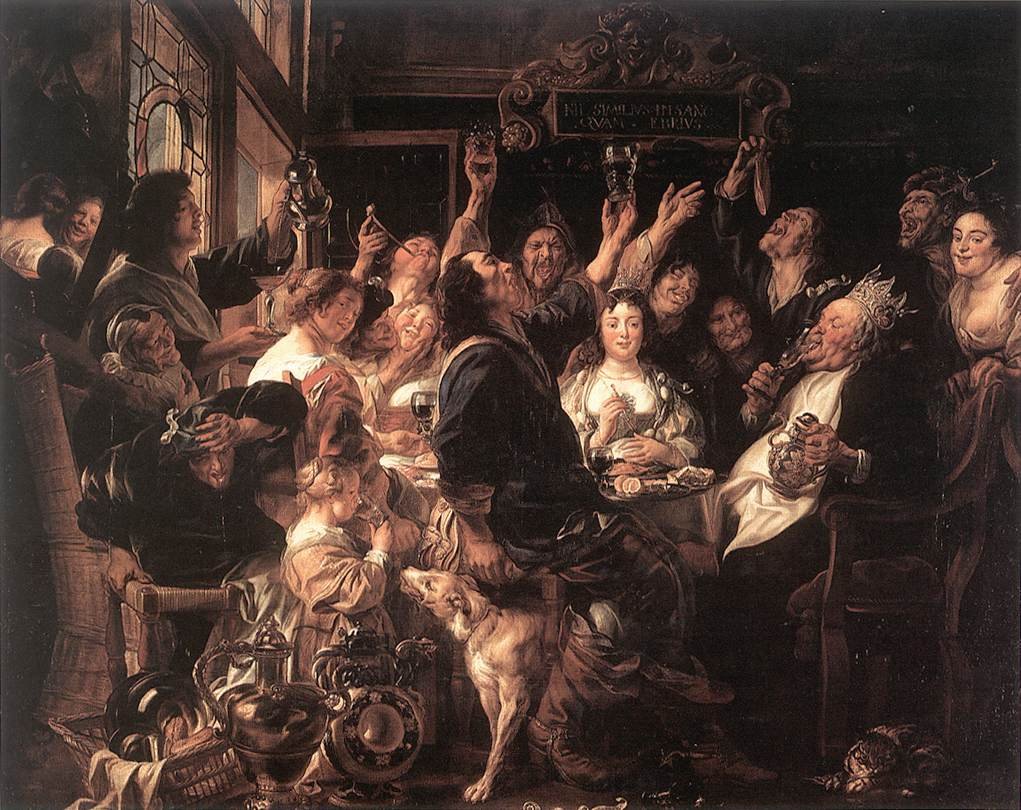
The Bean King by Jacob Jordaens

The Bean King by Jacob Jordaens (c.1665)
(Kunsthistoriches Museum Vienna)

My Daily Art Display today features the Flemish painter Jacob Jordaens.  He along with Peter Paul Rubens and Anthony van Dyck made up a triumvirate of great seventeenth century Flemish Baroque painters.  These three artists were in the forefront of the Antwerp School of painters, which was the artistic stronghold of Flemish Baroque art.

Jacob Jordaens was born in Antwerp in 1593.  He came from a very large family being the eldest of eleven children of his father Jacob Jordaens Senior, who was a wealthy linen merchant, and his mother Barbara van Wolschaten.  Coming from a wealthy family background it is assumed that young Jacob was afforded the best education.   This assumption is borne out by his clear handwriting and his competence in conversing in French.   In 1607, at the age of fourteen, he was apprenticed to the Antwerp painter Adam van Noort and he lived with van Noort and his family.  Fifteen years earlier, Rubens had been an apprentice of van Noort.   Adam van Noort was to be Jordaens only artistic tutor.  In 1615, aged twenty-two, and having completed his eight-year apprenticeship, Jordaens became a member of the Antwerp Guild of St Luke as a waterschilder.  A waterschilder was a painter of watercolours on canvas or paper which were then used as substitute tapestries.  A year later in 1616 Jordaens started to paint in oils.  His talent as an oil painter soon meant that he abandoned his watercolour work in favour of oil painting which was far more profitable.

In May 1616 Jacob Jordaens married Catherina van Noort, the eldest daughter of his tutor, and the couple went on to have three children, Elizabeth, Jacob and Anna Catharina.  Once married the couple moved from his father in law’s house to the Everdijstraat and two years later he had made sufficient money from his art to buy a house in the Hoogstraat, the very street in which he was born twenty five years earlier.   At the age of twenty-eight he was made the dean of the Guild of St Luke a post which he held for one year.

His father died in 1618 and his mother passed away in 1633.  On his mother’s death Jacob inherited Het Paradijs, the house in which he was born.  His artistic career at this point in time could not have been better.  Commissions for his work were flooding in and he became a leading light in Antwerp’s artistic circles.  Many of the commissions came from the authorities of the Catholic Church who wanted large altarpieces and he also designed several cycles of real, woven tapestries.

Between 1634 and 1638 he collaborated with Rubens on a number of commissions.  Jordaens continued to receive more and more commissions from wealthy patrons, including one for a series of twenty-two paintings from King Charles I of England in 1639.    His ever improving financial situation allowed him to have a new stylish home built next door to the one he had purchased in Hoogstraat and the two were combined to form one large residence affording him greater living space and studio work rooms.  Jordaens’ collaborator Rubens died in May 1640 and Rubens’ heirs approached Jordaens with a request for him to complete a commission for two paintings that Philip IV of Spain had given Rubens.  Jordaens fame as an artist grew throughout Europe and young aspiring painters came from many countries to study his techniques and work for him in his Antwerp studio.

In his later years, although a practicing Catholic, he clashed a number of times with the Catholic Church and his disagreement with some of the church’s beliefs.   In the 1650’s he was fined two hundred and forty pounds for publishing what the Catholic Church regarded as blasphemous and heretical writings.  In 1671, aged seventy-eight, Jordaens turned his back on the Catholic Church and was admitted into the Protestant faith, the Reformed congregation in Antwerp known as the Mount of Olives under the Cross.  As the Catholic Church was the only permitted religion in Flanders, which was under Spanish rule, the religious meetings of the Reformed Calvinist church were held secretly at worshipers’ homes, including the home of Jacob Jordaens.

Jacob Jordaens died on October 18th 1678, aged 85.  His death was from what has been termed a “mystery disease” and tragically, on that very day, this same disease struck and killed his unmarried daughter, Elizabeth, who lived with him.  Because Jordaens was now a Protestant he could not be buried in a Catholic cemetery in his home town of Antwerp and both father and daughter were buried together in the Protestant cemetery in Putte, a small village just north of the Dutch-Flemish border.  It is also in this cemetery that his wife, who died in 1659, was buried.

Have you ever heard the expression bean feast or beano?  My Daily Art Display featured painting today is all about the bean feast.  The term bean feast, often shortened to beano means a celebratory party with plentiful food and drink.  Today’s featured painting is entitled The Bean King and was completed by Jacob Jordaens around 1655 and was the fourth and last version he painted on this subject.  It is housed at the Kunsthistorisches Museum in Vienna.  The subject is the traditional Netherlandish feast held on January 6, the Day of the Three Kings or Magi, who came, according to the Gospels, to worship the Christ Child. Traditionally, a pie or cake containing a bean was baked for the festivities, and he who found the bean in his piece of pie or cake became Bean King. In this picture Jordaens showed the most joyful and noisy moment of the feast. Rich colouring and dynamic gestures emphasize the air of festivity.
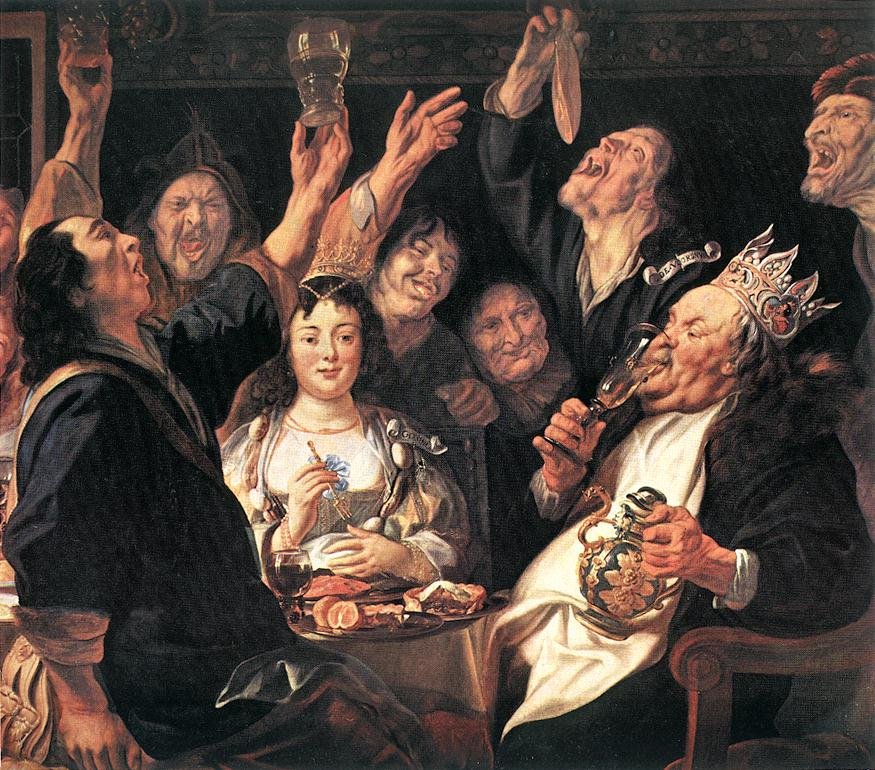
King for the day !!!

In the painting we can see a joyous and boisterous gathering sitting around a table, well stocked with food, and presided over by an old man with a crown on his head who, having found the bean in his slice of cake has been crowned the Bean King.  He has in turn chosen the prettiest lady in the gathering to be his Queen.  We see her as she sits demurely to the left of the king and seems to be overwhelmed by the whole occasion.  The rest of the group were appointed as the king’s courtiers by the newly crowned King.  The celebration meal would be punctuated at regular by the king raising his glass, as would the gathered merrymakers, and he would shout “The King drinks!”  at which time everybody else takes a swig of their drink.

There is an exuberant vitality about this work.  This painting is in the tradition of Pieter Bruegel the Elder and his tavern scenes, fairs and other over-indulgent festivities which were awash with unbridled merriment.  It is fascinating to look closely at the people in the gathering.   Take time and study the individual expressions on their faces.   On the left we see a man holding his head as he vomits.  Close by is a young child who has gained the unwanted attention of a large dog.  Whilst most of the men seem to be occupied in raising their glasses to the king, the one to the left of the queen grasps the chin of a young woman in a prelude to forcing a kiss upon her.   The cheeky looks we get from the women coupled with their low-cut neckline of their dresses would have us believe that they may be there to sell their wares to the highest bidders.  Old and young, sober and drunk are squashed together.  We are looking at a chaotic scene in a murky tavern atmosphere lit up solely by a shaft of light which streams through the window to the left of the painting.  This shaft of light seems to separate the revellers into distinct groups.   Jordaens has managed to depict an atmosphere of unrestrained emotion and merriment, giving each character expressive gestures and facial features.

In his interpretation, the everyday scene takes on a truly monumental character and can be read as an affirmation of life. The energetic composition with its warm golden-brown colouring marks out Jordaens as a follower of Rubens and one of the leading masters of the Flemish Baroque.  The final irony to this painting is a plaque on the wall above the heads of the revellers, on which is inscribed a moralizing Latin proverb:

 “No-one resembles the fool more than the drunkard”

The painting below is the version of The Bean King by Jordaens which he painted around 1638 and which can be found in the Hermitage Museum in St Petersburg.

The Bean King by Jacob Jordaens (c.1638)
(The Hermitage, St Petersburg)

Another version of The Bean King by Jacob Jordaens (below) can be found at the Staatliche Museen, Kassel.
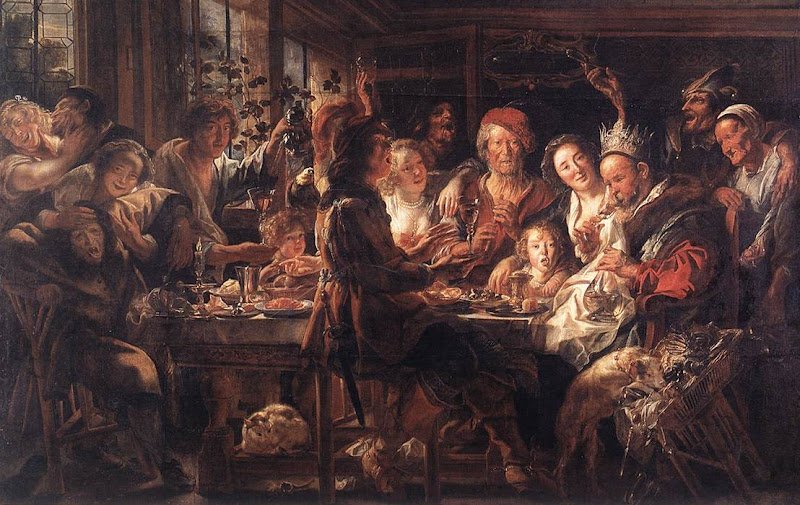
The Bean King by Jacob Jordaens (c.1635-55)
(Staatliche Museen, Kassel)
A View of the Westerkerk, Amsterdam by Jan van der Heyden

Today I am going to leave 19th century French art and Impressionism, which has featured in my recent blogs, and look at some 16th and 17th Dutch and Flemish art and artists.  Dutch art has always been very popular and admired for the realism it portrayed of everyday life and it has always proved to be highly collectible.  Before I look at some of the art of that time it may be interesting to look at a brief history of the region which has a bearing on the style of art.   I am probably laying myself open for criticism from Dutch historians for my understanding of this period of the history of the Netherlands and Holland but all I am trying to do is give you a brief insight into Flemish and Dutch art of the 16th and 17th centuries.

The Netherlands back in the fifteenth century was a conglomerate of the Seventeen Provinces often referred to as the Burgundian Netherlands, which included part of today’s Germany, Belgium, France and Luxembourg.  It was controlled from 1506 by Charles V who was the Holy Roman Emperor and also the King of Spain.   In 1556, Charles V abdicated and the power passed to his son, Philip II.  With Spanish rule came the imposition of the Catholic religion on the people of the Netherlands.  This policy of strict religious uniformity was imposed by the Inquisition with enormous amounts of brutality.  However the rise of the Protestantism in the forms of the Lutheran and Anabaptist movements and Calvinism were starting to gain ground with the populace.   The beginning of the break-up of Philip’s control of the Seventeen Provinces started with the Dutch people being unhappy at the high level of taxation levelled on them by Philip and his brutal repression of anti-Catholic movements.  To subdue the unrest, Philip sent his Spanish troops to the area under the leadership of the Duke of Alba and their presence and their cruelty further fanned the flames of rebellion.  Control of the vast area was becoming more of a problem for Philip, added to which there was now a threat coming from the French along the southern borders.  Philip II’s troops were moved from the north to the south leaving the north less well controlled and this led to the start of the Eighty Years’ War often termed as the Dutch War of Independence.   After the initial stages, Philip II deployed his armies and regained control over most of the rebelling provinces. However, under the leadership of the exiled William of Orange, the Northern provinces continued their resistance and managed to oust the Spanish armies, and established the Republic of the Seven United Netherlands, Holland, in 1609. The Dutch Revolt had officially ended and the Dutch republic of Holland was officially recognised by France and England. The end of the Eighty years War however did not end for another forty years.

The Netherlands was now split along an almost North/South divide.  The north, Holland, became a haven for Protestantism with Calvinism becoming the main religion.  There were no Catholic churches in this northern territory.   It soon became one of the world’s most economically powerful and wealthy maritime nations in the world and Amsterdam became its capital.   As far as far as art was concerned there was also a north/south divide.   The Spanish Catholic south, Flanders, with its capital Antwerp, still had most of its art commissioned by the Catholic Church or the Spanish Catholic rulers and would more often than not therefore depict religious scenes, whereas now the Dutch north where religion was mainly a Reformed Calvinistic one would not allow church’s money to be spent frivolously on the commissioning of art.   Dutch art had new patrons.  Now works were commissioned by the territory’s wealthy merchants and ship owners.  Often the subjects they commissioned had little to do with religion and more to do with their wealth and their status in society.

Today I want to feature an artist from the southern region, Flanders.  Jan van der Heyden was born in 1637 in Gorinchem, which now lies in south west Holland.  In 1650, when he was thirteen years old, the family moved to Amsterdam and lived in a house on Dam Square.   Sadly however, his father, who was a follower of the ethno-religious Mennonite group, died the year of their move.  Jan’s early artistic training began in Gorinchem with drawing lessons at his elder brother’s studio.  He also learnt, from a local artist, the reverse technique of glass painting.  Although we are looking at van der Heyden as an artist his overwhelming love was not art, although he continued to paint all his life, it was his love of engineering and inventions.   He was an artist but he also was an inventor and an engineer.  He designed many things such as the street lighting system in Amsterdam.  Shortly after he and his family moved to Amsterdam he witnessed a fire at the old town hall and the futile efforts that were made to hold back the flames.   He probably never forgot that incident for later, along with the help of his brother Nicolaes van der Heyden, a hydraulic engineer; he invented a fire engine fitted with pump driven hoses which was to change the effectiveness of fire fighting.

In 1661 Jan van der Heyden married and he and his wife moved to a house along the Herengracht, a fashionable area of Amsterdam.  As a painter, Jan van der Heyden, will always be remembered for his beautiful townscapes and his architectural designs certainly dominate these works.   Although he painted many townscapes he also painted scenes featuring village streets and country houses.  He loved to paint old and new buildings and paid particular attention to their facades.  He also completed more than forty landscapes although his landscape art was never in the same league as his contemporaries, Meindert Hobbema and Jacob van Ruisdael.   He worked in partnership with Adriaen van der Velde,  the Dutch animal and landscape painter, and Johannes Lingelbach, a Dutch Golden Age painter, who would often add figures to van der Heyden’ architectural scenes and add landscape effects as a finishing touch to the paintings.   His main subjects were Amsterdam and the region surrounding the Dutch-German border where he and his family visited on many occasions.

In 1672, Adriaen van de Velde died and Jan van der Heyden artistic output dwindled as he concentrated on his main employment that of superintendent of the lighting in Amsterdam and he also devoted much of his time as the director of the Amsterdam Fireman’s Guild.  He died a wealthy man in 1712, aged 75.

View of the Westerkerk, Amsterdam by Jan van der Heyden (c.1660)
(National Gallery, London)

My featured painting today is entitled View of the Westerkerk, Amsterdam.    The building work on the protestant church commenced in 1620 and was designed by the foremost architect of the time, Hendrick de Keyser, the father of the Dutch painter Thomas de Keyser.  The construction was completed eighteen years later and at the time its tower was the highest in the city.  Jan van der Heyden painting is of the church, seen from the east, across from the Keizersgracht, the new Emperor canal.  Buried within the church are the painters Nicolaes Berchem, Rembrandt and his son Titus.

There are two versions of this paintings housed in galleries in London.  Both were painted between 1660 and 1670.   In both cases these are, like many of his townscapes and landscapes, only loosely based on actual views as topographical accuracy was not in the forefront of his mind when he started to work on his paintings.  It was almost as if he wanted to bring into his painting all that was beautiful about the town, whether it be its landscape or its architecture.  It was simply an idealised townscape which I believe does not lessen the beauty of the finished work.  The difference between these paintings and others he did was that in View of Westerwerk, Amsterdam he has paid great attention to the detail of the buildings whereas in other townscapes the main buildings may look half finished with the emphasis being placed on surrounding structures and open spaces.

Let us look at the version which is at the National Gallery in London.  Look at the clarity of this work.  Marvel at the detail van der Heyden has put into this painting.  In the foreground we can see four wooden casings which protect the young tree saplings.  One can almost read the writing on the torn posters which have been affixed to the casings.   This version is much larger than the one in the Wallace Collection, measuring 91cms x 114cms and almost three times the normal size of van der Heyden’s previous works.  It is believed that it was commissioned by the governors of the Westerkerk, for their meeting room, where it remained until 1864.   I love the details of the red-brick buildings but look at the contrast in colour of them with how the artist has depicted the blue sky with all its luminosity, the yellow cobblestone path in the foreground which runs parallel to the stretch of the canal and the glass-like stillness of the water.  It is probable that another artist painted the people and animals shown in the work.

View of the Westerkerk, Amsterdam by Jan van der Heyden (c.1665-1670)
(Wallace Collection, London)

I went to the Wallace Collection last week and saw this other version of the painting.  It is much smaller in size, measuring just 41cms x 59cms.  The artist’s signature can be seen in the lower right on the coping of the canal wall.  To the left of the church is the Westmarkt and if you look carefully between the trees you can just make out the Westerhal, which housed a meat market on the ground floor and above it was a guard house.   The house which we see to the right of the church is Keizersgracht no, 198 and was at that time the residence of Lucas van Uffelen a wealthy Flemish merchant and art collector.  What is very striking about this small painting is the sharp contrasts of colour, light and texture with shadows slanting across the front of the church.  Look at the contrast between the angular roofs and the luminous blue sky.  See how the artist has contrasted the trees heavy in leaf with the red brick buildings and in the case of the house on the right of the painting, its whitewashed frontage.  In this painting, unlike the one at the National Gallery, the artist(s?) have depicted reflections in the still water of the canal.  It should be remembered that this painting was completed after the one which now hangs in the National Gallery and is probably a re-working of the scene.  It could be that Jan van der Heyden was not completely satisfied with his first effort and wanted to make some artistic improvements.

If you are in London, why not take a chance to visit both galleries and compare the two paintings and decide which you like the best.

Une loge aux Italiens (A Box at the Theatre des Italiens) by Eva Gonzalès

Une loge aux Italiens (A Box at the Theatre des Italiens) by Eva Gonzalès (1874)

I had intended this offering to be my previous blog but when I researched into today’s featured artist and her painting I saw there was a connection between this work of hers and a similar one completed by Renoir in that same year.  My Daily Art Display featured artist today is Eva Gonzalès and the work I want to look at is entitled Une loge aux Italiens (A Box at the Theatre des Italiens) which she completed in 1874.

Eva Gonzalès was born in Paris in 1849.  Her father was the novelist and playwright, Emmanuel Gonzalès, a Spaniard but naturalised French.  Her mother was a Belgian musician.  From her childhood she was immersed in the literary world as her parents house was often used as a meeting place for critics and writers.

Eva began her artistic career in 1865, at the age of sixteen, when she began to study art.  Initially she studied under Charles Joshua Chaplin, the French society portraitist, who ran art classes specifically for women in his atelier and who, the following year, would teach the American female artist Mary Cassatt.

Portrait of Eva Gonzalès by Manet

Just before her twentieth birthday in 1869 she became a pupil of Édouard Manet and also used to model for him and many of the other Impressionist artists.  It was whilst at his studio that she met Berthe Morisot who was also working with Manet and posing for some of his works.  There would seem to have been an intense  rivalry between the two females.  According to Anne Higonnet’s book Berthe Morisot, Morisot wrote to her sister about Gonzalès and Manet’s attitude towards her saying:

“… Manet preaches at me and offers me the inevitable Mlle Gonzalès as an example; she has bearing, perseverance, she knows how to carry something through, whereas I am not capable of anything.   In the meantime, he begins her portrait again for the twenty-fifth time; she poses every day, and every evening her head is washed out with black soap.  Now that’s encouraging when you ask people to model…”

Repose by Édouard Manet

One can easily detect Berthe Morisot’s jealousy of Eva Gonzalès in that passage.  The painting referred to by Berthe Morisot was entitled Portrait of Eva Gonzalès which Manet was working on and which he exhibited in the 1870 Salon.  It is now housed at the National Gallery, London.  At the same time that he was painting the portrait of Eva Gonzalès he was also painting a work entitled Repose which was a portrait of Morisot and which he also exhibited at the 1870 Salon, as almost a companion piece.  This portrait of Morisot can be seen in the Rhode Island School of Design, Museum of Art, Providence, Rhode Island.  As you can see by the passage above, Morisot was annoyed by Manet’s painting of Gonzalès.   What rankled Morisot the most was probably how Manet had portrayed the two young ladies.    So what could have annoyed Morisot about Manet’s depiction of her?  Look at the two paintings.  Both young women, both wear similar clothing, both have been portrayed as young and pretty but the one big difference is that Morisot is depicted half laying back on the sofa in what one could describe as a languid and idle pose whereas Eva is portrayed as a budding artist actively at work.   What also should be kept in mind is that Morisot did not look upon herself as merely a “pupil” of Manet.  For Morisot,  her relationship with Manet was almost as equals rather than master and pupil.  In her relationship with Manet, she was also much more forceful and self-confident than Gonzalès, who was more of a willing disciple of Manet and who would put up with Manet’s abrupt manner,  whilst continually absorbing his teaching.   Of course there was another significant difference between the two young women – age!   Eva was more than eight years younger than Morisot.

Unlike Morisot, but like her mentor Manet, Eva Gonzalès decided not to exhibit any of her work at the controversial Impressionist Exhibitions but she has always been grouped with them because of her painting style.   However, she did regularly have her work shown at the annual Salon exhibitions in the 1870’s.  Her works received mixed comments.  The critics who were supporters of the Impressionist artist liked her work.

Portrait of Jeanne Gonzalès in Profile by Eva Gonzalès

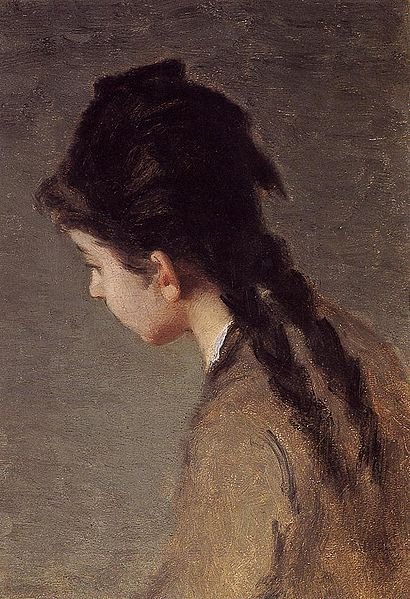
In 1869 Eva married Henri Charles Guérard, an etcher, lithographer  and printmaker, who was a close friend and sometime-model for Édouard Manet and who modelled for some of his wife’s paintings along with his sister-in-law Jeanne (La femme en rose, Jeanne Gonzelès).  In 1883, a month after her 34th birthday, she gave birth to a son, John.  Sadly, her life was cut short when she died following complications of childbirth.  It was believed to have been Puerperal Fever.    Her death came just six days after the death of her one-time mentor Édourad Manet.   Two years after her death a retrospective of Gonzalès’ work was held at the Salons de La Vie Moderne in Paris where over eighty of her paintings were put on display.

Five years later, in 1888, Henri-Charles Guérard  married Eva’s younger sister, Jeanne Gonzalès, also an artist.   My featured painting by Eva Gonzalès is entitled Une loge aux Italiens (A Box at the Theatre des Italiens) and you can obviously see the similarity between her painting and my previous offering entitled La Loge by Pierre-Auguste Renoir.  I decided to feature his first and then let you compare her painting with his.

As I discussed in my last blog, the auditorium of a  theatre and especially the theatre box were fashionable places for an exchange of society chit-chat and gave the theatregoers the opportunity to be seen at their best.  The subject of the theatre and theatre goers was a subject frequently chosen by the Impressionists, such as Cassatt and Degas but probably the most celebrated of this genre was Renoir’s La Loge (The Theatre Box) and it is interesting to compare it with this work by Eva Gonzalès which she completed in the same year, 1874.  This painting by Gonzalès was submitted to the Salon jurists for inclusion in the 1874 Salon but was refused.   Eva Gonzalès then made some changes to the painting and five years later submitted it to the 1879 Salon and this time it was accepted.  The critics loved the work.

There are some similarities to this painting of hers and that of her former tutor Édouard Manet in the way she, like him, chose to paint a modern-day subject and the way her painting, like some of his, shows a total contrast between the light colours of the clothing of the subject and the pale creamy skin of the female and the dark background.   In stark contrast to the dark velvet edge of the box , we see her white-gloved hand with its gold bracelet casually resting along it.   There is also an uncanny similarity between the bouquet of flowers that rests on the edge of the theatre box to the left of the woman in Gonzalès’ painting and the bouquet of flowers which Manet depicted in his painting, Olympia (see My Daily Art Display October 12th 2011).  The two people who were sitters for Eva’s painting were her husband, Henri Guérard and her sister Jeanne who as I said before was to become Henri’s second wife.

As was the case in Renoir’s painting we are left to our own devices as to what is going on within the theatre box. We need to make up our own minds as to what the relationship is between the man and the woman and to their social standing in society.  There is little symbolism to help us interpret the scene.  We just have to use our own imagination and sometimes that adds to the joy os looking at a work of art.

La Loge by Pierre-Auguste Renoir

La Loge by Renoir (1874)

Today’s featured work of art was not my original intended offering.  That sounds somewhat strange but actually there is logic to my decision.  I was researching a painting when I came across today’s work and there seemed, at least in my mind, a good reason to offer you today’s painting before I showcased my original work.

The French word La Loge in the context of a theatre means the theatre box and it has been the subject of a number of paintings.  Today I want to look at La Loge by Pierre-Auguste Renoir which he completed in 1874 and now hangs at The Courtauld Gallery in London.  Today this work of art by the Impressionist painter is looked upon as one of the most significant works of the Impressionist movement.  At the time of this painting it was estimated that over 200,000 theatre tickets were sold every week in Paris.  However, going to a Parisian theatre in the nineteenth century was not just about taking in the latest plays by the likes of Victor Hugo or Alexandre Dumas or the less formal vaudeville shows which were also very popular at the time, it was about being seen by other theatregoers.  Men would accompany and flaunt their wives or lovers.  Proud fathers would show off their daughters and “out-of-towners” would take the opportunity of dressing up and sample the Parisian lifestyle.   It was an almost indoor form of promenading, which was the leisurely walking in public places dressed in one’s finery and carried out as a social activity.  Attending  the theatre was a chance to showcase one’s most expensive clothes and accoutrements as well as parading one’s latest beau.  What could be more satisfying than to flaunt one’s wealth or one’s new lover?  It was a question of seeing and being seen and going to the theatre dominated the cultural life of the city.  As well as seeing actors on the theatre stage the theatregoers were actually quietly performing on their own  social stage.

Being seen

The way Renoir has depicted the scene in the theatre box sums up this attitude.  We see a lady and gentleman seated in their box.  Take a look at their demeanour.  Are they depicted as locked in concentration at what is happening on the stage below?  No they are not.  The lady stares out at us with her gloved hand holding her opera glasses and resting it on the lavish velvet frontage of the box whilst her other hand clasps a black fan and a white lace handkerchief in her lap.  Protocol of the day demanded that ladies must wear gloves on formal occasions.

Her face is now not hidden from view by her opera glasses.  She is revealing her face to all who may wish to gaze at her.   So how would you describe her?  Is there a delicate elegance about her or does she look rather brash.  She is without doubt beautiful and has little trepidation about letting people admire her from afar.  She wears a lavish dress, one she has probably saved for this very outing.  This is her tenue de premiere or opening-night attire.  Her costume would often be referred to as a robe à la polonaise or polonaise which was popular in the late eighteenth century and saw a was revival a hundred years later in the 1870’s.  It consisted of a fitted overdress which extended into long panels over an underskirt.  The magic of Renoir’s painting is that from a far one can see the three dimensional form of the dress with all its folds and yet up close it was just a series of brushstrokes.  It is almost magical the way the artist has painted this work.

The elegant dress oozes a sense of wealth but that is not the only thing which advertises the financial situation of the couple.   The style of the dress also oozes the ladies sensuality.  Note the position of the rose which immediately draws our eyes to the décolletage which emphasizes her cleavage. The low-cut neckline was a popular feature of evening gowns of that era.   Another rose placed in her hair once again draws our eyes to her simple but elegant coiffure.

Look at her neck and the pearl necklace she is wearing.  Also we can just make out a pair of diamond earrings dangling from her ears and if we look at the hand which holds her opera glasses we note a gold bracelet around her slender wrist.  The wealth is there for us to see but more importantly it is there for the other theatregoers to note.

This is a summation of the “seen and being seen” philosophy.  She is wanting to be seen in all her finery whilst he is concentrating on seeing.  Renoir used one of his regular models, Nini Lopez, as the model for the lady.

Seeing

The sitter for her male companion in the theatre box was Edmund Renoir, the brother of the artist.  He, like the lady, is dressed elegantly in his formal clothes.  Renoir has depicted him wearing a white shirt with a starched cravat, black trousers and gold cufflinks.  His attire, which is typical of that of the wealthy male theatregoer also exudes a sense of affluence but its plainness and subdued colour allows the more colourful female to be the centre of attention.

The aspect of this painting which we cannot be sure about and I will leave you to decide is whether we are seeing a husband and wife out for an evening at the theatre or are we looking a wealthy man accompanied by an elegantly dressed courtesan.  Can we deduce the truth from looking at the painting but beware of falling into the trap of being too judgemental !!!

Renoir exhibited this painting in the First Impressionist Exhibition which was held in the former studio of the photographer Nadar at 35 boulevard des Capucines in Paris on April 15, 1874.  This work, which gives us an insight into Parisian life in the late nineteenth century, is now hailed as a masterpiece of art and one of the most significant works of the Impressionist movement.  At the time it was exhibited it helped establish the reputation of Renoir.  The painting gives us an insight into life in the French capital during the late nineteenth century.

The Marriage of Strongbow and Aoife by Daniel Maclise

The Marriage of Strongbow and Aoife by Daniel Maclise (1854)

Today I am moving from France to Ireland for my featured artist.  I will be looking at the life of the Irish painter Daniel Maclise and one of his historical paintings which will allow me to take you back in time to the twelfth century and regale you about a happening at that time in Irish History, but first let me tell you a little about the artist.

Daniel Maclise was born in Cork in 1806 into a poor but thrifty Scottish Presbyterian family. His father, after leaving the British Army, became a shoemaker. Maclise was educated locally in Cork and attended the Cork Institute where he studied drawing.   Whilst still a teenager  he was introduced to the art connoisseur, George Newenham, and the antiquarian and merchant, Richard Sainthill and it was through Sainthill that Maclise became interested in medals, coins, and aspects of heraldry and he would often illustrate coin catalogues for Sainthill.

In 1825, when he was nineteen years of age, Walter Scott the novelist and playwright visited a local bookstore in Cork and Maclise made a sketch of him which was subsequently lithographed and the copies sold.  This was to launch Maclise’s artistic career and enhanced his reputation as a portraitist.

Maclise travelled to London in 1827 and started to put together a portfolio of his work which he submitted to the Royal Academy as part of his submission to become a probationary student.  He was accepted into the R.A. the following year and stayed on for a further three years during which time he was awarded a silver medal and a gold medal for his historical painting, Choice of Hercules.  Whilst in London Maclise mixed in the company of men who appreciated his artistic skills and in particular Dr William Maginn, the founder and editor of Fraser’s Magazine, a general and literary journal for which Maclise contributed portraiture and caricatures.  He became a friend of Charles Dickens and contributed a number of book illustrations for his novels.

In 1848 he was back in London after a period of time spent in Ireland.  He presented a cartoon, sketch, and fresco specimens to the Fine-Art Committee of the Palace of Westminster for their official competition to paint frescoes in the House of Lords.   They liked his work and he was chosen to paint The Spirit of Chivalry for the House of Lords in 1848. One year later he painted a companion fresco entitled The Spirit of Justice.    His big break came along in 1858 when he was commissioned to paint two giant commemorative frescoes for the Royal Gallery of Westminster Palace, The Meeting of Wellington and Blücher and The Death of Nelson. These two mammoth works were to be the greatest achievement of Maclise’s public career but sadly they were also to cause the deterioration of his health.   The two works took Maclise seven years to complete and he worked tirelessly on completing them on time.   The passionate and concentrated effort which he put into these two great historic works affected him badly.   He would shut himself away and shun his erstwhile friends.  The Royal Academy even offered him the Presidency in 1865 but he declined the invitation.  His health declined rapidly and in 1870, aged 64, he died of acute pneumonia.

My Daily Art Display’s featured painting today by Daniel Maclise is entitled The Marriage of Strongbow and Aoife and was completed in 1854.  I suppose the first thing you need to know is who are these two characters, Strongbow and Aoife, and why are they the centre of attention in the painting.

Strongbow was the nickname given to Richard de Clare the 2nd Earl of Pembroke who was born in Tonbridge, Kent in 1130.  He was a Cambro-Norman knight, that is to say, he was a descendent of the Norman knights who had eventually settled in southern Wales after the 1066 Norman conquest of England by William the Conqueror.  He had become the Earl of Pembroke on the death of his father in 1848 and had lands around Pembroke.

However fate was to take a hand in his destiny.   King Henry I of England died in 1135 and his only surviving offspring was his daughter Matilda, who at the time was pregnant in Normandy with her third child.  This gave her cousin Stephen of Blois, grandson of William the Conqueror, the chance he needed to usurp the English throne and he became King Stephen I of England and ruled until his death in 1154.  On his death, Matilda’s eldest son Henry was crowned King Henry II of England.   Unfortunately for Richard de Clare he made a bad decision in 1135 as instead of supporting Matilda’s claim to the English throne he supported Stephen’s claim and when Matilda’s son became King Henry II of England he took his revenge on Richard de Clare by stripping him of the title of the Earl of Pembroke.  Unbeknown to Richard his future lay entwined in what was happening across the Irish Sea as in 1167, Dermot MacMurrough, the king of Leinster, was defeated by Turlough O’ Connor, the king of Connacht.   Dermont hastily rushed to England and asked King Henry II for help .  Henry could not send troops but asked Dermot to approach Richard de Clare to help him in his war against Roderic.   Richard agreed to help on condition that he was allowed to marry Dermont’s daughter, Aoife and succeed Dermont as King of Leinster on his death.  With Richard de Clare’s help, Dermot was able to defeat the king of Connacht’s forces, who poorly armed with only slings and stones, where no match for  Richard de Clare’s army which relied heavily on Welsh archers, which is why Richard, who was an expert bowman,  received the nickname ‘Strongbow’.   Richard married Aoife in 1170 and when Dermont died the following year he became the new king of Leinster.   However back in England King Henry II was concerned with their power Richard now exerted in Ireland and so in late 1171 Henry and his troops crossed the Irish Sea and Strongbow was forced to surrender Leinster to Henry. The land was later returned to Richard de Clare in return for the service of 100 of his knights.

My Daily Art Display featured painting today is the large romantic historical oil painting (309cms x 505cms) entitled The Marriage of Strongbow and Aoife which was completed by Daniel Maclise in 1854 and is housed in the National Gallery of Ireland in Dublin.   It depicts the ruins of the captured city of Waterford, which is the setting for the arranged marriage of the daughter of Diarmuid Mac Murrough the King of Leinster to Richard de Clare. In the foreground of the painting we see bodies of the vanquished enemy heaped on top of each other.  To the left we see the broken-stringed harp, the instrument which symbolises Ireland.   In the central midground we see Richard and Aiofe.  The victorious Richard de Clare takes his bride’s hand whilst we see his foot on top of a Celtic cross, symbolising the crushing of the Irish enemy.  This would be the start of a long period of subjugation by the English for the people of Ireland.  Facing Richard is Aoife, his bride-to-be, behind who stand a line of her bridesmaids.  Facing us in the central midground is the local religious dignitary who, with his hand raised heavenwards, blesses the couple.  The father of the bride, Diarmuid Mac Murrough, King of Leinster, stands to the right of the priest.  In the background above the ruins of the city we see wounded men and bodies being carried away by their colleagues whilst women weep and mourn the loss of their men folk.

A truly remarkable painting with so much going on.   It is one of those paintings which every time you revisit it, you see something that you had not noticed before.

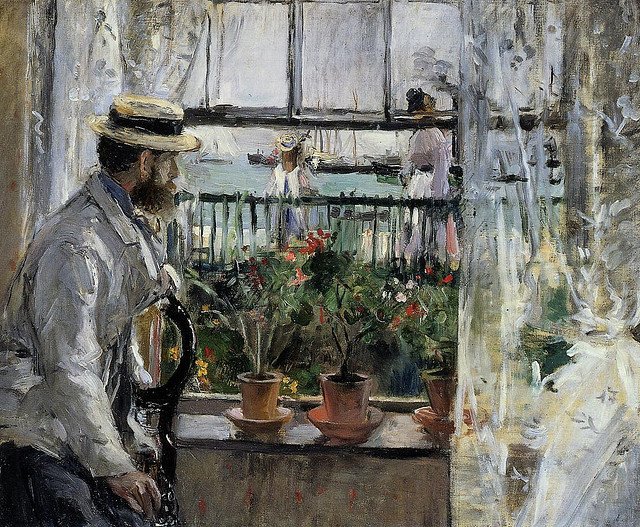
Eugène Manet on the Isle of Wight and Eugène Manet and His Daughter in the Garden by Berthe Morisot

Although I could write numerous blogs about Berthe Morisot and her works, this is not a Berthe Morisot site and therefore after today’s offering I will drag myself away from this talented artist and head for pastures new.  However today I want to focus on Berthe Morisot, her husband and her daughter and have a look at a couple of her paintings which portray the happy family.

As I wrote in my last blog, in 1868, Berthe Morisot had been introduced to Édouard Manet by Henri Fantin-Latour whilst she was working as a copyist at the Louvre.  Over time the Morisot and the Manet family became close friends and would exchange visits to each other’s houses and during this time Berthe became acquainted with Édouard Manet’s brothers, Gusatve and Eugène.

When her sister Edma married Adolphe Pontillon in 1869 she moved to Lorient and gave up painting.   For her, and despite having exhibited at four Salons, she considered her marriage was far more important than any thoughts she may have had of an artistic career. She was determined to channel all her energy into her marriage, playing the role of a supporting wife to her naval officer husband and being a loving and devoted mother to their children.  On the other hand, Berthe on her marriage to Eugène Manet in December 1874 was adamant that the change in her marital status would not affect her art.  She continued to paint as prolifically as before and kept signing her works in her maiden name.  In many ways she was fortunate that Eugène’s attitude to her work was one of support and often when Berthe set off on painting trips he would accompany her and dabble a little in art himself by making a few sketches.  Berthe was also fortunate not to have any money worries and this allowed her to pursue her artistic career without being anxious about where the next centime was coming from.

Eugène Manet on the Isle of Wight by Berthe Morisot (1875)

My Daily Art Display featured painting today, which is housed in the Musée Marmottan Monet in Paris, is entitled Eugène Manet on the Isle of Wight and is one which Berthe Morisot completed in 1875 when she and her husband spent the summer in Cowes on the Isle of Wight on their honeymoon.  This, at the time, was a favoured holiday destination for the English high society.  They visited the town of Rye several times before they moved on to London.  Whilst on the Isle of Wight Berthe spent most of her time painting.  Often she and Eugène would be seen leaving their lodgings carrying easels and paint boxes which they would position at some site of natural beauty and spend the day recording the beauty of the island.   Often Berthe would set up her easel in their hotel room and paint what they could see from their window.  Today’s work is an example of just that.  She managed to persuade Eugène, with some difficulty, to pose for her looking out of the window.   She wrote to Edma about the problems of getting her husband to pose, saying:

“…I began something in the sitting room with Eugène; poor Eugène is taking your place; but he is a much less accommodating model; he’s quickly had enough…”

The view from the window is of the port of Cowes but the painting is all about her husband Eugène Manet and the little cottage garden in front of the residence.  It is interesting to observe how Morisot has painted the window panes and the gauze curtains to convey transparency.  The flowers in the garden and the potted plants on the window sill add a dash of colour but in the main Morisot has used muted greys, blacks and blues in her work.  There is a grid-like structure to the painting with the vertical and horizontal lines of the window frame, window sill and garden fencing as well as Eugène’s boater.  Apparently Morisot found it quite difficult to paint this kind of picture and found the task both frustrating and in some ways depressing.  This again is an example of Morisot’s perfectionism and the problems inherent in that state of mind.  She wrote to Edma about the work saying:

“…The view from my window is very pretty to see, very ugly to paint; views from above are almost always incomprehensible; the upshot is that I am not doing very much, and the little I do looks frightful…”

Eugène Manet and His Daughter in the Garden by Berthe Morisot (1883)

In November 1878, almost four years after Eugène and Berthe married, Berthe gave birth to a daughter, Julie, who was to be their one and only child.  Berthe featured her daughter prominently in many of her future paintings as did her sisters and family members.  I particularly like the painting she did in 1883, entitled Eugène Manet and His Daughter in the Garden.  The setting is the garden on the Bougival estate where they were staying that summer.  Unlike some of her works which also featured her husband and daughter, this painting depicts a more private world of Eugène and Julie.  Eugène is dressed casually in an artist’s smock with a straw hat atop his head.  Julie, dressed in her light blue summer dress, sits by the pond watching her tiny red sailing boat drifting on the water.  There is no sign of their house in the painting but the natural setting enhances the loving father/daughter relationship.   Morisot had always intended the painting to be a private family work and no doubt for that very reason she never exhibited it during her lifetime.  It was not seen by the public until 1896, a year after her death.  The work was one of her daughter’s particular favourites,  as Julie commented on the scene with her father saying:

“..he gazes with a father’s eyes on the little blonde girl in a white dress who is intent on getting boats to move around the pond…”

I will now leave the life and paintings of Morisot for a little while but will undoubtedly return to showcase some of her other beautiful work at a later date.  If you are interested in Berthe Morisot and her life I suggest you read Berthe Morisot by Anne Higonnet, which gives a fascinating insight into Berthe Morisot’s life, her family and the people she mixes with.  It is a great read.

Portrait of Cornélie Morisot and Edmé Pontillon (Mother and Sister of the Artist) by Berthe Morisot

Portrait of Cornélie Morisot and Edmé Pontillon (Mother and Sister of the Artist) by Berthe Morisot (1870)
” Your daughters have such inclinations…they will become painters. Do you realize what that means? In your environment of the upper middle class this will be a revolution, I might almost say a catastrophe.   Are you sure that you will never curse the day that art will become the only master of destiny of your two children? “

That was the question Joseph Guichard, art tutor of Berthe and Edma Morisot, asked their mother.  Did she really want her two daughters to strive to become professional artists?  In that era, although artistic ability and aptitude were encouraged of young ladies there was a definite line between the professional and the amateur artist and it was a line which was both very precise and thickly drawn.  Women could spend their time “playing” at art as amateurs but for a woman to want to become a professional artist was often both derided and frowned upon.   Their mother, Marie Cornélie Morisot, however, was adamant that the girls should carry on with their chosen careers even if it meant they had to perform twice as well as their male counterparts just to get recognised as professional painters.  Berthe and Edma’s parents were very supportive and gave constructive encouragement to the painting aspirations of their daughters.  Their father had a studio built in the garden for Edma and Berthe to work in and his wife made sure that she went to all of their exhibitions where she carefully listened in on the viewers’ comments, and reported her findings back to the girls.

As I mentioned at the end of my last blog, the twelve-year painting partnership of the two sisters came to an end in early 1869 when Edma Morisot married a naval officer, Adolphe Pontillon.  There was a close relationship between the two Morisot sisters, both in their personal and artistic lives. Only two examples of Edma Morisot’s work survives, one is an 1863 portrait of her sister Berthe at work which was the featured painting in my last blog (My Daily Art Display, April 9th 2012).   Whether it was Edma’s marriage to Pontillon in 1869 or the start of the Franco-Prussian War the following year but something caused Berthe to seriously review both her personal and artistic life.  Although her sister had married and decided to forego her art, Berthe decided that she would stay single and concentrate on her artistic career.  Berthe was a perfectionist and was continually evaluating her work and, if anything, she was utterly self-critical and constantly questioned the value of what she had painted, and this was despite having her works accepted by the jurists of the Paris Salon.

Berthe Morisot was a copyist at the Louvre and it was here one day in 1868 that she met the French painter, Henri Fantin-Latour, who in turn introduced her to the painter, Édouard Manet.  Berthe was soon persuaded to become one of Manet’s models and during their long and close friendship he painted no fewer than eleven portraits of her. Édouard Manet was one of the new generation of artists who was unhappy with the Salon and the way the jurists held sway over what paintings would be allowed into the Salon’s  annual exhibitions.  Two of his works put forward to the jurists of the Salon had caused controversy.    His paintings Olympia (My Daily Art Display Oct 12th 2011) and Le Déjeunier Sur L’herbe (My Daily Art Display Dec 23rd 2010)  were controversial enough for them to be excluded from being exhibited at the Salon and in an act of retaliation, he chose to enter them into his own exhibition, in which he made his work The Balcony the main attraction.  This 1869 work featured a number of people on a balcony, one of who was Berthe Morisot, whom he had persuaded to pose for the work.  Berthe Morisot became friendly with the Manet family and the Morisot and Manet families socialised regularly.  Six years later Berthe Morisot married Eugène Manet, Édouard’s younger brother.

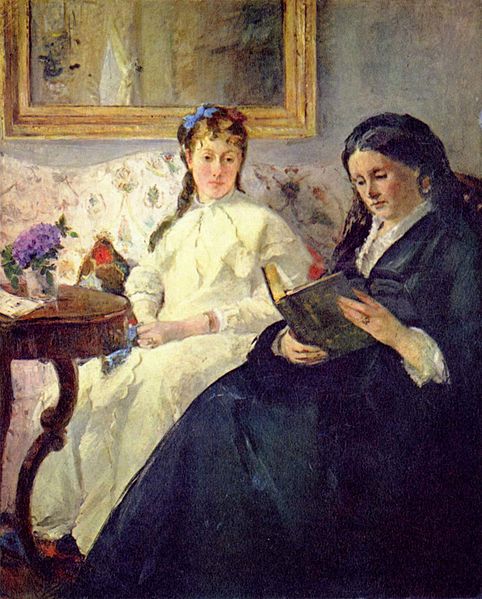
Edma Pontillon, née Morisot,  became pregnant with her first child at the end of 1869 and for a time that winter she returned to the family home to receive some comfort and support from her family whilst she waited for the birth of her first child.  For My Daily Art Display featured oil on canvas painting today, I am going back to that winter of 1869 and the return of the pregnant Edma Morisot to the family household.  It was during that stay that Berthe painted her mother and sister sitting together.  The painting, completed in 1870, is entitled Portrait of Cornélie Morisot and Edmé Pontillon (Mother and Sister of the Artist) and was one of her largest works which now hangs at the NGA Washington.   

It is a family portrait and in it she has portrayed her mother, Marie-Cornélie Morisot, reading whilst her sister, Edma, sits close by, within the family’s drawing room. We see the mother is concentrating upon reading her book and looks as if she is oblivious to her daughter’s presence.  Edma is portrayed with a dazed expression, in an almost dream like state, totally in a world of her own.  Again,  as I have asked on other occasions, look at the face of the daughter, what do you detect from her expression?  Why has her sister depicted her in this way?  To me her facial expression is a study of contemplation, almost meditation.   Maybe she is lost in thought with the arrival of her first child and considering what her future life will be like. Maybe her mother is reading out aloud and she is simply concentrating on her mother’s words.   Is Edma a young mother-to-be?  Look at her.  What age would you think she is?  Barely out of her teens or in her early twenties?  She in fact is not as young as her sister has depicted her as she was born in 1839 and at the time of the painting had had her thirtieth birthday.  The pure white colour of Edma’s dress is voluminous enough to hide the fact that she is pregnant,  as at the time Berthe, no doubt, had thoughts of having the work accepted for the Salon and she probably realised that depicting a pregnant woman would not please the jurists.  The virginal-white colour of Edma’s dress contrasts with the black one worn by her mother, who could be still in mourning for the death of her own mother, Marie-Caroline (Mayniel) Thomas earlier that year.

The painting was exhibited at the Salon of 1870 and it is thought that she also included it in the first exhibition held by the Impressionist painters in 1874.  The lead-up to Berthe putting forward the painting to the Salon jurists is an interesting tale, as the ever self deprecating Morisot was in two minds whether to even exhibit it.  In the end she approached Édouard Manet for his advice as to whether to submit the work.  He called at the Morisot household on the deadline day for Salon submissions to inspect the painting.  In one of Berthe’s letters she wrote about this inspection and told how Manet said nothing but instead extensively repainted the figure of the mother!  Berthe was mortified by what Manet had done and now wondered even more whether she should submit the painting to the Salon jurists.  She told her mother what had happened and of her dilemma with whether to exhibit the work as now it had been partly done by Manet, saying that she would “rather be at the bottom of the sea” than for this picture to appear at the Salon.  She went on to describe to her mother what had happened when Manet started to touch-up her work:

“…it isn’t possible to stop him; he passes from the petticoat to the bodice, from the bodice to the head, from the head to the background.”

She did put it forward for the Salon exhibition and it was well received.

Berthe Morisot by Edma Morisot

Berthe Morisot by Edma Morisot (1865)

For the next few blogs I want to look at the life and works of Berthe Marie Pauline Morisot and some of the paintings other artists have done of her.  As I told you in my last offering I visited the Musée Marmottan Monet last week whilst in Paris and they were currently staging a retrospective of her work.  I have already featured one of her works, Le Bercau (The Cradle) in My Daily Art Display of August 10th 2011 and briefly told you about her life.  Today I am going to look again at her early life and feature a painting, not by the artist herself,  but a stunningly portrait of her, painted by her sister, Edma.

The world of French art between 1839 and 1841 was surely blessed as it was in that two-year period that the world witnessed the birth of four of the greatest French artists.  Paul Cezanne was born in January 1839, Claude Monet was born in November 1840 and Berthe Morisot and Pierre-Auguste Renoir were born in January and February 1841 respectively.  Berthe Morisot was born in Bourges, a city in central France.  She had distant roots in French art as she was an indirect and distant descendent on her father’s side of none other than the French Rococo painter Jean-Honoré Fragonard and the French 18th century female painter, Marguerite Gérard.  Berthe was one of four children.  She had two sisters, Marie-Elizabeth Yves born in 1838, known simply as Yves and Marie Edma Caroline born in 1839, known simply as Edma.  She also had a younger brother, Tiburce, born in1848.  Berthe was brought up in a successful and financially secure household.  Her mother was Marie-Cornélie Thomas, who came from a family of high level government officials, chief treasurers and paymasters of the province.   Her father was Edmé-Tiburce Morisot, who was an architectural graduate and who at the age of twenty-six founded an architectural journal.  However the venture collapsed when his co-founders absconded with all the money and left Tiburce to face the creditors.  He eventually had to hurriedly leave town, leaving all his furniture and possessions to his landlord in lieu of rent, and fled to Greece.  A year later in 1835 he returned to France penniless but his good looks and charm won him the hand of Marie-Cornélie in marriage.  She was sixteen years old and he was thirteen years older.   Marie’s father, who was the personnel director at the Ministry of Finance, managed to arrange employment for Tiburce Morisot as subprefect at the city of Yssingeaux, in the Haute-Loire region.  Tiburce worked hard and soon impressed his employers.  Promotions followed and at the time of his daughter Berthe’s birth, he was the prefect of the Department of Cher, the monarch’s chief administrator for the entire province.

In 1848 when Berthe was just seven years of age, because of the Third French Revolution which eventually led to the creation of the French Second Republic, Berthe’s father decided to move his family from Bourges to the Parisian suburb of Passy.   When Berthe was aged sixteen years of age, her mother, Marie-Cornélie Morisot decided to enrol her three daughters in private drawing classes.  At that time the prestigious École des Beaux-Arts would not admit female students and maintained that sexist doctrine until the last few years of the nineteenth century.  The sisters’ first tutor was Geoffroy-Alphonse Chocarne who taught the girls the fundamentals of drawing.  Yves love of art waned quickly and she gave up on her art tuition after a few months leaving just Edma and Berthe to carry on with their artistic studies.

Edma and Berthe then enrolled to study with Joseph Guichard, who had once been a student of Ingres and now lived in the same street in Passy as the Morisot family.  Guichard taught the girls all about classical art in the academic tradition.  He was there tutor from 1857 and 1860 and in 1858 Berthe registered as a copyist at the Louvre.  It was under the guidance of Guichard that Berthe Morisot first experimented in oil painting.  En plein-air,  painting outdoors in natural light,  became very important to the Impressionist painters and those from the Barbizon School and the two girls told Guichard that they wanted to learn more about that technique and so, in 1863, in consultation with Jean-Baptiste Camille Corot, a leader of the Barbizon School of painters it was arranged that the girls would study under Achille Oudinot, the French landscape painter.  In the spring of 1864 after seven years of intensive artistic training Berthe and Edma Morisot were admitted to the official Salon.  Berthe would exhibit at the Salon regularly and Edma would until her marriage in 1869 at which time she virtually gave up painting.

It is said that behind every great woman, there is another woman, often a close relative.  In nineteenth century England we saw it with the likes of the talented Bronte sisters who had each other for constructive critical support.  Although Morisot’s upbringing in a wealthy household bears no resemblance to the upbringing of the Bronte sisters,what she did have in her formative years, similar to the Bronte sisters, was the luxury of having a very loyal and supportive sister.  Standing unwaveringly behind Berthe was her sister Edma.  The sisters’ artistic collaboration came to an end in 1869, when Edma married her husband, Adolphe Pontillon, a naval officer.  In some ways Edma regretted the end of their artistic partnership and the close friendship which came with it.  They kept in contact by letter and in one Edma wrote:

“…I am often with you in thought, dear Berthe.  I’m in your studio and I like to slip away, if only for a quarter of an hour, to breathe that atmosphere that we shared for many years…”

Berthe Morisot with a Bouquet of Violets by Édouard Manet (1872)

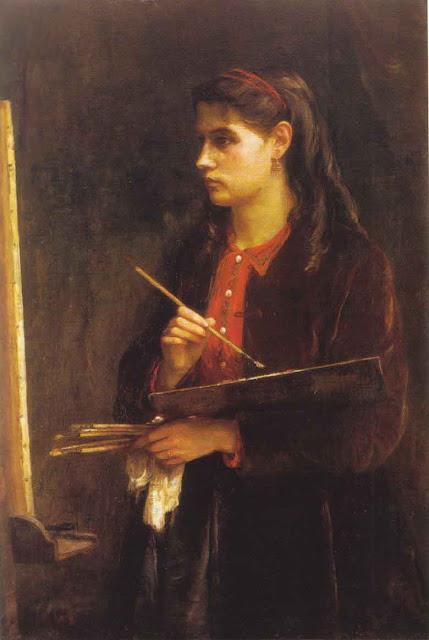
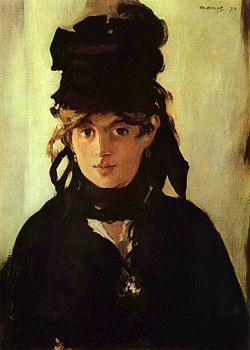
And so I come to today’s featured painting.  There have been many portraits painted of Berthe Morisot , probably the best known being the one of her entitled, Berthe Morisot with a Bouquet of Violets which was painted by her brother-in-law, Édouard Manet in 1872 and which is housed in the Musée d’Orsay.  I have always thought that his has made her look rather dowdy, so today I have featured one of my two favourite portraits of the artist.  This one is simply entitled Berthe Morisot and was painted by her sister Edma in 1865 and is held in a private collection.  This beautiful portrait in some ways bears out the close relationship between the sisters and reveals the shared interest both had in painting.  In this work Edma has depicted her sister Berthe holding her palette and brush concentrating earnestly at the picture she is painting.  Look how well Edma has captured the intensity in Berthe’s expression.  Our eyes are immediately drawn to the face of Berthe, which is bathed in light and which contrasts well with the darkened background and also echoes the whites of the side of the canvas and the rag she holds.  This painting of Berthe Morisot depicts her indisputable beauty which often other portraits fail to achieve.  This is indeed a portrait of an extremely delightful young woman in her mid-twenties and one I fell in love with when I first saw it.

Musée Marmottan Monet in Paris

Musée Marmottan Monet

For my blog today I am not showcasing an artist or a painting but a small museum , the Musée Marmottan Monet, which I visited last week when I was in Paris and I hope that for any of you who are intending to visit the French capital and want to take in some of its artistic heritage you will make time to visit this museum.  I can assure you that you will not be disappointed.  The museum is situated at 2 rue Louis Boilly in the vibrant and colourful 16th arondissement and is easy to get to as there are two nearby Metro stations, La Muette and Ranelagh.

I have often advocated that when one goes to London one should not always head for the major art galleries such as the National Gallery or the two Tate galleries as they are so big that one has no hope of seeing everything in one session and trying to often means that you skimp on the time each painting deserves.  A better plan of action if your time is limited is to go and visit one of the smaller galleries.  In London one has the Wallace Collection, the Courtauld Gallery and the Dulwich Picture Gallery, to mention just a few.  So to practice what I preach, when I was in Paris last week I didn’t revisit the Louvre or the Musée d’Orsay, instead I visited, for the first time, the Musée Marmottan Monet and it was unquestionably a most worthwhile visit.

The building was originally constructed as a hunting lodge for the Duke of Valmy and a few years later was sold to Jules Marmottan which on his death along with all his belongings was bequeathed to his son Paul.  Paul Marmottan later built a small pavilion in the courtyard as the original building was too small to house all of his paintings, furniture and bronzes.  Paul Marmottan bequeathed his home and collection to the Académie des Beaux-Arts, which opened up the house and collection as the Museum Marmottan in 1934.

If you like the work of the Impressionists and in particular the works of Claude Monet then look no further as this museum houses the largest collection of Monet’s work in the world and this is partly due to the fact that Monet’s youngest son Michel donated his father’s paintings from Giverny to the museum.  The building originally had two floors, the ground floor and an upper floor but to exhibit all the works they had to build a large underground room.  A number of bequests to the museum over the years have filled the building with beautiful and priceless art treasures.

The Duhem Collection was bequeathed to the museum by the daughter of the French painter, Henri Duhem.  These included works by Boudin, Caillebotte, Corot, Gaugin,  Monet and Renoir.  In 1980 an amazing group of illuminations spanning the 13th to 16th century was donated to the museum by Daniel Wildenstein.  The collection is exceptional for both the quantity and quality of the works.  There are over three hundred miniatures.  In 1996 the museum received an extraordinary donation from Annie Rouart.  Her husband was Denis Rouart, the grandson of Berthe Morisot and Eugène Manet.  Among the paintings given to the museum by Annie Rouart were masterpieces by Degas, Manet, Monet and Renoir and of course works by the famous female Impressionist Berthe Morisot.

Berthe Morisot Exhibition

For those of you who love the work of Berthe Morisot, and I include myself in that particular fan club, there is currently running a brilliant exhibition of her work.  It is housed in the basement.   It opened on March 8th and runs until July 1st 2012.  It presents the first major retrospective of the work of Berthe Morisot to be held in Paris for almost half a century.  One hundred and fifty paintings, pastels, watercolours and drawings in red chalk and charcoal, from museums and private collections all over the world, retrace the career of the Impressionist movement’s best-known woman painter. Works which have been selected for the exhibition cover the whole of Berthe Morisot’s artistic career, from her earliest works around 1860, to her untimely death at the age of 54, in 1895.  In my next few blogs I will feature a few  of the many paintings I saw when I walked around the museum.

Pablo Picasso – The early days, Part 1

Having returned home from a four-day vacation in Paris I need to catch up with writing my blog.  In my last blog I promised two entries with regards the life and works of Picasso and so, true to my word that is what I will give you.  Before I start I have a terrible admission to make.  I do not like the works of Picasso.  Yes, I know that is artistic anathema but at least I am honest.  I suppose the one caveat to that controversial assertion is that it is the later works of Picasso which I do not like and so my next two blogs will cover some of his earlier paintings and the fascinating beginnings to the Spanish artist’s life.

Pigeons by José Ruiz Blasco (Picasso's father) 1888

It was 11:15pm on Tuesday October 25th 1881 that Picasso was born in Malaga, Spain.  His father was Don José Ruiz y Blasco, a painter of birds in their natural habitat, especially pigeons, and who at the time was a professor of drawing at the Escuela Provincial de Bellas Artes in Malaga and a curator at the local art museum.  Picasso’s mother was Maria Picasso y Lopez.  He was the first-born of their children.  He was baptised Pablo Diego José Francisco de Paula Juan Nepomuceno María de los Remedios Crispiniano de la Santísima Trinidad, honouring a number of saints and some of his relatives.  To that already long name was added the names of his father “Ruiz” and his mother “Picasso” which was a requirement of Spanish law.  He was known simply as Pablo Ruiz.  Picasso’s father’s marriage to his wife was considered at the time as his father marrying beneath himself as he was from minor aristocracy and had a much higher standing in the community than that of his wife who was also without a dowry.  Although she brought no money into the relationship she did bring energy and thriftiness which was to serve her husband and family well.  Another thing Maria brought to the marital home was a bevy of females – her family, which consisted of her widowed mother and two unmarried sisters, Eladia and Eliodora along with a maidservant and so the young Pablo was brought up in a household full of women, all of whom were devoted to the little boy.

In late December 1884 Picasso’s sister, Lola was born, just three days after the devastating earthquake which destroyed large parts of the city of Malaga, killing almost eight hundred people and destroying 4000 homes.  The Picasso family fled the city and temporarily took refuge at the house of his father’s employer.  One wonders whether the young Picasso associated giving birth with the cataclysmic earthquake !   A second sister, Concepcion, was born when Pablo was six years old.  In 1891 the art museum which Picasso’s father had been its curator had closed down and as this was the main source of his income the father decided, for economic reasons, to uproot his family from Malaga an move everybody to La Corunna in the far north west of the country where he had gained employment as a teacher at the Guarda School of Fine Art.  By now, Picasso, aged almost eleven had developed a talent for drawing and his artistic skills blossomed to the detriment of his normal school work.  His father realised that his young son’s artistic talent would soon outshine his own and decided to transfer his own ambitions to those of his son and concentrated on getting his son, and now protégé, the very best artistic training.

In late 1894, when Picasso was barely thirteen years of age, tragedy struck the family with his four year old sister, Conchita, contracting diphtheria.  The young Picasso related years later that at this time he entered into a bargain with God that if he spared his sister’s life then he would give up all thoughts of painting again.   The fact that she was dying was concealed from Conchita and the family, for her benefit, celebrated the Christmas period as usual but sadly on January 10th 1895, she died.  Picasso was devastated by the death. In Arianna Stassinopoulos Huffington’s biography of Picasso entitled Picasso: Creator and Destroyer, she relates a conversation the artist had with his young lover Françoise Gilot, during which he tells her about his bargain with God with regards the life of his sister and his artistic career and the dilemma that had encompassed.  Huffington explains the thought process of the guilty Picasso regarding the prodigious bargain he had made with God saying:

“…he was torn between wanting her saved and wanting her dead so that his gift would be saved.  When she died, he decided that God was evil and destiny an enemy.   At the same time he was convinced that it was the ambivalence that had made it possible for God to kill Conchita.  His guilt was enormous, the other side of his belief in the enormous power to affect the world around him.    And it was his compounded by his primitive, almost magical conviction that his little sister’s death had released him to be a painter and follow the call of the power he had been given, whatever the consequences…”

In September 1895, the family made the sea passage from La Corunna to Barcelona, stopping off in Malaga to visit relatives.  Once in Barcelona, Pablo entered the local art academy, La Llojta School of Fine Arts, where his father had just gained the post as professor of drawing.   As far as Picasso and his father were concerned this was a great move as they were leaving the northern provincial town of La Corunna and moved to the great artistic centre of the Catalan capital.   Barcelona was the making of the adolescent Picasso.  It is in the Catalan city that Picasso starts to look into two utterly diverse worlds, the world of religion and the world of sex.  Pablo often received religious guidance from his wealthy and devout uncle, Doctor Salvador Ruiz, who would also aid him financially and who first met with young Pablo at his birth when he breathed life into what, at first, was considered to be a still-born baby.  His sex education comes to the fourteen year old Picasso by way of his frequent visits to the city brothels in the Barrios Chino.

First Communion by Pablo Picasso (1896)

In 1896, after a lot of persuasion from his father and probably through the good auspices of his father, Picasso entered a painting, entitled First Communion, into a major art competition, the Exposicion de Bellas Artes, in Barcelona, which was a means for young aspiring Catalan artists to exhibit their works of art.  His father posed as the model for the father in the painting and his sister Lola posed as the First Communicant.  The son of a friend of his father posed as the altar boy.  Picasso was just fourteen years of age when he painted this work.  He not only concentrated on the three individuals but spent a similar amount of time in depicting the still-life floral arrangement, the candelabra and the altar cloth.  The painting did not win a prize at the exhibition but for a fifteen year old having his work accepted into the exhibition with such aspiring artists was an honour in itself and his road to artistic fame had begun.

Science and Charity by Picasso (1897)

It was his father’s belief that his son would achieve success as an academic painter, and this heartfelt belief started to bear fruit in 1897 with Picasso’s painting entitled Science and Charity, which was awarded an honourable mention in Madrid at the General Fine Arts Exhibition.   Picasso’s father once again poses as the man in the painting, this time, the doctor whose skill and knowledge will determine the patient’s fate.  Picasso commented on the use of his father in his early paintings and how it remained with him all his life, saying:

“…Every time I draw a man, I think of my father.  To me, man is don José, and will be all my life…”

The painting did not win any medals but received an “Honorable Mention” albeit the critics were not happy with the way Picasso had depicted the woman’s hand which lies limply at the side of the bed.  The dark coated doctor at the bedside symbolises learning, literature and science whilst the religous nun symbolises all that is good, succour and charity.     Although put up for sale in Madrid the work was not sold and Picasso and his father presented the work as a gift to Picasso’s Uncle Don Salvador Ruiz whilst spending their summer vacation with his family.  The painting is now housed at the Picasso Museum in Barcelona.

It was during this summer sojourn that Don Salvador and Picasso’s father planned the next step in Picasso’s career and managed to gather together enough money from their relatives in Malaga to send Picasso to the Royal Academy in Madrid but as you will see in the next blog their plans failed.

My next blog will look at the adolescent Picasso developing an independent spirit, free of parental control.  I will also look at some of his early friendships and yet another tragedy which was to remain with him for the rest of his life.