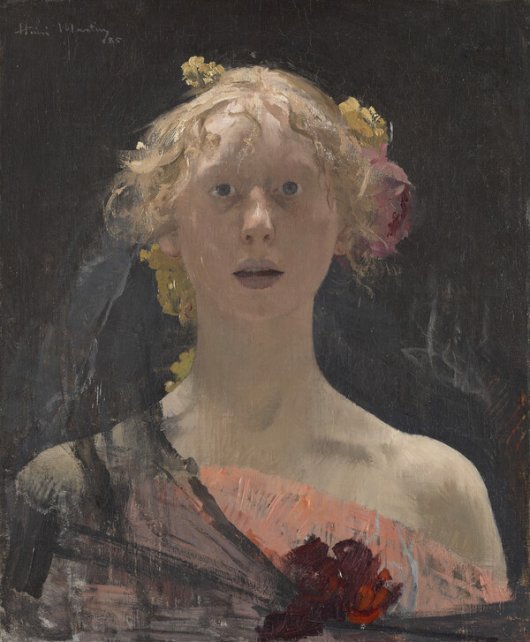
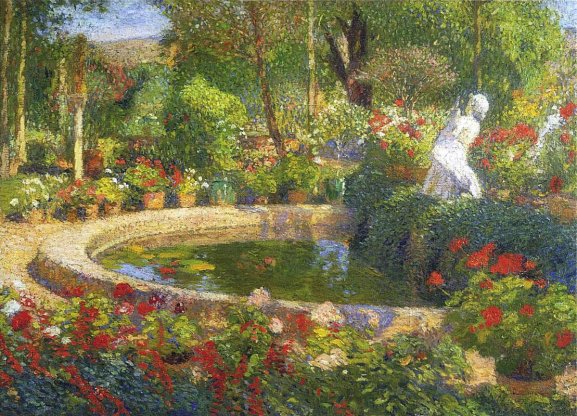
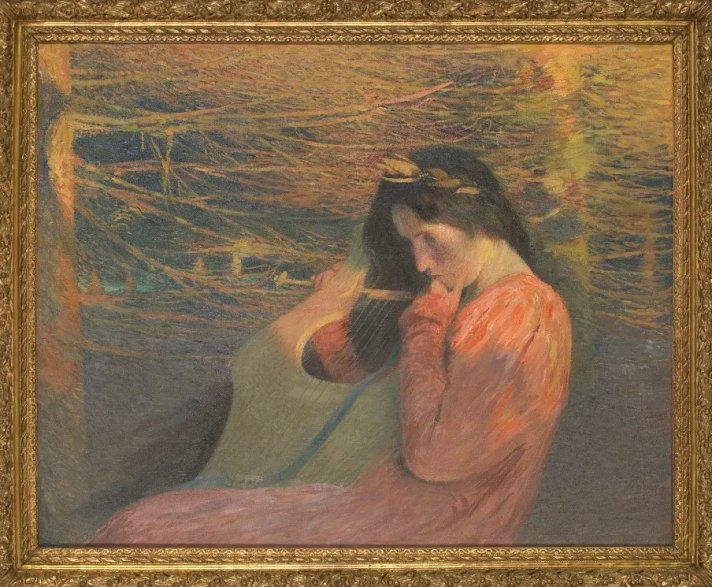
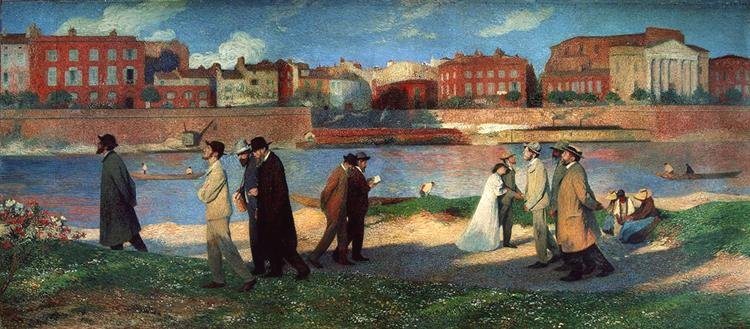
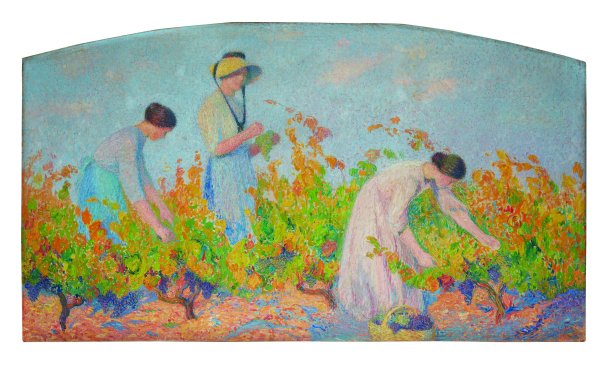
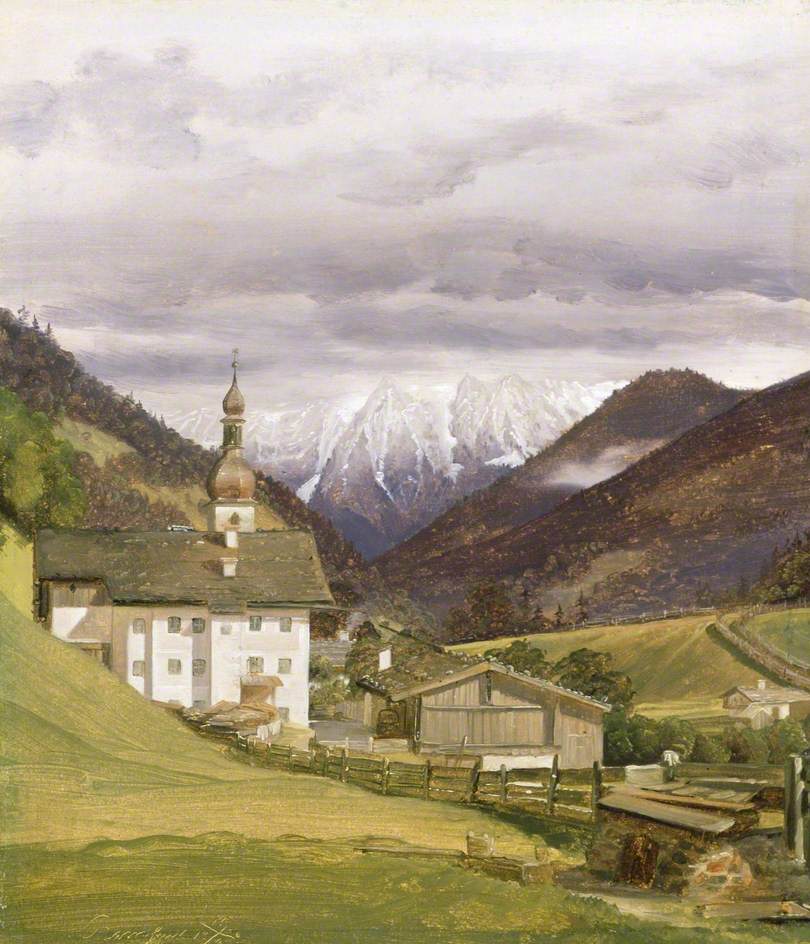
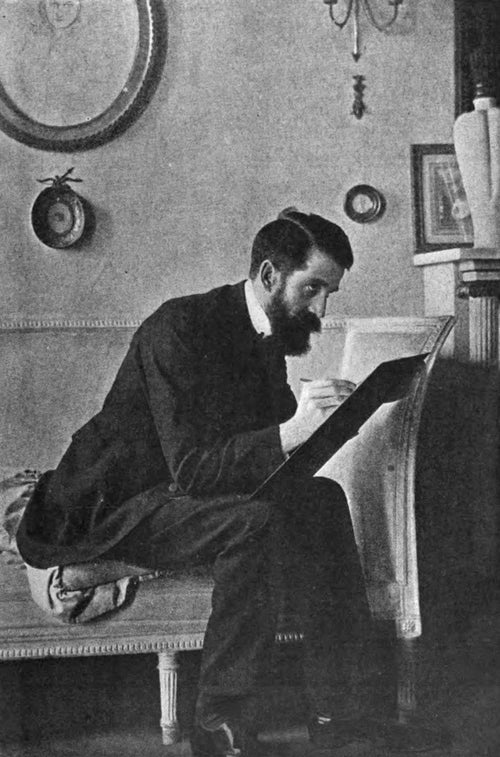
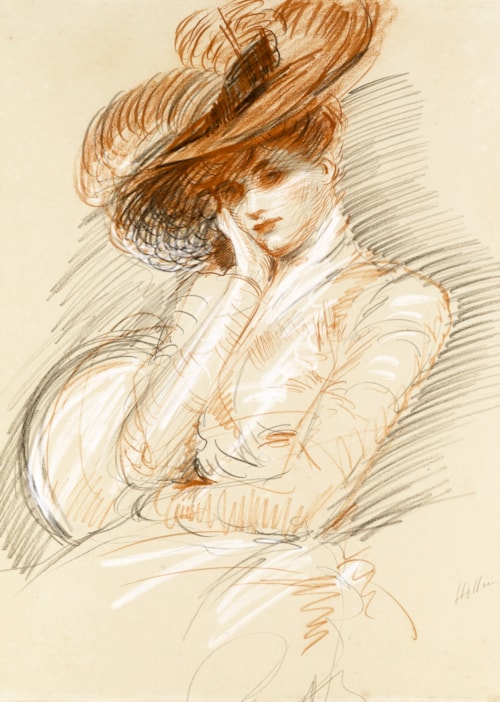
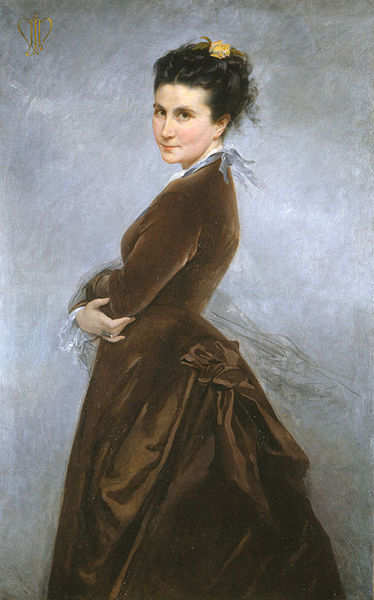
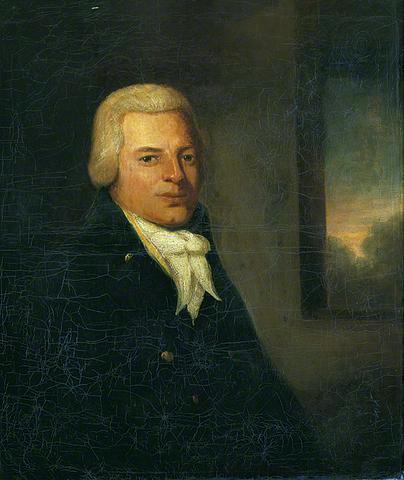
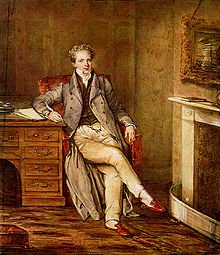
Paul César Helleu and Alice Guérin.

Paul César Helleu

At the end of my previous blog about the French artist Léon Bonnat, I talked about how he had bequeathed most of his art collection and the majority of his work to the local Bayonne museum and how the town named the Museum after him and yet it is now known as the Musée Bonnat-Helleu.. So who is “Helleu”?

Musée Bonnat-Helleu, Bayonne

The donation of Paulette Howard-Johnston, the youngest child of Paul and Alice Helleu made the museum one of the places of reference for the works of Paul César Helleu from 1988 onwards. It houses his works thanks to his daughter’s donation, as well as the donations and bequests of Paulette Howard-Johnston’s nieces, Éliane Orosdi and Ghislaine de Kermaingant,  when in 2009, she died.  In her will,  the Bonnat Museum was designated as the heir to her collection of more than 300 new pieces.  In 2011, the museum closed its doors for a major renovation, while thanks to this last bequest made by the Helleu family, the museum became the Musée Bonnat-Helleu.

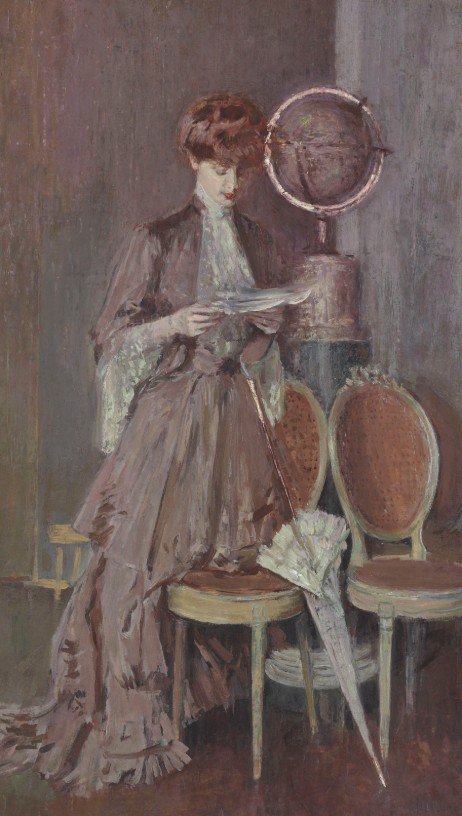
Portrait of Madame Helleu reading by Paul César Helleu

Paul César Helleu was born on December 11th, 1859, in the Brittany town of Vannes.  His mother, Marie Esther Guiot and his father, César Helleu, who was a customs receiver, were married in 1855 and had two sons Paul and his elder brother Édouard.   Paul took an interest in art when he was young. Following the death of his father when Paul was just a teenager, he decided he wanted to further his art studies by going to live in Paris.  His widowed mother was against this idea but Paul persisted and travelled to Paris to continue his schooling at the Lycée Chantal.  In 1876, at the age of sixteen Paul graduated and was admitted to the École des Beaux-Arts, at the atelier of Jean Leon Gerome, where he began his formal academic training in art.

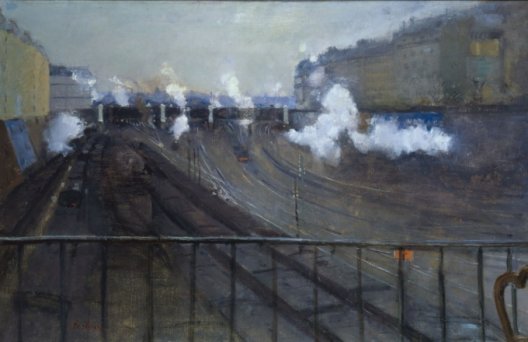
The Saint Lazare Train Station by Paul César Helleu (1885)

It was also in the Spring of 1876 that Helleu attended the Second Impressionist Exhibition at the Durand-Ruel Gallery in Paris. A total of nineteen artists participated in the exhibition, including prominent figures such as:  Degas, Monet. Morisot and Gustave Caillebot. Whilst in Paris,   Helleu made the acquaintance of John Singer Sargent, James McNeill Whistler, and Claude Monet. He was struck by their modern, bold alla  prima artistic technique, which was an approach to painting that involved applying layers of paint, also known as wet-on-wet, and completing a painting in a single sitting. This meant working with wet paint and not letting the layers dry, before applying the next layer. In Italian, the phrase alla prima translates to “at first attempt”.  Helleu was also impressed with their plein air style of painting.

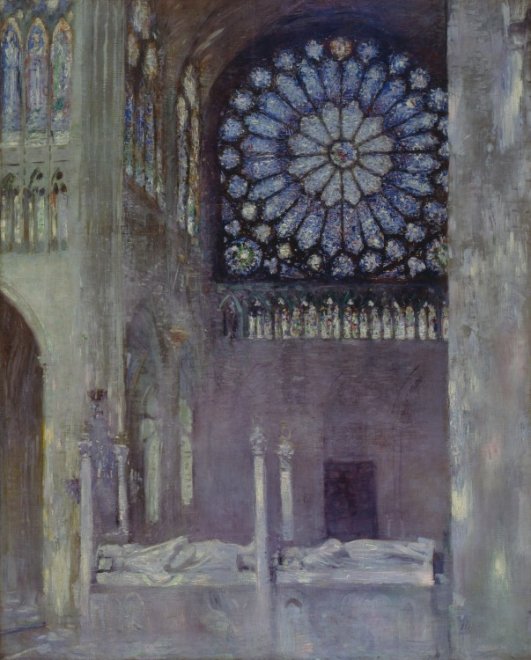
The Interior of the Abbey Church of Saint Denis by Paul César Helleu (c 1891)

Following graduation, Helleu found employment at the prestigious faience (earthenware) workshop, Joseph-Théodore Deck Ceramique Française.  Joseph-Théodore Deck was a 19th-century French potter, and an important figure in late 19th-century art pottery.  In 1856 he established his own earthenware workshop and began to experiment with styles from Islamic pottery, and particularly the Iznik style.  At the time Paul César Helleu joined the workshop, Japonisme, the popularity and influence of Japanese art and design following the forced reopening of foreign trade with Japan in 1858 was all the rage. Helleu created decorations for dishes.

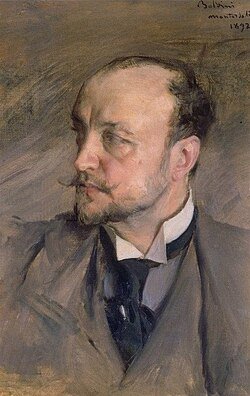
Giovanni Boldini self portrait (1892)

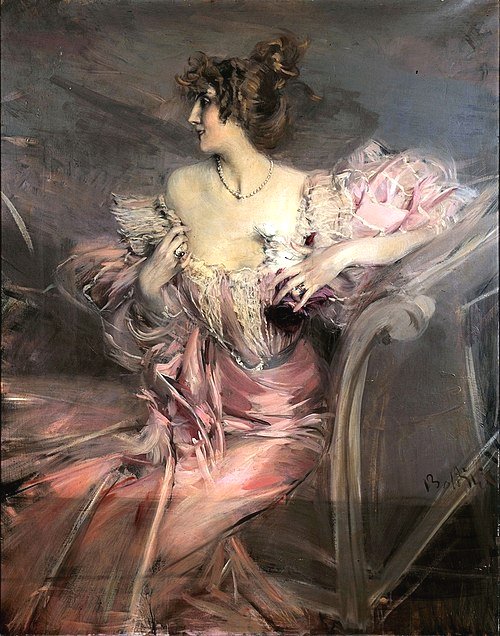
Portrait of Marthe de Florian, a French demi-mondaine and socialite,  by Giovanni Boldini (1898)

Around this time, Helleu met Giovanni Boldini, an Italian genre and portrait painter who lived and worked in Paris.   His portraiture focused on all the grandes dames of Paris, and for them to have their portrait painted by Boldini was looked upon as the crowning event of the social season. Boldini became a friend and mentor to Helleu, and his style of painting had a great influence on his artwork. The other great influence for Helleu was his friendship with John Singer Sargent, often referred to as the leader of “posh portraiture” in Britain, that majorly encouraged Helleu. Helleu even sold his first painting to Sargent. 

Portrait de Madame Chéruit by Paul César Helleu (1898) Madeleine Chéruit was a French fashion designer. She was among the foremost couturiers of her generation, and one of the first women to control a major French fashion house.

This time in Helleu’s life coincided with France’s Belle Époque era. The term, Belle Époque, literally means “Beautiful Age” and was a name given in France to the period between the end of the Franco-Prussian War in 1871 up to to the start of World War I in 1914. During those forty plus years of peace, the living standards for the upper and middle classes increased, (albeit the lower classes did not benefit in the same way, or to anywhere near the same extent).  It was the well-off who termed the phrase Belle Epoque labelling it a golden age in comparison to the humiliations that came with the Prussian invasion and what was to come, the devastation and occupation of the First World War.

Mademoiselle Vaughan by Paul César Helleu (1905)

It was a time of booming progress and prosperity in Europe, with Paris the centre of the fast-flowing changes in economics, technology, and the arts. However, as the name denotes, beauty was a key element of this prosperous period.  The upper-class patrons would often commission artists to paint their portrait or one of a family member, in a luxurious and extravagant manner highlighting both their beauty and wealth.  The finished portraits heightened an artist’s reputation, ensuring more clients for the artists.

Alice Helleu by Paul César Helleu (1885)

This blog is not only about Paul César Helleu but also his muse, lover, and later his wife, Alice Louis-Guérin. Helleu met Alice in 1884 when her mother asked him to paint a portrait of her fourteen-year-old daughter, Alice. At the age of twenty-four, Helleu appears to have fallen in love with her during this first meeting.   Alice remained the artist’s favourite model throughout his life and she was also a muse for many other artists.  Her beauty and sophistication also helped introduce her husband into the elite circle of artists, writers and society figures of the French capital.  The Count de Montesquiou, who was a noted dandy and one of the leading figures in the artist’s group of friends, described her appearance as

“…La multiforme Alice, dont la rose chevelure illumine de son reflet tant de miroirs de cuivre…”

 (‘The multifaceted Alice, whose rosy hair illuminates so many copper mirrors with its reflection.’)

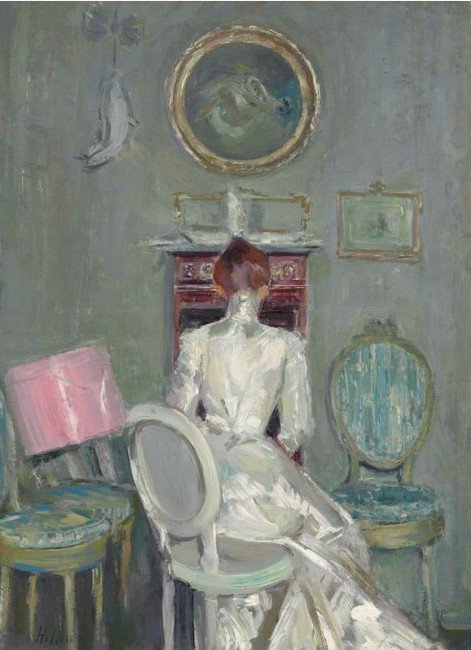
Madame Helleu à son bureau by Paul César Helleu.

Helleu often avoided standard conventional rules of portrait composition, and would frequently depict his sitters from behind – standing before a mirror, or sitting at a desk, as was the case of his painting entitled Madame Helleu à son bureau. Note the porcelain koi carp hanging in the upper left corner which was an example of Japonisme which was all the rage in Paris at the time.   The desk depicted in the painting and which appears in numerous works by Helleu is still in the artist’s family.  The painting hanging above it is Boldini’s Leda and the Swan.

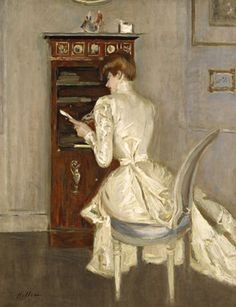
Madame Helleu assise à son bureau dans le salon de l’atelier de l’artiste, capturant une scène intérieure intime avec une élégance raffinée. (Madame Helleu seated at her desk in the artist’s studio salon, capturing an intimate interior scene with refined elegance.)

His painting entitled Mrs. Helleu sitting at her desk in the artist’s studio living room confirms Paul and Alice Helleu were had superb taste and these portraits depict Alice seated at a secrétaire in the couple’s drawing room of their Paris apartment, into which they moved in 1888. I suppose these two paintings cannot be considered as portraits in the conventional sense of the word, but rather as interior still life works, in which the furniture and surroundings are as vital as the sitter.

Madame Helleu by John Singer Sargent (1889)

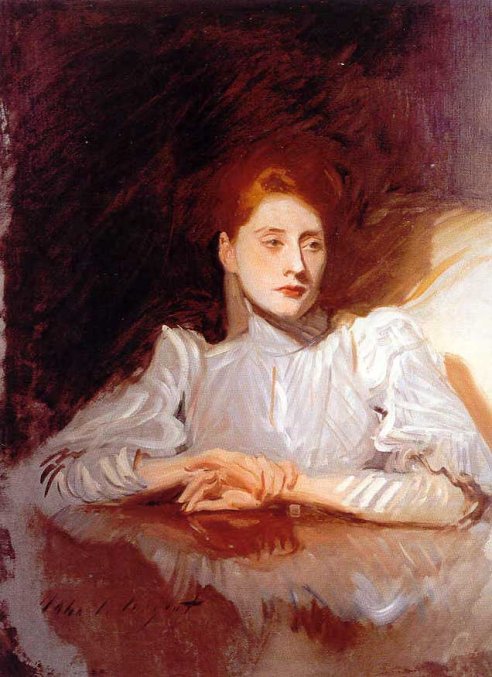
Alice Guérin was depicted in a number of paintings by Paul Helleu’s friend John Singer Sargent.

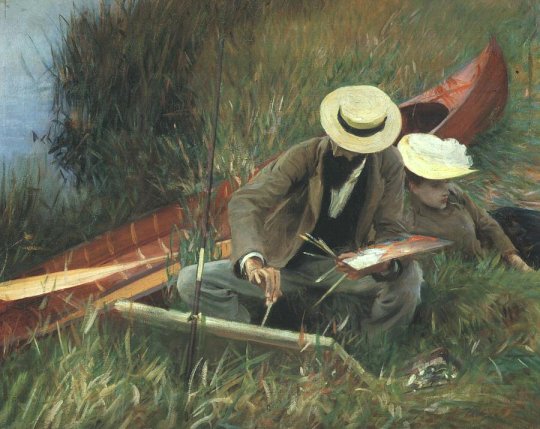
Paul Helleu Sketching with his Wife by John Singer Sargent (1889)

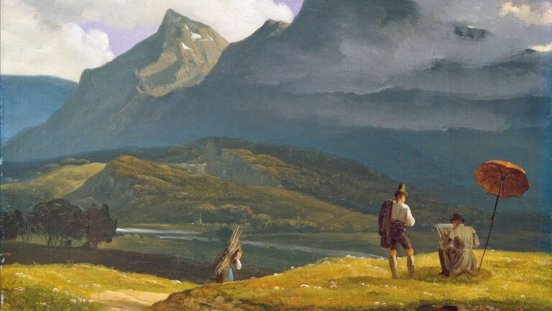
In his 1889 painting, Paul Helleu Sketching with his Wife, Sargent depicts a tranquil outdoor scene, portraying the French artist Paul Helleu engaged in the act of sketching. Alongside him, sits his wife Alice who appears happy and relaxed.  The figures of husband and wife are set against a lush, natural environment that suggests a calm and comforting ambiance. Sargent’s painting also manages to capture their fashionable clothing with Paul wearing a formal suit and Alice attired in an elegant dress.  Both wear wide-brimmed hats that both provide shade and stylishly adorn their heads.

Portrait of Artist’s Wife by Paul César Helleu

Paul Helleu was one of Sargent’s closest friends.  Initially, they had met in Paris in 1878.  Paul was 18 years old and Sargent 22. Sargent’s artistic career had already taken off, and he was becoming known to the public as a great portraiture artist and was receiving many commissions for his work. However, on the other hand, Helleu was selling little of his work, and because of this, he was suffering from depression.  Paul Helleu was financially strapped with hardly enough money to even eat and had to leave his studies in art due to lack of funds.  Sargent, got to hear about the plight of his friend and visited him at his studio and although he never alluded to his friend’s dire financial difficulties, Sargent selected one of Helleu’s paintings, and commended it for its artistic merits. Helleu was so flattered that the successful Sargent would think so kindly of his work that he offered to give it to him.  The story goes that Sargent responded to Helleu’s offer, saying:

“…I shall gladly accept, Helleu, but not as a gift. I sell my own pictures, and I know what they cost me by the time they are out of my hand. I should never enjoy this pastel if I hadn’t paid you a fair and honest price for it…”

He paid Helleu one thousand francs for the painting.  Helleu never forgot Sargent’s generosity and moral support and later, when Sargent was suffering from depression after the death of his father, Paul and Alice Helleu went to stay with him in England.

Portrait of Madame Helleu by Paul César Helleu.

Paul César Helleu and Alice Louis-Guérin married, two years after their first encounter, on July 29th, 1886, at Neuilly sur Seine.  She was two months away from her seventeenth birthday and Paul was twenty-six years old.  They went on to have four children, Hélène in 1887, Jean in 1894, Alice in 1896 and Paulette in 1904.

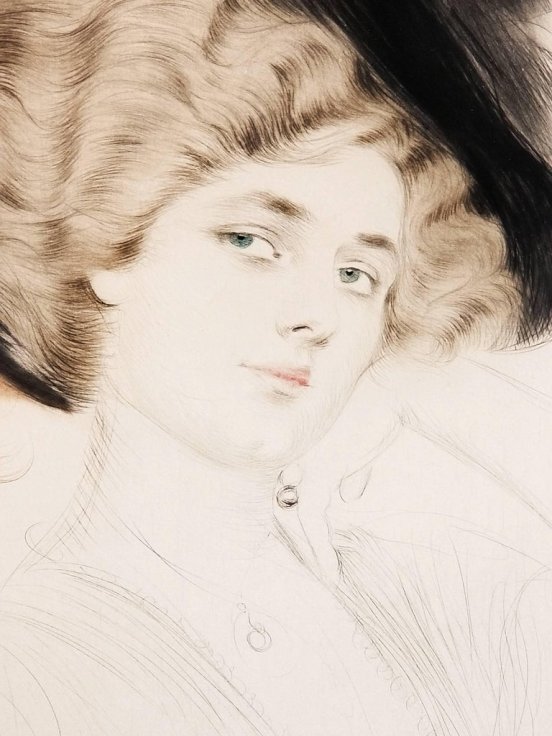
Details of Femme aux chapeau – Drypoint by Paul Helleu

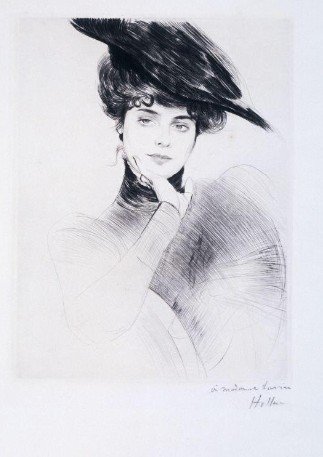
Drypoint Portrait of a Young Woman wearing a Hat by Paul César Helleu (c.1900)

It is believed that during a trip to London in 1885 Helleu once again met Whistler who introduced him to James Tissot a French society painter, illustrator, and caricaturist who was living in the English capital.  It was this established artist who taught Helleu the unique medium of etching.  Helleu became fascinated by drypoint etching.  Drypoint is a printing technique in which the printmaker scratches the lines on the printing plate with a sharp pointed tool. The printmaker holds the tool like a pencil and pushes the excess metal to either side of the furrow. It is this curl of rough metal, known as the ‘burr’, that gives the drypoint print its character. The ink is held in the burr as well as in the furrow and gives the edges of the printed line a soft, blurred quality. In Helleu’s work (above) the burr on the woman’s choker gives it a very velvety look.  Over the course of his career, Helleu produced more than 2,000 drypoint prints and he quickly mastered this technique, using the same flair with his stylus as he demonstrated with pastels.  It was the brilliance of his drypoint etchings that ensured Helleu’s place as one of the greats of the Belle Epoque, and he journeyed to Britain and America, and his artworks boosted his fame across both sides of the Atlantic.

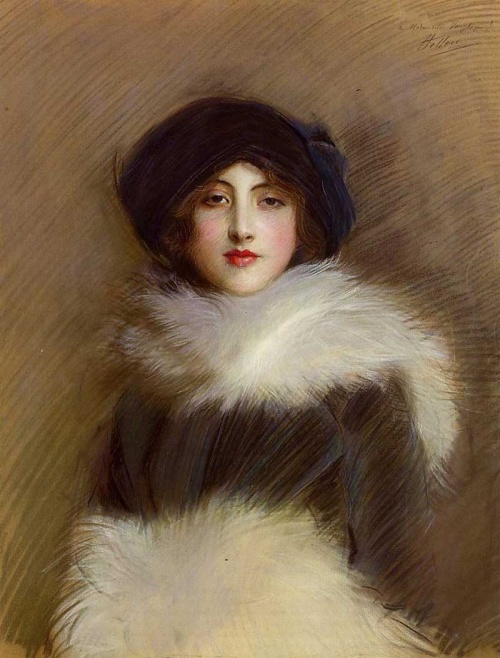
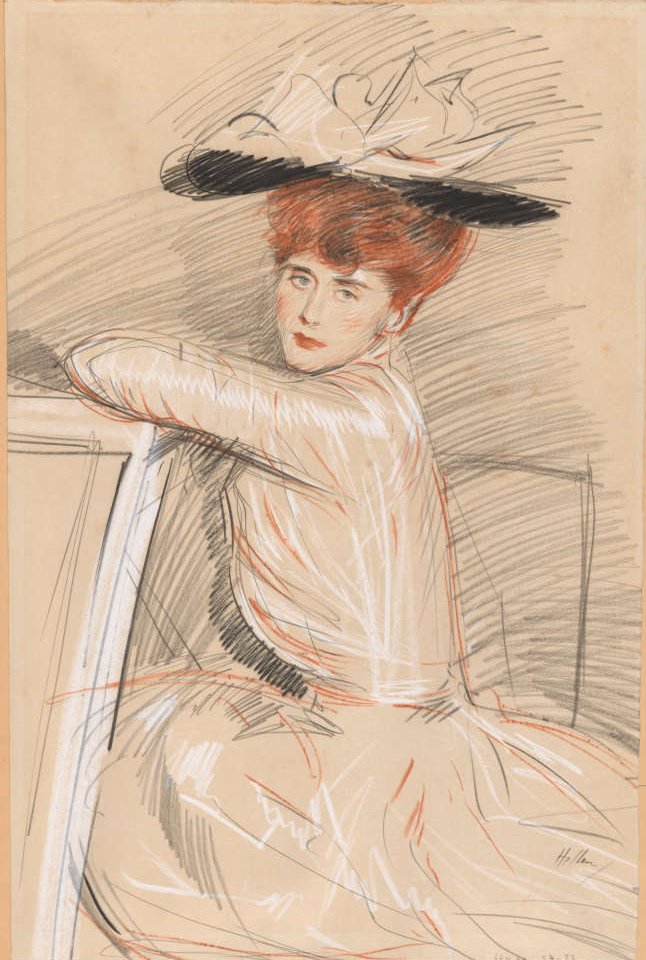
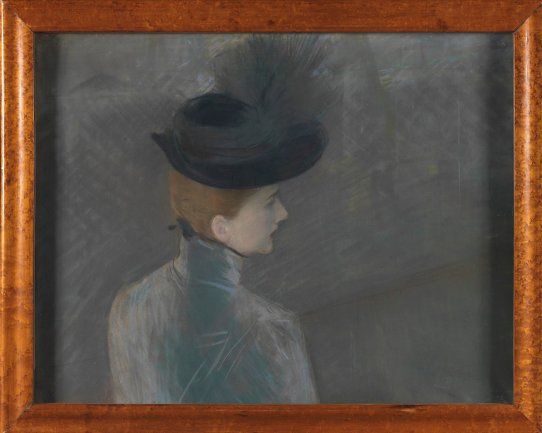
Alice au chapeau noir by Paul César Helleu

Helleu and his wife had made many friends in Paris including Countess Greffulhe, a French socialite, known as a renowned beauty and queen of the salons of the Faubourg Saint-Germain which allowed Helleu to successfully expand his career as a portrait artist to elegant women in the highest ranks of Paris society

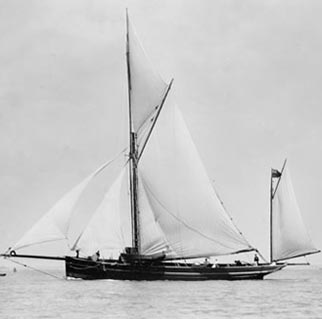
Paul Helleu’s yacht Étoile

Paul Helleu, wife Alice and baby daughter Paulette on L’Étoile (c.1904)

In 1904, Helleu was awarded the Légion d’honneur by the French president, Émile Loubet, and became one of the most celebrated artists of the Edwardian era in both Paris and London. He was an honorary member in important beaux-arts societies, including the Société Nationale des Beaux-Arts and the International Society of Painters, Sculptors, and Engravers, headed by Auguste Rodin. 

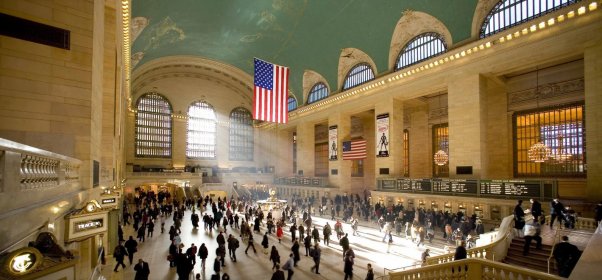
New York City’s Grand Central Terminal.

During his second trip to the United States in 1912, Helleu was awarded the commission to design the ceiling decoration in New York City’s Grand Central Terminal. Helleu decided on a mural of a blue-green night sky covered by the starry signs of the zodiac that cross the Milky Way.

Paul César Helleu (1859-1927)

Helleu made his last trip to New York in 1920 for an exhibition of his work, but he realized that the Belle Époque era was over. He sadly realised that he had lost touch with that vibrant era.   Shortly after his return to France, he destroyed nearly all of his copper plates.   While planning for a new exhibition with Jean-Louis Forain, a French Impressionist painter and printmaker, Helleu died of peritonitis following surgery in Paris, on March 23rd, 1927 at age 67.


Information needed for this blog came from Wikipedia and Facebook plus the following websites:

Brave Fine Art

Contessa Gallery

Stephen Ongpin Fine Art

John Singer Sargent Virtual Gallery

Sotheby’s

Léon Joseph Florentin Bonnat. Part 2

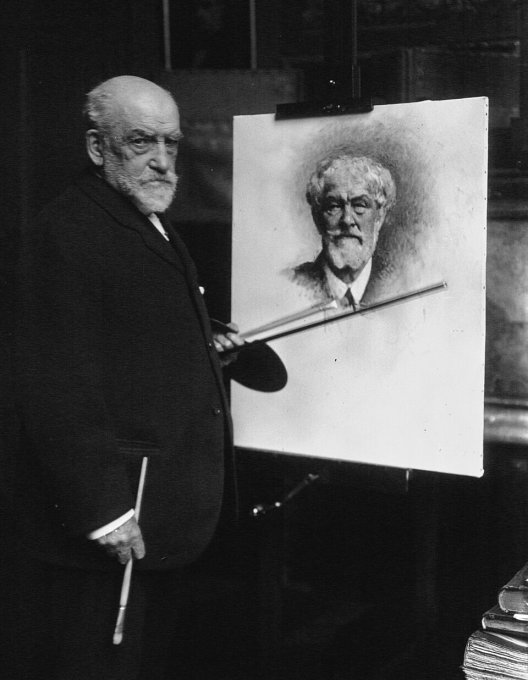
Léon Bonnat painting a portrait of artist, Alfred Roll (1918)

Léon Bonnat was born in Bayonne, France and lived there until he was thirteen years old.  Léon’s family then moved to Madrid where his father took on a book shop.  Léon’s love of art began to materialise after he went to live in the Spanish capital and, to encourage him, his father would take his son to the Prado.  He remembered those museum visits, saying:

“…I was brought up in the cult of Velasquez. I was very young, in Madrid; my father, on bright days such as one only sees in Spain, sometimes took me to the Prado Museum, where we did long stops in Spanish cinemas. I always left them with a feeling of deep admiration for Vélasquez… “.

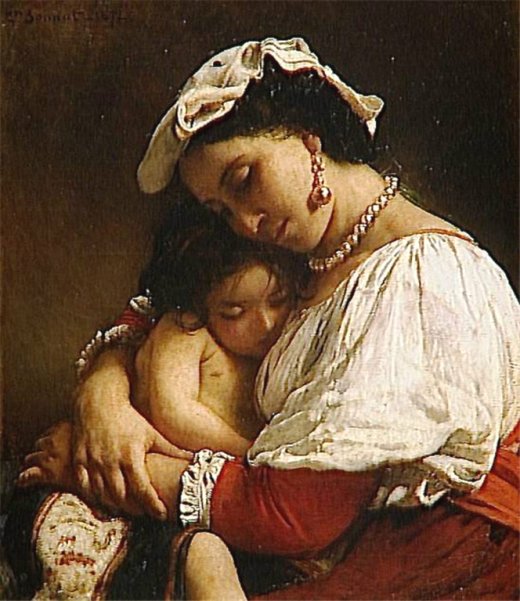
Italian Woman with Child by Léon Bonnat

In 1853, when Léon was twenty, his father died and the family returned to their French hometown of Bayonne.  After studying at the Ecole de Dessin de Bayonne, he went to live in Paris and study at the Ecole des Beaux-Arts.  In Paris, he was able to view paintings by the great Masters of French and Dutch art and particularly remembers seeing the works of Rembrandt and the influence his works had on him, commenting:

“…What is striking about Rembrandt is the power, the strength and the brilliance. He represents life in all its intensity. We see his characters, we talk with them, he resuscitates and revives an entire era. a marvellous and unique gift of interpretation, he joins the sensitivity, the goodness of a heart which vibrates to all the miseries, to all the joys, to all the emotions of humanity. He does not belong to any school. He has opened the new path which closed behind him…”

Roman Girl at a Fountain by Léon Bonnat (1875)

In 1857 he came second in the Prix de Rome competition and left Paris and spent three years at the Villa Medici.  The Villa Medici, now the property of the French State was founded by Ferdinando I de’ Medici, Grand Duke of Tuscany, and has housed the French Academy in Rome and welcomed winners of the Rome Prize since 1803, so as to promote and represent artistic creation in all its fields.

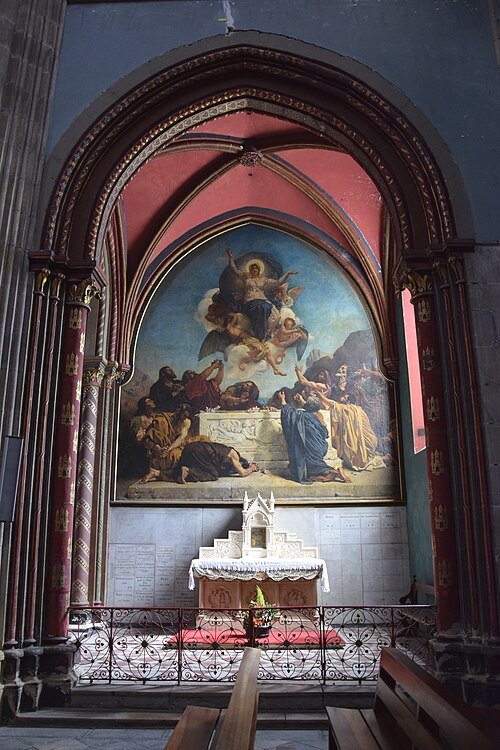
L’Assomption de Marie by Léon Bonnat (1869)

L’Assomption de Marie in situ in the Church Saint-André à Bayonne (Pyrénées-Atlantiques, Nouvelle-Aquitaine, France)

In 1869 Bonnat was awarded the Medal of Honor of the Salon for his painting L’Assomption.

The Martyrdom of Saint Denis by Léon Bonnat (1880)

One of Bonnat’s last religious paintings was his 1880 painting entitled The Martyrdom of Saint Denis.  St Denis was a 3rd-century Christian martyr and saint.  Denis was Bishop of Paris and through his speeches, made many conversions but he was looked upon by the local Roman priest as a danger and had Denis together with his faithful companions, the priest Rusticus and deacon Eleutherius, executed.  The place of the execution, by beheading, was on the highest hill in Paris, which is now known a Montmartre.   Denis was said to be against the beheading taking place at this spot and “folklore” has it that after Denis was beheaded, the corpse is said to have picked up his severed head and walked ten kilometres from the top of the hill, and during that entire walk he preached a sermon. 

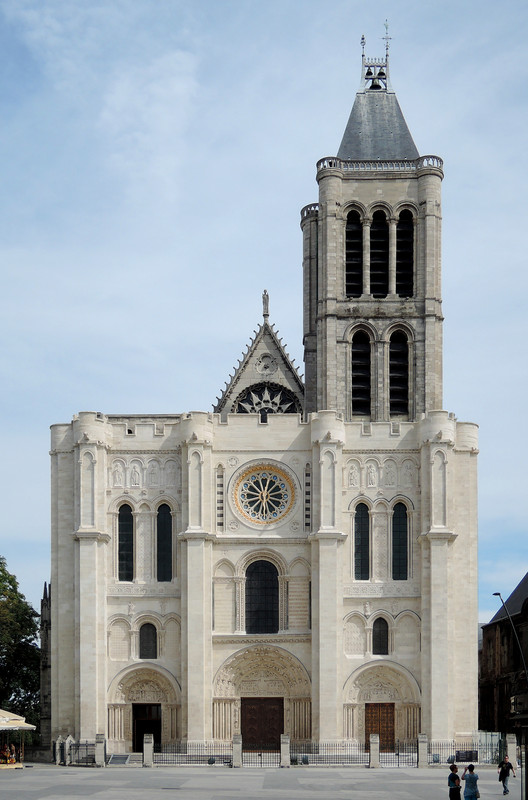
Basilica of St Denis, Paris

Detail of the north portal sculpture; the martyrdom of Saint Denis, Eleuthere and Rustique 

Denis finally collapsed at the place where he wanted to be buried, the spot where now stands the Basilica of St Denis and which is also the burial place of the Kings of France.  Saint Denis is the patron saint of both France and Paris.

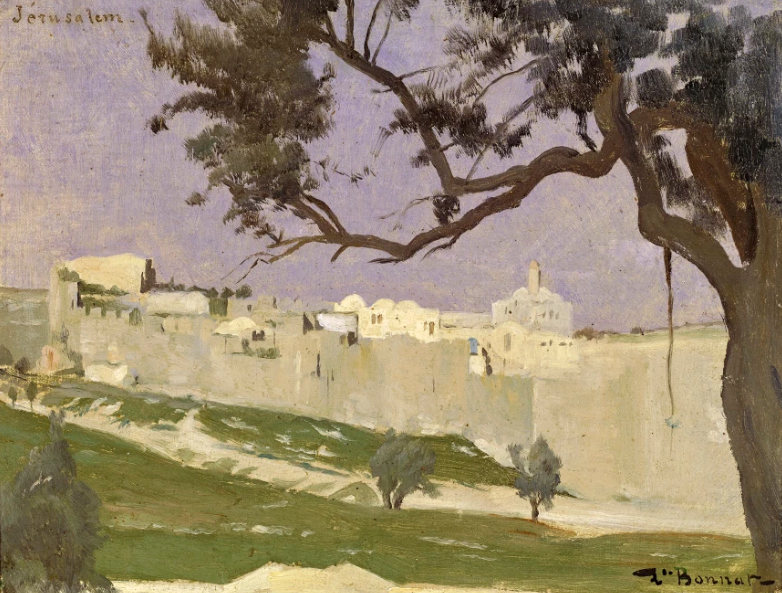
View of Jerusalem by Léon Bonnat

Although, as we will see later, Bonnat was best known for his portraiture and his early historical and religious subjects, but his landscapes and Orientalist depictions are looked upon as among his most intensely personal and beautifully crafted works.  Léon Bonnat travelled to the Middle East in 1868 together with a party that included the French painter, Jean-Léon Gérôme, his pupil Paul-Marie Lenoir,  the Dutch artist Willem de Farmas de Testas and Gérôme’s brother-in-law Albert Goupil.  The journey began in January 1868 at the Egyptian port of Alexandria and by the third of April, the group had arrived at the gates of Jerusalem.   Willem de Famars Testas recalled their first glimpse of the walled city:

“…The first glimpse of Jerusalem was gripping, the sun-illuminated city was silhouetted against a violet thundery light, while the outlying land lay under the shadow of clouds…”

Léon Bonnat recorded the impressions and the specifics of their arrival at the gates of Jerusalem in April of that year in one of his may oil on canvas sketches entitled View of Jerusalem.

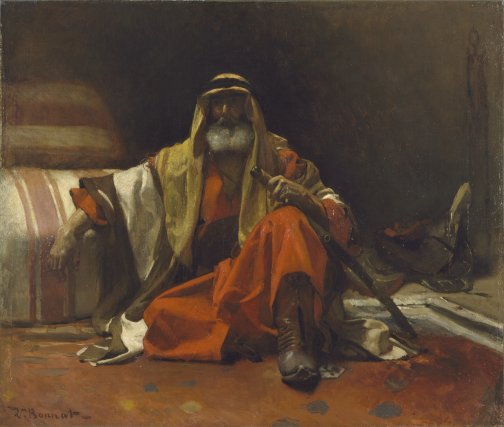
An Arab Sheik by Léon Bonnart (c.1870)

One of Léon’s works from this period was entitled An Arab Sheik which he completed once back in Paris.  It is thought that Bonnat’s depiction emerged from combining multiple resources such as the French model who posed for the seated figure; the saddle we see which Bonnat brought back from his travels and a multitude of sketched notations which he made during his travels in the Middle East.  Combining all this data Léon managed to create a painting that appears authentic, and yet, it is stereotypical of what Europeans believed about the Arabic world and its people such as the way the sheik holds his sword depicting his strength and fierceness and enhances how Europeans believed that that cultures in the Middle East and elsewhere were ruled by violence, in contrast to the supposedly more “civilized” societies of Europe and North America.

Christ on the Cross by Léon Bonnat(1674)

Bonnat’s haunting work entitled Christ on the Cross was commissioned in 1873 for the courtroom of the Cour d’Assises of the Palais de Justice in Paris.  The reasoning behind the commission was that it would embody divine justice in the eyes of the accused and by reminding them of the sufferings of Christ to save the fishermen. The painting was submitted  at the 1874 Salon.  The painting measures 1.59 meters in width and 2.27 meters in height. Bonnat’s depiction fundamentally renews the traditional representation of Christ on the cross. Christ is shown with a crown of thorns, his body is muscular and pale, and he wears a simple white loincloth. Blood is visible from the nails piercing his hands and feet. The background is dark and sombre. The crucified Christ is characterised in an extremely realistic way, accentuating Christ’s suffering due to the torture he received. Christ on the Cross is one of the best known and best loved crucifixion paintings of the western world. The painting can be viewed at the Petit Palais, Museum of Fine Arts of the City of Paris.

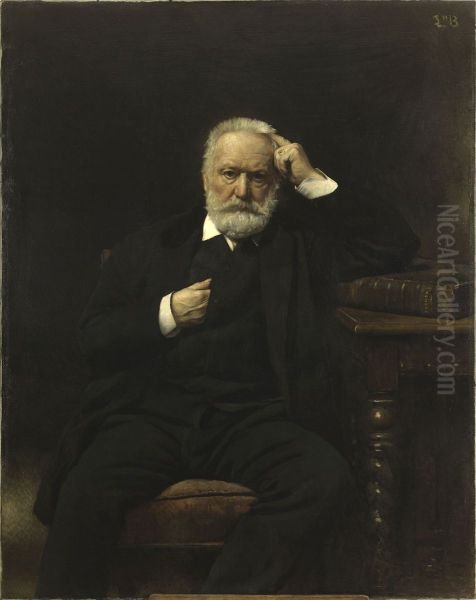
Victor Hugo by Léon Bonnat (1879)

For an artist to survive financially he or she must sell their work.  Once back in France, after his three-year stay at Villa Medici in Rome, Léon realised that the sale of his historical and religious paintings had fallen off and he had to look for another painting genre which would attract more buyers.  While Bonnat created many religious and historical works, his long-lasting fame rested on his exceptional career as a portrait painter. In an era before photography became the norm, painted portraits were central for chronicling the likenesses of important individuals, and Bonnat became one of the most sought-after portraitists of the French Third Republic and beyond. His sitters included presidents, politicians, writers, scientists, artists, and members of high society.

Jules Ferry by Léon Bonnat (1888) Jules François Camille Ferry was a French statesman and republican philosopher. He was one of the leaders of the Moderate Republicans and served as Prime Minister of France from 1880 to 1881 and 1883 to 1885.

Bonnat artistic brilliance as a portrait artist was his extraordinary skill in capturing not just a physical likeness but also the sitter’s charm, personality and social standing. His portraits are typified by their unruffled gravity, psychological perception, and scrupulous attention to every detail, whether it be the texture of fabrics to the detailed features of the face and hands. Bonnat often used dark, neutral backgrounds, which allowed viewers to focus entirely onto the subject, which were often illuminated by a carefully controlled light source, a technique evocative of the Spanish painter, Velázquez.

Portrait of Marthe and Therese Galoppe by Léon Bonnat (1889)

Marthe and Therese Galoppe were prominent figures in 19th-century France, known for their social standing and involvement in Parisian society. The painting captures their youthful beauty and grace, reflecting the evolving role of women in society during that time. Bonnat’s portrayal of the Galoppe sisters is significant as it showcases women not just as muses but as individuals with their own identities, challenging traditional views of women in art.

Armand Fallières by Léon Bonnat (1907) French statesman who was President of France from 1906 to 1913.

Among his most famous sitters were famous figures were the statesman Adolphe Thiers, the revered author Victor Hugo, the pioneering scientist Louis Pasteur, fellow painter Pierre Puvis de Chavannes, and French Presidents like Jules Ferry and Armand Fallières. Bonnat’s portraits served not only as personal records but also as official images that helped shape the public perception of these influential individuals. His success in this genre brought him considerable wealth and prestige.

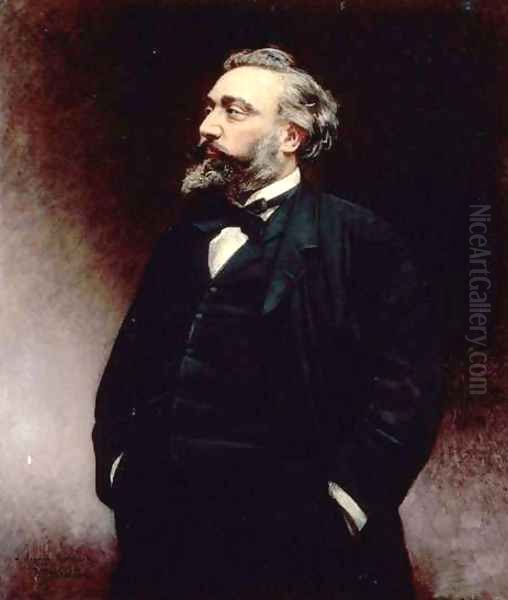
Portrait of Léon Gambetta by Léon Bonnat (1888) Gambetta was a French lawyer and republican politician who proclaimed the French Third Republic in 1870 and played a prominent role in its early government.

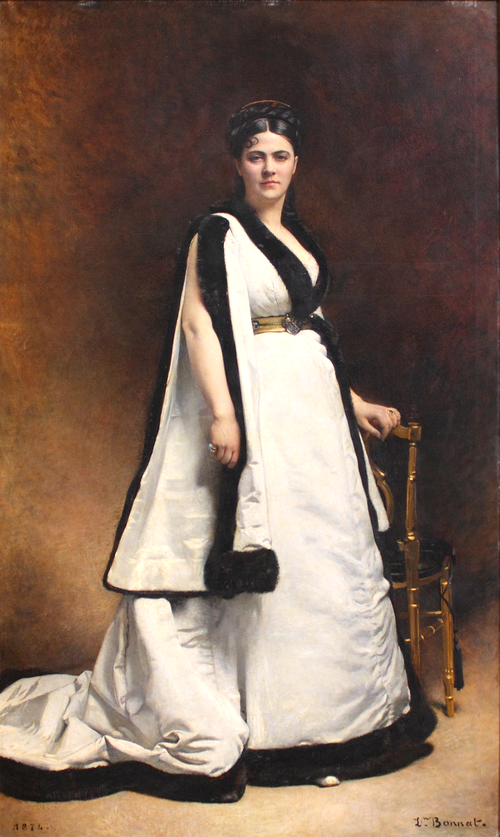
Madame Pasca by Léon Bonnat (1874) Alice Marie Angèle Pasquier was better known by her stage name Madame Pasca, a French stage actress.

Bonnat’s methodology when it came to creating portraits was known to be both thorough and painstaking. He demanded of his sitter numerous meetings so that he could carefully observe them in order to capture subtle gradations of expression and posture and because of this, he was able to achieve prolonged observations which allowed him to realise a high degree of naturalism along with psychological depth.  However, Bonnat’s long processes to achieve a finished portrait did not always please the sitters.  Although he was minded as to what the sitter wanted in the finished portrait, Bonnat refused to flatter his subject and simply strived for an unvarnished truth, but still conveying the dignity appropriate to the subject’s station in life. His commitment to authenticity along with his undoubted technical mastery in delivering form and texture, achieved the finished product being solid, present, and intensely real.
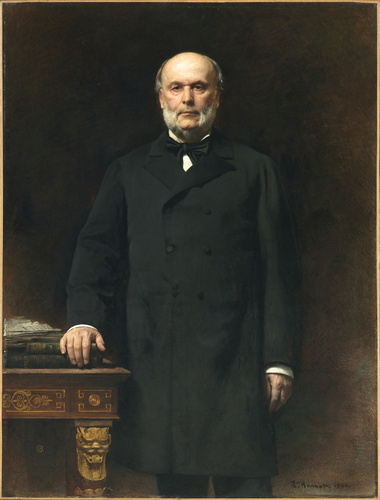
Portrait of Jules Grévy by Léon Bonnat (1880). Jules Grévy was  a French lawyer and politician who served as President of France from 1879 to 1887.

Léon Bonnat who had benefited, following the intervention of the mayor of Bayonne, Jules Labat, when he was granted a municipal scholarship from the city to study the Fine Arts in Madrid and then later in Paris, announced his intention to give his native city the gigantic art collection he had built up.  Léon Bonnat’s dedication to art extended well beyond his lifetime through this act of extraordinary generosity. Léon had no direct heirs, and decided to bequeath his extensive personal art collection, along with many of his own works, to his hometown of Bayonne.
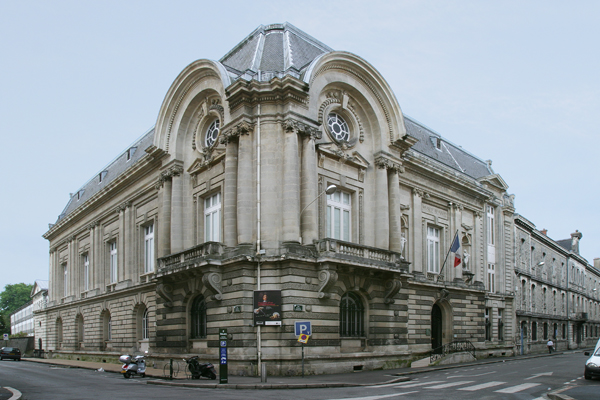
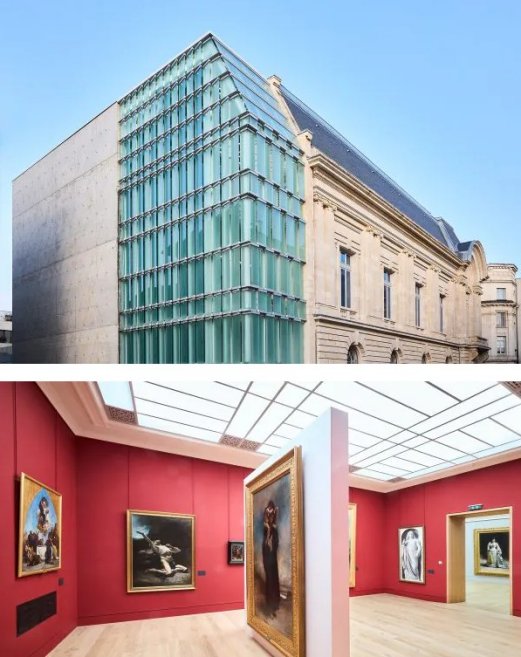
Musée Bonnat-Helleu in Bayonne, France

It was during the latter part of the nineteenth century that Bonnat had achieved financial stability and was able to indulge his passion for collecting art, especially drawings. He acquired sketches, drawings and prints by Rembrandt, Poussin, and Watteau as well as many others.  Eventually, his collection included drawings and paintings from the best of his students and colleagues as well. Like many collectors, Bonnat not only loved the art he had acquired, but he also hoped to share it with a larger public and so he proposed the idea of building a museum in his native Bayonne that would ultimately house his own collection. With his deep roots in the region, continuing family ties to Bayonne, and undoubtedly a sense of gratitude for the support he’d received as a fledgling painter, Bonnat worked tirelessly at developing the new museum. 

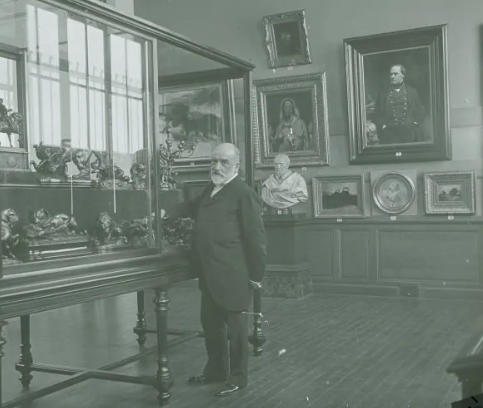
Léon Bonnat, installing his collection at the Musée Bonnat, Bayonne.

In 1902, he personally installed a large portion of his own unparalleled collection in the new Musée Bonnat.  The collection was later enriched by the donation of the collection of Paul Helleu and his wife Alice, leading to its current name, the Musée Bonnat-Helleu.  The chosen location of the museum was located at the corner of the two streets, Jacques-Laffitte and Frédéric-Bastiat, in the city centre, near the church of Saint-André where Léon Bonnat’s painting, Assumption of the Virgin can be seen. In 1896, the first stone of the future museum was laid by the Bayonne mayor Léo Pouzac and the classical-style building, in limestone, was completed eighteen months later. Inaugurated in 1901.  When the Bonnat Museum opened, the artist and collector came to set up his collection himself, while writing a will by which he bequeathed almost all of his works to the National Museums with the obligation to deposit them in Bayonne.

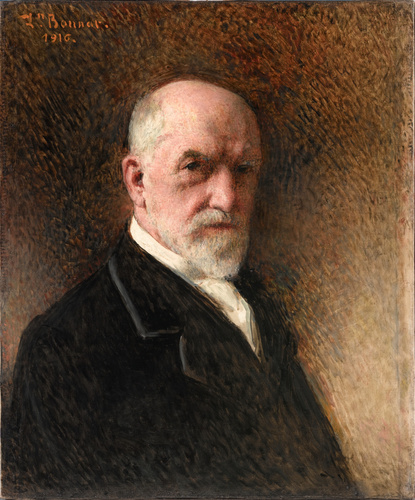
Self portrait by Léon Bonnat (1916)

Léon Bonnat died in Monchy-Saint-Éloi,  a commune in the Oise department in northern France, on September 8th 1922, aged 89.   Léon had never married and lived most of his life with his mother and sister. 

Léon Joseph Florentin Bonnat.

Self portrait by Léon Bonnat (1855)

The artist I am looking at today was one of the leading French painters of the nineteenth century.  He was a colossal figure in 19th-century French art, a painter whose career managed to tie together the past academic traditions with the proliferating trends of modernism. Let me introduce you to Léon Joseph Florentin Bonnat.

Madame Bonnat, mère de l’artiste by Léon Bonnat

Bonnat was born in Bayonne, in the French Basque Country in the far southwestern corner of France, close to the Spanish border, on June 20th1833.  He is remembered for his forceful, expressive and emotional portraits and yet he also made his name as talented history and religious painter, and an influential educator, who also built up a great personal art collection.

Portrait of Madame Melida, sister of Léon Bonnat by Léon Bonnat

In 1846. his family moved from France to Spain and went to live in the city of Madrid where his father took over the running of a bookshop. For thirteen years old Léon, who had developed a love of art this move was opportune. In the Spanish capital, Bonnat received his foundational art education, studying under the tutelage of José de Madrazo y Agudo one of the primary exponents of the Neoclassical style in Spain. He was also the patriarch of a family of artists that included his sons Federico and Luis; and his grandsons, Raimundo and Ricardo.  Federico de Madrazo y Kuntz, and his father were leading figures in Spanish academic art, and Federico was a renowned portraitist.

The Artist’s Sister by Léon Bonnat

Bonnat began his artistic education at the Academia Real de las Bellas Artes de San Fernando, in the studio of Federico Madrazo. Studying under Federico de Madrazo, he was plunged into the rich artistic heritage of Spain and he spent numerous hours in the Prado Museum, copying the works of Spanish Golden Age masters such as Diego Velázquez, Jusepe de Ribera, Francisco de Zurbarán, and Francisco Goya. These painters and their artworks had a great influence on Bonnat through their profound realism, dramatic use of chiaroscuro and the dignified way they depicted their subjects and their styles left an indelible mark on Bonnat’s developing style. Their portraits often used sombre palettes and this textural richness of Spanish art resonated deeply with him, and this style provided a contrast to the often more refined idealized French academic tradition that he would come across in his later years.

Job by Léon Bonnat (1880)

Léon’s father died in 1853 and Léon and his family moved back to France and their hometown of Bayonne.  Now back “home” Léon continued his art studies at the Ecole de Dessin de Bayonne, where one of his tutors was Bernard-Romain Julien, a French printmaker, lithographer, painter and draughtsman.  In 1854, with a stipend of 1500 francs from the city of Bayonne, Bonnat left Bayonne and travelled north to the French capital. His move to the French capital and the tuition costs were partly funded by the City of Bayonne. Having attained a strong foundation from his training in Madrid, Bonnat was able to enter the well-respected Ecole des Beaux-Arts. There, where he studied in the atelier of Léon Cogniet, a much admired historical and portrait painter. Cogniet’s studio was known for its demanding academic training, with great emphasis on students’ ability, emphasizing their drawing, and composition skills.  The students would also spend time studying the works of the old Masters. For a time whilst in Paris Bonnat briefly studied with Paul Delaroche, another prominent academic painter.

The Good Samaritan by Léon Bonnat

Adam and Eve Finding the Body of Abel by Léon Bonnat

Now in Paris, Bonnat began to create his reputation as an up-and-coming artist. In 1857, for the first time, he submitted paintings to the Paris Salon with works such as The Good Samaritan and Adam and Eve Finding the Body of Abel which demonstrated his skill in depicting religious and historical subjects, which confirmed the influence of his Spanish and Italian studies.

Villa Medici, Rome.

In 1857, whilst studying at the École des Beaux-Arts, Bonnat competed for the prestigious Prix de Rome in Painting, The Prix de Rome in Painting was one of the most prestigious awards in the field of fine arts. It was created in 1663, and this annual competition was organized by the Académie royale de peinture et de sculpture (Royal Academy of Painting and Sculpture) in Paris. Each year the winners of the Prix de Rome were sent to the Villa Medici in Rome to perfect their artistic training for a number of years.  The prize awarded to the winner was a scholarship that allowed promising artists to study cost-free in Rome. It was the goal of every early-career artist to win the award.   By rewarding talented young artists with a scholarship and a chance to stay at the Villa Medici in Rome, it was also seen as a way in which it helped to promote academic art and encourage artists to hone their skills. Bonnat, after two failures in 1854 and 1855 had made another attempt to win the prize in 1857.
The Resurrection of Lazarus by Léon Bonnat (1857)

Each year, entrants were given a subject to focus on and then present their submission in front of a demanding jury. This fierce competition encouraged artists to push their limits and express all their creativity.  The year, 1857, Bonnat attempted to win the award the subject matter chosen by the organisers was Lazarus. Léon Bonnat submitted his work entitled The Resurrection of Lazarus and he was awarded the second prize, which unfortunately did not include the full French state scholarship.
Lazarus Raised from the Dead by Charles Sellier

The winner of that year’s prize was the French painter who specialized in mythological and historical subjects, Charles Sellier with his painting, Lazarus Raised from the Dead.

Portrait of Léon Bonnat by Edgar Degas

Bonnat was pleased to receive the second-place award but disappointed that his prize did not allow him a three-year all expenses paid stay at the Villa Medici which was only awarded to the winner of the competition.  However, thanks to the financial assistance of a further 1500 francs granted to him by the city of Bayonne, as well as  money raised by some of the town’s wealthy citizens including the Personnaz family,  a wealthy Jewish family of fabric exporters,  he was able to spend the next three years in Rome, where he was able to study the works of the great Italian Masters, particularly the works of Raphael, Titian, and Michelangelo, as well as the powerful naturalism of Caravaggio.  During his stay in Rome, he also became friends with Edgar Degas, Gustave Moreau, Jean-Jacques Henner, and the sculptor Henri Chapu.

St Vincent de Paul Taking the Place of a Galley Slave by Léon Bonnat (1865)

Bonnat remained in the Italian capital from 1858 until 1861.   Bonnat’s early paintings, such as his 1865 St Vincent de Paul Taking the Place of a Galley Slave were renowned for their dramatic intensity and his religious works of that time strengthened his reputation in this genre.  This painting was based on a part of Vincent;s life. Vincent de Paul was an Occitan French Catholic priest who dedicated himself to serving the poor and became Chaplain-General of the Galleys in 1619, while working for the General of the Galleys of France, Philippe-Emmanuel de Gondi. This position took him to the port of Marseilles in 1622.   When not at sea, the galley slaves, or galères, would spend their time in a squalid prison in the fortified port’s prison. Vincent was horrified at the state of the prisoners and their environs and complained to his patron M. Gondi that such a situation could not continue if France was truly a Christian kingdom. Vincent began ministering to the galley slaves, providing aid to the Catholic prisoners, as well as to the enslaved Muslims and Protestants. At the same time, he instituted important reforms in relation to how these men were treated, regardless of their faith, and set about building a hospital in Marseilles to treat the galley slaves. Due to a lack of steady funding, the General Hospital of Galley Slaves, as it would eventually be called, was not finished until 1646.

Because of Léon’s artistic prowess and being looked upon as a leading academic artist, he was often asked to act as a juror for the annual Salon exhibitions, and in 1867, he was his nominated to the Legion of Honor.

…….to be continued.


Most of the information for these blogs about Léon Bonnat came from Wikpedia and these blogs:

NiceArtGallery

Rehs Gallery

Léon Bonnat by Guy Saigne

Vincent and the Galley Slaves

Musée Jacquemart-André, Baron Haussman and Georges de la Tour

Having been touring Europe for the last three weeks I have had a rest from my blog.   The last part of my journey was a short three-day stay in Paris and it was almost seven years since I had graced this wonderful city. I have visited many art galleries around the world, and my favourites have been the ones that offer something else other than walls of artwork.  I do like artwork which is hung on walls of the interiors of beautiful buildings.  It is like a 2 for 1 offering beautiful architecture and magnificent paintings.

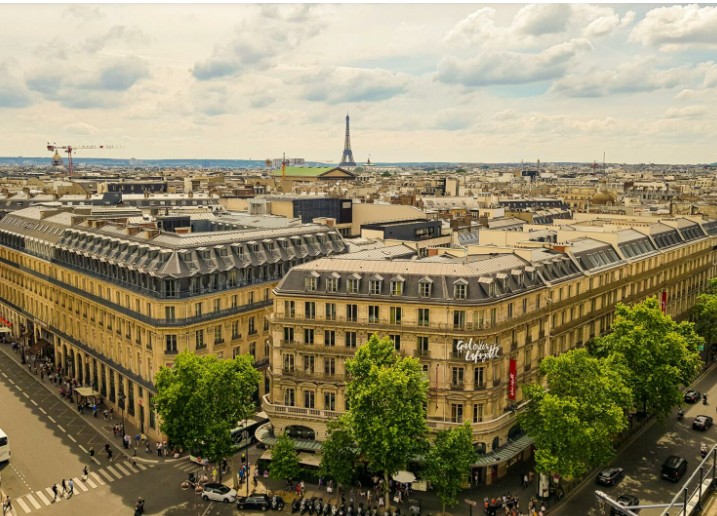
Baron Haussman’s Paris

Whilst in Paris there was an exhibition of one of France’s great 17th century artists, and one of the greatest exponents of 17th century Baroque painting, Georges le Tour.  However, first let’s have a look at the impressive building which was hosting the exhibition.  The Musée Jacquemart-André is a private museum located at 158 Boulevard Haussmann in the 8th arrondissement of Paris.  The street named after Georges-Eugène “Baron” Haussmann, a French administrator, who in the mid nineteenth century, with the backing of Emperor Napoleon III, was responsible for the transformation of the ancient impoverished and unhealthy areas of Paris which involved the demolition of 19,730 historic buildings and the construction of 34,000 new ones. Old narrow streets gave way to long, wide avenues characterised by rows of regularly aligned and generously proportioned neo-classical apartment blocks faced in creamy stone.

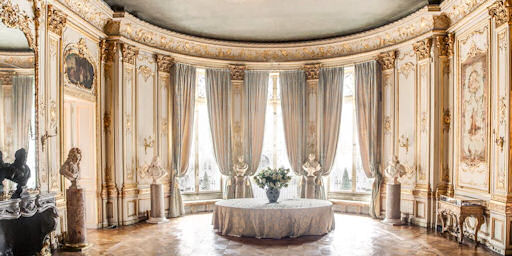
One such building was Musée Jacquemart-André, situated on Haussman Boulevard, which was the private home of Édouard André and his wife Nélie Jacquemart which was to display the art they collected during their lives. It was what the French term it as a hôtel particulier, a grand urban mansion. Edouard André bought land on the newly created Boulevard Haussmann with the intention of having a mansion built. Building started in 1869 by the architect Henri Parent and completed in 1875. 

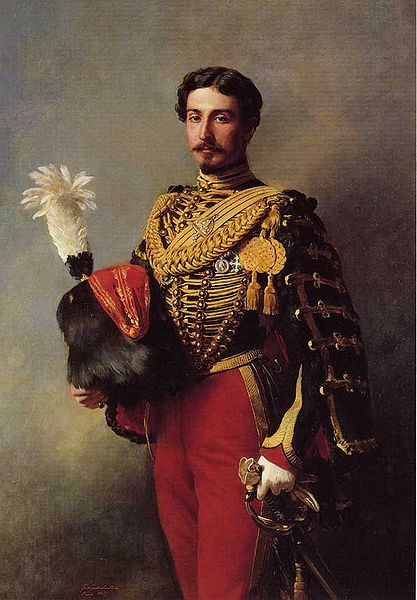
Portrait of Édouard André by by Franz Xaver Winterhalter. 

Nélie Jacquemart and Édouard André were an improbable and mismatched couple.  She was a Catholic woman and a famous society portrait painter, and he was the Protestant heir to a banking fortune. 

Nélie Jacquemart – Self portrait

They married in 1881. Nélie had painted Édouard André’s portrait ten years earlier. Each year, the couple would travel to Italy, buying works of art and slowly amassing one of the finest collections of Italian art in France. When Édouard André died in 1894, Nélie Jacquemart carried on the renovation of their home.  She also made many trips to Japan and neighbouring far-east countries adding many Oriental works to the collection.  Following her husband’s dying wishes, on her death in 1912, she bequeathed the mansion and its collections to the Institut de France as a museum, and it opened to the public in 1913. The couple’s relationship led to one of the most notable private art collections of fin-de-siècle Paris.

The Tapestry Room

The Round Room

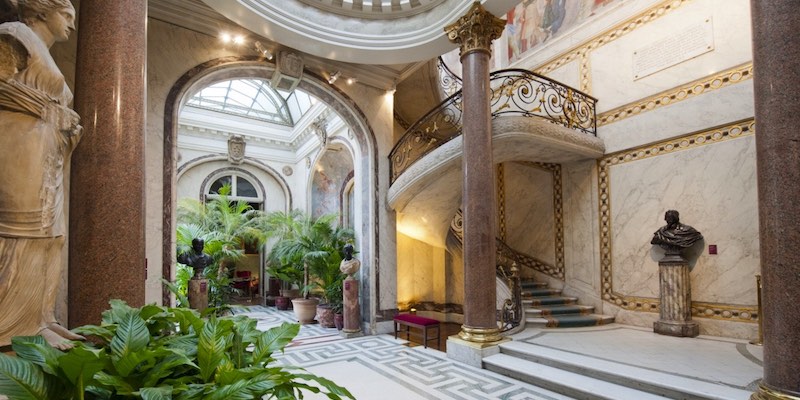
Once inside the Musée Jacquemart-André we are able to glimpse into the splendour of Parisian aristocratic life as it was in the 19th century.  We can witness the luxurious setting, both inside and outside of Édouard André and Nélie Jacquemart former mansion.  Adorned with the finest works of art, one can see in every room the evidence of their passion for Italian and French art.  This was a building which hosted extravagant receptions and soirees.

The Winter Garden and Staircase


Grand Salon

Their collection of Italian artwork which Nélie meticulously curated is legendary and includes paintings by Sandro Botticelli, Giovanni Bellini, and Andrea Mantegna. Besides these Italian works of art, the museum houses an remarkable array of French, Dutch, Flemish, and English paintings, as well as sculptures, antique furniture, and objets d’art. Wandering through rooms one observes how they have been preserved in their original state, and one feels that we have been immersed into the world of Parisian high society.

One of the State Rooms and Picture Gallery

The grand salons were designed for hosting lavish events and feature stunning frescoes, sculptures, grand sweeping staircases, and luxurious decor. The experience of walking through lavishly decorated rooms and halls allows us to see how the affluent lived in a bygone era of luxury.

Once the excellent tour of the rooms and garden of the mansion was complete, I went to see the Georges la Tour exhibition which was spread across several upstairs rooms.   It was entitled From Shadow to Light which alludes to the way La Tour explored in his paintings nocturnal scenes, half hidden candles, light filtering through a translucent page, glimmers on a skull or a lantern punctuating the darkness in which meditation unfolds.

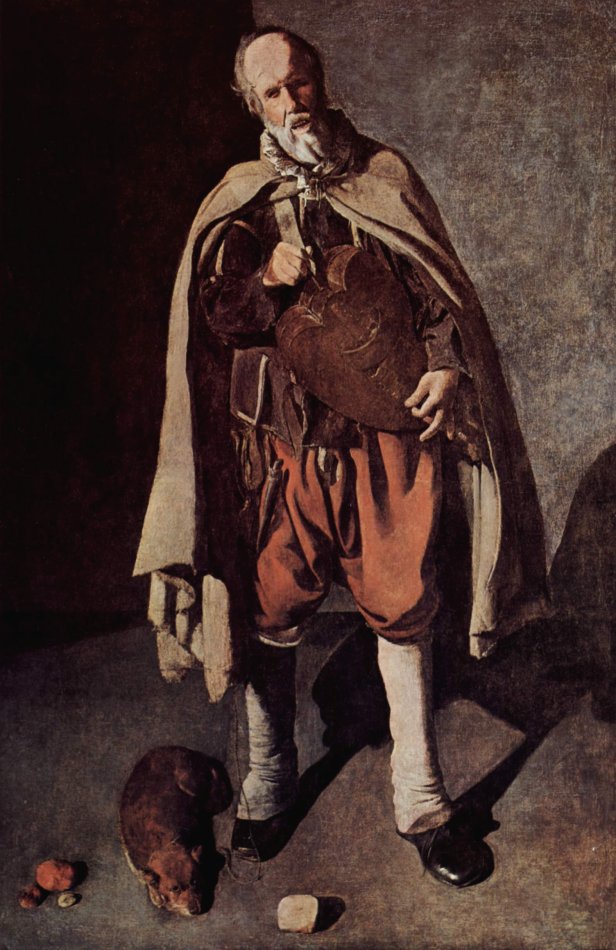
The Hurdy=Gurdy Man with a Dog by Georges de la Tour (1625)

Georges de la Tour was baptized in March 1593 in Vic-sur-Seille in Lorraine.  He was the second of seven children, born into a family of bakers.  Following a fire started by French troops during the Thirty Years’ War, his home, his studio, and some of his works were destroyed and he and some of his family escaped to Nancy.  A year later la Tour was appointed “First Painter to the King” by Louis XIII and as such, he lived in the Louvre and was officially recognized by the court and the Parisian artistic community.   At the height of his career, he painted for many prestigious patrons such as Cardinal Richelieu and the Dukes of Lorraine and became one of the wealthiest painters of his time.

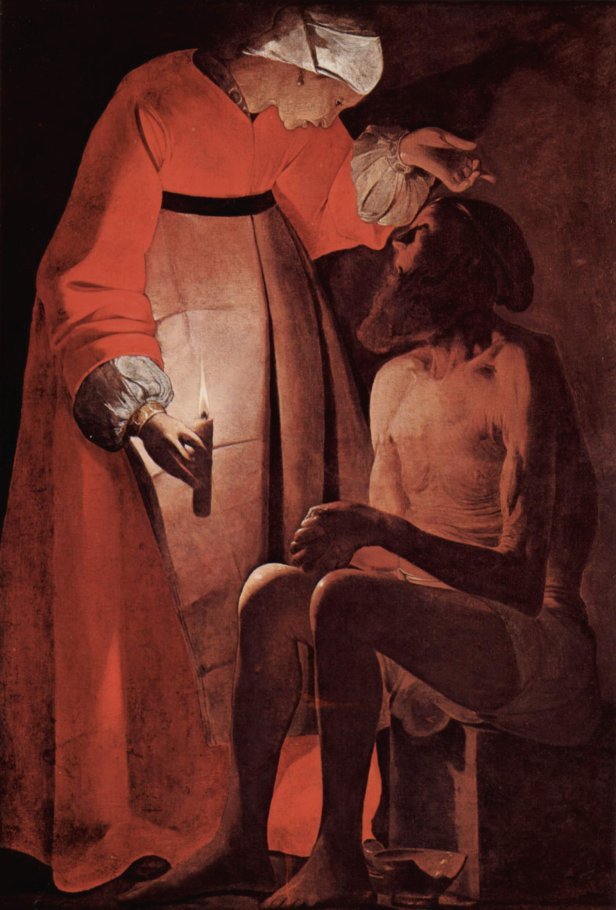
Job Mocked by his Wife by Georges de la Tour (1635)

As can be seen in his paintings, Georges de La Tour was influenced by the Italian painter Caravaggio whose style was then spreading throughout Europe. It is not thought that de la Tour ever travelled to Italy but he was probably influenced by Dutch and Lorraine Caravaggism.  De la Tour developed a personal and daring interpretation of chiaroscuro that made him truly original. His paintings are notable for their realism and sober compositions, which contrast with the dramatic intensity of Italian Caravaggist works. Although de la Tour’s work used the technique of chiaroscuro  his style is of painting is often alluded to as tenebrism.  Tenebrism, which comes from the Italian word tenebroso meaning dark, gloomy, mysterious and is a style of painting using especially pronounced chiaroscuro, where there are violent contrasts of light and dark, and where darkness becomes a dominating feature of the image. This technique was developed to add drama to an image through a spotlight effect and is common in Baroque paintings. Tenebrism is used only to obtain a dramatic impact while chiaroscuro is a broader term, also covering the use of less extreme contrasts of light to enhance the illusion of three-dimensionality.

St Peter Repentent by Georges de la Tour (1645)

The pamphlet that went with the exhibition describes the painting of St Peter as:

“…The celebrated St Peter Repentent exemplifies this sober style, in which lightbecomes the principal sign of the divine. The visual rhyme between the saint’s tonsureand the rooster’s crest introduces a discreet irony, a singular perspective on religious iconography…”

The painting is based on the Bible story of Jesus’s arrest on the night of the Last Supper, when the apostle Peter denied knowing him. Although Christ forgave his betrayal, Peter was consumed by guilt. In his painting, La Tour represents Peter as an old man, reflecting on his past actions in a state of perpetual repentance. The apostle’s red-rimmed eyes and the uncertain light of the lantern evoke the feeling that the Peter has spent anxious sleepless nights and the use of muted colours and simple forms give visual expression to Peter’s solemn and dejected emotions.

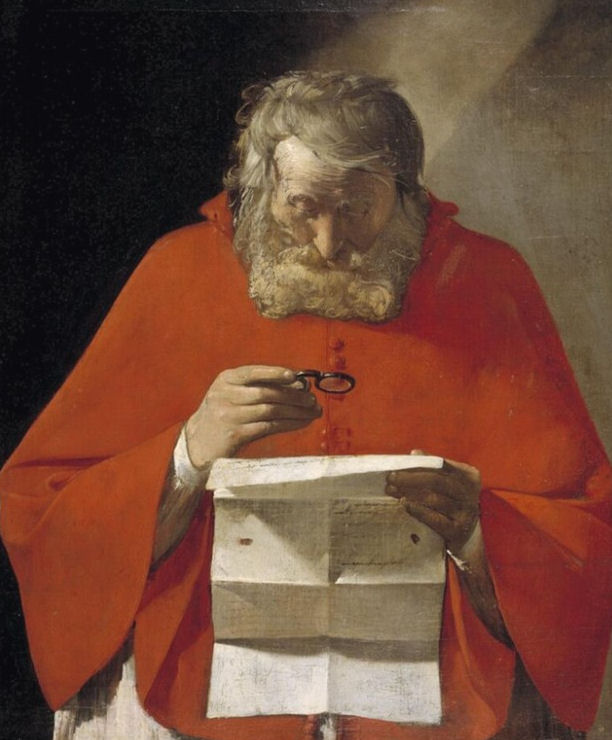
St Gerome Reading a Letter by Georges de la Tour (1629)

The painting by Georges de la Tour’s Saint Jerome Reading a Letter was completed around 1629 and is a masterclass in how to make a single, ordinary action, in this case, reading, carry the weight of a whole life. St Jerome was an early Christian priest, confessor, theologian, translator and historian and his image fills the frame at half-length, wrapped in a cardinal-red mantle.  His head bends slightly forward, and a wisped halo of grey hair catches the light that slants in from the upper right in a wedge-like form.  In his left hand, Jerome holds a creased sheet of paper and in his right hand, he lifts a small pair of spectacles toward the page, trying to focus on the written words.

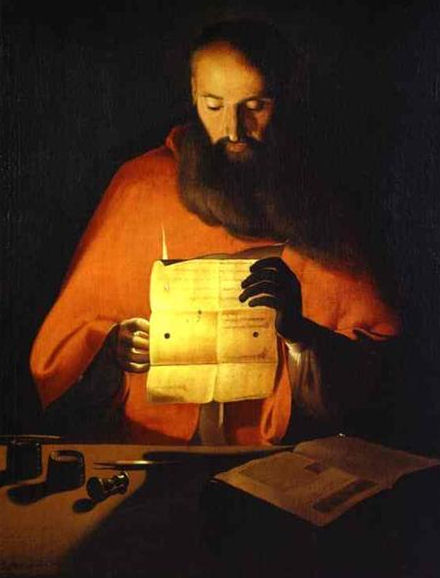
St Jerome Reading by Georges de la Tour (1650)

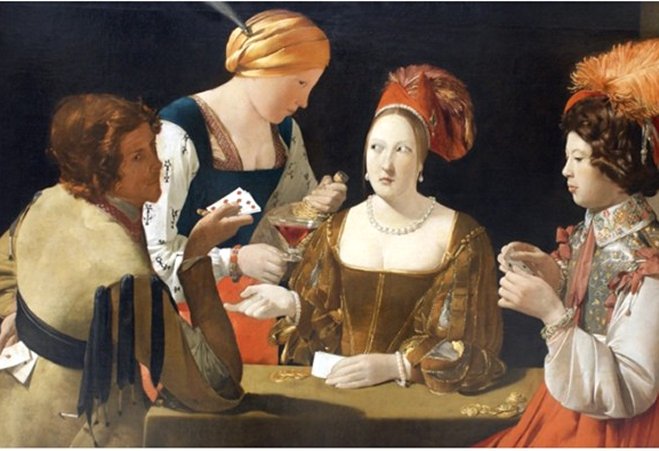
Georges de La Tour is best known for his religious paintings, which are instilled with extraordinary spiritual intensity despite the look of simplicity. In complete contrast to the religious works, de la Tour was interested in scenes of games of cards and dice as well as genre scenes. His interest in depicting card players and card cheats can be seen in two versions he made two years apart.

The Cheat with the Ace of Clubs by Georges de la Tour ( 1630–1634)

The earlier version is one of two versions of the composition by de la Tour and is known as The Cheat with the Ace of Clubs.   There are a number of variations in details of colour, clothing, and accessories between the two paintings.  This one is now hanging in the Kimbell Art Museum in Fort Worth, Texas.

The Card Sharp with the Ace of Diamonds by Georges de la Tour (1636-38)

The work, the later variation, depicts a card game in which the wealthy young man on the right is being cheated of his money by the other players, who both appear to be part of the scheme. The card sharp on the left is in the process of retrieving the ace of diamonds from behind his back.

The Dice Players by Georges de la Tour (1651)

De la Tour’s painting entitled The Dice Players is a genre painting which he completed in 1651.  In the work he depicts a group of five figures who are deeply absorbed in their game with dice. Their intimate gathering around a table, illuminated by a single, subtle light source, is a good example of his tenebrism-style that emphasizes dramatic contrasts between light and dark. Look how each figure has a different facial expression as we see them all concentrating on the game.  Besides this, look at how the artist has depicted details of their period clothes and he has created, through the dim, atmospheric lighting, a vivid record of 17th-century life, and a sense of realism to the scene. De la Tour has used a sombre palette and the careful attention to textural details highlights the gravity of the moment.

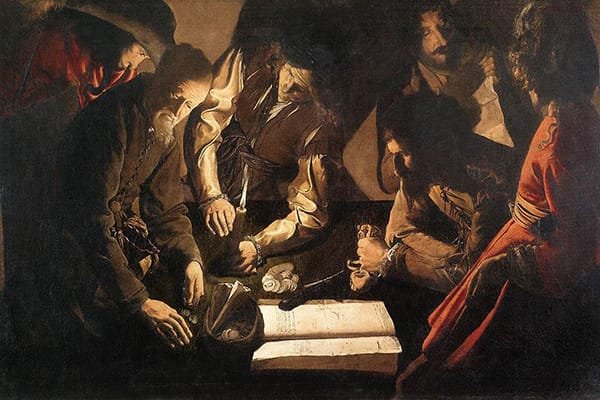
Payment of Taxes by Georges de la Tour (1620)

The painting entitled Payment of Taxes by Georges de La Tour was completed around 1620. Once again it highlights la Tour’s love of the artistic movement known as Tenebrism which is characterized by dramatic illumination and stark contrasts between light and dark. It is a large painting measuring 152 by 99 centimetres. The painting depicts a group of figures huddled together around a table. The depiction is dramatically lit by a single, stark light source, casting deep shadows and creating a profound sense of volume and space. This light appears to emanate from a candle or lantern which is out of view, highlighted by the reflective surfaces and illuminating select portions of the figures and objects. The men gathered around the table are engaged in an exchange, with a distinct focus on the act of counting or possibly exchanging money. The artist has focused their expressions and their hands and that emphasizes the gravity and concentration of the transaction at hand. The use of light and shadow not only gives the scene an emotional feeling but it also guides the viewer’s gaze through the composition, emphasizing the movement of money encapsulated in this painting.

Peasant Couple Eating by Georges de la Tour (c.1620)

Georges de la Tour’s painting entitled Peasant Couple Eating was completed around 1623, at the early part of his artistic career.   The two half-length figures which are almost life-size are tightly framed in the pictorial space.  They face us as if we have interrupted them during their meagre meal of dried peas.  The man exhibits a sour and resentful look as he looks down.  The woman stares fixedly at us with her deep-set almost dead eyes as she raises a spoon to her mouth.  As the background is a simple grey, we have no idea where the event is taking place.  However, this background enhances the old couple.  The painting of half-length figures like this one was a characteristic of Caravaggio’s style, an artist who influenced de la Tour in his early works.  This painting proved very popular and there are records of three 17th century copies.

In the book, Georges de la Tour of Lorraine, 1593-1652, by Furness, the author wrote of the artist:

“……Georges de la Tour is classed as a realist.  Realist he is in that his subjects, predominantly if not exclusively religious, are represented in terms of “real” life, often the life of his own country-town and surroundings in Lorraine.  But he avoided naturalism; rather, he chose to simplify, modelling his forms by marked contrasts of light and shade, and using large volumes and severe lines, with great selective economy of detail…”


Some of the paintings shown in this blog were not at the exhibition but I wanted to show you more of la Tour’s work.

Did I enjoy the exhibition ? The painting were excellent. However, for me the downside was two-fold. Firstly the rooms displaying the paintings were overcrowded (and this was a timed-enterance exhibition). Some people were moving clockwise whilst others moved anticlockwise and it felt slightly claustrophobic. Secondly all the paintings were accompanied by a card describing the work but they were all in French, rather bilingually. My love of visiting art museums is to buy a book with regards the exhibition and in this case a book about the actual museum itself and the works of the artist were on sale in many languages but none in English.. Brexit ???

I recommend you to the gallery website:

Musée Jacquemart-André | Museum in Paris

Suffolk Artists. Part 2.

This is the second part of my blog which focuses on lesser-known artists that had a connection with the English county of Suffolk.

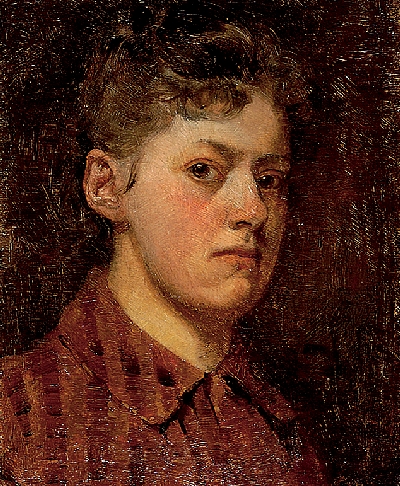
Rose Mead’s self portrait (c.1900)

Emma Rose Mead, known as Rose Mead, was born at 15 Hatter Street, Bury St Edmund’s, Suffolk on December 4th 1867.  She was the youngest of eight children, having six brothers and two sisters of Samuel Mead, a master house plumber, glazier and decorator who employed several men, and his wife Emma Mead, née Smith, who married at St James’s Church, Bury St Edmund’s July 1846.  

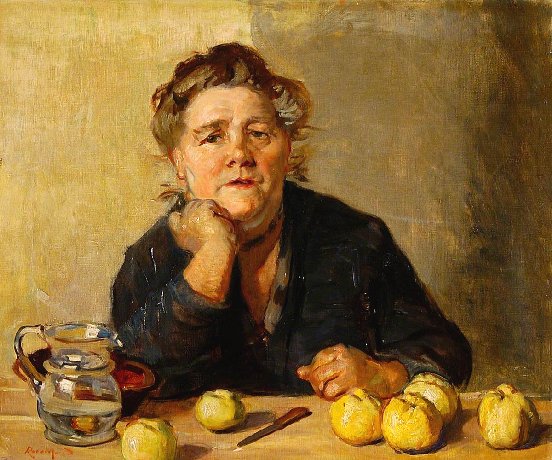
Barbara Stone in the Kitchen by Rose Mead (c.1930). One of Rose Mead’s her best known pictures, was of Barbara Stone who was Rose’s home help

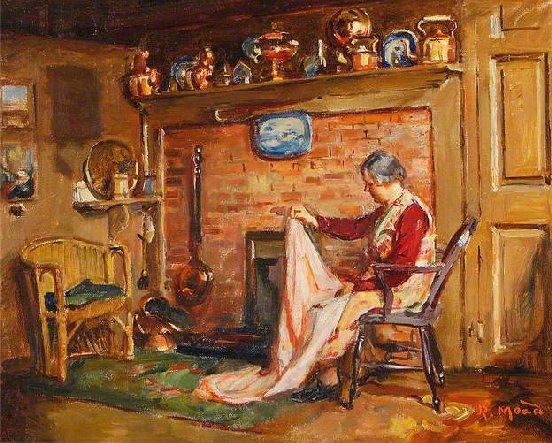
Rose attended the local school for girls. studied at Bury St Edmunds Science and Art Classes from where in 1884, she passed her art examinations and the next year she transferred to the Lincoln School of Art and soon began to exhibit at the Bury St Edmunds and West Suffolk Fine Art Society.  Later she went to live with her older brother, Arthur, a bank clerk, in Leatherhead, Surrey and attended the Westminster School in London. Her stay at the college was short-lived as she was called back home to care for her dying father. After his death in May 1895, she spent a year in Paris with her friend Helen Margaret Spanton, an artist and suffragette.  Whilst living in the French capital Rose continued her art studies at the Académie Delécluse where she became great friends with another English artist, Beatrice How. During her stay in Paris, she had one of her pastel portraits exhibited at the Paris Salon and it was again exhibited at the Royal Academy the following year.

Interior of the Athnaeum Kitchen by Rose Mead (1933)

Rose returned to London in 1896 but this stay was interrupted once again in 1897 when her mother fell in and she was summoned to Bury St Edmunds to her mother’s Crown Street home to look after her.  This was to be her permanent place of residence.  Her mother died in 1919. In her later years she lived at St Edmund’s Hotel on Angel Hill and, one day, when she failed to return to the hotel, on investigation Rose was found in the hallway of her Crown Street studio from a fall downstairs and she died from a fractured skull on 28 March 1946, aged 78.  Rose never married.

The second artist I am featuring in this blog is Edwin Thomas Johns who was born in the Suffolk port town of Ipswich on December 26th 1882.  Edwin was the youngest of five children of William Johns and his wife Isabella Elvira Johns née Wardle.  Edwin had four older siblings, three sisters and one brother, Elvira Isabella, Lavinia, Ellen and William.  Edwin’s art tuition began when he attended the Ipswich School of Art.

Memories by Edwin Thomas Johns (1929)

Edwin attended the Ipswich School of Art under the headmaster, William Thompson Griffiths.  In 1877 Edwin was articled to James Butterworth, a company of architects on Museum Street, Ipswich.  When Butterworth retired Edwin completed his articles with William Cotman Eade and later became his assistant.  Then the company was renamed Eade & Johns until 1912, when Eade retired and Edwin Johns carried on his own company based in Lower Brook Street, Ipswich.  He was a founder of the Suffolk Association of Architects and became its first President. In 1921, his nephew Martin Johns Slater joined the business, which subsequently operated under the name Johns & Slater until Edwin retired in 1933.

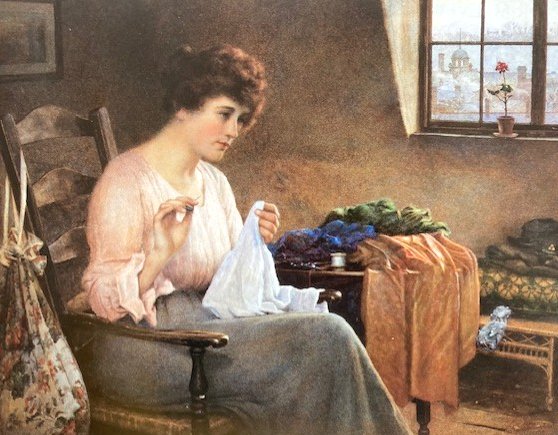
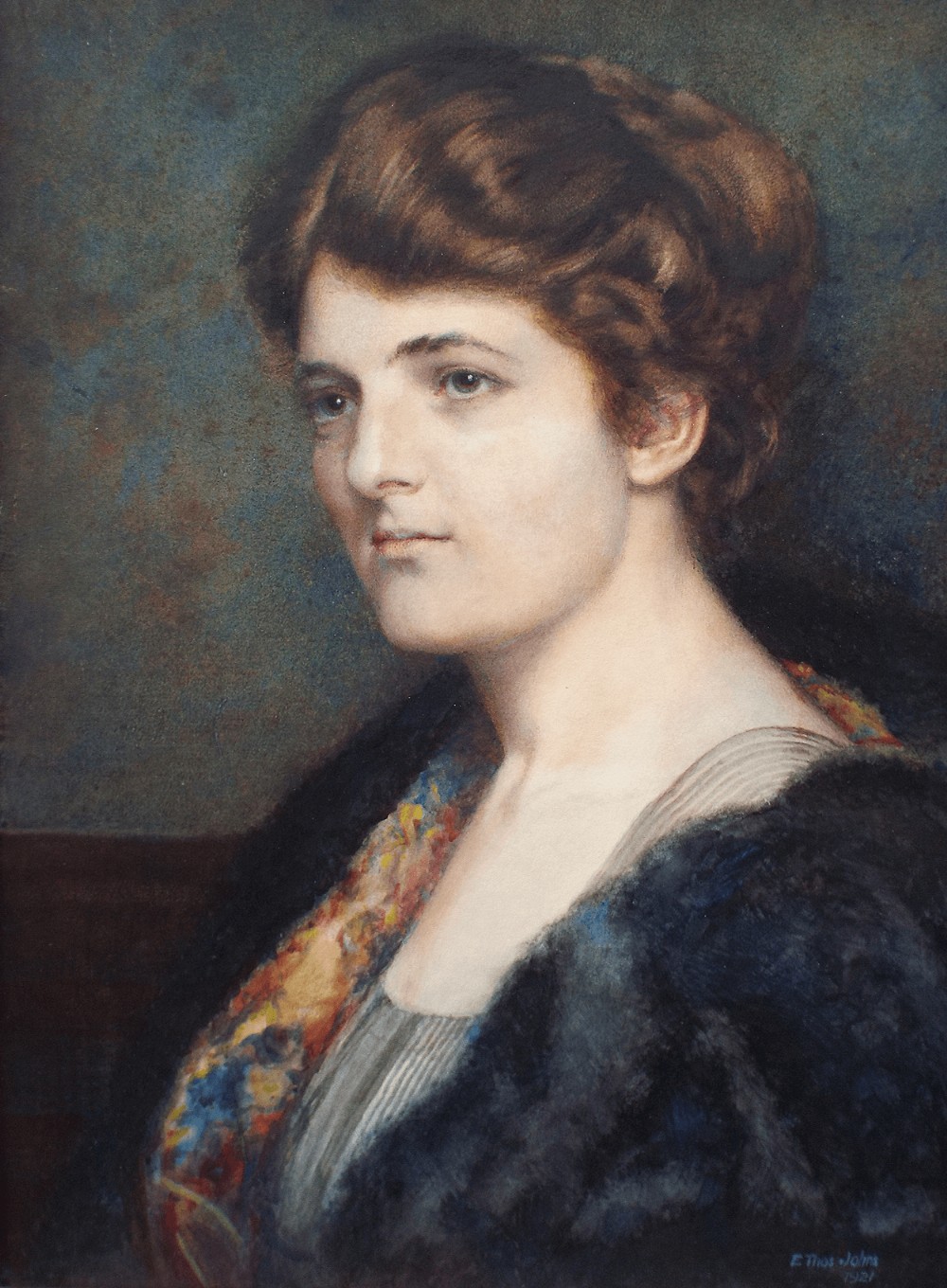
Portrait of a Lady by Edwin Thomas Johns

Edwin Johns was also an accomplished watercolour artist and painting became his main interest later in his life.  He was a life member and regular annual exhibitor at the Ipswich Fine Art Club which he first joined in 1887 and remained a member until his death in 1947.  At one time he held the office of Club secretary and Club president. He also exhibited at the Royal Academy with several of the works also being shown at Ipswich.

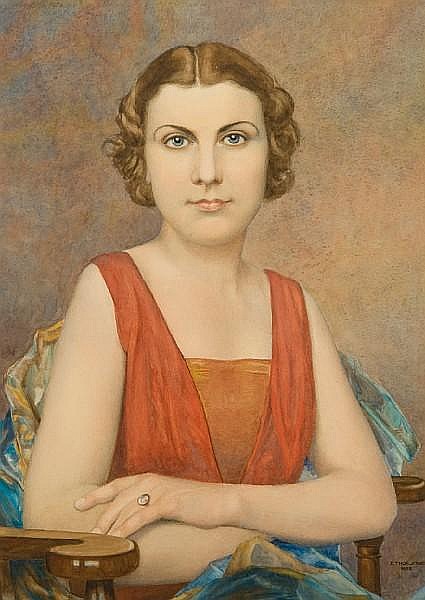
Portrait of a lady with cropped hair, in red dress by Edwin Thomas Johns (1938)

He married at the Congregational Chapel, Redhill on March 29th 1893  His bride was Janet Eliza Prentice.  The couple had no children.   Edwin Thomas Johns died at his home in Ipswich on November 11th 1947, aged 84.

Thomas Smythe was born on November 14th 1825 to James Smyth, a banker, and his wife Sarah Harriet Smythe (née Skitter}.  Thomas was fifteen years younger than his brother, the artist Edward Robert Smythe, whom I wrote about in Part 1.  It is thought that Thomas went to school run by Charles and Elizabeth Watson at Berners Street, Ipswich.

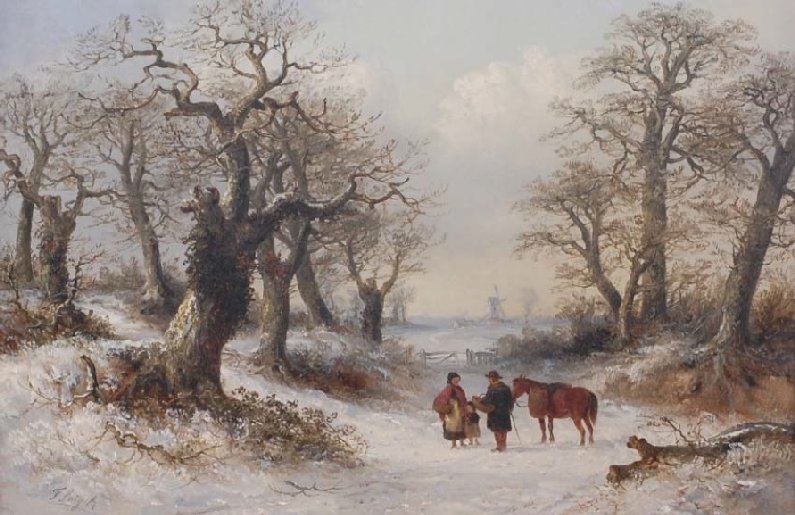
Figures in Winter Landscape with Windmill beyond by Thomas Smythe

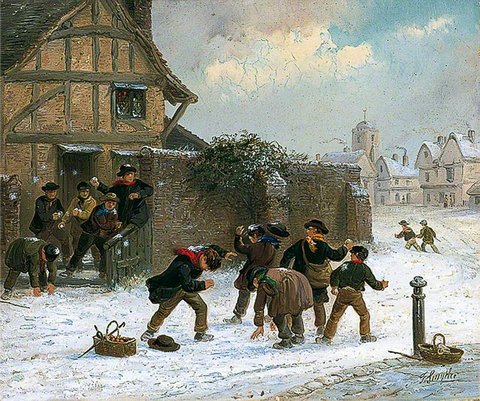
Children Snowballing by Thomas Smythe (c.1900)

Thomas worked alongside his brother from around 1846, until 1851 when Edward Robert Smythe left for the Lancaashire town of Bury.  It was then that Thomas set up on his own as a landscape and animal painter in Brook Street, Ipswich.  In 1850, Thomas married twenty-one-year-old Miss Pearse from Ipswich.  They went on to have five children, Thomas the eldest child became an artist but sadly died in a cycling accident when he was nineteen.  Ernest their second son was also an artist and became a book illustrator in London until he emigrated to America. Their son Robert emigrated to Canada.

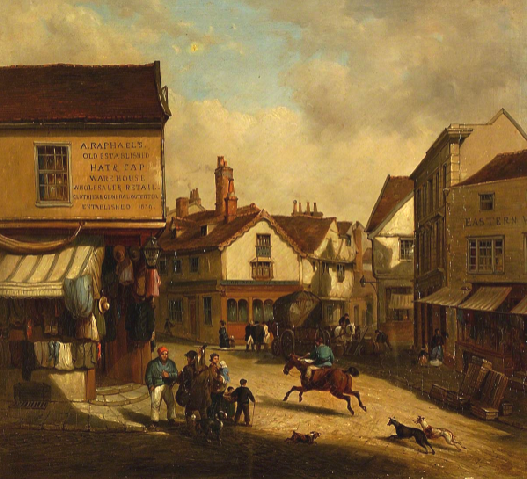
Angel Corner, Fore Street by Thomas Smythe (c.1850)

Thomas Smythe exhibited several oil paintings at the Suffolk Fine Arts Association exhibition in August 1850 which was held at the New Lecture Hall at the Ipswich Mechanics’ Institute. Around 1899 Thomas Smythe went to live, with his son Ernest, in London but died after a short illness, at the home of his son-in-law Frank Brown, at Heathfield, Ipswich on May 15th 1906, aged 81. His wife Jane died at Ipswich in 1919, aged 76

A more well-known Suffolk artist was Frederick George Cotman. Frederick George Cotman was born at 186 Wykes Bishop Street, Ipswich on August 14th 1850.  He was the youngest child of Henry Edmund Cotman, a former silk mercer of Norwich, and his wife Maria Taylor who married at St Andrew’s Church, Norwich in January 1842. Henry Cotman was a younger brother of Norwich School’s more famous artist John Sell Cotman.  Frederick Cotman had two brothers, Henry Edmund and Thomas William and a sister Marguerite.

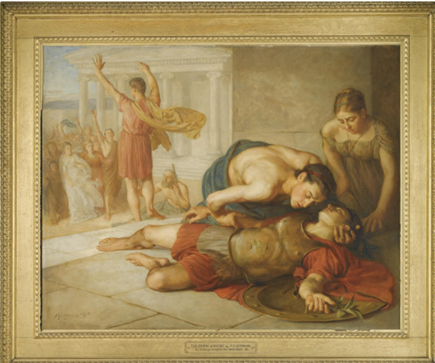
The Death of Eucles by Frederick Cotman (1873)

In 1866, aged sixteen, Frederick attended the Ipswich School of Art  and his first work was exhibited in 1867 at the Eastern Counties Working Classes Industrial Exhibition at Norwich, where he won a prize medal.  In 1868, he enrolled as a student at the Royal Academy Schools and his ability as a draughtsman and painter in oils and watercolours, was rewarded with four silver and in 1873 a gold medal for his painting, The Death of Eucles, which can now be seen displayed at the Ipswich Town Hall.

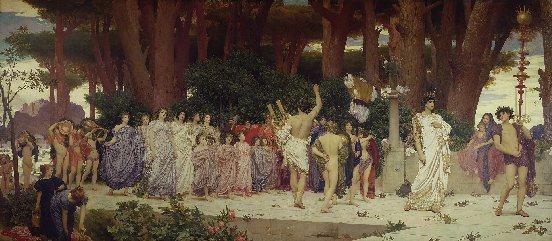
The Daphnephoria, by Frederick Leighton (c.1874-76)

At the RA Schools two of Cotman’s tutors were Frederick Leighton and the miniature and portrait painter Henry Tamworth Wells.  Leighton employed Cotman to help paint The Daphnephoria in 1876,  a composition of thirty-six figure which depicted the festival in ancient Thebes to celebrate a victory over the Aeolians. It was held every ninth year in honour of Apollo; at head of procession a pole is carried bearing several copper globes, the largest representing the sun or Apollo, the next largest the moon and the small globes the stars and planets.

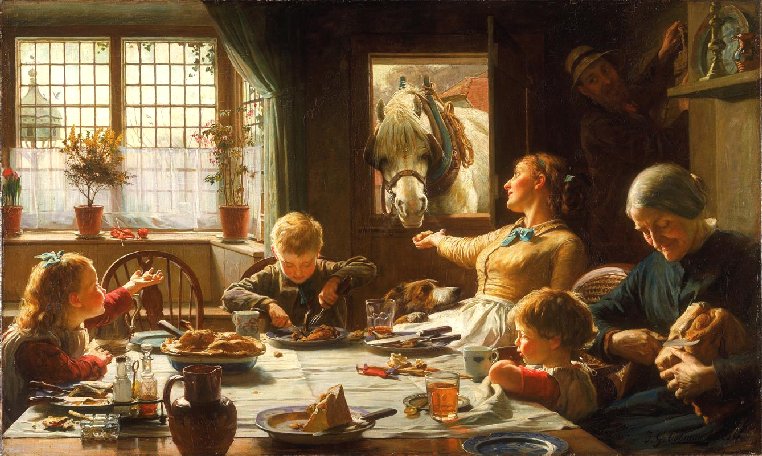
One of the Family by Frederick George Cotman (1880)

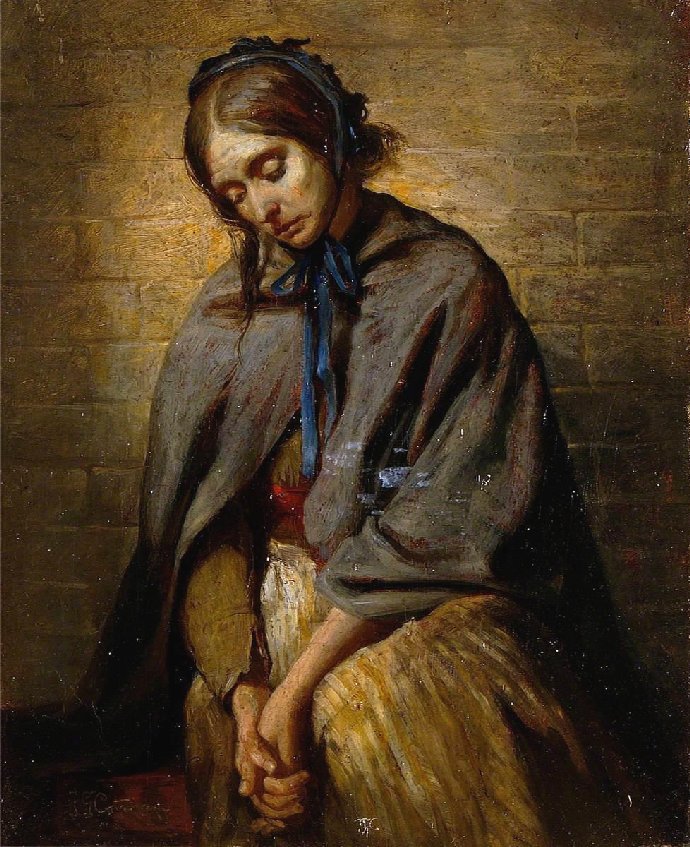
The Widow by Frederick George Cotman (1880)

Cotman became recognised as a London society portrait painter, and such paintings could fetch a fee of three hundred guineas.  He also completed many homely genre scenes. Cotman was elected a member of both the Royal Institute of Painters In Water Colours and the Royal Institute of Oil Painters, and his paintings graced the walls of the Royal Academy, the Royal Society of British Artists; Royal Institute of Painters in Water Colours; Agnew & Sons Gallery; the Dudley Gallery; Dowdeswell Gallery; Fine Art Society; Grosvenor Gallery all in London, the Walker Art Gallery in Liverpool; Manchester City Art Gallery; the Royal Glasgow Institute of the Fine Arts and the Royal Scottish Academy.

Alderman William Groom by Frederick George Cotman (1903) 

Frederick married at St Mary Abbots, Kensington, London on March 30th 1875.  His wife was a Scottish girl, Ann Barclay Grahame, who was the daughter of Barron Grahame, of Morphie, Aberdeenshire.  It was also in 1875 that Frederick became a founder member of the Ipswich Fine Art Club.  In 1891, Frederick with his wife and six children were living at Widmere Common, Burnham, Buckinghamshire but in 1897 he moved to Lowestoft, Suffolk to enjoy his favourite sport of yachting.  Frederick George Cotman died at Quilter Road, Felixstowe on July 16th 1920, a month before his seventieth birthday.   He was buried in Old Felixstowe churchyard. His wife died in 1936, aged 86.

Henry George Todd was born at 27 St John’s Street, Bury St Edmund’s on January 20th 1847.  He was the son of George Todd, who plied his trade as a decorative artist and signwriter, and his wife Sophia Todd (née Spencer). Henry attended a school at Bury St Edmund’s and later Henry was apprenticed to his father and trained in decorating, gilding and signwriting. At the age of 18, Henry enrolled in an art school and due to his excellent work he went on to enrol at the South Kensington Schools, which is now known as the Royal College of Art.

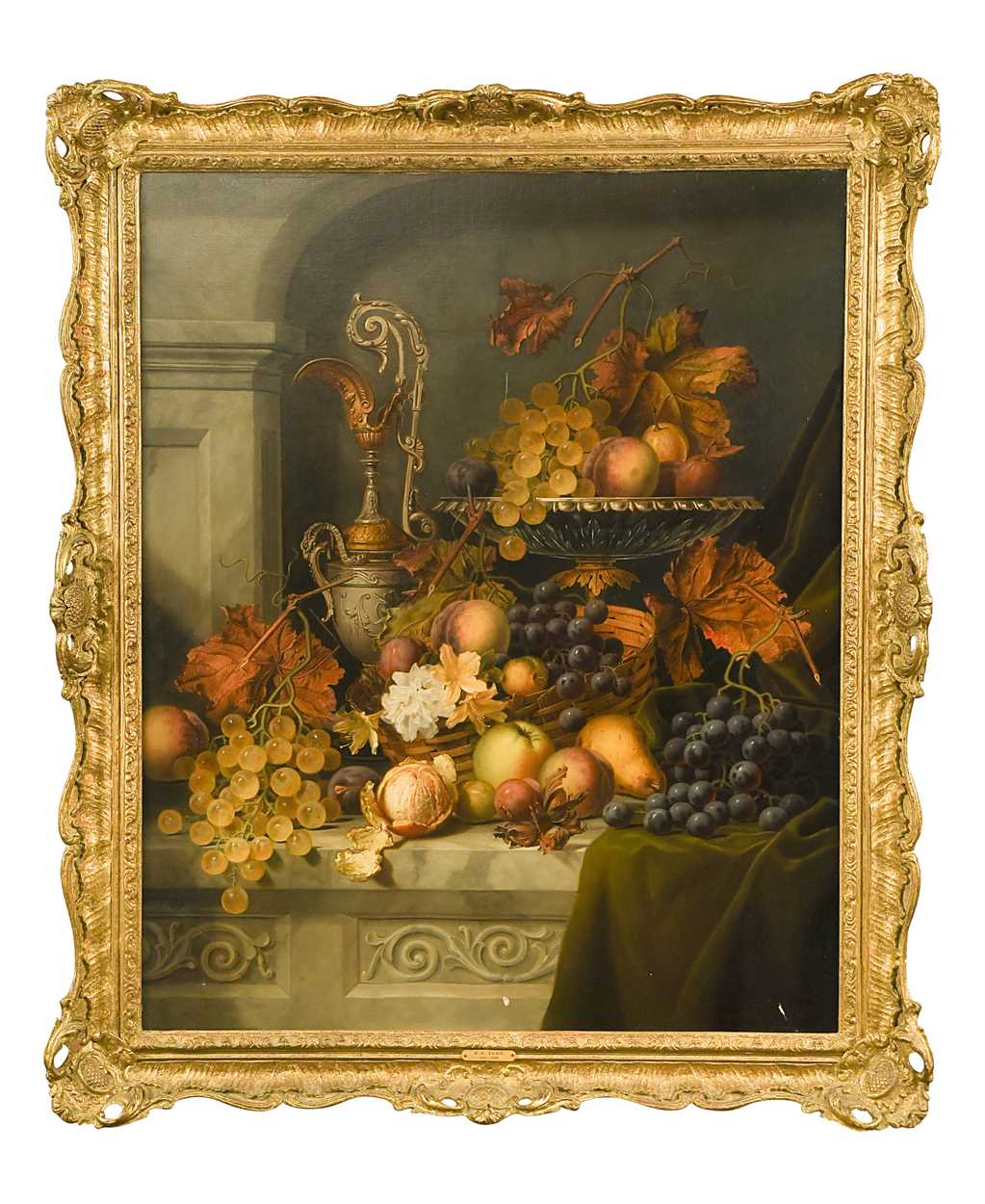
Still life with Fruit and a Ewer on a Stone Ledge by Henry George Todd

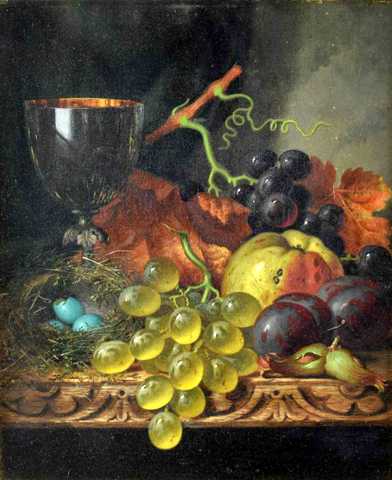
Still life by Henry George Todd

Later both he and his father exhibited their works in the Todd’s St Andrew’s Street North shop. Around 1874, twenty-seven-year-old Henry moved to Ipswich and got a job with Alfred Stearn & Son, which was then the most important decorating company in the town, working in design, decoration, and gilding, being commissioned by local traders for their shopfronts which were considered by many as works of art.

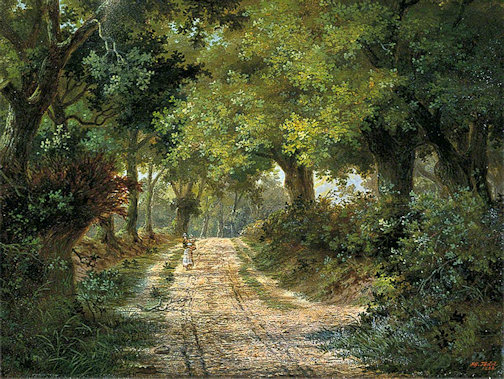
Gainsborough Lane, Ipswich by Henry George Todd

Although Henry was working full time at the business, he still found time to paint.  His favoured genres were his still life pictures and Suffolk landscapes.   Henry Todd married 21-year-old Ellen Lucy Quinton of Ipswich and the couple went on to have five children; Ada Ellen who was born in 1874, George William in 1875, Eva Spencer in 1876 and Arthur John in 1880, sadly their 16-month-old daughter, Kate Sophia died in 1882.  He joined the Ipswich Fine Art Club in 1885 and became largely famous for his still-life and his aptitude to paint grapes.

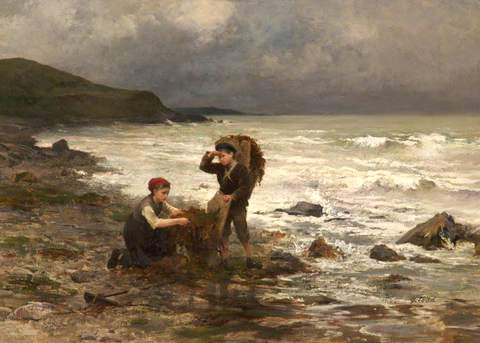
Seaweed Gatherers by Henry George Todd

Todd exhibited at many shows including one painting at the Royal Academy also displayed his work at the Suffolk Street Gallery of the Royal Society of British Artists, and the Dudley Gallery.   Henry George Todd died in Croft Street, Ipswich on June 30th 1898, aged 51 and was buried in Ipswich cemetery five days later.


Once again the information for Part 2 of the Suffolk Artists was gleaned from two excellent websites;

Suffolk Artists

East Anglia Art Centre

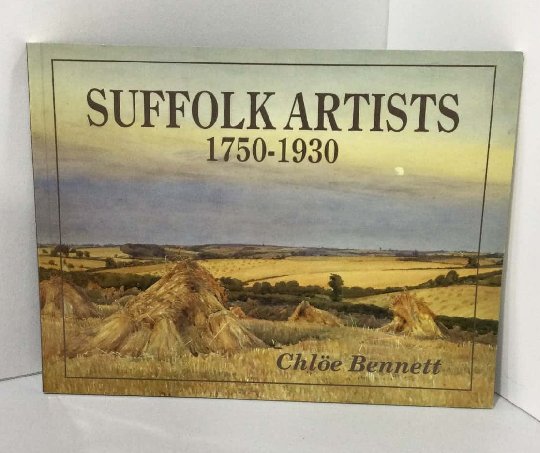
and also the book by Chloe Bennett entitled Suffolk Artists (1750-1930).

Suffolk Artists. Part 1.

Britain had a number of locations favoured by artists.  There was Newlyn in the south-west and Snowdonia in North Wales to mention just two.  In the next two blogs I want to look at artists who were born or worked in the south-east county of Suffolk during the late eighteent6h century to the early twentieth century.  I am not focusing on the renowned artists such as Gainsbouough, Constable and Cotman but will be looking at the life and works of painters that you may not have heard of but their works of art depict the beauty of this area of England.

My first “lesser known”artist from Suffolk is George Frost.  He was baptised at Barrow, Suffolk on February 21st 1745, and was the son of George Frost a builder at Ousden, Suffolk, and his wife Thomasin.

The Common Quay, Ipswich by George Frost (1820)

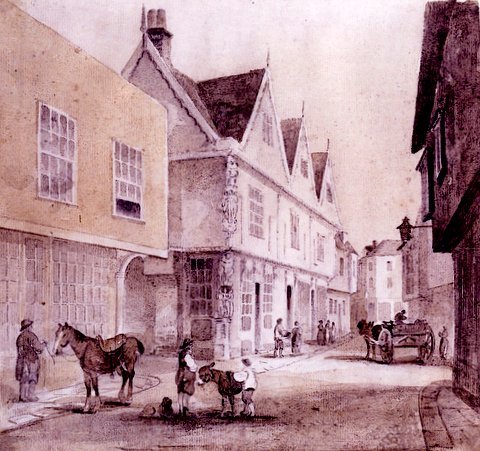
Asssembly Rooms, Tavern Street Ipswich by George Frost (c.1800) Pen and ink with grey and buff washes over pencil.

  George began his career working in his father’s business but later secured a position in the office of the Blue Coach Company in Upper Brook Street, Ipswich, where he continued until his retirement in 1813. Working there involved multiple jobs such as dispatching the coaches, the buying in of hay, straw, oats, etc., paying wages of the workers, and looking after the company’s horses and coaches, while his wife also helped in the office. Once his office work was concluded for the day Frost would leave and would go out and about for the remainder of the day and ikndulge in his love of painting.  George had a natural talent for drawing and he painted topographical watercolours of Ipswich but later began sketching the countryside around the Suffolk town in pencil and black chalk.  He became acquainted with John Constable probably through his work at the coach office and by around 1800, the two artists sketched amicably together along the banks of the River Orwell. Frost often visited London and it is thought that he had been dealing in paintings.  He died after a lingering illness, on June 28th 1821, aged 77, and is buried at St Matthew’s Church, Ipswich.

Thomas Churchyard was the only son of a Melton butcher and grazier. Following his education at Denham Grammer School he was articled to a local solicitor. He became a country lawyer in Woodbridge in 1822 and lived in the Suffolk town but his enduring love was for painting and he completed hundreds of watercolours and oils.

Country House in a landscape, probably Shrubland Hall by Thomas Churchyard Inscribed verso ‘Emma’, with a pencil sketch of landscape verso.

Churchyard also formed a friendship with the poets Bernard Barton and Edward Fitzgerald and the group became known as the “wits of Woodbridge”. Besides painting, he was  a lifelong avid art collector and, on his death, his estate included works by Gainsborough, Constable and Crome.  Churchyard’s work is held in the Tate Gallery, The British Museum, the V & A and the Ashmolean.

Shortly before his death Churchyard was careful to inscribe each of his most prestigious works in his studio with the names of his seven daughters. On the reverse of the “Country House” painting there is the inscription “Emma” who was Churchyard’s second daughter. Why ?

He is recorded to have said at the time:

 “…My dears, there will not be any money for you when I die, but I will leave you my paintings, which one day will be worth more than any money I could ever have hoped to have made…”.

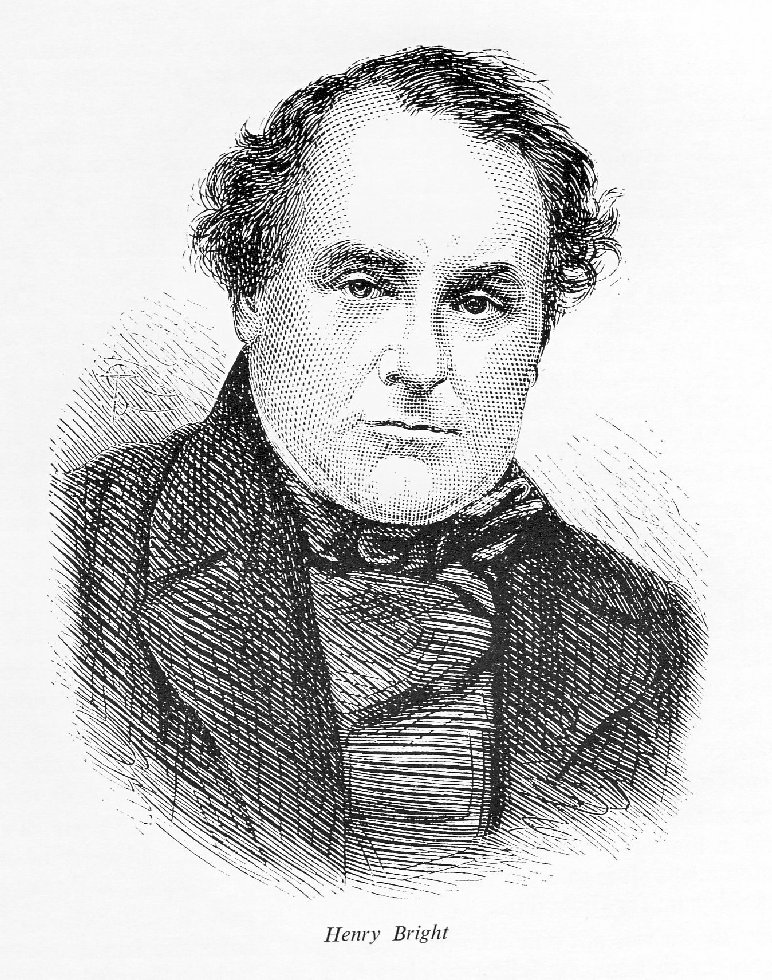
Henry Bright was a well-known English landscape painter connected with the Norwich School of painters.  He was born at the family home, also his father’s business premises, on June 5th 1810 in Saxmundham, Suffolk.  Henry was the third son and one of nine children of Jerome Bright, a clockmaker, and Susannah Denny, of Alburgh in Norfolk, who were married on June 28th 1790.

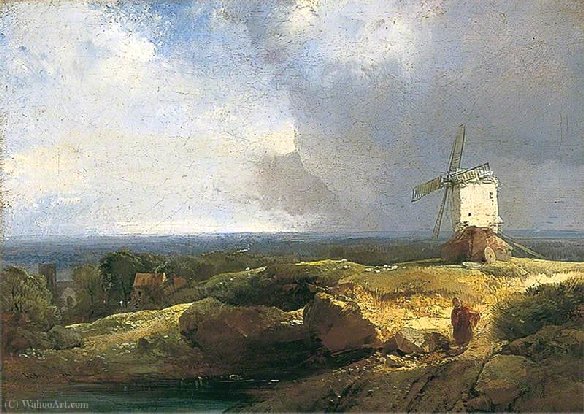
Landscape with Windmill by Henry Bright (1841)

 Henry attended a School for Young Gentlemen in North Entrance Saxmundham.  As a teenager he was indentured as a chemist’s apprentice in Woodbridge and later was transferred to Norwich and to Paul Squires’ chemist and soda water manufacturer who was also a keen collector of art, and it was he who introduced Bright into the local artistic circles. Later Bright became a dispenser at the Norfolk and Norwich hospital

On the Broads by Henry Bright (1833)

Having always loved sketching Henry Bright was determined to become an artist, and fortunately managed to persuade his parents to let him transfer his indentures to artist Alfred Stannard of Norwich and he became a member of The Norwich Society of Artists. Henry married Eliza Brightly at Saxmundham parish church on May 8th 1833.  She was the youngest daughter of the late Alfred Brightly, a liquor merchant, of New York, North America and granddaughter of Thomas Brightly, a Saxmundham farmer.  The couple went on to have two sons, who both died in childhood, and two daughters. In 1836, Bright and his family moved to Paddington, London where he lived for some twenty years, subsequently moving to Grove Cottage, Great Ealing and exhibiting in London.  He sold his second Royal Academy exhibit to Queen Victoria, which ensured a following among the metropolitan elite, only returning to Saxmundham after the death of his wife at Ealing in 1848.

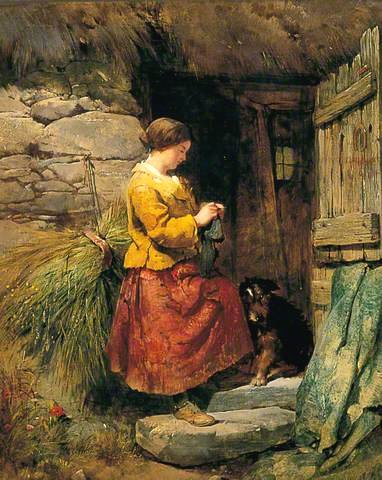
The Colttage Door by Henry Bright (1864)

Bright earned up to £2,000 per annum from his many royal and aristocratic pupils, including the Landgravine of Hesse-Homburg, the Grand Duchess Marie of Russia, and many local Suffolk artists as well as publishing chromolithographs and drawing books, such was his reputation that he gave his name to Bright’s Superior Coloured Crayons and his testimonials included Winsor & Newton’s Moist Water Colours.

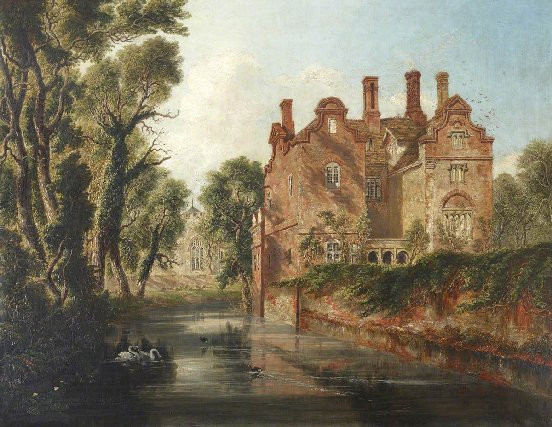
Landwade Castle by Henry Bright

Bright was a natural draughtsman and his watercolours, typically of open skies and landscapes, have considerable freedom, freshness, and richness of colour; he also made many drawings in chalk or pastel of old and picturesque buildings. He remained active in East Anglia and was vice-president of the Suffolk Fine Arts Association. After living at various addresses, in October 1870, Bright returned to Ipswich, living at the house of his niece, where he died after months of illness on September 21st  1873, aged 59 and was buried in Ipswich cemetery five days later. At the time of his death, he was said to have enough commissions to last him for ten or twelve years.

Edward Robert Smythe was an English painter of rustic landscapes and an exhibitor at London’s Royal Academy.  He was born at Berners Street, Ipswich in 1810 and baptised St Nicholas Church, Ipswich on 10 February 1815.  He was the son of James Smyth and his wife Sarah Harriet née Skitter who married at Norwich on June 14th 1811.  James was an accountant with bankers Bacon, Cobbold, Rodwell, Durningham & Cobbold in Tavern Street, Ipswich who added a final ‘e’ to his surname.

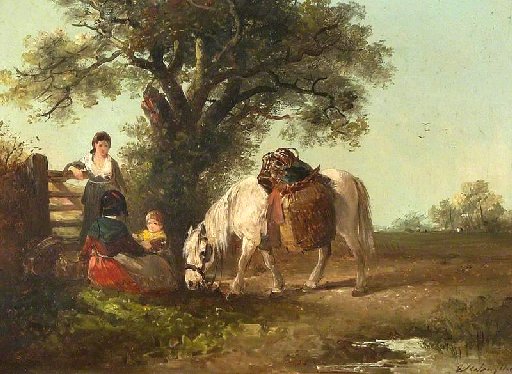
Two Women, Child and Pony by Edward Robert Smythe

Edward, from an early age, had a strong interest in drawing and loved to  sketch views of the Suffolk coastline. He quickly became looked upon as a very talented artist and was soon elected to the Ipswich Society of Artists and opened his own studio at the ‘Old Shire Hall’.

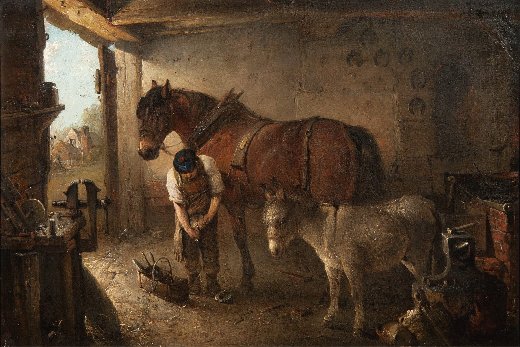
 A Farrier Shoeing a Plough Horse with a Donkey in a Forge Interior by Edward Smythe (1899)

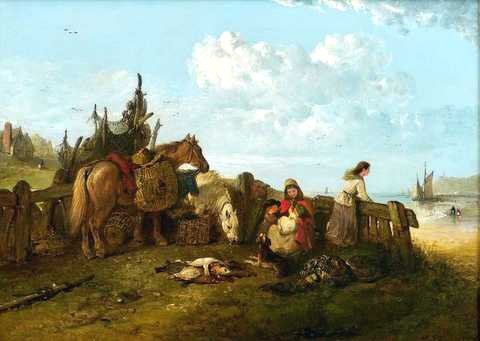
In the early 19th century, Ipswich was still mainly an agricultural area but this all changed with the arrival of industrialisation which gradually eroded its rustic charms. Edward Smythe was an artist with a deep connection to nature, and left Norfolk for Bury, Lancashire, in 1851, which had managed to safeguard its agricultural roots.  His landscape and figurative works concentrated upon his personal view of the world and was influenced by both the uncomplicated endeavour of rural communities and the gnarled beauty of the Suffolk countryside. His depictions featured what was termed ‘rugged realism’ of his local neighbourhoods such as the leaning timber-framed cottages, overgrown foliage, weary cattle groups, and dog-eared inn-dwellers. Rarely does a tree grow straight in his rustic rose-tinted utopia.

Fisherfolk besides the Sea by Edward Robert Smythe

About 1840, he moved back to Norfolk and the city of Norwich where he joined the Norwich School of Painters.  On March 15th 1848 he married Ellen Burman a resident of Ipswich and it was here in 1849 that they had their first child, Edward Robert, jun.  On September 13th 1850, now living in the Suffolk village of Elmswell, he was declared insolvent.  By 1861, he and his wife had further children born at Bury St Edmund’s, Francis (Frank) Rowland in 1852, Ellen Kate in 1854 and Mary Emily in 1856, and their daughter Louisa Jane, who died on 7 April 7th 1861, aged 3 years and 7 months.  In 1879 whilst living in Bury St. Edmonds his wife died aged 52. Two years after the death of his wife Edward went to live in Ipswich with his married daughter Ellen Kate.  Edward Robert Smythe died in Ipswich on, July 5th 1899, aged 88, and was buried in Ipswich cemetery three days later.

John Duvall was born in the Kent seaside town of Margate on September 3rd 1815. He was a nineteenth century English artist who painted landscapes, sporting and rustic subjects. He moved to the Suffolk port town of Ipswich in 1852 where he set up his studio in the Butter Market and began to teach drawing. Although he started off as a portrait painter, the number of portrait commissions declined due to the advent of photography and so he decided to start to focus on painting horses and some of his depictions of the animals provided illustrations for the Suffolk Horse Society’s Stud Book.

The Suffolk Show at Christchurch Park by John Duvall (1869)

In his 1869 painting, The Suffolk Show at Christchurch Park John Duvall depicts Colonel Barlow in the centre foreground with his prize-winning Suffolk Punch Dalesman. Next to him is his son, Eustace, while his groom Chapman is riding Topstall. The artist has included himself in the depiction, lying on the ground smoking a pipe with a sketch of a horse lying on the ground behind him. Duvall’s son has also been depicted. He is the one on the left of the two men under the tree on the far left of the painting.

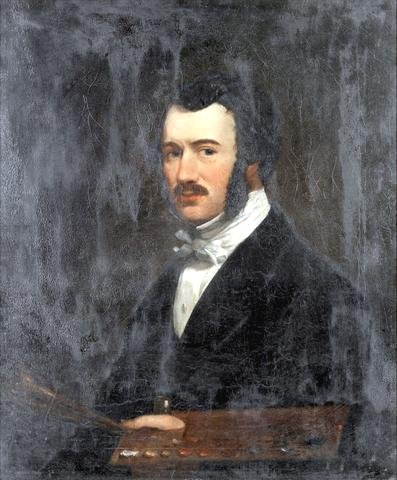
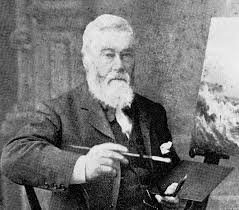
John Moore was born in the Suffolk town of Woodbridge on May 16th 1920 and was baptised in February 1821.  Woodbridge was a hotbed of local artistic movements, with poets and painters regularly to be seen about the town. Woodbridge was influenced by the local artist/lawyer, Thomas Churchyard, known as the lawyer painter, who would often forego his business duties for painting trips and John Moore’s early works were testament to this inspiration.

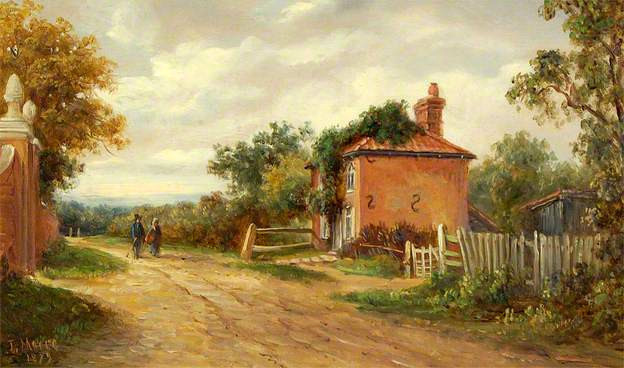
Old Park Road, Ipswich by John Moore (1879)

John Moore became a professional artist after pursuing an early career as a decorator and producer of specialist decorative effects, and these trades left him with a thorough understanding of painting techniques. The experience enabled him to paint quickly and confidently, his smooth touch of the brush displaying skills only matched by a handful of far more famous artists.  By the time the Ipswich Fine Art Club’s exhibitions commenced in 1875 his works were very sought after, appearing as a prolific exhibitor almost every year at these exhibitions until he died. Some local newspaper critics compared him to Turner and Clarkson Stanfield, the premier marine painters of his day.

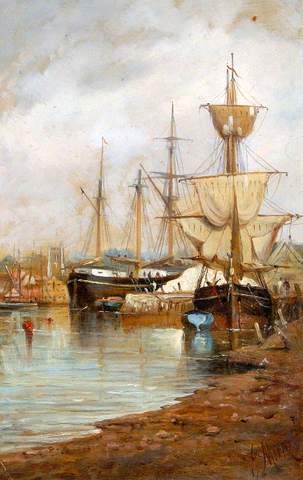
Ships in Ipswich Dock by John Moore

​Northumberland Coast Scene by John Moore

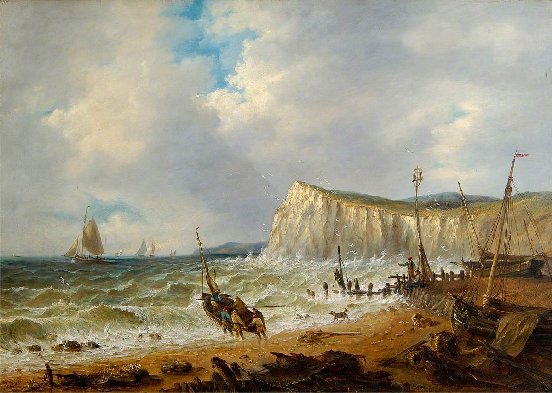
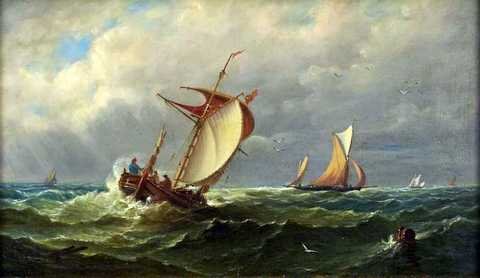
According to his accounts in 1877 he travelled to Scotland to carry out a commission for the Cobbold family. Art exhibitions featuring his work were displayed at the Ipswich Art Club between 1877 and 1882. Many of these paintings depictied scenes of Northumberland. Oten they focused on dramatic depictions of shipwrecks and fisherman battling against rough seas.

Fishing Boats in a Swell By John Moore

John Moore’s first wife, Caroline, died in 1877 and his second wife, Harriet, died in 1901.  Having outlived his two wives; he moved from Suffolk to the neighbouring county of Norfolk and the town of Diss where he spent the final few years of his life at the home of his friend George Scolding where he died on 8 April 1902, aged 82 and was buried in Ipswich cemetery.

…….to be continued.


Information for this blog was gained from the following websites:

East AnglianTraditional Art Centre

Suffolk Artists

Also from a book I found in a Brighton second-hand bookshop by Chloe Bennett entitled Suffolk Artists (1750-1930).

Mark (Max) Gertler. Part 1.

Max Gertler by Lady Ottoline Morrell vintage snapshot print, 1917. © National Portrait Gallery, London

My featured artist today is Markz Gertler. He was one of the most prominent artists of his generation and an early member of the New English Art Club, elected in 1912. He was a painter of figures, portraits and still-life.  Markz was born on December 9th 1891 at 16 Gun Street, Spitalfields, London.   He was the youngest of five children born to Austrian-Jewish immigrants from Poland, Louis Gentler and Kate (Golda) Berenbaum.  Markz had to elder brothers, Harry and Jacob, known as Jack and two elder sisters, Deborah and Sophie. 

Dorset Street, Spitalfields (c.1910)

By the 19th century, most of the area’s around Spitalfields had traditional industries, including silk weaving, but they had moved elsewhere, although the area still produced some textiles.  This decline of the local industry destroyed Spitalfields and it became a poverty-stricken, overpopulated area with little work. The grand houses which had been built by the Huguenots were turned into slums, and the area became unsafe. By the late 19th century, many people considered the place the most criminal in London.

The Rabbi and his Grandchild by Mark Gertler (1913)

The following year after Markz was born, 1892, because of the terrible economic downturn in the area, the family moved back to Markz’s mother’s native city of Przemyśl in Galicia, which at the time was part of the Austro-Hungarian Empire but now is situated in south-eastern Poland close to the Ukraine border. Life for the family was little better here as Max’s father worked as an innkeeper but this failed and now the family were financially desperate.  It could have been that his father felt guilty about not being able to support his family but one night in 1893, Gertler’s father Louis, without telling anyone, left his family destitute and on the brink of starvation, and went off to America to search for work.  Much later he contacted his wife to say that once he got established in America, he would send for them and all would be well.  It never happened as all his hopes of making a fortune in America ended in failure. 

Whitechapel High Street (1905)

Following yet another business failure Louis Gertler left America and returned to England and the London borough of Whitechapel, the heart of London’s Jewish quarter.  He set himself up as a furrier and in 1896 he arranged for his family to join him.  Once in England, his son’s first name was changed from the Polish Markz to Mark.

Portrait of Mark Gertler by John Currie (1913)

Gertler spent his early formative years in Whitechapel, London, a poor Jewish community, and attended nearby schools in Settles Street and Deal Street between 1897 and 1906.  He displayed a gifted artistic talent even as a young child and was said to have been motivated by pavement artists, advertising posters, and it was the autobiography of the great English painter William Powell Frith, which made Max determined to become a professional artist. In 1906, at the age of fifteen, on leaving school so as to earn some money for his family Mark (known as Max) became an apprentice at the stained-glass company Clayton and Ball.  He hated working there and rarely spoke of  the experience in later years.  During this time, he would attend evening classes at the Regent Street Polytechnic but in 1907 he had to drop out of college due to his family’s perilous finances.  In 1908, Max was placed third in a national art competition and then realised that he could become a great artist.  In 1908 Gerter met the artist, William Rothenstein. After seeing Max’s work Rothenstein wrote to Max’s father:

“…It is never easy to prophesy regarding the future of an artist but I do sincerely believe that your son has gifts of a high order, and that if he will cultivate them with love and care, that you will one day have reason to be proud of him. I believe that a good artist is a very noble man, and it is worth while giving up many things which men consider very important, for others which we think still more so. From the little I could see of the character of your son, I have faith in him and I hope and believe he will make the best possible use of the opportunities I gather you are going to be generous enough to give him…”

However, knowing the cost of studying art and that the family would be ununable to pay his tuition fees he became downhearted.

Portrait of a Girl by Mark Gertler (1912)

Having the money to pay for tuition fees, he needed a sponsor to put him forward to the prestigious Slade School of Fine Art.  This he received with a recommendation from William Rothenstein, an English painter, printmaker, draughtsman, lecturer, and writer on art who lived in the affluent London borough of Hampstead and who held a number of soirées which often included many well-known artists and some young and up and coming ones, such as Mark.  Mark Gertler entered the Slade in 1908   and studied there for three years.  He was the first and youngest Jewish working-class student of his generation to do so.

In her 1989 biography A Life of Dora Carrington: 1893-1932 Gretchen Gerzina, wrote about Max Gertler’s arrival at the Slade, writing:

“…At the Slade, Mark was at first something of a misfit. He had started school late in life and had left it at the age of fourteen. His hair was short and his clothes were different. Most of all, however, the other students found him too serious and too intense. He was extremely handsome, with huge dark eyes, pale skin, and a thin body, and he was both solemn and passionate about his art. Only at the polytechnic had he finally been introduced to museums and systematic schooling in the history of art, including the old masters. When he first arrived at the Slade at seventeen, he had the fervour of a convert who has surmounted great obstacles for his religion. In contrast, his fellow students seemed privileged and rather frivolous. Yet his early opinions of them were not untouched by envy…”

Still Life by Mark Gertler

After a little time at the Slade, Max made friends with a group of very talented students all of whom would become famous artists, such as C.R.W. Nevinson, an English figure and landscape painter, etcher and lithographer, who was one of the most famous war artists of the First World War, Stanley Spencer, John S. Currie, Maxwell Gordon Lightfoot, Edward Wadsworth, Adrian Allinson and painter and draughtsman Rudolph Ihlee. This group became known as the Coster Gang because as writer David Boyd Haycock put it, they mostly wore black jerseys, scarlet mufflers and black caps or hats like the costermongers who sold fruit and vegetables from carts in the street.

Vanessa Bell’s Friday Club exhibition at the Alpine Club Gallery

In 1910, whilst he was still an art student at the Slade, Max began exhibiting some of his paintings at Vanessa Bell’s Friday Club.  Vanessa Bell was an English painter and interior designer, a member of the Bloomsbury Group and the sister of Virginia Woolf.  The idea for the Friday Club was inspired by her earlier involvements of café life in Paris. It was her wish to create a similar atmosphere, and the Friday Club held its first meeting in the summer of 1905 and that November the Club held its first exhibition.   From 1910 until 1918, the Friday Club was based at the Alpine Club.

………to be continued.


Once again much of the information was gleaned from various Wikipedia sites but also these excellent websites:

Ben Uri Research Unit

Art UK

A Crisis of Brilliance

Spartacus Educational

Famous Views of the Sixty odd Provinces by Utagawa Hiroshige. Part 2.

Title Page for the series Famous Places in the Sixty-odd Provinces of Japan by Hiroshige

Hiroshige was born in Edo (now Tokyo) in 1797 and grew up in a minor samurai family. His father was part of the firefighting force assigned to Edo Castle. It was here that Hiroshige was given his first exposure to art.   In 1811, young Hiroshige entered an apprenticeship with the celebrated Toyohiro Utagawa. After only a year, he was bestowed with the artist’s name Utagawa. He soon gave up in his role in the fire department to focus entirely on painting and print design. Hiroshige’s artistic genius went largely unnoticed until 1832.  In Hiroshige Utagawa’s groundbreaking series of Japanese woodblock prints.  The 53 Stations of the Tokaido which he produced between 1832 and 1833, he captured the journey along the Tokaido road, the highway connecting Edo to Kyoto, the imperial capital. With the Tokugawa Shogunate relaxing centuries of age-old restrictions on travel, urban populations embraced travel art and Hiroshige Utagawa became one of the most prominent and successful ukiyo-e artists.

Chikugo Province, The Currents Around the Weir by Hiroshige. Print from Hiroshige’s Famous Views of the Sixty-odd Provinces series.

Chikugo River

The Chikugo Province can be found in southern Japan in Fukuoka Prefecture. In this print by Hiroshige, the Chikugo River can be seen flowing through the foreground, as it separates Chikugo Province on the left from Chikuzen Province to the seen in the bottom right. The village of Haki appears within the trees of the far bank, as the mountains rise above the pink clouds of sunset. The river is a much-loved spot for fishing and the choice of fish is the Ayu.  The Ayu often referred to as the is one of Japan’s best summer foods, known for its delicate flavour is found in Japan’s rivers.  It is a small, slender fish that thrives in spotless and clear water. This characteristic has earned it the elegant nickname “the queen of clear rivers” in Japan.

Satsuma Province, Bo Bay, The Two-sword Rocks by Hiroshige Print from Hiroshige’s Famous Views of the Sixty-odd Provinces series

In the print entitled Satsuma Province, Bo Bay, The Two-sword Rocks we are treated to a remarkable view of the “Two-sword Rocks” in Bo Bay, which are two rock pillars extend skywards from the water, as viewed from Mount Use. Two boats are depicted in the print, one a ferry which transports a couple of passengers across the river passing close to the strange rock formations.  Many other smaller rocks forming small islands can be seen in the distance as well as white-sail boats on the rosy coloured horizon.   This was another example of Hiroshige using a vertical print.

Bitchu Province, Gokei by Hiroshige Print from Hiroshige’s Famous Views of the Sixty-odd Provinces series

The small waterfalls in the Makadani River

The Bitchū Province was a province of Japan situated on the Inland Sea side of western Honshū, in what is today western Okayama Prefecture.  This is another of Hiroshige’s beautiful landscape prints which depicts the Gokei Valley with the Makidani River rushing through, crashing over many waterfalls on its relentless journey.  Like the previous print we see the rock formations reaching vertically towards the sky. On the left of the river, we see tiny citizens walking along the riverbank. Hiroshige forgoes the fiery shades of fall but concentrates on emphasizing the monumentality of the landscape through the scale of the travellers and trees. The minute size of the pedestrians, who walk along the riverbank, gives us a sense of how big the valley sides are and how it emphasizes the enormous granite peaks along the valley.

Izumo Province, Taisha, Depiction of Hotohoto by Hiroshige Print from Hiroshige’s Famous Views of the Sixty-odd Provinces series

Izumo Taisha Shrine (Izumo Grand Shrine)

Beneath a canopy of cedar, three women pass through the grounds of the Izumo Grand Shrine. The great Shrine of Izumo Taisha is one of the most important ancient shrine in Japan. It was said to be the oldest, known to have existed at least the 7th Century, according to Japan’s oldest chronicles. The main building was built on 1744 and apparently has undergone 25 reconstructions.  It was dedicated to the kami Okuninushi, the deity of earth and the harmony of nature, agriculture, and medicine. He was also believed to bring happiness and harmony to human relationships, that is why it magnetizes lots of young women who wish to be married.  In the print we see that fog has reduced most of the scene to silhouette, the women carry trays laden with auspicious symbols of the New Year. Hotohoto is a New Year’s celebration local to the region. The festival takes its name from the onomatopoeia of knocking on a door. There are different traditions associated with this festival, including leaving rice cakes (mochi) on the doorstep for a god’s messenger to replace with a straw craft, or children going door-to-door to receive mochi and small gifts. Today, the former Izumo Province belongs to modern Shimane Prefecture.

Tanba Province, Kanegasaka by Hiroshige. Print from Hiroshige’s Famous Views of the Sixty-odd Provinces series

Tanba Province was one of the old provinces of Japan, located in San’indo. It covered the middle part of the present Kyoto prefecture, At the bottom of Hiroshige’s print we can see a narrow path which rises sharply along the mountainside before it disappears beyond the horizon. The area is located on a connecting road to northern Kyoto.  As one can see, it is a difficult and dangerous upward climb which was ultimately thought too steep for travel.

Meiji-period tunnel

To solve the problem the Meiji-period tunnel built in its place still stands today. In the top right of the print one can see that Hiroshige has depicted the arch between two rock formations as a stone beam.  It is thought that he came to know about this structure through travel guides (meishoki) or other paintings of Kanegasaka. Today, the former Tanba Province belongs to central Kyoto Prefecture and east-central Hyogo Prefecture.

Sado Province, The Goldmines by Hiroshige Print from Hiroshige’s Famous Views of the Sixty-odd Provinces series.

In Hiroshige’s print of the Sado goldmines we see a lush green forest which gives way to the rocky entrance to the mine. Miners dot the foreground as the mountainside opens into three mining shafts, each internally reinforced with wood. While the island had been known for its gold since the 12th century, the gold from Sado became an important source of wealth for the Tokugawa shogunate during the Edo period. Though the local economy prospered from the mines in the 17th century, by Hiroshige’s time the veins were running dry and the working conditions had significantly declined. The mines finally closed in 1989. Today, the former Sado Province corresponds to Sado Island in Niigata Prefecture

Doyu no Warito goldmine on Sado Island

Doyu no Warito is a relic of opencast mining from the Edo Period (1603-1867), which is said to be a pit in the early stages of the development of Sado’s gold and silver mines. As the digging went deeper and deeper to extract more gold ore, the mountaintop was split into a V-shape. The crack on the summit reaches approximately thirty metres in width and seventy-four metres in depth. The mountain with the crack holds a mother lode of gold, stretching about ten metres wide, called the Doyu Vein, and after the Meiji Period (1868-1912), large-scale development was carried out under the Warito. Today, the former mining area is a tourist attraction and has been nominated as a World Heritage Site.

I will conclude this blog with a quote from Charles Holmes’:

“…Hiroshige can be of service to us in another way. He is perhaps the artist through whom the great Japanese masters may best be approached by Europeans. The originality and force of his design, the brilliancy of his colour, his fairly successful realism, and more than all, his evident seriousness, his open sympathy with what has seemed admirable to our romantic tastes, render him attractive at once. His great predecessors are more reticent, more abstract, more remote from us. It is hardly surprising, then, that the painter who, in our own times, has assimilated most perfectly the spirit of Japan should have received this inspiration in the main from Hiroshige. To have a share with Velasquez in the making of Mr. Whistler’s style is no slight honour, and among the artists of modern Japan – the Japan of the last fifty years – there is no other who deserves it so well...”


Apart from various Wikipedia sites the information for this blog came from:

ISSUU – Hiroshige: Famous Places in the 60-odd Provinces -Ronin Gallery

Fuji Arts

Viewing Japanese Prints

The Woodblock Prints of Utagawa HiroshigeAppreciation by Charles Holmes

Famous Views of the Sixty odd Provinces by Utagawa Hiroshige. Part 1.

Memorial Portrait of Utagawa Hiroshige by Utagawa Kunisada (c.1858) This portrait of the artist Hiroshige shows him as he looked just before his death, with the robes and shaven head of a Buddhist priest. At the age of sixty, two years before his death of an undetermined long illness, he took monks vows.

Utagawa Hiroshige or Andō Hiroshige, born Andō Tokuta in 1797 was a Japanese ukiyo-e artist, considered the last great master of that tradition.

In March 2023 I began a three-blog series looking at his woodcut prints of Hiroshige entitled The Tokaido Road Trip. The Tōkaidō Road,  which literally means the Eastern Sea Road, and was once the main road of feudal Japan. It ran for about five hundred kilometres between the old imperial capital of Kyoto, the home of the Japanese  Emperor  and the country’s de facto capital since 1603, Edo, now known as Tokyo, where the Shogun lived.

Today I want to start a two-blog series looking at one of Hiroshige’s great print collection series entitled Famous Views of the Sixty-odd Provinces (Rokujuyoshu meisho zue) and whisk you away on a pictorial journey around Japan courtesy of the great Japanese master ukiyo-e print artist, Utagawa Hiroshige.   Ukiyo-e is a genre of Japanese art that flourished from the 17th through 19th centuries. Its artists produced woodblock prints and paintings of such subjects as female beauties; kabuki actors and sumo wrestlers; scenes from history and folk tales; travel scenes and landscapes; flora and fauna; and erotica.

Yamashiro Province, The Togetsu Bridge in Arashiyama by Hiroshige. Print from Hiroshige’s Famous Views of the Sixty-odd Provinces series.

Togetsu Bridge

The first print I am offering depicts the Togetsu Bridge which straddles the Katsura River.  The 150-metre-long structure has been a landmark in Western Kyoto’s Arashiyama District for over four hundred years. It is known for its natural beauty. Changing colour throughout the year with blushing pink in the spring and ablaze in reds, oranges, and yellows each autumn. The bridge has often been used in historical films.  It is also the site of an important initiation for local children. Young boys and girls (the latter clad in kimono) first receive a blessing from a local temple and then make their way across the bridge under orders to do so without looking back. If one ignores this instruction, it is said to bring bad luck as a result, so the stakes are high.

Kawachi Province: Mount Otoko in Hirakata  by Hiroshige. Print from Hiroshige’s Famous Views of the Sixty-odd Provinces series.

The series represents a further development of Hiroshige’s landscape print design, including some of his most modern compositions. The striking new use of a vertical format allowed Hiroshige to experiment with the foreground and background contrasts typical of his work, drawing the viewer in while at the same time implying a sense of great distance.  In the depiction we see the Yodo River curving below, the rugged peak of Mount Otoko breaks through the clouds. Mount Otoko was home to the Iwashimizu Hachimangu Shrine, one of Japan’s most important Shinto sites and a popular pilgrimage destination. The use of bokashi (color gradation) infuses the scene with a rich atmosphere. Bokashi is the Japanese term which describes a technique used in Japanese woodblock printmaking. It achieves a variation in lightness and darkness (value) of a single colour or multiple colours by hand applying a gradation of ink to a moistened wooden printing block, rather than inking the block uniformly. This hand-application had to be repeated for each sheet of paper that was printed.  The best-known examples of bokashi are often seen in 19th-century ukiyo-e works of Hokusai and Hiroshige, in which the fading of Prussian blue dyes in skies and water create an illusion of depth.   In later works by Hiroshige, an example of which is the series One Hundred Famous Views of Edo, most prints originally featured bokashi such as red-to-yellow-to-blue colour sunrises.

Izumi Province, Takashi Beach by Hiroshige. Print from Hiroshige’s Famous Views of the Sixty-odd Provinces series.

Takashi Shrine

The high vantage point of this design allows for a sweeping panorama and an expansive view of the beautiful coastline.  In the foreground of this print, nestled amongst the pine trees on the side of a lush green hill, is the Tagashi Shrine, which  is nestled among the pine trees and pilgrims follow the track to the holy place.  Looking further down the pine-covered slope we can see Osaka Bay which reaches out to the horizon in the background whilst waves can be seen crashing onto Takashi Beach.  Hiroshige used the technique known as kimetsubushi to enhance the colours.  Kimetsubushi  was a technique used to enhance the expressive application of colours in woodblock printing and involved the intentional use of woodgrain (visible in traditional printing blocks, which were cut parallel to the grain of the tree). Called kimetsubushi (“uniform grain printing”), the process involved working the surface of the wood with stiff brushes or rubbing with pads to roughen the surface and thereby impress the paper with the grain pattern in areas of relatively uniform or “flat” colour.

Owari Province, Tsushima, Tenno Festival by Hiroshige. Print from Hiroshige’s Famous Views of the Sixty-odd Provinces series.

Festival Owari Tsushima Tenno

Festival Owari Tsushima Tenno

The setting of this print is the Tenno River and we see from above, as night begins to fall over the mountains and hills, the river is illuminated by the hundreds of lanterns decorating the boats which are part of the Tenno Festival.  The festival, which has existed for more than five hundred years, is held on the fourteenth and fifteenth days of the sixth month on the lunar calendar and the highlight of the celebration is the sailing of the illuminated boats. It is one of the three major river festivals in Japan and nationally renowned. To cater for the crowds visiting the festival, temporary teahouses have sprung up on the riverbank.

Sagami Province, Enoshima, The Entrance to the Caves by Hiroshige Print from Hiroshige’s Famous Views of the Sixty-odd Provinces series.

On the left edge of the print we can just see the side of Mount Fuji.  In the foreground waves can be seen crashing against the rugged cliffs of Enoshima, a small offshore island, about 4 km in circumference, Below the lush green of the cliffs above, the cave entrance in the lower right temps the viewer into the darkness of the cave. Hewn by the waves over time, this cave system housed a shrine to Benzaiten, a goddess associated with fortune and artistic success.  The caves attracted many pilgrims, and the entire island was considered a sacred site. In addition to the usual travellers, this small island attracted many celebrities and ambitious individuals.

Pilgrimage to the Cave Shrine of Benzaiten by Hiroshige (c. 1850)

Three year before Hiroshige embarked on his Famous Views of the Sixty-odd Provinces series he completed another woodcut print of Cave Shrine of Benzaiten at Enoshima.

Hida Province, Basket Ferry by Hiroshige Print from Hiroshige’s Famous Views of the Sixty-odd Provinces series.

Detai; of Hida Province Basket Ferry

The Basket Ferry (detail) by Hiroshige

The Hida Province, Basket Ferry is illustrated in one of Hiroshige’s woodcut prints.  Travellers are ferried above a swift flowing river using an ingenious rope and basket system which is fixed between two sheer cliffs.  In the depiction we see the jagged cliffs rise up all around as the sun sets behind the mountain range beyond. It is a beautifully coloured print which once again is detailed with fine bokashi shading.  It is not thought that Hiroshige ever tried this “ferry” but it is more likely that he found these details in the designs of others, perhaps an illustration by his teacher Utagawa Toyohiro in his 1809 novel The Legend of the Floating Peony.

Shinano Province, The Moon Reflected in the Sarashina Paddy-fields, Mount Kyodai by Hiroshige. Print from Hiroshige’s Famous Views of the Sixty-odd Provinces series

As clouds encircle the base of Mount Kyodai reflections of the full moon seem to leap through the paddy-fields, each watery surface reflecting its likeness in this atmospheric composition. The Just above the fields, Choraku Temple sits in the shadow of “Granny Rock.”  This place is also significant in that it was the location of the signing of the Treaty of Shimoda in 1855, which officially established diplomatic relations between Bakumatsu Japan, the final years of the Edo period when the Tokugawa shogunate ended, and the Russian Empire.

………to be continued.


Apart from various Wikipedia sites the information for this blog came from:

ISSUU – Hiroshige: Famous Places in the 60-odd Provinces -Ronin Gallery

Fuji Arts

Viewing Japanese Prints

Maxamilian Kurzweil

Self Portrait by Max Kurzweil

The artist I am looking at today is the Austrian painter and printmaker, Maximilian Franz Viktor Zdenko Marie Kurzweil who was born on October 12th 1867 in Bzenec, a small town in the South Moravian Region, which was then part of the Austro-Hungarian Empire, and now part of the Czech Republic,  He was the son of Kurt and Maria Kurzweil and he had a brother, Karl and two sisters, Marie and Berthe.   In 1879, at the age of twelve, Max and his family moved to the outskirt of the Austrian city of Vienna. Vienna was a major cultural center at the time. It likely exposed the young Max Kurzweil to art and music. This early move to Vienna shaped his future artistic path.

The Cushion by Max Kurzweil (1903)

Max Kurzweil studied art at the Academy of Fine Arts Vienna under Christian Griepenkerl, a German painter and professor, who was best known for rejecting Adolf Hitler’s application to train at the Academy and Leopold Carl Müller, an Austrian genre painter noted for his Orientalist works. It was here that Max was encouraged to develop a solid foundation in classical  painting techniques.  Max Kurzweil’s artistic voyage of discovery was a continuous search for new forms of expression and his profound attention to the avant-garde movements of his time. One of his great interests was the Symbolist movement, which emphasized the emotional and mystical aspects of art, focusing on themes of love, fear, death with a highly stylized and decorative approach.  In painting, Symbolism was looked upon as a restoration of some mystical trends in the Romantic tradition.

The Fisherman by Max Kurzweil (1910)

After leaving the Vienna Academy, Max travelled to Paris and attended the Académie Julian in Paris from 1892.  It was whilst he was living in the French capital that he exhibited his first painting at the Paris Salon in 1894.  Whilst living in France he visited the Breton harbour town of Concarneau and fell in love with the area, its vivid sunrises and sunsets, its people and the busy port with its sailing ships and fishing fleet.  In 1894 he returned to Vienna and the Academy and studied the art of portraiture.  He began to be influenced by French art especially Impressionism and plein-air painting which showed him the way to use lighter – much brighter colours than those he used before.

The artists wife Martha Kurzweil on the shore in Pont-Aven, France (c1900)

In 1895 Max married Maria-Josephine Marthe Guyot a woman from Brittany and they used to spend their summers in Brittany and their winters in Vienna.  In 1896, at the age of twenty nine he became a member of the Künstlerhaus in Vienna.

Members of the Vienna Secession at the group’s 14th (“Beethoven”) Exhibition (1902). Left to right: Anton Stark, Gustav Klimt (in the chair), Koloman Moser (before Klimt with hat) Adolf Böhm, Maximilian Lenz (lying), Ernst Stöhr (with hat), Wilhelm List, Emil Orlik (seated), Maximilian Kurzweil (with cap), Leopold Stolba, Carl Moll (horizontal), Rudolf Bacher

A year later in 1897 he was one of the founders of the Vienna Secession, along with Josef Hoffman, Koloman Moser, Otto Wagner and Gustav Klimt. The Vienna Secession was formed as a counter-response to the conservatism of the artistic institutions in the Austrian capital The objectives laid down at the founding of the Movement encompassed the establishing contact and an exchange of ideas with artists from outside Austria, and thus condemning artistic nationalism, renewing the decorative arts; creating a “total art”, that unified painting, architecture, and the decorative arts; and, in particular, opposing the domination of the official Vienna Academy of the Arts, the Vienna Künstlerhaus, and official art salons, with its traditional orientation toward Historicism, which comprises artistic styles that draw their inspiration from recreating historic styles or imitating the work of historic artists and artisans. 

The Vienna Secession Building, Vienna

The Vienna Secession Movement consisted of a number of artists who decided to break away from the association that ran the city’s own venue for contemporary art to form their own, progressive group and built a venue to display their work.  The Secession’s building created the first dedicated, permanent exhibition space for contemporary art of all types in the West.

Cover of First Issue of Ver Sacrum

Max Kurzweil was also editor and illustrator of the influential Secessionist magazine Ver Sacrum (Sacred Spring).  The magazine, founded by Gustav Klimt and Max Kurzweil was the official journal of the Vienna Secession. It was published from 1898 to 1903 and featured drawings and designs in the Secession style along with literary contributions from distinguished writers from across Europe. Max was also professor at the Frauenkunstschule, an academy in Vienna for female artists.  

Woman in a Yellow Dress by Max Kuzweil (1899)

Kurzweil’s completed one of his best-known paintings entitled Woman in a Yellow Dress in 1899.  It is a truly stunning painting of his beautiful wife Martha.  Her arms are draped over the back of a chaise longue, which is upholstered in a green patterned fabric, as she gazes out at us in a languid and relaxed pose.  There is a supreme look of contentment in her expression.  The yellow dress with its many tones is in total harmony with the sofa and compliments her pale limbs.

Martha Kurzweil before an Easel by Max Kurzweil l(1902)

Kurzweil won the prestigious Villa Romana Prize in 1905. This award allowed him to spend time in Florence, Italy, furthering his artistic development. His time there influenced his later works. Max Kurzweil’s portraiture was outstanding and a good example of this is his portraits of two young girls Mira and Bettina Bauer.  Max had been a close friend of Eugen and Lily Bauer and their two daughters and he had  taught the mother of the Bauer sisters painting and was a frequent guest at the Bauer household.  In 1907 they asked him to complete two separate portraits of the girls and he was invited to their summer residence located on the corner of Largo San Grisogono and the Palatucci Gardens, known at the time as Villa Bauer.

Mira Bauer by Max Kurzweil (1908)

In his half-length painting of Mira Bauer, which Kurzweil completed in 1908, we see a very young girl portrayed standing next to a dark wooden piece of furniture on which is a vase of colourful flowers ranging from white to orange and purple.  Mira has long dark brown hair. She carefully stares towards Kurzweil who is portraying her. Her gaze appears serious, serene and yet at the same time imparts a lot of sweetness towards the observer.

Bettina Bauer by Max Kurzwill (1907)

Bettina Bauer, who at the time of the portrait was four years old, became a well-known painter and illustrator of numerous children’s books, many of which she also wrote. On November 27th 1930 she married the sculptor Georg Ehrlich. Georg Ehrlich frequently depicted children and young people in his sculptures, often as symbols of hope. This cast of ‘Two Sisters‘ was completed in 1944. The inscription suggests that it was originally cast as a private memorial to his wife Bettina’s sister, Mira Marie Bauer, later Mira von Gutman, who died in 1944. The figure on the right is Ehrlich’s wife Bettina and the figure on the left is Mira, his sister-in-law Mira.

Two Sisters. Sculpture by Georg Ehrlich

Georg Ehrlich was born in Vienna but because of the post-War economic depression in Austria he moved to Munich and then to Berlin.  He returned to Vienna in 1924, and his interest turned almost exclusively to sculpture.  On November 27th 1930 he married the artist Bettina Bauer, who like him, was Jewish. After the Nazi Anschluss in March 1938, it was too dangerous for them to be living in Austria. He decided to stay in London, where he was at the time and his wife joined him there in July 1938, bringing many of his works.  Mira Bauer was already living in London and organised the paperwork needed to bring Georg and Bettina to join her in London. Mira died in 1944. In June 1940 Ehrlich was interned as a so-called ‘enemy alien’ in Hutchinson Camp on the Isle of Man.  He became a British citizen in 1947 and was elected an Associate of the Royal Academy in 1962.

Portrait of Adele Bloch-Bauer I by Gustav Klimt (1907)

Portrait of Adele Bloch-Bauer II by Gustav Klimt (1912)

Mira and Bettina’s aunt was Adele Bloch Bauer.  She was a Viennese socialite, salon hostess, and patron of the arts from Austria-Hungary, who was married to sugar industrialist Ferdinand Bloch-Bauer. She is most well known for being the subject of two of artist Gustav Klimt’s paintings. She has been called “the Austrian Mona Lisa”.

Ein Lieber Besuch (A dear visit) by Max Kurtzweil (1894)

My last work by Max Kurzweil I am showing is my favourite.  He completed Ein Lieber Besuch in 1894.   We are looking  through the open door which leads to a winter snowy barracks courtyard, and see a horse led by a soldier entering a sickroom.  The patient is propped up in bed by another soldier. The sick person’s eyes are closed, but his hand is raised in a loving greeting. Max Kurzweil beautifully depicts this poignant and heart-rending scene in a narrative way. The condition of the patient seems serious and it could be that the ‘dear visit’ mentioned in the title is also a farewell forever. Kurzweil’s depiction of the soldier’s life aligns with a realistic conception of art.

A Walk in the Garden by Max Kurzweil (1896)

Kurzweil was highly thought of by his contemporaries for his contributions to the Vienna Secession. Along with Gustav Klimt, he remains to the most significant representatives of the Viennese Secessionist movement.  Over the years his work continued to change and develop.

Despair by Max Kurzweil

Sadly, all was not well with him financially or with his personal life and as a consequence of these problems which worsened his inborn sense of melancholy, he committed suicide, at the age of 48, on May 9th 1916, together with his student and lover, Helene Heger.


Information for this blog came from Wikipedia and three excellent websites:

The Art Bog

The Art Story – Vienna Secession

Catherine la Rose – The Poet of Painting