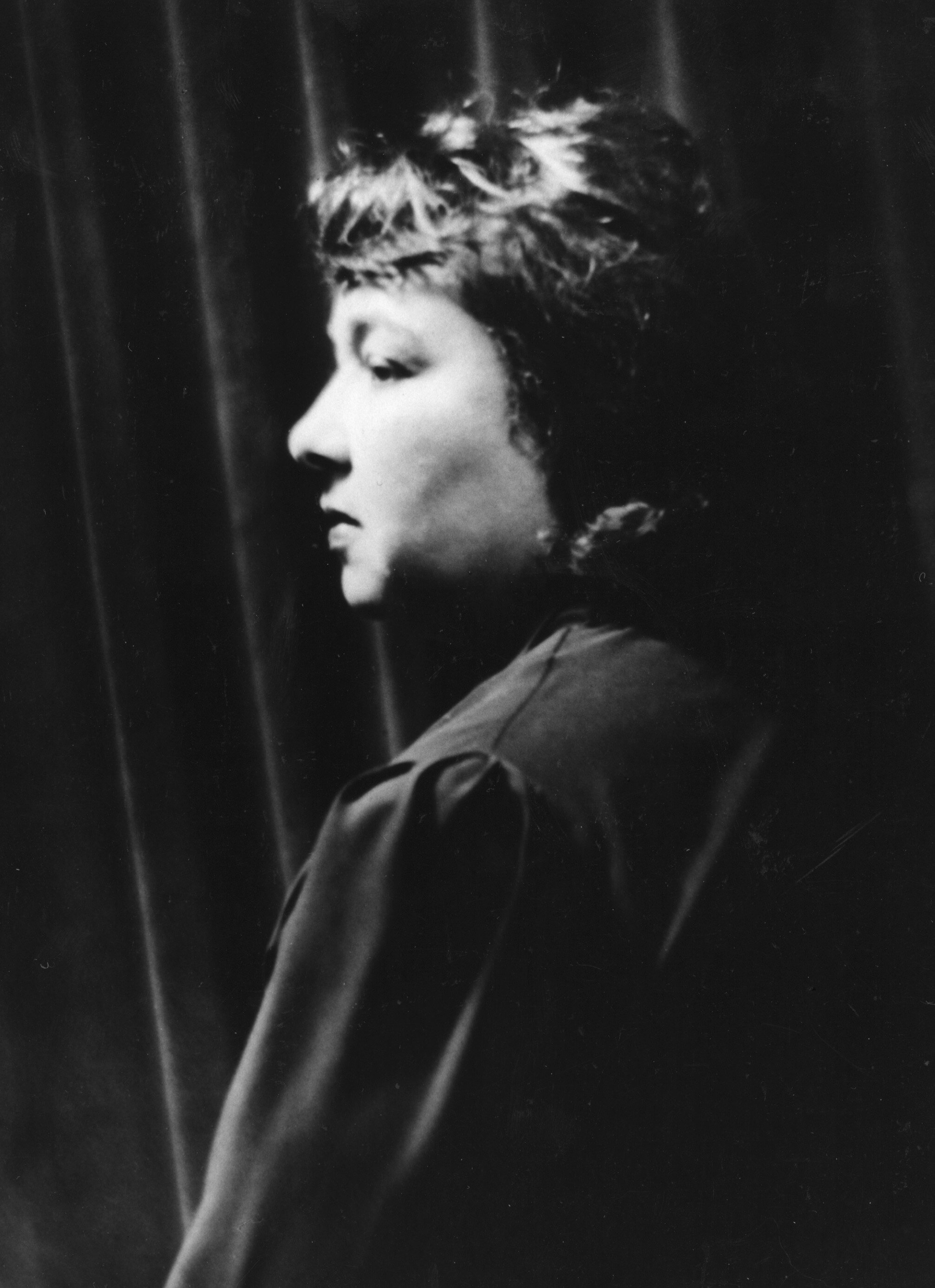
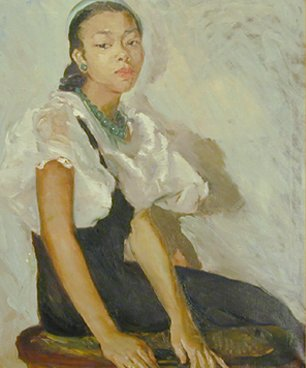
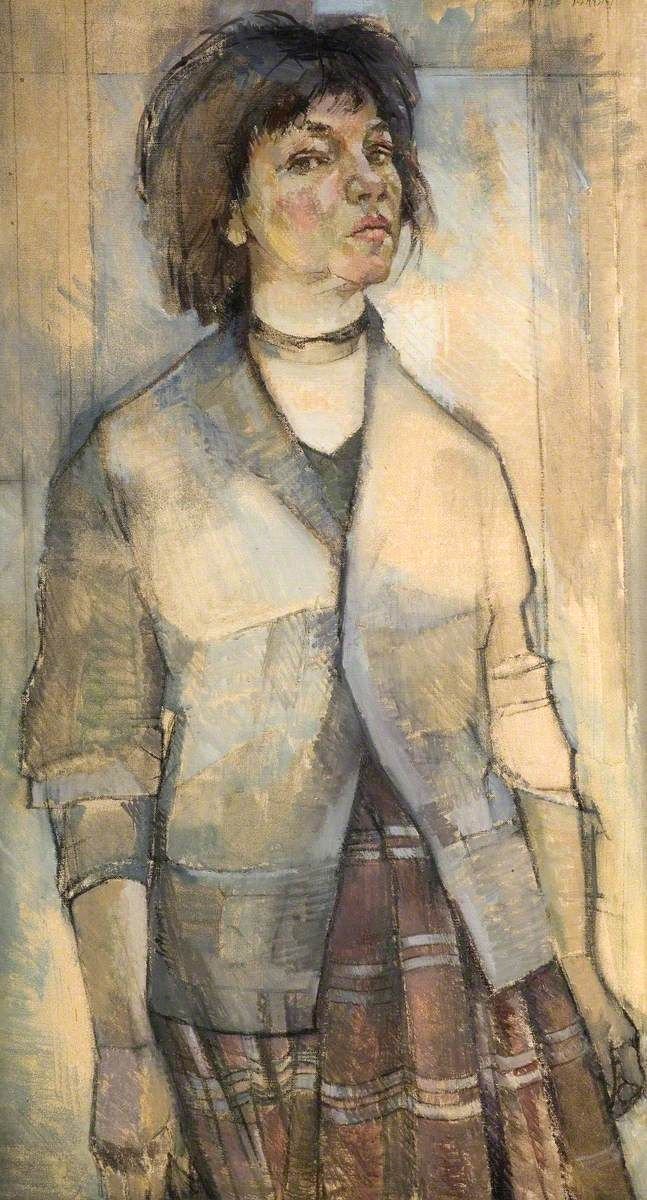
Ottalie Tolansky

After my very long last blog, here is a shorter one !

Ben Uri Gallery (Boundary Road, off Abbey Road, St John’s Wood, London)

When I was visiting London the other day, I visited the Ben Uri gallery in St John’s Wood, just off the famous Abbey Road.  I had been sent regular emails from the gallery about events and followed them on Facebook and was interested to visit the premises. 

The Girl in the Green Sari by Clara Klinghoffer

A few weeks ago I wrote about Clara Klinghoffer and I knew one of her paintings was at this gallery so I was interested to look at it up close.  I eventually found the gallery after going round in circles because I struggled to follow the GPS on my phone.  The gallery was much smaller than I had imagined but there on display was the Klinghoffer painting entitled The Girl in the Green Sari.

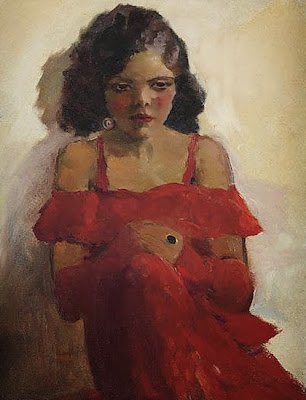
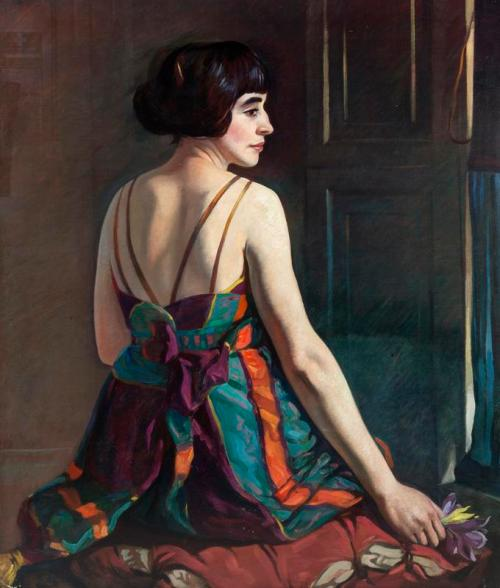
Girl in a Red Shirt by Ottilie Tolansky (c.1950)

The full-length painting was displayed in the small gallery and was quite impressive.  However, for me, more impressive was the full length painting next to it.  It was entitled Girl in a Red Shirt and the artist was given as Ottilie Tolansky and I knew I had to find out more about this unknown (to me) artist.

Self portrait by Ottilie Tolansky

Ottalie Pinkasovitch was born in Czernowitz, which was, at the time of her birth, in the northern Bukovian sector of the Austro-Hungary.  The town is now known as Chernivsti and is in western Ukraine.  She was born on May 30th 1912 into an Orthodox Jewish household.  Shortly after Ottalie was born, the town witnessed numerous riots directed against the Jewish community and so the family moved to live in Vienna.  For Ottalie, Vienna was home and she always looked upon herself as being Austrian. 

Reimann Art School in Berlin

In 1928, at the age of sixteen, the family were on the move again.  This time they set up home in Berlin where Ottalie’s father, an internationally recognised singer, took up the post of Obercantor at the city’s eighteenth century Alte Synagougue.  Meanwhile, the family having recognised that their daughter had a great talent for art decided to enter her into the Reimann School of Art in Berlin.  It was a private art school which had been founded in 1902 by Albert and Klara Reimann, and later in January 1937 was re-established in Regency Street, Pimlico, London following the persecution of the Jews by the Nazis. After leaving the Reimann School, she continued her studies at the Berlin Academy of Fine Arts.

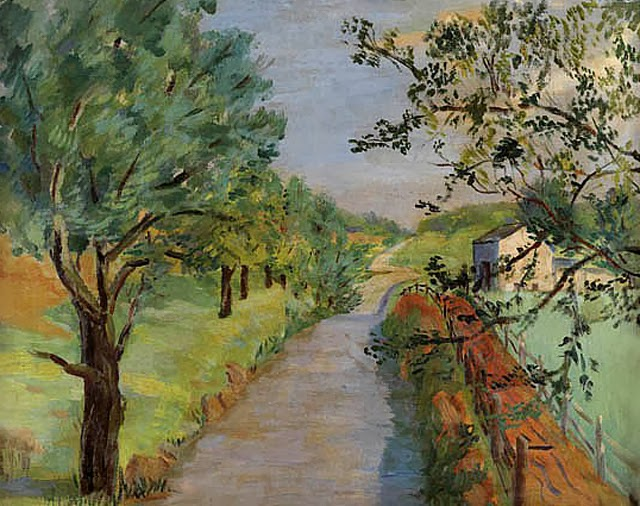
Meadow Scene by Ottilie Tolansky

Hitler came to power in 1933 when he became the German Chancellor and with growing antisemitic views which swept the country the Pinkasovitch family moved to the safety of England.  Ottilie’s father accepted a job at a synagogue in Cheetham Hill, which was the predominantly Jewish area of Manchester.  Ottilie, who was enrolled at the Manchester Municipal School of Art, once again came into contact with her friend, the physicist Samuel Tolansky who was working at the University of Manchester. 

Mary Louise by Ottalie Tolansky

Samuel Tolansky had been born on November 17th 1907 in Newcastle upon Tyne. His parents had migrated to Great Britain around the turn of the century. His ancestors had come from Odessa but were of Lithuanian Jewish origin. Samuel was the second child in a family of two boys and two girls. His father was a tailor and, like most immigrants from Eastern Europe at the time, he had to start near the bottom of the ladder both financially and socially.  For the first ten years of life in England Samuel’s father lived in conditions of considerable poverty and that his son’s progress up the educational ladder was, at every critical stage, dependent on his ability to win scholarships and other awards.  However, Samuel worked hard and succeeded.

Samuel Tolansky

Ottilie had first met Samuel in Berlin in 1931 when he had been working at the Physikalisch-Technische Reicsansalt, a German government scientific institute.   In 1932, after a year working at the Berlin Institute he went to England and attended Imperial College London as a researcher into interferometry.  He remained in London until 1934.  From Imperial College London he relocated to Manchester and from 1934 to 1947 worked at the University of Manchester, as an Assistant Lecturer, later Senior Lecturer and Reader.  Ottilie and Samuel’s friendship blossomed and the couple found themselves in love.  The couple married in 1935.  Ottilie gave birth to their first child, Ann, who is now married and having graduated in history from Oxford University, became a solicitor. A second child, Jonathan, was born in London. He became a musician, a percussionist who has played in several of the leading orchestras.

Abstract by Ottilie Tolansky

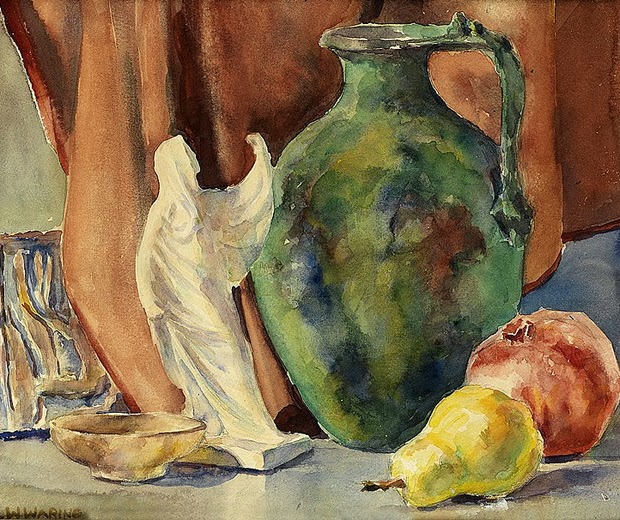
Samuel and Ottilie Tolansky left Manchester and moved to London, where, after the war had ended, she attended the Hammersmith School of Art and regularly submitted her work at various exhibitions.  Ottilie’s portraiture, still lifes and figure drawings, which she completes mainly in oils and gouache are characterised by her main use of blues and violets.

Rabbi Joseph Trostmann by Ottilie Tolansky (c.1962)

One of her most famous portraits, in fact two paintings, is of her grandfather Rabbi Joseph Trostmann.  She based the depiction of the elderly man on her childhood recollections and family photographs.  One can be found at Stoke-on-Trent Art Gallery whilst the other was kept in the family.  After Ottilie died, her son Jonathan Tolansky, donated it to the Ben Uri Gallery.

Portrait of a Gentleman by Ottilie Tolansky

Ottilie Tolansky died in London on February 13th 1977 aged 64.  Her husband who had been nominated for a Nobel Prize, and was a principal investigator to the NASA lunar project known as the Apollo program, died four years earlier.

Edward Darley Boit and his Daughters

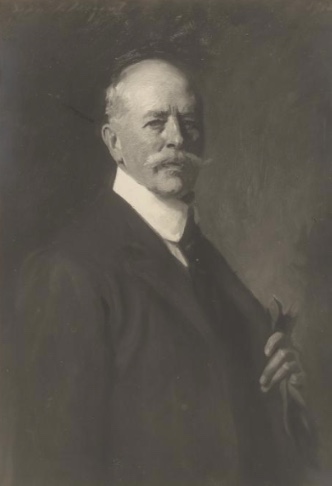
Edward Darley Boit

For this blog I am reverting to my early modus operandi when I concentrated the blog on one painting, rather than, as I do nowadays, focus on the artist(s). Having said that, the blog revolves around two American artists, one who is rightly categorised as one of the great nineteenth century painters and the other, who is less well-known, is now almost forgotten.   One is the artist who painted the work and the other is the father of the four girls who are depicted in the painting.  The artist was John Singer Sargent, the  American expatriate painter, considered the leading portraitist of his generation  and the father  of the girls depicted in the work  is Edward Darley Boit, a watercolour painter from Boston.  The work of art I am featuring is entitled The Daughters of Edward Darley Boit, which was originally titled Portraits d’enfants.

John Singer Sargent – Self-Portrait (1906) 

Edward Darley Boit Jnr., known as Ned, was born in 1840.  His father, also Edward Darley Boit, was a Harvard-educated lawyer and his wife was Jane Parkinson Hubbard whom he married in 1839.  Jane’s family, the Hubbards, were an old New England family who owned sugar plantations in British Guyana.  The couple had three sons, Edward (Ned), Robert (Bob) and John and two daughters, Jane and Elizabeth.  His son, Edwards Darley Boit Jnr. studied at the Boston Latin school and then Harvard where he graduated in 1863.  From there he went on to study at Harvard Law School.

Mrs Edward Darley Boit(Mary Louisa Cushing) by John Singer Sargent (1887)

Edward’s love of legal matters soon waned despite his aptitude in his legal studies.  However it was his love of art which came to the fore in his life but it was not just art that was to enter his life.  There was a woman who would take a leading role in the life of Edward (Ned) Darley Boit junior.  She was Mary Louisa Cushing, known simply as Isa, who was part of the upper-class Bostonian Society.  Her great uncle was Thomas Handasyd Perkins hailed from a wealthy Boston Brahmin family and was an American merchant, slave trader, smuggler, philanthropist and early patron of the Arts. Isa’s father, John Hubbard, worked for his uncle’s merchant’s businesses in China.  He returned to America in 1831, a very wealthy man and a very eligible bachelor.  Isa’s father met and fell in love with her mother, Jane Parkinson, and the couple married in 1839.  In 1840, they moved to their Bellmont estate in Watertown, Massachusetts.  They had five children, four sons and one daughter, Mary Louisa (Isa).  Isa was brought up in a wealthy household and wanted for nothing.

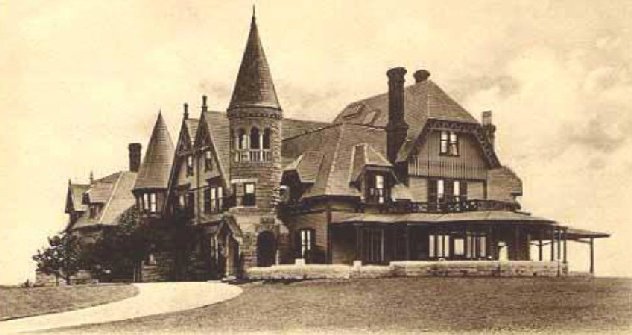
Edward and Isa’s summer home, The Rocks

Despite her wealthy upbringing, tragedy was to strike Isa in 1862 when she was still only sixteen years old.  In April of that year her father died, aged 75 and less than two months later, in early July her mother Mary Louisa Cushing died.  She was 63.  Isa went live with her elder brother Ned who acted as her legal guardian. On June 16th 1864, with the American Civil War still raging, twenty-four-year-old Edward Darley Boit, who was still studying law and was exempt military service, and seventeen-year-old Isabel Louisa Cushing married in an Episcopal ceremony at Christ Church in Harvard Square, Boston.  It was a sumptuous, no-expense spared affair.  The young couple split their time between Boston and Newport, Rhode Island where they had their summer house built.  It was known as The Rocks, and was situated above Bailey Beach and just along from Isa’s brother, Robert’s home.

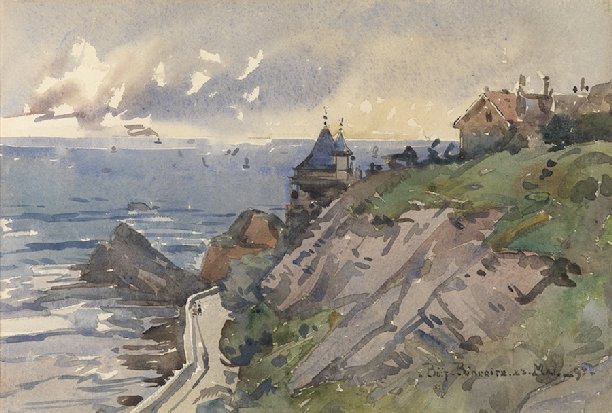
Biarritz by Edward Darley Boit

In April 1865 Isa Boit gave birth to their first child, named Edward after his father but was known as Neddie.  The following year Edward Darley Boit was admitted to the Massachusetts Bar and once again Isa was pregnant.  That summer Edward Boit, his pregnant wife and their son travelled to Europe visiting Dublin, Paris, Rome before returning to the French capital.  Throughout the European journeys Edward was continually visiting the major city art galleries and absorbing as much as the European art as he could.  In the Autumn of 1886 they returned to London where Isa gave birth to their second child, a son called John.  Neither Isa nor John were well following a problematic birth but their travels continued and they returned to Paris, their favourite city, in mid-December 1866.  However Edward wanted to once again visit Italy to study the works of the Italian Renaissance Masters and so Edward, Isa, Neddie and baby John went to Rome visiting Genoa and Florence en-route.  Five month old baby John was became very ill and never recovered his health. He died in March 1867 and was buried in the Protestant Cemetery in Rome.  Edward, Isa and Neddie returned to Boston where Edward resumed his legal career.

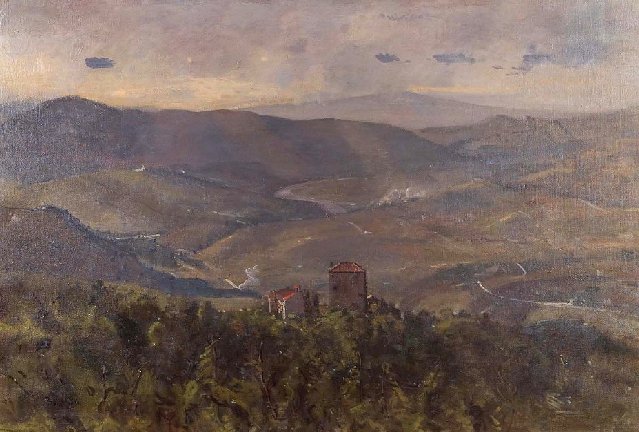
Italian Landscape by Edward Darley Boit

Edward Boit visited an art exhibition at Boston’s Soule and Ward gallery and for him it was a magical visit and he was overwhelmed by the landscape work of Jean-Baptiste-Camille Corot and how the French painter had managed to capture the light, air and atmosphere in his works.  It was an epiphany for Boit who there and then decided that he would give up law and become a painter and furthermore he and the family would leave America and live in Paris.  Edward’s wife Isa supported him both passionately and financially having received a sizeable inheritance from her late parents.  Isa preferred life in Paris to that of life in Boston. 

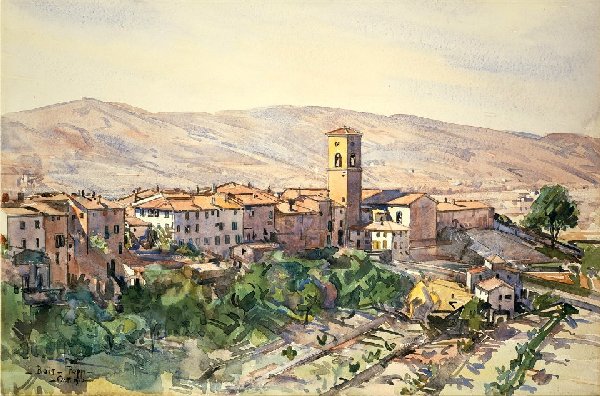
Poppi in the Casentino, Tuscany by Edward Darley Boit

Whilst in Newport Rhode Island, the size of the Boit family had  increased.  A daughter, Florence, was born on May 6th 1868 and a second daughter, Jane, was born on January 17th  1870.  There was one major problem to the Paris relocation plans.  Their eldest son, now five-years-old, suffered from severe mental retardation and was now living in a “home”.  Edward and Isa had a heartbreaking decision to make as to whether to stay in Boston to be near him, albeit he didnt recognise them and could not communicate or leave their son behind when they emigrated to Paris.  After a lot of soul searching they decided to relocate the family and leave Neddie behind in the specialist home. In the Autumn of 1871, Boit gave up his conventional legal life, and the couple sold their Newport home and moved to Europe with the family, visiting Italy first then travelling around the French countryside before arriving at their ultimate destination, Paris.  One of the first things Boit picked up about French art was the way they cared less for detail and concentrated on overall effect liberation.  Edward Boit and his family split their time between Paris and Rome and enjoyed all that French and Italian society had to offer.  Among the close friends they met were the author,  Henry James and the young artist Frederic Crowninshield both of whom had connections with Boston.  In 1876 Boit decided to make Paris his base and had rented a studio at 139 boulevard Montparnasse in the city’s Left Bank artist quarters.  At the start of his Parisian residency he began to be tutored by the French landscape artist François-Louis Français, who himself had been a pupil of Corot, one of Boit’s favourite painters.

Avenue de Friedland, Paris.

In 1874 the Boit family increased with the birth of a third daughter, Mary Louisa on June 5th in Paris and eighteen months later on November 15th 1878 a fourth daughter, Julia, was born in the northern Paris suburb of Soissy.  Edward and Isa decided that it was now time to return to America for a long stay so as to introduce their daughters to their uncles and grandparents and in mid-June 1879 they, along with European governesses and nurses, boarded SS Bothnia for the Atlantic sea passage.  Great celebrations followed their arrival and Edward’s parents looked forward to Edward and his family remaining over the winter months in Boston, but their hopes were dashed when Edward outlined his plans to return to Paris. The voyage back to France took place in early October 1879. On arriving back in Paris they took a large apartment on the avenue de Friedland, a large boulevard that radiated out from the Place d’Etoile,

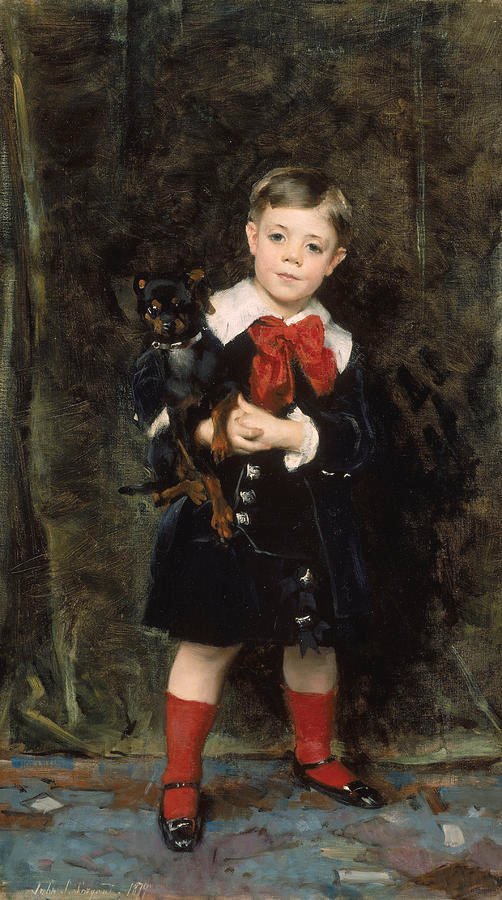
Portrait of Robert de Cévrieux with his Pet Dog by John Singer Sargent

There is some doubt as to when Edward and Isa Boit met the artist, John Singer Sargent but it is thought most likely it was in Paris in the late 1870s during one of the many artistic soirees that the Boits and Sargent frequented.  Another possible reason was the meeting came about through the auspices of Edward Boit’s teacher, François-Louis Français, whose close friend was Carolas-Duran, one of Singer Sargent’s tutor.   Sargent was an expert portraitist and a third of them were commissions to paint children.  An example of one such painting is Sargent’s 1879 Portrait of Robert de Cévrieux with his Pet Dog.  We see him standing on an oriental rug in front of a curtained backdrop.

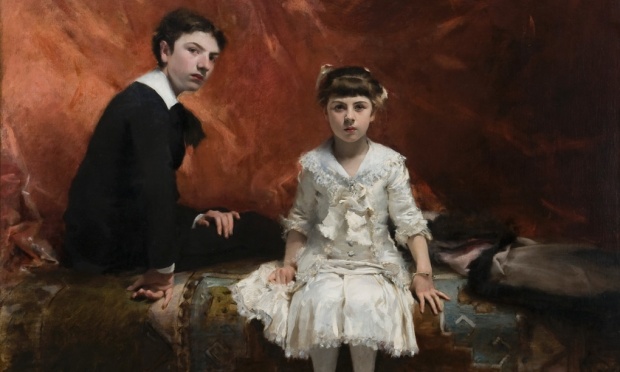
Portrait of Edouard and Marie-Loise Pailleron by John Singer Sargent (1881)

Another child portrait by Sargent was a commission from one of Sargent’s earliest patrons, Edouard Pailleron, the French poet and dramatist.  Sargent had completed a portrait of Edouard and his wife in 1879 and two years later,  a portrait of Edouard’s two children, sixteen-years-old Edouard and his younger sister, Marie-Louise, which was exhibited at the 1881 Salon.  The children’s portrait was time consuming and Marie-Louise, later recorded that there were eighty-three sitting for this painting which might explain why the subjects seem strangely remote from the artist.

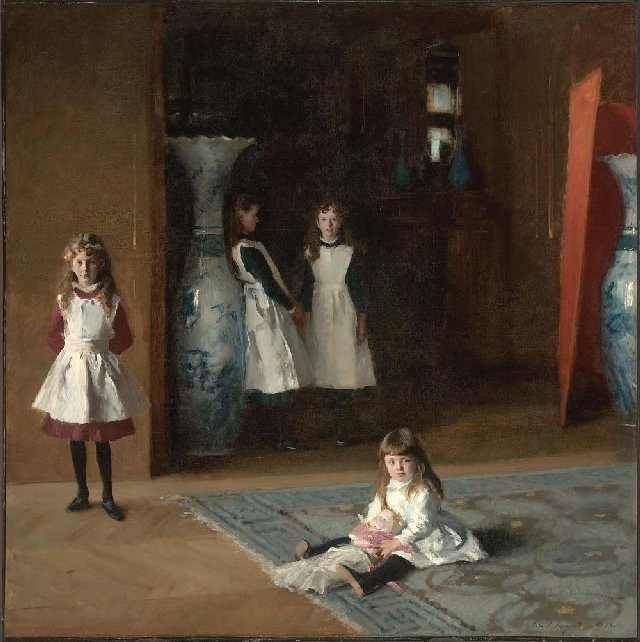
The Daughters of Edward Darley Boit by John Singer Sargent (1882)

The painting I am concentrating on in this blog, The Daughters of Edward Darley Boit, is one that Sargent started on in October 1882 after he returned to Paris from Italy.  He completed the work in December, a mere two months later. This was a great achievement as the painting was so large (225 x 255 cms) 87.6 inches square. Sargent titled the painting Portraits of Children and it was then shown at Georges Petit’s Exposition de la Société Internationale and the following year at the Salon.    It is an unusual depiction in as far as, that besides the four girls and two large vases, the location seems empty, even stark.  This would be completely different to the real Boit household which was known to be full of furnishings which they had collected on their travels over the years.  The stylistic interior tastes of the Boits is not reflected in this portrait with the exception of the vases.  Maybe Edward and Isa first approached Sargent tasking him to paint a traditional portrait of their four daughters but subsequently they may have acceded to Sargent’s decision to make the depiction part portraiture and part an interior genre painting.

Mary Louisa (Isa) Boit

The setting for this portrait is one of the rooms in the family’s spacious apartment, possibly the foyer.  Edward and Isa had moved into the apartment on the avenue de Friedland, a large boulevard that radiated out from the Place d’Etoile, Their elegant residence was situated in the eighth arrondissement, a luxurious neighbourhood much preferred by wealthy Americans.  They had lived there since 1879 when they had arrived back from a summer in Newport, Rhode Island.  It was to be home to the Boits until 1886.

Julia Overing Boit

In the painting, the light comes from the left. The two older daughters are shielded from it by the recessed enclave they stand in, a position which they have found for their uneasy refuge. All the girls wear white pinafores, which gives Sargent the opportunity to show off his absolute mastery of a full range of tones created by the folds and creases in the pinafores. It was a dark shadowy space in which Sargent then positioned the Boits’ four daughters.   The youngest daughter, four-year-old Julia sits on the floor, eight-year-old Mary Louisa stands at the left midground of the painting whilst the two older daughters, Jane, aged twelve, and Florence, fourteen, stand in the background, partially obscured by shadow. 

Painting with the vases at the Museum of Fine Arts, Boston.

Besides the four girls the other striking feature of the painting is the inclusion of the two tall vases.  These were not Sargent’s props but two Japanese vases owned by the Boits, which Sargent faithfully depicted, although he subdued the colour allowing the girls to be the more important.  The vases, like their owners, criss-crossed the Atlantic more than a dozen times and only suffered minor damage to their rims.  They were six feet tall giants, the tops of which flared into scalloped ripples of porcelain.  The size of them dwarfed the girls.  They were made in Arita, Japan an area famous for its porcelain, which in the late nineteenth century was specifically made for export to the West. The two oversize Japanese porcelain vases depicted in the work were, along with the painting, also donated by the Boit family to the Boston Museum of Fine Arts and are exhibited beside Sargent’s painting.

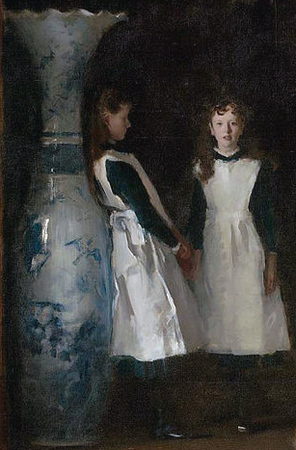
Florence Dumaresq and Jane Hubbard Boit

The painting by Sargent is not a conventional group portrait as Sargent has positioned the four girls individually.  There is no connection between the siblings.   The two older sisters are placed in the semi-shade in the background while the youngest is centre stage in the foreground holding her doll and the other girl is standing alone off to the left.  Each of the girls is presented individually, but the features of the two older girls are obscured, by the darkness of the background.  The presence of empty space, and the isolation of the figures all add to the sense of quiet anxiousness. Florence with her back to the vase comes over as being independent and refuses to participate at all and Jane, facing us, is left unsure whether to side with her big sister or to emerge from the shadows and face the artist.

Las Meninas by Velazquez (1656)

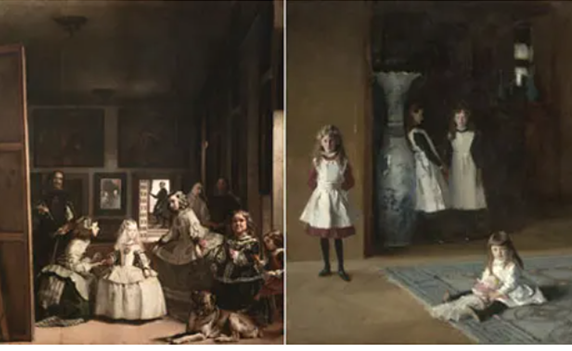
Many art historians have likened the position of the girls with way Velazquez set up the figures in his painting, Las Meninas, the famous portrait of the young Spanish infanta with her maids in a great shadowed room.  Sargent had studied and copied this work during his 1879 visit to the Prado in Madrid. 

A composite image of Las Meninas by Diego Rodriguez de Silva y Velazquez and The Daughters of Edward Darley Boit by John Singer Sargent. 

The relationship between these two works was considered so noteworthy that the Museum of Fine Arts in Boston who owned the Boit family portrait loaned it to the Museo del Prado in 2010, so that the paintings could be exhibited together for the first time. 

Malcolm Rogers, the director of Boston’s Museum of Fine Arts at the time of the loan, when asked about the similarity of the two works of art stated;

“…These two great paintings have never been together in one room before……It is Sargent’s greatest painting, one of the great paintings of childhood and for it to hang side by side with arguably the world’s greatest portrait of childhood has to be a historic and iconic moment. I think people will be very moved…”

When the Daughters of Edward Darley Boit was first exhibited in 1883, the depiction of the children was the subject of much discussion. Many art critics were confounded as to why the children were so isolated from each other and also why is one in profile and almost indistinct?  Again Malcolm Rogers postulated:

“…The Boit daughters is just one of those paintings that moves people because of its beauty, but also its mystery.  You don’t quite know what these four girls are thinking; it opens up your own imagination. It’s got a little bit of sadness, a little bit of happiness, a little bit of childishness, great beauty. It is a very intriguing work…”

I will end this blog with a brief summary of what happened to the family. Isa, Edwards wife, was taken ill in the summer of 1894 and by the Autumn she had suffered from increasing paralysis of her limbs and both her heart and lungs began to fail. She died in Dinard, France on September 29th 1894 aged forty-eight and was buried in Paris, the city she loved so much. Edward refused to return to Boston in deference to Isa who had hated living in the American city.

In Biarritz, in the summer of 1895, Edward became re-aquainted with a young girl, Florence McCarty Little, who he had first met in Boston and was a firend of his twenty-one year-old daughter Isa. To everybody’s shock and his daughters’ horror Edward and Florence became very close and and they announced their impending marriage. Florence was thirty-six years younger than Edward.

Edward Darley Boit and F lorence set June 1896 for the marriage ceremony but it was postponed until October. His four daughters were sent back to Boston to stay with their aunt, Jane Boit Hunnewell in Wellesley. Edward’s brother Bob tried to dissuade his brother from marrying such a young girl saying that he was acting like a selfish, infatuated, silly school-boy and that he was appalled by his brother’s “abandonment” of his children. His daughters’ cousin Mary Boit returned to Paris with the four girls in October and wrote about the atmosphere at her cousins’ home:

“…I think he seems quite pre-occupied and now we are over hereUncle Ned says he is going to marry Florence Little next month. Well it is a very strange thing and I am more sorry for the girls than anything. poor dears, it seems so queer to look at Uncle Ned then think he is in love with somebody my age…”

Edward Darley with his sons, Julian and Edward.

The marriage finally took place in Biarritz on January 5th 1897 and on June 21st 1900 Florence gave birth to their first child, a son, Julian. Two years later, on April 12th 1902 she gave birth to their second son, Edward. Sadly, two weeks after the birth of Edward, Florence contracted a fever and died on April 24th, aged 25. Edward Darley Boit died of arteriosclerosis in Rome on April 21st 1915, three weeks before his 75th birthday.

None of the four daughters, depicted in the painting, married. The eldest, Florence Dumaresq died in 1919, aged 51. The second born daughter, Jane Hubbard Boit had suffered a nervous breakdown and never completely recovered. Her father was concerned that she would end up in a mental asylum like his first-born, Neddie. She improved and in fact, went to live on her own in a Paris apartment. She died in New York State in November 1955, aged 85. Mary Louisa Boit, the girl who stood alone on the left of Sargent’s painting, and who was looked upon as the prettiest of the four girls, died in New York in June 1945, aged 71.

Woman in Blue, Apartment in Paris by Julia Overing Boit (1921)

The youngest aughter, Julia Overing Boit, became a talented watercolour painter and often her letters contained small watercolour sketches. Her work was exhibited in many exhibitions and in March 1929 at the Copley Gallery in Boston, sixty-six of her watercolours were exhibited. She died in February 1969, aged 91.


Most of the information for this blog came from an excellent book which I bought from Amazon. It is entitled Sargent’s Daughters, The biography of a portrait, by Erica E Hirshler. If you would like a greater in-depth read about the Boit family and the painting, this is a must-have book.

The Artistically Talented Walton Family

My blog today is about a family of artists, the Walton family, a veritable artistic dynasty.  The head of the family was Edward Arthur Walton, best known as, simply, E.A.Walton.  Walton was born on April 15th, 1860 in Barrhead, a small town in East Renfrewshire, Scotland, thirteen kilometres (8 miles) southwest of Glasgow city centre. 

The Artist’s Mother, Elizabeth Balfour Nicolson, Mrs Jackson Walton by Edward Walton (1885)

Edward Walton was one of twelve children of Jackson Walton and his wife Elizabeth Balfour née Nicholson. Jackson was a Manchester commission agent and a skilled amateur painter and photographer. His brother was George Henry Walton, a noted architect, furniture designer and stained glass designer, who worked with Charles Rennie Mackintosh, a renowned Scottish architect, designer, watercolourist and artist. 

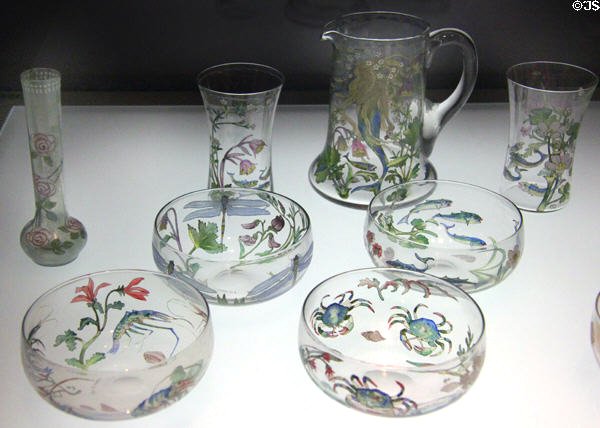
Glassware painted by Helen Walton (1910)

Edward’s sisters, Helen and Constance were also talented artists.  Helen Walton was best known for her decorative work in ceramics and glass and as one of the eldest children, Helen became an artistic mentor to her siblings including her brother, Edward Arthur, who was ten years her junior.

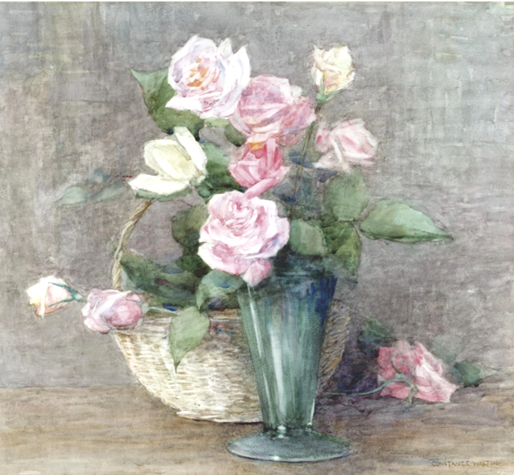
Still Life with Roses by Constance Walton

Constance Walton was a much-admired botanical painter.  She trained at Glasgow School of Art and became a member of the group known as the Glasgow Girls.  This group of women artists and designers pursued different styles and worked in a range of art forms.  Many of the women created their own discreet groups while others chose to work alone and although the name of the group was coined by William Buchanan in an essay, he contributed to the catalogue for a Glasgow Boys exhibition held in 1968, many of the women lived and worked outside Glasgow. These female artists became prominent in the late nineteenth century, thanks to the enlightened attitude of Francis Newbery, a painter and art educationist, best known when he was director of the Glasgow School of Art between 1885 and 1917. who set out to enrol men and women equally.

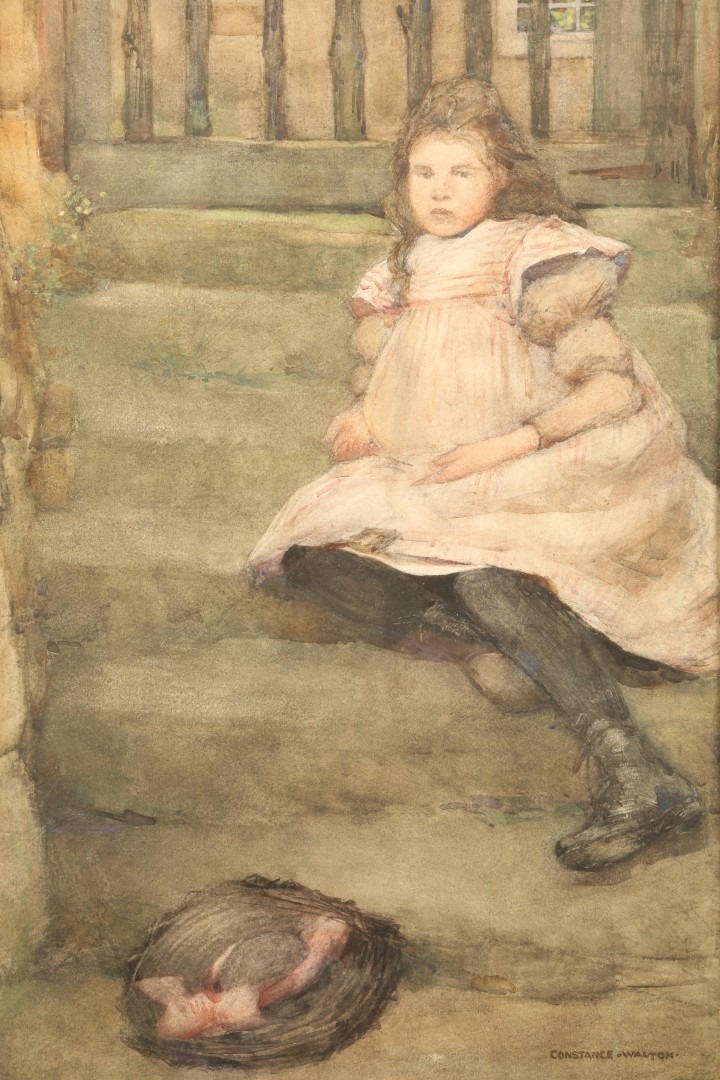
Daydreams by Constance Walton(c.1895)

Day Dreams by Constance Walton is a large watercolour depicting a young girl sitting on steps looking distractedly into the distance. Constance Walton’s figurative paintings are quite rare as after her marriage in 1886 she concentrated on her flower and botanical paintings.  This depiction could have been influenced by her brother, Edward’s work of the same name which he completed in 1885.

A Daydream by Edward Walton (1885)

Helen and Constance’s brother Edward Arthur Walton was probably the best-known artist of all the siblings

Self portrait by Edward Walton

After completing school and wanting to concentrate on his art he travelled to Germany where he spent two winters at the Dusseldorf Academy of Art before returning to Scotland and enrolling at the Glasgow School of Art in 1878.

Joseph Crawhall by Edward Walton (1884)

At the Glasgow School of Art he became good friends with fellow aspiring painters, James Guthrie and Joseph Crawhall whose sister married Edward’s brother.  As we have often seen in various blogs, young artists training at State Academies often became disillusioned and disheartened by the academic training which concentrated on historical painting and high levels of finish.  It was for this reason that in many countries the young artists rebelled and set about working to their own agenda.  In the case of Edmund Walton and his friends they formed a loose group which became known as the Glasgow Boys who decided that their focus should be on realistic depictions, often of rural subjects, depictions that would illustrate real life, the hard-bitten and candid view of living. 

The Harbour Scene, St Ives by Edward Walton

The Glasgow Boys group gained inspiration from the progress in landscape painting in France and sought to take greater notice on the natural effects of light in the open air when setting about painting Scottish rural scenes.  The group also took to the French style of en plein air painting when, whilst outdoors, they would paint directly onto the canvas.  The painter who had the greatest influence on this group of artists was the French realist painter, Jules Bastien-Lepage whose down-to-earth depictions focused on the real, often, impoverished life that surrounded his village.  For all Edmund Walton learnt about art in Dusseldorf and the Glasgow School of Art, nothing compared to the knowledge he gained working alongside his fellow “boys”.

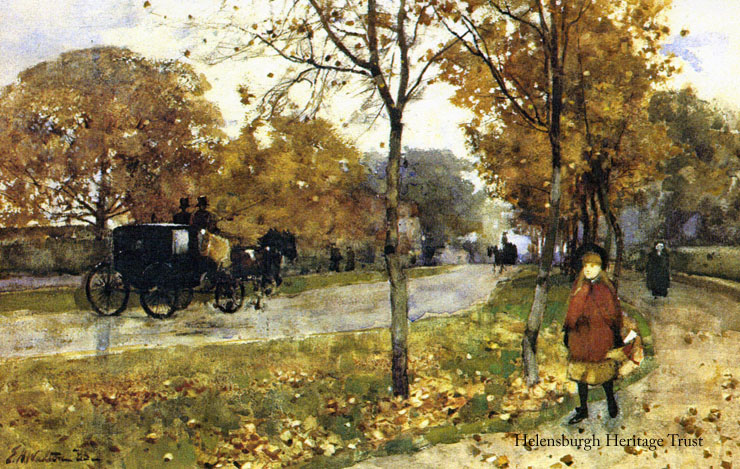
Victoria Road Helensburg by Edward Walton

In 1883, Edward Walton joined James Guthrie, at Cockburnspath, Berwickshire where he honed his talent as a painter in both oil and watercolour in the open air.  He also spent time in Helensburgh, an affluent coastal town on the north side of the Firth of Clyde where he completed a series of watercolours depicting the well-dressed affluent residents of this prosperous suburb.

Helensburgh by Edward Walton

His skill as a watercolourist resulted in him being accepted as a member of the Royal Scottish Society of Painters in Water Colours in 1885 and shortly after he became a member of the New English Art Club.  In 1894, when he was thirty-four, he moved to London living in Kensington and later Chelsea, where his neighbour and good friend James Whistler lived.  Other artistic neighbours were the Irish-born painter John Lavery and Philip Wilson Steer, a British painter of landscapes, seascapes plus portraits and figure studies. Steer was also an influential art teacher and a leading figure in the Impressionist movement in Britain.

Edward Arthur Walton Artist, with his Fiancée Helen Law or Henderson as Hokusai and the Butterfly by Sir John Lavery (1889)

Around 1889 Edward Walton met Helen Law.  Love followed and the pair got engaged.  To celebrate their engagement the couple attended the Grand Costume Ball, organised by the Glasgow Art Club November 29th 1889. Edward dressed as the Japanese printmaker Hokusai, (an exhibition of his work was on show in Glasgow at the time) while his fiancée’s costume represents the painter Whistler’s signature in the shape of a butterfly. Photographer James Craig Annan took a photograph of the couple.  Artist and the couple’s friend, the artist, John Lavery, sketched this portrait of Edward and Helen on the night and presented it to them as a gift for their engagement, which they had announced earlier that evening.

Eric Robertson

Edward and Helen married and went on to have four children, the eldest of whom was their daughter Cecile who was born on March 29th 1891.  In 1894, Edward Walton, his wife and two-year-old Cecile moved from Scotland to London. In the summer the Walton family travelled to Suffolk where they rented the Old Vicarage at Wenhaston, which was a few miles from Walberswick, a village on the Suffolk coast, where Frank and Jessie Newbery lived and the two families painted together in the summer.  Cecile Walton and Newbery’s daughter Mary became close friends and later both developed strong links with Galloway area of Scotland.  The Walton family returned to Scotland in 1904 and took up residence in Edinburgh where Cecile enrolled at the Edinburgh College of Art. 

Cecile Walton by Eric Robertson (1922)

She also had private tuition from the Symbolist painter, John Duncan who taught her to appreciate Florentine art of the Renaissance and it was whilst at John Duncan’s house that she met another painter, Eric Robertson.  Cecile’s parents were not enamoured with her friendship with Robertson as he had a reputation of being a heavy drinker and a philanderer but despite her parents’ views Cecile and Eric Robertson married in 1914 and their first child, Gavril, was born in February 1915.

Romance by Cecile Walton (1920)

Cecile and Eric’s second child, another son, Edward, was born in December 1919 and it was shortly after his birth that Cecile started what was to be one of her most famous paintings, Romance. Cecile Walton depicts herself holding up her new-born son, Edward, for intense scrutiny, whilst her elder boy, Gavril, clutches his gollywog doll. Although nowadays the toy is recognised as a racist caricature, they were commonplace in British childhoods until the 1960s. The depiction of mother and baby is usually associated with the Madonna and Child but in Cecile’s painting, the depiction knowingly echoes a well-known impressionist image of a sex worker; Olympia as portrayed by Edouard Manet, and this implies a more troubled attitude to motherhood. The inclusion of carefully placed details such as petals on the floor, and the apple, add to the sense of unease.  In the painting we see Cecile, depicted lying half naked in bed holding her new baby son.  At the foot of the bed, we see her first-born child Gavril looking on. In an article in the Woman’s Art Journal, Frances Fowle, art historian and curator comments on the painting:

“…The title Romance seems inappropriate and the picture itself has a disconnected feel: the figures seem strangely dislocated, the scene has an almost surreal clarity, and the eye is arrested by the disagreeable greenish hue of the wall.  The picture poses questions; even the objects on the table and the discarded rose on the floor invite interpretation.  The artist lies stretched out on the bed, naked except for a curious yellow hat and towel wrapped around her hips…”

The thorns on the stem of the rose symbolise the suffering of the virgin and this may, in this case, allude to the suffering of the woman during childbirth. The crushed rose seen on the floor next to the bed is thought to symbolise Cecile’s failing marriage brought on by her husband’s unacceptable habits and his surrender to the demon alcohol.  Cecile was not in a good place at this time having to endure her husband’s drunkenness and infidelity. Marriage and subsequent children had also deprived Cecile of her personal freedom and curbed her artistic output, similar to what happened to her mother once she married Edward Walton.  The painting was exhibited at the second Edinburgh Group Exhibition in 1920.

The Favourite Dress by Cecile Walton

Cecile’s marriage to Eric Robertson ended in 1923 due to his unacceptable behaviour and Cecile, along with her two sons, moved out of the family home and went to live with her friend Dorothy Johnstone.  Her divorce was finalised in 1927.   In 1924 Dorothy and Cecile staged a joint exhibition of their work.  However since the ending of her marriage and subsequent divorce Cecile’s artistic output decreased and her artistic career began to fail.  

Deserted Ferry by Cecile Walton (1949)

Eric Robertson’s artistic career also broke down after his separation from Cecile, and he eventually capitulated to alcohol.  In 1923, following the failure of his marriage he moved to Liverpool and by the early 1930s, he was largely forgotten as a painter. Cecile Walton remarried in November 1936.  Her second husband was to Gordon Gildard, a BBC producer, and she moved to Glasgow to be with him.  Unfortunately, their marriage was short-lived and the couple divorced in 1945.  Cecile went to live the rest of her life in the vibrant fishing port and artists’ town of Kirkcudbright, within Dumfries and Galloway, Scotland.

Cecile Walton died in Edinburgh on April 23rd 1956, aged 65.

Susan Greenough Hinckley and Reverend Leverett Bradley

Susan Greenough Hinckley was born in the Beacon Hill area of Boston, Massachusetts on May 15th 1851. Her father was Samuel Lyman Hinckley, of the well-known family of Northampton Lymans, and her mother was Anne Cutler Parker whom he married in 1849, nine years after his first wife had died.  Susan had three siblings, an older brother Samuel Lyman Hinckley and a younger brother, Robert Cutler Hinckley.  She had a younger sister, Anna who died when she was eight years old. She also had a half-brother Henry Rose Hinckley who was the son of Samuel Hinckley and his first wife Henrietta who died at the age of twenty in 1838.

Oriental Still Life by Susan Bradley

From a young age Susan and her brother Robert showed an interest in, and a talent for, sketching and painting.  She attended Miss Wilby’s local school, where she was taught the history of painting.  In 1871, aged twenty, Susan made her first trip to Europe and this ignited her love of art.  Sadly, that December, while the family were in Paris her father died.  When the family returned to America, Susan decided to learn about watercolour painting and read the books written by John Ruskin.

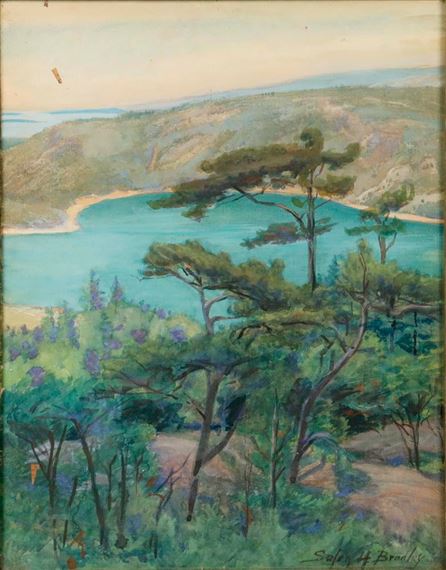
Eagle Lake, Acadia, Maine by Susan Bradley

Four years later in 1875 she returned to Europe with her mother and visited Rome where she studied under Edward Darley Boit, a fellow Bostonian who at the time was living and teaching in the Italian capital.  On returning to Boston she enrolled at the Museum of Fine Arts’ School of Drawing and Painting, in Boston where one of her tutors was the Bostonian artist, Frederic Crowninshield.  Here, she was in the first life class for women under his tutelage.  In 1878 she began to exhibit her work at the American Watercolor Society and a year later, she enrolled in the Boston Museum of Fine Arts’ School of Drawing.

Reverend Leverett Bradley

A young man came into Susan’s life in 1878.  He was Reverend Leverett Bradley a theology student at Hartford Theological Institute.  Leverett Bradley was born in 1846 and was brought up on the family farm in Methuen, Massachusetts.  In April 1861 the American Civil War began and aged only fourteen, Leverett left home and enlisted as a soldier in the Fourteenth Regiment of the Infantry which was under the command of his father.  Leverett would write numerous letters to his family whilst away at war and they were later collated into a book, A Soldier Boy’s Letters (1862-1865).  At the end of the war, Leverett returned to his family in Massachusetts and decided to dedicate the rest of his life to the church.  In 1867, he enrolled at the Phillips Academy Andover to complete his education which had been cut short by the war.  Two years later he attended the prestigious Amherst College where he studied for a theology degree.  Having completed his degree, he studied at the Hartford Theological Institute and in the Spring of 1878 he was ordained and went to work at Boston’s Trinity Church, a church where Susan often went to worship. 

The couple had much in common as they both loved art and music.  Susan and Leverett became engaged in the summer 1879 and the couple married on December 3rd that year.  Soon after the marriage Leverett was assigned a new post and he and Susan relocated to Maine where Leverett took on the role of rector at Christ Church Episcopal in the town of Gardiner. He was remembered there for the passion and enthusiasm he gave to his role.

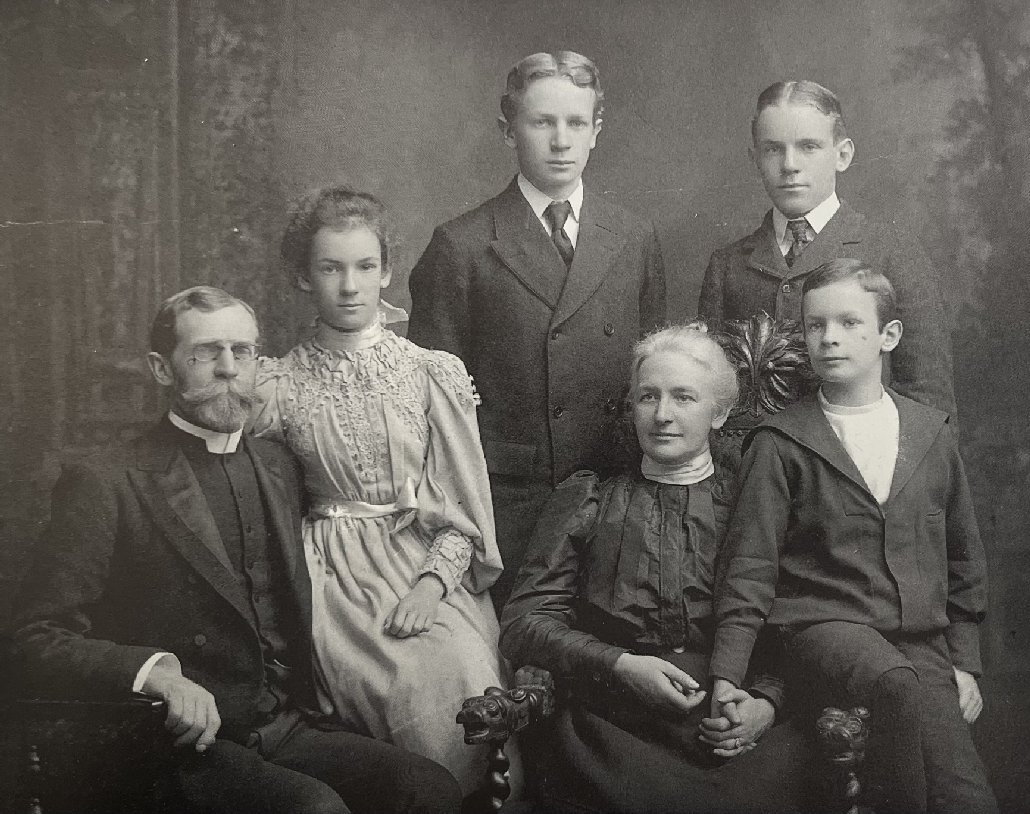
Leverett and Susan with their four children

In 1880, Susan gave birth to their first child, a son, Leverett Jnr., and two years later a second son, Walter, was born.  Susan and Leverett’s remained in Maine until the Autumn of 1884 when he accepted the position of rector of Christ Church in Andover, a town in Essex County, Massachusetts. Leverett and his wife Susan, now pregnant with their third child, a daughter Margaret, and their two young boys moved into the rectory of Christ Church.

Italian Landscape by Susan Bradley

Susan Hinckley Bradley faced, like so many female artists at the time, the fact that they did not have equal rights with male artists.  In the 1880’s, the best-known art societies such as the Boston Water Color Society, which was organized in 1885 by Childe Hassam, refused membership to women until 1918.  Other societies with similar discriminatory rules were the Art Club of Boston and St. Botolph Club, a dining club which was popular with many artists but which would not relax the all-male membership rule until 1988.  However, Susan had a very supportive husband who was equally horrified by the fewer opportunities for women artists to meet and exhibit their work, and together they decided to rectify the situation.

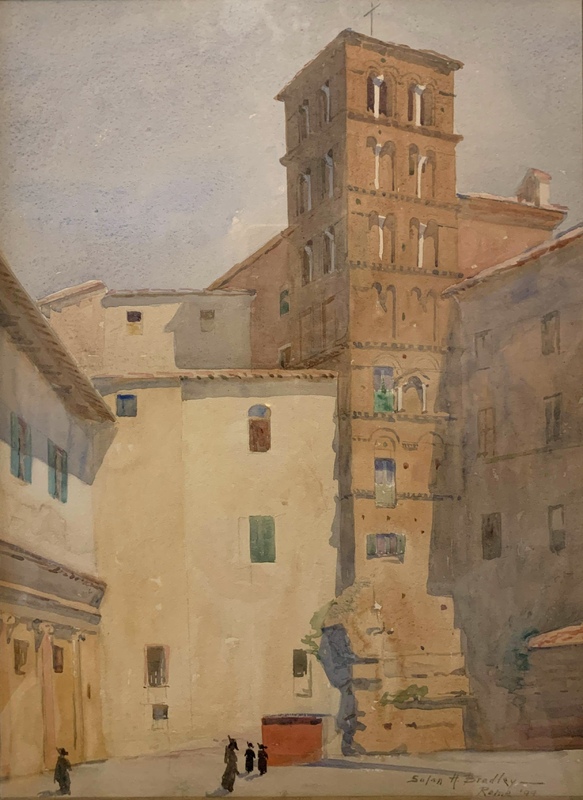
Rome by Susan Bradley (1899)

In 1887, Susan together with fifteen other women such as Sarah Wyman Whitman, Sarah Choate Sears, Martha Silsbee, and Helen Bigelow Merriman came together to form the Boston Water Color Club in response to the exclusive membership rules of the all-male Boston Water-Color Society.  The inaugural exhibition of the Water Color Club included forty-seven works by sixteen women artists; and ten years on, the membership had doubled.  Ironically it was not until nine years later that men were allowed to join the club.

Concord River by Susan Bradley (c.1928)

In the Autumn of 1889 Susan and her husband were once again on the move, relocating to Philadelphia, when he was offered the rectorship at St. Luke’s Church. This church had a large, urban congregation and Leverett set to work and soon made a positive impact on the local community. He kept up the role of army chaplain of the Third Regiment for many years and during the miner’s strike of 1902 was called into active duty. Leverett’s health had been deteriorating for some time and on December 31st 1902 he died of heart complications, aged 56.

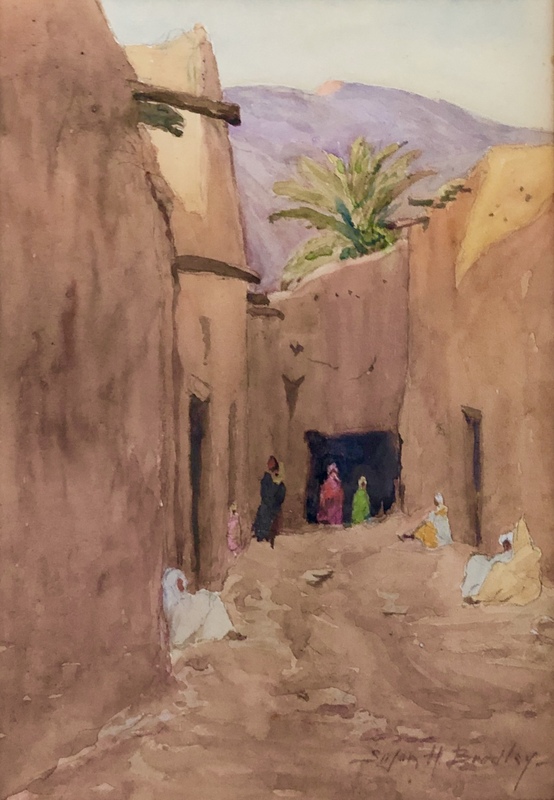
Evening near the Red Village, Algeria by Susan Bradley (c.1907)

Susan Bradley had to reduce her painting time when she was bringing up her four children and looking after her husband and their home.   She did get back to it eventually studying with William Merritt Chase, and spent time once again in Rome being tutored by Boit.  She travelled extensively to Egypt, Greece, Tunisia, Italy, Switzerland, France and Ireland, as well as exploring her own country and was known for not only the wilderness locations in Western Canada and Arizona but her depictions of the New York streets and the seascapes of the Maine and Massachusetts coasts.  Her work was shown at many exhibitions including the Panama Pacific International Exposition in 1915, Louisiana Purchase Exposition in 1904, and the American Watercolor Society in 1902 and her works form part of many of the collections of the major American museums.  Susan was a prolific painter whose career spanned five decades.

A Rose by Susan Bradley {1928)

She died on 11 June 1929, in Boston, Suffolk, Massachusetts, United States, at the age of 78, and was buried in Andover, Essex, Massachusetts, United States.

Albert Godwin

Albert Goodwin

The artist I am looking at today is the nineteenth century English painter, Albert Frederick Goodwin, best known for his watercolour landscapes.

The Artist’s Father, Samuel Goodwin by Albert Goodwin (1868)

Albert Goodwin was born at 1 Acton Place, 62 Boxley Road, Maidstone on January 17th 1845.  His father was Samuel Goodwin, a builder.  His mother was Rosetta (née Smith).  Albert was the seventh of eight children, having three older sisters, Emma, Rosetta and Mary Ann and three elder brothers, Charles, William Sidney and Henry (called Harry).  He also one younger brother, Frank Alfred.  An artistic talent weaved its way through his male siblings.  His eldest brother was known for his artistic talent as a young man before he joined the military as a member of the Royal Engineers.  Charles became a frame maker and Harry and Frank became professional painters.

Albert was brought up in a devout Baptist household and attended the Bethel Chapel in Maidstone, which his father had built along with its Sunday School in 1934.  Albert’s uncle, Thomas Goodwin often preached at the chapel and was its resident organist, which he had also constructed.  Albert attended Mr William Henry Wickstead’s School at Rocky Hill House, London Road, Maidstone.

The Old Bridge at Maidstone, Kent, Looking South by Albert Goodwin

Albert became interested in art and at the age of ten when he first exhibited one of his paintings,  This was a time at the start of the Pre-Raphaelite Brotherhood and one of its founders, William Holman Hunt had a great influence on young Goodwin.  At the age of fourteen Albert Goodwin started an apprenticeship with a local draper but after six months, he realised that the drapery business was not for him as he had set his heart on becoming a professional artist.  He just needed a willing teacher.   That came by chance, as it is said that whilst painting en plein air in the local woods he was spotted by the Pre-Raphaelite painter, Arthur Hughes who lived in Maidstone with his wife and children.  Arthur Hughes was impressed by Albert’s artistic skill and became his first tutor.

Sunrise over the Sea by Albert Goodwin

In 1859 Goodwin completed his painting entitled Bluebell Hill, Maidstone and in 1860 he exhibited his painting, Under the Hedge.  On March 18th 1863, Albert’s mother Rosetta died at the age of fifty-eight.  During Albert’s early twenties he was introduced to the well-known artist and art critic John Ruskin and on seeing Albert’s work, Ruskin purchased them all for £50 and Albert put the money to good use, funding his five week painting trip to the south coast resort of Hastings.  Around the mid 1860s Albert’s tutor, Arthur Hughes, introduced him to Ford Maddox Brown, a Pre-Raphaelite luminary who took Albert on as his pupil in his London studio.  Albert soon became acquainted with the other Pr-Raphaelite Brotherhood, such as Rossetti, William Morris, the Scottish artist William Bell Scott and George Price Boyce, the watercolour painter of landscapes.

The Old Bridge at Maidstone, Kent looking South by Albert Goodwin

Later, according to Albert’s daughter Olive, Albert and his brother Harry, went to work in the studio of William Morris’ company in Red Lion Square in London’s Holborn district.  In 1864 Albert set off on his first overseas trip, going to Holland where he visited the cities of Amsterdam and Rotterdam and that summer spent time in Jersey.  In the Autumn of 1864, he travelled north visiting Newcastle and Durham as well as the coastal town of Whitby

Whitby Abbey a watercolour by Albert Goodwin

Albert Goodwin completed a colourful watercolour of Whitby Abbey as seen from the east.  The abbey which had been founded in 657 by St Hilda was later destroyed by marauding Danes in 867.  This view is of Whitby Abbey from the east. The ruin depicted in this watercolour is as it is now after one of the towers collapsed in 1830.  Goodwin painted another version of the Abbey in 1910 but this was completed using oils and is now housed in the Victoria Gallery, Bath.  Albert Goodwin’s diary entry of July 22nd 1909 declares his love for Whitby.  He wrote:

“…Whitby once again…I am again inclined to repeat myself in the belief that one or two things in it (for colour) are as good as anything can be…”

Whitby Abbey by Albert Goodwin (1910)

Goodwin always loved to depict dramatic, poetic landscapes. In the 1910 version of Whitby Abbey the thoroughly radiant deep blue of the sky in this work is so typical of his work. Albert liked Whitby Abbey as a subject for painting because of its ruinous manifestation, but also because he was a deeply religious man, and had an interest in spiritual subjects.   Goodwin had painted many scenes featuring the abbey over the previous fourteen years.

A Prospect of Edinburgh from the East by Albert Goodwin (1909)

Albert Goodwin carried on painting in the 1860s and exhibited his work at many exhibitions including the Dudley Gallery in London.  On February 16th 1867 Albert married Mary Ann Lucas, who was the eldest daughter of George Lucas, a fruiterer from Brighton and a year later his brother Harry married Henrietta Lucas, the sister of Albert’s new wife.  Sadly, on December 13th 1869 Albert’s wife Mary Ann died, aged twenty-nine of peritonitis.  Albert and Mary Ann had no children.  Around this time Albert went to live with Arthur Hughes and his family in West Brompton, London and he was employed as Hughes’ studio assistant.

Ely Cathedral by Albert Goodwin

In 1871 Albert went on another European trip visiting Bruges.  That year he was elected Associate of the Society of Painters in Watercolours and at the time his address was given as Maltravers Street, Arundel, Sussex where he lived with his brother Harry and his wife Henrietta.  Sadly, Henrietta died that year, less than two years after her sister had passed.

The Medway at Maidstone by Albert Goodwin (1871)

Almost ten years had passed since Albert had first met John Ruskin and in Spring 1971, Ruskin offered Albert a job as his assistant and asked that he came to work with him at his home in Abingdon, Oxfordshire.  At the Royal Academy annual exhibition in 1871 Albert Goodwin exhibited his painting entitled The Medway at Maidstone.

The Drawing Room at Dixton Manor (Drawing Room at Dixton Manor with K.M.G. writing) by Harry Goodwin (1883)

In 1872 Albert’s brother Harry married for the second time following his first wife’s death.  His new wife was fellow painter, Kate Malleson. Harry depicted his wife writing at a desk in Dixton Manor.

From left to right: John Ruskin, Mrs JC Hilliard, Mrs Joan Severn, Arthur Severn, Constance Hilliard, Albert Goodwin.

Albert Goodwin’s friendship with John Ruskin continued and, along with Ruskin’s cousin Joan Severn and her husband Arthur Severn, visited Matlock Bath and the following year Albert Goodwin and Ruskin travelled to Italy and Switzerland.

  Mont Blanc from the Sèleve, near Geneva

In 1873, Albert Goodwin stayed for three months in the Swiss village of Simplon which lies close to the Italian border.

An Arabian Night, Cairo by Albert Goodwin (1876)

In 1873, like his brother the year before, Albert Goodwin a widower for four years, married his second wife, Alice Desborough at Holy Trinity Church in the West Devon village of Gidleigh.  The couple went on to have seven children, two sons and five daughters. In 1876, Albert and Alice travelled to Marseille before boarding a ship for Egypt.  They also called at Gibraltar, Naples and Crete.

Blue Water in Mounts Bay, Cornwall by Albert Goodwin (1881)

Albert Goodwin had first met the naturalist, Charles Darwin when he was introduced to him by John Ruskin. He visited Darwin at his Kent home, Down House.

Down House from the Garden by Albert Goodwin (1880)

Down House by Albert Goodwin (1880)

Whilst there he made sketches of the house and gardens and later completed two watercolour paintings of Darwin’s residence, which had been built in the early 18th century, and remained Darwin’ and his wife, Emma’s home for forty years until his death in 1882.   It was here that Darwin developed his theory of evolution by natural selection and wrote his ground-breaking work On the Origin of Species in 1859.

Ilfracombe by Albert Goodwin (1884)

Albert and his wife and children left London and moved to Montpelier Terrace Ilfracombe in 1877.  He continued on his painting trips around Britain and further afield to France, Switzerland and the Italian Lakes often accompanied by John Ruskin and Arthur Severn, sometimes accompanied by his brother Harry.  During these trips Goodwin made a large number of annotated sketches and watercolour studies direct from nature, a method he used, alongside working from memory, throughout his career. Ruskin was fascinated by the large number of sketches, which he termed “flying sketches”, which Goodwin produced on a daily basis. Goodwin was happy with his system and in his 1917 dairy entry, he wrote:

“…To me this method of work is one of the happy things of the art that I practise, for I get the realisation of a place twice over, and often the memory makes the scene a better one than the first experience…”

Meanwhile his wife Alice was at home in Ilfracombe with their seven children, Ivy, Olive, Edytha, Albert, Christabel, Alice and Harold and their two servants, one a cook and the other a nurse.  A few doors down from them were Alice’s mother and sister Mary.

Florence, Evening by Albert Goodwin (1896)

In 1881 Goodwin was elected a member of the Royal Society of Painters in Watercolours. Albert Goodwin was continually influenced by John Ruskin who was constantly advising him with regards artistic techniques. Goodwin was a master of depicting topographical and landscape views.  For him, it was all about colour, and tonal values.   Ruskin was pleased and proud of his protégé and was constantly talking about the art of Turner and proudly showing off his own collection of Turner’s work.  Albert Goodwin wrote about the influence Turner had upon him in a diary entry in 1911.  He wrote:

“…I sometimes wonder if the spirit of old Turner takes over my personality. I often find (or think I find) myself doing the very same things that he seemed to do…”

Art critics of the time often likened his work to that of Turner.  In The Standard of October 1893, the art critic wrote:

“…In water-colour drawing Mr. Albert Goodwin is the legitimate successor of Turner…”

The Source of the Sacred River by Albert Goodwin (1900)

Albert Goodwin travelled to India in 1895 and one of the works from this trip was The Source of the Sacred River which he completed in 1900 and was exhibited at the Royal Academy that year.  The source in the title refers to the source of the River Ganges, which is regarded by the Hindu population of India as sacred, is at Lapthal, is in the Himalayas on the frontier between India and China. Of the painting, the art critic of The Athenaeum, a British literary magazine, in 1900 wrote:

“…Allegorical landscape, and still more allegorized landscape painting, is a difficult and particularly uncertain sort of art in which Mr Goodwin, its most accomplished practitioner amongst us, is one of the few who contrive even to approach success. The Source of the Sacred River is almost as suggestive, quite as well painted, and much more understandable. In general, it does not differ from a score of similar works by Mr Goodwin, who is not content with painting nature so admirably that few rival him and leaving to her sympathetic lovers the task of recognizing the pathos and poetry which, so to say, harmonizes itself with the spectator’s mood. There is nothing to tell us that the stream Mr Goodwin depicted so rarely is sacred in any exceptional sense, but there is much we can be grateful for in its abundant and sumptuous harmonies of colour, form, and light, and the dignity of its masses…”

Rye – The Winter’s Tale by Albert Goodwin (1920)

Albert Goodwin carried on with his painting trips around Britain and across the world, visiting South Africa, West Indies, Australia and New Zealand. His works were shown at a multitude of exhibitions and were always appreciated by critics and visitors alike. Goodwin died at his home, Ellerslie, in Bexhill-on-Sea on April 10th, 1932 aged 87.


Much of the information regarding the life and times of Albert Goodwin came from the Chris Beetles Gallery catalogue, Albert Goodwin RWS (1845-1932). The John & Mary Goodyear Collection, which I found in a charity shop in London.

and the website

The Maidstone Museum Websitre

Alethea (Thea) Mary Proctor

Alethea Proctor by George Lambert (1903)

The subject of today’s blog is the Australian painter, Alethea (Thea) Mary Proctor.  Thea was born on October 2nd 1879 at Armidale, a town in the Northern Tablelands of New South Wales, two hundred and fifty miles north of Sydney.  She was the elder child of William Consett Proctor, an English-born solicitor who was also a member of the Legislative Assembly and his Queensland-born wife Kathleen Janet Louisa Proctor, (née Roberts), who was a cousin of the artist John Peter Russell .  Thea’s brother Frederick William was born three years later.  She and her brother were brought up in what was considered as a financially comfortable lifestyle. During the 1880s the family lived at Hunters Hill, Sydney, and when she was ten years old, she was sent to boarding school at Armidale. Thea’s mother was determined that her children should succeed in life and arranged for them to take violin lessons from an early age.

Self portrait by Thea Proctor (1921)

In 1892, Thea’s parents separated and were finally divorced five years later. After the parent’s separation, Thea’s mother took her two children to live with her mother at Bowral, in the Southern Highlands of New South Wales, about ninety minutes southwest of Sydney and it was her maternal grandmother who encouraged and inspired Thea’s love of art. In 1894, at the age of fifteen, Thea attended Lynthorpe Ladies’ College, and at the end of the first school year she won a prize at the Bowral District Amateur Art Society’s exhibition. In 1896 she enrolled at the Julian Ashton’s art school, founded by Ashton, an English-born Australian artist. Thea also worked for a short time as an illustrator at the Australian Magazine.

The Bay by Thea Proctor (1927)

Thea’s mother Katherine, who was aware of her daughter’s artistic talent also realised that she would learn much more by visiting England and see what the art institutions had to offer her daughter. Kathleen Proctor and her twenty-two year-old daughter set sail from Australia in April 1903 and arrived in the English capital in early June. Once in London Thea studied at St John’s Wood Art Schools where she and George Washington Lambert once again became fellow students.

Self portrait by George Washington Lambert

Thea would often pose for George Lambert who once proclaimed that Thea was beautiful, tall, dark-haired, languorous and dignified.  She in turn found Lambert to be intellectually stimulating and she was devoted to him and their friendship was to last a lifetime.  Amongst the artist she met whilst in London were other expatriate Australians painters, Charles Conder, Arthur Streeton and Tom Roberts, all of who had been drawn to the opportunities London had to offer aspiring painters. 

Fan by Thea Proctor (1906)

Charles Conder’s fan designs fascinated Thea as did the Japanese prints which were circulating the English capital at the time.  Thea exhibited her decorative fans created in watercolours on silk at the Royal Academy of Arts and New English Art Club in London and they were deemed a great success.  Thea’s favourite painting medium was watercolours and she completed many works drawing and painting in watercolours.  She was also greatly interested in the costumes she saw worn by women at the Chelsea Arts Club Balls and the Ballet Russe which she went to see in 1911.

Yellow Cab, Hyde Park by Thea Proctor (1910)

Thea’s mother, Kathleen, returned to Australia during the summer of 1905 but her daughter decided to stay in England.  Thea favoured the inspiring environment of London with all its cultural riches, and it offered her the chance to learn more about art and it was here that she was able to exhibit her work. The downside for her was it was an expensive place to live but she lasted out till October 1912 when she eventually returned to Australia.  Once back home Thea exhibited her work in Sydney and Melbourne and both the National galleries of Victoria and New South Wales bought some of her works.   The sale of her paintings was not as good as she had expected and the lure of England became too great to ignore and in late 1914, she returned to London. 

Summer by Thea Proctor (1930)

Thea soon produced her first lithographs which, although she continued to paint, established her reputation when exhibited by the Senefelder Club, an organization formed in London in 1909 to promote the craft of art reproduction by the process of lithography.  Later she exhibited with the International Society of Sculptors, Painters and Gravers and at the Goupil Gallery.  In tandem with her love for art was her love of fashion and the theatre.  This combined love of theatre and fashion was reflected in her work.   This was brought home in an interview she gave in the March 1926 issue of The Home Magazine, a high quality Australian quarterly magazine published in Sydney.  In the article Modifying the Mode by Selecting the Suitable Century, Thea talked about women’s fashion in England and was quoted as saying:

“…In London it is different. There quite a number of people dress to express their personalities. I don’t mean fancy dress or anything startling like Isadora Duncan’s brother who used to wear a Greek tunic and sandals on Chelsea Embankment in the chilliest weather, or one London authoress who generally attends dinner parties in hunting pink – the long topcoat looped back over an evening dress. But there are so many ways – almost imperceptible ways – in which a woman can modify the existing fashion so as to make a dress express her own personality rather than the personality of the shop from which it came. And her own period – it is a mistake to think that all women belong to the twentieth century simply because they were born in it…”

The Swing by Thea Proctor (1926)

Proctor eventually returned to Australia and went to live firstly in Melbourne in 1921 where she endeavoured to raise people’s interest in lithography, but unfortunately she found little interest and so she returned to Sydney.

The White Vase by Thea Proctor

Back on Australian soil Thea still promoted her lithographs and in 1925 Thea teamed up with Margaret Rose Preston, an Australian painter and printmaker, to stage a  joint exhibition in Sydney and Melbourne. Both artists exhibited brightly coloured woodcuts in scarlet frames and despite Thea’s works being viewed in London as being comparatively conservative, many Australian critics thought them to be ‘dangerously modern’.   In 1926, Thea Proctor and her long-standing friend, George Lambert, who had also returned from England in 1921 founded the Contemporary Group in Sydney in 1926 to encourage young avant-garde artists.  Their annual exhibitions were held at various galleries including Macquarie Galleries, Farmer’s Blaxland Galleries, Grosvenor Galleries, David Jones’ Galleries.

Alethea Mary Proctor in 1964

Thea taught design at Ashton’s Sydney Art School and also took on the role of a private art tutor and in so doing, introduced many young budding artists to the world of linocut printing.  In the 1940s Thea taught drawing for the Society of Arts and Crafts.  Thea Proctor never married and died on July 29th 1966 at Potts Point, a small suburb in the inner-city of Sydney.  She was 87.  She was cremated with Anglican rites.

George Benjamin Luks

The artist I am looking at today is an American who was mainly known for his social-realist paintings and illustration.  Today’s painter supported several of his contemporaries in their philosophy of painting subjects which challenged the traditional approaches put forward at the time by the National Academy of Design and the established art circles in America.  This art renegade is George Benjamin Luks and he became a leading figure in the New York art world in the early part of the 20th century.

Bear by George Luks (1904)

George Luks was born on August 13th, 1867, in Williamsport, Pennsylvania.  He was the son of Emil and Bertha Luks who were both amateur painters and both encouraged their son’s inherent artistic talent by providing him with his earliest artistic tutoring.  When George was still a young child, the family moved some fifty miles south-east to Pottsville, a town in the heart of Pennsylvania’s coal region.  It was here that his father, a physician, tried to help the coal-miners and their families and was a supporter of a group known as the ‘Molly Maguires’, a secret organization of Irish-Americans that tried to improve conditions for the area’s miners.  As George grew up, he became aware of the poverty-stricken lives of the miners and their families.  This early exposure to the hard lives of the mining community had an effect on Luks and his works of art which often depicted impoverished families in naturalistic surroundings.

Portrait of Miss Ruth Breslin by George Luks (1925)

George Luks’ earliest job was in vaudeville.  He and his brother took part in the Pennsylvania and New Jersey vaudeville circuits while still in their teens.  However, even as a teenager, he was determined to become a professional artist and so his vaudeville career ended.  In 1884, at the age of seventeen, he enrolled in the Pennsylvania Academy of Fine Arts, where he was tutored by the painter, Thomas Anshutz, but his rebellious nature resisted the rigors of formal study, and he withdrew after a short stay.

London Bus Driver by George Luks (1889)

Luks then visited Europe and set about visiting Germany, England and France attending several of the city’s art schools.  One such school was the Kunstacademie in Dusseldorf, but his stay there as a pupil did not last long for the same reason that he departed the Pennsylvania Academy of Fine Arts – his dislike of the high standards and inflexibility of the rules of the establishment.  This mindset would stay with him all his life.  He then headed for Paris and London.  Throughout his European sojourn he was greatly influenced by European painters such as Velazquez, Manet, Rembrandt but in particular the Dutch painter, Frans Hals.

The Little Madonna by George Luks (1907)

On his return to America in 1890 he began to earn money as a newspaper illustrator and in 1894 he started at the Philadelphia Press and Philadelphia Evening Bulletin, where he produced “at-the-scene sketches” which later became illustrations to go alongside the news stories.   This was Luks’ forte as he was both a talented draftsman and had a meticulous eye for recording details of events.

Havana by George Luks (1896)

He and fellow illustrator at the Philadelphia Press newspaper, Everett Shin, moved into a one-room flat in the city.  Whilst working at the newspaper Luks became friends with the artists John Sloan and William Glackens.  These four painters and illustrators would have weekly get-togethers at the studio of Robert Henri, a renowned artist who was several years their senior, and who emboldened his younger friends to ponder over the necessity for a new style of painting.  Henri’s vision was that this new artistic style would express the essentials of their own time and experiences and would counter the limitations imposed by the present conservative art establishment.  Henri told his friends that they should be depicting scenes of ordinary life and discard the current trends of portraying life as a genteel existence.  Robert Henri and his four new friends with their new ideas regarding the direction of American art, collectively became known as the Philadelphia Five.

In 1896, the Philadelphia Press sent Luks to Cuba to cover the Spanish-American War as a newspaper correspondent/war artist.  On his return to America, he re-located to New York and joined the newspaper, New York World, under publisher Joseph Pulitzer.  Luks began at the newspaper employed to draw the comic strips, such as The Yellow Kid and Hogan’s Alley.  It was during this period that Luks began to devote more time to hone his painting skills, and six years later, in 1902, he abandoned newspaper work to concentrate all his energies to painting. 

Street Scene (Hester Street) by George Luks (1905)

One of his most famous paintings was his 1905 work entitled Street Scene (Hester Street).  The setting is a push-cart market on Hester Street on the Lower East Side of Manhattan, an area of the city which was packed with recent Jewish immigrants.  From our viewpoint looking down the street we see a crowd of shoppers, both men and women and in the foreground we see children, milling around a toy pedlar, searching for bargains.  Many art historians have judged the depiction to be a compassionate pictorial essay of Jewish life.  We see the people in profile, and Luks has paid particular attention to skin colour and the physical features of the people in the crowd, while the subject matter relates to a series of caricatures of Jewish peddlers. It is a congested depiction and we only get small glimpse of the blue sky in the middle background. In the middle-ground we see the darkly oppressive inexpensive tenement blocks, in which were apartments that were so designed to house hundreds of these people, maximising the profits of the landlords.

Allen Street by George Luks (1905)

Another of George Luks’ 1905 Lower East Side paintings was entitled Allen Street. Between 1880 and 1920, more than twenty million immigrants came to America, making it the greatest period of mass migration in American history. At the time Luks painted these Lower East Side street scenes it was home to approximately half a million Jewish immigrants, who had fled economic hardship and political violence within the Russian Empire. At the time it was the most densely populated place on earth.  Sadly, with this sudden influx of Jews into the area came a rise in nativism, the protection of the interests of native-born or established inhabitants against those of immigrants, and anti-semitism.

Luks had produced antisemitic caricatures, above is an example, for several publications during the 1890s, and the emphasis on racist stereotypes about Jewish physiognomy  can be seen in the painting, Hester Street.

The Spielers by George Luks (1905)

Despite the hardship of life whilst living in the overcrowded tenement block Luks also wanted to depict a modicum of joy displayed by some of the younger residents.  His 1905 painting entitled The Spielers (from the German word spielen – to play) was one of his favourites works and when, in 1907, he gave it to his dealer, William Macbeth to sell, he said he wanted $2000 for it.  His dealer was dismayed at such a high price. When it was displayed at Luks’ 1910 solo exhibition at the Macbeth Gallery in New York, critics called it an artistic masterpiece.  Luks sold it direct to a collector but it is not known whether he achieved his $2000.  In an article in the New York Times Magazine on February 6th, 1916, the art critic James Huneker praised the work in his article George Luks, Versatile Painter of Humanity wrote:

“…The east side is yet to boast its Dickens. And Dickens would have enjoyed the picture of the little tousled Irish girl with her red locks who dances with the pretty flaxen-haired German child, surely a baker’s daughter of Avenue B. Now you might suppose that this vivid art, this painting which has caught and retained the primal jolt and rhythm of the sketch, might be necessary rude and unscientific in technique. It is the reverse. This particular picture is full of delicious tonalities. The head of the blonde girl might be from an English eighteenth century masterpiece…”

This simple painting of two girls dancing together more than any other work by Luks, made his reputation.

The Wrestlers by George Luks (1905)

Some art critics had voiced an opinion on Luks’ figurative work saying that he was not good at depicting human anatomy.  It is thought that Luks’ baulked at this sleight on his ability and in 1905 produced a complex painting of two nude wrestlers, so as to counteract their criticism. The painting is now housed in the Museum of Fine Art, Boston, which described the work:

“…The artist’s perspective was radical for the time. Luks’s composition effectively presses the viewer to the edge of the wrestling pit, thereby emphasizing the down-at-heels setting. The jarring vantage point also evokes the sweaty underbelly of modern urban life, a theme for which he and fellow members of the Ashcan School would become known.  Luks’s scene of entangled human flesh under duress is reminiscent of the sporting scenes that fellow Philadelphian Thomas Eakins painted, in particular Eakins’s 1899 Wrestlers (Los Angeles County Museum of Art). Whereas Eakins depicted a wrestling hold with the impassive eye of a painter rendering a studio model, Luks conveys the passion exuded by the heaving torsos. Eakins applied carefully blended strokes of pigment, building up solidly modelled forms after the manner of his studio training with the French academic painter Jean-Léon Gérôme. Luks, in contrast, enlivens his figures with energetic brushwork and thick impasto. Luks’s familiarity with the popular press, gained from his work for illustrated periodicals, may have inspired the sense of immediacy he suggested—brilliantly illuminated flesh is thrown into relief against the dark background as though caught in a reporter’s flashbulb.  The opponent at the left also recalls the terrifying visages of the early-nineteenth-century Spanish painter Francisco Goya’s so-called Black Paintings (Museo Nacional del Prado, Madrid), in which humans are transformed into ghouls. Luks portrays a distinctive type among the multitudes in New York City, in this case an aggressive athlete. Once again, his training as a newspaper illustrator likely honed his astute sensitivity to physiognomy, and here the thickly furrowed brow, devilish eyes, and flushed complexion suggest the bellicose personality befitting a pugnacious wrestler…”

Known originally as The Five, of which Luks became a member.  Then it became collectively known as The Eight, which was made up of the original five members with the addition of Arthur B. Davies, Ernest Lawson, and Maurice Prendergast.  Then The Eight eventually became known as the Ashcan School.  . The name “Ashcan” was originally coined by critics of the movement to deride the surplus of refuse bins in the artists’ pictures and the perceived dirtiness of the subjects at large. Robert Henri, the leader of the movement and its spiritual father was blunt of what he wanted to achieve. He said he wanted art to be akin to journalism… he wanted paint to be as real as mud, as the clods of horse-shit and snow, that froze on Broadway in the winter. Many of this group’s works were rejected when submitted to exhibitions of the powerful, conservative National Academy of Design and this motivated The Eight to form their own exhibiting group.  Their exhibition at the Macbeth Galleries in New York in January, 1908 was a significant event in the promotion of twentieth-century American art. 

Feeding the Pigs by George Luks

Following the success of the New York exhibition John Sloan organized a traveling exhibition that brought their paintings to Chicago, Indianapolis, Toledo, Cincinnati, Pittsburgh, Bridgeport, and Newark.  These travelling exhibitions had people talking the new realism that the Ashcan School represented.  George Luk’s paintings Feeding the Pigs and Mammy Groody were seen as examples of this new ‘earthiness’ that many art lovers were not yet ready to accept.  The Ashcan movement threw down the gauntlet and confronted the academic art institutions, and as a result, during the 1910s the authority of the National Academy of Design as a cultural authority began to wane.  The Ashcan painters played a an essential role in developing the nation’s sense of what were to be considered suitable subjects for free artistic expression.

Gramercy Street by George Luks (1905)

As a member of The Eight, George Luks created works in vivid bravura manner that captured the spirited energy of the tenement districts of New York and their occupants. The American Art historian, Milton Brown wrote about George Luks’ works in his 1955 book, American Painting from the Armory Show to the Depression:

 “…In his art and in his character, he symbolized the spirit of American dynamism; as aggressive as a tycoon, as brash and boastful as a ‘drummer’. . . he was a swashbuckler in paint. This was not, of course, the cultured tradition of American life; it was rather the expression of a cruder side of America, an echo of the frontier…”

Hannaford.s Cove by George Luks (1922)

George Luks is best known for his depictions of New York City life, but he also painted many landscapes.

Old Gristmill, The Berkshires by George Luks (1925)

There are several landscapes of the Berkshire Mountains in Massachusetts that follow the Impressionist tradition.  One such work is his painting Old Gristmill, The Berkshires which he completed in 1925.   However, Luks was far happier living a city life.  

Foggy Night by George Luks (c.1925)

Luks’ painting Foggy Night which he completed around 1925 captures his urban vision during his many walks around the city. He was fascinated by what he saw.  In this depiction of an overcast night in New York, there is an eerie stillness about the scene.  We see a lone cab driver who has stopped his horse-drawn carriage on an otherwise empty bridge.  In the distance we can just make out shadowy buildings and the spire of a church. The city has been overwhelmed by the misty atmosphere and darkened by the nocturnal setting.

Spring Morning Houston and Division Streets by George Luks (1922)

George Luks was married twice but had no children. He was as famous for his paintings as he was with his mood.  He was said to be loud, boastful of his boxing prowess but a good-humoured man, and was a notoriously heavy drinker.  On October 29th, 1933, he was found dead in a Manhattan doorway at 6th Avenue and 52nd Street, a casualty of a bar-room brawl.  He was 66.  Luks was buried at Fernwood Cemetery in Royersford, Pennsylvania.  He was dressed in an 18th-century embroidered waistcoat, which was one of his most valued possessions. His death was reported in the New York Times and the reporter wrote:

“…His canvasses were invariably virile; his versatility was astonishing, and he painted as he lived, contemptuous of conventionalities, impatient with snobbishness and full of joy of life that so many of his paintings reflected…”

Clara Klinghoffer. Part 3.

Marriage and travels.

Lucien Pissarro by Clara Klinghoffer (1928)

Clara continued to paint and produce beautiful works of art.  She worked constantly at her easel from daybreak till sunset.  She was awarded a bursary by the Slade allowing her to attend classes three days a week for a year and receive tuition from the Slade Professors of Art, Frederick Brown, and Henry Tonks.  However, Clara only continued with this tuition for a few weeks, preferring to paint on her own at home.  In 1921, the excessive workload she had given herself and her innate perfectionism finally took a toll on her health and she suffered a breakdown and suddenly the desire to paint had left her.  She was suffering badly both mentally and physically, losing weight and becoming gaunt.  She talked to nobody about her struggle and her parents could not understand why she spent little time painting.  Clara recognised that she was ill and tried self-help but with little success.  It was almost a year later when something strange happened to arrest this decline.  At the rear of their large house, beyond their garden, there was a low border wall, on the other side of which was a set of newly constructed tennis courts.  Clara and her sisters were fascinated and loved to watch the tennis players in action.  The courts were owned by a good-looking young man in his early twenties, Julius Abrahams. A close friendship developed and Julius had strong feelings for Clara.  Clara painted a full sized portrait of him but as Julius was engaged to another woman, Clara decided that a friendship was all she could offer Julius. 

Upon Reflection by Clara Klinghoffer (1919)

Clara continued to build up a portfolio of her work and a number of her drawings were due to be exhibited at the Leicester Galleries in Central London in June 1923.  Her drawings caught the attention of a certain Mr Smith who had contacted her and asked to see more of her work.  Clara was requested to visit his house in Gordon Square in Central London’s Bloomsbury.  Despite disliking trudging across London in wintry weather to visit a possible patron, she needed to sell work to fund her artistic materials and so on January 10th 1924, a Sunday afternoon, she headed towards Gordon Square and to her meeting with Mr Smith – a meeting which would change the course of her life.

Rose with a Mortar and Pestle by Clara Klinghoffer (1919)

Unbeknown to Clara her meeting with Mr Smith was not a one-to-one meeting but she was heading to his house where he was hosting one of his artistic soiree.  One of the regulars to these “parties” was an Italian journalist who lived in Hampstead with his fellow lodger, a Dutch freelance journalist, Joseph (Joop) Stoppleman.  Joop was invited by his flatmate to come along to the party and reluctantly agreed, on the pretext that the experience might even make good copy for an article.  On entering the drawing room of the opulent house the two journalists were greeted by raucous singing led by their host, Mr Smith.  Midway through the party the doors to the Salon opened and Stoopleman in his biography, Clara Klinghoffer, The Life and Career of a Traditional Artist described what happened next:

“…the Study door was opened and a small girl with beautiful auburn hair, entered, carrying a portfolio much too large for her to hold with any comfort…”

The revellers were bemused by the sight of this small girl.  Mr Smith, who was halfway through giving his rousing speech to his guests, stopped and rushed towards Clara, taking her portfolio from her and raising it in the air, whilst acclaiming:

“…”Now my young friends you will have the privilege to see art that is on a par with the work of the great Masters. And who has created it?  This little girl–Clara Klinghoffer. Mark that name well, for one day it will be famous…”

The portfolio of Clara’s work was then placed on the large table at the centre of the Salon and Clara showed each of her paintings and drawings to the guests.  They were all amazed by what she had created.  When the party came to an end Joop Stoopleman offered to carry the heavy portfolio for Clara until she reached the trolleybus which would take her home.  He wanted to see her again and was both surprised and delighted when Clara asked if he wanted to visit her at home and see more of her work.  He avidly agreed and they exchanged telephone numbers and a date was set for the next meeting.  This was the start of a long friendship which resulted in a love affair and which would eventually result in marriage. Joop was well received by the family but as a freelance journalist he knew he could not boast a regular steady income.  As for Clara, she relied on the sale of her work so that their combined income was somewhat irregular.

Harriet Cohen by Clara Klinghoffer (1925)

The new year, 1925, was a very busy time for both Clara and Joop.  Clara worked steadily on her drawings and paintings. One of her sitters was Harriet Cohen, the celebrated British concert pianist. At the same time, she was organising her work for a large-scale exhibition in the Redfern Gallery, in Old Bond Street, which was to begin in March of 1926. Clara had collected together twenty new paintings and some thirty new drawings. By the time she had put together sufficient work for the exhibition she was both exhausted and deflated.  Her spirits were lifted when she was invited to accompany her friend Mabel Greenberg on a month-long holiday in the Pyrenees.  Clara, on her return home at the end of April, was refreshed and was filled with ideas that could be used as depictions for her future paintings.  In parallel to Clara’s busy schedule, Joop had to go on a trip to Holland visiting chief editors, to see if he could find new outlets for his writing.

Portrait of a Girl in a Fur Hat by Clara Klinghoffer

During the New year celebrations of 1926, Joop and Clara decided that they would marry once the Redfern Gallery exhibition had run its course.  The exhibition which opened on March 9th was a great success and her paintings received much praise from the art critics.  The art critic of The Times wrote:

“…It is perhaps being wise after the event to say that “work has feminine characteristics when an artist is known to be a woman. But this is certainly the case with Clara Klinghoffer’ s exhibition of paintings and dnawings at the Redfern Gallery. That is to say she has the power to imitate with great skill the manner of another painter and yet of toning it down and adapting it to her own less emphatic means of expression, as Berthe Morisot did with Manet. Her drawings and small pictures, rather than her larger oils, show that she has real talent. Her drawings are by far her best work and please at once, though, while they are reminiscent of Leonardo da Vinci, they leave out his emphasis and thus their correctness becomes apparent only after close examination. As is the modern custom, they are intended to be works of art in themselves, not studies of works of art, and they do not show the curiosity of an artist who draws to find something out, not to produce a finished effect. They are sensitive, but not profoundly sensitive.  Mims Klinghoffer’s paintings are more under the influence of Renoir than of Leonardo, and in her biggest pictures she has tried to be more forcible than is in keeping with the character shown in her drawings…”

Portrait of the Artist’s Husband, aged 25 by Clara Klinghoffer

Once the Redfern Gallery Exhibition had completed, Clara felt utterly drained and Joop persuaded her to take a rest from painting and visit his homeland, Holland.  She agreed to the change of scene despite Joop not being able to accompany her from the start as he was committed to leading a tour party to Europe.  Joop arranged for her to stay with a family in the village of Voorthuizen and when, after six weeks,  Joop finally arrived,  the pair travelled north to his home town, Groningen and there she met Joop’s family.  Clara and Joop finally returned to London in June 1926 and their marriage took place on July 29th at the Duke Street Great Synagogue of London.  At the time of the wedding Clara’s youngest sister, Hilda had been very unwell.  Joop and Clara decided that as they were going to the warm weather of Southern France for their honeymoon, Hilda should accompany them so as to help restore her health.  All was agreed with the family and the three of them took the ferry to Calais and then the train south to Avignon for a short stay before arriving at their ultimate destination, the Côte d’Azur seaside town of Menton.

The Old Troubador by Clara Klinghoffer (1926)

The Menton pension they stayed in was very comfortable but quite expensive.  In fact, it was too expensive for them as they planned to stay in Menton for six or seven weeks.  Clara approached the pension owner and because they intended to stay a long time in Menton, he agreed to lease them a large house, Villa Aggridito, situated on the Boulevard de Garavan, on the outskirts of the town, and only charged them just four hundred francs a month.  They took him up on his generous offer.  One day whilst out walking they came across a man carrying a guitar.  In Joops biography of his wife he recalls the moment:

“…we saw a little man with grey hair standing in the middle of the right-hand lane. He was neatly dressed in black linen trousers and jacket and carried a large guitar on a leather strap across his shoulders. He had a long egg-shaped face, burnt a red brown by the summer sun. His straight nose had wide, sensitive nostrils; his large eyes were of a melancholy brown.   His forehead, wide and furrowed, blended into his high bald dome; and above both ears were thick tufts of snow-white hair.  On his open shirt collar a neat dress tie had somehow found a foothold. All in all, he made the impression of a musician on the way to an appointment, transporting his instrument in a somewhat unorthodox way.  As we approached, he quickly placed the guitar in position, and began to play. First a gay melody, then the popular ‘Valencia’ tune, of which he sang the words in a small, tremulous voice. We stopped and listened. There was nothing about him of the street singer. Rather, he seemed to be amusing himself and, accidentally, allowing us to share his enjoyment…”

The musician was Torquato Simoncelli and he came to their villa the next day and sat for Clara. It took half a dozen sittings for Clara to complete the portrait. On February 16th 1958, Clara wrote about that visit:

“…My husband and I spent the summer and autumn of 1926 in Menton-Garavan, close to the Italian border. It was there, at the border, that we met old Torquato Simoncelli, singing and playing on his guitar. This gentle and lovable old man came to sit for me on the terrace of our Villa, after his day’s work as a Troubadour was over (generally in the late afternoon). He sang, reminisced and played while I painted…. I did paint a second picture of him in another pose (this picture I still have)…”

………to be continued.


The information I used for this blog came from a variety of sources but the two main ones which would be of interest to you if you want a more in-depth look at Clara’s life are:

Clara Klinghoffer- 20th century English artist

and

Clara Klinghoffer: the girl who drew like Raphael and Leonardo

Evelyn Dunbar

Detail from Self portrait by Evelyn Dunbar (1930)

Evelyn Dunbar was born in Reading on December 18th, 1906.  She was the fifth and youngest child of William Dunbar and Florence Dunbar (née Murgatroyd). William Dunbar was a Scotsman who originally came from Cromdale, Morayshire.  In 1913, when Evelyn was seven-years-old the family moved to Rochester in Kent where her father established himself as a draper and bespoke tailor.  Evelyn’s mother Florence was a keen gardener and amateur still-life artist and a Christian Scientist and soon Evelyn became one and remained one throughout her life.

Portrait of the artists mother, Florence, on a bentwood rocking chair, by Evelyn Dunbar (c.1930)

Evelyn Dunbar won a scholarship to attend the Rochester Grammar School for Girls.  From there she enrolled on a two-year art course at the Rochester School of Art, in 1925 and in 1927 attended the Chelsea School of Art remaining there until 1929.  That year, she won a scholarship to attend  the Royal College of Art where she studied until 1933 at which time she graduated as an ARCA (Associate of the Royal College of Art). Students at the Royal College of Art were encouraged by Sir William Rothenstein, College Principal and Professor of Painting, to find commissions for their work and engage socially with influential art world figures. 

Compositional Study for The Pleasures of Life at Morley College by Charles Mahoney (1930)

Cyril Mahoney, known as Charles Mahoney, had been Visiting Painting Tutor at the RCA since 1928 and had carried out a commission to paint a thirty-foot long mural, entitled The Pleasures of Life, at the Morley College for Working Men which he and colleagues completed two years later.  In his memoir Since 50, Men & Memories 1922-1938, the first two names that appear on William Rothenstein list of top Royal College of Art students were Henry Moore and Charles Mahoney – the list continues with the names of other leading lights such as Eric Ravilious, Edward Bawden, Barnett Freedman Edward Le Bas, and Evelyn Dunbar.

Mural by Evelyn Dunbar at Brockley County School for Boys

In 1932, Mahoney was offered a commission to decorate Brockley County School for Boys (which is now the Prendergast School for Girls) in South London, and following an appeal from Rothenstein for students to experiment further with mural painting, Mahoney chose three of his senior students to assist in the project, Evelyn Dunbar, Mildred Eldridge and Violet Martin. The subjects of these proposed five arched-top panel murals were to illustrate tales from Aesop’s Fables.  The painting of this set of murals was not completed until 1936. 

An English Calendar by Evelyn Dunbar (1938)

During Mahoney’s work with Evelyn on the mural their relationship intensified and he became her lover.   Mahoney and Evelyn shared a studio in South End Road, at the southern end of Hampstead Heath.  Besides painting and sketching,  they had another shared interest, that of plants and horticulture.  Mahoney’s love of horticulture resulted in an amusing warning from Evelyn who wrote to him:

“…Don’t ever have too big a garden, or with your avidity for making the names in the catalogue come true, you’ll never touch a brush or a pencil…”

Whilst working on the Brockley murals Evelyn accepted another commission.  Near neighbours to Evelyn Dunbar and Charles Mahoney were Catherine and Donald Carswell, authors and journalists.  Donald Carswell had put together a series of short travel stories, to be published by Routledge & Sons, under the title, The Scots Week-End and Caledonian Vade-Mecum for Host, Guest and Wayfarer and needed an illustrator to produce accompanying illustrations. 

Evelyn Dunbar: Pen and ink vignettes from The Scots Week-End and Caledonian Vade-Mecum for Host, Guest and Wayfarer (1936)

They approached Charles Mahoney who recommended Evelyn.  She agreed to the commission and produced twenty-five pen and ink vignettes, the frontispiece and dust jacket for the miscellany. 

Evelyn Dunbar: Pen and Ink frontispiece to The Scots Week-End and Caledonian Vade Mecum for Host, Guest and Wayfarer (1936)

For Evelyn, it was not a labour of love and she wrote to Mahoney about her struggle to complete the commission asking for some moral support:

“…can you tell me why it is that whenever I get going on these blooming Scotch illustrations with vigour and spontaneity all my spontaneous and lively feelings completely desert me, and I am left clutching an unwilling, unwieldy pen, scratching at laborious and second-rate expressions of stereotyped and 5th rate (so it seems to me) ideas? I’m trying my best and I mean to get over it, but jobs of that kind seem to mesmerise me into a kind of stupidity and inability. Write me a few comforting and inspiring lines…”

With the success of the travel book more commissions came from the Routledge publishing house.  One of them was for the book, Gardeners’ Choice which comprised of the history, characteristics and cultivation advice for forty garden plants.  The book was illustrated in pen and ink, and was jointly written and illustrated by Dunbar and Mahoney.

Design for June for the Country Life 1938 Gardeners Diary by Evelyn Dunbar

More work came their way when the magazine, Country Life, commissioned Dunbar to compose their Gardener’s Diary 1938, a monthly journal and appointments book which contained literary texts chosen by Evelyn and illustrated with her pen and ink drawings.

In 1941 Dunbar collaborated with author, Michael Greenhill by providing pen-and-ink illustrations for his book, A Book of Farmcraft.  It was a basic primer of husbandry for those who had little or no knowledge of farming. Michael Greenhill was an instructor of recruits to the Women’s Land Army at Sparsholt Farm Institute, near Winchester, Hampshire. Many of Evelyn’s illustrations, differentiated between the right way of undertaking some agricultural task and the wrong way.  For the illustrations, Evelyn used Sparsholt recruits as her models.

Putting on Anti-gas Protective Clothing by Evelyn Dunbar (1940) Composite image of a woman being assisted into an anti-gas suit by another woman

Having looked at Evelyn Dunbar’s mural work and her interest in horticulture, floral paintings and illustrations, one has to remember that she is best known for her depictions of the activities of the Women’s Voluntary Service and the Women’s Land Army during the Second World War.  In April 1940 Evelyn was appointed by the War Artists’ Advisory Committee, (WAAC), as an official war artist and later was the only woman artist to receive successive and continuous salaried commissions throughout the war.  The WAAC tasked her with pictorially documenting civilian contributions to the war effort on the home front.

Milking Practice with Artificial Udders by Evelyn Dunbar 

Land Army Girls going to Bed by Evelyn Dunbar

One of the most important tasks for women besides working in munitions factory was tending the land as so many male farm workers had gone to fight in the war.  The first harvest which the Women’s Land Army was largely responsible for bringing in during the summer/autumn of 1940 led to Evelyn’s painting entitled Men Stooking and Girls Learning to Stook.

Men Stooking and Girls Learning to Stook by Evelyn Dunbar (1940)

One of Evelyn’s paintings, A Canning Demonstration,  depicted some members of the Women’s Voluntary Service learning how to can and preserve the fruit which had been harvested that summer.

A Canning Demonstration by Evelyn Dunbar

A Knitting Party by Evelyn Dunbar (1940)

Another important task for the women, who volunteered their services, was to organise knitting “gatherings” at which the women would make blankets and comforters which could be sent to the troops.  In her 1940 work entitled, A Knitting Party we see one such gathering.  The setting is the drawing room of the Dunbar family home in Rochester, Kent, and it depicts some fifteen women, one of whom is Evelyn’s mother,  Florence.

Portrait of Flying Officer Roger Folley in Flying Kit by Evelyn Dunbar

Whilst working for the War Artists’ Advisory Committee she encountered Roger Folley, who came from Lancashire and who had graduated from Leeds University.  Roger was an “outdoor person” and spent his holidays and time after university working on farms and enjoying life outdoors hiking around the countryside.  Having gained some experience working on farms combined with his two university degrees (B.Sc and B.Comm.) it qualified him to work as an agricultural economist and his first job was as Costing Officer at Sparsholt Farm Institute, near Winchester, where he first met Evelyn who had been posted there in 1940 to paint Women’s Land Army recruits at work.

Winter Garden by Evelyn Dunbar (1929-37)

Roger was a Royal Auxiliary Air Force volunteer and at the outbreak of war, was called up to serve in the RAF.  He received his Flying Officer commission in 1941 and transferred from the Voluntary Reserve and became Flight Lieutenant Roger Folley RAF, serving as a navigator with 488 (NZ) Squadron.  Friendship between Evelyn and Roger blossomed into love and the couple were engaged in February 1942 and married the following August  

Pastoral, Land Girls Pruning at East Malling by Evelyn Dunbar (1944)

One of Evelyn’s and Roger’s great mutual loves was their commitment to the land and the careful management of its productivity.  For Evelyn this premise was in line with her Christian Science beliefs which she continued to follow.  She believed in the texts of the Old Testament that talked about a covenant between God and encompassed a covenant, frequently mentioned in the Old Testament, between God the Creator and mankind whereby the creator guaranteed the means of subsistence to mankind in return for mankind’s undertaking to cherish the land with love, intelligence and industry.

Potato Sorting, Berwick by Evelyn Dunbar

Evelyn often followed her husband when he was transferred to another military base and once he was stationed at RAF Charter Hall in Berwick. Whilst staying at the Scottish Borders, Evelyn made a sketch of women from the Women’s Land Army sorting newly dug-up potatoes.

Sprout Picking by Evelyn Dunbar

Much of the Land Girls’ work on the farm was back-breaking as can be seen by Evelyn’s painting entitled Sprout Picking.

Singling Turnips by Evelyn Dunbar

Turnip seeds are minute and they are scattered in ridges by seed-drill.  However a few weeks after the seeds have been “mechanically” sowed, the seedlings will shoot up in their masses along with a profusion of weeds.   To avoid the turnip shoots being choked by the weeds they have to be thinned out by hand and re-planted, known as “singling” – hence the title of the painting.

A Land Girl and the Bail Bull by Evelyn Dunbar (1945)

One of the last paintings Evelyn completed for the War Artists’ Advisory Committee, depicting the Land Girls was entitled A Land Girl and the Bail Bull.  It is a depiction of a Land Girl’s work with an outdoor dairy herd on the Hampshire Downs.  The name “bail” in the painting’s title refers to the moveable shed, which can be seen in the centre of the middle-ground and is where the milking is done.  The girl has to catch and tether the bull and we see her enticing the animal with a bucket of fodder whilst she hides the chain behind her, ready to snap on to the ring in its nose as soon as it is within her reach. The girl in the painting is modelled by Evelyn’s sister, Jessie .

The Cerebrant by Evelyn Dunbar

Once the Second World War had ended Evelyn and her husband went to live in Long Compton, Warwickshire, and they remained there for fifteen months.  In 1946 The Oxford School of Art welcomed Evelyn as a part-time tutor and she combined this with her role as a visiting teacher at the Ruskin School of Drawing and Fine Art. Having these two teaching posts in Oxford and with her husband, Roger Folley, obtaining a position in the nearby University Agricultural Economics Research Institute, the couple decided to move home from Long Compton and re-locate to Enstone, Oxfordshire, in the spring of 1947. They made the  Manor House at Enstone their home for next three years. In 1948, whilst living at Enstone, Evelyn completed a portrait of her thirty-five year-old husband Roger, entitled The Cerebrant.  The setting for the work was his study on the top floor of The Manor House.  It is a peaceful and relaxed portrait of her husband. He is depicted sitting  down at a small table, which has various coloured books on it. One of the books is open and he is holding one of the pages in his right hand. He is looking towards his right, which is the direction the light is coming from. Folley is dressed casually in a green, short-sleeved, collared shirt. The painting was given that title by Roger Folley some fifty-seven years later when he presented it to Manchester Art Gallery in 2005.  He had told one of his wife’s biographers that It was a celebration of Thinking.

Bailing Hay by Evelyn Dunbar (1943)

Roger Folley changed jobs in 1950 when he was appointed to the Department of Economics at Wye College, Kent. The new position meant Folley and Eveleyn had to move home and they  leased an isolated house, The Elms, four miles from the Kent village of Wye, nestled in the hills of the Kent Downs.  Dunbar would run informal art classes but still managed to travel once a year to Oxford to give an annual lecture at the Ruskin School. In 1953 a solo exhibition of her paintings was held at Withersdane Hall on the Wye campus.

Women’s Land Army Hostel by Evelyn Dunbar

Roger Folley was away in the Caribbean working for the government whilst Evelyn remained at The Elms.   However their lease on the property was coming to an end and she had to organise a new home for her and her husband.   Evelyn chose a more modern property in the village of Wye, which had once been a vicarage. She named it Tan House.  It did not prove a good move and the couple were never happy there.  It was smaller than they were used to and did not have a studio space for Evelyn. In 1958 Roger and Evelyn, could no longer endure the limitations of Tan House and moved to a farmhouse called Staple Farm, close to the village of Etchinghill, on the North Downs and in this home Evelyn had her own studio.
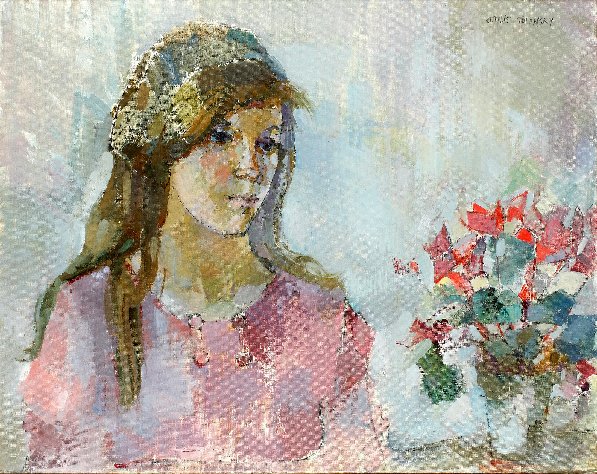
August and the Poet by Evelyn Dunbar (1960)

On the evening of May 12th 1960, whilst out walking in the woods around Staple Farm, Dunbar suddenly collapsed and died. One of Evelyn’s last paintings was Autumn and the Poet which she had started to paint ten years earlier and was still on one of her easels when she died.  The figure of the poet, half-seated on the ground, was modelled by her husband.  Unfortunately the painting was slightly smoke-damaged in a house fire in 2004, but was restored in time for the 2006 exhibition marking the centenary of Dunbar’s birth.

Roadworks by Evelyn Dunbar (Thought to have been produced while studying at Rochester School of Art in c.1926) sold in 2018 for £19,000.

Her main works were her oil paintings but she also left behind many portfolios of watercolours, drawings, pastels, sketches and other secondary work, most of which were not seen for many years after disappearing shortly after her death.   The Times newspaper in its obituary of Evelyn Dunbar wrote:

“…Living a retired life in Kent, absorbed in country pursuits, Miss Dunbar did not often come before the public in mixed exhibitions, but her mural paintings and illustrations, with their peculiar authenticity of work inspired by the ruling passion, appealed strongly to those who knew it…”

Roger Folley remarried in 1961, and Evelyn’s works of art were distributed among family and friends.


I have only scratched the surface of Evelyn Dunbar’s life and the majority of the information was gleaned from a beautifully written series of blogs regarding this wonderful artist written by her nephew, Christopher Campbell-Howes, who has also published a book on her life an art work.

Broncia Koller-Pinell

I was reading an article entitled A Forgotten Fame in the German Arts magazine, Schirn Mag.  It was about the life and works of the Austrian artist Bronislawa (Broncia) Pinell, later, Broncia Koller-Pinell and the headline read:

“…Broncia Koller-Pinell is listed as one of Austria’s most important female artists of the turn of the 20th century – but today her name has been almost entirely forgotten…”

She was an Austrian Expressionist painter who specialized in portraits and still-lifes. I was fascinated by what I read and so I decided to feature the young Austrian painter in one of my blogs. It is a strange story as she was listed as one of the most impor­tant Austrian artists of the turn of the 20th century – even though her name has by now largely slipped into obscu­rity.

Had you heard of her ?

Self Portrait by Broncia Koller-Pinell

Bronislawa (Broncia) Pineles was born on February 23rd 1863 in the town of Sanok, which is situated in the extreme south-east of Poland close to both the Polish and Ukrainian borders.  She was one of five children brought up by Orthodox Jewish parents, Klara Chaja and Saul Pineles, an architect of military fortifications.  She was the fourth-born of five children and had two older brothers, Markus and Stanislaus and an older sister Erika, and younger brother Friedrich. Later in life, Dr. Stanislaus Pineles, became a lawyer and lecturer at the University of Vienna, and Friedrich Pineles, a physician at the Wiener Allgemeine Krankenhaus and later head of the Franz-Josefs Ambulatorium.

Egon Scheile and his wife Edith by Broncia Koller-Pinell (1918)

At the age of seven, Broncia moved with her family to Vienna.  Her father had set up a manufacturing business just outside the city.  It was also the time when the family name was changed to “Pinell”.  Broncia developed a love of art and her father Saul did everything he could to nurture his daughter’s love of painting and sketching.  When she was eighteen, he had her receive private lessons from the sculptor Josef Raab and after Raab’s death in 1883, she was tutored by Alois Delug, the Austrian painter and later a professor at the Academy of Fine Arts, Vienna.

Seated Woman (Marietta) by Broncia Koller-Pinell (1907)

In 1885, Broncia went to Munich and enrolled at the so-called “Ladies Academy” at the Munich Kunstverein and this presented the young painter with the oppor­tu­nity to further profes­sion­alize her skills in a single-sex art class.  The Munich Women Artists’ Association was founded in 1882 and according to the statutes, the primary goal was:

“…to give the ladies of the arts and crafts the opportunity for mutual stimulation in their work and mutual support in their endeavours, to raise a sense and taste for beauty and to develop artistic understanding in women’s circles more and more…”

Silvia Koller with Bird Cage by Broncia Koller-Pinell (c.1905)
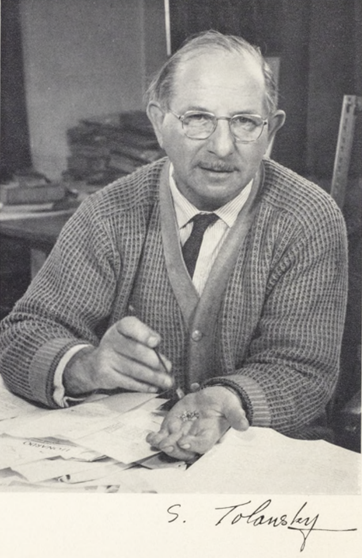
It was during her five-year stay at the Lady’s Academy that she was able to study in the ateliers of the German artist and educator, Ludwig Heterich and Ludwig Kühn, the German Impressionist and Modernist artist.

The Artist’s Mother by Broncia Koller-Pinell (1907)

Broncia Pinell began exhibiting her work in 1888.  However, it was not until 1892 when she achieved her first success with her paintings when they were exhibited at the Künstlerhaus in Vienna.  The following year her paintings were well received at the Glaspalast in Munich and in 1894 at the Kunstverein in Leipzig.   In 1896 she exhibited her works for the first time at the International Art Exhibition in Vienna.

Sleeping Child (The Artist’s Daughter, Sylvia) by Broncia Koller-Pinell (1903)

The year 1896 was also an important one for Broncia for this was the year she married Dr. Hugo Koller, a German Catholic physician and physicist, who studied medicine as well as mathematics and physics at the University of Vienna.  This decision did not please her family because she was Jewish and her husband was Catholic and the children were raised as Christians, albeit Broncia did not convert to Catholicism.  After marrying, the couple lived in Salzburg and later Nuremburg where Hugo held a leading position at Schuckert & Co., a German electricity company based in the city.  Whilst living in Nurenburg, they had two children, Rupert in 1896 and Silvia in 1898.  More about them later.   In 1903 the family resettled in Vienna.

Nude standing in Front of a Mirror by Broncia Koller-Pinell (1904)

Once settled in Vienna, Broncia actively participated in the circles around the Vienna Secession, which was also known as the Union of Austrian Artists, or Vereinigung Bildender Künstler Österreichs.   It was formed in 1897 by a group of Austrian painters, graphic artists, sculptors and architects, including Josef Hoffman, Koloman Moser, Otto Wagner and Gustav Klimt. The latter becoming a friend of Broncia and her husband.  The Vienna Secession was an art movement, closely associated with Art Nouveau.   The artists who formed this organisation were opposing the domination of the official Vienna Academy of the Arts, the Vienna Künstlerhaus, and official art salons, with their traditional orientation toward Historicism.  Broncia was also involved with the Wiener Werkstätte, which was an association formed and brought together architects, artists, designers and artisans working in ceramics, fashion, silver, furniture and the graphic arts. 

Die Ernte (The Harvest) by Broncia Koller-Pinell (1908)

Broncia’s husband Hugo Koller was an art collector and patron of the arts and he endorsed his wife’s artistic work and, through his good relations with the Secessionists and artists of the Wiener Werkstätte, he facilitated her access to exhibitions.  In 1898 the family moved to Nuremberg. In 1903 the family moved back to Vienna and lived right next door to the Theater an der Wien.  

Hugo Koller by Egon Schiele (1918)

Hugo built the first power plant in Lower Austria to power the factory in Oberwaltersdorf which was owned by his father-in-law, Saul Pineles. After the death of his father-in-law in September 1903, Hugo and Broncia inherited Saul’s Oberwaltersdorf estate and had the main residence extensively rebuilt. 

House Koller in Oberwaltersdorf (Vienna), Austria.

The couple would often entertain guests from the art world here such as Josef Hoffmann, Kolo Moser, Egon Schiele and Gustav Klimt, as well as philosophers, musicians, and scholars. Broncia Koller had a special relationship with Klimt and his group of friends and she would exhibit her work alongside this group of artists and in 1913 she became a member of the Bund Österreichischer Künstler founded by Klimt, Moser, Hoffman, and others.

Erster Schnee” (Der Wiener Naschmarkt im Winter) by Broncia Koller-Pinell (1911)

Life’s pathway to being a respected artist was very bumpy for Broncia.  There were two main reasons for this.  Firstly she was a female and as such was looked down upon by some male art critics who, according to Albert Paris von Gütersloh, an Austrian painter and writer, despite her artistic accomplishments, her critics and even some of her “friends” labelled her with the stigma of being simply “the talented wife of a prominent husband” or “a painting housewife”.  Sadly, like many Jewish women artists of her time, Broncia Koller-Pinell was supposed to fit into the male-ordained female role of just looking after the family and the home.  The second reason as to why she had to fight all the way along her career path and parry male “put-downs” was that she was a prosperous Jew.  That duel factor, coupled with the growing anti­semitism in Austria after the First World War, was experienced ever more acutely by Broncia and other Jewish artists and their families.

Werden und Vergehen by Broncia Koller-Pinell (1920)

Bronica Koller-Pinell died in Oberwaltersdorf on April 26th 1934, aged 71. Her husband died in October 1949.

Junge Frau by Sylvia Koller (1924)

After completing her studies, her daughter Sylvia Koller worked as an artist in Vienna. She became a member of the Kunstschau and the Wiener Frauenkunst, at whose exhibitions she began entering her work in 1927.  Being Jewish, it is probable that she was no longer allowed to work as an artist after the annexation of Austria. In 1937, three years after the death of her mother, she returned to Oberwaltersdorf and became a carer for her sick widowed father. In 1961, she organized the first posthumous exhibition of the work of her mother, Broncia Koller-Pinell.  Silvia Koller not only posed for her mother several times but also for a number of artists including Egon Schiele. Sylvia died in 1988, two weeks before her eighty-fourth birthday.

Anna Mahler by Broncia Koller-Pinell (1921)

Anna Justine Mahler was the second child of the composer Gustav Mahler and his wife Alma Schindler.  At the age of 16, Anna fell in love with a rising young conductor, Rupert Koller, the eldest child of Broncia Koller-Pinell and Hugo Koller. They were married on November 2nd 1920 but their marriage ended within months.  She actually married and divorced five times during her life.  Robert Koller was conductor at the Municipal Opera House in Elberfeld.  He died in 1976.


I acquired a great deal of information for this blog from the following websites:

The Shalvi/Hyman Encyclopedia of Jewish Women

Schirn Mag: Forgotten Fame

artvise.me:  Viennese Modernism, 6 important female artists from 1900-1938