Walter Frederick Osborne.

Walter Frederick Osborne

My featured artist today is Walter Frederick Osborne, the Irish impressionist and post-impressionist landscape and portrait painter. He was born on June 17th, 1859 at 5 Castlewood Avenue in Rathmines, an inner suburb on the southside of Dublin, about 3 kilometres south of the city centre. He had two brothers and a sister, Violet. He was the second of three sons of Anne Jane Woods and her husband, William Osborne, an acknowledged animal painter whose speciality was portraits of horses and dogs owned by wealthy landowners. Walter Frederick Osborne, known as Frederick Osborne for the first twenty-five years of his life, attended the local school at Rathmines.

A Glade in the Phoenix Park by Walter Frederick Osborne (1880 )

Having realised that money could be made from painting, Frederick wanted to follow in the footsteps of his father and become an artist. So, once he had completed his schooling in 1876, seventeen-year-old Frederick, enrolled on an art course at the Royal Hibernian Academy School. Osborne made an impact straight away, exhibiting in the RHA annual show in his first year. He won numerous medals and prizes including the Albert prize in 1880 with his painting, A Glade in the Phoenix Park.

In 1881 he attended Koninklijke Academie voor Schone Kunsten van Antwerpen (Royal Academy of Fine Arts Antwerp), where one of his tutors was the Belgian painter Michael Charles Verlat. Whilst studying there he won the Royal Dublin Society Taylor Art Award in 1881 and 1882, which awarded him an annual bursary. This was the highest student honour in Ireland of the time and given annually to a graduate of an Irish art college or an Irish art student graduating from an art college abroad to assist them with the development of their career as a visual artist.

A Flemish Farmstead by Walter Frederick Osborne (1882)

Osborne sent back to the Royal Hibernian Academy a number of paintings he completed whilst attending the Royal Academy of Fine Arts in Antwerp. One was his 1882 work, A Flemish Farmstead, and this exhibited by the Academy the following year, just after Osborne had been elected an Associate Member. From his earliest days, Osborne was interested in painting farmyards such as the one above. His scenes usually included one or two figures. However, this work is slightly subtler for he merely suggests that the farmyard is a working one by including the jacket that hangs on the open door and the clogs that stand against the wall. Being a great believer that detail is important, he has even depicted the clogs standing on end, suggesting that they are that way so as to allow them to drain after a wet morning in the fields.
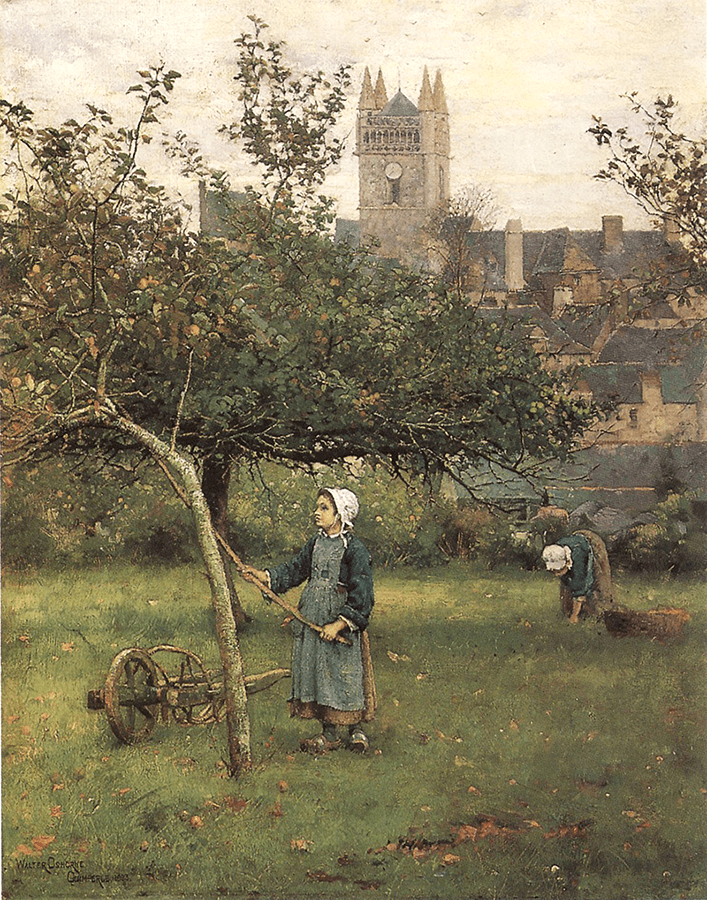
Apple Gathering by Walter Frederick Osborne (1883)

He completed his studies in Antwerp in 1883 and travelled to the Breton artists’ colony at Quimperlé. Osborne soon realised that the most noteworthy modern painters were painting en plein air and were using ordinary local people as their models and the Breton fishing villages had a plethora of such willing characters. It was at Quimperlé that he completed his famous Apple Gathering painting which is now housed in the National Gallery of Ireland. The painting depicts a young girl dressed in a peasant costume holding a long stick, busily shaking branches of an apple tree to loosen the ripe fruit. Looking behind her, we see another young girl picking up the fallen apples which are scattered around the orchard. In the background we see the church of Quimperlé which was the subject of many of the artists residing at the town’s artist colony. The painting can now be found in the National Gallery of Ireland in Dublin.
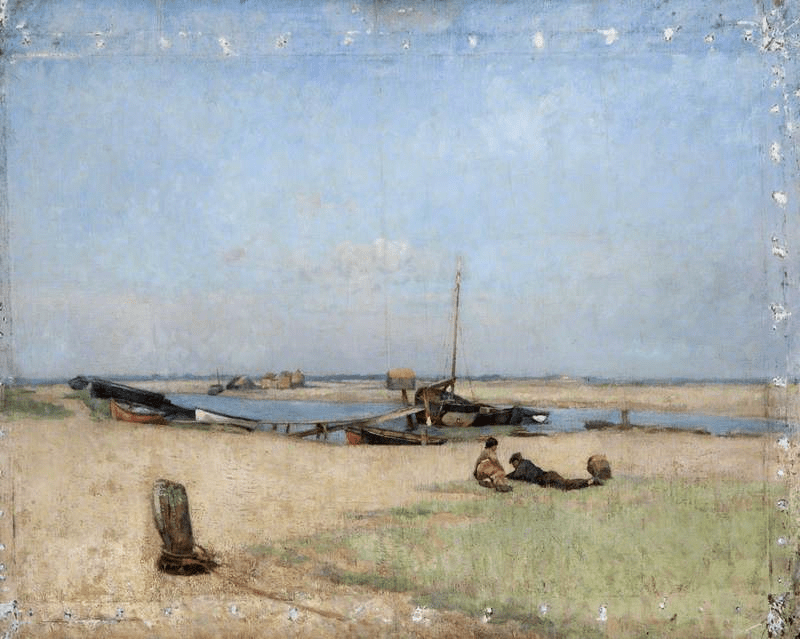
Estuary at Walberswick by Walter Frederick Osborne (c.1885)

Walter Osborne along with two fellow Irish artists, who were part of the Quimperlé artist’s colony, Drogedha-born Nathaniel Hill and Galway-born Augustus Nicholas Burke eventually left the Breton town and returned to England and headed for another artist’s colony at the Suffolk coastal village of Walberswick, where one of the artists was Philip Wilson Steer, who had studied at the École des Beaux Arts under Alexandre Cabanel, during which time he became a follower of the Impressionist school. Steer would become a leading figure in the Impressionist movement in Britain.
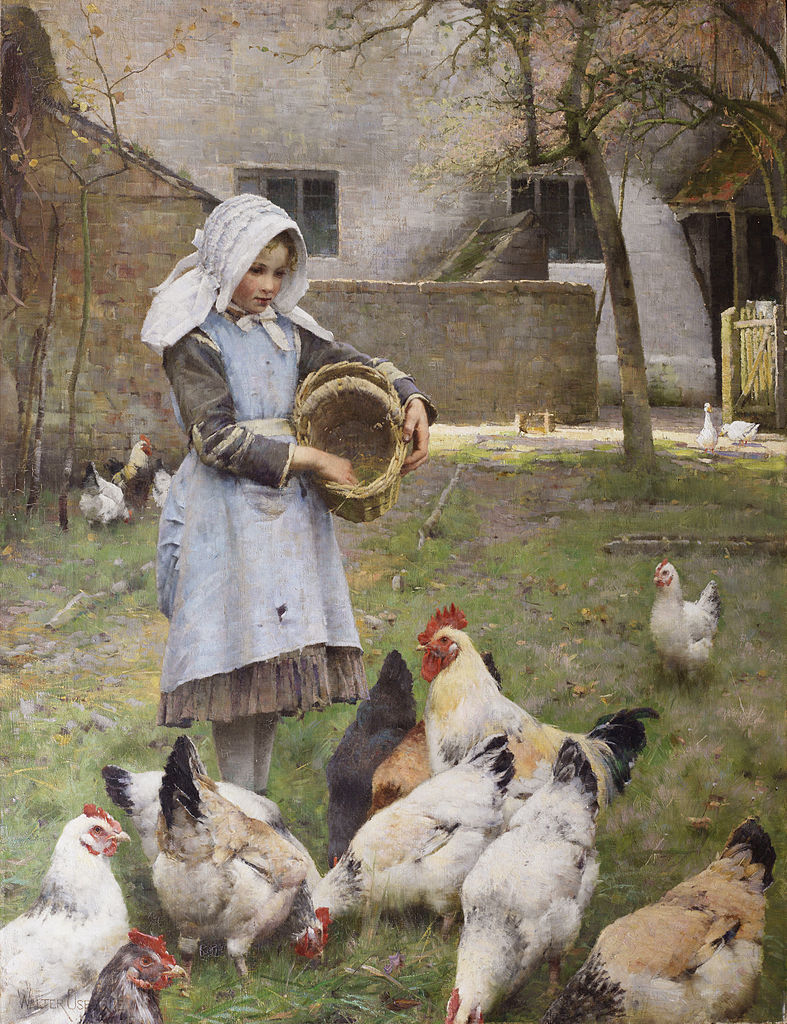
Feeding the Chickens by Walter Frederick Osborne (1885)

At the start of 1884, Walter Osborne’s early paintings often featured young children accompanied by animals, often their pets. One of his most famous works of this genre came about whilst Walter Osborne along with his fellow young artists Nathaniel Hill and Edward Stott, another former École des Beaux Arts student, travelled through the English countryside, on sketching trips. That October, the trio had arrived at North Littleton, near Evesham, Worcestershire and the painting which evolved from his visit here was the work entitled Feeding the Chickens. The oil on canvas painting measured 36 x 28 inches (92 x 71cms). In the work, we see a young but confident girl, with her earnest expression, scattering corn for the chickens. She is Bessie Osborne, (no relation to the artist), the daughter or maybe a servant in the substantial house which we see in the background. In Osborne’s preparatory sketch for this work, there was another figure, a gardener with his wheelbarrow, but he was not transferred to the finished painting. Presumably Osborne thought his inclusion would detract from the main focus of the work, the girl.

The Irish art historian Jeanne Sheehy’s biography of Osborne quotes from his letter to his father, dated October 12th, 1884, about the details of the work. In a letter to his father he set the scene for the painting:

“…’The weather, I am sorry to say has been bitterly cold the last week, so much so that my model nearly fainted and I had to send her home … It will probably seem funny to you all that my model’s name should be Bessie Osborne …”

The young girl is wearing an embroidered bonnet and holding a basket of grain, surrounded by a brood of hens. A further insight into the making of this painting can be found in the letter:

“…Now I am pretty far advanced on a kit-kat of a girl in a sort of farmyard, a rough sketch on the opposite page will indicate the composition. The figure of the girl which is a little over two feet high is coming towards finish, but the immediate foreground with poultry is merely sketched in as yet. The fowl are very troublesome, and I have made some sketches but will have to do a lot more as they form rather an important part of the composition…”

Also, in the letter to his father Walter asks him to look through his sketches he had done whilst at Quimperlé and find any of chickens which may help with this painting.
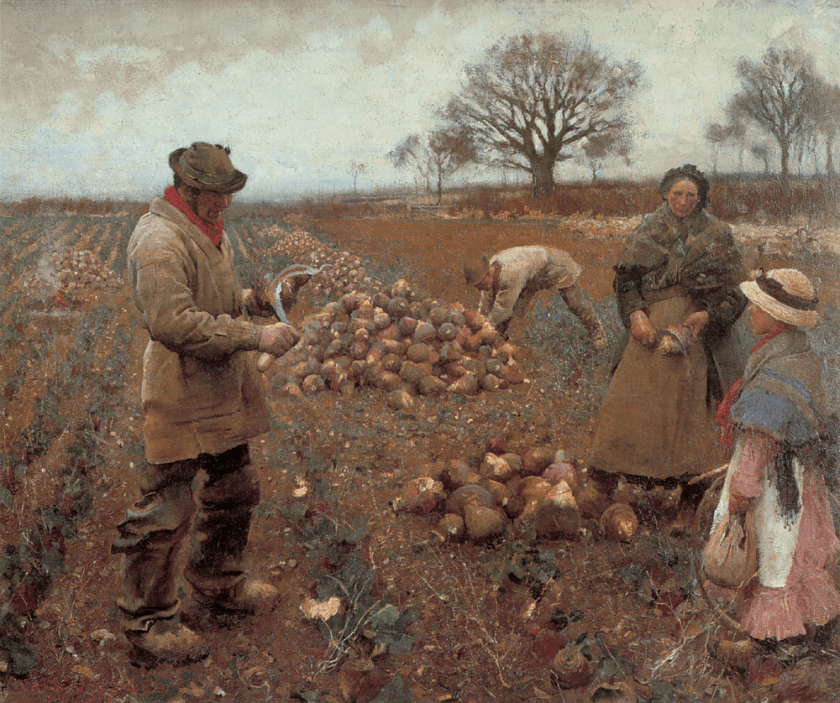
Winter Work by George Clausen (1883)

During his travels around the English countryside, Rural Naturalism became his favoured genre. He had been influenced by the works of the French painter, Jules Bastien-Lepage, whose works were dominating the Paris Salon and it was this type of work which Osborne preferred to the themes from history or mythology which were taught in the Academies of Europe. Another influence on Osborne was another Naturalist painter, the English artist George Clausen.

The Return Of The Flock by Walter Frederick Osborne (1885)

From 1883 and for the next fifteen years Osborne spent the summers wandering around the South of England often visiting the area of the beautiful Berkshire Downs or the area around the Hampshire market town of Romsey or the Suffolk coastal villages. Once asked why he did not spend his summers in Ireland he said that it was cheaper to live in England and it rained less which was important as he wanted to paint en plein air. Osborne was not looking for spectacular landscape which he could have found in the West of Ireland, the Lake District or Scotland. His preference was for the sedate beauty of rural villages with their well-stocked picturesque cottage gardens, often his paintings would include farmyard animals such as sheep. Like the French Impressionists, Osborne was fascinated by the effect of light and how it changes during every hour of the day.

Portrait of Mrs Chadwyck-Healey and her Daughter by Walter Frederick Osborne (1900)

Walter Osborne was elected an associate of the Royal Hibernian Academy in 1883 and became a full member in 1886. Although Osborne spent the summers travelling around the southern English countryside he would return to the family home in Dublin during the winter months.  In 1886, following his election to the Royal Hibernian Academy he received many commissions for portraits and from 1892 onwards, Osborne’s main output changed from landscape work to portraiture. These portraiture commissions were essential to Osborne for his financial survival and that of his parents who relied heavily upon him. Osborne’s permanent move to Dublin in 1892 was prompted by the death of his sister Violet whose newly-born baby was given into the care of Osborne’s aged parents and he had to take on the task of looking after her daughter. His portraiture and landscape works had become so popular and because he received more and more commissions he decided that working from home was not feasible and so acquired his own studio in St Stephens Green in 1895.
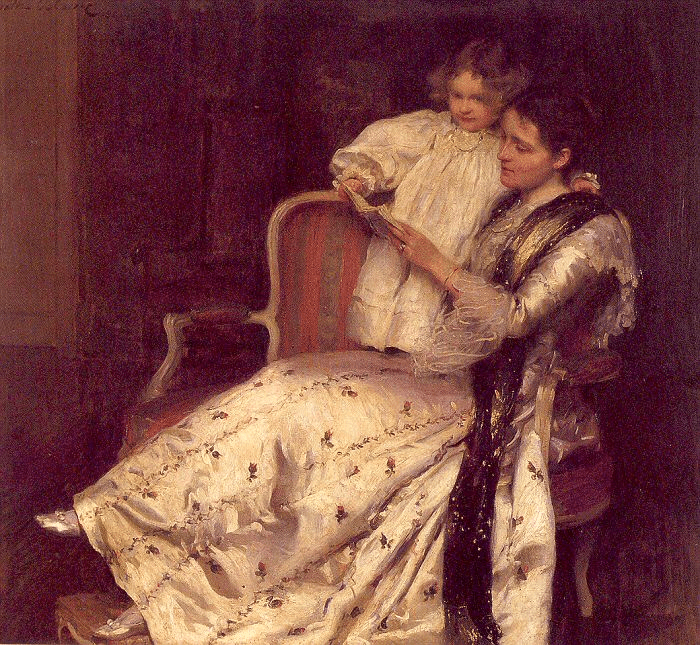
Mrs. Noel Guinness And Her Daughter Margaret by Walter Frederick Osborne (1900)

One of his best-known portraits was entitled Mrs Noel Guinness and her Daughter Margaret and this was exhibited at the Paris Exposition Universelle in 1900 and which received the bronze medal. The painting depicts Mary Guinness (née Stokes), the wife of Richard Noel Guinness, and her four-year-old daughter Margaret.
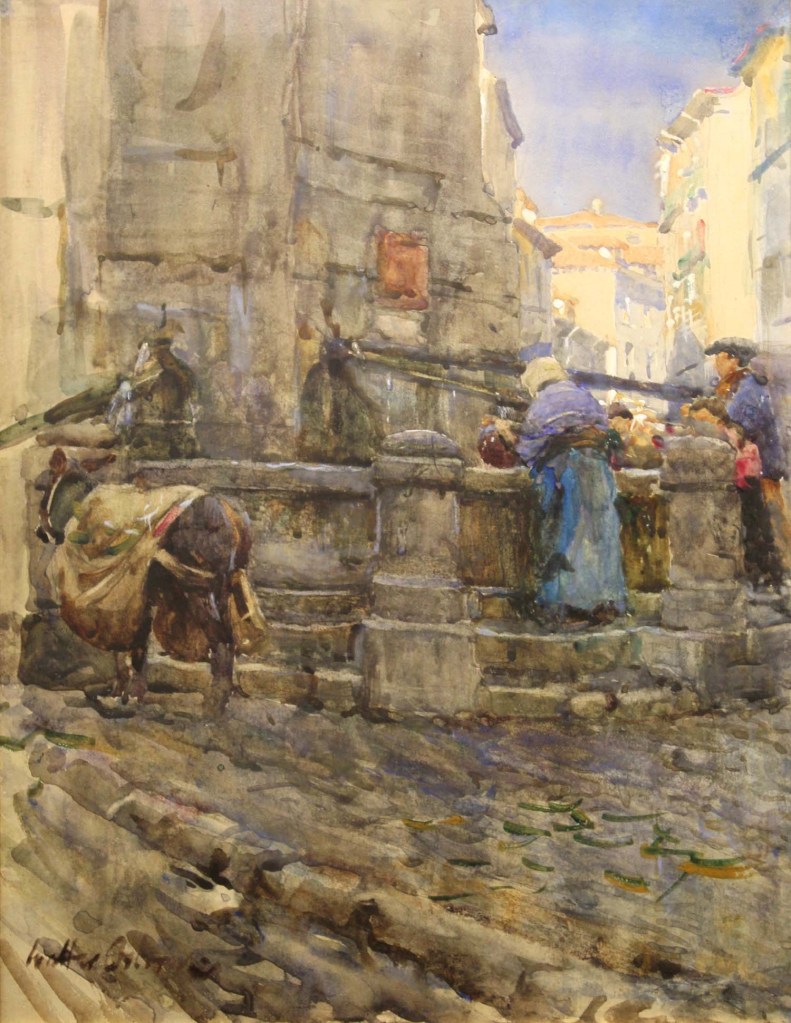
The Old Fountain, Madrid by Walter Frederick Osborne (1895)

In 1895 he and his friend, the art historian and writer, Walter Armstrong, toured around Spain, where Walter completed a number of watercolour drawings and oil sketches. The following year the two men travelled to Holland where he completed a number of Amsterdam canal scenes.

Dublin Streets a Vendor of Book by Walter Frederick Osborne (1889)

During this time Walter Osborne put together a series of paintings depicting Dublin street scenes, which some time later were exhibited at the Royal Academy. Osborne made pencil sketches and took photographs of the street scenes and then completed the series in oils in his studio. Probably the most famous of the paintings in this series was Dublin Streets: A Vendor of Books which he completed in 1898.  The painting depicts a bookseller’s stall, set up on Eden Quay, looking eastwards towards the O’Connell Bridge. We see a mother leaning against the wall holding a very young child in her arms. She has a fatigued and nervous look about her. By her side, on the floor, there is a basket of daffodils. What is her story? Is she in any way connected to the bare-footed girl who has moved towards the customers who are perusing the books at the vendor’s stall? The little girl has a small bunch of daffodils in her hand which she is holding up to the customers. She has been sent by the lady, maybe her mother, to try and get a few pence for the flowers. It is a painting full of movement from the horse drawn carriages we see crossing the bridge to the barge making its way down the River Liffey about to pass under the bridge. These realistic paintings of street life in Dublin, although in great demand now and a good historical record of the times past, were not as successful then as his portraiture.
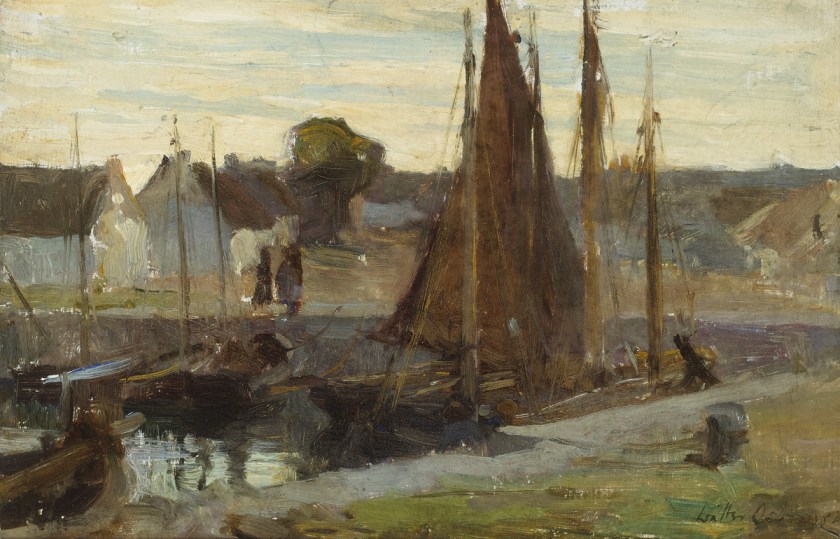
Greystones by Walter Frederick Osborne (1884)

Osborne did not forsake his landscape work completely and one his Impressionist-style works, completed around 1898, was entitled Greystones. It is a somewhat moody study 0f the quayside of Greystones, a small coastal fishing village in County Wicklow. In the painting we see a number of fishing boats tied up to the harbour quayside, some of which have the sails unfurled. In the background there are a number of cottages. His use of muted colours and tones such as his mauves, pinks, pale greys and browns induce a sense of soft light. Look how Osborne has cleverly depicted the diffused sunlight on the gable ends of the cottages and again with the way he has represented it with the silvery flickering of the water with its reflections.
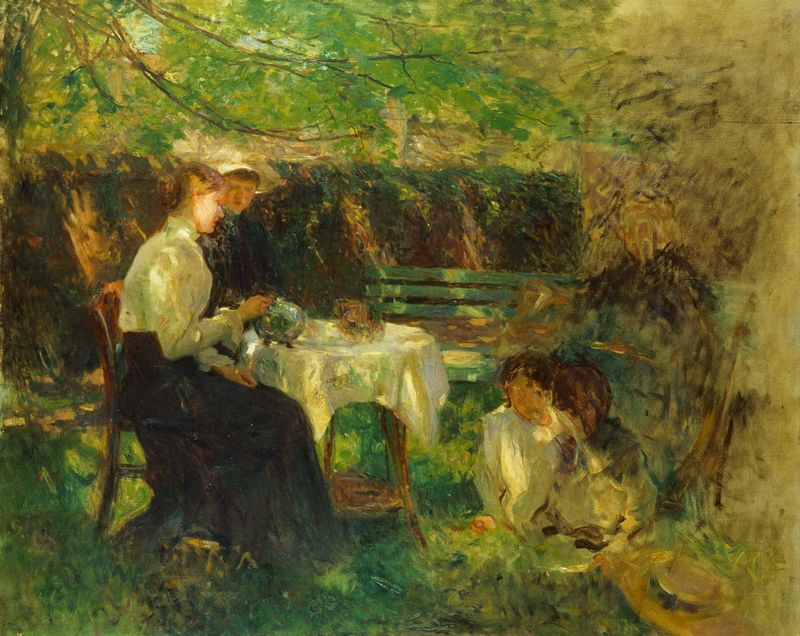
Tea In The Garden by Walter Frederick Osborne (1902)

In 1900 Osborne was offered a Knighthood in recognition of his services to art and his distinction as a painter, but he refused the honour. His mother became ill in the early 1900s, and Walter spent long periods looking after her. In 1902 he started to paint what was to be his last picture, Tea in the Garden, which remained unfinished at the time of his death. It was a beautiful work, a juxtaposition of his favoured Impressionism and Naturalism.

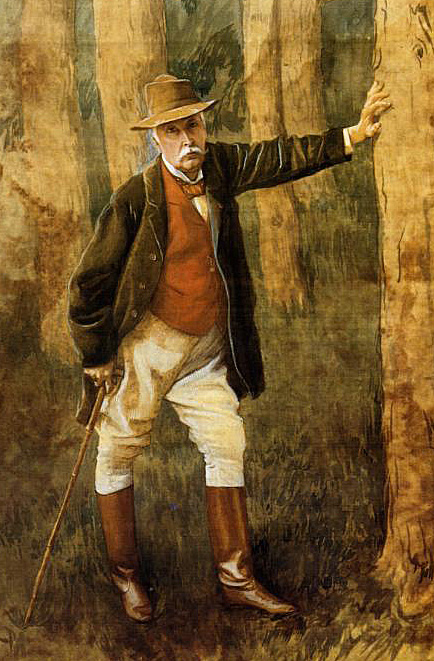
Self-portrait by Walter Frederick Osborne

In 1903, after a strenuous time gardening, he became ill, which he tried to ignore but which developed into double pneumonia. He died aged forty-three, at the family home in Castlewood Avenue, Rathmines, Dublin, on April 24th 1903, and was buried in Mount Jerome cemetery. Walter Frederick Osborne never married and left considerable savings behind him. He was one of the most sought after and talented Irish artists of his time.
James Tissot. Part 4 – True love, loss and a return to his homeland

James Tissot (1836 – 1902)

Tissot had stayed at the home of his friend, Thomas Bowles, when he arrived in England in June 1871, and remained his guest until 1872, at which time he went to live in a house in St John’s Wood, an area inhabited by a number of artists. A year later, with buoyant finances, he was on the move again, this time buying a house close by, in Grove End Road. His friends back home in France could not believe the change in Tissot’s fortunes. His good friend Degas wrote to him about his change of circumstances:

“…I hear you have bought a house. My mouth is still open…”

While others, probably jealous of his success in London were somewhat scathing. Edmond de Goncourt, a French writer, literary and art critic wrote mockingly in his journal, dated November 3rd 1874:

“… Tissot the plagiarist painter, was having the greatest of successes in England. Has this ingenious exploiter of English stupidity not come up with the idea of an ante-room to his studio perennially filled with iced champagne for his visitors, and around his studio a garden where one might observe at all times a footman occupied in dusting and polishing the leaves of the laurel bushes…”

Berthe Morisot and her husband visited Tissot in 1875 and following the meeting she wrote to her mother:

“…he is very well set up here and is turning out very pretty pictures. He sells them for 300,000 francs a time. So, what do you think of success in London? He was very kind; and complimented me on my work, though I doubt if he has actually seen any…”

In another letter to her sister she wrote:

“…Tissot……is living like a prince…..he is very kind, and most amiable, though a little common…..I paid him a great many compliments and truly deserved ones…”

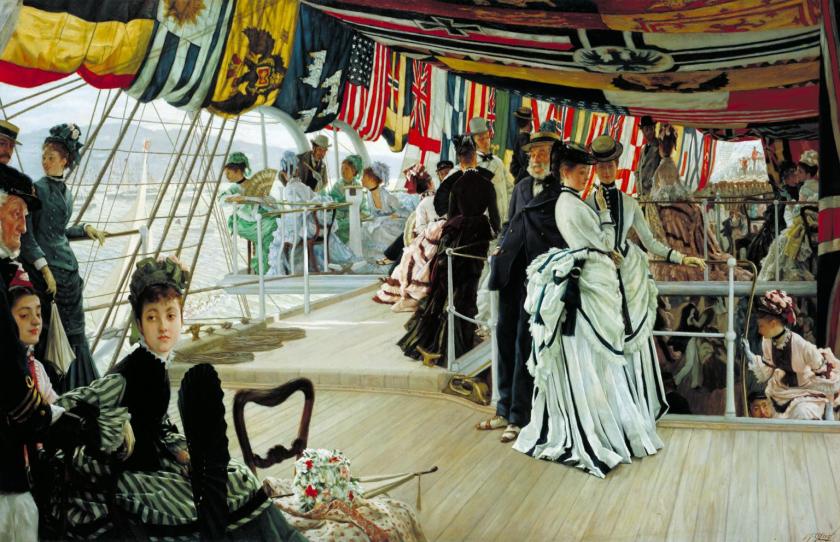
The Ball on Shipboard by James Tissot (c.1874)

One of Tissot’s paintings in 1874 is now looked upon as one of his most festive works and one of his finest works which he completed whilst living in England. Again, it followed on from other shipboard paintings which Tissot had become known for. The painting depicts men and women relaxing at an event thought to be the annual regatta at Cowes on the Isle of Wight. It is entitled The Ball on Shipboard and was exhibited at the Royal Academy in 1874, but unpredictably it received an unfavourable reaction from some art critics. To them, there was no narrative, the colours were too garish and some even levelled the complaint that it was “simply vulgar”. John Ruskin described it as:

“…unhappy mere colour photographs of vulgar society…”

The art critic of the magazine Athenaeum said of it:

“…I can find no pretty women, but a set of showy rather than elegant costumes, some few graceful, but more ungraceful attitudes and not a lady in a score of female figures…”

How the critic came to that collusion now seems unfathomable and the supercilious and snobbish judgement he made is completely at odds with today’s views when the work is simply looked upon as the spirit of Victorian fashion and sophistication.

London Visitors by James Tissot (1874)

Another of Tissot’s works to be exhibited at the Royal Academy received stinging criticism and yet is now looked upon as one of his masterpieces. The painting is entitled London Visitors. The colours used are mainly grey and muted tones which are suggestive of a typical of a smoky city atmosphere of a London scene on a dull winter’s day. Depicted are a couple of stylishly dressed visitors to the capital standing underneath the portico of the newly constructed National Gallery in London, with the church of Saint Martin-in-the-Fields framed in the background. The couple are trying to decide where to head to next. The gentleman checks his guidebook, while his female companion uses her umbrella to point towards Trafalgar Square, which lies in front of them. Standing in the foreground is young boy. He is one of the so-called bluecoat boys, who were students of the charitable Christ’s Hospital School, who often acted as tour guides to visitors to the city.

Empress Eugénie and the Imperial Prince in the grounds of Camden Place, Chislehurst by James Tissot (c.1874)

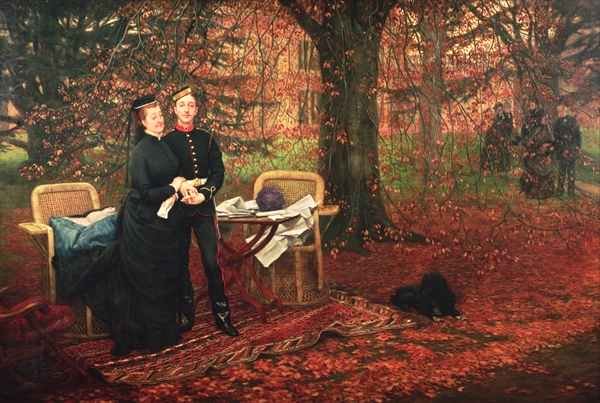
Tissot’s exalted reputation as a portrait painter was further boosted with one of his most prestigious portrait commissions which he received in 1874. This painting is a royal portrait of the widowed Empress Eugénie and her son, Louis Napoleon, entitled The Empress Eugénie and the Prince Impérial in the Grounds at Camden Place, Chislehurst. The painting which is now housed in the Chateau de Compèigne in France is one of Tissot’s most remarkable portraits. It is a portrait of a once powerful family who were then living in reduced circumstances. It is a portrait laced with sympathy. The autumnal colours add to the pair’s mood of sad reflection and feeling of desolation. In it, we see the sorrowful figures of the Empress Eugenie and her son, the recently deceased Napoleon III’s heir.  He is dressed in his British Royal Artillery uniform and is depicted supporting his mother as he looks towards us.   Empress Eugénie was to suffer more tragedy for sadly her son was killed in 1879, five years after the painting was completed, while fighting in the Zulu War in South Africa.

Mavourneen (My Darling)
Portrait of Kathleen Newton by James Tissot (1877)

It was 1875 when a new person entered James Tissot’s life. A person who would bring both joy and sadness to him. The person was Kathleen Newton (née Kelly), an Irish woman who would become his muse and later his lover.
Kathleen Irene Ashburnham Kelly was born in 1854 to Irish parents in Lahore, where her father, an officer in the British Indian army, was stationed. Kathleen’s father finally achieved the rank of chief adjutant and accountant officer in Agra and eventually retired around 1865 and left India and returned with his wife and daughters to live in London. Kathleen had been convent educated, but after her mother died she was sent to boarding school. When she was seventeen her father decided that she should marry. He arranged such a marriage with an older man, Isaac Newton who was a surgeon attached to the Indian Civil Service, and Kathleen was sent off in a steamer to meet her proposed husband, whom she had yet to set her eyes upon. For all intense and purposes, she was a mail-order bride.

The Bunch of Violets by James Tissot (1875)

Unusually her father had not arranged for a chaperone to travel with his teenage daughter and it was during this long sea passage that she fell in love with a fellow traveller, a Captain Palliser. She arrived in Lahore and on January 3rd 1871 Kathleen and Isaac Newton were married. Being somewhat naïve but one has to remember she was a pious convent girl,  on the advice of a Catholic priest, she confessed to her husband about the on-board romance soon after their wedding ceremony and before the marriage was consummated. In a letter to her husband, which I am not sure would have helped her cause for forgiveness, she wrote:

“…I am going to speak to you as if I was standing before God. It is true that I have sinned once, and God knows how I love that one [Palliser] too deeply to sin with any other…”

He was horrified and unforgiving and in May 1871 initiated divorce proceedings. He was granted a decree nisi in December 1871 and a decree absolute in July 20th 1872. Kathleen returned to England and went to live with her sister and brother-in-law, Mary and Augustus Hervey who lived in Hill Road, St John’s Wood close to Tissot’s Grove End Road house. On the same day as the decree absolute ending Kathleen’s marriage was granted she gave birth to Palliser’s child, Muriel Mary Violet.

Young Women Looking at Japanese Objects by James Tissot (1869)

It is not known for sure how Kathleen Newton and James Tissot met or when, but the best guess is late 1875. What we do know is that Kathleen Newton gave birth to her second child, Cecil George in March 1876 and that Kathleen, plus Violet and Cecil George went to live in James Tissot’s house that same year. Opinions are divided and arguments put forward fore and against as to whether Cecil George was Tissot’s son.  Kathleen gave her son the surname of Newton presumably so that he and his sister had the same last name !  All we do know is that Tissot’s household now included an Irish divorcee and her two illegitimate children and this did not sit well with the “rules” of respectable Victorian society. Although his close friendship with fellow artists remained as strong as ever his relationship with Kathleen found him barred from many high society gatherings. Tissot did not worry about this ostracising for he now sampled the joys of “family life” for the first time.

Portrait of Mrs N., more commonly titled La Frileuse by James Tissot (1876)

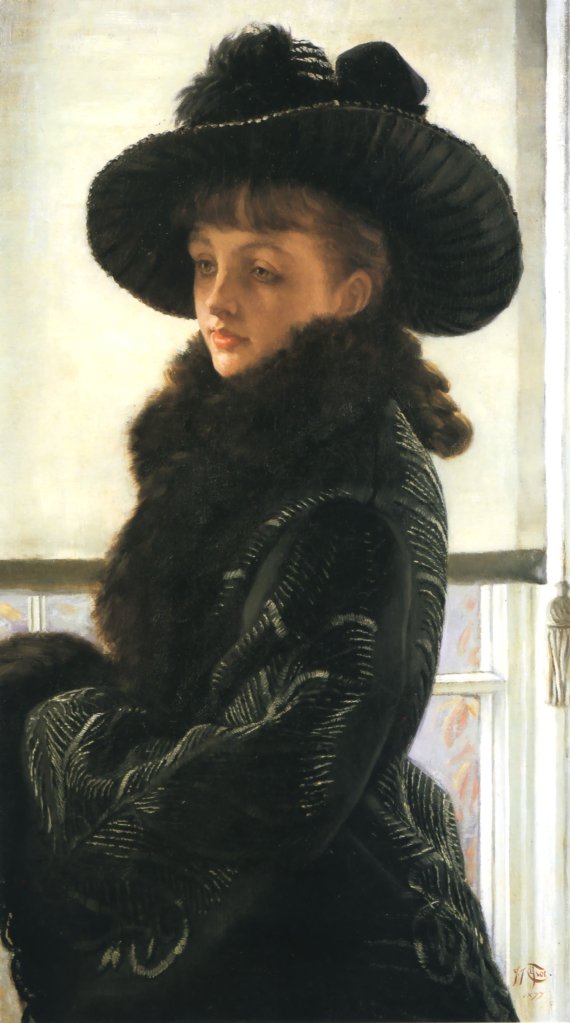
One of his earliest portraits of Kathleen Newton was a small (26 x 16cms) drypoint in black ink on cream laid Japan paper, which he completed in 1876. It was entitled Portrait of Mrs N..(Kathleen Newton) often referred to as La Frileuse (a woman shivering) which referred to the fact that Kathleen constantly felt the cold. It is regarded as his finest and most exquisite portrait of Kathleen. It must have been a true labour of love as we know he lost his heart to this Irish woman. The description in the William Weston London Gallery’s catalogue states:

“…It is a work of extreme delicacy yet great richness, of poetic quiet yet great emotion. Unlike the great majority of Tissot’s prints it is worked in pure drypoint, without the strength of underlying pure etching. The use of pure drypoint allowed him to combine extremely fine touches of line, in the drawing of her face for example, with tremendously rich textures in the burr and wiped ink tone in the fur collar or the hat. Kathleen Newton was the inspiration for some of Tissot’s very finest works…”

Le Croquet. (Playing Croquet) by James Tissot (1878)

The fact that Tissot was living with Kathleen was not unusual as many wealthy men kept mistresses but they did not, like Tissot, parade them around openly and advertise their relationship. Tissot did not worry about what society thought about his relationship with Kathleen as he now sampled the joys of “family life” for the first time. Tissot’s open and very public display of his affair with Kathleen shocked the London society, a society which had once welcomed him with open arms. His choice was simple, embrace Victorian society’s protocol or be proud to be seen with Kathleen.  For Tissot there was no question as to which course of action he would choose. Kathleen was the love of his life and he chose her over life amongst London society. James and Kathleen settled down to home life and were happy to mix with their many artistic friends who continued to support them. They never married and the reason for this could be their rigid Roman Catholic upbringing and beliefs. Tissot’s house and garden were spacious and Tissot and Kathleen along with her two children created a private world together and it is this private world which is the atmospheric background to many of Tissot’s compositions of this period including another drypoint, Le Croquet, which he completed around 1878.
A Passing Storm by James Tissot (1876)

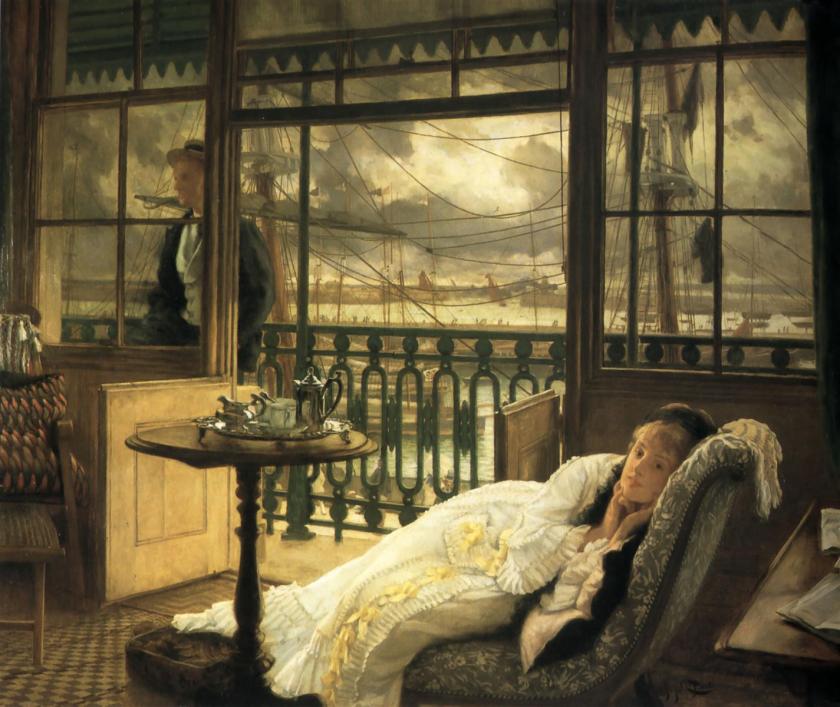
One of the first painting in which Kathleen appears is the 1876 work by Tissot entitled A Passing Storm. The setting for this painting is a room overlooking Ramsgate harbour. Kathleen is depicted lying on a chaise longue in an elegant if somewhat provocative pose. In the background, seen standing on the balcony, we see her lover. His demeanour is puzzling. He stands there with his hands in his pockets looking rather impatient and uninterested in the lady. It is a scene of inhibited passion. Again, it is a narrative work which lets the viewers decide what is going on and what has been said between the two to end up at this juncture.

Room Overlooking the Harbour by James Tissot (c.1876)

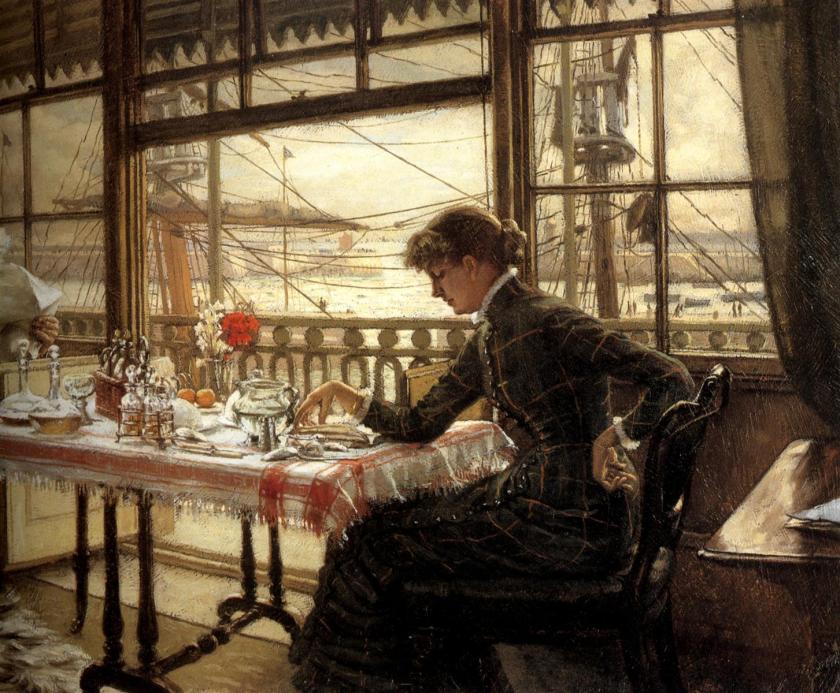
Another early work featuring Kathleen was one entitled Room Overlooking the Harbour. In this work the lady sits at a table having lunch. Across the table from her is an older man who is reading a newspaper.

Photograph of Kathleen Newton

It was during this period, the late 1870’s that Tissot began to use photographs to help with his depictions and a number of these photographs still survive to this day.

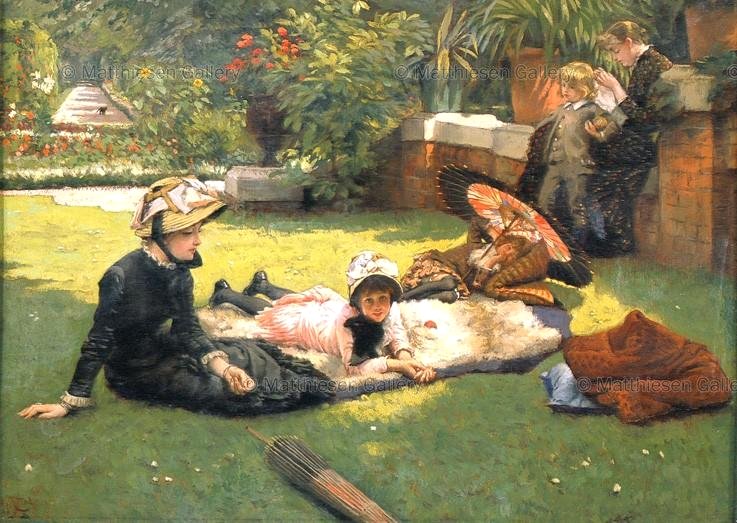
En Plein Soleil (In the Sunshine) by James Tissot (c.1881)

One such instance of this technique was Tissot’s painting En plein Soleil (In the Sunshine) which he completed in 1881. The depiction of Kathleen Newton is from a photograph of her sitting in the garden of his Grove End home.  The setting for the painting is Tissot’s Grove End Road garden in St. John’s Wood. It is a group portrait, we see Kathleen Newton on the left depicted in the same pose as in the photograph. On the rug next to her is her daughter, Muriel Mary Violet. The other girl lying under the parasol is her niece Lillian Hervey. To the right is Kathleen’s sister, Mary Hervey, whom she lived with on her return from India,  and is seen ruffling the hair of a young boy, Cecil George, Kathleen’s five-year-old son, who may also have been fathered by Tissot.
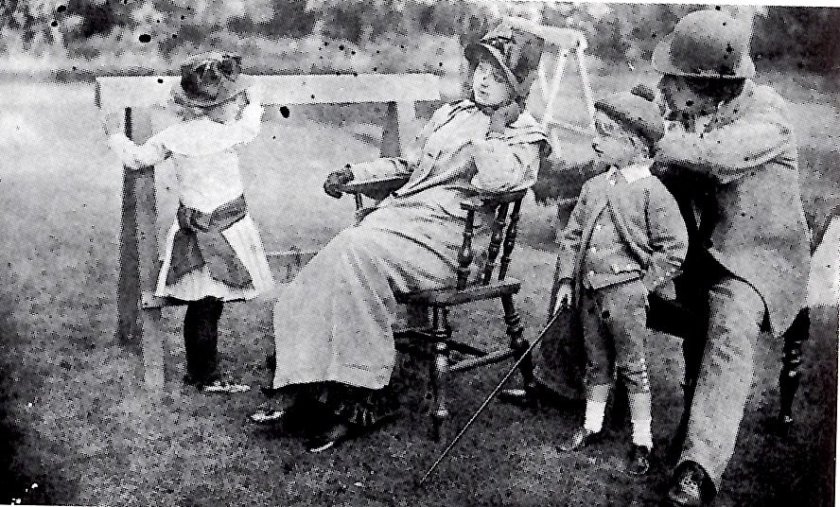
Family photograph

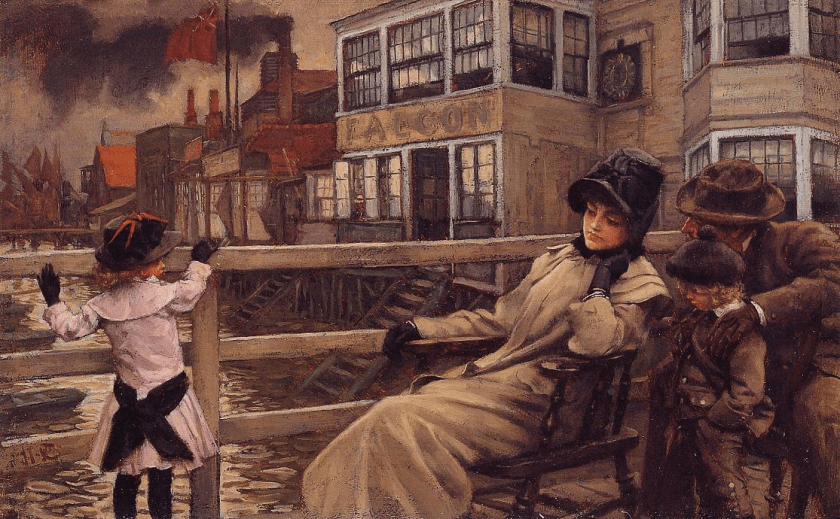
In 1878 Tissot used another photograph of Kathleen for his painting entitled Waiting for the Ferry. The photograph was once again taken in the garden of Tissot’s Grove End Road home. In it, we see Tissot and Kathleen along wither son Cecil George and her niece Lilian Hervey.
Waiting for the Ferry by James Tissot (1878)

In the painting we see the young girl wearing a large hat with an equally large bow holding onto the wooden rail of the dock waiting for the arrival of the ferry. The woman, modelled by Kathleen, is depicted sitting in the same Windsor chair shown in the photograph. The woman is well wrapped up against the cold and doesn’t look well. In a number of his later works featuring Kathleen Newton, Tissot has depicted her as being unwell and convalescing which is rather sad, bearing in mind the onset of Kathleen’s own illness.

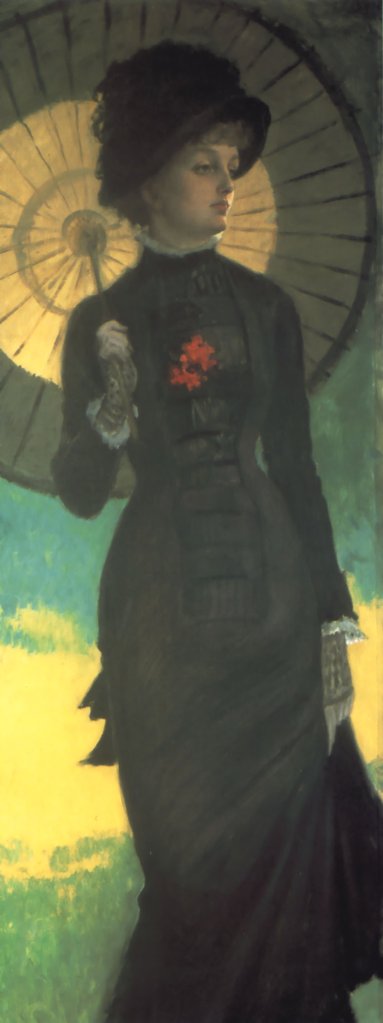
Mrs Newton with a Parasol by James Tissot (1879)

Another beautiful painting featuring Kathleen was his 1879 work Mrs Newton with a Parasol. This is looked upon as one of Tissot’s finest depictions of Kathleen. It has a hint of japonisme in its simplicity of design and the abstract colouring of the background. This is Tissot’s eulogy to feminine exquisiteness. This is Tissot’s homage to the woman he loved.

Tissot, by 1876, was financially secure through the sale of his paintings and he was happy with his life with Kathleen and her children. However, as we all know, life is not all plain sailing. In the latter part of the 1870’s Tissot’s paintings which he exhibited at various galleries were receiving a lot of criticism from the art critics. During the period, late 1879, through all of 1880, Tissot failed to exhibit any of his work at any of the leading London galleries. The critic were probably aware of the disdain shown by Tissot with regards Victorian morals and thought that criticising his work would be pay-back for his laissez-faire attitude to flaunting his private life in public. The art critic of the Spectator scathingly wrote:

“…This year he tries our patience somewhat hardly, for these ladies in hammocks, showing a very unnecessary amount of petticoat and stocking, are remarkable for little save a sort of luxurious indolence and insolence…”

The Hammock by James Tissot (1880)

The painting which the critic was lambasting was The Hammock which was set in Tissot’s own garden with its distinctive pool and cast-iron colonnade. In Victorian London having and maintaining such a large and decorative garden was very much a sign of affluence. The painting is all about lavishness, inactivity, and adoration. We see the lady, modelled by Kathleen, sitting back in her hammock, lazily reading her newspaper, There is a glimpse of a white petticoat which had upset the critics believing this would result in male viewers entertaining erotic thoughts !!! Although not discernible from the attached picture the book lying face down on the rug is probably French which alludes to the fact that Tissot had been sitting on the rug at the feet of his lover. Once again Tissot has included elements of japonisme in the painting.  It was interesting to note that Tissot exhibited the work at the Grosvenor Gallery instead of the Royal Academy. The Grosvenor was the temple of the Aesthetic Movement and Tissot’s style of paintings were much more aligned to the philosophy of this gallery than the Royal Academy which was looked upon as an older, straight-laced institution which frowned at frivolity.

Soirée d’eté (Summer Evening) by James Tissot (1882)                                                                                       A painting featuring Kathleen shortly before her death.

Another reason for Tissot not exhibiting any of his work during 1879 and 1880 was the declining health of Kathleen Newton who had contracted tuberculosis. In 1882 her health deteriorated rapidly with the onset of consumption. It was an illness that caused her great suffering and seeing his wife in so much pain was almost too much for Tissot to bear. Kathleen, aware that she was dying and saddened by sight of her distraught husband, decided to take matters into her own hands and took an overdose of laudanum. Kathleen Newton died in November 9th 1882, aged just 28.   While her coffin stood in Grove End Road draped in purple velvet, Tissot prayed besides it for hours.  Later, she was buried in plot  in St Mary’s Cemetery, Kensal Green.

One week after the death of his beloved Kathleen, Tissot abandoned his London home at St John’s Wood, leaving behind his paints, brushes and unfinished canvases and never returned to it. The house was later bought by his painter friend Alma-Tadema. Tissot was inconsolable and never really recovered from Kathleen’s death. He left London for good and returned to his homeland, France.

..…..to be concluded.


Most of the information I am using comes from Christopher Wood’s 1986 biography of Tissot which is an excellent read, full of beautiful pictures.

James Tissot. Part 3 – Life in England

Young Lady in a Boat by James Tissot (1870)

At the end of the 1860’s Tissot was still producing charming portraits of elegant young ladies. One such paintings were exhibited by Tissot in the 1870 Salon. It was entitled Jeune Femme en bateau (Young Lady in a Boat). It depicts a young lady in a boat wearing a fashionable early nineteenth century costume. Behind her sits her pet pug dog. This type of dog symbolised a sign of affluence and prestige. Look at her face – what is she thinking, why is she in the boat? Maybe she is on her way to meet her lover. We need to also to take into account the alternative title to this painting which was Adrift. So, could this mean her tryst with her beau is not going to go too well.

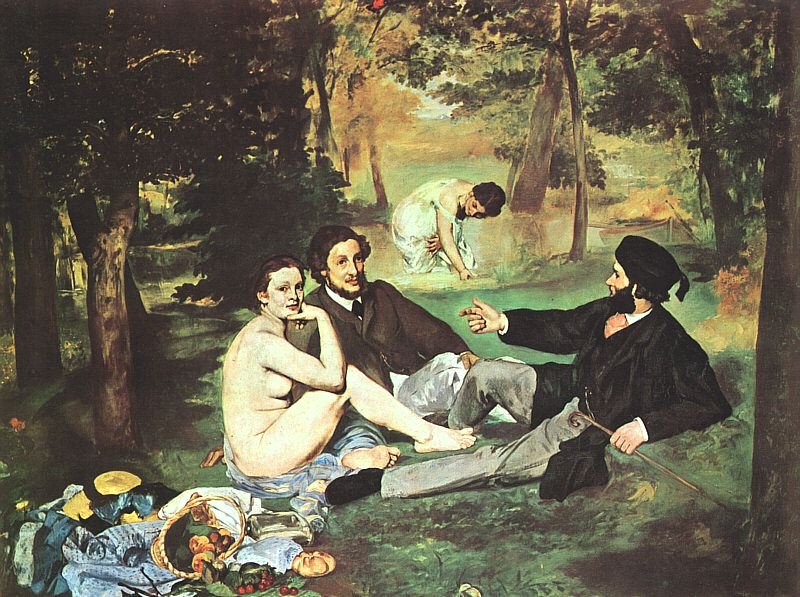
Le dejeuner sur l’herbe By Manet (1863)

The other work of Tissot which was exhibited at the 1870 Salon was his painting, Le Partie Carrée (The Foursome). There is a similarity between this work and Edouard Manet’s 1862 work, Dejeuner sur l’Herbe (Luncheon on the Grass) which had shocked critics and public alike seven years earlier.

The Foursome by James Tissot (c.1870)

For Tissot his depiction was a light-hearted look at eighteenth-century French manners and for that reason it proved a hit with the public. In this depiction, the female on the right lifts her glass high as she downs a glass of champagne, whilst her partner raises his glass to the man opposite in a celebratory toast. The man on the left raises his glass whilst his other hand is wrapped around the waist of his lady and cups her breast. She seems amused and looks boldly out at us with a questioning stare. Is she challenging us to censure her? It is interesting to note that she focuses us with a bold and defiant gaze which is mirrored by that of the woman in the boat in the previous painting. It is as if she is saying “if you don’t like what you see, hard luck!!!”.

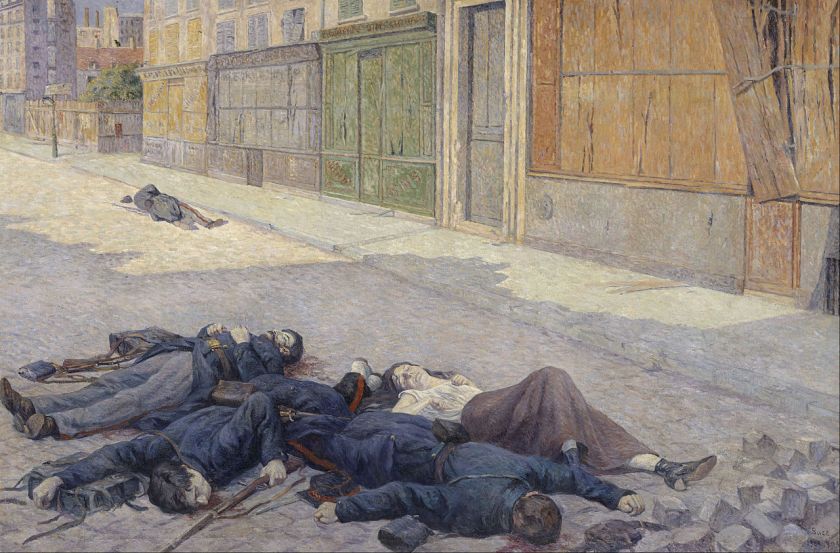
A street in Paris in May 1871 by Maximilien Luce

By 1870 things were going well for Tissot. He was being celebrated as a great figurative painter and his paintings of elegant young ladies were selling well. What could go wrong for him? The answer for him and the rest of the people of France was war. Napoleon III, the Emperor of France since 1852, in a dispute over matters involving Spanish succession, declared war on Prussia in July 1870, having unwisely been counselled by his military advisers that the French army could defeat Prussia and that such a victory would, at the same time, restore his declining popularity in France. However, by January 1871, after a four month siege of Paris by the Prussian army, the fighting was over and the French were defeated. But worse was to come for those who had suffered the Prussian army’s siege of Paris. At the cessation of hostilities between the Prussian army and the French army, the latter was allowed to form a National Assembly. The Parisians, tense and irritable after the long strain of the siege, were horrified by the action of rural France in electing a monarchist assembly committed to what they regarded as a dishonourable peace. They vowed to end the rule of the National Assembly and the infamous and bloody Paris Commune was formed. The Paris Commune was a radical socialist and revolutionary government that ruled Paris from March 18th to May 21st 1871. The working class of Paris seized power of their own city and established the world’s first workers’ government. It all came to a bloody conclusion in May with the storming of the Parisian barricades by the army. It was estimated that twenty-five thousand died during the siege many summarily executed after the battle was over.

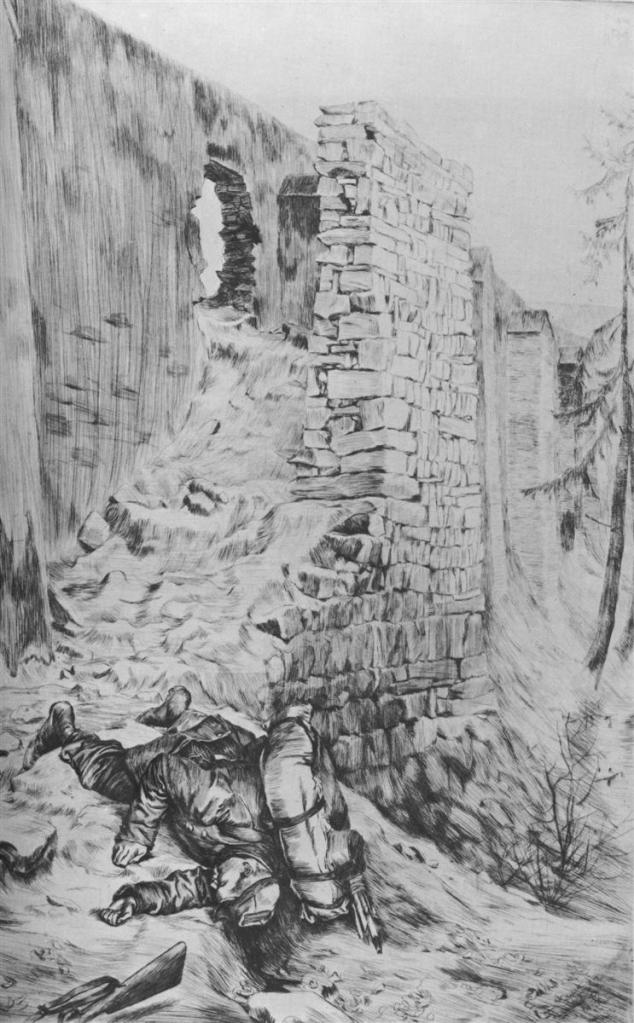
The First Man I saw Killed by James Tissot (1876)

So how did all this affect Tissot? Tissot, during the siege of the capital by the Prussian forces, saw active service when he joined two companies of the Garde Nationale, first the Eclaireurs de la Seine and later the Tirailleurs de la Seine, which included many patriotic artists who committed themselves along with a few talented lawyers, and traders to defend the city. Tissot recorded the horrors of battle with a small number of sketches and watercolours, which were later turned into prints and illustrations.

During the Paris Commune Tissot was rumoured to have become one of the violent revolutionary Communards. So why was he thought to have sided with the revolutionaries. Some believe it was an act of self-preservation and that of safeguarding his property, whilst others believed it was a supreme act of patriotism. What is known is that when the bloody collapse of the Paris Commune came in May 1871, Tissot fled the city and it was this hasty retreat that aroused suspicions of him being a Communard. The Parisian art market was ruined and life as an artist in the French capital was in disarray and so, in June 1871, Tissot arrived in London, almost penniless.

A Dandy by James Tissot (c.1873)

Tissot found sanctuary at the Cleve Lodge, Hyde Park Gate home of his friend Thomas Gibson Bowles, whom he had known and had occasionally carried out commissions for caricatures of prominent men for the magazine Vanity Fair, which was founded by Bowles. Tissot stayed with Bowles for several months and also was given a job of producing cartoon portraits for the Vanity Fair magazine. One such was his caricature entitled A Dandy.

George Whyte Melville, The Novelist Society by James Tissot (Vanity Fair September 1871)

Another was published in the September 21st, 1871 edition of Vanity Fair – a caricature of George Whyte-Melville, the Scottish novelist and poet. Although this was not the type of art that Tissot wanted to concentrate on, it provided him with financial support during his early stay in England.

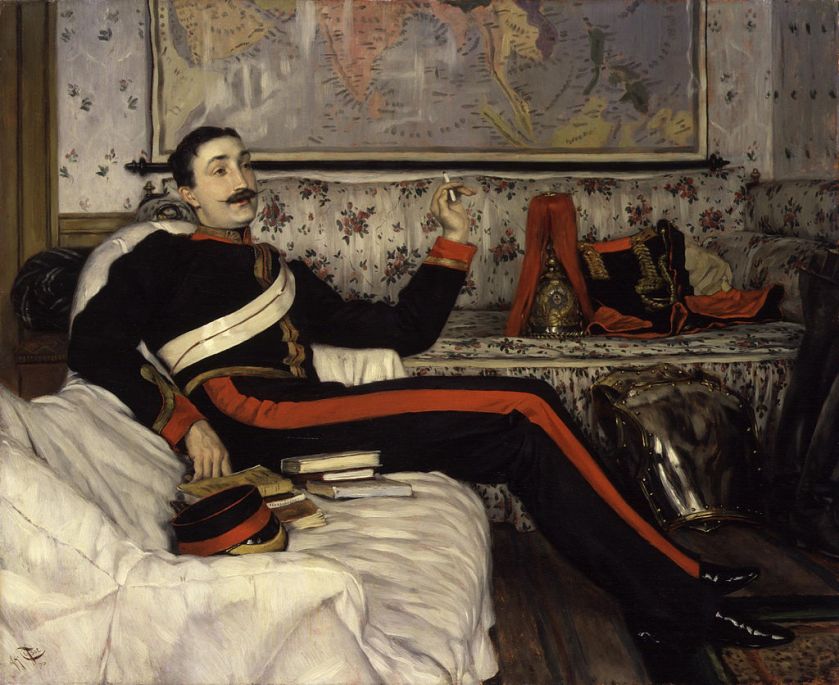
Colonel Frederick Gustavus Burnaby by James Tissot (1870)

Tissot’s reputation as a very talented portrait painter was further enhanced with the showing of two male portraits in the 1872 London International Exhibition. One of the paintings was a small (20ins x 24 ins,) portrait which had been commissioned by his friend Thomas Bowles.  It was of Bowles’ close friend, Colonel Frederick Gustavus Burnaby, the debonair soldier, who was a captain in the privileged Royal Horse Guards, the cavalry regiment that protected the monarch. It was Burnaby who suggested naming Bowles’ magazine Vanity Fair and it was he who lent half of the necessary £200 in start-up funding.  Burnaby then volunteered to go to Spain to chronicle his adventures for the satirical magazine. We see Burnaby depicted in his “undress” uniform as a captain in the 3rd Household Cavalry. He is the epitome of an elegant gentleman in a relaxed male conversation. The painting was eventually purchased by London’s National Portrait Gallery from Bowles’ son (and Burnaby’s godson), George, in 1933.

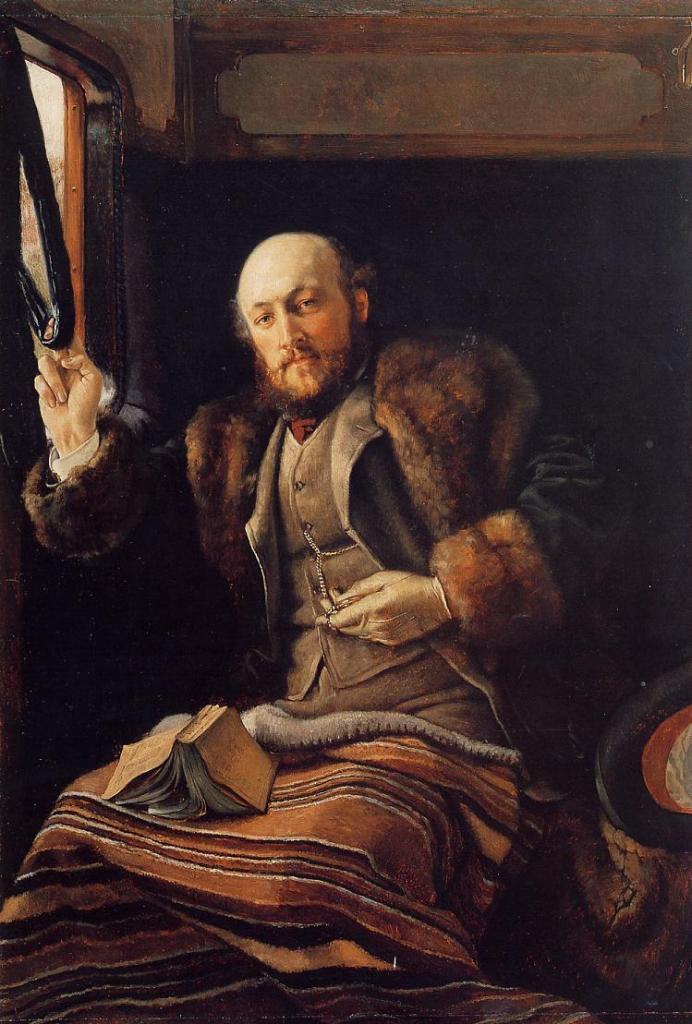
Gentleman in a railway carriage by James Tissot (1872)

The other Tissot work in the exhibition was also a portrait entitled Gentleman in a Railway Carriage (Portrait of Captain ***) which he completed in 1872 and is now housed at the Worcester Art Museum in Worcester Massachusetts. The figure in the painting has never been identified but once again it is a portrait of a well-dressed elegant man. He is wearing a fur coat and over his knees is a travelling rug, on top of which is a book. He holds onto a strap and this very fact gives us the feel of the train rattling along at speed. He studies his pocket watch and we wonder is he late or is the train on time. This portrait is beginning to look like a narrative piece in which a story behind the depiction is beginning to emerge.

Tissot’s reputation as a talented painter was soon recognised in England thanks to his illustrations in Vanity Fair and his meetings with Thomas Bowles’ wealthy connections. In 1873, Tissot finally exhibited works at the Royal Academy which he had completed whilst living in England, .

An Interesting Story by James Tissot (c.1872)

The most well received of his exhibited works was An Interesting Story which he completed in 1872. The depiction, which is housed in the National Gallery of Victoria, Melbourne,  is set in the eighteenth century and it is a comedy of manners. Three figures dominate the depiction. A man, shown as a red-coated officer, is seen studying a map which lies on a table. He is recounting a story to two elegantly dressed young ladies. They seem completely disinterested in what they are hearing and find it difficult to hide their boredom. One looks away whilst the other tries to stifle a yawn.  It was the type of painting loved by the English public, who were fond of eighteenth century historical and literary scenes with a touch of humour. The art critic of the Athenaeum described the painting as:

“…a capital piece of humorous characterisation…”

The Tedious Story by James Tissot (1872)

Buoyed by the success of the painting Tissot produced several variations on the same theme, such as his 1872 work, The Tedious Story, with its similar River Thames backdrop.

Wapping on Thames by James McNeil Whistler (1861)

Such River Thames backdrops were used by other artists. The most famous one is probably the American artist James Whistler who in 1864 had his painting, Wapping on Thames, exhibited at the 1864 Royal Academy Exhibition and the Exposition Universelle in 1867. The background to his painting was a Wapping dockyard on the River Thames, close to where Whistler was living. Whistler set up his easel at an inn known as The Angel and he created the scene en plein air. The inn overhung the south bank of the Thames where it widens after the Pool of London and then winds out to sea. I love the juxtaposition of the contrasting colours used – bright turquoise for the water and sky against the oranges and browns used to depict the ships’ masts, rigging and dockyard buildings. The female in the painting was Joanna Hifferman, who was an artist’s model Whistler often used and who would become the artist’s lover. Next to her is Alphonse Legros, the French painter, and they are both in conversation with a sailor.

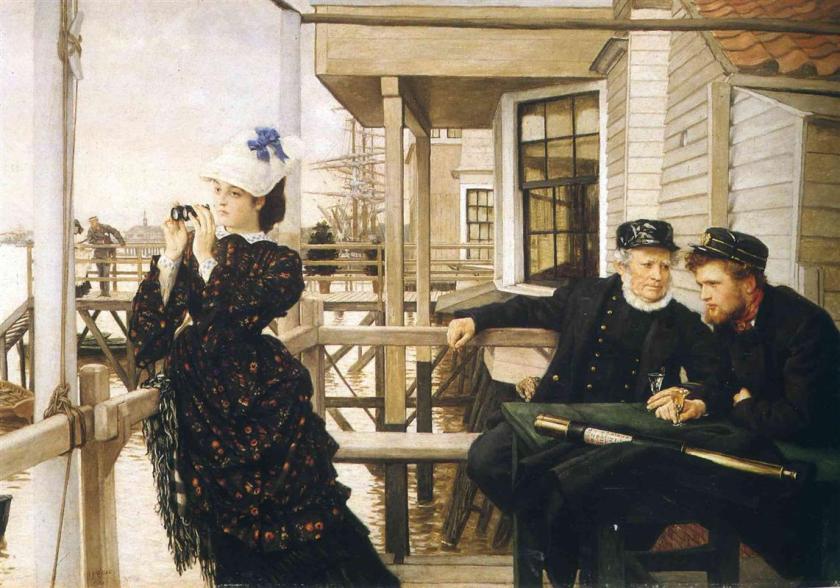
The Captain’s Daughter by James Tissot (1873)

Tissot was fascinated by the Thames and depicted it in many of his paintings. Maybe it reminded him of his childhood and the port of Nantes which he visited regularly. For Tissot the Port of London docks and the dockside buildings offered him so many artistic possibilities. At the 1873 Royal Academy Exhibition Tissot exhibited two paintings, both of which featured dockside backgrounds. The setting for the painting The Captain’s Daughter is the porch of the Falcon Tavern at Gravesend on the Thames. Tissot completed the work that year, and in it we see the Captain sitting discussing his daughter with her young sailor suiter, whilst they drink some wine. The daughter, tired of the conversation, stands up and gazes absentmindedly out over the river.

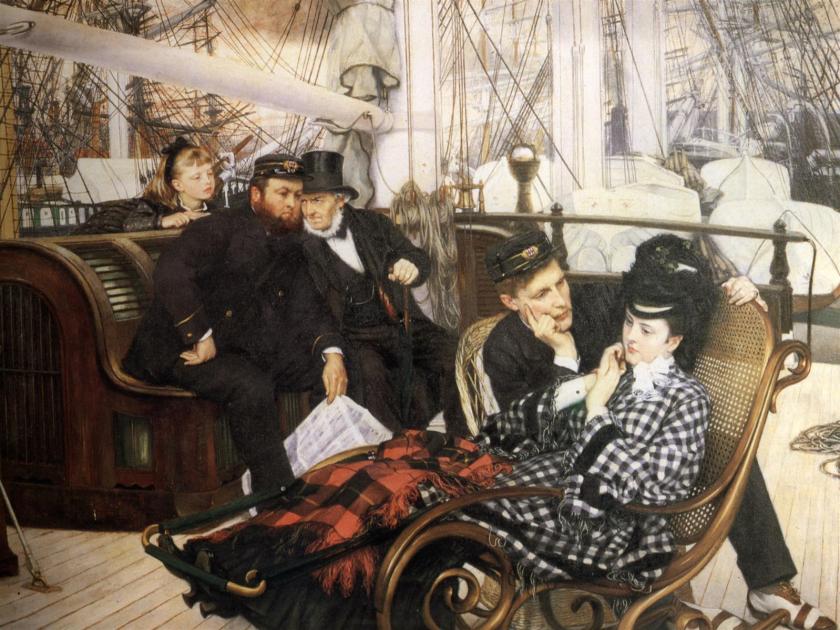
The Last Evening by James Tissot (1873)

The other Tissot painting exhibited at the 1873 Royal Academy Exhibition is probably Tissot’s best known London pictures. It is entitled The Last Evening and is one of his many shipboard paintings. It is a narrative piece and it is up to us to guess what is going on. There is enough of an ambiguity about the depiction to tease us into believing we alone know what is happening. The setting is a ship the night before it is about to set sail. Look at the way Tissot has skilfully painted the background of the ships and their rigging. In the foreground we see a young lady wearing a chequered jacket sitting in a Bentwood rocking chair. Next to her sitting in a wicker chair is a young sailor who only has eyes for the pretty lady. He stares passionately at the girl. In the mid-ground, sitting on a bench are two elderly men deep in discussion. One of the elder men is probably the father of the lady in the chair, the other, a member of the ship’s crew. Leaning over the back of the bench is a young girl who could be the lady’s younger sister, or could she be her daughter? The painting is housed at London’s Guildhall Art Gallery.

James Tissot was prospering in London.  His art was loved and sold well.  In my next blog I will look at what made him suddenly return to France if life was so good to him in England.

..…………..to be continued

James Tissot. Part 2- A change of style and japonisme

Self Portrait of James Jacques Joseph Tissot (c.1898)

At the end of Part 1 of this blog about Tissot I told you that around 1863 he decided to change his artistic style. He decided to abandon his medieval style championed by the likes of the Belgian painter Henri Leys and enter the world of modern day portraiture.

Portrait of Mlle L.L… by James Tissot (1864)

This change of style can be seen in the two outstanding paintings he exhibited at the 1864 Salon, both of which are housed in the Musée d’Orsay. One was entitled Portrait of Mlle L.L… often referred to as Young Lady in a Red Jacket, and this is now looked upon as one of Tissot’s most esteemed portraits. It is an unusual depiction and the first two questions we may ask are what is the young woman sitting on and then who is this Maemoiselle L.L.? The answer to both these questions is still unknown! The young woman’s pose is one of effortlessness, with her right arm dangling loosely over her skirt, and a there is a sense of detachment about her, but her inscrutable gaze is as engaging as it is captivating. Tissot’s depiction of her clothes, the fashionable black satin skirt contrasted by the red bolero with the bobble-fringe was all the rage for all things Spanish in the 1860’s. As usual the addition of items surrounding the lady such as the books coupled with her bold stare leads us to believe that she was independent by nature.

Dominique Ingres 1856 portrait of Mme Moitessier

The lady was truly one of Tissot’s great images of the nineteenth century woman and, because of the way she is depicted, it is often compared to Dominique Ingres 1856 Portrait of Mme Moitessier. In Le Grand Journal of June 1864, the art critic Jules Castagnary wrote about Tissot’s change of style:

“…Mr Tissot, the crazy primitive of the most recent Salons has suddenly changed his manner and moved closer to Mr Courbet, a good mark for Mr. Tissot…”

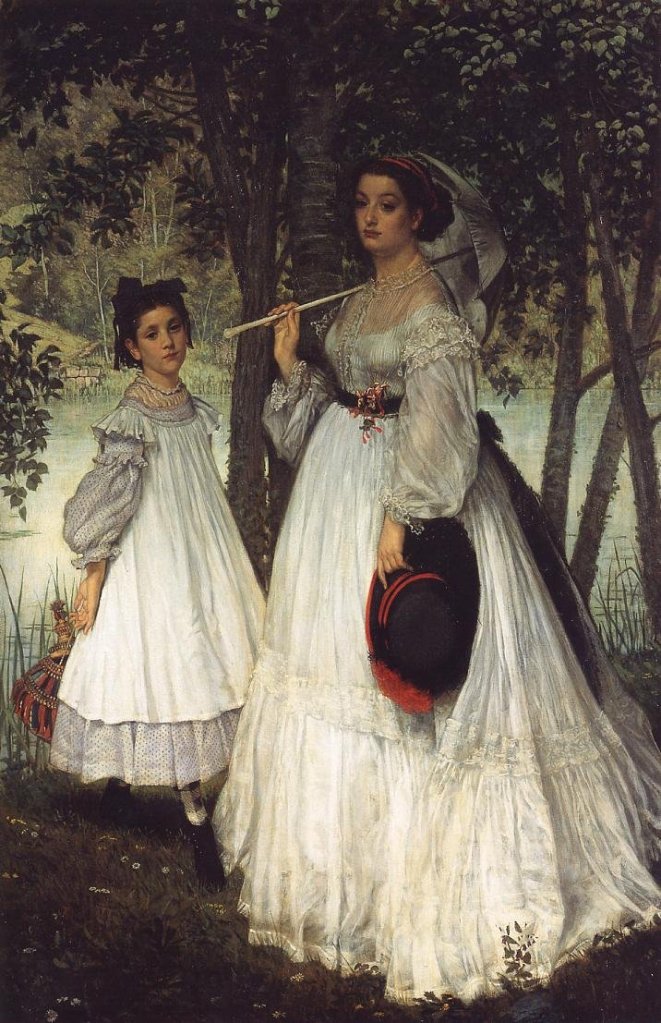
The Two Sisters by James Tissot (1863)

The second portrait by Tissot exhibited at the 1864 Salon was entitled The Two Sisters.  We see the two females, dressed in white, standing by a stream. Once again there is a prevailing air of innate stylishness and sincerity about Tissot’s depiction.

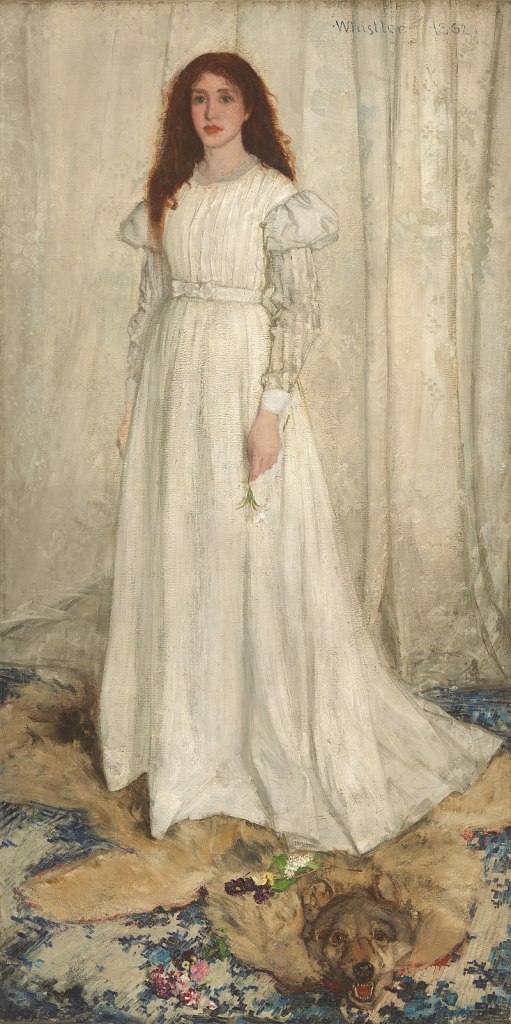
Symphony in White, No. 1 – The White Girl (Portrait of Joanna Hiffernan) by Whistler

The two figures seem to blend in with their surroundings and the painting is often likened to Whistler’s Symphony in White No. 1: The White Girl, (Portrait of Joanna Hiffernan), which was exhibited at the Salon des Refusés in 1863 and known to be one of Tissot’s favourites. Once again, we see the Tissot’s depiction of the females as being stylish, sophisticated and well-bred.

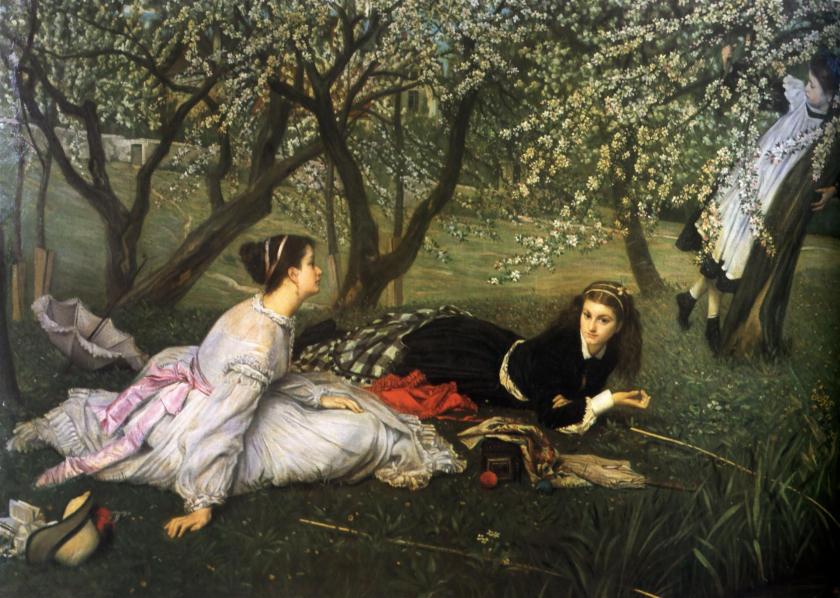
Spring by James Tissot (1865)

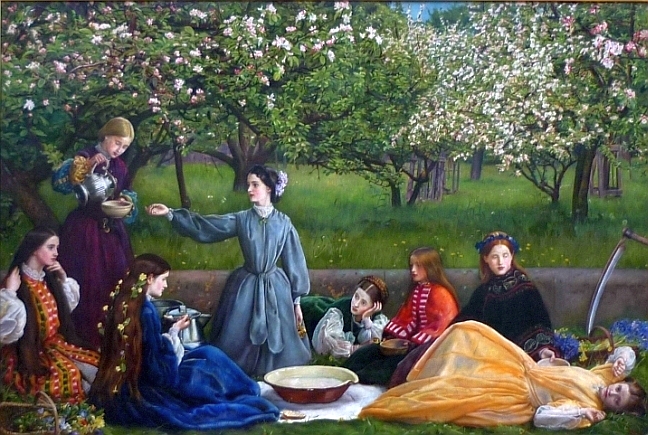
Tissot’s friendship with James Whistler meant that he received the latest art news from his friend who had been living in London since 1859. One of Whistler’s near neighbours was the pre-Raphaelite painter Rossetti and soon Tissot became interested in the works of the pre-Raphaelites and how their works concentrated on the beauty of their subjects and less about narratives attached to the depiction. In 1865 Tissot’s painting Spring was shown at the Salon and this had an undoubted connection to Millais’ 1859 work with a similar title.

Apple Blossoms or Spring by John Everett Millais (1859)

The similarity of the two was remarked upon by the art critics.

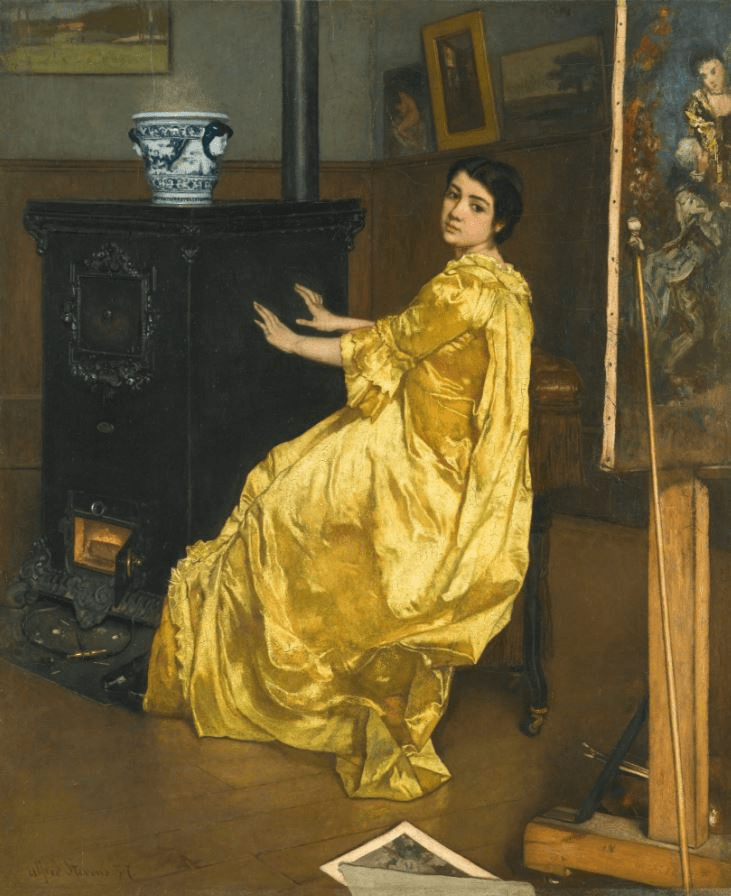
In the Studio by Alfred Émile Léopold Stevens (1857)

Having been influenced by the Middle Age-style of the works of the Belgian artist, Henri Leys, in the late 1850’s Tissot became enamoured with the artistry of another Belgian painter, Alfred Émile Léopold Stevens, in the late 1860’s. Stevens’ works focused on pretty, fashionably-dressed young women. His stylish young women were always portrayed wearing beautiful clothes and soon Tissot followed suit.

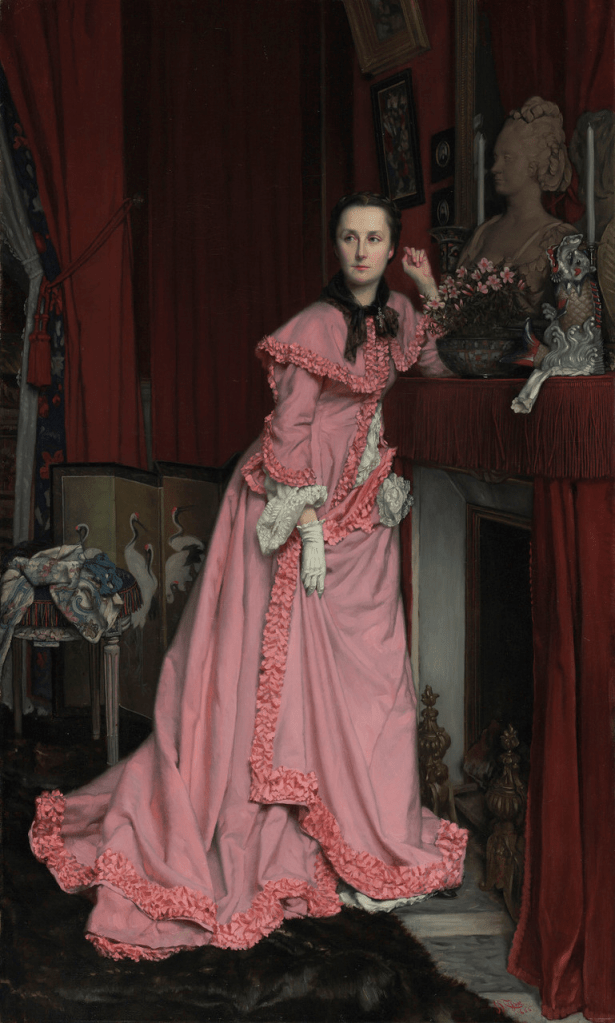
Jacques Joseph Tissot. Portrait of the Marquise de Miramon, née, Thérèse Feuillant by James Tissot (1866)

A good example of this style was Tissot’s painting entitled Portrait of the Marquise de Miramon which he completed in 1867 and now hangs in the J. Paul Getty Museum in Los Angeles. The subject of the painting was Thérèse-Stephanie-Sophie Feuillant, the Marquise de Miramon. She was from a wealthy bourgeois family and inherited a fortune from her father and in 1860 married René de Cassagnes de Beaufort, Marquis de Miramon. The setting is the Château de Paulhac, Auvergne, the residence of her husband’s family. She is wearing a rose-coloured, ruffled peignoir, or dressing gown. A black lace scarf and silver cross hang round her neck. What is also interesting are some of the accoutrements we see depicted, all of which have been shown for a specific reason. There became an obsession with Japanese art and design that swept France and the rest of Europe after trade with Japan resumed in the 1850s, the country having been closed to the West since about 1600. This trend was known as japonisme. It was the love of Japanese art and design and the collecting of all things Japanese was all the rage. Tissot decided to include a touch of japonisme in this portrait. Directly behind her, standing on the floor, is a Japanese screen depicting cranes on a gold ground. The lady rests her left elbow on the mantlepiece which draws our eyes to it and on it we see several pieces of Japanese ceramics. Also on the mantle is a terracotta bust which alludes to the noble heritage of her spouse. Alongside the Japanese screen we can see an expensive Louis XVI stool and on it is some needlework which we are to believe belongs to the lady and thus tells us that she is a wealthy lady of leisure. The work was completed in 1866 and the following year Tissot wrote to the Marquis and asked if he could borrow the work and have it exhibited at the 1867 Exposition Universelle in Paris. The Marquis agreed and later,  Tissot carried out a number of portrait commissions for the Marquis.

Tissot was not only and avid collector of Japanese art and artefacts. This is borne out in a letter Rossetti wrote to his mother in November 1864 about his time in Paris and his visit to Madame Desoye’s rue de Rivoli shop:

“…I have bought very little – only four Japanese books….. I went to the Japanese shop but found all the costumes there were being snapped up by a French artist, Tissot, who it seems is doing three Japanese pictures, which the mistress of the shop described to me as the three wonders of the world, evidently in her opinion quite throwing Whistler into the shade…”

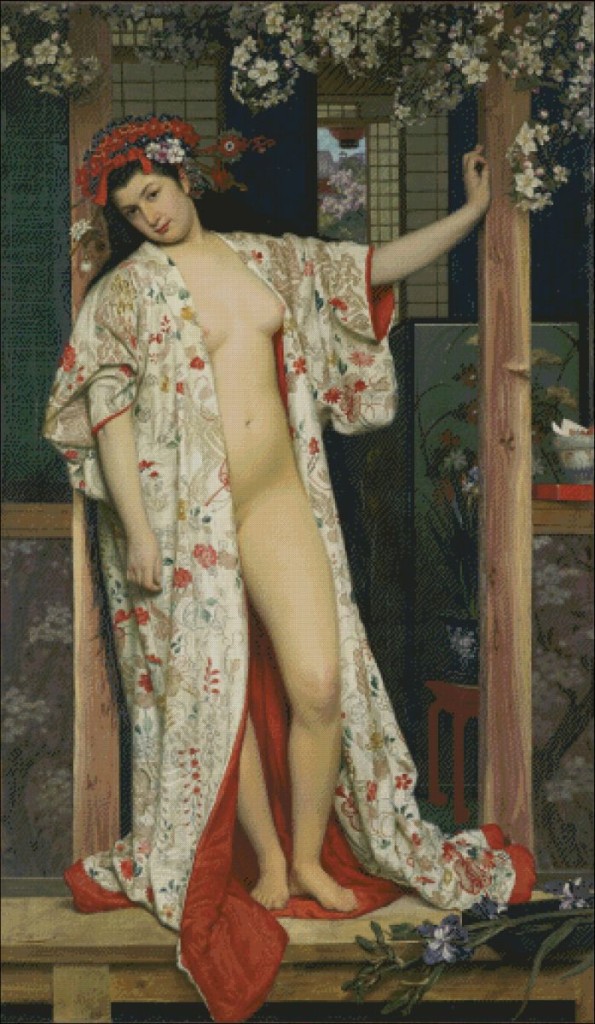
Japonaise au Bain (Japanese Girl Bathing) by James Tissot (1864)

So we know that japonisme began to influence Tissot’s style of painting and one of the “three wonders of the world” paintings was thought to be his 1864 work Japonaise au Bain (Japanese Girl Bathing). The model Tissot used for this work was not a Japanese girl but a Parisian model dressed in a kimono. This was simply a transference of one of Tissot’s Parisian beauties whom he had used before and converted her into a Japanese beauty. This painting which some would declare as being slightly pornographic was his only depiction of a female nude.

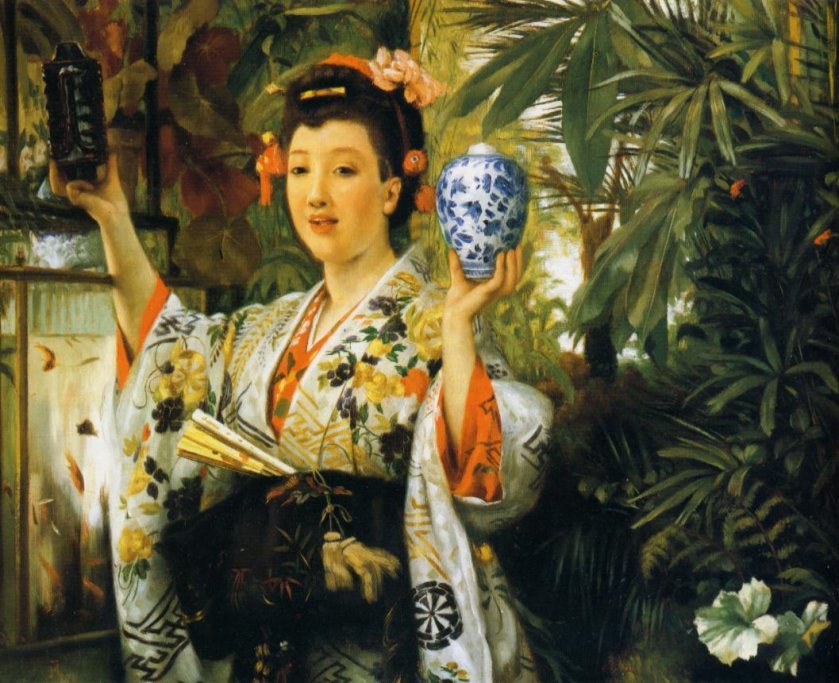
Young Lady Holding Japanese Objects by James Tissot (1865)

Tissot however did use a Japanese lady in his 1865 painting entitled Young Lady Holding Japanese Objects.

Prince Akitake Tokugawa by James Tissot (1864)

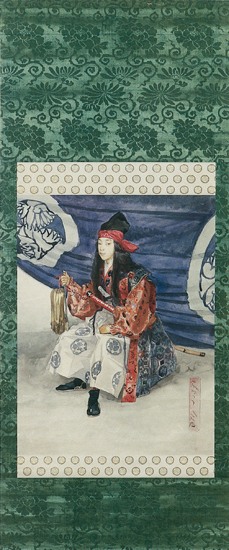
In 1868 Tissot’s reputation of painting Japanese scenes had been acclaimed by critics and public alike and he was offered the post of gwa-gaku (drawing master) to Prince Akitake who was the young brother of the last Tokugawa Shogun, who had led the Japanese Imperial Commission to the Exposition Universelle in Paris in 1867. At the end of his seven month tenure as tutor Tissot painted a watercolour portrait of his fourteen-year-old pupil which was mounted as a hanging scroll in green and gold silk.

The Circle of the Rue Royale by James Tissot (1868)

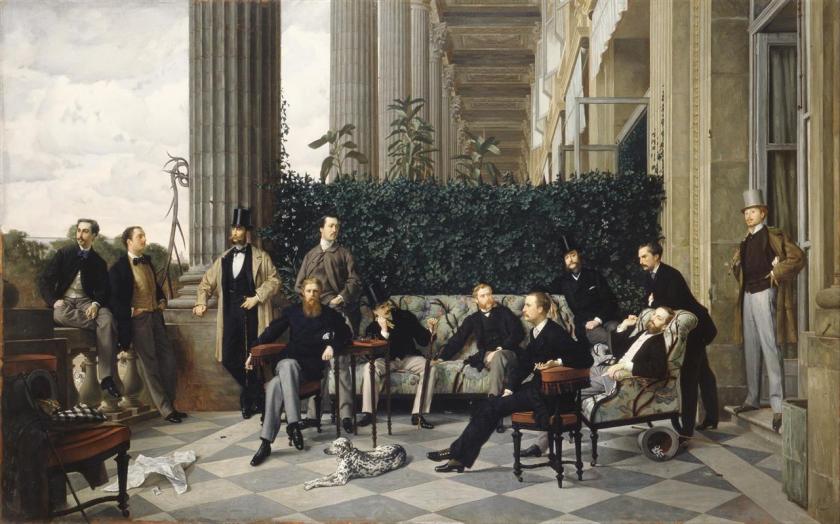
Now that Tissot was recognised for his modern portraiture he became inundated with commissions and one of the most important commission he received was for a group portrait of members of an exclusive Parisian all-male club, of which the Marquis de Miramon was a member. The painting, which was completed in 1868, was entitled The Circle of the Rue Royale. The setting for the painting was one of the balconies of the Hôtel de Coislin that still overlooks the Place de la Concorde. The terms of the commission were quite bizarre. Each one of the twelve members of the club depicted paid 1000 Francs for the painting to be made, and the final owner was to be determined via a special draw. In the painting, the Marquis de Miramon is sitting to the left of the sofa, wearing a top hat. Baron Hottinger, is seated to the right of the sofa, and it was he who won the draw and kept the painting. The painting remained in his family until it was acquired by the Musée d’Orsay in 2011. Once again we see the attention Tissot has paid to accurately depicting the men’s clothing and this probably goes back to the fact that both his mother and father were involved in the fashion industry. The clothing worn by wealthy men of the time along with the fashion accessories were a sign of their social status and one presumes they wanted Tissot to capture every minute detail. This type of portrait is often referred to as a conversation piece. Works of this kind usually depict informal groups, often family members or friends. The people depicted are sometimes, but not always, engrossed in conversation. James Tissot was now forging ahead as one of the most talented and respected portrait painters of his generation, was one of the most sought-after portraitists of chic Paris society, partly due to his skill for placing his proud, if somewhat arrogant, sitters in lavish settings evocative of wealth and sophistication.

Portrait of Eugène Coppens de Fontenay by James Tissot (1867)

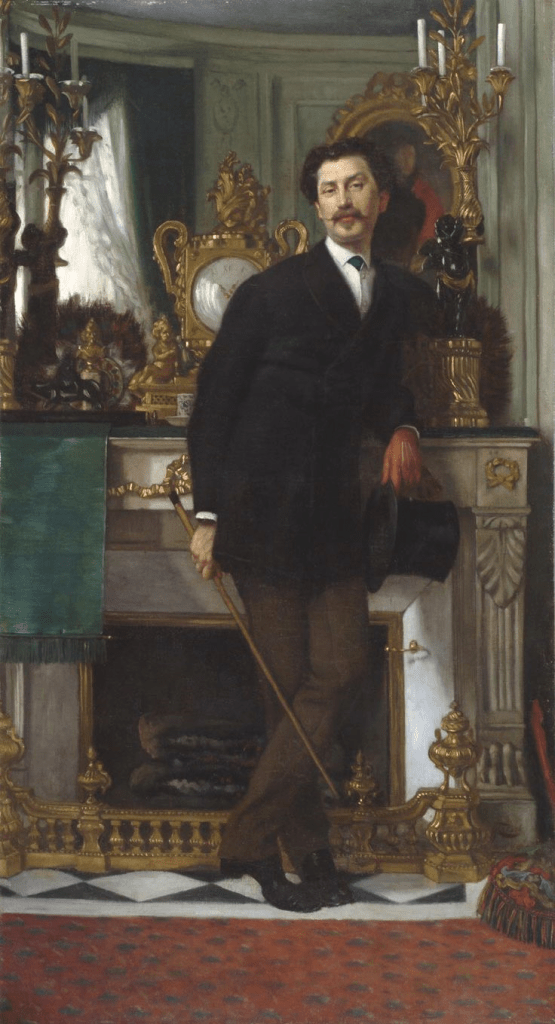
Although Tissot may be best known for his depiction of fashionable young ladies he was equally accomplished when it came to male portraiture and an example of this is his 1867 Portrait of Eugène Coppens de Fontenay, the Belgian industrialist, Catholic politician and president of the exclusive Jockey Club in Paris. The painting is now housed in the Philadelphia Museum of Art.

In my next blog about James Tissot I will look at his hasty departure from France and his time in England.

..……………………………… to be continued.


Most of the information I am using comes from Christopher Wood’s 1986 biography of Tissot which is an excellent read, full of beautiful pictures.

James Tissot. Part 1. The early years.

Self portrait by James Tissot (1885)

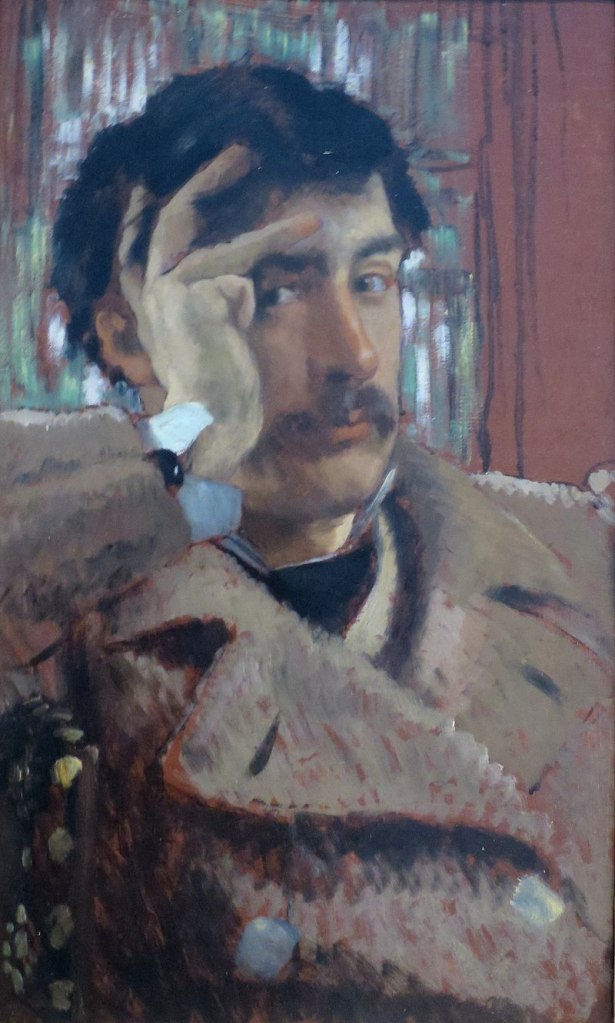
My artist today is the French nineteenth century painter Jacques Joseph Tissot. In the introduction to Tissot’s biography by Christopher Wood, he writes:

“…Tissot was an assiduous and highly competent painter, most of whose pictures are of pretty, elegant women; his work is visually attractive, without being too demanding intellectually…”

It is that last phrase which is probably the reason that Tissot’s work was loved by the public but was panned and scorned by the art historians and art critics. His country of birth, France, look upon him as just a minor artist saying that his work is too anglicised. It probably rankles with the French art critics that Tissot spent eleven years in London during which time most art historians believe he produced his finest work and accordingly was a financial success.

Jacques Joseph Tissot was born on October 15th, 1836 in Nantes, which, at the time, was a prosperous seaport on the Loire estuary. He was the second of four sons. His father was Marcel Théodore Tissot and his mother, Marie Tissot (née Durand). His father, who was born in 1807, came from Trévilliers, a small mountain village in the Franche Comté region of eastern France, close to the Swiss border. As a young man Marcel left home to seek his fortune and through his hard work was a very successful man. He met and married his wife, Marie Durand, a Breton lady, and daughter of an impoverished royalist family. Marcel and Marie set themselves up in the drapery business and she began to design ladies’ hats. So successful were the couple that in 1845 they returned to Marcel’s birthplace and bought themselves a substantial estate, Chateau de Buillon near Besançon.

Jacques Joseph Tissot was brought up in the family home in Nantes. During his early life Tissot inherited a number of traits which were to help him through life. From his father he acquired a business acumen which was to serve him well during his life and make him one of the shrewdest and financially successful of all the nineteenth century painters. From his mother, who was a very pious Catholic, she instilled in him religious feelings which were to change the course of his later life. His parents through their drapery and design business instilled in their son his love of female fashion and elegance. His final great influence was the port of Nantes itself. For a young boy the port and its ships must have been awe-inspiring and many of his paintings completed whilst living in London thirty years later featured scenes of ports and the ships. Nantes was also blessed with great Medieval and Gothic architecture and young Tissot often sketched the buildings and in fact his early career choice was to become an architect.

He was educated at a Jesuit boarding school but proved to be just an average student. At the age of seventeen he had set his mind to becoming an artist and as was the case in so many stories about artists, his parents were dead set on opposing his choice for his future. His father was adamant that his son’s proposed choice of career was a total waste of time and, but for Tissot’s mother, her son would not have been able to follow his favoured profession.

Jeune homme nu assis au bord de la mer by Jean-Hippolyte Flandrin (1836)

In late 1856, at the age of twenty, Jacques Joseph Tissot travelled to Paris to embark on artistic training. His two main tutors were Louis Lamothe, the history painter with whom Tissot studied both Italian and Flemish Primitives at the Louvre and spent many hours copying them. He also studied under Jean-Hippolyte Flandrin. Flandrin’s most celebrated work was his 1836 painting,   Jeune homme nu assis au bord de la mer (Young Male Nude Seated beside the Sea) which he completed whilst in Rome during his five-year stay, which was granted to him for winning The Prix de Rome in 1832. Tissot spent a short time attending the Ecole des Beaux Arts and it was here he became a close friend of James McNeill Whistler and it was through him that he met the leading French artists of the time such as Fantin-Latour, Alphonse Legros and Gustave Courbet. Whistler also introduced Tissot to a number of English painters such as Edward Poynton and George du Maurier, the illustrator and novelist. It is widely believed that Tissot’s friendship with Whistler and his English friends made him change his name to the anglicised version, James Tissot

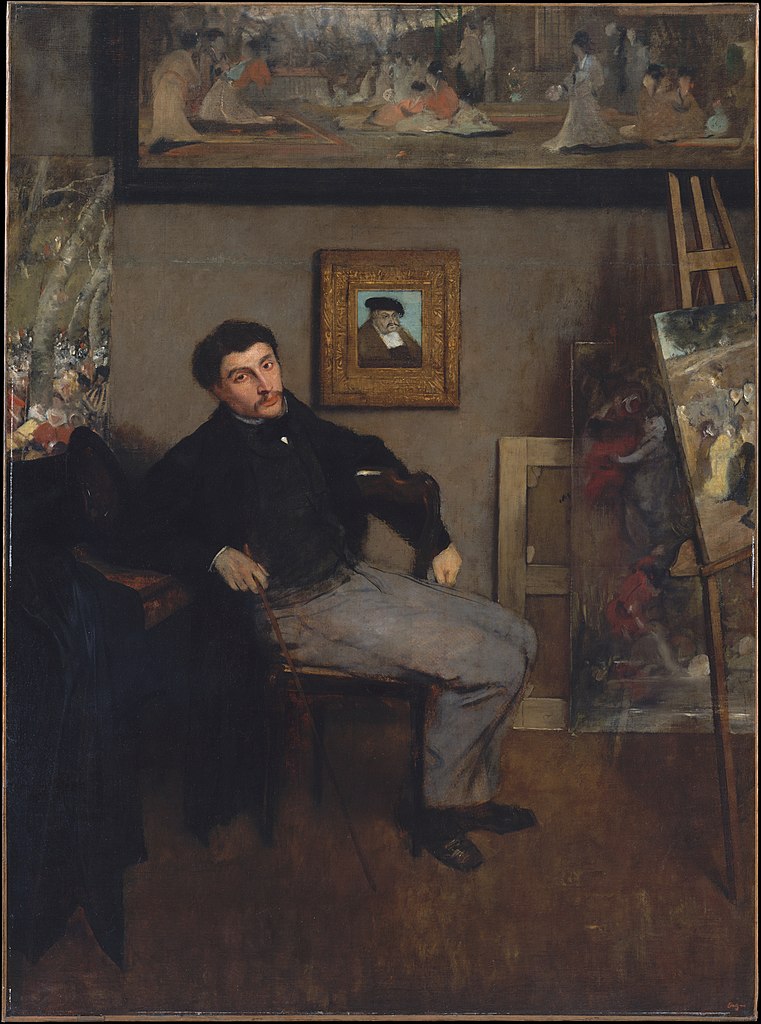
Portrait of James Tissot by Edgar Degas (1868)

Another of his friends was the Impressionist painter Edgar Degas who painted a portrait of Tissot in 1868. Theirs was a stormy relationship which came to an abrupt end in 1895 when Degas discovered that Tissot had sold one of Degas’ paintings which had been given to him by the artist as a gift. Degas may also have been a little jealous of Tissot’s success in his art sales which were far greater than his own.

Self portrait by Henri Leys

Tissot was now seeking new subjects and a new mode of painting and was strongly influenced by the work of the Belgian painter and engraver Jan August Hendrik Leys (Henri Leys), who was a leading representative of the historical or Romantic school in Belgian art. Leys was notable for his history and genre paintings which were often referred to as style troubadour which was a somewhat mocking term for French historical painting of the early 19th century with idealised depictions of the Middle Ages and the Renaissance. This was also a style favoured by the young Alma-Tadema who was, at the time, based in Antwerp.

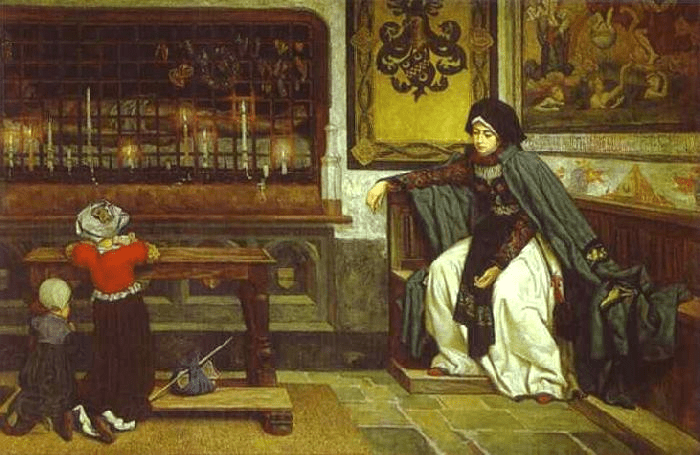
The Trental Mass for Berthal de Haze by Henrik Leys (1854)

Leys won a gold medal at the Exhibition Universelle in Paris in 1855 for his historical painting Les Trentains de Berthal de Haze (The Trental Mass of Berthal de Haze). A trental mass was a Roman Catholic mass for the dead on the thirtieth day after death or burial. The art critics appreciated the high quality of his reconstructions of times past through his beautiful depictions of early costumes and architecture, as well as the true-to-life postures and facial expressions of his characters combined with the vividness of the colours he used.

Marguerite in Church by James Tissot (1860)

From 1859 and for the next five years Tissot paintings featured depictions of historical and religious scenes, many of which derived from Goethe’s Faust. Such depictions were very popular at the time and paintings featuring these subjects were often exhibited at the Paris Salon and London’s Royal Academy. Tissot incorporated, in a number of his paintings, scenes from Faust and Marguerite, an 1855 romantic opera, which was popular with a number of painters, such as Ari Scheffer. The libretto was written by Michel Carré and loosely based on the Faust legend, but simply focuses on Faust’s romantic encounter with Marguerite (Gretchen in Goethe’s original drama) and the tragic results of their liaison. The character of Marguerite was looked upon by the French public as a romantic but ill-fated figure who was a vulnerable victim of her fate.

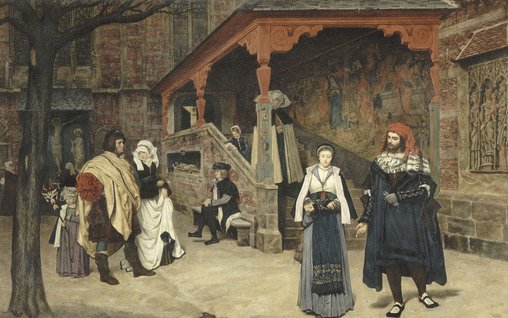
The Meeting of Faust and Marguerite by Tissot (1860)

Although the public may have liked these works which appeared at the Paris Salon the art critics were less impressed, nevertheless one of Tissot’s first “Faustian” paintings, The Meeting of Faust and Marguerite attracted the attention of an important patron, Comte de Nieuwekerke, a high-level civil servant in the Second French Empire. who persuaded the French government to buy the painting for the Musée de Luxembourg. This was such an honour for Tissot as up until then he had never achieved  a medal for his works exhibited at the Salon.

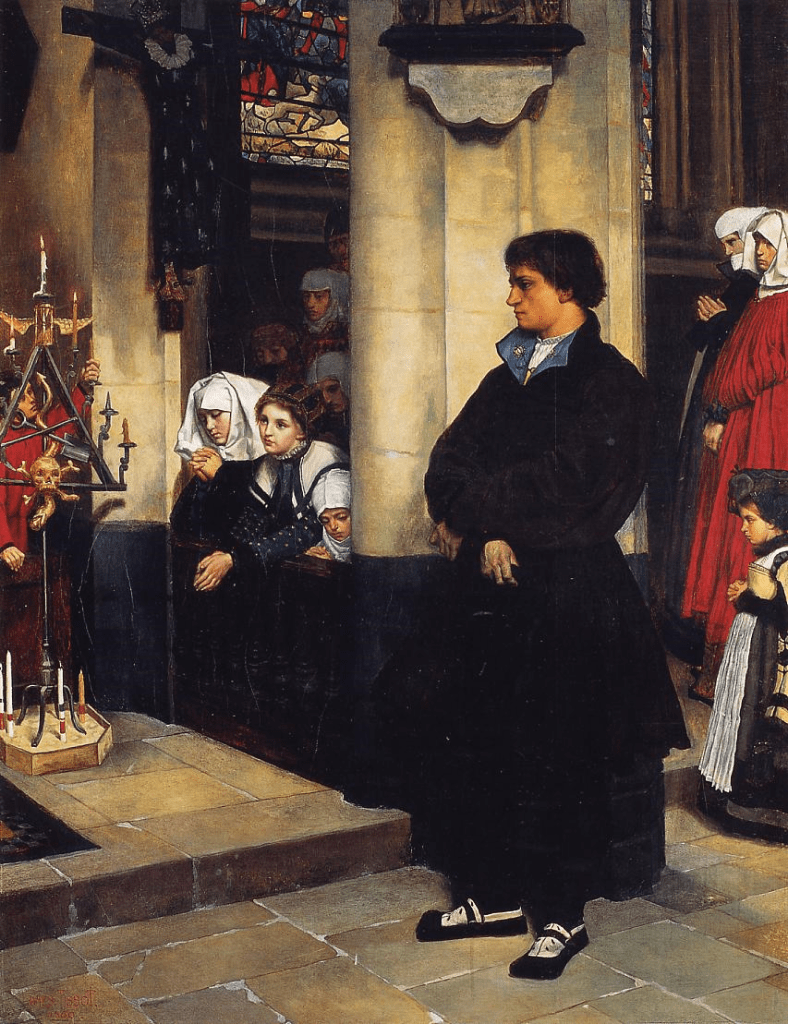
During the Service (also known as Martin Luther’s Doubts) by James Tissot (1860)

Tissot was not deterred by criticism of his Henri Leys painting style and continued with his historical paintings. In 1861 he entered two of his works at the Salon. One, which he completed in 1860, was entitled Martin Luther’s Doubts. In this depiction by Tissot we see the gloomy figure of Luther leaning against a stone pillar, seemingly lost in thought, and completely isolated from the congregation. It is a depiction of the alienation of the man and this theme of estrangement featured in many of Tissot’s works. This is a depiction of a man, termed as a heretic, who openly rejected several teachings and practices of the Roman Catholic Church three centuries earlier.

Voie des fleurs, voie des pleurs (Way of Flowers, Way of Tears) by James Tissot (1860)

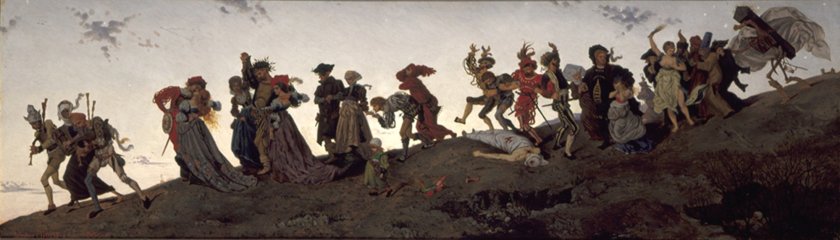
His second work at that year’s Salon was a more unusual painting entitled Voie des fleurs, voie des pleurs (Way of Flowers, Way of Tears), often referred to as the Dance of Death. This is an amazing composition with all the figures silhouetted on a hillside with the skeletal figure of Death with his billowing white shroud, bringing up the rear with a coffin slung on his back. Although a very theatrical depiction it was one of only a few of Tissot’s early works which was well-liked by the art critics.

The Return of the Prodigal Son by James Tissot (1862)

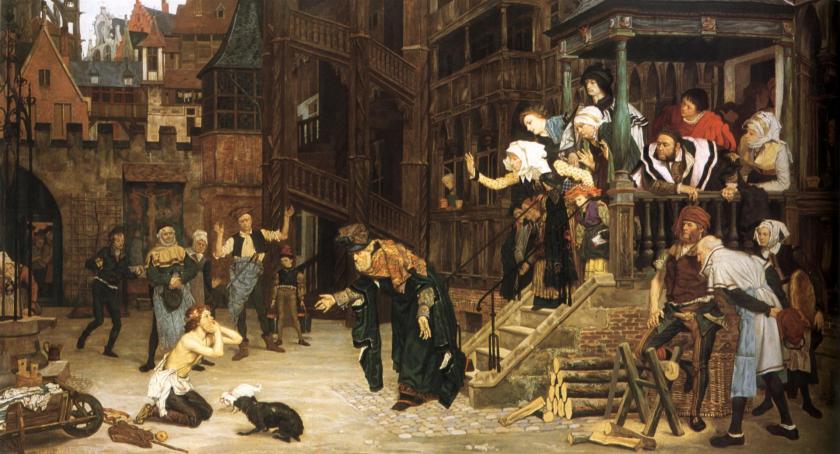
Buoyed with the success and the sale of his Faust and Marguerite painting, Tissot decided to carry on with his historical style paintings and in 1863 produced three large-scale works for that year’s Salon, one of which was The Return of the Prodigal Son. It is a remarkable multi-figured painting which is part biblical (the story) part theatrical as the setting looks like a theatre stage set with its medieval buildings. It is a pure Henri Leys-style of painting and one of the last of the type Tissot would complete. The critics on both sides of the Channel were unimpressed. The critic of the London art’s Journal, The Athenaeum stated that it was affected, false and artificial and went on to rebuke him saying that he was wasting his talents by imitating so bizarre a school of painters as that of ancient Flanders. That was the final straw as far as Tissot was concerned and he decided to abandon the Middle Ages for his depictions and instead concentrate on modern life.

The Prodigal Son in Modern Life: The Return (1882)

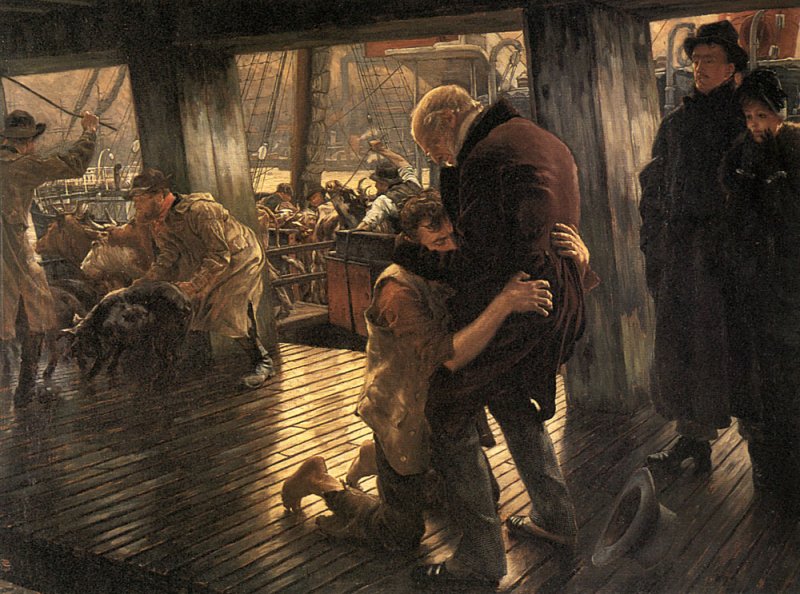
Twenty years later however, he did return to the subject of the Prodigal Son with his 1882 work, The Return of the Prodigal Son in Modern Life:  The Return,  in which he depicts the prodigal son returning repentant to his father, in a contemporary context. The son’s ship has just come in and his father awaits him at the quayside.  This painting is now housed in the National Gallery of Art, in Washington DC.

..…………….. to be continued


Most of the information I am using comes from Christopher Wood’s 1986 biography of Tissot which is an excellent read, full of beautiful pictures.

Hans Andersen Brendekilde

Hans Andersen Brendekilde

As I have said before, I choose the subject for my blogs based on having sufficient information about the artist and also access to a large selection of his or her work. Without those two criteria the blog would be somewhat empty. I also prefer to feature “unknown” (at least, to me) artists. However, once in a while, there comes a time when I look at a painting and have the overwhelming desire to share it with you, even before knowing whether my two criteria could be achieved. Today’s blog is one of those occasions.

My featured artist today is the nineteenth Danish painter Hans Andersen Brendekilde although at birth his name was simply Hans Andersen but later added to his surname the name of his birth village, Brændekilde.    He was born on April 7th, 1857, on the island of Funen, the third largest Danish island,which lies five miles south-west of the island’s main town, Odense. He was brought up in an impoverished household and had to try and support the family by doing jobs, which included working in the house of a farmer doing chores. His father, Anders Rasmussen, was a maker of wooden shoes and his mother was Maren Nielsdatter.

L. A. Ring painting near Aasum smithy by Hans Andersen Brendekilde (1893)

As a child, Hans was interested in carving figures of animals out of wood. When he was attending the local school one of his teachers discovered his talent as an artist and sent him to a school in Odense. Here he became a good friend of Axel Blumensaadt, and it was Axel’s mother who helped fund Hans to attend the Academy of Fine Arts in Copenhagen, where he initially studied sculpture.

Portrait of L.A. Ring by Hans Andersen Brendekilde

He became a friend and associate of painter Laurits Andersen, and in 1881 he left behind sculpting to take up painting. Laurits Andersen and Hans Andersen held a joint exhibition, but because of the confusion of their surnames they both decided to add their birthplace to their name and so Laurits who was born in the Zeeland village of Ring became known as Laurits Andersen Ring (L.A. Ring) and Hans took the name Hans Andersen Brendekilde (H.A. Brendekilde). Their paintings at their first exhibition now had their “new” designated surnames to avoid confusion.

In the summer of 1882 Hans and some other artists were invited to stay on a farm in Rugelund by its owner and soon an artist colony was formed. For Hans it was not just a chance to paint and mix with fellow artists it was a chance to be well-fed. It was also a chance to see first-hand the harsh working environment of the rural workers which he would later depict on many of his canvases. But all was not doom and gloom in his works for often, in comparison to his gritty social realism works, other paintings by Brendekilde highlighted the pleasures of living in the countryside.

Udslidt by Hans Andersen Brendekilde (1889)

But let us have a look at probably his most famous work, the one which drew me to looking into his life. It was his social realist painting entitled Udslidt (Worn Out) which he completed in 1889.

In this heart-rending depiction we see a day-labourer lying crumpled on the rock-strewn ground of the barren field where he had been working. His onerous task, with other peasants, would have been to remove the stones from the ground, prior to ploughing and planting, and put them in piles awaiting disposal. The field although barren takes up eighty per cent of the picture. Look at the detail Brendekilde has incorporated in his depiction of the ground. However, what is more emotive is the portrayal of the two figures in the foreground. The elderly peasant worker has stumbled and fallen to the ground. He is dressed in shabby clothes which are covered in dirt. One of his wooden clogs has fallen off during his fall. The heavy stones he had been carry in his apron, lie on the ground next to him. He had finally been overcome by exhaustion or maybe he has suffered a heart attack. A woman, maybe his wife or daughter or just a co-worker, has rushed to his aid. She is kneeling next to him and cradles his head.

A scream for help

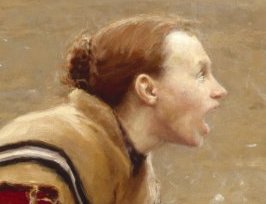
Her mouth is open wide as she screams for somebody to come and help. Her impassioned plea has yet to be answered and she is both overwhelmed with fear for the man and her own helplessness.  The picture was exhibited at the Exposition Universelle of 1889 and also at The World’s Columbian Exposition in Chicago in 1893.

It received a mixed reception. Many people lavished praise on the artist for the work whilst the “monied-people” and the bourgeois press thought the painting was over-melodramatic and condemned it for its blatant political stance about the life of the poor and downtrodden which they obviously didn’t want to be reminded about.

Fortrykt by Hans Andersen Brendekilde (1887)

Another of his works with a depiction in a similar vain is his 1887 painting simply entitled Fortrykt which literally translated now means “pre-printed” but it is more likely that the artist was using the word to mean “supressed” or “subdued”. The painting was completed two years before the previous work Worn Out and again dwells on the hardship suffered by the rural peasant class, who were the social losers and who were way down the social ladder. Four people dominate the foreground and we may surmise that they are a young woman and her child along with her mother or older sister and her father. The older woman and the seated father are dressed in old clothes and have been working in the fields gathering bits of grain to take home.

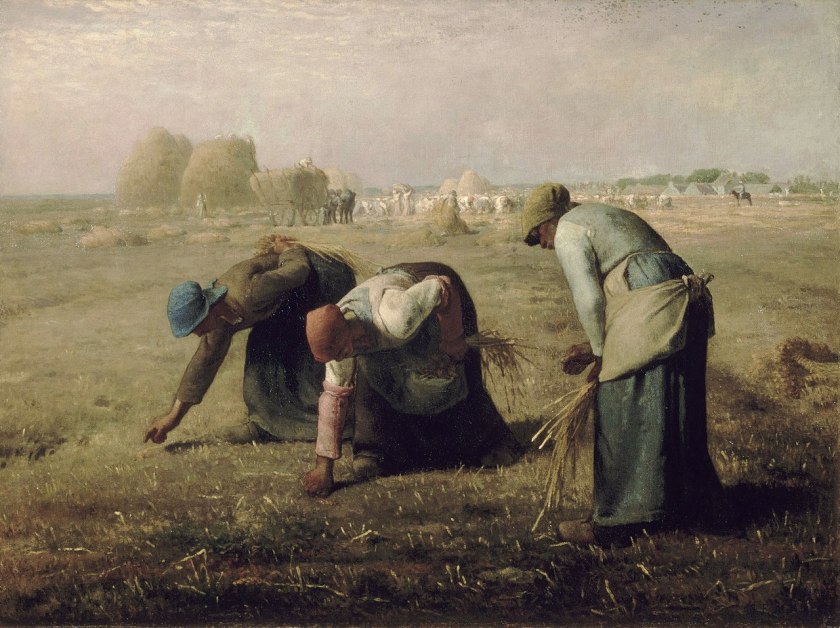
The Gleaners by Jean-François Millet, (1857).

They are the gleaners, as depicted in Millet’s famous 1857 painting,  The Gleaners.  Gleaning is the act of collecting leftover crops from farmers’ fields after they have been commercially harvested or on fields where it is not economically profitable to harvest. It is the Biblically-derived right to glean the fields and was reserved for the poor; a right, enforceable by law, that continued in parts of Europe into modern times. The young woman is dressed in finer clothes and has not been working in the field. She is talking to her father and her mother raises her head to listen. The father sits on a bag of grain and looks exhausted and yet there seems to be an air of resignation about him. He has accepted his lowly lot in life. Has his daughter told him something he didn’t want to hear? Is it something to do with young child who, whilst amusing herself, is sitting on a pile of coats?

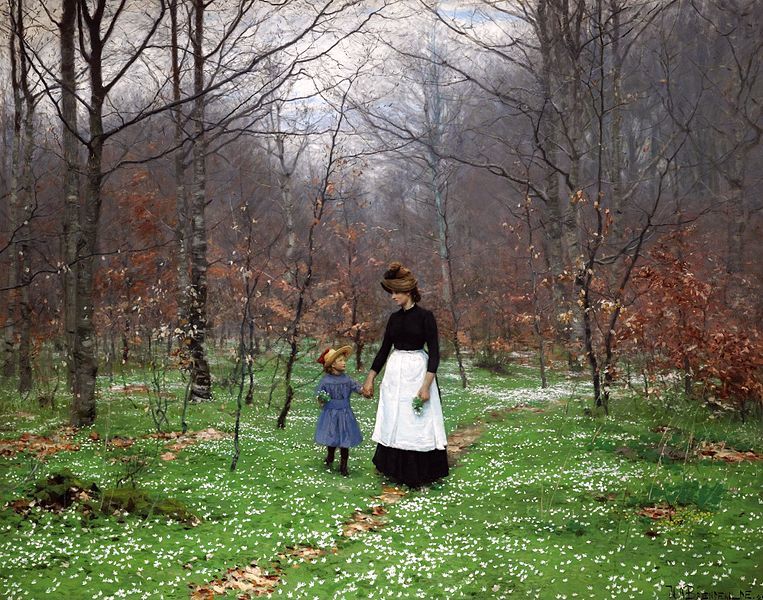
The First Anemones by Hans Andersen Brendekilde (1889)

At the end of the nineteenth century Brendekilde painted several cutting social-realist works. At other times he depicted the everyday life of poor people without critical undertones. These were more to do with the happier memories Brendekilde had of rural life when lack of money could not detract from the pleasures of immersing oneself in nature such as his 1889 springtime painting, The First Anemones.

A Spring Day by Hans Anderson Brendekilde (c.1890)

Again, we see a similar setting in his work A Spring Day when the villagers, dressed in their “Sunday-best” clothes take a pleasurable walk through the forest.

Autumn by Hans Andersen Brendekilde

Another fascinating and evocative work is his 1908 oil painting, Autumn. It is a combination of a landscape and sombre realist style painting in which we see an elderly lady standing by an open grave in a cemetery. It is a dark autumn day and we see the leaves from the nearby trees lying all around. There is a gale blowing which is stripping the leaves from the trees which are leaning over due to the ferocity of the wind. In the middle ground one can see the church and the green grass of the graveyard. Two black crosses have been blown over and lie abandoned against a hillock. Some graves seem to have been tended whilst others look abandoned. The old woman through her age and the strength of the wind is bent over and she clutches at her dress whilst holding on to her walking cane. She gazes into the excavated hole in the ground. The question the artist poses is what are her thoughts. Has she lost a loved one who will be buried in this plot or is she contemplating her own end of life. Could this even be termed a vanitas painting?  One of the pleasures of looking at a painting is to try and decide for ourselves what we see in a depiction and work out what the artist was trying to convey.

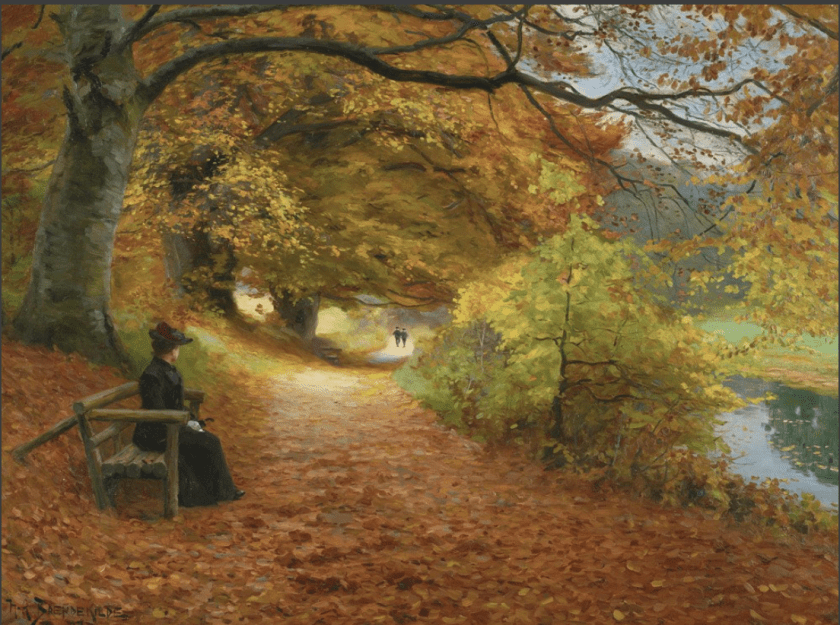
A Wooded Path In Autumn by Hans Andersen Brendekilde (1902)

The autumn season often featured in Brendekilde’s painting.  He enjoyed depicting this colourful time of the year.  A time when the normally green leaves of many deciduous trees and shrubs slowly turn to various shades of red, yellow, purple, black, orange, pink, magenta, blue and brown, during a few weeks in the autumn season, before they fall to the ground.  Brendekilde beautifully captures that moment in his 1902 painting entitled A Wooded Path in Autumn.

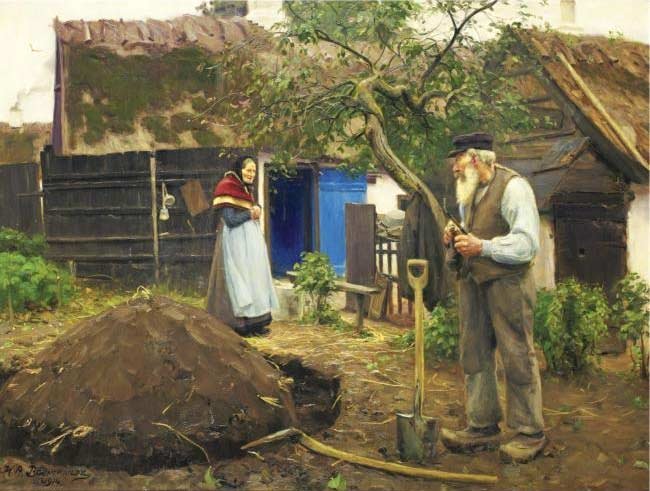
A Short Respite by Hans Andersen Brendekilde

Elderly people often featured in Brendekilde’s paintings and another of my favourites is his painting entitled A Short Respite in which we see an old man taking a rest from his gardening chores looked on by his wife.

Soap Bubbles by Hans Andersen Brendekilde (1906)

It was not just the elderly who featured in Brendekilde’s works of art, nor were the subjects of his painting always sombre.  In later life, he would concentrate on idyllic village scenes often depicting happy children, innocent children, and these proved very popular with the public.

Home with Dinner by Hans Andersen Brendekilde

In many of his paintings featuring children he also included one or two elderly people. Maybe he remembered his childhood days and how elderly relatives and neighbours played a part in his life. It seems strange now that some look upon paintings depicting an older person with a child as something suspicious and unnatural. Gone are the days when we accept unconditionally that our young children and an elderly person such as a relative can form a bond and in some ways learn from each other.

Fishing Village by Hans Andersen Brendekilde

Brendekilde died on 30 March 1942, aged 84,  in Jyllinge, a town located on the eastern shores of Roskilde Fjord,  some 40 km west of Copenhagen.

Mary Adshead – the great muralist.

Mary Adshead

The artist I am showcasing today, Mary Adshead, was an exceptionally gifted person. She was an artist who moved seamlessly between easel painting and murals.   She was a portrait painter.  She painted on furniture and glass.  She was a postage stamp designer.  She was a book illustrator and devised and designed advertisements and stage sets but will probably be best remembered as a muralist.

Mary was born in Bloomsbury, London, on February 14th, 1904. She was the daughter and only child of Stanley Davenport Adshead and Annie Adshead. Her father was a well-known neo-Georgian architect and talented amateur watercolourist, who trained in Manchester and London and for four years was clerk of works for the vast mansion at Rosehaugh, Argyll, during which time he met his wife, Annie, who was the village school mistress. In 1909, Stanley became Associate Professor of Civic Design at the University of Liverpool, and in 1912 became the Lever Professor of Civic Design. He moved back to London in 1914 and became the first Professor of Town Planning at University College, London, and remained there until his retirement in 1935.

Stanley Davenport Adshead (1927)

From the age of six, Mary was determined to become an artist and spent much of her time drawing and she produced many sketchbooks of cartoons and illustrations to stories.  The family would spend their summer holidays in the New Forest. Her mother and father’s relationship was often stormy and Mary found herself acting as a go-between, passing messages from one parent to the other.  At the age of twelve, she attended Putney High School and remained there for three years.    At the age of fifteen she went to Paris with her mother and both lived in a hotel in the French capital for six months whilst Mary attended the Lycée Victor Dury.

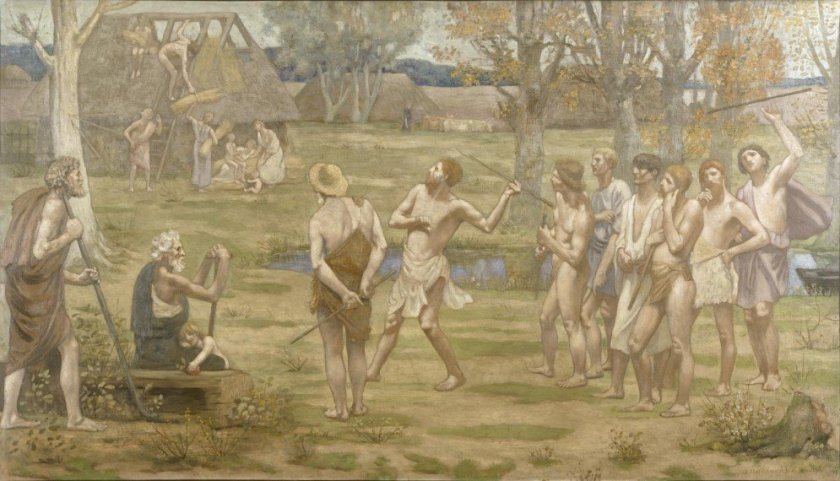
Ludus Pro Patria by Puvis de Chavannes (c.1883)
This painting which is housed at the Walters Art Museum, Baltimore, replicates the central portion of a mural, Ludus Pro Patria (Patriotic Games), which was installed in the stairwell of the Musée de Picardie in Amiens, France

Whilst in Paris she visited many of the famous art galleries and was greatly influenced by the murals of Pierre Puvis de Chavannes.  In the Autumn of 1921, when she was seventeen years old, her father took her to meet Henry Tonks the principal at the Slade School of Art, which was part of the University College, London, where Stanley Adshead was a professor.  Henry Tonks, a former surgeon, had a reputation for being very harsh with his students and a fierce taskmaster.  Mary brought along a portfolio of work which she had put together whilst in Paris but Tonks was not impressed.  However through a lot of arm-twisting by her father Tonks agreed to allow her to enrol on his art course.  This was a great relief to Mary and her father who, because he was a professor at the UCL, would not have to pay for his daughter’s tuition.

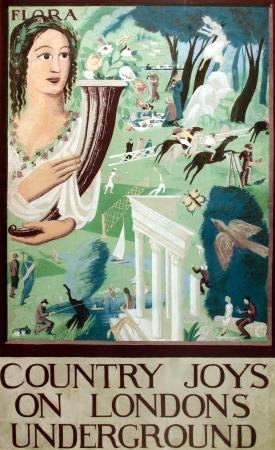
Poster artwork; Country joys on Londons Underground, by Mary Adshead, 1926

During the early phase of her course Mary did not work as hard as she should and was happy to hang out with a set of wealthy girls who looked on the art and course as simply a pleasant hobby.  Soon she realised that she was wasting valuable time and began to knuckle down and Tonks began to be very impressed with her work. Mary and fellow student, Rex Whistler won the joint first prize in the Slade’s Summer painting competition in 1924 and as a result, when their time at the Slade came to an end, Henry Tonks arranged for them to undertake a joint mural commission at the Highway Boys’ Club in London’s East End.

Mary Adshead 1926 mural:
A Tropical Fantasy:
for Charles Reilly’s Dining Room
Mural (panel 1 of 6)

Once she had completed that commission, more followed and her next one, in 1924, was to create a mural based on a desert island theme, which became known as A Tropical Fantasy. It was commissioned by Charles Reilly, the professor of architecture at Liverpool University, and one-time colleague of Mary’s father.  It is now housed at the Liverpool University Victoria Art Gallery. It is one of just a few of her murals to survive. That same year she completed a large mural entitled The Housing of the People, which was exhibited at the 1924 British Empire Exhibition at Wembley.

Bank Underground station, advertising mural by Mary Adshead which was situated next to escalator (1926)

She designed posters for the Underground Group and London Transport in the period 1927-37 and also carried out decorative works at Bank and Piccadilly Circus Underground Stations.

An English Holiday – Village Inn, 1928


One of her most lauded and often considered as her finest work was a commission she received in 1928 from Lord Beaverbrook, the millionaire Canadian-British newspaper publisher and politician, for a mural to cover the walls of his dining room at his Newmarket House, Calvin Lodge. He had decided that the mural should depict scenes of Newmarket life such as the horse racing and the fair and should depict his well-known and famous friends and it was that last instruction which was to be the stumbling-block to this project.

An English Holiday – The Puncture by Mary Adshead (1928)

The resultant panels, collectively titled An English Holiday, were true masterpieces combining humour with an insight into a life of privilege and elegance. They were described at the time as being in ‘the manner of English 18th-century sporting prints and acquatints. The paintings were packed with activity.

Village Inn by Mary Adshead


In Village Inn, a gentleman cyclist flirts with a country maid. In another one we see Arnold Bennett playing the harmonium for a crowd of gypsies. In another we see Lady Louis Mountbatten waiting by her car, the tyre of which had punctured and is being offered assistance by a swaggering, bearded character who looks very much like the painter Augustus John. More bizarrely Churchill is depicted astride an elephant. All of the characters are making their way to the Newmarket racecourse to meet Lord Beaverbrook.


However, Lady Diana Cooper, a good friend of Lord Beaverbrook and who also appeared picnicking in one of paintings persuaded him not to install the murals. Her argument being that as he was so cantankerous and quarrelsome, he was bound to, sooner or later, argue with one or more of the people depicted in the murals and then he would be forced to look at their depictions every time he dined. He listened to her advice and returned the panels to Adshead and paid the two-thirds rejection fee.

The panels were reassembled and exhibited at the large Peter Jones Department store in Central London in 1930 before being rolled up and relegated to a cupboard in the Adshead’s house where years later all but three were destroyed by fire.

The Little Boy and his House by Stephen Bone and Mary Adshead

In 1929 Mary Adshead married the painter Stephen Bone, the son of the artist and etcher Sir Muirhead Bone. Stephen and Mary had been students together at the Slade. The couple went on to have three children, two sons, Quentin and Sylvester and a daughter, Christina.  Mary and Stephen collaborated on a couple of children’s books, namely The Little Boy and His House in 1936, The Silly Snail and Other Stories in 1942 and The Little Boys and Their Boats in 1953 in which Mary provided the illustrations.


Chateau Poulet, near Forcalquier, Haute Provence by Mary Adshead

During their early married life, the couple made many painting and sketching tours during their travels through Europe.  Mary received many commissions through her architect father and also through the good auspices of her father-in-law who was always singing her praises in his circle of artist friends.  Her father-in-law, Muirhead Bone was well known for helping young aspiring artists such as Stanley Spencer, Gwen John and Cristopher Nevinson.

Morning after the Flood by Mary Adshead (1928)

Mary Adshead’s first solo exhibition was held in 1930 at the Goupil Gallery and included the painting The Morning after the Flood which is now part of the Tate collection. This decorative painting by Mary Adshead was characteristic of the style taught at the Slade Art School when she was a student. The tutors at the Slade had students set out figurative compositions that had connections with Biblical tales. This work was set the day after the Great Flood when Noah’s boat with his family and animals had come to rest on dry land.  One art critic wrote that her figure painting combined a fashionable primitivism, loosely derived from Stanley Spencer with a fluency and humour rarely found among her contemporaries.

Self Portrait by Mary Adshead (1931)

Her talent as a portrait artist can be seen in her 1931 self-portrait.

Portrait of Daphne Charlton,by Mary Adshead (c.1935)

Other portraits she completed include one of Daphne Charlton, the painter who studied at the Slade and who was a close friend of Stanley Spencer.

One of her favourites was one she did of her three children.
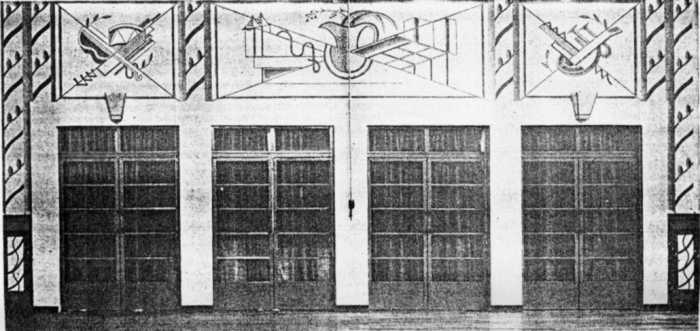
Victoria Pier, Colwyn Bay prior to demolition (pre-2017)

There is actually connection between Mary Adshead and her father and a place near where I live. The connection is the Victoria Pier Pavilion at Colwyn Bay, North Wales. The original pier was started in 1899 and was completed two years later. A 600-seat ‘Bijou’ theatre was built at the pier head in 1917 for the purposes of light entertainment. This original pavilion was completely destroyed by fire in 1922. This disaster forced the owners, the Victoria Pier Company, into bankruptcy and the pier was taken over by Colwyn Bay Urban District Council which arranged to re-build the structure. Eleven years later this second pavilion was destroyed by fire and a second blaze a few months later destroyed the theatre.

The mural decorations by Mary Adshead in the auditorium of Colwyn Bay Pier

Not to be deterred by these two disasters, the Colwyn Bay Urban District Council set about rebuilding, and the third pavilion was opened on Tuesday 8 May 1934 at a cost of £16,000. Now to the connection !

Inside Victoria Pavilion, Colwyn Bay with murals by Mary Adshead and Eric Ravilious

The third pavilion was designed by architect Stanley Davenport Adshead, Mary’s father, and Mary and Eric Ravilious were commissioned to paint some Art Deco murals for the interior of the pier building. The pier was badly damaged by the gales and sea in 2017 and started to collapse and it was decided to dismantle the whole structure.

Sections of murals from Colwyn Bay pier pavilion

The Art Deco murals created by Eric Ravilious and Mary Adshead, back in 1934, from inside the pavilion, have all been successfully removed and are currently awaiting restoration.

Mary Adshead and Stephen Bone

Stephen Bone, Mary’s husband, was a landscape painter and for a while was very successful but later the market for his work dried up and he became depressed and began to look upon himself as a failure. Stephen Bone died of bowel and liver cancer on 15 September 1958 at St Bartholomew’s Hospital, London. He was just fifty-three years old.

Travelling with a Sketchbook by Mary Adshead

After the death of her husband, and with her children all grown up, Mary embarked on a tour of America. During the adventure she carried her sketchbook and filled it with drawings of her journey. When she returned to England she published a book about her travels entitled Travelling with a Sketchbook.

1952 8d Wilding definitive stamp designed by Mary Adstead

Between 1948 and 1963 she submitted designs for a number of Post Office stamp issues including the Universal Postal Union stamps of 1949, the Festival of Britain stamp of 1951 and four denominations of the Wilding definitive stamps of 1952, which featured the Dorothy Wilding photographic portrait of Queen Elizabeth II .  Adshead’s design for the 8d, 9d, 10d and 11d were chosen.


Mary Adshead
(1904 – 1995)

In her latter years, lameness caused by painting off ladders hampered her work and life, but, ever purposeful, she would crawl where she could not walk with a stick, curious glances notwithstanding.  Despite this affliction Mary Adshead remained an active working artist until the end of her life.  She died in London on September 3rd 1995, aged 91.

Gustave Doré, the book illustrator.

Gustave Doré and the Rime of the Ancient Mariner.

Paul-Gustave Doré

The subject of my blog today reflects moments of my past life, from the days when I spent years journeying across the oceans and earlier when, at the age of sixteen,  I had to sit the national exam in English Literature.  The  examination was based on a book, a Shakespearian play, and a poem, all of which, we had to read, over and over again and dissect each into bits of minutiae. My classmates and I were delighted to find the book we had to read and digest was a novel by H.G.Wells. We had all heard of and/or read his Time Machine and War of the Worlds so we looked forward to the book set by the exam board.

Our hopes were soon dashed as we set about reading The History of Mr Polly which I remembered to be both turgid and depressing but there again I have to admit I was never an avid reader. The Shakespearean play was the Merchant of Venice which proved a lucky choice and one which I especially enjoyed when we looked at it in depth. Then came the poem. Poetry was anathema to sixteen year old boys and “boys don’t do poetry” was our class mantra and one needs to remember that our school was an all-boys one. Add to that the feeling of gloom about embarking on reading and learning lines of the poem for furthermore this chosen poem, which we had to study was not a short one with just a  few stanzas but an extremely long one. It was The Rime of the Ancient Mariner, which was the longest major poem by the English poet Samuel Taylor Coleridge, and one he completed and had published in 1798. Unbelievably it proved to be my favourite part of the English Literature exam syllabus.

Camden Lock Market at night.

I was in London last week and visited Camden Lock which has a great market and a plethora of “arty” shops including an excellent second-hand book shop where I found a number of books to buy, one of which was The Rime of The Ancient Mariner with forty-two illustrations by Gustave Doré. My blog today looks at Gustave Doré and some of the illustrations used in the book.

Journal pour rire

Paul-Gustave Doré was an Alsatian, born on January 6th, 1832, in Strasbourg. He became known as one of the most prolific and successful book illustrators of the late 19th century, whose high-spirited and somewhat strange fantasy-fashioned sizeable dreamlike scenes were widely loved during the Victorian period.

Doré was considered by many as a child genius when it came to his artistic ability. By age five, he was creating drawings that were mature beyond his years. In his late teenage years, he created several text comics, like his 1847 “comic” Les Travaux d’Hercule. Others followed and so well-liked were his works that he won a commission to illustrate books by Cervantes, Milton, and Dante.

Honoré de Balzac’s Les Contes drolatiques (Droll Stories) were illustrated by Gustave Doré

In 1848, when he was fifteen years old, Doré, went to Paris and began working as a caricaturist for the French paper Le Journal pour rire (Journal for laughs) as well as producing, over the next six years, several albums containing his lithographs.

Oeuvres de Rabelais, illustrated by Gustave Doré

His most accomplished work could be seen in his illustrations in such books as the 1854 edition of the Oeuvres de Rabelais, the 1855 edition of Honoré de Balzac’s Les Contes drolatiques (Droll Stories), and the 1861 edition of Inferno of Dante.

Andromeda by Gustave Doré (1869)

He also painted many large compositions of a religious, mythological, or historical character such as his 1869 work, Andromeda. The painting depicts Andromeda, the daughter of the Aethiopian king Cepheus and his wife Cassiopeia. When Cassiopeia’s boasts that Andromeda is more beautiful than the Nereids, the sea nymphs, Poseidon sends the sea monster Cetus to ravage Andromeda as divine punishment. Andromeda is stripped and chained naked to a rock as a sacrifice to sate the monster but is saved from death by Perseus.

Glen Massan by Gustave Doré

One of my favourite paintings by Doré was his spectacular landscape scene entitled Glen Massan. Doré first visited the Scottish Highlands in 1873 on a salmon fishing trip with his good friend Colonel Teesdale. However, it turned out that Doré preferred to paint rather than fish and was inspired by the beauty of the Highland landscape, so much so, he returned to northern Scotland the following year. This painting, of Glen Massan near Dunoon, is a large canvas painted in a romantic Victorian style. I like the way Doré has depicted shafts of light penetrating the billowing clouds and lighting up parts of the valley.

And so to the Samuel Coleridge Taylor poem, The Rime of the Ancient Mariner.  Doré was excited about illustrating the poem, so much so he had completed the designs for the illustrations before a deal had been struck with the publisher.  The wooden blocks he used for the illustrations were very large and cost Doré a lot of money and unlike previous engravings he took control of the supervision of them.  Doré believed that this was his greatest work but unfortunately for him, its sales recouped him only slowly for his large initial outlay.  It was first published in England and soon editions appeared in France, Germany and America.

Samuel Coleridge Taylor did not set his poem in any one period but as an illustrator, Doré had to be more precise and he chose a medieval setting for the wedding feast  at the start of the poem.

The opening setting for the poem is a path leading to a church where three of wedding party are heading. An elderly man with a grey beard, the Ancient Mariner, halts them to tell his tale. Two escape his clutches but the third is trapped and made to listen. It is an ancient Mariner,
And he stoppeth one of three.
“By thy long grey beard and glittering eye,
Now wherefore stopp’st thou me?
“The Bridegroom’s doors are opened wide,
And I am next of kin;
The guests are met, the feast is set:
May’st hear the merry din.”

The old sailor recounts how the sea voyage had started well but soon the ship was being drawn southward by a storm and the men had lost control of the vessel.

With sloping masts and dipping prow,
As who pursued with yell and blow
Still treads the shadow of his foe
And forward bends his head,
The ship drove fast, loud roared the blast,
And southward aye we fled.

Soon the Ancient Mariner’s ship was trapped in the Antarctic ice with no hope for survival.

And through the drifts the snowy clifts
Did send a dismal sheen:
Nor shapes of men nor beasts we ken —
The ice was all between.
The ice was here, the ice was there,
The ice was all around:
It cracked and growled, and roared and howled,
Like noises in a swound!

The Ancient Mariner recalls how the sailors believed they were doomed and all hope had gone – until the arrival of an albatross, which came each day and was fed by the sailors.  The bird then led the ship and the sailors away from their icy prison and all aboard celebrated their good fortune.

At length did cross an Albatross:
Thorough the fog it came;
As if it had been a Christian soul,
We hailed it in God’s name.
It ate the food it ne’er had eat,
And round and round it flew.
The ice did split with a thunder-fit;
The helmsman steered us through!
And a good south wind sprung up behind;
The Albatross did follow,
And every day, for food or play,
Came to the mariners’ hollo!

However for some unknown reason the Ancient Mariner shot the albatross with his crossbow.

“God save thee, ancient Mariner!
From the fiends, that plague thee thus! —
Why look’st thou so?”— With my cross-bow
I shot the ALBATROSS.

At first the sailors, despite condemning the old mariner for his action, seemed to be pleased that the south wind which had been mustered up by the albatross was still with them and they had left the cold waters of Antarctica and approached the warm waters of the Equator. All was good with the crew and their ship, but then the wind dropped and the ship was becalmed.

Down dropt the breeze, the sails dropt down,
’Twas sad as sad could be;
And we did speak only to break
The silence of the sea!
All in a hot and copper sky,
The bloody Sun, at noon,
Right up above the mast did stand,
No bigger than the Moon.
Day after day, day after day,
We stuck, nor breath nor motion;
As idle as a painted ship
Upon a painted ocean. 

Water, water, every where,
And all the boards did shrink;
Water, water, every where,
Nor any drop to drink.
The very deep did rot: O Christ!
That ever this should be!
Yea, slimy things did crawl with legs
Upon the slimy sea.

The becalmed ship was surrounded by evil creatures of the sea and soon the blame for their misfortune fell on the Ancient Mariner for killing the albatross.  Close to death they suddenly spot a shape on the horizon – could it have come to their rescue?

There passed a weary time. Each throat
Was parched, and glazed each eye.
A weary time! a weary time!
How glazed each weary eye,
When looking westward, I beheld
A something in the sky.
At first it seemed a little speck,
And then it seemed a mist:
It moved and moved, and took at last
A certain shape, I wist.

The ghostly hulk approaches their ship and on board are two figures, a skeletal Death and a deathly pale female, Night-mare Life-in-Death and the two are playing dice for the souls of the crew members. Death wins the lives of all the crew members, all except for the Ancient Mariner, whose life is won by Night-mare Life-in-Death. It is the name of this character that allows us to know the fate of the Ancient Mariner – a fate worse than death, a living death, was to be his punishment for killing the albatross.
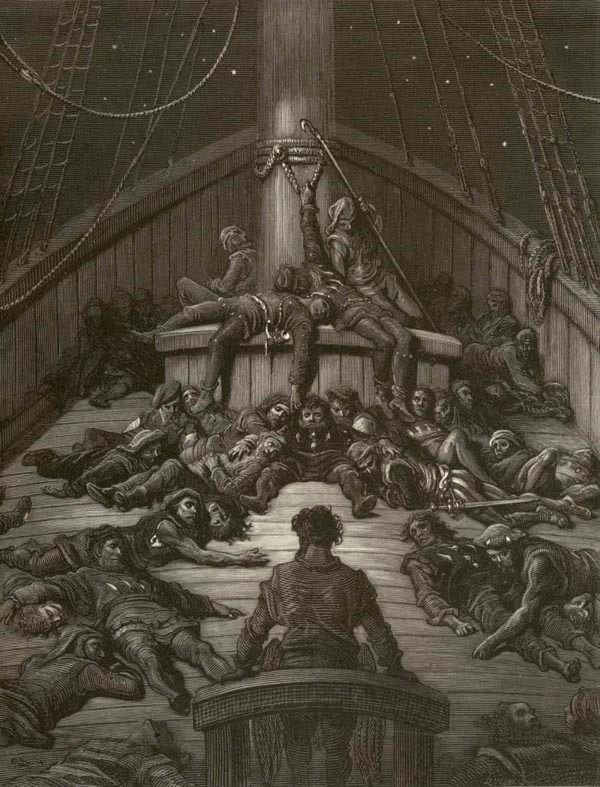
The Ancient Mariner is the sole survivor of the ill-fated crew.  The bodies of the dead crew members lay around the deck with their eyes staring at the Ancient Mariner. The Ancient Mariner recounts how he felt, how he wanted to die but was not allowed that luxury.
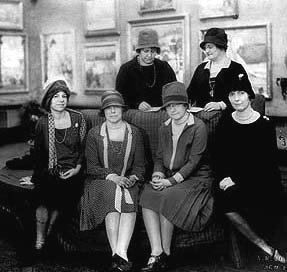
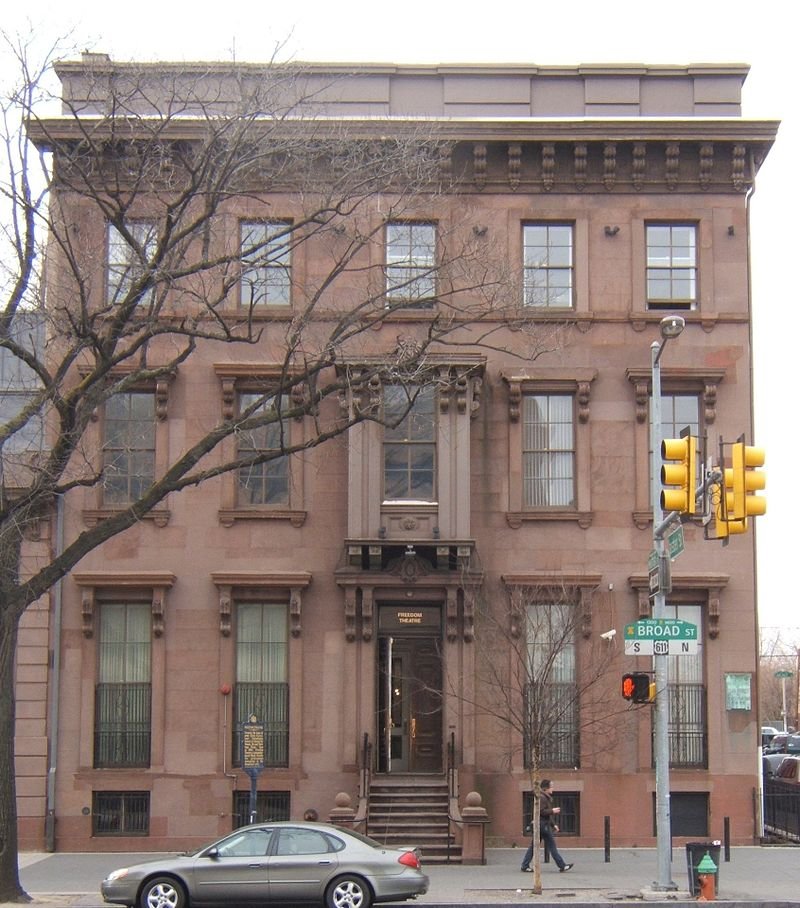
I looked to Heaven, and tried to pray:
But or ever a prayer had gusht,
A wicked whisper came, and made
my heart as dry as dust.
I closed my lids, and kept them close,
And the balls like pulses beat;
For the sky and the sea, and the sea and the sky
Lay like a load on my weary eye,
And the dead were at my feet.
But the curse liveth for him in the eye of the dead men.
The cold sweat melted from their limbs,
Nor rot nor reek did they:
The look with which they looked on me
Had never passed away.
An orphan’s curse would drag to Hell
A spirit from on high;
But oh! more horrible than that
Is a curse in a dead man’s eye!
Seven days, seven nights, I saw that curse,
And yet I could not die.

I suppose you may curse me, like the curse put on the Ancient Mariner, but I am not going to tell you the end of the story in the hope that you will go out and get yourself a copy of the epic poem, and if possible, a copy with the Gustave Doré’s woodblock illustrations.  You won’t regret it.


The Philadelphia Ten. Part 1 – The beginnings and the facilitators.

Members of the Philadelphia Ten at their Art Club of Philadelphia exhibition, January 28 – February 11, 1928.

A month ago, I looked at the life of English artist Louise Swinnerton and told of her struggle to be accepted into the male-dominated art establishment. It was the time of the suffragettes and their struggle for women’s rights. A similar struggle was taking place across the Atlantic in America where, like the female artists of Britain, the American female artists were struggling to get a foothold in their own art establishments.

All artists need to be able to exhibit their work so that they can enhance their reputation and be recognised as talented painters but also they need to be able to sell their paintings. Too often, females who wanted to learn to paint were dismissed as people who just wanted to paint as a hobby. Why should they earn money from their paintings? Surely the female just needs to marry a wealthy man and let him provide for her. Wouldn’t it be much better if she stayed at home and looked after her husband and their children? A simple male philosophy of the time but of course women were determined to strike out on their own.

In my next two blogs I am looking at the birth of the Philadelphia Ten, often simply referred to as The Ten, an embryonic group of female artists and sculptors that went on to exhibit their work together for nearly thirty years. In the second part of the blog I will look at some of these aspiring artists, based in Philadelphia, who were members of the collective and who, through this group, fought their way to success in the world of American art. The Philadelphia Ten existed between 1917 and 1945 and, during this twenty-eight-year period, regularly exhibited their work together in large annual group shows at the National Academy of Design, the National Association of Women Painters and Sculptors’ the Pennsylvania Academy of Fine Arts and the Art Club of Philadelphia. Although having their work accepted by the various exhibition jurists at these annual events was a great achievement there were still hurdles to overcome, such as the number of paintings each of the women was allowed to submit and, after having their paintings accepted, the whereabouts of the hanging position of their works within the exhibition, as this was left to the hanging jurists. For young aspiring female artists, it was a long struggle to have all their work displayed and their aspiration of having more paintings exhibited led to the formation of the Philadelphia Ten.

Sarah Worthington King Peter

Before the “formation” of The Ten could take place there had to be an establishment for them to learn their trade and somebody to support their desire to become painters. Enter onto the scene Sarah Worthington, who would later become a renowned nineteenth-century American philanthropist and patron of the arts. She was born into a powerful political family on May 10th, 1800, at Chillicothe, Ohio, the daughter of an Ohio senator. She led a charmed life, going to private schools in Kentucky and later Washington D.C. At the age of sixteen, she married her first husband, Edward King, the son of a renowned New York politician, Rufus King. The couple, who lived in Cincinnati, went on to have five children. Her husband died in 1836 and she moved to Cambridge Massachusetts to be close to two of her sons who were attending Harvard University.

Edwin Forrest House, formerly the home of the Philadelphia School of Design for Women.

In 1844, she married William Peter, who, at the time, was the British consul to Philadelphia. The couple lived in Philadelphia and it was here that Sarah Worthington King Peter began her philanthropic career. Knowing the difficulties women had in progressing with their art, she founded the Philadelphia School of Design for Women in 1848. It was the first American art school devoted exclusively to the training of women. It originally was not simply a fine arts college but one which was set up to teach a trade to women, who struggled to support themselves.  They were taught all about lithography, wood carving, and design, which could then be used during the making of household items such as carpets and wallpaper. The institution was renamed Moore College of Art & Design in 1932 after Joseph Moore, Jr. set up a $3 Million-dollar endowment in memory of his parents.  Sarah Worthington Peter’s original vision continues to drive the College’s mission to educate women for careers in the visual arts.  Sarah’s second husband died in 1853 and she returned to Cincinnati where she would stay for the rest of her life. She continued with her philanthropy and established the Ladies’ Academy of Fine Arts.

Having established the Philadelphia School of Design for Women it was important to staff it with the best teachers. Two of the best and most influential teachers, during the days when the Philadelphia Ten were learning about art, were Henry Bayley Snell and Elliot Dangerfield, both talented landscape artists.

Henry Bayley Snell

Henry Bayley Snell, an Englishman, was born in Richmond in September 1858 where he remained until, at the age of seventeen, he emigrated to New York where he attended the Art Students League. In his twenties, to eke out a meagre living, Snell supported himself by working in the blueprint department of an engineering firm, and by producing marine scenes for a Photoengraving Company. In 1888, thirty-year-old Snell married artist Florence Francis. It was in 1899 that Snell was given the post of art teacher at the Philadelphia School of Design for Women. That same year the couple travelled to visit a fellow painter, William Lathrop in his hometown of New Hope, Maine. Liking the town so much the couple moved there in 1900.

Sailing in Springtime by Henry Bayley Snell

In 1921, along with Frank Leonard Allen, Snell founded the Boothbay Studios in Boothbay Harbour, Maine, which operated as a summer school. Henry B Snell remained as a teacher at the Philadelphia School of Design for Women until his death in 1943 and during his early days there, he taught many artists who became part of the Philadelphia Ten. During his teaching years, he travelled abroad extensively, frequently accompanied by his students. It was his reputation both as a teacher and a painter that lured many artists to the New Hope Area.

Monk Smelling a Bottle of Wine by Elliot Dangerfield (1880)

The other lecturer who greatly influenced the women was the watercolourist, John Elliott Parker Daingerfield. Dangerfield was born in March 1859 at Harpers Ferry, West Virginia, the son of Captain John Elliott Daingerfield, commander of a Confederate arsenal, and Matilda Wickham DeBrau Daingerfield. However, from a young age he was raised nearby in Fayetteville, North Carolina and he is looked upon as one of the most important artists to come from this area.  From a young age, Daingerfield’s dream was to become an artist and early on in life he learned some basics of drawing and painting from a sign painter in Fayetteville as well as assisting a commercial photographer and a china painter. In 1880, at the age of twenty-one, he decided to pursue a formal art education and went to New York where he enrolled at the National Academy of Design. During his first year there he produced his painting entitled, The Monk Smelling a Bottle of Wine, which was exhibited at the Academy in 1880.

Midnight Moon by John Elliot Parker Dangerfield (c.1906)

In New York, Daingerfield worked as an apprentice in the studio of William Satterle. So impressed by his student that he offered him a job as an instructor in his still life class. To progress further in the world of art, Dangerfield attended classes at the Art Students League.  Daingerfield’s most influential mentor was George Inness, whom he met in 1884 when he rented studio space at Holbein Studios on Fifty-fifth street. “Master and pupil” would often study each other’s work. Innes taught Dangerfield the technique of how to get the atmospheric effects of light by mixing layers of paint with thin layers of varnish and it was this procedure that brought about a wonderful sense of mood and tone.

In 1886, Dangerfield’s health began to deteriorate and he decided to leave New York and return to North Carolina and the town of Blowing Rock where he hoped to recuperate. He fell in love with the area and decided to make his home amongst the peace and tranquillity of the Blue Ridge Mountains

Daingerfield spent the rest of his life travelling between his studios in Blowing Rock and New York City and taught out of his studio in North Carolina in the summers and at the Philadelphia School of Design and the Art Students League in the winters. Dangerfield was a very spiritual man and sensed the connection between art and spirituality. He once said:

“…Art is the principle flowing out of God through certain men and women by which they perceive and understand the beautiful. The office of the Artist is to express the beautiful…”

The Philadelphia Ten’s first joint exhibition was held on February 17th 1917 at the Art Club of Philadelphia at 235 South Carmac Street. In all, 245 paintings were on display and this exhibition was looked upon as the birth of the Philadelphia Ten. Following the great success of the event, the group’s exhibitions became an annual event and art critics and collectors always looked upon them as exhibitions of the highest quality, embracing a wide selection of subject matter and a variety of styles. The fact that the artists were able to exhibit a large number of their paintings at each exhibition soon allowed the observers to be able to easily recognise their individual styles, something that had not happened before due to the small number of paintings large exhibitions would allow each artist to show.

In my next blog I will look at the life and works of some of the artists who formed the Philadelphia Ten.

Grant Wood. Part 3 – the latter years and rumours.

For many people the name Grant Wood is synonymous with the painting American Gothic but in fact he completed many more superb works of art and in this blog I will look at some of my favourites.

Stone City, Iowa by Grant Wood (1930)

In 1930, the same year he painted American Gothic, he entered two of his works in to the Iowa State Fair Art Exhibition and was awarded first prize for the best picture of the exhibition and first prize in the oil portrait category for his Portrait of Arnold Pyle (see Grant Wood, Part 2) and first prize in the oil landscape category for his painting entitled Stone City. Stone City was Grant Wood’s first major landscape painting. It is a tranquil, idealized scene of life in harmony with nature. Stone City which is located on the Wapsipinicon River, twenty-six miles from Cedar Rapids, was once a boomtown but it went bust. The boomtown came to fruition because of its limestone quarries and laid to rest by the development of Portland cement. Wood, through his painting, would like us to believe that the town has since reverted to a purer purpose of grazing animals and growing crops.  In his 1995 book Grant Wood: An American Master Revealed, James Homs wrote about this painting:

“…Although Stone City, Iowa was based on a direct study of a place with which he was thoroughly acquainted, he turned this village and its river valley site into a fantasy of curving contours, ornamental trees and brightly patterned surfaces. Wood considered the “decorative adventures” of his commonplace rural surroundings – their inherent elements of abstraction – as the true origin of the most lasting qualities in his work…”

The Midnight Ride of Paul Revere by Grant Wood (1931)

In 1931, a year after American Gothic, Wood finished another of his well-loved paintings entitled The Midnight Ride of Paul Revere. Wanda Corn, a biographer of Wood, wrote that as a child, Wood had been captivated by the tale of Revere’s journey through the night from Boston to Lexington to warn the patriots of the British advance. Like most Americans of his day, Wood would have learned about the American legend from a poem by Henry Wadsworth Longfellow, which was published in 1863:

Listen, my children, and you shall hear
Of the midnight ride of Paul Revere,
On the eighteenth of April in Seventy-five;
Hardly a man is now alive
Who remembers that famous day and year.

Like many young boys, Wood was captivated by the idea of a local hero carrying vital news, raising the alarm, and through this brave deed, achieving immortality. Wood probably liked to imagine himself on just such an assignment galloping from farm to farm to warn his neighbours of an approaching tornado and then being held aloft as the local hero having saved so many lives.

Toy Town like geometric houses

Grant Wood’s depiction is viewed from above. We see a vast sweep of countryside and a village with houses depicted as simple geometric shapes, which resembles a “toy town” where the houses are made with wooden blocks. The painting portrays the hero on horseback as he gallops through a small village which is nestled among the trees which are painted in Wood’s favoured “sponge-like” representation. Ahead of this American hero, as he rides out of town, is darkness, behind the horse and rider are houses with lights on and some of the occupants, woken by Revere’s warning calls, stand in their night clothes on their front steps and in the street.  Woods intention in depicting this piece of American folklore was, as he put it, to save those bits of American folklore that are too good to lose. His intention was, during the Great Depression, to remind people of historic times of the past, to remind people of the greatness of their country. However, his work had many detractors who said that his child-like depiction made fun of this American legend.

Grant Wood painting his Stone City ice wagon quarters (c. 1932) Photographer: John W. Barry, Jr.
Courtesy of the Grant Wood Art Gallery, Anamosa, IA.

By 1932, Wood’s reputation as an artist had risen significantly and he became co-founder of the Stone City Colony and Art School in Iowa. along with Edward Rowan, the director of the Little Gallery in Cedar Rapids, Adrian Dornbush, the former director of the Flint Institute of Art who was an art instructor at the Little Gallery. The Stone City Art Colony was a home and a place to paint for artists in the Midwest. As a teacher at the colony Grant Wood was able to spread the message of Regionalism to aspiring artists. Unfortunately, the art colony was always plagued by financial difficulties and closed in the autumn of 1933.

The Corn Parade mural by Orr C. Fisher, in the Mount Ayr, Iowa, post office (1941)

In 1934 Grant took on a position with the art department at the University of Iowa, and also in that year, he was named director of the Public Works of Art Project in Iowa. Grant Wood later took on many of the artists at the artist colony in that project, a programme which employed artists, as part of the New Deal, during the Great Depression, and which he administered for the state of Iowa. The programme produced a large number of Depression Era murals that can still be viewed on the walls of rural post offices and public buildings in Iowa. In her book Wall To Wall America: Post Office Murals in the Great Depression by Professor Karal Ann Marling, she explains that the concept for nine years, from 1934 to 1943  She said that the Federal Government, under the Public Buildings Administration, commissioned murals for a variety of newly constructed post-offices around the United States. Life magazine,  named it “Mural America for Rural America.” It was a programme designed to get starving artists out of the garrets and into suitable work that would decorate bare walls, edify the public, and put some spare change in their pockets.

Grant Wood in his favoured rural-type bib and braces

In 1935 Grant Wood published the essay “Revolt Against the City,” in which he laid out the tenets of the Regionalism movement. For him Regionalism was a movement to which artists all over the United States must dedicate themselves in order to avoid a colonial dependency on European tradition. He felt that the rural Midwest, (the farmer’s life, dress and setting) would provide the richest kind of material for a truly indigenous regionalist style.

Joseph Chamberlain Furnas was an American freelance writer. He is best known for his article, commissioned for the Reader’s Digest, “—And Sudden Death!”   This article brought national attention to the problem of automobile safety and is the most-reprinted article in the Digest’s history. In it he wrote:

“…An enterprising judge now and again sentences reckless drivers to tour the accident end of a city morgue. But even a mangled body on a slab, waxily portraying the consequences of bad motoring judgment, isn’t a patch on the scene of the accident itself. No artist working on a safety poster would dare depict that in full detail…”

Death on the Ridge Road by Grant Wood (1935)

It could be that Grant Wood read the whole article in the August 1935 edition of the Reader’s Digest and it was that, that made him paint Death on the Ridge Road in 1935. It is a painting all about movement but with a bleak message about death on the roads. The painting vividly depicts the bends of the road, the shapes and positions on the road of the vehicles careering towards one another. It is a bleak and stormy night.  Even the telegraph pole at the top of the hill seems to be bending over due to the ferocity of the wind and, in the background, we sense that the storm clouds are scuttling across the sky depositing rain which will moisten the road surface. The tarmacked road bends are bordered by barbed-wire fences as it cuts through green hills. The large red truck rushes headlong over the crest of the hill towards an on-coming black car which has skidded across the road into its oncoming path. We know what is going to happen next. We know there will be deaths and the arms of the telegraph poles now seem to symbolise crosses on a grave. Maybe Wood was warning us about the dangers of technological progress.

Spring Turning by Grant Wood (1936)

Grant Wood painted a very hypnotic work in 1936 entitled Spring Turning. This type of work by Wood is often referred to as Magic Realism.  The term magical realism, was first expressed in a discussion of the visual arts. The German art critic Franz Roh, in his 1925 book, Nach Expressionismus: Magischer Realismus: Probleme der neuesten europäischen Malerei (After expressionism: Magical Realism: Problems of the newest European painting).  In it he described a group of painters whom we now categorize generally as Post-Expressionists, and he used the term Magischer Realismus to both highlight and rejoice at their return to figural representation after a decade or more of abstract art.

With its bird’s-eye view of smooth, swelling hills and nearly abstract banded squares of green grass and ploughed earth, Wood’s depiction is probably from his own memory as a child on the family farm in Anamosa.  There is no evidence in the depiction of cars, farm machinery, paved roads, or electric wires. Wanda Corn in her 1983 book, Grant Wood: The Regionalist Vision, describes the work as a tale about:

“…man living in complete harmony with nature; he is the earth’s caretaker, coaxing her into abundance, bringing coherence and beauty to her surfaces…”

1935 photograph of the happy couple – Grant (44) and his wife Sara (51)

Despite the successes Wood achieved with his paintings in the 1930’s his life was becoming stressful with the IRS chasing him for unpaid taxes and he began finding some solace in liquor. To add to his problems, on March 2nd, 1935, he, without warning, married a divorced woman, Sara Sherman Maxon, the former head of Michigan City’s School of Fine Arts and a former light opera singer  The marriage took place in a small ceremony in Minneapolis, the town in which Sara was living, far from Grant’s home, and with none of his friends or family in attendance, as one report put it:

“…Wood’s neighbours read with astonishment that he was to be married that night in a small ceremony in Minneapolis. The fact that Cedar Rapids’ “bachelor artist” had a secret fiancée was nearly as dumbfounding as the circumstances of the wedding itself – a ceremony conducted with little warning, far from home, and with no friends or family in attendance…”

Grant Wood and his wife Sara Maxon

It was not a “marriage made in heaven” and many of Grant’s friends thought they were ill-matched, as Sara seemed flamboyant and overpowering whilst Grant was a socially awkward and reticent bachelor. Shortly after the couple were married, they moved to Iowa City where Grant was teaching at the University of Iowa.

House in Iowa which Grant restored and served as home for his bride and his mother.

Wood bought an eighty-year-old house for $3,500 and spent almost $35,000 renovating and refurbishing it, which financially crippled him. The pair found it difficult to survive as a happily married couple. The marriage was a platonic affair and never consummated. Did Sara know that her husband was homosexual? It seemed to have been common knowledge of his friends and some of his students.

Boy Milking Cow, by Grant Wood (1932)

In the same year Grant and Sara married, Wood hired a handsome,  athletic, young man, Park Rinard, as his personal secretary. Rinard, who lived in Falls Church, was born in Montana and grew up in Iowa. He graduated from the University of Iowa, where he also received a master’s degree in creative writing. It was while he was in graduate school that he became secretary to Grant Wood. Although not a homosexual himself, Rinard clearly understood Wood’s attraction to him. Rinard was the ghost writer for Grant Wood’s unfinished autobiography, Return from Bohemia.  But Rinard’s presence only further pushed Sara to the side, which made her woefully unhappy.

The relationship between Wood and his wife was so bad at the end that, according to one account, he  enlisted his housekeeper as proxy to deliver his desire for a divorce to Sara. Another account tells of Sara going to hospital because of a suspected heart attack (she was a notorious hypochondriac) and Grant sent a note to her telling her not to bother to return!  The inevitable divorce came in September 1939.

Parson Weems Fable by Grant Wood (1939 )

Another American folktale was the subject for a satirical work depicted in Grant Wood’s 1939 painting Parson Weems Fable. Mason Locke Weems usually referred to as Parson Weems, was an American book agent and author who wrote the first biography of George Washington, entitled The Life of Washington  in 1800, immediately after the first President’s death in December 1799 . The tale of the cherry tree and Washington appeared in the fifth imprint of this bestseller book in 1805. The tale of the cherry tree (I cannot tell a lie, I did it with my little hatchet) was to highlight George Washington’s virtues, even as a six-year-old child, and was intended to provide a morally instructive tale for the youth of the young nation. Grant Wood created his work in celebration of historian Parson Weems and the first President George Washington. Weems’ anecdote told the story of the six-year-old future President chopping down his father’s favourite cherry tree and then owning up to it. Grant Wood’s regionalism style painting, this satirical work predicts the revolutionary spirit coming to colonial America. His contrast of colours conjures up a sense of impending change, particularly in the storm clouds we see gathering on the horizon.

Father and son, with the $1 bill face

Washington’s father Augustine is depicted as a red coat holding the fallen cherry tree with an outreached hand, while the unruly youth, painted with the adult head and face of Washington, as it appears on the $1 bill, on a child’s body,   The child points at the offending hatchet.   In the right-hand foreground, we see Weems, with a wry smile on his face, pulling a drape aside to reveal this iconic encounter. In the background we catch sight of two slaves picking cherries from another tree, and this could be a reference to another historic and revolution that was to come.

Grant Wood in his studio in1931

Grant Wood was a complex character. He constantly wanted to be known a “farmer-painter” and in many of the photographs of him we see him dressed in overalls which was bizarre as he hated farming. It is more than likely that his showy rural character was part of the style that he, Thomas Hart Benton, and John Steuart Curry promoted in the 1930’s as champions of American Regionalist painting. There is no doubt that they were nostalgic about the past and believed that the healthy values of the Midwest should be maintained as an antidote to their perceived view of the decadence and degenerate European lifestyle and the corruption which they believed sullied life in the American East Coast cities.

Young Corn by Grant Wood (1931)

Unfortunately for Grant Wood, his artistic legacy, which only lasted eleven years, was damaged, firstly by critics’ ridiculing his work, saying it was merely “regionalistic” and light-weight and secondly by wide spread rumours about his sexuality. The final part of the title of this blog mentioned “rumours” and I thought long and hard whether to even include the rumours about Grant Wood’s life. The rumours were about Grant Wood’s sexuality and I was not sure whether it had any bearings on his ability as a painter.  A 1944 biography hinted at Wood’s homosexuality, as did the catalogue written by Wanda Corn that accompanied the travelling exhibition of Grant Wood’s work. However, she and other art historians had to be very careful what they wrote about Wood as his sister, Nan, was quick to litigate against any slurs about her brother. There were  rumours of an attachment Wood had with his wife’s son, Sherman, from her first marriage who occasionally lived with them.  Lester Longman, a modernist-minded colleague in the University of Iowa art department, where Wood had taught since 1935, tried to have him fired, in part on explicit moral grounds. However, the university ignored the charge and retained Wood. It was only after his sister’s death in 1990 that historians could write with more openness and impunity. In a 2010 biography, by R Tripp Evans, Grant Wood: A Life, he unequivocally states that Wood was a closeted gay man and someone who was terrified of having his sexual orientation uncovered.

Sultry Night by Grant Wood (1939)

Probably another work by Wood which made people question his sexuality came about in 1939 when he produced a controversial lithograph, entitled Sultry Night. In it he depicts the farmhand pouring a pail of bathwater over his head in the empty dark of a field. We see water dripping from his mouth, along his chest, and down to his penis. The problem for Wood was that the depiction of the naked man is not posed in the academic postures of the classical nude, which may have made it more acceptable, but instead we see this splay-footed individual with his face upturned to receive the stream of water. Wood created the lithograph for Associated American Artists, a distributor of low-cost reproductions for the masses, but the print was quickly banned by the US Postal Service. Wood maintained that the depiction of the naked man was just a normal scene from his childhood memories of farm life, but despite his protestations that the image was not pornographic, the Postal Service upheld the ban.

Spring in Town by Grant Wood (1942)

Wood’s Regionalism was falling out of favour and that put him at variance with many of the university faculties and he became so frustrated that, in 1940, Grant Wood took a leave of absence from academia although he carried on with his paintings, which continued to show his faithful adherence to American Regionalism, the American art movement he was primarily responsible for founding. During his sabbatical period from lecturing and teaching he still carried on painting. His last works were a pendant pair entitled Spring in Town and Spring in the Country which he completed in 1941. They both illustrate his steadfast devotion to American Regionalism.

Spring in the Country by Grant Wood (1941)

In his sister’s 1993 autobiography, My Brother, Grant Wood, written by her with John Zug and Julie Jensen McDonald. Grant’s thoughts about the paintings are quoted:

“…In making these paintings, I had in mind something which I hope to convey to a fairly wide audience in America—the picture of a country rich in the arts of peace; a homely, lovable nation, infinitely worthy of any sacrifice necessary to its preservation…”

In 1941, shortly after taking his sabbatical, Grant Wood was diagnosed with pancreatic cancer and the doctors told him that he was terminally ill. On February 12th, 1942, just a day before his 51st birthday, he died.  Park Rinard was at his bedside.  Grant Wood was buried on his family’s plot in Anamosa. Reportedly, on his deathbed, he repeated over and over again that he wanted to paint his dead father, whom he had “lost” at the age of ten. Thomas Hart Benton, a fellow Regionalist, who visited Wood before his death, later remarked:

“…It was if he wanted to destroy what was in him, and become an empty soul before he went into the emptiness of death…”

He died in debt and his contribution to American art was mostly forgotten by the late 1930’s with international political concerns overshadowing domestic ones. His beloved Regionalist art was condemned for being too parochial, too much of Midwestern chauvinism and a genre which failed to change despite the onset of American Abstract Expressionism which was about to dominate in the post-war years. If remembered at all, it was for one work which has always been judged, as not his finest or most interesting, but one which has now become an iconic work, famous all around the world.

After Wood’s death in 1942, Nan inherited his estate and devoted the rest of her life to maintaining and promoting his legacy. Nan, who had married a real estate investor, Edward Graham, died in 1990, aged 91.

I could have attached many more of Grant Wood’s paintings but I am sure if you like what you have seen in these three blogs about his life you will search out more of his work.

————————————————-

Most of the information I gleaned for these three blogs on Grant Wood came from the usual sources such as Wikipedia and the following websites:

Cedar Rapids Museum of Art
http://www.crma.org/content/Collection/Grant_Wood.aspx

Sullivan Goss an American Gallery
http://www.sullivangoss.com/Grant_Wood/#Bibliography

Nan Wood’s scrapbook
http://digital.lib.uiowa.edu/cdm/ref/collection/grantwood/id/880

The Beacher Weekly newspaper

Click to access BeacherSep18.pdf