
Life in Taos, New Mexico
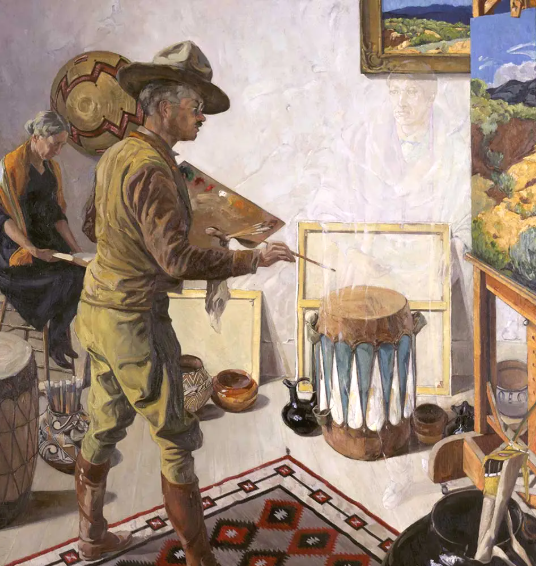
Walter Ufer
Having taken his wife’s advice with regards approaching Chicago’s dignitaries and offering to paint their portraits, Ufer called upon the Carter H Harrison, the 30th mayor of Chicago, who had held office from 1897-1905 and then again from 1911-1915. Harrison proved reluctant but eventually agreed but added that in his opinion there were better portrait artists than Ufer. His agreement to sit for the portrait came with a number of provisos. He told Ufer that he would not pay for commission as the prestige of having it hung in city hall would be sufficient “payment”. Later however, he grudgingly agreed to pay for the painting materials and frame. Harrison also said that before the portrait would be hung on the walls of the City Hall it had to be accepted by the jury for submission into the Chicago Society of Artists Exhibition.
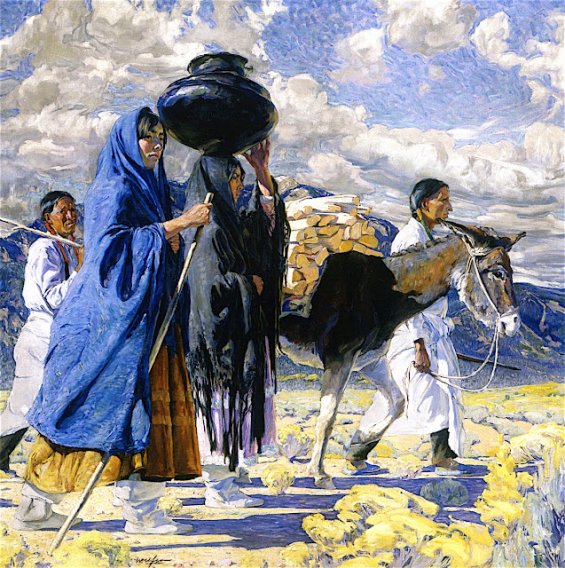
Going East by Walter Ufer (1917)
This contact with the mayor proved to be fortuitous as Harrison’s syndicate of German American businessmen, agreed to sponsor three trips for Ufer to travel to Taos, New Mexico along with fellow artist Victor Higgins. Harrison, who like many art patrons of the time, was fascinated by the American West and its indigenous cultures, and viewed it as a distinctively American subject matter. For Ufer, these journeys to New Mexico gave him an opportunity to observe the natural beauty of the New Mexico landscape, with its intense clarity of the light, and at the same time witness the rich cultural heritage of the Pueblo people. The trips over the next two years were to be an opportunity to record on canvas what they observed. These journeys to the West proved to be an eye-opener for Ufer who fell in love with the country and its native inhabitants. Ufer made his first trip to New Mexico at the end of the summer of 1914 visiting Santa Fe, Chimayo, and the pueblos of San Juan, Isleta, and Taos. Ufer completed over thirty ten and a half by twelve and a half inch canvases as well as a group of twenty-five by thirty-inch paintings, mostly portraits painted in Isleta and San Juan.
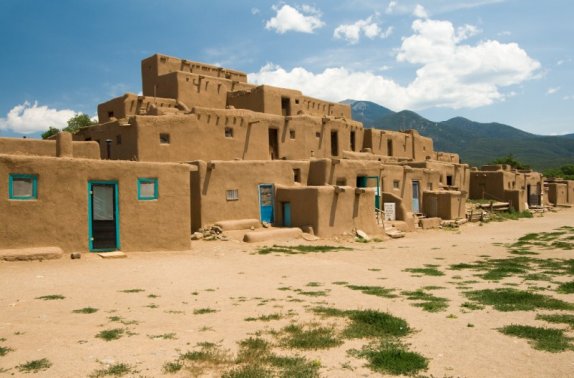
South Pueblo, Taos Indian Pueblo, New Mexico
When Ufer arrived in Taos, which at the time was a small, remote town situated at the foot of the Sangre de Cristo Mountains. The population of town was made up of Catholic Hispanics who worked the land; Native Americans, a farming society, who also worked as servants, artists’ models, and other lowly menial jobs. There were also a smattering of Anglos, such as artists, bankers, and merchants. Six of the Anglos that Ufer met after he arrived were artists, a painting group that formed the Taos Society of Artists the following year. North of the town was the famous Taos Pueblo, where Native Americans lived in a multi- storied structure similar to ones they had lived in four hundred years earlier. None had the basic necessities such as electricity or running water.
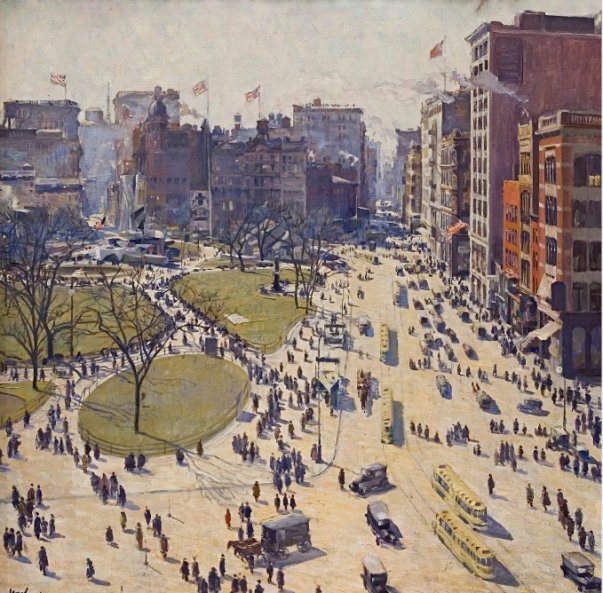
The Battery by Walter Ufer (1918)
In the Winter of 1918, whilst back in New York, Ufer visited a friend of another of his wealthy patrons, William H Klauer, and completed the bird’s-eye view painting The Battery from the view he had from the apartment window overlooking the Battery district of Lower Manhattan in winter. It is the depiction of bustling crowds around the square. Ufer was a patriotic artist and in this work we can see American flags fluttering over tall buildings, one of which housed an army recruiting office. Soon after the finishing this painting Walter Ufer returned to his beloved Taos where he remained for the rest of his life.
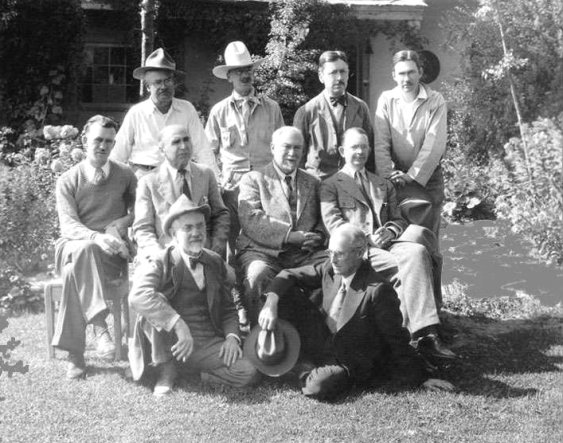
Former members of the Taos Society of Artists photographed by C.E. Lord in the Couse garden, 1932. Back row: Ufer, Dunton, Higgins, Adams. Seated: Hennings, Phillips, Couse, Berninghaus. Front row: Sharp; Blumenschein. Missing: Critcher and Rolshoven.
Soon after Ufer arrived in Taos he was drawn into the town’s artistic community known as the Taos Society of Artists (TSA) that had formed in 1915 The group was formally established by a group of six painters: Bert Geer Phillips, Ernest L. Blumenschein, Joseph Henry Sharp, Oscar E. Berninghaus, E. Irving Couse, and W. Herbert “Buck” Dunton. The Society’s undertaking was to promote the art of Taos and the Southwest, sending traveling exhibitions of their work to major cities across the United States. Walter Ufer officially joined the Society in 1917, and soon became one of its most active and powerful members.
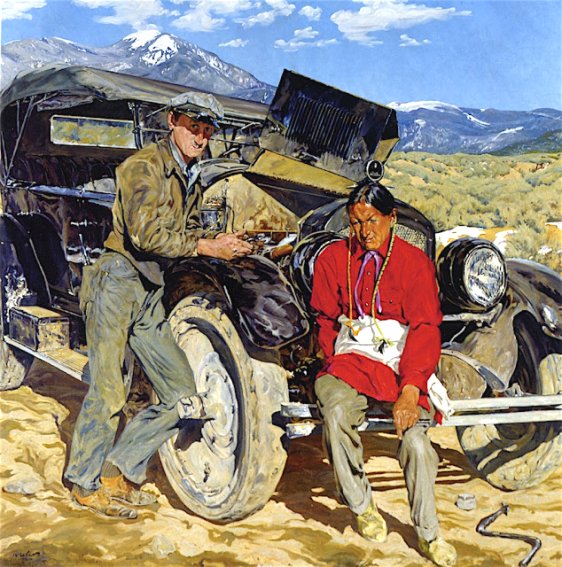
Bob Abbot and his Assistant by Walter Ufer (1935)
The TSA artists, with additional members, also became known as the “Taos Ten” were all captivated by the region’s rugged landscape and its native inhabitants. However, each artist had their own unique style and viewpoint. Walter Ufer came to the group bringing with him his European training and modernist propensities, and he was able to add an individual voice. Ufer was known for his strong compositions, the use of a vibrant colour palette, and a more direct, and less romanticized portrayal of his subjects in comparison to some of his fellow members. However, he still collaborated closely with the other members of the TSA all the time sharing ideas and participating in the Society’s collective efforts to gain national recognition for Southwestern art. The TSA played a very important role in popularizing images of the American West and its indigenous peoples and enhanced the nation’s perception of this unique region.
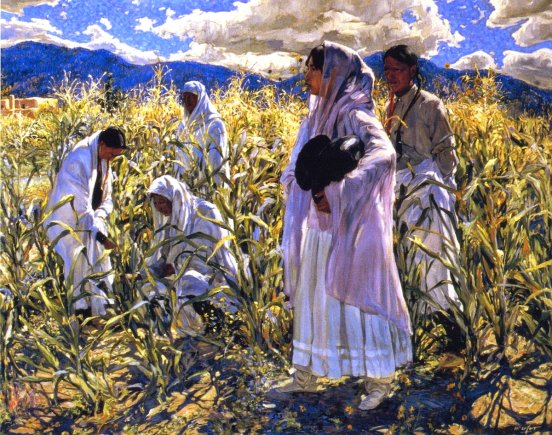
Indian Corn by Walter Ufer
Ufer had moved to Taos on his own leaving his wife Mary behind in Chicago. She would not join her husband until 1916. Shortly after arriving in Taos Ufer was quick to contact the community leaders such as the local doctor, Thomas P. Martin, whom he lodged with for the first summer. The doctor treated many of the TSA artists and often was paid for his services in the form of paintings. The same system of payments was also afforded to many of the local businesses.
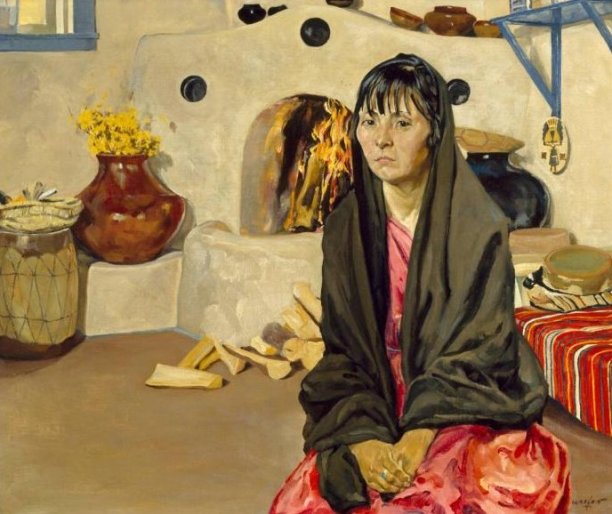
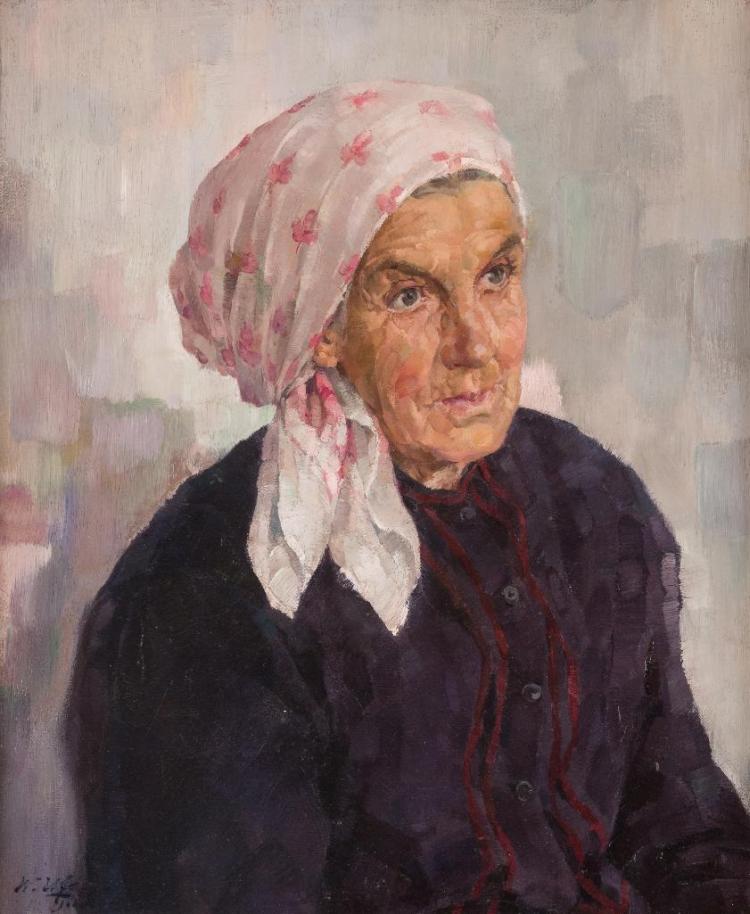
Anna by Walter Ufer (1920s)
Ufer soon built up a large collection of paintings and exhibited seventeen paintings in the reception room of the Palace of the Governors. His offering achieved excellent reviews with an article in the November 1914 issue of the local newspaper, El Palacio entitled “Exhibit by Chicago Artist,” the reviewer called each of Ufer’s landscapes a gem, although his figures are his forte.” It was his masterly ability to paint figures that enhanced Ufer’s reputation as an artist, one which would grow most significantly from his work with the human figure even though he was a master of being able to conquer the ambiance of mother nature.
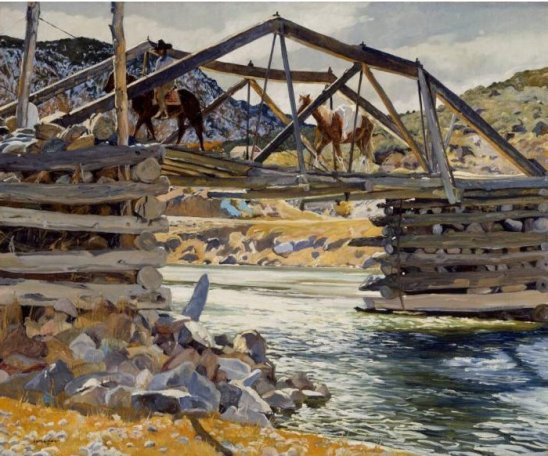
Crossing the Rio Grande (c.1930)
Walter Ufer moved between Taos, New Mexico in the summer and Chicago during the winter months. He had broken off relations with his former patrons and from 1919 to 1924, the New York art dealer John E. D. Trask had become Ufer’s personal agent. Trask was well-connected in the art community, which had him well positioned to sell his clients’ work. He was pleased to have Ufer as a client as he believe3d that the artwork of Ufer would create a type of image with a broad appeal and often voiced the opinion that every American home should have a painting by Walter Ufer, an artist whose reputation was well established.
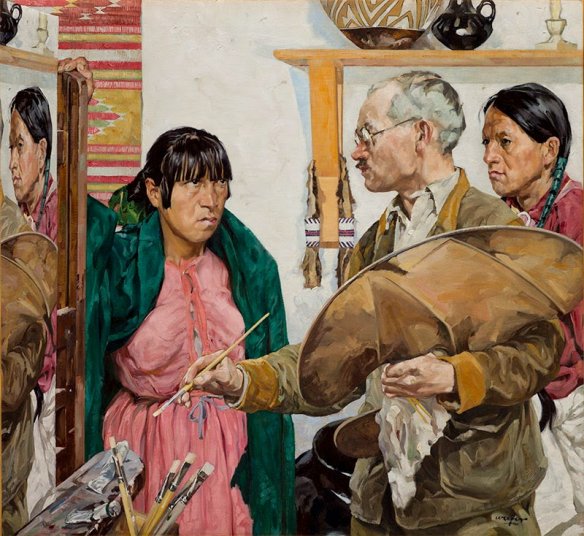
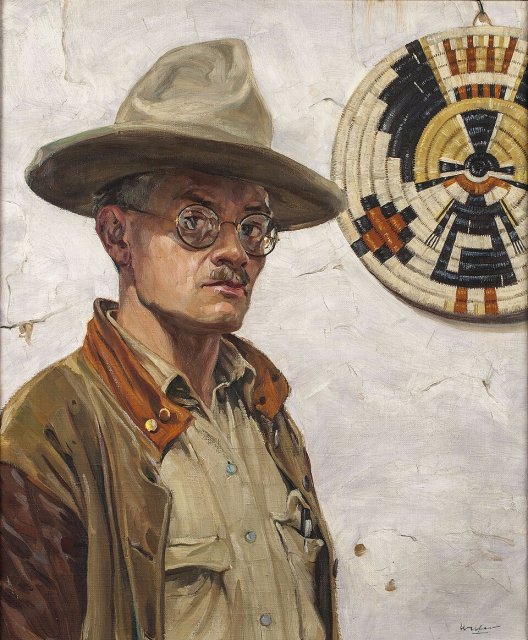
Self portrait, Paint and the Indians by Walter Ufer (1923)
Trask was a great promoter of Ufer’s works and had them placed in several museums, art associations and private collections. Besides Chicago collectors and the Art Institute of Chicago, Ufer’s paintings were acquired by the Pennsylvania Academy of the Fine Arts, the Brooklyn Museum of Art, the Corcoran Gallery, the Baltimore Museum of Art, and the National Academy of Design. At this point, the sale of Ufer’s paintings was as strong as any artist working in Taos, perhaps in America and his earnings were high with Ernest Leonard Blumenschein, an American artist and founding member of the Taos Society of Artists, claiming that Ufer was earning $50,000 a year. This has since been queried as the sales records in Ufer’s archives does not support Blumenschein’s contention. In those archival records Ufer’s gross income totalled approximately $10,000 annually until the middle 1920’s at which time art market collapsed.
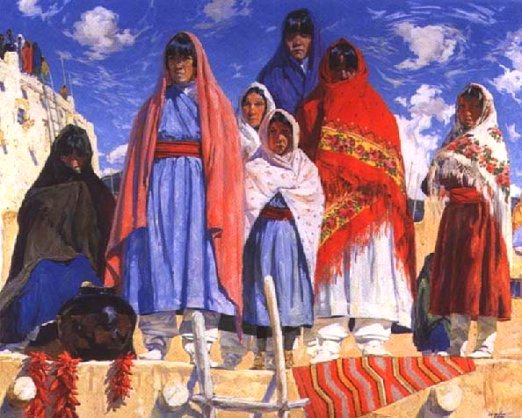
The Audience by Walter Ufer (1917)
Things began to go wrong for Ufer once his promoter and agent Trask retired. Ufer tried to sell his work to galleries in New York and Chicago but with little success and this heralded the start of Ufer’s downfall. Sales of his artwork fell dramatically and yet Ufer failed to rein in his expensive lifestyle and soon his spending habits were outstripping his earning power. When in Chicago he continued to stay at the expensive Bismarck Hotel, always on the look-out for a sale while consuming increasing amounts of alcohol. Even though he maintained his Chicago contacts, he had difficulty selling his pictures. Ufer’s finances took another downward turn with the arrival of the Great Depression, and he was forced to borrow money and yet seemed oblivious to his personal circumstances. Eventual realisation caused him to turn even more to alcohol and periods of debilitating depression. By the early 1930s Ufer had lost his battle with alcoholism and found it difficult to paint and even when he did, the results were of poor quality in comparison to his earlier work.
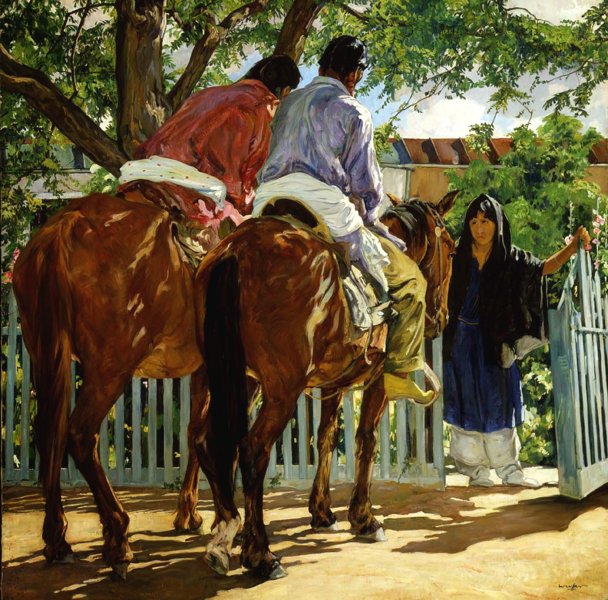
Callers by Walter Ufer (1926)
His wife, Mary, who was living apart from her husband in Chicago begged him to leave Taos and join her in Chicago where, she believed it would be cheaper for two to live. Regrettably, Walter was adamant that his home and life was in Taos and that he would again enjoy success with his artwork and once again regain his national reputation. His health had slowly deteriorated and despite the support from afar from his wife and a few friends, the end came on August 2nd, 1936, when Walter Ufer died after experiencing a ruptured appendix. He died in St. Vincent’’ Hospital in Santa Fe, from peritonitis a fortnight after his sixtieth birthday.
Once again information for this blog came from a number of excellent websites:
Walter Ufer (1876-1936) Essay by Dean Porter, Ph.D. © Illinois Historical Art Project





















 my daily art display