Lot and his Daughters by Artemisia Gentileschi


Lot and His Daughters by Artemisia Gentileschi (C.1640)

The other day I was asked a question about a painting and the painting within that painting and it was whilst researching into the answer I came across My Daily Art Display’s featured painting of today.  My Daily Art Display painting today is entitled Lot and his Daughters by Artemisia Gentileschi.  I had previously featured a painting with the same title by Lucas Cranach the Elder back on August 20th and there are numerous similar works by other Renaissance artists who have depicted the biblical scene including Orazio Gentileschi, the father of today’s featured painter.

Artemisia Gentileschi was born in 1593 in her parents’ home on Via Ripetta, near S. Giacomo degli Incurabili, a church dedicated to St James the Great, in the Corso near Piazza del Popolo. She was the first born of five children of the Tuscan painter Orazio Gentileschi, then 30, and Prudentia Montone Gentileschi, who was then just 18 years old.   The Gentileschi family always lived in the artists’ quarter between Piazza del Popolo and Piazza di Spagna, in the Campo Marzio, Latin for the Field of Mars and the nearby church of Sta. Maria del Popolo, which was built in 1520 and contains works by Raphael, Bernini and Caravaggio.  Artemisia’s mother died in childbirth aged 30 when Artemisia was just twelve years of age and she was brought up by her father.  Artemisia studied painting in her father’s workshop and accounts of her early life tell of how she was a far better student than her brothers who were also being trained as artists by their father.  Her father introduced her to the Roman artists of the time including the great Michelangelo Merisi da Caravaggio.

Much of Orazio Gentileschi’s work was influenced by Caravaggio and in turn Artemisia’s style of painting in her early artistic days was also inspired by him.  The one main difference between the painting styles of father and daughter was that Orazio’s works were idealized, her paintings were more naturalistic in nature.  Artemisia was indebted to her father in the way he supported her artistic ambitions as at that time women were not considered to be intelligent enough to be an artist and her artistic talent, which was plain to see even in those early days, was heavily criticised by her male counterparts who were jealous of her artistic gift.  Artemisia was not to be put down and fought for her right to become an artist and her determined and unwavering attitude eventually gained her the respect she deserved and ultimately it gained her justifiable credit for her work.

She produced her first major work at the age of seventeen.  It was Susanna e i Vecchioni (Susan and the Elders) which she completed in 1610.  This biblical subject was another which had been, and was to be painted many times over.  However Artemisia’s painting shows how she incorporated the realism of Caravaggio into the work and is one of the few Susanna paintings showing the actual sexual assault of the two Elders as a traumatic event.

Two years later an incident occurred which was to change the course of Artemisia’s life.  Her father was working on a commission for Pope Paul V inside the Pallavicini Rospigliosi Palace along with fellow painters, one of whom was the Florentine artist,  Agostino Tassi.  Orazio got on well with his fellow worker and contracted him to tutor his daughter privately. It was during this tutelage that Tassi raped Artemisia. At the time she was nineteen years of age.  Instead of reporting the incident to her father she said nothing and continued to have sexual relations with her mentor, as Tassi had managed to placate her by promising her marriage.   Tassi however, had other ideas and broke off the liaison citing her unfaithfulness with another lover as the reason for the end of the relationship.   It was at this point that Artemisia’s father pressed rape charges and Tassi was arrested and put on trial for rape and for the theft of a painting from Orazio’s workshop.

The trial lasted several months and is well documented and the transcripts of the trial still exist.   The case followed a similar pattern that is familiar nowadays with the defendant maintaining that his victim had not been a virgin but was a willing lover and in fact had had many lovers and was an insatiable “whore”.  The assertion that Artemisia was not a virgin was the crucial issue and it has to be remembered that the fact that Artemisia had maintained that she had been a virgin prior to the rape was the only reason the courts would countenance a trial.  However she had to undergo the embarrassment of a number of  thorough gynaecological examinations by midwives to determine whether she had been “deflowered” recently or a long time ago and she even underwent intense questioning sometimes being tortured using a sibille, a type of thumbscrews, for the officials to come to a decision about the charges she had laid against Tassi.  Tassi denied ever having had sexual relations with the virginal Artemisia and brought many witnesses to testify that she was “an insatiable whore.”   During the court case, it came to light that Tassi had previously been imprisoned for having an affair with his sister-in-law and had planned to kill his wife.   Unfortunately for Tassi, a witness was produced who recounted how he had heard Tassi boasting about raping Artemisia.  Tassi was found guilty and sentenced to one year’s imprisonment.

A month after the trial ended, her father arranged for Artemisia to marry a Florentine artist, Pietro Antonio di Vicenzo Stiattesi and soon after the couple moved home to Florence.  Soon after the trial, Artemisia Gentileschi painted Judith Slaying Holofernes .  The painting is remarkable not only for its technical proficiency, but for the original way in which Gentileschi portrays Judith, who had long been a popular subject for art.  A year after moving to Florence, Artemisia gave birth to their daughter Prudentia.  In all they had four sons and the one daughter but it was only Prudentia who survived childhood.  She and her husband worked at the Academy of Design, and Artemisia became an official member there in 1616.  This was an extraordinary tribute to be paid to a woman of her day and this almost certainly came through the good auspices of her Florentine patron, the Grand Duke Cosimo II of the powerful Medici family.   It was during her time in Florence, that he commissioned a number of  paintings from her and soon betters her husband’s reputation.  Artemisia Gentileschi remained in Florence producing works for Cosimo II until his death in 1621 at which time she returned to Rome.

The following year her husband is charged with assaulting one of a group of Spaniards, who were outside their home serenading Artemisia. By 1623, her husband is no longer listed as being a household member and it appears that they have separated permanently. Artemisia continued to live in Rome until about 1627,when she moved to Venice.  A year later she was in Naples, living with her daughters and servants.  Always in search of new patrons she finally found one, King Charles I of England who was an art-collecting monarch and who surrounded himself with many continental artists including Artemisia’s father Orazio.  Her patronage ended suddenly with the outbreak of the English Civil War and the execution of her patron Charles.  Artemisia returned to Naples where she spent the rest of her life.  She died in there in 1654, aged 61.

Although the story about Lot’s wife being turned into a pillar of salt when she disobeyed God by looking back at the burning cities of Sodom and Gomorrah is very well known and told to children who receive bible studies or religious education, the follow-up biblical tale about Lot being plied with wine until he was drunk by his daughters, who then seduce him, and have a sexual relationship with him in order to have children is for obvious reasons often left off the religious curriculum in schools, or at least I can say, with hand on heart, it wasn’t mentioned during my religious lessons.

The Bible passage Genesis (19: 30-38) sets the scene:

30 Lot and his two daughters left Zoar and settled in the mountains, for he was afraid to stay in Zoar. He and his two daughters lived in a cave. 31 One day the older daughter said to the younger, “Our father is old, and there is no man around here to give us children—as is the custom all over the earth. 32 Let’s get our father to drink wine and then sleep with him and preserve our family line through our father.”

33 That night they got their father to drink wine, and the older daughter went in and slept with him. He was not aware of it when she lay down or when she got up.

34 The next day the older daughter said to the younger, “Last night I slept with my father. Let’s get him to drink wine again tonight, and you go in and sleep with him so we can preserve our family line through our father.” 35 So they got their father to drink wine that night also, and the younger daughter went in and slept with him. Again he was not aware of it when she lay down or when she got up.

36 So both of Lot’s daughters became pregnant by their father. 37 The older daughter had a son, and she named him Moab; he is the father of the Moabites of today. 38 The younger daughter also had a son, and she named him Ben-Ammi ; he is the father of the Ammonites of today.

Artemisia Gentileschi painted the subject in the 1640’s at the height of the Baroque era.  In the painting she elected to portray the scene of wining and dining prior to the first seduction.  Lot sits between his two daughters at the entrance to their cave.   In the left background, far behind them, the city burns, and in the middle distance Lot’s wife is frozen into a Baroque statue, her arms outstretched in terror. The three main figures are intricately interlocked by a system of rhyming arms and legs.   Three prominent arms take us across the painting from left to right in a slowly falling rhythm: the daughter’s arm on the wine jug rhymes strongly with Lot’s lower arm which in turn intersects with a third arm that curves gently down to the tabletop. This strong physical  linking, with its relationship to the wine jug, wine glass and bread, has set the scene and in some ways incriminates the father and daughters in the incest which follows.  In this portrayal of the scene unlike others the artist has not depicted Lot as somebody who is so drunk that he is incapable of knowing what is happening and thus unable to thwart the incest.  He is not shown as a passive victim of the affair.  Artemisia has portrayed all three members of the family as having an active role of what is about to happen.  The girls are virgins, a state which will soon change.

The daughter to the right of the painting is well highlighted and one must suppose that she is the elder daughter and the first to seduce her father.   Look at the colours of the girls’ clothing; blue, white and gold.  We have the rich blue which is the colour often used in the portrayal of the Virgin Mary.  We have the white which symbolises virginal innocence and we have gold which is symbolic of purity and preciousness.  The elder daughter twists round, almost contorted, to look at her father.  One end of the rich blue fabric snakes between her thighs whilst the other end lies close to the thighs of her father.  Is that just coincidental or are we to believe that maybe Artemisia has placed the sash between the daughter’s thighs as an indication that this is exactly where her father will position himself during their sexual act?  Again, are we reading too much into the painting if we compare the bread which is on the table as having had its outer skin violently broken and its fresh interior exposed to the light with the act of the virgin being deflowered?  Another strange departure from the biblical tale is the action of the father.  In the Bible we are told that the daughters plied their father with drink so he became drunk and did not know what was about to happen, but look closely at the picture.  The daughter with the wine is on the left and the father is passing his wine glass to the daughter on the right as if he is plying her with wine and not the other way around.  Look at his facial expression.  What do you read into it?  Is it a look of a man who is becoming befuddled and not in control of the situation or is this the look of a man who is beginning to enjoy himself and is encouraging his elder daughter to imbibe and  take pleasure in what is happening?  Is this another way in which Artemisia is implicating him in the sexual acts which were to follow?  Is Artemisia trying to tell us that the man is not without guilt?  So the question you must ask yourself as you look at this painting is whether the artist is portraying Lot as almost a lecherous old man or one that is being hoodwinked by the daughters?  If you believe the former, as a lot of feminists do, why did Artemisia portray him that way?  Had her being raped altered her view of men and thus she would not have us believe Lot was just an old man being hoodwinked by his daughters?  Remember also that her artistic career and her eventual fame did not come easily as she was thwarted throughout her life – by whom?  Men !!!!

Many questions and some controversial answers.   I will let you form your own conclusions.

Just a little addition to the original blog:

The sibille was a long cord which was wound round the base of each finger then the palms of two hands were tied together, palm to palm, at the wrists.   Then the cord was threaded around each pair of fingers.  A large wooden screw is then attached and turned so the cord tightens digging into the flesh, cutting it and eventually it would cut down to the bone.  The pain would have been excruciating.
A Moonlight Effect by Paul Sandby

Landscape painting became the most inventive form of art in Britain during the late eighteenth and early nineteenth century.  Traditionally, paintings of the British landscape had been a way of showing off magnificent country houses, and were often commissioned by wealthy landowners to show off their estates and wealth.  However in the late eighteenth century the landscape became the subject of a more poetic vision. There was a growth in the urban middle-class and for them landscape art provided a romantic ideal of the landscape as the source of timeless values which could be enjoyed by anyone.  Landscape paintings were now being viewed as portraying idyllic places of rest and solace.  Landscape art in the 18th century did however have its detractors.  The Swiss-born artist Henry Fuseli, when once lecturing his art students, identified landscape art as a low branch of painting.  He described it:

“…the tame delineation of a given spot;   what is commonly called Views is  little more than topography; ….a kind of map-work”……”

My featured artist today would not have agreed with Fuseli’s description, as he was one of England’s great landscape artists.  His name is Paul Sandby.  Sandby was born in Nottingham in 1731.  His father Thomas was a framework knitter and he had a brother, also named Thomas, who was ten years older than him.  The boys had a comfortable upbringing and it is thought that they both received drawing tuition from Thomas Peat, a Nottingham-based land surveyor.  Both boys showed great aptitude and in 1747 Paul, then aged sixteen, left Nottingham to take up employment as a military draughtsman.  After the Battle of Culloden the English felt the need to map the Scottish landscape with detailed records of forts and castles and Paul Sandby was involved in the survey and from his office at Edinburgh Castle, where he worked as a mapmaker, he developed his landscape drawing technique.

After his work in Scotland he went on to paint much of Britain. In 1752, he, along with his brother, took up a post producing landscapes of the royal estates at Windsor.   Importantly in 1770, he travelled through Wales and was one of the first artists to paint landscapes of that country.  He popularised the area by not just exhibiting paintings but widely circulating printed images and developing an innovative print method, aquatint, a variant of etching, which echoes the washes of watercolour rather than relying on pure lines.   He returned to Wales in 1773 and toured the south of the country along with Sir Joseph Banks, the naturalist and botanist.  This sketching trip resulted in the 1775 publication of XII Views in South Wales.  A further twelve views were added the following year.

In 1757, Sandby  married Anne Stogden.   In 1768, the same year as his election as a Royal Academician, he was appointed chief drawing master to the Royal Military Academy at Woolwich, a position he held for over thirty years,.  His son Thomas Paul was eventually to succeed him in that post.

 Unfortunately for Sandby the public fell out of love with his fresh and uncomplicated natural style of paintings, which he embraced, and he was ultimately forced to petition the Royal Academy for financial support to supplement his modest pension. He died in 1809, his obituary describing him as the ‘father of modern landscape-painting in watercolours’.  He is buried in St George’s Burial Ground London.

Gainsborough praised Sandby as one of the first artists to paint what he termed “real views”, ones which were topographically accurate as opposed to idealised compositions.  There was a large gap between the topography and the ideal landscapes.  The topographer accurately recorded what he saw whereas the ideal landscape artist manipulatesd his landscape for aesthetic ends.  Paul Sandby endeavoured to bridge that gap.  He kept faith with his topographical skills but managed to bring expression and sensitivity to his work.  He did this by carefully choosing the viewpoint for the composition.  He also liked to incorporate realistic human figures in his works.  Throughout his career Sandby only ever used the medium of watercolour.

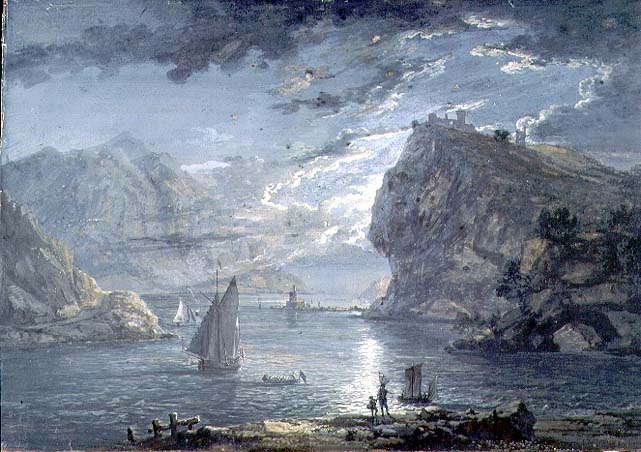
My Daily Art Display featured painting today is entitled A Moonlight Effect which Paul Sandby completed around 1790 and which can be found in the Nottingham City Museums and Galleries.  This is one of a number of paintings Sandby completed which depicted a place or a building as seen by moonlight.  In the 1770’s the early romantic painters, such as Joseph Wright of Derby and William Hodges, had taken a special interest in the portrayal of moonlight effects; and the image of the moon and of moonlight became one of the great romantic images.  For the romantic artist, who saw himself as alienated from society, the moon was often seen as an image of constancy and hope in a changing world, and it adequately depicted that longing and yearning or an unattainable perfection which lies at the heart of romanticism.

I love this painting with its silvery moonlight. 

Maybe you will have noticed that My Daily Art Display has not quite been a “daily” offering recently.  The reason for that is not because I am losing interest or having difficulty to find yet another painting, albeit it is getting harder.  The reason is that I have been trying to build up a reserve stockpile of blogs for when I am away on holiday in case I don’t have the time to research and compose a blog.  Today we are setting off to Hong Kong and Australia for a three-week break.  I am hoping I will still have access to the internet when I am away so that I can send out one of my “reserve” blogs, at least every other day.  I am hoping to take in a couple of art galleries when I am away and I am looking forward to seeing the depth of art on offer.


The Hunt in the Forest by Paolo Uccello

Hunt in the forest by Paolo Uuccello (c.1470)

When I visited the Claude Lorrain exhibition at the Ashmoleon Museum in Oxford last month,  I had time to look around their permanent collection of painting.  To my mind they have one of the best collections on offer with works from artists of different nationalities and from different eras.  I strongly recommend you visit this gallery for I know you will not be disappointed.

The painting I am featuring in today’s My Daily Art Display is one by Paolo Uccello entitled The Hunt in the Forest which he completed around 1470.  Hunting was a very popular pastime for the aristocracy in those days.  The depiction of hunting in art goes back to the Ancient Greeks when it can be seen on their tableware.  During the time of the Romans, many hunting scenes can be found on their sarcophagi and in Medieval times hunting scenes could be found in their manuscripts, wall paintings and tapestries.  There were many forms of hunting in the Medieval times, such as hunting with hawks, which took place mainly in the spring and summer and the boar and bear hunting which took place during winter.

Cassone (chest) with spalliera (backboard)

It is believed that this work of art you see before you was a one-off painting and not part of a series.  It is of an unusual size, measuring 63cms tall x 165cms wide.  With those dimensions it could well have been intended for the front panel of a cassone, a Renaissance marriage chest or a spalliera, the back of a Tuscan bench or settle, or the headboard or footboard of a bed.  The spalliera paintings were very popular at the time this painting was completed.  Therefore we are probably safe to assume that this work was painted for a wealthy family to be seen by guests as they entered the house and went into the camera, the reception room which was also often the bedroom, where the spalliera or cassone would be in pride of place.

 So what do we see before us?  Is it a painting of a real hunt or is it an imaginary scene?  Art historians tend to believe the latter is correct as hunts such as these would have had a number of different species of dogs each trained to carry out a specific task in the hunt.  There would be dogs which were good at following scents.  There would be another species of dog which were fast running and capable of catching and bringing their quarry to ground.   In this painting we only have the one type of dog.   In the painting we also only see one type of deer, the roebuck, and that would be unlikely to be the case in a real hunt.  The setting for the hunt is also very questionable.  The scene is dark and it appears that the hunt is taking place at twilight or during the night and this is not the normal time of day set aside for hunting.  Hunting, especially in forests, would normally take place during the day when the maximum amount of sunlight can filter through the trees.

The view we have before us is also one of organised chaos !  The hunters seem to be converging upon each other from two sides while the dogs and the hunted animals seem to be disappearing into the central distance.  There seems to be no attempt by the hunters to enact a carefully co-ordinated plan to capture their prey.

I love the vibrant colours in this painting.  Look how Uccello has given the leaves on the trees golden highlights.  I love the bright livery of the horses and the colourful clothing of the aristocratic hunters atop their horses, ably being assisted by the beaters.  On the livery of the horses we see many examples of a golden crescent moon emblem which could be a sort of homage to Diana the Roman goddess of hunting (Artemis the Greek goddess of hunting) who was often seen wearing a crown shaped as a crescent moon.

The aristocracy liked to have hunting scenes adorning the walls of their mansions.  Hunting, in some way, like chivalric jousting tournaments, was akin to battle and those taking part in such events were looked upon as being fearless and athletic.  Men who organised such hunts (maybe not in this case!) were looked upon as being tactically astute and great leaders and just the qualities which were needed for those who were to lead armies into battle.  In those days hunting was a very prestigious pastime and strangely, sometimes looked upon as an allegory of love.

The one question, which has yet to be answered and one can only guess at it, is who commissioned Uccello to carry out this work.  We know that this was Uccello’s last major painting before he died in Florence in 1475 and historians think the painting was completed around about 1470.  Art historians have come up with a couple of ideas but none our conclusive.  I have already mentioned the crescent moon emblems on the horses livery and as well as being associated with Diana they were also the emblem of the Strozzi family.  The Strozzi clan were an ancient and noble Florentine family who played an important part in the public life of Florence and this painting may have been commissioned by one of them.  The other possibility was that Uccello painted this picture whilst he was still living in Urbino and before he returned to Florence.  We know that he was in Urbino from 1465 to 1469 and if that was the case he could well have been commissioned by his patron, the Duke of Urbino, Federico da Montefeltro whose palace was full of works of art.

This is undoubtedly a masterpiece and as we look at the painting we can almost hear the noise made by the hunters crashing through the undergrowth and the baying of their animals as they chase after their unfortunate quarry.  It is an exciting painting full of vitality and colour.  The artist encourages us to stare into the depth of the forest and our eyes alight on Uccello’s distant vanishing point in the central background but no sooner do we stare into the distance than our eyes dart back to the foreground, seduced by the colours and the rhythm of the hunt. 

I just love this work and it is even better to stand in front of the original.

The Night of Enitharmon’s Joy by William Blake

The Night of Enitharmon’s Joy by William Blake (1794)

Today I am once again dipping my toe into the strange world of William Blake the 18th century painter, printer, book illustrator and poet.  I went through his life story in a couple of my earlier blogs (October 30th and November 1st) and if you haven’t read them I urge you to go to them now before you read about this painting as it may just give you a better understanding as to why an artist would depict such weird but wonderful scenes.  My Daily Art Display featured painting today has three titles.  It is usually known as The Night of Enitharmon’s Joy but is often referred to as The Triple Hecate or simply The Hecate.   It is a colour print finished in ink and watercolour on paper.   

If, like me, you have never heard of Enitharmon or Hecate, let me take you into Blake’s strange world of mythopoeia, his own fictional mythology.  We are all used to hearing tales of Greek and Roman mythology but William Blake made up his own mythology with its own characters.   I suppose he can be compared with Tolkien and his stories of Middle Earth or C S Lewis and his tales of Narnia.   For Blake, who all his life experienced visions of heavenly bodies whom he would communicate with, his mythological characters were real.

Enitharmon is a major female character in William Blake’s mythology and she plays a major role in some of his prophetic books.   In this work Blake portrays her as an androgynous Hecate, one with a combination of male and female characteristics, as can be seen in this coloured print.   Hecate is the goddess of witchcraft and you may have come across her in Shakespeare’s Macbeth.  She appeared to the three witches in the play, as they sat around their bubbling cauldron, she came to them demanding to know why she has been excluded from their meetings with Macbeth.   To William Blake she represents female domination and sexual restraints that limit the artistic imagination.  After her birth, Enitharmon asserts that women will rule the world, with Man being given Love and Women being given Pride. This would create within men a fear of female dominance that would in turn bring them under control of the females.

Do you remember the famous lines spoken by the three witches in Macbeth as they surrounded the cauldron?

“Fillet of a fenny snake,
In the cauldron boil and bake;
Eye of newt and toe of frog,
Wool of bat and tongue of dog,
Adder’s fork and blind-worm’s sting,
Lizard’s leg and owlet’s wing,
For a charm of powerful trouble,
Like a hell-broth boil and bubble.”

It is therefore not a coincidence that in Blake’s print we can see a frog or a toad, a bat and a snake?  The Night of Enitharmon’s Joy is a large colour print and is plate 5 of Europe, a book written by Blake in 1794 which has the opening line:

“..Now comes the night of Enitharmon’s joy!..”

 In the book, Enitharmon sets the trap of false religion which dominated Europe, for eighteen hundred years between the time of Christ’s birth and the French Revolution.  The night of Enitharmon’s joy is when she establishes her Woman’s World with its false religion of chastity and vengeance.   Blake used pen and ink to give strong outlines to the figures, and to draw locks of hair, the bat, and the donkey’s mane and rough coat. The owl has eyes which have been highlighted with a bright opaque red wash.  The figures have been given form and roundness by washes of intense but transparent colour.   The sky is dark as are the lichen-covered rocks in the left of the work.  A strange-looking evil winged spectre hovers above Enitharmon’s head as a large donkey to the left nibbles on what little vegetation can be found amongst the rocks.

This is yet another weird work by Blake and once again I hesitate to think what was constantly going through his mind as he conjured up these images.

A Burial at Ornans by Gustave Courbet

A Burial at Ornans by Gustave Courbet (1850)

In an earlier blog (November 14th) I looked at the life of Courbet and his painting The Artist’s Studio.  If you have just arrived at today’s blog it would be worth going to the earlier one to read about Courbet’s life and his artistic principles I mentioned in that earlier blog that when he had tried to get his three large painting into the Paris Exposition Universelle of 1855 they were rejected because of their size.  My Daily Art Display featured painting today entitled A Burial at Ornans was one of the three.  This work was even bigger than the The Artist’s Studio, and measures 3.1metres by 6.6 metres and was completed by Courbet in 1850.  Both paintings are housed at the Musée d’Orsay.

Gustave Courbet was born in Ornans in 1819 and this huge painting depicts the funeral of his great uncle at the town in September 1848.   The depiction of the funeral and the laying to rest of the dead is unlike the usual way it would have been portrayed in Romantic or Academic art, where we would expect to see angels of the Lord carrying the soul of the deceased heavenwards.  Gustave Courbet was a realist painter.  In fact he was in the forefront of the Realism art movement, which was a grouping of artists  who believed that they should represent the world as it is even if that meant breaking with artistic and social conventions.  Realist artists painted everyday characters and situations all in a true-to-life manner.  These artists wanted to rid art of the theatrical drama, lofty subjects and the classical style and in its place they wanted to depict more everyday commonplace themes.  Courbet was once asked to incorporate angels in a painting he was doing of a church.  He rejected the request saying:

“….I have never seen angels. Show me an angel and I will paint one… “

The Innocent gaze

This realist art we see before us is exactly as Courbet would want.  It is a funeral scene, warts and all.  It is an unflattering yet dignified scene, but more importantly to Courbet, it is a realistic scene.  There is a stillness and serenity of what we see before us.  There is no attempt to glorify the setting with a grandiloquent and ostentatious depiction of descending angels with God seated on a throne in the clouds above.  In the foreground there is an open grave awaiting the coffin.  The funeral procession approaches from the left.  In the procession we see the pallbearers slowly following the priest and altar boys as they close in on the gaping hole in the ground and the gravedigger, who is on bended knee by the grave.  The figures in red are officials of the church, who assisted at religious functions.  If you look closely at the edge of the grave, you can just make out a skull which presumably was exhumed when the grave was dug out.  The mourners fill the middle ground of the painting.  Grief-stricken women, with handkerchiefs fending off their tears, circle the grave.  It is interesting to note that Courbet did not use models for this scene, which would have been the norm in historical narrative paintings.  Instead he used actual villagers who were at the ceremony, including his sister and mother, and this again highlights his desire for realism.  This is not an en plein air painting for the depiction of the people was done in his studio at Ornans.  Look how Courbet has depicted the young at this event. 

Girl peeking at grave

See how the young altar boy, who is standing behind the priest, stares up at one of the pallbearer.  Courbet has managed to perfectly capture the look of innocence in the boy’s face.  Cast your eyes to the right foreground of the painting and see if you can spot the face of a small girl who is peeking out at the grave.  We just see her face.  The rest of her is almost lost amongst a sea of black clothing.  Look at the way Courbet has kept the heads of the mourners and officials level with the tops of the cliffs and the land in the background.  Observe how only the crucifix reaches reaches above that level into the pale sky, as it is held aloft by an attendant.   Just a coincident or has a little piece symbolism crept into Courbet’s work?

In Sarah Faunce’s biography of Courbet she talked about the reception this painting received from the public and critics.  She wrote:

“….In Paris the Burial was judged as a work that had thrust itself into the grand tradition of history painting, like an upstart in dirty boots crashing a genteel party, and in terms of that tradition it was of course found wanting…”

The critics seemed to miss the histrionics and exaggerated gestures of grief they had been used to seeing depicted in great historical funeral paintings of the past.  They thought this painting was ugly and presumably missed the beauty of angels, puti and the presence of the figure of God sitting aloft awaiting a new entrant to his kingdom.   Another aspect of the painting which disturbed the critics was the fact that Courbet painted this huge work, similar in size to grand historical paintings of the past, centred, in their opinion,  on a subject of little consequence – a burial of a family member.  As far as the sophisticated Parisians were concerned paintings of  rural folk should be confined to small works of art and they were very critical of Courbet’s decision to afford these folk such a large space of canvas.  The fact that he did was looked upon as a radical act.  However Courbet said of the painting “it was the debut of my principles”.   For the critics, if an artist was going to paint such an enormous work, then they expected the subject to be an idealized grand narrative and not just an ordinary every day event.

I end today with two quotes from the artist on his artistic upbringing and his pursuit of Realism and what he tried to achieve.

“…I have studied, apart from any preconceived system and without biases, the art of the ancients and the moderns. I have no more wished to imitate the one than to copy the other; nor was it my intention, moreover, to attain the useless goal of art for art’s sake. No! I simply wanted to draw forth from a complete knowledge of tradition the reasoned and independent understanding of my own individuality…”

“…To know in order to be capable, that was my idea. To be able to translate the customs, idea, the appearances of my epoch according to my own appreciation of it [to be not only a painter but a man,] in a word to create living art, that is my goal…”

And finally his hope for how he would be remembered…………….

“…When I am dead, let it be said of me: ‘He belonged to no school, to no church, to no institution, to no academy, least of all to any regime except the regime of liberty…”

The Artist’s Studio by Gustave Courbet

The Artist's Studio by Gustave Courbet (1855)

Jean-Desiré-Gustave Courbet was born in Ornans, a rugged area in the Franche-Comté region close to the France-Swiss border in 1819.  His father Règis Courbet and his mother, Sylvie were landowners, who owned a vineyard in Flagey, ten miles outside of Ornans.  They were a prosperous family but despite that Courbet’s parents held left of centre, anti-monarchist views.  This was probably a long held passion as his mother’s father had fought in the French Revolution.  At the age of twelve he attended a seminary in Ornans and it was during his time there that, according to his friend and art critic, Jules-Antoine Castagny, he came up before the priest to confess his sins and to have them forgiven.  According to Jack Lindsay in his biography of the artist,  Gustave Courbet: His Life and Art

“…The sins he revealed to his confessor so monstrously exceeded, in number and in kind, the iniquities appropriate to his tender age that nobody was willing to give him absolution…These successive rejections began to affect his reputation…To make sure he had forgotten nothing, Courbet had compiled a list of all the sins it would have been possible to commit, from the most trifling peccadillo to the darkest of crimes…”

This was an early sign of Courbet’s rebellious nature which would remain with him for the rest of his life.  When he was eighteen years of age his father arranged for Gustave to attend the Collège Royal at Besançon to study law.  At the same time he attended lessons at the Académie and studied painting under the tutelage of  Charles-Antoine Flageoulet, who had once been a pupil of the great neo-classical artist Jacques-Louis David.  Courbet left Besançon and moved to Paris.  His father still believed that this move was to further his legal studies but Gustave had other ideas.   Whilst there, he became great friends with Francois Bonvin, the French realist painter and the two would frequent the Louvre and study the Masters.  He also attended the atelier of Steuben and Hesse on the Île de La Cité.   He set about a series of self portraits in the 1840’s, one of which, Self portrait with Black Dog, he submitted to the Salon Exhibition of 1844 and was accepted while the rest of his submissions did not pass the jury’s scrutiny.  This was the start of a long running battle Courbet was to have with the Salon’s juries and lead to many vociferous comments by the artist against what he believed was the Salon jurists’ petty vindictiveness against himself. 

The following three years saw Courbet travelling around Belgium and Holland.  His art was very popular in the Low Countries and he had built himself a large wealthy international clientele.  It was through these connections that his fame as an artist spread throughout Europe.  Courbet was in the forefront of the Realism art movement, a grouping of artists  who believed that artist should represent the world as it is even if that meant breaking with artistic and social conventions.  Realist artists painted everyday characters and situations all in a true-to-life manner.  These artists wanted to rid art of the theatrical drama, lofty subjects and the classical style and in its place they wanted to depict more everyday commonplace themes.     Realism was starting to be popular not only in art but in literature.  Strictly speaking realism in literature denoted a particular kind of subject matter, especially the representation of middle-class life. In literature, like in art, realism was a reaction against romanticism. Realists focused their attention, in the main, on the immediate, the here and now, the specific action, and its verifiable consequence.

Courbet used to meet his fellow realists in the Brasserie Andler,  which was only a few steps away from his studio at 28 rue Hautefeuille in Paris.  He would rub shoulders with writers such as Champfleury and Proudhon and the poet Beaudelaire.   Max Buchon, his old school friend from Ornans would also be there.  Fellow artists, such as the caricaturist and painter Honoré Daumier and Alexandre Décamps were also regulars who congregated at the brasserie. Courbet had carved himself a leading role within this group of Realists.  The biographer Jack Lindsay quoted in his book Gustave Courbet his life and art,  the words of the 19th century French journalist and writer Alfred Delvau,  who described Courbet’s role within this circle of friends and his realist philosophy, saying:

 “….And in this temple of Realism, where M. Courbet was then the sovereign pontiff and M. Champfleury the cardinal officiating, there were then, as the public of boozers, students, and wood engravers understood, only realists and non-realists…”

Courbet’s  many pictures of peasants and scenes of everyday life established him as the leading figure of the realist movement of the mid nineteenth century.  He was an outspoken opponent of the French government and it was during the short lived Paris Commune that he took part in the destruction of the Vendôme Column in 1871 during the uprising in Paris which followed after France was defeated in the Franco-Prussian War.   Courbet expressed his reasoning for the removal of the Vendome column, saying:

“…In as much as the Vendôme Column is a monument devoid of all artistic value, tending to perpetuate by its expression the ideas of war and conquest of the past imperial dynasty, which are reproved by a republican nation’s sentiment, citizen Courbet expresses the wish that the National Defense government will authorise him to disassemble this column…”

The uprising was chiefly caused by the disaster of the war and the growing discontent among French workers.  For Courbet the Column was totally devoid of artistic value but more importantly he was against what it stood for.    For his part in the pulling down of the column he was sentenced on 2 September 1871 by a Versailles court martial to six months in prison and a fine of 500 francs.  In 1877 the estimated cost of rebuilding the Vendome was finally established as being 323,091 francs and 68 centimes. Courbet was told he must pay for it to be rebuilt and he was to pay a fine in yearly installments of 10,000 francs for the next 33 years meaning the final payment would be when he had reached the age of 91.   On July 23rd, 1873 Courbet, through the assistance of a few friends, fled France for Switzerland as he could not, nor did not want to pay his fines.     On December 31st 1877, in La Tour de Peilz in Switzerland where he was living in exile, a day before the payment of the first installment was due, Courbet died, aged 58, of a liver disease probably due to his bouts of heavy drinking,

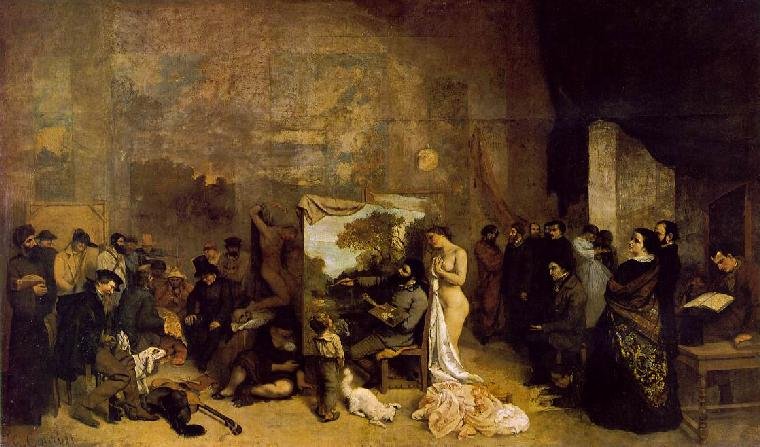
In My Daily Art Display today I have  featured one of Courbet’s greatest painting entitled The Artist’s Studio which he completed in 1855 and which had a secondary title: A Real Allegory of a Seven Year Phase in my Artistic and Moral Life.  It was an enormous painting, 3.61 metres tall and almost 5.98 metres wide and can be seen in the Musée d’Orsay in Paris.  Courbet submitted this painting with thirteen others to the Exposition Universelle of 1855.  The Exposition Universelle was an International Exhibition held on the Champs Elysées in Paris from May to November in that year.  This Paris exhibition came four years after London had held their Great Exhibition of 1851.  To Courbet’s horror, three of his paintings were rejected on the grounds that they were far too big for the exhibition as space was restricted.  One of these was today’s featured painting and one of the others was his mammoth work, A Burial at Ornans, which was 3.14metres tall and 6.63 metres wide.  However Courbet was not to be denied and decided to withdraw all his paintings and with the help of his patron Alfred Bruyas set up a rival exhibition with forty of his works in a rented hall next door to the official exhibition, which he called The Pavilion of Realism.   It did not prove to be a great success as attendances and sales were poor and many just came out of curiosity, but for fellow artists, Courbet’s gesture was inspirational and his standing in the artistic community rose.  He was now acclaimed as a hero of the French avant-garde and an inspiration to the young up and coming artists.  In some ways this alternate exhibition running alongside the official exhibition was a forerunner of the Salon de Refusés, which came into being as an alternative to the Salon exhibitions in Paris  in 1863 and again in 1874 during the Imressionist era.

The work before us today was looked upon as an allegory of Courbet’s life as a painter and the various figures depicted are allegorical representations of various influences on his life.  So who are all the people?   In some ways the work is a kind of triptych with three distinct sections.  On the left hand side of the painting are various figures from the different levels of French society.  To my mind the left hand side includes things and people Courbet disliked and sums up what he believes was wrong with society, such as religion and poverty, while on the right of the painting he has presented us with things and people he holds dear. 

Let us first look at the grouping on the left hand side of the painting.  On the ground sprawled beside the canvas sits the figure of a starving peasant.  More than likely Courbet is depicting an Irish peasant, as the Great Irish Famine had taken place only a few years earlier.  To the left of the peasant there are several other figures.  This strange grouping appears to include a priest, a prostitute, a grave digger and a merchant. In the far left of the painting we see the standing figure of a Jewish Rabbi and seated on a chair before him is a hunter with several dogs.  This depiction of this man is quite interesting as it is thought by use of x-ray analysis that the figure of the man was added later and was not mentioned in Courbet’s letter to Champfleury when he wrote about the details of the work.  So what was so important to cause this late addition.  Art historians would have us believe that he is an allegory of the then current French Emperor, Napoleon III.  He has been identified as such because of his famous hunting dogs and also by his twirled moustache which he was famous for.  So why place the French ruler on the left side of the painting?  The answer probably lies in Courbet’s early upbringing in an anti-monarchist household and Courbet’s inherent dislike of the emperor.  It was Courbet’s belief that Napoleon III was no better than a thief having stolen the country from its people.   In the centre of the work, behind Courbet’s landscape canvas we see a nude male model, on the floor we see a guitar, dagger and hat, and on the table a skull.  These were all accoutrements of traditional academic art which Courbet loathed. 

In the middle, taking centre stage and thus the centre of our attention, we see the realist artist himself sitting before his easel working on a landscape.  He has placed himself as the main focus of the painting and maybe it was his way of projecting himself as the leader of the Realist movement.   Behind Courbet, and being ignored by him, is a nude model, which symbolises academic art tradition which Courbet disliked so much.  Standing in front of Courbet, looking totally mesmerised by what Courbet is doing, is a small boy.  It is believed that Courbet included the boy as a symbol of the innocent eye of the artist but of course the mesmeric admiration of the boy for what Courbet has painted may just be something artists crave.  By the boys feet there is a white cat.  

Beudelaire by Gustave Courbet (1848)

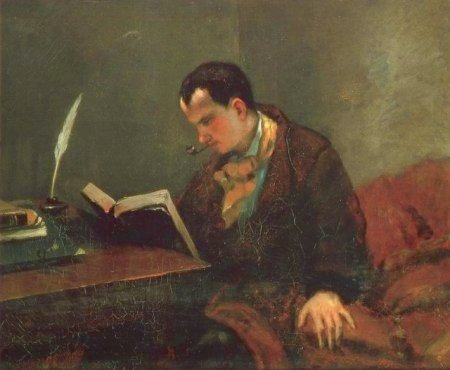
On the right of the painting is another group of people.  This grouping is a selection of his friends, associates and admirers.  It is possible to identify some of these figures.  The man standing and looking across to the left hand side, with a beard, is Alfred Bruyas a long-time patron of Courbet.  Standing behind him, facing us,  is Pierre-Joseph Proudhon, politician and socialist philosopher and another friend of the artist. Moving away from those two and towards the foreground we see a man seated.  This is the French novelist Jules Husson, whose non de plume was Champfleury and who was a greater supporter of Courbet’s realist art.  The man at the extreme right of the painting, reading a book, is the French poet Beaudelaire and we know that Courbet’s depiction of him is from a portrait he did of him seven years earlier.  Beaudelaire at the time had a quadroon (mixed race) mistress and Courbet had included her in the painting just to the left of Beaudelaire (as we look at him) but Beaudelaire was not happy with her inclusion and persuaded Courbet to paint her out of the scene.  The presence of Beaudelaire’s mistress was only discovered recently when the painting was cleaned and x-rayed.  Standing quite prominently in the group, in front of Beaudelaire, is a well dressed bourgeoisie lady with a brown-patterned shawl and her companion.  Art historians have not come to a definitive agreement as to who they are but one theory is that it is Christine Ungher and her husband François Sabatier, another of Courbet’s patrons.  Notwithstanding what art historians believed to be the message of the painting Courbet expressed his thought process behind what he had achieved with this magnificent work in a letter to Champfleury.  He wrote:

“….It’s the whole world coming to me to be painted,  on the right are all the shareholders, by that I mean friends, fellow workers and art lovers. On the left is the other world of everyday life: the masses, wretchedness, poverty, wealth, the exploited and the exploiters, people who make a living from death…”.

Silence by Henry Fuseli

Silence by Henry Fuseli (1800)

As you know, I like paintings which have some kind of symbolism or ones which lead art historians to write about their interpretations of what is before us.  It is always interesting to witness how art historians’ views sometimes differ with regards how they interpret what an artist has depicted.  It also gives one an opportunity to air one’s own views about the symbolism and how we want to interpret what we see.   I want you to look carefully at today’s featured painting and work out in your own mind what you are witnessing.  Later, after looking at the life of the artist, I will pose some questions which you may wish to deliberate on and then I will tell you what I see and let us see how close we come together with our interpretations of this beautiful and haunting painting.

My Daily Art Display featured painting today is by Henry Fuseli and is simply entitled Silence.  He completed the work in 1800 and it is now housed in the Kunsthaus in Zurich.  Fuseli was born in Zürich, Switzerland, in 1741 and was the second of eighteen children, of which only five survived to adulthood.   His father was Johann Caspar Füssli, a portrait and landscape painter and later a city clerk.  He was also a part-time writer and was author of the art history book entitled Lives of the Helvetic Painters. Henry’s mother was Anna Elisabeth Füssli (née Waser).  His mother and father wanted Henry to study for the church, and after some home tutoring sent him to the Caroline College of Zurich, where he received a first-class classical education, studying literature, aesthetics, Greek and Latin. It was during his time at this college that he met and became great friends with Johann Kaspar Lavater, who would become a well-known Swiss poet.  In 1761, aged twenty, he was ordained into the church as a Zwinglian minister.  The following year, 1762, Fuseli and his friend Lavater discovered the corrupt ways of a local magistrate and politician Felix Grebel and denounced him publicly.  The magistrate was found guilty and had to make financial reparations, which angered him and his followers, so much so that in 1763 Fuseli had to flee the country and go to Prussia to avoid retribution.

After spending a short time in Berlin, Fussli who by now was an accomplished linguist,  moved to London where he was employed as a translator, translating French, German and Italian books into English. He spent a lot of his leisure time sketching and writing but had little success in getting any of his writings published.  Whilst in London he got to know the artist Sir Joshua Reynolds and on showing the English artist some of his sketches, he was encouraged to devote more of his time on his art and less time trying to become an author, so in 1768 Henry Fussli took Reynolds’ advice and decided to become an artist.

In 1770, at the age of twenty nine, Füssli went along the well-trodden path taken by artists and would-be artists – an artistic pilgrimage to Italy and he remained in that country for eight years.  Füssli was a self-taught artist and whilst in Italy copied many of the works of the Renaissance Masters and spent much time in the Sistine Chapel copying the frescoes of Michelangelo.  It was also his stay in Rome that afforded him multiple sexual forays and these experiences no doubt were the reason behind some of his erotic drawings.  During his eight year sojourn In Italy he also changed his surname to the more Italian-sounding “Fuseli” which he must have believed had a more artistic ring to it. 

In 1779 he returned to Zurich and fell in love.  The woman he loved was the niece of his old friend from the Caroline College, Felix Lavater.  Unfortunately for Fuseli, his love for Anna Landolt vom Rechs was not reciprocated.  One of Henry Fuseli’s most famous paintings, The Nightmare, which I featured in My Daily Art Display (August 8th) is based on an erotic dream he had of this “love of his life”.  Fuseli left Zurich heartbroken and returned to London.  In London, Fuseli exhibited many of his history paintings at the Royal Academy between 1780 and 1786 and by so doing established a reputation in this important genre. He also came into contact once again with Joshua Reynolds, the man who almost twenty years earlier advised him to become an artist.  Reynolds was now the president of the Royal Academy.

William Blake, the English poet and artist met Fuseli around 1787 and they became close friends, with Blake engraving occasional works for Fuseli.   In that same year, Fuseli was elected associate of the Royal Academy and in 1788 he married Sophia Rawlins, a woman who was eighteen years his junior.  It was also around this period of his life that Fuseli became acquainted with the feminist writer Mary Wollstonecraft (her daughter Mary Wollstonecraft Godwin, later Mary Shelley wrote the novel Frankenstein).  She was besotted with Fuseli and even went as far as approaching Fuseli’s young wife’s to share the man between them. Needless to say Fuseli’s wife would have nothing to do with this plan. 

Fuseli was elevated to Royal Academician in 1790 and what was strange about this change of status was that his one-time mentor Reynolds tried unsuccessfully to oppose the appointment.   In 1799 he became Royal Academy professor of painting.   In 1816 Fuseli, Sir Thomas Lawrence and John Flaxman were elected honorary academicians of the Accademia di San Luca at Rome.   Henry Fuseli died at the home of the countess of Guilford at Surrey in 1825, aged 84 and is buried in St Paul’s Cathedral.   Although Fuseli’s reputation is based on his works of art he should also be remembered for his writings on art and the fact that he was a formidable art historian.

So by now you have had time to study the featured painting and maybe you have come to a conclusion of what it all about.  Let me therefore pose some theories and at the same time question you on what you have concluded.  This painting is totally devoid of symbolism and it demands your own determination of what it is all about.  It is enigmatic and frustratingly we do not know what it is all about.  We see a figure, seated cross-legged in an indeterminate place, surrounded by gloom.  There is nothing in the depiction of the background to help us fathom out the mystery.   Is it a man or is it a woman?  Long hair and a shift-like dress, so it must be female or must it be so?  The hands are feminine but maybe the arms, which look quite muscular, are masculine.  For the time being let us presume it is a long-haired female.  Her head is downcast, almost hunched into her shoulders.  She is of an indeterminate age and there is ambivalence about the way she is dressed.  But what of her mood?   What is the state of her mind?  The problem for us when we want to decide the mood of the person is that we can neither see her face nor her facial expression.  One’s face is who one is.  Maybe more importantly, we cannot see her eyes – the windows to her soul.  We cannot therefore try and read her mind.  We have to build up our perception of her by looking at her posture.  As we cannot see her facial expression, can we glean anything by studying the body language?  Are we looking at somebody who is just simply relaxing or are we looking at somebody who has come to the end of her tether and slumps before us almost drained of life?  If I asked you to describe her posture in one word, what would it be?  Despair? Exhaustion?, Acceptance? Resignation?

I don’t have the answers.  Nobody but the artist knows what it is all about.  Why did he give the painting the title Silence?  We can all theorise but nobody can be categorical about the correctness of their theories.  I will leave you with this haunting painting and let you decide.

The Artist’s Studio, Rue de La Condamine by Frédéric Bazille

The Artist’s Studio, Rue de La Condamine by Frédéric Bazille

quem di diligunt, adolescens moritur

Whom the gods love, die young.”

The aphorism comes from the Roman playwright Plautus, who flourished around the end of the 3rd century and actually based his story on a Greek legend about a mother and her two sons.   The point of bringing up this saying is that it unhappily could refer to my featured artist of the day, who was so talented and yet was taken from us at such a young age by war.

Jean Frédéric Bazille was born in Montpellier in 1841.  His father was a senator and the head of an affluent and cultured middle-class Protestant family.    In Montpellier, Jean became acquainted with a friend of his father, a local art collector Alfred Bruyas.  Bruyas was a close friend of Gustave Courbet and he owned a large number of expensive paintings by Millet, Corot, Eugène Delacroix and many by his friend Courbet.  Young Frédéric Bazille was fascinated and inspired by the collection and this was the start of his love affair with art. He loved to paint and sketch but his father told him that if he wanted to continue with his art he had to agree to continue with his medical studies. He agreed to his father’s terms and in 1860 he started studying art.

 In 1862 he moved north to Paris to continue with his medical studies but spent most of his time sketching and painting.  Later that year he joined the studio of Charles Gleyre, the Swiss artist.  It was whilst there that he met and became friends with fellow aspiring artists, Monet, Renoir, Sisley and Whistler.   Gleyre’s studio closed the following year and Bazille decided to leave Paris and follow his friends whilst he waited on the results of his medical exams.

During his journeys around Normandy with Monet  in 1864 they stopped off at Honfleur, which was at that time a special meeting place for the en plein air painters.   It was here that he met up with Monet’s friends, the French marine and landscape painter, Eugene Boudin and the Dutch landscape and seascape painter, Johan Jongkind.  These two artists would later be instrumental in the development of Impressionism.    In the autumn of 1864 Bazille returned with Monet to Chaillyen-Bière, near Fontainebleau.  It was around this time that he finds out that he had  failed his medical exams but fortunately for him, his father did not press him to re-sit them and instead allowed his son to concentrate solely on his artistic career.  In 1865 he put forward two of his paintings to the Paris Salon, Young Girl at the Piano and Still-life with Fish.  Annoyingly for him only his still-life was accepted for the exhibition by the Salon jury.

Bazille and Camille (Study for Déjeuner sur l'Herbe) 1865

Monet, who had a competitive streak, knew about Édouard Manet’s work  Déjeuner sur l’herbe (See My Daily Art Display December 23rd) and knew of the masses of publicity it had received (not all good of course!) when it was exhibited at the 1863 Salon des Refusés.  In the spring of 1865, he decided that he too would embark on his own version of Déjeuner sur l’herbe.   This idea of figure painting in the open air was a new venture for Monet.  He began sketches for his new large-scale painting (4metres x 6 metres) which he planned to finish back in his Paris studio.  The reason for huge size for the proposed work was mainly down to Monet being inspired by Courbet’s recent large scale paintings.   The figures in Monet’s painting were life-sized.  It was almost a group of portraits set in a landscape.  Bazille and Monet’s girlfriend Camille posed for part of this work.  This preparatory oil painting of the two of them exists entitled Bazille and Camille (Study for “Déjeuner sur l’Herbe”) and can be seen at the National Gallery of Art in Washington.  However, only fragments of Monet’s completed grand scale painting survive.   Monet left it with a landlord to cover a debt, and it was ruined by moisture and neglect.  At the same time Bazille himself completed a painting The Pink Dress, which was part of the study for Monet’s open-air mammoth portrait/landscape. 

Bazille having come from a wealthy family never had any financial problems unlike his newly found artist friends and he would often help them out by sharing his studio with them and providing them with artistic materials when they couldn’t afford to buy them.   He actually bought some of Monet’s paintings, including a large work entitled Women in the Garden,  just because the artist needed money.  His friendship with the soon-to-be Impressionists was recorded in a series of paintings he did one of which was set in his Paris studio where they would all meet and it is this work which is My Daily Art Display’s featured painting of the day. 

At the outbreak of the Franco-Prussian war in August 1870, Bazille enlisted in the Zouave, which was the title given to certain light infantry regiments of the French army.  His friends had all tried to dissuade him from this patriotic gesture but to no avail.   In a battle close to the village of Beaune-la-Rolande, his commanding officer had been killed and he took control of his men leading an assault on the Prussian position.  He was hit twice by enemy fire and died on the battlefield.  His death on November 28th 1870 was just a few days before his twenty-ninth birthday.    His father was devastated by the news and a week later came north from Montpellier to the scene of the battle and took his son’s body back home for burial.

Today I am giving you The Artist’s Studio in the Rue de La Condamine, which Frederic Bazille completed in 1870, the same year he went off to fight and die for his country.  The painting currently hangs in the Musée d’Orsay.   One can imagine a group of friends nowadays doing the same as Bazille has done  – recording for posterity a gathering of companions in a photograph but of course in Bazille’s day,  it had to be a sketch or a painting.   The setting for the painting is Bazille’s studio at 9 rue de la Condamine, which he shared with Renoir from the beginning of 1868 until May 1870.   Some of Bazille’s works  are scattered around the room.  To the left, on the wall, we have his Fisherman with a Net and his painting entitled La Toilette can be seen hanging just above the white sofa.  The small still-life above the head of the piano player is a still life by Monet which Bazille had bought in order to support his friend.   We see three men standing at an easel discussing the painting on display.  The man with the hat standing in the middle is Édouard Manet and behind him we think is Monet.  The tall man to the right of the easel, palette in hand, is Bazille himself.  On the staircase is the journalist, writer and art critic, Emile Zola, who is in discussion with Renoir, who is seated below the staircase.  At the piano is Bazille’s musician friend Edmond Maitre.  The National Gallery at Washington houses a portrait of Maitre by Frédéric Bazille.

Frédéric Bazille was considered to be the most gifted of the soon-to-become Impressionists and, if he had lived, he might well have become one of the leaders of that group.  Camille Pissarro described him as one of the most gifted among us.

The Railway by Édouard Manet

The Railway by Édouard Manet (1872)

During Édouard Manet’s life he was great friends with the writer Charles Beaudelaire, the French poet, philosopher and art critic, and from around 1855 they became constant companions with the two of them frequently going off on sketching trips.   It was an important friendship for Manet, as during the times his work was being harshly criticised, Beaudelaire was very supportive of him.  Lois Hyslop the American author and Beaudelaire specialist wrote about this supportive role in her 1980 book Beaudelaire, Man of His Time, and she quoted his comments with regards Manet:

“…Manet has great talent, a talent which will stand the test of time. But he has a weak character. He seems to me crushed and stunned by shock…”

Beaudelaire believed in modernité in art and in his book, The Painter of Modern Life and Other Essays, he stressed the importance of it saying that it was very important that art must be held accountable to capture the modern experience.  He wrote:

“…By modernity I mean the transitory, the fugitive, the contingent which make up one half of art, the other being the eternal and the immutable…”

His advice to Manet was that his art should depict a contemporary realism and that Manet should become le peintre de la vie moderne .

Today I am returning to the French artist Édouard Manet and looking at another of his paintings.   It is a painting of modern life and modern Paris and would no doubt have pleased his friend, Beaudelaire.  The painting is simply entitled The Railway which he started in 1872 and completed the following year.  It now hangs in the National Gallery of Art in Washington. This was the only painting by Manet that was accepted by the Salon jury for their 1874 exhibition.  In some ways it is an unusual painting and we struggle to understand what it is all about and Manet never revealed his thoughts behind the work.  So let us take a look at the image and see if we can understand Manet’s thought process as he put brush to canvas.

Gare Saint Lazare and Pont de l'Europe (c.1868)

To start on this journey of exploration I suppose we need to say what we see.  Let us first let us take in the setting of the scene.  It is an urban landscape of Paris in the late 19th century.  Why did Manet choose this scene and what was its significance?  This was the area around the newly built Gare Saint Nazare which was completed in 1837 and this area, along with the Pont de l’Europe, which straddled the railway tracks was an area of unparalleled importance for representing the changing face of modern life in Paris brought about by the redevelopment scheme of Baron Haussmann.   It was an area which was depicted many times by the Impressionist artists like Monet, Caillebotte and Jean Beruad.  The view we see is from the garden of the rue de Rome apartment house of Manet’s artist friend Alphonse Hirsch.  The painting is almost dominated by the black metal railings which boldly run the full width of the painting, creating a foreground and a background to the work and at the same time and in some ways acts to force the two females out towards us.  The black railings form a hard, lattice-work and it is in contrast to the pure white steam behind it.  There is an abundance of contrast in this painting with its sharp edges and soft dissolves. The small girl, with her back to us, almost seems as if she is using the railings as stage curtains which she draws open to get a better view of the rail tracks and the feverish movement of the trains below.  In contrast, the older female just leans back against them and shows little interest in what is happening behind her.  She has seen it all before.  To the right, on the other side of the railings, low down we can see a signal box, above which we can just make out a white pillar which is part of the Pont de l’Europe, which was inaugurated in 1868.  The Saint-Lazare station, which is out of picture, is further to the right.

Across from the railway tracks and in the background on the upper left of the painting, just behind the woman’s head, we see the buildings on the rue de Saint-Pétersbourg and the probable reason for this inclusion is we are actually looking at the door and window  of 4 rue de Saint-Pétersbourg , which was formerly a fencing hall, but from 1872 to 1878, it was Manet’s studio.  Most of the central background behind the railings has been masked by a cloud of steam and smoke which has wafted upwards from a passing locomotive and now hangs in the air.

On our side of the railings and close up to us we have the life sized figures of a young women and a young girl.  We are connected to them by their nearness, but is there a connection between the two of them?  Are they mother and daughter, or sisters, or governess and charge?  I think at this early stage in our investigation we have hit a brick wall as there is nothing to tell us about this relationship.  However there is certain disconnect between the two.  They face in different directions, almost a Janus-like scenario.

The woman wears a long dark blue dress with large round white buttons and full lace cuffs.  Cradled in her lap we see a small dog, which is often termed due to its size, a lap dog.  She is holding an opened book which she has been reading and tucked partly under her right arm is a closed fan.  Her long hair which is auburn in colour hangs loosely down and rests on her shoulders.  The lack of styling to her hair gives me to believe that she may be just out of her teenage years and yet, the covering of her arms, unlike the young girl next to her,  would indicate a sense of decorum attributable to adulthood.  On top of her head she wears a tall bonnet crested with a floral design.  For jewellery she has gold-like earrings and a bracelet and wears a thin black ribbon around her neck.   She stares thoughtfully out at us.  It is an ambiguous unwavering  stare and in some ways a similar look to the one the lady gave us in Manet’s painting Olympia.  Is she trying to engage with us?

The model Manet used for this depiction is once again Victorine Louise Meurent, a painter and famous artist’s model.  We have seen her before in Manet’s controversial masterpieces, Le déjeuner sur l’herbe (The Luncheon on the Grass) which I featured in My Daily Art Display of August 2nd and Olympia (My Daily Art Display Oct 12th).  This was to be her last sitting for Manet  for it was around this time that she started taking painting lessons.  She wanted to concentrate on an academic style of painting which was anathema to Manet and their relationship fell apart.

Let us now look at the young girl.  The model used for this young girl was the daughter of Albert Hirsch, Manet’s friend.   She has her back to us and we see her peering between the railings at the activity below – the passing of a steam train.  It is somewhat strange that her right arm and shoulder are missing which is in direct contrast to her left arm which is stretched outwards as her hand grips the black metal railing.  Her attire reinforces her young age as we see she is not condemned by late 19th century convention to have long sleeves to her dress.  Her bluish/silver dress with the large bow is depicted in an unusual fashion.  It balloons outwards which either means a rush of upward air has caused it to billow or she has retained what is termed “puppy fat”.  Her hairstyle belies her age as it is swept up in an adult fashion and tied by a similar black ribbon worn by the woman.

So what did the critics make of Manet’s painting which was his largest en plein air work,  up until then, that he ever painted measuring 93cms x 114cms.  Alas once again a hostile reception from the critics greeted Manet’s work.  One said the painting should be renamed:

Two sufferers from incurable Manet-mania watch the cars go by, through the bars of a madhouse

Those who visited the exhibition were baffled by the work.  Critics said that the painting was incoherent and the painting quality was poor.  Unfortunately, few failed to recognise that this was a painting which symbolised modernity.  His friend Beaudelaire would have been proud of him but alas he died seven years before the painting was exhibited.

Maria Bicknell, Mrs John Constable by John Constable

Maria Bicknall by John Constable (1816)

In My Daily Art Display blog yesterday I looked at the early life of John Constable,  up to the point in his life when at twenty-three years of age he was still hell-bent to become an artist.     Today I am going to conclude the story of his life and look at another of his paintings.  

In 1799,  Constable had finally convinced his father to let him pursue art and he enrols in the Royal Academy School as a probationer.  Although he finds inspiration in paintings by Peter Paul Rubens, Thomas Gainsborough, Claude Lorrain and Annibale Carracci, he becomes very homesick and yearns for the beautiful countryside of his Sussex home.  He is also becoming very disheartened with the way the Royal Academy, at that time, disdainfully viewed landscape art.  Landscape art was his passion but unfortunately for him, it was not held in high regard by the Academy, who only valued history painting and portraiture.  Whilst he attended the Academy he met Turner but the two never forged a friendship.

In 1802 Constable exhibited his first painting at the Royal Academy.  His landscape works were unfortunately not the traditional heavenly landscapes which depicted biblical or mythological stories, which were in vogue at the time, and so were not popular with the buying public.  His depictions of the countryside were far more realistic than those of the very popular Gainsborough and Claude.  If anything, his style was more akin to that of the Dutch landscape painters, such as Jacob van Ruysdael.   Constable fervently believed that landscape art was to be a true study and reflection of nature and that idealized landscapes, which had been painted from the artist’s own imagination were, in some ways, dishonest.  He left the Royal Academy in 1802 and was offered the position of drawing master at Great Marlow Military College, but he turned down the offer, which horrified the then master of the Royal Academy, Benjamin West, who told Constable in no uncertain terms that his refusal would probably mean the end of his artistic career.  However Constable was not deterred and chose to stay on his chosen course – that of a landscape artist.  Constable returned to East Bergholt.

In 1800, when he was aged twenty-four and whilst he was at home in East Bergholt, he had become friendly with a young girl who was some twelve years younger than him.  Her name was Maria Bicknell.  Now almost ten years later in 1809, John is aged thirty-three and Maria is twenty-one years of age and their relationship changed.  Slowly but surely, this one-time childhood friendship developed into a much more serious relationship and the two fell deeply in love.  Seven years later, in 1816,  the couple decided to get engaged but this was strongly opposed by Maria’s parents and her grandfather, Dr. Rhudde who was the rector of East Bergholt.  Both Maria’s father, Charles Bicknell, who held the prominent position as solicitor to the Admiralty, and her grandfather did not want her to be married to a penniless artist and they also believed that Constable and his family were socially inferior to them and not fit in-laws.  To force home their disquiet about such a proposed liaison they told Maria that she would be disinherited if she married Constable.  Constable’s parents Golding and Ann Constable, while somewhat sympathetic to the desires of their son, could also see no future in the proposed marriage as they would not in the position to financially support the couple and even Maria herself pointed out to Constable that if he was to succeed as an artist he did not want the distraction of a wife and the financial implications of such a match.  For the next seven years the couple were often parted and sometimes forbidden even to write to one another, but throughout their long, frustrating courtship they remained loyal to each other

The situation changed in 1816 when both Golding and Ann Constable died and Constable inherits a fifth of the family business.   Now with some money behind him and the fact that their daughter Maria is twenty-eight years old, her parents reluctantly agree to let her marry Constable.  John and Maria marry in that October at St Martin-in-the Fields, London and the two of them tour the south coast of England on honeymoon. 

Constable struggled to sell his paintings and it was not until 1819 that Constable made his first big sale, which was for his painting entitled The White Horse.  This sale spurred him on and it led to what are known as his “six footers”, a series of six large scale paintings, which included The Hay Wain and Stratford Lock.  The Hay Wain was exhibited at the Royal Academy in 1821 and was seen by the great French Romantic artist Théodore Géricault who on his return to Paris spread the word about Constable and his painting.   Three years later, the painting is bought by the art dealer John Arrowsmith and it is exhibited at the Paris Salon of 1824 where it wins a gold medal.

Four years on and it is 1828 and that January Maria gives birth to their seventh child.  Sadly that same year she falls ill and after a prolonged illness dies that November of tuberculosis, at the young age of forty-one.  Constable is devastated by his loss and in a letter to his elder brother Golding he wrote:

“….hourly do I feel the loss of my departed Angel—God only knows how my children will be brought up…the face of the World is totally changed to me…”

In his book, Memoirs of the Life of John Constable, Charles Leslie wrote that after the death of his wife, Constable was always dressed in black and was “a prey to melancholy and anxious thoughts”.  Constable had to, from then on, look after his seven children singlehandedly.    

The financial situation of his having to bring up all his children should not have been too burdensome as shortly before her death, Maria’s father had died, leaving her £20,000.  However Constable, instead of safeguarding this new wealth, speculated disastrously with this money.  A large proportion of the money was invested in the engraving of his landscape works which he believed would easily pay for themselves but he was sadly mistaken and the money raised did not cover the expenditure.

At the age of  fifty-two he was elected to the Royal Academy and two years later in 1831 was appointed Visitor at the Royal Academy, a part time teaching post which proved to be very successful and extremely fulfilling.  He regularly lectured on landscape art and once again regaled how works should depict real scenes and not idealized fantasies.  It is interesting to note that although he was not always happy with the art education he received at the Royal Academy thirty years earlier, one of the constant themes of his lectures was the way he praised the establishment calling it the “cradle of British Art” and he stated that no great artist was ever self-taught.

Constable died in 1837 a couple of months short of his sixty-first birthday and was buried besides his beloved Maria in the graveyard of St John-at-Hampstead in London.  Later the couple would be joined in the family tomb by two of their sons, John Charles Constable and Charles Golding Constable

My Daily Art Display featured painting today is not one of his famous “six-footers” but a beautiful painting of his wife which he completed a few months before they married in 1816.  On completing the portrait Constable wrote to his wife:

“…I would not be without your portrait for the world the sight of it soon calms my spirit under all trouble…”

Constable is primarily known for his beautiful landscape paintings but he was also an accomplished portraitist and before us we see his depiction of the woman he deeply loved.  What greater love could an artist bestow on his wife than to paint her portrait?  The marriage only lasted twelve years but one should remember that he had known and loved the young girl for sixteen years before they had been allowed to become man and wife.

The painting hangs at the Tate Britain Gallery in London.

.