Wilhelmina Douglas Hawley

Wilhelmina Douglas Hawley, Self Portrait (1897)

The artist I am featuring today is the American painter and watercolourist Wilhelmina Douglas Hawley.  She was born on July 13th 1860 in the small coastal town of Perth Amboy, New Jersey. Her father, Peter Radcliffe Hawley was an officer in the coast guard and her mother, Isabella Hawley (née Merritt), a Canadian-born dancer. Wilhelmina’s ancestors were English and Scottish migrants, who moved to the east coast of the United States and Canada in the seventeenth and eighteenth century

Birthplace of Wilhelmina Douglas Hawley, Merritt Peck House, 213 High Street, Perth Amboy, New Jersey

Wilhelmina had three siblings: an older sister Jeanne and two younger brothers William and Alan Ramsey.  When Wilhelmina was four-years-old, the family moved to the New York suburb of St Albans, a residential neighbourhood in the southeastern portion of the New York City borough of Queens. Wilhelmina developed two loves during her pre-teen years.  One was a love of sketching and painting thanks to two of her unmarried aunts, Florence and Georgina Agnes Merritt and the other was the love of travel once her grandparents took her to Europe when she was just twelve years of age and it was the excitement of visiting so many new places that encouraged her to start writing a journal.

The Cooper Union

Wilhelmina soon developed a love of art and decided to follow the dream of becoming a professional painter.  In 1879, at the age of nineteen, she enrolled in the Cooper Union Women’s Art School, one of the New York art academies that is open to women.  The Cooper Union for the Advancement of Science and Art was established in 1859 and is among the nation’s oldest and most distinguished institutions of higher education. The college, founded by inventor, industrialist and philanthropist, Peter Cooper, offers a world-class education in art, architecture and engineering as well as an outstanding faculty of humanities and social sciences.  Cooper took the revolutionary step of opening the school to women as well as men. There was no colour bar at Cooper Union. Cooper demanded only a willingness to learn and a commitment to excellence, and in this he manifestly succeeded.
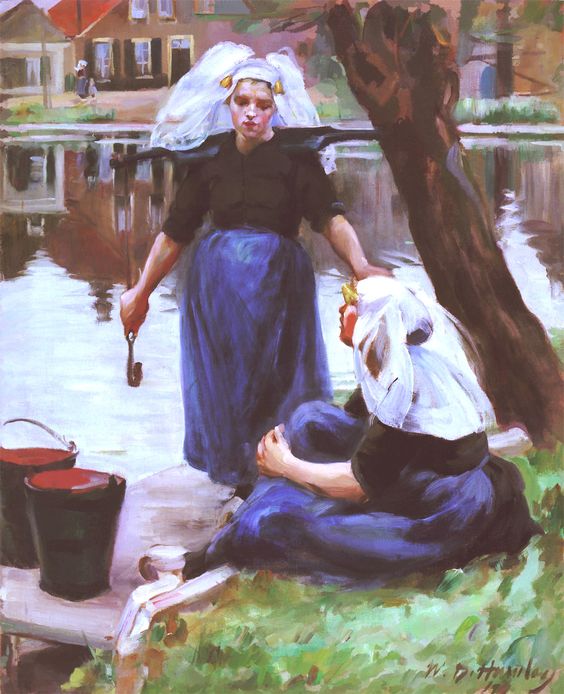
Two Women near the River Waal by Wilhelmina Douglas Hawley (1894)

Wilhelmina remained at the Cooper Union for a year and then enrolled at the Art Students League where she honed her artistic skills eventually becoming the first woman vice-president of this progressive institution. Her tutors included William Merritt Chase, Julian Alden Weir, Charles Yardley Turner and Kenyon Cox. The popularity of the Art Student League was that it was based in New York and the city attracted many European artists, many of whom Wilhelmina met while living and studying at the Arts League.

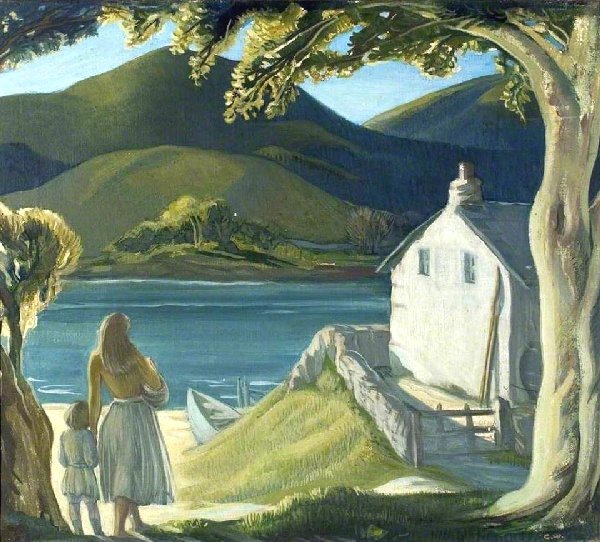
Young Woman in the Meadow by Wilhelmina Douglas Hawley

To escape the cold climate of New York, Wilhelmina spent the winter of 1891/2 on the island of Bermuda where she fell in and out of love with a mysterious Englishman whom she had agreed to marry.  Fortunately, she realised the error of her judgement and the two split up.  Once again, like so many American artists of the time, who succumbed to the magnetism of Paris, Wilhelmina was drawn towards the French capital to continue with her artistic tuition. On June 18th 1892, just a month before her thirty-second birthday, Wilhelmina once more, set sail for Europe on the Holland-America steamer Veendam.  During her Atlantic voyage, Wilhelmina was accompanied by the Dutch-American artist John Vanderpoel and his wife Jessie Elizabeth Humphreys. Vanderpoel. He was a well-known artist and taught at the Art Institute of Chicago where one of his tudents was Georgia O’Keeffe, and it was he who most likely suggested to Wilhelmina that she should spend the summer months at the charming village of Rijsoord near Dordrecht in the Netherlands, where he had founded an artists’ colony in 1886. 

Interior with Mother, two Children and Cat by Wilhelmina Douglas Hawley

On arriving in Paris Wilhelmina registered at the Académie Julian, one of only two art academies in the city to which women and foreign students were admitted.  Having arrived in the Summer, all the Academies were closed for the summer break and would not re-open until the September.  Wilhelmina used the time to travel throughout Belgium and the Netherlands and on 4 July 1892 she made her first visit to the Dutch flax village and artists’ colony at Rijsoord, where various foreign artists and art students had been living and working since 1888 especially during the summer months.  In 1893, Wilhelmina achieved her first artistic successes at the French Academy where she was awarded a prize for best composition.  Also for the first time, one of Wilhelmina’s paintings was selected for the Paris Salon that year, and success came from across the Atlantic when her painting, Holland Peasant Girl was shown in New York at an exhibition of the National Academy of Design
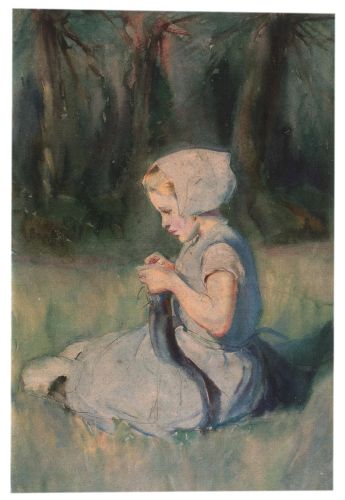
Girl Knitting in a Field by Wilhelmina Douglas Hawley

In 1893, Wilhelmina was appointed as an art teacher at Academy Colarossi and it was around this time that she met English-born Canadian art student, Laura Muntz  A friendship between the two women sprung up and Laura moved in with Wilhelmina at her studio at No. 111 Rue Notre-Dame-des -Champs. Close to the Palais de Luxembourg.  Directly across from their studio was the studio of American artist, James Abbott McNeill Whistler.  Both Laura and Wilhelmina were regular visitor to Whistler’s studio, and he to theirs.
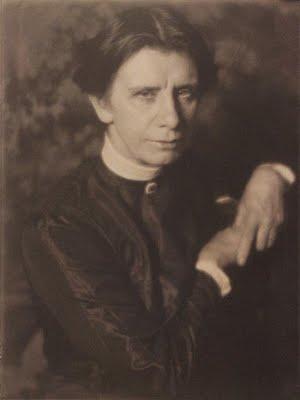
Laura Muntz Lyall

Laura Munz, who was born in 1860 in Radford, Warwickshire, England, was the same age as Wilhelmina and is recognised as one of the most talented painters of her time.  She was an impressionist painter, best known for her depiction of mothers and children. When she was a small child, she emigrated with her family to Canada, where grew up on a farm in the Muskoka District of Ontario. 
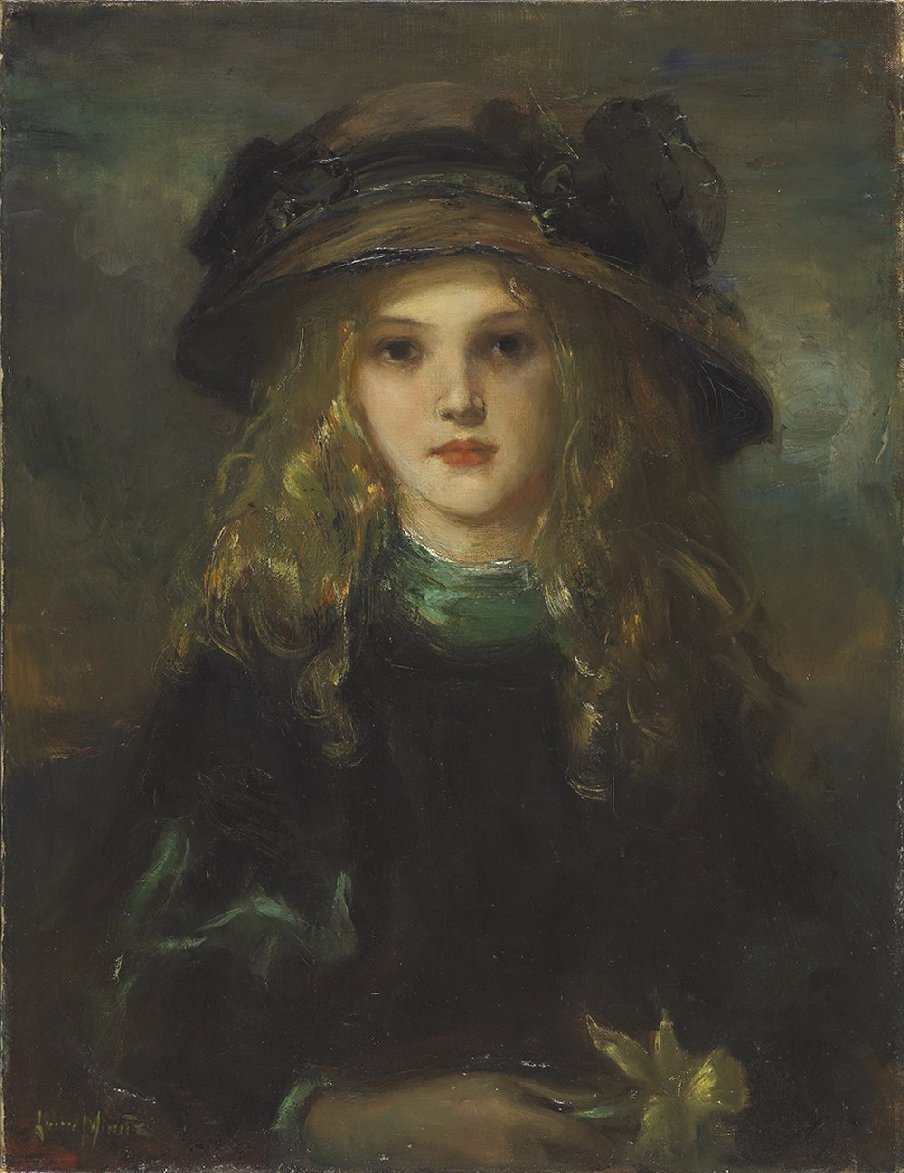
A Daffodil by Laura Munz Lyall (1910)

In 1882, Laura began to take classes at the Ontario School of Art in Toronto.   She also studied briefly at the South Kensington School of Art in 1887, then returned to Canada to continue her studies at the Ontario School. She came to Paris in 1891 and before she met Wilhelmina had been living alone and earning money by teaching and administrative work.  She was the first Canadian to receive the distinguished “Honourable Mention” at the Paris Salon exhibition in 1895.

Portrait of Wilhelmina Douglas Hawley by Laura Munz (1897)

In 1896 Laura returned to Canada for a short spell to help look after an ailing relative.  She returned to Paris and the Academy Colarossi and was promoted to the post of  massiere (Studio head) at the Académie Colarossi.  In 1898 she returned to Canada in 1898 and set up a studio in Toronto to teach and paint.  In 1906, she moved to Montreal to continue her career and built up a large clientele that regarded her as the premier Canadian portraitist of children.  Following the death of her sister in 1915, she returned to Toronto and married her brother-in-law Charles W.B. Lyall and cared for his children of her sister’s marriage, eleven in all, but many had left home by then.  She set up a studio in the attic of their home, and started signing her works with her married name. Laura Munz Lyall died in Toronto in 1930, aged 70.
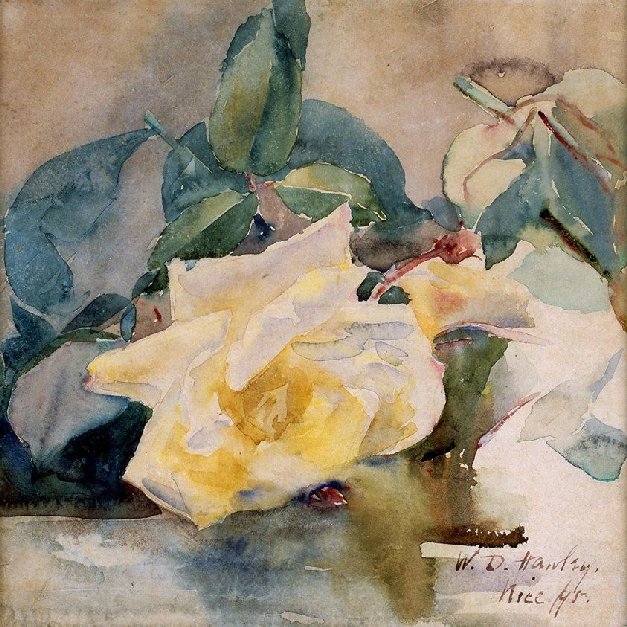
Rose by Wilhelmina Douglas Hawley (1895)

Wilhelmina and Laura spent part of the summers in the French countryside as well as the artists’ colony of Rijsoord in the southern Netherlands. She would often take her international students of the Académie Colarossi with her on these painting trips.   It was here that Wilhelmina captured the villagers in oils and watercolours. The village of Rijsoord was well situated for passing travellers on the Rijksstraatweg (State Highway), an important European road that connected Paris to The Hague.
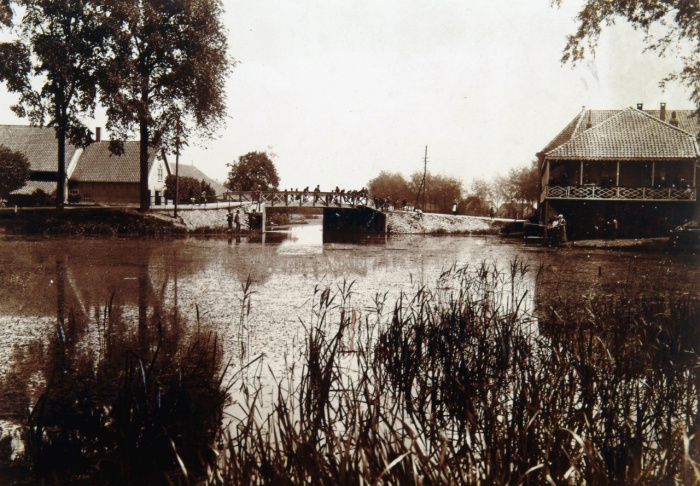
The bridge over the River Waal at Rijsoord, with Hotel Warendorp on the right

An inn was constructed on the spot near the river Waal where the eighteenth-century tollhouse had stood. The building is still standing and for several years had housed the restaurant Hermitage. When Wilhelmina first visited Rijsoord, the inn was called Hotel Warendorp. Hotel Warendorp functioned as the headquarters of the summer academy. The ground floor of the building comprised a livingroom, diningroom and a room for drinking coffee. Most of the guestrooms were also on the ground floor. On the floor above it, the large space under the roof was used as an artists studio, where the artists would hang their most recent paintings and watercolors for discussion. On rainy days, when it was impossible to work en plein air, the artists would actually work in the studio. Wilhelmina’s great granddaughter, Alexandra van Dongen, wrote about how her great grandmother met her husband in her blog: For Two Years, or Perhaps Forever”; Wilhelmina Douglas Hawley and the Artists’ Colony in Rijsoord.  The tale is an instalment in a monthly series of blogs telling stories about the rich history shared by the American and the Dutch peoples.  She wrote:

“…In 1899, Wilhelmina apparently first encountered the 31-year-old Rijsoord farmer Bastiaan de Koning (1868-1954). They most likely met during a boat trip on the river Waal, as the story goes, as local villagers including De Koning, regularly rowed the artists to their outdoor painting locations. In the summer of 1900 Wilhelmina returned to Rijsoord again and announced her engagement to Bastiaan. They married a year later on December 5, 1901. Another three years later, when Wilhelmina was 44 years old, she gave birth to a daughter, my grandmother, Georgina Florence de Koning (1904-1973), named after Wilhelmina’s aunts. By that time, Wilhelmina had been active in the art world for twenty-five years. Family life did not prevent her from traveling abroad, visit exhibitions or meet her friends in Paris and New York. In 1915, her family in Rijsoord engaged a young housekeeper, Geertrui van Nielen (1895-1981), who became an important supporter in her life. Trui, or Troy, as she was called by Wilhelmina, took care of household matters and looked after Georgy, as Wilhelmina’s daughter was called, when her mother was traveling abroad …”
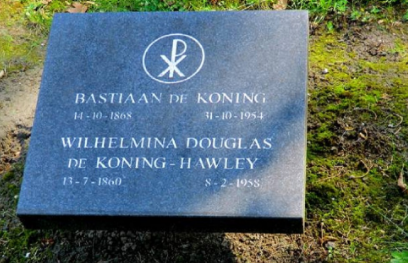
Wilhelmina continued to live with her husband and daughter in Rijsoord.  Years later she enjoyed the summer holiday visits from her daughter, Georgy, her husband, Hans van Dongen and their six children.  On February 18th, 1958, Wilhelmina Douglas Hawley passed away at home at the age of 97.


The information I used for this blog came from a number of excellent websites, all of which are worth visiting. They are:

The Society of the Hawley Family

For Two Years, or Perhaps Forever”; Wilhelmina Douglas Hawley and the Artists’ Colony in Rijsoord

Wilhelmina Douglas Hawley

Schildersdorp Rijsoord 1886-1914

New York Almanack


Rowland Hilder

Rowland Frederick Hilder

The artist I am looking at today is the American-born English watercolourist Rowland Frederick Hilder, a great painter of English landscapes and seascapes.  Rowland was born to Roland and Kitty Hilder (née Fissenden) on June 28th, 1905 at Great Neck, a village on a peninsula on the North Shore of Long Island. 

Tyringham Hall by Rowland Hilder

In early 1915, following the outbreak of the First World War, Rowland’s father decided to return to England, and his native county of Kent, where his forbears had lived and he would enlist in the army and serve his country.  The Hilders set sail on the SS Lusitania, a liner which would be destroyed by a German submarine on its next transatlantic crossing in May of that year.

The First Snow by Rowland Hilder

Life at school was not a happy one for Rowland.  He was a tall gangling boy who had a pronounced American accent which went against him, both with his fellow students and some of the teachers.  Hilder was academically challenged and found it difficult to spell correctly.  Fortunately for him, the art master at the school encouraged him to sketch and advised his parents to let their son follow his love of art.

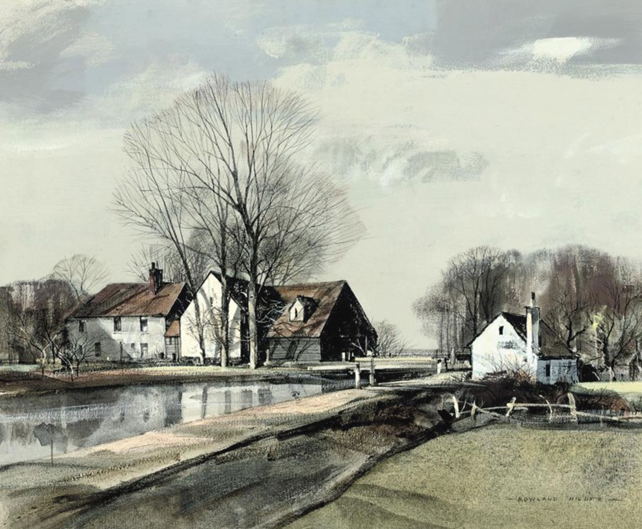
Watermill, Cambridgeshire by Rowland Hilder

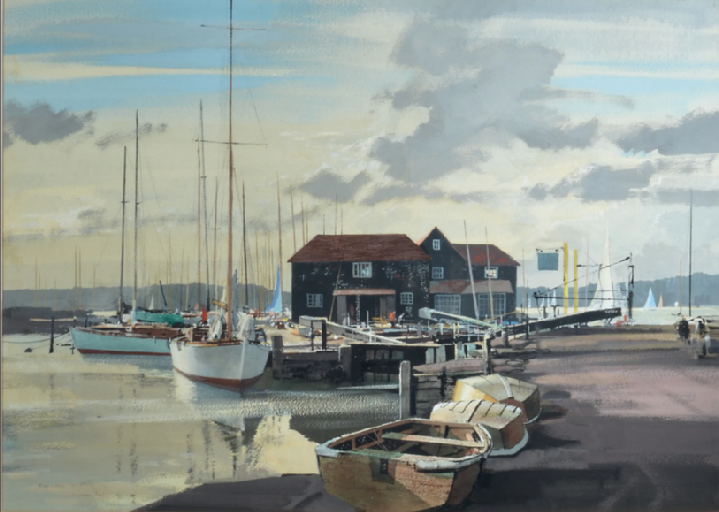
Birdham Pool, Chichester by Rowland Hilder

Having shown a great talent for sketching, in 1921, at the age of sixteen, Rowland Hilder enrolled at Goldsmiths’ College in London, an art establishment which had established a reputation for nurturing fine draughtsmanship in its students.  He was initially placed in the etching class but couldn’t stand the smell of the acid so switched to illustration.  While studying illustration at Goldsmiths one of his tutors was the illustrator, Edmund (E.J.) Sullivan who had contributed illustrations for many of the great journals and magazines of the 1890s and Hilder looked up to him and regarded him as a true professional.  Sullivan taught Hilder the discipline of line drawing and with it the essential structure that holds any work of art together.  Hilder remembered his days at Goldsmiths and how Sullivan had encouraged his students to spend a great deal of time sketching.  Rowland was also introduced to the art of one of the greatest draughtsmen of the past, Albrecht Durer.

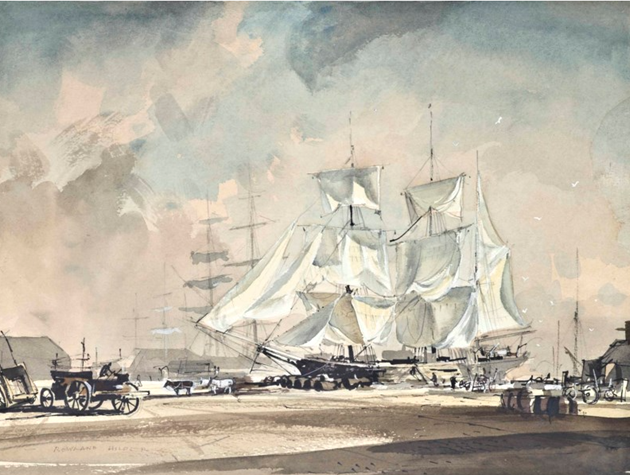
In Days of Sail by Rowland Hilder

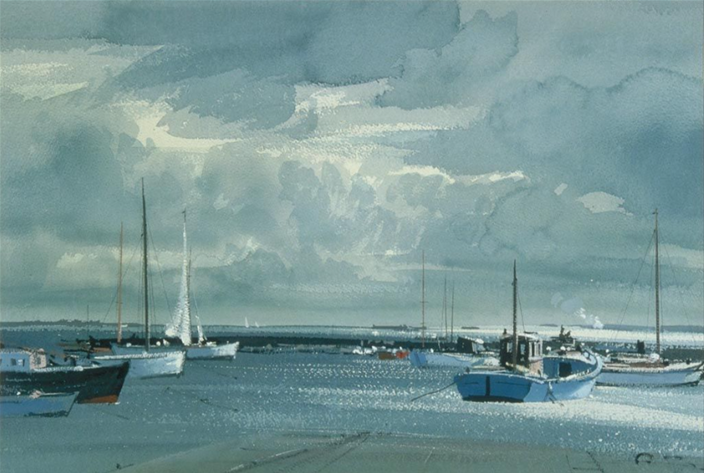
Poole Harbour by Rowland Hilder

As time went by at Goldsmiths Rowland began to think about his future art career and what genre of painting he would like to follow.  At first he decided to become a marine painter and he spent much time on the waterfront sketching and painting boats.  Around this time he also won a prize in a competition sponsored by Cadburys for his work.  The prize, a travelling scholarship,  and Rowland used the money to travel to the Netherlands to study the works of the great Dutch Masters who depicted magnificent marine scenes.

Artist at Work (Edith Hilder by Rowland Hilder

Whilst studying at Goldsmiths, Rowland met fellow student Edith Blenkiron.  She was a botanical painter, and her depictions were often to be found on fabrics or pottery, illustrations for books, or simply painting pictures which could be hung on people’s walls. She said that she was most happy when working direct from nature.  Love blossomed and the couple married and went on to have two children.

Floral Arrangement by Edith and Rowland Hilder

Edith’s beautifully drawn and botanically accurate floral watercolours, with landscape backgrounds often painted by her husband proved very popular.  It was her floral depictions which brought her a following in her own right rather than be just considered as the wife of the artist Rowland Hilder.

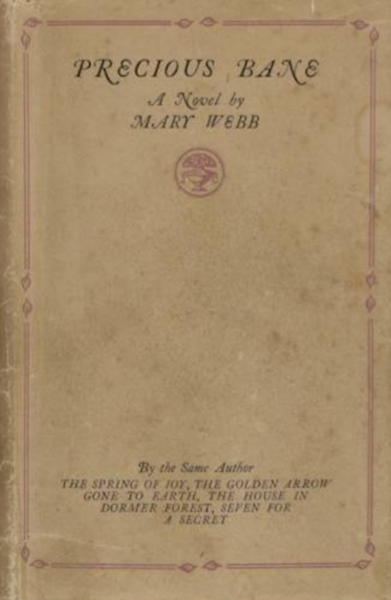
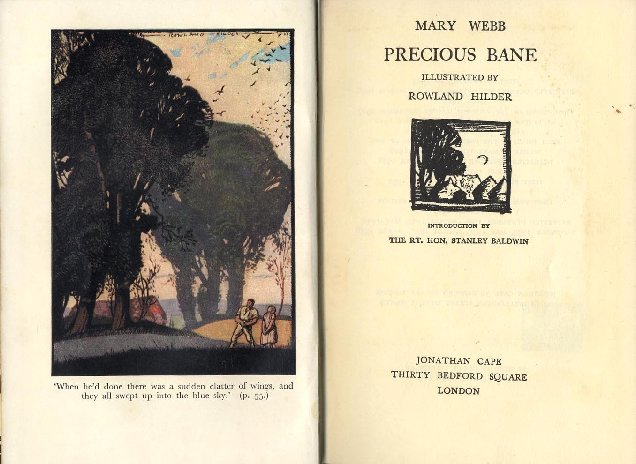
During his period at Goldsmiths he completed a large drawing of a cable ship which was bought by two Royal Academicians, William Orpen and Arnesby Brown on behalf of the National Gallery of Australia .  Whilst at Goldsmith he was also approached by two book publishers. Jonathan Cape and Blackies, to illustrate their books of sea stories.  Both publishers were pleased with Hilder’s illustrations and in 1928, publishing house, Jonathan Cape, asked Rowland if he would contemplate switching from is favoured marine and seascapes and concentrate on depicting countryside landscape scenes as they would like him to illustrate books for Mary Webb, an author who had achieved considerable fame for her novel Precious Bane.

The publishers arranged that winter for Rowland Hilder, his mother and his soon to be wife Edith, to stay in Mary Webb’s cottage in the Shropshire countryside so he could familiarise himself with the rural surroundings in which her novel, Precious Bane, was set. Both his wife and mother would remain in the warmth of the indoors during the day, whilst Rowland would trudge through the snow and the frozen winter ground avidly collecting material, both for use in his illustrative work, but also for his newly found love of depicting the landscape in wintry conditions in his paintings.  Hilder was mesmerised by the rural beauty.  Views of the winter landscape astounded Hilder and he realised that the depiction of such beauty could prove popular with the public.  Many of his pictures were seen on greetings and Christmas cards.

World War II poster by Rowland Hilder

When the Second World War broke out in 1939 Rowland Hilder was one of the first artists who was approached by the government to design war posters which would rally round the people of Britain.  One such poster designed by him was Convoy your Country to Victory Save and Lend through our National Savings Group, which was issued and sponsored by the National Savings Committee, London; Scottish Savings Committee, Edinburgh; Ulster Savings Committee, Belfast and printed for H.M. Stationery Office.  The poster depicted merchant navy ships being escorted across the treacherous Atlantic Ocean under the watchful eye of a Royal Navy vessel which is seen flying the White Ensign.

Garden of England by Rowland Hilder

Another project Hilder was involved in was to provide black and white drawings for an illustrated bible.  This wartime bible contains many beautiful depictions of the English landscape, by Rowland Hilder as well as one or two other artists working in the same style.  The idea of this new book was stated in its preface – to give the people of today a copy of the Bible that is easy to read and that will take them at once to the heart of its message.  Some of the drawings depicted Biblical themes whilst others illustrated daily life in the mid twentieth century.

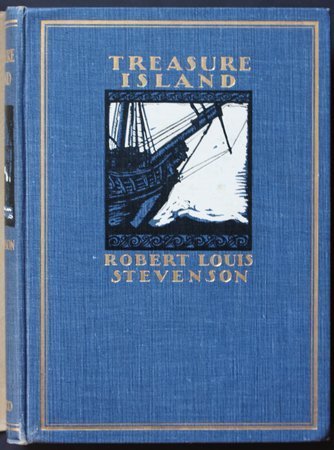
Treasure Island (1929) by Robert Louis Stevenson with twelve colour plates and some black and whight vignettes by Rowland Hilder

Rowland Hilder’s received numerous book illustration commissions included Herman Melville’s Moby Dick and Robert Louis Stevenson’s 1929 edition of Treasure Island.

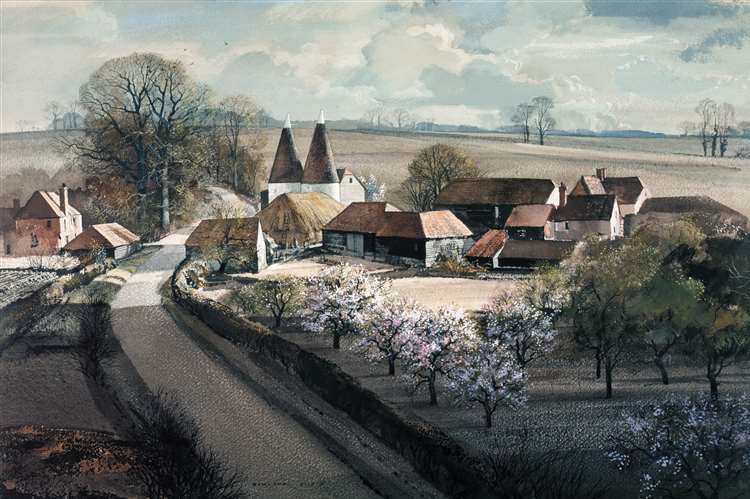
Landscape with Oast Houses by Rowland Hilder

Hilder achieved great popular success with his portrayal of the English countryside, notably Kent, with the characteristically delineated trees and oast-houses.

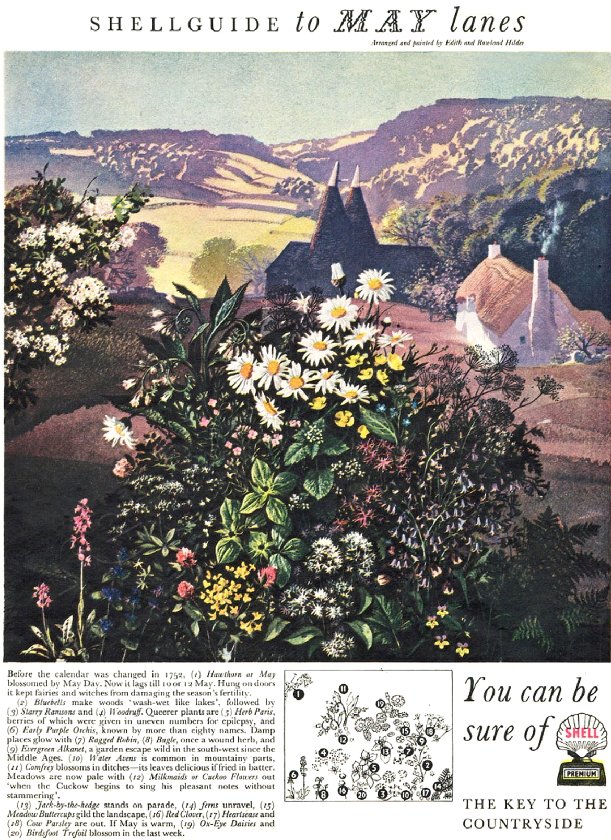
Shell advertising poster illustrated by Rowland and Edith Hilder

Shell Guide to May Lanes arranged and painted by Rowland and Edith Hilder

From the 1920s and into the 1950s, the Shell Oil company produced some beautiful advertising posters which many said, were the most beautiful ever produced.  Rowland and Edith Hilder collaborted on a number of the designs.   

In 1956, a book was published featuring the drawings and paintings of Edith and Rowland Hilder. Rowland also had his own books published: Starting with Watercolour and Painting Landscapes in Watercolour and the two volumes of his paintings under the titles Rowland Hilder’s England and Rowland Hilder Country..

After the Second World War, Rowland formed a small family business with his wife and father called The Heron Press which printed, amongst other things, greeting cards.  They became known as “Hilderscapes” a term that Hilder himself disliked.  In 1963 Rowland wanted to move away from his illustrative work and return to his first love, watercolour landscape painting and so he severed connections with the company. 

Shoreham in Kent by Rowland Hilder

Shoreham in Kent by Rowland Hilder

When it comes to locations for his paintings Rowland Hilder considered Shoreham, a village and civil parish in the Sevenoaks District of Kent, England, located 5.2 miles north of Sevenoaks. and the Shoreham Valley, as his first love.

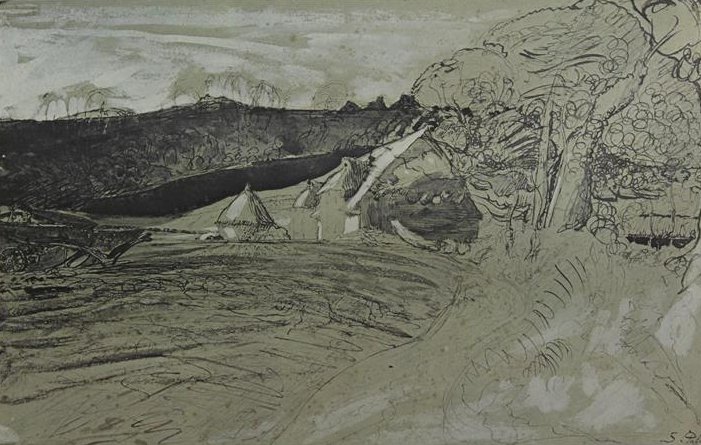
Samuel Palmer ‘s “Barn in a Valley, Sepham Farm”

It was also here in the 1820s that Samuel Palmer, a key figure in Romanticism in Britain, produced visionary pastoral paintings of that area. Hilder tells of how he came across Shoreham:

“…Some fellow students and I discovered Palmer together when we were at Goldsmiths’ College, so I went out to find Shoreham for myself, taking a camera with me. I photographed the farms, and oasts and walked the lanes. I discovered one of my photographs was of Sepham Barn, one of Palmer’s subjects. It had not changed in a hundred years. Later when I went back it had been knocked downand a new tin one was there in its place. I can’t bring myself to include that modern version in my paintings of Shoreham…”

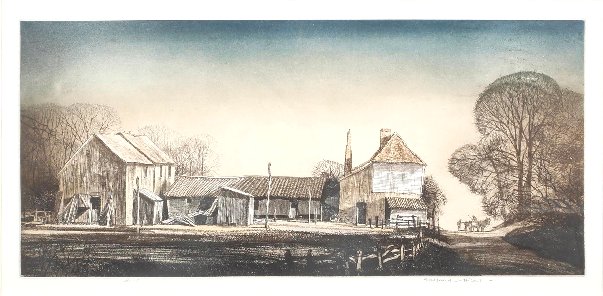
The Lane, High Halstow by Rowland Hilder

Twenty miles north-east of Shoreham lies the village of High Halstow and the surrounding area was the subject of Rowland Hilder’s studies for over fifty years. On one occasion Rowland and fellow Goldsmith student, Norman Hepple, during a sketching holiday, rented an old disused pub in the village. From the front windows they had a view of the neighbouring farm, which was situated in a lane which led to a bird sanctuary. Roland recalled the time:

“…We were invited by a keen bird watcher to join him in one of the hides, to watch a nest of baby herons. I disgraced myself by making an accidental noise, whereupon all the babies were simultaneously sick…”

Rowland Hilder’s sketch

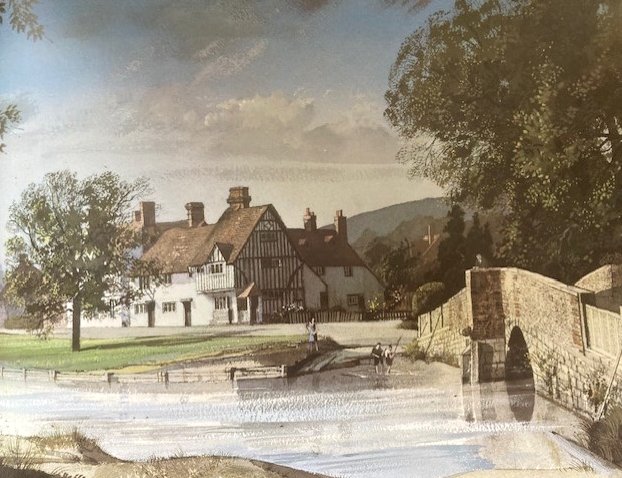
The Old Ford and Bridge, Eynsford by Watercolour by Rowland Hilder

Eynsford is a village and civil parish in the Sevenoaks District of Kent and is a few miles north of Shoreham.   This area is undulating and has a large minority of woodland.    This was also a place Hilder visited many times to sketch and very little has changed since his time.  The bridge at Eynsford leads to a popular pub, the ruins of the local castle and many walks along the river Darent to Lullingstone bridge with its reconstituted Roman villa.

London Docklands by Rowland Hilder

Like his contemporaries, Claughton Pellew, John and Paul Nash, Edward Bawden and Eric Ravilious, Hilder shared their interests in depicting the countryside. They would explore themes of rural peace and harmony and rejected modernism. However, Pellew and Ravilious often depicted the clash between pastoral tranquillity and the rise of modernism whereas Hilder just concentrated on depictions of rural beauty whether it is bathed in sunshine or covered in snow and the by-gone aspects of farming practice.

First Snow by Rowland Hilder

Surprisingly Hilder was himself never taught watercolour. He honed the skills after his training, and he wrote several books on the subject.  He also taught his skills at Farnham School of Art, and as professor of art at his alma mater, Goldsmith’s. In 1938 he was elected a member of the Royal Institute of Water Colours, and in 1964 he became president of the Institute.  His work was included in the 1984 Hayward Gallery exhibition: The British Landscape 1920-50. Retrospective exhibition at the Woodlands Gallery in 1985 and Hilder was appointed OBE in 1986. He lived in London but retained a base at Shell Ness, a small coastal hamlet on the most easterly point of the Isle of Sheppey in the English county of Kent. Where he would carry out his marine painting.  He continued to paint into his retirement and died in Greenwich on the 21st April 21st, 1993 two months before is eighty-eighth birthday.


In putting this blog together I was helped by information I found in the following websites:

THE BOOKROOM ART PRESS

The Watercolour Log

The Artistically Talented Walton Family

My blog today is about a family of artists, the Walton family, a veritable artistic dynasty.  The head of the family was Edward Arthur Walton, best known as, simply, E.A.Walton.  Walton was born on April 15th, 1860 in Barrhead, a small town in East Renfrewshire, Scotland, thirteen kilometres (8 miles) southwest of Glasgow city centre. 

The Artist’s Mother, Elizabeth Balfour Nicolson, Mrs Jackson Walton by Edward Walton (1885)

Edward Walton was one of twelve children of Jackson Walton and his wife Elizabeth Balfour née Nicholson. Jackson was a Manchester commission agent and a skilled amateur painter and photographer. His brother was George Henry Walton, a noted architect, furniture designer and stained glass designer, who worked with Charles Rennie Mackintosh, a renowned Scottish architect, designer, watercolourist and artist. 

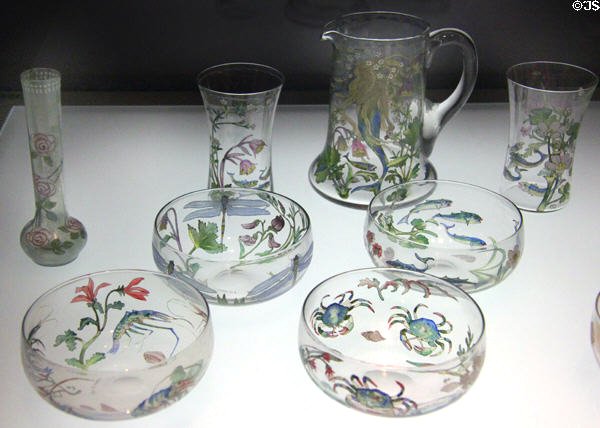
Glassware painted by Helen Walton (1910)

Edward’s sisters, Helen and Constance were also talented artists.  Helen Walton was best known for her decorative work in ceramics and glass and as one of the eldest children, Helen became an artistic mentor to her siblings including her brother, Edward Arthur, who was ten years her junior.

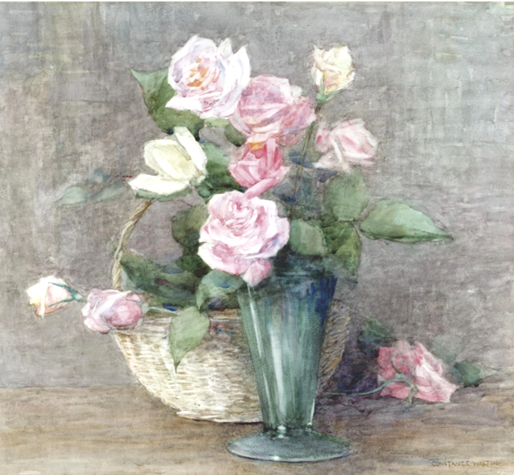
Still Life with Roses by Constance Walton

Constance Walton was a much-admired botanical painter.  She trained at Glasgow School of Art and became a member of the group known as the Glasgow Girls.  This group of women artists and designers pursued different styles and worked in a range of art forms.  Many of the women created their own discreet groups while others chose to work alone and although the name of the group was coined by William Buchanan in an essay, he contributed to the catalogue for a Glasgow Boys exhibition held in 1968, many of the women lived and worked outside Glasgow. These female artists became prominent in the late nineteenth century, thanks to the enlightened attitude of Francis Newbery, a painter and art educationist, best known when he was director of the Glasgow School of Art between 1885 and 1917. who set out to enrol men and women equally.

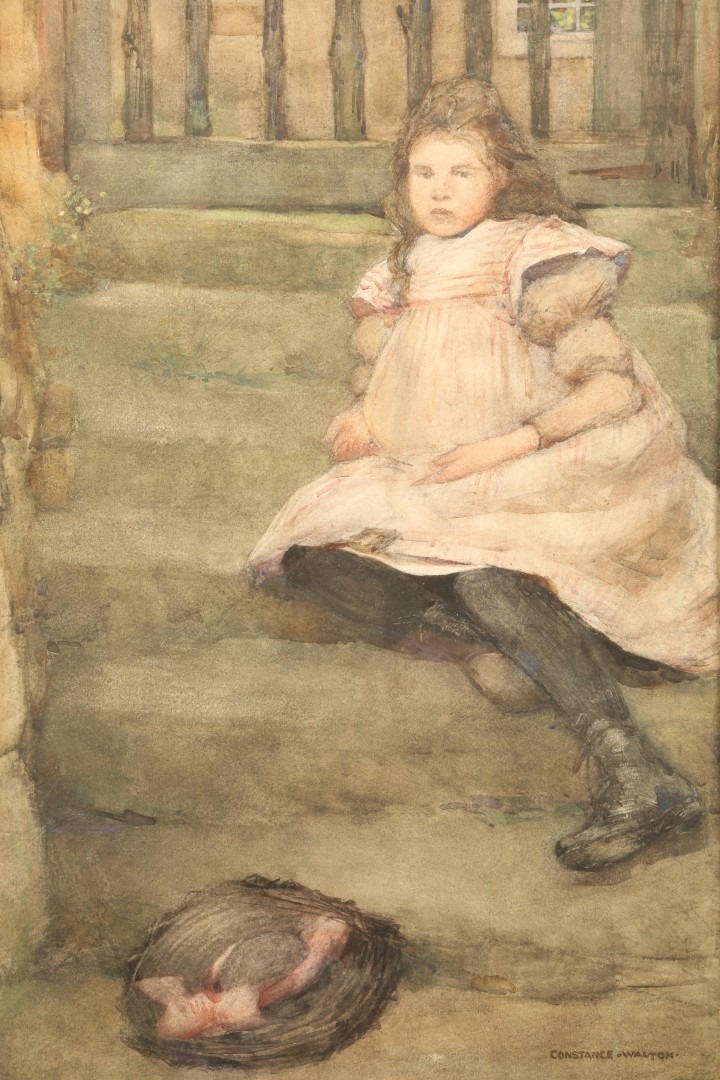
Daydreams by Constance Walton(c.1895)

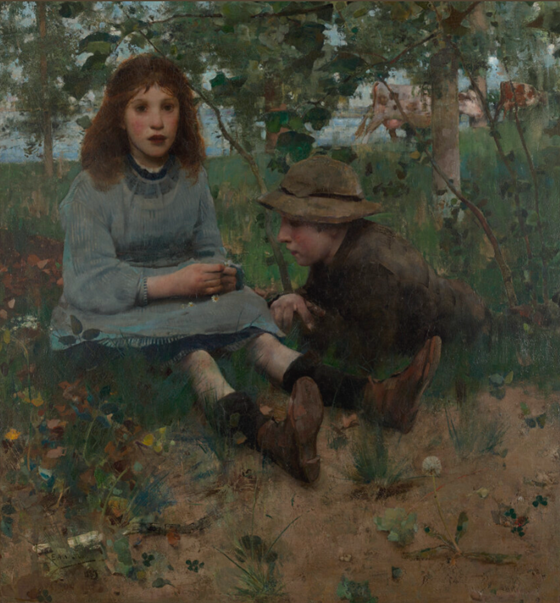
Day Dreams by Constance Walton is a large watercolour depicting a young girl sitting on steps looking distractedly into the distance. Constance Walton’s figurative paintings are quite rare as after her marriage in 1886 she concentrated on her flower and botanical paintings.  This depiction could have been influenced by her brother, Edward’s work of the same name which he completed in 1885.

A Daydream by Edward Walton (1885)

Helen and Constance’s brother Edward Arthur Walton was probably the best-known artist of all the siblings

Self portrait by Edward Walton

After completing school and wanting to concentrate on his art he travelled to Germany where he spent two winters at the Dusseldorf Academy of Art before returning to Scotland and enrolling at the Glasgow School of Art in 1878.

Joseph Crawhall by Edward Walton (1884)

At the Glasgow School of Art he became good friends with fellow aspiring painters, James Guthrie and Joseph Crawhall whose sister married Edward’s brother.  As we have often seen in various blogs, young artists training at State Academies often became disillusioned and disheartened by the academic training which concentrated on historical painting and high levels of finish.  It was for this reason that in many countries the young artists rebelled and set about working to their own agenda.  In the case of Edmund Walton and his friends they formed a loose group which became known as the Glasgow Boys who decided that their focus should be on realistic depictions, often of rural subjects, depictions that would illustrate real life, the hard-bitten and candid view of living. 

The Harbour Scene, St Ives by Edward Walton

The Glasgow Boys group gained inspiration from the progress in landscape painting in France and sought to take greater notice on the natural effects of light in the open air when setting about painting Scottish rural scenes.  The group also took to the French style of en plein air painting when, whilst outdoors, they would paint directly onto the canvas.  The painter who had the greatest influence on this group of artists was the French realist painter, Jules Bastien-Lepage whose down-to-earth depictions focused on the real, often, impoverished life that surrounded his village.  For all Edmund Walton learnt about art in Dusseldorf and the Glasgow School of Art, nothing compared to the knowledge he gained working alongside his fellow “boys”.

Victoria Road Helensburg by Edward Walton

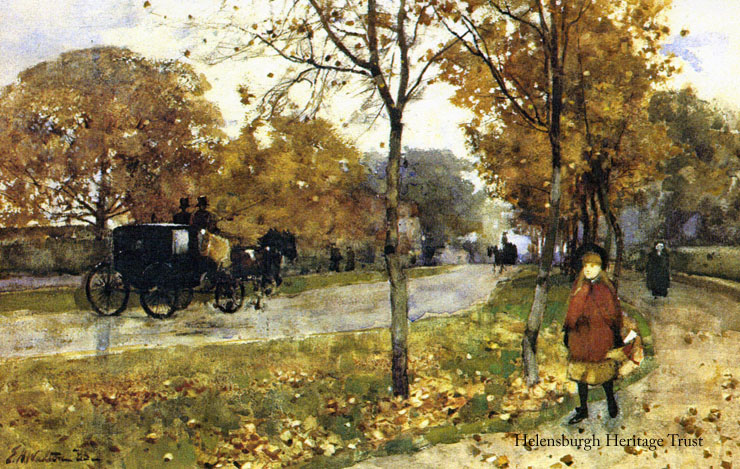
In 1883, Edward Walton joined James Guthrie, at Cockburnspath, Berwickshire where he honed his talent as a painter in both oil and watercolour in the open air.  He also spent time in Helensburgh, an affluent coastal town on the north side of the Firth of Clyde where he completed a series of watercolours depicting the well-dressed affluent residents of this prosperous suburb.

Helensburgh by Edward Walton

His skill as a watercolourist resulted in him being accepted as a member of the Royal Scottish Society of Painters in Water Colours in 1885 and shortly after he became a member of the New English Art Club.  In 1894, when he was thirty-four, he moved to London living in Kensington and later Chelsea, where his neighbour and good friend James Whistler lived.  Other artistic neighbours were the Irish-born painter John Lavery and Philip Wilson Steer, a British painter of landscapes, seascapes plus portraits and figure studies. Steer was also an influential art teacher and a leading figure in the Impressionist movement in Britain.

Edward Arthur Walton Artist, with his Fiancée Helen Law or Henderson as Hokusai and the Butterfly by Sir John Lavery (1889)

Around 1889 Edward Walton met Helen Law.  Love followed and the pair got engaged.  To celebrate their engagement the couple attended the Grand Costume Ball, organised by the Glasgow Art Club November 29th 1889. Edward dressed as the Japanese printmaker Hokusai, (an exhibition of his work was on show in Glasgow at the time) while his fiancée’s costume represents the painter Whistler’s signature in the shape of a butterfly. Photographer James Craig Annan took a photograph of the couple.  Artist and the couple’s friend, the artist, John Lavery, sketched this portrait of Edward and Helen on the night and presented it to them as a gift for their engagement, which they had announced earlier that evening.

Eric Robertson

Edward and Helen married and went on to have four children, the eldest of whom was their daughter Cecile who was born on March 29th 1891.  In 1894, Edward Walton, his wife and two-year-old Cecile moved from Scotland to London. In the summer the Walton family travelled to Suffolk where they rented the Old Vicarage at Wenhaston, which was a few miles from Walberswick, a village on the Suffolk coast, where Frank and Jessie Newbery lived and the two families painted together in the summer.  Cecile Walton and Newbery’s daughter Mary became close friends and later both developed strong links with Galloway area of Scotland.  The Walton family returned to Scotland in 1904 and took up residence in Edinburgh where Cecile enrolled at the Edinburgh College of Art. 

Cecile Walton by Eric Robertson (1922)

She also had private tuition from the Symbolist painter, John Duncan who taught her to appreciate Florentine art of the Renaissance and it was whilst at John Duncan’s house that she met another painter, Eric Robertson.  Cecile’s parents were not enamoured with her friendship with Robertson as he had a reputation of being a heavy drinker and a philanderer but despite her parents’ views Cecile and Eric Robertson married in 1914 and their first child, Gavril, was born in February 1915.

Romance by Cecile Walton (1920)

Cecile and Eric’s second child, another son, Edward, was born in December 1919 and it was shortly after his birth that Cecile started what was to be one of her most famous paintings, Romance. Cecile Walton depicts herself holding up her new-born son, Edward, for intense scrutiny, whilst her elder boy, Gavril, clutches his gollywog doll. Although nowadays the toy is recognised as a racist caricature, they were commonplace in British childhoods until the 1960s. The depiction of mother and baby is usually associated with the Madonna and Child but in Cecile’s painting, the depiction knowingly echoes a well-known impressionist image of a sex worker; Olympia as portrayed by Edouard Manet, and this implies a more troubled attitude to motherhood. The inclusion of carefully placed details such as petals on the floor, and the apple, add to the sense of unease.  In the painting we see Cecile, depicted lying half naked in bed holding her new baby son.  At the foot of the bed, we see her first-born child Gavril looking on. In an article in the Woman’s Art Journal, Frances Fowle, art historian and curator comments on the painting:

“…The title Romance seems inappropriate and the picture itself has a disconnected feel: the figures seem strangely dislocated, the scene has an almost surreal clarity, and the eye is arrested by the disagreeable greenish hue of the wall.  The picture poses questions; even the objects on the table and the discarded rose on the floor invite interpretation.  The artist lies stretched out on the bed, naked except for a curious yellow hat and towel wrapped around her hips…”

The thorns on the stem of the rose symbolise the suffering of the virgin and this may, in this case, allude to the suffering of the woman during childbirth. The crushed rose seen on the floor next to the bed is thought to symbolise Cecile’s failing marriage brought on by her husband’s unacceptable habits and his surrender to the demon alcohol.  Cecile was not in a good place at this time having to endure her husband’s drunkenness and infidelity. Marriage and subsequent children had also deprived Cecile of her personal freedom and curbed her artistic output, similar to what happened to her mother once she married Edward Walton.  The painting was exhibited at the second Edinburgh Group Exhibition in 1920.

The Favourite Dress by Cecile Walton

Cecile’s marriage to Eric Robertson ended in 1923 due to his unacceptable behaviour and Cecile, along with her two sons, moved out of the family home and went to live with her friend Dorothy Johnstone.  Her divorce was finalised in 1927.   In 1924 Dorothy and Cecile staged a joint exhibition of their work.  However since the ending of her marriage and subsequent divorce Cecile’s artistic output decreased and her artistic career began to fail.  

Deserted Ferry by Cecile Walton (1949)

Eric Robertson’s artistic career also broke down after his separation from Cecile, and he eventually capitulated to alcohol.  In 1923, following the failure of his marriage he moved to Liverpool and by the early 1930s, he was largely forgotten as a painter. Cecile Walton remarried in November 1936.  Her second husband was to Gordon Gildard, a BBC producer, and she moved to Glasgow to be with him.  Unfortunately, their marriage was short-lived and the couple divorced in 1945.  Cecile went to live the rest of her life in the vibrant fishing port and artists’ town of Kirkcudbright, within Dumfries and Galloway, Scotland.

Cecile Walton died in Edinburgh on April 23rd 1956, aged 65.

Susan Greenough Hinckley and Reverend Leverett Bradley

Susan Greenough Hinckley was born in the Beacon Hill area of Boston, Massachusetts on May 15th 1851. Her father was Samuel Lyman Hinckley, of the well-known family of Northampton Lymans, and her mother was Anne Cutler Parker whom he married in 1849, nine years after his first wife had died.  Susan had three siblings, an older brother Samuel Lyman Hinckley and a younger brother, Robert Cutler Hinckley.  She had a younger sister, Anna who died when she was eight years old. She also had a half-brother Henry Rose Hinckley who was the son of Samuel Hinckley and his first wife Henrietta who died at the age of twenty in 1838.

Oriental Still Life by Susan Bradley

From a young age Susan and her brother Robert showed an interest in, and a talent for, sketching and painting.  She attended Miss Wilby’s local school, where she was taught the history of painting.  In 1871, aged twenty, Susan made her first trip to Europe and this ignited her love of art.  Sadly, that December, while the family were in Paris her father died.  When the family returned to America, Susan decided to learn about watercolour painting and read the books written by John Ruskin.

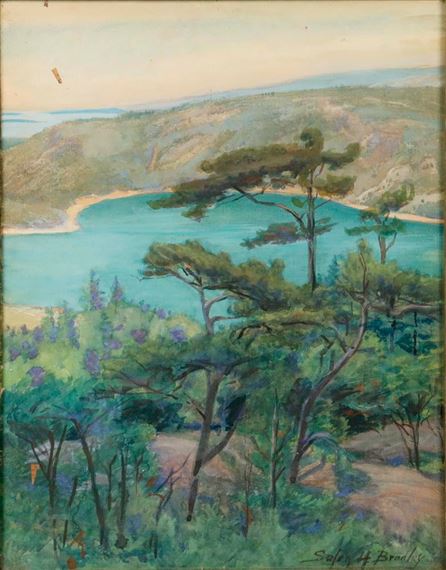
Eagle Lake, Acadia, Maine by Susan Bradley

Four years later in 1875 she returned to Europe with her mother and visited Rome where she studied under Edward Darley Boit, a fellow Bostonian who at the time was living and teaching in the Italian capital.  On returning to Boston she enrolled at the Museum of Fine Arts’ School of Drawing and Painting, in Boston where one of her tutors was the Bostonian artist, Frederic Crowninshield.  Here, she was in the first life class for women under his tutelage.  In 1878 she began to exhibit her work at the American Watercolor Society and a year later, she enrolled in the Boston Museum of Fine Arts’ School of Drawing.

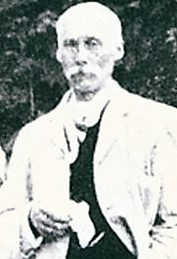
Reverend Leverett Bradley

A young man came into Susan’s life in 1878.  He was Reverend Leverett Bradley a theology student at Hartford Theological Institute.  Leverett Bradley was born in 1846 and was brought up on the family farm in Methuen, Massachusetts.  In April 1861 the American Civil War began and aged only fourteen, Leverett left home and enlisted as a soldier in the Fourteenth Regiment of the Infantry which was under the command of his father.  Leverett would write numerous letters to his family whilst away at war and they were later collated into a book, A Soldier Boy’s Letters (1862-1865).  At the end of the war, Leverett returned to his family in Massachusetts and decided to dedicate the rest of his life to the church.  In 1867, he enrolled at the Phillips Academy Andover to complete his education which had been cut short by the war.  Two years later he attended the prestigious Amherst College where he studied for a theology degree.  Having completed his degree, he studied at the Hartford Theological Institute and in the Spring of 1878 he was ordained and went to work at Boston’s Trinity Church, a church where Susan often went to worship. 

The couple had much in common as they both loved art and music.  Susan and Leverett became engaged in the summer 1879 and the couple married on December 3rd that year.  Soon after the marriage Leverett was assigned a new post and he and Susan relocated to Maine where Leverett took on the role of rector at Christ Church Episcopal in the town of Gardiner. He was remembered there for the passion and enthusiasm he gave to his role.

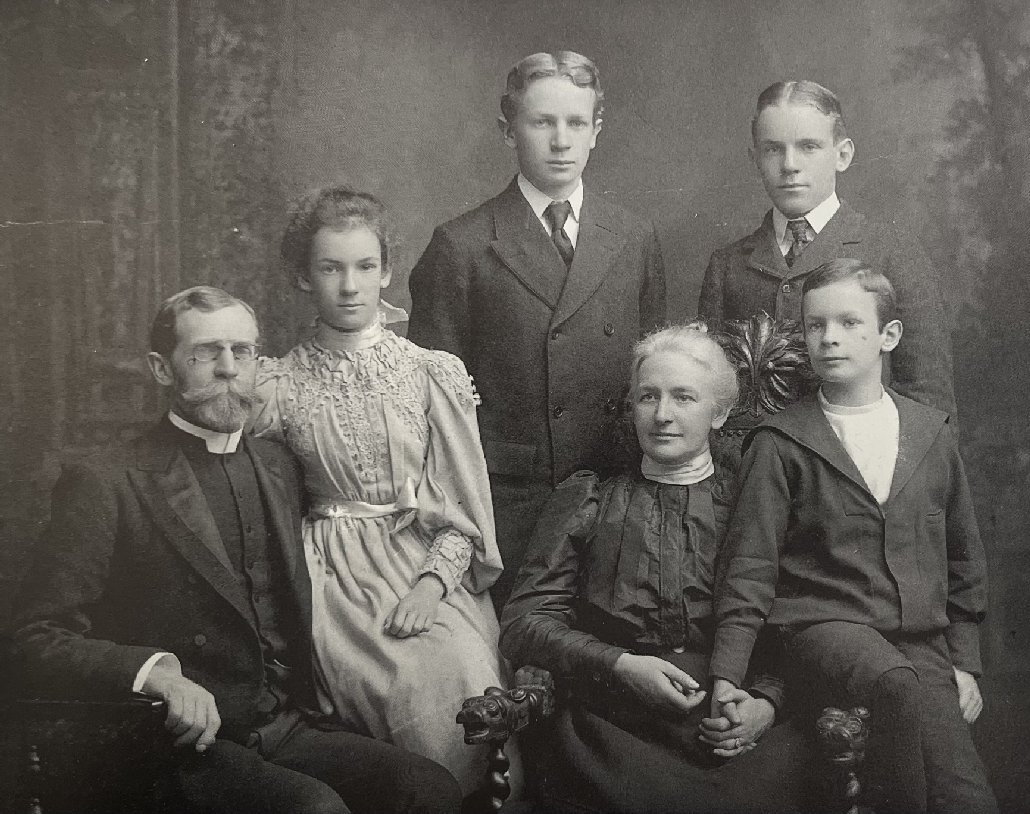
Leverett and Susan with their four children

In 1880, Susan gave birth to their first child, a son, Leverett Jnr., and two years later a second son, Walter, was born.  Susan and Leverett’s remained in Maine until the Autumn of 1884 when he accepted the position of rector of Christ Church in Andover, a town in Essex County, Massachusetts. Leverett and his wife Susan, now pregnant with their third child, a daughter Margaret, and their two young boys moved into the rectory of Christ Church.

Italian Landscape by Susan Bradley

Susan Hinckley Bradley faced, like so many female artists at the time, the fact that they did not have equal rights with male artists.  In the 1880’s, the best-known art societies such as the Boston Water Color Society, which was organized in 1885 by Childe Hassam, refused membership to women until 1918.  Other societies with similar discriminatory rules were the Art Club of Boston and St. Botolph Club, a dining club which was popular with many artists but which would not relax the all-male membership rule until 1988.  However, Susan had a very supportive husband who was equally horrified by the fewer opportunities for women artists to meet and exhibit their work, and together they decided to rectify the situation.

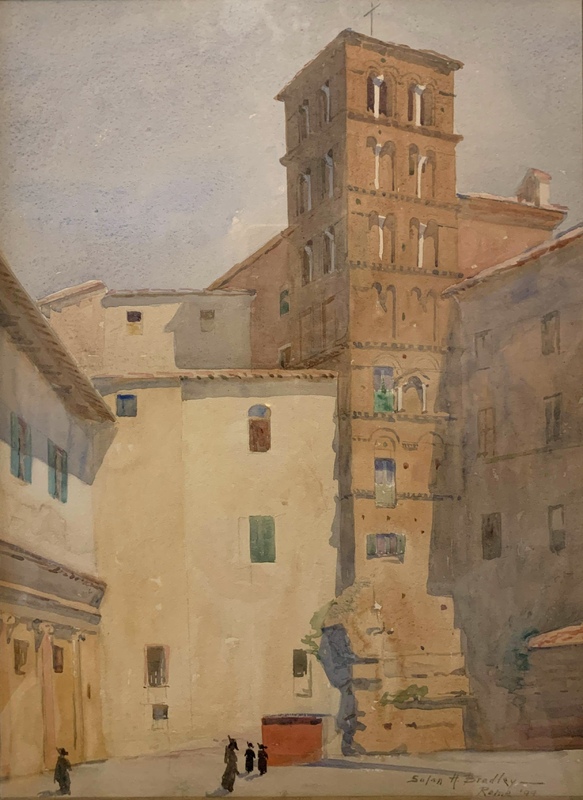
Rome by Susan Bradley (1899)

In 1887, Susan together with fifteen other women such as Sarah Wyman Whitman, Sarah Choate Sears, Martha Silsbee, and Helen Bigelow Merriman came together to form the Boston Water Color Club in response to the exclusive membership rules of the all-male Boston Water-Color Society.  The inaugural exhibition of the Water Color Club included forty-seven works by sixteen women artists; and ten years on, the membership had doubled.  Ironically it was not until nine years later that men were allowed to join the club.

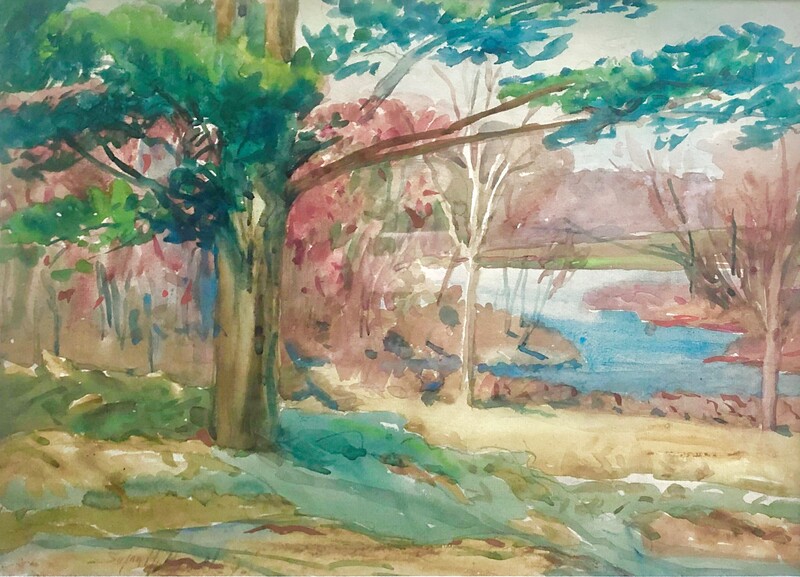
Concord River by Susan Bradley (c.1928)

In the Autumn of 1889 Susan and her husband were once again on the move, relocating to Philadelphia, when he was offered the rectorship at St. Luke’s Church. This church had a large, urban congregation and Leverett set to work and soon made a positive impact on the local community. He kept up the role of army chaplain of the Third Regiment for many years and during the miner’s strike of 1902 was called into active duty. Leverett’s health had been deteriorating for some time and on December 31st 1902 he died of heart complications, aged 56.

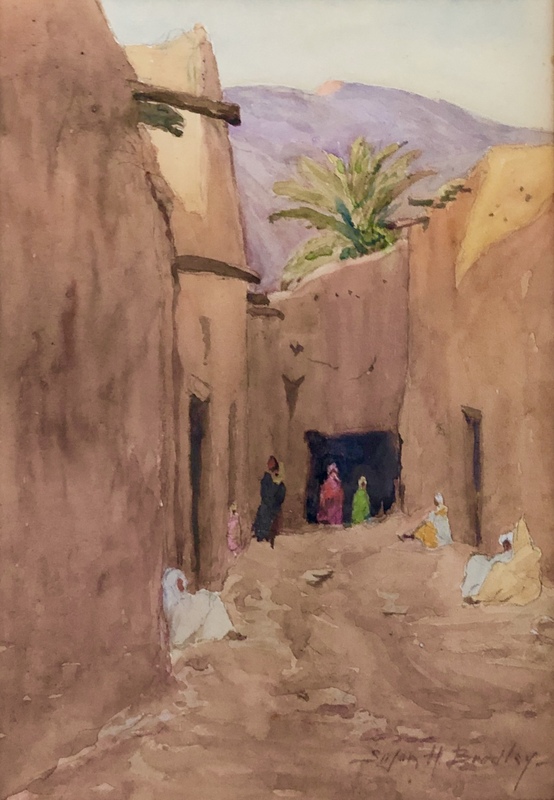
Evening near the Red Village, Algeria by Susan Bradley (c.1907)

Susan Bradley had to reduce her painting time when she was bringing up her four children and looking after her husband and their home.   She did get back to it eventually studying with William Merritt Chase, and spent time once again in Rome being tutored by Boit.  She travelled extensively to Egypt, Greece, Tunisia, Italy, Switzerland, France and Ireland, as well as exploring her own country and was known for not only the wilderness locations in Western Canada and Arizona but her depictions of the New York streets and the seascapes of the Maine and Massachusetts coasts.  Her work was shown at many exhibitions including the Panama Pacific International Exposition in 1915, Louisiana Purchase Exposition in 1904, and the American Watercolor Society in 1902 and her works form part of many of the collections of the major American museums.  Susan was a prolific painter whose career spanned five decades.

A Rose by Susan Bradley {1928)

She died on 11 June 1929, in Boston, Suffolk, Massachusetts, United States, at the age of 78, and was buried in Andover, Essex, Massachusetts, United States.

Albert Godwin

Albert Goodwin

The artist I am looking at today is the nineteenth century English painter, Albert Frederick Goodwin, best known for his watercolour landscapes.

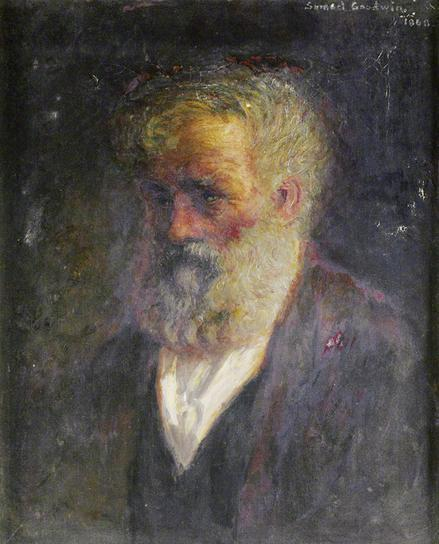
The Artist’s Father, Samuel Goodwin by Albert Goodwin (1868)

Albert Goodwin was born at 1 Acton Place, 62 Boxley Road, Maidstone on January 17th 1845.  His father was Samuel Goodwin, a builder.  His mother was Rosetta (née Smith).  Albert was the seventh of eight children, having three older sisters, Emma, Rosetta and Mary Ann and three elder brothers, Charles, William Sidney and Henry (called Harry).  He also one younger brother, Frank Alfred.  An artistic talent weaved its way through his male siblings.  His eldest brother was known for his artistic talent as a young man before he joined the military as a member of the Royal Engineers.  Charles became a frame maker and Harry and Frank became professional painters.

Albert was brought up in a devout Baptist household and attended the Bethel Chapel in Maidstone, which his father had built along with its Sunday School in 1934.  Albert’s uncle, Thomas Goodwin often preached at the chapel and was its resident organist, which he had also constructed.  Albert attended Mr William Henry Wickstead’s School at Rocky Hill House, London Road, Maidstone.

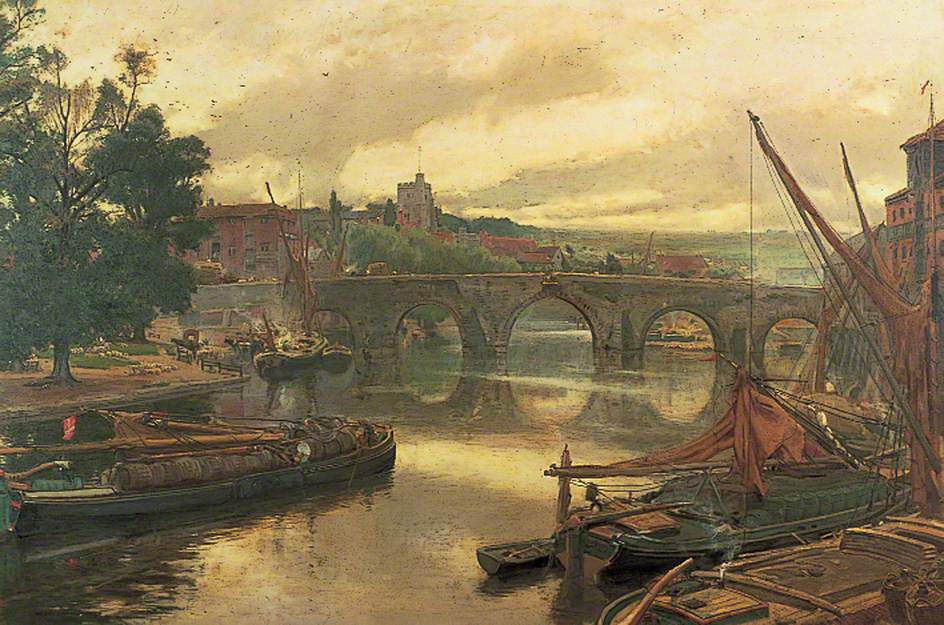
The Old Bridge at Maidstone, Kent, Looking South by Albert Goodwin

Albert became interested in art and at the age of ten when he first exhibited one of his paintings,  This was a time at the start of the Pre-Raphaelite Brotherhood and one of its founders, William Holman Hunt had a great influence on young Goodwin.  At the age of fourteen Albert Goodwin started an apprenticeship with a local draper but after six months, he realised that the drapery business was not for him as he had set his heart on becoming a professional artist.  He just needed a willing teacher.   That came by chance, as it is said that whilst painting en plein air in the local woods he was spotted by the Pre-Raphaelite painter, Arthur Hughes who lived in Maidstone with his wife and children.  Arthur Hughes was impressed by Albert’s artistic skill and became his first tutor.

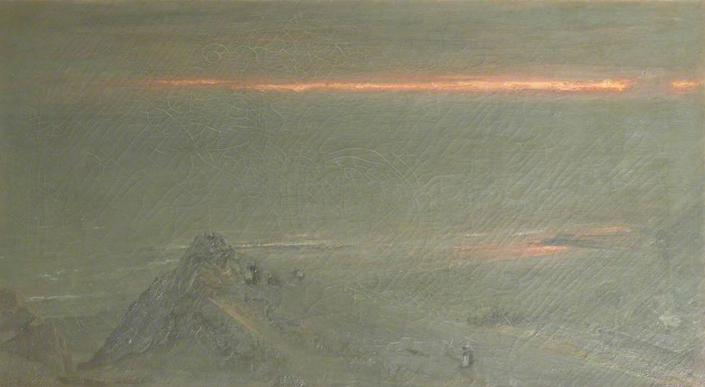
Sunrise over the Sea by Albert Goodwin

In 1859 Goodwin completed his painting entitled Bluebell Hill, Maidstone and in 1860 he exhibited his painting, Under the Hedge.  On March 18th 1863, Albert’s mother Rosetta died at the age of fifty-eight.  During Albert’s early twenties he was introduced to the well-known artist and art critic John Ruskin and on seeing Albert’s work, Ruskin purchased them all for £50 and Albert put the money to good use, funding his five week painting trip to the south coast resort of Hastings.  Around the mid 1860s Albert’s tutor, Arthur Hughes, introduced him to Ford Maddox Brown, a Pre-Raphaelite luminary who took Albert on as his pupil in his London studio.  Albert soon became acquainted with the other Pr-Raphaelite Brotherhood, such as Rossetti, William Morris, the Scottish artist William Bell Scott and George Price Boyce, the watercolour painter of landscapes.

The Old Bridge at Maidstone, Kent looking South by Albert Goodwin

Later, according to Albert’s daughter Olive, Albert and his brother Harry, went to work in the studio of William Morris’ company in Red Lion Square in London’s Holborn district.  In 1864 Albert set off on his first overseas trip, going to Holland where he visited the cities of Amsterdam and Rotterdam and that summer spent time in Jersey.  In the Autumn of 1864, he travelled north visiting Newcastle and Durham as well as the coastal town of Whitby

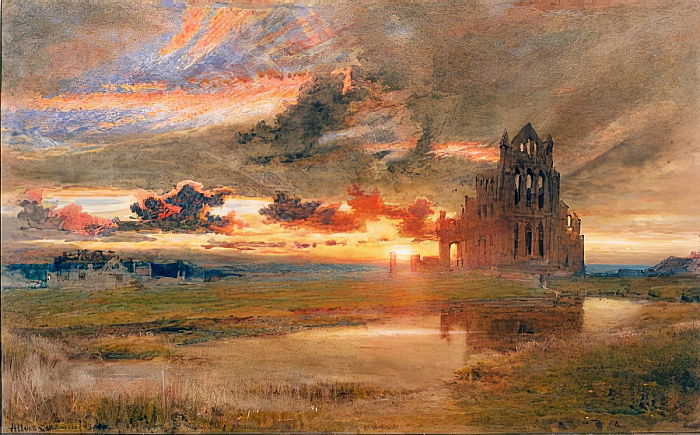
Whitby Abbey a watercolour by Albert Goodwin

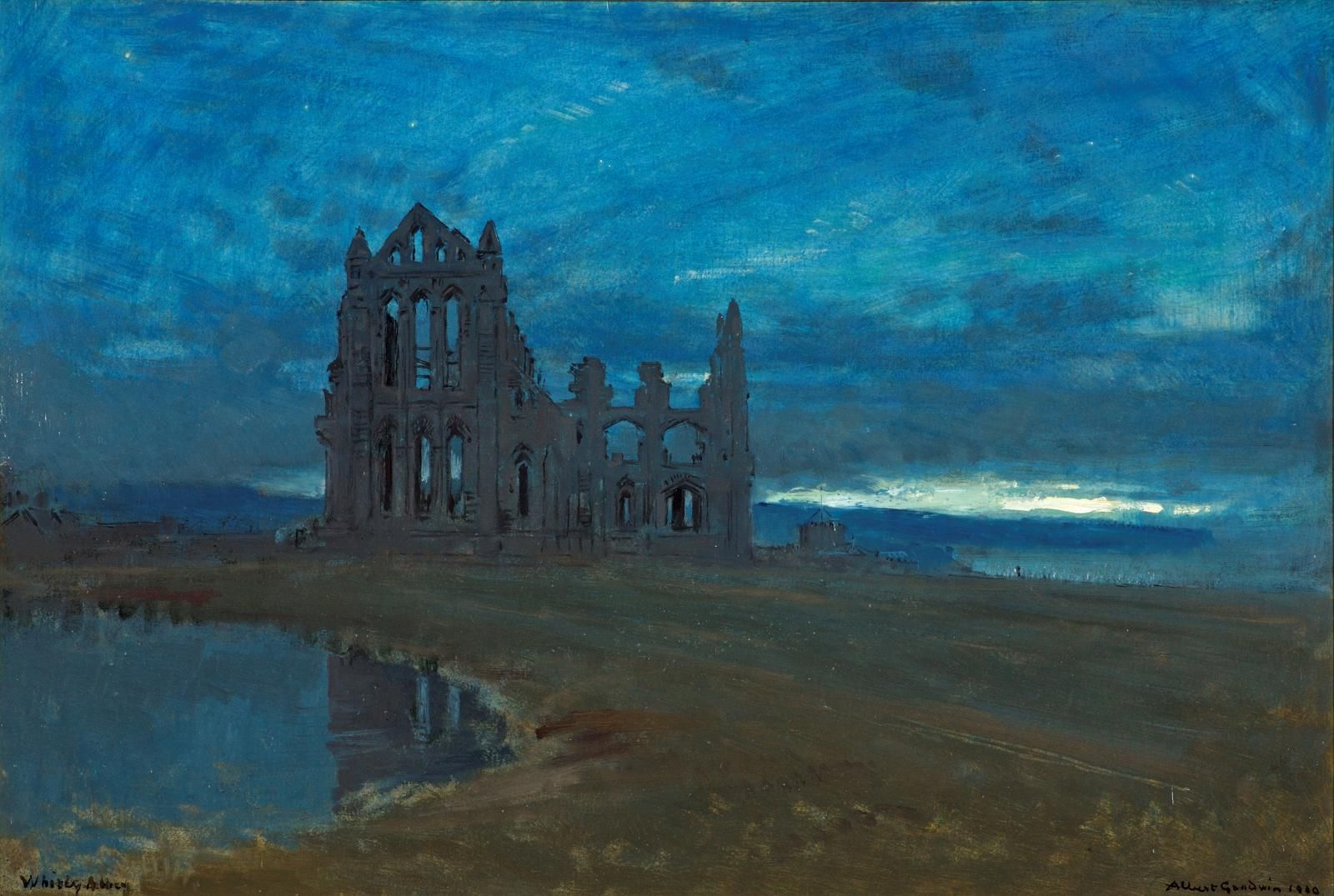
Albert Goodwin completed a colourful watercolour of Whitby Abbey as seen from the east.  The abbey which had been founded in 657 by St Hilda was later destroyed by marauding Danes in 867.  This view is of Whitby Abbey from the east. The ruin depicted in this watercolour is as it is now after one of the towers collapsed in 1830.  Goodwin painted another version of the Abbey in 1910 but this was completed using oils and is now housed in the Victoria Gallery, Bath.  Albert Goodwin’s diary entry of July 22nd 1909 declares his love for Whitby.  He wrote:

“…Whitby once again…I am again inclined to repeat myself in the belief that one or two things in it (for colour) are as good as anything can be…”

Whitby Abbey by Albert Goodwin (1910)

Goodwin always loved to depict dramatic, poetic landscapes. In the 1910 version of Whitby Abbey the thoroughly radiant deep blue of the sky in this work is so typical of his work. Albert liked Whitby Abbey as a subject for painting because of its ruinous manifestation, but also because he was a deeply religious man, and had an interest in spiritual subjects.   Goodwin had painted many scenes featuring the abbey over the previous fourteen years.

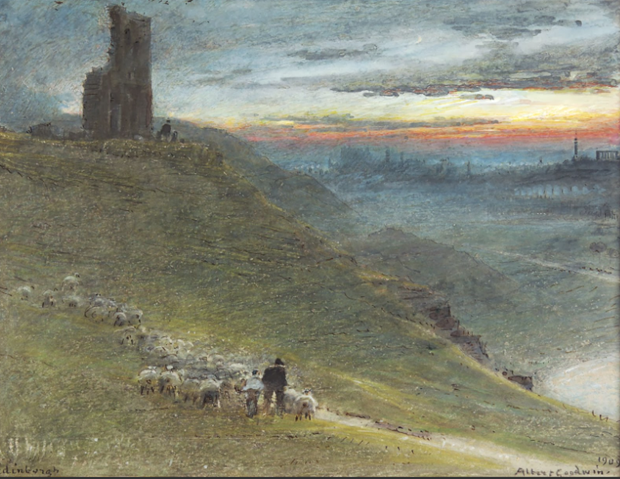
A Prospect of Edinburgh from the East by Albert Goodwin (1909)

Albert Goodwin carried on painting in the 1860s and exhibited his work at many exhibitions including the Dudley Gallery in London.  On February 16th 1867 Albert married Mary Ann Lucas, who was the eldest daughter of George Lucas, a fruiterer from Brighton and a year later his brother Harry married Henrietta Lucas, the sister of Albert’s new wife.  Sadly, on December 13th 1869 Albert’s wife Mary Ann died, aged twenty-nine of peritonitis.  Albert and Mary Ann had no children.  Around this time Albert went to live with Arthur Hughes and his family in West Brompton, London and he was employed as Hughes’ studio assistant.

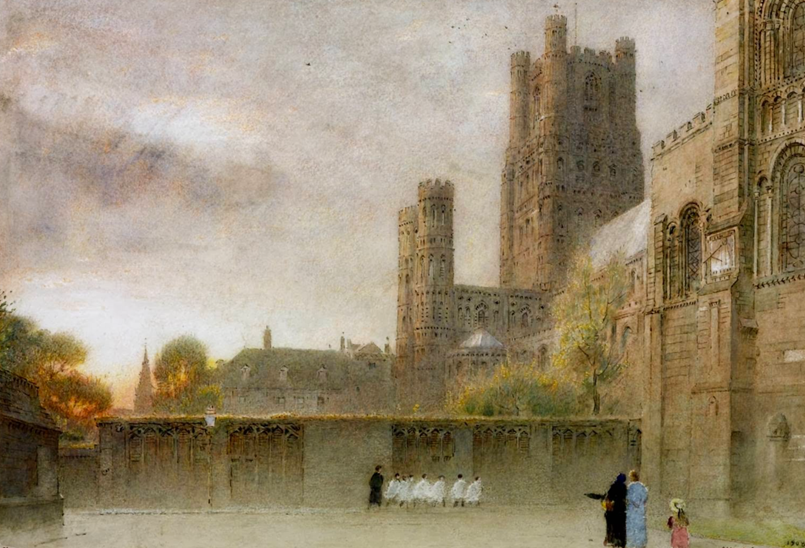
Ely Cathedral by Albert Goodwin

In 1871 Albert went on another European trip visiting Bruges.  That year he was elected Associate of the Society of Painters in Watercolours and at the time his address was given as Maltravers Street, Arundel, Sussex where he lived with his brother Harry and his wife Henrietta.  Sadly, Henrietta died that year, less than two years after her sister had passed.

The Medway at Maidstone by Albert Goodwin (1871)

Almost ten years had passed since Albert had first met John Ruskin and in Spring 1971, Ruskin offered Albert a job as his assistant and asked that he came to work with him at his home in Abingdon, Oxfordshire.  At the Royal Academy annual exhibition in 1871 Albert Goodwin exhibited his painting entitled The Medway at Maidstone.

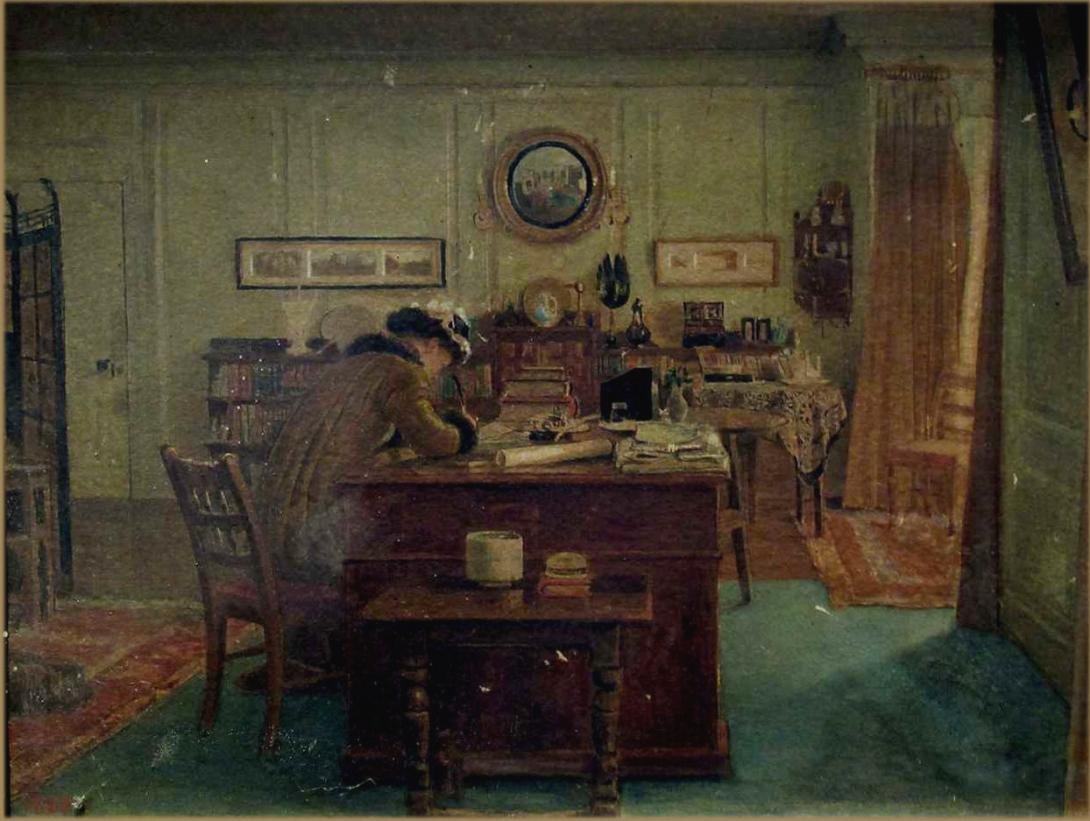
The Drawing Room at Dixton Manor (Drawing Room at Dixton Manor with K.M.G. writing) by Harry Goodwin (1883)

In 1872 Albert’s brother Harry married for the second time following his first wife’s death.  His new wife was fellow painter, Kate Malleson. Harry depicted his wife writing at a desk in Dixton Manor.

From left to right: John Ruskin, Mrs JC Hilliard, Mrs Joan Severn, Arthur Severn, Constance Hilliard, Albert Goodwin.

Albert Goodwin’s friendship with John Ruskin continued and, along with Ruskin’s cousin Joan Severn and her husband Arthur Severn, visited Matlock Bath and the following year Albert Goodwin and Ruskin travelled to Italy and Switzerland.

  Mont Blanc from the Sèleve, near Geneva

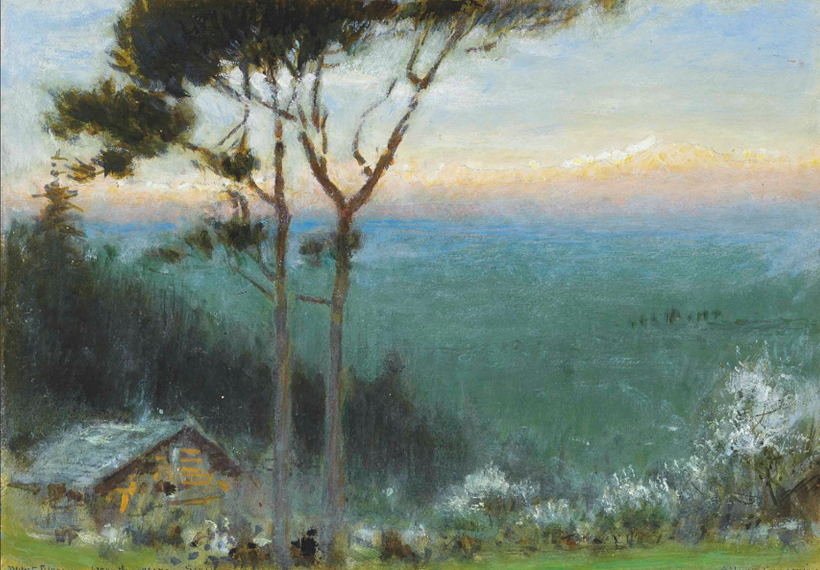
In 1873, Albert Goodwin stayed for three months in the Swiss village of Simplon which lies close to the Italian border.

An Arabian Night, Cairo by Albert Goodwin (1876)

In 1873, like his brother the year before, Albert Goodwin a widower for four years, married his second wife, Alice Desborough at Holy Trinity Church in the West Devon village of Gidleigh.  The couple went on to have seven children, two sons and five daughters. In 1876, Albert and Alice travelled to Marseille before boarding a ship for Egypt.  They also called at Gibraltar, Naples and Crete.

Blue Water in Mounts Bay, Cornwall by Albert Goodwin (1881)

Albert Goodwin had first met the naturalist, Charles Darwin when he was introduced to him by John Ruskin. He visited Darwin at his Kent home, Down House.

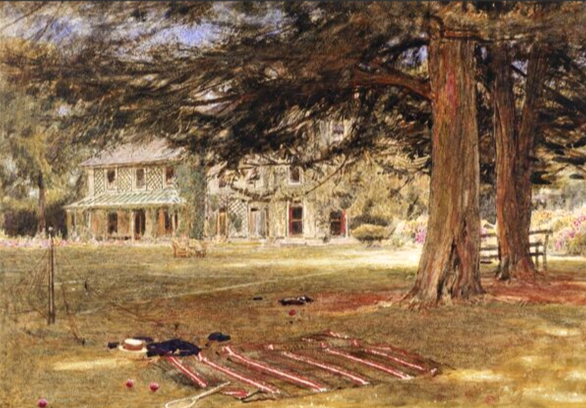
Down House from the Garden by Albert Goodwin (1880)

Down House by Albert Goodwin (1880)

Whilst there he made sketches of the house and gardens and later completed two watercolour paintings of Darwin’s residence, which had been built in the early 18th century, and remained Darwin’ and his wife, Emma’s home for forty years until his death in 1882.   It was here that Darwin developed his theory of evolution by natural selection and wrote his ground-breaking work On the Origin of Species in 1859.

Ilfracombe by Albert Goodwin (1884)

Albert and his wife and children left London and moved to Montpelier Terrace Ilfracombe in 1877.  He continued on his painting trips around Britain and further afield to France, Switzerland and the Italian Lakes often accompanied by John Ruskin and Arthur Severn, sometimes accompanied by his brother Harry.  During these trips Goodwin made a large number of annotated sketches and watercolour studies direct from nature, a method he used, alongside working from memory, throughout his career. Ruskin was fascinated by the large number of sketches, which he termed “flying sketches”, which Goodwin produced on a daily basis. Goodwin was happy with his system and in his 1917 dairy entry, he wrote:

“…To me this method of work is one of the happy things of the art that I practise, for I get the realisation of a place twice over, and often the memory makes the scene a better one than the first experience…”

Meanwhile his wife Alice was at home in Ilfracombe with their seven children, Ivy, Olive, Edytha, Albert, Christabel, Alice and Harold and their two servants, one a cook and the other a nurse.  A few doors down from them were Alice’s mother and sister Mary.

Florence, Evening by Albert Goodwin (1896)

In 1881 Goodwin was elected a member of the Royal Society of Painters in Watercolours. Albert Goodwin was continually influenced by John Ruskin who was constantly advising him with regards artistic techniques. Goodwin was a master of depicting topographical and landscape views.  For him, it was all about colour, and tonal values.   Ruskin was pleased and proud of his protégé and was constantly talking about the art of Turner and proudly showing off his own collection of Turner’s work.  Albert Goodwin wrote about the influence Turner had upon him in a diary entry in 1911.  He wrote:

“…I sometimes wonder if the spirit of old Turner takes over my personality. I often find (or think I find) myself doing the very same things that he seemed to do…”

Art critics of the time often likened his work to that of Turner.  In The Standard of October 1893, the art critic wrote:

“…In water-colour drawing Mr. Albert Goodwin is the legitimate successor of Turner…”

The Source of the Sacred River by Albert Goodwin (1900)

Albert Goodwin travelled to India in 1895 and one of the works from this trip was The Source of the Sacred River which he completed in 1900 and was exhibited at the Royal Academy that year.  The source in the title refers to the source of the River Ganges, which is regarded by the Hindu population of India as sacred, is at Lapthal, is in the Himalayas on the frontier between India and China. Of the painting, the art critic of The Athenaeum, a British literary magazine, in 1900 wrote:

“…Allegorical landscape, and still more allegorized landscape painting, is a difficult and particularly uncertain sort of art in which Mr Goodwin, its most accomplished practitioner amongst us, is one of the few who contrive even to approach success. The Source of the Sacred River is almost as suggestive, quite as well painted, and much more understandable. In general, it does not differ from a score of similar works by Mr Goodwin, who is not content with painting nature so admirably that few rival him and leaving to her sympathetic lovers the task of recognizing the pathos and poetry which, so to say, harmonizes itself with the spectator’s mood. There is nothing to tell us that the stream Mr Goodwin depicted so rarely is sacred in any exceptional sense, but there is much we can be grateful for in its abundant and sumptuous harmonies of colour, form, and light, and the dignity of its masses…”

Rye – The Winter’s Tale by Albert Goodwin (1920)

Albert Goodwin carried on with his painting trips around Britain and across the world, visiting South Africa, West Indies, Australia and New Zealand. His works were shown at a multitude of exhibitions and were always appreciated by critics and visitors alike. Goodwin died at his home, Ellerslie, in Bexhill-on-Sea on April 10th, 1932 aged 87.


Much of the information regarding the life and times of Albert Goodwin came from the Chris Beetles Gallery catalogue, Albert Goodwin RWS (1845-1932). The John & Mary Goodyear Collection, which I found in a charity shop in London.

and the website

The Maidstone Museum Websitre

Alice Ravenel Huger Smith

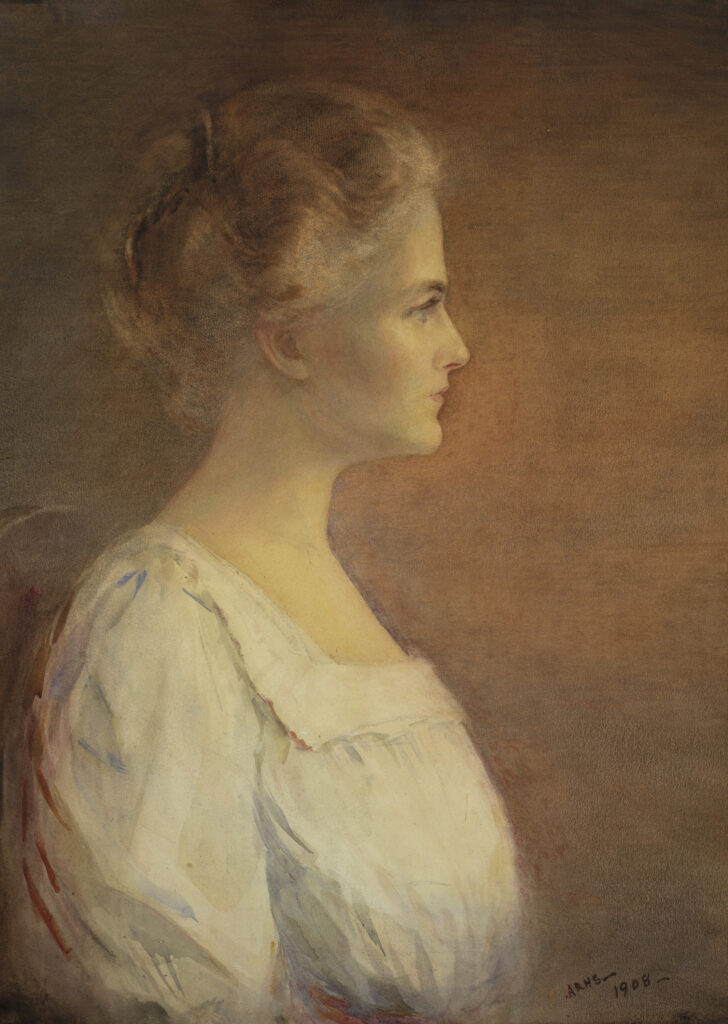
Self portrait (1908)

Self Portrait (1908)

At the turn of the twentieth century, the South Carolina city of Charleston was a shadow of its former glory. Charleston had historically nurtured a celebrated art and architectural heritage during the Colonial Period and Antebellum period but following the end of the Civil War in 1865 and the Reconstruction period 1865-77, it struggled to continue doing so. Between the two World Wars, beginning in the second decade of the 20th century, Charleston experienced a renaissance that flourished in part due to the work of authors, architects, artists, poets, & preservationists who rallied behind the common cause of ‘the betterment of the city’. It was a period known as the Charleston Renaissance and is credited with helping to spur the city’s tourist industry. Of the various artists associated with the movement, four of them stand at its forefront: Alfred Hutty, Alice Ravenel Huger Smith, Anna Heyward Taylor, and Elizabeth O’Neill Verner. In this blog I am looking at the life and artwork of one of the four, Alice Ravenel Huger Smith.

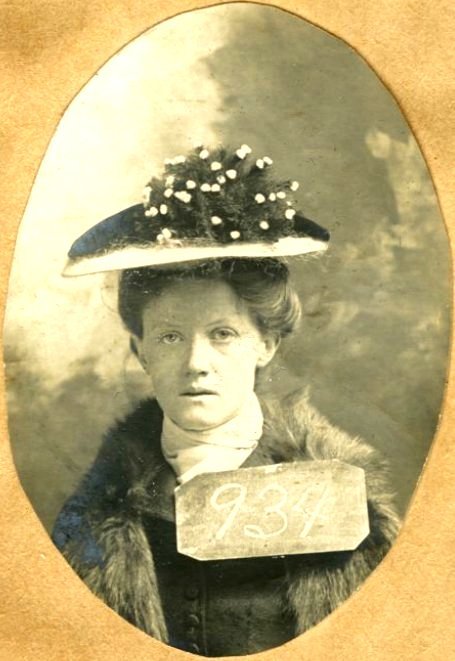
Alice Ravenel Huger Smith, Age 25.

Alice Ravenel Huger Smith, aged 25.

Alice Ravenel Huger Smith was born in Charleston on July 14th 1876. She was the fourth of five children and was descended from prominent rice planters and was the daughter of Daniel Elliott Huger Smith and Caroline Ravenel and was part of a socially prominent Charleston family. Although artistically self-taught she later did attend some classes in drawing and painting at the Carolina Art Association. Louise Fery, a Frenchwoman, instructed her students in the basics and, most importantly for Alice, in the technique of watercolour. The Art Association was established in 1857 by a group of prominent low country planters and factors and was officially chartered by the General Assembly on December 21, 1858. Its purpose was the cultivation of the arts and art education. It is now part of the Charleston’s Gibbes Museum of Art.  Alice Smith began her artistic career by making money from her portraiture, copying old family images and painting friends and relations.  She also dabbled with painting fans and dance cards. 

Celestial Figs by Alice Smith.  Colour woodblock print. (1917)

Of her early artistic influences, one was Birge Hirston, the American genre and landscape painter, teacher, and writer who was a prominent practitioner and advocate of Tonalism.  Tonalism was an artistic style that emerged in the 1880s when American artists began to paint landscape forms with an overall tone of coloured atmosphere or mist.  Alice met him during his extended visit to Charleston in 1908.  Later she would credit Hirston as being her guide when it came to her romantic style with regard to her landscape depictions.

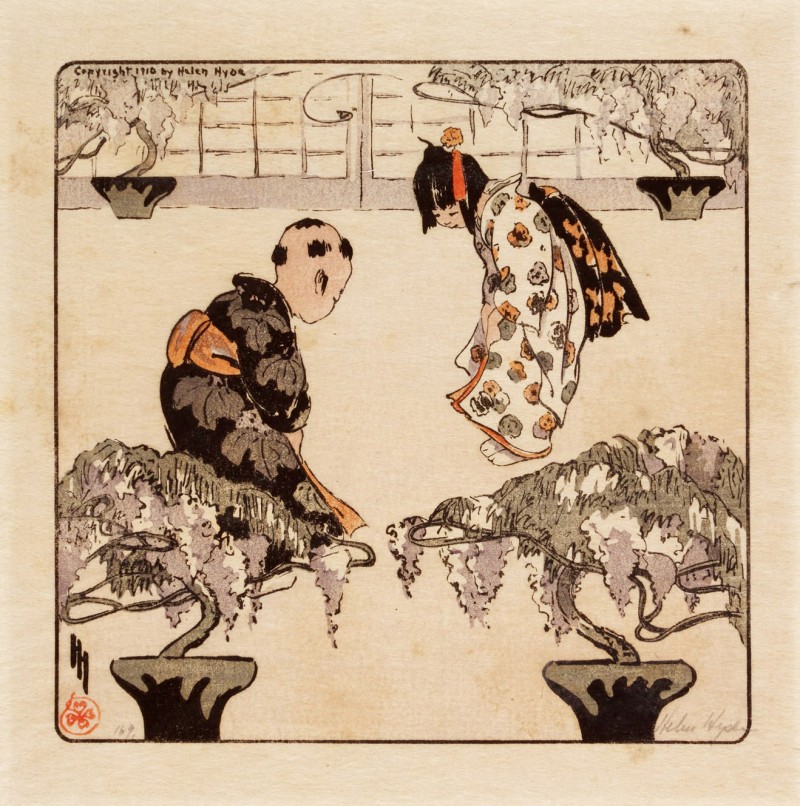
HELEN HYDE (1868–1919) TEN WOODBLOCK PRINTS, MEIJI PERIOD (20TH CENTURY) Woodblock Print by Helen Hyde

Another influence which inspired Alice Smith was the Japonisme aesthetic of the American etcher and engraver, Helen Hyde, who is best known for her colour etching process and woodblock prints which echoed the portrayal of Japanese women and children. Around about 1917, Smith undertook an intense study of Japanese colour woodblock prints, largely from the ukiyo-e school, which had been collected by her cousin, the Harvard professor Motte Alston Read. Motte Alston Read built up a collection of almost four hundred Japanese woodblock prints during the first two decades of the twentieth century, working meticulously to assemble a group of prints that were representative of the history of Japanese woodblock printing. She also began to teach etching during the 1920s, and one of her most famous students was Elizabeth O’Neill Verner.

Smith catalogued the collection and, began trying out with actual blocks and she taught herself how to print in the traditional Japanese manner.  She managed to produce a body of work which was characterized by sophisticated design and yet retained a sense of tranquillity.  In 1923 Smith helped the founding of the Charleston Etchers Club, a collaborative group that jointly acquired a press and shared expertise and criticism. However, by the late 1920s Smith gave up her work in prints and began to concentrate on watercolour.

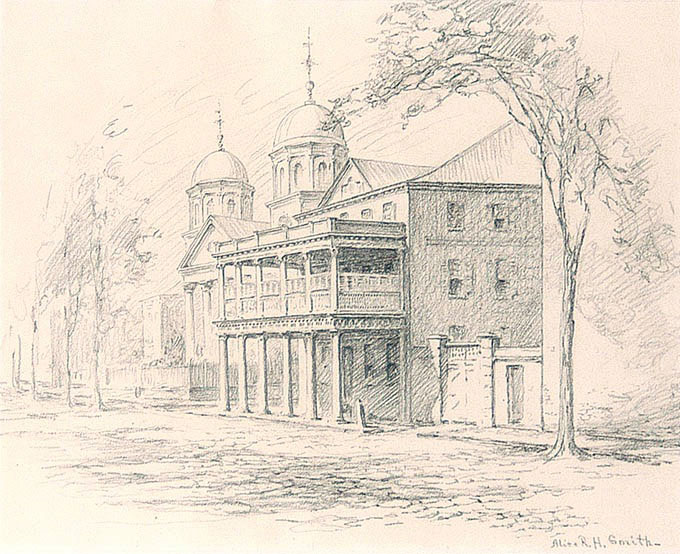
Branford-Horry House by Alice Smith (1917)

Branford-Horry House by Alice Smith

Alice Smith is probably best remembered for her scenic views of Charleston streets and in 1917 she produced a beautiful graphite sketch of one of Charleston’s famous buildings, the Branford-Horry House.  The house was built for William Branford, a wealthy planter, in 1765-67 and is rated one of Charleston’s finest examples of a three-story brick Georgian townhouse, or “double house.” In 1801 it was purchased by Thomas Horry, who had married Branford’s daughter. His son, Elias Horry, president of the South Carolina Canal and Railroad Company, inherited the house and altered it somewhat. The house is a three-story Georgian brick building with stucco-covered walls. Unfortunately, in 1988, a speeding car crashed into the house, knocking out two of the columns and sending one into the front door of the house.

St Phillips Church Spire, Charleston by Alice Smith

St Phillips Church Spire by Alice Smith

Another graphite on paper sketch of a Charleston building is Alice’s depiction of St Philip’s church spire.  St. Philip’s is the oldest congregation in the United States south of Virginia.  The church was built in 1836 and the spire completed in 1850.  On November 7, 1973, it was added to the National Register of Historic Places and designated a National Historic Landmark.

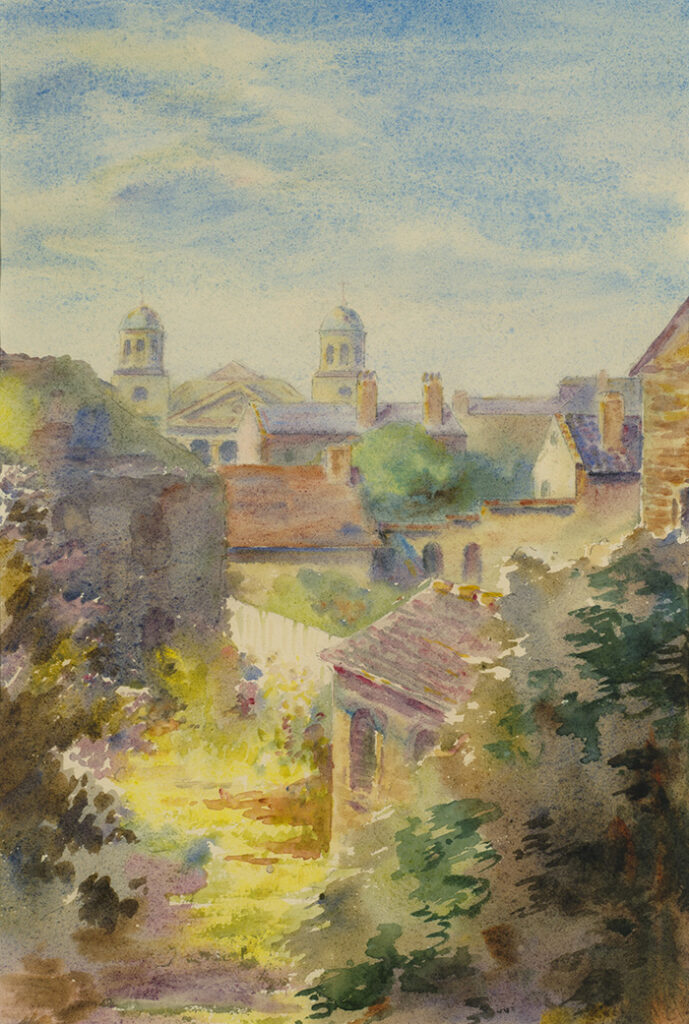
House-Tops-View-from-69-Church-Street-689x1024

House Tops View from her home, 69 Church Street Charleston by Alice Smith

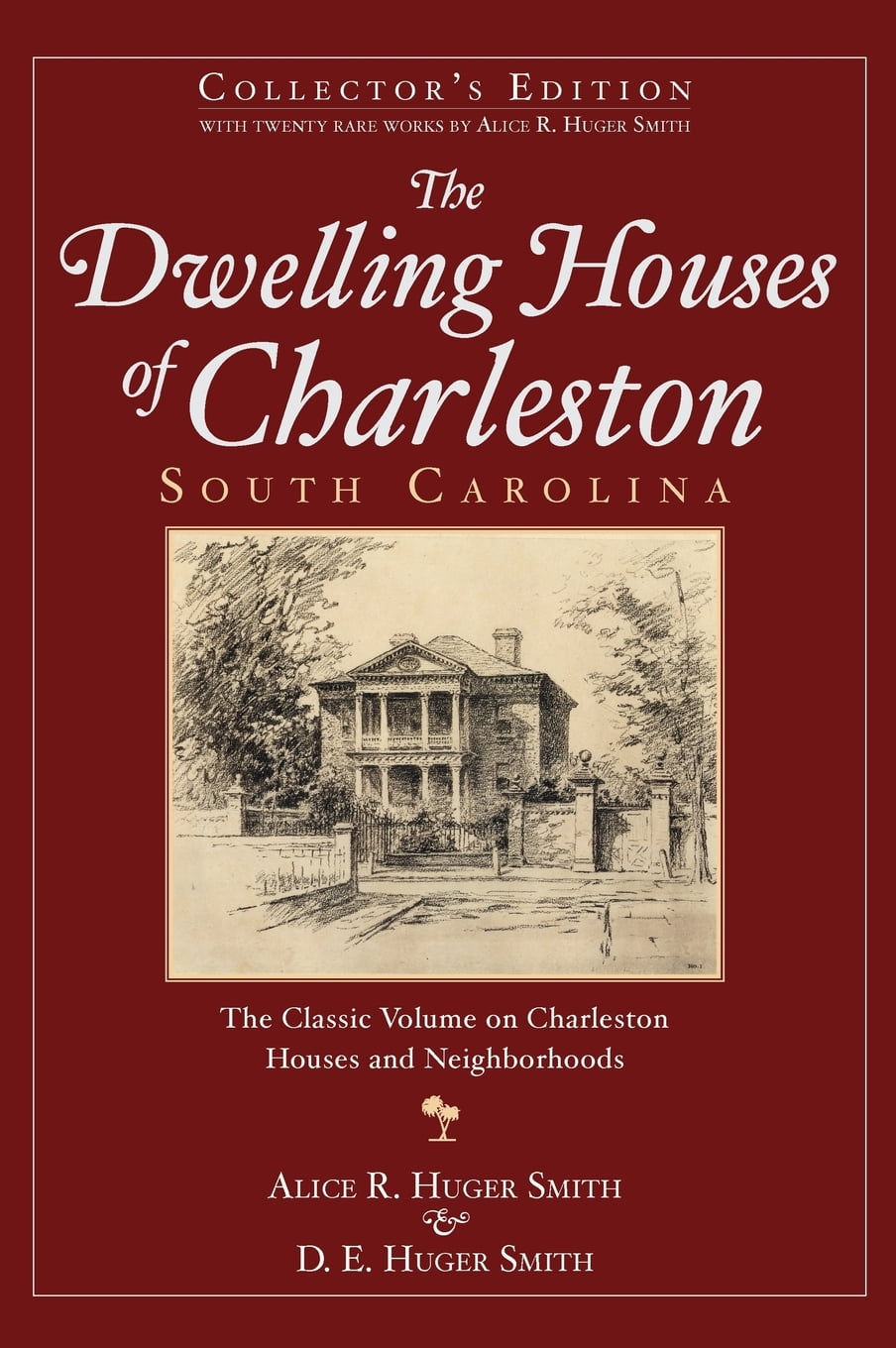
Alice Smith became so interested with the old buildings of Charleston that in 1917 in collaboration with her father, Daniel, she had a book published, The Dwelling Houses of Charleston, South Carolina, in which the authors demonstrate how the fashions of its architecture, often brought over from England, have maintained local characteristics and resulted in a distinctive style.

See the source image

For Alice and her father, it had not simply been their object to list or to describe these dwelling houses after the manner of a guidebook, but to show how the fashions of its architecture, though imported and constantly modified by new ideas brought chiefly from England, had yet maintained local characteristics, resulting in quite a distinctive style which has steadily persisted and been developed.

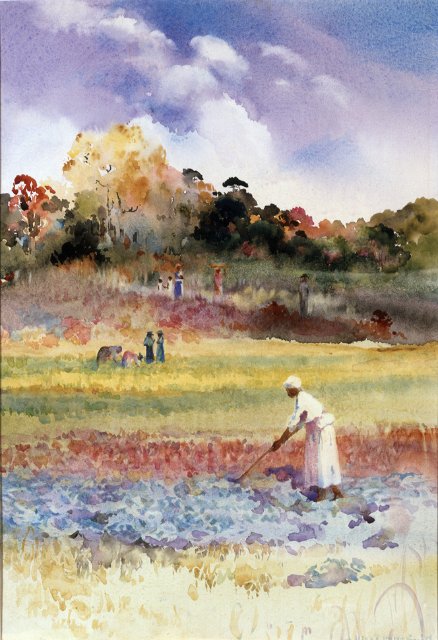
The Winter Vegetable Garden from the series A Carolina Rice Plantation of the Fifties by Alice Smith (c.1935)

The Winter Vegetable Garden from the series A Carolina Rice Plantation of the Fifties by Alice Smith (c.1935)

However, Alice Smith is best known for her lyrical and expressive depictions of the Carolina Lowcountry, the cultural region along South Carolina’s coast, including the Sea Islands. It was once known for its slave-based agricultural wealth in rice and indigo, crops that thrived in the hot subtropical climate, and is known now for its historic cities and communities, natural environment, cultural heritage, and tourism industry.  Smith summed up her love of the area saying:

“…my own lovely flat country of rice fields, of pinewoods, of cypress swamps, of oaks, lotus, and all their attendant feathered folk would yield me a full harvest if diligently spaded…”

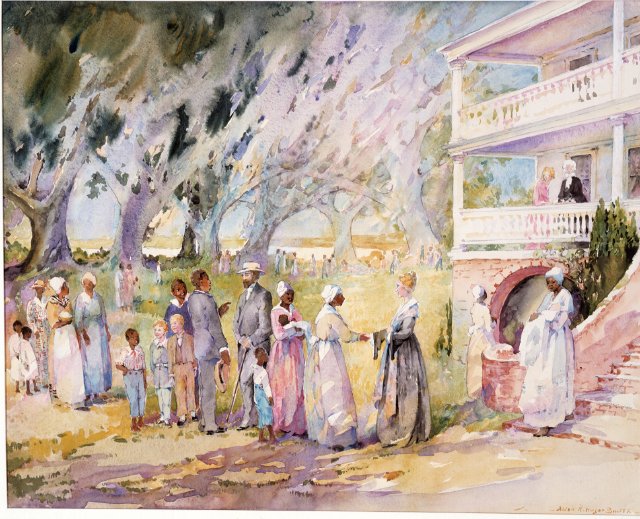
Sunday Morning at the Great House by Alice Smith

Sunday Morning at the Great House from the series A Carolina Rice Plantation of the Fifties by Alice Smith (c.1935)

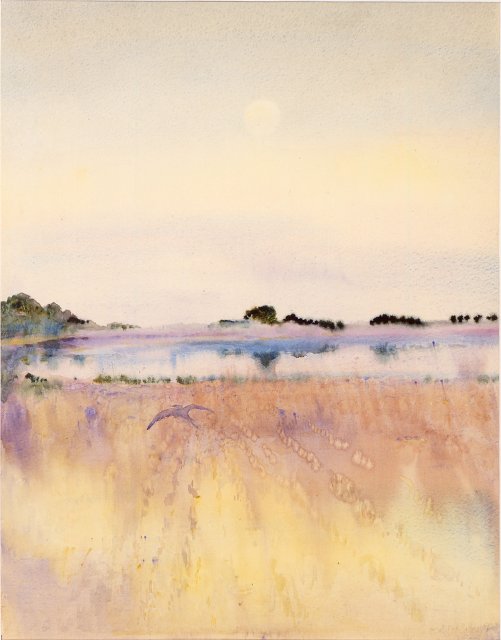
Around about 1924 Alice Smith changed her favoured painting medium and resorted to working with watercolours. After experimenting with oil paints and printmaking, Smith eventually settled on watercolour in which she would work for the rest of her life.  The reason being she said was that watercolours were most conducive to achieving the atmospheric effects she sought in her landscapes. Her landscape depictions are generally devoid of figures as she wanted to concentrate on the beauty of nature itself.  Many of her mature watercolours depict scenes from rural salt marshes.

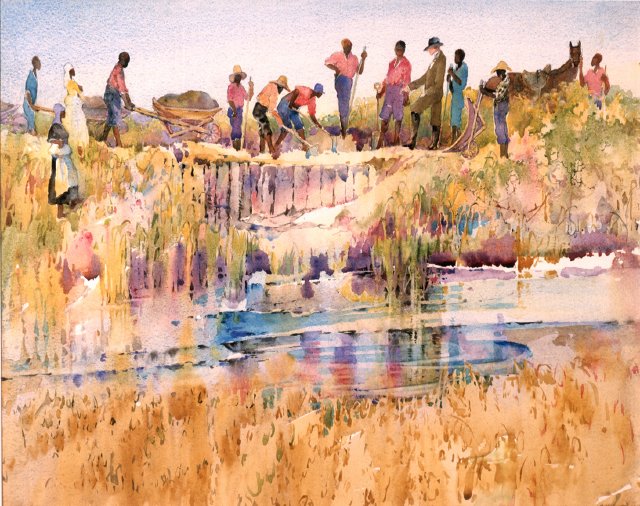
Mending a Break in a Rice-Field Bank from the series A Carolina Rice Plantation of the Fifties

Mending a Break in a Rice-Field Bank from the series A Carolina Rice Plantation of the Fifties by Alice Smith (c.1935)

Alice Smith was also a noted illustrator, and contributed illustrations to two volumes her father, the historian Daniel Smith, who wrote about the history of Charleston and its architecture, as well as other books relating to South Carolina, most notably the 1936 book, A Carolina Rice Plantation of the Fifties, which contained thirty paintings in water-colour, by Alice Huger Smith, and a narrative by Herbert Ravenel Sass, with chapters from the unpublished memoirs of her father Daniel Huger Smith.

A Winter Field Still in Stubble from the series A Carolina Rice Plantation of the Fifties by Alice Smith

A Winter Field Still in Stubble from the series A Carolina Rice Plantation of the Fifties by Alice Smith (c.1935)

Alice was also engrossed in recording vanishing ways of life in South Carolina and her best-known work is the series of thirty watercolours known as her Rice Plantation Series which can be seen at the Gibbes Museum of Art in Charleston’s Historic District. She donated the Rice Plantation Series to the Gibbes in 1937.  Alice was able to pictorially tell the history of plantation life in the antebellum South, and by doing so, she took it upon herself to preserve that period in a series of nostalgic images that would be accompanied by her father’s memoirs and an essay on rice cultivation by the historian Herbert Ravenel Sass.  Alice made these plantation paintings during the height of the Jim Crow era, when black people in Charleston and throughout the country were subjected to humiliating discrimination and life-threatening abuse.  She was well aware of this as she, a single woman, lived in downtown Charleston, close to areas of extreme poverty, surviving only through the sale of her art.  As I said at the beginning, this period was in the 1930’s when Charleston was a city in limbo.  Gone were the days of the glorious affluence of the rice years with its economic revival still years away.  It was a time for those who lived in Charleston to hanker for the “good old days” and like to remember when times were relatively calm, when blacks knew their place and white planters were firmly in charge, when life for the privileged class was simple and wealth abundant.  In Alice Smith’s 1950 autobiography, Reminiscences, she wrote about change:

“…Small places and big places alike show it. Perhaps small happenings show it as sharply as great events, and one looks with surprise at the differences that one never noticed during the endless moments of what might be called trivial evolution…”

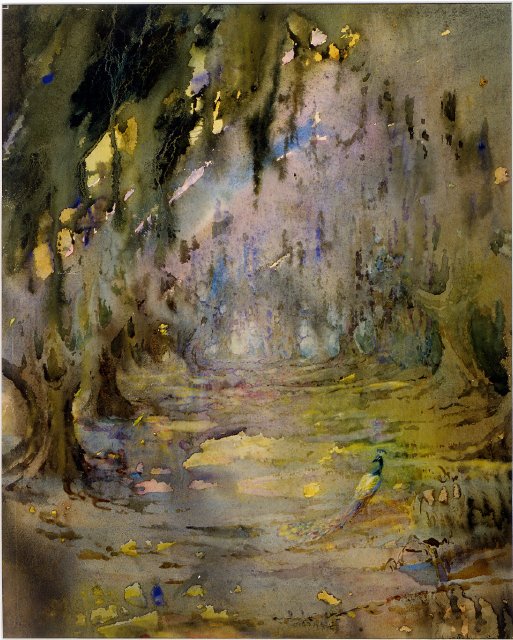
The Grove of Oaks from the series A Carolina Rice Plantation of the Fifties by Alice Smith (c.1935)

The Grove of Oaks from the series A Carolina Rice Plantation of the Fifties by Alice Smith (c.1935)

Her series of watercolours reflect her sense of change, and her profound nostalgia.  Maybe it was a nostalgic view of plantation life of the past but maybe it was pure fantasy but one has to remember paintings were made to be sold and maybe the public preferred this “happy plantation life” image rather than the cruelty that existed and by studying her depictions the public it probably helped people believe that the past was lovely.

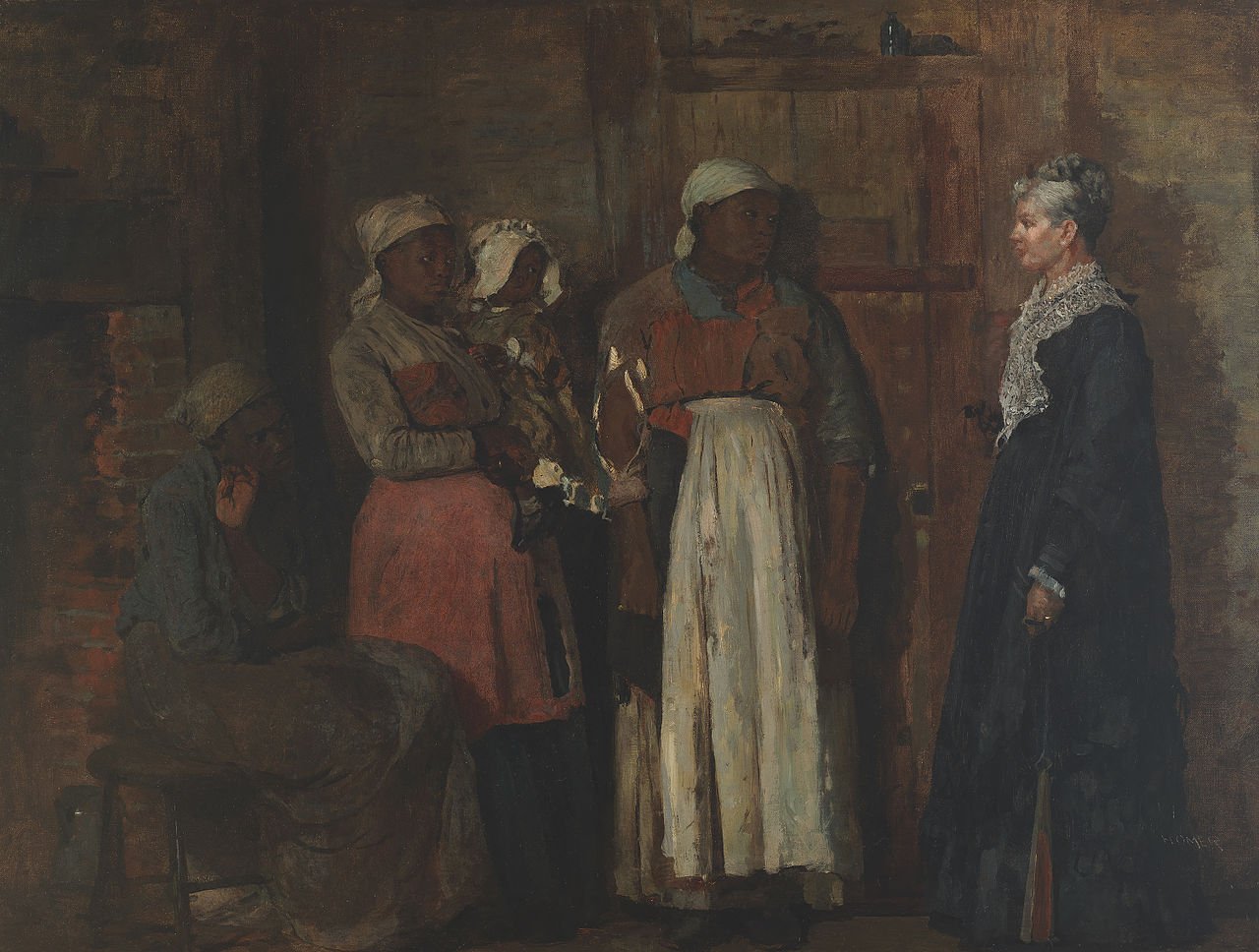
A Visit from the old Mistress by Wilmslow Homer (1876)

A Visit from the Old Mistress by Winslow Homer (1876)

Almost sixty years before Alice Smith’s Plantation series the great American painter Winslow Homer created his 1876 work, A Visit from the Old Mistress, a picture depicting an idealised situation when blacks as freed slaves and living in a ramshackle cabin were shown as mixing happily with a white person, their former mistress of the “big house” who, until recently, owned them. It represented a scene from the present, a meeting of different classes and colour which caused an inevitable awkwardness when it was exhibited.

1 / 22
Woods at River Bend on Wando River, by Alice Smith (c. 1936)
 

Alice Smith donated the Rice Plantation Series to the Gibbes in 1937, and since that time the watercolours have been among the most popular works owned by the museum. The problem however was that the delicate works on paper were slowly deteriorating due to the acidic boards mounted to the back of each of the paintings. The acid then began to discolour the works and deposit on them brown spots known as foxing and with many of the watercolours, the damage was well advanced.

At the Head of the Valley by Alice Smith

The management of the Gibbes, realised the need to intervene, reverse the damage, and prevent future damage through professional conservation of Smith’s entire series of watercolours. To accomplish this, they established the Welsh-Blakely Fund, a substantial financial commitment that funded the five-year conservation project carried out by the Straus Center for Conservation at the Harvard University Art Museums.

Along the Beach by Alice Smith (c.1926)

Like many other leading painters from the Southern states of America during the early twentieth century, Alice Smith had a steadfast belief in the South, which was both idealized and energetically favourable, but this was simply down to her love of where she lived.  Smith was at the centre of Charleston’s artistic reawakening during the early twentieth century.

Larger memorial image loading...

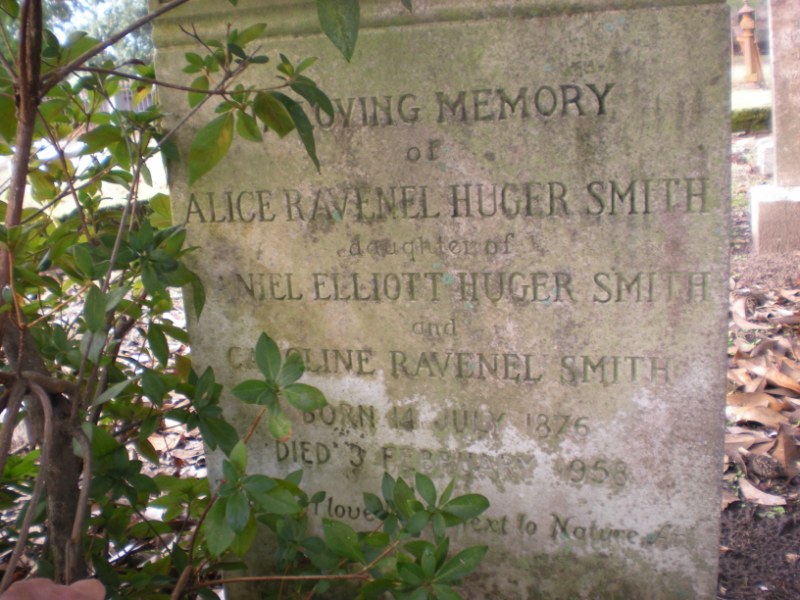
Alice Ravenel Huger Smith died on February 03, 1958, aged 81 and is buried at Magnolia Cemetery in Charleston.

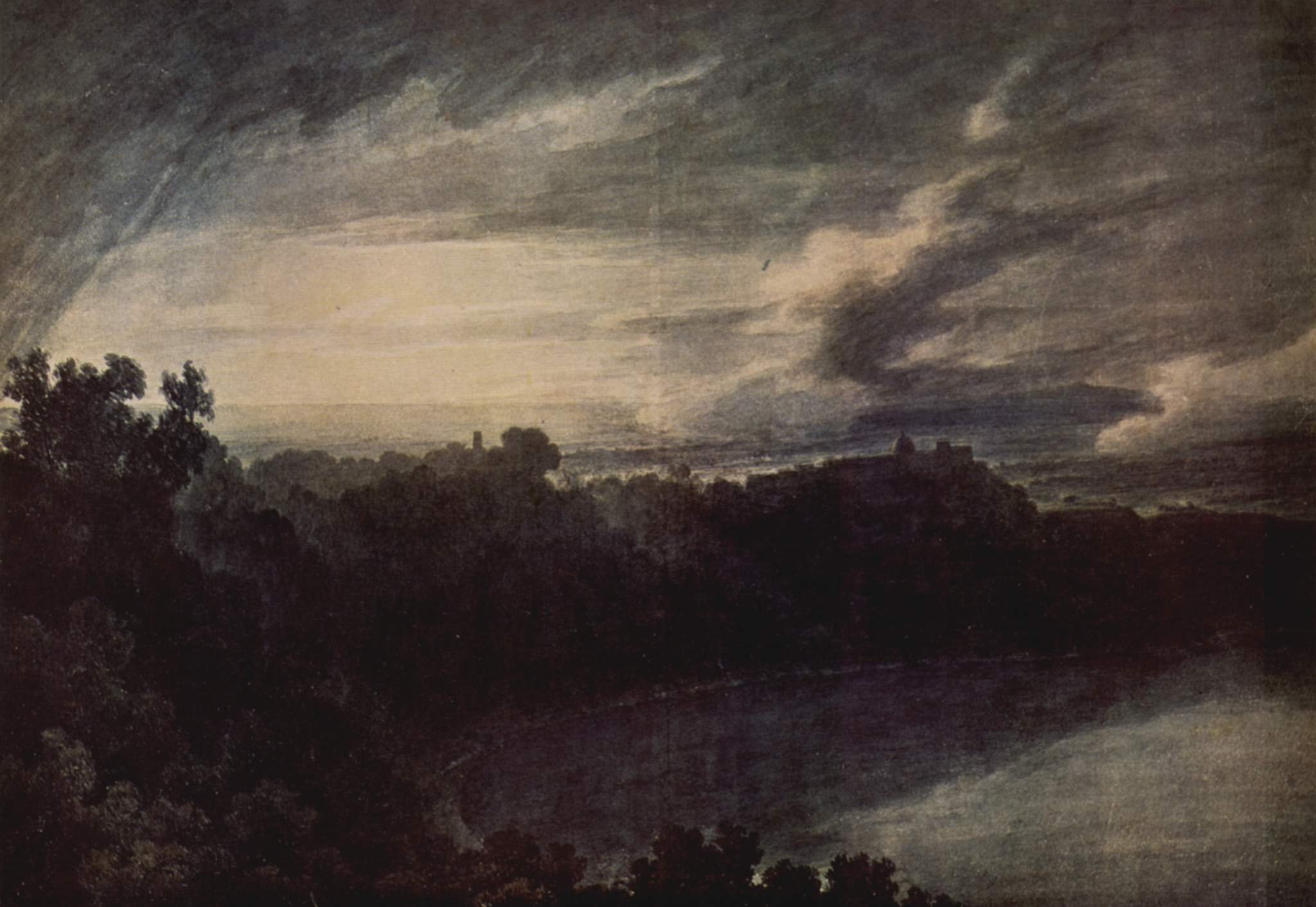
The artists of the Norwich School of Painters. Part 1 – John Sell Cotman.

John Sell Cotman by his son, Miles Edmund Cotman

In the art world one often hears about Schools. Not just meaning art establishments but denoting a group of artists who work from a specific location. Prime examples of this are the Barbizon School, which was active from about 1830 through to 1870, and takes its name from the village of Barbizon, France, near the Forest of Fontainebleau. Probably the best known School in Britain was the Newlyn School, an art colony of artists based in or around Newlyn, a fishing village adjacent to Penzance, on the south coast of Cornwall, from the 1880s until the early twentieth century.  A few blogs ago I wrote about Francis Danby who was part of the Bristol School.

Village in Normandy, France, Noon by John Sell Cotman (1817-1820)

In this blog I am looking at a group of artists who worked out of the county of Norfolk, specifically the town of Norwich. These were painters of the Norwich School, or Norwich Society of Artists, which came into being in 1803 in the town of Norwich and was the first provincial art movement in Britain. The area around Norwich was very picturesque and a landscape painter’s idyll. The Scottish miniaturist, Andrew Robertson who was a friend of Constable, visited Norwich in 1812 and was full of praise for the town’s vitality, writing in a letter:

“…I arrived here a week ago and find it a place where the arts are very much cultivated….some branches of knowledge, chemistry, botany etc are carried to a great length.   General literature seems to be pursued with ardour which is astonishing when we consider that it does not contain a university, and is merely a manufacturing town…”

Robertson continued, talking about the quality of music in the city and then turned his thoughts to the city’s art:

“…Painting and Drawing are as much esteemed, and many are nearly as great proficient….The study of landscape about the town are infinitely beautiful and inexhaustible. The buildings, cottages etc are charming and have invited people to the general practice of drawing, or rather painting in watercolours from nature, assisted by man of considerable abilities as a teacher and landscape painter…”

The Norwich Society of Artists was founded in 1803 by John Crome and Robert Ladbrooke and their idea was that artists could meet and exchange ideas. The Society set down its aims as being:

“…an enquiry into the rise, progress and present state of painting, architecture, and sculpture, with a view to point out the best methods of study to attain the greater perfection in these arts…”

Drop Gate, Duncombe Park, Yorkshire by John Sell Cotman (1805)

The Society, once formed had their first meeting in a local tavern, The Hole in the Wall. Two years later they moved to new premises and the extra space allowing the members to use as a studio and also exhibit their work. Their first exhibition was held in 1805 and it was a great success, so much so, that they held an annual exhibition there for the next twenty years. Unfortunately, the building had to be demolished but three years later, in 1828, the Society members regrouped and became the Norfolk and Suffolk Institution for the Promotion of the Fine Arts.
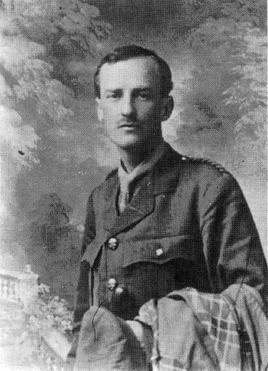
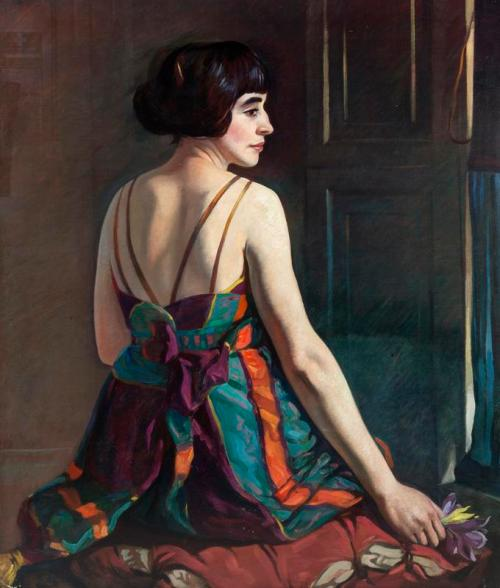
The leading light of the Norwich School of Painters was John Crome who then attracted many friends and pupils until his death in 1821. Leadership of the Society then fell on John Sell Cotman, who had been a member of the society since 1807, and who continued to keep the Society together until he left Norwich for London in 1834. The Society effectively ceased to exist from that date.

Portrait of John Sell Cotman by Alfred Clint

One of the most well-known artists associated with the Norwich School was John Sell Cotman. Cotman was born on May 16th 1782 in the East Anglia town of Norwich, the son of Edmund Cotman and his wife Ann. He was the eldest of ten children. His father, Edmund Cotman, formerly a barber but latterly a draper by trade, had married Ann Sell. John Sell Cotman initially studied at the Norwich School, which is one of the oldest schools in the world having been founded in 1096. John’s father had intended that once his son had completed his education, he would join him in the family business. However, during his time at school John Cotman had developed a love of art and was determined that he would not spend his working life behind a shop counter. At the age of 16, he left home and went to London to study art.

Houses at Epsom by John Sell Cotman (1800)

Whilst living in London he managed to earn some money by colouring aquatints for Anglo-German lithographer and publisher, Rudolph Ackerman, who had, in 1795, established a print-shop and drawing-school in The Strand. Ackermann had set up a lithographic press and begun a trade in prints.

Doctor Thomas Monro

It was whilst Cotman was in London that he also met Doctor Thomas Monro, who was an avid art collector. Monro was Principal Physician of the Bethlem Royal Hospital and one-time the consulting physician to King George III. Besides being an amateur painter and art collector, he was also a patron to a number of young aspiring artists including Thomas Girtin. Monro had a house in Adelphi Terrace, London where he had his studio and a country house in Merry Hill, a suburb of Bushey just fifteen miles from the capital. Monro liked to surround himself with other artists and J.M.W. Turner was a frequent visitor. He ran an art Academy where he would offer evening art classes, some of which were attended by John Sell Cotman.

The Devil’s Bridge North Wales by John Sell Cotman (c.1801)

John Sell Cotman managed to gain the patronage of Monro and through him met many of the leading British artists of the time and it was through his friendship with Turner, Girtin and Peter de Wint that Cotman continued his artistic development. He enjoyed taking trips out to sketch and it is believed that in 1800 he accompanied Thomas Girtin on a sketching trip to North Wales. A painting which came from one of his trips to North Wales was his 1801 work entitled The Devil’s Bridge, North Wales. A pencil drawing of this subject can be found in Leeds City Art Gallery, and it may well have been the inspiration for this very finished example of a Cotman watercolour.

Harlech Castle by John Sell Cotman (c.1800-1802)

Considering Cotman had had no formal art tuition it is amazing the artistic standard he had reached for someone of such a young age for when he was aged just eighteen, he first exhibited at the Royal Academy showing five works, four depicting scenes from the Surrey countryside and one was of Harlech Castle. When touring North Wales in 1800, he made a series of drawings and watercolours of Welsh subjects during the following years. This watercolour of Harlech Castle in North Wales is related to a sketch he drew on July 30th 1800. The castle at Harlech was built in the thirteenth century by Edward I, and was often represented by artists at this time. It features in watercolours by Girtin, Varley and Turner as well as Cotman.

The success Cotman believed would come about in London never materialised and in 1806 he returned to his hometown of Norwich and began earning his living as an art tutor. When he returned to Norwich he also joined the Norwich Society of Artists.  Cotman exhibited 20 works, including six portraits, at the society’s exhibition in 1807, and 67 works including some oils, in 1808. In 1811 he became president of the society.

Greta Bridge by John Sell Cotman (1806)

One of my favourite works by Cotman is a watercolour entitled Greta Bridge measuring just 22cms x 33cms. Cotman completed the small work in 1805 which can be found in the British Museum. A second version of the painting, a much larger one, (30cms x 50cms), was completed by Cotman in 1810 and is housed in the Norwich Castle Museum. Both of these watercolours recreate the rural solitude and tranquillity of the Greta area of North Yorkshire, where Cotman spent the summers of 1803 – 1805. The Greta Bridge in this painting spanned the river Greta in North Yorkshire near the gates of Rokeby Park. John Cotman had arrived at Rokeby on the evening of July 31st 1805, accompanied by his friend and patron, Francis Cholmeley. It had been arranged in advance that the two men were to stay as guests of the owner of Rokeby Park, John Bacon Sawrey Morritt. Cotman stayed at the house for about three weeks and when his hosts left on business, he remained nearby, taking up lodgings in a room at the local inn, which is the large building to the left of the bridge. Cotman then continued the work he had begun along the river Greta that skirts the park. It is a wonderfully balanced composition depicting the Greta Bridge, with its striking, single arch, which runs horizontally across the picture, in some way dividing it in two and yet uniting it into a single scene. The arch of the bridge epitomizes a great feat of engineering, which Cotman, with his love of architecture, admired. The structure we see before us was designed by John Carr of York, and built in 1773 for Morritt’s father, John Sawrey Morritt, who was a well-known collector of classical antiquities. The bridge replaced a Roman single-arched bridge of the same design.

Chateau Navarre, near Evreux, Normandy by John Sell Cotman (1830)

Cotman had a love of bridges and sketched many. For him, a bridge was a meeting point or landmark for travellers and would often be a point of reference on maps where rivers and roads meet. Cotman was fascinated by the interaction of this man-made feature and how it harmoniously interacted with a natural setting.

Dutch Boats off Yarmouth, Prizes during the War by John Sell Cotman (1824)

In 1809, Cotman married Ann Mills, the daughter of a farmer from the nearby village of Felbrigg and the couple went on to have five children. During his time as a drawing master he taught the local banker, botanist and antiquary Dawson Turner and his children. They became close friends and Dawson Turner introduced him to many prospective students. Cotman began to be interested in etchings and issued the first of his in 1811. He moved from Norwich and for the next ten years he lived in the Norfolk coastal town of Yarmouth and this gave him the opportunity to complete a number of seascapes such as his oil painting Dutch Boats off Yarmouth which depicts a coastal scene at Yarmouth and is a reminder of British naval triumphs over the Dutch navy. England and the Dutch Republic, despite having been allied for a century when they again went to war in 1780, a conflict that lasted four years and became known as the Fourth Anglo-Dutch War.  The conflict followed secret Dutch trade and negotiations with the American colonies, who, at the time, were in revolt against England.  In the background of the painting we can just make out Yarmouth’s monument to the Norfolk hero, Lord Nelson.

Cley Church, Norfolk by John Sell Cotman

It was around this time that Cotman concentrated on printmaking. The majority of his etchings were architectural in nature, with numerous ones of old Yorkshire and Norfolk buildings. It is more than likely that this move towards etchings and printmaking was due to, and inspired in part by his friend and patron, Dawson Turner. Unlike academic, London-based painters who romanticized the English countryside, John Sell Cotman and other members of the Norwich School painted landscapes in their immediate surroundings. An example of this is his 1818 drawing Cley Church, Norfolk which is a depiction of Saint Margaret’s in the village of Cley-next-the-Sea. It exhibits Cotman’s heightened attention to perspective and architectural detail as opposed to vegetation and atmospheric effects. It is now part of the Art Institute Chicago collection.

Church of St Paul at Rouen

In 1817, Cotman, with help from his patron, made the first of three tours of Normandy and out of these journeys came a book in 1822 entitled, Architectural Antiquities of Normandy, one of various books he illustrated with his etchings. The Etching on Chine Colle entitled Church of St Paul at Rouen was one of Cotman’s illustrations for his book.

Church of Querqueville, Near Cherbourg, from the series Architectural Antiquities of Normandy, etching by John Sell Cotman (1822)

Another etching from the series ‘Architectural Antiquities of Normandy‘ was his work, Church of Querqueville, Near Cherbourg.

In January 1834, through the good auspices of J.M.W. Turner, Cotman gained the post of Master of Landscape Drawing at King’s College School in London, which he held until his death. He and his family left Norwich and relocated to the London borough of Bloomsbury. Two years later, his eldest son Miles Edmond Cotman was appointed to assist him. The taking up of the position at King’s College could not have come at a more fortuitous time as Cotman was beginning to have financial problems. Sadly, with these financial problems, which had afflicted him during most of his working life, came bouts of depression, ill health and despondency brought on by the poor sales of his work. During John Cotman’s tenure at King’s College he taught many artists including Dante Rossetti.

John Sell Cotman’s grave in St. John’s Wood, London

Cotman’s last visit to his home town of Norfolk was in the autumn of 1841, just nine months before his death in London on July 24th, 1842. He was buried in the cemetery at St. John’s Wood Chapel.  The 20th century art historian and painter, Charles Collins Baker, said of John Sell Cotman:

“…a great colourist, whose earlier palette produced that rare plenitude that only masters of exquisite simplicity and restraint compass: from his palette the brown glebe, the black reflection of massed trees in a still river, the grey and gold of weathered stone and plaster, the glinting gold on foliage and the gilded green of translucent leaves have a special and supernal quality of dream pageants rather than of actuality…”

For most of the twentieth century, Cotman was the most widely admired English watercolourist, surpassing even Turner in popularity.

Anna Palm de Rosa, the Swedish watercolourist.

Anna Palm de Rosa (1865-1924)

In my last blog I looked at the life of Gustaf Wilhelm Palm, the renowned Swedish landscape painter. In this blog I want to talk about his equally artistically talented daughter Anna Palm. I read a Swedish article which it declared that Anna Palm was “one of our most productive artists from the oscarian era”. Oscarian is similar to what we term Victorian (1872-1907) as it relates to a period when the Swedish monarch Oscar II, who was on the throne between 1837-1901. Although today her work is largely forgotten and very little is written about her, in the 1890‘s she was one of the most wanted artists in Sweden.

Cliffs by Anna Palm (1891)

Anna Palm was born on Christmas day 1859 in Stockholm. Her father was Gustaf Wilhelm Palm, the court and landscape painter. Her mother, Eva, was the daughter of portraiture and historian painter Johan Gustaf Sandberg. The family lived at Barnhusträdgårdsgatan 19, in Stockholm, which today is known as Olof Palmes Street, renamed after the former Swedish prime Minister who was assassinated in 1986. The home of the Palm family was a favourite meeting place for a large circle of their artist friends. Gustaf Palm who lived in Italy between 1841 and 1851 brought the Italy he loved to his paintings and his love of art was soon transferred to his daughter.

Self-portrait as a Hunter by Edvard Perséus

During her teenage years she was home-schooled in art by her father,  who was a teacher at the elementary education school, which was a preparatory school for the Academy of Fine Arts. Anna did not attend the Academy itself as it was still uncommon for women to study at that prestigious establishment. However, in 1880, aged twenty-one, she became a student of the history painter Edvard Perséus. Edvard Perséus, born Edvard Persson, had opened a very successful private painting school in Stockholm in 1875 and who, in 1882, was appointed to be a hovintendent (superintendent) responsible for King Oscar’s art collection.

Norrland coastal landscape with woman on the path by Per Daniel Holm (1864)

Another of Anna’s tutors was the landscape and genre painter Per Daniel Holm. After this, and through her family’s financial support, Anna travelled to Denmark where she spent some time at the artist colony in Skagen, a small harbour town in the north of Denmark.

A game of l’hombre in Brøndums Hotel by Anna Palm (1885)

It was whilst here that she embarked on one of her best-known paintings, A game of L’hombre in Brøndums Hotel which she completed in 1885. L’hombre was a quick-fire seventeenth-century trick-taking card game and the Brøndums Hotel in Skagen became the centre of one of the most famous artists’ colonies in Europe, known as the Skagen painters

Summer Evening at Skagen Beach – The Artist and his Wife by P.S. Krøyer (1899)

It was at the beginning of the 1870’s that the first artists came to the town of Skagen, on the east coast of the Skagen Odde peninsula, in the far north of Jutland.  Peder Severin Krøyer, one of the best-known of the Skagen painters, was inspired by the light of the evening which he termed the “Blue hour”, which made the water and sky seem to optically merge.  These young painters, who congregated at Skagen, had studied at the Royal Academy of Fine Arts in Copenhagen and were seduced by these light conditions in an area which also offered numerous sights of natural beauty which could satisfy the plein air painters, and furthermore many of the local population were willing to act as artists’ models for a small fee. It was not just artists who came to sample the fresh and rejuvenating air of this small coastal town. Writers, musicians, and actors often visited the place all of whom wanted to immerse themselves in the cultural life of the colony.

The hotel dining-room with portraits of the Skagen Painters (c.1892)

The Skagen Painters had a close relationship with Brøndums Hotel. One of the earliest painters to arrive at Skagen was Michael Ancher who arrived there in 1874 and he soon developed close ties with the family, who owned the hotel, and he eventually married their daughter Anna Kristine in 1880. Anna Ancher went on to become one of Denmark’s greatest visual artists. The Brøndums’ dining-room became the centre of the artists’ social life and was filled with the paintings they donated to cover the cost of board and lodging.

Spring afternoon at the North Sea by Romain Steppe

From Denmark, Anna Palm went to live in Antwerp and studied at the studio of the Belgian marine painter Romain Steppe, a painter of landscapes, and genre scenes but was best known for his atmospheric marine painting in the Impressionist and Post-Impressionist style. From Antwerp Anna went to live and study art in Paris.

Ships in Stockholm Harbor by Anna Palm (1890)

Anna Palm’s painting were shown at the Royal Academy in Copenhagen in 1885 and again in 1887 as well as many other exhibitions around Scandinavia. Once again, one hears about the frustration of artists with their country’s academic training and in 1885 and she was one of the many signatories to a letter from disgruntled artists who felt frustrated by what they termed as the “obsolete education” of the Royal Danish Academy of Fine Arts in Copenhagen. Despite this criticism Anna became a teacher in watercolour painting at the Academy in 1889 and held that that post until 1891. It was during this period that there was a growing demand for her watercolour paintings and she was soon inundated with commissions, many of which depicted sailboats and steamers.

Old Opera Seen from Helgeandsholmen by Anna Palm (1892)

Views of Stockholm were often depicted in her watercolour paintings, such as her 1892 work entitled Old Opera Seen from Helgeandsholmen. Helgeandsholmen is a small island in central Stockholm.

We can see in a letter she wrote to a client in 1892 as to how busy she was producing watercolours:

“…… Mr. Wilhelm Sjöström, Karlshamn,
I have not received students in watercolour painting, because I have so much to do with ordered jobs. What about your second request as to whether I have any watercolour study to sell, I have enough. For example, from the coast of Gotland, two smaller – 33 cm long and 24 cm wide. The one with trees on the left, in the background a jetty and boys wading in the foreground. The other – Lax fi crashed on the way home. They are painted directly after nature and really fresh in colour. I sell these two to 50, but not below. I also have a motif from Stockholm, 55 cm long and 30 cm high, Stockholm’s stream from Riddarholmen for SEK 50. Best is about Mr. Sjöström can decide soon, because I hardly get them ready until they are sold. With the utmost importance Anna Palm.

Stockholm, March 5, 1892. Address: Brännkyrkagatan 4 A. Stockholm…”

It needs to be remembered that 50 kr in the 1890’s was about one month’s salary for a worker and her watercolours now fetch between 15,000 – 25,000 kronor.

View of the Royal Palace, Stockholm by Anna Palm (1893)

Another such work featuring her favoured city was one entitled View of the Royal Palace, Stockholm which she completed in 1893.

Boulevard des Capucines by Anna Palm (1905)

Anna Palm left Stockholm and Sweden on New Year’s Eve in 1895 and never returned to her homeland. At this time, Anna Palm was thirty-six years old. Both parents were dead, and her brother had left Stockholm to live in Jönköping. Anna boarded a steamboat to Le Havre and went to live in Paris, with her friend Karin Nilsdotter. After some years in France, the two women went to Italy and during a visit to Capri, she met her prospective husband, Infantry Lieutenant Alfredo de Rosa. The couple married in Vaucresson, a western suburb of Paris, on September 9, 1901. From there they returned to Italy and moved to Capri before settling in the Madonna dell’Arco, district of Sant’Anastasia, near Naples in 1908.

Colosseum by Anna Palm de Rosa (c.1900)

Now an Italian resident, many of her watercolours featured depictions of famous Italian landmarks and Italian life such as her 1900 gouache work entitled Colosseum.

Stockholm Castle by Anna Palm de Rosa

However, Anna never forgot her previous life in Sweden and in fact many of her clients were Swedish and still wanted her to paint depictions of Stockholm and life in Sweden. One such work was her watercolour depiction of Stockholm Castle.  These constant commissions allowed her to support her husband and herself.

Motif from Yxlan, Stockholm Archipelago by Anna Palm de Rosa

Anna’s husband, Lieutenant Alfredo de Rosa, was called-up during the First World War and whilst he was away Anna became even more committed to her painting and spent large part of her time at Baiae, an ancient Roman town situated on the north-west shore of the Gulf of Naples, where she completed some of her finest marine paintings. With the ending of the war in 1918, Alfredo de Rosa, then a colonel and Anna were once again reunited.  Anna’s health began to fail and she became very frail. Anna Palm de Rosa died on May 2nd 1924, aged 64.

Greta Bridge by John Sell Cotman

Greta Bridge by John Sell Cotman (1805)British Museum
Greta Bridge by John Sell Cotman (1805)
British Museum

I try to visit my children, who live in London, every couple of months and take the opportunity to visit new art exhibition at one of the many city galleries.  As they are all away on extended breaks in far-off lands I will not be heading south until the end of January and this will sadly mean I will miss the Dulwich Picture Gallery exhibition, Cotman in Normandy which is an exhibition of works by the watercolourist, John Sell Cotman, which ends on January 13th.  For most of the twentieth century, Cotman was the most widely admired English watercolourist, surpassing even Turner in popularity.

John Sell Cotman was a marine and landscape painter, mainly in watercolour, who was born in Norwich in 1782.  He was the eldest of ten children.  His father, Edmund Cotman, formerly a barber but latterly a draper by trade, had married Ann Sell.   He initially studied at the Norwich School, which is one of the oldest schools in the world having been founded in 1096.   John’s father had intended that once his son had completed his education he would join him in his family business.  However during his time at school John Cotman had developed a love of art and being determined that he would not spend his working life behind a shop counter, at the age of 16, left home and went to London to study art.

Whilst in London he managed to earn a living by colouring aquatints for Anglo-German lithographer and publisher, Rudolph Ackerman, who in 1795 established a print-shop and drawing-school in The Strand.   Ackermann had set up a lithographic press and begun a trade in prints. It was whilst he was in London that he also met Doctor Thomas Monro, who was an avid art collector.   He was Principal Physician of the Bethlem Royal Hospital and one-time consulting physician to King George III.  Besides being an amateur painter and art collector he was also a patron to a number of young aspiring artists including Thomas Girtin.  He had a house in Adelphi Terrace, London where he had his studio and a country house in Merry Hill, a suburb of Bushey just fifteen miles from the capital.  Monro liked to surround himself with other artists and J.M.W. Turner was a frequent visitor.  He ran an art Academy where he would offer evening art classes, some of which were attended by John Sell Cotman.

John Sell Cotman managed to gain the patronage of Monro and through him met many of the leading British artists of the time and it was through his friendship with Turner, Girtin and Peter de Wint that Cotman continued his artistic development.  He enjoyed taking trips out to sketch and it is believed that in 1800 he accompanied Thomas Girtin on a sketching trip to North Wales. Considering Cotman had had no formal art tuition it is amazing the artistic standard he had reached for someone of such a young age for when he was aged just eighteen, he first exhibited at the Royal Academy  showing five works, four depicting scenes from the Surrey countryside and one was of Harlech Castle.   The following year, 1801, John Cotman joined the Brothers, a sketching society, founded by Thomas Girtin, for both professional artists and talented amateurs. During the next two summers he spent much of his time travelling around Wales, sketching scenes many of which were exhibited at the Royal Academy in 1801 and 1802.

For the next three summers John Cotman spent time at Brandsby Hall in North Yorkshire, which was the home of Francis Cholmeley, an avid art collector and a patron of Cotman.  During his stay at the Hall, Cotman acted as the drawing tutor to the Cholomeley family.  Whilst there he also met the politician and art collector, Walter Ramsden Hawkesworth Fawkes, whose stately home was Farnley Hall and who was a very close friend of the artist, J.M.W. Turner who often stayed at Farnley Hall.

The success he had hoped for in London never materialised and in 1806 Cotman returned to his hometown of Norwich and earned his living as an art tutor.  On returning home he also joined the Norwich Society an art society formed the previous year by the Norfolk landscape painter John Crome.  This society met fortnightly, held artistic discussions and organised exhibitions of their work.  John Cotman became the vice president and he and Crome were the leading lights of the society.  The ethos of the Society was laid down as being:

“…An Enquiry into the Rise, Progress and present state of Painting, Architecture and Sculpture, with a view to point out the Best Methods of study to attain to Greater Perfection in these Arts…”

The artistic styles of Crome and Cotman were different and the Society members were, to some extent, divided into those who followed Crome’s realist manner, and those working in the more free style of Cotman, who was not above painting pictures of places he had not personally visited, working from other artists’ sketches.  The subjects of the Norwich School painters were typically landscapes, coasts and marine scenes from around Norwich and Norfolk.  John Cotman became president of the Norwich Society of Artists in 1811.

In 1809, Cotman married Ann Mills, the daughter of a farmer from the nearby village of Felbrigg and the couple went on to have five children.  During his time as a drawing master he taught the local banker, botanist and antiquary Dawson Turner and his children.  They became close friends and Dawson Turner introduced him to many prospective students. Cotman issued the first of his sets of etchings in 1811. He moved from Norwich and for the next ten years he lived in the Norfolk coastal town of Yarmouth and this gave him the opportunity to complete a number of seascapes.   It was around this time that Cotman concentrated on printmaking.  The majority of his etchings were architectural in nature, with numerous ones of old Yorkshire and Norfolk buildings.  It is more than likely that this move towards etchings and printmaking was due to, and inspired in part by, his friend and patron, Dawson Turner.   In 1817, Cotman , with help from his patron, made the first of three tours of Normandy and out of these journeys came a book in 1822 entitled, Architectural Antiquities of Normandy, one of various books he illustrated with his etchings.

In 1824, for business reasons he moved back to Norwich.  Cotman took up painting again with renewed energy, in watercolour and in oil; he exhibited more frequently in the city and also in London. In January 1834, through the good auspices of J.M.W.Turner, he gained the post of Master of Landscape Drawing at King’s College School in London, which he held until his death.  He and his family moved home to the London borough of Bloomsbury. Two years later, his eldest son Miles Edmond Cotman was appointed to assist him.  The taking up of the position at King’s College could not have come at a more fortuitous time as Cotman was beginning to have financial problems.   Sadly, with these financial problems, which had afflicted him during most of his working life, came bouts of depression, ill health and despondency brought on by the poor sales of his work.  During John Cotman’s tenure at King’s College he taught many artists including Dante Rossetti.  His last visit to his homeland of Norfolk was in the autumn of 1841, just nine months before his death in London in July 1842.

The 20th century art historian and painter, Charles Collins Baker, said of John Sell Cotman:

“…a great colourist, whose earlier palette produced that rare plenitude that only masters of exquisite simplicity and restraint compass: from his palette the brown glebe, the black reflection of massed trees in a still river, the grey and gold of weathered stone and plaster, the glinting gold on foliage and the gilded green of translucent leaves have a special and supernal quality of dream pageants rather than of actuality…”

Preliminary sketch of Greta Bridge by John Sell Cotman

My Daily Art Display featured painting today is a watercolour entitled Greta Bridge (22cms x 33cms), which Cotman completed in 1805 can be found in the British Museum. A second version of the painting, a much larger one, (30cms x 50cms), was completed by Cotman in 1810 and is housed in the Norwich Castle Museum.  Both watercolours recreate the rural solitude and tranquillity of the Greta area of North Yorkshire, where Cotman spent the summers of 1803 – 1805.   The Greta Bridge in this painting  spanned the river Greta in North Yorkshire near the gates of Rokeby Park. John Cotman had arrived at Rokeby on the evening of 31 July 1805, accompanied by his friend and patron, Francis Cholmeley. It had been arranged in advance that the two men were to stay as guests of the owner of Rokeby Park, John Bacon Sawrey Morritt.  Cotman stayed at the house for about three weeks and when his hosts left on business, he remained nearby, taking up lodgings in a room at the local inn, which is the large building to the left of the bridge. Cotman then continued the work he had begun along the river Greta that skirts the park.  It is a wonderfully balanced composition depicting the Greta Bridge, with its striking, single arch, which runs horizontally across the picture, in some way dividing it in two and yet uniting it into a single scene.  The arch of the bridge epitomizes a great feat of engineering, which Cotman, with his love of architecture, admired. The structure we see before us was designed by John Carr of York, and built in 1773 for Morritt’s father, John Sawrey Morritt, who was a well-known collector of classical antiquities. The bridge replaced a Roman single-arched bridgeof the same design.  Cotman had a love of bridges and sketched many.  For him, a bridge was a meeting point or landmark for travellers, and would often be a point of reference on maps where rivers and roads meet. Cotman was fascinated by the interaction of this man-made feature and how it harmoniously interacted with a natural setting

Greta Bridge by John Sell Cotman (1810)Norwich Castle Museum
Greta Bridge by John Sell Cotman (1810)
Norwich Castle Museum

The foreground of the painting is dominated by its rocky intrusions. In the background, above the bridge we see in the 1805 version, a forest of trees and  large white clouds and yet in the 1810 version a mountain ridge, which, in reality, does not actually exist, has substituted the individual clouds. So why did he make this fundamental change and add the idealised rocky structure?  It is believed that Cotman decided to add the mountain ridge in the later watercolour so as to strengthen the sense of perspective and by so doing have the viewers eye drawn through the landscape, starting from the rocks in the foreground, through the arch of the bridge to the trees in the middle ground as far as the mountain ridge and the sky in the background.

Although John Sell Cotman and Turner were strongly influenced by the work of Thomas Girtin, Cotman’s landscape style in comparison to Turner’s was different.  Cotman’s landscapes were not as detailed as either Girtin’s or Turner’s.  In his landscapes, Turner’s was more precise with the details.  Many believed his “every-single-branch-and-bud” precision was somewhat overwhelming, and said that the result was that the viewer stared at the same copse for too long.   In contrast, Cotman’s landscapes could be taken in with just a single glance.  In today’s work one can see the beauty of the watercolour despite the lack of minute detail.  In these watercolours, Cotman strived to capture the feeling and atmosphere of a place through the use of pattern and abstract shapes. Look how he has painted the boulders, which we see in the river.  They are smooth, rounded shapes sprinkled with spots of colour.  Cotman’s technique of using colour washes has accentuated the smooth roundness of the landscape.  His trees are rounded and block-like, in varying shades of green and brown and in the 1810 version the mountain ridge in the background is softly shaped.

This watercolour is a prime example of his balanced and sensitive technique which he used in his landscape work.   In this work he has used very muted colours for his high cloudy sky, which echo the colour of the river surface.  Below the dark clouds we see a suggestion of better weather to come with a hint of blue sky and thick white clouds.  The watercolour is built up in distinct patches of restrained colour, held in a precise pattern of tone and line, which were the hallmarks of Cotman’s inimitable style. The presence of the sun and the large trees around the flowing river causes crisp shadows on the building, bridge and water surface.

I love this watercolour and would love to visit Norwich were a number of his works are housed.  It would also be good to visit the Greta River area and take in the landscape, which inspired this talented artist.

Lake of Albano and Castel Gandolfo by John Robert Cozens

Lake of Albano and Castel Gandolfo by John Robert Cozens (1777)

About the watercolours produced by today’s featured artist, the Swiss-born painter Henri Fuseli wrote:

“…they are creations of an enchanted eye drawn with an enchanted hand…”

The great English landscape artist, John Constable,  wrote of him saying he was:

“…the greatest genius that ever touched landscape…”

So who was this celebrated artist who was so revered by his fellow painters?  His name was John Robert Cozens.  He was born in London in 1752.  He received his initial artistic training from his father, Alexandra Cozens, the Russian-born watercolour landscape artist who was mostly employed in teaching and was drawing-master at Eton school from 1763 to 1768 and also  gave lessons to the Prince of Wales.  He allegedly was the natural son of Peter the Great.  He and his wife Juliet Cozens (née Pine) had one son, John and a daughter Juliet.

John Robert Cozens was, for the most, an en plein air painter and would often go off on sketching tours of Suffolk.  In 1772 he toured the Peak District area continually sketching the rugged landscape.  It was in that same year that he moved to live in Bath where his uncle Robert Pine, the English portrait and historical painter also lived.  In 1776 he exhibited his first oil painting at the Royal Academy and it was well received by the critics. He made his first trip to Europe in 1776, accompanied by Payne Knight.  Knight was a colourful character.  He was a classical scholar and connoisseur, who was best known for his theories of picturesque beauty.  He was later to become a Member of Parliament and he was also a member of the Dilettante Society or Dilettanti which was a society of noblemen and scholars which sponsored the study of ancient Greek and Roman art and the creation of new work in the classical style and it was through his auspices that Cozens made it to Italy. 

During the next eighteen months Cozens toured around the Italian countryside visiting Tivoli, Naples as well as the volcanic lakes of the Alban Hills, which lie twenty kilometers south of Rome.  During his time in this area he made sketches which he would eventually turn into some of the greatest watercolour landscapes ever seen.  His artwork incorporated the classicism of the greats such as Claude, Gaspar Dughet and Nicolas Poussin.  He remained in Rome until April 1779 at which time he returned to England and Bath where he remained for three years.  During this sojourn he set about converting the numerous sketches and drawings he had made on his Italian trip into watercolours, as by this time he had numerous wealthy patrons, who could not get enough of his work as they realised that not only were they things of beauty but also a solid investment for the future.  In May 1782 Cozens, along with a party of companion travelers made up of doctors, teachers, musicians along with a number of servants set off for another journey of discovery to Italy.

The following year Cozens returned to England and set up home in London where he set about producing more watercolours for his various patrons based on what he had seen and recorded during his recent visit.  Whilst living in the capital he took the opportunity to go on sketching trips around the local area and sketched and painted many scenes of the likes of Richmond Hill, and Greenwich and Windsor Parks as well as Thames river scenes.  He was so inundated with commissions from patrons that he never had time to put forward paintings to the Royal Academy exhibitions.

Sadly, like many gifted people, Cozens suffered from bouts of depression, probably caused by his unending and burdening search for artistic perfection.  His health was further affected by a bout of malaria which he had contracted during his Italian visit in 1782.   In 1794, aged just forty-two, his mental health had deteriorated and he had a mental breakdown and was placed under the care of a Doctor Thomas Monro, a physician at the Bethlehem Hospital, better known as Bedlam.   Unable to paint, Cozens and his family faced financial ruin and had to be rescued with the help of patrons and friends.  John Robert Cozens died four years later at the age of forty-five and was buried in London on New Year’s Day 1798.

Whilst Cozens was in the care of his physician Thomas Monro the doctor had access to some of Cozens’ sketches and he employed both Turner and Thomas Girtin to copy them.  The two young aspiring artists were greatly influenced by Cozens’ work.   Cozens was an expert when it came to the painting of trees and in 1789 he published a set of works entitled Delineations of the General Character of Forest Trees.  He submitted it to the Royal Academy but they rejected it saying that it was judged as being “not proper art”.

My Daily Art Display featured watercolour over pencil work today is entitled Lake of Albano and Castel Gandolfo which Cozens completed in 1777.   This little gem measures just 43cms x 62cms.   It depicts a large panorama of a menacing sky over the darkening hills surrounding Lake Albano, a small volcanic crater lake in the Alban hills of Lazio and the small hill-top town of Castel Gandolfo. There is a solemn grandeur about this work, a sense of vastness as well as an underlying tranquility.  I think there is also an air of mystery to the setting and maybe we are meant to look at it and use our imagination as to what it would be like to stand high above the lake at sunset.  

The work itself which was owned by Professor Ian Craft a fertility doctor, who bought it for £198,500 in 1991.  It went under the hammer at a Sotheby’s auction last year with a catalogue estimate of £500,000 – £700,000.   It finally went to David Thomson, the Third Baron of Fleet, and Canadian media magnet for £2.4 million.  That price represented not just a significant return on investment for the vendor but also a dramatic new high for a work by Cozens.  It easily surpassed the artist’s previous record of £240,000 for Cetara, Gulf of Salerno, Italy at Christie’s in November 2004.  It was also a record, not just for the artist, but for any 18th-century British watercolour.

A huge amount for David Thomson to spend on a work of art ?   Actually minutes earlier he had paid a record £109,250 for a rare drawing entitled Villa Borghese by Richard Wilson, the influential landscape artist I featured recently.  

Who said money cannot buy you happiness?