Walker Art Gallery revisited.

The Walker Art Gallery in Liverpool has one of the most significant and famous collection of artworks in the UK, which includes European Renaissance paintings, masterpieces by Rubens, Rembrandt, Turner and Stubbs, Pre-Raphaelite artworks by Rossetti and Millais, Impressionist works by Monet and Degas and contemporary works by Hockney, Wylie and the winners of the John Moores Painting Prize.   I have covered many of the Pre-Raphaelite works exibited here in previous blogs and following a visit I made to the gallery last week I have chosen a few more paintings which impressed me.
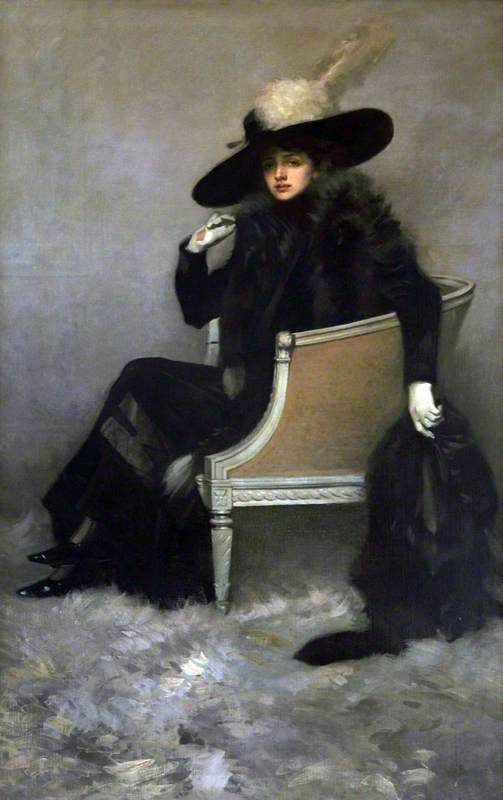
Lady in Black Furs by Pilade Bertieri (1912)

The first painting, I am showcasing is Lady in Black Furs, a work by the Italian painter Pilade Bertieri, which he completed around 1912.  Bertieri was born in Turin and exhibited in major cities in Italy, in New York and notably Manchester and Liverpool as well as Paris at the Salon from 1907 to 1931.  The painting depicts Bertieri’s wife Genevieve Wilson, the daughter of a wealthy New York socialite.  It was during a voyage in 1905 from Italy and America that they met and a year later they got married.  Bertieri said that he was first attracted to Genevieve when he saw seated on a deckchair.  For him, her graceful composure was just too much to resist and this depiction is a reconstruction of his first view of her but this time in a more fashionable chair.  The fact that she is wearing the very same furs, shoes and velvet and satin dress as she did aboard the ship in 1912 evokes memories for him of that first meeting.  At the time of the painting Genevieve was pregnant with their first child.

Fantine by Margaret Bernardine Hall (1886)

Margaret Bernadine Hall completed her painting entitled Fantine in 1886 and it depicts the character Fantine who was featured in Victor Hugo’s novel Les Misérables.  Fantine was dismissed from her job because of her illegitimate child and was forced into the life of a sex worker in order for her and her daughter to survive.  In the depiction we see Fantine protectively watching over her sleeping daughter.

Margaret Bernadine Hall was an English painter, born in 1863 in Wavertree, Liverpool.  Her father was Bernard Hall, a merchant, local politician and philanthropist, who was elected Mayor of Liverpool in 1879. Her mother was Margaret Calrow from Preston, who was Bernard Hall’s second wife. Margaret was their second child, and their oldest daughter.  In 1882 the family moved to London but at the end of that year nineteen-year-old Margaret went to live and study in Paris. Between 1888 and 1894 she travelled extensively to countries including Japan, China, Australia, North America, and North Africa, returning to live in the French capital in 1894. She moved back to England in 1907, where she died three years later.

River Scene with a Ferry Boat by Salomon van Riysdael (1650)

One of my favourite landscape painters is Salomon van Ruysdael and in his painting entitled River Scene with a Ferry Boat we see the kind of work he produced for the art-loving public. At this time, artists had mostly depicted religious subjects in their paintings and the Catholic Church used to be most artists’ best client, as they ordered altarpieces and other artworks to decorate churches and sacred places, but this came to an end with the Reformation as many Protestants refused to allow the presence of religious paintings or sculptures in churches.  This led to a great crisis for artists in Northwestern European countries as artists had only a few ways left to make money: painting portraits and illustrating books but there was also a revival of landscape paintings.  As well as the ever popular genre scenes, people began to buy landscape paintings to decorate their homes. Jacob Isaackszoon van Ruisdael, Salomon’s nephew, is generally considered the pre-eminent landscape painter of the Dutch Golden Age, a period of great wealth and cultural achievement when Dutch painting became highly popular. Jacob was best known for his atmospheric river scenes based upon the countryside around the city of Haarlem where he lived. He was also a merchant who dealt in the blue dye that was used in Haarlem’s famous cloth bleaching factories.

The Walker Art Gallery houses Salomon’s painting entitled River Scene with a Ferry Boat and we see a ferry crossing the river laden with people, livestock and even a small cart.  These ferries were an essential feature of the watery Dutch countryside, and a popular subject with landscape painters such as the Ruysdael family. This work is typical of much 17th-century Dutch landscape painting: naturalistic in its clear light and cloudy, rain-washed sky, but at the same time carefully organised to achieve a balanced composition. This work despite looking as though it was painted en plein air was not painted outdoors.  It is an idealised depiction and probably does not represent any particular place but is an amalgam of various details and features from a number of different places juxtaposed to form this vista.  Close to the riverbank we see a smaller boat with busy pulling in a fishing net. On the bank is a barn in which workers are salting fish and putting them into barrels. On top of the barn is a large dovecot. In a way the painting is a ‘foodscape’ as well as a landscape, highlighting what nature has to offer.  The Dutch patrons liked this kind of narrative painting.
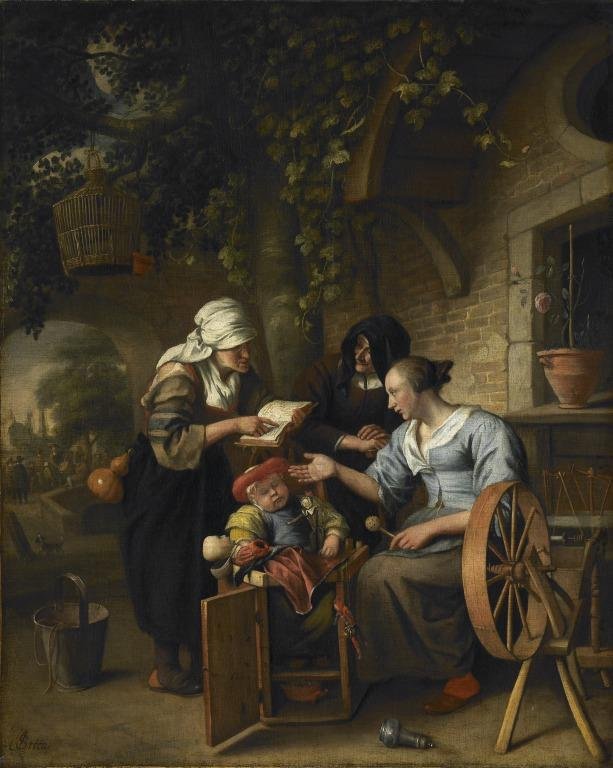
The Fortune Teller by Jan Steen (1663)

One of the greatest Dutch genre painters was Jan Steen. In Holland he ranks next to Rembrandt, Vermeer, and Hals in popularity.  He is best known for his humorous genre scenes, warm hearted and animated works in which he treats life as a vast comedy of manners.  Steen was born in Leiden and is said to have studied with Adriaen van Ostade in Haarlem and Jan van Goyen (who became his father-in-law) in The Hague. He worked in various towns – Leiden, The Hague, Delft, Warmond, and Haarlem and in 1672 he opened a tavern in Leiden.  In his painting The Fortune Teller we see a young woman sitting by her spinning wheel having her fortune told.  One interpretation of this depiction is that she is a sex worker, the old, black hooded lady is the brothel keeper and the soldiers in the background are her clients.  Fortune-telling was strongly associated with deceit, and therefore frowned upon in the seventeenth century.

The Epte in Giverny by Claude Monet (1864)
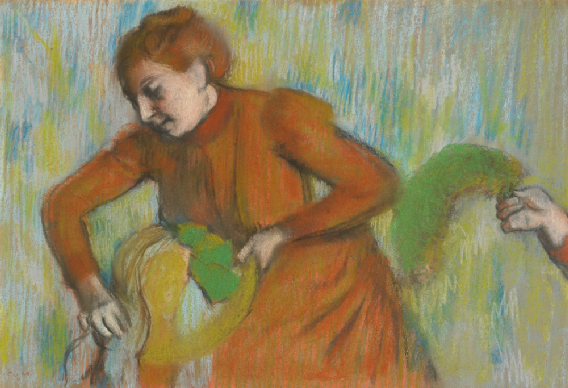
Modiste Decorating a Hat by Edgar Degas. (c.1895)

My next two offerings, The Epte in Giverny, by Monet and Modiste Decorating a Hat by Degas, are new arrivals at the gallery thanks to the beloved taxman. They have been acquired by National Museums Liverpool through the Government’s Acceptance in Lieu scheme which allows people, who have Inheritance tax bills to pay, to transfer important works of art and heritage objects into public ownership which are then allocated to museums, archives or libraries for people to enjoy.  Both the Monet and Degas artworks come from the collection of Mary Elliot-Blake and have been owned by the Montagu family by descent. Due to the family’s connection to Liverpool, the paintings were allocated to the Walker Art Gallery.

Monet completed the painting, The Epte in Giverny, in 1884, and it depicts the fast-flowing Epte river, which rises in Seine-Maritime in the Pays de Bray, near Forges-les-Eaux and empties into the Seine not far from Giverny where the artist painted his famous water lily series.

The second work is by Degas’ entitled Modiste Decorating a Hat and depicts a milliner adjusting a hat in a shop window.
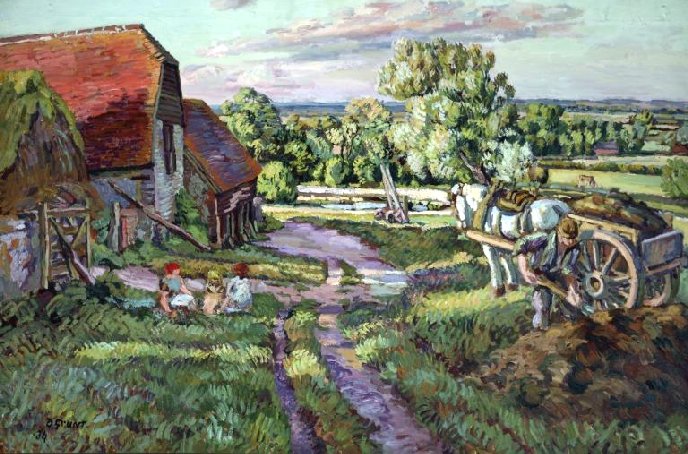
Farm in Sussex by Duncan Grant (1934)

The 1934 painting, entitled Farm in Sussex, is a depiction of Charleston Farm at Firle in Sussex is by the artist Duncan Grant. The picture was painted in his studio over a period of several years. The first thing that strikes you about the depiction is the unusually bright colours he has used and this is due to Duncan Grant’s great interest in Fauvism, which was popular between 1905 and 1910. The Fauves (the Beasts) used bright, clashing colours and fierce brushstrokes to express feelings and emotions.  In 1909, Grant met Henri Matisse, who was a leading light of this group.

He also saw more of the groups work in Roger Fry’s Post-Impressionist exhibition in London in November 1910, Fry had organised the exhibition Manet and the Post-Impressionists at the Grafton Galleries, London. This exhibition was the first to prominently feature Gauguin, Cézanne, Matisse, and Van Gogh in England and brought their art to the public.

Duncan Grant lived at Charleston Farm from 1916 with Vanessa Bell (neé Woolf), who was an artist and the sister of Virginia Woolf. They had met through the Bloomsbury Set, a London-based group of artists and writers who met regularly to discuss their work and ideas about modernism and art. Charleston Farm became a meeting place for the Bloomsbury Set outside of London.  The pair had moved to the countryside from London following the outbreak of World War I so that Grant could avoid conscription by working as a farm labourer. The couple each had their own studio at the farmhouse and decorated the entire building, including walls, fireplaces, door panels and furniture, with their paintings, fabrics and ceramics. They kept the house after the war and used it as a summer home. The painting highlights the bright colours that characterise Grant’s work. The painting was completed in 1934, the same year that Roger Fry died. Fry had been a close friend of both Duncan Grant and Vanessa Bell and was a regular visitor to Charleston. The painting reflects Grant’s affection for the Farm and the people he associated with it
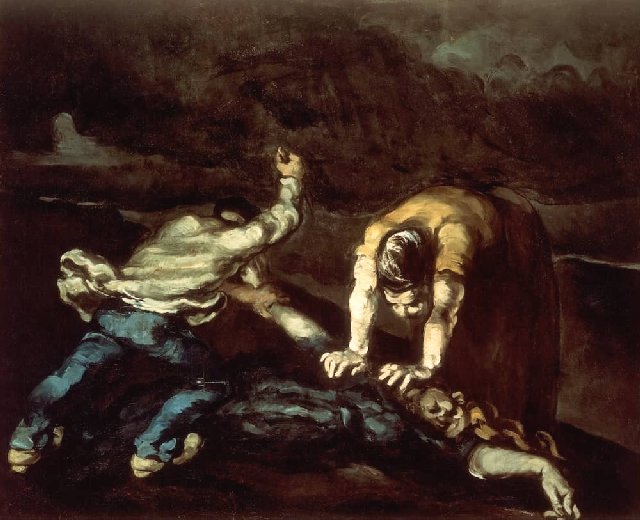
The Murder by Cezanne (c.1870)

The Murder is one of Cézanne’s early paintings which he completed around 1870.  It is a dark and highly melodramatic work which ably communicates the brutality of the act. In the depiction we see the murderer raising his hand and is about to give the final strike while his female conspirator forcefully holds down the rounded heavy-set body of the female victim whilst the fatal blow is struck.  Little can be made out of the figures; just the outline head and arms of the victim whose facial expression is contorted with pain.  The faces of her two assailants are blurred.  Cezanne was not interested with the identities of the murderers but the scene simply depicts the heinous act of anonymous violence.  The scene is made more frightening by the bleak surroundings and the dark sky overhead.  Close to the figures is a riverbank and we can deduce that the body of the dead woman will eventually be dumped into the dark waters.

Publicity Poster for Zola’s novel

The Murder was painted at a time when Cézanne was still influenced by the Old Masters such as Eugene Delacroix and Francisco Goya, and Diego Velazquez.  So after painting so many colourful landscapes why would he depict a brutal murder?  It is thought that Cezanne’s choice of depicting this brutal subject may have been inspired by Emile Zola’s novel Thérése Racquin which had been published in 1867, in which the heroine murders her husband. It was Zola’s third novel, though the first to earn wide fame. The novel’s adultery and murder were considered scandalous and famously described as “putrid” in a review in the newspaper Le Figaro. The painting’s subject could also be inspired by illustrations in the popular press.
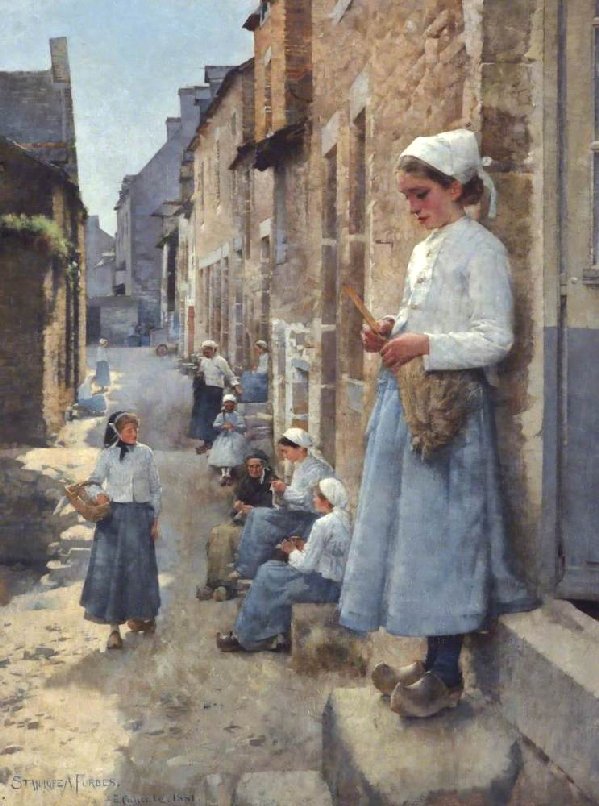
A Street in Britanny by Stanhope Forbes (1881)

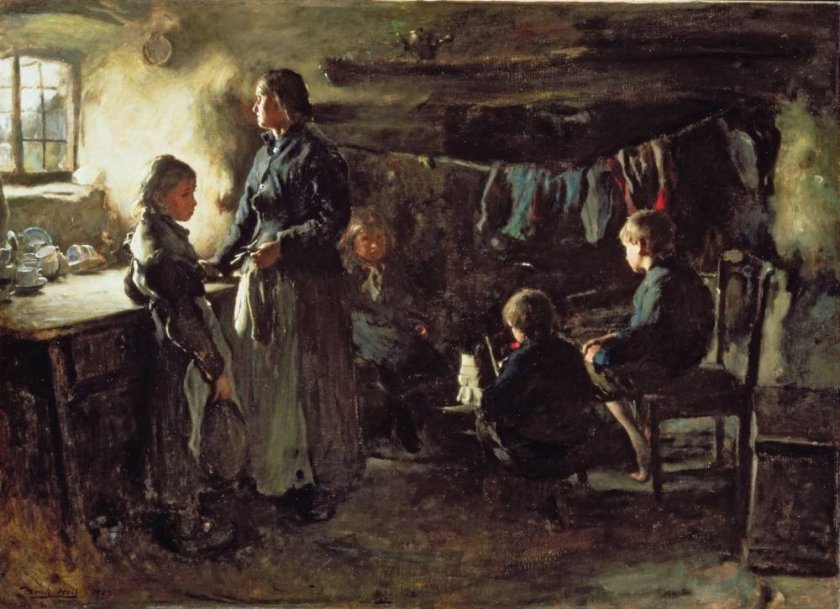
My final painting is A Street in Brittany by Stanhope Alexander Forbes which he completed in 1881.  It is a depiction of figures in a narrow street: women in white headgear known as coiffes and blue petticoats.  They are grouped around their cottages, some are seated on their knitting blue jerseys for their fishermen husbands.

Stanhope Forbes was born in Dublin, the son of Juliette de Guise Forbes, a French woman, and William Forbes, an English railway manager, who was later transferred to London. He was educated at Dulwich College, and he studied art under John Sparkes at Lambeth College of Art, who later taught at South Kensington School of Art. Forbes then studied at the private atelier of Léon Bonnat in Clichy, Paris from 1880 to 1882.  It was in the French capital that Forbes met up with fellow artist, Henry Herbert La Thangue, who had also attended Dulwich College, Lambeth School of Art and the Royal Academy.

In 1881 Forbes and La Thangue went to Cancale, a village in Brittany, at the western end of the bay of Mont-Saint-Michel, fifteen kilometers east of Saint-Malo. It was here that Forbes began to paint en plein air and produced this painting. 
His biographer, Mrs. Lionel Birch in her 1906 book Stanhope A. Forbes, A. R. A., and Elizabeth Stanhope Forbes, A. R. W. S. recalled the setting of this work:

“..One of the first results of the visit to Cancale was a composition of figures in a narrow street: women in white coiffes and blue petticoats, grouped round their cottages and seated on their doorsteps engaged in their everlasting occupation of knitting blue jerseys for their fisher husbands…”

The biographer continues:

“…It was a very simple motif, but painted with great care and conscientiousness, and with a close and searching attention to those truths of lighting and that clear out-of-door aspect which the painter sought to betray. It was interesting, too, as the first attempt Stanhope Forbes had made in what might be termed figure composition, if, indeed, a picture in which there is so little of arrangement in the grouping of the figures can be termed a composition. But it was, at any rate, a great step from simple portraiture, and its success — for it brought the young painter a very signal one — had the most marked influence in determining his future. Exhibited at the Royal Academy of 1881, it attracted favourable attention, and when, later on, it was sent to Liverpool, the Committee of the Walker Art Gallery decided to purchase it for their permanent collection…”

Forbes left France and returned to London and exhibited the works he had made in Brittany at the 1883 Royal Academy and Royal Hibernian Academy shows.  In 1884 he moved to Newlyn in Cornwall, and soon became a leading figure in the growing colony of artists.

I hope this blog will tempt you to visit the Walker Art Gallery in Liverpool. You will not be disappointed.
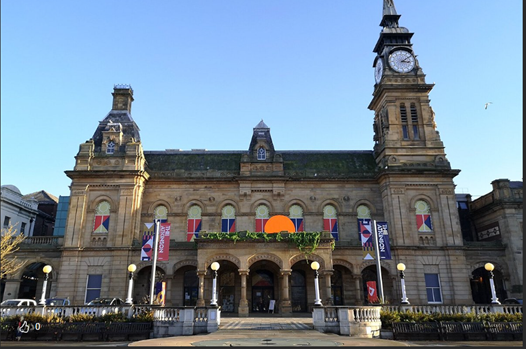
Southport’s Atkinson Gallery

The Atkinson Gallery, Southport

Art galleries or Museums of Art come in various shapes and sizes from the gigantic multi-room edifices such as London’s National Gallery, Paris’ Louvre and Madrid’s Prado, to small one-room private galleries.  The former is awash with works which would take you days to properly study them all, whilst the latter often contain less than fifty paintings and you are sometimes hard-pressed to see a work you like. 

A couple of days ago I visited Southport on the Merseyside coast, a seaside resort which is close to where I was born and lived for most of my life and yet I had never visited the town’s art gallery.  There was something about the site’s publicity I found off-putting.  You see, it was a multi-faceted building; part museum, part library, part café, part children’s playroom, part theatre, part bar, part locals selling their art and crafts etc etc., and yet there was only a small shop/theatre ticket office which had no literature on the permanent collection and as I feared, the room set aside for works of fine art was small.  However the works of art in the permanent collection, numbering about fifty, were excellent and for that reason I can recommend you visit their permanent collection.  Today’s blog is about some of these fine works. There were a number of paintings, presumably on loan, which belonged to the Harris Museum and Art Gallery in the nearby town, Preston, which had been closed whilst undergoing renovations.

A Golden Dream by Thomas Cooper Gotch (1895)

Thomas Cooper Gotch was an English painter and book illustrator.  He studied art in London and Antwerp before he married and studied in Paris with his wife, Caroline, a fellow artist, and when they returned to England, initially his works depicted the lives of Newlyn fisherfolk but after a visit to Italy his style changed and he began painting Symbolist images conjuring up dreamlike idylls of Arcadian innocence, in a Pre-Raphaelite romantic style.  Gotch exhibited A Golden Dream for the 1895 opening of the Newlyn Art Gallery.

Cordelia Disinherited - John Rogers Herbert als Kunstdruck oder Gemälde.

Cordelia Disinherited by John Rogers Herbert (1850)

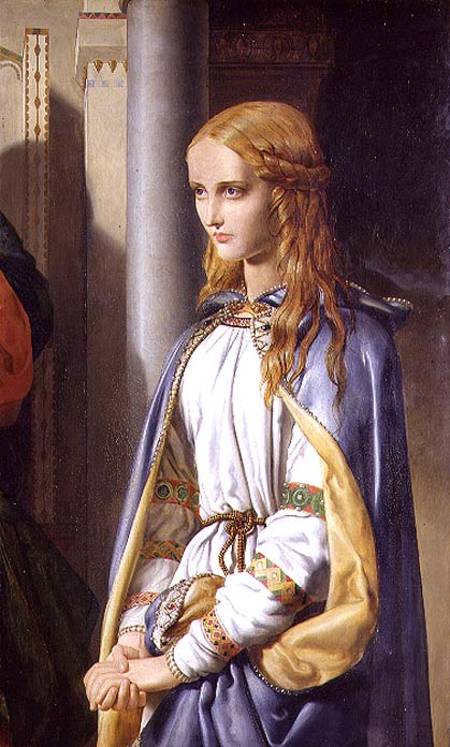
The subject of John Rogers Herbert’s painting is Cordelia, a fictional character in William Shakespeare’s tragic play King Lear. Cordelia, along with her sisters, Goneril and Regen are the three daughters of King Lear. After her elderly father offers her the opportunity to profess her love for him in return for one-third of the land in his kingdom, she, unlike her two sisters, refuses.  Lear banishes Cordelia from the kingdom and disinherits her.  Cordelia is depicted as a saintly figure.  She looks impassive and wears blue and white clothes which remind us of depictions of the Virgin Mary.  Herbert painting is a detail from a large fresco commissioned for the Houses of Parliament.

The Orphan of the Temple by Edward Matthew Ward (1875)

On the face of it, we are simply looking at an elegant young lady painting en plein air.  The title of the painting does not offer us a clue as to what is going on in the depiction !  However, if I tell you that the young lady painting is Marie Thérèse Charlotte, the eldest daughter of Louis XVI and Marie Antoinette you will realise that this painting depicts a little piece of French history.  In a brief synopsis of Marie Thérèse Charlotte  life : she was the daughter of Louis XVI, king of France and Marie Antoinette.  She was educated at French was imprisoned with her family in the Temple, originally a fortified monastery of the Templars and later a royal prison, in 1792.  Her mother and father were guillotined in 1793 although she was unaware of their fate at the time.  She was released from prison in 1795 and four years later married the Duke of Angoulême.  Later she lived in exile with her uncle Louis XVIII in various European countries.  The painting clearly contrasts the innocence of the young woman, dressed in white, with her gaoler who stands in the background.

On the Bridge by Stanhope Forbes (1925)

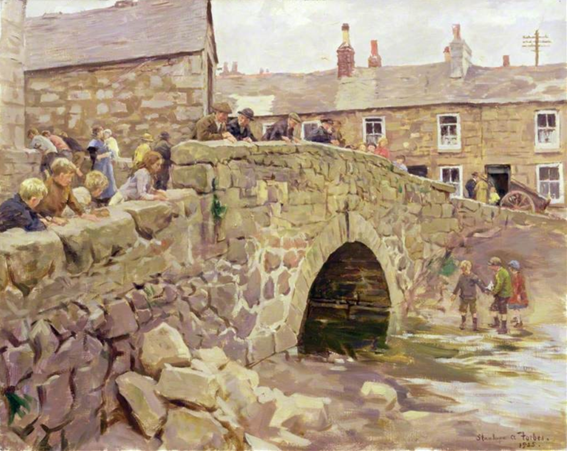
Stanhope Alexander Forbes was a British artist and a founding member of the influential Newlyn School of painters. He was often referred to as the father of the Newlyn School. This is the second time Stanhope Forbes painted this scene. The first was in 1888. The old bridge we see in the painting is in the Cornish village of Street-an-Nowan, in the lower part of the fishing town of Newlyn.

The Fish Fag by William Banks Fortescue (1888)

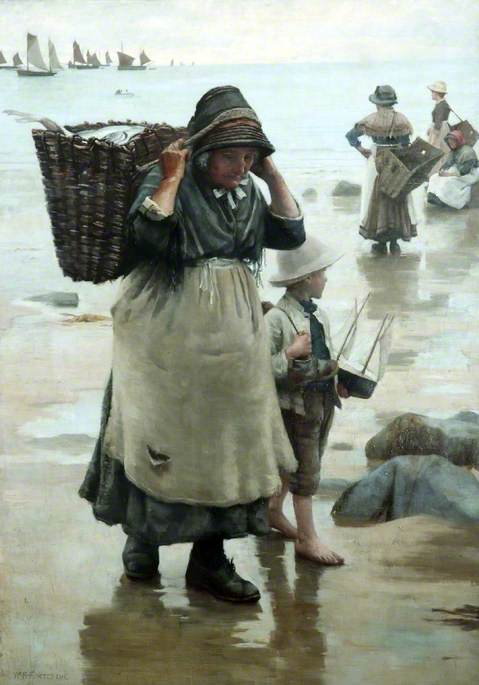
Fortescue was also one of the Newlyn School’s many Birmingham-born artists.  He began his career as an engineering designer but later trained as an artist. He studied art in Paris, and later travelled around Europe, reaching Venice in 1884.  On his return he exhibited many of his works depicting Venetian scenes at the Royal Birmingham Society of Artists. Fortescue went to live in the Cornish fishing town of Newlyn around 1885 and took lodgings in a house which also included Stanhope Forbes as another lodger.  This work by Fortescue was painted in the style of Stanhope Forbes and as is the case with this work, he used local people to model for his paintings.  The painting’s title Fish Fag is the term used for “Fishwife” and she would be in charge of cleaning the fish prior to them being sold.  Prior to the men setting sail in their boats the Fish Fags would also be tasked with baiting the hooks.  The little boy holding the toy boat and walking alongside the woman has probably been added by the artist implying that one day he will experience life as a fisherman.

Welcome, Bonny Boat! The Fisherman’s Return (Scene at Clovelly, North Devon) by James Clark Hook (1856)

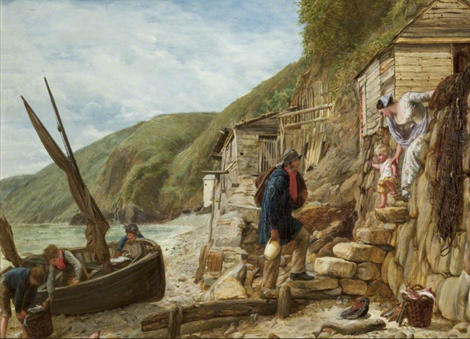
The life of a fisherman is a precarious one, even in the present day but more so in the nineteenth century. Catching fish to feed the family was a necessity and sometimes the fisherfolk heading out to sea to bring home food and to eke out a living sometimes meant taking risks which often resulted in dire consequences. James Clarke Hook RA., an English painter and etcher of marine, genre, historical scenes, and landscapes, was born in London in November 1819.   Initially his favoured painting genre was history painting but then he turned his attention to genre depictions in rural landscapes.   He made several trips to Devon and the fishing village of Clovelly which in Devon stimulated him to adopt coastal scenes as his main motif but it was more than just depictions of the sea and boats as he incorporated figures into his paintings in order to highlight the hardship and rewards of life by the sea. He completed so many of this type of depiction that his coastal paintings were soon dubbed “Hookscapes”.  In this painting we see a returning fisherman being greeted by his family, all of who are relieved to see him back safely.

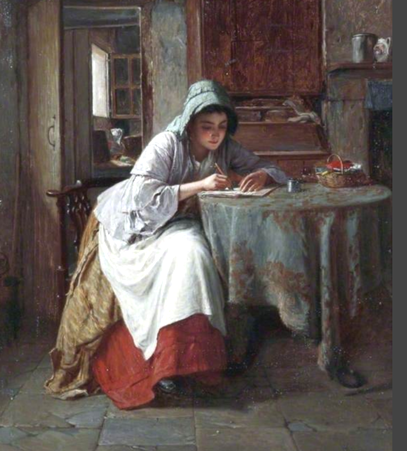
Katy’s Letter by Haynes King (1875)

Haynes King was an English genre painter, who was born in Barbados in December 1831. He came to London when he was twenty-three and became a student at Leigh’s later known as Heatherley’s Academy in Newman Street, London. In 1857 he exhibited some of his paintings for the first time at the Society of British Artists, of which he was elected a member in 1864 ; many of his works appeared at its exhibitions, and forty-eight were shown at the Royal Academy between 1860 and 1904.  He painted interiors, landscapes, and coastal scenes with figures. The motif in this painting centres around the letter which the young woman is reading.  The action of reading a letter was depicted in many paintings and became very popular.  The popularity of such a motif is probably because we are subconsciously being asked to imagine what was in the letter.  Good news or bad news?  We then put together in our minds a cover story both past and future for this young woman due to what she is reading !

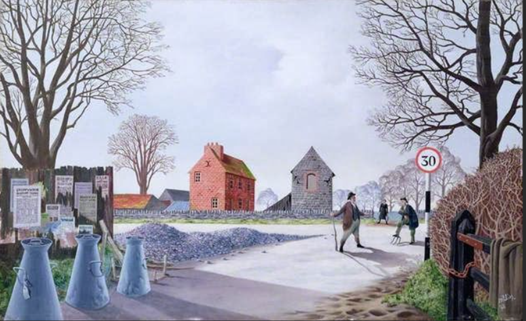
The Argument by Tristram Hillier (1943)

Tristram Paul Hillier was an English surrealist painter and a member of the Unit One group led by Paul Nash . He was born on April 11th 1905 in Beijing, China, and was the youngest of the four children of Edward Guy Hillier, a banker and diplomat, and Ada Everett.  He attended Downside, an independent boarding school.  He later went to Christ’s College, Cambridge and later in 1926, the Slade, where his tutors included Henry Tonks.  From the Slade he travelled to Paris and studied for two years under André Lhote, and also at the Atelier Colarossi.  Whilst in Paris he mixed with many members of the Surrealist movement and was particularly influenced by Giorgio de Chirico and Max Ernst. He lived in France until 1940, but travelled extensively; he remained a surrealist painter throughout his life. His painting style is unique to him and if you look at some of his other paintings you will recognise similar characteristics.

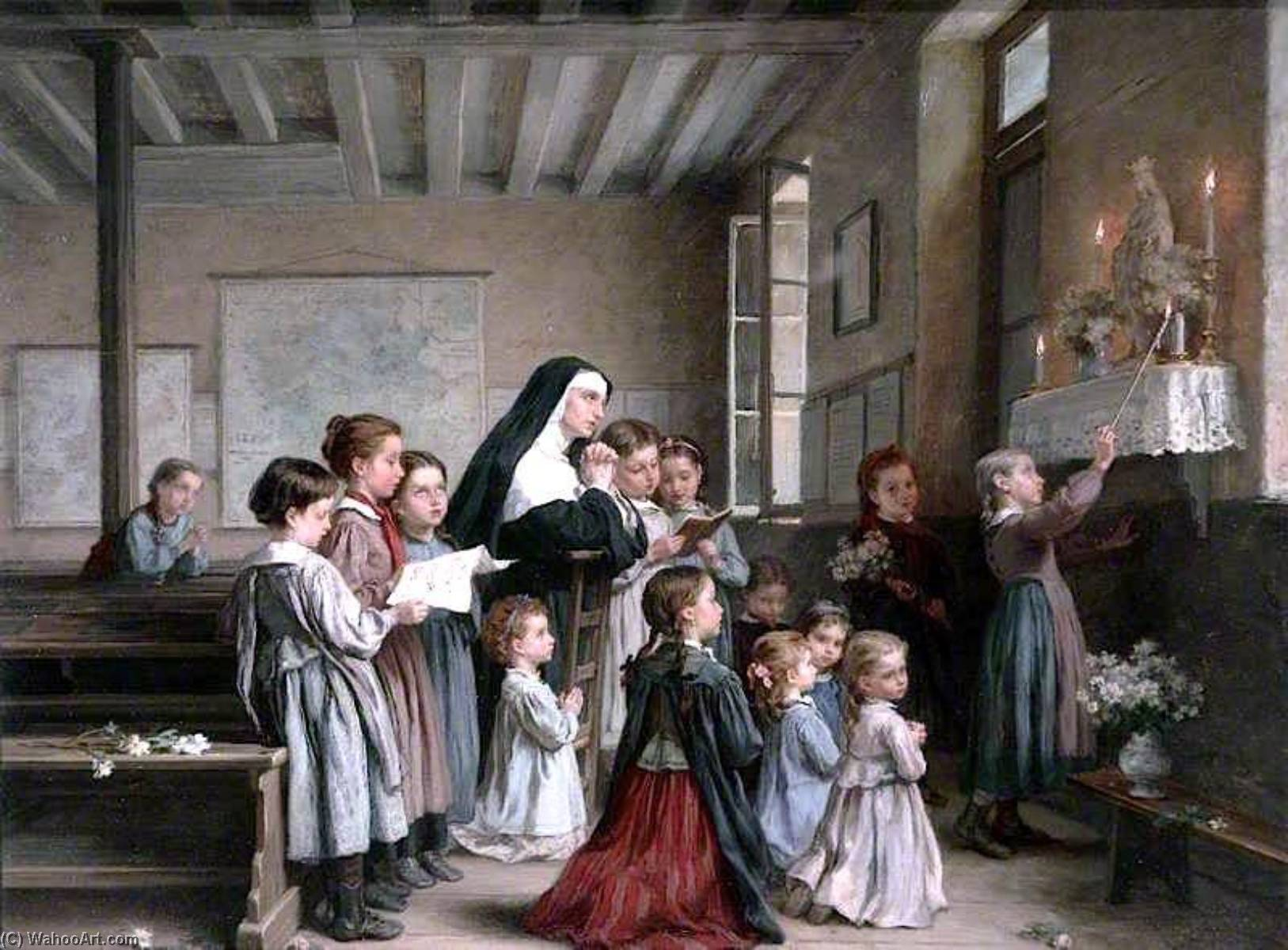
The Children’s Prayer by Arthur Hacker (1888)

There were a number of paintings on show with religious connotations.  One such work was Children’s Prayer by the English painter Arthur Hacker.  Hacker was born in St. Pancras, Middlesex in September 1858.  In 1876, aged eighteen, he enrolled on a four-year course at the Royal Academy.  From there he went to Paris where he studied at the atelier of Léon Bonnat.  He became a member of the Royal Society of Portrait painters in 1894.  His paintings were shown at the Royal Academy on two occasions, in 1878 and 1910.  It was also in 1910 that he was elected as a Royal Academician.  He travelled to France, Italy, Spain and Morocco., and of the RA in 1910.  Hacker was most known for painting religious scenes and portraits.

La Prière du Matin (Morning Prayer) by André-Henri Dargelas (c.1860)

André Henri Dargelas, a French painter of the realist movement, was born in Bordeaux on October 11th 1828.  In his twenties, his paintings became very popular in England due to the positive assessment of his work made by the English art critic, John Ruskin, who liked Dargelas’ sentimental vision as seen in many of his paintings.  In 1857 he began to exhibit his work at the Paris Salon and the motifs of his paintings were influenced by the very popular eighteenth century French artist, Jean Siméon Chardin.

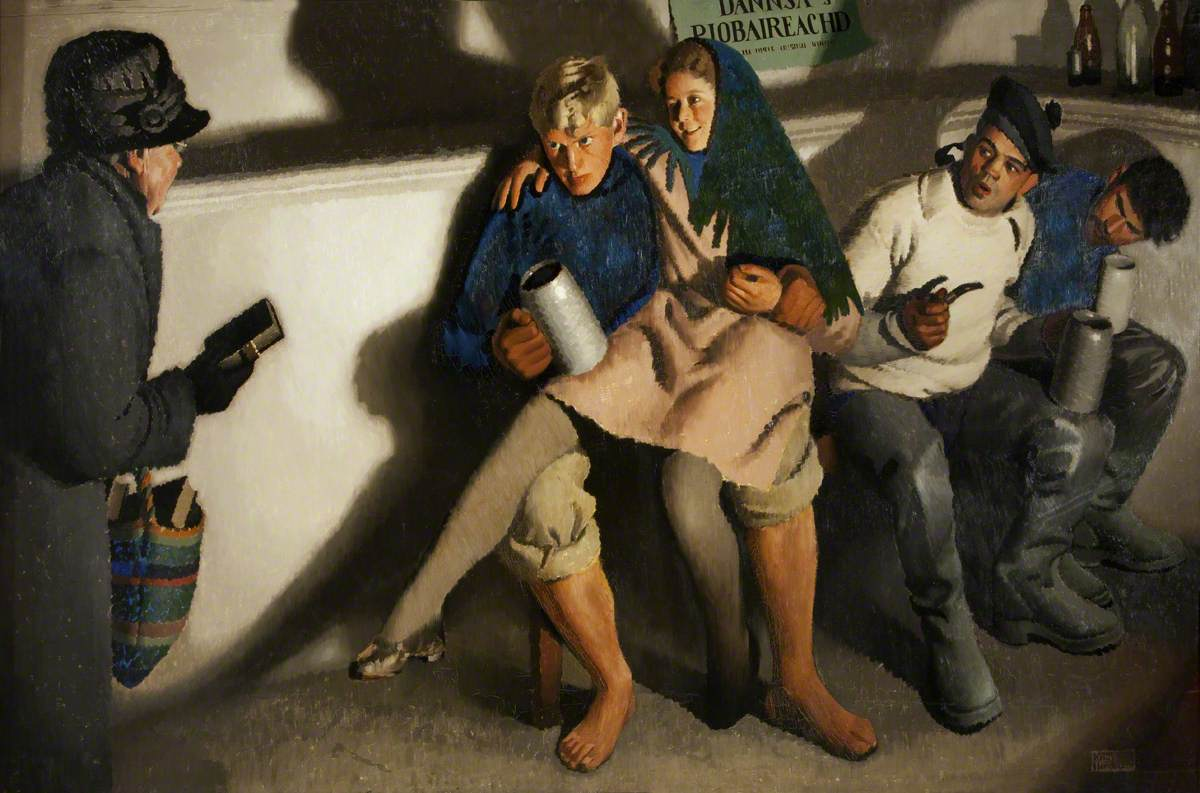
The Word by Keith Henderson (1931)

The above painting is more modern in comparison to those I have showcased earlier and some would say a more realistic view on religious trends and differing views of the old and young on the subject of religious worship. The Word was completed by Keith Henderson in 1931. Keith Henderson was a Scottish painter born in Aberdeenshire in April 1883.  He was one of three children born to George MacDonald Henderson, a barrister at Lincoln’s Inn, and Constance Helen, née Keith.  He attended Orme Square School in London before being admitted to Marlborough College, a prestigious Wiltshire public school. He then studied at the Slade School of Art before moving to Paris and studying art at the Académie de la Grande Chaumière.  During the First World War he served as a Captain with the Royal Wiltshire Yeomanry where he spent time in the trenches acting as a war artist.  He recorded his time on the Western Front in a book, Letters to Helen: Impressions of an Artist on the Western Front, which included several of his illustrations.  During the 1930s Henderson returned to Scotland to live on the Isle of Barra in the Outer Hebrides where his paintings at the time depicted village life.  He was forty-eight when he completed The Word which depicts an old lady seen distributing free bibles coming across a group of young revellers who have just come out of the local pub.  They seem to be little interested in her offer. The depiction harks back to Victorian moralistic paintings.

By the Waters of Babylon we sat down and wept by William Etty (1832)

“…By the rivers of Babylon, there we sat down, yea, we wept, when we remembered Zion. 

We hanged our harps upon the willows in the midst thereof. 

For there they that carried us away captive required of us a song; and they that wasted us required of us mirth, saying, Sing us one of the songs of Zion.

How shall we sing the Lord’s song in a strange land?…”

My final painting in this blog also has religious associations as it illustrates a passage from the tragic 137th psalm of the Book of Psalms in the Tanakh, the Jewish bible. The painting by William Etty, By the Waters of Babylon depicts the biblical story of the Israelites’ captivity in Babylon.  The psalm is a communal lament about remembering Zion, and yearning for Jerusalem while dwelling in exile during the Babylonian captivity.  The psalm reflects the yearning of the exiles for Jerusalem as well as hatred for the Holy City’s enemies.  In Etty’s painting the lyre can be seen hanging from the tree.   William Etty was an English artist best known for his history paintings containing nude figures. He was the first significant British painter of nudes and still lifes and in this “religious” painting the three women depicted are in a state of undress.

Harold Harvey

Harold Harvey

Harold Harvey (1874 – 1941)

My featured artist today is one of the famous Newlyn School painters. The term Newlyn school applies to a group of artists who settled in Newlyn and St Ives in the late nineteenth century and whose work is characterised by an impressionistic style and embodies subject matter drawn from scenes of rural life.   It was founded by a group of artists led by Stanhope Forbes. who came to Newlyn in West Cornwall in 1884 and was immediately captivated by the scenery and people in the area. The ‘Newlyn School’ became famous for its superb realism, in ‘Plein-Air‘ painting.  The artist I am looking at today, Harold Harvey, made his name for his beautiful works featuring the Cornish countryside.

See the source image

The Old Slip, Newlyn by Harold Harvey

Harold Charles Francis Harvey was born on May 20th 1874 in North Parade, Penzance, Cornwall.  He was the eldest of eight children of Francis McFarland Harvey, a bank clerk, and Mary Bellringer whom he married in September 1872. Harold had six brothers, Percival George Harvey; Frank Harvey; Arthur William H Harvey; Wilfrid Vignes Harvey; Leonard Harvey, and Cyril Harvey along with one sister, Gladys Maud Harvey.  Harvey trained in painting at the Penzance Art School under the tutelage of Norman Garstin, an Irish artist, teacher, art critic and journalist associated with the Newlyn School of painters. After leaving the Penzance Art School at the age of nineteen, William travelled to France and attended the Académie Julian in Paris between 1894 and 1896.

Harold Harvey - Unloading the boats, Newlyn Harbour.jpg

Unloading the boats, Newlyn Harbour by Harold Harvey (1906)

In the early part of the twentieth century, Harold Harvey’s paintings were impressionistic in style and the depictions focused on people involved in the agricultural and fishing trade. 

In the Whiting Ground’ by Harold Harvey

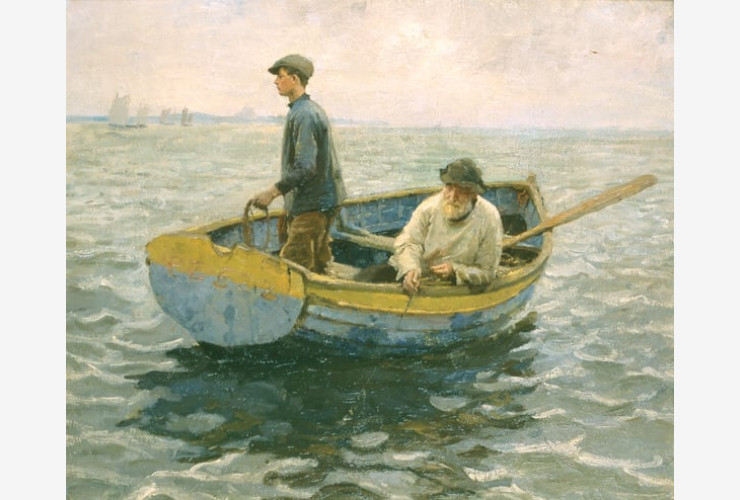
In the Whiting Ground by Harold Harvey (c.1900)

One such work was In the Whiting Ground which he completed around 1900 and depicts a small dinghy at sea with a young man standing holding a fishing line in his hands while an older man is holding a line in the water.  St Michael’s Mount the tidal island in Mount’s Bay, a large, sweeping bay on the English Channel coast of Cornwall, can be seen in the far distance.

Whiffing in Mount's Bay

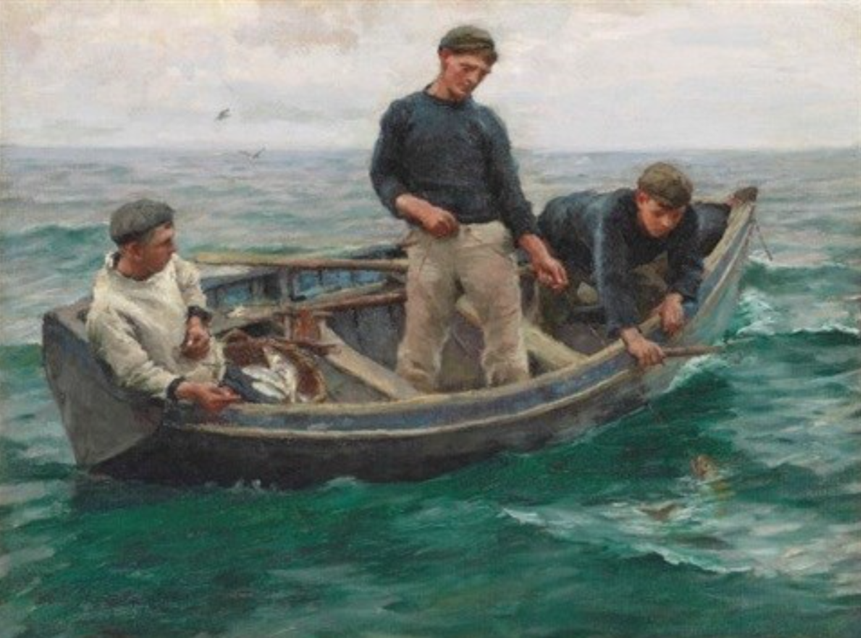
Whiffing in St Mount’s Bay by Harold Harvey (c.1900)

A small painting completed around the same time by Harvey featuring three young men in a boat had the strange title of Whiffing in St Mount’s Bay.  Whiffing is a mode of fishing with a hand line.

The Seaweed Gatherers by Harold Harvey

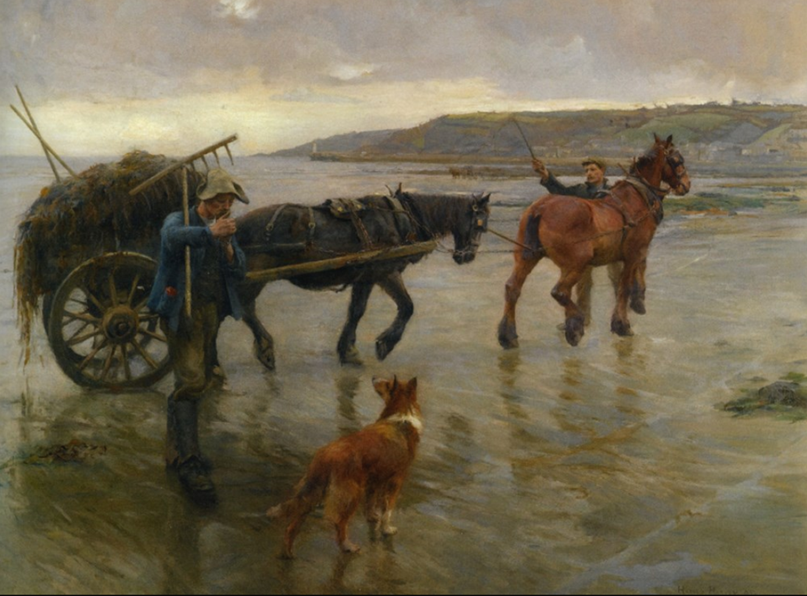
The Seaweed Gatherers by Harold Harvey

Another of his paintings depicting life along the Cornish shoreline was one entitled The Seaweed Gatherers in which we see two men hauling a horse and cart laden with fresh seaweed.

The Close of a Summers Day by Harold Harvey. (1909)

The Close of a Summers Day by Harold Harvey (1909)

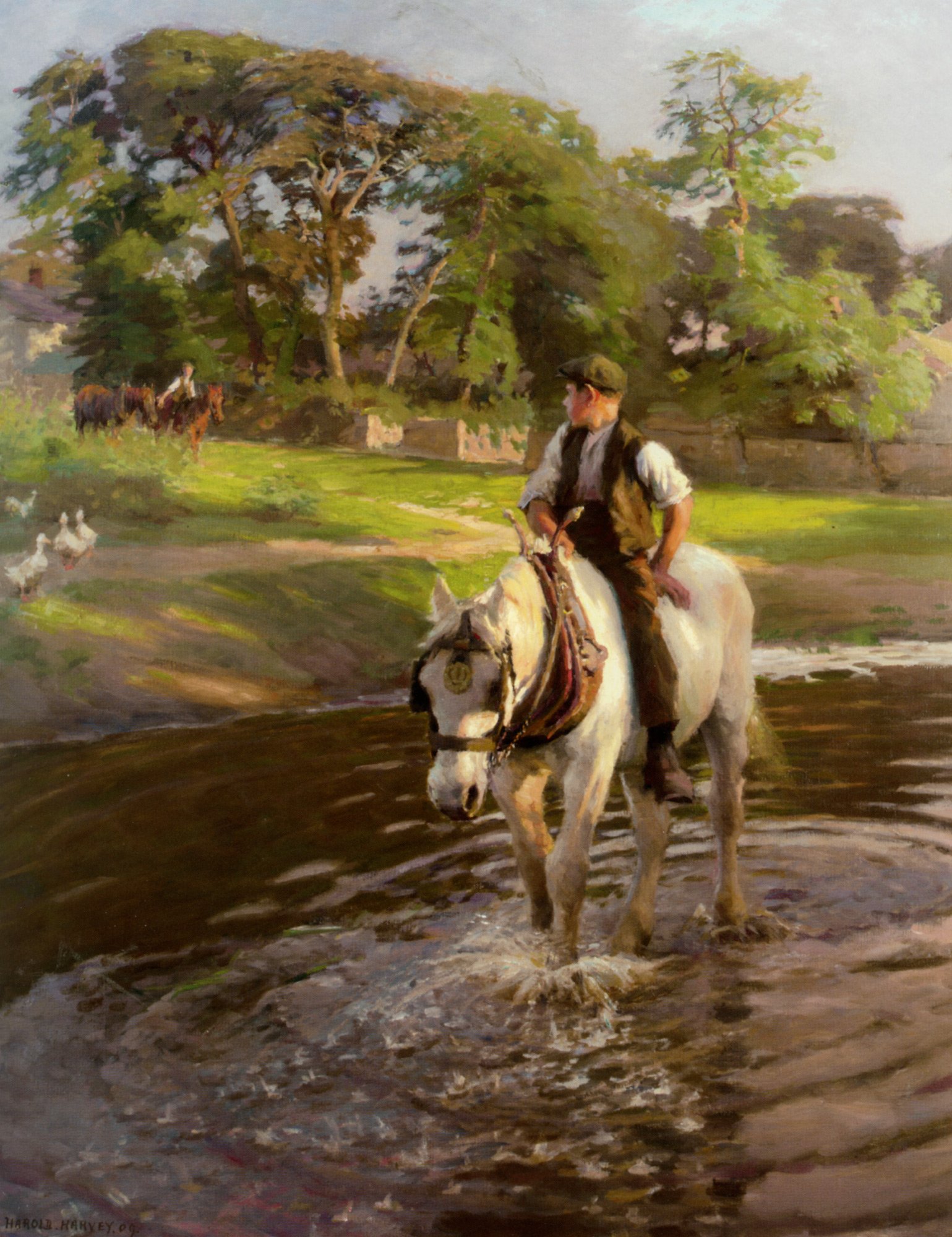
A more colourful painting is his beautiful work of idyllic tranquillity entitled The Close of a Summers Day which he completed in 1909.  It is at the end of a hot summers day and man and beast have need of a rest and refreshment.  The young farmworkers have been tasked with taking the horses down to the river for them to cool down and have a drink.  The white horse gently splashes in the water attempting to cool down its fetlocks.

From 1909 to 1913, Harvey was an Associate of the Royal Cambrian Academy of Art, Conwy and, in 1910, he became a member of the South Wales Art Society.

gertrude_harvey2_large

Gertrude Harvey by Harold Harvey

It was around this time that Harold Harvey met Gertrude Bodinnar.  She was born in 1879 and was the eighth of the ten children born to Ann Crews Bodinnar, (née Curnow), and her husband John Matthews Bodinnar, a cooper.  In her twenties, she acted as a model for students at the Forbes School of Painting, which had been founded in 1899 by Stanhope Forbes and his Canadian-born wife Elizabeth as their School of Painting and Drawing at Newlyn. It was indirectly through her work with students at this establishment that she first met Harold Harvey and agreed to act as his model.  Love blossomed and Harold and Gertrude married on April 19th 1911 and the couple set up home at Maen Cottage Elms Close Terrace, in Newlyn

Portrait of the Artist's Wife, Gertrude by Harold Harvey (1917)

Portrait of the Artist’s Wife, Gertrude by Harold Harvey (1917)

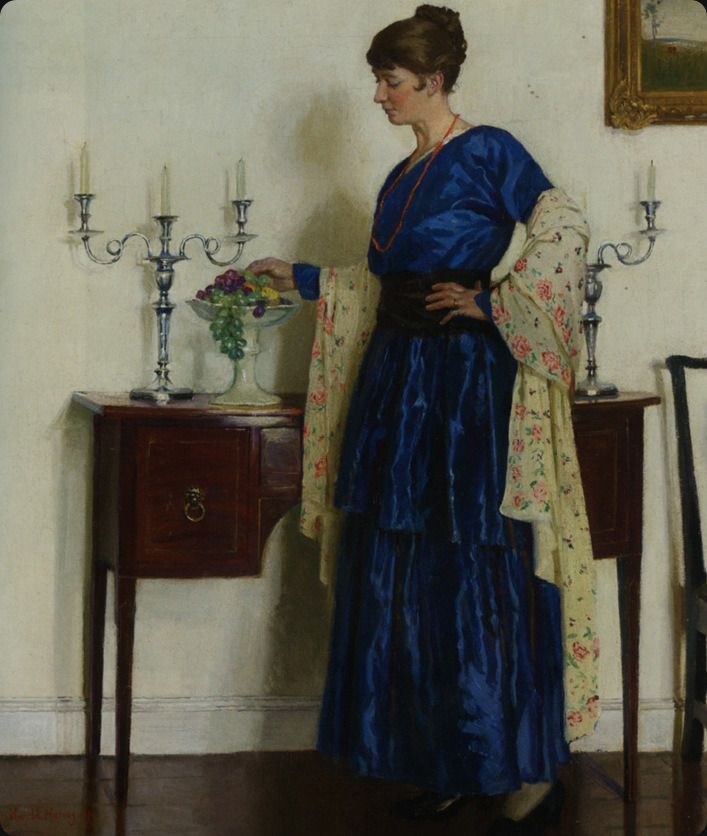
Gertrude appeared in a number of her husband’s paintings.  One example was his 1917 portrait of her entitled Portrait of the Artist’s Wife, Gertrude……

Gertrude Harvey with Parrot in the Artist's Home by Harold Harvey

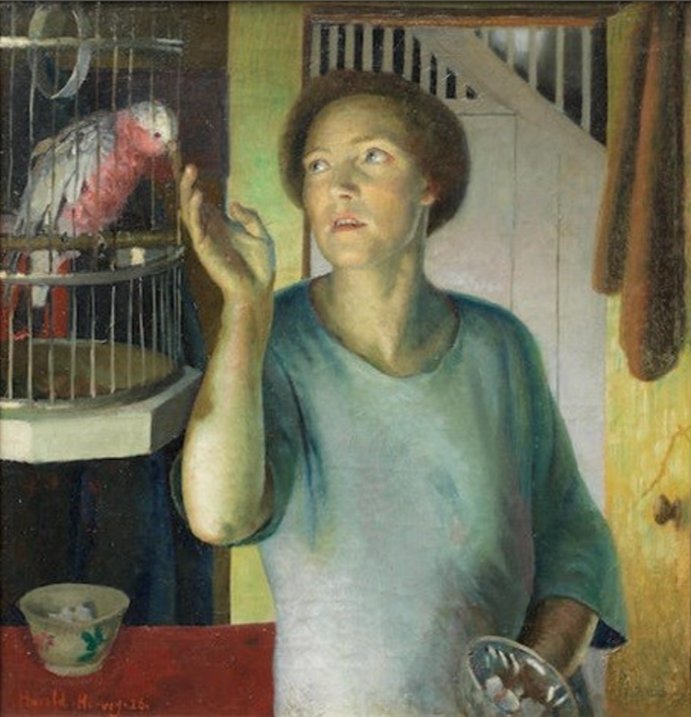
….and Gertrude Harvey with Parrot in the Artist’s Home……

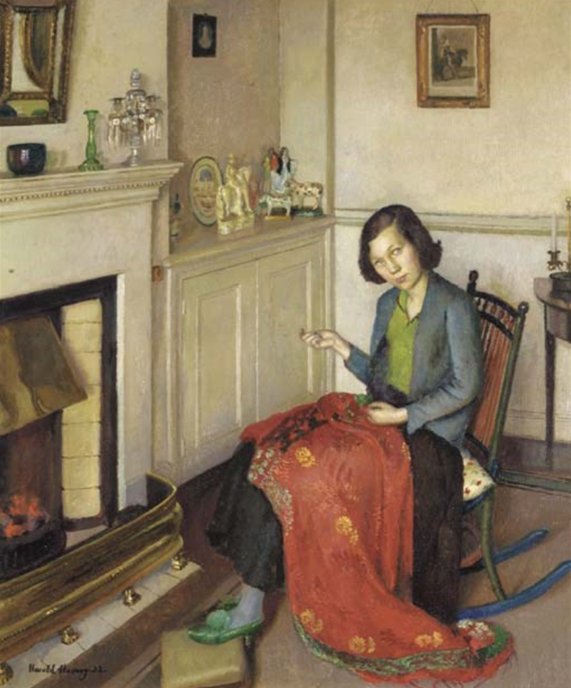
The Red Silk Shawl by Harold Harvey (1932)…..and The Red Silk Shawl in 1932.
Being around artists, including her husband, and watching them work fascinated her. She would often note down how the artists worked, and she soon realised that she had a talent for art and design.  Gertrude used mostly oil on canvas, board, card, or paper, but also tempera, gouache and though largely self-taught she became a talented artist in her own right, and her paintings were mainly of still-lifes, flowers and landscapes. 

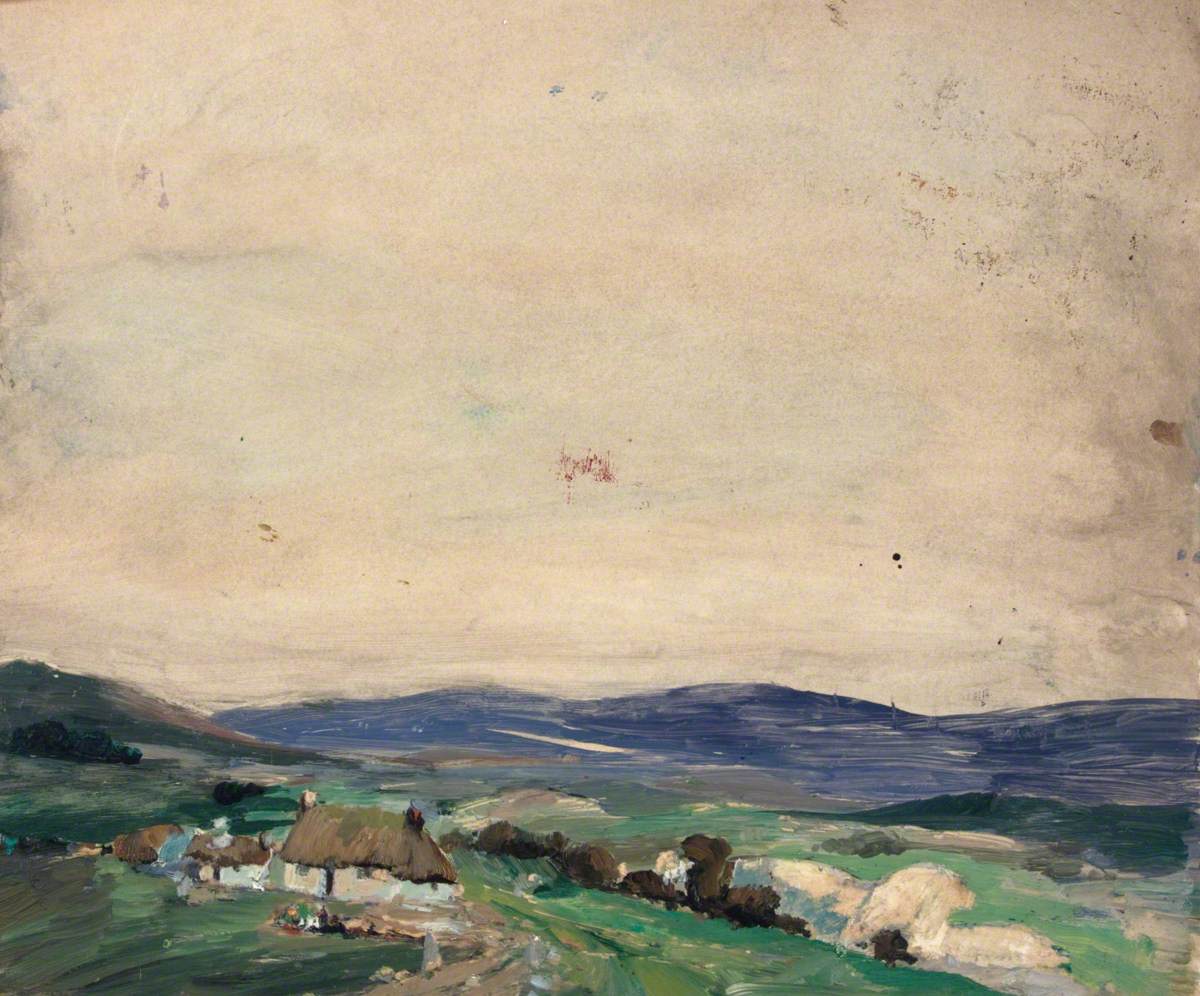
Landscape

Landscape by Gertrude Harvey

Her paintings were good enough to be sold and exhibited at the Newlyn Art Gallery and in the twenties and thirties her work could be seen in many London galleries including the Leicester Gallery and the Royal Academy. Often, she showed work together with her husband in mixed and group shows.   Between 1930 and 1949, Gertrude Harvey had twenty works selected for Royal Academy exhibitions and from 1945 to 1949 she was regular exhibitor with the St Ives Society of Artists.  She was also proficient at needlework and clothing design.

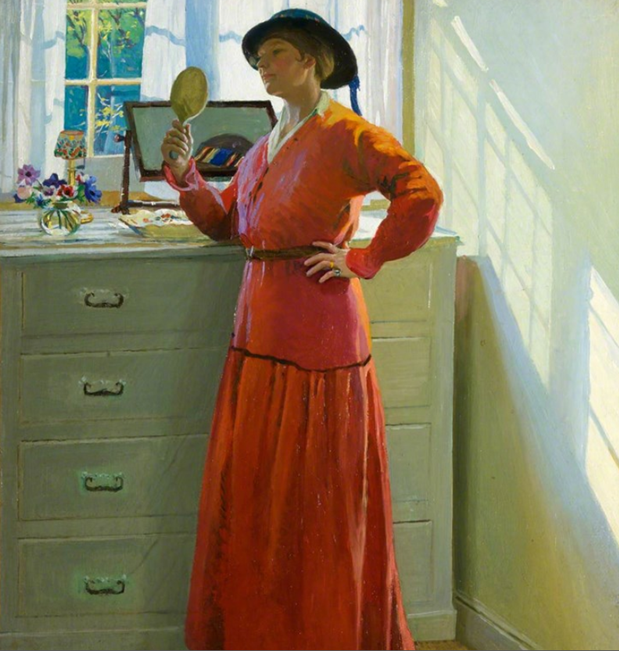
Reflections by Harold Harvey (1916)

Reflections by Harold Harvey (1916)

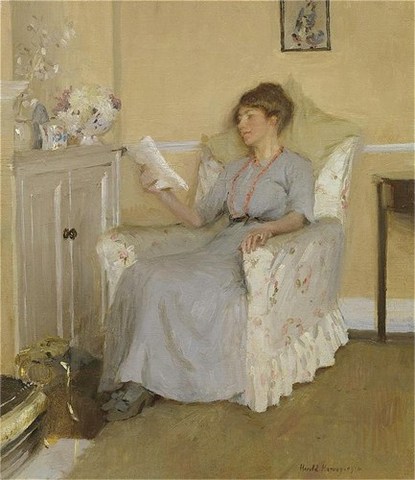
Meanwhile Harold Harvey continued painting and exhibiting his work. The First World War began in 1914 but due to health issues, he was exempted from military service.  In that year, he started to paint a series of interiors often using his own home.  One such painting was his 1916 work entitled Reflections.

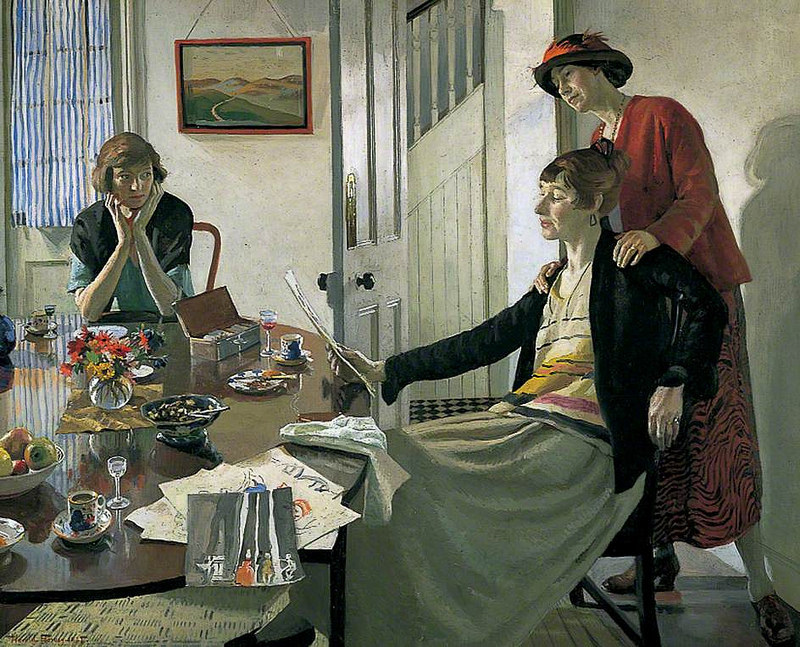
The Critics by Harold Harvey

The Critics by Harold Harvey

In another work entitled The Critics, we see three women enjoying coffee and an aperitif as they study some paintings, weighing up the merits of each one.

The Tea Table by Harold Harvey

The Tea Table by Harold Harvey (1920)

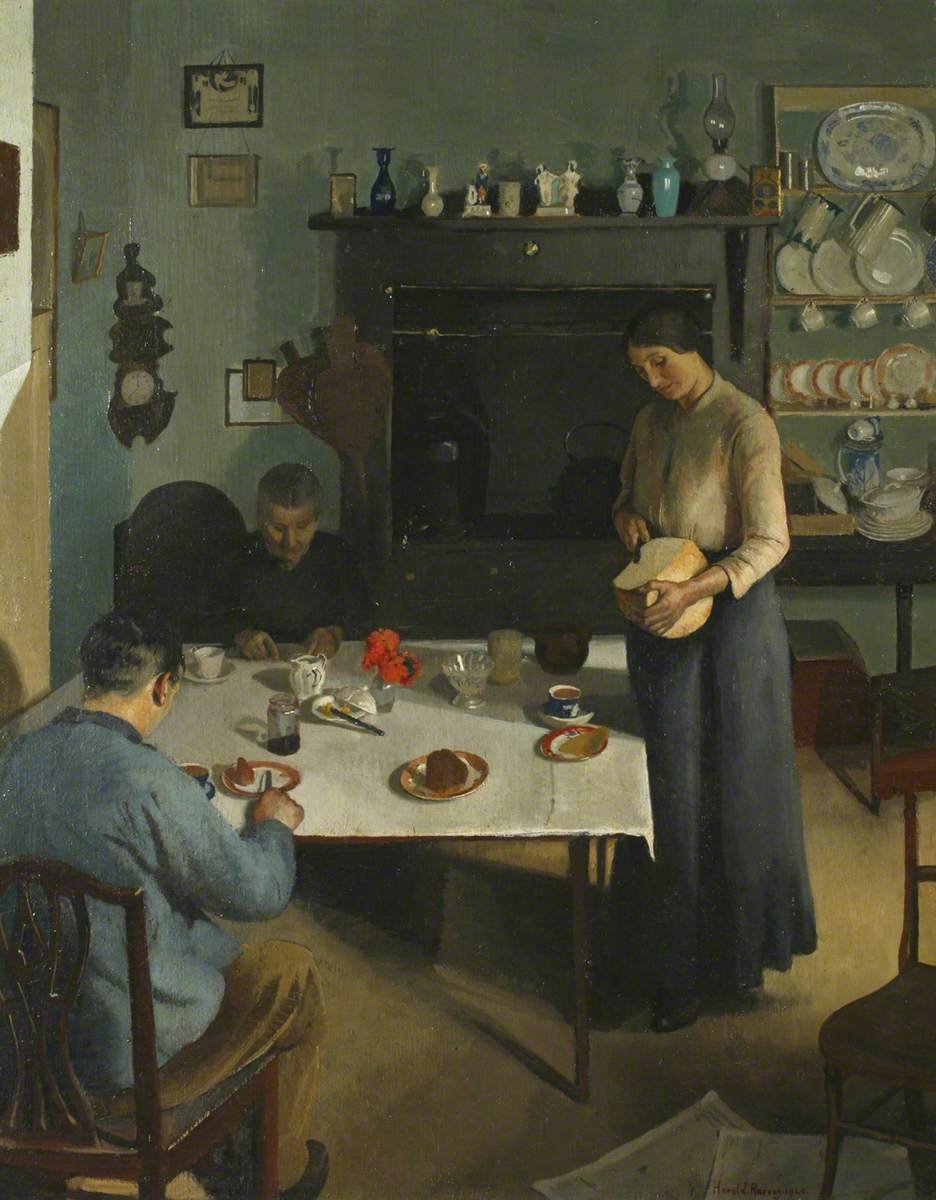
A depiction of domestic living can be best seen in Harold Harvey’s 1920 painting entitled The Tea Table.  It is a masterful depiction of a small dining room filled with shelves of crockery and ornaments.  It could almost be termed a still-life of household goods.

Girl on a Cliff by Harold Harvey (1926)

Girl on a Cliff by Harold Harvey (1926)

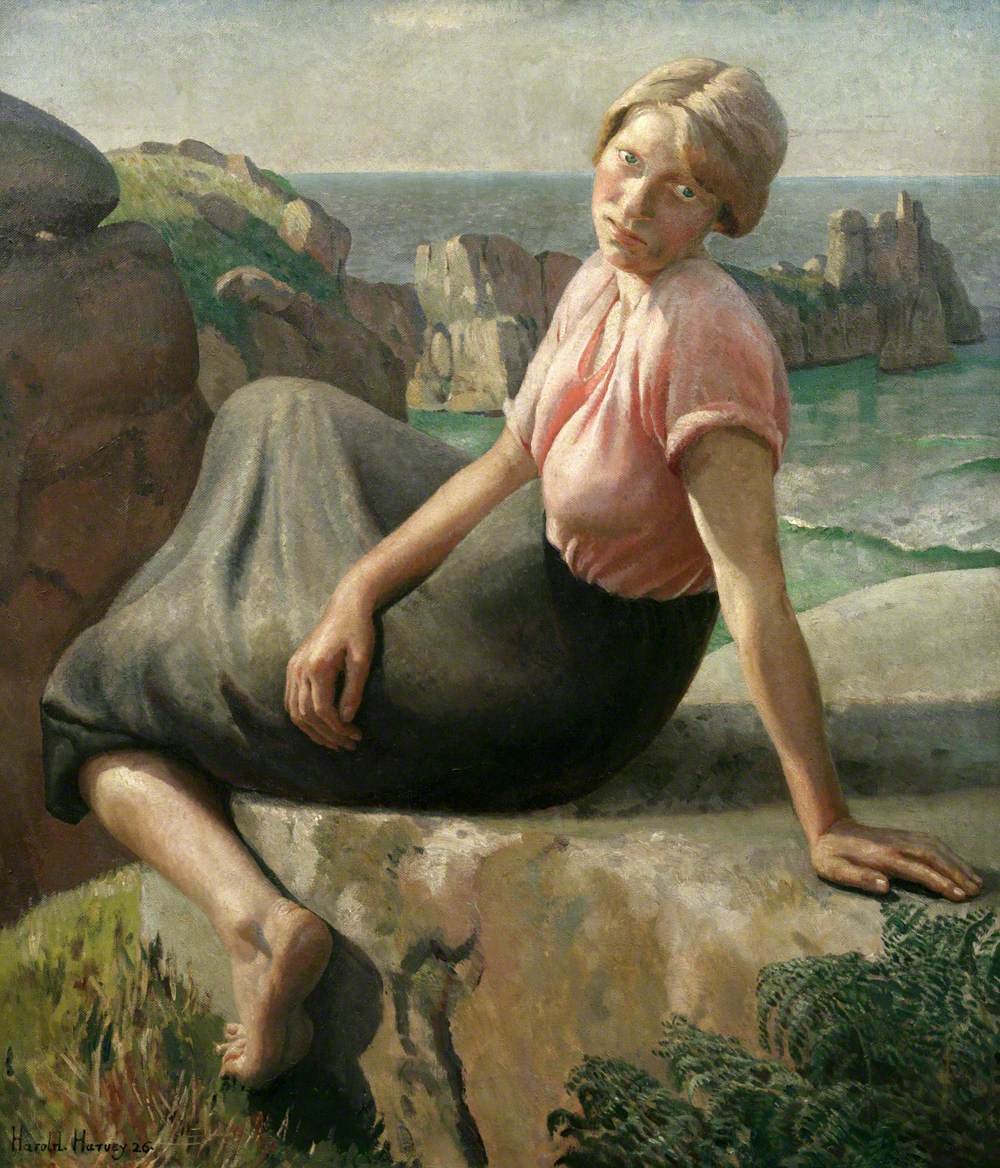
With such wonderful landscapes on his doorstep, it is no wonder that Harvey continued with his outdoor works featuring young models.  One example of this is his 1926 painting entitled Girl on a Cliff.  In a way, this is not a true plein air painting as the girl in the depiction is fourteen-year-old Cressida Wearne and Harvey painted her posing in the garden of his studio and he added the background at a later date.

Clara

Clara by Harold Harvey (1922)

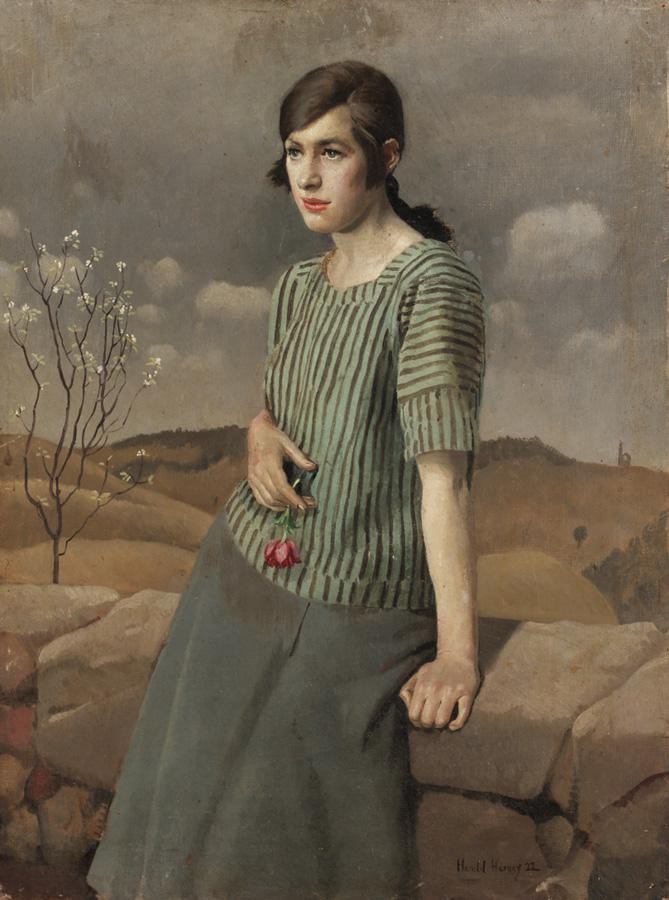
Again, we see this technique with his 1922 painting, Clara.  It is a full-length portrait of a girl standing by a wall set in a rolling landscape.  She is seen holding a rose and in several of Harvey’s portraits his female sitters are holding a single flower. The work is composed mainly of tones of grey and brown but it is the red of the rosebud which creates the focal point of the work.

Harvey, Harold C., 1874-1941; James Jewill Hill Junior

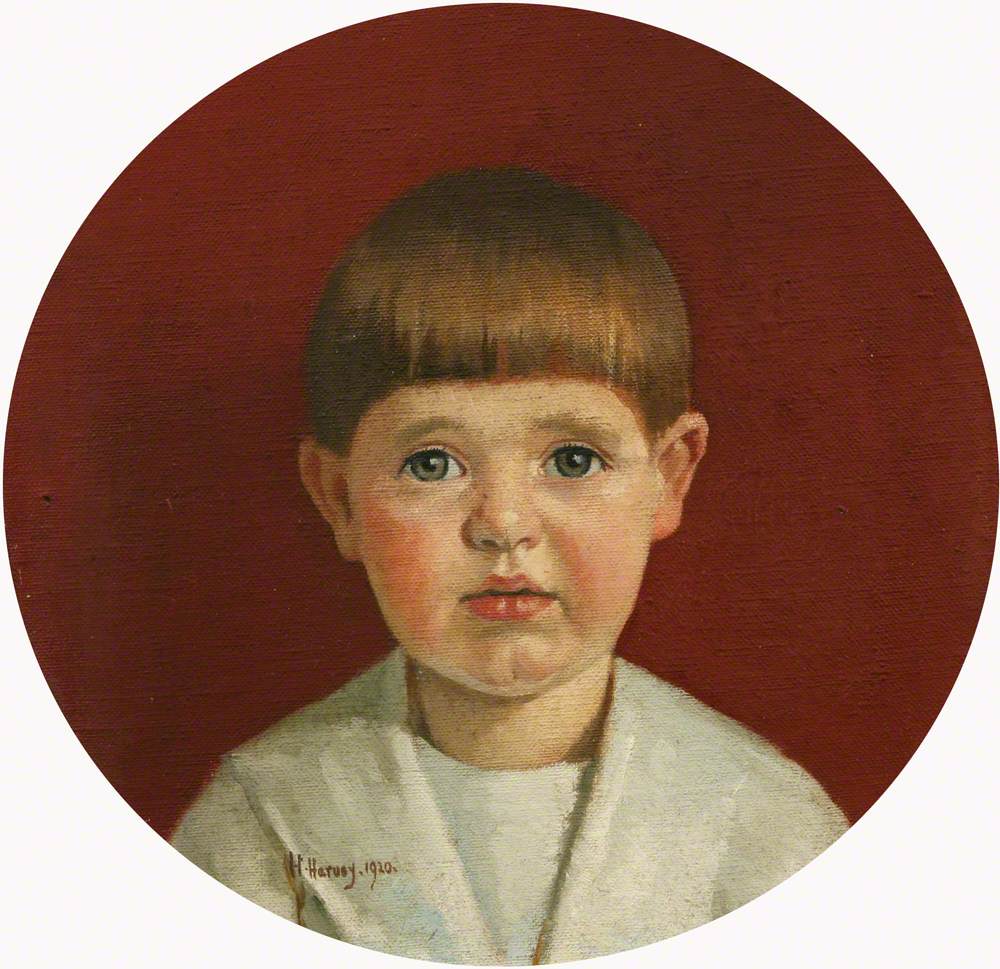
Portrait of James Jewill Hill by Harold Harvey (1920

Harold Harvey completed a number of portrait commissions, such as his 1920 portrait of the youngest son of James Jewill Hill, a partner in the solicitors firm Jewill Hill & Bennett, Penzance.

Harvey, Harold C., 1874-1941; John Humphreys (1850-1937), Professor of Dentistry
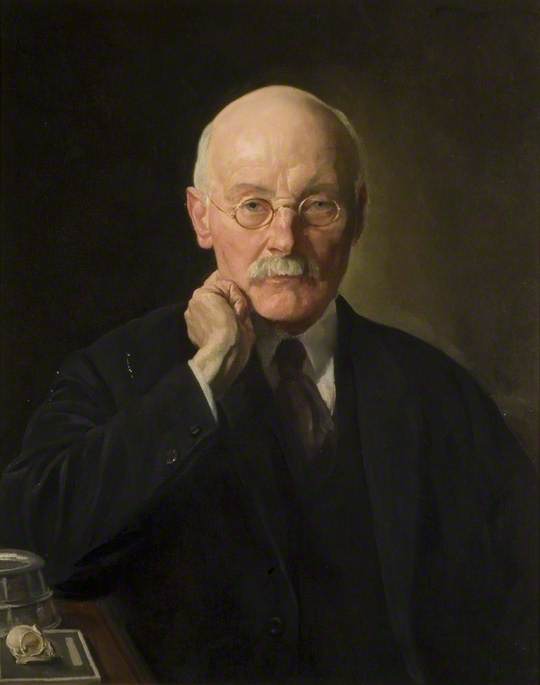
Portrait of John Humphreys, Professor of Dentistry; University of Birmingham; by Harold Harvey (1938)


Another portrait he completed was a 1938 commission to paint a portrait of John Humphreys, Professor of Dentistry.

In 1920, Harold Harvey and fellow Newlyn School artist, Ernest Procter, founded the School of Painting, in Newlyn, called the Harvey-Procter School, which ran throughout most of the 1920s. 

Harold Harvey died in Newlyn on 19 May 1941 and was buried in Penzance at the St Clare Cemetery. His wife, Gertrude, lived in their cottage until 1960 when she moved into the Benoni Nursing Home in St Just. She died six years late, aged 86.


Walter Langley the Social Realist painter and the Newlyn Art Colony

Walter Langley, from a chalk drawing by Hubert Vos. From Newlyn and the Newlyn School, Magazine of Art, 1890

In eighteenth century France, Rococo was the popular style of art. Painters such as Antoine Watteau, Jean-Honoré Fragonard and François Boucher had given art lovers a highly ornate and decorative form of art with its elegant, delightful, if somewhat voyeuristic, depictions of the good life. There was a playfulness about the depictions and all thoughts of seriousness was substituted by eroticism. The minority who were able to live the lifestyle shown in the Rococo paintings were pleased with what they saw but of course this was not real life for many of the citizens. Change had to come, and it did in the form of Realism. One of the leaders of this movement was the French artist, Gustave Courbet and he set out a manifesto, La Réalisme which stated that art should be about truth and depictions must be objective records. Realism was to be an art in which the painter put on his canvas what he saw, “warts and all” and not be concerned as to whether it was appropriate or inappropriate. This new form art was to move away from bourgeoise tastes.

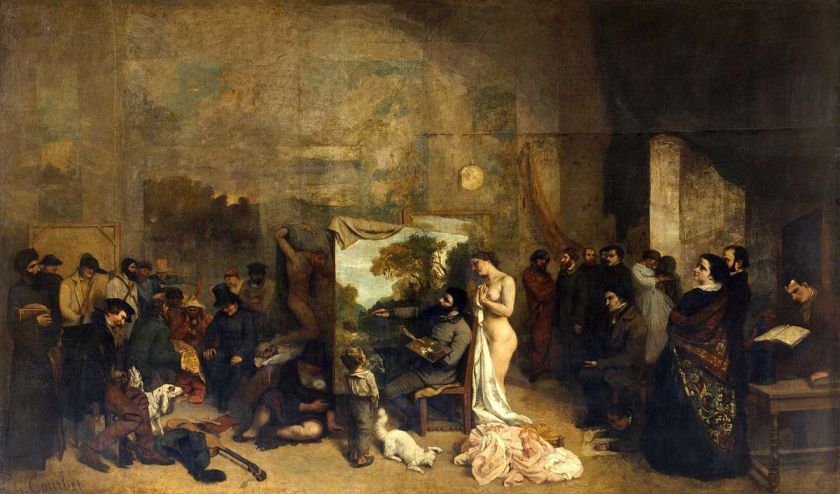
The Artist’s Studio by Gustave Courbet (1855)

Probably Courbet’s most famous painting was pure Realism. It was entitled The Artist’s Studio, which he completed in 1855. The work baffled many, so much so Courbet clarified the ideas behind the depiction, declaring:

“…It’s the whole world coming to me to be painted. On the right, all the shareholders, by that I mean friends, fellow workers, art lovers. On the left is the other world of everyday life, the masses, wretchedness, poverty, wealth, the exploited and the exploiters, people who make a living from death…”

The group to the right……..

The painting depicts two groups of men and women. In the first group on the right, there is the bearded profile of the art collector Alfred Bruyas, and behind him, facing us, the philosopher Proudhon. Jules François Felix Fleury-Husson, who wrote under the name Champfleury.  He was a French art critic and novelist, and a prominent supporter of the Realist movement in painting and fiction, and is seated on a stool, while the French poet and essayist Charles Baudelaire is absorbed in a book. In the right foreground we see a couple who exemplify a pair of art lovers, and in the background, near the window, we see a couple unashamedly wrapped in a loving embrace and they have been included to symbolise free love.

…………….and to the left

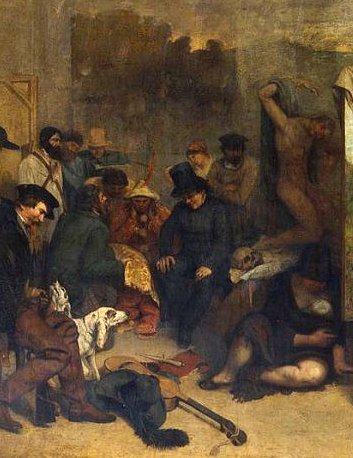
However, the group on the left symbolise the reality of life. There is a priest, a merchant, a hunter, and even an unemployed worker and a beggar girl symbolising poverty. These last two insertions were controversial. Look on the floor by the dog and you will see a dagger, a guitar and large hat with a black plumed feather. Courbet added these items alluding to what was often seen in Academic art.

Courbet and the landscape painting

In the centre, Courbet sits at his large-scale painting of a beautiful landscape with its blue sky and verdant background and this is in direct contrast to the depiction of his grimy and crowded studio. This is a reminder of the difference between real life and an idealised life. This work was destined to be exhibited at the 1855 Universal Exhibition but was rejected on the ground of it being too big but maybe it was because it was too controversial. Courbet, however, was determined that the work should be seen by the public and so, not to be deterred, Courbet, at his own expense, built a Pavilion of Realism close to the official Universal Exhibition site and showed this work and thirteen others including his famous A Burial at Ornans.

Hope by Frank Holl (1883)

From this eighteenth century Realist movement came Social Realism which developed to pictorially arouse concerns about the squalid living conditions suffered by urban poor, and farming and fishing communities. In Britain, artists such as Luke Fildes, Hubert von Herkomer, Frank Holl, and William Small were at the forefront of this movement. In America the beginnings of Social Realism started life with the Ashcan School painters, who in the early 20th century depicted through their art, the everyday, stark, and unglamorous truths of city life. Artists such as John Sloan, Robert Henri, George Bellows, and George Luks were prominent members of this diverse group who painted scenes from everyday life.

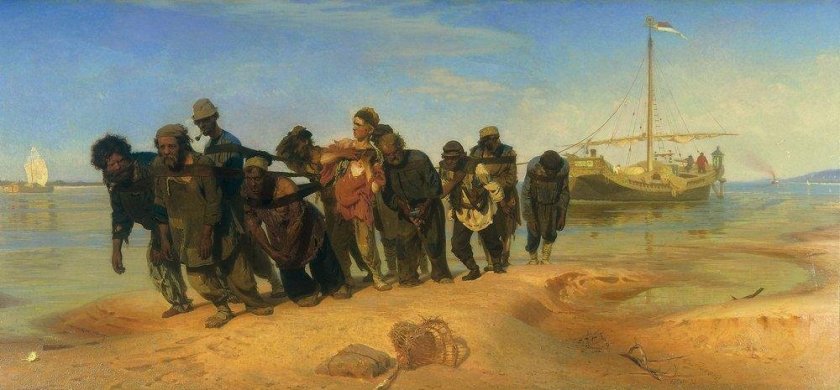
Barge Haulers on the Volga by Ilya Repin (1870-1873)

In Russia, Social Realism came in the form of paintings by Ilya Repin who declared that the reason for his art was to show and criticize all the monstrosities of our vile society of the Tsarist period.  One of his most famous Realist paintings was his 1883 work entitled Barge Haulers on the Volga.

Waiting for the Boats by Walter Langley (1885)

The reason for this introduction regarding Realism and Social Realism is that the artist I am looking at today is an English Social Realist painter. His name is Walter Langley. He was born in Birmingham, England on June 8th, 1852. Although attending normal school, because of his interest in drawing and painting and artistic ability, at the age of ten, he was also enrolled for evening classes at the Birmingham School of Design. He left school at the age of fifteen and was taken on as an apprentice to a lithographer, August Heinrich Biermann, but still continued with his classes at the School of Design. Langley began to teach himself to paint, and first exhibited three water colours at the Royal Birmingham Society of Artists in 1873. His wish was to become a professional artist and that year, at the age of twenty-one, he won a scholarship to the National Art Training School in South Kensington, now known as the Royal College of Art. It was there that he took part in a two-year design course and began to exhibit his works of art.

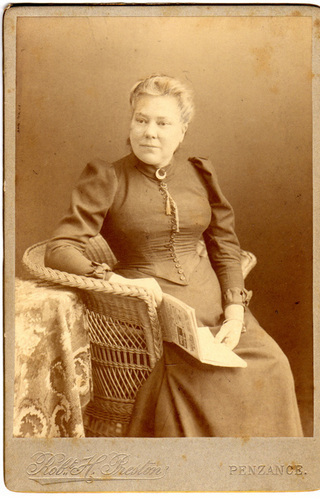
Photographic portrait of Clara, Walter Langley’s first wife, taken in the studio of Robert Preston photographer

It was also around this time that he married Clara Perkins, with whom he had four children.

Hard Times by Hurbert von Herkomer (1885)

In 1875, when his course had ended he had to decide whether to stay in London or return home. The decision was made for him as August Biermann, his former employer, offered Langley a partnership in his lithographer business and so he returned to Birmingham to resume his career as a lithographer. However, Langley did not give up his love of painting and, because he decided that he needed to make progress with his artwork, he enrolled in classes firstly at the Midland Art Guild and then at the Royal Birmingham Society of Artists. It was during this period that Langley became influenced by the works of Realist painters and one who had his works exhibited at the Birmingham Society  was the German-born British realist painter, Hubert Von Herkomer, who took a realistic approach to the conditions of life of the poor.

A Reverie by Walter Langley (1883)

Langley would have probably continued his career as a lithographer but in 1876 the demand for such items fell drastically and he soon realised that his artwork was needed to bring him a living wage. In 1877, Langley married Clara Perkins and the couple went on to have four children. In 1879 he left Biermann’s lithographer business and concentrated on his art. In his early years Walter Langley painted rural scenes close to his home in Birmingham and it was not until the summer of 1880 that he first visited Newlyn in Cornwall with his friend William Pope whilst on a sketching holiday.

Memories by Walter Langley (1906)

In 1881 he was elected an Associate of the Royal Birmingham Society of Artists, which is one of the oldest Art Societies in the United Kingdom. The Royal Birmingham Society of Artists played an important part in the Pre-Raphaelite movement and Sir John Everett Millais and Sir Edward Burne-Jones both served as presidents. Other eminent presidents were the painters, Lord Leighton and Sir Lawrence Alma-Tadema.

Between the Tides by Walter Langley (1901)

Whilst plying his artistic trade in Birmingham a well-known and wealthy Victorian photographer, Robert White Thrupp, approached him and offered him a commission of £500 to go to Cornwall and paint a series of twenty pictures of the local Newlyn scenes and so in 1881 Langley left his wife and family behind in Birmingham, and rented a property, Pembroke Lodge. The Penwith Local History Group wrote about Langley’s new home:

“…Pembroke Lodge was a grand house that had been home to bankers and gentry since it was built in 1791.Langley’s first year’s rent of £62 (payable in advance) gave him two parlours, two kitchens, a dairy, pantry, four good bedrooms, and a dressing room. It also had a studio in the garden. The house was a good size for Langley, his wife Clara and their four children who moved into their new home in March 1882. Clara had not long given birth to her fourth child, a son Cecil born in February that year. The other children were son Lorraine (born September 8, 1877), daughter Eleanor (born March 15, 1879) and son Gabriel (born November 21, 1881)…”

Thoughts Far Away by Walter Langley

Once settled in, Langley began to paint local scenes and portraits featuring the people of Newlyn, most of which depicted the women and their role in the community. Langley could empathize with the plight of the fishermen and their families because 0f his own working-class origins in Birmingham and his socialist beliefs.

Time Moveth Not, Our Being ‘Tis That Moves, by Walter Langley (1882)

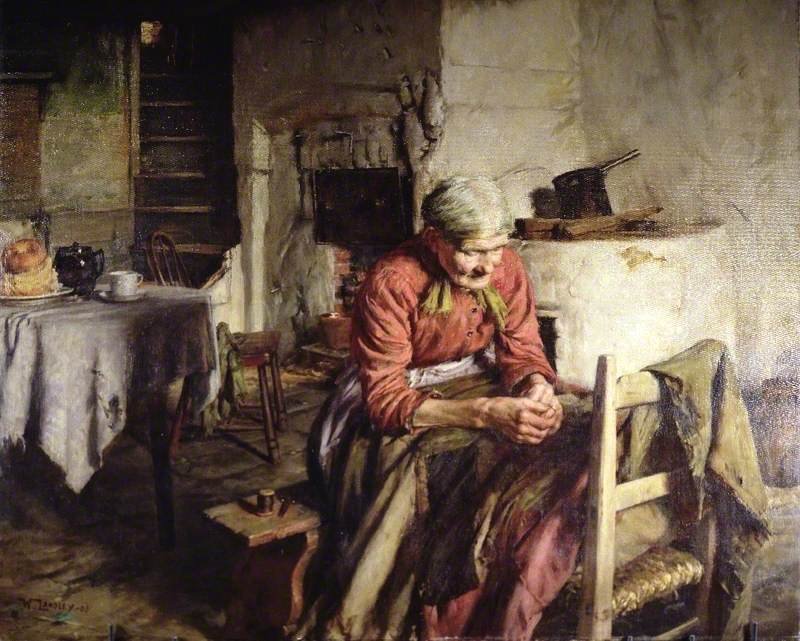
One of his first paintings he completed after his arrival at Newlyn was his 1882 watercolour work entitled Time Moveth Not, Our Being ‘Tis That Moves. It is a depiction of a local woman, believed to be Grace Kelynack. It is a portrait of great compassion and one that detects Langley’s understanding of the plight of the elderly. There is a sense of loneliness and solitude in this depiction of the woman as she ponders the hardships she has had to endure during her long life. In the painting we see her sitting at a table, with her right elbow on an open Bible. She rests her cheek on her fist as she gazes downwards, lost in her own thoughts. It was the first work that Langley exhibited in London and was widely acclaimed by both critics and the public. The watercolour painting led to Langley being elected to the prestigious Royal Institute of Painters in Watercolour.

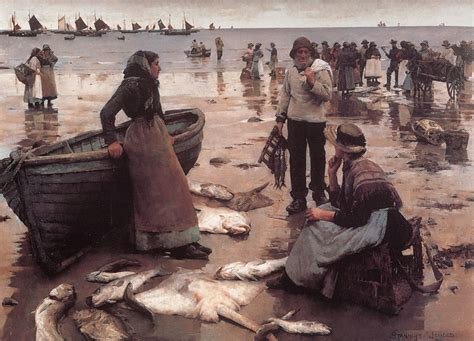
The Fish Sale on a Cornish Beach by Stanhope Forbes (1885)

Walter Langley soon became a leading figure in the Newlyn School, which was an art colony of artists based in or near Newlyn. Another of the founding members of the Newlyn School was Stanhope Forbes who arrived at the Cornish fishing village in 1884.

Amongst the Missing by Walter Langley (1884)

Like other artist colonies such as the Barbizon and Skagen Schools, as well as the artist colonies scattered along the coast of Britany, the attraction of Newlyn was its fantastic light, and mild climate which made it an ideal location for plein air painters. It also provided many opportunities to paint seascapes, and for the Realist painters, the chance to record the harsh life endured by the fishing community. Another attraction was the ability to live there cheaply and employ local people as models at much lower rates than would have been the case in big cities. This magnetic pull towards Newlyn was summed up in the Victorian writer, Mrs Lionel Birch’s 1906 book, Stanhope A. Forbes, and Elizabeth Stanhope Forbes, in which she quotes Stanhope Forbes’ take on Newlyn:

“…I had come from France and, wandering down into Cornwall, came one spring morning along that dusty road by which Newlyn is approached from Penzance. Little did I think that the cluster of grey-roofed houses which I saw before me against the hillside would be my home for many years. What lode-some of artistic metal the place contains I know not; but its effects were strongly felt in the studios of Paris and Antwerp particularly, by a number of young English painters studying there, who just about then, by some common impulse, seemed drawn towards this corner of their native land… There are plenty of names amongst them which are still, and I hope will long by, associated with Newlyn, and the beauty of this fair district, which charmed us from the first, has not lost its power, and holds us still…”

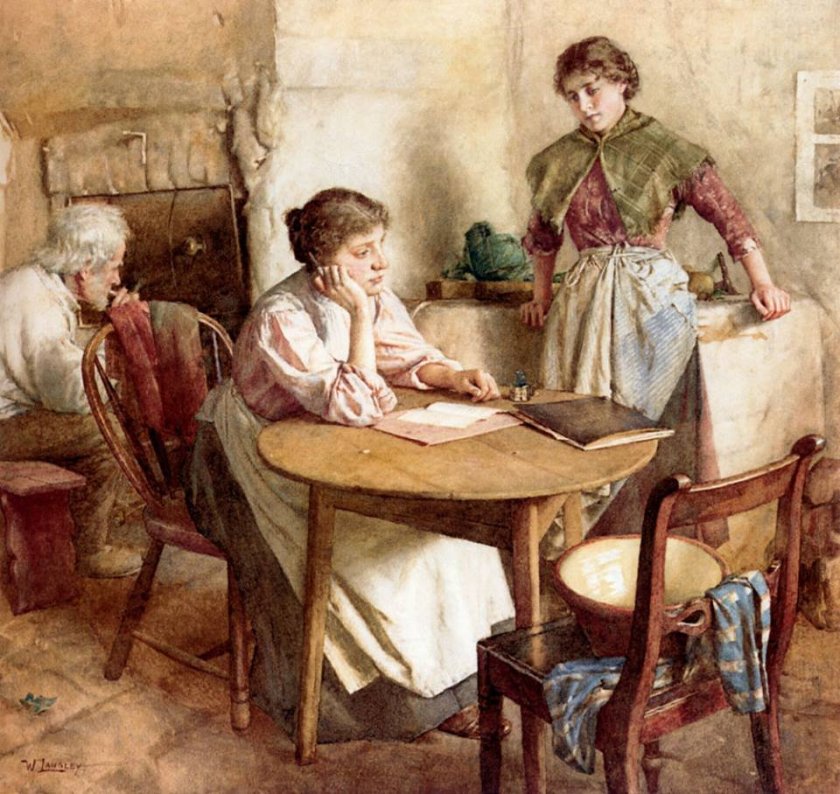
The Old Book by Walter Langley

Walter Langley was always an advocate of the working class and was noted for his left-wing views. Whilst a young man in Birmingham, he was influenced by the stance taken by the firebrand politician and advocate of trade unionism, Charles Bradlaugh, a radical socialist who fought for the rights of the working class. It was these strong-held beliefs of Langley that ensured he empathized with the harsh life of the Newlyn fishing folk and their families. It was through his paintings depicting their hard life and their worries that classed him as a Social Realist painter.

For Men Must Work and Women Must Weep by Walter Langley (1882)

One of his most poignant paintings is a watercolour entitled For Men Must Work and Women Must Weep which he completed in 1883 and focuses on the plight of wives and mothers who are left behind when their husbands and sons head out to sea. The title of the painting comes from a line of a poem by Charles Kinsley, The Three Fishers:

Three fishers went sailing out into the West,
Out into the West as the sun went down;
Each thought on the woman who lov’d him the best;
And the children stood watching them out of the town;
For men must work, and women must weep,
And there’s little to earn, and many to keep,
Though the harbour bar be moaning.
Three wives sat up in the light-house tower,
And they trimm’d the lamps as the sun went down;
They look’d at the squall, and they look’d at the shower,
And the night wrack came rolling up ragged and brown!
But men must work, and women must weep,
Though storms be sudden, and waters deep,
And the harbour bar be moaning.
Three corpses lay out on the shining sands
In the morning gleam as the tide went down,
And the women are weeping and wringing their hands
For those who will never come back to the town;
For men must work, and women must weep,
And the sooner it’s over, the sooner to sleep—
And good-by to the bar and its moaning.

Old fisherman at Newlyn Harbour (c.1906)

Newlyn was a mix of the good and the bad. The good was the picturesque landscape and the bad was the terrible poverty suffered by the local people who struggled to eke out a living from the fish they caught. Add to this the ferocious storms and tumultuous seas which brought death to many of the fishermen and made widows out of many of the women.

His one-year commission was completed at the end of 1885 and he moved back to Birmingham to be with his wife and children. He returned for a brief visit to Newlyn in 1886 to complete his unfinished watercolour which was shown at the Institute’s Spring Exhibition that year. In the Spring of 1887, Walter Langley, along with his family, moved permanently to Newlyn,

But O for the Touch of a Vanished Hand by Walter Langley (1888)

Another title of one of Langley’s paintings was based on a poem. His 1888 work, But O for the Touch of a Vanished Hand was a line from Tennyson’s poem Break, Break, Break which he wrote in 1835 and was about his sorrow at the death of his friend and fellow poet, Arthur Hallam, who tragically died at the age of twenty-two:

Break, break, break,
On thy cold grey stones, O Sea!
And I would that my tongue could utter
The thoughts that arise in me.
O well for the fisherman’s boy,
That he shouts with his sister at play!
O well for the sailor lad,
That he sings in his boat on the bay!
And the stately ships go on
To their haven under the hill;
But O for the touch of a vanish’d hand,
And the sound of a voice that is still!
Break, break, break,
At the foot of thy crags, O Sea!
But the tender grace of a day that is dead,
Will never come back to me.

Fradgan, Newlyn in 1906

On his return to Newlyn with his family, he was unable to secure suitable accommodation in Newlyn and decided to live in Penzance but as his work and models lived in Newlyn he bought a small cottage in Fragdan, the old part of the coastal village, which he converted into his studio.

Cornish Light, The Nottingham 1894 Exhibition

In June 1890, he brought his family back to Newlyn, and took a two-year lease on Pembroke Lodge. When the lease expired Langley moved his family to Penzance. In 1894, along with other Newlyn artists, he exhibited his work in the exhibition Painters of the Newlyn School at Nottingham Castle. In David Tovey and Sarah Skinner’s 2015 book, Cornish Light – the Nottingham 1894 Exhibition Revisited they discuss the exhibition:

“…The 1894 Nottingham Castle exhibition of Cornish painters was, in its way, ground-breaking. It brought a burgeoning new style and range of subjects to a much wider public and fostered awareness of painters from Newlyn, St Ives and Falmouth.
Much of the work was, in typical Victorian style, both art and social commentary and much of it is romanticised – craggy-faced fishermen gaze knowingly towards the horizon and the young women working on the shore have suspiciously lustrous complexions…”

This was the high-point of the Newlyn Colony’s achievements.

Self-portrait by Walter Langley
Courtesy of Archivi Alinari, Firenze

In 1895, forty-three-year-old Langley was invited, by the Uffizi Gallery in Florence, to contribute a self-portrait to hang alongside those of Raphael, Rubens, and Rembrandt in their Medici Collection of portraits of great artists.

That same year, Langley’s wife Clara died at the young age of 45. This left Langley a widower with four children. Two years later, Langley married his second wife Ethel Pengelly in St Johns Parish Church Penzance on June 24th, 1897. The couple went on to have one child. During 1904 and 1905, Langley made visits to Holland and a trip to Belgium in 1906.

Walter Langley in his studio

Walter Langley died in Penzance on March 22, 1922, a couple of months before what would have been his seventieth birthday. Today his work is described as being fundamental to the representation of the Newlyn School and he was, together with Stanhope Forbes, the most unswerving in style and his large output of works depicting life around Newlyn.


Besides the normal internet sources I gained a lot of information from the websites of the Penlee House Museum and the Penwith Local History Group.

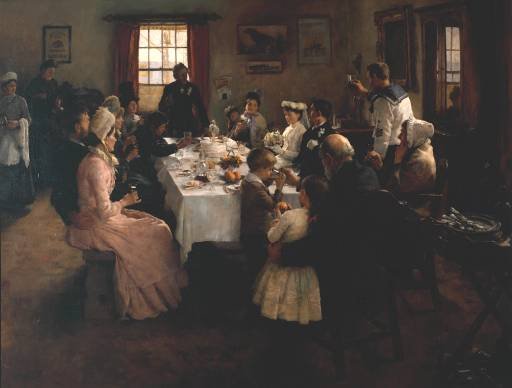
The Health of the Bride by Stanhope Alexander Forbes

The Health of the Bride by Stanhope Alexander Forbes (1889)

My Daily Art Display today features Stanhope Alexander Forbes, an artist of the Newlyn School.  The term “Newlyn School” refers to the artist colony located in and around the fishing village of Newlyn, in Cornwall, from the 1880s until the early 20th century, which specialized in landscape painting.  Like the Continental artist colonies of the Barbizon School near Paris, and Pont-Aven in Brittany, artists gathered in Newlyn to paint landscape scenes in a purer setting, with strong natural light. Newlyn’s plein air painting followed the Impressionist doctrine of naturalism, which is a true-to-life style which involves the representation or depiction of nature with the least possible distortion or interpretation.  The artists of the Newlyn School would work directly in nature, using subject matter drawn from rural working life, especially that of the fishermen.  Newlyn provided the perfect setting for artists with the long hours of strong natural light, a climate which was much milder than the rest of the country and the seaside town was surrounded by coastal and inland areas of natural beauty.  For the impoverished artist, Newlyn was, in those days, a cheap place to live and following new rail connections between Cornwall and London it proved very accessible.

Forbes was born in Dublin in 1857.  His father worked as a railway manager and his mother, Juliette, was French.  His uncle, James Staats Forbes, was a noted art collector who also worked for the railways.  The family often used to make trips to France and it was whilst on vacation there that young Stanhope developed an interest in art.   The family moved from Ireland to London when his father was transferred and it was at this time that Stanhope attended Dulwich College and later became a student at the Royal Academy Schools where he staged his first exhibition in 1878.  Two years later he and his friend and fellow artist he had met at Dulwich College, Henry La Thangue, went to Paris where they studied art under the French painter, Léon Bonnat.  In 1881, having become familiar with the plein air paintings of the French naturalist painter Jules Bastien-Lepage, he decided to travel to Brittany, staying at Cancale where he painted A Street in Brittany.  This painting met with great acclaim when it was exhibited at the Royal Academy in 1882 and  the Walker Art Gallery, Liverpool, purchased it that same year.  Forbes was greatly encouraged and he described the success of the painting as a turning point in his career.  He once again returned to Brittany in 1883 staying this time at Quimperlé.   He visited Pont-Aven in October and met many fellow artists there.

In 1884 he arrived in Newlyn and soon became a leading figure in the growing colony of artists.   His national reputation was established with the acceptance of his A Fish Sale on a Cornish Beach which he painted in 1885 and exhibited at the Royal Academy in London.  In 1889 he painted The Health of the Bride which is today’s featured work.  It was with the money he received from the sale of this painting to Henry Tate, the wealthy English sugar merchant and philanthropist that enabled him to marry Elizabeth Adela Armstrong, a fellow artist who had moved to Newlyn in 1885.   Canadian-born, she was one of the leading women artists of her day.  In 1886 Forbes became a founding member of the New English Art Club

Ten years later in 1899, as the number of artists in Newlyn dwindled, Stanhope and his wife Elizabeth founded their own Newlyn School of Painting.  Her marriage to Stanhope Forbes was a partnership of equals, and their School of Painting was very much a joint enterprise.  In 1910 he was elected to the Royal Academy.   His wife Elizabeth died of cancer in 1912 and three years later in 1915 Stanhope Forbes remarried, this time to Maudie Palmer, a former pupil of the school and close friend of the family.  Sadly, in August 1916, his son Alec died, killed fighting in the front line in France.

Stanhope Forbes died in Newlyn in 1947, a few months short of his 90th birthday.   In 2000, some fifty years after he died, his painting The Seine Boat which he completed in 1904, sold for £1.2 million and was a world record price for one of his works.

Today’s painting entitled The Health of the Bride was completed by Forbes in 1889, the year of his own marriage.  According to Cook, Hardie & Payne’s book on Forbes, entitled Singing from the Walls, Life & Works of EA Forbes, Forbes wrote about his painting to Sir Henry Tate the purchaser of the work.  In the letter he wrote:

“…I myself will be rather occupied down here – no less a matter than my own wedding.   It was inevitable after painting this picture…”

As to why Forbes should prefer such an indoor subject we need to go to Caroline Fox’s book Stanhope Forbes and the Newlyn School in which she quotes the comments of the artist about the reason behind the painting:

“…Standing in one of these inn parlours I had first thought of a painting of an anglers’ meeting – you will notice one or two cases of fish on the wall – but it occurred to me that a wedding party could be much more picturesquely grouped, even though one had to paint them in the smarter, more conventional Sunday clothes…”

In his painting we have members of different generations of a family seated around a table in an inn for a wedding breakfast.  Standing up, to the right, is a sailor, toasting the bride who avoids his gaze and the gazes of the other celebrants.  She just shyly looks down at her bouquet.  The painting is lit from different angles.  Although this is not an open air scene which was the norm for the Newlyn School of Painters, Forbes has stuck closely to their modus operandi.  The sitters are locals and not professional models and the setting for the scene is a recognisable place – in this case the local inn at Newlyn.   The local fishing industry which played a big part in Newlyn life is not forgotten as in the picture, on the rear wall of the inn, we can see a painting of a ship and if we look through the window of the pub we can just make out the mast and rigging of a ship.

The painting was bought by Sir Henry Tate for £600 and it became part of a collection which the philanthropist gave to the nation when the Tate Gallery was founded in 1897.  The painting was well received and was highly praised when exhibited at the 1899 Royal Academy.  It now hangs in the Tate Britain in London.