Maria Bicknell, Mrs John Constable by John Constable

Maria Bicknall by John Constable (1816)

In My Daily Art Display blog yesterday I looked at the early life of John Constable,  up to the point in his life when at twenty-three years of age he was still hell-bent to become an artist.     Today I am going to conclude the story of his life and look at another of his paintings.  

In 1799,  Constable had finally convinced his father to let him pursue art and he enrols in the Royal Academy School as a probationer.  Although he finds inspiration in paintings by Peter Paul Rubens, Thomas Gainsborough, Claude Lorrain and Annibale Carracci, he becomes very homesick and yearns for the beautiful countryside of his Sussex home.  He is also becoming very disheartened with the way the Royal Academy, at that time, disdainfully viewed landscape art.  Landscape art was his passion but unfortunately for him, it was not held in high regard by the Academy, who only valued history painting and portraiture.  Whilst he attended the Academy he met Turner but the two never forged a friendship.

In 1802 Constable exhibited his first painting at the Royal Academy.  His landscape works were unfortunately not the traditional heavenly landscapes which depicted biblical or mythological stories, which were in vogue at the time, and so were not popular with the buying public.  His depictions of the countryside were far more realistic than those of the very popular Gainsborough and Claude.  If anything, his style was more akin to that of the Dutch landscape painters, such as Jacob van Ruysdael.   Constable fervently believed that landscape art was to be a true study and reflection of nature and that idealized landscapes, which had been painted from the artist’s own imagination were, in some ways, dishonest.  He left the Royal Academy in 1802 and was offered the position of drawing master at Great Marlow Military College, but he turned down the offer, which horrified the then master of the Royal Academy, Benjamin West, who told Constable in no uncertain terms that his refusal would probably mean the end of his artistic career.  However Constable was not deterred and chose to stay on his chosen course – that of a landscape artist.  Constable returned to East Bergholt.

In 1800, when he was aged twenty-four and whilst he was at home in East Bergholt, he had become friendly with a young girl who was some twelve years younger than him.  Her name was Maria Bicknell.  Now almost ten years later in 1809, John is aged thirty-three and Maria is twenty-one years of age and their relationship changed.  Slowly but surely, this one-time childhood friendship developed into a much more serious relationship and the two fell deeply in love.  Seven years later, in 1816,  the couple decided to get engaged but this was strongly opposed by Maria’s parents and her grandfather, Dr. Rhudde who was the rector of East Bergholt.  Both Maria’s father, Charles Bicknell, who held the prominent position as solicitor to the Admiralty, and her grandfather did not want her to be married to a penniless artist and they also believed that Constable and his family were socially inferior to them and not fit in-laws.  To force home their disquiet about such a proposed liaison they told Maria that she would be disinherited if she married Constable.  Constable’s parents Golding and Ann Constable, while somewhat sympathetic to the desires of their son, could also see no future in the proposed marriage as they would not in the position to financially support the couple and even Maria herself pointed out to Constable that if he was to succeed as an artist he did not want the distraction of a wife and the financial implications of such a match.  For the next seven years the couple were often parted and sometimes forbidden even to write to one another, but throughout their long, frustrating courtship they remained loyal to each other

The situation changed in 1816 when both Golding and Ann Constable died and Constable inherits a fifth of the family business.   Now with some money behind him and the fact that their daughter Maria is twenty-eight years old, her parents reluctantly agree to let her marry Constable.  John and Maria marry in that October at St Martin-in-the Fields, London and the two of them tour the south coast of England on honeymoon. 

Constable struggled to sell his paintings and it was not until 1819 that Constable made his first big sale, which was for his painting entitled The White Horse.  This sale spurred him on and it led to what are known as his “six footers”, a series of six large scale paintings, which included The Hay Wain and Stratford Lock.  The Hay Wain was exhibited at the Royal Academy in 1821 and was seen by the great French Romantic artist Théodore Géricault who on his return to Paris spread the word about Constable and his painting.   Three years later, the painting is bought by the art dealer John Arrowsmith and it is exhibited at the Paris Salon of 1824 where it wins a gold medal.

Four years on and it is 1828 and that January Maria gives birth to their seventh child.  Sadly that same year she falls ill and after a prolonged illness dies that November of tuberculosis, at the young age of forty-one.  Constable is devastated by his loss and in a letter to his elder brother Golding he wrote:

“….hourly do I feel the loss of my departed Angel—God only knows how my children will be brought up…the face of the World is totally changed to me…”

In his book, Memoirs of the Life of John Constable, Charles Leslie wrote that after the death of his wife, Constable was always dressed in black and was “a prey to melancholy and anxious thoughts”.  Constable had to, from then on, look after his seven children singlehandedly.    

The financial situation of his having to bring up all his children should not have been too burdensome as shortly before her death, Maria’s father had died, leaving her £20,000.  However Constable, instead of safeguarding this new wealth, speculated disastrously with this money.  A large proportion of the money was invested in the engraving of his landscape works which he believed would easily pay for themselves but he was sadly mistaken and the money raised did not cover the expenditure.

At the age of  fifty-two he was elected to the Royal Academy and two years later in 1831 was appointed Visitor at the Royal Academy, a part time teaching post which proved to be very successful and extremely fulfilling.  He regularly lectured on landscape art and once again regaled how works should depict real scenes and not idealized fantasies.  It is interesting to note that although he was not always happy with the art education he received at the Royal Academy thirty years earlier, one of the constant themes of his lectures was the way he praised the establishment calling it the “cradle of British Art” and he stated that no great artist was ever self-taught.

Constable died in 1837 a couple of months short of his sixty-first birthday and was buried besides his beloved Maria in the graveyard of St John-at-Hampstead in London.  Later the couple would be joined in the family tomb by two of their sons, John Charles Constable and Charles Golding Constable

My Daily Art Display featured painting today is not one of his famous “six-footers” but a beautiful painting of his wife which he completed a few months before they married in 1816.  On completing the portrait Constable wrote to his wife:

“…I would not be without your portrait for the world the sight of it soon calms my spirit under all trouble…”

Constable is primarily known for his beautiful landscape paintings but he was also an accomplished portraitist and before us we see his depiction of the woman he deeply loved.  What greater love could an artist bestow on his wife than to paint her portrait?  The marriage only lasted twelve years but one should remember that he had known and loved the young girl for sixteen years before they had been allowed to become man and wife.

The painting hangs at the Tate Britain Gallery in London.

.
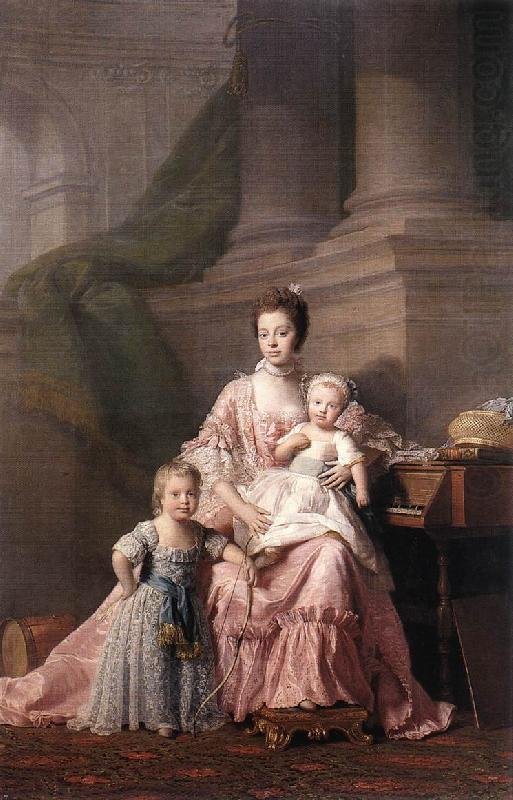
Queen Charlotte with her Two Eldest Sons by Allan Ramsay

Queen Charlotte with her Two Eldest Sons by Allan Ramsey (c.1764)

Britain is very fortunate to have so many art galleries.  Although if one lives in London I suppose one has the cream of the crop but dotted throughout the land there are some excellent art establishments.  One of the richest collection of art works is owned by the monarch and is held in trust for her successors and the nation.   There are more than 7000 paintings within the Royal Collection as well as thousands of watercolours, prints and drawings.  The collection is not held in just one place, Buckingham Palace, but is spread around the royal residences, such as Windsor Castle, Palace of Holyroodhouse in Edinburgh, Balmoral Castle, Hampton Court and Sandringham House.   The total collection is estimated to be worth around ten billion pounds.  My Daily Art Display today features a painting from the Royal Collection which hangs in Buckingham Palace.  It is entitled Queen Charlotte and her Two Eldest Sons by the Scottish portrait painter Allan Ramsay, which he completed around 1764.

Allan Ramsay was born in Edinburgh in 1713.  He was the eldest son of Allan Ramsay who was a poet and writer.  After completing his schooling in Scotland he moved to London when he was twenty years of age and studied art under the tutelage of Hans Hysing, the Swedish portrait painter and later was a student at the St Martin’s Lane Academy, which was the precursor to the present day Royal Academy.  In 1736, aged twenty-three he travelled to Rome and Naples to further his art education and he remained for almost three years.  On returning to Britain he went to Scotland and settled down in Edinburgh.

In 1739 he married his first wife, Anne Bayne, and the couple had three children but none survived childhood and his wife died during the birth of their third child in 1743.    Allan Ramsay supplemented his income from his paintings by teaching art and one of his pupils was Margaret Lindsay the eldest daughter of the nobleman Sir Alexander Lindsay of Evelick.  As a humble artist her parents frowned on their liaison outside of art tuition and knowing that, the couple eloped and were married in secret.  Her parents never forgave her for marrying lower than her station.  Allan Ramsey, in an attempt to ease their minds about how he would care for their daughter and that he had married their daughter for love and not for their money, wrote to them explaining that although he had to support his daughter from his first marriage along with his two sisters, he was well placed financially to look after their daughter.  Her parents were unmoved by his words.  The couple lived a happy life and went on to have two daughters and a son.

The devoted couple spent three years in Italy from 1754 to 1757, where they both spent time painting and copying old Masters and whilst there they would earn an income by painting portraits of the wealthy aristocratic travelers who were doing the Grand Tour of Europe.  They returned to Britain and went to live in London and in 1761, Allan Ramsey was appointed Principal Painter in Ordinary to George III.   The title of Principal Painter in Ordinary to the King or Queen of England was awarded to a number of artists, nearly all of whom were portraitists.  It was in this role that he completed many paintings of the royal couple and their children.  .

 So before us we have Queen Charlotte and two of her children but who was Charlotte and where did she come from?  Sophia Charlotte was born in 1744 and was the youngest daughter of Duke Charles Louis Frederick of Mecklenburg-Strelitz and his wife Princess Elizabeth Albertine of Saxe-Hildburghausen.  When King George III came to the throne it was decided that he should seek to marry someone of royal descent who would be use to life at court but would also have to be somebody who would be popular with the people of Britain.  Many of the ladies that George would have liked to have married were deemed, much to the monarch’s annoyance, unsuitable and inappropriate and he had to reluctantly agree to “look elsewhere” !    Eventually a royal match was made, when David Graeme, a British soldier, diplomat and courtier, who had visited many of the royal courts of Europe, reported back to the British that he had found an ideal marriage partner for George.   She was Princess Sophia Charlotte.

In 1761, when she seventeen years old, she married George III of England and at that young age became the queen consort of  the United Kingdom. With the marriage came stipulations which she had to agree to.  Firstly, she must become an Anglican and secondly, she had to promise not to become involved in the politics of the country.  George III bought Buckingham House in 1761 for his wife Queen Charlotte and it was here that fourteen of the fifteen children of theirs were born.  Charlotte was an extremely intelligent woman.     From her letters we can see that she was well read and loved the fine arts. The Queen was very musical and is known to have been taught music by Johann Christian Bach.   Wolfgang Amadeus Mozart, at aged eight, dedicated his Opus 3 piece to the Queen at her request.  She had a love of plants and trees and helped to establish Kew Gardens.       The Christmas tree was introduced to England by the Queen who had the first one in her house, in 1800.  The royal couple were very much in love with one another but sometimes for the young girl, suddenly having to take on the responsibility of queen consort, was trying but she always took her duties seriously.   In a letter to her younger brother, she wrote:

“…I find that the solitary and retiring life which I lead is not made for me. Having admitted this I assure you I shall not ignore my duty…”

My Daily Art Display today features one of Ramsay’s paintings of Queen Charlotte and her two eldest sons, George, who was Prince of Wales and was later to become George IV and Frederick, Duke of York.  As we have seen in other paintings despite the two children being male they were dressed in, what today, we would term girl’s clothing.  The elder son, George, stands with his bow in his hand and in the left side of the picture, we can see his drum.  These accoutrements have been added by the artist to symbolise George’s future soldierly spirit.  His mother Charlotte has her foot on a foot-stool and leans against a piano.  On the piano we have a sewing box and a copy of John Locke’s book Some Thoughts concerning Education.  At the time, this book, a treatise on education,  was considered the most important philosophical work on education in England and it was translated into almost all of the major written European languages during the eighteenth century.  The setting of this painting and the items depicted in it all add up to a compassionate relationship between a mother and her children and illustrate how she spent time with them whilst they were at play and how important family life was to them.

It is a lovely portrait of a mother and her children.  It is full of compassion and the smiles on their faces have put across the impression of happiness and fulfillment.

The Irish Girl and The English Boy by Ford Madox Brown

Manchester Art Gallery exhibition

The other day I went to Manchester to see the Ford Madox Brown exhibition at the Manchester Art Gallery.  The exhibition opened on September 24th and runs until January 29th 2012 and I strongly recommend you make the effort to visit the city and take in this superb show which displays 140 public and private works from this talented 19th century painter.  I have already  featured two of Ford Madox Brown’s paintings, The Last of England (June 15th) and Manfred on the Jungfrau (July 21st), the former I saw when I visited the Birmingham Art Gallery and the latter which I had hoped to view when I went to Manchester a few months ago had been withdrawn from the gallery for some restoration work prior to this new exhibition.   Both of these works are on show at the current Manchester Exhibition.

I will, in the coming months, review more of Ford Madox Brown’s works,  which I saw at the exhibition, but I need to space them out a little otherwise I will be accused of featuring one artist too often.

Like most people, I had seen many of Ford Madox Brown’s paintings before, in books or on the internet, but what I had not realized was that he had completed many portraits of which a number were on display at the exhibition.  However, there is nothing more true than the saying “you cannot please all the people all the time” for as I researched today’s blog and was still buoyed up with my admiration for Brown’s portraits,  I came across the Daily Telegraph’s art critic’s, Alastair Smart, view of the exhibition and his assessment of some of the paintings, especially his portraiture.  He wrote:

“…Despite the show’s claims to the contrary, Brown’s portraits and biblical dramas aren’t up to much either: his figures are just too awkward in facial gesture, one toothy contortion after another…”

How disappointing to read that when I was still so enthused with what I had seen.  I loved his small portraits.  I did get some consolation however when I re-read the opening line of his article which stated quite bluntly:

“….First, a confession: I utterly loathe the Pre-Raphaelites. Oh, what a mawkish, melodramatic and clichéd bunch…”

The journalist did however go on to qualify his bold statement by saying that he realized Ford Madox Brown was not a member of the Pre-Raphaelite Brotherhood but countered that by telling us that he did have a close association with the three founder members.  Guilty by association ?  Having said all that I will not be deflected from my proposed look at two of Brown’s small portraits, which I loved, even if the knowledgeable art critic disliked them. 

The Irish Girl by Ford Madox Brown (1860)

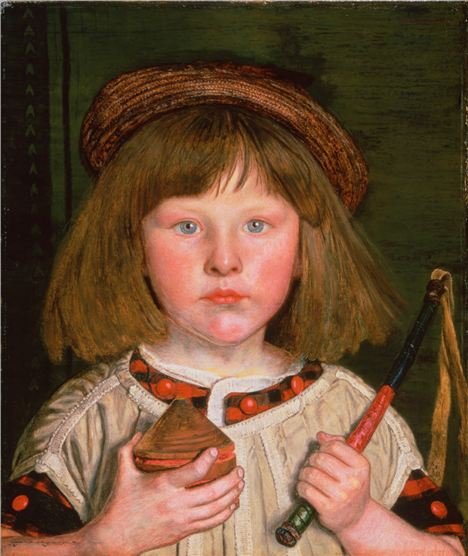
For My Daily Art Display today I am featuring two portraits, The Irish Girl and The English Boy as they were hung next to each other at the exhibition and in some ways they are connected.  It was the coming together of these “two old friends”, who were separated forty-seven years ago.  The man, who commissioned the paintings, was a Leeds stockbroker called Thomas Edward Plint, who was a patron of Ford Madox Brown, and an important Pre Raphaelite art collector.  In 1850, he had commissioned Brown to paint Work, and out of that commission came the painting, The Irish Girl, which also happens to be featured on all the exhibition publicity material.  To my mind this is a beautiful and haunting painting.  This small (almost 28cms square) oil on canvas work was completed by Brown in 1860 and is normally to be found exhibited at the Yale Centre of British Art.  The Yale Center for British Art, which is in New Haven, Connecticut, is a public art museum and research institute for the study of British art and culture. It was presented to Yale University by Paul Mellon who was in the Class of 1929 at Yale.  The Centre houses the largest collection of British art outside the United Kingdom.

In comparison to the portrait of the young English boy the young girl looks slightly nervous and somewhat troubled.  She has real beauty.  There is nothing idealized about this portrait.  Her haunting loveliness is plain to see and yet the difference between her and the English boy could not be starker.  Unlike the boy, she looks worldly–wise.  Her jet black hair, her dazzling brown eyes and her painted red lips are all part of her exquisiteness.   She has tilted her head a little to one side and her eyes focus on something off to the side.  When Ford Madox Brown was looking for Irish models for his painting Work he came across this young girl selling oranges and couldn’t pass up the opportunity to paint her portrait.   We see the fingers of her hand appearing from inside her red paisley shawl which is tightly wrapped around her and the colour of which complements the colour of her lips.  Between her fingers, she is gently holding a sprig of cornflowers. 

The English Boy by Ford Madox Brown (1860)

The portrait which hung next to the Irish Girl was entitled The English Boy and was the companion piece to the Irish Girl.  In this case the young child depicted was no stranger to Brown.  It was his five year old son, Oliver, and this too was painted in 1860.  It is slightly larger than the Irish Girl, measuring 39cms x 33cms.  This portrait is owned by the Manchester Art Gallery, which acquired it in 1932.  Although a companion piece to the Irish Girl they couldn’t be more different.  In this portrait,  the young child stares straight at us with a self-assured gaze.   It is a deadpan expression and we wonder what is going through his mind.   His cheeks are slightly flushed and this colouring in some way matches the red shawl and lips of the Irish Girl.   He wears a white smock over a red checked dress and on top of his head, sitting at a slightly jaunty angle, is a brown straw hat.  In his hands he clutches on tightly to the popular child’s toys of the time, a top and whip.  The way in which he holds the toys in some way reminds us of royal paintings where the subject holds a sceptre and orb.

Despite what our knowledgeable journalist would have us believe I don’t find these portraits in any way awkward in facial gesture.  I find them to be simply fascinating studies of two young children.

Miss Murray by Sir Thomas Lawrence

Miss Murray by Sir Thomas Lawrence

My Daily Art Display looks at a work by one of the greatest English portrait painters.  His name was Thomas Lawrence, later to become Sir Thomas Lawrence.   He was born in Bristol in 1769.  His father, also called Thomas, was a supervisor of excise and his mother Lucy was the daughter of a clergyman.  His mother had an amazing number of children – sixteen in all, albeit only five survived infancy.  It was around the time that Thomas was born that his father decided to give up his government job and become an innkeeper.  The initial move into running an inn failed and when Thomas was four years of age his father moved the whole family to the Wiltshire market town of Devizes and tried again at being a successful landlord of an inn.  The inn named the Black Bear was on the main route between London and Bath and was ideally situated to catch the London gentry who were on route to Bath in order to take the healing waters.

The father’s business acumen was lacking and he soon ran into debt and it was left to young Thomas to help with the family finances by selling his pastel portraits.  When Thomas was ten, his father was declared bankrupt and the family moved to Bath.  There was now more pressure on the young boy to stabilise the family’s finances through the sale of his portraits.  He concentrated on oval portraits measuring 3ocms x 25cm and he was able to charge three guineas for each half length portrait.   In 1787 Thomas Lawrence moved to London and in a very short time established his reputation as a portrait painter in oils.   It was primarily the portraiture of Britain’s growing aristocracy which was in great demand and Lawrence was able to command high fees for his work and it was into this aristocratic world that Lawrence was accepted.      In 1790, he received his first royal commission when he was asked to paint a portrait of Queen Charlotte, the wife of King George III.  The following year, aged just twenty two, he became an associate of the Royal Academy and three years later a full member of that society.  In 1792, Sir Joshua Reynolds the great English portrait artist, friend and mentor to Thomas Lawrence, died and this opened royal doors for his protégé.  George III, who had been delighted with Lawrence’s portrait of his wife, Queen Charlotte, appointed Thomas Lawrence as the Principal Court painter. He retained that position under the monarchy of George IV.   Lawrence was knighted in 1815 and five years later became the President of the Royal Academy.

So business was good for Lawrence the sale of his portraits went well and he could command higher and higher fees for the commissions he received and so he was rich.   Well, in fact no, he wasn’t wealthy and on a number of occasions was nearly bankrupt and only staved off financial disaster with help from friends and patrons.  So where did all the money go?  Lawrence was bemused by his lack of money, commenting:

“…I have never been extravagant nor profligate in the use of money. Neither gaming, horses, curricles, expensive entertainments, nor secret sources of ruin from vulgar licentiousness have swept it from me…”

Many biographers have sought the reason for his financial mess and it is now generally accepted that Thomas Lawrence could not handle his finances, rarely kept accounts and he spent a lot of money building up a collection of Old Master drawings.  He was also very generous when it came to his family – probably too generous.

Apart from financial problems he was also very unlucky in love.  He had come in contact with the well-known London stage actress Sarah Siddons and he became entangled with her two daughters, Maria and Sally.  He fell in love first with Sally, then transferred his affections on to her sister Maria, then broke with Maria and turned back to Sally again. Both the sisters had fragile health; Maria died in 1798, on her deathbed extracting a promise from her sister never to marry Lawrence.  Sally kept her promise and refused to see Lawrence again, dying in 1803. But Lawrence continued on friendly terms with their mother and painted several portraits of her.   Lawrence never married.  Sir Thomas Lawrence died in 1830, aged 60 and was the most fashionable portrait painter in Europe

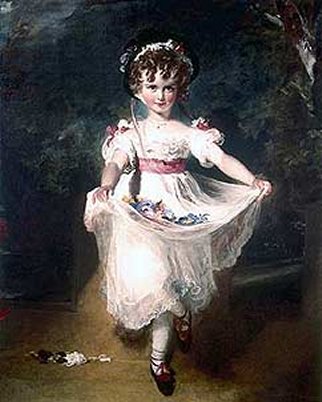
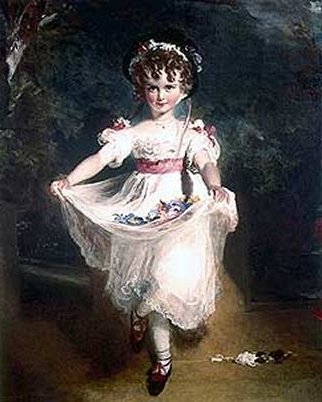
My Daily Art Display today is a delightful portrait which Sir Thomas Lawrence completed in 1826, entitled Miss Murray, which can be found at Kenwood House in London.  It is an unusual portrait considering the wealthy and famous people he had painted.  The painting was commissioned by Sir George Murray, the Scottish soldier and politician, who fought with General Wellington in the Peninsular Wars.  Louise Georgina Murray was his daughter and was also the goddaughter of the Duke of Wellington.  The young girl dances towards us beribboned and utterly bewitching.  She reminds me of the very young girls we see in present day American child beauty pageants, all dressed up adult-like, performing little dances for their doting audience.  She is just like Shirley Temple.   We seem to be looking up at her from below as if she is performing her dance on a stage and we are merely part of her audience.  Lawrence has undoubtedly captured the little girl’s beauty whilst she was still young.  Lawrence realised that his portrait had in some ways captured a certain moment in her life, a moment of child-like innocence and beauty which would undoubtedly change.  He commented on this very fact to her father, writing:

“…All I can do will be to snatch this fleeting beauty and expression so singular in the child before the change takes place that some few months may bring…”

How many times have we looked back on our children’s photographs when they were young and wondered how things change so much over time?  Lawrence and undoubtedly Sir George Murray knew that the sweet innocence of the child as she proudly shows off her dress and performs her dance would inevitably change.

So what of little Miss Murray, what became of her?    In 1843, aged twenty-one, she married Captain Henry George Boyce, a grandson of the 1st Duke of Marlborough who sadly died in Rome, five years after they were married.  Louisa Georgina Augusta Anne Murray remained a widow for forty three years, dying in 1891 in the Italian coastal town of Bordighera.

Mirror image ?

As I said at the start of this blog, the painting can be found in Kenwood House, London which I believe is near to Hampstead Heath.  I have never been there and thus have never stood in front of the painting but when I was researching the work I came across two “versions” of the painting, the one you see at the begining, with the girl looking slightly to her left and the sprig of flowers on the floor on the left side of the painting and the other picture of the painting (on the right) I came across in another art history book which had the girl turning slightly to her right and the flowers were on the floor to the right of the painting.  One book must have had a mirror-image of the real painting but which is correct?  Next time you visit the gallery please let me know !

Charles Beale by Mary Beale

Charles Beale by Mary Beale (c.1675)

For My Daily Art Display today, I am staying with an English artist but instead of a landscape painter and a man as was the case yesterday I am focusing on a lady artist, one of the most important portrait painters of 17th century England and who has been described as the first professional female English painter.  Her name is Mary Beale and the subject of today’s portrait painting is her husband Charles.

Mary Beale was born in 1633, in Barrow in the county of Suffolk.    Her father was the Reverend John Craddock, who was the local puritan rector.  He was an amateur painter and was acquainted with all the local artists, one of whom was Peter Lely, a portrait painter.  Although Mary Beale was never a pupil of Peter Lely there is no doubt that throughout her life she was influenced by his artistic style.  Her mother was Dorothy Brunton who sadly died when Mary was just ten years of age.

In 1652, at the age of eighteen, she married Charles Beale, a cloth merchant and amateur artist and she went to live with him in Covent Garden, London. The Beales had two sons who survived past childhood, Bartholomew and Charles.  Her husband, Charles became deputy clerk of the patents office in about 1660, by which time Mary had begun to study portraiture.   In 1664, the Beales moved away from London.  Charles had lost his job at the patents office and so they had a loss of income and they decided life would be cheaper in the country, so they moved to a farmhouse in Allbrook in Hampshire.  A second reason for the move was for their own safety as that year saw the onset of the Great Plague in London which was to kill a fifth of the population of London.

In 1670, Mary and her family, returned to London and she set up a studio in Pall Mall.  Here she painted many portraits of the aristocracy and local gentry.  Her husband, not only acted as her assistant, but looked after the business side of her artistic venture and her son Charles trained as an artist in his mother’s studio.  Her work was very popular and she received many commissions.   In her husband’s diary he recorded that in the 1670’s his wife received no fewer than 140 commissions for portraits.   Having returned to London she became reacquainted with Peter Lely who had been made the Court Artist to Charles II and many of Mary’s commissions were to paint copies of Lely’s works.

Mary Beale died in 1699, and was buried at St James’s, Piccadilly. Her husband died in 1705.  The Beales’ first child Bartholomew died when he was young.  Her second son also called Bartholomew studied portraiture but eventually gave up any thoughts of being a full time artist and took up medicine.  Her third son Charles jnr. became a painter specialising in miniatures.

The painting today, simply entitled Charles Beale, is a portrait of her husband.  She has portrayed him as a poet and clothed him accordingly in a style of unkempt abandon.  His disheveled state was that of the preserve of poetic and melancholic genius.  I love the informality of this painting with the sitter’s relaxed pose dressed in a brown gown underneath which we can see an open-necked chemise.  This portrait is in direct contrast to the portraiture norm when the sitter is expected to be shown in a strong courtly pose. This is a portrait that exudes casualness and familiarity which of course one expects of a husband’s portrait carried out by his loving wife.   This portrait has done away with the use of background drapery or Arcadian imagery which was so popular at the time and would no doubt have been included if this had been a commissioned work.  It is an engaging and intimate portrait.  The couple were very much in love and in his notebooks he always referred to his wife as his “Dearest and most Indefatigable Heart”.  There was great equality in their relationship and the fact that after losing his job he “worked” for his wife, which was acting against all contemporary notions of married life. Religious, social and medical teaching stressed the secondary role to be played by women, whose place was determined forever by Eve’s original Sin.   But Charles had no qualms about his position of apparent subservience.  Mary was a firm believer of equality between a husband and his wife and between man and woman outside of marriage.  She even put down her thoughts on the subject in 1660 when she wrote Essay on Friendship.  In Tabitha Barber’s book Mary Beale she quotes Mary’s thoughts on the subject of friendship and equality between husband and wife, writing:

“…This being the perfection of friendship that it supposes its professors equally, laying aside all distance, & so levelling the ground, that neither hath therein the advantage of other…”’

Regarding the relationship in marriage between husband and wife, Mary wrote:

“…In marriage, God had created Eve as ‘a wife and Friend but not a slave…”

Mary Beale painted numerous portraits of her husband Charles which is testament to the deep affection between them.

This painting presently hangs in a private collection.

Madame de Ventadour with Portraits of Louis XIV and his Heirs by The French School

Madame de Ventadour with Portraits of Louis XIV and his Heirs by The French School (c. 1715-1720)

For My Daily Art Display today I am returning to French art and a painting which is attributed to the French School around 1720.  The title of the work is Madame de Ventadour with Portraits of Louis XIV and his Heirs. It has all the grandeur and splendour one would expect in the pre-Revolution days when French life was controlled by the Monarchy.

I suppose the first thing I should talk about is who are all these people standing before us with their dignified regal poses?  In the painting we see four adults and a child in what is meant to look like an elegantly decorated room in the Palace of Versailles.  In the right background we can see the lavish gardens of the palace.  The people in the painting pose like actors playing to an audience and maybe we are that audience who marvels open-mouthed at such opulence.  Seated centre stage, as befits the most important person of the group, is King Louis XIV, the King of France.   Leaning on the back of his chair is his son, Louis, the Grand Dauphin and heir to the French throne.  On the right dressed sumptuously in a red velvet coat with gold brocade is the Dauphin’s eldest son and Louis XIV’s grandson, Louis, Duc de Bourgone who is second in line to the French throne.  The lady on the left is the lady of the title of the painting, Madame de Ventadour, who was the governess to the royal children and finally, the child in front of her, who is actually a boy despite the dress, and he is the great grandson of Louis XIV, Louis, the Duc d’Anjou, who would later become King Louis XV.  Two other personalities are present in the painting but only in the form of busts.  On the plinth in the left background we have the bust of King Henri IV, the deceased head of the Bourbon dynasty and on the plinth to the right we have the bust of King Louis XIII the deceased King of France and Louis XIV’s father.  Madame de Ventadour can be seen to the left of the painting but more about her later.

Louis XIV’s father Louis XIII had an arranged marriage with Anne of Austria when he was only fourteen years of age.  Anne suffered four miscarriages and the Royal couple waited twenty-eight years for their first child, Louis, to be born in 1638.  Five years after the birth of his son, Louis XIII died.  An amusing anecdote is related regarding the deathbed scene of the forty-one year old Louis XIII and his five year old son.  The dying man asked his son did he know who he was, the little boy replied:

“….Louis the Fourteenth, Father….”

To which his father quickly retorted:

“…You are not Louis the Fourteenth, yet….”

Louis came to the throne as Louis XIV on the death of his father at the age of four and ruled France for just over seventy-two years from 1643 to 1715 and as such, it is one of the longest recorded reigns of any European monarch.  He was known as the Sun King as he identified himself with the Sun God Apollo and it was probably in his honour that the picture of Apollo riding his chariot, which we see on the rear wall, was incorporated into the painting.

As the title of the painting states, this is a painting depicting Louis XIV’s heirs.  Actually we are looking at members from four generations.  We have the king seated, his son with the white wig, his grandson with the red coat and his great grandson the small child.   So why did this little boy, the king’s great grandson, become the next king on the death of his great grandfather?    The reason is simple but in some ways tragic.   Louis XIV lived a very long life, dying just four days before his seventy-seventh birthday in 1715.  His eldest son, the man standing behind his chair in the painting died of smallpox in 1711, aged 49.  The next in line for the throne would have been Louis XIV’s grandson, the Duc de Bourgogne, the man in the painting wearing the red coat, but he, his wife and one of their sons died of a measles epidemic in 1712.  This meant the little five year old boy, Louis duc d’Anjou, who we see in the painting with his governess Madame de Ventadour became Louis XV.

But why is this lady included in this royal portrait?  Like many of her family, Madame de Ventadour was the Gouvernante des enfants royaux, (Governess of the Children of France).  She became the royal governess in 1704.  It was amusing to read about her husband, Louis, Duke of Ventadour for though through marriage she became a duchess, she had a lot to put up with.  In L C Syms’ book of 1898 entitled Selected Letters of Madame de Sévigné  (Madame de Ventadour’s daughter) one letter described the Duke de Ventadour  as being

“horrific — very ugly, physically deformed, and sexually debauched”

However, she was credited as having saved the life of the soon to be Louis XV at a time when his elder brother, father and mother all succumbed to the deadly disease. The family was treated by the royal doctors, who bled them in the belief that it would help them to recover; instead, it merely weakened them and reduced their chances of survival.  She decided that she would not allow the same treatment to be applied to the two year old Duke of Anjou so Madame de Ventadour locked herself up with three nursery maids, and refused to allow the doctors near the boy.

The painting was commissioned to celebrate the role of the lady in ensuring the continuation of the Bourbon dynasty.  It is interesting to see how the seated king and the young child point to each other.  Maybe that symbolises the connection between great grandfather and his great grandson in as much as the crown passed between these two and circumvented the other two men in the painting.   If we want to look at symbolic connections in this painting, look how the bust of Louis XIII on the right hand pedestal, the seated Louis XIV and the little boy, Louis XV, the three consecutive French monarchs,  are connected by an imaginary diagonal line – just a coincidence ?

The painting can be seen by visiting the Wallace Collection in London.

Gathering on the Terrace at 47 Downshire Hill, Hampstead by Richard Carline

Gathering on the Terrace at 47 Downshire Hill, (1925) by Richard Carline

If you go back to My Daily Art Display for August 5th and the painting by Sir Stanley Spencer, you will find a mention of Richard Carline, as Spencer married his sister Hilda.   Richard Carline was born in Oxford into a family of artists.  It was an artistically talented family.  Richard Carline’s parents, George and Annie Carline were both artists who married in 1885 and had five children and the three youngest of these Sydney, Hilda and Richard all became respected painters.

Richard Carline’s works included landscapes and portraits, often of his contemporaries.  In 1913 Richard Carline enrolled at the Percyval Tudor-Hart’s Académie de Peinture et de Sculpture, in Paris.  Following a short period teaching, Carline served in World War I where he was appointed an Official War Artist.   Along with his brother he became well-known for his war pictures from the air.   In the 1920’s, the Carlines’ Hampstead home at Downshire Hill became a focus point for artists such as Henry Lamb, John Nash, Stanley Spencer and Mark Gertler who would have regular meetings there to discuss the arts.  It was during this time that Carline was clearly influenced by Stanley Spencer, transforming everyday scenes into something monumental.  Unlike Spencer, Carline achieved this without actually exaggerating figures or their gestures to the degree that Spencer did.  In 1924 he started a five year stint teaching at the Ruskin School of Drawing at Oxford.   His first solo exhibition came about in 1931 at the Goupil Gallery in London.  During the Second World War Carline supervised camouflage of factories and airfields. When the war was over, he was involved in helping to found the Hampstead Artists’ Council in 1944.   In 1946-47 he was appointed as the first Art Counsellor to UNESCO, and from 1955 to 1974 was chief examiner in art for the Cambridge Local Examinations Syndicate.   He also published a number of books including Pictures in the Post: the Story of the Picture Postcard, 1959;  Draw They Must, 1968; and Stanley Spencer at War, 1978.  The latter, I bought off eBay last week !!

Richard Carline died in 1980 aged 84.

The Carline family home, which George and Annie Carline bought in 1916, was 47 Downshire Hill in Hampstead, London and it was here that many artists would meet and discuss art, politics, religion and life in general.   One of the regular visitors, the Australian-born British painter, Henry Lamb,  described the artistic meetings as a veritable cercle pan-artistique.   Many of the group would embark on painting holidays together.

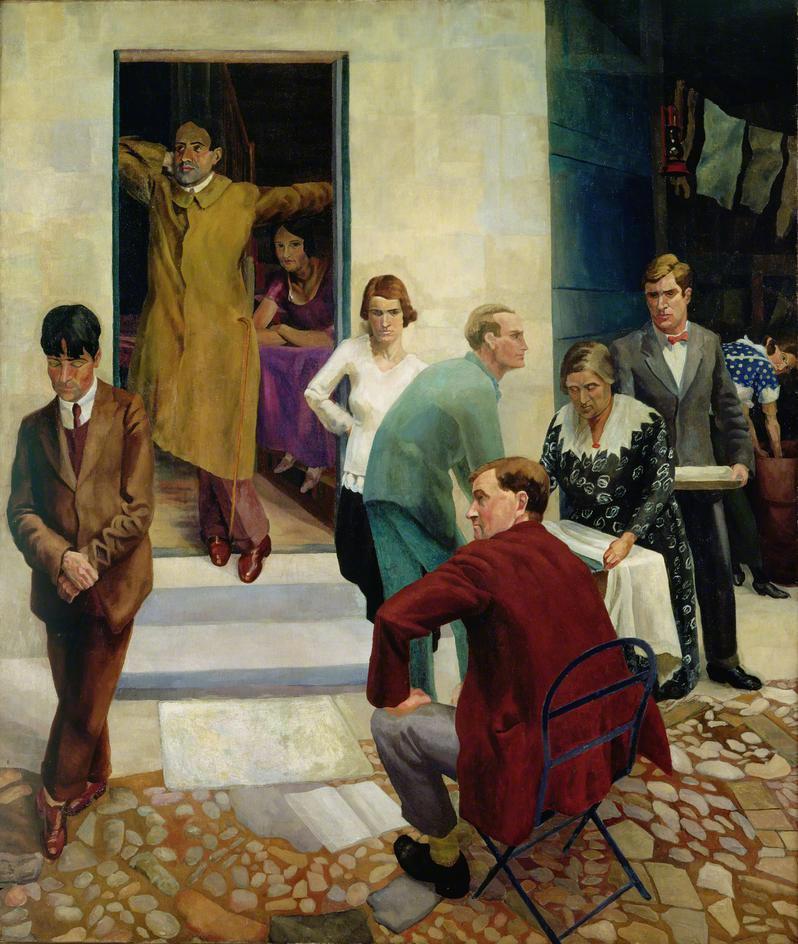
My Daily Art Display featured painting today by Richard Carline, entitled Gathering on the Terrace at 47 Downshire Hill, Hampstead,  shows one such meeting of the Downshire Hill Circle.  The painting was judged as one of Carline’s most impressive works.  Before us we have a group portrait. From left to right we have Stanley Spencer, James Wood, Kate Foster, Hilda Carline (later to become Mrs Stanley Spencer), Henry Lamb, Richard Hartley, Annie Carline and Sydney Carline.   Richard Carline was meticulous in his preparations for this work.  He painted an oil study of each of the group before slotting them into his group portrait.  His 1924 preparatory oil study of Stanley Spencer for this group portrait is also a stand-alone painting of his, entitled Study of Stanley Spencer.  Looking at the study one has to presume that he hadn’t  quite properly calculated the height of the preparatory study as he had to add Spencer’s shoes separately alongside the figure.

What enhances this group painting is the varied but individual characterization of each person.  This was not done by accident as Carline said his intention was to somehow convey the individuality of the people assembled at his parent’s house.  In his own words Carline described the group portrait:

“… [I] sought to convey the conflicting personalities gathered at our house – Stanley [Spencer] peering up and down as he expounded his views on this or that, James Wood hesitating in the doorway whether to come or go, Hilda absorbed in her own thoughts, Hartley sitting at ease, Lamb courteously attentive to my mother, with Sydney always helpful…”

This paintings, Gathering on the Terrace at 47 Downshire Hill, Hampstead , along with the Study of Stanley Spencer, are housed in the Ferens Art Gallery in Hull.  It is a gallery I have never visited but looking at their website it is one I will put down as a “must visit” location.

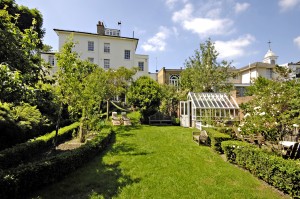
Finally, I always like to imagine what a place, depicted in a painting, looks like today.  I did this with my entry about Renoir’s boathouse in his painting Luncheon of the Boating Party which I featured in My Daily Art Display of August 2nd, so I wondered what the house at 47 Downshire Hill looks like today.  So below is a picture of it I found of it on the internet!

The present Downshire Hill house and garden

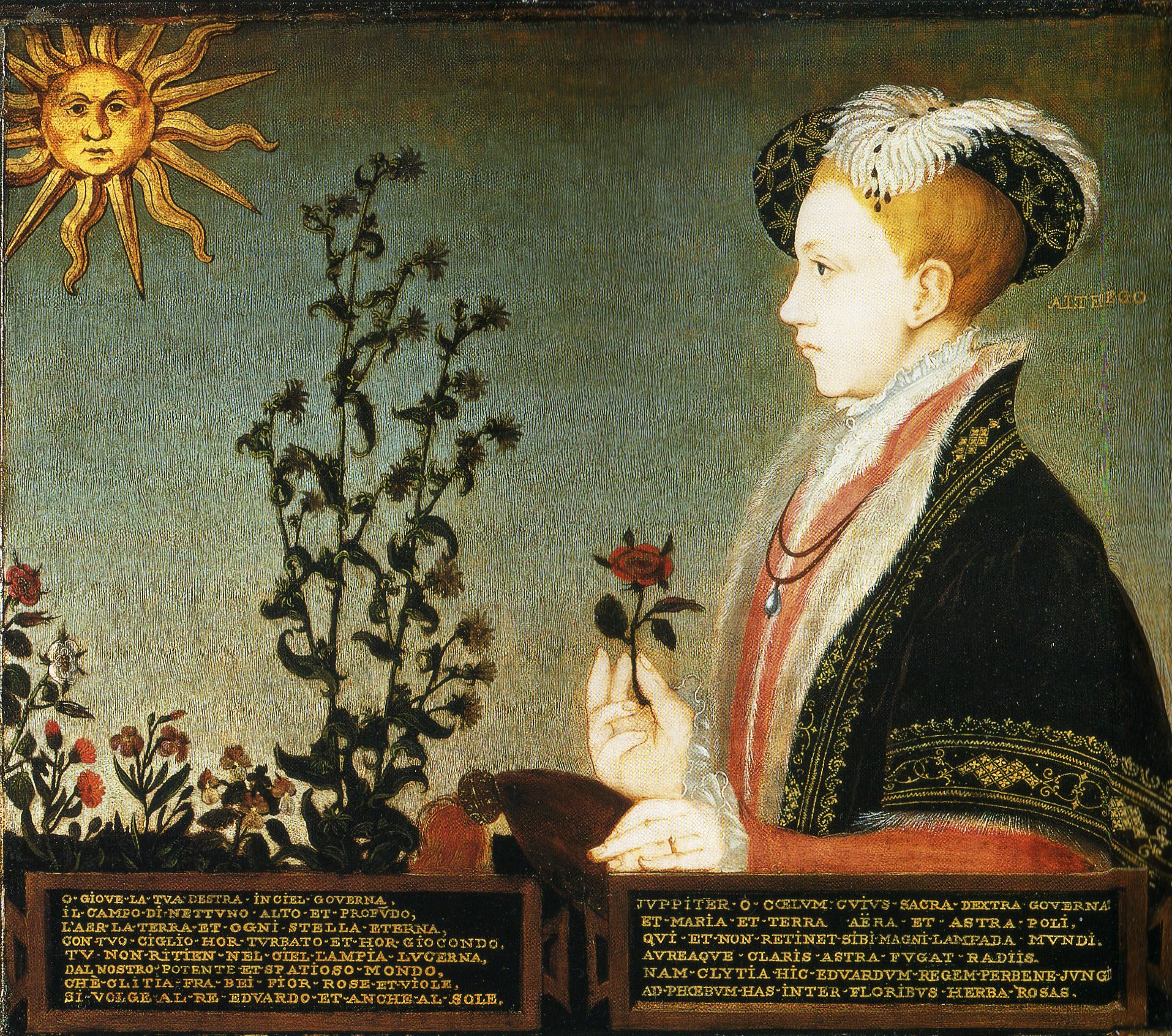
King Edward VI by William Scrots

King Edward VI by William Scrots (c.1550)

Let me start  by tantalising you and declaring that today My Daly Art Display is about three people, a young English king who came to the throne aged nine and died six years later, a Netherlandish portrait painter who became the King’s painter and finally a former chairman of an English Premier League football club.   Has that wetted your appetite to read on?

The king in question, who we see in the painting, was King Edward VI, the son of Henry VIII and his third wife, Jane Seymour.  Edward was born in October 1537 just over nine years before his father died and the crown passed to him.  Although he was the first son of Henry he was the third child of the monarch.  Henry VIII’s first child was Mary, born in 1516, whose mother was his first wife, Catherine of Aragon.  His second child was his daughter Elizabeth, born in 1533, his mother being Henry’s second wife Anne Boleyn.  However Henry didn’t want a girl to succeed him so he got Parliament to pass three Succession Acts, the First Succession to the Crown Act of 1534 disbarred Mary becoming Queen of England on the grounds that she was a bastard leaving the yet unborn Elizabeth the true successor.  However in 1536 with the execution of Anne Boleyn, the mother of Elizabeth, Elizabeth was declared also to be a bastard and Henry’s parliament passed the Second Succession to the Crown Act of 1536 which barred her from succeeding him to the throne of England.  At this time Henry had no heir although he had just married his third wife Jane Seymour and Edward had yet to be conceived.  In 1543 it all changed again when Henry had his Parliament pass a Third Act of Succession which made his son Edward the legitimate successor to his throne with Mary and Elizabeth reinstated as second and third in line.  Henry VIII died four years later and the nine year old Edward became King Edward VI.  His reign lasted just six years as at the age of fifteen he contracted tuberculosis and died.

The second person involved in this painting was the painter himself, William Scrots.  Little is known of his early life but he came to light as the court painter to Mary of Habsburg, the Regent of Netherlands in 1537.  We also know that Scrots travelled to England around 1545 where the following year he became the court painter of Henry VIII in succession to Hans Holbein.  It is believed that his annual salary for this position was £62. 10 shillings, double what Holbein had been receiving.  After Henry’s death in 1547 he remained as court painter to the young Edward.  Scrots painted a number of portraits of Edward VI, one of which is today’s featured painting.

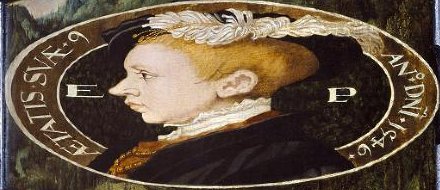
Anamorphic portrait of Edward VI by William Scrots

It is interesting to note that Scrots painted an anamorphic profile of Edward VI, which is a painting which looks totally distorted unless viewed from a certain angle when what is depicted becomes clear.   His predecessor Holbein had painted The Ambassadorsin 1533, in which he included a distorted shape of a skull lying diagonally across the bottom of the painting and which can only be recognised as such if viewing it from a very acute angle.

Anamorphic portrait as seen from an acute angle

My Daily Art Display featured oil on panel painting is simply entitled King Edward VI and Scrots is thought to have painted it around 1540.  It is an unusual portrayal of the monarch as it is one in which the sitter is seen in profile.  It is awash with detailed iconography.  We see in the painting both a red and white rose which symbolised the Houses of Lancaster and York respectively, the two great English dynasties, which were united by Edward’s grandfather, Henry VII.   The Latin inscription below the portrait speaks of Phoebus, the sun, and Clytia, the sunflower, both of whom feature in Ovid’s Metamorphoses. Ovid relates how Apollo turned the Princess Clytia into a sunflower as punishment for exposing his romance with her sister Leucothea.  Look at the sunflowers in the painting.  Normally they would turn and face the sun but in this portrait they have their “backs” to the sun and face the boy-king, which was probably meant to symbolise the power and influence of the young man.  It is believed the portrait was commissioned by the Stanhope family who were related to Edward’s uncle and chief minister, Edward Seymour who was for a time also the Lord Protector.  The painting remained in the Stanhope family until 2004.

And so to the third person connected to this painting, the former Premier League football chairman.  As I have just said the painting remained in the Stanhope family for over four hundred and fifty years until 2004 when it was auctioned by Sothebys.  This painting was considered to be one of the most significant sixteenth-century paintings ever to have come up for sale.  It was purchased for £700,000  by the Peter Moores Foundation for Compton Verney.  Sir Peter Moores is a British businessman, art collector and philanthropist, a former chairman of the Liverpool-based Littlewoods football poolsand retailing business in the UK and was briefly the Chairman of Everton Football Club.

So there you have it – a fascinating oil on panel painting, a tale of three men;  a boy-king, an artist and an ex football chairman.   What more could you ask for?

Mrs Baldwin in Eastern Dress by Sir Joshua Reynolds

Mrs Baldwin in Eastern Dress by Sir Joshua Reynolds (1782)

Today I am returning to portraiture and one of the greatest English portrait painters, Sir Joshua Reynolds.  His works were in a style which came from classical art and was often referred to as the Grand Manner which depended on idealization of the imperfect.  Reynolds himself preferred the term Grand Style which referred more to history painting and in his series of lectures, entitled Discourses of Art, he maintained that artists should perceive their subjects through generalisation and idealization rather than simply copying the sitter.  In the course of his lecture he expanded such thoughts, saying:

“…..How much the great style exacts from its professors to conceive and represent their subjects in a poetical manner, not confined to mere matter of fact, may be seen in the cartoons of Raffaelle.   In all the pictures in which the painter has represented the apostles, he has drawn them with great nobleness; he has given them as much dignity as the human figure is capable of receiving yet we are expressly told in Scripture they had no such respectable appearance; and of St. Paul in particular, we are told by himself, that his bodily presence was mean. Alexander is said to have been of a low stature: a painter ought not so to represent him. Agesilaus was low, lame, and of a mean appearance. None of these defects ought to appear in a piece of which he is the hero. In conformity to custom, I call this part of the art history painting; it ought to be called poetical, as in reality it is….”

Reynolds made a number of trips to Europe during which time he studied the foreign artistic techniques and by so doing was able to draw inspiration from them and it influenced how he shaped his own “English” paintings

My Daily Art Display featured painting;  Mrs Baldwin in Eastern Dress is a prime example of Sir Joshua Reynolds’s Grand Style of painting.   Jane Baldwin was born in Smyrna, Turkey in 1763.  She was the third daughter of Margaret Icard and William Maltass, a Yorkshire man from Ripon who, along with his brother Henry, spent the early part of the eighteenth century in Eastern Europe and was one of the earliest Europeans to settle in Turkey.    He became a wealthy merchant who traded with the East through the Levant Company.  From an early age Jane was deemed an extraordinary beauty.  At the age of sixteen, still virtually a child, she married the prosperous George Baldwin, an extremely wealthy English merchant stationed in Alexandria, Egypt.  George Baldwin later became that country’s British Consul-General and the British Minister Plenipotentiary to the Court of Tehran.

In the painting we see the delectable nineteen-year old English beauty attired in a luxuriously brocaded emerald and gold striped caftan, sprigged with cherry-coloured flowers and is aggrandized by an ermine mantle.  We see her dark chestnut hair braided into multiple long strands.  She is wearing a white and pink silk turban, atop of which are a small bouquet of tea roses.   In the late eighteenth century it was very fashionable for ladies to wear Eastern style headdresses and was in a way highlighting Britain’s trading relationship with the Ottoman Empire.

Around her neck she wears a diamond waterfall necklace along with a gold chain and pendant.  Her ears are adorned with gold teardrop earrings.   She is seated on a red velvet divan which is studded with brass tacks around its base.  Her pose is somewhat both alluring and seductive as she sits cross-legged before us.  Her eyes are fixed upon an ancient gold coin of Smyrna, the inclusion of which was probably to remind us of the links between England and its Turkish trading partner.  The sitter seems lost in thought, unaware that she is the focus of attention of the artist and of course us, the viewers.  So did the artist manage this expression on his sitters face by just simply having her stare at the coin for hours on end?  In fact no he didn’t.  Jane Baldwin sat in the pose we see but at the time the artist was painting her portrait she was actually holding and reading a book of poems by Pietro Metastasio, the famed Italian poet and librettist.  So why not have her reading the book in this portrait instead of having her transfixed by the sight of a coin?  The reason is probably that Reynolds had been asked to have something in the painting which reflected the world of commerce, the very thing which had led to her family’s wealth.  It also is reminding us that different cultures are brought together through trade and on economic grounds.  For the sitter to be holding and reading a book of poems written by an Italian might lead the viewers to believe that cultures are brought together through the arts….. perish the thought that we believed that (even if we know it to be true)  !!!!!!!

Jane Baldwin wore the costume we see in the painting many times when she visited England including a ball given by the king.   She earned the sobriquet the “pretty Greek”  not because she was of Hellenic descent (she had no Eastern-European blood) but because she, having been born and raised in the Greek region of Western Turkey, identified with that community as her own.  This is one of Reynolds’ finest portraits and I will leave you with a passage from Jane Baldwin’s obituary notice from the 1839 (July to December) issue of the Gentleman’s Magazine which talks about the painting and the sitter’s views of the artist:

“…..It was during the first winter after her arrival in London (1781), that Sir Joshua Reynolds painted the beautiful portrait of this lady which now enriches the Marquess of Lansdowne’s Gallery at Bowood. She is represented sitting on a sofa in the eastern fashion, contemplating a small object which she holds in her right hand.  She once told the writer that, when this portrait of her was made, she was lodging with her husband in the Temple; and that the trees which Sir Joshua has represented in the background were those in the Temple Gardens. At first she used to give the painter sittings in his study, but Reynolds could not satisfy himself with her resemblance; he made three attempts, which he successively defaced. Mrs. Baldwin could only remember, besides, that he took a prodigious quantity of snuff, and that his painting room smelled horribly. After a few hours she always grew restless and cross, which used to vex Reynolds, who did not know how to amuse her. He made his fourth and last sketch at the residence of the lady, and when she grew impatient suggested that she should take a book. She asked for Metastasio, and while reading it her portrait was made. Instead of a volume, Reynolds represented an ancient coin of Smyrna in Mrs. Baldwin’s band,—a circumstance, as she informed the writer, which was much quizzed and ridiculed at the time. Of this painting there exist several mezzotint engravings….”

“….. She travelled widely and lived in England for a considerable number of years, and was always admired for her intelligence and beauty. She was patronised by Mrs Hester Lynch Thrale, who remarked “I…hope to Obtain some favours from the new Ministry for my pretty Greca: could her Husband but gain the Embassy!  Oh I should not sleep for Pleasure. This pretty Greek as we call her, was born at Smyrna, & ran away with a Man whose Family had been some of Mr Thrale’s best Friends in the Borough; between Gratitude to him, and delight in her, for artlessness & Beauty; I have been led to interest myself no little towards protecting her, may my Fortune & Talents be ever devoted to Charity & Friendship! & may I have the Strength & Courage to despise them who would hinder its Current, by trying to make each other believe that its Source was only Desire!…”.

“…Mrs. Baldwin had many peculiarities, but they were of a less ambitious character: a singular iulirmity of temper, which estranged from her all but her immediate relatives, was perhaps her prevailing characteristic. She had survived her generation, and ended her days in a self-inflicted penurious seclusion,— the inconveniences of which were aggravated, of late years, by sickness and suffering….”

Portrait of Jacobus Blauw by Jacques-Louis David

Portrait of Jacobus Blauw by Jacques-Louis David (1795)

The artist and the subject of this painting had one thing in common – they were both revolutionaries.  The artist Jacques-Louis David was both an artistic and political revolutionary.

Artistically, David was a revolutionary in as much he condemned the French Royal Academy and its standards and the way it functioned.  In the 1780’s, he continually voiced his disapproval of the rule-bound world of the Academy and Academicism.  His art was different to that which had been so fashionable since the start of the eighteenth century and which was termed Rococo.  Rococo was a light-hearted and often gently erotic artistic style which was well suited to the excesses of the royal regime prior to the Revolution.  David’ style of painting became free of Rococo mannerisms and developed a heroic style which was heavily influenced by his study of antique sculptures during his time in Rome.   His style was to become known as Neoclassicism and harked back to the Classical past which could be looked upon as a means to understanding the contemporary world.  This Neoclassical art tended towards a high moral seriousness and was in complete contrast to the frivolity of Rococo art which was condemned by the French Revolutionists.

Politically, David was an active sympathiser of the French Revolution and he served on various committees and even voted for the execution of Louis XVI.   Artistically he was looked upon as the foremost painter of the Revolution.    As with many of the revolutionaries of that time, life was good for them, as long as the people they supported remained powerful.  In David’s case he was a great friend and supporter of Maximillien Robespiere, one of the most influential figures of the French revolution and a leading light in the period which was commonly known as the Reign of Terror.    However, after the fall of Robespierre and his execution in 1794, David was imprisoned.  He was released on the plea of his wife, who had previously divorced him because of his Revolutionary sympathies; she being a Royalist.  The couple remarried two years later.

The sitter for this painting was Jacobus Blauw.  Blauw, albeit a respectable middle-class man, was also a revolutionary and one of the leaders of the Dutch Patriots.  He went on to be a judge, politician and diplomat..  He was a political envoy from the Netherlands who had rebelled against the feudal relationship with Prince William of Orange and had asked France to assist in the overthrow of the government.

Although David made his name with large heroic narrative pictures on themes from antiquity, some of his finest works are portraits of contemporaries and todays featured painting is a good example.  David has managed to bring authentic realism to this severe composition.  When the French army invaded the Netherlands, Blauw was sent to Paris as Ministre Plénipotentiare (envoy) of the new Batavian Republic to negotiate a peace settlement with the French and get them to recognise the new republic.

David has made interesting use of contrasting colour.  We have a pale grey background, a red chair and a pink cloth lying on the table as well as the turquoise coloured table covering itself.  We see Blauw in a half-length portrait seated at a table writing an official document.  The paper on the table before him is inscribed:

J. BLAUW, minister Plénipotenttiaire aux Etats Généraux des provinces unies.

Blauw sits upright at the table with his short-cropped powdered hair and this contrasts in style to the powdered wigs which were fashionable with the aristocracy of the time.  He has a lively expression on his face as he looks up at us with quill in hand almost as if we have interrupted him as he writes his letter.  This supposed interruption of course gives the artist the chance to paint Blauw in a full-face view.   He is dressed simply, which is befitting a republican.  His blue coat is of a plain design and around his neck he has a soft white cravat.  The brass buttons of his coat glisten with a hint of red as the light falls upon them.   It is probably difficult to see it in the attached picture but if you look closely you will see that the artist has inscribed his name “L.DAVID  4” in the folds of Blauw’s brown coat which seems to have slipped off the back of the chair.  The “4” refers to the date, year four of the French Revolution, i.e. 1795.
Bluaw was delighted with the portrait and in his letter to David he expresses his satisfaction:

“..Mes voeux sont enfin satisfaits, mon cher David.  Vous m’avez fait revivre sur la toile..”

(My wishes were finally satisfied, my dear David. You made me live again on the canvas)

The sitter obviously knew the artist for the letter continues:

“…j’ai voulu posséder un de vos chefs d’oeuvre, et j’ai voulu plus encor avoir dans ce portrait un monument éternel de mon étroite liaison avec le premier peintre de l’Europe..”

(I wanted to own one of your masterpieces, and I wanted to have more in this portrait an eternal monument of my close association with the first painter of Europe)

We must believe that Blauw was aware of David’s revolutionary activities and that will have won the admiration of a fellow revolutionary.  The two had another thing in common; they both suffered for their great causes.

I love this portrait.  I love the way Blauw is portrayed – dignified and assertive.  He is almost too beautiful to be a man.  The way David has portrayed his sitter lends us to believe that the artist respected him and that there was a bond between the two men, a kind of reverence between fellow revolutionaries.