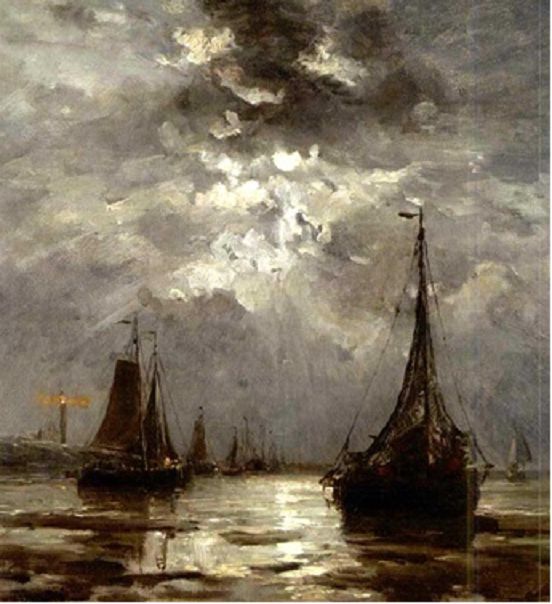
Maritime Art. Part 3.

Having looked at Marine Art with depictions of mighty sailing ships in Part 1., and the plight of fishermen and lifeboatmen battling raging seas in Part 2., this third and final part will concentrate on the tranquillity of the sea and the shoreline A and how people enjoy the elements.

When I was last in Madrid and had spent a few days and many hours in the main Museums of Art, such as the Prado, Thyssen-Bornemisza and the Museo Reina Sofia, I decided to visit the Sorolla Museum, featuring work by the Spanish artist Joaquin Sorolla as well as by members of his family such as his daughter Elena.

Strolling along the Seashore by Joaquin Sorolla (1909)

Sorolla completed a number of beautiful works featuring the serenity of simply walking along a beach.  It is an abnormally large square canvas (200 x 208cms) for a seascape work with life-sized figures.  The two figures are of his wife, Clotilde and his daughter Maria as they walk along the Playa de El Cabanyal beach in their hometown of Valencia.  Both women wear long white sundresses.  There is an air of elegance and sophistication regarding mother and daughter and they appear to be members of the upper class whiling away their time at the beach on a beautiful summer’s day.  Because of our viewpoint we do not see the horizon and the background is the sea with white foam atop the waves.  Sorolla has used many shades of blue to depict the shimmering sea.
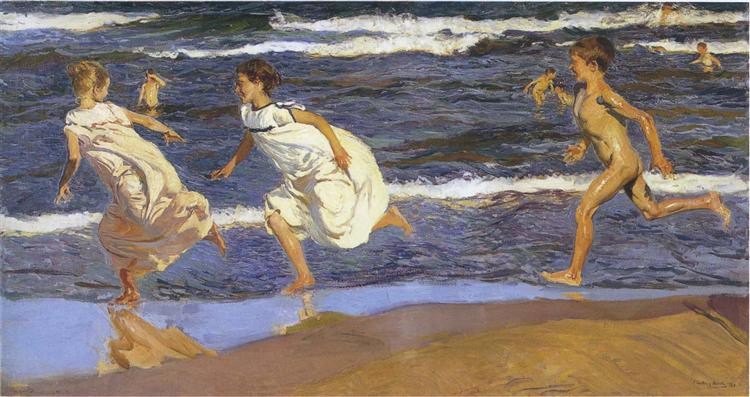
Running Along the Beach, Valencia by Joaquin Sorolla (1908)

Nothing expresses happiness and excitement more than children running along the shoreline without a care in the world. Sorolla’s painting entitled Running Along the Beach captures the energy and movement of the three children as they race along the water’s edge. The city of Valencia and its beaches were Sorolla’s great loves despite the fact that he resided in Madrid.  He spent many hours at the beach painting en plein air capturing the effects of the beautiful Mediterranean sunlight.

Summer’s Day on Skagen’s Southern Beach by Peder Severin Krøyer (1884)

Boys Bathing at Skagen, Summer’s Evening by Peder Severin Krøyer (1899)

From looking at the marine/seascape paintings they produced, life at Skagen in Denmark must have been an idyllic way for the artist colony painters and their families to relax and enjoy their lives.
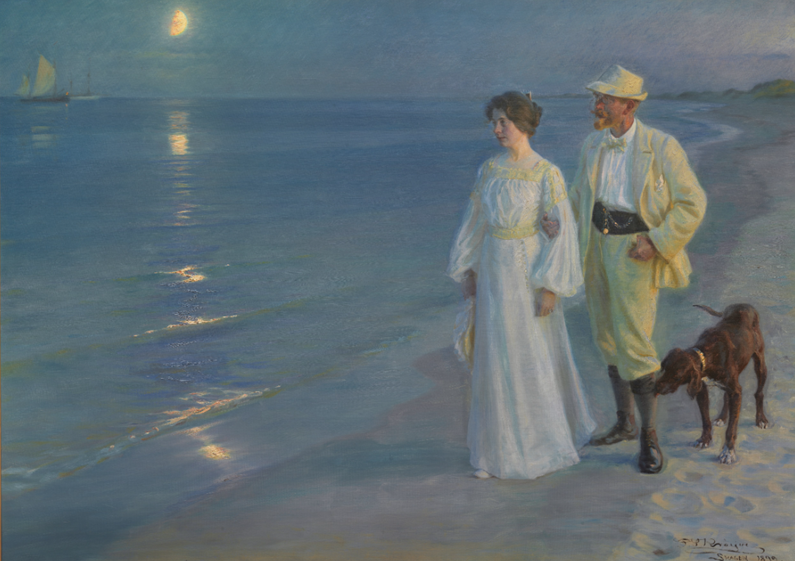
Summer Evening on Skagen Beach, Portrait of the Artist’s Wife by Peder Severin Krøyer (c.1899)

His painting, Summer Evening on Skagen Beach, Portrait of the Artist’s Wife, was part of Peder Severin Krøyer’s iconic, large scale ‘blue period’.  Krøyer arrived in Skagen for the first time in 1882.  Soon he became captivated by the light, the landscape and the simple lifestyle of the local community.   He returned every year during the summer months, whilst spending the rest of the year travelling or in Copenhagen where he had his studio. In the summer of 1889, around the time he completed this painting, he had married Marie Triepeke, a Danish painter, whom he had had met in Paris, shortly after she arrived in the French capital in December 1888. Marie ran into Krøyer at the Café de la Régence, a favourite with the many Danish artists living in the city at the end of the 1880s.  As Krøyer affection for Skagen grew, he began to take more of an interest in the vast expanses of sea, sand and sky.  In the painting the two figures are set into a blue half-light, which was a favourite with the artists of the Symbolist movement.
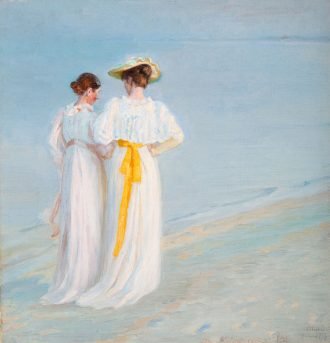
Anna Ancher and Marie Krøyer going for an Evening Walk along Sønderstrand by Michael Ancher (1897)

A Stroll on the Bach by Michael Ancher (1896)

Another Skagen painter, who depicted the sea and shoreline was the Dane, Michael Ancher.  He is renowned for his many works of Skagen’s fishermen and their battle with the harsh nature of the seas around Skagen, but he also produced paintings which highlighted the more tranquil side of life in the coastal town. When in the early 1890s Peder Krøyer painted his first blue-toned atmospheric pictures depicting Skagen South beach, Ancher was inspired by these images. In Ancher’s early paintings of Skagen from around the 1880s, the beach is first and foremost a place of work for the fishermen, but in the 1890s, Ancher saw the beach as becoming a promenade for the bourgeoisie, and in this work, this is just what Ancher has depicted. In the painting, A Stroll on the Beach, we see the merchant and counsellor, Lars Holst’s four daughters and a friend: In the front, Ida Holst, on the left, her sister, Anna Holst with her friend Elisabeth Bang, then Minne and on the right, Sophie Holst.
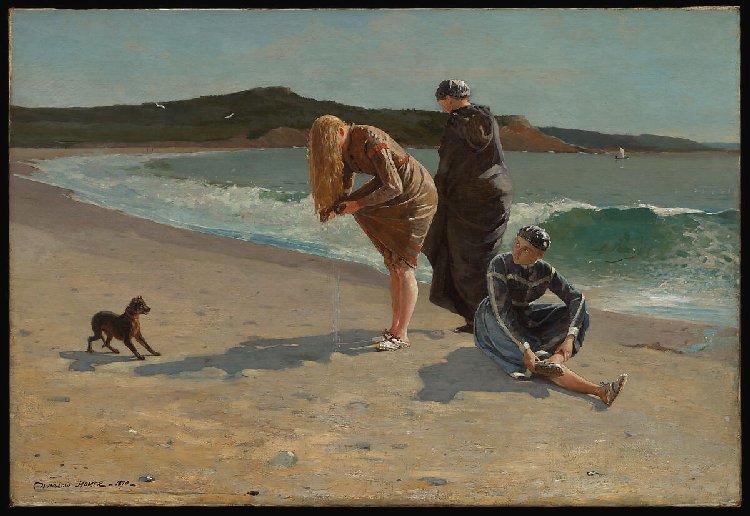
Eagle Head Massachusettes (High Tide} by Wilmslow Homer (1870)

Spending time at the beach can be a way of relaxing and clearing one’s mind of bustling city life.  It can also be a place when one can enjoy solitude and try and rid our minds of things we strive to forget.  This painting, Eagle Head Massachusetts (High Tide} was completed by American artist Wilmslow Homer in 1870.  In 1861 his employer, Harpers, sent him to the front lines of the American Civil War, where he sketched battle scenes and camp life, the quiet moments as well as the chaotic ones.  During his time as an illustrator for the magazine he witnesses the horrors of war and this painting was one of serene tranquillity which Homer had desired after his time at the Front.   After the long war, he turned his focus to lighter scenes and started concentrating on fashionable young women. The High Tide painting is believed to be Homer’s most daring subject.   It depicts three women on the beach having emerged from a swim in the sea.  The woman in the centre rings out her wet hair, startling the small dog which looks on.  The painting received mixed reviews with some focusing on issues of decorum and class, criticizing the women’s state of undress, despite the fact that they are wearing typical bathing costumes of the era.  Another criticised how Homer had depicted the women as “exceedingly red-legged and ungainly”.

At the Seaside by William Merritt Chase (c.1892)

William Merritt Chase was the most important teacher of American artists around the turn of the 20th century.  From 1891 to 1902, Chase served as the director of the Shinnecock Hills Summer School of Art in the town of Southampton, on Long Island, New York. The school and Chase’s stay on Long Island were organised by Mrs. Janet S. Hoyt, a wealthy patron of the arts and an artist who lived in the Shinnecock Hills.  Chase taught two days each week and spent the rest of his time painting and enjoying the company of his family. In his painting, At the Seaside, we see women and children enjoying themselves on the beach, along Shinnecock Bay. It is a depiction of genteel leisure on a perfect day, at a perfect location.   Chase has depicted a broad expanse of sky that fills the upper half of the canvas. We see the rushing clouds cleverly echoing the bright white forms of the children’s dresses and the Japanese-style parasols.

Crowd at the Seashore by William Glackens (1910)

William Glackens, known as an urban realist, favoured the crowded Coney Island beaches of New Jersey to depict the egalitarian throngs that came together there to relax and enjoy the sun and sea.  The mass of figures depicted in his painting Crowd at the Seashore, suggested that the folk from New York and New Jersey who came were of mixed socio-economic backgrounds.  Glackens desire to introduce liveliness into the work was achieved by using a vibrant palette.  To heighten the scene’s energy, Glackens used a vivid palette and vigorous brushstrokes, and he added saturated oranges and blues to conjure up the midday sun’s heat and glare. William Glackens painted many pictures featuring beach scenes which became very popular.
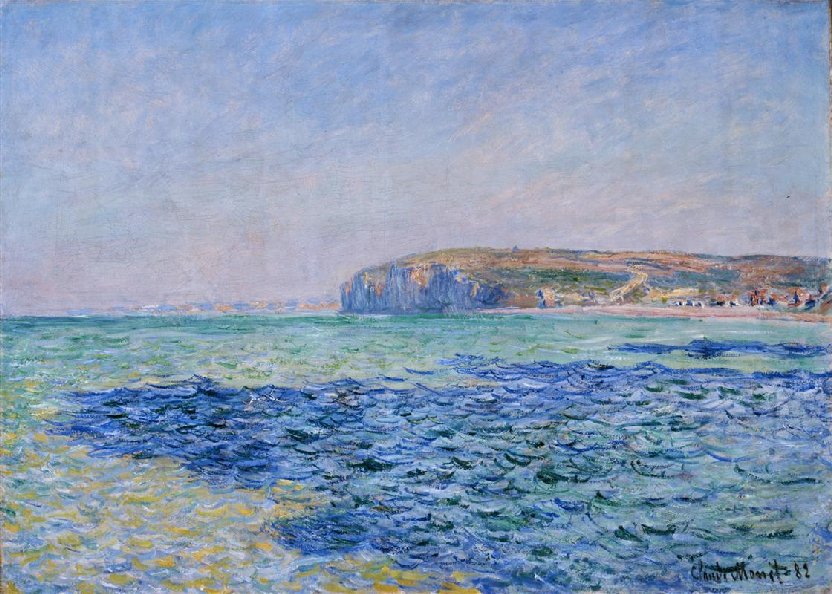
Shadows on the Sea. The Cliffs at Pourville by Monet (1882)

Monet’s painting entitled Shadows on the Sea is an excellent example of Impressionism and we are able to observe the individual brushstrokes of the wave.  Monet has depicted shadows, reflections and movements by a series of short, curved brushstrokes in pure, unmixed pigments.   It is interesting to note how Monet has used pure colours such as yellow and turquoise blue on parts of the wave and placed them next to each other.  Our eyes blend them from a distance and we begin to see green waves. The setting for the work is a hot summer day by the sea, and we note that the strong wind flowing across the water disturbs it, and it becomes a million small, flashing mirrors, which is exactly what Monet had hoped to convey.

Cliff Walk at Pourville by Claude Monet (1882)

The Cliff Walk at Pourville is an 1882 work by Claude Monet and is currently part of the Art Institute of Chicago collection.    Monet had a three-month stay between February and April 1882 at Pourville, a commune in the Seine-Maritime department in the Normandy region in northern France, in 1882.  He fell in love with the coastal town and the surrounding area and wrote to his future wife, Alice Hoschedé, extolling its merits:

“…How beautiful the countryside is becoming, and what joy it would be for me to show you all its delightful nooks and crannies…”

She was impressed by Monet’s enthusiasm and so they returned to Pourville in June that year.  The painting features two ladies on the cliff above the sea who could well be Alice and her daughter Blanche.   Many years later an X-ray of the painting indicated that the artist originally painted a third figure into the grouping, but later removed it. In John House’s 1986 book, Monet: Nature into Art, he talked about Monet’s marine art:

“…His cliff tops rarely show a single sweep of terrain. Instead, there are breaks in space; the eye progresses into depth by a succession of jumps; distance is expressed by planes overlapping each other and by atmospheric rather than linear perspective- by softening the focus and changes of colour…”
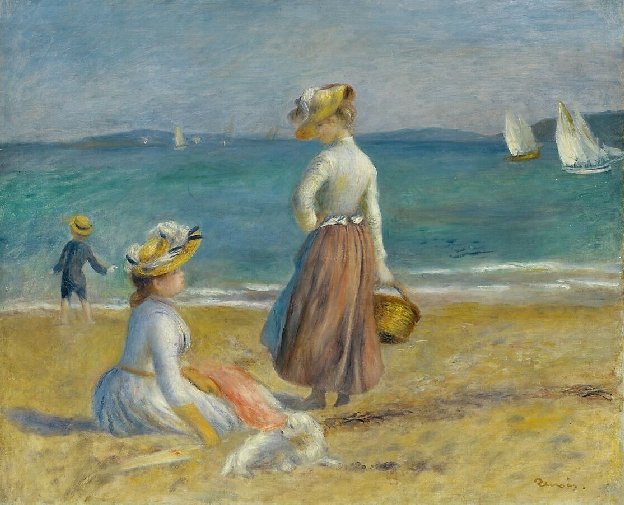
Figures on the Beach by Renoir (1890)

Another seaside scene I like was painted by Auguste Renoir in 1890 and entitled Figures on the Beach.  The setting is thought to have been a beach on the Cote d’Azur in southern France.  It is a sun-filled work in which we see two females at the beach, one shown in profile, sitting whilst holding a parasol on the sand, the other standing with her back to us holding a small wicker hamper.  Besides the two female we also have a small white dog lying in the sand next to the seated woman.  In the mid-ground we see a young boy dressed in blue standing by the water’s edge throwing stones into the sea.
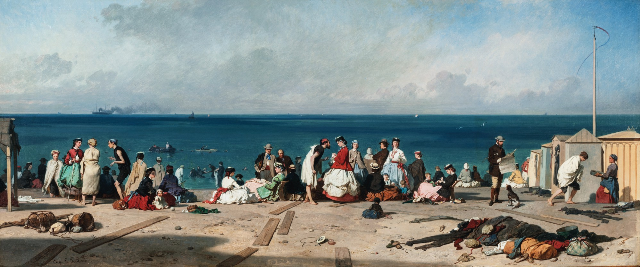
Sea Bathing, the Beach at Étretat by Eugène Lepoittevin, (1864)

Sea Bathing in Étretat by  Eugène Lepoittevin (1866)

My final two offerings featuring marine art and the way people enjoy their time on beaches and in the sea are from the French artist, Eugène Lepoittevin, who achieved an early and lifelong success as a landscape and maritime painter.  In the upper painting entitled Les Bains de Mer, Plage d’Étretat (Sea Bathing, the Beach at Étretat), completed in 1864, we see a large group of people enjoying their day at the seaside.  Of these figures some have been identified.   They include the prominent French author, Guy de Maupassant (in blue cap at left), Charles Landelle, the French portrait artist, (in red cap, centre), and the French illustrator, engraver, Bertall (reading newspaper at right). The painting  which was completed in 1864 was lost and only rediscovered  in the last decade and was sold at Sotheby’s in Paris, in December 2020, for €226,800, a record for a work by Lepoittevin.

Sea Bathing, the Beach at Étretat is also the title of another of Lepoittevin’s works and was completed in 1866.  The setting is the tranquil shores of Étretat, a place for plein air painting favoured by the artist.  It had everything he wanted – pristine beaches and dramatic cliffs with its natural arches carved by the relentless seas.  Add to this people enjoying the good weather and the opportunity to bathe in the clear water and the scene becomes idyllic. 

Maritime Art. Part 2.

In this look at Maritime or Marine Art I want to showcase those paintings which feature the people who have dedicated their lives to saving seafarers and those working the seas in a continual search for food to put on our tables. 

For the first of my forays into the depiction of fisherman I want to delve into the work of the great Skagen painters.  These were a group of Scandinavian artists who had come together in the small coastal village of Skagen, which is situated in the northernmost part of Denmark, from the late 1870s until the turn of the century. One of the Skagen painters was Peder Severin Krøyer.  He was born in Stavanger, Norway on July 23rd 1851 but moved to Denmark as a child. At the age of fourteen, he attended the Royal Danish Academy of Fine Arts in Copenhagen. Even at that young age he was a proficient portrait painter and was esteemed for his artwork and received many commissions.

Fishermen hauling nets, North Beach, Skagen by Peder Severin Krøyer (1883)

Krøyer depictions of fishermen were often in more serene situations rather than those showing the fishermen and their boats battling the elements.   His painting entitled Fishermen Hauling a Net at the North Beach, Late afternoon, was one of his first works painted on the beaches of Skagen and he wrote to his patron the tobacco manufacturer Heinrich Hirschsprung that for this painting he wanted to be close to the fishermen who had been hauling a net at the North Beach one late afternoon sundown when the sun appears flat and the weather is clear.  He had made many small preliminary sketches before taking the large canvas to the beach to complete the work en plein air.  He wrote to his patron:

“…I was on Nordstrand for the first time with my large picture this afternoon, driving with all my goods and chattels. It was a huge treat. It was calm and clear, really important for me…”

Fishermen on Skagen Beach by Peder Severin Krøyer (1883)

In his painting, Fishermen on Skagen Beach, several fishermen are shown relaxing on the beach, two of them are catching up on some sleep. The sense of tranquility of this scene is reinforced by a calm sea. This is one of those depictions which invites the viewer to mull over what is going on. Have they had a successful day or had it been a day to forget? Whatever happened they seem to now be exhausted.

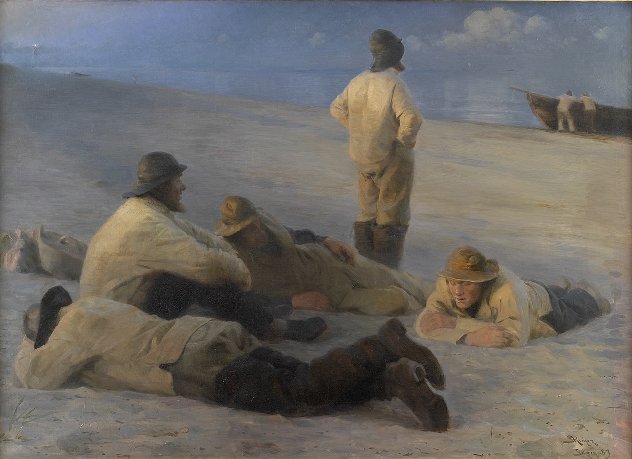
Fishermen on the Beach on a Peaceful Summer´s night by Michael Ancher (1881)

Michael Ancher was the first of the Skagen painters to settle in Skagen during the summer of 1881. In his work entitled Fishermen on the Beach on a Peaceful Summer´s night Michael Ancher depicts a group of fishermen from Skagen talking on the beach on a sunny summer evening. What are they chatting about? Perhaps they are exchanging news from Skagen, or simply planning tomorrow’s next fishing expedition. Ancher was a realist who always used living models, preferably fishermen and he knew their individual names and through his depiction they have come to life.  They have had a hard life battling the elements which can be seen by their heavily lined faces.  This painting which is owned by the National Gallery of Denmark, is currently  exhibited in the Danish Parliament.

Fisherman Coming to Shore by Michael Ancher

Michael Ancher has depicted a completely different portrayal of a fisherman than the previous paintings. This is not a relaxed study of a fisherman, quite the opposite. Observe the fiercly determined look on the face of the fisherman in Ancher’s painting entitled Fisherman Coming to Shore. He is trying to steer the boat to the safety of the shore whilst battling against a mighty following sea which makes steering almost impossible.

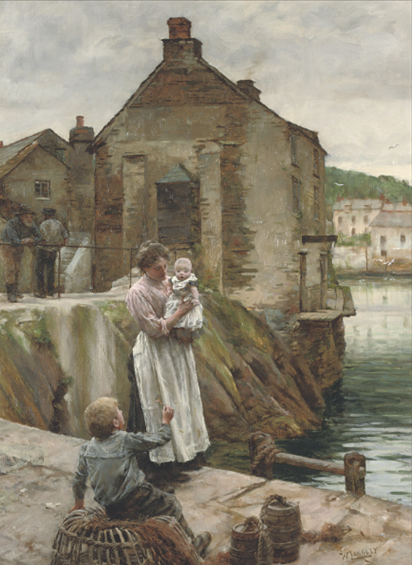
On the Quay, Newlyn by Walter Langley

Between the Tides by Walter Langley (1901)

Walter Langley, the son of a journeyman tailor, was born on June 8th 1852.  At the age of fifteen, he was apprenticed to a lithographer and six years later he won a scholarship to South Kensington School where he studied design for two years. He returned to Birmingham but took up painting full-time, and in 1881 was elected an Associate of the Royal Birmingham Society of Artists (RBSA). In that year, aged twenty-nine, he received a £500 commission for a year’s work by the Birmingham-based photographer Robert White Thrupp, a wealthy patron, to spend twelve months in the Cornish town of Newlyn, and pictorially record the lives of the fisherfolk.  Having been brought up in a poor working-class family environment Langley could empathise with the hardship faced by the fishing community and his paintings often depicted stories of family tragedies and loss of loved ones.

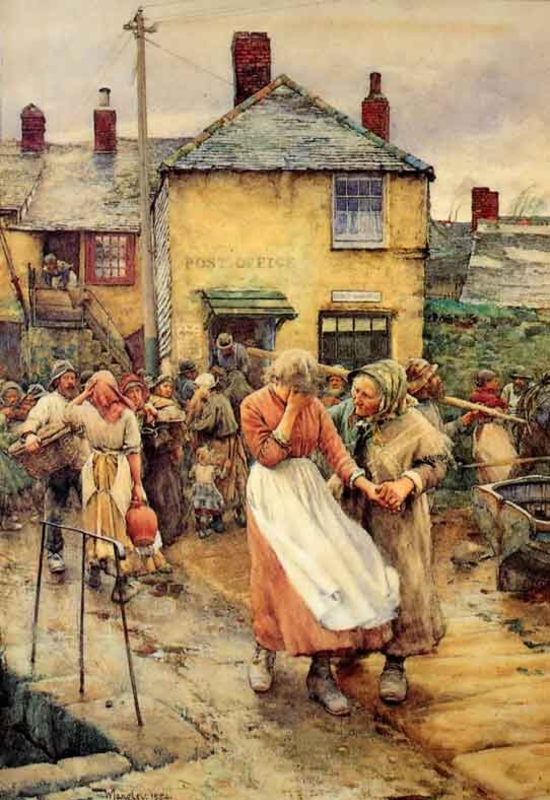
Among the Missing by Walter Langley

Never Morning Wore to Evening but Some Heart Did Break by Walter Langley (1894)

The painting, Never Morning Wore to Evening but Some Heart Did Break, was completed by the English artist Walter Langley in 1894.  The painting today, as was the painting before, is about loss.  The title of the painting emanates from Canto VI of Tennyson’s poem In Memoriam, which reads:

That loss is common would not make
My own less bitter, rather more:
Too common! Never morning wore
To evening, but some heart did break

The painting, Never morning wore to evening, but some heart did break depicts a young woman being comforted on the quayside at Newlyn harbour by Grace Kelynack, the elderly widow of a Newlyn fisherman.

Old Grace by Walter Langley (1894)

Langley had also completed a portrait of Grace Kelynack entitled Old Grace.

The Ninth Wave by Ivan Aivazovsky (1850)

One of my favourite seascape paintings by Aviazovsky is his 1850 work entitled The Ninth Wave. It is also probably his best-known work. The title refers to a popular sailing legend that the ninth wave is the most terrible, powerful, destructive wave that comes after a succession of incrementally larger waves. In his painting, set at night, he depicts a raging sea, which has been whipped up by a storm. In the foreground we see people clinging to the mast of a vessel which had sunk during the night. Note how the artist has depicted the debris the people are clinging to in the shape of a cross and this element can be looked upon as a metaphor for salvation from the earthly sin.  One wants to believe that the desperate will to survive will triumph over the raging ocean.  The people clinging to the debris are lit by the warmth of breaking sunlight and this gives one to believe that they may yet be saved.  For a life-or-death depiction the painting is not a gloomy one. In fact, it is full of light and air and thoroughly transfused by the rays of the sun which endows it with a feeling of optimism. The painting was originally acquired for the State Russian Museum of St Petersburg and was one of the first paintings in the collection of the Emperor Alexander III Russian Museum in 1897.

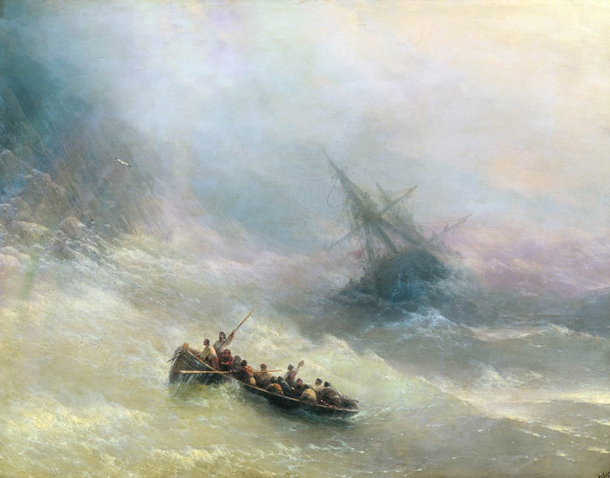
The Rainbow by Aviazovsky (1873)

Another of Aivazovsky’s works which is part of the Tretyakov Museum collection in Moscow is his painting entitled The Rainbow which features a sailing ship foundering on rocks while two lifeboats full of sailors from the doomed vessel are battling against the fierce seas as they try to manoeuvre their boats ashore. It is a truly remarkable work in which Aviazovsky created a scene of a storm as if seen from inside the raging sea.  In the foreground, we see the sailors who have taken to a lifeboat and abandoned their sinking ship which had foundered on the rocky shoreline. They had spent the whole night in the boat. Suddenly they see a rainbow and feel that all is not lost. The reflection of the rainbow can just be seen to the left of the painting.  Fyodor Dostoevsky, the Russian novelist, was an admirer of Aivazovsky’s art and The Rainbow was his favourite work.  Of the painting, Dostoevsky wrote:

“…This storm by Aivazovsky is fabulous, like all of his storm pictures, and here he is the master who has no competition. In his storms there is the trill, the eternal beauty that startles a spectator in a real-life storm…”

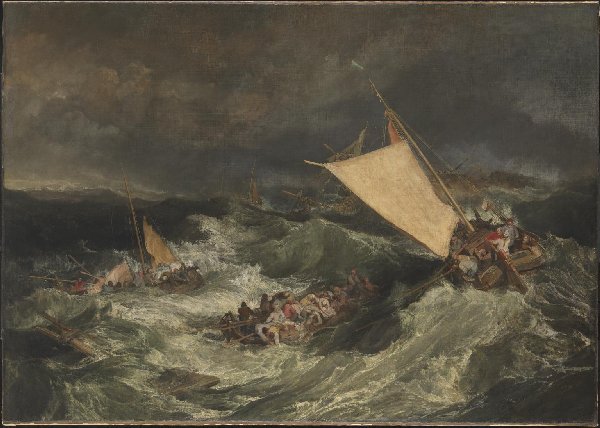
The Shipwreck by J.M.W Turner (c.1805)

Storms and shipwrecks were a popular theme for paintings during J.M.W.Turner’s life.   He completed his painting The Shipwreck around 1805.  It depicts fishermen battling the huge waves as they attempt the rescue of an overcrowded lifeboat.   In the painting, we see a ship foundering and about to capsize and sink in the dark seas. Turner was fascinated by this dramatic theme which conveyed the danger of life at sea. To get us to better appreciate the peril the seafarers had to endure he places us close to the drama and with no sight of land it is as if we are part of the rescuing crews as they battle the ferocity of the sea,

It is thought that Turner was inspired by the re-publication in 1804 of the fourth edition of William Falconer’s poem, The Shipwreck, which was illustrated by another marine painter Nicholas Pocock, part of which (3rd Canto, lines 640-645) is below:

Again she plunges! Hark! A second shock

Tears her strong bottom on the marble rock! 

Down on the vale of death, with dismal cries,

The fated victims shuddering roll their eyes, 

In wild despair; while yet another stroke,

With deep convulsion, rends the solid oak. 

The fourth edition of William Falconer’s The Shipwreck was published in 1772. This poem in three cantos of more than 900 lines each, recounts the final voyage of the merchant ship Britannia and her crew. This fourth edition of The Shipwreck is the first edition of the poem to be published after Falconer’s death, ironically due to a shipwreck. Falconer had been appointed purser onboard the frigate Aurora in 1769 when it was lost after rounding the Cape of Good Hope. An introduction to a 1798 edition of Falconer’s works supposes the loss was caused by the Aurora catching fire after rounding the Cape.

The Storm on the Sea of Galilee by Rembrandt (1633)

A marine painting with a biblical connotation is the one by Rembrandt von Rijn entitled The Storm on the Sea of Galilee which he completed in 1633. It was one of his earliest large format works.  It depicts a close-up view of Christ’s disciples as they grapple  to gain control of their fishing boat.  A large wave has crashed into the side of the boat, swamped the deck and ripped the mainsail.  The vessel lurches dramatically in the rough sea.  We see one of the disciples leaning over the side of the boat being sick.  A man faces us as he clings hold of the rigging.  This is a self-portrait of the artist.  All the people on board the vessel are panic-stricken, except for one, Christ, who can be seen on the right, calmly looking ahead.  The depiction is based on a passage from the bible (Luke  8: 22-25):

22 One day Jesus said to his disciples, “Let us go over to the other side of the lake.” So they got into a boat and set out. 23 As they sailed, he fell asleep. A squall came down on the lake, so that the boat was being swamped, and they were in great danger.

24 The disciples went and woke him, saying, “Master, Master, we’re going to drown!”

He got up and rebuked the wind and the raging waters; the storm subsided, and all was calm. 25 “Where is your faith?” he asked his disciples.

In fear and amazement they asked one another, “Who is this? He commands even the winds and the water, and they obey him.

In the third and final part of these blogs featuring marine art I will be looking at paintings that extoll the joys of the sea and shoreline.

Maritime Art. Part 1.

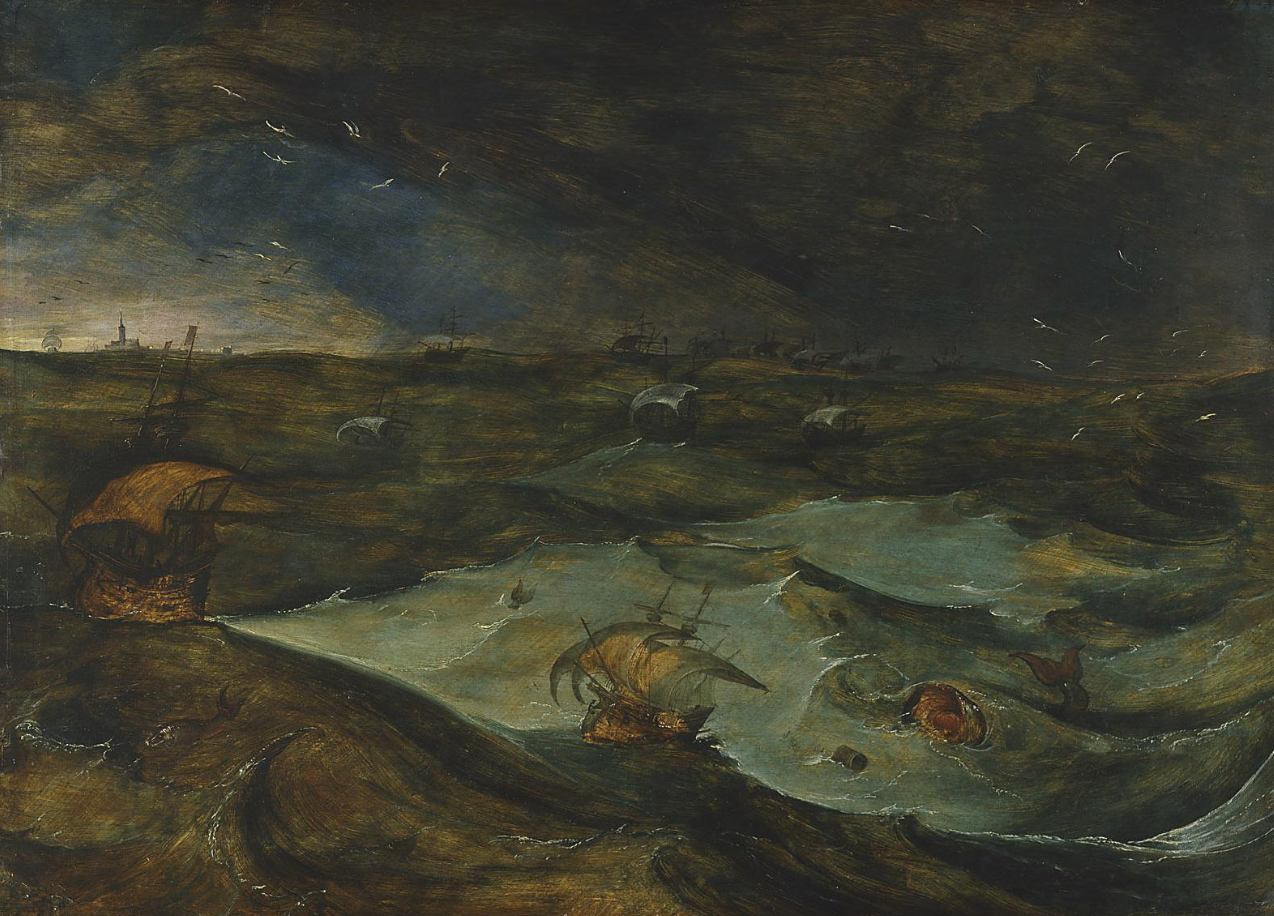
Storm at Sea by Pieter Bruegel the Elder (c.1569)

Maritime painting is an art genre that depicts ships and the sea.  Early examples of this genre were found in Greek vase paintings and the wall paintings of Pompeii.   Storm at Sea is one of earliest specific seascapes and was painted around 1569 by Pieter Bruegel the Elder’s and thought to be one of his last paintings. It is unfinished and, like so many of his works, defies unambiguous interpretation. On the one hand, we see ships threatened by a storm reminding us that man is not master of Nature, in fact man is often its victim. To try and save themselves from the stormy sea the sailors have poured oil onto the water.  They have also sacrificed a barrel from their cargo to distract the mighty whale who is attacking their vessel.

The Battle of Terheide (1657), commemorating the Battle of Scheveningen on 10 August 1653 by Willem van de Velde the Elder.

The greatest marine artists of the 17th century were Willem van de Velde the Elder and his son, Willem van de Velde the Younger.  They were best known for their spectacular depictions of storms at sea, and of nautical life, as well as their painstakingly drawn depictions of ships and naval battles. To commemorate the Dutch naval commander Maerten Harpertsz Tromp, his family commissioned a series of pen paintings of Tromp’s best-known battles from Willem van de Velde the Elder. The artist used pen and ink on canvas for these works, which which bear a resemblance to meticulous, accurate engravings. Van de Velde witnessed the Battle of Terheide in 1653 and he used the sketches that he produced on board as studies for this pen painting.

Men O’ War in Action by Willem van de Velde the Elder

Willem van de Velde the Elder was born in Leiden in 1611.  He was the son of the captain of a merchant vessel, Willem Willemsz van de Velde. When he was young, he would often accompany his father on sea voyages and this probably shaped his career as a marine artist.   Van de Velde married Judith van Leeuwen in Leiden in 1631 and the couple went on to have three children, a daughter, Magdalena, and two sons who would become renowned painters, Willem van de Velde the Younger, a marine artist and Adriaen van de Velde, a landscape painter.

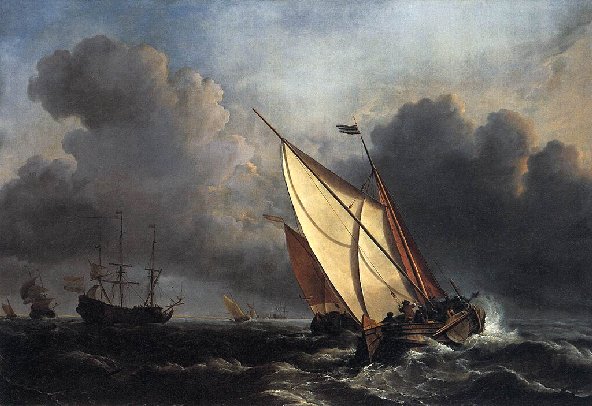
Ships in a Stormy Sea by Willem van de Velde the Younger (c.1672)

The painting entitled Ships in a Stormy Sea by Willem van de Velde the Younger depicts the drama and the excitement of those who braved the seas in the 17th century.  Willie van de Velde the Younger had first-hand knowledge of sailing, and his marine paintings were appreciated for their realistic depictions of ships and sailing tactics. In this work the ship in the foreground is a kaag, a light fishing vessel.  The artist has depicted it as sailing close-hauled in the strong breeze, which is one of the most difficult sailing manoeuvres, in which the vessel sails into the wind as directly as it can without causing the sails to flap uselessly.

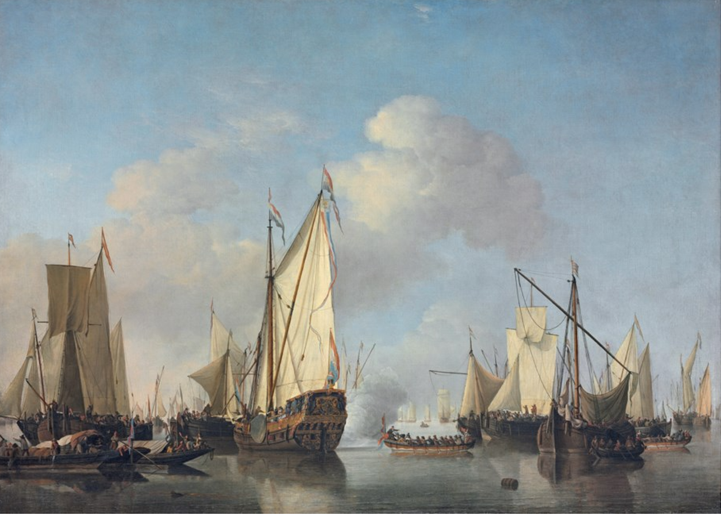
States Yacht and other vessels in a very light air by Willem van de Velde the Younger.

Whereas his father specialised in drawings and pen paintings, Van de Velde the Younger was best known for his oil paintings, which depicted life at sea in full colour.  He was born in Amsterdam in 1633 and trained as a painter with the Dutch artist Simon de Vlieger, who was known for his marine paintings, beach scenes, landscapes and genre work.  Unlike his father, Willem de Velde the Younger was a trained artist, unlike his father who was self-taught.  Van de Velde the Younger worked closely with his father and the pair brought their artistic visions to life. Often, he would use his father’s drawings as a guide to create his own masterpieces. The father was a master of detail whereas his son was a master of light.  It was this combination of artistic talents that was to lead to the success of their studio business.

The Home Fleet Saluting the State Barge by Jan van der Capelle (1650)

Shipping in a Calm at Flushing with a States General Yacht Firing a Salute by Jan van de Cappelle (1649)

Jan van de Cappelle was a Dutch Golden Age painter of seascapes and winter landscapes, also notable as an industrialist and art collector. He is now considered the outstanding marine painter of 17th century Holland. Jan van de Cappelle was wealthy and was occupied full-time running his father’s dyeing business. Though he painted some beach scenes and winter landscapes, most of his paintings represent the mouths of wide rivers or quiet inner harbours, where groups of ships at anchor were depicted in glassy calm waters. Many of his marine art works depict full cloud formations which hover over these tranquil waters and are mirrored in colourful reflections, often set in early morning or evening. When he died, aged fifty-three, in 1679, his estate was worth more than 90,000 guilders.

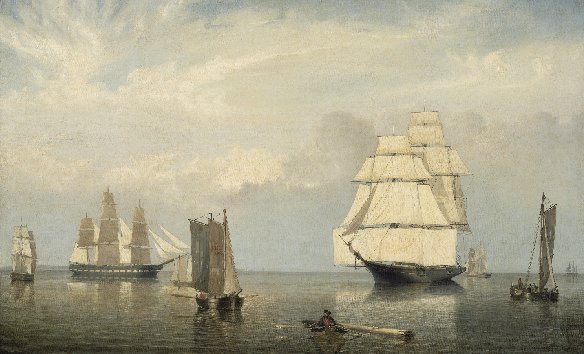
The Ships “Winged Arrow” and “Southern Cross” in Boston Harbour by Fitz Henry Lane (1853)

Fitz Henry Lane was born on December 19, 1804, in Gloucester, Massachusetts. Lane and was christened Nathaniel Rogers Lane three months later and would remain known as such until he was twenty-seven.  In March 1832, Lane requested that his name be changed to Fitz Henry Lane.  The reasons behind Lane’s decision to change his name, and for choosing the name he did, are still very unclear. Lane and his family lived on the outskirts of Gloucester close to the harbour’s working waterfront and so, growing up, Lane had contact with all the elements of maritime life.  Lane’s father, Jonathan Lane was a sailmaker and it was thought that his son would follow him into the business or become a seafarer.  Unfortunately, when only eighteen months of age he became ill and suffered a form of paralysis of the legs.  Growing up he was unable to join his friends in games and became withdrawn and stayed at home where, for amusement, he began to draw.  This developed into an amazing talent and living close to the sea and the harbour he began to sketch the ships and the harbour.

Salem Harbor by Fritz Henry Lane (1853)

For fifteen years, Lane was employed at Pendleton’s Lithography shop in Boston and during those years as a lithographer Lane honed his artistic skills.  He produced many works of marine art and was listed as a marine painter in the 1840 edition of the Boston Almanac.  His works became extremely popular and were in great demand.  Then despite living in Boston, it never prevented him returning on a number of occasions to his birthplace, Gloucester.  Aged forty-eight Lane left Boston and moved back to Gloucester where in 1849 he designed and had constructed his own granite house with seven gables and a studio on Duncan’s Point.  This house would remain his primary residence to the end of his life. Fitz Henry Lane died on August 14th, 1865, aged 60.

Rainbow at Sea with some cruising Ships by Christoffer Wilhelm Eckersberg (1836)

Christoffer Wilhelm Eckersberg, a Dutch painter, was born in Blåkrog in the Duchy of Schleswig on January 2nd 1783.  He was at the forefront of the Golden Age of Danish Painting, a period from 1800 to around 1850 and is often referred to as the “Father of Danish painting”.  After 1821 seascapes had become Eckersberg’s favourite subject.

The Russian Ship of the Line “Asow” and a Frigate at Anchor in the Roads of Elsinore by Christoffer Wilhelm Eckersberg (1828)

Eckersberg’s best loved maritime painting is his 1828 work entitled The Russian Ship of the Line “Asow” and a Frigate at Anchor in the Roads of Elsinore. This majestic work is not a true rendition of the scene but an idealised version as the setting of the scene is not Copenhagen where he had studied Russian ships of the line on two occasions.  We also know from his diaries that he had also studied the ship’s design from technical drawings he had borrowed from the naval dockyard.   However the backdrop is not Copenhagen but Elsinore where we can see Kronborg Castle in the background.  Kronborg is the castle and stronghold in the town of Helsingør, Denmark, which was immortalized as Elsinore in William Shakespeare’s play Hamlet.  The depiction is what the ship, Asow, would have looked like if viewed from a vantage point on the Øresund.

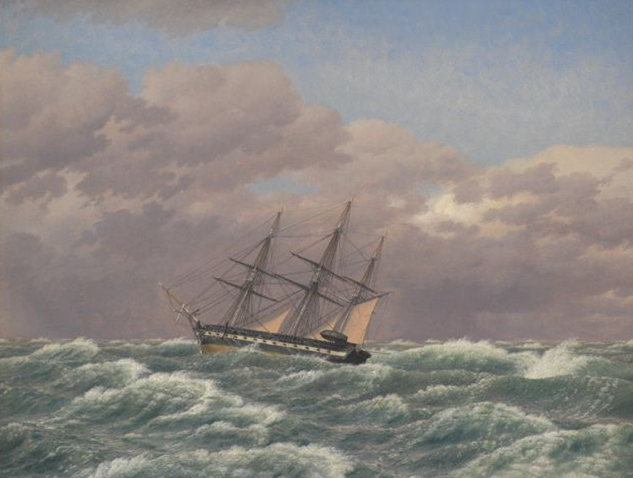
The Corvette Galathea in a Storm in the North Sea by Christoffer Wilhelm Eckersberg (1839)

Although he was known for his portraiture and historical paintings, marine paintings was another genre he developed.  Eckersberg developed a passion for ships, and, at the age of fifty-six, sailed around the Skagerrak, the Kattegat, the North Sea, and as far as the English Channel.  These sailing trips on the open seas brought home to Eckersberg that sea could be quite threatening and whereas many of his early work focused on cam seas, later works often depicted the ferocity of the sea.

If you would like to read more about the art of Christoffer Wilhelm Eckersberg then have a look at the five blogs I did focusing on his life life and paintings.

Northeaster by Wilmslow Homer (1895)

Winslow Homer was an American landscape painter and illustrator and is renowned for his marine subjects.  By many, he is considered one of the leading painters of 19th-century America.  His 1895 painting entitled Northeaster can be found in the collection of the Metropolitan Museum of Art, in New York City.   It depicts a wave crashing aggressively against a rocky Maine shoreline.  Homer loved the East coast of America around Maine and eventually settled down there in 1883, moving from New York to Prouts Neck, Maine where he lived at his family’s estate in the remodelled carriage house seventy-five feet from the ocean.  The title of the painting, Northeaster, does not refer to a location in America, but is a name given to a specific type of wind that occurs within the western North Atlantic Ocean. The painting depicts just a small section of rock seen in the lower left corner whilst, in the background, a spectacular section of sea is seen riding relentlessly towards the shore.

Early Morning, After A Storm At Sea By Winslow Homer (1900-1903)

Whilst living at Prouts Neck, Winslow Homer looked out upon the sea and once commented to a friend that painting was all about timing:

“…You must not paint everything you see. You must wait, and wait patiently until the exceptional, the wonderful effect or aspect comes. Then, if you have sense enough to see it—well . . . that is all there is to that…”

Homer began this seascape in 1900 and based it on a watercolour he had completed in 1883. He was proud of the finished work in oils stating that it was the best picture of the sea that he had painted but was totally dismayed when it was poorly received by the critics.   He just said of this dismissive reception that no one understood the work and besides that, the people never see the early morning effect. They don’t get up early enough.

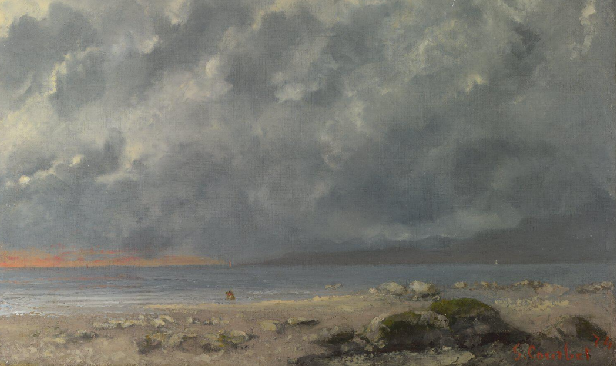
View of Lac Léman by Gustave Courbet (1874)

Threatening grey clouds move across the sky above the calm Swiss lake but the cloud formation threatens an oncoming storm.  The depiction is set in the evening and on the horizon against the vivid orange and gold of the setting sun we can just barely make out a tiny boat.   Soft red reflections streak the surface of the water.   Courbet had left France in 1873  for political reasons and settled on the shores of Lac Léman in Switzerland where he painted a number of scenes featuring the lake at sunset.

Marine by Gustave Courbet

Four years earlier during the late summer of 1869 Courbet travelled to Étretat, a small fishing village which was famous for its towering coastal cliffs with their rock arches carved out by the relentless sea. Courbet was fascinated by the sea and completed twenty-nine works during his stay at Étretat.  His depictions of the sea would vary from the quiet tranquillity of the calm sea to the violence of crashing waves upon the rocks.  In the above work Courbet shows us the power of the sea with white-capped waves with foam fringes as they approaches us.  The painting has captured the feel of motion and the immense power of the relentless waves.

In Part 2, I will be looking at Marine paintings which feature those who enjoy relaxing by the sea and those whose living is connected with the sea.

Eugène Boudin. Part 1.

See the source image

My featured artist today is the nineteenth century French painter Eugène Boudin.  He was one of the earliest en plein air painters and is credited with introducing plein air painting to Monet.  He was a marine painter and his depictions focused on seascapes and the Normandy shorelines.

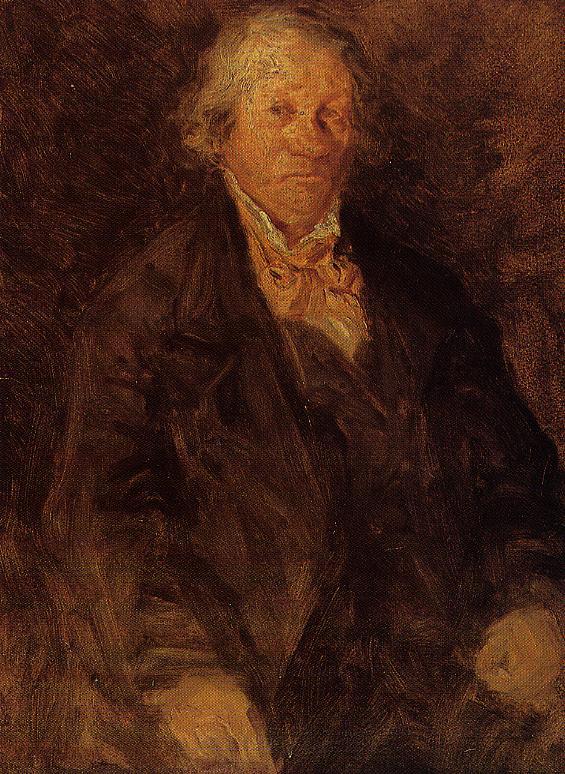
Portrait of the Artist’s Father  by Eugène Boudin (1850)

Eugène Louis Boudin was born in the coastal town of Trouville in Normandy on July 12th 1824. Leonard-Sebastien Boudin,  Boudin’s father, was a harbour pilot, and at the age of ten, young Boudin worked as a cabin boy on a steamboat that sailed across the Seine estuary between Le Havre and Honfleur and during those days on the water the young boy must have witnessed the constant fluctuations of the colours of the sea and sky which were aspects so important to plein air artists.  Boudin’s father gave up his seagoing life when Eugène was about twelve years of age.  In 1835, Eugène moved with his family to Le Havre where his father established himself as stationer and frame-maker. Eugène began work the following year as an assistant in the shop before opening his own small framing shop which he co-owned. It was whilst running this shop that he first met artists who were working in the area and used his shop to exhibit their paintings.  The most well-known of these were the landscape painter, Constant Troyon, Jean-Francois Millet, the portraiture artist, Jean-Baptiste Isabey and the history painter, Thomas Couture.  Eugène would receive encouragement from these painters to abandon the world of commerce and take up painting.  In 1846, aged twenty-two, Eugène Boudin took their advice and gave up the stationery shop and began to paint full time.  He had sold his share of the business to buy himself out of military service and in 1847, he travelled to Paris and spent time travelling through the Flanders region.  Boudin was profoundly influenced by the Dutch 17th-century Masters and when he met the Dutch painter Johan Jongkind, who had already made his mark in French artistic circles, Boudin was advised by his new friend to paint en plein air.  Three years later, in 1850 he won a scholarship that allowed him to move to Paris.  However, he never forgot his roots and would return to Normandy to paint and later take many painting trips to Brittany.  

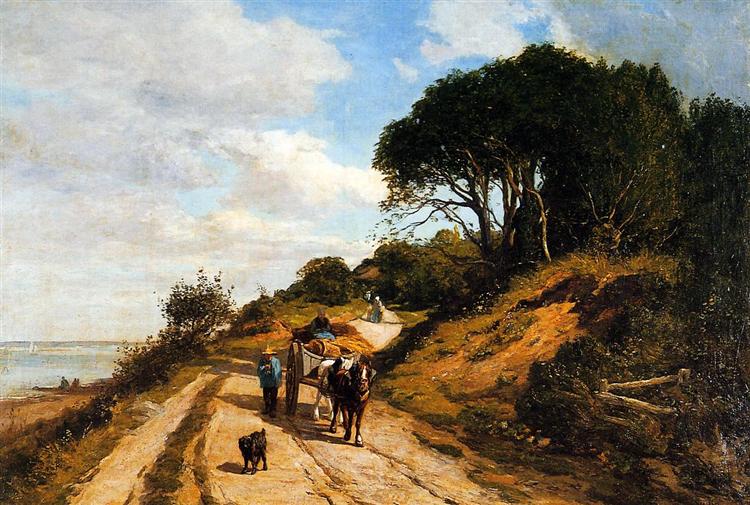
The Road from Trouville to Honfleur by Eugène Boudin (c.1852)

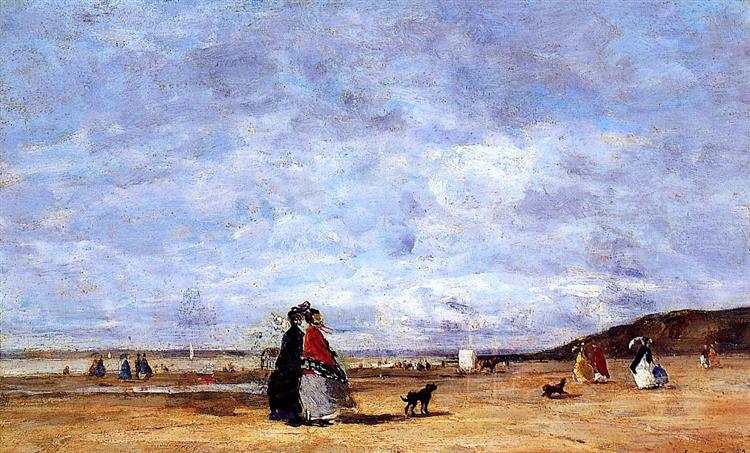
During that early period, Eugène painted rural landscapes, peasants, and still life works, but soon his love of the sea and the seaside progressively attracted his attention, and in 1862, he began to paint the crowds of fashionable tourists who had descended on the Normandy beaches.  Seaside resorts began to appear on the French Channel coast and in what was to become Belgium and the Netherlands in the late eighteenth century.  By the early nineteenth century the commercial sea-bathing habit was making an impact on Normandy. 

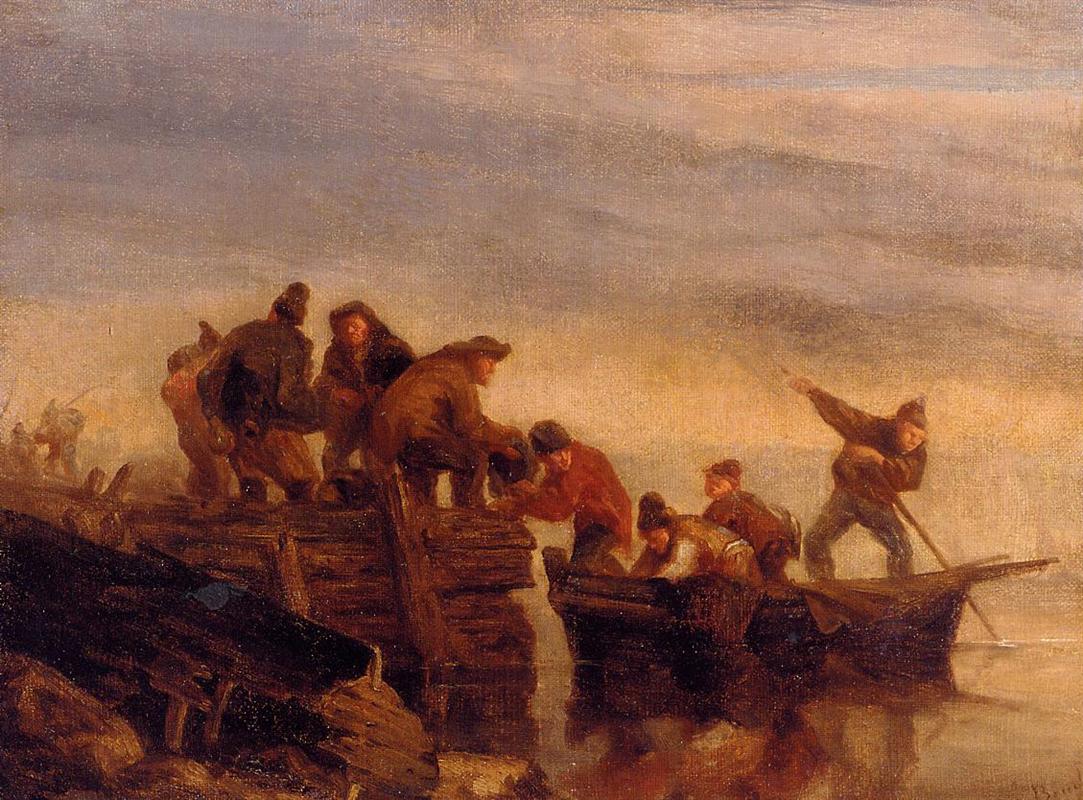
Fishermen by the Water by Eugène Boudin (1855)

Up until that time artists’ coastal scenes were rarely populated, and if they did include figures they were likely to be local fishermen. Boudin’s coastal scene paintings were adventurously modern in nature depicting smartly dressed holidaymakers engaging in leisure activities.

Elegant Women on the Beach by Eugène Boudin (1863)

His modus operandi was to sketch en plein air during the summer months and finish off the paintings in his studio during the winter months.  Boudin still respected the established tradition of outdoor painting.  His plein air sketches were merely studies rather than finished works and they had to be finalized in his studio utilizing the many sketches he had made as well as the meticulous notes he had recorded about atmospheric conditions and the time of day when the sketches had been made.  It was a painstaking operation as he once wrote in a letter to one of his students:

“… An impression is gained in an instant, but then it has to be condensed following the rules of art or rather your own feeling, and that is the most difficult thing – to finish a painting without spoiling anything…”

However, Boudin changed his methodology realising that there was an innate wrongness with his system of completing works indoors and so he would, from start to finish, complete his works en plein air.  This inherent immediacy of work painted outdoors allowed him to be aware of changing weather and light conditions.

The Beach at Villerville by Eugène Boudin (1864)

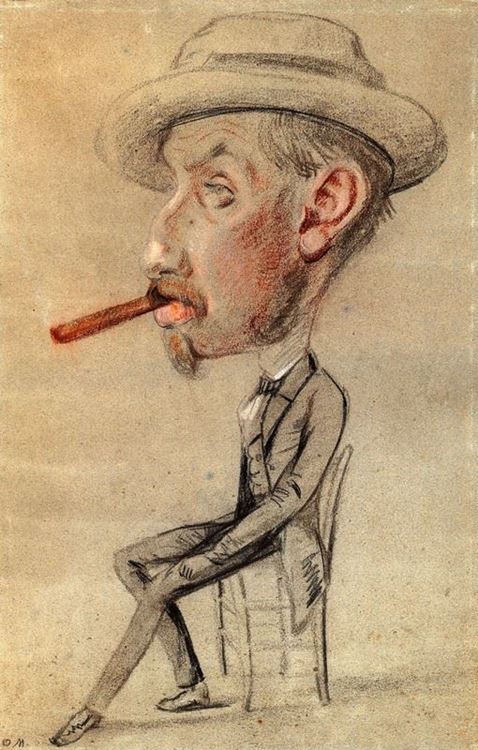
Claude Monet was born in Paris on November 14th 1840 and at the age of five moved with his family out of the French capital and went to live in Le Havre.  Monet was fourteen years younger than Boudin but it is said that around 1856, sixteen-year-old Monet met fellow artist Eugène Boudin, who then became his mentor and taught him to use oil paints. Boudin who befriended him also taught Monet the technique for outdoor painting.  This was to have a great influence on the young artist.  Up to the early meetings with Boudin, Monet had concentrated on his teenage caricatures but was persuaded by Boudin to focus all his time on landscape painting.  Monet recalled the time:

“…it was as if a veil had been torn from my eyes. I had understood, had grasped what painting could be. Boudin’s absorption of his work, and his independence, were enough to decide the entire future and development of my painting…”

Büyük Purolu Adam, 1855-1856 picture

Boudin helped Monet to love the bright hues and the play of light on water.  Monet remembered Boudin’s words of encouragement and later paid tribute to Boudin’s early influence:

“…Boudin without hesitation, came up to me, complimented me in his gentle voice and said ‘I always look at your sketches with pleasure, they are amusing, clever, bright.  You are gifted; one can see that at a glance.  But I hope you are not going to stop there.  It is all very well for a beginning, yet soon you will have had enough of caricaturing.  Study, learn to see and paint, draw, make landscapes.  The sea and the sky, the animals, the people and the trees are so beautiful, just as nature had made them, with their character, their genuineness, in the light, in the air, just as they are’…”

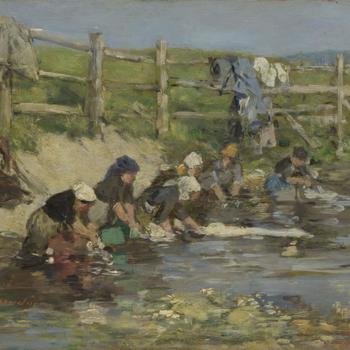
Laundresses by a Stream by Eugène Boudin

This would later become evident in Monet’s Impressionist paintings. Boudin offered Monet the chance to help him in his framing shop but the young man declined but later that summer he acquiesced.  The two remained lifelong friends and  it was probably through Monet that Boudin was asked to participate in the First Impressionist Exhibition in 1874.  

In 1859 Boudin met Gustave Courbet who introduced him to the poet and art critic, Charles Baudelaire, who was the first critic to draw Boudin’s talents to public attention when he made his debut at the 1859 Paris Salon.

Deauville Harbour by Eugène Boudin

Boudin was to later join Monet and his young friends in the first Impressionist exhibition in 1874, but he never considered himself a revolutionary trend-setter unlike some of the other artists.  So now Boudin’s work featured at both the Imressionist’s First Exhibition as well as at the Paris Salon that year.  In a way Boudin had created a vital connection between the past and future trends of French art, and by so doing won the admiration of his contemporaries.  Boudin could have become a regular member of the Impressionists but chose not to.

   Boudin had mental issues in the form of bouts of melancholia and he always seemed to doubt his own ability.  He was introverted and never felt the need to bolster his reputation which may have been enhanced if he had decided to live in the French capital and regularly mix within the Paris art circle.  Boudin preferred to remain living in Normandy.

In a letter, from Paris, dated June 14th 1869, to family-friend Ferdinand Martin Boudin tells of his desire to return to Normandy:

“…I dare not think of the sun-drenched beaches and the stormy skies, and of the joy of painting them in the sea breezes…”

The paintings that Boudin made of the coast were consistent with the ideals of the depiction of light which became popular with the Impressionist movement and so we must realise that Boudin continued to be an influence with the group.  

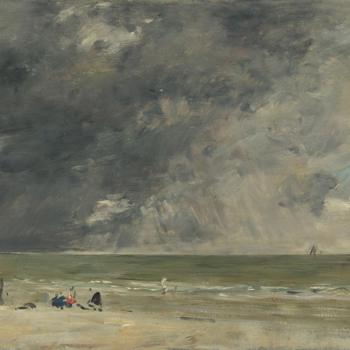
Beach at Trouville by Eugène Boudin

Boudin was a master when it came to depicting skies.   Fellow artists, like Corot, praised that aspect of Boudin’s paintings and nicknamed him King of the Skies.  In 1859 the poet Charles Baudelaire rhapsodically described the skies in Boudin’s paintings, shown at the Salon, ‘prodigious spells of air and water’.

………..to be continued.

Ivan Aivazovsky. Part 2. The Master of seascapes.

In the first part of my blog featuring the Russian seascape and marine painter, Ivan Aivazovsky I concentrated on his seascapes and marine paintings which, on the whole, depicted calm and idyllic seas.  However, what made me choose Ivan Aviazovsky for my blog was the masterful way he depicted the raging fury of the sea and man’s fight for survival in those terrifying conditions. I experienced that ferocity during my years working on ships but never have I seen it being depicted so graphically. His vivid depiction in his paintings of the terrifying power of the raging seas is masterly.

The Ninth Wave by Ivan Aivakovsky (1850)

One of my favourite seascape paintings by Aviazovsky is his 1850 work entitled The Ninth Wave. It is also probably his best-known work. The title refers to a popular sailing legend that the ninth wave is the most terrible, powerful, destructive wave that comes after a succession of incrementally larger waves. In his painting, set at night, he depicts a raging sea, which has been whipped up by a storm. In the foreground we see people clinging to the mast of a vessel which had sunk during the night. Note how the artist has depicted the debris the people are clinging to in the shape of a cross and this element can be looked upon as a metaphor for salvation from the earthly sin. The people clinging to the debris are lit by the warmth of breaking sunlight and this gives one to believe that they may yet be saved. The painting was originally acquired for the State Russian Museum of St Petersburg and was one of the first paintings in the collection of the Emperor Alexander III Russian Museum in 1897.

The Billowing Sea by Ivan Aivazovsky (1889)

There are many great paintings by Aviazovsky depicting raging seas. I particularly like one entitled The Billowing Sea.

The sheer size of this work, 304 x 505cms (119 x 199 in) is breathtaking.

The Rainbow by Ivan Aviazovsky (1873)

Another one of his works which I saw at the Tretyakov Museum in Moscow the other week was his painting entitled The Rainbow which features a sailing ship foundering on rocks whilst two lifeboats full of sailors try to manoeuvre their boats ashore through the fierce seas. It is a truly remarkable work in which Aviazovsky created a scene of a storm as if seen from inside the raging sea.  In the foreground, we see the sailors who have taken to a lifeboat and abandoned their sinking ship which had foundered on the rocky shoreline. They had spent the whole night in the boat. Suddenly they see a rainbow and feel that all is not lost. The reflection of the rainbow can just be seen to the left of the painting.  Fyodor Dostoevsky, the Russian novelist, was an admirer of Aivazovsky’s art and The Rainbow was his favourite work.  Of the painting, Dostoevsky wrote:

“…This storm by Aivazovsky is fabulous, like all of his storm pictures, and here he is the master who has no competition. In his storms there is the trill, the eternal beauty that startles a spectator in a real-life storm…”

Shipwreck near Gurzuf by Ivan Aivazovsky (1898)

In 1842 Aivazovsky had completed his two-year stint in Italy. He had spent many hours in various museums studying paintings by the Italian masters and became heavily influenced by Italian art and he looked upon his time at the museums as time in his “second academy”. He was awarded a gold medal by Pope Gregory XVI for his artwork. Aivazovsky left Italy in 1842 and travelled around Europe for the next two years. He had his work exhibited in an international exhibition at the Louvre, where he was the only representative from Russia. During his stay in France, he also received a gold medal from the Académie royale de peinture et de sculpture. In 1844 he returned to Russia.

Storm on the Sea by Aivazovsky (1847)

Upon his return to Russia, Aivazovsky was made an Academician of the Imperial Academy of Arts and was appointed the official artist of the Russian Navy to paint seascapes, coastal scenes and naval battles. In 1845, Aivazovsky travelled to the Aegean Sea with Duke Konstantin Nikolayevich and visited the Ottoman capital, Constantinople, and the Greek islands of Patmos and Rhodes. After years of travel Aivazovsky decided to settle down in his hometown of Feodosia In 1845. He built a house and studio and cut himself off from the outside world just maintaining a friendship with close friends.

Chaos (Anno Mundi) by Ivan Aivazovsky (1841)

As in life itself, time moves on and change is inevitable. So was the case with Russian art in the mid nineteenth century. Aivazovsky’s love of painting romantic seascapes was becoming unfashionable with the new style of Russian art – Russian Realism, becoming more and more popular. Aivazovsky could not accept the change and persevered with his Romantic style seascapes and his artwork began to be criticised.

Among the Waves by Ivan Aivazosky (1898)

For a beautiful seascape one needs look no further than the one which the eighty-one-year-old Ivan Aivazovsky completed in 1898, just two years before he died, entitled Among the Waves.  For once it is a pure seascape without any ships, afloat or sinking, and no sailors in lifeboats trying to survive their watery ordeal. However, with this painting came an interesting tale with regards the depiction. Before us we see that a storm has already erupted in full force and the black stormy sky threatens worse to come. Look how the water in the foreground is almost translucent, a mixture of greyish-green and silvery blue, dependent on how the sunlight, which bursts through from behind the storm cloud, falls upon the water. The waves are topped with white caps of foam. It is a pure sea and sky painting but it was not always so. Originally Aivazovsky had included in the depiction his “signature” boat which was struggling to survive but when Ivan asked his grandson what he thought of the painting his grandson told the elderly man that it was admirable work but queried why his grandfather had added to the depiction a “toy-like” boat with people in it. According to the memoirs of his grandson, the artist was terribly angry with his comments and, without a word, turned and walked away. The next day when the family members looked at the painting they found that the little boat full of sailors had been removed from the canvas !

In 1847, Aivazovsky became the professor of seascape painting at the Imperial Academy of Arts and was elevated to the rank of nobility. That year, he also was elected to the Royal Netherlands Academy of Arts and Sciences.

Aivazovsky with his first wife, Julia, and their four daughters

In 1848, Aivazovsky married Julia Graves, an English governess. She was the daughter of a St. Petersburg doctor, the Briton Jacob Grevs. It is believed that he may have been more than just an ordinary physician as rumour had it that he was personal physician of Tsar Alexander I.  Grevs mysteriously disappeared after the death of the emperor. Julia was an eighteen-year-old well-educated beauty when she married thirty-one-year-old Aivazovsky. The couple went on to have four daughters: Elena (1849), Maria (1851), Alexandra (1852) and Joanne (1858). Their marriage foundered after twelve years and they separated in 1860 with Julia leaving the marital home and taking the children. The breakdown of their marriage seems to have been the result of Ivan’s all-consuming passion for his art which left him little time for his wife. Anna finally could not accept this kind of marriage. The couple divorced in 1877 with permission from the Armenian Church, since Graves was a Lutheran and Julia remained in her new home in Odessa.

Battle of Chesme at Night by Ivan Aivazovsky (1848)

Aivazovsky completed a number of paintings depicting Russian naval battles and one of his most famous works was his 1848 painting entitled Battle of Chesme at Night which illustrated the Russian-Turkish naval battle which took place on July 7th, 1770. At this significant battle, the Russian Navy defeated the Turkish navy at the Bay of Chesme. This was quite an upset as the Turkish navy at that time was the strongest in the world. It would seem that the Turkish fleet had all the advantages – a significant advantage in the power of their fleet, the backup of their on-shore batteries, a good location and the glory of the strongest navy in the world. But for the Turks nothing quite went to plan. Early into the battle, following a bombardment by the Russian ships, one of the Turkish ships exploded. That night, the remaining part of the Russian fleet came to the bay, including their four fire-ships (specially converted small vessels of the fleet, which were intended to set fire to enemy ships of the line). Just one of them reached the Turkish warships and the Russian sailors set fire to their fire-ship and took flight in their lifeboats. The tactic succeeded and the Turkish battleship which had been rammed by the Russian fire-ship exploded and started a chain reaction. Soon more Turkish ships were ablaze and by the end of the night the Turkish navy had been destroyed. The horror of the battle was perfectly conveyed by Ivan Aivazovsky in his painting.

The Battle of Sinop by Ivan Aivazovsky (1853)

In 1853, the Crimean War erupted between Russia and the Ottoman Empire, and Aivazovsky was evacuated to the northern Ukrainian city of Kharkiv. When the Crimea became safer, he returned to the besieged fortress of Sevastopol to paint battle scenes. He also depicted the famous Battle of Sinop, at which the Russian navy was victorious over the navy of the Ottoman Empire on November 30th 1853 at Sinop, a sea port in northern Anatolia.  It was during this maritime battle that a squadron of Imperial Russian warships struck and defeated a squadron of Ottoman ships anchored in the harbour. It resulted in an ignominious defeat of the once all-powerful Turkish fleet at the hands of the Russian navy.

The Battle of Sinop (Night after the Battle), by Ivan Aivazovsky (1853)

In another painting of the battle often referred to as Night after the Battle, the sky is black, and the light from the stars has been extinguished. The fierce battle resulted in the death of a large number of sailors. In the background of the picture we see the burning ships of the Ottoman navy. The Turkish fleet is burning and a ship is exploding in the darkness. Part of the Turkish fleet went to the bottom, the rest of them burn out. In the foreground we see fragments of a sunken ship, on which people try to escape from imminent death.

Tempest on the Sea at Night by Ivan Aivazosky (1849)

Many honours were bestowed on Aivazovsky in the 1850’s. He had been working in Paris during 1856 and 1857 and became the first Russian, actually the first non-French artist to receive the prestigious Legion of Honour for his services to art. Leaving Paris in 1857, he visited Constantinople and was awarded the Order of the Medjidie. Also that year, he was elected an honorary member of the Moscow Art Society and the following year he was awarded the Greek Order of the Redeemer in 1859.  In 1865 he was further honoured, this time by his homeland, when he was given the Russian Order of St. Vladimir. It was also the year that Aivazovsky opened an art studio in Feodosia and was awarded a salary by the Imperial Academy of Arts the same year.

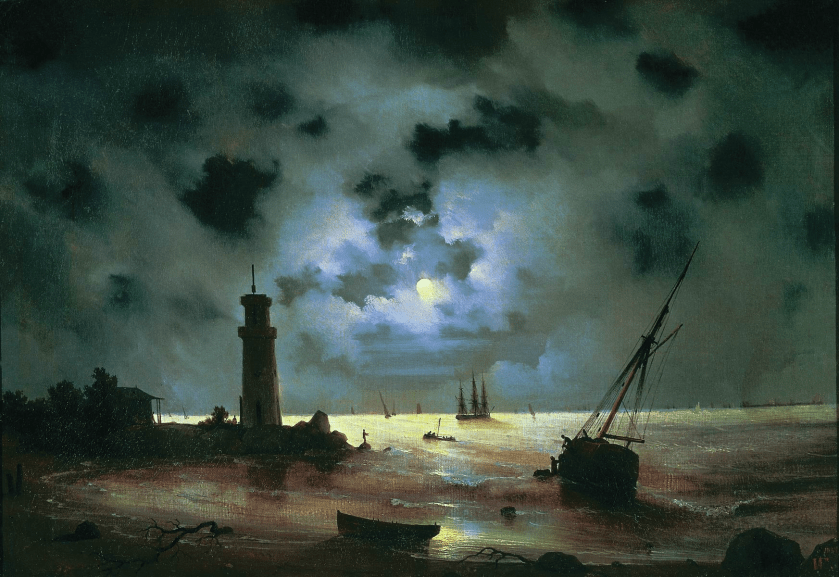
The Seashore with a Lighthouse at Night by Ivan Aivazovsky (1837)

Aivazovsky had become such a talented and prolific artist that he no longer needed to go outdoors for inspiration. During his almost 60-year career, he created around 6,000 paintings, making him one of the most prolific artists of his time. He had spent so many years observing his treasured surroundings that he was able to produce canvases with remarkable speed. It had got to the point in his artistic career that he often astonished his visitors by creating a large canvas in a matter of hours. Aivazovsky frequently compared his work to that of a poet saying:

“…The artist who only copies nature becomes a slave to nature. The motions of live elements are imperceptible to a brush: painting lightning, a gust of wind or the splash of a wave. The artist must memorize them. The plot of the pictures is composed in my memory, like that of a poet; after doing a sketch on a scrap of paper, I start to work and stay by the canvas until I’ve said everything on it with my brush…”

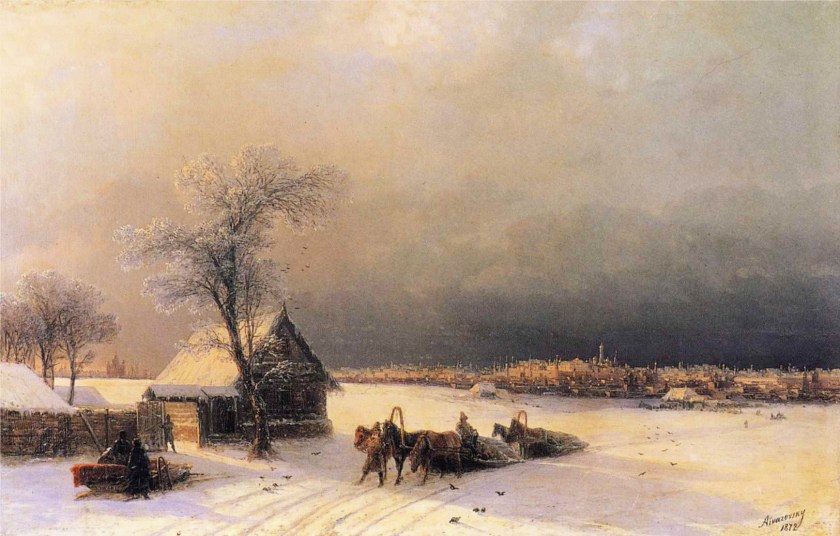
Moscow in Winter from the Sparrow Hills by Ivan Aivazovsky (1872)

Although most of Aivazovsky’s paintings were seascapes or marine depictions he did complete a number of works featuring landscapes and I particularly like his 1872 winter scene, Moscow in Winter from the Sparrow Hills.

Aivazovsky’s painting of his second wife Anna Burnazian-Sarkisova  (1882)

Aivazovsky had been living alone since his wife left him, taking their children. It was four years after his divorce was finalised that he happened to attend the funeral of a Feodosian merchant, named Sakrisov. At first sight of the grieving widow, Anna, following her husband’s coffin, he fell in love. Realising it would be inappropriate to approach her at such a time he bided his time but never forgot the sight of the young woman. After waiting for the sake of decency, he made an offer of marriage, which Anne accepted. Aivazovsky married his second wife, Anna Burnazian-Sarkisova in 1882. She was twenty-six-years of age and her husband was sixty-five. Aivazovsky believed that as his second wife was Armenian this marriage had brought him closer to his Armenian nation. Anna, unlike his first wife, Julia, was content with her husband devoting most of his time on his paintings and artistic career without becoming jealous, whilst she was able to enjoy her free time.

Tomb of Ivan Ajwazovsky in Feodosia, Crimea.

Ivan Aivazovsky died, aged 82, on April 19th 1900 in Feodosia. In accordance with his wishes, he was buried at the courtyard of St. Sargis Armenian Church. A white marble sarcophagus was made by Italian sculptor L. Biogiolli in 1901.

After Aivazovsky’s death, Anna lived a life of a recluse and for 25 years she did not leave the walls of the house, where she had been happily married. During World War II, she refused to leave her home when the country was under occupation and managed to survive by exchanging the last of her jewellery for bread and cereal. When the Germans left Feodosia, Aivazovsky’s widow, aged 87, forgotten by all, was found by the artist Nikolai Samokish and taken to his home in Simferopol. Anna died a year later, aged 88 and is buried next to her husband, in the square of the Armenian church, where they were once married.

American Shipping off the Rock of Gibraltar by Ivan Aivazovsky (1873)

On June 14, 2007 his painting “American Shipping off the Rock of Gibraltar” sold for £2.71 million pounds, and was the highest price paid at auction for an Ivan Aivazovsky painting. Ironically, he is also said to be the most forged of all Russian painters.

Ivan Konstantinovich Aivazovsky

Self-portrait of Ivan Aivazovsky (1874)

Two weeks ago, I went on a four-day city break to Moscow. I had always wanted to visit the Russian capital and especially visit the famous Tretyakov Gallery which houses the largest collection of Russian art in the world. I had read books about the wonders it had to offer and I knew I had to go and see it first-hand. Recently I wrote five blogs on the museum and the works of its leading proponents of portraiture, including Repin, Serov and Kramskoy but in the next few blogs I want to concentrate on lesser known artists (that is lesser known to me!) whose works also graced the walls of this outstanding Gallery.

Sunset in Crimea by Ivan Aivazovsky (1865)

As I have mentioned before, I live on the coast and a large number of paintings by local artists feature seascapes or marine paintings. My featured artist today is looked upon as one of the greatest maritime and seascape painters of all time and regarded as one of the most successful Russian painters of the 19th century. His work was admired by many seascape painters such as Turner. Let me introduce you to the Russian Romantic painter, Ivan Konstantinovich Aivazovsky.

Odessa by Ivan Aivazovsky (1840)

Ivan Konstantinovich Aivazovsky was born on July 29th 1817. At his baptism at the local St. Sargis Armenian Apostolic Church, he was given the name of Hovhannes Aivazian. His father, Konstantin, was an impoverished Armenian merchant whose family originated from the Polish region of Galicia, a historical and geographic region between Central and Eastern Europe.  In the early 1800’s Aivazosky’s father settled in the Black Sea port of Feodosia in the Crimea and it was here that he met a local girl, Ripsime, who later became his wife. They had five children, three daughters and two sons. Ivan’s elder brother, Gabriel, was to become an important historian and an Armenian Apostolic archbishop. Ivan began his education at Feodosia’s St. Sargis Armenian Church school and it was also during this period that he received his first tuition in art. His tutor was Jacob Koch, a local architect. In 1830, at the age of thirteen, he moved with the Taurida governor, Alexander Kaznacheyev’s family to Simferopol, the Crimean capital, where, through the good auspices of Jacob Koch, he was enrolled at the city’s Russian grammar school. Three years later, in 1833, having now established himself as a talented painter, sixteen-year-old Ivan transferred to the St. Petersburg Academy of Arts where he joined the class of the landscape painter, Maxim Vorobiov. He was a model student and progressed well. In 1835, he was awarded the silver medal for his painting Air over the Sea.

The Roads at Kronstadt by Ivan Aivazovsky (1836)

In 1836 the French artist Philippe Tanner arrived in St Petersburg to teach at the Academy and was immediately impressed by the talent of nineteen-year-old Ivan. Tanner’s forte was his marine paintings and during the time Aivazovsky worked as his assistant, he taught the young man marine painting techniques. In the autumn of 1836 Ivan had five of his works shown at art exhibitions, including his painting, The Roads at Kronstadt. Soon Ivan’s work was noticed and praised by both the press and the art critics alike.

Frigate under sails by Ivan Aivazovsky (1838)

In 1837, Aivazovsky joined the battle-painting class of Alexander Sauerweid and participated in Baltic Fleet exercises in the Gulf of Finland.

Yalta by Ivan Aviazovsky (1838)

In October 1837, he graduated from the Imperial Academy of Arts with a gold medal and received the official title of artist. He left the St Petersburg Academy in 1838 to carry out a commission to paint views of several Crimean towns and to do this he moved back to his home town of Feodosia in the Crimea where he set up a shop and started painting vistas of the Crimea and his beloved Black Sea. He would paint en plein air carefully recording the elements and then return to his studio to put the finishing touches on his masterpieces. He remained in his homeland for two years.

The Landing at Subashi by Ivan Aivazovsky (1839)

In 1839 Ivan Aivazovsky was invited to participate in a Navy operation which was taking place off the Crimea shores. There he took part in military exercises off the shores of Crimea, and where he met prominent Russian admirals Mikhail Lazarev, Pavel Nakhimov and Vladimir Kornilov and soon a long friendship blossomed between the artist and the military men. His canvases depicting sea battles were remarkably true to fact and so full of accurate details that they are now considered as illustrations of naval attack tactics.  One of his paintings depicting a naval battle was entitled The Landing at Subashi.

Mhitarists on the Island of St. Lazarus, Venice by Ivan Aivazovsky (1843)

In 1840 the Imperial Academy of Arts of St Petersburg sent Aivazovsky to increase his knowledge in art by going and studying in Europe. His first stop-over was Venice which he reached after travelling through Berlin and Vienna. In Venice he went to San Lazzaro degli Armeni, a small island in the Venetian Lagoon which has been home to the monastery of the Mekhitarists, an Armenian Catholic congregation, since 1717. This was the home of Aivazovsky’s elder brother Gabriel.

The Bay of Naples by Ivan Aivazovsky (1841)

Whilst here, Aivazovsky studied Armenian manuscripts and familiarised himself with Armenian art. From Venice he travelled across Italy and arrived in the Tuscan city of Florence and later took in the sights of Amalfi and Sorrento. He took up residence in Naples and stayed there until 1842. In that two year period in Italy, Aivazovsky fell in love with Italian art. Among the people he met whilst in Italy was the Ukranian-born Russian writer Gogol and the Russian Neoclassical painter Aleksandr Ivanov.

View of Amalfi by Ivan Aivazovsky (1843)

Aviazovsky returned to Russia in 1842 and he was given an official title within the General Naval Office. As such, he was allowed to join Russian research and science expeditions which travelled to Turkey, Greece, Egypt, America and Asia. From these journeys Aivazovsky was able to bring home hundreds of sketches which he later turned into his famous paintings.

The Bay of Naples at Moonlit Night. Vesuvius by Ivan Aviazovsky (1840)

He then visited Switzerland, Germany, the Netherlands and Britain, where he met English painter J. M. W. Turner who, was so impressed by Aivazovsky’s painting, The Bay of Naples on a Moonlit Night that he dedicated a rhymed eulogy in Italian to Aivazovsky.

“…Like a curtain slowly drawn
It stops suddenly half open,
Or, like grief itself, filled with gentle hope,
It becomes lighter in the shore-less dark,
Thus the moon barely wanes
Winding her way above the storm-tossed sea.
Stand upon this hill and behold endlessly
This scene of a formidable sea,
And it will seem to thee a waking dream.
That secret mind flowing in thee
Which even the day cannot scatter,
The serenity of thinking and the beating of the heart
Will enchain thee in this vision;
This golden-silver moon
Standing lonely over the sea,
All curtain the grief of even the hopeless.
And it appears that through the tempest
Moves a light caressing wind,
While the sea swells up with a roar,
Sometimes, like a battlefield it looks to me
The tempestuous sea,
Where the moon itself is a brilliant golden crown
Of a great king.
But even that moon is always beneath thee
Oh Master most high,
Oh forgive thou me
If even this master was frightened for a moment
Oh, noble moment, by art betrayed…
And how may one not delight in thee,
Oh thou young boy, but forgive thou me,
If I shall bend my white head
Before thy art divine
Thy bliss-wrought genius…”

The Golden Horn, Turkey by Ivan Aivazovsky (1845)

In 1845, Aivazovsky travelled to Istanbul upon the invitation of Sultan Abdülmecid. He would return to this Turkish city many times during his lifetime. He became court painter to the Ottoman Sultans Abdülmecid, Abdulaziz and Abdulhamid, and thirty of his commissioned works are still exhibited in the Ottoman Imperial Palace, the Dolmabahce Museum and many others at various other museums in Turkey.  One of his paintings from this time was The Golden Horn.  The Golden Horn is a horn-shaped estuary which divides the European side of Istanbul and is one of the best natural harbours in the world.  The Byzantine and Ottoman navies and commercial shipping interests were centred here.

In the next part of my bog looking at the life and works of Ivan Aivazovsky I will be looking at his beautiful depictions of the ferocity of the sea and its devastating affect on the seagoing fraternity.

Hendrik Willem Mesdag. Part 3. Bomschuiten, Storms and Panorama Mesdag

Hendrik Willem Mesdag by Hendrik Johannes Haverman

Following his visit to the Frisian island of Nordeney in the summer of 1868, Hendrik Mesdag would dedicate the rest of artistic life to seascapes and maritime paintings.  He and his wife Sientje had moved back to The Hague in 1869, a town which was a short distance from the coastal district of Scheveningen which offered him the perfect situation for his seascape paintings.

Beached Bomschuiten by Moonlight by Hendrik Mesdag

Scheveningen, at the time of Mesdag, was a small fishing village which has since grown to become one of the most popular beach destinations of The Netherlands. In the 16th century the village of Scheveningen had less than 900 inhabitants whose livelihood was dependent on fishing.   In the 19th century the main fishery was focussed on the catch of the herring. These were the golden times for the Scheveningen’s fishing industry but by the end of the 19th century the fishery almost ended since few young folk of Scheveningen followed in their fathers’ footsteps in becoming fishermen.

The Scheveningen Fishing Fleet putting to Sea in Hevay Weather by Hendrik Mesdag

One of the main features in Mesdag’s seascape depictions was the fishermen and their flat-bottomed boats known as bomschuiten on the beaches at Scheveningen.  When Mesdag went to live in The Hague, there was no harbour for the fishing boats and they would have to rest on the beach and the fishermen would simply pull them on and off the shore.  To get them into the sea for the next fishing trip was quite a complex and unusual affair which I saw explained in a write-up on the Gallery Rob Kattenburg website.

“…At about six feet from the water’s edge a heavy anchor is placed in the sea with a smaller anchor fixed to the same cable to prevent the large anchor from what is known as ‘crabbing’ – that is, sliding over the bottom – when the boat is being launched. At a short distance from the vessel an even smaller anchor is fixed to the cable. The youngest anchorman, with the anchor over his shoulder, walks into the sea up to his neck and then drops the anchor. Only after this has been done are the fishermen carried one by one by the so-called carriers or swimmers and set down on a ladder placed at the stern of the vessel. Then the carriers themselves climb on board. A complete crew numbered nine men. Then the anchor cable is wound round a primitive wooden windlass and the handspikes are inserted. Simultaneously with each rolling wave the crew strains to pull the cable in and thus draw the ship out to sea until they reach deep water. At some distance from the coast the sail is hoisted and the boat sets off for the fishing grounds…”

After the Storm of 1894 by Hendrik Mesdag (1894)

The low lying Dutch coastline was often battered by storms, one of the worst being in 1470 when it destroyed the church and half the houses.  The village was again hit by storms in 1570, 1775, 1825, 1860, 1881, and 1894, the latter being the most devastating.  At that time a safe harbour had yet to be built and as usual the fishing fleet of the flat-bottomed bomschuiten had been pulled up on the beach. They were devastated by the ferocity of the storm and most were smashed to pieces and this devastation was captured in Henrik Mesdag’s painting After the Storm 1894.  After this last storm, the villagers decided to build a harbour. Once the harbour had been constructed in 1904, more modern fishing boats replaced the bomschuiten.

Fishing Boats and Fisher-folk on the Beach of Scheveningen by Hendrik Mesdag (1872)

The painting Hendrik Mesdag was probably best known for was his panorama painting which became known as Panorama Mesdag.  I remember when I travelled to Venice many years ago, and visited the Gallerie dell’Academia I came across the enormous painting by Veronese entitled The Feast in the House of Levi.  I could not believe how big it was – it measured 18ft high and 42ft in width.  However, this fades into insignificance if you compare it to the size of Hendrik Mesdag’s Panorama which is 46ft high and 394ft in circumference (14m x 120m).  Trust me, seeing is believing!

London Panorama by Robert Barker (1792)

Panorama paintings had existed prior to Mesdag’s effort.  A panorama or panoramic painting is a massive work of art, which depicts a wide and all-encompassing view of a subject.  But what is a panorama? The word was coined by the Irish painter Robert Barker, the inventor of the visual panorama, by merging the Greek for pan, “all,” + orama, “that which is seen.” They could be depictions of a battle, historical event or a landscape and were very popular in the nineteenth century, a time before television or the cinema. The Irish artist, Robert Barker experimented with the idea of representing nature at a single glance.  Barker was born at Kells, County Meath, in 1739. He set himself up as an artist in Dublin but was never very successful and eventually left Ireland and settled in Edinburgh, where once again he set himself up as a painter of portraits and as a miniature painter. If not a great painter, Barker was certainly a great inventor and devised a mechanical system of perspective which he taught. One day when atop Calton Hill, one of Edinburgh’s main hills set right in the city centre he had the idea of a panorama painting of the city below and in 1787, helped by his twelve-year old son, Henry, he made drawings of a half-circle view from the hill and later in his studio completed his picture in water-colour and took it to London where sadly, it was not well received.  However, Barker believed in his project and completed a whole-circle view of Edinburgh twenty-five feet in diameter. He went on to exhibit the work in the Archer’s Hall at Holyrood and afterwards in the Assembly Rooms in George Street. Later in 1788 he exhibited the work in a large room in the Haymarket, London.  Barker went on to complete many more panorama paintings.

Panorama Mesdag with Sientje sitting under white parasol

In Belgium panoramas became very popular and Hendrik Mesdag received a commission from a Belgian panorama society, Societé Anonyme du Panorama Maritime de la Haye to paint a maritime panorama.  They wanted the panorama, without borders, to be centred around the Seinpostduine, which at the time was the highest sand dune in Scheveningen and was in danger of being excavated to make room for a café-restaurant.

Panorama Mesdag - view of Scheveningen
Panorama Mesdag (detail) – view of Scheveningen

Mesdag accepted the commission believing it to be a great opportunity to depict his beloved picturesque coastal village of Scheveningen and so, he went about enlisting the help of a few artist friends from The Hague School.  He invited George Hendrik Breitner, a young art student from The Hague Academy, whose task it was to sketch the village of Scheveningen, Théophile de Bock, a friend of van Gogh, was tasked to paint the sky and the dunes and the small contribution of Bernard Blommers was the painting of a fisherwoman and her child who are looking out to sea.  Another contributor to this massive project was Mesdag’s wife Sientje, who he depicted in the painting sitting down with her easel under a white parasol.   Mesdag set to work on the panorama in March 1881 building a sixteen-cornered building on Zeestraat in The Hague.  It incorporated a 14-metre-high structure on which Mesdag could paint his work

panorama_mesdag_3
Panorama Mesdag (detail) showing Cavalry exercising the horses on Scheveningen Beach

Mesdag and his team of painters made numerous sketches of the town and the surrounding coast and slowly over the next four and a half months the panorama evolved.  Mesdag was well satisfied with the finished result.  He believed the painting gave an overwhelming impression of nature.  Many believe he was influenced by his training at the hands of Willem Roelofs who had stressed the importance of reality painting.  Roelofs had told Mesdag on many occasions to “paint reality and nothing but reality”.

Panorama Mesdag Gallery

The museum housing the panorama was opened to the public on August 1st 1881 but after five years it went bankrupt.  Mesdag, who was concerned as to the fate of his panoramic painting, bought the museum, and kept it open despite it losing money year on year.   Vincent van Gogh, an early visitor to Panorama Mesdag,  in a letter to his brother Theo, dated August 26th 1881, wrote about the panorama:

“…then I saw Mesdag’s panorama with him [Théophile de Bock], that’s a work for which one must have the utmost respect.  It put me in mind of what Bürger or Thoré, I think, said about Rembrandt’s Anatomy Lesson. That painting’s only fault is not to have any faults…”

Panorama Mesdag Viewing Gallery

I visited Panorama Mesdag at the beginning of December and it was truly an amazing experience.  You enter the building, past the obligatory shop and into two small rooms which house some of Mesdag and his wife’s paintings.  You then follow a corridor upwards through a dimly lit long passage which opens out to what looks a circular observation gallery surrounded by the enormous painting.  The observation gallery has a circular walk way with rails all around it which you can lean against as you scan the painting.  As you stand on the gallery platform, the painting is 14 metres away from you and between you and the painting is sand and various items of flotsam, abandoned fishing nets and marram grasses which make it seem that you are standing on top of a sand dune looking down to the sea on one side and the village on the opposite side.  This addition of sand and bits of driftwood make the whole experience more realistic.
The museum housing the panorama was opened to the public on August 1st 1881 but after five years it went bankrupt.  Mesdag, who was concerned as to the fate of his panoramic painting, bought the museum, and kept it open despite it losing money year on year.
In his later years Mesdag received many honours. In 1889, he was elected chairman of Pulchri Studio Painters’ Society, the society he joined twenty years earlier, and remained in that post until 1907. He received the royal distinction of Officer in the Order of Oranje-Nassau in 1894.  In February 1901 Mesdag is promoted to Commander of the Order of the Dutch Lion.

50th wedding anniversary of Hendrik Mesdag and Sientje Mesdag-van Houten in the Pulchri Studio
50th wedding anniversary of Hendrik Mesdag and Sientje Mesdag-van Houten in the Pulchri Studio (1906)

In March 1909 his beloved Sientje died, aged 74.  Two years later in 1911, Hendrik Mesdag was taken seriously ill and although he recovered, his health slowly deteriorated.  Hendrik Willem Mesdag died in The Hague in July 1915, aged 84.

I end with a quote from the author, Frederick W Morton who wrote an article in the May 1903 edition of the American art journal, Brush and Pencil .  He wrote about Mesdag’s seascapes:

“…Other artists have painted more witchery into their canvases, more tenseness and terror.  A Mesdag has not the glint of colour one finds in a Clays or the awful meaning one reads in Homer.  On the contrary, many of his canvases are rather heavy in tone and are works calculated to inspire quiet contemplation rather than to excite nervous.  But he is a great marine-painter because he thoroughly knows his subject – he has sat by it, brooded over it, studied it in its every phase – and by straightforward methods, without the trick of palette or adventitious accessories, has sought to make and has succeeded in making his canvases convey the same impression to the spectator that the ocean conveyed to him…”

It is very difficult to describe the Panorama Mesdag experience but if you go to YouTube and type in “panorama mesdag” there are a number of videos showing you this wonderful painting.

Christoffer Wilhelm Eckersberg. Part 5. Clouds and marine paintings

If there is one other thing I have learnt since taking an interest in art is that by reading up on the paintings and the artists one learns a lot about history, whether it be European or American.  One picks up on things which should have been learnt at school but sadly passed one by.  Today’s look at the work and life of Christoffer Eckersberg is a good example of this in the way I have learnt a little about Danish history.

In 1807 the British shelled the Danish capital, Copenhagen.  This was the second ferocious onslaught on the Danish city as six years earlier a similar attack had been made.  It was all to do with the Napoleonic War and the Franco-Russian alliance secret agreement to ensure that Denmark and Sweden would assist them in a naval blockade of British trade.  British diplomats went to Copenhagen to ask the Danish government to put their naval ships under British command until the Napoleonic War had ended but the Danes would not agree and so on September 2nd 1807, the British army landed in Denmark and attacked the Danish capital.  The Danes finally surrendered and their naval ships were taken over by British sailors and sailed to England that October.

The Fire of the Church of Our Lady by Christoffer Eckersberg (1807) The Royal Library, Copenhagen
The Fire of the Church of Our Lady by Christoffer Eckersberg (1807)
The Royal Library, Copenhagen

My first painting I am looking at today by Christoffer Eckersberg, The Fire of the Church of Our Lady, records the terrible onslaught on Copenhagen and is a prime example of history through art.  The work shows the burning of the church steeple of the cathedral of Copenhagen, during the night of September 4th 1807. The steeple eventually fell to the ground.  In the painting we see the pandemonium in the neighbouring street due to the fierce assault and the resulting blitz.

The Bombardment of Copenhagen. View from Ostervold by Christoffer Eckersberg (1807) (50 x 60cms) Museum of National History, Frederiksborg Castle
The Bombardment of Copenhagen. View from Ostervold by Christoffer Eckersberg (1807)
(50 x 60cms)
Museum of National History, Frederiksborg Castle

Another of Eckersberg’s painting depicting the bombardment of Copenhagen can be seen in his 1807 work The Bombardment of Copenhagen.  View from Østervold.  Shortly after the British naval bombardment of the Danish capital, Eckersberg, who was living in Copenhagen, made many drawings, for prints, of the conflagration of the most famous landmarks of the city and by doing so captured for posterity the terrible events.  He managed to capture the feeling of panic which gripped the citizens of Copenhagen when the first shells fell on their beloved city.  Works like this were in general demand and brought about a patriotic stirring that swept through the Danish population in the wake of this British bombardment.

Cloud Study, Thunder Clouds over the Palace Tower at Dresden by J C Dahl (1822) (21 x 22cms) Nationalgalerie Berlin
Cloud Study, Thunder Clouds over the Palace Tower at Dresden by J C Dahl (1822)
(21 x 22cms)
Nationalgalerie Berlin

When Eckersberg returned to Denmark in 1816 after his stays in Paris and Rome he lost contact with most of the international artists of the time, with one exception, the Norwegian painter J C Dahl.   Johan Christian Dahl lived in Norway but spent much time in Dresden and would pass through Copenhagen on his journeys between there and his homeland.  It is known that J C Dahl was fascinated by clouds and their formation and had produced many works featuring this natural phenomenon, one of which was his 1825 painting, Cloud Study, Thunder Clouds over the Palace Tower at Dresden.  For Dahl, the sky was an integral part of a landscape painting, and he would spend many hours observing cloud formations and watch as they crossed over land.

Eckersberg and Dahl developed a lasting friendship and it could have been Dahl’s fascination with clouds and his interest in meteorology that infected Eckersberg, so much so that Eckersberg began a twenty-five year hobby of keeping a daily meteorological diary and would regularly sketch cloud formations.  J C Dahl would also have informed Eckersberg about how both artists and art theorists in Dresden were showing great interest in cloud formations.  Eckersberg was also fascinated by the work of Luke Howard the English manufacturing chemist and amateur meteorologist who in 1802 classified the various tropospheric cloud types and believed that the changing cloud forms in the sky could unlock the key to weather forecasting.

C.W. Eckersberg (1783-1853), Studie af skyer over havet, 1826
Study of Clouds over the Sea by Christoffer Eckersberg (1826) (20 x 31cms) Statens Museum for Kunst, Copenhagen

In 1826 Eckersberg decided to master the art of painting clouds and he took himself off to Kalkbraenderibugten, a bay just north of Copenhagen so that he could paint a range of studies of clouds over water and the painting above, Study of Clouds over the Sea, is one he completed that year

A Russian Fleet at Anchor near Elsinore by Christoffer Eckersberg (1826) (32 x 59cms) Statens Museum for Kunst, Copenhagen
A Russian Fleet at Anchor near Elsinore by Christoffer Eckersberg (1826)
(32 x 59cms)
Statens Museum for Kunst, Copenhagen

Looking at Eckerberg paintings so far I have concentrated on his mythological and biblical works along with some of his portraiture and nude studies but another genre of works favoured by Eckersberg was his marine works which also featured cloud depictions.  A prime example of this is a work he completed in 1827 entitled A Russian Fleet at Anchor near Elsinore.

View of a Harbour by Casper David Friedrich (1816)

The next marine painting by Eckersberg I am featuring could well have come about from a visit he made to the atelier of Casper David Friedrich in Dresden in 1816, on his way home from Rome.  It is quite possible that during that meeting he saw Friedrich’s newly completed work View of a Harbour.

The Russian Ship of the Line “Asow” and a Frigate at Anchor in the Elsinore Roads (1828) (63 x 51cms) Statens Museum for Kunst, Copenhagen
The Russian Ship of the Line “Asow” and a Frigate at Anchor in the Elsinore Roads (1828)
(63 x 51cms)
Statens Museum for Kunst, Copenhagen

This marine painting by Eckersberg is one of my favourites and also one of his best known marine works.  It is his magnificent 1828 painting entitled The Russian Ship of the Line “Asow” and a Frigate at Anchor in the Elsinore Roads.  It is a triumph of detail, not just of the vessel itself and the way he has truthfully represented all the details of the rigging but how he has painstakingly depicted the cloud formation.   So can we look at this as a mastering of plein air painting?  Actually, no !   This is an idealised marine painting made up from a number of Eckersberg’s sketches done at different times and different locations.  He may have been able to see some Russian ships at the Elsinore Roads in 1826, but at a great distance away, and it was not until sometime later that he observed a number of Russian ships at close quarters when they were at anchor in the Copenhagen Roads and it was during that fleet’s visit that he was able to go aboard the admirals’ ship, Azob, (although he later called it Asow !).  He started the painting in 1828 and for accuracy got hold of some constructional drawings of the vessels from the naval dockyard.  He even went as far as consulting his meteorological diary to check the weather conditions on the day the Asow was at anchor off Elsinore, and so the completed 1828 painting is not what Eckersberg saw on that day at Elsinore in 1826 but what he would have seen if he had been able to set off from land in a boat to witness, close up, the mighty Asow.

Eckersberg loved marine painting and in his later years concentrated on this genre at the expense of his once favoured landscape works.

A View towards the Swedish Coast from the Ramparts of Kronborg Castle by Christoffer Eckersberg (1829)

A View towards the Swedish Coast from the Ramparts of Kromborg Castle by Eckersberg is another example of his marine/cloud painting.  From his diary we know that this plein air work was started in September 1826 but was not completed until January1829 .  The artist had positioned himself on the ramparts of the castle looking out across the Øresund towards the coast of Sweden, which was just four kilometres away.   The castle which is on the extreme north-eastern tip of the island of Zealand is in the town of Helsingor and was immortalised as Elsinore in Shakespeare’s play Hamlet. It is a painting which doesn’t just focus on ships and clouds but looks at life going on inside the castle.  We see two maids tending to newly-washed clothes.  We can also see military personnel looking out at the warship in the Øresund strait.  They are engaged in guarding the castle and stand by the gun emplacements.  A Danish flag flutters in the wind as a reminder of the importance of the fortification to the country

The Corvette Galathea in a Storm in the North Sea by Christoffer Eckersberg (1839) (48 x 64cms) Statens Museum for Kunst, Copenhagen
The Corvette Galathea in a Storm in the North Sea by Christoffer Eckersberg (1839)
(48 x 64cms)
Statens Museum for Kunst, Copenhagen

My final look at Eckersberg’s marine paintings is one he completed in 1839 with the title The Corvette Galathea in a Storm in the North Sea.  Eckersburg had been a passenger on the vessel in the May of that year when it was crossing the North Sea on its way to Dover and encountered a fierce storm, which lasted two whole days.  On his return home he wrote up about this dramatic voyage in his diary which he later translated into this painting.  In his diary he wrote:

“…hideously rough waters, in which the ship veered horribly, now up and down, now to one side or the other, making it difficult to hold on tight………when the sun was shining the sea had the most extraordinary beautiful colour, pure blue and green, with glittering white foam….”

Eckersberg’s depiction of the Galathea is as if he had been witnessing the event from another vessel.  The sketches he made in the diary of the event were full of blues and greens of the sea, interrupted by the white of the foam which topped the waves.

The painting was completed in a month, on his return home from Hamburg.

A Sailor Taking Leave of His Girl by Christoffer Eckersberg (1840) (35 x 26cms) Ribe Art Museum
A Sailor Taking Leave of His Girl by Christoffer Eckersberg (1840)
(35 x 26cms)
Ribe Art Museum

Another of my favourite Eckersberg painting has a nautical theme and yet there is no sign of a ship.  It is a quirky work entitled A Sailor Taking Leave of His Girl which he completed in 1840.  He recorded the completion of this work in a diary on June 25th 1840, in which he wrote that he had “completed a small painting depicting a sailor taking leave of his girl”.  It was Eckersberg’s interest in depicting everyday scenes and quite ordinary events in his art which resulted in a work like this.  This type of work featuring scenes from the streets of Copenhagen was favoured by him back in the days when he was attending as a student at the Royal Danish Academy of Art.  In this small work Eckersberg has offered a small part of a relationship story between a sailor and a lady and has left us to fill in the background to the happening we see before us.  He referred to this type of depiction as a “fleeting moment”.   Look at the shadows on the wall.  In the painting we see the man and woman drifting apart and yet the shadow shows them merged.  Maybe these two images are asking us to decide what comes next.  Is it a final parting or will there be a reunion?  Look how the sailor points to the shadow.  Is this a reassuring gesture to the woman that one day they will be “as one”?  Maybe that is just too romantic a reasoning.  Maybe it is simply a sailor on leave from his ship wanting to seduce the young woman and take her off to a more secluded place.  I will leave you to decide !

Langebro, Copenhagen, in the Moonlight with Running Figures by Christoffer Eckersberg (1836) (45 x 33cms) Statens Museum for Kunst, Copenhagen
Langebro, Copenhagen, in the Moonlight with Running Figures by Christoffer Eckersberg (1836)
(45 x 33cms)
Statens Museum for Kunst, Copenhagen

My final offering is also a “fleeting moment” depiction.  Eckersberg completed Langebro, Copenhagen, in the Moonlight with Running Figures in 1836.  This is what is termed as one of Eckersberg’s “unresolved narratives”.  The idea for this work came to Eckersberg in October 1836 when he was taking a stroll along the waterfront.  He decided to paint a depiction of the bridge, not in the daytime but he decided to make it part of a nocturnal moonlight scene.  To the depiction of the bridge he has added a number of people running along it, towards us.  As was the case in the previous work, Eckersberg has depicted a scene and let us, the observers, work out what is going on.  Are the people running away from something, such as a fire or are they running towards something?  There are certainly signs of desperation in the way the people have been portrayed.  Look at the woman by the bridge railing.  What is she pointing at?  The painting poses many questions.  One line of thought is that in the same year Eckersberg completed the work the Danish novelist Carl Bernhard published his new work Dagvognen (The Stagecoach), the climax of which is set on the Langebro and told of a young man  rescuing a young woman who is trying to drown herself.

Christoffer Eckersberg was married three times.  In the Part 1 of this blog I talked about his first and somewhat disastrous marriage to Christine Rebecka Hyssing the father of his first child.  This ended in divorce in 1816 after just three years.  The following year he married Julie Juel, the daughter of his great mentor, the Danish portrait painter, Jens Juel.  Julie died in 1827.  A year later, in 1828, Eckersberg, aged 45 married Julie’s sister Sanne.  They were married for twelve years until her death in 1840.  Eckersberg fathered eleven children.

Christoffer Wilhelm Eckersberg died in 1853 of cholera.  He was seventy years of age.