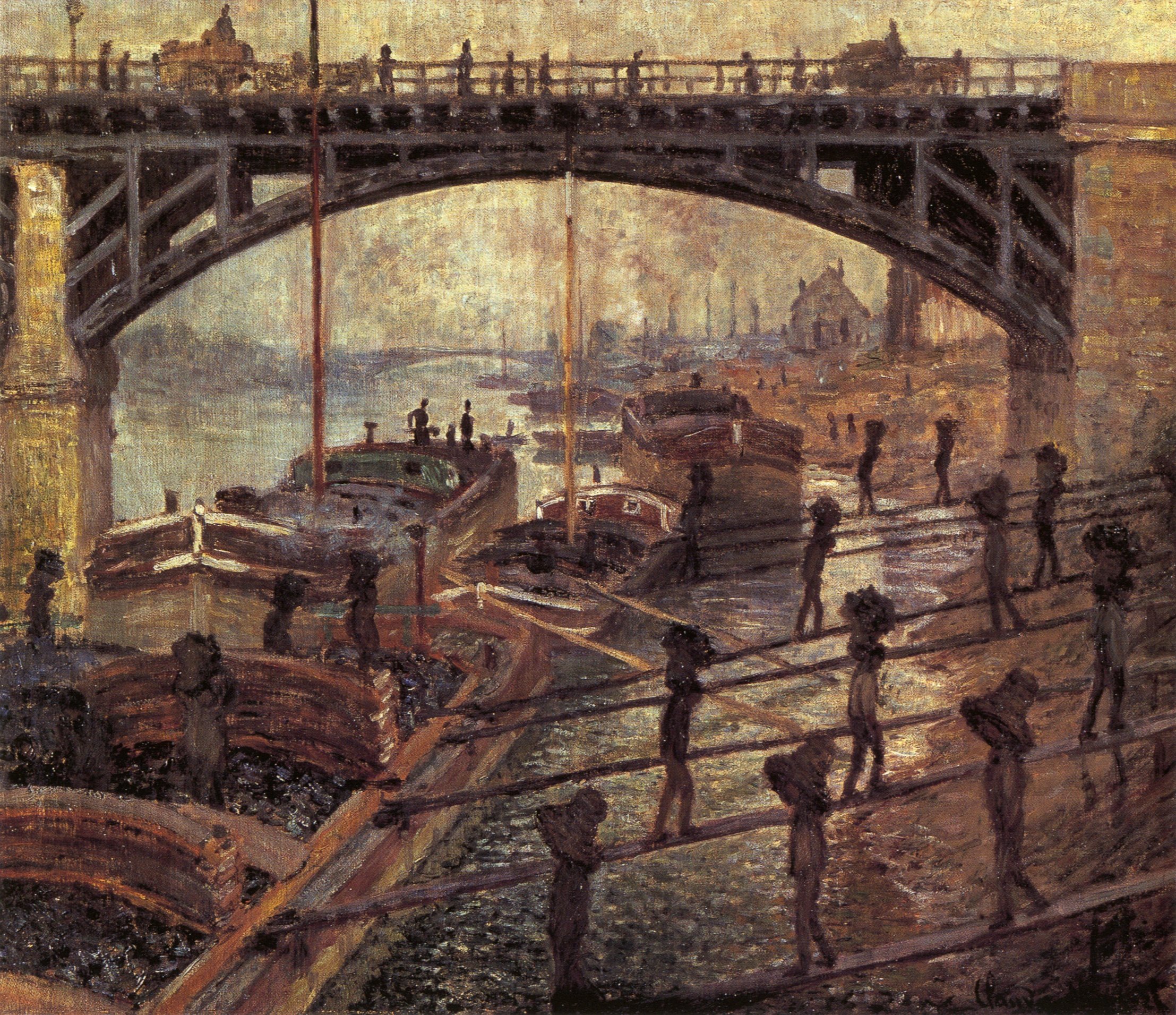
Les Charbonniers by Claude Monet

Les Charbonniers by Claude Monet (c.1875)

When I think of Impressionism and Impressionist paintings I think of light airy scenes.  I think of lily ponds and flowering arches at Givenchy.  I think of colourful young things boating on the mirror-like waters of the Seine.  I think of people sitting on the banks of the Seine staring out at blue cloudless skies.  I think of fashionable people promenading along the Grand Jatte in gorgeous sunlight.  I associate Impressionism and the paintings associated with that particular “–ism” as being light, colourful and full of smiling faces on the people as they relax from the rigours of their working lives.

That all changed when I came across the work of the Impressionist, Caillebotte and his Floor Scrapers (see August 3rd).  Today, I am featuring another darker and more sombre painting by one of the greatest Impressionist painters of all time, Claude Monet.  He painted today’s painting in 1875 when he was thirty five years old and living at Argenteuil.  It is entitled Les Charbonniers (The Coalmen) or sometimes referred to as Les déchargeurs de charbon (Men unloading coal).

Before us is a view of the docks at the Quai de Clichy, a little downriver from Paris.  Framed at the top of the painting in the background, we can just make out through the haze, the broad arch of the Pont de Clichy railway bridge, one which Monet would have crossed many times as he took the train from Argenteuil to Paris.   It is also a bridge which he featured in a number of his paintings.  Horses and carts can be seen crossing the nearer bridge, the Pont d’Asnières.  These carts will transport the coal from the quayside to nearby factories, the chimneys of which we can just make out in the distance as they pump out their smoky pollutants.   Also on the bridge we see a few pedestrians gazing down at the unloading operation.

It is a dark and atmospheric picture.  We do not have the brightness of a summer’s day.  It is a dull grey wintery day with a smoke-filled sky.  We see the men struggling with their heavy bags of coal perched on their shoulders as they struggle up the narrow wooden ramps between ship and quay over the murky waters of the Seine, balancing like tightrope walkers on a high wire.  The wooden walkways bend ominously under the strain of man and his load.  We can just imagine the ominous groaning and creaking of the wood as it takes the strain.  Hour upon hour these men will trudge mechanically back and forth until all the coal has been discharged from the boat.  This is a labour intensive operation.  Les charbonniers have an unenviable job with its physical strain on the body coupled with the inhalation of coal dust into their lungs.  In the holds of the vessel itself we see men filling baskets with coal ready for the charbonniers to take them ashore.  These men will probably not live to an old age.  Unfortunately for them, the invention of quayside cranes and cargo escalators had yet to be realised.  This discharge of the coal from the boat would be a long operation, as fully loaded, the coal barge could probably transport about 300 tons of coal, which could take anything up to two weeks to manually unload.

The sailing barge has probably brought its cargo of coal from the mines in Belgium and Northern France along the Canal de Saint-Quentin which connects the rivers Oise, Escaut and Somme.  The canal, a great feat of engineering, was opened by Napoleon Bonaparte in 1810.

The painting by Monet is simply a depiction of urban life and he might not have intended it as a political treatise with regards the conditions suffered by some working class people.  However the artist has given the painting a dark and solemn ambience which emphasizes the plight of some of the lowest paid workers.  This work was one of 29 works Monet presented in the fourth Impressionist exhibition.

The Bellelli Family by Edgar Degas

The Bellelli Family by Edgar Degas

Today, My Daily Art Display looks at a painting by a French Impressionist painter who, to me, is synonymous with paintings and sculptures of young ballet dancers.  His name is Edgar Degas who was actually born Hilaire-Germain Edgar De Gas in 1834.  He was in the forefront of the Impressionism movement although he preferred to be labelled as a realist painter.  He worked on today’s featured painting between 1858 and 1867.  It is entitled Family Portrait or The Bellelli Portrait and is a masterpiece of Degas’ youth.  It is a deeply insightful family portrait, in which we observe four people, two adults and two children who are the family Bellelli.

Degas had a traditional École des Beaux-arts education in Paris and in 1856 travelled to Italy to continue his studies and the following year visited his grandfather, Hilaire Degas, in Naples.  He also spent time in Rome where he set about copying the work of the Renaissance Masters.  In 1858 he received an invitation from his aunt, Laura Bellelli, née De Gas, to visit her and her family in Florence and at the same time to take the opportunity to study the paintings in the city’s prestigious gallery, the Uffizi.  He jumped at the chance and so went to stay with the family.  The head of the household was Laura’s husband, Gennaro, who had been a political journalist as well as a fervent supporter and good friend of Camillo Benso, Count of Cavour, a leading figure in the movement towards Italian Unification.  When in 1854 the revolution against the Austrians failed, Gennaro was forced to flee from Italy to escape persecution by the Austrians over his participation in the failed uprising.  He first went and lived in exile in Paris but later returned to Florence.

Degas did not get on well with Gennaro and only remained at their rented house until the arrival of his cousins who had remained in Naples following the death of Degas’ grandfather, Hilaire.  Degas’ could sense the tension between Gennaro and his aunt Laura who once she confided in Degas about her relationship with her husband and her uncertain future saying:

“…my husband is “immensely disagreeable and dishonest… Living with Gennaro, whose detestable nature you know and who has no serious occupation, shall soon lead me to the grave….”

Part of the problem was that this exile in Florence separated her from her family back in Naples and to make matters worse, Laura was once again pregnant.  It is thought that the constant tension between her and her husband led to the death of the child in infancy and this tragic loss only added to the bitterness between husband and wife.  It was with this lack of domestic happiness in mind that Degas started this family portrait.

Before us we see the four members of the Bellelli family, Gennaro, his wife Laura, the sister of Degas’ father, and their daughters Giulia and Giovanna.  It is known that Degas made many sketches of the family before returning to Paris to work on the painting.

We see Laura dressed in mourning for the recent death of her father, and Degas’ grandfather, Hilaire, and in the background we can see a framed portrait of him.  Looking closely at how Degas has depicted his aunt.  We see a very dignified woman with a very stern countenance.  She stands upright as if posing for an official picture.  She coldly averts her gaze away from her husband. Her right hand rests protectively on the shoulder of her elder and favourite daughter, Giovanna.   Degas’ two young cousins are depicted with their mother, and are also dressed in mourning, in their black dresses and white pinafores. Giulia half sits on a small chair at the centre of the painting, arms akimbo, as she looks towards her father and in some ways forms a link between the two estranged adults.  Degas was very taken with his cousins describing them:

“….The elder one was in fact a little beauty. The younger one, on the other hand, was smart as can be and kind as an angel. I am painting them in mourning dress and small white aprons, which suit them very well…I would like to express a certain natural grace together with a nobility that I don’t know how to define….”

Note how Degas has positioned the husband and wife far apart in the painting, which was probably an acknowledgement of the tension between the couple and how the two had drifted apart.  There is no feeling of togetherness about the family.    The father sits in an armchair at his desk next to the fireplace, where he had been reading or writing a letter.   He has his back to us but his head is turned towards his daughter.  He appears unmoved and uncaring, showing little interest in what is going on around him.    His body is framed by a mantelpiece on which we see an ornate clock, some plates and a candlestick.  Over the mantelpiece there hangs a large mirror and in the mirror we see reflections of the room which in some way open up the space and fills it with more light.  We see reflections in the mirror of a curtained window, a chandelier and a framed painting.

It is interesting to look at how Degas has seemed to separate the husband from the rest of the family by a vertical separation formed by the leg of the table, the candlestick and the vertical side of the fireplace and mirror.   Just behind his chair, on the floor, we catch a glimpse of the family’s pet dog.  The drawing which we can see hanging on the wall behind Laura is a portrait of the recently deceased Hilaire Degas, which his grandson had drawn.  It is more than likely that Degas positioned this small picture where he did so as to give a sense of connection between the various generations of the Degas family.

Laura must have been appalled that Degas had to stay in a household, which exuded such unhappiness.   It is believed that Laura married Gennaro in desperation because her father had not been satisfied with any of her previous suitors and she was still unmarried at the “ripe old age” of 28.   She was extremely unhappy in her marriage and once shared her misgivings with Degas.   According to the American biographer and art historian, Theodore Reff, who wrote about a letter from Laura to her nephew, in his book , Degas: The Artist’s Mind .   In the letter she wrote:

 “…You must be very happy to be with your family again, instead of being in the presence of a sad face like mine and a disagreeable one like my husband’s…”

 It is thought that this family portrait was not to be a gift to the family but a work of art which he wanted to exhibit at the Paris Salon.  Whether he ever did that is uncertain but many believe he put it forward for exhibition at the Salon in 1867.  Degas kept hold of the painting until 1913 when he gave it to his art dealer, Paul Durand-Ruel, for him to sell.  In 1918 it was sold to the Musée du Luxembourg, Paris  and later the painting was moved to the newly opened Musée d’Orsay where it can now be found.

One should remember that this is not a photograph in which one can detect the mood of the sitters.  This is a painting by an artist who has the ability to paint the demeanour of his sitters in whatever way he chooses.  So this painting is how Degas views the family life of the Bellelli family.  How close it is to realism is known only by Degas and the Bellelli family.  So it is up to you  to decide whether Laura was a stern and disillusioned matriarch and whether Gennaro was the disinterested and curmudgeonly.

The Floor-scrapers by Gustave Caillebotte

The Floor Scrapers by Gustave Caillebotte (1875)

Although I am sure people love to see the paintings of the so-called “Masters”, I believe it is good to look at the works of lesser known artists and by doing so, one can discover hidden gems.  After Renoir’s famous painting Luncheon of the Boating Party,which I featured yesterday,  I decided today that I would look for a painter, who until yesterday had been unknown to me.  However, I do understand that this may be due to my simple lack of artistic knowledge and in fact the artist is well known to you, if so, I apologise!

It is often the case that when I am researching a painting I come across another artist, whom I have never heard of, and that is the reason for my choice of artist today.  Amongst the guests at Renoir’s luncheon was his friend and lesser known Impressionist, Gustave Caillebotte and I decided to make him my artist of the day and I want to look at his unusual painting entitled Les raboteurs de parquet [The Floor Planers].

Caillebotte was born in Paris in 1848 and brought up in a very respectable and very wealthy upper-class family environment.  His father, Martial had inherited the family textile business.  Martial Caillebotte had been widowed twice before he met and married Gustave’s mother, Céleste.  When Gustave was eighteen his father moved the family home from Paris to the town of Yerres, a south-eastern suburb of Paris on the Yerres River,  an area which was familiar to the family as they had spent many summers there.

Gustave studied law when he was twenty years old and passed all his exams two years later. That year, he was drafted into army to fight in the Franco-Prussian War.  It was after the war and on leaving military service that Gustave wanted to concentrate on art and study painting.  He set up an artist’s studio in the family home and in 1873 he entered the École des Beaux-Arts in Paris.  The following year his father died and in 1878 his mother passed away, at which time the three brothers shared the family fortune.  It was also around this time that Gustave met and became friends with Edgar Degas and came into contact with the Impressionists, a group of artists who had rebelled against Academicism art and academic painters, whose works were exhibited in the Paris Salon.  This group of artists had their own Impressionist exhibitions, the first of which was held in 1874.

In 1876 the Impressionists held their second exhibition and Caillebotte exhibited eight of his paintings including today’s featured work, The Floor Scrapers, which he completed in 1875.  The style of this work belongs to the Realism genre but unfortunately for Gustave the art establishment only considered peasants and farmers from the countryside as acceptable subjects in works of art which highlighted the realism of working-class life.

The Floor-scrapers, sometimes known as The Floor-strippers  was painted in the artist’s family home.  It is a painting which depicts working class people hard at work and although that in itself was not an unusual subject for French paintings as it had been done many times before but the difference was that in previous French paintings, the depiction of the hardships of the working class was all about working class farmers or country peasants.  This painting depicts the urban working class and as such it was one of the first such representations.  Caillebotte presented his painting for the exhibition at the Paris Salon in 1875 but it was rejected.  The Jury of the Salon were shocked by its crude realism and some went so far as to describe it as being vulgar and offensive.  The artist was both disappointed and angered by their stance and decided that exhibiting his works at the Paris Salon was not going to be the future course for his paintings.  Instead, he decided to align himself with another group of French artists, who like him, were disillusioned by the narrow views of the academics and had formed themselves into their own artistic group – the Impressionists.

The work of art today is simply a painting depicting men hard at work.  Here we see three men stripping the varnish off the floor of the artist’s new apartment.  There is neither a moralising message nor is there a left wing political message.  Caillebotte is merely showing the men hard at work carrying out a strenuous task.  This is why the artist was looked upon as one of the most gifted French realist painters of his time.  Look how Caillebotte has depicted the musculature of the upper body of his three workers as they perform their back-breaking task on their hands and knees.  See how the artist has made the light of the late afternoon streams through the long balcony window and illuminate their backs.   It harks back to the heroes we saw centuries earlier when we looked at the paintings of the heroes of Antiquity. France, like Britain, had just gone through an Industrial Revolution and with urbanization came a new social class which was termed la classe ouvrière or working class and it was in complete contrast to the bourgeoisie.  The hard working men we see in Caillebotte’s painting may have been brought up in the countryside and therefore they were used to exhausting and strenuous work and had moved to the city to seek their fortunes.

At the time of this painting, France was in its Second Empire stage and Paris was undergoing massive change under the Haussmann’s Renovation of Paris which was the great modernisation plan for the city which had been commissioned by Napoleon III.  The project encompassed all aspects of urban planning, both in the centre of Paris and in the surrounding districts: streets and boulevards, regulations imposed on facades of buildings, public parks, sewers and water works, city facilities, and public monuments. The planning was influenced by many factors, not the least of which was the city’s history of street revolutions.  This was a time of great change and in a way Caillebotte wanted to change art and what had been previously unacceptable, he wanted to be accepted but he was a little ahead of his time as far as this painting was concerned.  There is a great contrast in colours used in the painting from the light blue walls to the dark browns of the floor and the men’s clothes.   I note that a bottle of wine and a glass has been added – a French prerequisite to help with a day’s work !

Luncheon of the Boating Party by Pierre-Auguste Renoir

Luncheon of the Boating Party by Auguste Renoir (1881)

My Daily Art Display today features one of the best known Impressionist paintings.  It is Luncheon of the Boating Party by Renoir which he painted in 1881.  Although I would rank Impressionism outside my top three favourite art genres, I was fascinated by this painting and the story behind it.

Maison Fournaise (c.1890)

I suppose firstly I should examine the setting for the painting, which is the balcony at the Maison Fournaise.  This building is situated on the ÎlIe de Chatou, an island situated across from the small town of Chatou, which is situated on the right bank of the Seine.   Boating on the Seine became a very popular form of recreation in the middle of the eighteenth century and whereas Argenteuil, a little way upstream from Chatou, where the Seine is wider and with its more prevalent winds, attracted sailors, the Îlle de Chatou was the ideal spot for rowers.  Alphonse Fournier, who was a river toll collector and a part-time boat carpenter, set up his boat building workshop along with his boat rental business in 1857.  Alphonse also used to organise boat regattas and water festivals.   At the same time, his wife, an accomplished cook, opened a restaurant next door.  This restaurant, combined with the boat rental facility and its many organised boating events, was a very popular family-run business.   Their daughter Louise-Alphonsine, who became a popular and well-known artist’s model, greeted the clients whilst their son Jules-Alphonse charmed the ladies and assisted them into the boats.  Artists visiting Maison Fournaise were never short of potential models for as Renoir wrote:

“…..I was constantly spending my time chez Fournaise-there I found as many beautiful girls as one could ever wish to paint!…..”

The Island of Chatou had other thing going for it.  Rail travel allowed Parisians easy access to this area in the countryside.  If you look carefully under the awning you can just make out, at the top left, the blue-gray outline of the Chatou railroad bridge, part of the government’s recently completed transportation projects that had made access to this riverside destination possible to everybody, not just to the members of the upper class.

La Maison Fournaise, today.

The setting also radiated   peace and tranquillity along with its ideal light conditions and proved a haven for artists with the likes of Claude Monet, Alfred Sisley, Berte Morisot, Edouart Manet and Camille Pissaro often visiting the location.   Auguste Renoir was also a regular caller and he once described his love of the establishment in a letter to friend:

“…You could find me anytime at Fournaise’s. There, I was fortunate enough to find as many splendid creatures as I could possibly desire to paint……….. I can’t leave Chatou, because my painting is not finished yet. It would be nice of you to come down here and have lunch with me. You won’t regret the trip, I assure you. There isn’t a lovelier place in all Paris surroundings….

The Fournaises’ two businesses flourished until 1906 when Madame Fournaise closed the restaurant and four years later Alphonse Fournaise wound down his boat rental enterprise.  Then, unfortunately, over the years,  the deserted premises started to fall into disrepair.  Madame Fournaise died in 1937.  By the 1970’s the buildings were at the point of complete dereliction.  However in 1977 the town of Chatou bought the building and five years later it listed it as a building of historic significance, joining the register of Les Monuments Historiques and restoration work began with the support from The Friends of Maison Fournaise and The Friends of French Art.   Currently the building is a museum, La Fournaise Museum, and in 1990 a restaurant reopened on the premises

So now we know the setting for the painting let me introduce you to some of the people featured in this wonderful painting.  As in a number of Renoir’s paintings, he liked to include portraits of his friends.

The Participants
  1.  Aline Charigot, seen holding a dog, was a seamstress and part time model for Renoir.  Aged twenty-seven at the time of the painting met Renoir in 1880 and they were married in 1890, despite a thirteen year age difference.  The couple had three children, Pierre, Jean (who became the well-known filmmaker) and Claude.  Despite being much younger than Renoir she died four years before him in 1915, aged 61 and was buried in the churchyard at Essoyes in the Champagne-Ardennes region of France which was her childhood home.  Renoir who died a few months before his seventy-ninth, in Cagnes, was laid to rest alongside his beloved wife.
  2. Jules-Alphonse Fournaise, wearing a straw boater and sportsman’s T shirt leans against the balustrade.  He was the son of the owner of Maison Fournaise and was in charge of the boat rentals.
  3. Louise-Alphonsine Fournaise, leaning against the balustrade is the daughter of the owner of the establishment and a war widow.
  4. Baron Raoul Barbier, sporting a brown bowler hat, has his back to us as he engages the proprietor’s daughter in conversation.  Formerly a cavalry officer and war hero later became mayor of colonial Saigon.  The two loves in his life were women and horse racing.
  5. Jules Laforgue, a Symbolist poet, journalist on the La Vie Moderne newspaper and private secretary to Charles Ephrussi (No.8)
  6. Ellen Andrée, seen drinking from her glass. Aged 24 at the time of the painting, she was a Parisian actress and mime at the Folies Bergère and sometime artist’s model for Renoir, Manet and Degas (See My Daily Art Display June 7th where the actress has modeled for the Degas painting).
  7. Angèle Leault, some time Parisian actress and singer and also a market flower seller.
  8. Charles Ephrussi, wearing a top hat and in conversation with his secretary.  Russian-born Ephrussi was a wealthy art collector and historian as well as being editor of the prestigious art magazine, Gazette des Beaux-Arts.  He was a great supporter of the Impressionist painters.
  9. Gustave Caillebotte, in the right foreground with a cigarette in his hand.  He was a good friend of Renoir and a well-known painter in his own right.  He was a collector of Impressionist paintings and also one of Renoir’s wealthy patrons.  Renoir’s prominent positioning of Caillebotte was not accidental but was a measure of his importance to Renoir.  He lived in a house overlooking the Seine, not far from Chatou.  Caillebotte  was trained as an engineer, built boats and was a great sportsman.  This maybe accounts for Renoir’s youthful portrayal of him (he was 33 at the time of the painting) in his boating attire, consisting of a sleeveless white T shirt and blue flannel pants.  On his head is a flat-topped straw hat around which a blue ribbon is tied.  This indicates that Caillebotte was a member of the privileged Cercle Nautique de la Voile boating club.  He was godfather to Renoir’s eldest son, Pierre.
  10. Adrien Maggiolo , Italian journalist on Le Triboulet newspaper.
  11.  Eugène-Pierre Lestringuez, official at the Ministry of the Interior and close friend of Renoir who often modeled for his paintings.
  12.  Paul Lhote, wearing a straw hat in conversation with Lestringuez and the actress Jeanne Samary.  He was a writer of short fiction and a journalist and close friend of Renoir.
  13.  Jeanne Samary, holding her black-gloved hands to her ears.  Actress at the Coméie-Francais in Paris.

With this group of people we can see that Renoir was illustrating the nature of Maison Fournaise which welcomed customers from a variety of social backgrounds from the wealthy aristocrats to the humble actors.   With the new rail system in place along with the shortened working week, everyone, no matter what their occupation, was able to escape the city and enjoy the pleasures of the Parisian suburbs at the weekends.  The forty year old artist in producing this large masterpiece depicted the modern life of Parisians as they relaxed.  Renoir’s painting captures the idyllic atmosphere as his friends wine and dine on the riverside terrace.  Renoir gathered most of the participants in the painting together early on so that he could organize the composition.  Later he worked on the individual figures as and when they were able to model for him.  It was a grueling time for the artist and Renoir felt the pressure on him to complete the work.  He had a love-hate relationship with the work commenting once:

“… I no longer know where I am with it, except that it is annoying me more and more….”

He made many changes to the work before he was completely satisfied. The final result was a veritable gem of Impressionism.

La Lecture, Deux Femmes aux Corsages Rouge et Rose by Renoir

La Lecture, Deux Femmes aux Corsages Rouge et Rose by Renoir (1918)

My Daily Art Display for today is a painting by the French Impressionist painter Pierre- August Renoir.  He was born in Limoges, France in 1841.  He came from a working class family.  His father Léonard was a tailor and his mother Marguerite was a dressmaker.  At the age of 14 he was apprenticed to a M. Levy a porcelain-painter and he worked in the local porcelain factory.  His ability to draw was soon noted and he was soon working in the department which painted designs on the finished fine china.   At the age of twenty one he began studying art in Paris where he met Alfred Sisley and Claude Monet.  He led a very frugal existence at this time and often could not afford to buy the paints he needed for his art work.  Renoir was twenty three years of age when he exhibited his first paintings at the Paris Salon.  His works were greeted with much acclaim at the first Impressionist exhibition in 1874

In 1881 Renoir set off on his travels visiting Algeria, Spain and Italy.  In Italy he visited Florence and Rome and saw the works of the great Masters, such as Titian and Raphael.  In the summer of 1883 Renoir spent the summer in Guernsey, with all its varied landscapes with its beeches, cliffs, bays, forests and mountains.  Whilst there, he created fifteen paintings of the island.  From there he moved back to mainland France and for a time settled down in the Montmartre district of Paris and it was whilst here that he met Suzanne Valadon who modeled for some of his paintings including The Bathers and Dance at Bougival.  Valadon also was a model for Toulouse-Lautrec before becoming a noted painter herself.

In 1890 Renoir married his lover, Aline Victorine Charigot, a model he had used in his painting Luncheon of the Boating Party and with whom he had already had a son, Pierre five years earlier.  His wife and children featured in many of his paintings as did their nursemaid Gabrielle Renard who as well as carrying out her domestic duties, often modeled for Renoir.

In 1907 due to the fact that he suffered badly from rheumatoid arthritis and to try and alleviate the symptoms he moved to the Cagnes-sur-Mer in the south of France.  Despite his arthritis he continued to paint until his death in 1919 at the age of 78, five years after the death of his wife Aline.

My Daily Art Display today is Renoir’s painting La Lecture, Deux Femmes aux Corsages Rouge et Rose which he completed in 1918 a year before he died.  This was by far his most successful of his large scale works.  It is a tender and harmonious portrait of two women as they sit serenely, completely absorbed in the words of a book they are reading.  They seem totally oblivious to what is happening around them, even unmindful of the artist himself.  The dark haired lady on the right is thought to be the erstwhile long serving maid Gabrielle Renard who had left the family five years earlier after looking after them for nineteen years.   The woman on the left maybe Andrée Heuschling, who was introduced to Renoir by Matisse, and who later married Renoir’s son, the film maker, Jean.

Finally, I will leave you with the words Théodore Duret, the French journalist, author and art critic,  who wrote of Renoir in his book,  Histoire des peintres impressionnistes:

“Renoir excels at portraits.  Not only does he catch the external features, but through them he pinpoints the model’s character and inner self.  I doubt whether any painter has ever interpreted women in a more seductive manner.  The deft and lively touches of Renoir’s brush are charming, supple and unrestrained, making flesh transparent and tinting the cheeks and lips with a perfect living hue.  Renoir’s women are enchantresses”

Paul Helleu Sketching with his Wife by John Singer Sargent

Paul Helleu Sketching with his Wife by John Singer Sargent (1894)

My Daily Art Display today is a tale of two artists who were very close friends.  One is the great American Impressionist John Singer Sargent, the other is the French painter Paul César Helleu.  Today’s work of art is a picture by the American artist Sargent of the French painter Paul César Helleu and his wife Alice Guérin.

John Singer Sargent was to become a leading portrait painter of his era.  His family were extremely wealthy, his father, Fitz William, being an eye surgeon in Philadelphia.  Sadly Sargent’s mother, Mary (née Singer) suffered a nervous breakdown after the death of her daughter and to aid her recovery her husband decided that his wife and their family should go to Europe to allow Mary to convalesce. 

Whilst in Europe, they travelled extensively.  John Singer Sargent was born in 1856 whilst his parents lived in Florence and his sister Mary was born there a year later.  After much discussion and to please his wife John’s father reluctantly relinquished his post at the Philadelphia hospital and remained in Italy were they led an unassuming lifestyle relying on a small inheritance and what savings they had managed to accrue. 

John Singer Sargent proved to be a rebellious child who would not take to formal schooling and so was taught by his parents.  His mother was a good amateur artist and she soon got John interested in that subject.  His parents must have provided him with a good education as by his late teens he was fluent in French, Italian and German and accomplished in art, music and literature.  No doubt the extensive travelling of European countries by the family improved his education.

In 1876, at the age of eighteen, Sargent passed the entrance exam to the École des Beaux-Arts in Paris.  Here he studied anatomy and perspective and spent time in the Paris museums copying the works of art of the masters.  It was whilst studying at the Art Academy that he met and became close friends with a young French artist, four years his junior, Paul César Helleu.  Whereas Sargent was having success with the sale of his paintings and was having no trouble in securing commissions, Helleu was becoming very despondent and disheartened, finding sales of his works difficult to come by and he was struggling to make needs meet.  Sargent, on hearing that Helleu was at the point of giving up his career as an artist, visited his friend on the pretext of looking at the young Frenchman’s work.  He congratulated his friend on the standard of his work and asked to buy one.  Helleu was delighted but told Sargent he must have the painting of his choice as a gift as it was not right to charge his friend.  Sargent replied to this offer saying:

 “I shall gladly accept, Helleu, but not as a gift. I sell my own pictures, and I know what they cost me by the time they are out of my hand. I should never enjoy this pastel if I hadn’t paid you a fair and honest price for it.”

He gave his friend a thousand-franc note for the painting.  Can you imagine how Helleu felt on receiving such a large sum of money for one of his paintings ?

In 1884 Sargent painted the portrait of Madame Pierre Gautreau, entitled Madame X, wearing a very risqué off the shoulder gown.  It was also shockingly low-cut.  Her mother asked him to withdraw the painting but he refused.  Although, now it is acclaimed as his best work of art, it scandalised Paris society and he was widely criticised in Paris art circles for being improper.  Sargent found the criticism unjustified and at the age of 28 he left Paris disillusioned by the incident and the fall off of sales of his paintings and moved to London where he remained for the rest of his life England.  He died there in 1925, aged 71.

My Daily Art Display painting today is entitled Paul Helleu Sketching with his Wife which he completed in 1889 and is in the Brooklyn Museum, New York.  It is difficult to put a name on Sargent’s genre of painting.   He was a prolific painter, painting over 2000 watercolours.  He was a very successful portraitist but labelled portraiture as “a pimp’s profession” and in 1907 he announced that he would paint “no more mugs” and with a few exceptions kept to his word.   He loved to paint landscape watercolours.  Today’s painting of his is very much in the characteristic style of Impressionism.

Child in a Straw Hat by Mary Cassatt

Child in a Straw Hat by Mary Cassatt (1886)

Today my painting for My Daily Art Display is a work of art by the American artist Mary Cassatt.   She was born in Allegheny City, Pennsylvania, which is now part of Pittsburgh, in 1844 and was the fourth of seven children, two of whom died in infancy.  She came from a wealthy family.  Her father, Robert, was a wealthy stockbroker and land speculator and her mother, Katherine, came from a banking family.   She and her family moved from America to Europe when she was seven years of age, where they travelled from country to country before returning back to America.  This European “adventure” was looked upon, by the affluent, as an aid to a good education and offered an understanding of different cultures

Mary decided that a life as an artist was for her but her parents disapproved.  However she was, even at this young age, very headstrong and wasn’t to be discouraged and at the  age of fifteen studied art at the Pennsylvania Academy of the Fine Arts in Philadelphia.  She became disillusioned with the Academy and the way budding female artists were treated and despite her father’s disapproval and his many objections, which she finally overcame, in 1866 she travelled to Paris, initially chaperoned by her mother and some family friends.  Whilst in Paris she met and was taught by Camille Pissarro, the great French Impressionist painter.  She was a great admirer of the works of Edgar Degas whom she met and became great friends with.  He was to have considerable influence on her life and her art work.  As time went on the Impressionist movement in Paris benefited greatly from Cassatt who helped them both financially and by facilitating them getting their works of art recognised and accepted in American museums and galleries.

Cassatt’s family never believed that their daughter would stay long in Paris and were surprised by her determination to succeed in the French capital.  Her sister Lydia, who Mary said was not just a sister but her best friend, joined her in France in 1874, so as to be company for her.   Three years later her parents moved to Paris.   Lydia Cassatt, as well as being very close to Mary, was also the model for many of Mary Cassatt’s most famous paintings.  Sadly after long bouts of illness Lydia died in 1882.  This had a devastating effect on Mary who for a time stopped painting. 

Mary Cassatt was an outspoken individual who was never backward in coming forward with her opinions.  Some say she was too outspoken.  However, being wealthy allowed her to be independent and she did not need to suffer fools.  Her independent attitude and her frankness, which on occasions was considered insulting, became more noticeable as she grew older.   She was highly critical of the modern artists such as Picasso and Matisse and even some of her Impressionist colleagues received her unbridled censure.  

Mary was a prolific and a well respected artist on both sides of the Atlantic and her works of art when they come up for sale now realise millions of dollars.  Like her friend and mentor Edgar Degas she suffered with failing eyesight and when she died in 1926, aged 82 she was blind.

Mary Cassatt’s place in the history of American art is unique, not only because she was one of the few woman artists of any nationality to succeed professionally in her time, but also because she was the only American artist to exhibit with the French Impressionists.

My Daily Art Display today is a painting completed in 1886 by Mary Cassatt entitled Child in a Straw Hat.  Mary Cassatt’s favourite subjects became children and women with children in ordinary scenes. Her paintings express a deep tenderness and her own love for children. But she never had children of her own.  Cassatt was fond of painting young girls in large elaborate hats and bonnets wearing frilly dresses.  However in this painting the girl wears a simple plain gray pinafore and her hat, albeit very large, is a simple straw one.  The child, with a furrowed brow, doesn’t look too pleased and has a sullen and slightly glum look on her face.  There is an air of impatience in her expression and maybe this is due to having to pose for the artist when she would rather have been out playing.

The Red Roofs by Camille Pissarro (1877)

The Red Roofs by Camille Pissaro (1877)

Camille Pissarro, the Impressionist painter of French descent, was born in 1830 on the island of St Thomas in the Danish West Indies.  At the age of twelve he went to Europe where he attended a Paris boarding school.  During his time in Paris he studied at various academic institutions including the École des Beaux Arts and Académie Suisse and under a succession of masters such as Corot and Courbet.  In the 1860’s he, along with Monet, became involved in the Impressionist Movement and spent most of his time painting urban and rural pictures which illustrated French life of that era, particularly in the area around Pontoise.  Pissarro died in Paris in November 1903 and was buried in Père Lachaise Cemetery, Paris.

Painted in 1877, today’s painting is entitled The Red Roofs and is a small (55 x 85cms) oil on canvas picture which hangs in the Musée d’Orsay.  The location for this painting is a group of farm buildings called La Côte des Boeufs, near Pontoise.   The painting is complicated by the fact that the artist wanted to show the buildings as seen through the trees but the screen of trees makes us look quickly beyond the trees, into the heart of the painting, and by doing so one can differentiate the many layers of colour.

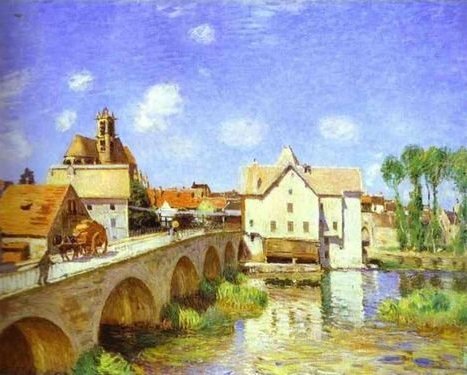
The Bridge at Moret by Alfred Sisley (1893)

The Bridge at Moret by Alfred Sisley (1893)

Alfred Sisley, born in Paris to English parents in1839, was sometimes called the “Forgotten Impressionist”.  At the age of 18 his father, a silk trader, sent him to London to study business but life as a business man similar to that of his father was not for him and he soon moved back to Paris.  His family supported him in his ambition to become an artist and sent him to Gleyre’s studio where he met and worked alongside Monet and Renoir.  In 1867 he became a pupil of Corot and a number of Sisley’s works reflect that tutelage with the way in which he has a passionate interest in the sky which became a dominate facet of his paintings

He still rates as one of the greatest Impressionists who ever lived and was regarded as an exceptional en plein air (outdoor) landscape painter.  Landscape painting was his favourite genre and he rarely attempted portraits.  Similar to another great English landscape artist John Constable, Sisley liked just to concentrate on painting places he knew well such as the Seine and Thames valleys.

The painting on display to today is one of his later works, The Bridge at Moret, which he completed in 1893 and is now exhibited in the Musee d’Orsay.   Alfred Sisley died in Moret-sur-Loing at the age of 59,  just a few months after the death of his wife.   Moret-sur-Loing  is a small and charming historical town in the Seine-et-Marne department of north central France and which  was a source of inspiration for Monet, Renoir and Sisley.