The Entry of Emperor Rudolf of Habsburg into Basle,1273 by Franz Pforr

The Entry of Emperor Rudolf of Habsburg into Basle, 1273 by Franz Pforr (1809)

In my last blog I looked at a painting by Johann Friedrich Overbeck entitled The Painter Franz Pforr, which was a friendship portrait he did of his good friend and fellow Nazarene, Franz Pforr.  Today I am switching my attention to Franz Pforr himself and looking at one of his most famous works.

Franz Pforr was born in Frankfurt am Main in 1788, a year before the birth of Friedrich Overbeck.  He came from an artistic background with his father, Johann Georg Pforr, who had started his working life as a miner but due to a serious accident in the mines turned his attention to art and originally worked as a porcelain painter before concentrating his efforts as a landscape artist and skilled painter of horses.  Franz Pforr’s uncle, Johann Heinrich Tischbein the Younger, a great friend of the writer Goethe, was part of the great Tischbein artistic dynasty and an art professor at the Kassel Academy of Art.

Franz Pforr received his initial art tuition from his father an uncle before, like Overbeck, attending the Akademie der Bildenden Künste in Vienna (Vienna Academy of Fine Arts) in 1805.  During the war between Austrian and France in 1805, Pforr volunteered as a guard in the Viennese militia.   The conflict affected the young artist’s health and he suffered a nervous breakdown, and would suffer from bouts of depression for the rest of his life.  It was probably during these mental upheavals that Pforr turned to religion using it as a crutch to see him through his mental torment.   In 1806 he returned to the Academy and resumed his academic studies and for a time saw himself as war artist, recording famous battles on canvas.

The Academy director at the time was Heinrich Füger who believed the art course should concentrate on the Neo-Classicisal style of painting.  Pforr, like Overbeck, was very disillusioned with the Academy’s artistic tuition and its lack of spirituality and so, in response to this, the two twenty year-old aspiring artists formed the Lucasbund, or Brotherhood of St. Luke (St Luke was the traditional patron saint of artists), deliberately recalling the guilds and the trade organizations of the late Middle Ages.   When Napoleon Bonaparte’s troops entered the city in 1809 the Academy was closed down.  The following year, 1810, along with Overbeck, Ludwig Vogel and Johann Hottinger, members of their Lucasbund, Franz Pforr moved to Rome and set up home at the deserted Sant’ Isidoro monastery.  They began to wear their hair long, and wore anachronistic medieval monk-like habits. The members of the group took vows of poverty and chastity almost as if they saw their group not simply as an artistic association but a religious one.   They still referred to themselves as the Brotherhood of Saint Luke but because of the way they look and acted most everyone else called them the “Nazarenes”.  The agenda of the Nazarenes was to reject the whole legacy of Baroque and Neoclassical art that was the dominating art of the day.  These young German artists sought inspiration in Italian painters of the early Renaissance, such as Raphael Sanzio as well as the German art of Albrecht Dürer who were to be their artistic benchmarks. Most of all they wanted their art to have a sense of spirituality.  They wanted it to be more honest, truthful, and sincere art similar to that of the late Middle Ages and Early Renaissance.  The subjects of their works of art were dominated by religious themes.

The Nazarenes disbanded in 1820 but for Franz Pforr his life with the group ended eight years earlier as he contracted tuberculosis and died in Albano Laziale, a suburb of Rome, in 1812.

The artwork of Franz Pforr calls to mind a sort of fairy-tale medievalism, awash with bright colours and picturesque details.  This can be seen in today’s featured painting by Pforr which he completed before he travelled to Rome, entitled The Entry of Emperor Rudolf of Habsburg into Basle, 1273.

This large medieval subject is consciously painted in a historical manner.  The subject of the painting is the entry into Basle of Rudolf of Habsburg and it is a pictorial tale of German pride and the country’s defiance of Napoleon Bonaparte.  Rudolf, who had inherited his father’s estates in the Alsace region, had also forcefully taken possession of the cities of Strasbourg and Basle and vast tracts of land in the western part of Switzerland.  It was in 1273, as he was laying siege to the Swiss city of Basle, that he heard that he had been elected to become the new German king by the prince-electors of the Holy Roman Empire,.  He would be crowned Rudolph I in Aachen cathedral in October of that year.    If we look to the horseback rider just left of centre we can see the black double-headed Habsburg eagle emblazoned on the back of his gold-coloured jacket.  The inclusion of this Habsburg eagle was thought to be Franz Pforr’s idea of defiance against Napoleon Bonaparte, who had been at war with the Germans and had occupied Pforr’s home town, Frankfurt in 1805.   Pforr was also affected again by Napoleon Bonaparte in May 1809 for he was a student at the Vienna Academy when Napoleon entered and occupied the city and the art establishment was closed down.

Self portrait of Franz Pforr

Another interesting aspect of Pforr’s painting is the way he has included himself in the scene as part of Rudolph’s entourage.  We see him on horseback riding some way behind the king.  He is the young man, wearing a black beret, and has turned in the saddle and is looking his over his shoulder at something happening at the rear of the procession.  In Cordula Grewe’s 2009 book entitled Painting the Sacred in the Age of Romaniticism she writes about how the Nazarene artists would often identify with their subjects and by doing so somehow identify with their own situation.  She goes on to talk about the interpretation of Pforr’s inclusion of himself saying:

“…Pforr’s mixture reflects the Nazarenes’ general obsession with temporality, as it serves to fold biblical into post-biblical time and, further differentiating the play of temporalities, to forge a link between medieval past and actual present. Pforr’s self-portrait marks the intersection of these various time axes.  His horse carries him forward in Rudolf’s wake… on his way towards the procession’s final destination, the town’s medieval cathedral.   Yet, while Pforr’s body moves towards a moment of historical completion, his gaze disengages with this view into the glorified but lost past of perfect piety.  As the only figure looking backwards, he gazes towards the right, fixing his eyes upon a point beyond the picture frame.  Pforr looks into the future.  In him, the picture’s two central aspects converge: his gaze unites the insight into God’s order (typology) with an understanding of the moral lessons that can be learned from history (a history past and yet available through the archetype)…”

Before us we see flattened perspectives.  The figures in the painting, in some ways, look uncoordinated often with head and shoulders portrayed at impossible and unrealistic angles.  There is almost a child-like innocence about the painting.   It is indeed a colourful painting but the colours are of a slightly muted and weak nature as was the case in many of the Nazarene works of art.   There is not the vibrancy and brightness of the colours used by the artists of the English nineteenth century Pre-Raphaelite movement, which was greatly influenced by the art of the Nazarenes.

Der Maler Pforr (The Painter Franz Pforr) by Johann Friedrich Overbeck.

Der Maler Pforr (The Painter Franz Pforr)
by Johann Friedrich Overbeck.

On a number of occasions whilst talking about the life of a nineteenth century  artist I have recounted how they had been in Rome to further their artistic careers and had come across a group of German artists known as the Nazarenes.   Today I am featuring one of the leading members of this group, the German painter, Johann Friedrich Overbeck.

Overbeck was born in Lubeck in 1789.  He was brought up in a very religious and also a very wealthy household.  His ancestors for three generations had been Protestant pastors.  His parents were Elisabeth Lang and Christian Adolph Overbeck, who was a doctor of law, and who was also a Lubeck senator.  In 1814 he actually became the burgomaster (mayor)of his home town.  Johann Oberbeck’s early schooling was at the nearby grammar school where his uncle was the master.  Overbeck studied the classics and received artistic tuition whilst attending this school.  At the age of seventeen, having completed his schooling, Overbeck left his home town and went to Vienna where he enrolled at the Academy of Fine Arts, which at the time was run by German portraitist and historical painter, Heinrich Füger.

Overbeck had mixed emotions about the training he received at the Academy.   Although he received tuition in the technique of neoclassical art, he was disturbed by the themes of the paintings which had been chosen by his tutors.  Overbeck had been brought up in a strict religious household and he felt that at the Academy there was a total lack of religious spirituality in the subjects he was asked to paint.  In a letter to a friend he commented that he had fallen among a vulgar set and that every noble thought was suppressed within the academy and that he, losing all faith in humanity, had turned inward to his faith for inspiration.   In a letter to his father about the tuition, the nineteen year old Overbeck wrote:

“…You get to paint an excellent drape, draw a correct figure, learning perspective, architecture, everything short – and yet comes out not a real painter. Lack one thing … heart, soul and emotion …“

Later he wrote about his disappointment with the lack of spirituality in the artistic training at the Academy and how he envisaged his future plans:

“…Oh! I was full of it; my whole fancy was possessed by Madonnas and Christs, but nowhere could I find response…………..I will abide by the Bible; I elect it as my standing-point…”

Overbeck, with his strong religious beliefs, believed that at this time in Europe, Christian art was in decline, and it was this very belief which was to shape his future artistic career.  Overbeck continued at the Academie until 1809 but he constantly found it ever more difficult to accept the situation and became more vociferous in his condemnation of the artistic tuition offered by the establishment and soon the situation became irreconcilable.  Whilst at the Academie he became close friends with Franz Pforr and together with Ludwig Vogel, Joseph Wintergerst, Joseph Sutter and Konrad Hottinger, all of who were similarly disillusioned with the artistic teaching at the Academie, they decided to take matters into their own hands.   In June 1809 they formed an art association which they called the Brotherhood of St. Luke or Lukasbrüder.  The decision as to whether to remain at the Academy was taken out of Overbeck’s hands as in 1809 Vienna was occupied by French troops and the artistic establishment was closed down.  Later when it re-opened it could not take in “foreigners” and Overbeck and Pforr could not gain re-admission.  Four of the members of the Lukasbrüder, Overbeck, Pforr, Hottinger and Vogelthen decided to head to Rome and in June 1810 they set up home in the empty monastery of Sant’ Isidoro, which had just been dissolved by Napoleon Bonaparte .  It was to become the home of the newly formed artists’ colony.

This newly assembled art group lived and worked with new recruits in their deserted monastery home and because of the way they dressed similar to monks and because of their long flowing hair, they were known as the Nazarenes.   The group led a quasi-monastic lifestyle.  The ethos of the group was based on fraternity and a frugal lifestyle.   The principle of their art was that it should be both simple and sincere, which was at odds with the academic principles of their time. There was a sobriety in the way they chose colours for their paintings.  Overbeck and his group fervently believed that art was a divine mission.

Sadly two years after arriving at Sant’ Isidoro, Franz Pforr died of tuberculosis.  He was just twenty-four years of age.  My Daily Art Display today features a friendship portrait by Johann Overbeck of his fellow artist Franz Pforr, which he completed in 1810,  around the time the pair arrived in Rome.  The painting is entitled Der Maler Pforr (The Painter Franz Pforr).  The painting is housed in the Staatliche Museen of Berlin but is currently on display at the Tate Britain, London, as part of the Pre-Raphaelites Victorian Avant-Garde exhibition.

The Nazarene artists often painted quasi-devotional portraits of each other and in some of the paintings they would include what they considered would be their choice of an ideal wife for their friend and this is exactly what Overbeck has done for his friend Franz Pforr.  There was also a great deal of religious symbolism in these works.   Franz Pforr had been a very close friend of Overbeck since their days at the Vienna Academy and it was he who had encouraged Overbeck into studying the work of the German Masters, such as Hans Holbein, Albrecht Dürer and Lucas Cranach.  There is a typical German feel to this work by Overbeck and maybe in a way it was a testament to the help and guidance Pforr had offered him.

Before us we see a young-looking Franz Pforr, who is not wearing nineteenth century clothing but instead is dressed in a typical German costume of the late 16th century.  He is sitting at a gothic loggia and, through the opening behind him, we can see a typical German townscape with a tall-spired church.  Further back, behind the town there is what appears to be a coastal scene.  To the left of the painting we see a woman busily sewing as she reads text from a book.  She is the ideal wife whom Overbeck as “bequeathed” to his friend.  She is both dutiful as shown by her sewing and religious by the way she reads from what is probably some religious text or the Bible.  These are two characteristics, which no doubt both Overbeck and Pforr would look for in their “perfect” wives.  Add to this the vase of white lilies, which has become the flower of the Virgin and symbolises purity and you have the perfect woman !

The vine we see to the right of the sitter’s head is a Biblical symbol which is often used to express the relationship between God and his people.  The vine is looked upon as an emblem of Christ as the passage from John’s Gospel (John 15:verses 1 and 5)

“I am the true vine, and my Father is the gardener…… I am the vine; you are the branches. If you remain in me and I in you, you will bear much fruit; apart from me you can do nothing…”

The falcon, which is tethered to its perch and is therefore a domestic bird, is in religious symbolism a representation of a holy man or a non-believer who has been converted to the Christian faith.  Pforr has been portrayed with his left hand resting on the stone sill with the watchful cat at his elbow.   There is a look of satisfaction in his face and maybe that is to reflect the inner peace he has achieved through religion.

This is a beautiful painting and the first one I came across when I visited the Pre-Raphaelite exhibition at the Tate Britain in London.  The exhibition lasts until January 13th 2013 and then moves to the National Gallery in Washington (February 17th – May 19th 2013).  If you like Pre-Raphaelite paintings then this exhibition is one you should not miss.

Self-Portait as a Soldier by Ernst Ludwig Kirchner

Self-Portrait as a Soldier by Ernst Kirchner (1915)

In my last blog I looked at the early life of the German Expressionist painter Ernst Ludwig Kirchner.  I left off the biography at the time he decided to leave Dresden and move to Berlin.  He was still a member of Die Brücke art group, which he had helped to form, and life for Kirchner was good.  Alas, as we all know only too well, life is not constantly good and to our liking and in this second and final instalment of Kirchner’s life I look at what went wrong.

In 1906, Die Brücke held its first exhibition, and two new artists, Emil Nolde and Max Pechstein, joined the group.  The following year, one of their founder members, Fritz Bleyl married and left the group to concentrate on looking after his family.  In 1908 Pechstein moved to Berlin and in October 1911, Kirchner followed, along with some of the other artists from the group.  It was in Berlin that Kirchner along with Pechstein founded a private art school, known as the MIUM-Institut, (Moderner Unterricht in Malerei-Institute)   Kirchner’s aim for this private school was to spread the word about modern ways of teaching art.  Alas, the venture failed with only two candidates, friends of Kirchner, enrolling on the first course.  The school closed the following year.  It was in this same year, 1912, that Kirchner met and started a relationship with Erna Schilling, a relationship which would endure all his life.

With all groups of artists, there comes a time when they begin to drift apart, because of their differing views of the future.   In cases of musicial groups one of them often wants to pursue a solo career and in the case of artist groups sometimes one of them wants to stage a solo exhibition of their work.  With all groups of artists, whether it is painters or musicians, there is often a hierarchical dilemma.  Is there to be a leader of the group?  Is the group to be run on a consensual basis?  This was the problem with Die Brücke as Kirchner believed he was the leader of the group and in 1913 he wrote the Chronik der Brücke, chronicling the history and aims of the group.  In his summation of what had gone before he portrayed himself as the leader and thinker of the group and the others were his followers and this upset the other members.  This publication along with the desire of some of the members, including Kirchner himself, to do their “own thing” led to the break-up of Die Brücke.  Probably because of what Kirchner had written in the chronicle the break-up was not an amicable one and harsh words were exchanged.  For Kirchner the split had been so acrimonious that he completely disassociated himself from Die Brücke artists for the rest of his life and would in later years denigrate the work of the group saying the paintings he did during Die Brücke days were simply “the nonsense of youth”.  Kirchner was determined that history should remember him and his art as a personal triumph, that he was self-sufficient and in fact, never needed Die Brücke.

An Artists’ Group by Kirchner (1927)

The one time, in later years, when he reflected on his Die Brücke days, was in 1926 when he completed a large panel painting entitled An Artists’ Group, which depicted Otto Mueller seated reading the infamous Chronik der Brücke whilst Kirchner, Erich Heckel, and Karl Schmidt-Rottluff stood to the right discussing this very chronicle, which ironically contributed to splitting the group asunder.  Otto Mueller who had only joined Die Brücke in its latter days was included in the work because he was a particular friend of Kirchner but Kirchner pointedly omitted Max Pechstein from the depiction, as he was the least popular member and he had left the group in 1912.

The year 1914 signalled the start of the First World War and this was to have a terrible and deep impact on Kirchner.  He received his call-up papers and joined the German army as an “unwilling volunteer” and was posted to Halle where he served as a driver in the artillery in order to avoid being drafted for less desirable duties.  Life in the army proved too much for Kirchner and he suffered a series of physical ailments, due to general weakness and lung problems.  He eventually suffered a mental breakdown which resulted in him being temporarily discharged from army and confined to a number of sanatoria.  Was he ill or did he just want to be away from army life and the horrors of war?  Maybe we will never know but during his time in hospital and sanatoria he was able to produce some of his best works including my featured painting today, Self-Portrait as a Soldier.

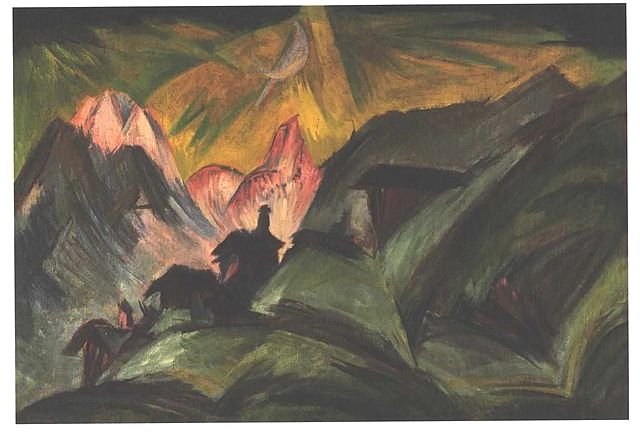
Stafelalp by Moonlight by Kirchner (1919)

Kirchner’s mental state showed no sign of improvement and his friends decided that he should move to a more tranquil environment and so they helped him emigrate to Switzerland and the small mountain town of Frauenkirche which lay just below the Stafelalp,  just south of Davos.  Here he remained for most of his life.   It was during these latter years that although his artistic style remained the same, the subjects of his art changed and he took a keen interest in the life of the farmers, who worked in this mountainous region,  and he recorded it in some of his works.   Although Kirchner was now living in a tranquil setting and his lifestyle was much more relaxed,  he was suffering from his time in the various German hospitals and had developed an addiction to drugs and this was exacerbated further by his alcoholism.  It was not until 1921 that he managed to wean himself off this narcotic addiction and get his life back together.

During the mid 1920’s Kirchner visited Germany in an attempt to regain recognition for his artistic works.  He received a number of commissions and in 1927 he had hoped to be appointed a professor at the Kunstakademie in Dresden.  In 1931 he was admitted to the Preussische Akademie der Künste in Berlin and by now most of the major museums in Germany housed some of his artworks.  Things were once again looking up for Kirchner but all that was to end two years later in 1933 when the National Socialists came to power.  Four years later, in 1937, the National Socialists campaign, known as entartete Kunst (degenerate art), stripped all the museums of his art and he was forced to resign from the Akademie in Berlin.   This proved all too much for Kirchner who had returned to his home in Frauenkirch, where on June 15th 1938, aged 58, he stood before his small house and shot himself.

The work I have featured today is the oil on canvas painting, entitled Self-Portrait as a Soldier, which he completed in 1915 and now hangs in the Allen Memorial Art Museum, Oberlin College in Ohio.  In it Kirchner imagines that due to the savagery of war, his hand has been severed and he is unable to paint.  Could it be that Kirchner was thinking about Van Gogh’s 1889 painting, Self-Portrait with Bandaged Ear when he first set about this work, albeit Kirchner’s severed hand was simply in his mind whereas Van Gogh’s self-mutilation was very real?

The work is all about Kirchner’s fears with regards how the war would affect him as an artist.   His fear was such that it was almost a pathological fear as to what would happen to him and his life as an artist.  It was not just about him but his belief that all young artists would be adversely damaged both mentally and physically by the conflict.  Kirchner painted the Self-Portrait as a Soldier during his time recovering at a sanatorium in Halle.  He has depicted himself in the uniform of the Königlich-Preußische Mansfelder Feldartilierie-Regiment Nr. 75 of Halle/Saale.   It is a haunting portrayal.  His face is drawn with a cigarette hanging loosely from between his lips.  His eyes are unseeing and empty, without pupils and in the irises we can see the reflection of the blue of his uniform. What are the most striking aspects of Kirchner’s self-portrait are the lost right hand and its bloody stump.  This grotesque aspect of the painting is the way Kirchner viewed his losses or possible future losses caused by the war.   He is concerned that he will lose his ability to paint.  He believes that all his creativity, artistic vision, and inspiration will be destroyed.  Behind the self portrait stands a nude woman.  There would seem little to connect the military man and her except that Kirchner may have wanted to think back on his early artistic days and his period where nudity dominated his works.

The style of Kirchner’s self-portrait is similar to his famous Berlin street scenes which he painted between 1913 and 1915.  In those, like this work, the style he used was of a primitive manner.   Kirchner had introduced primitivism to Die Brücke group.  Primitivism is a reference to the use by Western artists of forms of imagery derived from the art of the so-called primitive peoples especially those who had been colonized by Western countries.

Although Expressionism is not my favourite artistic style I have enjoyed researching the work and life of Ernst Kirchner and will soon return to look at some of his contemporaries.

Bathers at Moritzburg by Ernst Ludwig Kirchner

Bathers at Moritzburg by Ernst Kirchner (1909)

My last three blogs looked at Italian Renaissance paintings but today, and in my next blog, I want to move in a completely different artistic direction and look at the life and work of a man who is widely acknowledged as the greatest artist of German Expressionism.  His name is Ernst Ludwig Kirchner.

Before I look at the early life of Kirchner I suppose I should explain a little about the term Expressionism.  Expressionism came about around 1905 and lasted until about 1920.  It is a term given to a style of painting, music, or drama in which the artist or writer seeks to express the inner world of emotion rather than external reality.   This term Expressionism is applied to art which seeks to cause an emotional response, not to actual pictorial content but to the exaggerated style adopted by the artist who is seeking to reflect his inner self.   The term is generally applied to modern European art, where exaggerated forms and vivid colours were employed.  In Germany, at the beginning of the twentieth century, there was disillusionment with the old fashioned academic styles of painting and this prompted a flood of experimentation and innovation.  The artists were desperately searching for a new way to express themselves through the medium of painting and by doing so convey their personal experiences of their new modern world with all its advancing technology.   Expressionism is an artistic style in which the artist attempts to depict not objective reality but rather the subjective emotions and responses that objects and events arouse in him or her.   They accomplish their aim through distortion, exaggeration, primitivism, and fantasy and through the vivid, jarring, violent, or dynamic application of formal elements. The actual term Expressionism was first used in the preface of the catalogue for the 22nd Berlin Secession Exhibition of April 1911 to describe the work of Braque, Derain, Picasso, Vlaminck and Marquet.

Kirchner was born in Aschaffenburg in northwest Bavaria in 1880 and is now looked upon as one of the most important representatives of Expressionism.  Kirchner was brought up in a middle–class family environment.  His father was an industrial chemist.   Kirchner showed an early interest in drawing and as an extra-curricular activity, during his school years his parents arranged for him to have drawing and watercolour lessons at home.  His parents support for his love of art was not wholehearted as they saw no future in their son becoming an artist and so after taking his final school leaving exams they insisted he attended the Königliche Technische Hochschule to study architecture.  Kirchner went along with his parents’ plans as he believed the course would also allow him to have further training in art, such as freehand and perspective drawing.  He took his preliminary diploma in 1903 after which he spent the winter term studying in Munich.

Whilst at the Hochschule he became close friends with another student Fritz Bleyl and later they, along with two other architecture students, Karl-Schmidt-Rottluff and Erich Heckel, after successfully completing their architecture degree course in 1905, formed an artist group which they called Die Brücke (The Bridge).  The name, given to their group by Rottluff, was to symbolise a connection between Germany’s artistic past and future and they intended that their art would be that very link and the way forward.  Theirs was a radical group which was opposed to middle-class conventions, which they considered lacked fervour, and it was their aim to shun the traditional academic style of art and initiate a new style of painting which would be more in keeping with modern life.  They still saw their artistic work as belonging firmly within the tradition of German art, especially the art of Albrecht Dürer, Matthias Grünewald and Lucas Cranach the Elder.  This young group of artists was anti-establishment, liberal in their attitude and full of revolutionary ideas.  Like all new groupings the four founders decided that the group should have its own manifesto setting out its ambitions.  Kirchner was in the forefront of thinking up the wording for the manifesto and he clearly summed up what the group wanted to achieve:

 “….. freedom in our work and in our lives, independence from older, established forces…”

The group met regularly at the Dresden studio of Kirchner.  The lifestyle of this group was Bohemian in character.  In the Royal Academy 2003 exhibition catalogue Kirchner – Expressionism and the city, a quote from Fritz Bleyl described his friend’s first studio, which had formerly been a butcher’s shop:

“…[it was] that of a real bohemian, full of paintings lying all over the place, drawings, books and artist’s materials — much more like an artist’s romantic lodgings than the home of a well-organised architecture student…”

In Kirchner’s studio social standards were largely ignored. Art historians quote reports of the goings-on which took place at the studio and recount tales of “much impulsive love-making and naked cavorting”.  During these meetings at Kirchner’s studio, the artists met to study the nude in group life-drawing sessions.   However, Kirchner wanted to distance himself from the rigid and painstaking academic style of life drawing and he and his fellow artists would instead sketch the naked women, quickly in quarter-hour sessions (Viertelstundenakte) and by so doing, they believed that they were able to capture the fundamental nature of their subject as instinctively as they could. The models who posed nude for Kirchner’s group were not professional models; they were just part of Kirchner’s circle of friends, who were only too willing to become part of this newly-founded art movement.

The lifestyle of the group in some ways was mirrored in the flower-power days of the 1960’s or the punk rock days of the late 70’s.  They hoped and succeeded in shocking the bourgeoisie.  Normal social conventions were abandoned and the group’s studio became a place almost of decadence with group life-drawing sessions, frequent nudity and casual love-making.  Like Matisse and Picasso, Ernst Ludwig Kirchner was fixated with the female nude, as a symbol of his own intense sexuality as well as it being a seductive return to primitive nature. The intention of Die Brücke artists was to wage battle against the constricting forces of bourgeois culture.  To them this culture was linked indelibly with mediocrity, corruption, and weakness. Kirchner believed fervently on self-empowerment and complete freedom from convention and this could be seen in his early art which often concentrated on erotic subject matter. In the paintings done by Kirchner and the other artists of this group they often depicted the female nude crudely as both “primitive” and submissive.  For them this depiction of the female signified both male domination and male virility.

Die Brücke poster for the 1906 exhibition

In the September and October of 1906, a year after the formation of Die Brücke, the first group exhibition was held at the K.F.M. Seifert and Co. in Dresden.   The works exhibited focused on the female nude and Fritz Bleyl designed the lithographic poster for the event.  In 1906, Kirchner met Doris Große, who became his favoured model and remained at his side until 1911 when he decided to leave Dresden and move to Berlin.   Doris would not make that journey.  From 1907 to 1911, Kirchner liked to spend part of his summers at the Moritzburg lakes which lie to the north of Dresden.  He and the other members of Die Brücke art group, along with their friends relaxed amidst the countryside tranquillity and led a relaxed communal lifestyle and embraced the popular German culture of going back to nature and dispensing with such frivolous things as clothes !

My featured painting today is by Ernst Ludwig Kirchner and is entitled Bathers at Moritzburg which he completed around 1910.  It is a painting depicting people who have for a short time shunned the claustrophobic and overpowering life in the city and have gone back to the freedom of nature.   This is their reunion with nature.   It is a painting full of energy.  There is vigorous activity all around.   The first thing that strikes one about this work of art is the overstated colours he has used in this painting.  We have the contrast of the yellow-orange flesh of the bathers with the blue of the water.  This contrasts serves to emphasise the nudity of the figures. Although I have dated the painting as being completed around 1909, the original effect may have been too extreme for Kirchner as in 1926 he repainted parts of the picture making the colours lighter and the surface of the painting more even. It is presently housed in the Tate Modern in London.

As a leading proponent of Expressionism how did Kirchner view his style?  In a letter written in 1937 to art dealer Curt Valentin, he explained the development behind his own Expressionist style:


“…First of all I needed to invent a technique of grasping everything while it was in motion…I practised seizing things quickly in bold strokes, wherever I was and in this way I learned how to depict movement itself, and I found new forms in the ecstasy and haste of this work, which, without being naturalistic, yet represented everything I saw and wanted to represent in a larger and clearer way. And to this form was added pure colour, as pure as the sun generates it…”

In my next blog, I continue looking at the life of Ernst Kirchner as he moves to Berlin, suffers mentally from the rigours of World War I, splits from Die Brücke and spends the last years

The Family Portraits of Franz von Lenbach

The Artist with his Wife Lola and his Daughters Marion and Gabriele (1903)
Städtische Galerie im Lenbachhaus

My recent blogs have in some ways been connected.  I will be in the middle of researching one artist when I come across another, who I feel I just cannot ignore and so my next featured artist has already been decided upon before I have completed my research on the current one.  A few blogs back I looked at the life of Frida Kahlo.  Whilst looking at literature concerning her and other female artists I came across Gabriele Münter and from her I focused on her one-time lover Wassily Kandinsky.  On looking at his life I found that one of his early art tutors was Franz von Stuck and he was the subject of my last blog.  I had decided to stop this train of thought when choosing a new artist but then during my research on von Stuck I stumbled across a contemporary of his, Franz von Lenbach and although I had decided to stop this system of choosing artists I found his portraiture awesome, especially his depiction of his own family.  I just could not pass up the chance of introducing this German painter to you and share with you some of his wonderful family portraiture.

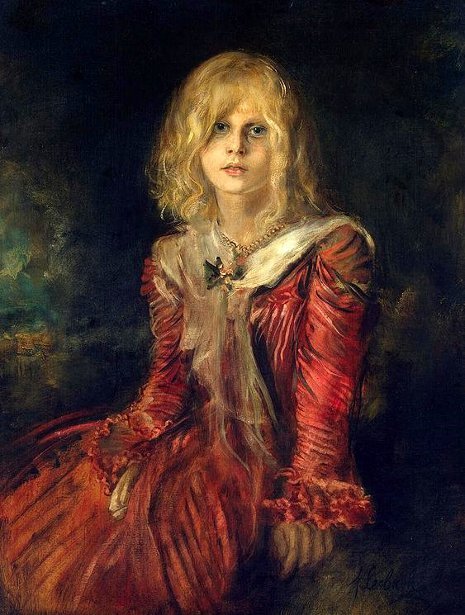
Marion Lenbach by Franz Lenbach

Franz Lenbach or to give him his full title, after ennoblement, Franz-Seraph Ritter von Lenbach was born in 1836 in the small town of Schrobenhausen which lies about forty miles north of Munich.  His father was a master builder and stonemason.  Initially Franz had planned to follow in his father’s footsteps and become a master builder himself and accordingly in his early teens, he enrolled at the Landshut Technical College to study the art of stone masonry and architecture.  At the age of fifteen he began to concentrate on sculpture and started to work in the studios of the German sculptor, Anselm Sickinger.  If it had not been for his elder brother, Karl August Lenbach, who was a painter, then maybe Franz would have carried on in his father’s profession.  However his brother introduced him to John Baptist Hofner, the German painter of animal and genre scenes and who had previously studied at the Akademie der Bildenden Künsten in Munich and it was he who introduced Franz Lenbach to drawing and painting.  Hofner and Franz Lenbach would often spend time going off together on painting trips and Hofner taught Lenbach the skills of en plein air painting.

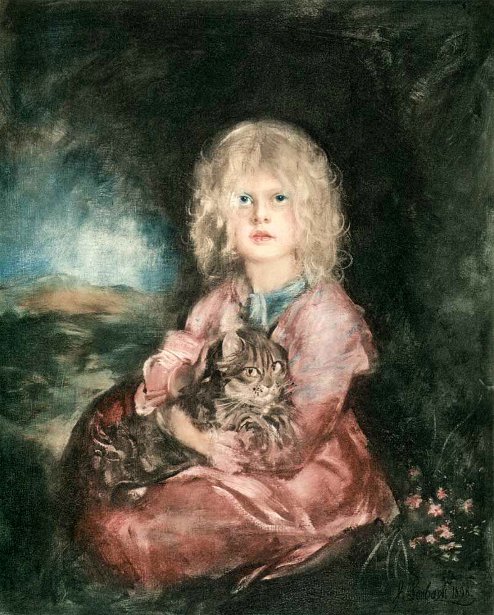
Marion With Cat by Franz Lenbach

For Franz Lenbach to gain admission to the Akademie der Bildenden Künsten he needed some formal groundwork training in art and so, in 1852,  at the age of sixteen, he enrolled at the Polytechnische Schule in Augsburg, following which he trained in the studio of Albert Gräfle, the Munich portraitist.  Finally Franz enrolled at the Munich Academy of Fine Arts in 1854.  Three years later he was studying under the great German historical painter Karl Theodore Piloty.  From the sale of one of Lenbach’s works, Peasants Trying to Take Shelter from a Thunderstorm in a Chapel and a scholarship, he managed to accumulate enough funds to go Rome with Piloty and Piloty’s brother Ferdinand, who was also an artist.  So impressed was Theodor Piloty with the artistic talents of Lenbach that in 1860, he put Lenbach’s name forward for the post of professorship of the Kunstschule in Weimar, which had just been opened.  Lenbach took the position and remained there for two years but by the end of this tenure he realised that life in academia as an art professor was not for him.

Gabriele Lenbach in Armour by Franz von Lenbach

It was around this time that Franz Lenbach met Adolf Friedrich, Graf von Schack,  who was a German poet, historian of literature and an avid art collector.  Schack had wanted to build up a formidable art collection for himself and although extremely wealthy he could not afford to buy paintings by the Old Italian Masters so he approached Lenbach and other aspiring young artists to set about copying some of his favourites.  Once Lenbach agreed to carry out this commission he was sent to Rome to start copying some of the famous works.  Here he met some other artists, such as Arnold Böcklin and Anselm Feuerbach who had also been commissioned as copyists by Schack.  So pleased was Schack with what Lenbach produced he sent him to Florence in 1865 to carry on the good work.

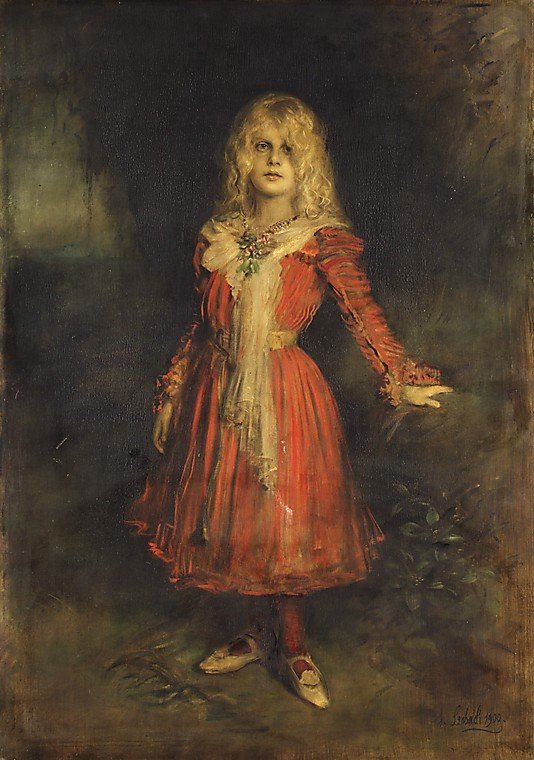
Marion Lenbach, the Artist’s Daughter by Franz von Lenbach (1900)

Whilst working in Florence Lenbach met Karl Eduard Baron von Liphart, a central figure of the German expatriate art colony in Florence, and it was through him that Lenbach picked up some lucrative portraiture commissions.  From Florence he travelled to Spain in 1867 with Ernst von Liphart the son of his benefactor.  The following year he and Liphart along with his patron, von Schack went to Tangiers. When he returned from North Africa he moved to Vienna and began to concentrate on his portraiture work.  Many famous people sat for Lenbach including Richard Wagner, Emperor Franz Joseph I, Ludwig I, King of Bavaria, Emperor Wilhelm I and he completed almost a hundred portraits of Otto Fürst Bismark.  It was during this period that Lenbach became recognised as the most famous contemporary German portrait painter.

Städtische Galerie im Lenbachhaus
Munich

In 1882 Franz Lenbach was ennobled, and became known as Franz von Lenbach.  Four years later in 1886 he procured himself an estate in Munich and with the assistance of his friend Gabriel von Seidl, the German architect, he designed and had built a Florentine villa which took almost four years to complete.  The city of Munich acquired the building in 1924, and today, the Lenbachhaus houses the city’s gallery.  In 1900 he won the Grand Prix for painting in Paris.   Lenbach died in Munich on May 6, 1904, aged 67.

My featured paintings today are not the ones Lenbach did of famous politicians and rulers of various countries but the intimate portraits of his family.    Lenbach had married twice and had three daughters, Marion, Erica and Gabriele.  His daughters and his second wife, Charlotte (Lolo) Freiin von Hornstein appear as models in many of his paintings and it some of these beautiful portraits that I have included in today’s blog.

Die Sünde by Franz von Stuck

Die Sünde by Franz von Stuck (1893)

Today I am want to look at the life and times of one of Wassily Kandinsky’s early art tutors, the German painter of mythological and allegorical scenes, Franz von Stuck.  Stuck was not just simply a painter.  He was a man on many talents.  Stuck was also a sculptor, printmaker, illustrator and architect.
Franz von Stuck was born in 1863 in Tettenweis, a village in the farming area outside the city of Passau and which lies close to the Austrian-German border about 150 kilometres north east of Munich.  He was brought up in a moderately affluent Catholic family who plied their trade as farmers and millers.   He enjoyed drawing from an early age and it is said that when he was just six years of age he would spend time drawing caricatures of the local village people.  At the age of fifteen he went to Munich to study art.  He first attended the Königliche Kunstgewerbeschule, a high school of applied arts in the city.  One of his teachers was the German landscape painter Ferdinand Barth.  After three years at this school, Stuck transferred to Munich’s Akademie der Bildenden Künste (The Academy of Fine Arts) where he received tuition from the German history painter, Wilhelm Lindenschmit the Younger and Ludwig Löftz.  Once he had completed his art tuition at the Akademie he found some work as an illustrator for various Munich publications such as Die Jugend, a cultural weekly publication, which soon became a style-setting icon that launched the German art nouveau movement, named Jugendstil,  after the magazineand the Fliegenden Blätter (Flying Pages), which was the name of a humorous and satirical German weekly magazine which was full of illustrations and caricatures.  Stuck’s input in these magazines over a four year period enhanced his reputation as an artist and illustrator.

In 1889, he began to paint in oils and that year he submitted his work, Der Wächter des Paradieses (The Guardian of Paradise) for inclusion at the Jahresausstellung exhibition at the Glastpalast in Munich.  This venue was the glass and iron edifice modeled after London’s Crystal Palace.  The building, like the Crystal Palace, was destroyed by fire,  in 1931 and resulted in the destruction of over a hundred artworks from the early 19th century .   For his painting, Franz Stuck was awarded a gold medal and a prize of sixty thousand gold marks.  This painting depicted a mythological scene and was the type of depictions that would appear in many of his works, the best of which was thought to be his paintings which depicted a solitary figure rather than his group figure works.  Franz Stuck had become a leading figure in the Munich avant-garde side of art life but also figured prominently in the official art world of the German city.

At the end of the nineteenth century, Munich was a place at the forefront of German art.  It was a charismatic city for German artists of every style who wanted to create something new, something different.    The city itself had a young, modern, and exciting feel about it and was a place where artists could create and conceive new styles.  The majority of Munich’s fine art painters belonged to the Königlich-privilegierte Münchener Künstlergenossenschaft (MKG) (Privileged Royal Artists’ Association of Munich).  This was the largest social and professional society for artists in Bavaria which had been founded in 1869.  Its remit was to further the interests of a wide range of artists both in and around Munich.   All was well until the Künstlergenossenschaft  Salons (The Society’s exhibitions) of 1889 and 1891 when the jurists, the people whose job it was to decide which works of art would be exhibited, chose a large number works which were blatantly biased towards Naturalism, Impressionism and Symbolism.  Following this the majority of artists within the Society voted for the implementation of regulations which would insist that future juries would cease favouring any one kind of art and guarantee that diversity of outlook would be their key criteria when choosing works for inclusion.   Over a hundred artists within the Association refused to accept this dictate and seceded in April 1892.   One of the co-founders of this new group of artists was Franz von Stuck.

More than a hundred artists came together as a new group by founding the Verein bildender Künstler Münchens e. V. Secession (Association of fine artists in Munich Secession).  This new artistic grouping refused the historicism propagated by the academies and wanted to create something new.    Their motto was that art concerns the whole man and the whole social life.  Besides the artists themselves, there were some very influential backers to the formation of this new association such as George Hirth the writer, publisher and founder of the avant-garde magazine Jugend.  Initially the Secession found little favour with official circles because of its modernist leaning and in the belief that this Secession would bring disunity to the Munich art scene and would lead to the fall from grace of Munich as a great centre of German art and allow Berlin to take its place as the centre of German culture.  However once the Secessionists gained in popularity, the official line changed and Luitpold, who was then Prince Regent ofBavaria, and other government officials gave their full support to the Secessionists, provided them with financial support and bought up many of the paintings from their exhibitions.  At the Secessionist exhibition in 1893 Franz von Stuck’s painting Die Sünde (The Sin) was shown and it caused a sensation.

In 1895 Franz von Stuck was given the position of professor at the Academy of Fine Arts, in Munich, an establishment where he had once studied.  Two of his most famous students were Paul Klee and Wassily Kandinsky, both of whom would go on to establish the Blaue Reiter art group.   He also became chairman of the board of the Genossenschaft Pan [Pan Co-operative], designing the covers for Pan, its art magazine.  It was around this time that he designed and had built the Villa Stuck for himself.  It was testament to his extraordinary abilities in design, sculpture, interior decoration and architecture. He also designed the furniture for his house and these won him another gold medal, at the 1900 World’s Fair in Paris.

Franz had an affair with Anna Maria Brandmaier, the daughter of a local baker, which resulted in the birth of a daughter, Mary Franziska Anna. The child was given into the care of Mary Lindpaintner, a wealthy American widow of a Munich physician.  On March 15th 1897 von Stuck married Mary Lindpaintner and his daughter grew up in his own house. Seven years later, in 1904 he and his wife would formally adopt her after a legal battle against the young girl’s natural mother. He also adopted the two children from Mary’s first marriage, Olga and Otto.

In 1906 he was knighted as Franz Ritter von Stuck. His Symbolist paintings, including many sensual nudes, and combine a linear style with an erotic flare. In 1913, at the height of his artistic success and fame, Stuck decided to build a studio next to the villa. Completed in 1914, it was double the size of the existing structure and contained two stories. The first floor was for sculpture and the second, with its 16.5-meter-wide, 7-meter-high dome was used for painting.  Franz von Stuck died in Munich on August 30, 1928 aged 65.  His house, Villa Stuck,  remains a living testament to the man and the artist.  Villa Stuck is a nationally and internationally renowned meeting place for the art of the 19th bis 21. to 21 Jahrhunderts. Century. Eine bedeutende Sammlung von Werken Franz von Stucks (1863-1928) und internationale Ausstellungen zur Kunst um 1900 sowie zur modernen und zeitgenössischen Kunst machen die Villa Stuck zu einem einzigartigen Ort des Kunsterlebens. An important collection of works by Franz von Stuck and as well as international exhibitions of modern and contemporary art transform Villa Stuck into a unique place.

My featured painting today is Stuck’s highly acclaimed work entitled Die Sünde (The Sin) which he completed in 1893 and is now housed in the Neue Pinakothek Museum, Munich.  It was first exhibited at the Secessionist Exhibition of 1893 and which, at that time, caused a sensation by the controversial nature of the depiction.   It is by far his best known painting of which he made many versions in the period of from 1891 to 1912. The main effect of the painting is created by the contrasts in the colours and by the concept of the picture.

In the painting we see a woman who coyly exhibits her bare breasts and stomach which the artist has bathed in light whilst the he has hidden the rest of her body in the darkness of an alcove. A snake lies on her right shoulder and the reptile curves around the back of the woman’s neck and along her left shoulder.  The snake symbolises original sin for it was a snake that tempted Eve to eat first the fruit from the tree of knowledge, and then it was she who tempted Adam.   The woman in the painting is not a woman but women in general.   In this painting the woman, with her snake, represents evil.   The woman before us is controlling us, the viewer, us, the voyeur.  She is tempting us.  We stand still in front of her and cannot avert our eyes.   She is mesmerising us.  She is inviting us to join her.  Are we sucked in by her beauty even though we know the dangers that would follow?   The viewer is curious and may be longing for adventure and is willing to submit himself or herself to the attraction of the unknown.   If we were to step forward into the painting we would cut off the source of light and all would be dark and we would be left with just the woman and her snake, then what?

The massive gilded frame of the painting adds to the contrast with the darkness of the painting itself.  Such heavy frames as this one were very common in Jugendstil art, with the artists themselves designing their own frames for their own works of art.

When it was first exhibited in its present home, the Neue Pinakothek Museum, Munich, it caused a sensation with crowds flocking to see this piece of seductive and erotic art. The painting left a lasting impression on those who viewed it and this effect was described by one who viewed the work:

“…The fame of the painting drove us through the galleries; we stopped nowhere and opened our eyes for the first time when we were finally standing opposite it. It was displayed on a special easel in its broad, monumental gold frame, […] and now all three of us stared at the night of hair and snake which did not allow too much of the pale, female body to be seen. The shadowed face with the bluish-white of the dark eyes was less important to me at first than the iron sheen of the nestling snake, its evil, beautifully designed head and the dull chequered pattern on its back, over which a delicate blue line ran like a seam. […] There are works of art that strengthen our sense of community, and there are others that seduce us into isolation. Stuck’s painting belonged to the latter group..”

The Blue Mountain by Gabriele Münter

The Blue Mountain by Gabriele Münter (1909)

A couple of blogs ago I looked at the life of Frida Kahlo and, in the course of following her life story, talked about her husband the Mexican muralist Diego Rivera.  Although Frida was an artist in her own right, I wonder if she suffered from the description:  “Frida, wife of the great Diego Rivera”.  How often was she looked upon as just that – merely the wife of the great Rivera?   There have been many romantic attachments between artists and between literary figures in the past, and they are mostly described in a manner where the men are looked upon as the celebrated ones in the partnership.  The male in the relationship is viewed as the great initiator or the knowledgeable inventor of this and that, while the female of the relationship is denigrated as simply somebody who follows the man subserviently in his shadow.  Today I am going to look at the life of another female artist who, for almost twelve years had, as her lover, the great Russian painter Wassily Kandinsky and one wonders how much influence she had on him and his work.    Her name is Gabriele Münter.  How many of you recognise her as a talented artist in her own right and how many of you just know her as the intimate friend and lover of the “great” Kandinsky?

Gabriele Münter was born in Berlin in 1877.  Her youth was spent in Herford and Koblenz.  She came from an upper middle-class background and from a young age enjoyed to draw and paint.  When she continued to show an interest in art, her parents decided to support her artistic ambitions and provide her with private tuition and when she was twenty years of age and after she had completed her normal education they arranged for her to attend the Malschule für Damen (Womens’ Artist School) in Dusseldorf.  At this time in Germany, women were not allowed to attend German Academies because of their sex for in Germany at the turn of the 20th century, only men were able to access government-subsidised Academies.  Her period at this school lasted just a year as she was disappointed with the artistic education it offered.  For a time she stayed at home with no job and little of interest to occupy her mind.  In 1898, she was twenty-one years of age and by this time,had lost both parents.  On the death of her parents her sister and her inherited a sizeable amount of money and the two of them decided to take a holiday to America, where their father had lived and her mother had been born and it was where the sisters still had family connections.  The two of them remained in America for two years.

In 1901 having returned to Germany, Gabriele decided to once again take up some formal artistic training and enrolled at the Künstlerinnen-Verein in Munich.  This Ladies Academy of the Munich Art Association was modeled on the prestigious Royal Bavarian Academy of Fine Arts and it allowed its female students the freedom to choose their own courses and offered them the opportunity to both paint in studios and paint en plein air.  One of her tutors during at the Academy was Angelo Jank, the German animal painter and graphic artist.   A year later Gabriele left the Academy and in 1902 she  enrolled at the newly established Phalanxschule in Munich The Phalanx  was an association of avant-garde artists who were opposed to old fashioned and conservative viewpoints in art.  One of its founder members was the Russian painter, Wassily Kandinsky.   Kandinsky, who had initially studied law and economics at Moscow University, did not turn to painting until he was thirty years of age.  It was then that he abandoned his promising career in academic law to attend art school in Munich in 1896.    He was elected president of the Phalanx association and also became the director of the Phalanxschule (Phalanx School of Painting). Gabriele was one of its first students.

In 1902 and 1903 Gabriele Münter attended Kandinsky’s summer landscape classes which were held in southern Bavaria.  Kandinsky was, at that time, still a married man having married his cousin, Anna Chimyakina in 1893.  The pair had separated by mutual agreement in September 1904, although they remained friends. They eventually divorced in 1911. However despite being still married, he and Gabriele became close and in 1902 a love affair between the two began.    Münter was always grateful for what she learnt about art in those summer classes especially the ability to paint much quicker.   In Reinhold Heller’s biography of the artist entitled Gabriele Münter: The Years of Expressionism 1903-1920, he quotes her comments on the help she received from Kaminsky:

“…My main difficulty was I could not paint fast enough. My pictures are all moments of life- I mean instantaneous visual experiences, generally noted very rapidly and spontaneously. When I begin to paint, it’s like leaping suddenly into deep waters, and I never know beforehand whether I will be able to swim. Well, it was Kandinsky who taught me the technique of swimming. I mean that he has taught me to work fast enough, and with enough self- assurance, to be able to achieve this kind of rapid and spontaneous recording of moments of life…”

The house in Murnau

Kaminsky and Münter travelled extensively around Europe between 1904 and 1908, including living in Sèvres, a suburb of Paris, for almost a year in 1906.  After years of gruelling travel visiting the major European cities, the pair was ready to settle down and arrived in Murnau, a small Bavarian village in the foothills of the Alps, seventy kilometres south of Munich. The following year Kandinsky persuaded Gabriele to buy a newly-built house in Kottmüllerallee in Murnau.   It had a view to the east, over the valley basin and onto the village and church hill.   Together with Kandinsky, their artist friends Alexi von Javlensky and Marianne von Werefkin, they worked there during the summer months, living a simple life.   Gabriele spent time tending the garden and furnishing the house with her own paintings, religious folk art, and local handicraft. She and Kandinsky lived there until 1914.  In 1909 Münter experimented with a new painting medium.  It was known as Hinterglasmalerei  or as it known here, Reverse painting on glass, which is an art form consisting of applying paint to a piece of glass and then viewing the image by turning the glass over and looking through the glass at the image. In France it was known as Verre Églomisé.  Münter had first learnt this technique whilst she was living in Murnau.

That same year, 1909, that the couple settled in Murnau,  Kandinsky, Gabriele Münter and their fellow artist friend Alexi Jawlensky founded the Neue Künstlevereinigung  (NKV)  (New Artists’ Association), which was an exhibiting group of avant-garde artists.  The members of this association were artists who, although they did not have similar styles of painting, were nevertheless united in their opposition to the official art of Munich.    They held two exhibitions in the art dealer, Heinrich Thannhauser’s Moderne Galerie in Munich in September 1909 and 1910.  In the latter exhibition there were also works from Picasso, Georges Braque and Maurice de Vlaminck.  Kandinsky was to later describe the rooms in the gallery as “perhaps the most beautiful exhibition spaces in all of Munich.”  Many of the works in the second annual exhibition were from Russian artists and maybe because of this, the show was not well received in Bavaria as the Germans were becoming fearful for their own culture.

Probably, due to the fact that the artists in this association had very different ideas on painting styles, discord was bound to occur and the “final straw” came late 1911, just prior to the NKV’s third annual exhibition, when Kandinsky submitted a large abstract painting, entitled Composition V, for inclusion but it was rejected by the exhibition jury for being too abstract and at 193cms x 274cms, it was far too big for inclusion.  Kandinsky was furious and he and Gabriele Münter along with a few others left the group and set up a rival artistic exhibiting association known as Der Blaue Reiter (The Blue Rider).   Then in that December, they simultaneously set up their own exhibition in the building next to the Thannhauser’s Moderne Galerie, where the NYK group was holding their annual exhibition.

Kandinsky and Münter Winter 1916 Stockholm

World War I broke out in 1914 and Kandinsky was compelled to leave Germany.  In the August of that year he and Gabriele moved to Switzerland.   Their relationship had been faltering for some time and at the end of 1914 the love affair was over and despite having been engaged to marry they never took that final step.   Gabriele left Switzerland and went on to Sweden whilst Kandinsky returned to his native Moscow.   They met once more in Stockholm at an art exhibition at Gummersson’s Art Gallery but after that their paths would never cross again.   In 1917 Kandinsky married Nina Andreevskya, the daughter of a Russian general, some twenty-seven years his junior.

Between 1917 and 1920 Münter lived in Copenhagen, after which she returned to Germany and her house in Murmau.   In 1925 she moved to Berlin where two years later she met the philosopher and art historian Johannes Eichner.  From 1928 Eichner would be Gabriele Münter’s lifelong companion and from 1931 Gabriele, until the end of her life, lived and worked in Murnau.   She led a reclusive and modest lifestyle but still continued to paint.

One of the greatest gifts Gabriele Münter bestowed on the art world besides her huge role in the history of early German modernism was that during World War II, whilst living in Murmau, she hid Kandinsky’s works and those from other artists from the Nazis and despite several house searches, the works of art were never found.   In 1957, on her eightieth birthday, Münter gave her entire collection, which consisted of more than 80 oil paintings and 330 drawings, to the Stadtliche Galerie in Lenbachhause in Munich, the former villa of the “painter prince” Franz von Lenbach.   This collection consisted of many works by herself and Kandinsky as well as works of their other artist friends in the Blue Rider Circle.   This generous gift turned the Lenbachhaus overnight into a museum of world significance.   The Gabrielle Münter and Johannes Eichner foundation was established and has become a valuable research center for Münter’s art, as well as the art that was done by the Blaue Reiter group

Gabriele Münter died on 19 May 1962 at home in Murnau where she is buried. She was 85 years old.

My featured painting today by Gabriele Münter is entitled The Blue Mountain which she completed in 1908 having just arrived in Murnau.   This painting always brought her fond memories of that time in the tranquil surroundings of the foothills of the Bavarian Alps and her time with Kandinsky.  Almost fifty year later in 1957 she put pen to paper about the painting of this picture.  She wrote:

 “Javlensky stayed behind on the Kohlhuber Landstrasse and painted – I walked on until I turned off to the right and up a bit towards Löb. There, from above, I saw the Berggeist Inn sitting there, and the way the path rose and behind it the blue mountain and the small red evening clouds in the sky. I quickly jotted down the image appearing before me. Then, it was like an awakening for me, and I felt as though I were a bird in song. I never spoke to anyone about this impression, just as I don’t tend to chatter all that much anyway. I kept the memory to myself, and now, after so many years, I am telling it for the first time…”

The trees, clouds, and mountains in this painting are simply reduced to elementary geometric forms and, like the sky and the meadows, they are coloured in artificial tones of green, yellow, and violet.  There is something about this painting and others like it that reminds me of the colourful works of Hockney which I saw at his exhibition at the Royal Academy earlier this year.

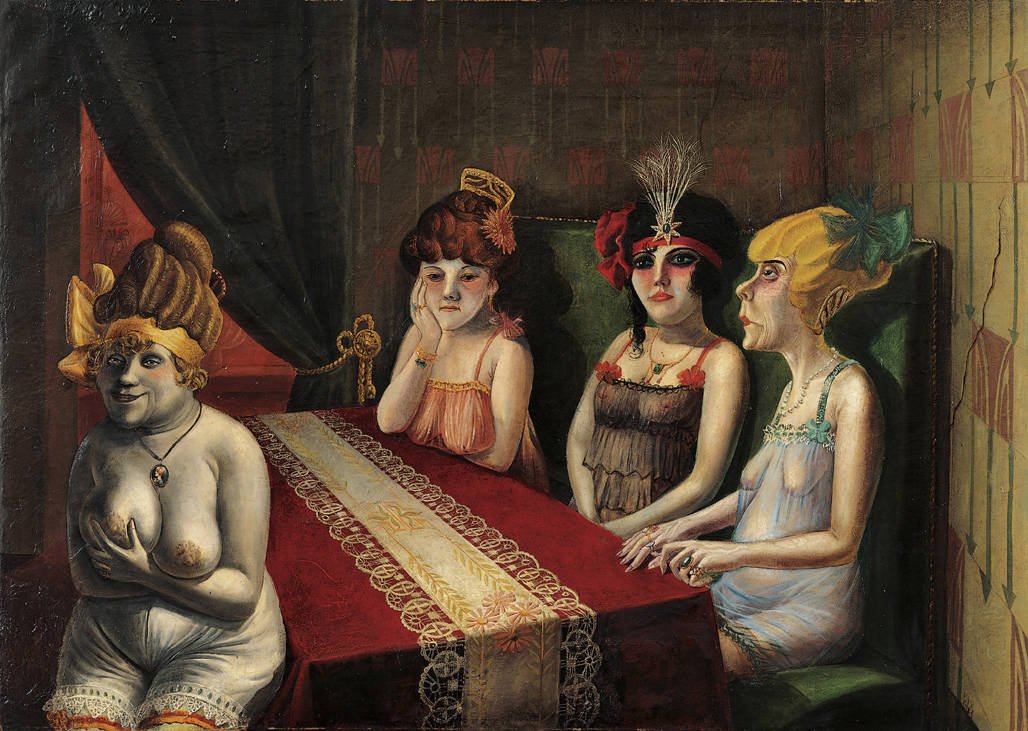
Salon I by Otto Dix

The Salon I by Otto Dix (1921)

Today I am looking at a painting by an artist whose work has frequently shocked the public.  His art often focused on the First World War and the aftermath of it on the people of Germany.  It was not his intention to shock people with what was depicted in his paintings.  It was simply his intention to tell the truth through his art and ensure that people would not ever forget the price citizens had to pay when their governments took them to war.  Of his controversial paintings, he said:

“I’m not that obsessed with making representations of ugliness. Everything I’ve seen is beautiful.”

“I did not paint war pictures in order to prevent war. I would never have been so arrogant. I painted them to exorcise the experience of war.”

“People were already beginning to forget, what horrible suffering the war had brought them. I did not want to cause fear and panic, but to let people know how dreadful war is and so to stimulate people’s powers of resistance.”

My featured artist today is the German painter and printmaker Otto Dix.  Dix was born in December 1891 in Untermhaus, Germany, which is now a part of the city of Gera.  He was the eldest son of Franz Dix, an iron foundry worker and Louise Dix, who was a seamstress and amateur artist.  His mother had also written poetry in her youth.  Otto had a cousin, Fritz Amann, who was a portrait and genre painter and so, from an early age, Otto Dix was exposed to the world of art.  At the age of fifteen Dix started a four year apprenticeship with the landscape painter Carl Senff and it was whilst at Senff’s workshop that Dix started painting his first landscapes.   At the end of his apprenticeship in 1910 he enrolled at the Dresden School of Arts and Crafts and supported himself financially by painting portraits and selling them to local people.  Whilst there he studied under Richard Guhr, the painter and sculptor and Dix attended his figurative and decorative painting classes.

World War I broke out in 1914 and Otto Dix enthusiastically enrolled in the German army.    His first assignment, as a non-commissioned officer, was to join up with a field artillery regiment in Dresden.  In the autumn of 1915 he was assigned as a non-commissioned officer of a machine-gun unit in the Western front and took part of the Battle of the Somme. He was seriously wounded on a number of occasions. In 1917, his unit was transferred to the Eastern front where he remained until the end of hostilities with Russia. He then returned with his regiment to the western front and took part in the German Spring offensive. He earned the Iron Cross (second class) for valour and reached the rank of vice-sergeant-major.  By the end of the conflict, he had been wounded on five separate occasions.  Dix was horrified and very much affected by the horrific sights he had witnessed during the four years of the war and these visions caused him to have many persisting nightmares well after the end of hostilities.

It was these nightmares and his traumatic experiences during the fighting that comes through clearly in many of his subsequent works, including a portfolio of fifty etchings called War, published in 1924.  At the end of the war, Dix returned to Gera, but in 1919 he moved to Dresden, where he studied at the Dresden Art Academy.   It was whilst studying art in that city that he met the Expressionist painter, Conrad Felixmüller, who was one of the youngest members of the New Objectivity movement.   Felixmüller was also a member of the Communist Party of Germany and his paintings often dealt with the social realities of Germany’s Weimar Republic. He became a mentor to Otto Dix and managed to bring together Dix and a number of like-minded Expressionist artists to form the city’s most radical art group, the Dresden Secessionist Group.  A year later Dix met George Grosz and it was around this time that Dix began to integrate collage aspects into his work.

The Trench by Otto Dix (1923)

In 1922 Dix moved from Dresden to Dusseldorf where he found a more lucrative market for his works of art.  A year later, in 1923 he completed a painting which shocked the public and establishment alike.  It had been commissioned by the city of Cologne and was entitled The Trench.  It depicted dismembered and decomposed bodies of soldiers after an overnight battle in a German trench.  For many, it was a gruesome and offensive depiction of death in the trenches.  He began the painting it in 1920 whilst he was living in Dresden but did not complete it until three years later.  Such was the uproar that the Wallraf-Richartz Museum in Cologne, which had commissioned the work, had to hide it behind a curtain.  The mayor of Cologne at the time and the future German Chancellor, Konrad Adenauer, cancelled the city’s purchase of the work and the Museum director, Hans Secker, was sacked.

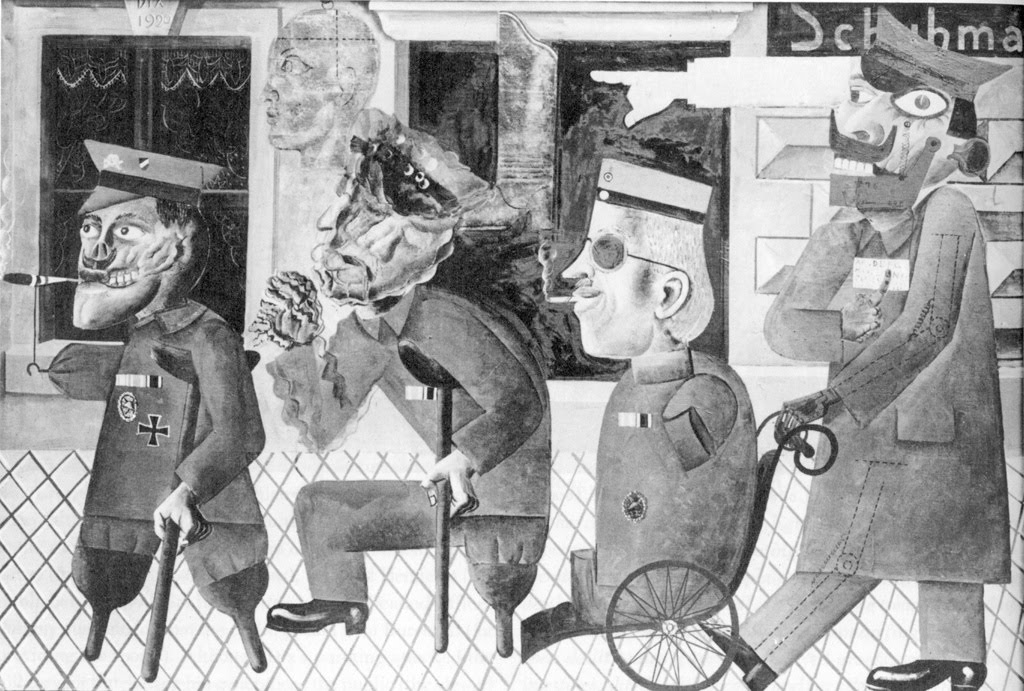
Otto Dix’s work, like that of his friend and contemporary George Grosz was extremely critical of the present-day German Weimar society.   His paintings would draw attention to the more miserable side of life and the hopelessness felt by the ordinary German people following on from their defeat in war.   The depictions seen in his paintings often graphically showed prostitution, violence, old age and death.  He also focused his attention on the German veterans of the war who would wander the streets of Berlin physically disfigured and mentally unable to cope with life.  These were the forgotten men who had served their purpose and who were now abandoned by society.   These paintings of his were somewhat sad and depressing and yet realistic.

The War Cripples by Otto Dix (1920)

When the Nazis came to power in Germany in the early 1930’s they regarded Dix as a degenerate artist and his depictions of the defeated German soldiers and his portrayal of the low-life of Berlin were considered unpatriotic and for this reason they had him sacked from his post as an art teacher at the Dresden Academy.  He later moved to live on the shores of Lake Constance.   In 1937, in Munich the Nazis held an art exhibition of what they called Entartete Kunst or Degenerate Art.  The purpose of the exhibition was to let the Germans know that some forms and pieces of art were not accepted by the “highest race”, and that this art was “degenerate”.  It was often termed Jewish or Bolshevistic art.  During the “Entartete Kunst” campaign over 20 thousand works by more than 200 artists of that time were confiscated. Dix’s 1923 painting The Trench and his 1920 work entitled, Kriegskrüppel (War Cripples) were shown at that exhibition.  They were later burned.  Dix was forced to join the Nazi-controlled Imperial chamber of Fine Arts in order to be able to work as an artist at all and had to promise to paint only landscapes. However, he still painted an occasional allegorical painting that criticized Nazi ideals. In 1939 he was arrested on a trumped-up charge of being involved in a plot against Hitler but was later released.  During World War II, Dix was conscripted into the Volkssturm. He was captured by French troops at the end of the war and released in February 1946. Dix eventually returned to Dresden. After the war most of his paintings were religious allegories or depictions of post-war suffering. Otto Dix died in Singen, Germany, in 1969, aged 77.

For My Daily Art Display featured painting today I have not chosen one of his gruesome but telling war paintings but a painting which looks at the fall-out from war for individuals, in this case females of the defeated nation.  The painting is entitled The Salon I and was completed in 1921, just three years after the end of World War I,  Dix had often examined the life of women in the aftermath of war, many of whom desperate for money to feed themselves and their family turned to prostitution.  In his painting we see four such women, garishly dressed, sat around a table which is covered with an expensive tablecloth, which evokes middle-class décor.  Except for one, they are all passed their prime.

These four scantily dressed prostitutes, decked out in bangles, necklaces and other cheap trinkets look bored.   They sit there in silent contemplation.  In the short term they wonder who their next client will be and how will they be treated.  In a longer term they wonder what will eventually happen to them and how was it possible that they have been reduced to this way of life.  The female to the left of the painting is overweight and was a character often seen in Dix’s works.  She gives us an inviting smile as she supports her breasts giving them an uplift which may make them more tempting to her next client.  The woman to the right of the painting is pitilessly depicted by Dix.  Her best years are far behind her and no amount of make-up can hide the wrinkles of old age.  Her diaphanous negligee does little to hide her sagging breasts.  Next to her wearing a red band and bow around her forehead is a young woman.  We ask ourselves why somebody with her looks and manner should end up in this brothel.  Her eyes and facial expression hide the truth from us.  We are left to decide for ourselves what necessitated her to sell her body.

All in all, it is a depressing work of art but before we condemn Otto Dix for choosing such a subject we need to remember why he did it.  At the very beginning of this blog I gave you his reasoning behind his often gruesome and shocking art.  He was horrified by what he experienced during his four years at war and he fervently hoped that it would never happen again and in his own way he needed to remind everybody about the horror of war or as is the case in today’s featured painting, he wanted to remind people about the terrible aftermath of war especially for the defeated.  Maybe we should consider again his reasoning for his art.  Dix wrote:

“People were already beginning to forget, what horrible suffering the war had brought them. I did not want to cause fear and panic, but to let people know how dreadful war is and so to stimulate people’s powers of resistance.”

Sadly nobody really paid attention to the horrors of the First World War as twenty years later we stumbled blindly into yet another major conflict.

The Fountain of Youth by Lucas Cranach the Elder

The Fountain of Youth by Lucas Cranach the Elder (1546)

Throughout time, mankind has always looked for ways to extend the longevity of life.  In modern times we have organ transplants, anti-aging creams and plastic surgery to either extend our life or if we accept the futility of that premise, then at least try and make oneself look younger.  We can now bathe in spas whose magical water quality are supposed to combat this disease or that disease and many who have bathed in these waters leave feeling cleansed and believe implicitly that the waters do heal them of their ailments and have rejuvenated them.  In past times there was always talk about the mythical Fountain of Youth in which the waters could reverse the ageing process.  Alexander the Great, who conquered most of the known world at the time, was thought to have been searching for a river that healed the ravages of age. Move forward to the 12th century and we hear of a puzzling letter sent to the Byzantine emperor Manuel I which started to circulate around Europe. It told of a magical kingdom in the East that was in danger of being overrun by infidels and barbarians. This letter was supposedly written by a king known as Prester John and talked about his kingdom which had rivers filled with gold and was the home of the Fountain of Youth.  Two centuries later, in 1513, it was recorded that the explorer, Ponce de León, was searching for the Fountain of Youth when he traveled to what is now Florida.   And so it goes on, this fascination with the mystical Fountain of Youth.

Artists have often recorded pictorially their take on this magical fountain and today I am going to take a look at one which was completed just over thirty years after Ponce de León’s voyage of discovery.  The painting, Der Jungbrunnen (The Fountain of Youth) is by the German artist Lucas Cranach the Elder which he completed in 1546.  It is about the human desire for immortality and eternal youth.  The old women in the painting crave to cast aside their worn outer shell, which is pale and wrinkled, and exchange their haggard looks by replacing their outer-self with a more acceptable younger version.

The examination

I like the mini-scene in the centre ground to the left of the pool where we see a man bent forward closely examining a naked woman.  What is that all about?  Is he an official or maybe a doctor who is examining how haggard the woman is to see if she fits the criteria for rejuvenation?  If this is the case, then for once to gain one’s admission to the pool old age and infirmity is requisite bargaining tool!

The Fountain

In many ways this simplistic depiction of the Fountain of Youth is quite amusing.  At the centre of the painting we observe a large square-shaped grey and white pool, at one end of which is the fountain.   The fountain gushes out water it has drawn from the spring below.  On the fountain there are statues of Venus and Cupid which, in some ways, is confirmation that this is more of a Fountain of Love and that maybe it is the power of love which is the rejuvenating factor.   The pool is populated by naked women.  Steps around the four sides of the pool lead down to the healing waters.  To the left of the painting we see elderly women, who have made the long and tiring journey, arriving in carts, on litters, in wheelbarrows or in one case piggy-backed on a man who can just about cope with her weight.  All want to bathe in the rejuvenating water.

Wheeled to the magical waters

The old women then alight from their transport, take off their clothes, examined and are helped into the square-shaped pool, the water of which is being topped up from the Fountain of Youth.   Once partly immersed in the magical waters the naked women begin to splash themselves with the water and frolic about, the cares of the world seemingly lifted from their shoulders.  Now that the women have regained their youthful looks they look at one another amazed by the change that has taken place.  They caress themselves or caress one another, hardly believing what they are seeing and feeling.  They comb their long flowing golden hair.  Their mood is one of triumph.  The power of the waters has worked.

In and out of the robing tent

If we now look to the right hand side of the pool we see that after having been immersed and had been revived by the recuperative powers of the waters, they step out of the pool, rejuvenated and once again young.  From the pool side, these gregarious young virgins are then directed towards a large tent in order to dress and after a short while they emerge as beautiful young ladies wearing the most exquisite clothes.  For them, the world has changed and they go off to dance or dine or find themselves a handsome young man whom they can take off to the seclusion of the bushes to……..

Although this undoubtedly is a humorous painting, I wonder whether Cranach intended to also moralize with his depiction.  On the left Cranach depicts the old women being brought to the waters by ordinary working-class types of people but note how, once rejuvenated and sumptuously dressed, the young women go off with the upper class nobility.  What happened to the poor men who almost carried their women to the pool?  Have they now been abandoned?  Another question the painting raises is why are there no men in the pool being rejuvenated?  Should we believe that in the 16th century it was only the women who sought rejuvenation?  Has nothing changed in the last five centuries?   Is the female current desire for rejuvenation by creams, potions and the surgeon’s knife any different to Cranach’s women immersing themselves in the Fountain of Youth?

One of the things I like about this painting is the number of mini-scenes taking place within the work.  Every time I look at the work, I notice something I had not seen before.  I saw this work of art when I visited the Gemäldegalerie in Berlin some time back, the same museum which houses the Netherländish Proverbs by Pieter Bruegel the Elder, another marvelous painting which is awash with mini scenes.

Ruth in Boaz’s Field by Julius Schnorr von Carolsfeld.

Ruth in Boaz’s Field by Julius Schnorr von Carolsfeld (1828)

Today I am returning to a biblical work of art and one which I saw at the National Gallery in London a fortnight ago, and like a number of paintings I have recently reviewed, it was hanging in Room 41.  There are a number of biblical events which seem to be favourites with the artistic fraternity, such as the Crucifixion, the Deposition, Susanna and the Elders, Lot and his daughters,  just to mention a few.  Today’s depiction of these two biblical characters is no different, as one or both have been seen in paintings by Michelangelo, Chagall, William Blake, William Morris, Fabritius, Nicolas Poussin and Rembrandt just to mention a few.  The biblical characters in question are Ruth and Boaz and the painting I am featuring today is entitled Ruth in Boaz’s Field by the German painter, Julius Schnorr von Carolsfeld.

Julius Schnorr von Carolsfeld was born in Leipzig in 1794.  His father, Johann Veit Schnorr was an engraver and painter and he gave his son his initial artistic training.  When Julius was seventeen years of age he attended the Vienna Academy where he studied for four years under the German portrait and historical painter, Heinrich Füger.  It was at this establishment that he made friends with fellow students, the German painter, Ferdinand Olivier and the Austrian painter Joseph Anton Koch.   A couple of years prior to enrolling at the Vienna Academy,  six of the students had formed an artistic cooperative in Vienna and  called it the Brotherhood of St. Luke or Lukasbund, a name, which followed the tradition for medieval guilds of painters.  In 1810 four of them, Johann Friedrich Overbeck, Franz Pforr, Ludwig Vogel and Johann Konrad Hottinger moved to Rome, where they occupied the abandoned monastery of San Isidro.   Julius Schnorr von Carolsfeld followed this group to Rome when he had completed his four-year course in 1815.

This grouping of German and Austrian Romantic painters was known as the Nazarenes and their formation was a reaction against Neoclassicism and the repetitive art education of the academy system. By setting up this group they hoped to return to art, which personified spiritual values, and this group sought stimulation from the works of artists of the late Middle Ages and the Early Renaissance periods.  The goal of the Nazarenes was to add to their works of art a purity of form and spiritual values which they saw in Renaissance art.  The group lived a semi-monastic existence, and they were given the name Nazarenes, by their detractors, as a term of derision, used against them for the quirky way they dressed, which imitated a biblical manner of clothing and hair style. They remained undeterred for the Nazarenes believed this was a way of re-creating the nature of the medieval artist’s workshop.  Most of their works were centered around religious subjects.

Julius returned to Germany in 1825 and went to live in Munich where he was employed by  King Ludwig I,  who that year had succeeded his late father, King Maximillian I, and had become King of Bavaria.  Julius and his staff then set about decorating the King’s palaces.  Julius was a follower of Lutherism and his later artistic phase featured biblical works.   His biblical works were often crowded scenes and were frequently criticised for their lack of harmony, unlike his featured painting today.  His biblical drawings and the cartoons he made for frescoes formed a natural lead up to his designs for church windows. His designs would then be made up into stained glass windows at the royal factory in Munich.  His fame as an artist soon spread and besides his commissions from German patrons he received many more from abroad, including ones for windows in both Glasgow and St Paul’s cathedrals.

Julius Schnorr died in Munich in 1872 aged 78.

Today’s oil on canvas painting entitled Ruth in Boaz’s Field Boaz is a biblical tale narrating the story of the first meeting between Ruth and Boaz and was painted by Julius Schnorr von Carolsfeld in 1828.   This picture was painted in Munich and based on drawings he had made a few years earlier whilst in Italy.

The subject is taken from the Old Testament Book of Ruth. Here we see the Moabite woman, Ruth, meeting with Boaz and she is gleaning (gathering up corn left after the harvest) to support her widowed mother-in-law. The landowner Boaz who talks to her has come to show his admiration for her hard work in supporting herself and her mother-in-law, Naomi.

Ruth was a daughter-in-law of Naomi, a woman from Bethlehem, who had left the city in order to escape the famine.  She, along with her husband Elimelech and their two sons, Mahlon and Chilion, travelled to the land of Moab which lay east of the Dead Sea.  However Naomi’s husband dies.  Later Naomi’s sons marry Moabite women but ten years later both of the sons die leaving Naomi with her two daughters-in-law, Orpah and Ruth.  Naomi feeling there was no reason to remain in Moab any longer decides to return alone to Bethlehem telling her daughter-in-laws to stay in Moab and return to their parent’s homes. Orpah goes back to her family but Ruth refuses to leave her mother-in-law, Naomi saying:

“…Where you go I will go, and where you stay I will stay. Your people will be my people and your God my God. Where you die I will die, and there I will be buried. May the LORD deal with me, be it ever so severely, if even death separates you and me…”

Naomi and Ruth then travel back to Bethlehem.  It is harvest time and in order to support her mother-in-law and herself, Ruth goes to the fields to glean (to gather up corn left after the harvest).  The story (Book of Ruth: 2) continues with the story:

“…And Ruth the Moabitess said to Naomi “Let me go to the fields and pick up the leftover grain behind anyone in whose eyes I find favour. “Naomi said to her, “Go ahead, my daughter.”   So she went out and began to glean in the fields behind the harvesters. As it turned out, she found herself working in a field belonging to Boaz who was from the clan of Elimelech.  Just then Boaz arrived from Bethlehem and greeted the harvesters, “The Lord be with you!”.  “The Lord bless you!” they called back.

Boaz asked the foreman of his harvesters, “Who is that young woman”    The foreman replied, “She is the Moabitess who came back from Moab with Naomi”.   She asks Boaz, “Please let me glean and gather among the sheaves behind the harvesters.”  She went into the field and has worked steadily from morning till now, except for a short rest in the shelter.’

So Boaz said to Ruth, “My daughter, listen to me. Don’t go and glean in another field and don’t go away from here. Watch the field where the men are harvesting, and follow along after the girls.”

When she sat down with the harvesters, he offered her some roasted grain. She ate all she wanted and had some left over.  As she got up to glean, Boaz gave orders to his men, “Even if she gathers among the sheaves, don’t embarrass her. Rather, pull out some stalks for her from the bundles and leave them for her to pick up, and don’t rebuke her.”

So Ruth gleaned in the field until evening. Then she threshed the barley she had gathered, and it amounted to about an ephah. She carried it back to town, and her mother-in-law saw how much she had gathered, Ruth also brought out and gave her what she had left over after she had eaten enough.

Her mother- in-law asked her, “Where did you glean today? Where did you work? Blessed be the person who took notice of you!” Then Ruth told her mother-in-law about the one at whose place she had been working. “The name of the person I worked with today is Boaz,” she said….”

The romantic story of Ruth and Boaz has a “happy ending” and for those of you who want to know what happened after that first meeting in the cornfield on the outskirts of Bethlehem you will have to read the Old Testament Book of Ruth (1-4).

Of all the biblical depictions of the couple I have seen in works of art I believe this to be the best.  The colours and tones used by the artist are superb.