Four Figures at a Table by le Nain Brothers

Four Figures at a Table by the le Nain Brothers (c.1643)

If I was an artist, which sadly I am not, I would always be sure to sign my name somewhere on my canvas after I had completed the work.  It would be a matter of pride.  It would be a matter of recognition even if it had not been the greatest work I had ever painted.  Today I am going to look at a painting which does not have an individual signature upon it.  It is not that it hasn’t been signed.  It is just that the signature is a kind of joint one, one signifying collaboration and it makes me wonder why that has been done.  Is it that the painting is a collaboration of three artists who each painted part of the work?  Was a decision made by the three painters that none of them should take more praise and recognition than the other two?  It is very strange.  My trio of painters are three brothers.  They are the Le Nain brothers. Louis who was born in 1593, Antoine  was born in 1599, although some art historians put his and Antoine’s birth date as “circa 1600”and the youngest, Mathieu, was born in 1607 and between them they created many amazing  genre and religious scenes as well as portraits.  Only 15 dated works survive, all executed between 1641 and 1648 and simply signed “Le Nain” but without a Christian name.

Their mother was Jeanne Prévost and their father was Isaac Le Nain who held the important position of Sergent Royal au Grenier à Sel in Laon.   The family were moderately prosperous and around 1615 had purchased a farm and some vineyards.  Historical records show that the le Nain brothers received their first artistic education from an “artiste étranger” which could mean that their tutor was from out of town or it could mean that he was a foreigner.  Unfortunately any of their early work, which had been kept in Laon like the fate of a lot art, would have been destroyed in the lead up to and during the French Revolution.

Sometime around 1629 the le Nain brothers moved to Saint Germain-des-Prés, a suburb of Paris and set up a studio, which because of its location, was outside the control and regulations of the Paris Guild.  Their business soon became very successful and they received many commissions, especially for their portraiture.  Surviving records show that in 1629, Antoine was admitted as master in the Corporation of Painters in Saint Germain and there is mention of a large commission he received from the Bureau de la Ville de Paris.  It is also recorded that Mathieu received many religious painting commissions and that in 1633, he was appointed painter to the city of Paris.  However the records mention little about the third brother, Louis.

All three brothers attended the initial meeting of the Académie Royale de Peinture et de Sculpture held in Paris on March 1st 1648 and were admitted to the Society as founder members.  Sadly, two months later, both Antoine and Louis were dead.  They died within two days of each other in May 1648, probably of some highly contagious disease.  They are buried at the Saint Sulpice church in Paris, recently made famous for the church at the centre of the Da Vinci Code film.

There is another unusual fact about the brothers, or to be more precise, the surviving brother Mathieu.  Within ten years of the death of his two siblings, Mathieu’s financial situation had vastly improved and his social standing in the community had also risen.  Mathieu’s social pretensions also increased and soon he was referring to himself as Lord of La Jumelle, which was the name of his parents’ small family farm back in Laon.  More was to follow as four years later Louis XIV awarded him the collar of the Order of St Michel, a form of knighthood.   This honour was only usually bestowed on those of noble birth and not an unprivileged painter like Mathieu le Nain.  So why did the king bestow this award on him?  There is no definite answer to this although he had spent a lot of time as a military engineer which may have contributed to his “award for services in the armies of the King”.  However what is more strange is that a year later the king took back the award but Mathieu refused to stop wearing the regalia and in 1666 he was imprisoned for the offence of sporting the symbols of office when he wasn’t entitled to.   Historians have put forward the view that Mathieu had friends in “high places” which resulted in his initial award but he also had an equal number of enemies in the same high places and they persuaded the king to strip Mathieu of his honour.

Mathieu le Nain died in 1667 and was laid to rest with his brothers at the church of Saint Sulpice, Paris.

It has been difficult, if not impossible, to attribute certain works of art to certain brothers and the closest they have come is the belief that the small paintings on copper had been done by Antoine and the larger more austere peasant scenes have been done by Louis.  However it is agreed that this is not a foolproof method of deciding which brother did which painting.  It is also strange to note that because Mathieu lived on almost thirty years after his siblings died in 1648, any paintings with the le Nain signature after that date, could be attributed to him.  However there has never been a painting signed “le Nain” later than 1647.

My Daily Art Display featured painting today is entitled Four Figures at a Table and was completed around 1643.  This small (44cms x 33cms) oil on canvas work is housed in the National Gallery in London.   The strong light emanates from the left of the scene and draws our attention to the darkness of the background in contrast to the pure white of the cloth and the cap worn by the mother.   There is a feeling of serenity and composure about the setting.  There is a sombre dignity to this painting of a peasant family at the meal table. Their clothes are of brownish-grey shades, which is in stark contrast to the white of the tablecloth.  I have featured many Dutch and Flemish paintings depicting peasants and in most cases there is a certain amount of squalor and drunken revelry associated with the scene.  Here it is quite different.  Here before us the le Nain brothers have given us a scene of tranquil dignity.  There is no sign of mockery with regards the characters depicted and there is no moralising symbolism.  This is simply a painting which exudes the quiet composure of the less well off.  Some art historians would have us believe that this is a portrayal of the Three Ages.  The old woman, hand on table, with her careworn face and look of resignation in contrast to the young woman, maybe her daughter, who is seated to the left, clay jug in hand,  with her fresh-looking face looking out at us questioningly and in the background the tiny girl staring out at us with wide-eyed fervour.

The under-painting

Strangely, when this painting was subjected to X-radiography in 1978 it was discovered that there was a bust-length portrait of a bearded man in a ruff wearing clothes which date back to the 1620’s, painted underneath the current work.  The X-radiograph exposed the man’s face and details of his costume with exceptional clearness. The underlying portrait, seen when the canvas was turned through 90 degrees, was thickly painted in colours containing a high proportion of lead white.  This colouration of the under-painting, in contrast to that of the final painting with its relatively thinly painted in colours containing little or no lead white, meant that it showed up strongly in the X-radiograph.   Why the original work was painted over by the brothers is not known and will never be known but where there once was a fashionable and wealthy citizen looking out at us, he has been replaced by four, less wealthy people sat at their meal table.

The subject of their painting, peasants, was an unusual subject for French painters at the time, most of whom were fixated with mythological allegories, and the “heroic deeds” of the king.  The paintings of peasant life by the three brothers have a realism unique in 17th-century French art.   However poverty and how to treat the poor was intensely debated especially by the Catholic movement in Paris.  It was much later, during the years preceding the French Revolution, that paintings of simple country life became popular.  So which of the le Nain brothers painted this work?  Or is this painting yet another collaboration by the three brothers?  We will probably never know the answer to that question but we do know that it was well received by the French Academy in 1648.

The Dining Room by Paul Signac

The Dining Room by Paul Signac (c.1887)

On October 21st,  I looked at a work by the Neo-Impressionist painter Georges Seurat, which had been completed by him using the technique known as Pointillism or Divisionism.   For a brief explanation of those terms, please go and look at that earlier blog.  Today I want to look at a work by his contemporary and friend Paul Signac.

Paul Victor Jules Signac was born in Paris in 1863 and came from a prosperous family of shopkeepers.  Originally he trained to become an architect but at the age of eighteen, after visiting a Claude Monet Exhibition, he decided to set off on an artistic career and learn the technique of en plein air painting.  His earliest known works were landscapes or still-lifes and one can see in them an Impressionist influence, especially the works of Monet and Alfred Sisley.  At the age of twenty he was tutored by the Prix de Rome winner Emile-Jean-Baptiste Bin.  In 1884 he became a founder member of the Société des Artistes Indépendants and their Salon des Indépendants.   The Salon des Indépendants was an annual exhibition which started in 1884 and was held in Paris by the Société des Artistes Indépendants.  It was set up in direct competition to the Paris Salon.   Many artists as well as the public became increasingly unhappy with the rigid and exclusive jurist-based selection policies of the official Salon.  Just over twenty years earlier, in 1863 the first Salon des Refusés had been held for innovative artists whose works had been rejected by the official Salon.  The Société des Artistes Indépendants which Signac co-founded had the motto “Sans jury ni récompense” which meant “no jury, no awards”.  One of the other co-founders of this society was Georges Seurat and it was he who introduced the principles of Divisionism and the theory of colours to his friend Signac.

Signac, up until then, had been following the Impressionist style of painting but he became fascinated with Seurat’s technique, known as Pointillism.    He then decided to experiment with this newly acquired technique of scientifically juxtaposing small dots of pure color on the canvas which combined and blended them in the viewer’s eye instead of the artist blending the colours on a palette before putting the combination on to the canvas.  Signac was fascinated with this technique and was tireless in his attempts to convert others to Seurat’s methods. In 1885 Signac met Camille Pissarro, whom he introduced to Seurat. Pissarro realised that this technique was the answer to his desire to have a rational style and so adopted it with great fervour.  Pissarro, against the wishes of the other Impressionists, invited Signac to participate in their eighth and last Impressionist Exhibition in 1886.

Signac loved to sail and a large number of his paintings featured the French coast and its harbours.  He would progressively sail further afield, visiting various ports in the Mediterranean as well as the Dutch coast to the north.  During the summers he would head south to the Côte d’Azur and St Tropez where he had bought himself a house in 1892.  He would always return from his voyages with numerous sketches of the places he had visited and then back in his studio, turn them into beautifully coloured canvases that are carefully worked out in small, mosaic-like squares of colour, and which were quite different from the tiny, variegated dots previously used by Seurat.

He became friends with Vincent van Gogh and the two would spend time in Van Gogh’s Parisian home and his summer hide-away in Arles. From the mid-1880s Signac exhibited regularly. Apart from the Salon des Indépendants, in which he figured every year, he showed at the last Impressionist Exhibition (1886) at the invitation of Pissarro.   It was not until he was almost forty years of age that he had his first one-man exhibition which was held at the Paris gallery owned by Siegfried Bing.  However like his Neo-Impressionist friends he received little public acclaim for the first 20 years of his career.  On Seurat’s death in 1891, Paul Signac became the leader of the Neo-Impressionists

Signac was a great inspiration to the young and up-and-coming painters such as Henri Matisse and André Derian.  It was his support that played a vital role in the evolution of Fauvism.   Fauvism was the short-lived and loose group of early twentieth-century Modern artists whose works emphasised the artistic qualities of strong colour more than the representational or realistic values of the Impressionist painters.  Signac became president of the annual Salon des Independants in 1908 and retained that position until his death.   As such, Signac encouraged and supported younger artists such as Matisse by allowing their works and the controversial works of the Fauves and the Cubists to be exhibited.

Signac died in Paris in 1935, aged seventy-two.

My Daily Art Display featured oil on white primed canvas painting today is not one of Signac’s landscape or seascape although it does highlight the unusual Divisionism technique.  It is entitled Dining Room and was completed in 1887 and exhibited at the Paris Salon des Indépendants in 1887 that year.  It now hangs in the Rijksmuseum Kröller-Müller, in Otterlo, Netherlands.  Before us we see three people, a man and a woman seated at a table and a maidservant.  Although the setting looks like it has all the accoutrements of a well-to-do bourgeois household, the dining room is actually that of Signac’s family, and before us we have Signac’s mother, grandfather and housekeeper.   The room is lit from behind with light emanating from a window on the rear wall.  This illuminates the subjects vividly and creates silhouettes and strong contrasts of light and shade.  It gives a strong structure to the composition.  See how Signac has highlighted areas of the painting by the use of barely tinted yellowish whites.  The seated characters are rather wooden-like.  They sit at the lunch table in stony silence.  There appears to be no communication between Signac’s grandfather and mother and the setting is devoid of anecdote.  There is a stiffness of what we see before us.  There is a frozen solemnity about the scene and this may have been Signac’s way of pictorially criticising the strict and ritualistic sombreness of middle-class meal times.

I am not sure I like the Divisionism technique used in Signac’s indoor scenes.  I think it works much better in his coastal landscape works.  There is no doubt about it that it was a clever technique but it is just not for me.

A Brawl in a Guardroom by Sébastien Bourdon

A Brawl in the Guardroom by Sébastian Bourdon (c.1643)

My featured artist for My Daily Art Display today is Sébastien Bourdon.  He was born in 1616 to Protestant parents living in Montpellier. His father was a glass painter.   Initially he was apprenticed to a painter in Paris from the age of seven to fourteen and then worked in Toulouse and Bordeaux until he travelled to Rome in 1634, where he gained a reputation as a bambocciante.  The Bamboccianti were genre painters active in Rome from about 1625 until the end of the seventeenth century. Most were Dutch and Flemish artists who brought existing traditions of depicting peasant subjects from sixteenth century Netherlands with them to Italy.   His genre scenes often depicted military bivouacs or itinerant figures at rest beside Italianate ruins, a fondness perhaps due to the fact that, after his apprenticeship, he enrolled as a soldier in the French Army at Toulouse.

After a brief sojourn in Venice he returned to France.  His return was brought about as he, being a Protestant, was forced to flee Italy in 1638 to escape denunciation by the Inquisition. He returned to Paris and continued to paint Italianate genre scenes. . He also became famous for his large Baroque religious and classical subjects painted with the definite influence of the great Venetian painters.   Around 1645 there was a noted difference in his painting style and it is believed that he had become influenced by the works of Nicholas Poussin.  The Académie Royale de peinture et de sculpture (Royal Academy of Painting and Sculpture), was founded in 1648.  The purpose of this academy was to professionalize the artists working for the French court and give them a stamp of approval that artists of the St. Luke’s guild did not have.    Bourdon was one of the founding members of the Académie Royale de Peinture et de Sculpture, and would later became its rector in 1654.  In these later years, due to his great success and recognition, he abandoned painting genre scenes altogether and his works were mostly comprised of commissions of a biblical or historical nature.

In 1652 Bourdon became the first court painter to Sweden’s Queen Christina, and during this period he painted numerous court figures in a style inspired by Anthony van Dyck.   His last works, made back in Paris, were landscape-oriented and influenced by Poussin’s art, to which Bourdon added tenderness, charm, and cool colour.

Bourdon died in Paris in 1671, aged 55.

My Daily Art Display featured work is entitled A Brawl in the Guardroom, and was completed by Bourdon around 1643 and can be seen at the Dulwich Picture Gallery in London.  Guardroom scenes, which the likes of the Dutch painter Pieter van Laer had mastered in the early seventeenth century, were very popular genre scenes in Europe at the time.  The guardroom scene is basically a genre painting depicting an interior with officers and soldiers who spend their off duty time making merry with camp followers.   These paintings often depicted mercenaries and prostitutes dividing booty, harassing captives, or indulging in morally despicable activities. The more dignified officers sometimes serve as mediators between the middle-class viewer and the unruly scene.

Two phases can be distinguished for the guardroom scene. The early phase lasted roughly until 1645 and was rather crude, displaying soldiers who were gambling, drinking, and frolicking with women of dubious repute. The second phase began after 1645 and was characterised by a certain refinement. Following the growing civility displayed by Dutch society as the seventeenth-century progressed, painters began to depict guardroom scenes which were occupied by middle-class people and devoid of booty and other signs of belligerent activities.  In the early phase, we find women in the role of barmaids, wearing aprons and holding jugs in their hands. The guardroom context, their unrestrained interaction with the men and the fact that they are sometimes dressed in undergarments and display a generous décolletage, are telling signs of their true nature.  In the second phase, the women who figure in the guardroom scenes tend to be restrained in dress and behaviour, whereas the men approach them gallantly and are otherwise mostly busy with activities related to the military.

In today’s work we can see that Bourdon has depicted the interior scene of a guardroom where we see soldiers at rest after a hard day.  The evening draws to a close and night fast approaches.   The moonlight illuminates the fort’s portcullis has remained in a raised position.  On the left of the painting we see a pair of young soldiers engaged in a brawl over a game of cards. The fight is almost spilling out of the left hand side of the painting.   It is apparent that the one who has lost the game believes he has been cheated and his fist is raised high poised to extract retribution.  Across the table from the combatants sits two older men, still dressed in their armour, watching the fracas, offer some reasoning, but to no avail and they appear not to want to intervene physically.  In the right of the painting we see another soldier kneeling by the open fire trying to warm himself.  In the middle of the foreground we see a young bare-footed boy, dressed almost in rags deliberately averting his eyes from the scuffle.   He looks directly out at us.  He, we believe, is a shepherd boy and if we look closely under the table we can just make out one of his sheep busily searching for crumbs of food.

This an interesting work of art and I received much of the information with regards the “guardroom” genre of painting  from the Dutch “dbnl” website.

Portrait of St John of Avilla by Pierre Subleyras

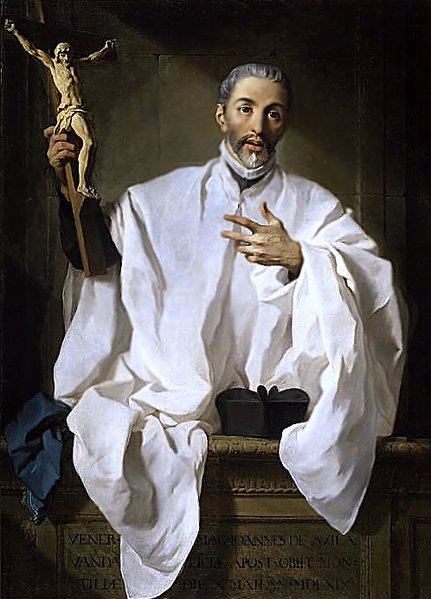
Saint John of Avila by Pierre Subleyras (1746)

Pierre Subleyras was born in Saint-Gilles-du-Gard, a town close to Nimes in the south of France in 1699.  He was a pupil of his father and later of the French painter, Antoine Rivalz, in Toulouse. In 1726 he studied at the Royal Academy of Painting and Sculpture in Paris, where he was awarded the Premier Prix de Rome, which was a scholarship for arts students, principally of painting, sculpture, and architecture. It was created, initially for painters and sculptors, in 1663 in France during the reign of Louis XIV.   It was awarded annually and came with a bursary for promising artists having proved their talents by completing a very difficult elimination contest. The competition was open to the students of the Academy and starting in 1666, the award winner could win a stay of three to five years at the Palazzo Mancini in Rome paid for by the King of France.    

In 1728, Subleyras went to Rome where he received a painting commission from Frederick Christian, the Elector of Saxony, and this led to him being accepted into the Roman artists’ guild known as the Academia di San Luca.  He remained in Rome for the rest of his life and carried out many commissions for the Catholic Church.  He painted a variety of subjects, which included portraits of Pope Benedict XIV.  He also painted the portrait of the Italian priest and nobleman who was a great art collector and patron of Subleyras and who was eventually elevated to become Cardinal Valenti Gonzaga.  He painted many still-lifes, but his reputation was built around his religious paintings, which are much more serious in spirit than most French work in the Rococo period.

His most famous work is the Mass of St Basil, which he painted for St Peter’s.  The painting that served as the cartoon for this altarpiece was commissioned from Pierre Subleyras.   He was paid for the picture, which is now in S. Maria degli Angeli, Rome.  This huge picture was highly acclaimed when it was unveiled in 1748, but Subleyras died before he could follow up his success.  A modello of the work is currently housed at the Metropolitan Museum in New York.

However, My Daily Art Display featured painting for today is another of Subleyras’ works.  It is his portrait of St John of Avilla which he completed in 1746 and now hangs in the Birmingham Museum and Art Gallery.  Saint John of Avila (1500-69) is often known as the Apostle of Andalusia.  Shortly after his ordination to the priesthood, Saint John gave his family’s wealth to the poor and prepared to do missionary work in the New World. However, the Archbishop of Seville intervened, for in the wake of the release of the southern-most region of Spain from almost eight centuries from 711 to 1492 of Islamic rule, the archbishop wanted to restore and revitalize the Catholic Faith in Andalusia, and he convinced Saint John, who was a renowned preacher, to take on the task.  He remained in Andalusia for nine years and afterwards continued his missionary activities throughout Spain and is, to this day, one of the most beloved of Spanish saints.  He was beatified by Pope Leo XIII on November 12, 1893, and Saint John was canonized on May 31, 1970, by Pope Paul VI.  St John of Avila is one of the Catholic Church’s greatest heroes, even if relatively little is known about him outside Spain, where he is patron of the nation’s priests.

It is a mesmeric work with the light falling on the white vestments of St John as he stands in the pulpit holding up the cross with the crucified Christ. The long fingers of his left hand lay across his chest as he points towards the cross.   His greying hair adds to the dignity of the figure.  His dark eyes look out at us as he preaches his sermon. His black biretta lays before him on the edge of the raised pulpit.  This painting is a personification of his greatest gift – the power of oratory and it was this God-given gift that enabled him to win over the hearts of minds of the Andalusian people.

A Burial at Ornans by Gustave Courbet

A Burial at Ornans by Gustave Courbet (1850)

In an earlier blog (November 14th) I looked at the life of Courbet and his painting The Artist’s Studio.  If you have just arrived at today’s blog it would be worth going to the earlier one to read about Courbet’s life and his artistic principles I mentioned in that earlier blog that when he had tried to get his three large painting into the Paris Exposition Universelle of 1855 they were rejected because of their size.  My Daily Art Display featured painting today entitled A Burial at Ornans was one of the three.  This work was even bigger than the The Artist’s Studio, and measures 3.1metres by 6.6 metres and was completed by Courbet in 1850.  Both paintings are housed at the Musée d’Orsay.

Gustave Courbet was born in Ornans in 1819 and this huge painting depicts the funeral of his great uncle at the town in September 1848.   The depiction of the funeral and the laying to rest of the dead is unlike the usual way it would have been portrayed in Romantic or Academic art, where we would expect to see angels of the Lord carrying the soul of the deceased heavenwards.  Gustave Courbet was a realist painter.  In fact he was in the forefront of the Realism art movement, which was a grouping of artists  who believed that they should represent the world as it is even if that meant breaking with artistic and social conventions.  Realist artists painted everyday characters and situations all in a true-to-life manner.  These artists wanted to rid art of the theatrical drama, lofty subjects and the classical style and in its place they wanted to depict more everyday commonplace themes.  Courbet was once asked to incorporate angels in a painting he was doing of a church.  He rejected the request saying:

“….I have never seen angels. Show me an angel and I will paint one… “

The Innocent gaze

This realist art we see before us is exactly as Courbet would want.  It is a funeral scene, warts and all.  It is an unflattering yet dignified scene, but more importantly to Courbet, it is a realistic scene.  There is a stillness and serenity of what we see before us.  There is no attempt to glorify the setting with a grandiloquent and ostentatious depiction of descending angels with God seated on a throne in the clouds above.  In the foreground there is an open grave awaiting the coffin.  The funeral procession approaches from the left.  In the procession we see the pallbearers slowly following the priest and altar boys as they close in on the gaping hole in the ground and the gravedigger, who is on bended knee by the grave.  The figures in red are officials of the church, who assisted at religious functions.  If you look closely at the edge of the grave, you can just make out a skull which presumably was exhumed when the grave was dug out.  The mourners fill the middle ground of the painting.  Grief-stricken women, with handkerchiefs fending off their tears, circle the grave.  It is interesting to note that Courbet did not use models for this scene, which would have been the norm in historical narrative paintings.  Instead he used actual villagers who were at the ceremony, including his sister and mother, and this again highlights his desire for realism.  This is not an en plein air painting for the depiction of the people was done in his studio at Ornans.  Look how Courbet has depicted the young at this event. 

Girl peeking at grave

See how the young altar boy, who is standing behind the priest, stares up at one of the pallbearer.  Courbet has managed to perfectly capture the look of innocence in the boy’s face.  Cast your eyes to the right foreground of the painting and see if you can spot the face of a small girl who is peeking out at the grave.  We just see her face.  The rest of her is almost lost amongst a sea of black clothing.  Look at the way Courbet has kept the heads of the mourners and officials level with the tops of the cliffs and the land in the background.  Observe how only the crucifix reaches reaches above that level into the pale sky, as it is held aloft by an attendant.   Just a coincident or has a little piece symbolism crept into Courbet’s work?

In Sarah Faunce’s biography of Courbet she talked about the reception this painting received from the public and critics.  She wrote:

“….In Paris the Burial was judged as a work that had thrust itself into the grand tradition of history painting, like an upstart in dirty boots crashing a genteel party, and in terms of that tradition it was of course found wanting…”

The critics seemed to miss the histrionics and exaggerated gestures of grief they had been used to seeing depicted in great historical funeral paintings of the past.  They thought this painting was ugly and presumably missed the beauty of angels, puti and the presence of the figure of God sitting aloft awaiting a new entrant to his kingdom.   Another aspect of the painting which disturbed the critics was the fact that Courbet painted this huge work, similar in size to grand historical paintings of the past, centred, in their opinion,  on a subject of little consequence – a burial of a family member.  As far as the sophisticated Parisians were concerned paintings of  rural folk should be confined to small works of art and they were very critical of Courbet’s decision to afford these folk such a large space of canvas.  The fact that he did was looked upon as a radical act.  However Courbet said of the painting “it was the debut of my principles”.   For the critics, if an artist was going to paint such an enormous work, then they expected the subject to be an idealized grand narrative and not just an ordinary every day event.

I end today with two quotes from the artist on his artistic upbringing and his pursuit of Realism and what he tried to achieve.

“…I have studied, apart from any preconceived system and without biases, the art of the ancients and the moderns. I have no more wished to imitate the one than to copy the other; nor was it my intention, moreover, to attain the useless goal of art for art’s sake. No! I simply wanted to draw forth from a complete knowledge of tradition the reasoned and independent understanding of my own individuality…”

“…To know in order to be capable, that was my idea. To be able to translate the customs, idea, the appearances of my epoch according to my own appreciation of it [to be not only a painter but a man,] in a word to create living art, that is my goal…”

And finally his hope for how he would be remembered…………….

“…When I am dead, let it be said of me: ‘He belonged to no school, to no church, to no institution, to no academy, least of all to any regime except the regime of liberty…”

The Artist’s Studio by Gustave Courbet

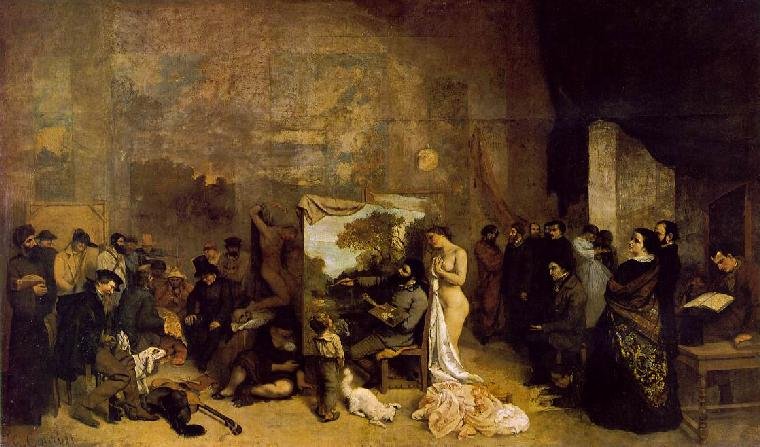
The Artist's Studio by Gustave Courbet (1855)

Jean-Desiré-Gustave Courbet was born in Ornans, a rugged area in the Franche-Comté region close to the France-Swiss border in 1819.  His father Règis Courbet and his mother, Sylvie were landowners, who owned a vineyard in Flagey, ten miles outside of Ornans.  They were a prosperous family but despite that Courbet’s parents held left of centre, anti-monarchist views.  This was probably a long held passion as his mother’s father had fought in the French Revolution.  At the age of twelve he attended a seminary in Ornans and it was during his time there that, according to his friend and art critic, Jules-Antoine Castagny, he came up before the priest to confess his sins and to have them forgiven.  According to Jack Lindsay in his biography of the artist,  Gustave Courbet: His Life and Art

“…The sins he revealed to his confessor so monstrously exceeded, in number and in kind, the iniquities appropriate to his tender age that nobody was willing to give him absolution…These successive rejections began to affect his reputation…To make sure he had forgotten nothing, Courbet had compiled a list of all the sins it would have been possible to commit, from the most trifling peccadillo to the darkest of crimes…”

This was an early sign of Courbet’s rebellious nature which would remain with him for the rest of his life.  When he was eighteen years of age his father arranged for Gustave to attend the Collège Royal at Besançon to study law.  At the same time he attended lessons at the Académie and studied painting under the tutelage of  Charles-Antoine Flageoulet, who had once been a pupil of the great neo-classical artist Jacques-Louis David.  Courbet left Besançon and moved to Paris.  His father still believed that this move was to further his legal studies but Gustave had other ideas.   Whilst there, he became great friends with Francois Bonvin, the French realist painter and the two would frequent the Louvre and study the Masters.  He also attended the atelier of Steuben and Hesse on the Île de La Cité.   He set about a series of self portraits in the 1840’s, one of which, Self portrait with Black Dog, he submitted to the Salon Exhibition of 1844 and was accepted while the rest of his submissions did not pass the jury’s scrutiny.  This was the start of a long running battle Courbet was to have with the Salon’s juries and lead to many vociferous comments by the artist against what he believed was the Salon jurists’ petty vindictiveness against himself. 

The following three years saw Courbet travelling around Belgium and Holland.  His art was very popular in the Low Countries and he had built himself a large wealthy international clientele.  It was through these connections that his fame as an artist spread throughout Europe.  Courbet was in the forefront of the Realism art movement, a grouping of artists  who believed that artist should represent the world as it is even if that meant breaking with artistic and social conventions.  Realist artists painted everyday characters and situations all in a true-to-life manner.  These artists wanted to rid art of the theatrical drama, lofty subjects and the classical style and in its place they wanted to depict more everyday commonplace themes.     Realism was starting to be popular not only in art but in literature.  Strictly speaking realism in literature denoted a particular kind of subject matter, especially the representation of middle-class life. In literature, like in art, realism was a reaction against romanticism. Realists focused their attention, in the main, on the immediate, the here and now, the specific action, and its verifiable consequence.

Courbet used to meet his fellow realists in the Brasserie Andler,  which was only a few steps away from his studio at 28 rue Hautefeuille in Paris.  He would rub shoulders with writers such as Champfleury and Proudhon and the poet Beaudelaire.   Max Buchon, his old school friend from Ornans would also be there.  Fellow artists, such as the caricaturist and painter Honoré Daumier and Alexandre Décamps were also regulars who congregated at the brasserie. Courbet had carved himself a leading role within this group of Realists.  The biographer Jack Lindsay quoted in his book Gustave Courbet his life and art,  the words of the 19th century French journalist and writer Alfred Delvau,  who described Courbet’s role within this circle of friends and his realist philosophy, saying:

 “….And in this temple of Realism, where M. Courbet was then the sovereign pontiff and M. Champfleury the cardinal officiating, there were then, as the public of boozers, students, and wood engravers understood, only realists and non-realists…”

Courbet’s  many pictures of peasants and scenes of everyday life established him as the leading figure of the realist movement of the mid nineteenth century.  He was an outspoken opponent of the French government and it was during the short lived Paris Commune that he took part in the destruction of the Vendôme Column in 1871 during the uprising in Paris which followed after France was defeated in the Franco-Prussian War.   Courbet expressed his reasoning for the removal of the Vendome column, saying:

“…In as much as the Vendôme Column is a monument devoid of all artistic value, tending to perpetuate by its expression the ideas of war and conquest of the past imperial dynasty, which are reproved by a republican nation’s sentiment, citizen Courbet expresses the wish that the National Defense government will authorise him to disassemble this column…”

The uprising was chiefly caused by the disaster of the war and the growing discontent among French workers.  For Courbet the Column was totally devoid of artistic value but more importantly he was against what it stood for.    For his part in the pulling down of the column he was sentenced on 2 September 1871 by a Versailles court martial to six months in prison and a fine of 500 francs.  In 1877 the estimated cost of rebuilding the Vendome was finally established as being 323,091 francs and 68 centimes. Courbet was told he must pay for it to be rebuilt and he was to pay a fine in yearly installments of 10,000 francs for the next 33 years meaning the final payment would be when he had reached the age of 91.   On July 23rd, 1873 Courbet, through the assistance of a few friends, fled France for Switzerland as he could not, nor did not want to pay his fines.     On December 31st 1877, in La Tour de Peilz in Switzerland where he was living in exile, a day before the payment of the first installment was due, Courbet died, aged 58, of a liver disease probably due to his bouts of heavy drinking,

In My Daily Art Display today I have  featured one of Courbet’s greatest painting entitled The Artist’s Studio which he completed in 1855 and which had a secondary title: A Real Allegory of a Seven Year Phase in my Artistic and Moral Life.  It was an enormous painting, 3.61 metres tall and almost 5.98 metres wide and can be seen in the Musée d’Orsay in Paris.  Courbet submitted this painting with thirteen others to the Exposition Universelle of 1855.  The Exposition Universelle was an International Exhibition held on the Champs Elysées in Paris from May to November in that year.  This Paris exhibition came four years after London had held their Great Exhibition of 1851.  To Courbet’s horror, three of his paintings were rejected on the grounds that they were far too big for the exhibition as space was restricted.  One of these was today’s featured painting and one of the others was his mammoth work, A Burial at Ornans, which was 3.14metres tall and 6.63 metres wide.  However Courbet was not to be denied and decided to withdraw all his paintings and with the help of his patron Alfred Bruyas set up a rival exhibition with forty of his works in a rented hall next door to the official exhibition, which he called The Pavilion of Realism.   It did not prove to be a great success as attendances and sales were poor and many just came out of curiosity, but for fellow artists, Courbet’s gesture was inspirational and his standing in the artistic community rose.  He was now acclaimed as a hero of the French avant-garde and an inspiration to the young up and coming artists.  In some ways this alternate exhibition running alongside the official exhibition was a forerunner of the Salon de Refusés, which came into being as an alternative to the Salon exhibitions in Paris  in 1863 and again in 1874 during the Imressionist era.

The work before us today was looked upon as an allegory of Courbet’s life as a painter and the various figures depicted are allegorical representations of various influences on his life.  So who are all the people?   In some ways the work is a kind of triptych with three distinct sections.  On the left hand side of the painting are various figures from the different levels of French society.  To my mind the left hand side includes things and people Courbet disliked and sums up what he believes was wrong with society, such as religion and poverty, while on the right of the painting he has presented us with things and people he holds dear. 

Let us first look at the grouping on the left hand side of the painting.  On the ground sprawled beside the canvas sits the figure of a starving peasant.  More than likely Courbet is depicting an Irish peasant, as the Great Irish Famine had taken place only a few years earlier.  To the left of the peasant there are several other figures.  This strange grouping appears to include a priest, a prostitute, a grave digger and a merchant. In the far left of the painting we see the standing figure of a Jewish Rabbi and seated on a chair before him is a hunter with several dogs.  This depiction of this man is quite interesting as it is thought by use of x-ray analysis that the figure of the man was added later and was not mentioned in Courbet’s letter to Champfleury when he wrote about the details of the work.  So what was so important to cause this late addition.  Art historians would have us believe that he is an allegory of the then current French Emperor, Napoleon III.  He has been identified as such because of his famous hunting dogs and also by his twirled moustache which he was famous for.  So why place the French ruler on the left side of the painting?  The answer probably lies in Courbet’s early upbringing in an anti-monarchist household and Courbet’s inherent dislike of the emperor.  It was Courbet’s belief that Napoleon III was no better than a thief having stolen the country from its people.   In the centre of the work, behind Courbet’s landscape canvas we see a nude male model, on the floor we see a guitar, dagger and hat, and on the table a skull.  These were all accoutrements of traditional academic art which Courbet loathed. 

In the middle, taking centre stage and thus the centre of our attention, we see the realist artist himself sitting before his easel working on a landscape.  He has placed himself as the main focus of the painting and maybe it was his way of projecting himself as the leader of the Realist movement.   Behind Courbet, and being ignored by him, is a nude model, which symbolises academic art tradition which Courbet disliked so much.  Standing in front of Courbet, looking totally mesmerised by what Courbet is doing, is a small boy.  It is believed that Courbet included the boy as a symbol of the innocent eye of the artist but of course the mesmeric admiration of the boy for what Courbet has painted may just be something artists crave.  By the boys feet there is a white cat.  

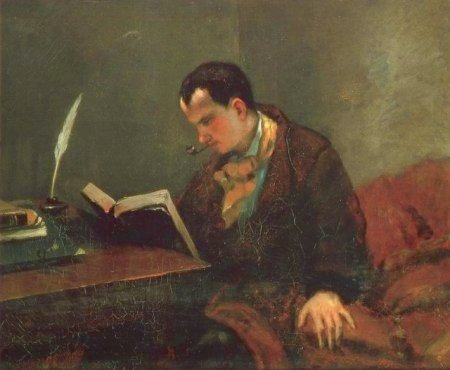
Beudelaire by Gustave Courbet (1848)

On the right of the painting is another group of people.  This grouping is a selection of his friends, associates and admirers.  It is possible to identify some of these figures.  The man standing and looking across to the left hand side, with a beard, is Alfred Bruyas a long-time patron of Courbet.  Standing behind him, facing us,  is Pierre-Joseph Proudhon, politician and socialist philosopher and another friend of the artist. Moving away from those two and towards the foreground we see a man seated.  This is the French novelist Jules Husson, whose non de plume was Champfleury and who was a greater supporter of Courbet’s realist art.  The man at the extreme right of the painting, reading a book, is the French poet Beaudelaire and we know that Courbet’s depiction of him is from a portrait he did of him seven years earlier.  Beaudelaire at the time had a quadroon (mixed race) mistress and Courbet had included her in the painting just to the left of Beaudelaire (as we look at him) but Beaudelaire was not happy with her inclusion and persuaded Courbet to paint her out of the scene.  The presence of Beaudelaire’s mistress was only discovered recently when the painting was cleaned and x-rayed.  Standing quite prominently in the group, in front of Beaudelaire, is a well dressed bourgeoisie lady with a brown-patterned shawl and her companion.  Art historians have not come to a definitive agreement as to who they are but one theory is that it is Christine Ungher and her husband François Sabatier, another of Courbet’s patrons.  Notwithstanding what art historians believed to be the message of the painting Courbet expressed his thought process behind what he had achieved with this magnificent work in a letter to Champfleury.  He wrote:

“….It’s the whole world coming to me to be painted,  on the right are all the shareholders, by that I mean friends, fellow workers and art lovers. On the left is the other world of everyday life: the masses, wretchedness, poverty, wealth, the exploited and the exploiters, people who make a living from death…”.

The Artist’s Studio, Rue de La Condamine by Frédéric Bazille

The Artist’s Studio, Rue de La Condamine by Frédéric Bazille

quem di diligunt, adolescens moritur

Whom the gods love, die young.”

The aphorism comes from the Roman playwright Plautus, who flourished around the end of the 3rd century and actually based his story on a Greek legend about a mother and her two sons.   The point of bringing up this saying is that it unhappily could refer to my featured artist of the day, who was so talented and yet was taken from us at such a young age by war.

Jean Frédéric Bazille was born in Montpellier in 1841.  His father was a senator and the head of an affluent and cultured middle-class Protestant family.    In Montpellier, Jean became acquainted with a friend of his father, a local art collector Alfred Bruyas.  Bruyas was a close friend of Gustave Courbet and he owned a large number of expensive paintings by Millet, Corot, Eugène Delacroix and many by his friend Courbet.  Young Frédéric Bazille was fascinated and inspired by the collection and this was the start of his love affair with art. He loved to paint and sketch but his father told him that if he wanted to continue with his art he had to agree to continue with his medical studies. He agreed to his father’s terms and in 1860 he started studying art.

 In 1862 he moved north to Paris to continue with his medical studies but spent most of his time sketching and painting.  Later that year he joined the studio of Charles Gleyre, the Swiss artist.  It was whilst there that he met and became friends with fellow aspiring artists, Monet, Renoir, Sisley and Whistler.   Gleyre’s studio closed the following year and Bazille decided to leave Paris and follow his friends whilst he waited on the results of his medical exams.

During his journeys around Normandy with Monet  in 1864 they stopped off at Honfleur, which was at that time a special meeting place for the en plein air painters.   It was here that he met up with Monet’s friends, the French marine and landscape painter, Eugene Boudin and the Dutch landscape and seascape painter, Johan Jongkind.  These two artists would later be instrumental in the development of Impressionism.    In the autumn of 1864 Bazille returned with Monet to Chaillyen-Bière, near Fontainebleau.  It was around this time that he finds out that he had  failed his medical exams but fortunately for him, his father did not press him to re-sit them and instead allowed his son to concentrate solely on his artistic career.  In 1865 he put forward two of his paintings to the Paris Salon, Young Girl at the Piano and Still-life with Fish.  Annoyingly for him only his still-life was accepted for the exhibition by the Salon jury.

Bazille and Camille (Study for Déjeuner sur l'Herbe) 1865

Monet, who had a competitive streak, knew about Édouard Manet’s work  Déjeuner sur l’herbe (See My Daily Art Display December 23rd) and knew of the masses of publicity it had received (not all good of course!) when it was exhibited at the 1863 Salon des Refusés.  In the spring of 1865, he decided that he too would embark on his own version of Déjeuner sur l’herbe.   This idea of figure painting in the open air was a new venture for Monet.  He began sketches for his new large-scale painting (4metres x 6 metres) which he planned to finish back in his Paris studio.  The reason for huge size for the proposed work was mainly down to Monet being inspired by Courbet’s recent large scale paintings.   The figures in Monet’s painting were life-sized.  It was almost a group of portraits set in a landscape.  Bazille and Monet’s girlfriend Camille posed for part of this work.  This preparatory oil painting of the two of them exists entitled Bazille and Camille (Study for “Déjeuner sur l’Herbe”) and can be seen at the National Gallery of Art in Washington.  However, only fragments of Monet’s completed grand scale painting survive.   Monet left it with a landlord to cover a debt, and it was ruined by moisture and neglect.  At the same time Bazille himself completed a painting The Pink Dress, which was part of the study for Monet’s open-air mammoth portrait/landscape. 

Bazille having come from a wealthy family never had any financial problems unlike his newly found artist friends and he would often help them out by sharing his studio with them and providing them with artistic materials when they couldn’t afford to buy them.   He actually bought some of Monet’s paintings, including a large work entitled Women in the Garden,  just because the artist needed money.  His friendship with the soon-to-be Impressionists was recorded in a series of paintings he did one of which was set in his Paris studio where they would all meet and it is this work which is My Daily Art Display’s featured painting of the day. 

At the outbreak of the Franco-Prussian war in August 1870, Bazille enlisted in the Zouave, which was the title given to certain light infantry regiments of the French army.  His friends had all tried to dissuade him from this patriotic gesture but to no avail.   In a battle close to the village of Beaune-la-Rolande, his commanding officer had been killed and he took control of his men leading an assault on the Prussian position.  He was hit twice by enemy fire and died on the battlefield.  His death on November 28th 1870 was just a few days before his twenty-ninth birthday.    His father was devastated by the news and a week later came north from Montpellier to the scene of the battle and took his son’s body back home for burial.

Today I am giving you The Artist’s Studio in the Rue de La Condamine, which Frederic Bazille completed in 1870, the same year he went off to fight and die for his country.  The painting currently hangs in the Musée d’Orsay.   One can imagine a group of friends nowadays doing the same as Bazille has done  – recording for posterity a gathering of companions in a photograph but of course in Bazille’s day,  it had to be a sketch or a painting.   The setting for the painting is Bazille’s studio at 9 rue de la Condamine, which he shared with Renoir from the beginning of 1868 until May 1870.   Some of Bazille’s works  are scattered around the room.  To the left, on the wall, we have his Fisherman with a Net and his painting entitled La Toilette can be seen hanging just above the white sofa.  The small still-life above the head of the piano player is a still life by Monet which Bazille had bought in order to support his friend.   We see three men standing at an easel discussing the painting on display.  The man with the hat standing in the middle is Édouard Manet and behind him we think is Monet.  The tall man to the right of the easel, palette in hand, is Bazille himself.  On the staircase is the journalist, writer and art critic, Emile Zola, who is in discussion with Renoir, who is seated below the staircase.  At the piano is Bazille’s musician friend Edmond Maitre.  The National Gallery at Washington houses a portrait of Maitre by Frédéric Bazille.

Frédéric Bazille was considered to be the most gifted of the soon-to-become Impressionists and, if he had lived, he might well have become one of the leaders of that group.  Camille Pissarro described him as one of the most gifted among us.

The Railway by Édouard Manet

The Railway by Édouard Manet (1872)

During Édouard Manet’s life he was great friends with the writer Charles Beaudelaire, the French poet, philosopher and art critic, and from around 1855 they became constant companions with the two of them frequently going off on sketching trips.   It was an important friendship for Manet, as during the times his work was being harshly criticised, Beaudelaire was very supportive of him.  Lois Hyslop the American author and Beaudelaire specialist wrote about this supportive role in her 1980 book Beaudelaire, Man of His Time, and she quoted his comments with regards Manet:

“…Manet has great talent, a talent which will stand the test of time. But he has a weak character. He seems to me crushed and stunned by shock…”

Beaudelaire believed in modernité in art and in his book, The Painter of Modern Life and Other Essays, he stressed the importance of it saying that it was very important that art must be held accountable to capture the modern experience.  He wrote:

“…By modernity I mean the transitory, the fugitive, the contingent which make up one half of art, the other being the eternal and the immutable…”

His advice to Manet was that his art should depict a contemporary realism and that Manet should become le peintre de la vie moderne .

Today I am returning to the French artist Édouard Manet and looking at another of his paintings.   It is a painting of modern life and modern Paris and would no doubt have pleased his friend, Beaudelaire.  The painting is simply entitled The Railway which he started in 1872 and completed the following year.  It now hangs in the National Gallery of Art in Washington. This was the only painting by Manet that was accepted by the Salon jury for their 1874 exhibition.  In some ways it is an unusual painting and we struggle to understand what it is all about and Manet never revealed his thoughts behind the work.  So let us take a look at the image and see if we can understand Manet’s thought process as he put brush to canvas.

Gare Saint Lazare and Pont de l'Europe (c.1868)

To start on this journey of exploration I suppose we need to say what we see.  Let us first let us take in the setting of the scene.  It is an urban landscape of Paris in the late 19th century.  Why did Manet choose this scene and what was its significance?  This was the area around the newly built Gare Saint Nazare which was completed in 1837 and this area, along with the Pont de l’Europe, which straddled the railway tracks was an area of unparalleled importance for representing the changing face of modern life in Paris brought about by the redevelopment scheme of Baron Haussmann.   It was an area which was depicted many times by the Impressionist artists like Monet, Caillebotte and Jean Beruad.  The view we see is from the garden of the rue de Rome apartment house of Manet’s artist friend Alphonse Hirsch.  The painting is almost dominated by the black metal railings which boldly run the full width of the painting, creating a foreground and a background to the work and at the same time and in some ways acts to force the two females out towards us.  The black railings form a hard, lattice-work and it is in contrast to the pure white steam behind it.  There is an abundance of contrast in this painting with its sharp edges and soft dissolves. The small girl, with her back to us, almost seems as if she is using the railings as stage curtains which she draws open to get a better view of the rail tracks and the feverish movement of the trains below.  In contrast, the older female just leans back against them and shows little interest in what is happening behind her.  She has seen it all before.  To the right, on the other side of the railings, low down we can see a signal box, above which we can just make out a white pillar which is part of the Pont de l’Europe, which was inaugurated in 1868.  The Saint-Lazare station, which is out of picture, is further to the right.

Across from the railway tracks and in the background on the upper left of the painting, just behind the woman’s head, we see the buildings on the rue de Saint-Pétersbourg and the probable reason for this inclusion is we are actually looking at the door and window  of 4 rue de Saint-Pétersbourg , which was formerly a fencing hall, but from 1872 to 1878, it was Manet’s studio.  Most of the central background behind the railings has been masked by a cloud of steam and smoke which has wafted upwards from a passing locomotive and now hangs in the air.

On our side of the railings and close up to us we have the life sized figures of a young women and a young girl.  We are connected to them by their nearness, but is there a connection between the two of them?  Are they mother and daughter, or sisters, or governess and charge?  I think at this early stage in our investigation we have hit a brick wall as there is nothing to tell us about this relationship.  However there is certain disconnect between the two.  They face in different directions, almost a Janus-like scenario.

The woman wears a long dark blue dress with large round white buttons and full lace cuffs.  Cradled in her lap we see a small dog, which is often termed due to its size, a lap dog.  She is holding an opened book which she has been reading and tucked partly under her right arm is a closed fan.  Her long hair which is auburn in colour hangs loosely down and rests on her shoulders.  The lack of styling to her hair gives me to believe that she may be just out of her teenage years and yet, the covering of her arms, unlike the young girl next to her,  would indicate a sense of decorum attributable to adulthood.  On top of her head she wears a tall bonnet crested with a floral design.  For jewellery she has gold-like earrings and a bracelet and wears a thin black ribbon around her neck.   She stares thoughtfully out at us.  It is an ambiguous unwavering  stare and in some ways a similar look to the one the lady gave us in Manet’s painting Olympia.  Is she trying to engage with us?

The model Manet used for this depiction is once again Victorine Louise Meurent, a painter and famous artist’s model.  We have seen her before in Manet’s controversial masterpieces, Le déjeuner sur l’herbe (The Luncheon on the Grass) which I featured in My Daily Art Display of August 2nd and Olympia (My Daily Art Display Oct 12th).  This was to be her last sitting for Manet  for it was around this time that she started taking painting lessons.  She wanted to concentrate on an academic style of painting which was anathema to Manet and their relationship fell apart.

Let us now look at the young girl.  The model used for this young girl was the daughter of Albert Hirsch, Manet’s friend.   She has her back to us and we see her peering between the railings at the activity below – the passing of a steam train.  It is somewhat strange that her right arm and shoulder are missing which is in direct contrast to her left arm which is stretched outwards as her hand grips the black metal railing.  Her attire reinforces her young age as we see she is not condemned by late 19th century convention to have long sleeves to her dress.  Her bluish/silver dress with the large bow is depicted in an unusual fashion.  It balloons outwards which either means a rush of upward air has caused it to billow or she has retained what is termed “puppy fat”.  Her hairstyle belies her age as it is swept up in an adult fashion and tied by a similar black ribbon worn by the woman.

So what did the critics make of Manet’s painting which was his largest en plein air work,  up until then, that he ever painted measuring 93cms x 114cms.  Alas once again a hostile reception from the critics greeted Manet’s work.  One said the painting should be renamed:

Two sufferers from incurable Manet-mania watch the cars go by, through the bars of a madhouse

Those who visited the exhibition were baffled by the work.  Critics said that the painting was incoherent and the painting quality was poor.  Unfortunately, few failed to recognise that this was a painting which symbolised modernity.  His friend Beaudelaire would have been proud of him but alas he died seven years before the painting was exhibited.

Sunday Afternoon on the Island of La Grande Jatte by Georges Seurat

A Sunday Afternoon on the Island of La Grande Jatte by Georges Seurat (1884-86)

Today I am starting My Daily Art Display blog by introducing you to some new “isms” which have a connection with what is to follow.  They are Post-Impressionism, Neo-Impressionism, Pointillism and Divisionism and they all are connected in some way to today’s featured artist George Seurat.

By now you will have read many of my blogs that cover the works of the Impressionists such as Monet, Renoir, Degas and Caillebotte and so by now you are familiar with the term Impressionism.  Post Impressionism was a style of painting that grew out of Impressionism or maybe we could say it was a style of painting which was a reaction against Impressionism. The three main artists who were central to this new group of painters and who were termed Post Impressionists were Gaugin, Van Gogh and Cézanne.   Gaugin retained the intense light and colour of the Impressionists but discarded the idea of painting from nature.  He was totally against naturalism, where artists depict nature just as it is, and in its place he wanted his works to have more inventive subject matter and he also liked to experiment with colour.   On the other hand Van Gogh continued to paint from nature but developed a highly personal use of colour and brushwork which openly expressed his own expressive response to a subject.  Cézanne kept faith with the Impressionist’s principle of painting from nature but his works came across with a greater energy and vitality.

Today I am going to look at Neo-Impressionism and Neo-Impressionist artists who were a distinct group of painters within the Impressionist movement and in some ways formed a transition period between the Impressionists and the Post Impressionists.  The two leading figures of this trend were Georges Seurat and Paul Signac and they wanted to have a more scientific approach on how light was depicted in their paintings.  Their works were characterised by the use of a technique known as Divisionism or Pointillism.  Divisionism, also sometimes known as Chromolumanarism, was a method of painting in which colour effects were achieved by applying small areas of dots of pure unmixed colours on the canvas so that  an observer standing at an appropriate distance from the painting (suggested distance for best effect was three times the diagonal measurement of the work) the dots would appear to react together giving a greater luminosity and brilliance than if the same colours had been mixed together before putting them on the canvas. What these artists wanted to achieve was that the observer of the painting combines the colours, which are in the form of dots, optically instead of the artist pre-mixing them on a palette before putting them on the canvas.

Pointillism comes from the term peinture au point, which was used by the French art critic Félix Fénéon, when he described today featured painting by Seurat.   It can be defined specifically as the use of dots of paint and does not necessarily focus on the separation of colors.  Divisionism refers mainly to the underlying theory, pointillism describes the actual painting technique associated with the likes of Seurat, Signac and to a lesser extent Pissarro. Pointillism is related to Divisionism which is a more technical variant of the method. Divisionism is concerned with color theory, whereas pointillism is more focused on the specific style of brushwork used to apply the paint.

Enough is enough !!!!  I don’t want to get too bogged down with “isms” and their meanings and I am sure that there are many people out there who can give a much more expansive explanation of the differences between Divisionism and Pointillism .   My Daily Art Display today features what many believe is Georges-Pierre  Seurat’s greatest work.  It is entitled A Sunday Afternoon on the Island of La Grand Jatte.  It was the one of the first painting to be executed entirely in the Pointillist technique and the first to include a great many people playing a major role.   It caused a sensation when it was exhibited at the eighth and final Impressionist Exhibition in 1886.  It is thought that it was possibly intended as a pendant to Seurat’s other work, Bathers at Asnière,  which I will look at in a later blog.

He started the work in 1884 and did not complete it until 1886.  He spent two years making over sixty preparatory pencil and ink drawings, conté crayon studies and oil sketches on panel for this work.  He would alter the grouping of people, the number of people within a group and where each group or individual were positioned until he was satisfied that he had achieved the perfect balance.  There was a smaller version of the painting which can be found in the Metropolitan Museum of Art in New York.  There is also a version of the scene without the people which was once in the private collection of Mrs John Hay Whitney.   This painting we see today is massive in size measuring 207cms high by 308cms wide (almost 7ft tall and 10ft wide) and since 1924 has been housed in the Art Institute of Chicago.  Seurat completed the final version of this painting in his small Paris studio.

The Models by Seurat (1886-88)

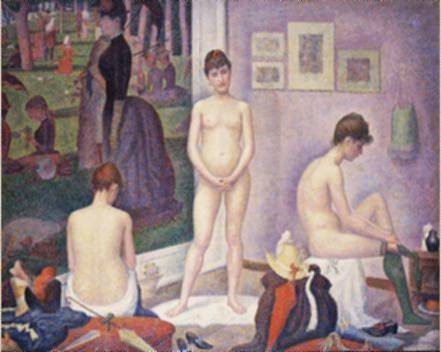
In 1888, Seurat also completed another painting which was entitled The Models  using his pointillism technique, and which depicts models in his studio.  Included in the painting is a section of La Grande Jatte and art historians believe that by doing this painting, he was showing the world that this technique of Pointillism worked just as well for indoor scenes as outdoor ones.

The Île de la Grande Jatte is a small island in the River Seine, downriver from La Défense.  It is about 2 kilometers long and just 200 metres wide at its widest point.  At one time it was reduced to being an industrial site but now has public gardens and houses.   Living on the island are approximately 4000 inhabitants.  However in the days of Seurat it was a pastoral retreat where Parisians could come at weekends from their claustrophobic city existence and soak up the quiet and peace of this little idyll.

Before us we see Seurat’s idealized version of the Grand Jatte omitting both the cafés and restaurants and the nearby ugly shipyard and factories.  In the painting we see members of different social classes out for a stroll along the Grand Jatte by the side of the Seine.  The figures, shown mainly in profile or frontal position, have a peculiar formal and artificial feel to them.  As we look at the painting head-on, there seems to be a definite elongation of some of the people although I believe if you stand at a certain angle to the painting this is minimised.  Seurat would sketch individual groups or single characters and then return to his studio to decide if and where each group should be placed on the canvas.  He sketched people of different classes in society to give the idea that all types of people enjoyed promenading along La Grande Jatte.   Look at the trio in the right foreground.  Here we have the a man wearing a top hat and holding a cane who is more than likely from the upper classes of Paris society.  The man with the muscular arms, lying back with a cap on his head, smoking the pipe is probably a working-class boatman and finally we have the young genteel lady of an indeterminate class.  An unusual trio and who, although physically close in the painting, would be unlikely to have a closeness in that present-day society.  The faces of the people in the painting show little personality.  There is something very impersonal about them.  We must presume that this was a deliberate ploy by Seurat who seemingly did not want the painting to be sullied by observers of the painting trying to interpret facial expressions.  I don’t believe the artist ever intended this to be in any way a moralistic statement about the French culture and classes at the time. However, some would disagree.   Art historians like to interpret every painting and seek symbolic depictions within a work so let us have a look at a few that have been thrown up for consideration with regards this work of art.

In the left middle ground we see a lady dressed in gold and orange fishing in the river.  I suppose there is nothing strange about that albeit she is hardly dressed as a woman who was to go out on a fishing expedition.  Well consider what the French word is to fish – it is pêcher and some have suggested that Seurat has made a play on the word as the French word to sin is pécher.  So is Seurat secretly identifying her as a prostitute.  Again look at the woman in the right foreground accompanying the gentleman.  Look what she is holding in her left hand – a monkey on a leash.  That is certainly an unusual pet to take for a walk.   So why did Seurat include a monkey.  One possible reason is that a female monkey in French is une singesse.  The symbolists would have us believe that a monkey is a symbol of licentiousness and that is why the French slang for prostitute is singesse.  So again I ask the question is Seurat trying to tell us by symbolism that this woman is a prostitute who is out for a stroll with her client?

It is interesting to note and it is not shown in my attached picture, that later Seurat painted the border using parallel red, orange and blue dashes and dots.  He varied the combination of colours in different parts of this border in order to accentuate the adjacent colours in the painting itself.  Maybe if you go to see the painting in Chicago you can let me know if Seurat’s idea with this border really works.

Finally, I came across a poem about this painting which I was going to add to the blog but it was too long so instead I have added the URL where you can find it.  It is:

http://www.lamaquinadeltiempo.com/algode/delmore2.htm

The Pond at Montfoucault by Camille Pissarro

The Pond at Montfoucault by Camille Pissarro

As promised yesterday my blog today carries on looking at the life of Camille Pissarro and one of his later paintings.

In 1872 Pissarro returned to Pontoise, where he once again set up home.   His friendship with Cézanne was re-established and Pissarro mentored his friend in the technique of painting “patiently from nature”.   Cézanne was to later to comment about his relationship with Pissarro and how his mentoring made him change his artistic style saying:

“…As for old Pissarro, he was a father to me, a man to consult and something like the good Lord…”

Pissarro was determined to create an alternative to the Salon.  He wanted a society of artists who would work together and become a type of cooperative.  It took almost four years to achieve his aim .   Artists petitioned for a new Salon des Refusés in 1867, and again in 1872.  Both requests were denied and so during the latter part of 1873, Pissarro along with Monet, Sisley and Renoir organized the Société Anonyme Coopérative des Artistes Peintres, Sculpteurs, Graveurs (“Cooperative and Anonymous Association of Painters, Sculptors, and Engravers”).  Its purpose was to exhibit their works of art independently.   They soon had fellow artists like Cezanne, Berthe Morisot and Degas interested in the scheme and all agreed to boycott participation in the Salon in 1874 and exhibit only at their exhibition.  The exhibition took place in January 1874 at the studio of Gaspard-Félix Tournachon , known as Nadar,  in the Boulevard des Capucines and this exhibition of their work was later to become known as the First Impressionist Exhibition.  Works in this exhibition included five paintings from Pissarro.  The names of the other artists who exhibited works in this exhibition reads like a Who’s Who” of famous artists.  Included in the exhibition were works by Monet, Renoir, Guillaumin, Béliard, Sisley, Cézanne, Degas and Morisot.  This First Impressionist Exhibition was not received favourably by the critics and Pissarro was disheartened by their criticism.  He wrote to the art critic Théodore Duret, who was sympathetic to the Impressionist cause, expressing his disappointment with the adverse criticism:

“…Our exhibition goes well. It is a success. The critics destroy us and accuse us of not having studied; I am returning to my work, it is better than reading the reviews…”

So why did the majority of art critics hate the works on show?    One should remember that the critics were brought up on the art of the Salon with its accepted works portraying religious, historical any mythological settings and so the paintings put forward by the Impressionists, including Pissarro, depicted commonplace street life and people busying themselves in their daily routine and was considered by the critics as both facile and some even went further by declaring them vulgar.  The critics considered a lot of the Impressionist works as being “unfinished” in comparison to the works seen at the Salon.  They commented that the way the brushstrokes of the Impressionists works were visible which, to their mind,  meant it had been done in haste and often completed in a solitary sitting.  In comparison they praised the Salon painters who to them were the “real” artists and who spent hour after hour carefully perfecting each part of their works.

The year of this First Impressionist Exhibition in 1874 proved a bad year for Pissarro.  His artworks were not selling and he had to endure a personal tragedy with his nine year old daughter Jeanne dying the week the exhibition opened.  However,  Pissarro stuck to his belief in the Impressionist movement and exhibited no fewer than twelve works in their second exhibition in 1876.  Three years on the Impressionist grouping was starting to fall apart with Renoir, Sisley and Cézanne having left.  There was also now a split amongst the remainder of the group with Degas on one side who wanted to bring in new artists and Caillebotte and Pissarro on the other who wanted to maintain the status quo.  Degas also laid down the rule for the Impressionist group that any artist putting forward work to the Salon could not enter work in that year’s Impressionist exhibition.  This was a major dilemma for some of the group who believed that to become a respected artist and command a good price for their works they had to exhibit at the Salon.

The possible break-up of the Impressionists that had worried Pissarro showed itself in the sixth and seventh exhibitions with few of the initial contributors putting forward works for inclusion.  Pissarro continued to support the Impressionist Exhibitions, refusing to enter works at the Salon and in fact contributed to all eight Impressionist Exhibitions.  Times were still difficult for Pissarro and the collapse of the French economy at the start of the 1880’s  made it even more difficult for him to sell his work.   In 1884 he moved from Pontoise to the small village of Eragny sur Epte which lies north east of Paris.  It was whilst living here that he met the artists Georges Seurat and Paul Signac and he became a convert to their new approach to art which was known as Neo-Impressionism.  I will go more into Neo-Impressionism movement and the related “–isms” of pointillism and divisionism, both of which are relevant to Neo-Impressionism, when I feature the works of George Seurat.

By the time of the eighth and last Impressionist Exhibition in 1886 there was an apparent lack of harmony among the remaining Impressionist artists, and the work of the Neo-Impressionists was shown separately from that of the others.   It was noticeable that both Monet and Renoir were absent from this last exhibition.   Seurat showed his now famous, and very large work entitled A Sunday on La Grande Jatte which he had just completed and  which dominated the room.  The room also contained Pissarro’s own Neo-Impressionist submissions which consisted of nine oil paintings,  as well as gouaches, pastels, and etchings.

Pissarro’s love affair with Neo-Impressionism was short lived and in 1889 he began to move away from the style, believing that it made it “impossible to be true to my sensations and consequently to render life and movement”.  Impressionism at this point in time had run its course.   Pissarro carried on painting city scenes although his erstwhile colleagues Renoir, Sisley and Monet had abandoned such subjects.  Pissarro completed a number of works featuring the streets of Paris and the Gare Saint Lazare.

In his latter years Pissarro suffered from a recurring eye infection that prevented him from his en plein air work and any outdoor scenes he wanted to paint he did so whilst sitting by windows of hotel rooms he stayed at, always making sure he had a top floor room with a good view.  He carried on doing this when he toured around the northern French towns of Rouen, Dieppe and Le Havre  and also when he made trips to London.  Pissarro died in Paris in 1903, aged 73.  He was buried along with the other greats of French art, music and literature in the Père Lachaise Cemetery.

Camille’s descendents followed his path in the art world.   His granddaughter, the daughter of his son Lucien,  Orovida Pissarro is a painter in her own right.  His great-grandson, Joachim Pissarro, is former Head Curator of Drawing and Painting at the Museum of Modern Art in New York and is now a professor in Hunter College’s Art Department.  His great-granddaughter, Lélia, is an artist who lives in London.

My daily Art Display featured work of art today by Camille Pissaro is a painting he completed in 1875 entitled The Pond at Montfoucault.   In 1859, a few years after arriving in Paris, Pissarro,  whilst attending the Académie Suisse,  met some aspiring artists who would become very famous, such as Monet and Cézanne.  He also became great friends with a lesser known painter, Ludovic Piette.  Piette often exhibited at the Paris Salon  in the 1860’s and also some of his paintings were shown at the Third Impressionist Exhibition of 1877.  Piette’s home was in the small village of Montfoucault, which lies on the border between Normandy and Brittany.   Pissarro went to stay with Piette on a number of occasions and when the Franco-Prussian war broke out Pissarro and his family left their home and took refuge with Piette before crossing the Channel to England.

It was later in 1874 when Pissarro had come to Montfoucault to try and relax and get over the stress and disappointment of the First Impressionist Exhibition that he started to paint some local country scenes.  He especially liked to depict female workers engaged in their daily duties and this is what we see in today’s painting.  Before us we see a female herding  some cattle by the pond which lay on Piette’s property.  Pissarro enjoyed his visits to Montfoucault and he wrote to Theodore Duret, the French journalist, author and art critic about his work but you can sense an uneasiness and doubt in his mind about his art.  He wrote:

“…I haven’t worked badly here.  I have been tackling figures and animals.  I have several genre pictures.  I am rather chary about going in for a branch of art in which first-rate artists have so distinguished themselves.  It is a very bold thing to do and I am afraid of making a complete failure of it…”

There is a beautiful tranquillity about this painting and one can see how an artist like Pissarro would have liked basing himself in this area.