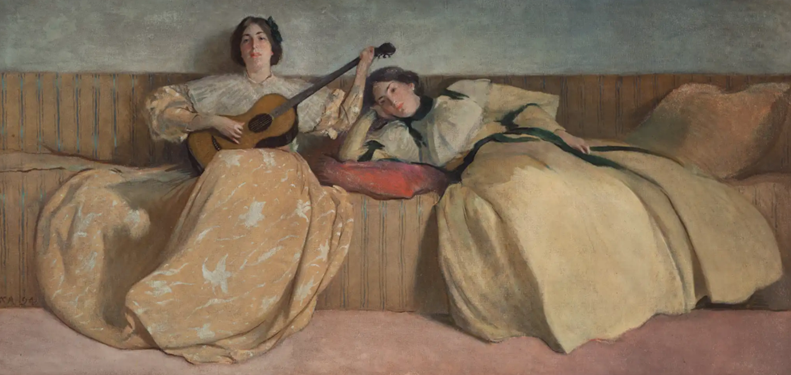
Maritime Art. Part 2.

In this look at Maritime or Marine Art I want to showcase those paintings which feature the people who have dedicated their lives to saving seafarers and those working the seas in a continual search for food to put on our tables. 

For the first of my forays into the depiction of fisherman I want to delve into the work of the great Skagen painters.  These were a group of Scandinavian artists who had come together in the small coastal village of Skagen, which is situated in the northernmost part of Denmark, from the late 1870s until the turn of the century. One of the Skagen painters was Peder Severin Krøyer.  He was born in Stavanger, Norway on July 23rd 1851 but moved to Denmark as a child. At the age of fourteen, he attended the Royal Danish Academy of Fine Arts in Copenhagen. Even at that young age he was a proficient portrait painter and was esteemed for his artwork and received many commissions.

Fishermen hauling nets, North Beach, Skagen by Peder Severin Krøyer (1883)

Krøyer depictions of fishermen were often in more serene situations rather than those showing the fishermen and their boats battling the elements.   His painting entitled Fishermen Hauling a Net at the North Beach, Late afternoon, was one of his first works painted on the beaches of Skagen and he wrote to his patron the tobacco manufacturer Heinrich Hirschsprung that for this painting he wanted to be close to the fishermen who had been hauling a net at the North Beach one late afternoon sundown when the sun appears flat and the weather is clear.  He had made many small preliminary sketches before taking the large canvas to the beach to complete the work en plein air.  He wrote to his patron:

“…I was on Nordstrand for the first time with my large picture this afternoon, driving with all my goods and chattels. It was a huge treat. It was calm and clear, really important for me…”

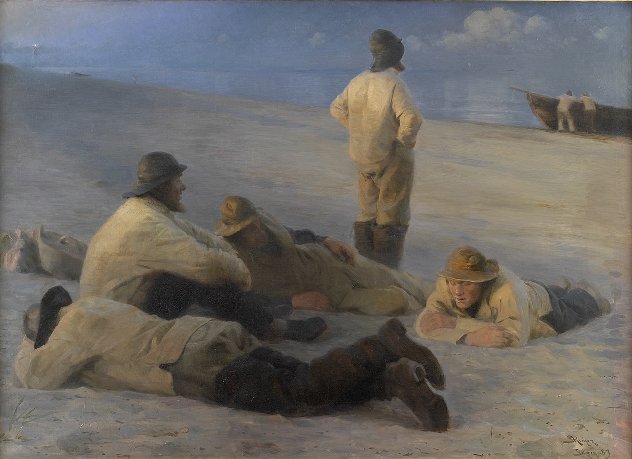
Fishermen on Skagen Beach by Peder Severin Krøyer (1883)

In his painting, Fishermen on Skagen Beach, several fishermen are shown relaxing on the beach, two of them are catching up on some sleep. The sense of tranquility of this scene is reinforced by a calm sea. This is one of those depictions which invites the viewer to mull over what is going on. Have they had a successful day or had it been a day to forget? Whatever happened they seem to now be exhausted.

Fishermen on the Beach on a Peaceful Summer´s night by Michael Ancher (1881)

Michael Ancher was the first of the Skagen painters to settle in Skagen during the summer of 1881. In his work entitled Fishermen on the Beach on a Peaceful Summer´s night Michael Ancher depicts a group of fishermen from Skagen talking on the beach on a sunny summer evening. What are they chatting about? Perhaps they are exchanging news from Skagen, or simply planning tomorrow’s next fishing expedition. Ancher was a realist who always used living models, preferably fishermen and he knew their individual names and through his depiction they have come to life.  They have had a hard life battling the elements which can be seen by their heavily lined faces.  This painting which is owned by the National Gallery of Denmark, is currently  exhibited in the Danish Parliament.

Fisherman Coming to Shore by Michael Ancher

Michael Ancher has depicted a completely different portrayal of a fisherman than the previous paintings. This is not a relaxed study of a fisherman, quite the opposite. Observe the fiercly determined look on the face of the fisherman in Ancher’s painting entitled Fisherman Coming to Shore. He is trying to steer the boat to the safety of the shore whilst battling against a mighty following sea which makes steering almost impossible.

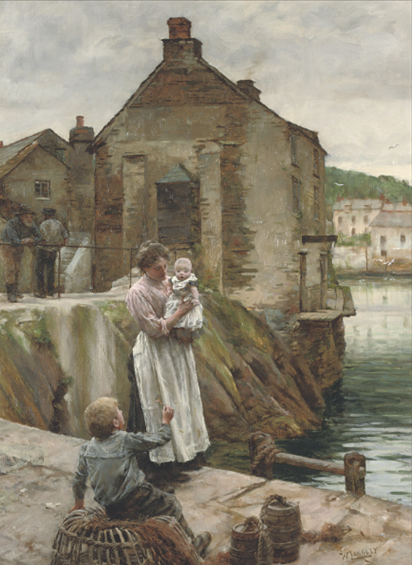
On the Quay, Newlyn by Walter Langley

Between the Tides by Walter Langley (1901)

Walter Langley, the son of a journeyman tailor, was born on June 8th 1852.  At the age of fifteen, he was apprenticed to a lithographer and six years later he won a scholarship to South Kensington School where he studied design for two years. He returned to Birmingham but took up painting full-time, and in 1881 was elected an Associate of the Royal Birmingham Society of Artists (RBSA). In that year, aged twenty-nine, he received a £500 commission for a year’s work by the Birmingham-based photographer Robert White Thrupp, a wealthy patron, to spend twelve months in the Cornish town of Newlyn, and pictorially record the lives of the fisherfolk.  Having been brought up in a poor working-class family environment Langley could empathise with the hardship faced by the fishing community and his paintings often depicted stories of family tragedies and loss of loved ones.

Among the Missing by Walter Langley

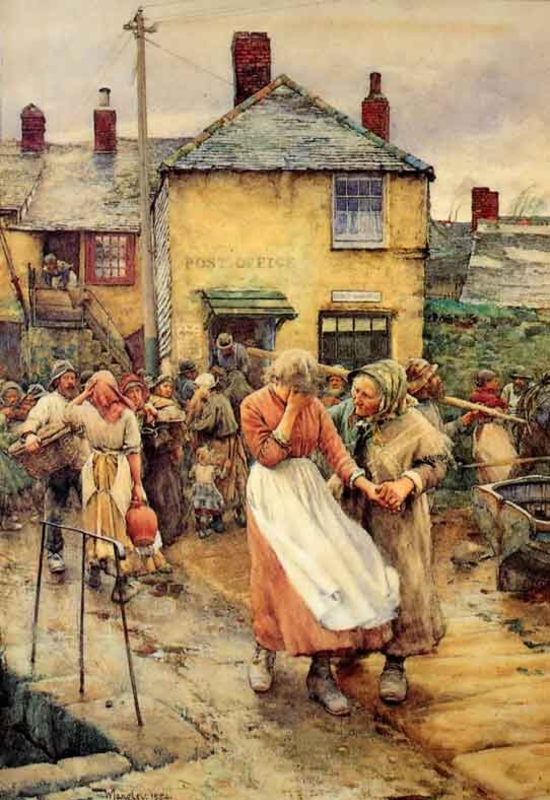
Never Morning Wore to Evening but Some Heart Did Break by Walter Langley (1894)

The painting, Never Morning Wore to Evening but Some Heart Did Break, was completed by the English artist Walter Langley in 1894.  The painting today, as was the painting before, is about loss.  The title of the painting emanates from Canto VI of Tennyson’s poem In Memoriam, which reads:

That loss is common would not make
My own less bitter, rather more:
Too common! Never morning wore
To evening, but some heart did break

The painting, Never morning wore to evening, but some heart did break depicts a young woman being comforted on the quayside at Newlyn harbour by Grace Kelynack, the elderly widow of a Newlyn fisherman.

Old Grace by Walter Langley (1894)

Langley had also completed a portrait of Grace Kelynack entitled Old Grace.

The Ninth Wave by Ivan Aivazovsky (1850)

One of my favourite seascape paintings by Aviazovsky is his 1850 work entitled The Ninth Wave. It is also probably his best-known work. The title refers to a popular sailing legend that the ninth wave is the most terrible, powerful, destructive wave that comes after a succession of incrementally larger waves. In his painting, set at night, he depicts a raging sea, which has been whipped up by a storm. In the foreground we see people clinging to the mast of a vessel which had sunk during the night. Note how the artist has depicted the debris the people are clinging to in the shape of a cross and this element can be looked upon as a metaphor for salvation from the earthly sin.  One wants to believe that the desperate will to survive will triumph over the raging ocean.  The people clinging to the debris are lit by the warmth of breaking sunlight and this gives one to believe that they may yet be saved.  For a life-or-death depiction the painting is not a gloomy one. In fact, it is full of light and air and thoroughly transfused by the rays of the sun which endows it with a feeling of optimism. The painting was originally acquired for the State Russian Museum of St Petersburg and was one of the first paintings in the collection of the Emperor Alexander III Russian Museum in 1897.

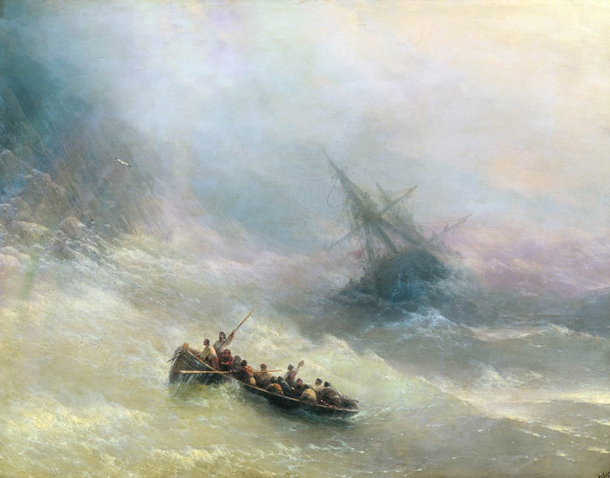
The Rainbow by Aviazovsky (1873)

Another of Aivazovsky’s works which is part of the Tretyakov Museum collection in Moscow is his painting entitled The Rainbow which features a sailing ship foundering on rocks while two lifeboats full of sailors from the doomed vessel are battling against the fierce seas as they try to manoeuvre their boats ashore. It is a truly remarkable work in which Aviazovsky created a scene of a storm as if seen from inside the raging sea.  In the foreground, we see the sailors who have taken to a lifeboat and abandoned their sinking ship which had foundered on the rocky shoreline. They had spent the whole night in the boat. Suddenly they see a rainbow and feel that all is not lost. The reflection of the rainbow can just be seen to the left of the painting.  Fyodor Dostoevsky, the Russian novelist, was an admirer of Aivazovsky’s art and The Rainbow was his favourite work.  Of the painting, Dostoevsky wrote:

“…This storm by Aivazovsky is fabulous, like all of his storm pictures, and here he is the master who has no competition. In his storms there is the trill, the eternal beauty that startles a spectator in a real-life storm…”

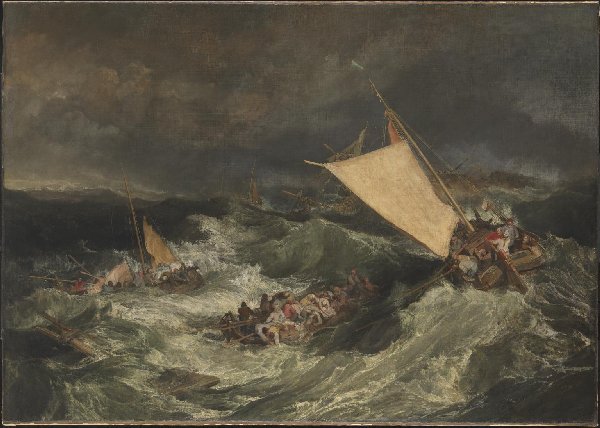
The Shipwreck by J.M.W Turner (c.1805)

Storms and shipwrecks were a popular theme for paintings during J.M.W.Turner’s life.   He completed his painting The Shipwreck around 1805.  It depicts fishermen battling the huge waves as they attempt the rescue of an overcrowded lifeboat.   In the painting, we see a ship foundering and about to capsize and sink in the dark seas. Turner was fascinated by this dramatic theme which conveyed the danger of life at sea. To get us to better appreciate the peril the seafarers had to endure he places us close to the drama and with no sight of land it is as if we are part of the rescuing crews as they battle the ferocity of the sea,

It is thought that Turner was inspired by the re-publication in 1804 of the fourth edition of William Falconer’s poem, The Shipwreck, which was illustrated by another marine painter Nicholas Pocock, part of which (3rd Canto, lines 640-645) is below:

Again she plunges! Hark! A second shock

Tears her strong bottom on the marble rock! 

Down on the vale of death, with dismal cries,

The fated victims shuddering roll their eyes, 

In wild despair; while yet another stroke,

With deep convulsion, rends the solid oak. 

The fourth edition of William Falconer’s The Shipwreck was published in 1772. This poem in three cantos of more than 900 lines each, recounts the final voyage of the merchant ship Britannia and her crew. This fourth edition of The Shipwreck is the first edition of the poem to be published after Falconer’s death, ironically due to a shipwreck. Falconer had been appointed purser onboard the frigate Aurora in 1769 when it was lost after rounding the Cape of Good Hope. An introduction to a 1798 edition of Falconer’s works supposes the loss was caused by the Aurora catching fire after rounding the Cape.

The Storm on the Sea of Galilee by Rembrandt (1633)

A marine painting with a biblical connotation is the one by Rembrandt von Rijn entitled The Storm on the Sea of Galilee which he completed in 1633. It was one of his earliest large format works.  It depicts a close-up view of Christ’s disciples as they grapple  to gain control of their fishing boat.  A large wave has crashed into the side of the boat, swamped the deck and ripped the mainsail.  The vessel lurches dramatically in the rough sea.  We see one of the disciples leaning over the side of the boat being sick.  A man faces us as he clings hold of the rigging.  This is a self-portrait of the artist.  All the people on board the vessel are panic-stricken, except for one, Christ, who can be seen on the right, calmly looking ahead.  The depiction is based on a passage from the bible (Luke  8: 22-25):

22 One day Jesus said to his disciples, “Let us go over to the other side of the lake.” So they got into a boat and set out. 23 As they sailed, he fell asleep. A squall came down on the lake, so that the boat was being swamped, and they were in great danger.

24 The disciples went and woke him, saying, “Master, Master, we’re going to drown!”

He got up and rebuked the wind and the raging waters; the storm subsided, and all was calm. 25 “Where is your faith?” he asked his disciples.

In fear and amazement they asked one another, “Who is this? He commands even the winds and the water, and they obey him.

In the third and final part of these blogs featuring marine art I will be looking at paintings that extoll the joys of the sea and shoreline.

Maritime Art. Part 1.

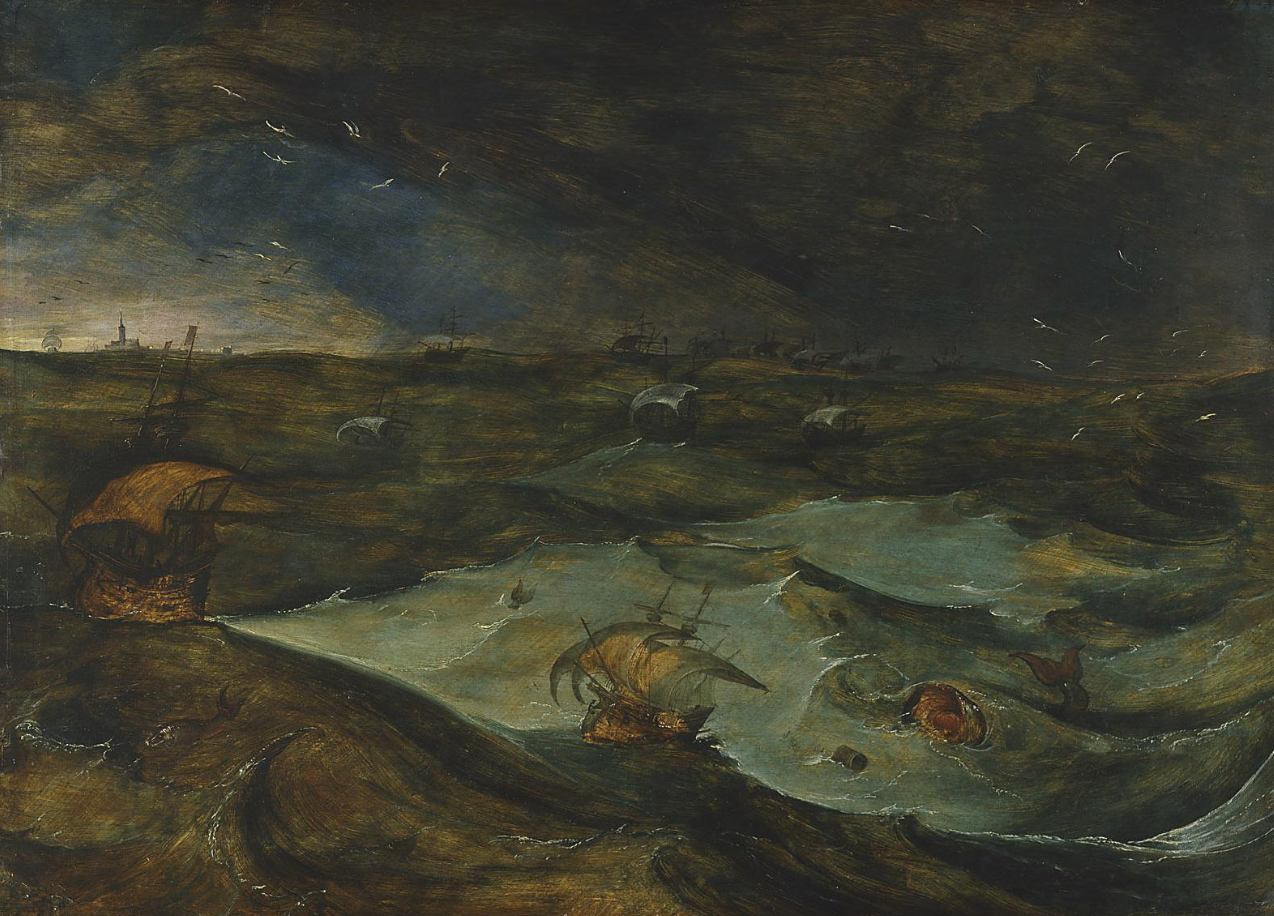
Storm at Sea by Pieter Bruegel the Elder (c.1569)

Maritime painting is an art genre that depicts ships and the sea.  Early examples of this genre were found in Greek vase paintings and the wall paintings of Pompeii.   Storm at Sea is one of earliest specific seascapes and was painted around 1569 by Pieter Bruegel the Elder’s and thought to be one of his last paintings. It is unfinished and, like so many of his works, defies unambiguous interpretation. On the one hand, we see ships threatened by a storm reminding us that man is not master of Nature, in fact man is often its victim. To try and save themselves from the stormy sea the sailors have poured oil onto the water.  They have also sacrificed a barrel from their cargo to distract the mighty whale who is attacking their vessel.

The Battle of Terheide (1657), commemorating the Battle of Scheveningen on 10 August 1653 by Willem van de Velde the Elder.

The greatest marine artists of the 17th century were Willem van de Velde the Elder and his son, Willem van de Velde the Younger.  They were best known for their spectacular depictions of storms at sea, and of nautical life, as well as their painstakingly drawn depictions of ships and naval battles. To commemorate the Dutch naval commander Maerten Harpertsz Tromp, his family commissioned a series of pen paintings of Tromp’s best-known battles from Willem van de Velde the Elder. The artist used pen and ink on canvas for these works, which which bear a resemblance to meticulous, accurate engravings. Van de Velde witnessed the Battle of Terheide in 1653 and he used the sketches that he produced on board as studies for this pen painting.

Men O’ War in Action by Willem van de Velde the Elder

Willem van de Velde the Elder was born in Leiden in 1611.  He was the son of the captain of a merchant vessel, Willem Willemsz van de Velde. When he was young, he would often accompany his father on sea voyages and this probably shaped his career as a marine artist.   Van de Velde married Judith van Leeuwen in Leiden in 1631 and the couple went on to have three children, a daughter, Magdalena, and two sons who would become renowned painters, Willem van de Velde the Younger, a marine artist and Adriaen van de Velde, a landscape painter.

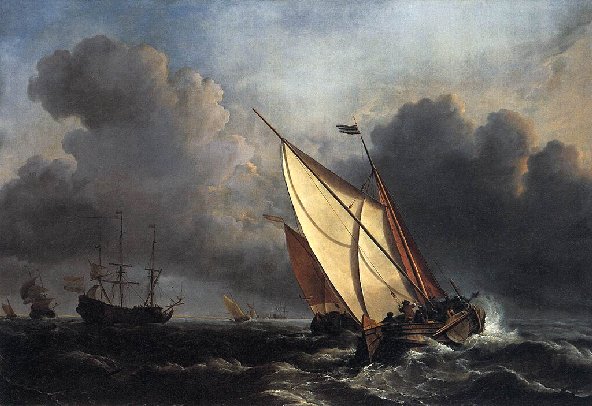
Ships in a Stormy Sea by Willem van de Velde the Younger (c.1672)

The painting entitled Ships in a Stormy Sea by Willem van de Velde the Younger depicts the drama and the excitement of those who braved the seas in the 17th century.  Willie van de Velde the Younger had first-hand knowledge of sailing, and his marine paintings were appreciated for their realistic depictions of ships and sailing tactics. In this work the ship in the foreground is a kaag, a light fishing vessel.  The artist has depicted it as sailing close-hauled in the strong breeze, which is one of the most difficult sailing manoeuvres, in which the vessel sails into the wind as directly as it can without causing the sails to flap uselessly.

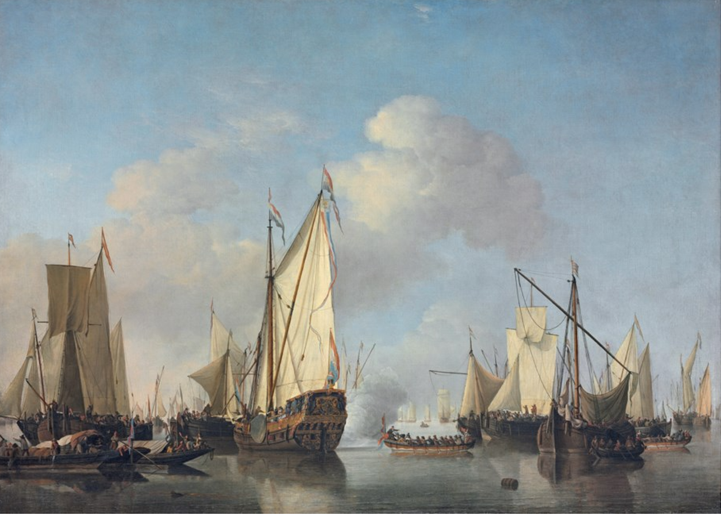
States Yacht and other vessels in a very light air by Willem van de Velde the Younger.

Whereas his father specialised in drawings and pen paintings, Van de Velde the Younger was best known for his oil paintings, which depicted life at sea in full colour.  He was born in Amsterdam in 1633 and trained as a painter with the Dutch artist Simon de Vlieger, who was known for his marine paintings, beach scenes, landscapes and genre work.  Unlike his father, Willem de Velde the Younger was a trained artist, unlike his father who was self-taught.  Van de Velde the Younger worked closely with his father and the pair brought their artistic visions to life. Often, he would use his father’s drawings as a guide to create his own masterpieces. The father was a master of detail whereas his son was a master of light.  It was this combination of artistic talents that was to lead to the success of their studio business.

The Home Fleet Saluting the State Barge by Jan van der Capelle (1650)

Shipping in a Calm at Flushing with a States General Yacht Firing a Salute by Jan van de Cappelle (1649)

Jan van de Cappelle was a Dutch Golden Age painter of seascapes and winter landscapes, also notable as an industrialist and art collector. He is now considered the outstanding marine painter of 17th century Holland. Jan van de Cappelle was wealthy and was occupied full-time running his father’s dyeing business. Though he painted some beach scenes and winter landscapes, most of his paintings represent the mouths of wide rivers or quiet inner harbours, where groups of ships at anchor were depicted in glassy calm waters. Many of his marine art works depict full cloud formations which hover over these tranquil waters and are mirrored in colourful reflections, often set in early morning or evening. When he died, aged fifty-three, in 1679, his estate was worth more than 90,000 guilders.

The Ships “Winged Arrow” and “Southern Cross” in Boston Harbour by Fitz Henry Lane (1853)

Fitz Henry Lane was born on December 19, 1804, in Gloucester, Massachusetts. Lane and was christened Nathaniel Rogers Lane three months later and would remain known as such until he was twenty-seven.  In March 1832, Lane requested that his name be changed to Fitz Henry Lane.  The reasons behind Lane’s decision to change his name, and for choosing the name he did, are still very unclear. Lane and his family lived on the outskirts of Gloucester close to the harbour’s working waterfront and so, growing up, Lane had contact with all the elements of maritime life.  Lane’s father, Jonathan Lane was a sailmaker and it was thought that his son would follow him into the business or become a seafarer.  Unfortunately, when only eighteen months of age he became ill and suffered a form of paralysis of the legs.  Growing up he was unable to join his friends in games and became withdrawn and stayed at home where, for amusement, he began to draw.  This developed into an amazing talent and living close to the sea and the harbour he began to sketch the ships and the harbour.

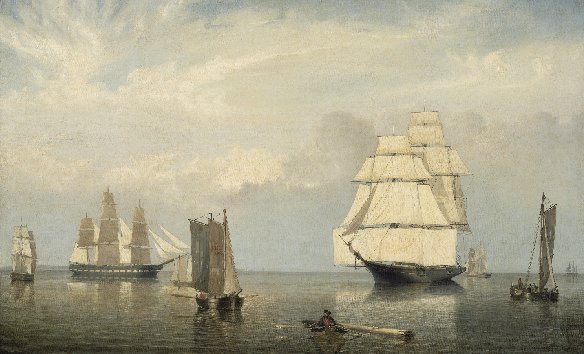
Salem Harbor by Fritz Henry Lane (1853)

For fifteen years, Lane was employed at Pendleton’s Lithography shop in Boston and during those years as a lithographer Lane honed his artistic skills.  He produced many works of marine art and was listed as a marine painter in the 1840 edition of the Boston Almanac.  His works became extremely popular and were in great demand.  Then despite living in Boston, it never prevented him returning on a number of occasions to his birthplace, Gloucester.  Aged forty-eight Lane left Boston and moved back to Gloucester where in 1849 he designed and had constructed his own granite house with seven gables and a studio on Duncan’s Point.  This house would remain his primary residence to the end of his life. Fitz Henry Lane died on August 14th, 1865, aged 60.

Rainbow at Sea with some cruising Ships by Christoffer Wilhelm Eckersberg (1836)

Christoffer Wilhelm Eckersberg, a Dutch painter, was born in Blåkrog in the Duchy of Schleswig on January 2nd 1783.  He was at the forefront of the Golden Age of Danish Painting, a period from 1800 to around 1850 and is often referred to as the “Father of Danish painting”.  After 1821 seascapes had become Eckersberg’s favourite subject.

The Russian Ship of the Line “Asow” and a Frigate at Anchor in the Roads of Elsinore by Christoffer Wilhelm Eckersberg (1828)

Eckersberg’s best loved maritime painting is his 1828 work entitled The Russian Ship of the Line “Asow” and a Frigate at Anchor in the Roads of Elsinore. This majestic work is not a true rendition of the scene but an idealised version as the setting of the scene is not Copenhagen where he had studied Russian ships of the line on two occasions.  We also know from his diaries that he had also studied the ship’s design from technical drawings he had borrowed from the naval dockyard.   However the backdrop is not Copenhagen but Elsinore where we can see Kronborg Castle in the background.  Kronborg is the castle and stronghold in the town of Helsingør, Denmark, which was immortalized as Elsinore in William Shakespeare’s play Hamlet.  The depiction is what the ship, Asow, would have looked like if viewed from a vantage point on the Øresund.

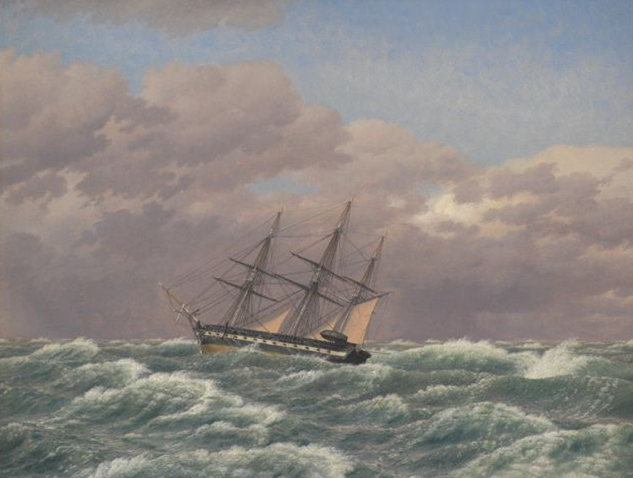
The Corvette Galathea in a Storm in the North Sea by Christoffer Wilhelm Eckersberg (1839)

Although he was known for his portraiture and historical paintings, marine paintings was another genre he developed.  Eckersberg developed a passion for ships, and, at the age of fifty-six, sailed around the Skagerrak, the Kattegat, the North Sea, and as far as the English Channel.  These sailing trips on the open seas brought home to Eckersberg that sea could be quite threatening and whereas many of his early work focused on cam seas, later works often depicted the ferocity of the sea.

If you would like to read more about the art of Christoffer Wilhelm Eckersberg then have a look at the five blogs I did focusing on his life life and paintings.

Northeaster by Wilmslow Homer (1895)

Winslow Homer was an American landscape painter and illustrator and is renowned for his marine subjects.  By many, he is considered one of the leading painters of 19th-century America.  His 1895 painting entitled Northeaster can be found in the collection of the Metropolitan Museum of Art, in New York City.   It depicts a wave crashing aggressively against a rocky Maine shoreline.  Homer loved the East coast of America around Maine and eventually settled down there in 1883, moving from New York to Prouts Neck, Maine where he lived at his family’s estate in the remodelled carriage house seventy-five feet from the ocean.  The title of the painting, Northeaster, does not refer to a location in America, but is a name given to a specific type of wind that occurs within the western North Atlantic Ocean. The painting depicts just a small section of rock seen in the lower left corner whilst, in the background, a spectacular section of sea is seen riding relentlessly towards the shore.

Early Morning, After A Storm At Sea By Winslow Homer (1900-1903)

Whilst living at Prouts Neck, Winslow Homer looked out upon the sea and once commented to a friend that painting was all about timing:

“…You must not paint everything you see. You must wait, and wait patiently until the exceptional, the wonderful effect or aspect comes. Then, if you have sense enough to see it—well . . . that is all there is to that…”

Homer began this seascape in 1900 and based it on a watercolour he had completed in 1883. He was proud of the finished work in oils stating that it was the best picture of the sea that he had painted but was totally dismayed when it was poorly received by the critics.   He just said of this dismissive reception that no one understood the work and besides that, the people never see the early morning effect. They don’t get up early enough.

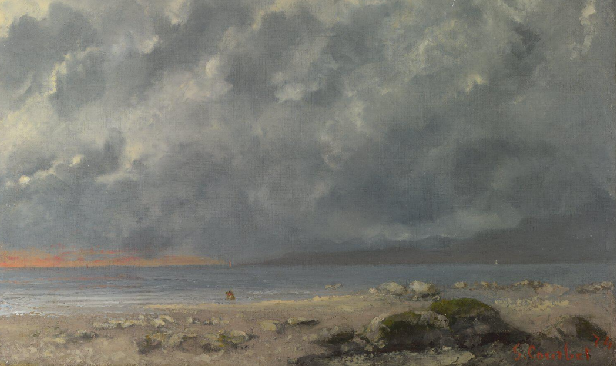
View of Lac Léman by Gustave Courbet (1874)

Threatening grey clouds move across the sky above the calm Swiss lake but the cloud formation threatens an oncoming storm.  The depiction is set in the evening and on the horizon against the vivid orange and gold of the setting sun we can just barely make out a tiny boat.   Soft red reflections streak the surface of the water.   Courbet had left France in 1873  for political reasons and settled on the shores of Lac Léman in Switzerland where he painted a number of scenes featuring the lake at sunset.

Marine by Gustave Courbet

Four years earlier during the late summer of 1869 Courbet travelled to Étretat, a small fishing village which was famous for its towering coastal cliffs with their rock arches carved out by the relentless sea. Courbet was fascinated by the sea and completed twenty-nine works during his stay at Étretat.  His depictions of the sea would vary from the quiet tranquillity of the calm sea to the violence of crashing waves upon the rocks.  In the above work Courbet shows us the power of the sea with white-capped waves with foam fringes as they approaches us.  The painting has captured the feel of motion and the immense power of the relentless waves.

In Part 2, I will be looking at Marine paintings which feature those who enjoy relaxing by the sea and those whose living is connected with the sea.

Cyril & Renske Mann. Part 5.

― Pablo Neruda, 100 Love Sonnets


In April 1960, four months after Renske met Cyril, he was admitted to the Royal Free Hospital to have an operation on his perforated stomach ulcer. Renske wrote Cyril a letter to say that she was missing him and expressing her love for him. Note that even after being with him since January that year she still addressed him as “Mr Mann”.

Dear Mr Mann

How dreadful that I can’t come to see you tonight. You don’t like the evenings in hospital, do you? Well, I don’t like the evenings in Bevin Court. Why? Because 108 Bevin Court is not complete when you are not here. You are so much my man in body and soul that I simply cannot do without you.

When I am writing to you, and from time to time, I am looking at your paintings, I feel you are so near to me. I love you Mr Mann. I want to tell you over and over again I love you and I pray that i will be your woman for all your life. I realize that I have not much to offer you; no beauty, no money, only my love and I hope one day to prove to you that my love is worth more than beauty or money. You have everything I always wanted: you are an artist, you are my husband, you are my friend, my love, everything. When you leave hospital I will ask for a day off. I will stuff the flat with flowers for you.…..

Cyril and Renske (c.1962)

Life in the 60s was all about Cyril and Renske themselves and they were almost oblivious to what was going on around them. They were aware of their limited finances and spending on food was minimal. Cyril cooked and managed the menus. Renske went out to work. If there was a positive to Cyril’s stomach ulcers it was that they prevented him consuming large amounts of alcohol. Once he had recovered from his stomach operation he was once again able to consume alcohol and sadly, after excessive imbibing his mood would often blacken and change to one of being boorish and confrontational. If this alcohol consumption also coincided with his decision to miss taking his anti-psychotic pills then often hell broke loose.

Allotments with Stormy Sky, Walthamstow by Cyril Mann (1967)

Their small cramped council flat accommodation at 108 Bevin Court was not conducive to painting especially when using large canvases and so, after four years, in 1966, they moved. Renske had always wanted to live in a house and so with great determination and frugality they managed to save enough money for a deposit on a small house at 97 Lynmouth Road in Walthamstow, a town in the London Borough of Waltham Forest, around seven and a half miles (12 km) northeast of Central London. It was a semi-derelict Victorian cottage which cost £2,750.

Cyril and Renske’s home at 97 Lynmouth Road in Walthamstow.

Their savings for the house was boosted by money given to them by Cyril’s long term sponsor, Erica Marx. The house cost £2700 and they had to find a deposit of £700 which was their maximum budget. They struggled to get a mortgage as in those days the income of a wife was not looked upon as viable long-term earnings. However, Cyril was managing to sell his work and had a good credit score and they were finally given a mortgage. Finally, they managed to buy the small house and with it the luxury of having their own small bedroom.  The house came with two bedrooms but the larger second bedroom was designated as one were Cyril could store all his painting paraphernalia.   Renske said that the fact that we could exit the house into the small garden was something she had previously only dreamed about after having to suffer living in the claustrophobic atmosphere of a top-floor flat in Bevin Court.

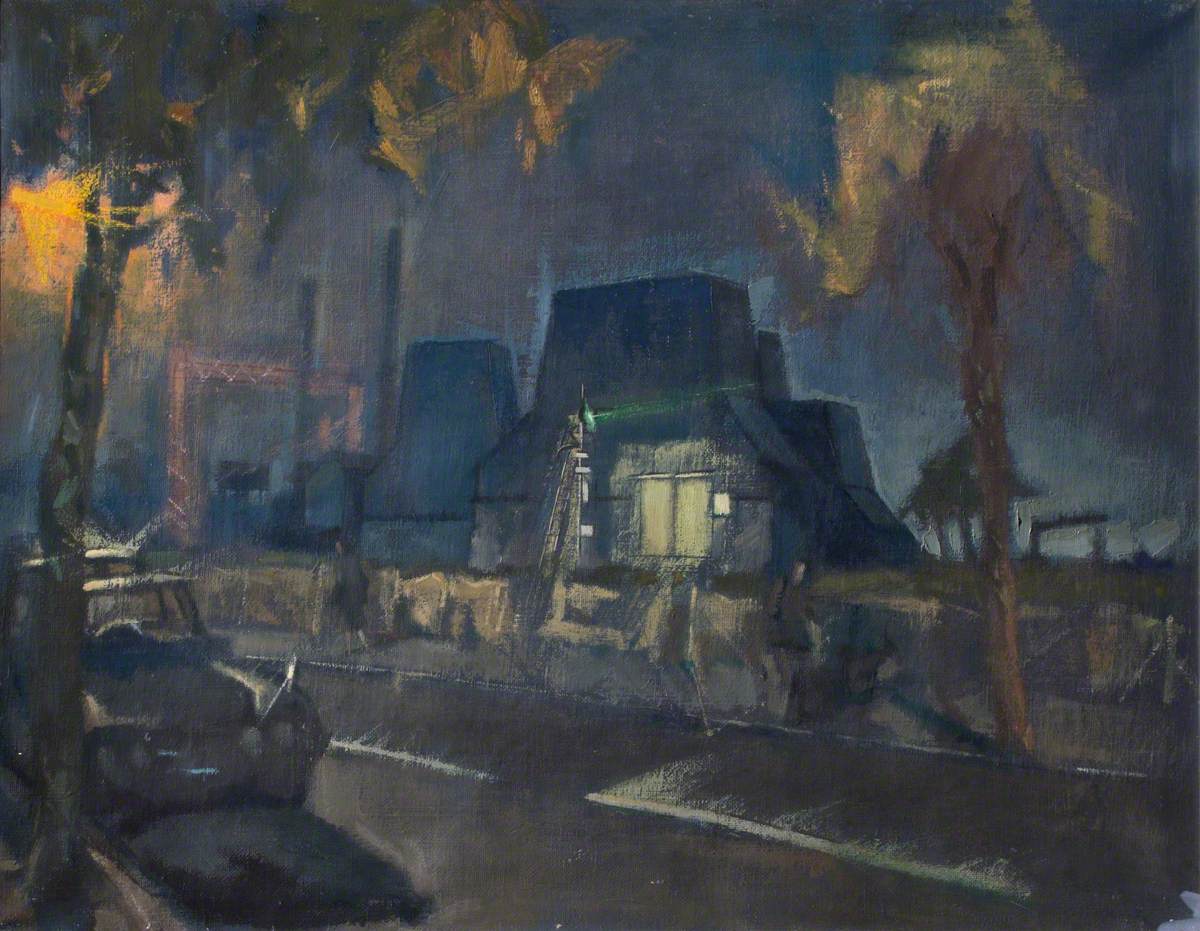
Gas Cooling Towers

Gas Cooling Towers by Cyril Mann

A new location gave Cyril new opportunities to paint local scenes. Cyril was mesmerised by the massive wooden gas cooling towers which towered above the modern skyline and he would go out in all weather conditions to capture the iconic building.

The Boiling Fowl by Cyril Mann (1963)

One of the first visitors to their Lynmouth Road house was a Canadian actor and TV-game host, Ronan O’Casey and his British actress wife, Louie Ramsey.  They had come to see Cyril’s paintings. He fell in love with Cyril’s semi-abstract rendition of a boiling fowl. Renske recounted how they could not believe their luck when he bought it and the couple took it home with them.  Cyril liked to recount the story about how months later he and Renske were invited to a dinner party in O’Casey’s smart and chic flat in Hampstead. O’Casey pointed to the painting he had bought from them and hilariously announced that he now has Cyril’s cock on his wall.  Renske remembered thinking that it would have been better if O’Casey had purchased one of Cyril’s flower painting !!

Daffodils in a Brown Jug by Cyril Mann (1958)

The problem that arose from the purchase of the Lynmouth Road house in Walthamstow was that it was not quite habitable and so they had to also retain the Bevin Court flat and, so for a time, were paying rent on Bevin Court and a mortgage on the Walthamstow house. Cyril and Renske were given a grant to refurbish their new home and he and one of his ex-students set about renovating the property. They installed a canary-coloured bathroom suite, built units for the kitchen and laid quarry tiles on the floor. Cyril set about the tasks with great gusto and Renske said that her husband’s skills as a carpenter, bricklayer and decorator were amazing. Cyril was a great handyman, like his builder father and grandfather.

Christ Church Spitalfields seen across bombsites from Scrutton St by Cyril Mann

Renske loved her new home as it had a small garden with an apple tree and raspberry canes. To make ends meet, Renske began to work full-time. She had completed twelve months of temping at the advertising agency in their PR department and now became an assistant with a proper permanent job.  More importantly, Cyril began to boost her self-confidence and told her that she could achieve anything she put her mind to. Renske basked in Cyril’s confidence in her and deep down began to believe in herself. Although Dutch, she could write in English and began to put together articles on art which she submitted to art magazines and had them accepted. Soon she was getting paid for her submissions. This was indeed a happy time in Renske’s life. Cyril continued to stay at home and paint whilst Renske went out to work. He always had a meal waiting for her after she returned home from work. 

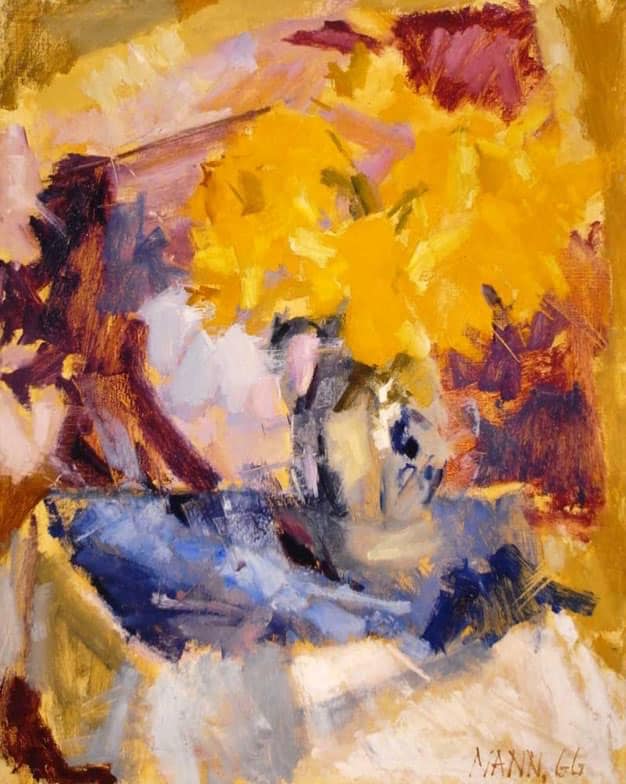
Sunlit Daffodils in a Blue Jug by Cyril Mann (1966)

On November 5th 1968 Amanda Mann was born.  She was Cyril Mann’s second child but the first born to Renske.  Cyril had been faithful to the promise he made to Renske that he would give her a baby whenever she felt the time was right.  The decision to have the baby was a maternal versus financial one as Renske knew that as the breadwinner it would mean a great financial sacrifice even though their finances had improved.  For Cyril it would also be a sacrifice as he was fifty-seven years old and had already brought up one child, Sylvia. 

Baby Amanda

However once Amanda was born, she was lavished with kindness and love by both her mother and father.  Cyril would walk the streets of Walthamstow and the local market with baby Amanda in her second-hand pram, all the time being admired by the stallholders.  Renske recalled that once when he returned home with Amanda, on lifting her out of her pram, he found a hoard of silver coins which the stallholders had surreptitiously slid under the blankets of the pram.  They later told Cyril that it was lucky to touch a baby’s head with silver.  Cyril could not believe such generosity existed and was moved to tears.   Having just given birth to their baby, Renske had very little bed rest as there was no such thing as maternity leave in those days and so for financial reasons, she had to return to work.

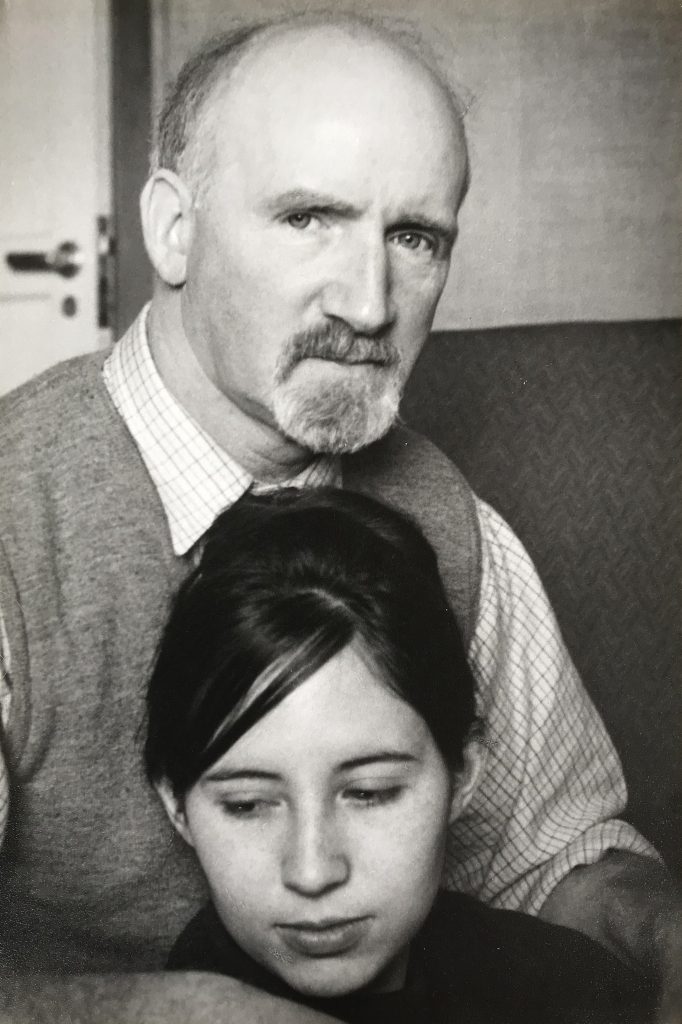
Cyril Mann with his daughter, Amanda.

Although the Walthamstow house was much roomier than Bevin Court it still just had one large bedroom and one small bedroom and Cyril had taken over the larger one for his art studio, leaving him and Renske to sleep in the smaller bedroom while Amanda slept on the landing in her pram.  Renske’s career in PR had rapidly progressed and she was beginning to earn a substantial wage and this upward turn in the family finances meant that late in 1969, Cyril, Renske and one-year-old Amanda moved a few miles down the road from their Walthamstow house and went to live in their newly purchased house in Leyton. 

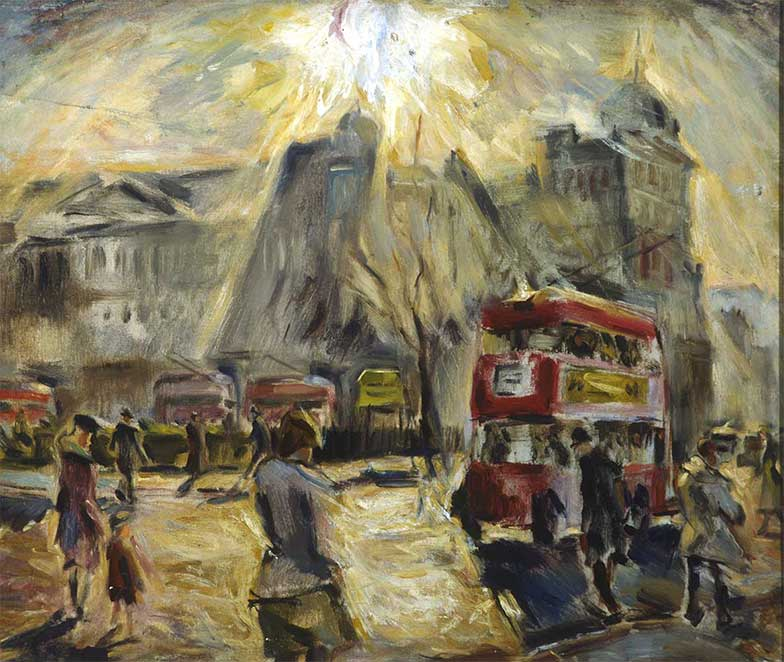
Trolley Bus, Finsbury Park by Cyril Mann (c.1948)

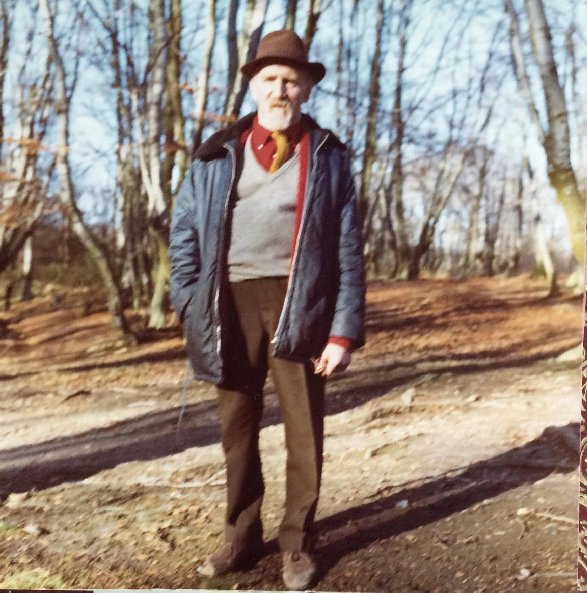
This new residence at 23 Goldsmith Road, Leyton was a five-bedroom house with a 100ft garden and had all the studio space Cyril could dream of. Cyril would spend hours walking through the nearby Walthamstow Forest.

Walking through the forest

It was coming up to Cyril and Renske’s twentieth anniversary of their first meeting but relations between them had reached an all-time low.  Eventually things between Cyril and Renske got to a point when she could no longer bear the sadness of this total breakdown of their relationship and she knew she had to leave him.  Amanda, who was eleven years old had been safeguarded from this parental breakdown as she was at boarding school in Eastbourne having achieved an open scholarship.

Tubby Isaacs Shellfish Stall by Cyril Mann (c.1955)

One night in early December 1979, after a particularly heated and nasty argument Renske became physically scared of Cyril and made the momentous decision to leave him and, whilst he slept, she slipped out of the house and away, like his first wife, Mary had done some twenty-nine years earlier.  Renske went to stay with friends, who were horrified to see Renske in such a fragile mental and physical state.  She returned to Cyril for a visit just before Christmas but knew she would not remain with him.  She was shocked to see how he had deteriorated both physically and mentally.  At the short meeting she promised Cyril that she would continue to support him financially and that he could see Amanda whenever he wanted, providing his mental state was conducive to such a father/young daughter meeting. He pleaded with Renske to stay with him and was devastated when she refused.

Roses with Books by Cyril Mann (c.1971)

Renske along with Amanda travelled to the Netherlands to see her parents and returned early in the New Year.  On arriving back in London, Renske contacted one of Cyril’s neighbours in Leyton to find out how he was coping.  She was told that he had suffered a second and more serious heart attack and had been rushed to the local Whipps Cross hospital where he had been lying in a week-long coma.  Renske rushed to his bedside but he was still unconscious.  She held his hand as he took his last breath and quietly passed away peacefully, aged 68.  It was January 7th 1980, almost twenty years to the day that the middle-aged English artist met the beautiful young Dutch East Indies woman.

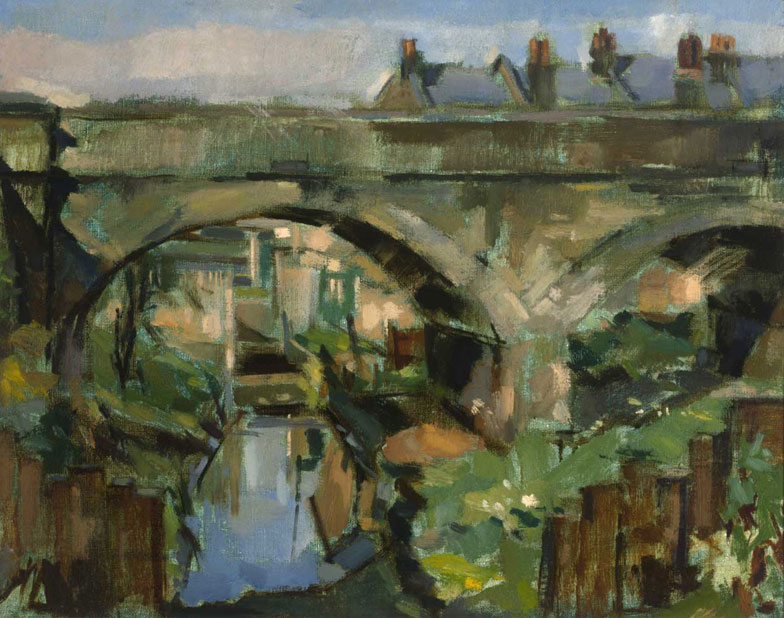
Railway Bridge over the Culvert, Walthamstow by Cyril Mann (c.1967)

I have spent many many hours putting together these five blogs on Cyril and Renske Mann. It has not simply been a look at the many paintings Cyril Mann completed during his lifetime.  It has been a long literary voyage looking at the lives of the middle-aged English painter and the beautiful young woman who remarkably dedicated her life to him.  It was not smooth sailing for either of them and I found myself wondering how they remained together for so long.  Why did Renske put up with a man who on many occasions had treated her badly. How did she manage to live with this middle-aged man who had suffered mentally for most of his life?  What made her fall passionately in love with an irritable, short-tempered impecunious artist who was thirty years her senior?  So many questions. 

Cyril and Renske during a visit to her family in Dordrecht. Her mother, Nina van Slooten on the far left along with an uncle and aunt.

Another question is why did Cyril continually crave recognition for his art and yet abuse those who could have given him such acknowledgement?  One of Cyril Mann’s favourite artists was Vincent van Gogh and he drew parallels with his life with that of the Dutch painter.  Both had great belief in their art, both in a way believed their skill as a painter was at genius level.  Neither received recognition during their lifetimes and both were embittered at their treatment.  As years passed and without the recognition, he believed he deserved, Cyril became unstable, frequently volatile and increasingly disillusioned by the unpardonable mistreatment he received from the artistic world.

Renske, who is alive and well, knows the answers to these conundrums and maybe she lets us into the secrets in her book, Girl in the Green Jumper, which I urge you to read.  What struck me most was the comment she made to Cyril at the start of their relationship that she would make him famous.  She had seen the talent and beauty of this middle-aged man and in a way, she was confident of her ability to mould him into the man she believed would be successful and with such success he would lead a much happier life.  After reading the account of her life, we know that she never quite succeeded in her aim.

Cyril and Renske in the 1960s.

What did Cyril take from his intense relationship with Renske?  I think the answer lies in a letter which Renske found in their house in Leyton shortly after his death.  Cyril had written:

My Dear Love,

I received your letter this morning and was afraid to open it for I was so filled with foreboding, which was justified on reading its contents.  When I saw the word solicitor, I knew my last bit of hope was gone.  I am not going to get upset for it won’t do me any good – harm in fact.

This in a way will be my last letter to you.  I do love you, Renske (oh Sweetheart) and always shall.  You can cease to love but you will never get rid of mine.  In all my pictures the evidence is there and will remain for people to see and realize.  You have been a dear and wonderful wife, giving me all and putting me first always.  I have been aware of it and have never taken it for granted.  Thank you for everything and all the happiness that went with it.  I shall always been grateful.  I am not bitter or angry even though you have truly broken my heart.

Every day I realize more the reason for taking the step you have.  It couldn’t have been easy of you but I now see that it was necessary and that you were really unhappy at home with me and had to take the final step.  So, love, don’t please feel guilty or self-reproachful for there is no need.  In all things I want is for you to be happy and to realize yourself and live fully.  You’ve done your twenty years chores on me.  Now think of yourself.  You’ve earned it.  So I say God Bless, take care of yourself.  Remember my heart and any help you may need is yours to call upon at any time…

There can be no doubt that Renske gained a lot of solace from his last words.  It gave her the will and the courage to live and continually bring his works to the attention of the public. 

Marion Matthews and Renske Mann (September 2022)

Renske, with Cyril’s encouragement, cleared her educational gaps by passing A-levels and then taking an Open University degree. Her PR career blossomed going from strength to strength.  She took on the role of director of Scholl, the international footcare-to-footwear company.  After Cyril’s death, Renske and her current partner, journalist Marion Mathews, converted a derelict dairy in Holland Park into an art gallery. They operated the venture as a charity, and she and Marion ran the Gallery on a charitable basis for 10 years, until 1993.  Their aim was to help unknown, but gifted artists like Cyril so as to reach that first difficult step on the exhibition ladder.  Now aged 84, Renske Mann continues to write articles and give talks on her late husband, Cyril, and his paintings, using skills acquired during her time as a PR executive. Her writings on social media attract thousands of followers and admirers.
Renske, you should be very proud of what you achieved.


It would not have been possible for me to put together all five blogs about the artist, Cyril Mann, without information gleaned from a number of sources:

The comprehensive biography of Cyril Mann, The Sun is God by John Russell Taylor

At the presentation of the Islington People’s Green Plaque in September 2013 : Renske Mann,her daughter Amanda next to her along with (far left) Islington Borough Counsellor Catherine West, elected Labour MP in 2015 and on the far right John Russell Taylor, art critic for The Times, who wrote Cyril’s monograph, The Sun is God.

The intimate autobiography of her and Cyril Mann’s life by his second wife Renske, entitled The Girl in the Green Jumper.

This autobiography has now been turned into a play which receives its World Premiere on Wednesday March 13th 2024 at the Playground Theatre, London, 8 Latimer Rd, London W10 6RQ.

Finally, and most importantly I owe many thanks to Renske Mann herself who provided me with information and photographs appertaining to her and her late husband Cyril.

Piano Nobile Gallery London for information and pictures.

Cyril and Renske Mann. Part 4.

Renske Mann from her book, The Girl in the Green Jumper

Renske was overjoyed by Cyril’s words. Although she didn’t believe his words were utterances of flattery and just simple facts, nevertheless the words made her happy and made her love him even more.

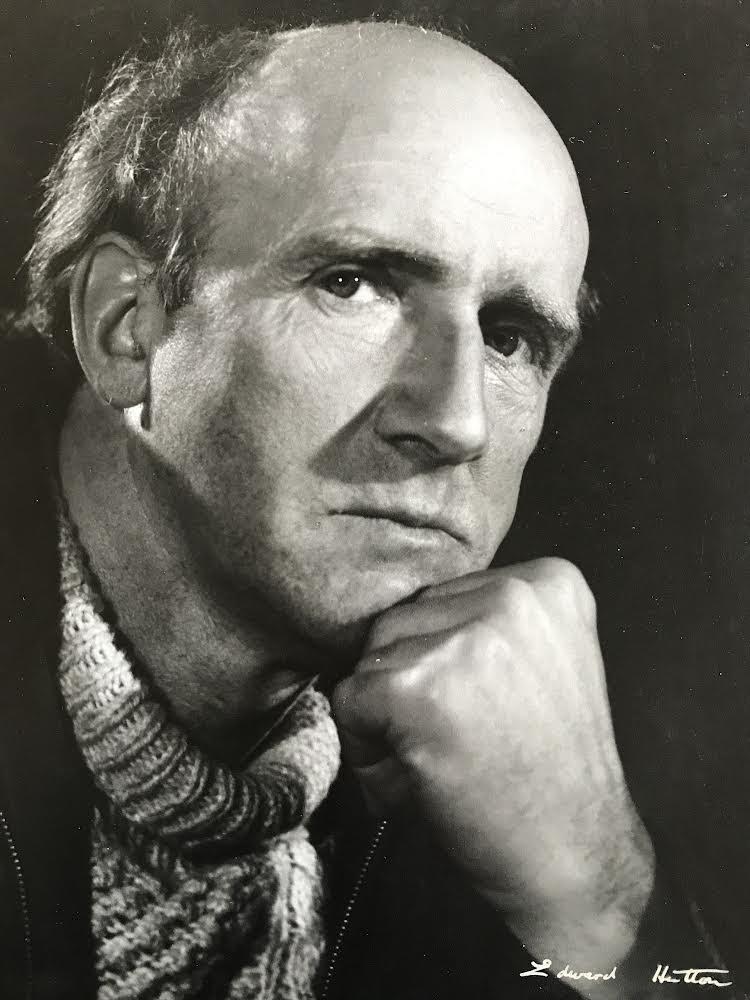
Cyril Mann (1960). Photograph by Edward Hutton.

Throughout his career Cyril painted many portraits, self-portraits and in the 1960s Cyril Mann completed a number of nude depictions using Renske as his model. 

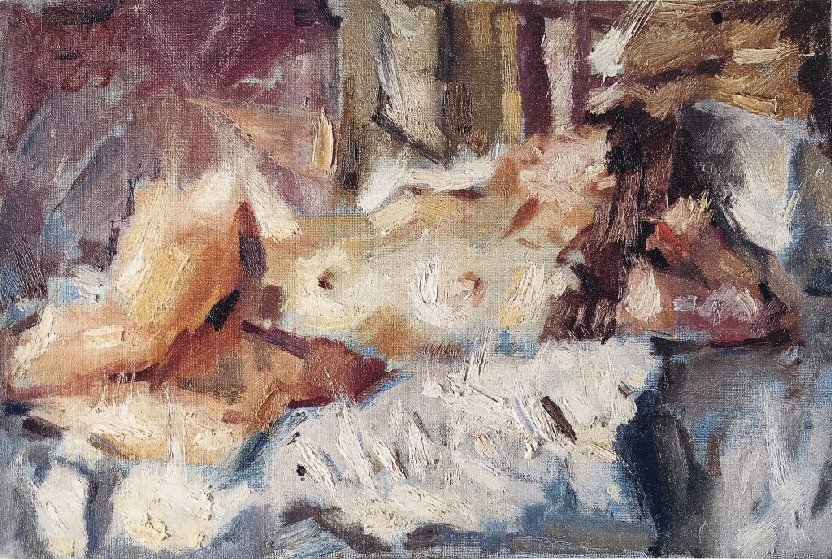
Ecstasy by Cyril Mann (1963)

One such nude portrait, using her as a model, was completed in 1963 and entitled Ecstasy.  Renske remembers the morning he began this work. In her book, The Girl in the Green Jumper, she describes the setting:

“…Cyril mostly painted in the morning.  The minute he drew the curtains he knew when the weather was set to last.  As the sun rose, it cast shadows from the Crittall windows [steel framed windows] across my nude body on our single bed.  He stared at me, grunting and squinting ‘Stay put and take a comfortable pose’ he ordered.  I knew by then that there was no such thing: every pose would turn into agony in time…”

It was not just about her body or pose it was also about the sunlight streaming through the window. It was of the utmost importance to Cyril to capture the dynamic effects of the rays of the sun as they bounced off every surface, from walls on to Renske’s body and back.  He was like a man possessed.  Tables and chairs had to be moved out to make a working space.  He would shuffle around the tight spaces never lifting the gaze from Renske’s body.  She moved to get comfortable on the bed and started to doze off only to be woken abruptly by Cyril who rudely told her “not to go fucking asleep”.  Throughout painting Renske said he would not stop talking, all the while explaining what he was doing.  He was adamant that he had to block in the light areas first as they were more important, not the mid-tones or darks.  Cyril compared Renske to the RA models he had once used saying:

“…Models at the RA haven’t a clue.  They just sit on a chair.  Students have to group around a podium.  If you are in the wrong spot, you’re fucked.  At least you know how to make your body look interesting…”

Cyril had been introduced to the famous English television personality, Denis Norden, who on seeing the painting told Cyril that he should give it the title Ecstasy. Cyril and Renske had hoped that Norden would buy the painting but he didn’t but their mutual friend, Peter Davis, who had introduced Denis Norden to them suggested they just give Norden the painting for nothing as the celebrity owning one of Cyril’s paintings would be added kudos. However Cyril was appalled by the suggestion and simply said ‘to hell with that’.

Modern Venus (c.1963)

One morning Cyril Mann came into the bedroom where is wife, naked, had just risen from bed.. He flings back the curtains and the sunlight streams in, illuminating her. He screamed at her not to move and at the same time drags into the room a large canvas and starts to paint her portrait.  She remembers that her shadow was cast against the wall as she rose from the vey messy jumble of bedclothes strewn on the bed. She is standing facing him with her left arm above her head which in that posture soon becomes numb. She balanced by standing one foot in front. Their blue alarm clock on their round bedside table glistens in the sun. He told her that she was a Modern Venus. Not rising from a seashell but from the sheets and blankets. The painting Modern Venus is complete.

Reclining Nude in Sunlight by Cyril Mann (1962)

In Reclining Nude in Sunlight, Cyril Mann omits detail as he just wants to depict and render light as a dynamic force. He used large hog’s-hair paintbrushes so that he could rapidly cover the canvas, and so focus on the light and how the sunlight fell and reflected on Renske’s nude body as it swiftly crossed their room.

Golden Torso by Cyril Mann (1961)

Golden Torso was completed in 1961 and when the author and art critic John Berger saw it he immediately recommended it for the Granada TV Art Collection which was recognised as probably having the third best corporate collection in Britain. Unfortunately for Berger the painting had already been snapped up by another collector and Berger reluctantly chooses another picture for his sponsor.

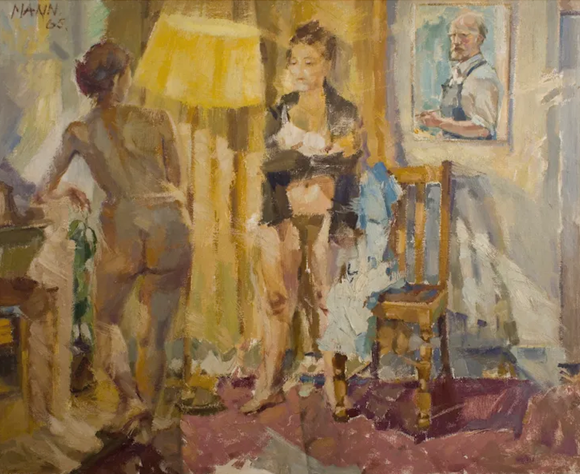
Self portrait with Double Nude by Cyril Mann (1965)

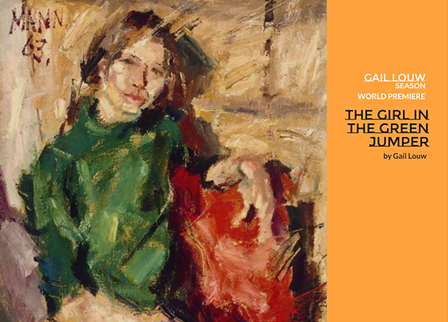
Probably the best-known portraits Cyril completed of Renske was The Girl in the Green Jumper, one with her fully clothed.  His self-portrait can be seen in the background, hanging on the wall.

The Girl in the Green Jumper by Cyril Mann (1963)

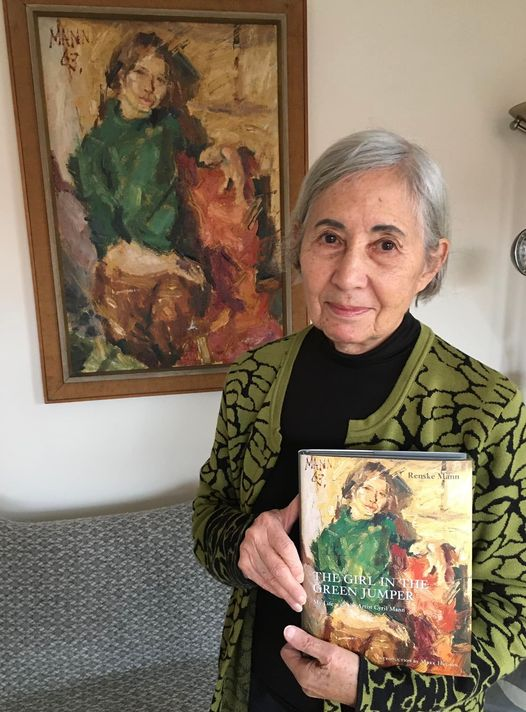
In the painting, The Girl in the Green Jumper, we see Renske perched on the narrow wooden armrest of their red chair, which she recalled made sitting still very difficult and painful, much to Cyril’s annoyance. She said that posing for Cyril required a good deal of concentration and willpower. The depiction came about when Cyril was admiring the green of her jumper which he commented looked so much more intense, seen against the red upholstery of their newly-purchased G-Plan suite. Renske, like many, queried whether it is a portrait or a study of sunlight blazing on to her through the window, striking her face and bouncing all over the room. She commented to her husband that her hands were just fingerless smears of paint but he replied that that was true abstraction. Abstraction he said was “to leave out” and abstract art is not actually abstract at all and should be better termed as “non-figurative”.

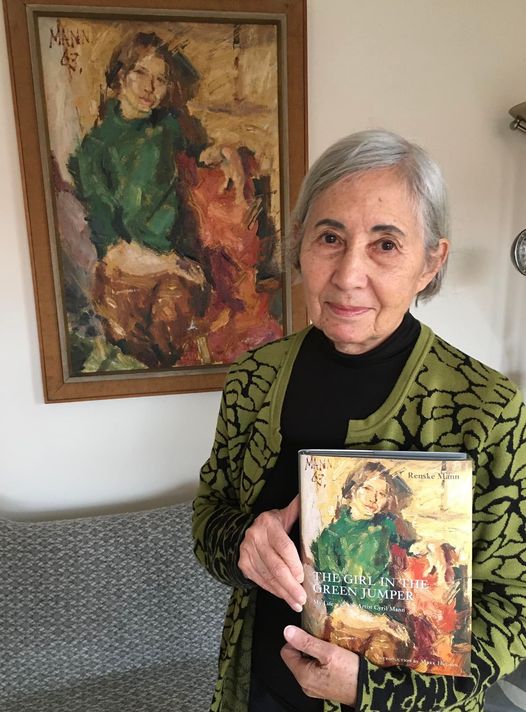
Amanda Mann has followed in her father Cyril Mann’s footsteps and is now also a talented artist. Here Amanda is seen with the painting that inspired her mother Renske Mann’s memoir “The Girl In The Green Jumper: My life with Cyril Mann”.

Cyril Mann, besides the nude depictions of his wife and self-portraits, completed many portraits of his family and friends which highlight what, he as a talented portrait artist, could produce. There is no doubt that he could have been a wealthy portrait painter. Alas he only rarely painted portraits of people outside the family as he said he could not accept portraiture commissions where he was supposed to flatter his sitter, which he believed was often the prerequisite for being given the commission.

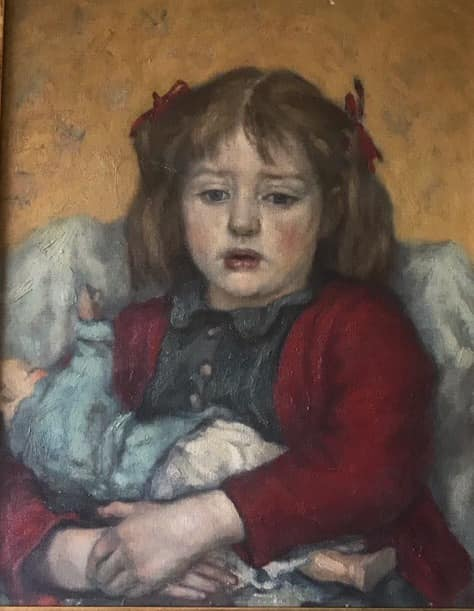
Portrait of Sylvia, aged 3, tearfully clutching her doll, by Cyril Mann (1943)

Sylvia, Cyril’s first daughter, would recount on a number of occasion the memory of sitting for her father for the portrait. She said the agony and boredom of sitting still for hours, clutching the doll still haunted her.

Portrait of Sylvia, by Cyril Mann (c.1957)                  Collection Gideon Dewhirst (Sylvia’s son and Cyril’s grandson)

Cyril Mann with his portrait of Sylvia Mann.

It is hard to judge the mood of the sitter. Sylvia was then aged seventeen and it was the time prior to her attending Keele University. It seems she is somewhat lost in her own thoughts. The depiction shows her holding a book, signifying her love of literature. After university she would go on to become a published author, poet and playwright. Sylvia died in 2006.

Amanda, aged 4, with Doll by Cyril Mann (1973)

Cyril and Renske’s four year old daughter, Amanda, was posed sitting on a chair holding her doll. It was a similar depiction to Cyril’s portrait of his first-born daughter, Sylvia, which he completed in 1943, also with a doll.

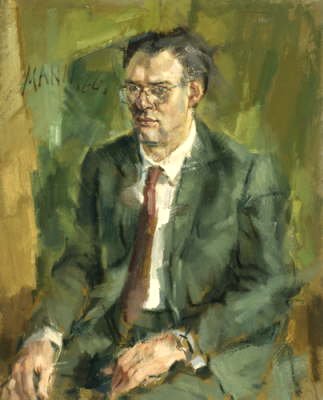
Portrait of David Hardisty by Cyril Mann (1966)

David Hardisty was a young lawyer working as a patent agent. He had seen and fell in love with one of Cyril’s floral paintings which were on display at the Rawinski Gallery in London. Hardisty, who had recently married, could not afford the £300 price tag. Not to be deterred he went to Bevin Court to ask Cyril if he could buy the painting in fifteen £20 instalments. Cyril agreed and during the following years David bought more of Cyril’s paintings. In the portrait, sunlight once again takes precedence over form in Cyril’s rendering. It plays across David’s features and on his suit, tie and hands. Time must have been at a premium for Cyril as the portrait was completed in only six two-hour sittings.

My Student, Vic Singh by Cyril Mann (1962)

When Renske went to the art class in December 1959 and met Cyril Mann for the frst time, one of his students that evening was Vic Singh. whom Renske remembered as being an extremely handsome young man,. His mother was Austrian and his father was an Indian politician. Singh went on to become a photographer. One day he called around to Bevin Court and Cyril persuaded him to pose for a portrait. He agreed and posed, one foot raised with his elbow resting across his knee while stretching one arm towards the bookcase in order to maintain his balance. He was exhausted by the time Cyril had completed the portrait.

Portrait of Ernest Groome (1971)

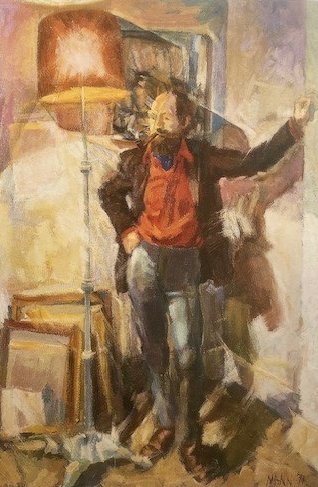
In 1960, Renske, like her husband, began to worry about the lack of sales of his paintings and suggested he took some of his work to Hyde Park Corner where many artists hung their work on the railings. Cyril was horrified with this idea saying that serious artists would not dream of hawking their wares in such a way. Renske, however, said that if he wouldn’t do it, she would. She arrived at Hyde Park Corner and found some spaces on the railings where she could hang Cyril’s artwork but she had forgotten to bring string or hooks to complete her task. She was rescued by a young Irishman, Ernest Groome, an aspiring young artist who had been working as a touring pub entertainer. He managed to find hooks and string and he and Renske hung Cyril’s paintings on the railings. 

Cyril first painted Ernest Groome’s portrait in 1961 shortly after the Hyde Park Corner meeting and ten years later completed another portrait of Groome. In this portrait Groome is in Renske and Cyril’s home. The red shade of the standard lamp picks up the colour of his shirt, casting a strong solid shadow against the wall behind him.

Self portrait by Cyril Mann

Cyril left behind many self-portraits which capture his many moods.

Self-Portrait with Hat by Cyril Mann (c.1968)

It is a very worried-looking Cyril Man who stares out at us in his 1968 Self-Portrait with Hat. He seems to have the cares of the world on his shoulders. It is 1968 and Renske is pregnant with her daughter Amanda, Renske, whose job was bringing financial stability to the household, was having to give up her job to have the baby. How were they going to cope? Could Cyril sell more of his work? All of these and many more questions were probably racing around Cyril’s head at the time of the self-portrait.

Self-Portrait with a Brush by Cyril Mann (1966)

The most controversial self-portrait came in 1978 under the title Ecce Homo. Ecce homo, meaning “behold the man” are, according to the Gospel of St John, the Latin words used by Pontius Pilate when he presented a scourged Jesus, bound and crowned with thorns, to a hostile crowd shortly before his Crucifixion. 

Ecce Homo by Cyril Mann (1978)

Ecce Homo was one of last self-portraits painted by Cyril Mann. He died a year later. His state of mind, at the time he painted his own portrait, was unstable but there was also a sense of defiance about this depiction. A sense that he was master of his own destiny. It is in a way a mirror of his great creative energy which throughout his life shone brightly and was never dimmed by his detractors.  Having given up smoking on doctor’s orders he had reverted to that habit and the portrait shows him defiantly holding a cigarette. It was another way of showing that he, and he alone, would make decisions about himself.  His rebellious posture and the title he gave the work was his way of reasoning that he, like Christ, had been persecuted and in a way crucified by art critics and gallery owners. He adamantly believed that the reason he never achieved the success he deserved during his life was due to others and not himself.   In the background, we see flanking him two earlier self-portraits and their positioning symbolises the thieves crucified on either side of Christ.

……. to be continued.


It would not have been possible for me to put together this and following blogs about the artist, Cyril Mann, without information gleaned from a number of sources:

The comprehensive biography of Cyril Mann, The Sun is God by John Russell Taylor

Renske Mann with her book The Girl in the Green Jumper, My life with the artist Cyril Mann

The intimate autobiography of Cyril Mann’s life by his second wife Renske, entitled The Girl in the Green Jumper.

Renske Mann and Natalie Ava Nasr, the lady playing the role of Renske in the play.

Peter Tate who plays Cyril Mann, Christian Holder, director of the play and Natalie Ava Nasr, who plays Renske in the play The Girl in the Green Jumper.

This autobiography has now been turned into a play which receives its World Premiere on Wednesday March 13th at the Playground Theatre, London, 8 Latimer Rd, London W10 6RQ. It runs until March 24th.

Finally, and most importantly I owe many thanks to Renske Mann herself who provided me with information and photographs appertaining to her late husband Cyril.

Piano Nobile Gallery London for information and pictures.

Cyril and Renske Mann. Part 3.

“…The very first moment I beheld him, my heart was irrevocably gone…”

– Jane Austen

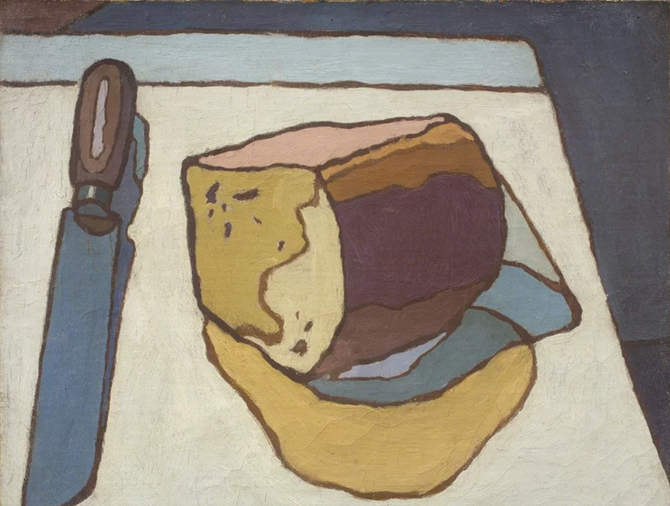
Bread and Knife by Cyril Mann (c.1955)

Still Life of Bottle and Jug by Cyril Mann (c.1955)

In the mid-1950s Cyril Mann’s painting style changed and he entered what was known as his solid shadow period.  This was a complete change of style for him in comparison to his earlier works which had concentrated on the effects of direct sunlight and yet light came into play with these “shadow” works. They concentrated on shadows that were seen below objects when viewed under an overhead light source. In 2018 the Piano Nobile Gallery in London put on an exhibition of Cyril Mann’s work entitled The Solid Shadow Paintings.  The gallery wrote about the works on display:

…Undertaken between 1951 and 1957, Mann’s solid shadow paintings were a dazzling interjection in the subdued art world of fifties Britain. This was his most original period and it stands as his lasting contribution to the history of twentieth-century painting.  It is an explosive programme of work, representing ordinary objects with boldly outlined shadows and bright, sometimes luminous colour. A dazzling interjection in the subdued art world of fifties Britain, these works have never been displayed together and the exhibition offers an exciting insight into the artist’s radiant formal language…

After Mary walked out on Cyril in the middle of the night with her their daughter Sylvia, he had to fend for himself.  Fortunately for Cyril, his daughter maintained contact with him and visited him regularly.  Sylvia, who was a year younger than Renske, won a scholarship to the City of London School for Girls . After successfully completed her schooling she left London, aged eighteen, and went to Keele University to read English Literature and French.  Whilst there, Sylvia also took on some temping work to supplement her student grant.  Cyril was very proud of his daughter and what she had achieved although he had to admit they had, at times, a tempestuous relationship and he found her quite difficult at times.  On occasions, it would appear that Sylvia also found her relationship with her father equally problematic.  Renske got to know Sylvia and often said that she was everything she should have loved to have been herself: tall, a head taller than Cyril and Renske, blonde and beautiful. She also had Cyril’s violet-blue eyes and sensitive mouth and in some ways, Renske often felt pangs of jealousy.
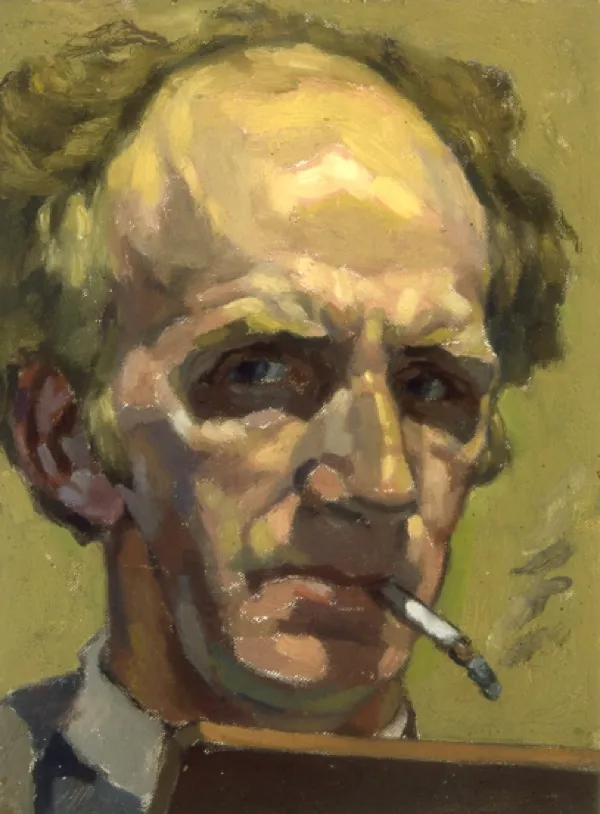
Self portrait by Cyril Mann (1956)

Cyril struggled to survive financially as the sale of his paintings were not going well although this could have been more down to his obstinacy and the cantankerous ways he treated dealers and galleries, rather than the quality of his paintings. 

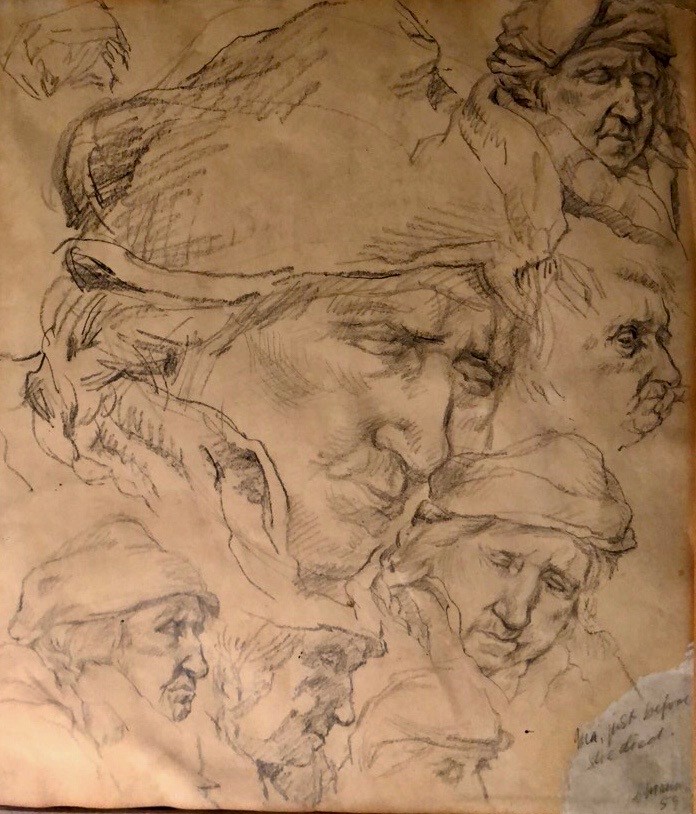
Ma, Just before she died by Cyril Mann

The years 1958 and 1959 proved to be a distressing time for Cyril Mann.  He had been suffering a great deal of pain and was seriously ill with stomach ulcers.  The discomfort had made him stop painting and teaching and the final straw to this misery was the death of his mother whom he had visited whilst she was in a Nottingham nursing home.  He had made a number of facial sketches of his mother in 1959 during her last days. She had outlived her husband, her daughter and two of her three sons.

Cyril and Renske

Things changed for Cyril at the end of 1959 when on the evening of December 18th Renske van Slooten came into his life.  Renske first met Cyril Mann at the Kingsway Day College in Holborn, London, where he was teaching students.  Her “boyfriend” and dancing partner at the time, who knew she was interested in art, took her to meet his former art teacher.  Renske remembers the moment well and, in her book, The Girl in the Green Jumper, she recalls that first sight of the artist:

“…As I stood on tiptoe peering through the window, I could see Cyril with his back to me, slumped at his desk in front of his students with their easels and drawing boards.  His hair, what there was of it was long and unkempt.  He wore a crumpled tweed jacket with leather elbow patches.  He wasn’t tall a bit over five foot at most.  To me, barely out of my teens and recently arrived from Holland, he looked old, at least fifty.  Yet before I’d even seen his face, I felt drawn to him…”

She also distinctly remembered the park warden’s prediction of meeting and marrying an “old” artist. At that first sighting of Cyril in his art class she was totally captivated by him.  Renske says of her first impression of Cyril:

“…A strange feeling came over me. This was it! I remembered the park warden’s prediction. I was mesmerised. I saw his hair was too long, his tweed jacket with leather elbow patches was tatty, he looked worn out, depressed. Didn’t take any notice of me.  I couldn’t care less what he looked like and how scruffy he was. I was attracted to him, not because he was older, but because I’m always attracted to people who are unusually gifted. And I sensed that he was…”

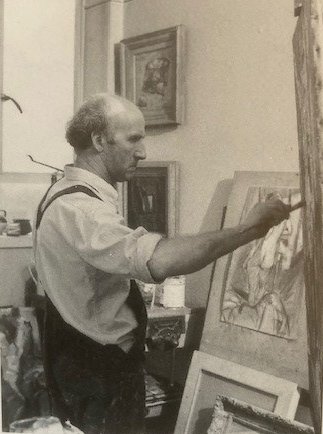
Cyril Mann painting in a small room in Bevin Court

After that first meeting, Cyril and Renske set up a date for the following evening. She was buoyed by the thought of being in the company of a professional artist.  Cyril was almost half an hour late at the rendezvous admitting he had fallen asleep whilst reading a book.  Fortunately for him Renske had waited patiently for him.  Cyril invited her back to his flat to look at some of his artwork.  At this time, he was renting a top-floor flat in a council housing block at Bevin Court in Islington.  Totally captivated by both Cyril and his painting, Renske admits she paid little attention to the flat itself, which was overflowing with his paintings, books and sculptures.  Renske remembers the artwork as being quite small, dark and gloomy and yet she says that they were among the most beautiful she had ever seen.  She told him that some reminded her of works by Turner.  He was delighted at that assertion as he looked upon the English artists as one of his great heroes.

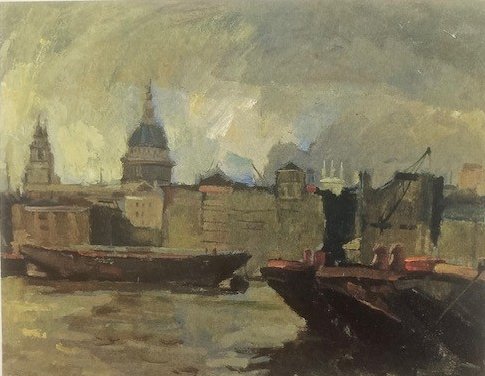
St Paul’s from Bankside by Cyril Mann (c.1952)

One of the paintings which she really liked was his work entitled St Paul’s from Bankside.  It depicted the dome of St Paul’s looming above the rooftops from across the River Thames.  Nowadays at this point on the Thames, the Millenium Bridge spans the river besides the Tate Modern.  Renske said that at first glance at the work, she thought it was a monochrome depiction but on closer inspection she could see that the greys were shot through with blue, yellow and warm pink.  Cyril told her that the city should be viewed on a grey day. He went on to assert:

“…One day people will recognise my qualities as an artist purely on the strength of my ability to perceive greys in their infinite variety…”

It was this assertion that one day he would be acclaimed a great artist that would haunt him all his life as he never felt recognised as a truly great painter.

St Paul’s by Cyril Mann (1948)

It is interesting to compare the 1952 painting with the one he completed in 1948. The latter was painted in his favoured style at the time that of facing the sun and concentrating on the effect of direct sunlight. The view is from Moor Lane which dominates the foreground in which we see four people walking along the pavement, to the side of which is a low wall. A fifth figure crosses the road. Over the other side of the wall is a vast empty space, the result of heavy wartime bombings. In the midground we see multi storey buildings, churches and to the right, the familiar outline of St Paul’s Cathedral.

St Paul’s from Bevin Court by Cyril Mann (1961)

Another of Cyril Mann’s cityscapes featuring St Paul’s cathedral was his painting entitled St Paul’s from Bevin Court. 

A month had passed since their first meeting and Renske and Cyril were happy about how things were progressing.  Renske, however, was not happy with her communal living at the YWCA and told Cyril she needed another place to live.  He made a few suggestions, including sharing a flat with his ex-girlfriend, but Renske came straight out and asked if she could live with Cyril in his flat !   The problem was that Cyril’s home was a one-bed flat and he slept on a single bed in a room that was full of paintings, easels and other artistic paraphernalia. Renske was not put off by this and said that as they were both small, they could both sleep in the bed.  For Renske, it was nothing to be ashamed of, although her work colleagues at the Dutch-owned company, when they were told, were scandalised,  Scandalised that she was living with a man, scandalised that she was living with a married man twenty-eight years older than her and that his daughter, Sylvia, was only a year younger than her, and scandalised that she was living in a poor and rough council estate. 

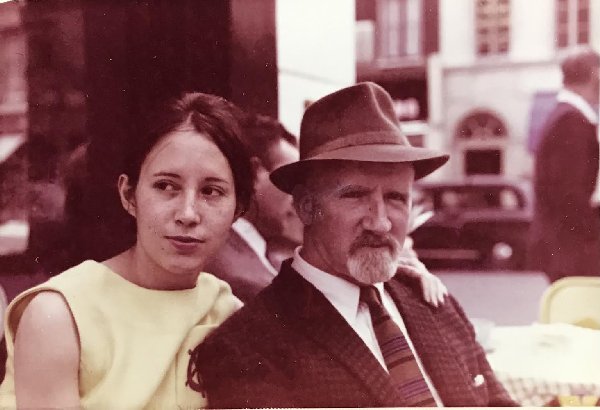
Renske and Cyril Mann in the mid 1960s

However, Renske was passionately in love with “her” artist and was not going to listen to subtle and not-so-subtle warnings about what she had done.  News of Renske’s situation of living with a married man got back to her boss who contacted the Dutch embassy in London and asked that her parents be informed about their daughter’s living and romantic situation.  Her father and mother were horrified and she was summoned home.  She was still not twenty-one and therefore, by Dutch law, she remained under their control.  Despite their protestations Renske declared that she would marry Cyril with or without their permission.  One can just imagine the thoughts that were going through the parents’ heads having been told that she intended to marry a man who was a year older than Renske’s own mother.  What her parents failed to realise that it was not the older man who was grooming their young daughter, it was their young daughter who was the prime mover in forging this relationship.  Renske returned to London and moved in with Cyril.  She wanted to marry him but could not as he was still married to his first wife, Mary !

Having lived apart for ten years, the marriage between Cyril and his first wife Mary ended in divorce on August 24th 1960 and eight days later, on September 1st, one week after Renske’s twenty-first birthday, Cyril and Renske were married.

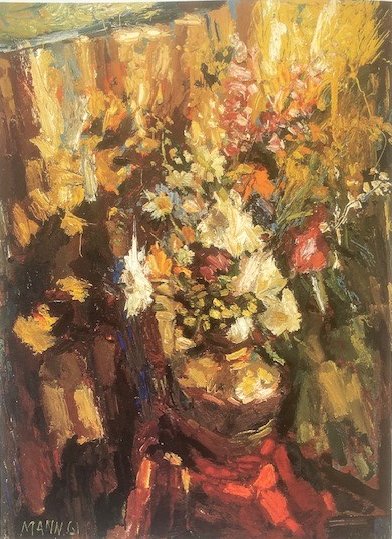
Mixed Flowers by Cyril Mann (1961)

Cyril had suffered stomach ulcers for years and had had to endure constant stomach pains after every meal which had weakened him and caused bouts of ill temper.  One day in April 1960, whilst out walking alone, he collapsed in the street and was rushed to the Royal Free Hospital where he underwent an emergency operation for a perforated stomach ulcer.  Following the operation and probably due to the pressures of having to earn a living from his teaching and the need to sell his artwork, both of which he was unable to do due to his physical illness, he suffered a serious mental breakdown.  Renske was upset by Cyril’s physical and mental decline and set about remedying the situation by putting Cyril’s life back on an even keel.  She believed that Cyril was not able to cope with having to teach, which he hated, and paint and so she maintained her job and became the breadwinner.  For Cyril this financial support from Renske liberated him from the drudgery of having to teach and the necessity of providing money to put food on the table.  After release from hospital Cyril went to convalesce at the Artists’ Rest Home in Rickmansworth, a town in south-west Hertfordshire, where he was allocated a comfortable room, painting facilities and three good meals a day.

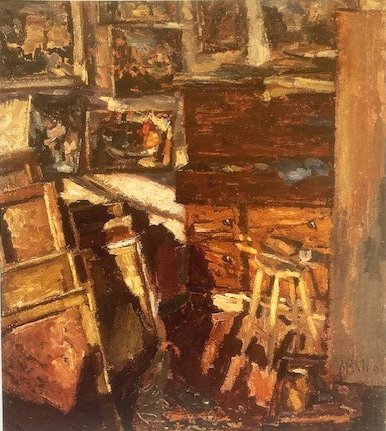
Studio Corner by Cyril Mann (1961)

His operation had left Cyril pain-free and he went back to his painting with a noted added gusto, but all was not well.  Renske remembers one horrendous evening when a hyped-up Cyril had decided he was going to design, what he termed, “the greatest mural the world had ever seen”.  She had been sleeping badly and was desperate to go to bed but Cyril refused to let her sleep and demanded that she helped him plan this great mural, an extensive paper plan of which had been tacked to the carpeted floor of their bedroom/living room.  He flew into a rage when Renske just wanted to lay down and sleep and demanded she helped him.  It finally got too much for her and she, determined to have an uninterrupted sleep, took some tranquilizers and sleeping pills and collapsed on the bed.  The next thing she remembered was waking up in hospital.  When she had collapsed, Cyril couldn’t shake her awake, and so he called an ambulance. 

Cyril with black eye

The ambulance arrived along with some police. Cyril demanded that he should accompany her to the hospital in the ambulance but they refused him.  He was furious and lost control, attacking both the ambulance staff and the police and for his troubles received a black eye but worse still another ambulance was summoned and after consultation with a psychiatric nurse, he ordered him to be sectioned, taken to a mental unit, placed in a straitjacket, and then taken to a padded cell.  His passport photograph taken days after the incident shows Cyril with a black eye after his altercation with the ambulance men.

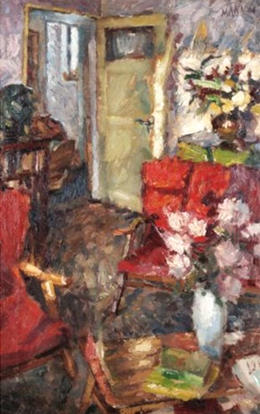
Interior with Red Chair by Cyril Mann (c.1961)

After a fortnight’s detention at the psychiatric hospital, Cyril was allowed home, heavily sedated, and having had to promise to take his medication every day.  Cyril was unhappy with the terms of his release as he believed the medication would threaten his libido.  Besides doing that, he asserted that the pills would also affect his creative artistic thoughts and to counteract this he unilaterally began to reduce the amount of medication he had been prescribed.  As often is the case, to raise spirits Renske decided to perform a deep-clean of the flat and buy some new furniture, including a garishly bright red upholstered chairs which Cyril loved and said that the new additions inspired him.

………..to be continued.


It would not have been possible for me to put together this and following blogs about the artist, Cyril Mann, without information gleaned from a number of sources:

The comprehensive biography of Cyril Mann, The Sun is God by John Russell Taylor

Renske Mann with her book The Girl in the Green Jumper, My life with the artist Cyril Mann

The intimate autobiography of Cyril Mann’s life by his second wife Renske, entitled The Girl in the Green Jumper.

This autobiography has now been turned into a play which receives its World Premiere on Wednesday March 13th at the Playground Theatre, London, 8 Latimer Rd, London W10 6RQ.

Finally, and most importantly I owe many thanks to Renske Mann herself who provided me with information and photographs appertaining to her late husband Cyril.

Piano Nobile Gallery London for information and pictures.

Wilhelmina Douglas Hawley

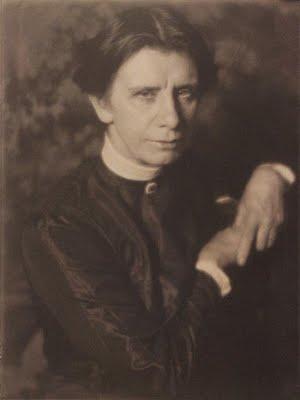
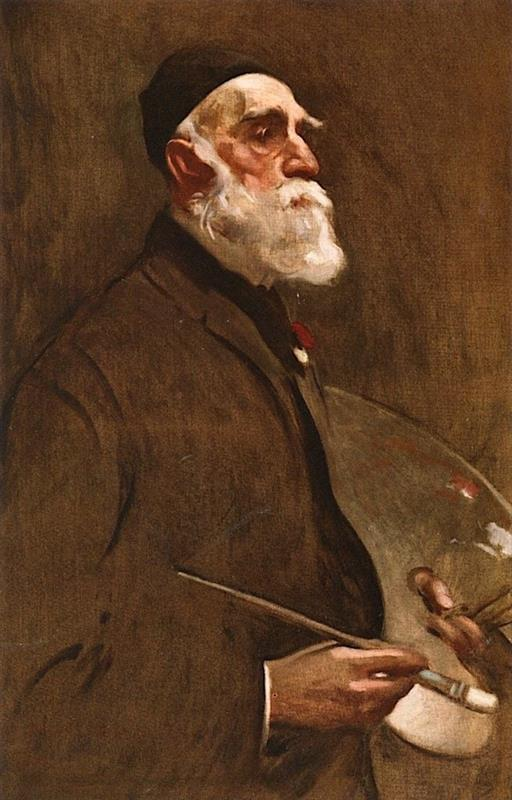
Wilhelmina Douglas Hawley, Self Portrait (1897)

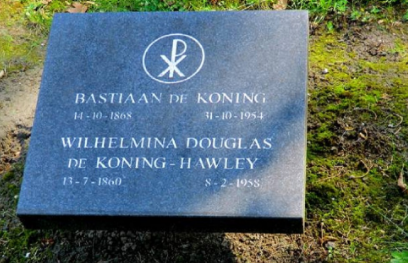
The artist I am featuring today is the American painter and watercolourist Wilhelmina Douglas Hawley.  She was born on July 13th 1860 in the small coastal town of Perth Amboy, New Jersey. Her father, Peter Radcliffe Hawley was an officer in the coast guard and her mother, Isabella Hawley (née Merritt), a Canadian-born dancer. Wilhelmina’s ancestors were English and Scottish migrants, who moved to the east coast of the United States and Canada in the seventeenth and eighteenth century

Birthplace of Wilhelmina Douglas Hawley, Merritt Peck House, 213 High Street, Perth Amboy, New Jersey

Wilhelmina had three siblings: an older sister Jeanne and two younger brothers William and Alan Ramsey.  When Wilhelmina was four-years-old, the family moved to the New York suburb of St Albans, a residential neighbourhood in the southeastern portion of the New York City borough of Queens. Wilhelmina developed two loves during her pre-teen years.  One was a love of sketching and painting thanks to two of her unmarried aunts, Florence and Georgina Agnes Merritt and the other was the love of travel once her grandparents took her to Europe when she was just twelve years of age and it was the excitement of visiting so many new places that encouraged her to start writing a journal.

The Cooper Union

Wilhelmina soon developed a love of art and decided to follow the dream of becoming a professional painter.  In 1879, at the age of nineteen, she enrolled in the Cooper Union Women’s Art School, one of the New York art academies that is open to women.  The Cooper Union for the Advancement of Science and Art was established in 1859 and is among the nation’s oldest and most distinguished institutions of higher education. The college, founded by inventor, industrialist and philanthropist, Peter Cooper, offers a world-class education in art, architecture and engineering as well as an outstanding faculty of humanities and social sciences.  Cooper took the revolutionary step of opening the school to women as well as men. There was no colour bar at Cooper Union. Cooper demanded only a willingness to learn and a commitment to excellence, and in this he manifestly succeeded.

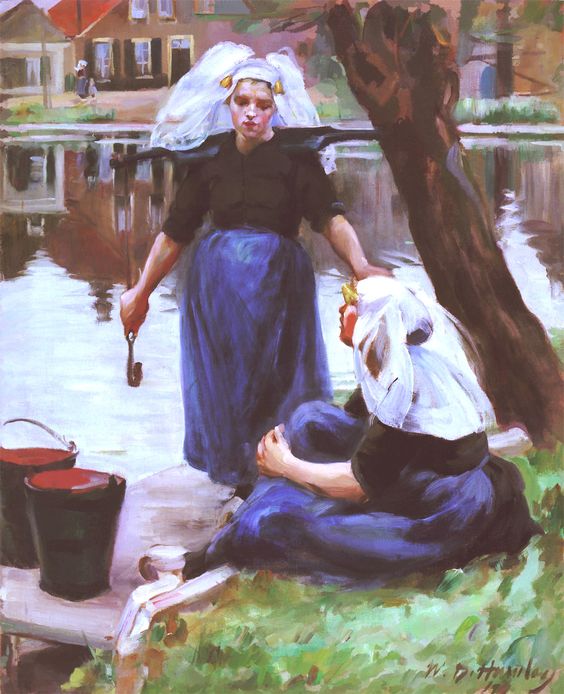
Two Women near the River Waal by Wilhelmina Douglas Hawley (1894)

Wilhelmina remained at the Cooper Union for a year and then enrolled at the Art Students League where she honed her artistic skills eventually becoming the first woman vice-president of this progressive institution. Her tutors included William Merritt Chase, Julian Alden Weir, Charles Yardley Turner and Kenyon Cox. The popularity of the Art Student League was that it was based in New York and the city attracted many European artists, many of whom Wilhelmina met while living and studying at the Arts League.

Young Woman in the Meadow by Wilhelmina Douglas Hawley

To escape the cold climate of New York, Wilhelmina spent the winter of 1891/2 on the island of Bermuda where she fell in and out of love with a mysterious Englishman whom she had agreed to marry.  Fortunately, she realised the error of her judgement and the two split up.  Once again, like so many American artists of the time, who succumbed to the magnetism of Paris, Wilhelmina was drawn towards the French capital to continue with her artistic tuition. On June 18th 1892, just a month before her thirty-second birthday, Wilhelmina once more, set sail for Europe on the Holland-America steamer Veendam.  During her Atlantic voyage, Wilhelmina was accompanied by the Dutch-American artist John Vanderpoel and his wife Jessie Elizabeth Humphreys. Vanderpoel. He was a well-known artist and taught at the Art Institute of Chicago where one of his tudents was Georgia O’Keeffe, and it was he who most likely suggested to Wilhelmina that she should spend the summer months at the charming village of Rijsoord near Dordrecht in the Netherlands, where he had founded an artists’ colony in 1886. 

Interior with Mother, two Children and Cat by Wilhelmina Douglas Hawley

On arriving in Paris Wilhelmina registered at the Académie Julian, one of only two art academies in the city to which women and foreign students were admitted.  Having arrived in the Summer, all the Academies were closed for the summer break and would not re-open until the September.  Wilhelmina used the time to travel throughout Belgium and the Netherlands and on 4 July 1892 she made her first visit to the Dutch flax village and artists’ colony at Rijsoord, where various foreign artists and art students had been living and working since 1888 especially during the summer months.  In 1893, Wilhelmina achieved her first artistic successes at the French Academy where she was awarded a prize for best composition.  Also for the first time, one of Wilhelmina’s paintings was selected for the Paris Salon that year, and success came from across the Atlantic when her painting, Holland Peasant Girl was shown in New York at an exhibition of the National Academy of Design

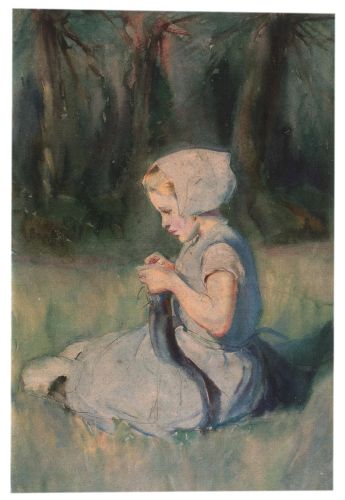
Girl Knitting in a Field by Wilhelmina Douglas Hawley

In 1893, Wilhelmina was appointed as an art teacher at Academy Colarossi and it was around this time that she met English-born Canadian art student, Laura Muntz  A friendship between the two women sprung up and Laura moved in with Wilhelmina at her studio at No. 111 Rue Notre-Dame-des -Champs. Close to the Palais de Luxembourg.  Directly across from their studio was the studio of American artist, James Abbott McNeill Whistler.  Both Laura and Wilhelmina were regular visitor to Whistler’s studio, and he to theirs.

Laura Muntz Lyall

Laura Munz, who was born in 1860 in Radford, Warwickshire, England, was the same age as Wilhelmina and is recognised as one of the most talented painters of her time.  She was an impressionist painter, best known for her depiction of mothers and children. When she was a small child, she emigrated with her family to Canada, where grew up on a farm in the Muskoka District of Ontario. 

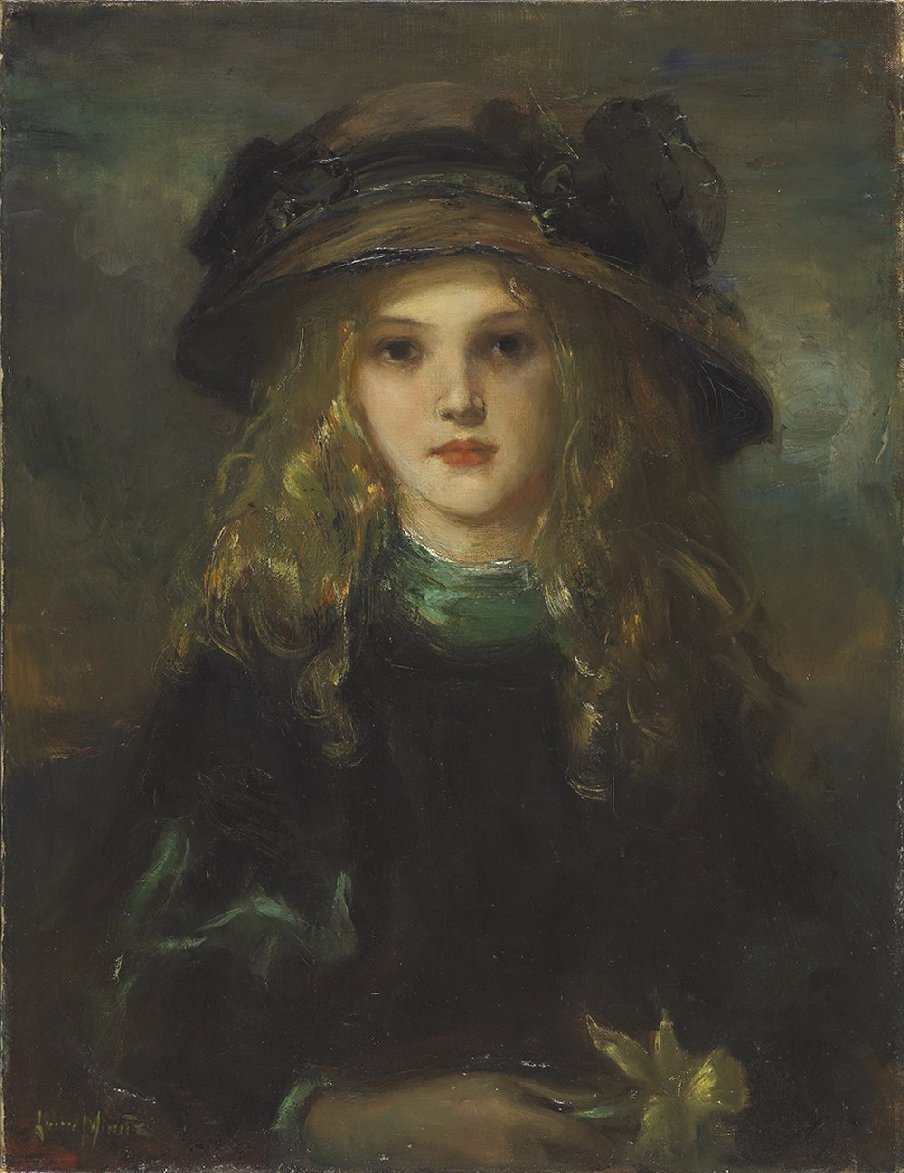
A Daffodil by Laura Munz Lyall (1910)

In 1882, Laura began to take classes at the Ontario School of Art in Toronto.   She also studied briefly at the South Kensington School of Art in 1887, then returned to Canada to continue her studies at the Ontario School. She came to Paris in 1891 and before she met Wilhelmina had been living alone and earning money by teaching and administrative work.  She was the first Canadian to receive the distinguished “Honourable Mention” at the Paris Salon exhibition in 1895.

Portrait of Wilhelmina Douglas Hawley by Laura Munz (1897)

In 1896 Laura returned to Canada for a short spell to help look after an ailing relative.  She returned to Paris and the Academy Colarossi and was promoted to the post of  massiere (Studio head) at the Académie Colarossi.  In 1898 she returned to Canada in 1898 and set up a studio in Toronto to teach and paint.  In 1906, she moved to Montreal to continue her career and built up a large clientele that regarded her as the premier Canadian portraitist of children.  Following the death of her sister in 1915, she returned to Toronto and married her brother-in-law Charles W.B. Lyall and cared for his children of her sister’s marriage, eleven in all, but many had left home by then.  She set up a studio in the attic of their home, and started signing her works with her married name. Laura Munz Lyall died in Toronto in 1930, aged 70.

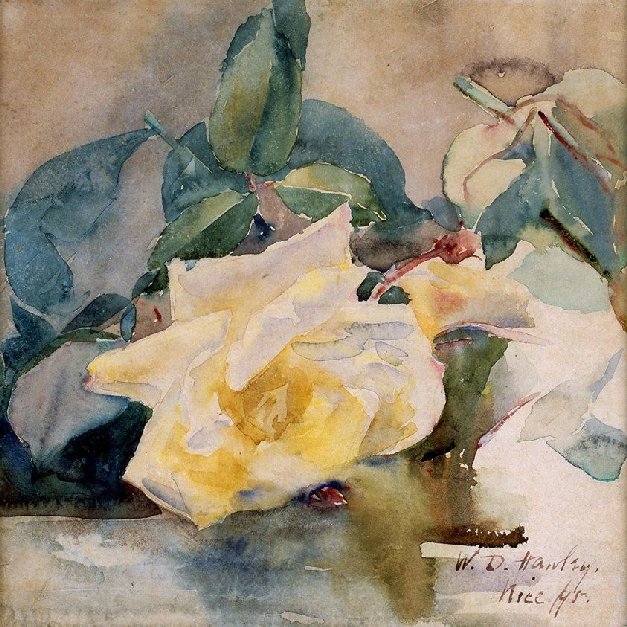
Rose by Wilhelmina Douglas Hawley (1895)

Wilhelmina and Laura spent part of the summers in the French countryside as well as the artists’ colony of Rijsoord in the southern Netherlands. She would often take her international students of the Académie Colarossi with her on these painting trips.   It was here that Wilhelmina captured the villagers in oils and watercolours. The village of Rijsoord was well situated for passing travellers on the Rijksstraatweg (State Highway), an important European road that connected Paris to The Hague.

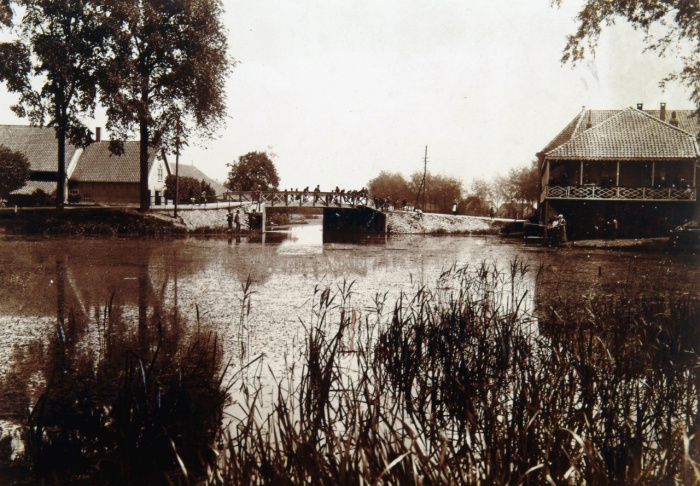
The bridge over the River Waal at Rijsoord, with Hotel Warendorp on the right

An inn was constructed on the spot near the river Waal where the eighteenth-century tollhouse had stood. The building is still standing and for several years had housed the restaurant Hermitage. When Wilhelmina first visited Rijsoord, the inn was called Hotel Warendorp. Hotel Warendorp functioned as the headquarters of the summer academy. The ground floor of the building comprised a livingroom, diningroom and a room for drinking coffee. Most of the guestrooms were also on the ground floor. On the floor above it, the large space under the roof was used as an artists studio, where the artists would hang their most recent paintings and watercolors for discussion. On rainy days, when it was impossible to work en plein air, the artists would actually work in the studio. Wilhelmina’s great granddaughter, Alexandra van Dongen, wrote about how her great grandmother met her husband in her blog: For Two Years, or Perhaps Forever”; Wilhelmina Douglas Hawley and the Artists’ Colony in Rijsoord.  The tale is an instalment in a monthly series of blogs telling stories about the rich history shared by the American and the Dutch peoples.  She wrote:

“…In 1899, Wilhelmina apparently first encountered the 31-year-old Rijsoord farmer Bastiaan de Koning (1868-1954). They most likely met during a boat trip on the river Waal, as the story goes, as local villagers including De Koning, regularly rowed the artists to their outdoor painting locations. In the summer of 1900 Wilhelmina returned to Rijsoord again and announced her engagement to Bastiaan. They married a year later on December 5, 1901. Another three years later, when Wilhelmina was 44 years old, she gave birth to a daughter, my grandmother, Georgina Florence de Koning (1904-1973), named after Wilhelmina’s aunts. By that time, Wilhelmina had been active in the art world for twenty-five years. Family life did not prevent her from traveling abroad, visit exhibitions or meet her friends in Paris and New York. In 1915, her family in Rijsoord engaged a young housekeeper, Geertrui van Nielen (1895-1981), who became an important supporter in her life. Trui, or Troy, as she was called by Wilhelmina, took care of household matters and looked after Georgy, as Wilhelmina’s daughter was called, when her mother was traveling abroad …”

Wilhelmina continued to live with her husband and daughter in Rijsoord.  Years later she enjoyed the summer holiday visits from her daughter, Georgy, her husband, Hans van Dongen and their six children.  On February 18th, 1958, Wilhelmina Douglas Hawley passed away at home at the age of 97.


The information I used for this blog came from a number of excellent websites, all of which are worth visiting. They are:

The Society of the Hawley Family

For Two Years, or Perhaps Forever”; Wilhelmina Douglas Hawley and the Artists’ Colony in Rijsoord

Wilhelmina Douglas Hawley

Schildersdorp Rijsoord 1886-1914

New York Almanack


John White Alexander

During the nineteenth century, Paris was considered the art capital of the world.  Once the American Civil War had ended, aspiring American artists, who had the necessary funds, made their way across the Atlantic to the French capital and enrolled in one of the many ateliers there, to learn from the foremost painters of the time.  Many enrolled in the prestigious government-sponsored École des Beaux-Arts and in thriving private academies and studios.  They also had the chance to visit the Louvre and study the works of the Masters of byegone days and be impressed by the modern works on display at the Paris Salons, World’s Fairs, and other exhibitions, including the eight shows staged by the Impressionists.  These young Americans also submitted their own works to the various exhibitions.  Today I am looking at the life of one such American, John White Alexander.

The American photographer and art critic, John Nilson Laurvik, wrote about my featured artist in the December 1909 edition of the Metropolitan Magazine:

“…In the whole history of art one looks in vain for anything approaching his inimitable skill in the arrangement and play of his figures. . . .[He is] pre-eminent as a delineator of feminine beauty and charm…”

John White Alexander

John White Alexander was an illustrator, landscape and still life painter, printmaker, muralist, society portraitist,  and production designer of posters, costumes, scenes, lighting, and tableaux vivants.  Alexander was born on October 7th, 1856, in Allegheny, Pennsylvania, which is now a part of the city of Pittsburgh.  He was orphaned at the age of five and was subsequently raised by his grandparents. When Alexander was 12 years old, he quit school and became a telegraph boy. One of his employers, Colonel Edward Jay Allen, the secretary/treasurer of the Pacific & Atlantic Telegraph Co., noticed Alexander’s aptitude for drawing and began working with him to help him develop that talent. So impressed with Alexander that he assumed guardianship of the young boy and persuaded him to return to the local High School for eighteen months.

Six years later, in December 1874, Alexander and a friend took a trip down the Ohio River,  earning money for food by sketching farmhouses and selling them to the locals.  It is said that Mark Twain read about their trip and a number of incidents on their voyage of exploration were used in his 1884 novel,  Huckleberry Finn.  Soon after his adventure, Alexander relocated to New York and spent three months seeking a job in New York City, visiting a number of publishers, showing his sketchbook.  He was finally employed as an office boy at Harper’s Weekly magazine where he was later promoted to illustrator and political cartoonist in 1875. He remained working for the magazine for three years. 

Alexander then travelled to Paris but found it very expensive and moved on to Germany and the city of Munich where he received his first formal artistic training at the Royal Academy, winning a bronze medal for drawing.    It was in Munich that Alexander first met Kentucky-born German painter, Frank Duveneck.  In 1878, Duveneck had opened a painting school in Munich.

Portrait of John White Alexander by Frank Davenek (1879)

However, like Paris, the cost of living in the city of Munich proved too onerous for Alexander and so he and Duveneck moved to the Bavarian town of Polling, a small town fifty miles east of Munich, where Duvenek set up another painting school and Alexander taught a private watercolour class in Duveneck’s school.  His students were known as the Duveneck Boys and included such aspiring painters as John Twachtman, Otto Henry Bacher, and Julius Rolshoven.  In 1879 Duvenek completed a portrait of John White Alexander.

Venice Canal Scene by John White Alexander (1880)

From 1879 to 1881, Alexander travelled and studied with Frank Duveneck in Italy. The pair spent the summer of 1880 in Venice.    One day, Alexander met Whistler by chance as he was painting next to a canal. Alexander returned to America in 1881 and was able to pick up illustrative commissions from various magazines.  One such commission saw him travelling 2,100 miles along the Ohio River in the Spring of 1881 resulting in sixteen sketches of the local coal industry.

Oliver Wendell Holmes by John White Alexander

On his return to America besides returning to his work as an illustrator, he became a very successful portrait artist. Many well-known individuals sat for Alexander such as Oliver Wendell Holmes, an American physician, poet, and humourist notable for his medical research and teaching, and as the author of the “Breakfast-Table” series of essays.

…..also Thomas Worthington Whittredge, an American artist of the Hudson River School.

Walt Whitman by John White Alexander (1889)

….and Walter Whitman Jr. who was an American poet, essayist, and journalist. He is considered one of the most influential poets in American history.

Mary Emma Woolley by John White Alexander

In 1909, Alexander completed the portrait of Mary Emma Woolley, an American educator, peace activist and women’s suffrage supporter. She was the first female student to attend Brown University and served as the 10th President of Mount Holyoke College from 1900 to 1937.  It is a beautiful portrait of the woman, exuding elegance and his brushstrokes along with the delicate shadows depict her as a dignified woman of great importance.  The sitter lightly thumbs a book with one hand while the other is clenched into a fist which was possibly referencing her knowledge and passion.  It is said that the way Alexander portrays Woolley validates a tendency among male artists of this era, who often painted women as domestic, inwardly emotional beings with exquisite exterior refinement.

Owing to the fact that they both had the same surname, John White Alexander was introduced to and later married, Elizabeth Alexander.  She was the daughter of James Waddell Alexander, president of the Equitable Life Assurance Society.   John and Elizabeth had one child, the mathematician James Waddell Alexander II.  In 1881 John White Alexander completed a black and white sketch of Elizabeth.

Portrait of Mrs John White Alexander (1902) by John White Alexander

……….and in 1902 he completed a full-length portrait of his wife.

Azalea (Portrait of Helen Abbe Howson) by John White Alexander (1885)

A turning point in Alexander’s artistic career came when, during a summer European holiday in 1884, he wrote to his early mentor, Colonel Allen, telling him of his desire to complete a “subject picture”. The result was his 1885 painting entitled Azalea (Portrait of Helen Abbe Howson). In Alexander’s painting, we see Howson adorned in a white dress seated on a sofa on the left of the horizontally elongated painting.  To counteract that, on the right is a white-flowering azalea branch in a large celadon vase and on the back wall one can see the bottom of a framed image.  The main title of the painting refers to the flowers Helen Howson stares pensively across the room at.  This pose of Howson is one of contemplation and in many of his figurative works Alexander depicts women who avoid the gaze of the viewer.  Some believe that Alexander’s depiction of self-conscious subdued women may be his way of counteracting the growing activism of women in their battle for suffrage and other forms of equality that was manifesting around this time.

Whistler’s Mother by James Mcneil Whistler

Historians believe the depiction was influenced by Whistler’s portrait of his mother which had been exhibited in New York in 1882.  The poses are similar. The “cut-off” picture frame is depicted in both paintings.

Six years later in 1897 Alexander completed another memorable work featuring a single woman.  It was entitled Isabella and the Pot of Basil and is based on a poem written by the English poet John Keats entitled Isabella, or the Pot of Basil. Keats had actually “borrowed” his tale from the Italian Renaissance poet Giovanni Boccaccio.  The story goes that Isabella was a Florentine merchant’s beautiful daughter whose ambitious brothers disapproved of her romance with the handsome but humbly born Lorenzo, their father’s business manager. The brothers murdered Lorenzo and told their sister that he had travelled abroad. The distraught Isabella began to decline, wasting away from grief and sadness. She saw the crime in a dream and then went to find her lover’s body in the forest. Taking Lorenzo’s head, she bathed it with her tears and finally hid it in a pot in which she planted sweet basil, a plant which is now associated with lovers. 

This scene was made famous by William Holman Hunt’s 1868 version…

 …….and the 1907 one by John Waterhouse,

However Alexander’s pictorial rendition of the scene is so different to the other two.  His depiction has used theatrical effects to depict this gruesome scene.  He has isolated Isabella in a shallow recess and illuminated her from below, almost as if she were an actor on a stage who has been illuminated solely by the footlights.

There is an eeriness about the way Alexander has utilised a cold monochromatic palette, and if we allow are eyes to follow the sensuous curves of Isabella’s gown, they are finally drawn to the loving attention Isabella gives the pot, as she gently caresses it. Isabella seems to be in a world of her own totally oblivious to us, the viewers.  It is a tragic depiction of lost love.

Panel for Music Room, by John White Alexander (1894)

There has always been a connection between fine art paintings and music.  So many famous works of art have depicted people playing musical instruments.  It is the conjoining of two great arts.  Many such paintings depict young ladies playing a musical instrument or intently listening to a musical recital.  Take a look at this beautiful work by John White Alexander as he depicts two young women laying back languorously on a long and plush sofa. 

Look carefully at their facial expressions.  The woman on the left who is playing the guitar is lost in concentration and in some ways seems mesmerised by the sounds coming from her instrument.  The woman on the right lies towards her resting on an ornate cushion.  She seems to be in a dream-like state lost in thought.  It is a frieze-like horizontally elongated depiction which measures 94 x 198cms (33 x 78 inches) portraying a dream-like atmosphere.

Memories by John White Alexander (1903)

Another of Alexander’s paintings featuring the interaction between two women is his 1903 work entitled Memories.

Repose by John White Alexander (1895)

One of Alexander’s most famous works is his 1895 painting entitled Repose. Once again it is a depiction of a woman lying languourously across a large cushion on a long sofa. The curves of her body can be seen despite the voluminous white dress she wears. Her head rests on her hand and she looks out at the viewer. 

The facial expression of the woman, whose lips are slightly parted, gives an added touch of sensuousness to the depiction. This provocative facial expression along with the sinuous curves are a reflection of the then current French taste for sensual images of women as well as the undulant linear rhythms of Art Nouveau.

Murals by John White Alexander on the Grand Staircase of the Art Museum of the Carnegie

Alexander held his first exhibition in the Paris Salon in 1893 and it was held to be a brilliant success.  Immediately following the exhibition, he was elected to the Société Nationale des Beaux Arts.  In 1901 he was named Chevalier of the Legion of Honor, and in 1902 he became a member of the National Academy of Design. He was elected a member of the American Academy of Arts and Letters and in 1900 at the Paris Exhibition he was awarded a gold medal.  Another gold medal was awarded to him in 1904 at the World’s Fair at St. Louis. His works are in museums in both America and Europe.

Grand staircase, Art Museum of the Carnegie Institute in Pittsburgh

In addition, in the entrance hall to the Art Museum of the Carnegie Institute in Pittsburgh, a series of Alexander’s murals entitled Apotheosis of Pittsburgh covers the walls of the three-storey atrium area.

View overlooking Grand Staircase of the murals by John White Alexander

At the top of the Grand Staircase of the Carnegie Art Museum in Pittsburgh, a cultural haven sponsored by industrialist Andrew Carnegie, there is a sweeping mural completed by John White Alexander in 1907.  This total number of murals cover almost 4,000 square feet of wall space of the interior.  The Apotheosis of Pittsburgh is a series of forty-eight murals, all painted by Alexander between 1905 and 1915.  The murals reflect turn of the century Western ideals of progress across three floors of the Grand Staircase. Alexander was given creative freedom for the project, and the resulting murals tell a story of Pittsburgh through the lens of Andrew Carnegie’s vision of the steel industry and the wealth gained through Industrial Capitalism that fuelled his philanthropy. Alexander completed the first elements of the mural in 1907 and the remainder in 1908.

Jonathan Scorch’s blog has a full description of the murals.

John White Alexander died May 31st 1915, aged 58, before finishing the mural panels for the third floor.

Laura Wheeler Waring. Part 2.

Houses at Semur by Laura Wheeler Waring (1925)

Saint-Jean-Pied-de-Port by Laura Wheeler Waring (1925)

After her short stay in the south of France, Waring returned to Paris in the Spring of 1925 and continued her studies at the Académie de la Grande Chaumiére whilst staying in the Villa de Villiers in Neuilly-sur-Seine.  That year Laura completed her paintings, Houses at Semur, France and Saint-Jean-Pied-de-Port. Critics believed this was a turning point in her artistic style as we see her use of vivid colours in order to express vivid, brilliant atmospheric conditions. Both works enhanced her growing reputation.  The following year, she had works shown at the Corcoran Gallery in Washington, D.C., the Brooklyn Museum, and the Philadelphia Museum of Art. And her standing in the art world was such that she was asked to curate the Negro Art section at the Sesquicentennial Exposition in Philadelphia.  

On June 23rd, 1927, Laura Wheeler was married to the Philadelphian, Walter Waring, a public-school teacher, who was ten years her junior and who was then working as a professor at the all-Black Lincoln University. The couple had no children. That same year, Laura won a gold medal in the annual Harmon Foundation Salon in New York. Laura Waring was actively painting during the Harlem Renaissance.  The Harlem Renaissance was an influential movement in African American literary, artistic, and cultural history from 1918 to the mid-to-late 1930s. The movement was originally referred to as the New Negro Movement, which referred to Alain LeRoy Locke’s 1925 book, The New Negro, which was an anthology that sought to motivate an African-American culture based in pride and self-dependence.

She was also involved with the Harmon Foundation.  It was established in 1921 by wealthy real-estate developer and philanthropist William E. Harmon who was a native of the Midwest, and whose father was an officer in the 10th Cavalry Regiment.  The Foundation originally supported a number of good causes but is best known for having served as a large-scale patron of African-American art and by so doing, helped gain recognition for African-American artists who otherwise would have remained largely unknown.

In 1944 the Harmon Foundation, which was under the direction of Mary Beattie Brady, organized an exhibition Portraits of Outstanding Americans of Negro Origin.  The idea behind the exhibition was to try and counteract racial intolerance, ignorance and bigotry by illustrating the accomplishments of contemporary African Americans. The exhibition featured forty-two oil paintings of leaders in the fields of civil rights, law, education, medicine, the arts, and the military. Betsy Graves Reyneau, Laura Wheeler Waring, and Robert Savon Pious painted the portraits that became known as the Harmon Collection. US Vice President Henry A. Wallace presented the first portrait, which featured scientist George Washington Carver, to the Smithsonian in 1944. The Harmon Foundation donated most of this collection to the Smithsonian’s National Portrait Gallery in 1967.

Anna Washington Derry by Laura Wheeler Waring (1927)

Laura Wheeler Waring will always be remembered for her portraiture and her most acclaimed work was not of the prosperous and famous African Americans which I have highlighted below but of a poor laundress, Anna Washington Derry.  She was one of five children who had moved with her family from Maryland to the eastern Pennsylvanian town of Strodsburgh, a borough in Monroe County.  Monroe was home to a small free Black community who had arrived via the Underground Railroad, a network of secret routes and safe houses used by enslaved African Americans to escape into free states.

The beautiful realistic depiction of the old lady beautifully conveys the lady’s dignity and inner determination through her use of simple, brown-beige tones of her dress, her expressive face, her folded arms and hands.  In the town where she lived Derry was looked upon as that of a community matriarch who was fondly addressed locally as “Annie”. The portrait was unveiled in 1926 at an elite exhibition for Black Philadelphian professionals some of whom may not have identified with Waring’s “ordinary” subject. The art historian Amanda Lampel commented:

“…Although Derry’s portrait did not sell that day, the Philadelphia Tribune, the oldest continuously published African American newspaper in the United States, called it remarkable……… Compared to fellow contemporaries like Aaron Douglas, Waring was much more conservative in her painting style and subject matter. This was in keeping with the types of artists who won the prestigious Harmon Foundation award, which sought to spotlight the up-and-coming Black artists of the Harlem Renaissance. Most of the award winners painted more like Waring and less like Douglas…”

In 1927 Laura exhibited the portrait of Anna Washington Derry at New York’s Harmon Foundation where it received the First Award in Fine Art – Harmon Awards for Distinguished Achievement Among Negroes. From there it was exhibited at Les Galeries du Luxembourg in Paris and across America.  The depiction was often reproduced in magazines and journals. The exhibition had its premiere at the Smithsonian Institution on May 2nd, 1944.  For the next ten years, Portraits of Outstanding Americans of Negro Origin, exhibition, travelled to museums, historical societies, municipal auditoriums, and community centres around the United States.  The public response was overwhelmingly positive in every venue.

James Weldon Johnson by Laura Wheeler Waring

Laura Wheeler Waring will be most remembered for her portraits of successful, upper class Negroes and whites including James Weldon Johnson, the successful Broadway lyricist, poet, novelist, diplomat, and a key figure in the NAACP, National Association for the Advancement of Coloured People.  In 1900, he collaborated with his brother to produce “Lift Every Voice and Sing,” a song that later acquired the subtitle of “The Negro National Anthem.”

William Edward Burghardt Du Bois by Laura Wheeler Waring

Another sitter for Laura was William Edward Burghardt Du Bois (W.E.B. DuBois), who was the first African-American to earn a doctorate from Harvard University  He then became a professor of history, sociology, and economics at Atlanta University, and  co-founder of the National Association for the Advancement of Coloured People (NAACP), and founder and editor of the NAACP’s magazine The Crisis. Laura Waring had worked for Du Bois, creating several illustrations for The Crisis. Laura depicts Du Bois seated at a wooden desk or table, looking to the right. The spectacles he holds in his right hand, and the small paper he holds in his left, confirm his status as an intellectual and academic.

Marian Anderson by Laura Wheeler Waing (1947)

Many women were sitters for Laura’s portraits including Mary White Ovington, an American suffragist, journalist, and co-founder of the National Association for the Advancement of Coloured People (NAACP).  Another of her most famous female portraits was of  the opera singer, Marian Anderson.  This contralto singer, like many African American artists of the time, first achieved success in Europe. She was persuaded to return to America in 1935 and that year had a triumphant concert which secured her standing in the opera world.  In 1939 she became embroiled in a historic event when the Daughters of the American Revolution banned her appearance at its Constitution Hall because she was black. President Roosevelt’s wife, Eleanor, stepped into this controversial banning and arranged for her to take top billing at the Easter Sunday outdoor concert at the Lincoln Memorial, an event which drew in 75,000 opera fans as well as having the event broadcast to a radio audience of millions.

Jessie Redmon Fauset by Laura Wheeler Waring (1945)

Another female to have her portrait painted by Laura Wheeler Waring was Jessie Redmon Fauset, the first African American woman to be accepted into the chapter of Phi Beta Kappa at Cornell University, where she graduated with honours in 1905. Fauset then taught high school at M Street High School (now Dunbar High School) in Washington, D.C., until 1919  She then moved to New York City to serve as the literary editor of the NAACP’s official magazine, The Crisis. In that role, she worked alongside W. E. B. Du Bois to help usher in the Harlem Renaissance of the 1920s.

Alice Dunbar-Nelson by Laura Wheeler Waring (1927)

In the 1890s women formed national women’s club federations, most of which were dominated by upper-middle-class, educated, northern women. Few of these organizations were bi-racial, a legacy of the sometimes uneasy mid-nineteenth-century relationship between socially active African Americans and white women. Rising American prejudice led many white female activists to ban inclusion of their African American sisters. The black women’s club movement rose in answer in the late nineteenth century. The segregation of black women into distinct clubs produced vibrant organizations that promised racial uplift and civil rights for all blacks, as well as equal rights for women. Soon there followed another, more powerful group known as the National Association of Coloured Women in 1896. Women, including Laura Wheeler Waring and Alice Dunbar-Nelson, came together from a variety of backgrounds to combat negative stereotypes and fight for basic rights. Alice Dunbar-Nelson became the subject of Laura Wheeler Waring’s 1927 portrait. By the time the portrait was completed, Dunbar-Nelson was a prominent political activist and journalist and was much in demand as a public speaker. The depiction of her radiates her self-confidence and both artist and sitter were talented, intellectual women whose friendship helped advance the rights of both women and African Americans.

Waring died on February 3rd, 1948, aged 60, in her Philadelphia home after a long illness.  She was buried at Eden Cemetery in Collingdale, Pennsylvania. In 1949, Howard University Gallery of Art in Washington, D.C. held an exhibition of art in her honour.  Her paintings were also included in the 2015 exhibition We Speak: Black Artists in Philadelphia, 1920s-1970s at Philadelphia’s Woodmere Art Museum.

Laura Wheeler Waring (1887-1948)

There is no doubt that although Laura spent most of her life in America she always treasured her three stays in France which played an important role in her artistic progress. During those three periods on French soil she was able to engage in its culture, and associated with famous French, African, and African American intellectuals. Her scholarship, her study at the Academie de la Grande Chaumiere, and her solo exhibition in Paris gave her recognition in the United States in the form of awards, supervisory and teaching positions, and additional exhibitions.  Like many of her colleagues, Waring cherished the freedom she found abroad, declaring in her diary:

“…In my very busy seasons here to come I shall want to relive some of these moments of atmosphere. I record them so that I can never say “I wish I had enjoyed that more” or “I didn’t apprecate all that then but now—[.]” I can never say the above truthfully because am grateful every minute and even the least of things gives me a thrill. . . . The very feeling of freedom is a pleasure and the ride on the bus down will be a joy…”


Much of the information for this blog and many of my other blogs in the past has come from an excellent website entitled The Art Story.

Other sources were:

A CONSTANT STIMULUS AND INSPIRATION”: LAURA WHEELER WARING IN PARIS IN THE 1910s and 1920s by Theresa Lieninger-Miller

BLACKPAST

SPEEDWELL

Ethel Spowers

The Tate website defines linocut thus:

“…The lino block consists of a thin layer of linoleum (a canvas backing coated with a preparation of solidified linseed oil) usually mounted on wood. The soft linoleum can be cut away more easily than a wood-block and in any direction (as it has no grain) to produce a raised surface that can be inked and printed. Its slightly textured surface accepts ink evenly.  Linoleum was invented in the nineteenth century as a floor covering. It became popular with artists and amateurs for printmaking in the twentieth century…”

It is thought to have been first displayed in the first decade of the twentieth century and its popularity has grown ever since.  The artist I am showcasing today is a twentieth century Australian artist who made her name as a skilled exponent of this artistic technique.  Let me introduce you to Ethel Louise Spowers, a painter and printmaker.

Ethel Louise Spowers was born on July 11th 1890 at South Yarra, Melbourne.  She was the second born of six children of New Zealand-born newspaper proprietor, William George Lucas Spowers and his London-born wife Annie Christina, née Westgarth.  She had four sisters, Frances, Cecilia, Rosalind and Myra and a younger brother, Allan.  Ethel was brought up in a wealthy and cultured household in a mansion in St Georges Road in the Melbourne suburb of Toorak.

The Kite by Ethel Spowers (1918) Watercolour

Ethel was enrolled at the private Melbourne Church of England Girls Grammar which she matriculated from in 1908.  Having completed her schooling, she went with the family on a trip to Europe and Ethel attended an art school in Paris.  This introduction to world of art, together with the encouragement from her mother and grandfather, both of who were amateur artists, and who inspired her. In 1911, she enrolled on a six year course in drawing and painting at the National Gallery of Victoria Art School in Melbourne, where she became known for her black and white children’s story illustrations.  As a student she was allowed to exhibit annually at the National Gallery of Victoria, and also having become a member of the Arts and Crafts Society of Victoria she began to regularly exhibit in their exhibitions. In 1918, selected members of the Arts and Crafts Society of Victoria were invited to exhibit with the Arts and Crafts Society of New South Wales and it was here that Ethel sold her first work.  It was a pen and ink and watercolour painting entitled The Kite.  The National Art Gallery of New South Wales in Sydney purchased it.

School is Out by Ethel Spowers (1936)

In 1920 Spowers held her first solo exhibition at the Decorations Gallery in Melbourne.  The exhibition comprised of fifty-four of her works which included black and white drawings, watercolours and two oils, many of which depicted fairy-tale and nursery rhyme themes. In 1921, Ethel Spowers provided the illustrations for Furnley Maurice’s novel Arrows of Longing

The Pigeon Loft by Ethel Spowers (1925)

That same year, the Spowers once again travelled to Europe, this time for an extended stay.  During this European voyage of discovery Ethel continued with her artistic studies.  Whilst in London she attended the Regent Street Polytechnic, and she and fellow Australian, Mary Reynolds, exhibited their work at the Macrae Gallery.  Buoyed with the success of the exhibition Ethel decided to prolong her stay in Europe whilst her parents and siblings went back to Australia.

The Blind by Ethel Spowers (1926)

During her European stay, she also went to Paris, where she enrolled at Academié Ranson.  Later, in 1923, whilst in Paris, her friend, Eveline Syme, from back home came to see her. Spowers and Syme were childhood friends who came from rival media families who ran competing newspapers, The Argus and The Age.   Eveline Syme and Ethel Spowers both attended life drawing classes at the Académie de la Grande Chaumière.  In 1924, after three years of living in Europe, Ethel returned home to Melbourne and had her work exhibited at the Victorian Artists’ Society as well as having a solo exhibition at the New Gallery in Melbourne in 1925 and 1927. It was around this time that Ethel Spowers became interested in Japanese woodblock printing, The prints are made by carving an image on a wooden block, applying ink or paint, and pressing it on paper or fabric.  She began to experiment with this art form.

The Plough by Ethel Spowers (1928) Lino-cut

Claude Flight was one of the leading artists to experiment with and make popular the linoleum cutting and printing technique. He initially studied art at the Heatherley School of Fine Art from 1913-1914 and exhibited at the Royal Academy, Paris , the Royal Society of British Artists. and the Redfern.  He taught at the Grosvenor School of Modern Art from 1926.

Ethel Spowers first became aware of Claude Flight’s ideas through her good friend, Eveline Syme, who in 1928 had bought a copy of Flight’s groundbreaking book Linocuts. A handbook of linoleumcut colour printing, which was published in 1927. Spowers and Syme were captivated with this new form of art.   Ethel Spowers was familiar with woodcut printing but she wanted to learn more, and so, a few months later, she and her friend had enrolled on a course run by Claude Flight at the Grosvenor School of Art, London.

The Enchanted Brds by Ethel Spowers (1927) Watercolour

Claude Flight educated them in the art of colour printing without a linear key block and were inspired by his encouragement to encapsulate the speed and movement of contemporary urban life simply, by simplified form, bold colour and rhythmic patterns. Eveline and Ethel learnt quickly and absorbed all Flight had to tell them and quickly developed their own distinctive new styles and subject matter. 

Speed, a lino-cut by Claude Flight

Whereas, at the time, Flight was interested in depicting the modern age through transport and industry, Ethel Spowers preferred to depict scenes of children and family life including picnics, urban street scenes and children at play.  Her bold and simplistic works oozed vibrancy.

Melbourne from the River by Ethel Spowers (c.1924)

Once back in Australia, Ethel Spowers set about promoting the lino-cut medium as she fervently believed that it was a modern medium for a modern age, and she and Syme, along with Dorrit Black staged a group exhibition of their lino-cut works at the Everyman’s Lending Library in Melbourne in 1930.  Ethel also demonstrated the technique at the Arts and Crafts Exhibition, held in Melbourne, in October 1935.

The Rain Cloud by Ethel Spowers (1931)

The London art scene took notice of Spowers’ work and the Victoria and Albert Museum, and the British Museum, bought works of hers in 1930.  The following year Ethel Spowers returned to London and once again enrolled at the Grosvenor School of Modern Art to study with Claude Flight. While in Australia, Spowers continued to promote this modernist art style through the media and lectures.  She became a founding member of Contemporary Group in Melbourne and acted as an agent for Claude Flight and his circle in Australia. Ethel Spowers was a leading light of this group and was continually having to defend this modernist art style against its more traditionalist disparagers.  In an article in the Australasian in April 1930 she pleaded with all lovers of art to be tolerant to new ideas and not to condemn without understanding. She also gained a teaching post at the Swinburne Technical College, Melbourne in the mid-1930s.

Resting Models by Ethel Spowers (c.1934)

In the late 1930s Ethel Spowers stopped practicing art after being diagnosed with breast cancer.  Her health steadily deteriorated and she died on May 5th 1947 after a long illness.  She was aged 56 and was buried at Fawkner Memorial Park in northwestern Melbourne.

Rowland Hilder

Rowland Frederick Hilder

The artist I am looking at today is the American-born English watercolourist Rowland Frederick Hilder, a great painter of English landscapes and seascapes.  Rowland was born to Roland and Kitty Hilder (née Fissenden) on June 28th, 1905 at Great Neck, a village on a peninsula on the North Shore of Long Island. 

Tyringham Hall by Rowland Hilder

In early 1915, following the outbreak of the First World War, Rowland’s father decided to return to England, and his native county of Kent, where his forbears had lived and he would enlist in the army and serve his country.  The Hilders set sail on the SS Lusitania, a liner which would be destroyed by a German submarine on its next transatlantic crossing in May of that year.

The First Snow by Rowland Hilder

Life at school was not a happy one for Rowland.  He was a tall gangling boy who had a pronounced American accent which went against him, both with his fellow students and some of the teachers.  Hilder was academically challenged and found it difficult to spell correctly.  Fortunately for him, the art master at the school encouraged him to sketch and advised his parents to let their son follow his love of art.

Watermill, Cambridgeshire by Rowland Hilder

Birdham Pool, Chichester by Rowland Hilder

Having shown a great talent for sketching, in 1921, at the age of sixteen, Rowland Hilder enrolled at Goldsmiths’ College in London, an art establishment which had established a reputation for nurturing fine draughtsmanship in its students.  He was initially placed in the etching class but couldn’t stand the smell of the acid so switched to illustration.  While studying illustration at Goldsmiths one of his tutors was the illustrator, Edmund (E.J.) Sullivan who had contributed illustrations for many of the great journals and magazines of the 1890s and Hilder looked up to him and regarded him as a true professional.  Sullivan taught Hilder the discipline of line drawing and with it the essential structure that holds any work of art together.  Hilder remembered his days at Goldsmiths and how Sullivan had encouraged his students to spend a great deal of time sketching.  Rowland was also introduced to the art of one of the greatest draughtsmen of the past, Albrecht Durer.

In Days of Sail by Rowland Hilder

Poole Harbour by Rowland Hilder

As time went by at Goldsmiths Rowland began to think about his future art career and what genre of painting he would like to follow.  At first he decided to become a marine painter and he spent much time on the waterfront sketching and painting boats.  Around this time he also won a prize in a competition sponsored by Cadburys for his work.  The prize, a travelling scholarship,  and Rowland used the money to travel to the Netherlands to study the works of the great Dutch Masters who depicted magnificent marine scenes.

Artist at Work (Edith Hilder by Rowland Hilder

Whilst studying at Goldsmiths, Rowland met fellow student Edith Blenkiron.  She was a botanical painter, and her depictions were often to be found on fabrics or pottery, illustrations for books, or simply painting pictures which could be hung on people’s walls. She said that she was most happy when working direct from nature.  Love blossomed and the couple married and went on to have two children.

Floral Arrangement by Edith and Rowland Hilder

Edith’s beautifully drawn and botanically accurate floral watercolours, with landscape backgrounds often painted by her husband proved very popular.  It was her floral depictions which brought her a following in her own right rather than be just considered as the wife of the artist Rowland Hilder.

During his period at Goldsmiths he completed a large drawing of a cable ship which was bought by two Royal Academicians, William Orpen and Arnesby Brown on behalf of the National Gallery of Australia .  Whilst at Goldsmith he was also approached by two book publishers. Jonathan Cape and Blackies, to illustrate their books of sea stories.  Both publishers were pleased with Hilder’s illustrations and in 1928, publishing house, Jonathan Cape, asked Rowland if he would contemplate switching from is favoured marine and seascapes and concentrate on depicting countryside landscape scenes as they would like him to illustrate books for Mary Webb, an author who had achieved considerable fame for her novel Precious Bane.

The publishers arranged that winter for Rowland Hilder, his mother and his soon to be wife Edith, to stay in Mary Webb’s cottage in the Shropshire countryside so he could familiarise himself with the rural surroundings in which her novel, Precious Bane, was set. Both his wife and mother would remain in the warmth of the indoors during the day, whilst Rowland would trudge through the snow and the frozen winter ground avidly collecting material, both for use in his illustrative work, but also for his newly found love of depicting the landscape in wintry conditions in his paintings.  Hilder was mesmerised by the rural beauty.  Views of the winter landscape astounded Hilder and he realised that the depiction of such beauty could prove popular with the public.  Many of his pictures were seen on greetings and Christmas cards.

World War II poster by Rowland Hilder

When the Second World War broke out in 1939 Rowland Hilder was one of the first artists who was approached by the government to design war posters which would rally round the people of Britain.  One such poster designed by him was Convoy your Country to Victory Save and Lend through our National Savings Group, which was issued and sponsored by the National Savings Committee, London; Scottish Savings Committee, Edinburgh; Ulster Savings Committee, Belfast and printed for H.M. Stationery Office.  The poster depicted merchant navy ships being escorted across the treacherous Atlantic Ocean under the watchful eye of a Royal Navy vessel which is seen flying the White Ensign.

Garden of England by Rowland Hilder

Another project Hilder was involved in was to provide black and white drawings for an illustrated bible.  This wartime bible contains many beautiful depictions of the English landscape, by Rowland Hilder as well as one or two other artists working in the same style.  The idea of this new book was stated in its preface – to give the people of today a copy of the Bible that is easy to read and that will take them at once to the heart of its message.  Some of the drawings depicted Biblical themes whilst others illustrated daily life in the mid twentieth century.

Treasure Island (1929) by Robert Louis Stevenson with twelve colour plates and some black and whight vignettes by Rowland Hilder

Rowland Hilder’s received numerous book illustration commissions included Herman Melville’s Moby Dick and Robert Louis Stevenson’s 1929 edition of Treasure Island.

Landscape with Oast Houses by Rowland Hilder

Hilder achieved great popular success with his portrayal of the English countryside, notably Kent, with the characteristically delineated trees and oast-houses.

Shell advertising poster illustrated by Rowland and Edith Hilder

Shell Guide to May Lanes arranged and painted by Rowland and Edith Hilder

From the 1920s and into the 1950s, the Shell Oil company produced some beautiful advertising posters which many said, were the most beautiful ever produced.  Rowland and Edith Hilder collaborted on a number of the designs.   

In 1956, a book was published featuring the drawings and paintings of Edith and Rowland Hilder. Rowland also had his own books published: Starting with Watercolour and Painting Landscapes in Watercolour and the two volumes of his paintings under the titles Rowland Hilder’s England and Rowland Hilder Country..

After the Second World War, Rowland formed a small family business with his wife and father called The Heron Press which printed, amongst other things, greeting cards.  They became known as “Hilderscapes” a term that Hilder himself disliked.  In 1963 Rowland wanted to move away from his illustrative work and return to his first love, watercolour landscape painting and so he severed connections with the company. 

Shoreham in Kent by Rowland Hilder

Shoreham in Kent by Rowland Hilder

When it comes to locations for his paintings Rowland Hilder considered Shoreham, a village and civil parish in the Sevenoaks District of Kent, England, located 5.2 miles north of Sevenoaks. and the Shoreham Valley, as his first love.

Samuel Palmer ‘s “Barn in a Valley, Sepham Farm”

It was also here in the 1820s that Samuel Palmer, a key figure in Romanticism in Britain, produced visionary pastoral paintings of that area. Hilder tells of how he came across Shoreham:

“…Some fellow students and I discovered Palmer together when we were at Goldsmiths’ College, so I went out to find Shoreham for myself, taking a camera with me. I photographed the farms, and oasts and walked the lanes. I discovered one of my photographs was of Sepham Barn, one of Palmer’s subjects. It had not changed in a hundred years. Later when I went back it had been knocked downand a new tin one was there in its place. I can’t bring myself to include that modern version in my paintings of Shoreham…”

The Lane, High Halstow by Rowland Hilder

Twenty miles north-east of Shoreham lies the village of High Halstow and the surrounding area was the subject of Rowland Hilder’s studies for over fifty years. On one occasion Rowland and fellow Goldsmith student, Norman Hepple, during a sketching holiday, rented an old disused pub in the village. From the front windows they had a view of the neighbouring farm, which was situated in a lane which led to a bird sanctuary. Roland recalled the time:

“…We were invited by a keen bird watcher to join him in one of the hides, to watch a nest of baby herons. I disgraced myself by making an accidental noise, whereupon all the babies were simultaneously sick…”

Rowland Hilder’s sketch

The Old Ford and Bridge, Eynsford by Watercolour by Rowland Hilder

Eynsford is a village and civil parish in the Sevenoaks District of Kent and is a few miles north of Shoreham.   This area is undulating and has a large minority of woodland.    This was also a place Hilder visited many times to sketch and very little has changed since his time.  The bridge at Eynsford leads to a popular pub, the ruins of the local castle and many walks along the river Darent to Lullingstone bridge with its reconstituted Roman villa.

London Docklands by Rowland Hilder

Like his contemporaries, Claughton Pellew, John and Paul Nash, Edward Bawden and Eric Ravilious, Hilder shared their interests in depicting the countryside. They would explore themes of rural peace and harmony and rejected modernism. However, Pellew and Ravilious often depicted the clash between pastoral tranquillity and the rise of modernism whereas Hilder just concentrated on depictions of rural beauty whether it is bathed in sunshine or covered in snow and the by-gone aspects of farming practice.

First Snow by Rowland Hilder

Surprisingly Hilder was himself never taught watercolour. He honed the skills after his training, and he wrote several books on the subject.  He also taught his skills at Farnham School of Art, and as professor of art at his alma mater, Goldsmith’s. In 1938 he was elected a member of the Royal Institute of Water Colours, and in 1964 he became president of the Institute.  His work was included in the 1984 Hayward Gallery exhibition: The British Landscape 1920-50. Retrospective exhibition at the Woodlands Gallery in 1985 and Hilder was appointed OBE in 1986. He lived in London but retained a base at Shell Ness, a small coastal hamlet on the most easterly point of the Isle of Sheppey in the English county of Kent. Where he would carry out his marine painting.  He continued to paint into his retirement and died in Greenwich on the 21st April 21st, 1993 two months before is eighty-eighth birthday.


In putting this blog together I was helped by information I found in the following websites:

THE BOOKROOM ART PRESS

The Watercolour Log