Laura Wheeler Waring. Part 2.

Houses at Semur by Laura Wheeler Waring (1925)

Saint-Jean-Pied-de-Port by Laura Wheeler Waring (1925)

After her short stay in the south of France, Waring returned to Paris in the Spring of 1925 and continued her studies at the Académie de la Grande Chaumiére whilst staying in the Villa de Villiers in Neuilly-sur-Seine.  That year Laura completed her paintings, Houses at Semur, France and Saint-Jean-Pied-de-Port. Critics believed this was a turning point in her artistic style as we see her use of vivid colours in order to express vivid, brilliant atmospheric conditions. Both works enhanced her growing reputation.  The following year, she had works shown at the Corcoran Gallery in Washington, D.C., the Brooklyn Museum, and the Philadelphia Museum of Art. And her standing in the art world was such that she was asked to curate the Negro Art section at the Sesquicentennial Exposition in Philadelphia.  

On June 23rd, 1927, Laura Wheeler was married to the Philadelphian, Walter Waring, a public-school teacher, who was ten years her junior and who was then working as a professor at the all-Black Lincoln University. The couple had no children. That same year, Laura won a gold medal in the annual Harmon Foundation Salon in New York. Laura Waring was actively painting during the Harlem Renaissance.  The Harlem Renaissance was an influential movement in African American literary, artistic, and cultural history from 1918 to the mid-to-late 1930s. The movement was originally referred to as the New Negro Movement, which referred to Alain LeRoy Locke’s 1925 book, The New Negro, which was an anthology that sought to motivate an African-American culture based in pride and self-dependence.

She was also involved with the Harmon Foundation.  It was established in 1921 by wealthy real-estate developer and philanthropist William E. Harmon who was a native of the Midwest, and whose father was an officer in the 10th Cavalry Regiment.  The Foundation originally supported a number of good causes but is best known for having served as a large-scale patron of African-American art and by so doing, helped gain recognition for African-American artists who otherwise would have remained largely unknown.

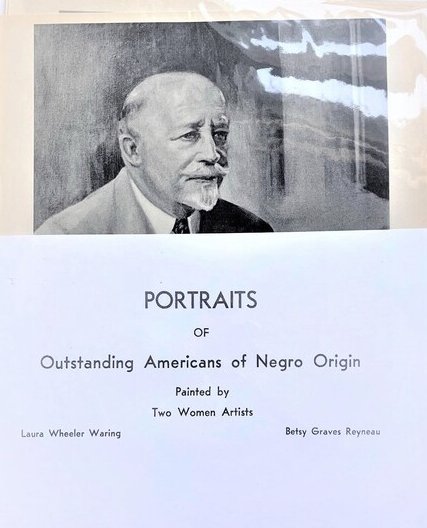
In 1944 the Harmon Foundation, which was under the direction of Mary Beattie Brady, organized an exhibition Portraits of Outstanding Americans of Negro Origin.  The idea behind the exhibition was to try and counteract racial intolerance, ignorance and bigotry by illustrating the accomplishments of contemporary African Americans. The exhibition featured forty-two oil paintings of leaders in the fields of civil rights, law, education, medicine, the arts, and the military. Betsy Graves Reyneau, Laura Wheeler Waring, and Robert Savon Pious painted the portraits that became known as the Harmon Collection. US Vice President Henry A. Wallace presented the first portrait, which featured scientist George Washington Carver, to the Smithsonian in 1944. The Harmon Foundation donated most of this collection to the Smithsonian’s National Portrait Gallery in 1967.

Anna Washington Derry by Laura Wheeler Waring (1927)

Laura Wheeler Waring will always be remembered for her portraiture and her most acclaimed work was not of the prosperous and famous African Americans which I have highlighted below but of a poor laundress, Anna Washington Derry.  She was one of five children who had moved with her family from Maryland to the eastern Pennsylvanian town of Strodsburgh, a borough in Monroe County.  Monroe was home to a small free Black community who had arrived via the Underground Railroad, a network of secret routes and safe houses used by enslaved African Americans to escape into free states.

The beautiful realistic depiction of the old lady beautifully conveys the lady’s dignity and inner determination through her use of simple, brown-beige tones of her dress, her expressive face, her folded arms and hands.  In the town where she lived Derry was looked upon as that of a community matriarch who was fondly addressed locally as “Annie”. The portrait was unveiled in 1926 at an elite exhibition for Black Philadelphian professionals some of whom may not have identified with Waring’s “ordinary” subject. The art historian Amanda Lampel commented:

“…Although Derry’s portrait did not sell that day, the Philadelphia Tribune, the oldest continuously published African American newspaper in the United States, called it remarkable……… Compared to fellow contemporaries like Aaron Douglas, Waring was much more conservative in her painting style and subject matter. This was in keeping with the types of artists who won the prestigious Harmon Foundation award, which sought to spotlight the up-and-coming Black artists of the Harlem Renaissance. Most of the award winners painted more like Waring and less like Douglas…”

In 1927 Laura exhibited the portrait of Anna Washington Derry at New York’s Harmon Foundation where it received the First Award in Fine Art – Harmon Awards for Distinguished Achievement Among Negroes. From there it was exhibited at Les Galeries du Luxembourg in Paris and across America.  The depiction was often reproduced in magazines and journals. The exhibition had its premiere at the Smithsonian Institution on May 2nd, 1944.  For the next ten years, Portraits of Outstanding Americans of Negro Origin, exhibition, travelled to museums, historical societies, municipal auditoriums, and community centres around the United States.  The public response was overwhelmingly positive in every venue.

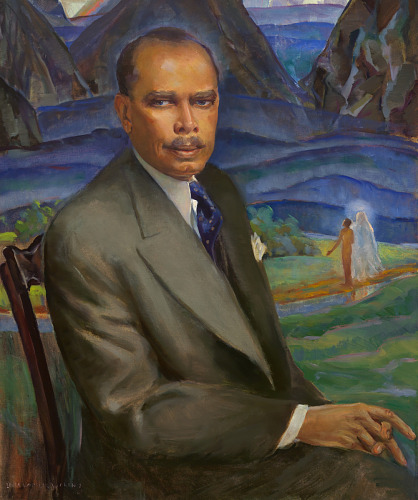
James Weldon Johnson by Laura Wheeler Waring

Laura Wheeler Waring will be most remembered for her portraits of successful, upper class Negroes and whites including James Weldon Johnson, the successful Broadway lyricist, poet, novelist, diplomat, and a key figure in the NAACP, National Association for the Advancement of Coloured People.  In 1900, he collaborated with his brother to produce “Lift Every Voice and Sing,” a song that later acquired the subtitle of “The Negro National Anthem.”

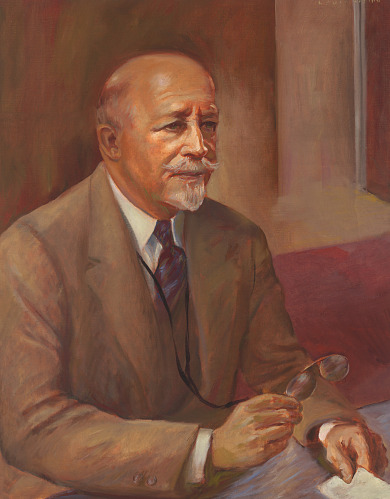
William Edward Burghardt Du Bois by Laura Wheeler Waring

Another sitter for Laura was William Edward Burghardt Du Bois (W.E.B. DuBois), who was the first African-American to earn a doctorate from Harvard University  He then became a professor of history, sociology, and economics at Atlanta University, and  co-founder of the National Association for the Advancement of Coloured People (NAACP), and founder and editor of the NAACP’s magazine The Crisis. Laura Waring had worked for Du Bois, creating several illustrations for The Crisis. Laura depicts Du Bois seated at a wooden desk or table, looking to the right. The spectacles he holds in his right hand, and the small paper he holds in his left, confirm his status as an intellectual and academic.

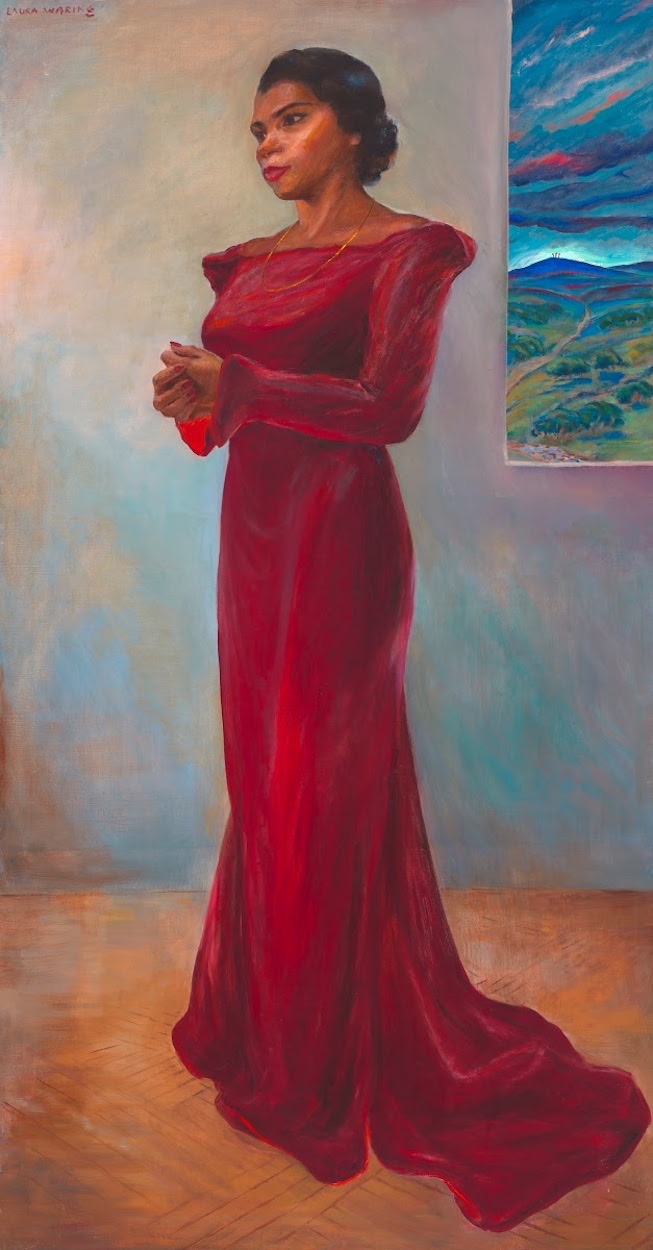
Marian Anderson by Laura Wheeler Waing (1947)

Many women were sitters for Laura’s portraits including Mary White Ovington, an American suffragist, journalist, and co-founder of the National Association for the Advancement of Coloured People (NAACP).  Another of her most famous female portraits was of  the opera singer, Marian Anderson.  This contralto singer, like many African American artists of the time, first achieved success in Europe. She was persuaded to return to America in 1935 and that year had a triumphant concert which secured her standing in the opera world.  In 1939 she became embroiled in a historic event when the Daughters of the American Revolution banned her appearance at its Constitution Hall because she was black. President Roosevelt’s wife, Eleanor, stepped into this controversial banning and arranged for her to take top billing at the Easter Sunday outdoor concert at the Lincoln Memorial, an event which drew in 75,000 opera fans as well as having the event broadcast to a radio audience of millions.

Jessie Redmon Fauset by Laura Wheeler Waring (1945)

Another female to have her portrait painted by Laura Wheeler Waring was Jessie Redmon Fauset, the first African American woman to be accepted into the chapter of Phi Beta Kappa at Cornell University, where she graduated with honours in 1905. Fauset then taught high school at M Street High School (now Dunbar High School) in Washington, D.C., until 1919  She then moved to New York City to serve as the literary editor of the NAACP’s official magazine, The Crisis. In that role, she worked alongside W. E. B. Du Bois to help usher in the Harlem Renaissance of the 1920s.

Alice Dunbar-Nelson by Laura Wheeler Waring (1927)

In the 1890s women formed national women’s club federations, most of which were dominated by upper-middle-class, educated, northern women. Few of these organizations were bi-racial, a legacy of the sometimes uneasy mid-nineteenth-century relationship between socially active African Americans and white women. Rising American prejudice led many white female activists to ban inclusion of their African American sisters. The black women’s club movement rose in answer in the late nineteenth century. The segregation of black women into distinct clubs produced vibrant organizations that promised racial uplift and civil rights for all blacks, as well as equal rights for women. Soon there followed another, more powerful group known as the National Association of Coloured Women in 1896. Women, including Laura Wheeler Waring and Alice Dunbar-Nelson, came together from a variety of backgrounds to combat negative stereotypes and fight for basic rights. Alice Dunbar-Nelson became the subject of Laura Wheeler Waring’s 1927 portrait. By the time the portrait was completed, Dunbar-Nelson was a prominent political activist and journalist and was much in demand as a public speaker. The depiction of her radiates her self-confidence and both artist and sitter were talented, intellectual women whose friendship helped advance the rights of both women and African Americans.

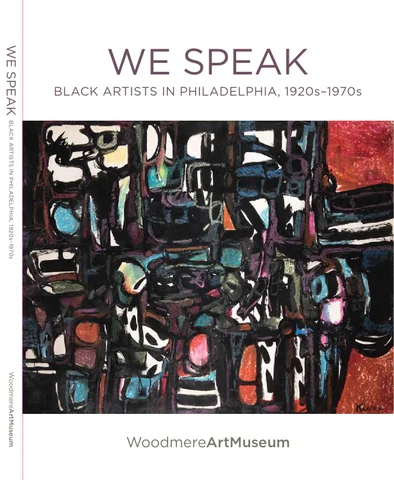
Waring died on February 3rd, 1948, aged 60, in her Philadelphia home after a long illness.  She was buried at Eden Cemetery in Collingdale, Pennsylvania. In 1949, Howard University Gallery of Art in Washington, D.C. held an exhibition of art in her honour.  Her paintings were also included in the 2015 exhibition We Speak: Black Artists in Philadelphia, 1920s-1970s at Philadelphia’s Woodmere Art Museum.

Laura Wheeler Waring (1887-1948)

There is no doubt that although Laura spent most of her life in America she always treasured her three stays in France which played an important role in her artistic progress. During those three periods on French soil she was able to engage in its culture, and associated with famous French, African, and African American intellectuals. Her scholarship, her study at the Academie de la Grande Chaumiere, and her solo exhibition in Paris gave her recognition in the United States in the form of awards, supervisory and teaching positions, and additional exhibitions.  Like many of her colleagues, Waring cherished the freedom she found abroad, declaring in her diary:

“…In my very busy seasons here to come I shall want to relive some of these moments of atmosphere. I record them so that I can never say “I wish I had enjoyed that more” or “I didn’t apprecate all that then but now—[.]” I can never say the above truthfully because am grateful every minute and even the least of things gives me a thrill. . . . The very feeling of freedom is a pleasure and the ride on the bus down will be a joy…”


Much of the information for this blog and many of my other blogs in the past has come from an excellent website entitled The Art Story.

Other sources were:

A CONSTANT STIMULUS AND INSPIRATION”: LAURA WHEELER WARING IN PARIS IN THE 1910s and 1920s by Theresa Lieninger-Miller

BLACKPAST

SPEEDWELL

Ethel Spowers

The Tate website defines linocut thus:

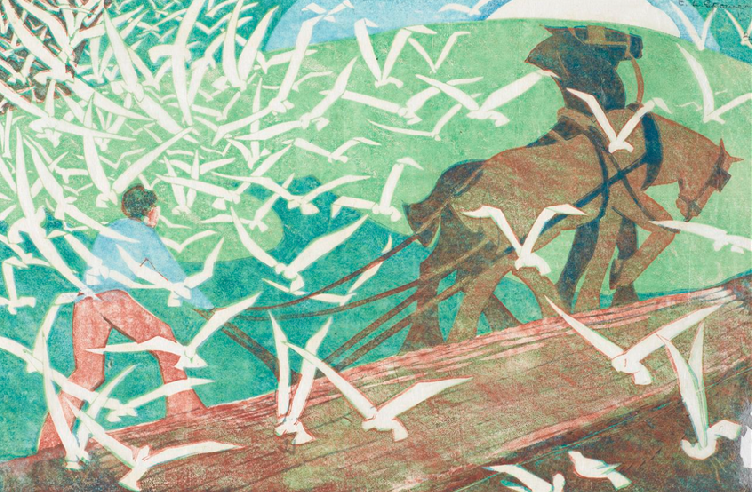
“…The lino block consists of a thin layer of linoleum (a canvas backing coated with a preparation of solidified linseed oil) usually mounted on wood. The soft linoleum can be cut away more easily than a wood-block and in any direction (as it has no grain) to produce a raised surface that can be inked and printed. Its slightly textured surface accepts ink evenly.  Linoleum was invented in the nineteenth century as a floor covering. It became popular with artists and amateurs for printmaking in the twentieth century…”

It is thought to have been first displayed in the first decade of the twentieth century and its popularity has grown ever since.  The artist I am showcasing today is a twentieth century Australian artist who made her name as a skilled exponent of this artistic technique.  Let me introduce you to Ethel Louise Spowers, a painter and printmaker.

Ethel Louise Spowers was born on July 11th 1890 at South Yarra, Melbourne.  She was the second born of six children of New Zealand-born newspaper proprietor, William George Lucas Spowers and his London-born wife Annie Christina, née Westgarth.  She had four sisters, Frances, Cecilia, Rosalind and Myra and a younger brother, Allan.  Ethel was brought up in a wealthy and cultured household in a mansion in St Georges Road in the Melbourne suburb of Toorak.

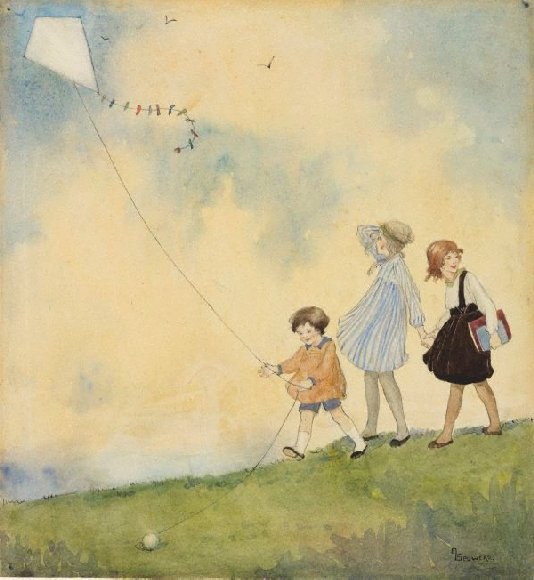
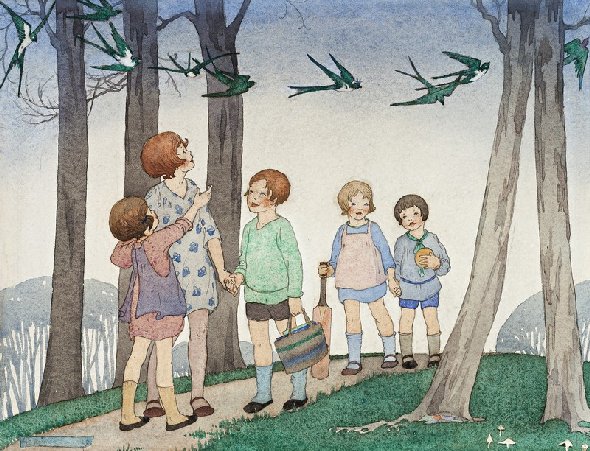
The Kite by Ethel Spowers (1918) Watercolour

Ethel was enrolled at the private Melbourne Church of England Girls Grammar which she matriculated from in 1908.  Having completed her schooling, she went with the family on a trip to Europe and Ethel attended an art school in Paris.  This introduction to world of art, together with the encouragement from her mother and grandfather, both of who were amateur artists, and who inspired her. In 1911, she enrolled on a six year course in drawing and painting at the National Gallery of Victoria Art School in Melbourne, where she became known for her black and white children’s story illustrations.  As a student she was allowed to exhibit annually at the National Gallery of Victoria, and also having become a member of the Arts and Crafts Society of Victoria she began to regularly exhibit in their exhibitions. In 1918, selected members of the Arts and Crafts Society of Victoria were invited to exhibit with the Arts and Crafts Society of New South Wales and it was here that Ethel sold her first work.  It was a pen and ink and watercolour painting entitled The Kite.  The National Art Gallery of New South Wales in Sydney purchased it.

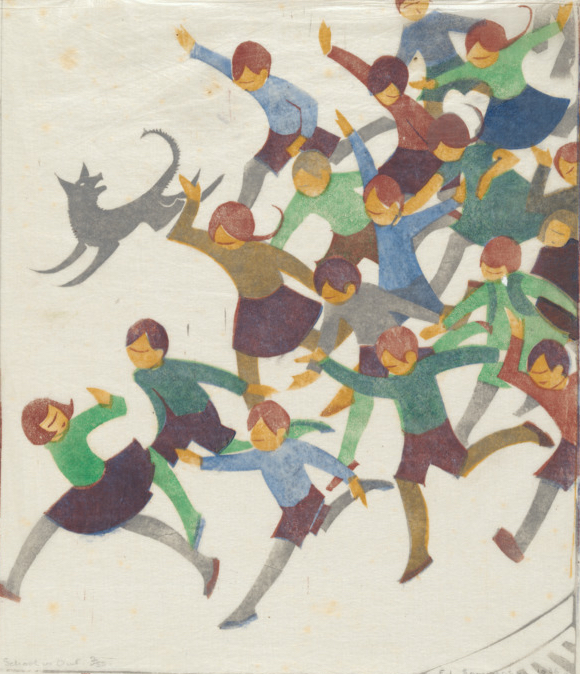
School is Out by Ethel Spowers (1936)

In 1920 Spowers held her first solo exhibition at the Decorations Gallery in Melbourne.  The exhibition comprised of fifty-four of her works which included black and white drawings, watercolours and two oils, many of which depicted fairy-tale and nursery rhyme themes. In 1921, Ethel Spowers provided the illustrations for Furnley Maurice’s novel Arrows of Longing

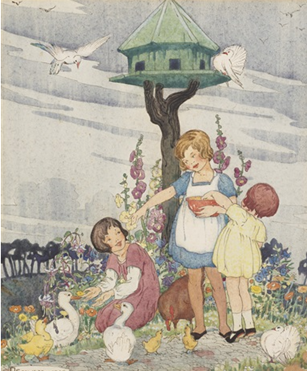
The Pigeon Loft by Ethel Spowers (1925)

That same year, the Spowers once again travelled to Europe, this time for an extended stay.  During this European voyage of discovery Ethel continued with her artistic studies.  Whilst in London she attended the Regent Street Polytechnic, and she and fellow Australian, Mary Reynolds, exhibited their work at the Macrae Gallery.  Buoyed with the success of the exhibition Ethel decided to prolong her stay in Europe whilst her parents and siblings went back to Australia.

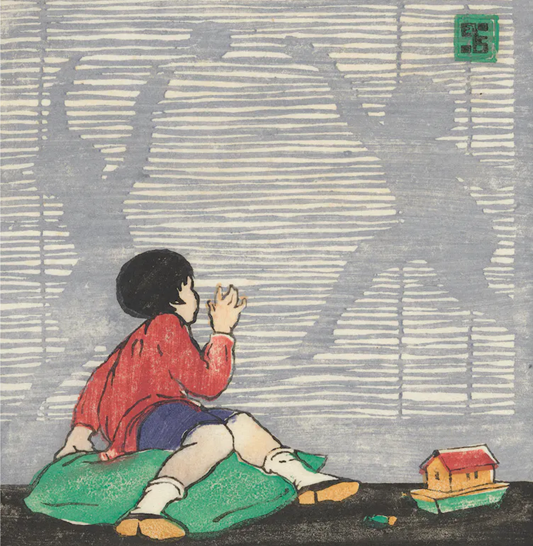
The Blind by Ethel Spowers (1926)

During her European stay, she also went to Paris, where she enrolled at Academié Ranson.  Later, in 1923, whilst in Paris, her friend, Eveline Syme, from back home came to see her. Spowers and Syme were childhood friends who came from rival media families who ran competing newspapers, The Argus and The Age.   Eveline Syme and Ethel Spowers both attended life drawing classes at the Académie de la Grande Chaumière.  In 1924, after three years of living in Europe, Ethel returned home to Melbourne and had her work exhibited at the Victorian Artists’ Society as well as having a solo exhibition at the New Gallery in Melbourne in 1925 and 1927. It was around this time that Ethel Spowers became interested in Japanese woodblock printing, The prints are made by carving an image on a wooden block, applying ink or paint, and pressing it on paper or fabric.  She began to experiment with this art form.

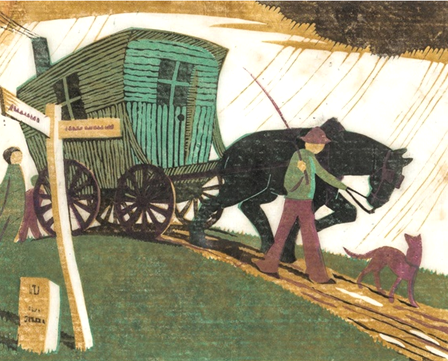
The Plough by Ethel Spowers (1928) Lino-cut

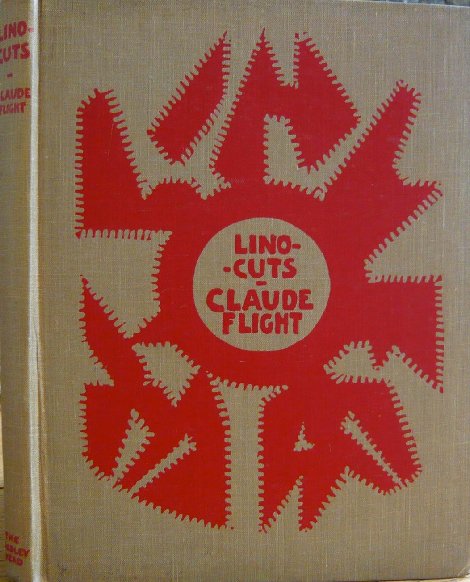
Claude Flight was one of the leading artists to experiment with and make popular the linoleum cutting and printing technique. He initially studied art at the Heatherley School of Fine Art from 1913-1914 and exhibited at the Royal Academy, Paris , the Royal Society of British Artists. and the Redfern.  He taught at the Grosvenor School of Modern Art from 1926.

Ethel Spowers first became aware of Claude Flight’s ideas through her good friend, Eveline Syme, who in 1928 had bought a copy of Flight’s groundbreaking book Linocuts. A handbook of linoleumcut colour printing, which was published in 1927. Spowers and Syme were captivated with this new form of art.   Ethel Spowers was familiar with woodcut printing but she wanted to learn more, and so, a few months later, she and her friend had enrolled on a course run by Claude Flight at the Grosvenor School of Art, London.

The Enchanted Brds by Ethel Spowers (1927) Watercolour

Claude Flight educated them in the art of colour printing without a linear key block and were inspired by his encouragement to encapsulate the speed and movement of contemporary urban life simply, by simplified form, bold colour and rhythmic patterns. Eveline and Ethel learnt quickly and absorbed all Flight had to tell them and quickly developed their own distinctive new styles and subject matter. 

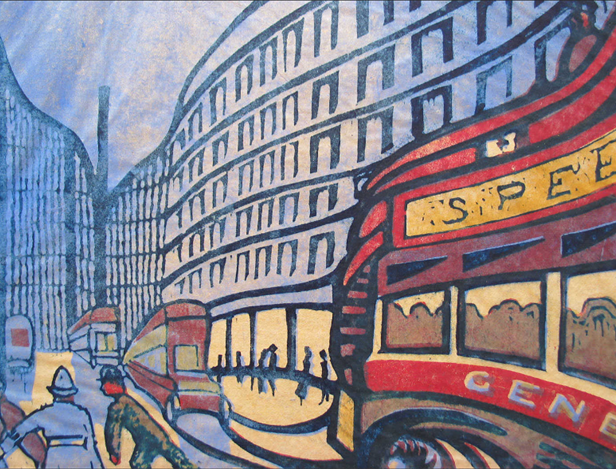
Speed, a lino-cut by Claude Flight

Whereas, at the time, Flight was interested in depicting the modern age through transport and industry, Ethel Spowers preferred to depict scenes of children and family life including picnics, urban street scenes and children at play.  Her bold and simplistic works oozed vibrancy.

Melbourne from the River by Ethel Spowers (c.1924)

Once back in Australia, Ethel Spowers set about promoting the lino-cut medium as she fervently believed that it was a modern medium for a modern age, and she and Syme, along with Dorrit Black staged a group exhibition of their lino-cut works at the Everyman’s Lending Library in Melbourne in 1930.  Ethel also demonstrated the technique at the Arts and Crafts Exhibition, held in Melbourne, in October 1935.

The Rain Cloud by Ethel Spowers (1931)

The London art scene took notice of Spowers’ work and the Victoria and Albert Museum, and the British Museum, bought works of hers in 1930.  The following year Ethel Spowers returned to London and once again enrolled at the Grosvenor School of Modern Art to study with Claude Flight. While in Australia, Spowers continued to promote this modernist art style through the media and lectures.  She became a founding member of Contemporary Group in Melbourne and acted as an agent for Claude Flight and his circle in Australia. Ethel Spowers was a leading light of this group and was continually having to defend this modernist art style against its more traditionalist disparagers.  In an article in the Australasian in April 1930 she pleaded with all lovers of art to be tolerant to new ideas and not to condemn without understanding. She also gained a teaching post at the Swinburne Technical College, Melbourne in the mid-1930s.
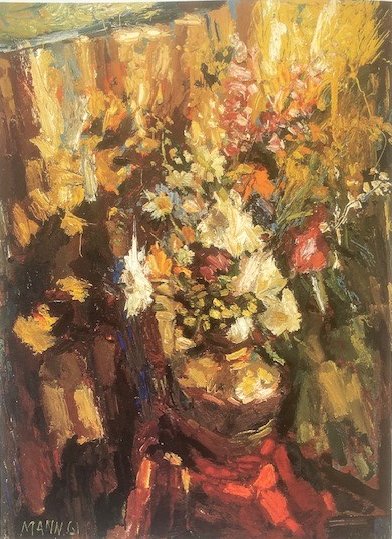
Resting Models by Ethel Spowers (c.1934)

In the late 1930s Ethel Spowers stopped practicing art after being diagnosed with breast cancer.  Her health steadily deteriorated and she died on May 5th 1947 after a long illness.  She was aged 56 and was buried at Fawkner Memorial Park in northwestern Melbourne.

Rowland Hilder

Rowland Frederick Hilder

The artist I am looking at today is the American-born English watercolourist Rowland Frederick Hilder, a great painter of English landscapes and seascapes.  Rowland was born to Roland and Kitty Hilder (née Fissenden) on June 28th, 1905 at Great Neck, a village on a peninsula on the North Shore of Long Island. 

Tyringham Hall by Rowland Hilder

In early 1915, following the outbreak of the First World War, Rowland’s father decided to return to England, and his native county of Kent, where his forbears had lived and he would enlist in the army and serve his country.  The Hilders set sail on the SS Lusitania, a liner which would be destroyed by a German submarine on its next transatlantic crossing in May of that year.

The First Snow by Rowland Hilder

Life at school was not a happy one for Rowland.  He was a tall gangling boy who had a pronounced American accent which went against him, both with his fellow students and some of the teachers.  Hilder was academically challenged and found it difficult to spell correctly.  Fortunately for him, the art master at the school encouraged him to sketch and advised his parents to let their son follow his love of art.

Watermill, Cambridgeshire by Rowland Hilder

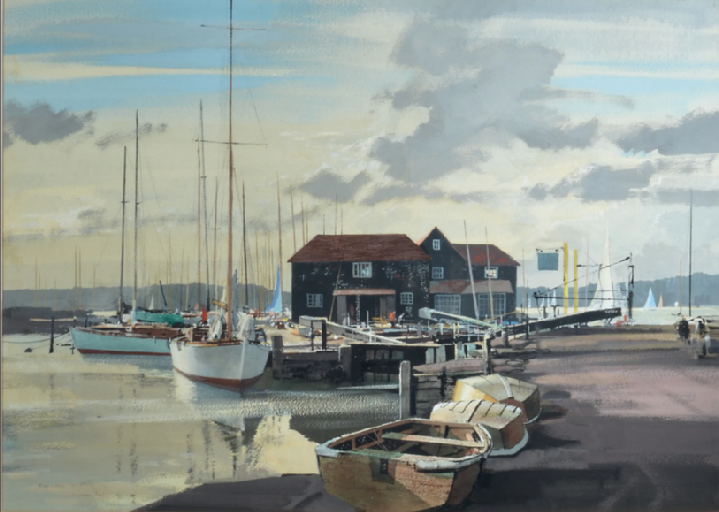
Birdham Pool, Chichester by Rowland Hilder

Having shown a great talent for sketching, in 1921, at the age of sixteen, Rowland Hilder enrolled at Goldsmiths’ College in London, an art establishment which had established a reputation for nurturing fine draughtsmanship in its students.  He was initially placed in the etching class but couldn’t stand the smell of the acid so switched to illustration.  While studying illustration at Goldsmiths one of his tutors was the illustrator, Edmund (E.J.) Sullivan who had contributed illustrations for many of the great journals and magazines of the 1890s and Hilder looked up to him and regarded him as a true professional.  Sullivan taught Hilder the discipline of line drawing and with it the essential structure that holds any work of art together.  Hilder remembered his days at Goldsmiths and how Sullivan had encouraged his students to spend a great deal of time sketching.  Rowland was also introduced to the art of one of the greatest draughtsmen of the past, Albrecht Durer.

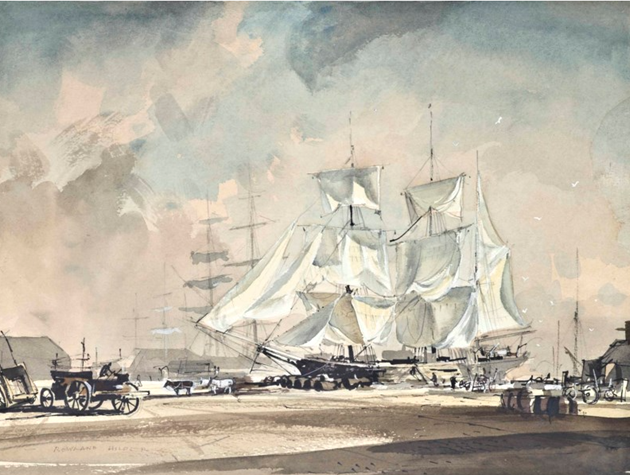
In Days of Sail by Rowland Hilder

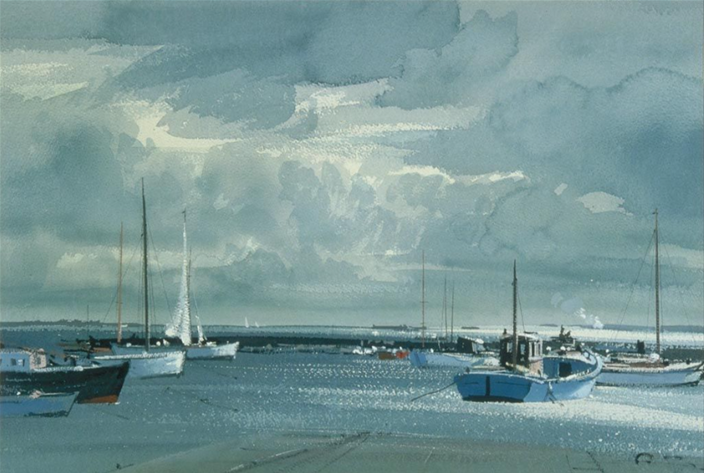
Poole Harbour by Rowland Hilder

As time went by at Goldsmiths Rowland began to think about his future art career and what genre of painting he would like to follow.  At first he decided to become a marine painter and he spent much time on the waterfront sketching and painting boats.  Around this time he also won a prize in a competition sponsored by Cadburys for his work.  The prize, a travelling scholarship,  and Rowland used the money to travel to the Netherlands to study the works of the great Dutch Masters who depicted magnificent marine scenes.

Artist at Work (Edith Hilder by Rowland Hilder

Whilst studying at Goldsmiths, Rowland met fellow student Edith Blenkiron.  She was a botanical painter, and her depictions were often to be found on fabrics or pottery, illustrations for books, or simply painting pictures which could be hung on people’s walls. She said that she was most happy when working direct from nature.  Love blossomed and the couple married and went on to have two children.

Floral Arrangement by Edith and Rowland Hilder

Edith’s beautifully drawn and botanically accurate floral watercolours, with landscape backgrounds often painted by her husband proved very popular.  It was her floral depictions which brought her a following in her own right rather than be just considered as the wife of the artist Rowland Hilder.

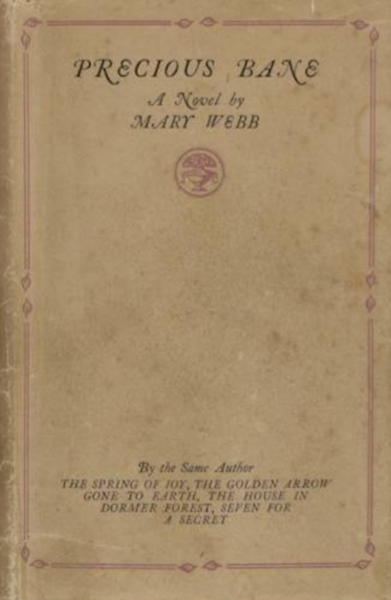
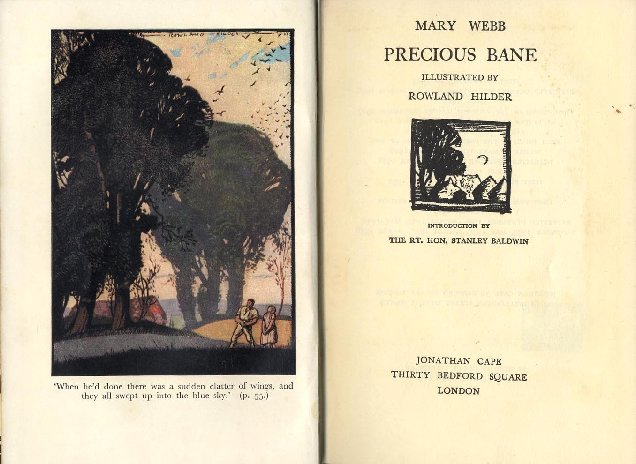
During his period at Goldsmiths he completed a large drawing of a cable ship which was bought by two Royal Academicians, William Orpen and Arnesby Brown on behalf of the National Gallery of Australia .  Whilst at Goldsmith he was also approached by two book publishers. Jonathan Cape and Blackies, to illustrate their books of sea stories.  Both publishers were pleased with Hilder’s illustrations and in 1928, publishing house, Jonathan Cape, asked Rowland if he would contemplate switching from is favoured marine and seascapes and concentrate on depicting countryside landscape scenes as they would like him to illustrate books for Mary Webb, an author who had achieved considerable fame for her novel Precious Bane.

The publishers arranged that winter for Rowland Hilder, his mother and his soon to be wife Edith, to stay in Mary Webb’s cottage in the Shropshire countryside so he could familiarise himself with the rural surroundings in which her novel, Precious Bane, was set. Both his wife and mother would remain in the warmth of the indoors during the day, whilst Rowland would trudge through the snow and the frozen winter ground avidly collecting material, both for use in his illustrative work, but also for his newly found love of depicting the landscape in wintry conditions in his paintings.  Hilder was mesmerised by the rural beauty.  Views of the winter landscape astounded Hilder and he realised that the depiction of such beauty could prove popular with the public.  Many of his pictures were seen on greetings and Christmas cards.

World War II poster by Rowland Hilder

When the Second World War broke out in 1939 Rowland Hilder was one of the first artists who was approached by the government to design war posters which would rally round the people of Britain.  One such poster designed by him was Convoy your Country to Victory Save and Lend through our National Savings Group, which was issued and sponsored by the National Savings Committee, London; Scottish Savings Committee, Edinburgh; Ulster Savings Committee, Belfast and printed for H.M. Stationery Office.  The poster depicted merchant navy ships being escorted across the treacherous Atlantic Ocean under the watchful eye of a Royal Navy vessel which is seen flying the White Ensign.

Garden of England by Rowland Hilder

Another project Hilder was involved in was to provide black and white drawings for an illustrated bible.  This wartime bible contains many beautiful depictions of the English landscape, by Rowland Hilder as well as one or two other artists working in the same style.  The idea of this new book was stated in its preface – to give the people of today a copy of the Bible that is easy to read and that will take them at once to the heart of its message.  Some of the drawings depicted Biblical themes whilst others illustrated daily life in the mid twentieth century.

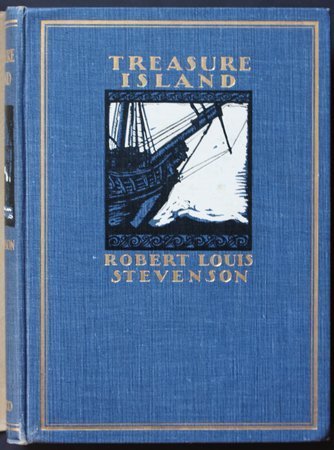
Treasure Island (1929) by Robert Louis Stevenson with twelve colour plates and some black and whight vignettes by Rowland Hilder

Rowland Hilder’s received numerous book illustration commissions included Herman Melville’s Moby Dick and Robert Louis Stevenson’s 1929 edition of Treasure Island.

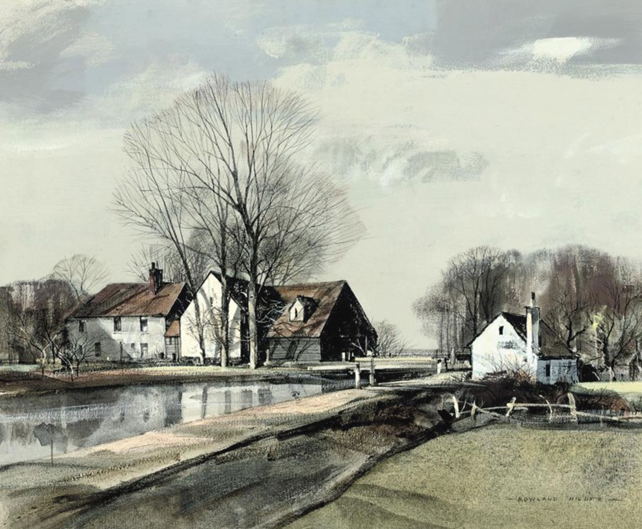
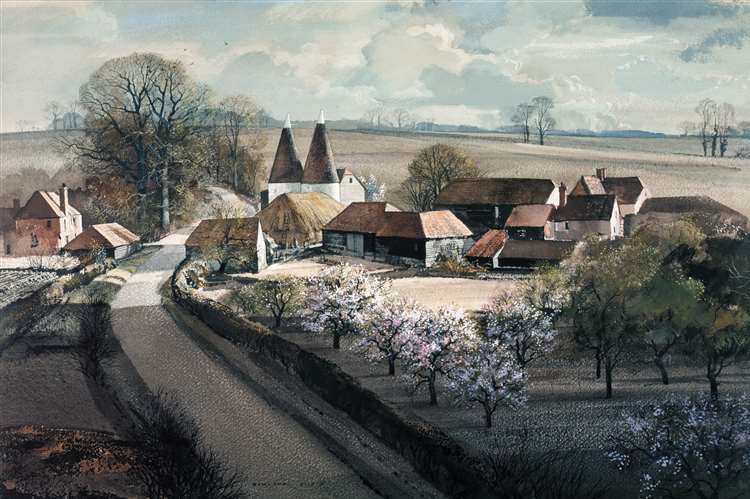
Landscape with Oast Houses by Rowland Hilder

Hilder achieved great popular success with his portrayal of the English countryside, notably Kent, with the characteristically delineated trees and oast-houses.

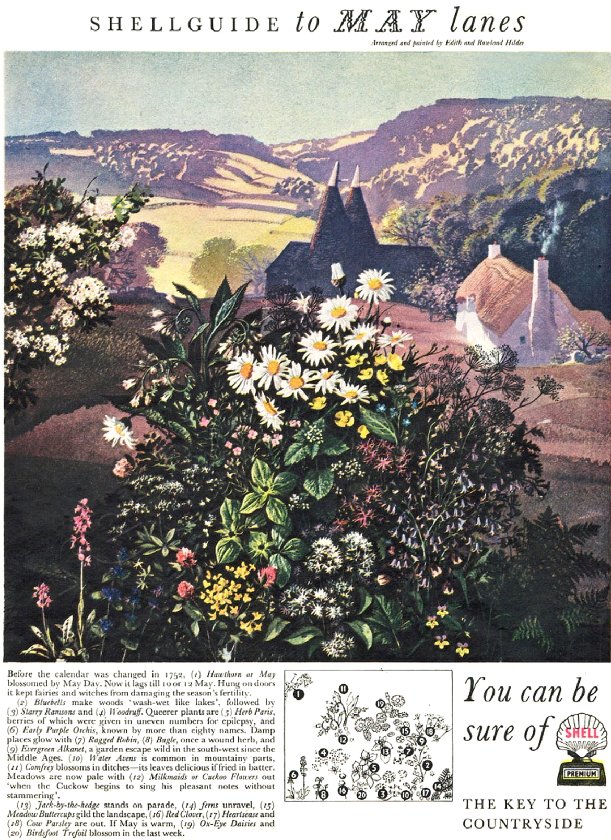
Shell advertising poster illustrated by Rowland and Edith Hilder

Shell Guide to May Lanes arranged and painted by Rowland and Edith Hilder

From the 1920s and into the 1950s, the Shell Oil company produced some beautiful advertising posters which many said, were the most beautiful ever produced.  Rowland and Edith Hilder collaborted on a number of the designs.   

In 1956, a book was published featuring the drawings and paintings of Edith and Rowland Hilder. Rowland also had his own books published: Starting with Watercolour and Painting Landscapes in Watercolour and the two volumes of his paintings under the titles Rowland Hilder’s England and Rowland Hilder Country..

After the Second World War, Rowland formed a small family business with his wife and father called The Heron Press which printed, amongst other things, greeting cards.  They became known as “Hilderscapes” a term that Hilder himself disliked.  In 1963 Rowland wanted to move away from his illustrative work and return to his first love, watercolour landscape painting and so he severed connections with the company. 

Shoreham in Kent by Rowland Hilder

Shoreham in Kent by Rowland Hilder

When it comes to locations for his paintings Rowland Hilder considered Shoreham, a village and civil parish in the Sevenoaks District of Kent, England, located 5.2 miles north of Sevenoaks. and the Shoreham Valley, as his first love.

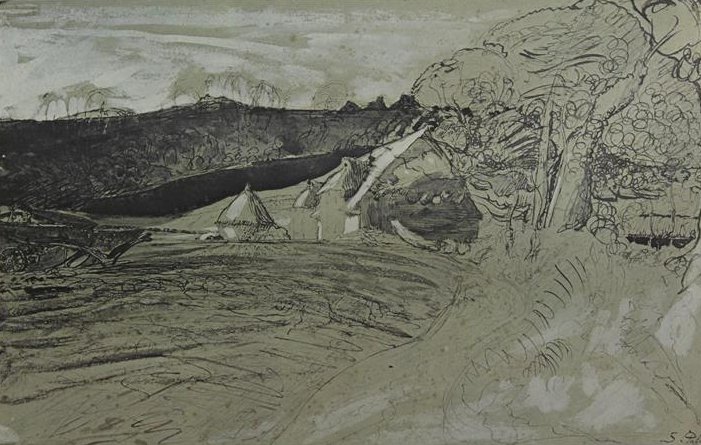
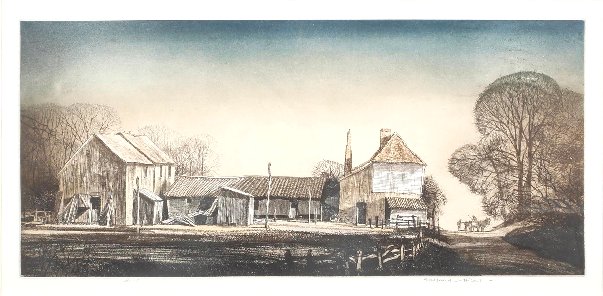
Samuel Palmer ‘s “Barn in a Valley, Sepham Farm”

It was also here in the 1820s that Samuel Palmer, a key figure in Romanticism in Britain, produced visionary pastoral paintings of that area. Hilder tells of how he came across Shoreham:

“…Some fellow students and I discovered Palmer together when we were at Goldsmiths’ College, so I went out to find Shoreham for myself, taking a camera with me. I photographed the farms, and oasts and walked the lanes. I discovered one of my photographs was of Sepham Barn, one of Palmer’s subjects. It had not changed in a hundred years. Later when I went back it had been knocked downand a new tin one was there in its place. I can’t bring myself to include that modern version in my paintings of Shoreham…”

The Lane, High Halstow by Rowland Hilder

Twenty miles north-east of Shoreham lies the village of High Halstow and the surrounding area was the subject of Rowland Hilder’s studies for over fifty years. On one occasion Rowland and fellow Goldsmith student, Norman Hepple, during a sketching holiday, rented an old disused pub in the village. From the front windows they had a view of the neighbouring farm, which was situated in a lane which led to a bird sanctuary. Roland recalled the time:

“…We were invited by a keen bird watcher to join him in one of the hides, to watch a nest of baby herons. I disgraced myself by making an accidental noise, whereupon all the babies were simultaneously sick…”

Rowland Hilder’s sketch

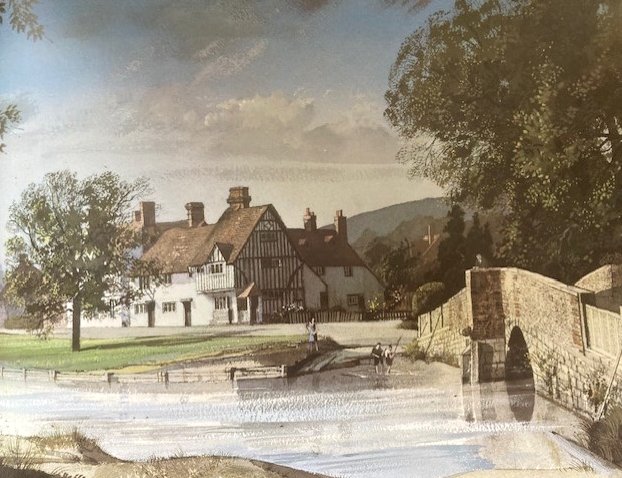
The Old Ford and Bridge, Eynsford by Watercolour by Rowland Hilder

Eynsford is a village and civil parish in the Sevenoaks District of Kent and is a few miles north of Shoreham.   This area is undulating and has a large minority of woodland.    This was also a place Hilder visited many times to sketch and very little has changed since his time.  The bridge at Eynsford leads to a popular pub, the ruins of the local castle and many walks along the river Darent to Lullingstone bridge with its reconstituted Roman villa.

London Docklands by Rowland Hilder

Like his contemporaries, Claughton Pellew, John and Paul Nash, Edward Bawden and Eric Ravilious, Hilder shared their interests in depicting the countryside. They would explore themes of rural peace and harmony and rejected modernism. However, Pellew and Ravilious often depicted the clash between pastoral tranquillity and the rise of modernism whereas Hilder just concentrated on depictions of rural beauty whether it is bathed in sunshine or covered in snow and the by-gone aspects of farming practice.

First Snow by Rowland Hilder

Surprisingly Hilder was himself never taught watercolour. He honed the skills after his training, and he wrote several books on the subject.  He also taught his skills at Farnham School of Art, and as professor of art at his alma mater, Goldsmith’s. In 1938 he was elected a member of the Royal Institute of Water Colours, and in 1964 he became president of the Institute.  His work was included in the 1984 Hayward Gallery exhibition: The British Landscape 1920-50. Retrospective exhibition at the Woodlands Gallery in 1985 and Hilder was appointed OBE in 1986. He lived in London but retained a base at Shell Ness, a small coastal hamlet on the most easterly point of the Isle of Sheppey in the English county of Kent. Where he would carry out his marine painting.  He continued to paint into his retirement and died in Greenwich on the 21st April 21st, 1993 two months before is eighty-eighth birthday.


In putting this blog together I was helped by information I found in the following websites:

THE BOOKROOM ART PRESS

The Watercolour Log

Ottalie Tolansky

After my very long last blog, here is a shorter one !

Ben Uri Gallery (Boundary Road, off Abbey Road, St John’s Wood, London)

When I was visiting London the other day, I visited the Ben Uri gallery in St John’s Wood, just off the famous Abbey Road.  I had been sent regular emails from the gallery about events and followed them on Facebook and was interested to visit the premises. 

The Girl in the Green Sari by Clara Klinghoffer

A few weeks ago I wrote about Clara Klinghoffer and I knew one of her paintings was at this gallery so I was interested to look at it up close.  I eventually found the gallery after going round in circles because I struggled to follow the GPS on my phone.  The gallery was much smaller than I had imagined but there on display was the Klinghoffer painting entitled The Girl in the Green Sari.

Girl in a Red Shirt by Ottilie Tolansky (c.1950)

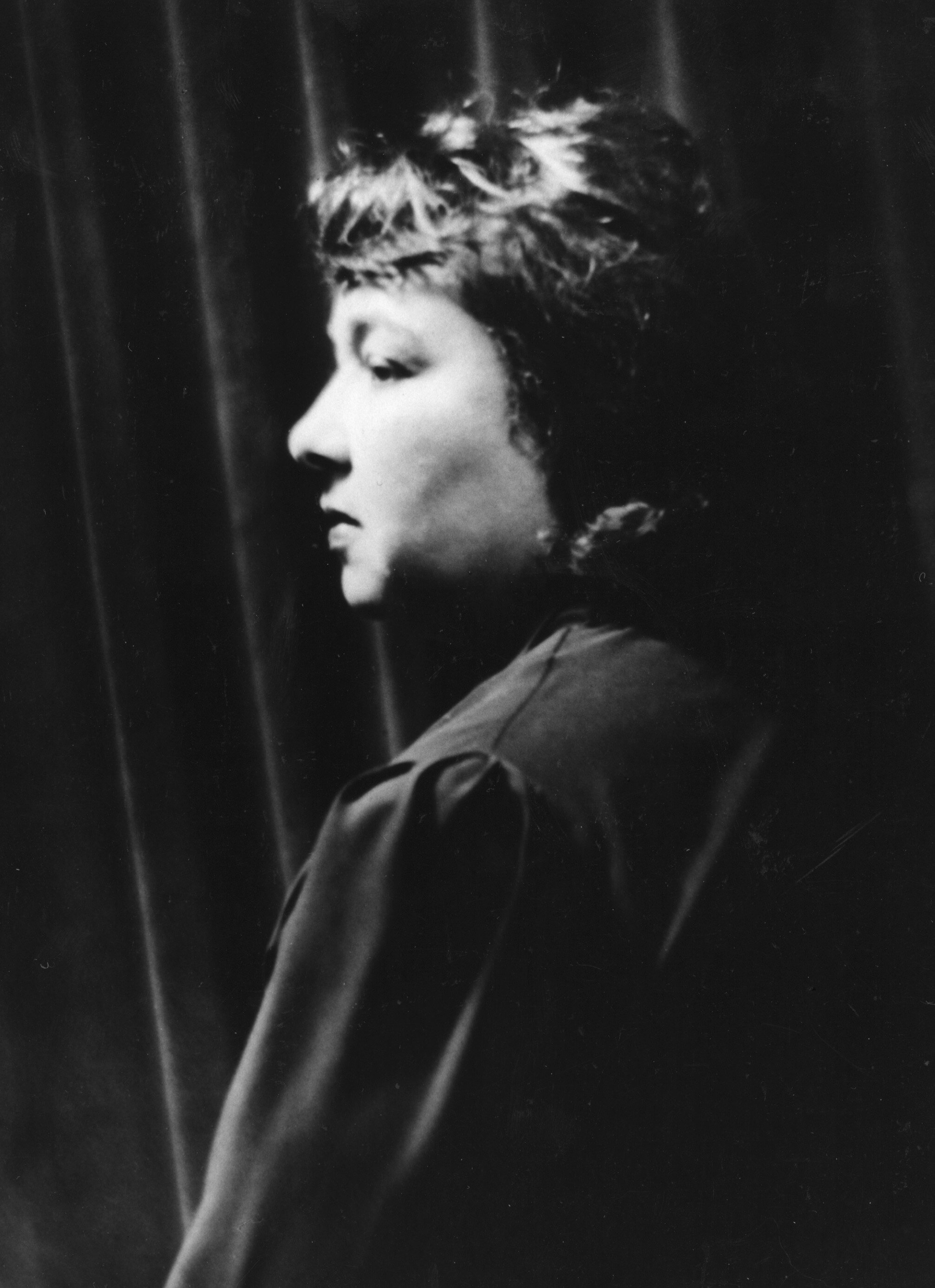
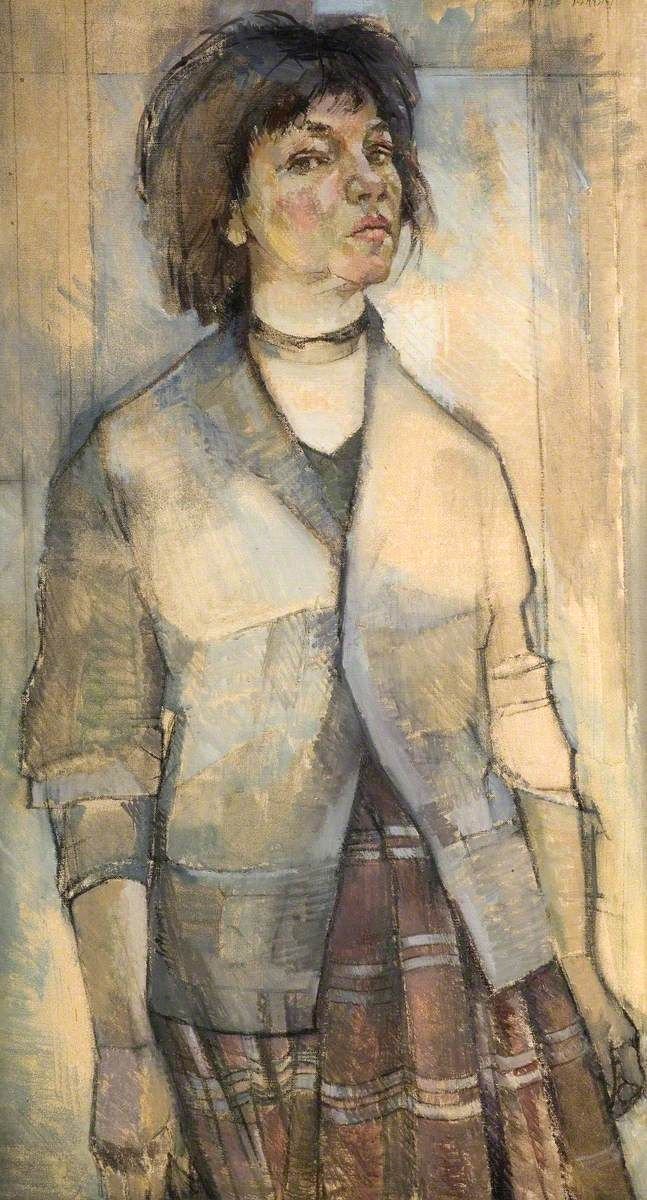
The full-length painting was displayed in the small gallery and was quite impressive.  However, for me, more impressive was the full length painting next to it.  It was entitled Girl in a Red Shirt and the artist was given as Ottilie Tolansky and I knew I had to find out more about this unknown (to me) artist.

Self portrait by Ottilie Tolansky

Ottalie Pinkasovitch was born in Czernowitz, which was, at the time of her birth, in the northern Bukovian sector of the Austro-Hungary.  The town is now known as Chernivsti and is in western Ukraine.  She was born on May 30th 1912 into an Orthodox Jewish household.  Shortly after Ottalie was born, the town witnessed numerous riots directed against the Jewish community and so the family moved to live in Vienna.  For Ottalie, Vienna was home and she always looked upon herself as being Austrian. 

Reimann Art School in Berlin

In 1928, at the age of sixteen, the family were on the move again.  This time they set up home in Berlin where Ottalie’s father, an internationally recognised singer, took up the post of Obercantor at the city’s eighteenth century Alte Synagougue.  Meanwhile, the family having recognised that their daughter had a great talent for art decided to enter her into the Reimann School of Art in Berlin.  It was a private art school which had been founded in 1902 by Albert and Klara Reimann, and later in January 1937 was re-established in Regency Street, Pimlico, London following the persecution of the Jews by the Nazis. After leaving the Reimann School, she continued her studies at the Berlin Academy of Fine Arts.

Meadow Scene by Ottilie Tolansky

Hitler came to power in 1933 when he became the German Chancellor and with growing antisemitic views which swept the country the Pinkasovitch family moved to the safety of England.  Ottilie’s father accepted a job at a synagogue in Cheetham Hill, which was the predominantly Jewish area of Manchester.  Ottilie, who was enrolled at the Manchester Municipal School of Art, once again came into contact with her friend, the physicist Samuel Tolansky who was working at the University of Manchester. 

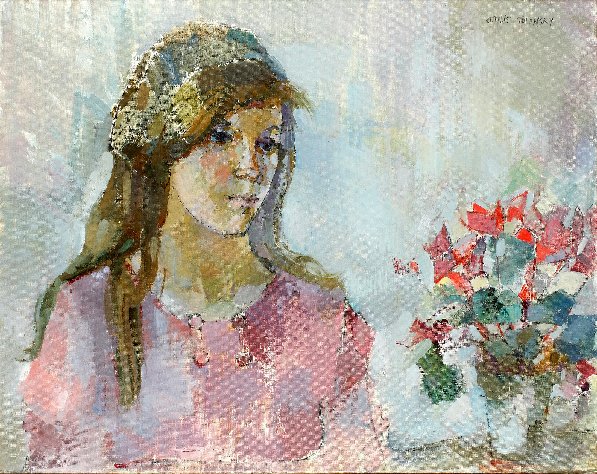
Mary Louise by Ottalie Tolansky

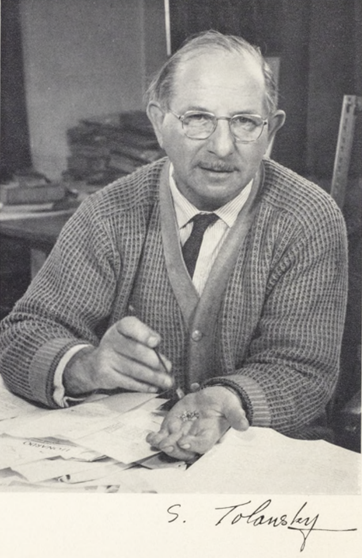
Samuel Tolansky had been born on November 17th 1907 in Newcastle upon Tyne. His parents had migrated to Great Britain around the turn of the century. His ancestors had come from Odessa but were of Lithuanian Jewish origin. Samuel was the second child in a family of two boys and two girls. His father was a tailor and, like most immigrants from Eastern Europe at the time, he had to start near the bottom of the ladder both financially and socially.  For the first ten years of life in England Samuel’s father lived in conditions of considerable poverty and that his son’s progress up the educational ladder was, at every critical stage, dependent on his ability to win scholarships and other awards.  However, Samuel worked hard and succeeded.

Samuel Tolansky

Ottilie had first met Samuel in Berlin in 1931 when he had been working at the Physikalisch-Technische Reicsansalt, a German government scientific institute.   In 1932, after a year working at the Berlin Institute he went to England and attended Imperial College London as a researcher into interferometry.  He remained in London until 1934.  From Imperial College London he relocated to Manchester and from 1934 to 1947 worked at the University of Manchester, as an Assistant Lecturer, later Senior Lecturer and Reader.  Ottilie and Samuel’s friendship blossomed and the couple found themselves in love.  The couple married in 1935.  Ottilie gave birth to their first child, Ann, who is now married and having graduated in history from Oxford University, became a solicitor. A second child, Jonathan, was born in London. He became a musician, a percussionist who has played in several of the leading orchestras.

Abstract by Ottilie Tolansky

Samuel and Ottilie Tolansky left Manchester and moved to London, where, after the war had ended, she attended the Hammersmith School of Art and regularly submitted her work at various exhibitions.  Ottilie’s portraiture, still lifes and figure drawings, which she completes mainly in oils and gouache are characterised by her main use of blues and violets.

Rabbi Joseph Trostmann by Ottilie Tolansky (c.1962)

One of her most famous portraits, in fact two paintings, is of her grandfather Rabbi Joseph Trostmann.  She based the depiction of the elderly man on her childhood recollections and family photographs.  One can be found at Stoke-on-Trent Art Gallery whilst the other was kept in the family.  After Ottilie died, her son Jonathan Tolansky, donated it to the Ben Uri Gallery.

Portrait of a Gentleman by Ottilie Tolansky

Ottilie Tolansky died in London on February 13th 1977 aged 64.  Her husband who had been nominated for a Nobel Prize, and was a principal investigator to the NASA lunar project known as the Apollo program, died four years earlier.

The Artistically Talented Walton Family

My blog today is about a family of artists, the Walton family, a veritable artistic dynasty.  The head of the family was Edward Arthur Walton, best known as, simply, E.A.Walton.  Walton was born on April 15th, 1860 in Barrhead, a small town in East Renfrewshire, Scotland, thirteen kilometres (8 miles) southwest of Glasgow city centre. 

The Artist’s Mother, Elizabeth Balfour Nicolson, Mrs Jackson Walton by Edward Walton (1885)

Edward Walton was one of twelve children of Jackson Walton and his wife Elizabeth Balfour née Nicholson. Jackson was a Manchester commission agent and a skilled amateur painter and photographer. His brother was George Henry Walton, a noted architect, furniture designer and stained glass designer, who worked with Charles Rennie Mackintosh, a renowned Scottish architect, designer, watercolourist and artist. 

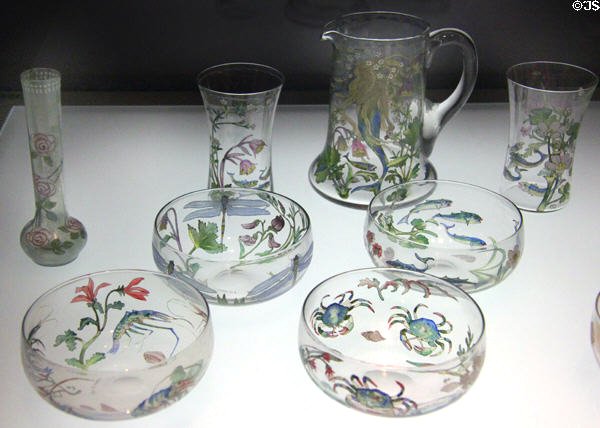
Glassware painted by Helen Walton (1910)

Edward’s sisters, Helen and Constance were also talented artists.  Helen Walton was best known for her decorative work in ceramics and glass and as one of the eldest children, Helen became an artistic mentor to her siblings including her brother, Edward Arthur, who was ten years her junior.

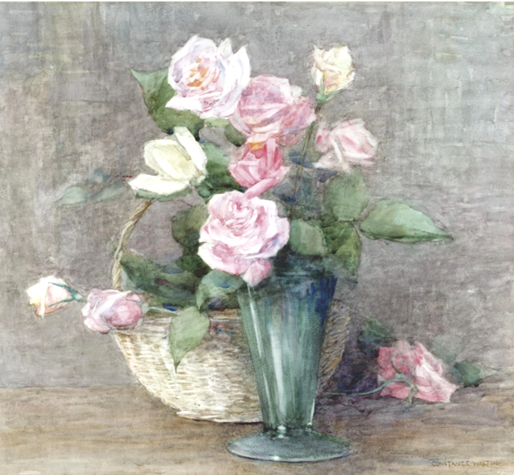
Still Life with Roses by Constance Walton

Constance Walton was a much-admired botanical painter.  She trained at Glasgow School of Art and became a member of the group known as the Glasgow Girls.  This group of women artists and designers pursued different styles and worked in a range of art forms.  Many of the women created their own discreet groups while others chose to work alone and although the name of the group was coined by William Buchanan in an essay, he contributed to the catalogue for a Glasgow Boys exhibition held in 1968, many of the women lived and worked outside Glasgow. These female artists became prominent in the late nineteenth century, thanks to the enlightened attitude of Francis Newbery, a painter and art educationist, best known when he was director of the Glasgow School of Art between 1885 and 1917. who set out to enrol men and women equally.

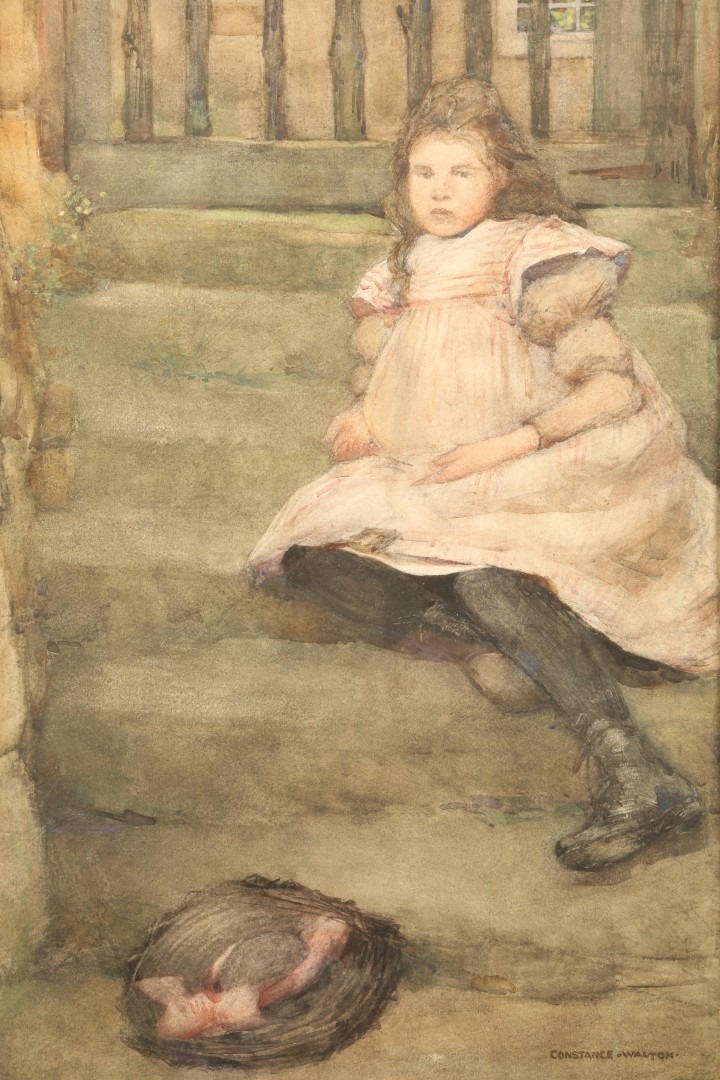
Daydreams by Constance Walton(c.1895)

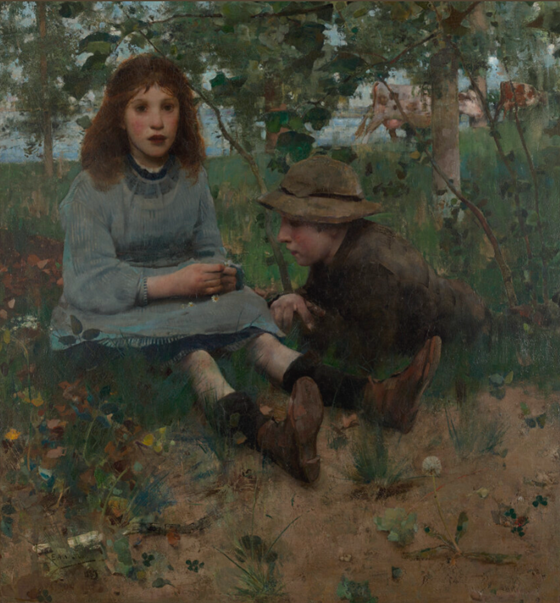
Day Dreams by Constance Walton is a large watercolour depicting a young girl sitting on steps looking distractedly into the distance. Constance Walton’s figurative paintings are quite rare as after her marriage in 1886 she concentrated on her flower and botanical paintings.  This depiction could have been influenced by her brother, Edward’s work of the same name which he completed in 1885.

A Daydream by Edward Walton (1885)

Helen and Constance’s brother Edward Arthur Walton was probably the best-known artist of all the siblings

Self portrait by Edward Walton

After completing school and wanting to concentrate on his art he travelled to Germany where he spent two winters at the Dusseldorf Academy of Art before returning to Scotland and enrolling at the Glasgow School of Art in 1878.

Joseph Crawhall by Edward Walton (1884)

At the Glasgow School of Art he became good friends with fellow aspiring painters, James Guthrie and Joseph Crawhall whose sister married Edward’s brother.  As we have often seen in various blogs, young artists training at State Academies often became disillusioned and disheartened by the academic training which concentrated on historical painting and high levels of finish.  It was for this reason that in many countries the young artists rebelled and set about working to their own agenda.  In the case of Edmund Walton and his friends they formed a loose group which became known as the Glasgow Boys who decided that their focus should be on realistic depictions, often of rural subjects, depictions that would illustrate real life, the hard-bitten and candid view of living. 

The Harbour Scene, St Ives by Edward Walton

The Glasgow Boys group gained inspiration from the progress in landscape painting in France and sought to take greater notice on the natural effects of light in the open air when setting about painting Scottish rural scenes.  The group also took to the French style of en plein air painting when, whilst outdoors, they would paint directly onto the canvas.  The painter who had the greatest influence on this group of artists was the French realist painter, Jules Bastien-Lepage whose down-to-earth depictions focused on the real, often, impoverished life that surrounded his village.  For all Edmund Walton learnt about art in Dusseldorf and the Glasgow School of Art, nothing compared to the knowledge he gained working alongside his fellow “boys”.

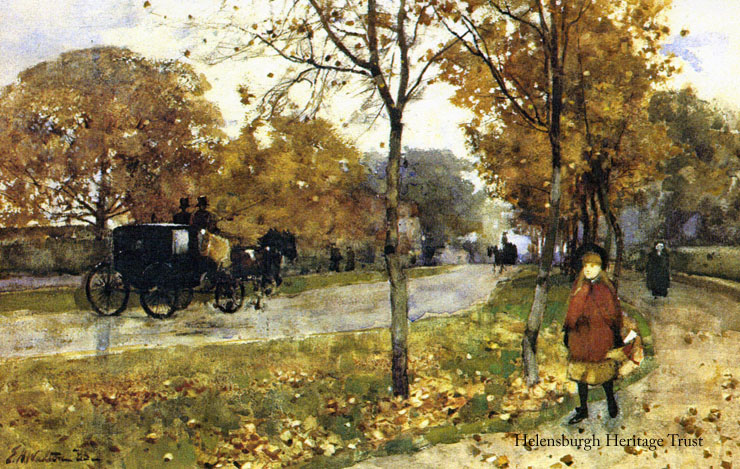
Victoria Road Helensburg by Edward Walton

In 1883, Edward Walton joined James Guthrie, at Cockburnspath, Berwickshire where he honed his talent as a painter in both oil and watercolour in the open air.  He also spent time in Helensburgh, an affluent coastal town on the north side of the Firth of Clyde where he completed a series of watercolours depicting the well-dressed affluent residents of this prosperous suburb.

Helensburgh by Edward Walton

His skill as a watercolourist resulted in him being accepted as a member of the Royal Scottish Society of Painters in Water Colours in 1885 and shortly after he became a member of the New English Art Club.  In 1894, when he was thirty-four, he moved to London living in Kensington and later Chelsea, where his neighbour and good friend James Whistler lived.  Other artistic neighbours were the Irish-born painter John Lavery and Philip Wilson Steer, a British painter of landscapes, seascapes plus portraits and figure studies. Steer was also an influential art teacher and a leading figure in the Impressionist movement in Britain.

Edward Arthur Walton Artist, with his Fiancée Helen Law or Henderson as Hokusai and the Butterfly by Sir John Lavery (1889)

Around 1889 Edward Walton met Helen Law.  Love followed and the pair got engaged.  To celebrate their engagement the couple attended the Grand Costume Ball, organised by the Glasgow Art Club November 29th 1889. Edward dressed as the Japanese printmaker Hokusai, (an exhibition of his work was on show in Glasgow at the time) while his fiancée’s costume represents the painter Whistler’s signature in the shape of a butterfly. Photographer James Craig Annan took a photograph of the couple.  Artist and the couple’s friend, the artist, John Lavery, sketched this portrait of Edward and Helen on the night and presented it to them as a gift for their engagement, which they had announced earlier that evening.

Eric Robertson

Edward and Helen married and went on to have four children, the eldest of whom was their daughter Cecile who was born on March 29th 1891.  In 1894, Edward Walton, his wife and two-year-old Cecile moved from Scotland to London. In the summer the Walton family travelled to Suffolk where they rented the Old Vicarage at Wenhaston, which was a few miles from Walberswick, a village on the Suffolk coast, where Frank and Jessie Newbery lived and the two families painted together in the summer.  Cecile Walton and Newbery’s daughter Mary became close friends and later both developed strong links with Galloway area of Scotland.  The Walton family returned to Scotland in 1904 and took up residence in Edinburgh where Cecile enrolled at the Edinburgh College of Art. 

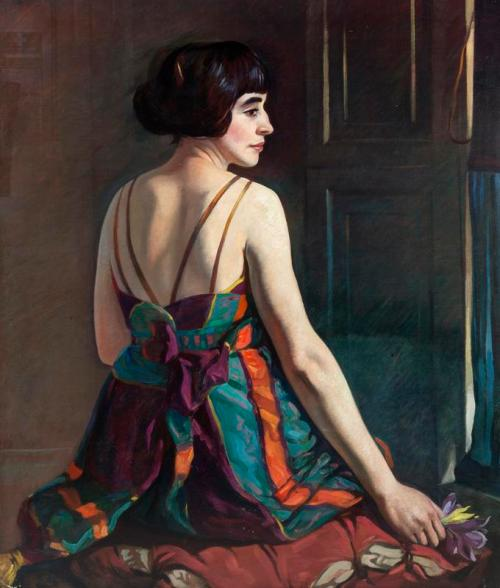
Cecile Walton by Eric Robertson (1922)

She also had private tuition from the Symbolist painter, John Duncan who taught her to appreciate Florentine art of the Renaissance and it was whilst at John Duncan’s house that she met another painter, Eric Robertson.  Cecile’s parents were not enamoured with her friendship with Robertson as he had a reputation of being a heavy drinker and a philanderer but despite her parents’ views Cecile and Eric Robertson married in 1914 and their first child, Gavril, was born in February 1915.

Romance by Cecile Walton (1920)

Cecile and Eric’s second child, another son, Edward, was born in December 1919 and it was shortly after his birth that Cecile started what was to be one of her most famous paintings, Romance. Cecile Walton depicts herself holding up her new-born son, Edward, for intense scrutiny, whilst her elder boy, Gavril, clutches his gollywog doll. Although nowadays the toy is recognised as a racist caricature, they were commonplace in British childhoods until the 1960s. The depiction of mother and baby is usually associated with the Madonna and Child but in Cecile’s painting, the depiction knowingly echoes a well-known impressionist image of a sex worker; Olympia as portrayed by Edouard Manet, and this implies a more troubled attitude to motherhood. The inclusion of carefully placed details such as petals on the floor, and the apple, add to the sense of unease.  In the painting we see Cecile, depicted lying half naked in bed holding her new baby son.  At the foot of the bed, we see her first-born child Gavril looking on. In an article in the Woman’s Art Journal, Frances Fowle, art historian and curator comments on the painting:

“…The title Romance seems inappropriate and the picture itself has a disconnected feel: the figures seem strangely dislocated, the scene has an almost surreal clarity, and the eye is arrested by the disagreeable greenish hue of the wall.  The picture poses questions; even the objects on the table and the discarded rose on the floor invite interpretation.  The artist lies stretched out on the bed, naked except for a curious yellow hat and towel wrapped around her hips…”

The thorns on the stem of the rose symbolise the suffering of the virgin and this may, in this case, allude to the suffering of the woman during childbirth. The crushed rose seen on the floor next to the bed is thought to symbolise Cecile’s failing marriage brought on by her husband’s unacceptable habits and his surrender to the demon alcohol.  Cecile was not in a good place at this time having to endure her husband’s drunkenness and infidelity. Marriage and subsequent children had also deprived Cecile of her personal freedom and curbed her artistic output, similar to what happened to her mother once she married Edward Walton.  The painting was exhibited at the second Edinburgh Group Exhibition in 1920.

The Favourite Dress by Cecile Walton

Cecile’s marriage to Eric Robertson ended in 1923 due to his unacceptable behaviour and Cecile, along with her two sons, moved out of the family home and went to live with her friend Dorothy Johnstone.  Her divorce was finalised in 1927.   In 1924 Dorothy and Cecile staged a joint exhibition of their work.  However since the ending of her marriage and subsequent divorce Cecile’s artistic output decreased and her artistic career began to fail.  

Deserted Ferry by Cecile Walton (1949)

Eric Robertson’s artistic career also broke down after his separation from Cecile, and he eventually capitulated to alcohol.  In 1923, following the failure of his marriage he moved to Liverpool and by the early 1930s, he was largely forgotten as a painter. Cecile Walton remarried in November 1936.  Her second husband was to Gordon Gildard, a BBC producer, and she moved to Glasgow to be with him.  Unfortunately, their marriage was short-lived and the couple divorced in 1945.  Cecile went to live the rest of her life in the vibrant fishing port and artists’ town of Kirkcudbright, within Dumfries and Galloway, Scotland.

Cecile Walton died in Edinburgh on April 23rd 1956, aged 65.

William James Glackens

To look at the history of the Ashcan School one has to go back a step and look at a group of painters who became known as The Eight.  These eight artists, with Robert Henri, acknowledged as the leader of the group, were Arthur B. Davies, William Glackens, Ernest Lawson, George Luks, Maurice B. Prendergast, Everett Shinn, and John Sloan.

Ashcan School artists and friends at John French Sloan’s Philadelphia Studio, 1898

Luks, Sloan, Glackens, and Shinn worked as newspaper artist/reporters and illustrator-cartoonists and maybe because of this connection, the many paintings of these artists took on a journalistic quality.  All eight artists utilised the crowded life found on the New York streets as the subject of their paintings.  Their work depicted un-idealized views of life in a big city and focused on the bars and the clientele, dark grubby-coloured tenements, pool halls, and slums. This was the epitome of urban realism.  Realism in art was described by Gustave Courbet in an open letter he wrote on December 25th 1861, now referred to as his Realist Manifesto.  He wrote:

“…To know in order to do, that was my idea. To be in a position to translate the customs, the ideas, the appearance of my time, according to my own estimation; to be not only a painter but a man as well; in short, to create living art – this is my goal…”

 At the high point of their popularity these men were seen as confronting Academia which favoured the genteel tradition of “art for art’s sake, and which had dominated the American art establishment for many decades with works from likes of John Singer Sargent and Abbott Handerson Thayer.

However, on February 3rd, 1908, the MacBeth Galleries, New York, opened an exhibition featuring The Eight artists. It caught the attention of the American art world and although the show remained on view in New York for less than a fortnight, it was taken to several cities including Chicago, Detroit, and Philadelphia.  These exhibitions were lauded as watershed exhibitions of 20th-century vanguard art.   It was a triumph of “American” art.

The name “Ashcan School” was a derisive criticism of The Eight and their works of art, which appeared in an article in The Masses, an American magazine of socialist politics.  The author of the article alleged that there were too many “pictures of ashcans and girls hitching up their skirts on Horatio Street” in their paintings.  The group of artists were amused by the article and the group soon became known as the Ashcan School of painters. The Ashcan School of artists had also been known as “The Apostles of Ugliness”.

William Glackens by Robert Henri (1904)

A few blogs back I looked at the life of George Luks who was an American realist painter connected to the Ashcan School.  Today I am looking at the life and paintings of one of his contemporaries who was also one of the Ashcan School of painters.  He is William James Glackens. William Glackens was born in Philadelphia on March 3rd 1870.  He was the youngest of three children to Samuel Glackens, a cashier for the Pennsylvania Railroad and his wife Elizabeth Glackens.  William’s siblings were an older sister, Ada and an older brother Louis who would later become a cartoonist and illustrator and work on early animation films.

East River Park by William Glackens (1902)

William attended the Central High School where one of his fellow students John Sloan, who would later become a member of The Eight.  Glackens graduated from the Central High School in 1890. Throughout his school days Glackens loved to draw and paint and became a very accomplished artist and in November 1891, aged twenty-one, he and Sloan enrolled at the Pennsylvania Academy of Fine Art. Glackens also worked as an artist reporter for many newspapers, starting at the Philadelphia Record.  His task was to pictorially record news events and had to work to tight deadlines.

Christmas Shoppers by William Glackens (1912)

In October 1894, having completed his studies at the Academy of Fine Art, Glackens started a job as a staff artist/reporter for the Philadelphia Press and worked alongside fellow artists Sloan, Edward Davis, George Luks, and Everett Shinn.  Around this time Glackens was introduced to Robert Henri by Sloan.  Henri was an artist five years older than the pair.  He had returned to study at the Academy for a second stint after spending time in Paris studying at the Académie Julian, under William-Adolphe Bouguereau, where he developed a love for Impressionism and later, he was admitted into the École des Beaux Arts.  Besides befriending Glackens and Sloan two more aspiring artists, George Luks and Everitt Shinn joined the informal group which met at Henri’s apartment to discuss art, philosophy, culture and more, their meetings became known as the Charcoal Club because they would spend time using that medium to produce drawings from life.  This informal group explored art genres not available at the Academy, such as nude figure drawing. They also became interested in the social philosophical writings of Ralph Waldo Emerson, Walt Whitman, Émile Zola, and Henry David Thoreau.  Besides meeting to draw. paint and discuss philosophy, the group led a very sociable life during which alcohol played its part !

Figures in the Park, Paris by William Glackens (1895)

In 1895, Glackens, along with several other artists, including Robert Henri travelled to Europe so that they could learn more about  European art.  The first country they visited was Holland where Glackens scrutinised the work of the Dutch masters. From there he went on to the French capital where he and Henri rented a studio apartment for a year. For Glackens, staying in Paris, exposed him to the work of the great Impressionists and Post-Impressionists.  His greatest influence was the work of Manet.

Lena (the artist’s daughter) Painting by William Glackens (1918)

Glackens returned to America in 1896 and moved to New York and spent time at Henri’s many social gatherings.  Glackens took up employment at the New York Herald as a reporter and also worked as an illustrator for various magazines.  These two lines of work provided him with a good steady income and over the next decade he produced more than a thousand illustrations.  Although many were comedic in nature, in April 1898 the Spanish-American War broke out in Cuba and the McClure’s Magazine sent him there to collate the news and produce newsworthy illustrations.  It was a difficult assignment and his living conditions were poor.  On his return to New York, he was taken ill and it was discovered that he had contracted malaria which would return time and again during his life.

Hammerstein’s Roof Garden by William Glackens (1901)

In 1901 Glackens completed a painting entitled Hammerstein’s Roof Garden.  Hammerstein’s Roof Garden was the official name of the fashionable semi-outdoor vaudeville venue that theatre magnate, Oscar Hammerstein I, built atop the Victoria Theatre and the neighbouring Theatre Republic.  During summer months theatres were often closed due to the suffocating atmosphere inside the venues and so roof garden venues were very popular.  The viewer is placed as if they are part of the audience and in front of us, we see a a colourfully dressed female tightrope walker as she tentatively navigates the rope which is strung across the stage.  In the foreground we see the audience, some of which are unaccompanied females which was something that years ago would have been unheard of.  The painting is now part of the Whitney Museum of American Art collection in New York.

The Artist’s Wife, Edith Dimock Glackens, in her Wedding Dress by William Glackens (1904)

William Glackens’ single status ended in 1904 when he married Edith Dimock.  Edith, who was six years younger than William, came from a wealthy Hartford Connecticut family which made its fortune as silk merchants.  Despite her family’s strong objections but she turned away from business as a career and instead set about becoming a professional artist.  She left home and moved to New York City when, in her early twenties, she enrolled at the Art Students League where she studied with American Impressionist William Merritt Chase.

Sweat Shop Girls in the Country by Edith Dimock (c.1913) 

She soon made a name for herself as a talented watercolourist depicting women and children of working- and middle-class backgrounds. Through his wife’s wealth, Glackens could concentrate on his art, and often Edith and later their daughters, Ira and Lenna became his models. His 1901 portrait of his wife is of a classical formal style.  Set against a dark background, Edith is depicted wearing a black coat and hat with a long brown pleated skirt.  As with many of his portraits Glackens wanted his subjects to be seen just as they were, warts and all, and refused to idealize his sitters.   In this portrait Glackens has made no attempt to either make the depiction more modern or beautify the sitter.

Portrait of Edith Dimock Glackens by Robert Henri (c.1902)

His friend Robert Henri also painted a portrait of Edith around the same time which appears more idealized and certainly adds a touch of beauty to the depiction.

At Mouquin’s by William Glackens (1905)

Artists need to sell their work and to do this their work has to be shown at exhibitions.  However it was not always easy for many artists to have their work accepted by exhibition juries and in 1907, Glackens and many of his contemporaries decided to take the matter into their own hands and split from the National Academy of Design who they felt, for some reason, stopped accepting their work  The Eight, as they had come to be known, led by Robert Henri decided to host their own exhibition at the Macbeth Galleries in New York City and an opening date for the event was set for February 3rd 1908.

May Day in Central Park by William Glackens (1905)

Although part of the Ashcan School of Painters, Glackens preferred to use a lighter palette for his work, unlike the darker palette used by the others who liked to depict the darker and grittier side of life in the city.  For Glackens depictions of family life whilst shopping or relaxing in the park were his favourite subjects for his paintings.   Unlike his colleagues Glackens preferred to focus more on scenes of leisure and entertainment rather than concentrate on the misery of life in the slums of the Lower East Side.

The Green Car by William Glackens (1910)

The consequences of working as an artist/reporter for a number of Philadelphia and New York newspapers taught him to observe the smallest of details of a scene.  In New York Glackens had a studio on Washington Square Park and it was from here he captured a scene for his 1910 painting entitled The Green Car.  The painting depicts a green trolley car as it rounds the corner at the south side of the park and we see it is heading towards a lady who is standing by the snowy curb, waiting to alight.  She is dressed smartly in a long coat, hat, and muff, she signals to the conductor of the trolley car.  Our eyes move from the foreground and the green trolley car across the snow-covered grass, through the trees and finally alight on a row of three-storey brick tenement buildings.

Olympia by Manet (1863)

In 1910 Glackens produced what many believe is his homage to Édouard Manet’s Olympia with his painting entitled Nude with Apple

Nude with Apple by William Glackens (1910)

It depicts a reclining nude holding an apple which she has taken from the nearby bowl on her right.  To her left on the sofa there is a large hat and a pile of her discarded clothing including one blue shoe.  She wears a black choker around her neck which harks back to the same accoutrement warn by Manet’s reclining nude, Olympia.  Whereas Manet’s Olympia covered her pubic region with her hand, Glackens has modestly covered his model’s pubic region with a piece of discarded white lingerie.  Glackens’ depiction is another of his typical realist genre.  The model is ordinary.  She could not be termed beautiful.  The depiction alludes to her being simply one of Glackens’ models who has just arrived at his studio wearing a large flowery hat, a gown and blue shoes.  She then hurriedly undressed, abandoning her clothes on the sofa.  The scene seems to have been unscripted.    And yet…..are we to think of the apple in her hand as symbolising Eve?

Breezy Day, Tugboats New York by William Glackens (1910)

Glackens extensive knowledge of European art and artistic trends in Europe led him to be commissioned by Albert Barnes, the American chemist, businessman, art collector, writer, and educator, in January 1912 to travel to Europe and buy paintings for him which would then become the foundation for the Barnes Collection in Philadelphia.  Barnes was also a High School classmate of Glackens and gave him twenty thousand dollars to be used for purchasing paintings and Glackens returned with thirty-three works of art.  That December Barnes himself travelled to Paris to buy more works of art.

Soda Fountain by William Glackens (1935)

On Feb. 17th, 1913, the International Exhibition of Modern Art opened at the 69th Regiment Armory on Lexington Avenue in New York. The Armory Show, as it came to be known, had a profound effect on American art.  William Glackens helped to organize the American section of this ground-breaking exhibition but later reflected on how the American art was somewhat inferior to the European submissions. He voiced his opinion:

“…Everything worthwhile in our art is due to the influence of French art. We have not yet arrived at a national art […] I am afraid that the American section of this exhibition will seem very tame beside the foreign section. But there is a promise of renaissance in American art…”

William Glackens in his studio (c.1915)

Although he liked the modern and much more abstract European works Glackens maintained his love of painting scenes of everyday life and always remained a realist artist. During the inter-war years Glackens made a number of trips to Europe buying European works to enhance the Barnes collection. Glackens died of a cerebral haemorrhage on May 22nd 1938 while spending a weekend visiting fellow artist Charles Prendergast in Westport, Connecticut. He was 68.

Albert Godwin

Albert Goodwin

The artist I am looking at today is the nineteenth century English painter, Albert Frederick Goodwin, best known for his watercolour landscapes.

The Artist’s Father, Samuel Goodwin by Albert Goodwin (1868)

Albert Goodwin was born at 1 Acton Place, 62 Boxley Road, Maidstone on January 17th 1845.  His father was Samuel Goodwin, a builder.  His mother was Rosetta (née Smith).  Albert was the seventh of eight children, having three older sisters, Emma, Rosetta and Mary Ann and three elder brothers, Charles, William Sidney and Henry (called Harry).  He also one younger brother, Frank Alfred.  An artistic talent weaved its way through his male siblings.  His eldest brother was known for his artistic talent as a young man before he joined the military as a member of the Royal Engineers.  Charles became a frame maker and Harry and Frank became professional painters.

Albert was brought up in a devout Baptist household and attended the Bethel Chapel in Maidstone, which his father had built along with its Sunday School in 1934.  Albert’s uncle, Thomas Goodwin often preached at the chapel and was its resident organist, which he had also constructed.  Albert attended Mr William Henry Wickstead’s School at Rocky Hill House, London Road, Maidstone.

The Old Bridge at Maidstone, Kent, Looking South by Albert Goodwin

Albert became interested in art and at the age of ten when he first exhibited one of his paintings,  This was a time at the start of the Pre-Raphaelite Brotherhood and one of its founders, William Holman Hunt had a great influence on young Goodwin.  At the age of fourteen Albert Goodwin started an apprenticeship with a local draper but after six months, he realised that the drapery business was not for him as he had set his heart on becoming a professional artist.  He just needed a willing teacher.   That came by chance, as it is said that whilst painting en plein air in the local woods he was spotted by the Pre-Raphaelite painter, Arthur Hughes who lived in Maidstone with his wife and children.  Arthur Hughes was impressed by Albert’s artistic skill and became his first tutor.

Sunrise over the Sea by Albert Goodwin

In 1859 Goodwin completed his painting entitled Bluebell Hill, Maidstone and in 1860 he exhibited his painting, Under the Hedge.  On March 18th 1863, Albert’s mother Rosetta died at the age of fifty-eight.  During Albert’s early twenties he was introduced to the well-known artist and art critic John Ruskin and on seeing Albert’s work, Ruskin purchased them all for £50 and Albert put the money to good use, funding his five week painting trip to the south coast resort of Hastings.  Around the mid 1860s Albert’s tutor, Arthur Hughes, introduced him to Ford Maddox Brown, a Pre-Raphaelite luminary who took Albert on as his pupil in his London studio.  Albert soon became acquainted with the other Pr-Raphaelite Brotherhood, such as Rossetti, William Morris, the Scottish artist William Bell Scott and George Price Boyce, the watercolour painter of landscapes.

The Old Bridge at Maidstone, Kent looking South by Albert Goodwin

Later, according to Albert’s daughter Olive, Albert and his brother Harry, went to work in the studio of William Morris’ company in Red Lion Square in London’s Holborn district.  In 1864 Albert set off on his first overseas trip, going to Holland where he visited the cities of Amsterdam and Rotterdam and that summer spent time in Jersey.  In the Autumn of 1864, he travelled north visiting Newcastle and Durham as well as the coastal town of Whitby

Whitby Abbey a watercolour by Albert Goodwin

Albert Goodwin completed a colourful watercolour of Whitby Abbey as seen from the east.  The abbey which had been founded in 657 by St Hilda was later destroyed by marauding Danes in 867.  This view is of Whitby Abbey from the east. The ruin depicted in this watercolour is as it is now after one of the towers collapsed in 1830.  Goodwin painted another version of the Abbey in 1910 but this was completed using oils and is now housed in the Victoria Gallery, Bath.  Albert Goodwin’s diary entry of July 22nd 1909 declares his love for Whitby.  He wrote:

“…Whitby once again…I am again inclined to repeat myself in the belief that one or two things in it (for colour) are as good as anything can be…”

Whitby Abbey by Albert Goodwin (1910)

Goodwin always loved to depict dramatic, poetic landscapes. In the 1910 version of Whitby Abbey the thoroughly radiant deep blue of the sky in this work is so typical of his work. Albert liked Whitby Abbey as a subject for painting because of its ruinous manifestation, but also because he was a deeply religious man, and had an interest in spiritual subjects.   Goodwin had painted many scenes featuring the abbey over the previous fourteen years.

A Prospect of Edinburgh from the East by Albert Goodwin (1909)

Albert Goodwin carried on painting in the 1860s and exhibited his work at many exhibitions including the Dudley Gallery in London.  On February 16th 1867 Albert married Mary Ann Lucas, who was the eldest daughter of George Lucas, a fruiterer from Brighton and a year later his brother Harry married Henrietta Lucas, the sister of Albert’s new wife.  Sadly, on December 13th 1869 Albert’s wife Mary Ann died, aged twenty-nine of peritonitis.  Albert and Mary Ann had no children.  Around this time Albert went to live with Arthur Hughes and his family in West Brompton, London and he was employed as Hughes’ studio assistant.

Ely Cathedral by Albert Goodwin

In 1871 Albert went on another European trip visiting Bruges.  That year he was elected Associate of the Society of Painters in Watercolours and at the time his address was given as Maltravers Street, Arundel, Sussex where he lived with his brother Harry and his wife Henrietta.  Sadly, Henrietta died that year, less than two years after her sister had passed.

The Medway at Maidstone by Albert Goodwin (1871)

Almost ten years had passed since Albert had first met John Ruskin and in Spring 1971, Ruskin offered Albert a job as his assistant and asked that he came to work with him at his home in Abingdon, Oxfordshire.  At the Royal Academy annual exhibition in 1871 Albert Goodwin exhibited his painting entitled The Medway at Maidstone.

The Drawing Room at Dixton Manor (Drawing Room at Dixton Manor with K.M.G. writing) by Harry Goodwin (1883)

In 1872 Albert’s brother Harry married for the second time following his first wife’s death.  His new wife was fellow painter, Kate Malleson. Harry depicted his wife writing at a desk in Dixton Manor.

From left to right: John Ruskin, Mrs JC Hilliard, Mrs Joan Severn, Arthur Severn, Constance Hilliard, Albert Goodwin.

Albert Goodwin’s friendship with John Ruskin continued and, along with Ruskin’s cousin Joan Severn and her husband Arthur Severn, visited Matlock Bath and the following year Albert Goodwin and Ruskin travelled to Italy and Switzerland.

  Mont Blanc from the Sèleve, near Geneva

In 1873, Albert Goodwin stayed for three months in the Swiss village of Simplon which lies close to the Italian border.

An Arabian Night, Cairo by Albert Goodwin (1876)

In 1873, like his brother the year before, Albert Goodwin a widower for four years, married his second wife, Alice Desborough at Holy Trinity Church in the West Devon village of Gidleigh.  The couple went on to have seven children, two sons and five daughters. In 1876, Albert and Alice travelled to Marseille before boarding a ship for Egypt.  They also called at Gibraltar, Naples and Crete.

Blue Water in Mounts Bay, Cornwall by Albert Goodwin (1881)

Albert Goodwin had first met the naturalist, Charles Darwin when he was introduced to him by John Ruskin. He visited Darwin at his Kent home, Down House.

Down House from the Garden by Albert Goodwin (1880)

Down House by Albert Goodwin (1880)

Whilst there he made sketches of the house and gardens and later completed two watercolour paintings of Darwin’s residence, which had been built in the early 18th century, and remained Darwin’ and his wife, Emma’s home for forty years until his death in 1882.   It was here that Darwin developed his theory of evolution by natural selection and wrote his ground-breaking work On the Origin of Species in 1859.

Ilfracombe by Albert Goodwin (1884)

Albert and his wife and children left London and moved to Montpelier Terrace Ilfracombe in 1877.  He continued on his painting trips around Britain and further afield to France, Switzerland and the Italian Lakes often accompanied by John Ruskin and Arthur Severn, sometimes accompanied by his brother Harry.  During these trips Goodwin made a large number of annotated sketches and watercolour studies direct from nature, a method he used, alongside working from memory, throughout his career. Ruskin was fascinated by the large number of sketches, which he termed “flying sketches”, which Goodwin produced on a daily basis. Goodwin was happy with his system and in his 1917 dairy entry, he wrote:

“…To me this method of work is one of the happy things of the art that I practise, for I get the realisation of a place twice over, and often the memory makes the scene a better one than the first experience…”

Meanwhile his wife Alice was at home in Ilfracombe with their seven children, Ivy, Olive, Edytha, Albert, Christabel, Alice and Harold and their two servants, one a cook and the other a nurse.  A few doors down from them were Alice’s mother and sister Mary.

Florence, Evening by Albert Goodwin (1896)

In 1881 Goodwin was elected a member of the Royal Society of Painters in Watercolours. Albert Goodwin was continually influenced by John Ruskin who was constantly advising him with regards artistic techniques. Goodwin was a master of depicting topographical and landscape views.  For him, it was all about colour, and tonal values.   Ruskin was pleased and proud of his protégé and was constantly talking about the art of Turner and proudly showing off his own collection of Turner’s work.  Albert Goodwin wrote about the influence Turner had upon him in a diary entry in 1911.  He wrote:

“…I sometimes wonder if the spirit of old Turner takes over my personality. I often find (or think I find) myself doing the very same things that he seemed to do…”

Art critics of the time often likened his work to that of Turner.  In The Standard of October 1893, the art critic wrote:

“…In water-colour drawing Mr. Albert Goodwin is the legitimate successor of Turner…”

The Source of the Sacred River by Albert Goodwin (1900)

Albert Goodwin travelled to India in 1895 and one of the works from this trip was The Source of the Sacred River which he completed in 1900 and was exhibited at the Royal Academy that year.  The source in the title refers to the source of the River Ganges, which is regarded by the Hindu population of India as sacred, is at Lapthal, is in the Himalayas on the frontier between India and China. Of the painting, the art critic of The Athenaeum, a British literary magazine, in 1900 wrote:

“…Allegorical landscape, and still more allegorized landscape painting, is a difficult and particularly uncertain sort of art in which Mr Goodwin, its most accomplished practitioner amongst us, is one of the few who contrive even to approach success. The Source of the Sacred River is almost as suggestive, quite as well painted, and much more understandable. In general, it does not differ from a score of similar works by Mr Goodwin, who is not content with painting nature so admirably that few rival him and leaving to her sympathetic lovers the task of recognizing the pathos and poetry which, so to say, harmonizes itself with the spectator’s mood. There is nothing to tell us that the stream Mr Goodwin depicted so rarely is sacred in any exceptional sense, but there is much we can be grateful for in its abundant and sumptuous harmonies of colour, form, and light, and the dignity of its masses…”

Rye – The Winter’s Tale by Albert Goodwin (1920)

Albert Goodwin carried on with his painting trips around Britain and across the world, visiting South Africa, West Indies, Australia and New Zealand. His works were shown at a multitude of exhibitions and were always appreciated by critics and visitors alike. Goodwin died at his home, Ellerslie, in Bexhill-on-Sea on April 10th, 1932 aged 87.


Much of the information regarding the life and times of Albert Goodwin came from the Chris Beetles Gallery catalogue, Albert Goodwin RWS (1845-1932). The John & Mary Goodyear Collection, which I found in a charity shop in London.

and the website

The Maidstone Museum Websitre

George Benjamin Luks

The artist I am looking at today is an American who was mainly known for his social-realist paintings and illustration.  Today’s painter supported several of his contemporaries in their philosophy of painting subjects which challenged the traditional approaches put forward at the time by the National Academy of Design and the established art circles in America.  This art renegade is George Benjamin Luks and he became a leading figure in the New York art world in the early part of the 20th century.

Bear by George Luks (1904)

George Luks was born on August 13th, 1867, in Williamsport, Pennsylvania.  He was the son of Emil and Bertha Luks who were both amateur painters and both encouraged their son’s inherent artistic talent by providing him with his earliest artistic tutoring.  When George was still a young child, the family moved some fifty miles south-east to Pottsville, a town in the heart of Pennsylvania’s coal region.  It was here that his father, a physician, tried to help the coal-miners and their families and was a supporter of a group known as the ‘Molly Maguires’, a secret organization of Irish-Americans that tried to improve conditions for the area’s miners.  As George grew up, he became aware of the poverty-stricken lives of the miners and their families.  This early exposure to the hard lives of the mining community had an effect on Luks and his works of art which often depicted impoverished families in naturalistic surroundings.

Portrait of Miss Ruth Breslin by George Luks (1925)

George Luks’ earliest job was in vaudeville.  He and his brother took part in the Pennsylvania and New Jersey vaudeville circuits while still in their teens.  However, even as a teenager, he was determined to become a professional artist and so his vaudeville career ended.  In 1884, at the age of seventeen, he enrolled in the Pennsylvania Academy of Fine Arts, where he was tutored by the painter, Thomas Anshutz, but his rebellious nature resisted the rigors of formal study, and he withdrew after a short stay.

London Bus Driver by George Luks (1889)

Luks then visited Europe and set about visiting Germany, England and France attending several of the city’s art schools.  One such school was the Kunstacademie in Dusseldorf, but his stay there as a pupil did not last long for the same reason that he departed the Pennsylvania Academy of Fine Arts – his dislike of the high standards and inflexibility of the rules of the establishment.  This mindset would stay with him all his life.  He then headed for Paris and London.  Throughout his European sojourn he was greatly influenced by European painters such as Velazquez, Manet, Rembrandt but in particular the Dutch painter, Frans Hals.

The Little Madonna by George Luks (1907)

On his return to America in 1890 he began to earn money as a newspaper illustrator and in 1894 he started at the Philadelphia Press and Philadelphia Evening Bulletin, where he produced “at-the-scene sketches” which later became illustrations to go alongside the news stories.   This was Luks’ forte as he was both a talented draftsman and had a meticulous eye for recording details of events.

Havana by George Luks (1896)

He and fellow illustrator at the Philadelphia Press newspaper, Everett Shin, moved into a one-room flat in the city.  Whilst working at the newspaper Luks became friends with the artists John Sloan and William Glackens.  These four painters and illustrators would have weekly get-togethers at the studio of Robert Henri, a renowned artist who was several years their senior, and who emboldened his younger friends to ponder over the necessity for a new style of painting.  Henri’s vision was that this new artistic style would express the essentials of their own time and experiences and would counter the limitations imposed by the present conservative art establishment.  Henri told his friends that they should be depicting scenes of ordinary life and discard the current trends of portraying life as a genteel existence.  Robert Henri and his four new friends with their new ideas regarding the direction of American art, collectively became known as the Philadelphia Five.

In 1896, the Philadelphia Press sent Luks to Cuba to cover the Spanish-American War as a newspaper correspondent/war artist.  On his return to America, he re-located to New York and joined the newspaper, New York World, under publisher Joseph Pulitzer.  Luks began at the newspaper employed to draw the comic strips, such as The Yellow Kid and Hogan’s Alley.  It was during this period that Luks began to devote more time to hone his painting skills, and six years later, in 1902, he abandoned newspaper work to concentrate all his energies to painting. 

Street Scene (Hester Street) by George Luks (1905)

One of his most famous paintings was his 1905 work entitled Street Scene (Hester Street).  The setting is a push-cart market on Hester Street on the Lower East Side of Manhattan, an area of the city which was packed with recent Jewish immigrants.  From our viewpoint looking down the street we see a crowd of shoppers, both men and women and in the foreground we see children, milling around a toy pedlar, searching for bargains.  Many art historians have judged the depiction to be a compassionate pictorial essay of Jewish life.  We see the people in profile, and Luks has paid particular attention to skin colour and the physical features of the people in the crowd, while the subject matter relates to a series of caricatures of Jewish peddlers. It is a congested depiction and we only get small glimpse of the blue sky in the middle background. In the middle-ground we see the darkly oppressive inexpensive tenement blocks, in which were apartments that were so designed to house hundreds of these people, maximising the profits of the landlords.

Allen Street by George Luks (1905)

Another of George Luks’ 1905 Lower East Side paintings was entitled Allen Street. Between 1880 and 1920, more than twenty million immigrants came to America, making it the greatest period of mass migration in American history. At the time Luks painted these Lower East Side street scenes it was home to approximately half a million Jewish immigrants, who had fled economic hardship and political violence within the Russian Empire. At the time it was the most densely populated place on earth.  Sadly, with this sudden influx of Jews into the area came a rise in nativism, the protection of the interests of native-born or established inhabitants against those of immigrants, and anti-semitism.

Luks had produced antisemitic caricatures, above is an example, for several publications during the 1890s, and the emphasis on racist stereotypes about Jewish physiognomy  can be seen in the painting, Hester Street.

The Spielers by George Luks (1905)

Despite the hardship of life whilst living in the overcrowded tenement block Luks also wanted to depict a modicum of joy displayed by some of the younger residents.  His 1905 painting entitled The Spielers (from the German word spielen – to play) was one of his favourites works and when, in 1907, he gave it to his dealer, William Macbeth to sell, he said he wanted $2000 for it.  His dealer was dismayed at such a high price. When it was displayed at Luks’ 1910 solo exhibition at the Macbeth Gallery in New York, critics called it an artistic masterpiece.  Luks sold it direct to a collector but it is not known whether he achieved his $2000.  In an article in the New York Times Magazine on February 6th, 1916, the art critic James Huneker praised the work in his article George Luks, Versatile Painter of Humanity wrote:

“…The east side is yet to boast its Dickens. And Dickens would have enjoyed the picture of the little tousled Irish girl with her red locks who dances with the pretty flaxen-haired German child, surely a baker’s daughter of Avenue B. Now you might suppose that this vivid art, this painting which has caught and retained the primal jolt and rhythm of the sketch, might be necessary rude and unscientific in technique. It is the reverse. This particular picture is full of delicious tonalities. The head of the blonde girl might be from an English eighteenth century masterpiece…”

This simple painting of two girls dancing together more than any other work by Luks, made his reputation.

The Wrestlers by George Luks (1905)

Some art critics had voiced an opinion on Luks’ figurative work saying that he was not good at depicting human anatomy.  It is thought that Luks’ baulked at this sleight on his ability and in 1905 produced a complex painting of two nude wrestlers, so as to counteract their criticism. The painting is now housed in the Museum of Fine Art, Boston, which described the work:

“…The artist’s perspective was radical for the time. Luks’s composition effectively presses the viewer to the edge of the wrestling pit, thereby emphasizing the down-at-heels setting. The jarring vantage point also evokes the sweaty underbelly of modern urban life, a theme for which he and fellow members of the Ashcan School would become known.  Luks’s scene of entangled human flesh under duress is reminiscent of the sporting scenes that fellow Philadelphian Thomas Eakins painted, in particular Eakins’s 1899 Wrestlers (Los Angeles County Museum of Art). Whereas Eakins depicted a wrestling hold with the impassive eye of a painter rendering a studio model, Luks conveys the passion exuded by the heaving torsos. Eakins applied carefully blended strokes of pigment, building up solidly modelled forms after the manner of his studio training with the French academic painter Jean-Léon Gérôme. Luks, in contrast, enlivens his figures with energetic brushwork and thick impasto. Luks’s familiarity with the popular press, gained from his work for illustrated periodicals, may have inspired the sense of immediacy he suggested—brilliantly illuminated flesh is thrown into relief against the dark background as though caught in a reporter’s flashbulb.  The opponent at the left also recalls the terrifying visages of the early-nineteenth-century Spanish painter Francisco Goya’s so-called Black Paintings (Museo Nacional del Prado, Madrid), in which humans are transformed into ghouls. Luks portrays a distinctive type among the multitudes in New York City, in this case an aggressive athlete. Once again, his training as a newspaper illustrator likely honed his astute sensitivity to physiognomy, and here the thickly furrowed brow, devilish eyes, and flushed complexion suggest the bellicose personality befitting a pugnacious wrestler…”

Known originally as The Five, of which Luks became a member.  Then it became collectively known as The Eight, which was made up of the original five members with the addition of Arthur B. Davies, Ernest Lawson, and Maurice Prendergast.  Then The Eight eventually became known as the Ashcan School.  . The name “Ashcan” was originally coined by critics of the movement to deride the surplus of refuse bins in the artists’ pictures and the perceived dirtiness of the subjects at large. Robert Henri, the leader of the movement and its spiritual father was blunt of what he wanted to achieve. He said he wanted art to be akin to journalism… he wanted paint to be as real as mud, as the clods of horse-shit and snow, that froze on Broadway in the winter. Many of this group’s works were rejected when submitted to exhibitions of the powerful, conservative National Academy of Design and this motivated The Eight to form their own exhibiting group.  Their exhibition at the Macbeth Galleries in New York in January, 1908 was a significant event in the promotion of twentieth-century American art. 

Feeding the Pigs by George Luks

Following the success of the New York exhibition John Sloan organized a traveling exhibition that brought their paintings to Chicago, Indianapolis, Toledo, Cincinnati, Pittsburgh, Bridgeport, and Newark.  These travelling exhibitions had people talking the new realism that the Ashcan School represented.  George Luk’s paintings Feeding the Pigs and Mammy Groody were seen as examples of this new ‘earthiness’ that many art lovers were not yet ready to accept.  The Ashcan movement threw down the gauntlet and confronted the academic art institutions, and as a result, during the 1910s the authority of the National Academy of Design as a cultural authority began to wane.  The Ashcan painters played a an essential role in developing the nation’s sense of what were to be considered suitable subjects for free artistic expression.

Gramercy Street by George Luks (1905)

As a member of The Eight, George Luks created works in vivid bravura manner that captured the spirited energy of the tenement districts of New York and their occupants. The American Art historian, Milton Brown wrote about George Luks’ works in his 1955 book, American Painting from the Armory Show to the Depression:

 “…In his art and in his character, he symbolized the spirit of American dynamism; as aggressive as a tycoon, as brash and boastful as a ‘drummer’. . . he was a swashbuckler in paint. This was not, of course, the cultured tradition of American life; it was rather the expression of a cruder side of America, an echo of the frontier…”

Hannaford.s Cove by George Luks (1922)

George Luks is best known for his depictions of New York City life, but he also painted many landscapes.

Old Gristmill, The Berkshires by George Luks (1925)

There are several landscapes of the Berkshire Mountains in Massachusetts that follow the Impressionist tradition.  One such work is his painting Old Gristmill, The Berkshires which he completed in 1925.   However, Luks was far happier living a city life.  

Foggy Night by George Luks (c.1925)

Luks’ painting Foggy Night which he completed around 1925 captures his urban vision during his many walks around the city. He was fascinated by what he saw.  In this depiction of an overcast night in New York, there is an eerie stillness about the scene.  We see a lone cab driver who has stopped his horse-drawn carriage on an otherwise empty bridge.  In the distance we can just make out shadowy buildings and the spire of a church. The city has been overwhelmed by the misty atmosphere and darkened by the nocturnal setting.

Spring Morning Houston and Division Streets by George Luks (1922)

George Luks was married twice but had no children. He was as famous for his paintings as he was with his mood.  He was said to be loud, boastful of his boxing prowess but a good-humoured man, and was a notoriously heavy drinker.  On October 29th, 1933, he was found dead in a Manhattan doorway at 6th Avenue and 52nd Street, a casualty of a bar-room brawl.  He was 66.  Luks was buried at Fernwood Cemetery in Royersford, Pennsylvania.  He was dressed in an 18th-century embroidered waistcoat, which was one of his most valued possessions. His death was reported in the New York Times and the reporter wrote:

“…His canvasses were invariably virile; his versatility was astonishing, and he painted as he lived, contemptuous of conventionalities, impatient with snobbishness and full of joy of life that so many of his paintings reflected…”

Clara Klinghoffer. Part 4.

The Latter Years

Portrait of a Girl by Clara Klinghoffer

Clara’s stay close to Menton with her husband and youngest sister had proved to be a great success and their plans to return home to London had been postponed on a number of occasions.  The decision as to whether to leave their rented villa, Villa Aggradito, was taken out of their hands eventually as the owner needed the villa for a long-term rental over the coming winter, and the price for renting the villa was well beyond their means.  They eventually moved and found Villa Josephine, a small ground floor flat with a small garden in the small Nice suburb of St. Sylvestre which was run by an elderly woman, Madame Rigolier.  No sooner had the trio moved to their new home in September than Clara declared she was pregnant.  Madame Rigolier immediately took on the role of “mother” and saw to all Clara’s needs.  Clara’s husband on seeing that his wife was being well looked after decided to return to London with Clara’s youngest sister, Hilda.   Clara was not being left alone as they invited Joop’s brother, who had not been well, to come and stay and they believed he would benefit from the warmer climate during the winter months.

Portrait of a Young Girl by Clara Klinghoffer (1960)

With winter over Clara and Joop had to decide on their next move.  Clara was not happy with the medical help she received from the local doctor but could not afford the charges levied by the hospitals and doctors in Nice.  Clara and Joop left the Côte d’Azur in early March 1927 and headed to England with a two-day stopover in Paris.  They managed to rent a small ground floor flat in the London suburb of Hendon.  

Portrait of Cera Lewin by Clara Klinghoffer (1935)

On May 28th 1927 Clara gave birth to their first child, a daughter, whom they named Sonia.  The family finances were not good.  It was true that Clara was selling her work to various galleries but by the time you deducted gallery commissions and the cost of painting materials there was barely any profit.  Joop was struggling to find newspapers and magazine willing to buy his journalistic offerings and so the couple struggled financially.  He was also aware of Clara’s family’s disappointment in him for not being able to provide for his wife.  However, on a positive note, Clara’s fame as a talented young artist was spreading into Europe.  The art critic of the leading Amsterdam Handelsblad wrote:

“…Clara Klinghoffer is among the few of her generation who have succeeded in circumventing the many pitfalls adhering to the work of most younger painters in England. Her recent ‘Old Troubadour is praised by leading critics as her best work to date. And rightly so, for in spite of the forcefully realistic conception of this picture, it is free of all coarseness, while the blending of its colours may safely be described as refined…”

Such favourable comments with regards to her work appeared in newspapers in England and throughout Europe and her work was being shown in a number of major exhibitions.  Despite the continuing high praise from art critics the sale of he work was slow and her husband believed this was due to the poor publicity of the galleries were her work was on show. 

My Sister Beth by Clara Kinghoffer (1918)

At the end of 1927 the family’s luck took a turn for the better when Clara’s husband, who could speak French and German, was offered a job as secretary to an American industrialist, Ray Graham, one of the three Graham brothers, who headed up the Graham Paige Motor Car Company of Detroit. He was arriving in Europe and needed a well-travelled multi-linguist as his aide-de-camp.

Girl with Plaits by Clara Klinghoffer

Ray Graham eventually returned to America and offered Joop a position in Detroit but Clara was horrified at this offer and her husband had to turn down the job.  All was not lost however as Graham then offered to set up an agency for his car company in Paris and wanted Joop to head it up.  Clara was not averse to living in Paris so Joop accepted the job offer.  They relocated to the French capital in the Spring of 1928 and rented a small flat in the Avenue de Chatillon on the Left Bank which was an area where many artists lived.  Their home was not at all what they expected and the manageress, who seemed to be an alcoholic, was both unpleasant and unhelpful.  Clara was unhappy and wrote about their home and the surroundings:

“…High up from my window I look down upon the square, grey and desolate. The rain has not left off since last night. The immense puddles are filled with little bubbles that swim about till they burst. The square is new, and the road still unmade. To the right a house is in the making: an incomplete red structure, bricks, mortar and wood are piled up and scattered about. The workmen have not come. Factories and many-storeyed flats arise on all sides. A distant funnel gives out a grey smoke, with irritating slowness. At the end of the square a tram passes by, then a taxi. A group of people und.er umbrellas go past quickly.  Then, for at least four minutes, not another human soul is to be seen…”

Heemstede Canal behind Rudi’s House by Clara Klinghoffer (1932)

Unhappy with their present flat they were pleased to hear about an ideal house for them from a friend of Joop, a fellow journalist.   It lay some ten miles north-west of Paris in the village of Montmorency.  The house was in the rue des Berceaux, close to the railway station, and both Clara and Joop were pleased to make it their home. The little ‘villa’, as they called it had a large corridor leading from the front door, spacious living rooms, a large kitchen and a bedroom.  A wide staircase led to more bedrooms and the bathroom.  At the rear of the property there was a small, enclosed garden.  Both Clara and Joop were pleased with their new home.

Mother and Child by Clara Klinghoffer

Having had her first solo exhibition at Hampstead Gallery in 1920, she held her first solo exhibition abroad in April 1928 when fifteen of her  paintings and thirty-five sketches were displayed at the Nationale Kunsthandel in Amsterdam.  Following the success of this exhibition Clara was bombarded by galleries, such as the Imperial Gallery, The New English Art Club and the Woman’s International Art Club, for more of her work for their future exhibitions.

Untitled (One of Clara’s sisters) Chalk on paper by Clara Klinghoffer   ©the artist’s estate. photo credit: the artist’s family

Joop was still working from his Paris office for the American car company Graham-Paige and Clara was so busy painting that she had to employ an au-pair, Anne-Marie, to look after baby Sonia.  However in October 1929 life in America was rocked by the Wall Street crash and the Great Depression.  The Presidential hopeful Herbert Hoover’s phrase “two chickens in every pot and a car in every garage” in his speech the previous year, now had a hollow ring to it. Joop’s boss’s car firm was all to do with high-end cars and they were hit badly.   People were laid off and money spent on publicity, which was Joop’s area of expertise, was cut back.  Joop began to realise that his job was in jeopardy.  Fortunately, he heard that the Paris branch of the American publicity house of Erwin Wasey had advertised for a linguist to assist their executive in charge of all West-European advertising for Esso products.  He applied for the job and was taken on.  Meanwhile Clara had submitted a number of works to London’s Redfern Gallery and it had proved to be a great success even though financial problems were having an adverse effect on sales of works in both France and England.

Lakshme by Clara Klinghoffer (1918)

Life was to change in 1930 when, in July that year, Clara found herself pregnant with her second child.  Around the same time Joop was “head-hunted” for a position at Lord & Thomas & Logan, a publicity company who were looking for a Dutch-speaker with a Dutch background who, at the same time, had the necessary experience in the international publicity field.  Joop was exactly who they were looking for and he, and after speaking to Clara, agreed terms with his new employer.  Clara was not unhappy about the move to The Netherlands as she had enjoyed her previous stay there and Amsterdam to London was a short distance to travel when she needed to talk to London gallery owners.

Grandmère and Sonia by Clara Klinghoffer (c.1930)

Joop travelled ahead to set up his Amsterdam office and a month later Clara joined him.  The couple found it difficult to rent suitable accommodation in the city and eventually, in the Autumn of 1930, settled for a small house in Heemstede- Aerdenhout, just south of Haarlem.  There they waited for their household furniture to arrive from Paris. Once again Clara, who was now heavily pregnant, needed help with looking after her daughter and husband and so they hired a maid to help with the chores.  It was not a good time for Clara and she became very stressed.
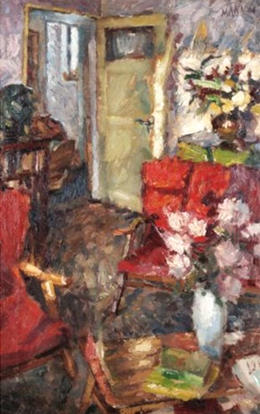
Portrait of Bananas the Pedlar by Clara Klinghoffer (1923)

On the twenty-fifth of January 1931 Clara’s second child, a boy, was born. They called him Michael Jacob.  The name Michael was chosen because they simply liked the sound of it, and Jacob because that was the name of Joop’s late father. With the birth of her son, Clara’s mood and physical health improved.  They even employed a German girl, Hettie, as nurse for the baby, but as Jews, they soon became wary of her and her questions relating to them and their families.  It proved later that the nurse was feeding this information back to the German embassy.  After confronting her, she hastily left the family home.  Help did materialise when her sisters, Leah and Hilda came to live with them during the summer.  In late 1931 Clara’s mother-in-law came to live with her and her son and she remained with them until she died in 1935.

Rosie with Apple by Clara Klinghoffer (c.1929)

The start of 1932 was a very sad time for Clara as she received news that Rosie, one of her younger sister and for many years one of her favourite models, had been ill for some times. At first her illness did not seem to be a very serious one. But her pains increased and then, on being examined by a specialist, Clara had to face the awful truth: that the girl, just about thirty years old, was dying of cancer.  Clara travelled to London at once and stayed there for some time, drawing as she always did and making an exquisite painting of Rosie.   Several doctors were consulted; even a Dutch physician of Utrecht who supposedly had a cure for cancer, was persuaded to send each week a bottle of his magic medicine to London. But it was, of course, all in vain. Rosie died that summer. It was a very hard blow. From now on the magic circle of the seven Klinghoffer girls existed no longer.  For some time the loss of Rosie paralyzed Clara’s desire for work. Then, gradually, she took up her brushes again and painted.

Giuseppina by Clara Klinghoff (1934)

In 1932 Hitler came to power when the Weimar Republic collapsed.  The National Socialist Movement in the Netherlands (Dutch Nazi party) led by Anton Mussert became more prominent following the rise of Hitler and grew more challenging, stressing ever stronger the anti-semitic principles of the Filhrer.   On February 27th 1933, the Reichstag in Berlin was set alight by a twenty-three-year-old Dutchman Marinus van der Lubbe and, as in Germany, anti-semitic tensions in The Netherlands grew fanned by inflammatory articles appearing in Mussert’s weekly newspaper Volk en Vaderland (People and Fatherland).  Notwithstanding the political tensions Clara and Joop managed to get away and have a holiday in Taormina, Sicily where they stayed in a small hotel which had beautiful vistas across the bay.  They became friendly with the owner, Ettore Silvestri and his daughter Giuseppina who agreed to pose for Clara. She said that posing for long periods would be a problem to her and Clara and Joop discovered she had been very ill for five years, an illness that tired her. In August 1935 whilst back home Joop and Clara received a letter from Taormina informing them that sadly, Giuseppina had died.

One-eyed Mexican Farmer by Clara Klinghoffer (1962)

In 1939, the anti-semitic feelings in The Netherlands had begun to escalate and there was talk of a Nazi invasion of the country and so Clara and Joop decided to move to London.  They packed up all their furniture and Clara’s paintings and they were stored in a warehouse in Haarlem but sadly their property was plundered during Nazi occupation.  When the Second World War ended Clara divided her time between her studios in London and New York. In New York Clara held a number of exhibitions of her work but the interest in her figurative art was waning as the art world had latched on to the new abstract expressionism, by the likes of Jackson Pollock and Willem de Kooning and suddenly Clara’s work was considered unfashionable and she struggled to attain exhibition space, even in London.  In 1952 she visited Mexico and she was attracted to the colourful landscapes and had no trouble finding locals who would model for her.  Her last exhibition was in 1969 at the Mexican/North American Cultural Institute in Mexico City.  She then returned to Europe and spent time in Southern France.  Her health began to deteriorate and she returned to London where she died on April 18th, 1970 at the age of 69.  Clara is buried at the Cheshunt Cemetery near London.

Clara Esther Klinghoffer (Stoppelman) 1900-1970

I end with a 1981 quote by Terrence Mullaly of The Daily Telegraph who wrote about Clara and her artistic talent:

“…If ever there was an artist who for some time has been unjustly forgotten, it is Clara Klinghoffer … While the temporary eclipse of her reputation was not, given trends in the visual arts, surprising, it is certainly lamentable. She was a portrait painter of sensitive talent and, above all, a fine draughtsman … In her work her obvious sensitivity towards her sitters is manifested, and enforced by her ability not only to suggest weight and substance of a body, but also to convey mood … When much more celebrated artists are forgotten, she will be remembered…”


Information for this blog was found in many sources but the most important ones were:

Clara Klinghoffer- 20th century English artist

Clara Klinghoffer: the girl who drew like Raphael and Leonardo

Clara Klinghoffer. Part 2.

The artistic road ahead.

“…I consider Clara Klinghoffer an artist of great talent, a painter of the first order…
Her understanding of form places her in the very first rank of draughtsmen in the world…”

Sir Jacob Epstein, London, March 30, 1939

Self portrait by Clara Klinghoffer

Fourteen year old Clara was just about to leave St Mark’s School and it is thought that it could have been the head teacher of the school, Mrs Sinock, who suggested that Clara should enrol at Sir John Cass Institute in Aldgate. Once there she was set the task to make sketches of statues such as Michelangelo’s David concentrating on the various facial attributes. Soon the tutors realised she had a natural aptitude for sketching. A talent which she achieved with little effort, one that amazed her tutors. Clara was happy at the Institute but that all ended when one of the young tutors acted towards her in a sexually inappropriate manner which frightened her. The pleasure she once had attending the classes vanished and she left the Institute suddenly without giving a reason for her departure. For a fourteen year old girl this must have been a shocking moment in her life.
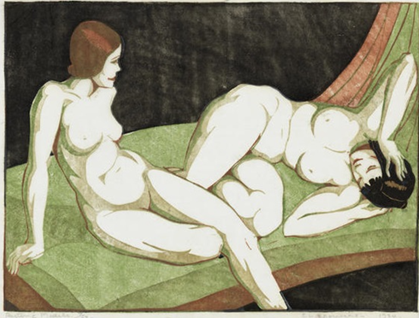
Salman Klinghoffer -Man In A Felt Hat (‘Daddy’) by Clara Klinghoffer (1929)

Clara’s father was disappointed that his daughter had given up her art studies and one day whilst travelling home on a tram he caught sight of an advert for the Central School of Arts and Crafts which was situated in Southampton Row in the West End of London He then managed to persuade his daughter to come with him to the art school and enrol. She agreed and took with her a portfolio of her sketches. The principal took a look at her work and immediately offered her a place, starting that next Monday. On the Monday, Clara, who was still very small, arrived at her classroom carrying her huge portfolio case much to the amusement of the two tutors who were overseeing the students. One was Douglas Grant a British painter who became part of the Bloomsbury Set and the other was Bernard Meninsky, the British figurative and landscape painter who had immigrated from Ukraine with his family when he was three weeks old. On looking at Clara’s portfolio, Meninsky was astounded by the quality of her work and set her the task of sketching a cast of a hand. He was astounded by the result and likened it to that of Da Vinci drawings. Both Meninsky and Grant had witnessed such talent in a person so young as Clara and often her sketches were hung on the walls of the classroom. Also on the wall was a print of Botticelli’s Primavera which Clara said that she loved above any other work she had seen. Another of her favourite works was a black and white reproduction of Titian’s Bacchus and Ariadne which she had seen a few years ago in the local library. More and more, she became influenced by Italian art.

East End Girl with Dark Hair by Clara Klinghoffer

Meninsky went on to tutor Clara in life drawing and became an important influence on her work.  He also introduced her to a number of luminaries of the art world such as Walter Sickert’s third wife, Thérèse Lessore, a British artist who worked in oil and watercolour and was a founder member of the London Group, the English writer and painter, Wyndham Lewis, and the New York born sculptor, Jacob Epstein and his publicist wife, Peggy, who became her close friends.

Harry, Old London Man by Clara Klinghoff (c.1920)

Clara remained at the Central School of Arts and Crafts for two years and during this period would often spend time at her easel, sketching at the Victoria and Albert Museum and her favourite venue, the British Museum, where she became a regular and was well known to the security guards, staff and regular visitors.

Mother and Child by Clara Klinghoffer. Modelled by Clara’s eldest sister Fanny and her youngest sister Hilda (1918)

One of Clara’s fellow students at the Central School of Arts & Crafts was a young man called Seidenfeld, who was besotted with Clara but she alas did not return his amour.  He, like Meninsky, praised Clara’s work and would tell everybody who would listen, about Clara’s work and her extraordinary talent.  Word of this young artistic genius reached the ears of a journalist, Joseph Leftwich and he was so impressed by her artistic talent that he spoke of it to the post-Impressionist painter, Alfred Wolmark,   Wolmark had some of his work shown at the Hamstead Art Gallery in London and he persuaded Clara to put together a portfolio of her work which would be used in her “one-man” show at the gallery in May 1920.  That gave her twelve months to complete a collection which was good enough to be exhibited and this entailed a period of non-stop painting. The painting Mother and Child was one which was exhibited at Clara solo show at the Harpenden Gallery in May 1920. The show received rave reviews and of this work, The Sunday Times art critic wrote:

“…Clara Klinghoffer’s ‘ Mother and Child’ will appeal to ‘many as having more sheer beauty than any work in the exhibition. While exceedingly able in point of drawing, this moving painting of a mother just lifting her child “out of the bath delights one by the piquancy of its colour, the shimmer of light on the bare flesh being rendered with the tenderness of a Renoir and the dexterity of a Besnard. In its dazzling radiance it is a joy of pure colour…”

Portrait of a girl in a fur hat, with red background by Clara Klinghoffer

Portrait of Woman Plaiting her Hair by Clara Klinghoffer

In the end Clara submitted twenty-one paintings and thirty-two framed and glazed drawings. On May 3rd 1920 the solo exhibition opened. The London Evening Standard stressed the brilliant future this 19-year-old painter is destined to have. and it continued:

“…One of the most encouraging things about her work is that it gives frank and full expression to what may be supposed to be her racial instincts and interests. She likes exuberant forms and bright colours and says so when painting with commendable frankness. Her strongest point at present is the ease with which she can fill her canvas. Evidently, she has studied the Old Masters, particularly Leonardo da Vinci, to good purpose…”

In 1920, an edition of the The Jewish Chronicle sang the praises of Clara’s work at the exhibition writing:

“…Clara Klinghoffer, in her exhibition at the Hampstead Art Gallery, has clearly proved to be a truly great artist. Her drawings are very beautiful and quite remarkable for an artist scarcely out of her teens. One feels how very much she has been influenced by the Great Masters–by Raphael and by Leonardo for example. And yet, her outlook is entirely modern; she has absorbed the past and expresses herself freely, inspired but never enslaved thereby. Her paintings are always well composed and this is so whether a single portrait or a group is considered. She has a peculiar sense of colour and makes no attempt to get the correct tone, which fact accounts for the unreal appearance of all save one or two portraits. She apparently paints without much effort, and the spontaneity of her work is charming……. There is nothing shallow in Miss Klinghoffer’s genius. She is perfectly sincere and employs her extraordinary gifts for a definite artistic purpose, simply and beautifully, without the slightest trace of affectation…”

The painting Mother and Child was then put on display at the New English Art Club that summer and the press was full of praise for the work

Portrait of a Man (on Red) by Clara Klinghoffer

Meanwhile, her father’s “mill end” business was flourishing, so too was her mother’s clothes shop, so much so, the family moved to a large Victorian House in King Edward Road, Hackney.  Compared to their previous London homes, this was paradise.  It was large with a basement kitchen, large first floor living rooms and several bedrooms on the upper floors.  The increase in the size of their home was fortuitous as Clara’s mother gave birth to a three further children, all daughters, which meant the house was home to mother, father and seven daughters !  Business success for her father meant that he could afford to buy Clara all the materials she needed for her paintings.  He and his wife were convinced their daughter would one day become a famous painter.

Portrait of the Artist’s Sister Rachel (Rachel in a Red Dress) by Clara Klinghoffer

Clara would complete small paintings of the neighbourhood children but realised that for her own exhibition at the Hampstead Gallery she would need to complete larger works and so she turned to her sisters, (Fanny, Rose, Rachel, Bertha, Leah, and Hilda), whose ages ranged from four to twenty-one, to act as models, but most frequently Rose (who also sat as a model for the sculptor Jacob Epstein), and Rachel. This shimmering portrait of Rachel is made from delicate brushstrokes and this was a recognisable style of Clara’s portraits and establish her renowned warmth and understanding in the way she depicts her sitters.

Girl in the Green Sari by Clara Klinghoffer (1926)

This portrait, Girl in the Green Sari, by Klinghoffer was that of the Bengali artist Pratima Devi, the  daughter-in-law of the famous Bengali poet and philosopher Rabindranath Tagore.  Pratima often travelled abroad with him and they often visited Klinghoffer in her London studio. In all, she completed at least three portraits of Pratima: the first, in oils, around 1919-20; the second, a pencil head, which The Times, in 1924, considered it remarkable for the sensitive drawing and the suggestion of light. This later full-length painting was carried out in 1926, which was the year Clara married and her husband remembers Pratima’s visit and sitting for her portrait.  She wore the blue sari and was adorned with dazzling jewellery.  Clara had Pratima remove all the jewellery, maybe as she believed it would detract from the woman’s depiction.  We observe Pratima as a demure, maybe shy, woman with her eyes downcast, dressed in a translucent sari standing in front of a glistening backdrop.

Portrait of Orovida Pissarro by Clara Klinghoffer

Clara’s arresting portrait of her friend and fellow artist Orovida Pissarro was completed in 1962.  Orovida was born in Epping, Essex, in 1893, and was the only child of Lucien and Esther Pissarro. Her father, Lucien Pissarro was an acclaimed artist and graphic illustrator, while Lucien’s father, Orovida’s grandfather, was the renowned Danish-French painter Camille Pissarro who was a founder of the Impressionist movement.  Much to her father’s horror, Orovida turned her back on Impressionism – and even dropped her famous surname, wanting to be simply known as ‘Orovida’. Her reason for this was not because she wanted to cut herself off from her family ties but because she wanted to make her own way in life, on her own terms.  Clara has depicted the form of her sitter including her rounded belly and full face framed by her cropped hairstyle, which is copied in the curves of the chair.  Behind her we see a collection of inanimate objects which probably referred to items which often appeared in Orovida’s portraiture.

……to be continued.


Information for this blog was found in many sources but the most important ones were:

Clara Klinghoffer- 20th century English artist

Clara Klinghoffer: the girl who drew like Raphael and Leonardo