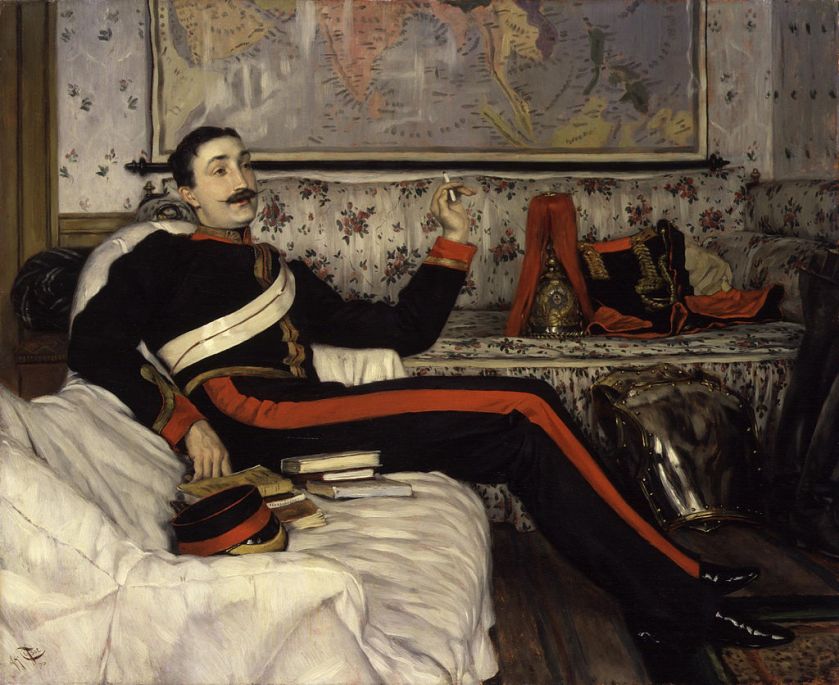
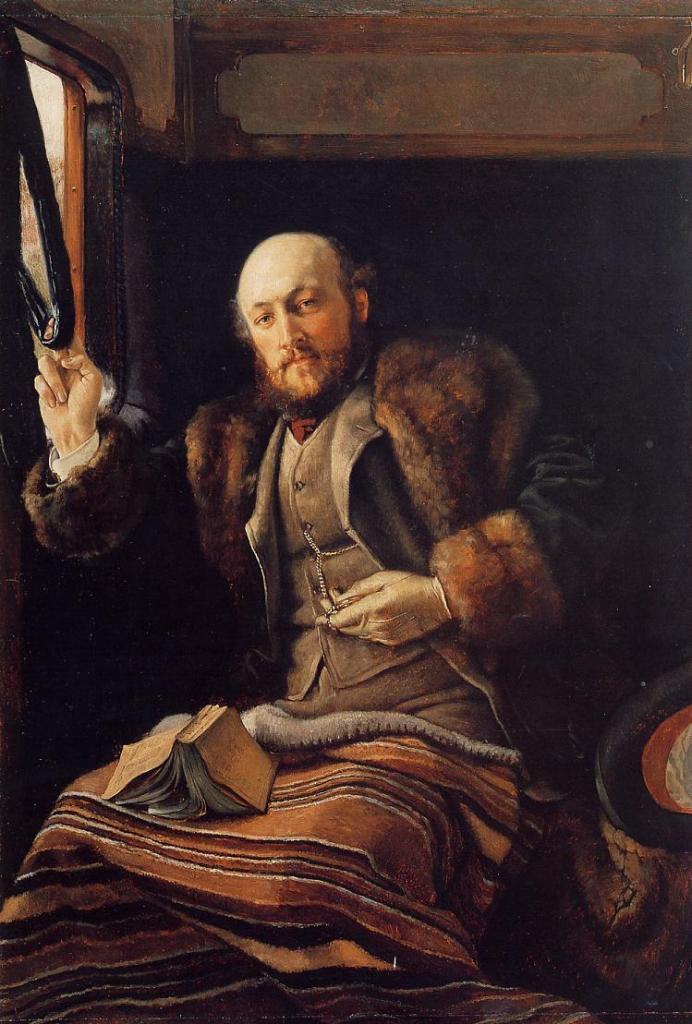
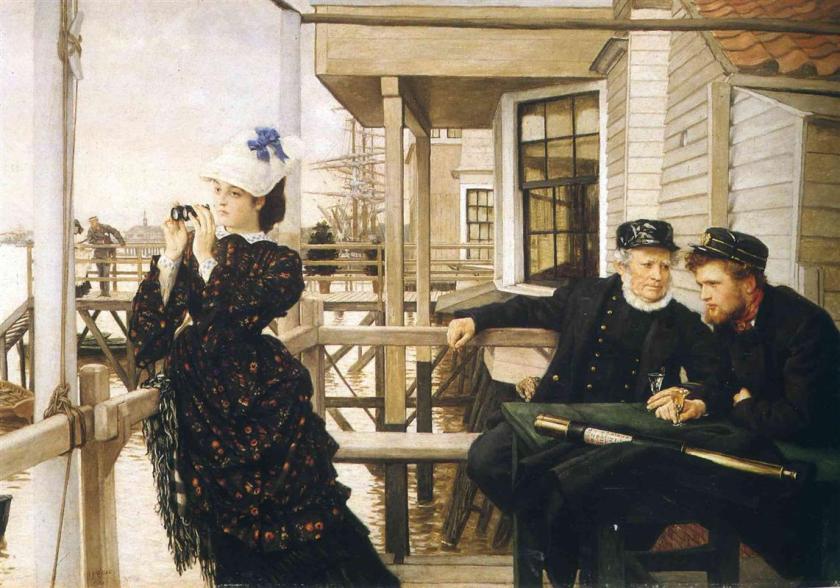
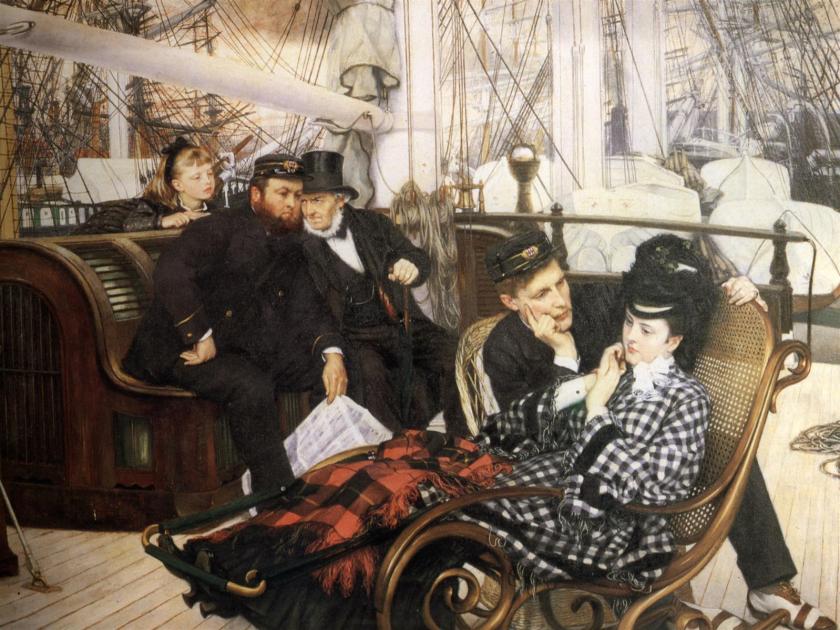
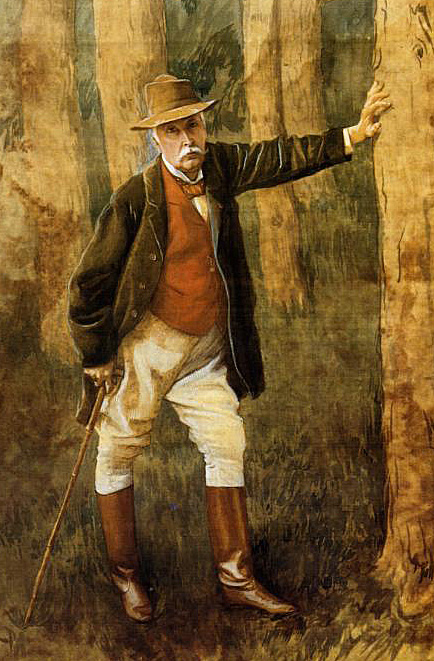
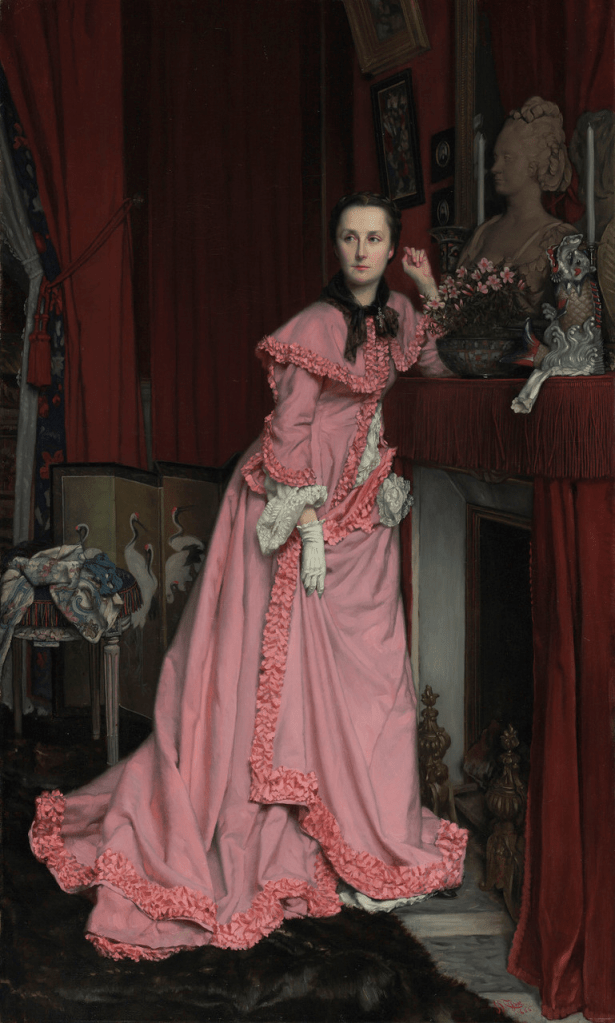
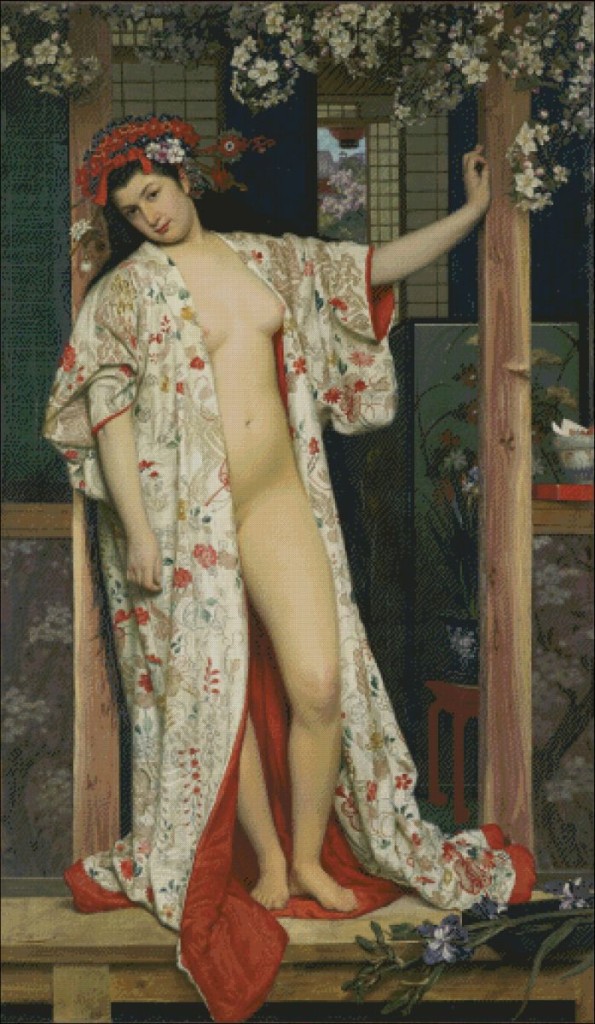
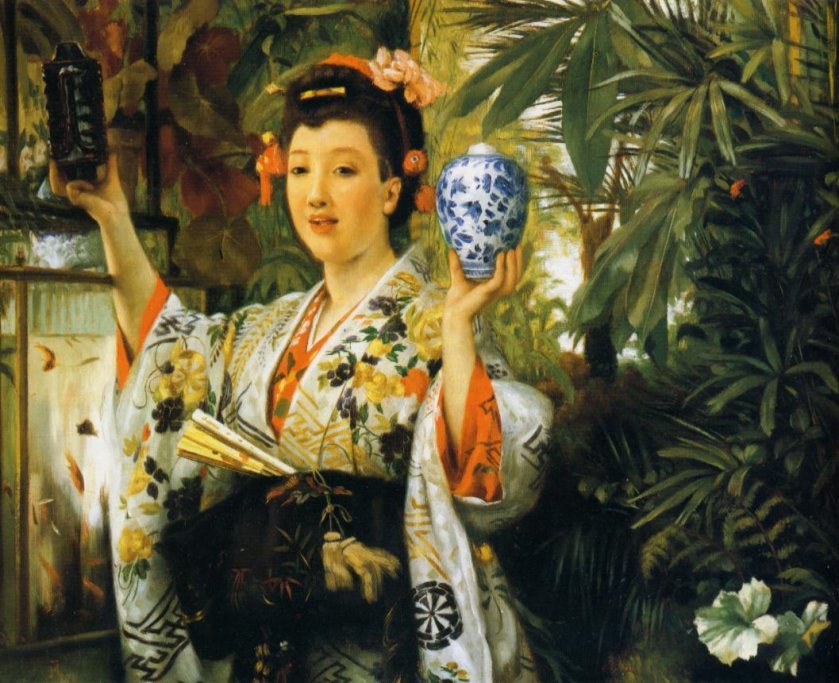
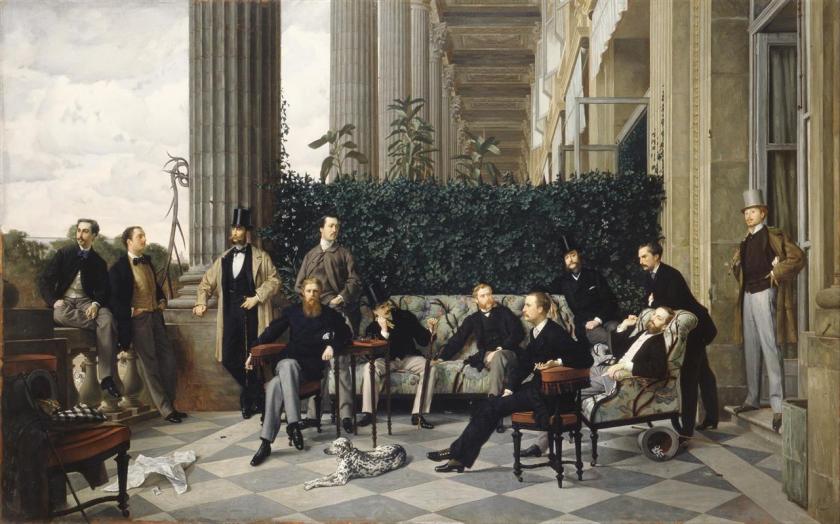
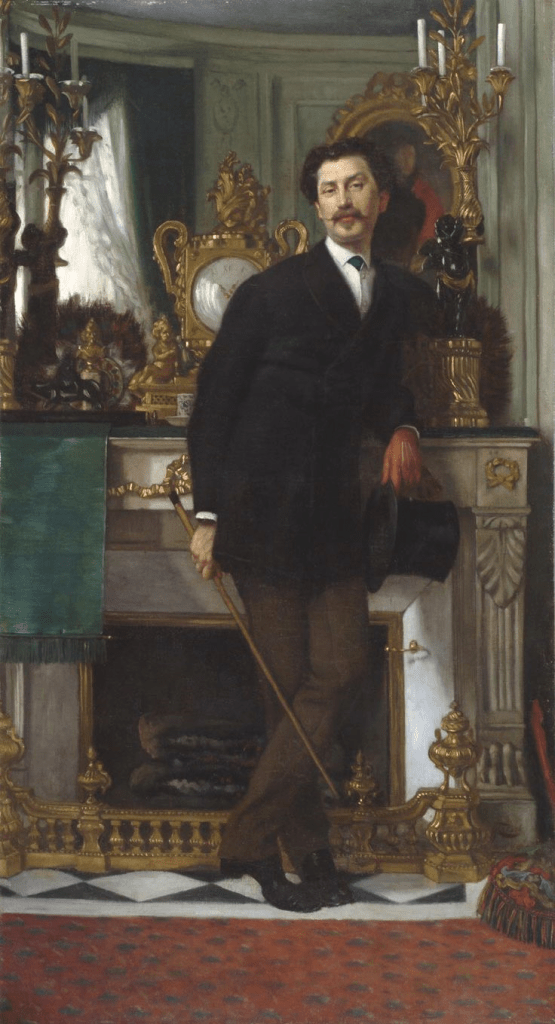
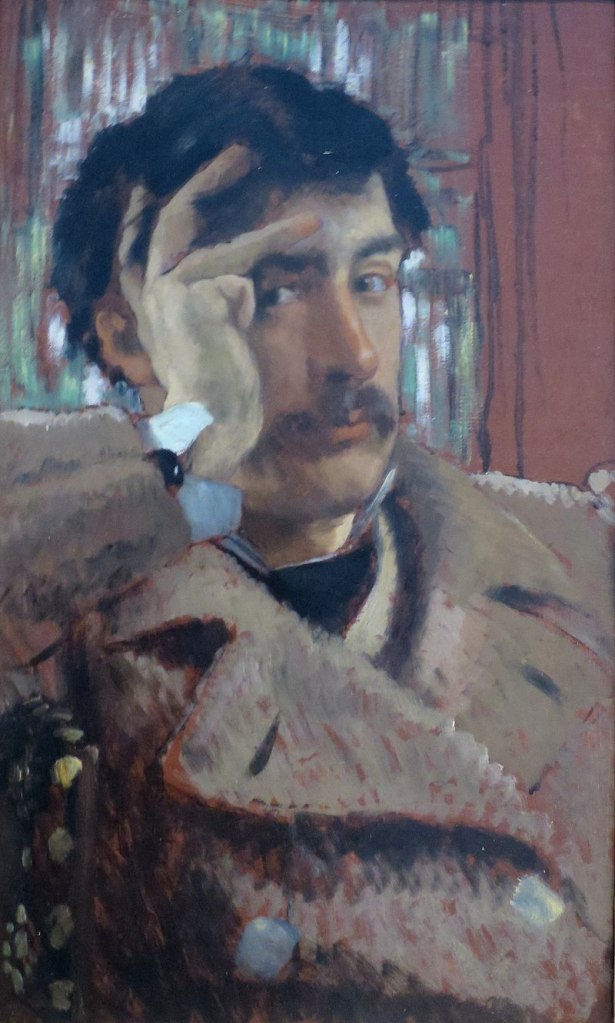
My artist today is the French nineteenth century painter Jacques Joseph Tissot. In the introduction to Tissot’s biography by Christopher Wood, he writes:
“…Tissot was an assiduous and highly competent painter, most of whose pictures are of pretty, elegant women; his work is visually attractive, without being too demanding intellectually…”
It is that last phrase which is probably the reason that Tissot’s work was loved by the public but was panned and scorned by the art historians and art critics. His country of birth, France, look upon him as just a minor artist saying that his work is too anglicised. It probably rankles with the French art critics that Tissot spent eleven years in London during which time most art historians believe he produced his finest work and accordingly was a financial success.
Jacques Joseph Tissot was born on October 15th, 1836 in Nantes, which, at the time, was a prosperous seaport on the Loire estuary. He was the second of four sons. His father was Marcel Théodore Tissot and his mother, Marie Tissot (née Durand). His father, who was born in 1807, came from Trévilliers, a small mountain village in the Franche Comté region of eastern France, close to the Swiss border. As a young man Marcel left home to seek his fortune and through his hard work was a very successful man. He met and married his wife, Marie Durand, a Breton lady, and daughter of an impoverished royalist family. Marcel and Marie set themselves up in the drapery business and she began to design ladies’ hats. So successful were the couple that in 1845 they returned to Marcel’s birthplace and bought themselves a substantial estate, Chateau de Buillon near Besançon.
Jacques Joseph Tissot was brought up in the family home in Nantes. During his early life Tissot inherited a number of traits which were to help him through life. From his father he acquired a business acumen which was to serve him well during his life and make him one of the shrewdest and financially successful of all the nineteenth century painters. From his mother, who was a very pious Catholic, she instilled in him religious feelings which were to change the course of his later life. His parents through their drapery and design business instilled in their son his love of female fashion and elegance. His final great influence was the port of Nantes itself. For a young boy the port and its ships must have been awe-inspiring and many of his paintings completed whilst living in London thirty years later featured scenes of ports and the ships. Nantes was also blessed with great Medieval and Gothic architecture and young Tissot often sketched the buildings and in fact his early career choice was to become an architect.
He was educated at a Jesuit boarding school but proved to be just an average student. At the age of seventeen he had set his mind to becoming an artist and as was the case in so many stories about artists, his parents were dead set on opposing his choice for his future. His father was adamant that his son’s proposed choice of career was a total waste of time and, but for Tissot’s mother, her son would not have been able to follow his favoured profession.
Jeune homme nu assis au bord de la mer by Jean-Hippolyte Flandrin (1836)
In late 1856, at the age of twenty, Jacques Joseph Tissot travelled to Paris to embark on artistic training. His two main tutors were Louis Lamothe, the history painter with whom Tissot studied both Italian and Flemish Primitives at the Louvre and spent many hours copying them. He also studied under Jean-Hippolyte Flandrin. Flandrin’s most celebrated work was his 1836 painting, Jeune homme nu assis au bord de la mer (Young Male Nude Seated beside the Sea) which he completed whilst in Rome during his five-year stay, which was granted to him for winning The Prix de Rome in 1832. Tissot spent a short time attending the Ecole des Beaux Arts and it was here he became a close friend of James McNeill Whistler and it was through him that he met the leading French artists of the time such as Fantin-Latour, Alphonse Legros and Gustave Courbet. Whistler also introduced Tissot to a number of English painters such as Edward Poynton and George du Maurier, the illustrator and novelist. It is widely believed that Tissot’s friendship with Whistler and his English friends made him change his name to the anglicised version, James Tissot
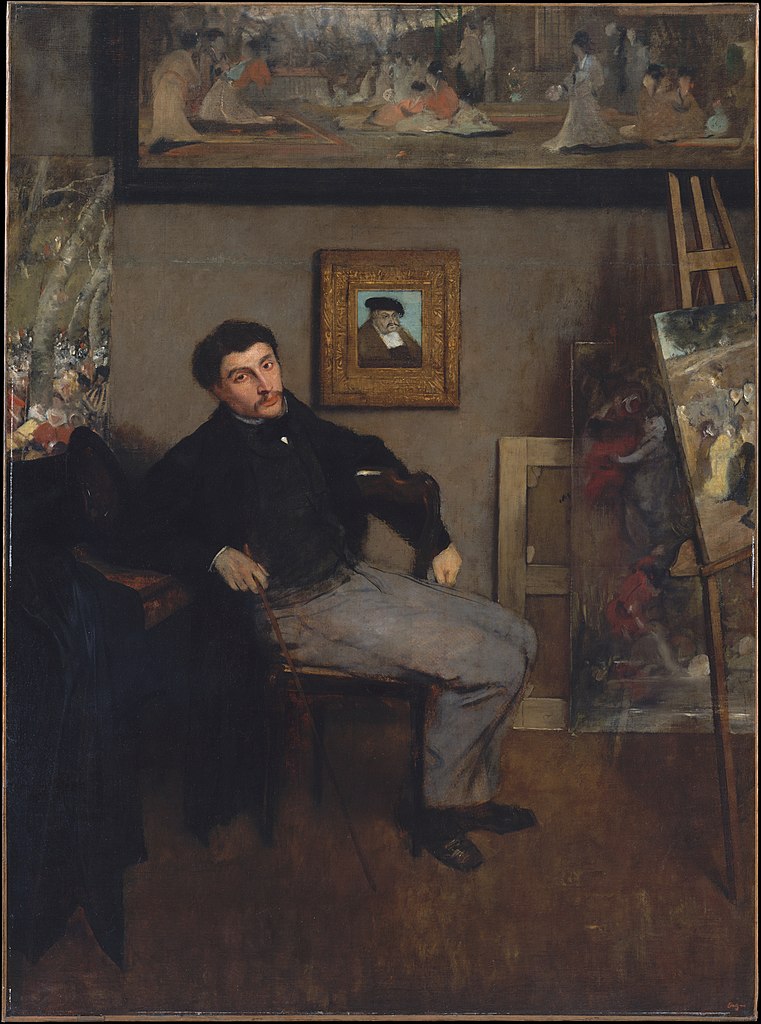
Portrait of James Tissot by Edgar Degas (1868)
Another of his friends was the Impressionist painter Edgar Degas who painted a portrait of Tissot in 1868. Theirs was a stormy relationship which came to an abrupt end in 1895 when Degas discovered that Tissot had sold one of Degas’ paintings which had been given to him by the artist as a gift. Degas may also have been a little jealous of Tissot’s success in his art sales which were far greater than his own.
Self portrait by Henri Leys
Tissot was now seeking new subjects and a new mode of painting and was strongly influenced by the work of the Belgian painter and engraver Jan August Hendrik Leys (Henri Leys), who was a leading representative of the historical or Romantic school in Belgian art. Leys was notable for his history and genre paintings which were often referred to as style troubadour which was a somewhat mocking term for French historical painting of the early 19th century with idealised depictions of the Middle Ages and the Renaissance. This was also a style favoured by the young Alma-Tadema who was, at the time, based in Antwerp.
The Trental Mass for Berthal de Haze by Henrik Leys (1854)
Leys won a gold medal at the Exhibition Universelle in Paris in 1855 for his historical painting Les Trentains de Berthal de Haze (The Trental Mass of Berthal de Haze). A trental mass was a Roman Catholic mass for the dead on the thirtieth day after death or burial. The art critics appreciated the high quality of his reconstructions of times past through his beautiful depictions of early costumes and architecture, as well as the true-to-life postures and facial expressions of his characters combined with the vividness of the colours he used.
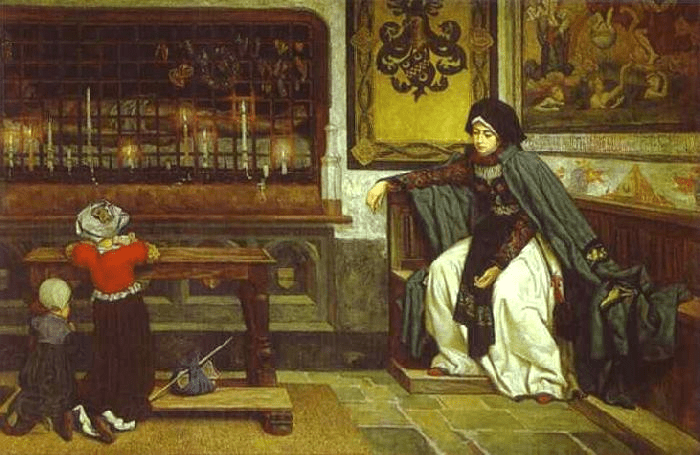
Marguerite in Church by James Tissot (1860)
From 1859 and for the next five years Tissot paintings featured depictions of historical and religious scenes, many of which derived from Goethe’s Faust. Such depictions were very popular at the time and paintings featuring these subjects were often exhibited at the Paris Salon and London’s Royal Academy. Tissot incorporated, in a number of his paintings, scenes from Faust and Marguerite, an 1855 romantic opera, which was popular with a number of painters, such as Ari Scheffer. The libretto was written by Michel Carré and loosely based on the Faust legend, but simply focuses on Faust’s romantic encounter with Marguerite (Gretchen in Goethe’s original drama) and the tragic results of their liaison. The character of Marguerite was looked upon by the French public as a romantic but ill-fated figure who was a vulnerable victim of her fate.
The Meeting of Faust and Marguerite by Tissot (1860)
Although the public may have liked these works which appeared at the Paris Salon the art critics were less impressed, nevertheless one of Tissot’s first “Faustian” paintings, The Meeting of Faust and Marguerite attracted the attention of an important patron, Comte de Nieuwekerke, a high-level civil servant in the Second French Empire. who persuaded the French government to buy the painting for the Musée de Luxembourg. This was such an honour for Tissot as up until then he had never achieved a medal for his works exhibited at the Salon.
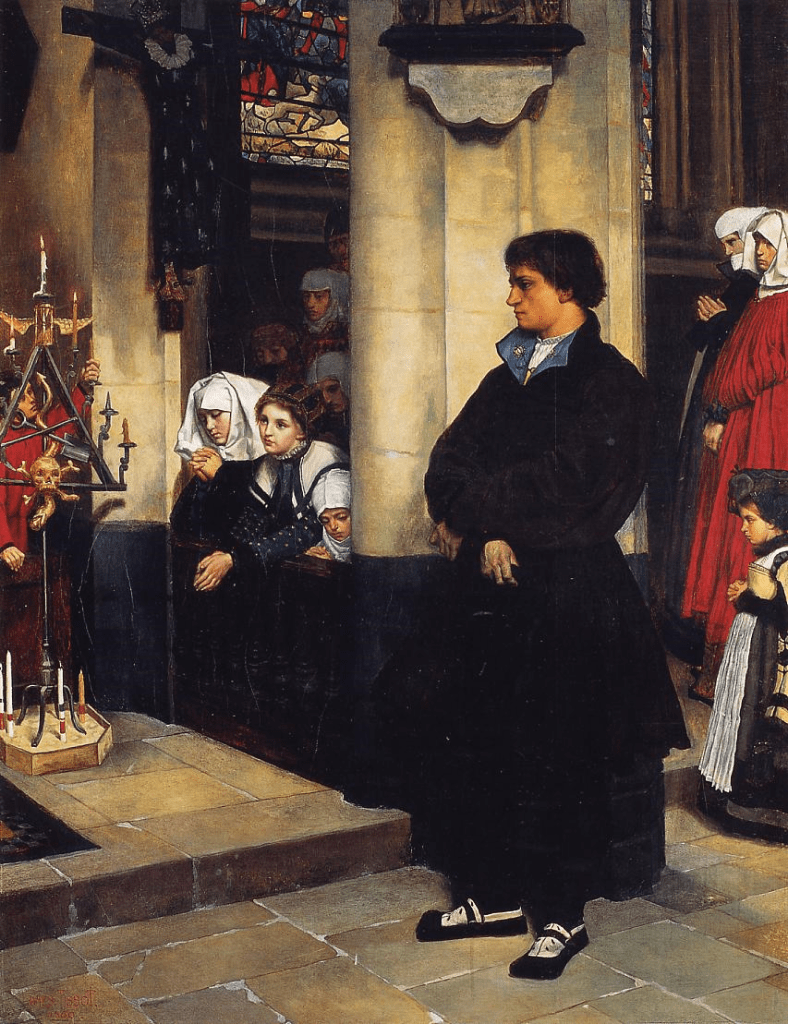
During the Service (also known as Martin Luther’s Doubts) by James Tissot (1860)
Tissot was not deterred by criticism of his Henri Leys painting style and continued with his historical paintings. In 1861 he entered two of his works at the Salon. One, which he completed in 1860, was entitled Martin Luther’s Doubts. In this depiction by Tissot we see the gloomy figure of Luther leaning against a stone pillar, seemingly lost in thought, and completely isolated from the congregation. It is a depiction of the alienation of the man and this theme of estrangement featured in many of Tissot’s works. This is a depiction of a man, termed as a heretic, who openly rejected several teachings and practices of the Roman Catholic Church three centuries earlier.
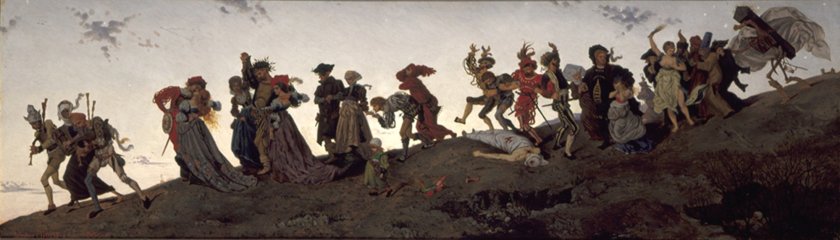
Voie des fleurs, voie des pleurs (Way of Flowers, Way of Tears) by James Tissot (1860)
His second work at that year’s Salon was a more unusual painting entitled Voie des fleurs, voie des pleurs (Way of Flowers, Way of Tears), often referred to as the Dance of Death. This is an amazing composition with all the figures silhouetted on a hillside with the skeletal figure of Death with his billowing white shroud, bringing up the rear with a coffin slung on his back. Although a very theatrical depiction it was one of only a few of Tissot’s early works which was well-liked by the art critics.
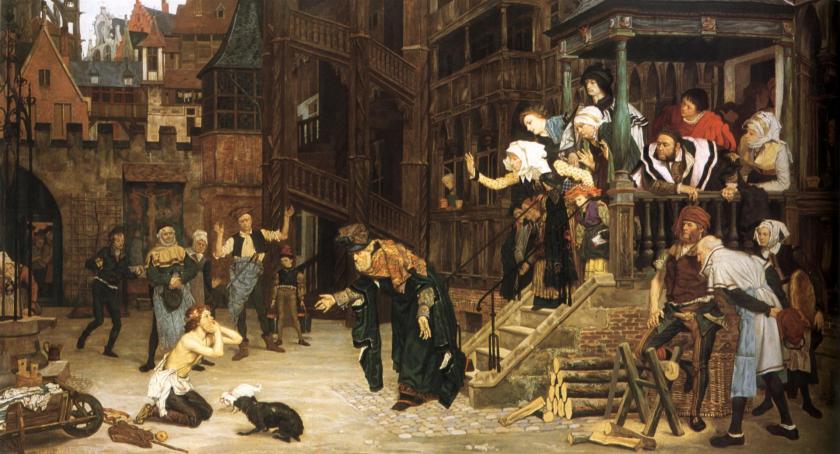
The Return of the Prodigal Son by James Tissot (1862)
Buoyed with the success and the sale of his Faust and Marguerite painting, Tissot decided to carry on with his historical style paintings and in 1863 produced three large-scale works for that year’s Salon, one of which was The Return of the Prodigal Son. It is a remarkable multi-figured painting which is part biblical (the story) part theatrical as the setting looks like a theatre stage set with its medieval buildings. It is a pure Henri Leys-style of painting and one of the last of the type Tissot would complete. The critics on both sides of the Channel were unimpressed. The critic of the London art’s Journal, The Athenaeum stated that it was affected, false and artificial and went on to rebuke him saying that he was wasting his talents by imitating so bizarre a school of painters as that of ancient Flanders. That was the final straw as far as Tissot was concerned and he decided to abandon the Middle Ages for his depictions and instead concentrate on modern life.
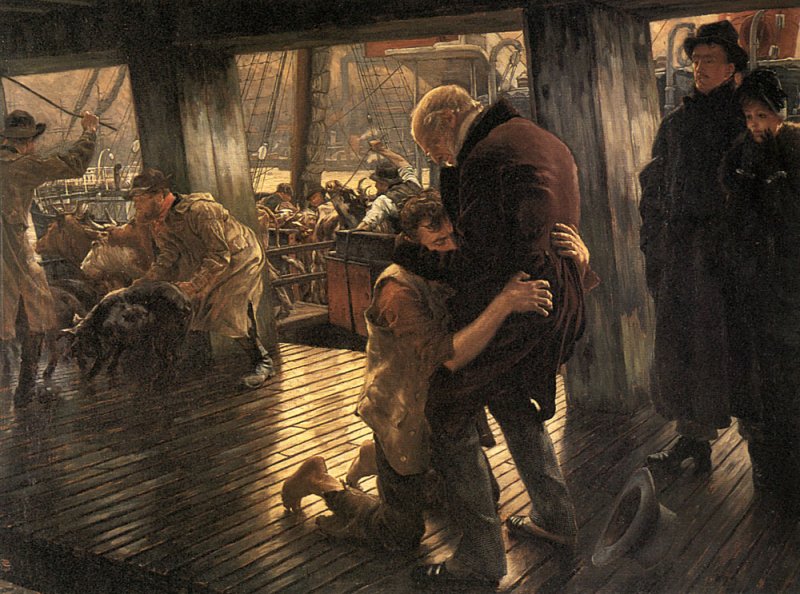
The Prodigal Son in Modern Life: The Return (1882)
Twenty years later however, he did return to the subject of the Prodigal Son with his 1882 work, The Return of the Prodigal Son in Modern Life: The Return, in which he depicts the prodigal son returning repentant to his father, in a contemporary context. The son’s ship has just come in and his father awaits him at the quayside. This painting is now housed in the National Gallery of Art, in Washington DC.
..…………….. to be continued
Most of the information I am using comes from Christopher Wood’s 1986 biography of Tissot which is an excellent read, full of beautiful pictures.
As I have said before, I choose the subject for my blogs based on having sufficient information about the artist and also access to a large selection of his or her work. Without those two criteria the blog would be somewhat empty. I also prefer to feature “unknown” (at least, to me) artists. However, once in a while, there comes a time when I look at a painting and have the overwhelming desire to share it with you, even before knowing whether my two criteria could be achieved. Today’s blog is one of those occasions.
My featured artist today is the nineteenth Danish painter Hans Andersen Brendekilde although at birth his name was simply Hans Andersen but later added to his surname the name of his birth village, Brændekilde. He was born on April 7th, 1857, on the island of Funen, the third largest Danish island,which lies five miles south-west of the island’s main town, Odense. He was brought up in an impoverished household and had to try and support the family by doing jobs, which included working in the house of a farmer doing chores. His father, Anders Rasmussen, was a maker of wooden shoes and his mother was Maren Nielsdatter.
L. A. Ring painting near Aasum smithy by Hans Andersen Brendekilde (1893)
As a child, Hans was interested in carving figures of animals out of wood. When he was attending the local school one of his teachers discovered his talent as an artist and sent him to a school in Odense. Here he became a good friend of Axel Blumensaadt, and it was Axel’s mother who helped fund Hans to attend the Academy of Fine Arts in Copenhagen, where he initially studied sculpture.
Portrait of L.A. Ring by Hans Andersen Brendekilde
He became a friend and associate of painter Laurits Andersen, and in 1881 he left behind sculpting to take up painting. Laurits Andersen and Hans Andersen held a joint exhibition, but because of the confusion of their surnames they both decided to add their birthplace to their name and so Laurits who was born in the Zeeland village of Ring became known as Laurits Andersen Ring (L.A. Ring) and Hans took the name Hans Andersen Brendekilde (H.A. Brendekilde). Their paintings at their first exhibition now had their “new” designated surnames to avoid confusion.
In the summer of 1882 Hans and some other artists were invited to stay on a farm in Rugelund by its owner and soon an artist colony was formed. For Hans it was not just a chance to paint and mix with fellow artists it was a chance to be well-fed. It was also a chance to see first-hand the harsh working environment of the rural workers which he would later depict on many of his canvases. But all was not doom and gloom in his works for often, in comparison to his gritty social realism works, other paintings by Brendekilde highlighted the pleasures of living in the countryside.
Udslidt by Hans Andersen Brendekilde (1889)
But let us have a look at probably his most famous work, the one which drew me to looking into his life. It was his social realist painting entitled Udslidt (Worn Out) which he completed in 1889.
In this heart-rending depiction we see a day-labourer lying crumpled on the rock-strewn ground of the barren field where he had been working. His onerous task, with other peasants, would have been to remove the stones from the ground, prior to ploughing and planting, and put them in piles awaiting disposal. The field although barren takes up eighty per cent of the picture. Look at the detail Brendekilde has incorporated in his depiction of the ground. However, what is more emotive is the portrayal of the two figures in the foreground. The elderly peasant worker has stumbled and fallen to the ground. He is dressed in shabby clothes which are covered in dirt. One of his wooden clogs has fallen off during his fall. The heavy stones he had been carry in his apron, lie on the ground next to him. He had finally been overcome by exhaustion or maybe he has suffered a heart attack. A woman, maybe his wife or daughter or just a co-worker, has rushed to his aid. She is kneeling next to him and cradles his head.
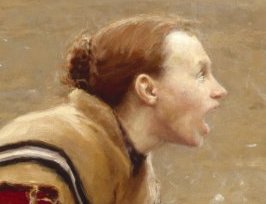
A scream for help
Her mouth is open wide as she screams for somebody to come and help. Her impassioned plea has yet to be answered and she is both overwhelmed with fear for the man and her own helplessness. The picture was exhibited at the Exposition Universelle of 1889 and also at The World’s Columbian Exposition in Chicago in 1893.
It received a mixed reception. Many people lavished praise on the artist for the work whilst the “monied-people” and the bourgeois press thought the painting was over-melodramatic and condemned it for its blatant political stance about the life of the poor and downtrodden which they obviously didn’t want to be reminded about.
Fortrykt by Hans Andersen Brendekilde (1887)
Another of his works with a depiction in a similar vain is his 1887 painting simply entitled Fortrykt which literally translated now means “pre-printed” but it is more likely that the artist was using the word to mean “supressed” or “subdued”. The painting was completed two years before the previous work Worn Out and again dwells on the hardship suffered by the rural peasant class, who were the social losers and who were way down the social ladder. Four people dominate the foreground and we may surmise that they are a young woman and her child along with her mother or older sister and her father. The older woman and the seated father are dressed in old clothes and have been working in the fields gathering bits of grain to take home.
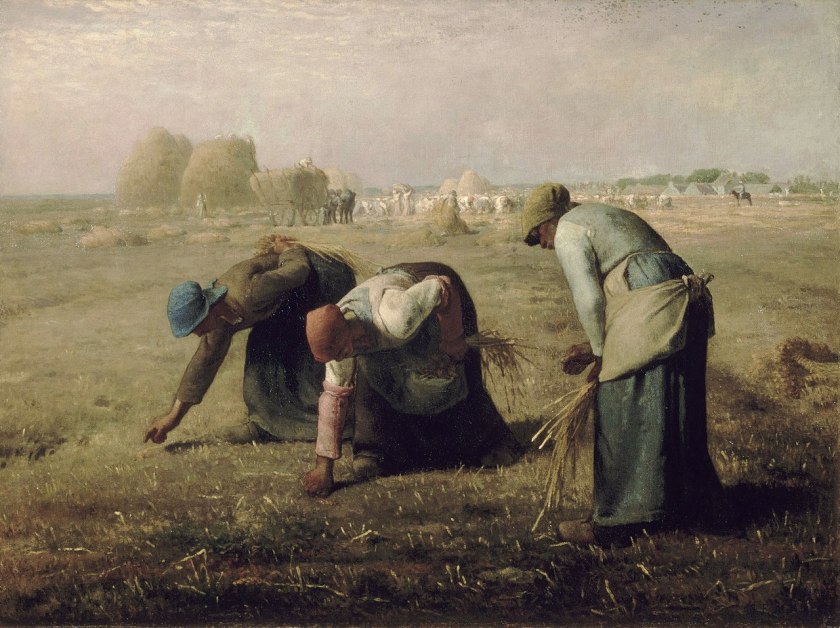
The Gleaners by Jean-François Millet, (1857).
They are the gleaners, as depicted in Millet’s famous 1857 painting, TheGleaners. Gleaning is the act of collecting leftover crops from farmers’ fields after they have been commercially harvested or on fields where it is not economically profitable to harvest. It is the Biblically-derived right to glean the fields and was reserved for the poor; a right, enforceable by law, that continued in parts of Europe into modern times. The young woman is dressed in finer clothes and has not been working in the field. She is talking to her father and her mother raises her head to listen. The father sits on a bag of grain and looks exhausted and yet there seems to be an air of resignation about him. He has accepted his lowly lot in life. Has his daughter told him something he didn’t want to hear? Is it something to do with young child who, whilst amusing herself, is sitting on a pile of coats?
The First Anemones by Hans Andersen Brendekilde (1889)
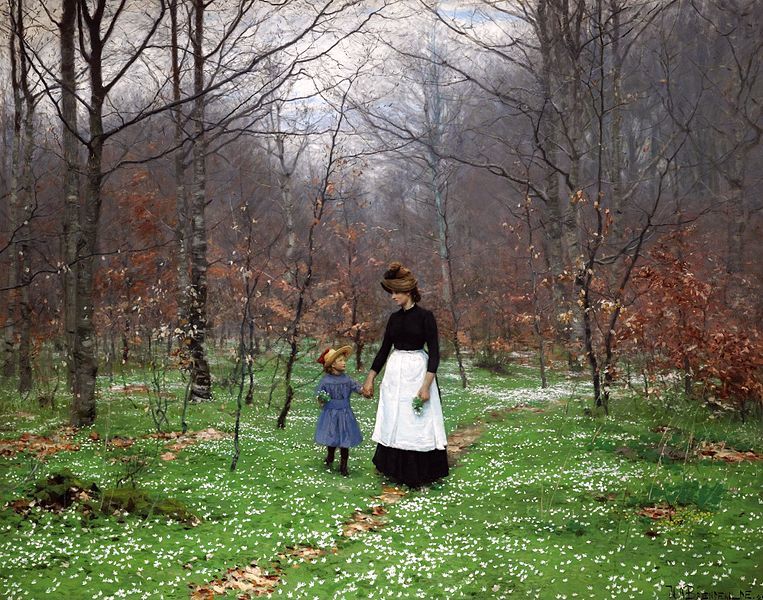
At the end of the nineteenth century Brendekilde painted several cutting social-realist works. At other times he depicted the everyday life of poor people without critical undertones. These were more to do with the happier memories Brendekilde had of rural life when lack of money could not detract from the pleasures of immersing oneself in nature such as his 1889 springtime painting, The First Anemones.
A Spring Day by Hans Anderson Brendekilde (c.1890)
Again, we see a similar setting in his work A Spring Day when the villagers, dressed in their “Sunday-best” clothes take a pleasurable walk through the forest.
Autumn by Hans Andersen Brendekilde
Another fascinating and evocative work is his 1908 oil painting, Autumn. It is a combination of a landscape and sombre realist style painting in which we see an elderly lady standing by an open grave in a cemetery. It is a dark autumn day and we see the leaves from the nearby trees lying all around. There is a gale blowing which is stripping the leaves from the trees which are leaning over due to the ferocity of the wind. In the middle ground one can see the church and the green grass of the graveyard. Two black crosses have been blown over and lie abandoned against a hillock. Some graves seem to have been tended whilst others look abandoned. The old woman through her age and the strength of the wind is bent over and she clutches at her dress whilst holding on to her walking cane. She gazes into the excavated hole in the ground. The question the artist poses is what are her thoughts. Has she lost a loved one who will be buried in this plot or is she contemplating her own end of life. Could this even be termed a vanitas painting? One of the pleasures of looking at a painting is to try and decide for ourselves what we see in a depiction and work out what the artist was trying to convey.
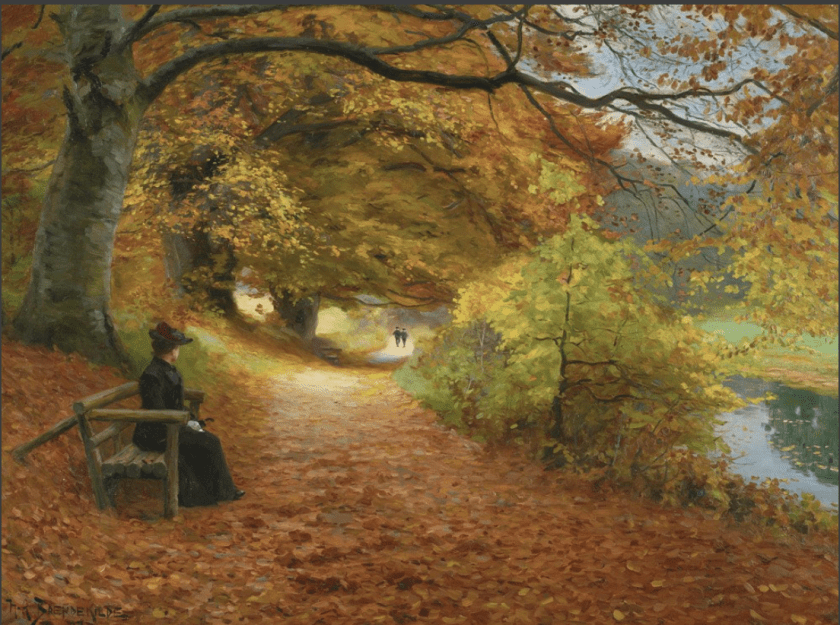
A Wooded Path In Autumn by Hans Andersen Brendekilde (1902)
The autumn season often featured in Brendekilde’s painting. He enjoyed depicting this colourful time of the year. A time when the normally green leaves of many deciduous trees and shrubs slowly turn to various shades of red, yellow, purple, black, orange, pink, magenta, blue and brown, during a few weeks in the autumn season, before they fall to the ground. Brendekilde beautifully captures that moment in his 1902 painting entitled A Wooded Path in Autumn.
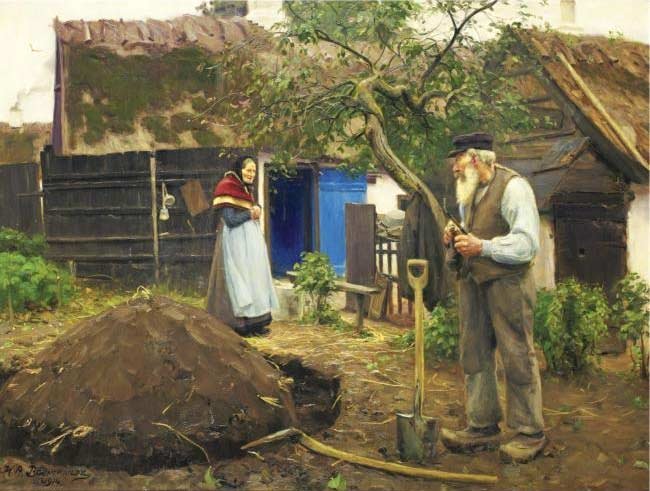
A Short Respite by Hans Andersen Brendekilde
Elderly people often featured in Brendekilde’s paintings and another of my favourites is his painting entitled A Short Respite in which we see an old man taking a rest from his gardening chores looked on by his wife.
Soap Bubbles by Hans Andersen Brendekilde (1906)
It was not just the elderly who featured in Brendekilde’s works of art, nor were the subjects of his painting always sombre. In later life, he would concentrate on idyllic village scenes often depicting happy children, innocent children, and these proved very popular with the public.
Home with Dinner by Hans Andersen Brendekilde
In many of his paintings featuring children he also included one or two elderly people. Maybe he remembered his childhood days and how elderly relatives and neighbours played a part in his life. It seems strange now that some look upon paintings depicting an older person with a child as something suspicious and unnatural. Gone are the days when we accept unconditionally that our young children and an elderly person such as a relative can form a bond and in some ways learn from each other.
Fishing Village by Hans Andersen Brendekilde
Brendekilde died on 30 March 1942, aged 84, in Jyllinge, a town located on the eastern shores of Roskilde Fjord, some 40 km west of Copenhagen.
The artist I am showcasing today, Mary Adshead, was an exceptionally gifted person. She was an artist who moved seamlessly between easel painting and murals. She was a portrait painter. She painted on furniture and glass. She was a postage stamp designer. She was a book illustrator and devised and designed advertisements and stage sets but will probably be best remembered as a muralist.
Mary was born in Bloomsbury, London, on February 14th, 1904. She was the daughter and only child of Stanley Davenport Adshead and Annie Adshead. Her father was a well-known neo-Georgian architect and talented amateur watercolourist, who trained in Manchester and London and for four years was clerk of works for the vast mansion at Rosehaugh, Argyll, during which time he met his wife, Annie, who was the village school mistress. In 1909, Stanley became Associate Professor of Civic Design at the University of Liverpool, and in 1912 became the Lever Professor of Civic Design. He moved back to London in 1914 and became the first Professor of Town Planning at University College, London, and remained there until his retirement in 1935.
Stanley Davenport Adshead (1927)
From the age of six, Mary was determined to become an artist and spent much of her time drawing and she produced many sketchbooks of cartoons and illustrations to stories. The family would spend their summer holidays in the New Forest. Her mother and father’s relationship was often stormy and Mary found herself acting as a go-between, passing messages from one parent to the other. At the age of twelve, she attended Putney High School and remained there for three years. At the age of fifteen she went to Paris with her mother and both lived in a hotel in the French capital for six months whilst Mary attended the Lycée Victor Dury.
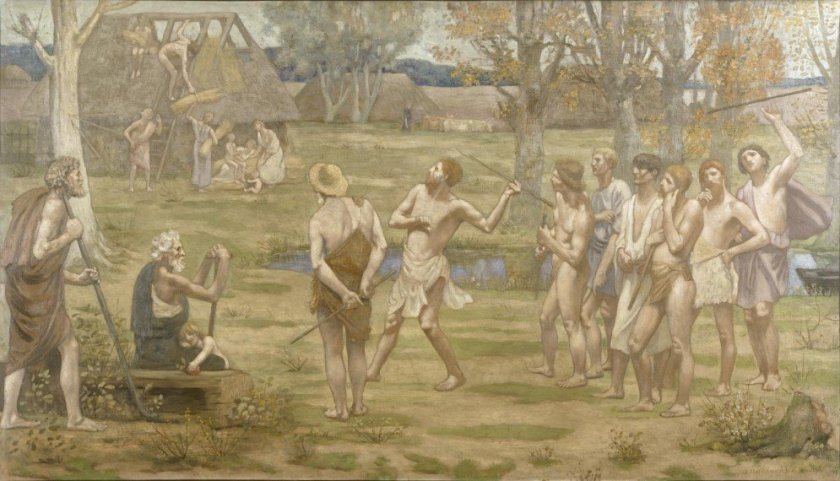
Ludus Pro Patria by Puvis de Chavannes (c.1883) This painting which is housed at the Walters Art Museum, Baltimore, replicates the central portion of a mural, Ludus Pro Patria (Patriotic Games), which was installed in the stairwell of the Musée de Picardie in Amiens, France
Whilst in Paris she visited many of the famous art galleries and was greatly influenced by the murals of Pierre Puvis de Chavannes. In the Autumn of 1921, when she was seventeen years old, her father took her to meet Henry Tonks the principal at the Slade School of Art, which was part of the University College, London, where Stanley Adshead was a professor. Henry Tonks, a former surgeon, had a reputation for being very harsh with his students and a fierce taskmaster. Mary brought along a portfolio of work which she had put together whilst in Paris but Tonks was not impressed. However through a lot of arm-twisting by her father Tonks agreed to allow her to enrol on his art course. This was a great relief to Mary and her father who, because he was a professor at the UCL, would not have to pay for his daughter’s tuition.
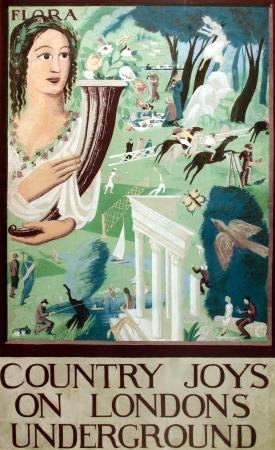
Poster artwork; Country joys on Londons Underground, by Mary Adshead, 1926
During the early phase of her course Mary did not work as hard as she should and was happy to hang out with a set of wealthy girls who looked on the art and course as simply a pleasant hobby. Soon she realised that she was wasting valuable time and began to knuckle down and Tonks began to be very impressed with her work. Mary and fellow student, Rex Whistler won the joint first prize in the Slade’s Summer painting competition in 1924 and as a result, when their time at the Slade came to an end, Henry Tonks arranged for them to undertake a joint mural commission at the Highway Boys’ Club in London’s East End.
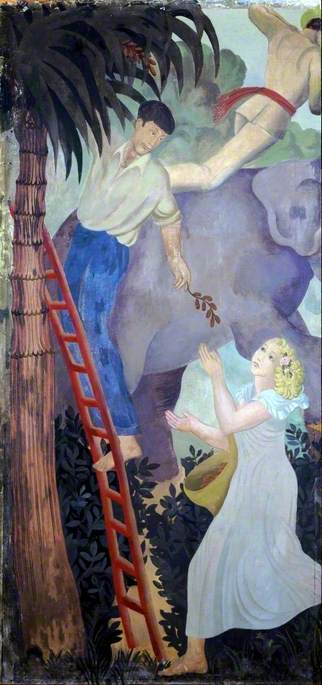
Mary Adshead 1926 mural: A Tropical Fantasy: for Charles Reilly’s Dining Room Mural (panel 1 of 6)
Once she had completed that commission, more followed and her next one, in 1924, was to create a mural based on a desert island theme, which became known as A Tropical Fantasy. It was commissioned by Charles Reilly, the professor of architecture at Liverpool University, and one-time colleague of Mary’s father. It is now housed at the Liverpool University Victoria Art Gallery. It is one of just a few of her murals to survive. That same year she completed a large mural entitled The Housing of the People, which was exhibited at the 1924 British Empire Exhibition at Wembley.
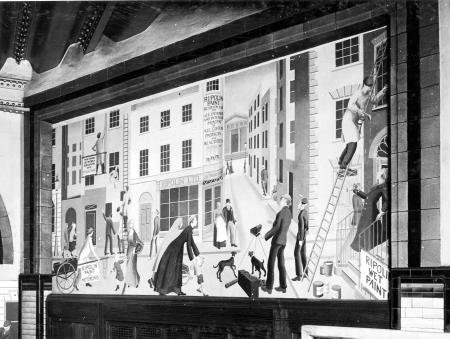
Bank Underground station, advertising mural by Mary Adshead which was situated next to escalator (1926)
She designed posters for the Underground Group and London Transport in the period 1927-37 and also carried out decorative works at Bank and Piccadilly Circus Underground Stations.
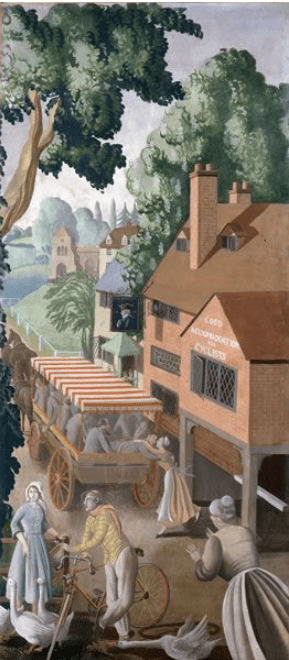
An English Holiday – Village Inn, 1928
One of her most lauded and often considered as her finest work was a commission she received in 1928 from Lord Beaverbrook, the millionaire Canadian-British newspaper publisher and politician, for a mural to cover the walls of his dining room at his Newmarket House, Calvin Lodge. He had decided that the mural should depict scenes of Newmarket life such as the horse racing and the fair and should depict his well-known and famous friends and it was that last instruction which was to be the stumbling-block to this project.
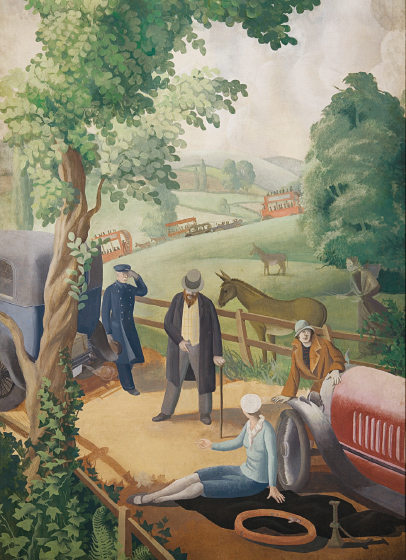
An English Holiday – The Puncture by Mary Adshead (1928)
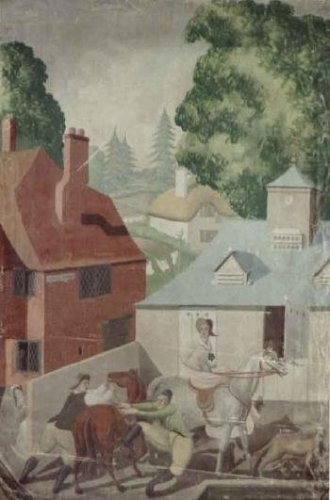
The resultant panels, collectively titled An English Holiday, were true masterpieces combining humour with an insight into a life of privilege and elegance. They were described at the time as being in ‘the manner of English 18th-century sporting prints and acquatints. The paintings were packed with activity.
Village Inn by Mary Adshead
In Village Inn, a gentleman cyclist flirts with a country maid. In another one we see Arnold Bennett playing the harmonium for a crowd of gypsies. In another we see Lady Louis Mountbatten waiting by her car, the tyre of which had punctured and is being offered assistance by a swaggering, bearded character who looks very much like the painter Augustus John. More bizarrely Churchill is depicted astride an elephant. All of the characters are making their way to the Newmarket racecourse to meet Lord Beaverbrook.
However, Lady Diana Cooper, a good friend of Lord Beaverbrook and who also appeared picnicking in one of paintings persuaded him not to install the murals. Her argument being that as he was so cantankerous and quarrelsome, he was bound to, sooner or later, argue with one or more of the people depicted in the murals and then he would be forced to look at their depictions every time he dined. He listened to her advice and returned the panels to Adshead and paid the two-thirds rejection fee.
The panels were reassembled and exhibited at the large Peter Jones Department store in Central London in 1930 before being rolled up and relegated to a cupboard in the Adshead’s house where years later all but three were destroyed by fire.
The Little Boy and his House by Stephen Bone and Mary Adshead
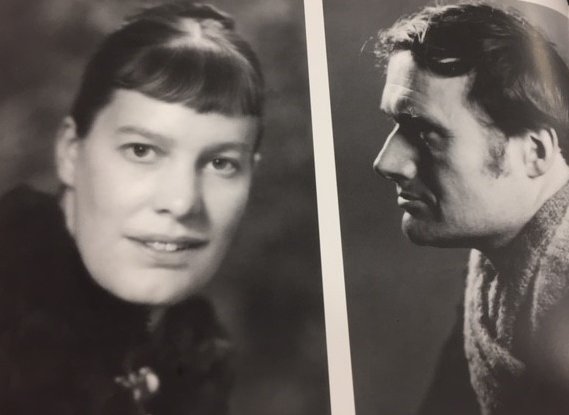
In 1929 Mary Adshead married the painter Stephen Bone, the son of the artist and etcher Sir Muirhead Bone. Stephen and Mary had been students together at the Slade. The couple went on to have three children, two sons, Quentin and Sylvester and a daughter, Christina. Mary and Stephen collaborated on a couple of children’s books, namely The Little Boy and His House in 1936, The Silly Snail and Other Stories in 1942 and The Little Boys and Their Boats in 1953 in which Mary provided the illustrations.
Chateau Poulet, near Forcalquier, Haute Provence by Mary Adshead
During their early married life, the couple made many painting and sketching tours during their travels through Europe. Mary received many commissions through her architect father and also through the good auspices of her father-in-law who was always singing her praises in his circle of artist friends. Her father-in-law, Muirhead Bone was well known for helping young aspiring artists such as Stanley Spencer, Gwen John and Cristopher Nevinson.
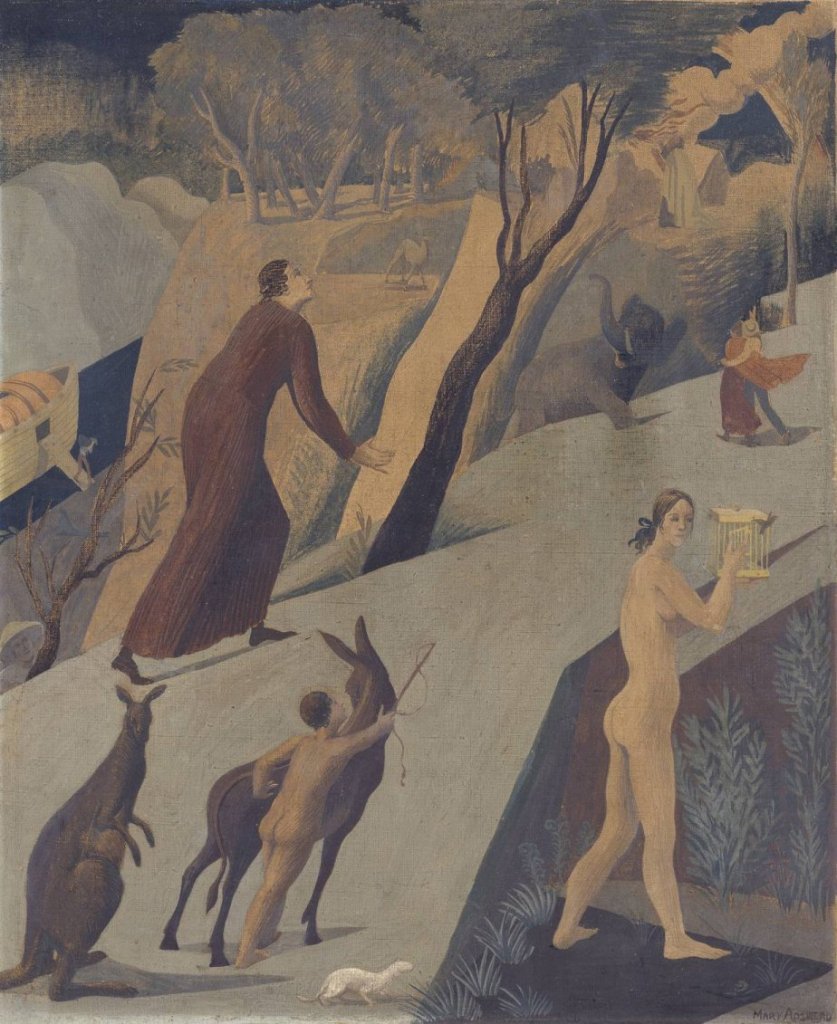
Morning after the Flood by Mary Adshead (1928)
Mary Adshead’s first solo exhibition was held in 1930 at the Goupil Gallery and included the painting The Morning after the Flood which is now part of the Tate collection. This decorative painting by Mary Adshead was characteristic of the style taught at the Slade Art School when she was a student. The tutors at the Slade had students set out figurative compositions that had connections with Biblical tales. This work was set the day after the Great Flood when Noah’s boat with his family and animals had come to rest on dry land. One art critic wrote that her figure painting combined a fashionable primitivism, loosely derived from Stanley Spencer with a fluency and humour rarely found among her contemporaries.
Self Portrait by Mary Adshead (1931)
Her talent as a portrait artist can be seen in her 1931 self-portrait.
Portrait of Daphne Charlton,by Mary Adshead (c.1935)
Other portraits she completed include one of Daphne Charlton, the painter who studied at the Slade and who was a close friend of Stanley Spencer.
One of her favourites was one she did of her three children.
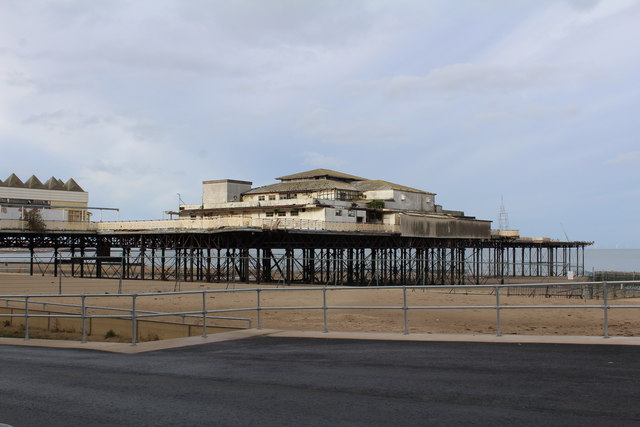
Victoria Pier, Colwyn Bay prior to demolition (pre-2017)
There is actually connection between Mary Adshead and her father and a place near where I live. The connection is the Victoria Pier Pavilion at Colwyn Bay, North Wales. The original pier was started in 1899 and was completed two years later. A 600-seat ‘Bijou’ theatre was built at the pier head in 1917 for the purposes of light entertainment. This original pavilion was completely destroyed by fire in 1922. This disaster forced the owners, the Victoria Pier Company, into bankruptcy and the pier was taken over by Colwyn Bay Urban District Council which arranged to re-build the structure. Eleven years later this second pavilion was destroyed by fire and a second blaze a few months later destroyed the theatre.
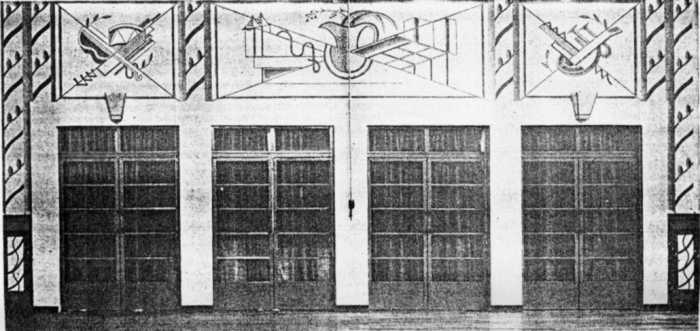
The mural decorations by Mary Adshead in the auditorium of Colwyn Bay Pier
Not to be deterred by these two disasters, the Colwyn Bay Urban District Council set about rebuilding, and the third pavilion was opened on Tuesday 8 May 1934 at a cost of £16,000. Now to the connection !
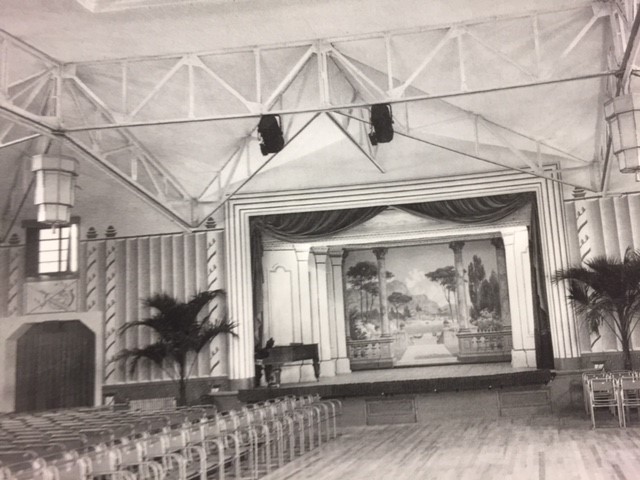
Inside Victoria Pavilion, Colwyn Bay with murals by Mary Adshead and Eric Ravilious
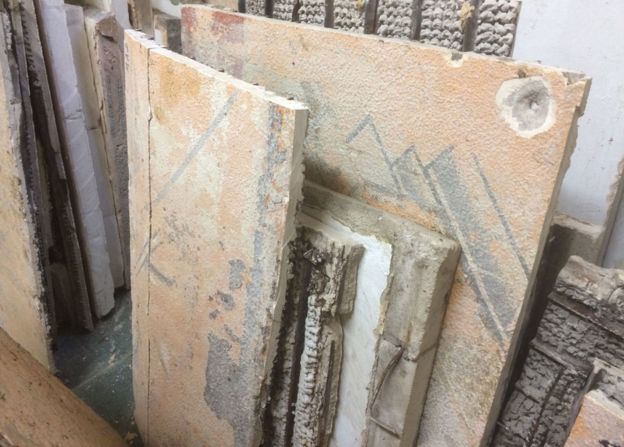
The third pavilion was designed by architect Stanley Davenport Adshead, Mary’s father, and Mary and Eric Ravilious were commissioned to paint some Art Deco murals for the interior of the pier building. The pier was badly damaged by the gales and sea in 2017 and started to collapse and it was decided to dismantle the whole structure.
Sections of murals from Colwyn Bay pier pavilion
The Art Deco murals created by Eric Ravilious and Mary Adshead, back in 1934, from inside the pavilion, have all been successfully removed and are currently awaiting restoration.
Mary Adshead and Stephen Bone
Stephen Bone, Mary’s husband, was a landscape painter and for a while was very successful but later the market for his work dried up and he became depressed and began to look upon himself as a failure. Stephen Bone died of bowel and liver cancer on 15 September 1958 at St Bartholomew’s Hospital, London. He was just fifty-three years old.
Travelling with a Sketchbook by Mary Adshead
After the death of her husband, and with her children all grown up, Mary embarked on a tour of America. During the adventure she carried her sketchbook and filled it with drawings of her journey. When she returned to England she published a book about her travels entitled Travelling with a Sketchbook.
1952 8d Wilding definitive stamp designed by Mary Adstead
Between 1948 and 1963 she submitted designs for a number of Post Office stamp issues including the Universal Postal Union stamps of 1949, the Festival of Britain stamp of 1951 and four denominations of the Wilding definitive stamps of 1952, which featured the Dorothy Wilding photographic portrait of Queen Elizabeth II . Adshead’s design for the 8d, 9d, 10d and 11d were chosen.
Mary Adshead (1904 – 1995)
In her latter years, lameness caused by painting off ladders hampered her work and life, but, ever purposeful, she would crawl where she could not walk with a stick, curious glances notwithstanding. Despite this affliction Mary Adshead remained an active working artist until the end of her life. She died in London on September 3rd 1995, aged 91.
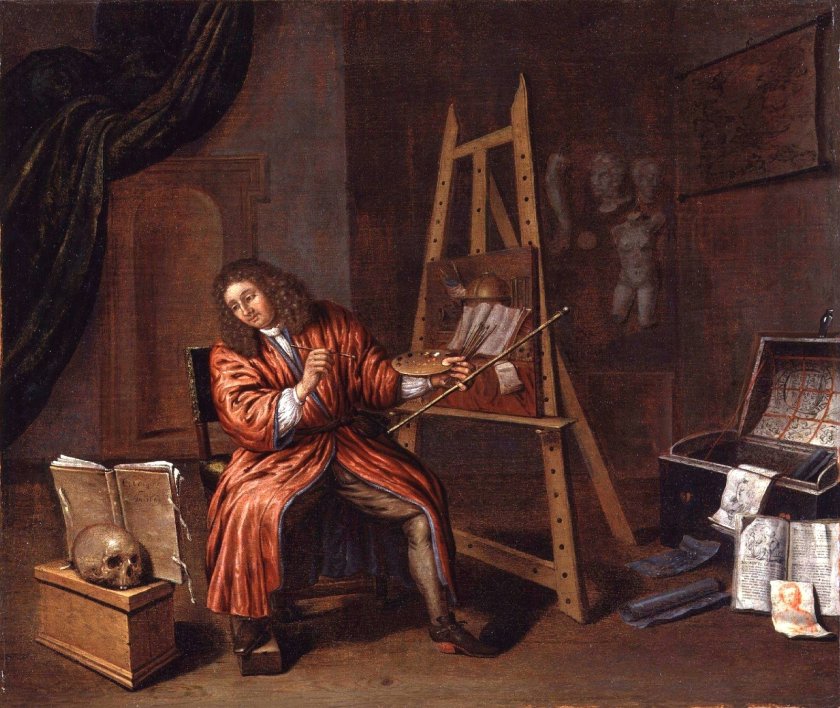
Self-Portrait with a Vanitas Still-life by Evert Collier (1684)
For those of you who have been following my blog over the years, you will know of my love of Flemish and Dutch art. Many of you would be able to conjure up names of some of the great Netherlandish artists such as the Flemish painters Pieter Bruegel, Hieronymus Bosch, Hans Memling, Quentin Massys, and David Teniers or the Dutch painters such as Jacob Isaacksz van Ruisdael, Jan Steen, Johannes Vermeer, van Gogh and Rembrandt, to mention just a few. My other artistic love is paintings with symbolism and so in the blog today, I want to introduce you to a lesser known Dutch painter many of whose paintings were awash with a myriad of symbolic objects.
Self portrait by Evert Collier (1682)
My painter I am looking at today is the seventeenth century artist, Evert Collier, who is famous for his vanitas and trompe-l’œil still life works and today I will look at his vanitas paintings. Edwaert Colyer, a Dutch painter possibly of English descent, (who later anglicised his name to Edward Collier) was born in Breda in January 1642 and baptised Evert Calier. He trained in Haarlem and eventually became a member of the Haarlem Guild of St. Luke.
Portrait of Vincent Laurenz van der Vinne by Frans Hals (ca 1655}
One of the greatest influences on Collier was a fellow painter of the Haarlem Guild of St Luke, Vincent Laurensz. van der Vinne. Initially van de Vinne trained as a weaver but then decided to concentrate on painting and in his late teens. He studied under Frans Hals, who actually painted his portrait around 1660, which is now housed at the Art Gallery of Ontario in Toronto.
The paintings of van der Vinne which survive today are mostly still lifes and genre scenes. They often include many aspects of trompe l’oeil and, in many instances, incorporate vanitas items.
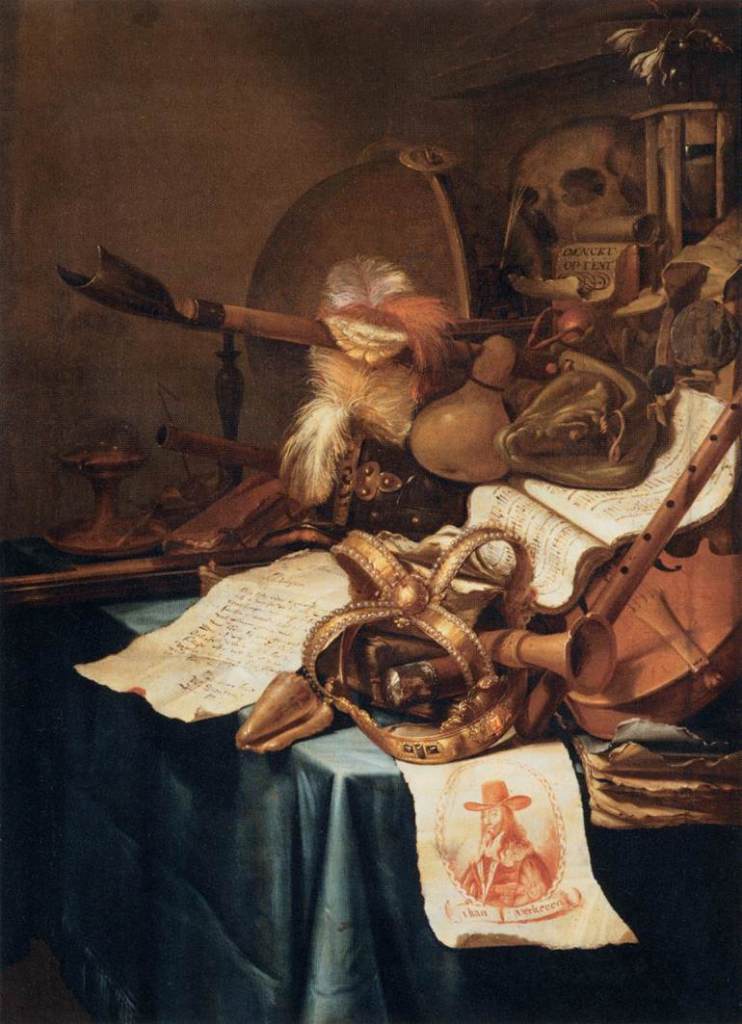
Vanitas with a Royal Crown by Vincent Laurensz. van der Vinne (c.1649)
Vanitas paintings are subtle moralistic depictions which were very popular at the time and were those works of art which, through their symbols, depicted the impermanence of life, the pointlessness of pleasure and were meant to remind people that death is inevitable. In a way they were to counter the wealth and profligacy of many of the well-to-do citizens. The word vanitas comes from the Latin noun ’emptiness’, ‘futility’, or ‘worthlessness’, which was the traditional Christian view being that earthly goods and lavish pastimes are merely fleeting and worthless moments in the great scheme of life. Such prosperity was countered by the words of condemnation from the bible (Ecclesiastes 1:2):
“…Vanity of vanities”, says the Preacher, “vanity of vanities! All is vanity.…”
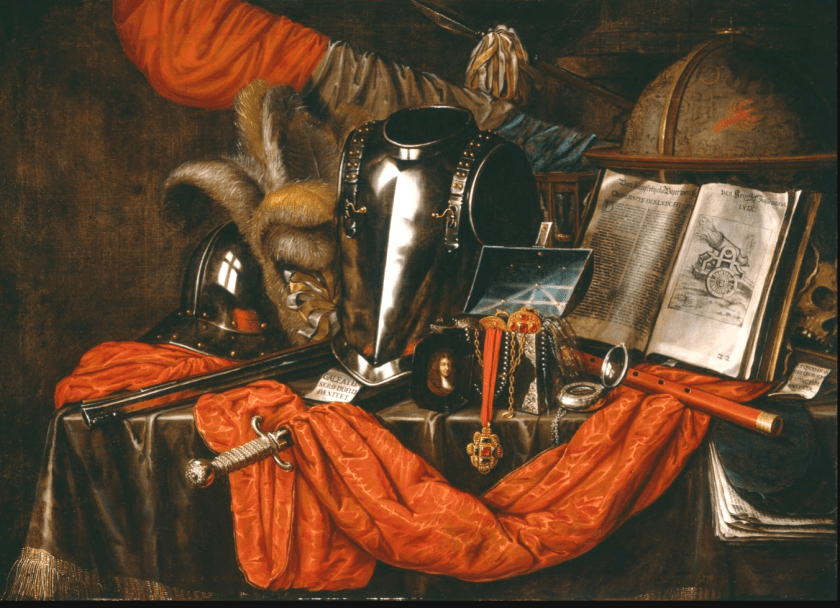
Vanitas Still Life by Evert Collier
The first work by Collier I am showing is one simply entitled A Vanitas Still Life which was completed by him in 1689. Let us study the work and look at the amazing detail. Look at the way Collier has depicted the string of pearls and the other jewels spilling out of an open casket. Next to the casket we see a Nautilus cup, so called as it was a cup made from a carved and polished nautilus shell and then mounted by goldsmiths on a thin stem of gold or silver to add to the extravagance. In front of the Nautilus cup we see a skull, crowned with laurel. The skull lies on top of an upturned crown, below which we see closed bellows and the jewelled hilt of a sword. The hilt of the sword traps a note to the edge of the table. The Latin inscription on the note is a salutary warning:
NEMO ANTE MORTEM BEATUS DICI. POTEST
(No one can be called happy before death)
It is a warning about not calling anyone blessed or happy, beatus, before he’s experienced all that life has had to offer.
Lying on the table behind the open casket, although not very clear in the picture, is a smouldering taper, wound with ivy. To the right of the skull one can just make out an open book.
So, what does it all symbolise? In one word, our mortality. The presence of the skull is a memento mori or reminder of death and immediately defines the work as a vanitas still life. But there are more symbolism in this work other than the skull representing death.
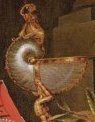
Nautilus cup
It is the association of the skull and the items of extreme wealth, such as the gold-stemmed Nautilus cup, casket overflowing with precious jewels and the gold crown which together remind us that wealth and power are futile in the face of death, which harks back to the passage in the book of Ecclesiastes in the bible.
Crown, skull, bellows and sword hilt.
Look at the richness of colour in this work. The glimmering pearls, the black and red gemstones, and the pearly grey shimmer of the Nautilus cup, which is adorned by golden figures. The whites and the golds of the crown and jewelled-bedecked sword hilt glitter in the light and are picked up in the gilded tassels of the table cloth.
As one looks at the painting one is seduced by the riches before us but one cannot get over the sight of the skull, symbolising death and the expiring taper which symbolises the transience of life, all of which serve as a warning that we should not be beguiled by such earthly wealth. Even the bellows is symbolic as they are used to pump life into a dying fire but in the painting, the bellows lie closed and of no use. The down-turned crown symbolises, which once represented power and kingship, has been symbolically overturned by death and even the bejewelled sword which once was an emblem of power and earthly might is rendered ineffectual by death.
But the painting is not all symbolising doom and gloom. There are also symbols of hope. The laurel wreath atop the skull and the open book present an encouraging note that fame achieved through learning can conquer death and this is corroborated by the note on the stone pillar:
FINIS CORONAT OPUS
(the end crowns the work)
which is a variant of the well-known Vanitas maxim:
Vita Brevis, ars longa
(Life is brief but art endures)
Vanitas still life by Evert Collier (1662)
Above is an early work by Collier, painted in 1662, during a period when he produced some of his best work. In this depiction he includes a candlestick, musical instruments, Dutch books, a writing set, an astrological and a terrestrial globe and an hourglass, all of which are on a table covered by a heavy ornate table covering. Once again these decorative and expensive objects indicate that wealth, knowledge and power are all earthly, temporary and ultimately meaningless. The tempus fugit theme is symbolised by the burning candle, pocket watch and hourglass which also represents the brevity of life; the violin with a broken string signifies the transient pleasure of music whilst the money bag denotes the worldly riches. The scholarly books and globes represent the vanity of learning, and the military flag denotes worldly power. On a piece of paper at far right one can once again read the words from Ecclesiastes:
Vanitas Vanitatu Et Omnia Vanitas
[Vanity of Vanities, All is Vanity]
The Vanitas work above by Collier is housed in the Denver Art Museum. This one, although having a number of Vanitas symbols, does not have a skull. Look at how Collier has given through this work the idea of it being 3-D when we know it is simply a 2-D painting. Such “artistic trickery” is known as trompe d’oeil (trick of the eye).
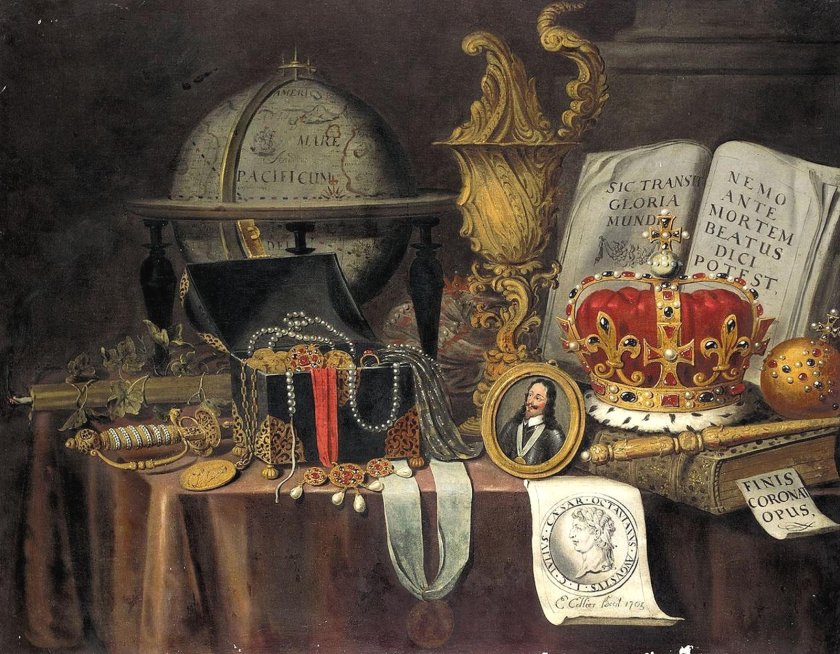
Vanitas painting by Evert Collier (1703)
Collier moved to London in 1693, where he lived almost ten years. In 1702, Collier returned to Leiden, where he worked productively for four years. However, due to circumstances, the artist was forced again to move to London. There, in September 1708, Evert Collier died, aged 66 and was buried in the cemetery of the church of St James’s Piccadilly.
The subject of my blog today reflects moments of my past life, from the days when I spent years journeying across the oceans and earlier when, at the age of sixteen, I had to sit the national exam in English Literature. The examination was based on a book, a Shakespearian play, and a poem, all of which, we had to read, over and over again and dissect each into bits of minutiae. My classmates and I were delighted to find the book we had to read and digest was a novel by H.G.Wells. We had all heard of and/or read his Time Machine and War of the Worlds so we looked forward to the book set by the exam board.
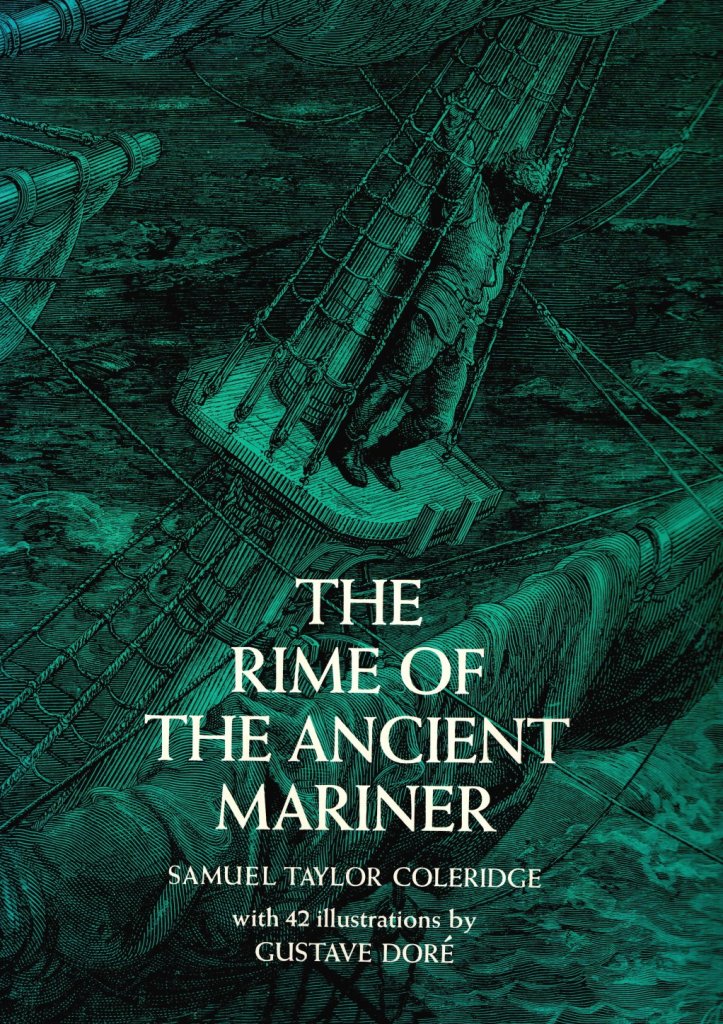
Our hopes were soon dashed as we set about reading The History of Mr Polly which I remembered to be both turgid and depressing but there again I have to admit I was never an avid reader. The Shakespearean play was the Merchant of Venice which proved a lucky choice and one which I especially enjoyed when we looked at it in depth. Then came the poem. Poetry was anathema to sixteen year old boys and “boys don’t do poetry” was our class mantra and one needs to remember that our school was an all-boys one. Add to that the feeling of gloom about embarking on reading and learning lines of the poem for furthermore this chosen poem, which we had to study was not a short one with just a few stanzas but an extremely long one. It was The Rime of the Ancient Mariner, which was the longest major poem by the English poet Samuel Taylor Coleridge, and one he completed and had published in 1798. Unbelievably it proved to be my favourite part of the English Literature exam syllabus.
Camden Lock Market at night.
I was in London last week and visited Camden Lock which has a great market and a plethora of “arty” shops including an excellent second-hand book shop where I found a number of books to buy, one of which was The Rime of The Ancient Mariner with forty-two illustrations by Gustave Doré. My blog today looks at Gustave Doré and some of the illustrations used in the book.
Journal pour rire
Paul-Gustave Doré was an Alsatian, born on January 6th, 1832, in Strasbourg. He became known as one of the most prolific and successful book illustrators of the late 19th century, whose high-spirited and somewhat strange fantasy-fashioned sizeable dreamlike scenes were widely loved during the Victorian period.
Doré was considered by many as a child genius when it came to his artistic ability. By age five, he was creating drawings that were mature beyond his years. In his late teenage years, he created several text comics, like his 1847 “comic” Les Travaux d’Hercule. Others followed and so well-liked were his works that he won a commission to illustrate books by Cervantes, Milton, and Dante.
Honoré de Balzac’s Les Contes drolatiques (Droll Stories) were illustrated by Gustave Doré
In 1848, when he was fifteen years old, Doré, went to Paris and began working as a caricaturist for the French paper Le Journal pour rire (Journal for laughs) as well as producing, over the next six years, several albums containing his lithographs.
Oeuvres de Rabelais, illustrated by Gustave Doré
His most accomplished work could be seen in his illustrations in such books as the 1854 edition of the Oeuvres de Rabelais, the 1855 edition of Honoré de Balzac’s Les Contes drolatiques (Droll Stories), and the 1861 edition of Inferno of Dante.
Andromeda by Gustave Doré (1869)
He also painted many large compositions of a religious, mythological, or historical character such as his 1869 work, Andromeda. The painting depicts Andromeda, the daughter of the Aethiopian king Cepheus and his wife Cassiopeia. When Cassiopeia’s boasts that Andromeda is more beautiful than the Nereids, the sea nymphs, Poseidon sends the sea monster Cetus to ravage Andromeda as divine punishment. Andromeda is stripped and chained naked to a rock as a sacrifice to sate the monster but is saved from death by Perseus.
Glen Massan by Gustave Doré
One of my favourite paintings by Doré was his spectacular landscape scene entitled Glen Massan. Doré first visited the Scottish Highlands in 1873 on a salmon fishing trip with his good friend Colonel Teesdale. However, it turned out that Doré preferred to paint rather than fish and was inspired by the beauty of the Highland landscape, so much so, he returned to northern Scotland the following year. This painting, of Glen Massan near Dunoon, is a large canvas painted in a romantic Victorian style. I like the way Doré has depicted shafts of light penetrating the billowing clouds and lighting up parts of the valley.
And so to the Samuel Coleridge Taylor poem, The Rime of the Ancient Mariner. Doré was excited about illustrating the poem, so much so he had completed the designs for the illustrations before a deal had been struck with the publisher. The wooden blocks he used for the illustrations were very large and cost Doré a lot of money and unlike previous engravings he took control of the supervision of them. Doré believed that this was his greatest work but unfortunately for him, its sales recouped him only slowly for his large initial outlay. It was first published in England and soon editions appeared in France, Germany and America.
Samuel Coleridge Taylor did not set his poem in any one period but as an illustrator, Doré had to be more precise and he chose a medieval setting for the wedding feast at the start of the poem.
The opening setting for the poem is a path leading to a church where three of wedding party are heading. An elderly man with a grey beard, the Ancient Mariner, halts them to tell his tale. Two escape his clutches but the third is trapped and made to listen. It is an ancient Mariner, And he stoppeth one of three. “By thy long grey beard and glittering eye, Now wherefore stopp’st thou me? “The Bridegroom’s doors are opened wide, And I am next of kin; The guests are met, the feast is set: May’st hear the merry din.”
The old sailor recounts how the sea voyage had started well but soon the ship was being drawn southward by a storm and the men had lost control of the vessel.
With sloping masts and dipping prow, As who pursued with yell and blow Still treads the shadow of his foe And forward bends his head, The ship drove fast, loud roared the blast, And southward aye we fled.
Soon the Ancient Mariner’s ship was trapped in the Antarctic ice with no hope for survival.
And through the drifts the snowy clifts Did send a dismal sheen: Nor shapes of men nor beasts we ken — The ice was all between. The ice was here, the ice was there, The ice was all around: It cracked and growled, and roared and howled, Like noises in a swound!
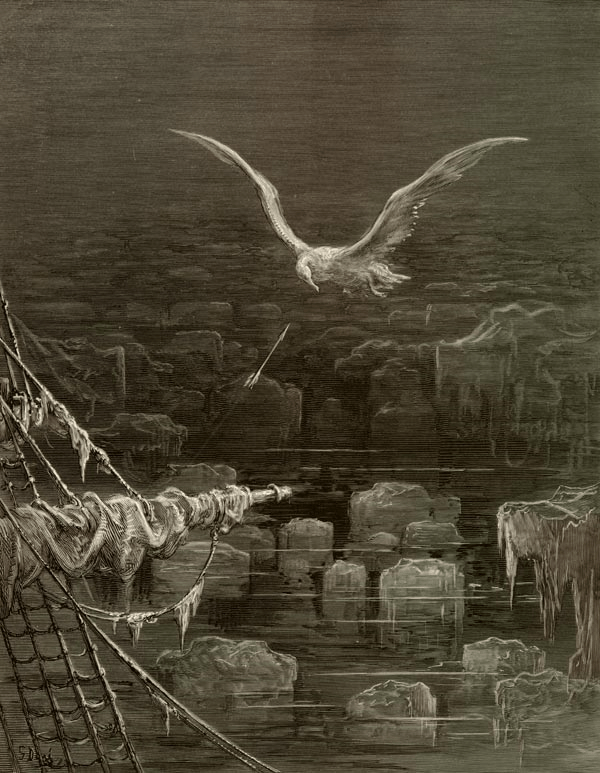
The Ancient Mariner recalls how the sailors believed they were doomed and all hope had gone – until the arrival of an albatross, which came each day and was fed by the sailors. The bird then led the ship and the sailors away from their icy prison and all aboard celebrated their good fortune.
At length did cross an Albatross: Thorough the fog it came; As if it had been a Christian soul, We hailed it in God’s name. It ate the food it ne’er had eat, And round and round it flew. The ice did split with a thunder-fit; The helmsman steered us through! And a good south wind sprung up behind; The Albatross did follow, And every day, for food or play, Came to the mariners’ hollo!
However for some unknown reason the Ancient Mariner shot the albatross with his crossbow.
“God save thee, ancient Mariner! From the fiends, that plague thee thus! — Why look’st thou so?”— With my cross-bow I shot the ALBATROSS.
At first the sailors, despite condemning the old mariner for his action, seemed to be pleased that the south wind which had been mustered up by the albatross was still with them and they had left the cold waters of Antarctica and approached the warm waters of the Equator. All was good with the crew and their ship, but then the wind dropped and the ship was becalmed.
Down dropt the breeze, the sails dropt down, ’Twas sad as sad could be; And we did speak only to break The silence of the sea! All in a hot and copper sky, The bloody Sun, at noon, Right up above the mast did stand, No bigger than the Moon. Day after day, day after day, We stuck, nor breath nor motion; As idle as a painted ship Upon a painted ocean.
Water, water, every where, And all the boards did shrink; Water, water, every where, Nor any drop to drink. The very deep did rot: O Christ! That ever this should be! Yea, slimy things did crawl with legs Upon the slimy sea.
The becalmed ship was surrounded by evil creatures of the sea and soon the blame for their misfortune fell on the Ancient Mariner for killing the albatross. Close to death they suddenly spot a shape on the horizon – could it have come to their rescue?
There passed a weary time. Each throat Was parched, and glazed each eye. A weary time! a weary time! How glazed each weary eye, When looking westward, I beheld A something in the sky. At first it seemed a little speck, And then it seemed a mist: It moved and moved, and took at last A certain shape, I wist.
The ghostly hulk approaches their ship and on board are two figures, a skeletal Death and a deathly pale female, Night-mare Life-in-Death and the two are playing dice for the souls of the crew members. Death wins the lives of all the crew members, all except for the Ancient Mariner, whose life is won by Night-mare Life-in-Death. It is the name of this character that allows us to know the fate of the Ancient Mariner – a fate worse than death, a living death, was to be his punishment for killing the albatross.
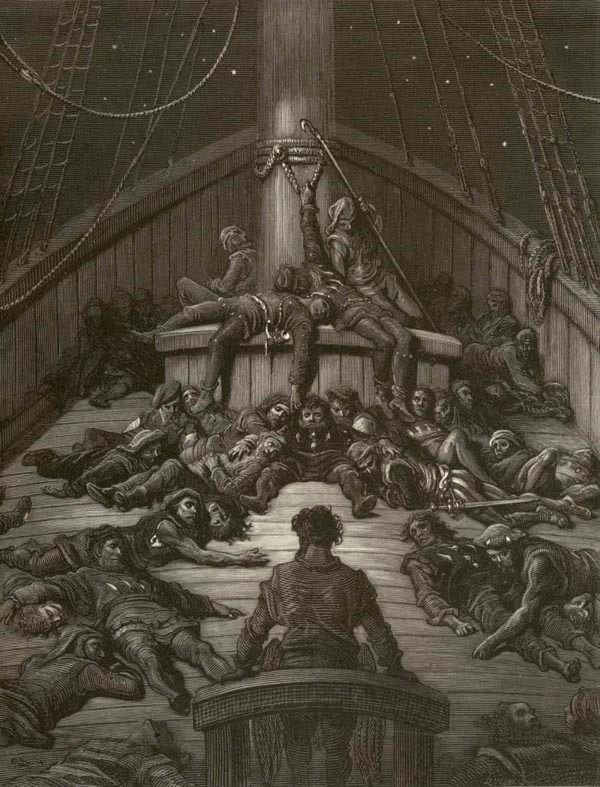
The Ancient Mariner is the sole survivor of the ill-fated crew. The bodies of the dead crew members lay around the deck with their eyes staring at the Ancient Mariner. The Ancient Mariner recounts how he felt, how he wanted to die but was not allowed that luxury.
I looked to Heaven, and tried to pray: But or ever a prayer had gusht, A wicked whisper came, and made my heart as dry as dust. I closed my lids, and kept them close, And the balls like pulses beat; For the sky and the sea, and the sea and the sky Lay like a load on my weary eye, And the dead were at my feet. But the curse liveth for him in the eye of the dead men. The cold sweat melted from their limbs, Nor rot nor reek did they: The look with which they looked on me Had never passed away. An orphan’s curse would drag to Hell A spirit from on high; But oh! more horrible than that Is a curse in a dead man’s eye! Seven days, seven nights, I saw that curse, And yet I could not die.
I suppose you may curse me, like the curse put on the Ancient Mariner, but I am not going to tell you the end of the story in the hope that you will go out and get yourself a copy of the epic poem, and if possible, a copy with the Gustave Doré’s woodblock illustrations. You won’t regret it.
For many people the name Grant Wood is synonymous with the painting American Gothic but in fact he completed many more superb works of art and in this blog I will look at some of my favourites.
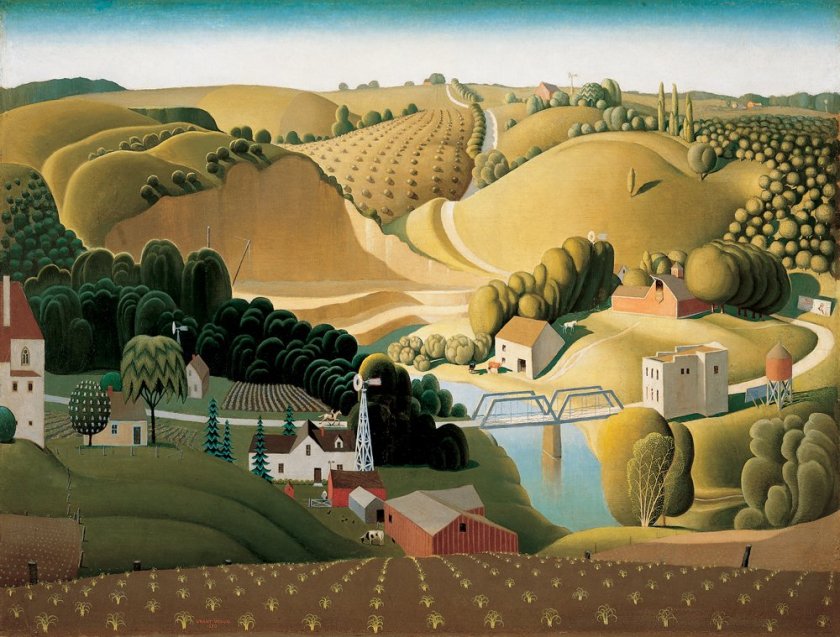
Stone City, Iowa by Grant Wood (1930)
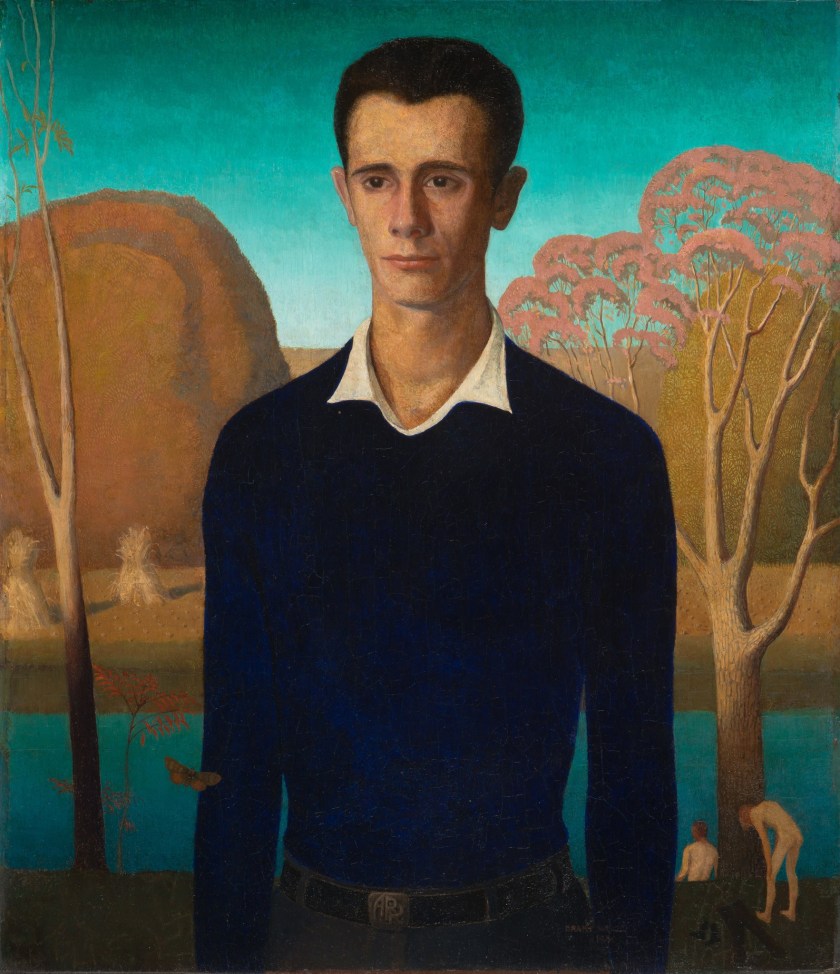
In 1930, the same year he painted American Gothic, he entered two of his works in to the Iowa State Fair Art Exhibition and was awarded first prize for the best picture of the exhibition and first prize in the oil portrait category for his Portrait of Arnold Pyle (see Grant Wood, Part 2) and first prize in the oil landscape category for his painting entitled Stone City. Stone City was Grant Wood’s first major landscape painting. It is a tranquil, idealized scene of life in harmony with nature. Stone City which is located on the Wapsipinicon River, twenty-six miles from Cedar Rapids, was once a boomtown but it went bust. The boomtown came to fruition because of its limestone quarries and laid to rest by the development of Portland cement. Wood, through his painting, would like us to believe that the town has since reverted to a purer purpose of grazing animals and growing crops. In his 1995 book Grant Wood: An American Master Revealed, James Homs wrote about this painting:
“…Although Stone City, Iowa was based on a direct study of a place with which he was thoroughly acquainted, he turned this village and its river valley site into a fantasy of curving contours, ornamental trees and brightly patterned surfaces. Wood considered the “decorative adventures” of his commonplace rural surroundings – their inherent elements of abstraction – as the true origin of the most lasting qualities in his work…”
The Midnight Ride of Paul Revere by Grant Wood (1931)
In 1931, a year after American Gothic, Wood finished another of his well-loved paintings entitled The Midnight Ride of Paul Revere. Wanda Corn, a biographer of Wood, wrote that as a child, Wood had been captivated by the tale of Revere’s journey through the night from Boston to Lexington to warn the patriots of the British advance. Like most Americans of his day, Wood would have learned about the American legend from a poem by Henry Wadsworth Longfellow, which was published in 1863:
Listen, my children, and you shall hear Of the midnight ride of Paul Revere, On the eighteenth of April in Seventy-five; Hardly a man is now alive Who remembers that famous day and year.
Like many young boys, Wood was captivated by the idea of a local hero carrying vital news, raising the alarm, and through this brave deed, achieving immortality. Wood probably liked to imagine himself on just such an assignment galloping from farm to farm to warn his neighbours of an approaching tornado and then being held aloft as the local hero having saved so many lives.
Toy Town like geometric houses
Grant Wood’s depiction is viewed from above. We see a vast sweep of countryside and a village with houses depicted as simple geometric shapes, which resembles a “toy town” where the houses are made with wooden blocks. The painting portrays the hero on horseback as he gallops through a small village which is nestled among the trees which are painted in Wood’s favoured “sponge-like” representation. Ahead of this American hero, as he rides out of town, is darkness, behind the horse and rider are houses with lights on and some of the occupants, woken by Revere’s warning calls, stand in their night clothes on their front steps and in the street. Woods intention in depicting this piece of American folklore was, as he put it, to save those bits of American folklore that are too good to lose. His intention was, during the Great Depression, to remind people of historic times of the past, to remind people of the greatness of their country. However, his work had many detractors who said that his child-like depiction made fun of this American legend.
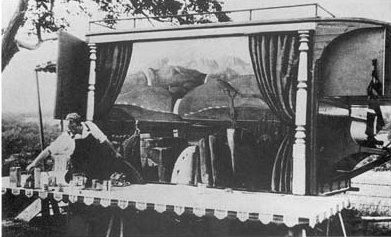
Grant Wood painting his Stone City ice wagon quarters (c. 1932) Photographer: John W. Barry, Jr. Courtesy of the Grant Wood Art Gallery, Anamosa, IA.
By 1932, Wood’s reputation as an artist had risen significantly and he became co-founder of the Stone City Colony and Art School in Iowa. along with Edward Rowan, the director of the Little Gallery in Cedar Rapids, Adrian Dornbush, the former director of the Flint Institute of Art who was an art instructor at the Little Gallery. The Stone City Art Colony was a home and a place to paint for artists in the Midwest. As a teacher at the colony Grant Wood was able to spread the message of Regionalism to aspiring artists. Unfortunately, the art colony was always plagued by financial difficulties and closed in the autumn of 1933.
The Corn Parade mural by Orr C. Fisher, in the Mount Ayr, Iowa, post office (1941)
In 1934 Grant took on a position with the art department at the University of Iowa, and also in that year, he was named director of the Public Works of Art Project in Iowa. Grant Wood later took on many of the artists at the artist colony in that project, a programme which employed artists, as part of the New Deal, during the Great Depression, and which he administered for the state of Iowa. The programme produced a large number of Depression Era murals that can still be viewed on the walls of rural post offices and public buildings in Iowa. In her book Wall To Wall America: Post Office Murals in the Great Depression by Professor Karal Ann Marling, she explains that the concept for nine years, from 1934 to 1943 She said that the Federal Government, under the Public Buildings Administration, commissioned murals for a variety of newly constructed post-offices around the United States. Life magazine, named it “Mural America for Rural America.” It was a programme designed to get starving artists out of the garrets and into suitable work that would decorate bare walls, edify the public, and put some spare change in their pockets.
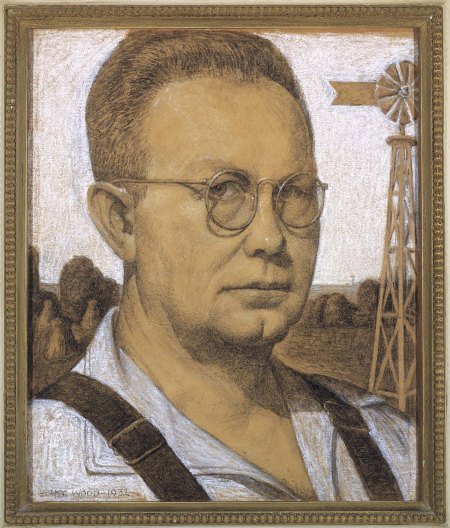
Grant Wood in his favoured rural-type bib and braces
In 1935 Grant Wood published the essay “Revolt Against the City,” in which he laid out the tenets of the Regionalism movement. For him Regionalism was a movement to which artists all over the United States must dedicate themselves in order to avoid a colonial dependency on European tradition. He felt that the rural Midwest, (the farmer’s life, dress and setting) would provide the richest kind of material for a truly indigenous regionalist style.
Joseph Chamberlain Furnas was an American freelance writer. He is best known for his article, commissioned for the Reader’s Digest, “—And Sudden Death!” This article brought national attention to the problem of automobile safety and is the most-reprinted article in the Digest’s history. In it he wrote:
“…An enterprising judge now and again sentences reckless drivers to tour the accident end of a city morgue. But even a mangled body on a slab, waxily portraying the consequences of bad motoring judgment, isn’t a patch on the scene of the accident itself. No artist working on a safety poster would dare depict that in full detail…”
Death on the Ridge Road by Grant Wood (1935)
It could be that Grant Wood read the whole article in the August 1935 edition of the Reader’s Digest and it was that, that made him paint Death on the Ridge Road in 1935. It is a painting all about movement but with a bleak message about death on the roads. The painting vividly depicts the bends of the road, the shapes and positions on the road of the vehicles careering towards one another. It is a bleak and stormy night. Even the telegraph pole at the top of the hill seems to be bending over due to the ferocity of the wind and, in the background, we sense that the storm clouds are scuttling across the sky depositing rain which will moisten the road surface. The tarmacked road bends are bordered by barbed-wire fences as it cuts through green hills. The large red truck rushes headlong over the crest of the hill towards an on-coming black car which has skidded across the road into its oncoming path. We know what is going to happen next. We know there will be deaths and the arms of the telegraph poles now seem to symbolise crosses on a grave. Maybe Wood was warning us about the dangers of technological progress.
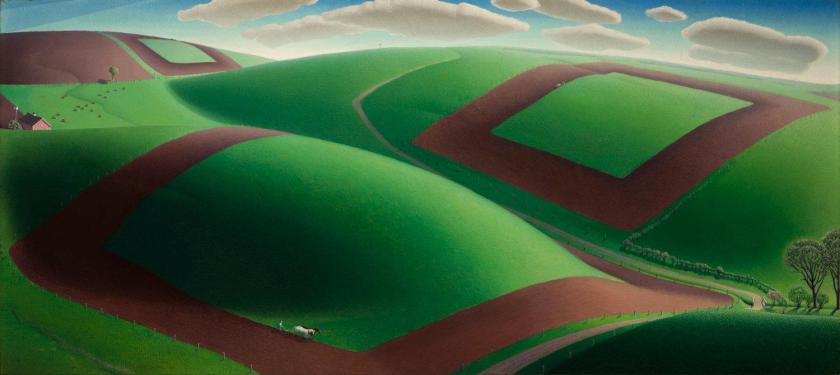
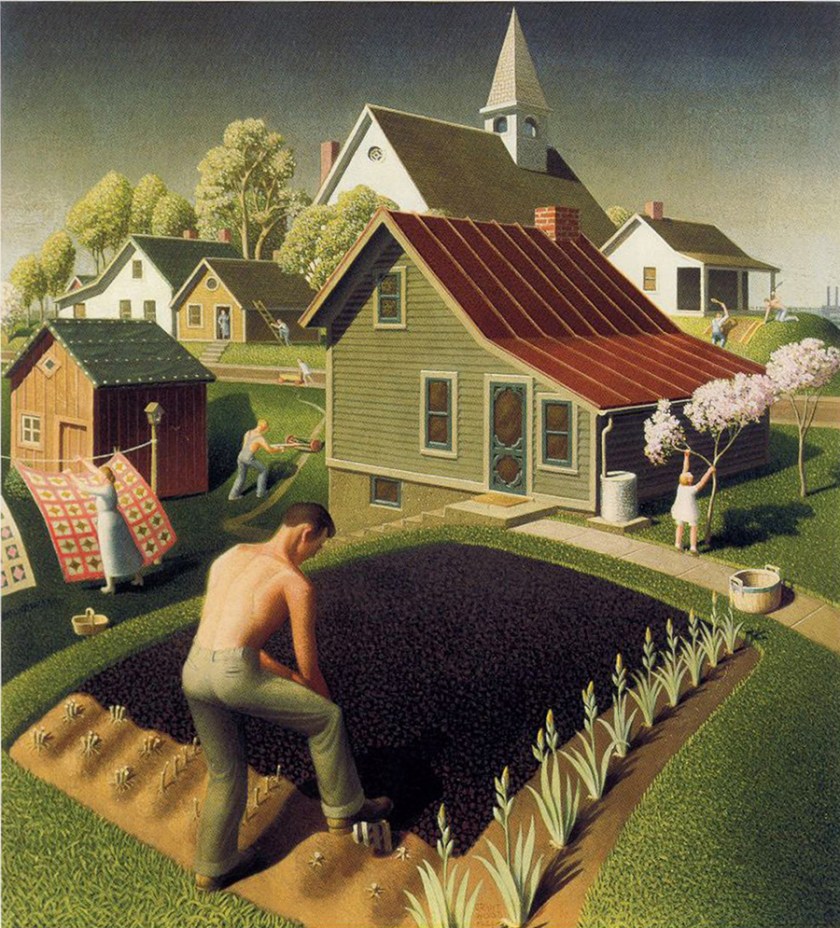
Spring Turning by Grant Wood (1936)
Grant Wood painted a very hypnotic work in 1936 entitled Spring Turning. This type of work by Wood is often referred to as Magic Realism. The term magical realism, was first expressed in a discussion of the visual arts. The German art critic Franz Roh, in his 1925 book, Nach Expressionismus: Magischer Realismus: Probleme der neuesten europäischen Malerei (After expressionism: Magical Realism: Problems of the newest European painting). In it he described a group of painters whom we now categorize generally as Post-Expressionists, and he used the term Magischer Realismus to both highlight and rejoice at their return to figural representation after a decade or more of abstract art.
With its bird’s-eye view of smooth, swelling hills and nearly abstract banded squares of green grass and ploughed earth, Wood’s depiction is probably from his own memory as a child on the family farm in Anamosa. There is no evidence in the depiction of cars, farm machinery, paved roads, or electric wires. Wanda Corn in her 1983 book, Grant Wood: The Regionalist Vision, describes the work as a tale about:
“…man living in complete harmony with nature; he is the earth’s caretaker, coaxing her into abundance, bringing coherence and beauty to her surfaces…”
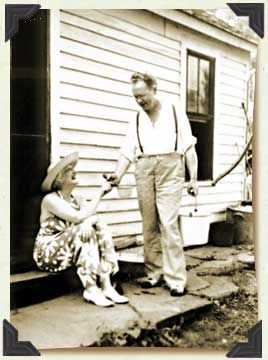
1935 photograph of the happy couple – Grant (44) and his wife Sara (51)
Despite the successes Wood achieved with his paintings in the 1930’s his life was becoming stressful with the IRS chasing him for unpaid taxes and he began finding some solace in liquor. To add to his problems, on March 2nd, 1935, he, without warning, married a divorced woman, Sara Sherman Maxon, the former head of Michigan City’s School of Fine Arts and a former light opera singer The marriage took place in a small ceremony in Minneapolis, the town in which Sara was living, far from Grant’s home, and with none of his friends or family in attendance, as one report put it:
“…Wood’s neighbours read with astonishment that he was to be married that night in a small ceremony in Minneapolis. The fact that Cedar Rapids’ “bachelor artist” had a secret fiancée was nearly as dumbfounding as the circumstances of the wedding itself – a ceremony conducted with little warning, far from home, and with no friends or family in attendance…”
Grant Wood and his wife Sara Maxon
It was not a “marriage made in heaven” and many of Grant’s friends thought they were ill-matched, as Sara seemed flamboyant and overpowering whilst Grant was a socially awkward and reticent bachelor. Shortly after the couple were married, they moved to Iowa City where Grant was teaching at the University of Iowa.
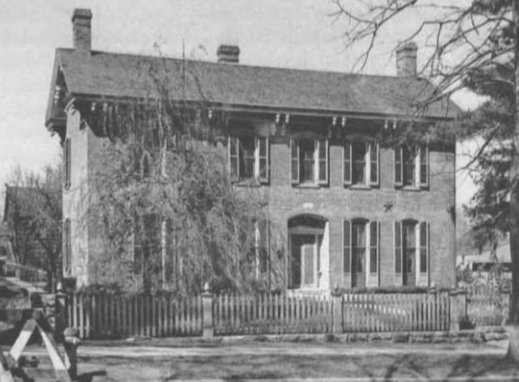
House in Iowa which Grant restored and served as home for his bride and his mother.
Wood bought an eighty-year-old house for $3,500 and spent almost $35,000 renovating and refurbishing it, which financially crippled him. The pair found it difficult to survive as a happily married couple. The marriage was a platonic affair and never consummated. Did Sara know that her husband was homosexual? It seemed to have been common knowledge of his friends and some of his students.
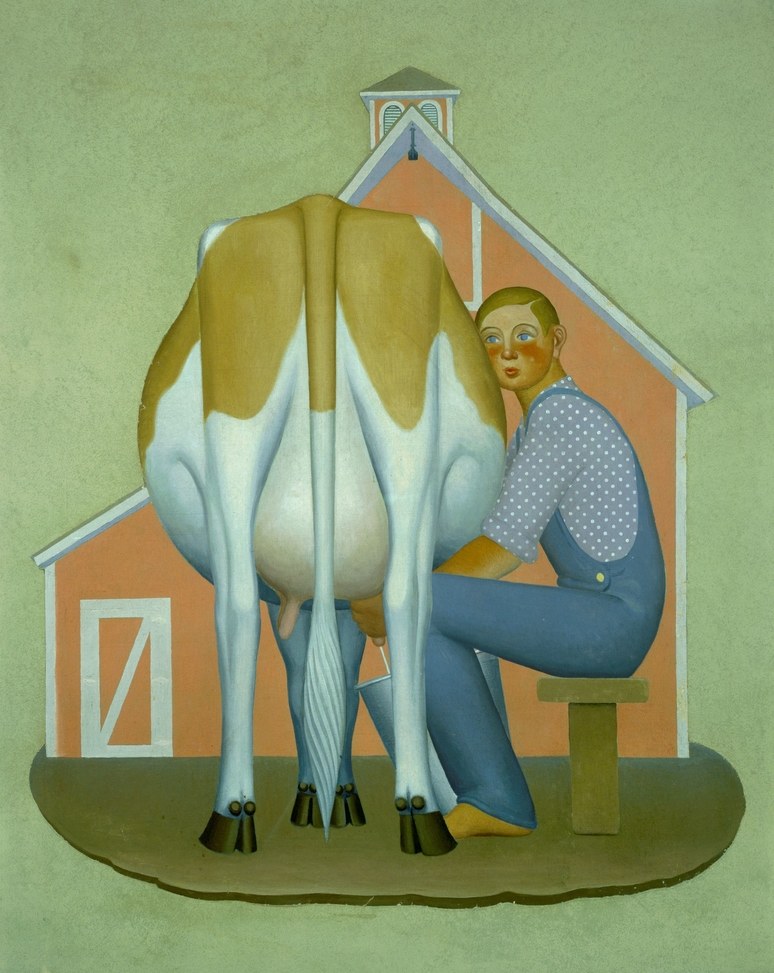
Boy Milking Cow, by Grant Wood (1932)
In the same year Grant and Sara married, Wood hired a handsome, athletic, young man, Park Rinard, as his personal secretary. Rinard, who lived in Falls Church, was born in Montana and grew up in Iowa. He graduated from the University of Iowa, where he also received a master’s degree in creative writing. It was while he was in graduate school that he became secretary to Grant Wood. Although not a homosexual himself, Rinard clearly understood Wood’s attraction to him. Rinard was the ghost writer for Grant Wood’s unfinished autobiography, Return from Bohemia. But Rinard’s presence only further pushed Sara to the side, which made her woefully unhappy.
The relationship between Wood and his wife was so bad at the end that, according to one account, he enlisted his housekeeper as proxy to deliver his desire for a divorce to Sara. Another account tells of Sara going to hospital because of a suspected heart attack (she was a notorious hypochondriac) and Grant sent a note to her telling her not to bother to return! The inevitable divorce came in September 1939.
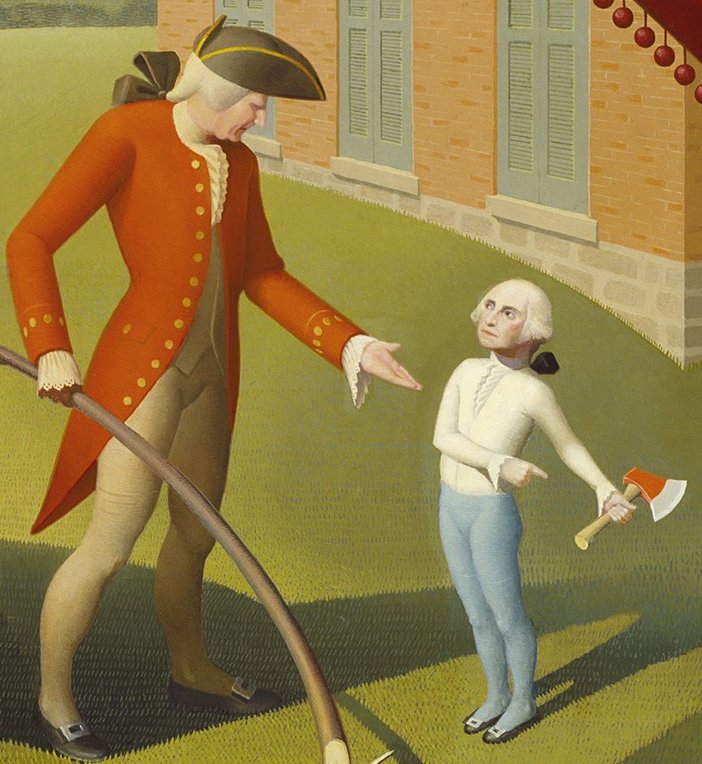
Parson Weems Fable by Grant Wood (1939 )
Another American folktale was the subject for a satirical work depicted in Grant Wood’s 1939 painting Parson Weems Fable. Mason Locke Weems usually referred to as Parson Weems, was an American book agent and author who wrote the first biography of George Washington, entitled The Life of Washington in 1800, immediately after the first President’s death in December 1799 . The tale of the cherry tree and Washington appeared in the fifth imprint of this bestseller book in 1805. The tale of the cherry tree (I cannot tell a lie, I did it with my little hatchet) was to highlight George Washington’s virtues, even as a six-year-old child, and was intended to provide a morally instructive tale for the youth of the young nation. Grant Wood created his work in celebration of historian Parson Weems and the first President George Washington. Weems’ anecdote told the story of the six-year-old future President chopping down his father’s favourite cherry tree and then owning up to it. Grant Wood’s regionalism style painting, this satirical work predicts the revolutionary spirit coming to colonial America. His contrast of colours conjures up a sense of impending change, particularly in the storm clouds we see gathering on the horizon.
Father and son, with the $1 bill face
Washington’s father Augustine is depicted as a red coat holding the fallen cherry tree with an outreached hand, while the unruly youth, painted with the adult head and face of Washington, as it appears on the $1 bill, on a child’s body, The child points at the offending hatchet. In the right-hand foreground, we see Weems, with a wry smile on his face, pulling a drape aside to reveal this iconic encounter. In the background we catch sight of two slaves picking cherries from another tree, and this could be a reference to another historic and revolution that was to come.
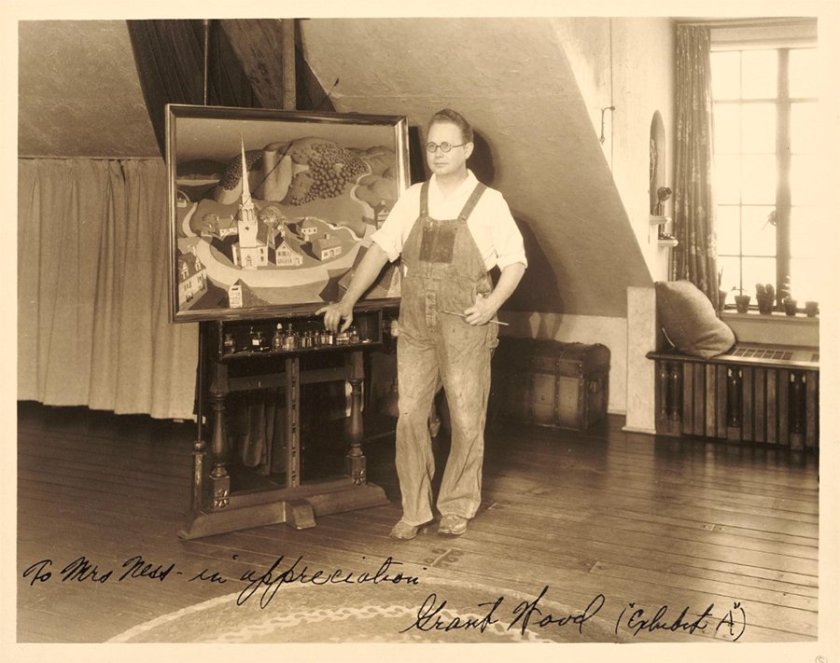
Grant Wood in his studio in1931
Grant Wood was a complex character. He constantly wanted to be known a “farmer-painter” and in many of the photographs of him we see him dressed in overalls which was bizarre as he hated farming. It is more than likely that his showy rural character was part of the style that he, Thomas Hart Benton, and John Steuart Curry promoted in the 1930’s as champions of American Regionalist painting. There is no doubt that they were nostalgic about the past and believed that the healthy values of the Midwest should be maintained as an antidote to their perceived view of the decadence and degenerate European lifestyle and the corruption which they believed sullied life in the American East Coast cities.
Young Corn by Grant Wood (1931)
Unfortunately for Grant Wood, his artistic legacy, which only lasted eleven years, was damaged, firstly by critics’ ridiculing his work, saying it was merely “regionalistic” and light-weight and secondly by wide spread rumours about his sexuality. The final part of the title of this blog mentioned “rumours” and I thought long and hard whether to even include the rumours about Grant Wood’s life. The rumours were about Grant Wood’s sexuality and I was not sure whether it had any bearings on his ability as a painter. A 1944 biography hinted at Wood’s homosexuality, as did the catalogue written by Wanda Corn that accompanied the travelling exhibition of Grant Wood’s work. However, she and other art historians had to be very careful what they wrote about Wood as his sister, Nan, was quick to litigate against any slurs about her brother. There were rumours of an attachment Wood had with his wife’s son, Sherman, from her first marriage who occasionally lived with them. Lester Longman, a modernist-minded colleague in the University of Iowa art department, where Wood had taught since 1935, tried to have him fired, in part on explicit moral grounds. However, the university ignored the charge and retained Wood. It was only after his sister’s death in 1990 that historians could write with more openness and impunity. In a 2010 biography, by R Tripp Evans, Grant Wood: A Life, he unequivocally states that Wood was a closeted gay man and someone who was terrified of having his sexual orientation uncovered.
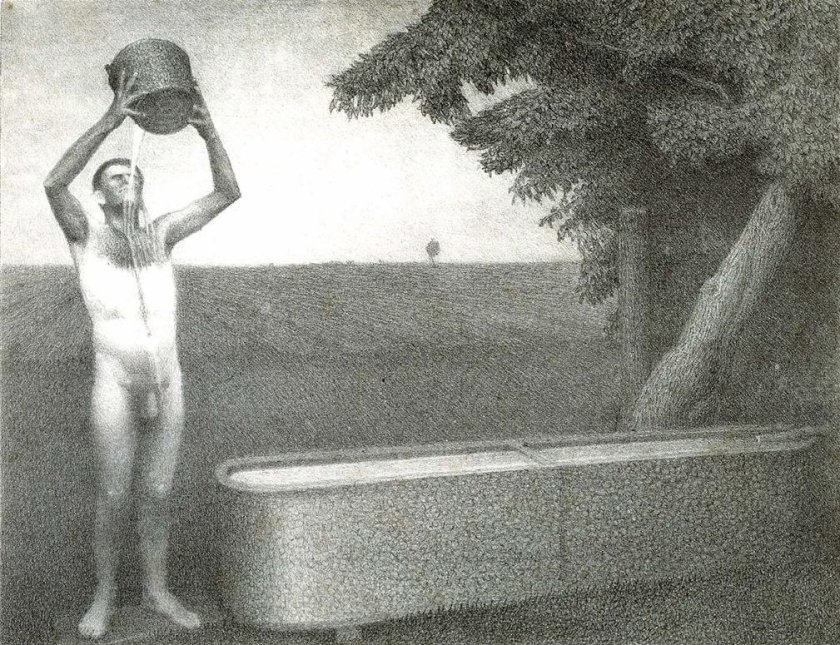
Sultry Night by Grant Wood (1939)
Probably another work by Wood which made people question his sexuality came about in 1939 when he produced a controversial lithograph, entitled Sultry Night. In it he depicts the farmhand pouring a pail of bathwater over his head in the empty dark of a field. We see water dripping from his mouth, along his chest, and down to his penis. The problem for Wood was that the depiction of the naked man is not posed in the academic postures of the classical nude, which may have made it more acceptable, but instead we see this splay-footed individual with his face upturned to receive the stream of water. Wood created the lithograph for Associated American Artists, a distributor of low-cost reproductions for the masses, but the print was quickly banned by the US Postal Service. Wood maintained that the depiction of the naked man was just a normal scene from his childhood memories of farm life, but despite his protestations that the image was not pornographic, the Postal Service upheld the ban.
Spring in Town by Grant Wood (1942)
Wood’s Regionalism was falling out of favour and that put him at variance with many of the university faculties and he became so frustrated that, in 1940, Grant Wood took a leave of absence from academia although he carried on with his paintings, which continued to show his faithful adherence to American Regionalism, the American art movement he was primarily responsible for founding. During his sabbatical period from lecturing and teaching he still carried on painting. His last works were a pendant pair entitled Spring in Town and Spring in the Country which he completed in 1941. They both illustrate his steadfast devotion to American Regionalism.
Spring in the Country by Grant Wood (1941)
In his sister’s 1993 autobiography, My Brother, Grant Wood, written by her with John Zug and Julie Jensen McDonald. Grant’s thoughts about the paintings are quoted:
“…In making these paintings, I had in mind something which I hope to convey to a fairly wide audience in America—the picture of a country rich in the arts of peace; a homely, lovable nation, infinitely worthy of any sacrifice necessary to its preservation…”
In 1941, shortly after taking his sabbatical, Grant Wood was diagnosed with pancreatic cancer and the doctors told him that he was terminally ill. On February 12th, 1942, just a day before his 51st birthday, he died. Park Rinard was at his bedside. Grant Wood was buried on his family’s plot in Anamosa. Reportedly, on his deathbed, he repeated over and over again that he wanted to paint his dead father, whom he had “lost” at the age of ten. Thomas Hart Benton, a fellow Regionalist, who visited Wood before his death, later remarked:
“…It was if he wanted to destroy what was in him, and become an empty soul before he went into the emptiness of death…”
He died in debt and his contribution to American art was mostly forgotten by the late 1930’s with international political concerns overshadowing domestic ones. His beloved Regionalist art was condemned for being too parochial, too much of Midwestern chauvinism and a genre which failed to change despite the onset of American Abstract Expressionism which was about to dominate in the post-war years. If remembered at all, it was for one work which has always been judged, as not his finest or most interesting, but one which has now become an iconic work, famous all around the world.
After Wood’s death in 1942, Nan inherited his estate and devoted the rest of her life to maintaining and promoting his legacy. Nan, who had married a real estate investor, Edward Graham, died in 1990, aged 91.
I could have attached many more of Grant Wood’s paintings but I am sure if you like what you have seen in these three blogs about his life you will search out more of his work.
————————————————-
Most of the information I gleaned for these three blogs on Grant Wood came from the usual sources such as Wikipedia and the following websites:
When Grant Wood spent time in Munich overseeing the production of stained glass for the memorial window for the Veterans Memorial Building in Cedar Rapids he had time to visit the city’s museums and he was inspired by the artistry of the painters from Netherlands, especially Jan van Eyck and the portraiture of the Renaissance artists.
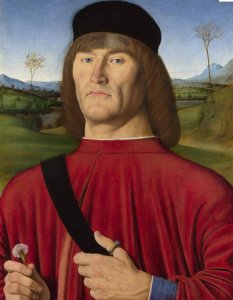
Man with Pink Carnation by Andrea Solari (c.1495)
Portraiture normally has a plain background so as not to detract from the sitter but often in Renaissance portraits a landscape background was used which would give you some knowledge about the sitter.
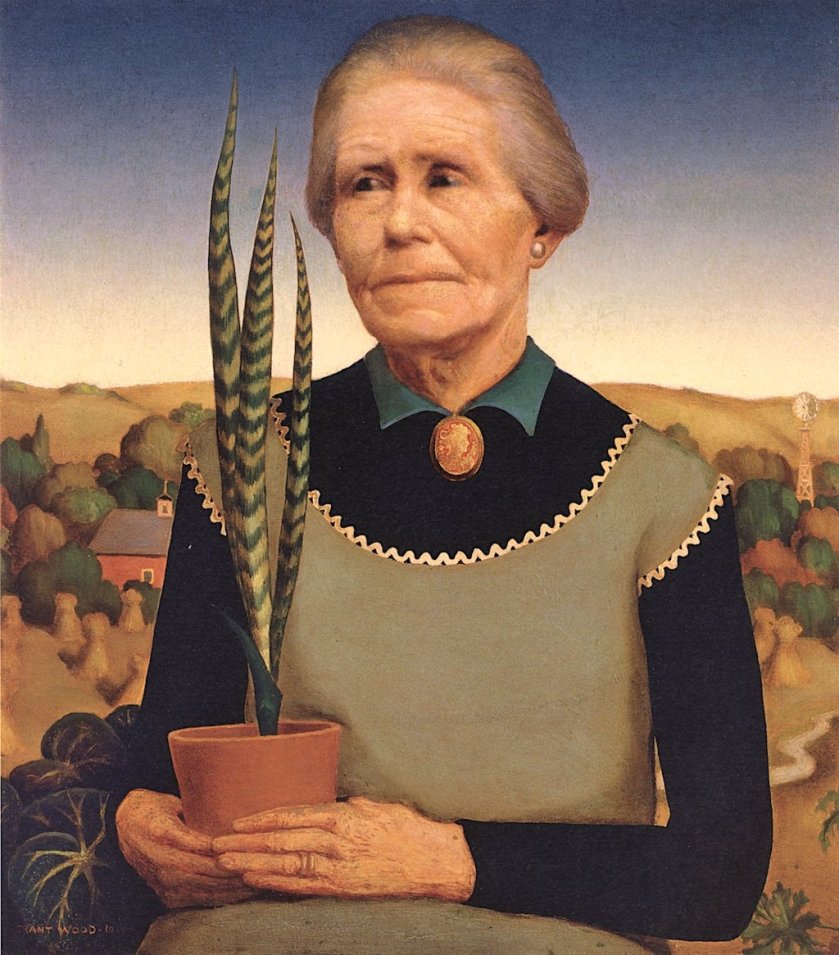
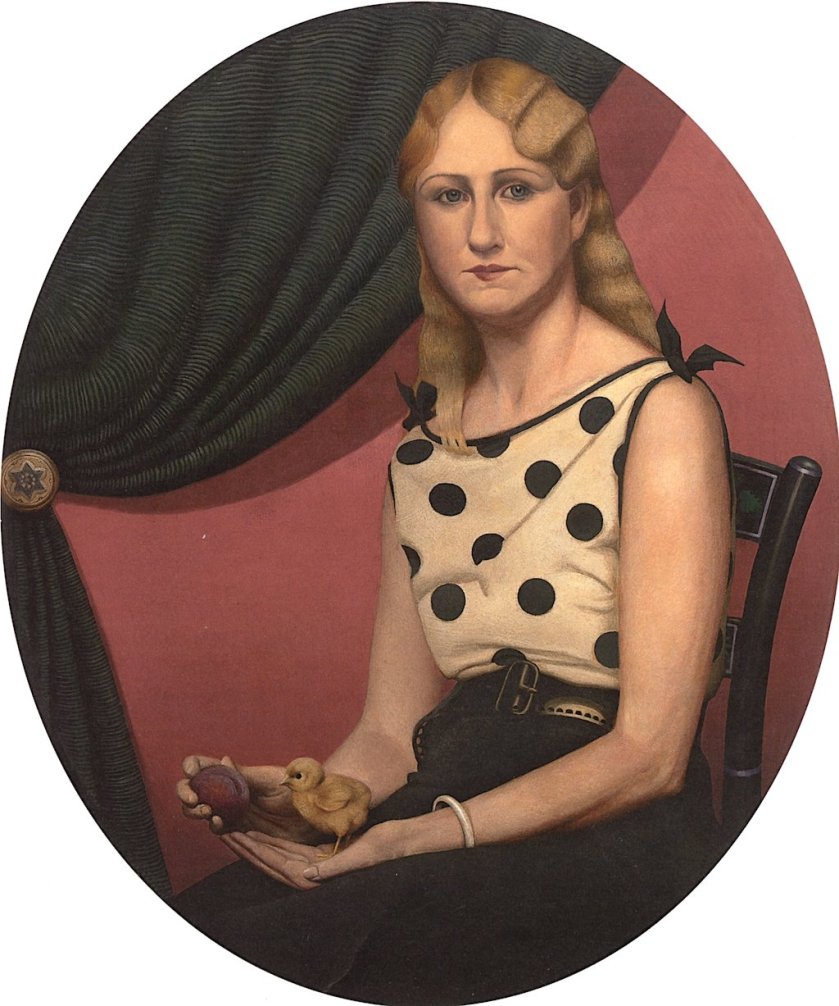
Woman with Plant by Grant Wood (1929)
No doubt Grant Wood remembered that type of portraiture when he painted Woman with Plant in 1929. In this work we see a Midwestern woman in country clothes, wearing a cameo broach and an apron bordered with rick-rack stitching. In her hands she holds a plant pot containing a snake plant. She is the epitome of the pioneer woman, and this is a Renaissance-style work with its half-length figure in the foreground and a landscape backdrop and it is the inclusion of a windmill and sheaves of corn which marks it as an American Midwestern depiction. This was actually a portrait of his mother !
Arnold comes of Age (Portrait of Arnold Pyne)
In August 1930 at the Iowa State Fair Grant Wood’s painting entitled Arnold comes of Age which was his portrait of twenty-one year old, Arnold Pyne, his assistant on the Memorial Window project.
Des Moines Tribune-Capital, August 20th 1930
The renowned American journalist and correspondent for the Chicago Tribune from 1925 to 1932, covering Europe, William Shriver, once asked Grant Wood whilst in Paris, why, having witnessed the emerging art styles in Europe in the 1920’s, would his artistic style change. Wood answered by likening himself to the famous American novelist, short-story writer, and playwright, whose 1920 novel, Main Street, satirised the strict conservatism of small-town life. :
“…I am going home to paint those damn cows and barns and barnyards and cornfields and little red schoolhouses… and the women in their aprons and the men in their overalls and store suits… Isn’t that what Sinclair Lewis has done in his writing… Damn it, you can do it in painting too!…”
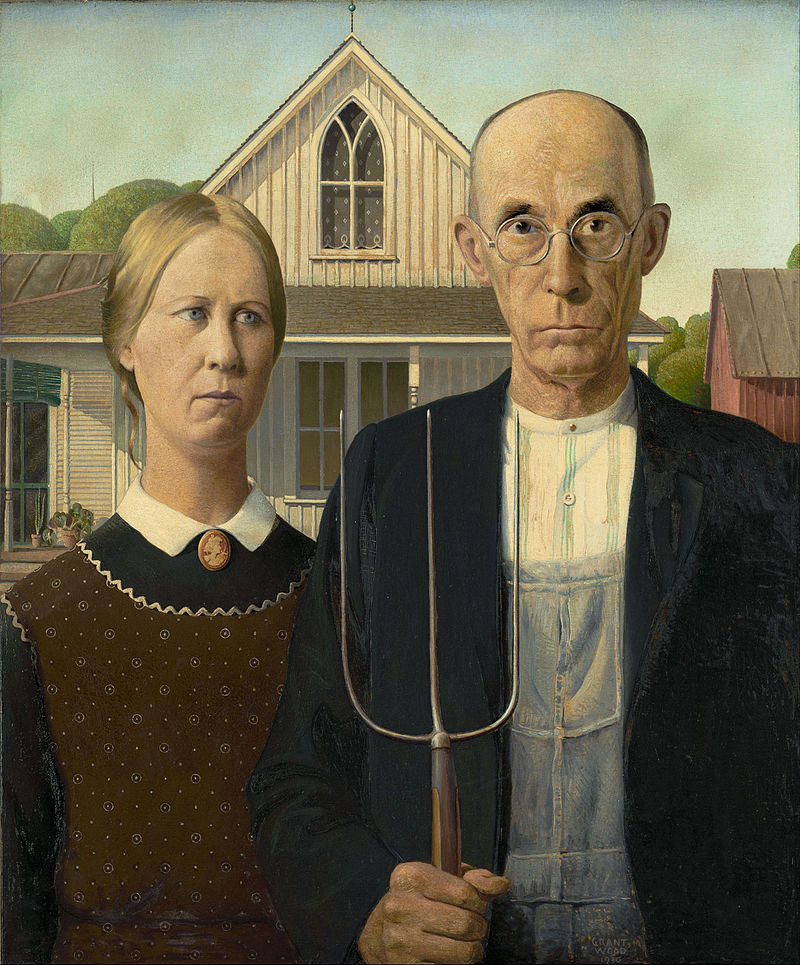
American Gothic by Grant Wood (1930)
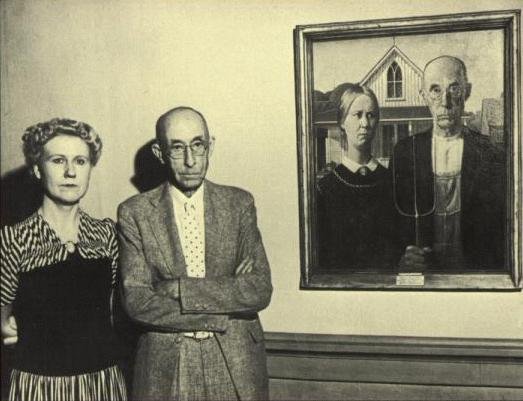
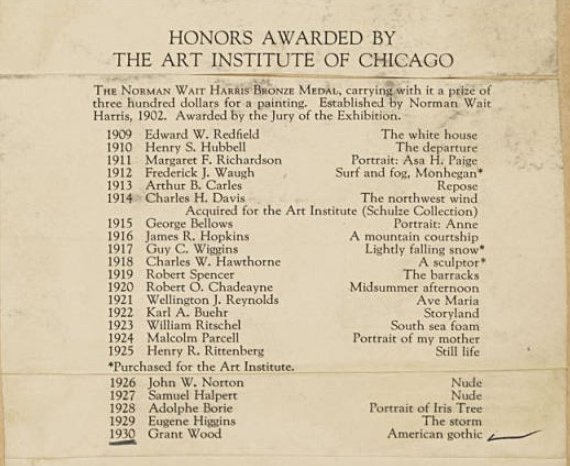
A year after the stained glass window was installed at the Veterans Memorial Building in Cedar Rapids, Grant Wood completed his iconic painting American Gothic, a painting which many consider to be the most famous painting in American art. So how did all come about?
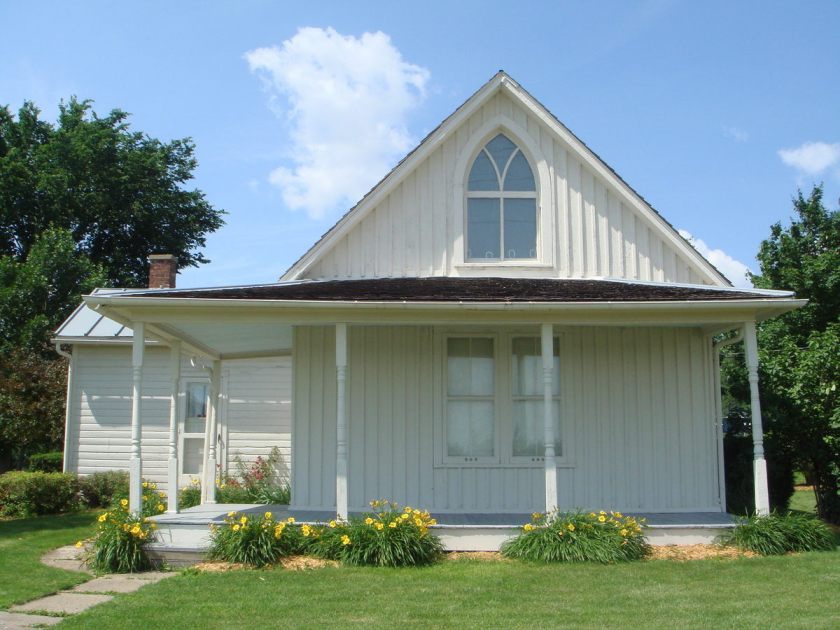
In the spring of 1930, Grant Wood decided to take a weekend off from his painting and drove the 12o miles from his home in Cedar Rapids, to the home of one of his former student in Eldon, Iowa. The road trip passed through gently rolling patchwork of farmlands of central and south Iowa between the Cedar River to the Des Moines River. On a Sunday morning in early April, Wood came upon the now-famous house. It was known by the local residents as the Dibble House as it was built by Eldon resident, Charles Dibble, a Civil War veteran and livery stable owner in 1882 for his family, which included himself, his wife, and his eight children.
The American Gothic House in Eldon, Iowa
The house was built in a style known as Carpenter Gothic, or Rural Gothic, and is a North American architectural style-designation for an application of Gothic Revival architectural detailing and picturesque massing applied to wooden buildings erected by house-carpenters. This terminology is used when the design of lofty architecture of European cathedrals is applied to American frame houses. The Eldon house was a small, simple frame structure and was no different than many houses dotted around Wood’s home in Cedar Rapids. However, it had one unusual feature. On the second storey there was a single gable with an inset narrow Gothic window. The house mesmerised Wood and he began to wonder what type of people lived in such a house, so much so, after driving around the block he knocked on the door and introduced himself to the residents who showed him around the interior. After thanking the young couple he went back to his car, grabbed his paints and made a quick oil sketch of the house.
The Sunday Register, December 1st 1930
After he got back home he told his sister Nan about the house and how it had captivated him. The one aspect of the exceptional house which disappointed him was the fact that the residents were not whom he had envisioned for they were a young couple. He said to Nan:
“… I’ve decided to do a painting of the kind of people I think should live in that house. I thought about it last night. I have a woman in mind, Nan, but I’m afraid to ask her to pose, because, you know, like all the others, she’ll want me to make her look young and beautiful. And I’m not going to paint her beautiful in this picture. So she’ll be disappointed…”
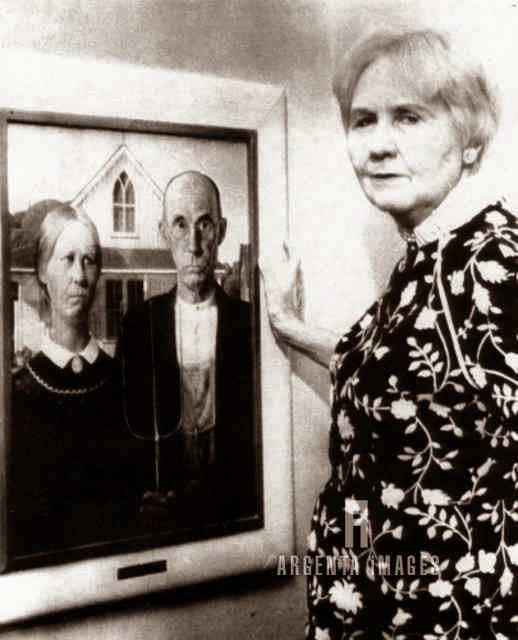
Of course, we now know that the woman in the painting would be his thirty-one year old sister, Nan, but there lay the problem for Grant, for the woman he intended to paint was going to be an “old maid”. However, even knowing the problem he still asked his sister to pose and he showed her his preliminary oil sketch.
American Gothic painting satirised
There was a long pause before Grant answered his sister’s question. Finally he addressed his sister asking her, if she was willing, to pose for the picture. He then had to sell the concept to her as he wanted the “daughter” to have a plain and old-fashioned appearance and her facial expression was to be one of sternness and sombreness. He asked Nan to imagine what it would be like to be under the control of her elderly and authoritarian father. Nan agreed and that afternoon went off to the store to buy some appropriate sombre brown and black clothes for the painting, as she later recalled:
“…. We were supposed to be small-town people. We were really not supposed to be farmers, but just small-town folk. We would own maybe a cow to milk, and we would have a little garden to tend for ourselves. But we’d keep all we grew and not sell anything in the market. Grant and I talked and talked about this. The man in the painting – who was supposed to be my father, would do some tinkering around the house, we decided. We tried to determine what the mother and wife would look like, but we just could not agree on anything. So we decided that the man was a widower. Now, when we talked about this, we tried to imagine what expression would be on the face of the man and his daughter. When we finished talking about this, I posed…”
Nan later remembered the posing for the painting:
“…It was really difficult because Grant was always joking. And both of us would break into laughter, and then we would have to start all over again. It was hard to go from being Grant Wood’s sister and joking with him in the studio to being a farmer’s daughter standing in front of a house. When I was posing and I lost my concentration, Grant would always draw me back to the work at hand by begging, ‘Come on, now, Nan. I’m trying to do your face and I really need you to look sour.’ So I looked sour, the best I could. And so he painted me…”
His depiction of a plain, stern-faced Iowa woman has an everlasting, inscrutable quality and some who saw the painting called her the “American Mona Lisa.”
Grant explained to her that he would paint the house in the background and, standing side by side in front of it would be an elderly man and his daughter and that he intended to approach his sixty-three year old dentist, Byron McKeeby, to pose as the man. Grant had exchanged some of his paintings in lieu of payment for dental work with him and he knew McKeeby liked his work, so he was sure he would pose for the painting.
For Nan, Grant could do no wrong, and she was a constant source of encouragement to her brother. She had no misgivings about posing for the American Gothic painting even though she knew ahead of time it would probably be very unflattering. However, she harboured no resentment towards her brother, once saying:
“…Grant made a personality out of me. I would have had a very drab life without it…”
Some say the pair depicted were husband and wife but Grant’s sister Nan maintained it was father and daughter so that she was not to be classified as a woman who would marry a much older man. Grant, himself, never clarified the status of the pair !
Nan Wood Graham and the painting American Gothic
The stern-looking man was posed by Wood’s Cedar Rapids’ dentist Byron McKeeby. We see McKeeby dressed in a black jacket and collarless shirt and clean denim overalls. In his right hand he holds a three-pronged pitch fork, the prongs of which are echoed in the stitching of his overalls and again in the Gothic window of the house. Although the depiction of the couple looks suitably posed Wood painted the two people separately and his sister and the dentist never stood together in front of the house.
Comments about Nan as the model were often derogatory with one viewer writing that her face “would sour milk”. Other women protested that Nan was poking fun at them with her dour expression.
Nan Wood Graham and Dr. Byron McKeeby
American Gothic was displayed in Cedar Rapids after Wood’s death in 1942. Nan, at that time, Mrs Wood Graham, and Dr. Byron McKeeby were united with each other and the painting for the first time, with their “stretched out long” faces as dour as ever !
Bronze medal winners awarded by Art Institute of Chicago
Grant submitted the painting to the jury for the forty-third annual exhibition of American paintings and sculpture at the Art Institute of Chicago in 1930. The judges dismissed it as a trifling “comic valentine,” but a powerful museum patron urged them to reconsider. The painting was awarded the Norman Wait Harris Bronze Medal, as well as a three-hundred-dollar prize. The painting was bought by the Friends of American Art at the Institute for another three hundred dollars. Newspapers throughout America soon carried articles and reproductions of the painting. Eventually, the picture appeared in the Cedar Rapids Gazette, which caused great consternation with the real Iowa farmers and their wives and they were not amused. To them, the painting looked like a nasty caricature, portraying Midwestern farmers as pinched, grim-faced, puritanical Bible-thumpers. However, the painting, which is now housed at the Art Institute of Chicago, is one of the most iconic and recognizable images in American art, and it helped propel Wood to fame and launch the Regionalist movement, of which Wood became the de facto spokesperson.
The sitters for the American Gothic painting (1942)
The highly detailed style of the work and the two unbending figures at the forefront of the depiction were inspired by the Flemish Renaissance art, that Wood would have seen during his European travels between 1920 and 1926. Despite the negative comments that Wood was belittling the Mid-Western folk he actually intended the painting to be an upbeat declaration about rural America and rural American principles. Remember, the year before American Gothic was shown at the Art Institute of Chicago, the country was hit by the great depression and America was facing a major crisis. In the Mid-West there was overproduction in agriculture, as farming techniques improved, and farmers started producing too much food. Coupled with the fact that there was less demand from Europe for food from America because they could grow their own crops. This abundance of crops led to falling prices and thousands of farmers became unemployed after having to sell their farms. Despite this Wood wanted his painting to be a positive statement about rural American values, and for it to become an image of comfort and encouragement at a time of great displacement and disenchantment. For Wood the man and his daughter were symbols of survivors who would battle on through the tough times.
Portrait of Nan (1931)
Grant Woods, as a token of his gratitude, and maybe knowing of the hurtful remarks about his sister’s appearance in the painting, painted a formal portrait of her in 1931. Tripp Evans, a biographer of Grant Wood, wrote:
“…It’s really kind of a love letter from Grant to his sister. He adored Nan. And it’s a painting that he felt very close to as well, one of very few of his mature paintings that he kept for himself…”
In the painting, Portrait of Nan, he depicts her in fashionably marcelled hair style. The Marcelled hair style was a popular hairstyle of the 1920’s and 1930’s that featured unique waves and styling. Marcel Waves are a deep waved hairstyle reminiscent of American actress and bombshell Jean Harlow. Nan is shown wearing a patent-leather belt and a sleeveless polka-dot blouse. She is holding a plum in her left hand whilst the right-hand cups a small chicken. Nan is depicted as a chic-looking and chick-holding modern woman ! Grant Wood bought the little chick at a dime store but it proved to be an unwilling “sitter” for him. His sister Nan recalls the problems her brother had with the chick:
“…Grant kept long hours when he was on a painting spell and would work well into the night. The chick adjusted to his hours and made an awful fuss if it was sent to bed—actually, a crock Grant kept in the closet—before 2 or 3 a.m. It was also fussy about its victuals. It wouldn’t eat toast without butter or potatoes without gravy. One evening, the chick was acting up while company was over, so Grant deposited it in the crock, placed a book on top and forgot all about it. By morning, deprived of air, butter and gravy, the chick was in a dead faint. We threw water on the chick and fanned her for almost an hour before she came to. It was a close shave. She was pretty weak, and Grant didn’t have her do much posing that day…”
So why were the chicken and the plum featured in the portrait. Wanda Corn a leading Grant Wood scholar knew Nan well before she died, at age 91, and in 1990 wrote about the portrait:
“…He [Grant] undoubtedly liked the chicken because as it perched, young and vulnerable, in the cupped hand of his sister, it conveyed her tenderness. And the plum because, as an artistic convention, fruit has always symbolized femininity…”
So according to Wanda Corn, the two images represented, for Wood, all that was beneficial and wholesome about the Midwest. Many believed the chicken and the plum were symbolic but Grant’s sister Nan had a more down to earth reasoning for the inclusion of the chicken and the plum. In 1944 she wrote about the portrait:
“…Grant said the chicken would repeat the colour of my hair and the plum would repeat the background…”
Nan’s role as a model for Grant’s paintings ended with Portrait of Nan, Tripp Evans wrote in his 2010 book, Grant Wood: A Life:
“…After completing the painting, Wood reportedly told his sister, ‘It’s the last portrait I intend to paint, and it’s the last time you will ever pose for me.’”
She was surprised—she’d spent years posing for him—and asked for an explanation.
Wood said, “Your face is too well known…”
..……to be continued
In my final blog about Grant Wood I will look at his later years, showcase more of his paintings and talk about a rumour concerning the artist which would never go away.
Apart from Wikipedia much of the information about the artist and his paintings came from:
My last nine blogs focused on female artists and in many cases their fight for equality and so, for this blog, I thought I better give the men a chance. I have gone back to the end of the seventeenth century to look at the work of a distinguished French artist whose painting genre was looked upon by the Academies of Europe as the lowest genre in the hierarchies of figurative art.
The hierarchy in figurative art was established in the wake of the Italian Renaissance for works in 16th century Italy by the prodigious Italian Academies in Rome and Florence and they were later ratified by all the major European Academies, such as the French Académie de peinture et de sculpture, which was one of the leading Art establishments of the time. The hierarchical list, the top genre being the most important in the eyes of the Academicians, was:
History painting, including historically important, religious, mythological, or allegorical subjects
Portrait painting
Genre painting or scenes of everyday life. Landscape and cityscape art
Animal painting
Still life
This hierarchical listing was based on a division between art that made a cerebral effort to render visible the universal essence of things and that which merely consisted of mechanical copying of particular appearances. Basically, the list meant that Idealism was honoured and more favoured than Realism.
Let me introduce you to the Master of animal and still life painting, the French artist Jean-Baptiste Oudry. Oudry was born in Paris on March 17th, 1686, the youngest of three brothers. His father was Jacques Oudry, a painter, art dealer, and from 1706, the director of the Académie de St-Luc art school, which was the only serious competition to the more prestigious and influential Académie royale de peinture et de sculpture. He was to give all his sons their initial art tuition. Jean-Baptiste’s mother was Nicole Oudry (née Papillon).
Self-portrait of Nicolas de Largillierre.(1707)
Jean-Baptiste Oudry began his artistic studies at the age of eighteen. In 1704, he first studied with the Marseilles-based Catalan-born French painter Michel Serre, a cousin of the portraitist Hyacinthe Rigaud. The following year Oudry began a five-year apprenticeship with the portrait painter, Nicolas de Largillierre whilst also enrolling in drawing classes at the Académie de St-Luc and the Académie Royale de Peinture et de Sculpture in Paris. Largilliere set Oudry the task to copy the works of the Flemish and Dutch schools of the seventeenth century. Through the teachings of Largillierre Oudry began to perfect his sense of colour and enhance his skills as a painter of still life and portraiture, both genres in which his master had rightly built up his reputation. In 1708 Oudry submitted a now-lost bust-length painting of Saint Jerome as his reception piece and this gained him the status of Master in the Académie de St-Luc.
Jean-Baptiste Oudry began giving art tuition to some students, one of whom was Marie-Marguerite Froissé, the daughter of a miroitier (a mirror-maker) and in 17o8 master and student married. The couple went on to have thirteen children, one of who, Jacques Charles Oudry, followed in his father’s footsteps and became a painter.
A still life of a swan by Jacques Charles Oudry (Oudry’s son)
After completing his apprenticeship, Oudry set up his own business and concentrated on portraiture commissions and still-life painting to earn money but times were hard so he tried to paint whatever was popular with the public. He wanted to create his own style of portraiture and not be seen as just copying the style of his former tutor, Nicolas de Largillierre, who was at the peak of his fame. Oudry’s clients were mostly of the modest bourgeoisie and the lesser nobility.
Abundance with her Attributes by Jean-Baptiste Oudry (1719)
His financial predicament changed for the better in 1719 when thirty-three-year old Oudry was elected to membership of the Académie Royale de Peinture et de Sculpture (French Royal Academy) as a history painter with his reception work, Abundance with her Attributes. Although classed as a historical painting, look at the superbly painted surrounding array of fruits, vegetables, and animals. It was this talent for painting animals and still life objects that would make him famous. His main rival in this field of painting was Alexandre François Desportes, who at the start of the 18th century had been the principal painter of these genres in France.
Dead Wolf by Jean-Baptiste Oudry (1721)
In 1721 Oudry completed pendant paintings Dead Wolf and Dead Roe which can be seen at the Wallace Collection in London. These masterpieces were followed by several large hunt pictures, the most notable of which was his large 1723 painting (almost five metres wide) entitled Stag Hunt which was his breakthrough work. It can now be seen at the Stockholm Royal Palace.
Fire of the Petit Pont by Jean-Baptiste Oudry (1717)
It was around this time that Oudry reduced the number of portraiture commissions he accepted and concentrated on his still-life and hunting scenes which were beginning to become ever more popular. He even experimented with other genres such as landscapes and cityscapes as can be seen in his 1717 painting, Fire of the Petit Pont.
Le cheval fondu tapestry designed by Jean-Baptiste Oudry (1730)
During the 1720s, Oudry’s paintings of animal and hunting scenes were looked upon as the best in France and through them he even managed to impress the French king, Louis XV. Royal patronage soon followed and from 1724 onwards, Oudry spent all his time creating royal commissions. Through his honoured royal patronage Oudry became the most visible artist at the Paris Salon of 1725 and the following March he was granted his own solo exhibition at the palace of Versailles. His exhibition was a great success and this along with his paintings at the Salon led to him being offered a position at the royal tapestry works at Beauvais in July 1726 where he became the painter of tapestry cartoons. In 1734 Oudry became director of the factory and shortly afterwards he employed François Boucher as factory painter and the collaboration between Oudry and Boucher was one of the reasons for the success of the Beauvais tapestry works in the eighteenth century. During this period Oudry’s painting output declined and it was this way until 1737.
Stag Hunt by Jean-Baptiste Oudry (1723)
However, his work was in such great demand that he opened his own workshop which produced copies of his works for sale to the public. Between 1722 and 1725, Jean-Baptiste Oudry concentrated on his still-life and hunting scenes and would exhibit his works at the annual open-air Exposition de la Jeunesse which was held on Corpus Christie in the Place Dauphine and on the adjoining Pont Neuf in Paris which was the only public venue available to him.
Royal Hunts of Louis XV by Jean-Baptiste Oudry
The Salon in Paris was the official exhibition of art sponsored by the French government. It originated in 1667 when Louis XIV sponsored an exhibit of the works of the members of the Académie Royale de Peinture et de Sculpture. The exhibitions, to begin with, were not annual events, in fact they were quite sporadic with only one exhibition being held between 1704 and 1737 but from 1737 they became annual events. The Salon’s original focus was the display of the work of recent graduates of the École des Beaux-Arts and exhibiting one’s work at the Salon de Paris was vital for any artist to achieve success in France. Having one’s work in the Salon was tantamount to achieving royal favour and in the early days, before the inception of art dealers, it was the only way an artist had to sell their works. The return to annual exhibitions could be one of the reasons why in 1737 Oudry returned to painting and every year after, he would exhibit his works at the Salon.
Through his friend, Jean-Baptiste Massé, a portrait-painter and miniaturist, Oudry was introduced to Henri-Camille Marquis de Beringhen, Premier Ecuyer du Roi (Master of the King’s Private Stables), and organiser of the royal hunt, and he played a part in launching Oudry’s artistic career at court. He arranged for Oudry to have a studio and lodgings for himself and his family in the Tuileries Palace, so that he could work on royal commissions.
Misse and Turlu,Two Greyhounds Belonging to Louis XV by Jean-Baptiste Oudry (1725)
Oudry’s hunting scenes were very much admired by Louis XV, and Oudry portrayed the king’s favourite royal hounds, Misse and Turlu, and painted scenes of the king riding to the hunt, which was the monarch’s sporting passion.
Henri Camille, Chevalier de Beringhen (1722)
Occasionally, Oudry painted portraits, one of which was of the twenty-nine-year old, Marquis de Beringhen. Once again, this painting is part portraiture and part still-life with dead game, a living animal, and a landscape. It typifies Oudry’s method of painting: the stylish elegance of the rococo style is combined with a perceptive sense of observation. We see the marquis sitting upon a knoll at the base of a tree. He is splendidly dressed in his linen shirt, a pale grey hunting coat lined with teal-blue velvet and trimmed with silver braid and buttons, breeches, and thigh-length boots. We see strands of his powdered hair swept back and tied with a black silk ribbon. He holds aloft a red-legged partridge in his left hand and with his right hand he strokes his faithful pointer. To the left, behind the dog we see lying on the ground a powder horn, fowling piece, game, and a game bag. To the right of the marquis, in the distance, we can just make out two women talking on the terrace of a country house, which may be pure idealization and just included as a befitting noble setting that Oudry had devised for the Marquis de Beringhen. Oudry once again highlights his artistic techniques in the way he depicts the lace of Beringhen’s shirt and the silver embroidery on his coat, and in the feathers of the partridge and the fur of the hound.
Grand Buffet, Still Life with Monkey, Fruit and Flowers by Jean-Baptiste Oudry (1725)
Oudry soon broke Desportes’ royal monopoly and his work output grew. In 1725, the Paris Salon held an exhibition, the first since 1704, and Oudry submitted twelve pictures, including one entitled Grand Buffet but also known as Still Life with Monkey, Fruit and Flowers, which can be seen in the bottom right corner of the November 25th, 1725 edition of the French gazette and literary magazine Le Mecure de France.
Salon de 1725 as advertised in Le Mecure de France
In 1726 Oudry provided twenty-six paintings for an exhibition at Versailles. His other important acquaintance, Louis Fagon, the king’s Intendant des Finances, arranged for Oudry to become the painter to the royal tapestry works at Beauvais. This was to be the start of a new direction for Oudry who over the next decade designed a number of tapestry sets, including four pieces depicting Comedies of Molière, eight pieces based on Ovid’s Metamorphoses and four panels depicting Fables of La Fontaine.
The Fables of La Fontaine – The Two Pigeons by Jean-Baptiste Oudry
Between 1729 and 1734, Jean-Baptiste Oudry produced a total of 276 beautiful and highly finished drawings, including a frontispiece, which illustrated tales from the famous 17th century work by Jean de La Fontaine, Les Fables choisies mises en vers (Selected Fables Rendered in Verse). Each of the scenes was drawn with the brush with black ink and grey wash, heightened with white gouache, on sheets of blue paper, with each image surrounded with a wide border brushed on the same sheet in a darker shade of blue, acting as a fictive mount. These drawings, all made during this five-year period have long been recognised as Oudry’s most famous works as a draughtsman.
Louis XV Stag Hunting in the Forest at Saint Germain-en-Laye by Jean Baptiste Oudry (1730)
In 1728 Oudry began on a royal commission Louis XV Stag Hunting in the Forest at Saint Germain-en-Laye. It was a massive painting, measuring 210 x 390cms. Louis XV was a keen and knowledgeable hunter who knew the name of every one of the dogs in the pack. This work was painted for the hunting pavilion in Marly, and again it is a combination of animal painting and landscape genres. Oudry depiction set in a clearing in the forest of Saint Germain, is the moment of the halloo, the cry or shout used to attract attention or to give encouragement to dogs in hunting.
A Wild Sow and her Young Attacked by Dogs by Jean-Baptiste Oudry (1748)
Louis XV liked this work so much that, in 1733, he commissioned Oudry to produce three tapestry cartoons illustrating the hunts. The tapestries, woven under Oudry’s supervision at the Gobelins factory, were intended to decorate the king’s bedchamber and antechamber and the Council Chamber at the Château de Compiègne. In 1738, it was decided that the series should comprise nine cartoons; the last was completed by Oudry in 1746 and delivered to Gobelins. They made two sets of the tapestries. One set for the chateau at Compiègne and the other was sold to Philip, Duke of Parma, the King’s son-in-law.
Clara the Rhinoceros in Paris by Jean-Baptiste Oudry (1749)
In the 1720s and 1730s, Jean-Baptiste Oudry established himself as the preeminent painter in France of hunts, animals, still lifes, and landscapes. His Painted Menagerie focused on a set of eleven life-size portraits of exotic animals from the royal menagerie at Versailles, painted by Oudry between 1739 and 1752. The paintings ultimately went into the ducal collection in Schwerin, Germany. The most famous of these is the splendid portrait of Clara, an Indian rhinoceros who had become a celebrity in mid-eighteenth-century Europe. The Indian rhinoceros, who was born in Assam and had been named Clara, caused a sensation in Europe. A Dutch captain, Douwe Mout van der Meer, brought the three-year-old rhino in 1741. It was an animal that had never been seen before in Europe and he presented her at the Saint-Germain Fair in Paris, where she inspired many artists to undertake drawings and studies of her. Jean-Baptiste Oudry’s depiction of her is life size. The grand painting was shown at the Paris Salon in 1749 and acquired in 1750 by Duke Christian Ludwig II of Mecklenburg-Schwerin together with Oudry’s series of menagerie paintings. In all, there were approximately 57 drawings by him which ended up in the possession of the court in Schwerin.
Farmhouse by Jean-Baptiste Oudry (1750)
Although Oudry is remembered for his animal and hunting scenes his idealized landscape work was of the highest quality. In 1750 the Dauphin, Louis, the elder son on Louis XV, commissioned Oudry to paint a picture of rural life which would highlight the bountiful and beauty of Ile-de-France and to promote the state’s progressive agricultural policy. Later the painting became known as The Farmhouse.
Jacques-Charles Oudry – Nature morte avec chien et le canard
Oudry was not a very wealthy man but lived comfortably. Oudry lost some of his responsibilities when Louis Fagon, the king’s Intendant des Finances, was replaced by Daniel-Charles Trudaine. Oudry suffered two strokes in quick succession in 1755. The second left him paralysed and he died shortly thereafter in Beauvais on April 30th, 1755, aged 69. He was buried in the Church of Saint-Thomas in Beauvais. His son, Jacques-Charles Oudry, trained by his father, was also an accomplished painter.
Portrait of Gluck (c.1924) by photographer, Douglas
World War II started on September 3rd, 1939 and, by the end of that month Gluck’s Bolton House home had been commandeered by the Auxiliary Fire Service, but she was allowed to keep and occasionally stay at the studio. Whilst looking for a house to rent she went to stay with Nesta’s mother, Mrs Sawyer. These were troubled times for Gluck as witnessed by a passage from a letter she wrote to her mother on September 24th, 1939:
“…My looks say I am well, my spirit is a mess at the moment and my body and nerves almost at the end of their tether…”
Nesta and Gluck in Lenzerheide, Switzerland 1938-39
The thing which was causing Gluck’s despondency was not the perils of the war but her finances. Not just her finances, but the control of her finances, which had been denied her and put in the hands of The Family trustees, her younger brother Louis, her mother, and her cousin Sir Samuel Gluckstein. This rankled with her for the persona she had adopted was that of a man, a person of competency, influence, and potency, but to The Family, it was all a pretence, for in their eyes she was just a woman and thus, in their social classification, she was a person with no authority. Her father, who had looked upon his daughter as somewhat wayward and rebellious, had made sure that level-headed and wise people would control her finances thus avoiding the possibility that she would squander her money and become poverty stricken and eventually destitute.
Gluck was paid rent by the Auxiliary Fire Service for Bolton House and her trustees agreed for her to rent a small house, Millers Mead, which was in Plumpton just two minutes away from Nesta’s home. In the small garden there was a simple outhouse which she used as her studio. She employed a married couple to act as her servants. The annual rental cost was £218. In July 1941 the Auxiliary Fire Service vacated Bolton House and stopped paying the rent and so the financial burden fell back on Gluck and as Bolton House was left empty because Gluck remained at Millers Mead, it started to suffer through lack of occupancy and there was a cost to carry out expensive repairs. Her money was slowly but surely trickling away. She had the high cost of running three places, her Letter Studio in Lamorna, Bolton House and Millers Mead. In a letter to her on July 30th, 1941, one of the trustees, Sir Samuel Gluckstein wrote that she needed to limit her expenditure:
“…I am not endeavouring to read you a lecture but I am endeavouring to help you to avoid getting into financial distress…”
Gluck sent numerous letters to her trustees pleading for more money and more control of it but it was to no avail. Her mother, a trustee, seems to have been annoyed at these constant missives as can be seen in a very terse letter she sent to her daughter on May 25th, 1942:
“…I cannot either understand or cope with this continual correspondence with copy letters to Louis and Mr Dyer but I would like to make this perfectly clear…..Today everybody’s income has been reduced to exactly half….if you were to write a thousand letters you would not alter this, and I do think, in these very strenuous, nerve racking days, the less correspondence you and anyone has the better…..I do not get younger and these things make me very unhappy…”
The two other trustees were less tactful and did not hold back in their condemnation of her moaning about money, and her brother warned her that her attitude would finally break their brother/sister relationship. She met with Louis and her mother in August at the Trocadero but the meeting collapsed due to violent rowing between the participants. In a letter to her mother four months later Gluck wrote:
“…This talk was of a nature so disgusting and shocking to me that it became clear that I cannot discuss any matters connected with my Trust affairs without a witness and a shorthand writer…”
Portrait of Mrs Ernest Sawyer by Gluck (1939)
An impasse between her and her three trustees had reached an impasse. Her income was important to her and whilst living in Millers Mead she received several portrait commissions including one from Nesta who wanted Gluck to paint a portrait of her elderly mother, Ethel Sawyer. The result was a depiction of an English gentlewoman with her veiled hat, no-nonsense smile, pearls, mayoral collar and bright, if somewhat watery, eyes. Gluck would paint a second portrait of Nesta’s mother in 1943 as she lay dying. This period of war and the death of loved ones was a time when people wanted portraits of their relatives, some of which would prove to be consoling images.
The Pleiades by Gluck (1941)
Gluck also carried on with her floral paintings and in 1943 produced a work entitled Pleiades depicting a tangle of pink convolvulus and grasses. This work was a real labour of love for Gluck spent hours in the garden crouching over the same patch of weeds despite suffering painful backache and the onset of arthritis in her hands. The details in the painting are remarkable, such as the drops of dew on the web. Can you see the grasshopper on the leaf? She worked on the painting on and off for two years and it became a burden. She wrote about it to her mother on August 16th, 1942:
“…if I don’t get it done before September is over I am dished – and there are two waiting prospective purchasers. Anyway I am not anxious to face it again a third year and the work in it is terrific. I can only do very little every day and it is a strain on the yes. It is certainly going to be worth it when finished, but when will it ever be finished?…”
The painting was finally finished in August 1943.
The Punt by Gluck (1937) Gluck and Nesta also appear in The Punt (c. 1937), in which the couple embrace on a boat resting on the lake near the Obermers’ country property in Sussex. The work was rejected for Gluck’s 1973 exhibition at the Fine Art Society for being too suggestive.
Gluck’s relationship with Nesta started to unravel during the war years. Nesta sent fewer letters to her lover when they were apart and when home with her husband Seymour. Nesta’s visits to Gluck became fewer and shorter in duration. Gluck’s diary entries noted when Nesta came and how long she stayed. Cracks were beginning to appear in her relationship with Nesta. Gluck had moved to Plumpton to be near Nesta but with her time with Nesta diminishing rapidly she began to feel isolated in comparison to her former social life when she lived in Hampstead. One of the few people who visited her was her old friend Craig who stayed for a month in November 1943 but Craig noticed how Gluck seemed depressed. The depression was brought on by her deteriorating liaison with Nesta and the wrangling with the Family Trust who controlled her money and believed that she had to be more frugal. She was desperately unhappy and for her, life was all gloom.
Self portrait by Gluck (1942)
It was in 1942 that Gluck completed a self portrait and the way she has depicted herself is not one of happiness. There is no softness of expression. There is no expression of warmth or love in her eyes. She has depicted herself with her head tilted slightly backwards looking cheerlessly down on the viewer with a mutinous and antagonistic expression.
Chantry House, Steyning 2016
Gluck was working on several paintings during 1943, including one entitled Jerusalem and the floral painting Pleiades as well as two small landscapes and a triptych for Sussex Council of Churches. It was during the commission for the Sussex Council that she made several trips to the small West Sussex town of Steyning to see the council chairman, Bertram Nicholls. Whilst there she visited the Heald sisters, Nora Heald and Edith Shackleton Heald, at their home at Chantry House, in the town of Steyning, and would often stay their overnight or for a weekend break. Both Heald sisters were journalists. Nora was editor of The Lady and spent most of the week in a flat above the newspaper’s offices in London. Edith, the younger of the two sisters, was a correspondent for the London Evening Standard and tended to work from home. Gluck became a great friend of Edith, possibly due to a common issue, desolation. Gluck was deeply despondent due to her failing relationship with Nesta and Edith was very unhappy when her lover, the Irish poet, W.B.Yeats, died in January 1939. Gluck and Edith were able to console each other and Gluck spent the Christmas of 1943 with Edith at Chantry House – the first time in eight years that Gluck had not spent Christmas with “her darling wife” Nesta. Edith Heald tried to help Gluck through this distressing period and the two would often take trips along the south coast visiting the various English seaside towns. Soon Gluck was spending most of her days and nights at Chantry House although she never lost contact with Nesta.
Gluck received a commission from Wilfrid Greene to paint his portrait. Greene was resigning as Principal of the Working Men’s College and had been asked to present a drawing of himself to the College and he decided that Gluck should be the artist. On 16 July 1941 he was raised to the peerage as Baron Greene, of Holmbury St Mary in the County of Surrey. Gluck stayed at his Dorset home, The Wilderness, for a few days whilst working on the portrait.
Gluck’s doomed love affair with Nesta ended in 1944. Gluck had almost seen the break-up coming. What she wanted from Nesta was the sole access to her heart, her total commitment to the relationship. Sadly, she latterly realised that this was never going to happen. Their love for each other was not equal. Nesta was never going to leave her husband who supplied the finances for her lavish lifestyle and this upset Gluck. To Gluck, their love for each other was one sided and although they corresponded and met in the following years, the “marriage” was over.
Gluck with Edith Heald. Late 1940’s
Gluck could not bear to be alone and, after the break-up of her relationship with Nesta Obermer, she accepted Edith Heald’s invitation to come join her and her sister (plus the sisters’ servants!) and live in Chantry House. Gluck accepted and on October 6th, 1944 she moved in. Edith Weald was delighted with the decision, her sister less so. For Gluck the move and new home took away some of the disappointment with Nesta’s attitude. It solved her financial problems and the relationship with her trustees, as her Hampstead home, Bolton House, was sold in 1945 and the money reverted to the Gluck’s Trust fund. She did however keep the studio but had a wall built separating it from Bolton House. In some ways she looked up to the sisters and the way they had both made their own way in a male-dominated industry without the reliance on someone else’s money. Gluck was now away from her mother and away from the temptations of London’s West End. It was the perfect working environment. What was once known as the Yeats’ Room in Chantry House became her study and a cottage in the grounds of Chantry House became her studio.
Study for a Portrait of Wilfred Arthur Lord Greene, Master of the Rolls by Gluck
Raynard Goddard the Lord Chief Justice approached Gluck with a commission. He had seen the sketch she had done of Wilfrid Greene and he wanted Gluck to produce a similar work but this time in oils to present to the Inner Temple. She agreed but because of illness she did not complete the painting until 1949.
Gluck and Edith Heald’s relationship changed from friendship to a lesbian affair and this did not please Nora Heald. It was not just Nora that viewed her sister’s relationship with Gluck as distasteful, some of her sister’s erstwhile friends found the situation unbearable and began to distance themselves. The living arrangements at Chantry House were becoming problematic and far from harmonious and there were frequent excruciating tensions and shrieking matches between the three residents. Gluck always sided with Edith against Nora and the latter felt betrayed. With all this turmoil Gluck only completed one painting in 1946, and to escape from the cauldron Edith and Gluck went to Lamorna for a month that summer. On returning home they found Nora no easier to live with. Nora did not dare invite her friends and work colleagues to Chantry House, after all, she was the editor of The Lady which did not countenance ladies being in lesbian relationships. Something had to give. Nora wanted Gluck out and Edith and Gluck wanted Nora out. Gluck wanted a home and Edith was determined to provide her with one. Add to this the fact that Nesta still called on Gluck and became jealous of her relationship with Edith.
In 1947, after some pressure from her trustees Gluck sold her Lamorna studio. The situation with the Chantry House ménage à trois was finally sorted with Nora reluctantly leaving. Gluck’s trustees agreed to pay Nora half the value of Chantry House and the linen, tableware and ornaments were equally divided between the two sisters. The ménage à trois became a ménage à deux.
Gluck working at Chantry House studio wearing a the silver cravat (1960’s)
Even though many years had passed since her break-up with Nesta, Gluck never recovered from losing her or from the upheaval to her life caused by the war. Add to that the permanent estrangement between her and her brother Louis who managed her trust fund after her mother died in 1958. In addition, both Edith and Gluck were getting older and began to suffer from a variety of illnesses in their latter years. Gluck’s periods of depression became longer and she painted very little. Whether it was a cause she wanted to focus her mind back on art, we will never know, but she had a love of quality painting materials and was unhappy with the standard of paints and canvases on offer and so she began a dogged decade-long battle with the British Board of Trade and commercial paint manufacturers, who, in her mind, were producing inferior products that threatened to deteriorate over time. Fortunately for her, this cause had the backing of the Arts Council of Great Britain, British Colour Manufacturers Association, and two important museums. After a long battle she succeeded and the British Standards Institution Technical Committee on Artists’ Materials was formed and this meant that for the first time, there were published standards regarding the naming and defining of pigments, cold-pressed linseed oil, and canvas.
The Fine Art Society, London 1973
After the victory, Gluck returned to painting using the special handmade paints supplied by a manufacturer who had taken Gluck’s standards as a challenge. In all, fifty-three of these pieces were exhibited in a solo show at the Fine Art Society in 1973, and they were very well-received. The exhibition was her first since 1937. She was buoyed by the success of the exhibition and optimistic about the future. However, the directors of the Fine Art Society did not concur. For them the future of Gluck and her work were not as she saw it. She was now eighty years of age, was not in good health, suffering from arthritis and heart problems, painted slowly and they believed that her optimism about her future was simply her antidote to counter her depression. However, some of her older paintings were later shown by the Fine Art Society in their mixed exhibitions.
Rage, Rage Against the Dying of the Light by Gluck (1973)
In 1973, Gluck completed her last painting and it was one with an unusual title, Rage, Rage against the Dying Light which comes from the lines of a poem by Dylan Thomas:
“…Do not go gentle into that good night, Old age should burn and rave at close of day; Rage, rage against the dying of the light…”
Edith and Gluck
Edith Heald’s health deteriorated rapidly and it was agreed by her doctor that Gluck could not safely look after her and she was admitted to the Homelands nursing home in January 1975, aged ninety. Edith felt abandoned and betrayed. Gluck, who was not able to drive anymore, was chauffeured to the nursing home twice a week, to visit Edith, who according to Gluck seemed very sad and forlorn. Gluck was now living alone, albeit with her servants, and found the upkeep of Chantry House almost impossible. In the Autumn of 1975 Gluck returned to her cottage at St Buryan in Cornwall for the last time.
St. Buryan by Gluck (1968)
On October 11th, 1976, Gluck had Edith transferred from her Homelands nursing home she had been in for two years, to one close to Chantry House which would make it easier for her visiting her erstwhile friend but the move proved disastrous as within five weeks of the transfer Edith Heald died on November 5th, 1976. Gluck was in total shock on hearing of Edith’s death and blamed herself for having Edith transferred to her new nursing home. Two weeks after the funeral Gluck suffered another heart attack.
Gluck’s cousin Julia Samson visited her in January 1978 and recalls the event:
“…We talked and had tea. She thought of me as young and her sensibility wouldn’t have let her make a young person sad. I said I’ll come and see you next week. She didn’t say anything, just looked at me and her eyes were very very sad. There was a passion there inside. Perpetual liveliness…”
That next-week visit never came to fruition as Gluck died the next day, January 10th, 1978. She was 82. Her brother Louis broke off his Swiss holiday to attend the funeral of his sister and it was reported that his youngest son witnessed his father crying for the first time.
Nesta Obermer outlived Gluck by six years, dying at her French home in Vaud on October 3rd 1984 aged 91.
—————————————————–
Most of the information for this blog came from two excellent books – Gluck: Her biography by Diana Souhami.
Gluck Art and Identity by Amy De La Haye (Author), Martin Pel (Author), Gill Clarke (Author), Jeffrey Horsley (Author), Andrew Macintos Patrick (Author)
Both are excellent reads and fill in all the gaps in the life of Gluck which I have passed over.
In November 1932, the Fine Art Society in New Bond Street, London, hosted Gluck’s much heralded third solo exhibition. Constance Spry decorated the Fine Art Society galleries for the exhibition. All the paintings were hung in the main gallery which Gluck transformed into what became known as the Gluck Room. All her paintings were mounted in her own Gluck frames. This frame was described in Jacob Simon’s 1996 book, The Art of the Picture Frame:
“…The essential feature of the Gluck frame’, according to a note in the catalogue of her 1937 Fine Art Society exhibition, ‘is that it becomes part of any wall whatever its character, colour or period… It can be painted the same colour as the wall, or covered with the same wall-paper, or made in any wall material…”
Chromatic by Gluck (1932)
Gluck designed the interior of the Gluck room. It was a series of white panelled bays and pilasters which echoed the steps of the Gluck frames and this resulted in a unified effect of pictures and their setting. Modern furniture was added. Twenty-nine of Gluck’s paintings were shown at this exhibition, eleven of them were depictions of flowers with the pride of place going to her painting entitled Chromatic. Others on display were portraits of her mother, James Crichton-Browne, Margaret Watts and Georgina Cookson.
A Cornish Farmhouse by Gluck (Hannah Gluckstein) in its stepped white-painted ‘Gluck frame
There was also room for landscape paintings featuring her beloved Cornwall.
The Gluck Room at Fine Art Society 1932 exhibition
The exhibition was a great success and the visitors from all walks of life queued to see Gluck’s paintings. Even Queen Mary put in an appearance. So popular was the exhibition that the Fine Art Society extended its run for a month and added a few more of Gluck’s paintings. Newspaper and magazine reviews couldn’t have been better. In the journal, The Lady, the art critic wrote of Gluck’s sensitive brush and delicate sense of tone, colour and composition:
“…no one who loves painting should miss this exhibition. It is perhaps not irrelevant that it occurs at the tercentenary of Vermeer…”
1932 Fine Art Society Gluck catalogue
The Sunday Times regaled Gluck’s clarity of definition, clean light colour, feeling for stately design and Florentine dignity of composition, whilst The Times commented on Gluck’s suavity of workmanship. Most of the newspapers ran pictures of her work and gave passionate and affirmative reviews.
The Lady Mount Temple by Gluck (1936)
It was in early 1932 that another woman came into Gluck’s life. She was Ella Ernestine Sawyer, known as Nesta Sawyer. Gluck and Constance Spry were invited to a dinner party at Broadlands, in Romsey, Hampshire by Molly Mount Temple. Broadlands was a Palladian mansion and the home to Molly and Wilfred Ashley, the 1st Baron Mount Temple and once the country residence of Lord Palmerston when he was prime minister. Molly Mount Temple, an imperious figure, was the second wife of Ashley and a regular client of Constance Spry. Constance arranged the flowers at Broadlands and Molly’s London town house, Gayfere House in Westminster. In 1936 Gluck painted the portrait of this commanding female entitled The Lady Mount Temple. We see her imposing figure dressed by the Italian fashion designer, Elsa Schiaparelli in black and white. Her head is cocked to one side with a haughty look of arrogance. At that soirée, Molly introduced Nesta Obermer to Gluck.
Nesta was the daughter of a diplomat who had married the wealthy playwright Seymour Obermer in 1925 when she was thirty-one years of age. Before the marriage Nesta Sawyer had some of her literary works published under the name, Nesta Sawyer. Seymour Obermer, a widower, was some thirty years older than his wife. The couple led a glittering international life, wintering in Switzerland and spending the summers in Venice. For the elderly Seymour Obermer, his wife added a touch of style and elegance to his life. I suppose in today’s parlance she would be looked upon as his “trophy wife”. Diana Souhami summed up Nesta’s character in her biography of Gluck:
“…Strength and fearlessness were Nesta’s attributes. It was she who loved life to the full, charmed people with her glamour, generosity and understanding, had a go at everything – painting, writing, singing, drove fast cars, got her pilot’s licence, did yoga, got gold medals for skating and skiing and travelled the world…”
May 23rd 1932 was a special day for Gluck. This was the day that a chauffeur driven car whisked her off to Nesta’s home, The Mill House, which was in the East Sussex village of Plumpton. Gluck was to be Nesta and Seymour’s weekend guest. According to Gluck’s letters it was during this weekend that Nesta and Gluck fell in love. From then on, this day in May was looked upon as their anniversary date. From then on Gluck’s diary was full of entries about when the two women met, lunched, dined and sent and received each other’s letters. Gluck later looked upon the letters as the YouWe letters, letters which were affirmations of their romantic love that spanned the gap of frequent separation. Some of the hand-written love letters still survive but when the relationship ended Nesta destroyed many she had received from Gluck and sent some back to Gluck.
Constance Spry at work
In June 1936 Gluck and Nesta embarked on a lesbian relationship which was so intense and all-consuming that it caused a division between Gluck and her previous close friends such as former lover, Constance Spry.
This close relationship with Nesta was to lead to Gluck’s most famous painting, completed in 1936, known as Medallion or the YouWe painting. The work is a portrait of Gluck and Nesta Obermer and according to Gluck it came about after the two women went to see the Mozart opera, Don Giovanni at Glynbourne on June 23rd 1936. Nesta and Gluck sat in the third row of the stalls and Gluck recalled how she felt the intensity of the music which fused them into one person and matched their love. In her biography of Gluck, Diana Souhami describes the painting:
“…The gaze of aspiration and direction and the determined jaws have something of a feel of socialist revolutionary art. Nesta’s fair hair forms a halo around Gluck’s dark head…”
This dual-portrait depicts the artist and her lover, the American socialite Nesta Obermer. Gluck was forty-one and Nesta forty-three. The painting which was quite small (31 x 36cms) is the bringing together of Gluck with Nesta Obermer, whom she termed “her dear wife”. The painting hung on a wall in Gluck’s Bolton House residence and it consoled her during the frequent weeks of separation while Nesta travelled the world with her American husband. For Nesta the painting was all about teasing people who, on looking at the depiction of the two women, began to wonder about the nature of their relationship. The depiction was a dichotomy of honesty and restraint. For Gluck this relationship with Nesta was one she believed would last forever. It was a relationship which would banish her loneliness but of course like many relationships there is often an end point. The end point for Gluck’s relationship with Constance Spry came the day after Gluck and Nesta had attended the Glyndebourne opera. Gluck had invited Constance to dinner at Bolton House and during that evening Gluck told her that they could no longer be lovers. It was the end of the relationship. Constance had been a great influence on Gluck. She encouraged Gluck’s talent and introduced her into the heart of 1930’s English high society.
Gluck’s deep love and all-consuming passion for Nesta can be seen in a letter she wrote to her in the Autumn of 1936:
“…My own darling wife. I have just driven back in a sudden almost tropical downpour in keeping with my feelings at leaving you – my divine sweetheart, my love, my life. I felt so much I could hardly be said to feel at all – almost numb and yet every nerve ready to jump into sudden life…………..I love you with all my being now and for ever. Good morning dear heart and goodbye…”
Nesta was Gluck’s inspiration and in Gluck’s mind, her wife. In 1936, she wrote to Nesta:
“…Love, you are such an inspiration to me, and that you should be my darling wife too is all any man can expect out of life, don’t you agree?…”
Like all relationships there are good times and bad times. In 1937 Nesta Obermer was experiencing a lot of her own problems. Her elderly father was dying and her mother was becoming wary of her daughter’s relationship with Gluck, which she had been told by her daughter was just a casual relationship. Gluck was also starting to be concerned about her relationship with Nesta. She was jealous of Seymour and felt side-lined by his rightful claim on his wife’s time. She was starting to believe that her love for Nesta was much stronger than Nesta’s love for her. Gluck’s anticipation of receiving at least one letter a day from Nesta did not seem to be reciprocated by Nesta in her attitude to Gluck’s letters of love which she seemed to open “when she had time” unlike Gluck who almost opened Nesta’s letters before they exited the letterbox in her hallway. She mentioned this to Nesta in her letter but fearing that the tone of the missive would be seen as complaining, she ended by saying:
“…Don’t make any mistake – I know you love me, I know how you love me and I know that nothing like this can prevent me loving you, but my ears went back and I felt the armour close with a snap again round my heart which had become, I suddenly realised dangerously softened…”
The Village Church and Pond, Falmer, Sussex; by Gluck (1937)
Nesta was feeling the pressure from all sides as she wintered with her husband in St Moritz. Her father was dying (he died in April that year) and she felt guilty for not returning home to visit him as her mother pleaded for her to do. Gluck was becoming more needy, also wanting her to come back to England as she was barely surviving on just Nesta’s letters. Nesta’s husband Seymour wanted her to stay and in fact he wanted to lengthen their planned winter stay in Switzerland. It was almost certain that Gluck disliked Seymour’s hold on his wife and Seymour disliked Gluck’s influence on his wife and because of all this, Nesta was being torn different ways by various people.
Fine Art Society 1937 Gluck exhibition catalogue with annotations
For Gluck her artistic life had to continue notwithstanding her often troubled relationship with Nesta and on November 16th 1937 her new solo exhibition at the New Bond Street premises of The Fine Art Gallery opened. Thirty-three of Gluck’s paintings were on show with others on stand-by. There was a mix of genre – portraiture featuring people who were in the news at the time, floral paintings and idealised landscapes. All were up for sale and the prices ranged from £2 to £300. As was the case with her 1932 exhibition, this one was hailed as a great success. In the November 24th 1937 edition of the Bystander, a British weekly tabloid magazine, the art critic wrote:
“…I do not remember for years seeing such a display of versatility. Gluck’s flower paintings would be her strong point if her landscapes were not so brilliant, and her landscapes might get the top marks if it were not for her portraits or her still life…”
Daily Sketch November 3rd 1937
Her paintings were reproduced in many of the national newspapers and magazines. The Times lauded her, commenting on….
“…the clearness of her sense of form, her subtle use of colour and curiously reserved emotional content…”
The art critic of the Daily Telegraph, T.W.Earp called her crowd scenes little gems of humorous perception.The Daily Sketch wrote a piece about Gluck describing her as having:
“…the profile of a Greek god with eyes that shone like black diamonds…”
Gluck spent the summer of 1938 holidaying with Nesta in Dorset, Devon and Cornwall. Unbeknown to them, World War II was only a year away and this was going to cause Gluck a lot of hardship but even more depressing for Gluck was the slow unravelling of her relationship with her beloved Nesta.
..……..to be continued
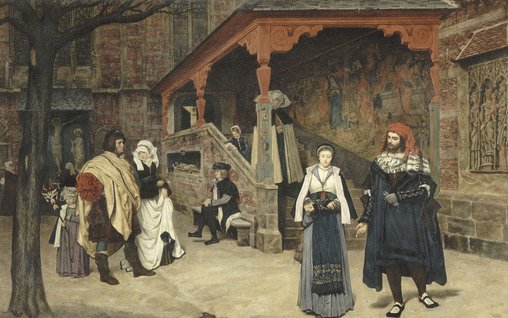
Most of the information for this blog came from two excellent books – Gluck: Her biography by Diana Souhami.
For a much fuller account of Hannah Gluckstein’s life, treat yourself to these biographies.
Gluck Art and Identity
Another great read is Gluck: Art and Identity by Amy De La Haye (Author), Martin Pel (Author), Gill Clarke (Author), Jeffrey Horsley (Author), Andrew Macintos Patrick (Author)