Axel Waldemar Gallén (Akseli Gallén-Kallela). Part 2. Marriage, Aino, Kalevala and that Lake.

Axel Gallén in his studio (ca.1905)

Finnish nationalism as far as language was concerned became prominent in the nineteenth century and was a consequence of the dominance of the Swedish language in Finland’s cultural and political life. With the Russian conquest of Finland in 1809, the Russian government generally supported Finnish linguistic nationalism, as they believed it would alienate the Finns from Sweden and thereby ensure that close ties with or even the integration with Sweden would be halted. This Finnish-language nationalism known as the Fennoman movement soon developed into the most powerful political force in nineteenth century Finland and was summed up by a popular phrase of the time:

“…We are no longer Swedes; we cannot become Russians; we must be Finns…”

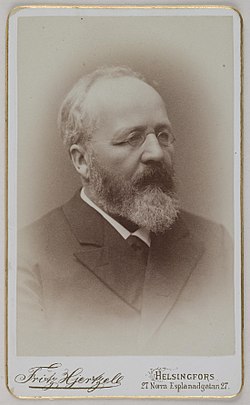
Kaarlo Slöör

Axel Gallén was a fervent nationalist and a follower of the Fennoman movement. It was this passion which was to alter the course of both his personal and artistic life. His interest in Finnish nationalism brought him in contact with Kaarlo Slöör who was a poet, translator, and editor in chief of the Finnish Official Journal and a staunch Finnish nationalist. Through this friendship he first met Slöör’s daughter Mary Helena, a talented concert pianist, and one of Kaarlo’s seven children. Axel Gallén had also attended school with two of her brothers, Karl Rafael, and Fredrik.

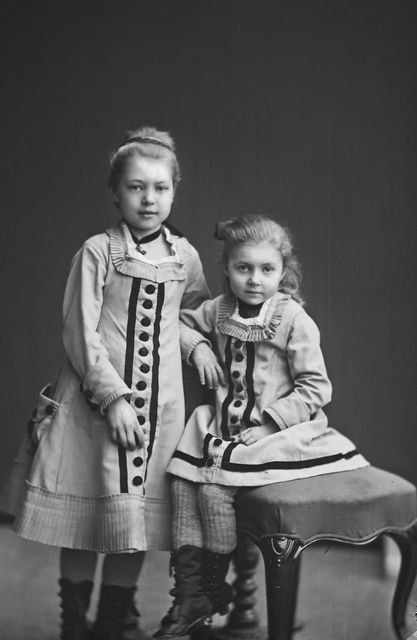
Nine year old Mary Helena and her five year old sister, Elin Margareta Slöör (1877)

Mary had a happy childhood living within a financially secure environment. Tragedy struck the family when Mary was ten years old with the death of her brother Otto in 1878 after suffering from diphtheria and the following year another of her brothers, Karl Artur, died of pneumonia.

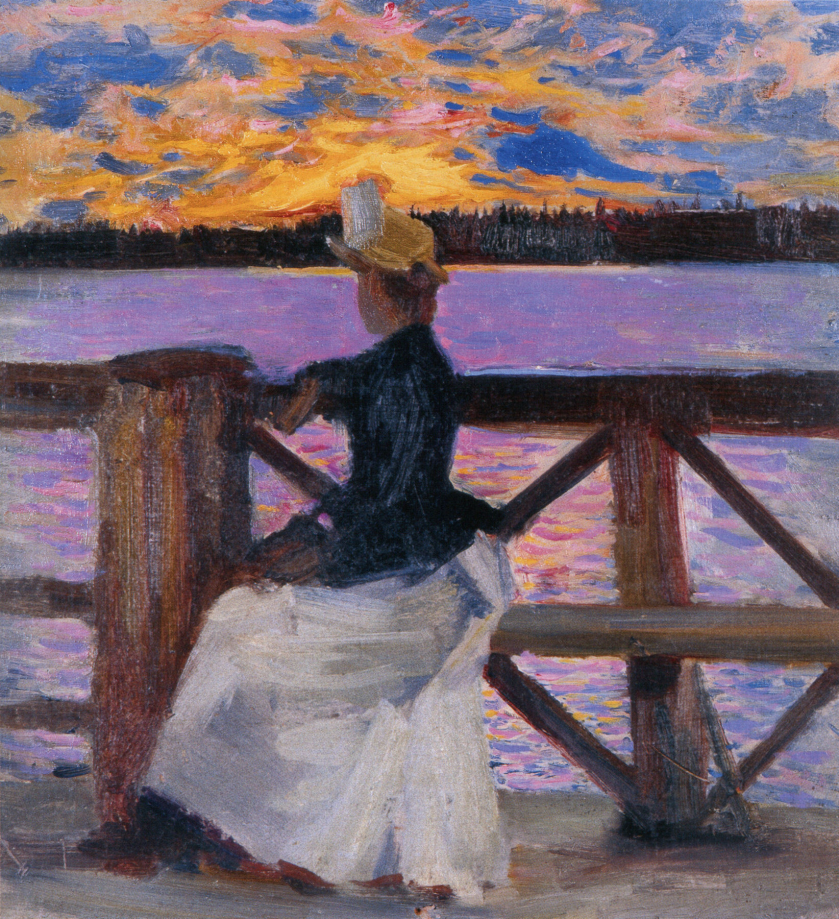
Mary Gallén on the Lakeshore at Lintula by Axel Gallén (1904)

Axel and Mary fell in love as can be seen in letters between the couple. In a letter dated May 29th, 1887, a bashful Axel wrote to Mary:

“…Most loved Mary, what you need is when You, as you say, you want to, but you will not be able to be kind to me, to keep me a little bit. In the last some you call yourself ‘ as a friend ‘. Do not know, therefore, that, you my feelings towards you is not friendship, but love. I love you with all my soul and I cannot say it to you… “

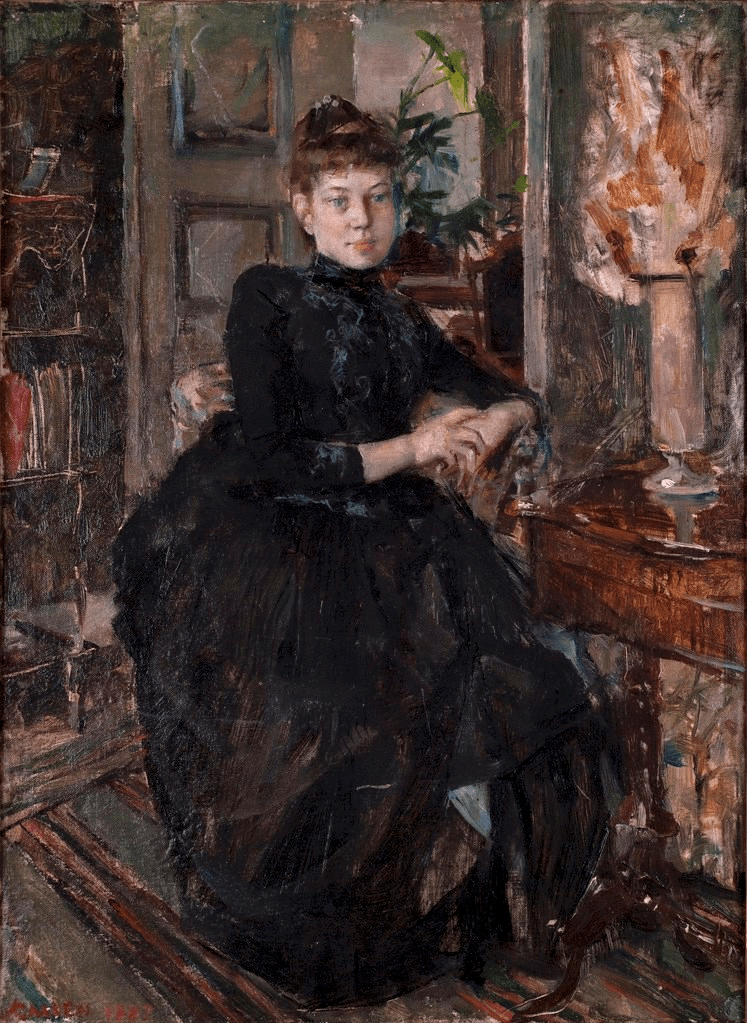
Portrait of Mary Slöör, the Artist’s Fiancée (also known as Mary in a Black Dress) by Axel Gallen (1887)

In 1887, Axel painted a portrait of his future wife, Mary, entitled Mary Slöörin muotokuva.

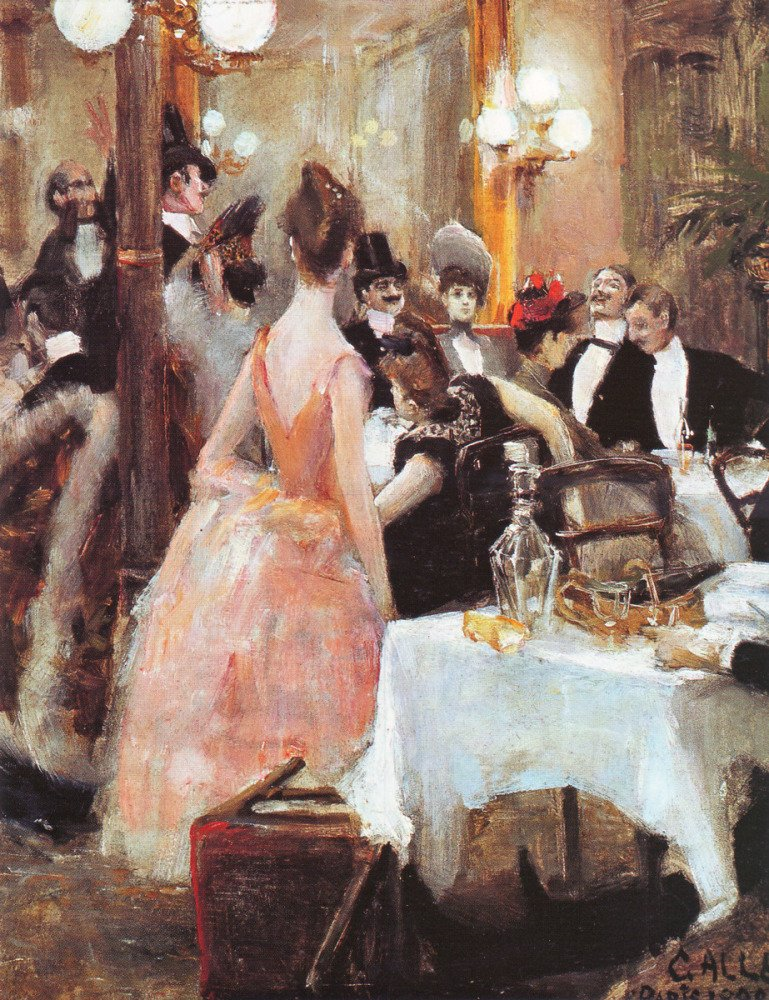
After the Opera Ball by Axel Gallén (1888)

Gallén lived in Paris from the autumn of 1887 to the summer of 1889 during which time he continued at the Académie Julian as well as working at the Atelier Cormon from 1887 to 1888. His Paris paintings, such as Parisian Café and After the Opera Ball, recall the heady days of Paris Society.

Marie Gallén at the Kuhmoniemi-bridge by Axel Gallén (1890)

Axel and Mary secretly got engaged in spring 0f 1887 during his visit to Finland and before returning to his artistic studies in Paris. Once Axel’s paintings began to sell and his financial situation had improved, the couple married at the home of Mary’s parents on May 20th 1890. They went on honeymoon to Kuhmo in the south-east of Finland. Axel completed a number of paintings during the honeymoon including Marie Gallén at the Kuhmoniemi-bridge.

Kalela in Winter by Axel Gallén (1896)

There the couple were joined by Swedish artist, Count Louis Sparre, whom Axel had met whilst in Paris. The two men also made a couple of week-long trips to northern Russian Karelia. Axel Gallén was organising himself to paint a new version, commissioned by the government, of his Aino triptych, and whilst in Karelia he hoped to find models and themes for his work. He also planned to enter a new competition, set by the Savo-Karelia Students’ Association to provide illustrations for the Kalevala, an epic poem, consisting of 22,795 verses, divided into fifty songs, compiled by Elias Lonnrot, derived from Karelian and Finnish oral folklore and mythology. It is regarded as the national epic of Karelia and Finland and is one of the most significant works of Finnish literature.

The Aino Tryptich by Axel Gallén (1889)

It was during his time studying at the Atelier Cormon in 1888 that Axel started on his famous triptych The Legend of Aïno. For him it was an exciting time. It was the time of the Young Finland, Karelianism and the beginnings of the Kalevala Karelia romanticism.

The tragic tale of Aino was largely created by Elias Lönnrot, collector and writer of the stories behind the Kalevala saga. Myths are a reflection of the society from which they spring, in this case where parents and family decide the marital fate of a girl. The Aino triptych is still very capable of arousing discussions and emotions.

Aino,meaning “the only one”,  is a figure in the Finnish national epic Kalevala. It tells of her being the beautiful sister of Joukahainen. Her brother, having lost a singing contest to the storied Väinämöinen, promised Aino’s “hands and feet” in marriage if Väinämöinen would save him from drowning in the swamp into which Joukahainen had been thrown. Aino’s mother was pleased at the idea of marrying her daughter to such a famous and well born person, but Aino did not want to marry such an old man. Rather than submit to this fate, Aino drowned herself (or ended up as a nix – a water being). However, she returned to taunt the grieving Väinämöinen as a salmon.

Gallén painted the story of Aino in three scenes. However, they are not presented chronologically. In the left-hand panel Aino wrenches the string of pearls from around her neck and rejects Väinämöinen’s proposal. In the central panel, Väinämöinen brings up a strange catch when he goes fishing, which he initially recognises as Aino. She mocks Väinämöinen and leaps into the water. In the right-hand panel Aino meets the frolicking water nymphs, the maids of the water goddess Vellamo. In the next stage of the saga, Aino swims to a rock from where she sinks with it into oblivion beneath the waves, but this is not depicted.

Gallén based his work on the Kalevala, and its text didn’t hold back on criticising men, including Väinämöinen. The story of Aino is one of the great tragedies. The girl’s mother bitterly regrets her attempts at marrying off her daughter, against the girl’s wishes. Väinämöinen, on the other hand, “cries evening long, cries morning long, at night he cries still more…”
Aino gets her revenge. She mocks Väinämöinen, who imagined her “wiping his little kitchen, cleaning his floors” and jeers that the “feeble-minded” old man, doesn’t even recognise “Vellamo’s watery maid, the only child of Aho”. This is what Gallén chose as the central discussion point behind his triptych.

Madonna (Mary and Impi Marjatta) by Axel Gallén (1891)

After their honeymoon the Axel and Mary moved into rented accommodation in Malmi, a suburb of Helsinki. In the summer of 1891 the couple had their first child, a daughter, Impi Marjatta. Three years later Axel and his family moved to a home he had built in Ruovesi Kalela.

Portrait of Edvard Munch by Axel Gallén (1895)

In early 1895 Gallén travelled to Berlin where he took part in a joint exhibition with the Norwegian painter Edvard Munch. Axel completed a portrait of Munch that year.

Kalman kukka (The Flower of Death) by Axel Gallén (1895) for the Pan magazine

Axel also worked on a number of drawings for the new Berlin arts and literary magazine, Pan. His stay in Berlin was brought to an abrupt when he received a telegram informing him of the death of his four-year-old daughter Impi Marjatta at their partly-completed home, Kalela, in Ruovesi. She had died of diphtheria.

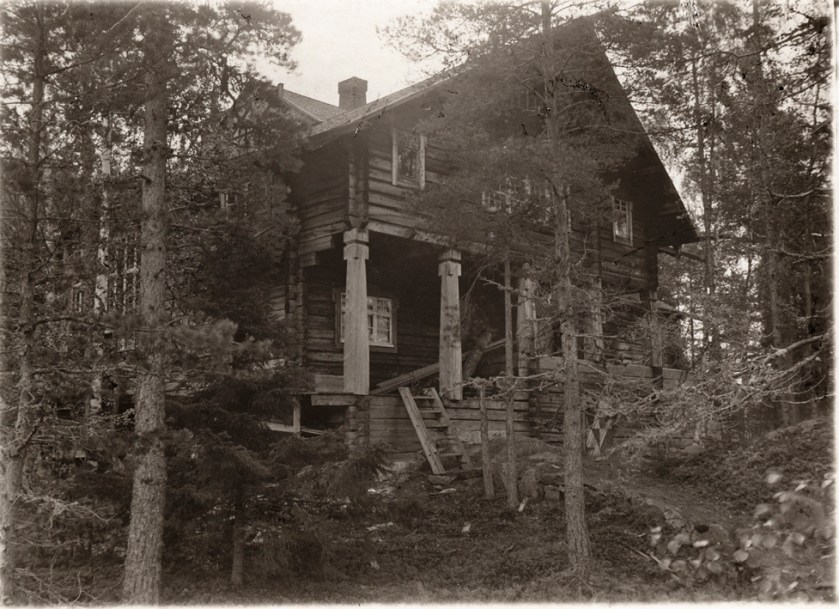
Axel and Mary’s studio-home in Ruovesi called Kalela

During 1895 ‘Kalela’ was finally completed. It was built of logs hewn lengthwise on opposite sides, and it became one of the most famous products of national-romantic architecture. Axel and Mary’s second child, a daughter, Kirsti, was born in 1895 and three years later their third child, a son, Kaius Jorma was born.  Mary helped Axel in his studio often making and decorating the paintings, and more mundane jobs such as cleaning and washing brushes and palettes. She would also practice wood cutting and gypsum moulding and helped him in the burning of glass stained glass. She often acted as his model.

The Artist’s Mother (also known as Konstnärens moder) by Axel Gallén (1896)

Axel was now starting to paint using tempera rather than oils and in 1896 he completed a portrait of his mother.

Joukahainen’s revenge by Axel Gallén (1897)

The following year more paintings in tempera illustrating the Kalevala followed including Joukahaisen kosto (‘Joukahainen’s Revenge’)

The Fratricide by Axel Gallén (1897)

and Velisurma (‘Fratricide’)

Study for the fresco Ilmarinen ploughing the Field of Vipers by Axel Gallén (1900)

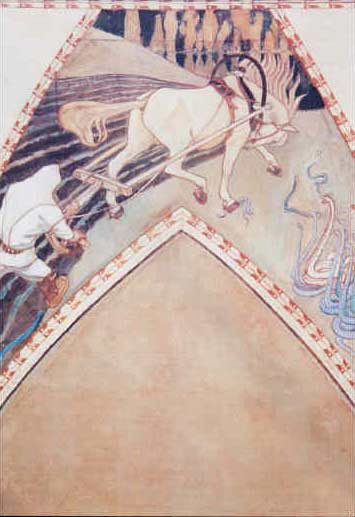
In 1900 Axel Gallén was commissioned to paint frescoes for the Finnish Pavilion at the Paris World Fair. One of the frescoes was Ilmarinen Ploughing the Field of Vipers. Ilmarinen, the Eternal Hammerer, blacksmith and inventor was a character in the epic poem, Kalevala, and is a god and archetypal artificer from Finnish mythology. Axel, a staunch follower of Finnish nationalism, took the opportunity to make the depiction very political as he painted one of the vipers in the fresco as wearing the Romanov crown, and the process of removing the vipers from the field was a clear reference to his wish for an independent Finland.

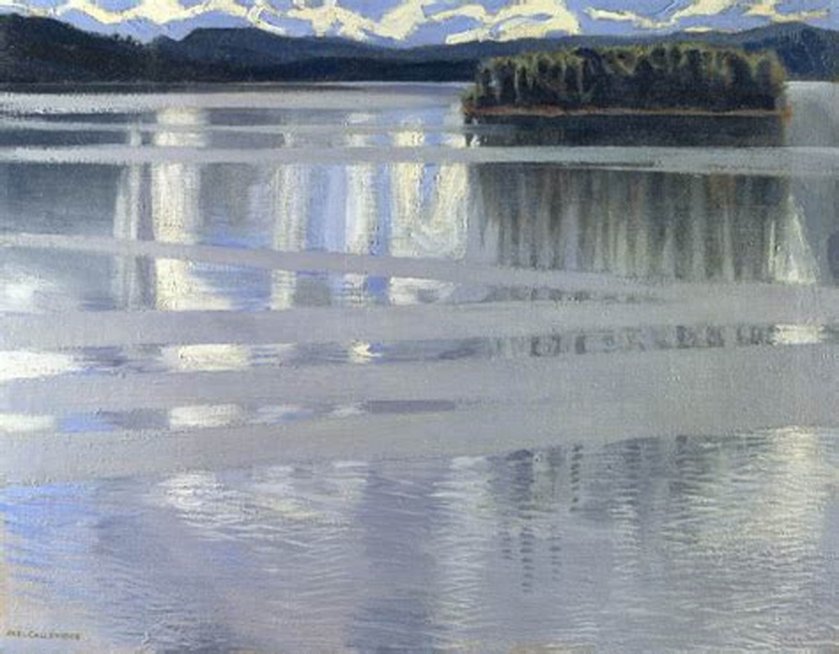
Lake Keitele by Axel Gallén (1905)

In 1905 Axel Gallén produced one of his most famous works, Lake Keitele.  It is one of the artist’s most eloquent and haunting renditions of the subject and it is still the only painting by him in a public collection in Great Britain.  It is housed in the National Gallery in London.  Strangely the artist painted four versions of the picture between 1904 and 1906.  The year, 1904, had not started well for Axel.  He and his wife had been travelling around Europe and during their stay in Granada in southern Spain Axel contracted malaria. He and his wife returned to Finland so that he could recuperate.  The couple rented a lodge in Konginkangas on the shores of Lake Keitele which was more practical than returning to his remote studio in Ruovesi.  The painting depicts the lake’s scenic shores and crystalline waters which are bathed in brilliant northern light.

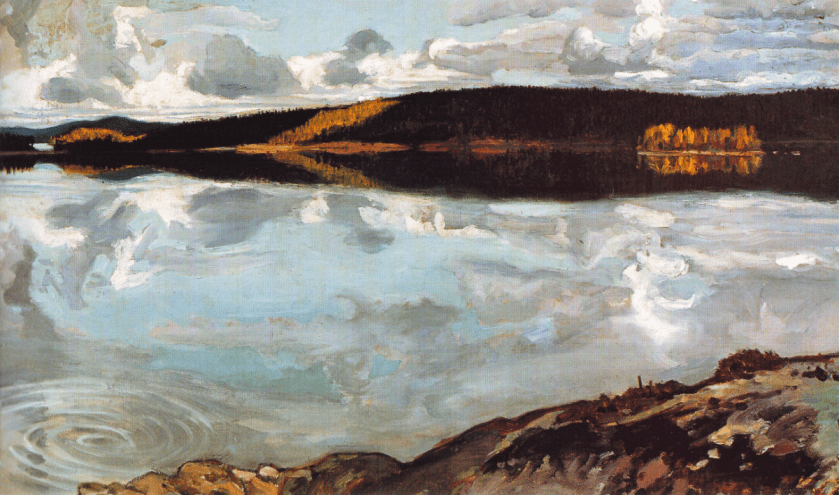
View Over Lake Ruovesi by Axel Gallén (1896)

Through finnicization, the changing of one’s personal names from other languages (usually Swedish) into Finnish, Axel Waldemar Gallén officially changed his Swedish family name to Akseli Gallén-Kallela in 1907 and from then on always signed his paintings with his Finnish name. However, his wife Mary kept her name as Mary Gallén.

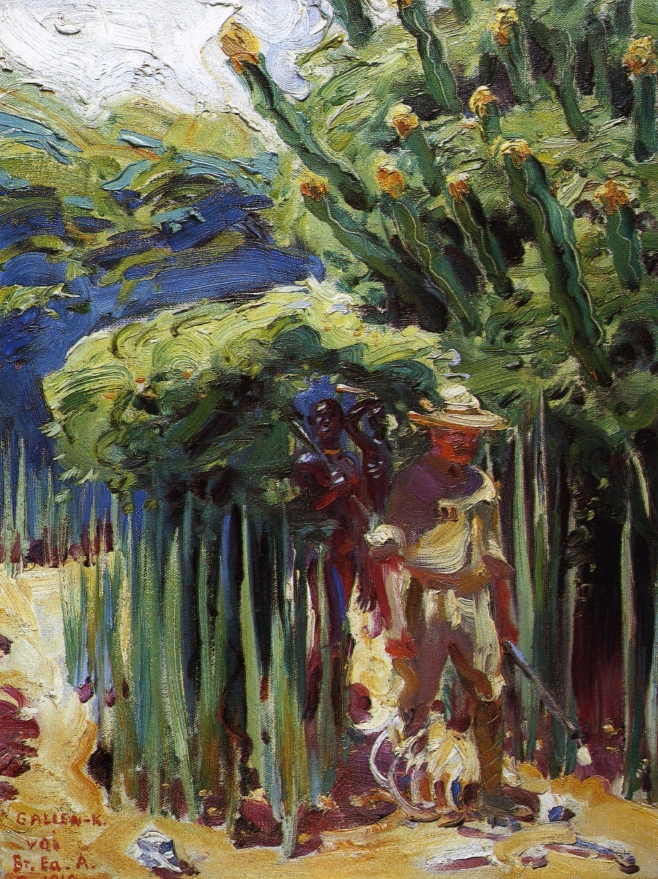
Kikuyu Warrior by Akseli Gallén-Kallela (1909)

In 1909, Gallen-Kallela moved with his family to the British East African city of Nairobi, and there he painted more than 150 expressionist oil-paintings and collected many East African artefacts. However, the family became homesick and Akseli realised once again that his main artistic inspiration was Finland. The family moved back to Finland in 1911 and between 1911 and 1913 he designed and built a studio and house at Tarvaspää, which lay about 10 km north of the centre of Helsinki.

British East Africa by Akseli Gallén-Kallela (1910)

The collapse of the Russian Empire in 1917 caused a power vacuum in Finland, and civil war erupted between the left-wing labour movement and the conservatives. In 1918, Akseli Gallen-Kallela and his twenty-year-old son Jorma took part in the fighting at the front, in the Finnish Civil War on the side of the conservatives under the regent, General Mannerheim.

Portrait of Sigurd Wettenhovi-Aspa by Akseli Gallén-Kallela (1919)                                  Georg Sigurd Wettenhovi-Aspa was a Finnish painter, sculptor, poet, composer, linguist, eugenicist, inventor, architect, freemason, Egyptologist and Fennoman who is best known for his fantastic theories about the past of the Finnish people, whom he believed to have descended from Ancient Egypt.

In the aftermath of the civil war, the Finns went from being under Russian control to being within the German sphere of influence and the German rulers had a plan to establish a German-led Finnish monarchy. However, this idea was shelved with the defeat of Germany in World War I and finally Finland emerged as an independent, democratic republic. Finally, a nation which had been so divided came together and Finnish society was reunited through social compromises based on a long-term culture of moderate politics and religion and the post-war economic recovery.

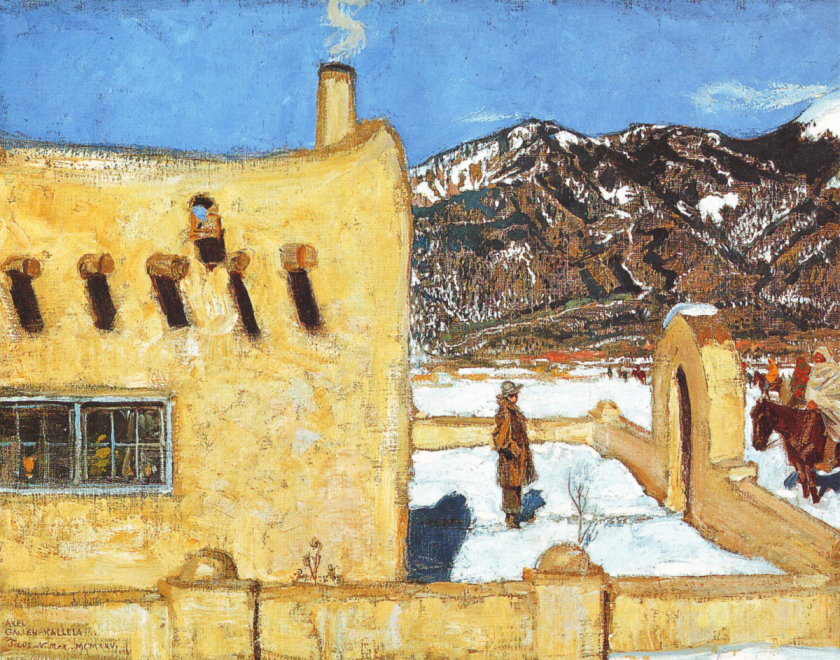
The Artist’s Home by Akseli Gallen-Kallela (1925)

From December 1923 to May 1926, Akseli Gallen-Kallela lived in the United States, where an exhibition of his work toured several cities, and where he visited the Taos art-colony in New Mexico to study indigenous American art. In 1925 he began the illustrations for his “Great Kalevala”. This was still unfinished when he died of pneumonia in Stockholm on March 7th 1931, while returning from a lecture in Copenhagen. He was 65 years of age.


Besides Wikipedia, much of the information about the artist was gleaned from a number of websites, including:
Ateneum Art Museum: https://ateneum.fi/nayttelyarkisto/akseli-gallen-kallela-150-years/?lang=en
Kallela Museum: http://www.gallen-kallela.fi/en/akseli-gallen-kallela-and-tarvaspaa/akseli-gallen-kallelas-lifespan-and-timeline/
National Biography of Finland: https://kansallisbiografia.fi/english/person/3194

Axel Waldemar Gallén (Akseli Gallén-Kallela). Part 1 – the early days.

My blog today is a veritable “potpourri”. It is a blend of history and geography all carefully mixed with the usual large serving of art history. It is a tale of a lake and forest, a country’s change of sovereignty and an artist who lived through those times but fell in love with his habitat. Today’s blog is all about the Finnish painter Akseli Gallén-Kallela, but this was not the name he was born with and this change is down to the changing history of his birth nation, Finland.

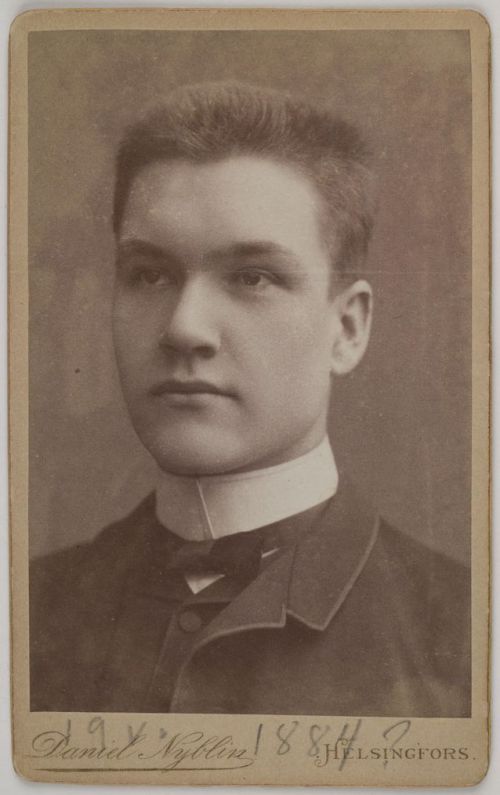
Axel Waldemar Gallén, aged 19 (1884)

If we look upon the history of Finland as a book, we should consider it as having three chapters. The first chapter would cover the period when what is now known as Finland was under the control of Sweden. This area was sandwiched between Sweden to the west and the Novgorod Republic to the east. However, as it is still the case in present times, ownership of land and “coveting thy neighbour’s goods” causes everlasting problems and Novgorod went to war with Sweden no fewer than 26 times over the land borders and the issue was not finally settled until August 12, 1323, when Sweden and Novgorod signed the Treaty of Nöteborg, which legalised their border for the first time. The Treaty allocated just the eastern part of Finland, such as Karelia, to Novgorod, whilst the western and southern parts of Finland were given to Sweden. As a consequence of this Swedish control in the west, the Swedish legal and social systems took root in Finland. During the Swedish period, Finland was merely a group of provinces and not a national entity and it was governed from Stockholm, which was the capital of the Finnish provinces at that time.

Gaining control of land is one thing, keeping the land is another. The great powerhouse of Sweden began to wane in the early 1700’s and Russia, which had absorbed Novgorod in the seventeenth century, began to look covetously at its western neighbour. When Sweden lost its position as a great power in the early 18th century, Russian pressure on Finland increased, and finally Russia conquered Finland in the 1808–1809 war with Sweden and the second chapter of Finnish history began.

After conquered by the Russian armies of Tsar Alexander I, Russia took control of Finland in 1809 and the country became an autonomous Grand Duchy, the head of state being the Grand Duke, the Russian Emperor, whose representative in Finland was the Governor General.

The third and final chapter in the history of Finland came in 1917 following the Russian Revolution when Finland declared itself independent. The following year the country was in tumult, divided by civil war brought on by an attempted coup by left-wing parties. An attempt was made to turn the country into a kingdom but this also failed. The Civil War finally ended in May 1918 when the government defeated the rebels and Finland became a republic in the summer of 1919.

So why the history lesson? Mainly for two reasons. My featured artist today lived between 1865 and 1931 and witnessed the changes in the history of his birthplace and was also part of the process of Finnicization, the changing of one’s personal names from other languages, in his case Swedish into Finnish in 1907. During the era of National Romanticism in Finland, between the late 19th and early 20th centuries, many people, especially Fennomans, who were supporters of a nationalist political movement in 19th-century Finland that wanted to raise Finnish to the national language of the country, finnicized their previously Swedish family names.

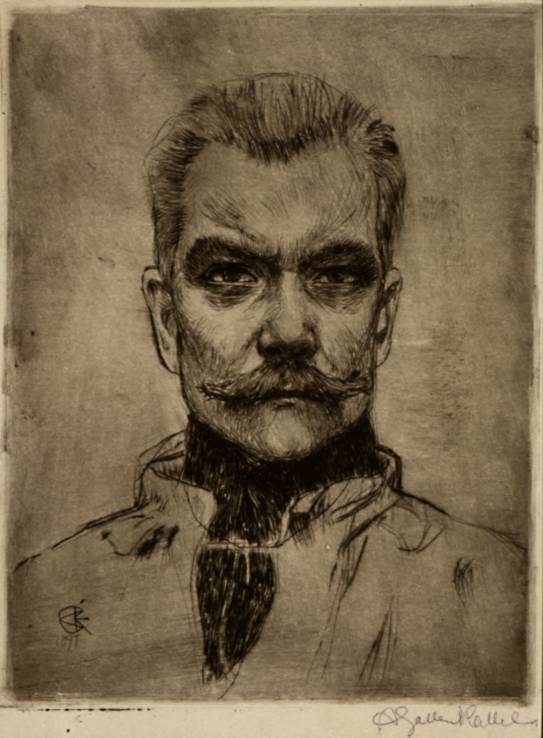
Drypoint Self-portrait, (1897)

Today’s featured artist was born Axel Waldemar Gallén. His father was Peter Wilhelm Gallén who came from the small town of Lemu close to the city of Turku and whose family owned a farm named Kallela. Peter Gallén left the family home and went to study for a public service career, and in 1840 he succeeded his brother as police chief of Tyrvää. In 1841, when he was twenty-four-years-old, Peter married his elder brother’s adopted daughter Sofia Antoinette and put money into the Vanni estate which Sophie had inherited. The couple went on to have five children. In 1855 Sophie died and three years later, in 1858, Peter married for the second time.

Axel Gallén.s birth home in Pori.

His second wife was Mathilda Wahlroos, the daughter of a Pori sea captain and in 1862 Peter Gallén became one of the cashiers at the Pori office of the Bank of Finland. Peter and his second wife, Mathilda, had seven children in all, which made Peter a father of twelve, the third of these children born to Peter and Mathilda on April 26th, 1865 was Axel Waldemar Gallén.

Jaatsi, the childhood home.

In 1867 Peter Gallén left his job at the bank in Pori and returned to the Tyrvää region with his large family, including Axel, who was then two years old, and bought Jaatsi Farm, and on the land, he built himself a spacious residence. It was a rural environment and for the children it was a case of living and playing amongst unspoiled nature. Once settled in, Peter became a lawyer in a private practice in Tyrvää.

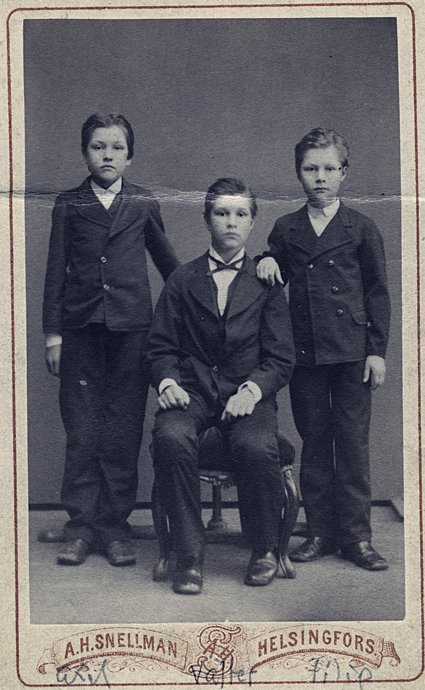
School photo of the Gallén brothers Axel, Uno and Walter in 1876.

Axel had developed a love of art during his early days and his mother, Mathilda Gallén, who was a keen amateur painter, wanted her son to have an artistic career but her husband vehemently disagreed and was adamant that this was not a suitable career path for his son and so, in 1876, when Axel was eleven years old, he, along with two of his brothers Uno and Walter, was sent away to Helsinki to attend the Swedish-language grammar school. He was very disinterested in what he was being taught as all he could think about was art and all he had to console himself was to  attend the evening course at the drawing school of the Finnish Art Society from 1878 to 1881 and later the Central School for Applied Arts in 1880 and 1881. Axel’s father Peter died in 1879 and Axel’s life and future took another route – a route he had always wanted to travel along – a route towards the world of art, so when his grammar school education ended in 1881 he enrolled as a day student at the drawing school of the Finnish Art Society. In 1883 he transferred to the model class, where his teacher was the Finnish landscape and portrait painter, Fredrik Ahlstedt.

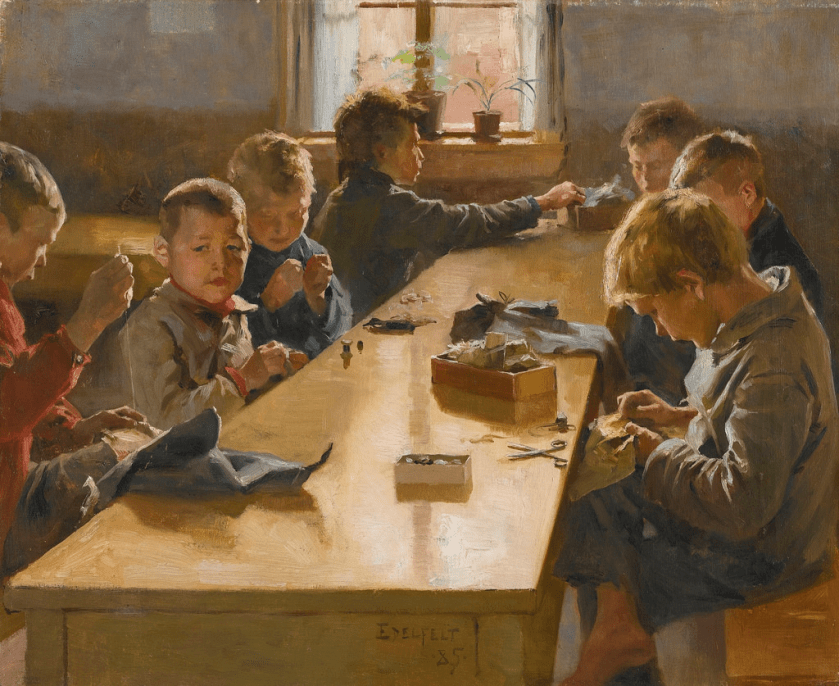
The Boy’s Workhouse, Helsinki by Albert Edelfelt, (1885)

In 1883 and in 1884 Axel was taught art by Albert Edelfelt, one of the first Finnish artists to attain international recognition and was one of the founders of the Realist art movement in Finland.

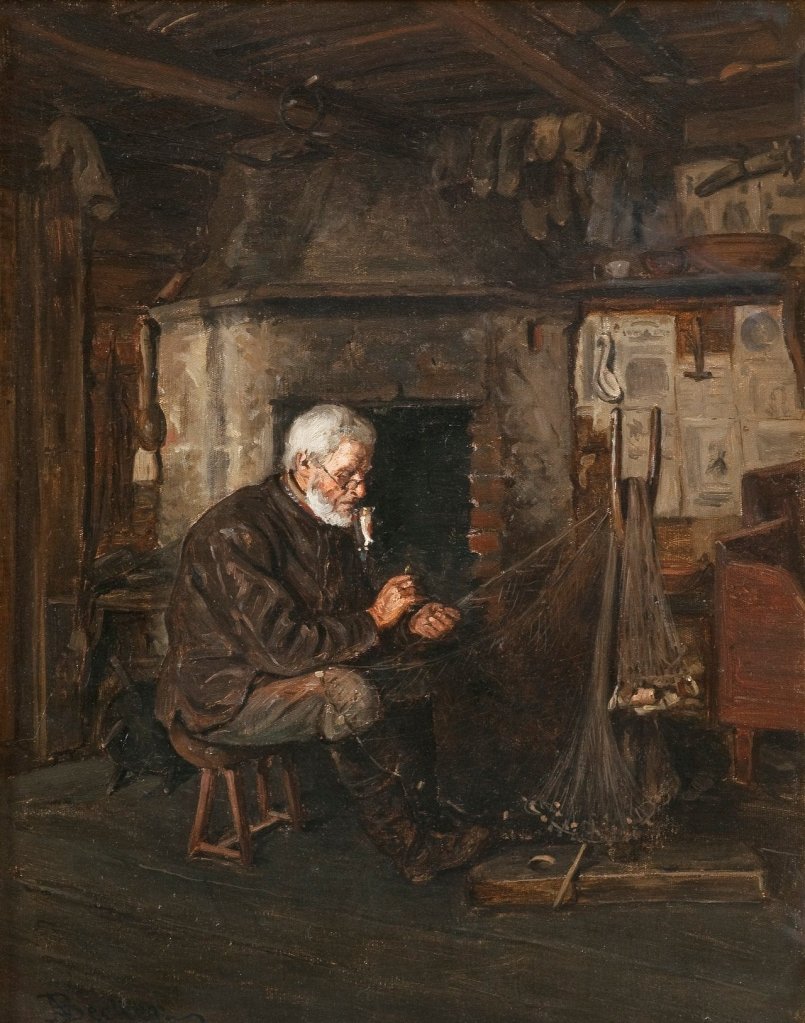
Repairing the Fishing Net by Adolf von Becker

Axel Gallén also spent time studying at the private academy run by the Finnish genre painter and art professor Adolf von Becker from 1882 to 1884 and did drawings at the University’s dissecting room.

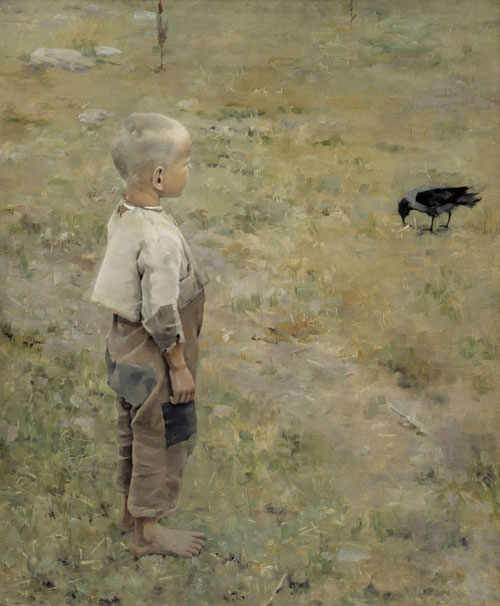
Boy with a Crow by Axel Gallén
(1884)

Adolf von Becker was his most dependable teacher in the area of French realism, and he greatly influenced Axel when it came to demonstrate the technique of plein air painting. One such work is Axel’s Boy with a Crow. Axel completed the painting and people were astounded by the finished work. What amazed people was that his depiction was so like many of the works by the French painter Jules Bastien-Lepage and yet Axel had never been to France and seen the work of this great painter.

Pas Mèche (Nothing Doing) by Jules Bastien-Lepage (1882)

It is believed that Axel had learnt about the work of Bastien-Lepage through Albert Edelfelt who had lived in Paris and had been won over by the outdoor realism paintings of Lepage. The peasant boy depicted in the painting, Boy with a Crow, was known to Axel and he talked about the staging of the depiction, saying that the secret of his success with the painting was persuading the boy to believe that he could tame the crow by sprinkling salt on its tail feathers!

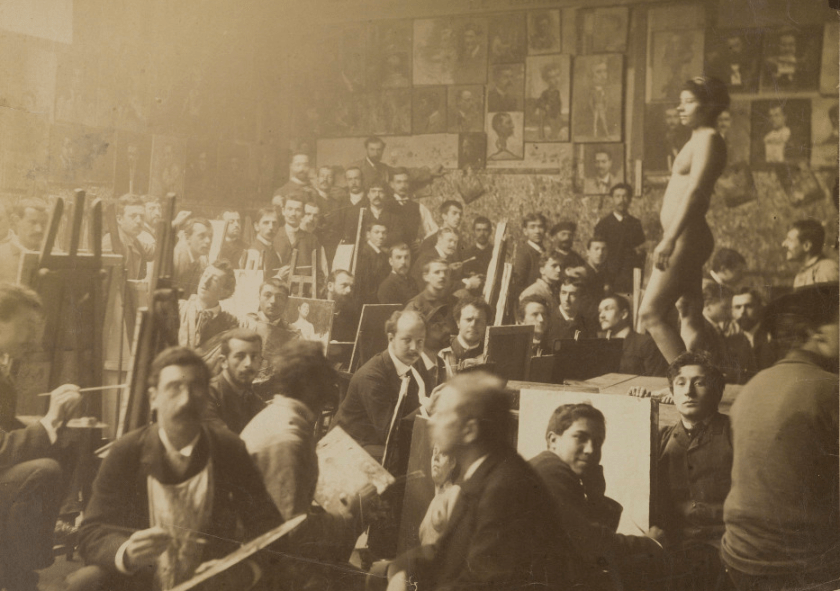
A photograph of Axel Gallén and other art students in Académie Julian in the 1880s

Probably persuaded by Edelfelt, Axel Waldemar Gallén, moved to Paris in the Autumn of 1884 and went to study at Académie Julian and the Atelier Cormon run by the French painter, Fernand Cormon. Axel studied at these establishments for the next five years. Equally as important to the artistic training he received at the Academy was the people he met. He recorded in his journal the bohemian lives of his artist and writer friends, such as the Swedish playwright and novelist, August Strindberg. He also spent time visiting art exhibitions, such as the Spring 1885 Jules Bastien-Lepage Memorial Exhibition when more than two hundred of the French painter’s pictures were exhibited at the École des Beaux-Arts, a year after the great man’s death.

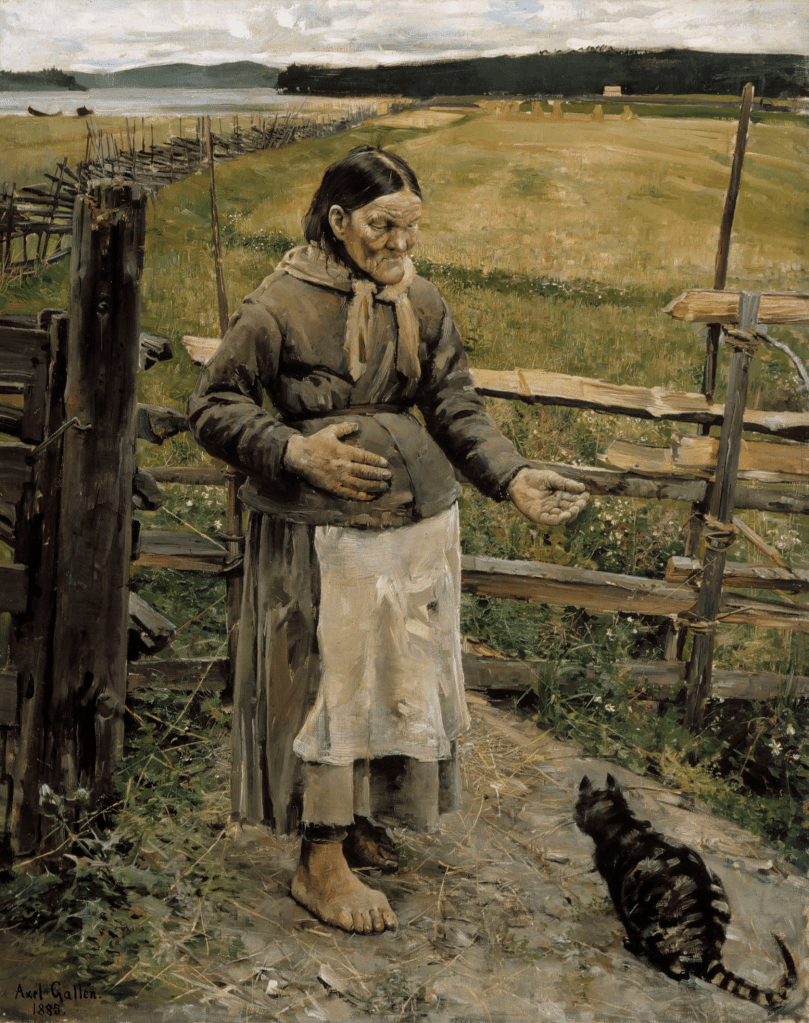
The Old Woman and the Cat by Axel Gallén (1885)

Axel Gallén returned home in 1885. This was the year he painted his well-known work Akka ja kissa (‘Old Woman and Cat’) at the town of Salo. The elderly woman depicted in the painting was a local peasant who lived with her sheep. The initial painting just depicted the woman and the cat and the background was added once Axel returned to his studio in Tyrvää. The painting was a classic example of naturalism or rural naturalism which follows the concept that truth was more valuable than beauty and once again we can see the influence of Bastien-Lepage in this work. The painting was exhibited at the Finnish Art Society in the autumn of 1886 but opinions on the merit of the work were divided. The conservatives believed the painting to be ugly and the depiction of the woman, repulsive, whilst the liberals acclaimed the work for its realistic qualities.

Portrait of Herman Frithiof Antell, by Axel Gallen (1885)

Axel returned to Paris in late 1865 thanks to financial help from his mother and a government grant. Whilst in the French capital he completed a portrait of Herman Frithiof Antell, a licentiate of medicine and one of the most generous benefactors in Finnish cultural history.

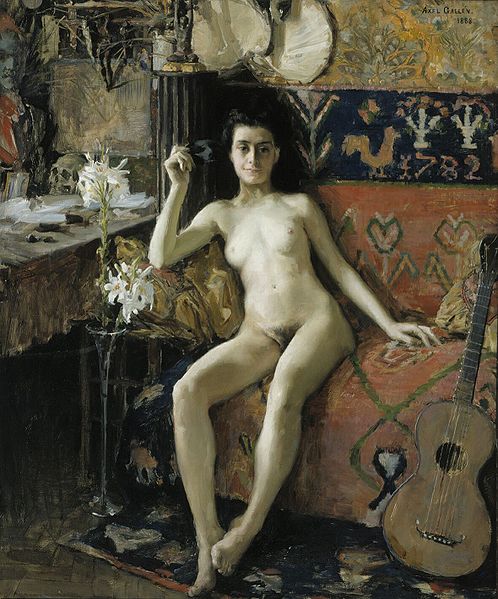
Démasquée by Axel Gallén (1888)

So pleased was Antell with the portrait that two years later he commissioned Axel Gallén to paint a nude, which is now known as Démasquée (Uncovered). This is one of just a handful of nude paintings completed by Gallén. It was done by him in his Paris studio and it is the epitome of realism. The naked woman, almost certainly a French model, is seen seated on a colourful cover made up in the typical Finnish ryijy weave. This is not a depiction of a well-endowed beauty. This is a true depiction of an ordinary woman who seems very relaxed and happy to be sitting naked in front of the artist. Another aspect of realism is the fact that Axel depicted pubic hair in his portrayal of the woman which was unusual in European art.

Evening Landscape from Korpilahti by Axel Gallén

Once again Alex returned to Finland in the summer of 1886 and this time settled down in the sparsely populated area around the small town of Korpilahti which lies in Central Finland. It is a beautiful area with over two hundred lakes as well as awe-inspiring mountains. It was during his stay here that Axel carried on with his rural realism depictions.

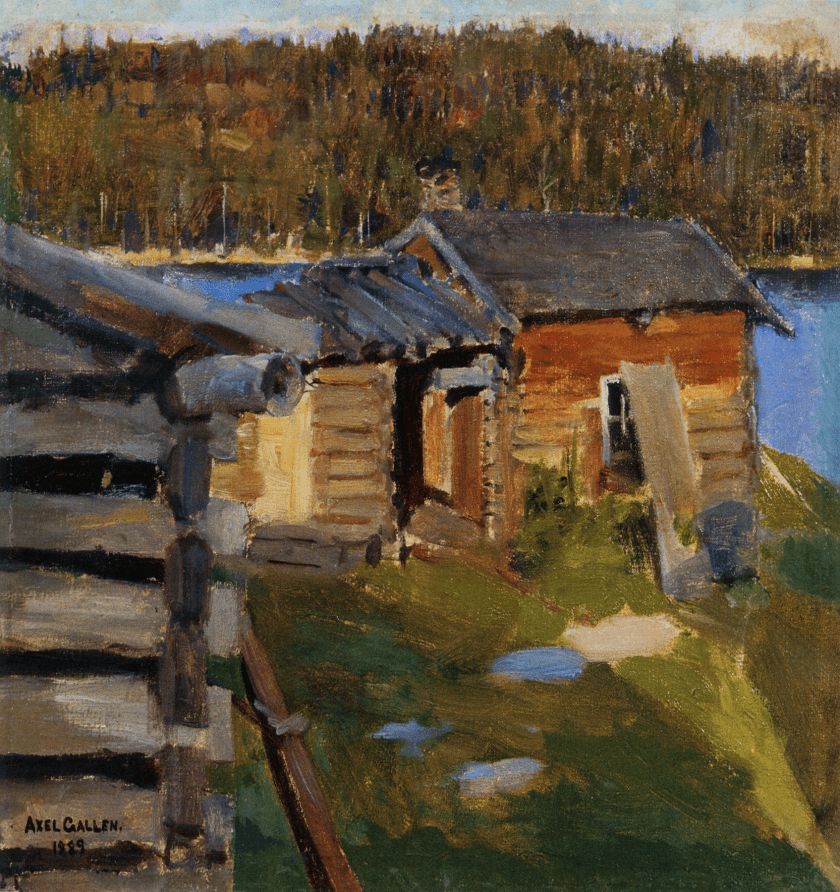
The Ekola Croft in Evening Sunlight by Axel Gallén (1889)

In the winter of 1886 Axel moved from Korpilahti to the Central Finnish town of Keuruu and stayed at Ekola Croft which appears in a number of his paintings such as The Ekola Croft in Evening Sunlight which he completed in 1889. The croft was on the shore of the large Keurusselkä lake and must have been an idyllic location.

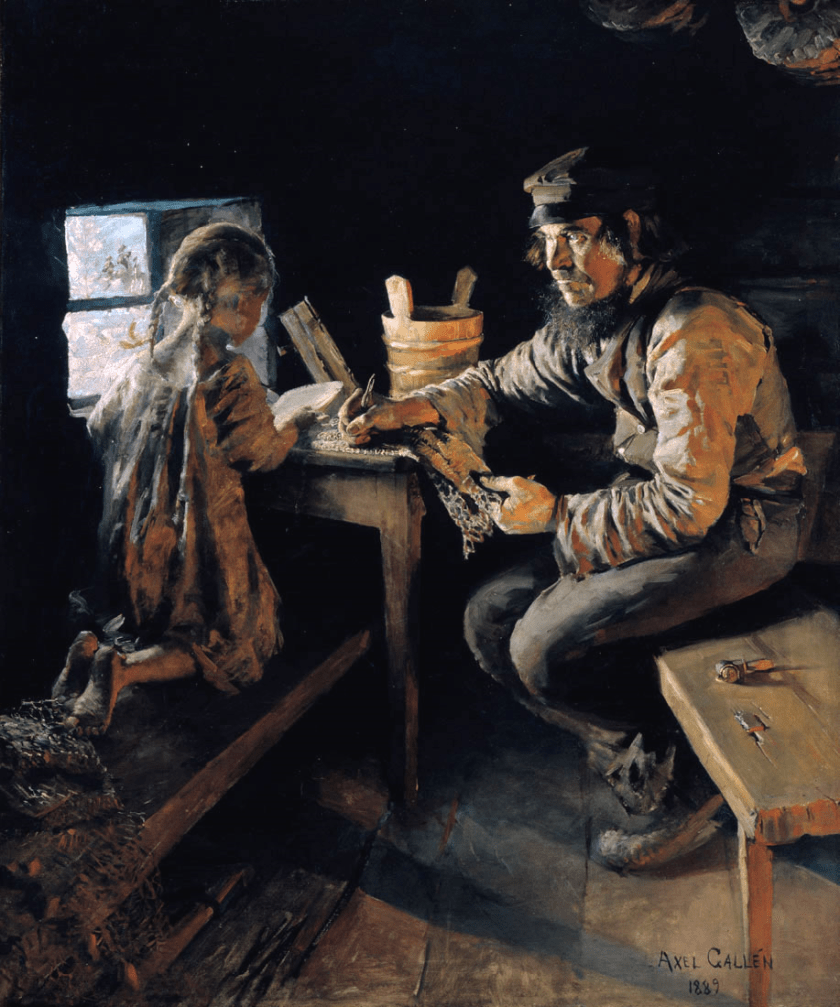
The First Lesson (also known as Ensi opetus) by Alex Gallén (c.1887)

Another painting he completed around this time was one entitled The First Lesson (also known as Ensi opetus). The setting is the interior of a log cabin and it depicts a father teaching his young daughter.

In the next part of my blog looking at the life and artwork of Axel Gallén (Akseli Gallén-Kallela) I will be delving into his later life, his marriage and his fascination with the Kalevala, the 19th-century work of epic poetry created and compiled by Elias Lonnrot.


besides Wilipedia, much of the information about the artist was gleaned from a number of websites, including:

Ateneum Art Museum:  https://ateneum.fi/nayttelyarkisto/akseli-gallen-kallela-150-years/?lang=en

Kallela Museum:  http://www.gallen-kallela.fi/en/akseli-gallen-kallela-and-tarvaspaa/akseli-gallen-kallelas-lifespan-and-timeline/

National Biography of Finland:  https://kansallisbiografia.fi/english/person/3194


The talented Rayner childen. Part 3. Louise Rayner

In the “About” section of my blog I state quite categorically that I am not a painter. This has now changed in as much as I have now started to dip a paintbrush into paint and touch it to a canvas. Why? As people know my great interest is in art history but people always seem surprised that I have not rattled off a few masterpieces. They constantly ask me why I do not even try to paint. I have now started on that long artistic road and have fallen by the wayside so many times I often wonder why I persevere, but persevere I do. Having said so many times in my blog that I like detailed paintings I tried to emulate the great painters who seem to find it so easy to depict buildings but of course, as you will have guessed, I fail miserably. How artists manage to add so much detail in their work both amazes and frustrates me. Maybe I should paint a few coloured squares or a series of dots instead and then have a highfalutin reasoning behind my depiction! However, whilst I struggle on manfully with my efforts, I want to talk about and show you the work of a genius in this field of cityscape art. Let me introduce you to the English Victorian painter Louise Rayner.

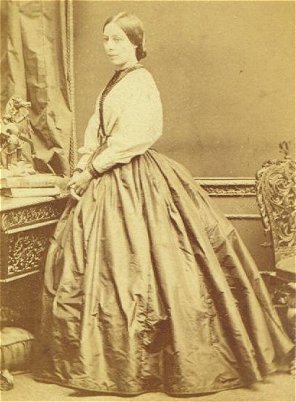
Louise Rayner aged 27

Louisa Ingram Rayner was born in Matlock Bath in Derbyshire on June 21st, 1832. Her middle name, Ingram, came from her grandmother’s family. Whilst she was young she was always known as Louisa but as she grew older she preferred the name, Louise. She was the fourth of nine children. Louise had four sisters and one brother, all of whom became artists. Her father was Samuel Rayner an English landscape artist, who was known for his depictions of buildings and their interiors, including abbeys, churches and old mansions and her mother was Ann Manser Rayner who was an expert engraver of black marble.

The Bell Inn, Market Place, Ely by Louise Rayner

At the age of ten, she and her family left Derbyshire and returned to London and it was here that she would spend most of her early life. It was whilst on a family holiday in Herne Bay, when she was fifteen, that she took up drawing and, soon after, she began to study painting seriously, at first with her father who played a major part in her love of art and later under guidance from her father’s artist friends such as George Cattermole, who like her father worked for John Britton, an English antiquary, author and editor, Edmund Niemann, the highly successful British landscape artist who worked mostly in oils. Another of her father’s friends was David Roberts, the Scottish painter who completed long sketching and painting tours of the near East, the Holy Land and Egypt but also specialised in architectural and topographical scenes.

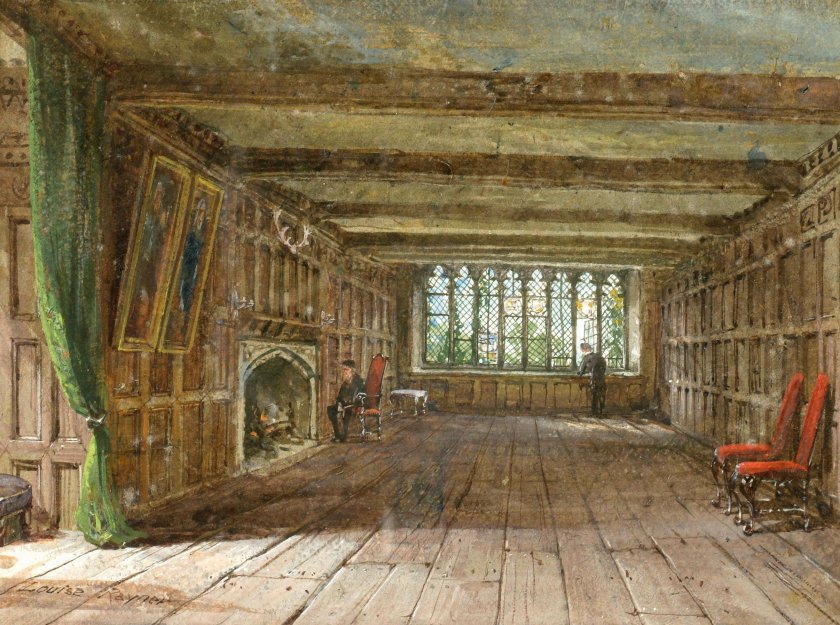
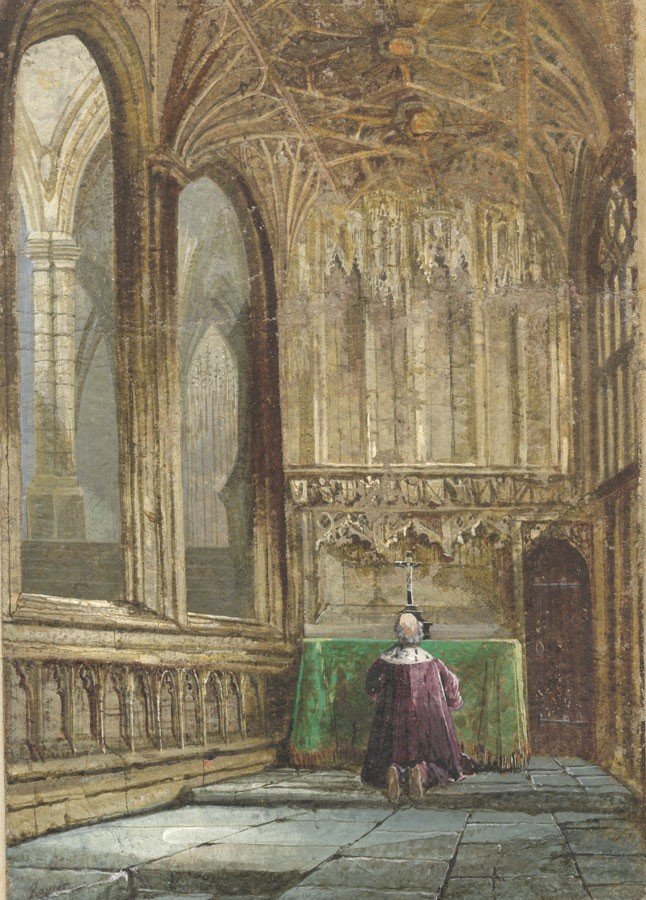
Interior of Haddon Hall by Louise Rayner

His influence on Louise Rayner is very apparent when we look at the first painting she submitted to the Royal Academy in 1852 entitled The Interior of Haddon Chapel, Derbyshire.

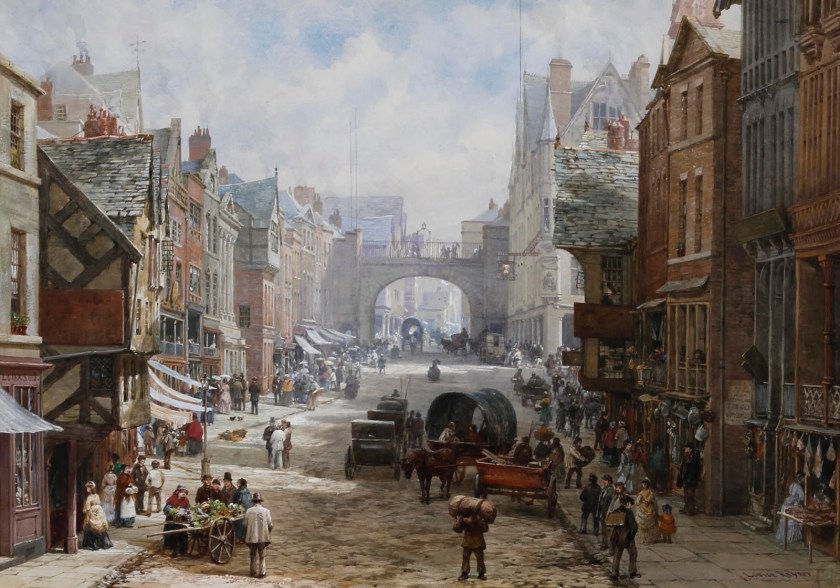
Eastgate Street, from east of the Cross looking towards the Eastgate by Louise Rayner

Louise Rayner, like David Roberts, depicted cities and their often crumbling buildings as well as stately homes and their surroundings. During her most active period, Louise, like her father before her, painted a large number of church interiors, and exteriors but what she would really become known for, was her depictions of ancient streets and picturesque yet dilapidated in many of the cities and towns of Britain and Northern France, all of which she always populated by numerous figures. She was a prolific painter and her works appeared at the Royal Academy exhibitions between 1852 and 1886.

Louise Rayner first began exhibiting her watercolour paintings in 1860 at the Society of Female Artists, which was founded three years earlier and has held an annual exhibition in London of the work of women artists ever since. Louise continued to live at the family home and in the early 1860’s this was located in Brighton.

Louise is first recorded as first visiting Chester in 1869. Her paintings from this period are very detailed and charming in a chocolate-box sort of way. They encapsulate the olde worlde charm of Chester and the other towns which she depicted. Most of her works feature people going about their daily business, such as street sellers and people out shopping.

Watergate Street Chester by Louise Rayner

However, midway through that decade, she went on sketching journeys which resulted in beautiful paintings of historical England and Wales. One of her favourite places to visit was the Roman town of Chester (Deva) and it is recorded that Louise was living in Chester at 2 Ash Grove, off the Wrexham Road, in Chester in 1869.

Aberconwy House by Louise Rayner                                                                  The painting shows both Aberconwy House and Conwy Castle in the background. Aberconwy House was originally a 14th Century merchant’s house. It is thought that Louise captured this image during one of her trips to the Welsh town around 1868.

What first grabbed my attention about the Rayner family was the picture above, a painting by Louise Rayner of Aberconwy House within the walled-town of Conwy.  It is a place I pass a number of times each week and up until two years ago, I lived just fifty yards from this building.

Aberconwy House this afternoon

..………and this is how looked this afternoon !

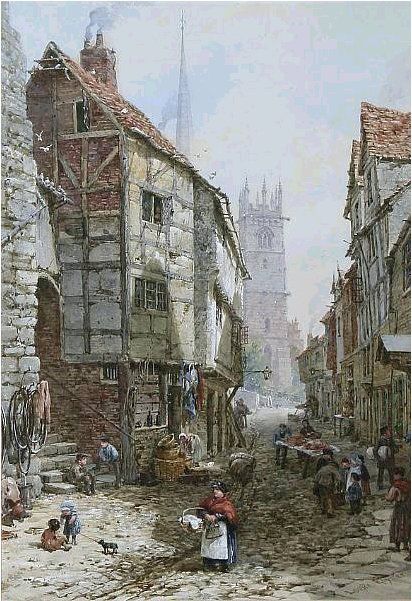
Street View Wrexham by Louise Rayner (c.1880’s)

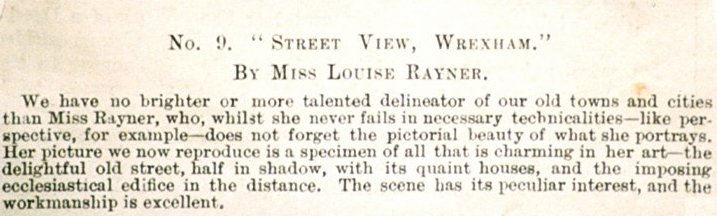
Another Welsh town she visited and depicted in one of her paintings was Wrexham and above we have her work entitled Street View, Wrexham which she completed in the 1880’s.

Newspaper clipping of 1898 following the exhibiting of the painting

Again the local newspaper’s art critic praised her work.

Fish Street, Shrewsbury by Louise Rayner                                       The depiction is of Fish Street, Shrewsbury, looking south-south-east. Not only do we have a hive of activity at street level but Louise has included some bird life up on the roofs. In the distance, two churches vie for attention. The spire is St. Alkmund’s Church, and the more prominent church is St. Julian’s.

Another of my favourite towns which I frequently visit is Shrewsbury and the town, as it used to be, is beautifully captured in Louise’s painting, Fish Street Shrewsbury.

Old Houses, Shrewsbury by Louise Rayner

Another depiction of the streets of Shrewsbury can be seen in her painting, Old Houses, Shrewsbury.

Dudley Market Place, 1870, by Louise Rayner

Louise and her younger brother Richard visited the area around the West Midland’s town of Dudley on one of their subject-seeking art expeditions in 1865 and five years later Louise produced this beautiful painting. The depiction is taken from Market Place and we look down Castle Street with Hall Street to the right. In the background, we can see the Church of St Edmund, locally known as the “bottom church” to differentiate from St Thomas’ parish church in High Street (not in the picture) which is known as “top church”. To the left, on the skyline, we can just make out the upper part of Dudley Castle.

Rheims Cathedral, France by Louise Rayner

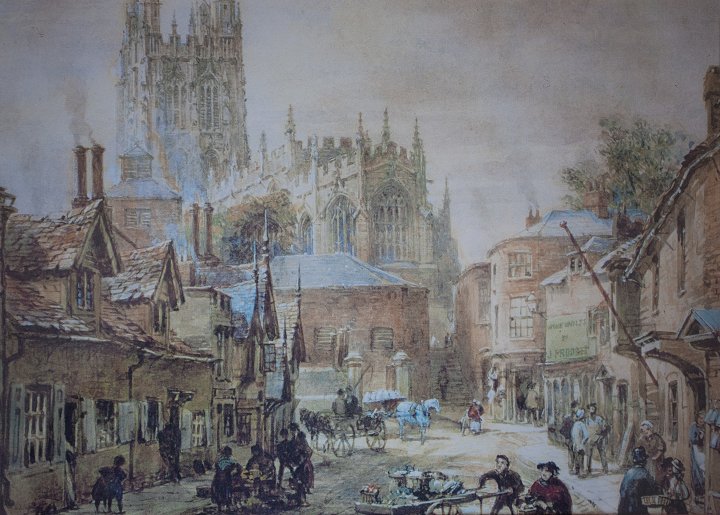
Louise traveled extensively throughout Britain each summer during the 1870s and 1880s, but also took trips to northern France and in the picture above we see her depiction of a street in Rheims. The painting depicts Rheims Cathedral in the background. The beauty of this work lies in the drama of the architecture as we see the cathedral spire rising into the sky whilst below we see the street populated by locals. Look how she has used a blaze of sunlight, raking between the buildings, to highlight a man on the right trying to gain entrance to his house.

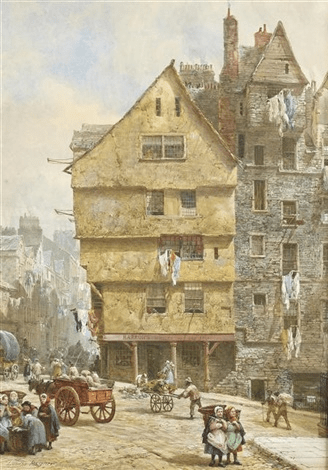
West Bow, Edinburgh by Louise Rayner

As it is for everyone, age takes its toll and as she grew older Louise’s artistic talent began to fade probably due to her failing eyesight, unsteady hands and the ability or enthusiasm to travel to towns to seek out new views for her work. Louise exhibited for the last time at the Royal Academy in 1886, and the last time anywhere in London in 1893. She had reached her peak well before she had almost decided to lay to rest her paint brushes at the age of 76 in 1908. The Rayner family dynasty was starting to come to an end. Frances Rayner Copinger died in 1889 and Louise’s mother, Ann, the following year. In 1890 Louise and her sister Margaret set up a teaching studio in Chester but on “retiring”, she and her sister went to live in Tunbridge Wells in 1910. In 1908 the youngest Rayner sibling, Richard, dies aged 65. On August 20th, 1920 her sister and companion Margaret died and Louise Rayner moved to Southwater Road, St Leonards on Sea, a seaside town close to Hastings, where she remained until her death on October 8th, 1924, aged 92.

The Close, Salisbury by Louise Rayner

What surprises me the most is that despite her intricate cityscape paintings, and watercolours, Louise Rayner is not seen as one of the great artists of the nineteenth century. Maybe it is because of the similarity of her work, but can you really get tired of a good thing?  I will leave the last word to Peter Watson, the art correspondent of The Observer newspaper, who wrote about Louise following his visit to the Christies Glasgow auction in November 1974. He wrote derisively about the event itself but praised Louise’s work.

“…Louise Rayner won’t be to everyone’s taste – very dense, detailed paintings-cum-drawings of Victorian streets teeming with life: cats fighting, dogs smelling, spivs spivving, washing hanging, flirts leering, babies vomiting, parents spanking. And not a give-away either (priced at several thousand) but they do have a lookatable quality which possibly justifies the price…”
I hope you have enjoyed the last three blogs charting the lives of the Rayner family.  Having just completed this one on Louise Rayner and her architectural cityscapes I am going to return to my own canvas, give up my aspirations of depicting a cityscape and just spray a few colours of paint on it and maybe a few zig-zags !!!!!!!


Besides the usual sources such as Wikipedia I got most of my information about the Rayner family from an excellent and comprehensive website entitled DudleyMall.

(http://www.dudleymall.co.uk/loclhist/rayner/samuel.htm)


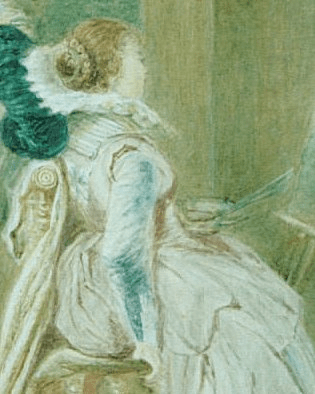
The talented Rayner children. Part 2: Ann Ingram (Nancy) Rayner, Rhoda (Rose) Rayner and Frances Rayner Copinger

Ann Ingram (Nancy) Rayner

This is a detail from Nancy’s sister Rose’s 1856 painting Divided Attention and it is thought that it depicts Nancy at work, sitting here in fancy dress.

Samuel and Ann Rayner had nine children of which six excelled artistically like their parents. Having looked at the life of the parents in my previous blog I want to focus on the talents of their children.

Their first-born child was William but he died at childbirth and so the title of eldest child fell on to the shoulders of their daughter Ann Ingram Rayner who, to save confusion with her mother, was always known as Nancy. She was born in London in 1826 during the time when the family were living at 11 Blandford Street, Portman Square, Marylebone. A year after she was born, the family moved to Museum Parade in Matlock Baths, and her early years were spent in Derbyshire.

                              The Gleaners by Nancy Rayner (c.1850)                                            The painting entitled The Gleaners was painted by Nancy in 1850 and shown at the Old Watercolour Society Exhibition in 1850. Gleaners are people, usually done by the local poor, who gather grain or other produce left behind after the harvest, with or without the farmer’s consent. It was usually done by the to provide some extra food. The children depicted are likely to be seven-year-old Richard Rayner (the youngest of the Rayner children) on the left, along with one of his sisters. The sister was initially thought to be Margaret but the painting was a poor likeness of her in 1850. Instead the girl is now believed to be one of the few non-artists of the Rayner children, Grace Dorothy Rayner, who would have been eleven at the time the painting was completed.

Nancy started her artistic studies at the age of ten and soon proved to be very talented. In her teenage years she was probably influenced by contemporaries of her father such George Cattermole, a fellow draughtsman working for John Britton. Another was Octavius Oakley, who had developed into a specialist of portraits in watercolour and was, like Samuel Rayner, given commissions by the Duke of Devonshire. Oakley  tutored Nancy in the art of portraiture and Nancy’s ability at painting portraits was initially down to his work with her. Other luminaries who influenced Nancy were the Scottish painter, David Roberts who had been a long-standing friend of the Rayner family. When he returned from a sketching trip to Spain he gave Nancy one of his original pencil sketches. Samuel Prout, one of the masters of British watercolour architectural painting, was also a great inspiration to Nancy.

The Tambourine Woman by Nancy Raynard (1852)                        The painting, originally known as The Gypsey Woman, later The Tambourine Woman, was painted by Nancy Rayner in 1852 but has no signature of the artist on the work of art itself although a sticker with her name on it was found on the frame. There are many thoughts as to why she did not sign the work. Maybe Nancy wanted to remain anonymous because of the scandal of her father’s court case in 1851 which was causing great financial problems to the family.

Nancy was the first of Samuel’s children to become an Associate of the Old Watercolour Society. The Society albeit supportive of watercolourists was a male-dominated society for it was only the male Associates who could progress to become full members of the Society and share in its profits and become administrators. Female associates were barred from this transitioning. At the time of Nancy’s election as an Associate there were only three other Associate female painters, Maria Harrison, Eliza Sharp and Mary Ann Criddle who were also affected by this ruling. They were well in the minority as there were 26 male members and 17 male associates. After sustained pressure from the ladies with regards this unfair treatment the Old Watercolour Society changed the rules and appointed them Honorary Lady Members. However, they still were not allowed to share in the profits of the Society.

Nancy then had her first painting exhibited at the Royal Academy in 1848, at the age of twenty-two, and was elected a Member of the Old Watercolour Society two years later. The sale of her paintings went well and she received many commissions and patronage. Princess Mary, Duchess of Gloucester was known to be one of Nancy’s patrons.

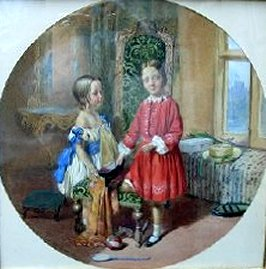
Portrait of the Gloucester Children by Nancy Rayner (1850)

Her 1850 painting entitled Summer Pastimes, which is also known as Portrait of the Gloucester Children depicts two young children playing. It is thought that the children are in fact the Duchess’s children or maybe her grandchildren as if you look at the window on the right you can see a flag flying over a castle tower, signifying that is part of the royal estate.

Nancy Rayner’s life came to an early end in November 1855 at the age of twenty-nine and so her artistic life was cut short. As a talented painter, maybe if she had lived longer, she would have been as famous as her father or her famous sister, Louise.

Rhoda (Rose) Rayner

Rose Rayner at the age of 31.

The second daughter of Samuel and Ann Rayner was Rhoda, known as Rose. She was born 1828 whilst her parents were living in the small Derbyshire town of Matlock Baths. Her artistic journey began as a teenager when she was taught how to create models using clay and she began to produce jugs and vases. Her late venture into the world of painting was probably due to her love of clay modelling and pottery and she would spend much time making and decorating her pottery figures. It was not until seven years later, around 1850, when she was twenty-one, that she began to paint with watercolours like her siblings. Four years later, in 1854, some of her paintings were seen at art exhibitions. One of the great artistic influences on Rose was the rise of the pre-Raphaelite painters.

Miss Catty by Rose Rayner (1854)                            The subject and title of this painting is Miss Catty. She is one of the daughters in the Catty family. Grace Dorothy Rayner who was ten years younger than Rose and one of three non-artists of the family. She had married Frederick Henry Bovil Catty in 1869.

Although her interests remained in watercolour painting and pottery her great love was teaching and it is thought that throughout her life she was involved in the private tuition of children whose parents could afford to give their children a good start in life. Rose was fortunate to be able to travel widely in Europe. The fact that she travelled so much and so far from home, like her trip to Russia in 1880 would mean that she had either become very prosperous or that she travelled as part of a wealthy family’s retinue.

Divided Attention by Rose Rayner (1856)                                   Rose Rayner painted Divided Attention in 1856. It is believed that it depicts her sister Nancy sitting before her easel with one of her many suitors watching her work. The signature at the bottom of the painting is “R.Rayner”
Rhoda Rayner exhibited at the Royal Academy and elsewhere between 1854 and 1866, and it is thought it was during this period that she began to call herself Rose.

In the late 1870’s life changed for her. The marriage between her younger sister Frances and her husband Charles Coppinger in 1866 had come to an end. Frances left her husband and went with her daughter Annette (Netta) back to live at her parents’ home in New Windsor. It was in 1879 that Samuel Rayner died and it is thought that Rose’s share of his inheritance allowed her the independence to live on her own at 103 Dalberg Road in the London borough of Lambeth and following Frances’ return home Rose offered to look after Netta who was eleven years old.

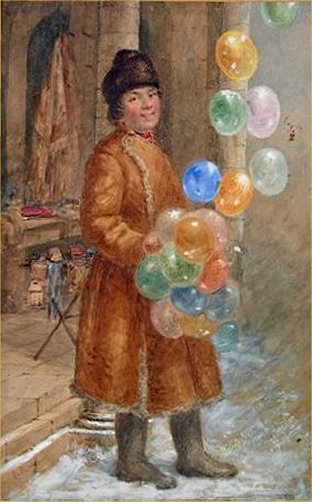
Russian Balloon Seller – Streets of Petrograd 1881 by Rose Rayner (1881)

In 1881 she completed a painting entitled Russian Balloon Seller, Streets of Petrograd. She had probably made preliminary sketches when she was visiting Russia in 1880 with her niece Netta and completed the work in her London studio.

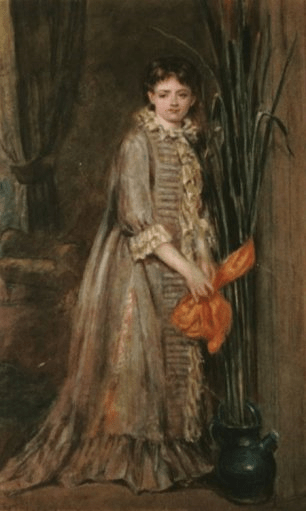
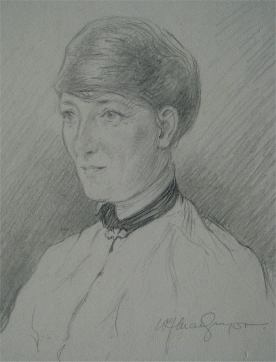
Self portrait of Netta MacGregor                 The sketch above is a self-portrait of Netta dated 1920, two years after her marriage to Robert MacGregor.   It is signed in her married name A(nnette) F(rances) MacGregor and is an indication that like her aunts she had acquired great artistic talent. 

Rose and Netta were still living together in 1891 according to the census of that year. Their home was now Hampstead in London and the census gives Rose’s occupation as Artist, Figure Painter, Sculptor and Annette’s occupation as piano music teacher.

In 1908, Rose’s younger brother Richard died, aged 65 and Rose moved to a new house and went to live next door to Richard’s family in Orpington Kent. Her niece Netta worked in a hospital during the First World War where she met a Canadian, Robert MacGregor, and when the war ended the couple were married and went to live in Canada. Rose died aged 92, in Orpington, Kent, on January 12th, 1921, just a few months after Netta and Robert sailed for Canada. Rose was the longest-lived of all her sisters.

Frances Rayner Copinger

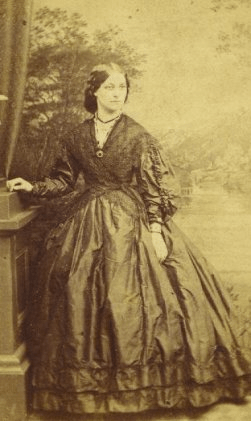
Frances Rayner aged 28.

Frances Rayner was the sixth child of Samuel and Ann Rayner. She was born in Piccadilly, London on August 19th, 1834 and along with her older brother Samuel and older sister Louise was christened at the Newman Street Apostolic Catholic Church in Marylebone the following February.

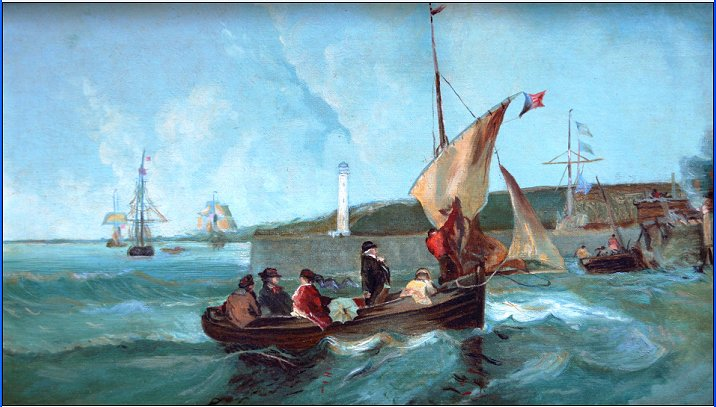
Port Dieppe by Frances Rayner (1884)                                                               It is thought that the portly figure with the white hair standing in the boat could have been Frances’ father Samuel but he died in 1879. However it is known that Frances had been in the Dieppe area in 1866 and she could have sketched the scene then but not painted it until later and not completed it until 1884.

Frances’ artistic path differed to those of her elder siblings as she never exhibited any of her paintings until she was twenty-five years of age, and then only on one occasion in 1861 did she have a painting of hers, a watercolour, Church of St Andre, Antwerp, appear in a London gallery.   It was exhibited in the Suffolk Street gallery in London. The one thing she had in common with her father was her love of architecture and especially the architecture of old religious buildings.

Kapellbrucke und Wasserthurm, Luzern by Frances Rayner                                           This is Frances’s painting of the Kapellbrucke und Wasserthurm, Luzern (Chapel Bridge and Water Tower in Lucerne, Switzerland), which is the oldest wooden bridge in Europe, spanning the River Reuss. In the lower left, though hardly visible, is Frances’s faint monogram and her married name Copinger.

One of her great loves was travel and she journeyed throughout Europe on a number of occasions and from these travels was born a number of paintings featuring places in Europe. Frances Rayner married Charles Copinger in February 1867. It was Copinger’s second wife, his first wife Mary had died in 1866. From his first marriage Charles had five children and with Frances he had a daughter Annette Frances who was born on October 26th, 1867 and a son Ernest Edwin born in 1871. Following her marriage, Frances and her husband lived in Brussels for some years, but by the time of the census in 1871 she and the family had returned to England and were living in the London borough of Islington. The census reports her occupation as an artist and her husband’s occupation stated as being a clergyman of the Catholic Apostolic Church. There was one other occupant of their household, Copinger’s sister Clara, who acted as a governess for the children.

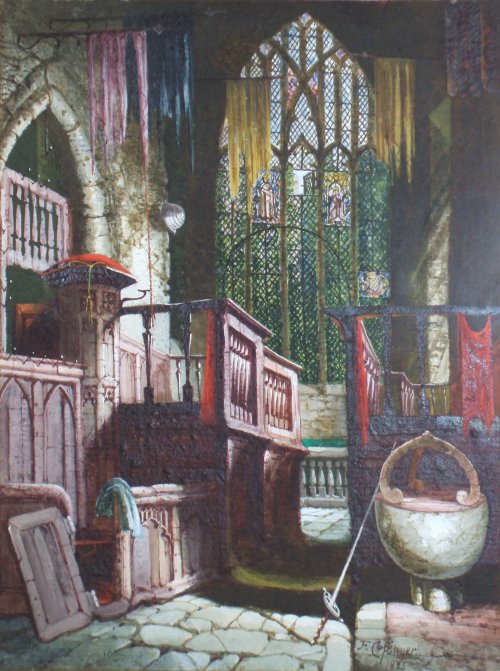
Canterbury Baptistery by Frances Copinger (née Rayner)  Frances certainly favoured religious subjects for her paintings and this one is the Canterbury Baptistery, and was signed (deep in the flowers) “F. Copinger née Rayner 1884”

The marriage between Frances Rayner and Charles Copinger ended shortly after the birth of their son but there is no record of a divorce, which was very difficult to procure in those days. Notwithstanding that, Charles simply left Frances and went off to America and in Baltimore in 1878, with or without divorce, he married his third wife Mary Margaret May. They went on to have two daughters and a son. Charles Copinger died on May 9th, 1913.
After the breakdown of her marriage in the late 1870s, Frances left her husband and took the children to live with her mother and father but probably because of the problems of space in her family’s house, her daughter Annette went to live with Frances’ sister Rose. In the 1881 census Frances is noted as living with her son Ernest as a lodger in a house belonging to the Sevenoakes family in New Windsor on the outskirts of London.

Baron’s Chapel at Haddon Hall by Frances Copinger (née Rayner) 1883             Frances, like her sisters and father painted scenes depicting Haddon Hall. of the family.

Frances Rayner died in 1889, a year before the death of her mother, Ann. She was 55. At the time of his mother’s death, her son Ernest was about eighteen years of age. When Frances died Ernest went to live in Camberwell with his Aunt Grace who had married Frederick Catty in 1869 and the couple had five children of their own. Ernest became a merchant’s clerk when he was nineteen. He died in 1904

Of all the Rayner children the most talented was Louise and I will dedicate my final blog to her life and her beautiful works of art.


Besides the usual sources such as Wikipedia I got most of my information about the Rayner family from an excellent and comprehensive website entitled DudleyMall.
(http://www.dudleymall.co.uk/loclhist/rayner/samuel.htm)

It is really worthwhile you going to have a look at it.

I also gleaned information about Charles Copinger from the family blog :

http://www.copinger.org/page.php?file=1_34


The talented Rayner Family. Part 1. The mother and father, Samuel and Ann.

In the next few blogs I want to explore the lives of an amazing artistic family. Today I am starting this voyage of discovery by looking at the lives of the heads of the family, the mother and father and in the next blog, I will investigate the life and works of some very talented artistic children.

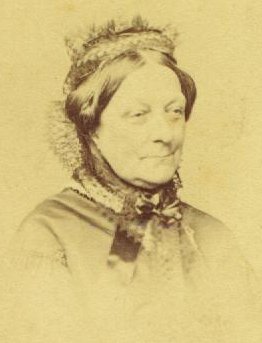
Samuel Rayner age 59.

Samuel Rayner was born on April 15th 1806 at Colnbrook a to the west of London.  He was the third of five children of Samuel Rayner Snr., a farmer and a dealer in corn and his wife Margaret Rayner (née Ingram). In 1812, when Samuel was six years of age, his parents moved from Colnbrook to London, and set up an ironmongery business at No. 7, Blandford Street, Marylebone. Five years later, on May 26th 1817, Samuel Rayner Snr. died suddenly at the aged thirty-nine, leaving his widow to carry on the business with the help of their children. A year after this sudden death, on November 21st, 1818, Samuel Snr’s grandfather Thomas Rayner, a painter himself, who is thought to have encouraged his grandson to sketch and paint, dies at the age of eighty-six.

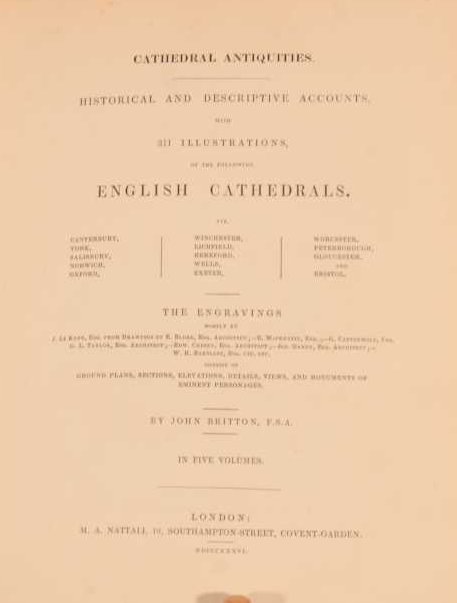
Cathedral Antiquities of England by John Britton

In 1821, when he was fifteen years of age Samuel Rayner began to work as a trainee draughtsman for John Britton the antiquary and author. John Britton had published the first of his nine-volume Architectural Antiquities of Great Britain in 1805 and the ninth volume was completed in 1814. When Rayner went to work for him Britton had started on the massive task to publish his fourteen volume-work, Cathedral Antiquities of England which would not be completed until 1835.

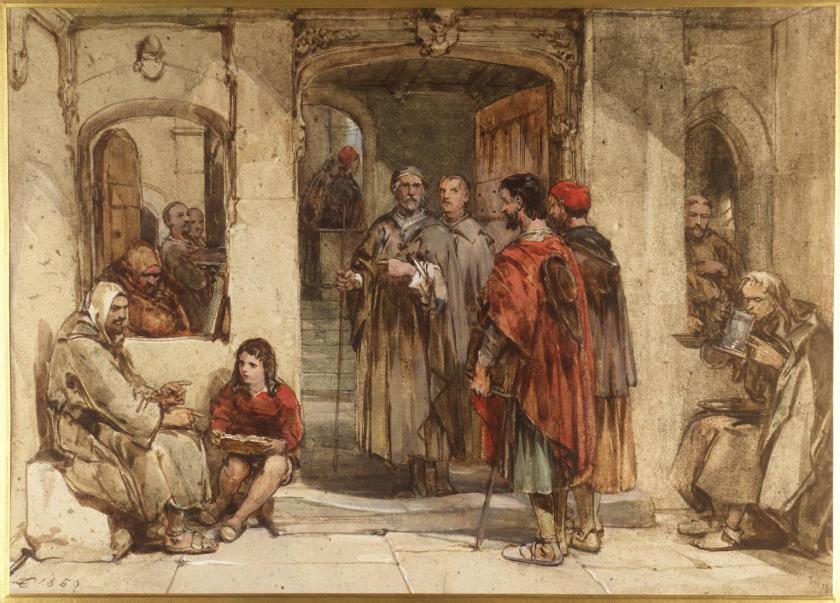
Ancient Monastic Life by George Cattermole (1850)

Among Britton’s draughtsmen were the brothers George and Richard Cattermole and they and Samuel were involved in producing drawings for John Britton’s fourteen-volume work with Samuel having five of his own drawings engraved for inclusion. George Cattermole who had started working for Britton at the age of fourteen and Samuel became good friends and Cattermole’s work greatly influenced the art of Samuel Rayner.

Interior of Knole Castle, Kent, by Samuel Rayner (1858)

Samuel Rayner must have learnt the basics of watercolour painting very quickly, for at the age of fifteen, he had his watercolour of Malmesbury Abbey accepted for exhibiting at the 1821 Royal Academy exhibition. Buoyed by that success, Samuel Rayner put forward another watercolour painting of the abbey for inclusion at the 1822 Royal Academy Exhibition and it was accepted. This time the work featured the West Front of the abbey. Presumably his employer, John Britton admired Samuel’s talent and began to train him as an architectural draughtsman and this would often entail him travelling around on sketching trips making intricate sketches of buildings and monuments. It was all about recording accurate details in his drawings. His work was mainly to do with cathedrals and abbeys as well as castles, often in ruins, and old mansions. It was not just the exteriors of these buildings which Samuel Rayner managed to capture on canvas but he tended to focus on the interiors of these great edifices.

Ann Manser Rayner

During one of his visits to the art galleries in London in 1823 he met Ann Manser, the daughter of William Manser, a successful London publisher and amateur artist. Ann was born on October 29th, 1802 and was almost four years older than Samuel Rayner. As a member of a prosperous family Ann was encouraged to engage in the “lady-like” pastime of painting. For Ann painting was more than just a simple hobby and at an early age she excelled in her artistic ability. However, her friendship with Samuel was frowned upon by her father who probably thought his daughter was too good for “her young man” and that Samuel’s prospects were not good enough to support his daughter. He would also be concerned that although his daughter was twenty-one, Samuel was only seventeen years of age and hardly mature enough to become Ann’s husband.

Ann was not deterred by her father’s misgivings but realised she would not be able to persuade him to change his mind and so the young couple eloped and in 1824 they were married at St George The Martyr Church in Southwark, London. The couple lived at No. 11 Blandford Street, Marylebone, two doors away from Samuel Rayner’s mother’s home and business premises. That same year their first child William was born but sadly died at birth. A daughter was born May 1st, 1826 and was christened Ann Ingram Rayner, but always known as Nancy. Although born after William, Nancy was always regarded as the eldest child of the family. Samuel Rayner’s success at having his paintings accepted for the Royal Academy Summer Exhibition continued in 1824 and 1826 with the exhibiting of his paintings of Salisbury Cathedral and Wells Cathedral.

Museum Parade, Matlock Baths (c.1832)

In 1827, when Samuel reached the age of twenty-one he inherited his share of his grandfather Thomas’ estate and also received a very lucrative commission from the William George Spencer Cavendish, the sixth Duke of Devonshire, who resided at Chatsworth House, Derbyshire. This commission and his newly-found wealth convinced Samuel and Ann to move, with their daughter, out of London to the quiet Derbyshire countryside and the town of Matlock Baths, although they retained their Blandford Street house in London. They settled into a newly built terraced house in what was then called Museum Parade but is now known as South Parade.

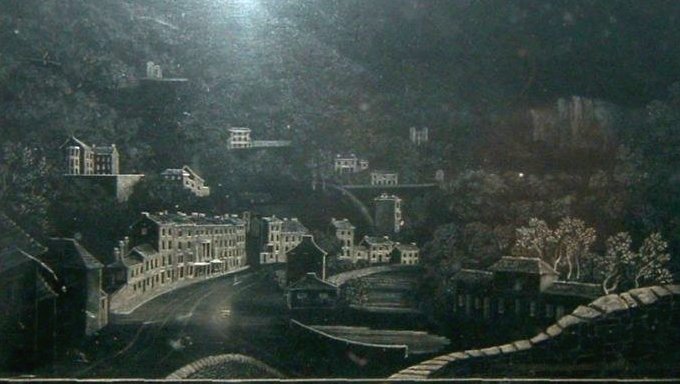
A picture of Matlock Bath engraved using Ashford Black Marble by Ann Rayner

Whilst her husband was working on his watercolour paintings, his wife was busy working on her intricately and meticulous black Ashford marble engravings. Ashford Black Marble is the name given to a dark limestone, quarried from mines near Ashford-in-the-Water, a village in the Derbyshire Peak District, ten miles north west of Matlock Baths. Once the marble is cut, turned and polished, its shiny black surface becomes highly decorative.

Rayners Sketches of Derbyshire Scenery Part 1 by Samuel Rayner

Samuel Rayner was kept busy working for the Duke of Devonshire and he also set up a lithographic printing and publishing business in partnership with John Vallance. However, he still dedicated some of his time to his watercolour painting and in 1830 published Rayners Sketches of Derbyshire Scenery Part 1, a collection of writings and lithographs by James Duffield Harding,  featuring the Derbyshire countryside and buildings.

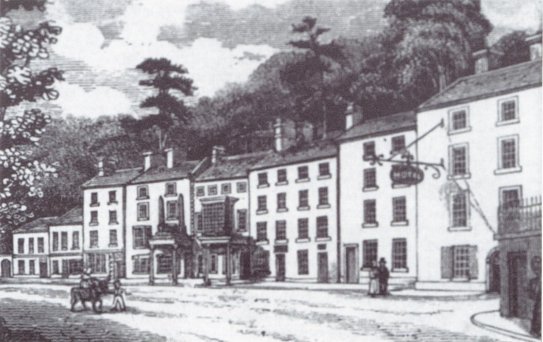
Matlock Bath – Drawn on Stone by J. D. Harding from a Sketch by Samuel Rayner.

Above we see Samuel Rayner’s sketch of South Parade, with its museums and Great Petrifying Well, which was published as a lithograph in “Sketches of Derbyshire Scenery, Part 1. Samuel’s depiction of the town would have been from standing opposite the entrance to the Old Bath Hotel, above what is now the Fish Pond Hotel but then known as the Old Bath Tap. The Upper Towers, high up on the hillside above Matlock Bath on the Heights of Abraham, must have only just been built. A year later, in May 1831 John Vallance exhibited several of Samuel Rayner’s drawings in his museum.

Haddon Hall – View of Stone Terrace engraving by Samuel Rayner

Having spent six years at Matlock Baths Samuel and his wife returned to London in 1833. There is no certainty as to why they returned but it could be that Samuel’s mother, Margaret’s health was deteriorating. The Rayner family now stood at seven, with Rhoda (Rose) (1828), William Harry (1830), Louise (1832) and Samuel (1833) all born in Derbyshire. The Rayner family did not return to their original home in Blandford Street but instead to a house at No 6 Dufour Place, Broad Street, St James, Piccadilly.

Conishead Priory by Ann Manser Rayner

Margaret Ingram Rayner, Samuel’s mother died on March 15th, 1834, aged 50. Five months later Ann Rayner gave birth to their fourth daughter, Frances on August 19th. Maybe because his mother had passed away and because of his wife’s talent at engraving on the Derbyshire Black Marble the family once again left London and went to live in Derby in 1836. Samuel quickly went into partnership with Robert Mosely and formed a lithographic printing and publishing company which was run from their Friar Gate family home and business premises at the Derby Corn Market.

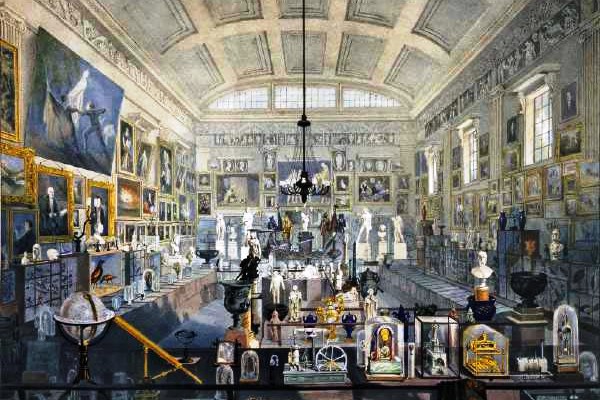
The Derby Exhibition by Samuel Rayner (1839)

In 1839 Samuel Rayner completed a work entitled The 1839 Derby Exhibition which depicts the early period of the formation of the Derby Town and County Museum and Natural History Society in 1836 and what would become the Derby Museum and Art Gallery in 1857. This collection of painting includes Joseph Wright of Derby’s painting Romeo and Juliet and the tomb scene which is on the left of the back wall.

Watercolour, Interior of a Cathedral by Samuel Rayner

Six years later, in 1842, and with two further children, Margaret (1837) and Dorothy (1839) the Rayners moved back to London where they resided at No. 15 Berners Street in the central area of the city, just off Oxford Street. Shortly after their arrival back in the capital, Ann gave birth to another son, Richard Manser Rayner (1843). He was the ninth and final child of Samuel and Ann. In February 1845, Samuel Rayner was accepted as an Associate of the Old Water Colour Society.

Samuel Rayner’s engraving of St. John’s Church, Derby.

In 1846 Samuel’s uncle died and he was left a small amount of money. There is some conjecture as to Samuel and Ann’s financial situation but in a letter written by his wife in 1848 she talked about money being tight. Samuel’s children were doing well with the eldest, Nancy being elected as an Associate member of the Old watercolour Society in February 1850. Life was good for the family and they had a large circle of friends. The good life came to crashing halt in February 1851 when Samuel’s father-in-law, William Manser, was charged with fraud and Samuel was implicated.

The Times column

The case hinged on the fact that William Manser allegedly wrote a document promising £2000 to his daughter Ann and so any money coming this way to Anne would automatically have become Samuel’s under the prevailing property rights of 1851. Following this, Samuel chose to use the money to make a payment to a Mr Roe (possibly an art dealer), and so endorsed the promissory note to pass the rights to that gentleman. At some point later, payment was refused, with Mr Manser claiming the note was a forgery. William Manser lost his argument that his signature was a forgery and thus the promissory note was genuine, so this would appear to clear Samuel Rayner of any wrong-doing but there was a belief in some quarters that he was in collusion with his father-in-law in trying to avoid making a payment that was promised, and that the two men were jointly seeking to defraud Mr Roe.

The adage that “there is no smoke without fire” in a way damned Samuel Rayner’s character and the officers of the Old Watercolour Society “unanimously resolved that Mr. Rayner’s name be erased from the list of Associates.

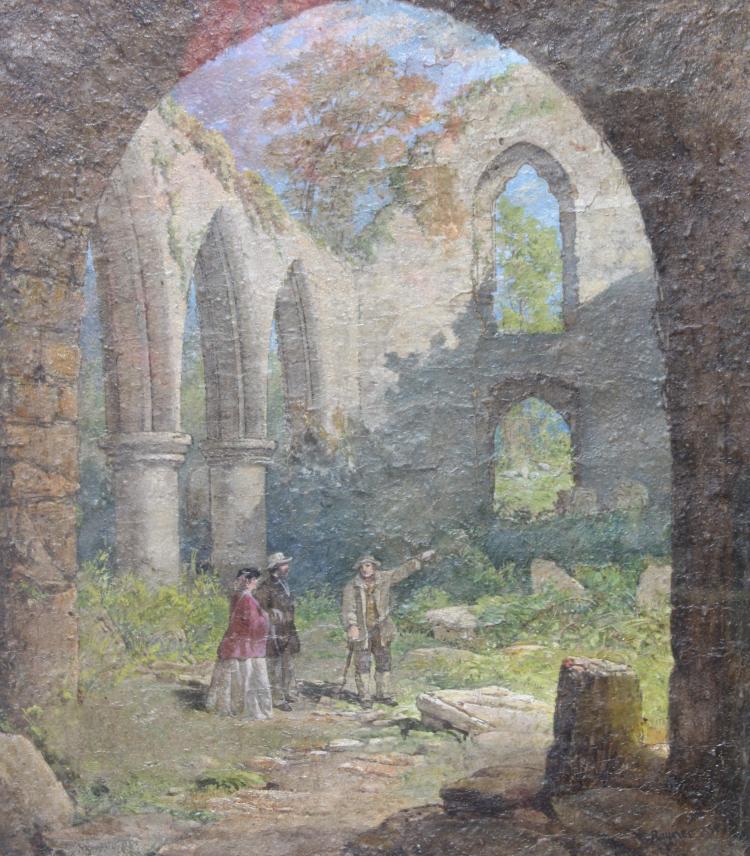
Tour of a Ruined Cathedral by Samuel Rayner (1858)

Samuel Rayner, whether he be innocent or guilty, was disgraced by this court case and it should be noted that for the rest of his life he tended to only exhibit his work in the provinces and steered clear of the prestigious London galleries. He and the family had a number of London addresses during his later years as well as spending time in Brighton and the nearby town of Hove.

Samuel Rayner at the end of his life, with his grandson Ernest Copinger (Frances’s son), in 1876.

Samuel Rayner died at his home in Windsor in 1879, aged 73. His wife, Ann continued to live there with her unmarried daughter Margaret who joined her soon after her father’s death and kept company with her until Ann herself died in 1890.  Samuel and Ann Rayner must have been very proud of the artistic qualities of six of their children and in my next blog I will be looking at some of their work.


Besides the usual sources such as Wikipedia I got most of my information about the Rayner family from an excellent and comprehensive website entitled DudleyMall.

(http://www.dudleymall.co.uk/loclhist/rayner/samuel.htm)

It is really worthwhile you going to have a look at it.

Walter Frederick Osborne.

Walter Frederick Osborne

My featured artist today is Walter Frederick Osborne, the Irish impressionist and post-impressionist landscape and portrait painter. He was born on June 17th, 1859 at 5 Castlewood Avenue in Rathmines, an inner suburb on the southside of Dublin, about 3 kilometres south of the city centre. He had two brothers and a sister, Violet. He was the second of three sons of Anne Jane Woods and her husband, William Osborne, an acknowledged animal painter whose speciality was portraits of horses and dogs owned by wealthy landowners. Walter Frederick Osborne, known as Frederick Osborne for the first twenty-five years of his life, attended the local school at Rathmines.

A Glade in the Phoenix Park by Walter Frederick Osborne (1880 )

Having realised that money could be made from painting, Frederick wanted to follow in the footsteps of his father and become an artist. So, once he had completed his schooling in 1876, seventeen-year-old Frederick, enrolled on an art course at the Royal Hibernian Academy School. Osborne made an impact straight away, exhibiting in the RHA annual show in his first year. He won numerous medals and prizes including the Albert prize in 1880 with his painting, A Glade in the Phoenix Park.

In 1881 he attended Koninklijke Academie voor Schone Kunsten van Antwerpen (Royal Academy of Fine Arts Antwerp), where one of his tutors was the Belgian painter Michael Charles Verlat. Whilst studying there he won the Royal Dublin Society Taylor Art Award in 1881 and 1882, which awarded him an annual bursary. This was the highest student honour in Ireland of the time and given annually to a graduate of an Irish art college or an Irish art student graduating from an art college abroad to assist them with the development of their career as a visual artist.

A Flemish Farmstead by Walter Frederick Osborne (1882)

Osborne sent back to the Royal Hibernian Academy a number of paintings he completed whilst attending the Royal Academy of Fine Arts in Antwerp. One was his 1882 work, A Flemish Farmstead, and this exhibited by the Academy the following year, just after Osborne had been elected an Associate Member. From his earliest days, Osborne was interested in painting farmyards such as the one above. His scenes usually included one or two figures. However, this work is slightly subtler for he merely suggests that the farmyard is a working one by including the jacket that hangs on the open door and the clogs that stand against the wall. Being a great believer that detail is important, he has even depicted the clogs standing on end, suggesting that they are that way so as to allow them to drain after a wet morning in the fields.

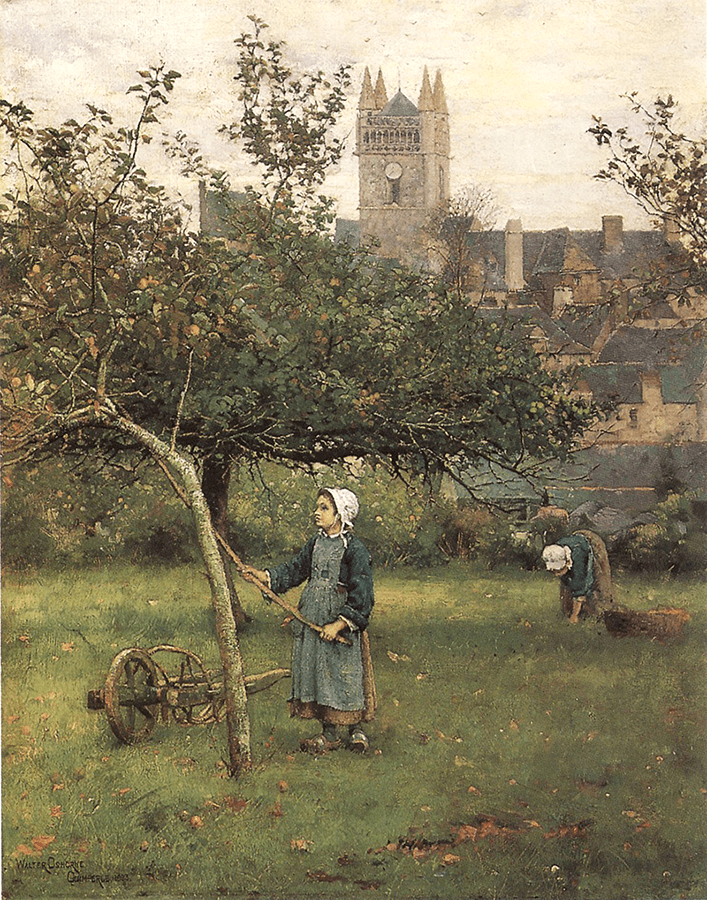
Apple Gathering by Walter Frederick Osborne (1883)

He completed his studies in Antwerp in 1883 and travelled to the Breton artists’ colony at Quimperlé. Osborne soon realised that the most noteworthy modern painters were painting en plein air and were using ordinary local people as their models and the Breton fishing villages had a plethora of such willing characters. It was at Quimperlé that he completed his famous Apple Gathering painting which is now housed in the National Gallery of Ireland. The painting depicts a young girl dressed in a peasant costume holding a long stick, busily shaking branches of an apple tree to loosen the ripe fruit. Looking behind her, we see another young girl picking up the fallen apples which are scattered around the orchard. In the background we see the church of Quimperlé which was the subject of many of the artists residing at the town’s artist colony. The painting can now be found in the National Gallery of Ireland in Dublin.

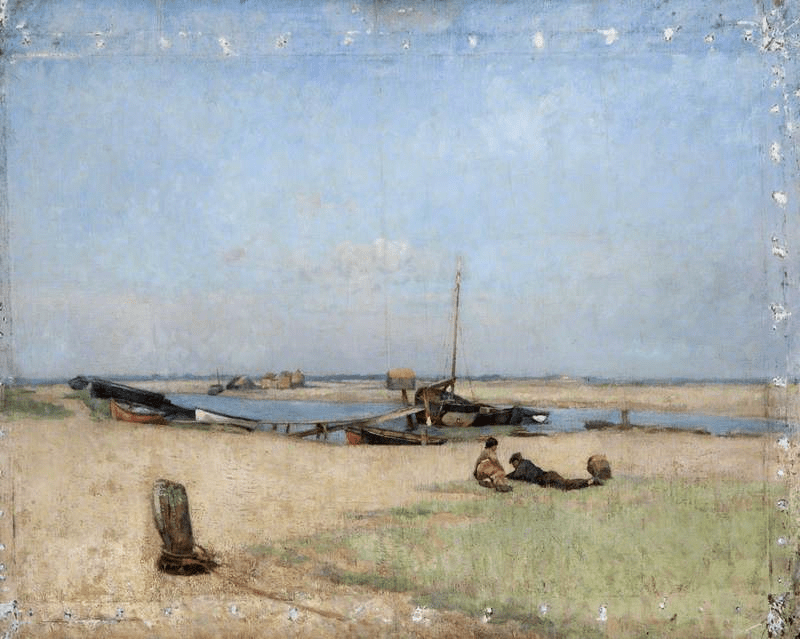
Estuary at Walberswick by Walter Frederick Osborne (c.1885)

Walter Osborne along with two fellow Irish artists, who were part of the Quimperlé artist’s colony, Drogedha-born Nathaniel Hill and Galway-born Augustus Nicholas Burke eventually left the Breton town and returned to England and headed for another artist’s colony at the Suffolk coastal village of Walberswick, where one of the artists was Philip Wilson Steer, who had studied at the École des Beaux Arts under Alexandre Cabanel, during which time he became a follower of the Impressionist school. Steer would become a leading figure in the Impressionist movement in Britain.

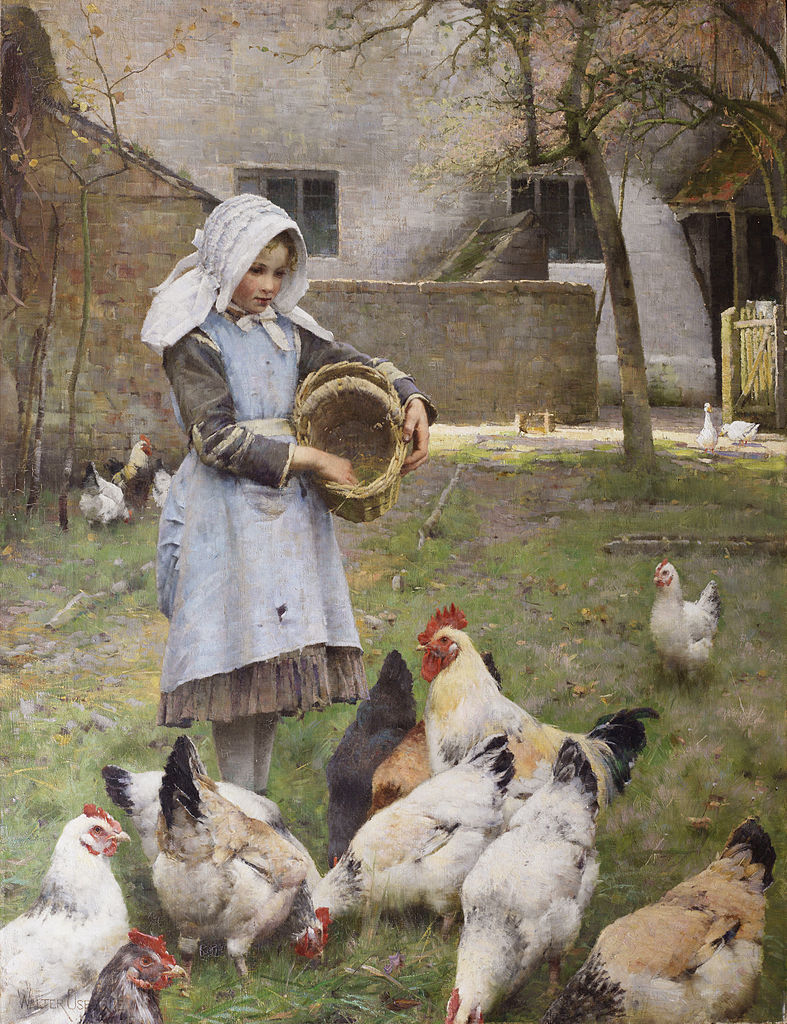
Feeding the Chickens by Walter Frederick Osborne (1885)

At the start of 1884, Walter Osborne’s early paintings often featured young children accompanied by animals, often their pets. One of his most famous works of this genre came about whilst Walter Osborne along with his fellow young artists Nathaniel Hill and Edward Stott, another former École des Beaux Arts student, travelled through the English countryside, on sketching trips. That October, the trio had arrived at North Littleton, near Evesham, Worcestershire and the painting which evolved from his visit here was the work entitled Feeding the Chickens. The oil on canvas painting measured 36 x 28 inches (92 x 71cms). In the work, we see a young but confident girl, with her earnest expression, scattering corn for the chickens. She is Bessie Osborne, (no relation to the artist), the daughter or maybe a servant in the substantial house which we see in the background. In Osborne’s preparatory sketch for this work, there was another figure, a gardener with his wheelbarrow, but he was not transferred to the finished painting. Presumably Osborne thought his inclusion would detract from the main focus of the work, the girl.

The Irish art historian Jeanne Sheehy’s biography of Osborne quotes from his letter to his father, dated October 12th, 1884, about the details of the work. In a letter to his father he set the scene for the painting:

“…’The weather, I am sorry to say has been bitterly cold the last week, so much so that my model nearly fainted and I had to send her home … It will probably seem funny to you all that my model’s name should be Bessie Osborne …”

The young girl is wearing an embroidered bonnet and holding a basket of grain, surrounded by a brood of hens. A further insight into the making of this painting can be found in the letter:

“…Now I am pretty far advanced on a kit-kat of a girl in a sort of farmyard, a rough sketch on the opposite page will indicate the composition. The figure of the girl which is a little over two feet high is coming towards finish, but the immediate foreground with poultry is merely sketched in as yet. The fowl are very troublesome, and I have made some sketches but will have to do a lot more as they form rather an important part of the composition…”

Also, in the letter to his father Walter asks him to look through his sketches he had done whilst at Quimperlé and find any of chickens which may help with this painting.

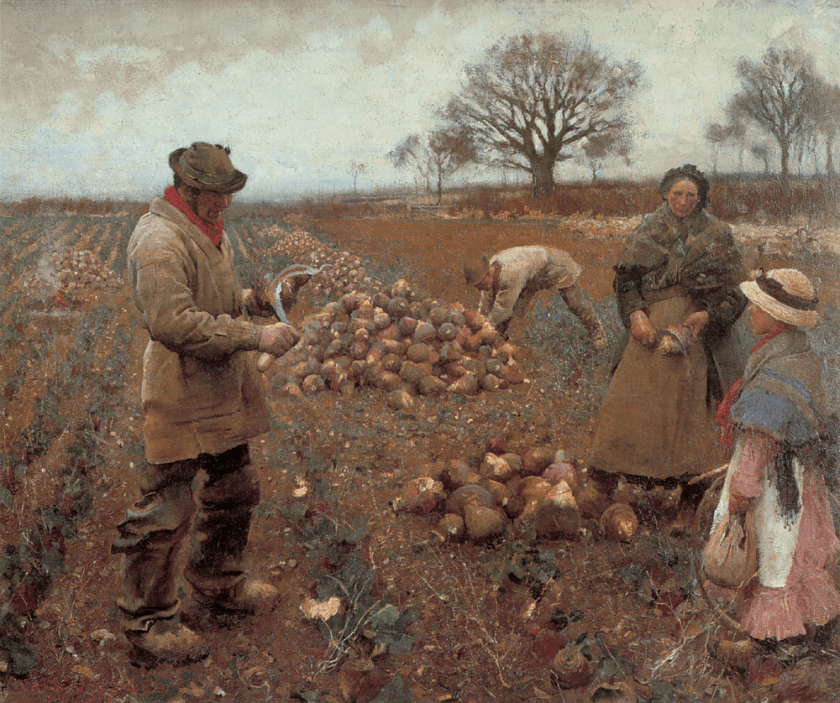
Winter Work by George Clausen (1883)

During his travels around the English countryside, Rural Naturalism became his favoured genre. He had been influenced by the works of the French painter, Jules Bastien-Lepage, whose works were dominating the Paris Salon and it was this type of work which Osborne preferred to the themes from history or mythology which were taught in the Academies of Europe. Another influence on Osborne was another Naturalist painter, the English artist George Clausen.

The Return Of The Flock by Walter Frederick Osborne (1885)

From 1883 and for the next fifteen years Osborne spent the summers wandering around the South of England often visiting the area of the beautiful Berkshire Downs or the area around the Hampshire market town of Romsey or the Suffolk coastal villages. Once asked why he did not spend his summers in Ireland he said that it was cheaper to live in England and it rained less which was important as he wanted to paint en plein air. Osborne was not looking for spectacular landscape which he could have found in the West of Ireland, the Lake District or Scotland. His preference was for the sedate beauty of rural villages with their well-stocked picturesque cottage gardens, often his paintings would include farmyard animals such as sheep. Like the French Impressionists, Osborne was fascinated by the effect of light and how it changes during every hour of the day.

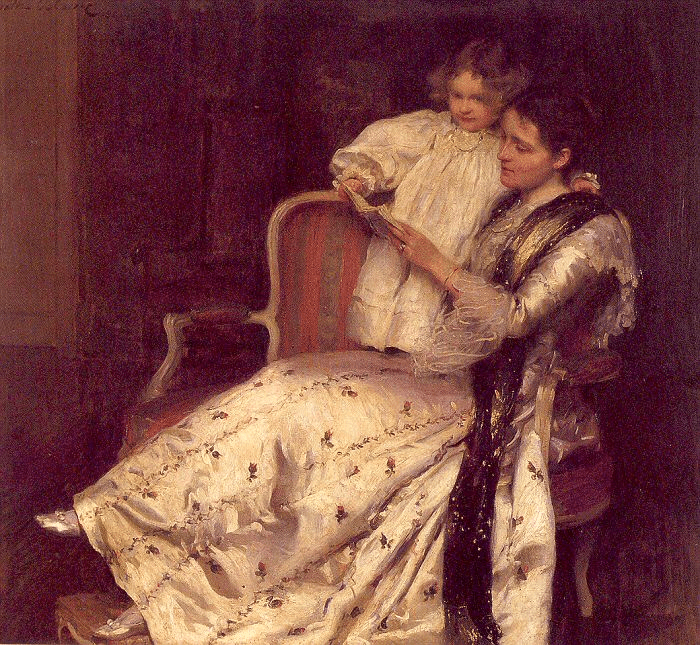
Portrait of Mrs Chadwyck-Healey and her Daughter by Walter Frederick Osborne (1900)

Walter Osborne was elected an associate of the Royal Hibernian Academy in 1883 and became a full member in 1886. Although Osborne spent the summers travelling around the southern English countryside he would return to the family home in Dublin during the winter months.  In 1886, following his election to the Royal Hibernian Academy he received many commissions for portraits and from 1892 onwards, Osborne’s main output changed from landscape work to portraiture. These portraiture commissions were essential to Osborne for his financial survival and that of his parents who relied heavily upon him. Osborne’s permanent move to Dublin in 1892 was prompted by the death of his sister Violet whose newly-born baby was given into the care of Osborne’s aged parents and he had to take on the task of looking after her daughter. His portraiture and landscape works had become so popular and because he received more and more commissions he decided that working from home was not feasible and so acquired his own studio in St Stephens Green in 1895.

Mrs. Noel Guinness And Her Daughter Margaret by Walter Frederick Osborne (1900)

One of his best-known portraits was entitled Mrs Noel Guinness and her Daughter Margaret and this was exhibited at the Paris Exposition Universelle in 1900 and which received the bronze medal. The painting depicts Mary Guinness (née Stokes), the wife of Richard Noel Guinness, and her four-year-old daughter Margaret.

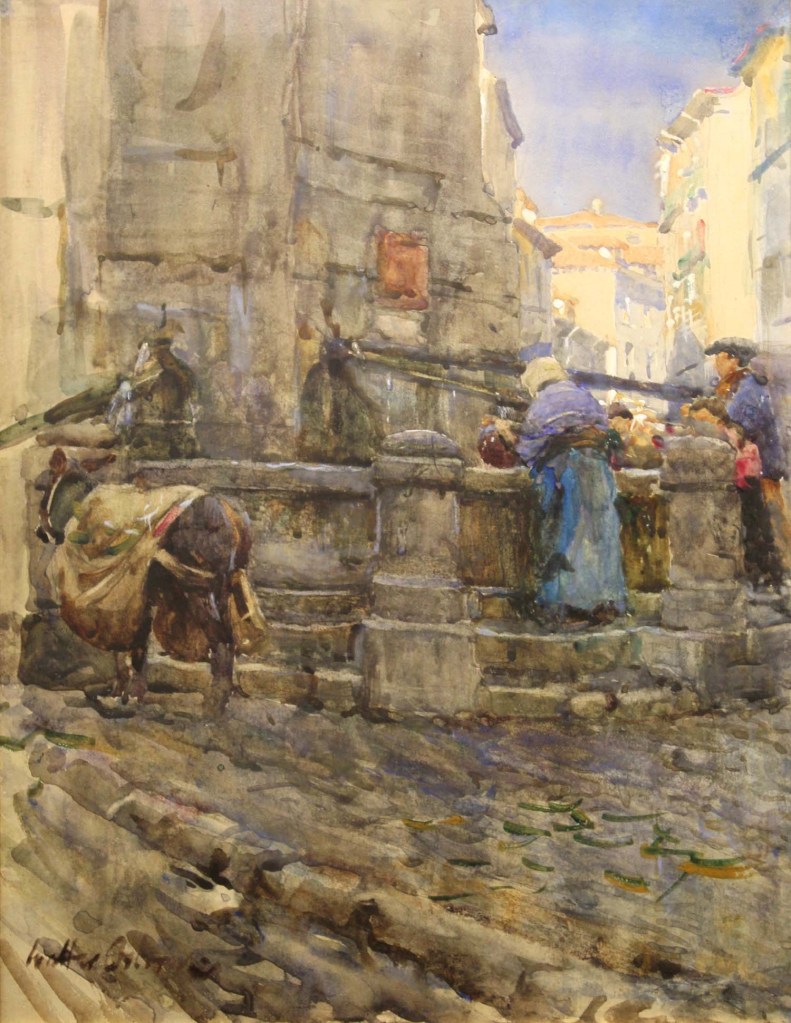
The Old Fountain, Madrid by Walter Frederick Osborne (1895)

In 1895 he and his friend, the art historian and writer, Walter Armstrong, toured around Spain, where Walter completed a number of watercolour drawings and oil sketches. The following year the two men travelled to Holland where he completed a number of Amsterdam canal scenes.

Dublin Streets a Vendor of Book by Walter Frederick Osborne (1889)

During this time Walter Osborne put together a series of paintings depicting Dublin street scenes, which some time later were exhibited at the Royal Academy. Osborne made pencil sketches and took photographs of the street scenes and then completed the series in oils in his studio. Probably the most famous of the paintings in this series was Dublin Streets: A Vendor of Books which he completed in 1898.  The painting depicts a bookseller’s stall, set up on Eden Quay, looking eastwards towards the O’Connell Bridge. We see a mother leaning against the wall holding a very young child in her arms. She has a fatigued and nervous look about her. By her side, on the floor, there is a basket of daffodils. What is her story? Is she in any way connected to the bare-footed girl who has moved towards the customers who are perusing the books at the vendor’s stall? The little girl has a small bunch of daffodils in her hand which she is holding up to the customers. She has been sent by the lady, maybe her mother, to try and get a few pence for the flowers. It is a painting full of movement from the horse drawn carriages we see crossing the bridge to the barge making its way down the River Liffey about to pass under the bridge. These realistic paintings of street life in Dublin, although in great demand now and a good historical record of the times past, were not as successful then as his portraiture.

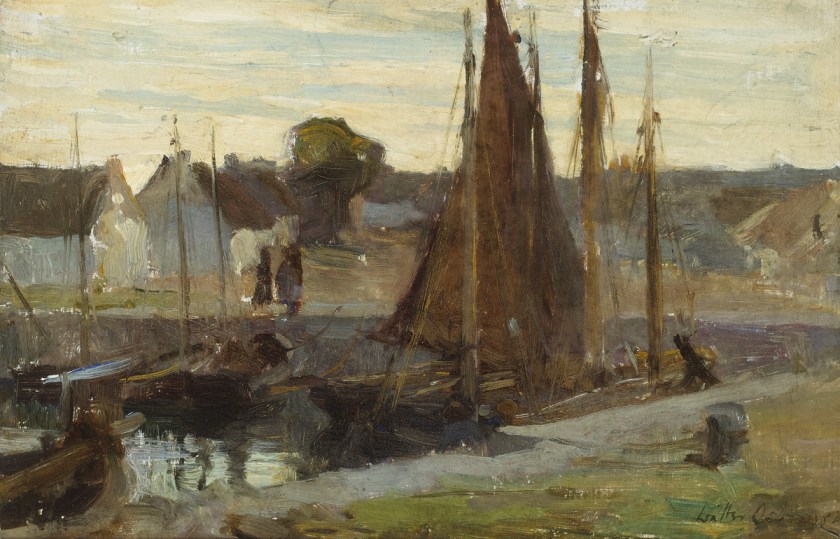
Greystones by Walter Frederick Osborne (1884)

Osborne did not forsake his landscape work completely and one his Impressionist-style works, completed around 1898, was entitled Greystones. It is a somewhat moody study 0f the quayside of Greystones, a small coastal fishing village in County Wicklow. In the painting we see a number of fishing boats tied up to the harbour quayside, some of which have the sails unfurled. In the background there are a number of cottages. His use of muted colours and tones such as his mauves, pinks, pale greys and browns induce a sense of soft light. Look how Osborne has cleverly depicted the diffused sunlight on the gable ends of the cottages and again with the way he has represented it with the silvery flickering of the water with its reflections.

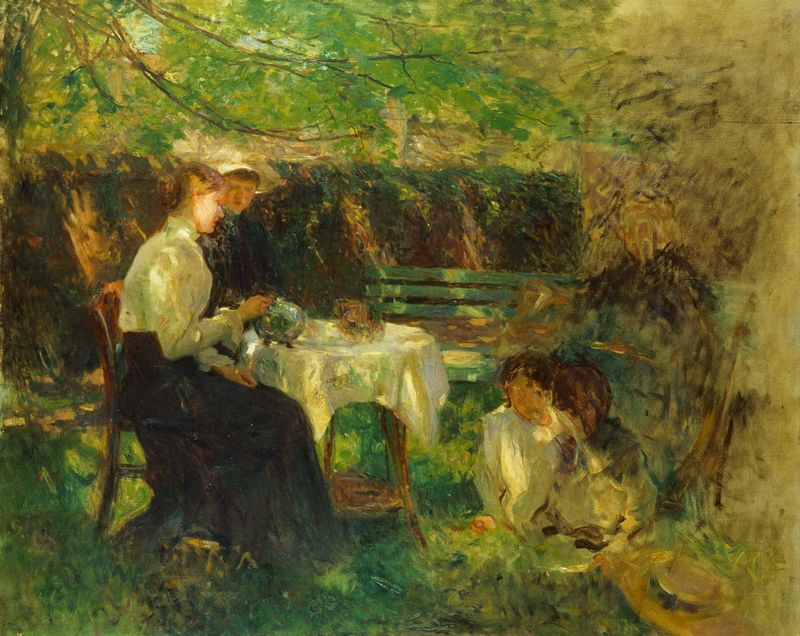
Tea In The Garden by Walter Frederick Osborne (1902)

In 1900 Osborne was offered a Knighthood in recognition of his services to art and his distinction as a painter, but he refused the honour. His mother became ill in the early 1900s, and Walter spent long periods looking after her. In 1902 he started to paint what was to be his last picture, Tea in the Garden, which remained unfinished at the time of his death. It was a beautiful work, a juxtaposition of his favoured Impressionism and Naturalism.

Self-portrait by Walter Frederick Osborne

In 1903, after a strenuous time gardening, he became ill, which he tried to ignore but which developed into double pneumonia. He died aged forty-three, at the family home in Castlewood Avenue, Rathmines, Dublin, on April 24th 1903, and was buried in Mount Jerome cemetery. Walter Frederick Osborne never married and left considerable savings behind him. He was one of the most sought after and talented Irish artists of his time.

James Tissot. Part 5 – The latter years and his religious paintings.

The Garden Bench by James Tissot (1882)

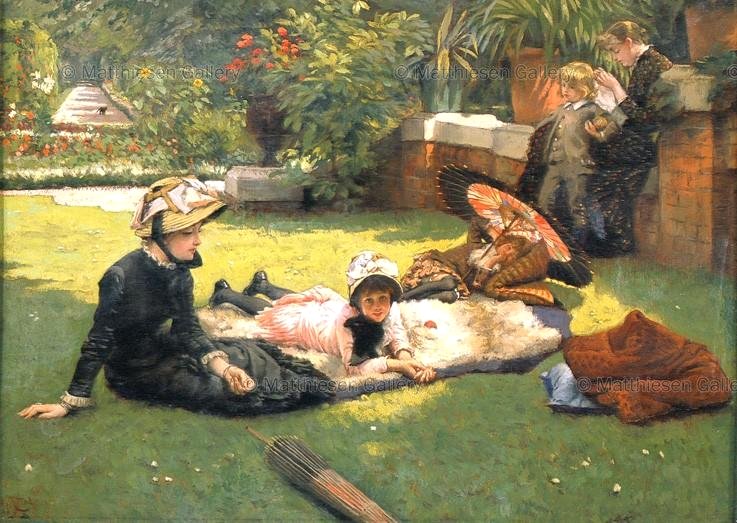
Tissot, heartbroken at the death of his lover and muse Kathleen Newton, returned to Paris in November 1882.  It was on his return to France that he competed a large family portrait painting entitled The Garden Bench. Kathleen Newton is depicted in Tissot’s London garden bathed in sunlight, sitting on a garden bench which is draped with a fur rug. She looks lovingly at her son Cecil George whilst behind her are her daughter Violet and her niece Lilian. With the premature death of Kathleen this painting became special to Tissot and although he allowed it to be exhibited in Paris in 1873 he would not allow it to be sold and kept it until his death.

A Little Nimrod by James Tissot (1872)

That same year he completed another work depicting his “family” playing in the garden of his home, which no doubt would remind him of the joys he experienced with Kathleen and her children which were suddenly and tragically taken from him. The painting was entitled A Little Nimrod. His period of family life was over and would never return.  So, after eleven years in England Tissot was once again on French soil. He was heartbroken and even the French writer and art critic, Edmond de Goncourt, who had castigated Tissot for his art work, was moved by Tissot’s anguish. After meeting with him, de Goncourt wrote in his journal:

“…A visit today from Tissot, just arrived in the night from England – and who told me during our talk hat he was much affected by the death of the English Mauperin, who, though already ailing, served as a model for the illustrations in my book…”

2010 edition of Rénee Mauperin by Edmond and Jules de Goncourt with illustrations by James Tissot

Edmund de Goncourt and his brother Jules wrote a novel entitled Renée Mauperin and, in the summer of 1882, Tissot was asked by them to illustrate it. Tissot produced ten etchings and in all of which Kathleen Newton was depicted as the heroine of the novel.

The Prodigal Son In Modern Life, (The Fatted Calf) by James Tissot (1882)

Tissot’s first task on returning to France was to enhance his reputation with the French art critics. In order to do this, he put together a collection of over a hundred of his works, most of which he had completed whilst living in England and exhibited them at the Palais de l’Industrie with the centrepiece being his set of paintings entitled The Prodigal Son in Modern Life, which he had exhibited at his one-man show at the Dudley Gallery, London in May 1882. In one of the paintings from the set (The Fatted Calf), we see a young man stepping out of his rowing-boat on the Thames to join his family at lunch in a summer house where a sumptuous meal has been set out to celebrate his return. Despite Tissot translating all the titles of the paintings into French, the exhibition was coolly received with one critic scathingly describing Tissot as:

“…a Parisian of London now become a Londoner of Paris…”

The Princesse De Broglie by James Tissot (1895)

In other words, as far as the French art critics were concerned Tissot had become too English for their taste. The only glimmer of hope for Tissot was that his pastel work at the exhibition was praised and during the 1880’s and 1890’s he turned more to that painting medium. One of his outstanding pastel on linen works was his 1895 portrait, The Princesse de Broglie. The lady was Joséphine-Éléonore-Marie-Pauline de Galard de Brassac de Béarn better known simply as Pauline, wife of Albert de Broglie, the 28th Prime Minister of France. Her pose is casual and yet the way she rests her hips on the table makes for an impressively alluring image. Tissot’s use of brilliant green pastels was to become his trademark.

La Femme à Paris series – The Shop Girl by James Tissot (1883-5)

Tissot, now back in Paris, sought to get himself back into Parisian society and would regularly frequent clubs and restaurants but the one thing he did consistently was to rise early and go to morning mass. He was disappointed that his exhibition at Palais de l’Industrie had not been received as well as he had hoped, and in 1883 he set about putting together a new series of fifteen paintings known as La Femme à Paris which looked at the life of Parisian women of different social classes at various occupations. He conceived a series of compositions focusing on women’s daily lives, from widowhood to flirtation, boredom in the countryside to belle of the ballroom, theatre to confessional.

The Sporting Ladies (Les Femmes de Sport) by James Tissot (1883-5)

Two years later the series was completed and they were exhibited at the Galerie Sedelmeyer in Paris in 1885 and in the Arthur Tooth Gallery in London in 1886. The theme of bustling Paris was very popular with artists in the 1890’s. The paintings were much larger in scale than anything Tissot had done before, his hope being that the monumental works would have an impact on critics and public alike. The Sporting Ladies one of the La Femme à Paris series, measuring 147 x 102cms, depicts a woman engaging the viewer as a participant in the action by her direct glance out of the picture. The event is a “high-life circus,” in which the amateur performers were members of the aristocracy.

La Femme à Paris series – Without a Dowry by James Tissot (1883-1885)

Another large painting in the series was Without a Dowry. The setting is the Tuileries Gardens where we see a beautiful young lady dressed in black, who is a recently bereaved widow. Next to her, sitting down reading the newspapers, is her mother, also adorned in black. To the left, in the background we see two soldiers, one of whom is struck by the beauty of the widow and stares at her with an admiring gaze albeit he is reluctant to approach her. The subject of the painting highlighted the plight of young widows who, on the death of their husbands, were often left financially destitute. This was a very popular subject during the Victorian era.

La Demoiselle d’Honneur (The Bridesmaid) part of the La Femme à Paris series by James Tissot (1883-5)

The last painting in the series La Femme à Paris was completed in 1885. It was entitled Sacred Music and it depicted a young woman singing with a nun in the organ loft of a church. For this painting Tissot visited the church of S. Sulpice in Paris. As he sat in one of the church pews during the mass service he experienced a vision which was to change his life. He recalled the vision later:

“… As the Host was elevated and I bowed my head and closed my eyes, I saw a strange and thrilling picture. It seemed to me that I was looking at the ruins of a modern castle…..then a peasant and his wife picked their way over littered ground; wearily he threw the bundle that contained their all, and the woman seated herself on a fallen pillar, burying her face in her hands…. And then there came a strange figure gliding towards these human ruins over the broken remnants of the castle. Its feet and hands were pierced and bleeding, its head was wreathed in thorns…. And this figure, needing no name, seated itself by the man and leaned its head upon his shoulder, seeming to say…..’See, I have been more miserable than you; I am the solution to all your problems; without me civilization is a ruin’…”

The Ruins (also known as Inner Voices) by James Tissot (1885)

Following this vision Tissot sat down and painted a picture of what he had seen in this vision. It was entitled The Ruins (Inner Voices).   It has to be said that the setting of a modern castle as described by Tissot is not transferred to the painting as this rather looks like a scene from the Paris Commune risings which Tissot had witnessed. It is a moving portrayal especially the depiction of Christ. This painting marked the beginning of Tissot’s devotion to illustrating the Bible. Strangely enough it was these religious paintings which were to bring Tissot greater wealth and prominence than his earlier modern-day life depictions. There were many cynics, including his friend Degas, who believed Tissot’s religious conversion was more to do with the increased sale of his work than to his religious beliefs. Could this be true? To give Tissot the benefit of the doubt one has to remember that there was a great revival of the Catholic church and its preaching in France during the later part of the nineteenth century, which was a counter reaction to the anti-clerical spirit of the Third Republic.

L’Apparition médiumnique (The Mediumistic Apparition) by James Tissot (1885)

It was not just the Catholic religion that Tissot embraced. He also took up Spiritualism and attended séances which had become very popular in the late nineteenth century and which had given him some comfort during the days following his wife’s death. In two séances Tissot attended, he was “visited” by an apparition of his beloved Kathleen, and despite one of the mediums later jailed for fraud, Tissot’s beliefs remained unshaken and he completed a work in mezzotint, L’Apparition médiumnique (The Mediumistic Apparition) in 1885. Tissot kept the picture in a special room in his house which he reserved for private spiritualistic séances.

Tissot in Palestine

This great interest in Catholicism led to the last great project embarked on by Tissot. He decided to dedicate his time in illustrating the whole of the Bible. This first stage of this mammoth task was to concentrate on the New Testament and Tissot started the illustrative work in 1866. Eight years later and with 365 illustrations completed his artistic labour was complete. Tissot was a perfectionist and to ensure the settings for the illustrations were accurate he made a number of trips to Palestine.

Tissot on the way to the Greek monastery of Mar Sara while he was studying the country between Jerusalem and the Dead Sea

The first trip started in October 1885 and lasted five months. He would return again to this biblical land in in 1889 and 1896. Whilst in Palestine Tissot recorded the landscape, architecture, costumes, and customs of the Holy Land and its people, which he recorded in photographs, notes, and sketches. This enabled Tissot to paint his many figures in costumes he believed to be historically authentic, and the completed series of watercolours had great archaeological accuracy. Tissot’s typical daily routine was recorded by Cleveland Moffett, the American journalist, author, and playwright in the March 1899 issue of the McClure’s Magazine, an American illustrated monthly periodical which was very popular at the turn of the 20th century. He wrote:

“…six o’clock saw him out of his bed even on dark winter mornings and seven o’clock found him at the Convent Marie Réparatrice, bowing before the candles and listening to the chant of the kneeling women…….and then, after eating, set forth to work, riding through the streets of Jerusalem, a servant trotting besides him with colors and brushes in a basket, and a large umbrella for shade, and such other things an artist needs. Then would come two hours’ sketching the putting down of numberless backgrounds for the Christ story…… and after food [lunch] came another excursion within or without the city and two hours more work……After dining quietly, M. Tissot spent his evenings in reading and reflection…”

Journey of the Magi, by James Tissot (c. 1894)

One of his finest works of the series was his opaque watercolour over graphite on grey wove paper entitled Journey of the Magi. The Magi are depicted in their flowing saffron robes being guided by the star. They have come from their individual lands in the east in their search for the new-born Jesus. The setting is the vast, arid landscape of the volcanic hills on the shores of the Dead Sea between Jericho, the Kedron Valley, and Jerusalem. The painting is a juxtaposition of beautiful shimmering masses of golden yellows, soft purples and rich browns. Look how Tissot has magically contrasted the highlights and shadows. The leading riders almost step out of the picture making us feel that we are almost there with them. The three wise men lead the procession. Tissot’s depiction of the three men differentiates their ages by the colour of their beards. All have weather-beaten darkened faces which is in contrast to the brightness of their golden robes. The long trail of men riding their camels spreads out far beyond the mountain range and vanishes into the distance.

Jesus at Bethany by James Tissot (1886-1894)

Once Tissot returned to Paris he set about rendering his sketches into actual paintings. The finished series became known as Tissot’s Bible and he wrote a foreword for the tome. Although he no doubt wrote from the heart the solemn words of the introduction now appear self-righteous, mystical and somewhat embarrassing.  Cleveland Moffett, the American journalist, author, and playwright in his article about James Tissot wrote an article for the March 1899 issue of the McClure’s Magazine entitled Tissot and his Paintings of the Life of Christ, in which he talked about Tissot’s artistic methodology:

“…M.Tissot, being now in a certain state of mind, and having some conception of what he wished to paint, would bend over the white paper with its smudged surface, and looking intently at the oval marked for the head of Jesus or some holy person, would see the whole picture there before him, the colors, the garments, the faces, everything that he needed and already half conceived. Then, closing his eyes in delight, he would murmur to himself ‘How beautiful! Oh, that I may keep it! Oh, that I may not forget it.’ Finally putting forth his strongest effort to retain the vision, he would take brush and color and set it all down from memory as well as he could…”

Jesus Goes Up Alone onto a Mountain to Pray by James Tissot (1886-1894)

In his watercolour, Jesus Goes Up Alone onto a Mountain to Pray, we see Jesus seeking solitude for prayer following the miracle of the loaves and fishes, at the summit of a mountain. It is a dramatic, some would say, melodramatic image, seen from below as we look up and see Jesus depicted, arms held out, against a night sky, with his gleaming white robes backlit by the radiance of the stars and the crescent moon.

The Soul of the Penitent Thief in Paradise by James Tissot (1886-1894)

In his work, The Soul of the Penitent Thief in Paradise, Tissot depicts the tiny figure of the thief being literally lifted by angels into orbit above the earth. Maybe the work is more to do with spiritualist apparitions than religious visions.

What Our Saviour saw from the Cross by James Tissot (1886-1894)

Probably the quirkiest, and of questionable taste, is his painting, What Our Saviour saw from the Cross. Look carefully at the centre foreground and you will see the feet of Christ and we, as mere spectators, are literally made to feel that it is us who is hanging from the cross. It was this kind of realism which appealed to the Catholic faithful in the 1890’s.

Portrait of the Pilgrim (Portrait du pèlerin) by James Tissot (1886-1894)

Tissot even included a self-portrait in one of his biblical scenes, Portrait of a Pilgrim. Tissot closed the published volumes of The Life of Christ with this funerary self-portrait and a plea to the reader to pray for him. In the depiction we see him standing among articles associated with rites for the dead: tapers, a draped coffin, wreaths, and holy water. In the background, a large wreath surrounds the distinctive “JTJ” monogram with which he signed some of his works. But there is more to this picture than first meets the eye. While Tissot raises his right hand in a gesture of benediction, his left hand seems transparent, almost like a ghostly apparition. Look how the lit candles flicker, almost as if a sudden gust of air—or a spirit—has passed through the room.

Tissot’s Bible was an immediate success and the Paris art world was thrown into turmoil.  The series became a talking-point in artistic circles. An exhibition of 270 of the 350 pictures was held in 1894 at the Salon du Champs-de-Mars and it was the greatest public success of Tissot’s career. The public were overwhelmed by the paintings with some women sinking to their knees and even crawling around the rooms in reverent adoration. After years of criticism Tissot had finally given the public what they desired– a mystical godliness which encapsulated the religious ambience of the day.  After the Paris exhibition the illustrations were shown in London and, in 1898, toured America where the entrance fees to view Tissot’s work raised in excess of $100,000.  In 1900, the Brooklyn Museum purchased this set of 350 watercolours, popularly known as The Life of Christ, and to this day, they remain one of the institution’s most important early acquisitions.

The Life of Our Lord Jesus Christ by James Tissot

The success of the exhibitions led to a publication of The Life of our Lord Jesus Christ with its 350 illustrations by Tissot.  It was first published in France in 1897 and later in both England and America.  Tissot received a million francs in reproduction rights from the French publisher alone.  The success of the book and the paintings ensured James Tissot would be a very rich man for the rest of his life.

The Ark Passes Over the Jordan by James Tissot (1889-1901)
Part of the Old Testament Series.

Tissot inherited the Chateau de Buillon from his father in 1888 and from that date onwards divided his time between there and his house in Paris. He lived in considerable style and surrounded himself with servants and relatives, one of who was his niece Jeanne Tissot, whom he left the chateau and all its contents when he died. After the tremendous success of the Life of Christ series he decided to illustrate the Old Testament and made his final trip to the Holy Land in 1896. Sadly, Tissot never completed his Old Testament series but before his death in 1902 he had completed ninety-five of the illustrations and these were shown at an exhibition at the Salon du Champs-de-Mars in 1901.

James Tissot
                                                                     (1836-1902)

Whilst overseeing renovations in the gardens at Chateau de Buillon he caught a chill and died on August 8th, 1902, aged 66. At the time of his death his reputation had begun to decline but nowadays his works of art are appreciated by more and more people.


Most of the information I used for the five parts of the James Tissot blog came from information I found in Christopher Wood’s 1986 biography of Tissot which is an excellent read, full of beautiful pictures.

If you would like to read the full March 1899 article about James Tissot as it appeared in the McClure’s Magazine by Cleveland Moffett,   entitled Tissot and his Paintings of the Life of Christ, then copy and paste the URL below into your browser:

https://babel.hathitrust.org/cgi/pt?id=mdp.39015030656113;view=1up;seq=415


James Tissot. Part 4 – True love, loss and a return to his homeland

James Tissot (1836 – 1902)

Tissot had stayed at the home of his friend, Thomas Bowles, when he arrived in England in June 1871, and remained his guest until 1872, at which time he went to live in a house in St John’s Wood, an area inhabited by a number of artists. A year later, with buoyant finances, he was on the move again, this time buying a house close by, in Grove End Road. His friends back home in France could not believe the change in Tissot’s fortunes. His good friend Degas wrote to him about his change of circumstances:

“…I hear you have bought a house. My mouth is still open…”

While others, probably jealous of his success in London were somewhat scathing. Edmond de Goncourt, a French writer, literary and art critic wrote mockingly in his journal, dated November 3rd 1874:

“… Tissot the plagiarist painter, was having the greatest of successes in England. Has this ingenious exploiter of English stupidity not come up with the idea of an ante-room to his studio perennially filled with iced champagne for his visitors, and around his studio a garden where one might observe at all times a footman occupied in dusting and polishing the leaves of the laurel bushes…”

Berthe Morisot and her husband visited Tissot in 1875 and following the meeting she wrote to her mother:

“…he is very well set up here and is turning out very pretty pictures. He sells them for 300,000 francs a time. So, what do you think of success in London? He was very kind; and complimented me on my work, though I doubt if he has actually seen any…”

In another letter to her sister she wrote:

“…Tissot……is living like a prince…..he is very kind, and most amiable, though a little common…..I paid him a great many compliments and truly deserved ones…”

The Ball on Shipboard by James Tissot (c.1874)

One of Tissot’s paintings in 1874 is now looked upon as one of his most festive works and one of his finest works which he completed whilst living in England. Again, it followed on from other shipboard paintings which Tissot had become known for. The painting depicts men and women relaxing at an event thought to be the annual regatta at Cowes on the Isle of Wight. It is entitled The Ball on Shipboard and was exhibited at the Royal Academy in 1874, but unpredictably it received an unfavourable reaction from some art critics. To them, there was no narrative, the colours were too garish and some even levelled the complaint that it was “simply vulgar”. John Ruskin described it as:

“…unhappy mere colour photographs of vulgar society…”

The art critic of the magazine Athenaeum said of it:

“…I can find no pretty women, but a set of showy rather than elegant costumes, some few graceful, but more ungraceful attitudes and not a lady in a score of female figures…”

How the critic came to that collusion now seems unfathomable and the supercilious and snobbish judgement he made is completely at odds with today’s views when the work is simply looked upon as the spirit of Victorian fashion and sophistication.

London Visitors by James Tissot (1874)

Another of Tissot’s works to be exhibited at the Royal Academy received stinging criticism and yet is now looked upon as one of his masterpieces. The painting is entitled London Visitors. The colours used are mainly grey and muted tones which are suggestive of a typical of a smoky city atmosphere of a London scene on a dull winter’s day. Depicted are a couple of stylishly dressed visitors to the capital standing underneath the portico of the newly constructed National Gallery in London, with the church of Saint Martin-in-the-Fields framed in the background. The couple are trying to decide where to head to next. The gentleman checks his guidebook, while his female companion uses her umbrella to point towards Trafalgar Square, which lies in front of them. Standing in the foreground is young boy. He is one of the so-called bluecoat boys, who were students of the charitable Christ’s Hospital School, who often acted as tour guides to visitors to the city.

Empress Eugénie and the Imperial Prince in the grounds of Camden Place, Chislehurst by James Tissot (c.1874)

Tissot’s exalted reputation as a portrait painter was further boosted with one of his most prestigious portrait commissions which he received in 1874. This painting is a royal portrait of the widowed Empress Eugénie and her son, Louis Napoleon, entitled The Empress Eugénie and the Prince Impérial in the Grounds at Camden Place, Chislehurst. The painting which is now housed in the Chateau de Compèigne in France is one of Tissot’s most remarkable portraits. It is a portrait of a once powerful family who were then living in reduced circumstances. It is a portrait laced with sympathy. The autumnal colours add to the pair’s mood of sad reflection and feeling of desolation. In it, we see the sorrowful figures of the Empress Eugenie and her son, the recently deceased Napoleon III’s heir.  He is dressed in his British Royal Artillery uniform and is depicted supporting his mother as he looks towards us.   Empress Eugénie was to suffer more tragedy for sadly her son was killed in 1879, five years after the painting was completed, while fighting in the Zulu War in South Africa.

Mavourneen (My Darling)
Portrait of Kathleen Newton by James Tissot (1877)

It was 1875 when a new person entered James Tissot’s life. A person who would bring both joy and sadness to him. The person was Kathleen Newton (née Kelly), an Irish woman who would become his muse and later his lover.
Kathleen Irene Ashburnham Kelly was born in 1854 to Irish parents in Lahore, where her father, an officer in the British Indian army, was stationed. Kathleen’s father finally achieved the rank of chief adjutant and accountant officer in Agra and eventually retired around 1865 and left India and returned with his wife and daughters to live in London. Kathleen had been convent educated, but after her mother died she was sent to boarding school. When she was seventeen her father decided that she should marry. He arranged such a marriage with an older man, Isaac Newton who was a surgeon attached to the Indian Civil Service, and Kathleen was sent off in a steamer to meet her proposed husband, whom she had yet to set her eyes upon. For all intense and purposes, she was a mail-order bride.

The Bunch of Violets by James Tissot (1875)

Unusually her father had not arranged for a chaperone to travel with his teenage daughter and it was during this long sea passage that she fell in love with a fellow traveller, a Captain Palliser. She arrived in Lahore and on January 3rd 1871 Kathleen and Isaac Newton were married. Being somewhat naïve but one has to remember she was a pious convent girl,  on the advice of a Catholic priest, she confessed to her husband about the on-board romance soon after their wedding ceremony and before the marriage was consummated. In a letter to her husband, which I am not sure would have helped her cause for forgiveness, she wrote:

“…I am going to speak to you as if I was standing before God. It is true that I have sinned once, and God knows how I love that one [Palliser] too deeply to sin with any other…”

He was horrified and unforgiving and in May 1871 initiated divorce proceedings. He was granted a decree nisi in December 1871 and a decree absolute in July 20th 1872. Kathleen returned to England and went to live with her sister and brother-in-law, Mary and Augustus Hervey who lived in Hill Road, St John’s Wood close to Tissot’s Grove End Road house. On the same day as the decree absolute ending Kathleen’s marriage was granted she gave birth to Palliser’s child, Muriel Mary Violet.

Young Women Looking at Japanese Objects by James Tissot (1869)

It is not known for sure how Kathleen Newton and James Tissot met or when, but the best guess is late 1875. What we do know is that Kathleen Newton gave birth to her second child, Cecil George in March 1876 and that Kathleen, plus Violet and Cecil George went to live in James Tissot’s house that same year. Opinions are divided and arguments put forward fore and against as to whether Cecil George was Tissot’s son.  Kathleen gave her son the surname of Newton presumably so that he and his sister had the same last name !  All we do know is that Tissot’s household now included an Irish divorcee and her two illegitimate children and this did not sit well with the “rules” of respectable Victorian society. Although his close friendship with fellow artists remained as strong as ever his relationship with Kathleen found him barred from many high society gatherings. Tissot did not worry about this ostracising for he now sampled the joys of “family life” for the first time.

Portrait of Mrs N., more commonly titled La Frileuse by James Tissot (1876)

One of his earliest portraits of Kathleen Newton was a small (26 x 16cms) drypoint in black ink on cream laid Japan paper, which he completed in 1876. It was entitled Portrait of Mrs N..(Kathleen Newton) often referred to as La Frileuse (a woman shivering) which referred to the fact that Kathleen constantly felt the cold. It is regarded as his finest and most exquisite portrait of Kathleen. It must have been a true labour of love as we know he lost his heart to this Irish woman. The description in the William Weston London Gallery’s catalogue states:

“…It is a work of extreme delicacy yet great richness, of poetic quiet yet great emotion. Unlike the great majority of Tissot’s prints it is worked in pure drypoint, without the strength of underlying pure etching. The use of pure drypoint allowed him to combine extremely fine touches of line, in the drawing of her face for example, with tremendously rich textures in the burr and wiped ink tone in the fur collar or the hat. Kathleen Newton was the inspiration for some of Tissot’s very finest works…”

Le Croquet. (Playing Croquet) by James Tissot (1878)

The fact that Tissot was living with Kathleen was not unusual as many wealthy men kept mistresses but they did not, like Tissot, parade them around openly and advertise their relationship. Tissot did not worry about what society thought about his relationship with Kathleen as he now sampled the joys of “family life” for the first time. Tissot’s open and very public display of his affair with Kathleen shocked the London society, a society which had once welcomed him with open arms. His choice was simple, embrace Victorian society’s protocol or be proud to be seen with Kathleen.  For Tissot there was no question as to which course of action he would choose. Kathleen was the love of his life and he chose her over life amongst London society. James and Kathleen settled down to home life and were happy to mix with their many artistic friends who continued to support them. They never married and the reason for this could be their rigid Roman Catholic upbringing and beliefs. Tissot’s house and garden were spacious and Tissot and Kathleen along with her two children created a private world together and it is this private world which is the atmospheric background to many of Tissot’s compositions of this period including another drypoint, Le Croquet, which he completed around 1878.

A Passing Storm by James Tissot (1876)

One of the first painting in which Kathleen appears is the 1876 work by Tissot entitled A Passing Storm. The setting for this painting is a room overlooking Ramsgate harbour. Kathleen is depicted lying on a chaise longue in an elegant if somewhat provocative pose. In the background, seen standing on the balcony, we see her lover. His demeanour is puzzling. He stands there with his hands in his pockets looking rather impatient and uninterested in the lady. It is a scene of inhibited passion. Again, it is a narrative work which lets the viewers decide what is going on and what has been said between the two to end up at this juncture.

Room Overlooking the Harbour by James Tissot (c.1876)

Another early work featuring Kathleen was one entitled Room Overlooking the Harbour. In this work the lady sits at a table having lunch. Across the table from her is an older man who is reading a newspaper.

Photograph of Kathleen Newton

It was during this period, the late 1870’s that Tissot began to use photographs to help with his depictions and a number of these photographs still survive to this day.

En Plein Soleil (In the Sunshine) by James Tissot (c.1881)

One such instance of this technique was Tissot’s painting En plein Soleil (In the Sunshine) which he completed in 1881. The depiction of Kathleen Newton is from a photograph of her sitting in the garden of his Grove End home.  The setting for the painting is Tissot’s Grove End Road garden in St. John’s Wood. It is a group portrait, we see Kathleen Newton on the left depicted in the same pose as in the photograph. On the rug next to her is her daughter, Muriel Mary Violet. The other girl lying under the parasol is her niece Lillian Hervey. To the right is Kathleen’s sister, Mary Hervey, whom she lived with on her return from India,  and is seen ruffling the hair of a young boy, Cecil George, Kathleen’s five-year-old son, who may also have been fathered by Tissot.

Family photograph

In 1878 Tissot used another photograph of Kathleen for his painting entitled Waiting for the Ferry. The photograph was once again taken in the garden of Tissot’s Grove End Road home. In it, we see Tissot and Kathleen along wither son Cecil George and her niece Lilian Hervey.

Waiting for the Ferry by James Tissot (1878)

In the painting we see the young girl wearing a large hat with an equally large bow holding onto the wooden rail of the dock waiting for the arrival of the ferry. The woman, modelled by Kathleen, is depicted sitting in the same Windsor chair shown in the photograph. The woman is well wrapped up against the cold and doesn’t look well. In a number of his later works featuring Kathleen Newton, Tissot has depicted her as being unwell and convalescing which is rather sad, bearing in mind the onset of Kathleen’s own illness.

Mrs Newton with a Parasol by James Tissot (1879)

Another beautiful painting featuring Kathleen was his 1879 work Mrs Newton with a Parasol. This is looked upon as one of Tissot’s finest depictions of Kathleen. It has a hint of japonisme in its simplicity of design and the abstract colouring of the background. This is Tissot’s eulogy to feminine exquisiteness. This is Tissot’s homage to the woman he loved.

Tissot, by 1876, was financially secure through the sale of his paintings and he was happy with his life with Kathleen and her children. However, as we all know, life is not all plain sailing. In the latter part of the 1870’s Tissot’s paintings which he exhibited at various galleries were receiving a lot of criticism from the art critics. During the period, late 1879, through all of 1880, Tissot failed to exhibit any of his work at any of the leading London galleries. The critic were probably aware of the disdain shown by Tissot with regards Victorian morals and thought that criticising his work would be pay-back for his laissez-faire attitude to flaunting his private life in public. The art critic of the Spectator scathingly wrote:

“…This year he tries our patience somewhat hardly, for these ladies in hammocks, showing a very unnecessary amount of petticoat and stocking, are remarkable for little save a sort of luxurious indolence and insolence…”
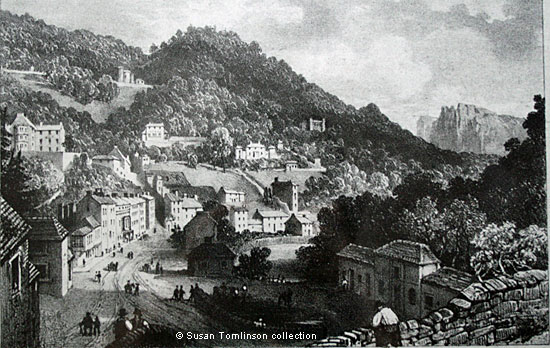
The Hammock by James Tissot (1880)

The painting which the critic was lambasting was The Hammock which was set in Tissot’s own garden with its distinctive pool and cast-iron colonnade. In Victorian London having and maintaining such a large and decorative garden was very much a sign of affluence. The painting is all about lavishness, inactivity, and adoration. We see the lady, modelled by Kathleen, sitting back in her hammock, lazily reading her newspaper, There is a glimpse of a white petticoat which had upset the critics believing this would result in male viewers entertaining erotic thoughts !!! Although not discernible from the attached picture the book lying face down on the rug is probably French which alludes to the fact that Tissot had been sitting on the rug at the feet of his lover. Once again Tissot has included elements of japonisme in the painting.  It was interesting to note that Tissot exhibited the work at the Grosvenor Gallery instead of the Royal Academy. The Grosvenor was the temple of the Aesthetic Movement and Tissot’s style of paintings were much more aligned to the philosophy of this gallery than the Royal Academy which was looked upon as an older, straight-laced institution which frowned at frivolity.

Soirée d’eté (Summer Evening) by James Tissot (1882)                                                                                       A painting featuring Kathleen shortly before her death.

Another reason for Tissot not exhibiting any of his work during 1879 and 1880 was the declining health of Kathleen Newton who had contracted tuberculosis. In 1882 her health deteriorated rapidly with the onset of consumption. It was an illness that caused her great suffering and seeing his wife in so much pain was almost too much for Tissot to bear. Kathleen, aware that she was dying and saddened by sight of her distraught husband, decided to take matters into her own hands and took an overdose of laudanum. Kathleen Newton died in November 9th 1882, aged just 28.   While her coffin stood in Grove End Road draped in purple velvet, Tissot prayed besides it for hours.  Later, she was buried in plot  in St Mary’s Cemetery, Kensal Green.

One week after the death of his beloved Kathleen, Tissot abandoned his London home at St John’s Wood, leaving behind his paints, brushes and unfinished canvases and never returned to it. The house was later bought by his painter friend Alma-Tadema. Tissot was inconsolable and never really recovered from Kathleen’s death. He left London for good and returned to his homeland, France.

..…..to be concluded.


Most of the information I am using comes from Christopher Wood’s 1986 biography of Tissot which is an excellent read, full of beautiful pictures.

James Tissot. Part 3 – Life in England

Young Lady in a Boat by James Tissot (1870)

At the end of the 1860’s Tissot was still producing charming portraits of elegant young ladies. One such paintings were exhibited by Tissot in the 1870 Salon. It was entitled Jeune Femme en bateau (Young Lady in a Boat). It depicts a young lady in a boat wearing a fashionable early nineteenth century costume. Behind her sits her pet pug dog. This type of dog symbolised a sign of affluence and prestige. Look at her face – what is she thinking, why is she in the boat? Maybe she is on her way to meet her lover. We need to also to take into account the alternative title to this painting which was Adrift. So, could this mean her tryst with her beau is not going to go too well.

Le dejeuner sur l’herbe By Manet (1863)

The other work of Tissot which was exhibited at the 1870 Salon was his painting, Le Partie Carrée (The Foursome). There is a similarity between this work and Edouard Manet’s 1862 work, Dejeuner sur l’Herbe (Luncheon on the Grass) which had shocked critics and public alike seven years earlier.

The Foursome by James Tissot (c.1870)

For Tissot his depiction was a light-hearted look at eighteenth-century French manners and for that reason it proved a hit with the public. In this depiction, the female on the right lifts her glass high as she downs a glass of champagne, whilst her partner raises his glass to the man opposite in a celebratory toast. The man on the left raises his glass whilst his other hand is wrapped around the waist of his lady and cups her breast. She seems amused and looks boldly out at us with a questioning stare. Is she challenging us to censure her? It is interesting to note that she focuses us with a bold and defiant gaze which is mirrored by that of the woman in the boat in the previous painting. It is as if she is saying “if you don’t like what you see, hard luck!!!”.

A street in Paris in May 1871 by Maximilien Luce

By 1870 things were going well for Tissot. He was being celebrated as a great figurative painter and his paintings of elegant young ladies were selling well. What could go wrong for him? The answer for him and the rest of the people of France was war. Napoleon III, the Emperor of France since 1852, in a dispute over matters involving Spanish succession, declared war on Prussia in July 1870, having unwisely been counselled by his military advisers that the French army could defeat Prussia and that such a victory would, at the same time, restore his declining popularity in France. However, by January 1871, after a four month siege of Paris by the Prussian army, the fighting was over and the French were defeated. But worse was to come for those who had suffered the Prussian army’s siege of Paris. At the cessation of hostilities between the Prussian army and the French army, the latter was allowed to form a National Assembly. The Parisians, tense and irritable after the long strain of the siege, were horrified by the action of rural France in electing a monarchist assembly committed to what they regarded as a dishonourable peace. They vowed to end the rule of the National Assembly and the infamous and bloody Paris Commune was formed. The Paris Commune was a radical socialist and revolutionary government that ruled Paris from March 18th to May 21st 1871. The working class of Paris seized power of their own city and established the world’s first workers’ government. It all came to a bloody conclusion in May with the storming of the Parisian barricades by the army. It was estimated that twenty-five thousand died during the siege many summarily executed after the battle was over.

The First Man I saw Killed by James Tissot (1876)

So how did all this affect Tissot? Tissot, during the siege of the capital by the Prussian forces, saw active service when he joined two companies of the Garde Nationale, first the Eclaireurs de la Seine and later the Tirailleurs de la Seine, which included many patriotic artists who committed themselves along with a few talented lawyers, and traders to defend the city. Tissot recorded the horrors of battle with a small number of sketches and watercolours, which were later turned into prints and illustrations.

During the Paris Commune Tissot was rumoured to have become one of the violent revolutionary Communards. So why was he thought to have sided with the revolutionaries. Some believe it was an act of self-preservation and that of safeguarding his property, whilst others believed it was a supreme act of patriotism. What is known is that when the bloody collapse of the Paris Commune came in May 1871, Tissot fled the city and it was this hasty retreat that aroused suspicions of him being a Communard. The Parisian art market was ruined and life as an artist in the French capital was in disarray and so, in June 1871, Tissot arrived in London, almost penniless.

A Dandy by James Tissot (c.1873)

Tissot found sanctuary at the Cleve Lodge, Hyde Park Gate home of his friend Thomas Gibson Bowles, whom he had known and had occasionally carried out commissions for caricatures of prominent men for the magazine Vanity Fair, which was founded by Bowles. Tissot stayed with Bowles for several months and also was given a job of producing cartoon portraits for the Vanity Fair magazine. One such was his caricature entitled A Dandy.

George Whyte Melville, The Novelist Society by James Tissot (Vanity Fair September 1871)

Another was published in the September 21st, 1871 edition of Vanity Fair – a caricature of George Whyte-Melville, the Scottish novelist and poet. Although this was not the type of art that Tissot wanted to concentrate on, it provided him with financial support during his early stay in England.

Colonel Frederick Gustavus Burnaby by James Tissot (1870)

Tissot’s reputation as a very talented portrait painter was further enhanced with the showing of two male portraits in the 1872 London International Exhibition. One of the paintings was a small (20ins x 24 ins,) portrait which had been commissioned by his friend Thomas Bowles.  It was of Bowles’ close friend, Colonel Frederick Gustavus Burnaby, the debonair soldier, who was a captain in the privileged Royal Horse Guards, the cavalry regiment that protected the monarch. It was Burnaby who suggested naming Bowles’ magazine Vanity Fair and it was he who lent half of the necessary £200 in start-up funding.  Burnaby then volunteered to go to Spain to chronicle his adventures for the satirical magazine. We see Burnaby depicted in his “undress” uniform as a captain in the 3rd Household Cavalry. He is the epitome of an elegant gentleman in a relaxed male conversation. The painting was eventually purchased by London’s National Portrait Gallery from Bowles’ son (and Burnaby’s godson), George, in 1933.

Gentleman in a railway carriage by James Tissot (1872)

The other Tissot work in the exhibition was also a portrait entitled Gentleman in a Railway Carriage (Portrait of Captain ***) which he completed in 1872 and is now housed at the Worcester Art Museum in Worcester Massachusetts. The figure in the painting has never been identified but once again it is a portrait of a well-dressed elegant man. He is wearing a fur coat and over his knees is a travelling rug, on top of which is a book. He holds onto a strap and this very fact gives us the feel of the train rattling along at speed. He studies his pocket watch and we wonder is he late or is the train on time. This portrait is beginning to look like a narrative piece in which a story behind the depiction is beginning to emerge.

Tissot’s reputation as a talented painter was soon recognised in England thanks to his illustrations in Vanity Fair and his meetings with Thomas Bowles’ wealthy connections. In 1873, Tissot finally exhibited works at the Royal Academy which he had completed whilst living in England, .

An Interesting Story by James Tissot (c.1872)

The most well received of his exhibited works was An Interesting Story which he completed in 1872. The depiction, which is housed in the National Gallery of Victoria, Melbourne,  is set in the eighteenth century and it is a comedy of manners. Three figures dominate the depiction. A man, shown as a red-coated officer, is seen studying a map which lies on a table. He is recounting a story to two elegantly dressed young ladies. They seem completely disinterested in what they are hearing and find it difficult to hide their boredom. One looks away whilst the other tries to stifle a yawn.  It was the type of painting loved by the English public, who were fond of eighteenth century historical and literary scenes with a touch of humour. The art critic of the Athenaeum described the painting as:

“…a capital piece of humorous characterisation…”

The Tedious Story by James Tissot (1872)

Buoyed by the success of the painting Tissot produced several variations on the same theme, such as his 1872 work, The Tedious Story, with its similar River Thames backdrop.

Wapping on Thames by James McNeil Whistler (1861)

Such River Thames backdrops were used by other artists. The most famous one is probably the American artist James Whistler who in 1864 had his painting, Wapping on Thames, exhibited at the 1864 Royal Academy Exhibition and the Exposition Universelle in 1867. The background to his painting was a Wapping dockyard on the River Thames, close to where Whistler was living. Whistler set up his easel at an inn known as The Angel and he created the scene en plein air. The inn overhung the south bank of the Thames where it widens after the Pool of London and then winds out to sea. I love the juxtaposition of the contrasting colours used – bright turquoise for the water and sky against the oranges and browns used to depict the ships’ masts, rigging and dockyard buildings. The female in the painting was Joanna Hifferman, who was an artist’s model Whistler often used and who would become the artist’s lover. Next to her is Alphonse Legros, the French painter, and they are both in conversation with a sailor.

The Captain’s Daughter by James Tissot (1873)

Tissot was fascinated by the Thames and depicted it in many of his paintings. Maybe it reminded him of his childhood and the port of Nantes which he visited regularly. For Tissot the Port of London docks and the dockside buildings offered him so many artistic possibilities. At the 1873 Royal Academy Exhibition Tissot exhibited two paintings, both of which featured dockside backgrounds. The setting for the painting The Captain’s Daughter is the porch of the Falcon Tavern at Gravesend on the Thames. Tissot completed the work that year, and in it we see the Captain sitting discussing his daughter with her young sailor suiter, whilst they drink some wine. The daughter, tired of the conversation, stands up and gazes absentmindedly out over the river.

The Last Evening by James Tissot (1873)

The other Tissot painting exhibited at the 1873 Royal Academy Exhibition is probably Tissot’s best known London pictures. It is entitled The Last Evening and is one of his many shipboard paintings. It is a narrative piece and it is up to us to guess what is going on. There is enough of an ambiguity about the depiction to tease us into believing we alone know what is happening. The setting is a ship the night before it is about to set sail. Look at the way Tissot has skilfully painted the background of the ships and their rigging. In the foreground we see a young lady wearing a chequered jacket sitting in a Bentwood rocking chair. Next to her sitting in a wicker chair is a young sailor who only has eyes for the pretty lady. He stares passionately at the girl. In the mid-ground, sitting on a bench are two elderly men deep in discussion. One of the elder men is probably the father of the lady in the chair, the other, a member of the ship’s crew. Leaning over the back of the bench is a young girl who could be the lady’s younger sister, or could she be her daughter? The painting is housed at London’s Guildhall Art Gallery.

James Tissot was prospering in London.  His art was loved and sold well.  In my next blog I will look at what made him suddenly return to France if life was so good to him in England.

..…………..to be continued

James Tissot. Part 2- A change of style and japonisme

Self Portrait of James Jacques Joseph Tissot (c.1898)

At the end of Part 1 of this blog about Tissot I told you that around 1863 he decided to change his artistic style. He decided to abandon his medieval style championed by the likes of the Belgian painter Henri Leys and enter the world of modern day portraiture.

Portrait of Mlle L.L… by James Tissot (1864)

This change of style can be seen in the two outstanding paintings he exhibited at the 1864 Salon, both of which are housed in the Musée d’Orsay. One was entitled Portrait of Mlle L.L… often referred to as Young Lady in a Red Jacket, and this is now looked upon as one of Tissot’s most esteemed portraits. It is an unusual depiction and the first two questions we may ask are what is the young woman sitting on and then who is this Maemoiselle L.L.? The answer to both these questions is still unknown! The young woman’s pose is one of effortlessness, with her right arm dangling loosely over her skirt, and a there is a sense of detachment about her, but her inscrutable gaze is as engaging as it is captivating. Tissot’s depiction of her clothes, the fashionable black satin skirt contrasted by the red bolero with the bobble-fringe was all the rage for all things Spanish in the 1860’s. As usual the addition of items surrounding the lady such as the books coupled with her bold stare leads us to believe that she was independent by nature.

Dominique Ingres 1856 portrait of Mme Moitessier

The lady was truly one of Tissot’s great images of the nineteenth century woman and, because of the way she is depicted, it is often compared to Dominique Ingres 1856 Portrait of Mme Moitessier. In Le Grand Journal of June 1864, the art critic Jules Castagnary wrote about Tissot’s change of style:

“…Mr Tissot, the crazy primitive of the most recent Salons has suddenly changed his manner and moved closer to Mr Courbet, a good mark for Mr. Tissot…”
The Two Sisters by James Tissot (1863)

The second portrait by Tissot exhibited at the 1864 Salon was entitled The Two Sisters.  We see the two females, dressed in white, standing by a stream. Once again there is a prevailing air of innate stylishness and sincerity about Tissot’s depiction.

Symphony in White, No. 1 – The White Girl (Portrait of Joanna Hiffernan) by Whistler

The two figures seem to blend in with their surroundings and the painting is often likened to Whistler’s Symphony in White No. 1: The White Girl, (Portrait of Joanna Hiffernan), which was exhibited at the Salon des Refusés in 1863 and known to be one of Tissot’s favourites. Once again, we see the Tissot’s depiction of the females as being stylish, sophisticated and well-bred.

Spring by James Tissot (1865)

Tissot’s friendship with James Whistler meant that he received the latest art news from his friend who had been living in London since 1859. One of Whistler’s near neighbours was the pre-Raphaelite painter Rossetti and soon Tissot became interested in the works of the pre-Raphaelites and how their works concentrated on the beauty of their subjects and less about narratives attached to the depiction. In 1865 Tissot’s painting Spring was shown at the Salon and this had an undoubted connection to Millais’ 1859 work with a similar title.

Apple Blossoms or Spring by John Everett Millais (1859)

The similarity of the two was remarked upon by the art critics.

In the Studio by Alfred Émile Léopold Stevens (1857)

Having been influenced by the Middle Age-style of the works of the Belgian artist, Henri Leys, in the late 1850’s Tissot became enamoured with the artistry of another Belgian painter, Alfred Émile Léopold Stevens, in the late 1860’s. Stevens’ works focused on pretty, fashionably-dressed young women. His stylish young women were always portrayed wearing beautiful clothes and soon Tissot followed suit.

Jacques Joseph Tissot. Portrait of the Marquise de Miramon, née, Thérèse Feuillant by James Tissot (1866)

A good example of this style was Tissot’s painting entitled Portrait of the Marquise de Miramon which he completed in 1867 and now hangs in the J. Paul Getty Museum in Los Angeles. The subject of the painting was Thérèse-Stephanie-Sophie Feuillant, the Marquise de Miramon. She was from a wealthy bourgeois family and inherited a fortune from her father and in 1860 married René de Cassagnes de Beaufort, Marquis de Miramon. The setting is the Château de Paulhac, Auvergne, the residence of her husband’s family. She is wearing a rose-coloured, ruffled peignoir, or dressing gown. A black lace scarf and silver cross hang round her neck. What is also interesting are some of the accoutrements we see depicted, all of which have been shown for a specific reason. There became an obsession with Japanese art and design that swept France and the rest of Europe after trade with Japan resumed in the 1850s, the country having been closed to the West since about 1600. This trend was known as japonisme. It was the love of Japanese art and design and the collecting of all things Japanese was all the rage. Tissot decided to include a touch of japonisme in this portrait. Directly behind her, standing on the floor, is a Japanese screen depicting cranes on a gold ground. The lady rests her left elbow on the mantlepiece which draws our eyes to it and on it we see several pieces of Japanese ceramics. Also on the mantle is a terracotta bust which alludes to the noble heritage of her spouse. Alongside the Japanese screen we can see an expensive Louis XVI stool and on it is some needlework which we are to believe belongs to the lady and thus tells us that she is a wealthy lady of leisure. The work was completed in 1866 and the following year Tissot wrote to the Marquis and asked if he could borrow the work and have it exhibited at the 1867 Exposition Universelle in Paris. The Marquis agreed and later,  Tissot carried out a number of portrait commissions for the Marquis.

Tissot was not only and avid collector of Japanese art and artefacts. This is borne out in a letter Rossetti wrote to his mother in November 1864 about his time in Paris and his visit to Madame Desoye’s rue de Rivoli shop:

“…I have bought very little – only four Japanese books….. I went to the Japanese shop but found all the costumes there were being snapped up by a French artist, Tissot, who it seems is doing three Japanese pictures, which the mistress of the shop described to me as the three wonders of the world, evidently in her opinion quite throwing Whistler into the shade…”

Japonaise au Bain (Japanese Girl Bathing) by James Tissot (1864)

So we know that japonisme began to influence Tissot’s style of painting and one of the “three wonders of the world” paintings was thought to be his 1864 work Japonaise au Bain (Japanese Girl Bathing). The model Tissot used for this work was not a Japanese girl but a Parisian model dressed in a kimono. This was simply a transference of one of Tissot’s Parisian beauties whom he had used before and converted her into a Japanese beauty. This painting which some would declare as being slightly pornographic was his only depiction of a female nude.

Young Lady Holding Japanese Objects by James Tissot (1865)

Tissot however did use a Japanese lady in his 1865 painting entitled Young Lady Holding Japanese Objects.

Prince Akitake Tokugawa by James Tissot (1864)

In 1868 Tissot’s reputation of painting Japanese scenes had been acclaimed by critics and public alike and he was offered the post of gwa-gaku (drawing master) to Prince Akitake who was the young brother of the last Tokugawa Shogun, who had led the Japanese Imperial Commission to the Exposition Universelle in Paris in 1867. At the end of his seven month tenure as tutor Tissot painted a watercolour portrait of his fourteen-year-old pupil which was mounted as a hanging scroll in green and gold silk.

The Circle of the Rue Royale by James Tissot (1868)

Now that Tissot was recognised for his modern portraiture he became inundated with commissions and one of the most important commission he received was for a group portrait of members of an exclusive Parisian all-male club, of which the Marquis de Miramon was a member. The painting, which was completed in 1868, was entitled The Circle of the Rue Royale. The setting for the painting was one of the balconies of the Hôtel de Coislin that still overlooks the Place de la Concorde. The terms of the commission were quite bizarre. Each one of the twelve members of the club depicted paid 1000 Francs for the painting to be made, and the final owner was to be determined via a special draw. In the painting, the Marquis de Miramon is sitting to the left of the sofa, wearing a top hat. Baron Hottinger, is seated to the right of the sofa, and it was he who won the draw and kept the painting. The painting remained in his family until it was acquired by the Musée d’Orsay in 2011. Once again we see the attention Tissot has paid to accurately depicting the men’s clothing and this probably goes back to the fact that both his mother and father were involved in the fashion industry. The clothing worn by wealthy men of the time along with the fashion accessories were a sign of their social status and one presumes they wanted Tissot to capture every minute detail. This type of portrait is often referred to as a conversation piece. Works of this kind usually depict informal groups, often family members or friends. The people depicted are sometimes, but not always, engrossed in conversation. James Tissot was now forging ahead as one of the most talented and respected portrait painters of his generation, was one of the most sought-after portraitists of chic Paris society, partly due to his skill for placing his proud, if somewhat arrogant, sitters in lavish settings evocative of wealth and sophistication.

Portrait of Eugène Coppens de Fontenay by James Tissot (1867)

Although Tissot may be best known for his depiction of fashionable young ladies he was equally accomplished when it came to male portraiture and an example of this is his 1867 Portrait of Eugène Coppens de Fontenay, the Belgian industrialist, Catholic politician and president of the exclusive Jockey Club in Paris. The painting is now housed in the Philadelphia Museum of Art.

In my next blog about James Tissot I will look at his hasty departure from France and his time in England.

..……………………………… to be continued.


Most of the information I am using comes from Christopher Wood’s 1986 biography of Tissot which is an excellent read, full of beautiful pictures.