Adrien-Jean Le Mayeur de Merprès.

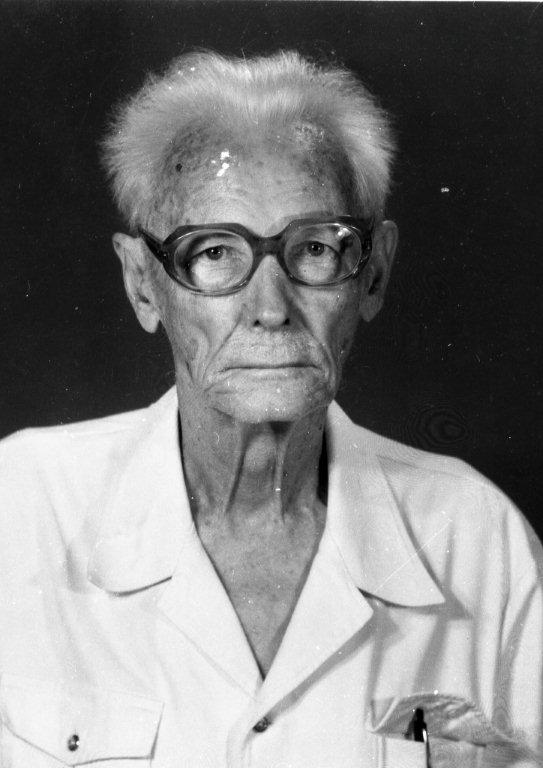
This blog is the second one requested by Barbara Matthias, a reader of my blogs, who had actually met the artist, and, like the previous one about Rudolf Bonnet, it is about the life and artwork of a painter who spent the latter half  of his life on the Indonesian island of Bali.  Let me introduce you to Adrien-Jean Le Mayeur de Merprès, a self-declared impressionist.

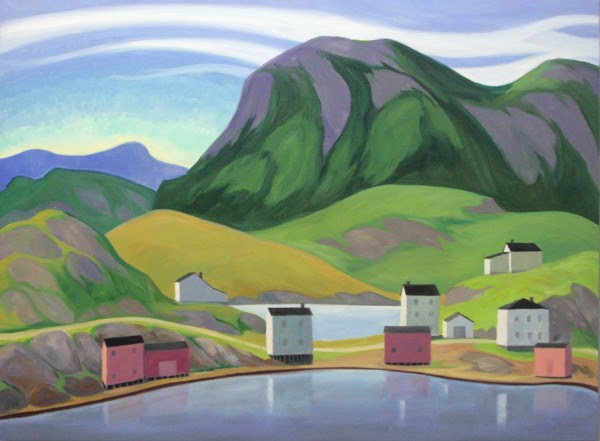
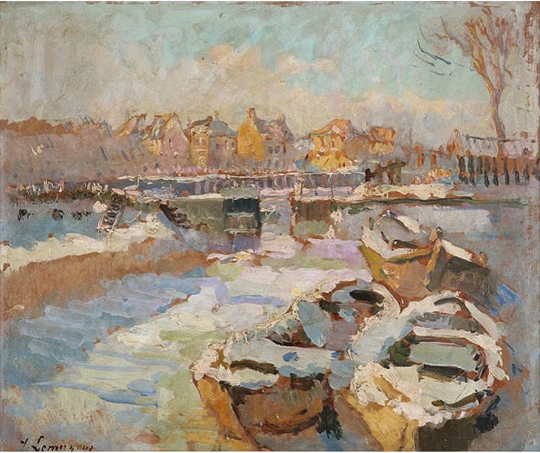
City view with boats in the canal by Adrien-Jean Le Mayeur de Merprès

Le Mayeur was born on February 9th 1880 in Ixelles, a municipality of Brussels which lies to the south-east of the Belgium capital.  He was the youngest of two brothers born to Andrien Le Mayeur De Merpres, a marine artist, and his wife Louise Di Bosch. During his early years Jean studied painting with the French artist, Ernest Blanc-Garin as well as being tutored by his father.  His father wanted his son to receive an all-round education and had him enrol at the Polytechnic College of The Université Libre de Bruxeles, where he studied Architecture and Civil Engineering.  However much to the horror of his family, Jean decided to forego all that he had learnt at the polytechnic and pursue his love of painting and his favoured genre of landscape painting in the Impressionistic style, depicting Belgian landscapes in hazy hues.

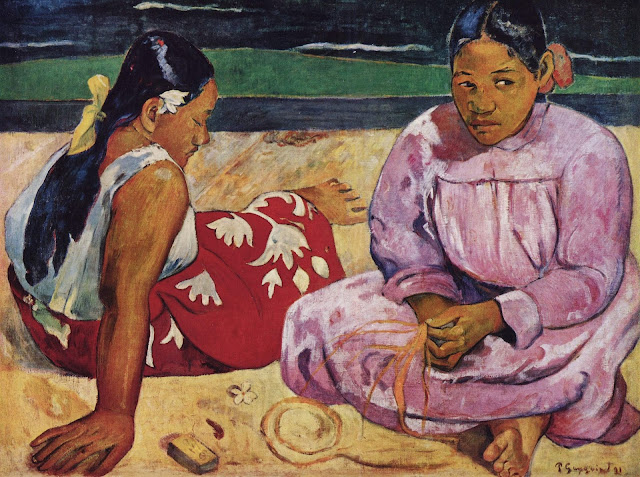
Tahitian Women on the Beach Gaugin’s Tahitian painting (1891)

In 1914, now in his thirties, with the outbreak in Europe of the Great War, Jean was enlisted as a war-time painter and photographer.  During the conflict he was affectedly badly by the carnage of the war and this could have been one of the reasons why he decided to leave Western “civilisation” and find solace in the exotic worlds which he had seen in the works of the French post-impressionist artist Paul Gauguin.

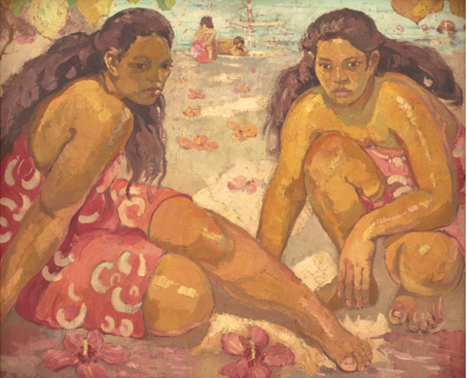
 Two Women on the Beach, Tahiti, by Adrien-Jean Le Mayeur de Merprès

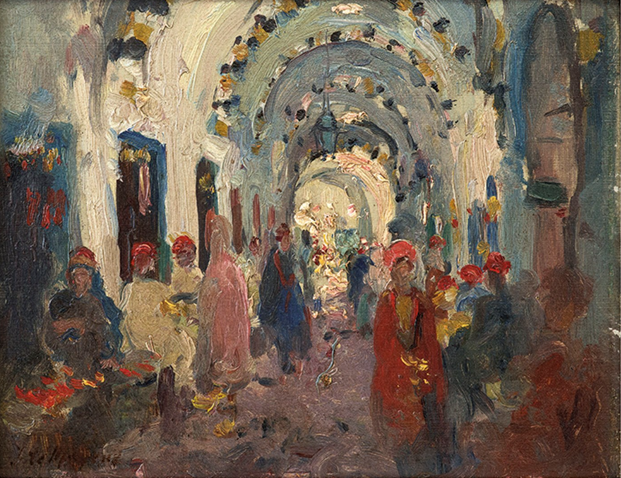
Jean had also acquired an insatiable appetite for travel.   In the early 1920s he visited Italy, North Africa, India, Cambodia, Burma, Madagascar and Turkey, all the time transferring his thoughts and what he saw onto canvas.  In a way these extensive travels were Jean’s way of searching for paradise and like Paul Gaugin, who had visited the Pacific island of Tahiti in June 1891, he too arrived on the Pacific island in 1929.  Jean Le Mayeur was disappointed with Tahiti as it was now far more commercialised than it was in Gaugin’s day and so Jean discounted Tahiti as being the promised land and instead decide to travel to south-east Asia and in 1932 he embarked on his first voyage to the “island of the Gods”, Bali.

An Arab Market by Adrien-Jean Le Mayeur de Merprès

After a long sea passage,   Le Majeur arrived at Singaraja, a port town in northern Bali.  From there he travelled south and rented a house in Banjar Kelandis, close to the northern part of Denpasar, the island’s main town. He was captivated by the Balinese people’s traditional way of life, the temple ceremonies and the local dances such as Legong, which is a form of Balinese dance that is characterized by intricate finger movements, complicated footwork, and expressive gestures and facial expressions.  For Le Mayeur, Bali was an ideal place to paint because of its light, colour and the exquisiteness of the surroundings in what was still a quite an unspoilt island.

Harbour of St Tropez by Adrien-Jean Le Mayeur de Merprès

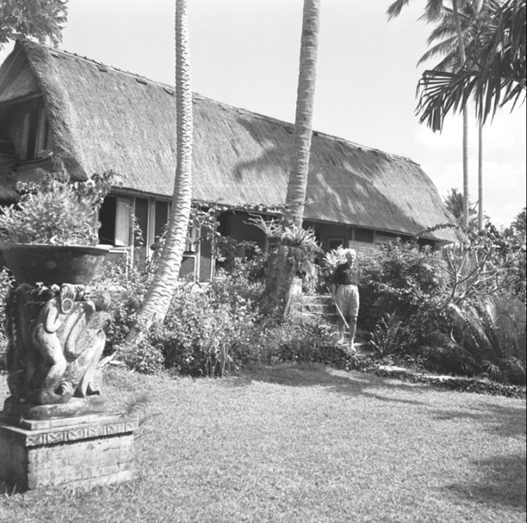
From his love of watching the Legong dancers Le Majeur met a beautiful fifteen-year-old Legong performer, Ni Nyoman Pollok and he persuaded her to model for his paintings. In 1933 he had put together a collection of work featuring Ni Pollok, which he took to Singapore for an exhibition.  The exhibition was a great success and it resulted in him being more widely known.  On returning from Singapore, Le Mayeur purchased a plot of land at Sanur beach, a coastal stretch east of Denpasar in southeast Bali.  There, he built a house, which was also his studio and a beautiful garden. It was here that Ni Pollok along with her two friends worked every day as his models.

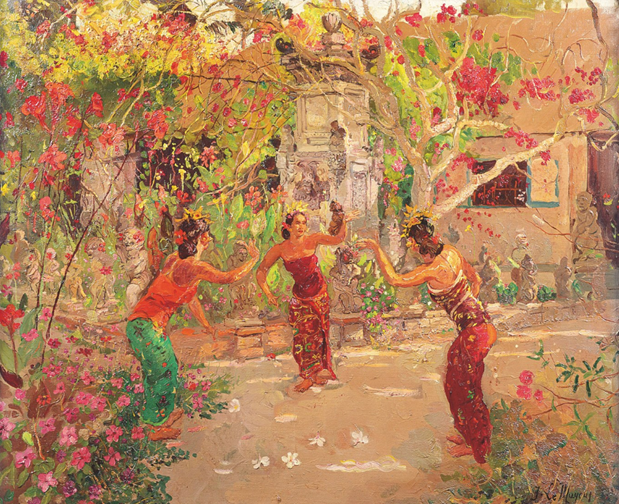
Three Dancers in the Garden by Le Mayeur by Adrien-Jean Le Mayeur de Merprès

In his painting entitled Three Dancers in the Garden we see three graceful dancers.  The setting of the depiction is in the garden in front of the house Le Mayeur and his wife Ni Pollok built on the beach of Sanur. Almost the whole of the background is taken up by the white house with its thatched roof and blue and white window shutters. 

Their house at Sanur was depicted on a number of occasions by Le Mayeur.  In one of his letters to a friend he recounts his love for the property:

“…I’ve evidently made all things serviceable to my art. All my actions have but one purpose: facilitating my work…”

 In another, he talks about how he is inspired by the house:

“…you will understand my paintings wherever you may see them, for everything in this little paradise which I created for myself was made to be painted”…”

Again, in yet another letter he writes about his love for the garden:

“…I organized my home exactly as I liked it. I intended to surround myself with nothing but beauty.  I planted a mass of bougainvillea, frangipani, hibiscus and all around the cottage I put groups of intertwining plants. I built little temples, completely made of white coral, dug little ponds in which the reflections of all the Gods of Hindu mythology can be seen among the sacred lotus flowers. The two temples are surrounded by approximately two hundred of these little sculptures, which have integrated with the flowers whose silhouettes are drawn on the purple and pink tropic skies…”

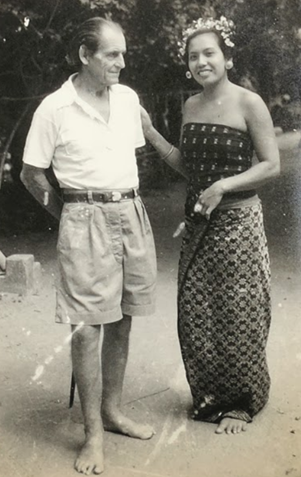
Le Mayeur and Ni Pollok

It is fair to say that Le Mayeur was smitten by the beauty of the island and the beauty of Ni Pollok. His original intention had been that he would just stay on the island for eight months but as that time came to an end he took the decision to remain in Bali for the rest of his life. After three years working together, in 1935, Le Mayeur and Ni Pollok got married. Le Mayeur kept on painting with his wife and her friends as his models during their married life. During the Japanese occupation of the Dutch East Indies in 1942, Le Mayeur was put under house arrest by the Japanese authorities.

Around the Lotus Pond by Adrien-Jean Le Mayeur de Merprès

Many of Le Mayeur’s paintings depicted scenes in and around their house.  The subjects were varied such as women at leisure on a daybed in the interior of the house; women weavers at the loom; women on the veranda or women dancing on a terrace; women in front of the house or in the garden picking flowers or making offerings but one of his favourite depictions was of women dancing around the lotus pond in his garden.  In this painting, Around the Lotus Pond, which Le Mayeur completed in the 1950s, we see the pond around which are six young women picking flowers.  It is thought that Ni Pollock posed for all the women.  Le Mayeur strived to make his paintings colourful and in this work the hues of red, purple, orange and pink dominate the painting and are in contrast with the darker colour of the pond and its water which we see in the lower left of the picture.

Ni Pollok with a friend enjoying the Afternoon Sun

by Adrien-Jean Le Mayeur de Merprès

During the war, tourism had totally disappeared but at the cessation of hostilities tourism to the island slowly returned.  The island’s tourists would often visit and look around Le Mayeur’s home and studio in Sanur and took the opportunity to buy his artwork.   Returning home with their purchasers enabled Le Mayeur’s works of art to become part of many collections. Although Bali was undoubtedly a scenic paradise, one of the downsides of living on the island was the possibility of contracting malaria and le Mayeur often suffered from bouts of the disease which weakened him.  A riding accident in 1948, resulted in the then sixty-eight years old artist to suffer a broken leg from a fall from his horse, Gypsy, and after that incident, probably because of his age, he never ever really recovered and had always, from then on, to use a cane when walking.  In 1951 the aging artist was attacked by a group of robbers and thanks to the effort of his wife Ni Pollok, they managed to fight off the intruders.  However Le Majeur received a large stab wound in the shoulder during the attack. Five years later he suffered with a hernia. Despite all these negative happenings, Le Mayeur managed to keep focused on his work and maybe the highly colourful works he produced radiated the sunny side of his and Ni Pollok’s life.

Five women on the Beach by Adrien-Jean Le Mayeur de Merprès

In 1958, seventy-year-old Le Mayeur had to travel to Brussels with his wife for treatment for cancer of his ear. Sadly, the illness was diagnosed as being terminal and the painter died on May 31st, 1958, aged 78. and was buried in Ixelles, Brussels. Ni Pollok later married an Italian physician who was living on the island but like many foreigners, during the troubles in Indonesia, he had his residence permit revoked and was obliged to leave the country. Ni Pollok stayed behind on Bali.

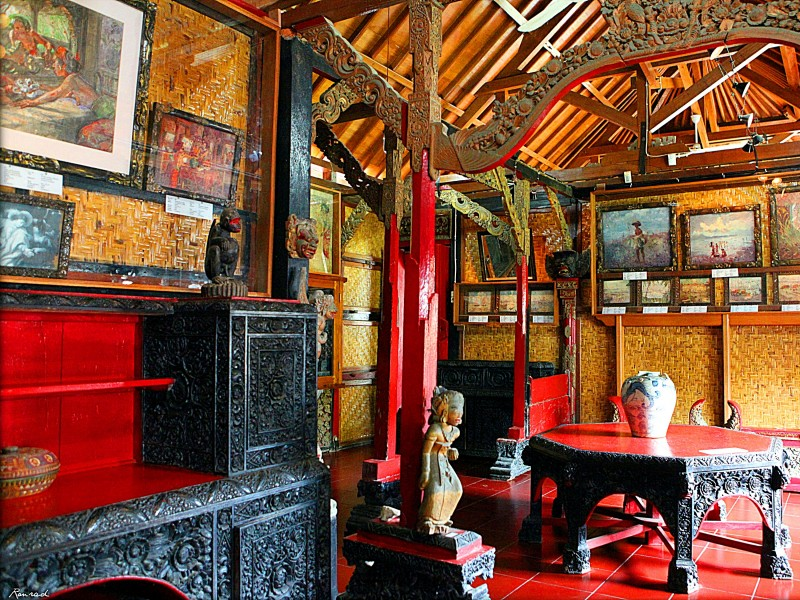
A room in Le Mayeur’s house, now a museum, in Sanur

The will of Le Mayeur had stated that Ni Pollok was allowed to live in the house in Sanur and she resided there up to her death in 1985. Subsequently, the house and its contents, including a hundred paintings by Le Mayeur, were then donated to the Indonesian government and the house was converted into a museum.

Johan Rudolf Bonnet

Rudolf Bonnet

My next two blogs were requested by a reader of my site and so I always try and fulfil requests, here is the first one.

Today I am looking at the life and work of the Dutch painter Johan Rudolf Bonnet.  He was born in Amsterdam on March 30th 1895, although, as we will see, he spent most of his life in the town of Ubud on the Indonesian island of Bali.  He was one of the most individualistic artists who travelled and painted in the Dutch East Indies during the first half of the 20th century and he stood head and shoulders above his fellow European artists who visited the island of Bali.  It was during his journeys away from his homeland to the East Indies which saw his artistic talent blossom.

Anticoli Corrado

Rudolf’s father was, Jean Bonnet Jr. and his mother was Elisabeth Elsina Mann, and both were of Huguenot descent, and were bakers. After normal Primary schooling he received artistic education at a technical High School where he studied decorative painting.  He also attended evening classes at the Rijksacademie van Beeldende Kunsten. In 1920, when he was twenty-five, Rudolf Bonnet along with his parents took a vacation to Italy.  Rudolf loved the area south of Rome known as Anticoli Corrado.  The town was the home of an artists’ colony and many of the young inhabitants would pose as models for the this thriving artistic community.  Rudolf remained in Italy for eight years.

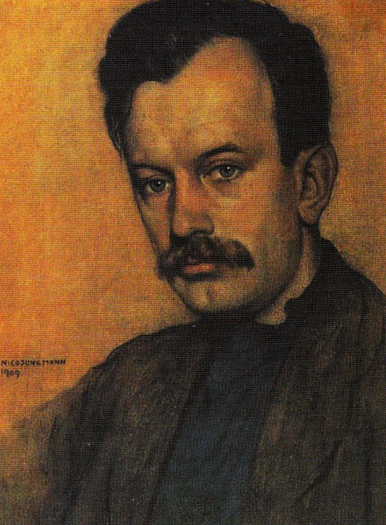
Portrait of Wijnand Otto Jan Nieuwenkamp by Nico Jungmann (1909)

It was during his latter years in Italy that Rudolf met Wijnand Otto Jan Nieuwenkamp, the first European artist to visit Bali, and who significantly influenced the island’s art and culture, making it better known in the wider world, and who had made numerous illustrations of Balinese culture. Nieuwenkamp shared with Bonnet this love for the Dutch East Indies and Bonnet knew he had to visit this “wonderous” place.

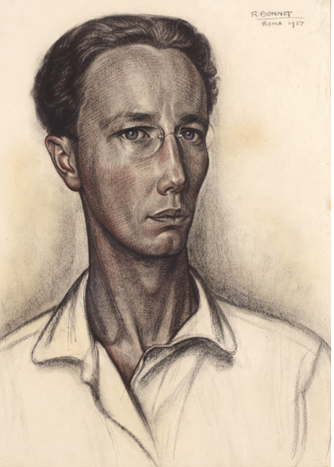
Self portrait by Rudolf Bonnet (1927)

In 1927, a year before leaving for the Dutch East Indies, Bonnet, aged thirty-two, completed a self-portrait.  It is a stunningly meditative depiction of the artist at a time in his life when he was struggling to find inspiration and motivation outside his safe and comfortable European lifestyle.   The painting was completed at a time in the artist’s life when he had begun to yearn for inspiration and an experience outside the comforts of European living. The artist surveys us out of the corner of his eye. It is a self-portrait which does not hide his physical facial gauntness and the receding hairline which cannot disguise his premature ageing.  Bonnet, in this portrait, has honestly revealed himself to us. 

Village Street by Walter Spies (1929)

Soon after arriving on the island Bonnet met the German  artist Walter Spies, who had come to the Dutch East Indies in 1923 and settled in Bali four years later in the town of Ubud.  Nine years later Spies moved out of the town and built himself a mountain retreat in Iseh.   Rudolf Bonnet took over Spies’ house in Ubud where he set up his own studio.

Dewa Poetoe by Rudolf Bonnet (1947)

The sitter for the above artwork is Dewa Putu Bedil, one of the youngest members of the Pita Maha movement who had received instruction and encouragement from Bonnet in developing his own artistic style. Bonnet had a close personal relationship with, Dewa Poetoe and this work is an outstanding study of expression, and highlights the artist’s mastery of portraiture.

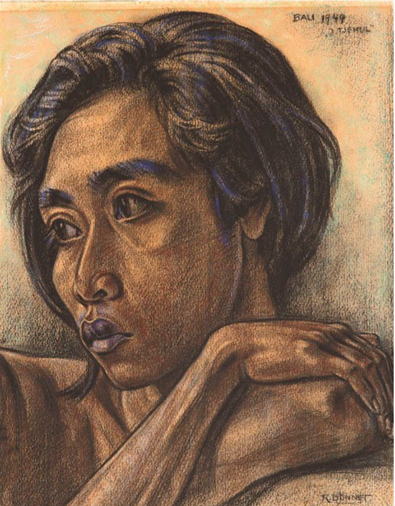
I Tjemul by Randolf Bonnet (1949)

Bonnet soon came across traditional Balinese art but soon he began to witness a change in it as local painters came in contact with the tourists who were visiting the island and soon they picked up on their concepts of art.  It was not long before Bonnet immersed himself in issues affecting the local community such as healthcare and education and he became involved in setting up the Pita Maha movement.  Pita Maha literally means “Great Shining” and was founded in 1934 as an association for artists in Bali and it had two main goals; firstly to develop, improve and preserve the quality of Balinese art objects by setting up weekly inspections and secondly to encourage the selling of high-quality art by coordinating sales exhibitions outside Bali.  Bonnet believed the association would inspire local artists to raise their artistic standards.

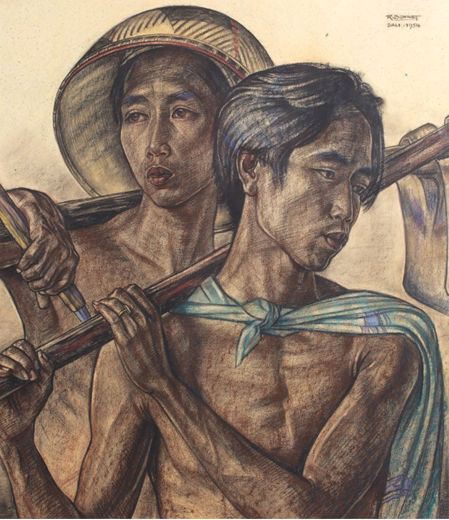
Two Balinese Men by Rudolf Bonnet (1956)

Two Balinese Men by Rudolf Bonnet (1954)

During his time in Italy, Bonnet had fell in love with the Italian Renaissance masters and in particular their portraiture.  It was this that influenced him when he set about portraying the indigenous people living in the colonial Dutch East indies and he knew they faced many hardships during their lifetime in what was an ever-changing modernising of the twentieth century.  Hoisted on their bare shoulders are tools of their manual trade Rudolf portrays the unpretentiousness of their daily existence and in a way has depicted them in the highest benchmarks of classical beauty.

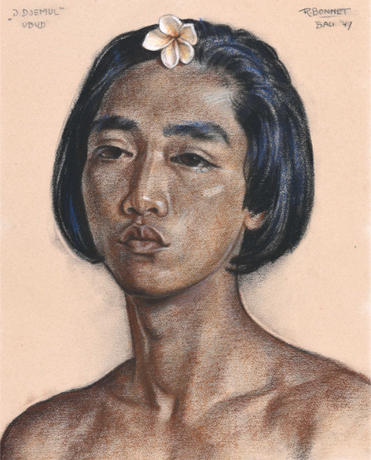
Portrait of J. Djemul by Rudolf Bonnet (1949)

Bonnet’s arrival on Bali in 1929 was followed by an influx of Europeans all who wanted to learn about and record the lives of the Balinese people.    During the 1930s, Bali became home to the anthropologists Margaret Mead and Gregory Bateson, musicologist Colin McPhee, and the artists Miguel Covarrubias and Walter Spies.  All these people helped glamorize and make popular the image of Bali itself and its inhabitants.  Through words and paintings, they, like Bonnet presented Bali as an extraordinary place of unspoilt beauty.  McPhee, made a musicological study of Bali, and in his book A House in Bali, described the island as “an enchanted land of aesthetes at peace with themselves and nature”, while Miguel Covarrubias, the Mexican painter, caricaturist, illustrator, ethnologist and art historian,  on his honeymoon in Bali with his wife Rosa, wrote an ethnographic book, Isle of Bali, which became a literary sensation in the West, lauded for the detailed sketches of Balinese women, dancers and scenery that Covarrubias had made in the field.

“Ni Radji” Bali by Rudolf Bonnet (1954)

The Balinese idyll for Bonnet came crashing down with the arrival of the Japanese army in February 1942.  Bonnet remained at liberty until later that year when he was arrested and sent to Sulawesi, where he remained a prisoner of war  in internment camps in Pare-Pare, Bolong and Makassar for the remainder of the conflict. 

Rudolf Bonnet standing in front of his house in the 1950s

When the war ended and he was released from internment and Bonnet returned to Bali where he built his house and studio in Campuan. More trouble was to rear its ugly head with the deterioration in the relationship between the Republic of Indonesia and the “motherland”, The Netherlands. 

(Dua orang gadis) Double portrait of Ni Radji by Rudolf Bonnet.

However Bonnet was able to stay due to his close relationship with President Sukarno who, as an art lover, had collected fourteen of Bonnet’s works. His relationship with Sukrano soured in 1957 after a dispute regarding Bonnet’s painting entitled (Dua orang gadis) Double portrait of Ni Radji. Both Bonnet and President Sukarno loved the painting and Bonnet wanted to keep the work for himself and refused to sell it.  For Bonnet, it was  a means of remembering the young woman who had modelled for him but had left Ubud after her marriage.   However Bonnet was pressurised by the President and had to sell the painting to Sukarno and after the acrimonious dispute Bonnet was forced to leave Indonesia in 1958. He only returned for short visits to his beloved Bali fifteen years later.

Rudolf Bonnet died in the Dutch town of Laren on April 18th 1978, aged 83.  He was cremated and his ashes were taken to Bali by his niece Hilly de Roever-Bonnet, where they were re-cremated.

Cedric Morris

Self portrait by Cedric Morris (1919)

Cedric Lockwood Morris was born on December 11th 1889 at Matcham Lodge, Sketty, Swansea.  He was the first-born child of George Lockwood Morris, an industrialist, iron founder and prominent rugby player who had played for Wales and his wife Wilhelmina (née Cory).  Both of Cedric’s mother and father hailed from well-to-do families who owned industrial businesses. Cedric had two sisters, Muriel who died in her teens and Nancy who was four years his junior. In 1947, when Cedric’s father, George, was eighty-eight, he succeeded to the baronetcy which had been created for his great grandfather. Sir John Morris, a copper and coal magnate.  This prestigious event came three months before he died and the baronetcy passed on to fifty-eight-year-old Cedric Morris, who became the 9th Baronet in November 1947. 

Cedric was sent away to St Cyprian’s School, Eastbourne, an English preparatory boarding school for boys, which trained pupils to proceed to leading public schools, and so providing a taster to boarding school life.  From here Cedric, aged thirteen, was enrolled at Charterhouse, an English public school.  He achieved very little academically at these schools and sat the examinations to enter the army, which he failed. In 1907, aged seventeen, Cedric, at his mother’s suggestion, travelled to Canada to work on a farm in Ontario.  That did not suit him and after a number of menial low-paid jobs he returned to Wales.  He briefly studied music at the Royal College of Music where he hoped to become a singer but again he failed in that venture.  In April 1914, at the age of twenty-four, he travelled to Paris and enrolled at the Académie Delacluse in the Montparnasse district of the French capital.  His stay in Paris was curtailed due to the outbreak of the First World War and he returned to England and joined the Artists’ Rifles, an active-duty volunteer reserve force of the British Army.  Many of those who joined were artists, actors, musicians and architects and its first headquarters was located at Burlington House. Its first commanders were the painters Henry Wyndham Phillips and Frederic Leighton. However like many of his previous aspirations, this came to naught, when he was medically discharged due to a childhood operation which affected his hearing and so he never made it to the Front.  However, Cedric who was an accomplished horseman, took up his next position as part of the  war effort when he joined the Remounts Service which was responsible for the provisioning and training horses and mules which were bound for the Front.  He worked under Cecil Aldin, a Remount Purchasing Officer who was also an amateur artist.  In 1916 the Remounts Service was taken over by the Army and became the Army Service Corps Remounts Service and as Cedric was a civilian he had to leave the organisation.

Frances Hodgkins by Cedric Morris (1917)

In 1917 Morris travelled to Zennor, a village in south-west Cornwall, close to St Ives, where he stayed for twelve months painting in watercolours and studying the plants and fauna of the area.  It was here that he met the New Zealand painter, Frances Hodgkins.

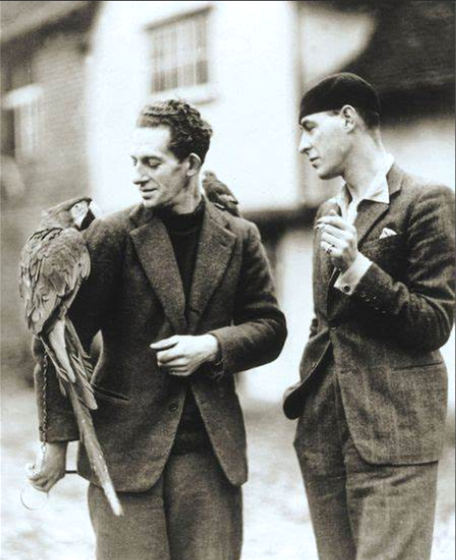
Cedric Morris (Man with Macaw) by Frances Hodgkins (1930)

As well as his painting of her Frances painted one of him with a macaw in 1930.

Arthur Lett Haines

By the time of the Armistice and the end of the Great War on November 13th, 1918, Morris had left Cornwall and returned to London and it was on Armistice Day that he first met Arthur Lett Haines and fell in love with the painter and sculptor despite Haines living with his wife of two years, Gertrude Aimee Lincoln, an American and granddaughter of Abraham Lincoln.  Cedric Morris moved into the Lett Hains’ household in Carlyle Square, Chelsea and the trio had planned to move together to America.  However, the three-person tryst ended and Aimee moved alone to America.  With Aimee out of the picture, the two men travelled to Newlyn, Cornwall and set up home. Arthur Lett Haines, known by his middle-name Lett, was five years younger than Morris, being born on November 2nd 1894.  He was educated at St Paul’s School Public School, London and went on to serve in the British Army during the Great War.

Atelier Tapisseries, Djerba, Tunisia by Cedric Morris (1926)

Cedric Morris and Lett Haines moved to Cornwall to set up home in 1919 and at the same time they sub-let their London flat to Frances Hodgkins.  They moved houses a couple of times before settling in a house known as The Bowgie, which was a combination of a row of old cottages overlooking Newlyn harbour, and became a holiday home for the pair.  At Christmas 1920 they sold The Bowgie and moved to Paris. 

Cedric Morris and Lett Haines

The Paris that Morris and Lett Haines arrived at was said to have been a melting pot of artistic creativity. The pair would devote their evenings mingling in the cafes and bars in Montparnasse and mixed with such artistic luminaries as Marcel Duchamp, Peggy Guggenheim and the photographer, Man Ray.  The one thing that Cedric Morris had difficulty with whilst in Paris was his dislike of crowds and so he and Lett Haines would take every opportunity to escape the hubbub of city life and although living in Paris for the next five years, it was just a base they used as the two painters, along with friends, went off on their European travels. 

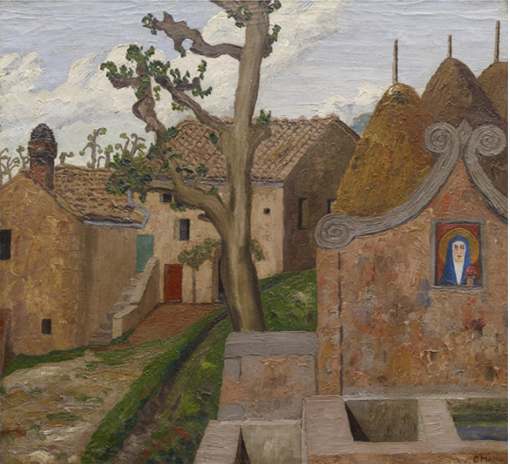
The Italian Hill Town by Cedric Morris (1922)

They went to North Africa in 1921, 1925 and 1926 and spent time in Germany in 1921 before journeying to Italy where they travelled the country for most of 1922.  Cedric held his first one-man exhibition at the Casa d’Arte Bragaglia in Rome which opened at the beginning of November 1922.  Casa d’Arte Bragaglia was an exhibition space for Futurist art and a meeting point for intellectuals and artists.  Unfortunately the exhibition opening coincided with Mussolini’s March on Rome, an organized mass demonstration and a coup d’état which resulted in Benito Mussolini’s National Fascist Party ascending to power in the Kingdom of Italy.  Futurist art was condemned by Mussolini and his Fascist followers and the exhibition was closed down.

Patisseries and a Croissant by Cedric Morris (c.1922)

Although living in Paris, Cedric Morris held the first of his two one-man exhibitions in London. The first was in June 1924. which was held at Gower Street, and organised by the Arts League of Service, a little-known cultural organisation founded in Britain in 1919 with the singular aim of bringing art and the ‘higher forms of entertainment’ to the masses. Cedric exhibited forty-four paintings and twelve drawings.

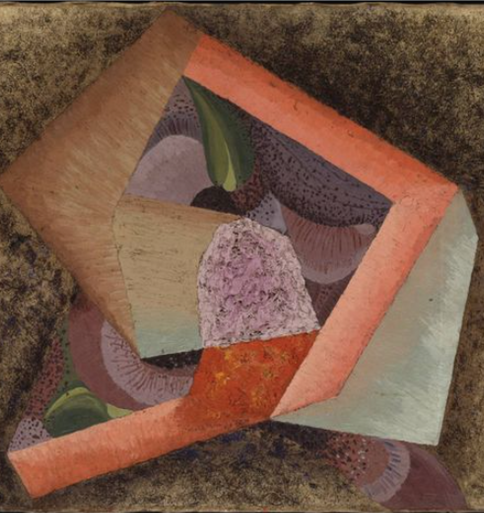
Experiment in Textures by Cedric Morris, (1923)

It was also in the 1920s that Morris dabbled with Abstract Art.

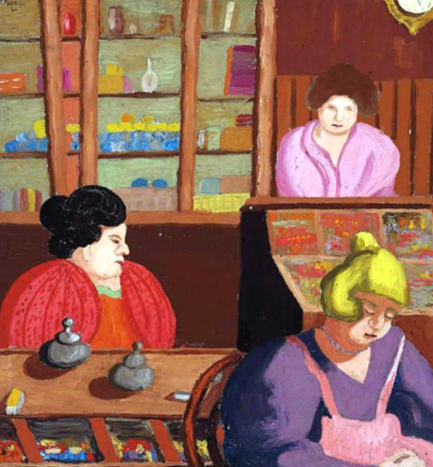
The Brothel by Cedric Morris (1922)

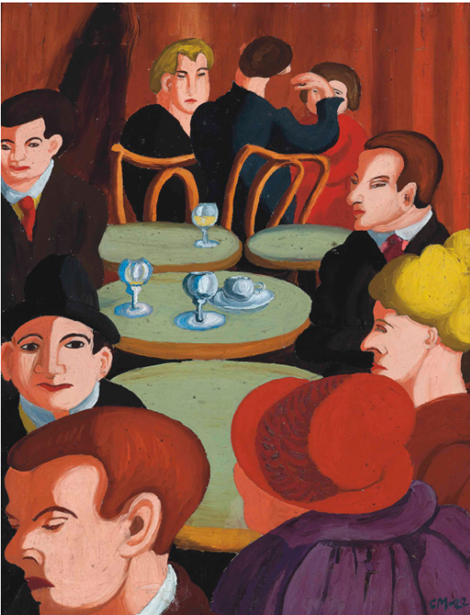
Cedric Morris and Lette Haines were great “people watchers” and Parisian streets, boulevards and bars were great places to study the locals. Morris took delight in recording the activities and idiosyncrasies of the people as we can see in the paintings he completed around that time. One example is his painting entitled The Brothel.

Les Bocks à Montparnasse (1922)

Another was his café scene for his painting entitled Les Bocks à Montparnasse.

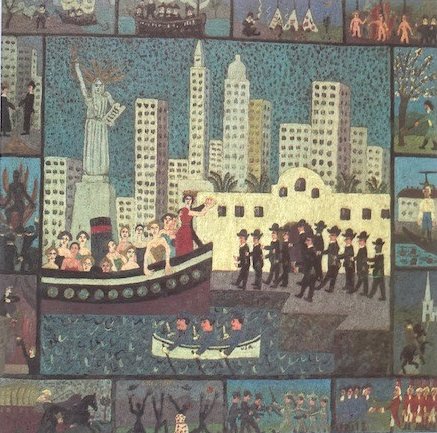
The Entry of Moral Turpitude into New York Harbour by Cedric Morris (1926)

One of Cedric Morris’ unusual paintings around this time was one he completed in 1926, entitled The Entry of Moral Turpitude into New York Harbour, a painting bought by his friend, Vita Sackville-West. This painting’s compartmented depiction is unique in Morris’ work.  The idea for this depiction came about with the dramatic and scandalous case of the time when the United States immigration authorities refused to allow a titled Englishwoman to land and enter into New York after a sea passage from England.  The Immigration officials stated that their refusal was based on their belief that she was allegedly guilty of “moral turpitude”.  Moral turpitude refers to conduct that is considered contrary to community standards of justice, honesty, or good morals and so covers numerous types of misdemeanours.  In the case of the English women her misdemeanour was having been divorced by her husband and the man, also titled, travelling with her had been cited in the divorce case.  She and her companion are depicted in Morris’ painting standing at the bow of the ship wearing coronets.  Their transatlantic ship is being approached by uniformed officials in a boat marked “USA”.  On the quayside we see a group of men wearing black suits, large hats and white collars waiting for the ship’s arrival.  They are meant to be ministers of the church. 

A legal battle followed and their deportation order was eventually quashed.  The news of the case travelled back to England and the English Foreign Secretary at the time was asked if England should refuse entry to Britain of American divorcees.  The main painting is surrounded by fourteen smaller paintings that were meant to draw attention to contrasting impulses in America towards liberty and oppression, the latter being an obvious message in the main painting.  Other scenes depicted in the smaller peripheral paintings include Landing of Christopher Columbus, Landing of the Mayflower, fraternisation between colonists and American Indians, burning of witches, George Washington cutting down the cherry tree, assassination of Lincoln, to name but a few.  Cedric Morris, probably due to his sexuality, disliked and found offensive the more restrictive aspects of morality taught by the churches

Herbs, Salads and Seasoning by Marcel Boulestin, illustrated by Cedric Morris

Probably because of Morris’ dislike of big cities, he and Lett Haines left Paris and returned to England, staying for a time in the late summer of 1926 with his sister Nancy who lived in the Dorset village of Corfe whilst at the same time they were searching out studio space in London.  At around this time he met Marcel Boulestin who had wanted an illustrator for his soon-to-be-published book, Herbs, Salads and Seasoning.  Cedric Morris accepted the commission to illustrate the book.

The Dancing Sailor by Cedric Morris (1925)

Morris eventually found a large studio in London which catered for all his needs.  It was at 32 Great Ormond Street and early in 1927 Cedric and Lett Haines moved in.  It seems strange that Morris should leave the over-crowded French capital because of the suffocating atmosphere and yet locate his studio in London but it is thought that Lett Haines had persuaded him to make the move to the English capital as it would be possible to launch Cedric into the British art scene.  The Great Ormond Street studio became a very popular meeting place and party venue for the great and the good of the Bloomsbury Set.  The Bloomsbury Set was a group of English writers, intellectuals, philosophers and artists in the first half of the 20th century which included Virginia Woolf, Vanessa Bell, Roger Fry, John Maynard Keynes, E. M. Forster and Lytton Strachey.

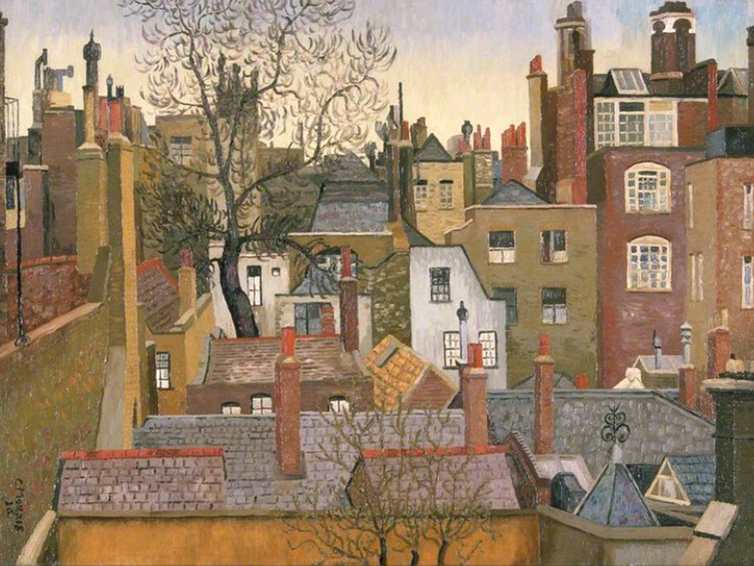
From a Bedroom Window at 45 Brook Street, W1 by Cedric Morris (1926)

Soon after settling down in London, Morris became a member of the Seven and Five Society, an art group of seven painters and five sculptors, including artist Ben Nicholson and sculptors Henry Moore and Barbara Hepworth.  Morris submitted many of his works to exhibitions but one of his greatest successes was at his one-man exhibition at Arthur Tooth & Sons Gallery in New Bond Street, an art gallery founded in London, in 1842 by Charles Tooth.  It was a great success with thirty-one of his thirty-nine painting selling at the private viewing and the remaining ones sold by the time the exhibition closed.

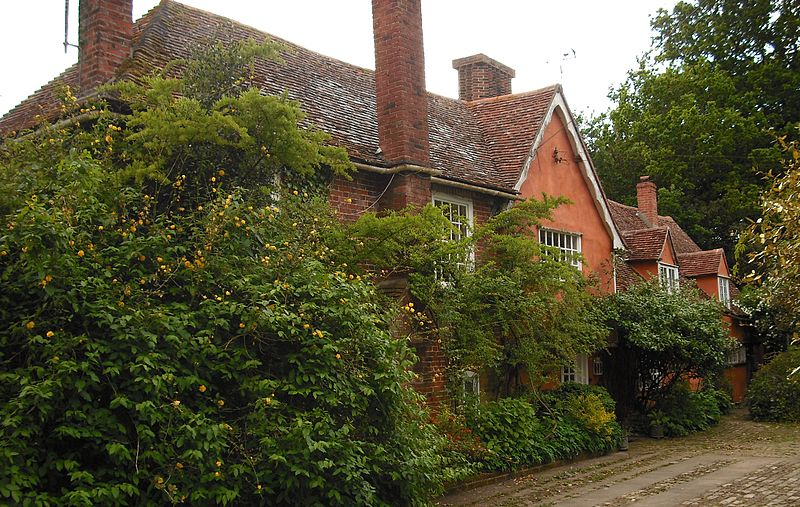
Pound Farm, Higham

Not only was Cedric Morris a great artist who loved to paint, he also had another great love – a love of horticulture.  He was a true plantsman but living in London hindered that love and so he and Lett chose the country life in order to pursue Cedric’s passion for horticulture. And so, early in 1929, Cedric and Lett took the lease of Pound Farm, Higham, Suffolk, and in February 1930 they gave up their London studio. The farm was owned by the wealthy landlady and student, Mrs Vivien Doyle Jones. In 1932 their landlady died and bequeathed the farm to Cedric Morris. It was here that Morris lovingly created a memorable garden.

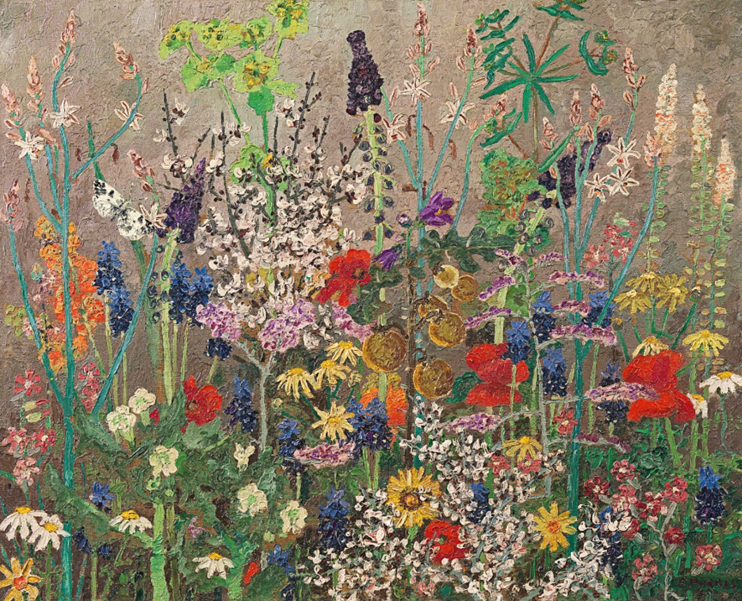
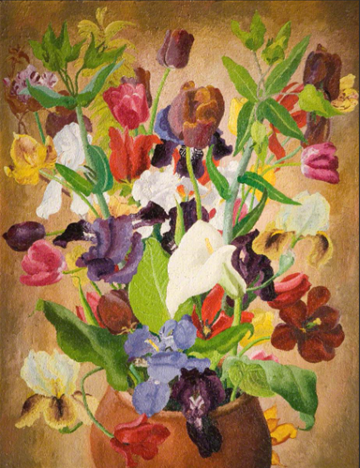
Flowers by Cedric Morris (c.1926)

Morris had always been interested in floral painting and now, at Pound Farm, he found the ideal location. He also became a successful and well-known breeder of irises.

Irises and Tulips by Cedric Morris

Cedric Morris had a great passion and extensive knowledge of gardening and one of his favourite hobbies was breeding irises.  In his painting Irises and Tulips we see a colourful arrangement of irises and tulips and an impressive white Arum Lily along with two stems of the Great Yellow Gentian.  The tulips are shown as starting to collapse which hints at this painting being carried out in the early part of summer.

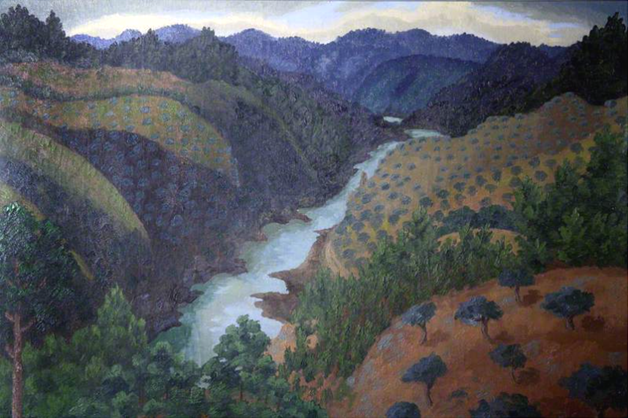
River Zezere, Portugal by Cedric Morris (1950)

Three miles to the south-west of Pound Farm was the small town of Dedham, which a century earlier, was the home of the great English painter, John Constable.  On April 12th 1937 Cedric Morris and Lett Haines opened the East Anglian School of Painting and Drawing in an old house in the centre of Dedham.  Lett-Haines taught theory, whilst Morris taught by encouragement and example.  It is interesting to note that the school was described in a prospectus as “an oasis of decency for artists outside the system”.  It was a great success from the very start and by the end of the year, it had sixty students. 

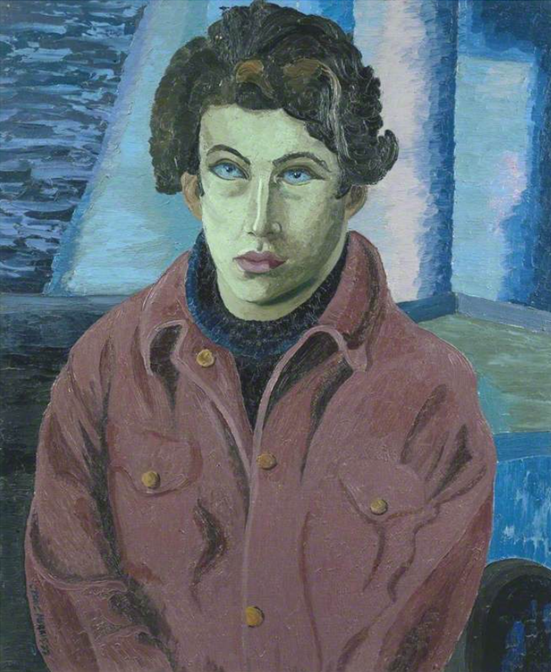
Lucian Freud by Cedric Morris (1941)

In 1939 a seventeen-year-old student by the name of Lucian Freud enrolled at the school, after he had spent a short time studying at the Central School of Art in London. 

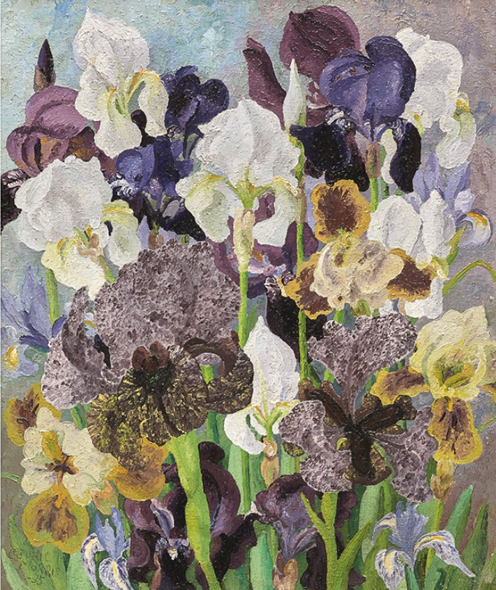
May Flowering Irises. No.2. by Cedric Morris (1935)

In July 1939, disaster struck when the old Dedham house was destroyed by fire. Living nearby was the artist Alfred Munnings, who would become the President of the Royal Academy in 1944. He was one of England’s finest painters of horses, and an outspoken critic of Modernism which Cedric Morris practiced   He shed no tears when the Dedham art establishment of Morris and Lett Haines burnt to the ground and it was reported that he had his chauffer drive him around the burnt-out house, gloating at its destruction, and cheered loudly at the destruction of what he saw as an odious development in art . 

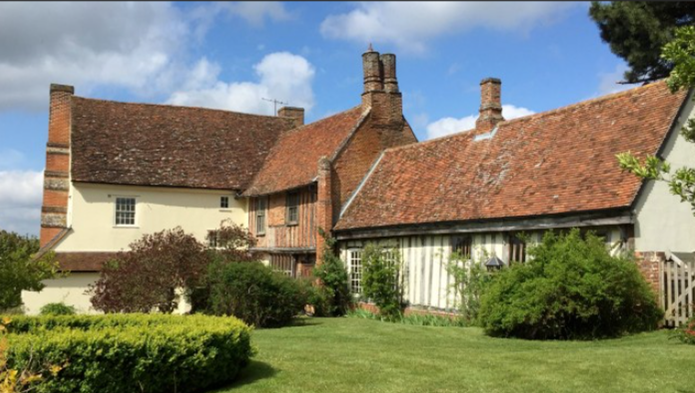
Benton End, the home to the East Anglian School of Painting and Drawing (Photo: Benton End House & Garden Trust)

Not to be deterred by this disaster, at the end of 1939, Morris and Lett Haines discovered Benton End, a rambling 16th-century house with gardens, on the outskirts of Hadleigh in Suffolk.  The large size of the place allowed the artists to live and run their school and also accommodate their students in one place, which hadn’t been possible at the previous venue.

In 1946, Cedric Morris and Lett-Haines became founder members of Colchester Art Society and later Morris became the society’s president.  In 1947, on the death of his father, Cedric became Sir Cedric Lockwood Morris, 9th Baronet.  Deteriorating eyesight in the mid 1970s curtailed most of his art.  The Dedham school closed shortly after Lett Haines died on February 25th 1978, aged 84.

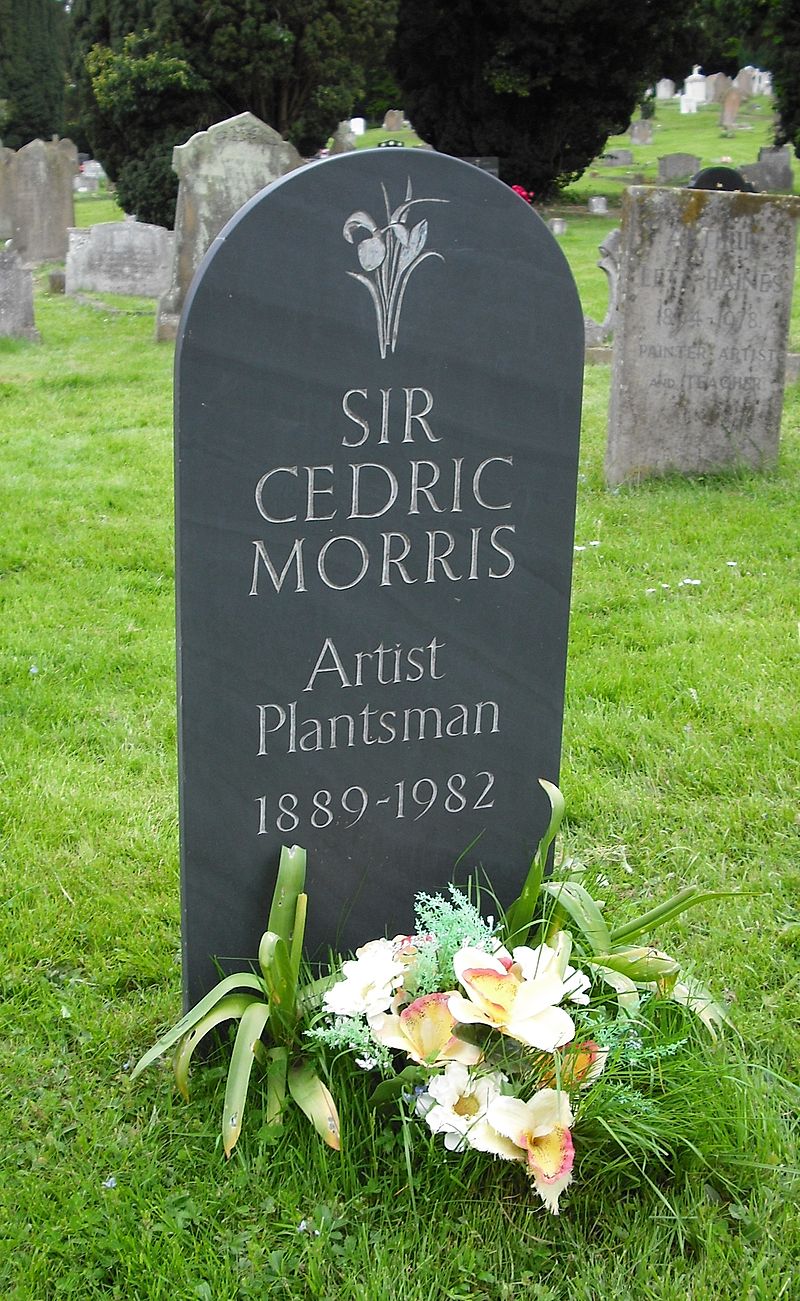
Cedric Morris continued to live at Benton End until his own death on February 8th 1982, aged 92.   The two are buried near each other at Hadleigh Cemetery in Hadleigh.  Morris’s gravestone, in front, and Lett-Haines, in back on the right.


The information for this blog came from the many websites about the life of Cedric Morris and Lett Haines as well as Richard Morphet’s Tate Gallery book on Cedric Morris, the great Welsh artist.

Benjamin Robert Haydon. Part 4.

The sad ending to life.

In the previous blog I told you about Benjamin Haydon’s trip to Paris with his friend David Wilkie.   The journey began at the end of May 1814 when the pair were able to take advantage of the ending of hostilities between England and France.  Whilst in the French capital the two artists spent time at the Louvre  and see the art collections gathered by Napoleon from across Europe.  

Portrait of Emperor Napoleon I by François Gérard (1815)

They also visited François Gérard’s studio.  Gérard was one of the foremost portrait-painters of the day and had eight of his portraits accepted at the 1808 Salon and fourteen in the Salon of 1810.  His portraiture depicted all of the leading figures of the French Empire and of the Bourbon Restoration, as well as all of the most celebrated men and women of Europe and his Paris studio was often a meeting place for upper-class society. 

Napoleon Bonaparte as First Consul by François Gérard (1803)

When Haydon and Wilkie visited the studio Haydon was most impressed by Gérard’s portraits of Napoleon Bonaparte and he became captivated by the French leader.

Napoléon Bonaparte (‘Napoléon on St Helena’) by Benjamin Haydon (1830)

Haydon painted over two dozen of pictures of Napoleon, even bought his death mask and tried on one of the emperor’s hats.  In his portrait of Napoleon entitled Napoleon on St Helena we see the French leader in a thoughtful, meditative mood, pondering on his past triumphs and calamities.  One of the first of Haydon’s Napoleon portraits was for the lawyer, Thomas Kearsey, in 1829 and the following year it was exhibited at the Western Exchange.   A whole-length version above, entitled Napoleon Musing at St Helena was commissioned by Sir Robert Peel. Many others followed including Napoleon Meditating at Marengo and Napoleon Contemplating his Future Grave.

Arthur Wellesley, 1st Duke of Wellington by Benjamin Haydon (1839)

Having completed the depiction of the French leader pondering his triumphs and failures whilst on St Helena, Haydon wanted to produce a companion piece featuring the great British military leader, Arthur Wellesley, the Duke of Wellington.  The painting was to depict  Wellington overlooking the rolling fields at Waterloo at sunrise, a companion piece to Napoleon Bonaparte on St Helena gazing across the sea at St Helena.

In a way the portrait has an element of sadness as we see the ageing hero, who is not adorned in his military uniform but is dressed in civilian clothes.  The painting completed in 1839 by Haydon is almost twenty-five years after the Battle of Waterloo and twenty years after Wellesley finally left the military and entered the world of politics.  In the work we see Wellesley looking out over the scene of his greatest triumph at Waterloo. The Duke who was seventy at the time of the portrait disliked sitting for his portrait, or at least he did at this time of his life

He was even more disinclined to lend Haydon the helmet and sword which we see in the left foreground. Haydon eventually persuaded the Duke to allow them to be used as “stage settings” for the work.  Haydon went on to paint twenty-five variants of the portrait, signifying his almost obsessive interest in the Duke.

The Raising of Lazarus by Benjamin Haydon (1821-23)

When Haydon began painting The Judgement of Solomon he had debts of more than £600. Two years later when he completed the work the size of his debt had doubled. In 1821 he embarked on his largest ever canvas (426 x 632 cms), The Raising of Lazarus and in that year, Haydon’s financial problems came to a head when he couldn’t fulfil his obligations to some people who had lent him money. He was admonished but only just avoided imprisonment.

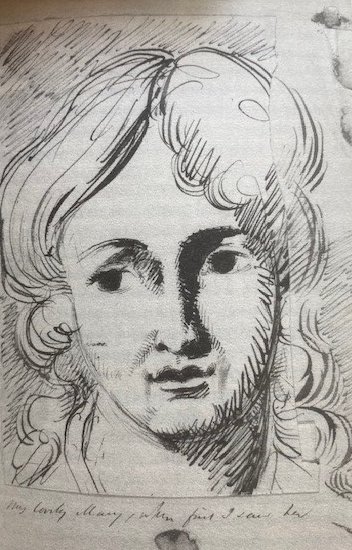
Mary Hyman – a sketch by Benjamin Haydon

It was in late Spring that Haydon first caught sight of Mary Cawrse Hyman whilst he was walking with his friend, Maria Foote, and he recounted that first glimpse of Hyman. In his journal he recorded the moment:

“…Not far from my house she requested me to stop a moment whilst she left a letter with a lady who was going into Devonshire. I waited; a servant came down, and requested I walk up……and in one instant the loveliest face that was ever created since God made Eve smiled gently at my approach…”

Haydon was besotted with her beauty and would spend hours walking by her home hoping to catch a glimpse of her. One “fly in the ointment” with Haydon’s hopes of happiness was that she was married and had two young sons, Orlando and Simon.

Later he made a sketch of her, from memory, in his journal and inscribed it:

“…My lovely Mary when first I saw her…”

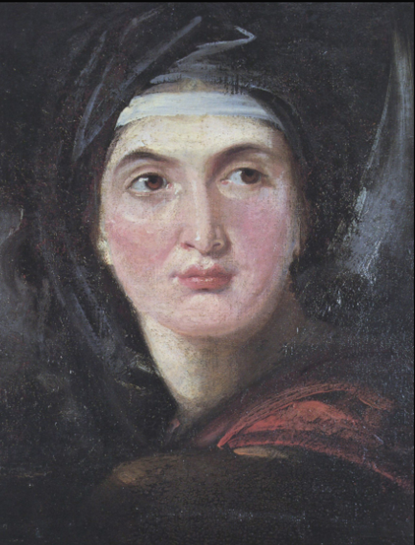
Mary Haydon as the Delphic Sibyl, by Benjamin Robert Haydon (1821)

Mary’s husband, a Devonport jeweller, was much older than his wife and was unwell. He actually died in 1821, three years after Hayman had had that first encounter with Mary. Mary Hyman and Benjamin Haydon married on October 10th 1821 at Church of St Mary le Bone. His friend David Wilkie witnessed the ceremony and he and Haydon drank many toasts to a successful marriage. This ready-made family added more financial pressure on Haydon and a day after the marriage ceremony Haydon was arrested because of he was unable to pay his creditors. Haydon, accompanied by the Sheriff’s Officer, went to the home of David Wilkie to see if his friend would stand guarantor for the debt but Wilkie was reluctant until Haydon managed to negotiate with his landlord a longer time to repay him and so Wilkie agreed to help his friend. Haydon in typical fashion wrote to Wilkie the following day berating him for his unfriendly behaviour. Wilkie, who had reluctantly agreed to stand guarantor, was horrified by Haydon’s words, said to be a mixture of sarcasm and truth, upbraiding him for his unfriendly behaviour.

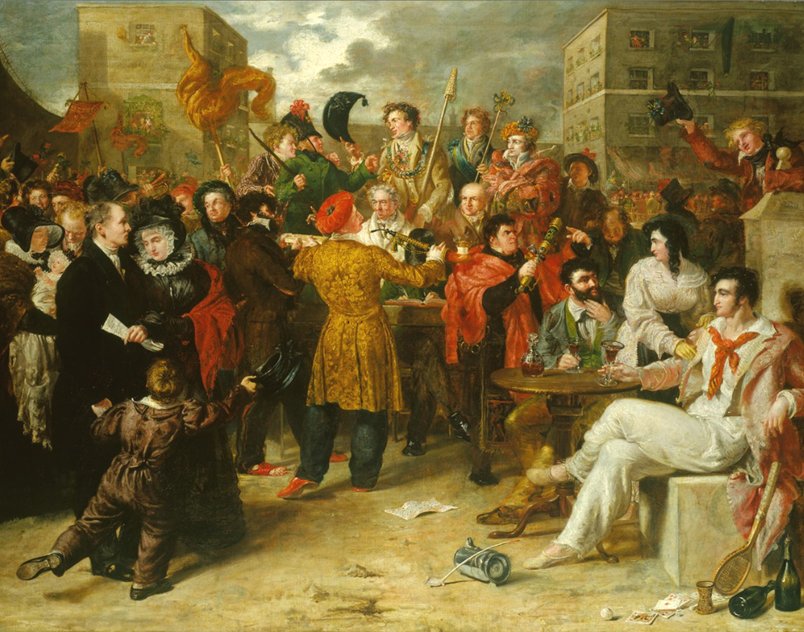
The Mock Election by Benjamin Haydon (1827)

On December 12th 1822 Mary gave birth to their first child, a son, Frank. He was the first of eight children fathered by Haydon, although sadly, five died in infancy. Haydon’s financial difficulties increased with the enlargement of the family and lack of sales of some of his works and this resulted him spending time in the debtor’s prison on a number of occasions.

His second such incarceration was in 1827 when Haydon was in King’s Bench Prison for debt. It was whilst staying here that he observed other inmates putting on a sham election in order to open a poll for the election of a member to plead for their parliamentary rights, which had been taken from them once they were imprisoned. It was proposed that they should elect a member of parliament to represent Tenterden, (a slang name for the prison).  Three candidates stood for election, one of whom was Lieutenant Meredith, a veteran of the Peninsula War. It was just like a normal election with addresses made by the candidates’ placards were printed and affixed to the walls of the prison and the electors were invited to attend the poll on Monday morning, the 16th of July.  Haydon recalled the riotous scene:

“…… As I approached the unfortunate, but merry, crowd, to the last day of my life I shall ever remember the impression… baronets and bankers, authors and merchants, painters and poets… dandies of no rank in rap and tat-ters… all mingled in indiscriminate merriment, with a spiked wall, twenty feet high, above their heads…”

King George IV bought the painting and gave Haydon 500 guineas.

Chairing the Member by Benjamin Robert Haydon (1828)

Probably Haydon’s best-known non-biblical works were painted around 1829.  In August 1828 he completed his large oil on canvas work entitled Chairing the Member. Haydon had been so encouraged by the sale of The Mock Election to George IV that he painted a companion piece, Chairing the Member, and returned to the prison to make drawings of some of the inmates. Later a third painting of contemporary life depicted in his painting entitled Punch and May Day in the New Road at Marylebone. He had great hopes that George IV would buy these works as well but he was to be disappointed, a setback he blamed on the actions of the Keeper of the King’s Pictures, William Seguier.
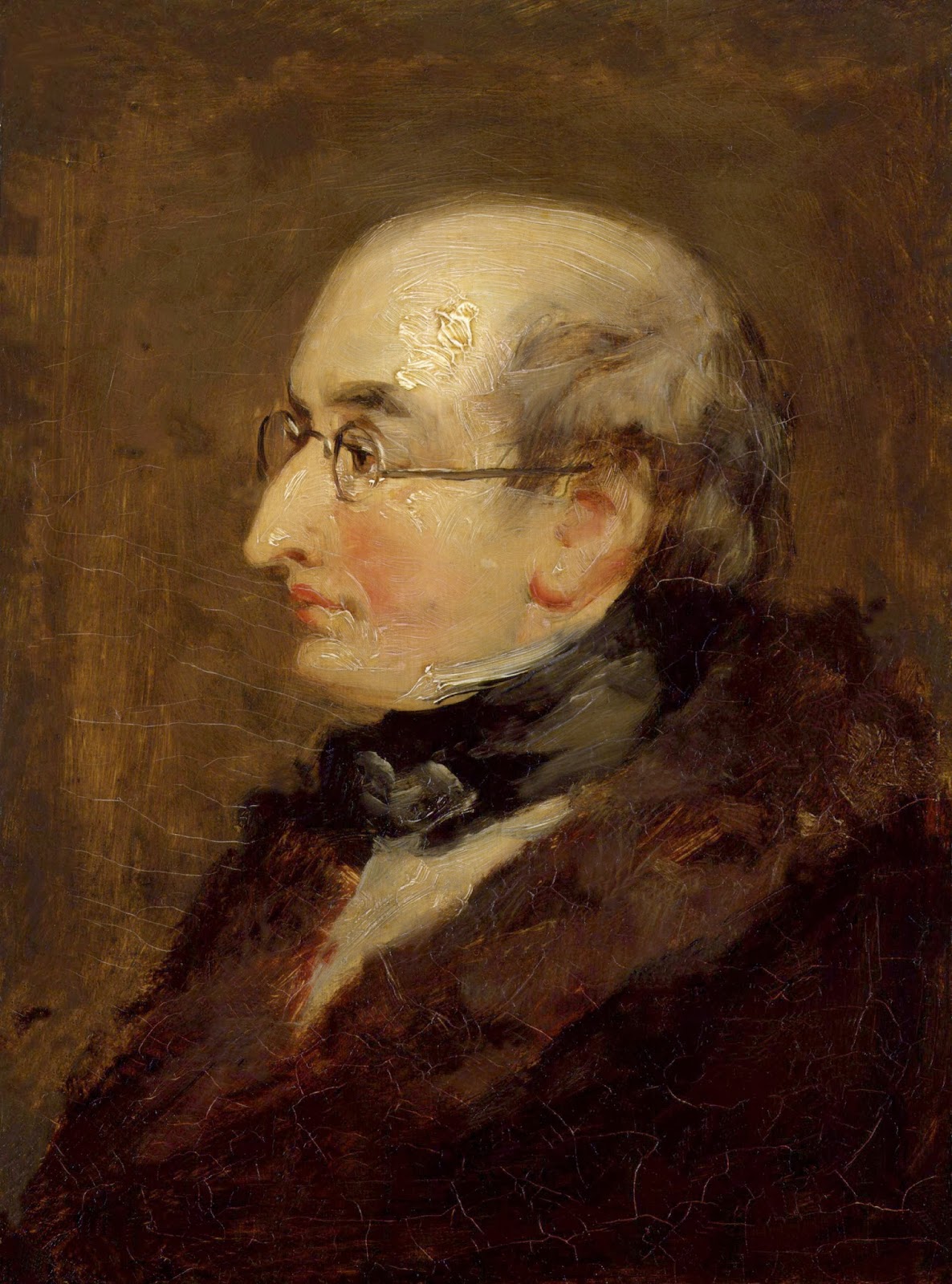
Chairing the Member is a crowd scene, the main characters of which are in a riotous mood brought on by an excess of alcohol.  In the background, we can see two men being hoisted aloft on the shoulders of their friends.  In the centre foreground we observe a man wearing a red waistcoat and coat, white breeches and a Napoleonic hat carrying a long pole attempts to challenge three guards, who stand on guard, seemingly unaffected by the riotous behaviour of the crowd.  A small child also grips the pole.  To the right we see a man slouched drunkenly on a stool still gripping a bottle of ale.  A woman, adorned in a black dress and wearing a white bonnet with pink ribbons, holds the man’s shoulders to prevent him falling off the stool.  A small child with a hoop stands in front of the seated man and places her hand on his thigh in order to steady him.  To the left, on the ground, we see a man slumped under a table, atop of which are glasses and glass decanters of wine.  Also, below the table, on the ground by the fallen man’s feet, is a small barrel in which are a pineapple and two other bottles wine. The whole disorderly scene is closely watched by an elderly man from an upstairs window on the right and, to the left, another man hangs out of an upper window below a red flag and toasts the revellers.  The painting is now part of the Tate Britain collection.

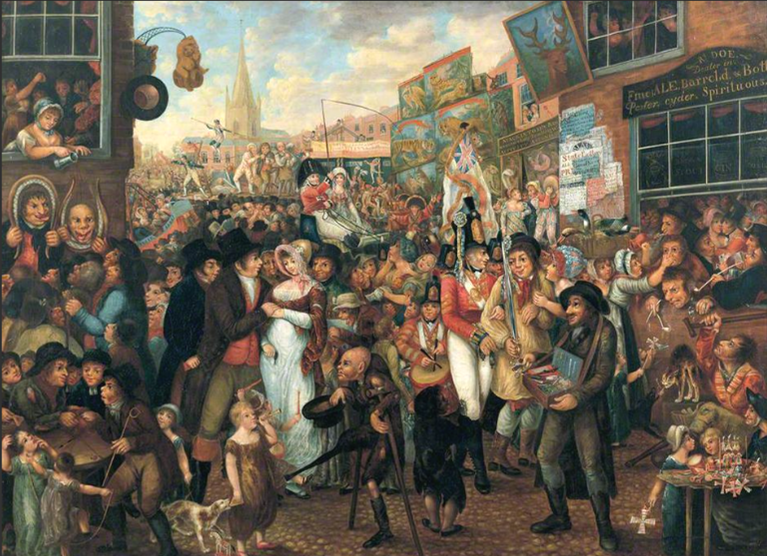
Punch or May Day by Benjamin Haydon (1829)

In 1829, a year after the completion of Chairing the Member, Haydon completed another work that depicted people enjoying themselves.  Initially Haydon had thought to entitle the work, Life, as it would encapsulate everyday life of everyday people but he later gave the work the title, Punch or May Day.  Hayden resolved to highlight the contrasts of everyday life. We see a crowd of mixed classes, ages and races who happily mingle with a costumed procession and a Punch and Judy show in the Marylebone Road.   On the right we see a marriage coach in which are a bride and groom.  In the background we see a hearse.  The newlyweds, tranquil and happy, look out of the window of their coach at the mayhem of the Punch and Judy performance with all its violence.  Even the May Day celebrations and procession in Marylebone Road, which were pagan traditions, is set against a backdrop which includes the Christian church of St Marylebone.  Taking part in this parade is a young dancing chimney sweep with blonde curls and soot-blackened face. The boy’s lively countenance contrasts with the artist’s treatment of the austere black footman standing at the back of the wedding coach.  In the left foreground we see a barefooted female slumped on the ground next to a table of wares which she is trying to sell.  Haydon believed he was a great history painter but also believed, like the woman selling her goods, he and his paintings were similarly under-appreciated.  In contrast, next to the beggar woman, and attentively watching the Punch & Judy show is a man dressed in the finest expensive clothes.  Look closely and you will see he is just about to have his pockets picked by a young pick-pocketer. Standing by the wedding coach and peering around the cavalry officer is a Bow Street runner, who is watching the antics of the thief. Behind the dandy is a rosy-cheeked farmer up from the country. Close to the Punch & Judy stage, a woman holds up her baby aloft so she could see the puppets close up. Haydon had been living in London for twenty-five years and he had enjoyed the capital’s vibrancy and in this painting he had aimed to encapsulate this energy and the diversity of the inhabitants.

Venus and Anchises by Benjamin Haydon (1826)

Haydon became well known as a lecturer on painting, and in 1835 he began to travel around England and Scotland on lecture tours. He was also a fervent believer that the country’s public buildings should be decorated with history paintings showing the glories of the nation’s past.  No doubt he believed he could supply such great works.

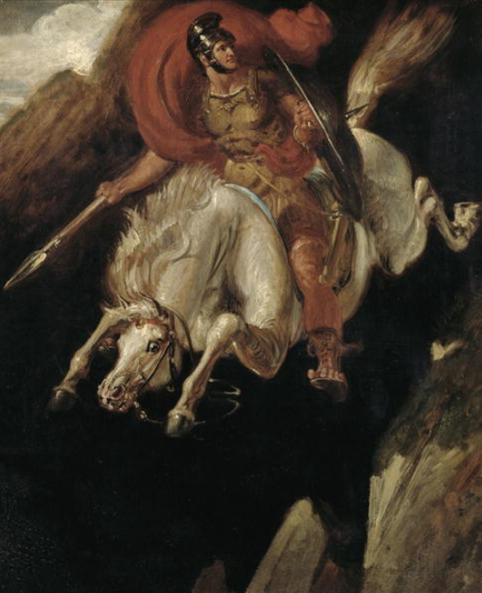
Curtius Leaping into the Gulf by Benjamin Haydon (1843)

Curtius Leaping into the Gulf was a painting Haydon completed in 1843 and depicts an ancient Roman legend, the young Marcus Curtius, throwing himself into a huge crack in the ground that had opened up in Rome. According to legend, the Roman gods were satisfied with Curtius’s sacrifice and the crack closed again.  In this work, Curtius is a self-portrait of Haydon Whether it was just a coincidence that Haydon should choose the act of suicide for his Curius painting we will never know but what is known that Haydon talked about suicide as an escape from his own life on a number occasions and he had often discussed suicide and the reasons why a person would end their own life.  He was a devote Catholic, so for religious reasons he would never countenance the taking of his own life and yet by the mid-1840s life had become very difficult as a result of his financial difficulties and his constant begging of his friends to alleviate his poverty.  He was becoming desperate.  The day before his death he was out walking with his son, Frank, and expressed how he gained pleasure on the idea of throwing himself off the Monument and dashing his head to pieces.  The viewing gallery at the top of the Monument in London was a favourite place for people wanting to commit suicide and this was only curtailed when the whole of the gallery was encased in an iron cage.  Frank was worried by his father’s mood and pleaded with him to discard any thoughts of taking his own life.  Back home, Frank told his mother about her husband’s dark thoughts but she laughed it off. 

Bartholomew Fair by Benjamin Haydon

The next morning Haydon asked his wife to travel to Brixton to invite over one of his journalist friends, David Coulton, to discuss some business.  That next morning with his wife out of the house, Haydon went to the premises of Isaac Rivière, a gun-maker, and bought himself a pocket-sized pistol.  He arrived back home within the hour and locked himself in his painting studio, with his unfinished work, The Blessings of Justice: Alfred and the First Trial by Jury on an easel.  A portrait of his wife sat on a smaller easel.  He wrote a will, but as it had not been witnessed, was invalid.  He wrote short letters to some of his friends.  One letter was to Sir Robert Peel in which he wrote:

“…Life is unsupportable!  Accept my gratitude for always feeling for me in adversity – I hope I have earned for my dearest Wife security from Want…”

He also wrote a letter to his wife:

“…God bless thee, dearest love.  Pardon this last pang, many thou has suffered from me.  God bless thee in dear widowhood.  I hope Sir Robert Peel will consider I have earned a pension for thee.  A thousand kisses.  Thy husband & love to the last…”

He also wrote a short note to each of his sons and daughter asking them to look after their mother and lead a good and honest life.  He then opened his diary which he had been keeping for the last thirty-eight years and wrote in it:

God forgive me – Amen

Finis

Of B.R.Haydon

‘Stretch me no longer on this tough World’ – Lear

End

He then cocked his pistol and shot himself in the head.  His wife and daughter heard the bang but thought it came from the nearby barracks and ignored it.  The pistol Haydon had bought that morning was of such a low calibre the bullet although fracturing his skull, did not penetrate his brain.   Not to be thwarted he picked up one of his razors and made two cuts to his neck and throat.  His wife and daughter still had no idea of what was happening and both left the house.  Benjamin Robert Haydon lay on the floor and bled to death.

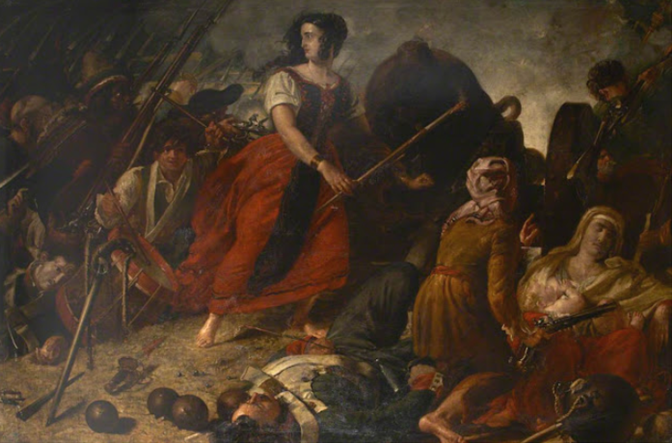
The Maid of Saragossa by Benjamin Haydon

Benjamin Robert Haydon died in his London home on June 22nd 1846, aged 60.  His wife survived him by eight years, dying on July 25th 1858 aged 61.

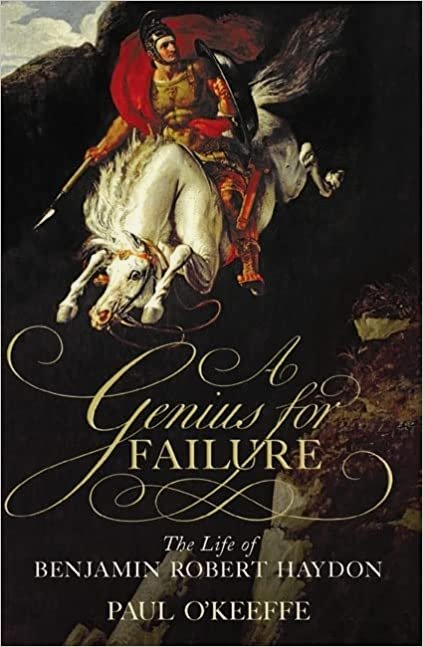
I recounted this life story of Haydon over four blogs and yet I have only scratched the surface of his life.  Before you judge Haydon, and if you would like to find out more about this talented painter, then I do recommend you reading  Paul O’Keeffe’s biography: A Genius for Failure, The Life of Benjamin Robert Haydon. It was from this book that I got the majority of information for these blogs.

Benjamin Robert Haydon.

Part 3. The Elgin Marbles affair

Judgement of Solomon by Benjamin Haydon

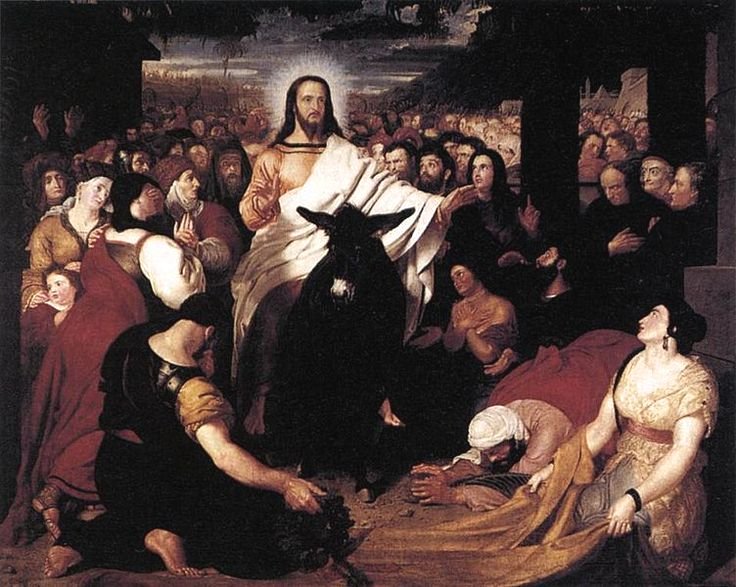
The eventual sale of Haydon’s painting, Judgement of Solomon, to a pair of Plymouth bankers, Sir William Elford and his partner, Mr T J Tingcombe gave Haydon a much needed seven hundred guineas but although that lessened his debt, he still owed more than four hundred guineas to various other creditors.  Even before the sale of the work Hayden had decided that he would complete another monumental biblical painting and ordered in the large canvas measuring 396 x 457 cms, a metre taller and a metre wider than his Judgement of Solomon canvas, which was considered colossal at the time.  Haydon believed that the finished work would bolster his artistic stature as a great historical painter.  The subject of the painting would be the arrival of Christ into Jerusalem a few days before his crucifixion.

Christ’s Triumphant entry into Jerusalem by Benjamin Haydon (1812-16)

In August 1814, despite his dire financial situation, Haydon took a two-month trip to Paris with Wilkie, He returned to London and started his monumental biblical painting.  A month later he was struck down with severe eye trouble and had to take time off to recuperate on the south coast.  News came in September that lifted his spirits.  He had been made Freeman of Plymouth for his “extraordinary merit as a historical painter and particularly for his recent painting”.  His latest biblical painting progressed slowly and for the last three months of the year he set about recruiting models for the depiction.

The painting was not completed until the end of 1816.

Portrait of Leigh Hunt by Benjamin Haydon (1813)

The monumental painting was halted for a short time to allow Haydon to complete a portrait of his friend James Henry Leigh Hunt which he had started a couple of years previously.  Leigh Hunt was an English essayist, critic and poet who had worked in the War Office before becoming editor of The Examiner, a journal that had been founded by his brother John Hunt, and had articles also written by another brother Robert Hunt.  It was a controversial publication often writing stinging attacks on the government and the royalty, some in the shape of personal attacks on the Prince Regent.  In 1813 the government tried the three brothers and for their attacks on the unpopular prince regent and they were sentenced to two years imprisonment. Leigh Hunt, who continued to write for The Examiner whilst languishing in the Surrey County Gaol. He was regarded as a martyr in the cause of liberty.  He was released from prison in February 2nd 1813.  John Hunt had approached Haydon to paint his brother’s portrait.  The portrait shows Leigh Hunt as a pale-faced man with round cheeks and pouting lips.  The broad, floppy white collar gave him a young appearance, younger than his thirty-one years. The portrait had not been a labour of love for Haydon who wrote about the different feelings he had painting his large biblical painting against his feelings about painting the portrait:

“…I miserably feel……different sensations after concluding [the portrait] to those after a day’s work on my Picture [Christ’s Entry into Jerusalem].  The one was all the timid, mean sensation of a face; the other all the swelling, bursting glories of realising….visions of imaginations.  I feel the beauties of individuality as much as any one, the sharpness and softness of flesh, the delicacy of touch, and calm sweetness of breath & melting, racy flush of colour, but if all these tend to elicit a mean character, of what value are they?…”

After this experience, Benjamin Haydon refused to paint another portrait and this determination lasted eight years.

Despite the money, seven hundred guineas, Haydon had received for his Solomon painting together with a one hundred guinea prize for it from the British Institution, he was still deeply in debt which had been exacerbated by his two-month “holiday” in France. His financial situation was so bad that he had to make his first visit to a moneylender asking for one hundred guineas, He described the man as:

“… a little low fellow, with red eyes, his lids hanging down over his pupils so that he was obliged to throw his head back & look at you through the slit, as it were, his eye lids made…”

The moneylender had a novel way of making a profit from the transaction as he made Haydon buy a poor quality sketch of Rubens for twenty guineas before he gave him the loan !

Christ’s Agony in the Garden by Benjamin Haydon

George Philips, the MP for Ilchester in Somerset, had approached Haydon with regards a five hundred guinea commission to paint the biblical work depicting Christ’s Agony in the Garden.  Haydon received 100 guinea on account and two months later a further 100 guineas.  In 1815 Haydon once again approached Philips to solicit more money, despite not having started the commission, nor had he completed his painting entitled Christ’s Triumphant Entry into Jerusalem.  His work on his paintings had to stop that September as his eyesight was deteriorating and he was advised to convalesce on the south coast and he moved to Brighton.  After a month, the solitude caused him to become depressed but that was alleviated with the arrival of his friend, David Wilkie.

Haydon sleeping – A sketch by David Wilkie (1815)

While staying with Haydon in Brighton Wilkie made a quick sketch of his friend whilst he was asleep. The sketch depicts the artist lying on his side, arms crossed over his chest, right hand resting on a book, still wearing his glasses. It is a sketch of great tranquility, one portraying his friend as being somewhat gentle, carefree but with a certain vulnerability. This was at the mid-point in Haydon’s life with no inclination of what was coming. Haydon and Wilkie returned to London a month later.

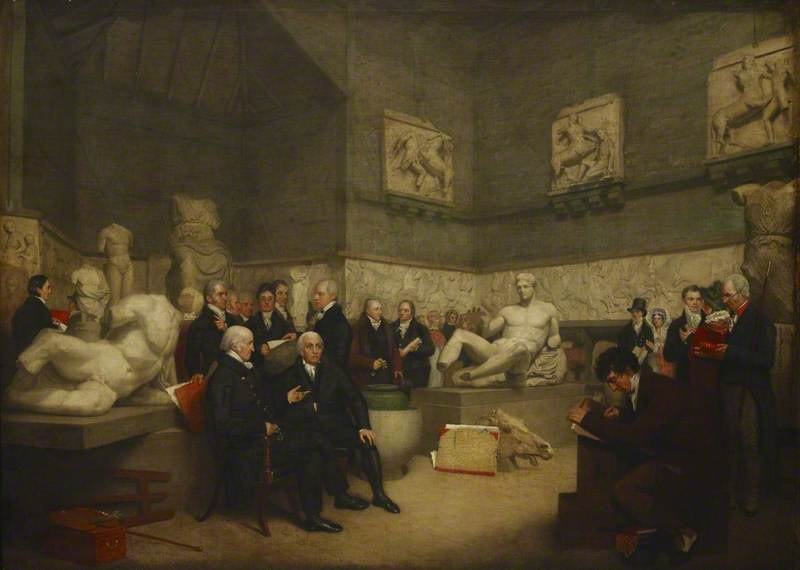
A portrait depicting the Elgin Marbles in a temporary Elgin Room at the British Museum surrounded by museum staff, a trustee and visitors, 1819

Benjamin Haydon fell in love with the Elgin Marbles from the very first encounter with them accompanied by his friend David Wilkie, when the two of them visited the makeshift museum in a shed at the bottom of a garden of Gloucester House.  Haydon declared they were the most heroic style of art combined with all the essential details of actual life.  He spent hours and days in Lord Elgin’s garden shed/museum making copies of the figures and the artefacts so they could be used for his Dentatus painting Haydon would constantly think, speak and write of the Elgin’s Marbles until his death. 

In December of 1798 Thomas Bruce, the Seventh Earl of Elgin and Eleventh Earl of Kincardine, was appointed Ambassador Extraordinary and Minister Plenipotentiary of His Britannic Majesty to the Sublime Porte of Selim III, Sultan of Turkey. Lord Elgin decided to undertake a survey of the Temple of Minerva (the Parthenon) at Athens to record and remove Greek antiquities, fearing their destruction in the ongoing conflict between the Greeks and the Turks.  Elgin decided he would engage, at his own expense, a team of artists and architects to produce plaster casts and detailed drawings of ancient Greek buildings, sculptures and artefacts.  Later it was decided to remove about half of the Parthenon frieze, fifteen metopes, and seventeen pedimental sculpture fragments and Elgin and his team arranged to bring back casts and sketches that might serve to improve the general “taste” in Britain. They became known as the Elgin Marbles and were removed from Ottoman Greece and between 1801 and 1812 and then were transported to Britain by agents of the Earl of Elgin.  According to Elgin, the act of removing the artefacts was with permission of the Ottoman officials who, at the time, exercised authority in Athens. The truth with regards this “permission” has since been queried.  The bringing to Britain of these structures was not well-received in all quarters with Lord Byron, at the time, likening Elgin’s actions as a form of vandalism and looting. 

Visitors at the British Museum looking at sections of the frieze of the Elgin Marbles

In 1816 Lord Elgin, newly divorced and deeply in debt, needed to sell the Marbles to the UK government in an attempt to recoup the £74,240 it had cost him to remove them and bring them to England.  However, there was one big problem for Elgin, as he and the government had differing views as to their worth.   The diplomat and Under Secretary for Foreign Affairs under the then British Prime Minister, Lord Castlereagh, valued them at £62,000.  Artists such as Sir Thomas Lawrence, a future President of the Royal Academy and Benjamin West, the incumbent President of the Royal Academy and sculptors such as Joseph Nollekens, John Flaxman and Richard Westmacott were sounded out by the government’s Select Committee as to what they believed the Marbles were worth and most believed they were of a superior standard, although most declined to put a figure on them.  The government turned to the Art Connoisseurs, art experts, with a more refined and more intricate knowledge about art and artists who advised institutions and investors. One such connoisseur was Richard Payne Knight,  Britain’s “leading” antiquarian, who was outspoken about the Marbles being of “mixed quality”, some of which were “second-rate” and he advised the government that they should pay Elgin no more than £25,000 which he still believed was twice what they were worth on the open market. 

Much to his annoyance Benjamin Haydon, who loved the artefacts and spent days copying them, was not consulted about their worth.  However, this did not stop him voicing his opinion on the matter.  Between the completion of the Select Committee’s meetings and the publication of their report about the value they put on Elgin’s Marbles, Haydon launched a bitter attack in the pages of the Examiner, a leading intellectual journal expounding radical principles, and the Champion, a radical eight-page newspaper.  His article entitled On the Judgement of Connoisseurs being preferred to that of Professional Men, he was critical of the Government listening to the advice of Connoisseurs (such as Payne Knight) rather than the advice of artists and sculptors.  He went on to write that in no other profession is the opinion of the man who has studied a subject for his amusement preferred to that of him who has devoted his soul to excel at it, adding that no man would trust his limb to a connoisseur in surgery.

Haydon’s comments are thought to have irked the government, which finally offered Lord Elgin £35,000 for the Marbles which he reluctantly accepted.  Haydon however, due to the article in the journals, had made a name for himself and he even had the article translated into a number of foreign languages.  There was a downside to this for Haydon who incurred the wrath of the “Connoisseurs” and in particular Lord Mulgrave who had made plans for Haydon with the British Institution directors.  They were shelved as they believed Haydon’s criticism of Richard Payne Knight was a criticism of them.  Once again Haydon had upset the “establishment”  On April 19th 1816, after the Parliamentary Select Subcommittee that had been appointed to make recommendations concerning the purchase of Lord Elgin’s collection announced that they were in favour of the purchase and in June 1816, granted £35,000 to Lord Elgin in exchange for the sculptures.

Many of the public believed that the government should not waste their money on buying Elgin’s Marbles and instead, be spending the money on much more needy things such as alleviating poverty and feeding the people during the time of famine.  A John Bull satirical cartoon appeared in the newspaper in 1816 highlighted the problem.  In the cartoon by George Cruikshank entitled The Elgin Marbles! or John Bull buying stones at the time his numerous family want bread, John Bull’s family are starving during the famine caused by the catastrophic harvest of 1816. During the same summer the 7th Earl of Elgin persuaded the British government to purchase the sculptures he had removed from the temples of the Athenian acropolis. The cartoon depicts the Leader of the House of Commons, Lord Castlereagh, as a sinister salesman trying to lure John Bull into buying some statues. It depicts Castlereagh saying:

“…Here’s a Bargain for you Johnny! Only £35,000!! I have bought them on purpose for you! Never think of Bread when you can have Stones so wonderous Cheap!!…”

…………………………………..to be continued


The majority of the information I have used in this and the subsequent blogs on the life of Benjamin Haydon came from an excellent second-hand book, published in 1998, I came across entitled A Genius for Failure, The Life of Benjamin Robert Haydon by Paul O’Keefe.  If you are interested in Haydon’s life, I can highly recommend you try to get yourself a copy.

In this particular blog further information I gleaned regarding the Elgin Marbles came from the Foundations website:

http://ww2.jhu.edu/foundations/?p=8

Benjamin Robert Haydon. Part 2

His lifelong quarrel with the Royal Academy,

In 1805 Hayden met another student who had arrived to study at the Royal Academy Schools and the two became great friends.  He was David Wilkie, who had begun his artistic training at Edinburgh’s Trustees Academy at the age of fifteen.

Pitlessie Fair by David Wilkie (1804)

One of his first paintings Wilkie exhibited was Pitlessie Fair which was inspired by examples of seventeenth century Dutch and Flemish paintings and also by Scottish folklore and cultural traditions celebrated in contemporary literature. This was well liked when shown in London and resulted in several prestigious commissions. The first meeting of Haydon and Wilkie was described in Wilkie’s biography, Life of Sir David Wilkie by Allan Cunningham.  Haydon recalls that meeting at the RA:

“…We sat and drew in silence for some time; at length Wilkie rose, came and looked over my shoulder, said nothing, and resumed his seat.  I rose, went and looked over his shoulder, said nothing, and resumed my seat.  We saw enough to satisfy us as to each other’s skills…”

‘The Egyptian Room’ by Thomas Hope as seen in the magazine ‘Household Furniture & Interior Decoration’ (1807).

In 1807, when twenty-one-year-old Haydon had his first work shown at the Royal Academy exhibition.  It was his work entitled The Repose in Egypt, and it was purchased by Thomas Hope for the Egyptian Room at his town house, a house designed by Robert Adam in Duchess Street, Portland Place, London, which he remodelled with a series of themed interiors.

In November 1807 Haydon’s mother who had been seriously ill travelled from Plymouth with Haydon and his sister to get further medical help in London. However she never made it to the English capital and died at the Windmill Inn, a coach stop at Salt Hill, just west of Slough.

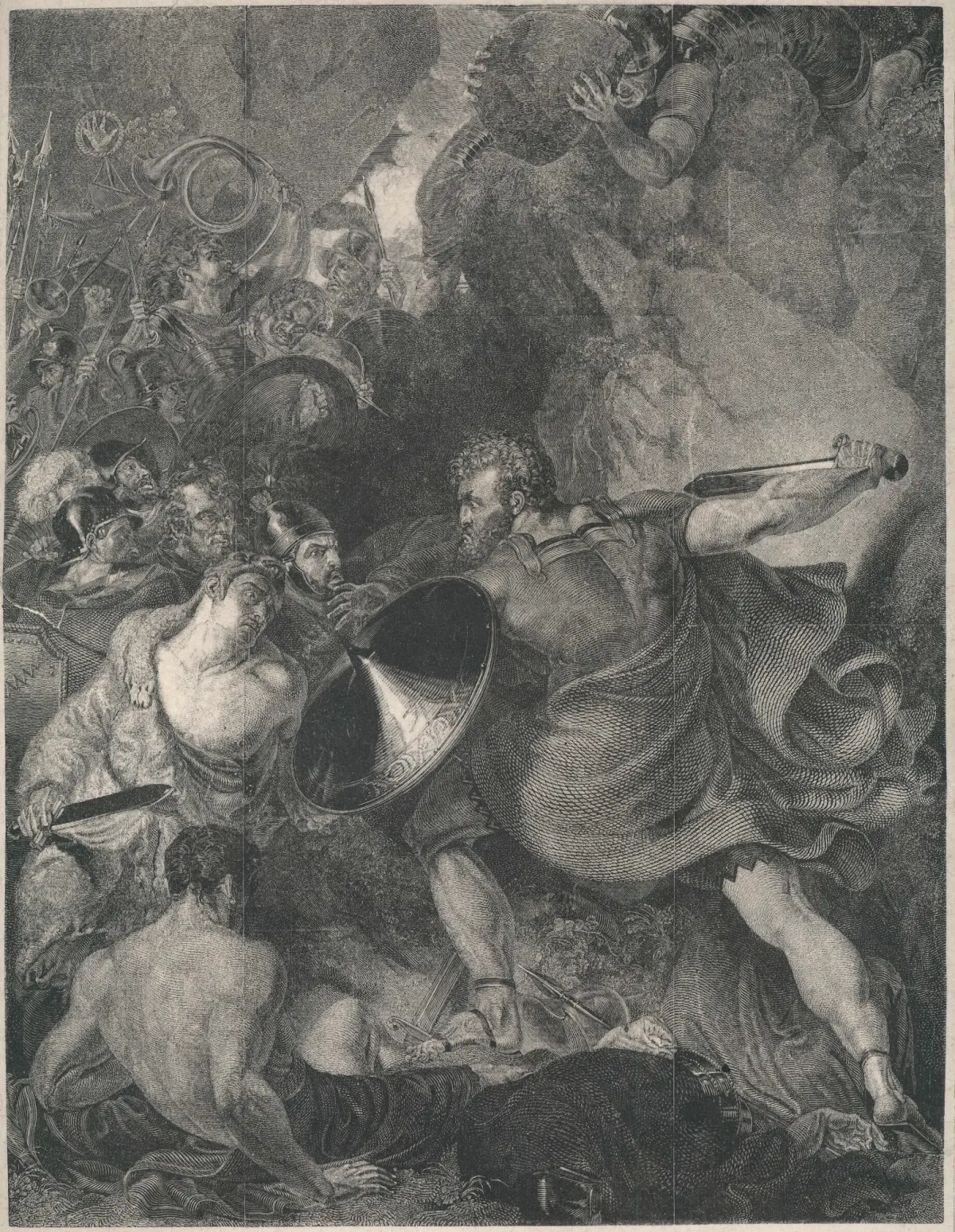
Assassination of L. S. Dentatus,   After Benjamin Robert Haydon. Engraving by William Harvey (1821)

As far as his artwork was concerned, Haydon could not have wished for a better start to his professional career as an artist. Following on shortly after the sale of his biblical painting Haydon received a commission from the Henry Phipps, 1st Earl of Mulgrave, for a large history painting featuring the Roman general, Lucius Siccius Dentatus.  Mulgrave himself had been a general in the Army as well as a prominent politician.   The subject of the work was that of the celebrated Roman Tribune, Dentatus, who is seen making his last desperate effort against his own soldiers, who attacked and murdered him in a narrow pass. It took Haydon two years to complete and was ready for exhibiting at the 1809 Royal Academy Exhibition. 

With his historical painting of Dentatus completed Haydon had to decide where it should be exhibited.  Many of his friends such as Sir George Beaumont and David Wilkie, as well as his tutor, Fuseli, had seen the painting and were full of praise for what he had achieved.  Beaumont pressed Haydon to exhibit the work at the British Institution where it could vie for the 100 guinea premium (prize) which was awarded to the best painting of historical or poetical composition but Haydon wanted this new work of his to be exhibited along with the greats of the Royal Academy.  He was scornful with regards the standard of art and artists showing at the British Institution and dismissive of the prize money, saying:

“…If [Benjamin] West and all the Academicians were to be my competitors, nothing would give me greater delight, even if I lost it – less glory would be lost, and more won if I gained it.  But to contend with a parcel of mannered, ignorant, illiterate boys, without science or principle [at the British Institution], if I were successful would be no honour, and if, unsuccessful, I should never hold up my head again.  Besides what do I care for prizes?  I want public approbation and fame – this is the only prize I esteem…

It is that last sentence that tells us so much about Haydon’s character !

  Haydon believed to achieve this sought after fame his work had to be shown in the Great Hall of the Royal Academy’s Exhibition.  One morning on April 1809, Haydon and a couple of companions carried the massive painting along The Strand and deposited it at the Royal Academy in Somerset House.  The full title of Haydon’s beloved work was The Celebrated Old Roman Tribune, Dentatus, Making his Last Desperate Effort against his own Soldiers, who Attacked and Murdered him in a Narrow Pass.

The Hanging Committee selected Haydon’s work for the exhibition and Fuseli had positioned it in the Great Hall.  However Benjamin West, the President of the Royal Academy had it moved to the dark Ante-Room, which is the way Haydon described its positioning, albeit others disagreed.  West’s reasoning being that the Great Hall was a space reserved for Academicians’ paintings.  Haydon never forgave the Academy for what he looked upon as a personal insult.  Twenty-five years later he recounted his feelings with regards the affair.  He wrote:

“…I lost my Patrons – & sunk into a species of despair & embarrassment from which I have had occasional gleams of Sunshine but never permanent fortune….[It] threw a cloud on the whole of my life – embarrassments, exasperations followed….I lost all employment & sunk to a Prison…”

Lord Mulgrave did buy the painting and paid Haydon two hundred and ten guineas.

Haydon’s fury at how his painting had been treated by the Academy festered for many years despite being warned by some of the Academicians, including Constable, that his attitude towards the Academy and the Academicians was unacceptable and would work against him.

Although the leading lights of the Royal Academy did not agree with Haydon, regarding the positioning of his painting at the Academy Exhibition, the well-known writer and art critic wrote the following in the May 29th 1809 edition of The Examiner:

“…From the trash with which it is mostly filled and from its indistinct light the Anti-room seems to be considered by the Academy, as I am sure it is by the tasteful visitor, little more than a mere vestibule to the larger room and is therefore frequently hurried over with scarcely a glance.  If however the visitor will allow me to be his intellectual caterer, I advise him to pause as he enters this sepulchral Anti-room and I am confident that in Mr Haydon’s picture of Dentatus making his last desperate effort against his soldiers who murdered him in a narrow pass, no.259, he will enjoy a treat served up by the hand of a genius and displayed with a refinement of science and of art…”

A Life Class at the Royal Academy, Somerset House by Thomas Rowlandson (1811)

Following shortly after Haydon’s clash with the Royal Academy he was engaged in a protracted argument with one of his patrons, Sir George Beaumont, over a commission to paint Macbeth.  It was all to do with the size of the painting and the figures within the depiction. Haydon was not deterred by this unfortunate situation as he felt that the work could be exhibited at the British Institution and he would secure the three hundred guineas prize. On the strength of that hope Haydon began to borrow money. Alas, the three hundred pound prize was not given to Haydon who was offered just thirty guineas to cover the cost of framing. Haydon was devastated. To add to his worries, his success on selling some of his work had a downside. His father viewing his son’s success stopped paying him his annual allowance of £200 which added to his son’s financial problems.

Having passed the test of drawing from plaster Haydon was allowed to enter the life-drawing sessions using live models.  An idea of what those classes were like can be gleaned from Thomas Rowlandson’s image of these classes, such as his 1811 painting entitled A Life Class at the Royal Academy, Somerset House.  It depicts Royal Academy students and Royal Academicians seated on semi-circular benches facing the model on a platform.  These classes ran for two hours every night during term-time.  Tuition at these classes was provided by visiting artists who were Royal Academicians.  There were nine visitors each year and their stint lasted one month.   The Royal Academy website offers an amusing anecdote about Rowlandson and his image of the Life Drawing class:

“…Rowlandson was himself a student at the Royal Academy from 1772-1778 when the life class was still in Old Somerset House. He is said to have nearly been expelled after firing a pea- shooter at the female model during the life class.  This characterisation of the Academicians and RA students as lechers is typical of Rowlandson’s caricatures…”

In Patricia Phagan’s 2011 book,  Thomas Rowlandson: Pleasures and Pursuits in Georgian England, she talks about Rowlandson’s interest in the Royal Academy School’s life drawing classes:

“…there was something compulsive in his repeated depiction of the seductive or voyeuristic relationships of grotesque old men and busty young women, or of the traitorous triangle of young wife, young lover, and old husband…”

The Judgement of Solomon by Benjamin Haydon (1812)

In 1812 Haydon made a start on his new painting that would be entitled The Judgement of Solomon.  The new painting was a depiction based on the Hebrew biblical story about King Solomon who made a ruling in a case featuring two women both claiming to be the mother of a child. Solomon revealed their true feelings and relationship to the child by suggesting the baby be cut in two, each woman to receive half. With this strategy, he was able to discern the fraudulent mother as the woman who entirely approved of this proposal, while the actual mother begged that the sword might be sheathed and the child committed to the care of her rival.

Study of head for ‘The Judgement of Solomon” by Benjamin Robert Haydon, c.1812–4

At this juncture in Haydon’s life, he was in debt, owing six hundred pounds to various creditors and he was constantly approaching friends for more financial help, many of whom had already loaned him money and had not been paid back. This was the start of Haydon’s financial decline and it was beginning to affect Haydon’s mental health.

………….to be continued

The majority of the information I have used in this and the subsequent blogs on the life of Benjamin Haydon came from an excellent second-hand book, published in 1998, I came across entitled A Genius for Failure, The Life of Benjamin Robert Haydon by Paul O’Keefe. If you are interested in Haydon’s life, I can highly recommend you try to get yourself a copy.

Benjamin Robert Haydon

The beginning.

Benjamin Robert Haydon

I was watching the film Mr Turner for the second time the other day and often on a second viewing of a film or the second reading of a book you come across things that you didn’t see the first time around.  During the second viewing of the film about Turner I noticed a minor character in it who Turner referred to as Haydon.  He was depicted as a “fussy” man who had great money troubles and was constantly approaching Turner for a financial loan.  I had never come across an artist named Haydon and it peaked my interest.  So, let me share with you a look at the life and works of a very troubled, whom some would say, was a very talented English artist.  Let me introduce you to Benjamin Robert Haydon.

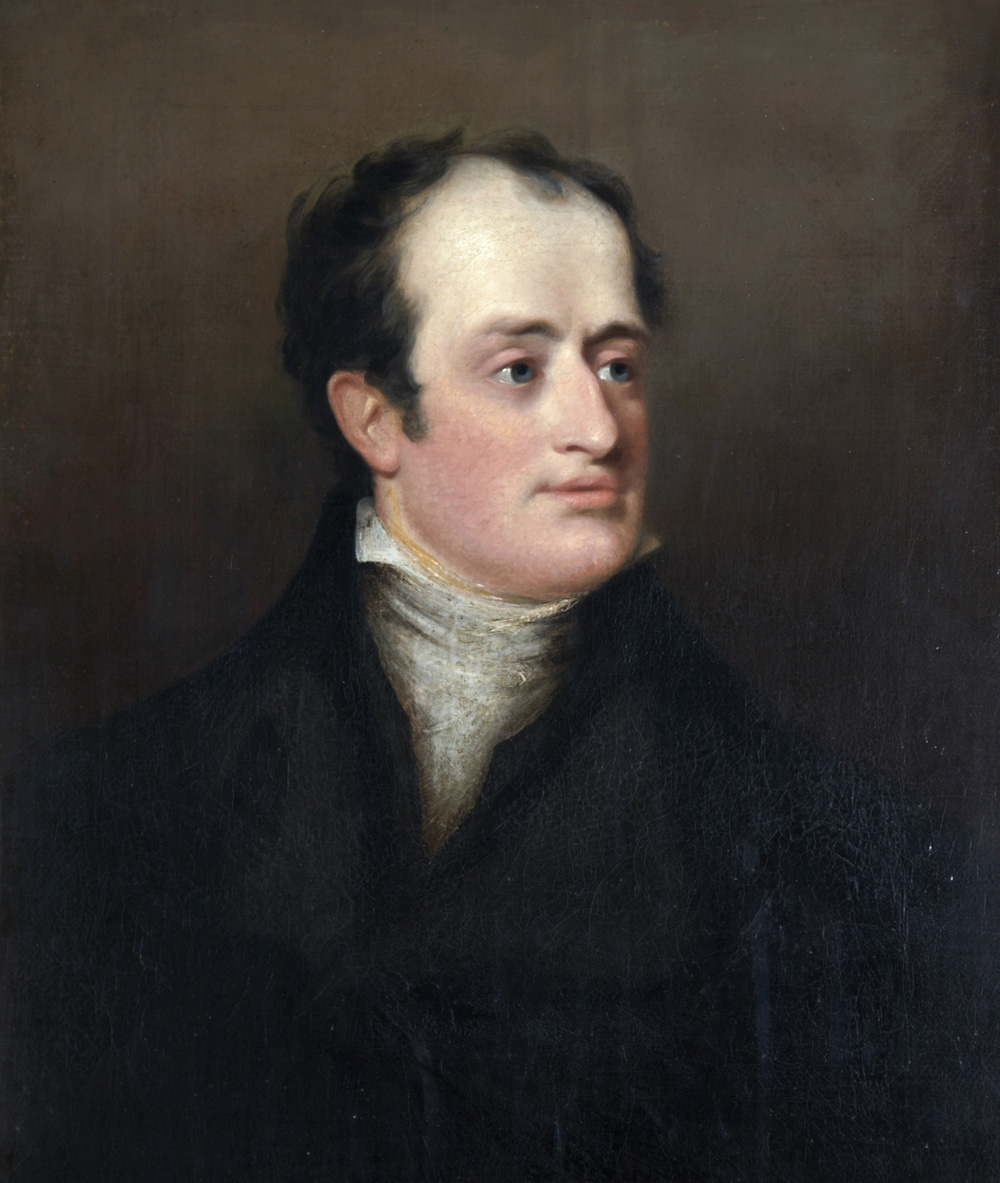
Benjamin Robert Haydon by William Nicholson RSA (c.1820)

Benjamin Robert Haydon was born in Wimpole Street in the south coast English garrison town of Plymouth on January 26th, 1876.  He had a younger sister Harriet; another sister, Sarah, had died in infancy.  His father was Benjamin Robert Haydon who had married his wife Mary, one of eight children and the second daughter of the Rev. Benjamin Cobley, curate of Shillingford and later, the rector of Dodbrook, near Kingsbridge, in the county of Devon.  Haydon’s father was a well-to-do printer, stationer and publisher and had a shop in Plymouth at 75 Market Place.  He was also an amateur “special correspondent” to the Bristol Journal, who as he lived in a garrison town, he enjoyed writing about the valorous exploits of the English military heroes fighting for their country in various parts of the world.

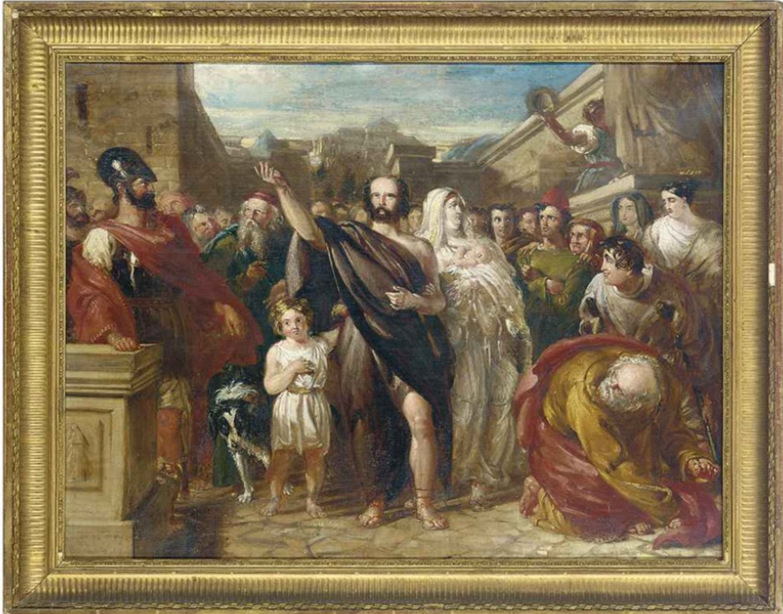
The Banishment of Aristides from Athens by Benjamin Haydon

In 1792 Benjamin Haydon, then aged six, first attended school and it was the start of his interest in sketching and he would often draw rough portraits of his school friends..  The following year, 1793, England and France went to war and it was that same year that seven-year-old Benjamin Haydon attended the Plymouth Grammar School run by the headmaster, the Reverend Dr. Bidlake.  Bidlake, Haydon recalled the head painted and played the organ and realising the young Haydon had a love and aptitude for sketching gave him and one of his fellow pupils some painting lessons.    That fellow student was Samuel Prout who would later become a renowned watercolourist, and one of the masters of watercolour architectural painting.  Bidlake encouraged Haydon to paint landscapes en plein air but this was countered by the advice given to him by a Neapolitan worker in his father’s business, a Mr. Fenzi, who would regale excitedly about the works of Raphael and Michelangelo.  Haydon was excited about what he saw and heard and remembered Fenzi’s words of advice about ignoring landscape painting and concentrate on figurative painting:

“…Do not draw de landscape; draw de feegoore, Master Benjamin…”

When Haydon was eleven years old he contracted measles and was laid up in bed.  He recalled the time well, as his father visited his bedside to excitedly announce the British naval victory at Cape St Vincent.  Later Haydon recalled the excitement in the household with the news of Horatio Nelson’s naval victories.

Plympton Grammar School

(Photograph taken 28 August 2001 © Mr Gerald Rendle)

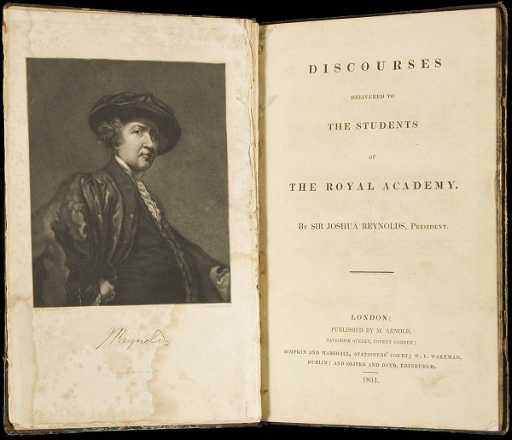
In 1798, at the age of twelve, Haydon left Plymouth Grammar School and was admitted as a boarder to All Hallows School in Honiton, some sixty miles from his home.  Here the headmaster was Reverend William Hayne who was tasked by Haydon’s father to help his son improve his art.  In 1800 Reverend William Hayne was offered a teaching post at Plympton Grammar School and he accepted and moved his family and pupils to Plympton St Maurice.  In a way it was a return home for Haydon who had spent his early years nearby.  Fifty years earlier the grammar school had been where the artist, Sir Joshua Reynolds, studied and Reynold’s father had been the headmaster.  In all, Haydon had been under the tutelage of Reverend Hayne for two years at Honiton and a further six months at Plympton Grammar where he rose to become head boy at the age of fifteen and by which time he had acquired a good understanding of the Latin, Greek, and French languages.

Haydon left the school and the world of the classic literature and had to decide on his next move.  However, that decision was taken away from him by his father who saw his son as being his successor in the family business and so had his son move to Exeter where he studied business and as Haydon saw it, the dry tuition of profit/loss and ledgers.  He was not enamoured by the world of finance and bookkeeping.  His course lasted six months at which time he returned home to Plymouth where he was indentured for a period of seven years as an apprentice to his father.  Life could not have been worse according to young Haydon who hated everything about the job.  He hated everything – his father’s customers, serving behind the counter in his father’s shop, working on his father’s accounts.  Nothing pleased him and he would spend long periods of time sulking at his lot in life.

Benjamin Haydon came to the conclusion that his future lay ahead as an artist.  His father and his grandfather both had similar thoughts at Benjamin’s age but they soon faded and Benjamin’s father believed the same would happen to his son’s great artistic ambitions.  Heated and constant family arguments followed on a daily basis over young Haydon’s future, so much so, Haydon became ill and suffered severe inflammation of his eyes.  Benjamin’s father believed this would put an end to his son’s fantasies of becoming an artist and told him he could never become an artist as he couldn’t see properly, but he was mistaken for his son was not to be deflected.

Discourses by Sir Joshua Reynolds

Haydon believed that his eyesight problem was not a major stumbling block and he was buoyed by the words of Joshua Reynolds in his first Discourse he delivered to the Royal Academy during the opening session in January 1769. Reynolds set out his theories on art in a series of fifteen lectures in the Royal Academy Schools, which were later published as Discourses on Art.  It was all about the fact that nothing would be achieved without hard work.  Reynolds said:

“…But young men have not only this frivolous ambition of being thought masters of execution inciting them on one hand, but also their natural sloth tempting them on the other. They are terrified at the prospect before them of the toil required to attain exactness. The impetuosity of youth is disgusted at the slow approaches of a regular siege, and desires, from mere impatience of labor, to take the citadel by storm. They wish to find some shorter path to excellence and hope to obtain the reward of eminence by other means than those w4iich the indispensable rules of art have prescribed. They must, therefore, be told again and again that labor is the only price of solid fame, and that whatever their force of genius may be, there is no easy method of becoming a good painter…”

Haydon met Samuel Northcote, one of his father’s customers and hearing of young Haydon’s wish to become an artist Northcote advised him to study anatomy.  Haydon took that advice and purchased a book at the Plymouth Naval Hospital Auction entitled Tables of the Skeleton and Muscles of the Human Body written by Bernhard Siegfried Albinus in 1749   It cost him two pounds ten shillings, an amount he did not have !  This attitude to buying things he could not afford would haunt him all his life.  Haydon rushed home and spoke to his father who grudgingly gave him the money.  Haydon immersed himself in the anatomy book and after two weeks of constant studying the drawings and information, he claimed that he knew every muscle and every bone in the human body.

Haydon’s constant battle with his mother and father as to his future continued with neither side relaxing their stance.  However, he must have finally worn them down as they finally agreed to him travelling to London and enrolling on a two-year course at the Royal Academy Schools.  They gave him an initial twenty pounds to cover the cost of lodgings which he secured in the Strand, close to Somerset House, the home of the Royal Academy.  The course was free of charge but to get a place on the course one had to be recommended by an Academician.  This was achieved through Haydon’s uncle Benjamin Cobley who contacted his friend and Academician, Prince Hoare.   Haydon left Plymouth on an overnight coach on the morning of May 4th 1804 and arrived in London the next day.

Haydon, on arrival in London, took lodgings at 3 Broad Street, Carnaby Market. One of the first outings Haydon made was to the Royal Academy’s thirty-sixth annual exhibition which was being held at Somerset House (The Royal Academy did not move to its present location at Burlington House on Piccadilly until 1868).  There was a one shilling entrance fee which entitled you to a catalogue and according to the catalogue outlined the reason for the charge:

“…it was to prevent the Rooms from being filled  by improper Persons, to the entire Exclusion of those for whom the Exhibition is apparently intended…”

Laocoön’s head

Haydon settled into his course at the Royal Academy Schools and studied hard.  He decided that his favoured painting genre would be that of historical paintings. The first stage of his admission to the Royal Academy Schools was to present a drawing from plaster casts and so he immediately went to a seller of plaster casts who had a shop in nearby Drury Lane.  Here he purchased a cast of Laocoön’s head, a famous pieces of Hellenistic sculpture, along with some casts of arms, hands and feet and these together with his copy of Albinus’ anatomy book he set about creating acceptable drawings.  He worked non-stop and described his daily ritual:

“…I rose when I woke, at three, four or five; drew at anatomy until eight, in chalk from my casts from nine to one and from half-one until five – then walked, dined and to anatomy again from seven to ten and eleven…”

Dissection of the neck from the 1794 book ‘Engravings, Explaining the Anatomy of the Bones, Muscles and Joints’ by John Bell.

Another early purchase Haydon made was a copy of the 1794 book Anatomy of the Bones, Muscles and Joints by John Bell and this was to supplement his Albinus book on anatomy.

 It took a while before he made meaningful friendships with the exception of his sponsor and Royal Academy’s Secretary of Foreign Correspondence, Prince Hoare, who, on seeing Haydon’s sketches introduced him to John Opie and James Northcote.  Opie concurred with Haydon as to the importance of studying anatomy whereas Northcote advised Haydon to forget about anatomy and historical paintings and concentrate on portraiture but Haydon would not be deterred.  At the meetings Haydon spoke to the two artists about whether he should take lessons from a master.  Once again Opie and Northcote had differing views.  Opie was for it, Northcote against it saying Opie was only interested in extracting money from Haydon and Haydon’s father.  In the end he decided to follow Opie’s advice about studying anatomy but Northcote’s advice with regards not working under a master painter.

The Nightmare by Fuseli (1781)

On Christmas Eve 1804 Prince Hoare introduced Haydon to the Academy’s Professor of Painting, the Swiss-born painter John Henry Fuseli.  Fuseli held the position at the Royal Academy as Keeper, who carried overall responsibility for the Royal Academy Schools.  Haydon had seen Fuseli’s “strange” works such as his 1781 painting The Nightmare and his 1802 painting, Uriel watches Saturn on his Flight to Earth, a print of which he remember seeing in his father’s shop and so was delighted to visit this great master in early January and show him his sketches.  Fuseli was duly impressed with Haydon’s works and granted him admission to the RA Schools as a Probationer.

A sheet of anatomical drawings of the bones, muscles and tendons of the arm and hands by Benjamin Haydon  (ca. 1805)

One of Haydon’s early tasks he had to perform at the RA School was to copy a cast but the object was set up some distance from him and he realised that his poor sight was going to pose a problem and so had to purchase a pair of spectacles.  Haydon continued to work hard and such attitude found favour with Fuseli. 

The statue of the athlete Discobulus by Myron (c.450BC)

In March 1804, having completed the task of drawing the figure of Discobolus he received his “ticket” and became a ”Student of Painting”.  Shortly after, Haydon was summoned home by his family as his father was dying.  However, despite still being a patient at Royal Naval Hospital in Plymouth his father had recovered and Haydon remained in the city that summer.  Haydon immediately sought permission from the hospital authorities to draw from their collection of preserved human bones with dried muscle. He drew obsessively, combining his depiction of the specimens with poses typically found in anatomical textbooks. 

Anatomical drawing of the bones and muscles of the lower leg by Benjamin Haydon (1805)

The result was an album with a collection of anatomical drawings.  Haydon believed that anatomy was the key to comprehending the ‘principles of heroic form’ which would then result in successful completion of grand historical works which was still his artistic aim. His ambition was to become the greatest historical painter England had ever known.

……to be continued


The majority of the information I have used in this and the subsequent blogs on the life of Benjamin Haydon came from an excellent second-hand book, published in 1998, I came across entitled A Genius for Failure, The Life of Benjamin Robert Haydon by Paul O’Keefe. If you are interested in Haydon’s life, I can highly recommend you try to get yourself a copy.

The Tokaido Road Trip. Part 3.

The end is in sight

The Tokaido Road

Hiroshige’s journey is over two-thirds complete. In the last blog he and his party had arrived at Arai and now the Tokaido Road travellers head in a westerly direction, following the coast as it approaches Shiomizaka,

No.37. Akasaka: Inn with Serving Maids by Hiroshige

Along with the preceding post stations of Yoshida and Goyu, the one at Akasaka was well known for its meshimori onna. Meshimori onna, which literally translates to “meal-serving woman,” is the Japanese term for the women who were hired by the hatago inns on the Tokaido Road post stations. At first their role was that of simply maidservants on the payroll of the inns, but as the traffic along became busier and the kaidō (road) grew,  competition between the inns increased, and the ladies were often engaged in prostitution.  However, in 1718 the Tokugawa shogunate laid down a law which stated that the number of meshimori onna working at each inn would be limited to two and this was seen as tacit permission to employ a limited number of prostitutes.  Hiroshige’s print depicts a typical inn and it is divided in half by a sago palm in the centre of the work. To the left we see travellers partaking of an evening meal.  On the right, we see prostitutes  putting on make-up and preparing for the evening entertainment.

No.38. Fujikawa: Scene at Post Outskirts by Hiroshige

At its peak, Fujikawa was once a large stop over town with 302 buildings. Its total population was approximately 1,200 people. In this ukiyo-e print by Hiroshige the artist has depicted a daimyō procession on their trek along the Tokaido Road entering the post station.  We see three commoners kneeling as the lord’s retinue passes by.  A line of old pine trees extend for approximately a kilometre mark the location of the Tōkaidō Road.

No.39. Okazaki: Yahagi Bridge by Hiroshige

Okazaki was a part of the thriving castle town which encircled Okazaki Castle, the headquarters for Okazaki Domain. The thirty-ninth print of the series depicts the Yahagibashi bridge.  This magnificent structure was one of the few bridges that people were permitted to use on the Tokaido Road by the Tokugawa shogunate.  It was one of the longest bridges built in Japan during the early Edo period. On the opposite bank of the river we can see Okazaki Castle.

No.40. Chiryū: Early Summer Horse Fair

Chiryū was the thirty-ninth of fifty-three stations of the Tōkaidō and counting the print featuring the Edo starting point at Nihonbashi, the fortieth of the woodblock series.  Reaching this point meant the travellers had trekked for three hundred and thirty kilometres and would have probably taken, on average, two weeks.  The town was famed for its horse market which took place in late April and early May.  Tall pine trees can be seen and the shogun, Tokugawa Ieyasu, ordered that the post station plant pine trees along through route of the highway before and after the town.  These all survived until the Isewan Typhoon of 1959 which destroyed most of them.

No.41. Narumi: Famous Arimatsu Tie-dyed Fabric

 The woodblock print depicts travellers passing by open-fronted shops selling tie-died cloth. Clothing such as the yukata kimono, the unlined kimono for summer use, which was a local speciality of the region.

No.42. Miya: Festival of the Atsuta Shrine

The Tokaido Road post station at Miya also acts as a post station on the The Nakasendō, the Central Mountain Route, also known as the Kisokaidō, which was one of the five routes of the Edo period, that connected Edo and Kyoto.  Hiroshige’s print depicts two gangs of men dragging a portable shrine cart which is just out of the picture, past a huge torii gate. The torii gate is the symbol of a Shinto shrine, and the name of the town, “Miya” also means a “Shinto shrine. The shrine in question is the famous Atsuta Shrine, one of the most famous in Japan and a popular pilgrimage destination in the Edo period.

No.43. Kuwana: Shichiri Crossing

The Kuwana post station was found in the castle town of Kuwana Domain, which was a major security installation on the Tōkaidō Road for the Tokugawa shogunate. The actual post station could be found located on the western shores of the Ibi River. Hiroshige’s print of Kuwana depicts two large ships of the Shichiri no watashi ferries about to set sail with travellers from in front of Kuwana Castle, whilst in the background we can see other ships sailing away on their voyages.

No. 44. Yokkaichi: Mie River by Hiroshige

Hiroshige’s ukiyo-e print of Yokkaichi  illustrates a stormy day and we see a man running after his hat which has been blown from his head.  Another man crosses a small bridge over the Sanju River  The roofs of the small group of huts which form the post station can be seen in the middle of a marsh are almost hidden by the reeds.

No. 45. Ishiyakushi: Ishiyakushi Temple by Hiroshige

The Ishiyakushi post station derived that name from the nearby Buddhist temple which is said to have been founded in 726 AD by the shugendō monk Taichō. According to the temple legend, Kūkai carved an image of Yakushi Nyorai on a huge boulder that was found in the forest, and Taichō later built a temple around this image. A settlement gradually developed around the temple.  Utagawa Hiroshige’s ukiyo-e print of Ishiyakushi depicts the temple in the midst of a grove of trees on the left and a village on the right.  Rising in the background are the Suzuka Mountains.  In the foreground we can see bales of rice which means that this is an Autumn depiction and tells us that this post station is at the heart of the countryside.

No.46. Shōno: Driving Rain

The weary travellers are suddenly caught out by torrential downpour as they arrive at the town of Shōno in Ise Province. On the right we see two men heading down hill, one holding an umbrellas and the other wearing a hat and cloak. There are two inscriptions on the umbrella. One is Takenouchi who was the publisher of the series of prints and the other is Gojūsan-tsugi, which was part of the Japanese name of the Tokaido Road woodblock series Tōkaidō Gojūsan-tsugi no uchi. To the left of these men we see another man wearing a hat and a cloak walking uphill followed by two litter-bearers. The falling of heavy rain is depicted like a grey curtain.

No.47. Kameyama: Clear Weather after Snow

The procession of travellers continue on an upward trajectory. The steep path takes them past the castle of Ishikmawa daimyo and we can just see the town of Kameyama in the valley to the left. The castle was home to the Ishikawa clan,  daimyō of Ise-Kameyama Domain.  The setting is early sunrise and the sky is reddened by the early morning sun. Kameyama was a well fortified city from the middle of the sixteenth century at the time of the building of the castle. In 1854, twenty years after Hiroshige’s woodblock print series was published, the castle was destroyed by the great Ansei earthquake. However in 1855 Hiroshige produced a vertical woodblock series of the Tokaido Road journey and in that series, despite the destruction of the castle, it is depicted in an unblemished state !

No.48. Seki: Early Departure of a Daimyō

The next depiction in the Tokaido series is that of the inn at Seki where the travellers had rested for the night. It is early the next morning and still somewhat dark. The people prepare to set off on the day’s travels. The innkeeper dressed in his traditional kamishimo, a formal kimono for men, stands on the verandah issuing instructions to one of his servants. To the left of the table we see a palanquin (litter) on the ground with the palanquin bearers standing by. The banners we see hanging around the courtyard of the inn probably bear the emblem of the daimyō who has spent the night at the inn. You can see some small brown signs hanging above the head of the innkeeper – they are advertising the availability at the inn of the famous Senjoko and Biojoko brands of white face-powder.

Snow landscape with a gate: Seki by Hiroshige (1855)

The town of Seki also appeared in the 1855 version of Hiroshige woodblock series of the Tokaido Road, the so-called Reisho Tokaido. In this depiction it is late afternoon on a snowy day and we see a few travellers passing the gate to the pilgrim’s route to Iso.

No.49. Sakanoshita: Fudesute Mountain by Hiroshige (c.1833)

Having left Seki, the travellers move deeper inland and have reached the summit of the Fudesute Mountain. The mountain derives its unusual name from an incident in which the celebrated artist Kano Motonobu threw away (sute) his brushes (fude) when he could not capture the beauty of the mountain in a painting.  

Another version by Hiroshige of Fudesute Mountain at Sakanoshita.

No.50. Spring Rain at Tsuchiyama by Hiroshige (c.1833)

The fiftieth print in the series depicts a daimyō procession.  They are enduring torrential rain as they traverse the crossing surrounded by a raging torrent which rushes below a wooden bridge. The post station, with its darkly coloured buildings, partly hidden by trees, are seen to the left of the picture.

Below are two prints made by Hiroshige of the remote Minakuchi layby station. One was part of the 1833 series and the other from the later series which was published around 1852 and known as the Reisho Tokaido or the Marusei Tokaido..

No.51. Minakuchi: Famous Dried Gourd by Hiroshige (c.1833)

In the 1833 print we see a lone traveller walking through the village of Minakuchi. In the foreground we observe women peeling and drying gourds In the background there is a range of hills. This resting station is located in a desolate rural area and was famous for its production of dried gourd shavings which were often used for Japanese dishes. These women we see are busy producing them. One is shaving a gourd, one, with a baby slung on her back, is helping the shaver, whilst another one is drying the shaved gourd on a rope.

The beautiful pines at Hiramatsuyama by Hiroshige (1851-2)

In this 1852 edition of the Reisho Tokaido we see a peasant leading an ox laden with produce making their way slowly along the winding uphill path. Another man follows. The setting of this print is the steep road leading to the next stop-over point at Ishibe and just to the left of the Tokaido Road. This hill between the villages of Harimura and Kojibukuro, although it only reaches an elevation of two hundred and twenty-eight metres, is known as Mount Hiramatsu. The striking thing about the depiction are the pine trees on either side of the road. Normally pine trees along the side of the road have been planted but these are said to have grown there on their own accord. Note in the background the white clouds depicted by Hiroshige. These cumulus clouds were a Western element, one which only rarely appeared in Hiroshige’s prints.

No. 52. Ishibe: Megawa Village by Hiroshige

Utagawa Hiroshige’s ukiyo-e Hōeidō edition print of Ishibe does not actually show the post station at all, but instead we see a tea house known as Ise-ya, which was located at Megawa no Sato, on the road between Kusatsu and Ishiba.  This shop was well-known for its tokoroten, a sticky sweet made from agar, and kuromitsu, a black sugar syrup. We see depicted in the print a group of travellers who seem to be dancing and cavorting in front of the shop.  They are observed by three women who are wearing travelling hats and walking sticks.  A couple of other travellers, some distance further down the road, are seen to be heavily laden, and struggling with their trek.

No.53. Kusatsu: Famous Post House by Hiroshige (1833)

The post station on the Tokaido Road at Kusatu was also a post station for the The Nakasendō (Central Mountain Route), also known as the Kisokaidō, both being one of the five routes of the Edo period.  Looking at the print we observe a busy scene within the post station itself in front of the open-fronted Yōrō-tei, a tea house in which many patrons are probably partaking in their famous Ubagamochi, a sweetened sticky rice cake which was a speciality of Kusatsu.   In front of the tea house, on the road itself, we see a passenger in an open kago (palanquin) holding desperately on to a rope as the porters rush him to his destination  Moving in the opposite direction we see a larger green, covered kago, and this is probably transporting a high status passenger.

No. 54. Ōtsu: Hashirii Teahouse by Hiroshige

The Ōtsu post station was the last of the fifty-three stations of the Tōkaidō as well as the last of the sixty-nine stations of the Nakasendō. In Hiroshige’s 1833 depiction we see oxcarts, heavily laden with bushels of rice or charcoal descending the street. The oxcarts pass in front of the open front of the Hashirii teahouse, which was a popular resting point on the highway, and was well known for its delicacy known as Hashirii Mochi, a sweet rice cake, which is still a local specialty of Ōtsu.  In front of the teahouse is a well from which fresh water gushes out.

No. 55. Kyōto: The Great Bridge at Sanjō by Hiroshige

Finally the weary travellers arrive at the Great Sanjō Bridge over the Kamo River in Kyoto, the imperial capital and the terminal of the Tōkaidō. The bridge is well known because it served as the final location for journeying on both the Nakasendō and the Tōkaidō, two of the famous “Five Routes” for long distance travelers during the Edo period in Japan’s past. In the background we can see houses, temples, and villas at the foot of Higashiyama. Mount Hiei, which is an important Buddhist centre, is silhouetted in distance.

That is the end of our 500 kilometres journey. Most of the pictures came from the website: The Fifty-three Stations of the Tōkaidō Road

(https://hiroshige.org.uk/Tokaido_Series/Tokaido_Great.htm)

The information about the journey came from the usual internet sources and a great book I found in a second-hand bookshop entitled Hiroshige, a Royal Academy of Arts, Publication, produced at the time of their 1997 exhibition of Hiroshige’s work.

The Tokaido Road Trip. Part 2.

The middle part of the journey.

The Tokaido Road Post Stations: Edo (1) to Kyoto (55)

 The Takaido Road journey was about 500 kilometres long and most travellers made the tiring journey on foot, aiming to accomplish several stages per day although in some cases the travellers would spend several nights at one station.  The whole trip, on average, would take two weeks but the more athletic could cut that time  by half.  One of the determining factors was the weather and bad weather could make the journey last up to a month.  As I said in Part 1, one set of travellers who made the annual pilgrimage was the procession of the great daimyo (powerful Japanese magnates, feudal lords), who were commanded to spend every other year at the Shōgun’s court.  The reason for this being to prevent them from organizing rebellions and the large entourage travelled back and forth in huge processions numbering hundreds of people.

No.17. Yui: Satta Peak by Hiroshige (c.1833).

At the end of the last blog Hiroshige had reached the snow covered village of Kambara. He and his group have moved further south west and arrived at the Satta Pass. In this depiction we see a few travellers on the cliff-top pass looking out at the panoramic Kiyomi Bay, a bay on the Pacific coast of Honshū. The Satta Pass was carved out of the rocks in 1655. Two pine trees can be seen leaning over and twisted in the wind and in the background we once again see Mount Fuji.

Yui: The Dangerous Satta Pass by Hiroshige (1855)

Hiroshige completed another print of the Satta Pass in his 1855 Tokaido Road series.

Travellers on a mountain path along the coast by Hiroshige (c.1837)

Hiroshige must have been fascinated by the view afforded to him from the Satta Pass and Mount Fuji as one of his prints from his Famous Views of our Country is entitled Travellers on a Mountain Path along the Coast and once again we see travellers trekking along the Satta Path.

No.18. Okitsu: The Okitsu River by Hiroshige.

The Takaido Road travellers leave Yui and the Satta Pass and cross the Okitsu River towards the layby station at Okitsu. The classic ukijo-e print by Hiroshige depicts two sumo wrestlers being carried across the Okitsu River, one on a packhorse and the other in a kago, which is a type of litter used as a means of human transportation by the non-samurai class in feudal Japan.

No.19. Ejiri: Distant View of Miho by Hiroshige (c.1833).

Further along the Takaido Road the travellers are able to look towards the sea and the harbour town of Ejiri. Ejiri was a castle town.  Ejiri castle was built in 1570, but the town of Ejiri was not officially designated a post station until the early 17th century.  The print depicts a view over the Miho no Matsubara,(pine grove at Miho), a scenic area on the Miho Peninsular of Shizuoka City. Its seven-kilometre seashore is lined with pine trees. with boats anchored in the foreground in front of a fishing village, while others can be seen sailing in Suruga Bay.

No.20. Fuchū: The Abe River by Hiroshige (c.1833).

The weather was always a determining factor for how long the five hundred kilometre journey would take but the other factor was the crossing of rivers that traversed their path. One such was the Abe River which proved a great challenge. depicts travellers crossing the Abe River to the west of the post station. A woman is being carried in a kago (another type of litter, while other people are fording the stream on foot.

No.21. Mariko – Local Specialities Shop by Hiroshige (c.1833).

We have now arrived at the twenty-first stop over point near Mariko and in this depiction we see two travellers who have stopped their journey for refreshments at a roadside stall. Tea is being served with a local speciality known as tororoshiru, which is a paste made from grated yam. The two men are being served by a woman who has a baby strapped to her back. To the left of the stall we see a man on his way along the road with his back to us. He is smoking a pipe and his rain jacket and hat are tied to a stick which he carries over his shoulder.

No.22. Okabe: Utsu Mountain by Hiroshige (c.1833).

Once again the travellers had to struggle along the tiring uphill stretch of the Tokaido Road as they move slowly over the Utsu Mountain pass. Most of the post stations I am highlighting in these three blogs were built around 1602 but the one at Okabe was not completed until a year later.  At the time it was built, the population there was just sixteen and thirty-five years later, had only risen to one hundred.  The print depicts a mountain stream between steep green banks, with the roadway a narrow path walled in on one side by a stone wall.  it was destroyed by fire in 1834. After it was rebuilt in 1836, it was eventually named nationally designated Important Cultural Property.  In 2000, it was reopened as an archives museum.

No. 23. Fujieda: Changing Porters and Horses by Hiroshige (c.1833).

Such a long journey along the 500 km Tokaido Road necessitated a frequent change of horses and men who have been employed to carry people and supplies across fast flowing rivers and up steep mountain trails. Fujieda was one of these stop-off points between the Abe and Ōi rivers, where fresh horses and men could be employed for the onward route.

No. 24. Shimada: The Suruga Bank of the Ōi River by Hiroshige (c.1833)

With fresh horses and a new group of porters to carry supplies, the palanquins and the party were ready to cross the Ōi River which flowed down from the Akaishi mountains, part of the  the Japanese Southern Alp that form the border between Shizuoka, Nagano and Yamanashi prefectures. From the print we can see that the crossing was an immense challenge. The Tokugawa Shogunate was very mindful about the defence of Edo and that included the outer limits of the city.  It was then deemed necessary to stop any easy access to Edo expressly forbidding the building of bridges or allowing a ferry service to cross the Ōi River.  All travellers had to wade across the shallowest parts of the river but this was impossible during times of heavy rain which caused the river to flood.  During those times travellers had to spend days at Shimada, which of course made the tea houses and shop owners very happy.

No.25. Kanaya: The Far Bank of the Ōi River by Hiroshige (c.1833)

The twenty-fifth woodcut print of the Tokaido Road series by Hiroshige depicts the party at the end of their struggle to cross the Ōi River and to approach the Kanaya post town. Kanaya was located on the west bank of the Ōi River and like Shimada, prospered from the Tokugawa Shogunate’s defence policy of not allowing any bridge or ferry to be established on the Ōi River. This meant reaching the town from the east was often difficult if the river flow, after heavy rain, was too fast for travellers to cross and they had to wait before entering the river finding themselves trapped for days on either side awaiting the water level to drop.

No.26. Nissaka. Sayo Mountain Pass by Hiroshige (c.1833)

Having crossed the Ōi River the party of travellers moves into the Sayo mountains and once again face a steep up-hill climb. On the path we see a large stone. This object appears in a later woodcut print by Hiroshige.

Nissaka by Hiroshige (1849)

The stone features prominently in this print. It is known as the Night-Weeping Stone and according to legend a pregnant woman was killed by bandits, and her blood fell on the stone. After she died, a passing priest heard the stone call out for him to rescue the surviving infant. The tale goes that the stone has cried at night for her.

No.27. Kakegawa – View of Akiba Mountain by Hiroshiga (c.1833)

This woodblock print depicts a priest and boy and elderly pilgrims crossing the trestle bridge. To the right we see farmers planting crops in the fields, and in the background on the right we get a distant view of Mount Akiba. An old couple is struggling against a strong wind, followed by a boy making a mocking gesture; another boy is watching a kite floating up in the air.

No. 28. Fukuroi: Tea Stall by Hiroshige (c.1833)

The twenty-eighth print in the Tokaido Road series is one depicting a tea stall at the small town of Fukuroi. This was a much needed and much appreciated stop-off point for the travellers who had trekked up steep mountain passes and forded fast flowing rivers. Although only a small town at the time of Hiroshige’s visit, within a hundred and twenty-five years it had grown and was given city status in 1958. We see a couple of travelers sheltering at a wayside lean-to, in front of which a woman stirs a large kettle which hangs from the branch of a large tree. The surrounding area appears to be featureless rice fields, with little indication of a post town.

No.29. Mitsuke: Tenryū River View by Hiroshige (c.1833)

The Tokaido Road procession has reached the town of Mitsuke and are facing yet another river to cross. This time it is the Tenryū River which has flowed two hundred kilometres south from its source, Lake Suwa. The river drains into a wide coastal plain noted for fruit and rice production. The print portrays a close-up scene along the Tokaido Road which depicts the difficult and laborious crossing of the Tenryu River close to the point it reaches the sea. In the foreground, we see two ferrymen waiting for their passengers who are on this long trek.

No.30. Hamamatsu: Winter Scene by Hiroshige (c.1833)

The party of Tokaido Road travellers have successfully crossed the Tenryū River and arrived at Hamamatsu. Hamamatsu flourished during the Edo Period under a succession of Daimyo rulers as a castle city, and a postal city on the Tokaido Road. In this print we see some of the procession huddled together trying to counteract the harsh winter conditions.

No.31. Maisaka: View of Imagiri by Hiroshige

The party arrive at Maisaka and the woodblock print is looking back at the Imagiri Promontory.  As the Tokaido Road links the shogun’s headquarters in Edo with the imperial capital in Kyoto, its route runs along the Pacific coast and so many of the woodcut print images from the series are seascapes. The depiction we see shows a view of Imagiri Beach near Maisaka. We look inland from the beach and see Lake Hamana, which empties into the Pacific Ocean. Our group of travellers heading west had to take a ferry across the lake. In the foreground we see brown-red pilings which were erected to protect the ferry port from the open sea.

No.32. Arai Ferryboat by Hiroshige (c.1833)

Hiroshige left Maisaka with his party which included one of Japan’s powerful lords, known as a diamyo, along with his entourage and headed for the next lay-over station at Arai.  However, to reach Arai they had to cross a large stretch of water, Lake Hamana.  To accomplish this the party organised boats to transport the people and provisions.

The diamyo’s boat

In the centre of the painting we see a ferry, carrying the daimyo, crossing the water, heading to Arai.  The large boat is fitted with a  sea curtain to protect the powerful dignitary from any inclement weather they should encounter during the crossing.  It has hangings marked with circular symbols, the lord’s family crest.

The Attendants

In the foreground, we can observe the daimyo’s attendants in a separate boat.  It is interesting to look at their facial expressions and their countenances. Some looked bored while others yawn or lie back asleep.  They are fed up and exhausted after their long trek.

The Arai Fortification

On the far side of the lake we can see the Arai barrier which was a fortification built by Tokugawa Ieyasu around 1600.

No.33. Shirasuka: View of Shiomizaka by Hiroshige (c.1833)

The post station of Shirasuka is seen in this depiction situated on a high plateau.  However this was not the original site of Shirasuka as originally it was found close to the shore.  This all changed with the earthquake which hit the country in 1707, with the ensuing tsunami overwhelming the region and destroying the twenty-seven inns.  Following this natural disaster the post station was moved to site high above the coastal plain.  The next stop along the coast will be Futagawa.  Many hill roads in Japan bear the name Shiomizaka. The name has two meanings in the Japanese language, the most common is one is “watch the tide” and another is “see death.” 

No.34. Futagawa: Monkey Plateau by Hiroshige (c.1833)

The town of Futagawa was formed in 1601 with the merging of two villages, Futagawa and Ōiwa which were a kilometre apart and the townspeople were instructed to look after the travellers who were making the trek along the Tokaido highway.  This didn’t work well and so, in 1644, the Tokugawa shogunate had the village of Futagawa moved westwards and the village of Ōiwa moved further to the east.  The post station was re-established in Futagawa’s new location, and an Ai no Shuku was built in Ōiwa.  Ai no Shuku were unofficial post stations but were not officially designated rest areas, and travellers along the roads were not allowed to stay in these post stations. The print depicts a rather gloomy landscape and we see the weary travellers having scaled the hill, arrive at a free-standing tea house. The quality of the soil in this area is poor and the area as become a barren wasteland with only small pine trees and shrubs seen to be growing.

No.35. Yoshida: The Toyokawa River Bridge by Hiroshige

The post station of Yoshida was two hundred and eighty-seven kilometres from the starting point of the journey at Edo. The travellers had covered just over half their long journey. Yoshida lay almost half way between the post station of Nihonbashi to the west, and Futagawa to the east. The post station within the castle town of Yoshida came into being in 1601.  At Yoshida there was a long bridge which spanned the Tokugawa River.  This was an important bridge for the travellers as it was the only one they could use as deemed by the Tokugawa shogunate.  The post station at Yoshida was one of the largest stations and stretched two and a half kilometres along the Tōkaidō Road and the census of 1802 noted that the station comprised of two honjin (inns for government officials), one  waki-honjin (secondary inn in a post-town which provided lodging to second ranking official travellers)  and sixty-five hatago (lodging housess for travellers).  The print by Hiroshige depicts the famous bridge at Yoshida, as well as Yoshida Castle.

No. 36. Goyu: Women Stopping Travellers by Hiroshige

This classic ukiyo-e print by Andō Hiroshige depicts the main street of the post town at Goyu at dusk, with aggressive female touts, who were infamous characters around this post station.  Their “role” was to entice/drag travellers into the teahouses and inns for a night of entertainment.

In the next blog I will look at the final stages of the Tokaido Road trek which Hiroshige took part in 1832.

The Tokaido Road Trip. Part 1.

Leaving Edo

The next three blogs today are all about a journey.  I hope you will join me on this journey and look at the artwork associated with the long trek.  Most of you will have heard of the Camino de Santiago or in English, The Way of St James, which has a number of various starting points, but all paths on the Camino pilgrimage route lead to the Spanish town of Santiago de Compostela, where the remains of St James, (Sant Iago), were discovered in the ninth century. I will be guiding you along the Tokaido Road as seen and recorded in woodblock prints by the Japanese artist Utagawa Hiroshige.

The Tōkaidō Road,  which literally means the Eastern Sea Road, was once the main road of feudal Japan. It ran for about five hundred kilometres between the old imperial capital of Kyoto, the home of the Japanese  Emperor  and the country’s de facto capital since 1603, Edo, now known as Tokyo, where the Shogun lived.

The Tokaido mainly followed the Pacific coast and places where mountains suddenly meet the sea. It then ran across the mountains, and around the southern end of Lake Biwa, to Kyōto.

Memorial portrait of Utagawa Hiroshige by Utagawa Kunisada I (1858)

Hiroshige completed fifty-five woodcut prints 0f the fifty-three stop-over stations plus the two termini, which later became post-towns established along it.  These consisted of horse and porter stations, along with providing a range of lodgings, food, etc, establishments for the use of travellers. The horses were mainly for use by official messengers, but in some cases travellers wearied by their long journey could also hire horses.

The Five Routes (五街道, Gokaidō)

The Five Routes (Gokaidō), sometimes translated as “Five Highways”, were the five centrally administered routes that connected Edo, the de facto capital of  Japan, with the outer provinces during the Edo period (1603-1868).  Two of these routes appeared in a series of woodblock prints completed by Utagawa Hiroshige. In this blog we will be following his journey along the Tōkaidō Road.

No.1. Nihon Bridge: Morning Scene.

In 1832 Hiroshige travelled with an entourage of the Shogun’s officials from Edo to Kyoto along the Tokaido Road. This journey proved to be an eye opening and life changing experience for him. One has to remember that Hiroshige was an urban man of Edo, and his life had been centred around Edo. This journey he undertook along the Tokaido, entering rural villages and observing the beauty of his country made a great impression on the artist, so much so that he immediately returned to Edo once the journey had been completed and started on his woodblock series using the sketches he had made during the long trek.   They were then published as the Fifty-three stations of the Tokaido or Hoeido Tokeido.  The publication earned him great critical acclaim during his lifetime and for future generations.   Hiroshige was part of an official delegation which was tasked with transporting horses, a gift from the shogun Tokugawa leyasu, the hereditary commander-in-chief in feudal Japan, to the imperial court of the Emperor Ayahito.  The horses were a gift from him which symbolised the power structure in Japan and how the shogun recognised the divine rights of the emperor.

Travelling along the Tokaido Road had some restrictions and checkpoints, known as seki, were set up by the Tokugawa government, where guards stood watch, and turned back those who did not have the appropriate passes. Even in the city of Edo there were restrictions and each section of the city, known as machi was closed off by wooden gates called kido.  These gates were shut every night, and re-opened early in the morning and so a traveller wishing to start on the first stage of the Tokaido route, at the Nihon-bashi literally “Japan Bridge” in the heart of Edo would have to wait until the kido at the bridge was opened.

Nihonbashi: Daimyō Procession Setting Out

Hiroshige’s journey started in the eighth month of 1832 at the Nihonbashi starting point. It was also from here that the Daimyō Procession started their annual pilgramige. Among the travellers on the Tōkaidō were the processions of the great daimyō, powerful Japanese magnates, and  feudal lords who, from the 10th century to the middle 19th century, ruled most of Japan from their vast, hereditary land holdings. They were subordinate to the shogun.  They were directed to spend every other year at the Shōgun’s court to prevent them from organizing rebellions, and the group travelled back and forth in huge processions numbering hundreds of people.

No.2.  Shinagawa: Sunrise by Hiroshige

The first stop-off point on Hiroshige’s journey along the Tokaido Road journey was at Shingawa, a suburb of Edo.

No.3. Kawasaki: The Rokugo Ferry by Hiroshige (1833).

In the third of the series we see the Rokugo Ferry at Kawasaki depicted.  It is a tranquil river scene in which we witness a ferry carrying six passengers.  On the Kawasaki shore we see future passengers along with their horse who have to wait for the ferry’s return.  Mount Fuji appears in the upper-right of the print.

No.4. Kanagawa: View of the Embankment by Hiroshige (c.1833).

The fourth of the fifty three woodcuts was of travellers arrival at Kanagawa.

The setting of the woodcut print is the town of Kanagawa and it is an evening scene.  We see the weary travellers slowly ascending the hill, being propositioned by young girls who try to entice them into the tea-houses.

The Great Wave off Kanagawa by Hokusai’s  (c. 1829–1832)

Kanagawa is also the famous setting for Japan’s most famous artwork – Hokusai’s print entitled The Great Wave off Kanagawa. In 1923 the town was devastated by the Great Kanto earthquake.

No.5. Hodogaya: Shinmachi Bridge by Hiroshige.

The next stop for Hiroshige was at the lay-over station of Hodogaya on the bank of the Katabira River.  This town, now a suburb of Yokohama, was formed by combining the towns of Katabira, Godo, Iwama and Hodogaya. For that reason, the Katabira Bridge across the Katabira River was called the Shinmachi Bridge (meaning New Town Bridge). Begging Zen priests of the Fuke sect and palanquin bearers are seen crossing the bridge, and beyond them women of the small restaurants stand around and chat.

No.6. Totsuka: Motomachi Fork by Hiroshige

The next layby station on Hiroshiga’s journey is another suburb of Yokohama called Totsuka.  In this print we see a man dismounting from his horse in front of an open tea-house, while a waitress stands by to receive him. Beyond this station, the highway was lined with finely shaped pine trees.

No.7. Ōiso: Tora’s Rain by Hiroshige

Once Hiroshige and his party had departed from Totsuka and passed through Fujisawa and Hiratsuka the travellers arrived at Ōiso, a coastal town located in Kanagawa Prefecture.   In his depiction of Ōiso, dark black skies dominate and we see a small group of travellers entering the town sheltering from the downpour.  To the right of the road we can see Mount Korai and to the left we have a sea view.  The inclement weather is highlighted by the menacing black cloud which hovers above the horizon in the yellowish sky. The town of Ôiso at one time had been the home of Ôiso no Tora, also known as Tora Gozen. She was a courtesan based at the Chôtei brothel in Ôiso and the mistress of Soga no Juro and features in numerous kabuki plays.  Soga and his younger brother Goro slew Kudō Suketsune, avenging the death of their father.  Shortly afterwards the two brothers were executed.  This historical event later featured in many Noh and puppet theatre.  According to the stories, following Jûrô’s death, Tora became a nun and devoted the remainder of her life to praying for his soul.  Tora Gozen was later metamorphosed into a stone, which is one of the sites that can be seen in Ôiso. It is said that she cried on the 28th day of the Fifth Month, the day of Juro’s death and the title of the woodcut Tora’s Rain is reference to this event.

No.10. Odawara: The Sakawa River by Hiroshige (c.1833)

Hiroshige and the travellers left Oiso and headed south-west towards their next stop, Odawara but to reach that stop-over town they had to cross the Sakawa River. In those days travellers made the crossing on the backs of waders, or for the very rich traveller, they would cross the water seated in a palanquin or litter. On the middle-ground on the right of the print we can see the low-lying town of Odawara. Further to the right we observe the fifteenth-century castle of Odawara which nestles below a tree-covered hill.

No.11. Hakone: View of the Lake by Hiroshige (c.1833)

Having left Odawara Hiroshige and the travelling party headed for Hakone and Mishima.  To reach Hakone the travellers had to trek through mountainous regions close to their destination.  The mountains close to Hakone rose more than a thousand metres and the way to Hakone was a constant up and down and then circling Lake Ashi through the Hakone Pass to reach the Hakone stop-off station.  The woodcut print depicts Lake Ashi on the left and in the distance we can make out Mount Fuji silhouetted against a reddish sky.  The presence of Mount Fuji is all about artistic licence as from the position we are looking from, the mountain would not have been visible.

No.12. Mishima: Morning Mist by Hiroshige (c.1833)

The next stop on the Tokaido Road is the town of Mishima. During the time of Hiroshige, Mishima prospered as an inn town on the old Tokaido Road, a gateway to Mt. Fuji, Hakone and the Izu peninsula.  In the woodcut print we can see a small company of travellers passing through the town.  In the depiction, through the morning mist, we can clearly see two stone lanterns of the Mishima shrine.  To the left we see the roofs of the town and a few further figures.  As the shrine is on the right-hand side of the road the travellers are heading to Edo and the party is carrying a palanquin which would come in use for the journey ahead over the mountain pass.

Mount Fuji seen across a Plain: Numazu by Hiroshige (c.1852)

No.13. Numazu: Twilight by Hiroshige (c.1833)

Present day Numazu with Mount Fuji in the background

Having passed through the mountains of Hakone Hiroshige’s party descend down to the plain which gives them the perfect view of the imposing Mount Fuji. The background of the upper print, completed in 1852 by Hiroshige, is a yellow sky with the smaller Mount Ashitaka on the right. In the right foreground we can just make out the castle of Numazu which was completed in 1579 and two hundred years later it was destroyed and rebuilt.

No.14. Hara: Mount Fuji in the Morning by Hiroshige (c.1833-34)

At Hiroshige’s next layby station at Hara, which literally means “field”, the view of Mount Fuji is virtually unobstructed. It is here that one gets the best view of the majestic mountain.  The mountain’s imposing height is emphasized as its peak extends beyond the frame of the picture. This was a technique used by Hiroshige in many of his prints depicting the mountain.  Two women, accompanied by a male attendant in traveling dress, seem awestruck by the breath-taking view.  The early morning sun reddens the sky.  To the right of Mount Fuji is Mount Ashitakayama.  The small party depicted in this painting are en route to the next stop over point, Yoshiwara,  The area around Hara is dotted with ponds and pools which are habitat for eels and the presence of two cranes in the field is evidence that they are hunting for food from one of these pools.  The jacket of the porter bears a pattern that later appears regularly on Hiroshige’s prints as his seal, consisting of two signs for “Hiro”.

No.15. Yoshiwara: Mount Fuji on the Left by Hiroshige. (1833).

No.16. Kanbara: Night Snow by Hiroshige (c.1833)

Deep snow covers the slope of Kanbara in the evening and we can see fresh flakes falling on the houses. Trees, and mountains create a quiet scene only broken by the perceived crunch of the travellers’ footsteps in the snow. Two travellers wearing cloaks and hats trudge up the hill.  To the left of them there is another man dressed in blue holding an umbrella and a walking stick.  The mountains in the background and the houses in the middle ground stand out against a grey sky.  Once again Hiroshige has added a dark strip along the upper edge of the painting to denote that it is evening.  This painting is another case of artistic licence as it rarely snows in the Kanbara area, which is in present-day Shizuoka.

Hiroshige’s journey along the Tokaido Road continues in Part 2 of the blog.