The Old Hoosick Bridge by Grandma Moses

The Old Hoosick Bridge by Grandma Moses (1847)

For the last few blogs I have been looking at the lives of artists who were taken from us at a very young age, and in very sad circumstances.   I looked at the lives and works of the French artist Fréderic Bazille and the English painter Brian Hatton both of whom gave up their lives for their country on the battlefield at the age of twenty-nine and in my last two blogs I showcased the life and work of the German Expressionist Paula Modersohn-Becker who died suddenly after giving birth to her first and only child at the young and tender age of thirty-one.  The three painters promised so much and we were cruelly robbed of their artistic talents.  For my next three blogs I wanted to lift spirits and talk about an artist who did not die young, in fact lived to the age of 101.  She is probably far better known in her native America than in the rest of the world.  Let me introduce you to Anna Mary Robertson Moses who became better known as Grandma Moses, the most famous of American naive painters.  Naive art is defined as art produced in more or less sophisticated societies but lacking or rejecting conventional expertise in representational skills.  It is art that is often typified by a childlike simplicity in the subjects it depicts and in its methodology.   There is often a lack of perspective, with objects being depicted the same size notwithstanding whether they are in the foreground or background.  Again, there is no diminishment in detail or strength of colour between objects in the foreground and the background.  There is a simplicity about this type of art and it has become ever more popular.

Anna Mary Robertson was born on September 7th 1860, on a farm in Greenwich, upstate New York.  She was the third of ten children born to Russell King Robertson, a flax grower, and Margaret Shannahan.    She had a simple and happy early life and she recalled those happy days some eighty-five years later in an autobiographical sketch of her early life which she wrote in 1945:

“…I Anna Mary Robertson was born back in the green meadow and wild woods, on a Farm in washington, Co., in the year of 1860, Sept 7, of Scotch Irish Paternal ancestry.   Here I spent my life with mother Father and Sisters and Brothers, those were my Happy days, free from care or worry, helping mother, rocking Sisters cradle taking sewing lessons from mother sporting with my Brothers, making rafts to float over the mill-pond, Roam the wild woods gathering Flowers, and building air castles…”

Her schooling was limited.  She attended a one-room schoolhouse with her brothers and sisters.  She said that schooling was just confined to three months in the summer and three months in the winter but few young girls went to school in the winter as it was so cold and they did not have enough warm clothing.   When she was twelve years of age, she left home and for the next fifteen years she earned a living as a “hired girl”, working at neighbourhood farms.  The work was often hard but she recounted how she benefited from the experience:

“….I left home to earn my own living as then was called a hired girl.   This was a grand education for me, in cooking, House Keeping, in moralizeing and mingleing with the outside world…”
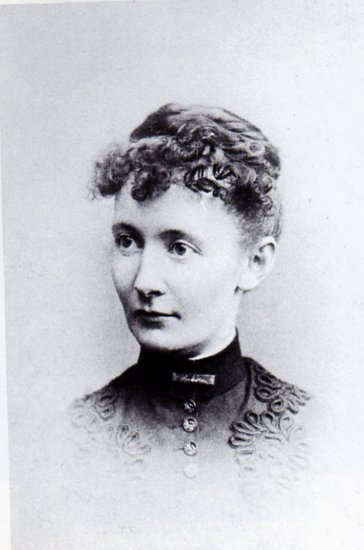
Anna Mary Robertson
the bride (1887)

She spent time living with the Whitesides family who she liked and they looked upon her as one of their own.  They were an elderly couple, devout Presbyterians and every Sunday she would drive them to church in their horse and carriage.  The wife, who was an invalid, was quite ill and Anna for three years cared for her.   When she died she stayed and looked after the husband and his nephew and wife moved in to run the farm.  Anna stayed until Mr Whiteside died and after that just drifted away from the neighbourhood still working as a “hired girl”.
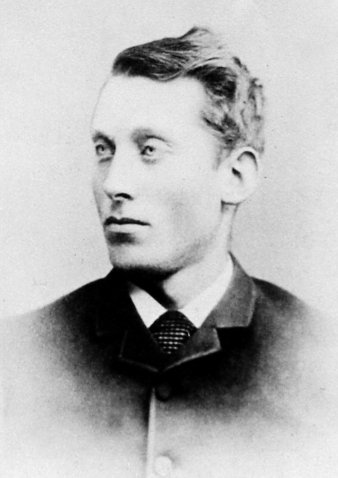
Thomas Salomon Moses
the bridegroom (1887)

In 1887, at the age of 27, she married Thomas Salmon Moses, a farmer by occupation, and the couple left the area for North Carolina, where they were going to run a horse ranch.  However they never made it to North Carolina as once they arrived in Staunton Virginnia, they were offered the chance to run a farm.  The farm had lost all its coloured workers after the war and people were desperate to employ others to fill their places They accepted the offer and lived there for a year before moving on to live and work on a six hundred acre dairy farm.  She wrote about her life there:

“… Here I commenced to make Butter in pound prints and ship to the White Sulphur Springs, W, Va.   I also made potato chips, which was a novelty in tho days, this we continued for several years…”

She gave birth to ten children, five of whom died in infancy. In a letter she looked back at that time with the birth and death of her children, writing:

“… Here our ten children were Born and there I left five little graves in that beautiful Shenadoah Valley…”

She, along with her husband and their five surviving children, Winona, Forrest, Lloyd, Anna and Hugh, left Virginia at the end of 1905 and moved north to the hamlet of Eagle Bridge in Rensselaer County, New York State which was not far from her birthplace.  The couple bought a farm, which was known locally as Mount Nebo, named after Moses’ biblical resting place and went into the dairy business, selling milk.  Over the years one of her daughters, Anna, got married and left home and two of her sons, Forrest and Lloyd, went to live on a farm which they had bought themselves.   In 1927 Anna’s husband Thomas died and their youngest son Hugh and his wife Dorothy took over the running of the farm.  Anna Mary Moses was then sixty-seven years of age.

You may find it strange that up to this point in my account of Anna’s life I have never mentioned her art.  I haven’t mentioned drawing lessons or her desire to be an artist.  The reason is quite simple – art never became a serious part of her life although her father, whol liked to draw,  would give her and her brothers paper and he would like to watch them all draw pictures and she would often colour her drawings using grape juice or juice from other berries.  However with all her work as a “hired girl” and later as a young wife she never had time on her hands to continue with her painting.  However, soon after her husband died  and she was becoming too fragile to carry on with her housework, she needed something to occupy her time, as she wrote in her autobiographical sketch:

“…Here Jan 15, 1927, my Husband died, my youngest son and wife taking over the farm,

Leaving me unoccupied, I had to do something, so took up painting pictures in worsted, then in oil…”

The Old Hoosick Bridge 1818
Embroidery by Grandma Moses

My Daily Art Display featured painting today is entitled The Old Hoosick Bridge which Grandma Moses painted in 1947.  The reason for featuring this work, although she painted it when she was 87 years of age, was that she had in her early days depicted a similar scene, but as a work of embroidery, which was entitled, The Old Hoosick Bridge, 1818. (above)   Initially Anna started making pictures out of worsted wool which she designed herself and were awash with very bright colours.  This scene was typical of her early works which were from memories of her early childhood and as a farmer’s wife.  The old covered bridges were landmarks in her early days but at the time she painted this picture the bridge had well gone.

In my next blog I will continue with her life story and recall how she got her big “break” as far as her art was concerned.

James Tissot and Kathleen Newton

Kathleen Newton in an Armchair by James Tissot (1878)

My blog today is the second part of the life of the French painter James Tissot.  In my last offering I looked at one of his beautiful and unusual religious paintings and I told you a little about the life of the artist but purposely left out his relationship with the special lady in his life, which I wanted to save for today.

In 1870 France was in turmoil.  The Franco-Prussian war had broken out, which was the conflict between France, under Napoleon III and the Kingdom of Prussia and was the final straw in the conflict between the two nations.  France was defeated and Paris was eventually occupied by the Prussian army.  Tissot was a member of the Garde Nationale which was tasked with defending the French capital and later became a member of the Paris Commune, which was a quasi-government that briefly ruled Paris and acted as protectors of the Parisians and their property from March to May in 1871.   However, Tissot, whether through business reasons or concerns he had for his personal safety, decided to leave his homeland and that year went to England where, through his art, he had built up a network of friends and business contacts.  One of these was Thomas Gibson Bowles, the proprietor of the popular magazine Vanity Fair.  Bowles not only provided Tissot with a place to stay in London but he also employed him as a caricaturist on the magazine.  Whilst in London Tissot also exhibited at the Royal Academy.  As was the case when he was in France, Tissot depicted in his paintings many of the chic ladies of London and he was a genius in the way he depicted them bedecked in the most expensive and sumptuous clothing which he carefully detailed.   These paintings were very popular and soon, through their sales, he managed to buy his own house in St John’s Wood, which, at that time, had become a popular and much sort after enclave for artists.  Tissot was not only admired as a great artist by the London Society but through the auspices of Thomas Bowles he was given entry into the social and artistic circles of London.

This particular time, 1874, was the starting point for the French Impressionists and his friend Degas tried to persuade Tissot to exhibit at their first exhibition but he declined the offer.  His decision to refuse to exhibit did not in any way cut him off from his Impressionist friends as he remained great friends with Berthe Morisot who visited him at his London home and also he remained very friendly with Edouard Manet.  The following year, 1875, the two travelled to Venice on a painting trip. It was around 1875 that he first met Kathleen Newton, a stunningly beautiful divorcee and it was Tissot’s relationship with her that afforded him, as an adult, his only period of a real family life.  She would dominate the subject matter of his paintings.

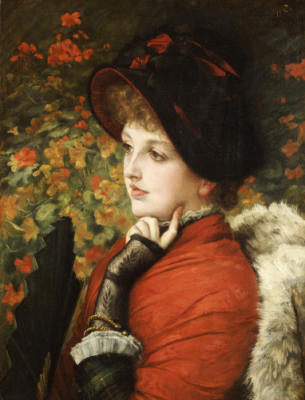
A Type of Beauty by James Tissot (1880)

Kathleen Irene Ashburnham Kelly was born in 1854 and brought up in Lahore and Agra.  She was the youngest of five children and came from an Irish Catholic family.   Her grandfather, Charles Kelly, left Ireland and practiced medicine in London. His son, and Mary’s father, Charles Frederick Kelly joined the East India Company and was stationed in Lahore where he worked as a clerk.  He married Flora Boyd, whose family came from the North of Ireland, and the couple had five children, Charles (Charley), Frederick WD (Freddie), George Lloyd (George), Mary Pauline (Polly) and Kathleen Irene (Kate).   In 1858, Charles Kelly, who had now added the family name “Ashburnham” to his own name, was transferred to Agra.   Kathleen’s father finally achieved the rank of chief adjutant and accountant officer in Agra and eventually retired around 1865, left India and returned with his wife and daughters to live in London.  When Kathleen was sixteen she travelled back to India to marry Isaac Newton, who was a surgeon attached to the Indian Civil Service. This was to be an arranged marriage orchestrated by her father and she had little or no input into the choosing of her future husband.

During the sea passage to India she was befriended by a Captain Palliser of the Bengal Rifles regiment who was returning to the sub-continent to rejoin his regiment.  (Other versions of her life state that Palliser, although a captain, was a naval officer).  Their friendship grew during the long sea passage and they became lovers and despite his pleas to her to cancel her wedding plans, she and Isaac were married in January 1870.  Being a devout Catholic, Kathleen decided to tell the local priest of her affair with Captain Palliser.  For him to forgive her of her sins the priest told her she should first tell her husband about this relationship.  She took the priests advice and told her husband who was horrified and as their marriage had not been consummated; her husband immediately instigated divorce proceedings on the grounds that his wife had not been a virgin on her marriage day.  Kathleen returned to England, the sea passage being paid for by the lovestruck Captain Palliser, who accompanied her, as a gesture of good will for her agreeing to be his mistress.  Their affair continued and she became pregnant but still refused to marry him.    When she arrived back in England she went to stay with her father, who was at the time courting a widow.  Kathleen’s daughter Muriel Mary Violet Newton was born there on 20 December 1871, which was also the same day as her Decree Nisi came through.   Later Kathleen and her daughter Violet went to live with her sister Polly and her husband at Hill Road, St John’s Wood.

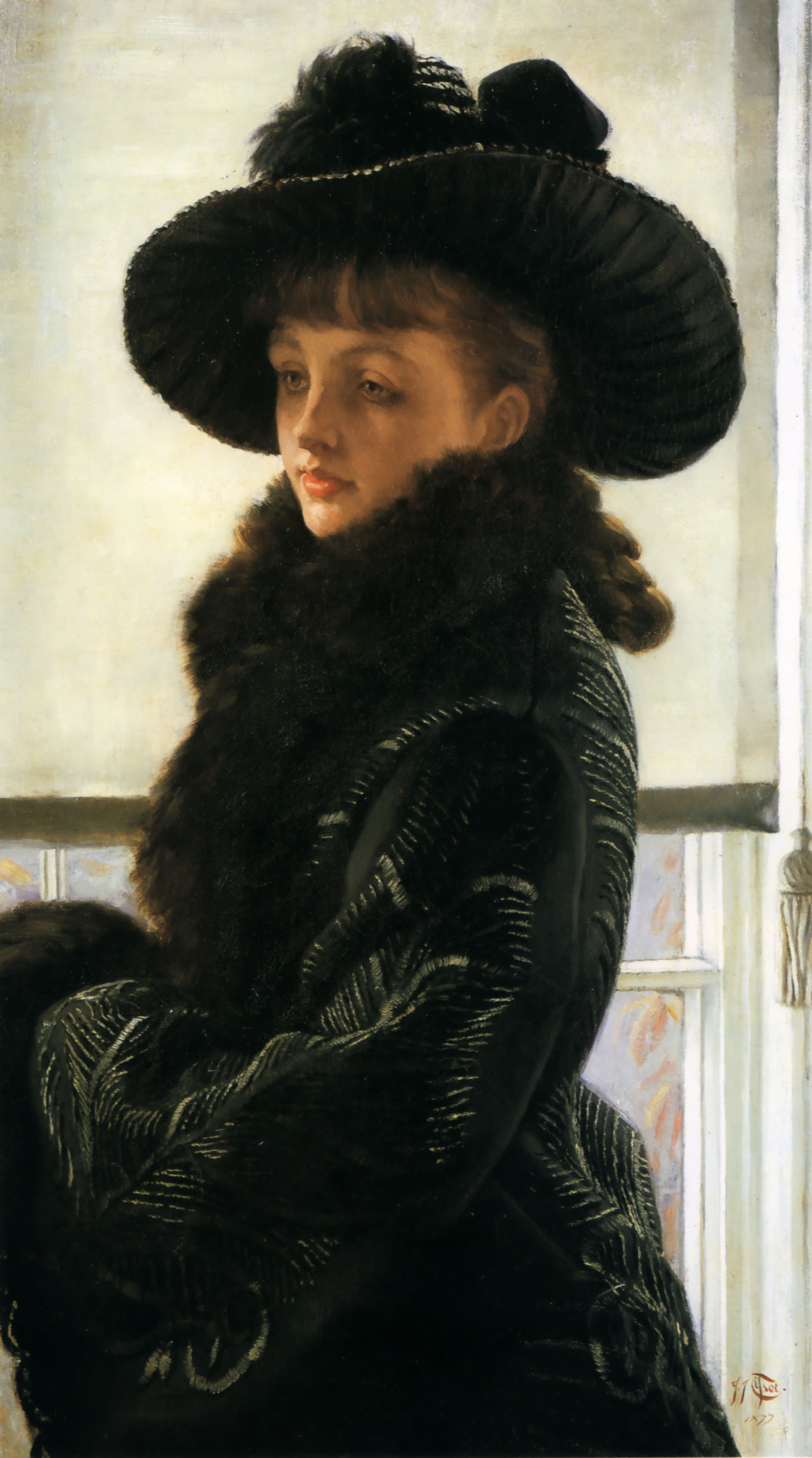
Mavourneen (Portrait of Kathleen Newton) by James Tissot (1877)

It was about four years later around 1875, that James Tissot, who was also living in St John’s Wood, London, met Kathleen Newton née Kelly.  The next step in their relationship came in March 1876 when Kathleen gave birth to a son, Cecil George Newton Ashburnham, who it is believed had been fathered by Tissot. Kathleen and James Tissot became lovers and she moved in with Tissot.  (It should be noted that census records cast some doubt whether they lived together and it is thought that Kathleen’s two children spent most or all of their time living with their aunt Polly and her family).   For Tissot, as was the case with Captain Pallister some five years earlier, he was smitten by this stunningly beautiful young woman.  His terms of endearment for her were mavoureen (Irish Gaelic for my love) and his native French phrase ravissante Irlandaise (lovely Irish).  Kathleen Newton became the love of Tissot’s life, his muse and adored lover.  Tissot described his time with Kathleen as one of “domestic bliss” and the happiest times of his life.  He completed many paintings featuring Kathleen of which I have featured some in my blog today.

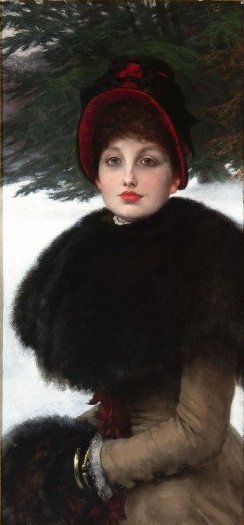
A Winter’s Walk by James Tissot (1878)

There was one great setback with his relationship with Kathleen for James Tissot.  Although it was not uncommon for successful and wealthy men to keep a mistress they did not, like Tissot, parade them around openly and advertise their liaison.   Tissot’s open and very public display of his affair with Kathleen shocked the London society which had once welcomed him with open arms and he had to choose between his social life and Kathleen.   For Tissot there was no question as to which course of action he would choose.  Kathleen was the love of his life and he chose her over life amongst London society.  He and Kathleen settled down to a life of domesticity and were happy to mix with their many artistic friends who continued to support them.  They never married and this may be due to their rigid Roman Catholic upbringing and beliefs.

Kathleen Newton in the Garden by James Tissot

This charming painting shows Kathleen sitting on a rug in the garden next to her daughter Violet.  The other small girl holding the parasol is her niece, Lillian Hervey. Sitting on the wall is her sister, Mary Hervey (Polly), who you can see ruffling the hair of Cecil George Newton who is thought to be the son of James Tissot.

————————————————————————————————————————————–

In the late 1870s Kathleen’s health started to deteriorate with the onset of tuberculosis.  Tissot remained devoted to her.  In 1882, Kathleen’s health declined rapidly with the onset of consumption.  The illness gave her great pain and Tissot was visibly distraught by the physical state of his wife and her sufferings.   Kathleen was aware that she was dying and she was saddened to witness how heartbroken her husband was, witnessing her long lingering death and so in November 1882, aged just twenty eight, she took an overdose of laudanum and died.  Sadly because she had committed suicide she was not able to be buried in consecrated ground.

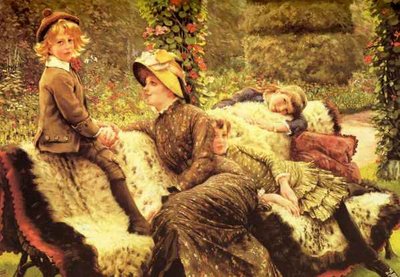
The Garden Bench by James Tissot (1882)

The painting above shows Kathleen Newton and her children, Cecil George and Violet and her niece, Lilian Hervey, the daughter of her sister Polly.  Although Tissot exhibited the painting, he would not sell it and kept it with him as a memorial until his death.

————————————————————————————————————————————–

One week after Kathleen’s death, Tissot left his London home at St John’s Wood, and never returned to it. The house was later bought by the artist Alma-Tadema.  Tissot was inconsolable and never really recovered from Kathleen’s death. Tissot never married and like many people who are devastated by the loss of a loved one he turned to Spiritualism, and on a number of occasions tried to contact his beloved Kathleen.

This somewhat sad story about a French artist and his fallen women is one of the great 19th century English love stories.   My interest in James Tissot was born out of a comment I received from Lucy Paquette who said she was publishing an eBook this autumn, entitled Hammock, a novel based on the life of James Tissot.  I hope, like me, you will be looking out for this publication.

Patricia O’Reilly has also written a novel about Kathleen Newton entitled A Type of Beauty: The Story of Kathleen Newton (1854-1882) which I am hoping to buy as novels based on lives of artists or one of their paintings always fascinate me.

A View of the Westerkerk, Amsterdam by Jan van der Heyden

Today I am going to leave 19th century French art and Impressionism, which has featured in my recent blogs, and look at some 16th and 17th Dutch and Flemish art and artists.  Dutch art has always been very popular and admired for the realism it portrayed of everyday life and it has always proved to be highly collectible.  Before I look at some of the art of that time it may be interesting to look at a brief history of the region which has a bearing on the style of art.   I am probably laying myself open for criticism from Dutch historians for my understanding of this period of the history of the Netherlands and Holland but all I am trying to do is give you a brief insight into Flemish and Dutch art of the 16th and 17th centuries.

The Netherlands back in the fifteenth century was a conglomerate of the Seventeen Provinces often referred to as the Burgundian Netherlands, which included part of today’s Germany, Belgium, France and Luxembourg.  It was controlled from 1506 by Charles V who was the Holy Roman Emperor and also the King of Spain.   In 1556, Charles V abdicated and the power passed to his son, Philip II.  With Spanish rule came the imposition of the Catholic religion on the people of the Netherlands.  This policy of strict religious uniformity was imposed by the Inquisition with enormous amounts of brutality.  However the rise of the Protestantism in the forms of the Lutheran and Anabaptist movements and Calvinism were starting to gain ground with the populace.   The beginning of the break-up of Philip’s control of the Seventeen Provinces started with the Dutch people being unhappy at the high level of taxation levelled on them by Philip and his brutal repression of anti-Catholic movements.  To subdue the unrest, Philip sent his Spanish troops to the area under the leadership of the Duke of Alba and their presence and their cruelty further fanned the flames of rebellion.  Control of the vast area was becoming more of a problem for Philip, added to which there was now a threat coming from the French along the southern borders.  Philip II’s troops were moved from the north to the south leaving the north less well controlled and this led to the start of the Eighty Years’ War often termed as the Dutch War of Independence.   After the initial stages, Philip II deployed his armies and regained control over most of the rebelling provinces. However, under the leadership of the exiled William of Orange, the Northern provinces continued their resistance and managed to oust the Spanish armies, and established the Republic of the Seven United Netherlands, Holland, in 1609. The Dutch Revolt had officially ended and the Dutch republic of Holland was officially recognised by France and England. The end of the Eighty years War however did not end for another forty years.

The Netherlands was now split along an almost North/South divide.  The north, Holland, became a haven for Protestantism with Calvinism becoming the main religion.  There were no Catholic churches in this northern territory.   It soon became one of the world’s most economically powerful and wealthy maritime nations in the world and Amsterdam became its capital.   As far as far as art was concerned there was also a north/south divide.   The Spanish Catholic south, Flanders, with its capital Antwerp, still had most of its art commissioned by the Catholic Church or the Spanish Catholic rulers and would more often than not therefore depict religious scenes, whereas now the Dutch north where religion was mainly a Reformed Calvinistic one would not allow church’s money to be spent frivolously on the commissioning of art.   Dutch art had new patrons.  Now works were commissioned by the territory’s wealthy merchants and ship owners.  Often the subjects they commissioned had little to do with religion and more to do with their wealth and their status in society.

Today I want to feature an artist from the southern region, Flanders.  Jan van der Heyden was born in 1637 in Gorinchem, which now lies in south west Holland.  In 1650, when he was thirteen years old, the family moved to Amsterdam and lived in a house on Dam Square.   Sadly however, his father, who was a follower of the ethno-religious Mennonite group, died the year of their move.  Jan’s early artistic training began in Gorinchem with drawing lessons at his elder brother’s studio.  He also learnt, from a local artist, the reverse technique of glass painting.  Although we are looking at van der Heyden as an artist his overwhelming love was not art, although he continued to paint all his life, it was his love of engineering and inventions.   He was an artist but he also was an inventor and an engineer.  He designed many things such as the street lighting system in Amsterdam.  Shortly after he and his family moved to Amsterdam he witnessed a fire at the old town hall and the futile efforts that were made to hold back the flames.   He probably never forgot that incident for later, along with the help of his brother Nicolaes van der Heyden, a hydraulic engineer; he invented a fire engine fitted with pump driven hoses which was to change the effectiveness of fire fighting.

In 1661 Jan van der Heyden married and he and his wife moved to a house along the Herengracht, a fashionable area of Amsterdam.  As a painter, Jan van der Heyden, will always be remembered for his beautiful townscapes and his architectural designs certainly dominate these works.   Although he painted many townscapes he also painted scenes featuring village streets and country houses.  He loved to paint old and new buildings and paid particular attention to their facades.  He also completed more than forty landscapes although his landscape art was never in the same league as his contemporaries, Meindert Hobbema and Jacob van Ruisdael.   He worked in partnership with Adriaen van der Velde,  the Dutch animal and landscape painter, and Johannes Lingelbach, a Dutch Golden Age painter, who would often add figures to van der Heyden’ architectural scenes and add landscape effects as a finishing touch to the paintings.   His main subjects were Amsterdam and the region surrounding the Dutch-German border where he and his family visited on many occasions.

In 1672, Adriaen van de Velde died and Jan van der Heyden artistic output dwindled as he concentrated on his main employment that of superintendent of the lighting in Amsterdam and he also devoted much of his time as the director of the Amsterdam Fireman’s Guild.  He died a wealthy man in 1712, aged 75.

View of the Westerkerk, Amsterdam by Jan van der Heyden (c.1660)
(National Gallery, London)

My featured painting today is entitled View of the Westerkerk, Amsterdam.    The building work on the protestant church commenced in 1620 and was designed by the foremost architect of the time, Hendrick de Keyser, the father of the Dutch painter Thomas de Keyser.  The construction was completed eighteen years later and at the time its tower was the highest in the city.  Jan van der Heyden painting is of the church, seen from the east, across from the Keizersgracht, the new Emperor canal.  Buried within the church are the painters Nicolaes Berchem, Rembrandt and his son Titus.

There are two versions of this paintings housed in galleries in London.  Both were painted between 1660 and 1670.   In both cases these are, like many of his townscapes and landscapes, only loosely based on actual views as topographical accuracy was not in the forefront of his mind when he started to work on his paintings.  It was almost as if he wanted to bring into his painting all that was beautiful about the town, whether it be its landscape or its architecture.  It was simply an idealised townscape which I believe does not lessen the beauty of the finished work.  The difference between these paintings and others he did was that in View of Westerwerk, Amsterdam he has paid great attention to the detail of the buildings whereas in other townscapes the main buildings may look half finished with the emphasis being placed on surrounding structures and open spaces.

Let us look at the version which is at the National Gallery in London.  Look at the clarity of this work.  Marvel at the detail van der Heyden has put into this painting.  In the foreground we can see four wooden casings which protect the young tree saplings.  One can almost read the writing on the torn posters which have been affixed to the casings.   This version is much larger than the one in the Wallace Collection, measuring 91cms x 114cms and almost three times the normal size of van der Heyden’s previous works.  It is believed that it was commissioned by the governors of the Westerkerk, for their meeting room, where it remained until 1864.   I love the details of the red-brick buildings but look at the contrast in colour of them with how the artist has depicted the blue sky with all its luminosity, the yellow cobblestone path in the foreground which runs parallel to the stretch of the canal and the glass-like stillness of the water.  It is probable that another artist painted the people and animals shown in the work.

View of the Westerkerk, Amsterdam by Jan van der Heyden (c.1665-1670)
(Wallace Collection, London)

I went to the Wallace Collection last week and saw this other version of the painting.  It is much smaller in size, measuring just 41cms x 59cms.  The artist’s signature can be seen in the lower right on the coping of the canal wall.  To the left of the church is the Westmarkt and if you look carefully between the trees you can just make out the Westerhal, which housed a meat market on the ground floor and above it was a guard house.   The house which we see to the right of the church is Keizersgracht no, 198 and was at that time the residence of Lucas van Uffelen a wealthy Flemish merchant and art collector.  What is very striking about this small painting is the sharp contrasts of colour, light and texture with shadows slanting across the front of the church.  Look at the contrast between the angular roofs and the luminous blue sky.  See how the artist has contrasted the trees heavy in leaf with the red brick buildings and in the case of the house on the right of the painting, its whitewashed frontage.  In this painting, unlike the one at the National Gallery, the artist(s?) have depicted reflections in the still water of the canal.  It should be remembered that this painting was completed after the one which now hangs in the National Gallery and is probably a re-working of the scene.  It could be that Jan van der Heyden was not completely satisfied with his first effort and wanted to make some artistic improvements.

If you are in London, why not take a chance to visit both galleries and compare the two paintings and decide which you like the best.

Berthe Morisot by Edma Morisot

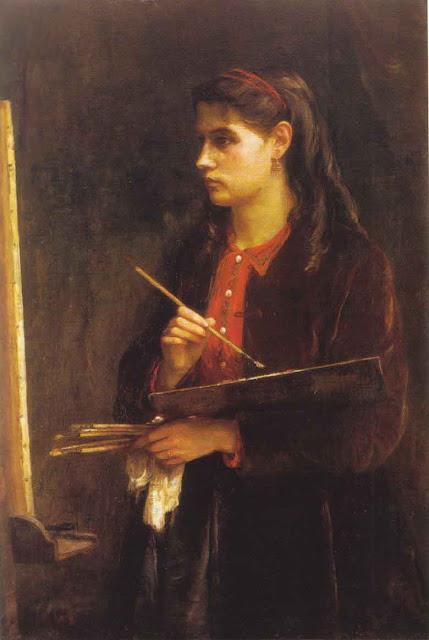
Berthe Morisot by Edma Morisot (1865)

For the next few blogs I want to look at the life and works of Berthe Marie Pauline Morisot and some of the paintings other artists have done of her.  As I told you in my last offering I visited the Musée Marmottan Monet last week whilst in Paris and they were currently staging a retrospective of her work.  I have already featured one of her works, Le Bercau (The Cradle) in My Daily Art Display of August 10th 2011 and briefly told you about her life.  Today I am going to look again at her early life and feature a painting, not by the artist herself,  but a stunningly portrait of her, painted by her sister, Edma.

The world of French art between 1839 and 1841 was surely blessed as it was in that two-year period that the world witnessed the birth of four of the greatest French artists.  Paul Cezanne was born in January 1839, Claude Monet was born in November 1840 and Berthe Morisot and Pierre-Auguste Renoir were born in January and February 1841 respectively.  Berthe Morisot was born in Bourges, a city in central France.  She had distant roots in French art as she was an indirect and distant descendent on her father’s side of none other than the French Rococo painter Jean-Honoré Fragonard and the French 18th century female painter, Marguerite Gérard.  Berthe was one of four children.  She had two sisters, Marie-Elizabeth Yves born in 1838, known simply as Yves and Marie Edma Caroline born in 1839, known simply as Edma.  She also had a younger brother, Tiburce, born in1848.  Berthe was brought up in a successful and financially secure household.  Her mother was Marie-Cornélie Thomas, who came from a family of high level government officials, chief treasurers and paymasters of the province.   Her father was Edmé-Tiburce Morisot, who was an architectural graduate and who at the age of twenty-six founded an architectural journal.  However the venture collapsed when his co-founders absconded with all the money and left Tiburce to face the creditors.  He eventually had to hurriedly leave town, leaving all his furniture and possessions to his landlord in lieu of rent, and fled to Greece.  A year later in 1835 he returned to France penniless but his good looks and charm won him the hand of Marie-Cornélie in marriage.  She was sixteen years old and he was thirteen years older.   Marie’s father, who was the personnel director at the Ministry of Finance, managed to arrange employment for Tiburce Morisot as subprefect at the city of Yssingeaux, in the Haute-Loire region.  Tiburce worked hard and soon impressed his employers.  Promotions followed and at the time of his daughter Berthe’s birth, he was the prefect of the Department of Cher, the monarch’s chief administrator for the entire province.

In 1848 when Berthe was just seven years of age, because of the Third French Revolution which eventually led to the creation of the French Second Republic, Berthe’s father decided to move his family from Bourges to the Parisian suburb of Passy.   When Berthe was aged sixteen years of age, her mother, Marie-Cornélie Morisot decided to enrol her three daughters in private drawing classes.  At that time the prestigious École des Beaux-Arts would not admit female students and maintained that sexist doctrine until the last few years of the nineteenth century.  The sisters’ first tutor was Geoffroy-Alphonse Chocarne who taught the girls the fundamentals of drawing.  Yves love of art waned quickly and she gave up on her art tuition after a few months leaving just Edma and Berthe to carry on with their artistic studies.

Edma and Berthe then enrolled to study with Joseph Guichard, who had once been a student of Ingres and now lived in the same street in Passy as the Morisot family.  Guichard taught the girls all about classical art in the academic tradition.  He was there tutor from 1857 and 1860 and in 1858 Berthe registered as a copyist at the Louvre.  It was under the guidance of Guichard that Berthe Morisot first experimented in oil painting.  En plein-air,  painting outdoors in natural light,  became very important to the Impressionist painters and those from the Barbizon School and the two girls told Guichard that they wanted to learn more about that technique and so, in 1863, in consultation with Jean-Baptiste Camille Corot, a leader of the Barbizon School of painters it was arranged that the girls would study under Achille Oudinot, the French landscape painter.  In the spring of 1864 after seven years of intensive artistic training Berthe and Edma Morisot were admitted to the official Salon.  Berthe would exhibit at the Salon regularly and Edma would until her marriage in 1869 at which time she virtually gave up painting.

It is said that behind every great woman, there is another woman, often a close relative.  In nineteenth century England we saw it with the likes of the talented Bronte sisters who had each other for constructive critical support.  Although Morisot’s upbringing in a wealthy household bears no resemblance to the upbringing of the Bronte sisters,what she did have in her formative years, similar to the Bronte sisters, was the luxury of having a very loyal and supportive sister.  Standing unwaveringly behind Berthe was her sister Edma.  The sisters’ artistic collaboration came to an end in 1869, when Edma married her husband, Adolphe Pontillon, a naval officer.  In some ways Edma regretted the end of their artistic partnership and the close friendship which came with it.  They kept in contact by letter and in one Edma wrote:

“…I am often with you in thought, dear Berthe.  I’m in your studio and I like to slip away, if only for a quarter of an hour, to breathe that atmosphere that we shared for many years…”

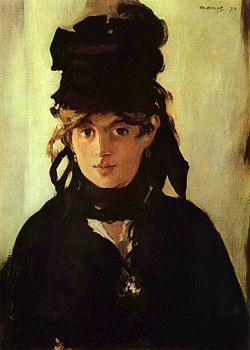
Berthe Morisot with a Bouquet of Violets by Édouard Manet (1872)

And so I come to today’s featured painting.  There have been many portraits painted of Berthe Morisot , probably the best known being the one of her entitled, Berthe Morisot with a Bouquet of Violets which was painted by her brother-in-law, Édouard Manet in 1872 and which is housed in the Musée d’Orsay.  I have always thought that his has made her look rather dowdy, so today I have featured one of my two favourite portraits of the artist.  This one is simply entitled Berthe Morisot and was painted by her sister Edma in 1865 and is held in a private collection.  This beautiful portrait in some ways bears out the close relationship between the sisters and reveals the shared interest both had in painting.  In this work Edma has depicted her sister Berthe holding her palette and brush concentrating earnestly at the picture she is painting.  Look how well Edma has captured the intensity in Berthe’s expression.  Our eyes are immediately drawn to the face of Berthe, which is bathed in light and which contrasts well with the darkened background and also echoes the whites of the side of the canvas and the rag she holds.  This painting of Berthe Morisot depicts her indisputable beauty which often other portraits fail to achieve.  This is indeed a portrait of an extremely delightful young woman in her mid-twenties and one I fell in love with when I first saw it.

Musée Marmottan Monet in Paris

Musée Marmottan Monet

For my blog today I am not showcasing an artist or a painting but a small museum , the Musée Marmottan Monet, which I visited last week when I was in Paris and I hope that for any of you who are intending to visit the French capital and want to take in some of its artistic heritage you will make time to visit this museum.  I can assure you that you will not be disappointed.  The museum is situated at 2 rue Louis Boilly in the vibrant and colourful 16th arondissement and is easy to get to as there are two nearby Metro stations, La Muette and Ranelagh.

I have often advocated that when one goes to London one should not always head for the major art galleries such as the National Gallery or the two Tate galleries as they are so big that one has no hope of seeing everything in one session and trying to often means that you skimp on the time each painting deserves.  A better plan of action if your time is limited is to go and visit one of the smaller galleries.  In London one has the Wallace Collection, the Courtauld Gallery and the Dulwich Picture Gallery, to mention just a few.  So to practice what I preach, when I was in Paris last week I didn’t revisit the Louvre or the Musée d’Orsay, instead I visited, for the first time, the Musée Marmottan Monet and it was unquestionably a most worthwhile visit.

The building was originally constructed as a hunting lodge for the Duke of Valmy and a few years later was sold to Jules Marmottan which on his death along with all his belongings was bequeathed to his son Paul.  Paul Marmottan later built a small pavilion in the courtyard as the original building was too small to house all of his paintings, furniture and bronzes.  Paul Marmottan bequeathed his home and collection to the Académie des Beaux-Arts, which opened up the house and collection as the Museum Marmottan in 1934.

If you like the work of the Impressionists and in particular the works of Claude Monet then look no further as this museum houses the largest collection of Monet’s work in the world and this is partly due to the fact that Monet’s youngest son Michel donated his father’s paintings from Giverny to the museum.  The building originally had two floors, the ground floor and an upper floor but to exhibit all the works they had to build a large underground room.  A number of bequests to the museum over the years have filled the building with beautiful and priceless art treasures.

The Duhem Collection was bequeathed to the museum by the daughter of the French painter, Henri Duhem.  These included works by Boudin, Caillebotte, Corot, Gaugin,  Monet and Renoir.  In 1980 an amazing group of illuminations spanning the 13th to 16th century was donated to the museum by Daniel Wildenstein.  The collection is exceptional for both the quantity and quality of the works.  There are over three hundred miniatures.  In 1996 the museum received an extraordinary donation from Annie Rouart.  Her husband was Denis Rouart, the grandson of Berthe Morisot and Eugène Manet.  Among the paintings given to the museum by Annie Rouart were masterpieces by Degas, Manet, Monet and Renoir and of course works by the famous female Impressionist Berthe Morisot.

Berthe Morisot Exhibition

For those of you who love the work of Berthe Morisot, and I include myself in that particular fan club, there is currently running a brilliant exhibition of her work.  It is housed in the basement.   It opened on March 8th and runs until July 1st 2012.  It presents the first major retrospective of the work of Berthe Morisot to be held in Paris for almost half a century.  One hundred and fifty paintings, pastels, watercolours and drawings in red chalk and charcoal, from museums and private collections all over the world, retrace the career of the Impressionist movement’s best-known woman painter. Works which have been selected for the exhibition cover the whole of Berthe Morisot’s artistic career, from her earliest works around 1860, to her untimely death at the age of 54, in 1895.  In my next few blogs I will feature a few  of the many paintings I saw when I walked around the museum.

Picasso: The Early Life Part 2

I ended my last blog with Pablo Picasso and his family in Malaga during the summer of 1897 on vacation at the home of his uncle Don Salvador.  It was during this stay that Picasso’s father José Ruiz Blasco and his brother decided that the way forward for Pablo was for him to go to Madrid and attend the San Fernando Royal Academy of Arts where his father’s former employer, the director of La Llotja art school in Barcelona, was now one of the principal teachers.   With that in mind the two brothers approached the relatives for financial support to send the seventeen year old Picasso to the Spanish capital so as to further his artistic career.

So was everybody happy with this turn of events?  The adults were, the relatives were and yet the young artist was unhappy with the Academy and how it taught art. He disliked the artistic constraints of the Academia Real de San Fernando.   How many times have I written about young aspiring artists rebelling against the formulaic approach to art laid down by the Academies, whether they are in London or Paris?   He was also unhappy with the way the adult members of his family had taken it upon themselves and decided the future path he should follow in his artistic career.  He became rebellious and did little work at the Academy.  He would often skip lectures and go to the Prado where he fell in love with the works of the great Spanish artists such as Goya, Velazquez and Zurbaran but was specially inspired by the expressionist style of El Greco.  The news about Picasso’s lack of a work ethic, frequent non-attendance and general bohemian lifestyle soon filtered back to his father in Barcelona and his uncle in Malaga.  The uncle who was the main financial backer for Picasso’s living arrangements and academic tuition was so angered that he immediately cut off the young artist’s stipend and suddenly Picasso had to survive on the meagre financial assistance his father could provide.  He finally quit the Academy at the end of 1897.

Whether it was due to his impoverished existence in Madrid and the lack of good wholesome food or whether it was just fate, but Picasso’s health began to deteriorate and in the Spring of 1898 the seventeen year old had to return home to his family to recuperate from what was thought to be scarlet fever.

Portrait of Manuel Pallarés by Picasso (1895)

It was here that he once again met up with his friend Manuel Pallarés who had been a fellow pupil of his at the city’s Llotja art school.  In April 1898 war had broken out between Spain and America and young men were being conscripted to fight.  Pallarés, who was six years older than Picasso, to avoid the draft, left Barcelona and went back to his native village, Horta de Ebro, which was a small isolated community in the mountains on the border of Catalonia and Aragon.  Picasso accompanied his friend and the two stayed together in the small rural community for the next six months.  The two would roam the wild countryside with their easels and paints for weeks sometimes camping out in the open, other times they slept in caves on beds of grass, and survived on rice which they cooked over open fires.  All the time they painted and sketched.

The Mule by Picasso

The subjects were peasants at work in the mill, shepherds guarding their sheep, and old somewhat dilapidated houses surrounded by golden yellow fields of wheat.   They would often feature some of the animals they saw on their travels such as lambs, goats and the poor over-worked donkey.  When they needed money the two would return to Horta to help with the grape harvest.  Picasso remembered this time he spent with his friend in Horta de Ebro, saying:

“Everything I know, I learned in Pallarés’ village.”

By December 1898, Spain had lost the war against America and ceded both Cuba and the Philippines to the victors.  The fighting had stopped and Picasso returned home to Barcelona where he managed to eke out a living as a graphic artist, designing posters, illustrations for magazines and journals often influenced by the Swiss-born French Art Nouveau painter and printmaker, Théophile Steinlen and the French painter, Henri de Toulouse-Lautrec. He also earned a little money with his pencil portraits of his friends.   His rejection of academic art made him search for a new artistic direction and he did this by joining an avant-garde group of artists and poets who congregated at a local coffee-house restaurant called Els Quatre Gats.

Menu for Els Quatre Gats designed by Picasso (1899)

Picasso earned some money by designing their menu.  The artists and poets who gathered here were known as the modernistes or decadentes.  It was here in 1900 that Picasso held his first solo exhibition.  At Els Quatre Gats, Picasso met and became great friends with many of the bohemians who frequented the establishment including a young artist, Carles Casagemas and an aspiring poet, Jaime Sabartès, who in the 1930’s became Picasso’s secretary and invaluable confidante.   Sabartès wrote about their early friendship and their daily routine in his 1949 biography of Picasso entitled Picasso: An Intimate Portrait.  He wrote:

“…After lunch we met in Els Quatre Gats and from there I accompanied him to his studio.  Henceforth, every day was the same.  At times I left him at the foot of the stairs; at others, if he insisted, I went up with him.  Sometimes he was more at ease once he began work than if he was alone, for with me at his side, he did not need to think about me…”

Picasso et le peintre Casagemas by Picasso (1899)

Although Sabartès probably considered himself as Picasso’s best friend it was probably not the case for Picasso had forged a great friendship and working relationship with Carles Casagemas.   Casagemeas was the youngest child of a very wealthy family and was probably overindulged by his parents.  He kept a studio in a wing of his parent’s house where he and Picasso worked together.  They were almost inseparable much to the annoyance of Sabartès.  Casegemas led a decadent lifestyle, addicted to both morphine and alcohol and was involved in the anarquismo sin adjetivos movement, the anarchist movement that flourished in Barcelona at the end of the nineteenth century.  From the wing in Casagemas’ parents house the two artists moved to an unfurnished atelier in the once affluent but now impoverished and run-down Ciutat Vella district of the city, populated mainly by beggars.

Picasso made very little money from his pencil portraits but to his great surprise and pleasure his oil painting entitled Last Moments, was accepted for the Spanish pavilion at the 1900 Exposition Universelle in Paris.  The work depicted a dying woman in bed attended by a priest.  This was without doubt a great honour for a young man who had not yet had his nineteenth birthday.  Unfortunately the painting does not now exist as Picasso painted over it in 1903 with his work La Vie.  Picasso was keen to see his work hanging at the Exposition and so after cajoling his father into funding the journey, which left him and his wife almost penniless, Picasso and his friend Casagemas left Barcelona and headed for Paris and the artistic district of Montmartre.

Le Moulin de la Galette by Picasso (1900)

Now ensconced in a studio on rue Gabrielle in Montmartre Picasso absorbed the works of the French artists of the time such as Corot, Courbet and Manet as well as the academic painters such as Eugène Delacroix and Jacques-Louis David.  He would see the paintings in the private galleries of the art dealers such as Durand-Ruel and Ambroise Vollard.  He also visited Le Moulin de la Galette which in those days was where working class Parisians would dress up and spend time there dancing, drinking, and eating galettes (round crusty cakes).  Picasso painted a scene of this dance hall in the autumn of 1900 entitled Le Moulin de la Galette, which is now housed at the Gugenheim Museum in New York.  In it we see how Picasso has portrayed the women in a manner which suggests that they are almost dominating their male partners.  It is believed that the woman on the left is Germaine Gargallo who would soon play a fateful role in the life of Picasso’s closest friend, Casagemas. They are depicted as being coquettish and confident.  Picasso witnessed a woman different from the downtrodden Spanish females or the subjugated Spanish whore.  Here he observes the sophisticated French women, who are able to manipulate their men folk.  He immediately acquired a profound and intense respect for these women.

His friend from Barcelona, Manuel Pallarés, arrives in Paris and joined up with Picasso and Casagemas.  The three live together along with three girls, who they employed as artists’ models.   The girls, Germaine Gargello and her sister, Antoinette and their friend Louise Lenoir, known simply as Odette, speak little or no Spanish and Picasso and his two friends speak little or no French.   Odette becomes Picasso’s first girlfriend in Paris.  Casagemas falls deeply in love with Germaine which leaves Antoinette to pair off with Pallarés.

So was this ménage à six a success?  Surely, three men and three lusty women in a cramped but intimate room was a recipe for a wonderful sexually-fulfilling life.  Alas there was one slight problem to this sexual Arcadia.  It is believed that Casagemas was impotent and lovemaking in front of his fellow flatmates in that studio of theirs was a humiliating disaster for Casagemas.  In Norman Mailer’s 1995 book entitled Picasso: Portrait of Picasso as a Young Man he wrote about the situation Casagemas found himself:

“…In fact the situation (living) proved disastrous for Casagemas. Lovemaking in that studio must often have been a spectacle: the humiliation of Casagemas had sought by never going with others to brothels may now have suffered from open display.  He was hardly in a position of the kind of readily available virility that could undertake the tests of an orgy…”

The inability of Casagemas to perform sexually with Germaine affected him mentally and there is evidence that she would taunt him about his impotency.  It got so bad that Picasso decided to take Casagemas back to Barcelona with him.  The departure from Paris at a time when his work was selling well wasn’t solely a selfless act on behalf of Picasso as he, being loosely associated with Catalan anarchist groups in Paris, had become the subject of great interest to the Paris gendarmerie.   Picasso went from Paris to Barcelona with Casagemas in time for Christmas and then the two headed down to Malaga. Casagemas could not get over his love affair with Germaine and would write to her daily expressing his love for her, asking her to marry him and terming her as his fiancé.  Sadly for Casagemas it was unrequited love. Picasso became weary with the inconsolable Casagemas’ distraught lovelorn attitude and his constant demands on his time when he had to listen sympathetically to Casagemas’ outpourings of his love for Germaine.  Picasso had had enough and got his uncle to arrange a boat passage back to Barcelona for his lovesick friend.  It was to be the last time Picasso would see Casagemas alive.  Picasso headed alone to Madrid where he worked on new magazine entitled Arte Joren started by his Catalan friend Francisco de Asís Soler.  Picasso was to provide the illustrations.  The magazine eventually closed due to lack of advertising revenue.

Meanwhile Casagemas could not remain in Barcelona knowing his “true love” Germaine was living alone in Paris so on February 16th 1901, having bought himself a new suit, he headed back to Paris.  Germaine met him at the railway station and bluntly told him that she would never marry him.  Casagemas was devastated.  However the next morning he told her that he would return to Barcelona and he invited her, Odette, Pallarés and a few friends to a farewell dinner at L’Hippodrome Café.  That afternoon, he spent hours composing a suicide note and whether because he knew his torment was about to be ended, he arrived at the restaurant in seemingly good spirits.  During the meal, Casagemas stood up as if to make a speech and took out a letter for Germaine.  He then took a pistol from his pocket.  The diners scattered and Germaine dived under the table and placed herself behind Pallarés.  Casagemas looked at his lover Germaine, pointed the gun at her and fired shouting Voilà pour toi (this is for you).  Germaine slumped to the ground and Casagemas believed he had killed her, when in fact she had just fainted.  Casagemas then put the gun to his head and cried: Et voilà pour moi (and this for me).  He fell to the ground.  The police arrived and Casagemas who was still alive was rushed to a chemist and then on to the Hôpital Bichat where he died just before midnight.

When Picasso heard the news in Madrid he was devastated.  Maybe he believed that he had abandoned his friend and that he could have done more for him.  He condemned Germaine for her attitude to his friend and was very critical of the type of women who demanded and took but were reluctant to give back in return.  Picasso returned to Paris after the failure of the Arte Joren and carried out a number of commissions for Pere Mañache, his unofficial agent, and the gallery owner, Ambroise Vollard.  These were varied works, some portraiture and others depicting the happy life of Parisians.

Death of Cagemas by Picasso (1901)

However in that same year and possibly countering the joy shown in the paintings he had done for Vollard, Picasso painted a portrait of his dead friend entitled Head of the Dead Casagemas.  It was only a small work measuring eleven inches by fourteen inches (27cms x 35cms).  We see just the right side of Casagemas’ head with the mark of the bullet entry in his skull.  On the far side we see a candle burning brightly which in some ways symbolises the sorrow of Casgaemas’ mother sitting in vigil.   Picasso must have been wracked with guilt as he painted this picture as he remembered how he had initially done everything to persuade Casagemas’ mother to allow her son to leave home with him and head for Paris.

I will end the story of Picasso’s early life at this point, just before the start of his Blue Period with its entire works evoking a somber mood which may have been as a result of the death of his friend for Picasso is reported to have said:

“…When I realized Casagemas was dead, I started to paint in blue…”

I leave you with a very sad Picasso, wracked with remorse for his friend but pose this question.  How is it that if Picasso blamed Germaine for the suicide of his friend why would he take her for his lover when

Pablo Picasso – The early days, Part 1

Having returned home from a four-day vacation in Paris I need to catch up with writing my blog.  In my last blog I promised two entries with regards the life and works of Picasso and so, true to my word that is what I will give you.  Before I start I have a terrible admission to make.  I do not like the works of Picasso.  Yes, I know that is artistic anathema but at least I am honest.  I suppose the one caveat to that controversial assertion is that it is the later works of Picasso which I do not like and so my next two blogs will cover some of his earlier paintings and the fascinating beginnings to the Spanish artist’s life.

Pigeons by José Ruiz Blasco (Picasso's father) 1888

It was 11:15pm on Tuesday October 25th 1881 that Picasso was born in Malaga, Spain.  His father was Don José Ruiz y Blasco, a painter of birds in their natural habitat, especially pigeons, and who at the time was a professor of drawing at the Escuela Provincial de Bellas Artes in Malaga and a curator at the local art museum.  Picasso’s mother was Maria Picasso y Lopez.  He was the first-born of their children.  He was baptised Pablo Diego José Francisco de Paula Juan Nepomuceno María de los Remedios Crispiniano de la Santísima Trinidad, honouring a number of saints and some of his relatives.  To that already long name was added the names of his father “Ruiz” and his mother “Picasso” which was a requirement of Spanish law.  He was known simply as Pablo Ruiz.  Picasso’s father’s marriage to his wife was considered at the time as his father marrying beneath himself as he was from minor aristocracy and had a much higher standing in the community than that of his wife who was also without a dowry.  Although she brought no money into the relationship she did bring energy and thriftiness which was to serve her husband and family well.  Another thing Maria brought to the marital home was a bevy of females – her family, which consisted of her widowed mother and two unmarried sisters, Eladia and Eliodora along with a maidservant and so the young Pablo was brought up in a household full of women, all of whom were devoted to the little boy.

In late December 1884 Picasso’s sister, Lola was born, just three days after the devastating earthquake which destroyed large parts of the city of Malaga, killing almost eight hundred people and destroying 4000 homes.  The Picasso family fled the city and temporarily took refuge at the house of his father’s employer.  One wonders whether the young Picasso associated giving birth with the cataclysmic earthquake !   A second sister, Concepcion, was born when Pablo was six years old.  In 1891 the art museum which Picasso’s father had been its curator had closed down and as this was the main source of his income the father decided, for economic reasons, to uproot his family from Malaga an move everybody to La Corunna in the far north west of the country where he had gained employment as a teacher at the Guarda School of Fine Art.  By now, Picasso, aged almost eleven had developed a talent for drawing and his artistic skills blossomed to the detriment of his normal school work.  His father realised that his young son’s artistic talent would soon outshine his own and decided to transfer his own ambitions to those of his son and concentrated on getting his son, and now protégé, the very best artistic training.

In late 1894, when Picasso was barely thirteen years of age, tragedy struck the family with his four year old sister, Conchita, contracting diphtheria.  The young Picasso related years later that at this time he entered into a bargain with God that if he spared his sister’s life then he would give up all thoughts of painting again.   The fact that she was dying was concealed from Conchita and the family, for her benefit, celebrated the Christmas period as usual but sadly on January 10th 1895, she died.  Picasso was devastated by the death. In Arianna Stassinopoulos Huffington’s biography of Picasso entitled Picasso: Creator and Destroyer, she relates a conversation the artist had with his young lover Françoise Gilot, during which he tells her about his bargain with God with regards the life of his sister and his artistic career and the dilemma that had encompassed.  Huffington explains the thought process of the guilty Picasso regarding the prodigious bargain he had made with God saying:

“…he was torn between wanting her saved and wanting her dead so that his gift would be saved.  When she died, he decided that God was evil and destiny an enemy.   At the same time he was convinced that it was the ambivalence that had made it possible for God to kill Conchita.  His guilt was enormous, the other side of his belief in the enormous power to affect the world around him.    And it was his compounded by his primitive, almost magical conviction that his little sister’s death had released him to be a painter and follow the call of the power he had been given, whatever the consequences…”

In September 1895, the family made the sea passage from La Corunna to Barcelona, stopping off in Malaga to visit relatives.  Once in Barcelona, Pablo entered the local art academy, La Llojta School of Fine Arts, where his father had just gained the post as professor of drawing.   As far as Picasso and his father were concerned this was a great move as they were leaving the northern provincial town of La Corunna and moved to the great artistic centre of the Catalan capital.   Barcelona was the making of the adolescent Picasso.  It is in the Catalan city that Picasso starts to look into two utterly diverse worlds, the world of religion and the world of sex.  Pablo often received religious guidance from his wealthy and devout uncle, Doctor Salvador Ruiz, who would also aid him financially and who first met with young Pablo at his birth when he breathed life into what, at first, was considered to be a still-born baby.  His sex education comes to the fourteen year old Picasso by way of his frequent visits to the city brothels in the Barrios Chino.

First Communion by Pablo Picasso (1896)

In 1896, after a lot of persuasion from his father and probably through the good auspices of his father, Picasso entered a painting, entitled First Communion, into a major art competition, the Exposicion de Bellas Artes, in Barcelona, which was a means for young aspiring Catalan artists to exhibit their works of art.  His father posed as the model for the father in the painting and his sister Lola posed as the First Communicant.  The son of a friend of his father posed as the altar boy.  Picasso was just fourteen years of age when he painted this work.  He not only concentrated on the three individuals but spent a similar amount of time in depicting the still-life floral arrangement, the candelabra and the altar cloth.  The painting did not win a prize at the exhibition but for a fifteen year old having his work accepted into the exhibition with such aspiring artists was an honour in itself and his road to artistic fame had begun.

Science and Charity by Picasso (1897)

It was his father’s belief that his son would achieve success as an academic painter, and this heartfelt belief started to bear fruit in 1897 with Picasso’s painting entitled Science and Charity, which was awarded an honourable mention in Madrid at the General Fine Arts Exhibition.   Picasso’s father once again poses as the man in the painting, this time, the doctor whose skill and knowledge will determine the patient’s fate.  Picasso commented on the use of his father in his early paintings and how it remained with him all his life, saying:

“…Every time I draw a man, I think of my father.  To me, man is don José, and will be all my life…”

The painting did not win any medals but received an “Honorable Mention” albeit the critics were not happy with the way Picasso had depicted the woman’s hand which lies limply at the side of the bed.  The dark coated doctor at the bedside symbolises learning, literature and science whilst the religous nun symbolises all that is good, succour and charity.     Although put up for sale in Madrid the work was not sold and Picasso and his father presented the work as a gift to Picasso’s Uncle Don Salvador Ruiz whilst spending their summer vacation with his family.  The painting is now housed at the Picasso Museum in Barcelona.

It was during this summer sojourn that Don Salvador and Picasso’s father planned the next step in Picasso’s career and managed to gather together enough money from their relatives in Malaga to send Picasso to the Royal Academy in Madrid but as you will see in the next blog their plans failed.

My next blog will look at the adolescent Picasso developing an independent spirit, free of parental control.  I will also look at some of his early friendships and yet another tragedy which was to remain with him for the rest of his life.

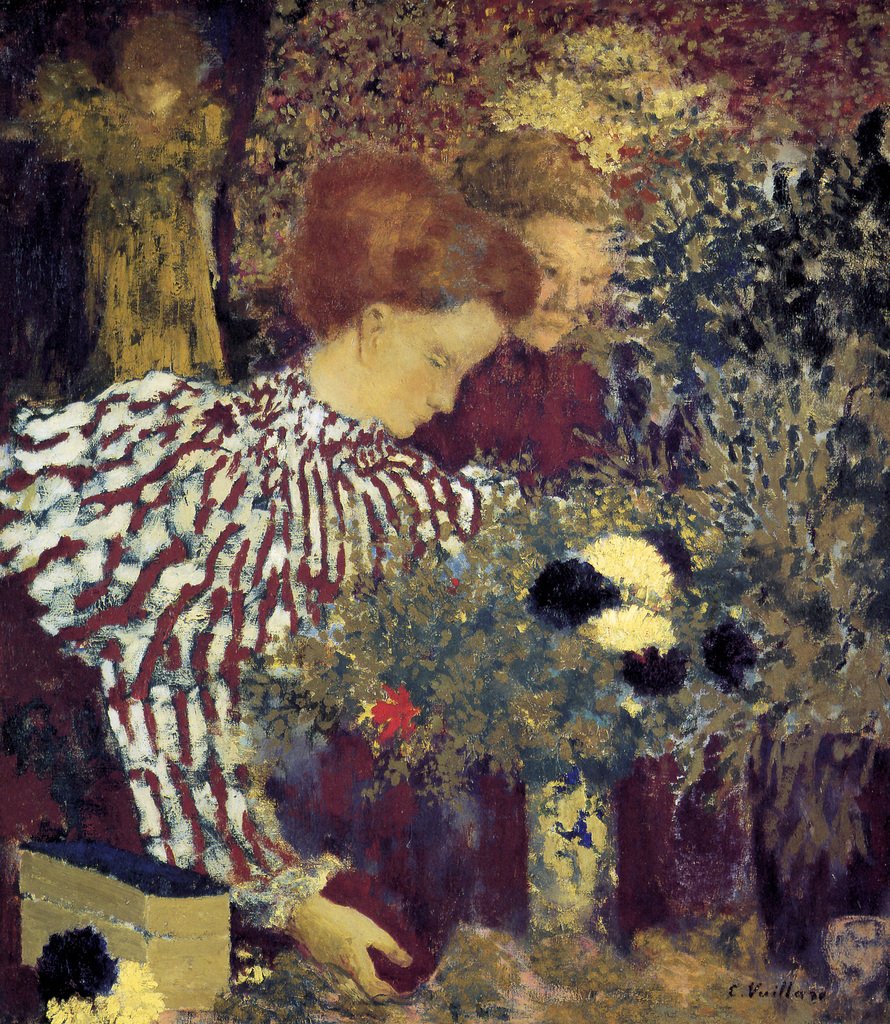
Le Corsage Rayé by Jean-Édouard Vuillard

Le Corsage Rayé by Édouard Vuillard (1895)

Today I am featuring a work by the French painter and printmaker, Jean-Édouard Vuillard.  Vuillard was born in 1868 in Cuiseaux, a commune in the region of Bourgogne in eastern France.  His father was a retired sea captain and his mother a seamstress.  When he was nine years old the family moved to Paris where his mother established a dressmaking workshop in their apartment.  In1883, when Édouard was fifteen years old his father died.  Following the death of his father Édouard received a scholarship so that he could continue with his secondary education at the Lycée Condorcet.  It was here that he met and became friends with another aspiring artist, Ker Xavier Roussel.  Vuillard left the school the following year and he and Roussel continued their artistic education at the studio of Diogène Maillart, which was formerly the studio of Eugene Delacroix.

In 1887, at the age of nineteen, Vuillard finally managed to be accepted at the Ecole des Beaux-Arts.  He had tried twice before but on each occasion failed to pass the entrance exam.  In 1889 he enrolled at the Académie Julian where he met Maurice Denis, Pierre Bonnard, Paul Ranson and Paul Sérusier.  It was Vuillard along with this group of young art students that formed the artistic grouping which came to be known as Les Nabis.  The French term nabi refers to a person inspired to speak the word of God and is clearly related to the Hebrew term for prophet (nebia) and the Arabic term  for prophet (nábi) .  The actual term was first used by the poet Henri Cazalis who drew a parallel between the way these painters aimed to revitalize painting (as prophets of modern art) and the way the ancient prophets had rejuvenated Israel.

In 1898 Vuillard set off on his European travels, visiting Venice and Florence and the following year made a trip to London.  In 1890 Vuillard put forward some of his paintings for the 1890 Salon.  He was both devastated and angered by the rejection of his works by the Salon jurists and vowed never to put forward any of his future works for Salon consideration.  Until the turn of the century Vuillard worked in theatrical circles, illustrating theatre programmes for the Théâtre Libre and even helped to set up the Théâtre de l’Oeuvre , with Aurélien Lugné-Poë which presented the work of the young French Symbolist playwrights and introducing major foreign dramas.  Vuillard continued to illustrate theatre programmes and design and paint theatrical settings.  In 1901 Vuillard had some of his works exhibited at the Salon des Indépendents and two years later put forward some paintings for the Salon d’Automne, an exhibition staged as a reaction to the conservative policies of the official Paris Salon.

Vuillard continued to live with his widowed mother and did so until her death in 1928.  A large number of his paintings had domestic themes or depictions of dressmaking scenes which would be set in the rooms of their house.  Often in these works Vuillard and his fellow Nabi painter, Pierre Bonnard, used domestic interior scenes as a setting for their paintings.  They were at pains to depict these domestic interiors with all their warmth, comfort and tranquil seclusion.  This type of subject matter became known as Intimism.  These paintings were marked by a gentle humor, and were finished in the subtle variety of soft, blurred colours.  The works would capture the light and atmosphere of the occasion but unlike Impressionism they would often embellish and distort the natural colour so as to communicate mood.  Many of his portraiture also retained the sense of Intimism with its calm domesticity.  Vuillard continued to receive numerous commissions from private patrons to paint portraits and decorative works as well as frescoes for public buildings. These commissions for public paintings included the decorations in the foyer of the Théâtre des Champs-Élysées and murals in the Palais de Chaillot and in the League of Nations in Geneva.  In his later years Vuillard concentrated on portraiture.

Jean-Édouard Vuillard died in La Baule, in the Loire-Atlantique department in western France, in 1940, aged 71.

My Daily Art Display’s featured oil on canvas painting is entitled Le Corsage Rayé,  which Vuillard completed in 1895 and can now be seen in the Collection of Mr and Mrs Paul Mellon at the National Gallery of Art in Washington.  The work was one of a set of five paintings, known as The Album,  based on household subjects, and commissioned by the Polish-born lawyer, journalist and art collector, Thadée Natanson, the publisher and co-founder of an artistic and literary journal called La Revue Blanche.  He was also a champion of Vuillard’s art and he and his wife were close friends of the artist.   The set of oil paintings were depictions of deep-coloured and richly textured interior scenes of varying formats, representing young bourgeois women engaged in simple domestic activities.  The set were to hang in the various rooms of Natanson’s Paris apartment.  In the case of this work it shows a woman arranging flowers.  The woman who modeled for this work is almost certainly Natanson’s wife, the concert pianist, Misia Godebska.

The woman dominates the painting with her puffed sleeved vintage dress in red and white stripes. No doubt the many years Vuillard watched his mother complete dresses in her studio aided him in the depiction of the woman’s clothing. The woman we see before us is arranging flowers in a vase. It is interesting to note that Vuillard has depicted the flowers not with an explosion of colour but has portrayed them with dull earthy colours.  This reason for this one presumes is so that they do not in any way detract from the clothing of the woman which Vuillard wants to be the focus of our attention.     Behind the woman we see another woman, dressed in what looks like a red uniform and is probably one of the woman’s servants.  Although this is a simple scene of domesticity the presence of the servant in some ways heightens the status of Misia.

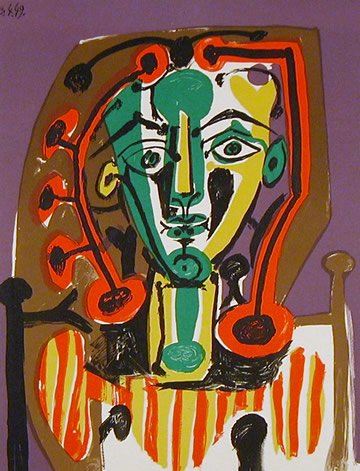
Le Corsage Rayé by Picasso

I end this entry by mentioning Picasso.  There are two reasons for this.  Firstly, Picasso made a drawing in 1949 entitled Le Corsage Rayé and his lithographer, Fernand Mourlot had the image recreated in a 300 copy edition.  I thought you would like to compare it with today’s featured work.   The second reason for mentioning Picasso as my next two entries will feature works by the artist and although I am not a fan of his later works I am fascinated by some of his earlier paintings and enthralled by the early part of his life.

The paintings were sold at auction by Thadée Natanson in 1908,  several years after he and his wife Misia were divorced.

My next blog will be about four days away as I am about to embark on my annual pilgrimage to Paris and soak up the atmosphere of the French capital and hopefully take in a gallery visit.  I am also hoping, depending on the weather, to visit La Maison Fournaise (see My Daily Art Display August 2nd 2011) and Giverny.

au revoir !

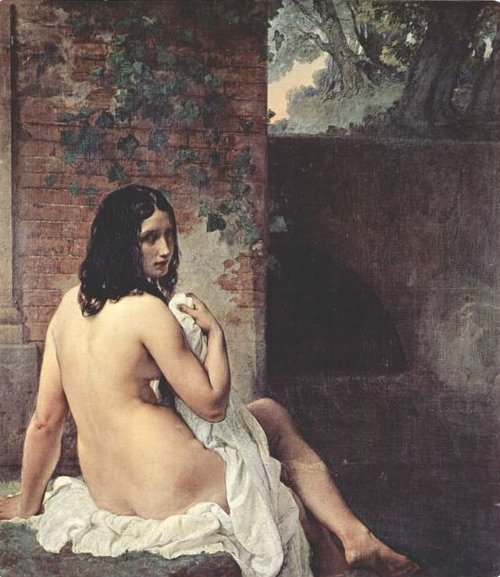
Susanna at her Bath by Francesco Hayez

Susanna at her Bath by Francesco Hayez (1850)

For an artist to have two favourite subjects for his paintings, biblical stories and female nudity, one would have thought combining the two would be somewhat difficult, if not risky.  However my featured artist today, the leading Romantic painter and portraitist of his time, Francesco Hayez, has, on a number of occasions, achieved that very thing.

Francesco Hayez was born in Venice in 1791.    He was the youngest of five sons.  His father was a French fisherman originally from Valenciennes and his mother, Chiara Torcella came from island of Murano, situated in the Venetian lagoon.  He was born into an impoverished household but fate took a hand in his life as Francesco was brought up in the household of his mother’s sister whose husband, Giovanni Binasco was a wealthy antiquarian and an avid art dealer and art collector.  It is more than likely that his uncle’s love for art transferred to his nephew, who in his childhood days developed a love of drawing.   Hayez’s uncle further developed Francesco’s love of art by gaining him a position as an apprentice in a studio of an art restorer.  His uncle then arranged for Francesco to study art under the tutelage of the Italian historical and allegorical painter, Francesco Maggiotto where he learnt about the Neo-Classical style of painting.  From the age of eleven to fifteen he studied the use of colour in classes run by the Bergamo painter, Lattanzio Querena, a skilful portraitist and copyist of 16th century Venetian paintings.

At the age of seventeen, Francesco Hayez was able to be enrolled at the Accademia di Belle Arti di Venezia where he studied under the historical and portrait painter, Teodoro Matteini.  It was whilst at the Academia that he won a painting competition, the prize being the chance to study for one year at one of the leading art establishments, Academia di San Luca in Rome.  Although his prize was for a one-year study period, Francesco Hayez, remained in the Italian capital for almost five years and spent much time studying the works of Raphael in the four Stanze di Raffaello (“Raphael’s rooms”) in the Vatican Palace.   He then moved on to Naples in order to fulfill a commission he had received from Joachim-Napoléon Murat, who at the time was the King of Naples, and brother-in-law to Napoleon Bonaparte.

Hayez moved to Milan in 1823 when he was thirty two years of age.   He was appointed Professor of Painting at the Accademia di Brera and soon became part of the academic and aristocratic life of the city.  It was around this time that he concentrated his art work on history paintings and portraiture and regularly exhibited his works at the annual Brera exhibitions.  In the mid 1830s he attended the famous Salon, which became known as the Salotto Maffei, as it was hosted by Clara Maffei, a leading Milan society hostess of the time.  Salon was the name given to gatherings of people under the roof of an inspiring host, held partly to amuse one another and partly to refine taste and increase their knowledge of the participants through conversation.  Clara’s salon was always well attended by well-known writers, artists, scholars, musical composers such as Verdi and people who were pro-Risorgimento (the political and social movement that wanted all the different states of the Italian peninsular united into one single state of Italy).  Hayez received many commissions from the men in the forefront of the fight for Italian independence and unification, one of these was his good friend Teodoro Arese, who in Hayez’s 1828 painting, Count Francesco Teodoro Arese in Prison, he depicted Arese in chains as a reminder of Arese’s imprisonment in 1821, as a result of his struggle against the government.

The paintings of Hayez were often dominated by biblical themes but Hayez had also developed an interest in the history of his country and began to incorporate contemporary political and social figures in historical backgrounds.  The sense of patriotism which he depicted in his portraiture was always well received by his patrons.   In 1850 he was appointed the director of the Academy of Brera and it is the Pinacoteca di Brera (“Brera Art Gallery”) which now houses one of the most famous of Hayez paintings, The Kiss (see My Daily Art Display Jan 6th 2011).

As I stated at the start of this blog, besides his love of historical and  biblical paintings, one of his other favourite themes was that of the semi-clothed, or the naked female. He often incorporated these within oriental themes or scenes from harems, such as his 1867 painting, Odalisque. By doing this he and other artists were able, in some way, to counter any possible negative comments by people offended by naked flesh.

Penitent Mary Magdalene by Francesco Hayez (1825)

What was more controversial was his 1825 portrayal of a naked repenting, Mary Magdalene, entitled Penitent Mary Magdalene, which surprisingly depicted such a well-known religious figure in a full-frontal nude pose.  Hayez’s reasoning behind such a depiction, which was not the normal portrayal of Mary Magdalene recanting her sins, was that it was to remind us of Mary Magdalene’s somewhat erotic and dubious past.

My featured Hayez painting today has also religious connotations but is unlike many similar depictions.  The work, which he completed in 1850, is entitled Susanna at her Bath and is housed in the National Gallery, London.  It has allowed the artist to combine his love of biblical stories and the portrayal of a well-endowed female nude.  The story of Susanna and the Elders comes from Chapter 13 of the Old Testament Book of Daniel

The story revolves around a Hebrew wife named Susanna who was falsely accused by two lecherous voyeurs.  Whilst bathing one day in her garden and having dispensed of the services of her attendants, two lustful elders secretly observe her.  On making her way back to her house, they accost her, threatening to claim that she was meeting a young man in the garden unless she agrees to have sex with them.  She is horrified at their suggestion and refuses to be blackmailed.  The two lechers carry out their threat and inform the authorities about her affair with an illicit lover.  She is arrested and about to be put to death by stoning for promiscuity when a young man named Daniel interrupts the proceedings, shouting that the two elders should be questioned to prevent the death of an innocent. The two men are questioned separately and their stories do not agree. The court then realises that the two elders have made false accusations against Susanna.   The false accusers are put to death and virtue triumphs.

The Susanna in Hayez’s painting is the same Susanna but unlike other depictions of the event we do not see the two elders and accordingly Hayez has not included the words “the Elders” in the title of his work.  Hayez has preferred to concentrate all his artistic ability in his depiction of the nubile and beautiful young woman.  Although the two men are not seen by us we notice the accusatory expression on Susanna’s face as she looks over her shoulder and catches a glimpse of her voyeurs.  It is a truly beautiful painting and Hayez’s portrayal of the voluptuous Susanna with her pale skin and pursed lips is remarkable.  Look into her eyes.  It is as if she is looking straight through us.  We ourselves feel accused of staring at her naked flesh.  We can just imagine her unwavering stare as she browbeats the two old lechers.  The background to the right is dark and contrasts with the pale white skin of her leg and this chiaroscuro effect adds to the painting.

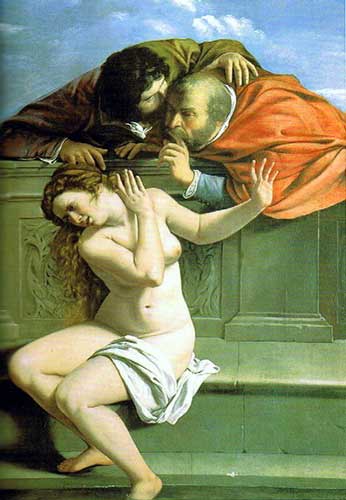
Susanna and the Elders by Artemisia Gentileschi (1610)

This painting depicting the biblical scene portrays Susanna’s character as being quite hard, determined and dare I say slightly brazen.  If you want to see a slightly different depiction of Susanna, in which she is shown as being vulnerable, frightened and devastated by the overtures of the two lechers then you must look at the painting Susanna and the Elders by my favourite female artist, Artemisia Gentilesschi.  She completed the work in 1610 and rather than showing Susanna as a coy or flirtatious person as often depicted by male artists, including Hayez, Artemisia looks on the event from the female perspective and deftly portrays the vulnerability of Susanna, showing her as being both scared and repulsed by the demands of the two men who menacingly loom over her.  It is one of the few Susanna paintings showing the sexual assault by the two Elders as a traumatic event. Artemisia Gentileschi at the time of her painting was having a torrid time with her boyfriend who two years later would rape her and Artemisia had then to endure the trauma and mortification of the rape trial.

Ruth in Boaz’s Field by Julius Schnorr von Carolsfeld.

Ruth in Boaz’s Field by Julius Schnorr von Carolsfeld (1828)

Today I am returning to a biblical work of art and one which I saw at the National Gallery in London a fortnight ago, and like a number of paintings I have recently reviewed, it was hanging in Room 41.  There are a number of biblical events which seem to be favourites with the artistic fraternity, such as the Crucifixion, the Deposition, Susanna and the Elders, Lot and his daughters,  just to mention a few.  Today’s depiction of these two biblical characters is no different, as one or both have been seen in paintings by Michelangelo, Chagall, William Blake, William Morris, Fabritius, Nicolas Poussin and Rembrandt just to mention a few.  The biblical characters in question are Ruth and Boaz and the painting I am featuring today is entitled Ruth in Boaz’s Field by the German painter, Julius Schnorr von Carolsfeld.

Julius Schnorr von Carolsfeld was born in Leipzig in 1794.  His father, Johann Veit Schnorr was an engraver and painter and he gave his son his initial artistic training.  When Julius was seventeen years of age he attended the Vienna Academy where he studied for four years under the German portrait and historical painter, Heinrich Füger.  It was at this establishment that he made friends with fellow students, the German painter, Ferdinand Olivier and the Austrian painter Joseph Anton Koch.   A couple of years prior to enrolling at the Vienna Academy,  six of the students had formed an artistic cooperative in Vienna and  called it the Brotherhood of St. Luke or Lukasbund, a name, which followed the tradition for medieval guilds of painters.  In 1810 four of them, Johann Friedrich Overbeck, Franz Pforr, Ludwig Vogel and Johann Konrad Hottinger moved to Rome, where they occupied the abandoned monastery of San Isidro.   Julius Schnorr von Carolsfeld followed this group to Rome when he had completed his four-year course in 1815.

This grouping of German and Austrian Romantic painters was known as the Nazarenes and their formation was a reaction against Neoclassicism and the repetitive art education of the academy system. By setting up this group they hoped to return to art, which personified spiritual values, and this group sought stimulation from the works of artists of the late Middle Ages and the Early Renaissance periods.  The goal of the Nazarenes was to add to their works of art a purity of form and spiritual values which they saw in Renaissance art.  The group lived a semi-monastic existence, and they were given the name Nazarenes, by their detractors, as a term of derision, used against them for the quirky way they dressed, which imitated a biblical manner of clothing and hair style. They remained undeterred for the Nazarenes believed this was a way of re-creating the nature of the medieval artist’s workshop.  Most of their works were centered around religious subjects.

Julius returned to Germany in 1825 and went to live in Munich where he was employed by  King Ludwig I,  who that year had succeeded his late father, King Maximillian I, and had become King of Bavaria.  Julius and his staff then set about decorating the King’s palaces.  Julius was a follower of Lutherism and his later artistic phase featured biblical works.   His biblical works were often crowded scenes and were frequently criticised for their lack of harmony, unlike his featured painting today.  His biblical drawings and the cartoons he made for frescoes formed a natural lead up to his designs for church windows. His designs would then be made up into stained glass windows at the royal factory in Munich.  His fame as an artist soon spread and besides his commissions from German patrons he received many more from abroad, including ones for windows in both Glasgow and St Paul’s cathedrals.

Julius Schnorr died in Munich in 1872 aged 78.

Today’s oil on canvas painting entitled Ruth in Boaz’s Field Boaz is a biblical tale narrating the story of the first meeting between Ruth and Boaz and was painted by Julius Schnorr von Carolsfeld in 1828.   This picture was painted in Munich and based on drawings he had made a few years earlier whilst in Italy.

The subject is taken from the Old Testament Book of Ruth. Here we see the Moabite woman, Ruth, meeting with Boaz and she is gleaning (gathering up corn left after the harvest) to support her widowed mother-in-law. The landowner Boaz who talks to her has come to show his admiration for her hard work in supporting herself and her mother-in-law, Naomi.

Ruth was a daughter-in-law of Naomi, a woman from Bethlehem, who had left the city in order to escape the famine.  She, along with her husband Elimelech and their two sons, Mahlon and Chilion, travelled to the land of Moab which lay east of the Dead Sea.  However Naomi’s husband dies.  Later Naomi’s sons marry Moabite women but ten years later both of the sons die leaving Naomi with her two daughters-in-law, Orpah and Ruth.  Naomi feeling there was no reason to remain in Moab any longer decides to return alone to Bethlehem telling her daughter-in-laws to stay in Moab and return to their parent’s homes. Orpah goes back to her family but Ruth refuses to leave her mother-in-law, Naomi saying:

“…Where you go I will go, and where you stay I will stay. Your people will be my people and your God my God. Where you die I will die, and there I will be buried. May the LORD deal with me, be it ever so severely, if even death separates you and me…”

Naomi and Ruth then travel back to Bethlehem.  It is harvest time and in order to support her mother-in-law and herself, Ruth goes to the fields to glean (to gather up corn left after the harvest).  The story (Book of Ruth: 2) continues with the story:

“…And Ruth the Moabitess said to Naomi “Let me go to the fields and pick up the leftover grain behind anyone in whose eyes I find favour. “Naomi said to her, “Go ahead, my daughter.”   So she went out and began to glean in the fields behind the harvesters. As it turned out, she found herself working in a field belonging to Boaz who was from the clan of Elimelech.  Just then Boaz arrived from Bethlehem and greeted the harvesters, “The Lord be with you!”.  “The Lord bless you!” they called back.

Boaz asked the foreman of his harvesters, “Who is that young woman”    The foreman replied, “She is the Moabitess who came back from Moab with Naomi”.   She asks Boaz, “Please let me glean and gather among the sheaves behind the harvesters.”  She went into the field and has worked steadily from morning till now, except for a short rest in the shelter.’

So Boaz said to Ruth, “My daughter, listen to me. Don’t go and glean in another field and don’t go away from here. Watch the field where the men are harvesting, and follow along after the girls.”

When she sat down with the harvesters, he offered her some roasted grain. She ate all she wanted and had some left over.  As she got up to glean, Boaz gave orders to his men, “Even if she gathers among the sheaves, don’t embarrass her. Rather, pull out some stalks for her from the bundles and leave them for her to pick up, and don’t rebuke her.”

So Ruth gleaned in the field until evening. Then she threshed the barley she had gathered, and it amounted to about an ephah. She carried it back to town, and her mother-in-law saw how much she had gathered, Ruth also brought out and gave her what she had left over after she had eaten enough.

Her mother- in-law asked her, “Where did you glean today? Where did you work? Blessed be the person who took notice of you!” Then Ruth told her mother-in-law about the one at whose place she had been working. “The name of the person I worked with today is Boaz,” she said….”

The romantic story of Ruth and Boaz has a “happy ending” and for those of you who want to know what happened after that first meeting in the cornfield on the outskirts of Bethlehem you will have to read the Old Testament Book of Ruth (1-4).

Of all the biblical depictions of the couple I have seen in works of art I believe this to be the best.  The colours and tones used by the artist are superb.