Suzanne Valadon. Part 3 Pierre-August Renoir

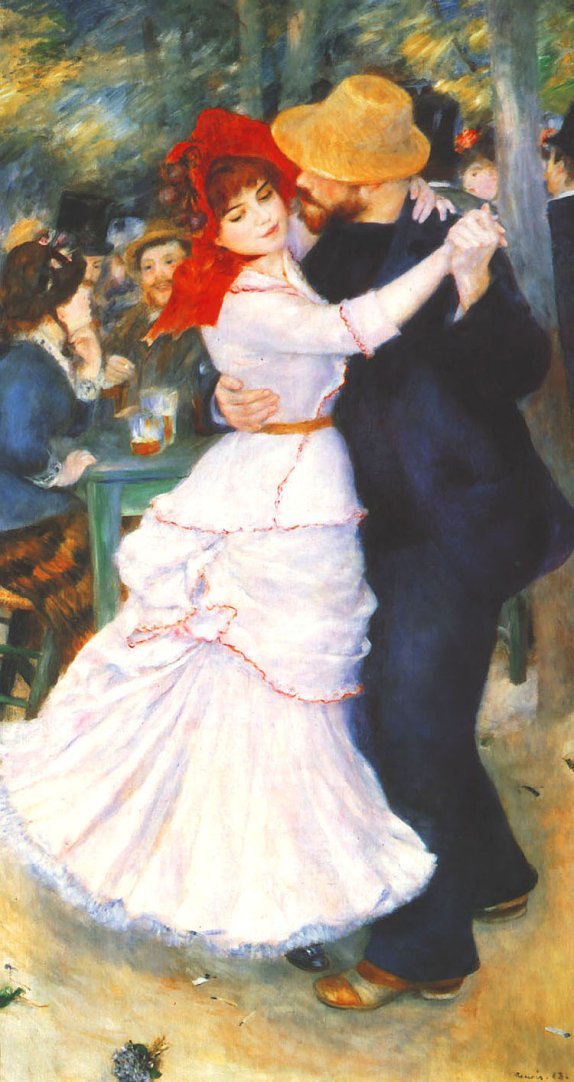
Dance at Bougival by Renoir (1883)
(featuring Suzanne Valadon and Eugene Pierre Lestringuez)

I ended my last blog about Suzanne Valadon with her relationship with Pierre Puvis de Chavannes ended and she had moved back in with her mother.  That summer she had become pregnant and in December 1883 had given birth to a baby boy whom she named Maurice.   The following year, after she had got herself back in shape and had employed a nanny to look after her son, she went back to her old life of modelling for artists by day and revelling in  café-bar life at night…..    

In 1883, before she became pregnant Suzanne was employed as a model by Pierre-August Renoir.  Besides being an artist an artist’s model they had something else in common – they both originated from Limoges.  Renoir had returned to Paris after extensively travelling around Europe and North Africa.   Despite being moderately well-off due to the sale of his paintings he chose to live in the less salubrious area of Montmartre.  Suzanne and Renoir would stroll along the streets of Montmartre arm in arm and nobody was in any doubt that they had become lovers.  They would go dancing at the Moulin de la Gatte on Sundays and picnic at Argenteuil and Chatou on sunny summer days. 

However, I want to turn the clock back two years to 1881 to look at what Renoir was doing at the time and, by doing so, look at the interaction between Suzanne and him a couple of years later.   Renoir had completed his famous painting Les Déjeuner des Canotiers (Luncheon of the Boating Party) in 1881 (see My Daily Art Display August 2nd 2011), which had been a group portrait of his friends dining on the upstairs terrace of Restaurant Fournaise which was in the small village of Bougival on the bank of the River Seine.   It was here that his friends would gather to eat and dance and watch the oarsmen row their boats up and down the river.  One of the people depicted in the painting was Aline Charigot who Renoir would eventually marry in 1890 albeit Aline had already given birth to their son, Pierre, in 1885. 

In 1882,  a year after completing the Déjeuner des Canotiers painting he was commissioned by Paul Durand-Ruel to complete three paintings, which became known as the Dance Series.  The series consisted of Dance à Bougival, Dance in the City and Dance in the Country.  These were life-sized works measuring about 180 x 90 cms.  In all three paintings there are two main characters, a male and a female dancing.  In the first two paintings, the model for the female was Suzanne Valadon and in the third one, the model was Aline Charigot. 

Dance in the City by Renoir (1883) (featuring Suzanne Valadon and Paul Lhôte)
Dance in the City by Renoir (1883)
(featuring Suzanne Valadon and Paul Lhôte)

The setting for Renoir’s painting Dance in the City is a high class Parisian establishment, for this is a “white ball”, which was favoured by the upper classes. Although the painting once again depicts a couple dancing, this work is all about the woman as the man is almost hidden from our view.  There is a shimmering opulence about this work.  Renoir has depicted the woman, modelled by Suzanne Valadon, wearing a two-piece white silk gown, – her toilette de bal (dance dress).  The cut of her dress reveals her back and shoulders.  Her partner, was thought to be modelled by Renoir’s close friend, Paul Lhôte, a journalist and writer of short fiction.  He is wearing formal evening wear and the tails of his long coat swish with the movement of the dance.    Both the man and woman wear white gloves which in a way makes the dance a more formal event ensuring that the bare hands of the man do not touch the delicate skin of the woman.  Their hands are clasped as in the Dance à Bougival but in this painting it is just the lightest coupling of hands. 

Suzanne Valadon always maintained that the Dancing à Bougival work featuring her was painted in-situ at Bougival thus implying that she was part of the Bougival “in-crowd”.  In later life she talked about her relationship with Renoir and the Dance à Bougival painting saying:

“…He fell in love with me and at Bougival he painted me in his famous picture…”

However Renoir stated quite categorically that he simply made a few sketches of Suzanne and the paintings was completed at his studio.  The painting Dance à Bougival is housed at the Museum of Fine Arts in Boston which acquired the work in 1937.  In this painting we see Suzanne Valadon dancing with Eugene Pierre Lestringuez, another of Renoir’s friends, who was an official at the Ministry of the Interior and who featured in a number of Renoir’s works including Les Déjeuner des Canotiers.  In this outdoor dance scene there is not the formality that we saw in the painting Dancing in the City.   Gone is the woman’s formal toilette de bal, replaced by a light pink dress with red piping.  The hands of the dancers are not gloved.  Gone is the man’s formal attire, replaced by a loose fitting blue jacket and wool sweater and atop his head he wears a yellow straw hat which hides part of his face and his eyes.  Gone are the lightly touching hands and in its place we see the left hand of the man gripping the lady’s hand tightly while his right hand snakes around her waist pulling her body into his.  Suzanne wears a large bright red hat, the colour of which draws your eyes to it and, by doing so, we focus on the faces of the dancers.  Look at the faces closely.  The woman pulls her face away from that of her partner and looks downwards avoiding any eye contact with the man whilst he stares at his partner with an unnerving intensity.  What is going on between the pair?  There is a strange uneasiness, tenseness, between the couple. There is no sense of intimacy between the dancers.

Facial expression (Detail from Dance at Bougival)
Facial expression
(Detail from Dance at Bougival)

As the artist, Renoir, was the one to decide on how he would depict the pair’s facial expressions and body language, what made Renoir portray the couple in this way?  Was Renoir in some way transferring Suzanne’s character into the painting?  This was supposed to be a joyful event in which couples twirl in the open air so why this pensiveness?  It is almost as if the man has said something inappropriate to the woman and she is slightly offended or could it be that the averting of her eyes is simply her way of teasing her dancing partner? 
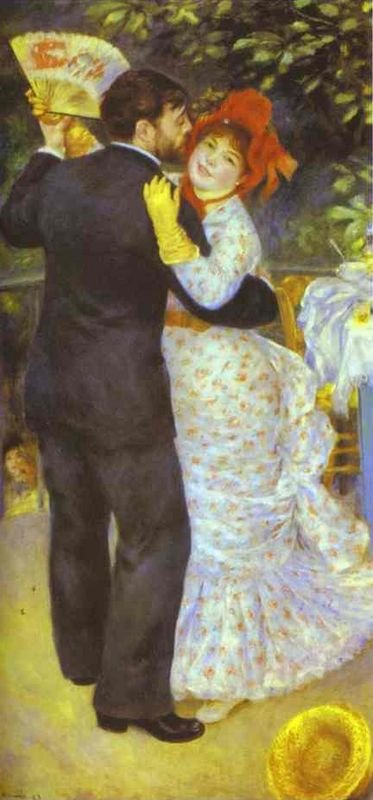
Dance in the Country by Renoir (1883) (featuring Aline Charigot and Paul Lhôte
Dance in the Country by Renoir (1883)
(featuring Aline Charigot and Paul Lhôte

Another question posed by Renoir’s Dancing series paintings that although Suzanne Valadon modelled for Dancing à Bougival and Dancing in the City why did the artist decide to switch to Aline Charigot for Dancing in the Country, who we see depicted partnering Paul Lhôte.  When I look at and compare  the faces of the two females depicted in the paintings I have to say that Suzanne’ thinner and more delicate face  is the more attractive and sophisticated and it could be that for a country dance scene Renoir decided that the fuller face with the rosy cheeks of Aline were more suited when it came to the ambience of the country.  Or could it be that Aline Charigot’s insisted that she, and not Suzanne, featured in the third work. 

The one aspect that the Bougival and City paintings have in common is the distracted expression on the face of Suzanne Valadon.  In both paintings she pays little attention to her partner and lacks the smile which Aline Charigot has on her face in Dancing in the Country.  Is this just coincidental?  Could it be that Renoir’s depictions of Aline and Suzanne give us a better feeling as to how he viewed his two lovers.  

The Bathers by Renoir (1887)

Suzanne travelled to Guernsey with Renoir in order for him to paint some pictures including a nude portrait of her.  Although he later destroyed the painting it is thought that he used the face for the central character in his painting The Bathers which he completed in 1887.  Amusingly, Suzanne was adament that it was not just her face that was used for the painting, but her whole body !!   Their painting trip to Guernsey was rudely interrupted with the news that Aline Charigot was coming to visit Renoir and one can only imagine Suzanne’s anger when Renoir arranged for her to return to Paris immediately so that the women would not meet.  There was obviously no love lost between Aline and Suzanne both vying to be Renoir’s one true love.  As I said earlier, Aline won that battle as she and Renoir eventually married.  

Suzanne Valadon by Pierre Auguste Renoir (1885)

Suzanne’s position as Renoir’s lover ended almost as soon as it had begun but she still modelled for him and in 1885 he completed a head and shoulder portrait of her.  At our first glance of this portrait we are aware of her facial expression.  It is not one of happiness but is one of despondency but it is still a charming depiction of his one time lover.

The Ponytail (Suzanne Valadon) by Renoir (1886)

In 1886 he completed another portrait of her which is sometimes referred to as The Braid (Susan Valadon) or The Ponytail (Susan Valadon) and which is housed in Museum Langmatt, Baden.   This is a far more sensuous portrait of Suzanne and her downward gaze adds to her innate sensuality.  There is no doubt that she was an extremely beautiful woman and one can see why artists like Renoir were drawn to this amazing young lady.  Renoir, besides employing her as a model and becoming her lover, did something else which was to change the course of her life.  He took an interest in her desire to draw and paint and nurtured the idea that she, one day, would become a great artist. 

                                                ………………………….. to be continued.

If you would like to have a more in-depth view of Suzanne Valadon’s lifestory then I would recommend that you read a book entitled The Valadon Drama, The Life of Suzanne Valadon, written by John Storm in 1923.
Susan Valadon. Part 2 – The artist’s model

Suzanne Valadon
Suzanne Valadon

In my last blog I looked at the early life and upbringing of my featured artist, Susan Valadon.  She and her mother Madeleine had moved from Limoges and had come to live in the Montmartre district of Paris.  They had survived the siege of the capital by the Prussian army as well as the bloody fight between the Communards and the French government troops which followed.  Suzanne had been trained as a seamstress but had ended up as a teenager working in a circus which culminated in her being injured in a fall whilst standing in for a trapeze artist.  She now needed to find an alternate income source……………

A friend of Suzanne suggested that she should consider becoming an artist’s model despite the modelling profession was looked upon as a risqué form of employment and just one inevitable step from becoming the artist’s lover and it was a profession which was frowned upon in many quarters.  Her mother believed that her daughter would become nothing more than a common prostitute but Suzanne, headstrong as ever, was not to be deterred.  Suzanne would meet every morning at the fountain in the Place de Pigalle with other young girls and wait to see if she would be chosen by an artist.  She had a lot of things going for her.  She had an elfin-like vivaciousness.  Her skin was soft and ivory in colour.  Even though she was till just sixteen years of age her figure had ripened.  She was a cross between an attractive and charming child and a self-assured voluptuous woman and more importantly ,as far as her job prospects were concerned, she was just what an artist was looking for.  She was constantly being chosen to model and she adored this new life.  She recalled the first time she was picked out of the waiting group of prospective models and sitting before an artist for the first time: 

“…I remember the first sitting I did.   I remember saying to myself over and over again ‘ This is it! This is it!’  Over and over I said it all day.  I did not know why.   But I knew that I was somewhere at last and that I should never leave…”

For her, modelling for artists meant that she was one of the players on the Montmartre artistic stage.  Her daily routine was fixed.  She would pose for the artists in the afternoons until the light started to fail, then in the evening she would accompany them to the bars and café-concerts and partake in what was known as the “green hour” – the time for relaxation in the pub, the time for stimulating conversation, but most importantly, the time for imbibing the 136 proof, anise-flavoured, green spirit, absinthe.

In 1882, when she was seventeen years of age, she was summoned by the French artist, Pierre Puvis de Chavannes, to attend his studio at Neuilly.   Pierre Puvis, who was fifty-seven at the time, was still a bachelor but was involved in a long lasting loving, but non-sexual, relationship with Princess Marie Cantacuzène, the wife of a Romanian nobleman.  Pierre and Marie would eventually marry in 1898, a few months before both of them died, Marie in the August and Pierre in the October.  Despite the forty year age gap Pierre Puvis and Suzanne became lovers and she moved into his Neuilly apartment.  She was dumbstruck by the opulence of his home.   This was a far cry from the lodgings she shared with her mother.  Pierre and Suzanne however could not have been more dissimilar in temperament.  She was wild, edgy and vocal whereas the artist was quietly spoken, laid back, and often lost in quiet contemplation.  She would hanker after a night at a café-cabaret while Puvis wanted nothing more than to go for a quiet stroll with her along the banks of the Seine. 

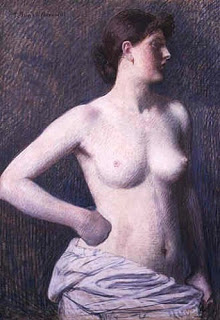
Suzanne Valadon by Pierre Puvis de Chavannes (1880)

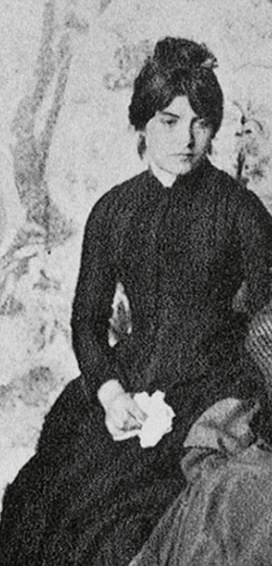
Susanne Valadon modelled for Pierre Puvis de Chavannes for his pastel on paper work which he completed in 1880.  The nude study was untitled but one can see the physical attraction of the model to the artist.  It is a stunningly beautiful work of art.  Suzanne, like many of the artists’ models had no problems with posing nude and early photograph below shows her in such a pose.

Suzanne Valadon          (photo)
Suzanne Valadon
(photo)

The liaison between Pierre Puvis and Susan Valadon lasted for six months and during that time he probably became a slightly more spirited person through being around Suzanne and in return he seemed to have instilled a calming influence on the hyper young woman. It was the first time that Suzanne had been in some ways dominated by a man.  It would appear to be a similar situation to the Eliza Doolittle and Henry Higgins scenario in Pygmalion.  Inevitably the liaison came to an end.  It did not end in a fiery confrontation with insults being hurled.  Their liaison as lovers had run its course.  It was just a quiet and mutual ending to a relationship which they had both enjoyed.  Suzanne returned home to live with her mother in her one-bedroom Montmartre lodgings on the rue du Poteau but still on occasions modelled for Pierre. 

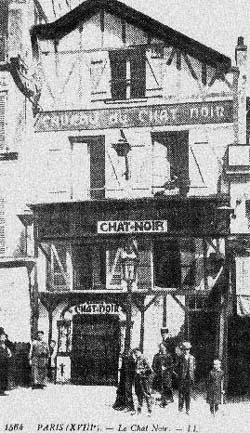
Le Chat Noir
Le Chat Noir

Suzanne soon returned to her old ways of modelling by day and celebrating at night and one evening whilst in Le Chat Noir she met Miguel Utrillo, a Spanish engineering student who was studying in Paris.  Soon the two became close friends which inevitably lead them to become lovers.   Utrillo was not the first man since Puvis that Suzanne had slept with as she had quite a number of sexual partners and so maybe it was not surprising that in late summer of 1883 she became pregnant.  The question on most people’s lips was – who was the father of Suzanne’s child?   Her friends would question her and put forward a name, to which Suzanne, not at all upset by the questioning, would just smile and amusingly state: “It could be” or “I hope so”.   Suzanne gave birth to a baby son on December 26th 1883 after a very prolonged and painful birthing process overseen by an irritable midwife and her ever drunk mother.  After giving birth Suzanne lapsed into a coma for two days.  The baby was registered at the town hall in Montmartre as Maurice Valadon.   Why Maurice?   Suzanne’s reasoning behind the choice of name was that none of her recent lovers had the name Maurice!   

Her old one-bedroom apartment in which she had been living with her mother was now not big enough and so after the birth Suzanne and her baby along with her mother Madeleine moved into a three-bedroom apartment in rue Tourlaque.  This was more expensive but Suzanne was not concerned, nor had she been concerned when she was pregnant and too big to be used as an artist’s model and her money from modelling dried up.   She was receiving money from an admirer or lover but she would never reveal the source of her income.  Once up and about, Suzanne reverted to her nights out at the bars and clubs accompanied by different men including Miguel Utrillo.

                                                                                          ……. to be continued

Susan Valadon, Part 1 – The early years

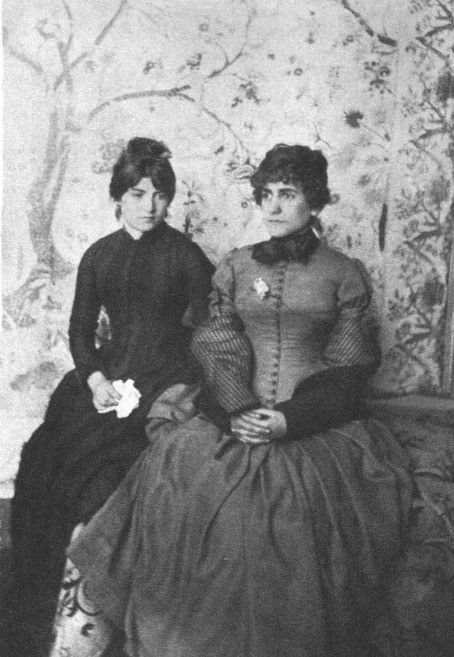
Suzanne Valadon aged 24

In my next few blogs I want to look at the life of a female who was both a great artist and artist’s model and whose name is synonymous with the artistic world of the late nineteenth/early twentieth century Montmartre.  She was, and still is, loved by the feminist movement who applaud her guts and determination.  She is Suzanne Valadon.   I want to spend time and look at the artistic friends she made during her life and how they adored her.  She was, to many artists, a model, a muse and, in some cases, a willing lover.   To fully understand why her lifestyle was as it was, one must go back and examine her family roots and look at her early childhood which was , as is the case for nearly all of us, the sewing and the germination of the seed which would eventually blossom and shape our lives. 

To examine her early life one needs to scrutinize the circumstances of her birth and for that it is necessary to look into the life of her family.   Her mother was Madeleine Valadon who was born in the small rural village of Bessines, close to the town of Limoges.  What we know of Madeleine comes from her own lips later in life and because she frequently changed the facts one needs to be careful as to what to believe.   She maintained that as a teenager she had once been married to a man from Limoges named Courland and that he died in jail when she was just twenty-one years of age but by which time she had given birth to a number of his children.  After his death Madeleine reverted back to her family name of Valadon and returned to her family home.  As a young girl, she was taught to read and write by nuns who also taught her to stitch and sew. She then fortuitously managed to secure employment as a live-in seamstress to the well-to-do Guimbaud family who lived nearby.  It was a position which she was pleased to accept and felt no grief for having to leave her children in their less than salubrious family home whilst she was living in comparative comfort close by.   She soon established herself as the head of the servants in the Guimbaud household and, unlike them, even dined with the family.  She remained in this employment for thirteen years but it came to an end when she once again became pregnant.   According to her, the father of the child was a local miller who was killed in an accident at work.  In later life she viewed the accident which killed him as divine retribution for making her pregnant!     

Naturally the small Bessines community was shocked by the news of her pregnancy and lack of a husband to act as a father figure to her newborn.  The Guimbaud family however treated her well and she remained in their house until her child, a daughter, was born.  According to the official records, the child was baptised Marie-Clémentine Valadon on September 23rd 1865.   It was not until she was nineteen years of age that Marie-Clémentine started calling herself Suzanne and this apparently was the suggestion of her friend, the artist, Henri Toulouse Lautrec.    It is also interesting to note that despite that documented official registration of her birth Suzanne always maintained she was born in 1867. 

Madeleine Valadon with her daughter Suzanne

Madeleine Valadon left Bessines with her baby in January 1866 and headed for Paris.  She never looked back.  She never saw or communicated with her family, her other children or her former employer, the Guimbaud family, ever again and one can only wonder why she wanted this complete break from her past. 

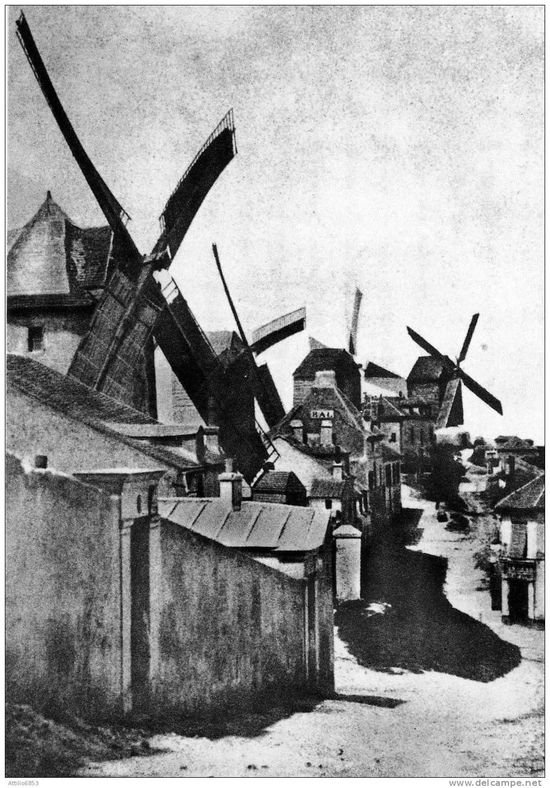
The windmills of Montmartre, taken in 1839 by Hippolyte Bayard

She arrived in Paris confidant that she would be able to earn a living as a seamstress.   Madeleine Valadon was amazed at the sight that greeted her to the north of the capital city – a hill on top of which were a number of windmills, a vista which was similar to the rural views back home.  The steep hill she viewed was the Mount of Martyrs, named after the execution of the first bishop of Paris, St Denis and his faithful lieutenants, St Rustique and St Éleuthère in the third century – Montmartre.  Madeleine settled into lodgings at the base of the hill in the Boulevard de Rochechouart and then, with a glowing reference from the Guimbaud family, set off to procure employment as a seamstress.  Her plans did not come to fruition as jobs were scarce and finally, in desperation, she had to settle for the menial job as a scrub-woman, cleaning floors whilst the wife of the concierge of her lodgings looked after Suzanne. 

Madeleine, no doubt aware that for her daughter to succeed in life she had to be educated, and so arranged for a priest to teach her to read and write and then had her attend the convent run by the nuns of St Vincent de Paul as a day pupil for a continuance of her education and to be taught, as she was, to become a seamstress.  However, once again her plans went awry with the start of the Franco-Prussian War which culminated in the siege of Paris by the Prussian army at the end of 1870 and the ousting of the French government, which retreated from Paris and based itself in Bordeaux.  In May 1871, following the conclusion of the Franco-Prussian War and the lifting of the Prussian siege of Paris, the French government returned to Versailles on the outskirts of Paris ready once again to rule the capital.  However many of the Parisians, who had suffered during the Paris siege, blamed their government for their misery and deprivation which they had to endure.  They remembered with bitterness the days they had to scavenge for food eating dogs, cats and rats to survive.  Out of this sense of bitterness and betrayal came the rise of the Communards.  The Communards were a group of working class disaffected Parisians who did not want the French government to return to control Paris.  They were very active around the area where Madeleine and Suzanne lived and their bloody determination that the defeated French government would not return to Paris from their bolt-hole at Versailles set up a clash which was in fact a mini civil war and which claimed the lives of more than twenty thousand Parisians. 

Suzanne, during these times of turmoil, had still attended the St Vincent de Paul convent for her lessons and during the Paris siege had been fed by the nuns from their home-grown produce.  However during the Paris Commune clashes between the government forces and the Communards the fighting had been so intense that the nuns barricaded themselves in the convent and closed it down to the day pupils and so Suzanne like many others lost their opportunity for learning and being fed.  Suzanne, who was six years of age and like many children of her age, revelled in not having to go to school.  Her mother, on the other hand, despaired and began to drink heavily.   At the end of the Paris Commune struggle at the end of May 1871 and with it, the return to law and order under the French government, the St Vincent de Paul nuns felt it safe to re-open their convent to their day pupils and Suzanne, who had enjoyed the freedom from the discipline of school life and the boredom of lessons reluctantly had to return to the confines of the convent.  She rebelled and was frequently absent preferring to play in the streets and on the hill of Montmartre with new friends both children and adults.   She mixed with the lowest elements of society, the prostitutes, the beggars and the thieves and loved every minute of it.  Later in life she recalled those times:

“…From that day the streets of Montmartre were home to me.  It was only in the streets that there was excitement and love and ideas – what other children found around their dining room tables…” 

Suzanne lived a feral existence.  She was small in stature and had a fierce temper and would often succumb to uncontrollable rages and on the streets of Montmartre she was often referred to as “The Little Valadon Terror”.   Her mother Madeleine became more morose and apathetic as the years passed.  She lost total interest in life and frequently descended into an alcoholic haze.  She rarely cleaned their lodgings and seldom did any laundry.  She begrudged cooking and having to feed Suzanne and when they ate at meal times they would normally eat apart.  Nothing Suzanne would do would lift her mother’s spirit.   Despite this lack of maternal love for Suzanne the two lived together for almost sixty years.  In later life Suzanne often depicted her mother in paintings.  She would nearly always portray her as being old, wrinkled and toothless but showed her hard at work. 

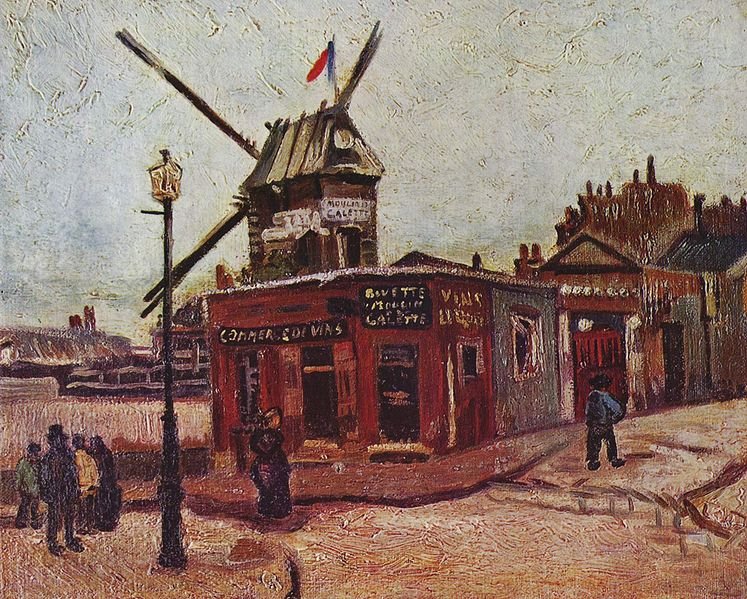
Le Moulin de Galette by Vincent van Gogh (1886)

Montmartre since the beginning of the 19th century was the centre of artistic life and drew artists, musicians and writers to it like a magnet.  Studio garrets shot up everywhere in which the artists would paint day in and day out and in the late evenings would look for some respite and so bars and music and dance halls, such as the notorious Moulin Rouge.  

L'Absinthe by Degas (1873)
L’Absinthe by Degas (1876)

The Café de la Nouvelle-Athènes, was a meeting place for the up and coming artists of the time including the “new kids on the block”, the Impressionists and it was outside this establishment that Degas depicted the two drinking companions in his famous 1876 work L’Absinthe  (See My Daily Art Display June 7th 2011).  Another popular establishment was Le Chat Noir, which opened in November 1881 in Boulevard Rochechouart, the same street where Madeleine and Suzanne lived and was run by the entertainment impresario, Rodolphe Salis.  The Divan Japonais, a café-concert (a combination of a concert hall and a pub) was a haunt of the French painter, Henri Toulouse-Lautrec.  Probably one of the most popular was the Moulin de la Galette.  This was originally a windmill, one of the thirty windmills on La Butte de Montmartre, which Madeleine saw as she arrived from Limoges.  The windmill owners then added a goguette (a wine shop) which also sold galettes (flat round crusty pastries) and later incorporated a dance hall and restaurant.  It was here that Suzanne Valadon reminisced that she had first set eyes on Degas whom she described as:  

“…a small round-shouldered man, fragile and sad-eyed, in pepper-and-salt tweeds, his throat swathed in woollen scarves…”

In 1874, at the age of nine, Madeleine took Suzanne to an atelier de couture where she was apprenticed as a seamstress.  Suzanne hated the life and made numerous attempts the workplace but unlike the nuns the workhouse owner would beat her when she was dragged back to the factory by her mother.  She stayed there for three years but eventually left and took jobs as a waitress in a café, a push-cart vendor of vegetables and working with horses at a livery stable.  It was this last job in which one of her jobs was to walk the horses around the streets.  People would stop on the street and watch this small young girl with her large horses.  Suzanne, ever the entertainer, was not content with just walking the horses but began to perform acrobatic tricks upon the horses to gain more notice and a modicum of applause.   In later years, she reckoned that a circus owner witnessed one of her “performances” and offered her a job.  She loved this new colourful and exciting life.  Although her role at the circus/carnival was a horse riding act, one day she was asked to stand in for a trapeze artist who had been taken ill.  She had done some trapeze work and so agreed.  Unfortunately the performance went badly and she fell, injuring her back and her circus life came to an end. 

                                                                        …………………… to be continued.

Having been chastised the other day for not acknowledging some of my sources I thought I had better behave myself today and tell you that most of my information came from a book I read (and I am still reading it) on the life of Suzanne Valadon entitled The Valadon Drama, The Life of Suzanne Valadon, written by John Storm in 1923.

Other sites I visited to find some pictures were:

http://lapouyette-unddiedingedeslebens.blogspot.co.uk/

http://youngbohemia.blogspot.co.uk/2012/01/suzanne-valadon_8445.html

http://www.messynessychic.com

The Blog:  It’s about time

http://bjws.blogspot.co.uk


Elderly Nude in the Sun by Mariano Fortuny

Mariano Fortuny
Mariano Fortuny

My featured painting today is a reminder to me of the glorious and unexpected summer weather we have been having these last five weeks and the rejuvenation of my battered and old body from basking in the sunlight.  The painting is entitled Elderly Nude in the Sun and was painted in 1871 by the Catalan painter Mariano Fortuny.  Fortuny is looked upon as one of the most esteemed and internationally renowned of the nineteenth century Spanish painters.

Mariano José María Bernardo Fortuny y Marsal was born in the Spanish coastal town of Reus in June 1838.  He came from an impoverished background and attended the local school where, among other subjects he was taught, he was given his first rudimentary lessons in drawing.  He was orphaned at the age of twelve when both his parents died and he went to live with his paternal grandfather, Maria Fortuny i Baró, who was a cabinet maker and amateur artist.   His grandfather continued to look after his grandson’s education sending him to watercolour classes run by a local artist, Domingo Soberano.  He also had him work in the studio of the silversmith and miniaturist, Antonio Bassa.  

As well as being a joiner his grandfather built up a collection of wax figurines which he had made and travelled the country selling them.  He spent much of his time teaching his grandson the art of making these wax figures.  On one of Mariano and his grandfather’s sales trips in September 1852 they visited the nearby city of Barcelona.  It was during this visit that Mariano met the sculptor Domingo Talarn who was so impressed with Mariano’s handiwork that he arranged for him to be paid a small monthly stipend which enabled him to attend the Escuela de Bellas Artes where he started on a four-year art course.  It was here that he studied under the Spanish artist, Claudio Lorenzale y Sugrañes.    

In 1857, aged 19 Mariano won an art scholarship which allowed him to travel to Rome the following year and, for the next two years he studied the art of the Italian Renaissance and Baroque periods.  At the end of his Italian stay he received a commission from the regional Catalan government to travel to Morocco and record the conflict between the Spanish and Moroccan armies which had broken out at the end of 1859. In the Catalan and Basque regions of Spain thousands of young men with a burning sense of patriotism rushed to the army recruiting centres to sign up for the Spanish army to help their country defeat the Moroccans and the Catalan government wanted to have recorded pictorially their brave fight for their country.  Fortuny travelled to Morocco in 1860 and completed numerous pencil sketches, highly colourful watercolours and small oil paintings of the Moroccan landscape and its people as well as the battle skirmishes.  When he returned home to Catalonia these sketches were shown at exhibitions in Madrid and Barcelona. 

Battle of Teutan by Mariano Fortuny

Fortuny used a number of his battlefield sketches to build up a monumental history painting, measuring 300 x 972cms, entitled Battle of Teután which recorded the Spanish and Moroccan armies large scale clash in January 1860 which culminated in the fall of the Moroccan town of Teután to the Spaniards.   Fortuny began work on this painting in 1862 but never fully completed it, adding and altering it constantly over the next twelve years.  On his death in Rome in 1874 the painting was found in his studio.  The Catalan government purchased the work and it can now be seen in the Museo Nacional de Arte de Cataluña, in Barcelona. 

In 1867 whilst in Madrid, Mariano Fortuny married Cecilia de Madrazo.   She came from a long line of painters.  She was the daughter of the great painter Federico de Madrazo, a one-time director of the Prado Museum.  Cecilia’s brother was the realist painter Raimundo de Madrazo who became a highly successful portraitist and genre painter in a Salon style.  In May 1871, Cecilia gave birth to a son, named Mariano after his father.  Mariano Fortuny y Madrazo went on to become one of the foremost Spanish fashion and tapestry designers. 

Fortuny was based in Rome until about 1870 after which he made a number of trips.  He then went to live in Paris but when the Spanish-French governmental relations began to break down, he decided to move his family back to Spain and for a two year period, he and his family lived in Granada.  He made a return trip to Morocco in 1872 and later to Rome.   By this time, Fortuny was disturbed and somewhat depressed with the necessity of churning out paintings which were saleable as he wanted the freedom to paint what he liked rather than what was popular and easy to sell.  In a letter to his friend, the prolific French art collector, Baron Davillier, he wrote of his dilemma: 

“…I want to have the pleasure of painting for myself.   In this lies true painting…”

In the summer of 1874 he headed back to Italy and his studio in Rome but stopped off at Portici, a coastal town on the Bay of Naples, where he spent time painting scenes of the Bay and the town.   Sadly, it was here that he contracted malaria which led to his death in Rome in November 1874, at the young age of 36.  

Elderly Man in the Sun by Mariano Fortuny (1871)

My featured work today by Mariano Fortuny is entitled Elderly Nude in the Sun which he completed in 1871 whilst living in Granada.   Fortuny was, at this time, at the height of his fame and his works were in great demand.  This painting was one of many life studies he completed at the time.  It is a painting which can be attributed to classical realism.   Note the marked difference to the finish Fortuny has afforded the painting.  The lower part of the torso is just roughly sketched whilst the detail of the man’s upper body and face are finished in such exquisite detail to make the work come to life.  It is an amazing work and reminded me so much of the pained expression and emaciated figure one associates with the crucified Christ.  Before us we have an old man with an old body which is well past its prime.  There is a contemplative expression on the man’s face as he faces the sun with his eyes tightly closed.  I have to admit that my initial and somewhat fleeting glance at the man’s facial expression made me believe it was one of anguish.  However if one looks more closely I think it is more a look of quiet acceptance and even a look of pleasure as the sun’s rays warm up his frail body.  Although it is a somewhat emaciated body we have before us, there is something truly beautiful about Mariano Fortuny’s depiction.

The Poor Fisherman by Pierre Puvis de Chavannes

The Poor Fisherman by Pierre Puvis de Chevannes (1881)

My last blog looked at the early life of Pierre Puvis de Chavannes as well as feature a series of four large wall paintings he completed in the 1860’s.  In today’s blog I will conclude his life story and feature one of his best known paintings entitled The Poor Fisherman.  

Following the success of his wall paintings for the Musée de Picardie he went on to complete many other wall painting commissions, such as the staircase of the Hôtel de Ville at Poitiers.  In 1874 the Department of Fine Arts in Paris commissioned him to paint a number of wall paintings depicting the childhood and education of St Geneviève, the patroness of Paris, for the church of Saint Genevieve, which is now the Pantheon.  Puvis procured a second commission  for work in the Pantheon in 1896, depicting Genevieve’s accomplishments in old age which consisted of a single composition coupled with a triad of panels, the whole of which surmounted by a frieze. 

One of his largest commissions came in 1891 when Charles Follen McKim a partner in the architect firm of McKim, Mead and White, who had designed the new Boston library, went to Paris and approached Pierre Puvis to provide wall paintings for the grand staircase and loggia of their new building.  Puvis agreed to carry out this extensive commission despite being sixty-seven years of age.  Then Puvis had a change of heart when he accepted a commission for work in the Paris City Hall and so the following year, 1892, the Americans had to send over another representative to Paris to ask Puvis not to renege on his original agreement. After prolonged negotiations in July 1893 Puvis put pen to paper and the contract for the wall paintings was finalised, agreeing to pay the artist the sum of two hundred and fifty thousand francs.  Puvis completed his Paris City Hall commission in 1894 and in 1895 he began on the paintings which were to adorn the walls of the Boston Library.  To ensure that the wall paintings blended in with the internal architecture the architects sent Puvis samples of the marble which was to be used for the staircase and its surroundings.  Puvis worked on the wall paintings at a purpose built studio at Neuilly, just outside of Paris and completed them in 1898.  They were then shipped out to America.   Puvis never saw for himself his paintings in situ in the Boston library.   For a much more detailed account of this commission it is worth having a look at:

http://cool.conservation-us.org/jaic/articles/jaic36-01-005.html 

Pierre Puvis did not exclusively work on large-scale wall paintings, he would often relax by carrying out smaller easel paintings and today I am featuring one such work which he completed in 1881 and entitled The Poor Fisherman, which is housed in the Musée d’Orsay. Although not the size of one of his wall paintings, it is still a large work, measuring 155 x 192 cms.

The Angelus by Jean-François Millet (1859)

In the painting we see a forlorn-looking man, head bent, standing up in his boat with his hands clasped together in front of him as if in prayer and it is his stance along with the connection between Christ and his Apostles and fishermen, which gives the painting a somewhat religious feel to it.  Is he praying for success in his forthcoming fishing expedition or as some would have us believe it could be that it was noon and, as a practicing Catholic, the fisherman was reciting an Angelus prayer.  This supposition is based on the similar stance of the figures seen in Millet’s 1859 The Angelus painting.   On the bank there is a woman, his daughter, collecting flowers and his sleeping baby, lying on his back in a bed of wild flowers. One is struck by the bleak landscape and the contrast between the seemingly happy female as she picks the flowers, the peacefully sleeping child with the troubled poverty-stricken fisherman as he bows his head down in silent contemplation.   

The work was exhibited at the Paris Salon in 1881 and received a mixed reception and was not sold until 1887 when the French State purchased the work whilst it was on show at the French art dealer, Durand-Ruel’s showroom.  So what is there not to like about the work?  Is it just too depressing?  Does it fail to conform to the artistic norm?  In an article in the December 1916 issue of the The Art World magazine entitled “A Trivial Work of Art: The Poor Fisherman by Puvis de Chavannes, the art critic Petronius Arbiter summed up the painting:

“…It is an absolutely trivial work; and, coming from him, was a complete surprise and much criticized at the time. In the first place the lines of the composition are so zigzag that the work is irritating instead of soothing to the eyes. Then the sprawling of the badly drawn child over a low shrub, every leaf and branch of which would prick out of it all sense of sleep or even of comfort, is absurd.  Then the head of the mother is too large, and the hair that of a man rather than that of a woman. Then the man looks ‘sawed-off,’ for he is represented as standing with his knees against a seat in the boat. But where is the rest of his lower legs? The boat is either not deep enough or his lower legs are abnormally short, or sawed-off. This is also manifestly absurd. Then the head is so childishly constructed as to be ridiculous. Moreover, what is he doing – praying, fishing, philosophizing over his destiny, or what? The whole thing is childish to a degree. Here we have a meaningless ‘individuality’ with a vengeance…”

However the article’s author begrudgingly had some good words to say about the work:

“…The picture has but one redeeming feature – its charming colour.  A delicate general tone of mauve pervades the whole creation and the gradation of the tones in the water are so skilfully painted that we are drawn into the far distance whether we will or no.  That is, the values of the picture are remarkably true…”

Le Pauvre Pêcheur by Pierre Puvis de Chavannes (1881)  The National Museum of Western Art
Le Pauvre Pêcheur by Pierre Puvis de Chavannes (1881) The National Museum of Western Art

The artist painted another version of The Poor Fisherman in which he depicts just the fisherman and his baby child which this time lies in the botom of his boat.  This copy can be seen at the National Museum of Western Art in Tokyo.

Pierre Puvis de Chavannes died in October 1898 aged 73.   Shortly before his death he married his long time companion, Princess Marie Cantacuzène.   She died just a few months before her husband.

Following my last blog, which looked at the early life of Pierre Puvis de Chavannes, I was ticked off by the author Aimée Brown Price for using information from her books on the artist and not acknowledging the fact.  To defend myself I have to say up until receiving her email I had no idea she had written these books and probably took her information unknowingly from a third-party source.  However to rectify my misconduct I have given you below the title of her books on Pierre Puvis de Chavannes and I am sure if you want to read a more detailed account of the life and works of the artist they will be invaluable.

Aimée Brown Price, Pierre Puvis de Chavannes. Volume I: The Artist and his Art.  Volume II:  A Catalogue Raisonné of the Painted Work. New Haven: Yale University Press, 2010. ISBN 9780300115710, box set, two volumes, 750 pp. 1200 illustrations.

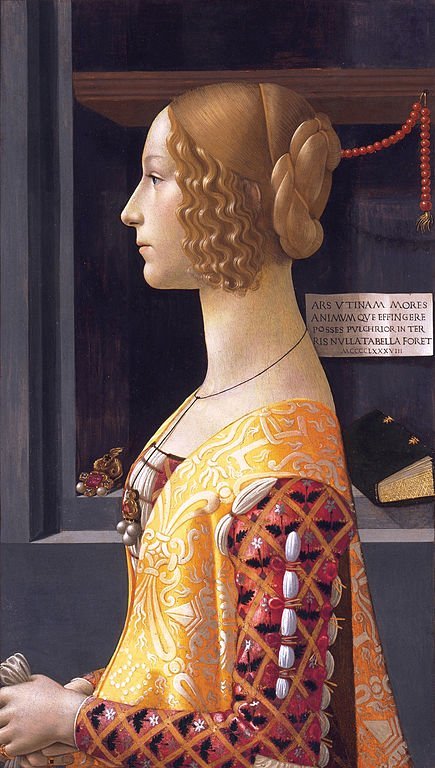
Portrait of Giovanna degli Albizzi Tornabuoni by Domenico Ghirlandaio

Portrait of Giovanna degli Albizzi Tornabuoni by Domenico Ghirlandaio (1488)

When you walk around an art gallery I wonder how long you spend in front of each painting.  I suppose it depends on the type of painting and whether it is part of a crowded special exhibition when you are jostled from one painting to the next by a crowded sea of viewers.  I suppose it also depends on your time management as if you are coming to the end of your allotted time you tend to jump from one picture to the next in a desperate attempt to not miss a single one, although in a way your hurried state probably means that the last few painting remain just a blur in your mind.   So why do I ask this question about time management and carefully appreciating the paintings before us?   The answer is that during a recent visit to the Thyssen-Bornemisza Museum in Madrid I had left the room, which housed the fifteenth century art collection till last and I was constantly aware that my time at the museum was running out.   I found myself flitting from one painting to another and I have to admit by doing so I failed to take in the beauty of the works in that section of the gallery.   That was until I came across two stunning works which I could hardly drag myself away from.  They were just such beautiful paintings.  Yes, I know beauty is in the eye of the beholder but for me they were truly exquisite.   I stood before them, totally mesmerised by their intrinsic charm and so I am dedicating my next two blogs to those two 15th century works. 

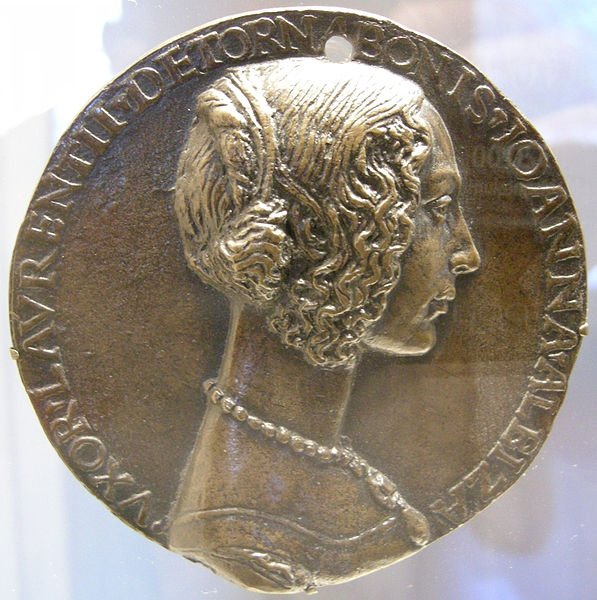
The Wdding Medalion
The Wdding Medalion

Today I want to offer you a beautifully crafted portrait by the 15th century Italian artist Domenico Ghirlandaio entitled Portrait of Giovanna degli Albizzi Tornabuoni which he completed in 1490 and which is now part of the permanent collection at Madrid’s Thyssen-Bornemisza Museum.   Giovanna was the wife of Lorenzo Tornabuoni who came from the wealthy Florentine banking family and whose father, Giovanni was Domenico Ghirlandaio’s patron.  We know this is the image of Giovanna as at the time of her marriage to Lorenzo a series of bronze portrait medals with her image were made to commemorate the event and the likeness of the figure on the medal and in the painting is undeniable.   Lorenzo and Giovanna married in June 1486 but sadly she died giving birth to her second son in 1488, at just twenty years of age.  As the portrait was completed after she died, it is thought that it could be looked upon as a kind of remembrance painting.   The painting hung in her husband’s private rooms in the Tornabuoni Palace.

We see Giovanna before us, half-length, in a somewhat rigid profile.  In her hands she clasps a handkerchief.  Giovanna is dressed in the most sumptuous way.  She wears a giornea which is an open-sided over-gown, which is brocaded.  The design on the brocade features the letter “L” and a diamond.   The “L” is her husband, Lorenzo’s initial and the diamond was the Tornabuoni family emblem.  There is no doubt that she is one of Florence’s élite by the way she wears her hair in the very latest Florentine fashion.  The jewels she wears around her neck comprise of two rings and pendant which were given to her by Lorenzo’s family as a wedding gift.  If you look closely at the pendant she wears you will also notice a matching brooch designed in the shape of a dragon which lies on a shelf behind her.   The jewel with its dragon, two pearls and a ruby formed a set with the pendant hanging from a silk cord around her neck.   Behind her, on the shelf, is a prayer book which is thought to be the libriccino da donna (little ladies’ book).  Above the book hangs a string of coral beads which have been identified as a rosary.   Ghirlandaio’s inclusion of this prayer book and the rosary in the painting was testament to Giovanna’s religious beliefs and her piety. 

What did Ghirlandaio think of his sitter?  Will we ever know?  Actually the answer lies within the painting itself because just behind Giovanna’s neck we can see attached to the shelf a cartellino.   A cartellino (Italian for small piece of paper) was a piece of parchment or paper painted illusionistically, often as though attached to a wall or parapet in a painting.  On the cartellino added by Ghirlandaio in this painting are the words:

ARS UTINAM MORES

ANIMUMQUE QUE EFFINGERE

POSSES PULCHRIOR IN TERRIS NULLA TABELLA FORET


which translates to:


“…Would that you, Art, could portray her character and spirit ;  for then there would be no fairer painting in the world..”.

At the bottom there is the date:

“MCCCCLXXXVIII”. (1488)

By these words there is no doubt Ghirlandaio is excusing himself to Giovanna for his belief that he has not been able to show her real inner beauty.  These are fine words from our artist but in fact they were not quite his own as they are a slight variation on the words of an epigram (a short and concise poem) of the Latin poet Marcus Galerius Martial, whose works were all the rage with the Florentine aristocracy of the day.

My featured artist today was born Domenico di Tommaso Curradi di Doffo Bigordi.  The name was derived in part from his father’s surname Curadi and the surname of his grandfather Bigordi.  He was born in Florence in 1449, the eldest child of Tommaso Bigordi and Antonia di ser Paolo Paoli.  His father was a goldsmith and was well-known for creating metallic garland-like necklaces which were worn by the ladies of Florence, and it was for that reason that Domenico was given the nickname Il Ghirlandaio (garland-maker).   Domenico worked in his father’s jewellery shop and it was during his time there that he started sketching portraits of customers and passers-by.   According to the famous biographer of artists, Giorgio Vasari, Domenico’s father decided to afford his son some formal artistic training and had him apprenticed to the Florentine painters, Alesso Baldovinetti and later Andrea del Verrocchio.

Domenico will always be remembered for his exquisite detailed narrative frescos in which he would incorporate portraits of the local aristocracy resplendent in their finery.  Many of his frescos appeared in local Florentine churches.  In 1482, he also completed a Vatican commission for Pope Sixtus IV – a fresco in the Sistine Chapel entitled Calling of the First Apostles.  The frescos he will probably be best remembered for were two major fresco cycles, which he completed with the help of his brothers, Davide and Benedetto along with his brother-in-law, Bastiano Mainardi, who was one of Domenico’s pupils.


The Resurrection of the Boy by St. Francis by Girlandaio
The Resurrection of the Boy by St. Francis by Ghirlandaio

The first of these frescos was for the Sassetti Chapel in the church of St Trinita in Florence.  It had been commissioned by Francesco Sassetti, a rich and powerful banker who worked for the Medici family.  This cycle of frescos was in six parts and depicted the life and times of St. Francis of Assisi, who was Sassetti’s patron saint. Seen within the frescos were a number of portraits of members of the Sassetti family along with some of the leading figures from the Medici family.  To look at the two families within the frescos one would be forgiven for coming to the conclusion that the Sassettis and the Medicis were very close, which of course was precisely the allusion Francesco Sassetti had wished to convey.  Alas for him, the close bond between the two families was all in his mind!

Visitation by Domenico Ghirlandaio

The second fresco cycle, Ghirlandaio’s last, and many art historians believe was his greatest, was commissioned to decorate the Capella Maggiore of the Santa Maria Novella Church in Florence by another banker, Giovanni Tornabuoni, who was related by marriage to the Medicis.   There was a connection between the two fresco cycles as Sassetti had the rights to decorate the Capella Maggiore of the Santa Maria Novella Church and he had wanted to have the frescos in the church depict the life of St Francis.   However the church was in trust to the Dominican order and they refused to allow such a design, so it was then that Sassetti decided to have the St Francis frescos painted instead in the Sassetti Chapel of the St Trinita Church in Florence and he sold the rite to decorating the Capella Maggiore to Giovanni Tornabuoni

 Ghirlandaio had not even completed the Sassetti fresco cycle when he was given this second large scale commission and he had to bring in most of the workers from his large Florentine studio to help him in this four-year project which was finally completed in 1490.  

The reason for talking about this fresco cycle is that I want you look closely at Ghirlandaio’s fresco, the part entitled Visitation.  Look at the third woman from the right.  Do you recognise her?   It is a full length portrait of Giovanna Tornabuoni who was the wife of Lorenzo Tornabuoni whose father, Giovanni was the commissioner of the fresco work and who was also my subject of today’s featured work.

The painting had a number of owners but in 1907 the American millionaire financier and philanthropist and founder of the J.P. Morgan bank,  J. Pierpont Morgan bought it in 1907.  It is believed that he adored the painting as it reminded him of his first wife, Amelia Sturgis, who like Giovanna had died very young.  She died of tuberculosis at the age of twenty-six, just four months after she and J.P. had married.   It entered the Thyssen-Bornemisza collection from the Morgan Library, New York, in 1935.

Whereas J.P. Morgan had his painting on view in his home to remind him of his wife I have a print of it on my breakfast room wall to remind me of Giovanna’s beauty as I serve guests with their breakfasts.

Frederic Edwin Church, Part 2

For those of you who have just landed on this page I suggest you go back to my previous blog which looks at Frederic Church’s early life and talks a little about his exhibition at the National Gallery, London which I visited last week.

Our Banner in the Sky by Frederic Edwin Church (1861)

Another beautiful and moving historical painting by Frederic Church which was on display at the exhibition and which I found very moving was a small oil painting entitled Our Banner in the Sky which Frederic Church completed in 1861.  I stood before this work, fascinated by the way in which Church had cleverly depicted the image of the Stars and Stripes American flag in tatters against an amazing daybreak landscape with its red and white bands of clouds.  Church had painted this shortly after the attack on Fort Sumter by General Beauregard and his Confederate troops in January 1861 , which signalled the start of the American Civil War, which tragically went on to cost so many American lives.   In the work we see a bare and tall tree slightly leaning over, which acts as a flagpole for the flag which blends in with the early morning sky.  In it, we see the North Star depicted through a patch of blue sky.  Church has cleverly managed to create a highly patriotic scene which in some ways connects the American landscape with the Northern cause.  It was a heartfelt cry for unity which sadly was not listened to. It was such a popular work that the Manhattan art dealer, Goupil & Co. commissioned Church to produce a chromolithograph of the work and, within a few months, hundreds of copies were bought up by the public.

Isabel Carnes Church by Frederic Church (1860)

It was during the New York exhibition of his Andes painting that Frederic Church met Isabel Carnes.  In 1860 just three months before his marriage to Isabel, Church bought some 126 acres of farmland, close to the towns of Hudson and Catskill and situated on a south sloping hill, overlooking the Hudson River.  He was familiar with this site as he had visited the area whilst on a painting trip with Thomas Cole in 1845.   As he still lived in New York, this new acquisition would be the family country get-away.   Church employed the foremost architect of the time, Richard Morris Hunt, to construct a cottage and design this ferme ornée.  The term means an ‘ornamented farm’, and describes a country estate laid out partly according to aesthetic principles and partly for farming.  Church and his wife referred to the small cottgae on the estate as their Cosy Cottage and it was surrounded by gardens and orchards and Church even had a section of marshland drained so as to build his own expansive ten acre lake.  Over time he bought up more of the adjoining land and eventually his estate encompassed 250 acres.

Fern Walk, Jamaica by Frederic Church (1865)

He and his wife lead a settled and happy life and he spent most of his time tending to his farm but his happiness was shattered in March 1865 when both his young children contracted diphtheria and died a week apart.  In an attempt to counteract the intense grief suffered after their children’s death, he and his wife along with some friends travelled to Jamaica where, for five months, Frederic immersed himself in a painting frenzy whilst his wife collected numerous species of ferns which she would later bring back home and which would form part of her fern garden.  Isabel’s interest in ferns and Frederic’s love of depicting nature in his painting were combined in his 1865 work entitled Fern Walk, Jamaica in which Church depicts a narrow path winding through luxuriant plants and ferns.  The shades of greens and browns which he used in depicting the native flora is breathtaking.  Frederic Church loved his stay in Jamaica.  He loved sketching plein air in the tropical light and, on his return to America, would often encourage other landscape artists to venture on painting trips to the Caribbean island.  In a letter he wrote to the landscape artist, Charles de Wolf Bramwell, he extolled the Fern Walk area of the island, writing:

“…the vegetation, next to that on the Magdalena River, the finest I ever saw –– The ferns, especially in the region known as Fern Walk — excelled every place…”

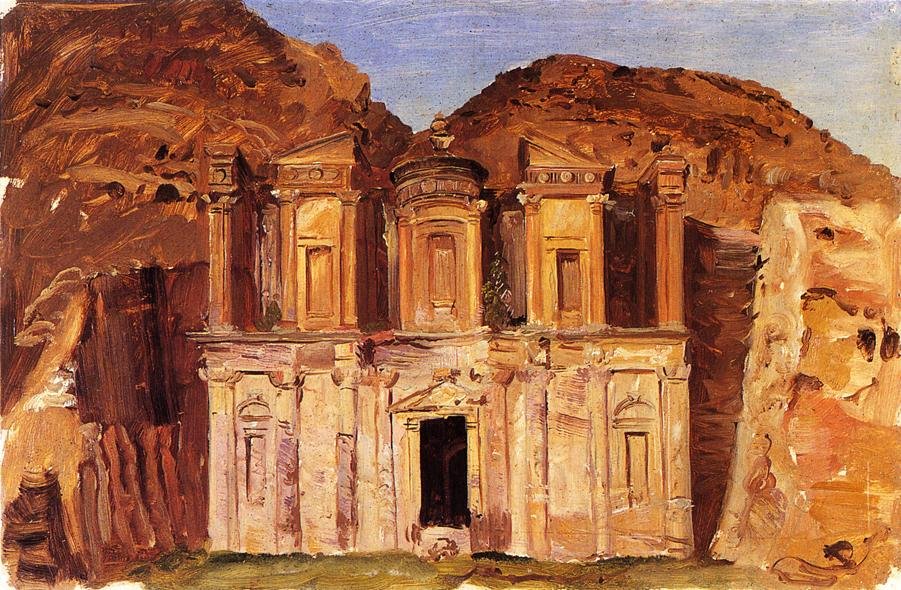
Ed Deir, Petra Jordan by Frederic Church (1868)

The couple returned home from Jamaica and in 1866 Isabel Church gave birth to a son, Frederic Junior.   The following year Frederic and Isabel, along with their son and Isabel’s mother, set off on a two-year long journey of Europe and the Holy Land.   They visited Jerusalem and from there headed to Jordan where Church, after an arduous ten day journey by mule, arrived at the ancient city of Petra.  During the long trip Church continually sketched and painted.  It was a trip which was fraught with danger from not only local bandits, but from the native porters which were helping Church’s party get to their destination.  These Arabs were very superstitious about his sketching but were eventually won over by his skill.  He finally arrived at Petra and made the long climb up above the city to the monastery of Ed Deir, which in the first century AD was a Nabatean temple.   Frederic Church completed his beautiful oil and graphite painting entitled Ed Dier, Petra, Jordan,   Unbelievable at it may sound but Church completed the work in just one sitting, in 1868.

Königsee by Frederic Church (1868)

From the Holy Land, Frederic Church returned to Europe visiting Rome and Athens and also the Bavarian Alpine region, Switzerland and Austria which had always been a popular venue for landscape painters.  Church was drawn to this area as he was always searching for beautiful vistas to paint.   He liked the area as he believed there was a marked similarity between the geography of the area and that of the rugged American landscapes which he knew so well.  In July 1868 he visited the Königsee, the beautiful Upper Bavarian lake which nestles amongst steep-sided cliffs.  Sheltered from the weather,  the surface of the lake is often mirror-like reflecting the surrounding mountains.   He completed a beautiful work entitled Königsee that month and it is a poignant reminder to me of the times I have visited the lake and stood in awe before it, mesmerised by its beauty.

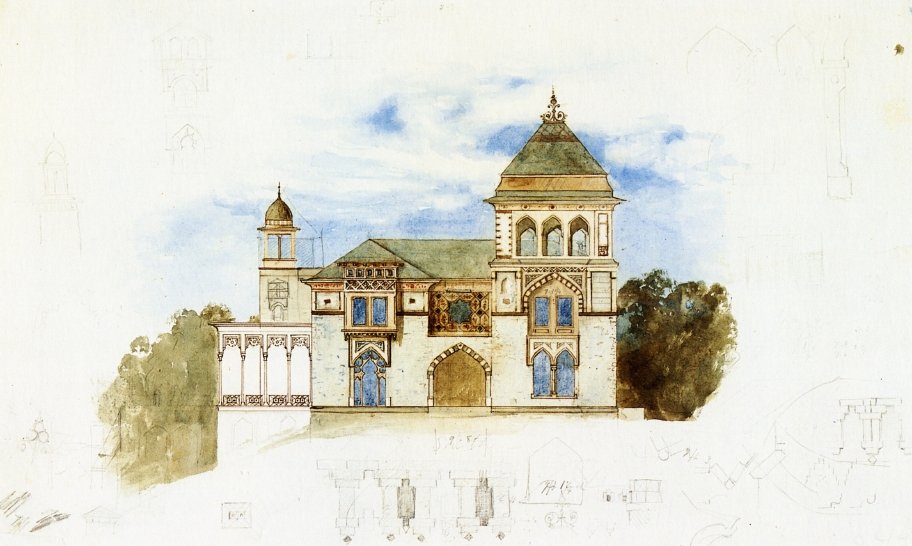
South West Facade of Olana by Frederic Church (1870)
South West Facade of Olana
A watercolour by Frederic Church (1870)

Frederic Church in 1867 was becoming homesick and wanted to return to America and his country estate.  Since he bought it seven years earlier he had been constantly planning the landscape design for the land and the architectural design for a large house on the top of the hill.  Richard Morris Hunt, his architect, had submitted plans for a large French chateau-style house and Church had liked the idea and agreed to the design.   However having returned from his tour of the Levant and studied the architecture of the area, he changed his mind.  He decided to discharge Hunt and take on the British-born American architect and landscape designer Calvert Vaux who was based in Manhattan and had in 1858, along with Frank Law Olmstead had won a design competition to improve and expand New York’s Central Park.

Olana Historic Site
Olana Historic Site

Frederic Church and Vaux worked on the plans for the design of the house which was to be the centrepiece of  Church’s estate, which he and his wife Isabel named Olana after a fortress-treasure house in ancient Persia which like Church’s estate also overlooked a river valley.  The building project was completed in 1872.

As Church got older he spent more and more time on his farm and concentrated his time running the estate.  From the 1870’s onwards Church suffered badly from rheumatoid arthritis which badly affected his right arm curtailing much of his art work although he did teach himself to paint with his left hand.  Frederic Church died in 1900, aged 74 and is buried in Spring Grove Cemetery in Hartford, Connecticut.

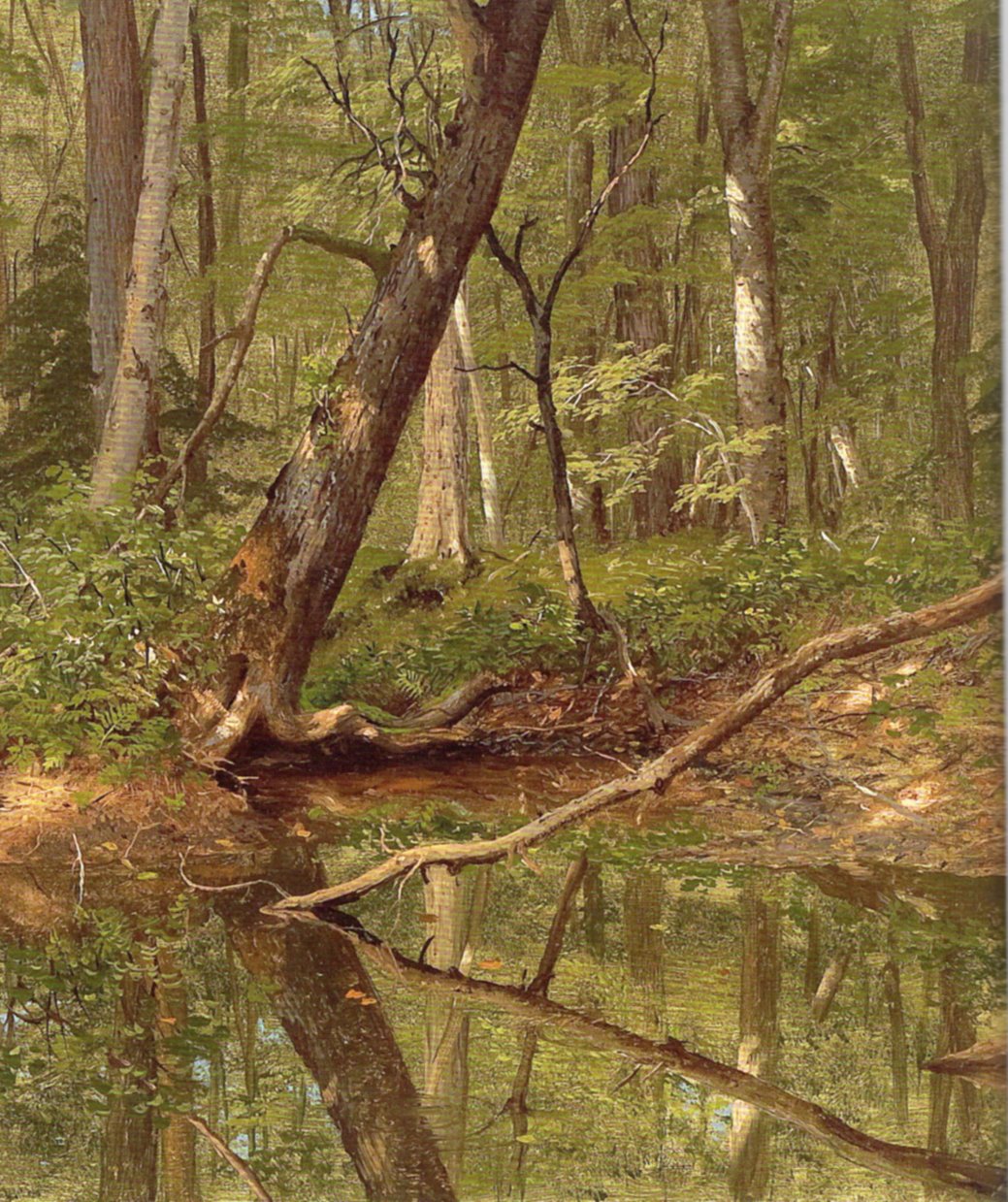
Forest Pool by Frederic Church (1860)

I will finish this blog with a look at the painting by Frederic Church, which most impressed me at the exhibition.  It is entitled Forest Pool and was completed by Frederic Church around 1860.  It was almost the first work I came across as I entered the exhibition room and I had to keep coming back to it in order to savour its beauty.   I stood before it and could not believe the quality of the painting.  Such beautifully drawn details.  Such beautiful colour and tones.  The work was a close-up view of a dense forest and a small forest pool.   Every square inch of the work is covered in rich shades of green and brown and although it was a study for a larger painting, it seems as if it is a finished work.  The artist has delightfully depicted the tranquillity of the forest scene with the calm surface of the pond offering up reflections of the trees and their branches and spots of sunlight.  If you look closely at the upper middle part of the composition you will just be able to make out a hint of blue sky which is otherwise blocked by the screen of trees.

The Frederic Church exhibition at the National Gallery is worth going to see for this painting alone.

“Moonlights” by John Atkinson Grimshaw

Moonlight, Wharfdale by Atkinson Grimshaw (1865)

Today I am featuring some works by the English Victorian painter John Atkinson Grimshaw, who was born in Leeds in 1836.  His father, David, at various times during his life, served as a policeman, worked for Pickfords and then as a Great Northern Railway worker in Leeds.  His mother was Mary Grimshaw née Atkinson.  John Atkinson Grimshaw was the eldest of six children.  He and his siblings were brought up in a very religious household with both his parents being strict Baptists.  He left school at the age of sixteen and became a clerk at the Great Northern Railway headquarters in Leeds.  It was whilst working and living in Leeds that he was able to visit one of the many art galleries and see the works of some of the Pre-Raphaelite painters such as Holman Hunt and Henry Wallis.  He also loved and was influenced by the works of the Leeds-born Pre-Raphaelite landscape artist John William Inchbold.   While he was employed as a clerk much of Atkinson’s free time was taken up by his love of art.  He was a self-taught artist who received no formal training.

In 1857 Atkinson Grimshaw married his cousin Frances Theodosia Hubbard and the couple went on to have twelve children although sadly only six survived to be become teenagers.  Of those who survived, many went on to become artists like their father.  In 1861, much to his parents’ horror Grimshaw, gave up his work at the railway company and decided to become a professional artist.   He first exhibited som of his art work in 1862 and at this time he had concentrated on still life works depicting fruit and blossom and some paintings of birds.  He also managed to gain his first commissions from the Leeds Philosophical and Literary Society.  Over time, Grimshaw developed his own highly individual style, and subject matter.   He became a talented painter of autumnal scenes and also works which depicted twilight and night time scenes, lit by moonlight reflected on the wet cobbled streets, sometimes depicting horse-drawn traffic and handsome cabs.  These were known as his “moonlights”.  His paintings would often depict street scenes swathed in fog and smog from pollution that so often enveloped cities and towns at that time.

Shipping on the Clyde by Atkinson Grimshaw (1881)

 He also painted many nocturnal harbour and dockyard scenes with the spiky outlines of the ships’ masts rearing up against a darkening sky.  Examples of this type of work can be seen in his paintings such as Liverpool from Wapping (1875), Nightfall down the Thames (1880),  Shipping on the Clyde (1881),  The Thames by Moonlight (1884),  Liverpool Quay by Moonlight (1887) and Prince’s Dock, Hull (1887).   Grimshaw’s works were more varied than just this as he painted many portraits, fairy pictures, and the most elaborate pictures of attractively dressed young women in opulent interiors.  During his early period he signed his paintings “J.A. Grimshaw” or “JAG” but in 1867 Grimshaw dropped his first name, John, and from then on signed his works “Atkinson Grimshaw”.

Atkinson Grimshaw always considered himself to be a Northerner, a Yorkshire man and Leeds, for most of his life, remained his base.  Grimshaw rarely travelled to London although he did set up a studio and live there for a short time in the mid 1880’s, and it was during this time he became friends with James McNeil Whistler.  His reputation as an artist was further enhanced when one of his paintings was accepted for exhibition at the Royal Academy.   However the fact that over the years, he only ever submitted five of his paintings to the Royal Academy  probably meant that he set little store by what the RA could do for him and he knew he had numerous northern business men queuing up to buy his work.  Over time, he slowly built up a large clientele for his work, including some London art dealers, especially the William Agnew Gallery, and with this artistic success came wealth, so much so that in 1870 he was able to move his family into Knostrop Hall on the outskirts of the city.

Knostrop Old Hall, Leeds by Atkinson Grimshaw

Knostrop Hall was a magnificent 17th century stone-built manor house, which featured in many of his paintings.  He also had a house in Scarborough for use in the summer.  He called it Castle-by-the-sea.

Atkinson Grimshaw died of cancer in October 1893 at Knostrop Old Hall, and was buried in Woodhouse cemetery in Leeds. He was especially appreciated by middle-class clients, many of whom were northern industrialists.   Grimshaw’s dock scenes of Liverpool, Hull and Glasgow, and the manor houses seen at the end of leafy, stone-walled suburban lanes, along which a single figure walks, were especially popular.

Atkinson Grimshaw had campaigned for a number of years for the building of Leeds City Art Gallery.  After much wrangling and a prolonged struggle with the authorities the Leeds Art Gallery opened in October 1888 and was financed by public subscription, collected in honour of Queen Victoria’s Golden Jubilee in 1887. The artist Hubert Herkomer formally opened the building, and presented an example of his work to the collection.  The Gallery mounted annual spring exhibitions in which Grimshaw always put forward works for inclusion.

 Atkinson Grimshaw had a unique style and is remembered as one of the minor Victorian masters and his place in art history will be assured by his depiction of Victorian life and his haunting moonlight which became his trademark.

Having said that, there was an element of controversy about his work.  As I said at the start of his biography, Atkinson had not received any formal artistic tuition, got married at the age of twenty-one and four years later despite now being a family man, had given up his job as a railway clerk to become a professional artist.  He had now to make money from his art work and to do this had to reach a level of artistic competence which would guarantee that his work would sell.  So how did he achieve such a feat?   John Ruskin, the art critic had recommended that artists should paint directly from nature but to do this one had to have had some training in draughtsmanship and perspective and so Atkinson Grimshaw in a way decided to “cheat”.   He discovered that by projecting a photograph or a lantern slide on to a blank canvas he was able to produce an immediate composition.  Then he would go over the outlines in pencil.  Over which he would add colours and the end result was a glossy finish which had removed all traces of the pencilled outline.  The finished landscapes and cityscapes sold well and for a time made him very wealthy.  However despite his success, other artists who had studied and trained in traditional academic methods for years despised his productions and in one of Grimshaw’s obituary notices it was written:

  “…[his pictures] excited considerable controversy among contemporary artists, not a few [of whom] were doubtful whether they could be accepted as paintings at all…

To be fair to Grimshaw the technique he used would not have caused such controversy nowadays and the question remains, does the end justify the means?  So let me finish with a kinder obituary notice which simply stated:

“…A Leeds artist of very great ability has passed away.  He may be regarded as self-taught in all that gave character and distinction to his art. His methods, treatment and colouring were quite unlike anything in ordinary practice…”

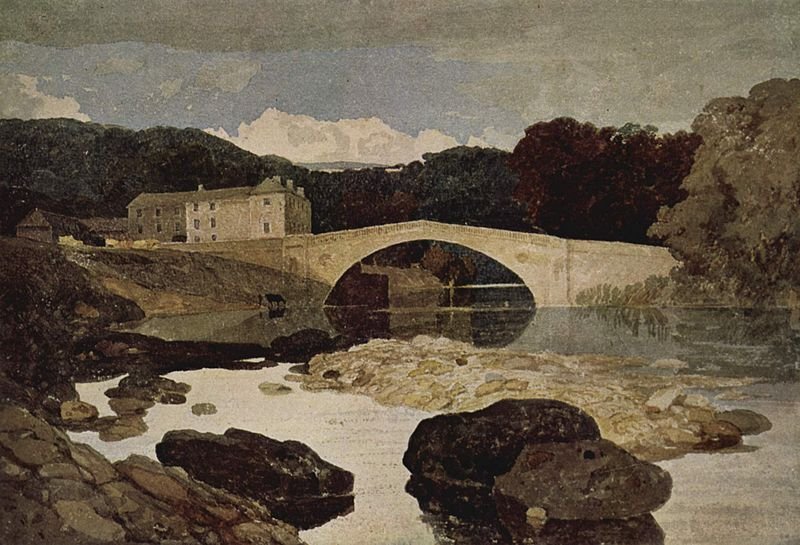
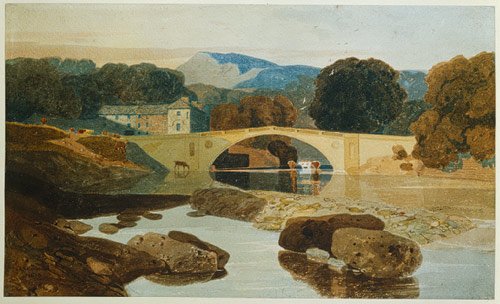
Greta Bridge by John Sell Cotman

Greta Bridge by John Sell Cotman (1805)British Museum
Greta Bridge by John Sell Cotman (1805)
British Museum

I try to visit my children, who live in London, every couple of months and take the opportunity to visit new art exhibition at one of the many city galleries.  As they are all away on extended breaks in far-off lands I will not be heading south until the end of January and this will sadly mean I will miss the Dulwich Picture Gallery exhibition, Cotman in Normandy which is an exhibition of works by the watercolourist, John Sell Cotman, which ends on January 13th.  For most of the twentieth century, Cotman was the most widely admired English watercolourist, surpassing even Turner in popularity.

John Sell Cotman was a marine and landscape painter, mainly in watercolour, who was born in Norwich in 1782.  He was the eldest of ten children.  His father, Edmund Cotman, formerly a barber but latterly a draper by trade, had married Ann Sell.   He initially studied at the Norwich School, which is one of the oldest schools in the world having been founded in 1096.   John’s father had intended that once his son had completed his education he would join him in his family business.  However during his time at school John Cotman had developed a love of art and being determined that he would not spend his working life behind a shop counter, at the age of 16, left home and went to London to study art.

Whilst in London he managed to earn a living by colouring aquatints for Anglo-German lithographer and publisher, Rudolph Ackerman, who in 1795 established a print-shop and drawing-school in The Strand.   Ackermann had set up a lithographic press and begun a trade in prints. It was whilst he was in London that he also met Doctor Thomas Monro, who was an avid art collector.   He was Principal Physician of the Bethlem Royal Hospital and one-time consulting physician to King George III.  Besides being an amateur painter and art collector he was also a patron to a number of young aspiring artists including Thomas Girtin.  He had a house in Adelphi Terrace, London where he had his studio and a country house in Merry Hill, a suburb of Bushey just fifteen miles from the capital.  Monro liked to surround himself with other artists and J.M.W. Turner was a frequent visitor.  He ran an art Academy where he would offer evening art classes, some of which were attended by John Sell Cotman.

John Sell Cotman managed to gain the patronage of Monro and through him met many of the leading British artists of the time and it was through his friendship with Turner, Girtin and Peter de Wint that Cotman continued his artistic development.  He enjoyed taking trips out to sketch and it is believed that in 1800 he accompanied Thomas Girtin on a sketching trip to North Wales. Considering Cotman had had no formal art tuition it is amazing the artistic standard he had reached for someone of such a young age for when he was aged just eighteen, he first exhibited at the Royal Academy  showing five works, four depicting scenes from the Surrey countryside and one was of Harlech Castle.   The following year, 1801, John Cotman joined the Brothers, a sketching society, founded by Thomas Girtin, for both professional artists and talented amateurs. During the next two summers he spent much of his time travelling around Wales, sketching scenes many of which were exhibited at the Royal Academy in 1801 and 1802.

For the next three summers John Cotman spent time at Brandsby Hall in North Yorkshire, which was the home of Francis Cholmeley, an avid art collector and a patron of Cotman.  During his stay at the Hall, Cotman acted as the drawing tutor to the Cholomeley family.  Whilst there he also met the politician and art collector, Walter Ramsden Hawkesworth Fawkes, whose stately home was Farnley Hall and who was a very close friend of the artist, J.M.W. Turner who often stayed at Farnley Hall.

The success he had hoped for in London never materialised and in 1806 Cotman returned to his hometown of Norwich and earned his living as an art tutor.  On returning home he also joined the Norwich Society an art society formed the previous year by the Norfolk landscape painter John Crome.  This society met fortnightly, held artistic discussions and organised exhibitions of their work.  John Cotman became the vice president and he and Crome were the leading lights of the society.  The ethos of the Society was laid down as being:

“…An Enquiry into the Rise, Progress and present state of Painting, Architecture and Sculpture, with a view to point out the Best Methods of study to attain to Greater Perfection in these Arts…”

The artistic styles of Crome and Cotman were different and the Society members were, to some extent, divided into those who followed Crome’s realist manner, and those working in the more free style of Cotman, who was not above painting pictures of places he had not personally visited, working from other artists’ sketches.  The subjects of the Norwich School painters were typically landscapes, coasts and marine scenes from around Norwich and Norfolk.  John Cotman became president of the Norwich Society of Artists in 1811.

In 1809, Cotman married Ann Mills, the daughter of a farmer from the nearby village of Felbrigg and the couple went on to have five children.  During his time as a drawing master he taught the local banker, botanist and antiquary Dawson Turner and his children.  They became close friends and Dawson Turner introduced him to many prospective students. Cotman issued the first of his sets of etchings in 1811. He moved from Norwich and for the next ten years he lived in the Norfolk coastal town of Yarmouth and this gave him the opportunity to complete a number of seascapes.   It was around this time that Cotman concentrated on printmaking.  The majority of his etchings were architectural in nature, with numerous ones of old Yorkshire and Norfolk buildings.  It is more than likely that this move towards etchings and printmaking was due to, and inspired in part by, his friend and patron, Dawson Turner.   In 1817, Cotman , with help from his patron, made the first of three tours of Normandy and out of these journeys came a book in 1822 entitled, Architectural Antiquities of Normandy, one of various books he illustrated with his etchings.

In 1824, for business reasons he moved back to Norwich.  Cotman took up painting again with renewed energy, in watercolour and in oil; he exhibited more frequently in the city and also in London. In January 1834, through the good auspices of J.M.W.Turner, he gained the post of Master of Landscape Drawing at King’s College School in London, which he held until his death.  He and his family moved home to the London borough of Bloomsbury. Two years later, his eldest son Miles Edmond Cotman was appointed to assist him.  The taking up of the position at King’s College could not have come at a more fortuitous time as Cotman was beginning to have financial problems.   Sadly, with these financial problems, which had afflicted him during most of his working life, came bouts of depression, ill health and despondency brought on by the poor sales of his work.  During John Cotman’s tenure at King’s College he taught many artists including Dante Rossetti.  His last visit to his homeland of Norfolk was in the autumn of 1841, just nine months before his death in London in July 1842.

The 20th century art historian and painter, Charles Collins Baker, said of John Sell Cotman:

“…a great colourist, whose earlier palette produced that rare plenitude that only masters of exquisite simplicity and restraint compass: from his palette the brown glebe, the black reflection of massed trees in a still river, the grey and gold of weathered stone and plaster, the glinting gold on foliage and the gilded green of translucent leaves have a special and supernal quality of dream pageants rather than of actuality…”

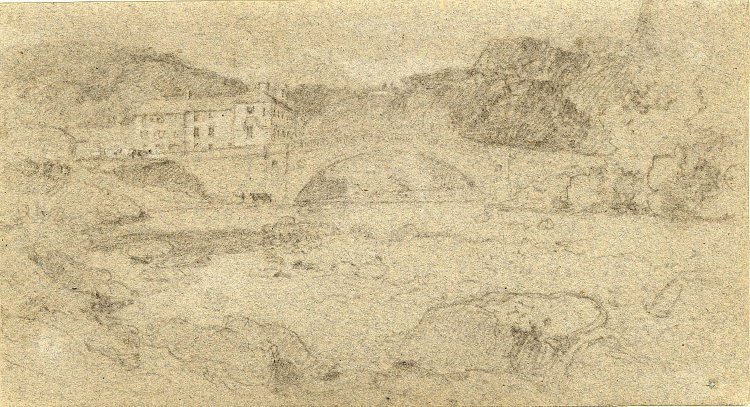
Preliminary sketch of Greta Bridge by John Sell Cotman

My Daily Art Display featured painting today is a watercolour entitled Greta Bridge (22cms x 33cms), which Cotman completed in 1805 can be found in the British Museum. A second version of the painting, a much larger one, (30cms x 50cms), was completed by Cotman in 1810 and is housed in the Norwich Castle Museum.  Both watercolours recreate the rural solitude and tranquillity of the Greta area of North Yorkshire, where Cotman spent the summers of 1803 – 1805.   The Greta Bridge in this painting  spanned the river Greta in North Yorkshire near the gates of Rokeby Park. John Cotman had arrived at Rokeby on the evening of 31 July 1805, accompanied by his friend and patron, Francis Cholmeley. It had been arranged in advance that the two men were to stay as guests of the owner of Rokeby Park, John Bacon Sawrey Morritt.  Cotman stayed at the house for about three weeks and when his hosts left on business, he remained nearby, taking up lodgings in a room at the local inn, which is the large building to the left of the bridge. Cotman then continued the work he had begun along the river Greta that skirts the park.  It is a wonderfully balanced composition depicting the Greta Bridge, with its striking, single arch, which runs horizontally across the picture, in some way dividing it in two and yet uniting it into a single scene.  The arch of the bridge epitomizes a great feat of engineering, which Cotman, with his love of architecture, admired. The structure we see before us was designed by John Carr of York, and built in 1773 for Morritt’s father, John Sawrey Morritt, who was a well-known collector of classical antiquities. The bridge replaced a Roman single-arched bridgeof the same design.  Cotman had a love of bridges and sketched many.  For him, a bridge was a meeting point or landmark for travellers, and would often be a point of reference on maps where rivers and roads meet. Cotman was fascinated by the interaction of this man-made feature and how it harmoniously interacted with a natural setting

Greta Bridge by John Sell Cotman (1810)Norwich Castle Museum
Greta Bridge by John Sell Cotman (1810)
Norwich Castle Museum

The foreground of the painting is dominated by its rocky intrusions. In the background, above the bridge we see in the 1805 version, a forest of trees and  large white clouds and yet in the 1810 version a mountain ridge, which, in reality, does not actually exist, has substituted the individual clouds. So why did he make this fundamental change and add the idealised rocky structure?  It is believed that Cotman decided to add the mountain ridge in the later watercolour so as to strengthen the sense of perspective and by so doing have the viewers eye drawn through the landscape, starting from the rocks in the foreground, through the arch of the bridge to the trees in the middle ground as far as the mountain ridge and the sky in the background.

Although John Sell Cotman and Turner were strongly influenced by the work of Thomas Girtin, Cotman’s landscape style in comparison to Turner’s was different.  Cotman’s landscapes were not as detailed as either Girtin’s or Turner’s.  In his landscapes, Turner’s was more precise with the details.  Many believed his “every-single-branch-and-bud” precision was somewhat overwhelming, and said that the result was that the viewer stared at the same copse for too long.   In contrast, Cotman’s landscapes could be taken in with just a single glance.  In today’s work one can see the beauty of the watercolour despite the lack of minute detail.  In these watercolours, Cotman strived to capture the feeling and atmosphere of a place through the use of pattern and abstract shapes. Look how he has painted the boulders, which we see in the river.  They are smooth, rounded shapes sprinkled with spots of colour.  Cotman’s technique of using colour washes has accentuated the smooth roundness of the landscape.  His trees are rounded and block-like, in varying shades of green and brown and in the 1810 version the mountain ridge in the background is softly shaped.

This watercolour is a prime example of his balanced and sensitive technique which he used in his landscape work.   In this work he has used very muted colours for his high cloudy sky, which echo the colour of the river surface.  Below the dark clouds we see a suggestion of better weather to come with a hint of blue sky and thick white clouds.  The watercolour is built up in distinct patches of restrained colour, held in a precise pattern of tone and line, which were the hallmarks of Cotman’s inimitable style. The presence of the sun and the large trees around the flowing river causes crisp shadows on the building, bridge and water surface.

I love this watercolour and would love to visit Norwich were a number of his works are housed.  It would also be good to visit the Greta River area and take in the landscape, which inspired this talented artist.

Bringing in the Maple Sugar by Grandma Moses

Bringing in the Maple Sugar by Grandma Moses (1939)

Grandma Moses – Part 2

This is the second part of my story about Grandma Moses and if you have just alighted on this page, you should go back to my last blog in which I looked at her early life.

I ended my last blog about Grandma Moses in the year 1927.  This was the year when her husband of almost forty years, Thomas Salmon Moses, died and Anna May Robertson Moses became a sixty-seven year old widow.  Following her husband’s death, she remained on her Mount Nebo farmstead along with her youngest son Hugh, who took over the running of the farm along with his wife Dorothy.  One of Grandma Moses’ other daughters, Anna, lived close by in the town of Bennington with her husband Frank, who was her first cousin, and their two children Walter and Thomas.   Anna had contracted tuberculosis and had become very ill.  Grandma Moses spent a lot of time with her and her family taking care of her two grandchildren.  Anna Moses died in 1933 and Grandma Moses stayed on at their Bennington home for the next two years looking after her son-in-law and his children.  This arrangement continued until 1935, at which time Frank Moses remarried and Grandma Moses was then able to return to her home.

Over those past years Grandma Moses found more time to carry on with her embroidery and needlepoint work.  Once when her sister Celestia came to Mount Nebo for a visit she saw some of her sister’s work and suggested that she should concentrate more on painting rather than embroidery.  This advice, together with the fact that Grandma Moses was suffering badly from arthritis of the hands, persuaded her to heed her sister’s advice and she began to concentrate all her artistic efforts, not in yarn but in oils.

I ended my last blog by mentioning Grandma Moses “big break” as far as her artistic opportunities were concerned.   This came in 1938 when her daughter-in-law, Dorothy persuaded her to let her take some of her embroidered work and painted pictures down to the Woman’s Exchange in the W.D. Thomas drugstore in Hoosick Falls and it was at this point that fate stepped in and took a hand,  for passing through the town during his Easter vacation was Louis Calder, a New York amateur art collector and engineer.  He spotted Grandma Moses’ works displayed in the drugstore window, priced between $3 and $5 and he bought them all.  He then enquired about the artist of his recent acquisitions and went to visit her.  He then bought a further ten of her works.

Louis Calder returned to New York and tried to interest people in Grandma Moses’ works.  There was little interest.  Somewhat despondent Calder had virtually given up hope of re-selling his newly bought acquisitions.  However the following year, 1939, he got to hear about an exhibition being held in the Members Room of the city’s Museum of Modern Art that was to open on October 18th and run for a month.  The exhibition was to be entitled Contemporary Unknown American Painters.  Calder went to the organiser of the show, Sidney Janis and showed him the works of Grandma Moses which he had just bought the previous year.   Janis agreed to exhibit three of the paintings, Home,  Maple Sugar Days and The First Automobile.   None of the paintings sold but Calder was not disheartened and contacted Grandma Moses urging her to produce further works for him.

In the meantime Louis Calder went on searching for prospective buyers for the paintings.  It was at the end of 1939 that he heard of a new gallery, Galerie St Etienne, which had recently been opened by Otto Kallir on Manhattan’s West 57th Street.   In 1938, Otto Kallir, then known as Otto Nierenstein, was one of Vienna’s most prominent Jewish art dealers but had fled the Nazi regime and emigrated to the United States.  He then, in 1939, established his gallery and helped to introduce Expressionism to America.   Later in the 1940’s and 1950’s, Kallir would give numerous important Austrian and German modernists, including Gustav Klimt, Oskar Kokoschka, Alfred Kubin, Paula Modersohn-Becker and Egon Schiele their first American exhibitions in his gallery.   Otto Kallir was known to be interested in folk art and primitive art and so Louis Calder arranged for him to see some of Grandma Moses’ art work.

One of the paintings which Kallir really liked was entitled Bringing in the Maple Sugar and it is this painting which I have featured in My Daily Art Display blog today.   Grandma Moses completed the work in 1839 and it depicts a sugaring-off scene in which people are collecting sap from the maple trees.  It is a winter scene set in a snow-covered clearing and we can see people busying themselves with the task in hand of collecting the precious tree sap to be used in making maple syrup.  Once the sap is collected in the buckets it is carried over and poured into kettles which dangle over fires.  Besides the hard-working adults in the scene, Grandma Moses has added the figures of children happily playing in the snow and waiting for some maple syrup candy which is being prepared by a man on the left who is busily stirring the pot.   To the right of the picture we can see a horse-driven sleigh loaded with timber which will be used to keep the fires burning.  In the left mid-ground we see a team of oxen approaching, pulling their sleigh full of wood.  It is a painting full of activity but what impressed Kallir most of all was not the way the artist had painted the figures, which he considered rather clumsy, but the way she had painted the landscape background.  He commented that although he believed Grandma Moses had never heard of any rules of perspective, she had managed to achieve an impression of depth in the way she had depicted the tall bare trees in the foreground to smaller ones in the background and the clearly outlined larger figures in the foreground to the smaller, hazy-detailed figures in the background.   He also liked how she had almost merged the smoke which billowed and rose from the chimney of the hut and the bluish gray sky of an early morning in winter.  For Kallir it was Grandma Moses’ ability to convey a true atmosphere and a oneness with nature that appealed to him.

Otto Kallir agreed to exhibit Grandma Moses’ works in a “one-man show” at his gallery.  It opened on October 9th 1940 and was entitled What a Farm Wife Painted and consisted of thirty-three of her paintings and one of her embroidered works.  The New York Times of October 8th previewed the exhibition and part of the article read:

“…Mrs Anna May Robertson Moses, known to the countryside around Greenwich, New York, as Grandma Moses, began painting three years ago, when she was approaching 80…”

From that day on Anna Mary Robertson Moses became known as Grandma Moses.