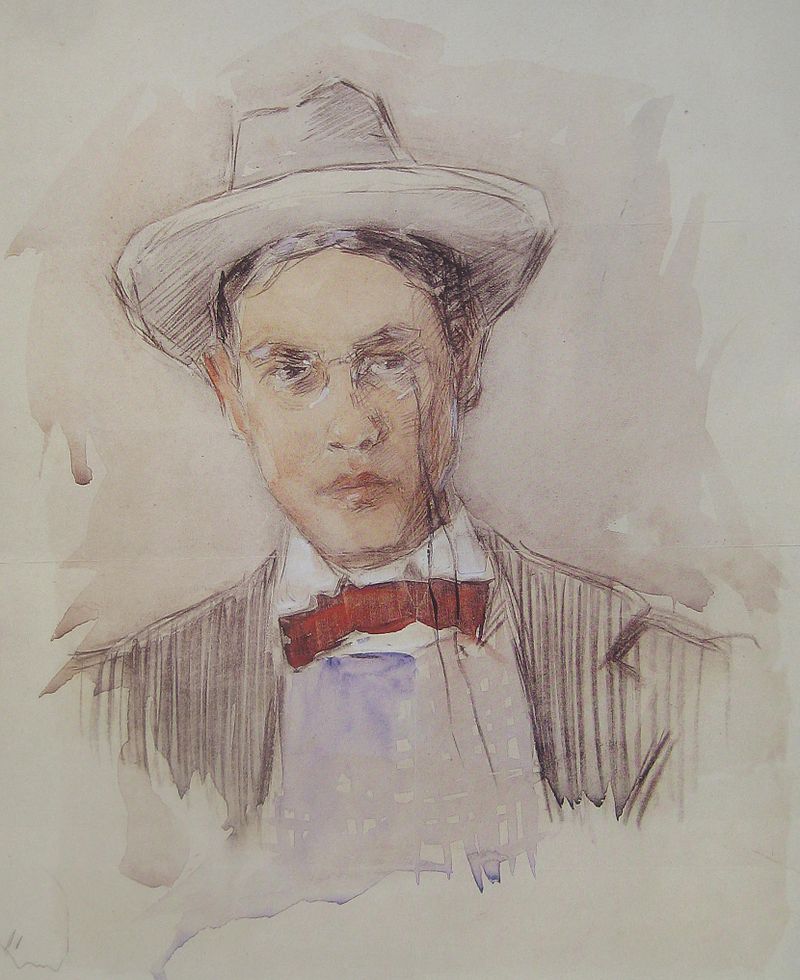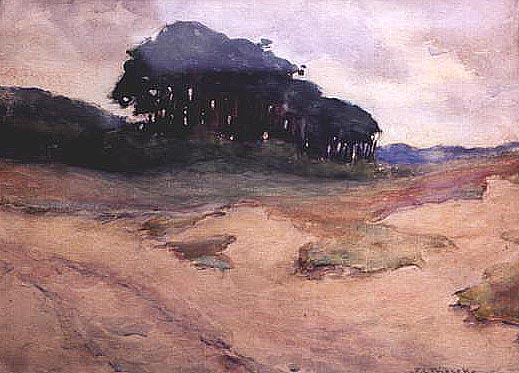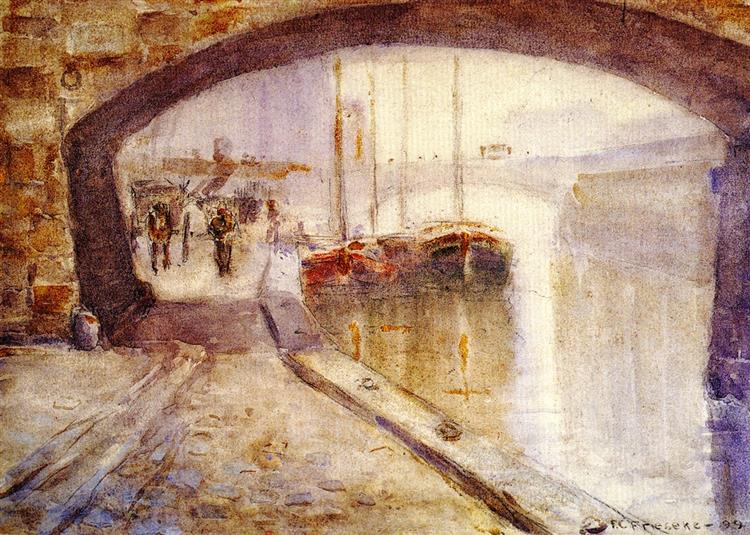
Ivan Fedorovich Choultsé

779648b48202df7819210fa53eb5c0ce

When my featured artist today had an exhibition of his work in London, the London Times summed up his works by saying “it must be seen to be believed”.  In America the art critics designated him as “the magician of light”.  His paintings are extraordinary.  They are magnificent.  Let me introduce you to the Russian landscape and staunch realist painter, Ivan Fedorovich Choultsé.

Sevanavank Monastery on Lake Sevan by Ivan Fedorovich Choultsé

Ivan Fedorovich Choultsé was born in St. Petersburg on October 21st 1874.  His ancestors hailed from Germany but emigrated to Russia in the eighteenth century.  The original spelling of his family name, which was of German origin, was Schultze.  His story was not one of a child dreaming of becoming a professional artist.  His fascination at an early age was electricity and its production through hydro power especially the electricity generated by the Imatra waterfall in South Karelia.  His interest in science was sated by an engineering education, although he continued to convey his creative side and during those early days as a teenager, he would spend his spare time painting small sketches.  He headed up an engineering project in Finland but something went badly wrong and he lost all his money and was declared bankrupt.

Winter Sunset by Ivan Fedorovich Choultsé

Ivan realised he had to earn money from another source and decided to concentrate on his drawing and painting abilities.  Along with his early paintings which he had fortunately not discarded, he approached the academician, famous landscape painter and drawing teacher, Konstantin Yakovlevich Kryzhitsky, who had been a court painter to Tsar Nicholas II and was a painter of miniatures.  His talent was apparent to Kryzhitsky and he enabled Ivan to be admitted to the Imperial Academy of Arts in St Petersburg. In addition to Kryzhitsky, Choultsé was influenced by other tutors, the Russian landscape artist Arkhip Kuindzhi and the Swiss landscape painter Alexander Kalam.  In 1903 Choultsé held his first Academy exhibition which gained him early fame and recognition as a talented artist. His exhibition was a great success and he went on to exhibit his work at other major galleries in St. Petersburg and Moscow.  He was eventually elected as a court painter to Tsar Nicholas II.

See the source image

Park in Neskuchnoye by Ivan Choultse

In 1910 Choultsé embarked on an Arctic painting trip with Kryzhitsky.  They visited the north of Norway and island of Spitzbergen.  From that trip Choultsé produced a number of glorious paintings of the arctic landscape.  In 1910 and 1911 Choultsé lost two of his most influential mentors, Kuindzhi in July 1910 and fifty-two year old Kryzhitsky who committed suicide in April 1911.  Following the untimely death of Konstantin Kryzhitsky, Choultsé had his works shown at exhibitions which had been arranged by the society created by Grand Duchess Olga Alexandrovna, also a student of Konstantin Kryzhitsly, in his name.  Choultsé frequently participated in its exhibitions that took place in the Grand Duchess’ palace on Sergeevskaya street in St Petersburg.

Silver Frost, Engadine, 1910  by Ivan Fedorovich Choultse

Silver Frost, Engadine, by Ivan Fedorovich Choultsé 

Cholutsé reputation as a painter grew as did the sale of his work which was confirmed by the fact that the brother of Tsar Nicholas II, Mikhail Alexandrovich, regularly commissioned his works.  In 1917 the Russian Revolution took place and for Choultsé he had to make an important decision.  He was an academic painter and a supporter of the Academy system which meant staying in Russia under the new regime which was probably fraught with difficulty and so in 1917 he set off on a two-year trip of Europe.  For those two years Choultsé was able to see and depict on canvas the beautiful landscapes of the mountainous regions of Northern Italy, Switzerland and Southern France where he painted the Mediterranean landscapes.

Ivan Fedorovich Choultse view of Engadine

Vers Le Soir, Engadine’ by Ivan Fedorovich Choultsé

It could well have been the snowy Swiss landscape that brought back memories of his homeland or it could have been because he was mesmerised by the panoramic views of the likes of the long high Alpine valley region of Engadine and St. Moritz, but whatever it was, it profoundly affected Choultsé.

See the source image
November by Ivan Choultsé

Choultsé finally settled back in Russia in 1921 as he still held out hope that he could remain a professional artist in his homeland under the new Soviet regime.  He joined the Society of Individualist Artists in St. Petersburg and took part in the society’s first two exhibitions that year. After a while he lost hope that everything would be the same as it was in the pre-Revolution days and finally took the decision to leave his country of birth and go to Paris.  He settled in the French capital in an apartment on the Boulevard Pereire, close to the Porte Maillot and it was here that the second stage of his career as a Russian immigrant began.

See the source image
A Storm on the Horizon by Ivan Choultse (c.1926)

Choultsé artistic breakthrough in Paris came with his first solo exhibition of his work on November 23rd 1922, at the Galleries Gérard Frères.  All fifty of his works were sold on the opening day of the show. This was extraordinary as the artistic environment of Paris was one of an over-abundance with all sorts of artistic offerings and gallery presentations.  However, his success was indicative of the artist’s amazing talent.  He became inundated with painting commissions and often did not have enough time to fulfil all the assignments.

See the source image
St. Moritz by Ivan Choultsé

There is no doubt that Choultsé was influenced by the the snowy Swiss landscape which probably reminded him of his native Russia.  He said that he had fallen in love with the immense vistas of Engadine and St. Moritz.  He was deeply moved by what he saw there and would concentrate on studying the effects of light on nature and by doing this created his best-known themes of beautiful snow-filled landscapes. In 1923, Ivan Fedorovich’s Choultsé’s paintings were exhibited in the Paris Spring Salon.  His works were an amazing success with the public and the art critics alike and he was touted as the most admired artists of the Salon. With all success, there is an element of luck and Choultsé’s good fortune emanated from having contacts with good art dealers and owners of art galleries.  He was represented by the gallery of Leon Gerard, which not only successfully sold his works of art but also regularly arranged his personal exhibitions. In 1927, Choultsé received his French citizenship.

File:Ivan Fedorovich Choultsé, Sailing boat at sunset on the gulf of Finland.jpg
Sailing boat at sunset on the gulf of Finland by Ivan Choultsé (1916)

Success in Europe was soon followed by success in America.   In 1928, Choultsé met Eduard Jonas, who took most of Choultsé’s works to America. Jonas was a prominent figure in French and international art market, owner of exhibition halls and galleries both in Paris and New York, and also offered an exclusive plan of exposing Choultsé’s works in the States. Choultsé was delighted with the opening up of the American market.  In a letter to his daughter, he wrote:

“…”I met a very interesting dealer. And how good it is that now, sitting in Paris, I can sell my work for dollars!…”

A contemporary of Choultsé, the Russian writer and critic, Nikolai Breshko-Breshkovsky wrote about the artist’s newly found fame and fortune in America:

“…In America, Choultsé’s snow and sun paintings are highly esteemed and worth of great price…”.

La Corniche (Côte d’Azur) by Ivan Fedorovich Choultsé 

Although based in Paris, Choultsé  regularly travelled to the Mediterranean and enjoyed painting many summer landscapes around the Côte d’Azur .

Adriatic Sunset by Ivan Choultsé

He also completed many paintings depicting scenes around the Italian coast.

In 1933 Choultsé moved his permanent residence to Nice. One of the last exhibitions of his work was in March 1936 held at the Breton Castle on rue Saint Antoine in Nice. Ivan Fedorovich Choultsé died in 1939, aged 64 and was buried in the Cimetière Caucade in Nice,

Quiet Mediterranean Evening by Ivan Choultsé

The Toronto dealer, G.Blair Laing, wrote in his 1979 book, Memoirs of an Art Dealer that Choultsé “painted spectacular snow scenes in which light seems to come from behind the canvas and glow

In 1935 the New York Hammer Galleries held a jubilee exhibition entitled ‘150 Years of Russian Painting’ and described Choultsé’s reputation as “beloved among American collectors as a great master of snowy landscapes gilded by slanted sunbeams”.

For all my readers who celebrate this festive period may I wish you all a Merry Christmas.

Anna Massey Lea Merritt

Self portrait by Anna Massey Lea Merritt (1910-15)

Sometimes when I am searching for a new artist to write about, I come across a painting which just sticks in the mind and I know I have to learn more about the painter who has delivered such a beautiful depiction.  This blog is a prime example of this modus operandi.

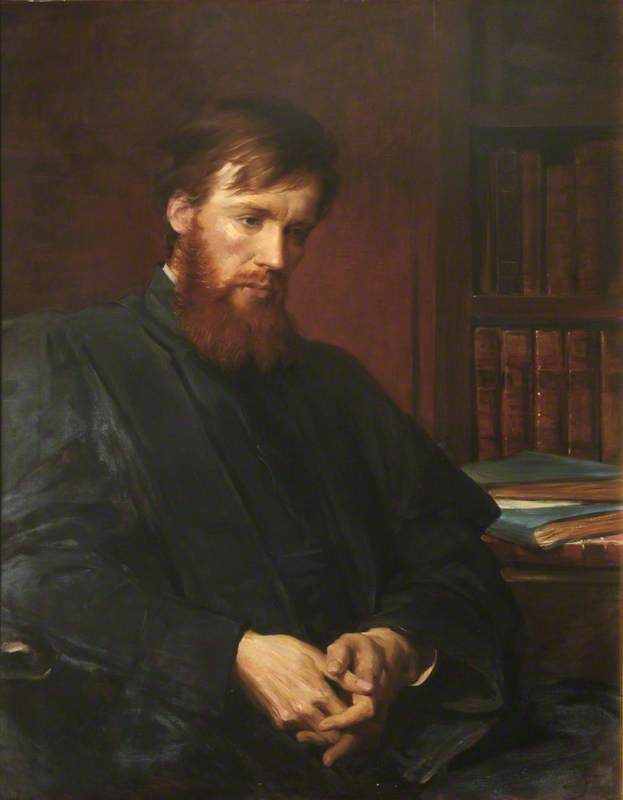
Right Reverend Talbot
Right Reverend Talbot by Anna Lea Merritt (1899)

Today I am looking at the life and times of the American painter, Anna Massey Lea Merritt who spent most of her life painting whilst living in Britain.  Anna Massey Lea was born on September 13th 1844 in the city of Philadelphia. She counted among her ancestors Andrew Robeson, the first Chief Justice of Pennsylvania back in 1693. Anna was brought up in a wealthy Quaker environment and was the eldest of six children of Joseph Lea and Susanna Massey.  Her affluent upbringing allowed her to attend politically progressive schools where she studied classics, languages, mathematics, and music with private tutors.  As far as her artistic upbringing was concerned, she began to study drawing with the portrait painter, William Henry Furness, at the age of seven.   Admission to the prestigious Pennsylvania Academy of the Fine Arts was probably not possible for her but later she studied anatomy at the newly founded Women’s Medical College of Philadelphia.

War
War by Anna Lea Merritt (1883)

In 1867, when she was twenty-three, she and her family took a trip to Europe.  continuing her art studies at the Louvre in Paris, in Rome, and in Dresden with the painter the German painter, Heinrich Hoffman, at the Academy of Art in Dresden. In 1870 Anna was living in Paris.  She was at a boarding school living with her sister but that July the Franco-Prussian War broke out and the Prussian army was marching on the French capital.  Fearing for their safety, she and her family were forced to abandon France and make their way to London.  Rather than return to America with her family she persuaded her father to let her remain in London.  He acquiesced and arranged for her to live with family friends.  However, at their house there was no room for a studio but after searching for a suitable place she found one in the house where Henry Merritt lived. Later in her 1879 biography, Henry Merritt: Art Criticism and Romance, she wrote about the early days in the studio and her timidity towards Henry Merritt:

“…I soon heard that he was a restorer and a connoisseur, but with timidity natural in a woman living alone in a foreign country, I avoided every acquaintance which might seem to arise in an accidental manner. I shut myself into an ugly studio, with a window through which I could look neither on the earth nor into the sky, and produced ugly pictures with no truth in them…”

Henry Merritt

Once Anna had got over her initial shyness, she became quite close to Merritt and took advice from him with regards her paintings.  She offered to pay him for his guidance but he refused stating his “rules”:

“… if I teach you, I must have the right to do it my own way. I must come when I like and scold you as much as I choose, and be altogether my own master if I am to be yours…”

And so he began to critique her work and was often quite blunt as Anna remembered:

“…So it was : how he scolded me ; how ruthlessly he rubbed out again and again the work of days, bidding me do it better ; what pains he took to make me appreciate true points of excellence ! When my work was dry, and had lain by awhile, he would sketch upon it in crayon, de- signing backgrounds or trying various effects of chiaroscuro. No one ever witnessed as I have done his fertility of invention, his refinement of colouring, his variety in touch. Often, he would work thus for a couple of hours, transforming my tame study of a model into a vision. The picture would go through a succession of different effects, any one of which could have satisfied a less imaginative mind. He would then throw down the chalks or the brushes, as the case might be, just give me time to study it, and wash off all he had done, bidding me make another design according to similar laws…”

Over time Anna’s relationship with Henry Merritt changed from Master and Pupil to a more intimate relationship.  Around the winter of 1875 Henry’s health deteriorated and he developed a never-ending cough which he downplayed to Anna saying:

“…It would be impossible to cough so splendidly with weak lungs…..My cough is no better although I have practiced it continually…”

The cough didn’t get better, in fact, it worsened and he began to cough up blood which he tried to ignore using a coloured handkerchief to catch the phlegm and disguise any signs of blood.    In the Spring of 1876 Anna was forced to leave London and travel to America as escort for her younger sister who had to return to the family.  She told Henry that she did not want to leave him but it was her duty to the family but she promised to return in the Autumn.

Anna, once in America, now found herself having to pay for two studios – the one in America and the rent on her London studio and to afford this she had to find some commissions for her work.  All the time Henry was writing to her telling her to concentrate on her art and look for work.   The tone of his letters showed how he had become devoted to Anna.  He would address his letters to:

“My dear little pupil”

In a letter from his Devonshire Street studio, dated May 8th 1876, he tried to ease Anna’s worries that during their enforced separation he would forget her and write words to boost her self-belief.  He wrote:

“…You imagine that I shall forget you. Am I likely after all the trouble I have taken to make a painter of you ? Do we plant fruit trees in order to leave them when the blossoms that are to produce peaches and apples appear ? Some day you will learn to value your many precious gifts better than to surmise that anyone possessing understanding will fail to appreciate a talented girl. Those who have hearts—there are not many—will not fail to see that Anna M. Lea is also a generous girl. I saw it long ago, or I should hardly have taken the trouble to teach her to spread colours upon canvas…”

Portrait of Henry Merritt with a Pipe by Anna Lea Merritt (1877)

Their separation lasted until March 1877.  It was a time when Anna was grieving for two close relatives who had died and it made her more conscious with regards life and death and that Henry was still ill and living alone in London.  It also coincided with having completed a number of lucrative commissions so that she was in the financial position to buy a sea passage to England.

In mid-March 1877, Anna arrived in Liverpool and travelled down to London to see Henry.  A small celebratory party followed.  Of the evening Anna recalled what Henry said to her.  In her 1879 biography of her husband, Henry Merritt: Art Criticism and Romance, she recalled his words:

“…Little Pupil we shall be married.  I cannot part from you again.  I am like a ship at the end of a long voyage, after ploughing the ocean for many a year, become covered with barnacles and all sorts of queer clinging weeds. But I do not see why I should give up our happiness for the sake of ungrateful people, who only think of what money they can get from me. We can still spare something for them, but in time perhaps you will have to defend me from them. You will be happy living in a cottage, as we soon shall, when I show you what a beautiful life it can be made. You are my only true friend, we must never be separated…”

On April 17th 1877 Anna and Henry married privately at St Pancras Church, London.  She was thirty-three years old, he was fifty-five. It was a happy time for the couple.  However Anna was ever conscious that her husband’s facial expression could not mask the pain he was in.  On July 22nd, Henry’s fifty-fifth birthday they drove to Hampton Court and talked about their future plans and buying a small cottage in the country.  Henry’s health took a turn for the worse and Anna recalls those last days with her husband:

“…Suffering became intense, but was never more nobly borne. His constant thought was for me. He feared my fatigue, he-feared my anxiety; but it was my great comfort that he could not spare me from him. No one else could be permitted to wait upon him, and for every trifling service he was so grateful, as though he did not expect to be tenderly nursed. ‘I have borne years of loneliness,’ he said, ‘ but happiness is too much for me.”

Henry Merritt died in July 10th 1877, shortly after his fifty-fifth birthday  and he was buried in Woking and as she promised Henry, Anna had an elm tree planted above his grave. Anna had decided that she would give up painting when she married Henry but now, with him dead, her plans had to change and she survived financially by her portrait paintings and her depictions of Victorian subjects.

Love Locked Out: a nude figure stands with her back to the viewer, leaning against a closed door.
Love Locked Out by Anna Lea Merritt (1889)

Now, I come to that painting I mentioned at the beginning of the blog.  It is looked on as her great masterpiece.  It is entitled Love Locked Out which she completed in 1889.  This painting shows young Cupid, the god of desire, pressed against the door of a tomb. Anna painted it as a memorial to her husband.  The thorny rose around the door frame symbolises the pain of bereavement and the persistence of love. Cupid has abandoned the world, his arrow and extinguished lamp lie on the ground with the autumn leaves. Anna described the depiction as Cupid attempting in vain to force open the door of a mausoleum, as ‘Love waiting for the door of death to open’ so that the ‘lonely pair’ might be once again reunited.  In a way it symbolised her desperate effort to be with her husband in the next life.  The work was exhibited at the Royal Academy in 1890 and is now part of the Tate Britain collection. She was the first woman artist to have a work acquired for the Tate collection. 

The Watchers of the Straight Gate by Anna Lea Merritt (1894)

In 1894 Anna Merritt completed another painting which depicted the two worlds – pre-death and after-death, The Watchers of the Straight Gate is Anna Merritts take on the transition between Earth and Heaven, between the living and the dead. The setting is just inside the gate to Heaven.  The reddish marble columns were reminders to Anna of the columns at the National Gallery, where she sought special permission to bring her canvas so that she could paint them directly, rather than from memory.  The artist has depicted two angels.  One carries a scale on which to weigh the soul of who wishes to enter the kingdom of heaven.  The other angel is seen holding a crown of wild roses with which to welcome accepted souls into glory. If we look between the gate we are offered a view of a verdant landscape transected by a path, which Anna described as depicting the ‘steep road descending to our village’ of Hurstbourne Tarrant in Dorset, where she was living at the time.

In 1890 Anna Merritt moved out of London and settled permanently in the Hampshire village of Hurstbourne Tarrant.  It was her love of the rural village that made her put pen to paper years later and produce her 1902 book, A Hamlet in Old Hampshire.

Eve Overcome by Remorse by Anna Lea Merritt (1887)

In 1893 she received medals for two works at the Chicago World’s Columbian Exposition, a mural in the Woman’s Building and the painting Eve Overcome by Remorse which she had finished six years earlier.

Wall murals at St. Martin’s Church in Surrey by Anna Lea Merritt (1893/4)

She then accepted the commission to paint murals for St. Martin’s Church in Surrey (1893-94).

 Museum Art Reproductions | James Russell Lowell, 1882 by Anna Lea Merritt (1844-1930, United States) | ArtsDot.com
Portrait of James Russell Lowell by Anna Lea Merritt (1882)

Merritt was a member of the Royal Society of Painter-Etchers and carried out numerous portrait commissions, including her 1882 portrait of James Russell Lowell, the American Romantic poet and is now part of the Harvard University Portrait collection.

Often I have written about the obstacles put in front of aspiring female artists but strangely Anna Merritt was not convinced about this and in 1900, she wrote an amusing article in Lippincott’s Magazine entitled Letter to Artists in which she cited problems in domestic life as being the main problem for female painters.  The article concluded:

“…The chief obstacle to a woman’s success is that she can never have a wife. Just reflect what a wife does for an artist: Darns the stockings; keeps his house; writes his letters; visits for his benefit; wards off intruders; is personally suggestive of beautiful pictures; always an encouraging and partial critic. It is exceedingly difficult to be an artist without this time-saving help. A husband would be quite useless…”

Anna Lea Merritt died in Hurstbourne Tarrant, Hampshire on 5 April 1930, aged 85.

Arthur Hacker

Arthur Hacker

My featured artist today is the late Victorian painter Arthur Hacker.  He regularly exhibited his works at the Royal Academy, London and the New Gallery in Regents Street which closed as a gallery in 1910 and is now a fashion store.  His painting genres were many including works featuring contemporary drama, mythological and Biblical narratives, landscapes and still lifes.  Later he concentrated on portraiture which proved very lucrative.

Mr Charles Davies on The Traverser by Edward Hacker

Arthur Hacker was born on September 25th, 1858 in the North London district of St Pancras.  His father was Edward Hacker, a line engraver who specialised in animal and sporting prints. Edward Hacker worked for forty years for the Sporting Review. Having completed his normal schooling, eighteen-years-old, Arthur Hacker applied for and was accepted into the Royal Academy Schools in 1876 and after four years of artistic tuition graduated in 1880.  He then, like many artists of the time, travelled to Paris and trained in the atelier of Léon Bonnat. One of his fellow pupils at the Royal Academy Schools and at the atelier was Stanhope Forbes, the English artist who was a founding member of the influential Newlyn school of painters. Arthur was greatly influenced by French art, especially their plein air realism.

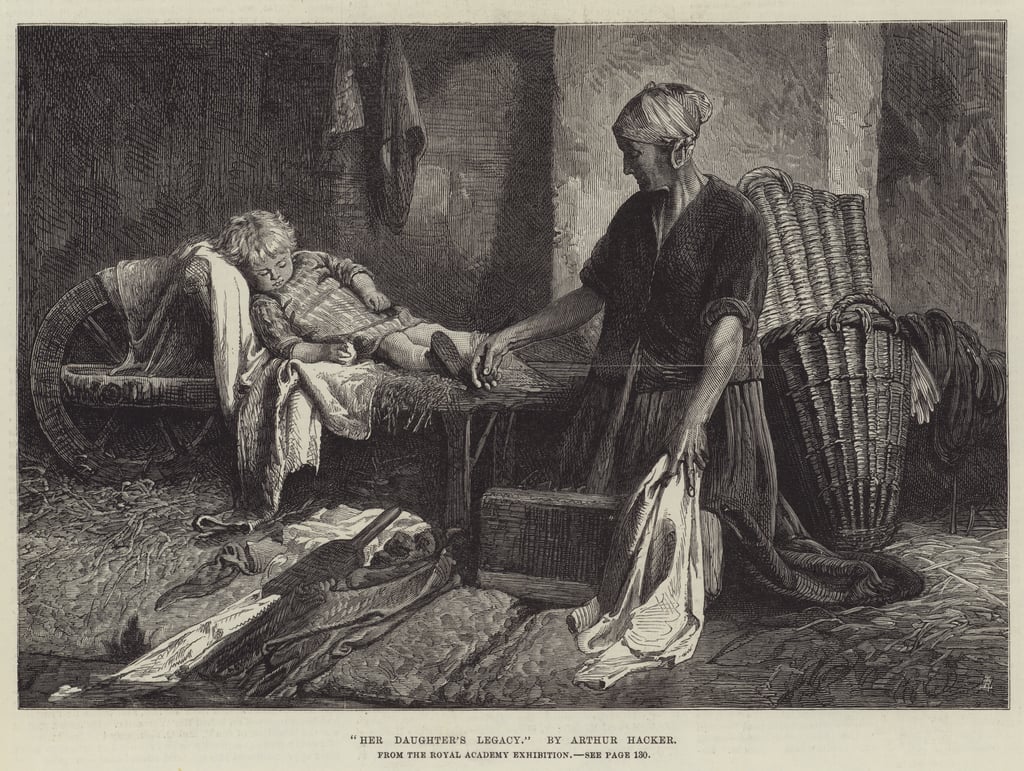
Her Daughter’s Legacy by Arthur Hacker

In 1881 he had his painting Her Daughter’s Legacy displayed at the Royal Academy and it received rave reviews.  An engraved version was used as an illustration for The Illustrated London News, on August 6th 1881.

A Heavy Burden by Arthur Hacker

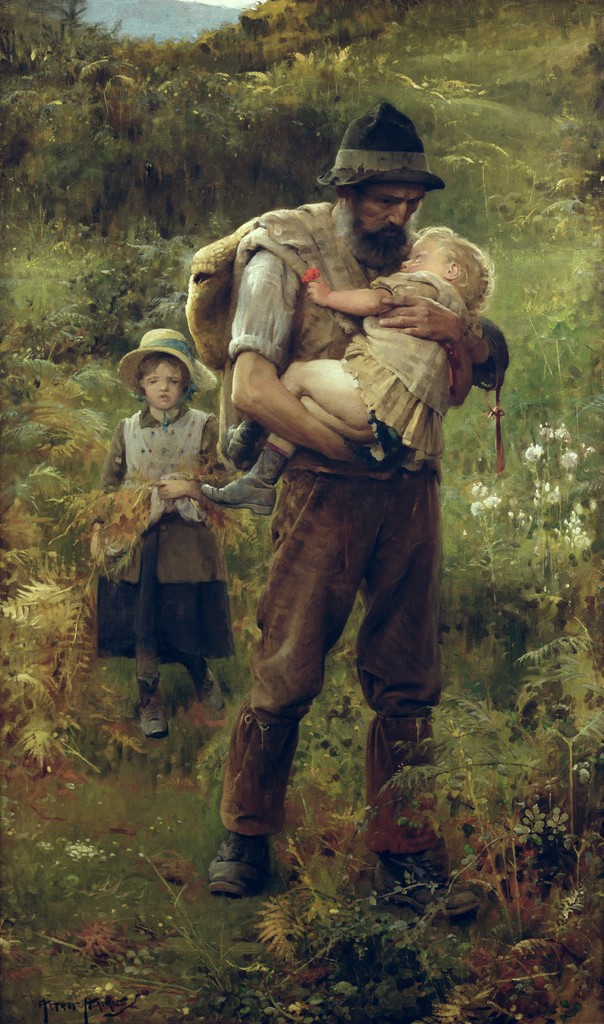
Hacker completed a number of other paintings which depicted the harsh reality of peasant life.  One which particularly catches the eye is his painting, A Heavy Burden, in which we see a a man struggling to carry his sleeping son through fields whilst his daughter follows on behind clutching hold of a bunch of wildflowers in the folds of her apron, which she has managed to pick during their walk.

See the source image
Portrait of Arthur Hacker by Solomon J. Solomon (1884)

Once Hacker had completed his studies in Paris in 1884 he set off on a painting voyage of discovery through Spain and north Africa with his friend and fellow British painter, Solomon J. Solomon, who painted Hacker’s portrait when the two were in Tangiers.  This would be the first of many expeditions Hacker made to Africa.

By the Waters of Babylon by Arthur Hacker (1888)

In 1886, Arthur Hacker along with Stanhope Forbes and Philip Wilson Steer, joined The New English Art Club (NEAC).  It was founded in London as an exhibiting society by artists influenced by impressionism and whose work was rejected by the conservative Royal Academy and were looking for a new exhibition space.  Early members were James Abbott McNeill Whistler, Walter Sickert and Philip Steer. Others in the NEAC’s first show included Sir George Clausen, Stanhope Forbes and John Singer Sargent.

Pelagia and Philammon, 1887 by Arthur Hacker (1858-1919, United Kingdom) | Museum Quality Copies Arthur Hacker | ArtsDot.com
Pelagia and Philammon by Arthur Hacker (1887)

For most of us the name Charles Kingsley conjures up his famous children’s book, The Water Babies, which he published in 1863.  However, ten years earlier he published a novel entitled Hypatia which recounts the fictionalised account of the life of the female philosopher Hypatia. It was said to have been a favourite of Queen Victoria.  Also, within the tale is the young monk Philammon and his search for his sister Pelagia who has been living as a hermit in the desert.  In Hacker’s 1867 painting we see this poignant meeting of the siblings.  Pelagia is at the point of death, and Philammon administers the holy sacraments to her. Philammon is sitting by the body of his sister. A chalice can be seen by his side. In the background we see vultures aware of the oncoming death.

The Sea Maiden by Arthur Hacker (1897)

Another of Hacker’s paintings which featured a nude woman was his 1897 work entitled The Sea Maiden.

Arthur Hacker
Arthur Hacker, The Annunciation (1892)

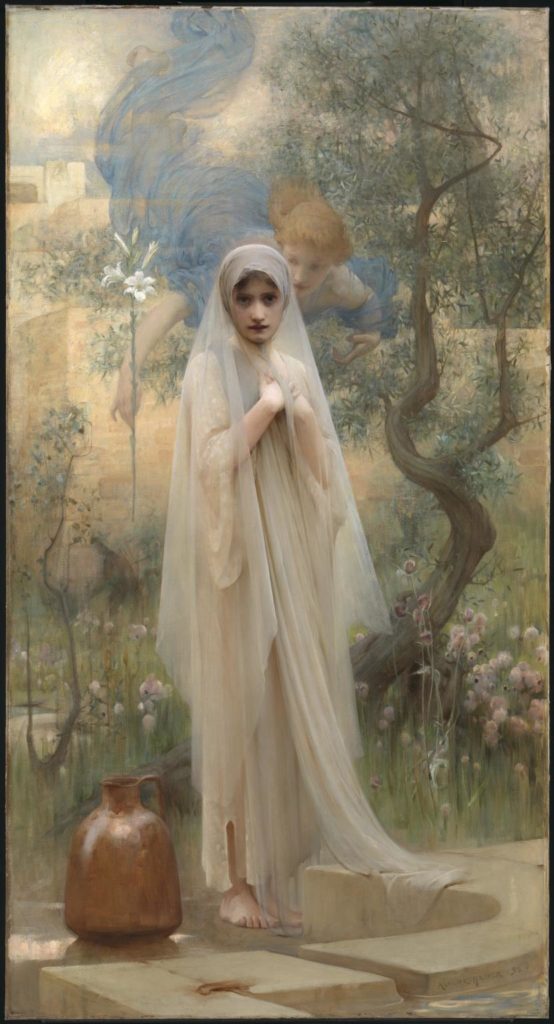
Arthur Hacker also painted a number of religious works and one of his best known was his 1892 painting entitled The Annunciation which is now part of the Tate Britain collection.  The depiction presents the Biblical story of the Annunciation, as was recorded in the Gospel of James. In that particular account, Mary, while gathering water from a well, is visited by an angel, which she cannot see. It is said by some that it is Hacker’s most beautiful painting.

The angel tells Mary that she will have a baby and that he should be named Jesus. It is thought that during Hacker’s travels in Spain and North Africa he was influenced by the life amongst the native people and in this painting it could well be that the clothes we see Mary wearing replicates the Islamic dress Hacker will have seen during his travels.  The fabric enshrouds Mary almost makes her ghost-like.  Mary stands tall with such grace. she wears layers of soft, floating, light fabric. These robes lend her multiple identities. All at once she is a classical Grecian statue, a goddess, and a bride. She appears authoritative and ethereal, yet tragic and mournful.

In the work, the figure of Mary is both radiant and haunting and is framed in the centre of the painting.  Hovering behind Mary is an angel who has floated down from the sky.   Hacker has painted the angel so translucently that he almost disappears into the background.  In the angel’s hand the there is an offering of a lily. Historically, flowers are symbolic of the Virgin Mary’s and the lily’s’ white petals imply Mary’s chastity and the golden pollen of the flower symbolises her radiant soul.   On either side of her, Hacker has placed objects which help narrate the story. A large brown clay water jug is on the floor by her feet.  Behind her we see the twisted trunk and branches of an olive tree.

In front are steps and a low wall, which encircle the pool of water which she has come to, so as to fill her jug.  Mary seems detached from things around her.  She ignores them as she stares directly towards us, the viewer. Look how she looks out at us.  We are hypnotised by that penetrating stare.  Her eyes are dark and disconcerting and contrast with her small, white, veiled face.  She has a thoughtful and solemn countenance and her hands are resting against her heart.  She is now aware that something dramatic is taking place, something which will affect her life.

Infra-red photography shows that the painting originally included a woman wearing a headscarf sitting behind Mary.

The Temptation of Sir Percival by Arthur Hacker (1894)

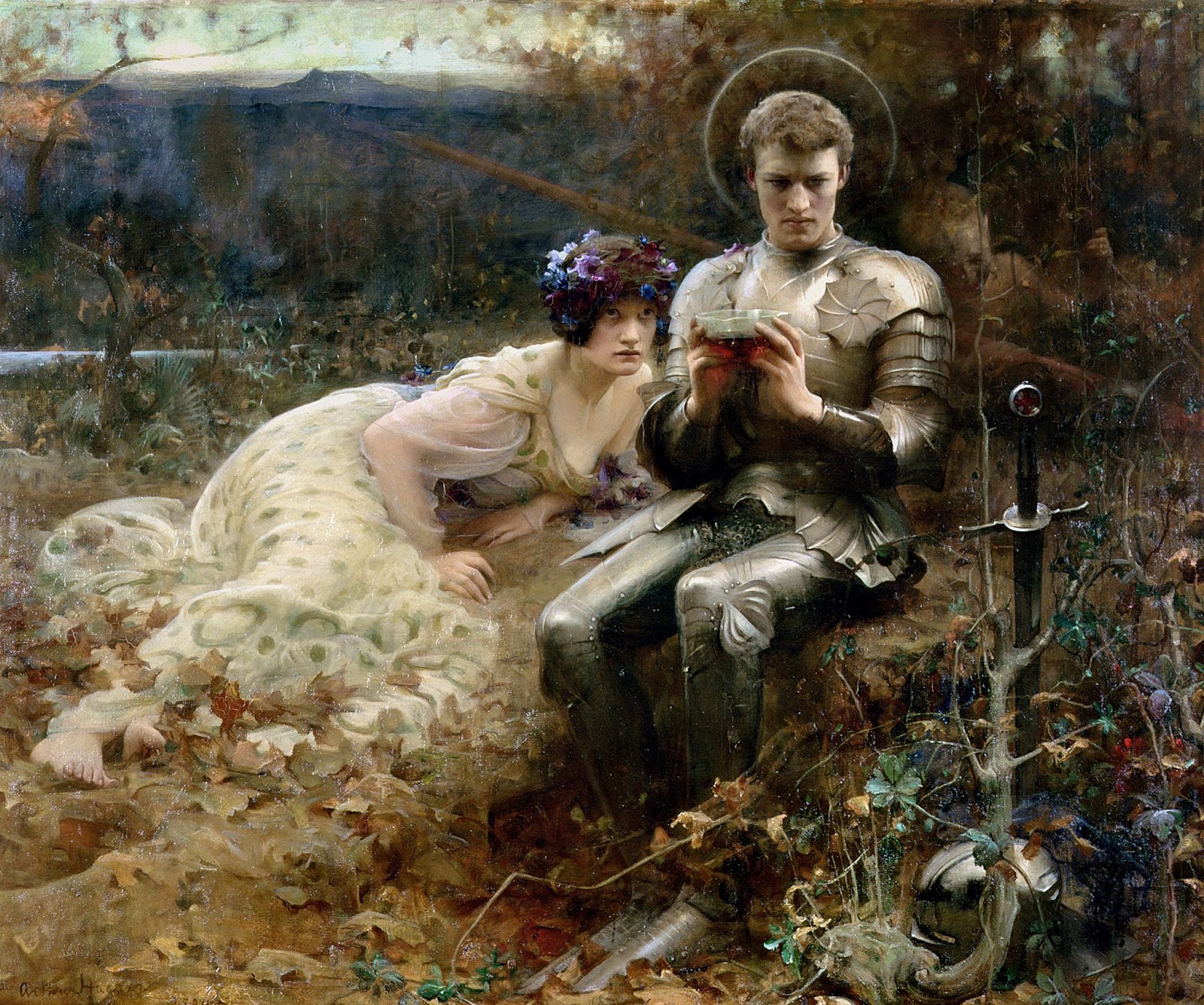
One of Hacker’s well-known works is his Pre-Raphaelite-style painting The Temptation of Sir Percival. The 1894 painting depicts a scene from Thomas Malory’s 1480’s book Le Morte d’Arthur, recounting the story of King Arthur, Guinevere, Lancelot, Merlin and the Knights of the Round Table, including Sir Percival a knight of the Round Table who went on a quest to find the Holy Grail. During that mission, the devil in the form of a beautiful but predatory women tries but fails to seduce Sir Percival and get him drunk. Sir Percival however on looking at his sword he notices the handle and its shaft form a cross.  On seeing this, he crosses himself and the woman vanishes.

The Temptation of Sir Percival is now kept in the Leeds City Art Gallery collection.

Arthur Hacker RA, A Wet Night at Piccadilly Circus
A Wet Night at Piccadilly Circus by Arthur Hacker (1910)

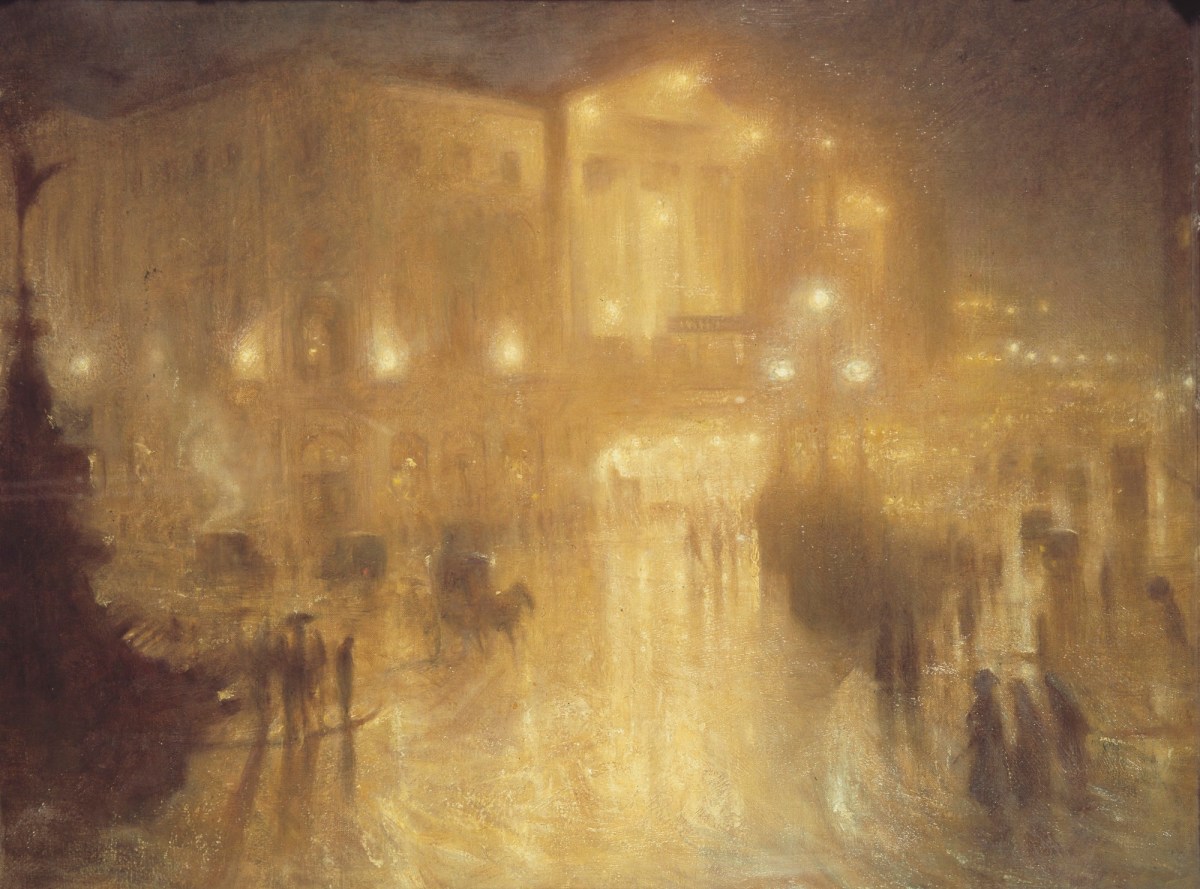
Public taste in art changed around the 1890’s and their once-loved genre of historical subjects began to wane and this forced artists, of that genre, to think about diversifying.  Arthur Hacker had to change the subjects in his paintings but he was equal to the challenge.  One solution for Hacker was his decision to re-visit his earlier ideas which had still engaged public interest.  He once again experimented with misty, atmospheric depictions of the London streets, undoubtedly motivated by the work of the French Impressionists, and produced a wonderful painting, Wet Night, Piccadilly Circus which he completed in 1910 and submitted it as his diploma piece when he was promoted to the rank of Royal Academician.

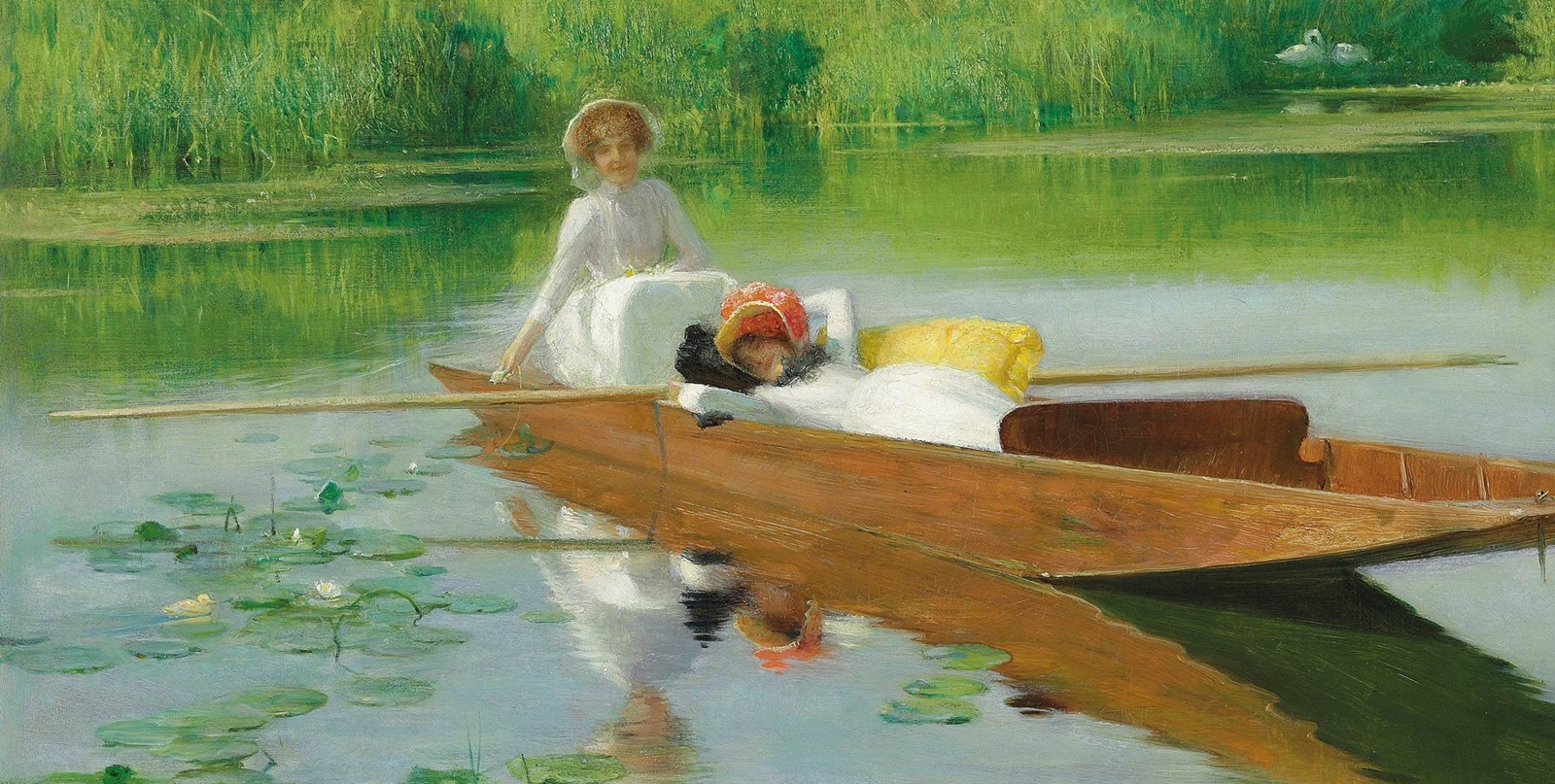
Punting on the Thames by Arthur Hacker (1901)

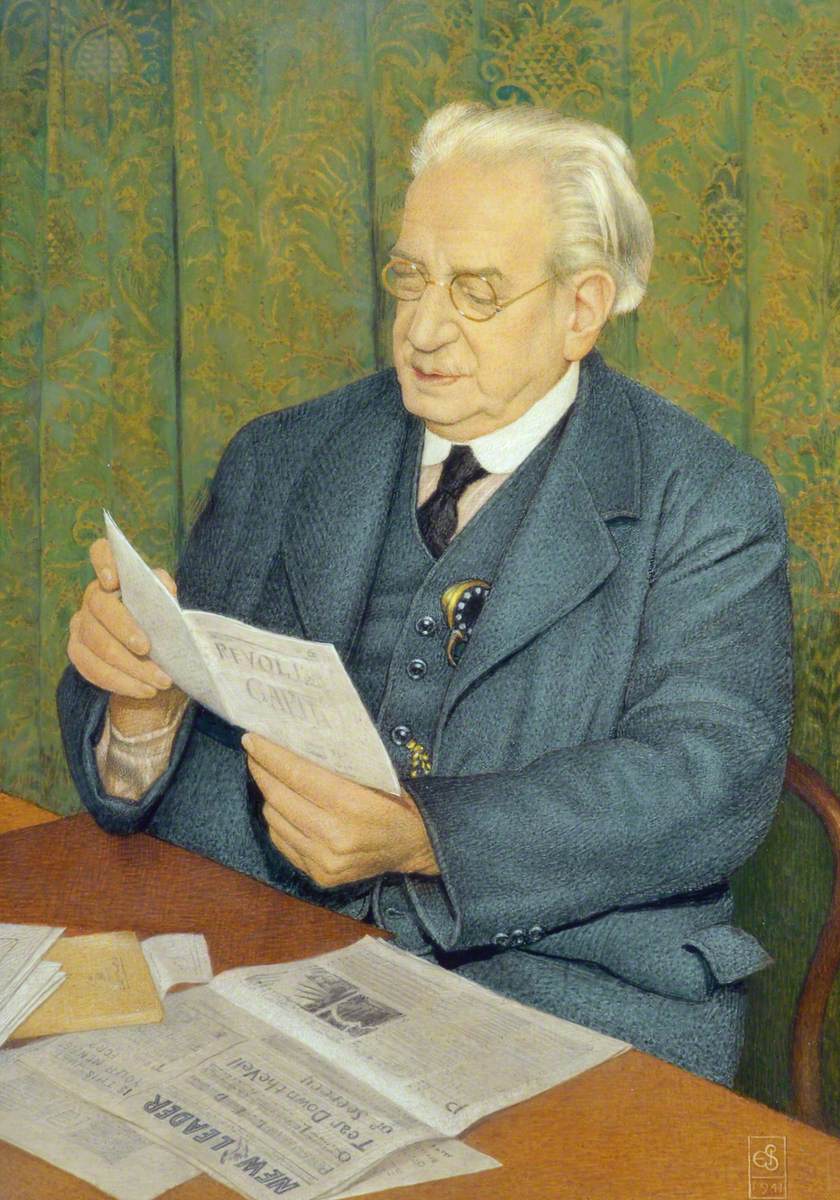
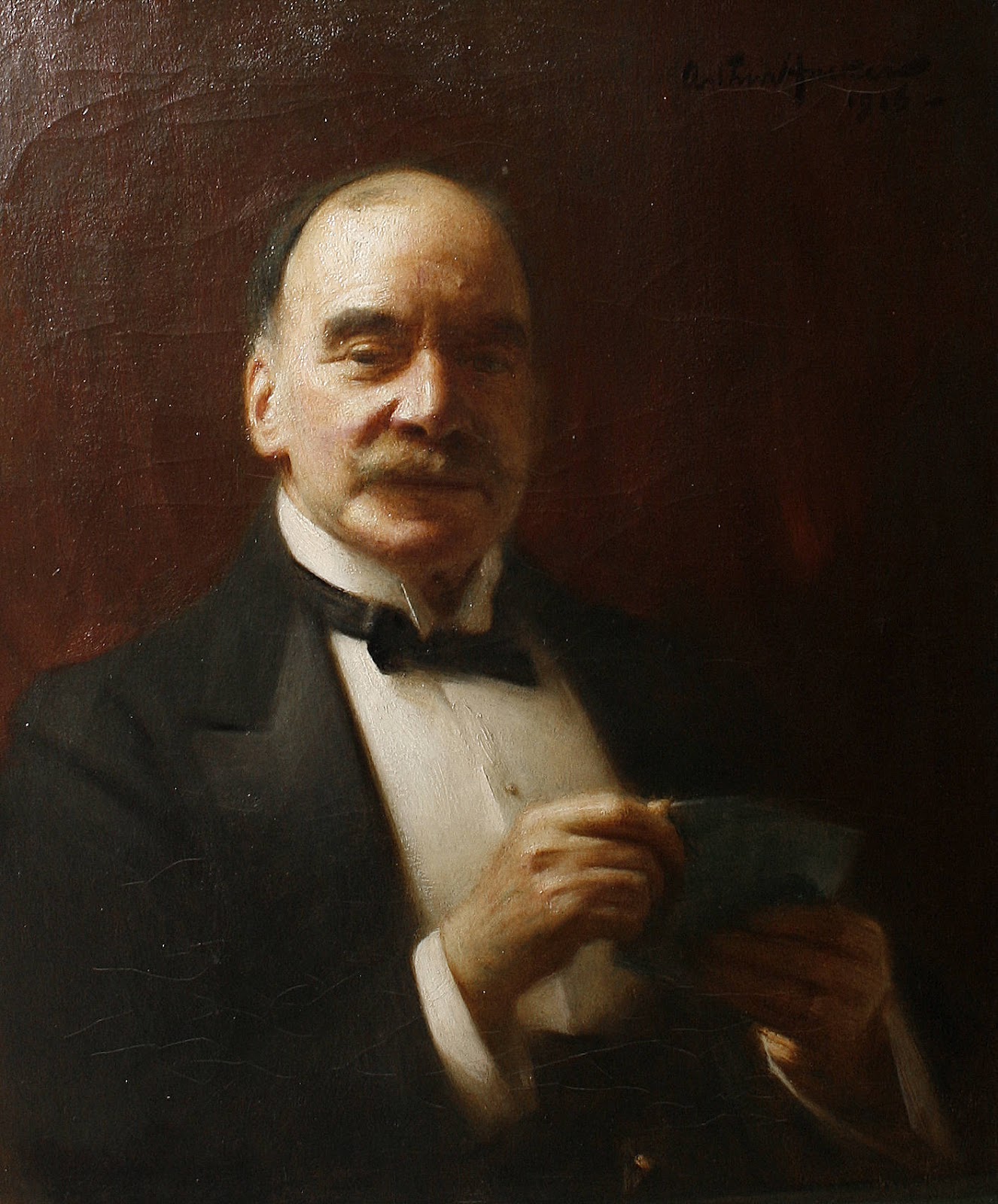
For reasons of finance it was important for artists to judge the changing interests of the buyers of art.  They needed to know what could make them the most money.  Arthur Hacker, like John William Waterhouse, Frank Dicksee and others, decided that portraiture could be a wise financial strategy and they began to develop a flourishing portrait practice. Hacker carried out many portraiture commissions and amongst his sitters were politicians, army officers, high-ranking clergy, aldermen, headmasters, physicians and society women.

See the source image
Portrait of John Gordon Thomson by Arthur Hacker

An example of Arthur Hacker’s portraiture can be seen in his Portrait of John Gordon Thomson, who drew the central cartoons for Fun the Victorian weekly magazine a rival to the better-known Punch magazine.  Thomson was an artist who had his work exhibited at the Royal Academy and illustrated many books and magazines.

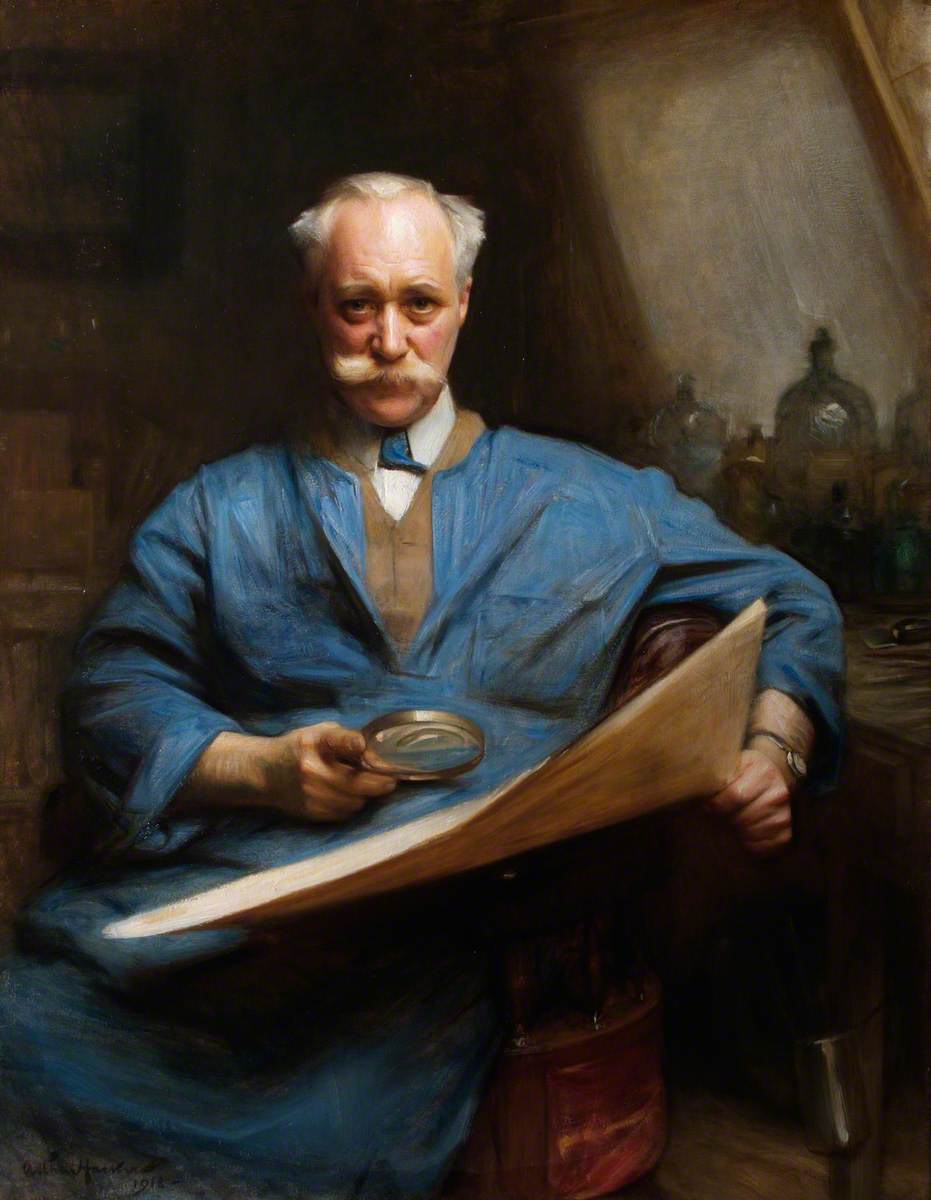
Sir Frank Short (1857–1945)
Sir Frank Short by Arthur Hacker (1918)

Another portrait by Arthur Hacker was his 1918 work depicting the British engraver Frank Short who was born at Wollaston, Worcestershire. He was the son of an engineer and trained to follow his father’s profession; his scientific background gave him a deep understanding of materials, and he made his own tools and invented new ones.

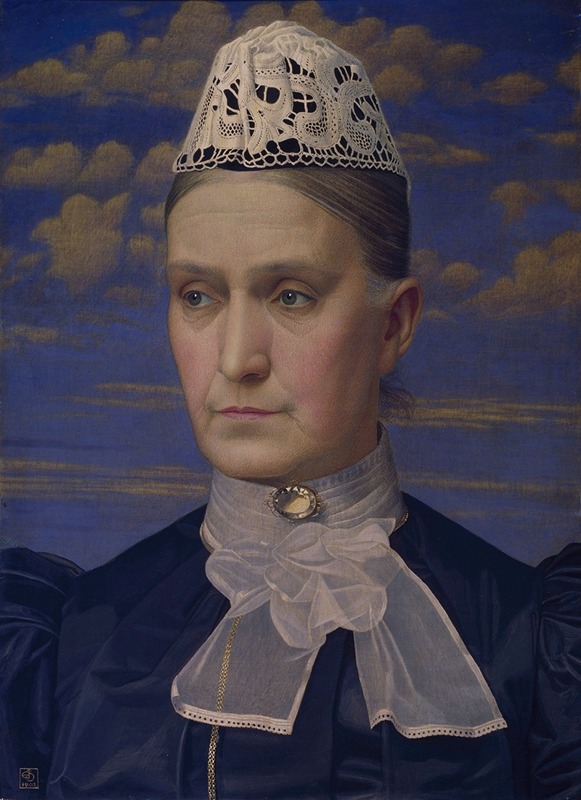
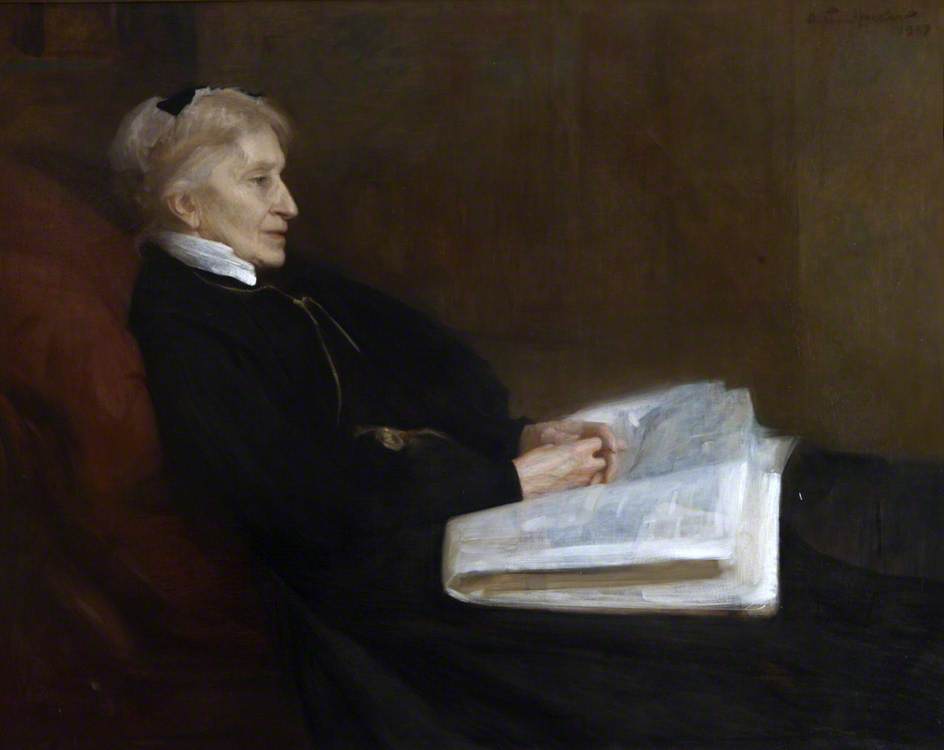
Portrait of the Artist’s Mother (Sophia Hacker) by Arthur Hacker (1907)

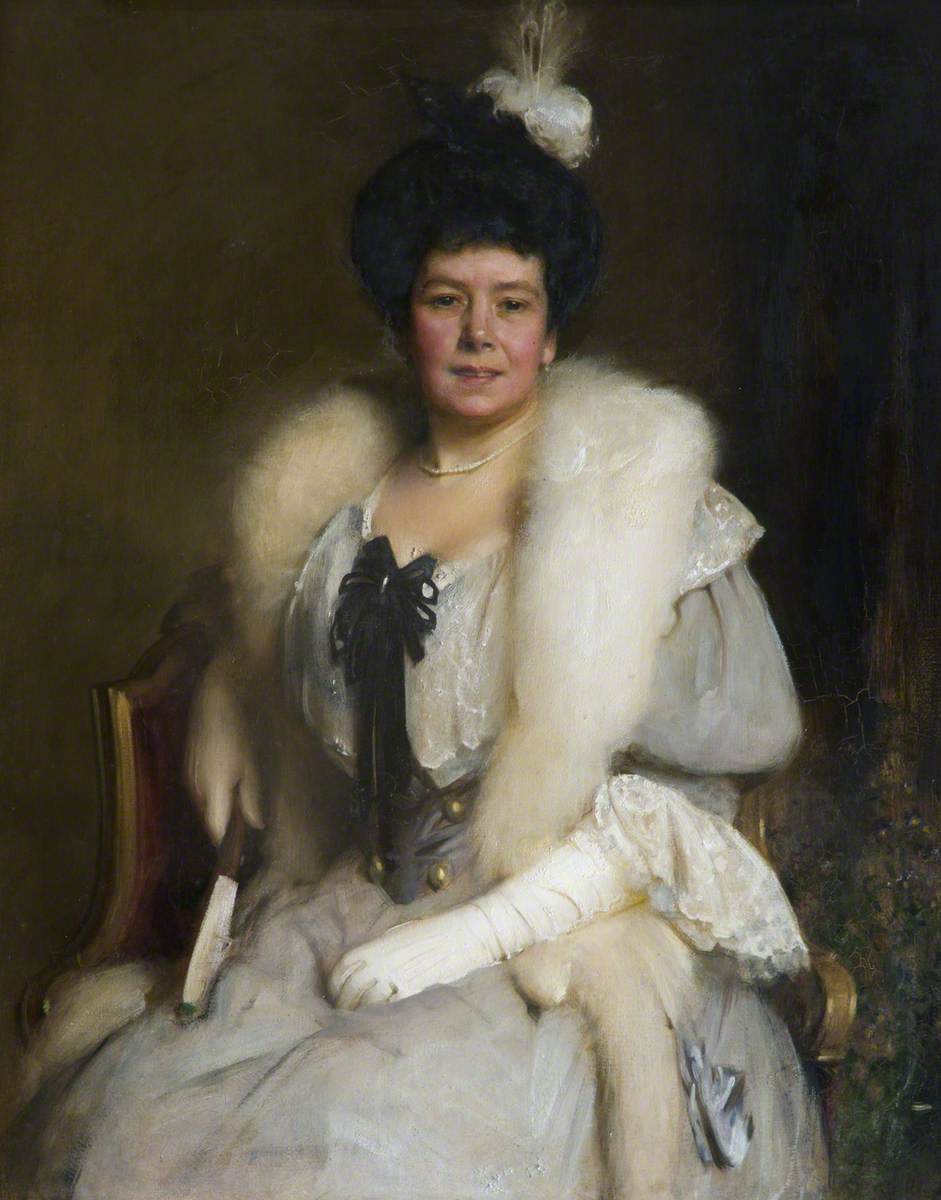
Another beautiful work of portraiture was his portrait of his mother in 1907. Albeit a very formal pose it still manages to remain both sophisticated and gentle in its depiction of the elderly lady.

Charlotte A. Ferguson of Largham, Donor of Victory Park
Charlotte A. Ferguson of Largham by Arthur Hacker

In 1902, Hacker built a new house at Heath End, Checkendon, Oxfordshire, and named it Hall Ingle.  He had commissioned a young architect Maxwell Ayrton to design the property and carried out the decorations himself. Arthur Hacker died in Kensington, London on November 12th 1919. He was sixty-one years old. He is buried in Brockwood Cemetery, Surrey.

The grave of Arthur Hacker

Bertha Wegmann – the Danish Queen of Portraiture.

Bertha_Wegmann_by_Georg_E._Hansen_cropped

Bertha Wegmann .  Photographed by Georg Emil Hansen (1891)

Bertha Wegmann was one of the first professional female Danish painters. Her work was very popular during her lifetime and she was much sought after as a portrait artist.   Without doubt, she is one of the most noteworthy painters of the Danish Realism movement.   Some art historians would have us believe that after the famous Danish portrait painter Peder Severin Krøyer, who died in 1909, Wegmann became the acknowledged leader of portrait painters in Denmark, among both genders.  She went on to complete numerous portraits of the celebrities of her day along with many paintings of her family and friends.  Although renowned for her portraiture she also painted landscapes, still life, and genre scenes.

Marie Triepcke

Portrait of Marie Triepcke. by Bertha Wegmann (1885)

In 1885 Bertha completed a portrait of Kroyer’s wife,  Marie Triepcke Krøyer Alfvén, more commonly known as Marie Krøyer, also, like her husband, a talented  Danish painter. The portrait was entitled Portrait of Marie Triepcke. 

Portrait of an Elderly Gentleman by Bertha Wegmann

Another Skagen painter, Vigo Johansen, was thought to be the model for Wegmann’s portrait, Portrait of an Elderly Gentleman.

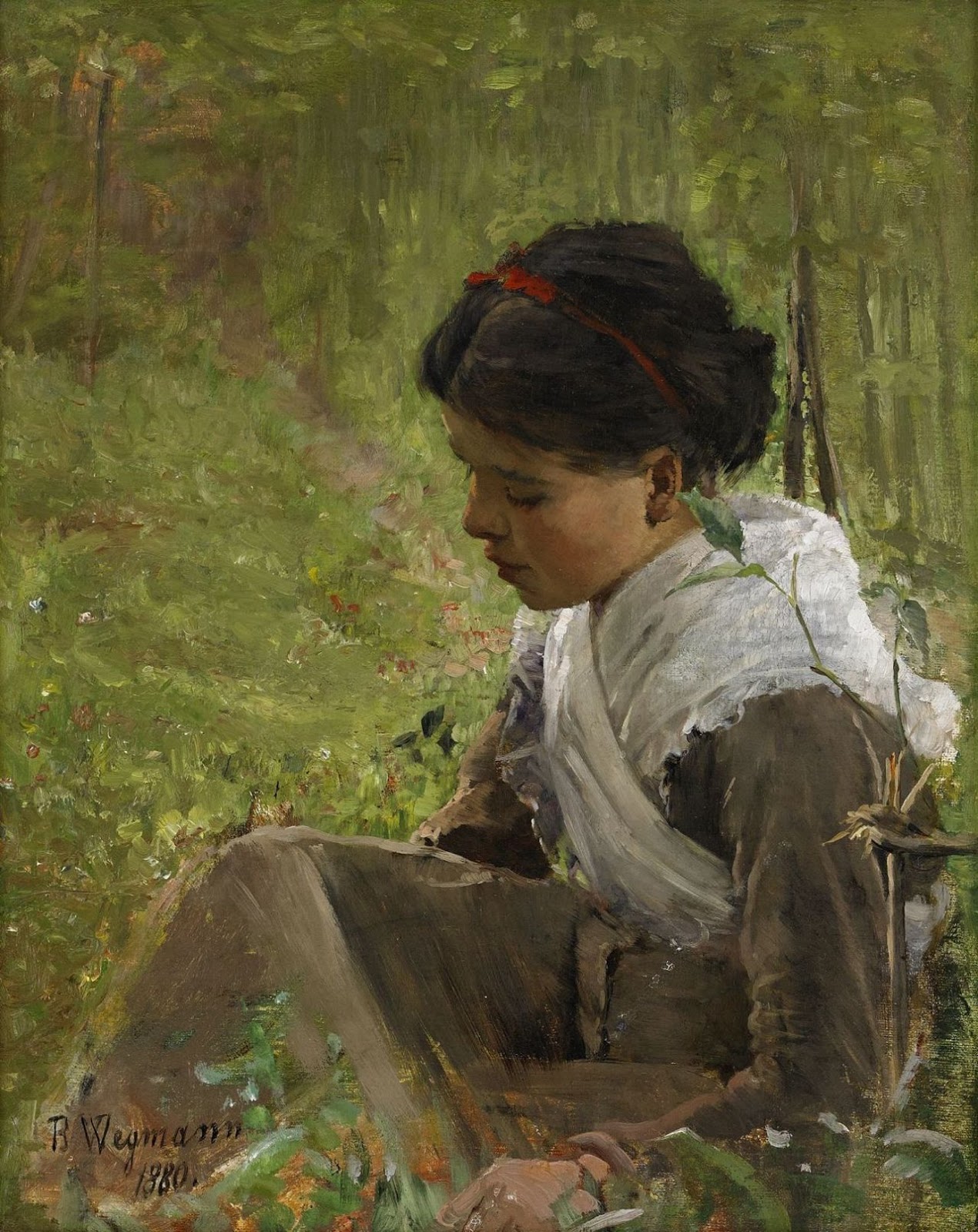
Portrait of a Girl by Bertha Wegmann (1880)

Bertha Wegmann, who was of German ancestry, was born in the small village of Soglio, in south-east Switzerland on December 16th, 1846 to Eberhard Ludwig and Cathrine Wegmann.   At the age of five the family moved to Denmark but sadly, five years after that move her mother died. As a child, Bertha showed an interest in drawing and her father, who was a merchant, and who was also an accomplished amateur painter, encouraged his daughter to paint.  Because of schoolwork and having to help her father run the family home she had no time to enrol on an additional art course.  In fact, it was not until she was nineteen years of age that she began her formal art studies.

Young Woman with a Child in the Garden by Bertha Wegmann

In 1867, aged twenty-one, funded by her father, she travelled to Munich and enrolled at the Munich Academy of Fine Arts, with the intention of becoming a painter of historical subjects and whilst in Munich her tutors included Wilhelm Lindenschmit the Younger, the German history painter and the Austrian genre painter Eduard Kurzbauer.   Although her artistic technique flourished rapidly, she, like many aspiring young artists, found herself discontented with the old-fashioned academic ambiance of the Munich academic establishments.  It was a time of change in the art world with the arrival of the French Impressionists.  In Italy, a group of Italian painters active in Tuscany in the second half of the nineteenth century had offered an alternative to the antiquated conventions taught by the Italian art academies and urged artists to carry out much of their painting en plein air so as to capture natural light, shade, and colour.

OIP

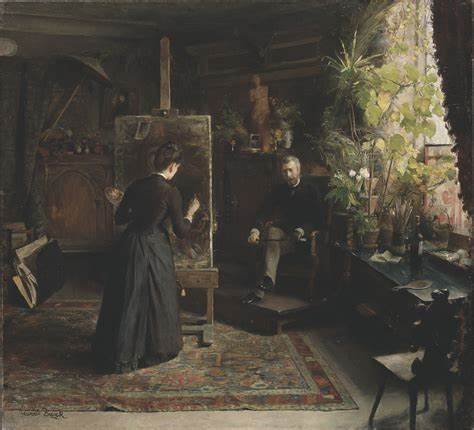
The Danish Artist Bertha Wegmann Painting a Portrait  by Jeanna Bauck

It was whilst studying in Munich that Bertha Wegmann met fellow aspiring artist Jeanna Bauck.  She was the daughter of a German-born composer and music critic Carl Wilhelm Bauck and a Swedish mother, Dorothea Fredrique.  She was six years older than Wegmann.  She had moved to Germany to study painting, first in Dresden and then in Munich.  They immediately became great friends and for many years would share their home and studios in Munich and Paris.  It was in their Munich studio, around 1879, that Jeanna completed a portrait of Bertha Wegmann entitled Den danska konstnären Bertha Wegmann målande ett porträtt, (The Danish Artist Bertha Wegmann Painting a Portrait).  The setting was their studio and, at the side of which, was a window that allowed natural light to stream through and illuminate the room.

Malarinnan Jeanna Bauck (Jeanna Bauck, The Artist), by Bertha Wegmann 1881

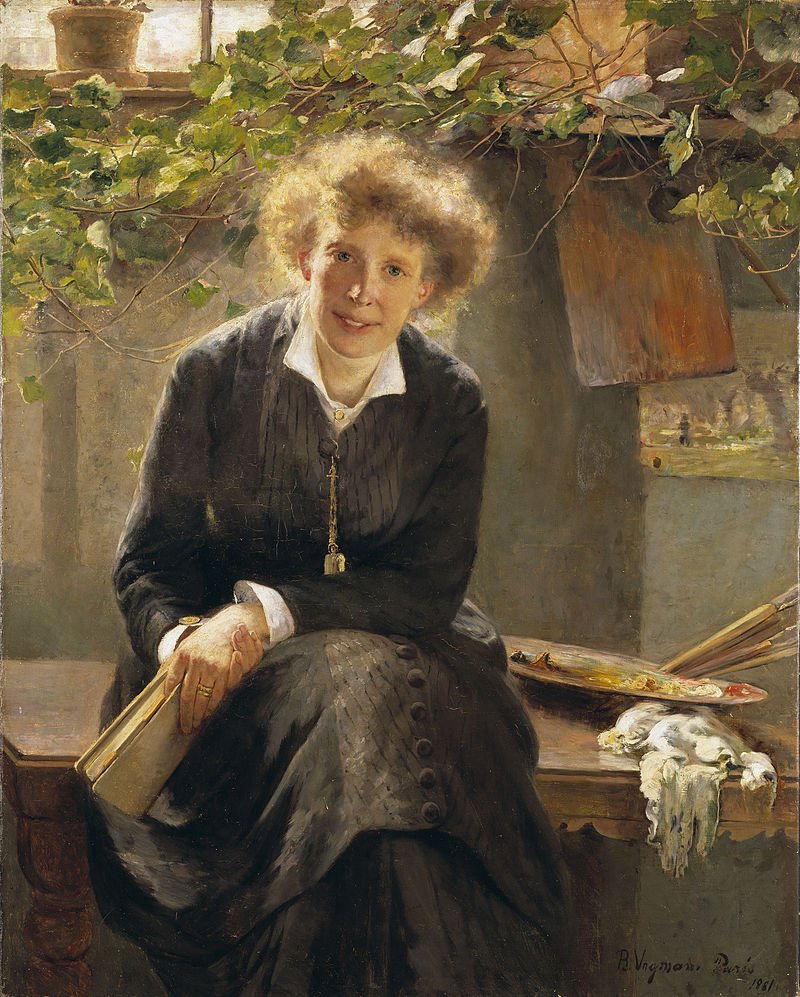
Målarinnan Jeanna Bauck by Bertha Wegmann (1881)

Bertha and Jeanna went together on painting trips including many journeys to Italy.  In late 1880, Bertha and Jeanna moved to Paris and again shared a studio. Bertha Wegmann painted almost twenty portraits of her friend, the best known of which is her well-known portrait entitled, Målarinnan Jeanna Bauck which she completed in their Paris studio. In the painting we see a smiling Jeanna gazing out at us.  She is sitting slightly forward, book in hand, with a smile on her face.  Her friend has portrayed her with great honesty and charisma. In the portrait, Bertha has managed to effectively juxtapose the impression of an uninhibited, independent type of woman with the stylishness of the middle-class woman. Besides Jeanna we see the tools of her career such as brushes, a palette and painting rags. The book held in her hand symbolises her character as an intelligent woman. If we look closely through the window in the background we can just make out the rooftops of Paris..  Jeanna Bauck returned to Munich in 1882, where she founded a painting school for female artists. Later, around the turn of the century she also taught at the Verein der Berliner Künstlerinnen painting school, an influential organisation for female artists, which continuously offered drawing and painting courses in Berlin. 

Bertha Wegmann - Madam Anna Seekamp, the Artist’s Sister
Madam Anna Seekamp, the Artist’s Sister. by Bertha Wegmann (1883)

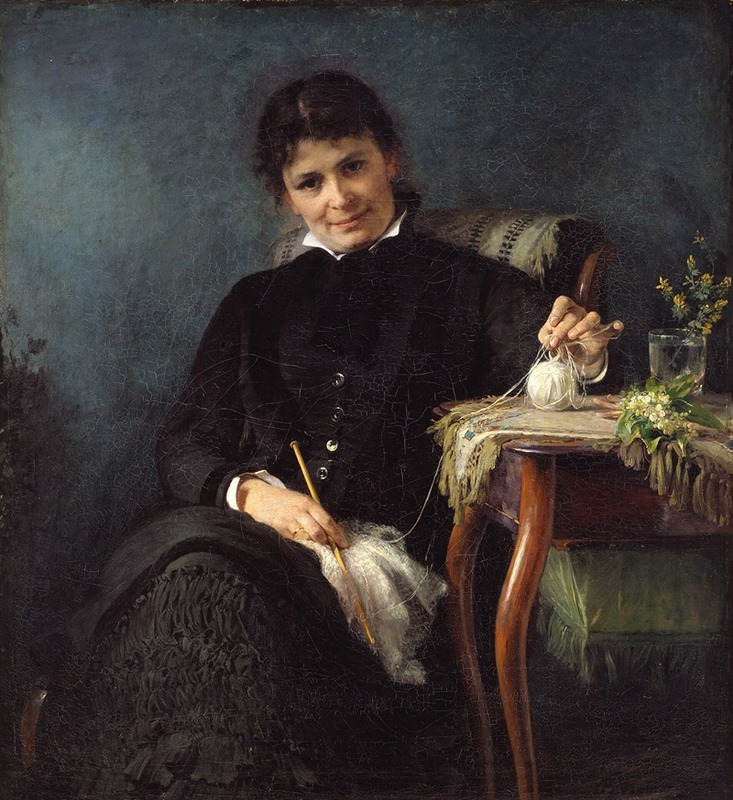
Bertha Wegmann exhibited at several Salons and received an “honourable mention” in her first Salon in 1880 and a gold medal in 1881.  She left Paris in 1882 and returned to Copenhagen, where she was already renowned for the works she had sent home and had exhibited at the Royal Danish Academy of Fine Arts in Copenhagen.  In 1883 her submission for the annual exhibition at the Charlottenborg Palace was a portrait her sister, Anna, entitled Madam Anna Seekamp, the Artist’s Sister.  For this painting the Royal Danish Academy of Fine Arts awarded her the Thorvaldsen Medal.  The award was one of the highest honours conferred in the Danish art world and Bertha was only the second woman to win this accolade.  The enchanting painting depicts her sister with her knitting in hand.  Her facial expression is one of sweetness, even playfulness.   In this work, Bertha has shown her mastery at conveying both likeness and complex human expressions.

Wikioo.org - The Encyclopedia of Fine Arts - Painting, Artwork by Bertha Wegmann - Maternity
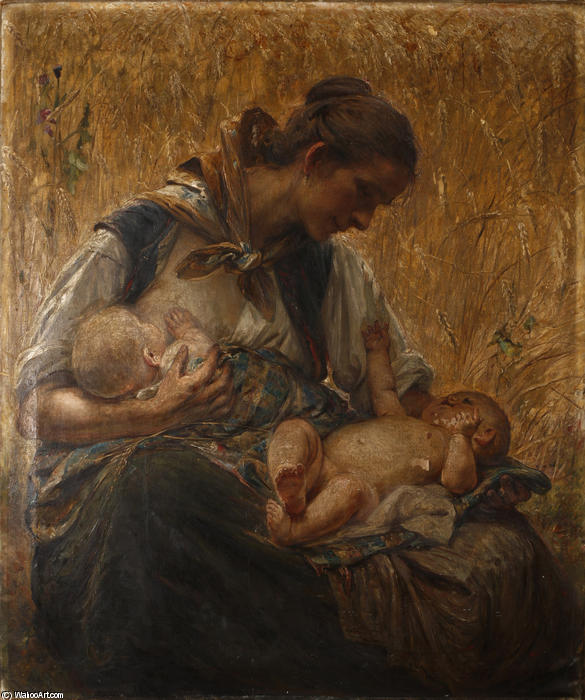
Maternity by Bertha Wegmann

After Bertha received the Thorvaldsen’s Medaille at Charlottenborg in 1883, she became the first woman to sit in the Academy’s Plenary Session. At the same time, she took part in many large official exhibitions throughout Scandinavia and Europe and at the Exposition Universelle of 1889 in Paris and 1900 and she also represented Denmark at several world’s fairs, including the famous World Columbian in Chicago in 1893 also known as the Chicago World’s Fair.   In 1895 her work appeared at the landmark Kvindernes Udstilling fra Fortid og Nutid (the Women’s Exhibition from the Past and Present) held in Copenhagen.  It was an art and culture exhibition for women from the Nordic countries.

Wikioo.org - The Encyclopedia of Fine Arts - Painting, Artwork by Bertha Wegmann - Woman with a Book
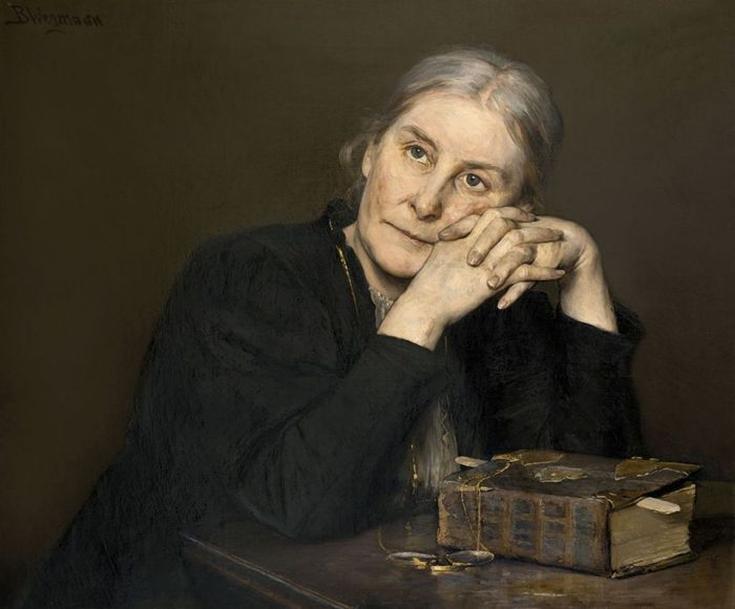
Woman with a Book by Bertha Wegmann

In 1897 Bertha Wegmann became the first woman to hold a chair at the Royal Danish Academy of Fine Arts. From that year through to 1907, she was a member of the board for the “Tegne- og Kunstindustriskolen for Kvinder” (Drawing and Art Industrial School for Women). In 1892 she became one of the first women to receive the royal Ingenio et Arti medal.  The award is given to artists (musicians, painters, actors and scientists) who have done extremely noteworthy work. It is a Danish medal awarded to prominent Danish and foreign scientists and artists.

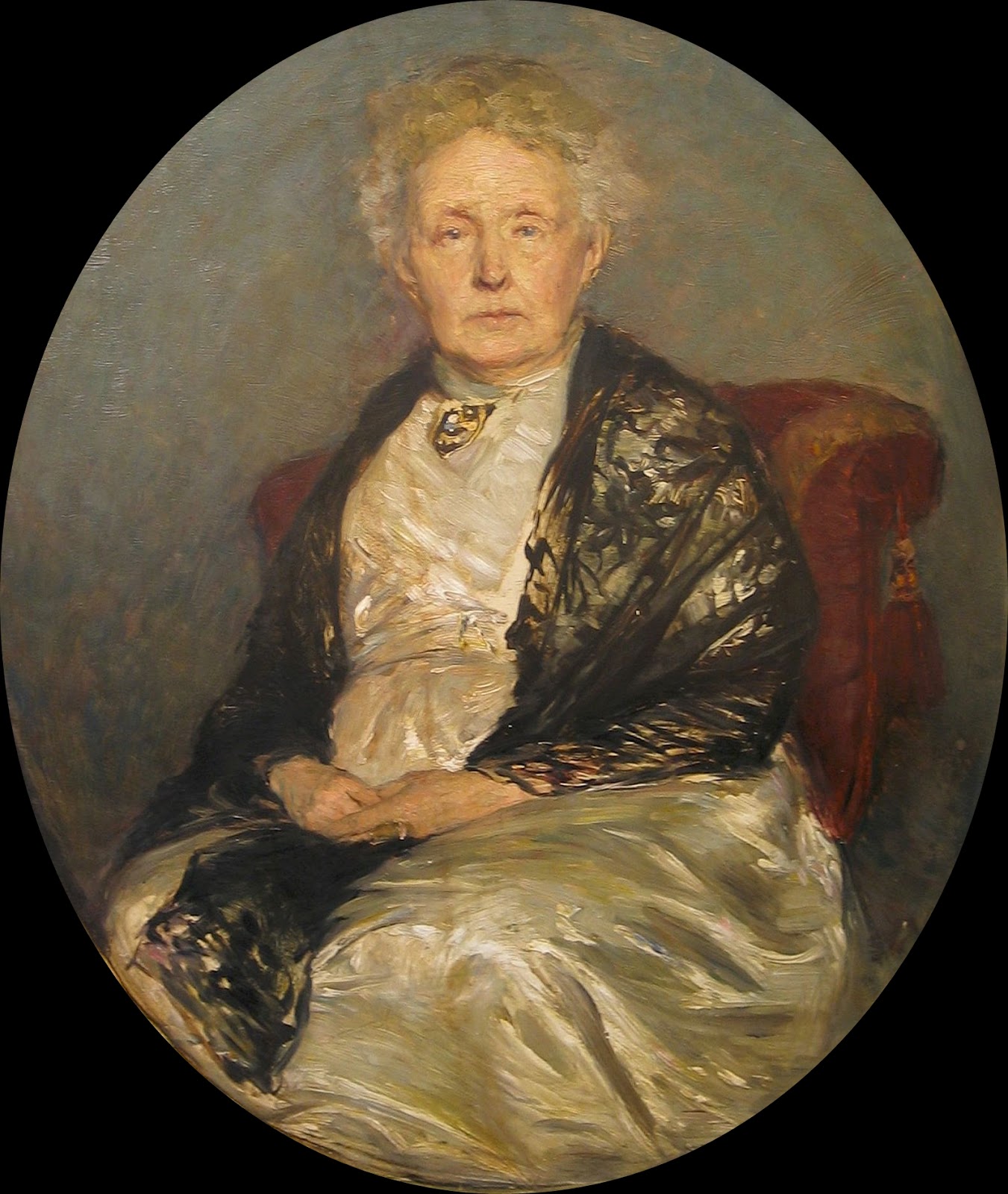
Portrait of a seated Woman by Bertha Wegmann

On February 22nd 1926, after a very long life of constant artistic success, Bertha Wegmann died suddenly, aged 78, while working in her studio.  She will be remembered as someone who achieved an unparalleled career at a time when it was especially difficult for a woman to forge any kind of independent life.  She was both determined and hard-working, but she also had a calm and caring nature. She was a multifaceted person who forged trails, broke stereotypes and cracked so many of the glass ceilings of her time.  She must also be remembered as a popular and loyal friend to many, a loving sister and a zealous champion of other artists, especially women artists.

Frederick Frieseke. Part 3. The latter years.

Portrait of Frederick Carl Frieseke by Lawton Palmer (1912-13)

Frederick Frieseke and Sadie O’Bryan became great friends with an American couple, Richard and Billee Miller who were also staying in Giverny.  Richard Miller had arrived in France a short time after Frederick Frieseke. Miller was a St Louis-born artist who had been honoured by receiving the first scholarship to study in Paris, awarded by the St. Louis School of Fine Arts Student Association.  He too relocated to Giverny for periods and leased a house adjacent to Monet’s property.  Mary Colman Wheeler was the founder and first head of the Wheeler School in Providence, Rhode Island and in 1887, she started a practice of taking groups of students to France during the summer to learn the French language and study painting and art history and also rented a house close to Monet’s residence.  In 1906 Richard Miller was giving summer art instruction in Giverny to the female students of Wheeler’s group.  In the mornings Miller and his students worked indoors with a model, and in the afternoon they sketched outdoors. In 1907 Roger Miller married one of Miss Wheeler’s students, Henriette Adams, known as Billee.

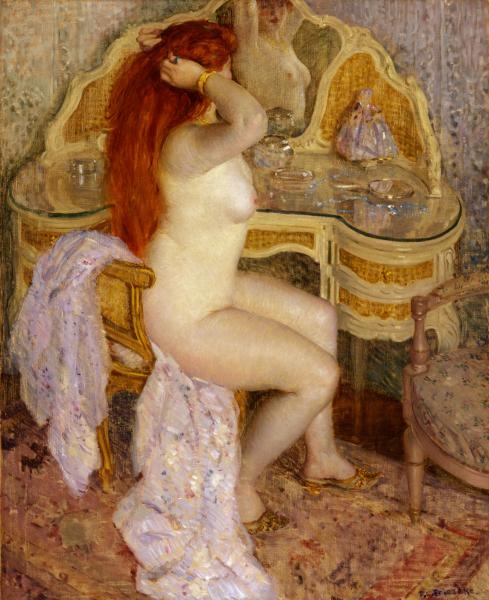
Nude Seated at her Dressing Table by Frederick Frieseke (1909)

Richard Miller was well connected in America and had attained European success very early in his career.  He was offered a chance to fill a whole room with his paintings at the Eighth International Venice Biennial during April and in May 1909, being a close friend and admirer of Frieseke’s work he offered to give up some of that space for Frederick’s paintings.  Frieseke exhibited some of his plein air works as well as a studio work entitled Nude Seated which he had completed that year. A work very similar to this and painted the same year was Nude Seated at her Dressing Table which is now part of the Smithsonian Collection.

[Frieseke_Frederick_C_The_Garden_Parasol.jpg]
The Garden Parasol by Frederick Frieseke

Frederick Frieseke along with other artists, often referred to as Giverny Luminists, put on a joint exhibition of their work at the Henry Fitch Taylor’s Madison Art Gallery in December 1910. Fitch Taylor, an American artist, who had spent time in Giverny with the other artists, on returning to the United States, rented a studio in New York City and began to exhibit his Impressionist landscapes. In 1909, Taylor was appointed to direct Madison Art Gallery by Clara Davidge, an avid supporter of the arts and Taylor’s future wife.

This exhibition of Frieseke’s work was a turning point for him as far as the American market was concerned as William Macbeth, the most successful and influential of the New York dealers in contemporary painting at the time, might well have seen Frieseke’s work at the Madison Art Gallery exhibition. He had already seen some of Frederick’s Giverny paintings whilst in Paris in the early winter of 1908, at the Société International.  By September 1911 Macbeth and Frieseke made plans for Frederick to hold a one-man exhibition at the Macbeth Art Gallery on New York’s Fifth Avenue.  It opened on January 17th, 1912. 

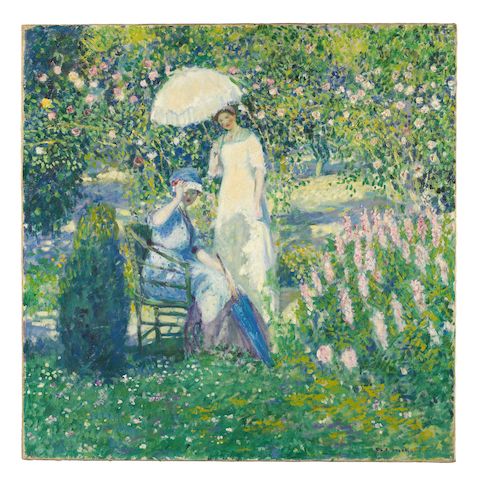
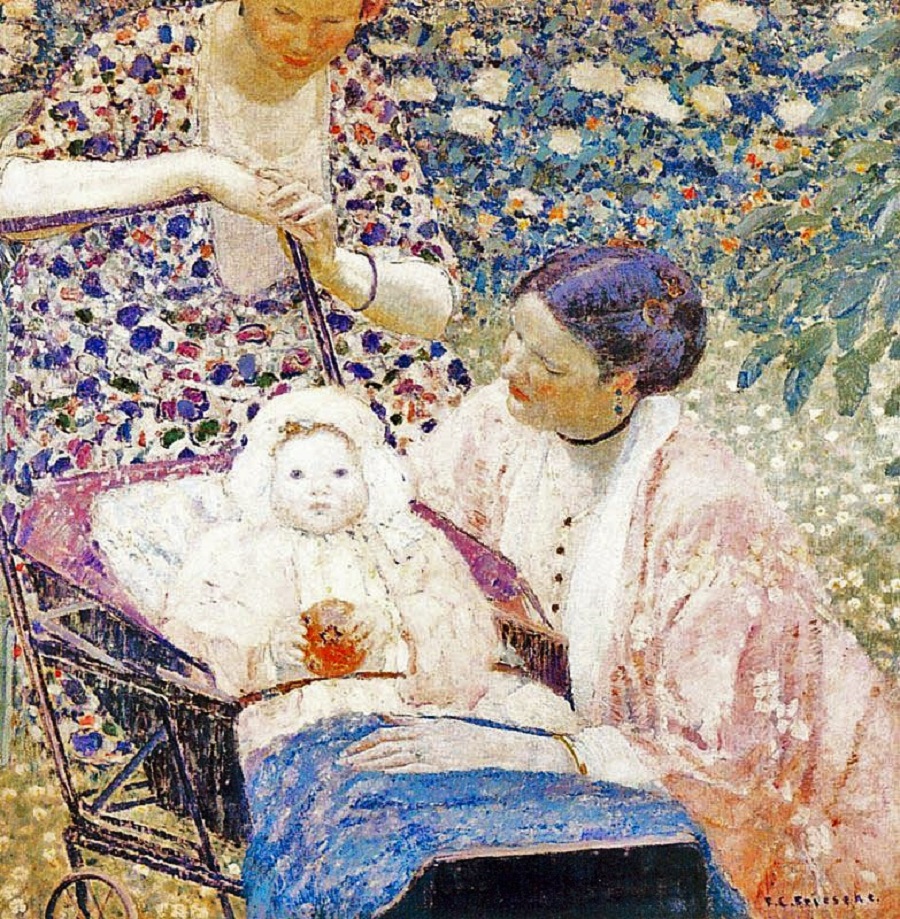
Frederick Carl Frieseke (American, 1874-1939) Two Ladies in a Garden 32 x 32in
Two Ladies in a Garden by Frederick Frieseke

Frederick Frieseke continued to depict females in a state of undress in various settings and this could be one of his reasons for remaining in France and not returning to live in America.  Once when asked if he considered himself an ex-patriot, he said:

“…I am not an expatriate. I often return to the States, and I look forward to finally locating there. I stay on here because I am more free and there are not the Puritanical restrictions which prevail in America…I can paint a nude in my own garden or down by the fish pond and not be run out of town…”

The following month Frederick and Sadie returned to France and apart from a brief visit to America at the end of 1928 Frederick would never again step foot on his homeland.

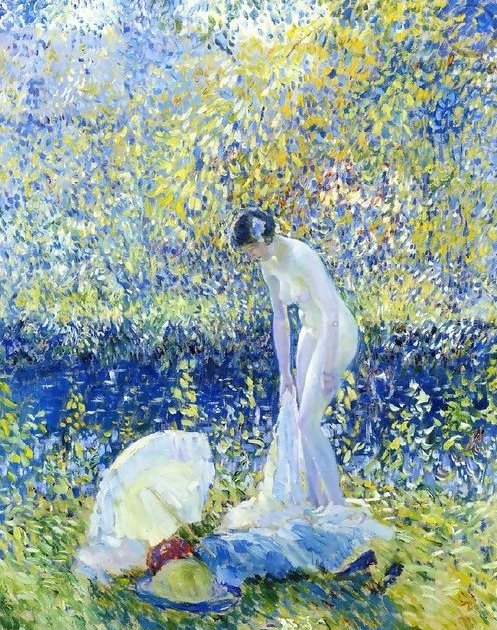
Cherry Blossoms by Frederick Frieseke (c.1913)

One such painting was his work entitled Cherry Blossoms which he completed around 1913.  The setting for the painting is Frieseke’s lush garden in Giverny.  The colours used in this painting bedazzle the viewer.  Frieseke has blended deep shades with light pastels of greens, blues and yellows, which are set off by traces of white and red.  A female figure, dappled in sunlight, looks relaxed as she enjoys the outdoor space. It is an explosive display of both colour and light, a grand depiction of a day of full sun but with conflicting shadows.  In Dr. William H Gerdt’s 1993 book, Monet’s Giverny: An Impressionist Colony, he wrote of Frieseke’s Giverny works:

“…it was Frieseke who introduced into the repertory of Giverny painting the concern for rich, decorative patterns, related to the art of Édouard Vuillard, Pierre Bonnard, and the other Nabi painters. There are patterns of furniture, patterns of parasols, patterns of fabric and wall coverings, patterns of light and shade, and patterns of flowers, all played off one another in bright sunshine…”

The dappling effect of sunlight in this work can often be found in other paintings by Frieseke around this time.

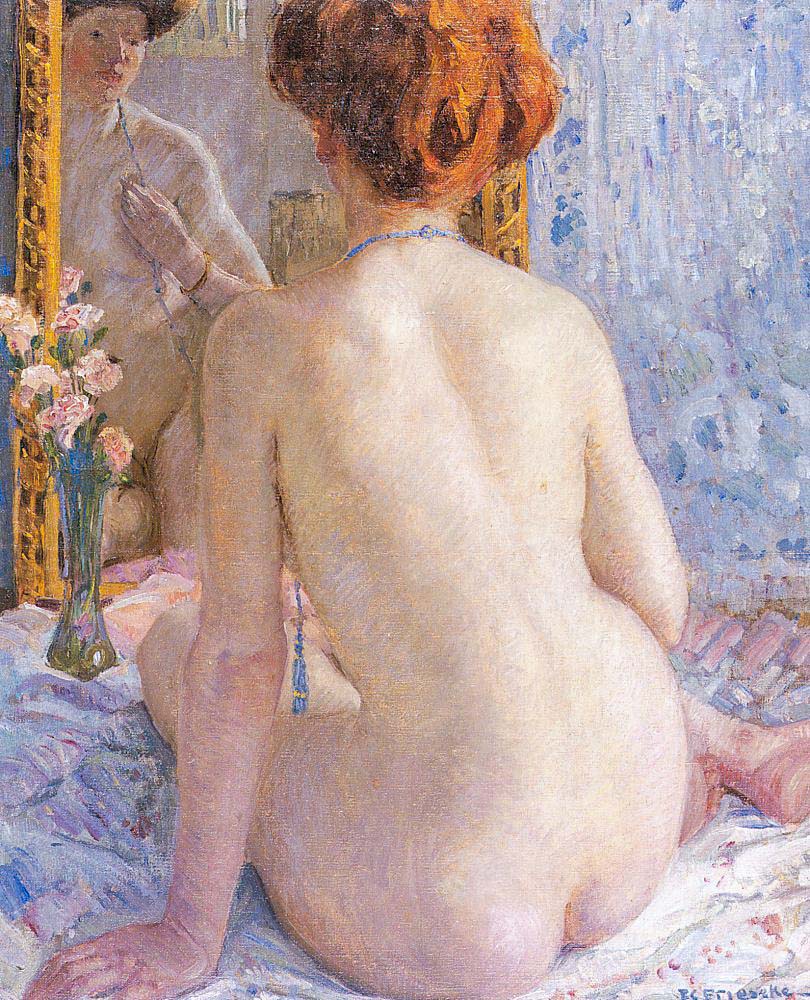
Reflections (Marcelle) by Frederick Frieseke (c.1909)

One of Frieseke’s favourite models was a red-headed French lady simply known as Marcelle.  She had posed for his well-known work entitled Reflections (Marcelle) which he completed around 1909.  This painting is typical of Frieseke’s many works depicting nudes relaxing in elegant boudoirs, which were often adorned with sumptuous fabrics and rugs. Marcelle stares tranquilly into the mirror at her reflection. She touches the string of her blue necklace.  We are positioned in close proximity to her beautifully rendered figure, which combines what is termed, the “serpentine curve”.  A curve of the body which has been looked upon by centuries of artists as a trademark of beauty.

On the Dunes by Frederick Frieseke (1913)

Having undergone a dreadful summer of bad weather in Paris, Frederick, after completing a number of paintings which he was pleased with, crated them up and sent them to the Macbeth Gallery in New York. He then decided to take his wife, Sadie, away from Paris and travel to the island of Corsica where he planned to stay over the winter months.  Once they arrived, they found a house with a garden which they liked, and Frederick set up his studio.  He then contacted his favourite Parisian model, Marcelle, and had her come to Corsica.  She would feature in six large paintings he completed which were exhibited at the Salon of the Société Nationale des Beaux-Arts.  The weather on Corsica was a great improvement to the previous Giverny summer and even though it was winter, Frederick was able to get Marcelle to pose naked on the beach.  His painting On the Dunes was painted en plein air with Sadie keeping a look-out to warn her husband of approaching tourists !

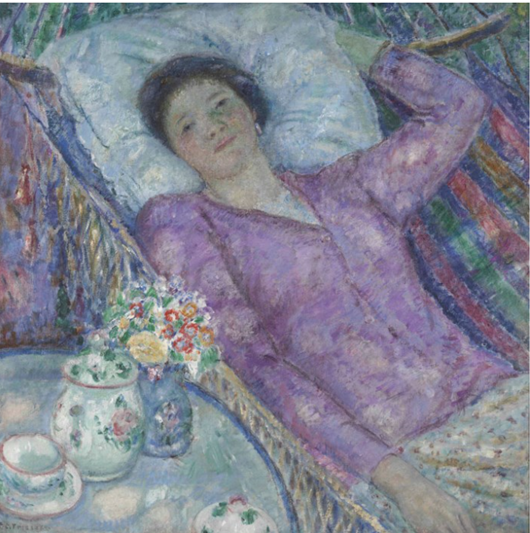
The Hammock by Frederick Frieseke (c.1915)

In 1915 Frieseke completed another Imressionist-style painting entitled The Hammock.  He was now painting using softer colours and strived to emphasize the natural light.  The predominant colour is periwinkle blue which gives a feeling of coolness afforded by the shade from the nearby trees.  To show how the sunlight as filtered through the leaves of the trees Frieseke has painted vivid white spots.  Frederick had always been fascinated by sunlight, writing that he preferred to paint sunshine, flowers in sunshine; girls in sunshine; the nude in sunshine.

Before Her Appearance by Frederick Frieseke (1913)

The sale of Frederick’s paintings in America had being going well and his arrangement with Wannamaker to purchase a regular number of his works was still in force.  One of his biggest sales was for his painting, Before Her Appearance, which he completed whilst in Corsica during the winter of 1912.  It was later shown at the 1913 Salon before being bought by the wealthy socialite, Mrs Gertrude Whitney Vanderbilt, for $2500.   In the painting we see the young lady, modelled by Marcelle, applying the last bit of ardent rouge to her lips before going on stage.  The female dancer is seated on a stool in her dressing room, looking at herself in the mirror. It is a very intimate scene with a very tender, almost monochromatic palette of pink, pale blue, marble white, and an occasional patch of yellow.

File:Frances, Frieseke.jpg
Frances (The artist’s daughter) by Frederick Frieseke (1924)

By the end of 1913, Frederick Frieseke and his wife Sadie found themselves in a financially sound position and bought themselves an apartment on the rue du Cherche Midi in Montparnasse.  The other good news the couple received at the end of 1913 was that Sadie, after a number of miscarriages, was once again pregnant.   Sadie gave birth to their only child, Frances, in Paris on August 2nd 1914, just about the time the French military forces were mobilizing for war with Germany.  By the end of 1914 most American painters had returned home but the Friesekes decided to remain in Paris.  In a letter to his American art dealer, William Macbeth on September 11th 1914, he wrote:

“…You see we are still staying by the flag. Things were sufficiently exciting with aeroplanes dropping bombs. We are provisioned for a six months’ siege. I couldn’t stand leaving Paris after the years I’ve lived here. Seemed like running away…”

See the source image
Peace by Frederick Frieseke (1917)

The war progressed and the Friesekes continued with their normal routines living and working in Paris and Giverny, and between October 1917 and the Spring of 1918 they spent time in the south of the country.  One of Frederick’s paintings completed during 1917 was entitled Peace which he sent to Macbeth in New York.  It is a depiction of a mother sitting beside her child’s cradle as she sews.  The model for this painting was Louise, who came from Giverny who often posed for Frieseke around this time.  The cradle in the depiction was that of Frieseke’s daughter, Frances, who had long since outgrown it.

See the source image
The Mother (Sadie and their one-year-old baby Frances) By Frederick Frieseke (1915)

One of Frederick Frieseke’s greatest honours was winning the Grand Prize at the Panama–Pacific International Exposition, which was held in San Francisco in 1915.   Among his entries was his painting entitled Summer, which is now part of the Metropolitan Museum of Art collection.   Of the painting, the New York Times of June 1915 declared:

“…Mr. Frieseke, whose accomplished work is well known to New Yorkers, says the last word in the style that was modern before the Modernists came along. Whatever he does has a sense of design, color, and style. A sense of gayety, an entertaining and well considered pattern, a remarkable knowledge of the effect of outdoor light on color are found in nearly all of his most recent paintings…”

Summer by Frederick Frieseke (1914)

After the first World War, Frieseke purchased a country home, the farmhouse, La Beauvairie, in the Normandy village of Le Mesnil-sur-Blangy, where Frederick could sate his desire to fish.  

La Beauvierie

Also, after the Great War had ended, there was a slow but steady waning in Frieseke’s popularity and this was despite him winning many awards and the purchasing of his works by a number of museums.  However lessening sales and discouraging reviews signaled a change in tastes in art buyers.  Art critics saw his work as outmoded and overly conservative and Frieseke as a painter of pretty women.  It was also during this time that his style was becoming less  French-Impressionist and moving more towards realism.

The Library by Frederick Frieseke (1934)

In the latter weeks of 1928, Frederick and his family returned to America for a short time.  It was to be their last visit to their homeland.  When they returned to France, Frederick’s fifteen-year-old daughter Frances became seriously ill and was diagnosed as having a pre-tubercular condition.  It was decided that due to her health conditions the family should move to the cleaner air of Switzerland where they spent the next two years.  By 1932, Frances had recovered and the family returned to Normandy.  However by 1934 the family finances had become dire and Frederick was forced to sell his Paris studio. However he did complete two works which featured Frances. One was entitled The Library whilst the other was Blue Girl Reading.

Blue Girl Reading by Frederick Frieseke (1934)

By 1935 people were sensing that the political turmoil in Germany would lead to another large-scale war.   Also in Europe the effects of the Great Depression were still being felt and the sale of his paintings in America had dipped alarmingly.  On the family front, Frederick and Sadie’s daughter Frances, now twenty-one and fully recovered from her illness, had become engaged to Kenton Kilmer, a young American poet and editor with whom she had begun a correspondence in the winter of 1933—34. Add all this together and Frederick and Sadie began to contemplate returning to America.

Considering their daughter’s impending marriage and other factors, the Friesekes contemplated the possibility of moving to the United States.   The marriage ceremony of Frances Frieseke and Kenton Kilmer was held in Le Mesnil sur Blangy on June 2nd, 1937 and it proved a great village celebration.  A few days later the newly-weds travelled to America to live. At the end of 1937 Frances told her parents that she was pregnant.  With the announcement of Frances’s pregnancy at the end of the year, the issue of the Friesekes’ possible return took on additional impetus. But they had to consider what would happen to Frederick’s career if they went ahead with the re-location, since painting is a reaction to where you live. Frances gave birth to a baby boy, Hugh, in late 1938, in Arlington Virginnia. He was the first of their five children and like his grandparents Hugh became an accomplished painter, and also a sculptor, and poet. He taught English, philosophy, and theology at Salve Regina University in Newport, R.I.  This new addition to the family put further pressure on Frances’ parents to at least go to America for a visit.

Sadie and Frederick at La Beauvairie (1939)

The Friesekes purchased tickets for a visit to the United States to see their daughter, Frances, Kenton, and  their new baby. But it was not to be. On the afternoon of August 24, 1939, shortly after the German invasion of Poland, Frederick Frieseke died suddenly at his home in Normandy. The cause was an aneurysm. Sadie cabled Frances:

…Darling our Papa could not stand the overpowering emotions of the last few days with no suffering he left us last night … be brave and help me to bear my sorrow …”


Most of the information for these three blogs on Frederick Frieseke came from the Telfair Museum of Art, Savannah’s catalogue which accompanied the exhibition, Frederick Carl Frieseke  The Evolution of an American Impressionist

.

Frederick Frieseke. Part 2.

Frederick Frieseke

In the Spring of 1902, Frederick Frieseke was back in America after a five-year stint in France.  His reason for returning to his country was two-fold.  He wanted to take care of his American side of his career and probably more importantly he had come to be with his stepmother who was seriously ill.  Once on American soil he wanted to have some of his artwork exhibited at two prestigious exhibitions – the Art Institute of Chicago and then the Pennsylvania Academy of the Fine Arts.  Having exhibited in Paris at the Societe Nationale des Beaux-Arts and the Salon stood him in good stead.  Frederick held a series of meetings with William R. French, director of the Art Institute of Chicago, which resulted in a special exhibition of eight of his paintings, which were hung together in Chicago’s annual exhibition.

Gertrude, Girl with a Book by Frederick Frieseke (1902)

During the next seven months Frederick spent time in Owosso, transacted business in New York and Chicago, and was able to maintain his flow of drawings for Wanamaker, as well as visiting Sadie in New York. Frederick continued to paint whilst in Owosso and he employed a local young woman, Gertrude Hallowell to model for him. One such work was his painting, Gertrude, Girl with a Book, which he completed in 1902, featured Hallowell.

Woman Reading beside a Lamp by Frederick Frieseke (1902)

Another portrait featuring Hallowell was his painting entitled Femme lisant a cote d’line Inmpe (Woman Reading beside a Lamp) which he also completed that year.

The Green Sash (Medora Clark) by Frederick Frieseke (1904)

Frederick returned to Paris in November 1902 and moved into his new studio and apartment at 6, rue Victor Considerant, which was situated on the opposite side of the Place Denfert Rochereau. The rooms he rented were on the first floor above the apartment of the newly married Alson and Medora Clark, with whom he was to build up a great relationship with for the next few years.  The couple were pleased to provide Frederick with a kind of domestic permanency and friendship. The three often shared meals and spent evenings together. Medora soon became Frederick’s model and posed for his 1904 painting entitled The Green Sash.

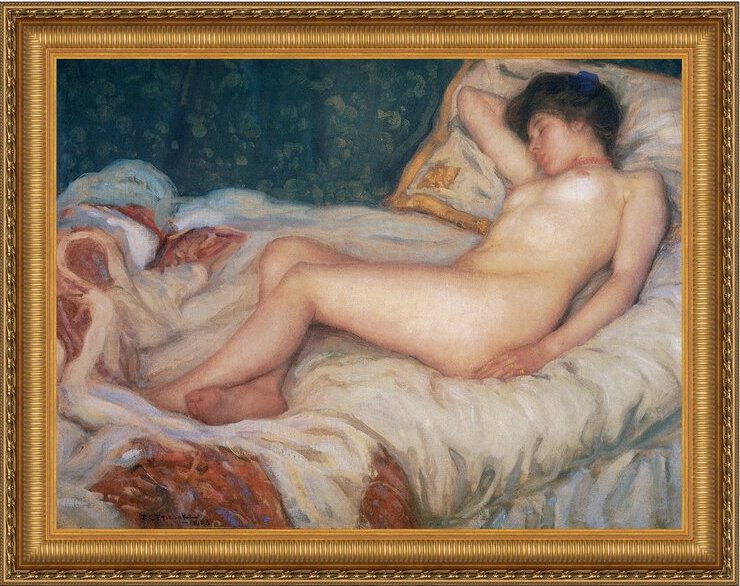
Sleep by Frederick Frieseke (1903)

Fredeick Frieseke also engaged the services of a Parisian model, Jeanne Blazy, someone who had worked with the leading artists at the time.  For Frederick she was not just his model, she was also a great help to him taking over some of his domestic chores.  In a letter to Sadie Byers dated March 27th 1904, he wrote:

“…I’ve had a nice model. She’s as useful as anything in other things besides posing. Brings my things for luncheon and cooks them before she leaves, hunts up anything I wish and is always cheerful. Always late but works on as long as I wish. She has posed for Whistler and lots of the big men. Posed for MacMonnies’ statue in the Luxembourg…”

See the source image
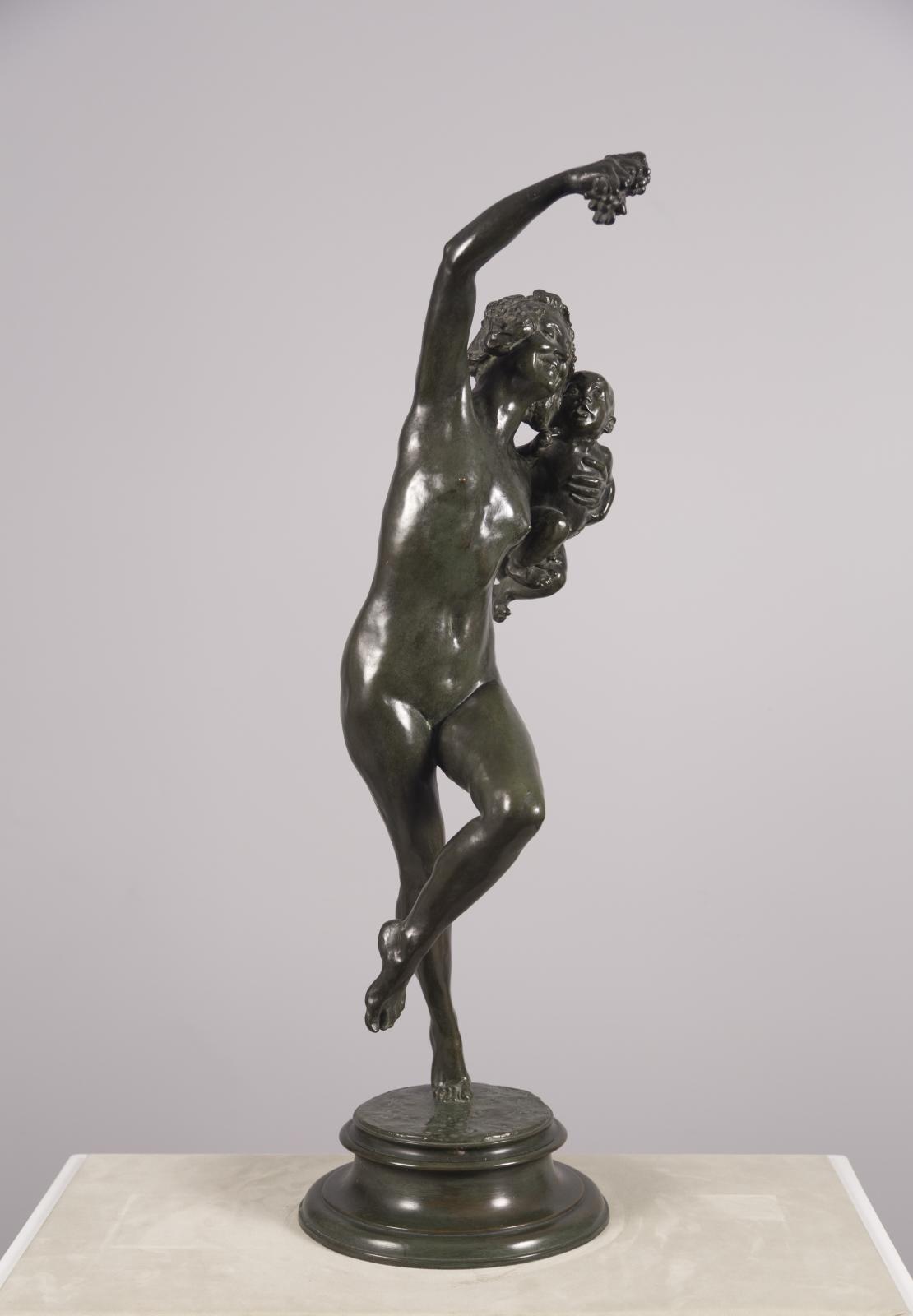
Bacchante with Infant Faun by Frederick McMonnies

The bronze statue he wrote about was Bacchante with Infant Faun by the American sculptor William Frederick McMonnies’ 1894 work and it was Blazy’s talent of standing on one foot for a long time while balancing an infant on her arm, as she apparently did for MacMonnies’s Bacchante with Infant Faun.  It was exhibited at the 1893 Salon of the Societe Nationale des Beaux-Arts and later purchased for the Luxembourg Museum.  Frederick used Jeanne Blazy for his 1903 painting entitled Sleep.

Sadie O’Bryan and her family returned to Paris in October 1903 and took a small apartment at 206, boulevard Raspail.  Just around the corner was the Dome, the cafe-restaurant where the American artists were often to be found and Frederick lived a short ten- minute walk away.  Sadie’s father, Judge O’Bryan died suddenly on March 1st, 1904, following an operation for appendicitis. This meant that the family had to make a hasty return to America.  Frederick had been with the family around the time of Sadie’s father’s death and decided to return to America with them.  The family and Frederick left France on March 5th 1904 on the SS. Saint Paul and arrived in New York on March 13th and then travelled to Pittsburgh.

Frederick and Sadie were now apart once again.  She in Pittsburgh with her family and he in New Jersey.  They kept on with their correspondence and in one poignant letter he tried to console her.  He wrote:

“…Yesterday morning I went to see Foote, and he was surprised enough to see me. Got me onto the floor and jumped on my—what one should keep covered—and we had a nice day together. It was horribly hard for me to leave you the other night. And when I came back for my umbrella and found you crying —dear me—I most disgraced us all by putting my arms around you. Dearie, the first days of your getting home are going to be hard ones for you all…”

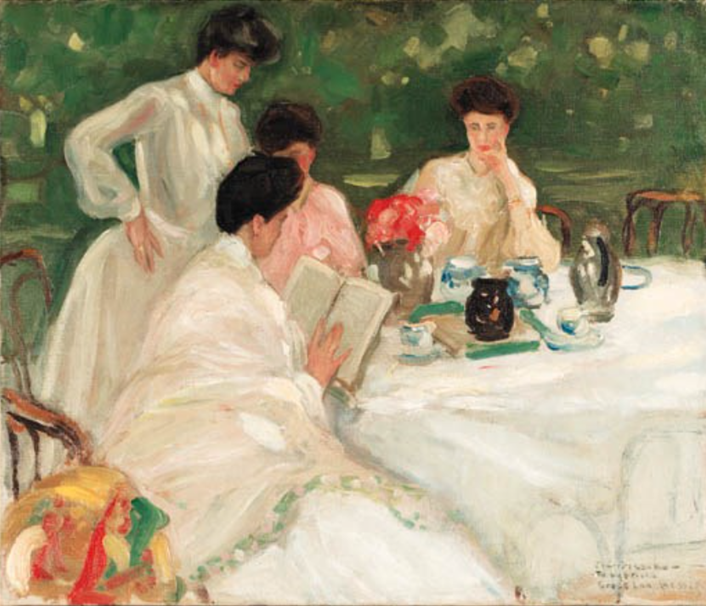
Le Thé au Jardin by Frederick Frieseke (1904)

Frederick Frieseke had associated with a group of Americans artists and their partners, including the Clarks, who frequented the residence of Grace Lee Hess, at her house in Moret-sur-Loing, some fifty kilometres southeast of Paris, beyond Barbizon and Fontainebleau.  It was here that Frederick and his friends celebrated the Fourth of July, and it was also here that Frederick executed his first large figure painting done plein air, Le Thé au Jardin (Tea in the Garden), featuring Grace Lee Hess and friends. This is a classic work in the Impressionist manner and a magnificent example of Frederick Carl Frieseke’s early style. His paintings completed between 1904 and 1919 epitomise his ambitious and important ventures into the world of Impressionism.  It was the first true en plein air work that Frieseke painted and Le Thé au Jardin marks the most noteworthy turning point in the artist’s career.

Frieseke had not only had Grace Lee Hess model for his large painting, Le Thé au Jardin but had also completed a portrait of her.  Their relationship blossomed and may have given Hess thoughts of romance but Frederick, and even though he liked to be spoiled by Hess, was wary of this turn of events.  It all came to a bitter end when Frederick announced his engagement to Sadie and in a letter to his betrothed, he talked about his rift with Grace Lee Hess:

“…It’s all over between Miss Hess and myself. She refuses to see me and insists that I’ve not acted honorably etc., which is very much too bad. And I’m sorry to lose her friendship but, well, I love Sadie very much and she loves me and while she may not be so keen at discovering my faults and correcting them—yet I think for that reason we will get along beautifully . . . and not quarrel as was the habit of Miss H and myself. At least I corrected the offenses and she did the quarrelling…”

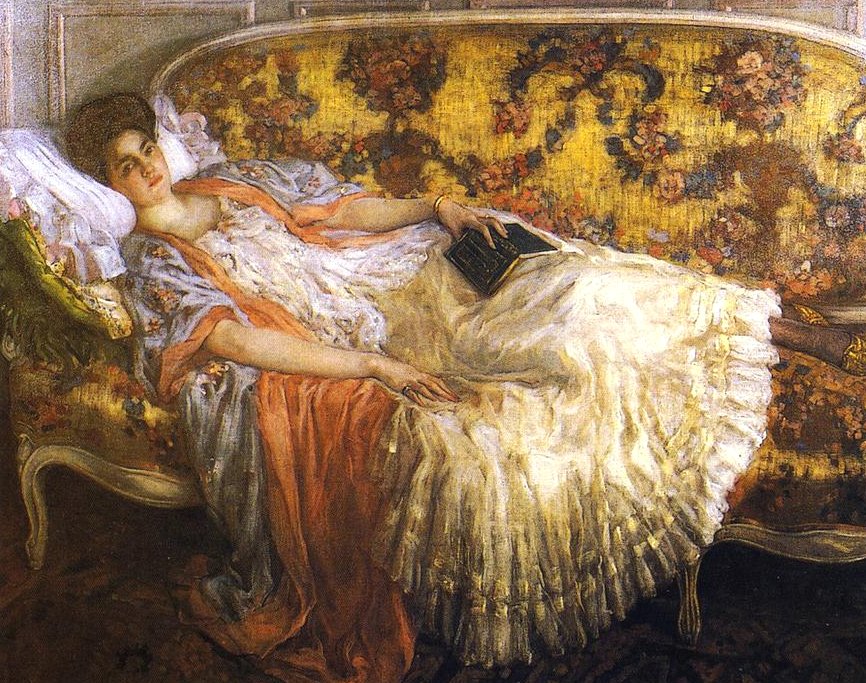
Rest (Femme au Sofa) by Frederick Frieseke (1906)

Frederick Frieseke and Sadie O’Bryan were finally married on June 27th 1905.  In 1906 Frieseke completed a formal wedding portrait of his wife entitled Rest (Femme au sofa).  This work, which appeared at the Salon that year, marked a new direction of Frieseke’s work. It was the start of what was to be many of his domestic depictions that would occupy him for the rest of his life – the embellishment of his intimate relationship he had with his wife and family.

Hotel Baudy (now a restaurant)

Beginning in 1906 they began to escape the cold smoky atmosphere of Paris and spend the warmer months in Giverny, which at the time was a small rural village fifty miles west of Paris on the right bank of the Seine as it runs towards the sea.  At the time it was a well-established art colony which was popular with American artists who had crossed the Atlantic to further their artistic experience.  It was not just a community that solely painted.  It was a group of like-minded people who enjoyed socialising.  The men would take time off to fish. There was also numerous evenings where they would listen to or play music.  Days were often spent playing tennis at the courts of the nearby Hotel Baudy.  Models were brought in from Paris and posed nude in the protected gardens. Often the artists would pose for each other.  The Friesekes would often take tea with the Monets, who were neighbours and Monet and Sadie, who both loved gardening would spend hours deliberating on the proposed expansion of Monet’s garden, and the new bridge from which his water lily garden could be enjoyed.

…………………………………….to be continued.

Frederick Frieseke – The American Impressionist.

Frederick Frieseke

Many American painters after having completed their artistic training in their homeland were drawn across the Atlantic to Europe.  The lure of what was happening in France was hard to resist in the nineteenth century and more so in the latter part of that century when the world of Impressionism was in full flow.   My featured artist today was one of many to sample the delights of this art genre and became one of the great American Impressionists.  Let me introduce you to Frederick Carl Frieseke.

File:Frederick Frieseke Birthplace and Boyhood Home.jpg
Frederick Frieseke’s Birthplace and Boyhood Home  in the central Michigan town of Owosso

Frederick Carl Frieseke was born on April 7th 1874 in the small central Michigan town of Owosso.  He was among the first of the Friesekes to be born in America.  His grandfather, also Frederick Frieseke, who had fought in the Battle of Waterloo, came to America with his wife and family from the German village of Pritzerbe in Brandenburg, and settled in the small central Michigan town of Owosso in 1858.  Two years later two of his sons Julius and Herman enlisted in the Union Army during the Civil War.  After the war was over Herman set himself up in the business of manufacturing bricks and drain tiles, using the local salmon-coloured clay.  After a number of years, the two brothers became well known and well liked and held various offices in the town council.  Herman Carl Frieseke married a local Owosso girl, Eva Graham and the couple went on to have two children, a daughter, Edith in 1871 and a son, Frederick Carl in 1874.

In 1880, when Frederick was just six years old, his mother died.  The next year Herman and his family left Owosso and relocated to Florida where he and his brother Albert set up another brick-making business in Jacksonville.  Frederick returned to Owosso and attended the local public school.  During his early years he was influenced by his maternal grandmother, Valetta Gould Graham’s love of art.  Thoughts of a career as a professional artist intensified after he visited the World’s Columbian Exhibition in Chicago in 1893 and he was amazed by the numerous paintings and posters.  He enjoyed sketching and painting and realised that he too could earn a living from his art.

In 1893, Frederick Frieseke, after graduating from Owosso High School, enrolled at the School of the Art Institute of Chicago studying with the American artist, Frederick Warren Freer and the Dutch-American figurative painter John Vanderpoel. Fredrick remained there until 1896.  Having successfully completed his studies at the Art Institute he persuaded his father to give him money so he could take a trip to New York and enrol at the Art Students League.  His father acquiesced to this financial plea and Frederick headed for New York and enrolled in the men’s afternoon life class at the Art Students League. To make some money he decided to complete some cartoon drawings and sell them to popular magazines such as Puck, Truth, and the New York Times.  He later remembered the hard times of his New York stay, writing in a letter to his fiancée, Sarah O’Bryan, dated February 18th 1902:

“…I remember I didn’t much like my winter in New York.  I was doing jokes, and it wasn’t much to joke about, trying to make a living out of them. If I had had more success, though, I should never have come abroad, never have painted, and most important of all should never have known the dearest girl in the world…”

Art Students. Pen and ink drawing by Frederick Frieseke

It would appear that Frederick did just enough to survive.  He would submit a pen an ink cartoon to a publisher and would wait to see if was published and only then would he receive payment.  Having been paid Frederick would go to the library and read for days on end and would not put pen to paper again until he was almost broke.

See the source image
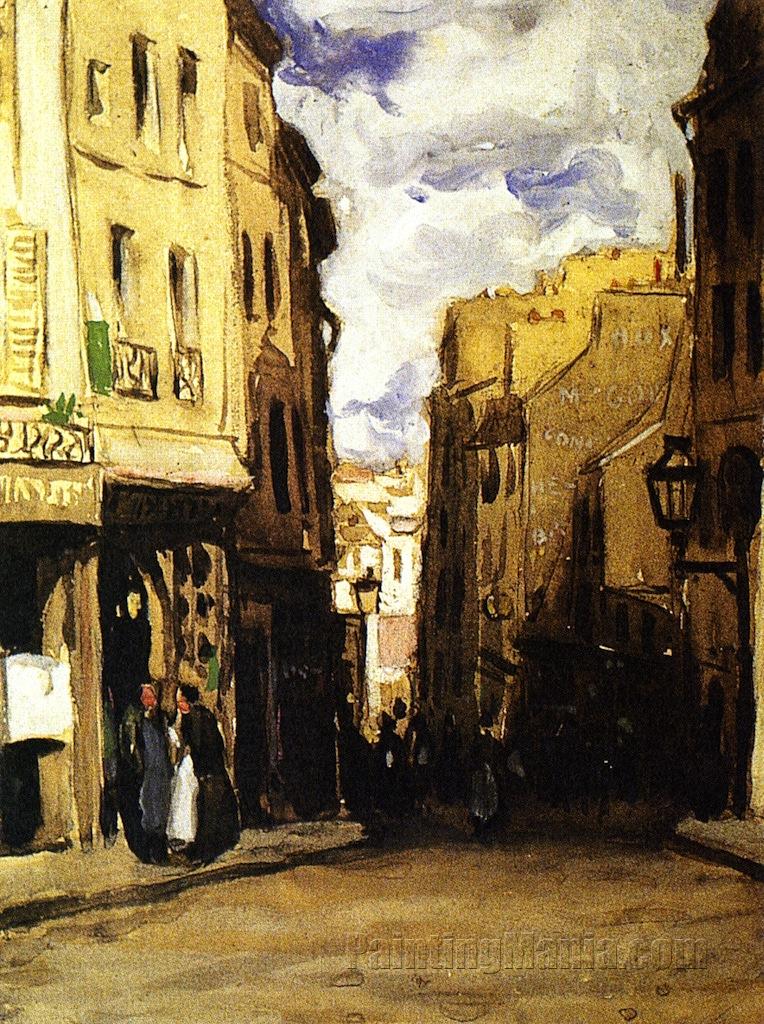
Montparnasse Landscape (Hilltop Street) by Frederick Frieseke

It was in 1898 that Frederick made the decision not to carry on with his cartoon drawings which were much in demand but instead concentrate on painting.  Once again he approached his father for financial support to pay for his sea passage to France.  Once again his father acquiesced and in September 1897 Frederick set sail on the SS Massachusetts, accompanying him was a fellow art student from the Art Institute of  Chicago and long-term friend from Michigan, Will Howe Foote. In early 1898 Frederick enrolled at the Académie Julian and for that first summer on foreign soil Frederick travelled to Holland and spent time in the artist colonies of Katwijk and Laren, where he concentrated on landscape painting using watercolours. 

Self-Portrait, 1901, Frieseke.jpg
Self Portrait by Frederick Frieseke (1901)

The Académie Carmen, also known as Whistler’s School, was a short-lived Parisian art school founded by James MacNeill Whistler.  It was named after Whistler’s Neapolitan model Carmen Rossi and it practiced the successful formula devised by Académie Julian, in which a model was available to artists, all day.   It operated from 1898 to 1901. The school was situated in a large house and stable at No. 6 Passage Stanislas, near the Rue Notre Dame du Champs, in the midst of the Montparnasse artists’ quarter. Frieseke along with his friend and travelling companion, Will Howe Foote, attended some of the classes.  Whistler taught without pay as a “visiting professor,” and appeared once a week to offer criticism.  It was Whistler who persuaded Frederick to paint in oils.

Holland, 1898 - Frederick Carl Frieseke
Holland by Frederick Frieseke (1898)

For an artist to survive he must sell his work and to sell his work he needs the chance to exhibit his paintings.  The Salons of Paris offered vital opportunities to the struggling artists but for young Americans who had come to Paris to further their ambitions there was another opportunity to show their work.  This opportunity was due to the American painter and philanthropist Abraham Archibald Anderson who conceived the idea of establishing an association for the benefit of American students in Paris. All he needed was a meeting place. 

Through his personal efforts, and those of his friends, such as Whitelaw Read, the US Ambassador to France and Rodman Wanamaker, the son of the millionaire department store magnate, John Wanamaker. Anderson had bought a half-ruined and abandoned building which he had discovered on the boulevard du Montparnasse. He then entirely restored it to its former glory and in May 1890 American Art Association of Paris finally opened its doors.

Misty Morning on the Seine, 1899 - Frederick Carl Frieseke
Misty Morning on the Seine by Frederick Frieseke (1899)

The Association would hold exhibitions of members paintings and at one of these Rodman Wanamaker noted the excellent drawings on the exhibition programme done by Frederick Frieseke, so much so that he invited Frieseke to become the illustrator of catalogues and advertisements for John Wanamaker’s stores in Philadelphia and New York.  After much discussion Friedeke accepted the position on the proviso he could remain in Paris.  Wanamaker agreed and Frieseke’s close relationship with the Wanamakers led to many painting commissions including Frieseke painting mural decorations which were installed in Wanamaker’s New York department store in 1904. In 1906 the murals he painted for the Shelbourne Hotel, Atlantic City, NJ, were put in place.

Sadie O’Bryan (1901)

It was not all work and no play for Frieseke as in 1900 love came a’calling in the shape of Sarah Anne O’Bryan.   Sarah Anne O’Bryan of Pittsburgh, known as Sadie, was the daughter of John Duross O’Bryan, an American judge, who had made and lost a series of fortunes in speculative ventures in the American West.  O’Bryan was fond of crossing the Atlantic to take vacations with his family and residing in Paris.

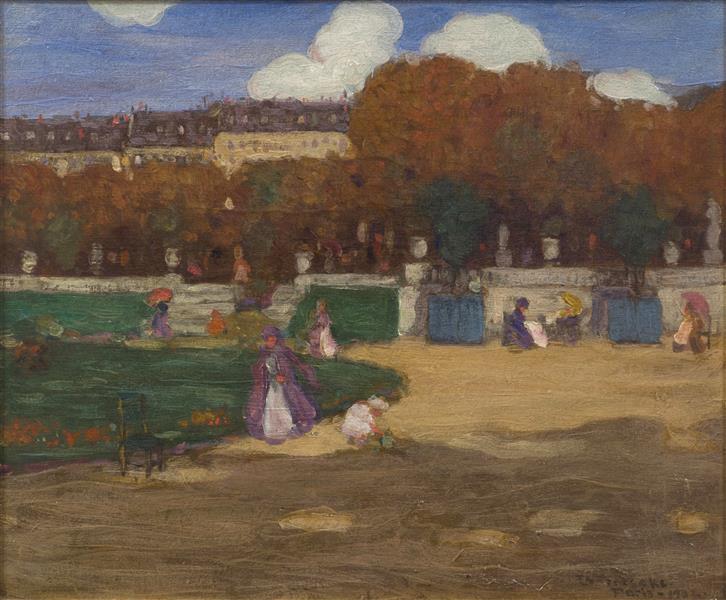
Luxembourg Gardens, 1902 - Frederick Carl Frieseke
Luxenbourg Gardens by Frederick Frieseke (1902)

In 1900, the O’Bryans had arrived in Paris and were living in an apartment at 72, rue Herschel, a very fashionable address not far from the Luxembourg Gardens,.  Their daughter Sarah, who, along with her younger sister Janet had accompanied them on this trip, was studying drawing and painting.   Soon after her arrival in the French capital she and Frieseke met. Very soon the couple fell in love and had, between themselves, agreed to an informal engagement.  However, when her father found out about this planned engagement he vetoed it as he would not approve his daughter marrying a poor artist. Frederick and Sadie were polar opposites.  She was very tall, almost six feet in height and elegant.  Frederick was short and dumpy and not the best dresser.  He was modest, single-minded and introverted.  She was vivacious, affected, gregarious and probably even more determined than him.  She was religious and her parents were staunch Catholics.  Frederick had a “take it or leave it” attitude to religion.  However love conquers all or would it?

Landscape, Le Pouldu by Frederick Frieseke (1901)

During the uncomfortably hot and often humid summer months, Paris was certainly a place to avoid and it signalled the departure of the artists from the French capital for this period.  In the summer of 1901 Frederick along with some fellow painters left Paris for a three-month stay in Britanny at the small fishing village of Le Pouldu.  Having begun to paint landscape scenes set around the Luxenbourg Gardens of the capital Freerick was eager to concentrate on landscape paintings and depict the area around Le Pouldu.  In a letter to Sadie in June 1901 he wrote about where he was living and what was happening:

“We are staying in a private house, a fine old country house, part of it built in 1728, so it says on the sun dial. . . . The country seems so lovely, and the sea and the river too…. It seems so peaceful down here. The people are so slow and I like everything: the black and white cows, the narrow little lanes with the trees meeting overhead, the dunes with one lonely cottage almost hidden, and the farms, houses of stone with thatched roofs and surrounded by trees which the sea winds have blown and twisted in strange shapes…”

However, all was not well with the decision of Frederick to concentrate on landscape depictions and at the end of June in another letter to Sadie Frieseke despondently wrote:

“…I have to confess that landscape is by far the most difficult thing I have tackled and that I am utterly unable to grasp it so far…”

With summer ending he and his fellow artists returned to Paris and resumed atelier painting and Frederick began the first of a life long series of female nude paintings

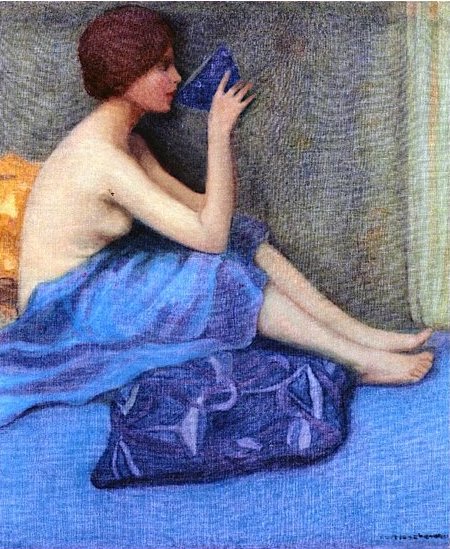
The Blue Bowl by Frederick Frieseke (1901)

In 1901, Frederick completed the painting entitled The Blue Bowl.  It was his first finished painting of a nude.  In a letter to Sadie Frederick, dated October 15th, 1901, he wrote about the painting:

“…I have a model mornings now. A blonde girl with rather reddish hair. Am trying to paint a nude–the first thing I have ever tried like that..”

Nude in a Glade, 1910 - Frederick Carl Frieseke
Nude in a Glade by Frederick Frieseke (1910)

If you peruse the illustrated Salon catalogues of the period you would find that academic artists depiction of nude females was simply part of storytelling, often a case of insincere moralising, or just a puerile fantasy.  However, Frieseke’s depiction of nude females was always more serious sober and quite simple, the painting’s purpose being directed not towards its subject matter but its manner. His down-to-earth approach to the subject and the subsequent resistance to it in his puritanical native land would create a stand-off that lasted throughout his career. Frieseke returned home to Owosso, Michigan for the first time in 1902 and again in a letter, that August, to Sadie, he wrote that he derived much pleasure in shocking the good Church people with the nudes.

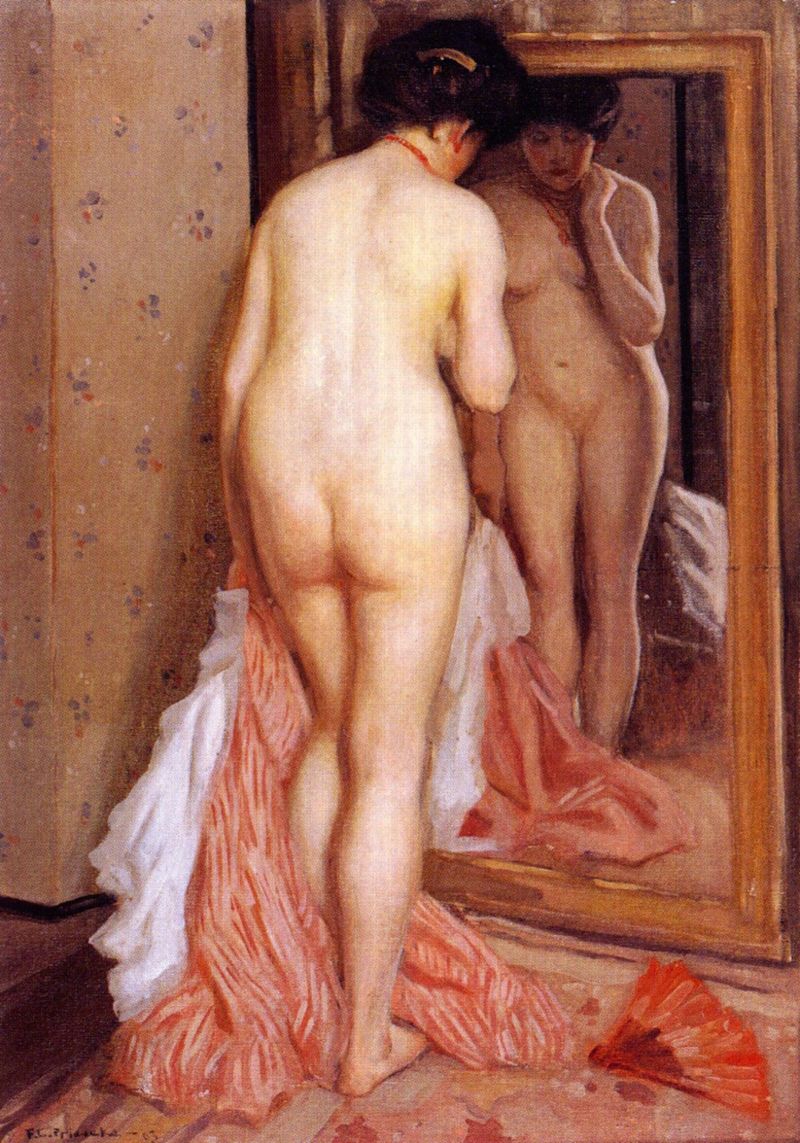
Frederick Carl Frieseke, 1903 - Before the Mirror.jpg
Before the Mirror by Frederick Frieseke (1903)

Frederick Carl Frieseke, 1903 - Girl in Pink.jpg
Girl in Pink by Frederick Frieseke (1903)

Above are two further example of this genre of paintings which Frieseke completed during the first decade of the twentieth century.

Sadie and her family had returned to America in 1901 and did not return to France until 1903. She and Frederick had to survive on long-distance love but that was all about to change.

…………………………..to be continued.

Natalie Papamichael. Part 2.

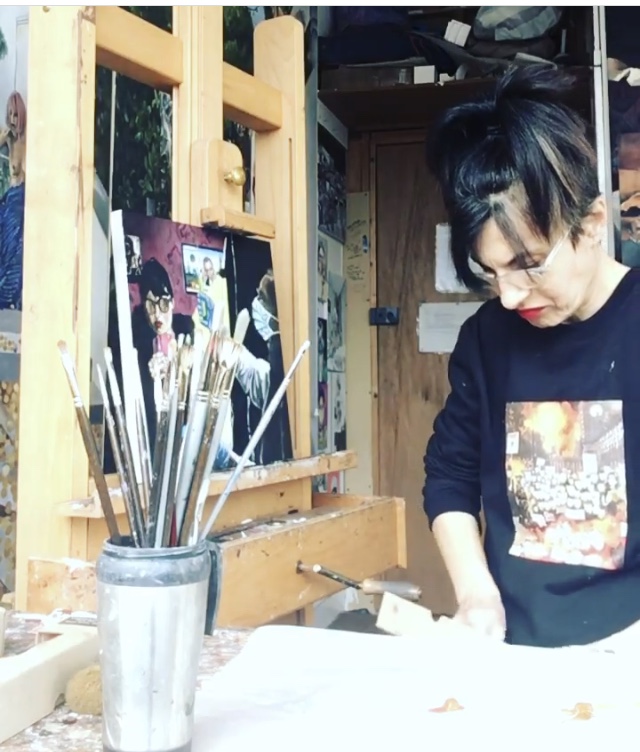
At work in my studio

During her first pregnancy, Natalie and her husband became increasingly unhappy with where they lived in London. They believed it was not a safe place to bring up children and so, decided to move. The problem for them, as it still is for most people, owning an affordable property in a good area in London is almost impossible. As they had had their wedding ceremony in Brighton, they knew something about the area and one of her friends from Paris who had previously lived in the seaside town told her that it would be a good place to bring up children. Knowing that it was a commutable distance to London and her beloved art galleries, the couple moved out of the capital in 2002 and relocated to the south coast town. In 2004 Natalie gave birth to her second child, another son, Tadhg. Now having two young sons, who were not great sleepers, put a lot of pressure on Natalie as she tried to continue with her art.

A collage of her life

In 2007, motivated to focus on combining her research with her studio practice, she went to Florence for a short Intensive Painting Course at the Angel Academy of Art, a private institution, founded by the English artist, Michael John Angel, in 1997, where one is taught drawing and learns the classical painting techniques of the Old Masters.

See the source image
Phoenix Art Space, Brighton.

In 2009, finding it difficult to work from home, Natalie took a studio in the Phoenix Art Space, a five-storey building in the centre of Brighton close to her where she lived. There are four floors dedicated to a diverse community of artists. It was originally started as an artist-run space and a charitable organisation offering affordable studios. Initially Natalie had to share a space but eventually she got her own studio on the second floor.

Casting Call by Eleanor Antin (2007)

One of the artists who influenced Natalie was Eleanor Antin.  She had created a body of work that explores history, contemporary culture, and identity from a feminist perspective.    In 2007 Antin produced photographic tableau entitled Casting Call and from that work evolved Natalie’s 2016 painting, The Masquerade.  Antin’s tableaux was based on the story of the Greek painter, Zeuxis. He was considered the greatest artist of the era and was asked to do a painting of Helen of Troy, considered to be the most beautiful woman. Claiming that there was no such thing as a perfect woman, Zeuxis took the five most perfect women from the town of Croton and took a different characteristic from each. In Antin’s photography, the women appear as if at a casting call for a movie.

The Masquerade by Natalie Papamichael (2016)

In The Masquerade, Natalie replaced Antin’s women with her own performance stills, which she made whilst at college, in different masquerades and at various stages of her pregnancy. She is rewriting the narrative from her own perspective whilst inserting herself into an artistic historical discourse.

The Society of Outsiders (1) (after Eleanor Antin) by Natalie Papamichael (2017)

In 2017, Natalie completed two large works (200 x 170cms) entitled The Society of Outsiders (after Eleanor Antin) I and II.   

The Golden Death from the Last Days of Pompeii by Eleanor Antin (2001)

These were again based on the photographic tableaux by the conceptual artist, Eleanor Antin, entitled The Golden Death from the Last Days of Pompeii by Eleanor Antin (2001).

The Roses of Heligabalus by Lawrence Alma Tadema (1888)

One of the original photographs by Antin was based on the Lawrence Alma Tadema’s 1888 painting, The Roses of Heligabalus. In this painting the decadent Roman Emperor, Heliogabalus, kills his guests by smothering them to death with rose petals.

The Society of Outsiders (II) (after Eleanor Antin) by Natalie Papamichael (2018)

There is an unusual story behind these two large works of art.  In late 2016, Natalie had been invited to create two paintings for an exhibition in Central London for a charitable event.  She was shown where the paintings would be hung so that she could tailor the canvases to fit neatly in place.   She worked on the paintings up until the end of 2018 in preparation for the exhibition which was due to take place in January 2019. She eventually completed the two works but a month prior to the exhibition the Charity organisers baulked at the depictions and said they did not want them in full view and allocated her an alternative space on the back staircase.  They then said they did not want them at all and later excluded more of her paintings, deciding that it was best not to show any of her work.  Who said the life of an artist is easy !!!

In her painting, Self-Portrait at La Salpêtrière, Natalie is once again reimagining an original work of art. 

This image has an empty alt attribute; its file name is image-7.png
A Clinical Lesson at the Salpêtrière by Andre Brouillet (1887)

This time the artist is Andre Brouillet and the painting is A Clinical Lesson at La Salpêtrière which he completed in 1887.   La Pitie-Salpêtrière is a famous hospital for the mentally ill in Paris. The original work depicts the renowned neurologist, Jean-Martin Charcot, giving one of his regular Tuesday lectures in how to treat an hysteric. It depicts the ‘queen of hysterics’ swooning and being caught by the nurses.

Self-Portrait at La Salpêtrière by Natalie Papamichael

In Papamichael’s painting the hysteric is replaced by Natalie’s own Self Portrait. Instead of passively swooning like Brouillet’s hysteric she is actively reading a book entitled ‘The Science of Woman’ and defiantly challenges the gaze of the male doctors.  Of the depiction, Natalie comments:

“…In my paintings I am both performing as the ‘male artist’, but also as the traditional, passive, female subject of the painting, thus challenging the binary opposition inherent in Art History. It is a way of inserting myself into the narratives and combining the past with the present to illustrate the similarities as well as to subvert the meaning…”

Anatomical Venus by Natalie Papamichael (2018)

Another of Natalie’s works featuring the science of medicine is her 2018 oil on aluminium panel, Anatomical Venus, which is based on the wax model which was created in 18th century Florence and displayed as part of the city’s public science museum, La Specola. It was used for instruction in anatomy. The models were also entitled ‘Slashed Beauties’ and ‘Dissecting Graces’. The doctors in the painting are from the 1931 black and white Frankenstein film. The painting juxtaposes the grotesque with the beautiful.

Herstory Rhymes by Natalie Papamichael

One of Natalie’s works which she considers as being of great importance is her painting entitled Herstory Rhymes which she feels encapsulates everything that is relevant to her practice and shows the most development from her early stages. There is reference to the film ‘Fahrenheit 451’ as the setting. She has changed the book titles so that each book is important in terms of censorship as well as her personal story. The poster which is about to burn in the background is ‘Ghost Town’ by the Specials. This references the deep recession of the 1980s and suggests the notion that ‘history doesn’t repeat, but it rhymes.’  Of the painting she said:

“… My self-portrait is again a reflection of the apathy of people ignoring what is happening around them whilst looking at their mobile phones …”

Docile Bodies by Natalie Papamichael

Natalie Papamichael’s painting entitled Docile bodies is a re-imagined painting adapted from a still from a Karl Lagerfield fashion show.  The original image resembled an old Masters setting with the futurist models walking forwards. Natalie explains:

“… I wanted to integrate the absurdity and the futuristic look of the models walking forward in a regimented style and integrate this with a reference to the setting of the Old Masters and integrate this with my performance stills from the LSHTM (London School of Hygiene & Tropical Medicine). In this performance I reference the poses of models from 16th and 17th century medical dictionaries and had misogynistic quotes from throughout history in which woman is subjugated because of her body and her bodily functions. Relating the historical subjugation of women through their bodies to culture today. The last model at the top of the staircase, is overtly referencing an eating disorder by pointing as if she is about to put her fingers down her throat. All the models also have a bar code on their wrists which references the commodification of people and is somewhat more pertinent than I realised it would be...”

Although the writing on the “shields” held by the three women is probably not visible in the picture they were three quotes:

Woman’s sexual needs have less of a mental character because generally speaking her mental life is less developed’ ( Emile Durkheim 1858-1917)
Every woman would prefer to be a man, just as every deformed wretch would prefer to be whole, and every idiot and fool would prefer to be learned and wise”. (Torquatto Tasso)
‘For 15 or 20 days (one could say almost perpetually) women is not only ill but wounded’ Jules Michelet 1798-1874
The Hydra by Natalie Papamichael (work in progress)

Natalie’s “work in progress” is her oil painting depicting the mythology of The Hydra. It is an allegorical piece based on contemporary world events. It is a pendant piece to ‘Herstory Rhymes.’  She explains her thoughts about the depiction:

“…For the beginning of the piece I used a still from a Percy Jackson film with the mythical creature, The Hydra. The Hydra is a monstrous serpent with nine heads and when a head is cut off another one simply grows back to replace it, thus the evil continues.  In my painting I have replaced the heads with politicians and people accused of orchestrating the constraints emerging on civil rights around the world. I am in the forefront of the painting looking at a mobile phone.  I have on my Marie-Antoinette wig and I am oblivious of what is happening around me. I have used one of my performance stills, as Salome, and I am about to strike one of the serpent heads. In the background there are screens depicting the widespread propaganda prevalent in the major media outlets around the world…”

She said that as she worked on it, it has evolved in its references and meanings. It also referenced the poem Jerusalem by Blake:

Bring me my Bow of burning gold:
Bring me my arrows of desire:
Bring me my Spear: O clouds unfold!
Bring me my Chariot of fire!
 
I will not cease from Mental Fight,
Nor shall my sword sleep in my hand:
Till we have built Jerusalem,
In England’s green & pleasant Land.

Dress made from the painting.

Around 1620 Artemesia Gentileschi completed her famous painting, Judith Beheading Holofernes. She portrays the moment that Holofernes is killed by the hand of the determined and formidable Judith. The overall effect is both powerful and frightening: the drunk corpulent general is lying on the bed, his head grasped by his hair and the sword plunged into his neck.

Judith Beheading Holofernes. by Artemesia Gentileschi (c.1620)

Furthermore, Artemisia did not shy away from adding the gory detail of blood spurting so profusely as to stain Judith’s breast.

Below we can see Natalie’s version of the famous painting.

Judith beheading Holofernes (after Artemesia Gentileschi) 2009-2011

Natalie has been continuing to teach herself using the methods she learnt in Florence. She has exhibited widely including exhibitions both within her studio as well as at Gallery Different and at the Society of Women Artists in London. Her practice has evolved in recent times to become more overtly political and she has started turning her paintings into merchandise to try to reach a wider audience.

The artist and I in her studio (Brighton 2021)

It has been my pleasure to collaborate with Natalie with these two blogs featuring her life and works of art. I wish her well in the future.

Nikolai Petrovich Bogdanov-Belsky. Part 1. School Days

Nikolai Bogdanov-Belsky (self-portret).jpg
Self portrait by Nikolai Petrovich Bogdanov-Belsky (1915)

Today I am talking about Nikolai Petrovich Bogdanov-Belsky, who was one of the great nineteenth century Russian painters. The visual expression of the artist’s painting has its roots in realism, the desire to depict the reality of life. 

Nikolai Petrovich Bogdanov was born on December 6th, 1868 in the small rural village of Shitiki of the Belsky district of the Smolensk province (today, the Oleninsky district of the Tver region) in the west of Russia, some 360 kilometres west-south-west of Moscow, and 60 kms from the border with Belarus.  The second part of his name was attached only in 1905 when the artist received the title of Academician. Bogdanov-Belsky recalled this momentous event:

“...My common name was as though ennobled by the Emperor himself, writing it personally in a diploma with a hyphen – “Belsky…”

Nickolai came from a poor peasant family which in a Russian-language site was described as:

Он, внебрачный сын батрачки,

He’ the illegitimate son of a batrachka

A batrachka is defined as an order of amphibians which includes the frogs and toads.  So, I guess that means his family was harshly classified as the lowest of the low !  Nikolai was born into a life of abject poverty and his childhood was harsh and unforgiving.  He lived with his mother at the house of his uncle, where they were unwanted guests and merely tolerated. According to church records, Bogdanov-Belsky began learning to read and write from a bell ringer. He continued into the 2nd grade of the Shopotovsky primary school where the local priest was also the teacher. The boy’s artistic abilities began to manifest themselves from the age of six and he was noticed by Sergei Alexandrovich Rachinsky, the founder of the folk school in the village of Tatevo, and from the autumn of 1878 to the spring of 1882, Nickolai Bogdanov-Belsky attended this school. The boy worked hard and was helped along by Sergei Aleksandrovich Rachinsky and lived in the Rachinsky household. Rachinskyi was a legendary and wealthy man, who was a professor of biology, who lived on a large estate.  Racznski had been Professor of Botany at Moscow University but left the scientific department in 1867 and created a school for peasant children on his estate in Tatev. However, to gain entrance to this school one had to pass an exam and in the case of Nicholai, he had to draw one of the school’s teachers in profile which is quite a difficult task for a child but his test piece was good enough for him to be accepted into the Sergei Aleksandrovich Rachinsky People’s School.

An der Schulschwelle von Nikolai Petrovich Bogdanov Belsky
On the Threshold of School by Nikolai Petrovich Bogdanov-Belsky (1897)

What was it like for Nickolai to face his first day at this new school?  The answer probably lies in his 1897 autobiographical painting which he painted, aged twenty-nine.  It was entitled On the Threshold of School.  In it we see a boy holding his breath as he stood outside his classroom, plucking up the courage to enter.

Writing by Nikolai Petrovich Bogdanov-Belsky (c.1908)

Another schoolroom scene was painted by Nikolai in 1908 simply entitled Writing.

Nikolay Petrovich Bogdanov-Belsky. Verbal counting
Oral Counting by Nikolai Petrovich Bogdanov-Belsky (1895)

One of Nickolai’s well-known works featuring school life is his 1895 painting entitled Oral Counting which is also referred to as Verbal Counting or Mental Arithmetic.  This is also Nikolai’s dedication to Sergei Aleksandrovich Rachinsky, a university professor and hereditary nobleman, who had befriended young Nikolai and set up a school which gave him and other barefoot peasant children from the village a start in life in the form of a decent education.  In the painting, we see the figure of a schoolteacher, an intellectual in a bow tie and a black tailcoat seated among ordinary rural boys who have come to learn mathematics.  The school room in the depiction is part of the school built with funds from Rachinsky in his ancestral village of Tatevo.  It became the first Russian educational institution with full board for children of peasants. Nickolai Bogdanov-Belsky himself was fortunate enough to study there.  Throughout his life, Nickolai would return with thoughts of gratitude remembering the warmth of school life and he devoted more and more of his new canvases to the teaching profession, and the process of schooling.  There is no doubt that his years spent at the Rachinsky school left an indelible mark on his soul  Rachinsky was very definite as to what the peasant classes needed, saying:

“…The first of the practical needs of the Russian people … is communication with the Divine…….The peasant is not drawn to the theatre in search of art, but to the church, not to the newspaper, but to the Divine Book…”

The reasoning behind this was that Rachinsky also believed that Dante and Shakespeare would be available for understanding to those who learnt Church Slavonic writing, while Beethoven and Bach would become closer to a person familiar with church chants. 

Nicolai Bodanova-Belsky’s depiction testifies to Rachinsky’s main passion – mathematics, and the emphasis that was placed on it in his teaching. Rachinsky created the textbook entitled 1001 Problems for Oral Counting, and the puzzle seen on the blackboard in the painting is one such problem. Apparently, this example seen on the blackboard can be solved by knowing about the regularities of adding squares of some two-digit numbers named after the famous Russian teacher. So, according to Rachinsky’s sequences, the sum of the squares of the first three numbers on the board will be equal to the sum of the next two. And since in the first and second cases this number is 365, the answer to this already classical problem is extremely simple….. 2, but you knew that !!!!!!!!!

Nikolay Petrovich Bogdanov-Belsky. Future monk

Future Monk by Nickolai Petrovich Bogdanov-Belsky (1889)

In 1881, Rachinsky sent thirteen-year-old Nickolai to receive an initial art education at the icon-painting workshop at the Trinity-Sergius Lavra, where the boy studied for two years. In 1884, after two years studying at the monastery school Rachinsky enabled Nickolai to enrol at the Moscow School of Painting and Architecture.  He thrived at the school and achieved many commendations for his landscape work.   He remained there for five years, and at the end of the course he had to produce a diploma painting, so as to receive the title of “class artist”.  He was unsure what to paint although his fellow students and teachers presumed it would be a landscape painting.  He decided to go back to the village of Tatevo to visit Raczynski and ask for his advice.  Together they come up with the idea that the painting should feature monks.  The painting he completed was entitled Future Monk.  It seems the young teenager in the picture has set his sight on becoming a monk and to go to the monastery.  The eyes of the “future monk” stare out at us with grim determination.  He is already dreaming of monastic life and spiritual feats that it will bring.  The work was approved by the examiners and bought from the exhibition by Kozma Terentievich Soldatenkov, the largest collector of works of art, and then given to by Empress Maria Fedorovna. Immediately the artist was ordered to paint two more versions of the painting. The painting had been an absolute success!

Sunday Reading by Nickolai Petrovich Bogdanov-Belsky (1895)

In 1890 Nickolai travelled to Constantinople and Mount Athos, a mountain and peninsula in northeastern Greece which is an important centre of Eastern Orthodox monasticism. On Athos, Bogdanov-Belsky met Filippe Malyavin, who is engaged in icon painting there. He also met sculptor Vladamir Beklemishev, a professor who later became the rector of the St. Petersburg Academy of Arts.  Between 1894 and 1895 Nickolai is in St Petersburg where he continues his art studies at the St. Petersburg Academy of Arts.  One of his lecturers was Ilya Repin.  In 1895 Nickolai completes one of his best loved paintings, Sunday Reading.  The painting is well received and is sold and with the money raised he goes to Paris, where he attends the private studios of Fernand Cormon and Filippo Colarossi.

Country Boys by Nickolai Bogdanov- Belsky (1916)

There can be no doubt about the love Nickolai had for painting children of peasant stock.  He would travel back and forth between St Petersburg where he rented an apartment and the village of Tatevo where he had his studio.  He once wrote:

“…I spent so many years in the village, so close to the village school, so often I watched peasant children, so loved them for their spontaneity, their talent, that they became heroes of my paintings…”

In my final look at Bogdanov-Belsky’s peasant children paintings I want to show you his 1916 work entitled Country Boys. The main characters in this depiction are two bare-footed boys, one of whom is sitting on a rickety wattle-fence which appears to be just strong enough to support him. He wears a peaked cap on his head, which was a typical head gear of the 19th and early 20th centuries and sported by people in towns and rural settings alike. He is wearing a patched shirt and ill-fitting trousers with a hole at the knee.  Something has distracted him making him turn to the side but we are unable to elicit what has caught his attention.  His friend, standing beside him, is also wearing shabby clothes which could well have been “hand-me-down” ones from an elder brother. This is a Realism painting.  The artist is simply depicting how things are for the rural poor.  This is not a painting denouncing social inequality.  In a way it is a poetic and lyrical depiction in the way Nickolai has given us a setting, a resplendent representation of nature, in which, behind the fence we see a chamomile field, forest and an overcast sky.

………………..to be continued.
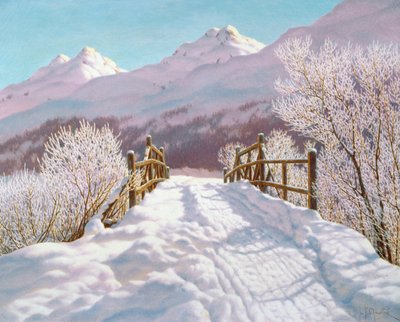
Alice Ravenel Huger Smith

Self portrait (1908)

Self Portrait (1908)

At the turn of the twentieth century, the South Carolina city of Charleston was a shadow of its former glory. Charleston had historically nurtured a celebrated art and architectural heritage during the Colonial Period and Antebellum period but following the end of the Civil War in 1865 and the Reconstruction period 1865-77, it struggled to continue doing so. Between the two World Wars, beginning in the second decade of the 20th century, Charleston experienced a renaissance that flourished in part due to the work of authors, architects, artists, poets, & preservationists who rallied behind the common cause of ‘the betterment of the city’. It was a period known as the Charleston Renaissance and is credited with helping to spur the city’s tourist industry. Of the various artists associated with the movement, four of them stand at its forefront: Alfred Hutty, Alice Ravenel Huger Smith, Anna Heyward Taylor, and Elizabeth O’Neill Verner. In this blog I am looking at the life and artwork of one of the four, Alice Ravenel Huger Smith.

Alice Ravenel Huger Smith, Age 25.

Alice Ravenel Huger Smith, aged 25.

Alice Ravenel Huger Smith was born in Charleston on July 14th 1876. She was the fourth of five children and was descended from prominent rice planters and was the daughter of Daniel Elliott Huger Smith and Caroline Ravenel and was part of a socially prominent Charleston family. Although artistically self-taught she later did attend some classes in drawing and painting at the Carolina Art Association. Louise Fery, a Frenchwoman, instructed her students in the basics and, most importantly for Alice, in the technique of watercolour. The Art Association was established in 1857 by a group of prominent low country planters and factors and was officially chartered by the General Assembly on December 21, 1858. Its purpose was the cultivation of the arts and art education. It is now part of the Charleston’s Gibbes Museum of Art.  Alice Smith began her artistic career by making money from her portraiture, copying old family images and painting friends and relations.  She also dabbled with painting fans and dance cards. 

Celestial Figs by Alice Smith.  Colour woodblock print. (1917)

Of her early artistic influences, one was Birge Hirston, the American genre and landscape painter, teacher, and writer who was a prominent practitioner and advocate of Tonalism.  Tonalism was an artistic style that emerged in the 1880s when American artists began to paint landscape forms with an overall tone of coloured atmosphere or mist.  Alice met him during his extended visit to Charleston in 1908.  Later she would credit Hirston as being her guide when it came to her romantic style with regard to her landscape depictions.

HELEN HYDE (1868–1919) TEN WOODBLOCK PRINTS, MEIJI PERIOD (20TH CENTURY) Woodblock Print by Helen Hyde

Another influence which inspired Alice Smith was the Japonisme aesthetic of the American etcher and engraver, Helen Hyde, who is best known for her colour etching process and woodblock prints which echoed the portrayal of Japanese women and children. Around about 1917, Smith undertook an intense study of Japanese colour woodblock prints, largely from the ukiyo-e school, which had been collected by her cousin, the Harvard professor Motte Alston Read. Motte Alston Read built up a collection of almost four hundred Japanese woodblock prints during the first two decades of the twentieth century, working meticulously to assemble a group of prints that were representative of the history of Japanese woodblock printing. She also began to teach etching during the 1920s, and one of her most famous students was Elizabeth O’Neill Verner.

Smith catalogued the collection and, began trying out with actual blocks and she taught herself how to print in the traditional Japanese manner.  She managed to produce a body of work which was characterized by sophisticated design and yet retained a sense of tranquillity.  In 1923 Smith helped the founding of the Charleston Etchers Club, a collaborative group that jointly acquired a press and shared expertise and criticism. However, by the late 1920s Smith gave up her work in prints and began to concentrate on watercolour.

Branford-Horry House by Alice Smith (1917)

Branford-Horry House by Alice Smith

Alice Smith is probably best remembered for her scenic views of Charleston streets and in 1917 she produced a beautiful graphite sketch of one of Charleston’s famous buildings, the Branford-Horry House.  The house was built for William Branford, a wealthy planter, in 1765-67 and is rated one of Charleston’s finest examples of a three-story brick Georgian townhouse, or “double house.” In 1801 it was purchased by Thomas Horry, who had married Branford’s daughter. His son, Elias Horry, president of the South Carolina Canal and Railroad Company, inherited the house and altered it somewhat. The house is a three-story Georgian brick building with stucco-covered walls. Unfortunately, in 1988, a speeding car crashed into the house, knocking out two of the columns and sending one into the front door of the house.

St Phillips Church Spire, Charleston by Alice Smith

St Phillips Church Spire by Alice Smith

Another graphite on paper sketch of a Charleston building is Alice’s depiction of St Philip’s church spire.  St. Philip’s is the oldest congregation in the United States south of Virginia.  The church was built in 1836 and the spire completed in 1850.  On November 7, 1973, it was added to the National Register of Historic Places and designated a National Historic Landmark.

House-Tops-View-from-69-Church-Street-689x1024

House Tops View from her home, 69 Church Street Charleston by Alice Smith

Alice Smith became so interested with the old buildings of Charleston that in 1917 in collaboration with her father, Daniel, she had a book published, The Dwelling Houses of Charleston, South Carolina, in which the authors demonstrate how the fashions of its architecture, often brought over from England, have maintained local characteristics and resulted in a distinctive style.

See the source image

For Alice and her father, it had not simply been their object to list or to describe these dwelling houses after the manner of a guidebook, but to show how the fashions of its architecture, though imported and constantly modified by new ideas brought chiefly from England, had yet maintained local characteristics, resulting in quite a distinctive style which has steadily persisted and been developed.
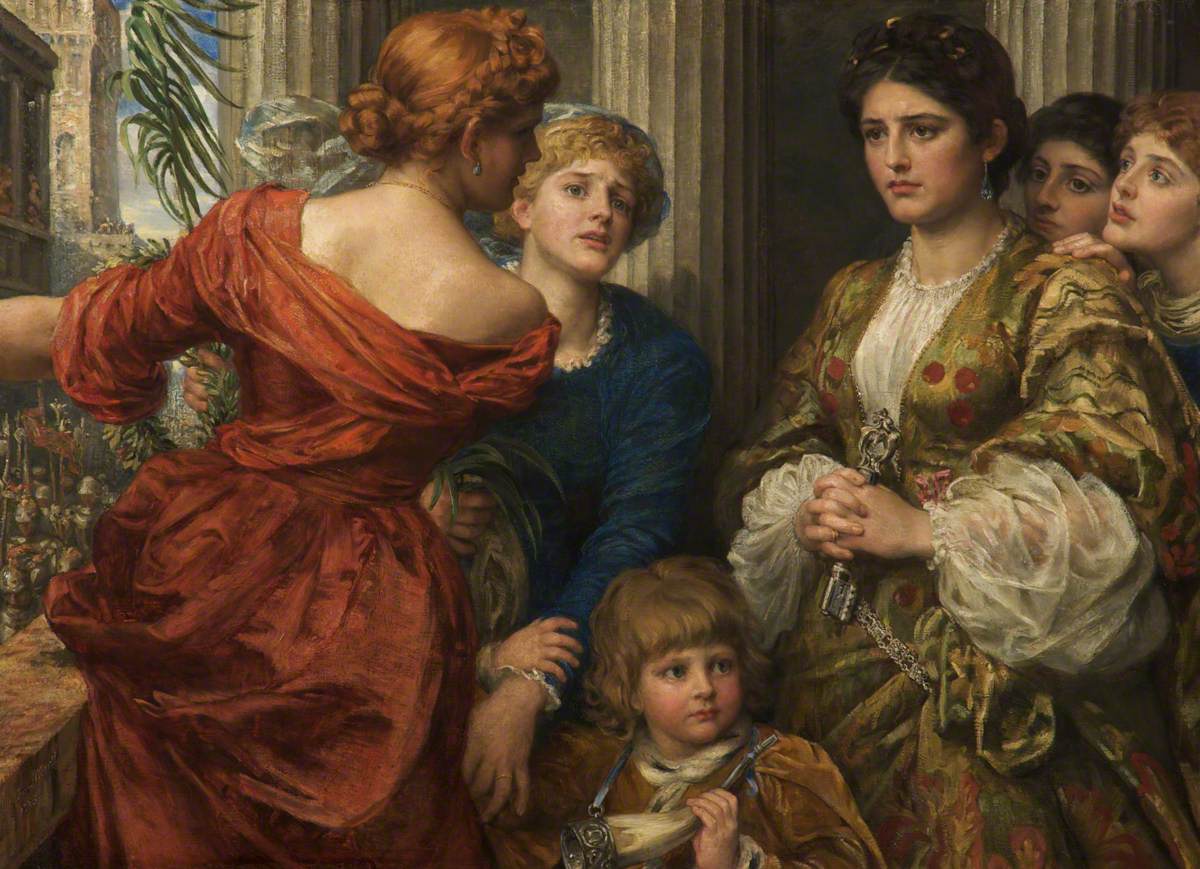
The Winter Vegetable Garden from the series A Carolina Rice Plantation of the Fifties by Alice Smith (c.1935)

The Winter Vegetable Garden from the series A Carolina Rice Plantation of the Fifties by Alice Smith (c.1935)

However, Alice Smith is best known for her lyrical and expressive depictions of the Carolina Lowcountry, the cultural region along South Carolina’s coast, including the Sea Islands. It was once known for its slave-based agricultural wealth in rice and indigo, crops that thrived in the hot subtropical climate, and is known now for its historic cities and communities, natural environment, cultural heritage, and tourism industry.  Smith summed up her love of the area saying:

“…my own lovely flat country of rice fields, of pinewoods, of cypress swamps, of oaks, lotus, and all their attendant feathered folk would yield me a full harvest if diligently spaded…”

Sunday Morning at the Great House by Alice Smith

Sunday Morning at the Great House from the series A Carolina Rice Plantation of the Fifties by Alice Smith (c.1935)

Around about 1924 Alice Smith changed her favoured painting medium and resorted to working with watercolours. After experimenting with oil paints and printmaking, Smith eventually settled on watercolour in which she would work for the rest of her life.  The reason being she said was that watercolours were most conducive to achieving the atmospheric effects she sought in her landscapes. Her landscape depictions are generally devoid of figures as she wanted to concentrate on the beauty of nature itself.  Many of her mature watercolours depict scenes from rural salt marshes.

Mending a Break in a Rice-Field Bank from the series A Carolina Rice Plantation of the Fifties

Mending a Break in a Rice-Field Bank from the series A Carolina Rice Plantation of the Fifties by Alice Smith (c.1935)

Alice Smith was also a noted illustrator, and contributed illustrations to two volumes her father, the historian Daniel Smith, who wrote about the history of Charleston and its architecture, as well as other books relating to South Carolina, most notably the 1936 book, A Carolina Rice Plantation of the Fifties, which contained thirty paintings in water-colour, by Alice Huger Smith, and a narrative by Herbert Ravenel Sass, with chapters from the unpublished memoirs of her father Daniel Huger Smith.

A Winter Field Still in Stubble from the series A Carolina Rice Plantation of the Fifties by Alice Smith

A Winter Field Still in Stubble from the series A Carolina Rice Plantation of the Fifties by Alice Smith (c.1935)

Alice was also engrossed in recording vanishing ways of life in South Carolina and her best-known work is the series of thirty watercolours known as her Rice Plantation Series which can be seen at the Gibbes Museum of Art in Charleston’s Historic District. She donated the Rice Plantation Series to the Gibbes in 1937.  Alice was able to pictorially tell the history of plantation life in the antebellum South, and by doing so, she took it upon herself to preserve that period in a series of nostalgic images that would be accompanied by her father’s memoirs and an essay on rice cultivation by the historian Herbert Ravenel Sass.  Alice made these plantation paintings during the height of the Jim Crow era, when black people in Charleston and throughout the country were subjected to humiliating discrimination and life-threatening abuse.  She was well aware of this as she, a single woman, lived in downtown Charleston, close to areas of extreme poverty, surviving only through the sale of her art.  As I said at the beginning, this period was in the 1930’s when Charleston was a city in limbo.  Gone were the days of the glorious affluence of the rice years with its economic revival still years away.  It was a time for those who lived in Charleston to hanker for the “good old days” and like to remember when times were relatively calm, when blacks knew their place and white planters were firmly in charge, when life for the privileged class was simple and wealth abundant.  In Alice Smith’s 1950 autobiography, Reminiscences, she wrote about change:

“…Small places and big places alike show it. Perhaps small happenings show it as sharply as great events, and one looks with surprise at the differences that one never noticed during the endless moments of what might be called trivial evolution…”

The Grove of Oaks from the series A Carolina Rice Plantation of the Fifties by Alice Smith (c.1935)

The Grove of Oaks from the series A Carolina Rice Plantation of the Fifties by Alice Smith (c.1935)

Her series of watercolours reflect her sense of change, and her profound nostalgia.  Maybe it was a nostalgic view of plantation life of the past but maybe it was pure fantasy but one has to remember paintings were made to be sold and maybe the public preferred this “happy plantation life” image rather than the cruelty that existed and by studying her depictions the public it probably helped people believe that the past was lovely.

A Visit from the old Mistress by Wilmslow Homer (1876)

A Visit from the Old Mistress by Winslow Homer (1876)

Almost sixty years before Alice Smith’s Plantation series the great American painter Winslow Homer created his 1876 work, A Visit from the Old Mistress, a picture depicting an idealised situation when blacks as freed slaves and living in a ramshackle cabin were shown as mixing happily with a white person, their former mistress of the “big house” who, until recently, owned them. It represented a scene from the present, a meeting of different classes and colour which caused an inevitable awkwardness when it was exhibited.

1 / 22
Woods at River Bend on Wando River, by Alice Smith (c. 1936)
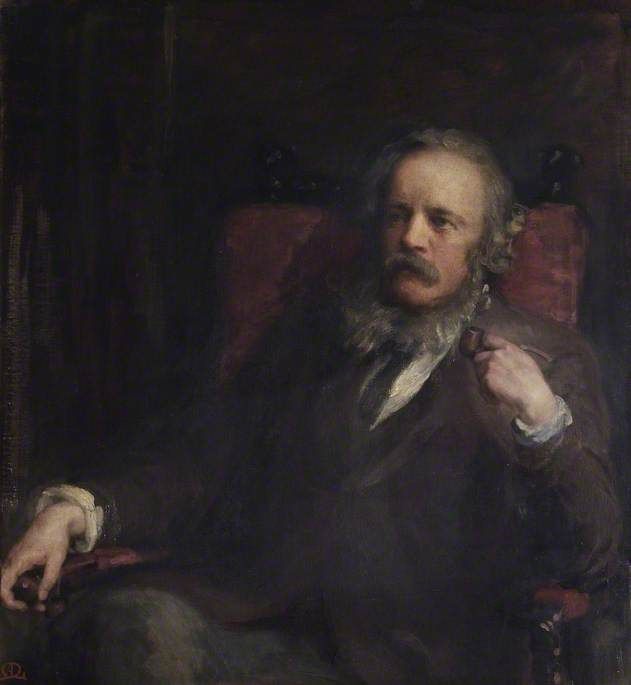
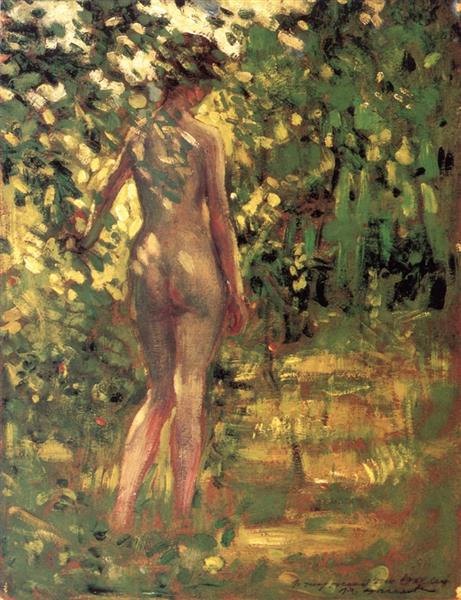
 

Alice Smith donated the Rice Plantation Series to the Gibbes in 1937, and since that time the watercolours have been among the most popular works owned by the museum. The problem however was that the delicate works on paper were slowly deteriorating due to the acidic boards mounted to the back of each of the paintings. The acid then began to discolour the works and deposit on them brown spots known as foxing and with many of the watercolours, the damage was well advanced.

At the Head of the Valley by Alice Smith

The management of the Gibbes, realised the need to intervene, reverse the damage, and prevent future damage through professional conservation of Smith’s entire series of watercolours. To accomplish this, they established the Welsh-Blakely Fund, a substantial financial commitment that funded the five-year conservation project carried out by the Straus Center for Conservation at the Harvard University Art Museums.

Along the Beach by Alice Smith (c.1926)

Like many other leading painters from the Southern states of America during the early twentieth century, Alice Smith had a steadfast belief in the South, which was both idealized and energetically favourable, but this was simply down to her love of where she lived.  Smith was at the centre of Charleston’s artistic reawakening during the early twentieth century.

Larger memorial image loading...

Alice Ravenel Huger Smith died on February 03, 1958, aged 81 and is buried at Magnolia Cemetery in Charleston.