Thérèse Schwartze

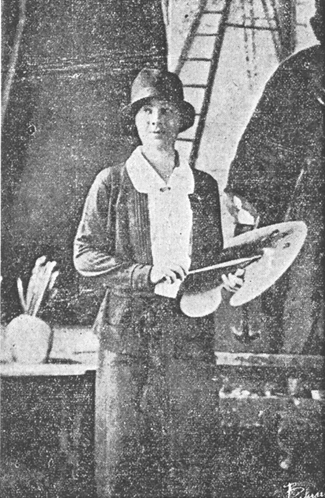
Thérèse Schwartze – self portrait (1917)

Therese Schwartze was a Dutch 20th century painter.  Such was a hugely talented portrait artist that was one of only a few females who had been honoured by receiving an invitation to contribute her self-portrait to the hall of painters at the Uffizi Gallery in Florence.  This genius of portraiture completed around a thousand works during her forty-year career, which means that she completed more than twenty paintings a year. Because many of her portraits were created to be treasured by family members, most of her work has remained in private collections.  About one hundred and fifteen of her paintings are in public collections in the Netherlands, and twelve are part of foreign public collections, which leaves the locations of nearly four hundred paintings still unknown. She became a millionaire in the process. Schwartze also established an international reputation, with countless exhibitions and commissions throughout Europe and the United States. 

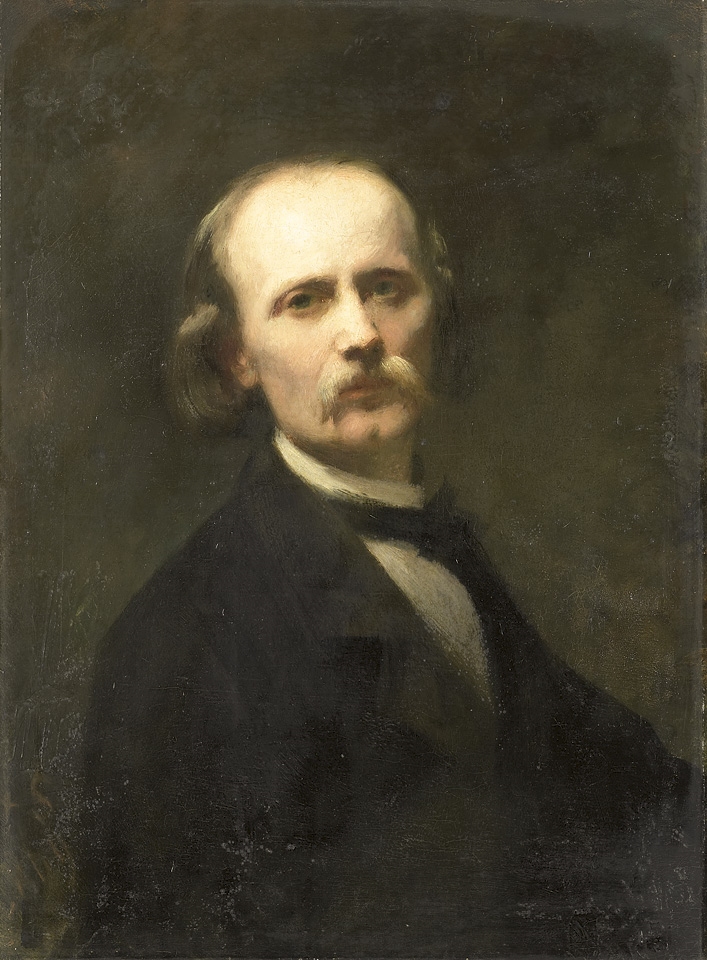
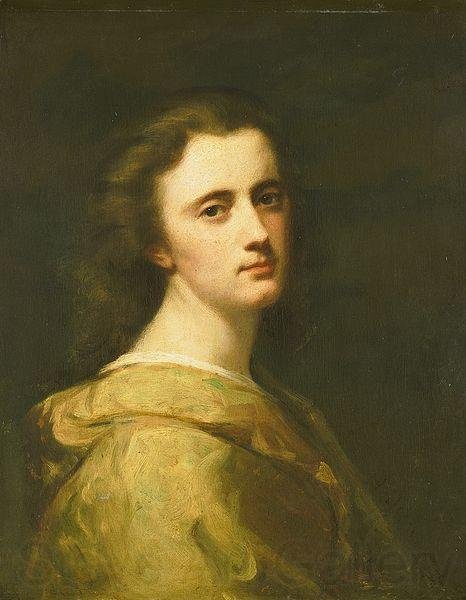
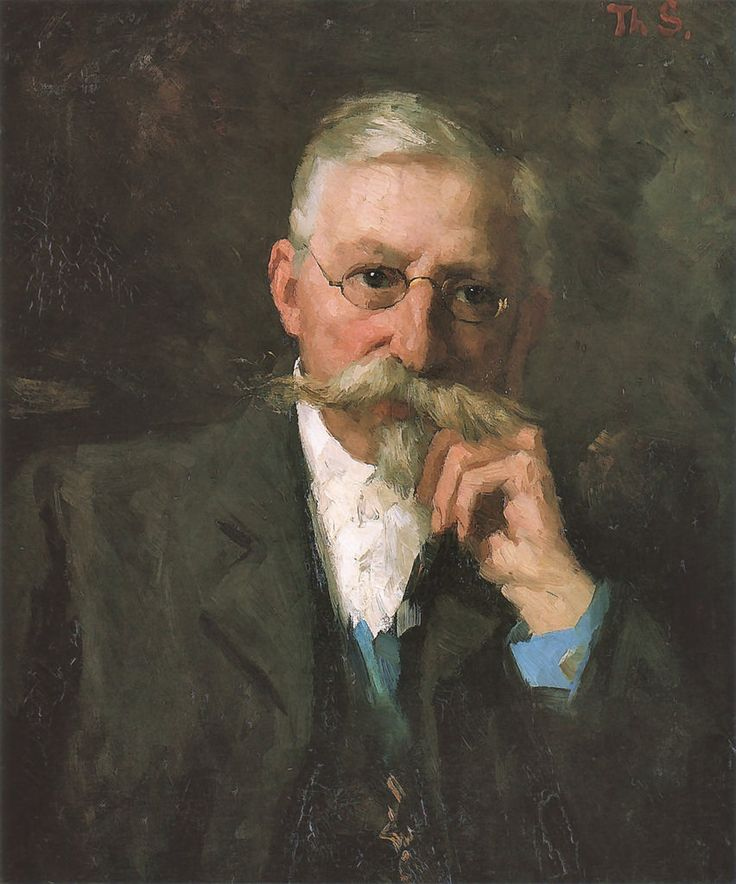
Self Portrait by Johan Georg Schwartze

Thérèse was born on December 20th 1852 in Amsterdam.  She was the daughter of Johan Georg Schwartze and Maria Elisabeth Therese Herrmann.  She was one of five children and had four sisters including Georgine, a sculptor, Clara Theresia, a painter and one brother, George Washington Schwartze, also a painter. 

Portrait of Thérèse aged 16 by her father, Johan Georg Schwartze (1869)

Her father was a well-respected portrait painter and it was he who provided Thérèse with her first artistic training.   In 1869 her father completed a portrait of his daughter, Thérèse.

Three girls of the orphanage in Amsterdam by Thérèse Schwartze (1885)

At that time, there was the perception that teaching girls and young ladies to paint was seen simply as a part of a cultured upbringing rather than a profession for earning money which was viewed as the role of the man. But for Johann Schwartze he couldn’t care less about such conventions. He trained his daughter in painting and drawing from a very young age and intended that Thérèse would become his worthy successor. She started her professional career at the age of sixteen, working in her father’s studio which she eventually took over when she was twenty-one after his death in 1874. Schwartze wrote to her father in a birthday letter, writing:

“…I will apply myself more to everything, so as, with God’s blessing, to be able to earn my living by painting…”

Because the art academies were not yet open to girls, her father sent her to Munich for expensive private lessons for a year under Gabriel Max and Franz von Lenbach who was regarded as the leading German portraitist of his era. In 1879 she moved to Paris and continued her artistic studies under Jean-Jacques Henner, the Alsace-born portrait artist.

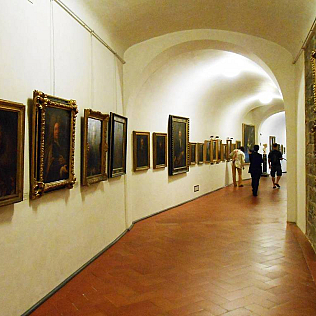
The Vasari Corridor at the Uffizi Gallery, Florence

Thérèse Schwartze’s portraits are truly remarkable and she was one of the few women painters, who had been honoured by an invitation to contribute her self-portrait to the Hall of Painters, the Vasari Corridor, at the Uffizi Gallery in Florence. The Uffizi collection is one of the most complete in all Europe, first started by Cardinal Leopoldo de’ Medici in the 17th century.  The passageway was designed and built in 1564 by Giorgio Vasari to allow Cosimo de’ Medici and other Florentine elite to walk safely through the city, from the seat of power in Palazzo Vecchio to their private residence, Palazzo Pitti.   The passageway used to contain over a thousand paintings, dating from the 17th and 18th centuries, including the largest and very important collection of self-portraits by some of the most famous masters of painting from the 16th to the 20th century, including Filippo Lippi, Rembrandt, Velazquez, Delacroix and Ensor.   While the Medici family bought the first paintings, after the collection started, the family started receiving the paintings as donations from the painters themselves. This has continued over the centuries and there were more paintings in the collection that did not have space to be exposed.  Things have now changed as from 1973 to 2016, some of the self-portraits which had been hung in the Vasari Corridor, were, however only visible during restricted and occasional visits because of the confined space, which, also lacked air conditioning and adequate lighting.  Most of the self portraits have been moved to other rooms at the Uffizi.

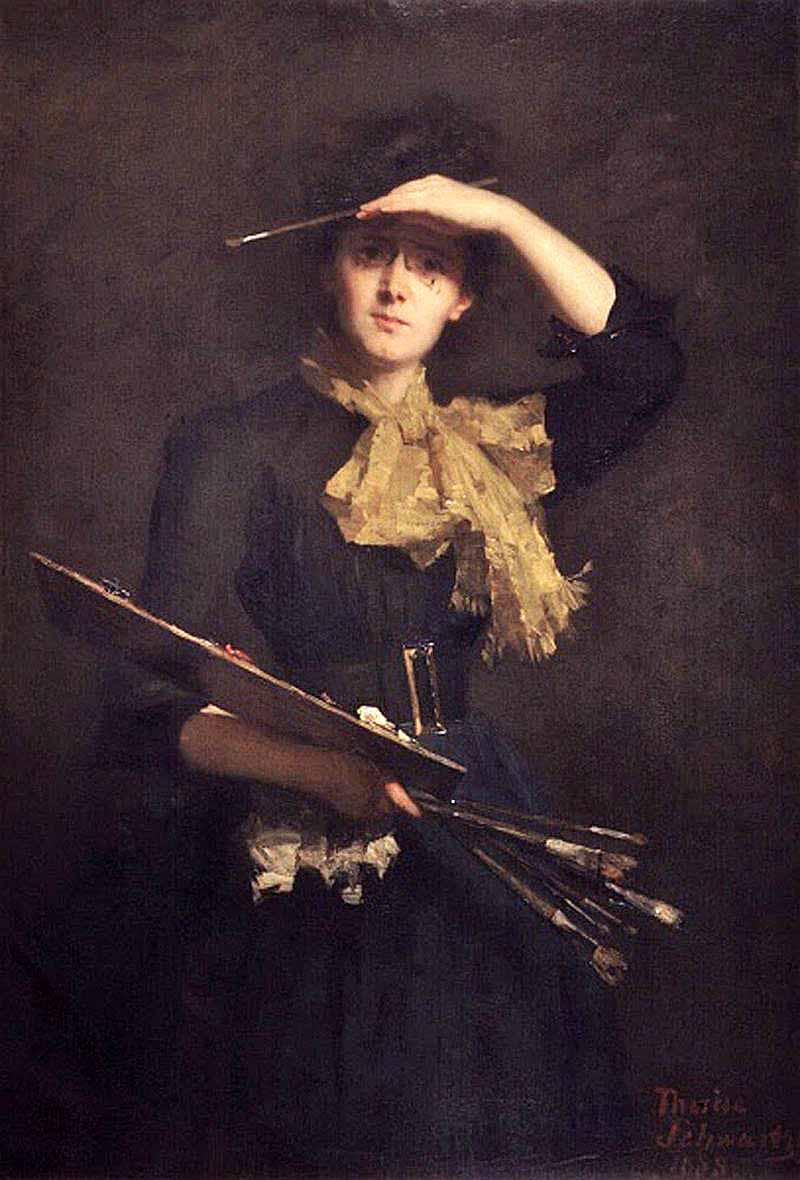
Self-portrait with Palette by Thérèse Scwartze (1888)

Only a handful of female portrait painters were active professionally in the 19th century, one of whom was Schwartze, who was nicknamed the ‘Queen of Dutch Painting’.  In the self portrait she contributed to the Uffizi entitled Self-portrait with Palette, she depicts herself staring out at us with a haunted look, paintbrush in one hand with the other looped through a paint-laden palette. The background of this canvas is bare, and our eyes are drawn to the painter’s tools: eyes, brush, pigments, and a rag at the ready. The painting was exhibited at the 1888 Paris Salon before being given to the Uffizi gallery in Florence.

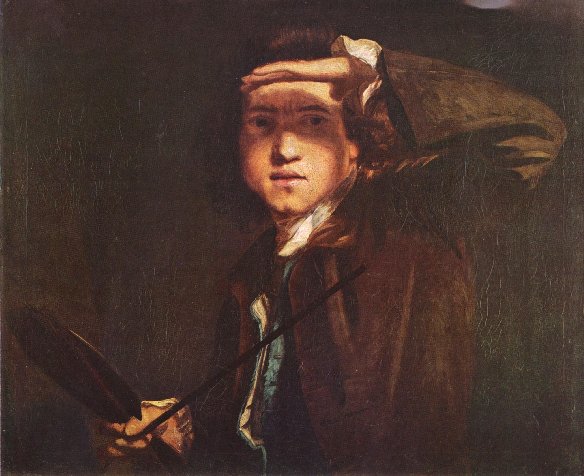
Sir Joshua Reynolds self portrait (c.1748)

Thérèse’s depiction of herself in her self-portrait could well have been inspired by Sir Joshua Reynold’s self-portrait which shows him similarly with his hand raised shielding his eyes from the bright light.

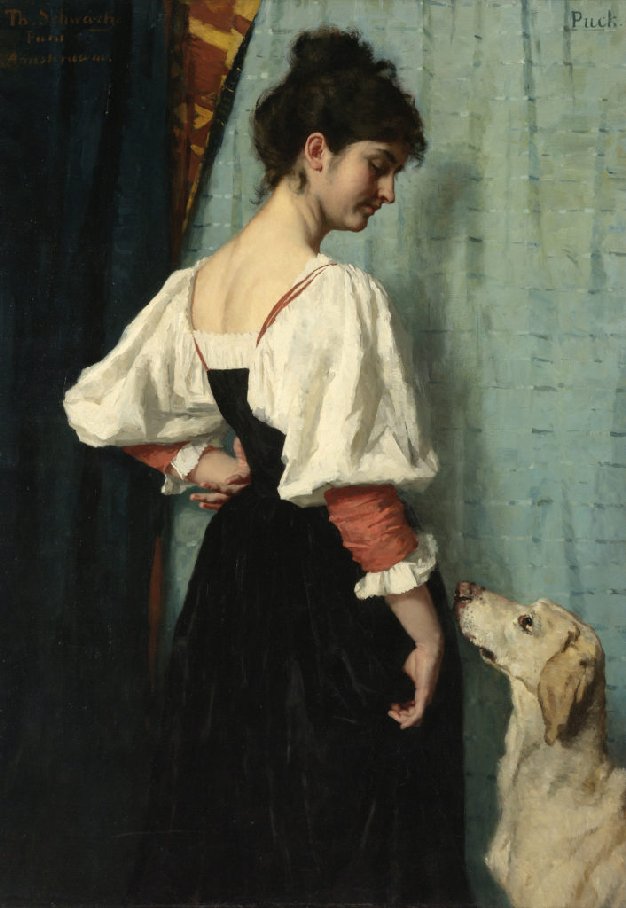
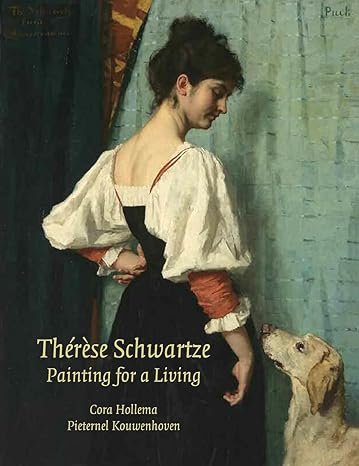
Young Italian Woman, with ‘Puck’ the Dog by Thérèse Schwartze, c. 1885)

Whilst living and studying in Paris, Thérèse completed her painting, Young Italian Woman, with ‘Puck’ the Dog.  The model she used for this painting was known as Fortunata.  She was one of the many professional Italian models working in Paris in the late 19th century. Schwartze started this painting in 1884 and exhibited it a year later in Amsterdam, having added the dog in the meanwhile.

According the 2021 biography by Cora Hollema and Pieternel Kouwenhoven entitled Thérèse Schwartze: painting for a living. Thérèse’s career took off at a time when a new, wealthy Dutch class wanted to flaunt its status and what better way to achieve this than with a flattering portrait. Her biographer wrote:

“She was in demand because she produced a new elegant, un-Dutch, extravagant, flattering style of portraiture which was in demand by the upcoming ‘new money…….. The new entrepreneurs and industrialists in the second half of the 19th century…”

Portrait of Aleida Gijsberta van Ogtrop-Hanlo with her five children by Thérèse Schwartze (1906).

Schwartze was one of the leading society painters in the Netherlands around 1900. Her clientele came from the nobility and the bourgeois elite in Amsterdam and The Hague. Members of the royal family also sat for her.   A good example of her excellent portraiture is her 1906 group portrait of Aleida Gijsberta van Ogtrop-Hanlo with her five children.  In this work, Aleida van Ogtrop-Hanlo is surrounded by, from left to right: Adriënne (Zus), Pieter (Piet), Maria (Misel), Eugènie (Toetie) and Adèle (Kees). The youngest and sixth child, Joanna (Jennie) was not yet born.  Her husband was a wealthy stockbroker and founder of Amsterdam Royal Concertgebouw. The portrait of his wife and children has a dreamy quality, with rich clothing and poetic colours. It gives an excellent impression of the self-image of the Dutch upper classes at the beginning of the twentieth century.  Stylistically Thérèse Schwartze followed in the footsteps of the famous eighteenth-century English portrait painter, Thomas Gainsborough. 

 Portrait of the six Boissevain daughters by Thérèse Schwartze (1916)

An equally great group portrait by Thérèse Schwartze was her Boissevinfamily portrait but this a more decorous depiction.  It is entitled Portrait of the Six Boissevain Daughters and she completed it in 1916. According to Schwartze’s biography by art historian, Cora Hollema, this difference in style was not due to a development of the artist, but more to do with the wishes of her client. Mr. & Mrs. Boissevain, who were wealthy members of the Amsterdam upper class had ten children, six daughters and four sons. They were aware of the portrait of Aleida and her children by Thérèse but believed it to be far too modern.   So, when they commissioned Thérèse to paint the portrait in 1916 they asked her to produce a more time-honoured portrait of their daughters. Thérèse was now the breadwinner of the family and so sensibly adapted her style according to her client’s demands bearing in mind the adage: The client was king.

Thérèse Schwartze in her studio, Prinsengracht 1021, Amsterdam, 1903.

Thérèse’s great success as an artist became a point of reference for the young Dutch women painters who founded the Amsterdamse Joffers, a group of women artists who met weekly in Amsterdam at the end of the 19th and beginning of the 20th century. These “ladies of Amsterdam” met weekly, often at the Schwartze home, to update the glorious Dutch tradition of painting based on French Impressionist innovations.  They supported each other in their professional careers. Most of them were students of the Rijksakademie van beeldende kunsten and belonged to the movement of the Amsterdam Impressionists.

Woman wearing a hat (Portrait of Theresia Ansingh (Sorella)), by Thérèse Schwartze (after 1906).

Besides Schwartze’s commissioned portraits, which made her very wealthy, she still had time to complete portraits of her friends and relatives which were not commissioned and were often given as gifts.  A fine example in this regard is the portrait of Schwartze’s niece, Theresia Ansingh, who later became a member of the Amsterdam school of female painters known as The Joffers, many of them were inspired by Schwartze’s professional success. 

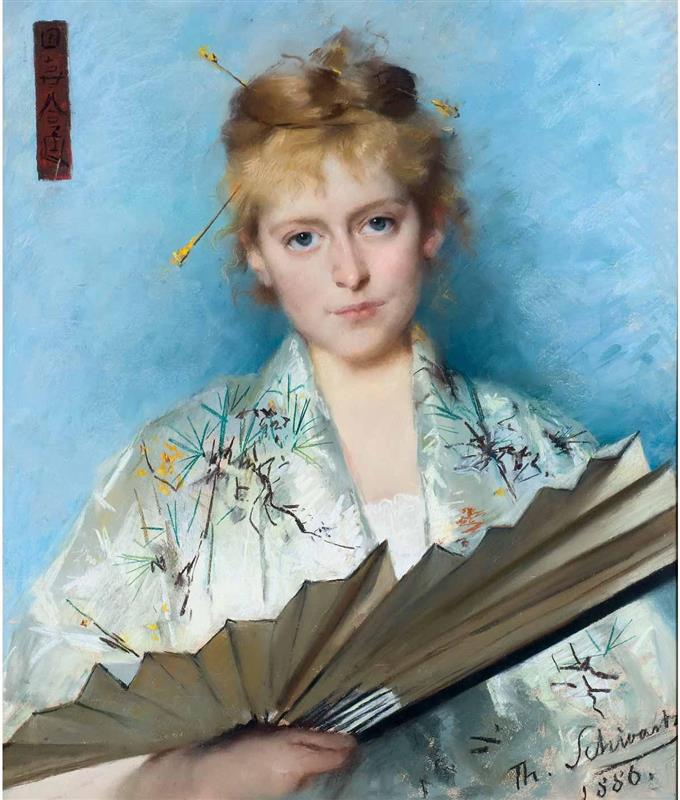
Maria Catharina Ursula (Mia) Cuypers by Thérèse Schwartze (1886)

One of my favourite portraits by Schwartze was her fascinating portrait of one of her friends, which is an amalgam of formal and informal portraiture and is entitled Portrait of Mia Cuypers.  She was a daughter of the architect Pierre Cuypers, who designed such famous buildings as the Rijksmuseum and Amsterdam’s Central Station. In 1883, she fell in love, to the dismay of her family and the astonishment of “high society,” with the Chinese-British merchant Frederick Taen-Err Toung from Berlin, who was in Amsterdam selling his Oriental merchandise at the International Colonial Exposition. Mia managed to overcome the social uproar and married Toung in 1886.  Being a close acquaintance of the Cuypers family, Thérèse was commissioned by the groom-to-be to make this wedding portrait, which is said to have only taken her one and a half days to complete.  There are Chinese characters in the upper left corner, which are not clear in my attached photo, which mean “rice field,” “longevity”/”delighted,” and “coming together.”

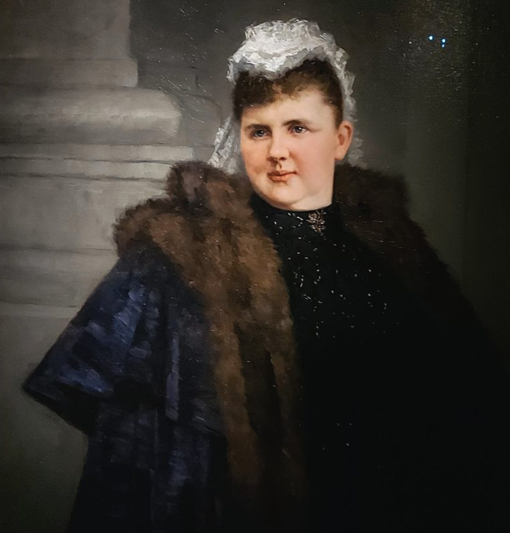
Portrait of Queen Emma by Thérèsa Schwartze (ca. 1881)

Soon after, she received a commission for a portrait of Queen Emma and the little princess Wilhelmina, who was born in 1880. In the single portrait of the young queen, she is dressed in dark colours against a neutral background, all is dark except her face. In this painting, one can already see the fine art of portraiture and the depicting of differing textures that Thérèse fully mastered. The fur stole, the lace cap on her head, as well as the brocade of the queen’s robe.

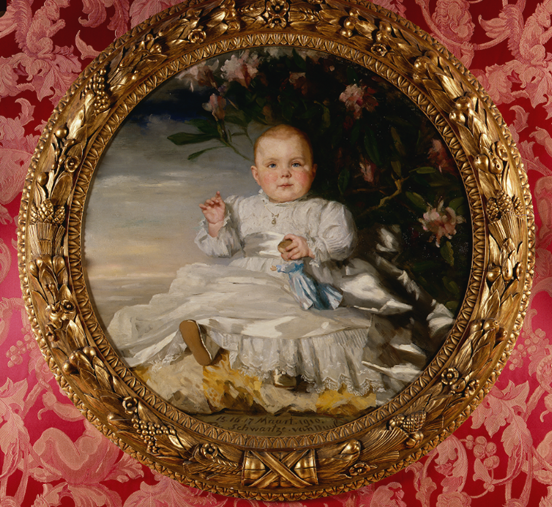
Portrait of Princess Juliana by Thérèsa Schwartze (1910)

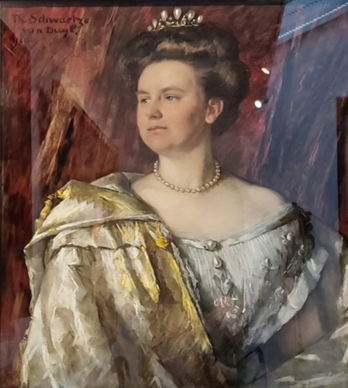
Thérèse’s worked with the royal family of the Netherlands through a period of thirty-five years and in all they gave her six commissions that contributed greatly towards her fame and wealth. Most royal portraits were of Queen Wilhelmina.

Portrait of Queen Wilhelmina by Thérèse Schwartze (1910)

The royal court had a habit of paying a little more than the average client, which meant that 1910 was a particularly profitable year for Thérèse.  She painted so many members of the royal family that she was almost deemed a member of their household.

Portrait of Anton van Duyl by Thérèse Schwartze

In 1906, Thérèse Schwartze married the editor-in-chief of the Algemeen Handelsblad, Anton van Duyl. Twelve years after they married, Thérèse’s husband died on July 22nd 1918.  It was double blow for Thérèse as she herself had been very ill at the time and five months later, on December 23rd 1918, three days after her sixty-seventh birthday, she died in Amsterdam.  

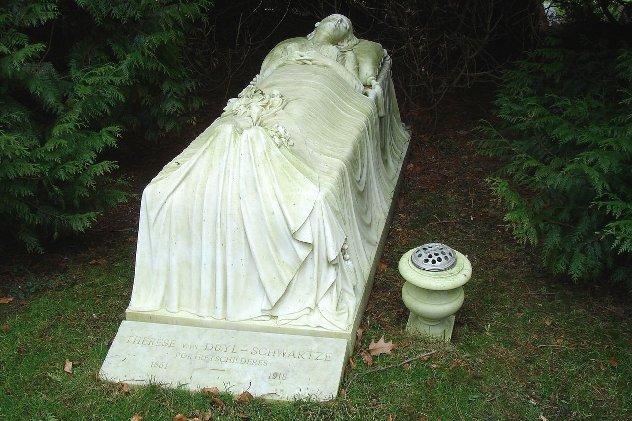
Grave of Thérèse Schwartze at the Nieuwe Ooster cemetery, Amsterdam.

She was buried at Zorgvlied cemetery in Amsterdam but was later reburied at the Nieuwe Ooster cemetery in Amsterdam, where her sister created a memorial to her, modelled after her death mask, which is now a rijksmonument.

Maria Slavona

Maria Slavona was born Marie Dorette Caroline Schorer on March 14th 1865 in the north German town of Lübeck.  She was the daughter of the pharmacist Theodor Schorer and his wife Ottilie, (née Steger).  Her father owned the Löwenapotheke on the corner of Königstraße, and Johannisstraße in the town, which is now known as Dr.-Julius-Leber-Straße.  She was the youngest of five children and had two brothers and two sisters.  As a child, she was brought up in a happy household in the old patrician house in Johannisstraße. Her parents’ home was a great meeting place for writers, artists and intellectuals. For Maria life at home was a liberal and cultural experience and, at an early age, she soon developed an intense interest in drawing and painting. Her parents encouraged her love of all things artistic and they hopde that one day she would become a painter and her mother and father supported this future road for her. 

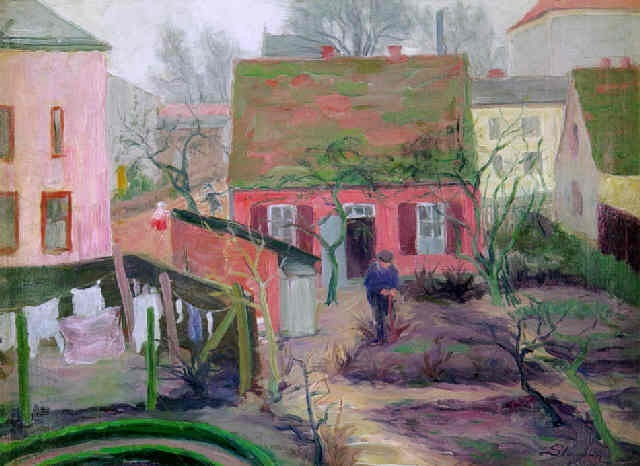
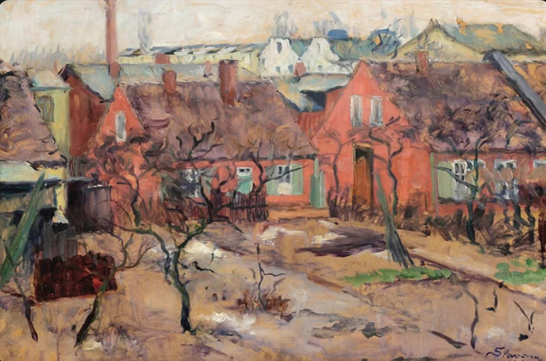
Red Gardener’s House with Gardener (Early Spring, Kahlhorst near Lübeck) by Maria Slavona

In 1882, when she was seventeen years of age, Maria went to Berlin to study art.  This was an unorthodox move as accordance with the social conventions of the time, it was unseemly for a young, unmarried woman to leave her parents’ home and pursue an education, in her case. studying painting.  Her move to Berlin caused a scandal in the Hanseatic city of Lübeck.  However, since women in Germany were denied access to art academies, Maria Slavona attended the Eichler private painting school in Berlin and the Deutsches Gewerbe-Museum zu Berlin, (Royal Museum of Decorative Arts) which at the time had a teaching institute.  In 1887, aged twenty-two, she moved to the painting school of the Verein der Berliner Künstlerinnen (Association of Women Artists and Friends of Art) in Berlin. It was an informal and free atmosphere, and the women here were allowed to conduct nude studies on living models.  A year later she enrolled at the painting school of the Münchner Künstlerinnenverein (Munich Association of Women Artists).

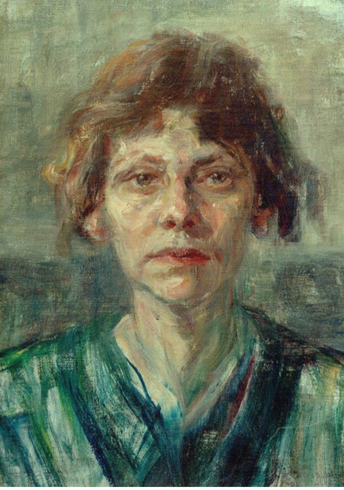
Self portrait by Maria Slavona (1887)

Her self-portrait, created in Berlin in 1887, shows the face of a 22-year-old, extremely pretty young woman, framed by tangled curls. With her head turned to the left, she fixes her gaze firmly on the viewer. Settling in this Bavarian city was fortuitous as the city of Munich had been, since 1850 onwards, deemed the most important centre for artistic creation and painting.  At this time, her most important patron and mentor was Ludwig Herterich, a German painter and art teacher, who in 1898 was a professor at the Academy of Fine Arts Munich, where he taught many young artists including Maria Slavona.   He introduced Maria to French Impressionism. A painting style that would be influential for her later paintings.

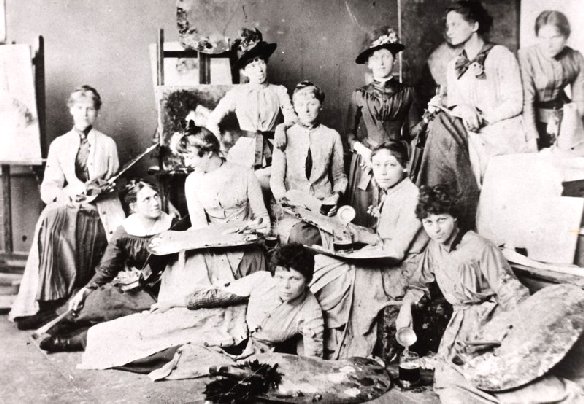
In the Munich Ladies’ Academy: Käthe Kollwitz seated between Maria Slavona (front right) and Rosa Pfäffinger (lying in front right)

Maria loved her time in Munich and made many friends including a fellow aspiring young painter, Käthe Kollwitz, who was also studying art in Munich. During a return home to Lübeck, she met some Scandinavian artists, one of whom was Vilhelm Petersen and, as they became closer friends, they both decided to take assumed names for their artworks. He chose Willy Gretor and she became Maria Slavona. Along with friends Maria and Vilhelm visited Paris in 1890.  She recalled her arrival in the French capital:

“…In 1890, I came to Paris. This is where a new world opened up to me. The first visits to the Louvre almost numbed and overwhelmed me. But I was disappointed by the schools I saw, I didn’t like them. I decided to work alone and seek advice and judgment only in the circle of a few young like-minded friends, almost all Danes and Norwegians…”

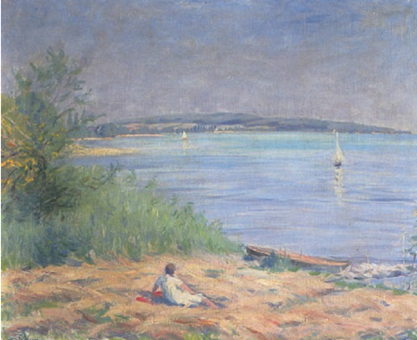
Sommermorgen am Starnberger See by Maria Slavona

That same year, Maria gave birth to an illegitimate daughter, Lilly, but her relationship with the father of the child, Petersen, was over.  She had at first looked upon him as a charismatic and educated man but he turned out to be a dubious art dealer, womanizer and bon vivant.  Worse still when their daughter Lilly was born Petersen had deserted Maria and she was left to bring up her daughter alone.

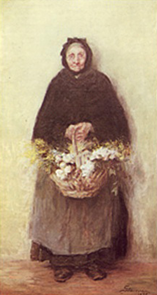
Alte Blumenfrau by Maria Slavona (1893)

In 1893, at her first exhibition at the Salon de Champ-de-Mars an annual event organized by the Société Nationale des Beaux-Arts.  Maria Slavona submitted her work, Alte Blumenfrau (Old Flower Woman). At this exhibition, ironically she identified herself under the male pseudonym “Carl-Maria Plavona”.  The painting depicts an old woman standing in frontal view, holding a large basket of white and yellow flowers in front of her body in her worn-out hands. Placed in front of a simple, ochre-coloured wall, the dark, poor clothing of the woman forms a strong contrast to the light background. The wrinkled face, framed by a headscarf, shows emotionless features. The tired eyes look firmly at the viewer.

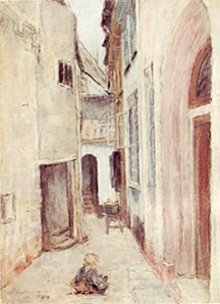
St Jurgen-Gang in Lubeck by Maria Slavona (1902)

Maria Slavona who, around 1898 had met the Swiss art connoisseur and collector Otto Ackermann. Their friendship grew over the next two years and in 1900 they married. Maria’s daughter Lilly took the name Ackerman and later she became an actress under the name Lilly Ackermann. Otto Ackermann was a valuable asset in the introduction of French art into Germany in the early 20th Century.  Otto and Maria set up home in Paris and it soon became a central meeting place for Parisian bohemianism. Visiting artists such as Münch, Liebermann, Leistikow, along with literary giants and art lovers would often frequent their home and be made most welcome.  Maria, who had spent sixteen years in the French capital, had led a happy and artistically productive life. During this period, she had completed many paintings depicting landscapes, portraits, still life and interiors.

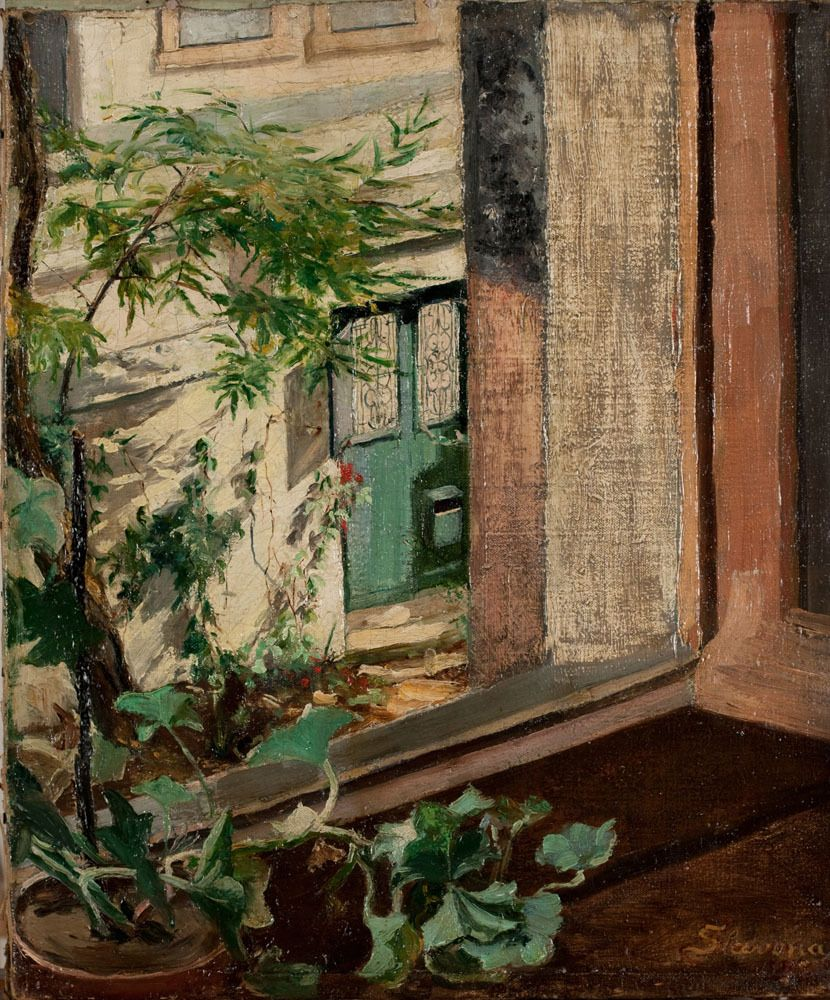
View from Studio Window by Maria Slavona (1899)

One of her favourite subjects was the view from the window of their home.  All of her work over those years established her reputation as a talented painter.

Houses on Montmartre, around 1900 by Maria Slavona

Häuser am Montmartre by Maria Slavona

In 1906 Maria and her family left Paris and returned to her old hometown of Lübeck.  During her stay in Lübeck she completed many paintings depicting the town and the surrounding areas.

 Villa entrance in Lübeck by Maria Slavona

Spring Thaw near Lubeck by Maria Slavona (1913)

Unfortunately, the bourgeois, art-hostile atmosphere that pervaded the old Hanseatic city had a negative effect on her husband’s art trade business and sadly this gave them no alternative but leave Lübeck in 1909, and move to Berlin.  It was in the German city of Berlin that she was once again artistically active and from 1913 she became a member of the Berlin Secession.  This was one of the last art Movements of 19th century German art.  It was a breakaway group of artists, who in 1898 ‘seceded’ from the city’s arts establishment, led by the eminent painter Max Liebermann.  It was a reaction to the Association of Berlin Artists, and the restrictions on contemporary art imposed by Kaiser Wilhelm II.  Sixty-five artists “seceded,” demonstrating against the standards of academic or government-endorsed art.  The group established an independent exhibition society, in order to champion new forms of modern art – rather than continue to churn out the old-fashioned academic art favoured by the art establishment.

Bouquet of field flowers by Maria Slavona (c.1900)

Following the end of the First World War Maria’s health began to deteriorate.  Added to that with a decrease in the sale of her paintings, the financial circumstances of the family took a substantial dip.  To try and rectify both her health and cut back on their financial outgoings the family moved to the countryside village of Munsing in Upper Bavaria.  From that time on, Maria mainly created floral still life works. 

Self portrait by Maria Slavona (1910)

Maria Slavona died in Berlin on May 10th 1931 aged 66.  Unfortunately, a large part of her work was lost during the Second World War, and also, for many years, her remaining works were branded by the Nazi government as Entartete Kunst (Degenerate Art) in 1933 and it was mainly ignored outside of her hometown Lübeck. Slavona is now known and famous as a representative of German Impressionism. Although she was unable to build on the artistic successes of her Paris years in Berlin, she was one of the best-known painters of her time, along with Dora Hitz and Käthe Kollwitz.

On the occasion of the 50th anniversary of her death in 1981, the Hanseatic City of Lübeck honoured its once famous and forgotten citizen with a large exhibition in the St. Anne Museum.

Walker Art Gallery revisited.

The Walker Art Gallery in Liverpool has one of the most significant and famous collection of artworks in the UK, which includes European Renaissance paintings, masterpieces by Rubens, Rembrandt, Turner and Stubbs, Pre-Raphaelite artworks by Rossetti and Millais, Impressionist works by Monet and Degas and contemporary works by Hockney, Wylie and the winners of the John Moores Painting Prize.   I have covered many of the Pre-Raphaelite works exibited here in previous blogs and following a visit I made to the gallery last week I have chosen a few more paintings which impressed me.

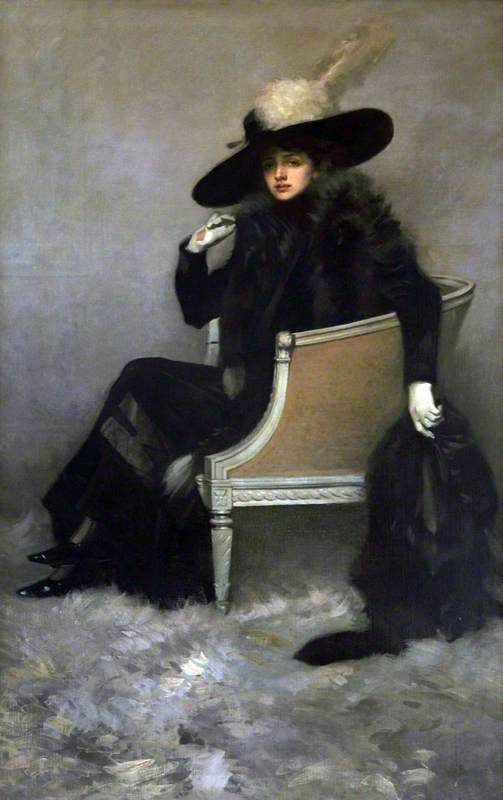
Lady in Black Furs by Pilade Bertieri (1912)

The first painting, I am showcasing is Lady in Black Furs, a work by the Italian painter Pilade Bertieri, which he completed around 1912.  Bertieri was born in Turin and exhibited in major cities in Italy, in New York and notably Manchester and Liverpool as well as Paris at the Salon from 1907 to 1931.  The painting depicts Bertieri’s wife Genevieve Wilson, the daughter of a wealthy New York socialite.  It was during a voyage in 1905 from Italy and America that they met and a year later they got married.  Bertieri said that he was first attracted to Genevieve when he saw seated on a deckchair.  For him, her graceful composure was just too much to resist and this depiction is a reconstruction of his first view of her but this time in a more fashionable chair.  The fact that she is wearing the very same furs, shoes and velvet and satin dress as she did aboard the ship in 1912 evokes memories for him of that first meeting.  At the time of the painting Genevieve was pregnant with their first child.

Fantine by Margaret Bernardine Hall (1886)

Margaret Bernadine Hall completed her painting entitled Fantine in 1886 and it depicts the character Fantine who was featured in Victor Hugo’s novel Les Misérables.  Fantine was dismissed from her job because of her illegitimate child and was forced into the life of a sex worker in order for her and her daughter to survive.  In the depiction we see Fantine protectively watching over her sleeping daughter.

Margaret Bernadine Hall was an English painter, born in 1863 in Wavertree, Liverpool.  Her father was Bernard Hall, a merchant, local politician and philanthropist, who was elected Mayor of Liverpool in 1879. Her mother was Margaret Calrow from Preston, who was Bernard Hall’s second wife. Margaret was their second child, and their oldest daughter.  In 1882 the family moved to London but at the end of that year nineteen-year-old Margaret went to live and study in Paris. Between 1888 and 1894 she travelled extensively to countries including Japan, China, Australia, North America, and North Africa, returning to live in the French capital in 1894. She moved back to England in 1907, where she died three years later.

River Scene with a Ferry Boat by Salomon van Riysdael (1650)

One of my favourite landscape painters is Salomon van Ruysdael and in his painting entitled River Scene with a Ferry Boat we see the kind of work he produced for the art-loving public. At this time, artists had mostly depicted religious subjects in their paintings and the Catholic Church used to be most artists’ best client, as they ordered altarpieces and other artworks to decorate churches and sacred places, but this came to an end with the Reformation as many Protestants refused to allow the presence of religious paintings or sculptures in churches.  This led to a great crisis for artists in Northwestern European countries as artists had only a few ways left to make money: painting portraits and illustrating books but there was also a revival of landscape paintings.  As well as the ever popular genre scenes, people began to buy landscape paintings to decorate their homes. Jacob Isaackszoon van Ruisdael, Salomon’s nephew, is generally considered the pre-eminent landscape painter of the Dutch Golden Age, a period of great wealth and cultural achievement when Dutch painting became highly popular. Jacob was best known for his atmospheric river scenes based upon the countryside around the city of Haarlem where he lived. He was also a merchant who dealt in the blue dye that was used in Haarlem’s famous cloth bleaching factories.

The Walker Art Gallery houses Salomon’s painting entitled River Scene with a Ferry Boat and we see a ferry crossing the river laden with people, livestock and even a small cart.  These ferries were an essential feature of the watery Dutch countryside, and a popular subject with landscape painters such as the Ruysdael family. This work is typical of much 17th-century Dutch landscape painting: naturalistic in its clear light and cloudy, rain-washed sky, but at the same time carefully organised to achieve a balanced composition. This work despite looking as though it was painted en plein air was not painted outdoors.  It is an idealised depiction and probably does not represent any particular place but is an amalgam of various details and features from a number of different places juxtaposed to form this vista.  Close to the riverbank we see a smaller boat with busy pulling in a fishing net. On the bank is a barn in which workers are salting fish and putting them into barrels. On top of the barn is a large dovecot. In a way the painting is a ‘foodscape’ as well as a landscape, highlighting what nature has to offer.  The Dutch patrons liked this kind of narrative painting.

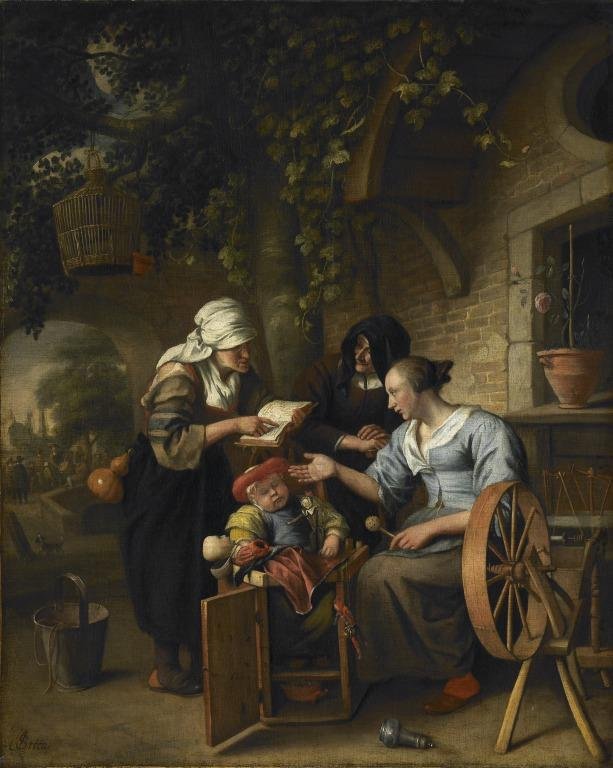
The Fortune Teller by Jan Steen (1663)

One of the greatest Dutch genre painters was Jan Steen. In Holland he ranks next to Rembrandt, Vermeer, and Hals in popularity.  He is best known for his humorous genre scenes, warm hearted and animated works in which he treats life as a vast comedy of manners.  Steen was born in Leiden and is said to have studied with Adriaen van Ostade in Haarlem and Jan van Goyen (who became his father-in-law) in The Hague. He worked in various towns – Leiden, The Hague, Delft, Warmond, and Haarlem and in 1672 he opened a tavern in Leiden.  In his painting The Fortune Teller we see a young woman sitting by her spinning wheel having her fortune told.  One interpretation of this depiction is that she is a sex worker, the old, black hooded lady is the brothel keeper and the soldiers in the background are her clients.  Fortune-telling was strongly associated with deceit, and therefore frowned upon in the seventeenth century.

The Epte in Giverny by Claude Monet (1864)

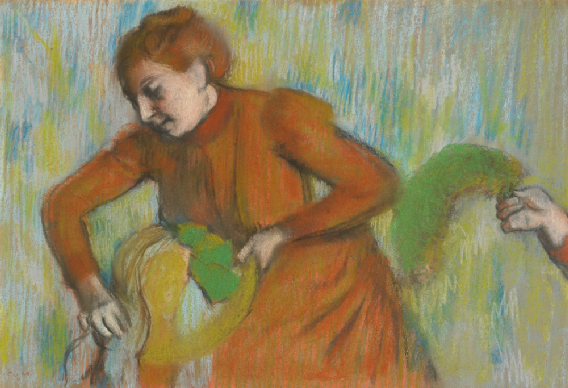
Modiste Decorating a Hat by Edgar Degas. (c.1895)

My next two offerings, The Epte in Giverny, by Monet and Modiste Decorating a Hat by Degas, are new arrivals at the gallery thanks to the beloved taxman. They have been acquired by National Museums Liverpool through the Government’s Acceptance in Lieu scheme which allows people, who have Inheritance tax bills to pay, to transfer important works of art and heritage objects into public ownership which are then allocated to museums, archives or libraries for people to enjoy.  Both the Monet and Degas artworks come from the collection of Mary Elliot-Blake and have been owned by the Montagu family by descent. Due to the family’s connection to Liverpool, the paintings were allocated to the Walker Art Gallery.

Monet completed the painting, The Epte in Giverny, in 1884, and it depicts the fast-flowing Epte river, which rises in Seine-Maritime in the Pays de Bray, near Forges-les-Eaux and empties into the Seine not far from Giverny where the artist painted his famous water lily series.

The second work is by Degas’ entitled Modiste Decorating a Hat and depicts a milliner adjusting a hat in a shop window.

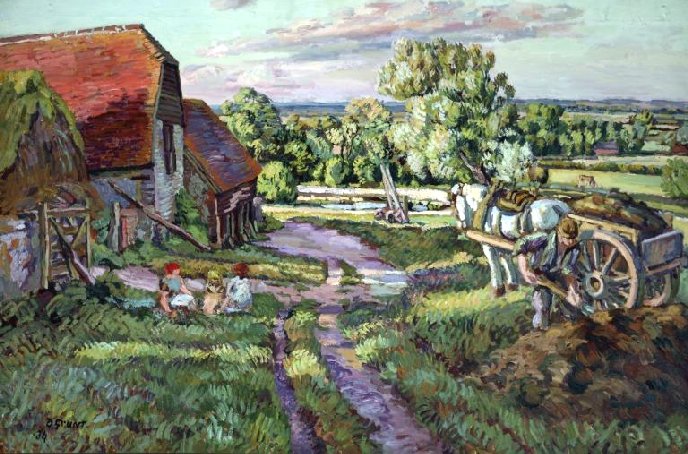
Farm in Sussex by Duncan Grant (1934)

The 1934 painting, entitled Farm in Sussex, is a depiction of Charleston Farm at Firle in Sussex is by the artist Duncan Grant. The picture was painted in his studio over a period of several years. The first thing that strikes you about the depiction is the unusually bright colours he has used and this is due to Duncan Grant’s great interest in Fauvism, which was popular between 1905 and 1910. The Fauves (the Beasts) used bright, clashing colours and fierce brushstrokes to express feelings and emotions.  In 1909, Grant met Henri Matisse, who was a leading light of this group.

He also saw more of the groups work in Roger Fry’s Post-Impressionist exhibition in London in November 1910, Fry had organised the exhibition Manet and the Post-Impressionists at the Grafton Galleries, London. This exhibition was the first to prominently feature Gauguin, Cézanne, Matisse, and Van Gogh in England and brought their art to the public.

Duncan Grant lived at Charleston Farm from 1916 with Vanessa Bell (neé Woolf), who was an artist and the sister of Virginia Woolf. They had met through the Bloomsbury Set, a London-based group of artists and writers who met regularly to discuss their work and ideas about modernism and art. Charleston Farm became a meeting place for the Bloomsbury Set outside of London.  The pair had moved to the countryside from London following the outbreak of World War I so that Grant could avoid conscription by working as a farm labourer. The couple each had their own studio at the farmhouse and decorated the entire building, including walls, fireplaces, door panels and furniture, with their paintings, fabrics and ceramics. They kept the house after the war and used it as a summer home. The painting highlights the bright colours that characterise Grant’s work. The painting was completed in 1934, the same year that Roger Fry died. Fry had been a close friend of both Duncan Grant and Vanessa Bell and was a regular visitor to Charleston. The painting reflects Grant’s affection for the Farm and the people he associated with it

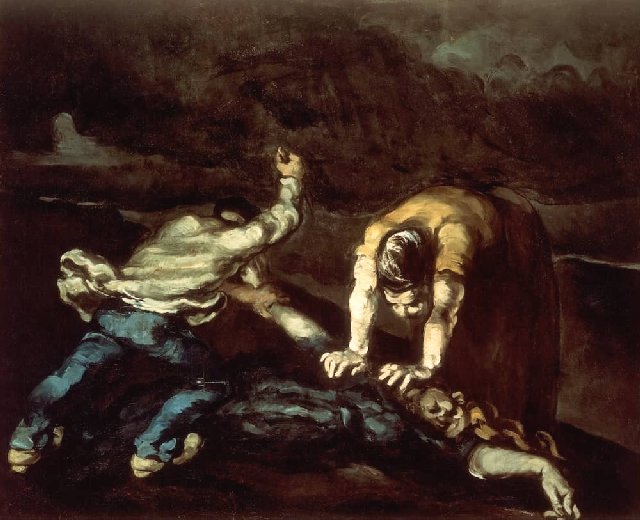
The Murder by Cezanne (c.1870)

The Murder is one of Cézanne’s early paintings which he completed around 1870.  It is a dark and highly melodramatic work which ably communicates the brutality of the act. In the depiction we see the murderer raising his hand and is about to give the final strike while his female conspirator forcefully holds down the rounded heavy-set body of the female victim whilst the fatal blow is struck.  Little can be made out of the figures; just the outline head and arms of the victim whose facial expression is contorted with pain.  The faces of her two assailants are blurred.  Cezanne was not interested with the identities of the murderers but the scene simply depicts the heinous act of anonymous violence.  The scene is made more frightening by the bleak surroundings and the dark sky overhead.  Close to the figures is a riverbank and we can deduce that the body of the dead woman will eventually be dumped into the dark waters.

Publicity Poster for Zola’s novel

The Murder was painted at a time when Cézanne was still influenced by the Old Masters such as Eugene Delacroix and Francisco Goya, and Diego Velazquez.  So after painting so many colourful landscapes why would he depict a brutal murder?  It is thought that Cezanne’s choice of depicting this brutal subject may have been inspired by Emile Zola’s novel Thérése Racquin which had been published in 1867, in which the heroine murders her husband. It was Zola’s third novel, though the first to earn wide fame. The novel’s adultery and murder were considered scandalous and famously described as “putrid” in a review in the newspaper Le Figaro. The painting’s subject could also be inspired by illustrations in the popular press.

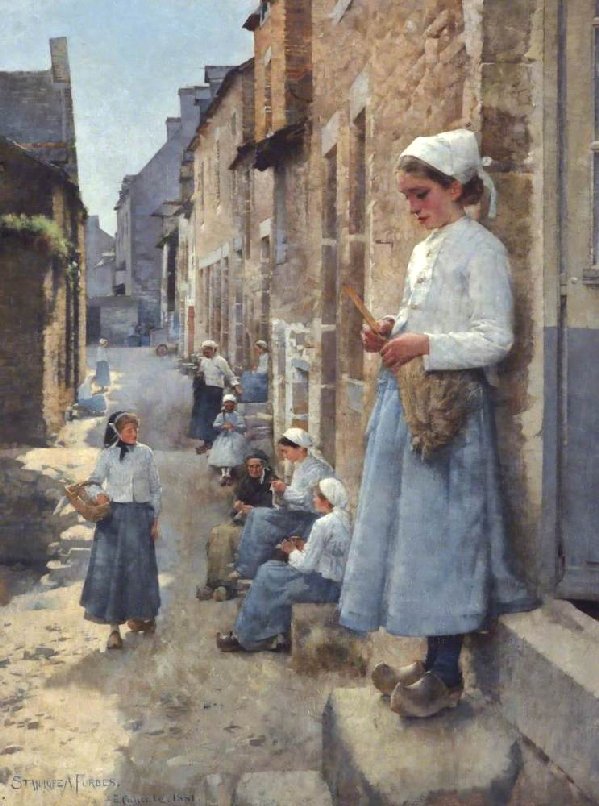
A Street in Britanny by Stanhope Forbes (1881)

My final painting is A Street in Brittany by Stanhope Alexander Forbes which he completed in 1881.  It is a depiction of figures in a narrow street: women in white headgear known as coiffes and blue petticoats.  They are grouped around their cottages, some are seated on their knitting blue jerseys for their fishermen husbands.

Stanhope Forbes was born in Dublin, the son of Juliette de Guise Forbes, a French woman, and William Forbes, an English railway manager, who was later transferred to London. He was educated at Dulwich College, and he studied art under John Sparkes at Lambeth College of Art, who later taught at South Kensington School of Art. Forbes then studied at the private atelier of Léon Bonnat in Clichy, Paris from 1880 to 1882.  It was in the French capital that Forbes met up with fellow artist, Henry Herbert La Thangue, who had also attended Dulwich College, Lambeth School of Art and the Royal Academy.
In 1881 Forbes and La Thangue went to Cancale, a village in Brittany, at the western end of the bay of Mont-Saint-Michel, fifteen kilometers east of Saint-Malo. It was here that Forbes began to paint en plein air and produced this painting. 

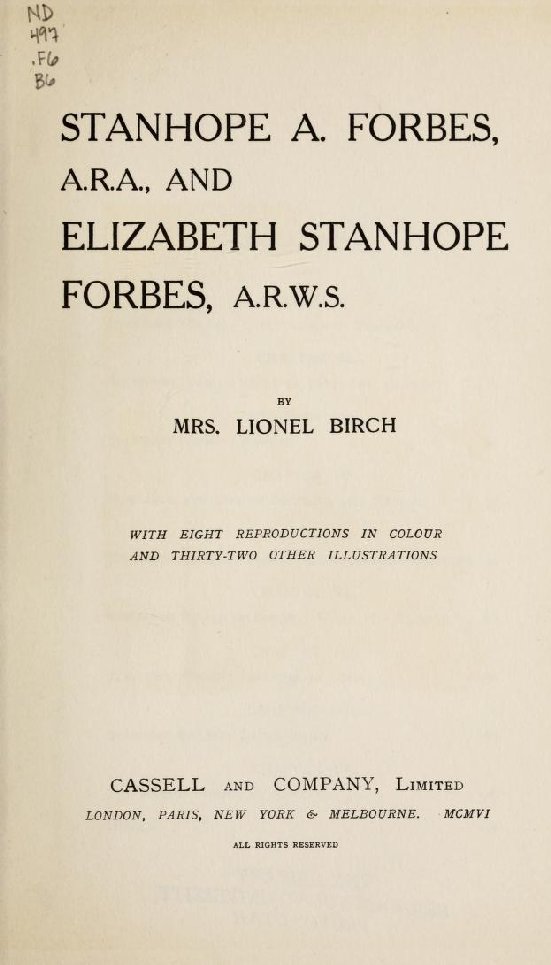
His biographer, Mrs. Lionel Birch in her 1906 book Stanhope A. Forbes, A. R. A., and Elizabeth Stanhope Forbes, A. R. W. S. recalled the setting of this work:

“..One of the first results of the visit to Cancale was a composition of figures in a narrow street: women in white coiffes and blue petticoats, grouped round their cottages and seated on their doorsteps engaged in their everlasting occupation of knitting blue jerseys for their fisher husbands…”

The biographer continues:

“…It was a very simple motif, but painted with great care and conscientiousness, and with a close and searching attention to those truths of lighting and that clear out-of-door aspect which the painter sought to betray. It was interesting, too, as the first attempt Stanhope Forbes had made in what might be termed figure composition, if, indeed, a picture in which there is so little of arrangement in the grouping of the figures can be termed a composition. But it was, at any rate, a great step from simple portraiture, and its success — for it brought the young painter a very signal one — had the most marked influence in determining his future. Exhibited at the Royal Academy of 1881, it attracted favourable attention, and when, later on, it was sent to Liverpool, the Committee of the Walker Art Gallery decided to purchase it for their permanent collection…”

Forbes left France and returned to London and exhibited the works he had made in Brittany at the 1883 Royal Academy and Royal Hibernian Academy shows.  In 1884 he moved to Newlyn in Cornwall, and soon became a leading figure in the growing colony of artists.

I hope this blog will tempt you to visit the Walker Art Gallery in Liverpool. You will not be disappointed.

Groeningen Museum Bruges. Part 2.
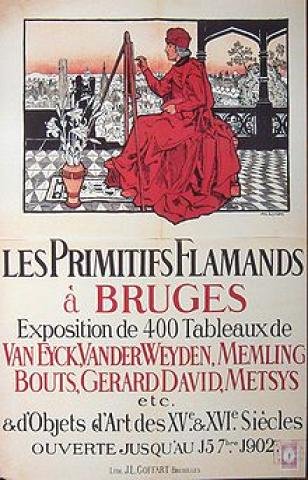
In 1902, a major exhibition of Flemish Primitive works entitled Les Primitifs flamands et l’art ancien was held in Bruges.  Almost four hundred paintings, including works by (or attributed to) Jan van Eyck, Rogier van der Weyden, Dieric Bouts, Hans Memling, Gerard David and Quentin Massijs, were on show. The exhibition drew in more than 35,000 visitors. It is believed that never before had so many Flemish paintings from the 15th and early 16th centuries been on display together.   If you manage to visit the Groeningen Museum in Bruges you will be able to see many works by the Flemish Primitives.

Portrait of a Theologian with his Secretary by Jacob van Oost the Elder (1686)

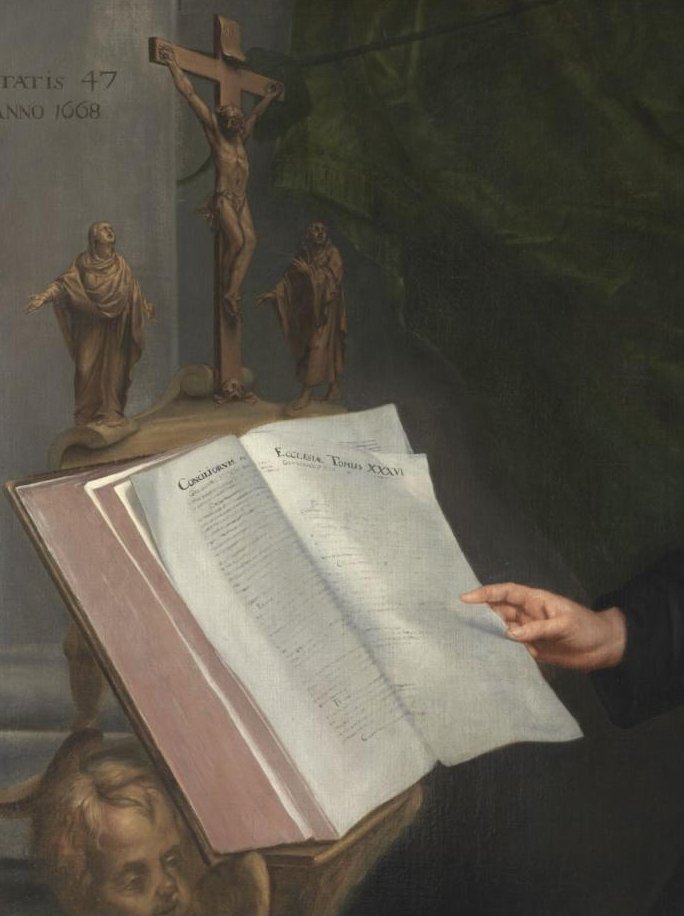
The first painting I am looking at in this blog is the dual portrait entitled Portrait of a Theologian and his Secretary by Jacob van Oost the Elder which he completed in 1668 and is part of the Groeninge Museum in Bruges.

Jacob van Oost the Elder was the leading artist of 17th-century Bruges. He painted many altarpieces in the churches of Bruges and he was also exceptionally gifted as a portrait painter as one can see in this work. Van Oost was born in Bruges, and trained there by his elder brother, Frans. He entered the Guild of Saint Luke in 1619, and became a Master two years later. He took a trip to Rome in the 1620s and on his return to Bruges in 1628, his work was influenced Caravaggio, albeit the depiction of his paintings were of a contemporary Netherlandish setting.

The work depicts a theologian, probably a Jesuit, reading the council’s decisions and comments on them to his secretary. His secular secretary takes notes. On the left of the painting we see a lectern, which is decorated with a sculpture of a Calvary group, and open on it is volume thirty-six of the collected Council Decrees. On the right of the painting we see a work table bedecked with a richly coloured tablecloth, at which the priest and the secretary are seated. On top of the table are study accoutrements, such as a globe and a book. Behind the two men is a bookcase with editions of the Bible and literature in the fields of theology and canon law.

Thomas Wentworth, Earl of Strafford, with Sir Philip Mainwaring by Anthony van Dyck

Once again, in this depiction we are reminded of the influence of Anthony van Dyck portraiture, such as his 1640 painting entitled Thomas Wentworth, Earl of Strafford, with Sir Philip Mainwaring, also the Caravaggesque treatment of the light, with its characteristically heavy contrasts between light and shade, in this case between the open book on the lectern and the black clothes of the English statesman and the lightness of his face in comparison to the dark background.

Portrait of a Bruges Family by Jakob van Oost the Elder (1645)

Portrait of a Bruges Family is another painting by the Bruges born painter Jakob van Oost.   He had been commissioned to paint a family portrait.  This work is regarded as a masterpiece of high Baroque painting. For the man who commissioned the work, it is a vanity painting in which he is asking the viewer to recognise his status, his wealth and his handsome family.  He stands before us his arm outstretched.  The focal point of this painting is the wealthy man who draws our attention to his assets. He points towards the estate he owns which stretches into the distance.  He is surrounded by his family and standing next to him is his wife.  We also see the children’s maid and the gardener and by catching a glimpse of the terrace he is standing on we know that his house will be palatial.  Van Oost has made his viewpoint low which adds to the imposing air of the central figure.  It is a painting which carefully exudes two facts for us to take in.  Firstly, the portrait is a glorification of family life based on love and fertility and secondly, it is a work of art which affirms the family’s social status.  In the seventeenth century the wealthy bourgeois yearned to be accepted into the realms of the aristocracy and one way of elevating themselves to that social status was to buy an estate that came with a title of nobility and we can clearly see the man in the portrait aspired to that elevated status.

What is fascinating about this painting, albeit you will probably not be able to see it clearly in the attached picture, is that the painting is signed and dated on the lower right on the parapet.  However, even more bizarre is that the painter has incorporated the age of the various figures in the work.  The man is 46 as we can see written on the heel of his shoe.  His wife is aged 26 and this figure appears on her fan and the boy who stands close to her is 3 as can be seen written on his hat.  The girl sitting on the steps sits on a cushion is 15 as shown on her basket and the young man is 17 as shown on his boot.  The baby who is being carried by the nursemaid has the figure 1 inscribed on his hand.   The ages of the various children suggest that there have been two separate marriages and the lady holding hands with the central figure is probably the mother of the two youngest children.  This work of art is considered to be one of van Oost’s greatest masterpieces.   It would be interesting to find out if anybody visits the museum and looks closely at the painting whether they can see the numbers inscribed in the painting

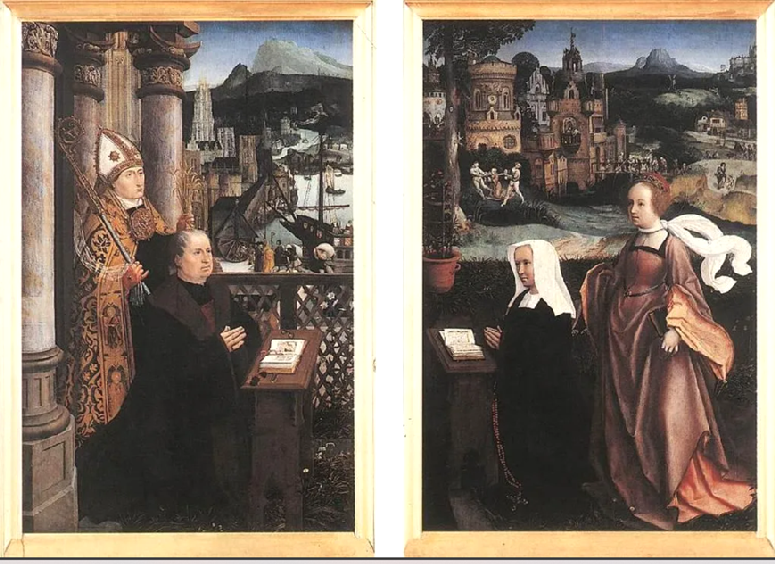
The next offering was once a triptych by the Belgian artist, Jan Provoost, and belonged to the former Dominican monastery in Bruges. Sometime before 1861 the front and back sides of the wing panels were separated by sawing them apart lengthwise.   The four panels are now displayed separately. The original central panel is missing. 

Jan Provoost was born in the Belgian town of Mons around 1463.  By 1491 he had married the widow of the miniaturist and painter, Simon Marmion and in 1494 he settled in Bruges.  He simultaneously headed up two workshops, one in Bruges, where he was made a burgher, the other in Antwerp, which was then the economic centre of the Low Countries. Provost was also a cartographer, engineer, and architect.

Inner wings of the original Triptych (c.1515)

The wealthy, but unknown, donors who commissioned the triptych are depicted on the original inner wing panels kneeling in prayer in a small, enclosed garden.  The background scenes include episodes in the lives of their patron saints, Nicholas of Myra and Godeliva who are also depicted in the panels.  Behind each of the saints are pictorial episodes from their lives.

The depiction in the background of the left hand panel we can just see men carrying sacks of food as they walk along the quayside next to a sailing vessel. When the people of Myra, a Lycian city in Ancient Greece in what is today the provinces of Antalya in Turkey, faced starvation, Bishop Nicholas had a shipload of grain that was destined for Alexandria distributed among the people. When the vessel completed its onward journey and arrived at Alexandria the cargo was found to have been miraculously replenished.

The right hand panel depicts the female donor along with her patron saint, Godeliva of Gistel and in the background we can see how the saint met her death. The story goes that she accepted an arranged marriage as was the custom, but her husband and family turned out to be abusive. Eventually he had her strangled by his servants. The large white scarf around the saint’s neck is to remind us of the manner of her death.

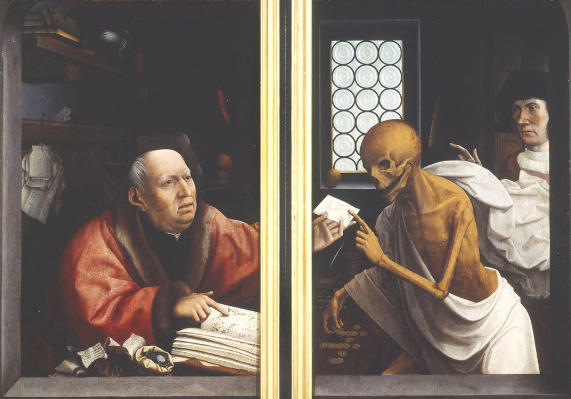
Outer (reverse)wings of the Triptych (c.1515)

Originally when the triptych was closed it showed the images Death and the Miser. These two rear sides form a continuous scene and depict a moneychanger who points to a line in an accounting register. Death lays down some tokens and points to the text held out to him by the moneychanger, presumably a promissory note. It is possibly that the man in the doorway with a raised finger could be the artist himself.

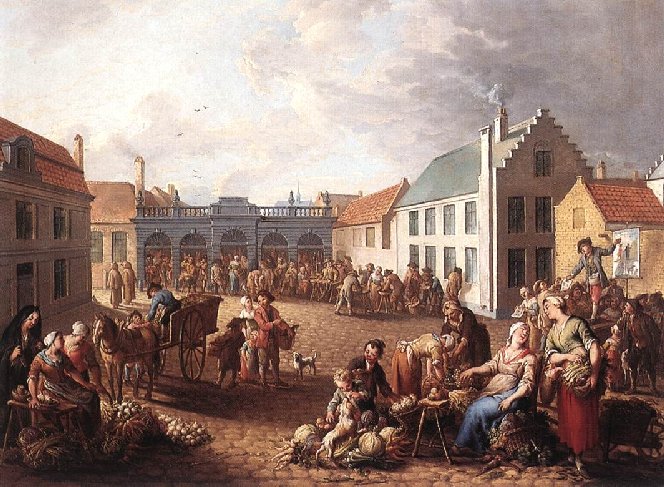
The Pandreitje in Bruges by Jan Antoon Garemijn (1778)

The world of art constantly changed.  Leaving the 15th- and 16th-century Northern Renaissance period, once known as the Flemish Primitives and moving on a quarter of a century, through the bombastic art of the Baroque period we arrive at the time when light-hearted charming, themed art of the Rococo period had gained in popularity.  In France, Antoine Watteau, Jean Honoré Fragonard and François Boucher held centre stage and defined the French Rococo period spanning from the reign of Louis XIV “The Sun King” to that of Napoleon Bonaparte.  They created soft-coloured dreamworld paintings set in idyllic surroundings exuding a light poetic atmosphere.  The Flemish Rococo artists never attained the aristocratic elegance of their French counterparts although they did manage to produce fresh bourgeois drawing-room style works. 

Portrait of Jan Antoon Garemijn by Charles-Nikolas Noel (1771)

The most talented of these Flemish artists was Jan Antoon Garemijn.  The Groeningemuseum houses his portrait and also a number of his beautiful works including one entitled The Pandreitje in Bruges which he completed in 1778. The Pandreitje was a square in Bruges used as a vegetable market. In the foreground we see women who have come to town from their rural homes bringing with them their vegetables which they hope to sell.  In the background, occupying the porticos of the prison building are the butchers selling their wares. 

On the left of the square we see a street entertainer singing songs and cracking jokes to keep the marketgoers entertained.  He is also depicted selling mannekensbladen, a kind of 18th century Flemish illustrated paper which is full of sensational stories.  Behind him is an advert for the paper he is trying to sell which bears the incomplete inscription:

DERLYCKL VAN- 1778

(Wonderful stories of 1778)

Garemijn always paid attention to detail in his paintings of market scenes, such as this one, which offered an idealised image of the common people without the symbolism and moralising undertone that earlier artists would insert into their genre works.  There was no hint of social criticism in this work.

Another painting housed in the Groeningemuseum is one I featured in one of my early blogs of 2011 and so I won’t repeat it but I will give you a link to the page. The painting and the story behind it, The Judgement of Cambyses and the Flaying of Sisamnes by Gerard David, was one of my most popular posts and it is well worth a visit.

Following these last two blogs featuring works housed in the Groeningemuseum I hope you will be able to visit one day in the future.

Marie Laurencin. Part 3.

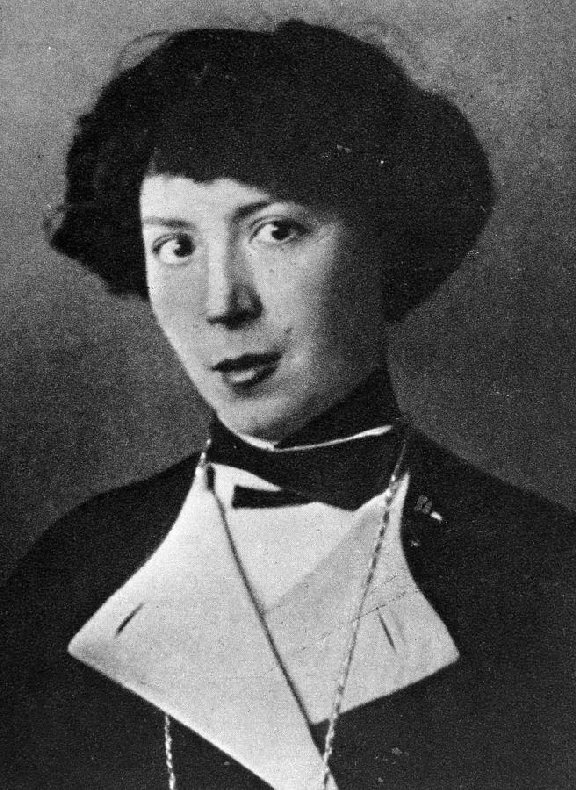
Marie Laurencin – a photograph by Granger (1913)

Marie Laurencin left Spain and returned to Düsseldorf via Switzerland in 1919. She was very unhappy with her life.  She was depressed and felt unstable with her marriage failing.   Laurençin filed for a divorce from her husband telling friends that the reason for the marital split was because her husband had become an alcoholic. In 1921 Laurençin returned to Paris, knowing that her marriage was finished and she divorced von Wätjen.   However, despite the divorce, they remained on good terms, and Marie kept in touch with van Wätjen’s until his death in 1942.

The Spanish Dancers by Marie Laurencin (1921)

Now having returned to the French capital Marie realised that she had been greatly affected by her separation from Paris which she looked upon as the unrivalled centre of artistic creativity. After her return, she developed a new style of painting which is reflected in her 1921 work, The Spanish Dancers.   Gone are the muted colours and the geometric patterns she had inherited from Cubism and these are replaced by light tones and undulating compositions. Once again, we note the coming together of the feminine world and the animal world, which became her favourite theme.  In the work we see three young women spinning around a small bounding dog, in front of a large grey horse. Marie has portrayed herself kneeling in the foreground wearing a pink tutu, which happens to be the only warm tone in the painting. Her hands are entwined with those of the young woman on the right, who is wearing a light grey dress with a light blue headscarf.  The woman on the left, wearing a light blue dress, is executing a dance step whilst holding a hat in place on her head.  Her eyes lead almost seamlessly into the large almond-shaped eye of the horse. The animals would appear to be the dancers’ confidantes in this strange setting.

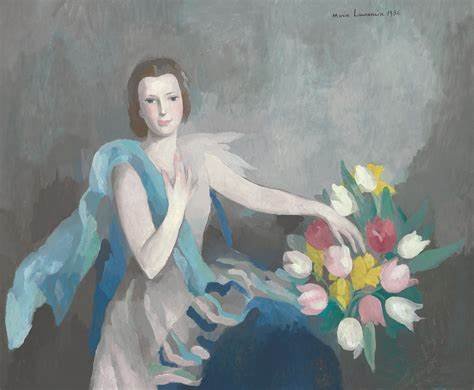
Femme aux tulipes by Marie Laurencin (1936)

Now back in Paris, Paul Rosenberg began to act as Marie Laurencin’s dealer which afforded her enhanced financial security and he also provided her with sound business advice.  Unfortunately, she did not always take Rosenberg’s advice and he was horrified to find that Marie often gave her work as a gift to those she liked. She also set higher prices for work which she found dull and often discounted some of her favourite works.  Curiously she often charged men double what she asked of women, and even charged brunettes more than blondes and furthermore she had a reputation for painting only children whom she liked.

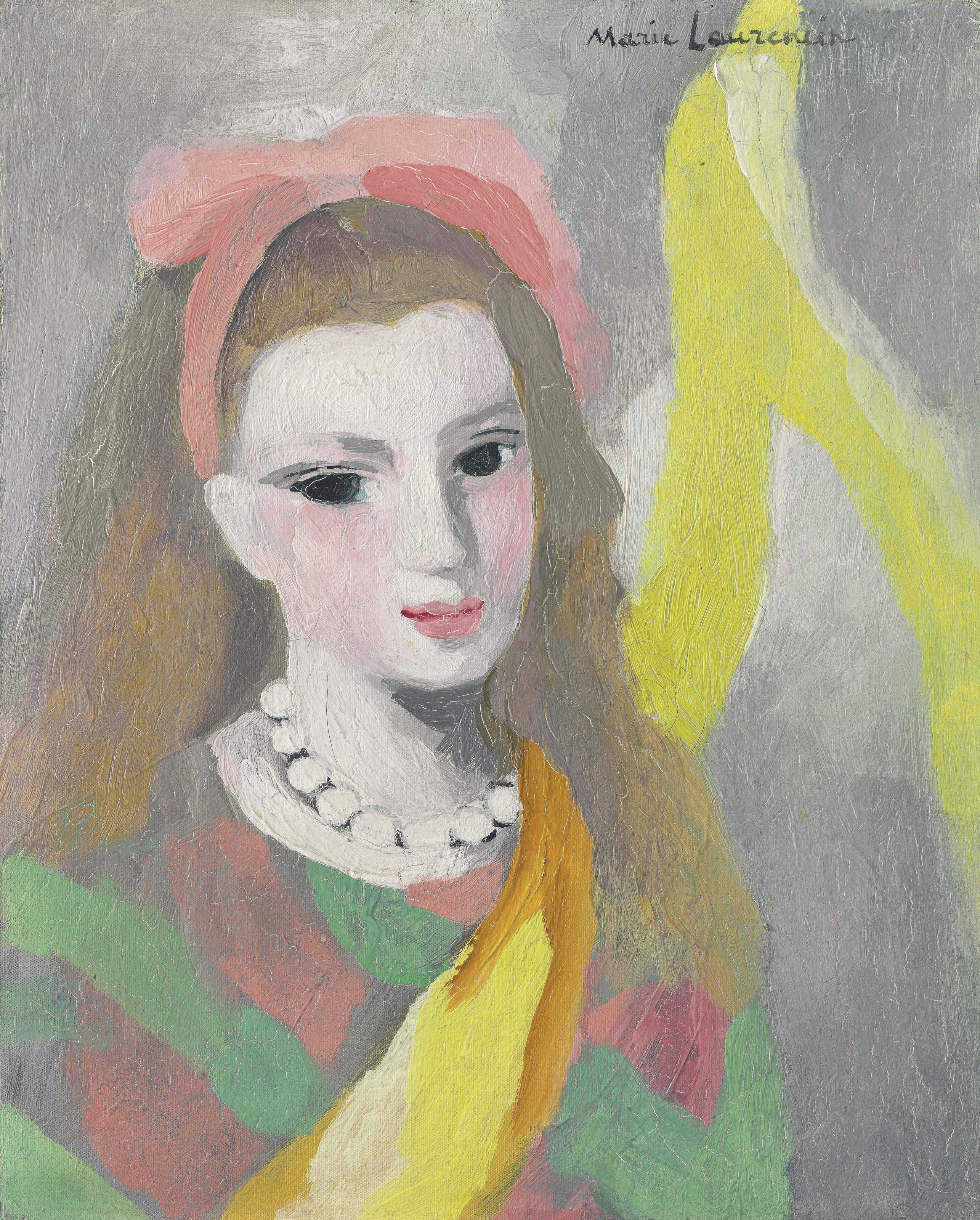
Jeunesse by Marie Laurencin (c.1946)

In her private life, while Marie Laurençin had a succession of male lovers, she also had close female friendships and lesbian relationships. She became part of the female expatriate community in Paris that searched for both artistic and sexual liberation. Lesbianism, for many of these women, was a crucial element of their resistance to bourgeois social conventions.

Gertrude Stein at 27 rue de Fleurus with her portrait by Picasso on the wall, May 1930

Now, based in the French capital, Marie was alone.  The first American who befriended her and bought her paintings was Gertrude Stein, an American novelist, poet, playwright, and art collector who had been born in Pennsylvania.  She had moved to Paris in 1903 and made France her home for the remainder of her life. She hosted a Paris salon, where the leading figures of modernism in literature and art, such as Pablo Picasso, Ernest Hemingway, F. Scott Fitzgerald, Sinclair Lewis, Ezra Pound, Sherwood Anderson and Henri Matisse, would meet for conversation and inspiration.  Laurençin soon became part of the Stein salon on rue de Fleurus.  Marie remained in contact with Gertrude Stein and Alice B. Toklas until Stein’s death in 1946 and continued to see Toklas until her own death.

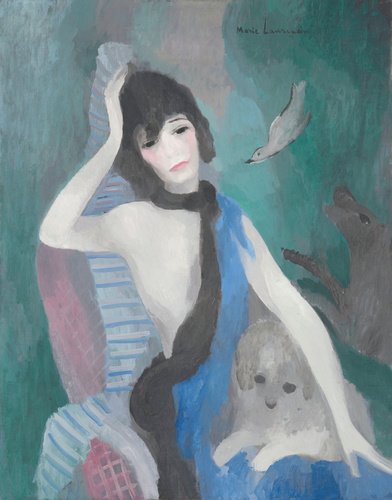
Portrait of Coco Chanel by Marie Laurencin (1923)

Laurencin held an exhibition of her work in 1921 at the Rosenberg Gallery in Paris. She had now built up her reputation as a talented portraitist, especially of celebrities, one of whom was Coco Chanel.  The commission to paint Chanel’s portrait came about in the autumn of 1923 when Marie Laurencin was working for Sergei Diaghilev’s Ballets Russes which was established in Paris, Monte-Carlo and London, and Marie was designing the costumes and sets for the ballet Les Biches [The Does]. At the same time, Coco Chanel was creating the costumes for the same company’s Le Train Bleu [The Blue Train] operetta .   At that time, Coco Chanel was both very rich and famous, and she commissioned Marie Laurencin to paint her portrait.  This was one of Laurencin’s early portrait commissions. Laurencin depicted Chanel face-on, seated in a relaxed, somewhat dreamy pose, with her head resting on her right arm. She appears relaxed and her eyes and mouth, neutral and expressionless, suggest that she is daydreaming or preoccupied by her thoughts. Marie Laurencin’s painting style was to incorporate animals in her works and here she depicts a white poodle sitting on the Coco Chanel’s knees. It is unclear where Chanel’s flesh ends and her dress begins; her pale outfit is accented with dark black and blue scarves, while the seat behind her is a textured pink and blue. On the right-hand side of the painting, we can see another dog leaping upwards towards a turtle dove which appears to be descending from the sky towards Coco Chanel, like the dove of the Holy Spirit, and thus Laurencin’s symbolising it as a sort of freedom. The colour palette is of a soft harmony of the colours – green, blue and pink, which is reinforced by the long black line of the scarf draped around the model’s neck.  The finished painting was so like Laurencin’s earlier works but did it capture the likeness of Coco Chanel.  The sitter did not think so and the artist did not deny it, but claimed that physical likeness was unimportant.  Chanel refused to pay for it and Laurencin was so annoyed by Chanel’s attitude that she refused to execute a second portrait and decided to keep the original herself.  Despite Chanel’s rejection of the painting, the success of Laurencin’s approach to portraiture was such that she continued to receive and execute portrait commissions in this style until the 1940s. The painting can now be found at the Musée de l’Orangerie in Paris.

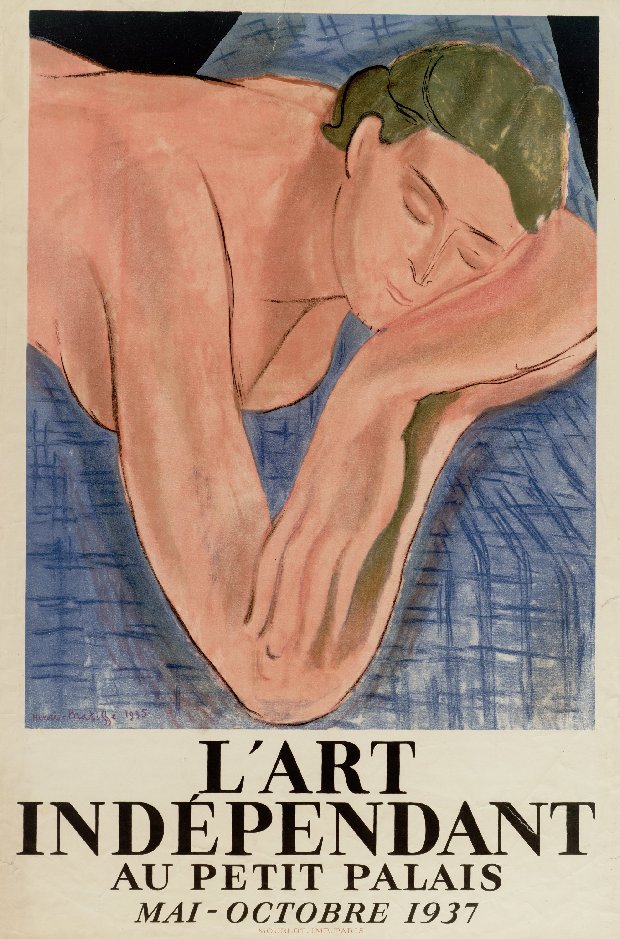
In 1931, Laurencin was one of the founding members of La Société des femmes artistes modernes, and took part in their annual exhibitions until the outbreak of World War II. During the period from 1932 to 1935, she tutored at the Villa Malakoff, a private art school.  In 1937, which art historians believe was the height of her career, a retrospective of Laurencin’s work was held in conjunction with the Great Exhibition of Independent Art Masters at the Petit Palais, which sought to promote the superiority of the contemporary French artistic school, extended to foreign artists “living or having lived in France for many years”. The year 1937 saw a change in Laurencin’s appearance when she finally acquired glasses, which changed her life considerably as she had been extremely short-sighted since childhood and had had difficulty negotiating staircases since the 1920s.

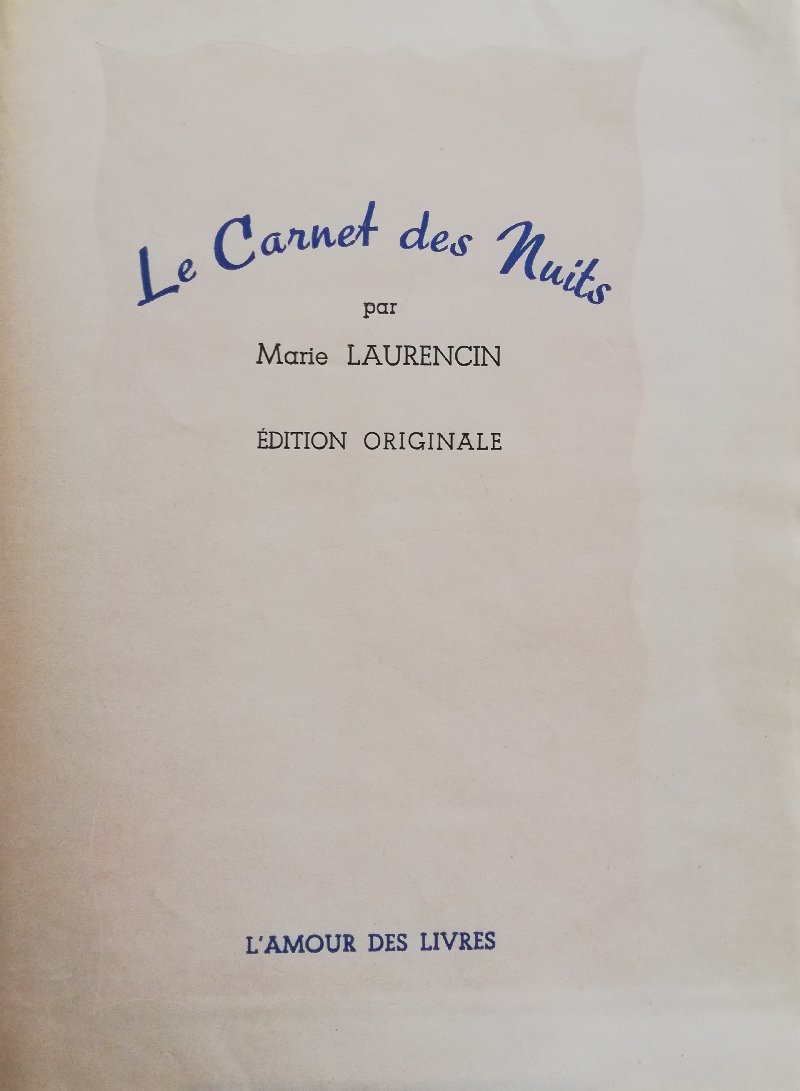
During World War II, Laurencin remained in Paris painting and working on designs for the ballet, and in 1942 she published Le Carnet des Nuits – a collection of poetry with short memoir pieces in prose.  Although Laurencin will be remembered as an artist and the grace and the elegance of her artworks; she is also the author of a diary, Le Carnet des Nuits, an important witness of her time. It tells of her early years she spent in Bateau-Lavoir.  Her writing is of the same delicate style used for her artworks. 

Head of a Woman by Marie Laurencin (1909)

In later years, Laurencin became withdrawn and increasingly isolated and sadly suffered from periods of depression and other health complaints, albeit, she continued to paint throughout this troubling passage of time. Her main companion was her maid, Suzanne Moreau, who had lived with her since 1925. Whether there was more to the mistress/servant relationship is unclear but it is thought that they were romantically linked.    In 1954, Laurencin made Moreau the beneficiary of her estate. It is thought this came about due to Laurencin’s legal struggle, resolved the following year, with tenants living in the apartment that she owned.

The tomb of Marie Laurencin in Père Lachaise Cemetery, Paris.

Laurencin died of a heart attack on June 8th, 1956, aged 72.  She was buried wearing a white dress in Père-Lachaise cemetery in Paris, as per her wishes, with Apollinaire’s love letters and a rose in her hand.


The main source of information for the three blogs about Marie Laurencin came from the excellent The Art Story website.

Walasse Ting

Walasse Ting (1929-2010)

Walasse Ting at work in his studio

I have just returned from another stay in the Algarve where I could finally see some sun and experience warm weather.  Whenever I visit the Algarve, I always visit the Art Catto gallery in Loule which I have often written about.  This time I not only got a chance to return to the excellent small gallery in the centre of town,but take up their invitation to the opening of an exhibition at the Conrad Hotel in Quinta do Lago.

Conrad Hotel, Quinta do Lago, Algarve

The Conrad Hotel is, to say the least, a spectacularly lavish hotel, and the entrance foyer rooms where fine places to exhibit the expensive works of Walasse Ting.  Seven years after his death, Walasse Ting’s has been given a place as a giant of 20th century paintings. He is such a captivating figure and the art he has produced over his 50-year career reveals many influences.   Today, his artwork is in public collections which include MOMA, New York; Guggenheim Museum, New York; National Gallery of Chicago, Chicago; Tate Modern Museum, London; Centre Pompidou, Paris; Hong Kong Museum of Art, and the Shanghai Art Museum. 

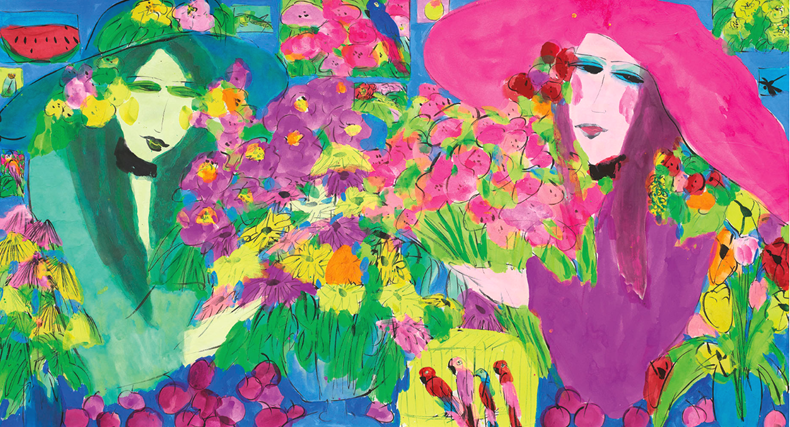
Beautiful Ladies by Walasse Ting

Many devoted private collectors also own his artwork. The latter group is growing especially fast, thanks in part to the rise of China as an economic and cultural force.  From the very early works, Walasse Ting’s paintings have charmed viewers with his use of vivid colours and light-hearted mood.

Ladies with Parrots by Walasse Ting

Walassi Ting is a Chinese artist who was born in Wuxi, China in 1929 but in fact was raised in Shanghai.  Ting is primarily a self-taught painter, sculptor, graphic artist, lithographer and poet, who began his life as an artist at a very young age. Ting studied at the Shanghai Art Academy before he left China in 1946 and after living briefly in Hong Kong set sail for France in 1950.   Times were hard for the young aspiring artist continually battling against poverty.  His stay in Paris coincided with the rise of the avant-garde artistic group known as CoBRA.   The word Cobra is derived from the French names of the cities of Copenhagen, Brussels and Amsterdam.

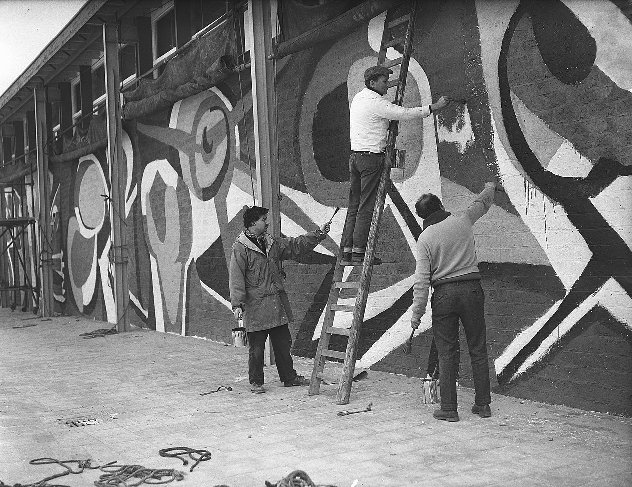
CoBra member Karel Appel working on a mural in Rotterdam for the Manifestation E55

The artists had founded the CoBRA group during a major international conference held in Paris in 1948 and they came from these three European capitals.  Ting became acquainted with all the members of the avant-garde group, most notably Pierre Alechinsky and Asger Jorn.

Women with Flowers by Walasse Ting

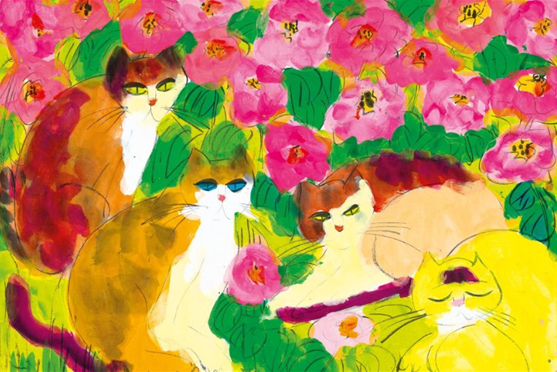
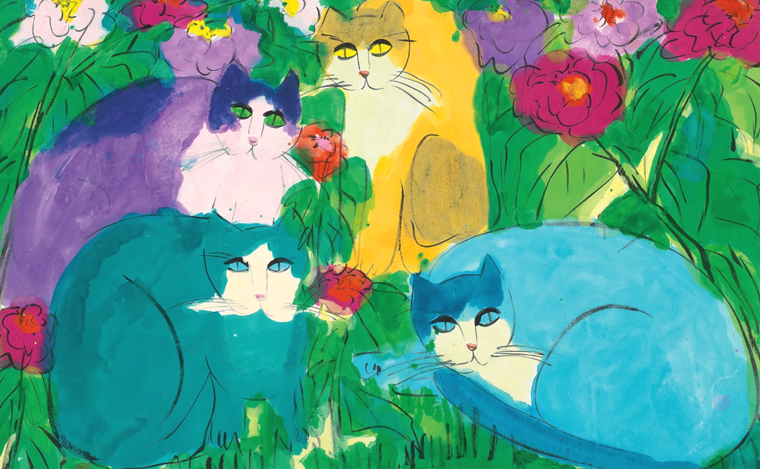
Walassi Ting left Paris and arrived in New York in 1959 and participated in the Pop Art and Abstract Expressionism movement where his closest associates were artists Sam Francis and Joan Mitchell, members of the second generation of Abstract Expressionist painters.  He sold many paintings which often featured bold dripping strokes.  It was just over a decade later in 1970 that Walassi Ting created a distinctive style using calligraphic brushstrokes to define outlines and filling flat areas of colour with vivid paint. After 15 years of abstract painting, Walasse Ting’s interest in the body and his exploration of sexuality led him back to figuration in the 1970’s.  Like the colour master, Gauguin, Ting made a number of journeys to Tahiti continually on the lookout for the exotic colours that he loved. The subject of his paintings often contained women, cats, birds and peacocks. 

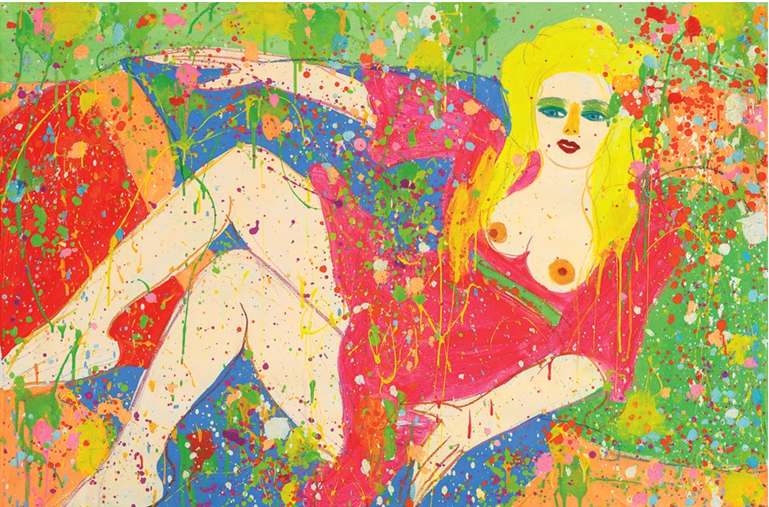
Kiss me, Kiss me by Walasse Ting

Ting embraced sexual desire through his art, as he conveyed his inner emotions through the fluent and expressive brushstrokes as he captured the alluring beauties set against a background of uncontrolled vibrant acrylic colours that break free into a dreamscape of sensual pleasure. In his 1974 acrylic on paper work entitled Kiss Me, Kiss Me, the title of the work and the bare-breasted model conjure up the emotions of sexual passion.   The work comprises of flat planes of colour and simplified lines, and the woman exposes herself to us, and is drenched in a tumult of multicoloured drips as if she was incorporated into an abstract expressionist canvas.

Come Talk to Us by Walasse Ting

In the summer of 1976 Ting produced his acrylic on canvas work entitled Come Talk to Us which depicted two half-length female figures who stare at a plant-like bouquet of colours at the centre of the image, an image which divides the image in two. The mirror-image like effect creates a sense of calm and balance, and the dabs of green, blue, and red paint trickle slowly along the canvas, exuding a melancholic beauty like that of gazing through a window on a rainy day. The title of the painting, Come Talk to Us, questions the viewer and echoes a lonely yet tantalizing longing. Ting has once again used the depiction of his figures to express the feelings inspired in him by objects of beauty.  Ting explained:

“…When I see a beautiful woman [and] I see flowers, its beauty makes me feel intangible, melancholy, love, refreshed, different, and reborn. I want to use different colours to express my inner feelings and emotions in my paintings.”

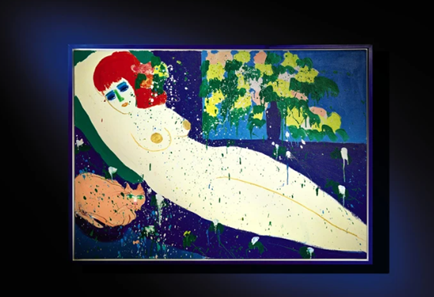
Eat me, I’m a Fish b y Walasse Ting

His 1978 work, with the strange title, Eat Me, I’m a Fish, Ting has splattered the paint over the entire canvas giving it the impression of a faint effervescence. This oblong depiction of the woman suggests the shape of a fish and the title boldly summons the viewer to come and consume its imagery, once again arousing the viewer’s culture’s sexual drive. The figure transects the diagonal of the picture plane while a cyan blue rectangle slices off the upper right quadrant of the image, giving the impression of a window.  Eat Me, I’m a Fish is Walasse Ting’s vivid interpretation of everyday life, and yet the composition is an obvious reference to Édouard Manet’s masterpiece Olympia. This painting could be thought of as Ting’s homage to a modern master, reinterpreting the essence of this classic painting and challenging the earlier artist’s greatness.

At the Conrad exhibition, many of his paintings were watercolours on rice paper.  They were both delicate and ornate, rendered with detail and repetitive patterns.

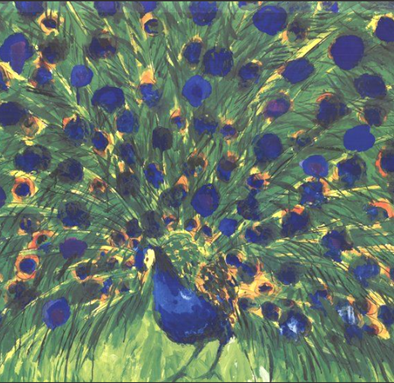
Peacock by Walasse Ting

Peacock II by Walasse Ting

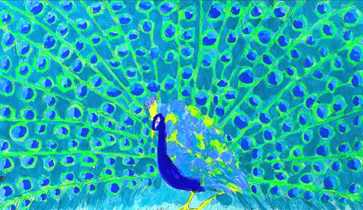
Ting frequently depicted cats, flowers and birds as in his painting, Peacock, in which the ‘eyes’ of the bird’s plumage radiate outwards across the large surface of the painting, creating a striking wallpaper of electric blue, yellow and green. The controlled circles, tightly arranged, create an arresting optical vibration.

Cat Series by Walasse Ting

Cat Series by Walasse Ting

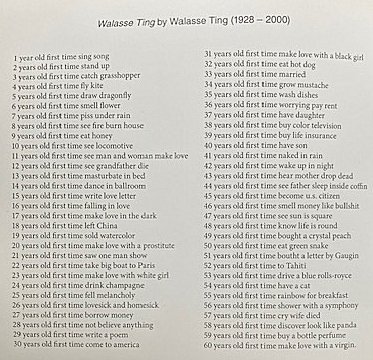
One very unusual thing at the exhibition was a display board giving a brief bio. by Ting himself It was also in the exhibition brochure. That is not strange in itself but what was unusual and some may say inappropriate, was his summary of his life “achievements”, year by year.

In the mid-1980s, he set up a studio in Amsterdam and in 2001 he permanently settled in that city. He was unable to create after a stroke in 2002. Ting died on May 17, 2010, at the age of 81 in New York.

Graham Clarke

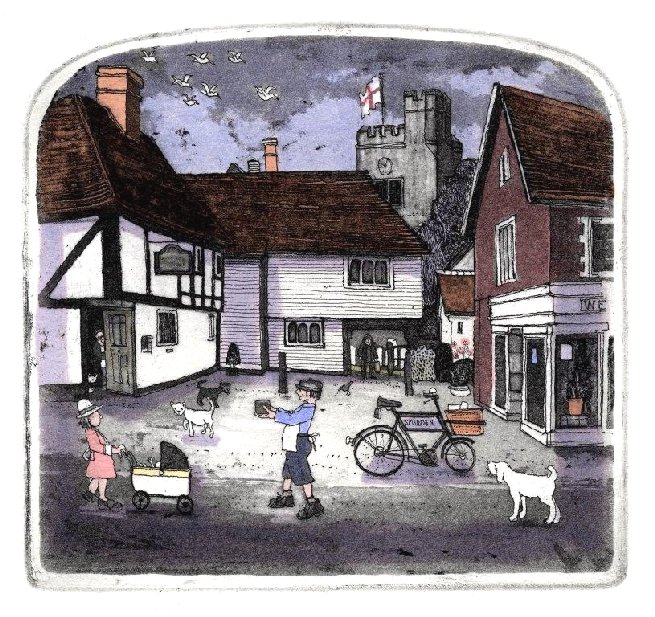
What is the reason behind you placing a paintings or prints on your walls at home?  Is it because it reminds you of somewhere you have visited or maybe it is a depiction of somewhere nearby?  Maybe it is a portrait of a loved one or somebody famous whom you admire.  In this period of our lives when there is so much suffering going on around us then sometimes the painting is a depiction which simply lifts our spirits and makes us smile.   Today I am looking at an artist and his work which fulfils that category.  Let me introduce you to the English author, illustrator and humourist Graham Clarke. He has created over five hundred images of his beloved English rural life. He has focused on how the ordinary Englishman viewed Europe. Through his quirky depictions, he brings his own unique brand of humour to his interpretation of past and present history through the eyes of the common man.

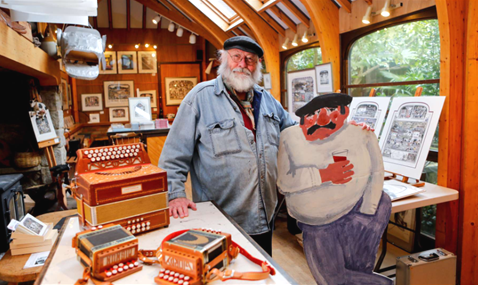
Graham Clarke

Graham Clarke was born on February 27th 1941 in a village in Oxfordshire during the Second World War.  His father Maurice was a Midland Bank employee.  He, his mother and his elder brother, Anthony, were evacuated there from their three-bedroomed semi-detached home in Hayes, Kent.  When Graham was two years old the family spent a couple of months at the Cornish village of Denabole, which lies close to Trebarwith with its large expanse of sandy beaches which was always remembered fondly by Graham.  In his teenage years Graham and the family would spend time at the coastal towns of Broadstairs and Looe and it was those holiday times on the coast that made a great impression on him. 

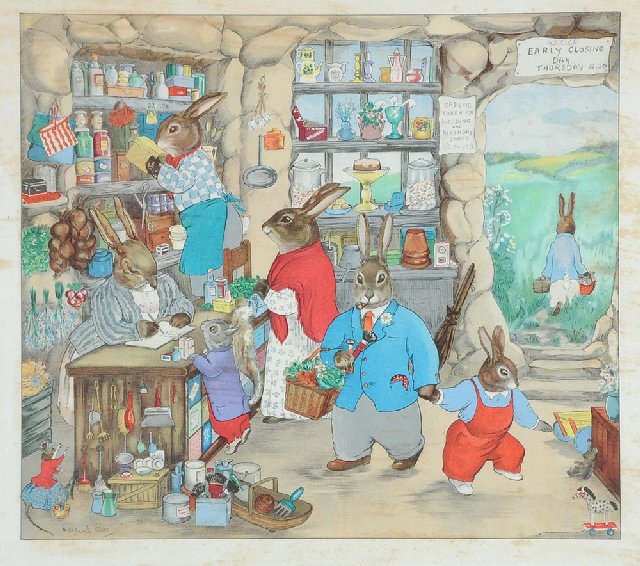
The Flippits.  A Story of the Rabbit, Fox and Badger by Margaret Ross.

On his fourth birthday in 1945, with the war at an end, back living in Kent, Graham received a birthday present which was to remain in his memory in the years that followed.  It was the children’s book, The Flippits.  A Story of the Rabbit, Fox and Badger by Margaret Ross.  It was a make-believe world, a world of peace unlike the threatening years that he and his family had experienced during the war.   It was an underground world of a warren with its cottagey interiors.  It was a book with illustrations which fuelled the imagination of four-year-old Graham.  Looking at many of Graham’s multi-figured depictions one can look back at the multi-figured illustrations from this book and realise the connection.

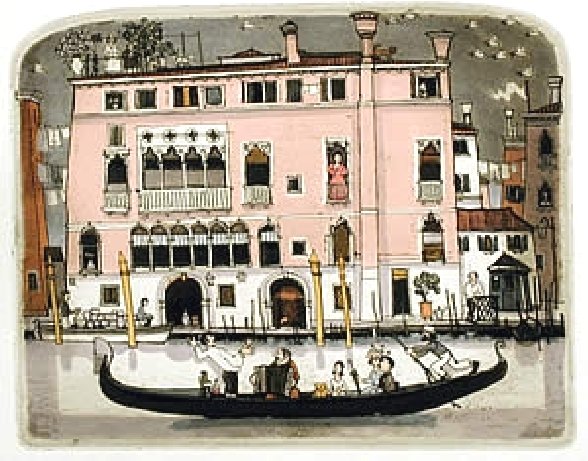
A la Carte by Graham Clarke

In 1949, when Graham was eight years old, the family left their home in Hayes and moved to a larger three-bedroomed semi-detached house. large enough to also accommodate Graham’s paternal grandfather  who had been widowed.  As a teenager, Graham was described as being an observant and sensitive child by his mother who would spend his free time cycling and exploring Hayes Common.  He and his brother would also help their parents with their love of amateur dramatics and their AmDram group, The Hayes Players.  Graham’s brother Anthony would help his parents by aiding with set building jobs and Graham would assist with painting stage portraits and stained glass windows.

Miss Jay’s Wood by Graham Clarke (1952)

One day Graham’s father came home and presented his son with a box of felt-tipped brushes and spirit-based inks and after the usual child-like sketches his artwork improved and he began to use watercolours for his countryside depictions.  The box of watercolour paints with sable brushes and a set of oils had been a Christmas gift from his aunt and uncle in 1952 and on that Boxing Day he completed his first oil painting entitled Misses Jay’s Wood, which was owned by a close-by neighbour.  The painting was bought by one of the neighbours for ten shillings.  Graham could immediately envision himself as becoming a professional artist !

Close Up Please by Graham Clarke

Meanwhile, Graham attended a small private school who fast-tracked their pupils’ education to be of a standard which would allow them to pass their 11+ exams.  Whilst attending this school Graham let it be known of his future aspirations as a professional artist.  However, he received no encouragement from his teachers, in fact, they told him it would be a pauper’s life for him if he were to realise his artistic dream.  Notwithstanding this, he clung to his ideas and passed the 11+ exams and entered the Beckenham and Penge Grammar School in 1952.  During his time there he enjoyed the geography and history lesson through his love of map-making and his fascination with castles and life for the working-class people of those times. 

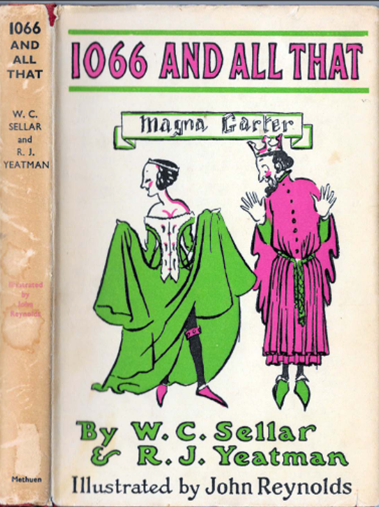
A book at the time which fascinated Graham was 1066 and All That, a tongue-in-cheek reworking of the history of England, written by W. C. Sellar and R. J. Yeatman and illustrated by John Reynolds.

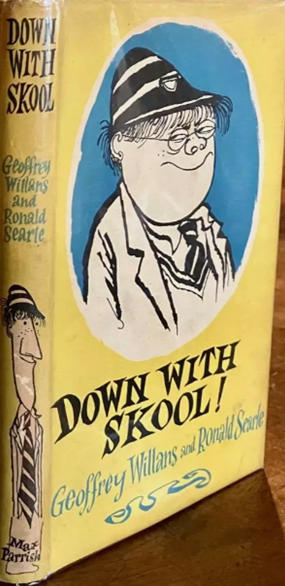
Another book which Graham loved was Down with Skool, by Ronald Searle which was one of his 1953 Christmas presents.  He became interested in caricature.  He excelled at art under Ronald Jewry, his art teacher who encouraged his students to use their imaginations when they painted.  Graham Clarke enjoyed his time in the art class.

Graham received an excellent grade for his GCSE ‘O’ level Art and managed to scrape through Maths and Science sufficient enough to enter the sixth form ‘A’ level on a Science course but he hated it.  His former art teacher, Jewry, approached his father and suggested that his son should abandon his A-level Science course and take up art instead.  No doubt Graham had already spoken with his father over his future.

Graham’s favourite artist at this time was Samuel Palmer, born in 1805, a British landscape painter, etcher and printmaker who was also a prolific writer. Palmer was a key figure in Romanticism in Britain and produced visionary pastoral paintings.  Graham believed that although he knew about the works of Palmer he realised that to get to really know him he had to visit the countryside around Shoreham, in west Kent, where Palmer had been so inspired.  During his studies at the Art College Graham had enrolled in the History of Art Course and went on a short train journey to Shoreham.  Graham was mesmerised by what he observed.  He later wrote:

“…Palmer loved this place and love it is that makes me walk here too.  Every lane is climbing up its hill [and] down again to the river, over the bridge and up and on again climbing and twisting. These are not mountains here there is no raging torrent, the trees are not giants and all is on a small scale, quiet and complete, Palmer decided God (and Nature) was at its best in this little valley of vision. Twenty miles from here is peace…”

Round and Round by Graham Clarke

One of his tutors as the Beckenham Art School was Wolf Cohen who Graham described as “small, fiercely energetic and a model of dedication” and it was he who instilled in Graham that art should be life-absorbing.  Although Graham’s figure drawing was not the best he managed to improve that during the time he spent in Susan Einzig’s life classes.  She introduced Graham to the Laurie Lees’ book Cider with Rosie, illustrated by John Ward.   It was these delicate and sensitive drawings that appealed to Graham.

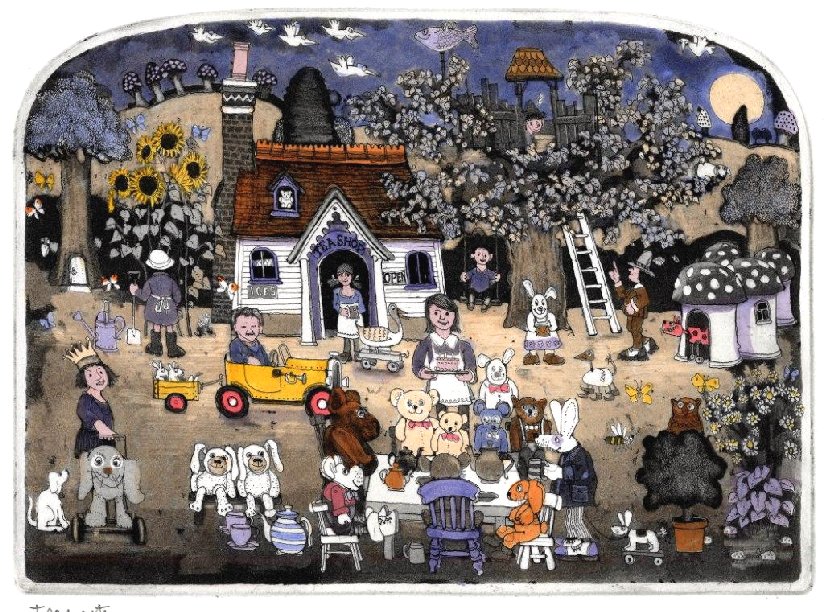
Tea Party by Graham Clarke

At the start of his final year at the art college, Graham Clarke had to make a decision about his future.  His tutor Wolf Cohen persuaded him to apply for a post-graduate position at The Royal College of Art and along with half a dozen of his fellow students he would spend weekends at Cohen’s studio building up his portfolio which would be needed when he applied to the college.  Graham succeeded in his entry interviews and portfolio submission and in 1961 he became a student at the prestigious Royal College of Art.

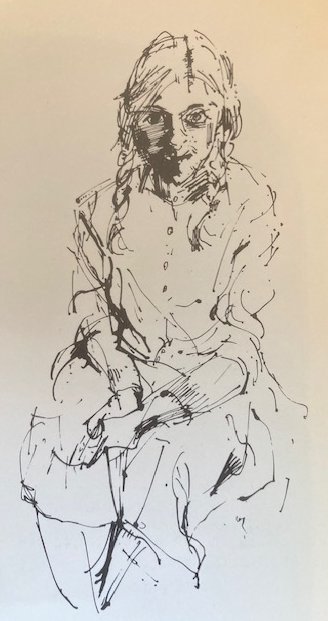
Wendy by Graham Clarke. Pen and ink drawing from his sketchbook.

In his late teens Graham had been a member of various Youth Clubs, one of which was the Bromley High Street Methodist Youth Club and it was here that eighteen year old Graham first met fifteen year old Wendy Hudd and the two of them became involved with the organising of plays, pageants and parties.

The Four Seasons by Graham Clarke

Graham’s first year at the Royal College of Art was a disaster.  He felt totally isolated from his fellow students and their interests in art.  Whereas they looked for their inspiration by studying modern American magazine depictions of pop stars and flashy cars and motorcycles, Graham clung to his love of all things rural or historical and soon realised that he was going to be isolated by such loves.  As he said, he was destined to “plough a lone furrow”.  He decided to stay with what he loved and he was proud of this sincere decision and when challenged about it, would just say that he did not need to “ride another horse”.  Graham described his first year as being a dark tunnel and yet he added he could just make out a light at the end of it.  Graham was fortunate to have the support of Wendy and her family during those difficult twelve months.

Serenata by Graham Clarke

At the Royal College of Art Graham specialised in illustration and printmaking and had the chance to follow his interest in calligraphy.

Billingsgate Market by Edward Bawden (1967)

During his time at the Royal College of Art he was greatly influenced by one of his tutors, Edward Bawden, an English painter, illustrator and graphic artist, who was known for his prints, book covers, posters, and garden metalwork furniture. 

Yeomans by Graham Clarke

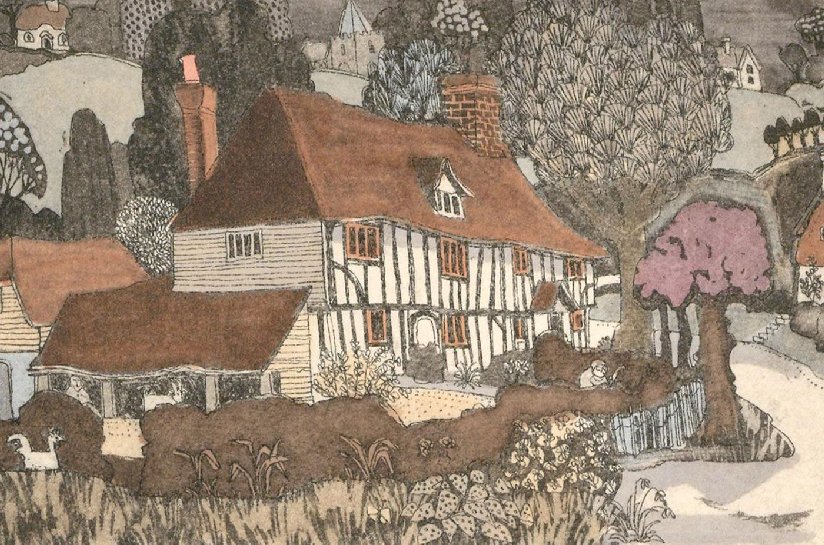
It was through Bawden’s influence that Graham took an interest in producing prints of traditional landscapes, the depictions of which highlighted local areas.  One such print featuring a rural scene was Yeomans which depicted a quaint English street scene featuring cottages and trees. 

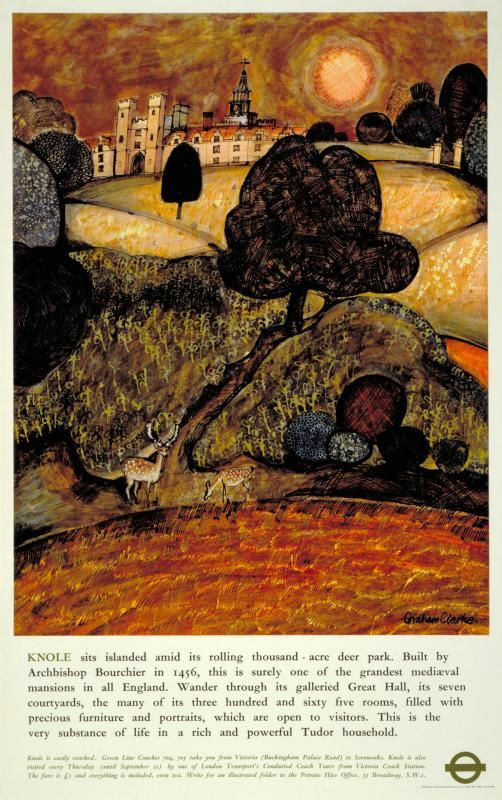
Graham finally graduated in 1964, which, fortunately for him, coincided with peoples’ interest in buying prints which resulted in a flourishing sale of them.  His artwork was admired and he soon received commissions for his depictions from the likes of Editions Alecto and London Transport Publicity Department and so a bright career for him began.

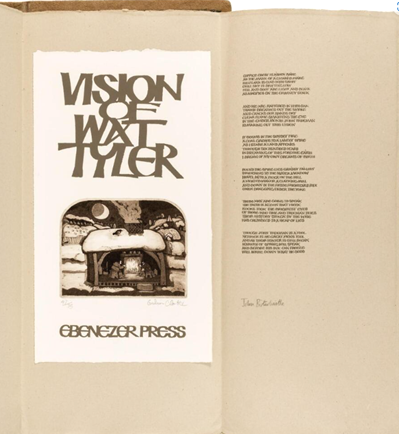
Vision of Wat Tyler by Graham Clarke

In 1969 Graham’s first hand-printed “livre d’artiste”, Balyn and Balan was published.  Another of his books was Vision of Wat Tyler which won recognition from the most influential patron and connoisseur of the day, Kenneth Clark. Lord Clark wrote enthusiastically in praise of Vision of Wat Tyler:

“…the whole book is a splendid assertion that craftsmen still exist and cannot be killed by materialism. A few idealists are the only hope for decent values…”

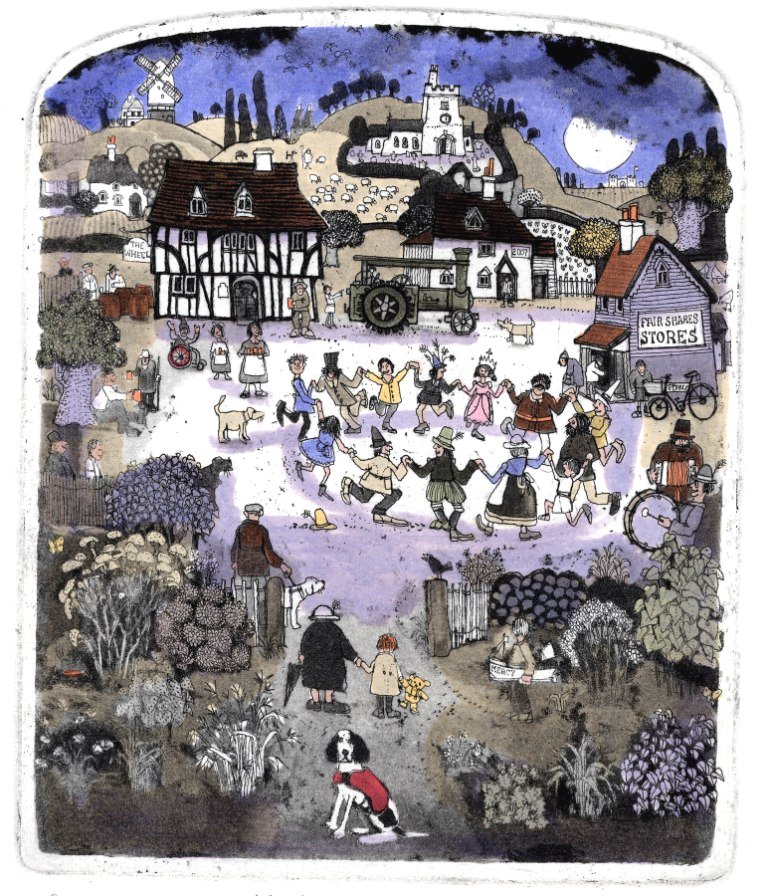
Dance by the Light of the Moon by Graham Clarke

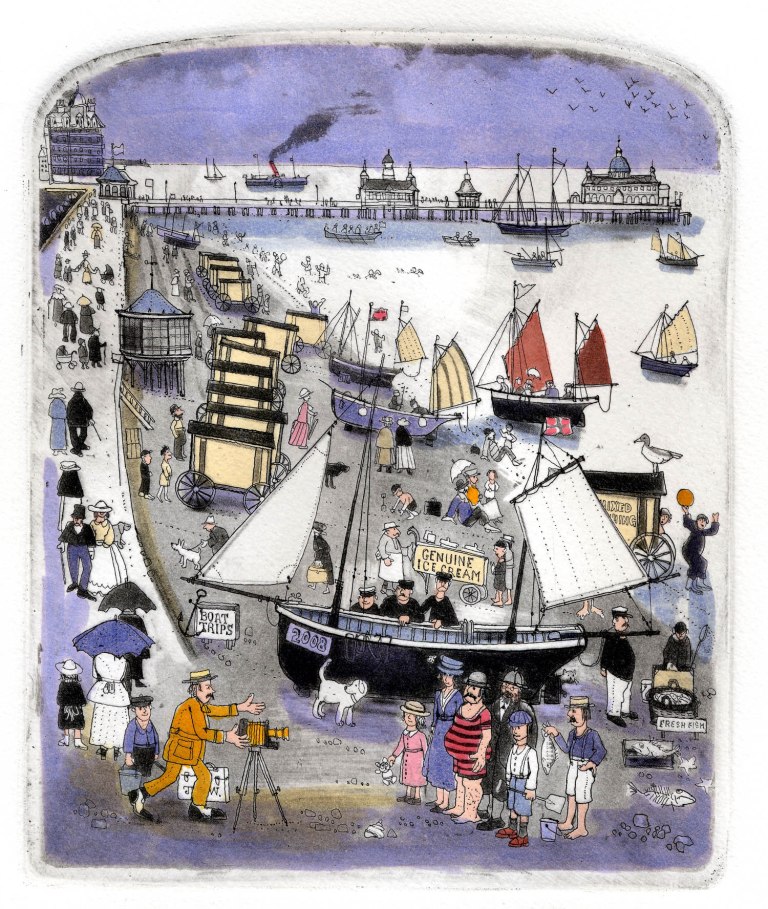
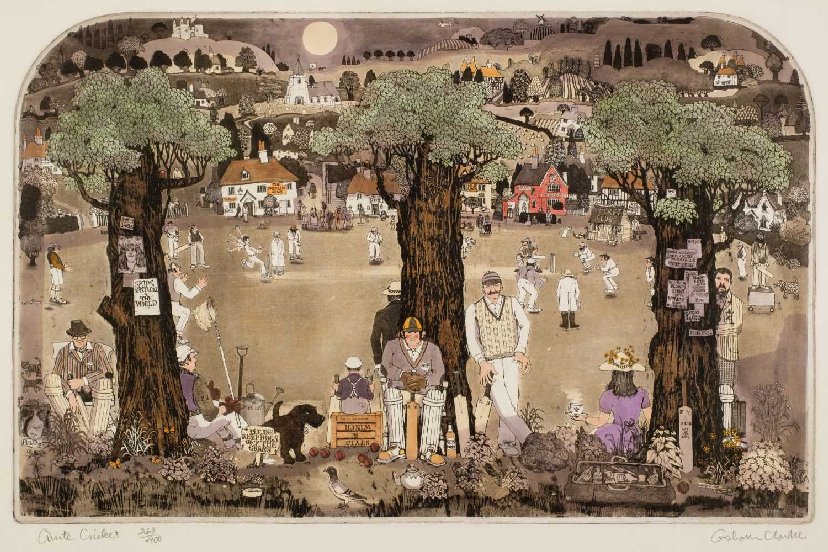
Graham’s famous ‘arched top’ etchings has established his widely successful reputation in Britain and overseas, and came to public attention in 1973 when the first of these, Dance by the Light of the Moon, was exhibited and sold in London at the Royal Academy of Arts Summer Show.

For you Madam by Graham Clarke

Examples of his work are held by Royal and public collections, including the Victoria and Albert Museum, the British Museum, the Tate Gallery and the National Library of Scotland in the United Kingdom, as well as by Trinity College, Dublin, the Library of Congress in Washington, D.C., the New York Public Library and the Hiroshima Peace Museum. Many more are to be found on the walls of private homes all over the world, collected systematically by devotees, as well as singly by ordinary art lovers who “know what they like”

Quite Cricket by Graham Clarke

Graham Clarke, who prides himself as being a “Man of Kent” lives with his wife Wendy, four children, his animals and friends, in the village of Boughton Monchelsea in the county of Kent where he also has his studio. 

He offers open-days at his studio which gives visitors an opportunity to view his work including hand coloured limited edition etchings, watercolours, posters and greetings cards depicting English rural life and history, the Bible and the Englishman’s view of Europe, all of which are available for sale.


My blog has only scratched the surface of the life of this talented artist. The information for this blog came from two main sources:

Clare Sydneys’ 1985 book entitled Graham Clarke

and

Graham Clarke’s website

Amélie Beaury-Saurel and Rodolphe Julian.

Amélie Beaury-Saurel

Amélie Beaury a French painter, was actually born in Barcelona on December 17th 1848.  Her family had previously lived in Spain and Corsica before moving to the Catalan city in 1845.  Her parents, Camille Georges Beaury and Irma Catalina Saurel owned a large carpet and tapestry factory with more than twenty looms, which they called Saurell, Beaury y Compañía. Amélie was their middle child.  She had an elder sister, Irmeta, also an artist, and a younger sibling, Dolores. Amélie later added “Saurel” to her name in recognition of her mother’s family who could trace their lineage to the Byzantine emperors of the 11th century.

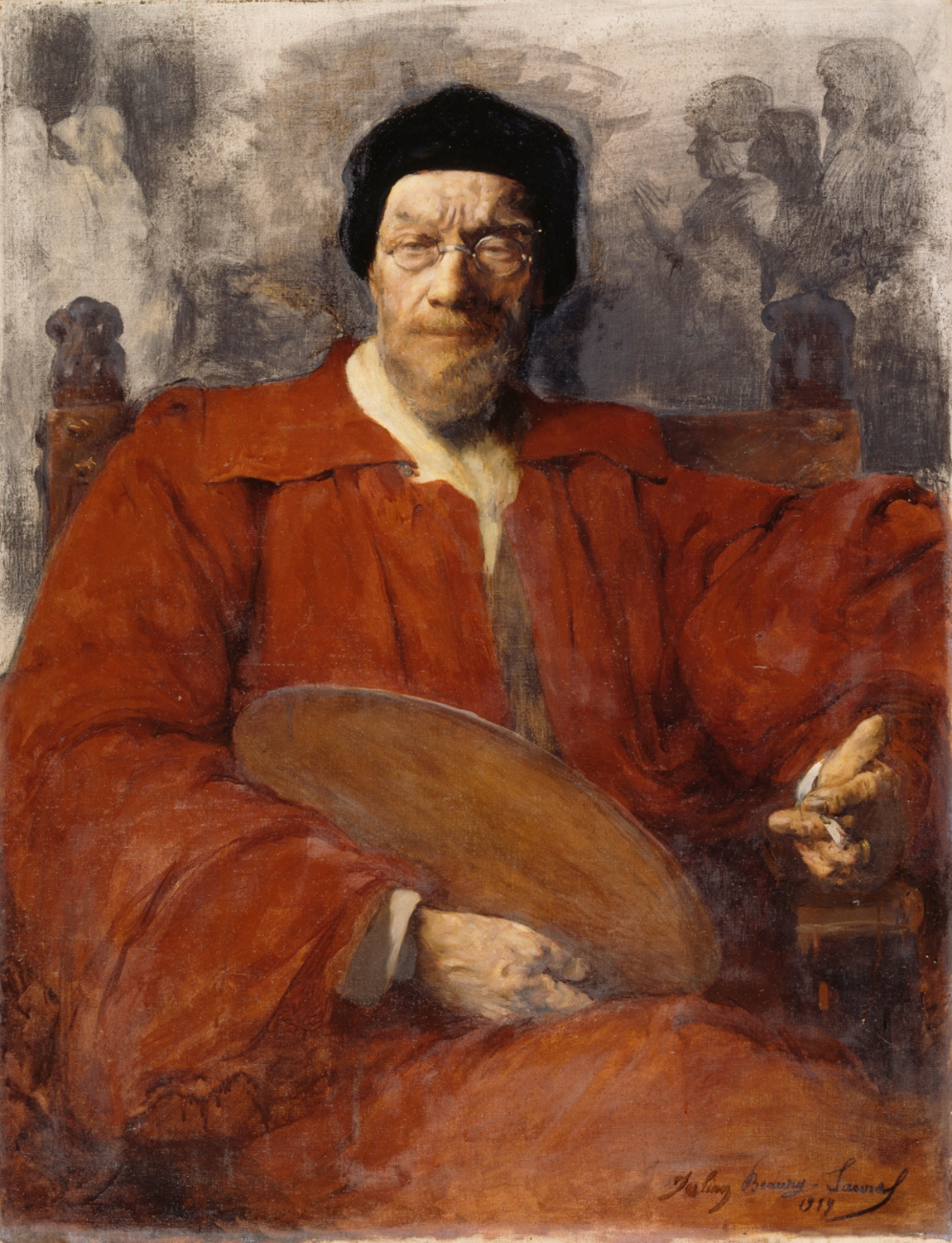
Portrait of the artist Jean-Paul Laurens by Amélie Beaury-Saurel (1919)

The happy family life was shattered in the late 1850s when Amélie’s father died and her mother decided to relocate with her three daughters to Paris.  Amélie recalled in an interview that she and her family lived in the French capital when she was ten years old and that her widowed mother, with little money, had to endure financial hardships.   Her mother instilled a love of art in her children and she would take them to the Louvre Museum to see the works of the Masters and encourage them to copy the works of the these great artists.

Portrait of Léonce Bénédite, curator of the Musée du Luxembourg,  by Amélie Beaury Saurel (1923)

Due to this family impoverishment, Amélie’s mother decided that her daughters should help with the financial burden and set about having them train as porcelain painting, a socially acceptable way of earning a living and eventually becoming financially independent. Amélie set to work as a painter of porcelainware but later said she considered what she was doing as commercial painting which in many ways damped down her creativity.  Her mother was very supportive of Amélie’s love of painting and, in 1874, initially paid for her nineteen-year-old daughter to study at the prestigious Académie Julian.  One of her first tutors was Pauline Coeffier, a French oil painter and pastelist, who specialized in the art of portraiture. Later many of the leading artists of the day would advise and tutor her, such as Tony Robert-Fleury, William Bouguereau, Jules Lefebvre, Benjamin-Constant, Jean-Paul Laurens and Pierre Auguste Cot.

Rodolphe Julian

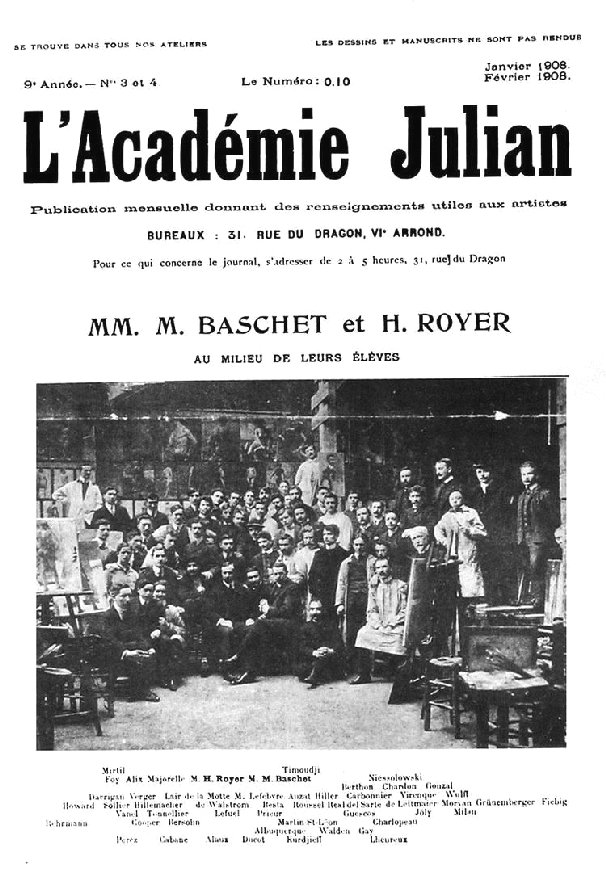
The Académie Julian was founded in 1868 by Rodolphe Julian. It was a private art school for painting and sculpture.  Paris was looked upon as the capital of the art world, and the centre of modern art.  This was one reason many young aspiring painters came to the French capital to discover all the latest trends in painting, like Impressionism and Post Impressionism, decorative art of various types, new forms of representational art such as expressionism, lithography and much more. Also with having a reputation as a forward-thinking art college the Académie Julian profited from the reputation of Paris.

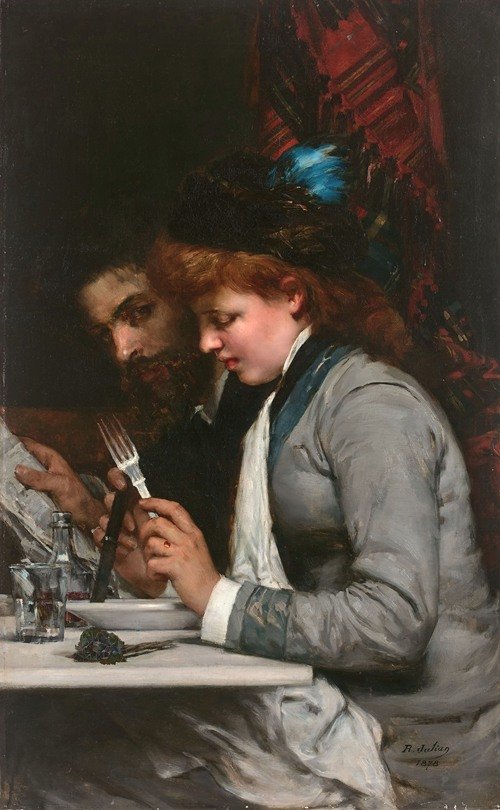
Chez Duval by Rodolphe Julian

Another reason for the popularity of Académie Julian was that it was the only art school in Paris to accept foreign students, many of whom struggled to pass the difficult French language exam, which was conditional on their acceptance into the Ecole des Beaux-Arts. Ambitious female painters were also barred from attending the official Ecole des Beaux-Arts until 1897 and even then, it was not considered suitable for women to study life drawing.  In contrast, Académie Julian was happy to offer them a full programme of education and training to women in fine art. They were offered the same classes as men, including the drawing of nude models. In fact, the Académie was one of the few schools to admit women to life-drawing classes. In fact, one of its four new branches was actually exclusively designed for female art students.

The Académie Julian was also regarded as a stepping stone to the prestigious École des Beaux-Arts by getting them prepared for the entrance exams and at the same time offered independent alternative education and training in arts.  Aspiring artists, both men and women, were welcome at the Académie Julian.   Men and women were trained separately, and women participated in the same studies as men, including drawing and painting of nude models.  The Académie Julian had no entrance requirements, was open from 8 a.m. until nightfall, and very soon became the most popular establishment of its type. Rodolphe Julian opened several branches throughout Paris, one of them especially for female artists, and by the 1880s the student population at these establishments reached six hundred.

Female Students at the Académie Julian in Paris, c. 1885

To ensure the success of the Académie, Rodolphe gathered together well-known and esteemed artists, such as Adolphe William Bouguereau, Jean-Paul Laurens, Tony Robert-Fleury, Jules Lefebvre and other foremost painters of that time trained in Academic art, to become tutors or visiting professors.  Académie Julian became recognised as a leading art establishment and its students were allowed to compete for the Prix de Rome, a prize awarded to promising young artists, and also show their work in the major Salons or art exhibitions.

So, who was Rudolphe Julian?

Rodolphe Julian was born in Lapalud, a commune in the Vaucluse department in the Provence-Alpes-Côte d’Azur region in southeastern France on June 13th 1839. He worked as an employee in a bookstore in Marseille but later moved to Paris, where he became a student of Léon Cogniet and Alexandre Cabanel, professor at the École des Beaux-Arts, albeit he never officially enrolled there.  Rodolphe was well aware of the struggles of artists who looked for artistic training once they had arrived in Paris and so, in 1863 he opened his own art school, Académie Julian.

Portrait of a Woman by Amélie Beaury-Saurel

Living in Paris, Amélie was determined to increase her knowledge of art and the Académie Julian offered her the best way of achieving that goal and eventually becoming a professional portrait artist.  However this course of action had to be funded so she approached Rodolphe Julian and proposed that in return to her helping out with the administrative and financial duties of the Académie, he would allow her to attend his classes free of charge.  He agreed. Rodolphe Julian had opened a women’s workshop in 1873 and in 1895 he put Amélie in charge of it.  As well as organising the workshop she had begun a very lucrative career as a portrait artist and received many commissions.

Académie by Amélie Beaury-Saurel (1890)

In 1890, Amelie completed one of her greatest paintings entitled Académie.  The title for the work refers to the art academy which at the time prohibited female painters from joining its ranks.  Her depiction conveys the compelling message to the viewer that she was not going to allow herself to be browbeaten by the male-dominated artistic establishment and she would not conform to their dictates.  The model in the painting exudes strength and determination as she stands grasping stalks of bamboo and stares out at us, challenging us.  It can be no coincidence that Amélie has depicted her model naked and this nude pose empathises the strong and defiant attitude women embraced as artists.

Deux vaincues (Two Defeated Women) by Amélie Beaury-Saurel (1892)

Two years later in 1892 Amelie produced another defiant depiction entitled Deux vaincues (Two Defeated Women).  It is looked upon as a rallying call to all female painters to be fearless as they travel through the unwelcoming and unforgiving world of art education and artistic professionalism and the many obstacles they had to overcome.  It was a plea to female artists to not allow themselves to be defeated in the face of the obstacles they would encounter.  The sketch depicts two women, both naked, chained to a wall.  Both face similar hardships but they have fared differently.  The one with her back to us is slumped forward in a defeated pose, while the other, in contrast, stands boldly upright, unrepentant and stares out defiantly.  The painting is a challenge to all women as to whether they give in or fight on. The work was exhibited at that year’s Salon.

 Portrait de Séverine by Amélie Beaury-Saurel (1893)

In 1893 Amelie completed a portrait of Caroline Rémy de Guebhard. She was a French journalist who held strong non-conformist views which labelled her as an anarchist, socialist, and communist.   She also was a great believer in feminist’s rights and opinions and this no doubt drew Amelie to paint the portrait.   Caroline Rémy de Guebhard would use the pen name Séverine, derived from the Latin severus which means “rigorous” or “brave”, for many of her newspaper articles.  When we look at the portrait, our eyes are immediately drawn to the vivid red flower on the sash of her dress.  The flower symbolizes Séverine’s leftist political views.  Look at her facial expression.  It is one that exudes strength, determination and tells you that this lady will not be moved.  Amelie’s ability as a great portraitist is borne out in this beautiful work.

Séverine by Renoir (c.1885)

A portrait of Caroline Rémy de Guebhard was also complted around 1885 by Renoir. It is in the permanent collection of the National Gallery of Washington.

Dans le bleu by Amélie Beaury-Saurel (1894)

One of my favourite works by Amelie is her 1894 painting entitled Dans le bleu.  It is a pastel on canvas which depicts a young woman waking up in the morning and indulging in the gratification of smoking that first cigarette.  However that is not the point of the depiction.  It is all about feminist assertions. In this painting, we see a woman depicted in profile, boldly treating herself to the pleasures of escapism. It is a depiction of defiance as women at this time were not seen smoking, especially not in public.  It was a habit that was counter to the feminine conceptions of the time.  We should remember that Amélie Beaury-Saurel had dedicated a large part of her work to the female model and had always maintained the feminist cause.  She supported the right to arts education and artist status for women.  In 1894 when she was working on this painting her reputation in Paris as an artist was at its highest point and her paintings were exhibited all over the French capital.

The background of the work is very dark, predominantly blue and this allows the figure stand out in the work.   It is hard to know whether the scene takes place in a private dwelling such as a kitchen or a living room or whether the setting was in a public place, such as a café.  The woman in the depiction sits smoking a cigarette, chin in hand.  She appears to be daydreaming. She seems preoccupied as she watches the blue smoke unfurl from her lips, drifting upward. What is she thinking about?  Would she, like the smoke, like to drift away?  Some have suggested this might be a Beaury-Saurel self-portrait, as the model resembles the artist.  The depiction is simple and realistic and in no way staged.  Amelie’s depiction is all about everyday reality and is without any hint of idealization which would have weakened the work and it is this simplicity that has added to the beauty of the depiction and has expressed the woman’s femininity.

Our Girl Scouts by Amelie Beaury-Saurel

In this painting by Amelie, the seven women are represented in a compact group, around a table with a pile of books. On the left, holding his handlebars in his hand gloved, the Belgian cycling champion, Hélène Dutrieu; next to her, holding a paintbrush, the publisher Anna-Catherine Strebinger (Madame Henri Rochefort) who was also a student at the Académie Julian; then the collector Marguerite Roussel looks at the viewer; in the center, in professional attire and pointing to an article in a code, the lawyer Suzanne Grinberg, an eminent member of the French Union for the women’s suffrage, created in 1909; leaning on her, in the outfit that she had adopted to travel safely to the Middle East, archaeologist and explorer Jane Magre-Dieulafoy. Then comes the novelist and journalist Lucie Delarue-Mardrus and aviator Elise Deroche, First woman to obtain a pilot’s license.

After Lunch by Amelie Beaury-Saurel (1899)

In 1895, Amélie Beaury-Saurel, married Rodolphe Julian and he put her in charge of the women’s workshops which he had started in 1873.  Amélie managed the expenses for the women’s studio, served as an intermediary between instructors and students, and ran the women’s group but also continued her career as a portraitist. She earned a medal for her submissions to the 1885 Paris Salon and the bronze medal at the 1889 Exposition Universelle. 

Chateau Julian, Lapalud

Rodolphe Julian died on February 2nd 1907, aged 67, and two months later on April 10th, Amelie’s mother died.  Following the death of Julian, Amelie took on the role of director of the Académie Julian.  This was a mammoth task and so she received help from her nephews Gibert and Jacques Dupuis, the children of her sister Dolores.  Rodolphe Julian had bought a large house in the village of Lapalud, where he was born and on his death they were bequeathed to his nephews.  Amelie bought this large property from her nephews and transformed it to accommodate her family. It was called the “Mas” Julian.

Amélie Beaury-Saurel

During her last years, Amélie continued to paint but also fought for women’s rights and supported women artists and their fight against male-dominated art circles.  She participated in solidarity exhibitions for the benefit of institutions such as the Société des Artistes Français, the Société Nationale des Beaux- Arts or the Fraternité des Artistes.  Such commitment to the promotion of art and her endless creative activity were recognized in 1923, a year before her death, through her appointment as Chevalier de la Légiond’honneur.   

Amélie Beaury Saurel died on May 30th 1924 aged 75 at he Paris home which she had once shared with her late mother and sisters.


Information for this blog came from the ususal search engines plus:

Aware Women Artists

Elles-d-artistes blogspot

Musings on Art

Ville de Lapalud

The Funen Painters. Part 2.

Following the last blog regarding the early members of the Funen artists, this blog looks at some of the younger members and how they were often connected.

Peter Syrak Hansen

One of the leading figures of the Funen painters was Peter Syrak Hansen and it was his home and workshop, Mesterhuset, which became a cultural meeting place for the Funen painters. Syrak Hansen was born in Swanninge, a Danish village on South Funen, on September 10th 1853. He trained as a decorative painter at the Academy of Fine Arts in Copenhagen under George Hinkler.

The Double Portrait of Count Preben Bille-Braheand his second wife Johanne Caroline neé Falbe by Christoffer Eckersberg (1817)

After qualifying Syrak received many decorative work commissions in South Funen’s to decorate manor houses and churches. He was also given funds by the prominent and wealthy art collector and art patron, Count Bille-Brahe of Hvedholm, and continued his artistic studies in Germany, Austria and France, where he concentrated on studying church decorations. Following his European travels, he later settled down as a master painter and decorative painter in Faaborg in southern Funen and based himself in the building, which became known as the Mesterhuset. He bought Mesterhuset, situated at Lagonis Minde 7 in 1875, and he became a sought-after decorative painter working primarily in churches and manor houses on South Funen.

Sonnige Strandansicht by Peter Syrak Hansen

Syrak Hansen became so busy with all the commissions he received he had to look for some help and he hired a journeyman painter. The painter was Fritz Syberg who worked with Syrak in his workshop from 1882. It was here that Fritz Syberg got to know his future wives, Anna and Marie Hansen.
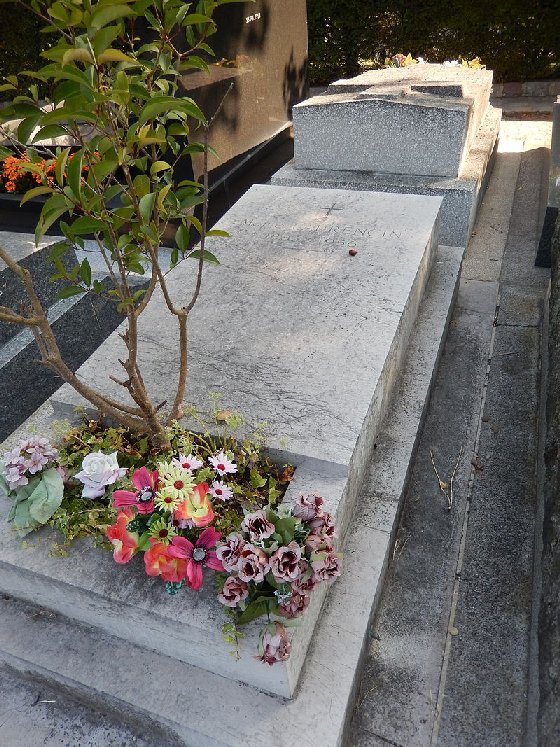
Faarborg Harbour by Karl Schou (1917)

Syrak Hansen married Marie Birgitte née Rasmussen and he and his wife had five children.  Marie Hansen, the eldest, was born in 1865 and became a parliamentary stenographer whose first husband was the painter Karl Schou. Schou was born in Copenhagen in 1870. After normal schooling he became a student at Valdemar Sichelkow’s painting school from 1884 to 1886 and then studied under Malthe Engelsted at The National Drawing Teacher Course, Copenhagen from 1886 to 1887, Finally he attended  Kristian Zahrtmann’s School from 1887 to 1900. During those three years at Zahrtmann’s school he became friends with the Funen painters.

Three persons in conversation at an evening party by Hans Nikolaj Syrak Hansen (1903)

A year after the birth of their first child, Marie Hansen gave birth to their first son, Hans Nikolaj Syrak Hansen who became apprenticed to his father. Hans attended Zahrtmann’s School in Copenhagen from about 1885 to the spring of 1887, but he had to give up his art studies and return home in order to take over the painting company from his father in 1891.

The Hay on the Meadow, South Funen by Peter Hansen

Syrak and Marie Hansen’s third child, their second son, Peter Marius Hansen was born on May 13th 1868. He attended the Copenhagen Technical School before studying under Kristian Zahrtmann at the Kunstnernes Frie Studieskoler between 1884 and 1890. 

Double portrait of two children. The artist’s stepdaughters by Peter Hansen (1889)

Peter Hansen married Elisa Nikoline, who had previously been married to an engineer, Ludvig Conrad Neckelmann, whom she divorced. In 1898, shortly after the divorce, Peter and Elise married. Ludvig and his wife, Elisa, had had two daughters, Marie Christine and Elizabeth and Peter completed a double portrait of his stepchildren.

By the window. Double portrait of the artist’s daughter, Elena and stepdaughter, Marie Christine by Peter Hansen (1902)

Peter and Elisa went on to have their own two daughters, Elena Italia in 1899 and Anna Margrethe in 1906. In 1902 Hansen completed a double portrait of his twenty-year-old elder stepdaughter, Marie Christine and his own three-year-old child Elena Italia.

The Ploughman Turns by Peter Hansen (1902)

Peter Marius Hansen belonged to the group of Danish painters who were called the Funen Painters, since they came from and mainly worked on the island of Funen.  One of the important qualities Peter displayed was his respect for the steadily, busily working human being and he made it a key motif in his art. For him the Peasant was the epitome of this ideal, when he would depict local Danish farmers and the mountain farmers from around the Danish artists’ colony in the Italian village of Cività d’Antino in Abruzzi.

Fritz Syberg self portrait (1910)

Christian Friedrich Wilhelm Heinrich Syberg, generally known as Fritz Syberg, was born on July 28th 1862, in Faaborg.  He came from a poor background and was first apprenticed as a house painter under Syrak Hansen.  From there, in 1882, he attended the Copenhagen Technical School where Holger Grønvold taught him drawing. In the Spring of 1884 he enrolled for a short period at the Danish Academy but then attended the Kunstnernes Frie Studieskoler  where he became one of the first Fynboerne, along with Peter Hansen, Johannes Larsen, and Poul S. Christiansen to study under Kristian Zahrtmann.

Dodsfald (Death) by Fritz Syberg (1881)

In the early 1890s may of Syberg’s paintings were dark and this can be seen in his 1892 work entitled Dodsfald (Death) which depicts his mother, Johanne Marie, on her death bed in 1881 in the Fåborg’s poorhouse.

Fritz Syberg “Jeg vil synge dem alle, alle!, sagde Moderen” (1898). Illustration for Hans Christian Andersen’s Historien om en moder. (I will sing them all, all of them!, said the mother) (1898). Illustration for Hans Christian Andersen’s The Story of a Mother by Fritz Syberg

In addition to the sale of his paintings, Syberg accepted many book illustration commissions, the most famous being his depictions for Hans Christian Andersen’s tragic tale, The Story of a Mother, which no doubt, Syberg could relate to his own childhood.  These depictions became one of the most celebrated collections of illustrations in Denmark’s history.

Spring by Fritz Syberg

Watching Birds on the Windowsill by Fritz Syberg

Having struck up a close friendship with Syrak Hansen’s daughter Anna whilst working as Syrak’s apprentice, their friendship turned to love and the couple married in 1894. The couple went on to have seven children.   In the 1890s and the early decade of the twentieth century Fritz Syberg made a number of trips to other European countries such as Italy, The Netherlands, Germany and France, sometimes with his family.. 

Anna Syberg by her husband Fritz Syberg (1896)

Syrak and Marie Brigitte Hansen had their fourth child, a second daughter, Anna Louise Birgitte Hansen in January 1870 and she, like her brother Peter, became part of the Funen painters. Anna Syberg grew up amidst a very colourful and energetic artistic environment that differed from ordinary middle-class conventions. Her father, Peter Syrak Hansen, was a master painter, and a renowned figure in the town of Faaborg.  Fortunately for Anna, her parents believed that education was of prime importance to both their daughters as well as their sons.

Crocus, Hyacinths and Tulips by Anna Syberg (1898)

Anna loved to learn and one of her favourite pastimes was decorative painting.  In 1884 she enrolled on a two-year course at a technical school in Faaborg, and in 1889 she was receiving tuition in Copenhagen from the sculptor Ludvig Brandstrup and the painter Karl Jensen. Her artistic education was topped off when she received singing lessons, learnt to play the piano to a high standard and learnt to sing lieder and Danish songs.

Wild Roses by Anna Syberg (1898)

Anna Syberg became a key figure in the Funen Painters artists’ colony.  Her paintings, other than a few figure scenes, depicted flowers and plants, often in the vases and pots around her home, or in her garden and ones she saw when out walking in the countryside. She worked mainly in watercolours, using multiple layers that would often include sketched lines of pencil, transparent layers of watercolour and black ink contours ensuring the depiction of the floral was of the utmost accuracy.

Grapes in the Greenhouse by Anna Syberg (1903)

The subject of her depictions were often of stage-managed as she experimented with the floral arrangements.  In many of her works she would often let the depiction of her flowers and plants extend beyond the edge of the paper in a form of dynamic cropping.  Her floral painting were neither symbolic nor botanical studies.  In Anna Syberg’s pictures, flowers are not charged with symbolic significance, nor are they stringently restrained botanical studies with all its scientific accuracy. In her works, Anna Syberg portrays the simple beauty of the flowers, a testament to their beauty. In 1894 Anna Hansen married Fritz Syberg.

Fritz and Anna Syberg

So this life as a Funen painter amongst family and friends was to be part of much loved idyllic lifestyle for Anna Syberg.  What could possibly interrupt this peaceful and fulfilling way of life?   And yet………..

At the turn of the century in Denmark, like many other European countries and those across the other side of the Atlantic, the stature of women in art, and even in life itself, was continually being questioned by men.  For many men, including even some fellow artists, women simply painted as a hobby or to add to their social graces but for women in the early 1900s practicing art was problematic.  For Anna it was one thing to be a talented artist, it was another thing to have the same respect bestowed upon her for her work as that of the men.  Things came to a head in Faarborg when the town got their own museum and paintings had to be selected for display in the museum.

Mads Rasmussen

Mads Rasmussen, an important businessman in Faaborg, and his wife Kristine, held a party one evening and among the guests were the Funen Painters’ inner circle including amongst others Fritz Syberg, Peter Hansen and Jens Birkholm. Together with Johannes Larsen they were all to become part of the Museum’s purchasing committee which, in turn, came to act as the steering group for the Museum’s acquisitions, their curation and the fixtures and fittings for the gallery.  It was very unusual that the “money man” would let a group of artists dictate as to what works were to fill the gallery.

Artists hanging their works in the galleries of Faaborg Museum, May 1915. From the left: Peter Hansen, Peter Tom-Petersen, Johannes Larsen, Astrid Noack, Nicolaus Lützhøft, Christian Ernlund, Carl Petersen og Fritz Syberg.

Here was the problem – the purchasing committee for Faaborg Museum, made up of the Funen painters, were all  male artists from the group, and they didn’t believe in the quality of the works produced by the female members of the group. In the minutes of the meetings of the purchasing group, comments were recorded stating that

“…At the negotiations, Peter Hansen and Birkholm wanted to be recorded in the minutes that they voted against the acceptance of Mrs. A.(Alhed) Larsen and Miss Christine Larsen’s works. Peter Hansen also against Mrs. Syberg…”

Also in the minutes, Peter Hansen, Anna’s elder brother, noted:

“…AS (Anna Syberg) and the other ladies had no significance for Danish art…”

Gallery at the Faarborg Museum

No reasoning was ever recorded as to why they thought so little of the works of the female Funen painters but the damage was done.   Presumably, one has to recognise that at that time there was generally a reluctance for women to be able to produce an artistic work. The one thing to remember also is that flower painting traditionally had a lower rank in the art world and this could have been in the minds of the male purchasing committee.

Anna was horrified that her own brother would critique her work so harshly and the rift between siblings became bitter.  She wrote to her brother Peter:

“…Where you create yourself. You voted against me at the Faaborg Museum based on high idealistic notions of safeguarding the best interests of art in Denmark. “You did not want to hide from me”, you wrote that I and the other ladies had no significance for Danish art…”

Faaborg Museum Inauguration (1910) by Peter Hansen

Anna Syberg is not in the picture of the artist group Fynbomalerne, despite her being a central part of the group. She should have supposedly sat on the empty chair in the bottom right corner.

The empty chair.

During the heated exchanges between Anna and Peter, he was working on a painting depicting the inauguration of the Faarborg Museum. The depiction was supposed to pay tribute to a group of artists who were both well-known and acclaimed painters. Anna Syberg’s outburst of anger over the words of her brother and members of the purchasing committee came while her brother was working on the painting, and it is believed that he deliberately chose not to paint his sister as part of the group and yet, to rub salt into the wounds, he provocatively indicated her absence with the empty chair, despite her being present at the inauguration and was said to have sat tanned and dressed in festive clothes with a large hat in the front row of the group. All the other female artists in the group are in the painting.

Anna Syberg (née Hansen) 1870-1914

Anne Syberg died on July 4th 1914 following a failed operation to treat a gallbladder infection.  She was just forty-four years of age.  Sadly the recognition she deserved as a gifted artist never came until after her death.  In 1915 a retrospective of her art was held and it was a success, and sales were high, including Faaborg Museum which purchased sixteen of her works. quite central in the country. After her death, Fritz Syberg married Anna’s elder sister Marie who he had known since the days of working for is father-in-law.

In 1873 Syrak Hansen’s youngest child, Poul Gerhardt, was born.  He did not follow his siblings into the world of art. He was married to Dagmar and the couple had two children: Helga and Louise.  Poul is believed to have died at the young age of 33 in 1906.


I could not have put together the two blogs about the Funen painters without the information I gleaned from various websites:

The Beauty of the Moment

Faarborg Museum

DR

The Hirschsprung Collection

arkivdk

The Funen Painters (Fynboerne)

The term Artists’ Colonies defines gatherings of artists in towns, villages and rural areas, who have assembled at places of natural beauty and where the cost of living is less than that of city life.  In the latter part of the nineteenth century, art colonies began to spring up as village movements with thousands of professional artists taking part in a mass exodus away from urban centres and heading for the idyllic countryside where they resided for varying lengths of time in artistic communities. Art colonies appeared on both sides of the Atlantic, forming on both the East and West coasts of America.  Many were also established in Europe such as Barbizon on the outskirts of Paris, Pont Aven in Brittany, Worpswede in Germany, Giverny in the northern French department of Eure, Lamorna and St Ives in Cornwall and the Newlyn School to name just a few.  Denmark had two important art colonies.  One was in Skagen in the north of the country, which I have written about on a number of occasions and the other was on the Danish Island of Funen.  In the following blogs I want to look at the Funen Art Colony and the artists who founded it and others who came later and were part of this artistic movement.

Self portrait by Kristian Zahrtmann (1915)

The Royal Danish Academy of Fine Arts was founded in 1754 and was the dominating force in the teaching of art to aspiring painters in that country.  In the first half of the nineteenth century during the era of the great Danish painting, Christoffer Eckersberg “ruled”, and the period became known as the Golden Age of Danish Painting.  At the centre of this movement was Copenhagen which although it had experienced fires, bombardment and national bankruptcy, the arts took on a new period of inspiration brought about by Romanticism, the dominant intellectual movement of German-speaking countries in the late 18th and early 19th centuries.  However, many artists began to rebel against the outdated way art was taught at the Academy and its policies. They wanted an alternative and this came in the form of  the Kunstnernes Frie Studieskoler, (Artists Studio School) an art school established in Copenhagen in 1882.  It became the central institution of the Modern Breakthrough in Danish art, the name given to the strong movement of naturalism and debating literature of Scandinavia which replaced Romanticism near the end of the 19th century.  Laurits Tuxen became the school’s first director and Peder Severin Krøyer one of its teachers.
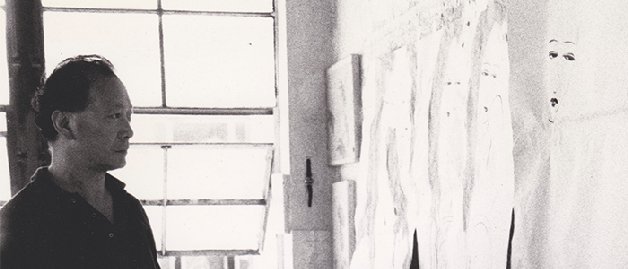
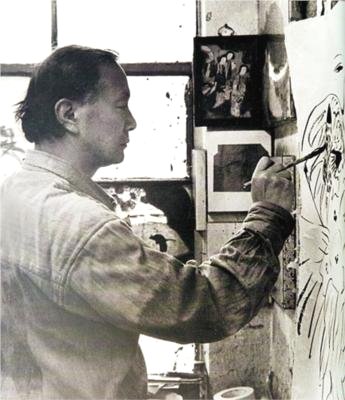
The Funen Painters

One hundred years ago an exhibition took place when the Faaborg Museum building opened its doors back in 1915, the Funen artists curated their own work, as the Museum had been conceived and built solely to show their ‘home-grown’ art. In 1915 gallery convention required that paintings were hung closely together and so there was space for the 366 paintings, sculptures and drawings, which had been purchased by the Museum from 1910-15. The entrepreneur Mads Rasmussen had the idea for a museum to showcase work by the Funen artists and he set up a purchasing committee composed of artists which had free rein to select work

The Funen Painters group, similar to other artists’ colonies in the late 1800s, searched for an alternative to city life by setting up a colony which was not just about painting but also a new lifestyle. Their aim was to connect their art with the countryside and the everyday life of the rural community which they believed created an overall vision for a ‘lifestyle’ reflecting their artistic ideals.

An oil painting recreating the frivolous court of Christian VII by Kristian Zahrtmann

In 1884 a preparatory class was added to the Kunstnernes Frie Studieskoler and in 1885 Kristian Zahrtmann became the head and, under him, it developed into an independent department.  Zahrtmann’s school became more avant-garde and innovative, due to his calls for radical experiments and strong use of colours.  By 1893 the preparatory class, which under his leadership,  turned into an independent department. He had some two hundred students from the Scandinavian countries and because of his stature as a teacher, the school was often simply referred to as “Zahrtmann’s School“.

A Family under Lamplight by Kristian Zahrtmann (1890)

Many of Zahrtmann’s students formed a group of painters who became known as Fynboerne (Funen Painters) due to their attachment to the island of Funen. His students included Peter Hansen, Fritz Syberg, Poul S. Christiansen, Johannes Larsen and Oluf Hartmann; and modern painters Karl Isakson; Edvard Weie, Harald Giersing and Olaf Rude. Zahrtmann travelled through Europe many times and his favourite country was Italy.

Piazza Santa Maria i Civita d´Antino by Kristian Zahrtmann (1904)

In June 1883, which was a very hot summer in Europe, Kristian Zahrtmann, travelled to the mountain town of Civita D’Antino in Italy, in search of cool temperatures as well as his love of good wine, and on the first afternoon in the town he decided that here was the ideal place for his summer painting school. His enduring fondness for Civita D’Antino lasted nearly 30 years and between 1890 and 1911 he spent every summer in the town living with the Cerroni family and gathering friends and students in an annual artist colony. He was named an honorary citizen of the town in 1902. This culminated in a vast production of portraits, landscapes, and scenes depicting an idyllic daily lifestyle around the mountain communit. His paintings are distinguished particularly by their realism and bold colour.

Johannes Larson, self portrait (1910)

Winter Day at the Zoo by Johannes Larson (1891)

One of the leading members of the Funen painters’ group was Johannes Larsen who was born in Kerteminde on the island of Funen on December 27th 1867. He was the son of Jeppe Andreas Larsen, a merchant and Vilhelmine Christine Bless.  During the 1880s, after regular schooling, Johannes studied art at the Free School in Copenhagen under Kristian Zahrtmann. It was whilst studying here that he met a number of aspiring painters who lived on Funen, notably Fritz Syberg and Peter Marius Hansen both of whom came from the southern port of Faaborg.  It was the coming together of these young artists that morphed into the Funen Painters group (Fynboerne).  Later they would create an art colony which would galvanise many Danish and Swedish artists to paint and exhibit their work.

Summer Sunshine and Wind by Johannes Larsen (1899)

After completing his studies with Kristian Zahrtmann, Johannes Larsen returned back home to his native Funen town of Kerteminde where he continued to paint working in oils, watercolour, woodcuts and drawing.  His depictions featured landscapes and other open-air scenes, and often included birds.  He received many commissions to illustrate books and paint large paintings for public buildings

The Garden House with Blossoming Cherries by Alhed Maria Larsen (c.1920s)

In 1898, Johannes married the painter Alhed Maria Warberg.  She played a central role within the Funen Painters group and would often have the role as hostess at their events.

Alhed Larsen

Alhed Larsen was born on April 7th 1872.  She was the second eldest of eight children, Laura Maria and Albrecht Christopher Warberg.  She had six sisters and one brother.   Her father was the estate manager for a very large farmstead, Erikshåb, and he had an office help, a teacher for the children and six servants.  Alhed grew up in well-to-do circumstances on the estate.  It was said that the seven sisters would often shock the bourgeoisie neighbours by walking around the streets of the town without wearing gloves and by using newfangled bicycles !  Many young painters would gather at the farmstead and soon Alhed began to learn to paint and was guided by the painter, Fritz Syberg.  Later it was the task of her husband, Johannes Larsen to take the role of her artistic mentor.  Peter Hansen joined the group along with his sister Anna and Maria and Johannes’ sister Christine and it was Alhed who had the role of unifying these painters of Funen.

Beach Leaves in the Window, Båxhult by Alhed Larson (1927)

When she was seventeen, Alhed went to Copenhagen and lived with her maternal uncle, the sculptor, Ludvig Brandstrup.  Between 1890 and 1893. In 1893, Alhed worked at the Royal Porcelain Factory with underglaze painting, at the same time as she received drawing lessons from her maternal uncle.  In late 1893 she travelled to Italy with the Brandstrup family and during that long holiday she managed to master the Italian language.  Back home at Erikshåb she formed a close and romantic relationship with Johannes Larsen but her parents were not happy with the prospect of their daughter marrying an impoverished artist.  She finally overcame her parent’s reluctance to have Larson as their son-in-law and in 1898 the couple married and settled in Kerteminde. Three years after the wedding the couple had a new home built on Møllebakken, on the coastal slope on the outskirts of the town.   Alhed decided that she was not satisfied with simply being the wife of an artist and decided that she wanted to become a professional artist as well.

Rhododendrons by Alhed Larson

Alhed Larsen’s artwork primarily depicted flowers, still life, interiors and window views. In 1917, Alhed and Johannes’ house was expanded with a large studio added, spacious enough for each to have their own studio space.

Møllebakken home of Alhed and Johannes Larson

Between 1901 and 1902, the couple built their home on Møllebakken in Kerteminde. Their home became the gathering place in summer months for many painters, particularly younger artists from Zahrtmann’s school.

Landscape with birds by Johannes Larsen (1946)

The Funen painters guiding principle was to encourage plein air painting, not just sketching but painting, notwithstanding the weather. Following this principle led to paintings having a fresh purity and energy which was missing from studio painting. Their works were appreciated by the public and became very popular, so much so that the Symbolist painters of the time attacked their style and in 1907 in the midst of a newspaper debate on Danish art, the Symbolists derogatively called them “farmer painters”.  Instead of being browbeaten by this tirade the artist gained greater recognition.

Birds flying over a landscape by Johannes Larson (1929?)

A turning point for the group came in 1910 when businessman Mads Rasmussen, who operated a successful cooperative canning factory in Faaborg, proposed to help the group by creating a museum next to his canning factory at Møllebakken in Kerteminde. which would promote and exhibit Funish Art. This made it possible for the public to view and buy their paintings which gave the Funen artists financial support. Johannes and Alhed Larsen lived almost their entire lives at Møllebakken.

In the autumn of 2006, a sculpture by the city’s two great artists, Johannes Larsen (1867-1961) and Fritz Syberg (1862-1939), was unveiled on Nordre Kirkerist, Kerteminde, next to the parish church, executed by local sculptor Bjørn Nordahl.

Johannes Larsen is looked upon as one of the greatest painters of birds and a knowledgeable pictorial storyteller of nature. His knowledge, his role as a conservationist and his beautiful artwork earned him an honorary membership of the Danish Society for Nature Conservation. At the age of 92, he was named president of the Wildlife Foundation established by the prime minister’s department.

………to be continued.