The Champion Single Sculls by Thomas Eakins

The Champion Single Skulls by Thomas Eakins (1881)

I had planned that this single blog would be all about the American artist Thomas Eakins and I had decided on which painting I would feature.  However whilst researching the life and works of this great painter I came across another painting of his which I fell in love with and decided that I could not pass up the opportunity of highlighting that particular work of art as well, so I have decided to split Eakins’ life story over two blogs which gives me the opportunity to feature not just one of his paintings, but two.

Thomas Cowperthwaite Eakins was born in Philadelphia in 1844.  He was the eldest child of five children of Caroline Cowperthwait Eakins, whose ancestors were part English and part Dutch, and Benjamin Eakins, who was the son of a Scottish-Irish weaver.  Thomas Eakins was brought up in a loving family environment and had a close and caring relationship with his father.  Father and son both loved sporting activities and they would often go out swimming together in the nearby river and when the harsh winters set in and the river froze over they would go ice skating.  It was also Thomas Eakins’ father who introduced him to the world of rowing, which he would enjoy as a sport and also depict in many of his paintings.  His father was also very interested in art and had many artist friends and would spend much time discussing art with his son.

Benjamin Eakins was a calligrapher and writing master and as such would spend hours pouring over parchment documents which he had to inscribe.   Thomas would watch his father at work and by the age of twelve became competent in line drawing, perspective and the grid work which was the needed in formulating designs and it was a technique that Eakins would sometimes use in his own artwork in the future.   Thomas Eakins attended the Central High School, a public secondary school in Philadelphia. The school still exists to this day and is regarded as one of the top public schools in America due to its high academic standards.  Here Eakins studied many subjects including mechanical drawing at which he proved an excellent student.   In 1861, at the age of seventeen, Thomas Eakins enrolled at the Pennsylvania Academy of Fine Art where he studied drawing and anatomy.  In 1864 he transferred to the Jefferson Medical College where he once again studied anatomy and at one time considered the medical profession as his future.

In 1866, aged twenty-two, he travelled to Europe to study art and remained there for four years.  Whilst in Paris he studied under the French realist painter Jean-Leon Gérome and worked as an apprentice at the atelier of the portrait painter, Léon Bonnat.  It was under his tutorship that Eakins learnt the importance of anatomical accuracy in paintings and a technique he would adhere to in his own future works.   He studied at the École des Beaux-Arts in Paris but like so many who studied there he railed against what he looked upon as that establishment’s classical pretentiousness.  He was also critical with regards the Academy’s treatment of nudity which was always couched in classical or mythological settings.   In William Innes Homer’s 1992 biography of Eakins entitled, Thomas Eakins: His Life and Art, he quotes from a letter Thomas wrote to his father in which he expressed his criticism, he wrote:

“…She [the female nude] is the most beautiful thing there is in the world except a naked man, but I never yet saw a study of one exhibited… It would be a godsend to see a fine man model painted in the studio with the bare walls, alongside of the smiling smirking goddesses of waxy complexion amidst the delicious arsenic green trees and gentle wax flowers & purling streams running melodious up & down the hills especially up. I hate affectation…”

From Paris he travelled to Spain and became influenced by the works of the great Spanish painters such as Velazquez and Ribera which he saw in the Prado.  He returned home to Philadelphia in 1870 and set about working on a series of oil paintings and watercolours, which featured rowing scenes and portraits of champion rowers.  However this depiction of such a modern sport in paintings was reported to have shocked the more staid and conservative local artistic establishment.

The featured painting in My Daily Art Display today is one of this series of paintings featuring rowing scenes.  It is entitled The Champion Single Sculls sometimes known as Max Schmitt in a Single Skull and was completed by Thomas Eakins in 1871.  The setting is the Schuylkill River that meanders quietly through Philadelphia and which is an ideal venue for rowing.  The central figure in this painting is the champion oarsman, Max Schmitt, a childhood friend of Eakins and who, like Eakins, had attended the Central High School.  Max Schmitt, a lawyer, was by far the best oarsman in Philadelphia at the time and had won, against formidable opposition, the first ever single skulls championship on the Schuylkill in 1867 and his friend Eakins sent him a congratulatory telegram from Paris.

The painting is not of the race itself but simply depicts the moustachioed Schmitt taking a break from his training session.  The rower rests and turns to face.  His oars cause a ripple on the surface of the river as they continue to skim across the water.   Schmitt and his racing scull are reflected on the mirror-like surface of the river.  To become a successful oarsmen one needs to have upper body strength and we can see how Eakins has depicted the toned muscular torso of Schmitt.

In the middle ground of the painting we see another oarsman and this is Eakins himself, who is rowing at speed away from us.  His name and the date are inscribed on his boat but it is difficult to make this out in the attached picture.  The name of Schmitt’s scull is much easier to read.  It is Josie which was named after his sister.  Another rowing boat can be seen in the background with its two rowers and a coxswain all of whom are wearing Quaker clothes.   Just beyond them we see the stone arches of the Connecting Railroad Bridge with a steam train just about to cross its span.  Further back is the first Girard Avenue Bridge, behind which we can just make out a steamboat chugging up the river.

Although at first glimpse we presume the setting is somewhere in the countryside, it is not, as the Schuylkill  River runs through Fairmount Park, which at the time was the largest urban park in America and would be the site of the 1876 Universal Exposition.

The Life Line by Winslow Homer

The Life Line by Winslow Homer (1884)

When I was flicking through my ever increasing number of art books and catalogues I came across a painting which immediately immersed me in a wave of nostalgia and reminded me of a time almost forty years ago.  I will tell you why at the end of this blog.  My featured artist today is one of the best loved American landscape and marine painter of the nineteenth century.  His name is Winslow Homer.

Winslow was born in Boston Massachusetts in 1836.  His mother, Henrietta Homer (née Benson) was a talented watercolour artist and acted as Winslow first art teacher. Both she and his father Charles Savage Homer hailed from New England.  Winslow had two brothers, one, two years older, Charles Savage Junior, and one, five years younger, Arthur.   He was brought up in an educated middle-class home by his parents in Cambridge Massachusetts.  By all accounts he led a very happy childhood walking in the countryside, fishing and playing with his brothers and his many cousins.  His father was quite a volatile man who changed jobs many times necessitating the uprooting of his family home on each occasion.  Although never a successful business man Winslow’s father, ever the optimist, always believed that things would soon come good and his fortune would be made.  It is therefore no surprise that when Winslow was just thirteen years of age his father gave up the family hardware business, left the family and joined the California Gold Rush.  Needless to say, all his dreams came to nought and after further spells in England and France in his futile attempt to gain some financial support for his money-making ideas he returned home to his family where he had to financially rely on his wife and family.

Winslow Homer graduated from high school and his father arranged for him to become an apprentice to J.H.Bufford a leading Boston commercial lithographic company.   Lithography was a very lucrative business at the time and was in great demand.   Winslow Homer not only learnt to draw but he developed a good business sense.  Although Winslow learnt all about lithography he found the work monotonous and wanted to concentrate on his real love – painting.  It could well have been his mother’s encouragement that finally turned him from being a journeyman illustrator to becoming “his own man” and so in 1857, on his twenty-first birthday, he left Buffords after being with them for two years. One thing his apprenticeship had taught him was that he wanted to be his own boss.  In Elizabeth Johns 2002 biography on Winslow Homer entitled, Winslow Homer, The Nature of Observation she quotes Homer’s comments regarding his days as an apprentice:

“…it was too fresh in my recollection to let me care to bind myself again.  From the time that I took my nose off that lithographic stone, I have had no master and never shall have any…”

Homer turned down the offer of employment from the magazine Harper’s Weekly but did work for them for a number of years on a freelance basis whilst continuing his career as a freelance illustrator.     He exhibited at the National Academy of Design from 1863 to 1866, and in 1867, and at the age of forty-one,  he embarked on a trip to Paris where he lived for a year and exhibited at the Exposition Universelle.  Whilst in the French capital he continued to supply Harper’s Weekly with scenes depicting Parisian life.  Despite the change in style of French art, Winslow Homer remained faithful to his love of paintings of peasant life and was a great admirer of Millet and his works of art.

Throughout the 1870s, Homer continued painting mostly rural or idyllic scenes of farm life, children playing, and young adults courting.   In 1875, Homer gave up working as a commercial illustrator and declared that he would continue to exist solely on the money he made from his paintings.   Homer started painting regularly with watercolours in 1873 whilst staying in Gloucester, Massachusetts.  From the beginning, his technique was natural, fluid and confident, demonstrating his innate talent for a difficult medium.    In 1877, Homer exhibited for the first time at the Boston Art Club with the oil painting, An Afternoon Sun, and from that first offering until 1909, the year before he died, he exhibited at the Boston Art Club on a regular basis.

Homer became a member of The Tile Club, which was a group of thirty-one notable New York painters, sculptors and architects who met between 1877 and 1887. The group was inspired by William Morris and the English Arts and Crafts movement and they created hand-painted ceramic tiles and promoted the decorative arts.  This group of artists and writers met frequently to exchange ideas and organize outings for painting, as well as foster the creation of decorative tiles. For a short time, Winslow Homer designed tiles for fireplaces.

Winslow Homer travelled to England in 1881 and settled in Cullercoats a Tyneside coastal village on the northeast coast.  Whilst there, he completed many paintings depicting the lives of working men and women.  His works often depicted the ferocity and relentless power of the sea and the men and women who braved those unforgiving elements of nature.  It was whilst staying at Cullercoats that on October 21st 1881 he witnessed the sinking off Tynemouth of the vessel, Iron Crown,  and the daring rescue of its crew by the local life saving society and it is from that memory, which is captured in Winslow’s painting, The Life Line.  The wreck of the Iron Crown at Cullercoats involved the volunteer Life Brigade who managed to rescue four of the crew using a rocket and breeches buoy. The local artist George Edward Horton, a member of the Bewick Club and the Cullercoats Colony of artists later recalled his first encounter with Wilmslow Homer:

“…As I stood watching the rescue operations a little cab turned up with an old Cullercoats fisherman on the dicky: out stepped a dapper medium sized man with a watercolour sketching block and sat down on the ways. He made a powerful drawing with some watercolour and some pastel….”

During the night of the disaster, Winslow Homer made sketches as he stood on the beach.  Immediately following the incident he painted an austere and dramatic canvas in oils depicting sailors huddled against the sea wall as they waited to find out the fate of their companions who were still in the raging seas.  Early during the rescue of the Iron Crown the life savers used a contraption known as a breeches-buoy to reach the stricken sailors.  Two years later in 1883,  when Homer was back in America at Atlantic City on the New Jersey coast, he went to talk to the local life-saving crews and asked them about this breeches-buoy device and watched a demonstration of the use of it for rescue from the sea.  With what he had seen with his own eyes two years earlier and what he had subsequently learnt when he got back home, he painted his large, impressive, and immediately popular painting The Life Line in 1884, which was just one of several paintings he completed at this time on the rescue theme.

The Life Line does not depict a specific rescue but it was intended as a general representation of the distress and heroism that were inexorable aspects of life by and on the high seas.  This work of art by Winslow Homer is all about the age-old themes of peril at sea and the power of nature, but at the same time honours modern heroism and yet at the same time encompasses the thrill of unexpected intimacy between strangers, in this case, the male rescuer and the female who is being saved, and who are being thrown together by the catastrophe.

Look carefully at the painting and what often strikes the viewer on their initial perusal of the scene is the fact that the face of the male rescuer is obliterated by the lady’s red scarf.  How strange is that?  Homer did this as he believed nothing should distract the viewer from the whole image – the actual rescue.  It was Homer’s belief that the intensity of the painting would be increased if we just focused our attention on the physical strength and brute force of the rescuer as he holds on tightly to the woman inching his way back to the shore.  The two dangle in the breeches-buoy in the trough between mountainous waves.  The woman being rescued lies unconsciously in his grasp.  Her head is thrown back.  Her arms lie limply by her side.  Her clothes have been drenched and torn by the ferocity of the sea.  She lies there in the man’s arms having been rescued from the ship, which we just catch a glimpse of with its tattered sails in the top left of the painting.

This is truly a terrifying depiction of a rescue at sea.  When Winslow Homer’s The Life Line was first exhibited at the National Academy of Design in New York in 1884 it became an instant sensation.   Some critics, at the time of the painting being exhibited, commented on its powerful sensuality.  For them the depiction of the man and the woman in the painting, had it not been part of a life and death situation, may well have been lovers locked in an intimate embrace.  The sensuousness and sexuality of the image exhibits itself in the wet clothes clinging to the woman’s flesh with their drenched bodies clutched tightly together.  Some were shocked by Homer’s exposing of the woman’s bare knees!!!  Homer’s composition propels us into the midst of the action with colossal waves rolling past, drenching the semiconscious woman and her anonymous saviour. Homer’s painting, The Life Line was immediately recognized by critics as a major contribution to American art, portraying a heroic, contemporary subject with both painterly virtuosity and detailed observation.

This masterpiece by Winslow Homer can be found at the Philadelphia Museum of Art and will feature in their upcoming exhibition entitled Shipwreck! Winslow Homer and “The Life Line” which runs from September 22nd to December 16th 2012.

Finally I have to tell you why this painting brought on a wave of nostalgia for a time forty years earlier.  It was in the early 70’s that I sat the first of my nautical exams and at the oral part of it I was asked by the examiner to describe how, if I was on a sinking ship, would I rig a breeches-buoy.  Thankfully I never had to put the theory into practice!

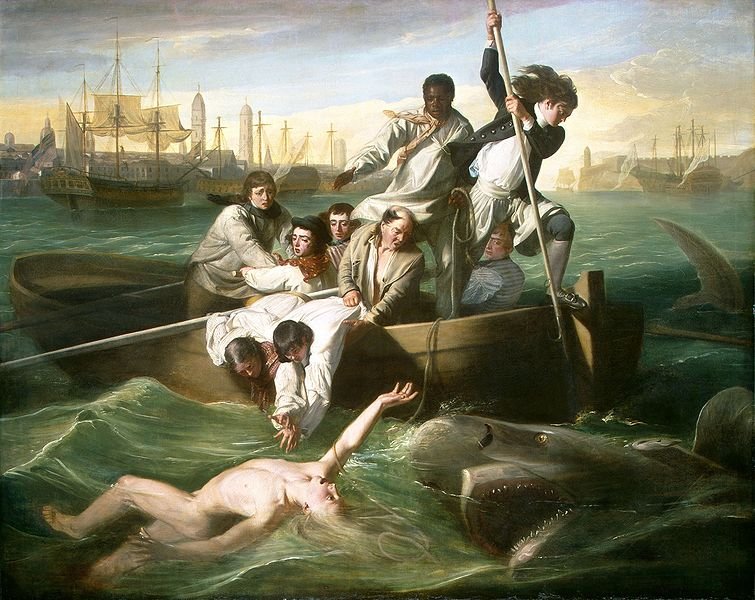
Watson and the Shark by John Singleton Copley

Watson and the Shark by John Singleton Copley (1778)

When I first set eyes on today’s featured painting I thought it was something to do with Herman Melville’s characters, Moby Dick and Captain Ahab but it also reminded me somewhat of Théodore Géricault’s painting Raft of Medusa (see My Daily Art Display June 10th 2011).  Of course it is neither.  Today’s featured work of art is all about two men, John Singleton Copley and the subject of the painting, Brook Watson.  My Daily Art Display painting today is entitled Watson and the Shark and was completed by John Singleton Copley, the American artist, in 1778.  In My Daily Art Display March 6th 2012 The Copley Family, I gave you a short biography of the artist’s life, so you may want to look back to that blog to find more about this talented American painter.  Today however I will concentrate on the subject of Copley’s work, Brook Watson.

Brook Watson, who would later become Sir Brook Watson, 1st Baronet, was born in Plymouth, Devon in 1735.  He was the only son of John and Sarah Watson (née Schofield), who both died when Brook was just six years of age.  After their deaths, he went to live with his aunt and uncle in Boston Massachusetts.  His uncle was a merchant and ship owner whose livelihood came from the import and export of goods to the West Indies.  Probably with living at this American port and seeing the ships plying their trade it is not surprising that young Brook Watson hankered after the seemingly glamorous life of a sailor.  His uncle realising his nephew’s desire to join the Navy organised for him to become a crew member on one of his ships.

In 1749, the fourteen year old Brook Watson was aboard his vessel in Havana harbour and foolhardily decided to take the opportunity to go for a swim on his own.  He was attacked by a shark and his shipmates, who had been waiting on board to escort their captain ashore, launched a valiant rescue effort.  As the sailors rushed to Watson’s aid, the shark repeatedly attacked the struggling boy.  During the first attack, the shark stripped the flesh from Watson’s right leg, just below the calf.   In the second frenzied attack, the shark bit off Watson’s foot at the ankle.  His shipmates managed to rescue the boy who was then taken to a hospital in Havana.  Surgeons were unable to save his leg and it had to be amputated below the knee.  Watson remained in Havana for three months to convalesce.

If that was not bad enough, when young Watson arrived back in Boston he found that his uncle had been declared bankrupt.  Despite the loss of his right leg, Brook Watson managed to secure a position on another ship which traded between Boston and a port in Nova Scotia supplying the British Army at Fort Lawrence.  Despite the loss of his right leg, Watson was taken on by the British military and served them as a commissary until 1759 at which time he left Canada and travelled back to London.  Here he pursued a career as a merchant importing and exporting goods to Canada and Northeast America.  In 1760 he married Helen Campbell, the daughter of an Edinburgh goldsmith.

Watson’s Coat of Arms

In 1784 he entered the English political arena and became a Member of Parliament for the City of London, a position he held until 1793.  In 1796 he was elected Mayor of London.  Watson was made a baronet in 1803 and he had his coat of arms designed in such a way so as to record his encounter with the shark in Havana harbour.  If you look at the crest you will see underneath Neptune, who is brandishing his trident, the shield bearing Watson’s severed right leg, underneath which is the Latin motto Scuto Divino,  which means “Under God’s Protection”. Brook Watson died in 1807, aged 72.

My Daily Art Display’s featured painting today, Watson and the Shark was completed by John Singleton Copley in 1778 and exhibited that year at the Royal Academy.  Copley and Brook Watson had become friends after the American artist arrived in London in 1774.   Watson commissioned Copley to create a painting of the Havana harbour incident which had occurred twenty-five years earlier.   The painting was Copley’s first of a series of large-scale historical paintings he completed after settling in London.   He went on to produce three versions of today’s painting.      The original version of the painting went to Brook Watson.  The second one was a full-size replica which he kept for himself and can now be found in the Museum of Fine Arts in Boston.  His third and smaller version, with a more vertical composition, is housed in the Detroit Institute of Arts.

The painting when exhibited at the Royal Academy was a sensation, probably due to its horrific subject.  The painting is something of an exercise in overstatement and embellishment going beyond a realistic depiction, with the sole intention of evoking strong emotions in the viewer.  In the painting we see nine of Watson’s fellow seamen rushing to his rescue.  Copley who had never visited the Caribbean island of Havana relied on maps, prints and book illustrations of the Cuban harbour for his background.  Observe how Copley has added a dramatic touch to the scene by the way he is portrayed Watson’s rescuers.  Their facial expressions reveal not only their fear for their own safety but the concern they have for the fourteen year old boy who is being attacked by the shark.   One of the sailors has thrown a rope in the water, but it has not reached the young boy and dangles beyond his grasp. Two other crewmen lean over the side of the boat, in an attempt to reach the boy, while the elder boatswain clutches his companion’s shirt trying to ensure he too doesn’t fall into the water. The other terrified seamen in the boat row frantically, and the seaman standing in the front of the small boat has his boathook ready to thrust downwards into the body of the shark. Copley’s depiction of a shark has often been criticised and the most probable reason why the shark looks more like a mythical creature than a shark, is because Copley had probably never seen an actual shark and so was forced to paint a creature based on the description of others.

The young Watson lies on his back in the water transfixed in shock.  It is a romanticised portrayal of the incident as the gory detail of Watson’s severed right foot is hidden beneath the waves and there is only the slightest hint of blood on the surface of the water and in the mouth of the shark.  However there is no sign of the frenzied thrashing about the victim as he is being attacked by the shark.  Maybe Copley thought the inclusion of such a depiction would be a step too far.

After Watson died his will was read and as far as the painting was concerned, it stated:

“I give and bequeath my Picture painted by Mr. Copley which represents the accident by which I lost my Leg in the Harbour of the Havannah in the Year One Thousand Seven Hundred and Forty Nine to the Governors of Christ’s Hospital to be delivered to them immediately after the Decease of my Wife Helen Watson or before if she shall think proper so to do hoping the said worthy Governors will receive the same as a testimony of the high estimation in which I hold that most Excellent Charity and that they will allow it to be hung up in the Hall of their Hospital as holding out a most useful Lesson to Youth.”

The school’s Committee of Almoners accepted the painting in 1819.   In 1963 it was purchased from Christ’s Hospital by the National Gallery of Art, Washington, D.C.

The oil painting’s enormous acclaim ensured John Singleton Copley’s appointment to the prestigious Royal Academy, and he went on to earn a fortune selling engravings of its design.

Winter Harmony by John Henry Twachtman

Winter Harmony by John Twachtman (C.1890-1900)

When we hear the word Impressionism we immediately think of French painters such as Monet, Renoir, Cassatt, Degas et al, but how much do we know about American Impressionists and their works?  How did the Impressionism Movement become important for a time in America?  To find the answer, we probably have to go back to the mid-nineteenth century as it was after the Civil War ended in 1865 that America developed a healthy economy and this was never more so than in the North where many of the victors, who had made their fortunes from the war, had become extremely wealthy.  As is the case nowadays, it is often not just enough to be wealthy, one had to flaunt one’s wealth.   The newly wealthy Americans wanted not just to be recognised as rich, they also craved to be looked upon as sophisticated which didn’t automatically go hand-in-hand with wealth.  So the rich Americans sat in their large magnificent houses and realised that it wasn’t enough to just have a large building, they realised that what they filled their homes with could help in their quest for sophistication and what could be more sophisticated than having their house filled with European art and furnishings.  American artists soon realised that European style art was a saleable commodity and many crossed the Atlantic to Europe, especially Paris, to study the latest artistic techniques.

It was also around this time in Paris that French Impressionism was born.  Impressionist art was a style in which the artist captured the image of an object as someone would see it if they just caught a glimpse of it. Their paintings were full of colour and, in the main, the paintings depicted outdoor scenes. There was a wonderful brightness and vibrancy about the works of the Impressionists.  The images we saw on their canvases were without detail but were painted in bold colours.   In the 1870’s there were already two American painters who had been seduced by the Impressionist style of art and were considered great exponents of this style.  They were Mary Cassatt and the Italian-born son of American ex-patriots, John Singer Sargent.

During the mid-1880s, French Impressionist art became very popular with American collectors who began to appreciate this new style, and more American artists realised that they had to take on board this new phenomenon.   Soon, exhibitions of Impressionist works were held in American cities and the paintings sold well.

Today I am going to look at a work of a less well known Impressionist, the American painter, John Henry Twachtman.  John Twachtman was born in Cincinnati in 1853.  His parents, Frederick Twachtman and his mother Sophie Dröge were German immigrants who had arrived in the country in the late 1840’s.  His father had many different jobs including being a policeman, a storekeeper and a cabinetmaker but his most lucrative work was as a window-shade decorator at the Breneman Brothers factory, and when his son, John, was fourteen years of age he joined his father in the business,  as well as attending classes at the Ohio Mechanics Institute.  John developed a love for art and persuaded his parents to allow him to enrol for a part-time course at the McMicken School of Design in Cincinnati and this is when he met and was mentored by an already successful American realist artist, Frank Duveneck who invited Twachtman to share his studio in Cincinnati.

In 1875, when he was twenty-four years of age, he and Duveneck, who was just five years his senior, travelled to Europe to study European art.  First stop was Munich where Twachtman studied for two years at the city’s Royal Academy of Fine Art tutored by the German genre and landscape painter, Ludwig von Löfftz.  This artistic establishment was a long-standing center of artistic excellence and was one which attracted increasing numbers of aspiring American artists.   From there he, Duveneck and another American student attending the Academy, William Merritt Chase, travelled to Venice in the spring of 1877 and spent much of their time painting en plein air.

Twachtman returned to America in 1878 and for a brief time taught at the Women’s’ Art Association in Cincinnati. He also joined the Cincinnati Etching Club where he became friendly with Martha Scudder, a Cincinnati artist and daughter of a local physician.    Martha had studied at the School of Design and also in Europe, and had, on a number of occasions, exhibited her work.   In 1880, Twachtman married, Martha Scudder.  Soon after she married she gave up her artistic career and simply devoted herself to bringing up her family.  John and Martha had two children: a son, J. Alden Twachtman, who was born in March 1882 and went on to became a painter and architect and a daughter, Marjorie, who was born in Paris in 1884.    In 1880 John and Martha left America on honeymoon and went to Europe and Bavaria where Twachtman helped out as an art teacher in Duveneck’s school.  Twachtman tired of the Munich style’s painting especially its lack of draughtsmanship and so he upped roots and moved to Paris, where in 1883 he enrolled at the Académie Julian, where he studied under Gustave Boulanger, the French figure painter who was renowned for his classical and Orientalist subjects.  Another of his tutors was the French figure painter, Jules-Joseph Lefebvre.

Twachtman returned to the United States in 1887 and remained there for the rest of his life settling in Connecticut where he established an informal art school at Holly House, a boarding house for artists at Cos Cob, a small fishing village near Greenwich.  This became a magnet for young aspiring artists, who came and were taught by Twachtman.  Ten years later in 1897, Twachtman along with Childe Hassan and J Alden Weir became founder members of a group known as the Ten American Painters generally known as The Ten.  This group was considered to be a sort of Academy of American Impressionists who had broken away from the more conservative Society of American Artists.  From 1899 onwards, although living on his farm in Greenwich, Twachtman spent most of his last summers in Gloucester, Massachusetts and it was here that he died suddenly of a brain aneurysm in 1902, aged 49.

The painting by John Twachtman, which I am featuring today, is one of his many winter landscapes.  This one is entitled Winter Harmony and was completed by the artist in the last decade of the nineteenth century.  It now hangs in the National Gallery of Art in Washington.  The painting features a pool on the artist’s property and was to be depicted in a number of his works.

The Copley Family, by John Singleton Copley

The Copley Family by John Singleton Copley (1777)

In my last blog I looked at the English portraitist James Sharples and talked about how he took his family from England to America in search of patrons and their lucrative commissions.  He was just one of many European artists who decided that the way to make a fortune from their art was by crossing the Atlantic.  He of course had not only to compete against the new immigrant artists who had also made the journey but he also had to compete for work against America’s own painters.  Today in My Daily Art Display I am focusing my attention on of those great 18th century American artists, John Singleton Copley, who in fact moved across the Atlantic in the opposite direction, from Boston to London.

John Singleton Copley was born in 1738 in Boston, Massachusetts.  Both his parents, Richard and Marie were of Irish descent and had arrived in America just two years before he was born.  His mother ran a tobacco shop which was on the Long Wharf pier at the port.  His father, who was also a tobacconist, suffered from poor health and went to the West Indies around about the time of his son’s birth in the hope that the warmer climate may help,  but he died there in 1748, although the actual year of his death is contested.   His mother remarried when Copley was 10.  She married the engraver, painter, and schoolmaster Peter Pelham and it was believed that he gave young John Copley his first artistic tuition.   Pelham made his living by selling his portraits and engravings and even ran evening classes in arithmetic and writing as well as a dance class.  Another tutor of Copley was the Scottish born portrait painter John Smybert who had left his homeland and had come to America in 1826.  Both Copley’s tutors died when he was just thirteen years of age and so his artistic tuition was handed over to Joseph Blackburn, an English portrait painter, who had left home and worked in Bermuda and in colonial America.  Blackburn worked in Boston and eventually set up a studio in the town.  Although this master-student partnership started well it ended in acrimony.  The master (Blackburn) realised his student (Copley) was becoming a far better artist than himself and jealousy ended the arrangement. 

Boy with a Squirrel by John Singleton Copley (1765)

In 1776 Copley had sent his painting, entitled Boy with a Squirrel, to London, for the Society of Artists Exhibition.  The painting featured his step-brother, Henry Pelham with his pet squirrel.  It was the first work of art painted in America to be exhibited abroad and it was well received by the critics and on the strength of this work he was made a Fellow of the Society of Artists of Great Britain.  Benjamin West, the American artist who had moved to London in 1763,  invited Copley to do as he had done and move to Europe to continue his artistic studies.  For Copley, the invite was tempting and in some ways made him more unhappy with his present situation.  He was aware of his talent and the lack of artistic stimulation in Boston.  In the book Letters & Papers of John Singleton Copley and Henry Pelham, 1739-1776, there is one letter which Copley wrote to the American artist, Benjamin West:

“…In this Country as You rightly observe there is no examples of Art, except what is to [be] met with in a few prints indifferently executed, from which it is not possible to learn much…”

However although the invite to leave America was tempting Copley was aware that his portraiture was selling well and he had a good standard of living, mixing with the aristocracy who were his patrons and so he decided to stay in Boston and wrote back to Benjamin West in 1768 explaining his reasons:

“…I should be glad to go to Europe, but cannot think of it without a very good prospect of doing as well there as I can here. You are sensable that 300 Guineas a Year, which is my present income, is a pretty living in America. . . . And what ever my ambition may be to excel in our noble Art, I cannot think of doing it at the expence of not only my own happyness, but that of a tender Mother and a Young Brother whose dependance is intirely upon me…”

Susanna Farnham Clarke (Mrs Susanna Copley) by John Singleton Copley

However, although not wanting to move to England himself, he continued to send his art work to London where his artistic reputation was on the rise.   In 1769 John Copley married Susanna Farnham Clarke, whose father was one of the richest Boston merchants and a very wealthy and powerful business man, the Boston agent for the prestigious Honourable East India Company.   Copley and his wife were very happy and his wife’s beauty was portrayed in a number of her husband’s paintings.  The Copley’s marriage lasted for forty-five years and they went on to have six children.
Copley’s early works were in oils but he then began to dabble with pastels.  By the age of nineteen Copley had built up a reputation as an outstanding portraitist.  However Copley wanted to branch out and tackle historical paintings which at the time were very popular and the market for them was excellent.  Copley’s family connections and his wife’s relatives were Loyalists, staunch supporters of British Colonial rule.  Copley’s father-in-law was the merchant to whom the cargo of tea was consigned which sparked the infamous Boston Tea Party in December 1773 and this incident and what followed drove Susanna Clarke’s father to the brink of bankruptcy.

The unstable political climate worsened by the day, leading in 1774 to the rise of patriotism and the birth of the Patriots, the supporters of the colonists of the British Thirteen United Colonies who would within eighteen months rebel against British control.  Copley’s lucrative work started to dry up and it was because of his fear of an oncoming war that Copley decided to take up Benjamin West’s invitation to come to England.  His clear intention was to return to America as soon as the troubles were over, at a time when there would be a resurgence of his once-thriving art business and he would be looked upon once again as America’s leading portrait painter.  He set sail for England from Boston on June 1st 1774 leaving his mother, wife and children in the care of his step brother, Henry Pelham.  Copley had fully intended to return soon to America but the long and bloody War of Independence which eventually broke out in 1775 forced him to postpone his return. After the war ended, Copley financial situation no longer permitted a return, and the painter ended up staying in Britain forever.

On his arrival in England in 1774 Copley sought out Benjamin West who introduced him to Sir Joshua Reynolds both of whom were founder members of the Royal Academy of Art.  Copley set off in September of that year on a nine month European tour taking in Paris before moving to Italy and from there journeying north into Germany and the Low Countries.  In 1775 whilst still in Europe, Copley became alarmed at the deteriorating political situation in America and for the safety of his family.  In a letter to his step brother, Henry Pelham, he wrote:

“…if the Frost be severe and the Harbour frozen, the Town of Boston will be exposed to an attack;  and if it should be taken all that have remained in the town will be considered as enemies to the Country and ill treated or exposed to great distress…”   

Having also been alarmed about the situation at home, Copley’s wife and children, unbeknown to her husband,  had already left Boston at the end of May 1775 and arrived in London where they stayed with her brother-in-law.  Her father and her brothers followed shortly after.  Copley returned from his European trip and he and his wife set up home in London where Copley remained for the rest of his life.  By the start of the nineteenth century, life for Copley the artist, was becoming problematic.  He was still painting but sales were declining probably due to the Napoleonic Wars.  The house his family were living in was expensive to run and the cost of putting his son, John Jnr. through law school was proving costly.  The problem for Copley was that he couldn’t equate the fall of his earning power with the necessity to rein back his expenditure.  He became very depressed with life and by 1810 his health was concerning those around him.  At a dinner party in August 1815 Copley suffered a stroke and although he seemed to be recovering, he suffered a second seizure the following month and died in September 1815, aged 77.

On his death, Copley was deep in debt and his barrister son, John, who would later become Lord Lyndhurst and Lord Chancellor of Great Britain, had to settle his father’s financial affairs, maintain his parents home and look after his mother, Susanna, until she died in 1836.

In My Daily Art Display today I am featuring the large oil on canvas painting entitled The Copley Family, by John Singleton Copley, which he completed in 1777 and is now housed in the National Gallery of Art in Washington.  It measures 184cms x 229 cms (72 inches x 90 inches).  He started this group portrait painting a year after his family had arrived from America and settled in London and shortly after he himself had returned from his artistic tour of Europe.  Although an accomplished portraitist, this was the first time Copley had executed a group portrait.  The figures are almost life-size and his talent as a portraitist ensure that they all have a life-like appearance.

Copley himself is seen standing at the back of the family group grasping a sheaf of sketches and stares out at us in a manner which gives the impression that he is about to introduce the members of the Copley family to us.  Copley’s father-in-law, the once prosperous merchant, Richard Clarke is seated on the left of the painting, stern-faced avoiding our gaze, holding the youngest of his grand-daughters, Susanna.  To the right of the painting we see Copley’s wife Susanna, cradling her son John.  Look at how Copley has captured the look of love and tenderness in his wife’s face as she gazes down at her son.  On the far right of the painting and to his wife’s left, her daughter, Mary, vies for her attention.  Standing upright and in a formal pose is Copley’s eldest child, his daughter Elizabeth.  It is interesting to note that in those days boys wore dresses like their sisters until they were about six or seven years of age and old enough to wear breeches.

Copley had decided on the setting of the painting so as to give an air of classical refinement.  He has achieved that by the inclusion in the painting of elegant and fashionable furnishings and as we look over the shoulders of his sitters we see the ancient and classical Arcadian landscape à la Claude Lorrain and this background setting could well have come from paintings Copley had seen during his travel around Italy.  This group portrait of a family is of greater intimacy as it is the father who has lovingly depicted the scene.

Bronze statue of John Singleton Copley in Copley Park, Boston

John Singleton Copley’s hometown Boston has memorialised their artist by naming a city square after him, Copley Square, located in the Back Bay district of the city.  The square-shaped park at the centre is a mass of greenery and on the north side is the bronze statue of the artist.

The Monk by George Inness

The Monk by George Inness (1873)

For my artist today I had decided to cross the Atlantic and look at the work of an American painter.   I have always liked the beautiful landscape works of the Hudson River School artists and so I dipped into my book, which featured these painters and came up with George Inness.  I particularly liked his superb and beautiful painting entitled Our Old Mill, which I had considered for today’s offering.  It was only when I was researching his life and his works of art that I came across a hauntingly beautiful work of his entitled The Monk.  It had little to do with the landscapes along the Hudson River but it was just too good to ignore.  So today my featured artist is an American who was famous for his American landscapes, but you will just have to forgive me for abandoning those works.  However I am sure that My Daily Art Display featured painting today will impress you.

George Inness was born in Newburgh, New York in 1825.  He came from a very large family being the fifth of thirteen children of John William Inness, a farmer, and Clarissa Baldwin.   In 1829 when George was just five years old the family moved to Newark, New Jersey.  Inness began his artistic education at the age of fourteen when he received tuition from an itinerant artist, John Jesse Barker.  Later he would work as a map engraver in New York and during the summer of 1843,  he studied under the French painter, who had recently arrived from France, Régis-François Gignoux.  From this he developed a great interest in art and enrolled at the National Academy of Design, where Gignoux taught, and the following year he exhibited his first work at the Academy.  This was to be the beginning of a great partnership between the artist and the Academy.

In 1848 he opened his first studio in New York and he received his first commission.  The following year he married Delia Miller but sadly she passed away a few months later.   In 1850, at the age of twenty-five Inness marries Elizabeth Abigail Hart and the couple go on to have six children.  The patronage of Ogden Haggerty allowed him to take a trip to Italy where he was able to paint and study the work of the great Italian masters.  Once there, he fell in love with the beautiful Italian landscape.  In all, he spent fifteen months in Rome and took the opportunity to study the works of the great landscape artists such as Claude Lorrain and Nicolas Poussin.  Whilst in Rome he rented a studio, which was in the same building as the American painter and portrait artist William Page who had arrived in the Italian capital two years earlier.

In 1853 Inness moved to Paris and began studying the work and technique of the French Barbizon landscape painters and soon Inness became the leading American exponent of the Barbizon-style of painting. His main influence was the work of The French painter, Pierre Étienne Théodore Rousseau, which totally captivated him. The Barbizon-style of painting, which uses loose brushwork and places an emphasis on mood, became part of the artist’s tools to create the luminous and atmospheric landscapes that eventually established Inness’ trademark.  A year after the couple settled in Paris, their son George Junior was born.  He would later become a leading landscape painter.

During the 1850’s, Inness received a lucrative commission from the Delaware, Lackawanna and Western Railroads.  The train operator wanted him to record and portray the progress of DLWRR’s growth in early Industrial America. George Inness and his family settled in the small town of Medfield, a suburb of Boston, where they remained for five years.  It was during this time that Inness completed what art critics believed were some of his best paintings.   In 1864, he was on the move once again.  The family moved to the town of Eagleswood in New Jersey where he taught art.   He made many trips to Europe, especially France and Italy where he lived between 1870 and 1874 before he returned to America and settled in Montclair, New Jersey.

In 1894 he and his family made a trip to Europe, visiting Paris, Munich and Baden-Baden before arriving in Scotland where on August 3rd he and his son visited the famous beauty spot of Bridge of Allan.  In Adrienne Baxter Bell’s biography of Inness entitled, George Inness and the Visionary Landscape she recounts the time as described by Inness’ son:

“…My father threw up his hands into the air and exclaimed ‘My God oh, how beautiful!’ fell to the ground and died minutes later….”

George Inness died aged 69.  His funeral was held at the National Academy of Design in New York City and he was buried in West Orange, New Jersey.

George Inness painted today’s featured work, entitled The Monk, in 1873.  Without doubt this can only be described as a haunting work and one of his best paintings.  The setting of the painting is thought to be a secluded corner of the Villa Barberini, which is near the pope’s summer residence of Castel Gandolfo and lies a little distance south of Rome.  Just to the right of centre in the foreground we see the small figure of a cowled monk, holding a staff, as he walks within the walled garden.  He is diminutive in comparison to the tall stone wall behind him and further back, the cluster of tall slender pine trees that we see in the middle distance.   Inness often painted just the odd figure in his landscapes.  In most cases they would be solitary figures with a degree of anonymity.  Look how Inness has portrayed the pine trees with their unusual shaped branches.  They stand out so well against the brilliant yellow-ochre sky.  The bright yellow light also filters between the slim branches which rise vertically to support the tree canopies.

I like this panting.  I like the evocative nature of the depiction of the lone monk.  I suppose it is his white cowl which gives the painting a ghostly feel. The painting can be found in the Addison Gallery of American Art, at the Phillips Academy, Andover, Massachusetts.  The Phillips Academy is unique among secondary schools in the United States in as much as it is home to two museums, each of which is dedicated to educating and enriching its student community while also serving as a resource to the general public.

Unemployed by Ben Shahn

Unemployment by Ben Shahn

My featured artist today was quite unknown to me.  I came across him and his paintings when I was flicking through an art book looking for information regarding another painter.  One painting stood out from the rest and I have made it My Daily Art Display featured painting of today.  There was something very haunting about the picture with its great sense of realism and I had to find out more about the work and the artist, Ben Shahn.

Ben Shahn was at the forefront of the American Social Realist art movement of the 1930s, a grouping, which included the likes of artists of the Ashcan School, many of whom I have featured in earlier blogs.   Social Realism is a term used to describe visual and other realistic art works which record the everyday conditions of the working classes and mainly feature the life of the poor and deprived and how they had to live.  The works are a pictorial criticism of the social environment that brought about these conditions. Social Realism has its roots back in the mid-19th century and the Realist movement in French art.  Twentieth century Social Realism refers back to the works of the French artist such as Courbet and his painting Burial at Ornans or Millet’s great work The Gleaners.   Social Reailsm art became an important art movement in America during their Great Depression of the 1930’s.

The art of the Social Realist painters often depicted cityscapes homing in on the decaying state of mining villages or broken-down shacks alongside railroad tracks.  Their art is about poverty and the hardships endured by the ordinary but poor people.  Often the works would focus on the indignity suffered by the poor and how they would work hard for little recompense.  The depiction of this inequality of course implied a criticism of the capitalist society and capitalism itself.  The Social Realist painters of America did not want their works to focus on the beauty of their country as portrayed by the likes of the Hudson River School painters.  For them, to get their message across to the public, their works needed to depict the industrial suburbs with its grime and unpleasantness or the run-down farming communities with their broken-down buildings.  Occasionally these artists would depict the rich in their paintings but they were only included for satirical reasons.

Ben Shahn was born in Kovno, Lithuania in 1898 and was the eldest of five children of an Orthodox Jewish family.  His father, Joshua, was a woodcarver and cabinet maker.  In 1902, probably because of his revolutionary activities, his father was exiled to Siberia.  His mother, Gittel Lieberman, and her children moved to Vilkomir, which is now the Lithuanian town of Ukmerge.  Four years later, in 1906, Shahn’s mother and three of her offsprings emigrated to America and settled in Brooklyn with Joshua who had already fled there from Siberia.  Ben Shahn original artistic training was as a lithographer and then as a graphic artist.

At the age of twenty-one Shahn went to New York University and studied biology.  Two years later he transferred to City College of New York to study art and then moved on to the New York National Academy of Design which is now known as The National Academy Museum and School of Fine Arts.

In 1924 Shahn married Tillie Goldstein and the two set off on a long journey of discovery taking in North Africa and the traditional artist pilgrimage of the capital cities of Europe taking in the works of the great European modern artists of the time such as Matisse, Picasso and Klee.  He had not been won over by their art or the European Modernist art scene and soon felt less influenced by their work and preferred to follow the style of the Realists painters especially those who showed a concern for the plight of the downtrodden.  Shahn was inspired by the likes of the photographer Walker Evans, the Mexican communist painter Diego Rivera and the French Realist painters.   It was with Rivera that Shahn worked on the public mural at the Rockefeller Centre, which was to cause such controversy and had to be hidden from public view and eventually destroyed.

As a political activist Shahn became interested in newspaper photography.  Photography was to act as his source material for some of his paintings and satires. During the 1930’s he was engaged in street photography himself, recording the lives of the working-class and immigrant populations and the hardship of the unemployed.   Over the years Shahn, with his trusted 35mm Leica camera, built up a large collection of photographs which poignantly recorded the horror of unemployment and poverty during the Depression years.

My Daily Art Display featured painting is simply entitled Unemployment and was completed by Shahn in 1934.  Shahn exhibited many paintings and photographs which highlighted the plight of the unemployed and homeless especially during the time of the Great Depression.  Before us stand five men, all purported to be out of work.  They look down on their luck.  Their black eyes stare out at us.  They stand upright trying to muster a certain amount of dignity despite the hopelessness of their situation.  In some of their faces we see a look of desperation and fear of what their future may hold.  The man in the right foreground has his arms folded across his chest.  His look is more defiant almost questioning the viewer about what they intend to do about his plight.  One man has a makeshift patch on his eye which makes him look even more vulnerable.  I suppose Shahn and other Realist painters believed that through the moving nature of the subjects of their works it would help remind everybody of the horrors of life we could face and counsel us to avoid similar pitfalls in the future.  Sadly, as in the case of war with its tragedies and horrors, we rarely learn by our mistakes and seem to always repeat our mistakes.  There seems to be little we can do but shake our heads sympathetically as we view these Social Realist paintings and can only hope that we ourselves are never touched by similar tragedies.

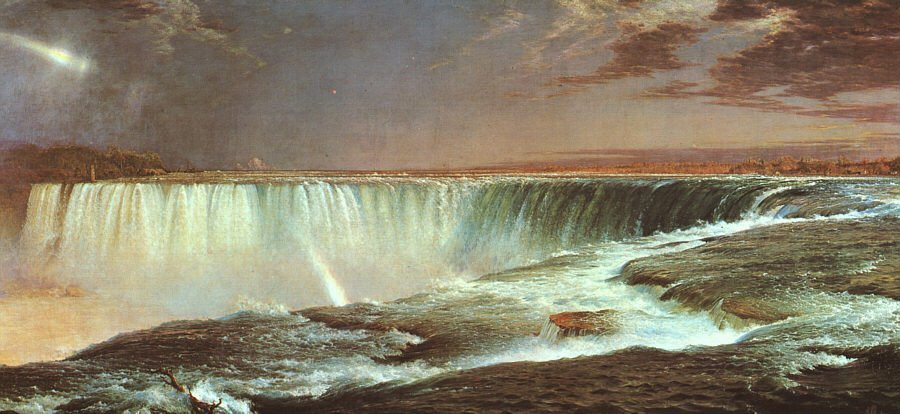
Niagara by Frederic Edwin Church

Niagara by Frederic Church (1857)

My Daily Art Display for today returns to a painting by an American artist and another member of the Hudson River School, which was a mid-19th century American art movement personified by a group of landscape painters whose artistic vision was influenced by the 18th century European Romanticism movement.   The paintings for which the group is named depict the Hudson River Valley and the area around the Catskill, Adirondack and the White Mountain ranges.  The artist is Frederic Edwin Church.

Frederic Church was born in Hartford Connecticut in 1826.  His father, Joseph, was a silversmith and watchmaker and through his success and that of his father who had owned a paper mill, the Church household lived a prosperous lifestyle.  Frederic studied art at school and through a family neighbour, Daniel Wadsworth, was fortunate enough to be introduced to Thomas Cole, the founder of the Hudson River School, who agreed to take Frederic on as his pupil.   Church thrived under Cole’s tutelage and within a year, he had some of his paintings shown in the National Academy of Design annual exhibition.  The following year, 1848, Church was elected as the youngest Associate of the National Academy of Design and was promoted to Academician the following year.  That year he sold his first major oil painting to the Hartford’s Wadsworth Atheneum, which had been founded by Wadsworth.

In 1848 he went to live in New York and began to teach art.  In his spare time in spring and autumn he would travel throughout New York and New England, particularly Vermont, all the time sketching the beautiful scenery whilst during the winter months he would return to New York City and his home and convert his numerous sketches into a number of landscape paintings, all of which sold well.   Church and a friend set forth on an adventurous trip through Central America and Ecuador. From this trip, Church’s first finished South American pictures, shown to great acclaim in 1855, transformed his career.   For the next decade he devoted a great part of his attention to those subjects, producing a celebrated series that became the basis of his ensuing international fame.   During a two year period, 1854 to 1856, he travelled extensively visiting Nova Scotia, and journeying throughout Maine, New Hampshire, and Vermont, and it was around this time that he visited the Niagara Falls.   The late 1850’s were the high point of Church’s career, artistic triumph followed artistic triumph.   In 1857 he made another trip to Ecuador and also took a voyage to Newfoundland and Labrador.  In 1860, Church bought some farmland at Hudson, New York, and married Isabel Carnes, whom he had met during the exhibition of his paintings.   He and his wife lead a settled and happy life and he spent most of his time tending to his farm but his happiness was shattered in 1865 when both his young children contracted diphtheria and died.  However, with the birth of Frederic junior in 1866, Church and his wife began a new family that was eventually to number four children.

At the end of 1867, Frederic Church and his family embarked on a long trip to Europe, North Africa, the Near East, and Greece that was to last eighteen months and was to lead to several important paintings. As Church got older he spent more and more time on his farm and farming.  From the 1870’s onwards Church suffered badly from rheumatoid arthritis and it badly affected his right arm which curtailed much of his art work although he did teach himself to paint with his left hand.  Frederic Church died in 1900, aged 74 and is buried in Spring Grove Cemetery in Hartford, Connecticut.

Today’s painting by Frederic Church entitled Niagara is one of four he painted of this waterfall.  This one was painted in 1857 and guaranteed for him, still a young man of thirty-one, the role of America’s most famous painter.   It is probably the most famous painting of it ever made.  During the 19th century, American artists flocked to the Falls to paint the various views of it.  The Falls were looked upon as the nation’s greatest natural wonder.   This picture was painted from the Canadian shore, a short distance above Table Rock, and includes the sweep of the Horseshoe Fall and the edge of Goat Island in a notable depiction of water and light. The time is towards evening.   We can see an amazing amount of detail in every stage of the water’s journey as it cascades downwards.  Look at how Church has incorporated an optical flourish of the rainbow against the falling waters.

The painting was introduced to the American public shortly after its completion, as a one-painting exhibition at the commercial gallery of Williams, Stevens, and Williams in New York City.   People flocked to see the work and were willing to pay 25 cents each to view the monumental canvas, which measured 109cms x 230cms and sometimes they would use opera glasses or other optical aids to augment the experience.   With their 25 cents admission fee the people would also receive a pamphlet that reprinted contemporary critics’ praise of Church’s picture and offered exhibition-goers the opportunity to purchase a print of the work.   Within a fortnight of the exhibition’s opening more than a hundred thousand people had paid to see it.  Art critics lavished praise on the work describing it as “the finest oil picture ever painted on this side of the Atlantic.”    After this success in New York the painting was taken to a number of American cities before it made two tours of Britain and was exhibited at the 1867 Exposition Universelle in Paris where it won a prize

The painting now hangs in the The Corcoran Gallery of Art in Washington DC

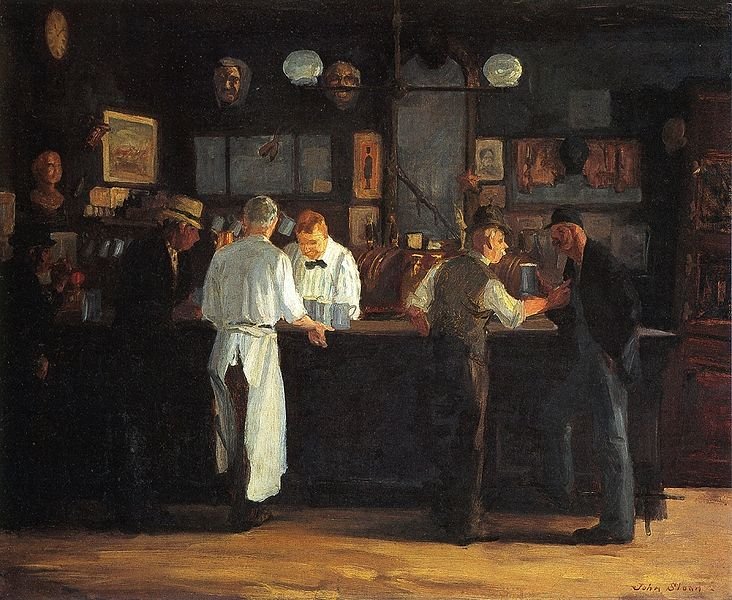
McSorley’s Bar by John Sloan

McSorley's Bar by John Sloan (1912)

I have looked at many paintings which have featured inns and taverns but they have been mainly been depictions of rural scenes with peasants in the Netherlands and Flanders and were painted by the Dutch and Flemish painters centuries ago.  Today, for a change, I am looking at a genre painting of a tavern scene but this is not really a tavern, more what we British would call a pub or Americans would term a bar or a saloon.  The title of the painting is McSorley’s Bar and was painted by the American artist John French Sloan.  Sloan was originally a member of a group of artists who had the strange collective name of The Eight and later he became a leading figure in the Ashcan School of realist artists.  I have featured works by these artists in earlier blogs and if you enter either Ashcan School or Robert Henri or George Bellows into the “Search” function at the right of this blog it will give you a little bit of history about these artist groups.

John French Sloan was born in New York in 1871.  His father James had had an interest in art, but as only as a hobby but he did encourage his children to draw and paint during their early years.  Sloan’s father struggled to find gainful employment moving from one job to another without ever making a fortune.  He married, Henrietta, a girl who had come from a much more financially prosperous family and who was a teacher.  James Sloan suffered a mental breakdown when John was seventeen years of age and consequently was unable to work and the burden of supporting the family fell on to the shoulders of the seventeen year old John.  For this reason, John Sloan had to leave school and find a job in order to bring in some money for the family.

Sloan was employed in a local bookstore as an assistant cashier.  The job was not very taxing and the young man had time to read the books that were on sale at the emporium and also spend time studying the artistic prints that it also held.  It was during this time that Sloan started to make pen and ink copies of some of the prints and the store owner liked them so much that he allowed Sloan to put them up for sale in the store.  Two years later in 1890 Sloan moved on to work in a stationery store where he used to design calendars and greeting cards.  Sloan had now found the joy of art and enrolled in an evening art class.  Buoyed by his artistic successes he left the stationers and set himself up as a commercial artist but his well-intentioned venture failed and he took a job as an illustrator at the local newspaper offices of The Philadelphia Enquirer, later he would work for the rival newspaper, The Philadelphia Press.    He continued his artistic tuition in the evenings by enrolling at the Pennsylvania Academy of Fine Arts.  It was here he met and became friends with fellow artists such as William Glackens and Robert Henri who became Sloan’s mentor, sending him reproductions of works by the French Impressionists and the leading European Renaissance painters, for him to copy.

When Sloan was twenty-seven he was introduced to a young woman with a somewhat chequered history, Anna Maria Wall, known affectionately as Dolly.  Sloan, who was very naive, very self-conscious and lacked the social graces which would gain him female companionship, met Anna at a brothel.  Although she worked in a department store during the day, she supplemented her meagre income by working in a brothel at night.  She needed the extra money to feed her other vice;  she was also an alcoholic but despite all this he fell in love with her and they started, what one can imagine, was a “challenging” relationship.

Their relationship did prove difficult as Anna not only suffered the effects of excessive and prolonged alcohol intake, she suffered from alcohol-related mental problems  and insecurity often believing Sloan was about to leave her.  In 1906 Sloan sought medical advice and was advised that he needed to constantly support Anna and show how much he needed her.  Between them they devised a plan by which Sloan would keep a dairy and in it he would write down each day how much he loved Anna and wanted to be with her and then leave the diary somewhere where she was bound to find it and surreptitiously read his journal entries and by doing so put her mind at rest.  He wrote daily entries for seven years until 1913.   Despite these problems, Sloan’s artistic work continued well and he was producing numerous oil paintings.  In 1904 he moved to New York and went to live in Greenwich Village and although relying on money he received from his freelance work for The Philadelphia Press newspaper, he supplemented that with money he earned for his book and magazine illustrations.   It was whilst living in New York, in 1912, that he painted today’s featured work McSorley’s Bar.  He exhibited it at the 1913 Armory Show, an exhibition of modern art which had been organised by the Association of American Painters and Sculptors.  This turned out to be a landmark exhibition which opened the eyes of the New Yorkers to this new modern art and the likes of cubism, who up till then had been accustomed to realistic art.   Sloan’s painting never sold and in fact remained unsold until 1932 when the Detroit Institute of Arts purchased it.  This was the first painting by Sloan to be part of a museum collection and was probably one of his best.

This painting was very typical of works by John Sloan in which he liked to depict the energy and life during the early years of the twentieth century of New York City and its inhabitants.  Sloan was a socialist and a member of the Socialist Party and had great empathy with the less well-off and their demanding and troubled existences.  His paintings would show the city’s people in different places and situations on the city streets and occasionally, like today’s painting, he would depict people in interior settings, such as cafés or bars as they discussed among themselves their everyday existence.

The painting today shows the interior of McSorley’s Bar with its clientele standing at the bar.  John Mc Sorley opened his Manhatten establishment on East Seventh Street in 1854 and during its existence in the nineteenth century, was an all-male bar.  From around 1912 it became a regular haunt of John Sloan and his Ashcan School artists.  The bar Sloan depicted was somewhat rough and inhospitable. It was always frequented by a great mix of people of various social classes and even today carpenters and mechanics rub shoulders with Wall Street brokers and local politicians.  John Sloan completed five paintings of the interior of the bar between 1912 and 1930 and these certainly increased the popularity of the establishment.   Today, McSorley’s bar draws visitors from around the world.    Its fame as New York’s oldest bar assures its survival and a 1970 court order guarantees that women are as welcome as men!   It’s a museum-like place. One can go there to drink a pint of ale and survey relics of a past era.

In 1943, Sloan’s  wife, Dolly, died of coronary heart disease. The next year, Sloan married Helen Farr, who is responsible for most of the preservation of his works. Part of this was the diary he wrote between 1907 and 1913 for his first wife, Dolly, to read and which were lovingly collated and published in 1965.  They gave a marvellous insight into Sloan’s life and his thoughts during those turbulent times.

On September 7, 1951 John Sloan died at the age of 80, of cancer in Hanover, New Hampshire.  John French Sloan was a leading figure in the Ashcan School of realist painters and was somebody who embraced the principles of socialism and allowed his artistic genius to be used to benefit those fervently upheld values.  His paintings sadly rarely sold during his lifetime and teaching at the Art Students’ League, of which he became its director in 1931, was his principal income.

To learn more about McSorley’s Bar why not go to their website:

http://www.mcsorleysnewyork.com/

Fur Traders descending the Missouri by George Caleb Bingham

Fur Traders descending the Missouri by George Caleb Bingham (1845)

For My Daily Art Display today I cross the Atlantic and return to the nineteenth century in order to discover the art of George Caleb Bingham.  Bingham was born in 1811 in Augusta County Virginia.  He was the second of seven children to Mary and Henry Bingham and his early life should have been a life of plenty as his grandfather on his mother’s side passed on to his mother and father the family mill and a vast tract of land along with a number of slaves and servants.  However when Caleb was seven years old, an unwise decision to stand surety for a friend’s debt by his father lost the family everything.  It was time to move on and the family went West in search of their fortune.

The family settled in Missouri in the small town of Franklin in Howard County, a few miles north of the great Missouri River, and eventually Caleb’s father became a county judge.  Sadly, when Caleb was only twelve, his thirty-eight year old father contracted malaria and died.   The family moved to a farm just outside the town.  Caleb spent much of his leisure time down by the river and many of his paintings he did as an adult featured this magnificent waterway.   Caleb became an apprentice to a cabinet maker when he was sixteen years old and he was put to work painting signs.  A few years earlier Caleb Bingham had met Chester Harding the portrait painter who had passed through Howard County looking for work.  The artist had sparked an interest in art with Caleb, so much so that the teenager started to paint portraits of the local people which he sold for twenty dollars.

Bingham married Sarah Hutchinson in 1836 and the couple moved to the city St Louis where he was able to expand his artistic career and soon made a name for himself as a portrait painter.  He travelled to Philadelphia where he spent some time at the Pennsylvania Academy of Fine Arts before moving to Washington.   He returned back to his Missouri home in 1844 and started painting river scenes, one of which is my featured painting today.  As far as his paintings are concerned, it is reckoned that the period between 1845 and 1855 he produced his greatest works.    In 1848 his wife died and his mother moved in with him to look after his children.  She too died three years later.  In 1856 Caleb made a trip to Europe with his second wife Eliza Thomas.   He visited Paris and was able to fulfil one of his ambitions which was to study the works of the Great Masters at the Louvre.  They moved on to Germany where the family lived in an artists’ colony and he enrolled at the Dusseldorf School of painting where he studied historical painting.

Eventually he and his family returned to America and he continued his lucrative career as a portraitist.  He also fulfilled another of his ambitions; he entered politics and held positions in the state legislature of Missouri and later became president of the Kansas City Board of Police Commissioners and was appointed their first chief of police.  His second wife died in an asylum in 1876 and soon after he married for a third time.  He became the first Professor of Art at the University of Missouri but he died in 1879, early into this tenure.

The painting I am featuring today in My Daily Art Display is entitled Fur Traders descending the Missouri which he completed in 1845.    This was one of his genre paintings of everyday life on the Missouri River.  He loved to depict the river boatmen and fur traders whose livelihood was tied up with this vast waterway.  In some ways Bingham’s painting was out of date and it really was just his nostalic look back on the past as by 1845 when he completed this work, the world of the lone hunters and trappers bringing their pelts to trading posts by canoe was over, superseded by the big companies which shipped their commodities up and down the river by steamer and barge.  The painting was originally titled French Trader, Half Breed Son.  It was quite common in those days for fur traders to take up with Native American women.  However when first exhibited the American Art Union considered the title to be, what we would now term, “not politically correct” and so the Art Union renamed it, hence its present title.  In front of us we see an old French fur trader, wearing his liberty hat along with his son with their cargo, riding a dugout canoe along the shimmering Missouri River.  In the centre of the canoe is their cargo of furs atop of which is a dead duck which will provide supper for the duo.   In the prow of the craft is a tethered animal.  I say “animal” for to me it looks like a cat but doing some research into the painting I believe it is supposed to be a small bear cub!

The light in the painting adds a haunting quality to the work and this is where I give you another “-ism” to think about – Luminism and the American Luminists.    The term luminism came into being in the mid-twentieth century when art historians used the term to describe a 19th-century American painting style that arose as a derivative of the Hudson River School, examples of which I featured on Feb 4th and Feb 9th.  Luminism was a retrospective name given by art historians and was not a term used by the luminist artist themselves nor did they align themselves with the Hudson River School of painters. The landscapes of Luminists could be characterised by the use of clear and cool colours.  It was hard to detect brushstrokes in paintings done by the luminists.  These artists liked to paint very large works emphasising nature’s grand scale that emphasized tranquillity, reflective water and soft hazy skies.

Today’s featured painting was looked upon as Caleb Bingham’s most famous,  evoking an era in America’s early history.  There is no question that the painting today is a prime example of luminism.  I am amazed by the aura of serenity and stillness I detect in this painting.  The composition is well balanced.   There is no hint of any motion and yet we know the small craft is carrying its passengers downstream.  Caleb Bingham will have seen such sights many times over when he lived near the banks of the Missouri.  It was thanks to the paintings of the likes of Bingham that folk back in the East learnt about the pioneering push to the West as although cameras had been invented before the time of this painting, photographs were expensive to produce and so for the ordinary people works of art were their window to the West.