Portrait of Maud Cook by Thomas Eakins

Portrait of Maud Cook by Thomas Eakins (1895)

As promised in my last blog, today I will complete the life story of the great American artist Thomas Eakins and look at another of his paintings, this time a portrait.  If you have just landed on this page maybe you would like to go back to my previous blog in which I started talking about Eakins’ early life and had a look at his famous painting entitled The Champion Single Sculls, a perfectly rendered quiet picture of a rower on the Schuylkill River which he completed in 1871.

After his four year stay in Europe, Eakins had returned to America and the city of Philadelphia where he remained to the end of his life.    He once again attended the Jefferson Medical College and resumed his anatomical studies and in 1878 he took up a teaching post as a volunteer at the Pennsylvania Academy of the Fine Arts.  The following year he was appointed Professor of Painting and Drawing and in 1882 he became director of the artistic establishment.  On January 19, 1884, he married Susan Hannah Macdowell, a student at the academy.   She was, well known in the artistic community.  She was 25 when Eakins met her at the Hazeltine Gallery in Philadelphia, where his painting, The Gross Clinic was being exhibited in 1875.  This was to be his most famous picture and at the time aroused controversy because of its detailed depiction of a surgical operation.     Unlike many, Susan MacDowell was impressed by the controversial painting and she decided to study with him at the Academy, which she attended for 6 years.   Her own artwork became more sober and her painting style became of a more realistic style similar to Eakins. She was an outstanding student and winner of the Mary Smith prize for the best painting by a matriculating woman artist.

Once she married Eakins she all but gave up her art as most of her time was spent in supporting her husband’s career, being the perfect hostess when they entertained and during the difficult times after Eakins left the Academy she never wavered in her support for him, unlike some of his family and so-called friends.  The couple did not have children but it was thought they lived a happy and contented life.  She and Eakins both shared a passion for photography, both as photographers and subjects, and employed it as a tool for their art. She also posed nude for many of his photos and took images of him. Both had separate studios in their home.

In the previous blog I talked about Eakins disenchantment with the École des Beaux-Arts and their treatment of nudity.  He had definite views on the subject and once wrote:

“…She [the female nude] is the most beautiful thing there is in the world except a naked man, but I never yet saw a study of one exhibited… It would be a godsend to see a fine man model painted in the studio with the bare walls, alongside of the smiling smirking goddesses of waxy complexion amidst the delicious arsenic green trees and gentle wax flowers & purling streams running melodious up & down the hills especially up. I hate affectation…”

Eakins was a fervent believer that the male and female nude were things of beauty and nude models should be available to his students for them to complete their life drawing studies.  He was attacked for his radical ideas, particularly his insistence on working from nude models.  Eakins’s work photographing and painting nudes made him something of a liability for the Pennsylvania Academy of the Fine Arts where he taught and it all came to a head in 1886 when he was forced to resign after allowing a class of both male and female students to draw from a completely nude male model.

The Concert Singer by Thomas Eakins

Thomas Eakins, who by the 1880s had only managed to sell nine pictures for a total of $2,000 now decided to concentrate on portraiture.   However, portraiture commissions were equally hard to come by and most of his portraiture works were of his friends and individuals who he admired and offered to paint them without payment.   My Daily Art Display painting today is an example of this.  My featured painting today is entitled Portrait of Maud Cook.  It is such a beautifully haunting portrait which Thomas Eakins completed in 1895 and is looked upon as one of his finest work of portraiture.  In 1892, Eakins had already completed portraits of Maud’s sister Weda Cook, the operatic contralto singer, one of which was entitled The Concert Singer.

Thomas Eakins’ paintings were known for being both scientifically and philosophically accurate.   For Eakins, portraiture held little interest as a means of fashionable idealization.  There was to be no glorification of how people looked.  There was to be no hint of making the person look more beautiful or younger than they actually were.   Unlike most other portrait painters of the time,  Eakins had little concern for flattering his sitters and instead demanded from himself the most precise objective images. The results were comprehensive and revealing portraits that seemed to carry with them the souls of their subjects.  Eakins refused to compromise and painted his subjects as they really were, and not as they wished to be seen.  However, it was precisely for this reason that his portraits were often rejected by the sitters or their families.

Eakins having studied anatomy and later taught it to his students applied this knowledge to the proportions of the human form in his work. He also had a certain gift for capturing the real embodiment of the person, which many artists strove for but often failed to achieve.

In this portrait of the twenty-five year old Maud Cook we see her wearing a pink dress the fabric of which flows from her shoulders and is pinned between her breasts.  Her hair is long and lies, tied with a ribbon, at the back of her neck.  Her face is tilted slightly towards the source of light which comes from the left of the painting.  Such light casts deep shadows across her face and reveals her facial structure.  There is a warmth in the light which illuminates the exposed skin of her neck and upper chest bringing to the painting a demure sensuality.  The expression on the young woman’s face is both captivating and haunting.  Is it a look of sadness or thoughtfulness?  In many of Eakins’ portraits of women he focused on their susceptibility and emotional sensitivity. Is this what he has achieved with this work?   Eakins gave the painting to Maud Cook and inscribed it on the back and carved frame:

“To his friend/Maude Cook/Thomas Eakins/1895”

Years later, Maud Cook described the portrait to the artist’s biographer:

“…As I was just a young girl my hair is done low in the neck and tied with a ribbon. Mr. Eakins never gave the painting a name but said to himself it was like ‘a big rosebud…'”

The painting was later bought by the newspaper publisher and art collector, Stephen Carlton Clark, who on his death bequeathed the painting to Yale University Art Gallery where it remains today.

The American artist Robert Henri, who had studied at the Pennsylvania Academy of the Fine Arts from 1886 to 1888 and knew Eakins, wrote an open letter about him to the Art Students League a year after the artist’s death.    In it he described the great man:

 “…Thomas Eakins was a man of great character. He was a man of iron will and his will to paint and to carry out his life as he thought it should go. This he did. It cost him heavily but in his works we have the precious result of his independence, his generous heart and his big mind. Eakins was a deep student of life, and with a great love he studied humanity frankly. He was not afraid of what his study revealed to him. In the matter of ways and means of expression, the science of technique, he studied most profoundly, as only a great master would have the will to study. His vision was not touched by fashion. He struggled to apprehend the constructive force in nature and to employ in his works the principles found. His quality was honesty. Integrity is the word which seems best to fit him. Personally I consider him the greatest portrait painter America has produced…”

It was only during the final years of his life that Eakins began to receive a little bit of the recognition he deserved. He died in 1916 in the Philadelphia home in which he was born. As is the case with many great artists, Eakins’ fame is almost entirely posthumous.  Eakins had struggled to make a living from his work which is somewhat ironic as his painting The Gross Clinic fetched US$ 68 million in 2006.  Today Thomas Eakins is regarded as one of the most important American artists of any period.

After his death in 1916, his wife returned to painting, adding considerably to her output right up to the 1930s.  Her artistic style changed becoming much warmer, looser, and brighter in tone.   She died in 1938.


The Champion Single Sculls by Thomas Eakins

The Champion Single Skulls by Thomas Eakins (1881)

I had planned that this single blog would be all about the American artist Thomas Eakins and I had decided on which painting I would feature.  However whilst researching the life and works of this great painter I came across another painting of his which I fell in love with and decided that I could not pass up the opportunity of highlighting that particular work of art as well, so I have decided to split Eakins’ life story over two blogs which gives me the opportunity to feature not just one of his paintings, but two.

Thomas Cowperthwaite Eakins was born in Philadelphia in 1844.  He was the eldest child of five children of Caroline Cowperthwait Eakins, whose ancestors were part English and part Dutch, and Benjamin Eakins, who was the son of a Scottish-Irish weaver.  Thomas Eakins was brought up in a loving family environment and had a close and caring relationship with his father.  Father and son both loved sporting activities and they would often go out swimming together in the nearby river and when the harsh winters set in and the river froze over they would go ice skating.  It was also Thomas Eakins’ father who introduced him to the world of rowing, which he would enjoy as a sport and also depict in many of his paintings.  His father was also very interested in art and had many artist friends and would spend much time discussing art with his son.

Benjamin Eakins was a calligrapher and writing master and as such would spend hours pouring over parchment documents which he had to inscribe.   Thomas would watch his father at work and by the age of twelve became competent in line drawing, perspective and the grid work which was the needed in formulating designs and it was a technique that Eakins would sometimes use in his own artwork in the future.   Thomas Eakins attended the Central High School, a public secondary school in Philadelphia. The school still exists to this day and is regarded as one of the top public schools in America due to its high academic standards.  Here Eakins studied many subjects including mechanical drawing at which he proved an excellent student.   In 1861, at the age of seventeen, Thomas Eakins enrolled at the Pennsylvania Academy of Fine Art where he studied drawing and anatomy.  In 1864 he transferred to the Jefferson Medical College where he once again studied anatomy and at one time considered the medical profession as his future.

In 1866, aged twenty-two, he travelled to Europe to study art and remained there for four years.  Whilst in Paris he studied under the French realist painter Jean-Leon Gérome and worked as an apprentice at the atelier of the portrait painter, Léon Bonnat.  It was under his tutorship that Eakins learnt the importance of anatomical accuracy in paintings and a technique he would adhere to in his own future works.   He studied at the École des Beaux-Arts in Paris but like so many who studied there he railed against what he looked upon as that establishment’s classical pretentiousness.  He was also critical with regards the Academy’s treatment of nudity which was always couched in classical or mythological settings.   In William Innes Homer’s 1992 biography of Eakins entitled, Thomas Eakins: His Life and Art, he quotes from a letter Thomas wrote to his father in which he expressed his criticism, he wrote:

“…She [the female nude] is the most beautiful thing there is in the world except a naked man, but I never yet saw a study of one exhibited… It would be a godsend to see a fine man model painted in the studio with the bare walls, alongside of the smiling smirking goddesses of waxy complexion amidst the delicious arsenic green trees and gentle wax flowers & purling streams running melodious up & down the hills especially up. I hate affectation…”

From Paris he travelled to Spain and became influenced by the works of the great Spanish painters such as Velazquez and Ribera which he saw in the Prado.  He returned home to Philadelphia in 1870 and set about working on a series of oil paintings and watercolours, which featured rowing scenes and portraits of champion rowers.  However this depiction of such a modern sport in paintings was reported to have shocked the more staid and conservative local artistic establishment.

The featured painting in My Daily Art Display today is one of this series of paintings featuring rowing scenes.  It is entitled The Champion Single Sculls sometimes known as Max Schmitt in a Single Skull and was completed by Thomas Eakins in 1871.  The setting is the Schuylkill River that meanders quietly through Philadelphia and which is an ideal venue for rowing.  The central figure in this painting is the champion oarsman, Max Schmitt, a childhood friend of Eakins and who, like Eakins, had attended the Central High School.  Max Schmitt, a lawyer, was by far the best oarsman in Philadelphia at the time and had won, against formidable opposition, the first ever single skulls championship on the Schuylkill in 1867 and his friend Eakins sent him a congratulatory telegram from Paris.

The painting is not of the race itself but simply depicts the moustachioed Schmitt taking a break from his training session.  The rower rests and turns to face.  His oars cause a ripple on the surface of the river as they continue to skim across the water.   Schmitt and his racing scull are reflected on the mirror-like surface of the river.  To become a successful oarsmen one needs to have upper body strength and we can see how Eakins has depicted the toned muscular torso of Schmitt.

In the middle ground of the painting we see another oarsman and this is Eakins himself, who is rowing at speed away from us.  His name and the date are inscribed on his boat but it is difficult to make this out in the attached picture.  The name of Schmitt’s scull is much easier to read.  It is Josie which was named after his sister.  Another rowing boat can be seen in the background with its two rowers and a coxswain all of whom are wearing Quaker clothes.   Just beyond them we see the stone arches of the Connecting Railroad Bridge with a steam train just about to cross its span.  Further back is the first Girard Avenue Bridge, behind which we can just make out a steamboat chugging up the river.

Although at first glimpse we presume the setting is somewhere in the countryside, it is not, as the Schuylkill  River runs through Fairmount Park, which at the time was the largest urban park in America and would be the site of the 1876 Universal Exposition.

The Life Line by Winslow Homer

The Life Line by Winslow Homer (1884)

When I was flicking through my ever increasing number of art books and catalogues I came across a painting which immediately immersed me in a wave of nostalgia and reminded me of a time almost forty years ago.  I will tell you why at the end of this blog.  My featured artist today is one of the best loved American landscape and marine painter of the nineteenth century.  His name is Winslow Homer.

Winslow was born in Boston Massachusetts in 1836.  His mother, Henrietta Homer (née Benson) was a talented watercolour artist and acted as Winslow first art teacher. Both she and his father Charles Savage Homer hailed from New England.  Winslow had two brothers, one, two years older, Charles Savage Junior, and one, five years younger, Arthur.   He was brought up in an educated middle-class home by his parents in Cambridge Massachusetts.  By all accounts he led a very happy childhood walking in the countryside, fishing and playing with his brothers and his many cousins.  His father was quite a volatile man who changed jobs many times necessitating the uprooting of his family home on each occasion.  Although never a successful business man Winslow’s father, ever the optimist, always believed that things would soon come good and his fortune would be made.  It is therefore no surprise that when Winslow was just thirteen years of age his father gave up the family hardware business, left the family and joined the California Gold Rush.  Needless to say, all his dreams came to nought and after further spells in England and France in his futile attempt to gain some financial support for his money-making ideas he returned home to his family where he had to financially rely on his wife and family.

Winslow Homer graduated from high school and his father arranged for him to become an apprentice to J.H.Bufford a leading Boston commercial lithographic company.   Lithography was a very lucrative business at the time and was in great demand.   Winslow Homer not only learnt to draw but he developed a good business sense.  Although Winslow learnt all about lithography he found the work monotonous and wanted to concentrate on his real love – painting.  It could well have been his mother’s encouragement that finally turned him from being a journeyman illustrator to becoming “his own man” and so in 1857, on his twenty-first birthday, he left Buffords after being with them for two years. One thing his apprenticeship had taught him was that he wanted to be his own boss.  In Elizabeth Johns 2002 biography on Winslow Homer entitled, Winslow Homer, The Nature of Observation she quotes Homer’s comments regarding his days as an apprentice:

“…it was too fresh in my recollection to let me care to bind myself again.  From the time that I took my nose off that lithographic stone, I have had no master and never shall have any…”

Homer turned down the offer of employment from the magazine Harper’s Weekly but did work for them for a number of years on a freelance basis whilst continuing his career as a freelance illustrator.     He exhibited at the National Academy of Design from 1863 to 1866, and in 1867, and at the age of forty-one,  he embarked on a trip to Paris where he lived for a year and exhibited at the Exposition Universelle.  Whilst in the French capital he continued to supply Harper’s Weekly with scenes depicting Parisian life.  Despite the change in style of French art, Winslow Homer remained faithful to his love of paintings of peasant life and was a great admirer of Millet and his works of art.

Throughout the 1870s, Homer continued painting mostly rural or idyllic scenes of farm life, children playing, and young adults courting.   In 1875, Homer gave up working as a commercial illustrator and declared that he would continue to exist solely on the money he made from his paintings.   Homer started painting regularly with watercolours in 1873 whilst staying in Gloucester, Massachusetts.  From the beginning, his technique was natural, fluid and confident, demonstrating his innate talent for a difficult medium.    In 1877, Homer exhibited for the first time at the Boston Art Club with the oil painting, An Afternoon Sun, and from that first offering until 1909, the year before he died, he exhibited at the Boston Art Club on a regular basis.

Homer became a member of The Tile Club, which was a group of thirty-one notable New York painters, sculptors and architects who met between 1877 and 1887. The group was inspired by William Morris and the English Arts and Crafts movement and they created hand-painted ceramic tiles and promoted the decorative arts.  This group of artists and writers met frequently to exchange ideas and organize outings for painting, as well as foster the creation of decorative tiles. For a short time, Winslow Homer designed tiles for fireplaces.

Winslow Homer travelled to England in 1881 and settled in Cullercoats a Tyneside coastal village on the northeast coast.  Whilst there, he completed many paintings depicting the lives of working men and women.  His works often depicted the ferocity and relentless power of the sea and the men and women who braved those unforgiving elements of nature.  It was whilst staying at Cullercoats that on October 21st 1881 he witnessed the sinking off Tynemouth of the vessel, Iron Crown,  and the daring rescue of its crew by the local life saving society and it is from that memory, which is captured in Winslow’s painting, The Life Line.  The wreck of the Iron Crown at Cullercoats involved the volunteer Life Brigade who managed to rescue four of the crew using a rocket and breeches buoy. The local artist George Edward Horton, a member of the Bewick Club and the Cullercoats Colony of artists later recalled his first encounter with Wilmslow Homer:

“…As I stood watching the rescue operations a little cab turned up with an old Cullercoats fisherman on the dicky: out stepped a dapper medium sized man with a watercolour sketching block and sat down on the ways. He made a powerful drawing with some watercolour and some pastel….”

During the night of the disaster, Winslow Homer made sketches as he stood on the beach.  Immediately following the incident he painted an austere and dramatic canvas in oils depicting sailors huddled against the sea wall as they waited to find out the fate of their companions who were still in the raging seas.  Early during the rescue of the Iron Crown the life savers used a contraption known as a breeches-buoy to reach the stricken sailors.  Two years later in 1883,  when Homer was back in America at Atlantic City on the New Jersey coast, he went to talk to the local life-saving crews and asked them about this breeches-buoy device and watched a demonstration of the use of it for rescue from the sea.  With what he had seen with his own eyes two years earlier and what he had subsequently learnt when he got back home, he painted his large, impressive, and immediately popular painting The Life Line in 1884, which was just one of several paintings he completed at this time on the rescue theme.

The Life Line does not depict a specific rescue but it was intended as a general representation of the distress and heroism that were inexorable aspects of life by and on the high seas.  This work of art by Winslow Homer is all about the age-old themes of peril at sea and the power of nature, but at the same time honours modern heroism and yet at the same time encompasses the thrill of unexpected intimacy between strangers, in this case, the male rescuer and the female who is being saved, and who are being thrown together by the catastrophe.

Look carefully at the painting and what often strikes the viewer on their initial perusal of the scene is the fact that the face of the male rescuer is obliterated by the lady’s red scarf.  How strange is that?  Homer did this as he believed nothing should distract the viewer from the whole image – the actual rescue.  It was Homer’s belief that the intensity of the painting would be increased if we just focused our attention on the physical strength and brute force of the rescuer as he holds on tightly to the woman inching his way back to the shore.  The two dangle in the breeches-buoy in the trough between mountainous waves.  The woman being rescued lies unconsciously in his grasp.  Her head is thrown back.  Her arms lie limply by her side.  Her clothes have been drenched and torn by the ferocity of the sea.  She lies there in the man’s arms having been rescued from the ship, which we just catch a glimpse of with its tattered sails in the top left of the painting.

This is truly a terrifying depiction of a rescue at sea.  When Winslow Homer’s The Life Line was first exhibited at the National Academy of Design in New York in 1884 it became an instant sensation.   Some critics, at the time of the painting being exhibited, commented on its powerful sensuality.  For them the depiction of the man and the woman in the painting, had it not been part of a life and death situation, may well have been lovers locked in an intimate embrace.  The sensuousness and sexuality of the image exhibits itself in the wet clothes clinging to the woman’s flesh with their drenched bodies clutched tightly together.  Some were shocked by Homer’s exposing of the woman’s bare knees!!!  Homer’s composition propels us into the midst of the action with colossal waves rolling past, drenching the semiconscious woman and her anonymous saviour. Homer’s painting, The Life Line was immediately recognized by critics as a major contribution to American art, portraying a heroic, contemporary subject with both painterly virtuosity and detailed observation.

This masterpiece by Winslow Homer can be found at the Philadelphia Museum of Art and will feature in their upcoming exhibition entitled Shipwreck! Winslow Homer and “The Life Line” which runs from September 22nd to December 16th 2012.

Finally I have to tell you why this painting brought on a wave of nostalgia for a time forty years earlier.  It was in the early 70’s that I sat the first of my nautical exams and at the oral part of it I was asked by the examiner to describe how, if I was on a sinking ship, would I rig a breeches-buoy.  Thankfully I never had to put the theory into practice!

A Suffolk Farm by Edward Seago

A Suffolk Farm by Edward Seago

Last Sunday,  I went down to London to visit two of my children and my one and only grandchild and on the following afternoon I had scheduled a visit to the Royal Academy Summer Exhibition.  I had some spare time on Monday morning and had intended to visit a couple of galleries or museums but my best laid plans were thwarted because of an item of shopping I was looking for which proved elusive and the atrocious weather which put a damper on any thoughts I had of a pleasant stroll between artistic collections.  I had seen an advert for an exhibition, Samuel Palmer, His Friends and His Followers at The Fine Art Society which is situated in New Bond Street so I eventually ended up there like a drowned rat as my umbrella proved totally inadequate to counter the torrential rain.   I will look at one of the paintings from that exhibition in a later blog.  I left there and still had an hour to kill before I was due to attend the Royal Academy and as I had no intention of any further long walks in the downpour I ended up at the Richard Green Gallery just a few doors down from The Fine Art Society.  The gallery was in the process of hanging an Edward Seago exhibition but allowed me to take a look at what was already in place.  What a wonderful collection of art.

Edward Brian Seago was born in Norwich in 1910, the second son of Brian, a local coal merchant and Mabel Seago.   As a child he suffered quite a lot with ill health caused by a heart complaint, paroxysmal tachycardia, with which he was first diagnosed when he was eight years of age.   This illness meant that on a number of occasions he was reluctantly confined to his bed. As a result of this enforced confinement, he spent a lot of time painting skies and the surrounding landscape from his bedroom window.  Seago later remembered those times with a surprising fondness and called his enforced leisure, “spells of sheer delight”.  It was during these periods of imposed convalescence that the young Edward Seago realised his great enthusiasm and aptitude for painting.

His continued illness precluded him from any formal artistic training and, for the most, he taught himself.  He did however receive some artistic advice from the local East Anglian painters who were both impressed with his work.  They were Sir Alfred Munnings, who lived in Dedham close to the Essex/Sussex border and the landscape painter, Bertram Priestman, who remained a friend for the rest of Seago’s life.  Another of Edward Seago’s friends was the poet John Masefield with whom Seago collaborated on a number of publications.  Masefield would provide the poems whilst Seago provided the illustrations.  Two of the most successful collaborations were The Country Scene which was published in 1937 and Tribute to Ballet which was published the following year.  It was also Masefield that instilled in Seago the love and appreciation of English country life.

Seago’s landscape works were influenced by the landscape paintings of the Dutch Masters as there was a certain similarity between the landscape of The Netherlands and that of the East Anglian countryside.  Seago also was a great admirer of the landscape works of the English painter, John Constable and by the painters of the Norwich School founded by John Chrome in 1803.  However notwithstanding all these outside influences, his biographer James Reid, wrote:

“…While Seago’s subject matter evolved within a fundamentally traditional genre, his methodology, style and technique contributed to an innovative interpretation of the rural, urban and marine scene…

During the 1930’s Seago led a very varied existence.  He loved the freedom associated with a bohemian lifestyle and would often travel and work with circus folk, gypsies and ballet dancers but at the same time he kept in contact with the more refined aristocratic circles which provided him with generous patronage.  One such patron and friend was the politician and industrialist, Henry Mond, 2nd Lord Melchett, who was also an art connoisseur and collector.  Seago and Henry Mond travelled together to Venice in 1933.   Seago was astounded by the beauty of Venice which he later captured in many of his oil paintings.  He also had the opportunity to view the art works of the great Italian masters which were on show in the city.

Another of Seago’s close friends was Princess Mary, the Countess of Harewood, who was King George VI’s sister, and it was through this acquaintance that he was later to meet the present Royal Family who collected many of his paintings.  George VI also commissioned a portrait, and that royal patronage made Seago and his art,  very fashionable.    The Queen Mother bought so many of his works of art that eventually the artist gave her two a year – on her birthday and at Christmas.   Later, in 1956, he accompanied Prince Philip, the Duke of Edinburgh on the Royal Yacht Britannia, on a world tour and during one part of the voyage the ship sailed around the Antarctic.  Prince Philip and Edward Seago used to paint alongside each other on the deck of the Royal Yacht Britannia and the two developed a very close friendship.  Edward Seago’s paintings depicting the Antarctic were quite beautiful and were loved by art critics and the public alike.

He became a war artist in Italy during the Second World War and spent two years with General Alexander.  After the Second World War Edward Seago concentrated his art work on the East Anglian countryside with its cloud-filled skies, cattle grazing in the expansive flat fields as well as paintings which focused on the waters and the mudflats of The Broads and some of the barges which plied their trade along these inland waterways.  His beautiful landscape paintings would often incorporate man-made structures such as windmills, churches and farmhouses.  Seago loved East Anglia and its countryside and once wrote:

“…Perhaps one has to be born and bred there for it to really get into one’s blood.   But it has a powerful hold on me, and whenever I go, I feel a longing to return there…”

In 1968 Seago bought Ca Conca, a villa apartment in the elegant yachting resort of Porto Cervo on the Costa Smeralda, Sardinia. The terrace of his property offered fine views of the harbour to the right.   His life was suddenly cut short whilst on a painting tour of Sardinia when he was diagnosed as having a brain tumour, from which he died in London in January 1974 just before his sixty-fourth birthday.  In terms of commissions, he was the most successful artist of his day.

The painting I have featured today by Edward Seago is entitled A Suffolk Farm and epitomises the beauty of his landscape paintings and his love for the Suffolk countryside.  I urge you to visit the Richard Green Gallery (147 New Bond Street, London W1 2TS) which in honour of Her Majesty the Queen’s Diamond Jubilee, is presenting an exhibition of 41 paintings by Edward Seago.  The exhibition opened on June 13th and ends on Saturday, July 7th.   The gallery is open Monday to Friday from 10am to 6pm and on Saturday from 10am to 1pm.  I can assure you that you will not be disappointed and if you have a few pounds to spare then you will be pleased to know that all the works are up for sale.

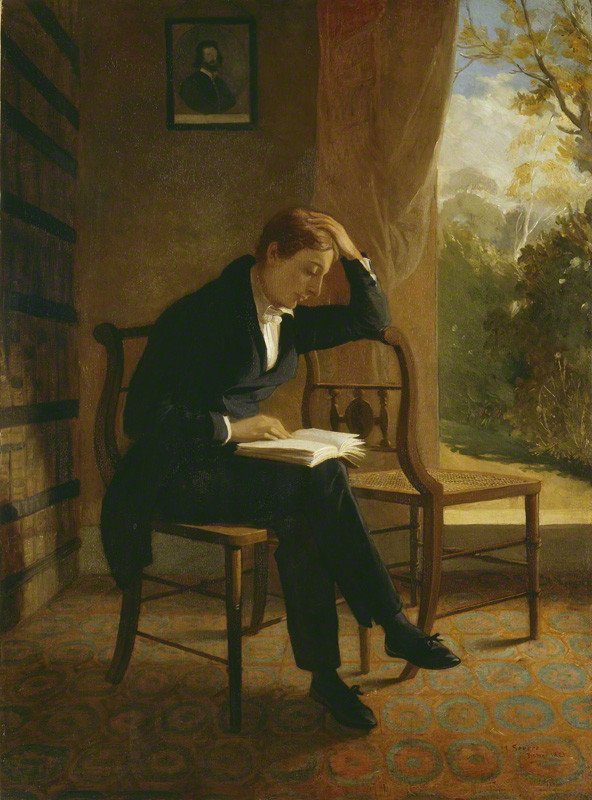
John Keats by Joseph Severn

John Keats by Joseph Severn (1821)

My Daily Art Display today centres around one of the greatest English poets, John Keats, and one of his most devoted friend, the English portrait artist Joseph Severn.

Joseph Severn was born in Hoxton near London in 1793.  He was one of seven children and the eldest son of a prosperous middle-class family.  His father was a music teacher and Severn besides being artistically talented was an accomplished pianist.   In 1807 his father arranged for him to be apprenticed to a London engraver, William Bond, a master of the stipple engraving technique.  When Severn was twenty-two years of age he enrolled at the Royal Academy Schools in London and four years later his first works were exhibited at the Royal Academy Exhibition.  That same year he was awarded the gold medal for his painting, Una and the Red Cross Knight in the Cave of Despair, the inspiration for this work being the epic poem by Sir Thomas Spenser entitled the Faerie Queen.  This prestigious award was even more special as the Royal Academy hadn’t awarded the medal for eight years.

It is thought that Severn first met the writer and poet John Keats around 1814 when he became part of the artistic circles of London.  He was not one of Keats’ closest friends but was one of Keats’ circle of literati and artists.  In 1817, John Keats and his brother George had to take time to nurse their brother Tom, who was suffering from tuberculosis.    In June 1818, Keats began a walking tour of Scotland, Ireland and the Lake District with his friend Charles Armitage Brown and his brother George and his sister-in-law Georgina before the latter pair set sail from Liverpool for a new life in America.  When Keats returned from his trip he continued to nurse his brother Tom and in doing so, exposed himself to the disease and it is thought by many that it was at this time that the disease took hold of John Keats.   His brother, Tom died in December 1818.

Tuberculosis took hold of Keats and he was counselled by his physicians to move to a warmer climate for the winter months.   Keats agreed to such a change of venue and a suitable travelling companion for him was sought.   Most of his close friends could not or would not go with him for various reasons and despite not being one of Keats’ “best friend” it was Severn who offered to accompany Keats to Italy for what was hoped to be an aid to the poet’s recovery.  Severn had always wanted to visit Italy and this proposed trip with Keats was his ideal opportunity. Severn was keen to study the great Italian Masters and be enthused by the beautiful landscapes of Italy. As he had just been awarded the gold medal by the Royal Academy he was eligible to apply for a travelling fellowship which gave him three years of artistic freedom funded by the Royal Academy. In order to receive this grant, Severn needed to paint an original in oil and have it shipped back to London. Once the painting was approved by a panel of judges, he would receive the precious fellowship and since Rome was the art capital of Europe, it made sense to Severn to travel there. His decision to leave England with Keats was not universally popular.  When he told his father of his plans, his father was horrified telling his son that he was risking his career and health by travelling with the ailing Keats and ordered him to remain in England. In Grant Scott’s book Letters and Memoirs, he recounts part of Severn’s late memoir in which he talks about this harrowing meeting with his father:

“…in his insane rage he struck me a blow which fell me to the ground…”

Severn was never to see his father again. However, Severn would not be deterred, packed his bags and embarked on what he believed was a voyage of convalescence, for his companion as Keats’s doctors had assured him that a stay in Rome would cure his condition.   It is extremely doubtful whether Keats believed the optimistic views of his doctors but it never crossed Severn’s mind that his companion would not fully recover once living in the favourable climate of the Italian capital.

In September 1820 Keats and Severn set sail for Naples on the vessel, Maria Crowther.  Although at the start of the voyage Keats’ illness seemed to be far from serious in the eyes of Severn, weeks into the voyage Keats became feverish and began to cough up blood and these physical signs of Keats’ illness affected Severn mentally.  In one of his letters he wrote of his time during the voyage with Keats:

“…He was often so distraught, with moreover so sad a look in his eyes, sometimes a starved, haunting expression that it bewildered me…”

The voyage itself had its problems.  The weather was constantly changing.  Stormy weather battered the ship one day and then the weather would completely change and the vessel would be becalmed lengthening the duration of the sea passage.  They finally arrived at the Italian port but then had to endure ten days in quarantine as news had travelled to Italy of a suspected outbreak of cholera in Britain.    Eventually the two men left Naples and travelled by carriage to Rome.  The pair eventually set up home in a villa on the Spanish Steps which is now the Keats-Shelly Memorial House Museum.  Keats’ health detonated and despite the ministrations of the medics he died on 23 February 1821 and was buried in the Protestant Cemetery in Rome and so, to carry out the last wishes of Keats, he was placed under an unnamed tombstone.  Joseph Severn and Keats’ close friend Charles Armitage Brown had the stone erected, which under a relief of a lyre with broken strings, was the epitaph:

“This Grave

contains all that was Mortal

of a

Young English Poet

Who

on his Death Bed, in the Bitterness of his Heart

at the Malicious Power of his Enemies

Desired

these Words to be

engraven on his Tomb Stone:

Here lies One

Whose Name was writ in Water. 24 February 1821″

My Daily Art Display featured painting today is simply entitled John Keats and was completed by Joseph Severn in 1821.  Severn had painted a number of portraits of Keats but this was one which he painted after the death of his friend and whilst he was still in Rome.  Severn wrote about this painting saying that it was painted to evoke a last graceful memory of his friend around the time when Keats first began to feel ill.  It had been on a morning visit to Keats’ house in Hampstead and Severn said that the position of the two chairs was exactly how he remembered the scene.  All the individual items such as the carpet, chairs, open window and even the engraving of Shakespeare hanging on the wall in the background were faithfully recorded in Severn’s work.  Look how Severn has depicted the room with all its atmospheric shadows.  It is a wonderful portrayal of the young poet reading his book and in the background we see a heavily gathered curtain pulled aside allowing us a glimpse of Keats’ Hampstead garden.  Severn said that his visit coincided with the time Keats had just written his famous Ode to the Nightingale and Severn later said that he was struck with the first real symptoms of the sadness Keats had so finely expressed in that poem.

This portrait of Keats is, beyond doubt, a Romantic portrait of one of the unsurpassed Romantic poets.

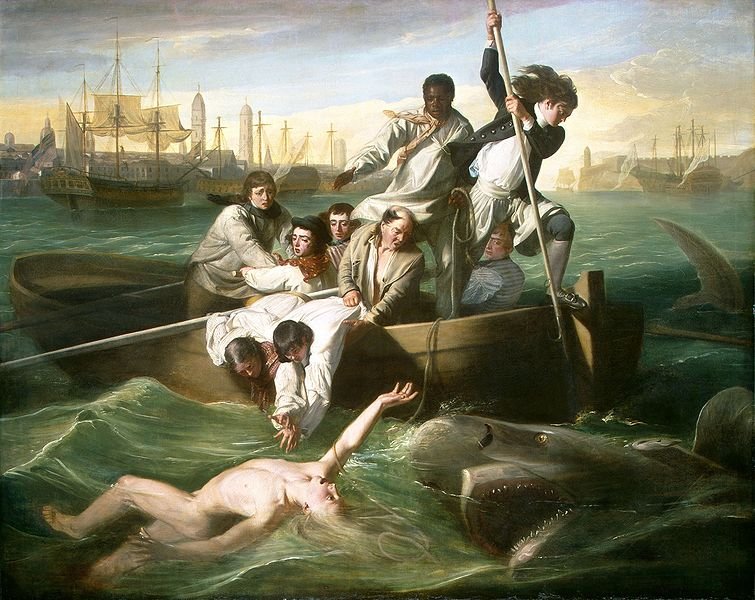
Watson and the Shark by John Singleton Copley

Watson and the Shark by John Singleton Copley (1778)

When I first set eyes on today’s featured painting I thought it was something to do with Herman Melville’s characters, Moby Dick and Captain Ahab but it also reminded me somewhat of Théodore Géricault’s painting Raft of Medusa (see My Daily Art Display June 10th 2011).  Of course it is neither.  Today’s featured work of art is all about two men, John Singleton Copley and the subject of the painting, Brook Watson.  My Daily Art Display painting today is entitled Watson and the Shark and was completed by John Singleton Copley, the American artist, in 1778.  In My Daily Art Display March 6th 2012 The Copley Family, I gave you a short biography of the artist’s life, so you may want to look back to that blog to find more about this talented American painter.  Today however I will concentrate on the subject of Copley’s work, Brook Watson.

Brook Watson, who would later become Sir Brook Watson, 1st Baronet, was born in Plymouth, Devon in 1735.  He was the only son of John and Sarah Watson (née Schofield), who both died when Brook was just six years of age.  After their deaths, he went to live with his aunt and uncle in Boston Massachusetts.  His uncle was a merchant and ship owner whose livelihood came from the import and export of goods to the West Indies.  Probably with living at this American port and seeing the ships plying their trade it is not surprising that young Brook Watson hankered after the seemingly glamorous life of a sailor.  His uncle realising his nephew’s desire to join the Navy organised for him to become a crew member on one of his ships.

In 1749, the fourteen year old Brook Watson was aboard his vessel in Havana harbour and foolhardily decided to take the opportunity to go for a swim on his own.  He was attacked by a shark and his shipmates, who had been waiting on board to escort their captain ashore, launched a valiant rescue effort.  As the sailors rushed to Watson’s aid, the shark repeatedly attacked the struggling boy.  During the first attack, the shark stripped the flesh from Watson’s right leg, just below the calf.   In the second frenzied attack, the shark bit off Watson’s foot at the ankle.  His shipmates managed to rescue the boy who was then taken to a hospital in Havana.  Surgeons were unable to save his leg and it had to be amputated below the knee.  Watson remained in Havana for three months to convalesce.

If that was not bad enough, when young Watson arrived back in Boston he found that his uncle had been declared bankrupt.  Despite the loss of his right leg, Brook Watson managed to secure a position on another ship which traded between Boston and a port in Nova Scotia supplying the British Army at Fort Lawrence.  Despite the loss of his right leg, Watson was taken on by the British military and served them as a commissary until 1759 at which time he left Canada and travelled back to London.  Here he pursued a career as a merchant importing and exporting goods to Canada and Northeast America.  In 1760 he married Helen Campbell, the daughter of an Edinburgh goldsmith.

Watson’s Coat of Arms

In 1784 he entered the English political arena and became a Member of Parliament for the City of London, a position he held until 1793.  In 1796 he was elected Mayor of London.  Watson was made a baronet in 1803 and he had his coat of arms designed in such a way so as to record his encounter with the shark in Havana harbour.  If you look at the crest you will see underneath Neptune, who is brandishing his trident, the shield bearing Watson’s severed right leg, underneath which is the Latin motto Scuto Divino,  which means “Under God’s Protection”. Brook Watson died in 1807, aged 72.

My Daily Art Display’s featured painting today, Watson and the Shark was completed by John Singleton Copley in 1778 and exhibited that year at the Royal Academy.  Copley and Brook Watson had become friends after the American artist arrived in London in 1774.   Watson commissioned Copley to create a painting of the Havana harbour incident which had occurred twenty-five years earlier.   The painting was Copley’s first of a series of large-scale historical paintings he completed after settling in London.   He went on to produce three versions of today’s painting.      The original version of the painting went to Brook Watson.  The second one was a full-size replica which he kept for himself and can now be found in the Museum of Fine Arts in Boston.  His third and smaller version, with a more vertical composition, is housed in the Detroit Institute of Arts.

The painting when exhibited at the Royal Academy was a sensation, probably due to its horrific subject.  The painting is something of an exercise in overstatement and embellishment going beyond a realistic depiction, with the sole intention of evoking strong emotions in the viewer.  In the painting we see nine of Watson’s fellow seamen rushing to his rescue.  Copley who had never visited the Caribbean island of Havana relied on maps, prints and book illustrations of the Cuban harbour for his background.  Observe how Copley has added a dramatic touch to the scene by the way he is portrayed Watson’s rescuers.  Their facial expressions reveal not only their fear for their own safety but the concern they have for the fourteen year old boy who is being attacked by the shark.   One of the sailors has thrown a rope in the water, but it has not reached the young boy and dangles beyond his grasp. Two other crewmen lean over the side of the boat, in an attempt to reach the boy, while the elder boatswain clutches his companion’s shirt trying to ensure he too doesn’t fall into the water. The other terrified seamen in the boat row frantically, and the seaman standing in the front of the small boat has his boathook ready to thrust downwards into the body of the shark. Copley’s depiction of a shark has often been criticised and the most probable reason why the shark looks more like a mythical creature than a shark, is because Copley had probably never seen an actual shark and so was forced to paint a creature based on the description of others.

The young Watson lies on his back in the water transfixed in shock.  It is a romanticised portrayal of the incident as the gory detail of Watson’s severed right foot is hidden beneath the waves and there is only the slightest hint of blood on the surface of the water and in the mouth of the shark.  However there is no sign of the frenzied thrashing about the victim as he is being attacked by the shark.  Maybe Copley thought the inclusion of such a depiction would be a step too far.

After Watson died his will was read and as far as the painting was concerned, it stated:

“I give and bequeath my Picture painted by Mr. Copley which represents the accident by which I lost my Leg in the Harbour of the Havannah in the Year One Thousand Seven Hundred and Forty Nine to the Governors of Christ’s Hospital to be delivered to them immediately after the Decease of my Wife Helen Watson or before if she shall think proper so to do hoping the said worthy Governors will receive the same as a testimony of the high estimation in which I hold that most Excellent Charity and that they will allow it to be hung up in the Hall of their Hospital as holding out a most useful Lesson to Youth.”

The school’s Committee of Almoners accepted the painting in 1819.   In 1963 it was purchased from Christ’s Hospital by the National Gallery of Art, Washington, D.C.

The oil painting’s enormous acclaim ensured John Singleton Copley’s appointment to the prestigious Royal Academy, and he went on to earn a fortune selling engravings of its design.

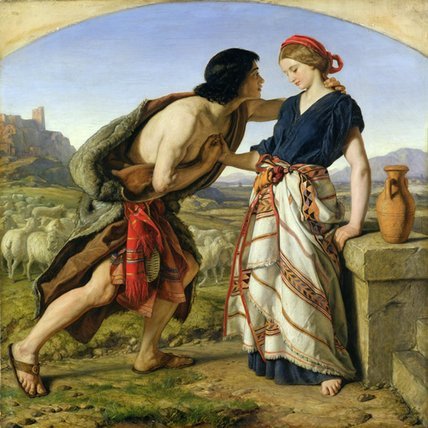
Jacob and Rachel by William Dyce

Jacob and Rachel by William Dyce (1853)

The first time I featured a painting by William Dyce was over twelve months ago (My Daily Art Display, May 14th 2011) when I looked at his painting Pegwell Bay, or to give it its full and bizarre title, Pegwell Bay, Kent – a Recollection of October 5th 1858.   To find out why the painting had such a strange title you will have to check back on the earlier blog.

William Dyce was born in Aberdeen in 1806. His father was a fellow of the Royal Society and an eminent physician.  Dyce attended the Marischal College, which is now part of the University of Aberdeen.  He trained as a doctor before reading for the church. However the course of his life changed when aged nineteen he decided to become an artist and enrolled at the Royal Scottish Academy Schools in Edinburgh and later as a probationer at the Royal Academy of London.   At the age of nineteen he made his first trip to Rome and stayed there for nine months studying the works of the great Masters such as Titian, Rembrandt and Poussin.  He returned to Aberdeen but the following year he went back to Rome and this time stayed for eighteen months.   During this second visit to the Italian capital he met the German painter, Friedrich Overbeck, who was one of the leading artists of the Nazarene Movement.   The Nazarene Movement was made up of a group of early 19th century German Romantic painters who aimed to revive honesty and spirituality in Christian art. The name Nazarene came from a term of derision used against them for their affectation of a biblical manner of clothing and hair style.

By 1829 Dyce was back in Scotland and settled in Edinburgh for several years.  To survive financially he would carry out many portraiture commissions but his main love was his religious, history and narrative paintings.   In 1837, he was appointed Master of the School of Design of the Board of Manufactures in Edinburgh and produced a pamphlet on the management of schools like the one he was working at and this was well received, so much so, that he was transferred to London as superintendent and secretary of the recently established Government School of Design at Somerset House, which was later to become the Royal College of Art.   In 1844 he was appointed Professor of Fine Art in King’s College, London, and became an Associate of the Royal Scottish Academy, and in 1848 elected to become a  Royal Academician.

In 1850 Dyce married Jane Brand who was twenty-five years younger than him.  They went on to have four children.   He died at Streatham, Surrey in 1864, aged 58.

Today I am looking at a completely different type of painting by the artist in comparison to his seaside painting, Pegwell Bay.  This is a religious painting entitled The Meeting of Jacob and Rachel.  There were about four versions of this work by Dyce,  each of different size and with minor alterations but this one, which was completed by him in 1853,  is now housed in the Kunsthalle in Hamburg.  This was the original work and the only one which had a vase resting on the edge of the well.  The painting proved so popular with the public that Dyce commissioned Holman Hunt to make copies of it.

The painting is based on a story from the Old Testament book of Genesis (29: 9-14):

9 While he was still talking with them, Rachel came with her father’s sheep, for she was a shepherd. 10 When Jacob saw Rachel daughter of his uncle Laban, and Laban’s sheep, he went over and rolled the stone away from the mouth of the well and watered his uncle’s sheep. 11 Then Jacob kissed Rachel and began to weep aloud. 12 He had told Rachel that he was a relative of her father and a son of Rebekah. So she ran and told her father.  13 As soon as Laban heard the news about Jacob, his sister’s son, he hurried to meet him. He embraced him and kissed him and brought him to his home, and there Jacob told him all these things. 14 Then Laban said to him, “You are my own flesh and blood.”

This painting, Meeting of Jacob and Rachel, depicts the point in time just before Jacob kissed Rachel, and as the biblical text quotes the experience was so memorable, he lifted up his voice, and wept.  Jacob had fallen in love, at first sight, with this beautiful young woman, when he saw her standing at the well about to give water to her father’s flock of sheep.   Look at the way Dyce has portrayed Jacob.  The young man having just cast his eyes on his cousin is besotted with her.  He leans towards her almost balancing on one leg.  Look at his demeanour.  Look at the intensity of his expression as he looks into Rachel’s face. Look at his eagerness.   His emotions seem to be getting the better of him.  He clutches Rachel’s right hand and press it against his heart.  Maybe he wants her to feel how it is beating wildly.  His left hand rests on the nape of her neck.  He caresses her neck gently and at the same time his hand will guide her face towards his so that he may kiss her.  Now look at Rachel.  See how her expression differs from that of Jacob.  Her eyes are cast downwards in a gesture of modesty or is it coyness?  She cannot meet Jacob’s gaze.  The top half of her body leans away from Jacob and she steadies herself by placing her left hand on the well.

So does this meeting of man and woman result in a happy ending?  Well yes and no!   Rachel’s father, Laban was quite cunning and realised that Jacob was a young and strapping lad who could help out on the farm and so he offered him the hand of Rachel in the future, providing he would work for him.  Jacob agreed and worked for Laban for fourteen years without payment in the hope of getting the father’s blessing for his marriage to his daughter.  Then Laban made another condition for this marriage.  He wanted Jacob to first marry Rachel’s elder sister, Leah, after which he would be able to have Rachel as his wife.

So this is not just a story about young love but also a story of patient love and the way Jacob was willing to wait for Rachel.   This may have been uppermost in Dyce’s mind as it mirrored his relationship with his wife-to-be Jane Bickerton Brand who was born in 1831, for he was made to wait for her hand in matrimony as she was so young when they first met and the age difference of twenty-five years obviously further concerned her father.  William Dyce did wait and they did marry,  so all ended happily.

A Primitive City by Edward Calvert

A Primitive City by Edward Calvert (1822)

When I wander around various galleries, I am often lost in wonderment  when I stand in front of a massive painting.  I can remember when I was in Venice last year and visited the Accademia Galleries and stood before the giant work of Paolo Veronese entitled Feast in the House of Levi.     I was amazed at the magnitude of the work which measured  5.6 metres x 13metres and I could only wonder at how he managed to physically paint such a large scale picture.  How long must it have taken him?  Maybe he had some of his apprentices to help him but still it was an outstanding undertaking.  I find equally impressive miniature paintings and I am always filled with a sense of amazement at how these delicate paintings have been achieved.  My Daily Art Display featured painting today is one such miniature and I want you to feast your eyes on this lovely work of art entitled A Primitive City painted by the English artist Edward Calvert.

Edward Calvert was born in Appledore in the county of Devon in 1799.  His early schooling and art education was at Plymouth but coming from a seafaring area the young Calvert joined the Navy and spent five years serving his country.  A death of a close friend in naval action resulted in him leaving the force and coming ashore.  In 1824 he moved to London and it was here he, at the age of twenty-five, enrolled at the Royal Academy, where one of the professors was the artist, Henri Fuseli.  It was whilst in London that he met the ageing English painter, William Blake.  Blake and his paintings were one of his first great artistic influences and one that would remain with him for the rest of his life.  Blake’s art work inspired a number of aspiring artists and Calvert and some like-minded Romantic artists, who had fallen under the spell of Blake and his work formed an association known as The Brotherhood of the Ancients often simply known as The Ancients.  The leader of the group was Samuel Palmer but one of the most of the most important members of the group was today’s featured artist, Edward Calvert.  Others in the group were George Richmond and John Linnell.  This group of painters, who  all had a love of the spiritual art of the past, would often meet at the home of Blake, which they used to refer reverentially to as the House of the Interpreter.  They would also congregate at Palmer’s house in Shoreham, Kent to discuss Blake’s visionary ideology and to paint pastoral images with a mystical perspective.  They brought a new dimension to Romantic Art.  They brought a wondrous vision of a golden age set in quiet landscapes amidst a pastoral innocence and abundance.

Edward Calvert who was a man of private means left the Academy and concentrated on another love of his, wood-engraving.  He lived with his wife in Dalston in the London borough of Hackney for most of his life.  Calvert’s love of pastoral depictions disappeared gradually but his interest in ancient Greece increased. He visited Greece where he sketched prolifically.  Eventually, he gave up his printmaking and for the rest of his life his art was just for himself and for his own pleasure.  He would work in oil, watercolour and gouache and for his subjects he liked to focus on pagan mythology.  Latterly, Calvert became a recluse and died in 1883, aged 84.

My featured painting today is a tiny watercolour miniature, measuring just 7 cms x 10 cms (not quite 3 inches x 4 inches), entitled A Primitive City, which Edward Calvert painted in 1822.   The quality of this work of art is amazing with its clarity of line and jewel-like colouring and the amount of detail that is shown in such a small space.  It is an evening scene and in the background on the right, we see the waning moon as it hovers behind a distant walled city.  In the right mid-ground we see a peasant leading a donkey which staggers slowly heavily laden with two large baskets of grapes on its back.  Behind the donkey there is another cart, crossing a rickety wooden bridge, being pulled by a bullock, which is loaded with sacks of grain and driven by a woman.  The grapes and grain symbolise the Eucharistic wine and bread.  The pastoral theme is emphasized  by the shepherd and his flock which  we see depicted in the left mid-ground of the work.  If we carefully look at the city itself we see a woman drawing water from a well and above her we see another woman watching her from her viewpoint on the staircase between the two towers.

There is an innocence to the scene and this is accentuated by the beautiful, almost naked, young girl we see to the left of the picture who is about to take a swim in the nearby stream, which runs across  the foreground of the painting.  We can see Calvert’s love and interest in Classical art in the way he  has depicted the woman, as the stance of the scantily-clad young lady is almost certainly derived from the Venus Kallipygos, which is in the Naples National Archaeological Museum.  It could well be that the presence of the river was Calvert’s idea of symbolising the river of life and the nakedness of the young woman symbolic of innocence.  Above the girls head we see that the trees are full of fruit symbolising abundance.

This was Calvert’s vision of the perfect idyll, tranquillity and abundance.  It should be remembered that this work was completed before Calvert went to London and became part of The Ancients , which just goes to show that his ideas for artistic subjects were similar to those of artists he was yet to meet.

Portrait of a Woman by Bartolomeo Veneto

Portrait of a Woman by Bartolomeo Veneto (c.1525)

I have over the past blogs featured paintings of a women whose facial beauty I find quite stunning and have commented at length on their great beauty.  Two especially come to mind, Jeunesse Dorée by Gerard Brockhurst (My Daily Art Display May 16th 2011) and Virgin Annunciate by Antonello da Messina (My Daily Art Display May 1st 2012).  I mention this because today I am featuring another such painting which is a portrait of an exceptionally beautiful woman.  The title of the painting is simply, Portrait of a Woman and the artist is Bartolomeo Veneto.  I will look at the painting in detail later and explore the mystery of whose portrait it might be but first let me tell you a little about the artist.

Bartolomeo Veneto was born at the end of the fifteenth century but little is known of his early upbringing and family life.  The first time his signature was found on a painting, was on his work entitled Virgin and Child and it was dated 1502.  The signature itself gives an insight into his early days as he signed it:

“… bartolamio mezo mezo cremonexe venizian e…”

which when roughly translated means:

“…Bartolomeo half-Venetian and half Cremonese…”

In his early days he worked in Veneto, in North East Italy, Venice itself and Lombardy, which has its border to the west of Veneto.  Whilst in Venice he trained under Gentile Bellini, who was the most prestigious painter in Venice in the early sixteenth century.  Bartolomeo Veneto concentrated most of his art on portraiture and for that he received many commissions.

It is thought that around 1507 Bartolomeo worked at the Este court in Ferrara, which was ruled by the Duke of Ferrara, Alfonso I d’Este who in 1502 married for the second time.  His new wife was none other than Lucrezia Borgia and Alfonso was her third husband.  During his time at the court Bartolomeo gilded frames and made carnival decorations and completed a painting depicting the Virgin and Saints.  After three years at the court Bartolomeo moved on and he is reported to have been in Padua in 1512 and Milan eight years later and it was here that his portraiture became influenced by the portraits by Leonardo da Vinci who had been in this Italian city some years earlier.

Today’s featured painting by Bartolomeo Veneto, which he completed around 1525, is entitled Portrait of a Woman and is now housed in the Städel Museum in Frankfurt.  I suppose the first question one asks when looking at this beautiful half-naked woman is who is she?   There is no degree of certainty as to the answer but it is thought to be a portrait of Lucrezia Borgia.  What makes her stand out is the fact that the artist has placed her, in three-quarter profile, dressed in a white tunic against a black background and he would use this black background technique in other portraits.

The staring eyes

Although she has turned to the left she keeps eye contact with us.  Although her left breast is bared, it is her gaze that catches our attention.  As we look at her we are almost mesmerized by that stare.  The way she looks at us is in some ways unnerving.  She has captured our attention.

Observe the ringlets of her golden hair as it cascades down her shoulders.  See how Bartolomeo has painted each strand of it in detail.  It is this extraordinary attention to detail that made his portraits so popular and led to many commissions from wealthy patrons.  This tempera and oil on wood panel bears the name of the ancient goddess of spring, Flora and she was often a character portrayed in Renaissance art.   In her right hand, she delicately holds up to us, between her slim index finger and thumb, a small posy of wild flowers consisting of daisies, anemones and buttercups,.  These three flowers are attributes of Zephyr’s wife Flora, the goddess who ushered in spring.  This is her offering to us.

A lavish jewel adorns her forehead.   Above the jewel is a blue silk band and her hair is covered in a veil which is crowned with myrtle, all of which lead us to believe that this woman is married.  Another jewel hangs between her breasts on a pendant, the placing of which adds to the sensuality of the portrait.  Having said that, I believe there is also chasteness in the way the artist has portrayed the woman.  Could this then be a portrait of Lucrezia Borgia?  The same Lucrezia Borgia who was one of the daughters of Cardinal Rodrigo Borgia, later to become Pope Alexander VI, and his mistress Vannozza Cattanei?  Could this be the portrait of a woman who was accused of incest with both her father and her brother Cesare?  Could this beautiful and delicate-looking woman be the infamous female who was accused of poisoning many of her adversaries and who had a string of extra-marital affairs?

So, are we looking at a beauty or a beast and is this a true likeness of Lucrezia Borgia?

The Vicar of Wakefield Reconciling his Wife to Olivia by Gilbert Stuart Newton

The Vicar of Wakefield Reconciling his Wife to Olivia
by Gilbert Stuart Newton (1828)

Today I am going to look at the life and one of the paintings of the Canadian born artist Gilbert Stuart Newton.  Newton was born in Halifax, Nova Scotia, one of twelve children in 1797.  His father, Henry Newton, who originally came from Boston, worked as a Customs official and his mother Anne Stuart came from a family of Scottish descent, who also lived in Boston, Massachusetts.  Her brother, Gilbert Stuart, was an artist and was generally believed to be one of America’s leading portraitists of the time and was to become one of his nephew’s first art tutors.   Gilbert’s parents moved from Boston to the Canadian port of Halifax in 1776 but on the death of his father in 1803, when he was six years old, his mother took her family back to her home town of Charleston, a district of Boston on the Charles River.

Although initially heading for a career in commerce he developed a love of art and his uncle Gilbert Stuart recognising his artistic promise took him on as one of his pupils.  Like many aspiring artists, Newton travelled to Europe to study painting, first in Florence and later in Paris and London.  He arrived in London in 1817.  During his travels, he made the acquaintance of the American artist, Washington Allston, (see My Daily Art Display, Feb 25th 2011),  the English genre painter Charles Leslie and the Scottish painter David Wilkie.  He enrolled as a student of the Royal Academy Schools in 1817 and exhibited his first work at the Royal Academy the following year.  Initially he focused his artistic talents on portraiture and had many well known sitters, such as the American author, Washington Irving and the American politician and then American Consul in Liverpool, James Maury.  He left England in 1831 and went back to America for a short period where he married but a year later he and his wife returned to England.

Gilbert Stuart Newton is principally remembered, not for his portraiture, but for his genre and literary scenes many of which were engraved.  Probably Newton will be remembered most of all for his depiction of literary subjects such as today’s featured painting entitled The Vicar of Wakefield Reconciling his Wife to Olivia, taken from Oliver Goldsmith’s novel, The Vicar of Wakefield.  He also depicted scenes from Shakespeare such as his 1831 painting entitled Portia and Bassanio.    Another scene from a novel he painted was that of Yorick and Grisette, two characters in Lawrence Sterne’s novel, A Sentimental Journey.  This work was exhibited in the Royal Academy in 1830.  In 1828 Newton was made and Associate of the Royal Academy and four years later was elected as a Royal Academician.  That same year, 1832, when he was made a Royal Academician was the also the year of the onset of his mental illness which progressively worsened to such a point that he had to be institutionalised in a private asylum in Chelsea.  Even whilst hospitalised he continued to draw, completing a number of sketches based on Shakespearian characters.   He died of consumption at the asylum in 1835 just a month before his thirty-eighth birthday.  He died alone as his wife along with their child had returned to America a few months earlier.

My featured painting today is Gilbert Newton’s work entitled The Vicar of Wakefield Reconciling his Wife to Olivia. It was painted as a commission for Lord Lansdowne.   The painting was exhibited at the Royal Academy Exhibition in 1828 and in the Exhibition catalogue against this work was the following quotation from Oliver Goldsmith’s 1766 novel, The Vicar of Wakefield.  They were the words uttered by the vicar to his wife imploring her, like him, to forgive the misdeeds of their daughter:

“…I entreat, woman, -that my words may be now marked once for all: I have here brought you back a poor deluded wanderer; her return to duty demands the revival of our tenderness … The kindness of heaven is promised to the penitent, and let ours be directed by the example…”

This novel, The Vicar of Wakefield, by Goldsmith was his most famous work of literature and in the painting we see Olivia, the vicar’s daughter, who had run away from home to be with the man she loved.  Her father, the vicar, eventually finds her and brings her home and we see him, in the right of the painting, comforting his distraught but repentant daughter, who has buried her face against his shoulder. To the left of the painting we see the vicar’s wife who has her back almost turned away from her husband and daughter and by her facial expression we must believe she hasn’t quite come to terms with what has happened.  She is now trying to balance the desire to punish her daughter for her misdeeds and yet show her some maternal love now that she is back in the fold.  Her hands are clenched tight in her lap and we can see by her facial expression that she is not in a forgiving mood.  Also included in the painting are the vicar’s two youngest sons who stand in front of their mother completely unaware of what is happening.   The younger daughter Sophia, who kneels at the side of her mother and who holds her mother’s hand in a comforting gesture, is pleading with her to forgive her errant sister, Olivia.  The vicar’s second son Moses, stands at the far right of the painting, by the open door of the house and looks somewhat bemused and unable to know what to do for the best.  The family dog lies under the table looking up aware of the commotion.

So how was the painting greeted by the art establishment in 1828?  The literary magazine of the time, The Athenaeum commented on the work:

“…A very interesting picture, cleverly composed, and well painted. The mother’s struggle between pride and tenderness, is admirably expressed, not only in her face and features, but throughout the whole figure; not more in the stiffness and erectness of carriage, than in the clenching of the hand on the knee. The patient and benevolent Dr Primrose, of Goldsmith, is finely characterised in the figure and head of the father: the affectionate sister, kneeling by her mother’s side, and anxiously interceding, is a picture of amiable loveliness; while Olivia, abandoned to shame, sorrow, and penitence, neglected in her attire, and with face averted, and concealed on her father’s shoulder, while her hand is most expressively held by his, forms, with the figure of the indulgent parent, a group replete with delightful expression. The hobbledehoy simplicity of Moses, and the panting and vague consciousness of the younger urchins, must not be overlooked; they are also most happy. The whole picture, in short, is full of truth, sentiment, and feeling…”