Ferdinand Georg Waldmüller and the Biedermeier era

Portrait of the fictitious character Gottlieb Biedermeier from the Munich Fliegende Blatter

My blog today starts with a caricature of Gottlieb Biedermeier.  Gottlieb is not the artist of the day.  He is just the lead-in to the star attraction.  Gottlieb Biedermeier, more commonly referred to as Papa Biedermeier, used to appear as a cartoon character in the popular newspaper, Fliegende Blätter, a German weekly non-political humour and satire magazine which appeared between 1845 and 1944 in Munich, and it is through his regular appearance that  this period was actually termed the Biedermeier era, an era which stretched between the defeat of Napoleon in 1815 and the Republican revolts against European monarchies of 1848, which began in Sicily, and spread to France, Germany, Italy, and the Austrian Empire.   Papa Biedermeier was a comic symbol of middle-class comfort. The art of the Biedermeier period came to be characterized by what art critics of the period termed “rigorous simplicity.”   The works of art often had an enamel-like finish that masked individual brushstrokes. Landscape and portraiture grew in importance while history painting declined.  In painting, the Biedermeier style reflected the bourgeois, simple, joyful, affable and conformist environment, enhanced the aesthetics of the natural beauty and has influence on contemporary art and design.

Early Spring in Vienna Forest by Ferdinand Waldmüller (1864)

In Austria painters during this time portrayed a sentimental and virtuous view of the world but in a realistic way. The German word best describing the emotions derived from the art is gemütlichkeit, which is a space or state of warmth, friendliness, and good cheer. Other qualities of gemütlichkeit include cosiness, peace of mind, belonging, and well-being.  In other words, a “feel good” factor and such comfort, as depicted, emphasized family life and private activities, especially letter writing and the pursuit of hobbies. No Biedermeier household was complete without a piano as an indispensable part of the popularized soiree. Soirees perpetuated the rising middle class’s cultural interests in books, writing, dance, and poetry readings—most subject matter for Biedermeier paintings was either genre or historical and most often sentimentally treated.  The leading Austrian exponent of this type of art is my artist of the day.  He is Ferdinand Georg Waldmüller.

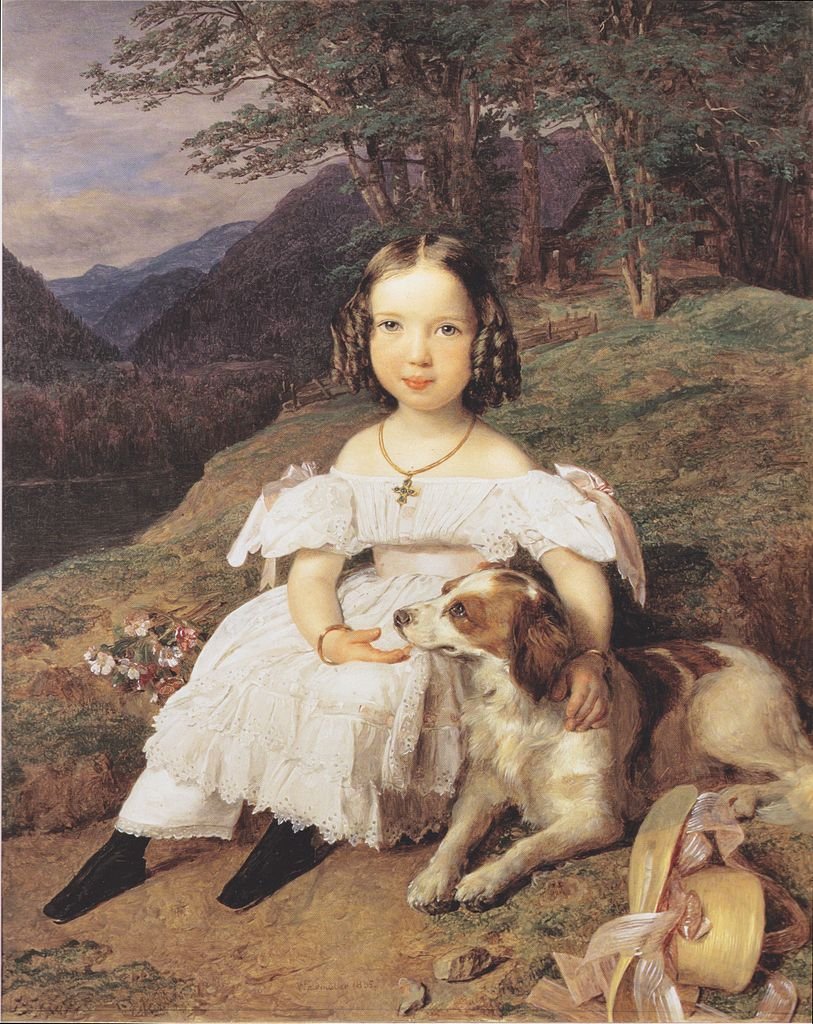
The Girl Antonia Seemann by Ferdinand Waldmüller

Ferdinand Georg Waldmüller was born in Vienna in January 1793.  In 1807, at the age of fourteen, Waldmüller studied Fine Arts at the Academy of Fine Arts in Vienna under the Austrian painter, draughtsman, and well-respected teacher,  Hubert Maurer, who had been teaching art at the Academy since 1785. Waldmüller remained there until 1811. Waldmüller then went to Presburg in Hungary to study portraiture.  Following that he worked in Croatia as a drawing teacher for the children of the Count Gyulay, the governor of Croatia before returning to the Academy in 1813 to carry on with his artistic studies, this time concentrating on portraiture.

Whilst in Vienna Waldmüller would visit the court and municipal galleries where he would make copies of the Old Masters.

Martyrdom of St Andrew by Jusepe de Ribera (1628)

One example of this is his version of Juseppe de Ribera’s Martyrdom of St Anthony which the Spanish artist completed in 1628 which is now in the Szépmüvészeti Museum in Budapest.   St. Andrew was St Peter’s brother and preached around the Black Sea Area.  According to legend he was crucified on two pieces of wood which formed an “X” which has since become known as the cross of St Andrew.

Martyrdom of St Andrew by Ferdinand Waldmüller (1821)

Waldmüller’s copy of the painting can be seen in the Akademie der bildenden Künste in Vienna. Waldmüller had hoped to sell the copies he made of the paintings of the Old Masters but the income from this venture was insufficient for him to live and support himself.

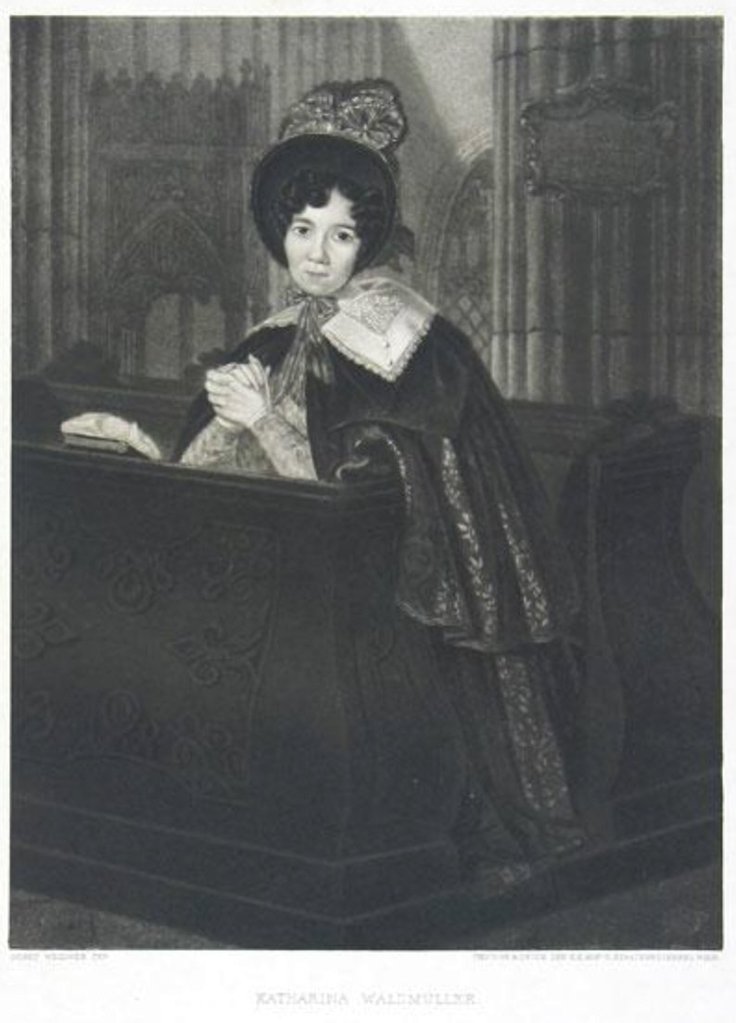
Katharina Waldmüller (née Weidner) by Joseph Weidner

In 1814, Waldmüller  married a well-known Austrian opera singer, Katharina Weidner and he worked as a scenery designer at the various venues at which his wife was performing.   He took up the role as professor of art at the Academy of Fine Arts in Vienna and in 1823 exhibited for the first time at the Vienna Akademie.

Ferdinand Georg Waldmüller Kaiser Franz I (1827)

For the next decade he travelled around Europe, enhancing his reputation as a leading portraitist of his time and in 1827.  He received royal patronage following his portrait of the nineteen year old Franz I, who would become the Holy Roman Emperor in 1845.

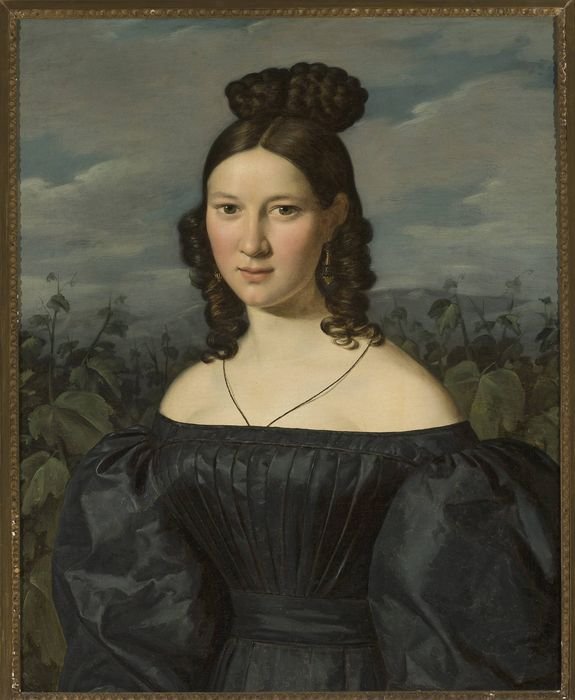
Portrait of a Young Lady by Ferdinand Waldmüller (1820)

His art at the time concentrated on portraiture, an art genre in which Waldmüller excelled.  His portraits had a high smooth-finish and decorative detail and were often compared to the French Neo-classical painter Ingres.  One of his most beautiful portraits is entitled Portrait of a Lady, which he completed in 1820.

Portrait of Beethoven by Ferdinand Waldermüller (1823)

One of the most famous of his sitters was Ludwig van Beethoven who sat for him in 1823.  The portrait had been commissioned by the Leipzig publishers Breitkopf & Härtel.  According to notes and letters, it was a one-off sitting and even that was interrupted.  So in the short time he had, Waldmüller only portrayed Beethoven’s face, and it was later, back in his studio, that he added the clothes and probably also parts of his hair.  The original was destroyed in 1943 but fortunately, the portrait was so popular in the late nineteenth and early twentieth century that it was reproduced and copied many times.

Julia Comtesse Apraxin by Ferdinand Waldmüller (1835)

Perhaps, one may consider his portraits of children a little too “syrupy” but this should not detract from the excellent portraits.  In 1835, Waldmüller, whilst living in Vienna, completed a commission to paint the portrait of seven year old Julia Aspraxin, the daughter of  Count Alexandr Petrovich Aspraxia, a serving Russian in Vienna.

Portrait of the Future Emperor Franz Josef I of Austria as a Grenadier with Toy Soldiers by Ferdinand Waldmüller (1832)

In 1832 he painted a portrait of the two-year-old Franz Josef, the future Austrian Emperor entitled Portrait of the Future Emperor Franz Josef I of Austria as a Grenadier with Toy Soldiers.  The child posed for the artist in the uniform of a grenadier along with some similarly dressed Hungarian wooden figures.  It is like a state portrait on a miniature scale. The child, with his blue eyes, looks out innocently unaware of his future role and the disasters that would follow.

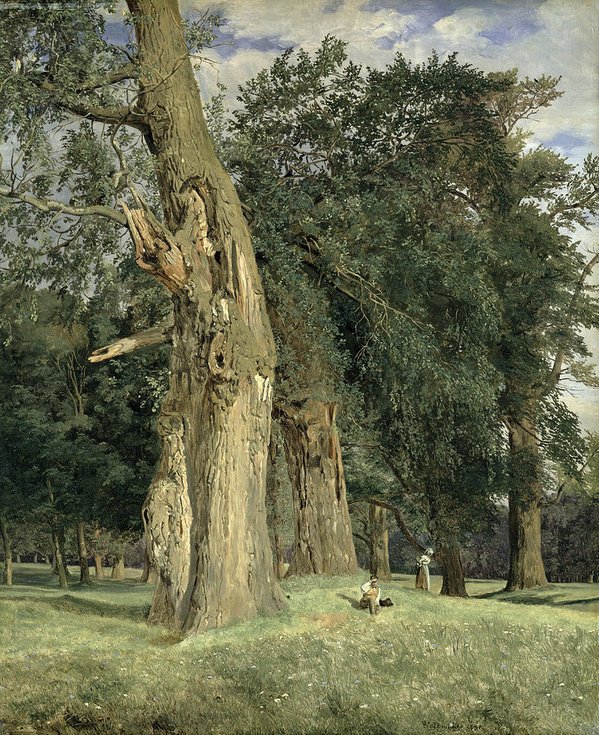
Old Elms In Prater by Ferdinand Waldmüller (1831)

Waldmüller painted pictures of all genres and had soon built up his standing as a talented landscape painter.  His beautiful landscape artistry was appreciated by the public and in the 1850’s he became very interested in the depiction of sunlight and the contrast between light and shadow which one realises was a pre-cursor to Impressionism.  I especially like his 1831 paintings featuring the elm trees in Prater, the large park in Vienna.   One was entitled Old Elms in Prater.  Look at the extraordinary detail.

Elms In Prater by Ferdinand Waldmüller (1831)

The other simply, Elms in the Prater.  His landscape artistry was based on his strong belief that art should be determined by the careful and meticulous examination of nature.  For Waldmüller, a talented colourist and someone who had a great knowledge of nature, it was all about natural observation achieved by plein air painting and not so much the way art was taught in academies. It was, like the Impressionists, fifty years later, about the effect of light.

View Of The Dachstein With The Hallstättersee From The Hütteneckalpe At Ischl by Ferdinand Waldmüller (1838)

Another beautiful landscape work was his 1838 painting entitled View Of The Dachstein With The Hallstättersee From The Hütteneckalpe At Ischl.

He became the curator of the Gemäldegalerie of the Academy of Fine Arts in 1829, a post he held for almost three decades.  However in 1849 and again in 1857,  he wrote critical papers with regards the Academy and academic teaching of art and,  at the age of sixty-four , was forced to resign from his position at the Academy.

Corpus Christi Morning by Ferdind Waldmüller (1857)

The third “string” to Waldmüller’s artistic bow was his great talent as a genre painter.  His genre paintings shied away from idealisation or pretentiousness and although he would often add historical and religious elements to his depictions he was never afraid to highlight social criticism in the paintings.   Through his depictions of life in the countryside his paintings extolled the virtue of rural life and at the same time highlighting the positivity of family life.  Such joyousness can be seen in his 1857 painting, Corpus Christi Morning.  Life for the peasant class may not all laughing and dancing but for that moment in time life could not be better.  It was a gemütlichkeit time.

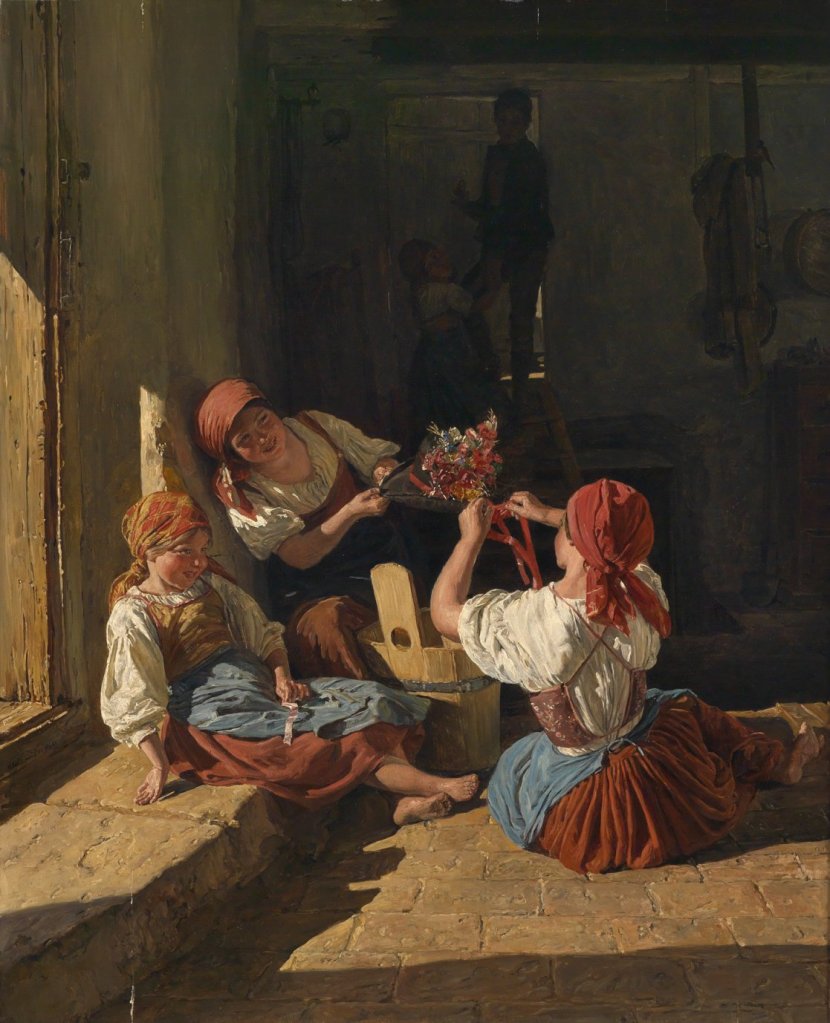
Ferdinand Georg Waldmüller, Children decorating a Conscript's Hat (1854)
Ferdinand Georg Waldmüller, Children decorating a Conscript’s Hat (1854)

Ferdinand Georg Waldmüller completed his painting Children decorating a Conscript’s Hat in 1854. The painting depicts a very poignant moment.  It was an occasion of great importance to rural families.  We see a group of girls, maybe his sisters,  decorating the hat of a young man who has been called up to fight for his country during his compulsory military service. His hat is being decorated with flowers and ribbons. The decorating of the hat is a time of joy and merriment which masks the possible horrors the young man may encounter.  As far as art is concerned, it is a masterpiece of evocative genre painting and, the work is a testament to how Waldmüller depicts the intricate interplay of light and shadow.

The Departure of the Conscript by Ferdinand Waldmüller (1854)

Another work by Waldmüller, The Depature of the Conscript, shows the family of a conscript saying their farewells and wishing him a safe journey.  His mother places the decorated hat on the head of her son.  Look how the boy wraps one arm around his mother whilst his other hand is held lovingly by his father.  It is now that maybe they realise that the ceremony of decorating the hat will mean nought if their beloved son does not return home.  In the background we see women in tears.  A young man, maybe the conscript’s younger brother, looks back pensively at his older brother wondering when it will be his time to join the military.  The conscript’s young sisters try to cling hold of him, not wanting him to go.  This is not a scene of joy but one of realism, one of foreboding.

I have always loved genre paintings especially when there are numerous characters depicted.  Each time I look at painting like this I discover something different.

In 1851, Waldmüller, aged 58,  married his second wife, 25-year-old Anna Bayer. He carried on exhibiting his work at various exhibitions, including the prestigious World Exhibition in Paris and at the International Exhibition in London. In 1856 he travelled to London where he sold thirty one of his paintings to the royal household and court. By the 1860s, the Academy in Vienna had forgiven Waldmüller’s transgressions and outspoken views critical of their institute and their teaching methods and he was once again welcomed back to the Viennese artistic fold.  He was knighted in 1865, shortly before his death that August, aged 72.

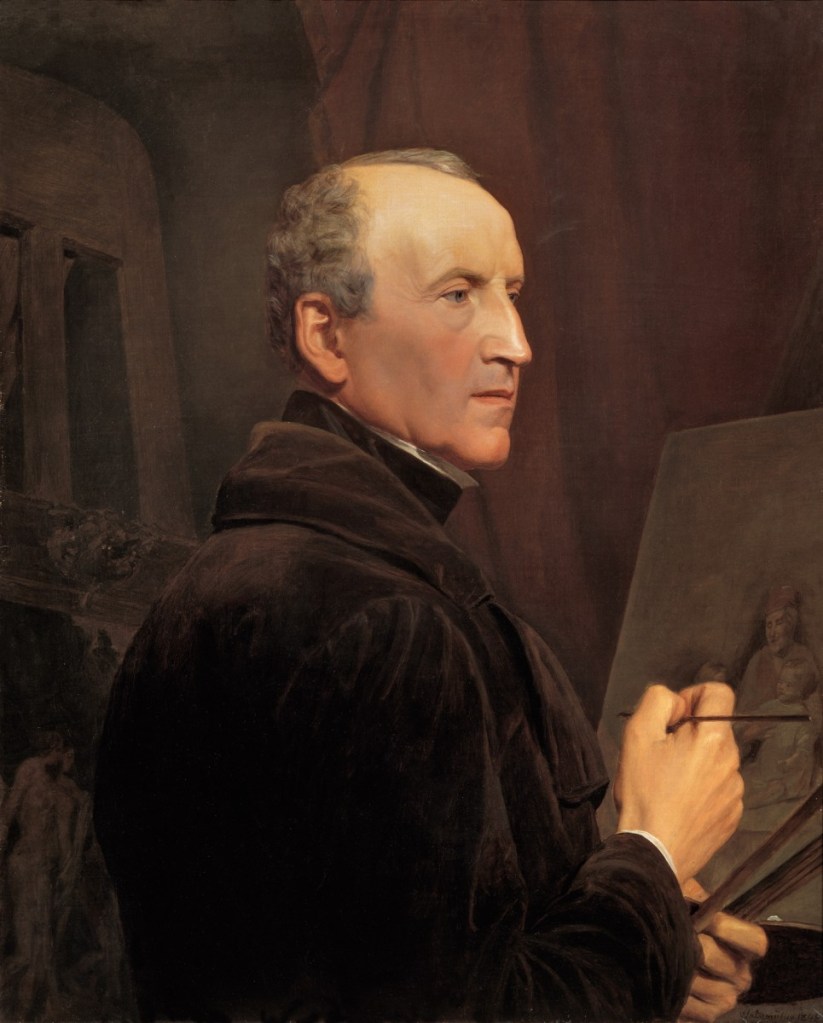
Ferdinand Georg Waldmüller, Self-Portrait at the Easel, (1848)

Ferdinand Georg Waldmüller is looked upon as one of the most important Austrian painters of the Biedermeier period.  His superb artistic talent, as a landscape painter, was never questioned.  He was an advocate of plein air painting, putting down on canvas what the eye could see.  This to him was of greater importance than the art taught in academies.  The way in which he achieved an accurate characterisation of the human face took his portraiture to another level.  His genre works which depicted rural everyday life were outstanding.  The depictions, often moralising and socially judgemental would set a marker for future artists who favoured this genre.

I give you Ferdinand Georg Waldermüller.

Two Mallorcan artists – Coll Bardolet and Miró.

During the last seven days I have been soaking up the sun and heat of Mallorca and now, whilst sheltering from the continual rain, I thought I would look at two artists who had an attachment to this Balearic Island.  Their work could not have been more different.  The artwork of the first artist was bright and beautiful whilst the work of the second artist, who is, by far, more famous, left me unmoved but I will try not to judge and simply accept that beauty is in the eye of the beholder.

Josep Coll Bardolet at work

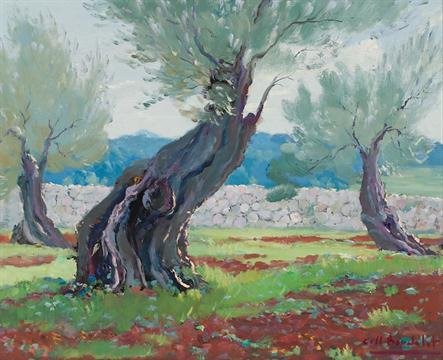
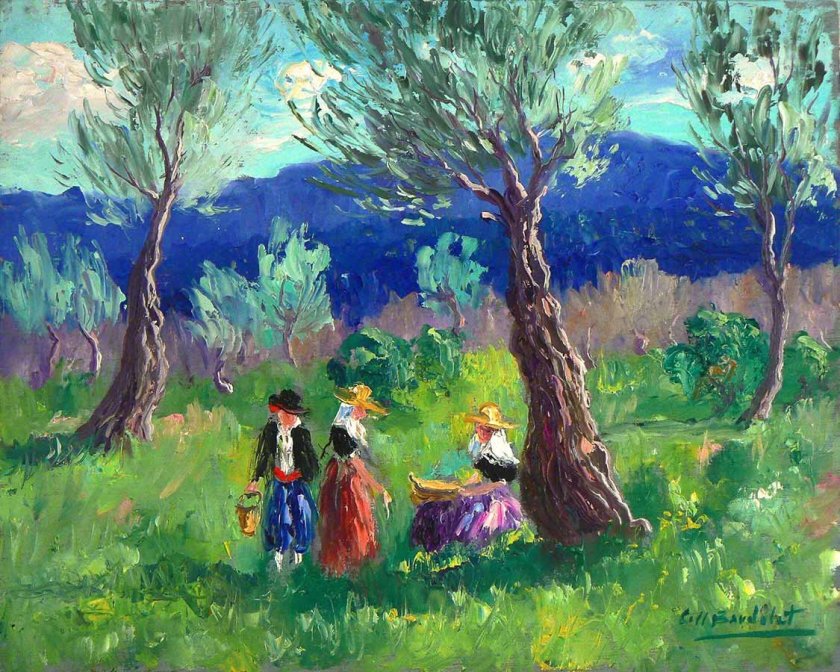
The first artist I am featuring is the Catalan painter Josep Coll Bardolet, whose work I came across at a gallery in the quaint Mallorcan town of Valldemossa.  He was born in November 1912 on mainland Spain, in Campdevànol, a village in the province of Girona.  When he was fifteen years old the family moved to the city of Vic, a small town twenty miles south of where he was born and where Coll Bardolet began his education at the Escola Municipal de Dibuix and worked as a painter and decorator. It is in that year in Vic that he held his first exhibition of his paintings. Having developed a love of landscape painting he then enrolled at the Landscape Painting School in Olot, which is now known as Escola d’Art i Superior de Disseny d’Olot .  The town of Olot, which lay twenty miles east of Campdevànol, is known for its natural landscape, including four volcanoes which are scattered around the city centre.  The town was also famous for its cultural activity, with its various art movements such as the Olot School of landscape painting.  The Olot School was a group of painters that created an artistic style in the second half of the 19th century, similar to the French Barbizon School.

Cala Deiá by Josep Coll Bardolet

In July 1936, the Spanish Civil War broke out and Bardolet, being a pacifist, decided to leave his homeland and cross the border to France.  He travelled to Tours and here he studied at the town’s Academy of Fine Arts.  The following year he moved to Brussels where he was appointed professor at the city’s Académie Royale des Beaux-Arts.

Majorcan Landscape (Oil on tablex) by Josep Coll Bardolet

In 1939 he returned to Spain and his beloved Catalonia and it is whilst here that he makes a number of journeys to Mallorca, each time staying longer and longer on the island.  He was fascinated by the island’s light, landscape and its folk dances and it is these themes which play a major part of his art.  His paintings were exhibited both on the mainland at Barcelona and on the island at Palma.  His love of the island grew over the years and finally in 1944 he settled permanently in Valdemossa.    He bought a house with a studio and a garden next to the Charterhouse of Valldemossa, a former Carthusian monastery, which is now a museum.  Here he lived with a small dog, a cook and a housekeeper.  Over the next twenty years he worked tirelessly completing paintings which are exhibited in galleries throughout Europe as well as Boston, USA.

Collidores by Josep Coll Bardolet

In 1987 he was declared an honorary citizen of Valldemossa, the town he had made his home for over forty years.  In 1988, in recognition of his achievements the Coll Bardolet  Art Gallery was opened in Campdevànol, the village where he was born seventy-six years before.

Spanische Tänzer by Josep Coll Bardolet

Thirty miles north-east of where Bardolet used to live in Valldemossa is the town of Escorca and there is the Santuari de Lluc, a monastery and pilgrimage site.  In 1984, with the celebration of the centenary of the Coronation of the Virgin the museum expanded with the addition of a considerable acquisition of modern art and sculpture, which was further extended to include rooms dedicated to the work of Josep Coll Bardolet who made two donations totalling 236 works of art in 1989 and 1995.  The new and definitive collection was opened on 10th September, 1995 and is made up of the Coll Bardolet Collection of portraits, drawings, gouache and water-colours.

The Coll Bardolet Cultural Fundation

In 1990 Bardolet was awarded the Saint George Cross by the Autonomous Government of Catalonia and the Gold medal of the Community of the Balearics Islands.  The Coll Bardolet Cultural Foundation was established in 2005 with the works donated by him to the town of Valdemossa.  The Foundation has two main objectives. The first is to preserve, exhibit and publicise the pictorial work of Josep Coll Bardolet and the Foundation’s private collection of his work, and the second is to promote the fine arts in all of their facets and forms.  The Foundation, which I visited last week, is in a three storey building in the centre of Valldemossa.  The first floor of the building features a permanent exhibition of Coll Bardolet’s paintings, which primarily consist of landscapes of Mallorca, though they also include still lifes, flower compositions and his well-known renderings of traditional Mallorcan folkdance scenes. The second floor houses temporary exhibitions, and the ground-level floor accommodates different cultural activities, such as conferences and concerts.  The building was restored under the auspices of the Balearic Islands Government and the Valdemossa Town Council.  The works in this permanent collection captivate the beautiful Mallorcan scenery.

Josep Coll Bardolet (1912 - 2007)
Josep Coll Bardolet
(1912 – 2007)

Josep Coll Bardolet died in Valdemossa in July 2007, aged ninety-four.

———————————————————

Joan Miro at work
Joan Miro at work

The second artist I am featuring today is the Barcelona-born painter who also had a connection with Mallorca.  He is Joan Miró.  I visited the museum dedicated to his art work, the Fundación Pilar i Joan Miró (Pilar and Joan Miró Foundation) museum whilst visiting Cala Major just a little way west of Palma.  Although born in Catalonia, both his mother and wife came from the Balearic Island of Mallorca.  The museum is comprised of a main building which houses his works which he donated, a library, a sculpture garden, Miró’s Sert studio, a building designed by his friend of twenty-five years, the Spanish architect and city planner, Josep Sert.

Inside the Gallery at the Fundación Pilar i Joan Miró, Palma Mallorca

In 1937, Josep Sert designed the Pavilion of the Spanish Republic for the Paris Exposition Universelle, for which Miró painted a large format oil painting, The Reaper, also known as El campesino catalán en rebeldía (Catalan peasant in revolt).

Joan Miró working on The Reaper

It was an enormous mural, 5.5metres tall.  Sadly it was destroyed or lost in 1938 and only a few black and white photographs survive, including one showing Miró working on the mural.

Inside Miró's Sert Studio
Inside Miró’s Sert Studio

The Sert studio is the one he used from the time he arrived on the island in 1956 until his death in 1983.  Almost twenty years earlier, in May 1938, whilst living in exile in Paris, he wrote about how owning his own spacious atelier would give him so much pleasure:

“My dream, when I can set somewhere, is to have a large workshop, not so much for lighting, north light, etc., that I find indifferent as to have more space, many fabrics, because the more I have work, the more you come to me to do “.

In 1956 his Sert atelier was ready for him and Miró remembered the time well, saying:

“…In the new study, I had enough space for the first time. I could unpack boxes containing works long ago […] When I took everything in Mallorca, I started myself […] I was ruthless with myself. I destroyed many fabrics, especially a lot of drawings and gouaches… “

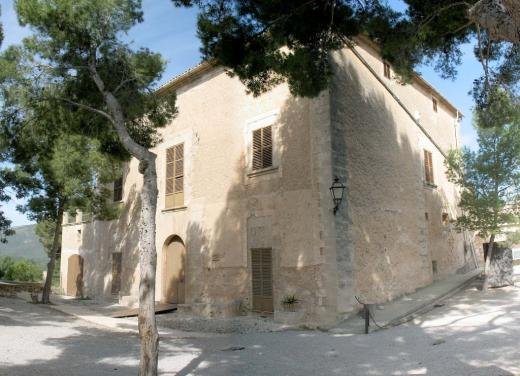
Finca Son Boter
Finca Son Boter

Also on the land, there is the Finca Son Boter which he often used as a studio.  The structure is of a typical eighteenth century Mallorcan manor house and its name derives from the surname of the owner of the land in the fourteenth century, the merchant Llorenc Boter.  The closeness of Son Boter to his Sert studio was commented upon in Miró’s letter to Josep Sert.  In October 1959, he wrote:

“…I just bought Son Boter, the magnificent house located behind ours. What, besides being a good investment, puts us safe from possible fastidious neighbors. I also serve to make fabrics and monumental sculptures, as well as to decongest the workshop…”

Sculpture outside Miro's studio
Sculpture outside Miro’s studio

The cost of the building was probably offset thanks to the funding which came with the Guggenheim prize, which he had won in 1958 for the creation of two ceramic murals he did for the UNESCO headquarters in Paris.

View of Cala Major, Palma, from the Joan Miro Museum

Joan Miró maintained a close relationship with Mallorca throughout his life. Although he was born in Barcelona on April 20, 1893, his mother, Dolores Ferrà, and his maternal grandparents were from Mallorca and from 1900, when he was only seven years, he began to spend part of the summer with his maternal grandmother in Mallorca.

Joan Miro and Pilar Juncosa (1929)

In 1920 Miró made his first trip to Paris, which would was to prove the turning point in his life.  In October 1929 his ties with Mallorca strengthened when he married Pilar Juncosa Iglesias.  Pilar’s mother, Enriqueta, was cousin of Miró’s grandmother.

 Joan MiroIn 1936 he travelled to Paris with his latest works, which were to be exhibited in New York. When the Spanish civil war broke out, he decided to stay in Paris and his wife and daughter joined him.   He lived and worked in an apartment at 98 Boulevard Auguste Blanqui, Paris and attended life classes at the Académie de la Grande Chaumière, where he produced a large number of drawings.  In the summer of 1939, with the onset of the Second World War he and his family left Paris and moved to Varengeville-sur-Mer in Normandy, where he rented a house and where the family remained until 1940.

Z 097At the end of May 1940 the Germans bombed Normandy and Miró decided to return to seek refuge in Spain with his family.  His fame had by now crossed the Atlantic and in 1947 during his first trip to America, he produced a mural painting for the Gourmet Room at the Terrace Plaza Hotel in Cincinnati.

Initially, Miró and his family had left France for Barcelona, but Miró had been an active sympathiser for the Republican struggle during the Spanish Civil War a few years earlier and this made him unpopular with Franco’s new regime, and so in 1956, he and his family decided to set up home in the relative isolation of Mallorca.  .

Joan_Mir_Espa_a_Catalu_a_El_nacimiento_del_d_aIn 1956 Miró  summed up his love of the Balearic Island:

“…This wonderful country … We are about to buy a house near Palma in a beautiful land. Dividing my time between here [Mallorca] and Paris, and occasionally travelled to New York, would be ideal for work and health… “

Joan Miró died in Palma de Mallorca on Christmas Day 1983, aged 90. He was buried in the Montjuïc cemetery, Barcelona on December 29th.

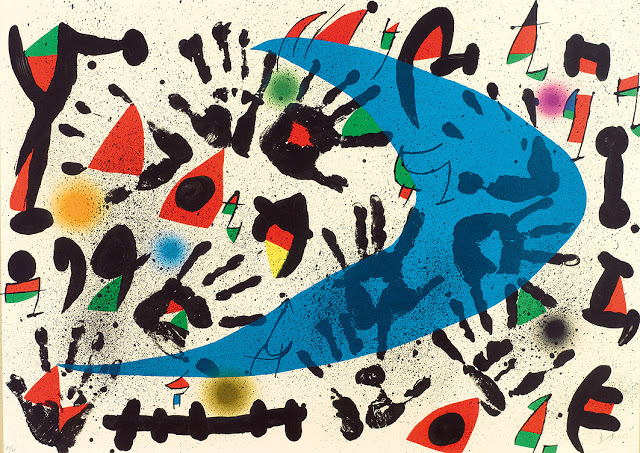
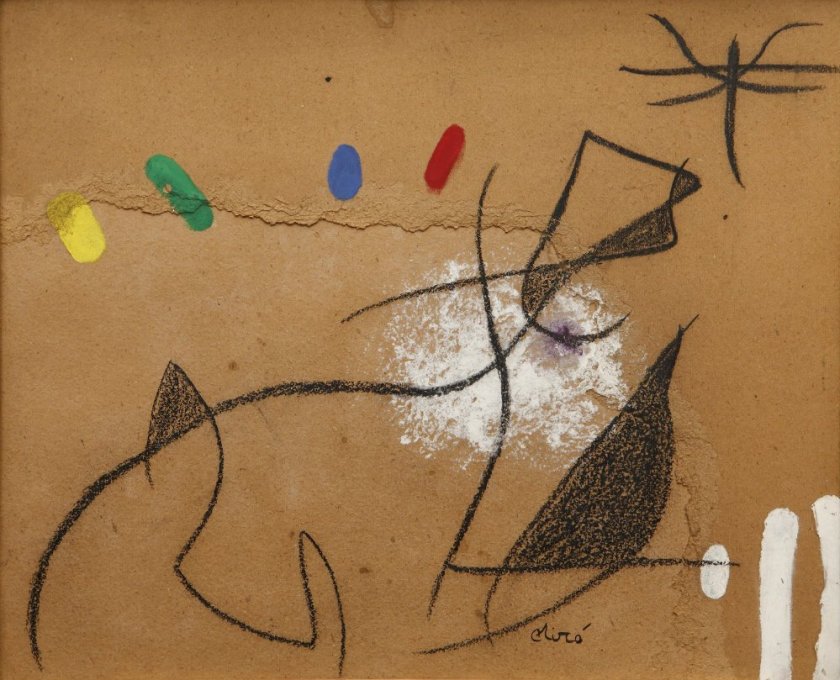
Oiseau dans La Nuit by Joan Miro (1973)

I have purposely not commented on the paintings as they are not the kind of art that I can understand or appreciate.  I am however mindful of what somebody once told me.  They said I must embrace all types of art and never make the crass comment that a child could have done better !  As I said at the beginning, beauty is in the eye of the beholder, so maybe this is your type of art, and if it is, enjoy.


Goethe – His family, his early life and his loves

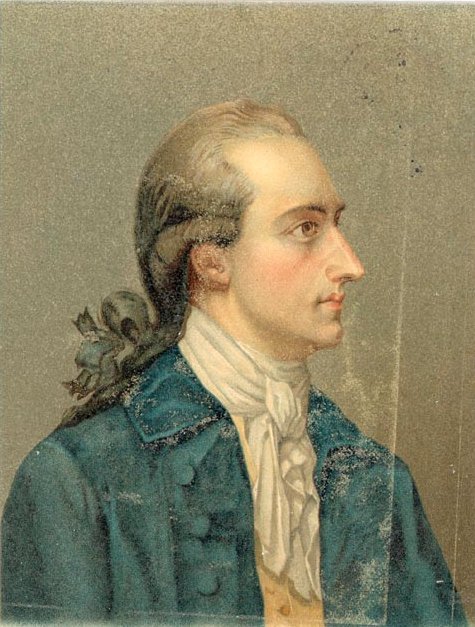
Portrait of Johann Wolfgang von Goethe by Georg Oswald May (1779)

 In nearly all my previous blogs I have either featured a single painting or a single artist but this blog is different as I am concentrating on not just one piece of art or one painter but instead looking how various artists portrayed the same sitter.  The subject of this blog is the German writer and statesman Johann Wolfgang von Goethe.

Johann Caspar Goethe (father)

Goethe was born in Frankfurt am Main in August 1749.  His father was Johann Casper Goethe, whose father was the son of a wealthy tailor who later became an innkeeper.  Goethe’s father inherited a fortune from his late father’s estate and after studying law at Leipzig University enjoyed the life, as a man of leisure, touring Italy, France, and the Low Countries.  Goethe Snr. was also an avid collector of books and paintings and later he would devote himself to his children’s education.

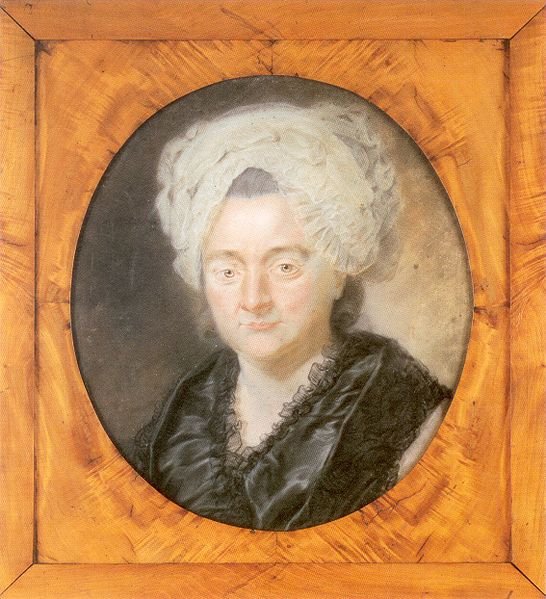
Catharina Elisabeth Goethe (mother) by Georg Oswald May (1776)

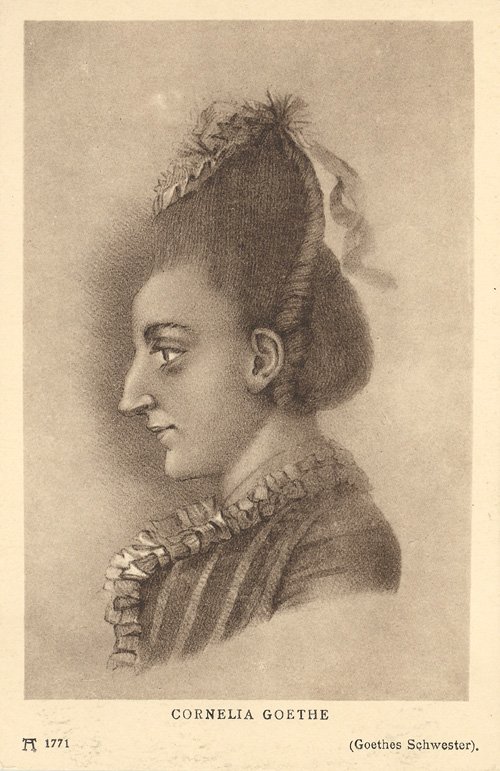
Goethe’s mother was Catharina Elisabeth Goethe (née Textor), the daughter of Johann Wolfgang Textor, a prominent citizen of Frankfurt. She was twenty-one years younger than her husband whom she married in August 1748. Goethe was the eldest of seven children.  Sadly only he and his eldest sister, Cornelia, who was two years his junior, lived to adulthood with the other siblings dying in infancy.

Cornelia Goethe (1771)

The family’s status would probably be identified as middle-class but they were financially well off and young Goethe lived a comfortable early life.  Frankfurt, at the time, was a wealthy commercial and financial centre, and it was also virtually a self-governing republic, a kind of city-state within the Holy Roman Empire.   His mother was a great influence to her son in the early days when she encouraged him to read and consider writing stories.  He attended a local school but after some troubles his father withdrew him and decided that his son should be home-tutored along with his sister Cornelia.  Tutors were brought in and young Goethe received academic lessons in subjects such as Greek, Latin, French, Italian, English and Hebrew as well as non-academic tuition in horse riding, dancing and fencing.  Home tutoring continued until he was fifteen years old.

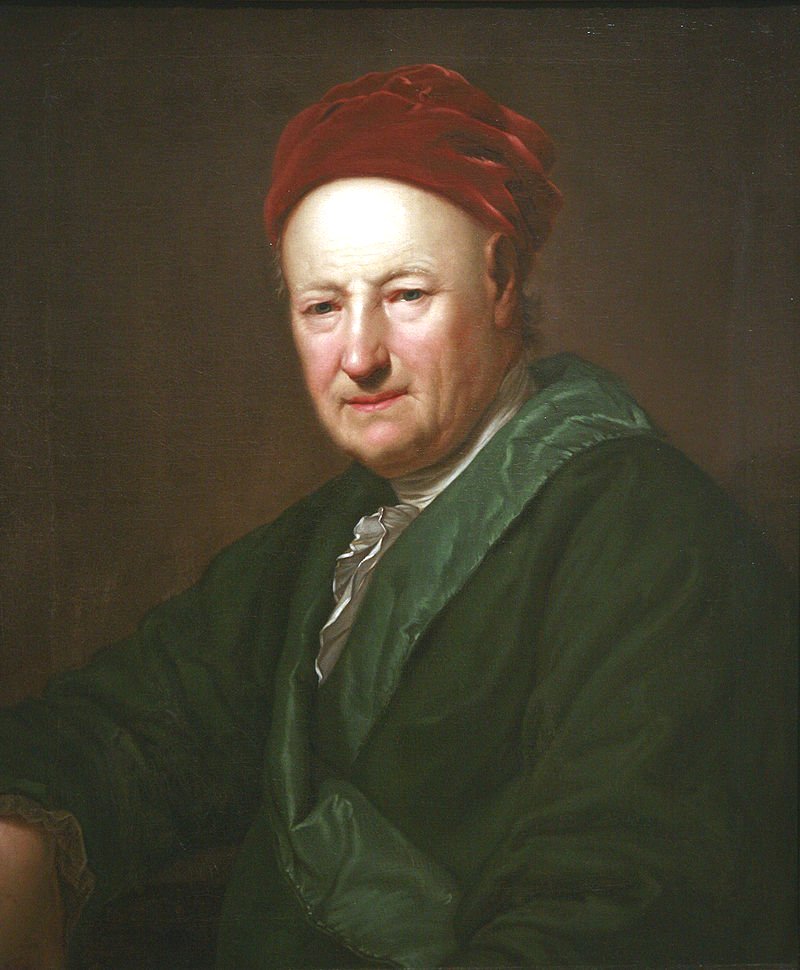
Portrait of Adam Oeser by Anton Graff (1776) (Musée des Beaux-Arts de Strasbourg)
Portrait of Adam Oeser by Anton Graff (1776)
(Musée des Beaux-Arts de Strasbourg)

Goethe’s father had mapped out his son’s future education and career, wanting him to follow in his own footsteps, attending Leipzig University as a law student and then going forward into the legal profession.  Following that, his father believed that there would be a place for his son at the Supreme Court in Wetzlar and that the rounding off his education would be accomplished by young Goethe taking part in a Grand Tour of Italy.  Following that journey, his father had great hopes that his son would carve a niche in Frankfurt society and gain a powerful position in the city’s administration – an end game his father never quite managed to achieve, and so in 1765, at the age of sixteen, Goethe, like his father before him,  enrolled at Leipzig University to study law.  The city was the hub of the country’s literary revival.   It was whilst in Leipzig that he had his first official drawing lessons from the German painter and sculptor Adam Friedrich Oeser , a professor at the Hochschule für Grafik und Buchkunst in Leipzig, which had opened its doors for the first time the year before and would become one of the oldest art schools in Germany.  It was during his artistic studies that Goethe became influenced by the writings of the art historian Johann Winklemann.

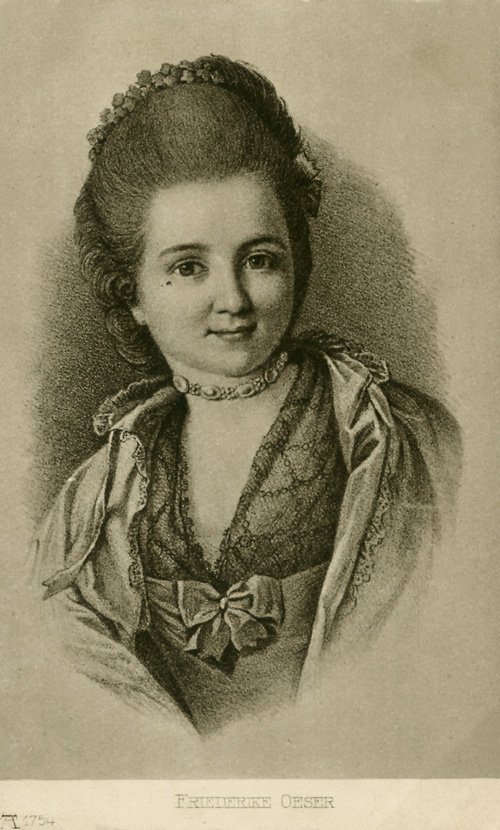
Friederike Oeser
Friederike Oeser

Whilst taking drawing lessons at the home of Adam Oeser he became friends with his daughter Friederike Oeser .  The Oeser family proved to be a great influence on Goethe and for years after his departure from Leipzig he would write to both father and daughter

By the time Goethe entered Leipzig University he had written a few short pieces but on reflection thought that they were child-like in quality so decided to destroy them and write a more adult piece.  The result was a collection of erotic verses and a pastoral drama, a form of drama evolved from poetry which idealizes nature and the rural life, entitled Die Laune des Verliebten (The Lover’s Caprice) which he started in 1767 but did not complete until many years later.

Anna Katharina Schönkopf

All was not well with university life as he fell in love with Anna Kätchen Schönkopf, the daughter of an innkeeper and wine merchant, Christian Gottlieb Schönkopf.  Although bombarding her with words of love and devotion and dedicated poems to her (a collection of them entitled Annettenlieder (Songs to Annette) was later published), the young woman, sadly for Goethe, never returned his love and was put off by his jealousy and eventually entered into a liaison with another aspiring lawyer, Christian Karl Kanne, ironically, a man who had been introduced to Anna by Goethe.

Goethe was devastated and decided to take literary revenge by writing a verse comedy, Die Mitschuldigen (Partners in Guilt) which highlighted the folly of a woman and her regrets after a year of marriage to the wrong man.  Goethe’s stay at the university was cut short in September 1768 when he was struck down with tuberculosis and had to return home without any qualifications.  In April 1770 having recovered from his long illness he travelled to Strasbourg to resume his studies for a doctorate in law.  To achieve this he had to produce a dissertation,  His choice of subject for the dissertation was controversial in which he questioned the status of the Ten Commandments.  For the examiners it was a step too far and was rejected and so his studies took another route by taking instead the Latin oral examination for the licentiate in law which he passed.

Friederike Brion. Color lithograph after drawing of George Engelbach

In October 1770, during his student days in Strasbourg, Goethe met Friederike Brion, an eighteen year old Lutheran pastor’s daughter during a riding trip with a fellow student, Friedrich Weyland,  to the small village of Sesenheim, forty kilometres north of Strasbourg, not far from the River Rhine. The two had dressed themselves as impoverished theology students and managed to inveigle a stay at the parsonage overnight which was when Goethe was introduced to the family.  Once again it was love at first sight when he saw Friederike .  He wrote about the initial encounter with Friederike:

“…Slim and light, as if she had nothing to wear in itself, she went, and almost seemed for the huge blond braids cute little head, the neck too delicate. From serene blue eyes, she looked around very clear, and the like snub nose did research so freely in the air, as if there could be in the world do not worry; the straw hat hanging on the arm, and so I had the pleasure to see them at the first glance at once in all its grace and loveliness and be seen…”

The love affair was both passionate and short-lived, ending when Goethe had received his licentiate in June 1771 and “fled” back to the family home in Frankfurt.  As a young man, Goethe was somewhat of a commitment-phobe.  Friederike was broken-hearted and suffered a breakdown.  Maybe Goethe felt some guilt as a lot of his writings during the next decade featured women who had been spurned by their lovers. One such work was Heidenröslein (“Rose on the Heath” or “Little Rose of the Field”) which was a poem he wrote in 1771.  Heidenröslein tells of a young man’s rejected love, with the lady being represented by a rose.

Goethe and Friederike Brion by Eugen Klimsch (1890)

The German painter and illustrator, Eugen Klimsch, captured a scene between the star-crossed lovers, Friederike and Goethe, in a woodcut entitled Goethe and Friederike Brion which he completed in 1890.  Klimsch was a follower of seventeenth century Dutch paintings and French Rococo art and his greatest success was the illustrations he did for the 5th edition of Goethe’s autobiography, Aus meinen Leben, Dichtung und Wahrheit (Poetry and truth from my own life) a story of his life between birth and 1775.

The first meeting between Johann Wolfgang Goethe and Friederike Brion in Sesenheim by August Borckmann (1875)

Another illustration featured Goethe and Frederike first meeting, this time by August Borckmann which appeared in an 1875 edition of Das Buch Für Alle (The Book for All), a German illustrated monthly family magazine.

At the graveside of Friederike Brion (200th death anniversary)
At the graveside of Friederike Brion
(200th death anniversary)

Frederike Brion died in Meißenheim in 1813 and three years ago there was a service at her grave to mark the 200th anniversary of her death.  Among those present were dignitaries from Sesenheim and Conrad Textor (2nd from left), a descendant of Goethe.

Having achieved the licentiate in law, Goethe then started a legal practice in Frankfurt.  The plans for his future that his father had meticulously designed were well on the way to fruition !   In the spring of 1772 Goethe, wanting to further himself in the legal profession. travelled to Wetzlar, to work and gain practical experience as a law clerk at the Imperial Supreme Court.  Wetzlar proved to be yet another location where Goethe fell in love, this time his beau was Charlotte Buff.  This liaison was never going to be a success as, at the time, Charlotte was, and had been for four years, engaged to be married to Johann Kestner, an art collector and diplomat, and although she, Goethe and Kestner spent time together the short lasting experience was always going to be a disappointment to Goethe and end in tears, even though he provided the wedding rings for the happy couple.

First edition of Die Leiden des jungen Werthers by Johann Wolfgang Goethe

According to J G Robertson in his 1959 book A History of German Literature, the doomed love of Goethe led him to publish an emotional novel entitled Die Leiden des jungen Werthers  (The Sufferings of Young Werther), which was published in 1774. The fictional tale, thought to be semi-autobiographical, is presented as a collection of letters written by Werther, a young artist of a sensitive and passionate temperament, to his friend Wilhelm. These give an intimate account of his stay in the fictional village of Wahlheim (based on Garbenheim, near Wetzlar whose peasants have enchanted him with their simple ways. There he meets Charlotte, a beautiful young girl who takes care of her siblings after the death of their mother. Werther falls in love with Charlotte despite knowing beforehand that she is engaged to a man named Albert eleven years her senior.  This novel proved immensely popular in Europe, and was far more influential than Goethe’s later works. Werther became a cult-figure for a whole generation, but was also criticized as provocative and a threat to customary morality. The novel was translated into many languages, imitated, “corrected,” even occasionally forbidden—whereupon it would be circulated secretly from one reader to the next

Charlotte Buff-Kestner by Johann Heinrich Schröder

A painting of Charlotte Buff-Kestner was completed by the German pastelist  portrait painter, Johann Heinrich Schröder.  Schröder  was born in Meining in 1757 and studied at the Academy of Painting and Sculpture in Kassel under Johann Heinrich-Tischbein  (see later, his paintings of Goethe).   Schröder soon became a portrait painter at the German royal courts, such as the one of Brunswick and Baden, where his lively, bright pastel portraits were highly acclaimed.

Goethe is made Privy Councilor by Wilhelm von Kaulbach,

In December 1774 Goethe made the acquaintance of Carl August, the Hereditary  Duke of Sachsen-Weimar –Eisenach, and had been invited to Weimar as his guest.  In October 1775 he made the journey to the German town which was then under the influence of Duchess Anna Amalia who was an ardent patron of the arts. After arriving in Weimar, Goethe was serenaded by the courtiers and became a good friend of Anna Amalia’s son Duke Karl August, so much so, on Goethe’s thirtieth birthday, in 1779, recognizing his official duties, he was made a privy councilor and the ceremony was captured in the drawing by Wilhelm von Kaulbach.  In the sketch we see Goethe being crowned by Duke Karl and seated we see Anna Amalia.  Goethe commented about the event, writing:

“…It is strange and dream-like, that I, in my thirtieth year, enter the highest place which a German citizen can reach…” 

Charlotte von Stein by Georg Melchior Kraus (1787)

One of Anna Amalia’s ladies in waiting at the Weimar court was Charlotte von Stein.  Shortly after his arrival in Weimar Goethe met Charlotte and a friendship quickly followed which would last more than a decade.  During that period she greatly influenced Goethe’s life and his writing.  They were so close that her eleven year old son came to live with Goethe and he acted as his tutor.

In September 1786, ten years after his arrival in Weimar, Goethe suddenly left the German town and his friends and set off for Italy on what was to be a two year voyage of discovery.  He had not consulted the Duke of Weimar, his employer or his close friend Charlotte von Stein.   This decision of course was the final piece of his father’s jigsaw plan for his son’s life.   He was thirty-seven years of age and the sojourn proved to be, as Goethe put it, “the happiest period of his life”.  It was in Italy that Goethe arranged a travelling stipend for the German portrait painter Johann Heinrich Wilhelm Tischbein so that he could join him.  Goethe had been pleased with Tischbein’s works of art and believed that he would be a good travelling companion and someone who could help him with his own works of art .  When they arrived in Rome, the two lodged in a large apartment on the Via del Corso.  Johann Tischbein had come from a family of artists which spanned three generations and to identify him from his siblings he became known as “Goethe’s Tischbein”.  The two lived in adjoining rooms of the apartment but often took meals together.  Goethe was initially delighted with his companion, writing:

“…We are so well suited that it is as if we have always lived together…”

This initial friendship waned slightly, as although they travelled together from Rome to Naples, they then parted company with Goethe wanting to head to Sicily and Tischbein, being of more meagre means, decided to stay in the Neapolitan city in the hope of attaining a post at the Academia del Arte.  The two were very different in character and latterly could not stand each other’s company !

Goethe at the window of the apartment on the Via del Corso, Rome by Johann Tischbein (1787) (42 x 27cms) (Frankfurter Goethe-Museum)
Goethe at the window of the apartment on the Via del Corso, Rome by Johann Tischbein (1787)
(42 x 27cms)
(Frankfurter Goethe-Museum)

One of Tischbein’s great talents as an artist was his power of observation and this is highlighted in his  watercolour entitled Goethe at the window of the apartment on the Via del Corso in Rome which he completed in 1787.

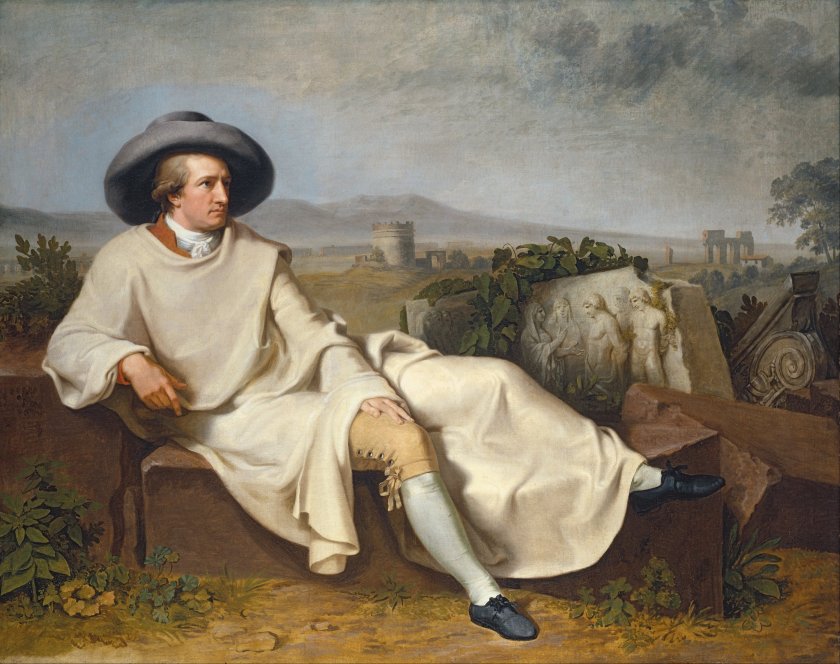
Goethe in the Roman Campagna by Johann Heinrich Wilhelm Tischbein (1787) (164 x 206cms) Frankfurt Stâdel Museum
Goethe in the Roman Campagna by Johann Heinrich Wilhelm Tischbein (1787)
(164 x 206cms)
Frankfurt Stâdel Museum

Tischbein’s most famous painting, and said to be one of the most popular works of art in Germany, is his 1787 work entitled Goethe in the Roman Campagna, which he had started the previous October.   We see Goethe wearing a halo-like broad brimmed grey hat, which was de rigeur for the German artists living in the Eternal city.  He wears a long sleeved creamy white duster and gazes out at the distant landscape in an idealized full-length classical pose.  He looks calm and collected.  It is typical of a Neoclassical painting with the ancient ruins seen in the background.  Behind Goethe, towards the right of the painting we can see a relief scene of Iphigenia meeting her brothers.  This was not an accidental inclusion by Tischbein as at the time Goethe was working on Iphigenia in Tauris based on the ancient Greek tragedy by Euripides , Iphigeneia in Taurois.

I suppose I should apologise over this blog on two counts.  Firstly it is over-long and secondly it is probably more to do with history than art but after reading about the painting Goethe in the Roman Campagna I got hooked on the writers early life and loves.

Thorolf Holmboe

Thorolf Holmboe
Thorolf Holmboe

In past blogs I have looked at some of the well known Norwegian painters such as Edvard Munch, Thomas Fearnley, Johan Christian Dahl and Peder Balke.  In today’s short blog I am going to examine the life and work of another artist from that country, one less well-known, Thorolf Holmboe.

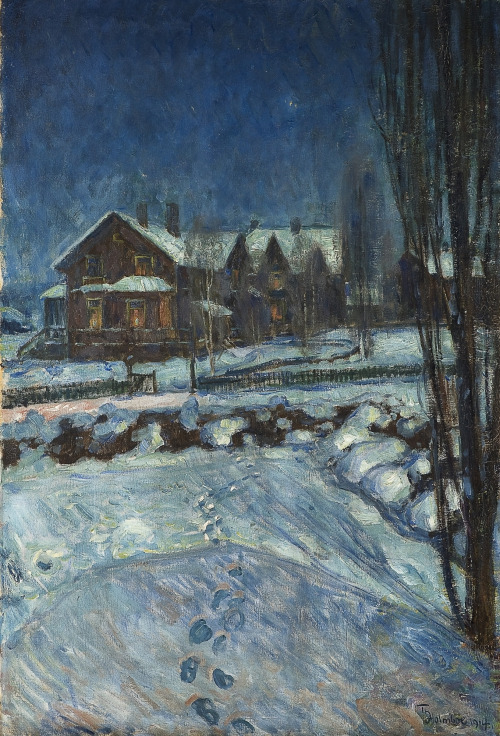
Thorolf Holmboe (Norwegian, 1866-1935), Landscape in Moonlight with a House, by Thorolf Holmboe (1914) Oil on canvas, (120 x 80 cms).
Landscape in Moonlight with a House, by Thorolf Holmboe (1914)
Oil on canvas,
(120 x 80 cms).

Thorolf Holmbloe was born in May 1866 in Vefsn a municipality in Helgeland which is the most southerly district in Northern Norway.  He was the eldest son of Othar Ervigius Holmbloe, a Customs cashier and Sofie Birgitte Andrea Hall.  He had two sisters, an elder one, Halfrid and a younger one, Gudrun and four younger brothers, Othar, who was also an artist and illustrator although he trained as a chemist and Birger, Jens and Thorvald.  Around the age of eight Thorolf and his family moved to the coastal town of Tromso and it was around this time he received his first watercolour painting lessons.  His father, who had an interest in art and was a founder of a local gallery, and probably encouraged his son to take up painting.

Still life by Thorolf Holmboe (1907)

Thorolf attended school in Christiania (now called Oslo) and graduated in 1884.  He then attended the military academy where he was a reserve officer in 1886.  In 1886, he studied marine art under the Norwegian marine painter, Carl Wilhelm Barth.  That year he travelled to Berlin where he enrolled, for a year, at the Berlin Academy of Art and studied under the professorship of the Norwegian romanticist artist and revered landscape painter Hans Gude.  After returning to Norway he studied at the Drawing School in Christiania under the sculptor, Julius Middelthun.

In August 1888 Thorolf married Julia Caspara Nilssen and the couple went on to have two children, a son, Erik Oscar born in 1895 and a daughter Erna Johanne who was born in 1899.

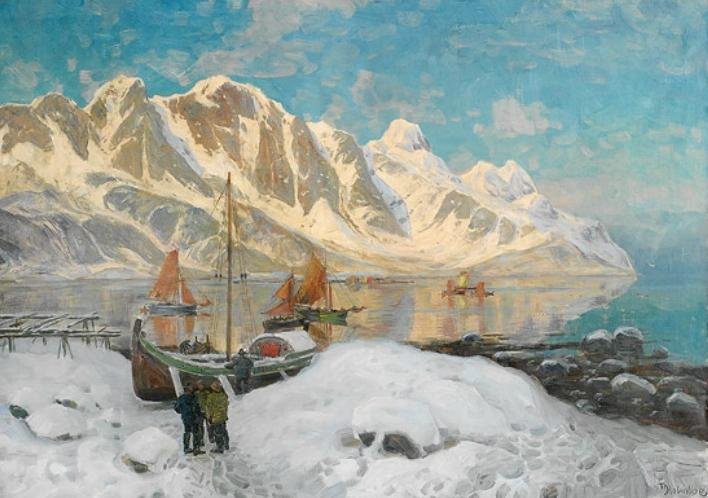
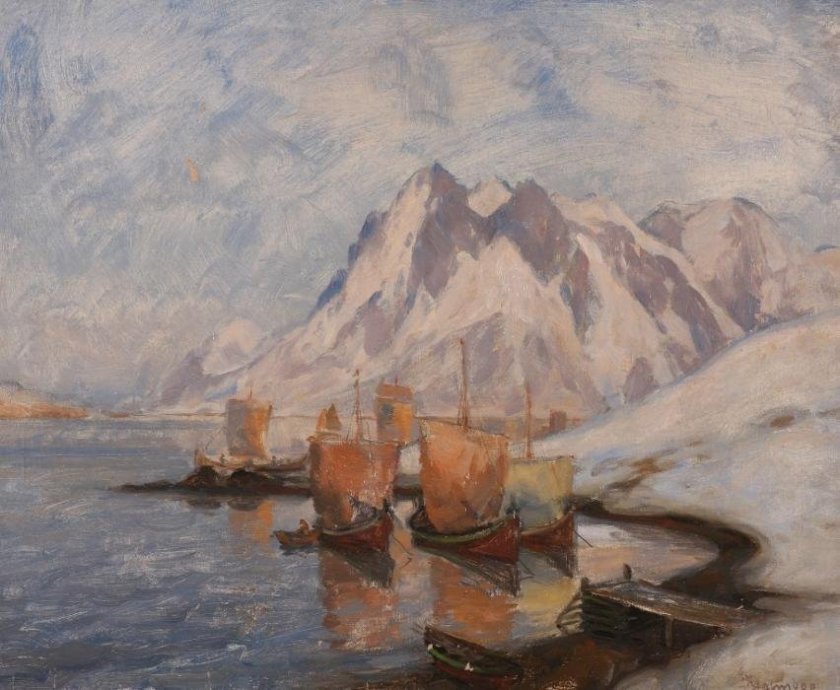
Fishing Village, Lofoten by Thorolf Holmboe

In 1889 he again left home to study art.  This time Holmbloe travelled to Paris where he remained for two years and studied at the atelier of the French painter, Fernand Cormon, who was a regular exhibitor at the annual Paris Salon.  Cormon had in the past had Toulouse-Lautrec, Louis Anquetin,  Van Gogh and Émile Bernard as former students.  Holmboe also attended classes at the École des Beaux-Arts where he was tutored by the French painter, Léon Joseph Florentin Bonnat .

Nordic Landscape (Nordlandsmotiv) by Thorolf Holmboe

Many of the Norwegian artists at the time completed paintings which formed what was termed a “Norwegian style” as they focused wholly or in part on aspects of Norwegian heritage.  Holmboe avoided this style and instead focused on Norwegian nature especially around his former home in the north of the country.  For him the beauty of his homeland is what he wanted to bring to the fore and this style was very popular with buyers in Norway and the rest of the world.

The Journey by Thorolf Holmboe

He completed many seascapes and it was probably his early life around Vefsn and Tromso that had such a great influence on his art.  He developed a strong affinity for the ocean and the power of the sea and this empathy with the power of nature stayed with him for the rest of his life.

He exhibited in Munich in 1891 and Paris in 1900 and went on to exhibit internationally and was granted solo exhibitions in Paris, Antwerp, Stockholm, Gothenburg, Copenhagen and London.  In his 1907 exhibition in London he exhibited many of his snow scenes.  More recently his work appeared in an exhibition entitled Symbolism in Norwegian Landscape Painting at the Palazzo del Diamanti in Ferrara, Italy in 2001.

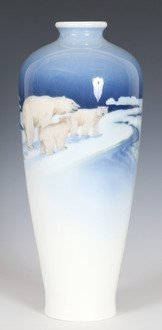
Thorolf Holmboe "Polar bear on Ice" design for Porsgrund porcelain vase
Thorolf Holmboe “Polar bear on Ice” design for Porsgrund porcelain vase

Between 1906 and 1925, Holmboe came up with designs and artwork for the famous Norwegian pottery maker, Porsgrund.  The pottery with some of his designs were used as decoration in the exhibition halls of the 1913 Prima Esposizione internazionale d’arte della Secessione Romana (First Roman Secession Exhibition).

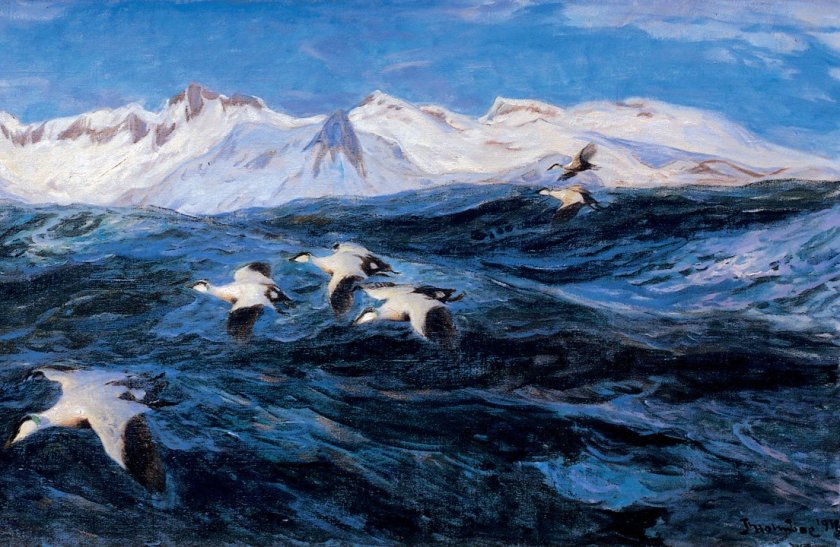
Marine painting by Thorolf Holmboe

Many of Holmbloe’s paintings featured seabirds, rocky cliffs and the rough coastal waters

Fra Akerselven (From Akerselven) by Thorolf Holmboe

Around the start of the twentieth century Holmboe’s paintings took on a more gloomy appearance.  It was also around the time that he completed paintings featuring the River Akerselven which flows through the city of Oslo.  One such work is his 1902 painting entitled Fra Akerselven (From Akerselven).  It depicts the River Akerselven which flows through the Norwegian city.

Utsikt over Akerselven by Thorolf Holmboe (1903)

Another painting featuring the river was done in 1903 entitled Utsikt over Akerselven (Overlooking Alerselven).  Once again it is a painting made up of dark and muted colours and this has added to the realism of the depiction.

Illustration to The Trumpet of Nordland

One of the most original Norwegian writers of the nineteenth century was the Lutheran priest and poet,  Petter Dass, whose most famous work was Nordlands trompet (The Trumpet of Nordland), a versified topographical description of northern Norway.  It gives a lively picture, in verse, of the life of a clergyman in this part of the country.  In the 1892 the edition of Petter Dass’ book, with its descriptions of the people and nature of Northern Norway, it was accompanied by the illustrations of Thorolf Holmboe.   Holmboe also designed many book covers, folders, telegrams and postcards.

Hekkende skarv (Nesting Cormorants) by Thorolf Holmbloe

In 1908 Holmboe participated in a hunting expedition to Spitsbergen and Hopen where he painted hunting and wildlife. Particularly popular were the pictures of polar bears that “sail” on ice floes (see the Porsgrund vase above).

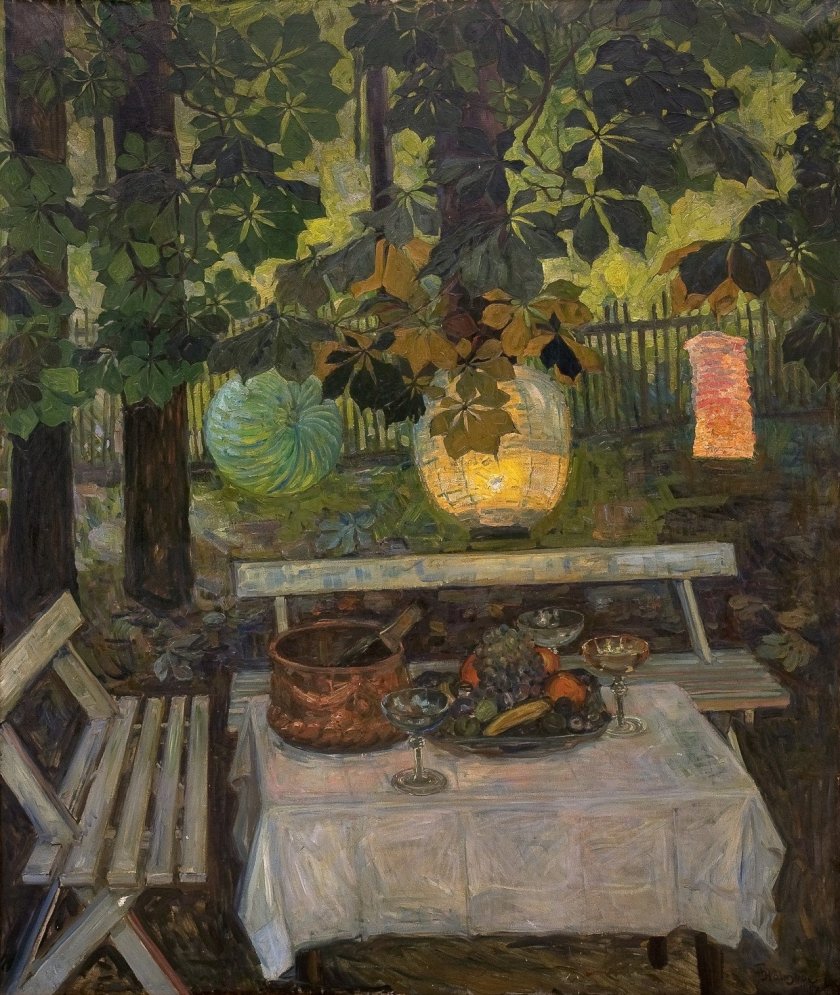
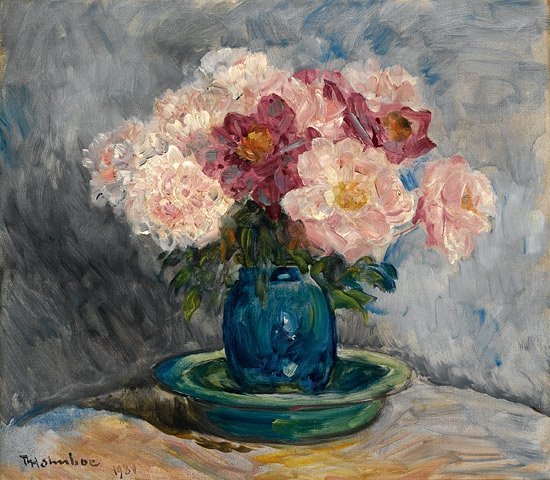
Peonies in a Vase by Thorolf Holmboe

The first decade of the twentieth century proved a difficult time for Holmboe to sell his works of art and despite his huge popularity at home he could not establish himself internationally and so he relied financially on his book illustration work and decoration designs.   However it was not all gloom for him in that first decade as he did receive good reviews of his marine paintings when they were exhibited in Antwerp in 1903 and 1904 and in Berlin in 1907 and 1909.  Things changed after the First World War with their being a greater demand for works of art and Holmboe was ready having built up a large collection of his paintings.   The subjects of these works were varied and included bathing scenes, marine life, still lifes, interiors and garden landscapes.  Thorolf Holmboe was appointed Knight of the 1st Class Order of St. Olav in 1900 and he was knighted by the French Legion of Honour.

Thorolf Holmboe died in Oslo in March 1935, aged 68.

Christoffer Wilhelm Eckersberg. Part 5. Clouds and marine paintings

If there is one other thing I have learnt since taking an interest in art is that by reading up on the paintings and the artists one learns a lot about history, whether it be European or American.  One picks up on things which should have been learnt at school but sadly passed one by.  Today’s look at the work and life of Christoffer Eckersberg is a good example of this in the way I have learnt a little about Danish history.

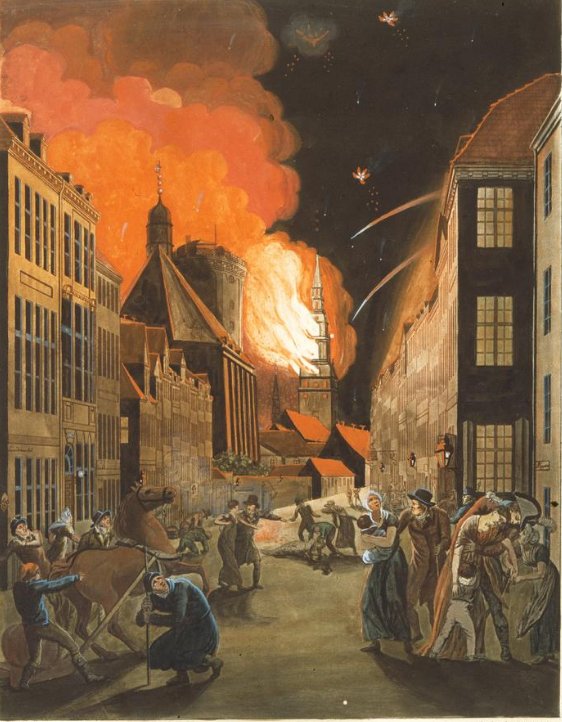
In 1807 the British shelled the Danish capital, Copenhagen.  This was the second ferocious onslaught on the Danish city as six years earlier a similar attack had been made.  It was all to do with the Napoleonic War and the Franco-Russian alliance secret agreement to ensure that Denmark and Sweden would assist them in a naval blockade of British trade.  British diplomats went to Copenhagen to ask the Danish government to put their naval ships under British command until the Napoleonic War had ended but the Danes would not agree and so on September 2nd 1807, the British army landed in Denmark and attacked the Danish capital.  The Danes finally surrendered and their naval ships were taken over by British sailors and sailed to England that October.

The Fire of the Church of Our Lady by Christoffer Eckersberg (1807) The Royal Library, Copenhagen
The Fire of the Church of Our Lady by Christoffer Eckersberg (1807)
The Royal Library, Copenhagen

My first painting I am looking at today by Christoffer Eckersberg, The Fire of the Church of Our Lady, records the terrible onslaught on Copenhagen and is a prime example of history through art.  The work shows the burning of the church steeple of the cathedral of Copenhagen, during the night of September 4th 1807. The steeple eventually fell to the ground.  In the painting we see the pandemonium in the neighbouring street due to the fierce assault and the resulting blitz.

The Bombardment of Copenhagen. View from Ostervold by Christoffer Eckersberg (1807) (50 x 60cms) Museum of National History, Frederiksborg Castle
The Bombardment of Copenhagen. View from Ostervold by Christoffer Eckersberg (1807)
(50 x 60cms)
Museum of National History, Frederiksborg Castle

Another of Eckersberg’s painting depicting the bombardment of Copenhagen can be seen in his 1807 work The Bombardment of Copenhagen.  View from Østervold.  Shortly after the British naval bombardment of the Danish capital, Eckersberg, who was living in Copenhagen, made many drawings, for prints, of the conflagration of the most famous landmarks of the city and by doing so captured for posterity the terrible events.  He managed to capture the feeling of panic which gripped the citizens of Copenhagen when the first shells fell on their beloved city.  Works like this were in general demand and brought about a patriotic stirring that swept through the Danish population in the wake of this British bombardment.

Cloud Study, Thunder Clouds over the Palace Tower at Dresden by J C Dahl (1822) (21 x 22cms) Nationalgalerie Berlin
Cloud Study, Thunder Clouds over the Palace Tower at Dresden by J C Dahl (1822)
(21 x 22cms)
Nationalgalerie Berlin

When Eckersberg returned to Denmark in 1816 after his stays in Paris and Rome he lost contact with most of the international artists of the time, with one exception, the Norwegian painter J C Dahl.   Johan Christian Dahl lived in Norway but spent much time in Dresden and would pass through Copenhagen on his journeys between there and his homeland.  It is known that J C Dahl was fascinated by clouds and their formation and had produced many works featuring this natural phenomenon, one of which was his 1825 painting, Cloud Study, Thunder Clouds over the Palace Tower at Dresden.  For Dahl, the sky was an integral part of a landscape painting, and he would spend many hours observing cloud formations and watch as they crossed over land.

Eckersberg and Dahl developed a lasting friendship and it could have been Dahl’s fascination with clouds and his interest in meteorology that infected Eckersberg, so much so that Eckersberg began a twenty-five year hobby of keeping a daily meteorological diary and would regularly sketch cloud formations.  J C Dahl would also have informed Eckersberg about how both artists and art theorists in Dresden were showing great interest in cloud formations.  Eckersberg was also fascinated by the work of Luke Howard the English manufacturing chemist and amateur meteorologist who in 1802 classified the various tropospheric cloud types and believed that the changing cloud forms in the sky could unlock the key to weather forecasting.

C.W. Eckersberg (1783-1853), Studie af skyer over havet, 1826
Study of Clouds over the Sea by Christoffer Eckersberg (1826) (20 x 31cms) Statens Museum for Kunst, Copenhagen

In 1826 Eckersberg decided to master the art of painting clouds and he took himself off to Kalkbraenderibugten, a bay just north of Copenhagen so that he could paint a range of studies of clouds over water and the painting above, Study of Clouds over the Sea, is one he completed that year

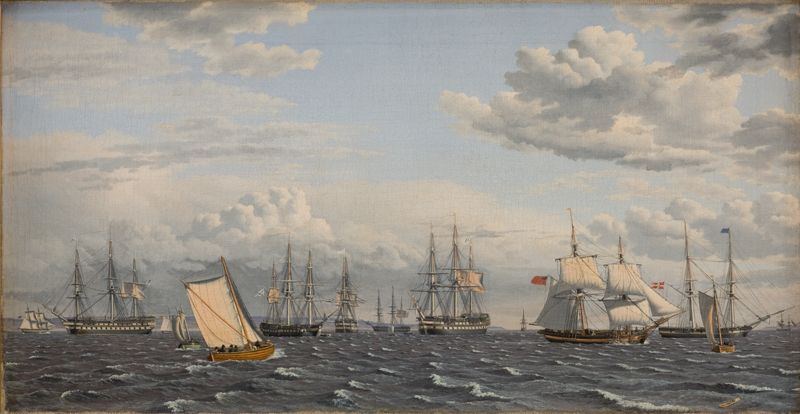
A Russian Fleet at Anchor near Elsinore by Christoffer Eckersberg (1826) (32 x 59cms) Statens Museum for Kunst, Copenhagen
A Russian Fleet at Anchor near Elsinore by Christoffer Eckersberg (1826)
(32 x 59cms)
Statens Museum for Kunst, Copenhagen

Looking at Eckerberg paintings so far I have concentrated on his mythological and biblical works along with some of his portraiture and nude studies but another genre of works favoured by Eckersberg was his marine works which also featured cloud depictions.  A prime example of this is a work he completed in 1827 entitled A Russian Fleet at Anchor near Elsinore.

View of a Harbour by Casper David Friedrich (1816)

The next marine painting by Eckersberg I am featuring could well have come about from a visit he made to the atelier of Casper David Friedrich in Dresden in 1816, on his way home from Rome.  It is quite possible that during that meeting he saw Friedrich’s newly completed work View of a Harbour.

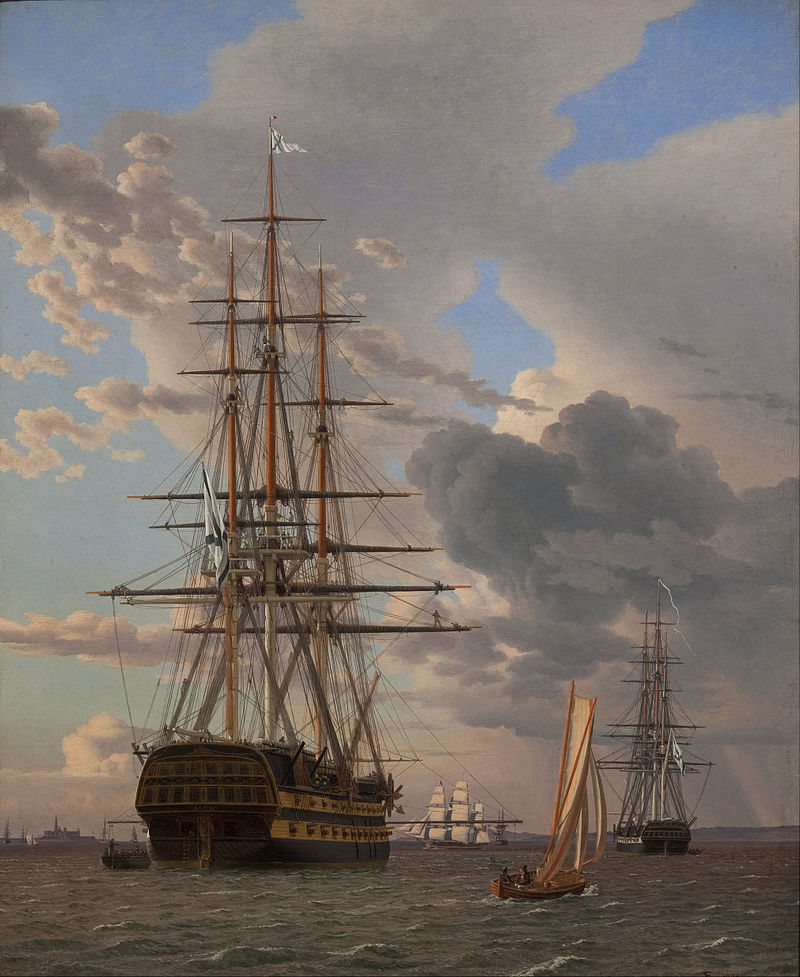
The Russian Ship of the Line “Asow” and a Frigate at Anchor in the Elsinore Roads (1828) (63 x 51cms) Statens Museum for Kunst, Copenhagen
The Russian Ship of the Line “Asow” and a Frigate at Anchor in the Elsinore Roads (1828)
(63 x 51cms)
Statens Museum for Kunst, Copenhagen

This marine painting by Eckersberg is one of my favourites and also one of his best known marine works.  It is his magnificent 1828 painting entitled The Russian Ship of the Line “Asow” and a Frigate at Anchor in the Elsinore Roads.  It is a triumph of detail, not just of the vessel itself and the way he has truthfully represented all the details of the rigging but how he has painstakingly depicted the cloud formation.   So can we look at this as a mastering of plein air painting?  Actually, no !   This is an idealised marine painting made up from a number of Eckersberg’s sketches done at different times and different locations.  He may have been able to see some Russian ships at the Elsinore Roads in 1826, but at a great distance away, and it was not until sometime later that he observed a number of Russian ships at close quarters when they were at anchor in the Copenhagen Roads and it was during that fleet’s visit that he was able to go aboard the admirals’ ship, Azob, (although he later called it Asow !).  He started the painting in 1828 and for accuracy got hold of some constructional drawings of the vessels from the naval dockyard.  He even went as far as consulting his meteorological diary to check the weather conditions on the day the Asow was at anchor off Elsinore, and so the completed 1828 painting is not what Eckersberg saw on that day at Elsinore in 1826 but what he would have seen if he had been able to set off from land in a boat to witness, close up, the mighty Asow.

Eckersberg loved marine painting and in his later years concentrated on this genre at the expense of his once favoured landscape works.

A View towards the Swedish Coast from the Ramparts of Kronborg Castle by Christoffer Eckersberg (1829)

A View towards the Swedish Coast from the Ramparts of Kromborg Castle by Eckersberg is another example of his marine/cloud painting.  From his diary we know that this plein air work was started in September 1826 but was not completed until January1829 .  The artist had positioned himself on the ramparts of the castle looking out across the Øresund towards the coast of Sweden, which was just four kilometres away.   The castle which is on the extreme north-eastern tip of the island of Zealand is in the town of Helsingor and was immortalised as Elsinore in Shakespeare’s play Hamlet. It is a painting which doesn’t just focus on ships and clouds but looks at life going on inside the castle.  We see two maids tending to newly-washed clothes.  We can also see military personnel looking out at the warship in the Øresund strait.  They are engaged in guarding the castle and stand by the gun emplacements.  A Danish flag flutters in the wind as a reminder of the importance of the fortification to the country

The Corvette Galathea in a Storm in the North Sea by Christoffer Eckersberg (1839) (48 x 64cms) Statens Museum for Kunst, Copenhagen
The Corvette Galathea in a Storm in the North Sea by Christoffer Eckersberg (1839)
(48 x 64cms)
Statens Museum for Kunst, Copenhagen

My final look at Eckersberg’s marine paintings is one he completed in 1839 with the title The Corvette Galathea in a Storm in the North Sea.  Eckersburg had been a passenger on the vessel in the May of that year when it was crossing the North Sea on its way to Dover and encountered a fierce storm, which lasted two whole days.  On his return home he wrote up about this dramatic voyage in his diary which he later translated into this painting.  In his diary he wrote:

“…hideously rough waters, in which the ship veered horribly, now up and down, now to one side or the other, making it difficult to hold on tight………when the sun was shining the sea had the most extraordinary beautiful colour, pure blue and green, with glittering white foam….”

Eckersberg’s depiction of the Galathea is as if he had been witnessing the event from another vessel.  The sketches he made in the diary of the event were full of blues and greens of the sea, interrupted by the white of the foam which topped the waves.

The painting was completed in a month, on his return home from Hamburg.

A Sailor Taking Leave of His Girl by Christoffer Eckersberg (1840) (35 x 26cms) Ribe Art Museum
A Sailor Taking Leave of His Girl by Christoffer Eckersberg (1840)
(35 x 26cms)
Ribe Art Museum

Another of my favourite Eckersberg painting has a nautical theme and yet there is no sign of a ship.  It is a quirky work entitled A Sailor Taking Leave of His Girl which he completed in 1840.  He recorded the completion of this work in a diary on June 25th 1840, in which he wrote that he had “completed a small painting depicting a sailor taking leave of his girl”.  It was Eckersberg’s interest in depicting everyday scenes and quite ordinary events in his art which resulted in a work like this.  This type of work featuring scenes from the streets of Copenhagen was favoured by him back in the days when he was attending as a student at the Royal Danish Academy of Art.  In this small work Eckersberg has offered a small part of a relationship story between a sailor and a lady and has left us to fill in the background to the happening we see before us.  He referred to this type of depiction as a “fleeting moment”.   Look at the shadows on the wall.  In the painting we see the man and woman drifting apart and yet the shadow shows them merged.  Maybe these two images are asking us to decide what comes next.  Is it a final parting or will there be a reunion?  Look how the sailor points to the shadow.  Is this a reassuring gesture to the woman that one day they will be “as one”?  Maybe that is just too romantic a reasoning.  Maybe it is simply a sailor on leave from his ship wanting to seduce the young woman and take her off to a more secluded place.  I will leave you to decide !

Langebro, Copenhagen, in the Moonlight with Running Figures by Christoffer Eckersberg (1836) (45 x 33cms) Statens Museum for Kunst, Copenhagen
Langebro, Copenhagen, in the Moonlight with Running Figures by Christoffer Eckersberg (1836)
(45 x 33cms)
Statens Museum for Kunst, Copenhagen

My final offering is also a “fleeting moment” depiction.  Eckersberg completed Langebro, Copenhagen, in the Moonlight with Running Figures in 1836.  This is what is termed as one of Eckersberg’s “unresolved narratives”.  The idea for this work came to Eckersberg in October 1836 when he was taking a stroll along the waterfront.  He decided to paint a depiction of the bridge, not in the daytime but he decided to make it part of a nocturnal moonlight scene.  To the depiction of the bridge he has added a number of people running along it, towards us.  As was the case in the previous work, Eckersberg has depicted a scene and let us, the observers, work out what is going on.  Are the people running away from something, such as a fire or are they running towards something?  There are certainly signs of desperation in the way the people have been portrayed.  Look at the woman by the bridge railing.  What is she pointing at?  The painting poses many questions.  One line of thought is that in the same year Eckersberg completed the work the Danish novelist Carl Bernhard published his new work Dagvognen (The Stagecoach), the climax of which is set on the Langebro and told of a young man  rescuing a young woman who is trying to drown herself.

Christoffer Eckersberg was married three times.  In the Part 1 of this blog I talked about his first and somewhat disastrous marriage to Christine Rebecka Hyssing the father of his first child.  This ended in divorce in 1816 after just three years.  The following year he married Julie Juel, the daughter of his great mentor, the Danish portrait painter, Jens Juel.  Julie died in 1827.  A year later, in 1828, Eckersberg, aged 45 married Julie’s sister Sanne.  They were married for twelve years until her death in 1840.  Eckersberg fathered eleven children.

Christoffer Wilhelm Eckersberg died in 1853 of cholera.  He was seventy years of age.

Christoffer Wilhelm Eckersberg. Part 4. Between the Nude and the Naked

Portrait of C.W. Eckersberg by Johna Vilhelm Gertner (1850) (83 x 59 cms) Det Kongelige Akademi For De Skønne Kunster, Copenhagen
Portrait of C.W. Eckersberg by Johna Vilhelm Gertner (1850)
(83 x 59 cms)
Det Kongelige Akademi For De Skønne Kunster, Copenhagen

If we remark on how we enjoy the beauty of landscape paintings or admire the skills of a portraitist, there is often very little comment from our listener.  If however we extol the beauty of nude paintings our listeners often look at us askance as if we have revealed an unhealthy interest in a taboo subject.  In Kenneth Clarke’s 1972 book The Nude: A Study in Ideal Form, he looks at the art of the Greeks to that of Renoir and Moore, and it surveys the ever-changing fashions in what has constituted the ideal nude as a basis of humanist form.  The book came out of a series of lectures he gave at the National Gallery of Art in Washington D.C. which was a part of the A. W. Mellon Lectures. In his lectures, and in this book, Clarke traces the development of the nude in art from several viewpoints, and categorizes the various influences that civilization at the time had on its representation. It opens with his observations on the terms “nude” and “naked”.

“…The English language, with its elaborate generosity, distinguishes between the naked and the nude. To be naked is to be deprived of our clothes, and the word implies some of the embarrassment most of us feel in that condition. The word “nude,” on the other hand, carries, in educated usage, no uncomfortable overtone. The vague image it projects into the mind is not of a huddled and defenseless body, but of a balanced, prosperous, and confident body: the body re-formed. In fact, the word was forced into our vocabulary by critics of the early eighteenth century to persuade the artless islanders [of the UK] that, in countries where painting and sculpture were practiced and valued as they should be, the naked human body was the central subject of art…”

It was also he who claimed in his 1956 book, The Nude, that there is a difference between nudity and nakedness. He said that a naked human body is exposed, vulnerable, embarrassing.  He further stated that, on the other hand, the word ‘nude’, carried, in educated usage, no uncomfortable overtone. The vague image the word projected into one’s mind is not of a huddled and defenceless body, but of a balanced, prosperous and confident body.

In this fourth instalment looking at the work of the Danish painter, Christoffer Wilhem Eckersberg I am going to take a look at his works of art which feature nude depictions.

Eckersberg had arrived in Paris in 1810 and it was during his three year stay in the French capital that he studied the art of painting the nude form in life drawing classes.  We know about this through a letter he wrote in July 1811 and sent to a professor of art at the Royal Danish Academy, Johan Frederik Clemens.  He wrote about his life in Paris:

“…Together with several German painters I am holding a kind of academy here, where we drew alternatively after the very best models of both genders, as is the common here, enabling me to carefully study the figures I use for my paintings…”

We know that Eckersberg attended Jacques-Louis David’s atelier in September 1811 and we also know that David only employed male models for the life classes.  It was for that reason that Eckersberg, at his own personal expense, employed his own female model, Emilie.

Ulysses Fleeing the Cave of Polyphemus by Christoffer Eckersberg (1812)
Ulysses Fleeing the Cave of Polyphemus by Christoffer Eckersberg (1812) (80 x 64 cms) Princeton University Art Museum

During this time with David, Eckersberg spent much time practicing life drawing and history painting and worked on a series of paintings depicting episodes from Homer’s Odyssey.  In this painting, Ulysses Fleeing the Cave of Polyphemus, we see the one-eyed giant Polyphe­mus, who had been blinded by Ulysses, moving blindly around the cave checking a sheep, searching for Ulysses and his companions. Ulysses and his men had escaped beneath the bellies of the flock and we observe Ulysses, on the right of the painting, looking furtively behind him at the monster.  He is the last of his band of men to exit the cave and he is desperate to join his companions who have made it to safety outside.  Outside the cave is beautifully lit with the Mediterranean light. However it is the contrast between extreme darkness of the cave and the well lit exterior which adds to the menace and tension.  The painting showcases Eckersberg’s interest in perspective, his acute observation of nature, and his nuanced treatment of light.

In October 1811 he again wrote to Clemens describing his work at David’s atelier:

“…We paint by life and have the choicest and most exquisite models at the studio; one is the very image of Hercules, another of a gladiator, a third quite the likeness of a young Bacchus or Antinous…”

It was not just the availability of top-class models that pleased Eckersberg it was the fact that the life classes took place during the day in favourable light conditions and he was able not to just study the physical form of the models but what he considered just as important, their colouring and the shades of skin resting on top of the muscle, bones and tissues underneath.

A Young Bowman Sharpening his Arrow by Christoffer Eckersberg (1812) Ny Carlsberg Glypotek, Copenhagen
A Young Bowman Sharpening his Arrow by Christoffer Eckersberg (1812)
Ny Carlsberg Glypotek, Copenhagen

One of his early paintings which art historians believe approximates the style of his tutor, David, is one he completed in 1812. It is entitled A Young Bowman Sharpening his Arrow.  The painting depicts a strong, beautiful and theatrically posed man à la Neoclassicism.  The differentiation between areas of light and shade on the model’s body is exquisite and the colour and tonal differences we see between the reddish tones on the rear of the thigh, the left knee, hands and face are in contrast to the bluish-grey of the rib and shoulder areas and this adds to the beauty of the painting.   It is the intrinsic flesh tones that Eckersberg has added which makes this a very special work.

Two Shepherds by Christoffer Eckersberg (1813) Statens Museum for Kunst, Copenhagen
Two Shepherds by Christoffer Eckersberg (1813)
Statens Museum for Kunst, Copenhagen

Eckersberg’s painting, Two Shepherds, was completed in 1813 around about the time he was about to leave Paris and head for Rome.  The work seems to have started off as a simple figure study which was then converted into a painting of two shepherds back in antiquity.  We see the two men sitting on blocks of stone which could at the preliminary stage been wooden crates which were used by artists in a studio and which formed part of the set up whilst trying to position the models in what was considered the best poses.   It is also a study of the male body at different stages of life.  The shepherd on the left being much older than his companion.  In this work Eckersberg is mindful of the strict, albeit generally accepted limits of correctness when it comes to depicting genitalia and has ensured that such is hidden by draperies which fell across the thighs of the two men.  Like the previous work, Eckersberg is very conscious of the effects of shade and light on the two male bodies and in this depiction the man on the right is bathed in light on his front whereas it is the back of the older man which has been lit whilst his chest and abdomen are in the shade.

Male Model holding a Staff. Carl Frørup, 18 Years (1837) The Royal Academy of Fine Arts, Copenhagen
Male Model holding a Staff. Carl Frørup, 18 Years (1837)
The Royal Academy of Fine Arts, Copenhagen

Probably the best known of his male nude paintings as it has been used in the massive posters publicising his current exhibition, is one he completed in 1837, entitled Male Model holding a Staff.  Carl Frørup, 18 years.   It was in 1837 that Eckersberg set about a five painting series featuring nude depictions of two were of men, two of women and one of an eleven year old girl.  The reasons for completing the series was that they would be used by students at the Royal Danish Academy of Fine Arts.  This factor could be part of why we never look on the depiction as a voyeur as we know the reason for the work is an aid for students who are studying life paintings.  Probably for that reason Eckersberg has painted five works which are in no way idealised classical versions of the human body.  There is no attempt to tag them with some mythological or historical story.  The five works were all completed in a studio.  All are overwhelming in size and nature.  In each case the model avoids eye contact with the viewer.  The work above features Carl Frørup,  a relative of the academy porter.

Standing Female Model with a Green Background, by Christoffer Eckersberg (1837) (126 x 77cms) The Royal Academy of Fine Arts, Copenhagen
Standing Female Model with a Green Background, by Christoffer Eckersberg (1837)
(126 x 77cms)
The Royal Academy of Fine Arts, Copenhagen

Eckersberg also completed many nude depictions of women.  Standing Female Nude against a Green Background was completed by Eckersberg in 1837 and was another of his series of five nude depictions.  The use of female models in the life classes in academies was forbidden up until 1822 and it was not until eleven years later, in 1833, that the Royal Danish Academy of Fine Arts sanctioned the use of female models for their life drawing classes.

Standing Female Nude against a Red Background by Christoffer Eckersberg (1837) (125 x 77cms) The Royal Academy of Fine Arts, Copenhagen
Standing Female Nude against a Red Background by Christoffer Eckersberg (1837)
(125 x 77cms)
The Royal Academy of Fine Arts, Copenhagen

This, along with its companion piece, Standing Female Nude against a Red Background, were both completed in 1837 part of the five nude studies. The models used for these paintings were nineteen year old Dorothea Petersen and eighteen year old Juliane Wittenborg.  Both these works look as if they were painted during life classes but Eckersberg has given the two women different facial expressions.  Whilst one looks introverted and worried.  The other looks detached and consumed by her own thoughts.  Neither model looks us in the eye.   Again as are the other paintings in the series, these were simply paintings that young art students at the Academy could study so as to formulate their own artistic techniques when it came to depicting nudes.   All the paintings in the series belonged to Eckersberg during his lifetime and upon his death were bequeathed to the Royal Academy of Fine Arts in Copenhagen by his children who wanted to carry out their father’s last request.

Reclining Female Nude by Christoffer Eckersberg (1813) (30 x 27 cms) Statens Museum for Kunst, Copenhagen
Reclining Female Nude by Christoffer Eckersberg (1813)
(30 x 27 cms)
Statens Museum for Kunst, Copenhagen

Eckersberg completed his small work, Reclining Female Nude, in 1813, whilst in Paris.  It is thought that he had worked on this painting whilst taking part in one of the “private academy” sessions he and some of his contemporary German artist friends would hold on a regular basis.  We see that he has taken pains to depict the varying tones in the woman’s skin.  Look at the variations.  The blue veins we see over her ribs, the reddish areas of skin around the neck and the red work-worn hands and the slight tanning of the skin above her breastbone which would have been due to the neckline of her dresses.

Nude reclining on a bed by Christoffer Eckersberg (1810-1813) (22 x 27 cms) Christian Panbo, Aabenraa
Nude reclining on a bed by Christoffer Eckersberg (1810-1813)
(22 x 27 cms)
Christian Panbo, Aabenraa

Another small nude painting completed around the same time (1813) was Nude Reclining on a Bed.  There is sensuousness about this work in comparison to most of his other female nude paintings.  What makes the work sensuous?  Could it be the rumpled state of the unmade bed, which gives rise to speculation that an intimate situation may just have happened?  Maybe it is the closed eyes and flushed cheeks of the woman which makes us believe that she too may be recalling the previous events.

Woman Standing In Front Of A Mirror by Christoffer Eckersberg (1841) The Hirschsprung Collection
Woman Standing In Front Of A Mirror by Christoffer Eckersberg (1841)
The Hirschsprung Collection

Eckerberg’s  Morgentoilette which is sometimes known as  Woman in Front of a Mirror which he painted in 1841.  It was while he was professor at the Royal Academy in Copenhagen that he conducted classes in life drawing and painting from the nude model, male and female.   This painting by Eckersberg, to me, emphasises the argument that a female body partly clothed  is far more erotic and sensuous in comparison to complete nudity, such as we see in Egon Schiele’s paintings.  The woman has her back to us and we see in the mirror the reflection of her face and her upper chest, just revealing a small amount of cleavage.   She stands before us with a towel slung loosely around her waist but letting us view the swell of her hips and the upper curvature of her buttocks.  Her body is like polished marble.  Our eyes move upwards from the towel and we observe the slimness of her waist and the well defined muscles of her back.  Her hair, which is tied back in a bob, is held by her right hand.  This upward positioning of her right arm allows us to look upon the sensuous curve of her shoulders and neck.  In the mirror we can just catch a glimpse of her face which appears flushed.  Maybe she is embarrassed by the pose and the gaze of the artist or maybe it is because she realises that in times to come we will be staring at her beauty.

Female Nude, Florentine by Christoffer Eckersberg (1840) Oil on copper (23 x 23 cms) BRANDTS-Museum of Art and Visual Culture, Odense
Female Nude, Florentine by Christoffer Eckersberg (1840)
Oil on copper (23 x 23 cms)
BRANDTS-Museum of Art and Visual Culture, Odense

My final painting for this blog is Female Nude.  Florentine, which Eckersberg completed in 1840.  In 1833, the Royal Danish Academy of Fine Arts, where Eckersberg was professor and director, introduced female models to its life drawing classes.  Prior to this date the Academy had only used male models for reasons of propriety. This decision, to allow female models to be used, renewed Eckersberg interest in life drawing, a genre which he had first practiced while studying with Jacques-Louis David in Paris.

During 1840 Eckersberg produced some of his most important and moving paintings and drawings of the female nude, including the one I am now showcasing. Many of his nude paintings at this time featured the same model, a woman named Florentine who he mentioned in his diary in the September of that year.  A year later he produced his best-known painting using the same model, Woman in front of a mirror.

This work was painted between September 5th and 10th 1840 during his life classes at the Academy’s Model School.  Unlike some of Eckersberg’s female nude painting of 1837, which I have shown earlier, the model Florentine flaunts her body more openly and the diffuse shading of her body lends to eroticism of this work.  There is no eye contact between Florentine and us and by avoiding this, the artist kept a robust degree of judicious deliberation.

In my fifth and final look at the life and works of Christoffer Eckersberg I will be looking at among other works, some of his exquisite seascapes

Christoffer Wilhelm Eckersberg. Part 3. Patrons and portraiture

In May 1816, Christoffer Eckersberg left Rome and headed home to Copenhagen.  During his homeward journey he stopped off at Dresden where he met up with the German Romantic painter, Casper David Friedrich.  Eckersberg finally arrived back in Copenhagen in August 1816.  His reputation as a leading painter of his time was all he could have wished for and soon commissions were rolling in.  Probably the most prestigious of these was a commission to paint four large works for the Throne Chamber of the magnificent baroque palace of Christiansborg which showed scenes from the history of the House of Oldenburg.  This commission earned him the nomenclature of “court painter”.

Duke Adolf declines the offer to be Danish king by Christoffer Eckersberg (1821) (43 x 39cms) Private collection
Duke Adolf declines the offer to be Danish king by Christoffer Eckersberg (1821)
(43 x 39cms)
Private collection

One of these works was Duke Adolf declining the offer to be King of Denmark which he completed in 1819.  The story behind this event is that in January 1448, King Christopher of Denmark, Sweden and Norway died suddenly and had no natural heirs. His death resulted in the break-up of the union of the three kingdoms, with Denmark and Sweden going their separate ways. Denmark had now to find a successor to the vacant Danish throne and so the Council of the Realm turned to to Duke Adolphus of Schleswig, as he was the most prominent feudal lord of Danish dominions. However Adolphus, who by that time was forty-seven years old and childless, declined the offer but instead supported the candidacy of his sister’s son, the Count Christian of Oldenburg.  Christian was elected King Christian I of Denmark and his coronation followed a year later in October 1449. In the painting we see Duke Adolphus declining the offer as he points to the portrait of his nephew, Christian, which is hanging on the wall in the background.

Mendel Levin Nathanson by Christoffer Eckersberg (1819) (32 x 28cms) Museum of National History at Fredericksborg Castle
Mendel Levin Nathanson by Christoffer Eckersberg (1819)
(32 x 28cms)
Museum of National History at Fredericksborg Castle

In October 1817 Eckersberg became a member of the Royal Academy of Fine Arts.  This allowed him to apply for any position as professor at the Model School of Charlottenborg, which was the home of the Royal Danish Academy of Fine Arts.  Whilst Eckersberg had been travelling around Europe he had been funded by a number of patrons and on his return home he decide to repay their generosity by completing portraits of them and their family.  One of Eckersberg’s most important and generous benefactors was Mendel Levin Nathanson.   He had arrived in Copenhagen aged twelve as a poor Jewish immigrant.  Nathanson rose to become a wealthy Danish merchant, editor, and economist who from an early age established himself in business.  At the age of twenty-six he became associated with the large Copenhagen banking firm of Meyer & Trier.  He was also a leading patron of the arts.   He was an author of books on economics as well as the country’s mercantile history but was probably best known for his advocacy of the Jewish cause. Nathanson was editor of the Berlingske Tidende one of the big three national newspapers from 1838 to 1858 and from 1865 to 1866.  Eckersberg completed the portrait of Nathanson in 1819.

The Nathanson Family by Christoffer Eckersberg (1818) (126 x 173cms) Statens Museum for Kunst, Copenhagen
The Nathanson Family by Christoffer Eckersberg (1818)
(126 x 173cms)
Statens Museum for Kunst, Copenhagen

Another of Nathanson’s commissions for Eckersberg was to get the artist to complete a group family portrait, a task he completed in 1818.  The depiction was of Nathanson, his wife and their eight children.  It was simply entitled The Nathanson Family and the portrait was the most densely peopled and involved work ever attempted by Eckersberg.  Nathanson was quite specific about what he wanted the painting to reveal about himself and his family.  It was to be a depiction which would tell of his affluence and status in the country.

The Nathanson Family (Preliminary sketch) by Christoffer Eckersberg (1818)

Eckersberg’s original idea, as seen in a preliminary sketch, was to depict the whole family dancing, highlighting a close and harmonious family connection,  a family who enjoyed each other’s company but this idea failed to satisfy Nathanson.  For Nathanson the depiction must depict a family of stature and wealth.  It was paramount to depict his own prominent position in Danish society as a merchant and an integrated Jew.  He again spoke to Eckersberg to remind him how he wanted the family to be depicted.   The family members in the finished painting are shown, in a line, blatantly parading themselves before us in a stage-like manner.  On the left hand side the depiction focuses on the private life of the children, at play, dancing and one daughter is seen playing the piano.  The children’s activity is interrupted by the arrival home of Nathanson and his wife from an audience with the Queen having enjoyed the family tradition of some royal entertainment.  There is a sartorial elegance about the velvet-like clothing Nathanson and his wife are wearing and this of course brings home to the viewer of the painting the social and financial class of the couple.  The whole scene is a juxtaposition of two visual aspects of Nathanson’s life – the loving husband and father with his happy children and the successful businessman who has access to the Royal Court.  In the portrait Nathanson stares out at us inviting us into his house to witness all that belongs to him.  His wife stands next to him, somewhat aloof, as the children, who have  interrupted their playing to run and greet her.

Bella and Hanna. Mendel Levin Nathanson's Elder Daughters by Christoffer Eckersberg (1820) (125 x 85cms) Statens Museum for Kunst in Copenhagen
Bella and Hanna. Mendel Levin Nathanson’s Elder Daughters by Christoffer Eckersberg (1820)
(125 x 85cms)
Statens Museum for Kunst in Copenhagen

In 1820 Eckersberg completed another portrait for Nathanson.  This time it is one depicting his two daughters, Bella and Hanna.   For many artists who have been asked to complete a portrait the decision as to how the sitter should be portrayed is a question which has to be carefully answered.  Should it be an en face depiction or a profile depiction?  In this work Eckersberg has solved the problem by having the daughter, who is standing, portrayed en face whilst the seated daughter is shown in profile.   Although it would not be that unusual to see the likeness of the two daughters in this case, could it be that Eckersberg has emphasized the similarities to such a degree that it almost looks as it is the portrait of a single person seen from two different angles.  On the table we see a parrot in a cage.  Is this just an additional ornamentation which lacks meaning?  Actually many believe it is symbolic and that it is all about the two young ladies who are at an age when marriage is on the horizon whilst other believe there is a definite similarity between the shape of the cage and the shape of the girls’ faces

Hans Christian Ørsted by Christoffer Eckersberg (1822) (53 x 43cms) Danish Museum of Science and Technology, Helsingør
Hans Christian Ørsted by Christoffer Eckersberg (1822)
(53 x 43cms)
Danish Museum of Science and Technology, Helsingør

Another of Eckersberg’s interesting portraits is Hans Christian Ørsted which he  completed in 1822.  It is a medium sized head and shoulder portrait which can now be found at the Danish Museum of Science and Technology in the eastern Danish town of Helsingør.  This is a good example of Eckersberg’s ability as a portraitist as to how he precisely and truthfully depicts his sitter.  It is a realistically accurate depiction of the man, as confirmed by his wife. The depiction of Ørsted facial expression is one of contemplation which concurs with the views that Ørsted was a great “thinker”.  Other than that expression on Ørsted’s face, it disregards the modus operandi of many portrait artists past and present who feel the need to incorporate into the portrait their perceived notion of the sitter’s psychological persona and by doing so they are happy to lose some of the physical accuracy of the person.   I know I am in the minority when I say, that for me, a portrait needs to be real and recognisable.   I am often told that as I am not an artist I do not understand portraiture !

Hans Christian Ørsted was an acclaimed international scientist born in 1777 who made the discovery that electric currents created magnetic fields which would later be known as Ørsted’s Law.  Eckersberg tells us more about the man, not by the way he “adjusts” the portrait but by using the tried and trusted method of including items in the portrait which relate to the man.  In his hand we see Ørsted holding a metal Chladni plate on which is sprinkled powder.  The powder has now formed a pattern on the surface of it, which is the result of a violin bow,  which can be seen on the table in the left foreground, being scraped against the edge of the plate.  The catalogue raisoneé of Eckersberg works does not indicate any payment for the portrait and it was probably a gift from Eckersberg to Ørsted as the two endured a long friendship after they had met in Paris years earlier.

Portrait of Bertel Thorvaldsen wearing the habit and Insignia of the San Luca Academy by Christoffer Eckersberg (1814) (91 x 74cms) The Royal Danish Academy of Fine Arts
Portrait of Bertel Thorvaldsen wearing the habit and Insignia of the San Luca Academy by Christoffer Eckersberg (1814)
(91 x 74cms)
The Royal Danish Academy of Fine Arts

When Eckersberg stayed in Rome we know he stayed in a lodging house which also accommodated the great Danish sculptor Bertel Thorvaldsen and the two became good friends.  One of Eckersberg’s most famous and inspired portraits, which he completed in 1814, was of Thorvladsen.  It was entitled Portrait of Bertel Thorvaldsen wearing the habit and Insignia of the San Luca Academy.  At the time, Thorvaldsen was regarded as the most important sculptor in Rome and in 1804 he became a member of the Florence Academy of Art and a year later a member of the Danish Art Academy.  In this portrait, we see Thorvaldsen bedecked in the official robes of the Academia di San Luca in Rome, of which he had been a member since 1808. This prestigious academy was founded in 1577 and as such  is among the oldest academies in Europe with its roots being traced to the first statutes written in 1478 for the guild of painters named Compagnia di San Lucca. The robes we see Thorvaldsen wearing provide the portrait with the nuance of an artist who is continuing the work of a long Roman tradition.  There is no doubt that the message we can take from the way Eckersberg depicted his friend is the artist’s great admiration for the sculptor and all that he had achieved.  Eckersberg, like many admirers of Thorvaldsen, looked upon him as a visionary and the artist has tried to capture that aspect in the sculptor’s contemplative facial expression.  Such admiration for Thorvaldsen’s work can be seen by the way Eckersberg has included Thorvaldsen’s most famous piece of sculpture, the Alexander Frieze, which can be seen in the background.  Eckersberg was so happy with the finished portrait that he sent it to Denmark as a gift to the Copenhagen Academy.  This generous gesture probably had a more ulterior motive, that of proving of his artistic ability to the academicians.

The Double Portrait of Count Preben Bille-Braheand his second wife Johanne Caroline neé FalbeZ by Christoffer Eckersberg (1817) (61 x 50cms) Ny Carlsberg Glyptotek
The Double Portrait of Count Preben Bille-Braheand his second wife Johanne Caroline neé FalbeZ by Christoffer Eckersberg (1817)
(61 x 50cms)
Ny Carlsberg Glyptotek

Eckersberg’s many portraits were not just of male sitters.  Portraiture was a great way of making money and many commissions came to him when he returned to Copenhagen.  The next painting I am showcasing is The Double Portrait of Count Preben Bille-Braheand his second wife Johanne Caroline neé Falbe which he completed in 1817 and is now housed in the Ny Carlsberg Glyptotek in Copenhagen.  Eckersberg had been awarded the Academy’s Gold Medal in 1809 and with it came funds to cover the cost of European travel.  However the money did not become available to him until 1812 but he wanted to set off to Paris immediately and so had to turn to some wealthy sponsors to lend him the money he needed to start his journey.  One such benefactor was Count Preben Bille-Brahe, a wealthy Danish landowner.  On his return to Copenhagen Eckersberg repaid Count Preben Bille-Brahe’s generous support for his European journey by painting a double portrait of the count and his second wife, Double Portrait of Count Preben Billie-Brahe and his Second Wife, Johanne Caroline, neé Falbe.  Although their social status was to be part of the aristocracy, Eckersberg has managed a more commonplace depiction of the couple, which he used when he depicted the middle-class in his portraiture, enhancing the view that they were just real people.  Having said that, the male sitter with the ruddy cheeks looks resplendent in his brown tailcoat, the buff waistcoat with its lower fastening unbuttoned.

Jesus and the Little Children by Christoffer Eckersberg (c. 1810) Altarpiece for the Home Church at Funen
Jesus and the Little Children by Christoffer Eckersberg (c. 1810)
Altarpiece for the Home Church at Funen

Eckersberg had met Count Preben Bille-Brahe in 1810 during the first part of his European journey to Paris.  He stopped off at his benefactor’s estate on the island of Funen and received a commission from Count Preben Bille-Brahe to create an altarpiece for the Home Church which was part of the estate.  Eckersberg completed the painting for the altar whilst in Paris.  It was a biblical scene entitled Jesus and the Little Children.

Home Church Funen
The interior of Home Church Funen

In my fourth look at the life and work of Christoffer Wilhelm Eckersberg I will concentrate on some of his female portraiture and his large number of nude paintings.

Christoffer Wilhelm Eckersberg. Part 2 – Rome (1813 – 1816)

C.W.Eckersberg by Christian Albrecht Jensen (1832)

In my last blog I talked about Christoffer Eckersberg travelling to Paris in 1810 where he studied under the tutelage of the French painter, Jacques-Louis David.  The year 1810 was an important year for Eckersberg for a completely different reason for it was in this year on July 1st that he married Christine Rebecca Hyssing.  The two had been lovers for a number of years and in September 1808 she had given birth to their son Erling Carl Vilhelm.  It is thought that the reason for the marriage was more to do with expediency and the desire to legitimise their son than love and devotion and it was soon after his marriage that Eckersberg left the marital home to travel to France.

Erling Eckersberg
Erling Eckersberg

The marriage was doomed to be a failure and in 1816 the couple’s divorce papers finally came through whilst Eckersberg was away on one of his travels. In my next blog about Christoffer Eckersberg I will look at his excuisite portraiture.would follow in his father’s footsteps studying at the Danish Art Academy in Copenhagen and at the age of twenty-six he, like his father, received the Academy travelling scholarship for three years and during which time he journeyed to Paris and Parma in Italy.

The Israelites Resting after the Crossing of the Red Sea by Christoffer Eckersberg

Christoffer Eckersberg left Paris in June 1813 and arrived in Rome in July.  He rented a room in a house which was also home to the Danish sculptor, Bertel Thorvaldsen.  History paintings continued to be his favoured genre and in 1812 he had received a commission from a Jewish merchant, Mendel Levin Nathanson to depict the crossing of the Red Sea by Moses and the Jewish people and for two years whilst he was in Rome he worked on the painting which was entitled The Israelites Resting after the Crossing of the Red Sea.  This large work which measures 203 x 283cms (80 x 112 ins) can be seen at the National Gallery of Denmark in Copenhagen.  The depiction is not the actual crossing itself but what happened after the event – the Israelites resting after their crossing.   In the book of Exodus (14: 26-29) it was written:

“…The Lord told Moses, “Stretch your arm toward the sea—the water will cover the Egyptians and their cavalry and chariots.” 27 Moses stretched out his arm, and at daybreak the water rushed toward the Egyptians. They tried to run away, but the Lord drowned them in the sea. 28 The water came and covered the chariots, the cavalry, and the whole Egyptian army that had followed the Israelites into the sea. Not one of them was left alive. 29 But the sea had made a wall of water on each side of the Israelites; so they walked through on dry land…”

 It is testament to Eckersberg’s artistic ability that he has been able to include such a large group of people in such a natural manner and once again he has added a landscape dimension to the biblical painting in the way the people are shown within a real landscape setting based on his studies and meticulous observations of nature which served as the basis for the depiction of the morning sun and cloud formations.  This methodology was contrary to the teachings he received from his professor,Abildgaard back at the Copenhagen Academy, whose landscape works were often somewhat murky and had no relevance to the time of day of the depiction.

Rome, at the time of Eckersberg’s sojourn, was a hive of artistic activity.  Many young artists had travelled from all over Europe to congregate in the Eternal City to be with like-minded painters and this offered them a chance to exchange views on art.  Many were inspired by what they learnt from their contemporaries who, like themselves, had escaped the clutches of their Academies and the strict academic training.  It was a chance for them to try out new artistic ideas.  For landscape artists it was a vital stage in their education and the one main decision many undertook was to paint plein air.  This technique allowed them to sit before their chosen subject in the open air and paint what they saw rather than just sketching out doors and then taking the sketches back to their studios for completion.  For these artists plein air painting afforded them the chance to capture on canvas the existing weather conditions and observe how that affected the light and shadow.  It also gave artists the opportunity to produce topographically correct depictions rather than idealized versions conjured up in their studios.  One of the founders of this en plein air idea around 1780 was the French painter, Pierre-Henri de Valenciennes who produced many oil studies en plein air, which were not meant for exhibitions but for his own private collection.

The Marble Steps leading to the Church of Santa Maria in Aracoeli in Rome by Christoffer Eckersberg (1816)

At this time in Rome, landscape and cityscape paintings, especially ones with the city’s most famous sights were in great demand with the tourists so much so it was a struggle for these artists to come up with a subject or a point of view of a subject which had not already been recorded artistically by a previous painter.  One of Eckersberg’s plein air paintings featuring a well-known building in Rome is The Marble Steps leading to the Church of Santa Maria in Aracoeli in Rome.  It was completed in 1816 and we can see that he took up a position with his easel at the foot of the Capitoline Hill and that allowed him to produce a composition of vertical and diagonal lines.  From the way and the direction of the shadow cast by the church we know the time of day was around ten in the morning and so Eckersberg would return numerous times at this time to build up the painting on the canvas.

View of the Capitoline Hill with the Steps that go to the Church of Santa Maria] d’Aracoeli) by Paranesi (c.1757)
View of the Capitoline Hill with the Steps that go to the Church of Santa Maria d’Aracoeli by Giovanni Piranesi (c.1757)

It is interesting to note that the structures we see in the painting were real and yet what was untrue about the depiction is what was left out – the omission of Michelangelo’s Palace which was atop the hill to the left of the church.  We know this by looking at Giovanni Piranesi’s etching of the same scene made half a century earlier, one from his collection entitled Vedute di Roma (Views of Rome).

View of the Cloaca Maxima, Rome by Christoffer Wilhelm Eckersberg (1814)

Many of Eckerberg’s paintings featuring the city of Rome avoided the iconic locations which featured in many of the other artists’ paintings.  He seemed to favour depicting less famous parts of the capital.  One such work which he completed in 1814 was entitled View of Cloacia Maxima which was bought by the NGA in Washington in 2004.  Cloacia Maxima, which means Greatest Sewer, is one of the world’s earliest sewage systems, thought to have been built around 600 BC as an open air canal.  It is a highly elaborate depiction packed with rich detail.  Some of the buildings we see are very old and many are decaying.  There is no uniformity in the architecture for most of the buildings would have been erected in different eras.  The viewpoint for this painting was the eastern slopes of the Palatine Hill looking towards the Capitoline, one of the Seven Hills of Rome.  It is a painting which depicts the transition from the “countryside” in the foreground which then leads towards the city itself.  It is a realistic depiction for although the foreground is a mass of verdant vegetation, it has been continually crossed by people on foot carving out rough paths.  Our eyes follow the two figures that walk down the path and lead us into the city.

View of the Garden of the Villa Borghese in Rome by Christoffer Eckersberg (1814)

Even when Eckersberg chose a well known location for his painting, he chose to depict a view that in his mind didn’t become “yet another view” of a famous place.  In his painting View of the Garden of the Villa Borghese in Rome which he completed in 1814 he chose to depict part of the decaying and unexceptional 18th century aqueduct rather than the famous gardens themselves.  The ancient reliefs on the wall to the left are foreshortened and are almost unrecognisable. Having said that, it is a beautiful work, which combines a detailed depiction of the angular ruins of the aqueduct in the mid ground.  Our eyes follow the path which runs under the aqueduct arch to an area of the garden albeit it is hidden from view by the ancient arch itself and the trees.   Again, like the previous work, Eckersberg is making the comparison between the harshness of architecture and the softness of nature in a single painting.  The way the artist depicts the sunlit and shaded areas leads one to believe that this was another of Eckersberg’s plein air paintings.

A Courtyard in Rome by Christoffer Eckersberg (1814-16)
A Courtyard in Rome by Christoffer Eckersberg (1814-16) (34 x 28cms)

Another interesting painting during his stay in Rome is one entitled A Courtyard in Rome.  It is a depiction of a nondescript courtyard which could have been in any city so what made Eckersberg paint this one.  There is some conjecture about this and one line of thought is that it is the courtyard of Casa Buti a lodging house in which he and Thorvaldsen stayed.  If that was the reason for painting this scene then it would make it a more personal depiction and one he would have seen every day for three years.  However it and could equally be one he passed by one day when walking around the city and was just a random choice of depiction for the work.   There is nothing breathtaking about the scene and yet it is a beautifully crafted work.  It is interesting to note that the aspect of this scene, the loggia, which could have added colour and variety to the depiction, can barely be seen in the upper background.  The painting is housed in the art museum of the town of Ribe in western Denmark.

A View through Three of the North-Western Arches of the Third Storey of the Coliseum by Christoffer Eckersberg (c.1816)
A View through Three of the North-Western Arches of the Third Storey of the Colosseum by Christoffer Eckersberg (c.1816)

Probably the most famous of Eckersberg’s paintings was one he completed during his three year stay in the Eternal city and is entitled A View through Three of the North-Western Arches of the Third Storey of the Colosseum in Rome, which he completed around 1816.  It is a relatively small work just measuring 32 x 50cms and is currently housed in the Statens Museum for Kunst (National Gallery of Denmark) in Copenhagen.  Eckersberg had depicted the ancient monument in a number of sketches and paintings but he never depicted a view of the outer structure of the amphitheatre in its entirety unlike many other artists.  It was this painting that he will be remembered for.  He set up his easel high up on the third level of the Colosseum looking out across the city which we see through the three arches of the structure.  The background details of the city in the distance are so precise it is thought that he may have used a telescope to ensure accuracy.  Look at the foreground of the painting and the authentic way in which he precisely depicted the crumbling structure.  This aspect of the work encompasses a thoroughness not seen in many landscape works.  This attention to detail serves to highlight the slow disintegration of the ancient monument.   However the greatest attribute to this work is the way he has made the three arches of the Colosseum act as picture frames for the cityscape in the distance.   he painting is sometimes referred to as “The Beautiful Lie” for if we stood in front of the centre arch, as seen in the depiction, then we would not see views of the city of Rome depicted through the other two arches.  To see those views we would have to move to the left or right and look through other arches.  Eckersberg also rid himself of many of the intervening structures which he thought inconsequential and would detract from the beauty of the view.  However this straying from realism does not take anything away from the work.  Eckersberg just wanted his viewers to experience the beauty of Rome as he envisioned it.

In my next blog about Christoffer Eckersberg I will look at his exquisite portraiture.

Christoffer Wilhelm Eckersberg. Part 1. Early life

Self Portrait by Christoffer Eckersberg (1811)

Let me start this blog with a question.  When you look around a large art gallery how long do you stand before each painting?  Is it just a cursory glance or do you study the artistic technique of the artist and examine the brush strokes which many artists believe are like the painter’s fingerprints?   I suppose a lot depends on the size of the gallery with all the works on show at the major ones being impossible to see in one visit and of course one has to also take into account whether one is likely to return to the gallery on another occasion.  The reason for this question is that a fortnight ago we were in Hamburg, staying for three nights in a hotel opposite the Hamburger Kunsthalle which is said to be the largest art museum in Germany.  Such a large collection and such a limited time to feast our eyes on the many paintings so what was to be the strategy – rush and see as many as possible or be selective and miss out on many unknown painters?  Fortunately, I didn’t have to decide as when we arrived and looked out the hotel bedroom window there were many large signs unfurled telling people that the museum was still closed and would not open until May 1st after seventeen months of renovations!!!

Hamburger Kunsthalle Exhibition

However all was not lost as a small number of rooms had been opened for a visiting collection of the Danish artist Christoffer Wilhelm Eckersberg and this turned out to be one of the best exhibitions I had ever seen.  The exhibition entitled Eckersberg – Fascination with Reality contained about 90 paintings and 40 drawings and prints from all the artist’s creative periods, and included all of the artist’s major works.  Because people may have been waiting for the official re-opening of the museum to visit the exhibition, there were no crowds and it allowed time to study each one of Eckersberg’s works without any “gallery rage” caused by hordes of people pushing to get better views.  In my next few blogs I will look at the life of Eckersberg and showcase some of his historical paintings, his portraits, seascapes and landscapes which made him one of Denmark’s greatest artists.

Christoffer Wilhelm Eckersberg was born in 1783 in Blåkrog, a small Danish town in the parish of Varnæs in Southern Jutland.  Later the family moved a short distance to the town of Blans.  He lived with his mother, Ingeborg Nielsdatter and his father, Henrik Eckersberg, who was a carpenter and house painter.  Christoffer studied as a painter for three years from the age of fourteen under the guidance of Jes Jessen of Aabenraa, who was well known for his a floral paintings, portraiture and historical works.  When Eckersberg was seventeen, Christoffer became apprenticed to the Flensborg artist, John Jacob Jessen.  During these early years of training Christoffer had one goal in mind – to be accepted as a pupil at the Royal Danish Academy of Art in Copenhagen, which was inaugurated in 1754, and was the leading artistic establishment of Denmark.  During his early training he had put together a portfolio of his work and that along with some money given to him by local people of the village, he set off in 1803 for Copenhagen.  The entrants’ panel of the Academy were impressed by his portfolio of work, so much so that he was accepted into the Academy without having to pay a fee.

Whilst studying at the Academy Eckersberg was influenced by the works of the late portrait and landscape painter, Jens Juel, a court painter and professor at the Academy but who had died a year before Eckersberg’s arrival.  The other great influence was one of Eckersberg’s professors, Nickolai Abildgaard, a neo-classical and royal history painter.  The highlight of Eckersberg’s six year stay at the Academy came in his final year, 1809, when he was awarded the academy’s Gold Medal and with that came a stipend for travel to Rome which he received in 1812.  After completing his studies he concentrated on completing a number of historical, mythological and biblical paintings.

Loke and Sigyn by Christoffer Eckersberg (1810)

One such work was entitled Loki and Sigyn who were husband and wife characters in Norse mythology.  Sigyn was a goddess and the wife of Loki and the tale is about her role in assisting Loki during his period of captivity. The mythology around this pair of characters is rather gruesome.  The story goes that when the gods captured Loki, they turned one of Loki’s sons, Vali into a wolf. The wolf then ripped apart Narfi, Loki and Sigyn’s son. The boy’s entrails hardened into an iron chain, and the gods used this grotesque fetter to bind Loki in a cave deep beneath the earth. The gods then placed a snake above Loki that would drip venom onto his head.  In order to save her husband from the dripping venom from the snake’s mouth, Sigyn sat by Loki’s side with a bowl to catch the drops of venom so that they wouldn’t touch her husband’s head. Every so often, however, she would have to leave the cave to pour out the bowl. In her absence, a few drops of poison would fall onto Loki’s forehead. This caused him to writhe in agony, which in turn caused earthquakes on the earth’s surface.

Farm in Spejlsby on Møn by Christoffer Eckersberg (1810)

Prior to his European travels Eckersberg completed a commission for Frantz Christopher von Bülow, Chief of the General Staff for King of Denmark, Frederick VI.  The commission was a set of twelve scenes of the island of Møn, a Danish island in the Baltic Sea.  One of these paintings was entitled Farm in Spejlsby on Møn, a depiction of a rainbow over the farmstead in a small village on the north of the island.  The farm has been hit by a rainstorm and yet the farm itself is bathed in sunlight.  Neither of the milkmaids in the foreground seems to be phased by the storm as they chat away, nor is the man with the basket who casually strolls along the path towards the farmhouse.  It is thought that Eckersberg completed the work in his Copenhagen studio from a sketch he made the previous year.

View of Møns Klint and Sommerspiret by Christoffer Wilhelm Eckersberg (1809)Another landscape Eckersberg completed in 1809 featuring the island was entitled The Cliffs of the Island of Møn. View of the Summer Spire.  The chalk cliffs on the eastern coast of the island, known as Møns Klint, and the surrounding woodlands and pasture lands has attracted an estimated quarter of a million visitors every year and is the favourite location for artists as it was in the nineteenth century.  Christopher von Bülow had his Nordfeld estate near the cliffs so this was probably the reason for Eckersberg depiction.  It gave the artist the chance to depict the elements of nature which made the area so loved.  The high white limestone peak we see in the background is the Sommerspirit or Summer spire which rises to a height of 102 metres.  Unfortunately this natural wonder can no longer be seen as in January 1988 it crashed into the sea due to coastal erosion below its base.  Maybe there is a touch of humour in the painting as we Eckersberg depicting a petrified woman shrink back from the edge of the cliff in fear, despite the soothing overtones from her male companion.

View of the Park of Liselund Manor on the Island of Møn by Christoffer Eckersberg ( 1809)

Another of his paintings depicting a scene on the island of Møn was View of the Park of Liselund Manor on the Island of Møn. This is acknowledged as one of the most romantic and picturesque views of the gardens at Liselund Manor.  Liselund is a landscaped park, in which there are several exotic buildings and monuments. The park is situated close to Møns Klint on the northeast side of the island.  The park was created in the 1790s by French nobleman Antoine de Bosc de la Calmette for his wife Elisabeth, commonly known as Lisa, and Liselund, roughly translated, means Lise’s grove.  The park is considered to be one of the finest examples in Scandinavia of Romantic English gardening.  Before us we see the cleft with the small waterfall which is framed by luxuriant trees.  In the foreground we see three visitors to the park fascinated by what they see before them.  The format of this landscape painting is unusual with it being portrait format instead of the usual landscape format.

Having completed his paintings of the island of Møn, Eckersberg set off on his Grand Tour of Europe, the first stop of which was Paris.  What Eckersberg soon learnt was that the new contemporary French painting of the time was so radically different to that of his Danish role models, Juel and Abildgaard. French paintings had a greater clarity of colour, bright light and clear-cut contours.  One of the stars of French art at this time was Jacques-Louis David and Eckersberg, through his patron had not only arranged for him to meet the great Neoclassical-style painter but had also had arranged for Eckersberg to be tutored by him in his life classes where students were taught how best depict the human body and the resulting change in a manifest change to Eckersberg’s style of history painting.

Three Spartan Boys by Christoffer Eckersberg (1812)

Eckersberg’s time spent in Jacques-Louis David’s life classes must have honed his skill for that type of art as in 1812 he produced Three Spartan Boys.  This was one of the first paintings in which he translated what he had learnt at those life classes of David.  A year after completion, the painting was exhibited in Copenhagen with the title, Three Spartan Youths Practicing Archery.  Etude from Nature.  The first part of the title ensures the painting is looked upon as a history painting but the second part of the title alludes to the fact that it is a modified and elaborated figure study.  See how the three youths strike different poses and we, as viewers, see them from different angles and thus admire the artist’s skill at his depiction of their bodies.  Note to the inclusion of a landscape background to this work.

Leonidas at Thermopylae by Jacques-Louis David

Such an inclusion could be the result of Eckersberg having studyed the works of Jacques-Louis David who would also add landscape backgrounds to his historical paintings, one example of which was his painting entitled Leonidas at Thermopylae which Eckersberg probably only saw an unfinished version as it was not completed until 1814.

Odysseus' Homecoming. Scene from the Odyssey XIX song, by Christoffer Eckersberg (ca. 1812)
Odysseus’ Homecoming. Scene from the Odyssey XIX song, by Christoffer Eckersberg (ca. 1812)

Another of Eckersberg’s historical paintings at this time was one entitled Odysseus’ Homecoming. Scene from the Odyssey XIX song, which he completed around 1812.  Book XIX of the Odyssey tells of the return of Odysseus, in disguise as a poor beggar to his home and to his erstwhile wife Penelope.  Odysseus continually refers to Penelope as the honourable wife of Lord Odysseus.   Odysseus has a bath and helped by his old nurse Eurykeia who recognizes a scar on Odysseus’ thigh and therefore knows the beggar is her lost master. Odysseus grabs her by the throat and tells her to keep what she saw from all others or else he will kill her.   In his painting, Eckersberg captures the moment when the old nurse is about to blurt out Odysseus’ name and so he covers her mouth with his hand as he looks over to Penelope to see if she has been alerted to the nurse’s discovery but she has her head in her hand still grieving for her lost husband.

Pont Royal seen from Quai Voltaire by Christoffer Eckersberg (1812)

Whilst in Paris Eckersberg did complete a number of historical paintings but his love for landscape work was not forgotten and in November 1812 he produced a beautiful painting entitled Pont Royal seen from the Quai Voltaire from sketches he made that summer.  It is a view from the Left Bank of the Seine looking across the river towards the Louvre and the Tuilleries.  As a landscape it is a change of style for him. It is an early example of his use of linear perspective which allowed him to give a sense of depth to the depiction.  As an artist and recorder of a view, he has adopted a very soberly observed position.  The details in the work are given to us in far greater detail than his usual landscape style.  He portrays light shining in from the left casting numerous shadows and his depiction of the clouds bears witness to his careful inspection of nature.  The painting was exhibited at Charlottenborg in Copenhagen in 1814.

In my next blog I will follow Eckerberg’s journey to Rome and look at more of his works of art.

Samuel Palmer. Part 2 The Shoreham Ancients, William Blake and later life

Samuel Palmer by George Richardson (1829)

Samuel Palmer was seventeen years old when he met the painter John Linnell and they would remain friends for life, a period stretching almost sixty years, albeit on occasions their relationship was somewhat strained during Palmer’s marriage to Linnell’s daughter. Linnell was born in London in 1792.  His background was very different to the middle-class prosperity of Palmer’s family.  His father, although a respectable carver and gilder, was not a wealthy man and whereas Palmer, who lived in the semi-rural outskirts of London, and was indulged and pampered by his parents, Linnell had to survive the murkiness of the depressing bleak streets of Bloomsbury.   Linnell was a landscape artist and portrait painter who found himself constantly in competition with the great John Constable.  At the time Linnell met Palmer the latter had rather lost his way artistically. Palmer wrote honestly about his worries regarding his art:

“…by the time I had practised for about five years I entirely lost all feeling for art … But it pleased God to send Mr. Linnell as a good angel from Heaven to pluck me from the pit of modern art…”

John Linnell inspired Palmer.  He offered artistic advice and instruction.   He took him to art galleries and introduced him to other artists, most notably William Blake who was to have a profound influence on Palmer.

The Rising of the Lark by Samuel Palmer (c.1839)

Linnell’s mentoring of Palmer was of great importance as it was Linnell who brought to the attention of Palmer  the artists of the late Gothic and early Renaissance periods, such as Albrecht Dürer, and the fourteenth century muralists, Francesco Traini, Buonamico Buffalmacco and Benozzo Gozzoli who were responsible for decorating the cemetery, Camposanto Monumentale in Pisa, Italy.

Interior hallway of Campo Santo showing restoration work of some of the murals

This magnificent building was said to have been built around a shipload of sacred soil from Golgotha, brought back to Pisa from the Fourth Crusade in the 12th century.  An inscription near the right gate tells us that the construction of the Camposanto started in year 1277 and finished in the late 15th century.

Another influence on Palmer around this time was the works of art of Henry Fuseli.  The National Gallery in London was not built until 1824 so Palmer would spend time at the Dulwich Gallery (opened in 1817) copying the works of the Masters and was fortunate to be allowed to view the private collection of the German merchant and insurance agent Carl Aders which included many works by artists of the Primitives movement.  However one of the greatest influences on Palmer was William Blake.  Blake was introduced to him by Linnell in 1824, who at the time, because of his art work, was viewed by many of the art establishment as an obscure and impoverished figure and thought to be just a harmless madman.  Palmer had always been a visionary and this was enhanced once he entered the world of William Blake

Early Morning by Samuel Palmer (1825)

In 1824, Palmer’s health once again deteriorated.  He suffered from asthma and bronchitis, and so he decided to follow his mother’s old remedy of leaving London and heading to the South Coast.  He visited the Kent village of Shoreham, and two years later he moved there permanently, buying himself a small run-down house, which he called Rat Abbey maybe because of his fellow dwellers in the old building!  A short time later, his father sold up his book selling business and left London and joined his son in Shoreham.  He rented half of a large house with the name Waterhouse which was situated on the banks of the River Darent.  Samuel Palmer’s nurse, Mary Ward, and his brother William joined Samuel snr. and also came to live there. The Water House proved to be of use to Samuel as it often housed visiting guests and fellow artists when there was no room at Rat Abbey.  Finally in 1828 Samuel Palmer left his small house and went to live with his father at Water House and stayed there for the rest of his time in Shoreham and it was during those heady days in Shoreham that Samuel first encountered John Linnell’s daughter Hannah whom he would later marry.  Palmer loved his new home and we can witness his contentment shown in his autobiographical letter published in The Portfolio art journal of that time.  He wrote:

“…Forced into the country by illness, I lived afterwards for about seven years at Shoreham, in Kent, with my father, who was inseparable from his books, unless when still better engaged in works of kindness. There, sometimes by ourselves, sometimes visited by friends of congenial taste, literature, and art and ancient music wiled away the hours, and a small independence made me heedless, for the time, of further gain; the beautiful was loved for itself …”

It was during his time in Shoreham that he founded, along with George Richmond and Edward Calvert, an artistic group of painters that were all inspired by William Blake.  The group were known as The Ancients or the Shoreham Ancients.  They were an artistic brotherhood who would meet both in Shoreham at Palmer’s home and at Blake’s apartment home in London.  This like-minded group of painters were followers of William Blake and were attracted to archaism in art, a style which has the deliberate intention to emulate a style of the past to suit contemporary vision.  With the exception of Palmer, most of the members of the “brotherhood” were former students of the Royal Academy, who had broken away from the confines of academic teaching and concentrated on their idealized vision of the past.

Samuel Palmer by George Richmond, watercolour and body colour on ivory, 1829
Samuel Palmer by George Richmond, watercolour and bodycolour on ivory, 1829

The Ancients were in existent around the same time as another art group was formed in Rome by some nineteenth century German painters.  They were known as the Nazarenes a derisory title which was used against them by detractors because of the biblical manner in the way they dressed and their Christ-like long hair and beards.  Samuel Palmer used to wear revivalist-type clothes and in a portrait in the National Portrait Gallery in London we see him with long hair and a full beard wearing a round-necked pleated smock under a coat.  It was during this time that critics believe that Samuel Palmer created his best works of art.  They were small landscapes which were almost composed of just a single colour using watercolour or ink. The depictions enforced Palmer’s religious belief which identifies God with the universe, or regards the universe as a manifestation of God and all the food derived from the fields were gifts from God.

An example of a Samuel Palmer painting of this time and type is one he completed in 1825 entitled The Valley Thick with Corn which is part of the six so-called Oxford Sepias, a group which now belongs to the Ashmolean Museum in Oxford.   The six pictures were completed between 1825 and 1835 at a time when Palmer found inspiration in the landscape around his home village of Shoreham.  The area was inspirational for him and it allowed him to produce, what some believe to be, some of the greatest English pictures of the 19th century.

The Valley Thick with Corn by Samuel Palmer (1825).

The Valley Thick with Corn is a beautiful brown ink pen drawing which has been finished off with a layer of varnish.  This coating has aged over the years and has now given the work a rich yellow-brown finish.  The setting for the painting is undulating cornfields.  The darkness of the picture suggests it is late evening with the full moon rising over distant rounded hills and a tall thin church spire. A horse drawn cart can just be made out in the top left of the picture, as it trundles up a steep track.   In the foreground we see an elderly bearded man dressed in what looks like Elizabethan clothes lying on the ground surrounded by ears of corn.  He is stretched out and rests on his elbow.  On his lap lies an open book so he could be reading, albeit he looks as if he has fallen asleep.  Behind and to the right of him we see two cows slowly making their way through the cornfields.  To the left, in the mid ground, we see upright sheaves of corn which have been harvested and awaiting collection and behind them are sheep tended by the shepherd who sits under a tree and plays music to them on his pipes.

In a Shoreham Garden by Samuel Palmer (1830)

In 1829 Palmer completed his work entitled In a Shoreham Garden.  It is a wonderful work at a time which is looked upon as the height of Palmer’s achievements. The picture is a small watercolour heightened with gouache on stiff smooth cardboard often referred to as Bristol Board.  The work, measured just 28 x 22 cms and remained in Palmer’s own collection, no doubt in memory of Shoreham, the village he had loved so much.   It now resides in Oxford’s Ashmolean Museum.  It is full of light and colour with the dominating feature being an apple fruit tree in full blossom on the end of a path within a walled garden.  The tree is loaded with flowers.  In fact, besides the side of a wooden building in the right foreground the picture is an abundance of colourful flowers, bushes and trees which reach up to the sky.  In the background we see a lady wearing a long flowing red dress gazing out to something out of view to the right of the painting.  It is thought that the painting was a scene from the garden of his and his father’s Water Garden house.  It is now part of the V&A collection.

The Magic Apple Tree by Samuel Palmer (1830)

What is thought to be a companion piece to In a Shoreham Garden is one of his other 1830 works, The Magic Apple Tree.

Cornfield by Moonlight, with the Evening Star by Samuel Palmer (c.1830)

Around 1830, Palmer also completed a work entitled Cornfield by Moonlight, with the Evening Star.  It was a small painting measuring just 19 x 30cms.  The painting is now considered one of Palmer’s finest moonscape paintings.  We see a man carrying a staff, dressed in a long smock and wearing a wide brimmed hat walking through a cornfield with his dog.  In the foreground there are again sheaves of corn.  The sky is dark, lit up by a waxing sickle moon and an evening star, which could be, because of its brightness, the planet Venus.  The light emitting from the moon is probably much stronger than it would be for such a moon but it serves to illuminate the land.  There is no documentation to tell us the location of the scene but the rolling hills we see was characteristic of the Shoreham area.

In 1835, after ten years in the Kent village, Palmer left Shoreham and went to live back in London.   He had hoped to earn some money by selling some of the work he had accumulated whilst at Shoreham and he also hoped that he would be able to make some money by teaching art in the capital.

Samuel Palmer and Linnell’s eldest daughter, Hannah, married on 20th September, 1837 after an engagement which lasted several years.  Linnell had always been supportive of the match unlike his wife who was somewhat opposed to the liaison.  Samuel Palmer, funded by his new in-laws, and his new wife Hannah set off on their honeymoon to Italy in October 1837, a journey which would last two years and one that Palmer’s mother-in-law was vehemently opposed to..

 Dream in the Apennines by Samuel Palmer (1864)
Dream in the Apennines by Samuel Palmer (1864)

A later painting by Samuel Palmer, one of his largest watercolours measuring 94 x 130cms, may have come from sketches he made during the honeymoon.  It was exhibited in 1864 and entitled Dream in the Apennine.  The depiction is a view of Rome as seen from the south-east.  It is now owned by the Tate in London.  When it was first exhibited it came with a note which read:

“…Suddenly, at a turn in the mountain road, we looked for the first time on that Plain; the dispenser of law, the refuge of philosophy, the cradle of faith. Ground which Virgil trod and Claude invested with supernatural beauty was sketched – but with a trembling pencil...”

In the foreground we see a young girl peering over the edge of a stone wall at the fast flowing river below.  She is throwing stones into the valley below.  There are goats standing behind her which may well be in her charge.  Behind and to the left of the girl we see a fully laden cart being pulled by a pair of mighty oxen which are being controlled by a young man.  A small child rushes towards the cart to add a few more bunches of flowers to the already filled large wicker baskets.  In the distance, on the plain we can see the Eternal city and the dome of St Peter’s Basilica.

The Lonely Tower by Samuel Palmer (1879)

The last work of Samuel Palmer which I am looking at was an etching which he completed in 1879 entitled The Lonely Tower.  The scene before us was first exhibited as a watercolour at the Watercolour Society by Palmer in 1868.  Along with the watercolour there was a quotation from Il Penseroso (The Serious Man), a poem by Palmer’s favourite poet, John Milton.

“…Or let my lamp at midnight hour,

Be seen in some lonely tower,

Where I may oft outwatch the Bear,

With thrice great Hermes…”

Palmer and his family were living at Furze Hill House in Reigate and from his study he could look out towards Leith Hill and the folly, built in 1765 which is at its summit.  It could be this that he saw when he painted The Lonely Tower.    It is a depiction of a remote hilltop tower standing on the edge of a cliff with its single light shining out against a darkening sky.  It is now the remains of what once had a greater purpose.  We see a crescent moon against a horizon which is filled with clouds and stars which sparkle brightly.   Below and to the left of the light we see a man struggling to get his ox-cart up a steep track.  On the opposite side of the deep ravine we see two shepherds gazing up at the light and the night sky.  Flying over the ravine we see a barn owl. It is such an atmospheric and haunting picture. The Irish poet W B Yeats referred to the work in his poem Phases of the Moon:

“…He has found, after the manner of his kind,

Mere images; chosen this place to live in

Because, it may be, of the candle-light

From the far tower where Milton’s Platonist

Sat late, or Shelley’s visionary prince:

The lonely light that Samuel Palmer engraved,

An image of mysterious wisdom won by toil;

And now he seeks in book or manuscript

What he shall never find…”

This was by far the most evocative of Palmer’s late works.

Leith Hill Folly
Leith Hill Folly

Hannah and Samuel’s first son was born on January 27th 1842.  He was named Thomas More Walter George Palmer, Thomas More, after the famous fifteenth century statesman and philosopher who was councillor to Henry VIII, and George after Samuel’s good friend George Richmond.  He was a boy who grew to be a studious young man during which time he survived many boyhood scrapes whilst in Grammar school prior to going to Oxford University.  Sadly his father’s dream that his son would get to Oxford was dashed when the young man’s health deteriorated in 1859 and eighteen months later, after a long and painful illness, died on July 11th 1861.  He died at the tender age of nineteen.  Both Hannah and Samuel were devastated.  Samuel Palmer never got over his loss.  In his work The Lonely Tower the Great Bear star constellation depicted in the sky in the background is said to be as it was on the night his son died and as he looked skyward in grief. It was forever engraved on his mind.

The couple had another son Alfred Herbert Palmer who was born in 1860.  He went on to publish a biography of his father The Life and Letters of Samuel Palmer in 1892.

Samuel Palmer's grave in St Mary Magdalene Church Reigate
Samuel Palmer’s grave in St Mary Magdalene Church Reigate

Samuel Palmer died on May 24th 1881 aged seventy-six.  Palmer’s father-in-law and mentor John Linnell died six months later.  Palmer’s wife Hannah died twelve years later and the two are together in a cemetery in St Mary Magdalene churchyard in Reigate.  A strange twist to this story is the fact that in 1909, many of Palmer’s Shoreham works were destroyed by his surviving son Alfred, who burnt a great quantity of father’s sketchbooks, notebooks and original works. His reasoning behind the destruction was that he believed that nobody would not be able to make head nor tail of the material and that he wished to save it from a more “humiliating fate”.   Alfred Herbert Palmer died in 1931.

Samuel Palmer in Old Age by John Linnell

There is so much about Samuel Palmer I haven’t included in the two blogs but I hope that there is enough in them to tempt you to read more about the artist and I recommend an excellent book which will tell you all you about the great man.  It is written by Rachel Campbell-Johnston the chief art critic and poetry critic for the Times.  The book is entitled Mysterious Wisdom.  The Life and work of Samuel Palmer.