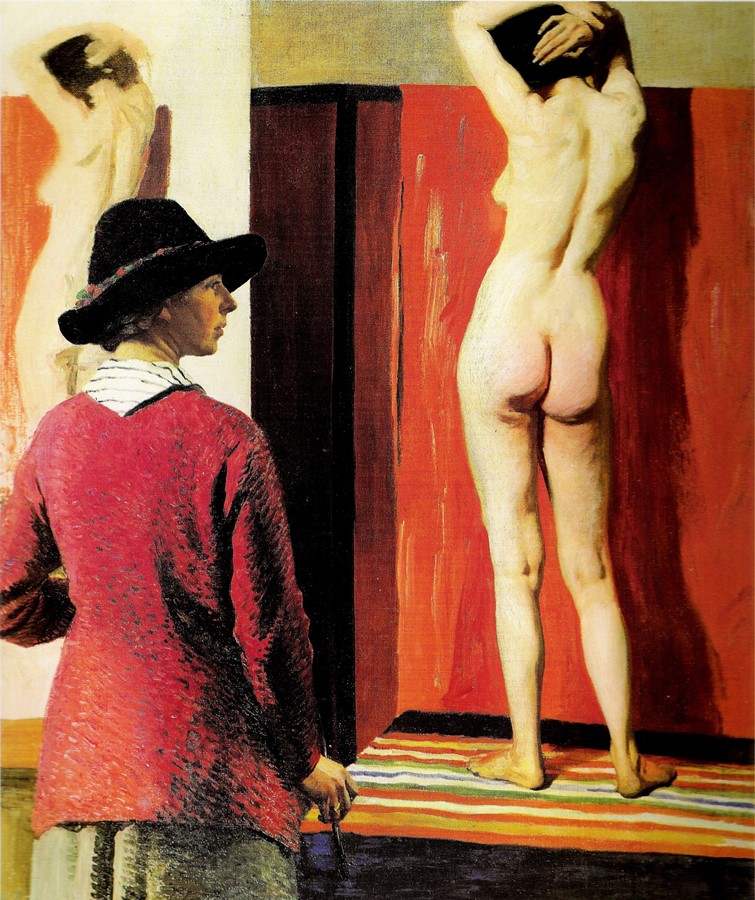
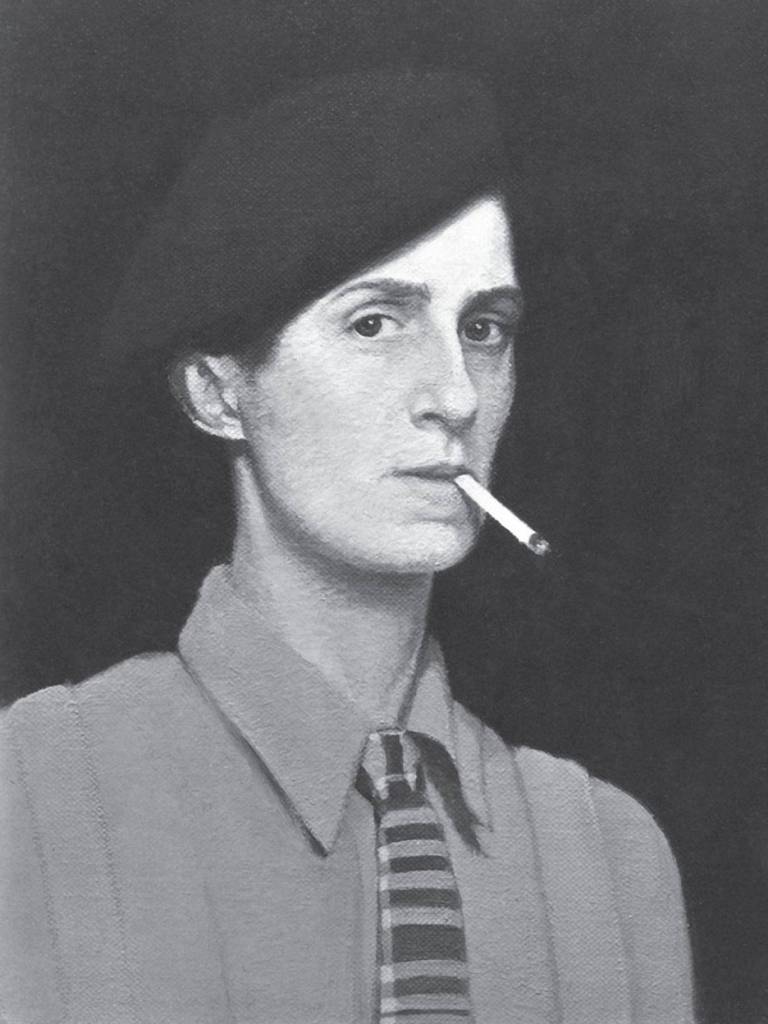
Annie Louisa Swynnerton. Part 2 – the middle years and marriage.
Charles Barry’s Royal Manchester Institution is now Manchester Art Gallery

After two years in Europe Annie Swynnerton and Isabel Dacre returned to Manchester. Manchester had two very important establishments with regards the Arts. There was the Royal Manchester Institution for the Promotion of Literature, Science, and the Arts (RMI) which had been founded in 1823. It came into being following a visit to the Exhibition of Paintings and Works of Art of the Northern Establishment of Artists at Leeds by three Manchester artists – William Brigham, Frank Stone and David Parry in the summer of 1823. They believed it would be a good idea to have a similar annual Exhibition in Manchester and so, in October 1823,  at a public meeting held in the Exchange Room by Manchester merchants, local artists and others keen to dispel the image of Manchester as a city lacking in culture it was decided to establish an “Institution for the Promotion of the Fine Arts in Manchester”.  In March 1824, King George IV agreed to give it his royal patronage and it became the Royal Manchester Institution (RMI). The Institution held regular art exhibitions, collected works of fine art, and promoted the arts generally from the 1820s until 1882, when the building and its collections were transferred under Act of Parliament to Manchester Corporation, becoming Manchester Art Gallery.

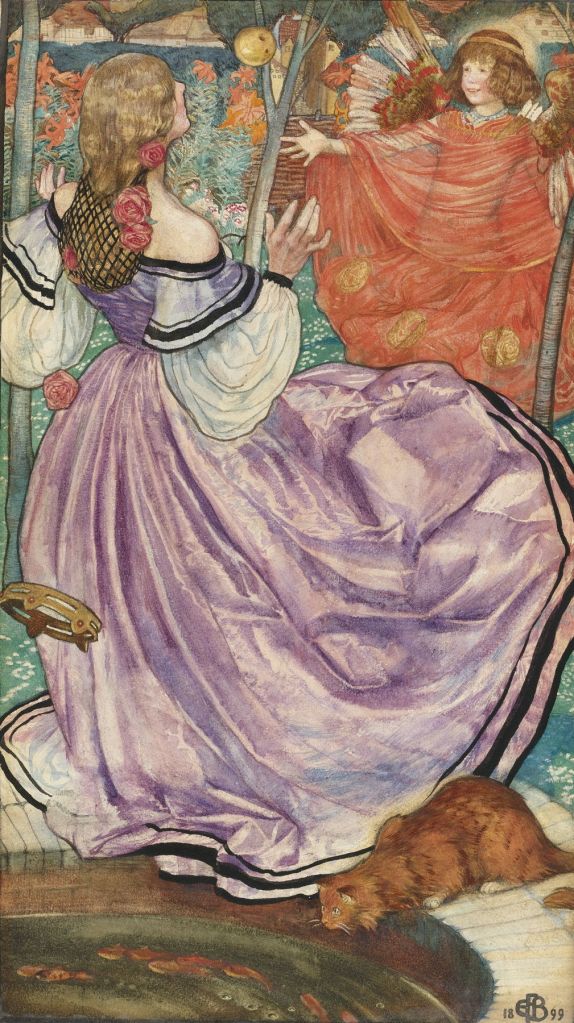
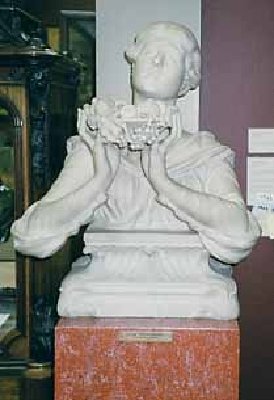
The Offering by Joseph Swynnerton (Manchester Art Gallery)

The other artistic establishment in Manchester was the Manchester Academy of Fine Arts (MAFA) which was founded in 1859.  Both organisations hosted major exhibitions every year and drew in well-known artists whose works were hung alongside those of younger and unknown aspiring artists. It was also an ideal time for what we now term “networking” when painters and sculptors who had their work on show could mix with the buying public and pick up new commissions. Annie Swynnerton and Isabel Dacre had their work exhibited and their portraits were in much demand.  Another recipient of many commissions especially for his portrait busts was a sculptor from the Isle of Man, Joseph Swynnerton and it is quite likely that he had met Annie during one of the exhibitions. He had studied and lived in Rome and it could well be the case that he persuaded Annie to visit the Italian capital once again.

William Gaskell by Annie Swynnerton (1879)

It was in 1878, during her two-year stay back in Manchester that Annie Robinson, later Annie Swynnerton,  completed one of her most impressive works. It was a commission, received from the Portico Library in Manchester, for the portrait of William Gaskell, the English Unitarian minister, charity worker and pioneer in the education of the working class. He was a writer and poet and the husband of novelist and biographer Elizabeth Gaskell. For his forty years of service to the library the proprietors offered Gaskell a gift of either a portrait painted by Annie Robinson or a bust sculpted by Joseph Swynnerton. On the advice of his two daughters, Meta and Julia, who had seen Annie’s work, he chose a portrait. It turned out that the library board found enough money to pay for both the portrait and the sculpture and so Joseph and Annie set to work on their commissions. On completion the bust of William Gaskell was given to the library where it went on display and the portrait painting was given to Gaskell himself. On his death the portrait was passed on to his daughter, Meta Gaskell, who in 1914 donated it to the Manchester Art Gallery where it remains to this day. Annie had become good friends with Meta and Julia Gaskell and it was through them that she came to meet the Pre-Raphaelite painters, Edward Burne-Jones, and John Everett Millais as well as the American portrait painter, John Singer Sargent.

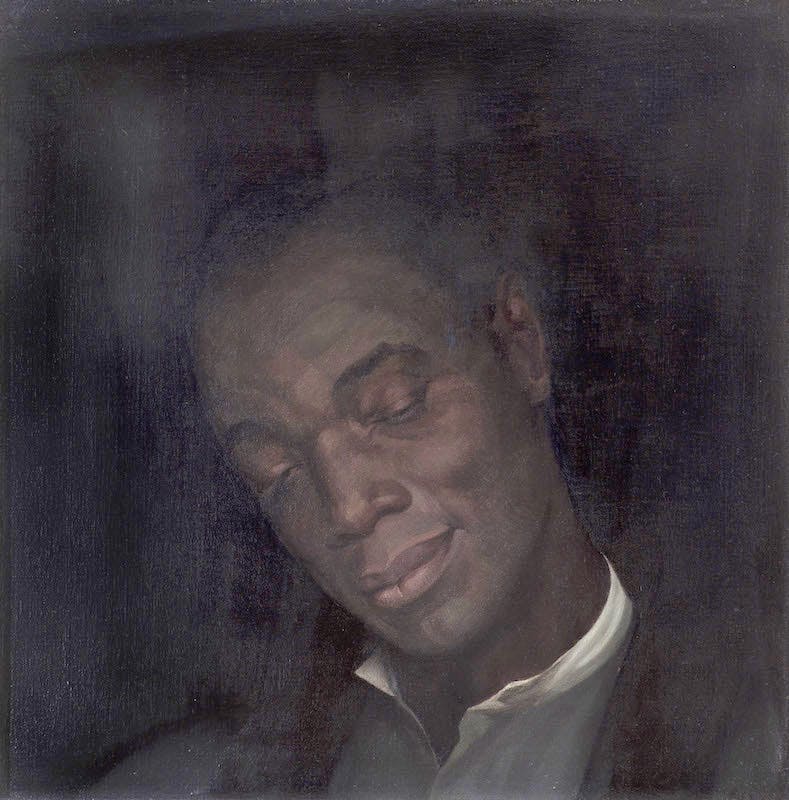
The Dreamer by Annie Swynnerton (1887)

Isabel Dacre and Annie Robinson left Manchester once again and returned to Paris where they remained for a year. On their return to Manchester their reputations as accomplished artists had grown, and their work was in much demand. The two women were very disappointed that the prejudice against women artists had not changed very much and they were well aware that female artists were able to get better tuition in Paris than was possible in England apart from London which now had, since 1856, the Society of Female Artists. Isabel and Annie decided to rectify the situation in 1879 and founded the Manchester Society of Women Artists. The society hosted many exhibitions which created opportunities for local women to display their work. The society also allowed women to take part in life drawing which up till then had not been available to women in Manchester. It was all about the equalizing of opportunities for women in the world of art.

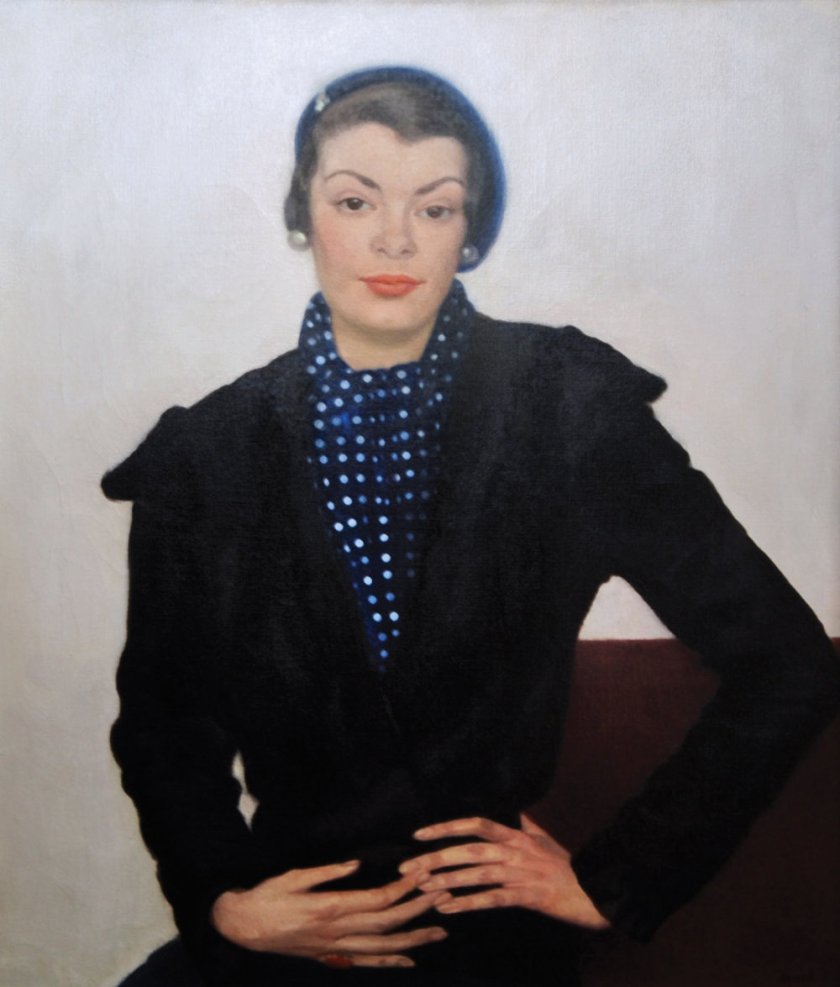
Evelyn by Annie Swynnerton

The Society held three annual exhibitions in 1880, 1882 and 1883 with Annie and Isabel providing the most works but by the time of the 1883 exhibition which was held in a studio used by Annie and Isabel the number of paintings on show had declined. In 1884 the Manchester Academy of Fine Arts decided to change its admission policy and allow women to full membership instead of just as Lady Exhibitioners and provided female artists with the same training and opportunities as their male counterparts. However, it was another three years before women could sit on the MAFA Council. This change of attitude by the Manchester Academy of Fine Arts was a triumph for Annie and Isabel and their Manchester Society of Women Artists and down to their hard work and constant lobbying for artistic equality. The Manchester Society of Women Artists had served its purpose and was now no longer needed.

Joan of Arc by Annie Swynnerton

Annie Swynnerton eventually found the artistic opportunities in Manchester were limited and realised that if she was to remain in England she must position herself in London or maybe even go back to Paris. She eventually made the move to London and found that there she had opportunities to meet fellow artists and the chance to exhibit her work at the likes of the Royal Academy or one of the new avant-garde galleries such as the Grosvenor Gallery.  Such opportunities were far greater than when she was living and working in Manchester.

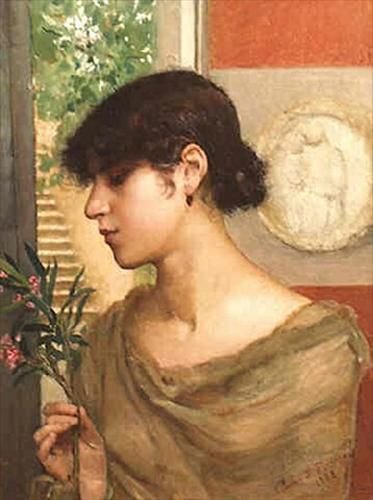
Oleander by Annie Swynnerton

There is no definite evidence as to when Annie Robinson first met the Manx sculptor Joseph Swynnerton, but we know their paths must have crossed during exhibitions in Manchester, or maybe when they were awarded the William Gaskell commission or when they were both in London and in Rome where Joseph spent most of his time. The couple were finally married on July 6th, 1883 at St Marylebone’s Parish Anglican Church in London. The wedding day was also Joseph’s thirty-fifth birthday; Annie was four years his elder. Although Annie was a Catholic. the service had to be held in an Anglican church as Joseph was not a Catholic, but Joseph later converted to Catholicism. The couple’s final decision to marry was not made for many years after they first met, and many wonder about the delay in formalising the relationship. Was it due to their constant travelling and being apart?  One theory regarding the delay, albeit a somewhat cynical one, was that Annie, who was a staunch believer in improving women’s rights, delayed marrying her husband until after the Married Women’s Property Act became law. The Married Women’s Property Act of 1882 was an Act of the Parliament of the United Kingdom that significantly altered English law regarding the property rights of married women, which besides other matters allowed married women to own and control property in their own right.

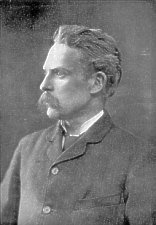
Joseph William Swynnerton

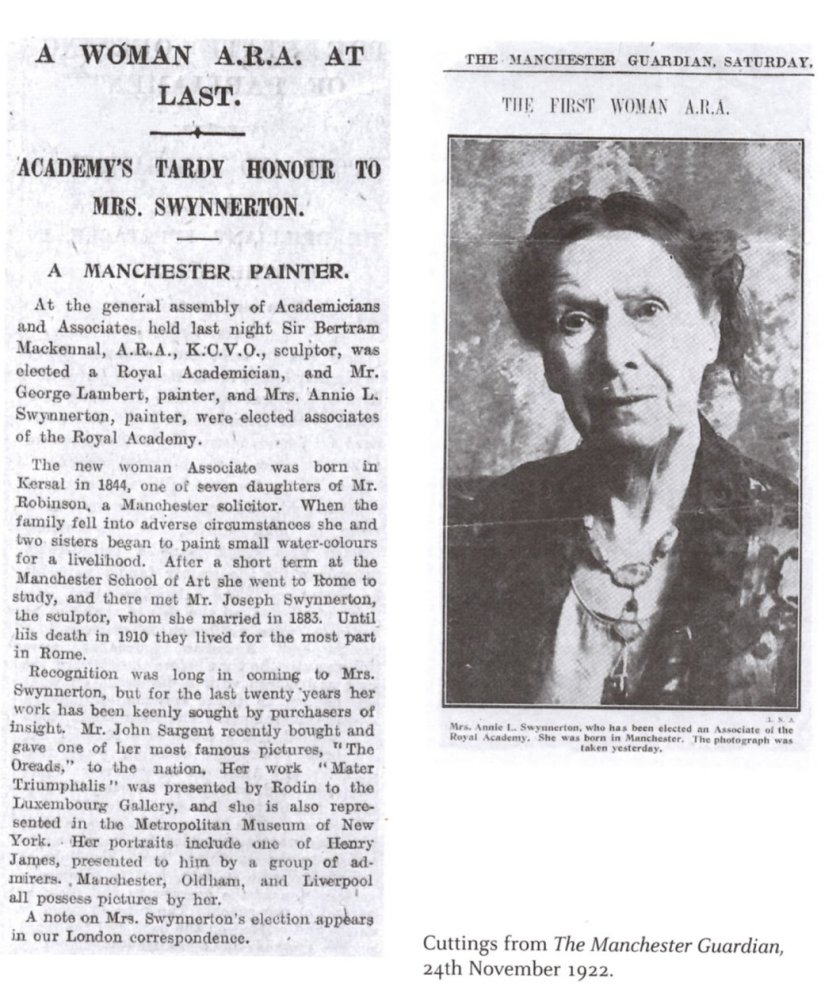
Joseph wynnerton had trained as a sculptor in Rome where, from 1869, he had his main home. He was very successful and exhibited his work at the Royal Academy and received many commissions for his work from clients in both Rome and Manchester. At this time Annie was also exhibiting her work at the Royal Academy and had split her time between London and Manchester but she was persuaded by her husband to leave England and come and live with him in Rome, albeit they both kept on their own studios in London.
When I was reading about Annie and Joseph’s wedding I came across a quote with regards the couple from Joseph’s “Aunt Florrie”. It is a very unflattering comment and of course we know little about “Aunt Florrie” or her age when she met Annie and later came out with this bizarre description of the couple. It quotes her saying:

“…He married a lady who was a Roman Catholic. Her name was Annie. I saw her shortly before they were married. They visited at our house and she was absolutely the ugliest woman I ever saw! I have often wondered about that because Uncle Joseph was such an admirer of beauty. She had a large bony frame without an ounce of flesh. Her eyes were sunken very deep in the sockets. Her forehead and cheek bones were very prominent and she had a very large mouth with protruding teeth!…”

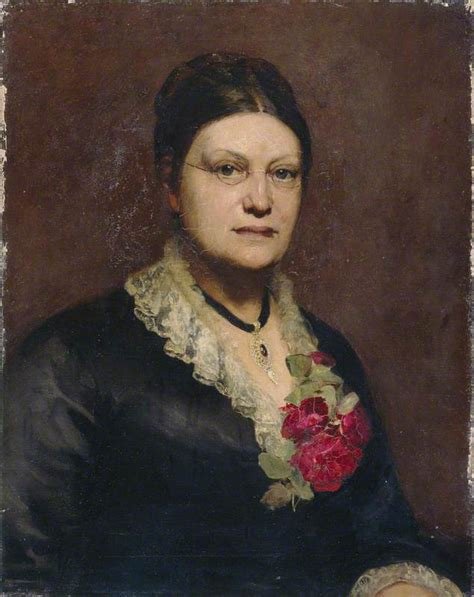
Lydia Becker by Isabel Dacre (c.1888)

It was very apparent that the lack of equality between men and women when it came down to opportunities was not just present in the art world but in all facets of life. There was a great feminist movement in Manchester which, at this time, had become a vibrant centre for new money, business, and social change, and in 1867 the Manchester National Society for Women’s Suffrage was launched.  Annie and Isabel Dacre became actively involved in the movement. The leading activist in the Manchester suffragist movement was Lydia Becker who was a friend of both Annie and Isabel.
Lydia Ernestine Becker sat for one of Isabel Dacre’s portraits which was completed in 1888 just two years before her death due to diphtheria at the age of 63. It is a somewhat austere portrait and is maybe due to the serious nature of her work as the President of the National Union of Women’s Suffrage Societies. In the depiction we see that her hair is on top of her head in a tightly-wound bun giving us an uninterrupted view of her face. The background of the painting is dark and plain and allows us to concentrate on the sitter. She wears a plain darkly coloured silk dress which mirrors her sensible and pragmatic character. She wears wire-framed glasses and an ornate necklace. There is a rose corsage attached to the lace of the dress. It is an un-idealized likeness which conjures up the image of an intellectual woman.

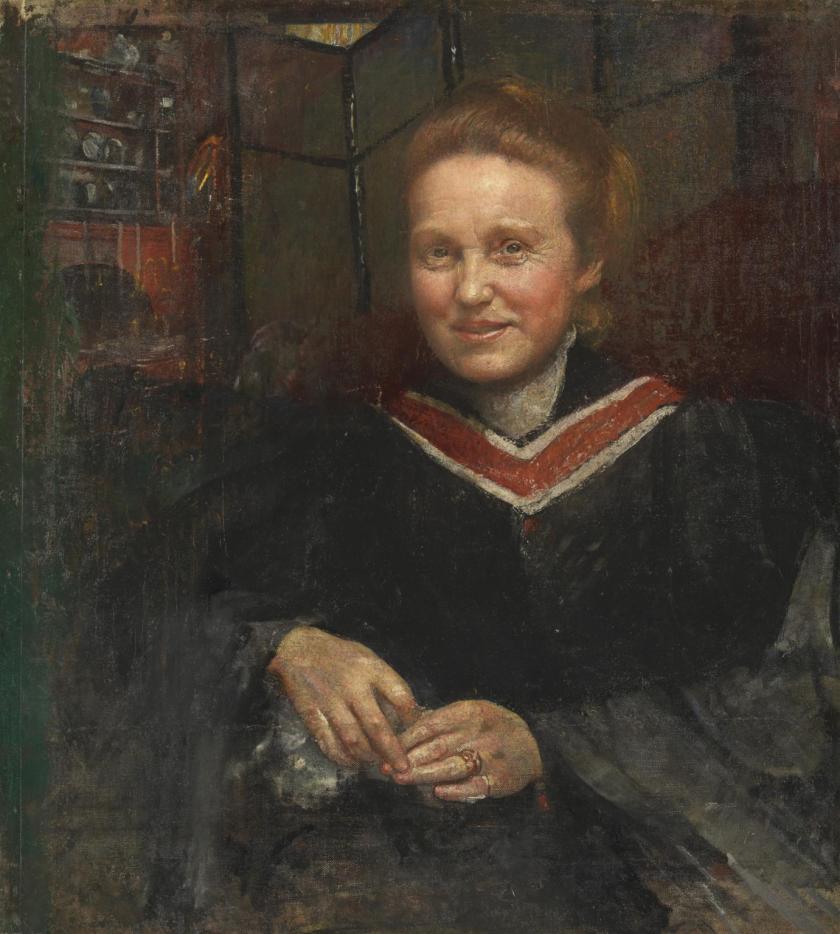
Dame Millicent Fawcett, C.B.E., LL.D. by Annie Louisa Swynnerton

Annie Swynnerton had an extensive network of female friends, many of who were leading lights in the Suffragist movement. Another of her many portraits was her depiction of Millicent Garrett Fawcett, the leader of the National Union of Women’s Suffrage Societies, who was influential in gaining British women over 30 the vote in 1918. Garrett Fawcett was Lydia Becker’s successor as leader of the National Union of Women’s Suffrage Societies. In this portrayal Fawcett is donned in the robes of the University of St Andrews, the establishment that awarded her an Honorary Doctorate in Law for services to education in 1899, and although the painting is undated it could well have been completed the year Fawcett was given the award at the age of 52. The setting for the depiction is an unknown domestic interior. Natural light has been blocked out by a screen which we see behind the lady but there is a strong shaft of light which illuminates her face, hands, and the front of her doctoral hood. This is a classic use of chiaroscuro technique which Swynnerton had used on many of her early portraits. It is another un-idealized portrait which shows the lines and creases of the face of the sitter but in a way, this has had gravitas to the work. In 1930, a year after Swynnerton had died this work was included in the Royal Academy exhibition entitled Portraits of Distinguished Men and Women. Ironically the National Portrait Gallery in London had rejected this work, and many believed this was because of Fawcett’s support of the Suffragist movement.

Joseph Swynnerton had been a healthy and very active man, but it is known that the couple had hurriedly returned to London in the early months of 1910 where Joseph was treated for a heart complaint. We cannot be sure what Annie and Joseph were told about his prognosis but from London they travelled to the Port St Mary in the Isle of Man, where Joseph had been born. Was it just that they believed a change of location would aid his recovery or was he returning to his birthplace one more time before he died?

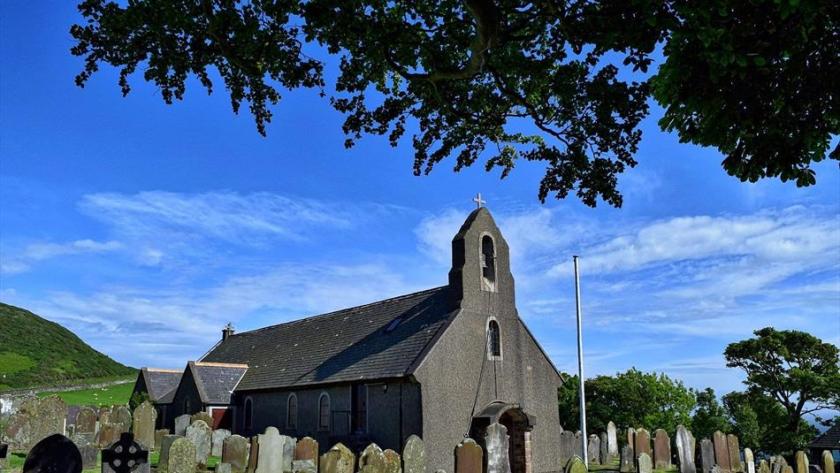
Kirk Maughold Church and graveyard, Isle of Man

We will never know but two weeks after their arrival, on August 10th, 1910, Joseph Swynnerton died, aged 62. He was buried in Kirk Maughold Churchyard, on the Isle of Man, where some years before he had expressed a wish to lie.   Of his death Annie wrote:

“…Meanwhile he has passed away in the sickness of hope deferred – lulled to rest by the dirge of the seagull and the murmur of the waves on the shores of his beloved island.
What a sense of loss – of exquisite companionship for ever fled, only those can estimate who were privileged to know him…”

Annie returned to Rome but soon left Italy and returned to England…….

………………………………..to be continued


Most of the information for this and following blogs about Annie Swynnerton was found in some excellent books which I bought at the Painting Light and Hope exhibition at the Manchester Art Gallery.

Annie Swynnerton, Painting Light and Hope by Kate JT Herrington and Rebecca Milner

The Life and Works of Annie Louise Swynnerton by Susan Thomson

Annie Swynnerton, Painter and Pioneer by Christine Allen and Penny Morris.

Annie Louise Swynnerton. Part 1 – the early years.

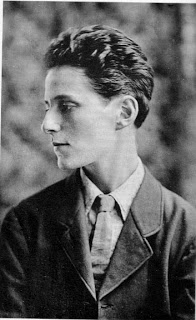
Portrait of Annie Swynnerton by Gwenny Griffiths (1928)

The media these days is full of articles and comments about the lack of equality suffered by women in all walks of life. One hopes that it is not just a fad that the media believe its audience want to be informed about but will die away like so many “hot topics” in the past. Women have had to struggle for too long and nowhere so much as in the male-dominated world of art. In the next few blogs I want to feature a female artist who railed against such inequalities. My featured artist today is the English painter Annie Louise Swynnerton (née Robinson).

Annie Swynnerton

Annie Louise Robinson was born  at 3 Vine Grove, Hulme, an inner-city working-class area south of the city centre of Manchester. She was one of seven daughters of Ann Sanderson and Francis Robinson. Her father came from a humble background, his father plying his trade as a carpenter. After he had completed his schooling, Francis Robinson embarked on a career in law as an attorney’s clerk. He married Anne Sanderson, the daughter of a York innkeeper, in 1840. Francis Robinson’s legal career progressed and in 1843 he attained the position of managing clerk in the Higsons law firm, later the firm became Higsons and Robinson. The couple had seven children, all daughters, the first born being Annie Louisa Robinson who entered the world on February 26th 1844. She was followed by Emily, Julia, Sarah, Adela, Mary and Frances. Annie was baptised at St Wilfrid’s Catholic Church later that year. The family changed their place of residence many times when Annie was growing up, living in various Manchester suburbs, such as Kersal, Chorlton-on-Medlock, Greenhays and in 1861 the seventeen-year-old was living at 227 Prestwich Park, Salford. This was a prestigious area of Manchester and the Robinson’s home was an eight-bedroomed house and was large enough to accommodate the parents, their seven children, Mary Robinson, Francis’ unmarried sister and two young Irish servant girls. The next-door neighbours were both prosperous  families, one being a hat manufacturer who employed over two hundred workers and on the other side the neighbour was a silk merchant.

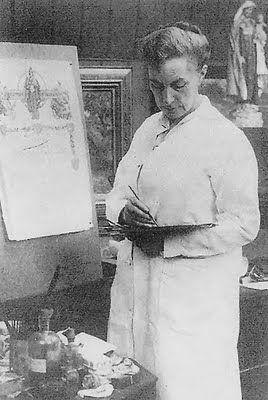
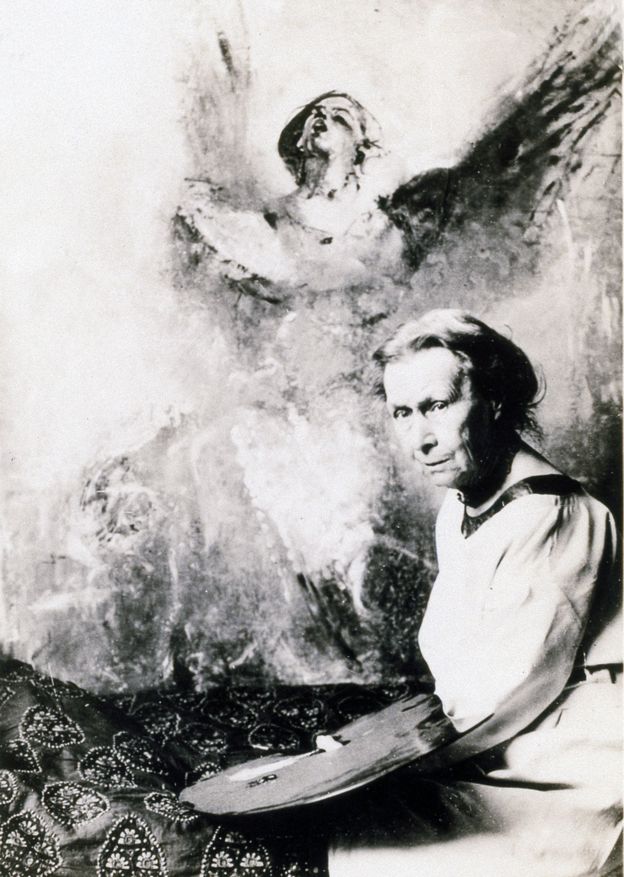
Annie Swynnerton in her studio painting Sense of Light (1895)

Around the end of the 1860’s there was a change in the family fortunes. Francis Robinson’s financial situation deteriorated when his firm was declared bankrupt. In 1869, Francis Robinson lost his home and most of its contents were sold off over a three-day period to pay off his debts. From census records of 1871 it is apparent that Annie, along with her two oldest sisters, Emily and Julia, and her two youngest sisters, Mary and Francis had moved to a small rented property at 28 Upper Brook Street in Chorlton-on-Medlock, an inner city area of Manchester but strangely there is no record of their father and mother living at this premises but they could have been out of the country during the census. Her aunt, Mary, and her step-grandmother lived in another small terraced house in the same street and were recorded as visitors to this property at the time of the census as were Annie’s other two sisters, Sarah and Adela. Maybe they lived somewhere else. Maybe they lived with their parents.

Glow Worm by Annie Swnnerton (1900)

In the autumn of 1868, Annie, Emily and Julia attended, on a part time basis, the nearby Manchester School of Art on Mosely Street, which is now the Manchester Art Gallery. One cannot be sure whether Annie had planned to become a professional fine artist or simply develop the skills which would count if she ever applied for a post as a governess. The three sisters all did well and, during the period they were there and won a number of prizes. In 1873, Annie won the respected national award, the Princess of Wales Scholarship, for the drawing of the head of a boy and a further award for one of her oil paintings. She received a gold medal and the princely sum of £11. It is apparent that the reason the three young ladies attended the School was to hone their artistic skills to such an extent that they would be able to sell their work and make some much needed money to support themselves, but it would also make them independent and maybe even self-sufficient and avoid relying on a man to support them. At this time, there was a vibrant market for contemporary art from the well-off merchants of Manchester who tended to steer clear of the art of the “old masters” as their knowledge of such work often led to deception and they preferred to commission their own paintings from up-and-coming painters.

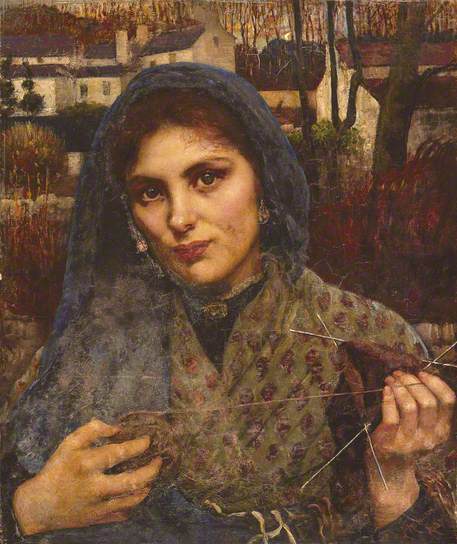
Unwinding the Skein by Annie Swynnerton

Annie Swynnerton’s struggle against prejudice and her eventual success at becoming a professional artist was an amazing achievement. People, who have studied the paths taken by females in the art world, soon realised that those few who succeeded had family artistic connections and no doubt family support for their venture into the male-dominated art world. However, Annie had no such parental backing, no artistic or social connections, which could have smoothed her path towards an artistic career, no early artistic training for remember she was twenty-four years of age when she attended the Manchester School of Art, also she had the responsibility of bringing up her younger siblings in cramped living conditions which did not favour the work of an artist. She was simply the daughter of a provincial attorney who turned to art as a way of earning money to support her family. She entered the art school with little going for her except her great determination to succeed.

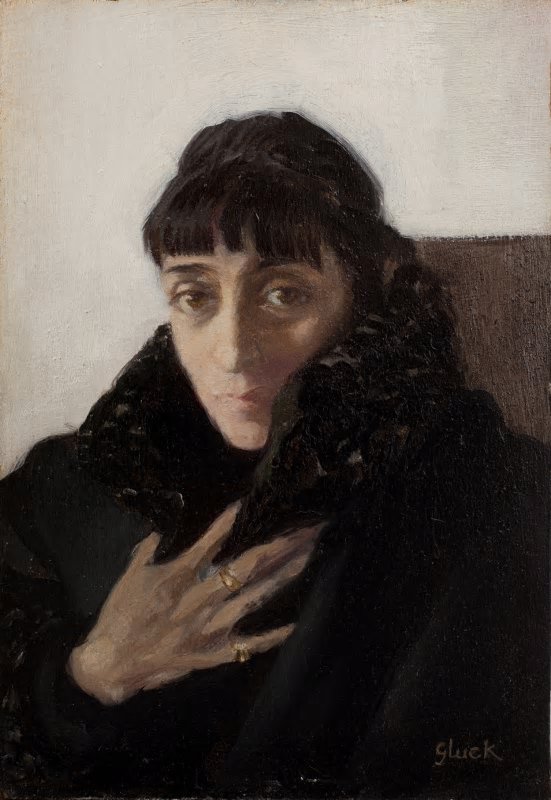
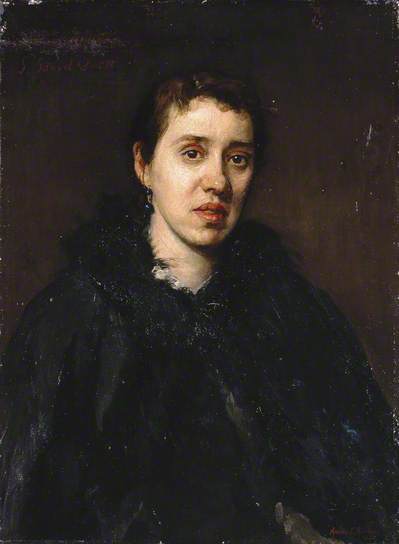
Susan Isabel Dacre by Annie Swynnerton (1880)

For artists to make money they must be able to exhibit and sell their work and at that time in Manchester the main route for this was to become a member of the Manchester Academy of Fine Arts and be allowed to show their work at the annual Spring exhibition. However, the Academy which had been founded in 1859, would not accept female artists into its fold. Annie was a fighter and would not accept things without a fight and so in 1874, along with some other female artists petitioned the Academy council to be allowed to become members. They had also made sure that their request was well reported in the local newspapers. In 1875, the Academy fearing bad publicity agreed on a compromise by which a new class of Academy membership was created and was to be known as Lady Exhibitioners, but the Academy would still neither let females hold office within the Academy nor would they let them attend the life drawing classes which was such an important aspect in artistic training. In 1875 Annie, her sisters Emily and Julia, her friend Isabel Dacre and five other female artists were elected as Lady Exhibitioners at the Manchester Academy but by this time and because of Annie’s lack of access to life drawing classes at the Academy which she found unacceptable, she had already left the country.

The Walls of Sienna by Isabel Dacre

Often in life it is a chance meeting with another person which will shape and influence your future. For Annie it was the meeting and the enduring friendship with her fellow Manchester School of Art student Susan Isabel Dacre. Warwickshire-born, convent-educated in Salford, where her mother kept a number of small hotels, Dacre was the same age as Swynnerton and like Annie had not had the benefit of an advantaged background. However, the early life of Isabel and Annie could not be more different for whereas Annie Swynnerton had led a quiet life in Manchester Isabel Dacre was an experienced traveller. At the age of fourteen Isabel was living in Paris and after completing her schooling there worked as a governess in the French capital and studied art at the Louvre. In 1869 she spent the winter in Italy before returning to Paris. However, following the war between France and Prussia which saw the French capital besieged by the Prussian troops in 1870,  Isabel Dacre and her brother hastily left France and returned to Manchester. They returned to Paris at the cessation of the Franco-Prussian War but were then caught up in the bloody and very dangerous Paris Commune uprisings in 1871 and had to once again quickly exit the country. On her return to Manchester Isabel Dacre became a student at the Manchester School of Art.

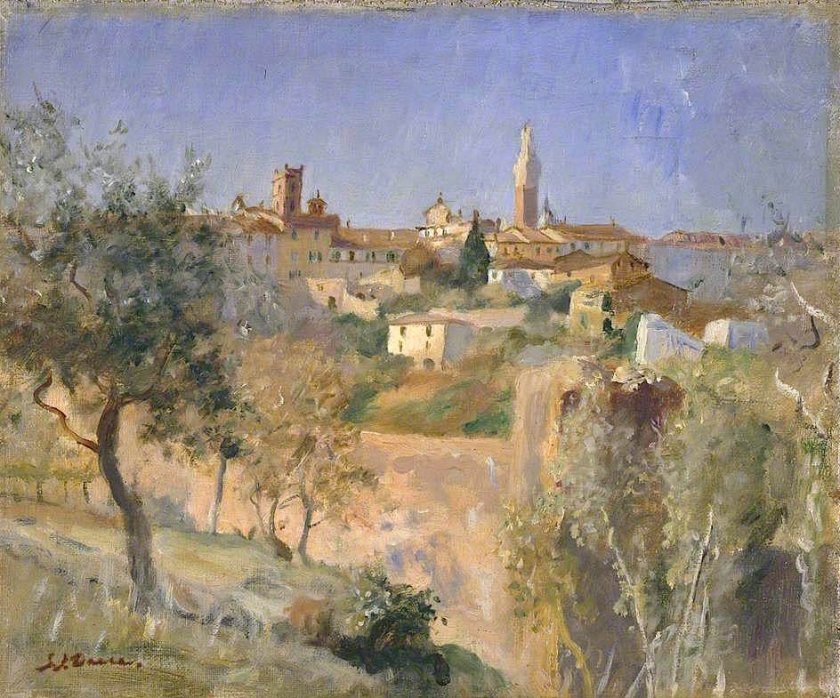
The Town of Sienna by Annie Swynnerton (c.1880’s)

There can be no doubt that Isabel Dacre had a great influence on Annie Swynnerton and managed to persuade her to join her in a trip to Paris and the opportunity to further their artistic career once they had concluded their art course in Manchester in the autumn of 1874. First port of call for the pair was Rome where the two women studied for two years and became part of the Anglo-American artistic and literary circle which had become well established in the city. Here they mixed with female writers, singers, actresses and artists. Swynnerton loved the Italian lifestyle and later lived there for lengthy periods between 1883 and 1910. Italy and the Italian way of life was to influence Swynnerton and this can be seen in the vibrant colours used in her portrayals of women.

The Roman Lady Jebsa by Annie Swynnerton (1874)

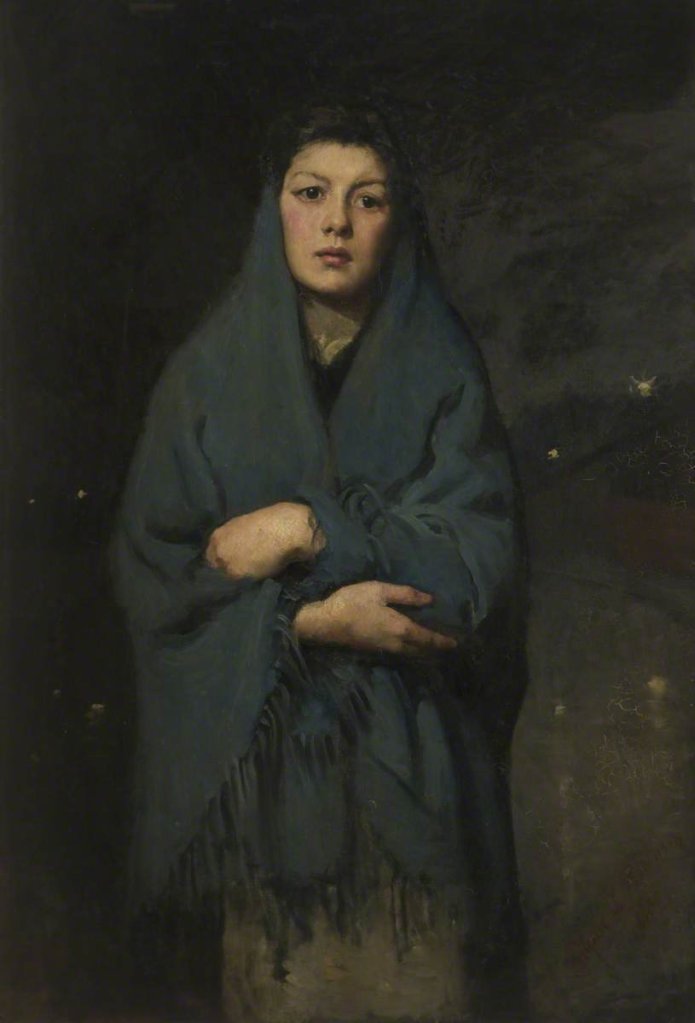
One such work which she completed in 1874 was an exquisite oil portrait entitled Roma Lady ‘Jebsa’. It is a Victorian portrait of an elegant Roma woman in traditional dress.   The name Jebsa has no historical or literary connotation and so it is presumed that Annie and the sitter could have been on first-name terms. This was Annie Swynnerton’s earliest known oil painting which she completed during her first visit to Italy. In this work, she has used the technique known as chiaroscuro, which is the use of strong tonal contrasts between light and dark to model three-dimensional forms which had been used by Italian artists such as Caravaggio during the High Renaissance period and Annie would have seen many of his works whilst in Rome.

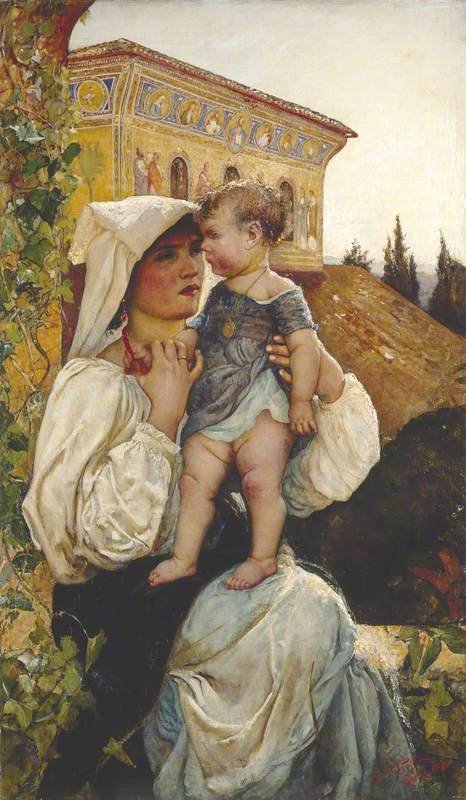
An Italian Mother and Child by Annie Swynnerton (1886)

Another portrait of note emanating from her time in Italy was her 1886 painting entitled An Italian Mother and Child. It was one of a series of Italian women and child paintings that Annie produced during the 1880’s.  The woman and child are posed in an arch of the wall of the Campo Verano cemetery that overlooks the Basilica Papale di San Lorenzo fuori le Mura (Basilica of St Lawrence outside the Walls).  In this portrait we see a young woman bedecked in a simple peasant dress with its white blouse with puff sleeves and a white head dress. She is sitting on a wall below an ivy-covered archway. On her lap stands her young pudgy-thighed child. The child is dressed in a blue dress with a white undergarment and a gold medallion necklace around her neck. The mother supports her child with her left hand, holding the child’s right hand with her right. Look at how the artist has used white highlights to depict how the bright natural sunlight  has fallen on the woman’s headdress, arms and knees.  The painting has a look of Renaissance art which Swynnerton would have studied during her days in Italy.

The Young Mother (Through the Orchard) by Annie Swynnerton (1885)

Another mother and child painting was completed by Swynnerton in the 1880’s entitled Mother and Child but often referred to as Through the Orchard.  The setting for this painting was Clovelly in Devon.  Similar to the previous work we can see how Annie has registered area where the natural light has touched various surfaces.  The inclusion of the apple tree as a background element harks back to pre-Raphaelite concept of truth to nature.  Annie has used a palette of earthy colours in this portrayal of a working-class woman and is a reminder of the Rural Naturalist paintings done by the likes of Bastien-Lepage and George Clausen.  The woman carries her young child as well as carrying a pitcher of water and symbolises the roles of motherhood, and worker.

Around the end of 1876, Annie and Isabel left Italy and returned to Manchester.

…………………………………………to be continued.

———————————————————-

Most of the information for this and following blogs about Annie Swynnerton was found in some excellent books which I bought at the Painting Light and Hope exhibition at the Manchester Art Gallery.

Annie Swynnerton, Painting Light and Hope by Kate JT Herrington and Rebecca Milner

The Life and Works of Annie Louise Swynnerton by Susan Thomson

Annie Swynnerton, Painter and Pioneer by Christine Allen and Penny Morris.

The Krohg Family. Part 2 – Oda Krohg the Bohemian Princess


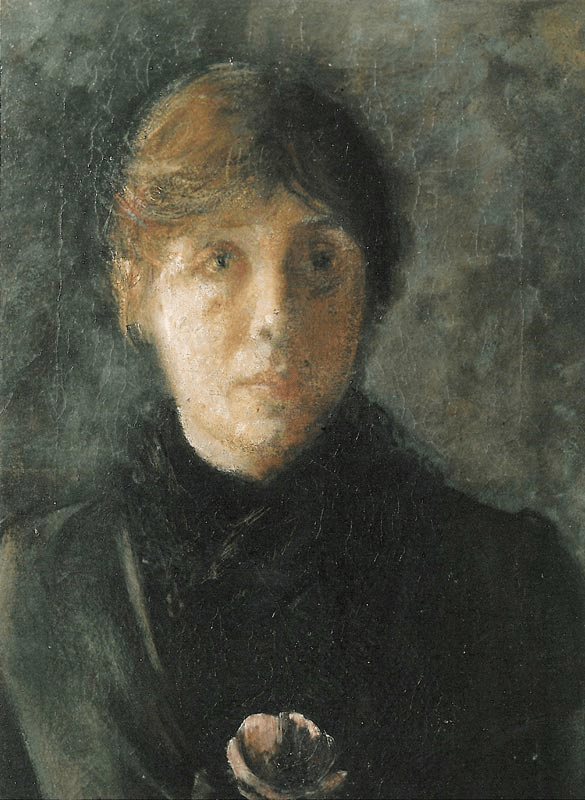
Self Portrait by Oda Krohg (1892)

I start this second blog about the Krohg family by delving back in history…..

Christian Fredrik Jacob von Munthe af Morgenstierne was a descendent of Bredo Munthe of Bekkeskov, who on 19 December 1755 was ennobled under the name von Munthe af Morgenstierne. Christian married Anastasia Sergiewna Soltikoff, a Russian princess in 1836 and the couple went on to have six children. The second eldest was a daughter, Alexandra Cathrine Henriette von Munthe af Morgenstierne who was born on March 5th, 1838. On May 8th, 1857 in Christiania (Oslo), at the age of nineteen, she married Christian Carl Otto Lasson, a government attorney. Over the next seventeen years Alexandra gave birth to eleven children, the third of whom was a daughter, Othilia Pauline Christine Lasson who was born on June 11th, 1860. Othilia Lasson became known as Oda Lasson, and would eventually become Oda Krohg.

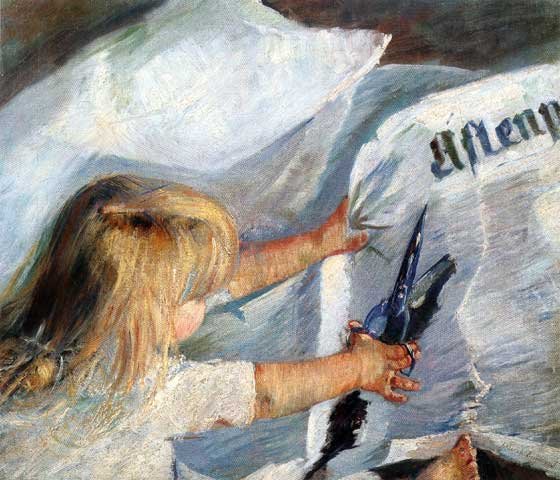
A subscriber to the Aftenposten by Oda Krohg (1887)

Oda Lasson was brought up in an intellectual bourgeois environment with artistic, especially musical interests. Hers was a large family, which consisted of her parents, eight sisters and two brothers. When she was twenty-one years old she married a businessman, Jørgen Engelhardt. The couple had two children, a daughter Sacha in 1882 and a son, Frederik in 1883. Oda and her husband split up shortly after the birth of their second child and she left the family home with her two children. However, it would be another five years before Oda and Jørgen were officially divorced.

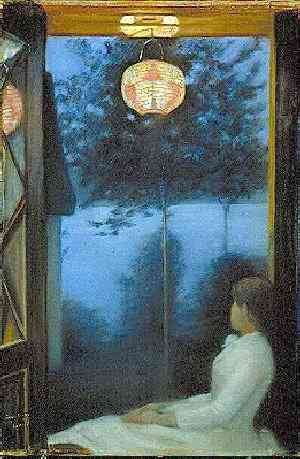
Japanese Light by Oda Lasson (1886)

It was also around 1883 that Oda Lasson decided to follow her love of art and in January 1884 she enrolled at a private painting school for ladies in Christiania which was run by Christian Krohg and Erik Werenskiold. Before attending this school, she had had n0 formal art education, but she was a willing student and soon began to progress with her art. The first painting she exhibited was entitled Ved Christianiafjorden (japansk lykt) (At the Oslofjord (Japanese Light). This is now in the National Gallery of Oslo.

Portrait of Christian Krohg by Oda Krohg (1903)

A close relationship developed between Oda and her art tutor, Christian Krohg and soon they became lovers which culminated on August 8th, 1885, with the birth of their first child Nana. Christian and Oda finally married in 1888 after her divorce from Jørgen Engelhardt was finalised. The following June, her second child, Per, was born during Christian Krohg and her stay at their summer residence in the coastal resort of Åsgårdstrand, about 100 km south of Oslo.

Poor little one by Oda Krohg (c.1900)
Christian Krohg and his daughter Nana

It was through her liaison with Krohg that Oda became part of the Bohemian movement of Christiania (Oslo), known as the Kristiania-bohemen and Oda soon became referred to as the Bohemian Princess due to her maternal ancestors. This small but conspicuous group of young students, artists and writers living in the capital shared radical and incisively critical views on bourgeois society. This group of upper-class intellectuals, writers, and artists dealt with controversial issues like urban poverty, prostitution, and sexual bigotry.

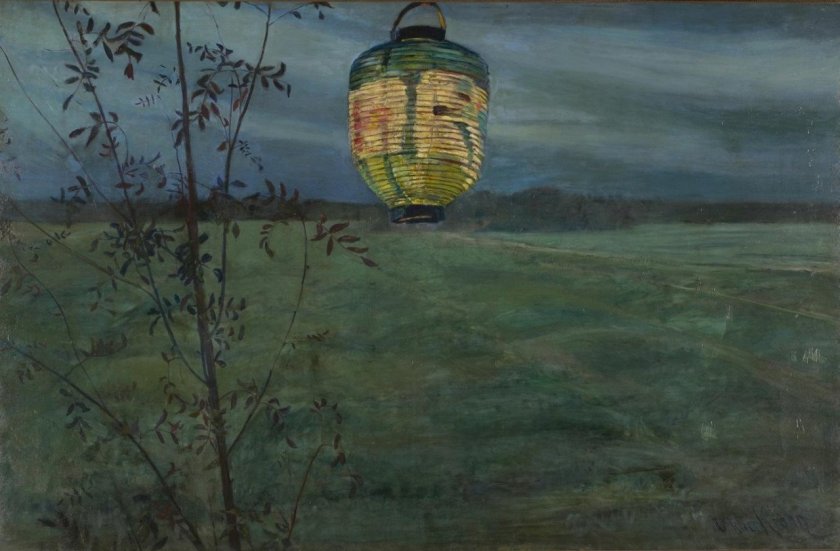
Chinese Lantern by Oda Krohg (1889)

One such member was the artist Edvard Munch. One of the leading lights of this bohemian movement was Hans Jaeger, a one-time seaman, one-time philosophy student and part time government stenographer. He was a colourful and controversial figure who made himself spokesperson for free love during the early 1880’s and he strived to promote the importance of sexuality. The group wanted full sexual freedom between the sexes in the same social class – in practice the upper classes – and the abolition of the institution of marriage. Bizarrely, Jaeger wanted to establish a school for women, which among other things would educate them and make them conscious of their lusts and follow them, so that neither them nor the men would be robbed of their part of the wonders of life !!

Cover of Fra Kristiania-Bohêmen. A novel by Hans Jæger

Jaeger’s downfall came in 1885 with the publication of his novel Fra Kristiania-Bohêmen (From Christiania’s Bohemia). The novel which was set in Christiania, was about two men who lived in lodgings and spent their days drinking in cafés, discussing philosophy, literature, and society reforms. One of them ends his life by committing suicide, shooting himself after spending his last night with a prostitute. The book was immediately banned by the Ministry of Justice, and the police managed to confiscate most of the printed copies shortly after its publication. Jæger received a 60-day prison sentence for the infringement of modesty and public morals, and for blasphemy. He avoided part of the sentence by moving to Paris, where he spent most of the rest of his life.

Portrait of Hans Jaeger by Edvard Munch (1889)

Munch painted a portrait of Hans Jaeger in 1889. In the depiction we see Jaeger slouched on a sofa. He stares out at us through his spectacles. His facial expression is emotionless and there is a sense of aloofness. He is dressed in a tight-fitting overcoat and wears a wide-brimmed hat which is placed on his head at a jaunty angle. The light source is to the left and casts deep shadows creating flickers of red-violet, brown and blue green hues. For many years the painting remained in Munch’s possession and was shown in most of his exhibitions in the 1890s. In 1897 he offered it to the National Gallery in Oslo, which duly purchased it.

Oda Krohg and Jappe Nilssen, photo from 1891

Christian Krohg and Oda’s roles in the organisation may not be fully known but there are a couple of aspects of the Kristiania-bohemen group which had a part to play in their lives. The sexual freedom advocated by many in the group seemed to have an effect on Oda and Christian’s marriage as it was what is now often termed as, an “open marriage” and it is known that Oda, despite being married to Christian  had a number of lovers, including Hans Jaeger, the Norwegian writer and art historian, Jappe Nilssen and the playwright Gunnar Heiberg. In Jaeger’s 1893 novel Syk Kjærlihet (Diseased Love), he describes a love triangle where he was strongly in love with a woman who was to marry an artist. It is believed that Oda was the model for the woman, and the book depicted the relation between himself, Oda and Christian during the summer and autumn of 1888.

Another aspect of Hans Jaeger’s philosophy which influenced Christian Krohg was Jaeger’s support of prostitutes and how he believed that the reason women turned to prostitution was due to the State’s social system.

Madeleine by Christian Krohg (1883)

In 1883 Krohg produced a painting entitled Madeleine. In the depiction we see a bleak and bare bedroom. A young woman sits on a thin mattress on a simple iron bedstead. From the little clothes she is wearing and the unmade nature of the bedding we think she is just getting up. However, what is more telling is her demeanour. Her body droops forwards and her head is cast downwards supported by her left hand. We are not allowed to see her face. Is she ashamed? In her right hand she seems to be holding a mirror. Has she been viewing her image? Is she unhappy at what she sees? It is thought that Krohg is portraying her as a “fallen woman” who is engaged in prostitution. Maybe her demeanour is one of sadness at what she has just done and is unable to come to terms with the shame. Like most paintings that seem to have a message it is up to the viewer to ponder on the possible story behind the image.

The novel Albertine

In 1886 Krohg wrote a novel, Albertine. The novel is set in Norway’s capital, Christiania, and looks at the plight of an unmarried but spirited seamstress Albertine, who is seduced by a police officer and because of her financial desperation and lack of support from the authorities, is forced into prostitution. The book caused a stir and embarrassed the authorities resulting in its confiscation of all copies the day after its publication. In 1888 the Supreme Court of Norway upheld the ruling, and Krohg was sentenced to pay a fine of 100 kr. Krohg went on to make a number of paintings based on the book and the world of prostitution.

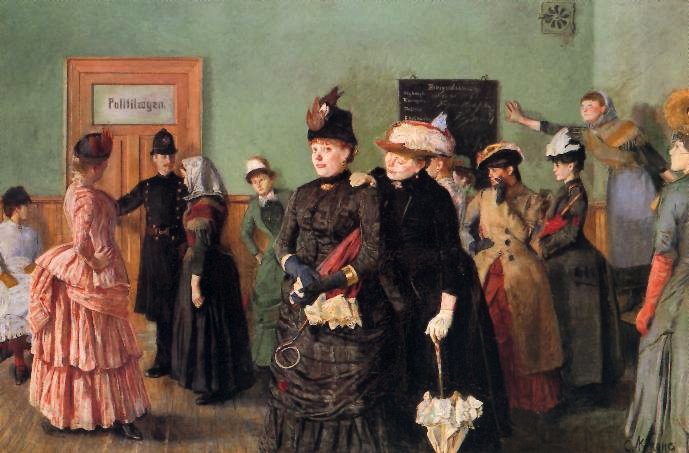
Albertine at the Police Doctor’s Waiting Room by Christian Krohg (1887)

Christian Krohg painted a number of pictures based on his novel.  In 1877 the most famous of these is his work entitled Albertine i politilægens venteværelse (Albertine at the Police Doctor’s Waiting Room) which is housed in the National Gallery in Oslo. The painting is set in a police station and depicts a number of women that have been arrested for being prostitutes. We see Albertine at the head of the queue at the door of the examination room where she will be examined by a doctor.  She is dressed in a simple plain costume and is wearing a headscarf, unlike the garish clothes worn by the other women, which were the normal adornment of the “street workers” of the time.

The public outcry following the confiscation of the book finally led to a partial de-criminalising of prostitution in Norway. The change in the Penal Code in 1902 did not signal that prostitution was to become allowed by society. It did however accept that the exchange of sex in one’s own home was now legal but maintained that loitering and procurement on the streets or in a public place would remain illegal and that women arrested for selling sex in public were to be entered into rehabilitation programmes. Ironically, the current law in Norway which bans purchase of sex and any money earned is illegal and yet such money is taxable!!!!
Krohg’s book, Albertine, was published again in 1921 without any murmurs from the authorities.

The Struggle for Existence by Christian Krohg (1889)

It was not just the plight of prostitutes that featured in Krohg’s paintings. He was very interested in the state of poverty in his own country and his painting The Struggle for Existence was one of his major projects and also one of his finest works. The setting for the scene is Oslo’s main thoroughfare, Karl Johan Street, on a cold winter’s day. The street and pavements are covered in a slushy snow and the cold has almost freed the street of people with the exception of a crowd of poor women and children who are queuing for the chance to be given some free food. We see both women and children clutching empty baskets and cannisters which they hope to fill with food given to them. To the left we can make out a hand sticking out from behind the pillars which is holding a bread roll which is part of the free food. This could be a bakery and the baker has decided to give the poor some of yesterday’s stale bread. The people are poorly dressed in shabby and ragged clothing. In the middle of the street we observe a policeman walking towards the crowd but seemingly uninterested in what is happening.

Gunnar Heiberg by Oda Krohg (1900)

Oda Krohg’s extra-marital relationship with the playwright Gunnar Heiberg became serious around 1897 and Oda declared she was in love with him. She left Oslo in 1897, and took her eight-year-old son, Per, and went to live with Heiberg in Paris. Christian also left the Norwegian capital in 1901 and moved to Paris where he became an art instructor at Académie Colarossi in 1902. Later Oda set herself up in an artist’s studio in Montparnasse and soon immersed herself into the art world of Paris meeting most of the leading artists including Henri Matisse. Having now established herself she began to exhibit her work at the Salon d’Automne. Oda’s restless nature kicked in once again and around this time she began a relationship with the poet and art critic Jappe Nilssen. When that finally died she returned to her husband, Christian and Oda along with their children left Paris and returned to Oslo in 1909 but would often return to Paris for long periods and did not final settle down in Oslo until 1911. From 1909 to 1925 Christian held the post of professor and director of the newly founded Academy of Painting and Sculpture in Oslo.

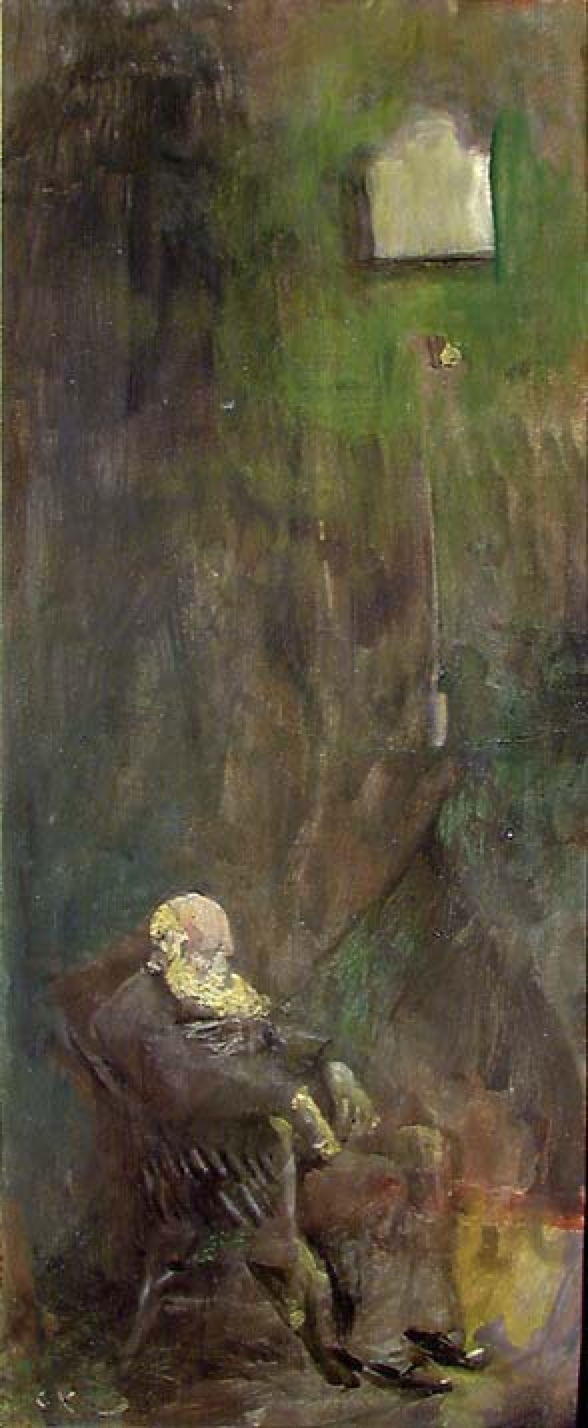
Five to Twelve by Christian Krohg (c 1924)

One of Christian Krohg’s last paintings which he completed a year before his death was entitled Five to Twelve. On the face of it, it appears to be a self-portrait and we see him with his long white beard, but almost bald, as he sleeps in a chair beneath a pendulum clock. The face of the clock is completely blank, but the title of the artwork tells us the time: it is five minutes to midnight, close to midnight and maybe meant to symbolise that it is close to the end of his life.

Grave of Christian Krohg and Oda Krohg at Vår Frelsers gravlund, Oslo, Norway.

In 1925, Krohg retired as the director of the State Academy of Art, and he died in Oslo a few months later, on 16 October, aged 73. Oda Krohg died exactly ten years later on October 15th 1935, aged 75. Christian and Oda are buried at the Cemetery of Our Saviour in Oslo.

Per Lasson Krohg

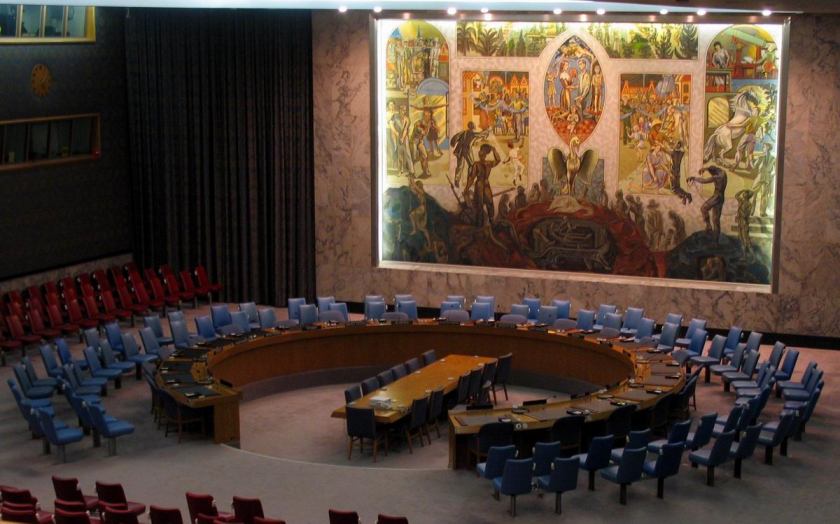
Christian and Oda Krohg’s son, Per Lasson Krohg, who was born in Åsgårstrand, Norway in June 1889, followed in his parent’s footsteps and became an artist. As a teenager, he received his artistic training from his father and, when he was twenty years old, had Henri Matisse for a mentor. Per Lasson Krohg’s artistic work was varied and covered simple drawings on paper, to colour illustrations, and from designing posters to set design and sculpture, but he will probably be remembered mainly for the oil canvas mural he painted in 1952 for the United Nations Security Council Chamber, located in the United Nations building.

Mural at the United Nations Security Council Chamber by Per Lasson Krohg

It depicts a phoenix rising from its ashes, as a symbol of the world being rebuilt after the Second World War. Above the dark sinister colours at the bottom different images in bright colours symbolizing the hope for a better future are depicted. Equality is symbolized by a group of people weighing out grain for all to share.

Nana Krohg, Christian and Oda’s daughter was born in Brussels in the summer of 1885. At this time, Oda was still married to Engelhart and his living with Oda was passed off as a “study stay”. Nana Krohg’s art career was neither long nor particularly comprehensive. At the age of 18, she attended an art school and received tuition for the next two years from the Norwegian painter, Johan Nordhagen. Nana never became a professional artist and after her marriage to Anton Schweigaard around 1909, she simply used her artistic skills in design and homemaking for her own use. The couple had two children, Anton Martin and Line.

The Krohg Family – Part 1 – Christian Krohg. The early years and life at Skagen

Christian Krohg

The art of one of the painters I am looking at today was compartmentalised as being works of a Naturalism genre and also of a Realism genre. So what is Naturalism and how does it differ to Realism when appertaining to art?

The best way to describe Naturalism is to say that it is a type of art that pays attention to very accurate and precise details. It is painting which is true to what we see without any falsification or artistic interpretation.  That sounds like Realism !

Naturalism was an artistic movement, which came into being in the mid-nineteenth century and embodied things closer to the way we observed them. Prior to this, depictions of landscapes or human beings tended to be idealised or rendered according to precepts resulting from the traditions of classical art. Naturalism was a denouncement of the fantasy world of Romanticism, which had flourished from the late eighteenth century into the first half of the nineteenth century. Naturalism is also often associated with plein air painting.

But is this not the definition of Realism? The two are close but Realism, especially Social Realism, focuses more on social realities and concentrates on content rather than the methodology of the work. Realism tends to deliberate on who or what is being painted rather than how it was painted and realist depictions often muse over ordinary people, who are often struggling with life. Often Realism paintings have a moralistic story to tell and they then tend to be viewed as a commentary on the social and political life of the day. Naturalism tends to be more about how the work has been painted ensuring that it is true to life.

Self Portrait by Christian Krohg

Christian Krohg was born in Vestre Aker, a district of the city of Oslo on August 13th 1852, the son of the journalist and publisher, Georg Anton Krohg and Sophie Amalie Holst. His paternal grandfather, Christian Krohg was a lawyer, government minister, and had at various times served as Minister of the Interior and Minister of Finance.

Christian was the second-born of their children and had four sisters, Anna Helene Nicoline, born in June 1850, Stine Marie, born in December 1854, Nanna born in January 1859, and Sophie Amalie Holst born in April 1861. Christian’s mother died on April 28th 1861, seven days after having given birth to Sophie and maybe in memory of her mother she was also named Sophie Amalie Holst. In June 1868 more sadness was to befall Christian’s family when Christian’s younger sister, Nanna, contracted tuberculosis and died, aged nine.

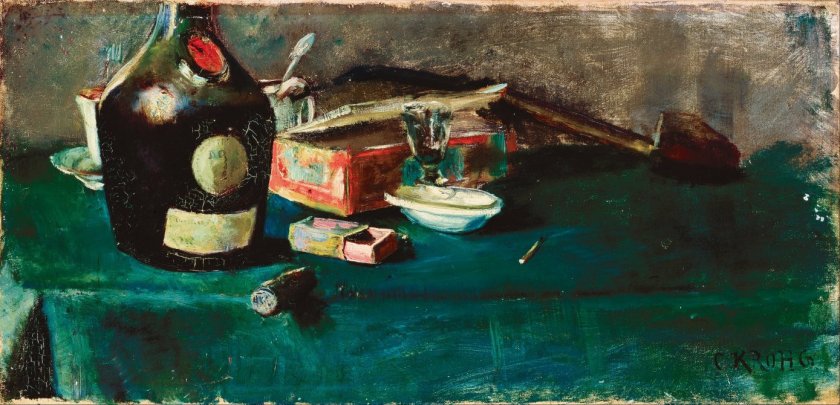
Still life with a D.O.M. Bottle by Christian Krohg (1883)
The D.O.M. stands for Deo Optimo Maximo which means – To God most good, most great.

Following his normal schooling Christian went to the Royal Frederick University (now the University of Oslo) in 1869 to study law, the plan, probably fostered by his father, being that he would become a lawyer, like his grandfather.   However for Christian his main interest was art and maybe through an agreement with his father that if he studied for a law degree he would be allowed to also attend art classes at the local drawing schools. He attended both Johan Fredrik Eckersberg’s private art school from 1869 to 1870 and later the drawing class of Julius Middelthun, the Norwegian sculptor, at the Royal School of Art and Design of Christiana (Oslo).

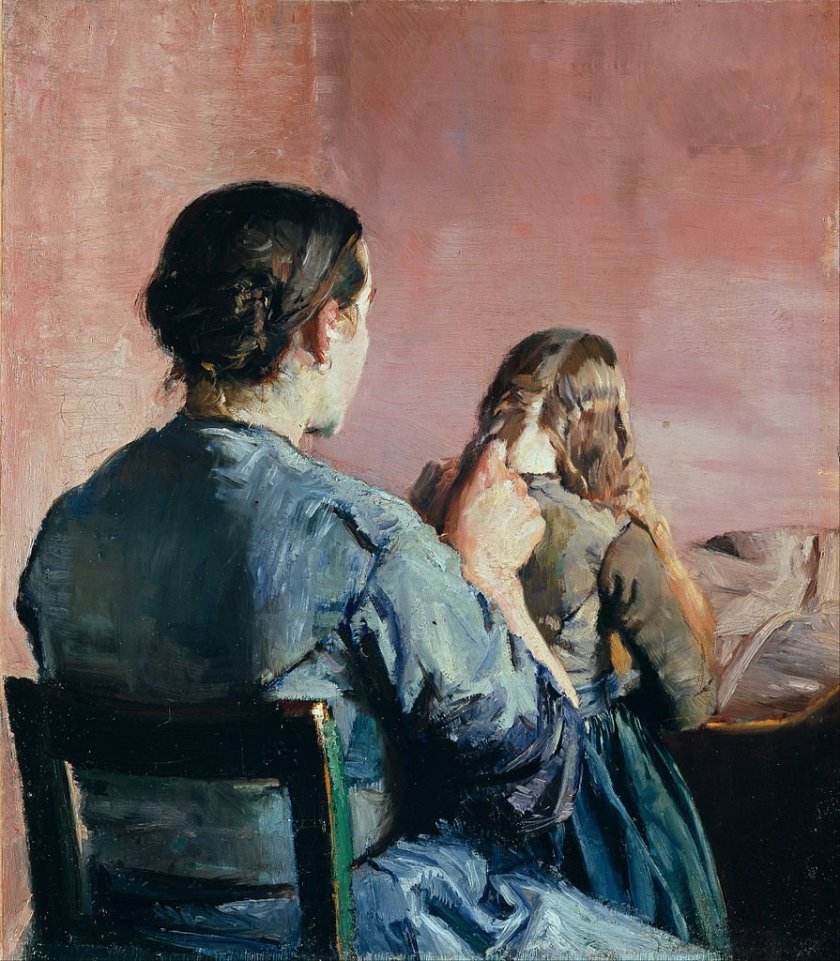
Braiding her Hair by Christian Krohg (1888)

On April 13th 1873, during his university studies, Christian’s father Georg died, aged fifty-six. The following year, at the end of his five year law course, he attained a law degree but instead of practicing law he decided to travel to Germany with his friend and fellow artist, Eilif Peterssen and they both enrolled at the Baden School of Art in Karlsruhe, where two of his professors were Karl Gussow, the German Realist painter, and Hans Gude, the Norwegian Romanticist painter and one of Norway’s foremost landscape painters. Gude spent most of his adult life as a professor of art and was a leading figure in the advancement of Norwegian art. To young, aspiring Norwegian artists of the mid and late nineteenth century, Gude was a god and they would travel to Germany to enrol on courses taught by him at academies in Dusseldorf, Berlin and Karlsruhe.

Georg Brandes – sketch by P S Krøyer (1900)

Christian Krohg remained at the Baden School of Art in Karlsruhe for a year before moving on to the Berlin Academy in 1875, a move that had already been made by his former professor, Karl Gussow. Krohg remained in Berlin for three years. Whilst there he made friends with the German symbolist painter, Max Klinger and the Danish writer and philosopher, Georg Brandes.   Brandes writings were centered on the concept of realism and were diametrically opposed to the world of fantasy in literature. He was looked upon as the founder of the Cultural Radicalism movement. According to Aarhus Universitet’s Institut for Kultur og Samfund, Cultural Radicalism can be looked upon as:

“…Cultural radicalism must be understood from its cultural and philosophical origins in the modern breakthrough in the last half of the 19th century, as well as from the actual roots of rationalism of enlightenment. In Denmark, cultural radicalism has rooted in the bourgeois radicalism of the 1870s and in the intellectual environment around the brothers Georg and Edvard Brandes and Viggo Hørup. The bourgeois radical ideas constituted a cultural battle against the authority of the church and the state, and they concerned in particular the right to individual expression, freedom of opinion and tolerance, and criticism of what was considered to be a restricted, oppressive and colorless civil culture…”

Charles Lundh in Conversation with Christian Krohg by Christian Krohg (1883)
Charles Lundh, a Norwegian painter, lived together with Christian Krohg and the Swedish painters Johan Krouthén and Oscar Björck in a house in Skagen in 1883

Krohg was very attentive to the views of Brandes and became more aware of the social and political problems of the time. These views were enhanced by the poor quality of his living standards during his time in Berlin, which almost bordered on out and out poverty   More importantly for Krohg it was his friendship with Georg Brandes that led to him being introduced to Emile Zola, the great French writer, playwright and journalist.  Zola was interested in the world of art and as a journalist in the late 1860’s and early 1870’s, he produced many newspaper articles defending the art of Cézanne, Manet, and the emerging Impressionists, such as Monet, Renoir and Degas, all of whom were being criticised by the artistic elite. It was also Zola who first coined the term Naturalism, defining it as a literary movement, which gave emphasis to observation and the methodology used in the fictional portrayal of reality.

Farewell by Christian Krohg

It was in the following year, 1876, that Krohg exhibited his painting entitled A Farewell. For the time he concentrated on his portraiture and two works of note was his 1876 portrait of Lucy Eyeberg and his depiction of his friend Georg Brandes which he completed in 1879

The year 1879 was of great importance to Christian Krohg as it was during that summer that he first went to Skagen, a Danish fishing community on the north coast of Jutland. Christian and his fellow Norwegian painter and former fellow student in Karlsruhe, Frits Thaulow, travelled to Skagen in Thaulow’s small sailboat and remained there through to the end of autumn. Skagen had become a summer meeting place for artists in the late 1870’s and remained such up until the end of the nineteenth century.

Dining room in Brøndums Hotel (ca. 1891) showing some of the group and the panel of their portraits

It was because of its favourable natural light that it was so popular with the plein-air artists from Scandinavia, such as husband and wife artists, Anna and Michael Ancher, Peder Severin Krøyer and his wife Marie, Karl Madsen and Viggo Johansen, as well as painters from northern Europe.  It was this fascination with the changing natural light that had also inspired the Impressionists. Many of the Skagen artists had spent time in Paris and they were influenced by the French Barbizon artists and the world of Realism. This style of painting was contrary to the inflexible conventions set out by academies such as The Royal Danish Academy of Fine Arts and the Royal Swedish Academy of Arts, which believed students should adhere to painting in the favoured Academic styles of Historicism and Neoclassicism. Michael Ancher, Karl Madsen and Viggo Johansen had also studied at the Royal Danish Academy in Copenhagen.

Ane Gaihede by Christian Krohg (1888)

The early members of the Skagen artistic community had been befriended by Brøndum family, who were the owners of a local shop/bar and soon it became the meeting place for the Skagen painters and their literary friends. Peder Severin Krøyer became very friendly with the Brøndum’s fifteen-year-old daughter Marie and six years later the pair were married.

Woman cutting bread by Christian Krohg (1879)

Christian Krogh became a regular summer visitor to Skagen during the mid and late 1880’s and it was during those times that he focused on one family, the Gaihede family, for the subject of many of his works. Husband and wife, Niels and Ana Gaihede, along with their son Rasmus and daughter-in-law, Tine and their two children Ane and Sofus. One such painting featured the matriarch of the family Ana Gaihede who modelled for Krohg’s 1879 painting Woman Cutting Bread. Sixty-six year old Ana is seen in three-quarter length profile against a blank background, save for three small pictures, which allows us to focus completely on the subject of the work. It is a fascinating depiction, which gives us an insight into the people and their culture of the time.

The Net Mender by Christian Krohg

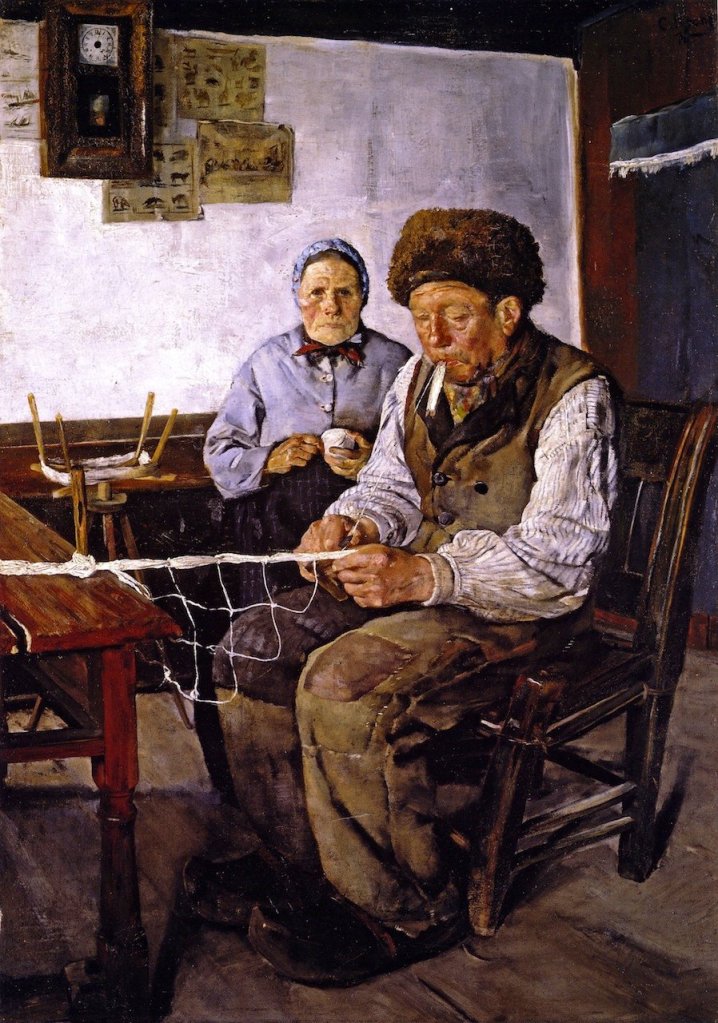
In another of Krohg’s works featuring the Gaihede family, The Net Mender, we see both Ana and her husband Niels depicted. In this 1880 work Niels can be seen repairing his fishing net whilst Ana sits stony-faced in the background making balls of fibre, which will be used in the repairing of the net. The walls of their home are a dull grey and the only thing breaking up the monotony of the colour are a few magazine pictures of animals and boats which may have been for the benefit of Sofus their six-year-old grandson. Looking at the interior furnishings of the home and the dress of the two characters one can detect a frugal standard of living, maybe not poverty-stricken but one in which every krone counts.

Niels Gaihede by Christian Krohg (1888)

Christian Krohg won a state stipend in 1881 and travelled to Paris, where he taught at an art school for women. In those days most of the prestigious art establishments denied women access to art tuition and Krohg could see the error of this dictate and wanted to be supportive of the female cause. Maybe Krohg was sympathetic with regards the plight of women in general as it is known that at about this time he was also becoming more and more interested in painting pictures which highlighted people’s struggle with everyday life and especially the great effort women had to make just to survive.

The Sick Girl by Christian Krohg (1881)

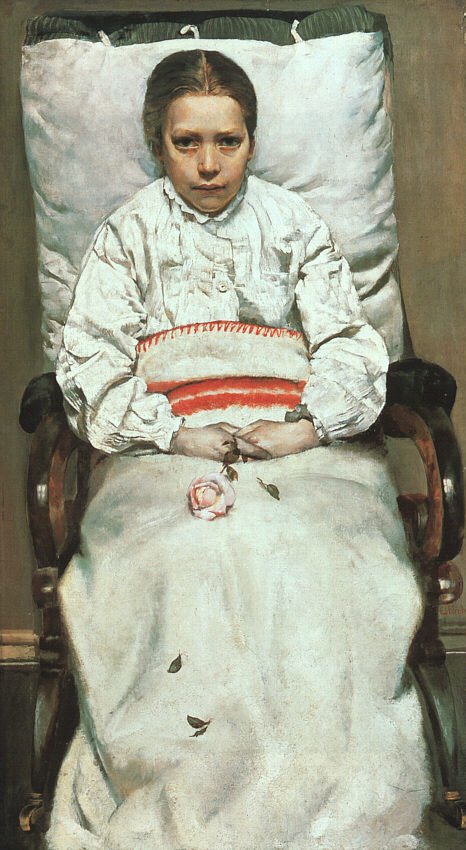
In 1881 he completed a very poignant painting entitled The Sick Girl. It was the depiction of a girl who had been struck down by tuberculosis and was dying. Krohg would be painfully aware that this killer disease had also taken his youngest sister, Nanna, thirteen years earlier. It is a haunting depiction. The girl sits upright in a wooden chair with a cushioned back. A thick woollen blanket covers the lower part of her body. Look at the girl’s tight-lipped facial expression. It is a mixture of sadness and fear. Maybe she is aware that her life is ebbing away. Her hands are tightly clasped together, as if in prayer, as she clutches the stem of a pale pink rose, the leaves and petals of which are starting to fall to the ground. The rose like the girl is dying.  One cannot help but be moved by such a depiction.

Babord litt (Port side) by Christian Krohg (1879)

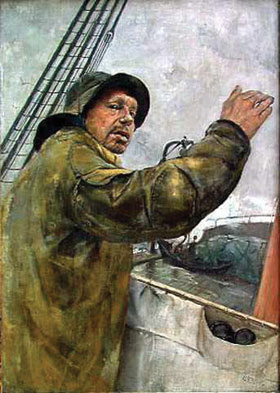
During his time in the French capital he became influenced by the works of Édouard Manet and his modern scenes, which were often controversial. Even now, Manet is looked upon as the father of modernism. During his stay in Paris Krohg had two of his works accepted for the 1882 Salon. One of which was entitled Port Side, which he had started whilst living in Berlin but did not complete until 1879 whilst living in Skagen. It is a depiction of great detail. Look how Krohg has portrayed the clothes worn by the seaman. They have been well worn and impregnated with oil and dirt. They are old and have had to be patched and these details, along with the backdrop of the rough seas, add to the atmospheric mood of the work and we can sense how the bow of the vessel is about to dive headlong into the unforgiving swell.

Girl with a Rake by Jules Breton (1859)

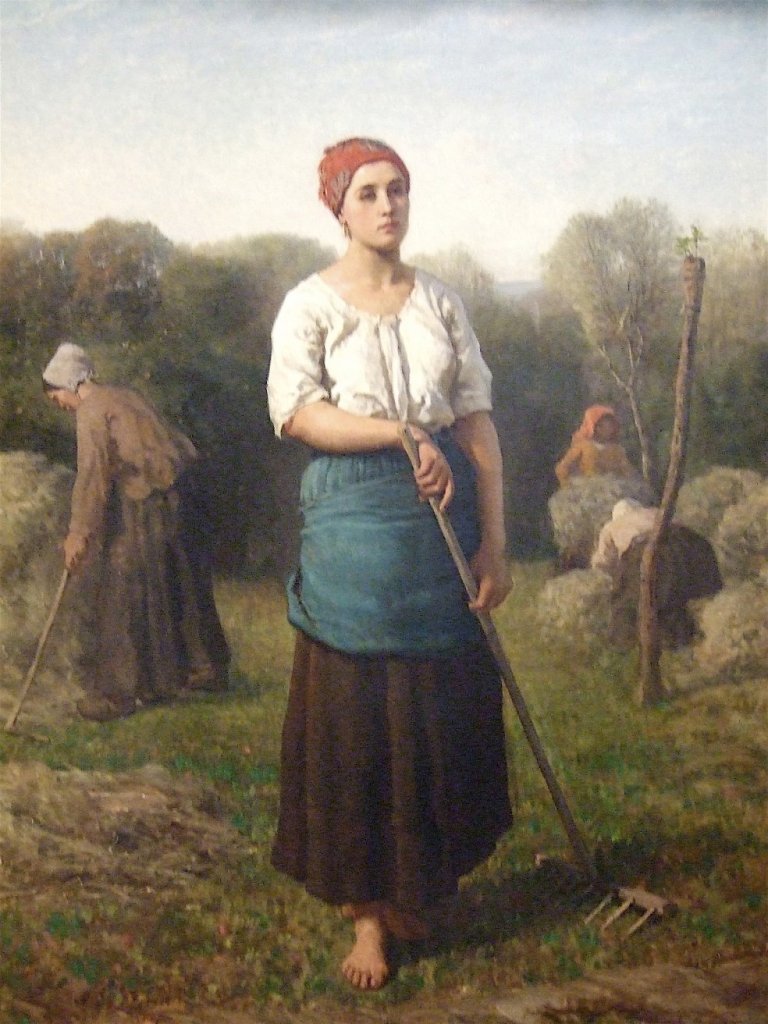
During his stay in Paris Krohg had been very interested in the works of the leading French Social Realist painters of the time, Jules Breton, who was known for his depictions of peasant themes, Jules Bastien-Lepage, a painter noted for his sentimental naturalistic paintings of rural life and Léon Lhermitte, whose main theme for his paintings was also rural scenes depicting peasants at work.

Sovende mor med barn (Sleeping mother with child) by Christian Krohg (1883)

Krohg’s developing interest was the plight of women and their everyday trials and tribulations, which had to be overcome just to survive. Tiredness is one of the greatest afflictions that beset mothers with small children and Krohg’s 1883 painting Mother and Child highlights this perfectly. The work is housed in the National Museum of Art, Architecture and Design in Oslo.

Trett (Tired) by Christian Krohg (1885)

Again exhaustion features in his 1885 work simply entitled, Tired, which shows a young woman who has fallen asleep during working on her sewing machine.

In the second part of the blog about Christian Krohg and his family I will be looking at his fascination with and his depiction of “fallen women” and how it got himself into trouble with the authorities.  I will also look at the life of his wife, Oda, and his unusual and sometimes turbulent marriage.

John-Louis Ernest Meissonier – Part 2

The Siege of Paris in 1870 by Ernest Meissonier 1874

……………………Paris under siege, this time, not by its own people, but by the Prussians, as it was pictorially recorded in Meissonier’s 1884 painting, Le siège de Paris 1870-1871 [The Siege of Paris 1870-1871]. The event took place at the end of the Franco-Prussian War in 1871. During the siege Meissonier was colonel of a marching regiment. It is a painting which is part realism and yet partly allegorical. The central figure, standing in front of a tattered French tricolour flag, is that of Paris, draped in a black veil and a lion skin, and modelled by Meissonier’s wife. She stands above the ruined barricade. There is nothing glorious about the depiction, just a foreboding of hard times to come following the destruction of the city by the Prussian troops signified by the billowing clouds of ash emanating from the burnt-out buildings in the background. The work paints a picture of utter confusion as we see dead and dying soldiers lying on beds of palm leaves which were a symbol of martyrdom. Confusion abounds. Look at the man who lies against the skirt of Paris. This is the twenty-seven-year-old artist Henri Regnault. He was not killed during the siege but actually died in January 1871 at the Battle of Buzenval which was part of the Prussian offensive against the French and a precursor to the siege shown in this painting. Meissonier added him to the work to highlight the futility and waste of young and promising lives struck down by the conflict. Look carefully at the details of this work. To the right of the central character we see a woman holding up her dead baby to her husband. Further to the right we see a woman prostrating herself across the body of her dead husband and to the right of her we see an old man searching through the bodies in the hope of finding his son.

Napoléon III at the Battle of Solferino by Ernest Meissonier (1863)

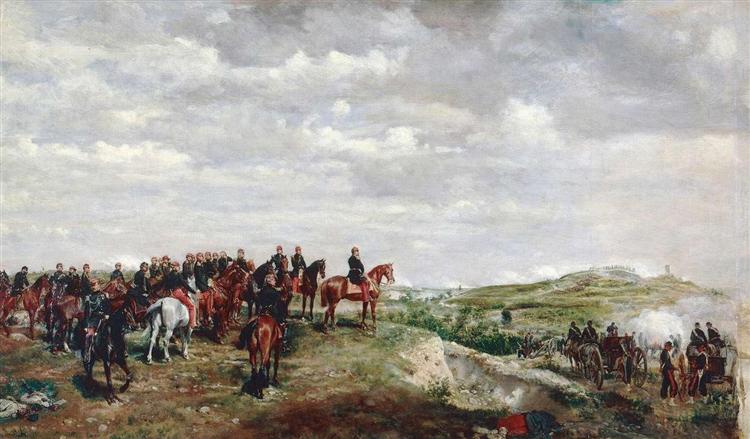
The defeat to the Prussian army stayed in the minds of the French people and scenes from the war were common subjects for painters of the day. Most, like Meissonier, wanted to focus their depictions on the heroism of the French in defeat and offer some hope for the future.  In 1859, Meissonier was commissioned to paint the Napoleon III at the Battle of Solferino. This was the beginning of a new series of works, which was to celebrate the glories of the first Empire. The Battle of Solferino took place on 24 June 1859 and resulted in the victory of the allied French Army under Napoleon III and Sardinian Army under Victor Emmanuel II and the defeat of the Austrian Army under Emperor Franz Joseph I. It was the last major battle in world history where all the armies were under the personal command of their monarchs. Meissonier completed the work in 1863 and is now housed in the Louvre.

La Rixe (The Brawl) by Ernest Messonier (1855 )

In 1851 he produced a very popular genre painting entitled La Rixe (The Brawl). The painting was one of nine paintings by Meissonier that were exhibited at the Exposition Universelle in Paris in 1855, where it was awarded the prestigious Grande Médaille d’Or by the critics. One special admirer of the work was Prince Albert, the Prince Consort and wife of Queen Victoria. It was originally acquired by Emperor Napoleon III for 25,000 francs and then presented to Prince Albert on 26 August 1855, his thirty-sixth birthday. Queen Victoria recalled the gift-giving event:

“…We lunched with the Emperor & Empress. Both most kindly gave Albert presents, the former a beautiful picture by Meissonier called “La Rixe”, the finest thing in the Exhibition, which Albert had been in such extacies over…”

It is now part of the Royal Collection. In the painting we see that a row has broken out in a tavern over a game of cards. A melee ensued, and the table has been overturned. The two men seen brawling are elegantly dressed in early seventeenth-century-style doublets and breeches, and are being restrained by their three fellow players, whilst a sixth person can be seen peeping around the door. What has made the drama more realistic is the way Meissonier has portrayed the twisting and straining of the figures as they battle for supremacy. Meissonier often made wax model figures when planning a composition, and he also owned a large collection of historical costumes and weaponry which he used as props. This work is a romanticised history painting conjuring up a swashbuckling scene from the past and has its counterpart in the novels of Alexandre Dumas, whose The Three Musketeers, which was published in 1844, became the most commercially successful French book of the nineteenth century.

Innocents and Card Sharpers (A Game of Piquet) by Ernest Meissonier (1861)

Playing cards featured in several paintings by Meissonier and often they have a hint of skulduggery as is the case in his 1861 work, Innocents and Card Sharpers (A Game of Piquet). The depiction is of two innocent and naïve youths sitting around a table along with a group of card sharps. The callow youths are unaware of their dubious company, but the atmosphere is tense as seen by the man on the right, standing behind them, keeps his hand on his sword whilst others keenly watch the cards and the players.

A Man in Black smoking a Pipe by Ernest Meissonier (1854)

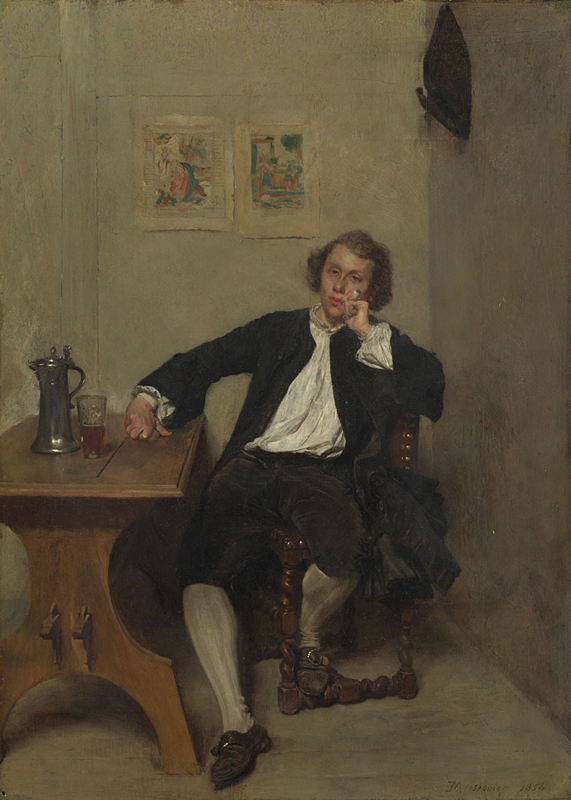
The National Gallery in London has an oil on wood painting by Meissonier entitled A Man in Black smoking a Pipe which he completed in 1854. Meissonier painted numerous genre scenes with individuals in period costume. This is a typical example with the smoker shown in a modest interior with a tankard and a glass of beer. The wall behind is decorated with some unframed popular prints.

Le Voyageur by Ernest Meissonier (c. 1880’s) s
Statuette in wax, fabric and leather

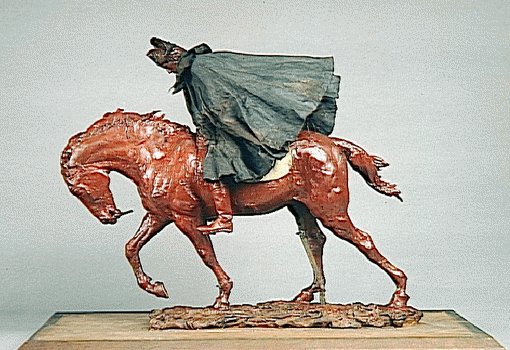
Whereas most people will know of Meissonier as a painter less would realise that he was also a sculptor. The Musée d’Orsay has a fine example of his prowess as a sculptor – Le Voyager (The Traveller) which he completed in 1840. This wax sculpture measuring (HWD) 48 x 60 x 40cms depicts a man hunched over the neck of his horse, as he battles against the wind and lashed by the rain.  The Traveller is probably the most notable of all the statuettes made by Meissonier and one that exudes an air of romanticism. Look how Meissonier by the way in which he models the musculature of the horse and by doing so, has been able to amplify the power of the piece. This work by Meissonier is an example of verism, (the theory that rigid representation of truth and reality is essential to art), in the way that he used real fabric for the coat and leather for the reins. Meissonier said that he enjoyed modelling and almost always worked in wax because it was so malleable.  He commented:

“…It is instant burst of creativity… You cannot imagine how absorbing and exciting it is to make a model…”

Campagne de France (Napoleon and his staff returning from Soissons after the Battle of Laon), by Ernest Meissonier (1864)

Meissonier was probably best known for his military art and paintings depicting Napoleon Bonaparte and scenes from Napoleonic battles. He specialised in meticulous, small-scale military scenes. One of his most memorable works is Campagne de France, 1814 [Campaign of France, 1814] which is housed in the Musée d’Orsay. Although this is a military history painting, in comparison to the often-monumental paintings of this genre, it is small in size, measuring just 52 x 77cms.  It is an example of Historical Realism in art. There is no sign of glorified heroics. The riders are not crossing a stretch of virgin white snow but rather an unpleasant-looking muddied terrain. This is pictorial history recording Napoleon and his staff returning from Soissons after being defeated at the Battle of Laon in March 1814 by the Prussian troops of Gebhard Leberecht von Blucher. The whole scene uses subdued brown and grey tones, and with the exception of the fortitude that emanates from the isolated figure of Napoleon on his white horse, there is a sense of doubt and resignation felt by the officers and the troops.

Friedland 1807 by Ernest Meissonier (1875)

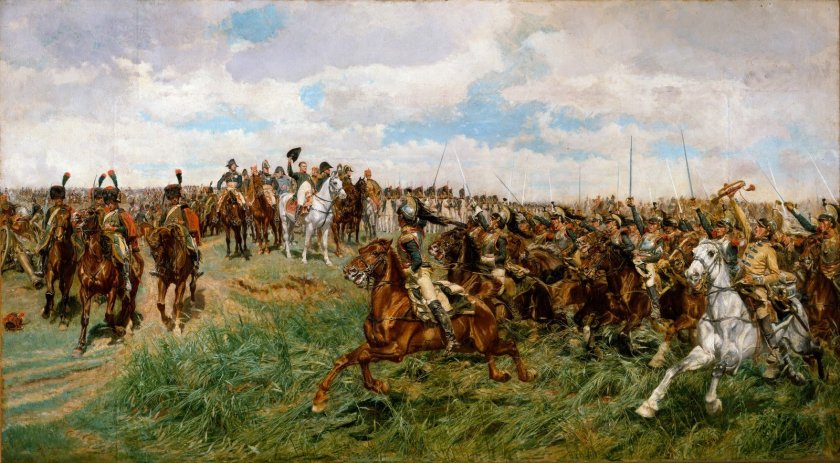
Countering that image of Napoleon in defeat, Meissonier’s completed his largest and most ambitious painting, Friedland 1807, which evokes one of the emperor’s greatest victories. The work measures 136 x 243cms and is currently housed in the Metropolitan Museum in New York. Initially the work was bought “sight unseen” by the American department store magnate Alexander T. Stewart and later Judge Henry Hilton acquired the work at Stewart’s estate sale and in 1887 bequeathed it to the Metropolitan Museum. This work and the previous one, Campagne de France, 1814 were the only two paintings completed by Meissonier for his proposed cycle of five episodes in the life of Napoleon.

A General Officer by Ernest Meissonier

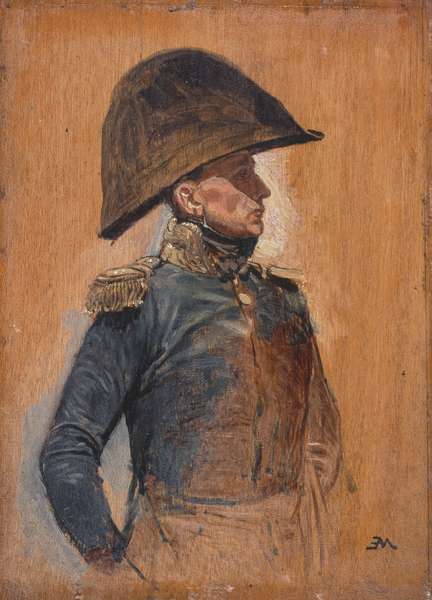
Meissonier produced very small meticulous paintings of military scenes and interiors as well as men in military uniforms such as his painting, A General Officer, which just measured 13 x 9cms. It depicts a General Officer in the army of Napoleon III. The painting, being in profile, shows off the military man wearing his grand military hat to its best advantage. The officer, dressed in white breeches and a blue jacket with gold epaulettes, stands in an upright pose with his hands behind his back. This type of meticulous painting by Meissonier is based on the style of seventeenth-century Dutch genre and still life paintings and they were greatly admired in his lifetime by both the public and the critics.

Advance Guard of an Army by Ernest Meissonier.

Another military miniature measuring 12 x 21cms is Advance Guard of an Army. In this work we see the advance guard of an army moving downwards along a path on a barren hillside. The column of troops is being observed by a solitary soldier on horseback at the top of the hill.  In the background on the far left we catch a glimpse of the sea. The overcast sky is plain and does not distract from the portrayal of the troop column. Once again Meissonier has used a low viewpoint to depict the movement of the horsemen and this technique lent itself well to Meissonier’s diminutive canvases, giving them a feeling of expansiveness in a small frame.

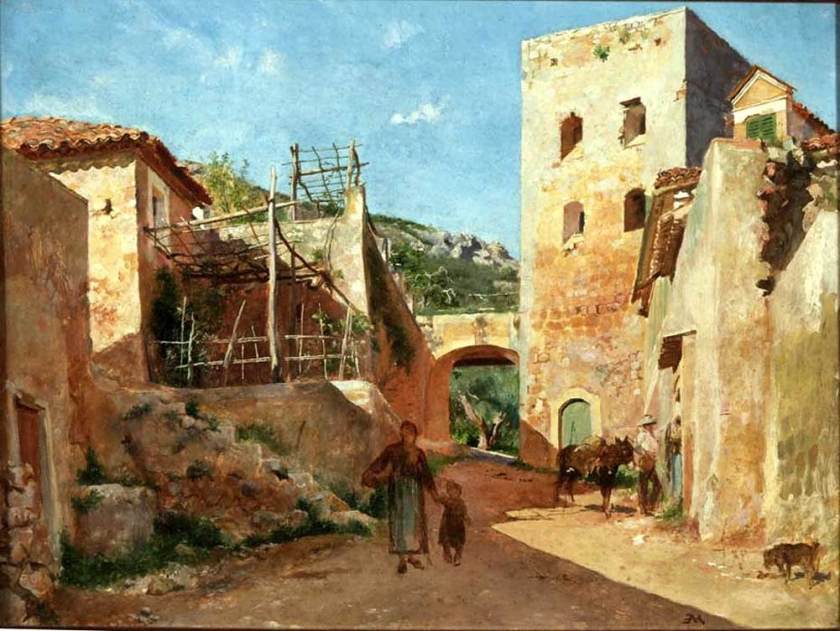
Street Scene near Antibes by Ernest Meissonier (1868)

In June 1868 Meissonier travelled to the south of France and stayed in Antibes. His desire to go to the Mediterranean coast was probably two-fold. Firstly he was interested in the life of Napoleon Bonaparte who had been imprisoned in Fort Carré, at Antibes and also when Napoleon returned from exile on the isle of Elba in 1815 he made landfall at Golfe-Juan along the coast from Antibes. The second reason for the visit was probably the excellent plein air painting conditions he would have had in Antibes.   Other plein air landscape painters would have talked to him about the conditions and have persuaded him to move away from his historical works and look to completing some landscape plein air work.

“…It is delightful to sun oneself in the brilliant light of the South instead of wandering about like gnomes in the fog. The view at Antibes is one of the fairest sights in nature.”

One such work he completed whilst there was his 1868 painting Street Scene near Antibes.

Napoleon and his Staff by Ernest Meissonier (1868)

Meissonier received many honours during his lifetime. In 1846 he was appointed knight of the Légion d’honneur and promoted to the higher grades in 1856, 1867, and 1880, eventually receiving the Grand Cross in 1889. One of his unfilled ambitions was to teach at the École des Beaux-Arts, but it never came to fruition. He also dabbled in politics but his attempts to be chosen as a deputy or made senator were never realised. When the Société Nationale des Beaux-Arts was revitalized, in 1890, Ernest Meissonier was elected its first chairman, but he died shortly after the appointment.

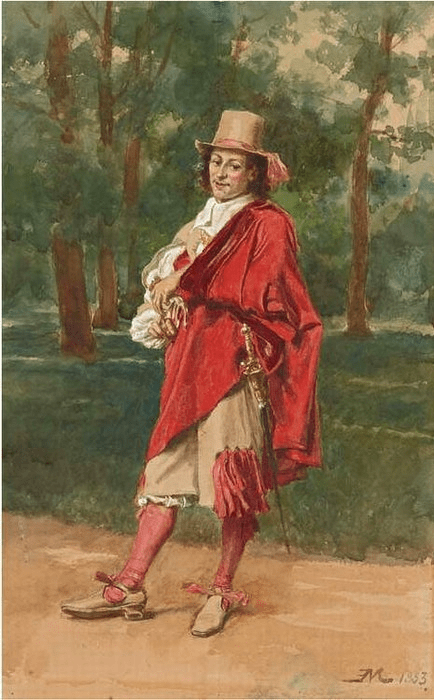
Jean-Charles Meissonier, son of the artist, in Louis XIII costume by Ernest Meissonier

His son, Jean Charles Meissonier, also a painter, was his father’s pupil, and was admitted to the Légion d’honneur in 1889.

Statue of Meissonier at Parc Meissonier in Poissy (Yvelines), France

Meissonier’s wife died in June, 1888 and in August, 1890, he married Mlle Bezançon.   Meissonier died in Paris on 31 January 1891, just a few weeks short of his seventy-sixth birthday.  After a Requiem Mass at the Madeleine, on February 3rd 1891, he was buried at Poissy where a monument was erected to him in 1894.

Jules-Louis Ernest Meissonier – Part 1.

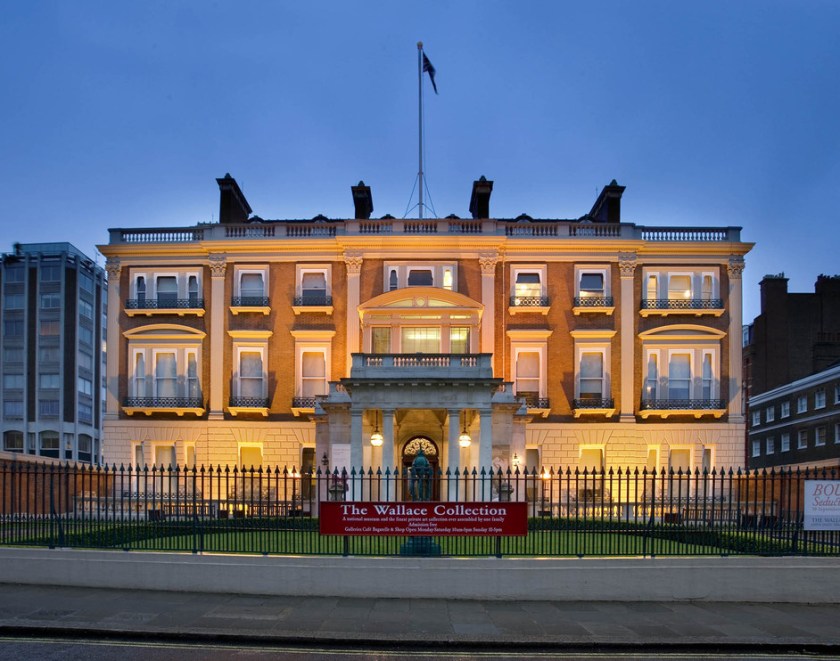
The Wallace Collection, London

When I go to a large town or city I tend to try and visit the local art gallery/museum. The trouble with these establishment in major cities such as London, New York, Paris, and Madrid, is that the foremost galleries tend to be massive in size and almost impossible to view all the works in the time you have free. When time is of the essence I tend to look for a smaller gallery and often they are little gems. When I am in London, and if I only have a few hours to spare, I try and visit the Wallace Collection which is situated in Manchester Square a short distance from Selfridges and Debenhams on Oxford Street.

Wallace Collection gallery

There, on display are a superb collection of works of art collected in the eighteenth and nineteenth centuries by the first four Marquesses of Hertford and Sir Richard Wallace, the illegitimate son of the 4th Marquess. When Richard Wallace died in 1890, he bequeathed his entire estate, including the art collection, to his widow, Amélie-Julie-Charlotte Castelnau and it was Lady Wallace who, on her death in 1897, bequeathed it to the British nation. There were a couple of provisos that went with the bequest.

In her will, she specified that in return for her gift, the Government should provide a site to build a new museum and that the collection should be kept together. She also stipulated that the Wallace Collection was to be a closed collection, meaning that no other works of art could be added to it, permanently or temporarily, nor should any of the collection be taken away. So little changes with the art collection but one never tires of seeing so many gems of European oil paintings from the fourteenth to the mid-nineteenth century. Both the 4th Marquess and his son, Sir Richard Wallace lived in Paris and they both acquired many works of art by eighteenth and nineteenth century French artists, such as Watteau, Boucher, Fragonard and Decamps as well as my featured artist, Jules-Louis Ernest Meissonier.

Self-portrait by Ernest Meissonier (1889)

In my next two blogs I will be looking at the life of Jules-Louis Ernest Meissonier, the great French Classicist painter, who is probably best known for his military and historical subjects, especially depictions of Napoleonic battles.  Meissonier was largely self-taught, and yet, became one of the highest paid painter in the second half of the century.

An Artist showing his Work by Ernest Meissonier (1851)

Ernest Meissonier was born, in Lyon on February 21st, 1815, just as the Napoleon Bonaparte era was ending.  He was the elder of two sons.  At the age of three his father moved his family to Paris. His father, Charles Meissonier, was a dye merchant and a very successful businessman, who owned a factory in Saint-Denis, north of Paris. The factory produced dyes for the textile industry. He also had a drug and provisions shop in the Rue des Ecouffes. Meissonier’s mother loved music and took lessons in the painting of miniatures and ceramics. She died when her son was still young.

Meissonier’s school record left a lot to be desired. When he was nine years old and attending a local school in Rue des Francs-Bourgeois, his teacher commented:

“…[he showed] too marked a tendency to draw sketches in his copy-books instead of paying attention to his teachers…”

Meissonier’s father was concerned about his son’s leaning towards art as the Romantic painters in those days did not have a great reputation and he believed that the likelihood of his son becoming successful was unlikely.  Later during his stay at a school on the Rue de Jouy his teacher reported on Meissonier’s love of art and the part it played in his failing at other subjects:

“… Ernest has a decided talent for drawing. The mere sight of a picture often takes our attention from our serious duties…”

By now Meissonier’s father was alarmed with his son’s progress and in 1832, when Ernest was seventeen years old, his father decided to pull him out of school and had him apprenticed as a druggist. Ernest was not happy with his father’s plan for his future and presumably after many months of conflict between father and son, he was allowed to study art at the atelier of Jules Potier. His stay there was short-lived and from there he moved to the atelier of the French history painter and portraitist, Léon Cogniet. However, Ernest was more influenced by the paintings of the Dutch and Flemish Masters which he saw at the Louvre than the teachings of Potier and Cogniet.

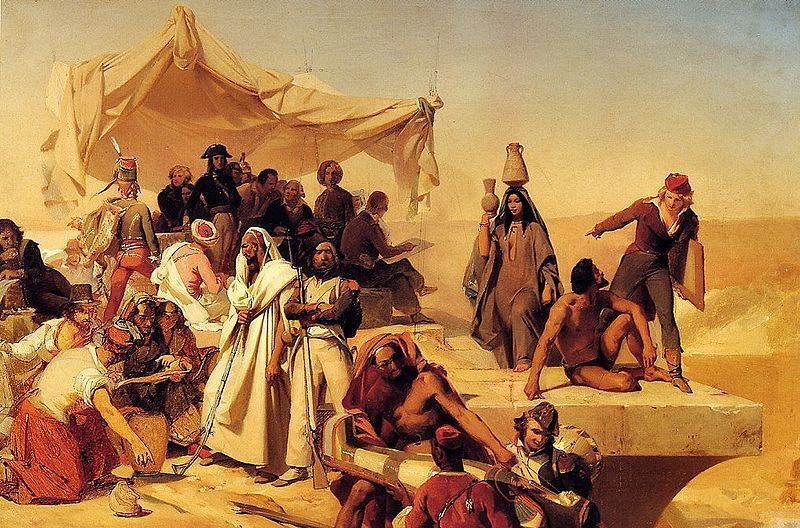
L’Expédition d’Egypte sous les ordres de Bonaparte (in 1798), by Léon Cogniet

However, it was whilst studying at Cogniet’s studio that Meissonier witnessed his master painting a military work which when completed in 1835 would be referred to as L’Expédition d’Egypte sous les ordres de Bonaparte (in 1798), (The 1798 Egyptian Expedition Under the Command of Bonaparte). Meissonier was fascinated to watch Cogniet working on the painting, soldiers were hired in for the day, dressed in republican uniform as well as dragoons and artillerymen and their horses. He realised that he would like to become a military painter, but that was some way in the future.

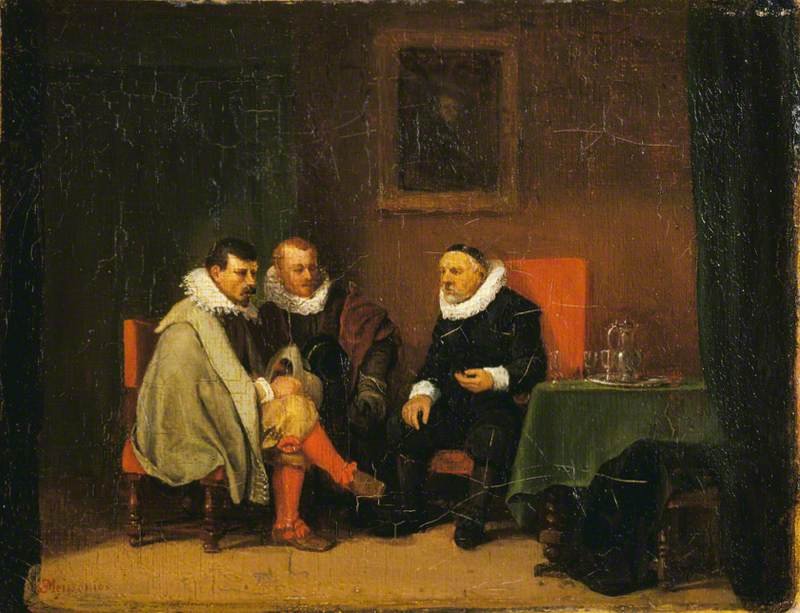
Dutch Burghers by Ernest Meissonier (1834)

Meissonier’s first breakthrough into the art world was when he had one of his paintings, Les Bourgeois Flamands (Dutch Burghers), also known as The Visit to the Burgomaster, accepted into the 1834 Salon. This very small oil painting measuring 18 x 22cms was, in essence, a costume piece depicting three sober-looking gentlemen dressed in traditional seventeenth century clothing. It is fascinating to see how Meissonier has depicted in this work the light and shadow. He has also inserted a still-life depiction into the painting with his rendition of the silver tray, jug, and glasses atop the table to the right of the painting. This work of art was acquired by Sir Richard Wallace for his Wallace Collection.

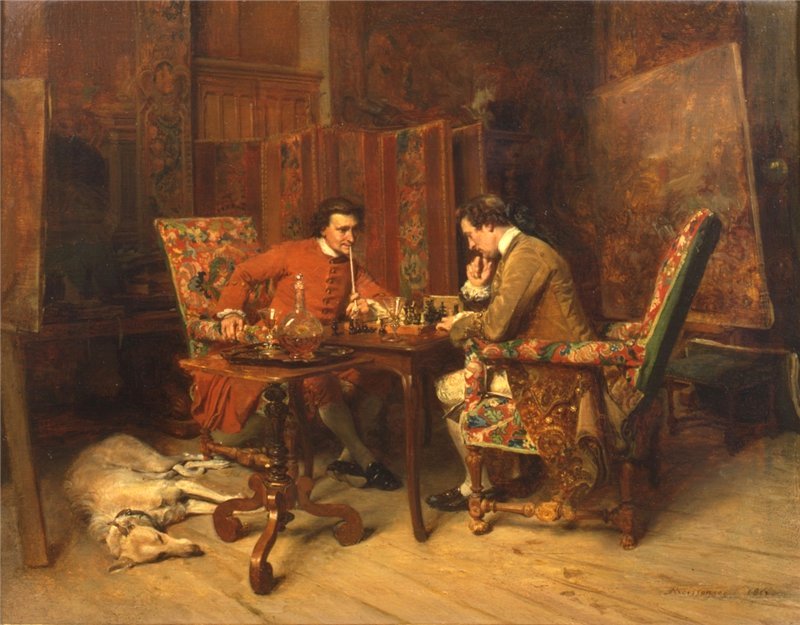
Chess Players by Ernest Meissonier (1853)

Meissonier in the mid-thirties soon realised that the life of an artist was one of depravation and living hand to mouth and had to turn to his father on a regular basis for financial assistance. Notwithstanding the financial hardships he endured, he had further success at the Salon in 1836 when two of his paintings, The Chess Player and The Errand Boy were accepted into the exhibition. It is interesting to note the vagaries of the Salon jury system as both these works had been rejected by the Salon jury in 1835.   The chess player theme was evident in another painting he completed almost twenty years later.  It was a miniature (9.5 x 12.5cms) which he painted in 1853.

The novel, Paul et Virginie, with illustrations by Ernest Meissonier

Financial salvation for Meissonier arrived in the form of book illustrations. He produced many woodblock illustrations for the publisher, Henri-Léon Curmer, for his edition of the popular 1788 novel Paul et Virginia,  by Jacques-Henri Bernardin de Saint-Pierre. Meissonier also supplied a full set of diminutive illustrations for another edition of a novel by this author, which he wrote in 1790, La Chaumière indienne (The Indian Cottage). They were well received, and book sales flourished. Financially, the tide had turned for Meissonier.

The Recital by Ernest Meissonier (1853)

One of Meissonier’s artistic friends was the Strasbourg-born painter Auguste Steinheil and through this friendship, Meissonier met his sister Emma. A courtship followed and on October 13th 1838 Ernest and Emma married. The couple went on to have two children, a daughter Thérèse in 1840 and later a son, Jean-Charles. Maybe Meissonier had plans for his artistic future as on Thérèse’s birth certificate, Meissonier’s occupation was given as “painter of history”.

Isiah by Ernest Meissonier (c.1838)

In the late 1830’s Meissonier embarked on religious paintings and around 1838 produced Isaiah which was exhibited at the Paris Salon of 1840. This was to be one of only a few religious paintings by Meissonier and so, with little success with this genre and advice from the French painter Jules Chenavard, he stopped painting religious scenes and returned to his small genre pieces featuring scenes of bourgeoise domestic life which proved so popular.  One of the reasons why miniature paintings were preferred to the bygone grandiose history paintings was that smaller canvases such as landscapes or portraits, because they fitted more easily onto the walls of Paris apartments, were big sellers. Meissonier was often referred to as the French Metsu, likening him to the seventeenth-century Dutch painter Gabriel Metsu, who also specialised in miniature scenes of bourgeois domestic life.

Smoker by Ernest Meissonier

The significant year in Meissonier’s life was 1842. It was in that year that he produced two beautifully painted genre works, The Smoker and The Bass Player. Critics were overwhelmingly complimentary and one of the leading critics at the time, Théophile Gautier commented:

“…In their small scale, we place these inestimable works without hesitation beside those of Metsu, Gerald Dou, and Mieris; perhaps even above them, because Meissonier has the truth of drawing, the fineness of tone and preciousness of touch joined with a quality that the Dutch hardly possess—style…”

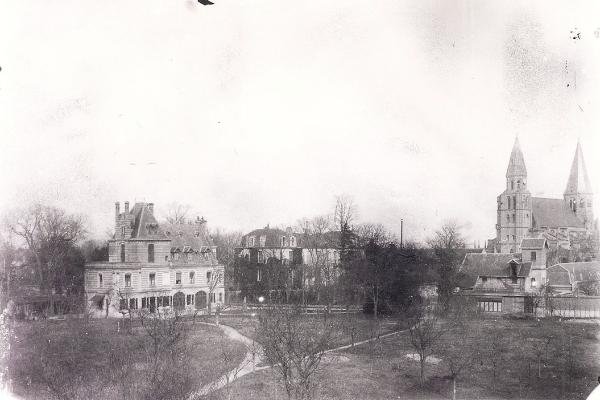
Poissy, enclosure of the abbey, years 1870-1880.
From left to right, Meissonier’s house, Ridgway Knight’s house (center) and Notre-Dame collegiate church. Photo Agnès Guignard

Such critical praise made Meissonier one of the most sought-after painter of the decade, and his works of art appealed to a wide range of collectors. Such a demand for his work meant that the prices he could achieve for his work also rose and the money flowed in. The fruits of all this labour were rewarded and in 1847, he was able to purchase an elegant suburban home in Poissy, known as the Grand Maison. The Grande Maison included two large studios, the atelier d’hiver, or winter workshop, situated on the top floor of the house, and at ground level, a glass-roofed annexe, the atelier d’été or summer workshop. This rise in wealth and artistic status was a great achievement for somebody who had taught himself art and had no great financial backing from a well-to-do family.

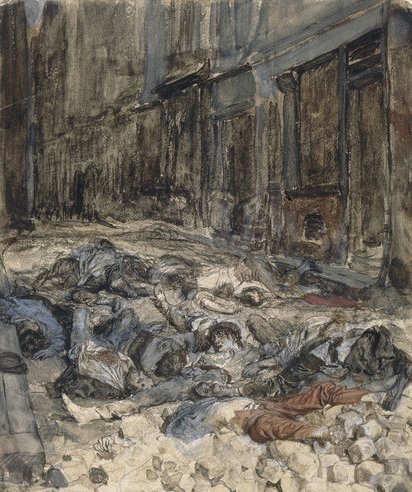
The Barricade by Ernest Meissonier (1848)

Things had settled down in France politically since the Revolution of the 1790’s and the Napoleonic era but in 1848 the situation changed for the worse. In Paris, Louis-Philippe, known as the “citizen king was forced to abdicate that February, and the country descended into civil strife and anarchy. Meissonier was an artillery captain in the National Guard, and one his responsibilities was for his troops to defend the Hôtel de Ville. In June 1848, Meissonier witnessed a bloody struggle and resulting carnage with the massacre of the insurgents on a barricade of the rue de l’Hôtel-de-Ville. He produced a watercolour which depicted the outcome of the massacre. Meissonier neither forgot about the incident nor the painting for in the 1890’s he talked about his love for the work, in a letter to Alfred Stevens, the Belgian painter:

“…I am not modest about this drawing, and I am not afraid to say that if I were rich enough to buy it back, I would do so immediately […] When I painted it, I was still terribly affected by the event I had just witnessed, and believe me, my dear Alfred, those things penetrate your soul when you reproduce them […] I saw it [the taking of the barricade] in all its horror, its defenders killed, shot, thrown out of the windows, the ground covered with their bodies, the earth still drinking their blood…”

The watercolour was hailed as truly remarkable and it was acquired by the painter Eugène Delacroix and is now housed in the Musée d’Orsay.
This watercolour, depicting the outcome of the fight, was always considered, by both the artist and his contemporaries, as a remarkable and an unusual work. The history of this drawing also makes it special with Eugène Delacroix being its first owner.

The Barricade, rue de la Mortellerie, June 1848 by Ernest Meissonier (1849)

Meissonier did a follow-up oil painting depicting the massacre the following year entitled The Barricade, rue de la Mortellerie, June 1848 which can now be found in the Louvre. Once again, the depiction is based on Meissonier’s memory of what happened on that fateful day. In the work we see numerous corpses and severed limbs of the rioters lying amongst the cobblestones in the middle of a street lined with old houses.  Meissonier had hoped to exhibit this painting at the 1849 Salon under the title of June 1848, but he gave up on the idea saying that the horror of the incident was too fresh in people’s minds and many wanted to eradicate the incident from their memory. The art critic Théophile Gautier was the only one who dared to admit being disturbed by the work and talked of “this trusty truth that no-one wants to tell.” This unidealized work not only presents a denunciation of civil rebellion, but also highlights the growing tensions between the social classes in Paris.

………….to be continued.

John Bauer and Ester Ellqvist

John Bauer Self Portrait (1908 – Volterra, Italy)

I suppose everybody at some time or other has read or had read to them a children’s fable or fairy tale. As a child we would have been fascinated by these stories, but the enchantment was enhanced by the illustrations which were set alongside the printed stories. My blog today is about an artist who was the master of book illustrations which often sat alongside stories about enchanted woods and fairy princesses. Let me introduce you to John Albert Bauer, the Swedish painter and illustrator.

Stackars lilla Basse! (Poor Little Bear) by John Bauer (1912)

John Bauer’s father, Joseph Bauer, came to Sweden from Ebenhausen in Bavaria as a young orphaned teenager in 1863. He eventually settled down in Jönköping, which is situated at the southern end of Sweden’s second largest lake, Vättern, a lake, which would play a fateful part of his son, John’s life. In the early 1870’s Joseph married Emma Charlotta Wadell, whose parents belonged to a farming community in Rogberga, a rural area, eight kilometres south-east of Jönköping.

Villa Sjovik

Joseph Bauer and his family lived in an apartment above their charcuterie shop in the bustling East Square in Jönköping. The family business was a very profitable venture, so much so that Joseph Bauer was able to afford to buy a summer residence, Villa Sjövik, which was built in 1881 and was situated on the west shore of the Rocksjö, a lake close to Jönköping. It was a rural location, surrounded by almost untouched nature. Looking back from the lake, forests could be seen straddling the mountains which bordered the city of Jönköping. Alas, Villa Sjövik was demolished in the 1960’s but in its place today, there is the JOHN BAUERSGATAN (John Bauers Park) bearing the artist’s name. It is now a small area of tranquillity in the middle of the bustling city and there is a sign marking the place where Villa Sjövik once lay.

Eight year old John Bauer

John Bauer was born on June 4th, 1882. He was the third of four children having an elder brother and sister, Hjalmar and Anna and a younger brother Ernst. When John Bauer grew up he spent much time exploring the woods and the nearby fields. Nature to him was his friend. Villa Sjövik was a beautiful residence with a large verdant garden and leading from it was a long jetty which led to the lake which made for an ideal bathing spot. The Bauer family enjoyed their time at their summer residence, away from their town apartment, and after a time, they decided to live permanently at Villa Sjövik.

John Bauer at work

The Bauer family happiness ended abruptly in 1889 when John was seven years old. His sister Anna died suddenly at the tender age of thirteen and this death had an overwhelming effect on John and his family. Living in an apartment situated above their father’s charcuterie, he was always given to sketching and drawing. During his time at Villa Sjövik, he would spend time walking through the Småland forest, always with his sketchbook. It was probably during these teenage years that he began to draw images of the imaginary creatures which he believed inhabited the woods, such as forest trolls and it could be the time that his imaginary fairy-tale world evolved. Another reason for John’s fascination with the world of fairy tales came from the numerous stories he and his siblings were told by their maternal grandmother Johanna Ellqvist. In these recounted myths and legends, she would tell her grandchildren about superstitions and the powers and the secrets of nature which undoubtedly remained in John Bauer’s mind and would play such a big part of his artistic life.

An Old Mountain Troll by John Bauer (1904)

His initial schooling was at Jonkopings Hogre Allmana Laroverk, the Jönköping Public School of Higher Education and then from the age of ten to sixteen he attended the Jonkopings Tekniska Skola, the Jönköping Technical School. John’s passage through school was undistinguished. He was, at best, a mediocre student who lacked any interest in his studies and during lessons would often be lost in his daydreams and doodling on his books and composing caricatures of his teachers. However, one thing was certain, his ability to draw and his interest in art was undeniable. His interest in art was lost on his parents who were too occupied with their own life. They understood he did not like school and showed no interest in getting a job so were supportive when their sixteen-year-old son told them he wanted his future life to be centred around art.

Princess Daga by John Bauer (1907)

At the age of sixteen John left home and moved to Stockholm to study art. Although his parents showed little interest in his artistic ambition they did support him financially, enabling him to pursue his future plans. It must have been a difficult time for the teenager as although he was immersed in his chosen life of art he must overcome his doubts about his own ability. At sixteen years of age Bauer was too young to enrol at the Stockholm’s Royal Swedish Academy of Fine Arts and so became a student at the Kaleb Ahltins school for painters for the next two years.

Troll by John Bauer (1912)

In 1900, aged 18, Bauer was accepted into the Swedish Academy of Fine Arts. He studied traditional illustrations and made drawings of plants, medieval costumes and croquis, which is the quick and sketchy drawing of a live model. There were Classical Art classes, classes which looked at anatomy, perspective, and he would also be expected to attend lectures on the History of Art. When he got home he would also be expected to complete drawing assignments. All of this was to serve him well in his later work. He did well at the Academy and in his 1991 biography of John Bauer, the author Gunnar Lundqvist quotes a comment of one of Bauer’s tutors, the noted historic painter, Gustaf Cederström, who had this to say about Bauer’s work:

“…His art is what I would call great art, in his almost miniaturized works he gives an impression of something much more powerful than many monumental artists can accomplice on acres of canvas. It is not size that matters but content…”

Söndags-Nisse magazine

Whilst a student at the Academy he supplemented the money he received from his parents by working as an illustrator for various magazines. One of the greatest influences on him was the fellow illustrator Albert Engström, who was one of the most influential journalists in Sweden. He was a humourist and cartoonist with a great European reputation, and in America he was referred to as the “European Mark Twain”. John Bauer sold his first illustrations to the Söndags-Nisse, which was a light-hearted Swedish magazine. He continued to earn money with his illustrations for this journal and they even offered him a permanent job, which he turned down.

Laplanders in snowstorm by John Bauer (1904)

The far north of Sweden, Norway and Finland was the land of the Sami people but with the discovery of vast amounts of iron ore in that region much of their lands were taken over by large mining companies. In 1904 Carl Adam Victor Lundholm planned to publish a book, Lappland, det stora svenska framtidslandet (Lappland, the great Swedish land of the future) which was all about the beauty of this area known as Lapland and to focus on the native Sami people who lived in this wintry region. To make the book complete Lundholm wanted it to be illustrated. Established artists were commissioned.  Bauer applied but as he was only young and inexperienced he was asked to prove his abilities by going to Skansen and sketch the Sami people.

Model Village at Skansen

Skansen was the first open-air museum and zoo in Sweden which is located on the island Djurgården in Stockholm. It had been in existence since October 1891 and revealed the way of life in the different parts of Sweden prior to the industrial era. This open-air museum atop the hill dominates the island and the site includes a full replica of an average 19th-century town, in which craftsmen in traditional dress such as tanners, shoemakers, silversmiths, bakers and glass-blowers demonstrate their skills in period surroundings. There is also an open-air zoo containing a wide range of Scandinavian animals including the bison, brown bear, moose, grey seal, lynx, otter, red fox, reindeer, wolf, and wolverine (as well as some non-Scandinavian animals because of their popularity). There are also farmsteads where rare breeds of farm animals can be seen.

Lundholm was pleased with what Bauer produced after his visits to Skansen and commissioned him to provide some of the book illustrations, and so in July 1904 Bauer travelled to Lappland, staying there a month, sketching, and photographing the area, its people, and their way of life. The book was eventually published in 1908 and eleven of Bauer’s watercolours graced the book. Bauer also turned many of his sketches and photographs into paintings.

Self portrait by Ester Ellqvist

A fellow first-year student of John Bauer was Ester Ellqvist. Ester was born in Ausås in southern Sweden on October 4th, 1880. She was the youngest of seven children of Karl Kristersson Ellqvist and Johanna Nilsdotter. Ester had three older brothers, Carl, Oscar, and Ernst and three older sisters, Selma, Hilda and Gerda. A couple of years after Esther was born, the Ellqvist family moved to Stockholm, where Esther went to the technical school and amongst other things learnt to draw perspective, which was one of the requirements for being admitted into Stockholm’s art academy. One of her sister, Gerda, became an art and needlework teacher, and two of her brothers, Oscar and Ernst made their living as photographers.

John and Ester

John and Ester never studied together as at that time males and females were not allowed to attend the same classes for the men and their artistic education was conducted differently. This was problematic for women such as Ester as although she had the artistic talent and the ambition to succeed she did not have the same opportunities as her fellow male students.

Dubbelporträtt av barn (Double portrait of children) by Ester Ellqvist

John and Ester began seriously courting around 1903 but it was not a close courtship as they were apart most of the time, and their courtship often just existed as an exchange of letters. But these letters were important as each told the other about their loves, their worries and their hopes for the future

Ester photographed by her brother Oscar.

For John, blonde-haired Ester was the personification of a beautiful fairy tale princess and she would be his great inspiration when he started to concentrate on his illustrations for fairy tale books. John and Ester were engaged in 1903, much to Bauer’s family dismay for they believed their son was too young to marry and had yet to establish himself as a professional artist or illustrator.

The Fairy Princess, 1904, oil sketch by John Bauer

However, a year after the couple completed their Academy course they were married on December 18th, 1906. Whether it was just marriage jitters but before the wedding Ester was beginning to have doubts about her relationship with John and their future together. One must remember that the two had vastly different upbringings. Ester, except for her first couple of years, lived in the city of Stockholm and was used to all the things cities could offer. She was a lively vivacious person who had many friends and for her, life in the city was exciting and offered up many social events. John Bauer on the other hand was a solitary person who was brought up in a small town and spent much of his life alone or with his brothers wandering around the nearby forests of South Vätterbygden where he gained inspiration for his paintings. The other problem for the newly-weds was that Ester, like John, was an aspiring artist but now, after marriage, she was expected to give up her art and concentrate on her husband, their home, and the family.

The Königsberg by John Bauer

The turning point in John Bauer’s artistic career came in 1907 when the publishers, Åhlén & Åkerlund, asked him, to provide illustrations for their newly launched Bland tomtar og troll, (Among Gnomes and Trolls) which was a popular Swedish annual which was full of folklore stories and fairy tales written by various authors.  The first edition was published in 1907. Except for 1911 issue, Bauer’s illustrations appeared in the first nine publications. The reason that the 1911 edition of the annual did not contain his illustrations was due to Bauer and the publisher falling out about who owned the watercolours Bauer had given the publisher for the books. He wanted them, they refused saying his material belonged to them and so he declined to supply any material for the 1911 issue. The result was a disaster for the publisher as sales of that year’s annual slumped. The publisher caved in. Bauer was granted the copyright of his paintings which were all returned to him and he resumed producing paintings for their annuals and sales of the annual rose.  Many of the illustrations would be of blonde-haired princesses for which Ester was his ideal muse.

Lucia by John Bauer

One can imagine how excited Bauer was to produce the illustrations. As a child he would walk through the woods close to Villa Sjövik and daydream about the trolls and fairy princess he imagined lived in the woods and now he could convert his dreams into pictorial reality. His illustrations depicted the beauty of Swedish nature with its dense forests pierced by sunlight as it penetrated the gigantic tree canopy. There is a mysticism about his forest illustrations which may sound a chord to those who have ever explored the dark world of a forest.

Ännu sitter Tuvstarr kvar och ser ner i vattnet (Still, Tuvstarr sits and gazes down into the water) by John Bauer (1913)

Due to the restrictions of the technology available to his printers, the 1907to 1910 editions were produced in just two colours: black and yellow even though the watercolour paintings he had given the publisher were in full colour. Things changed with printing techniques in 1912, and the pictures could then be printed in three colours: black, yellow, and blue which were now closer to Bauer’s original paintings. In 1914, following his return from Italy, his illustrations started to be influenced by the Italian Renaissance. However, after eight years of supplying paintings for the annuals, Bauer had had enough and wanted to move on with his art and 1915 marked the last year he provided material for the annuals.

In 1931 a book was published which had extracts from the original volumes illustrated by John Bauer and the proceeds from its sales went to raise money for a memorial honouring Bauer.  One of the most memorable illustrations from these annuals was his 1913 picture, Ännu sitter Tuvstarr kvar och ser ner i vattnet. (Still, Tuvstarr sits and gazes down into the water).

Ester in Italy

In Gunnar Lindqvist’s 1991 biography of John Bauer he states that in the Spring of 1908, John’s father financed his son and daughter-in-law’s trip to Southern Germany and Italy. John and his father Joseph had visited Germany in 1902. John and Ester’s journey lasted for almost two years during which they studied art, visiting museums and churches as well as sketching and painting. The couple visited Verona, Florence, and Siena.  Whilst in Tuscany they spent two months in Volterra, a walled mountain top town of which its history dates to before the 7th century BC. They continued through Naples and Capri, constantly writing home to their families, telling them about all they had seen and done.

The Root Trolls by John Bauer (1917)

It was on their return to Sweden in 2010 that they first got sight of Villa Björkudden on the shores of Lake Bunn, a few miles south east of Gränna. They fell in love with the house and in 1914 they bought it.  The following year in the autumn Ester gives birth to their first child, a boy named Bengt, but always referred to as Putte. The nickname may have derived from the Italian word putti, a figure in a work of art depicted as a chubby male child – a cherub! Bengt actually appeared in a painting by his father entitled The Root Trolls, which Bauer completed in 1917.

Ester Bauer and her son Bengt

The marriage of John and Ester Bauer was failing. Ester saw herself and her life being taken away from her. She had wanted to be a portrait artist but instead she was simply a lonely housewife married to an artist. She believed she had nothing to show for herself. Again, another underlying cause for the unhappy marriage was Ester’s discontent about where she lived. Ester had always wanted the city life and John was content with his countryside home on the bank of Lake Brunn. They did return to Stockholm during the winter but that was never enough for Ester. Whether the decision to buy a new house, a permanent home in Stockholm was John’s attempt to save their marriage, we will never know but it sadly ended in the death of the family.

Train accident at Getå on October 1st 1918

On October 1st, 1918 there occurred the worst train disaster in Swedish history caused by a landslide at Getå.  Forty-two people died when the train de-railed due to the collapse of the track after the landslide. The train jumped the embankment, landing on the road below. The tragedy was well-publicized and it was to lead to a fateful decision by Bauer.

The ferry, Per Brahe

Seven weeks later, on November 19th, 1918 John, Ester and two-year-old Bengt had to go to Stockholm to their new home but because of all the media reports about the Getå train disaster John took the  decision to take the  ferry Per Brahe from Granna to Stockholm instead of going by train. The small steamer carried eight passengers and sixteen crew and was fully loaded with iron stoves, agricultural equipment, sewing machines and barrels of produce. All the cargo did not fit into the steamer’s hold and thus a significant portion had to be stored, unsecured, on deck, making the ship top-heavy. The weather was bad, and the ferry sailed into a raging storm. The violent rolling of the vessel in the big swell caused the deck cargo to shift, and some of it went overboard which destabilized the vessel. The ship foundered and capsized, sinking stern first, just 500 metres from its next port of call, Hastholmen.

Bauer’s Obituary notice
“…The artist John Albert Bauer, his wife Ester-Lisa Bauer nee Ellqvist and son John Beng Olof passed away at sea and leave us, siblings, relatives and friends sorrowful and lamented…”

All twenty-four people on board, including the Bauers, drowned. John Bauer was thirty-six, Ester, thirty-eight and their son Bengt was just three years old when they perished that night in Lake Vättern.

The Bauer Family grave

The Bauers were buried at the Östra cemetery in Jönköping.

Who knows what would have become of the Bauer family if they had not died on that fateful night. Would their marriage have survived? Would John Bauer change his artistic style? Would Ester start painting again? We will never know.

John Bauer and the Mountain King film poster (2017)

A film about the life of John and Ester Bauer was made in 2017 and can be downloaded free at:

http://www.4kmoviehub.com/watch-john-bauer-and-the-mountain-king-2018-online-free


A great deal of information for this blog was gleaned from:

Jönköpings läns museum website

Out flew the web and floated wide blog

Daniel Ridgway Knight

Daniel Ridgway Knight (c.1908)

In my last blog I looked at the life and works of the Social Realist painter Walter Langley and his depictions of the hard life endured by the Cornish fishermen and their loved ones. Today I am looking at an American artist whose paintings could not be more different. Daniel Ridgway Knight chose to depict pretty young women enjoying life. The depiction of these ladies in beautiful countryside setting, lit up by dazzling sunlight  was, although very popular, so different to the work of artists of the Realism genre. So why would people want to buy paintings depicting scenes which in reality were just something we would like life to be? Maybe that is the answer to the question. Maybe whilst enduring real life with all its hardships we hanker after the perfect life even if it is just an imaginary idyll. If you had to choose a painting to hang on the wall of your lounge would it be one which depicts poverty or one which depicts sunny meadows awash with flowers and beautiful women?

The Well by Daniel Ridgeway Knight (1880)

Daniel Ridgway Knight was born into a strict Quaker home, on March 15th, 1839, in Chambersburg, Pennsylvania, a town thirteen miles north of Maryland and the Mason-Dixon line. He attended local schools and his family intended that he would either work in a local hardware store or in his uncle’s ship building company, but for Daniel his love of art was his overriding passion and in 1858, at the age of nineteen, he enrolled at the Pennsylvania Academy of the Fine Arts (PAFA). Fellow students at that time included Thomas Eakins, Mary Cassatt, and William Sartain. Knight also became one of the earliest members of the Philadelphia Sketch Club which was founded by six students of the Pennsylvania Academy of the Fine Arts in November 1860 and is still in existence today.

Daniel Ridgway Knight

One of the PAFA students who became a friend of Daniel Knight was Lucien Grapon, a Frenchman, and he would often talk to Daniel about his homeland and how Daniel would love to live in France, with its great social life, fine ladies, and its even finer wines. Daniel must have been seduced by the thoughts of life in France as in 1861 he set sail for France, a journey many of his fellow PAFA students would later take. Cassatt and Eakins went to France in 1866.

Maria on the Terrace with a Bundle of Grass by Daniel Ridgway Knight

On arrival in Paris, Daniel Knight enrolled at the Ecole des Beaux-Arts and attended classes run by Alexander Cabanel as well studying in the atelier run by the Swiss artist, Marc Gabriel Charles Gleyre. During his time in Paris Knight made a number of friends with fellow artists such as Renoir and Sisley. He also took trips to the artist colony at Barbizon where he was influenced by the works of the plein air painters. His stay in France lasted just two years but was curtailed when he received grave news from home about  the state of the American Civil War which had started the year he left for France.   Even more worrying for Knight was that by 1863 the war had spread north with the soldiers of the Confederate army, led by General Robert E Lee invading his home state of Pennsylvania. In a patriotic gesture, twenty-four-year-old Knight returned to Philadelphia and on August 17th, 1864, enlisted in the Union Army as a Private in Company K, 5th Cavalry Regiment Pennsylvania. When not engaged in battle Knight took the opportunity to make sketches of the battle scenes as well as portraits focusing on the facial expressions of his fellow soldiers. Knight later presented many of his sketches at meetings of the Philadelphia Sketch Club.

Harvest Scene by Daniel Ridgeway Knight (1875)

At the end of the Civil War, Daniel was discharged from the Union army and he returned to Paris to complete his studies at the Ecole des Beaux-Arts. On completion, he went back home to Philadelphia and opened a workshop where he worked on his portrait commissions and also held classes for aspiring painters.

The Burning of Chambersburg, Pennsylvania by Daniel Ridgway Knight (1867)

In 1867 Daniel Knight completed an historical painting, The Burning of Chambersburg, Pennsylvania, which depicted an infamous incident in the Civil War. On July 30, 1864, Brigadier General John McCausland and 2,800 Confederate cavalrymen entered Chambersburg and demanded $100,000 in gold or $500,000 in greenbacks. The residents of Chambersburg failed to raise the ransom, and McCausland ordered his men to burn the town. Flames destroyed more than 500 structures leaving more than 2,000 homeless. Chambersburg was the only Northern town the Confederates destroyed. The attack inspired a national aid campaign and spurred the Union Army to a more aggressive approach that finally won the war.

Un Deuil (Bereavement) by Daniel Ridgway Knight,(1882)

It was at his Philadelphia studio that he first met Rebecca Morris Webster, the daughter of Colonel Thomas Webster Jnr, who was one of his students. On September 20th, 1871 the couple married in St Luke’s Church Philadelphia. For the next twelve months Daniel took on many portrait commissions and with the money he earned from them, he had enough for two boat tickets for himself and his wife and they returned to France where they would remain for the rest of their lives.

Ridgway Knight painting in front of the front facade of his house in Poissy, [1883]

Daniel and Rebecca first went to live in Saint Germain Des Prés, on Paris’ Left Bank and then later in 1872, they settled in Poissy, where Walter had bought a vast 17th century house. The property had belonged before him to the Arbien-Caulaincourt family. The house, which until the early 1920’s, was located at what is now, 24 avenue Meissonier and was sometimes referred to as the Abbey Castle.

Daniel Ridgway Knight in his studio (c.1889).

To ensure that he was able to capture the true colours of the daylight which may have been lost in studio painting he built a glass-enclosed studio, separate from the house, so he could paint comfortably “indoors” while still capturing the true colours fully in its natural surroundings. This would allow him to position his models there notwithstanding the weather conditions outside even during the coldest winter’s day, and still make the best use of the natural light. Such protection from inclement weather in a controlled environment made for a perfect studio. His models would be dressed in peasant costumes and sometimes he would actually use local girls to sit for him.

The Poissy enclosure of the abbey, years 1870-1880. From left to right, Meissonier’s house, Ridgway Knight’s house (center) and Notre-Dame collegiate church.
Photo Agnès Guignard

The French Classicist painter, Ernest Meissonier, had occupied the neighbouring property since 1846 and it still exists. Meissonier completed most of his paintings in his studio there as well as conducting art classes for his students. In the photograph above, dated around 1880, we see three buildings. On the left is Meissonier’s house, Daniel Ridgway Knight’s house can be seen in the centre and to the right is the Notre-Dame collegiate church, which was once the l’abbaye aux dames.  It was a truly magnificent building which Knight spent years and much money on restoring and refurbishing it.

Article from The Decorator and Furnisher March 1886

The interior of his house was commented on, and a sketch made of the elaborate main staircase in the March 1886 edition of the New York published magazine The Decorator and Furnisher:

“… In our illustration will be seen a rough sketch of a fine old staircase in the house of the excellent painter Mr. Daniel Ridgway Knight, of Philadelphia, Mr. Knight has settled at Poissy (Seine-et- Oise), near his master Meissonier. His house is a part of the old Abbey of Poissy, a splendid dwelling, with lofty rooms, which Mr. Knight has filled with choice furniture and objects of art. The staircase, broad enough for four people to walk up it abreast, has an elegant wrought-iron balustrade, and Mr. Knight has completed the decoration with a fine old German wrought-iron lantern, the potence of which is peculiarly graceful and delicate in design. The walls of the staircase and entrance-hall are hung with red cloth, over which several fine pieces of tapestry are stretched, with, on the landings, a profusion of flowers and plants. -In the sketch the balustrade and the lamp alone appear; the accessories are barely indicated…”

The Knight family on the steps of their house in Poissy, [1883].

His neighbour was the painter Ernest Meissonier who had bought his large mansion which was sometimes known as the Grande Maison. The Grande Maison included two large studios, the atelier d’hiver, or winter workshop, situated on the top floor of the house, and at ground level, a glass-roofed annexe, the atelier d’été or summer workshop. Meissonier, not only became a good friend of Daniel Ridgway Knight but acted as his artistic mentor. Daniel Knight and his wife Rebecca went on to have three children, all boys. Louis Aston Knight was born in August 1873. His godfather and godmother were the son-in-law and daughter-in-law of Meissonier, Gustave Méquillet and Jeanne Gros. Louis became a very talented and successful landscape painter.  Charly Meissonier Knight, was Rebecca and Daniel’s second child, born in 1877, and Meissonier himself was his godfather.  He later became a well-known architect and made a speciality of restoration of houses in Paris and country chateaux. The youngest child, Raymond Knight, was born in 1878 but died at the age of thirty-six in 1914.

The Gleaners by Jean-Francois Millet (1857)

By 1874, Knight had to decide what he wanted to paint. In the early days he was happy with his historical paintings and on his return to Philadelphia after the Civil War he had made money with his portrait commissions but now he wanted to do something altogether different. That year he again visited Barbizon and saw the works of Jean-Francois Millet with his depiction of French peasantry and he believed he should follow this theme for his paintings. The one thing he didn’t like about Millet’s depictions was that Millet’s works were of the Realism genre and the artist had focused on the hardships suffered by the peasants.

The Reapers by Jules Breton (c.1860)

Knight decided that his depictions of the peasantry would focus on the joys of the countryside and the happiness of the peasants whether they were at work or enjoying their leisure time. He was influenced by the works of the French artist, Jules Breton and, although he too is classed as a Realist painter, his depictions, which are also heavily influenced by the French countryside and the peasants working the land, are, in the main, a celebration of the beauty and idyllic vision of rural existence, as can be seen in the painting above, The Reapers which he completed around 1860.

Les Laveuses by Daniel Ridgway Knight (1875)

Meissonier was a great believer in Knight’s talent as an artist and one day set him a challenge to produce a large painting from a sketch he had made. The result was Les Laveuses (Washerwomen) which resulted in Knight’s first big success at the Salon in 1875.

Hailing the Ferry by Daniel Ridgway Knight (1888)

In 1888 Daniel Ridgway Knight painted several large paintings for major exhibitions, and Hailing the Ferry, was regarded as one of his masterpieces. When it was exhibited at the Paris Salon of 1888, it was awarded the third-class gold medal. He was also awarded a Gold Medal at the Munich Exhibition that same year for this work. It can now be seen at the Pennsylvania Academy of the Fine Arts. The depiction is of two peasant girls calling for the ferryman on the other side of the river. The beauty of this work is how Knight captured all the elements of the subdued light and colour, together with the way he added the finely detailed figures which highlighted his constant focus on detail.

Coffee in the Garden by Daniel Ridgway Knight (1924)

Daniel Knight’s genre scenes were very popular with buyers on both sides of the Atlantic and they enhanced his reputation as a great painter. One of his popular works was entitled Coffee in the Garden. The setting is the outside of a rural house/café. The pink and grey colour of the rough plaster of the building contrasts with the various colourful flowers in the window boxes and plant pots which brighten the building’s façade. In the background our gaze is carried along the River Seine.  We can see the calm waters of the river meandering quietly on its journey along the wide valley towards the sea. In this work we see a group of three women sitting around a wooden table on cane-bottom chairs and a wooden stool. A young boy approaches them carrying a large pot of coffee. The ladies await patiently holding their empty porcelain cups in readiness. To the left we see a carved wooden table bearing a tureen of soup, a ladle, and a pile of empty shallow bowls. Next to the tureen are two empty bottles and a broken loaf.

Portrait de femme (Mme Knight ) by Daniel Ridgway Knight (1892)

In the mid-1890’s, Daniel Ridgway Knight signed a contract with the well-known and much respected art dealers, Knoedler, who had many galleries in New York and Paris. The company would act as sole agents to sell all his paintings. This was an added boost to his income stream and shortly after the contracts were signed Knight decide to buy another large house.

Julia in the Corner of the Garden by Daniel Ridgway Knight

It was around 1896 that Daniel Knight and his family left their home in Poissy to live in their new home at Rolleboise, some forty kilometres down river from Poissy. The Knight family’s new residence had breathtaking views of the River Seine as it was positioned atop an elevated headland overlooking the river. His home had a beautiful garden and terrace that overlooked the Seine and it was that view that often appeared in his painting. It was a stunning vista which overlooked the cascading rooftops below, and, all the way along the River Seine which flowed between miles and miles of fields, meadows, and lines of trees. Besides carrying on with his own paintings, Knight held classes at his house for aspiring artists and this led to the foundation of the Rolleboise School.

The Sheperdess of Rolleboise by Daniel Ridgway Knight (1896)

One of his first paintings after he moved to his new home was his 1896 work, The Shepherdess of Rolleboise. In the painting, which combined a grey and silver palette, we see a French shepherdess. Her youth and loveliness are seen against a pastoral background on the bank of the River Seine. As she gazes out at the water her charges feed themselves on the grassy bank. The work was exhibited at the 1896 Salon and was well received. It was Knight’s take on peasant life that appealed to the many American buyers who would rather witness the beauty and romanticism of peasant life rather than the harsher realities of their lives depicted by the Realism painters of the time. Knight’s work was closer to the Naturalism genre which was practiced by the great French painter, Jules Bastien-Lepage.

A Garden above the Seine, Rolleboise by Daniel Ridgway Knight

In 1889 Knight was awarded a Silver Medal at the Paris Exposition and was knighted in the Legion of Honour, and later in 1914, becoming an officer. In 1896 he received the Grand Medal of Honour at the Pennsylvania Academy of the Fine Arts.

Daniel Ridgway Knight died in Paris on March 9th, 1924, a week before his eighty-fifth birthday. Ridgway Knight’s paintings continued to be popular in the twentieth century, particularly in America and still, even now, realise high prices at auction.

Walter Langley the Social Realist painter and the Newlyn Art Colony

Walter Langley, from a chalk drawing by Hubert Vos. From Newlyn and the Newlyn School, Magazine of Art, 1890

In eighteenth century France, Rococo was the popular style of art. Painters such as Antoine Watteau, Jean-Honoré Fragonard and François Boucher had given art lovers a highly ornate and decorative form of art with its elegant, delightful, if somewhat voyeuristic, depictions of the good life. There was a playfulness about the depictions and all thoughts of seriousness was substituted by eroticism. The minority who were able to live the lifestyle shown in the Rococo paintings were pleased with what they saw but of course this was not real life for many of the citizens. Change had to come, and it did in the form of Realism. One of the leaders of this movement was the French artist, Gustave Courbet and he set out a manifesto, La Réalisme which stated that art should be about truth and depictions must be objective records. Realism was to be an art in which the painter put on his canvas what he saw, “warts and all” and not be concerned as to whether it was appropriate or inappropriate. This new form art was to move away from bourgeoise tastes.

The Artist’s Studio by Gustave Courbet (1855)

Probably Courbet’s most famous painting was pure Realism. It was entitled The Artist’s Studio, which he completed in 1855. The work baffled many, so much so Courbet clarified the ideas behind the depiction, declaring:

“…It’s the whole world coming to me to be painted. On the right, all the shareholders, by that I mean friends, fellow workers, art lovers. On the left is the other world of everyday life, the masses, wretchedness, poverty, wealth, the exploited and the exploiters, people who make a living from death…”

The group to the right……..

The painting depicts two groups of men and women. In the first group on the right, there is the bearded profile of the art collector Alfred Bruyas, and behind him, facing us, the philosopher Proudhon. Jules François Felix Fleury-Husson, who wrote under the name Champfleury.  He was a French art critic and novelist, and a prominent supporter of the Realist movement in painting and fiction, and is seated on a stool, while the French poet and essayist Charles Baudelaire is absorbed in a book. In the right foreground we see a couple who exemplify a pair of art lovers, and in the background, near the window, we see a couple unashamedly wrapped in a loving embrace and they have been included to symbolise free love.

…………….and to the left

However, the group on the left symbolise the reality of life. There is a priest, a merchant, a hunter, and even an unemployed worker and a beggar girl symbolising poverty. These last two insertions were controversial. Look on the floor by the dog and you will see a dagger, a guitar and large hat with a black plumed feather. Courbet added these items alluding to what was often seen in Academic art.

Courbet and the landscape painting

In the centre, Courbet sits at his large-scale painting of a beautiful landscape with its blue sky and verdant background and this is in direct contrast to the depiction of his grimy and crowded studio. This is a reminder of the difference between real life and an idealised life. This work was destined to be exhibited at the 1855 Universal Exhibition but was rejected on the ground of it being too big but maybe it was because it was too controversial. Courbet, however, was determined that the work should be seen by the public and so, not to be deterred, Courbet, at his own expense, built a Pavilion of Realism close to the official Universal Exhibition site and showed this work and thirteen others including his famous A Burial at Ornans.

Hope by Frank Holl (1883)

From this eighteenth century Realist movement came Social Realism which developed to pictorially arouse concerns about the squalid living conditions suffered by urban poor, and farming and fishing communities. In Britain, artists such as Luke Fildes, Hubert von Herkomer, Frank Holl, and William Small were at the forefront of this movement. In America the beginnings of Social Realism started life with the Ashcan School painters, who in the early 20th century depicted through their art, the everyday, stark, and unglamorous truths of city life. Artists such as John Sloan, Robert Henri, George Bellows, and George Luks were prominent members of this diverse group who painted scenes from everyday life.

Barge Haulers on the Volga by Ilya Repin (1870-1873)

In Russia, Social Realism came in the form of paintings by Ilya Repin who declared that the reason for his art was to show and criticize all the monstrosities of our vile society of the Tsarist period.  One of his most famous Realist paintings was his 1883 work entitled Barge Haulers on the Volga.

Waiting for the Boats by Walter Langley (1885)

The reason for this introduction regarding Realism and Social Realism is that the artist I am looking at today is an English Social Realist painter. His name is Walter Langley. He was born in Birmingham, England on June 8th, 1852. Although attending normal school, because of his interest in drawing and painting and artistic ability, at the age of ten, he was also enrolled for evening classes at the Birmingham School of Design. He left school at the age of fifteen and was taken on as an apprentice to a lithographer, August Heinrich Biermann, but still continued with his classes at the School of Design. Langley began to teach himself to paint, and first exhibited three water colours at the Royal Birmingham Society of Artists in 1873. His wish was to become a professional artist and that year, at the age of twenty-one, he won a scholarship to the National Art Training School in South Kensington, now known as the Royal College of Art. It was there that he took part in a two-year design course and began to exhibit his works of art.

Photographic portrait of Clara, Walter Langley’s first wife, taken in the studio of Robert Preston photographer

It was also around this time that he married Clara Perkins, with whom he had four children.

Hard Times by Hurbert von Herkomer (1885)

In 1875, when his course had ended he had to decide whether to stay in London or return home. The decision was made for him as August Biermann, his former employer, offered Langley a partnership in his lithographer business and so he returned to Birmingham to resume his career as a lithographer. However, Langley did not give up his love of painting and, because he decided that he needed to make progress with his artwork, he enrolled in classes firstly at the Midland Art Guild and then at the Royal Birmingham Society of Artists. It was during this period that Langley became influenced by the works of Realist painters and one who had his works exhibited at the Birmingham Society  was the German-born British realist painter, Hubert Von Herkomer, who took a realistic approach to the conditions of life of the poor.

A Reverie by Walter Langley (1883)

Langley would have probably continued his career as a lithographer but in 1876 the demand for such items fell drastically and he soon realised that his artwork was needed to bring him a living wage. In 1877, Langley married Clara Perkins and the couple went on to have four children. In 1879 he left Biermann’s lithographer business and concentrated on his art. In his early years Walter Langley painted rural scenes close to his home in Birmingham and it was not until the summer of 1880 that he first visited Newlyn in Cornwall with his friend William Pope whilst on a sketching holiday.

Memories by Walter Langley (1906)

In 1881 he was elected an Associate of the Royal Birmingham Society of Artists, which is one of the oldest Art Societies in the United Kingdom. The Royal Birmingham Society of Artists played an important part in the Pre-Raphaelite movement and Sir John Everett Millais and Sir Edward Burne-Jones both served as presidents. Other eminent presidents were the painters, Lord Leighton and Sir Lawrence Alma-Tadema.

Between the Tides by Walter Langley (1901)

Whilst plying his artistic trade in Birmingham a well-known and wealthy Victorian photographer, Robert White Thrupp, approached him and offered him a commission of £500 to go to Cornwall and paint a series of twenty pictures of the local Newlyn scenes and so in 1881 Langley left his wife and family behind in Birmingham, and rented a property, Pembroke Lodge. The Penwith Local History Group wrote about Langley’s new home:

“…Pembroke Lodge was a grand house that had been home to bankers and gentry since it was built in 1791.Langley’s first year’s rent of £62 (payable in advance) gave him two parlours, two kitchens, a dairy, pantry, four good bedrooms, and a dressing room. It also had a studio in the garden. The house was a good size for Langley, his wife Clara and their four children who moved into their new home in March 1882. Clara had not long given birth to her fourth child, a son Cecil born in February that year. The other children were son Lorraine (born September 8, 1877), daughter Eleanor (born March 15, 1879) and son Gabriel (born November 21, 1881)…”

Thoughts Far Away by Walter Langley

Once settled in, Langley began to paint local scenes and portraits featuring the people of Newlyn, most of which depicted the women and their role in the community. Langley could empathize with the plight of the fishermen and their families because 0f his own working-class origins in Birmingham and his socialist beliefs.

Time Moveth Not, Our Being ‘Tis That Moves, by Walter Langley (1882)

One of his first paintings he completed after his arrival at Newlyn was his 1882 watercolour work entitled Time Moveth Not, Our Being ‘Tis That Moves. It is a depiction of a local woman, believed to be Grace Kelynack. It is a portrait of great compassion and one that detects Langley’s understanding of the plight of the elderly. There is a sense of loneliness and solitude in this depiction of the woman as she ponders the hardships she has had to endure during her long life. In the painting we see her sitting at a table, with her right elbow on an open Bible. She rests her cheek on her fist as she gazes downwards, lost in her own thoughts. It was the first work that Langley exhibited in London and was widely acclaimed by both critics and the public. The watercolour painting led to Langley being elected to the prestigious Royal Institute of Painters in Watercolour.

The Fish Sale on a Cornish Beach by Stanhope Forbes (1885)

Walter Langley soon became a leading figure in the Newlyn School, which was an art colony of artists based in or near Newlyn. Another of the founding members of the Newlyn School was Stanhope Forbes who arrived at the Cornish fishing village in 1884.

Amongst the Missing by Walter Langley (1884)

Like other artist colonies such as the Barbizon and Skagen Schools, as well as the artist colonies scattered along the coast of Britany, the attraction of Newlyn was its fantastic light, and mild climate which made it an ideal location for plein air painters. It also provided many opportunities to paint seascapes, and for the Realist painters, the chance to record the harsh life endured by the fishing community. Another attraction was the ability to live there cheaply and employ local people as models at much lower rates than would have been the case in big cities. This magnetic pull towards Newlyn was summed up in the Victorian writer, Mrs Lionel Birch’s 1906 book, Stanhope A. Forbes, and Elizabeth Stanhope Forbes, in which she quotes Stanhope Forbes’ take on Newlyn:

“…I had come from France and, wandering down into Cornwall, came one spring morning along that dusty road by which Newlyn is approached from Penzance. Little did I think that the cluster of grey-roofed houses which I saw before me against the hillside would be my home for many years. What lode-some of artistic metal the place contains I know not; but its effects were strongly felt in the studios of Paris and Antwerp particularly, by a number of young English painters studying there, who just about then, by some common impulse, seemed drawn towards this corner of their native land… There are plenty of names amongst them which are still, and I hope will long by, associated with Newlyn, and the beauty of this fair district, which charmed us from the first, has not lost its power, and holds us still…”

The Old Book by Walter Langley

Walter Langley was always an advocate of the working class and was noted for his left-wing views. Whilst a young man in Birmingham, he was influenced by the stance taken by the firebrand politician and advocate of trade unionism, Charles Bradlaugh, a radical socialist who fought for the rights of the working class. It was these strong-held beliefs of Langley that ensured he empathized with the harsh life of the Newlyn fishing folk and their families. It was through his paintings depicting their hard life and their worries that classed him as a Social Realist painter.

For Men Must Work and Women Must Weep by Walter Langley (1882)

One of his most poignant paintings is a watercolour entitled For Men Must Work and Women Must Weep which he completed in 1883 and focuses on the plight of wives and mothers who are left behind when their husbands and sons head out to sea. The title of the painting comes from a line of a poem by Charles Kinsley, The Three Fishers:

Three fishers went sailing out into the West,
Out into the West as the sun went down;
Each thought on the woman who lov’d him the best;
And the children stood watching them out of the town;
For men must work, and women must weep,
And there’s little to earn, and many to keep,
Though the harbour bar be moaning.
Three wives sat up in the light-house tower,
And they trimm’d the lamps as the sun went down;
They look’d at the squall, and they look’d at the shower,
And the night wrack came rolling up ragged and brown!
But men must work, and women must weep,
Though storms be sudden, and waters deep,
And the harbour bar be moaning.
Three corpses lay out on the shining sands
In the morning gleam as the tide went down,
And the women are weeping and wringing their hands
For those who will never come back to the town;
For men must work, and women must weep,
And the sooner it’s over, the sooner to sleep—
And good-by to the bar and its moaning.

Old fisherman at Newlyn Harbour (c.1906)

Newlyn was a mix of the good and the bad. The good was the picturesque landscape and the bad was the terrible poverty suffered by the local people who struggled to eke out a living from the fish they caught. Add to this the ferocious storms and tumultuous seas which brought death to many of the fishermen and made widows out of many of the women.

His one-year commission was completed at the end of 1885 and he moved back to Birmingham to be with his wife and children. He returned for a brief visit to Newlyn in 1886 to complete his unfinished watercolour which was shown at the Institute’s Spring Exhibition that year. In the Spring of 1887, Walter Langley, along with his family, moved permanently to Newlyn,

But O for the Touch of a Vanished Hand by Walter Langley (1888)

Another title of one of Langley’s paintings was based on a poem. His 1888 work, But O for the Touch of a Vanished Hand was a line from Tennyson’s poem Break, Break, Break which he wrote in 1835 and was about his sorrow at the death of his friend and fellow poet, Arthur Hallam, who tragically died at the age of twenty-two:

Break, break, break,
On thy cold grey stones, O Sea!
And I would that my tongue could utter
The thoughts that arise in me.
O well for the fisherman’s boy,
That he shouts with his sister at play!
O well for the sailor lad,
That he sings in his boat on the bay!
And the stately ships go on
To their haven under the hill;
But O for the touch of a vanish’d hand,
And the sound of a voice that is still!
Break, break, break,
At the foot of thy crags, O Sea!
But the tender grace of a day that is dead,
Will never come back to me.

Fradgan, Newlyn in 1906

On his return to Newlyn with his family, he was unable to secure suitable accommodation in Newlyn and decided to live in Penzance but as his work and models lived in Newlyn he bought a small cottage in Fragdan, the old part of the coastal village, which he converted into his studio.

Cornish Light, The Nottingham 1894 Exhibition

In June 1890, he brought his family back to Newlyn, and took a two-year lease on Pembroke Lodge. When the lease expired Langley moved his family to Penzance. In 1894, along with other Newlyn artists, he exhibited his work in the exhibition Painters of the Newlyn School at Nottingham Castle. In David Tovey and Sarah Skinner’s 2015 book, Cornish Light – the Nottingham 1894 Exhibition Revisited they discuss the exhibition:

“…The 1894 Nottingham Castle exhibition of Cornish painters was, in its way, ground-breaking. It brought a burgeoning new style and range of subjects to a much wider public and fostered awareness of painters from Newlyn, St Ives and Falmouth.
Much of the work was, in typical Victorian style, both art and social commentary and much of it is romanticised – craggy-faced fishermen gaze knowingly towards the horizon and the young women working on the shore have suspiciously lustrous complexions…”

This was the high-point of the Newlyn Colony’s achievements.

Self-portrait by Walter Langley
Courtesy of Archivi Alinari, Firenze

In 1895, forty-three-year-old Langley was invited, by the Uffizi Gallery in Florence, to contribute a self-portrait to hang alongside those of Raphael, Rubens, and Rembrandt in their Medici Collection of portraits of great artists.

That same year, Langley’s wife Clara died at the young age of 45. This left Langley a widower with four children. Two years later, Langley married his second wife Ethel Pengelly in St Johns Parish Church Penzance on June 24th, 1897. The couple went on to have one child. During 1904 and 1905, Langley made visits to Holland and a trip to Belgium in 1906.

Walter Langley in his studio

Walter Langley died in Penzance on March 22, 1922, a couple of months before what would have been his seventieth birthday. Today his work is described as being fundamental to the representation of the Newlyn School and he was, together with Stanhope Forbes, the most unswerving in style and his large output of works depicting life around Newlyn.


Besides the normal internet sources I gained a lot of information from the websites of the Penlee House Museum and the Penwith Local History Group.

Eilif Peterssen

Self portrait by Eilif Peterssen (1876)

My featured artist today is one who produced many paintings of differing genres, such as history paintings, landscape and seascape paintings and portraiture.

 Hjalmar Eilif Emanuel Peterssen was born on September 4th, 1852 in Christiania, (known as Oslo since 1925), and spent his early life in the Christiania borough of Frogner.  He attended the local schools and at the age of seventeen enrolled at the city’s Johan Fredrik Eckersberg School of Painting.  This painting school, on Lille Grensen in Christiania, had been established in 1859 by the Norwegian artist, Johan Fredrik Eckersberg. After Eckersberg’s death in 1870, the running of the school was taken over by two Norwegian painters Knud Bergslien and Morten Müller.

Eilif Peterssen by Peder Severin Kroyer (1883)

From there, in 1871, Peterssen went to Denmark and studied briefly at the Art Academy in Copenhagen.  Later that year, Peterssen travelled to the German city of Karlsruhe where he attended the Academy of Fine Arts and was student of Ludwig des Coudres, the German history and portrait painter and first director of the academy, and the German landscape painter, Wilhelm Riefstahl.  Also resident professor at the Academy was Hans Gude, who was considered to be one of Norway’s foremost landscape painters.  Another painter who influenced Peterssen during his stay in Karlsruhe was the history painter Carl Friedrich Lessings and his richly landscaped landscapes with historical scenes.  Lessings was a director at the Academy.

 In the Autumn of 1873, Peterssen moved to Munich he became a pupil at the city’s Academy of Fine Arts and one of his tutors was Wilhelm von Diez, the German painter and illustrator of the Munich School.  He also spent time studying under Franz von Lenbach.

Christian II signing the Death Warrant of Torben Oxe by Eilif Peterssen

Every successful artist needs to have had a breakthrough painting, one which announces his arrival on the art scene.  For Peterssen his breakthrough work was an historical painting he completed in 1876 entitled Christian II Signing the Death Warrant of Torben Oxe.  The story behind the depiction is from sixteenth century history of the Nordic countries.  Christian II was the last Roman Catholic king of Denmark and Torben Oxe was a noble who was appointed Governor of Copenhagen Castle. In the summer of 1517, Dyveke Sigbritsdatter, the king’s mistress, fell ill and died and Torben Oxe was accused by Dyveke’s mother of her daughter’s murder by poisoning her through a box of cherries. Christian II believed the accusation and condemned his friend Oxe to death.  In the painting we see Christian, unmoved by the momentous event, signing the death warrant.  His wife, is at her husband’s left and is seen pleading with her husband for Oxe’s life.  Oxe was beheaded, and his body burned.

Three Women in Church by Wilhelm Leibl (1878-81)

Eilif Peterssen’s portraiture had become very popular and besides his commissioned works he would paint many un-commissioned portraits of people.  In my Daily Art Display of March 1st, 2011, I showcased an oil on mahogany masterpiece by the acclaimed German realist artist Wilhelm Liebl entitled Three Women in a Church.  He started the work in October 1878 and did not complete it until December 1881.  It is a depiction of three women of three different generations, dressed in regional costumes, sitting in a church.

In the Church by Eilif Peterssen (1878)

In 1878 Peterssen completed a very similar depiction, Under Salmesangen (In the Church).  Again, like Liebl’s work, Peterssen has depicted three women of different generations sitting together.  The old lady, dressed in widow’s garb is seated in the centre with her hands clasped in prayer and rosary beads dangling from her wrists.  She looks upwards as she prays. Maybe she is asking for divine strength to carry on with life. To her right sits a young girl, curls of her red hair lay across her forehead and to the old lady’s left sits a young woman, who with folded hands, demurely peruses her hymn book.  I like the way Peterssen has depicted the facial expression of the young woman – shy and demure, and lost in thought.

Judas Iskariot by Eilif Peterssen (1878)

In the same year he painted a religious work entitled Judas Iskariot which is housed in the Nordnorsk Kunstmuseum in Tromso.  The light from the lamp that Judas is carrying lights up the face of Christ.  I am fascinated by Peterssen’s depiction of Christ’s facial expression in the painting.

Mary, Christ’s Mother by Eilif Peterssen (1877)

The previous year, 1877, Peterssen was invited to participate in a competition to produce an altarpiece for the newly built church of St Johannes in Oslo.  He was then commissioned to paint a crucifixion scene part of which would be his depiction of the Virgin Mary entitled Mary, Christ’s Mother.  The brown and red tones he used in this portrait were similar to the ones he used in his depiction of Judas Iscariot and was influenced by the brownish palette of the Munich School painters.

In 1879, aged twenty-seven, Eilif Peterssen married Nicoline Gram, the daughter of Major General Johan Georg Boll Gram, the Court Marshal.

Breakfast in Sora by Peder Severin Krøyer (1880)

Peterssen and his wife Nicoline visited Sora, a town in the Italian commune of Lazio, in 1880 together with the Danish painter Peder Severin Krøyer, and this was captured in Krøyer’s painting Breakfast in Sora which depicted himself with Nicoline and Eilif Peterssen, and the painter Christian Meyer Ross.

Siesta i et osteria i Sora by Eilif Peterssen (1880)

Peterssen also documented his stay to the mountain village of Sora with his 1880 painting set in an Osteria, a place for serving wine and simple food, Siesta in an Osteria in Sora.

Kunstnerens hustru Nicoline Peterssen, født Gram (The Artist’s Wife Nicoline Peterssen, born Gram) by Eilif Peterssen

Sadly, the Peterssen’s marriage to Nicoline lasted just three years as Nicoline died in 1882, aged thirty-two.  Eilif painted a picture of his wife entitled Kunstnerens hustru Nicoline Peterssen, født Gram (The Artist’s Wife Nicoline Peterssen, born Gram).  I think it is a somewhat unflattering depiction of his wife.

Moonrise over the Dunes by Eilif Peterssen (1883)

A year after his wife’s death, Peterssen went to the Danish artist colony of Skagen in the summer of 1883.  Since the 1870’s, the Northern Danish coastal village of Skagen was a summer meeting place for a group of Scandinavian artists, such as the husband and wife pair, Michael and Anna Ancher, Christian Krohg and Peder Severin Krøyer.  The area around the village attracted the plein air artists because of its scenic delight and the quality of light.  It was often compared to what the Barbizon School of painters found in and around the Forest of Fontainebleau.  One painting completed during his stay at Skagen was his moonscape, Moonrise over the Dunes.

Landscape from Meudon, France (1884)

Petersen travelled around Europe, visiting France and Italy during the next couple of years including visiting Venice in 1885 accompanied by Frits Thaulow.  Whilst visiting Paris in 1884 he completed a beautiful landscape work entitled Landscape from Meudon, France which is a depiction of the Seine riverside by the town of Meudon, a municipality in the southwestern suburbs of Paris.

Portrait of Edvard Grieg by Eilif Peterssen (1891)

Peterssen eventually returned to Norway in 1886 and established himself as a skilful portrait artist.

Portrait of Norwegian Author Henrik Ibsen by Eilif Peterssen (1895)

Two well-known Norwegian personalities featured in portraits by Peterssen, the composer Edvard Grieg and the writer Hendrik Ibsen.

Summer Night by Eilif Peterssen (1886)

It was in 1886 that Peterssen completed his most famous work and one which caught my eye and one that made me research into his life and other works.  The oil on canvas painting was entitled Sommernatt (Summer Night), which is housed in the National Museum of Art, Architecture and Design – The National Gallery, Oslo, came about when Peterssen along with a group of artist friends, including Norwegian painters Christian Skredsvig, Gerhard Munthe, Kitty Kielland, Harriet Backer, and Erik Werenskiold, some of whom he had met whilst a student in Munich stayed at a farmstead in Fleskum, just outside of Oslo which was owned by painter and writer, Christian Skredsvig, who like Peterssen was a pupil at the Eckersberg drawing and paint school in Christiania and a student at the Munich Academy of Fine Arts.  In the history of Norwegian art, the Fleskum artists’ colony was a significant breakthrough of plein-air painting in Norway and heralded the arrival of Neo-Romanticism in Norway.   Peterssen’s Summer Night was the most important to come out from that 1886 Fleskum gathering.  As observers we stare down at the still water of the lake during the last light of a summer’s day.  Strangely, there is little shown of the sky, but the reflection of the crescent moon is a reminder of the clear sky above.  Some have suggested at a hint of symbolism with this painting with the contrast between the sturdy upright tree in the right foreground and the dead birch tree, to the left, which has died and rotting, having fallen lifelessly into the lake.  Is this symbolic of life itself, from sturdy youthful growth to inevitable death?

Nocturne by Eilif Peterssen (1887)

The following year, 1887, Peterssen completed his painting Nocturne, which was the same view of the lake as in his Summer Night painting, but this time he has added some flowers, and a nude.

In 1888, six years after his first wife died, Peterssen re-married.  His second wife was Frederikke Magdalene (“Magda”) Kielland, daughter of Lieutenant Commander Jacob Kielland.

Sunshine, Kalvøya by Eilif Peterssen (1891)

Like many painters in the late nineteenth century Peterssen was aware of the work of the French Impressionists.  One of his works which is often likened to Impressionism style, with its broad-brush strokes used to depict the foliage, was his 1891 work entitled Sunshine Kalvøya, which is one he painted whilst he and his wife were on the island of Kalvøya, which lies off the town of Sandvika, about twenty miles west of Oslo.  This is a depiction of Peterssen’s second wife and so the painting is often referred to as Magda Sewing. We see her absorbed in her needlework surrounded by a lush green landscape, lit up by the full summer sun.  It is a veritable depiction of peace, tranquillity, and contentment

From the Norwegian Archipelago by Eilif Peterssen (1894),

One of Peterssen’s favourite haunts was Sele on the west coast of Norway and the views of the many small islands separated by the branchlike Inner Leads which separate the small islands.  His 1894 painting, From the Norwegian Archipelago, depicts a view of these inner leads.  In the right foreground of this exquisite work we see a woman standing amongst the low vegetation.  She is wearing traditional clothes and is busy with her knitting.  She leans back against a low multi-coloured dry-stone wall.  On the other side of the lead we see several red roofed houses and crofts.  A sailing boat in full-sail goes past, navigating the blue waters.

Kveld, Sele (Gedine on a Hillock) by Eilif Peterssen (1896)

Another painting completed by Peterssen in 1896 was set in Sele.  It is entitled Kveld, Sele (Gedine på haugen) – Evening, Sele (Gedine on a Hillock).  The painting takes in the beautiful colours brought on by the setting of the sun at dusk.  In the foreground we see a young girl, Gedine, a friend of Peterssen sitting on a hillock made of large grey stones.  She is lost in contemplation as she gazes out across the flat landscape towards the sea.

On the Look-out by Eilif Peterssen (1889)

A third painting completed by Peterssen and set on Sele which I really like, is his 1889 work entitled On the Look-out.  In the painting we see five men, four lying on the sand and one seated, all gazing seawards, almost certainly trying to catch a glimpse of the returning fishing fleet.

Old House in Normandy by Eilif Peterssen (1896)

Eilif Peterssen, during his lifetime, made several trips to France and Italy. In 1896 he went to Arques-la-Bataille, a small commune in the Seine-Maritime department of Normandy, a few miles south of Dieppe.  It is a beautiful area where three rivers, Eaulne, Varenne and Béthune converge and in close proximity of the Forest of Arques.  It was during his time here that he completed several landscape paintings including Old House in Normandy.

At the start of the twentieth century Peterssen became interested in Symbolism and was influenced by the colourful work of the Pre-Raphaelite painters. Around this time, he completed a number of works focused on French medieval legends. Even during his later life Peterssen continued to travel tirelessly around his own country and even though a few years from his seventieth birthday he was still able to make the long journey to the South of France visiting the small towns of Cagnes and St Paul in Provence.
Hjalmar Eilif Emanuel Peterssen died in Lysaker, a town close to Oslo, on December 29th 1928, aged 76.