Grant Wood. Part 2 – American Gothic and sister Nan

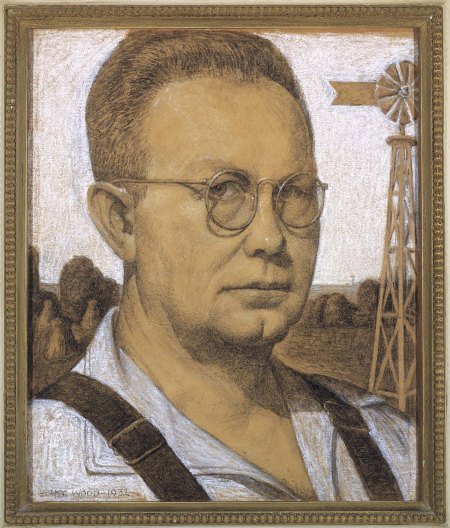
Grant Wood, Study for Self-Portrait, 1932,

When Grant Wood spent time in Munich overseeing the production of stained glass for the memorial window for the Veterans Memorial Building in Cedar Rapids he had time to visit the city’s museums and he was inspired by the artistry of the painters from Netherlands, especially Jan van Eyck and the portraiture of the Renaissance artists.

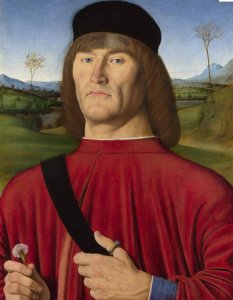
Man with Pink Carnation by Andrea Solari (c.1495)

Portraiture normally has a plain background so as not to detract from the sitter but often in Renaissance portraits a landscape background was used which would give you some knowledge about the sitter.

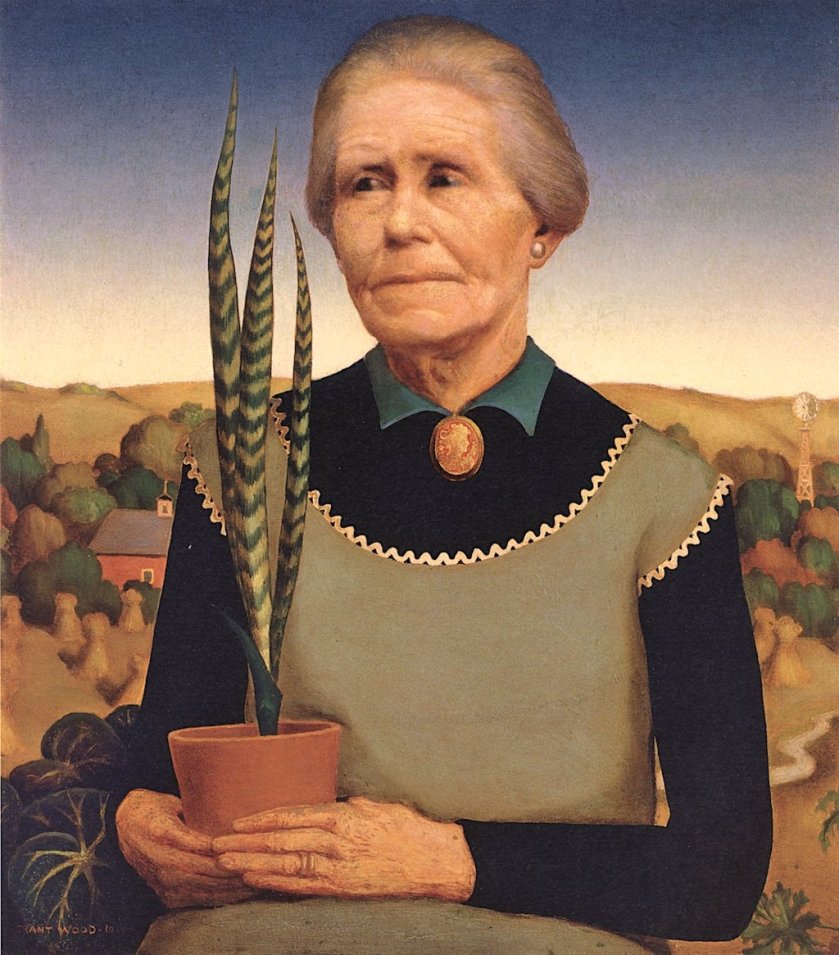
Woman with Plant by Grant Wood (1929)

No doubt Grant Wood remembered that type of portraiture when he painted Woman with Plant in 1929. In this work we see a Midwestern woman in country clothes, wearing a cameo broach and an apron bordered with rick-rack stitching. In her hands she holds a plant pot containing a snake plant. She is the epitome of the pioneer woman, and this is a Renaissance-style work with its half-length figure in the foreground and a landscape backdrop and it is the inclusion of a windmill and sheaves of corn which marks it as an American Midwestern depiction. This was actually a portrait of his mother !

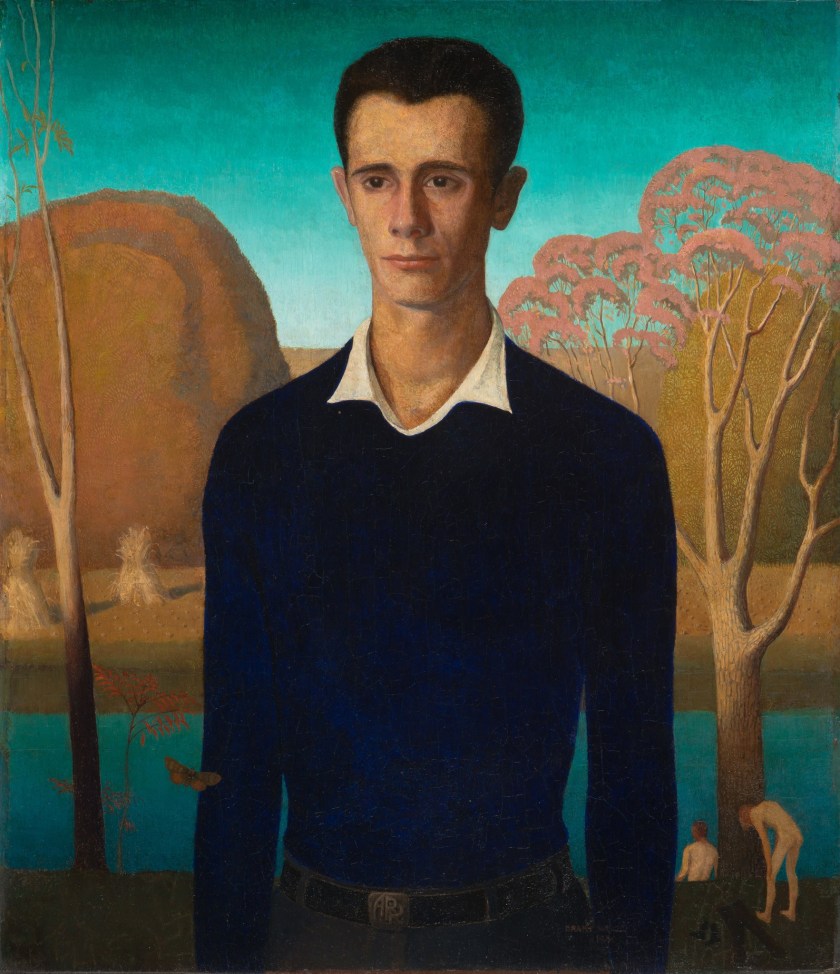
Arnold comes of Age (Portrait of Arnold Pyne)

In August 1930 at the Iowa State Fair Grant Wood’s painting entitled Arnold comes of Age which was his portrait of twenty-one year old, Arnold Pyne, his assistant on the Memorial Window project.

Des Moines Tribune-Capital, August 20th 1930

The renowned American journalist and correspondent for the Chicago Tribune from 1925 to 1932, covering Europe, William Shriver, once asked Grant Wood whilst in Paris, why, having witnessed the emerging art styles in Europe in the 1920’s, would his artistic style change. Wood answered by likening himself to the famous American novelist, short-story writer, and playwright, whose 1920 novel, Main Street, satirised the strict conservatism of small-town life. :

“…I am going home to paint those damn cows and barns and barnyards and cornfields and little red schoolhouses… and the women in their aprons and the men in their overalls and store suits… Isn’t that what Sinclair Lewis has done in his writing… Damn it, you can do it in painting too!…”

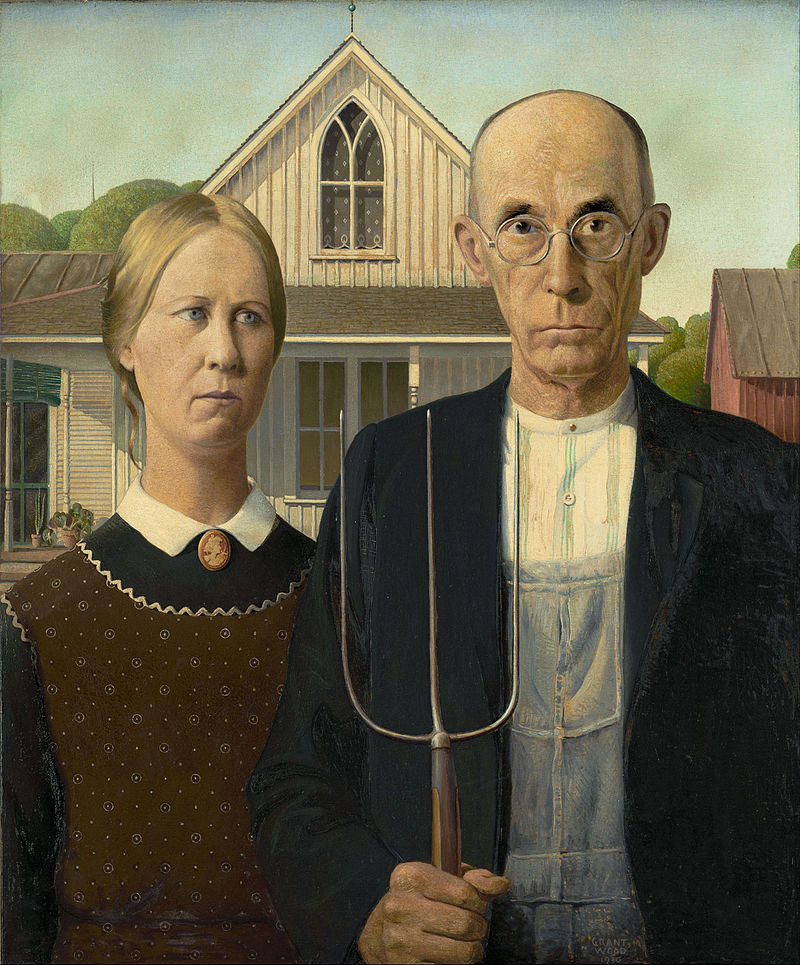
American Gothic by Grant Wood (1930)

A year after the stained glass window was installed at the Veterans Memorial Building in Cedar Rapids, Grant Wood completed his iconic painting American Gothic, a painting which many consider to be the most famous painting in American art. So how did all come about?

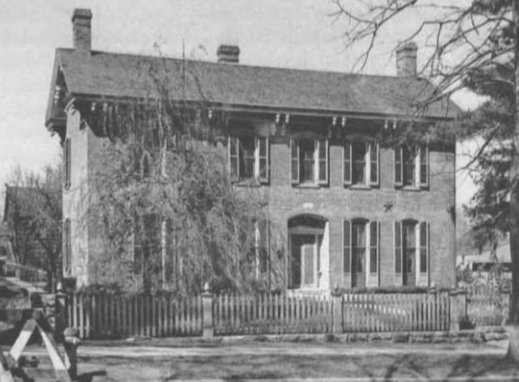
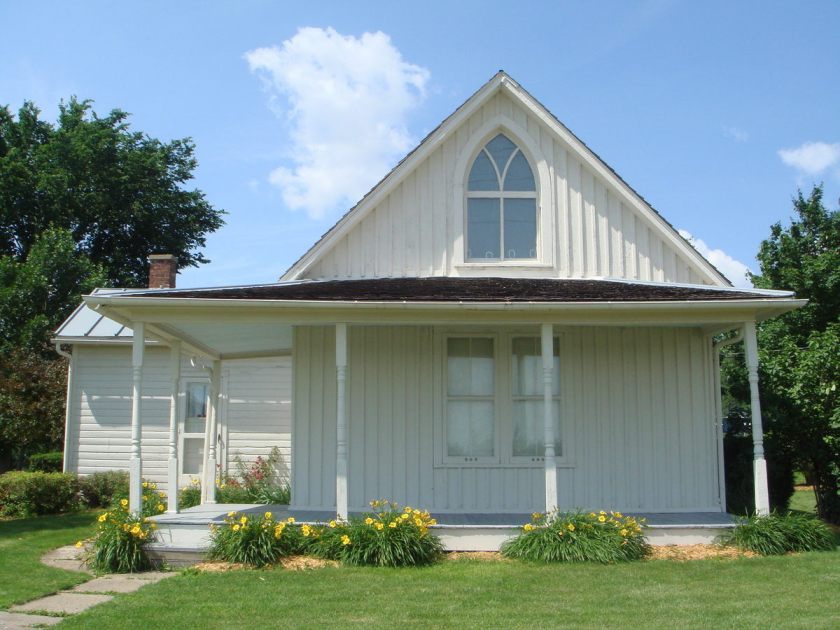
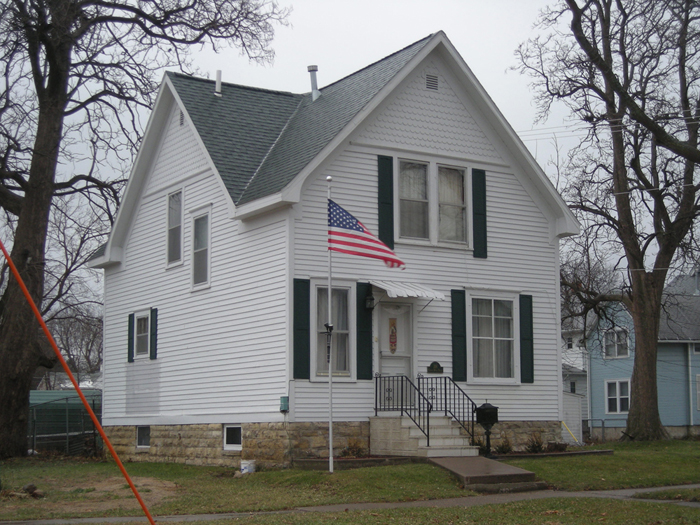
In the spring of 1930, Grant Wood decided to take a weekend off from his painting and drove the 12o miles from his home in Cedar Rapids, to the home of one of his former student in Eldon, Iowa. The road trip passed through gently rolling patchwork of farmlands of central and south Iowa between the Cedar River to the Des Moines River. On a Sunday morning in early April, Wood came upon the now-famous house. It was known by the local residents as the Dibble House as it was built by Eldon resident, Charles Dibble, a Civil War veteran and livery stable owner in 1882 for his family, which included himself, his wife, and his eight children.

The American Gothic House in Eldon, Iowa

The house was built in a style known as Carpenter Gothic, or Rural Gothic, and is a North American architectural style-designation for an application of Gothic Revival architectural detailing and picturesque massing applied to wooden buildings erected by house-carpenters. This terminology is used when the design of lofty architecture of European cathedrals is applied to American frame houses. The Eldon house was a small, simple frame structure and was no different than many houses dotted around Wood’s home in Cedar Rapids. However, it had one unusual feature. On the second storey there was a single gable with an inset narrow Gothic window. The house mesmerised Wood and he began to wonder what type of people lived in such a house, so much so, after driving around the block he knocked on the door and introduced himself to the residents who showed him around the interior. After thanking the young couple he went back to his car, grabbed his paints and made a quick oil sketch of the house.

The Sunday Register, December 1st 1930

After he got back home he told his sister Nan about the house and how it had captivated him. The one aspect of the exceptional house which disappointed him was the fact that the residents were not whom he had envisioned for they were a young couple.  He said to Nan:

“… I’ve decided to do a painting of the kind of people I think should live in that house. I thought about it last night. I have a woman in mind, Nan, but I’m afraid to ask her to pose, because, you know, like all the others, she’ll want me to make her look young and beautiful. And I’m not going to paint her beautiful in this picture. So she’ll be disappointed…”

Of course, we now know that the woman in the painting would be his thirty-one year old sister, Nan, but there lay the problem for Grant, for the woman he intended to paint was going to be an “old maid”. However, even knowing the problem he still asked his sister to pose and he showed her his preliminary oil sketch.

American Gothic painting satirised

There was a long pause before Grant answered his sister’s question.  Finally he addressed his sister asking her, if she was willing, to pose for the picture.  He then had to sell the concept to her as he wanted the “daughter” to have a plain and old-fashioned appearance and her facial expression was to be one of sternness and sombreness. He asked Nan to imagine what it would be like to be under the control of her elderly and authoritarian father. Nan agreed and that afternoon went off to the store to buy some appropriate sombre brown and black clothes for the painting, as she later recalled:

“…. We were supposed to be small-town people. We were really not supposed to be farmers, but just small-town folk. We would own maybe a cow to milk, and we would have a little garden to tend for ourselves. But we’d keep all we grew and not sell anything in the market. Grant and I talked and talked about this. The man in the painting – who was supposed to be my father, would do some tinkering around the house, we decided. We tried to determine what the mother and wife would look like, but we just could not agree on anything. So we decided that the man was a widower. Now, when we talked about this, we tried to imagine what expression would be on the face of the man and his daughter. When we finished talking about this, I posed…”

Nan later remembered the posing for the painting:

“…It was really difficult because Grant was always joking. And both of us would break into laughter, and then we would have to start all over again. It was hard to go from being Grant Wood’s sister and joking with him in the studio to being a farmer’s daughter standing in front of a house. When I was posing and I lost my concentration, Grant would always draw me back to the work at hand by begging, ‘Come on, now, Nan. I’m trying to do your face and I really need you to look sour.’ So I looked sour, the best I could. And so he painted me…”

His depiction of a plain, stern-faced Iowa woman has an everlasting, inscrutable quality and some who saw the painting called her the “American Mona Lisa.”

Grant explained to her that he would paint the house in the background and, standing side by side in front of it would be an elderly man and his daughter and that he intended to approach his sixty-three year old dentist, Byron McKeeby, to pose as the man. Grant had exchanged some of his paintings in lieu of payment for dental work with him and he knew McKeeby liked his work, so he was sure he would pose for the painting.

For Nan, Grant could do no wrong, and she was a constant source of encouragement to her brother. She had no misgivings about posing for the American Gothic painting even though she knew ahead of time it would probably be very unflattering. However, she harboured no resentment towards her brother, once saying:

“…Grant made a personality out of me. I would have had a very drab life without it…”

Some say the pair depicted were husband and wife but Grant’s sister Nan maintained it was father and daughter so that she was not to be classified as a woman who would marry a much older man. Grant, himself, never clarified the status of the pair !

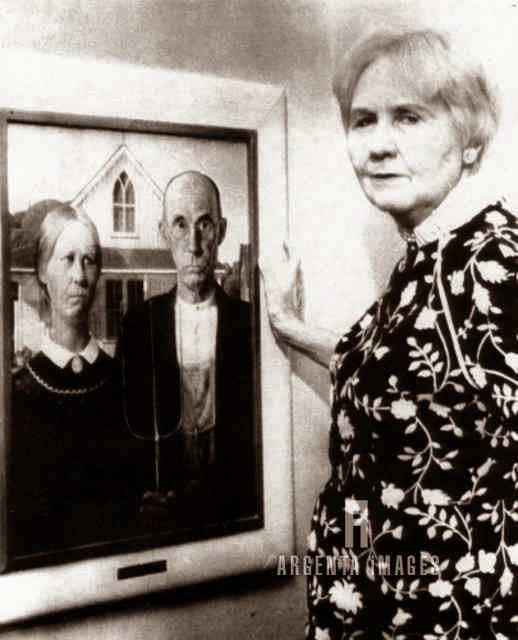
Nan Wood Graham and the painting American Gothic

The stern-looking man was posed by Wood’s Cedar Rapids’ dentist Byron McKeeby. We see McKeeby dressed in a black jacket and collarless shirt and clean denim overalls. In his right hand he holds a three-pronged pitch fork, the prongs of which are echoed in the stitching of his overalls and again in the Gothic window of the house. Although the depiction of the couple looks suitably posed Wood painted the two people separately and his sister and the dentist never stood together in front of the house.

Comments about Nan as the model were often derogatory with one viewer writing that her face “would sour milk”. Other women protested that Nan was poking fun at them with her dour expression.

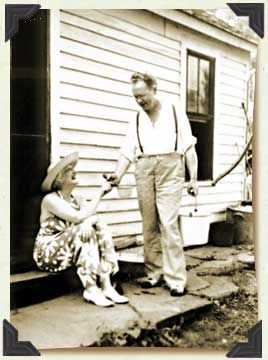
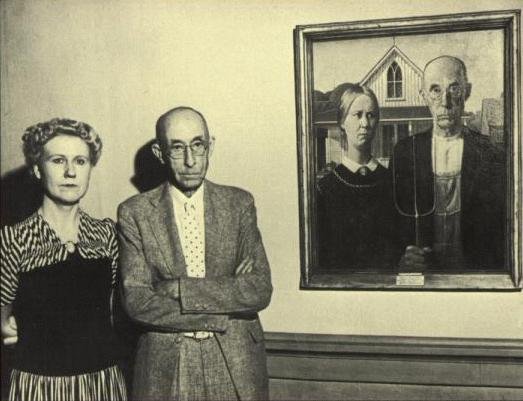
Nan Wood Graham and Dr. Byron McKeeby

American Gothic was displayed in Cedar Rapids after Wood’s death in 1942. Nan, at that time, Mrs Wood Graham, and Dr. Byron McKeeby were united with each other and the painting for the first time, with their “stretched out long” faces as dour as ever !

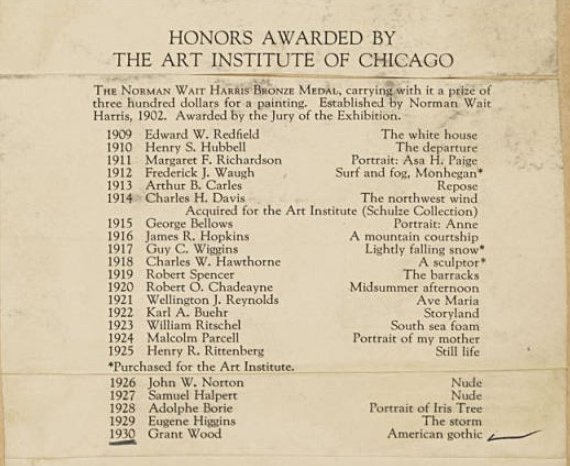
Bronze medal winners awarded by Art Institute of Chicago

Grant submitted the painting to the jury for the forty-third annual exhibition of American paintings and sculpture at the Art Institute of Chicago in 1930. The judges dismissed it as a trifling “comic valentine,” but a powerful museum patron urged them to reconsider. The painting was awarded the Norman Wait Harris Bronze Medal, as well as a three-hundred-dollar prize. The painting was bought by the Friends of American Art at the Institute for another three hundred dollars. Newspapers throughout America soon carried articles and reproductions of the painting. Eventually, the picture appeared in the Cedar Rapids Gazette, which caused great consternation with the real Iowa farmers and their wives and they were not amused. To them, the painting looked like a nasty caricature, portraying Midwestern farmers as pinched, grim-faced, puritanical Bible-thumpers. However, the painting, which is now housed at the Art Institute of Chicago, is one of the most iconic and recognizable images in American art, and it helped propel Wood to fame and launch the Regionalist movement, of which Wood became the de facto spokesperson.

The sitters for the American Gothic painting (1942)

The highly detailed style of the work and the two unbending figures at the forefront of the depiction were inspired by the Flemish Renaissance art, that Wood would have seen during his European travels between 1920 and 1926. Despite the negative comments that Wood was belittling the Mid-Western folk he actually intended the painting to be an upbeat declaration about rural America and rural American principles. Remember, the year before American Gothic was shown at the Art Institute of Chicago, the country was hit by the great depression and America was facing a major crisis. In the Mid-West there was overproduction in agriculture, as farming techniques improved, and farmers started producing too much food. Coupled with the fact that there was less demand from Europe for food from America because they could grow their own crops. This abundance of crops led to falling prices and thousands of farmers became unemployed after having to sell their farms. Despite this Wood wanted his painting to be a positive statement about rural American values, and for it to become an image of comfort and encouragement at a time of great displacement and disenchantment. For Wood the man and his daughter were symbols of survivors who would battle on through the tough times.

Portrait of Nan (1931)

Grant Woods, as a token of his gratitude, and maybe knowing of the hurtful remarks about his sister’s appearance in the painting, painted a formal portrait of her in 1931. Tripp Evans, a biographer of Grant Wood, wrote:

“…It’s really kind of a love letter from Grant to his sister. He adored Nan. And it’s a painting that he felt very close to as well, one of very few of his mature paintings that he kept for himself…”

In the painting, Portrait of Nan, he depicts her in fashionably marcelled hair style. The Marcelled hair style was a popular hairstyle of the 1920’s and 1930’s that featured unique waves and styling. Marcel Waves are a deep waved hairstyle reminiscent of American actress and bombshell Jean Harlow. Nan is shown wearing a patent-leather belt and a sleeveless polka-dot blouse. She is holding a plum in her left hand whilst the right-hand cups a small chicken. Nan is depicted as a chic-looking and chick-holding modern woman ! Grant Wood bought the little chick at a dime store but it proved to be an unwilling “sitter” for him. His sister Nan recalls the problems her brother had with the chick:

“…Grant kept long hours when he was on a painting spell and would work well into the night. The chick adjusted to his hours and made an awful fuss if it was sent to bed—actually, a crock Grant kept in the closet—before 2 or 3 a.m. It was also fussy about its victuals. It wouldn’t eat toast without butter or potatoes without gravy. One evening, the chick was acting up while company was over, so Grant deposited it in the crock, placed a book on top and forgot all about it. By morning, deprived of air, butter and gravy, the chick was in a dead faint. We threw water on the chick and fanned her for almost an hour before she came to. It was a close shave. She was pretty weak, and Grant didn’t have her do much posing that day…”

So why were the chicken and the plum featured in the portrait. Wanda Corn a leading Grant Wood scholar knew Nan well before she died, at age 91, and in 1990 wrote about the portrait:

“…He [Grant] undoubtedly liked the chicken because as it perched, young and vulnerable, in the cupped hand of his sister, it conveyed her tenderness. And the plum because, as an artistic convention, fruit has always symbolized femininity…”

So according to Wanda Corn, the two images represented, for Wood, all that was beneficial and wholesome about the Midwest. Many believed the chicken and the plum were symbolic but Grant’s sister Nan had a more down to earth reasoning for the inclusion of the chicken and the plum. In 1944 she wrote about the portrait:

“…Grant said the chicken would repeat the colour of my hair and the plum would repeat the background…”

Nan’s role as a model for Grant’s paintings ended with Portrait of Nan, Tripp Evans wrote in his 2010 book, Grant Wood: A Life:

“…After completing the painting, Wood reportedly told his sister, ‘It’s the last portrait I intend to paint, and it’s the last time you will ever pose for me.’”

She was surprised—she’d spent years posing for him—and asked for an explanation.
Wood said, “Your face is too well known…”

..……to be continued

In my final blog about Grant Wood I will look at his later years, showcase more of his paintings and talk about a rumour concerning the artist which would never go away.


Apart from Wikipedia much of the information about the artist and his paintings came from:

Cedar Rapids Museum of Art
http://www.crma.org/content/Collection/Grant_Wood.aspx
Sullivan Goss an American Gallery
http://www.sullivangoss.com/Grant_Wood/#Bibliography
Nan Wood’s scrapbook
http://digital.lib.uiowa.edu/cdm/ref/collection/grantwood/id/880
Eldon House
http://lde421.blogspot.com/2011/12/american-mona-lisa-profile-of-nan-wood.html

Grant Wood. Part 1. The early years of the American Regionalist painter

Self portrait by Grant Wood (1932)

During their lifetime most artists paint hundreds of works of art but often, as far as the public are concerned, may just be famous for one of their works. Examples of this are Edvard Munch, who is best known for his 1893 painting The Scream. Johannes Vermeer is best known for his 1665 work Girl with the Pearl Earring and Leonardo da Vinci is best known for his 1503 painting, Mona Lisa. The artist I am looking at today, Grant Wood, will always be remembered for the painting he completed in 1930 entitled American Gothic. Grant Wood is classified as an American Regionalist painter, which is an American term. Regionalism being the work of a number of rural artists, mostly from the Midwest, who came to prominence in the 1930s. The artists tagged with the label of Regionalism often had differing styles but what they shared was an unpretentious anti-modernist style, all of who wanted to simply depict everyday life and their rural conservatism was totally anathema to the left-wing Social Realist painters of that time. American Regionalism, sometimes referred to as American Scene painting, was a naturalist style of painting where typical American life and Mid-West landscapes were lovingly depicted. It was an art based on indigenous imagery from local surroundings.

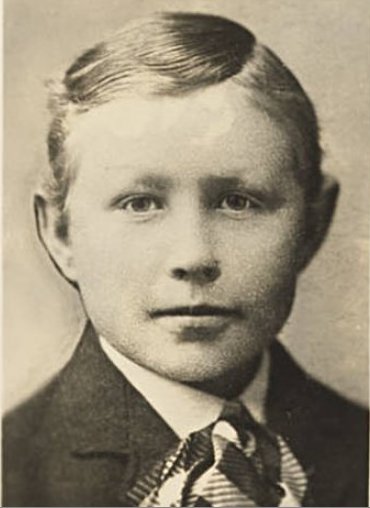
The young Grant Wood during the time he lived on the family farm

Grant Wood was born on February 13th 1891. He was the second child born to Hattie DeVolson Weaver and her husband Francis Maryville Wood. He had an elder brother Francis Marion Wood and a younger sister and brother, Nanny (Nan) Rebecca Wood and John Clifford Wood. Grant was born on the family farm near the rural township of Anamosa, Iowa.

Grant Wood boyhood home, Cedar Rapids, Iowa,

Family life was seriously disrupted on March 13th 1901 when Grant’s father unexpectedly died at the age of forty-six, and Grant’s mother Hattie was left to bring up her four children between the ages ranging from eighteen months to ten years of age. She decided to leave the farm and go and live at her family’s home in Cedar Rapids. Life for the Grant family had suddenly changed from the rural idyll of Anamosa to the urban life of Cedar Rapids.

Grant Wood attended the local grammar school and it is said that one of his teachers, Emma Gratten, encouraged the boy’s interest in art. In 1905, aged fourteen, he entered a drawing of oak leaves into a drawing competition which was sponsored by Crayola and he won third prize. As a youth growing up in this small but expanding Midwestern city, his teachers and the community admired Wood’s talent for drawing. He even taught himself to make jewellery, copperware, ornamental light fixtures, and furniture. Once he began attending Washington High School his love of art continued and when he was fifteen, he began a lifelong friendship with a fellow pupil, Marvin Cone, who also had a love of art and the two of them designed sets for the school’s theatre department and provided illustrations for the school magazine. Grant and Marvin also helped with the installation of exhibitions at the Cedar Rapids Art Association, which had just been opened in the town’s Carnegie Library in 1905. In 1910 Grant graduated and immediately enrolled on a summer course at the Minneapolis School of Design and Handicraft, taught by nationally known architect and designer Ernest Batchelder. It was here that he learnt how to work with metal and jewellery as well as building furniture, a skill that would later serve him well.

In 1913 Grant Wood moved to Chicago and spent much of his time working as a designer at Kalo Silversmiths Shop, which was the important arts and crafts silversmith and leading maker of Arts and Crafts movement silver in Chicago. Besides this day job Grant attended evening classes at the Art Institute of Chicago and took correspondence and summer school courses in the decorative arts. He remained in Chicago for three years but in 1916 he had to return home to Cedar Rapids when he heard the news that his mother had fallen ill and was having financial problems. Grant took a job as a grammar school teacher to support his mother and his sister, Nan. From 1917-1918 Wood served in the U.S. Army, where he was tasked to paint and design camouflage for the military vehicles.

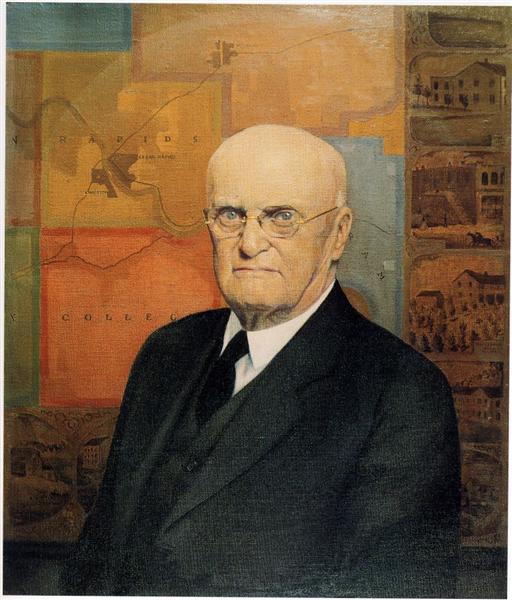
Portrait of John B. Turner by Grant Wood (1929) A patron of Grant Wood

In 1919 he began as an art teacher for the Cedar Rapids Community Schools and at Jackson and McKinley Junior Highs. He also attended the life drawing class taught by Charles Atherton Cumming at the University of Iowa. His high school teaching did not disrupt his painting and, slowly but surely, his painting techniques improved and soon Wood became famous for his paintings in his local neighbourhood. In 1919, Killian, the local department store in Cedar Rapids, held an exhibition of Wood’s painting as well as work by his schoolfriend Marvin Cone. Out of this came many commissions for portraits of the local dignitaries as well as store window displays for the Armstrong department store and he was commissioned to paint murals for the Eppley Hotels in Cedar Rapids, Sioux City, Waterloo, and Council Bluffs.

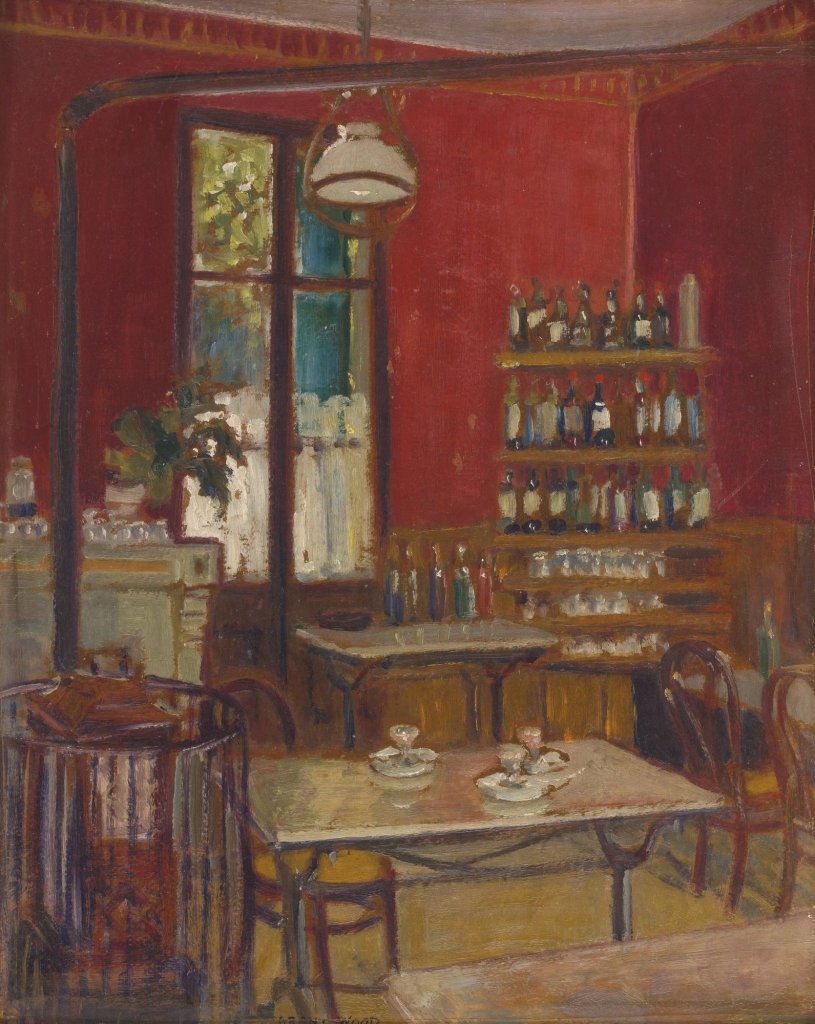
Cafe De Palais by Grant Wood (1926)

Like most aspiring American artists at the time, Grant Wood wanted to travel to Europe and visit the famous museums and study the many styles of painting, including Impressionism and post-Impressionism which he found fascinating and can be seen in his paintings of the 1920’s.   He also said that he had to go to France to appreciate Iowa! To travel to Europe cost money and Wood could not alone afford it but thanks to his long-time patrons, John B. Turner and his son David Turner who owned the city’s mortuary business they had underwritten the trips for Wood to study art in Europe in 1920 and 1923-1924, and in return he gave them a number of his paintings.

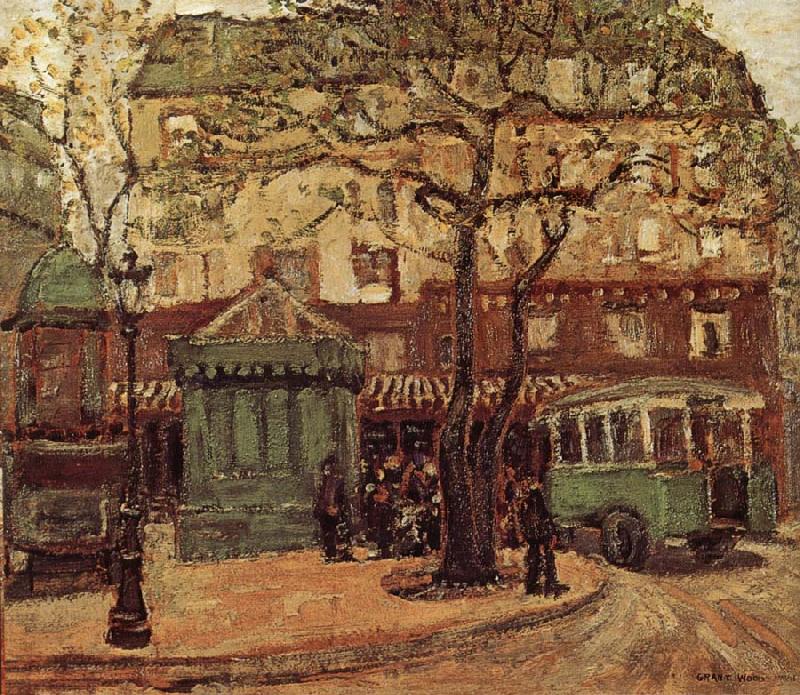
Greenish Bus in Street of Paris by Grant Wood (1926)

Grant made his first trip to Europe in the summer of 1920 when he and his friend from school, Marvin Cone, visited Paris. Grant returned to Paris for a longer stay in 1923 and did not return home until the following year.

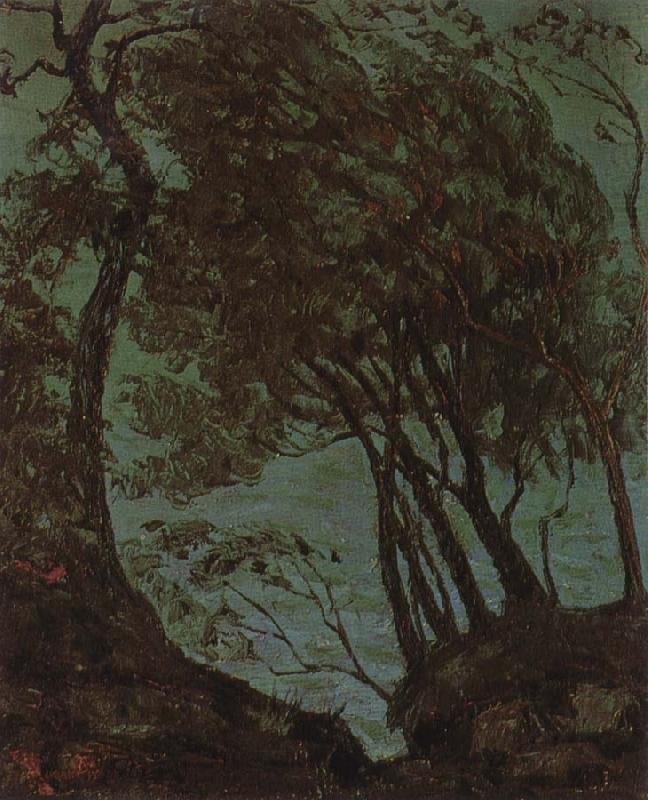
The Bay of Naples’s View by Grant Wood (1925)

This longer stay allowed him time to study at the Académie Julian and journey to the Italian seaside town of Sorrento. His time in the French capital and surrounding countryside proved influential, resulting in a stunning series of impressionistic views of picturesque cityscapes and landscapes, Paris streets and gardens, and the French countryside.

The structure has been the home of John R. Turner and Son funeral homes since 1924. Iowa artist Grant Wood was paid to help decorate the mortuary at that time

In between his European trips Wood was still working in Cedar Rapids. David Turner of the Turner Mortuary business had bought the large elegant Douglas Mansion with the intention of converting it into a funeral home, they commissioned Wood to redesign the mansion’s interior for its new function. Wood carried out the major refurbishment of the house including doing some interior decorating and furnishing. Grant Wood also designed the iron gates at the front entrance.  Once the make-over had been completed it was opened to the public in 1924 and the Cedar Rapids newspaper, The Gazette, wrote about Grant Wood’s hard work which he had put into the refurbishment:

“… [Grant Wood] was responsible for the decorating and furnishing of the interior, and the landscaping of the grounds. He not only personally supervised the work, but also did much of it himself…”

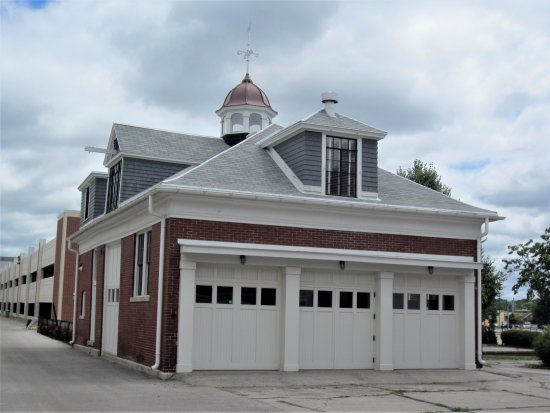
Grant Wood’s studio was above the six-car garrage

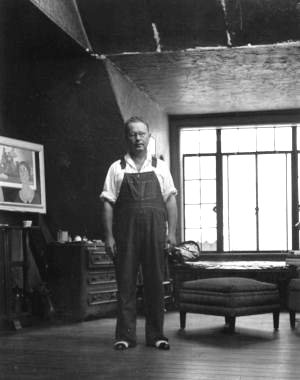
At the rear of the house there was a brick barn which had been converted into a modern garage, which could house six cars. At the suggestion of the Turners, Wood began to build a studio and residence above the garage.

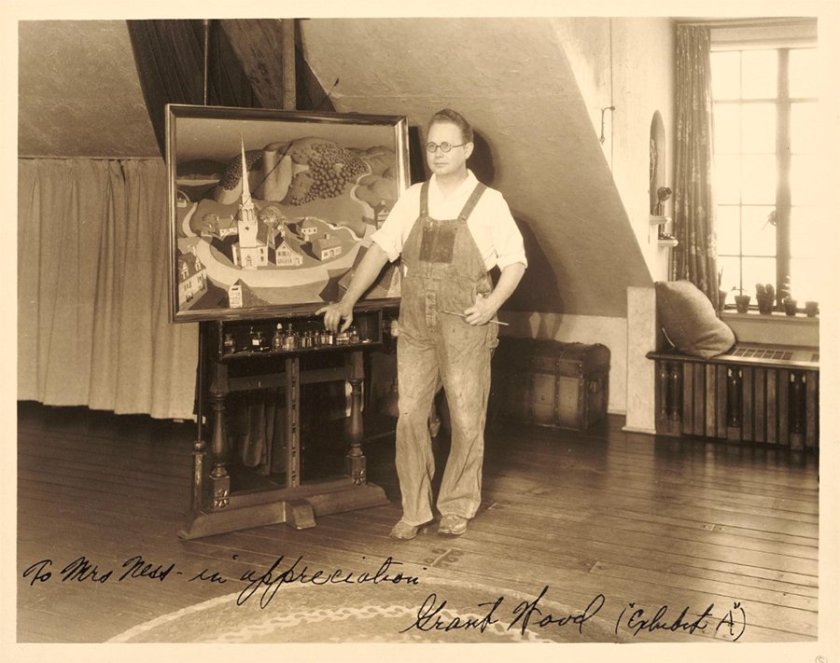
Grant Wood stands in his studio at No. 5 Turner Alley in Cedar Rapids.

Not having to pay rent for the studio and apartment meant that he could eventually give up teaching his job at McKinley High School.

The Spotted Man by Grant Wood (1924)

What is considered to be his most accomplished work during his time in Paris is his 1924 painting entitled, The Spotted Man, which he painted in the Académie Julian studio. The technique used by Wood in this painting is a kind of Seurat-like pointillism. During his stay in Paris he had probably seen the famous pointillism works by Georges Seurat and Paul Signac.

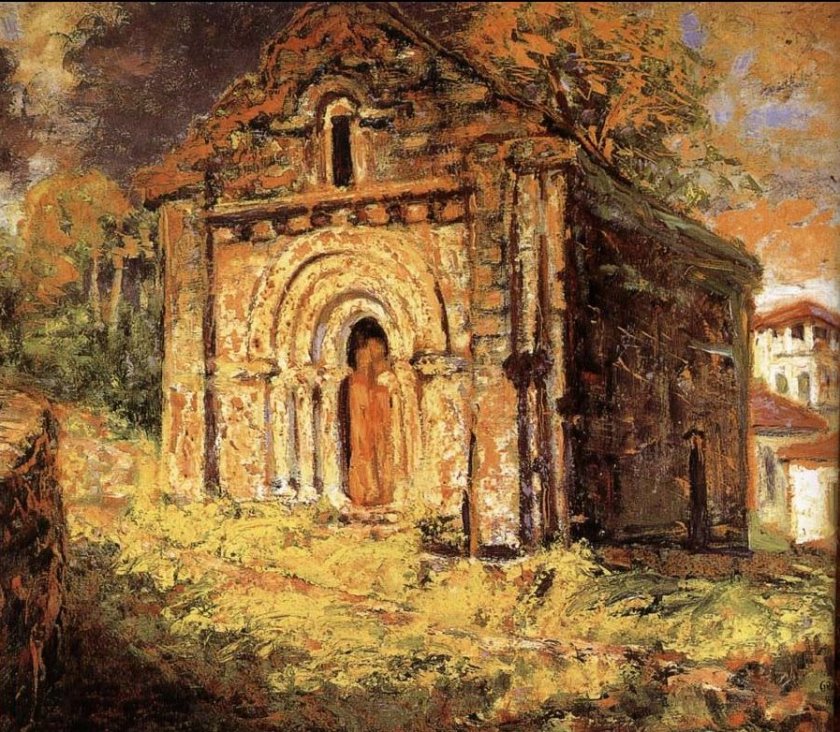
The Little Chapel Chancelade by Grant Wood (1926)

According to his sister Nan, Grant, whilst studying at the Académie Julian, was invited by a fellow student to visit his home in Spain and from that trip he painted The Little Chapel Chancelade. However, the setting remains unknown. Before he went back to Cedar Rapids the Carmine Gallery agreed to exhibit some of his work and so he returned to the French capital in 1926 for the Gallerie Carmine exhibition but he came away very disappointed and slightly disheartened as it was only a moderate success.

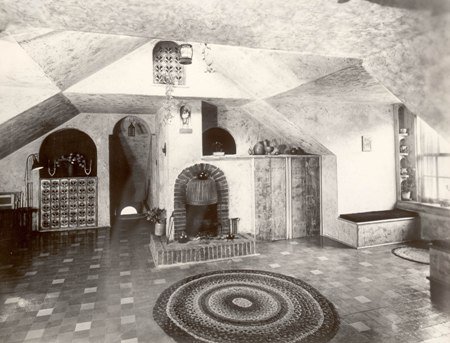
Interior view of Grant Wood’s Turner Alley studio, courtesy of Figge Art Museum, Grant Wood archives, photo by John W. Barry

In between his European trips Wood was still working in Cedar Rapids and in 1924 Wood was doing some interior decorating for David Turner of Turner Mortuary and Turner offered Grant the use of the carriage house behind the mortuary as a studio for his artwork. This now renowned studio situated at No. 5 Turner Alley became home to Wood and his mother for eleven years as well as being Grant’s studio during the most creative period of his career.

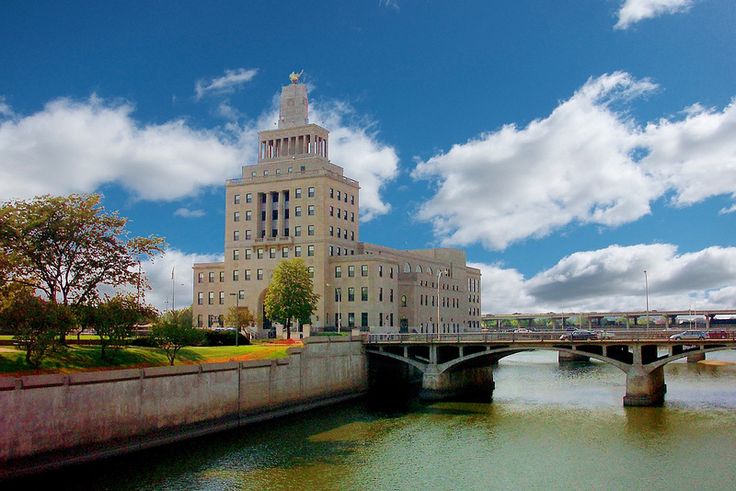
Veterans Memorial Building, Cedar Rapids, Iowa

The Veteran’s Memorial Building in Grant’s home town of Cedar Rapids is located on May’s Island in the middle of the Cedar River, between the First and Second Avenue Bridges. A petition to construct a memorial building was filed with the City Clerk on March 4, 1925. To make the building financially viable, a new city hall was incorporated into the plans.

Cedar Rapid’s Veterans Memorial Building on Mays Island

The positioning of the building on an island made Cedar Rapids, one of only two cities, after Paris, France, which had their governments located on an island. The main portion of the building contains four stories, with an eight-story section in the front. A cenotaph tops the eight-story section. The auditorium contains seven banners from veterans’ organizations, and seven American flags were suspended from the ceiling. A Tomb of the Unknown Soldier is located above the cenotaph. The architects and the Cedar Rapid’s planners decided to incorporate a large stained glass memorial window.

Stained glass window in the Cedar Rapids Veterans Memorial Building

In 1927 Grant accepted a nine-thousand dollar commission to design and build the stained glass window for the Veterans Memorial building. Despite not having experience with the medium of stained glass and certainly never having accepted such a large commission before, the finished window is looked upon as one of Grant Wood’s greatest achievements.

Grant Wood and Arnold Pyle preparing for the Stained Glass Window

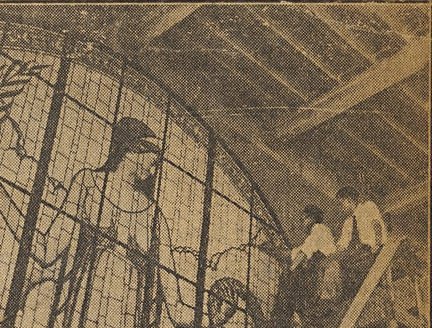
Wood along with his assistant Arnold Pyle spent months prior to the fabrication of the window. The two would spend hours perched aloft on wooden scaffolding in an old recreation room at the Quaker Oats company, where Wood assembled a full-scale mock drawing. This elaborate study enabled Wood to finalise his design and at the same time it afforded him the opportunity to correct difficulties with the perspective. The Emil Frei art glass company of St. Louis, Missouri was awarded the bid to make the glass for the window. However, it was discovered that due to the intricate detail wanted for the piece, the glass pieces had to be manufactured at a factory in Munich, Germany. Wood went to Munich to supervise the final stages of the production of the delicate pieces of glass. While there he was deeply influenced by the realism of the sharply detailed paintings of various German and Flemish masters of the 15th and 16th century and when he returned to the United States he was determined to integrate their approach into his own work.

The six soldiers

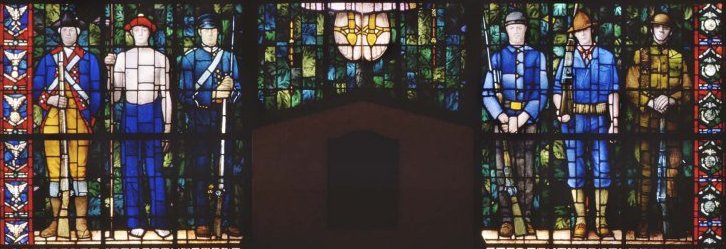
The memorial window is a lasting tribute to Veterans of the six American wars from the Revolutionary War to World War I. It stands 23 feet and 6 inches high and 20 feet wide and is made up of about 10,000 pieces of stained glass fitted together with lead, forming a stunning work of art. Solemnly standing at the base of the window are six life sized figures of private soldiers wearing the uniform of Private, representing the wars (from left to right): Revolutionary War, The War of 1812, The Mexican War, Civil War, Spanish-American War and the First World War.

Lady of Peace and Victory

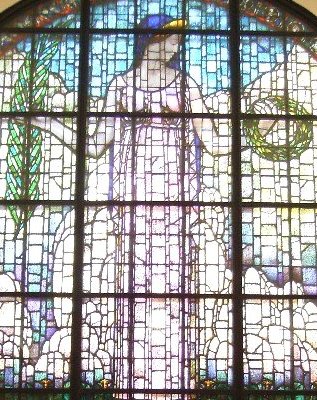
Three stood on either side of a sixteen-foot-high central figure which is said to represent the “Lady of Peace and Victory”. Draped over her head is a blue mourning veil, her floating body surrounded by clouds. In her right hand, she holds the palm branch of peace; in her left, the laurel wreath of victory. In an article in the Cedar Rapids Gazette from 1928 written by reporter Naomi Doebel, she tells of a conversation she had with Grant’s sister Nan:

“…Mrs. Nan Wood Graham, sister of the artist, modelled for the heroic central figure, a woman standing sixteen feet tall and wearing a Grecian robe. The figure, with toes pointed down, floats in the clouds giving the spiritual effect found in many of the Renaissance paintings. Draped over the woman’s head is a mourning veil of blue. In her right hand she holds the palm branch of peace, and in her left the laurel wreath of victory…”

Veteran’s Memorial Building Cedar Rapids during 2008 floods

In 2008 the siting of the Memorial Building on an island proved to be somewhat of a disaster as the Cedar River flooded Mays Island and caused a large amount of damage to the building.

Everybody loved the finished window ? – well, not quite all !!! For the Daughters of American Revolution accused Wood of being unpatriotic because he sourced a German firm to manufacture materials for a U.S. veterans memorial so soon after World War I.   The furore resulted in the window not being dedicated publicly until its restoration was completed in 2010 following the flooding of 2008.

Daughters of Revolution by Grant Wood (1932)

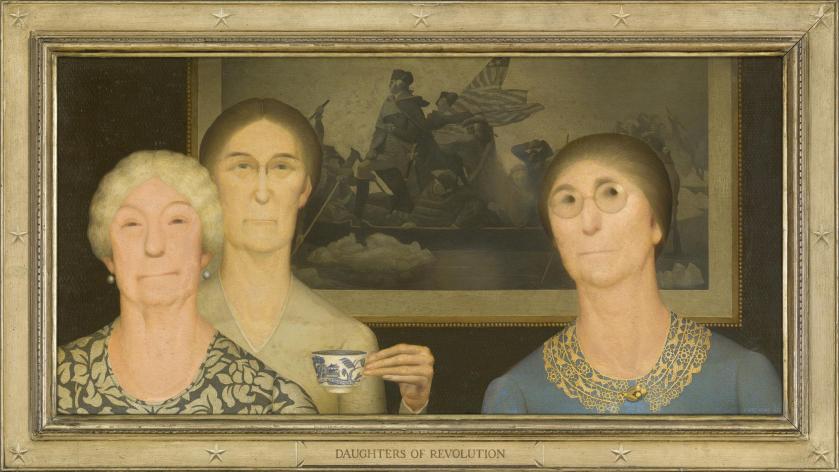
Grant Wood was not one to apologize for sourcing the stained glass for the memorial window from Germany, and he called the females of the Daughters of American Revolution, “those Tory gals,” and in 1932 painted a satirical work entitled Daughters of the American Revolution. To Wood this group was both ridiculous and contradictory to the extreme. On a website American Studies at the University of Virginia, they discuss the satirical aspect of the painting:

…Wood approaches his subjects through many layers of satire. Perhaps most jarring is the juxtaposition of the title and the ladies pictured. That these self-satisfied, teacup-raising, and meticulously coifed septuagenarians might have a thing to do with revolution is nothing short of absurd. Wood has painted the three ladies in a soft-focus haze that at first seems to render them more gentle and sympathetic. Two elements undermine this softness. Perhaps the most noticeable element in the painting is the claw-like hand breaking clearly through the haze and raising the teacup in a wordless and seemingly inappropriate salute to the Revolutionary War…”

Wanda Corn in her 1983 book, Grant Wood, The Regionalist Vision. wrote about the painting:

“…The hand holding the teacup tells us more about the Daughters. It is ringless, which suggests the woman is a spinster, and it is thin and bony, looking very much like the chickens’ feet in some of Wood’s other paintings. Further, the softness of the focus deepens the ladies’ eyes until they are beady and animal-like. They peer out of the painting, waiting only to be recognized for their inherited glory; they are not unlike purebred animals. Wood has further amused himself by placing the ladies in front of Emmanuel Leutze’s Washington Crossing the Delaware. Although the famed work was considered an American treasure and treated as something of a documentary painting, the truth was that Leutze had painted it in Germany, using the Rhine as a model for the Delaware, and, it was suggested, German soldiers for the models…”

In my next blog I will look at the new style of painting by Grant Wood known as American Regionalism and feature his iconic work of art, American Gothic.

…………………………..….to be continued


I found the information for the two blogs about Grant Wood from the usual sources such as Wikipedia but also gleaned a vast amount of facts from three websites:

Cedar Rapids Museum of Art
http://www.crma.org/content/Collection/Grant_Wood.aspx
Sullivan Goss an American Gallery
http://www.sullivangoss.com/Grant_Wood/#Bibliography
Nan Wood’s scrapbook
http://digital.lib.uiowa.edu/cdm/ref/collection/grantwood/id/880

Jean-Baptiste Oudry – animals and hunting scenes artist and so much more.

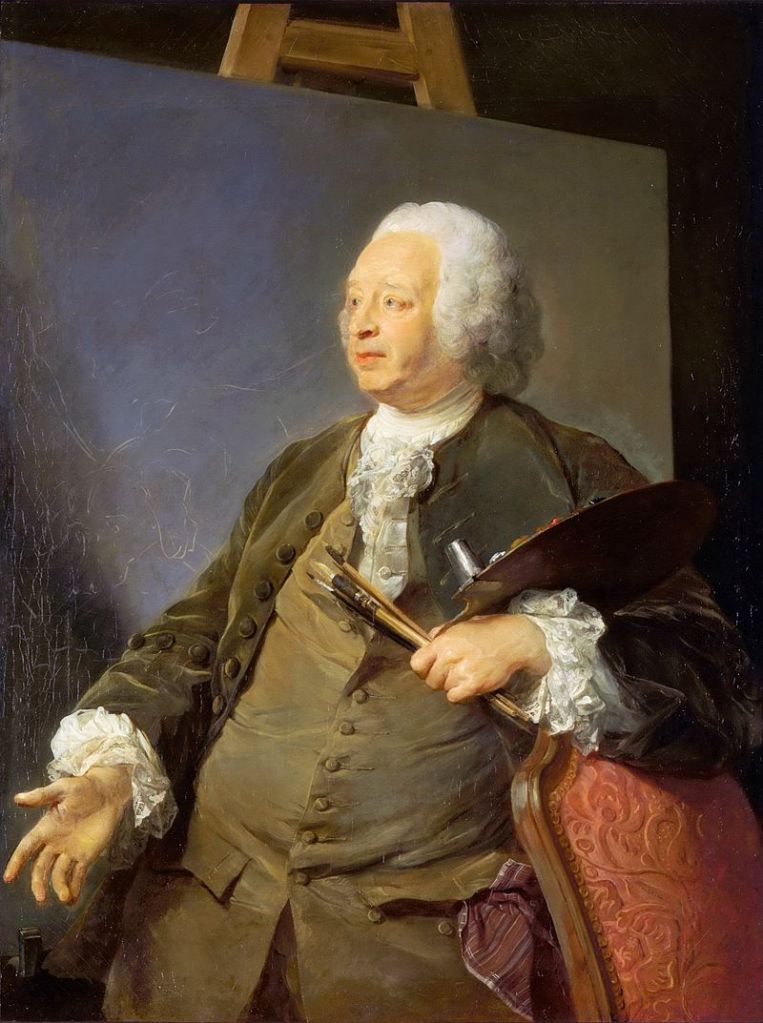
Jean-Baptiste Oudry, by Jean-Baptiste Perronneau.

My last nine blogs focused on female artists and in many cases their fight for equality and so, for this blog, I thought I better give the men a chance. I have gone back to the end of the seventeenth century to look at the work of a distinguished French artist whose painting genre was looked upon by the Academies of Europe as the lowest genre in the hierarchies of figurative art.
The hierarchy in figurative art was established in the wake of the Italian Renaissance for works in 16th century Italy by the prodigious Italian Academies in Rome and Florence and they were later ratified by all the major European Academies, such as the French Académie de peinture et de sculpture, which was one of the leading Art establishments of the time. The hierarchical list, the top genre being the most important in the eyes of the Academicians, was:

 History painting, including historically important, religious, mythological, or allegorical subjects
Portrait painting
Genre painting or scenes of everyday life.                                                               Landscape and cityscape art
Animal painting
Still life

This hierarchical listing was based on a division between art that made a cerebral effort to render visible the universal essence of things and that which merely consisted of mechanical copying of particular appearances. Basically, the list meant that Idealism was honoured and more favoured than Realism.

Let me introduce you to the Master of animal and still life painting, the French artist Jean-Baptiste Oudry. Oudry was born in Paris on March 17th, 1686, the youngest of three brothers. His father was Jacques Oudry, a painter, art dealer, and from 1706, the director of the Académie de St-Luc art school, which was the only serious competition to the more prestigious and influential Académie royale de peinture et de sculpture. He was to give all his sons their initial art tuition. Jean-Baptiste’s mother was Nicole Oudry (née Papillon).

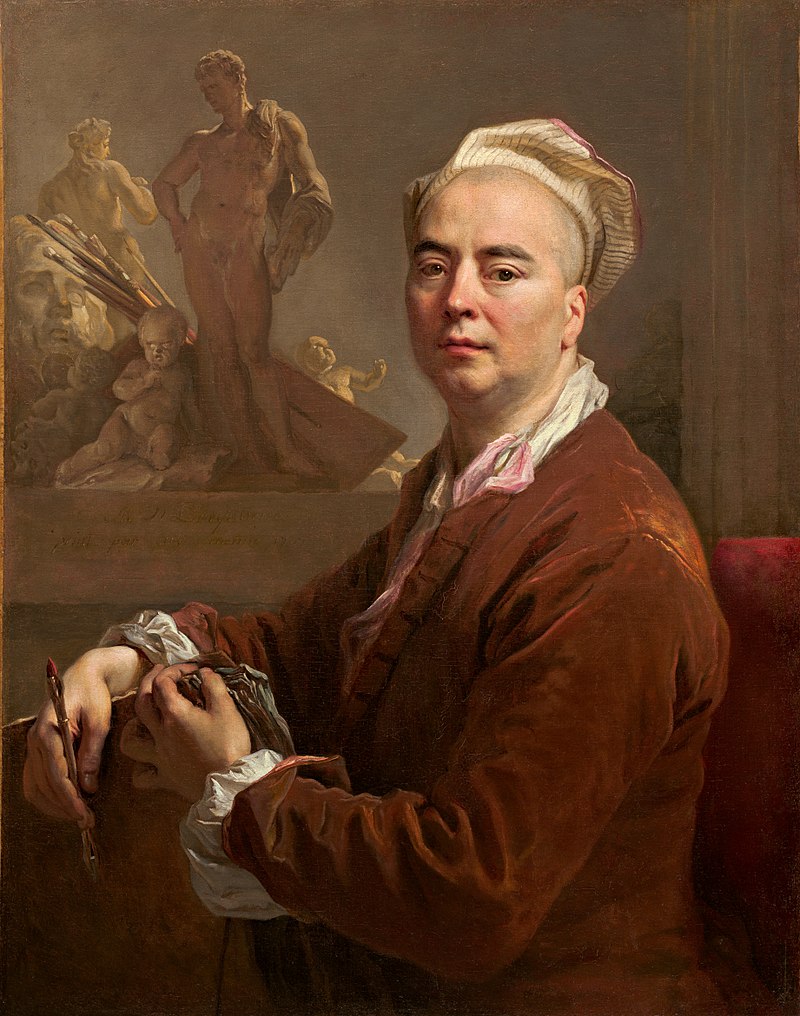
Self-portrait of Nicolas de Largillierre.(1707)

Jean-Baptiste Oudry began his artistic studies at the age of eighteen. In 1704, he first studied with the Marseilles-based Catalan-born French painter Michel Serre, a cousin of the portraitist Hyacinthe Rigaud. The following year Oudry began a five-year apprenticeship with the portrait painter, Nicolas de Largillierre whilst also enrolling in drawing classes at the Académie de St-Luc and the Académie Royale de Peinture et de Sculpture in Paris. Largilliere set Oudry the task to copy the works of the Flemish and Dutch schools of the seventeenth century. Through the teachings of Largillierre Oudry began to perfect his sense of colour and enhance his skills as a painter of still life and portraiture, both genres in which his master had rightly built up his reputation. In 1708 Oudry submitted a now-lost bust-length painting of Saint Jerome as his reception piece and this gained him the status of Master in the Académie de St-Luc.
Jean-Baptiste Oudry began giving art tuition to some students, one of whom was Marie-Marguerite Froissé, the daughter of a miroitier (a mirror-maker) and in 17o8 master and student married. The couple went on to have thirteen children, one of who, Jacques Charles Oudry, followed in his father’s footsteps and became a painter.

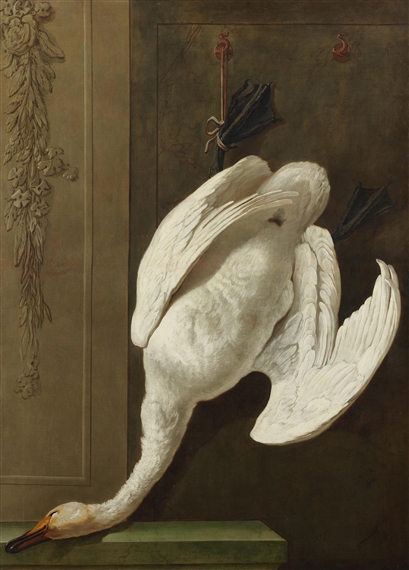
A still life of a swan by Jacques Charles Oudry (Oudry’s son)

After completing his apprenticeship, Oudry set up his own business and concentrated on portraiture commissions and still-life painting to earn money but times were hard so he tried to paint whatever was popular with the public. He wanted to create his own style of portraiture and not be seen as just copying the style of his former tutor, Nicolas de Largillierre, who was at the peak of his fame. Oudry’s clients were mostly of the modest bourgeoisie and the lesser nobility.

Abundance with her Attributes by Jean-Baptiste Oudry (1719)

His financial predicament changed for the better in 1719 when thirty-three-year old Oudry was elected to membership of the Académie Royale de Peinture et de Sculpture (French Royal Academy) as a history painter with his reception work, Abundance with her Attributes. Although classed as a historical painting, look at the superbly painted surrounding array of fruits, vegetables, and animals. It was this talent for painting animals and still life objects that would make him famous. His main rival in this field of painting was Alexandre François Desportes, who at the start of the 18th century had been the principal painter of these genres in France.

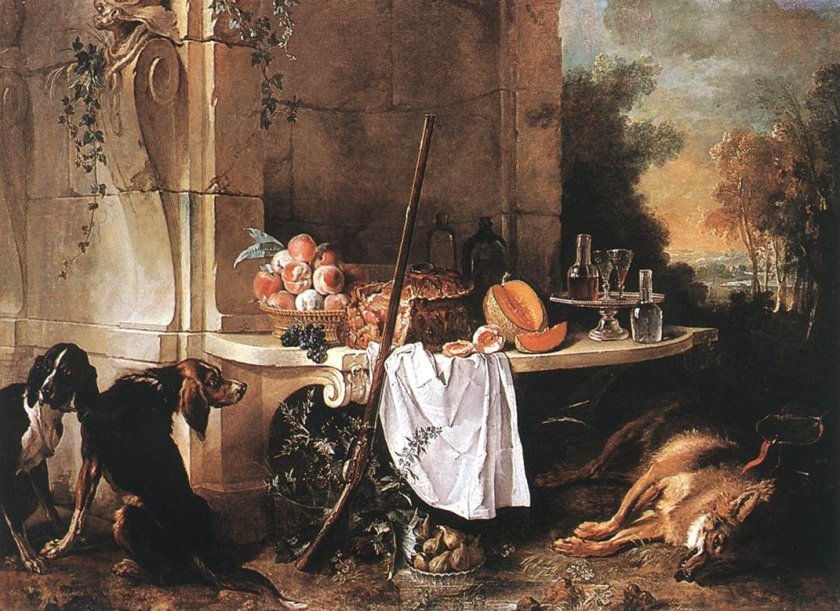
Dead Wolf by Jean-Baptiste Oudry (1721)

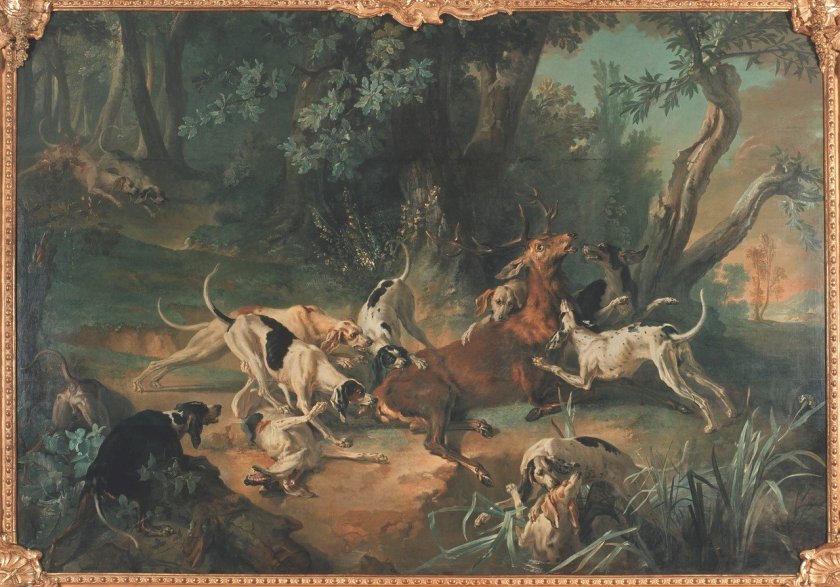
In 1721 Oudry completed pendant paintings Dead Wolf and Dead Roe which can be seen at the Wallace Collection in London. These masterpieces were followed by several large hunt pictures, the most notable of which was his large 1723 painting (almost five metres wide) entitled Stag Hunt which was his breakthrough work. It can now be seen at the Stockholm Royal Palace.

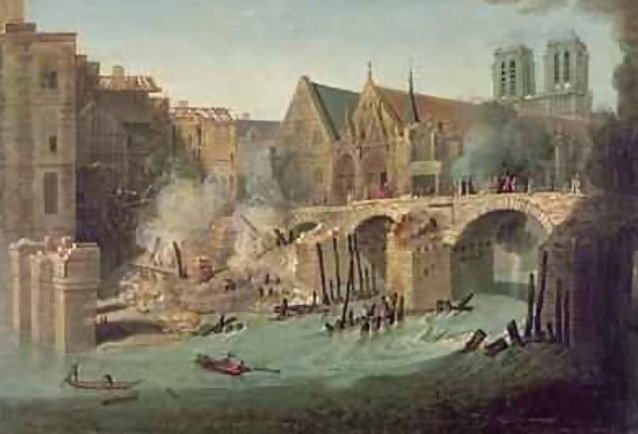
Fire of the Petit Pont by Jean-Baptiste Oudry (1717)

It was around this time that Oudry reduced the number of portraiture commissions he accepted and concentrated on his still-life and hunting scenes which were beginning to become ever more popular. He even experimented with other genres such as landscapes and cityscapes as can be seen in his 1717 painting, Fire of the Petit Pont.

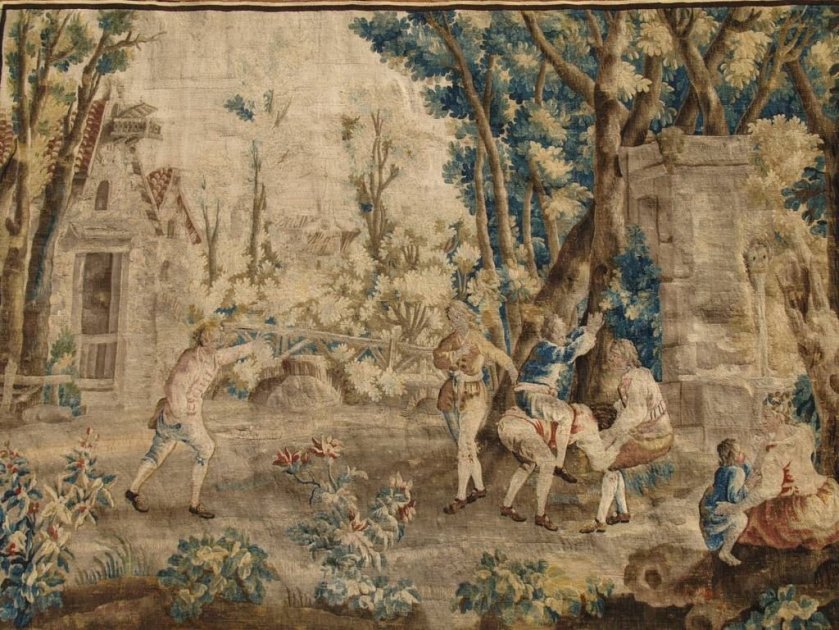
Le cheval fondu tapestry designed by Jean-Baptiste Oudry (1730)

During the 1720s, Oudry’s paintings of animal and hunting scenes were looked upon as the best in France and through them he even managed to impress the French king, Louis XV. Royal patronage soon followed and from 1724 onwards, Oudry spent all his time creating royal commissions. Through his honoured royal patronage Oudry became the most visible artist at the Paris Salon of 1725 and the following March he was granted his own solo exhibition at the palace of Versailles. His exhibition was a great success and this along with his paintings at the Salon led to him being offered a position at the royal tapestry works at Beauvais in July 1726 where he became the painter of tapestry cartoons. In 1734 Oudry became director of the factory and shortly afterwards he employed François Boucher as factory painter and the collaboration between Oudry and Boucher was one of the reasons for the success of the Beauvais tapestry works in the eighteenth century. During this period Oudry’s painting output declined and it was this way until 1737.

Stag Hunt by Jean-Baptiste Oudry (1723)

However, his work was in such great demand that he opened his own workshop which produced copies of his works for sale to the public. Between 1722 and 1725, Jean-Baptiste Oudry concentrated on his still-life and hunting scenes and would exhibit his works at the annual open-air Exposition de la Jeunesse which was held on Corpus Christie in the Place Dauphine and on the adjoining Pont Neuf in Paris which was the only public venue available to him.

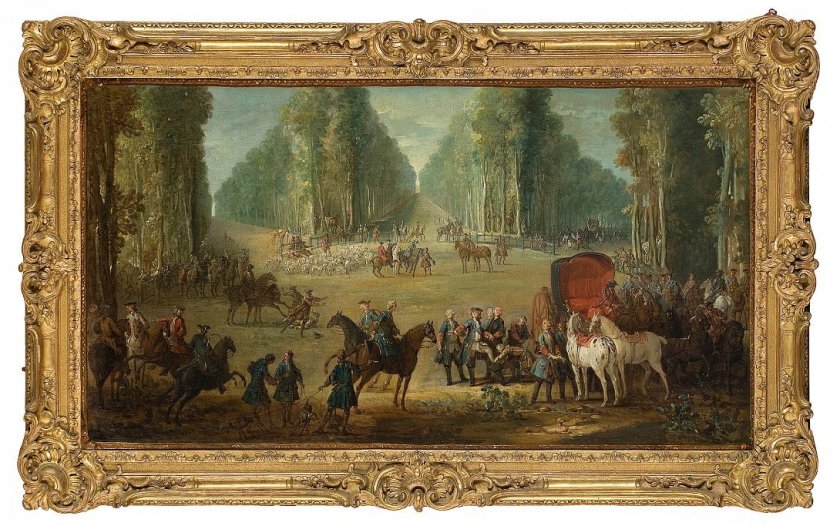
Royal Hunts of Louis XV by Jean-Baptiste Oudry

The Salon in Paris was the official exhibition of art sponsored by the French government. It originated in 1667 when Louis XIV sponsored an exhibit of the works of the members of the Académie Royale de Peinture et de Sculpture. The exhibitions, to begin with, were not annual events, in fact they were quite sporadic with only one exhibition being held between 1704 and 1737 but from 1737 they became annual events. The Salon’s original focus was the display of the work of recent graduates of the École des Beaux-Arts and exhibiting one’s work at the Salon de Paris was vital for any artist to achieve success in France. Having one’s work in the Salon was tantamount to achieving royal favour and in the early days, before the inception of art dealers, it was the only way an artist had to sell their works. The return to annual exhibitions could be one of the reasons why in 1737 Oudry returned to painting and every year after, he would exhibit his works at the Salon.

Through his friend, Jean-Baptiste Massé, a portrait-painter and miniaturist, Oudry was introduced to Henri-Camille Marquis de Beringhen, Premier Ecuyer du Roi (Master of the King’s Private Stables), and organiser of the royal hunt, and he played a part in launching Oudry’s artistic career at court. He arranged for Oudry to have a studio and lodgings for himself and his family in the Tuileries Palace, so that he could work on royal commissions.

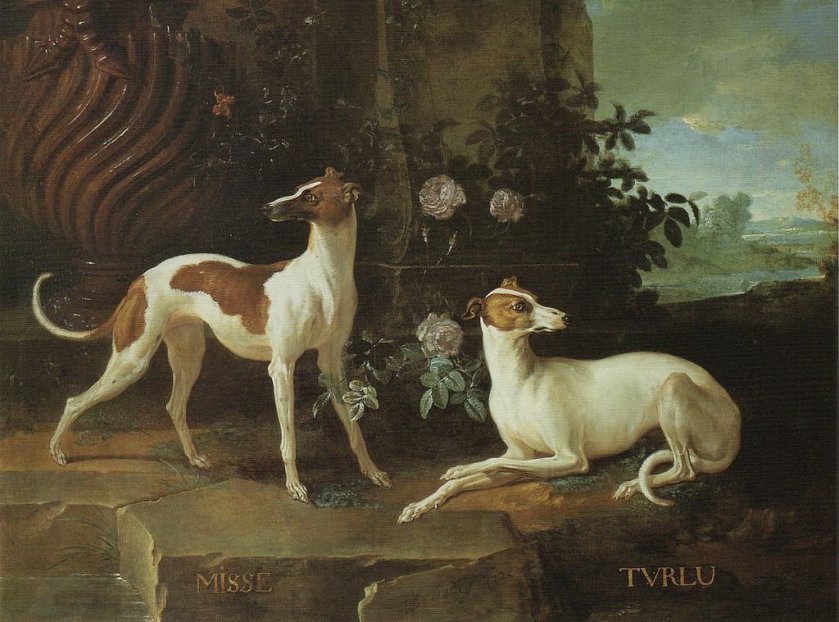
Misse and Turlu,Two Greyhounds Belonging to Louis XV by Jean-Baptiste Oudry (1725)

Oudry’s hunting scenes were very much admired by Louis XV, and Oudry portrayed the king’s favourite royal hounds, Misse and Turlu, and painted scenes of the king riding to the hunt, which was the monarch’s sporting passion.

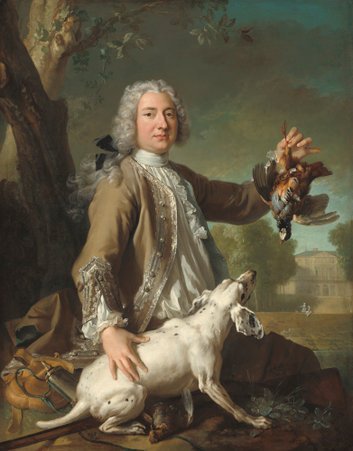
Henri Camille, Chevalier de Beringhen (1722)

Occasionally, Oudry painted portraits, one of which was of the twenty-nine-year old, Marquis de Beringhen. Once again, this painting is part portraiture and part still-life with dead game, a living animal, and a landscape. It typifies Oudry’s method of painting: the stylish elegance of the rococo style is combined with a perceptive sense of observation. We see the marquis sitting upon a knoll at the base of a tree. He is splendidly dressed in his linen shirt, a pale grey hunting coat lined with teal-blue velvet and trimmed with silver braid and buttons, breeches, and thigh-length boots. We see strands of his powdered hair swept back and tied with a black silk ribbon. He holds aloft a red-legged partridge in his left hand and with his right hand he strokes his faithful pointer. To the left, behind the dog we see lying on the ground a powder horn, fowling piece, game, and a game bag. To the right of the marquis, in the distance, we can just make out two women talking on the terrace of a country house, which may be pure idealization and just included as a befitting noble setting that Oudry had devised for the Marquis de Beringhen. Oudry once again highlights his artistic techniques in the way he depicts the lace of Beringhen’s shirt and the silver embroidery on his coat, and in the feathers of the partridge and the fur of the hound.

Grand Buffet, Still Life with Monkey, Fruit and Flowers by Jean-Baptiste Oudry (1725)

Oudry soon broke Desportes’ royal monopoly and his work output grew. In 1725, the Paris Salon held an exhibition, the first since 1704, and Oudry submitted twelve pictures, including one entitled Grand Buffet but also known as Still Life with Monkey, Fruit and Flowers, which can be seen in the bottom right corner of the November 25th, 1725 edition of the French gazette and literary magazine Le Mecure de France.

Salon de 1725 as advertised in Le Mecure de France

In 1726 Oudry provided twenty-six paintings for an exhibition at Versailles. His other important acquaintance, Louis Fagon, the king’s Intendant des Finances, arranged for Oudry to become the painter to the royal tapestry works at Beauvais. This was to be the start of a new direction for Oudry who over the next decade designed a number of tapestry sets, including four pieces depicting Comedies of Molière, eight pieces based on Ovid’s Metamorphoses and four panels depicting Fables of La Fontaine.

The Fables of La Fontaine – The Two Pigeons by Jean-Baptiste Oudry

Between 1729 and 1734, Jean-Baptiste Oudry produced a total of 276 beautiful and highly finished drawings, including a frontispiece, which illustrated tales from the famous 17th century work by Jean de La Fontaine, Les Fables choisies mises en vers (Selected Fables Rendered in Verse). Each of the scenes was drawn with the brush with black ink and grey wash, heightened with white gouache, on sheets of blue paper, with each image surrounded with a wide border brushed on the same sheet in a darker shade of blue, acting as a fictive mount. These drawings, all made during this five-year period have long been recognised as Oudry’s most famous works as a draughtsman.

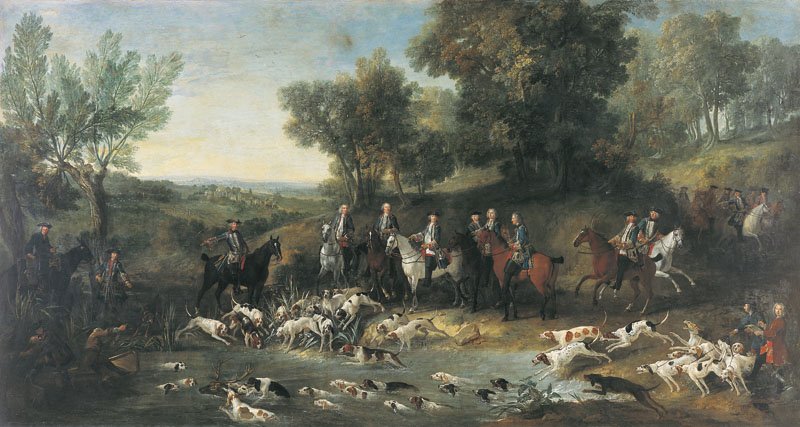
Louis XV Stag Hunting in the Forest at Saint Germain-en-Laye by Jean Baptiste Oudry (1730)

In 1728 Oudry began on a royal commission Louis XV Stag Hunting in the Forest at Saint Germain-en-Laye. It was a massive painting, measuring 210 x 390cms. Louis XV was a keen and knowledgeable hunter who knew the name of every one of the dogs in the pack. This work was painted for the hunting pavilion in Marly, and again it is a combination of animal painting and landscape genres. Oudry depiction set in a clearing in the forest of Saint Germain, is the moment of the halloo, the cry or shout used to attract attention or to give encouragement to dogs in hunting.

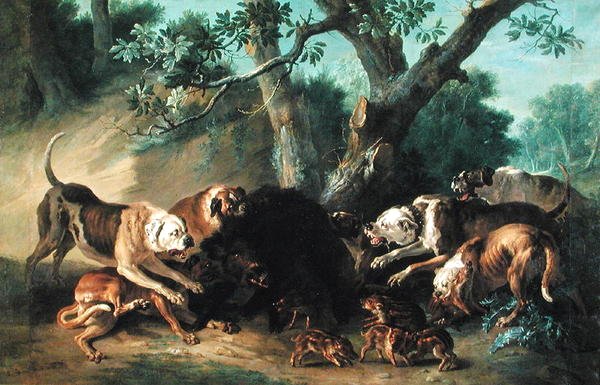
A Wild Sow and her Young Attacked by Dogs by Jean-Baptiste Oudry (1748)

Louis XV liked this work so much that, in 1733, he commissioned Oudry to produce three tapestry cartoons illustrating the hunts. The tapestries, woven under Oudry’s supervision at the Gobelins factory, were intended to decorate the king’s bedchamber and antechamber and the Council Chamber at the Château de Compiègne. In 1738, it was decided that the series should comprise nine cartoons; the last was completed by Oudry in 1746 and delivered to Gobelins. They made two sets of the tapestries. One set for the chateau at Compiègne and the other was sold to Philip, Duke of Parma, the King’s son-in-law.

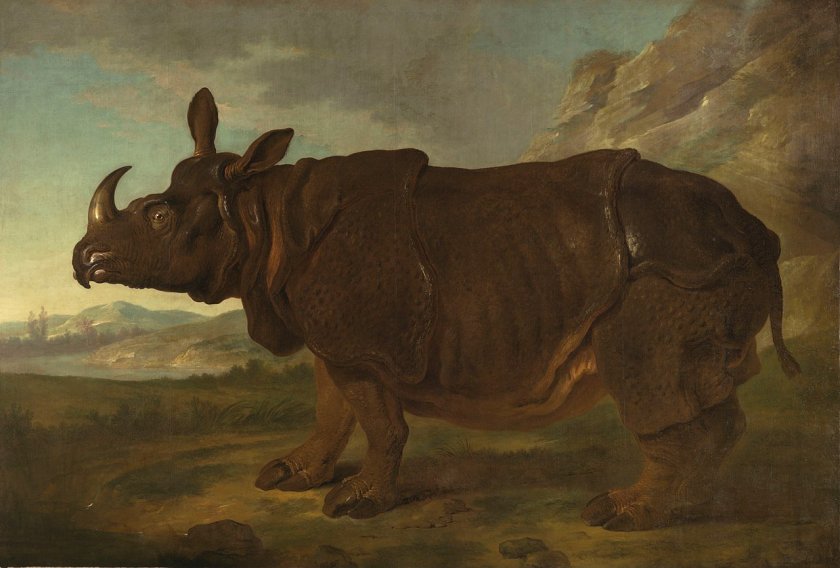
Clara the Rhinoceros in Paris by Jean-Baptiste Oudry (1749)

In the 1720s and 1730s, Jean-Baptiste Oudry established himself as the preeminent painter in France of hunts, animals, still lifes, and landscapes. His Painted Menagerie focused on a set of eleven life-size portraits of exotic animals from the royal menagerie at Versailles, painted by Oudry between 1739 and 1752. The paintings ultimately went into the ducal collection in Schwerin, Germany. The most famous of these is the splendid portrait of Clara, an Indian rhinoceros who had become a celebrity in mid-eighteenth-century Europe.  The Indian rhinoceros, who was born in Assam and had been named Clara, caused a sensation in Europe. A Dutch captain, Douwe Mout van der Meer, brought the three-year-old rhino in 1741. It was an animal that had never been seen before in Europe and he presented her at the Saint-Germain Fair in Paris, where she inspired many artists to undertake drawings and studies of her. Jean-Baptiste Oudry’s depiction of her is life size. The grand painting was shown at the Paris Salon in 1749 and acquired in 1750 by Duke Christian Ludwig II of Mecklenburg-Schwerin together with Oudry’s series of menagerie paintings. In all, there were approximately 57 drawings by him which ended up in the possession of the court in Schwerin.

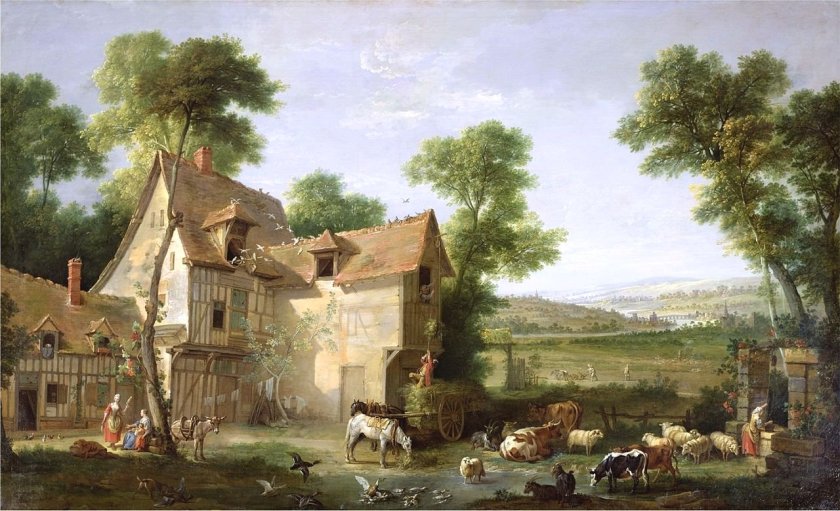
Farmhouse by Jean-Baptiste Oudry (1750)

Although Oudry is remembered for his animal and hunting scenes his idealized landscape work was of the highest quality. In 1750 the Dauphin, Louis, the elder son on Louis XV, commissioned Oudry to paint a picture of rural life which would highlight the bountiful and beauty of Ile-de-France and to promote the state’s progressive agricultural policy. Later the painting became known as The Farmhouse.

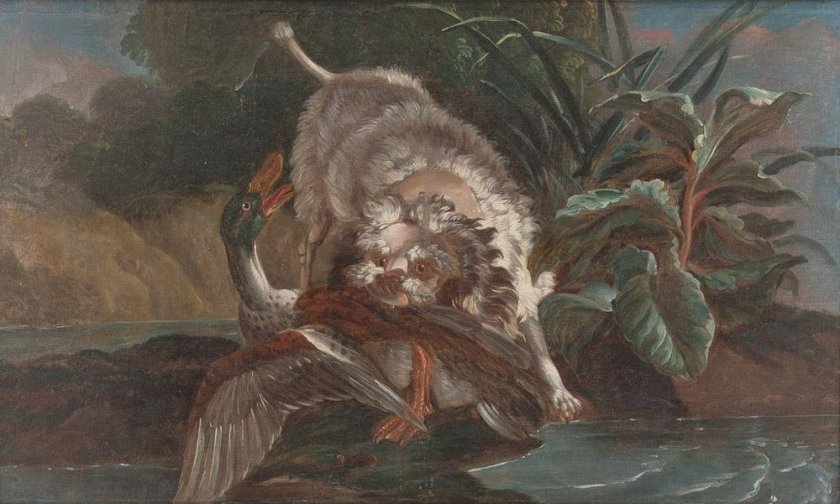
Jacques-Charles Oudry – Nature morte avec chien et le canard

Oudry was not a very wealthy man but lived comfortably. Oudry lost some of his responsibilities when Louis Fagon, the king’s Intendant des Finances, was replaced by Daniel-Charles Trudaine. Oudry suffered two strokes in quick succession in 1755. The second left him paralysed and he died shortly thereafter in Beauvais on April 30th, 1755, aged 69. He was buried in the Church of Saint-Thomas in Beauvais. His son, Jacques-Charles Oudry, trained by his father, was also an accomplished painter.

Hannah Gluckstein (Gluck) – Part 5, the latter years and the Heald sisters

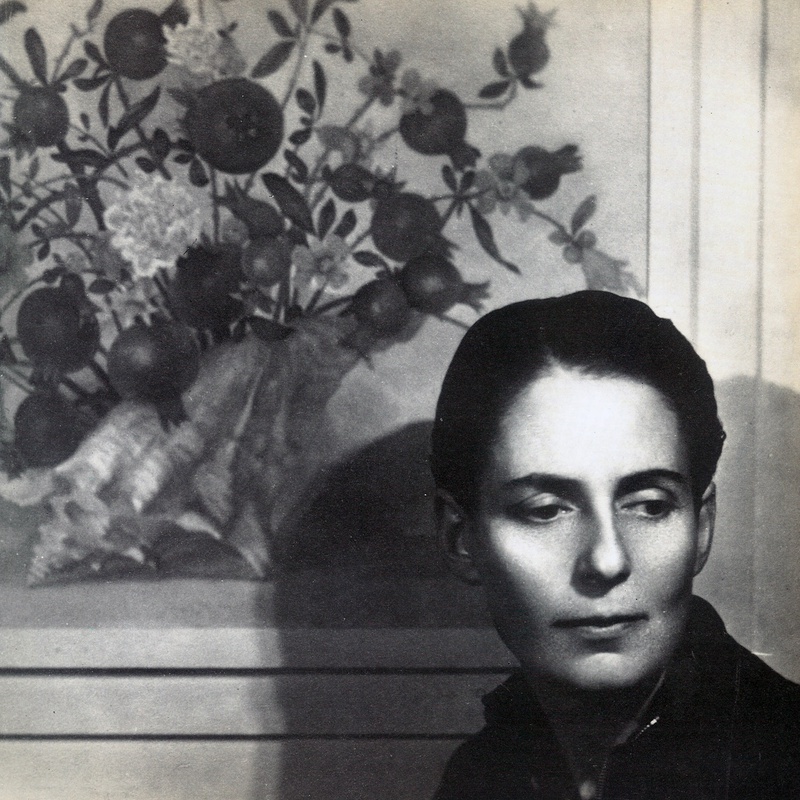
Portrait of Gluck (c.1924) by photographer, Douglas

World War II started on September 3rd, 1939  and, by the end of that month Gluck’s Bolton House home had been commandeered by the Auxiliary Fire Service, but she was allowed to keep and occasionally stay at the studio. Whilst looking for a house to rent she went to stay with Nesta’s mother, Mrs Sawyer. These were troubled times for Gluck as witnessed by a passage from a letter she wrote to her mother on September 24th, 1939:

“…My looks say I am well, my spirit is a mess at the moment and my body and nerves almost at the end of their tether…”

Nesta and Gluck in Lenzerheide, Switzerland 1938-39

The thing which was causing Gluck’s despondency was not the perils of the war but her finances. Not just her finances, but the control of her finances, which had been denied her and put in the hands of The Family trustees, her younger brother Louis, her mother, and her cousin Sir Samuel Gluckstein. This rankled with her for the persona she had adopted was that of a man, a person of competency, influence, and potency, but to The Family, it was all a pretence, for in their eyes she was just a woman and thus, in their social classification, she was a person with no authority. Her father, who had looked upon his daughter as somewhat wayward and rebellious, had made sure that level-headed and wise people would control her finances thus avoiding the possibility that she would squander her money and become poverty stricken and eventually destitute.

Gluck was paid rent by the Auxiliary Fire Service for Bolton House and her trustees agreed for her to rent a small house, Millers Mead, which was in Plumpton just two minutes away from Nesta’s home. In the small garden there was a simple outhouse which she used as her studio. She employed a married couple to act as her servants. The annual rental cost was £218. In July 1941 the Auxiliary Fire Service vacated Bolton House and stopped paying the rent and so the financial burden fell back on Gluck and as Bolton House was left empty because Gluck remained at Millers Mead, it started to suffer through lack of occupancy and there was a cost to carry out expensive repairs. Her money was slowly but surely trickling away. She had the high cost of running three places, her Letter Studio in Lamorna, Bolton House and Millers Mead. In a letter to her on July 30th, 1941, one of the trustees, Sir Samuel Gluckstein wrote that she needed to limit her expenditure:

“…I am not endeavouring to read you a lecture but I am endeavouring to help you to avoid getting into financial distress…”

Gluck sent numerous letters to her trustees pleading for more money and more control of it but it was to no avail. Her mother, a trustee, seems to have been annoyed at these constant missives as can be seen in a very terse letter she sent to her daughter on May 25th, 1942:

“…I cannot either understand or cope with this continual correspondence with copy letters to Louis and Mr Dyer but I would like to make this perfectly clear…..Today everybody’s income has been reduced to exactly half….if you were to write a thousand letters you would not alter this, and I do think, in these very strenuous, nerve racking days, the less correspondence you and anyone has the better…..I do not get younger and these things make me very unhappy…”

The two other trustees were less tactful and did not hold back in their condemnation of her moaning about money, and her brother warned her that her attitude would finally break their brother/sister relationship. She met with Louis and her mother in August at the Trocadero but the meeting collapsed due to violent rowing between the participants. In a letter to her mother four months later Gluck wrote:

“…This talk was of a nature so disgusting and shocking to me that it became clear that I cannot discuss any matters connected with my Trust affairs without a witness and a shorthand writer…”

Portrait of Mrs Ernest Sawyer by Gluck (1939)

An impasse between her and her three trustees had reached an impasse.  Her income was important to her and whilst living in Millers Mead she received several portrait commissions including one from Nesta who wanted Gluck to paint a portrait of her elderly mother, Ethel Sawyer. The result was a depiction of an English gentlewoman with her veiled hat, no-nonsense smile, pearls, mayoral collar and bright, if somewhat watery, eyes. Gluck would paint a second portrait of Nesta’s mother in 1943 as she lay dying. This period of war and the death of loved ones was a time when people wanted portraits of their relatives, some of which would prove to be consoling images.

The Pleiades by Gluck (1941)

Gluck also carried on with her floral paintings and in 1943 produced a work entitled Pleiades depicting a tangle of pink convolvulus and grasses. This work was a real labour of love for Gluck spent hours in the garden crouching over the same patch of weeds despite suffering painful backache and the onset of arthritis in her hands. The details in the painting are remarkable, such as the drops of dew on the web. Can you see the grasshopper on the leaf? She worked on the painting on and off for two years and it became a burden. She wrote about it to her mother on August 16th, 1942:

“…if I don’t get it done before September is over I am dished – and there are two waiting prospective purchasers. Anyway I am not anxious to face it again a third year and the work in it is terrific. I can only do very little every day and it is a strain on the yes. It is certainly going to be worth it when finished, but when will it ever be finished?…”

The painting was finally finished in August 1943.

The Punt by Gluck (1937)
Gluck and Nesta also appear in The Punt (c. 1937), in which the couple embrace on a boat resting on the lake near the Obermers’ country property in Sussex. The work was rejected for Gluck’s 1973 exhibition at the Fine Art Society for being too suggestive.

Gluck’s relationship with Nesta started to unravel during the war years. Nesta sent fewer letters to her lover when they were apart and when home with her husband Seymour. Nesta’s visits to Gluck became fewer and shorter in duration. Gluck’s diary entries noted when Nesta came and how long she stayed. Cracks were beginning to appear in her relationship with Nesta. Gluck had moved to Plumpton to be near Nesta but with her time with Nesta diminishing rapidly she began to feel isolated in comparison to her former social life when she lived in Hampstead. One of the few people who visited her was her old friend Craig who stayed for a month in November 1943 but Craig noticed how Gluck seemed depressed. The depression was brought on by her deteriorating liaison with Nesta and the wrangling with the Family Trust who controlled her money and believed that she had to be more frugal. She was desperately unhappy and for her, life was all gloom.

Self portrait by Gluck (1942)

It was in 1942 that Gluck completed a self portrait and the way she has depicted herself is not one of happiness. There is no softness of expression. There is no expression of warmth or love in her eyes. She has depicted herself with her head tilted slightly backwards looking cheerlessly down on the viewer with a mutinous and antagonistic expression.

Chantry House, Steyning 2016

Gluck was working on several paintings during 1943, including one entitled Jerusalem and the floral painting Pleiades as well as two small landscapes and a triptych for Sussex Council of Churches. It was during the commission for the Sussex Council that she made several trips to the small West Sussex town of Steyning to see the council chairman, Bertram Nicholls. Whilst there she visited the Heald sisters, Nora Heald and Edith Shackleton Heald, at their home at Chantry House, in the town of Steyning, and would often stay their overnight or for a weekend break. Both Heald sisters were journalists. Nora was editor of The Lady and spent most of the week in a flat above the newspaper’s offices in London. Edith, the younger of the two sisters, was a correspondent for the London Evening Standard and tended to work from home. Gluck became a great friend of Edith, possibly due to a common issue, desolation. Gluck was deeply despondent due to her failing relationship with Nesta and Edith was very unhappy when her lover, the Irish poet, W.B.Yeats, died in January 1939. Gluck and Edith were able to console each other and Gluck spent the Christmas of 1943 with Edith at Chantry House – the first time in eight years that Gluck had not spent Christmas with “her darling wife” Nesta. Edith Heald tried to help Gluck through this distressing period and the two would often take trips along the south coast visiting the various English seaside towns. Soon Gluck was spending most of her days and nights at Chantry House although she never lost contact with Nesta.

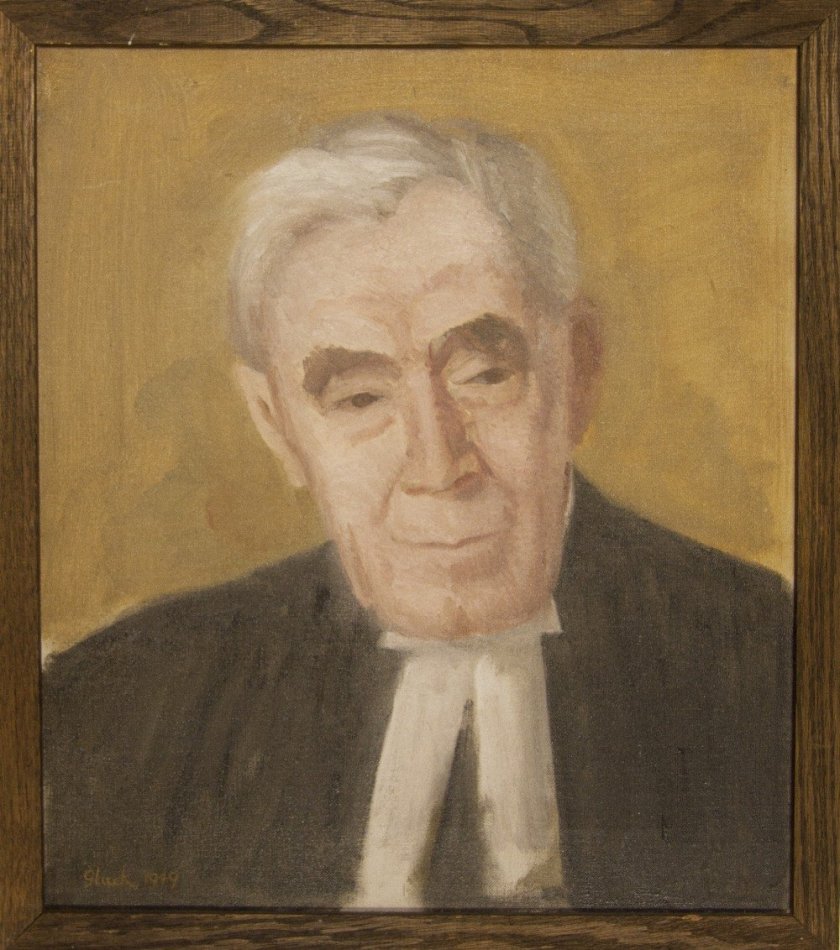
Gluck received a commission from Wilfrid Greene to paint his portrait. Greene was resigning as Principal of the Working Men’s College and had been asked to present a drawing of himself to the College and he decided that Gluck should be the artist. On 16 July 1941 he was raised to the peerage as Baron Greene, of Holmbury St Mary in the County of Surrey. Gluck stayed at his Dorset home, The Wilderness, for a few days whilst working on the portrait.

Gluck’s doomed love affair with Nesta ended in 1944. Gluck had almost seen the break-up coming. What she wanted from Nesta was the sole access to her heart, her total commitment to the relationship.  Sadly, she latterly realised that this was never going to happen. Their love for each other was not equal. Nesta was never going to leave her husband who supplied the finances for her lavish lifestyle and this upset Gluck. To Gluck, their love for each other was one sided and although they corresponded and met in the following years, the “marriage” was over.

Gluck with Edith Heald.
Late 1940’s

Gluck could not bear to be alone and, after the break-up of her relationship with Nesta Obermer, she accepted Edith Heald’s invitation to come join her and her sister (plus the sisters’ servants!) and live in Chantry House. Gluck accepted and on October 6th, 1944 she moved in. Edith Weald was delighted with the decision, her sister less so. For Gluck the move and new home took away some of the disappointment with Nesta’s attitude. It solved her financial problems and the relationship with her trustees, as her Hampstead home,  Bolton House, was sold in 1945 and the money reverted to the Gluck’s Trust fund. She did however keep the studio but had a wall built separating it from Bolton House. In some ways she looked up to the sisters and the way they had both made their own way in a male-dominated industry without the reliance on someone else’s money. Gluck was now away from her mother and away from the temptations of London’s West End. It was the perfect working environment. What was once known as the Yeats’ Room in Chantry House became her study and a cottage in the grounds of Chantry House became her studio.

Study for a Portrait of Wilfred Arthur Lord Greene, Master of the Rolls by Gluck

Raynard Goddard the Lord Chief Justice approached Gluck with a commission. He had seen the sketch she had done of Wilfrid Greene and he wanted Gluck to produce a similar work but this time in oils to present to the Inner Temple. She agreed but because of illness she did not complete the painting until 1949.

Gluck and Edith Heald’s relationship changed from friendship to a lesbian affair and this did not please Nora Heald. It was not just Nora that viewed her sister’s relationship with Gluck as distasteful, some of her sister’s erstwhile friends found the situation unbearable and began to distance themselves. The living arrangements at Chantry House were becoming problematic and far from harmonious and there were frequent excruciating tensions and shrieking matches between the three residents. Gluck always sided with Edith against Nora and the latter felt betrayed. With all this turmoil Gluck only completed one painting in 1946, and to escape from the cauldron Edith and Gluck went to Lamorna for a month that summer. On returning home they found Nora no easier to live with. Nora did not dare invite her friends and work colleagues to Chantry House, after all, she was the editor of The Lady which did not countenance ladies being in lesbian relationships. Something had to give. Nora wanted Gluck out and Edith and Gluck wanted Nora out. Gluck wanted a home and Edith was determined to provide her with one. Add to this the fact that Nesta still called on Gluck and became jealous of her relationship with Edith.

In 1947, after some pressure from her trustees Gluck sold her Lamorna studio. The situation with the Chantry House ménage à trois was finally sorted with Nora reluctantly leaving. Gluck’s trustees agreed to pay Nora half the value of Chantry House and the linen, tableware and ornaments were equally divided between the two sisters. The ménage à trois became a ménage à deux.

Gluck working at Chantry House studio wearing a the silver cravat (1960’s)

Even though many years had passed since her break-up with Nesta, Gluck never recovered from losing her or from the upheaval to her life caused by the war. Add to that the permanent estrangement between her and her brother Louis who managed her trust fund after her mother died in 1958. In addition, both Edith and Gluck were getting older and began to suffer from a variety of illnesses in their latter years. Gluck’s periods of depression became longer and she painted very little. Whether it was a cause she wanted to focus her mind back on art, we will never know, but she had a love of quality painting materials and was unhappy with the standard of paints and canvases on offer and so she began a dogged decade-long battle with the British Board of Trade and commercial paint manufacturers, who, in her mind, were producing inferior products that threatened to deteriorate over time. Fortunately for her, this cause had the backing of the Arts Council of Great Britain, British Colour Manufacturers Association, and two important museums. After a long battle she succeeded and the British Standards Institution Technical Committee on Artists’ Materials was formed and this meant that for the first time, there were published standards regarding the naming and defining of pigments, cold-pressed linseed oil, and canvas.

The Fine Art Society, London 1973

After the victory, Gluck returned to painting using the special handmade paints supplied by a manufacturer who had taken Gluck’s standards as a challenge. In all, fifty-three of these pieces were exhibited in a solo show at the Fine Art Society in 1973, and they were very well-received. The exhibition was her first since 1937. She was buoyed by the success of the exhibition and optimistic about the future. However, the directors of the Fine Art Society did not concur. For them the future of Gluck and her work were not as she saw it. She was now eighty years of age, was not in good health, suffering from arthritis and heart problems, painted slowly and they believed that her optimism about her future was simply her antidote to counter her depression. However, some of her older paintings were later shown by the Fine Art Society in their mixed exhibitions.

Rage, Rage Against the Dying of the Light by Gluck (1973)

In 1973, Gluck completed her last painting and it  was one with an unusual title, Rage, Rage against the Dying Light which comes from the lines of a poem by Dylan Thomas:

“…Do not go gentle into that good night,
Old age should burn and rave at close of day;
Rage, rage against the dying of the light…”

Edith and Gluck

Edith Heald’s health deteriorated rapidly and it was agreed by her doctor that Gluck could not safely look after her and she was admitted to the Homelands nursing home in January 1975, aged ninety. Edith felt abandoned and betrayed. Gluck, who was not able to drive anymore, was chauffeured to the nursing home twice a week, to visit Edith, who according to Gluck seemed very sad and forlorn. Gluck was now living alone, albeit with her servants, and found the upkeep of Chantry House almost impossible. In the Autumn of 1975 Gluck returned to her cottage at St Buryan in Cornwall for the last time.

St. Buryan by Gluck (1968)

On October 11th, 1976, Gluck had Edith transferred from her Homelands nursing home she had been in for two years, to one close to Chantry House which would make it easier for her visiting her erstwhile friend but the move proved disastrous as within five weeks of the transfer Edith Heald died on November 5th, 1976. Gluck was in total shock on hearing of Edith’s death and blamed herself for having Edith transferred to her new nursing home. Two weeks after the funeral Gluck suffered another heart attack.
Gluck’s cousin Julia Samson visited her in January 1978 and recalls the event:

“…We talked and had tea. She thought of me as young and her sensibility wouldn’t have let her make a young person sad. I said I’ll come and see you next week. She didn’t say anything, just looked at me and her eyes were very very sad. There was a passion there inside. Perpetual liveliness…”

That next-week visit never came to fruition as Gluck died the next day, January 10th, 1978. She was 82. Her brother Louis broke off his Swiss holiday to attend the funeral of his sister and it was reported that his youngest son witnessed his father crying for the first time.

Nesta Obermer outlived Gluck by six years, dying at her French home in Vaud on October 3rd 1984 aged 91.


—————————————————–

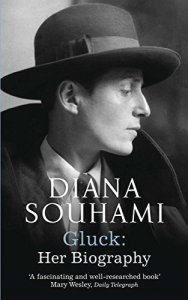
Most of the information for this blog came from two excellent books – Gluck: Her biography by Diana Souhami.


Gluck Art and Identity  by Amy De La Haye (Author), Martin Pel (Author), Gill Clarke (Author), Jeffrey Horsley (Author), Andrew Macintos Patrick (Author)


Both are excellent reads and fill in all the gaps in the life of Gluck which I have passed over.

Hannah Gluckstein (Gluck) – Part 4 – Nesta Obermer and the Fine Art Society exhibitions of 1932 and 1937

Gluck in the Gluck Room at The Fine Art Society

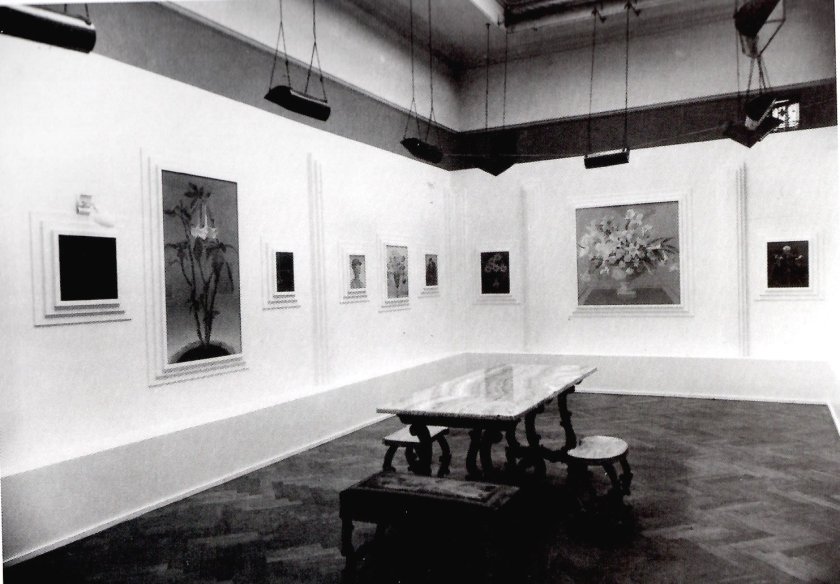
In November 1932, the Fine Art Society in New Bond Street, London, hosted Gluck’s much heralded third solo exhibition. Constance Spry decorated the Fine Art Society galleries for the exhibition. All the paintings were hung in the main gallery which Gluck transformed into what became known as the Gluck Room. All her paintings were mounted in her own Gluck frames. This  frame was described in Jacob Simon’s 1996 book, The Art of the Picture Frame:

“…The essential feature of the Gluck frame’, according to a note in the catalogue of her 1937 Fine Art Society exhibition, ‘is that it becomes part of any wall whatever its character, colour or period… It can be painted the same colour as the wall, or covered with the same wall-paper, or made in any wall material…”

Chromatic by Gluck (1932)

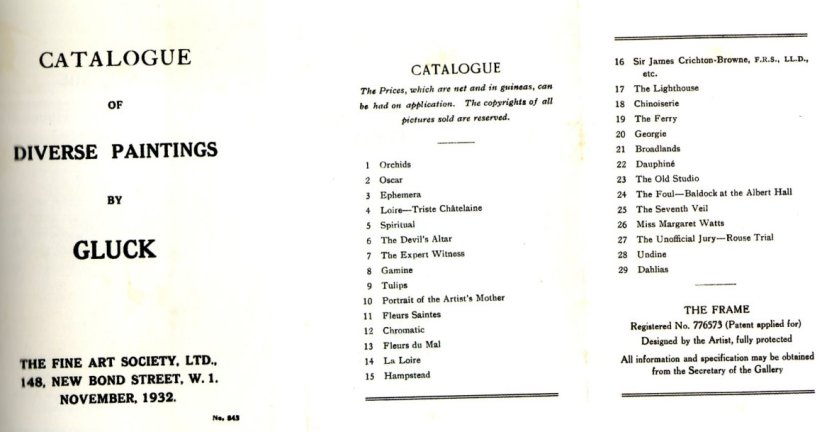
Gluck designed the interior of the Gluck room.  It was a series of white panelled bays and pilasters which echoed the steps of the Gluck frames and this resulted in a unified effect of pictures and their setting. Modern furniture was added. Twenty-nine of Gluck’s paintings were shown at this exhibition, eleven of them were depictions of flowers with the pride of place going to her painting entitled Chromatic. Others on display were portraits of her mother, James Crichton-Browne, Margaret Watts and Georgina Cookson.

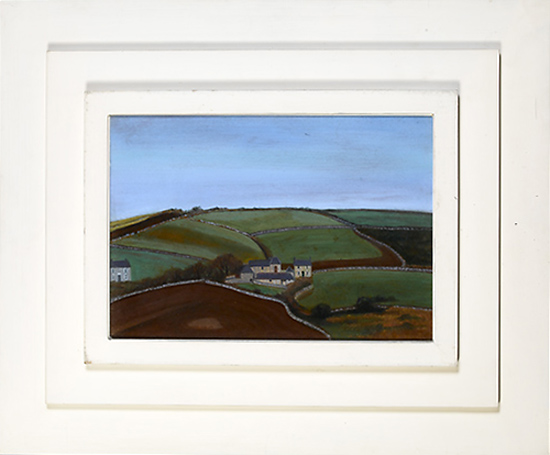
A Cornish Farmhouse by Gluck (Hannah Gluckstein) in its stepped white-painted ‘Gluck frame

There was also room for landscape paintings featuring her beloved Cornwall.

The Gluck Room at Fine Art Society 1932 exhibition

The exhibition was a great success and the visitors from all walks of life queued to see Gluck’s paintings. Even Queen Mary put in an appearance. So popular was the exhibition that the Fine Art Society extended its run for a month and added a few more of Gluck’s paintings. Newspaper and magazine reviews couldn’t have been better. In the journal, The Lady, the art critic wrote of Gluck’s sensitive brush and delicate sense of tone, colour and composition:

“…no one who loves painting should miss this exhibition. It is perhaps not irrelevant that it occurs at the tercentenary of Vermeer…”

1932 Fine Art Society Gluck catalogue

The Sunday Times regaled Gluck’s clarity of definition, clean light colour, feeling for stately design and Florentine dignity of composition, whilst The Times commented on Gluck’s suavity of workmanship. Most of the newspapers ran pictures of her work and gave passionate and affirmative reviews.

The Lady Mount Temple by Gluck (1936)

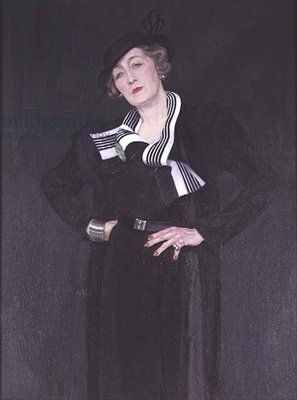
It was in early 1932 that another woman came into Gluck’s life. She was Ella Ernestine Sawyer, known as Nesta Sawyer.  Gluck and Constance Spry were invited to a dinner party at Broadlands, in Romsey, Hampshire by Molly Mount Temple. Broadlands was a Palladian mansion and the home to Molly and Wilfred Ashley, the 1st Baron Mount Temple and once the country residence of Lord Palmerston when he was prime minister. Molly Mount Temple, an imperious figure, was the second wife of Ashley and a regular client of Constance Spry. Constance arranged the flowers at Broadlands and Molly’s London town house, Gayfere House in Westminster. In 1936 Gluck painted the portrait of this commanding female entitled The Lady Mount Temple.  We see her imposing figure dressed by the Italian fashion designer, Elsa Schiaparelli in black and white.  Her head is cocked to one side with a haughty look of arrogance.  At that soirée, Molly introduced Nesta Obermer to Gluck.

Nesta was the daughter of a diplomat who had married the wealthy playwright Seymour Obermer in 1925 when she was thirty-one years of age. Before the marriage Nesta Sawyer had some of her literary works published under the name, Nesta Sawyer. Seymour Obermer, a widower, was some thirty years older than his wife. The couple led a glittering international life, wintering in Switzerland and spending the summers in Venice. For the elderly Seymour Obermer, his wife added a touch of style and elegance to his life. I suppose in today’s parlance she would be looked upon as his “trophy wife”. Diana Souhami summed up Nesta’s character in her biography of Gluck:

“…Strength and fearlessness were Nesta’s attributes. It was she who loved life to the full, charmed people with her glamour, generosity and understanding, had a go at everything – painting, writing, singing, drove fast cars, got her pilot’s licence, did yoga, got gold medals for skating and skiing and travelled the world…”

May 23rd 1932 was a special day for Gluck. This was the day that a chauffeur driven car whisked her off to Nesta’s home, The Mill House, which was in the East Sussex village of Plumpton. Gluck was to be Nesta and Seymour’s weekend guest. According to Gluck’s letters it was during this weekend that Nesta and Gluck fell in love. From then on, this day in May was looked upon as their anniversary date. From then on Gluck’s diary was full of entries about when the two women met, lunched, dined and sent and received each other’s letters. Gluck later looked upon the letters as the YouWe letters, letters which were affirmations of their romantic love that spanned the gap of frequent separation. Some of the hand-written love letters still survive but when the relationship ended Nesta destroyed many she had received from Gluck and sent some back to Gluck.

Constance Spry at work

In June 1936 Gluck and Nesta embarked on a lesbian relationship which was so intense and all-consuming that it caused a division between Gluck and her previous close friends such as former lover, Constance Spry.

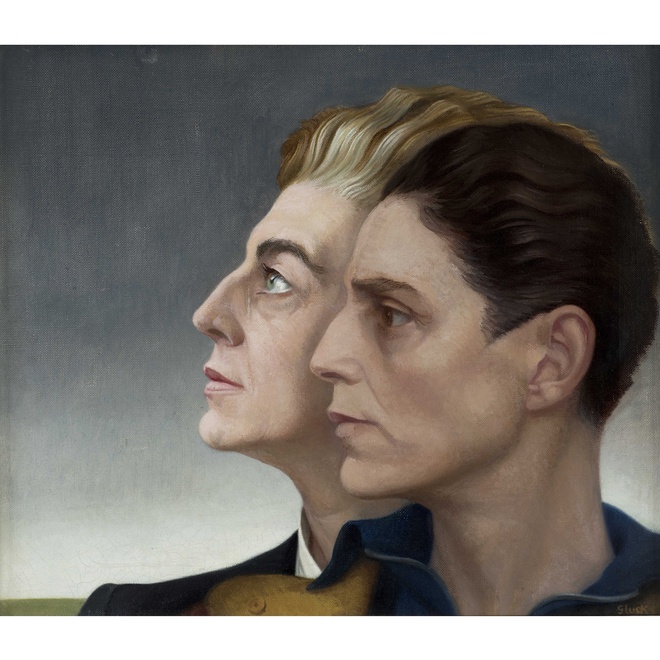
This close relationship with Nesta was to lead to Gluck’s most famous painting, completed in 1936, known as Medallion or the YouWe painting. The work is a portrait of Gluck and Nesta Obermer and according to Gluck it came about after the two women went to see the Mozart opera, Don Giovanni at Glynbourne on June 23rd 1936. Nesta and Gluck sat in the third row of the stalls and Gluck recalled how she felt the intensity of the music which fused them into one person and matched their love. In her biography of Gluck, Diana Souhami describes the painting:

“…The gaze of aspiration and direction and the determined jaws have something of a feel of socialist revolutionary art. Nesta’s fair hair forms a halo around Gluck’s dark head…”

This dual-portrait depicts the artist and her lover, the American socialite Nesta Obermer. Gluck was forty-one and Nesta forty-three. The painting which was quite small (31 x 36cms) is the bringing together of Gluck with Nesta Obermer, whom she termed “her dear wife”.  The painting hung on a wall in Gluck’s Bolton House residence and it consoled her during the frequent weeks of separation while Nesta travelled the world with her American husband. For Nesta the painting was all about teasing people who, on looking at the depiction of the two women, began to wonder about the nature of their relationship. The depiction was a dichotomy of honesty and restraint. For Gluck this relationship with Nesta was one she believed would last forever. It was a relationship which would banish her loneliness but of course like many relationships there is often an end point.  The end point for Gluck’s relationship with Constance Spry came the day after Gluck and Nesta had attended the Glyndebourne opera.  Gluck had invited Constance to dinner at Bolton House and during that evening Gluck told her that they could no longer be lovers.  It was the end of the relationship.  Constance had been a great influence on Gluck.  She encouraged Gluck’s talent and introduced her into the heart of 1930’s English high society.

Gluck’s deep love and all-consuming passion for Nesta can be seen in a letter she wrote to her in the Autumn of 1936:

“…My own darling wife. I have just driven back in a sudden almost tropical downpour in keeping with my feelings at leaving you – my divine sweetheart, my love, my life. I felt so much I could hardly be said to feel at all – almost numb and yet every nerve ready to jump into sudden life…………..I love you with all my being now and for ever. Good morning dear heart and goodbye…”

Nesta was Gluck’s inspiration and in Gluck’s mind, her wife. In 1936, she wrote to Nesta:

“…Love, you are such an inspiration to me, and that you should be my darling wife too is all any man can expect out of life, don’t you agree?…”

Like all relationships there are good times and bad times. In 1937 Nesta Obermer was experiencing a lot of her own problems. Her elderly father was dying and her mother was becoming wary of her daughter’s relationship with Gluck, which she had been told by her daughter was just a casual relationship. Gluck was also starting to be concerned about her relationship with Nesta. She was jealous of Seymour and felt side-lined by his rightful claim on his wife’s time. She was starting to believe that her love for Nesta was much stronger than Nesta’s love for her. Gluck’s anticipation of receiving at least one letter a day from Nesta did not seem to be reciprocated by Nesta in her attitude to Gluck’s letters of love which she seemed to open “when she had time” unlike Gluck who almost opened Nesta’s letters before they exited the letterbox in her hallway. She mentioned this to Nesta in her letter but fearing that the tone of the missive would be seen as complaining, she ended by saying:

“…Don’t make any mistake – I know you love me, I know how you love me and I know that nothing like this can prevent me loving you, but my ears went back and I felt the armour close with a snap again round my heart which had become, I suddenly realised dangerously softened…”

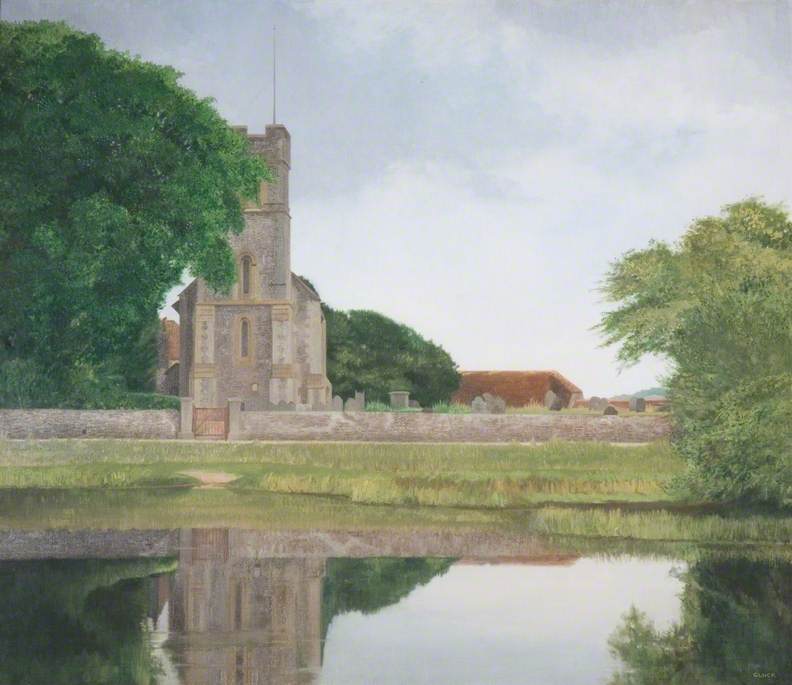
The Village Church and Pond, Falmer, Sussex; by Gluck (1937)

Nesta was feeling the pressure from all sides as she wintered with her husband in St Moritz. Her father was dying (he died in April that year) and she felt guilty for not returning home to visit him as her mother pleaded for her to do. Gluck was becoming more needy, also wanting her to come back to England as she was barely surviving on just Nesta’s letters. Nesta’s husband Seymour wanted her to stay and in fact he wanted to lengthen their planned winter stay in Switzerland. It was almost certain that Gluck disliked Seymour’s hold on his wife and Seymour disliked Gluck’s influence on his wife and because of  all this, Nesta was being torn different ways by various people.

Fine Art Society 1937 Gluck exhibition catalogue with annotations

For Gluck her artistic life had to continue notwithstanding her often troubled relationship with Nesta and on November 16th 1937 her new solo exhibition at the New Bond Street premises of The Fine Art Gallery opened. Thirty-three of Gluck’s paintings were on show with others on stand-by. There was a mix of genre – portraiture featuring people who were in the news at the time, floral paintings and idealised landscapes. All were up for sale and the prices ranged from £2 to £300. As was the case with her 1932 exhibition, this one was hailed as a great success. In the November 24th 1937 edition of the Bystander, a British weekly tabloid magazine, the art critic wrote:

“…I do not remember for years seeing such a display of versatility. Gluck’s flower paintings would be her strong point if her landscapes were not so brilliant, and her landscapes might get the top marks if it were not for her portraits or her still life…”

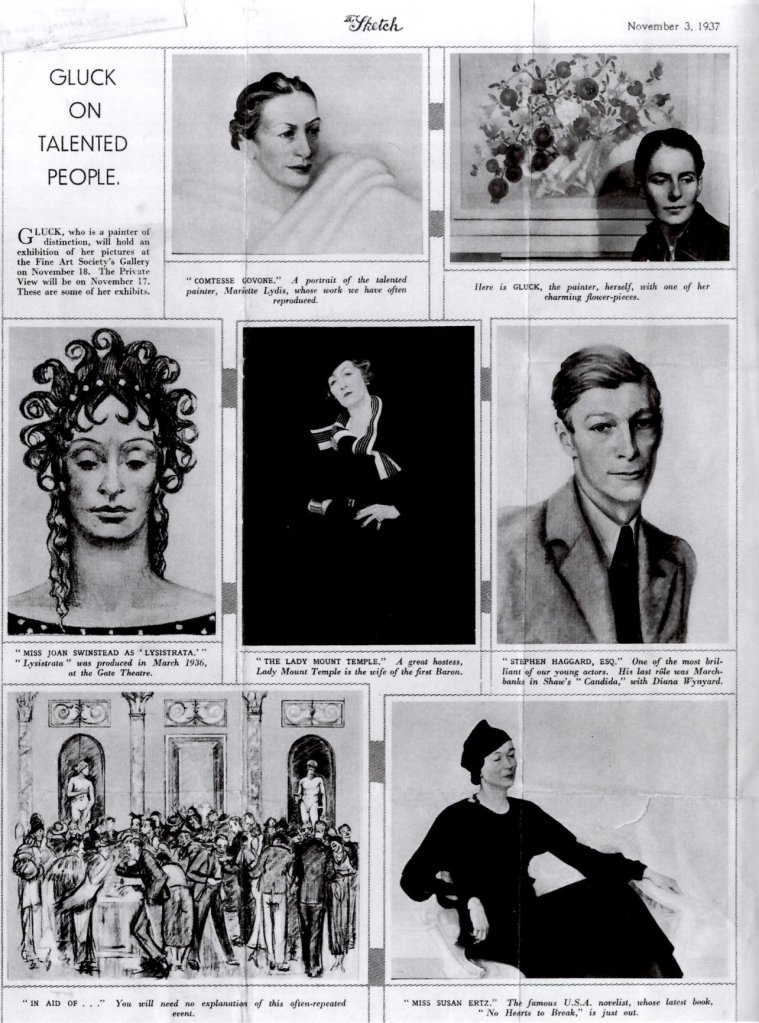
Daily Sketch November 3rd 1937

Her paintings were reproduced in many of the national newspapers and magazines. The Times lauded her, commenting on….

“…the clearness of her sense of form, her subtle use of colour and curiously reserved emotional content…”

The art critic of the Daily Telegraph, T.W.Earp called her crowd scenes little gems of humorous perception. The Daily Sketch wrote a piece about Gluck describing her as having:

“…the profile of a Greek god with eyes that shone like black diamonds…”

Gluck spent the summer of 1938 holidaying with Nesta in Dorset, Devon and Cornwall.  Unbeknown to them, World War II was only a year away and this was going to cause Gluck a lot of hardship but even more depressing for Gluck was the slow unravelling of her relationship with her beloved Nesta.

..……..to be continued


Most of the information for this blog came from two excellent books – Gluck: Her biography by Diana Souhami.


For a much fuller account of Hannah Gluckstein’s life, treat yourself to these biographies.

Gluck Art and Identity


Another great read is Gluck: Art and Identity by Amy De La Haye (Author), Martin Pel (Author), Gill Clarke (Author), Jeffrey Horsley (Author), Andrew Macintos Patrick (Author)

Hannah Gluckstein (Gluck). Part 3-Floral paintings and Constance Spry.

Gluck in the Gluck Room at The Fine Art Society

In 1932, by the time Gluck was thirty-seven years old, life could not have been better. She lived in Bolton House in Hampstead village with its newly-built large studio and was busy putting together a collection for that year’s Autumn Exhibition at the Fine Art Society in London. Her live-in guest and lover, Sybil Cookson, a journalist who had split from her racing driver husband, Roger Cookson had moved in to Bolton House with her two daughters. Gluck never wanted for anything financially as her mother always ensured that her daughter had everything she wanted from art materials, and clothes to covering the cost of repairs to her daughter’s house and car and as Diana Souhami wrote about this mother/daughter relationship in her biography of Gluck:

“…After the death of her husband, she [Gluck’s mother] let it be known to the other trustees that she favoured generous treatment for her daughter. What Gluck wanted, after her father’s death and before the outbreak of war, in any material sense, she received…”

Despite all that financial help Gluck was wary of her mother. She believed her mother to be unstable and Gluck was unhappy with her mother’s tendency of trying to control her life. Gluck had forged herself a place in “smart” society, a society which was sexually tolerant and not judgemental and whenever she tired of London social life she could take herself off to the tranquillity of Lamorna in Cornwall. Having said all that, one has to question her happiness at this time. Gluck eulogised about her love of the simple life and yet lived somewhat flamboyantly. She said that she flourished on exhilaration and yet she often yearned for peace and quiet. She would often be the soul of integrity regarding everyday mundane dealings of business and yet her integrity was often set aside when it came to her own infidelity and affairs with other men’s wives and it was this constant dichotomy which would cause her mental anguish.

Annette Mills and Muffin the Mule

It was Gluck’s infidelity which led to the ending of her time with Sybil Cookson just prior to her 1932 Fine Art Society exhibition when Sybil discovered Gluck and Annette Mills, in flagranti in the art studio. Mills would later become a household name for her TV role in Muffin the Mule in the 1950’s. Sybil deeply upset by Gluck’s infidelity immediately took her children and left Bolton House.

Gluck never lacked company and the loss of Sybil was soon forgotten as she moved on to her next lover. It is interesting to muse that her different lovers influenced her painting subjects. Whilst she was with the journalist and writer of romantic novels, Sybil Cookson, she would depict courtroom dramas which Sybil covered for her newspaper. She also painted portraits of Sybil’s family.

Constance Spry arranging flowers

Gluck’s next love affair was with the society flower arranger, florist and writer, Constance Spry, and throughout their four-year liaison she produced the most beautiful floral paintings. Constance Spry’s expertise was in much demand, as what she produced was looked upon by the monied upper-class as the height of sophistication and respectability. Constance Spry, who was nine years older than Gluck, had a very difficult early life. She had moved with the family to Ireland because of her father’s job. When she was nineteen she enrolled in a course for health lecturers and got a job in Dublin. In 1910, she married Irishman James Heppell Marr, a mine engineer from the north of England in and the couple had one child, a son, Anthony. The family then moved to Barrow-in-Furness. Their marriage, although it lasted six years, was doomed from the start. He was often moody and suffered from depression. But it seems that their wedding night was so brutal it shocked her for years to come, and despite Constance giving birth to a child, she would reject her husband’s sexual advances and he became increasingly violent.

Constance Spry at work

In 1921, she was appointed headmistress of the Homerton and South Hackney Day Continuation School in east London. It was here that she taught teenage factory workers in cookery and dressmaking, and later flower arranging. She gave up teaching in 1928 and opened up her first florist shop in 1929 in Pimlico which she called “Flower Decorations“. The name was to distinguish her work from the normal floral arrangements supplied by other florists. She would fill the shop with stock from her own garden and when necessary buy in some from Covent Garden. Soon Spry was inundated with orders and she had to recruit a dedicated team to cope with the increasing business. It was not just the floral arrangements which made Spry popular as she would rake through junk shops for unusual vases to hold her displays and she insisted that every arrangement should be composed in situ, as opposed to in her shop, so it would fit in perfectly with the surroundings. She looked upon herself and staff, not just as flower arrangers but as artists. Ever more commissions poured in and she had to move to a larger premises and it was important that her shop was in the midst of her wealthy clients and so in 1934 she took on the lease of a shop at No. 64, South Audley Street at the heart of Mayfair and business was so good that she eventually employed seventy staff.

The Pine Cone by Gluck

Whilst living in London, Constance met Henry ‘Shav’ Spry and they fell in love, although he was married at the time. Later they lived together and pretended that they were married. They eventually did marry when both Constance and Henry were divorced but the marriage was far from perfect with Shav having a long-running affair with one of her flower shop employees. It was around about this time, in 1932, that Constance Spry was introduced to Gluck by a mutual friend, Prudence Maufe, a trained architect and interior designer, and the wife of the architect, Edward Maufe, who designed Gluck’s new studio. Constance Spry had been asked by Prudence to present Gluck with a floral arrangement. In her letter to Gluck, dated January 4th 1932, Prudence wrote:

“…Edward and I are giving ourselves the pleasure of sending you up a Mixed Bunch of white flowers for your Studio. I have commissioned my friend Mrs Spry to do it and to ring you up when certain flowers which I have asked are procurable………………..I think she has a genius for flowers and you have a genius for paint, so that ought to make for happiness…”

Chromatic by Gluck (1932)

Val Pirie, an assistant of Constance Spry came to Gluck’s studio at Bolton House and slowly created the floral display using anthuriums, amaryllis, arums and tulips. The flowers in a Warwick vase were placed on a pedestal. Gluck was taken back by the beauty of the floral display and decided to paint it immediately. The finished work measured 122 x 119cms. It was the most painstaking and most spectacular of all her flower paintings and the finished work was entitled Chromatic and it became the centrepiece for 1932 show at the Fine Art Society  exhibition. It was sold to a private client. After the death of the owner it was sold to an art dealer. Gluck loved the painting so much that she tried to buy it back but the dealer refused to sell it to her.

Ambrose Heal’s furniture store on Tottenham Court Road

Gluck’s friend, Prudence Maufe, ran a show flat in the Mansard Gallery, on the top floor of Ambrose Heal’s furniture store in the Tottenham Court Road. This iconic company was behind some of Britain’s finest furniture. Ambrose Heal was also a lover of fine art and his involvement with painting and drawing went side by side with his training as a designer, manufacturer and retailer. It was this love of art and furniture design that Ambrose Heal set up the Mansard Gallery at Heal’s to exhibit the most ground-breaking art of the period. It was here that he showcased contemporary artists and designers. At the time, Prudence would exhibit Gluck’s paintings as well as weekly floral arrangements supplied by Constance Spry.

The Vernon Picture by Gluck (1937)

Derbyshire landowner, Lord Vernon of Sudbury Hall, a stately home near Uttoxeter, commissioned a painting of lilies by Gluck for his new London home, Vernon House in Carlyle Square. The finished painting became known as The Vernon Picture.

A Cornish Farmhouse by Gluck (Hannah Gluckstein) in its stepped white-painted ‘Gluck frame

The painting was in a frame which had been specifically designed and patented by Gluck in 1932. She was very protective of her patented design and had an antique furniture dealer and restorer, Louis Koch as the sole maker of the frame. In the Frame blog it describes the Gluck frame:

“…In the 1930s the artist Hannah Gluckstein (‘Gluck’) (1895-1978) went about framing her work from a much more austere viewpoint than Bloomsbury. She produced frames with a stark three-step profile, usually painted white, and which she patented as the Gluck frame. ‘The essential feature of the Gluck frame’, according to a note in the catalogue of her 1937 Fine Art Society exhibition, ‘is that it becomes part of any wall whatever its character, colour or period… It can be painted the same colour as the wall, or covered with the same wall-paper, or made in any wall material’…”

Still life by Gluck

Constance Spry’s work contributed to the fashion of the day – white interiors. Everything of the interior was to be white – white walls, upholstery, ornaments and flowers and it was said that 1932 was the year when the white fashion trend reached its peak. Constance wrote about her love of white flowers in her 1934 book Flower Decorations:

“…It is the interplay of light and shade, colour and shape in a thousand variations, that the delight of white flowers lies. It is subtle and distinct, cool yet brilliant and is a matter of endless experiment and pleasure…”

Lords and Ladies by Gluck (1936)

Constance Spry realised that Gluck’s artistic talent would work well with her floral displays in formulating perfect interior decorative design and she began to introduce Gluck to her upper-class and wealthy clients, including the Royal Family as well as leading interior designers such as Syrie Maugham, the leading British interior decorator of the 1920s and 1930s who was best known for popularizing rooms decorated entirely in shades of white. Her all-white drawing rooms featured in many fashion magazines and some would have Gluck’s Chromatic painting featured on one of the walls.

Datura, The Devil’s Altar by Gluck (1932)

One of Constance Spry’s favourite plants was the Datura. Gluck’s 1932 painting which is now at the Art Gallery Brighton, entitled The Devil’s Altar depicts two beautiful and delicate pendulous flowers hanging from the gnarled twigged stems of the Datura plant.

During her time with Constance Spry, Gluck and Constance would holiday in Tunisia, North Africa at Villa Hammamset, the home of Constance’s friends, Jean and Violet Henson. After Gluck’s relationship with Constance Spry ended she still remained friends with the Hensons, and a month after the split with Spry, Gluck travelled back there on her own. Gluck loved the North African lifestyle and would often dress in Arab clothes such as her androgynous outfit of white baggy trousers, a scarlet Neapolitan sash, yellow shirt and green jacket. If that was not eye-catching enough she would wear a geranium behind the ear and a Hammamet cap.

One of her pictures from those North African stays is a depiction of the head of a young Arab boy. She said that she was madly excited by the beauty and subtlety of the skin of the boy. She commented:

“…He is really delicious – A tiny delicate little head with a sad, far away look in his eyes…..God knows whether I shall get any of it. He can’t speak French and is very tiny and moves a great deal…”

Gluck, through Constance Spry’s social circle, now moved in high society and from this, gained numerous commissions and invites to society gatherings. One of the most memorable was when she was invited to a dinner party at Broadlands, the Palladian mansion by Molly Mount Temple who was the stepmother to Edwina, Countess of Burma. Gluck’s mother was so impressed by her daughter being invited to such a dinner party she allowed her to go there in her Rolls Royce driven by her chauffeur. Besides commissions to paint Broadlands and a portrait of Molly, the dinner party was another pivotal moment in Gluck’s life.

Nesta Obermer by Gluck

It was at one of these social gatherings that Gluck was introduced to society woman, Nesta Obermer, the second wife of an elderly American, Seymour Obermer. He had married Nesta in 1925 after the death of his first wife. He was thirty years older than Nesta. The couple led a jet-set lifestyle travelling around the world, wintering in Switzerland and spending many summers in Venice. Nesta, who despite being married, was destined to be Gluck’s next lover.

…………. to be continued


Most of the information for this blog came from the excellent book – Gluck: Her biography by Diana Souhami.
For a much fuller account of Hannah Gluckstein’s life, treat yourself to this biography.

Hannah Gluckstein (Gluck). Part 2 – Artistic success and acclaim

This portrait of Gluck in her artist’s smock, taken in 1926 when she was 31, was by Howard Coster, a self-styled “photographer of men.”

Hannah Gluckstein left her family home in 1916 to go to Lamorna a village in west Cornwall to paint with three of her fellow St John’s Wood art students, including her best friend, a female who simply wanted to be known as Craig. In the late nineteenth and early twentieth centuries Lamorna became well-liked by artists of the Newlyn School. Gluck was delighted to be amongst a group of fellow artists such as Samuel John Lamorna Birch who on the advice of his friend and fellow artist Stanhope Forbes adopted the soubriquet “Lamorna” to differentiate him from a contemporary artist of his, Lionel Birch.

Gluck on a Hilllside by Alfred Munnings (1916)

Other artists in residence at the time were Laura Knight and her husband Harold, and Alfred Munnings who completed a sketch of Gluck dressed in a gypsy costume smoking a pipe.

Self Portrait and Nude by Laura Knight (1913)

At Lamorna, Gluck soon made friends with Ella Naper, a thirty-year old jeweller, potter, designer, and painter. Ella was a friend of Laura and Harold Knight and was featured as a nude model in Laura’s 1913 painting, Self-portrait, and Nude. Laura described Ella in her 1936 book, Oil Paint and Grease Paint:

“…[Ella was] an adorably lovely creature who when she chose, wore workman’s trousers, smoked a clay pipe and bathed naked off the rocks…”

Dozmare Pool on Bodmin Moor

Gluck stayed for a time in an old hut close to Dozmare Pool on Bodmin Moor with Ella and maybe her demeanour and dress rubbed off on her. The moor was often a wild place during adverse weather and offered spectacular landscape painting opportunities.

Gluck stayed in Cornwall in the summers and she and Craig would return to a flat in London, which Gluck’s father had financed, during the winters. Slowly she built up a large collection of paintings, fifty-seven in all, which she showed in 1924 at her first solo exhibition at the Dorien Leigh Gallery in London. All were sold, and with the money raised she was able to move from her Earls Court studios to a larger studio in Tite Street in the borough of Chelsea, once used by the American artist James Abbott McNeill Whistler.

Peter, A Young English Girl – Portrait of Gluck by Romaine Brooks (1924)

It was around 1923 that Gluck and her good friend, the American artist Beatrice Romaine Brooks arranged to do portraits of each other. Romaine’s portrait of Gluck was entitled Peter, a Young English Girl. Why the title? Although Hannah Gluckstein worked under the name of Gluck she preferred to be called Peter within her circle of friends. Gluck’s androgynous persona is accentuated by her clothing. We see her with a short, boyish haircut wearing a stylish jacket.

Romaine Brooks, Self-Portrait, 1923

Both Brooks and Gluck were attracted to women and the current style of menswear-inspired fashion suited them. It was the wearing of such clothes that allowed upper class lesbians to identify one another while at the same time staying unobtrusive. Many looked upon this way of dressing as just a rich woman’s idiosyncratic take on wealth and fashion. Gluck’s portrait of Romaine Brooks was never finished. Gluck had set up a large canvas and invited Brooks round to her studio but things did not go well between sitter and artist. Gluck wrote a note about the sitting:

“…Romaine wasted so much sitting time in making a row that at last I was only left an hour in which to do what I did – but my rage and tension gave me almost superhuman powers…… she insisted I should do one of my little pictures. I refused so she left me with the unfinished portrait. However I had to give away many photographs of it to her friends…”

Gluck painted over the unfinished canvas !!

London Trocadero

One of the most popular night-spots in London between the wars was the London Trocadero. Originally opened in 1896 it was just a restaurant, owned by J.Lyons and Co., one of Gluck’s uncles’ businesses. In 1924 her uncle Montague Gluckstein asked Charles Cochran, an English theatrical manager and impresario, to stage a cabaret in the grill room of the restaurant. From then until the start of World War II cabarets ran continuously at this venue and one of the regular attendees was Gluck.

Three Nifty Nats by Gluck (1926)

In her 1926 painting, Gluck depicted one of Cochran’s song and dance acts, The Three Nifty Nats performing their dance routine. For Gluck this was one of her true art deco pieces. This along with forty-three other works by her featured in her Stage and Country exhibition which opened at the Fine Art Society in Bond Street in April 1926. The paintings on show were a mix of her life in Cornwall and her life in London. For the opening event Gluck had styled her hair in an Eton Crop, a haircut which often involved trimming off a woman’s flowing locks in favour of the tapered look sported by men. She was dressed in breeches, a man’s soft hat, and smoked a pipe. The art reviewer, Onlooker, for the Daily Graphic wrote about his initial encounter with Gluck at the opening of the exhibition:

“…I addressed him naturally as “Mr Gluck”……It was with considerable shock that I found myself being answered in a soft voice, essentially feminine. I do not know that I should altogether like my own wife or my daughters to adopt Miss Gluck’s style of dressing her hair or clothing her limbs, but I do know that I should be proud of them if they could paint as well as Miss Gluck paints…”

Self Portrait with Cigarette by Gluck (1925)

Another painting on show at the exhibition was her self-portrait, entitled Self-portrait with Cigarette which she had completed the previous year. The exhibition was a great success and her work was highly praised by the art critics of the day. She was lauded as a painter of her time and strangely no report gave mention of her connection with the prosperous and very wealthy Gluckstein family. It would be interesting to know what Gluck’s father thought of the exhibition with his daughter’s picture wearing men’s clothing splashed across many of the daily newspapers. Perhaps he was thankful that the Gluckstein name did not figure in the media outpourings! All Gluck’s works on show were sold. This prestigious London gallery was to become the home for all her future exhibitions.
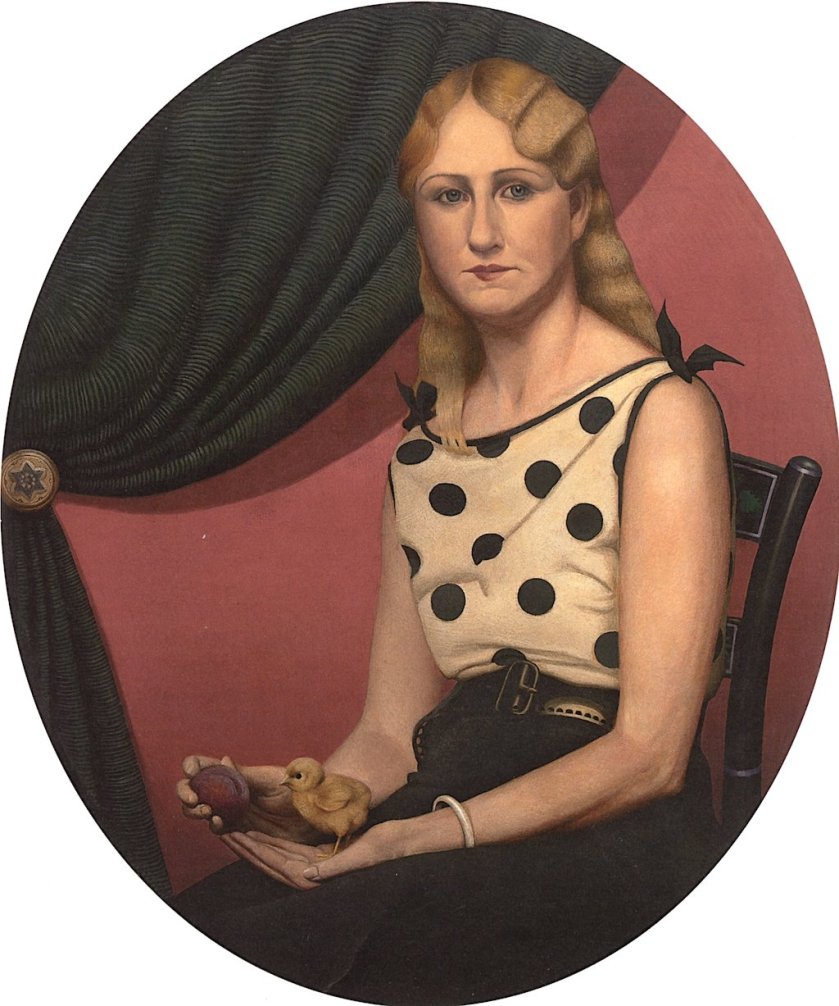
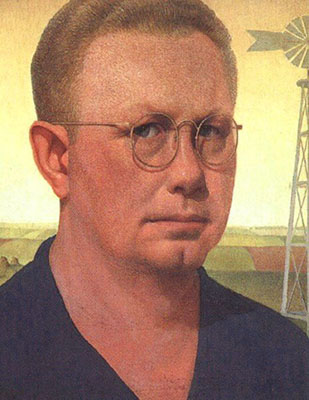
Bolton House, Windmill Hill, Hampstead (1909) once owned by Joanna Baillie

In 1926, Gluck’s father gave his daughter twenty thousand pounds and bought her a new place to live – Bolton House, Windmill Hill in the heart of Hampstead Village. It had been the home of the poet and dramatist Joanna Baillie for the last fifty years of her life. It was a large three storey red-brick Georgian building with an impressive wide drive. Gluck went to live there along with a housekeeper, a maid, and a cook. She also had a car which gave her easy access to her beloved Cornwall and her “Letter Studio” in Lamorna which was once owned by Laura Knight.

Sir James Crichton-Browne by Gluck (c.1930)

Gluck did not remain alone in Bolton House for long as in 1928, Sybil Cookson, the granddaughter of Sir James Crichton-Bowne, a leading British psychiatrist, came with her two young children to live with Gluck. On visiting Bolton House to see his granddaughter he had seen Gluck’s paintings and commissioned her to paint his portrait which she completed that year. Sybil Cookson was a journalist and romantic novelist. She had left her husband, a well-known racing driver, to go and live with Gluck. She was fascinated and in awe of Gluck. She believed she was living with an artistic genius. Soon she was running Bolton House for Gluck. During the summers Gluck, Sybil and her two children would go and stay in Lamorna.

As a journalist, Sybil also wrote about boxing, and her stories of the ancient art form of pugilism induced Gluck to paint several boxing scenes, one of which was entitled Baldock versus Bell at the Albert Hall.  Teddy Baldock was a very popular Eastender, and one time world champion.  Whenever he fought numerous coaches carrying his supporters left Poplar in the East End of London to cheer him. When he met Archie Bell at the Albert Hall on 5 May, 1927, no less than 52 crowded coaches made their way out of the East End, heading for Kensington like an Army convoy.

Baldock versus Bell at the Royal Albert Hall by Gluck (1927)

Gluck’s brother Louis returned home from the war in 1918 and went to live with his parents. He stayed with them until he married in 1926. There was a major problem with Louis marriage to his wife Doreen as she neither got on with Gluck nor her mother-in-law. Gluck’s father died on November 30th, 1930 at the age of 74. Right up to the end Joseph Gluckstein hoped his daughter would change her ways. He must have realised his end was near as he was able to sort out all his financial affairs before he died. He also wrote a farewell letter to his wife Francesca.   In it he wrote poignantly about Gluck:

“…I hope that our dear Hannah may so develop as to be like her dear mother, which to my mind embraces the wish that she will be a model woman…”

At the same time, he wrote a letter to his son Louis:

“…And now my dear boy adieu. I am most grateful for all the happiness you have given me from the day of your birth. You have been a true model son and I can say that no son has ever given to his parents more happiness than you have to yours…”

He did not write a letter to his daughter.

Sadly, their father’s death marked the end of the very good relationship Gluck had had with her brother Louis who, along with his mother, had been made the main trustee of his sister’s finances and this upset and annoyed her to have her younger brother control the purse strings.

Spiritual (Study of a Negro Head) (1927) by Gluck.

In 1927 she completed a portrait entitled Spiritual which came into being because of a bet. At a party Gluck had been talking about painting and how light played a big part in any work. A friend of hers commented that it would be impossible to paint a black face against a black background. Gluck was up for the challenge and advertised in a newspaper for a black person to model and her picture of him successfully proved that she could portray a black person against a black background.

Gluck’s Studio at Bolton House

Gluck enjoyed life at Bolton House and converted a small outhouse at the bottom of her garden into her studio. It had once been home to a small pony. However, in 1931 the outhouse was demolished and in its place was built a magnificent new studio designed by her architect friend, Edward Maufe, later Sir Edward Brantwood Maufe. The new building cost Gluck £1500. To get from the house to the studio she had to walk over a Maufe-designed stone-paved garden flanked by flowerbeds and a central lily pond which received its water from a concrete fountain. Bolton House and the new studio gained a lot of media attention because of their beauty and in the House and Gardens magazine of July 1935 a three-page spread was set aside extolling the beauty of the two buildings:

“…Miss Gluck, the well-known painter, is the happy possessor of an unspoiled Georgian House and a completely modern and efficient studio, separated from it only by a paved courtyard, with flower beds reflected in a shallow lily pool…”

Sir Edward Maufe by Gluck (1945)

In 1945 Gluck completed a portrait of Maufe at work in his studio.

Portrait of Miss Margaret Watts by Gluck (c.1930)

Margaret Watts was the daughter of the illustrator Arthur Watts, who was a neighbour of Gluck’s in Hampstead. Gluck painted a portrait of Margaret Watts aged 21 depicting her as a fashionable young woman.  Margaret later became a costume designer.

……..to be continued

In the final part of my look at the life and art of Gluck I will be examining how two females she had affairs with influenced her work and how her love for one of them culminated in one of her best known and best loved works of art.


Most of the information for this blog came from the excellent book – Gluck: Her biography by Diana Souhami.
For a much fuller account of Hannah Gluckstein’s life, treat yourself to this biography.

Hannah Gluckstein (Gluck). Part 1 – the rebellious daughter

Often when I look at portraits I talk about the reason the background is plain so not to detract from the person being portrayed. My featured artist today was a person who wanted to be remembered for her art but her exuberant and unconventional lifestyle was often what most people focused on. Today I want you to meet Hannah Gluckstein who was born in London on August 13th, 1895.

Self Portrait by Gluck (1942)

Hannah Gluckstein was born into an extremely wealth Jewish family. Her father was Joseph Gluckstein. He was involved in the family’s tobacco retail business, Salmon & Gluckstein which advertised itself as The Largest Tobacconist in the World. His brothers Isidore and Montague along with Joseph Lyons, the cousin of Isidore’s wife Rose, founded the British restaurant chain, food manufacturing, and hotel conglomerate, J. Lyons & Co in 1884. Hannah’s mother was the American-born opera singer Francesca Halle. She was Joseph’s second wife. His first wife Kate, a cousin, whom he married in 1882 died childless in 1889. Joseph, then aged thirty-eight, and Francesca, aged nineteen, married in September 1894 after a whirlwind courtship lasting just six weeks. After the marriage the couple returned from their American honeymoon and went to live in a purpose-built house in West Hampstead. Eleven months after the marriage Hannah was born. Eighteen months later her brother, Louis was born. Francesca’s career as a soprano ended when she married, as her husband had made it crystal clear that no wife of his would work for a living. Hannah would look back on this as the sacrifice of Art to Money. Francesca spent much of her time doing charitable work. She worked for the Jewish Board of Guardians, The Home for the Deaf, The Home for the Incurables and many more. Her role as a mother was in a way superfluous due to the large number of servants employed by her husband which included parlour maids, cooks, a nanny, a governess, a groom, and a coachman.

Self Portrait by Gluck

Hannah and her brother had everything money could buy. They were home educated by a Swiss governess and taught about the responsibilities of being part of their large family empire with all its responsibilities, opportunities, and wealth. Louis warmed to the task and did everything expected of him. He became a formidable public figure working as a British lawyer and Conservative Party politician. He was appointed a Deputy Lieutenant of the County of London in 1952 and was knighted in the Coronation Honours of 1953 for his services to the community. Hannah Gluckstein could not have been more different !!!

Hannah Gluckstein

In 1899, Francesca Gluckstein suffered the first of many nervous breakdowns and she and her family went for a protracted vacation to America to stay with her parents. Once there Hannah and Louis were left with their grandparents whilst their mother and father went off to tour the country. The family returned to England but in 1903 when Hannah was eight their mother was once again struck down with a nervous breakdown, this time much more severe and the Joseph Gluckstein uprooted his family from their West Hampstead home and travelled to France, Germany and Switzerland in search of a cure for his wife. The family did finally return to England in 1908 and went to live in a large mansion in St John’s Wood on the edge of Regent’s Park. Hannah attended a Dame School (an early form of a private elementary school) in the London borough of Swiss Cottage and two years later when she was fifteen attended the St Paul’s Girls’ School in Hammersmith. Although she would later maintain that she never learned anything at these schools and her education was gained due to her vociferous appetite for reading books. She did however receive many special prizes for drawing and painting.

Joseph Joachim by John Singer Sargent (1904)

During her time at school Hannah Gluckstein wanted to follow a career in the Arts but could not decide whether it should be through music, as she had a fine contralto voice, or art. Fate took over, for when she attended a St Paul’s pupils’ concert at the Wigmore Hall, she received heartening applause for her performance, and it was then that she decided on a career as a singer. She waited backstage for her next appearance on stage and was looking at photographs of famous musicians when she came across a photograph of John Singer Sargent’s 1904 painting Portrait of Joseph Joachim, the Hungarian violinist, conductor, and composer. She remembered the incident well:

“…Suddenly I faced the only photograph of a painting in the room – Sargent’s portrait of Joachim. There was a great swirl of paint and this hit me plumb in the solar plexus. All thoughts of being a singer vanished. The sensuous swirl of paint told me what I cared for most…”

However, her desire to leave school and train to become an artist and study art met opposition from both her father and the headmistress of her school, both of who wanted her to go onto university. Her art teacher came to Hannah’s rescue by convincing the headmistress that Hannah was a talented artist and should not be made to go to university. A compromise was finally agreed in which Hannah would stay on at school for another year, practice her art but also study the History of Art.

Following the extra year at St Paul’s Hannah went to art school. She had wanted to go to the Slade which was notorious for its liberal attitude to studies but her father decided that if she was to study art, and he had hoped it was just a passing fancy, then she would be enrolled at the St John’s Wood Art School which was close to where the family lived. She was not happy with the school. Later she wrote:

“…As far as I was concerned there was nothing taught that could be considered training…”

Portrait of Miss E M Craig (1920)

Those in authority at the school looked upon Hannah as just a very rich girl who wanted to dabble with art prior to marrying a rich husband. Hannah became very frustrated and this soon turned into rebelliousness. She became friendly with a fellow female student, who wanted to be simply known by her surname, Craig. Hannah Gluckstein felt an empathy for her new friend and demanded that from then on, she would be simply be addressed as Gluck. Her parents were informed of her decision that she was never again be addressed as Hannah !!

The Artist’s Grandfather by Gluck (1915)

In 1915 she painted a portrait of her grandfather which she completed in just sixty minutes!

Lamorna Cove (1859)

In 1915, the First World War was barely a year old and Gluck’s brother Louis had left home to volunteer for active service. Her mother was working hard to help the refugees and was barely ever at home. Her father was busy with his business which left Gluck on her own as she had refused to help with her mother’s charity work. Probably because of her unhappiness her parents allowed her to go to the artists’ colony at Lamorna in a valley in West Cornwall with Craig and two other art students. Here she loved to mingle with established artists such as Alfred Munnings and Harold and Laura Knight all of who would become part of the Newlyn School set up by Stanhope and Elizabeth Forbes. Gluck, this young and rebellious girl, was accepted into the group and would entertain them with her singing. She wrote about those happy days:

“…I was very spoiled by them all because they liked my singing, and we used to have a lot of music in the Knights’ huge studio. Little did I think then that this studio would one day be mine…”

Ernest Thesiger by Gluck (1925-26) English stage and film actor.

Gluck returned to the family home but had had a taste of freedom – a freedom from family restrictions. Alfred Munnings had wanted her to return to Cornwall and even offered to financially support her. Her father, desperate to keep his daughter offered to build her a studio at home but she refused to stay. Her father was hurt and refused to forgive her rebelliousness. He had worked hard all his life to provide a comfortable home for his family and his daughter had in one act of defiance thrown it all in his face. In July 1918, he wrote to his son, Louis:

“…I don’t think she will ever return permanently and that will always remain a cancer to me however I try to forget, I really shall never be able to…”

Sketching on the Moors by Gluck (1919)

Gluck was pleased to be back in Lamorna amongst the artists who used to  appraise her work. She lived with Craig in a primitive cottage. She delighted in being a rebel. She revelled in being who she wanted to be and do what she wanted to do without any parental or religious control. She began to wear male clothing and smoke a pipe. She and Craig stayed in Lamorna during the summer but returned to a rented flat in the Finchley Road in North London during the winter months.

Despite his acrimonious split with his daughter Joseph Gluckstein continued to support her financially by opening a bank account in her name and setting up trust accounts. Maybe this was his way of maintaining lines of communications with her. In a letter to his son dated November 6th, 1918, Joseph Gluckstein wrote:

“…I am only doing this to protect her against herself and also against me, as I won’t take the risk of her suffering financially, in case I feel inclined, through passion or otherwise to stop her allowance……….I told her I would allow her even more if she wanted it as my and mother’s sole idea was to make her happy…”

There were however financial restrictions which prevented her getting at all the money or that an undesirable man may try to marry her for her money. Gluck, although happy to have access to money, resented her father’s stance. Her father’s relations were very unhappy at how Gluck had treated “The Family” and were highly critical of Joseph Gluckstein’s generous financial settlement on his daughter. Furthermore “The Family” were horrified by Gluck’s behaviour, her outrageous way of dressing as a man and what they saw as her disreputable friends. Gluck’s mother hoped it was just a passing phase in her daughter’s life and blamed it all on Gluck’s female companion Craig. In a letter to her son in November 1917 she wrote:

“…Hig [the family’s nickname for Gluck] showed me her work from Cornwall and it was very fine, but she was in trousers and that velvet coat and when I see her dressed like that I am sure she has a kink in the brain and I go heartsick. I am sure when she leaves the pernicious influence of Craig all will be well…!

Both Gluck’s mother and father hoped that her friendship with Craig would end soon for her parents sincerely believed that their daughter would then return to “normality” but of course that was never going to happen. They also believed that her brother Louis, whom she loved, would talk her into reforming. However, Louis never tried to change the ways of his sister.

Before the Races, St Buryan, Cornwall by Hannah Gluckstein (1924)

Compared to many of her artist friends in Cornwall, Gluck had no financial problems. Living in the Lamorna artist colony was cheap and she also had her Finchley Road flat in London and had even rented two rooms in Earls Court as her studio, one for her painting studio and the other as a storeroom and a place to entertain friends. She was content with her life and spent most of her time putting together a collection of her work which she exhibited at solo exhibitions in London.  In 1924 her paintings were exhibited at the Dorien Leigh Gallery in South Kensington where fifty-seven of her pictures were on show. All were sold, and she could now afford to move to a bigger studio in Chelsea.

Three Nifty Nats, 1926

Two years later she had put together another selection of works which she exhibited in 1926 at the Fine Art Society in Bond Street. The latter location was to become the home for all her future exhibitions.

……to be continued


Most of the information for this blog came from the excellent book –  Gluck: Her biography by Diana Souhami.


Eleanor Fortescue-Brickdale

Eleanor Fortescue-Brickdale

My featured artist today is the Victorian painter Mary Eleanor Fortescue-Brickdale, one of the most popular artists of her time. She is perhaps best remembered for reawakening the Pre-Raphaelite style of painting at the end of the 19th century as shown in her moral or medieval depictions with their vibrant and flamboyant colours. The Pre-Raphaelite group was founded in 1848 by John Everett Millais, William Holman Hunt and Dante Gabriel Rossetti but by the time Eleanor went to art school in 1889, Pre-Raphaelite painting was led by a second generation of artists which included Edward Burne-Jones. Eleanor admired their work and carefully followed in their footsteps which helped keep the style alive until the start of the twentieth century. Eleanor was not simply a painter. She was also a designer, produced stained-glass windows and small-scale sculptures, illustrated books as well as completing numerous watercolour and oil paintings.

The Ugly Princess by Eleanor Fortescue-Brickdale (1902)

Mary Eleanor Fortescue-Brickdale was born at the family home in the prosperous London suburb of Upper Norwood on January 25th, 1872. Her father Matthew Inglett Fortescue-Brickdale was a barrister of Lincoln’s Inn who married, Sarah Ann Lloyd, the daughter of Judge Edward John Lloyd QC, of the Bristol county court. Eleanor was the youngest of five children. She had two brothers, Charles, the eldest child, who was born in 1857, John Matthew and two sisters, Kate, and Ann. Ann died aged six, four years before Eleanor was born. The family financial circumstances were sound, and they employed four servants and a governess for Eleanor. As was the norm at that time, the parents were preoccupied with their sons’ future ensuring they had the best schooling and went on to a financially-sound profession whilst being ambivalent with regards their daughters’ future believing that the future happiness of their daughters was a good, kind, and wealthy husband!

Portrait of Charles Fortescue-Brickwell by Eleanor Fortescue-Brickwell (1924)

Charles, an amateur artist who, attended Westminster School and Christ Church, Oxford University, followed in his father’s footsteps and became a barrister focusing on land law and in 1900 was appointed Chief Registrar of HM Land Registry.  He was famed for modernising the Land Registry system. John, who was two years older than Eleanor, went into medicine and became a physician in Bristol and contributed many articles for medical journals and co-authored a couple of medical books. Ironically, despite their parent’s plans, neither Kate nor Eleanor married. Little is known of Kate but of course we do know that Eleanor’s love of art was to contribute to her fame and financial stability.

In the Springtime by Eleanor Fortescue-Brickdale (1901) watercolour

One must presume Eleanor’s interest in art was fostered by her parents who looked upon the ability to paint and draw, as simply a hobby for females  but one which would prove attractive to suitors. Another reason could be that her father had an interest in art and had John Ruskin as a fellow Oxford University student. Matthew Fortescue-Brickdale was involved in one of Ruskin’s art projects, the Arundel Society, which was founded to promote knowledge of the art works of the old Italian, Flemish, and other European Masters and to conserve and document works of art which were at risk of destruction. It is believed that her father’s love of art resulted in visits with his children to art galleries.

After completing her home schooling in 1889, seventeen-year-old Eleanor enrolled at the Crystal Palace School of Art, Science and Literature. It was not one of the most prestigious establishment but maybe it was chosen for Eleanor for its closeness to the family home. It was a mixed college, but the art classes were for female students only, the science for male students and the music was for both. Eleanor proved an able student and at the end of her first year, was awarded the annual scholarship for crayon drawing and watercolours and in 1892 she gained a silver medal for watercolour.

Natural Magic, 1905 watercolor by Eleanor Fortescue Brickdale

In 1894, tragedy struck the Fortescue-Brickdale household when Eleanor’s father, Matthew was killed whilst mountain climbing in the Alps.

Around the mid 1890’s, wanting a more prestigious art school which offered tuition by well-known artists who would develop her talent, Eleanor enrolled at the St John’s Wood School. The art school had another important role. It was an established feeder school for students who wanted to enrol at the prestigious Royal Academy Schools. Proof of this comes from the statistic that in the first half of the 1890’s of the 394 students who were admitted to the RA Schools, 250 came from the St John’s Wood School. St John’s Wood School also offered life drawing classes with nude models to both its male and female students.

Contemplation by Eleanor Fortescue-Brickdale

To achieve admission into the Royal Academy Schools, the candidate had to submit certain pieces of art and if they were found acceptable the candidate would become a probationer and then, if their work during the next three months was up to the standard required, they would become a full student and be allowed to start one of the courses. In the Magazine of Art, 25, 1902, an article appeared written by Marion Hepworth Dixon , Our rising Artists: Eleanor Fortescue-Brickdale in which she wrote that it took Eleanor three attempts to get to become a probationer but once that was achieved in January 1895, she only remained as such for three weeks before becoming a full-student and starting an art course. In 1897 Eleanor was awarded a prize by the Royal Academy Schools for her work as a designer and promising decorative designer.

Madame Placid by Eleanor Fortescue-Brickdale

For any up-and-coming artist wanting to establish a reputation, social connections were of paramount importance to achieving commissions and acquiring a wealthy patron. Eleanor’s education had been different to many other aspiring painters. She had not attended school, her parents deciding on home schooling, she had not attended a university and now at the age of twenty-five remained unmarried, all of which resulted in her not having many outside connections which would have helped her through her artistic life and so, she had to rely on her family and friends for a helping hand.

Land Registry certificate (1898). Designed by Eleanor Fortescue-Brickdale.

Her first breakthrough came in the form of a “brotherly helping-hand”. Charles her eldest brother who was working at the Land Registry persuaded her to design a certificate of registration for his newly re-organised Land Registry office.

A Cotswold Village; or, country life and pursuits in Gloucestershire, by James Gibbs

In the same year her brother Charles helped her once again. He had married Mabel Gibbs, whose brother James Gibbs an amateur cricketer who had played for the MCC, and a writer who, that year, had published a book, A Cotswold Village; or, country life and pursuits in Gloucestershire, and had Eleanor illustrate it with twenty pen and ink sketches of rural scenes. Later her reputation was further advanced when she provided pen and ink sketches for the illustrated version of Walter Scott’s Ivanhoe.

Her reputation as a talented illustrator soon grew and her design work was in great demand from such popular journals as Country Life and The Ladies’ Field. Her “audience” were the wealthy landowners some of who became her patrons and would often call upon her to paint pictures of their family and stately homes.

The Pale Complexion of True Love by Eleanor Fortescue-Brickdale (1898)

In 1899 she completed her first major work of art entitled The Pale Complexion of True Love which was accepted for inclusion in that year’s Royal Academy Annual Exhibition. The title of the work is taken from Act 3 Scene IV of Shakespeare’s pastoral comedy, As You Like It, when the elderly shepherd, Corin speaks of the shepherd, Silvius’ unrequited love for the shepherdess, Phebe:

“…If you will see a pageant truly play’d,
Between the pale complexion of true love
And the red glow of scorn and proud disdain,
Go hence a little and I shall conduct you,
If you will mark it…”

The first thing that strikes you with this painting is the sumptuous red of the lady’s gown. It is interesting how the artist has used such a bright spectrum of colours. To many people, the Pre-Raphaelite painters use of bright colours was garish and lacked delicacy. To others it was this vibrancy of colour which heightened their work, but I will leave you to decide.

The Gift That is Better Than Rubies by Eleanor Fortescue-Brickdale (1899)

In 1899 Eleanor produced a painting, The Gift That is Better Than Rubies, a title derived from a passage in the Bible – Proverbs 8: 10-11.

“…Receive my instruction, and not silver; and knowledge rather than choice gold. For wisdom is better than rubies; and all the things that may be desired are not to be compared to it…”

The Gilded Apple by Eleanor Fortescue-Brickdale (1899)

In the summer of 1899, father and son art dealers, William and Walter Dowdeswell who ran a gallery in New Bond Street, London, commissioned Eleanor to produce a large number of watercolour paintings for their 1901 show which was entitled Such stuff as dreams are made of, a line from Shakespeare’s play The Tempest. The depictions in these works covered subjects from the Bible, Shakespeare, Browning and Coleridge. One of her watercolour paintings on show at this exhibition was The Gilded Apple. It depicts a fairy tale princess being thrown a gilded apple. She leans back in an attempt to catch it and her crown tumbles from her head and is about to fall into a fishpond behind her. Meanwhile we see a cat ready to pounce on one of the fish in the pond.  The commission had been so big that Eleanor had decided to acquire her own studio in Holland Park, and area populated by many artists. The show was a spectacular success and all the paintings were sold. In an article in the June edition of The Artist praise was heaped upon her:

“…Rarely, if ever, has a woman painter made a great reputation as quickly and thoroughly as Miss Eleanor Fortescue-Brickdale, whose series of watercolour drawings has, during the last month, drawn the whole of artistic London to the Dowdeswell Galleries…”

The Little Foot Page by Eleanor Fortescue-Brickdale (1905)

One of Eleanor’s best-known paintings is one she completed in 1905 and is entitled The Little Foot Page which is now part of the Walker Art Gallery collection in Liverpool. This painting illustrates lines from a 1765 ballad Child Waters sometimes known as Burd Helen, part of the collection of traditional folk ballads by Thomas Percy’s Reliques of Ancient English Poetry. The ballad describes the loyalty of Ellen who is bearing the child of her heartless lover Child Waters. He insists Ellen serve him as a page. She is shown dressed in male clothing and just about to cut her long beautiful hair, so she can pass as a boy. Her dress and wimple can be seen, discarded in the foreground. The theme of a wronged woman was a familiar one in Victorian times. Look at the painstaking way the artist has depicted the foliage. Eleanor was a great believer of the adage, “truth to nature”, and this is highlighted in the painting.

Love and his Counterfeits by Eleanor Fortescue-Brickdale (1904)

I have always liked multi-figured paintings which have a story attached and so one of my favourite works by Eleanor Fortescue-Brickdale is one which she completed in 1905 and entitled Love and His Counterfeits. The painting was included in the artist’s second show at the Dowdeswell Gallery, in June 1905. How many times do we look at a “complicated” work of art and wonder what is going on? If only we could ask the artists. In this case Eleanor has put us out of our misery by supplying, in her words, the story behind the depiction which came with the work. She wrote:

“…When a girl’s soul awakens and she opens the door of her Heart’s Castle to receive Love, at first she will not recognise him.
First, she will see Fear and think him to be Love. Fear, in craven armour of black, with no coat of arms or badge to mark his family. But by Fear, Love may come.
Then she will see Romance, being now in love with ‘being in love’ –
Romance, the Boy on a Bubble with a Castle of Dreams in his hand, and
Birds and Roses about him. He leads Ambition, who shall stir the girl to think he is Love himself – Ambition, very hot and eager, riding upon Pegasus, the winged Horse.
After them is Position, whom she may take for Love; but truly she is in love with Appearance, Prestige, Importance, Riches, Place, all his Train, and this is borne by a Cupid.  Now she is stirred by Pity, thinking whom she pities she loves – Pity with the Cup of tears with three handles, that many may drink.
Then she perceives Arts, a brave fellow who is but words and emptiness and a mask for love. Arts paints a wound upon him and sings that it is real. To Love he is not henchman, nor cousin, but enemy.
Behind him goes Flattery with a mirror, so she is wooed by vain words. Then Gratitude comes with the smoke of memory, and she will think she is faithless if she does not love one who has been kind.
Now, at last, after her emotion, her assault by gifts, mirrors, riches, tears, dreams, phrases, memories, comes True Love, empty-handed, to take and win her Heart’s Castle…”

The Rusty Knight (Yniol’s rusted arms) by Eleanor Fortescue-Brickdale

During the first part of the twentieth century Eleanor carried on with her book illustration. In 1909, Ernest Brown, of the Leicester Galleries, commissioned a series of twenty-eight watercolour illustrations to Tennyson’s Idylls of the King, which she painted over two years. They were exhibited in the Dowdeswell Gallery in 1911, and twenty-four of them were published the next year in a deluxe edition of the first four Idylls. The book, Idylls of the King, was a cycle of twelve narrative poems by the English poet Alfred, Lord Tennyson, which retells the legend of King Arthur.

In the painting, above, The Rusty Knight (Yniol’s rusted arms), we see the knight Sir Geraint astride his horse, accompanied by Enid who walks alongside. He has borrowed a suit of armour from her father Yniol to challenge Enid’s other suitor on the tournament ground. Geraint is a flawed character and suffers from jealousy and at times mistrusted Enid. It could be that Eleanor felt for Enid and so mocked Geraint by depicting him, peeking 0ut his ill-fitting suit of armour whilst sat on an over-large horse.

The Passing of Elaine by Eleanor Fortescue-Brickdale (1911)

Her 1911 painting, The Passing of Elaine, depicts another female character from Tennyson’s Idylls of the King, which caught the imagination of Eleanor.  She was Elaine, a naïve but affectionate young girl who falls in love with Lancelot, but he has no romantic feelings for her. When he tells her that their love can never be, she wishes for death. She orders a chariot bier to take her to the river and place her on a barge, clothed in black upon which she will make her final journey down the river to King Arthur’s Court in the castle at Camelot.

Portrait of Winifred Roberts, by Eleanor Fortescue-Brickdale, (1913)

The works of art of Eleanor Fortescue-Brickdale were not all book illustrations, neither were they all Pre-Raphaelite-type paintings. One of my favourite works by Fortescue-Brickdale is a portrait which she completed in 1913. It is a portrait of Winifred Roberts, a student at the Byam Shaw School of Art, where she taught. The portrait was a commission given to Eleanor by Winifred’s grandmother Rosalind Howard. Winifred wears a blue dress with lace trimming. She is sitting on a settee which is covered in a fabric produced by Morris and Company, a furnishings and decorative arts manufacturer and retailer founded by the artist and designer William Morris with friends from the Pre-Raphaelites.

In 1938, Brickdale’s career as an artist and illustrator was cut short when she suffered a stroke and was unable to paint for the last seven years of her life. Eleanor Fortescue-Brickdale died in Surrey on March 10th, 1945 at the age of 73.

Eleanor was acknowledged as having revived the Pre-Raphaelite style of painting at the end of the 19th century and was considered ‘the last survivor of the late Pre-Raphaelite painters’. Her style of painting and her illustrative work had many admirers who baulked at the new modern art which was becoming more popular, what they wanted and what Eleanor gave them was aesthetically pleasing art which told stories.

Annie Louisa Swynnerton. Part 3 -The later years and the Royal Academy

Portrait of Annie Swynnerton by Gwenny Griffiths (1928)

In my third and final blog looking at the life and works of the talented Victorian artist, Annie Louise Swynnerton I wanted to firstly concentrate on some of her best loved paintings.

In 1880 she completed a work entitled The Tryst sometimes referred to as The Factory Girl’s Tryst. This remarkable painting was bought by Henry Boddington Jnr., the owner of the brewing empire which was not only Manchester’s largest brewery but one of the largest in the North of England. He later gave it to the Salford Art Gallery.

Tryst by Annie Swynnerton (1880)

The depiction features a night-time background scene with distant twinkling lights reflected on water behind the female figure. It could be that Annie got the idea of this background after seeing some of Whistler’s Nocturne paintings featuring the River Thames at night, which he completed in the 1870’s. The setting for Annie Synnerton’s work is thought to be Peel Park Lake, an urban park in Salford, Manchester and the park is situated on the flood plain of the River Irwell.  In the top right of the painting you can just make out an illuminated windmill and it is known that a mill stood on the bank of the river in the 1880’s.

James Abbott McNeill Whistler, Nocturne in Black and Gold – The Falling Rocket, (1874)

The meaning of the word tryst in the title of the painting refers to a secret meeting between lovers and this subject is a very popular one for the Pre-Raphaelite painters. The figure is of a young girl who is clutching her shawl around her body to fend off the cold. She has a worried expression on her face, a look of desperation, but why? We cannot hep feel for this vulnerable young girl. Her eyes are staring out as if she is looking for something or somebody, but what or who is she searching for?

The answer lies in a Manchester legend which Annie would have been familiar with. It is a legend of the love affair between a poor local girl, a mill worker, the daughter of a miller, and the son of the wealthy landowning Stanley family. She had come to the windmill to meet the young man, but he never arrived. His family had found out about the affair and were horrified by the liaison and so, to put an end to the relationship, they sent him away from home. The young girl was heartbroken when she heard what had happened and being so distraught threw herself into Peel Park Lake and drowned. The Stanley’s son on hearing of the death committed suicide. The boy’s father was so remorseful about sending his son away from home which resulted in the two suicides made it known that the windmill, the trysting place of the young lovers, must endure forever.

The Letter by Annie Swynnerton

Another painting which causes you to wonder what the depiction is all about is Swynnerton’s painting, The Letter, which is part of the Royal Academy collection in London and is a depiction of a favoured subject by many artists of the past. Receiving, reading, and writing a letter was a much-loved subject of artist for many centuries. Looking back at genre works by sixteenth and seventeenth century Northern Renaissance and Dutch painters many featured this subject.  It was a depiction that made viewers wonder about the story behind the painting.

Woman Reading a Letter by Gabriel Metsu (1665)

I can recall two wonderful paintings by Gabriel Metsu, prints of which I have on one of my walls at home, Woman Reading a Letter and Man Writing a Letter (see My Daily Art Display, Jan 22nd, 2014).

The Letter by Leonard Campbell Taylor

The subject was also popular in the nineteenth century and early twentieth century with British artists such as The Letter painted by the British painter Leonard Campbell Taylor.

Girl Reading a Letter by an Open Window by Johannes Vermeer (1659)

Annie Swynnerton’s painting besides being about letter reading has another connection with a famous painting of the same subject, Johannes Vermeer’s painting Girl Reading a Letter at an Open Window, as like Vermeer the person reading the letter is illuminated by natural light coming through a window, which symbolised the outside world. In the work by Swynnerton the way she has formulated the composition (101 x 48cms) its narrowness gives us a feeling that the girl is in some way confined in a restricted space which gives us a perception of claustrophobia. The contrast between the dark background and the illuminated figure of the girl with the painted highlights on her face, hair and dress enhances the three-dimensionality of the depiction. What is in the letter remains a mystery but whatever it is, it has the girl’s full attention.

Cupid and Psyche by Annie Swynnerton (1891)

Annie Swynnerton’s paintings often depicted nudes but couched them with mythological connotations probably to make them more acceptable to the Victorian public. Her best-known work of this genre was her 1890 painting Cupid and Psyche. The pair from Roman mythology were the favourite subject of many artists. According to mythology Cupid was sent by his mother Venus, who was jealous of Psyche’s beauty, to wound Psyche with one of his arrows and by so doing she would fall in love with a lowly man. The twist to the story is that Cupid falls in love with Psyche and makes her his wife, but he forbids her to look at his face to ensure the marriage remains a secret. The story then gets more complicated………

In the depiction we see Cupid on the right kissing Psyche. The depiction of the nudes differs from the normal idealized Academic-depicted nude paintings which were common in works by artists such as Lawrence Alma-Tadema or Frederic Leighton. Swynnerton has once again gone for an un-idealized portrayal of the human body. Look carefully at the way the artist has use an assortment of colours in the portrayal of the naked flesh including blue for the veins. Their bodies are illuminated by moonlight whilst, behind them, we see the light of the breaking dawn. The painting received mixed reviews from the critics, some of whom were startled by the depiction. Claude Phillips from the Art Journal praised Swynnerton writing:

“…her flesh-painting has a certain quivering reality not to be found in many renderings of the nude by contemporary English artists…”

But the art critic and one of the two ‘non-artistic’ members of the Pre-Raphaelite Brotherhood, Frederic George Stephens, writing in The Athenaeum commented on Swynnerton’s depiction of Psyche:

“…her features are coarse and blubbered, and her flesh is without the sweetness, evenness or purity of youth…”

Oceanid by Annie Swynnerton (1908)

Another of Annie Swynnerton’s mythological paintings, Oceanids, was completed in 1909 and is thought to have resulted from some plein-air painting at one of the crater lakes close to Rome and then completed in her studio in central Rome. Oceanids were goddess-nymphs who presided over the sources of earth’s fresh-water, from rain-clouds to subterranean springs and fountains. Along with the Oceanid there is another creature depicted in the painting but barely discernible in the bottom right of it. It is a sea serpent which co-habits with the Oceanid in the lake. What is so magical about this painting is the way Swynnerton has illustrated the translucency and movement of the water and could only have been achieved by carefully studying the water conditions of the lake and the way light played on the surface. It is also remarkable the way she has depicted the dappled light on the body of the woman. The expression on the woman’s face is one of great pleasure as she draws her hair out to be warmed by the rays of the sun. The painting was bought by Christiana Jane Herringham who was the daughter of Thomas Wilde Powell, an artist, and later a wealthy patron of the Arts and Crafts Movement. In 1880 she married the physician Wilmot Herringham, (later Sir Wilmot Herringham) with whom she had two sons, Geoffrey, and Christopher. Lady Herringham was committed to women’s suffrage from 1889 onwards and had probably met Swynnerton through their mutual friendship with Millicent Garrett Fawcett. The painting is now part of the City of Bradford Museum collection.

Geoffrey and Christopher Herringham by Annie Swynnerton

Annie Swynnerton completed a painting, of Jane Herringham’s two sons, Geoffrey, and Christopher Herringham in 1889 and the following year was exhibited at the New Gallery in London and at the Liverpool Autumn Exhibition. The rural setting is at the onset of evening with the sun setting in the blue-hilled background. Again, like so many of her figurative works, Swynnerton has focused on the natural light which illuminates the rosy-cheeks of the boys but also look at how the glimmering light is captured on the velvet jumpers worn by the boys. It is a depiction of happy childhood but alas their future was destined to be anything but happy. The younger son, Christopher, died of acute rheumatoid arthritis soon after the painting was completed, and Geoffrey was killed in 1914, during the first months of the Great War. He was 31. Their mother Jane died aged 77 in 1929 but spent many of her last years in a mental institution suffering from delusions of pursuit and persecution.

Autumn Leaves by John Everett Millais (1856)

The painting is often likened to that of John Millais’s 1856 work Autumn Leaves with its twilight setting and blue-hilled backdrop. Millais’ work is housed in the Manchester Art Gallery and must have been seen on many occasions by Swynnerton.

Margaret and Chrystian Guthrie by Annie Swynnerton (1907)

Another painting commission Annie Swynnerton received due to her connection with the woman’s rights campaign was to produce a portrait of the two daughters of American-born Mary Guthrie, the wife of David Charles Guthrie, 5th Baron of Craigie and East Haddon Hall. Mary Guthrie was a leading campaigner in the Northampton area for the Woman’s rights and it is through that connection that she met Swynnerton. In the painting entitled Margaret and Chrystian Guthrie we see her two daughters sitting on a window seat in East Haddon Hall. In the background we can see the extensive and opulent gardens. The children seem a little bit edgy and probably don’t like to waste time sitting for the portrait and prefer to be off playing. Look at the elder of the sisters on the left. She is almost desperate to lift herself off the seat and run away. The younger, with her back to us, looks over her shoulder and smiles but seems to prefer to concentrate on the sunny garden. The painting is a mass of colour and tones from the yellows, greens, and blues of the garden in the background to the pinks and reds of the sumptuous curtains and cushions we see in the room itself. The painting was exhibited at the Royal Academy in 1907.

In 1922 Annie Louisa Swynnerton was finally elected the first female Associate Member of the Royal Academy. One has to remember that Swynnerton had been regarded as a highly accomplished and talented artist since the late 1880’s so why the long wait for recognition by the Royal Academy? To find a possible answer to that question one must look at the Royal Academy establishment.

A 19th century illustration of the Royal Academy

The Royal Academy was founded in 1768 to publicise the arts, to deliver free tuition which would enable the talented, notwithstanding their means, to be taught to the highest standards. It was also committed to hold an annual exhibition which would be free to exhibitors and at which the works would be selected on merit. Thirty-six artists and architects petitioned King George III seeking his permission to establish a society which would promote the Arts.

The Academicians of the Royal Academy by Johan Zoffany (1772)

In a group portrait of the thirty-six founding members of the Royal Academy completed by Johann Zoffany in 1772, we see the members gathered around a nude male model at a time when women were excluded from such training to protect their modesty. For that reason, the two female founding members, Mary Moser and Angelica Kauffman could not be depicted as being present at the life drawing class but Zoffany added them as portraits hanging on the wall.

King George III agreed to the request and accorded it Royal status and helped subsidise it for the first decade. Its first president was Joshua Reynolds. To preserve the excellence of the establishment the numbers of Academicians would be limited to artists, sculptors and architects.  Later engravers were included. The 1768 Instrument of Foundation allowed total membership of the Royal Academy to be 40 artists. When Annie Swynnerton was elected the maximum permitted number was 42 and since then there have been two more changes to the rule and the maximum now stands at 80, but within that number there must always be at least 14 sculptors, 12 architects and 8 printmakers with the balance being painters. The maximum age of an Academician is set at seventy-five and once Academician reach that age they stand down and become Senior Academicians. So, when this happens or on the death of an Academician, a vacancy occurs.

Nominations Book of the Royal Academy

Anyone is eligible to become a Royal Academician, if they are under seventy-five years of age and professionally active as an artist or architect in the UK. Potential new Royal Academicians are first nominated by an existing Academician, who writes their name in the weighty Nominations Book. Signatures must then be elicited from eight other Royal Academicians in support of the nomination. At this stage the nominee becomes a candidate. In March, May, and December each year, all the Academicians meet at a General Assembly to vote in new Members from the list of candidates. There is no postal voting, so this is done entirely in person.

Oreads by Annie Louisa Swynnerton (1907)

So, to go back to the case of Annie Swynnerton. She was a respected artist. She was under seventy-five years of age and so she should have been a prime candidate, or was she? The Royal Academy in the last two decades of the nineteenth century was very male orientated and talk of electing a woman into the hallowed ranks was anathema to many Academicians. In 1907, when Annie was 63, her name was put forward by George Clausen following the positive response to her paintings which were shown at the Academy’s 1906 exhibition and by her painting Oreads shown in 1907. However, she failed to be elected. Seven years later, in 1914, her name was once again put forward by George Clausen but once again she failed to be elected. Annie may have been totally disillusioned with the way in which she had been treated by the R.A. and did not exhibit again at the Royal Academy for six years.

The breakthrough finally came in November 1922 when she was finally elected the first woman Associate Royal Academician. Full coverage across all newspapers hailed this not only a success for Annie but a success for women. She was delighted, and the Daily Mail of November 25th printed an interview they had with her and recorded her feelings at being so honoured:

“…I am much gratified at the honour bestowed on me, but true art needs no incentive; its work is its own reward. Professionally, though, this recognition of women artists should be a great help. It marks such a very long stage from my younger days, when women were not admitted to the Academy schools and it was difficult for them to get their best work exhibited…”

And that ended the saga – or did it? Those of you who are good at maths, knowing Annie Swynnerton was born in 1844, will have realised that when she was elected a Royal Academician in November 1922 she was 78 and that was three years past the cut-off date for being eligible to become a Royal Academician !!!!!!   It was thought that she would have to resign immediately. The proposed treatment of Annie outraged the national press. In an article in November 28th Daily News they did not mince their words:

“…Today the world sinks back in its chair overwhelmed with laughter and despair and the Academy is covered with ignominy. Surely there has never been so egregious a blunder, if indeed it was not something worse…”

They, like many people, could not decide whether it had been the Academicians’ carelessness and incompetence for not realising the age of Annie Swynnerton when her name was put forward on the third occasion or they were being devious and there was an element of conspiracy about the whole issue.  A compromise was finally reached and Annie Louisa Swynnerton was made a Senior Associate Academician but, because of her age, could never be raised to full membership.

Annie Swynnerton’s Grave, St Mary’s Church, South Hayling

Annie Swynnerton’s sight began to deteriorate towards the end of her life, but she continued to exhibit pictures at the Academy, although they were often works she had painted years earlier. She died on October 24th, 1934 at the age of eighty-eight at her home on Hayling Island, near Portsmouth, leaving a studio full of 170 pictures, all but 12 of them unfinished and unframed.

Annie Louisa Swynnerton, besides being a very talented painter, was a fighter. Her determination was the key to success. She overcame many difficulties and what she achieved was a beacon of light which inspired many female artists who followed to press ahead with their fight against institutionalised prejudice against female artists.


Most of the information for my three blogs about Annie Swynnerton was found in some excellent books which I bought at the Painting Light and Hope exhibition at the Manchester Art Gallery, which you should try and visit.

Annie Swynnerton, Painting Light and Hope by Kate JT Herrington and Rebecca Milner.

The Life and Works of Annie Louise Swynnerton by Susan Thomson.

Annie Swynnerton, Painter and Pioneer by Christine Allen and Penny Morris.