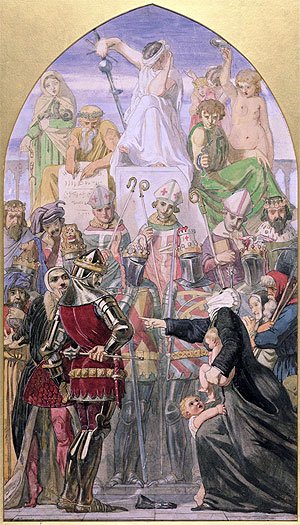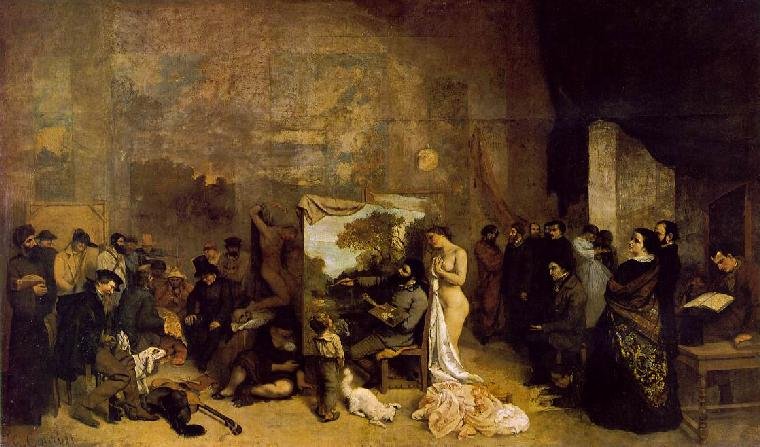
The Artist’s Studio by Gustave Courbet

The Artist's Studio by Gustave Courbet (1855)

Jean-Desiré-Gustave Courbet was born in Ornans, a rugged area in the Franche-Comté region close to the France-Swiss border in 1819.  His father Règis Courbet and his mother, Sylvie were landowners, who owned a vineyard in Flagey, ten miles outside of Ornans.  They were a prosperous family but despite that Courbet’s parents held left of centre, anti-monarchist views.  This was probably a long held passion as his mother’s father had fought in the French Revolution.  At the age of twelve he attended a seminary in Ornans and it was during his time there that, according to his friend and art critic, Jules-Antoine Castagny, he came up before the priest to confess his sins and to have them forgiven.  According to Jack Lindsay in his biography of the artist,  Gustave Courbet: His Life and Art

“…The sins he revealed to his confessor so monstrously exceeded, in number and in kind, the iniquities appropriate to his tender age that nobody was willing to give him absolution…These successive rejections began to affect his reputation…To make sure he had forgotten nothing, Courbet had compiled a list of all the sins it would have been possible to commit, from the most trifling peccadillo to the darkest of crimes…”

This was an early sign of Courbet’s rebellious nature which would remain with him for the rest of his life.  When he was eighteen years of age his father arranged for Gustave to attend the Collège Royal at Besançon to study law.  At the same time he attended lessons at the Académie and studied painting under the tutelage of  Charles-Antoine Flageoulet, who had once been a pupil of the great neo-classical artist Jacques-Louis David.  Courbet left Besançon and moved to Paris.  His father still believed that this move was to further his legal studies but Gustave had other ideas.   Whilst there, he became great friends with Francois Bonvin, the French realist painter and the two would frequent the Louvre and study the Masters.  He also attended the atelier of Steuben and Hesse on the Île de La Cité.   He set about a series of self portraits in the 1840’s, one of which, Self portrait with Black Dog, he submitted to the Salon Exhibition of 1844 and was accepted while the rest of his submissions did not pass the jury’s scrutiny.  This was the start of a long running battle Courbet was to have with the Salon’s juries and lead to many vociferous comments by the artist against what he believed was the Salon jurists’ petty vindictiveness against himself. 

The following three years saw Courbet travelling around Belgium and Holland.  His art was very popular in the Low Countries and he had built himself a large wealthy international clientele.  It was through these connections that his fame as an artist spread throughout Europe.  Courbet was in the forefront of the Realism art movement, a grouping of artists  who believed that artist should represent the world as it is even if that meant breaking with artistic and social conventions.  Realist artists painted everyday characters and situations all in a true-to-life manner.  These artists wanted to rid art of the theatrical drama, lofty subjects and the classical style and in its place they wanted to depict more everyday commonplace themes.     Realism was starting to be popular not only in art but in literature.  Strictly speaking realism in literature denoted a particular kind of subject matter, especially the representation of middle-class life. In literature, like in art, realism was a reaction against romanticism. Realists focused their attention, in the main, on the immediate, the here and now, the specific action, and its verifiable consequence.

Courbet used to meet his fellow realists in the Brasserie Andler,  which was only a few steps away from his studio at 28 rue Hautefeuille in Paris.  He would rub shoulders with writers such as Champfleury and Proudhon and the poet Beaudelaire.   Max Buchon, his old school friend from Ornans would also be there.  Fellow artists, such as the caricaturist and painter Honoré Daumier and Alexandre Décamps were also regulars who congregated at the brasserie. Courbet had carved himself a leading role within this group of Realists.  The biographer Jack Lindsay quoted in his book Gustave Courbet his life and art,  the words of the 19th century French journalist and writer Alfred Delvau,  who described Courbet’s role within this circle of friends and his realist philosophy, saying:

 “….And in this temple of Realism, where M. Courbet was then the sovereign pontiff and M. Champfleury the cardinal officiating, there were then, as the public of boozers, students, and wood engravers understood, only realists and non-realists…”

Courbet’s  many pictures of peasants and scenes of everyday life established him as the leading figure of the realist movement of the mid nineteenth century.  He was an outspoken opponent of the French government and it was during the short lived Paris Commune that he took part in the destruction of the Vendôme Column in 1871 during the uprising in Paris which followed after France was defeated in the Franco-Prussian War.   Courbet expressed his reasoning for the removal of the Vendome column, saying:

“…In as much as the Vendôme Column is a monument devoid of all artistic value, tending to perpetuate by its expression the ideas of war and conquest of the past imperial dynasty, which are reproved by a republican nation’s sentiment, citizen Courbet expresses the wish that the National Defense government will authorise him to disassemble this column…”

The uprising was chiefly caused by the disaster of the war and the growing discontent among French workers.  For Courbet the Column was totally devoid of artistic value but more importantly he was against what it stood for.    For his part in the pulling down of the column he was sentenced on 2 September 1871 by a Versailles court martial to six months in prison and a fine of 500 francs.  In 1877 the estimated cost of rebuilding the Vendome was finally established as being 323,091 francs and 68 centimes. Courbet was told he must pay for it to be rebuilt and he was to pay a fine in yearly installments of 10,000 francs for the next 33 years meaning the final payment would be when he had reached the age of 91.   On July 23rd, 1873 Courbet, through the assistance of a few friends, fled France for Switzerland as he could not, nor did not want to pay his fines.     On December 31st 1877, in La Tour de Peilz in Switzerland where he was living in exile, a day before the payment of the first installment was due, Courbet died, aged 58, of a liver disease probably due to his bouts of heavy drinking,

In My Daily Art Display today I have  featured one of Courbet’s greatest painting entitled The Artist’s Studio which he completed in 1855 and which had a secondary title: A Real Allegory of a Seven Year Phase in my Artistic and Moral Life.  It was an enormous painting, 3.61 metres tall and almost 5.98 metres wide and can be seen in the Musée d’Orsay in Paris.  Courbet submitted this painting with thirteen others to the Exposition Universelle of 1855.  The Exposition Universelle was an International Exhibition held on the Champs Elysées in Paris from May to November in that year.  This Paris exhibition came four years after London had held their Great Exhibition of 1851.  To Courbet’s horror, three of his paintings were rejected on the grounds that they were far too big for the exhibition as space was restricted.  One of these was today’s featured painting and one of the others was his mammoth work, A Burial at Ornans, which was 3.14metres tall and 6.63 metres wide.  However Courbet was not to be denied and decided to withdraw all his paintings and with the help of his patron Alfred Bruyas set up a rival exhibition with forty of his works in a rented hall next door to the official exhibition, which he called The Pavilion of Realism.   It did not prove to be a great success as attendances and sales were poor and many just came out of curiosity, but for fellow artists, Courbet’s gesture was inspirational and his standing in the artistic community rose.  He was now acclaimed as a hero of the French avant-garde and an inspiration to the young up and coming artists.  In some ways this alternate exhibition running alongside the official exhibition was a forerunner of the Salon de Refusés, which came into being as an alternative to the Salon exhibitions in Paris  in 1863 and again in 1874 during the Imressionist era.

The work before us today was looked upon as an allegory of Courbet’s life as a painter and the various figures depicted are allegorical representations of various influences on his life.  So who are all the people?   In some ways the work is a kind of triptych with three distinct sections.  On the left hand side of the painting are various figures from the different levels of French society.  To my mind the left hand side includes things and people Courbet disliked and sums up what he believes was wrong with society, such as religion and poverty, while on the right of the painting he has presented us with things and people he holds dear. 

Let us first look at the grouping on the left hand side of the painting.  On the ground sprawled beside the canvas sits the figure of a starving peasant.  More than likely Courbet is depicting an Irish peasant, as the Great Irish Famine had taken place only a few years earlier.  To the left of the peasant there are several other figures.  This strange grouping appears to include a priest, a prostitute, a grave digger and a merchant. In the far left of the painting we see the standing figure of a Jewish Rabbi and seated on a chair before him is a hunter with several dogs.  This depiction of this man is quite interesting as it is thought by use of x-ray analysis that the figure of the man was added later and was not mentioned in Courbet’s letter to Champfleury when he wrote about the details of the work.  So what was so important to cause this late addition.  Art historians would have us believe that he is an allegory of the then current French Emperor, Napoleon III.  He has been identified as such because of his famous hunting dogs and also by his twirled moustache which he was famous for.  So why place the French ruler on the left side of the painting?  The answer probably lies in Courbet’s early upbringing in an anti-monarchist household and Courbet’s inherent dislike of the emperor.  It was Courbet’s belief that Napoleon III was no better than a thief having stolen the country from its people.   In the centre of the work, behind Courbet’s landscape canvas we see a nude male model, on the floor we see a guitar, dagger and hat, and on the table a skull.  These were all accoutrements of traditional academic art which Courbet loathed. 

In the middle, taking centre stage and thus the centre of our attention, we see the realist artist himself sitting before his easel working on a landscape.  He has placed himself as the main focus of the painting and maybe it was his way of projecting himself as the leader of the Realist movement.   Behind Courbet, and being ignored by him, is a nude model, which symbolises academic art tradition which Courbet disliked so much.  Standing in front of Courbet, looking totally mesmerised by what Courbet is doing, is a small boy.  It is believed that Courbet included the boy as a symbol of the innocent eye of the artist but of course the mesmeric admiration of the boy for what Courbet has painted may just be something artists crave.  By the boys feet there is a white cat.  
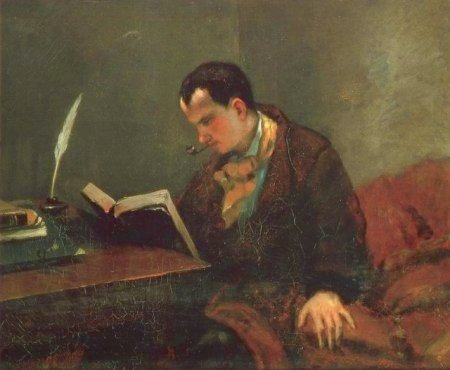
Beudelaire by Gustave Courbet (1848)

On the right of the painting is another group of people.  This grouping is a selection of his friends, associates and admirers.  It is possible to identify some of these figures.  The man standing and looking across to the left hand side, with a beard, is Alfred Bruyas a long-time patron of Courbet.  Standing behind him, facing us,  is Pierre-Joseph Proudhon, politician and socialist philosopher and another friend of the artist. Moving away from those two and towards the foreground we see a man seated.  This is the French novelist Jules Husson, whose non de plume was Champfleury and who was a greater supporter of Courbet’s realist art.  The man at the extreme right of the painting, reading a book, is the French poet Beaudelaire and we know that Courbet’s depiction of him is from a portrait he did of him seven years earlier.  Beaudelaire at the time had a quadroon (mixed race) mistress and Courbet had included her in the painting just to the left of Beaudelaire (as we look at him) but Beaudelaire was not happy with her inclusion and persuaded Courbet to paint her out of the scene.  The presence of Beaudelaire’s mistress was only discovered recently when the painting was cleaned and x-rayed.  Standing quite prominently in the group, in front of Beaudelaire, is a well dressed bourgeoisie lady with a brown-patterned shawl and her companion.  Art historians have not come to a definitive agreement as to who they are but one theory is that it is Christine Ungher and her husband François Sabatier, another of Courbet’s patrons.  Notwithstanding what art historians believed to be the message of the painting Courbet expressed his thought process behind what he had achieved with this magnificent work in a letter to Champfleury.  He wrote:

“….It’s the whole world coming to me to be painted,  on the right are all the shareholders, by that I mean friends, fellow workers and art lovers. On the left is the other world of everyday life: the masses, wretchedness, poverty, wealth, the exploited and the exploiters, people who make a living from death…”.

Silence by Henry Fuseli

Silence by Henry Fuseli (1800)

As you know, I like paintings which have some kind of symbolism or ones which lead art historians to write about their interpretations of what is before us.  It is always interesting to witness how art historians’ views sometimes differ with regards how they interpret what an artist has depicted.  It also gives one an opportunity to air one’s own views about the symbolism and how we want to interpret what we see.   I want you to look carefully at today’s featured painting and work out in your own mind what you are witnessing.  Later, after looking at the life of the artist, I will pose some questions which you may wish to deliberate on and then I will tell you what I see and let us see how close we come together with our interpretations of this beautiful and haunting painting.

My Daily Art Display featured painting today is by Henry Fuseli and is simply entitled Silence.  He completed the work in 1800 and it is now housed in the Kunsthaus in Zurich.  Fuseli was born in Zürich, Switzerland, in 1741 and was the second of eighteen children, of which only five survived to adulthood.   His father was Johann Caspar Füssli, a portrait and landscape painter and later a city clerk.  He was also a part-time writer and was author of the art history book entitled Lives of the Helvetic Painters. Henry’s mother was Anna Elisabeth Füssli (née Waser).  His mother and father wanted Henry to study for the church, and after some home tutoring sent him to the Caroline College of Zurich, where he received a first-class classical education, studying literature, aesthetics, Greek and Latin. It was during his time at this college that he met and became great friends with Johann Kaspar Lavater, who would become a well-known Swiss poet.  In 1761, aged twenty, he was ordained into the church as a Zwinglian minister.  The following year, 1762, Fuseli and his friend Lavater discovered the corrupt ways of a local magistrate and politician Felix Grebel and denounced him publicly.  The magistrate was found guilty and had to make financial reparations, which angered him and his followers, so much so that in 1763 Fuseli had to flee the country and go to Prussia to avoid retribution.

After spending a short time in Berlin, Fussli who by now was an accomplished linguist,  moved to London where he was employed as a translator, translating French, German and Italian books into English. He spent a lot of his leisure time sketching and writing but had little success in getting any of his writings published.  Whilst in London he got to know the artist Sir Joshua Reynolds and on showing the English artist some of his sketches, he was encouraged to devote more of his time on his art and less time trying to become an author, so in 1768 Henry Fussli took Reynolds’ advice and decided to become an artist.

In 1770, at the age of twenty nine, Füssli went along the well-trodden path taken by artists and would-be artists – an artistic pilgrimage to Italy and he remained in that country for eight years.  Füssli was a self-taught artist and whilst in Italy copied many of the works of the Renaissance Masters and spent much time in the Sistine Chapel copying the frescoes of Michelangelo.  It was also his stay in Rome that afforded him multiple sexual forays and these experiences no doubt were the reason behind some of his erotic drawings.  During his eight year sojourn In Italy he also changed his surname to the more Italian-sounding “Fuseli” which he must have believed had a more artistic ring to it. 

In 1779 he returned to Zurich and fell in love.  The woman he loved was the niece of his old friend from the Caroline College, Felix Lavater.  Unfortunately for Fuseli, his love for Anna Landolt vom Rechs was not reciprocated.  One of Henry Fuseli’s most famous paintings, The Nightmare, which I featured in My Daily Art Display (August 8th) is based on an erotic dream he had of this “love of his life”.  Fuseli left Zurich heartbroken and returned to London.  In London, Fuseli exhibited many of his history paintings at the Royal Academy between 1780 and 1786 and by so doing established a reputation in this important genre. He also came into contact once again with Joshua Reynolds, the man who almost twenty years earlier advised him to become an artist.  Reynolds was now the president of the Royal Academy.

William Blake, the English poet and artist met Fuseli around 1787 and they became close friends, with Blake engraving occasional works for Fuseli.   In that same year, Fuseli was elected associate of the Royal Academy and in 1788 he married Sophia Rawlins, a woman who was eighteen years his junior.  It was also around this period of his life that Fuseli became acquainted with the feminist writer Mary Wollstonecraft (her daughter Mary Wollstonecraft Godwin, later Mary Shelley wrote the novel Frankenstein).  She was besotted with Fuseli and even went as far as approaching Fuseli’s young wife’s to share the man between them. Needless to say Fuseli’s wife would have nothing to do with this plan. 

Fuseli was elevated to Royal Academician in 1790 and what was strange about this change of status was that his one-time mentor Reynolds tried unsuccessfully to oppose the appointment.   In 1799 he became Royal Academy professor of painting.   In 1816 Fuseli, Sir Thomas Lawrence and John Flaxman were elected honorary academicians of the Accademia di San Luca at Rome.   Henry Fuseli died at the home of the countess of Guilford at Surrey in 1825, aged 84 and is buried in St Paul’s Cathedral.   Although Fuseli’s reputation is based on his works of art he should also be remembered for his writings on art and the fact that he was a formidable art historian.

So by now you have had time to study the featured painting and maybe you have come to a conclusion of what it all about.  Let me therefore pose some theories and at the same time question you on what you have concluded.  This painting is totally devoid of symbolism and it demands your own determination of what it is all about.  It is enigmatic and frustratingly we do not know what it is all about.  We see a figure, seated cross-legged in an indeterminate place, surrounded by gloom.  There is nothing in the depiction of the background to help us fathom out the mystery.   Is it a man or is it a woman?  Long hair and a shift-like dress, so it must be female or must it be so?  The hands are feminine but maybe the arms, which look quite muscular, are masculine.  For the time being let us presume it is a long-haired female.  Her head is downcast, almost hunched into her shoulders.  She is of an indeterminate age and there is ambivalence about the way she is dressed.  But what of her mood?   What is the state of her mind?  The problem for us when we want to decide the mood of the person is that we can neither see her face nor her facial expression.  One’s face is who one is.  Maybe more importantly, we cannot see her eyes – the windows to her soul.  We cannot therefore try and read her mind.  We have to build up our perception of her by looking at her posture.  As we cannot see her facial expression, can we glean anything by studying the body language?  Are we looking at somebody who is just simply relaxing or are we looking at somebody who has come to the end of her tether and slumps before us almost drained of life?  If I asked you to describe her posture in one word, what would it be?  Despair? Exhaustion?, Acceptance? Resignation?

I don’t have the answers.  Nobody but the artist knows what it is all about.  Why did he give the painting the title Silence?  We can all theorise but nobody can be categorical about the correctness of their theories.  I will leave you with this haunting painting and let you decide.

The Artist’s Studio, Rue de La Condamine by Frédéric Bazille

The Artist’s Studio, Rue de La Condamine by Frédéric Bazille

quem di diligunt, adolescens moritur

Whom the gods love, die young.”

The aphorism comes from the Roman playwright Plautus, who flourished around the end of the 3rd century and actually based his story on a Greek legend about a mother and her two sons.   The point of bringing up this saying is that it unhappily could refer to my featured artist of the day, who was so talented and yet was taken from us at such a young age by war.

Jean Frédéric Bazille was born in Montpellier in 1841.  His father was a senator and the head of an affluent and cultured middle-class Protestant family.    In Montpellier, Jean became acquainted with a friend of his father, a local art collector Alfred Bruyas.  Bruyas was a close friend of Gustave Courbet and he owned a large number of expensive paintings by Millet, Corot, Eugène Delacroix and many by his friend Courbet.  Young Frédéric Bazille was fascinated and inspired by the collection and this was the start of his love affair with art. He loved to paint and sketch but his father told him that if he wanted to continue with his art he had to agree to continue with his medical studies. He agreed to his father’s terms and in 1860 he started studying art.

 In 1862 he moved north to Paris to continue with his medical studies but spent most of his time sketching and painting.  Later that year he joined the studio of Charles Gleyre, the Swiss artist.  It was whilst there that he met and became friends with fellow aspiring artists, Monet, Renoir, Sisley and Whistler.   Gleyre’s studio closed the following year and Bazille decided to leave Paris and follow his friends whilst he waited on the results of his medical exams.

During his journeys around Normandy with Monet  in 1864 they stopped off at Honfleur, which was at that time a special meeting place for the en plein air painters.   It was here that he met up with Monet’s friends, the French marine and landscape painter, Eugene Boudin and the Dutch landscape and seascape painter, Johan Jongkind.  These two artists would later be instrumental in the development of Impressionism.    In the autumn of 1864 Bazille returned with Monet to Chaillyen-Bière, near Fontainebleau.  It was around this time that he finds out that he had  failed his medical exams but fortunately for him, his father did not press him to re-sit them and instead allowed his son to concentrate solely on his artistic career.  In 1865 he put forward two of his paintings to the Paris Salon, Young Girl at the Piano and Still-life with Fish.  Annoyingly for him only his still-life was accepted for the exhibition by the Salon jury.

Bazille and Camille (Study for Déjeuner sur l'Herbe) 1865

Monet, who had a competitive streak, knew about Édouard Manet’s work  Déjeuner sur l’herbe (See My Daily Art Display December 23rd) and knew of the masses of publicity it had received (not all good of course!) when it was exhibited at the 1863 Salon des Refusés.  In the spring of 1865, he decided that he too would embark on his own version of Déjeuner sur l’herbe.   This idea of figure painting in the open air was a new venture for Monet.  He began sketches for his new large-scale painting (4metres x 6 metres) which he planned to finish back in his Paris studio.  The reason for huge size for the proposed work was mainly down to Monet being inspired by Courbet’s recent large scale paintings.   The figures in Monet’s painting were life-sized.  It was almost a group of portraits set in a landscape.  Bazille and Monet’s girlfriend Camille posed for part of this work.  This preparatory oil painting of the two of them exists entitled Bazille and Camille (Study for “Déjeuner sur l’Herbe”) and can be seen at the National Gallery of Art in Washington.  However, only fragments of Monet’s completed grand scale painting survive.   Monet left it with a landlord to cover a debt, and it was ruined by moisture and neglect.  At the same time Bazille himself completed a painting The Pink Dress, which was part of the study for Monet’s open-air mammoth portrait/landscape. 

Bazille having come from a wealthy family never had any financial problems unlike his newly found artist friends and he would often help them out by sharing his studio with them and providing them with artistic materials when they couldn’t afford to buy them.   He actually bought some of Monet’s paintings, including a large work entitled Women in the Garden,  just because the artist needed money.  His friendship with the soon-to-be Impressionists was recorded in a series of paintings he did one of which was set in his Paris studio where they would all meet and it is this work which is My Daily Art Display’s featured painting of the day. 

At the outbreak of the Franco-Prussian war in August 1870, Bazille enlisted in the Zouave, which was the title given to certain light infantry regiments of the French army.  His friends had all tried to dissuade him from this patriotic gesture but to no avail.   In a battle close to the village of Beaune-la-Rolande, his commanding officer had been killed and he took control of his men leading an assault on the Prussian position.  He was hit twice by enemy fire and died on the battlefield.  His death on November 28th 1870 was just a few days before his twenty-ninth birthday.    His father was devastated by the news and a week later came north from Montpellier to the scene of the battle and took his son’s body back home for burial.

Today I am giving you The Artist’s Studio in the Rue de La Condamine, which Frederic Bazille completed in 1870, the same year he went off to fight and die for his country.  The painting currently hangs in the Musée d’Orsay.   One can imagine a group of friends nowadays doing the same as Bazille has done  – recording for posterity a gathering of companions in a photograph but of course in Bazille’s day,  it had to be a sketch or a painting.   The setting for the painting is Bazille’s studio at 9 rue de la Condamine, which he shared with Renoir from the beginning of 1868 until May 1870.   Some of Bazille’s works  are scattered around the room.  To the left, on the wall, we have his Fisherman with a Net and his painting entitled La Toilette can be seen hanging just above the white sofa.  The small still-life above the head of the piano player is a still life by Monet which Bazille had bought in order to support his friend.   We see three men standing at an easel discussing the painting on display.  The man with the hat standing in the middle is Édouard Manet and behind him we think is Monet.  The tall man to the right of the easel, palette in hand, is Bazille himself.  On the staircase is the journalist, writer and art critic, Emile Zola, who is in discussion with Renoir, who is seated below the staircase.  At the piano is Bazille’s musician friend Edmond Maitre.  The National Gallery at Washington houses a portrait of Maitre by Frédéric Bazille.

Frédéric Bazille was considered to be the most gifted of the soon-to-become Impressionists and, if he had lived, he might well have become one of the leaders of that group.  Camille Pissarro described him as one of the most gifted among us.

The Railway by Édouard Manet

The Railway by Édouard Manet (1872)

During Édouard Manet’s life he was great friends with the writer Charles Beaudelaire, the French poet, philosopher and art critic, and from around 1855 they became constant companions with the two of them frequently going off on sketching trips.   It was an important friendship for Manet, as during the times his work was being harshly criticised, Beaudelaire was very supportive of him.  Lois Hyslop the American author and Beaudelaire specialist wrote about this supportive role in her 1980 book Beaudelaire, Man of His Time, and she quoted his comments with regards Manet:

“…Manet has great talent, a talent which will stand the test of time. But he has a weak character. He seems to me crushed and stunned by shock…”

Beaudelaire believed in modernité in art and in his book, The Painter of Modern Life and Other Essays, he stressed the importance of it saying that it was very important that art must be held accountable to capture the modern experience.  He wrote:

“…By modernity I mean the transitory, the fugitive, the contingent which make up one half of art, the other being the eternal and the immutable…”

His advice to Manet was that his art should depict a contemporary realism and that Manet should become le peintre de la vie moderne .

Today I am returning to the French artist Édouard Manet and looking at another of his paintings.   It is a painting of modern life and modern Paris and would no doubt have pleased his friend, Beaudelaire.  The painting is simply entitled The Railway which he started in 1872 and completed the following year.  It now hangs in the National Gallery of Art in Washington. This was the only painting by Manet that was accepted by the Salon jury for their 1874 exhibition.  In some ways it is an unusual painting and we struggle to understand what it is all about and Manet never revealed his thoughts behind the work.  So let us take a look at the image and see if we can understand Manet’s thought process as he put brush to canvas.

Gare Saint Lazare and Pont de l'Europe (c.1868)

To start on this journey of exploration I suppose we need to say what we see.  Let us first let us take in the setting of the scene.  It is an urban landscape of Paris in the late 19th century.  Why did Manet choose this scene and what was its significance?  This was the area around the newly built Gare Saint Nazare which was completed in 1837 and this area, along with the Pont de l’Europe, which straddled the railway tracks was an area of unparalleled importance for representing the changing face of modern life in Paris brought about by the redevelopment scheme of Baron Haussmann.   It was an area which was depicted many times by the Impressionist artists like Monet, Caillebotte and Jean Beruad.  The view we see is from the garden of the rue de Rome apartment house of Manet’s artist friend Alphonse Hirsch.  The painting is almost dominated by the black metal railings which boldly run the full width of the painting, creating a foreground and a background to the work and at the same time and in some ways acts to force the two females out towards us.  The black railings form a hard, lattice-work and it is in contrast to the pure white steam behind it.  There is an abundance of contrast in this painting with its sharp edges and soft dissolves. The small girl, with her back to us, almost seems as if she is using the railings as stage curtains which she draws open to get a better view of the rail tracks and the feverish movement of the trains below.  In contrast, the older female just leans back against them and shows little interest in what is happening behind her.  She has seen it all before.  To the right, on the other side of the railings, low down we can see a signal box, above which we can just make out a white pillar which is part of the Pont de l’Europe, which was inaugurated in 1868.  The Saint-Lazare station, which is out of picture, is further to the right.

Across from the railway tracks and in the background on the upper left of the painting, just behind the woman’s head, we see the buildings on the rue de Saint-Pétersbourg and the probable reason for this inclusion is we are actually looking at the door and window  of 4 rue de Saint-Pétersbourg , which was formerly a fencing hall, but from 1872 to 1878, it was Manet’s studio.  Most of the central background behind the railings has been masked by a cloud of steam and smoke which has wafted upwards from a passing locomotive and now hangs in the air.

On our side of the railings and close up to us we have the life sized figures of a young women and a young girl.  We are connected to them by their nearness, but is there a connection between the two of them?  Are they mother and daughter, or sisters, or governess and charge?  I think at this early stage in our investigation we have hit a brick wall as there is nothing to tell us about this relationship.  However there is certain disconnect between the two.  They face in different directions, almost a Janus-like scenario.

The woman wears a long dark blue dress with large round white buttons and full lace cuffs.  Cradled in her lap we see a small dog, which is often termed due to its size, a lap dog.  She is holding an opened book which she has been reading and tucked partly under her right arm is a closed fan.  Her long hair which is auburn in colour hangs loosely down and rests on her shoulders.  The lack of styling to her hair gives me to believe that she may be just out of her teenage years and yet, the covering of her arms, unlike the young girl next to her,  would indicate a sense of decorum attributable to adulthood.  On top of her head she wears a tall bonnet crested with a floral design.  For jewellery she has gold-like earrings and a bracelet and wears a thin black ribbon around her neck.   She stares thoughtfully out at us.  It is an ambiguous unwavering  stare and in some ways a similar look to the one the lady gave us in Manet’s painting Olympia.  Is she trying to engage with us?

The model Manet used for this depiction is once again Victorine Louise Meurent, a painter and famous artist’s model.  We have seen her before in Manet’s controversial masterpieces, Le déjeuner sur l’herbe (The Luncheon on the Grass) which I featured in My Daily Art Display of August 2nd and Olympia (My Daily Art Display Oct 12th).  This was to be her last sitting for Manet  for it was around this time that she started taking painting lessons.  She wanted to concentrate on an academic style of painting which was anathema to Manet and their relationship fell apart.

Let us now look at the young girl.  The model used for this young girl was the daughter of Albert Hirsch, Manet’s friend.   She has her back to us and we see her peering between the railings at the activity below – the passing of a steam train.  It is somewhat strange that her right arm and shoulder are missing which is in direct contrast to her left arm which is stretched outwards as her hand grips the black metal railing.  Her attire reinforces her young age as we see she is not condemned by late 19th century convention to have long sleeves to her dress.  Her bluish/silver dress with the large bow is depicted in an unusual fashion.  It balloons outwards which either means a rush of upward air has caused it to billow or she has retained what is termed “puppy fat”.  Her hairstyle belies her age as it is swept up in an adult fashion and tied by a similar black ribbon worn by the woman.

So what did the critics make of Manet’s painting which was his largest en plein air work,  up until then, that he ever painted measuring 93cms x 114cms.  Alas once again a hostile reception from the critics greeted Manet’s work.  One said the painting should be renamed:

Two sufferers from incurable Manet-mania watch the cars go by, through the bars of a madhouse

Those who visited the exhibition were baffled by the work.  Critics said that the painting was incoherent and the painting quality was poor.  Unfortunately, few failed to recognise that this was a painting which symbolised modernity.  His friend Beaudelaire would have been proud of him but alas he died seven years before the painting was exhibited.

Maria Bicknell, Mrs John Constable by John Constable

Maria Bicknall by John Constable (1816)

In My Daily Art Display blog yesterday I looked at the early life of John Constable,  up to the point in his life when at twenty-three years of age he was still hell-bent to become an artist.     Today I am going to conclude the story of his life and look at another of his paintings.  

In 1799,  Constable had finally convinced his father to let him pursue art and he enrols in the Royal Academy School as a probationer.  Although he finds inspiration in paintings by Peter Paul Rubens, Thomas Gainsborough, Claude Lorrain and Annibale Carracci, he becomes very homesick and yearns for the beautiful countryside of his Sussex home.  He is also becoming very disheartened with the way the Royal Academy, at that time, disdainfully viewed landscape art.  Landscape art was his passion but unfortunately for him, it was not held in high regard by the Academy, who only valued history painting and portraiture.  Whilst he attended the Academy he met Turner but the two never forged a friendship.

In 1802 Constable exhibited his first painting at the Royal Academy.  His landscape works were unfortunately not the traditional heavenly landscapes which depicted biblical or mythological stories, which were in vogue at the time, and so were not popular with the buying public.  His depictions of the countryside were far more realistic than those of the very popular Gainsborough and Claude.  If anything, his style was more akin to that of the Dutch landscape painters, such as Jacob van Ruysdael.   Constable fervently believed that landscape art was to be a true study and reflection of nature and that idealized landscapes, which had been painted from the artist’s own imagination were, in some ways, dishonest.  He left the Royal Academy in 1802 and was offered the position of drawing master at Great Marlow Military College, but he turned down the offer, which horrified the then master of the Royal Academy, Benjamin West, who told Constable in no uncertain terms that his refusal would probably mean the end of his artistic career.  However Constable was not deterred and chose to stay on his chosen course – that of a landscape artist.  Constable returned to East Bergholt.

In 1800, when he was aged twenty-four and whilst he was at home in East Bergholt, he had become friendly with a young girl who was some twelve years younger than him.  Her name was Maria Bicknell.  Now almost ten years later in 1809, John is aged thirty-three and Maria is twenty-one years of age and their relationship changed.  Slowly but surely, this one-time childhood friendship developed into a much more serious relationship and the two fell deeply in love.  Seven years later, in 1816,  the couple decided to get engaged but this was strongly opposed by Maria’s parents and her grandfather, Dr. Rhudde who was the rector of East Bergholt.  Both Maria’s father, Charles Bicknell, who held the prominent position as solicitor to the Admiralty, and her grandfather did not want her to be married to a penniless artist and they also believed that Constable and his family were socially inferior to them and not fit in-laws.  To force home their disquiet about such a proposed liaison they told Maria that she would be disinherited if she married Constable.  Constable’s parents Golding and Ann Constable, while somewhat sympathetic to the desires of their son, could also see no future in the proposed marriage as they would not in the position to financially support the couple and even Maria herself pointed out to Constable that if he was to succeed as an artist he did not want the distraction of a wife and the financial implications of such a match.  For the next seven years the couple were often parted and sometimes forbidden even to write to one another, but throughout their long, frustrating courtship they remained loyal to each other

The situation changed in 1816 when both Golding and Ann Constable died and Constable inherits a fifth of the family business.   Now with some money behind him and the fact that their daughter Maria is twenty-eight years old, her parents reluctantly agree to let her marry Constable.  John and Maria marry in that October at St Martin-in-the Fields, London and the two of them tour the south coast of England on honeymoon. 

Constable struggled to sell his paintings and it was not until 1819 that Constable made his first big sale, which was for his painting entitled The White Horse.  This sale spurred him on and it led to what are known as his “six footers”, a series of six large scale paintings, which included The Hay Wain and Stratford Lock.  The Hay Wain was exhibited at the Royal Academy in 1821 and was seen by the great French Romantic artist Théodore Géricault who on his return to Paris spread the word about Constable and his painting.   Three years later, the painting is bought by the art dealer John Arrowsmith and it is exhibited at the Paris Salon of 1824 where it wins a gold medal.

Four years on and it is 1828 and that January Maria gives birth to their seventh child.  Sadly that same year she falls ill and after a prolonged illness dies that November of tuberculosis, at the young age of forty-one.  Constable is devastated by his loss and in a letter to his elder brother Golding he wrote:

“….hourly do I feel the loss of my departed Angel—God only knows how my children will be brought up…the face of the World is totally changed to me…”

In his book, Memoirs of the Life of John Constable, Charles Leslie wrote that after the death of his wife, Constable was always dressed in black and was “a prey to melancholy and anxious thoughts”.  Constable had to, from then on, look after his seven children singlehandedly.    

The financial situation of his having to bring up all his children should not have been too burdensome as shortly before her death, Maria’s father had died, leaving her £20,000.  However Constable, instead of safeguarding this new wealth, speculated disastrously with this money.  A large proportion of the money was invested in the engraving of his landscape works which he believed would easily pay for themselves but he was sadly mistaken and the money raised did not cover the expenditure.

At the age of  fifty-two he was elected to the Royal Academy and two years later in 1831 was appointed Visitor at the Royal Academy, a part time teaching post which proved to be very successful and extremely fulfilling.  He regularly lectured on landscape art and once again regaled how works should depict real scenes and not idealized fantasies.  It is interesting to note that although he was not always happy with the art education he received at the Royal Academy thirty years earlier, one of the constant themes of his lectures was the way he praised the establishment calling it the “cradle of British Art” and he stated that no great artist was ever self-taught.

Constable died in 1837 a couple of months short of his sixty-first birthday and was buried besides his beloved Maria in the graveyard of St John-at-Hampstead in London.  Later the couple would be joined in the family tomb by two of their sons, John Charles Constable and Charles Golding Constable

My Daily Art Display featured painting today is not one of his famous “six-footers” but a beautiful painting of his wife which he completed a few months before they married in 1816.  On completing the portrait Constable wrote to his wife:

“…I would not be without your portrait for the world the sight of it soon calms my spirit under all trouble…”

Constable is primarily known for his beautiful landscape paintings but he was also an accomplished portraitist and before us we see his depiction of the woman he deeply loved.  What greater love could an artist bestow on his wife than to paint her portrait?  The marriage only lasted twelve years but one should remember that he had known and loved the young girl for sixteen years before they had been allowed to become man and wife.

The painting hangs at the Tate Britain Gallery in London.

.

Dedham Vale and The Vale of Dedham by John Constable

My Daily Art Display today features two paintings by the same artist, with almost the same titles, but completed twenty six years apart.  The artist is one of the greatest landscape painters of England.  His name is John Constable.  Before we look at the two works of art let me give you a potted history of his life.

John Constable was born in East Bergholt, a small village on the River Stour in Suffolk in 1776, the fourth of six children.  His descendents were farmers and his father Golding Constable was an affluent corn merchant who owned considerable amounts of property in the area.  He owned water mills at Flatford and Dedham, two windmills in East Bergholt and even a small ship The Telegraph, which was moored at Mistley, North Essex, and which he used to transport his grain to London.  It was in East Bergholt that two years before John Constable was born his father built himself a large house and lived there with his wife Ann Constable (née Watts), whom he married in 1748.  The couple had six children, three sons, Golding, John and Abram and three daughters, Ann, Martha and Mary.

John Constable was fortunate with his upbringing, being afforded all the advantages of a wealthy family.  His education consisted of a short spell at a boarding school in Lavenham, which proved far too strict, then followed a period at the local day school in Dedham.  John had always enjoyed sketching and this love of this was helped by the local plumber, John Dunthorne, who would take the young boy out on sketching trips around the nearby area. 

As is the case in many life stories of artists, this desire of his son to become an artist did not go down well with his father who believed artists rarely made much money and instead had wanted John to study for a career in the church.  However this, because of his grades, proved to be a forlorn hope.  After that his father decided that John should come into his corn merchant business.  Although John was the second son, his elder brother Golding was mentally handicapped and could not take an active part in the family business and so John was the obvious choice as the future successor.  John did go into the family business but lasted just a year, at which time his younger brother, Abram, was of the age and had the will to become an active member of his father’s business.

The real turning point for John as far as art was concerned came when he was nineteen years old and he and his mother went to visit neighbours.   At this get-together John was introduced to Sir George Beaumont, an amateur artist and wealthy art collector.  Beaumont used to carry around with him, in a specially made wooden box, the latest paintings he had acquired and the day Constable met him he had with him his newly acquired Claude Lorrain painting Hagar and the Angel.  John Constable could not get over its beauty and was totally in awe of the way Claude had depicted the landscape.  The two art lovers spent much time that day discussing art and the works of Claude and the likes of the English landscape artists, John Cozens, and Thomas Girtin.  Sir George Beaumont was very impressed by young Constable’s enthusiasm and knowledge of art.  Constable knew then that he wanted to be a full time artist.  During a visit to Middlesex he met John Thomas Smith, the painter and engraver, later known as Antiquity Smith, because of the book he wrote, Antiquities of London and its Environs.   It was Smith who taught Constable the basic techniques of painting but warned him of the financial drawbacks of becoming a full-time artist.  In 1798 Constable met Joseph Farrington, who had once been a pupil of Richard Wilson.  Farrington goes on to teach Constable the techniques of this great Welsh landscape painter.

Fortunately in 1799, his father relented on his stance about his son studying art and as he now had his other son, Abram, to assist him,  he gave John some money and arranged for him to go London where he enrolled as a probationer at the Royal Academy School.  John was very homesick missing the beautiful countryside of his home and was disillusioned with the continuous copying of the old Masters.  To make things worse he realised that landscape art, which was what he loved, was not held in high regard by the Academy, who only held in high esteem history painting and portraiture.

I am going to conclude the story of Constable’s life at this juncture in his life, aged twenty-three still hell-bent to become an artist but unhappy with his start at the Royal Academy schools.  My next blog will conclude his life story, the tale of his love for a woman and the problems he had with her family but now I want to look at today’s two featured landscape paintings.

In 1802, at the age of twenty-six John Constable completed his first major work entitled Dedham Vale which is now in the Victoria and Albert Museum in London.  This, like most of Constable’s paintings, was a scene from the area around the Stour Valley.  I started off this blog by saying that Constable was one of the greatest landscape painters of England but maybe his accolade should be that he was the greatest landscape painter of the Stour Valley and Suffolk as he rarely travelled to other parts of Britain, let alone Europe,  unlike other landscape artists, who would travel extensively painting the beauty of the likes of the Lake District or Wales or the Roman Campagna. 

Dedham Vale by John Constable (1802)

Dedham Vale was painted by Constable in 1802 and now hangs in the Victoria and Albert Museum in London.  The scene we see before our eyes is one of complete tranquility.  Sadly for many, including Constable, it was also the start of a period of change in Britain and even in that area with the onset of  creeping industrialization,  such peace and serenity would soon be a thing of the past.  Even Constable’s beloved Stour valley would be home to the hubbub of a textile manufacturing area. 

We see before us, looking down from Gun Hill in the east, a flattish landscape of Dedham Vale pierced with a number of small waterways, some of which are natural, others man-made.  The lower reaches of the River Stour is in the middle ground of the painting and it can be seen wending its way eastwards towards the sea.   In the central background we see the gothic tower of Dedham Church and the village of Dedham and further back in the hazy distance we can just make out the town of Harwich.

The Vale of Dedham by John Constable (1828)

Twenty six years later in 1828 he returned to this scene for his last major painting of the Stour Valley entitled The Vale of Dedham, which is now housed in the National Gallery of Scotland in Edinburgh.  Maybe the fact that he returned to this scene so many years later is testament to his love for the area.  This later painting of the same view has some subtle differences.  The meandering river heading towards Dedham has got wider and now has a bridge across it.  In the foreground the old stump of the tree is sprouting some new saplings and by drawing our eye to it our attention focuses on the distant landscape.  However what was a more contentious addition to the scene was Constable’s inclusion of a gypsy mother nursing her child besides a fire.  Critics said that the addition did not add to the landscape and the inclusion was just the artist’s way of making the scene more picturesque.  However Charles Rhyne, Professor Emeritus, Art History at Reed College, Oregon,  wrote in his book Studies in the History of Art,  when discussing Constable’s landscapes, that according to an ordnance survey map,  a well was located in this area, and that this would have made it a natural camping site for gypsies.

Graham Reynolds, the art historian and author, also talked about the controversial inclusion of the gypsy in the painting.  In his book about Constable, he pointed out that gypsies were frequently to be seen in East Anglia and that the inclusion of this detail did not infringe Constable’s rule that only actual or probable figures should appear in his landscape paintings. By including the gypsy mother and child in this painting, he said that Constable enlivened the image, with the gypsy’s red cloak providing a contrast to the green of the vegetation.  It should be remembered that Suffolk had been affected by the agricultural depression and social unrest during the 1820s, and the inclusion of the gypsy in the painting may reflect the instability of rural life at this time and Constable’s sympathy with the cause of ordinary people.   Note how the gypsy is wearing a bright red shawl or coat.  Constable always believed that even the smallest touch of bright red in a painting highlighted and animated the green of the surroundings and he often used this technique in his other paintings.  Maybe that is another reason for the inclusion of the gypsy.

This second painting of Dedham Vale was well received by the Royal Academy when Constable exhibited it in 1828 under the title of Landscape.  Six years later he exhibited it again, this time at the British Institution under a different title.  This time he called it The Stour Valley.  People loved it and art critic of the The Morning Post (March 10th 1834) wrote:

“…..We must consider this picture as one of the best which we remember to have seen from Mr. Constable’s pencil. It is a work of great power both of colour and light and shade, and is executed with considerable freedom and dexterity of execution…” 

Which version did you prefer?

Spirit of Justice by Ford Madox Brown

Spirit of Justice by Ford Madox Brown (1845)
I am returning to the artist Ford Madox Brown and for My Daily Art Display today I am taking a look at one of his earliest works, which he completed in 1845 when he was twenty four years of age, and which is entitled Study for Spirit of Justice.  Before I look in detail at the painting and the reason why the artist painted the picture let me go over with you the early life of the artist and his ancestors.  Much of the information regarding Ford Madox Brown’s family tree comes from a biographical volume written by his grandson, Ford Hueffer, later known as Ford Madox Ford, entitled Ford Madox Brown, a record of his life and works, which was published in 1896.  I also have to acknowledge the work The Ancestry and Families of Ford Madox Brownby W.D.Padden,  a professor of English Literature at the University of Kansas. Ford Madox Brown’s  paternal grandfather, John Brown, was the son of a common labourer and an active member of the Seceders, a strict Scottish sect, linked to the United Secession Church,  which followed the 18th century Secession movement from the Church of Scotland, and which later became the United Presbyterian Church of Scotland.  He, like his father, followed the strict doctrines of the sect but that all changed when he went to the University of St Andrews in Edinburgh and he began to see the failures and flaws of some of the sect’s doctrines.   After his university studies Ford Madox Brown’s grandfather became a doctor and was also the author of many medical books as well as holding down the position as a university lecturer.  He appears to have been a very colourful character as it was reported that during his lectures he would take vigorous mouthfuls of a mixture of whiskey and laudanum in order to achieve a suitable degree of inspiration.  Doctor Brown married Ford Madox Brown’s grandmother, Euphemia, in 1765 and the couple went on to have twelve children of whom eight survived the father. Ford Brown, Ford Madox Brown’s father, was born in 1780.  He became a purser in the Royal Navy in 1800 and remained sea-going in the military for fourteen years before taking a shore-based post.  A year later in April 1815, Ford Brown married Caroline Madox.  Caroline was the daughter of Tristram Maries Madox, who was a member of Her Majesty’s Bodyguard of the Honourable Corps of Gentlemen at Arms.  Their role was to act as guards or attendants to the sovereign on state occasions.   Biographical notes on the couple state that they lived on the continent “for reasons of thrift”.  Their first child, a daughter Eliza Coffin Brown was born in 1819 and two years later on April 16th 1821 their first son Ford Madox Brown was born in Calais.  Ford Madox Brown’s father had to retire from the Royal Navy in 1834 following a stroke.  Ford Madox Brown’s mother died in Calais in 1839 when the artist was nineteen years old and his sister died the following year aged just twenty one.

Ford Madox Brown and his family had moved around the continent quite a lot, probably due to the nature of his father’s work and he received his formal art education at various academies.  In Bruges he studied under the Belgian neo-classicist painter Albert Gregorious, and later was a student of the Flemish painter Pieter van Hanselaer at Ghent both of whom were former pupils of Jacques-Louis David.   From Ghent he went to study in Antwerp for three years where his teacher was Gustav Wappers, the leader of the Belgian Romantic School.  The standard of his art education was high and more importantly to his family, much cheaper than if he had studied in Paris.   In 1840 after the deaths of his mother and sister, he and his father moved to Paris.  His father died there in 1842 and was buried at Montmarte.

So to My Daily Art Display’s featured painting.  In London, the old Houses of Parliament had been destroyed by fire in 1834 and a new Houses of Parliament at Westminster were built. Competitions were held for appropriate designs (‘cartoons’), with a number of leading artists commissioned to take part.   To organise and oversee this project, a Royal Commission had been appointed in 1841, the President of which was Queen Victoria’s new consort Prince Albert.   In all there were three annual competitions and Ford Madox Brown decided to enter a work for the third and final one in 1845.  The competition rules were that each artist would submit a full sized cartoon (preparatory drawing) with specimens of fresco or other techniques suitable for murals.  The design of their submitted work had to be scenes from British History or Literature or personifications of abstract representations of Religion, Justice and the Spirit of Chivalry.

Before us we see the Study for Spirit and Justice, a pencil, watercolour and bodycolour work, the preparatory drawing of which he submitted to the adjudicators of the competition.  It measured 5 meters x 3meters which was to be the actual size of the mural if it was selected.  His reasoning behind his submission was that it reflected patriotism and it highlighted his sympathy with the oppressed.  In it we see Anglo Saxons defeated by foreign invaders and abused by a rich baron.  In the foreground we have a lone grieving widow, clutching her baby with another of her youngsters holding on to her skirt.  To the right of her, we see her parents who are unable to help her.  She is appealing to Justice against the oppression of the wicked but powerful Baron.  We see the baron on the left in his armour with his deceitful advisor whispering advice.  Above them are more armed barons who are there to administer justice and further back we have the bishops and peers who represent the Lords Spiritual and the Lords Temporal and who are an allegorical representation of the House of Lords.    At the top of the painting we see the blindfolded woman – Justice.  To her right we have the figures of Mercy and Erudition and to her left we have Truth and Wisdom.

Ford Madox Brown’s submission did not win a prize but nevertheless it was well received by the artistic community,  both artists and critics alike,  and a picture of his cartoon actually appeared in the competition catalogue.  Benjamin Robert Haydon, the English historical painter and writer was dismissive of the result of the competition stating:

“…The only bit of fresco fit to look at is by Ford Madox Brown.  It is a figure of “Justice” and exquisite as far as that figure goes…”

The young Dante Gabriel Rossetti loved the work and cut out the picture from the catalogue and had hung in his room.

It is an interesting work and one which would have looked good on one of the walls of the Houses of Parliament, but sadly it was not to be.

Winter Scene by Joos de Momper

Winter Scene by Joos de Momper (c.1630)

“…Why, sir, Claude for air and Gaspar for composition and sentiment; you may walk in Claude’s pictures and count the miles. But there are two painters whose merit the world does not yet know, who will not fail hereafter to be highly valued, Cuyp and Mompers…”

Richard Wilson

In an earlier blog about the Welsh landscape painter, Richard Wilson, I told you how he believed that although the landscape works of Claude Lorrain and Gaspar Dughet were lauded, he spoke about the, as yet, unknown talents of Aelbert Cuyp and Joos de Momper and so I thought it was time to take a look at the life of Joos de Momper the Younger and one of his greatest works.

Joos de Momper also known as Josse de Momper was born in 1564 in Antwerp.  He was just one of an outstanding artistic dynasty.  His great grandfather, Jan de Momper I,  was a painter in Bruges; his son, and our featured artist’s grandfather, Josse de Momper I, was also known as an artist and dealer who moved from Bruges to Antwerp, where his son, and Joos’ father,  Bartolomeus de Momper , inherited both occupations, as well as being an engraver. Bartholomeus’s sons Josse de Momper II and Jan de Momper II were both landscape painters, but Josse the younger, today’s featured painter, was the exceptional artist of the family.

He received his initial artistic training under the guidance of his father, Bartholomäus de Momper.   In 1581, when he was seventeen years of age, de Momper’s father, who was at that time Dean of the Antwerp painters’ guild, The Guild of St Luke, enrolled him as a vrijmeester (master) into that association.   It is believed that around this time Joos travelled to Italy.  Records show that an artist in Treviso, Lodewijk Toeput, was his teacher .  Another reason for believing that the young artist had visited Italy is that so many of his paintings featured mountain scenes and as he spent most of his life in Antwerp, to have such a knowledge of mountains, almost certainly meant that he had at one time crossed the Alps into Italy.   So did he go to Italy?   A further clue to whether de Mompers was ever in Italy came in 1985  when the frescoes in the church of San Vitale in Rome, previously attributed to Paul Bril, were attributed to Joos de Momper the Younger.

Records show that in 1590, the twenty-six year old artist was back in Antwerp as it was in this year and in this city that he married Elisabeth Gobyn.  The couple had ten children.  The painting dynasty was to continue with two of the  couples’ sons, Gaspard and Philips both becoming notable artists.  Gaspard de Momper and Philips de Momper I,  both became painters although little is known of their work, except that Philips executed the figures in some of his father’s paintings; he also spent some years in Rome, where he had travelled with Jan Breughel the Younger

 In 1594 De Momper collaborated with two other Flemish painters Adam van Noort and Tobias Vwerhaecht as well as the Flemish architect Cornelis Floris on the decorative programme to celebrate the entry of the Archduke Ernest into Antwerp.   Shortly after this de Momper was invited to become one of the Archduke’s court painters, a position he took up at the court of the Archduke and Archduchess Albert and Isabel Clara Eugenia, the sovereign rulers of the Spanish Netherlands. In 1611, de Momper was made Dean of the Guild of St Luke in Anterp.

Most of de Momper’s paintings, like the one we are going to look at today, featured landscapes and his work was very well received. His landscapes were sometimes topographically accurate whilst others would be idealised fantasy ones, but all sold well.    His work was highly regarded and he is considered to be the most important Flemish landscape artrist of his time.  The timeline of great Flemish painters puts him coming after Pieter Bruegel, whose works greatly influenced him, and before Peter Paul Rubens.  

My Daily Art Display today features a painting simply entitled Winter Landscape and was painted by Joos de Momper the Younger around 1630 and can now be seen in the North Carolina Museum of Art.  This is a winterscape with a number of figures,  which were believed to have been painted, not by de Momper, but by Pieter Bruegel’s son Jan.  I love this work as it is so “busy”.  Besides the beauty of the landscape in winter we have a dozen people depicted carrying on with their daily duties.  Pieter Brueghel the Elder’s influence is clearly evident in this winter landscape.    Joos de Momper was known for his use of Mannerist colors in many of his landscapes, but in the more realistic pictorial representations, such as today’s painting, he used more natural colors.   Momper’s has managed to deliver a scene with such aesthetic appeal. 

Woman by cart

In this village landscape before us, the houses and people, which in his mountain landscapes were mere accessories, are now in some way the main focus of our attention.   Look at the woman in red who stands by the cart.  Look how the artist has depicted her struggling and straining with an arched back to lift the barrel on to the cart.  Look how her face is reddened by the physical effort.  To the right of her we see a mother and two children in a line.  The mother is carrying a bundle of firewood on her head whilst her son tags behind with a token few sticks of kindling.  Following up at the rear is the young daughter, with her arms outstretched shrieking, as she is being left behind.

Man with baskets

It is a scene full of activity and I love to cast my eyes around the painting to discover what is happening.  At the barn we see a man repairing a cart whilst the white horse stands passively to the side.  In the left midground we see a man bent over surveying what looks like two large wicker baskets.  I am not sure what he is doing but whatever is going through his mind, he seems fascinated by them.  Besides the people in the painting, look at the way the artist has elegantly painted the trees which have shed their leaves and which stand tall and unbowed in this cold but still winter’s day.

In the background on the right we have the nearby town.  It is separated from our main scene by a river, the water of which seems partly frozen over.  Fishermen are at the river trying to catch something for their meal in the small parts that have yet to be frozen. 

Town and bridge

The way to the town is accessed by a small wooden bridge and we see a man with his dogs making his way over it and heading into town..

I hope you have enjoyed this painting and thanks to Richard Wilson, I have discovered a new Flemish artist and one day I will return to him and look at another of his works.

Finally my thanks go to Universal Pops’ Photostream on Flickr for the details of the painting.  His photographic site is quite amazing and well worth a visit.

http://www.flickr.com/photos/universalpops/

The Ghost of a Flea by William Blake

The Ghost of a Flea by Wiliam Blake (c.1820)

In my previous blog I left off the story of William Blake with him still living in London.  Today I will conclude the short biography of the great man.

 In 1800, Blake moved to a cottage at Felpham in Sussex and began to work on illustrations to go with the poetry of the poet William Hayley.  It was during his time in Felpham that Blake began to write his epic poem, Milton: a Poem and it was the preface to this work which includes a poem:

And did those feet in ancient time.
Walk upon England’s mountains green:
And was the holy Lamb of God,
On Englands pleasant pastures seen!

And did the Countenance Divine,
Shine forth upon our clouded hills?
And was Jerusalem builded here,
Among these dark Satanic Mills?

Bring me my Bow of burning gold;
Bring me my Arrows of desire:
Bring me my Spear: O clouds unfold!
Bring me my Chariot of fire!

I will not cease from Mental Fight,
Nor shall my Sword sleep in my hand:
Till we have built Jerusalem,
In Englands green & pleasant Land

The poem later became the words for the anthem, Jerusalem which was set to music quite emotively by the composer Hubert Parry in 1916.

Blake had always been radical and had, on a number of occasions, fell foul of authority.  His most serious run-in with the law came in 1803 when he and a drunken soldier, John Schofield, who was part of a troop which was billeted at the local pub.  The soldier had strayed into Blake’s cottage garden and the two had a physical altercation during which Schofield alleged that Blake had verbally damned King George III.  Blake was charged with voicing seditious and treasonous words against the monarch.  Blake on the other hand contested that the charges were a “fabricated perjury”.  A pre-trial hearing at the local quarter sessions in Petchworth found sufficient evidence to send Blake to stand trial in Chichester in the January of the following year but fortunately for the artist the jury found him not guilty.

In 1804 he left his Sussex home and returned to London where in the following years he was to illustrate many books including Milton’s Paradise Lost as well as illustrative work for bibles. Blake showed work at the exhibition of the Associated Painters in Water-Colours  in 1812 and exhibited some pictures at the Royal Academy of Arts, but these works were greeted with silence.  In 1809 and 1810 he organised a retrospective exhibition of his work in rooms above his brother’s hosiery shop in London.  The exhibition gave him the chance to show his Canterbury Illustrations, which were a set of illustrations he had done for Chaucer’s Canterbury Tales, along with some of his other works.  To accompany the exhibition he put together a prospectus, entitled Descriptive Catalogue,   which described and explained the works on display. 

The Descriptive Catalogue

His exhibition was not a success and only a few people saw the exhibits.  The journalist and art critic Robert Hunt wrote about the exhibits and the accompanying catalogue.   Of the display, Hunt said the pictures were “wretched” and of the write-up of them in the catalogue he said Blake’s words were “a farrago of nonsense, unintelligibleness and egregious vanity”.  It is interesting to note that the Descriptive Catalogue which received such bad reviews is now looked upon as a brilliant analysis of Chaucer’s work.   Robert Hunt concluded his review by saying that in his opinion Blake was “an unfortunate lunatic whose personal inoffensiveness secures him from confinement”.  More devastating reviews followed and Blake was shattered and began to withdraw more and more from public life.

Later in his life Blake began to sell a great number of his works, particularly his Bible illustrations, to Thomas Butts, his most important patron who saw Blake more as a friend than a man whose work held artistic merit; this was typical of the opinions held of Blake throughout his life.  The largest Blake collection ever formed, was assembled by Thomas Butts probably between 1799 and  1810, and between 1820 and  1827. It consisted of over 200 biblical temperas and watercolors, Milton illustrations, color-print drawings, illuminated books, illustrated books, and engravings.

 In 1818 Blake is introduced to the English landscape painter John Linnell who became one of his best friends and ardent patrons.  It was Linnell who gave Blake the two largest commissions he ever received for single series of designs.  He paid £150 for drawings and engravings of The Inventions to the Book of Job.  In 1826, the year before Blake’s death Linnell commissioned him to produce etchings and watercolours illustrating Dante’s Divine Comedy.  Although he never lived to complete the commission, the illustrations he produced of the poem were not viewed merely as accompanying works, but rather they were considered to be a critical revision of Dante’s masterpiece.  There was in his pictures a commentary on the particular spiritual and moral aspects of Dante’s text.

Blake died in August 1827.  According to the biography, Blake by Peter Ackroyd, on the day of his death, Blake worked tirelessly on Linnell’s Dante series commission. Completely exhausted, he stopped working and turned to his wife, who was in tears by his bedside. Looking at her, Blake said, “Stay Kate! Keep just as you are – I will draw your portrait – for you have ever been an angel to me.”  Having completed this portrait which is now lost, Blake laid down his tools and began to sing hymns and verses.  At six that evening, after promising his wife that he would be with her always, Blake died.

Throughout his life Blake spoke about visions he had.  They started at the age of four and carried on throughout his life.  These visions were often connected to beautiful religious themes and imagery, and probably inspired him to paint his spiritual works and God and Christianity were at the heart of all his writings.  He stuck to the belief that in some way he had been instructed to create his art works by the Archangels and that the works he completed were read and looked at by these heavenly bodies.

His attitude to life, his visions and his works leads one to believe that he was bordering on insanity and William Wordsworth said of him:

“…There was no doubt that this poor man was mad, but there is something in the madness of this man which interests me more than the sanity of Lord Byron and Walter Scott…”

My Daily Art Display featured picture is entitled The Ghost of a Flea by William Blake, which he completed in 1820 and in some ways highlights how disturbed his mind was at this time.  It is a tempera heightened with gold on mahogany
support and is quite small measuring just 21cms x 16 cms.  The work can be seen at Tate Britain in London but unfortunately has degraded quite badly mainly due to the technique Blake used to create the work.

William Blake had been introduced to John Varley, an English watercolourist,  by his friend and patron John Linnell in 1818.  Varley was some thirty years Blake’s junior but notwithstanding this age difference, he and Blake became great friends and soon became one of Blake’s circle of admirers who had called themselves The Ancients.  As Varley believed strongly in astrology,  he was attracted to Blake’s visionary tales of heaven and angels and how he was able to converse with these heavenly creatures.  Blake would often call on Varley and the latter was energized by the spiritual portraits that Blake drew when they were together.  Often late in the evening when Blake was at Varley’s home they would take part in séances at which Varley would summon a long-dead historical person or mythological creature, describe his vision to Blake, who would quickly sketch it.  It was at one such séance in 1819 that Blake conjured up an image of a flea.  In George Bentley’s book The Stranger from Paradise, A Biography of William Blake, he quotes Varley’s account of what happened that evening:

“…As I was anxious to make the most correct investigation in my power, of the truth of these visions, on hearing of this spiritual apparition of a Flea, I asked him if he could draw for me the resemblance of what he saw: he instantly said, ‘I see him now before me.’ I therefore gave him paper and a pencil with which he drew the portrait… I felt convinced by his mode of proceeding, that he had a real image before him, for he left off, and began on another part of the paper, to make a separate drawing of the mouth of the Flea, which the spirit having opened, he was prevented from proceeding with the first sketch, till he had closed it…”

The imagery and Blake’s imagination which conjured up such a horrific image of the creature is both awesome and terrifying.  The flea depicted in this work is monstrous in size and muscular in body.  Its long voracious tongue slithers out from its mouth to lap up blood from the acorn-shaped bowl which is held in its left hand.  Its right hand is behind its back and the fingers of the hand grasp a thorn.  It appears part human, part reptilian and in the picture it moves from right to left past a set of heavy stage-like curtains as if on a stage.  Look at the upper part of the body.  Blake has given the creature a thick neck and a small scaly head with bulging and staring eyes.  It reminds me of a head of a gargoyle and one has to remember that Blake in his early days was sent around the Gothic churches of London to sketch and it could be some of the Gothic carvings he saw stuck in his mind.

On the back of the panel are the words:

“…The Vision of the Spirit that inhabits the body of a Flea, and which appeared to the late Mr. Blake, the Designer of the vignettes for Blair Grave and the Book of Job. The Visions first appeared to him in my presence, and after wards till he had finished this picture. The Flea drew blood on this…”

John Varley bought the work from William Blake in 1820 and in 1892 it was sold on to Graham Robertson, the William Blake collector for £10.50 at a Sotheby’s auction.   Graham Robertson’s collection of works by William Blake was  recognised as the most distinguished in existence. His purchases of the group of masterpieces had mainly come from the Butts family who were descendent of Blake’s friend and patron, Thomas Butts.  Robertson lent the work to the Tate in 1913 and eventually donated it to the gallery in 1948.

There is no doubt that this is an unsettling picture, dark in tone and yet has some shimmering golden tints.  There is no doubt that Blake, albeit looked upon as a genius, had throughout his life a very disturbed mind and one has to wonder whether the visions he constantly talked about were a comfort to him or gave him a nightmarish existence.