Feast at the House of Levi by Paolo Veronese

Feast at the House of Levi by Paolo Veronese (1573)

The 16th century the art scene of Venice was dominated by three artists, Titian, Paolo Veronese, and Jacopo Tintoretto and it was these three painters who managed to tender for and win most of the public and religious commissions, which were on offer during that period.  My featured painting today was one of Veronese’s most controversial paintings.   It was intended to be a monumental work depicting the Last Supper but as you will now read that Veronese, three months after its completion, had to hastily change the title of the painting.  The work, which is now entitled Feast at the House of Levi, is a massive work of art measuring 555cms x 1280cms (18’6″ x 42’6″) and was far too big to be included in the recent Veronese Exhibition at the National Gallery, London but I have been fortunate enough to stand in front of this amazing work a few years ago when I visited the Gallerie dell’Accademia in Venice.  It is a truly magnificent painting.

Basilica di Santi Giovanni e Paolo, Venice

In 1573, Paolo Veronese, who was at the time forty-five years old, was awarded the commission to paint a depiction of the Last Supper for the rear wall of the refectory of the fourteenth century Basilica di Santi Giovanni e Paolo, sometimes known as the pantheon of doges, as twenty-five of them have been buried there. It is one of the largest churches in the city of Venice. The building of this great church started around 1333 but was not completed until November 1430 as the construction was halted on many occasions due to the never-ending plagues that the city suffered during the 14th century.  This painting by Veronese would replace Titian’s painting, The Last Supper, which had been lost in a fire in 1571.  According to the writing on the base of the pillars, to the left and right in the foreground of the painting, the work was completed by Veronese on April 20th 1573.  When I looked at some of the Veronese paintings at the National Gallery exhibition in my previous two blogs, I talked about the artist’s penchant for combining secular depictions in some of his religious works, such as his painting, Supper at Emmaus, and in today’s painting we can see that this theme was once again adopted, much to the horror of the Catholic Church.  So let us look in more detail at this immensely impressive work.
Dog looking at cat which appears under Last Supper table

In the painting we see a monumental triple-arch background through which one can see more magnificent buildings of Venice cityscape.  This was more than likely inspired by buildings designed by the great Italian architects of the time, Andrea Palladio and Jacopo Sansovino, who designed many of the Venetian buildings in the sixteenth century.   In the foreground of the painting and on either side of the depiction of Christ at the Last Supper, we witness a scene of great merriment, with jesters and blackamoors, along with the nobility of Venice enjoying their own sumptuous feast.  Veronese has simply combined the Last Supper with Christ and his Apostles with a typical Venetian dinner party.  The first thing that strikes you about this work is the large number of figures that have been included in the work, one could say, almost crammed into the work and because the work is somewhat cluttered by human beings, the depiction of Christ at the Last Supper seems almost lost in the melee and this is part of the reason why it did not find favour with the Church.  One realises that the artist must have derived great joy from including all these various figures, all doing different things and for him this maybe what the painting was about and that the Last Supper was just a bi-product of the work.  Maybe we can glean an understanding of Veronese’s modus operandi by his description of his work as an artist when he described what he did, saying:

“I paint and compose figures”

Jester with parrot
Jester with parrot

The Church’s displeasure of the completed work was not just that the depiction of the Last Supper, in the central background of the painting, seems almost to play a secondary and minor role in the work; it was that they were horrified by some of the numerous other characters who populated the work.  Veronese’s inclusion of this assortment of characters into such a famous religious scene was looked upon by the Church as being irreverent, bordering on blasphemous. One has to remember that this period marked the beginning of the Counter Reformation which was the Catholic Church’s attempt to strongly and vociferously oppose the Protestant Reformation and to move towards a re-definition of good Catholic values.  The Church was very wary about anything which could be perceived as mocking the Church and its values.  This counter-reformation movement attempted to elevate the moral and educational standards of the clergy and by so doing enable it to win back areas endangered by Protestantism.  So when Veronese added a plethora of people, some of whom seemed to be drunk, as well as dogs, a cat, midgets, and Huns to the depiction of Christ at the Last Supper at the house of Simon, the elders of the Church were horrified.  Veronese was summoned to appear before the Inquisition on July 18th 1573 which was sitting in the Chapel of S. Teodoro.

One of the first questions posed by his inquisitors was whether he knew why he had been summoned before them.  Veronese replied:

“…I fancy that it concerns what was said to me by the reverend fathers, or rather by the prior of the monastery of San Giovanni e Paolo, whose name I did not know, but who informed me that he had been here, and that your Most Illustrious Lordships had ordered him to cause to be placed in the picture a Magdalene instead of the dog; and I answered him that very readily I would do all that was needful for my reputation and for the honour of the picture; but that I did not understand what this figure of the Magdalene could be doing here…”

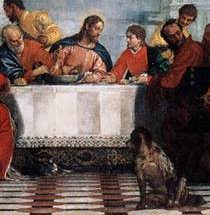
 The inquisitors were not pacified by his answer and began to question him in more detail.  They asked him why he had included two German soldiers seen on the stairway, standing guard bearing halberds, in the right foreground.  One has to remember it was the German Martin Luther, who initiated the Protestan Reformation fifty-five years earlier and it was he who had been a thorn in the side of the Catholic Church, constantly criticising the ways of the Catholic clergy and the Catholic doctrine.   The Inquisition wanted to know why such frivolous things as a dwarf with a parrot on his arm, a dog which sits before Christ’s table staring at the cat which has appeared under the tablecloth had been included in a deeply religious scene.  Veronese had all the answers ready.  As far as the German soldiers he answered:

German guards with halberds

“…We painters use the same license as poets and madmen, and I represented those halberdiers, the one drinking, the other eating at the foot of the stairs, but both ready to do their duty, because it seemed to me suitable and possible that the master of the house, who as I have been told was rich and magnificent, would have such servants…”

The inclusion of the two Germans in the painting was considered by the inquisitors an even greater sin than the other inclusions the inquisitors questioned Veronese again as to their inclusion.

“…Do you not know that in Germany and other countries infested by heresy, it is habitual, by means of pictures full of absurdities, to vilify and turn to ridicule the things of the Holy Catholic Church, in order to teach false doctrine to ignorant people who have no common sense?…”

Veronese realised he was now on dangerous ground but skilfully replied:

“… I agree that it is wrong, but I repeat what I have said, that it is my duty to follow the examples given me by my masters…”

Veronese was probably now becoming a little fearful at the way the questioning was going and so decided to go down the line of – if you think I have blasphemed with my painting, what about the much beloved Michelangelo’s work in the Vatican.  Veronese expanded:

“…In Rome, in the Pope’s Chapel, Michelangelo has represented Our Lord, His Mother, St. John, St. Peter, and the celestial court; and he has represented all these personages nude, including the Virgin Mary, and in various attitudes not inspired by the most profound religious feeling…”

Other diners

The Inquisitors however would not criticise Michelangelo’s work, merely saying that in the depiction of the Last Judgement, which Veronese was referring to, it was only natural that the people were without clothes and that the work had been inspired by the Holy Spirit.  They then turned on Veronese stating that there was no indication that his work had been so inspired by the Holy Spirit and that he needed to make some changes to it.  They then compared Michelangelo’s work with his and commented:

“…There are neither buffoons, dogs, weapons, nor other absurdities. Do you think, therefore, according to this or that view, that you did well in so painting your picture, and will you try to prove that it is a good and decent thing?..”

A little trickier was the question as to why he would include a jester with a parrot on his wrist in such a “sacred” work.  However, he was not to be browbeaten and simply answered:

“…He is there as an ornament, as it is usual to insert such figures…”

 Veronese did however agree with his inquisitors that there was only Christ and his twelve apostle present at the table during the Last Supper but forwarded the reason for the inclusion of so many characters.  He said that the painting was to be so large that he had to fill the space with something, saying:

“…when I have some space left over in a picture I adorn it with figures of my own invention…” 

The inquisitors countered Veronese’s argument by asking him whether he thought he had the right to mock the Last Supper by including irreligious figures, such as buffoons, dwarves, a dog, a cat and worst of all Germans.  Veronese replied:

“…No, but I was commissioned to adorn it as I thought proper; now it is very large and can contain many figures…”

The way in which Veronese had depicted the Last Supper seen in the central background was also criticised by the Inquisition.  This was not similar to the portrayal of Last Supper à la Leonardo.  Veronese’s table scene was more of an everyday festive scene and this was not lost on the inquisitors who wanted to know what was going on at the supper table.  They started by questioning Veronese as to who was sitting down with Christ.  He answered:

“…The twelve apostles…”

They then questioned what the person, Saint Peter, on the right hand of Christ was doing.  The artist responded:

“… He is carving the lamb in order to pass it to the other part of the table and Christ holds a plate to see what Saint Peter will give him…”

On questioning what a third person at the table was doing he merely commented:

“…. He is picking his teeth with a fork…”

In a desperate final attempt to justify the inclusion of all the extra people, both normal and strange, he pointed out that such elements that displeased the Inquisition, such as the dog, the dwarf, the blackamoors, the man with the nosebleed, who is seen holding a handkerchief at the left of the picture, were all in the foreground or the sides of the painting, and did not, in any way, form an incursion into the religious depiction of Christ at supper at the centre of the work.

Venetian guest arriving for supper

With a terrible sense of foreboding the questions came to an end and Veronese awaited his fate. So, it was much to his surprise that at the end of the interrogation Veronese was told that he was a free man.  However as the Inquisition could not accept his argument for adding what they termed “anti-conformist elements” he was given three months to correct the painting at his own expense.  They required him to paint out the dog, and replace it with the Magdalene.  He was also to expunge the German soldiers and it was all to be done within three months. Paolo Veronese, who had feared torture and even death because of his heretical depiction of the Last Supper, couldn’t believe his luck.  So how had he managed to escape the full force of the Inquisition?  Maybe the answer lay in the fact that the Inquisition had much reduced powers in Venice and the inquisitors knew that they could only threaten and not use the brutal methods of torture that was taking place in other countries such as Spain and Italy.  They simply wanted to frighten Veronese in the hope that he would think twice before he again combined secularity with religious scenes.  The Inquisition in Venice was also fully aware that every judgement they made was scrutinised by the Venetian Senate, who were ready to drastically curtail their powers, if they dared to take away the liberty of a Venetian subject and, of course,  Paolo Veronese was one such subject.

Date on column and reference to Luke's Gospel
Date on column and reference to Luke’s Gospel

Veronese never made any of the major changes to his painting that the Inquisition had demanded, but in deference to Ecclesiastical sensibilities and not wishing to push his luck, he added the inscription across the top of the pillars at the head of the staircases, the ones which also showed the date of completion.  The inscription read:

Fecit D.Covi Magnum Levi                       Luca Cap. V

This was in reference to a passage in Luke’s gospel of the New Testament (Luke 5: 27-29):

“…After this, Jesus went out and saw a tax collector by the name of Levi sitting at his tax booth. “Follow me,” Jesus said to him, and Levi got up, left everything and followed him.  Then Levi held a great banquet for Jesus at his house, and a large crowd of tax collectors and others were eating with them…”

He then merely changed the title of the work from The Last Supper to Feast at the House of Levi and by doing so was able to retain the dog and removed the need for it to be replaced by a repentant Magdalene prostrating herself on the floor before Christ.  Veronese’s decision not to make the changes pleased both the friars who loved the painting, and for the majority of Venetians who resented Rome’s inquisition.   The painting remained in the refectory of the Basilica di Santi Giovanni e Paolo until Napoleon Bonaparte’s troops marched into Venice in 1797 and he ordered it be taken back to Paris.   It was returned to Venice a decade later and remained in the church until 1815, at which time it was acquired by the Accademia Galleries in Venice, its current home.

One final thought as to why Veronese would add so many people into a religious scene.   A decade earlier, in 1563, he had completed a similar monumental religious commission for the monks, entitled the Wedding at Cana, which now hangs in the Louvre.  It is interesting to note that it was the monks who had asked him to squeeze as many figures into their painting, as possible.  This was however at a time when the Inquisition and the upholding of Counter-Reformation ideals had yet to reach Venice.
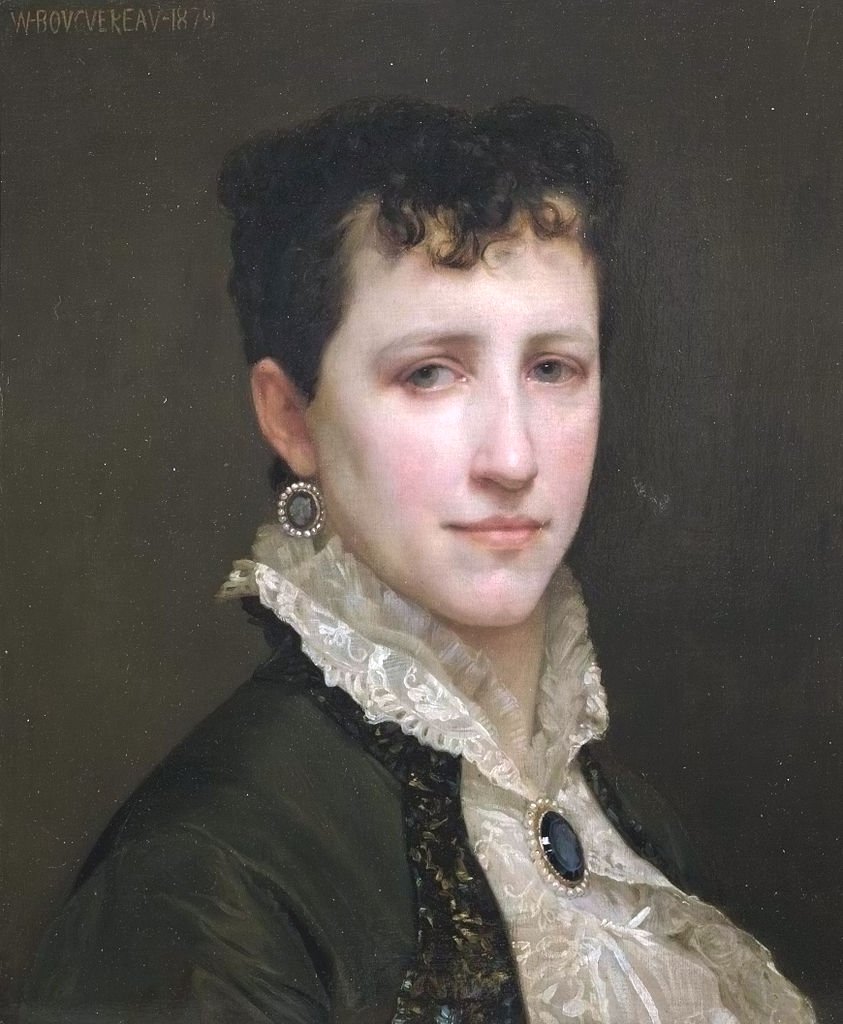
Elizabeth Jane Gardner – the resolute and tenacious artist.

Elizabeth Jane Gardner by William Bouguereau (1879)

The artist I am looking at today is the American, Elizabeth Jane Gardner.  If you read my last blog, which was the conclusion of the life of the French Academic painter William Bouguerau, you will know that Gardner was his second wife.  This is not a story about the wife of a famous painter dabbling with art.  This is a story about the fighting spirit of an acclaimed painter – a great artist in her own right, although it has to be said that she was often criticised because much of her work resembled her husband’s genre pieces.

Elizabeth Jane Gardner was born in October 1837.  Her birthplace was the town of Exeter in the American state of New Hampshire.  It was here that she attended junior school.  After completing her regular school education in 1853, she attended the Lasell Female Seminary at Auburndale Massachusetts.  The college, which was founded in 1851, was named after its founder Edward Lasell, who was a great believer in female education.  It was at this college that Elizabeth studied languages and art.  She graduated in 1856 and for the next few years was a teacher of French at the newly opened Worcester School of Design and Fine Arts in Massachusetts.

Whilst she had been studying art at the Lasell Seminary she would often question the teaching she received but it dawned on her that the foundation of all good painting stemmed from the ability to master the art of drawing.  It was probably during the time spent in her art classes there that she nurtured the desire to one day, go to Europe and live and study art in Paris, which was then, the capital of the art world and the Mecca for all European and American artists.  This artistic ambition to savour French life and its art was probably delayed by the American Civil War and her dream was not realised until 1864, when she and her former art teacher at the Lasell Seminary, Imogene Robinson, set sail for France.  They got themselves a flat in Paris and that summer obtained licenses as copyists at the Louvre and the Musée du Luxembourg.  For the duration of that summer they fulfilled artistic commissions from America by copying paintings in the collection of the prestigious galleries which they also sold to the locals.  However Elizabeth’s main reason for coming to Paris was to receive further artistic tuition at one of the prestigious art academies and so in the autumn she applied to enter L’École des Beaux-Arts, the foremost art institution.  She was horrified that her application was rejected, not on the grounds of her ability but on the grounds of her sex.  L’École des Beaux-Arts, like many art establishments at the time, had a male-only admissions policy and refused to admit females into their hallowed corridors.  The banning of women from the L’École des Beaux-Arts was not lifted for another thirty-five years, in 1897.

Whether it was her and her American companion Imogene’s need to fulfil their initial aim for coming to France, to receive tuition from an established artist or whether it was the simple fact that the public art galleries were not heated and copying works of art in the cold establishments became less pleasant, the women gave up their commissioning work and in the winter of 1864 they looked for an artist who would provide them with some tuition.   Established artists were happy to nurture and teach aspiring artists provided they could pay.  The more the student was willing to pay the better the class of artist who would become their tutor.  Elizabeth’s companion Imogene was in a much better financial situation than Elizabeth and was able to secure Thomas Couture as her mentor and tutor whereas Elizabeth who was not as well off settled for a lesser-known painter Jean-Baptiste-Ange Tissier, whose students were mostly women.

Portrait of Elizabeth Gardener Bouguereau by her husband William Bouguereau (1895)

Elizabeth Gardner was a resolute and determined character and was not going to be put off by red tape and sexist bureaucracy of the art academies and so devised a plan on how she would gain admission to one of the Parisian art schools.   Before she had left the shores of America, she had been ill and had lost a lot of weight and had had to have her hair cropped short.  Her figure had taken on a boyish appearance which part facilitated her ingenious plan. She decided to pose as a young lad but for a woman to walk the streets of Paris dressed as a male she had to have permission from the Paris Police Department!  The law was passed on November 17th 1800 when Paris city chiefs had placed the order on the statute books that required women to seek permission from the police if they wanted to “dress like a man.”   The order was issued at the end of the French Revolution when working-class Parisian women were demanding the right to wear pants in their fight for equal rights.  Parisian women activists, during the Revolution, had also requested the right to wear trousers as a political gesture and like their male working-class revolutionaries became known as “sans-culottes” for wearing trousers instead of the silk-knee breeches preferred by the bourgeoisie. It was modified in 1892 and 1909 to allow women to wear trousers if they were “holding a bicycle handlebar or the reins of a horse”.  Such an old fashioned law!  Actually not, for it was only in January 2013 that the French Minister of Women’s Rights, Najat Vallaud-Belkacem, said that the ban was incompatible with modern French values and laws and although it had been ignored for many years it was only right that the law was officially repealed and so French officials invalidated the 213-year-old order that forbade women in Paris to dress like men and wear trousers.  The French government had been opposed to women wearing trousers for it was a simple method of preventing women, who dressed as men, from gaining access to certain offices or occupations which were male-only domains.

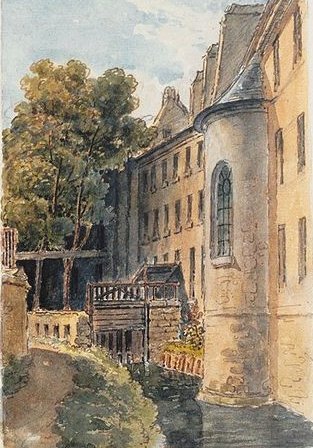
The rear of the Gobelin Factory (c.1830)

Elizabeth’s plan worked, for in 1865, she successfully applied to the drawing school of the prestigious Gobelin Tapestry factory which was best known as a royal factory supplying the court of Louis XIV and later monarchs.  At the beginning she was accepted as a young lad but after a while her fellow students and instructors realised that she was actually a young woman.  Whether it was because of her outstanding drawing ability or her determined personality, one may never know, but despite the discovery of her sex, she was allowed to stay.

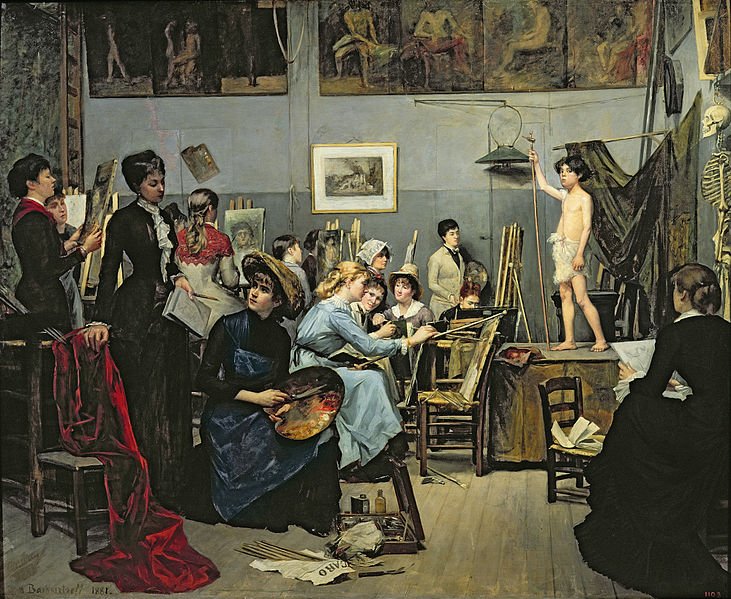
In the Académie Julien in Paris by Marie Bashkirtseff (1881)

One person, who was also impressed with her ability and strength of mind, was Rodolphe Julian.  He had established the Académie Julian in 1868 as a private studio, a school for art students. The Académie Julian was a kind of feeder school for art students who wanted to later gain admission to the École des Beaux-Arts as well as offering independent training in arts. At that time, women were not allowed to enrol for study at the École des Beaux-Arts, but this new Académie Julian accepted both men and women, albeit they were trained separately, but most importantly, women participated in the same studies as men, which included access to classes which taught the basis of art – drawing and painting of nude models.  The Académie Julian was particularly popular with aspiring American artists for it did not have an admission’s precursor of having to be able to speak French.

Whether it was beginners luck or just the fact that she had become a successful and talented artist but in 1868 she had two of her painting accepted by the Salon jury.  To have a painting exhibited at the Salon was a great moment in the life of an aspiring painter.  It was not just in recognition of their talent but it enhanced the value of their future works.  Elizabeth was delighted and wrote home to her parents:

“…when the ex’n opened both of mine were hung in full view among foreign artists and raises the value of what I paint…” 

Elizabeth Gardner’s works were often found in the annual Salon exhibitions and in the exhibition catalogues she, like many other artists whose works were on show, would often name the well know artists who had taught them.   This was an attempt by artists to boost their status and their “artistic bloodline”.  It is by looking at these catalogue entries that we know that Elizabeth received tuition from Hugues Merle, a contemporary and friend of Bouguereau from 1868 to 1874.  The name of the artist, Jules-Joseph Lefebvre was added in catalogues in 1875 as was the name of William Bouguereau from 1877 onwards.

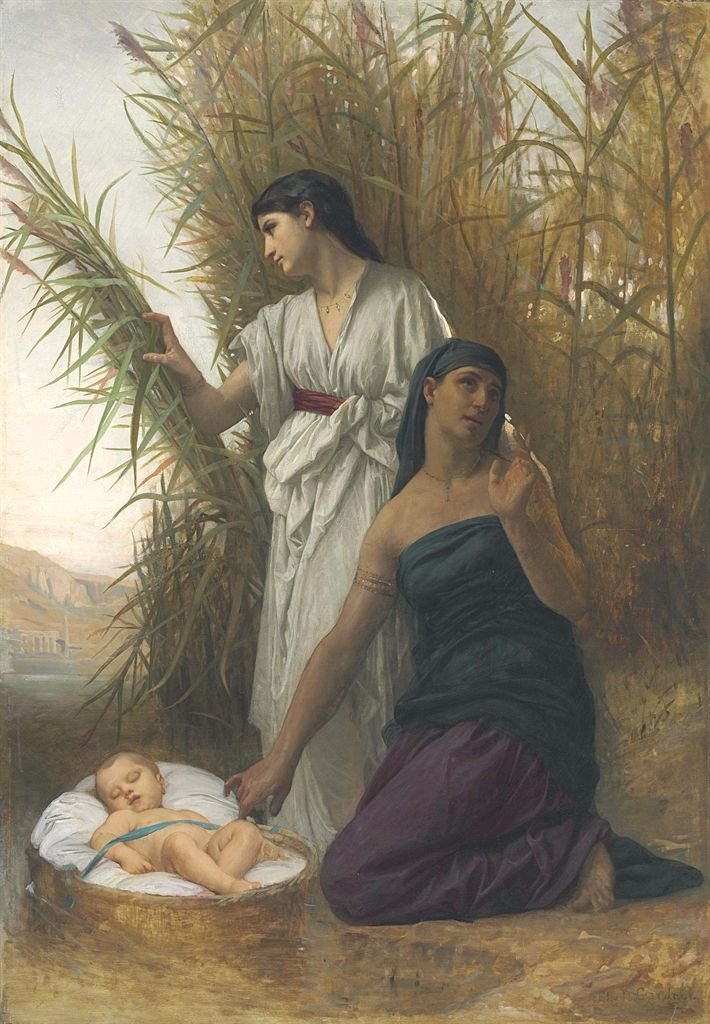
Moses in the Bullrushes by Elizabeth Jane Gardner (1878)

In 1878 Elizabeth Gardner put forward a religious painting for inclusion at that year’s Salon.  It was entitled Moses in the Bulrushes.  She had started the work the previous year and was pleased with its progress.  In December 1877, she wrote about her progress with the work to her brother, John, who was back home in Exeter, New Hampshire:

“… I have advanced my picture of little Moses a good bit this month. The canvas is now covered and now comes what is to me the hardest part. I have always ideas enough for nice subjects but it is so hard to make the reality come up to the dream. I get sometimes quite frantic over it…” 

The work was accepted by the Salon jurists and exhibited in 1878.  The Arts critic of the American Register, a newspaper for expatriate Americans living in Paris wrote in the April 6th edition:

“…‘Miss E. J. Gardner has just completed her picture for the Salon, Moses in the Bulrushes. The subject is taken at the moment when Moses has just been placed amongst them, and his sister has parted the bulrushes to watch the approach of Pharaoh’s daughter, who is seen in the distance. The expression of anguish in the mother’s face is especially well rendered, and the coloring is remarkably fine…” 

The fact that she had put forward a religious painting for inclusion at the Salon was a brave move as history and religious paintings were looked upon as the highest form of art genre.  It was a genre that was also looked upon as being artistically, a male-only domain and female artists were often discouraged from attempting such works.  However as we know, Elizabeth Gardner was a strong-minded person and never shied away from controversy if she believed her course of action was right.  Her submission of this religious work entitled Moses in the Bullrushes, put her in direct competition with her male counterparts.  It was also interesting to note that her take on the event portrayed was from a female perspective.  She had depicted the two women, the mother of the baby and the Pharaoh’s daughter, as courageous women who were saving the life of the baby, Moses.

As the sale of her paintings increased with her popularity, so her financial situation improved.  Things got even better in the late 1870’s when the renowned Paris art dealer Goupil began purchasing her work and in the 1880’s her work was so much in demand that the prestigious Knoedler art dealership of New York, was buying her Salon paintings, sight unseen.  This art dealership had formerly been a subsidiary of the Parisian art dealers, Goupil & Cie.

Elizabeth had reached one of her most sought-after ambitions in 1868 – to have one of her paintings exhibited at the Paris Salon.  However Elizabeth was not one to rest on her laurels and her next ambition was not only to have her work hung at the Salon exhibition but that it was deemed worthy of an award.   She had to wait another nine years for that happening.

One of Elizabeth Gardner’s artistic mentors was William Bouguereau.  Elizabeth and her companion Imogene were living in a flat in rue Nôtre-Dame des Champs in the Montparnasse district of Paris, the same street in which Bouguereau and his family resided.  Elizabeth became known to the family and was on friendly terms with Bouguereau’s wife, Marie-Nelly. William Bouguereau and Elizabeth Gardner must have become quite close during this time as, eight months after the tragic death in childbirth of Bouguereau’s wife in April 1877, the grieving widower proposed marriage to Elizabeth.  Elizabeth was happy to accept but Bouguereau’s mother and daughter Henriette were horrified.  The daughter threatened to leave home and join a convent if a marriage took place but this threat was never tested as Bouguereau’s of the vociferous, sustained and obdurate opposition from his mother to the formalising of the partnership was enough to halt any proposed wedding plans.   However the couple became engaged in 1879 and Elizabeth wrote about Bouguereau, their betrothal and her thoughts about his mother.   In a letter she wrote:

“…And now about my engagement…. I am very fond of Mr Bougereau and he has given me every proof of his devotion to me.   We neither of us wish to be married at present.  I have long been accustomed to my freedom.  I am beginning to attain a part of the success for which I have been struggling so long.   He is ambitious for me as well as I for myself.  As it is I can’t help working very much like him.  I wish to paint by myself a while longer.  He has a fretful mother who is now not young, 78 I think.  She is of a peevish, tyrannical disposition and I know she made his first wife much trouble…” 

Elizabeth and Bouguereau continued to work together and seemed happy or maybe just resigned, to accept a long drawn out courtship.

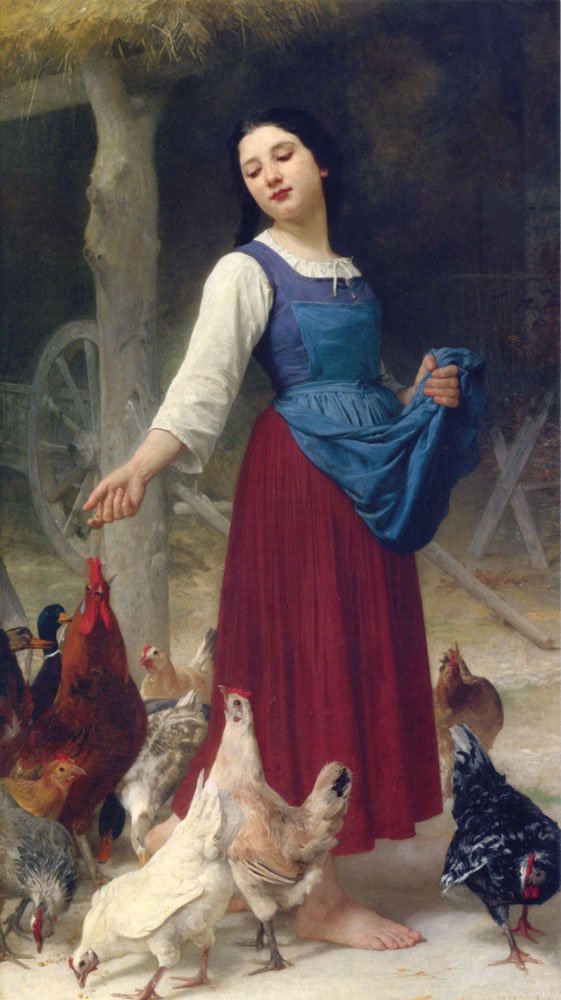
The Farmer's Daughter by Elizabeth Jane Gardner (1878)
The Farmer’s Daughter by Elizabeth Jane Gardner (1878)

The realisation of Elizabeth’s ambition to be awarded a medal at the Salon came in 1887.   By this time, the popularity of her work had surged and she had been inundated with commissions but her mind was focused on her Salon entries and in December 1886, she wrote to her brother John of her desire to achieve that ultimate success:

“…I must work to get a medal in Paris and not for money a while longer.   All will come right in time I am confident if I work hard and am patient…”

In a letter to her sister Maria in January 1887, she again sounded both resolute and optimistic about her award prospects:

“…I am bound to get a medal some year…”

Finally in 1887 the Salon awarded her a medal (third class) for her work entitled The Farmer’s Daughter.  The idea for the painting came to Elizabeth whilst she was on a painting trip in the countryside.  Whilst out, the weather turned nasty and a downpour ensued.  She took refuge from the rain by sheltering in a farmer’s barn and it was whilst there that she saw the farmer’s daughter feeding the hens and ducks.  So impressed by what she saw, she decided to make a quick sketch of the scene which led to the finished prize-winning work.  The painting is a depiction of unspoiled rural living and must have been seen as a breath of fresh air in comparison to paintings by the up-and-coming Impressionists depicting city scenes and the onset of modernity.  Gardner’s tranquil scene would probably have made many people want to exit the city and sample the peacefulness and serenity of the countryside and was for the owner of such a painting, it was a reminder of how life was in simpler days.

The award she received for her work was the first and only medal that was ever bestowed on an American woman painter at the Paris Salon.  She was ecstatic and on May 30th 1887, she wrote to her brother John back in America:

“…My pictures at this year’s Salon have just received the medal which I have waited for so many years. I hasten to write you by the first mail for I know you will All sympathize with me in my happiness. The jury voted me the honor by a very flattering majority – 30 voices out of 40 ….No American woman has ever received a medal here before. You will perhaps think I attach more importance than is reasonable to so small a thing, but it makes such a difference in my position here, all the difference between that of an officer and a private, and I hope it will be a good thing for the sale of my paintings. I made an extravagant risk in my large one this year. Monsieur Bouguereau is very happy at my success. He is as usual President of the Jury, it is his great impartiality which has so long kept him in office. He has always said that I must succeed through my own merit and not by his influence. I hope to send some photos soon….I have nearly a hundred letters of congratulation and dispatches to acknowledge today. I have begun by the dear ones at home…”

This work by Elizabeth was to receive further awards when it was exhibited in the Gallery of the United States at the Paris Exposition Universelle in 1889 where it was awarded a bronze medal.   To understand how great an achievement this was, one has to remember she was up against some of the finest American painters such as Thomas Eakins, William Merritt Chase and John Singer Sargent.

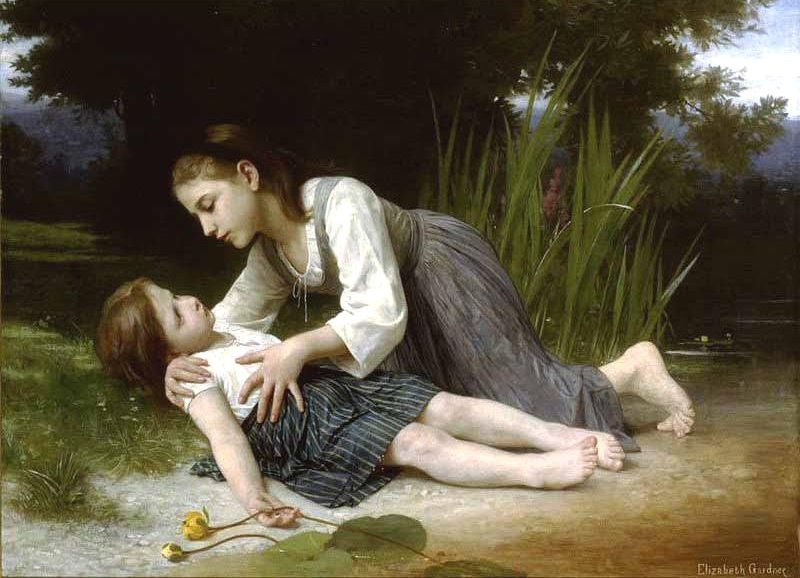
The Imprudent Girl by Elizabeth Jane Gardner (1884)

The work was exhibited along with another of her works, the somewhat controversial, L’imprudente (The Imprudent Girl).

Elizabeth and William Bouguereau had been courting for seventeen years, unable to marry for fear of crossing Bouguereau’s mother who was adamant that the couple should not marry.  However in 1896 his mother died aged 91 and the couple wasted no time in getting married. The colour of Elizabeth’s bridal gown was black and white because, as she explained, although it was her wedding day, she was still in mourning for Bouguereau’s mother.   The groom was 71, and the bride 59 years of age.  Elizabeth wrote home about their change in circumstances:

“… The old lady died on February 18th at the age of 91.  Her devoted son who had borne with such affectionate patience all her peculiarities was quite afflicted by the change [in her health].  He had so long had the habit of subordinating every detail of his life to her desires, of which the first was to rule without opposition in his house…”

After marrying Bouguereau, Elizabeth almost stopped painting altogether and spent most of her time looking after her husband and his studio.  When asked why she stopped painting she simply replied:

“…He was alone and needed me. I abandoned the brush…” 

She did not resume her painting career until after his death nine years later and it was then that she signed all her works in her married name.

The Shepherd David by Elizabeth Jane Gardner (1895)One other of Elizabeth Gardner’s painting of note was completed just before she married William.  It was another religious painting entitled The Shepherd David and was based on a passage from the Old Testament story (1 Samuel 17:34):

“…And David said unto Saul, “Thy servant kept his father’s sheep, and there came a lion and a bear and took a lamb out of the flock…”

The work depicts David demonstrating his worthiness to fight Goliath when he tells the tale of how he, as a shepherd, battled with wild beasts which were menacing his flock. In the painting Elizabeth has shown the young David kneeling in triumph on a dead lion while at the same time grasping a lamb under his right arm.   He looks upward towards the heavens, with his left arm raised in recognition that God had given him the strength to fight off the wild animals.  Elizabeth was proud of the painting and wrote to her sister Maria in America that she full expected to see her painting receive full-page coverage as one of the best works of art in 1895 in Goupil’s, the esteemed Parisian art dealers, art directory.

Elizabeth and William worked happily together from their studio in rue Nôtre Dame des Champs and, even at the age of 78, Bouguereau took his new wife to Italy a country he hadn’t visited since 1850 when he had won the Prix de Rome prize and the stay at the Villa Medici.  The couple would spend their summers away from the claustrophobic atmosphere of the French capital and return to the calming ambience of his birthplace, La Rochelle.  It was here that William Bouguereau died of a heart attack on August 19th 1905, three months short of his eightieth birthday.  His body was transported back to Paris and he was buried in the Cimetière de Montparnasse.

Art critics of the time often disapproved of Elizabeth’s painting style, saying that it copied too closely the style of her husband.  However Elizabeth was unrepentant and was very proud of her work and in a 1910 interview stated:

“I know I am censured for not more boldly asserting my individuality, but I would rather be known as the best imitator of Bouguereau than be nobody!”

The similarity in style between works painted by her and her husband was probably a financially astute decision as she was well aware that this genre of art, the sentimental secular works, was very popular with the public both in France and even more so in America where clients could not get enough of her and her husband’s art.

Elizabeth Jane Gardner Bouguereau, a native of New Hampshire will be remembered as the feisty young woman who challenged the French art establishment.  She was proud to be different and by so doing, signposted the way for many other women to challenge the stranglehold that males had on the world of art.   Elizabeth died at her summer residence in St. Cloud, a western suburb of Paris in January 1922 aged 84 and was buried, like her husband William, in the Cimetière de Montparnasse in Paris.

If you are interested in the life and work of Bouguereau and Elizabeth Gardner I do suggest you buy the excellent book,  Bouguereau  by Fronia E. Wissman, an author who has written or contributed to a number of books about French artists.

Adolphe-William Bouguereau. Part 2 – The painter of Religious Scenes and his painting The Flagellation of Christ

Photograph of William Bouguereau (c.1870)

My blog today looks at another of Bouguereau’s great history paintings.  This is one of his religious works and has all the ferocity of his painting Dante and Virgil, which I featured in my last blog.  Whether you are a lover of religious historic paintings or not, I defy you to be unmoved by the beauty of this work.  Bouguereau was a devout catholic and looked upon his religious paintings as a form of his worship of both God and mankind.  Bouguereau’s religious belief can be plainly seen in his religious works.  The painting I am featuring today is entitled The Flagellation of Christ, which he completed in 1880. Before I discuss the painting let me tell you a little about his life.

Adolphe-William Bouguereau was born in the French Atlantic coastal town of La Rochelle in November 1825.  His father was Theodore Bouguereau, a seller of wine and olive oil.  His father struggled to make much money from his business and because of the financial hardship and family tensions William was sent to live with his uncle Eugène Bouguereau, who was curate in the town of Montagne, some twenty kilometres from Bordeaux.   This enforced move to his uncles was to prove highly fortuitous for the young boy as it was his uncle who introduced him to the world of Roman and Greek mythology and had him read the stories from the Old and New Testaments.  At the age of thirteen, William’s uncle arranged for him to attend the high school at Pons where he attended his first drawing classes under the guidance of Louis Sage, a young classical painter who had once studied under Ingres.   He remained at the school for three years.  In 1841, he eventually moved to Bordeaux where his father had set up his business and once again William was with his family.  William joined in his father’s business but at the same time, in 1842, he was allowed to enrol on a two-year part-time course at the city’s École Municipale de Dessin et de Peinture.  Here he studied under  Jean-Paul Alaux, the French landscape painter and lithographer.  He could not attend full-time because of his promise to help his father during the day, and so, he only attended art classes in the early morning and in the late evening.  Despite being a part-time student he excelled in what he did and in 1844 he won first prize for the best History painting with his depiction of Saint Roch.     Following this award William Bouguerau realised that his future was indelibly tied to art.  To earn some money for himself he designed lithographic labels for jars of jams and other preserves.

Bouguereau realised that to progress with his art he needed to be in Paris which was, at that time, considered the capital of the art world.   However to live in the French capital required money, a commodity he lacked.  His father’s business was not successful enough for him to give his son the money but fortunately for William, his uncle Eugène, the curate, once again proved to be his salvation.  He arranged for William to paint portraits of his parishioners for a fixed fee and after months of portraiture he had amassed nine hundred francs.  A similar sum was given to him by his aunt and he was all set to head to Paris.

The Flagellation of Christ by William Bouguereau (1880)

In my third and final blog about Bouguereau I will finish his life story but for today I want to focus on another of his great History paintings, his religious work entitled The Flagellation of Christ.   He exhibited this work at the 1880 Paris Salon.  It is a monumental work measuring 390 x 210 cms (almost 13ft high and 7ft wide).  One can easily imagine how it stood out from all the other works on show at the exhibition. This is acknowledged as being one of Bouguereau’s greatest religious works.  In this painting, Bouguereau has depicted Christ, tied to a column.  Christ’s body hangs down almost lifelessly with his feet dragging on the ground.  His head droops backwards.  His eyes are blank and unfocused. He is utterly powerless.  He can do little to stop the ferocious onslaught.  Unlike Bouguereau’s painting Dante and Virgil which I featured in the last blog, he has made no attempt to exaggerate the musculature in his portrayal of Christ’s body.  The body of Christ is that of a normal human being.  It is just like ours and in doing this Bouguereau has allowed us more easily to empathise with Christ’s suffering and pain.

A look of concern
A look of concern

We see Christ’s tormentors, two men, who stand on either side of him, arms raised in mid swing with their knotted rope whips airborne.  In the right foreground we see a third man kneeling.  He is in the process of tying up birch branches which will be used later to flagellate their prisoner.  Look at his facial expression.  It is one of concern.  It appears that maybe he is not convinced that what he sees before him is justified.  It is if he is beginning to question his part in the flogging.    In the background an inquisitive crowd gather to witness the flogging.  This is not a leering and jeering crowd we have seen in many of the crowd scenes in Northern Renaissance works.  This group of people cannot be likened to the snarling mob we have seen in earlier Passion of Christ depictions.

A child looks on
A child looks on

An old man in the crowd, maybe the father, lifts a baby aloft for him or her to get a better view.  There is little sign of compassion on the faces of the crowd.  Maybe they have accepted the charges that have been laid against Christ and feel that he needed to be punished.  However there is one exception.

Look closely at the far left of the background.  We see a young boy in a long green tunic who has turned away in horror of what is happening and has burrowed his head in the clothing of the woman who has wrapped her arm around him in a comforting gesture.  Maybe it is his mother.  Maybe she is horrified by what her young son has witnessed and is trying belatedly to protect him.  In the mid-background, there is a man wearing a white vest and grey headband.  He grips a sheath of birch branches and is readying himself to take part in the flogging.  There are a number of examples where the artist has decided to insert his own image into a work and Bouguereau has done the same in this painting.

The artist looks on
The artist looks on

Look at the face in the background to the right of the man wearing the white top and head band.  There, gazing between the spectators is a man with red hair and a red beard.  His brow is furrowed signifying his unease of what he sees before him.  This is believed to be the face of the artist himself.  He, like us, looks on at the terrible scene.

The size of the work almost certainly precluded the sale of it to a private individual and in 1881 Bouguereau gave it to the Society of Friends of the Arts in his home town of La Rochelle.  This majestic work can now be found at the Baptistery of La Rochelle Cathedral, France. 

Bouguereau never lost his love of Greek and Roman mythology which he had been brought up on from early age by his uncle Eugène.   As I said earlier, Bouguereau was a very religious man and religious imagery was a persistent theme in his paintings.   Often his religious works focused on sad and moving events and it is believed they mirrored the anguish and suffering he endured with the loss of loved ones in his own life, which I will talk about  next time.

The Holy Family paintings by Joos van Cleve

Self portrait by Joos van Cleve (1519) Museo Thyssen-Bornemisza, Madrid
Self portrait by Joos van Cleve (1519)
Museo Thyssen-Bornemisza, Madrid

The artist I am featuring today is the early Netherlandish painter Joos van der Beke, better known as Joos van Cleve because he is thought to have been born in the Lower Rhine region of Kleve, possibly the Rhine-river town of Wesel, which lies on the current Dutch-German border.  The year of his birth is believed to be around 1485.  There are various accounts of his early life, much of which are contradictory, but it is thought that his initial artistic training began when he worked in the Kalkar studio of the Dutch painter, Jan Joest van Kalkar, between 1505 and 1509.

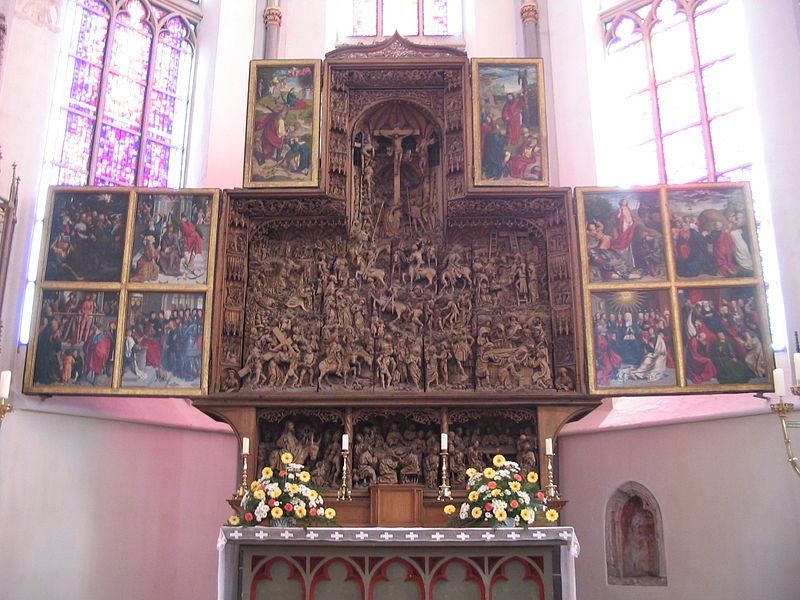
The High Altarpiece in the Kalkar church of St Nicholai  by Jan Joest
The High Altarpiece in the Kalkar church of St Nicholai by Jan Joest

It was during his time with Joest that he worked with his master on the twenty-panelled high altarpiece in the Kalkar church of St Nicholai which is considered to be Joest’s greatest work.   From Kalkar, it is believed Joos van Cleve lived around the Ghent-Bruges area and the next we hear of him is in 1511 where he is mentioned in records as a free-master in the Antwerp’ Guild of St Luke, the city’s painters guild, and on a number of occasions he would hold the position of co-deacon of the guild as well as being appointed Dean of the St Luke’s Guild in 1519, 1520 and 1525.

Centre panel of triptych Death of the Virgin  by Joos van Cleve (c.1515)
Centre panel of triptych
Death of the Virgin
by Joos van Cleve (c.1515)

He set up his own studio in Antwerp and over the next twenty years he took on a number of apprentices.  His studio became the most famous in the city and he was inundated with painting commissions, many of which found their way to the leading European royal, ecclesiastic and merchant houses.  One of these lucrative commissions came in 1515, from the Nicasius and Georg Hackeney, wealthy merchants of Cologne, for a religious triptych which became known as the Death of the Virgin and which is currently housed in Cologne’s Wallraf-Richartz-Museum.  It was from this work that Joos also became known as Master of the Death of the Virgin. It was works like this which brought the Flemish tradition to Cologne, and in so doing brought to bear an extensive influence on the Cologne school of art.

The centre panel of the wide-format triptych is a scene depicting a number of apostles gathered around the bed of the dying Virgin Mary. Of these people, only John and Peter are identifiable.   Peter stands before the bed.  On the floor is a stool on which lies a Gothic rosary.  On the two wings of the triptych there is a depiction of an open river landscape with continuous horizons as well as portraits of the commissioners of the work, Nicasius and Georg Hackeney with their patron saints.

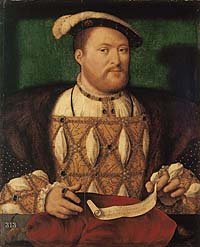
Henry VIII by Joos van Cleve (1535)

Besides his religious works, Joos van Cleve was an accomplished portrait painter.  He was so talented that the king of France at the time, Francis I, summoned him to Paris to work at the French court, during which time he painted a number of portraits of the king, his wife, Eleanor of Austria and members of the court.  It is thought that Joos van Cleve also travelled to England around 1534.  This belief is based on a fact that he painted a portrait of the forty-four year old monarch, Henry VIII, dated 1535, which is now part of the Royal collection.

Little is known about his family life except that in 1519 Joos van Cleve met and married his first wife, Anna Vijts.  The couple had two children, both born in Antwerp.  The birth records of the children show them listed as  “vander Beke, alias van Cleve” and that their father was registered as an Antwerp burgher which possibly indicates that Joos had registered as an Antwerp citizen in order to be able to work in the city.  Joos and Anna had a son, Cornelis, who was born in 1520 and two years later in 1522, Anna gave birth to their daughter, Jozijne.  Their son, Cornelis became a talented portrait painter in his own right.  He helped his father in his workshop and would, after his father’s death, run the business   Cornelis was later known as Sotte Cleve (Mad Cleve) after becoming insane at the age of thirty-four.    Joos van Cleve also allegedly had an illegitimate daughter, Tanneken, from his relationship with Clara van Arp.   In 1531, three years after the death of his first wife, Anna, Joos married Katlijne van Mispelteren.  The couple had no children.   The exact date of Joos van Cleve’s death is uncertain but it is known that on November 10th 1540 he wrote his last will and testament and it is believed he died shortly afterwards.  In April 1541 his wife, Katlijne, was listed as a widow.

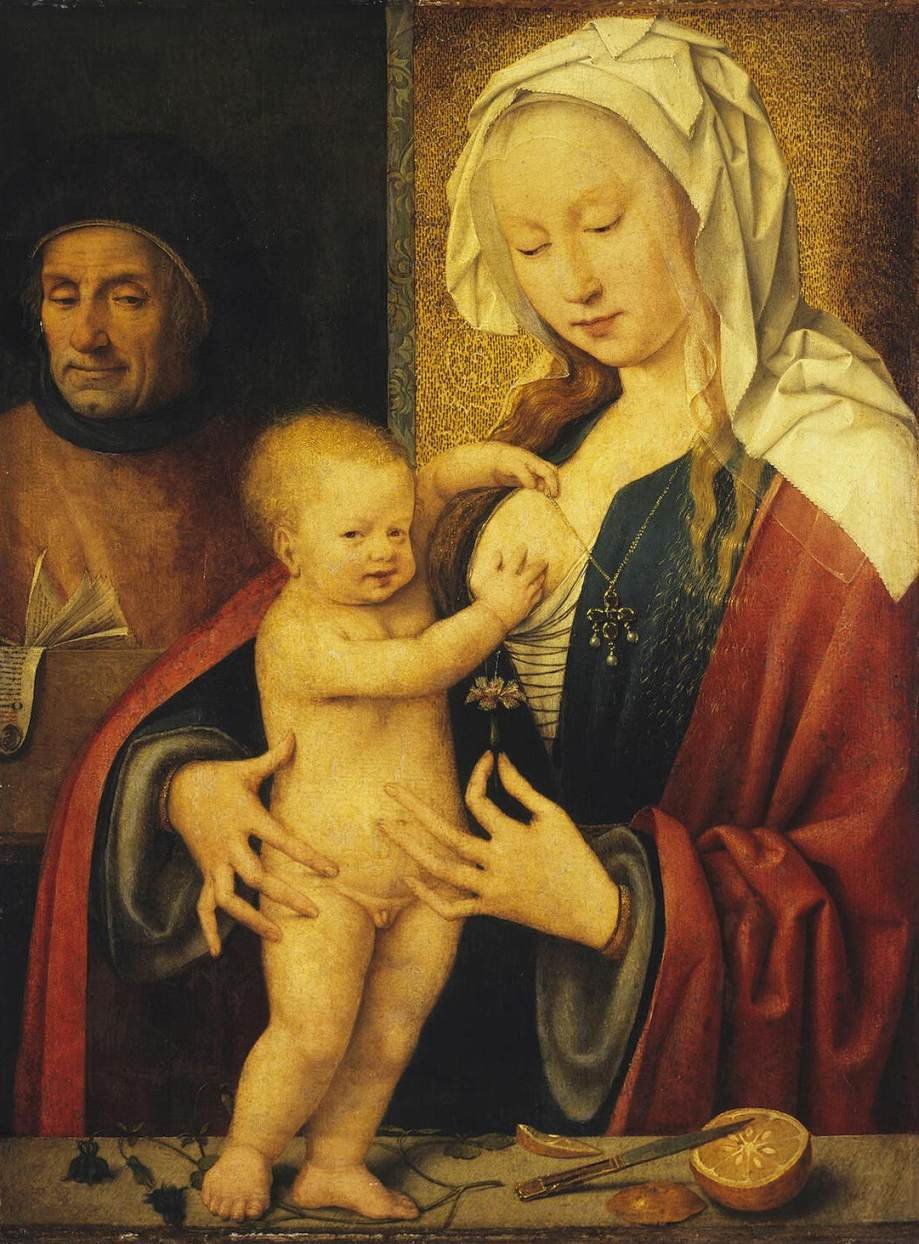
     The Holy Family  (St Petersburg version)      by Joos van Cleve
The Holy Family
(St Petersburg version)
by Joos van Cleve

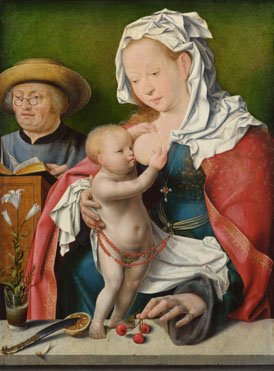
The works of art produced by Joos van Cleve merge the emotions of the Italian Renaissance with the exactitude and lucidity of early Netherlandish art. He was also an astute business man who knew the paintings people liked.   An example of this is in the way he painted many versions of his most popular subject, The Holy Family.  One of these versions is in the Hermitage Museum in Saint Petersburg.  In this work we see a half length composition of the Virgin with the upright Christ Child standing on a stone parapet.  To the left, and somewhat in the background, is Saint Joseph.  The Virgin protects the Child from falling by embracing him with her Mannerist elongated hands.  The pose we see before us is often referred to in Latin, as Maria Lactans, “the virgin’s nursing breast”, or “the lactating virgin”, which was the primary symbol of God’s love for humanity.

    The Holy Family  (Academy of Fine Arts, Vienna)  by Joos van Cleve (c.1515)
The Holy Family
(Academy of Fine Arts, Vienna)
by Joos van Cleve (c.1515)

In the Academy of Fine Arts in Vienna there is another version of The Holy Family, completed around 1515 and in this rendering we see that Joos van Cleve has added a landscape panorama behind the bespectacled foster-father, Joseph, who seems to be positioned outside the room as he reads his book which rests on the window sill.   Again we have the Child standing upright on the parapet held by his mother.  Once more, we notice the depiction of the hands circling the child in an Antwerp Mannerism style.   To emphasize the close mother-child relationship Joos van Cleve has once again gone for the Maria lactans motif but showing it in a somewhat playful fashion.

    The Holy Family  (Metropolitan Museum of Art, New York)  by Joos van Cleve (c.1513)
The Holy Family
(Metropolitan Museum of Art, New York)
by Joos van Cleve (c.1513)

The Metropolitan Museum of Art, in its Friedsam Collection, has a yet another of Jan van Cleve’s versions of The Holy Family which was painted around 1513.  In this version the Christ Child is sitting on the parapet and his lips are tight on the breast of the Virgin as he suckles.  On the parapet we see a glass of wine and a plate of fruit which are symbolic of Christ’s incarnation and the sacrifice of his life which will come in the future.  Again in the background to the left of the mother and child we have Saint Joseph.  In this version he seems less detached and is not concentrating on reading from a book, although he is holding an unfurled scroll.

   The Holy Family (Currier Museum in Manchester, New Hampshire )  by Joos van Cleve (c.1520)
The Holy Family
(Currier Museum in Manchester, New Hampshire )
by Joos van Cleve (c.1520)

The Currier Museum in Manchester, New Hampshire has another version of Joos van Cleve’s The Holy Family, completed around 1520.  It is a small painting measuring 74cms x 56cms.  In front of the mother and child there is, not the stone parapet which we had seen in the other versions, but a table covered by a green felt cloth.   It is a beautiful work which is full of finely detailed still-life objects on the table.   Joos van Cleve has adroitly depicted a variety of objects of differing textures varying from a glass vessel to the ermine lining of Mary’s robe.   In this painting the Christ Child lies across his mother’s lap clutching an amber-coloured string of beads.  As the beads are fixed on the string in five groups of ten we can be almost certain that they represent a rosary.  On the table is a glass jar which symbolises the purity of the Virgin.  This symbolism comes from the fact that light passes through the vessel without breaking it similar to the impregnation of the seed which entered Mary womb without her hymen being breached.    There is a cross reflected in the jar and this is a reminder of how the Christ Child will die and the wine in the jar symbolises the blood of Christ which will be shed during his suffering.   Also on the table there is a folded piece of embroidery, known as a sampler.  In the left of the painting we have Joseph.  He is reading a scroll version of the Magnificat which comes from Luke’s Gospel (1:46-55) and which relates to Mary’s holy stature of Luke:

  “…For behold, henceforth all generations will call me blessed, for He who is mighty has done great things for me and holy is His name…”


   The Holy Family  (National Gallery, London)  by Joos van Cleve (c.1515-20)
The Holy Family
(National Gallery, London)
by Joos van Cleve (c.1515-20)

The final version of Joos van Cleve’s The Holy Family I want to show you is the one in London’s National Gallery.   This version was completed between 1515 and 1520.  In this work the figures are depicted close together giving a sense of intimacy, albeit Joseph is set back and does not engage with Mary or the Child.   This depiction and positioning of Joseph symbolizes his subordinate, albeit contributory, role in the family relationship.  The depiction of Mary is somewhat an idealized and heavenly one but there are definite earthly characteristics about the bespectacled, grey-haired Joseph with his double chin.   Again the Maria Lactans depiction of the Virgin reinforces the human characteristic of the child and adds to the intimate and cherished relationship between mother and baby.  The Christ Child stands on a smooth stone parapet which is shown in the foreground of the painting.  Wrapped around him, almost like a restraint, is the string of beads of an orange rosary.  On this ledge Joos van Cleve has depicted a number of inanimate objects which are symbolic.  We see the Virgin holding a stalk with three red cherries which symbolise paradise.  The glass vase to the left contains a stem of white lilies which symbolizes the purity of the Virgin.  It is believed the piece of lemon which has been cut open by the knife which rests upon it may represent the weaning of the child.

In all the Holy Family paintings Joos van Cleve has depicted the Virgin and the Christ Child in a similar fashion whereas his depiction of Saint Joseph standing in the background varies  from painting to painting.  I wonder why that was.  Did he reconsider the role of Saint Joseph differently and thus altered his image?

Virgin and Child with Saints by Rogier van der Weyden

Sketch of Madonna and Child with Saints

Do you like jigsaw puzzles?  Do you like a mystery?    I hope so as today my featured paintings are just part of an artistic and mysterious jigsaw puzzle.  I will be looking at the three remaining pieces of an original oil on wood work of art and a sketch which may give a clue as to what the original complete painting may have looked like.  From the three remaining pieces which still exist, one can tell it must have been a truly beautiful work of art.  The artist who painted the work was the great early Netherlandish painter Rogier van der Weyden.  I featured one of his best known works entitled The Descent from the Cross in My Daily Art Display on November 15th 2010 and today I am pleased to feature another of his fine works.

Rogier van der Weyden was born in, what is now, the Belgium town of Tournai around 1399.  His name at that time was actually Rogier de le Pasture which literally translated meant Roger of the Pasture.   His father Henri de le Pasture was a knife manufacturer.  At the age of 26 he married Elisabeth Goffaert, the daughter of a Brussels shoemaker, and they had four children.  In 1436 he was given the position of stadsschilder, (painter to the town), of Brussels, a post especially created for him.  It was whilst living in Brussels, which was then a Dutch-speaking town that he began to use the Dutch version of his name: Rogier van der Weyden.

The complete painting I am featuring today was entitled Virgin and Child with Saints, but it does not exist anymore.   However three parts of the work have survived.  One of these is entitled The Magdalen Reading and is housed at the National Gallery in London.  The other two pieces entitled Head of Saint Joseph and Head of Female Saint (St Catherine?) are to be found in the Museu Calouste Gulbenkian in Lisbon.  It is believed that all three pieces were once part of a large Sacra Conversazione painted by Rogier van der Weyden some time between 1435 and 1438A Sacra Conversazione is an Italian phrase which literally translates to “holy conversation”.  The phrase is designated to works of art, normally altarpieces, which depict the Virgin and Child flanked by attendant saints, who are grouped in a single panel, rather than a multi-panelled polyptych.  From the fifteenth century the sacra conversazione began to replace the polyptych.   The word “conversazione” alludes to the characters in the painting being in intimate conversation with one another.  This depiction of the saints communing with each other was unusual as normally in religious works of the time the saints would be shown simply meditating or reading and it was not until a century later that they took on a more animated quality.

Although the original and complete painting does not exist any longer we have some idea what it looked like as there exists a drawing of the almost complete work in the National Museum of Fine Arts in central Stockholm which was drawn by a follower of Rogier van der Weyden.  Although it is an incomplete sketch, it gives one an idea of what the original finished painting looked like.   In this drawing we see standing on the left a bishop saint with a mitre on his head.  In his left hand he holds his crosier, his pastoral staff, and his right hand is raised as he makes a blessing.    If you look to the right of this figure you can see there is a narrow vertical gap with a few curved but faint vertical lines and it is in this gap that art historians believe was the lower part of the kneeling figure of the female saint, Saint Catherine of Alexandria, a fourth century martyr, whose head and shoulders appear in the Lisbon painting. 

Head of Female Saint (St Catherine?) by Rogier van der Weyden ? (before 1438)

However, some art historians, who have studied the three pieces of the painting, have come to the conclusion that the depiction of Saint Catherine may not have been painted by van Weyden himself.  The Scottish art historian, Lorne Campbell, an expert on early Netherlandish paintings, wrote in his 2004 book, Van der Weyden, that the depiction of the head of Saint Catherine was “obviously less well drawn and less successfully painted than the figure in the Magdalen “and as far as he was concerned the image of Saint Catherine may have been painted by one of the members of van Weyden’s workshop. 

The next figure along in the sketch is a bearded barefooted figure holding an open book.  This is thought to be John the Baptist.  Seated to the right of him is the Virgin who holds the Christ Child in her lap.  The Christ Child is wriggling himself out of his mother’s grasp as he tries to look at another book which the kneeling man, on the right, is showing him.  This man is believed to be John the Evangelist.  As I said earlier, this drawing seems to be an unfinished sketch of the original painting, not just because of the empty space between the bishop and John the Baptist but more importantly because it does not show what is believed to have been the complete right hand side of the original painting, part of which forms the work held in London’s National Gallery entitled The Magdalen Reading.   Because the sketch does not show the right hand section of the original painting it is believed that this was the first section to have been cut from the original.

The Magdalen Reading by Rogier van der Weyden (before 1438)

So let us examine both the sketch and the Magdalen Reading painting and see if we can envisage the two being joined.    Look at the robes of the figure kneeling in the extreme right of the sketch.  See how they lie along the floor but suddenly stop at the edge of the sketch.   Look carefully at how the folds of this robe in the black and white sketch compare with the folds of the red robe on the floor to the left in the Magdalen Reading, close to where we see the bottom of a stick or cane which is being held by somebody who is not fully shown in the painting.  The stick touches the red flowing robes which are almost certain to be the robes of the kneeling John the Evangelist of the sketch.

So now we have what we believe is the bottom right hand part of the original painting in the guise of The Magdalen Reading.  This fragment of the original painting depicts a woman with pale skin and high cheekbones.   This is Mary Magdalen.  She sits piously reading a holy book, the cover of which includes a chemise of white cloth, which protects the precious tome.  We see her deep in contemplation as she reads. According to art historian, Lorne Campbell, the book she is reading looks similar to a 13th century French Bible.   She seems quite oblivious to those around her.  Her head is tilted so that her eyes are shyly turned from us, the viewer.    She sits on a red cushion and leans back slightly and relaxes against a kind of wooden sideboard.   On the floor by her side is a white alabaster jar.  This is her traditional attribute in Christian art as the Gospels tell of her bringing spices in it to the tomb of Jesus.  Look how beautifully van Weyden has portrayed her.  She wears a long green robe which is pulled tightly below her bust by a dark blue sash.  From beneath the robe we catch a glimpse of the gold brocade of her underskirt which is hemmed with many jewels.  Van Weyden has spent much time in depicting detail, such as the many folds of her green robe, or the rosary beads dangling from Saint Joseph’s hand. 

In the background we have a view through a window which overlooks a canal in the distance.  On this side of the canal positioned on the wall of the garden there is an archer and across the canal we catch sight of a figure walking along the opposite canal bank.  The background and the headless torso are visible to us today but that was not always the case as the background of the painting had been over-painted with a thick layer of brown paint.   It was not until the painting was cleaned in 1956 that the figure behind Mary Magdalen, the red robe of the kneeling figure on the left and the landscape view through the window were revealed. 


Head of St Joseph by Rogier van der Weyden (before 1438)

But what about the top right hand part of the original painting.   For this we must go to the painting held in Lisbon’s Museu Calouste Gulbenkianand study their painting entitled Head of Saint Joseph.   If you place this painting above the Magdalen Reading painting you can see that the head and shoulders of the man in the Lisbon painting fit perfectly with the lower torso of the “head-less” figure shown standing to the side of Mary Magdalen in the London painting.  The man in the Lisbon painting has been identified as Saint Joseph and if you look carefully at his right shoulder you will see a slight hint of a red sleeve which can be clearly seen continuing on the “headless” torso in the Magdalen Reading painting.  In one hand he holds a walking stick or cane and in the other he holds rosary beads made of rock crystals.   So we now have managed to place the three individual paintings into the one work…….or do we?

I raise the hint of doubt as not all art historians agree that the three are part of one whole, especially when it comes to the head of Saint Catherine.  Let us look more closely at the Lisbon painting, Head of Female Saint (St Catherine?).  Look carefully at the background and the window opening behind her and that of the one shown in the background of the Magdalen Reading painting.  They are different in design, one is plain and one is bevelled and this to some art historians, such as Martin Davies, who wrote about the painting in his work Rogier van der Weyden’s Magdalen Reading and John Ward, who wrote an article about the painting entitled A Proposed Reconstruction of an Altarpiece by Rogier van der Weyden in the Art Bulletin (vol. 53, 1971. 27–35), means that Head of the Female Saint was not part of the original work. 

Notwithstanding whether I believe the three paintings once formed part of one original work, I only wish I could have seen the work as a whole before it was split up.

The Resurrection by Piero della Francesca

The Resurrection by Piero della Francesca (c.1468)

For today’s blog I am staying with Italian Renaissance art and looking at a work by, some say, the greatest Early Renaissance painter, Piero della Francesca.  This is the second time I have featured this artist in one of my blogs.  The first being The Flagellation of Christ (My Daily Art Display, September 29th 2011).   Today I want to look at his beautiful fresco entitled The Resurrection which he completed around 1468.

Piero della Francesca or as he was known in his day, Piero di Benedetto de’ Franceschi, was born around 1415 in the Tuscan market town of Borgo San Sepolcro, which is now known as Sansepolcro,  a small town located on the plains of the Upper Tiber Valley in the southeast of Tuscany, bordering Umbria and The Marches.  His family were merchants dealing in leather and wool and his father, Benedetto di Franceschi, hoped that his son would follow in his footsteps.  With that in mind, Piero was sent to school to learn arithmetic and the ability to calculate weights and measures, assess the volumes of barrels and bales, and most importantly, learn how to keep accounts.  Piero was academically gifted and became well known as a mathematician and in fact after his death he was revered not so much as a painter but for his mathematical knowledge.

Piero’s initial artistic training came as an apprentice to Antonio di Giovanni, a local painter, who was based in Anghiari, a town across the Tiber Valley from Borgo San Sepolcro.  From being Antonio di Giovanni’s apprentice, he soon became his assistant and during the 1430’s the two of them worked jointly on commissions around Borgo San Sepolcro.  Piero went to Florence for the chance to gain more work and he worked on commissions as an assistant alongside another young artist, Domenico Veneziano.  It was during this time spent in Florence that Piero would have probably come into contact with the great Florentine artists of the time such as Fra Angelico, Mantegna and the architect, Brunelleschi.

In 1442, Piero returned to Sansepolcro and three years later, in 1445, Piero received a large commission from the Compagnia della Misericordia, a confraternity of Borgo San Sepolcro, for a polyptych, Polyptych of the Misericordia: Madonna of Mercy, as an altarpiece for the local church, Church of the Misericordia.  The confraternity had asked Piero to complete the work in three years, setting the anticipated completion date as 1445.   Piero however did not feel constrained by this suggested timeline and any way he had many other projects on the go at the time and in the end did not complete the altarpiece until 1462, some seventeen years late!

Piero moved around the country a good deal during his life, living in Ferrara and Rimini before arriving in Rome in 1455.  Here he painted frescoes in the Vatican for Nicholas V and continued to work in the Vatican Palace for Pius II. Sadly his works were destroyed to make room for paintings by Raphael.

Piero’s birthplace, the town of Borgo San Sepolcro which literally means “Town of the Holy Sepulchre” derives its name from the story of its founding back in the tenth century.   The story of its coming into being would have us believe that two saints, Saint Arcano and Saint Egidio were returning from a pilgrimage to the Holy Land bearing some wood shavings from the sepulchre in which Christ had been buried, when they were miraculously instructed to create a new settlement – Borgo San Sepolcro.   These sacred relics have been preserved in the local Benedictine abbey and so when the town hall of Borgo San Sepolcro was renovated and extended in the late 1450s, Piero was commissioned to paint the fresco on the appropriate subject of The Resurrection for the building’s state chamber. This room was set aside for the use of the Conservatori, the chief magistrates and governors.  Before holding their councils, these four appointed guardians of the town would solemnly kneel before Piero’s image, to pray for the grace of God to descend upon them during their deliberations. The room is now the civic museum.

My featured painting today is a fresco which exudes an air of peace and tranquillity.   In the painting, the risen Christ can be seen in the centre of the composition.  He is portrayed at the moment of his resurrection, as we see him with his left foot on the parapet as he climbs purposefully out of his marble tomb clutching the banner in his right hand, as if he is declaring his victory over death.   He looks formidable as he stands tall.   We don’t see the lid of the tomb but look to the bottom right of the painting and we can see Piero has depicted a large rock which probably harks back to the biblical tale which told of a rock being rolled away from the entrance of Christ’s tomb.   In most resurrection paintings we are used to seeing Christ dressed in white burial clothes and yet Piero has depicted him in red robes, which was probably done to infer royalty and signify that this resurrected person is Christ the King.  Piero has portrayed the pale body of the risen Christ as almost blemish-free with the exception of the wound to his side and the wound in the back of both his hands made by the crucifixion nails.   In his depiction of Christ he has not let us forget that this central figure is both man and God, for if you look closely at the stomach of Christ we notice that the artist has given it an almost human appearance.  It has a slightly wrinkled appearance caused by the folds of the skin happening as he raises his leg to exit the tomb.

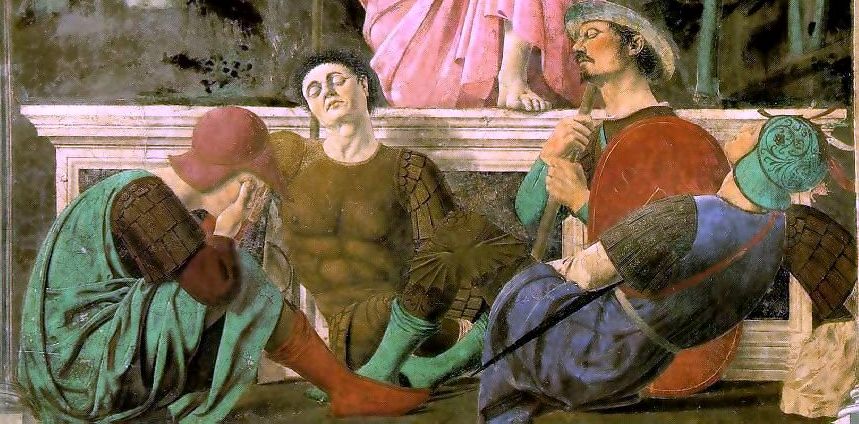
The sleeping guards

The alertness of the risen Christ in the painting contrasts starkly with the four soldiers who instead of keeping guard on the tomb, lie asleep.  The Renaissance painter and biographer of artists, Vasari, would have us believe that Piero included his own self-portrait in this fresco.

Piero della Francesca

It is the face of the second soldier from the left, and Vasari postulates that Piero did this as a sign of his own hopes of awaking one day to redemption. It is also interesting to note the contrast in the way Piero has depicted the risen Christ and the four soldiers.  Christ is shown in a solid vertical stance looking straight out at us, whereas the sleeping soldiers are depicted in diagonal poses and viewed at various oblique angles.  The way the artist has portrayed Christ almost gives one the feeling that he is about to step out of the painting to join us, the viewer.  In some ways the expression on the face of Christ is disturbing.  It is a penetrating glance and one art critic commented that it was if he was looking into the soul of the viewer.

The landscape is bathed in the new cold and clear light of a Tuscan dawn.  Look carefully at the trees on the right of the painting and those on the left side.  Do you spot the difference?   The ones on the right are depicted as flourishing specimens adorned with leaves and healthy green shoots whereas the trees on the left of the painting are grey in colour and bare as if on the point of dying.   This contrast almost certainly alludes to the renewal of mankind through the Resurrection of Christ

It is likely that Piero painted his striking image of the risen Christ stepping resolutely, banner in hand, from the tomb, to represent not only the resurrection of Jesus but also the resurgence of the town of Sansepolcro.  After a few years under the rule of Florence from 1441, Sansepolcro regained its identity and dignity in 1456 when the Florentines returned the use of the Palazzo to the Conservatori. The church Council which the young Piero had witnessed in Florence had thus had unforeseen consequences for Sansepolcro. The Pope, his treasury depleted by his lavish Council, defrayed some of the costs by ceding Sansepolcro to Florence which was later returned by Florentine authorities to the citizens of Sansepolcro on February 1st 1459, as a sign of the restoration of some measure of autonomy to the Borgo.

One interesting end note to the tale of this painting comes from a BBC article which tells the story of how a British artillery officer, Tony Clarke, during World War II, defied orders and held back from using his troop’s guns to shell the town of Sansepolcro and his decision is believed to have saved this beautiful fresco.   To read the full story click on:

http://www.bbc.co.uk/news/magazine-16306893

The Transfiguration by Raphael

The Transfiguration by Raphael (1520)

In my last blog I looked at The Raising of Lazarus by Sebastiano del Piombo and talked about how this and a painting by Raphael, entitled Transfiguration, had been commissioned in 1517 by Cardinal Giulio de’ Medici as a high end altarpiece for the French Cathedral of S. Giusto Narbonne.  Raphael was, at the time, busy on other commissions.  He had been summoned to Rome by Pope Julius II to paint frescoes on the rooms of his private Vatican apartment, the Stanza della Segnatura and the Stanza di Eliodor and at the same time he was busy working on portraits and altarpieces as well as working alongside Sebastiano del Piombo on frescoes for Agostino Chigi’s Villa Farnesina.   It is thought that Giulio de Medici was so concerned with the time it was taking Raphael to complete The Transfiguration altarpiece that he commissioned Sebastiano di Piombo to paint the Raising of Lazarus for the cathedral in an effort to stimulate Raphael to work faster on his commission.

Today I am featuring Raphael’s work, The Transfiguration, which was considered the last painting by the Italian High Renaissance master.  Giorgio Vasari, the sixteenth century Italian painter, writer, historian, and who is famous today for his biographies of Renaissance artists, called Raphael a mortal God and of today’s painting, he described it as:

“…the most famous, the most beautiful and most divine…”

Although Raphael Sanzio was only thirty-four years of age when he was given the commission, bad health prevented him from finishing it. It was left unfinished by Raphael, and is believed to have been completed by his pupils, Giulio Romano and Giovanni Francesco Penni, shortly after his death on Good Friday 1520.

If we look closely at this work of art we can see two things going on simultaneously both of which are described in successive episodes of the Gospel of Matthew.   In the upper part of the painting we have the Transfiguration, which is described in Matthew’s Gospel (Matthew 17: 1-7):

“…After six days Jesus took with him Peter, James and John the brother of James, and led them up a high mountain by themselves.  There he was transfigured before them. His face shone like the sun, and his clothes became as white as the light.  Just then there appeared before them Moses and Elijah, talking with Jesus.   Peter said to Jesus, “Lord, it is good for us to be here. If you wish, I will put up three shelters—one for you, one for Moses and one for Elijah.”    While he was still speaking, a bright cloud covered them, and a voice from the cloud said, “This is my Son, whom I love; with him I am well pleased. Listen to him!”   When the disciples heard this, they fell facedown to the ground, terrified.  But Jesus came and touched them. “Get up,” he said. “Don’t be afraid…”

We see the transfigured Christ floating aloft, bathed in a blue/white aura of light and clouds.  To his left and right are the figures of the prophets, Moses and Elijah.  Below Christ we see the three disciples on the mountain top shielding their eyes from the radiance and maybe because of their own fear of what is happening above them.   The two figures kneeling to the left of the mountain top are said to be the martyrs Saint Felicissimus and Saint Agapitus of Palestrina.

 In the lower part of the painting we have a depiction by Raphael of the Apostles trying, with little success, to liberate the possessed boy from his demonic possession. The Apostles fail in their attempts to save the ailing child until the recently-transfigured Christ arrives and performs a miracle.  Matthew’s Gospel (Mathew 17:14-21) recounts the happening:

“…When they came to the crowd, a man approached Jesus and knelt before him.  “Lord, have mercy on my son,” he said. “He has seizures and is suffering greatly. He often falls into the fire or into the water.  I brought him to your disciples, but they could not heal him.”    “You unbelieving and perverse generation,” Jesus replied, “how long shall I stay with you? How long shall I put up with you?  Bring the boy here to me.”   Jesus rebuked the demon, and it came out of the boy, and he was healed at that moment.   Then the disciples came to Jesus in private and asked, “Why couldn’t we drive it out?”   He replied, “Because you have so little faith. Truly I tell you, if you have faith as small as a mustard seed, you can say to this mountain, ‘Move from here to there,’ and it will move. Nothing will be impossible for you…”

Observe this lower scene.  The young boy, with arms outstretched and distorted in a combination of fear and pain, is possessed by some sort of demonic spirit.   He is being led forward by his elders towards Christ who is about to descend from the mountain.   The boy is crying and rolling his eyes heavenwards.   His body is contorted as he is unable to control his movement.   The old man behind the boy struggles to control him.  The old man, with his wrinkled brow has his eyes wide open in fear as to what is happening to his young charge.  He looks directly at the Apostles, visually pleading with them to help the young boy.    See how Raphael has depicted the boy’s naked upper body.  We can see the pain the boy is enduring in the way the artist has portrayed the pale colour of his flesh, and his veins, as he makes those violent and fearsome gestures.   The raised arms of the people below pointing to Christ, who is descending, links the two stories within the painting.  A woman in the central foreground of the painting kneels before the Apostles.  She points to the boy in desperation, pleading with them to help alleviate his suffering.

Contrapposto

The contorted poses of some of the figures at the bottom of the painting along with the torsion of the woman in what Vasari calls a contrapposto pose were in some way precursors to the Mannerist style that would follow after Raphael’s death.   Vasari believed that this woman was the focal point of the painting.     She has her back to us.  She kneels in a twisted contrapposto pose. Her right knee is thrust forward whilst she thrusts her right shoulder back.   Her left knee is positioned slightly behind the right and her left shoulder forward.  Thus her arms are directed to the right whilst her face and gaze are turned to the left.  Raphael gives her skin and drapery much cooler tones than those he uses for the figures in heavy chiaroscuro in the lower scene and by doing so illuminates her pink garment.  The way he paints her garment puts emphasis on her pose.  She and her clothes are brilliantly illuminated so that they almost shine as bright as the robes of the transfigured Christ and the two Old Testament Prophets who accompany him.   There is an element about her depiction which seems to isolate from the others in the crowd at the lower part of the painting and this makes her stand out more.

The unfinished painting was hung over the couch in Raphael’s studio in the Borgo district of Rome for a couple of days while he was lying in state, and when his body was taken for its burial, the picture was carried by its side.   Cardinal Giulio de’ Medici kept the painting for himself, rather than send it to Narbonne and it was placed above Raphael’s tomb in the Pantheon.   In 1523, three years after the death of Raphael, the cardinal donated the painting to the church of San Pietro in Montorio, Rome. In 1797, following the end of the war in which Napoleon’s Revolutionary French defeated the Papal States; a Treaty of Tolentino was signed.    By the terms of this treaty, a number of artistic treasures, including Raphael’s Transfiguration, were confiscated from the Vatican by the victorious French.   Over a hundred paintings and other works of art were moved to the Louvre in Paris.   The French commissioners reserved the right to enter any building, public, religious or private, to make their choice and assessment of what was to be taken back to France. This part of the treaty was extended to apply to all of Italy in 1798 by treaties with other Italian states.   It was not until 1815, after the fall of Napoleon, that the painting was returned to Rome. It then became part of the Pinacoteca Vaticana of Pius VII where it remains today.

The Raising of Lazarus by Sebastiano del Piombo

The Raising of Lazarus by Sebastiano del Piombo (1520)

My next two blogs feature paintings by two different artists, commissioned almost at the same time by the same person, one of which is often looked upon as the greatest painting ever.

My featured artist today is Sebastiano Luciani, who would be better known later as Sebastiano del Piombo for reasons I will explain later.   Sebastiano was born around 1485 and his birthplace is thought to have been Venice as he often signed his works Sebastianus Venetus.   His first thoughts, regarding what he should do with his life, were to join a religious order and he may well have started along the path towards the priesthood. His first love was not drawing and painting but music.  He had a great interest in music and was an accomplished singer and also played many musical instruments, including the lute, which was his favourite.  This musical talent of his made him very popular in Venetian society.   He did however eventually turn his attention to art when he was about eighteen years of age and his first artistic tuition came from Giovanni Bellini, who was a member of the great Bellini family of Venetian artists and brother-in-law of Andrea Mantegna.   Having learnt the basics of art from Bellini he left the studio and became a pupil of Giorgione da Castelfranco, whom he had first met through their joint love of music.  Sebastiano and Giorgione had a long association and the early works of the young aspiring painter were greatly influenced by the style and technique of his master, so much so, that some of his early paintings were confused with those of Giorgione.

Giorgione died in 1510 and the other great Venetian artist, Tiziano Vecelli (Titian) was away, working in Padua.   Sebastiano was now looked upon as the leading painter in Venice.   In early 1511, the Siennese banker, Agostino Chigi, who had become one of the richest men in Rome and a financial backer of the Popes,  visited Venice and persuaded Sebastiano to return with him to Rome.  Chigi believed that Sebastiano was the greatest living painter in Venice and he wanted him to carry out some work in his newly acquired villa.   Chigi was a great lover of the Arts and a wealthy patron of art and literature.  Chigi, at that time, owned a suburban villa on the shore of the River Tiber, known as Viridario, but later owners changed its name and it became known asVilla Farnesina.  Chigi wanted his residence to be one of the most opulent in the city befitting a man of his standing in society and wanted the best artists of the time to come and decorate the interior.  Besides summoning Sebastiano he invited other great painters to put their mark on the villa, such as Giovanni da Udine, Giulio Romano, Sodoma and Raphael Sanzio.  Sebastiano worked alongside Raphael on the frescoes for the villa which depicted scenes from Ovid’s Metamorphoses.

It was whilst working in Rome that Sebastiano became acquainted with, and became one of the rare and trusted friends of, Michelangelo Buonarroti.   According to Vasari, Michelangelo befriended Sebastiano and offered him pictorial designs for him to develop in paint.  This friendship however drew Sebastiano into the long running rivalry Michelangelo had with Raphael Sanzio but in a way it had a lot to do with today’s featured work.  It is believed that through the good auspices of Michelangelo, Sebastiano was, at the end of 1516, commissioned by Cardinal Giulio de’ Medici to paint a large altarpiece, depicting the Raising of Lazarus.  Cardinal Giulio de’ Medici was appointed to the see of Narbonne, in south-west France, by his cousin Pope Leo X.  The painting, along with its proposed companion piece the Transfiguration, which the cardinal had commissioned, shortly before, from Raphael, were to be sent to the cathedral in the Cardinal’s own bishopric in Narbonne, which owned a relic relating to the story of Lazarus.  There seems nothing strange about the cardinal commissioning two paintings for the same cathedral but Vasari would have us believe that there was a little devilment with the cardinal’s request as, in a way, it was to pit the two artists against one another and of course the cardinal was well aware of the rivalry between Michelangelo and Raphael as we know Raphael’s “artistic enemy” was Michelangelo, who was therefore only too willing to lend Sebastiano a hand with the work by supplying him with sketches that could be incorporated into the Raising of Lazarus.

Michelangelo’s sketch of Lazarus

The featured painting today, the Raising of Lazarus by Sebastiano, is a great example of the highly colourful style of Venetian painting of the time.   Sebastiano completed the painting in January 1519 and it was immediately hailed as an artistic triumph.  Raphael was concerned that his painting of the Transfiguration was not compared with Sebastiano’s Raising of Lazarus but the two were seen together in April of the following year, a couple of days after Raphael’s death.  Raphael’s painting never went to Narbonne, remaining in Rome whereas Sebastiano’s Raising of Lazarus eventually went to the French city.

The biblical tale tells us about the request of the sisters Martha and Mary for Jesus to visit the grave of their brother Lazarus and raise him from the dead.  In his Gospel, St John divided the story of the miracle into three parts. Firstly, Jesus bids the people to take the stone from the tomb.  Next he tells his friend, Lazarus to rise, and finally Jesus tells Lazarus to unbind his shroud and it is this third command to Lazarus that we see in the painting.  The painting we see before us is a depiction of a biblical story from the Gospel of Saint John (John: 11).  Verses 40 to 44 recount the event:

“…Jesus, once more deeply moved, came to the tomb. It was a cave with a stone laid across the entrance.   “Take away the stone,” he said.  “But, Lord,” said Martha, the sister of the dead man, “by this time there is a bad odor, for he has been there four days.”    Then Jesus said, “Did I not tell you that if you believe, you will see the glory of God?”   So they took away the stone. Then Jesus looked up and said, “Father, I thank you that you have heard me.    I knew that you always hear me, but I said this for the benefit of the people standing here, that they may believe that you sent me.”  When he had said this, Jesus called in a loud voice, “Lazarus, come out!” The dead man came out, his hands and feet wrapped with strips of linen, and a cloth around his face.  Jesus said to them, “Take off the grave clothes and let him go.”

In the background of the painting, we see a cloudy sky being penetrated by a shaft of light.  We can make out a distant town by a lake or river. The town is more a depiction of a high-walled fortified Roman town with its large and solidly built bridge, rather than a depiction of somewhere from Sebastiano’s birthplace, Venice.   It feels Roman more than Venetian. We see the figure of Christ standing in the foreground, slightly left of centre,   He is portrayed theatrically pointing towards the seated figure of Lazarus, who is still partly covered by his burial shroud.  It is almost as if Jesus is giving a speech.   Jesus needs all his powers of persuasion to bring back Lazarus. It is not so much a command Jesus is giving to Lazarus, more that he is appealing to the old man, his friend, to rise from the dead.
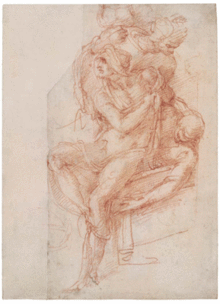
All around, and squeezed tightly into the composition, are men and women all of who pose in a most theatrical manner, due to their shock at seeing Lazarus coming back to life.   In the left mid-ground we see a group of Pharisees unimpressed by what they have seen and are still hell-bent on plotting the death of the so-called miracle maker.    The various figures in the painting are all clothed differently.  It is interesting to take time and study each figure.  There is an old man knelt on the lower left, hands clasped in a prayer-like manner as he looks up at Jesus.    Look how some of the men and women hold their hands up in horror and look away rather than cast a glimpse on the back-from-the-dead figure of Lazarus.  Dramatic poses have been given to Martha and Mary, the sisters of Lazarus.   Mary is on her knees to the right of Jesus, her hand placed over her heart.   Martha, dressed in a blue robe with a red sash, stands to the right of Jesus, recoiling from what the Biblical passage termed “the bad odour”.

Martha recoiling at the sight and smell of Lazarus

Others talk together discussing what they see before them.   Take time and look at all the various expressions on the faces of the people.   All these figures are painted in bright colours.  The artificial and theatrical gestures we see before us seem almost as if time has come to a standstill.  It is like a freeze-frame shot from a film.   Lazarus is indeed a strong, mature man and Sebastiano used the red and black chalk drawings given to him by Michelangelo for a preliminary study of the figure of Lazarus and some of his attendants. Three of these drawings still exist and one can be seen at the British Museum in London.   The way the figures are portrayed by Sebastiano are depicted in a Michelangelo’s style. A prime example is the depiction of Lazarus.  Look at the way Sebastiano has shown him half turned which is often the way a sculptor would position his figure.  The arms and legs of Lazarus are so positioned to show off his musculature and sinews.  It is so like the work of Michelangelo.

Cardinal Giulio de’ Medici chose to keep Raphael’s Transfiguration for himself and it is now housed in the Vatican Gallery.  He sent Sebastiano’s painting to Narbonne.   The Raising of Lazarus in now housed in the National Gallery, London.    After Raphael’s death, Sebastiano became the leading painter in Rome and he was the first artist to return there after the 1527 Sack of Rome.  In 1531, the Pope rewarded his service by making him Keeper of the Papal Seal and it was from this position that Sebastaino became known as Sebastiano del Piombo, (piombo being the Italian word for lead which was used for sealing).

Tomorrow I will look at the companion piece or some would say the “competition” piece to Sebastiano’s Raising of Lazarus – Raphael Sanzio’s Transfiguration, a painting many art historians believe to be the greatest painting of all time.

The Melun Diptych by Jean Fouquet

The Melun Diptych by Jean Fouquet (c.1450)

In my last blog I looked at an altarpiece by Michael Pacher and discussed terms such as diptych, triptych and polyptych, which all referred to panel paintings which were hinged together.  Although we looked at a triptych altarpiece this form of art was not only used in the depiction of religious personages.   There were many commissions for the diptych when it came to secular portraiture.  Often it would be the portrait of the husband on one panel with the portrait of his wife on the other.  The diptych was quite a common format in the Early Netherlandish paintings of the 15th and 16th centuries. In my blog today I want to look at a fifteenth century diptych, known as the Melun Diptych, which was the work of the great French painter and manuscript illustrator, Jean Fouquet.  Although the attached photograph above shows the two paintings as a diptych, the two panels are now separated.  Up until 1775, the diptych remained in the church of Notre Dame in Melun. However the church fell on hard times and needed money to help pay for the building’s restoration.  The elders of the church decided to raise funds for the building work by selling the diptych.  The right wing with the Madonna and Child was sold to the mayor of Antwerp and it has remained in the Belgian city ever since.  It is now housed in Koninklijk Museum voor Schone Kunsten, Antwerp (The Royal Museum of Fine Arts).    The left hand panel of Chevalier and St Stephen was purchased by Clemens Brentano, the German poet and novelist in 1896.  This panel is now housed in Staatliche Museen, Berlin.   Each of the wood panels measure 93cms x 85cms.

Jean Fouquet was born in Tours, a town in the Loire Valley, around 1420.  It is thought that Fouquet’s initial artistic training was at a studio in Paris, where he was educated in the ways of a manuscript illuminator and painting of miniatures.   It is also believed that he may have worked as an apprentice in the Bourges workshops of the Netherlandish painter, Jacob de Littemont, who was the court painter to Charles VII and later, Louis XI, a position that Fouquet himself would hold in 1475.    His first recorded painting dates back to 1440, and was entitled The Court Jester Gonella, who was the court jester of Nicholas III d’Este.  I featured that painting in My Daily Art Display of December 14th 2010.
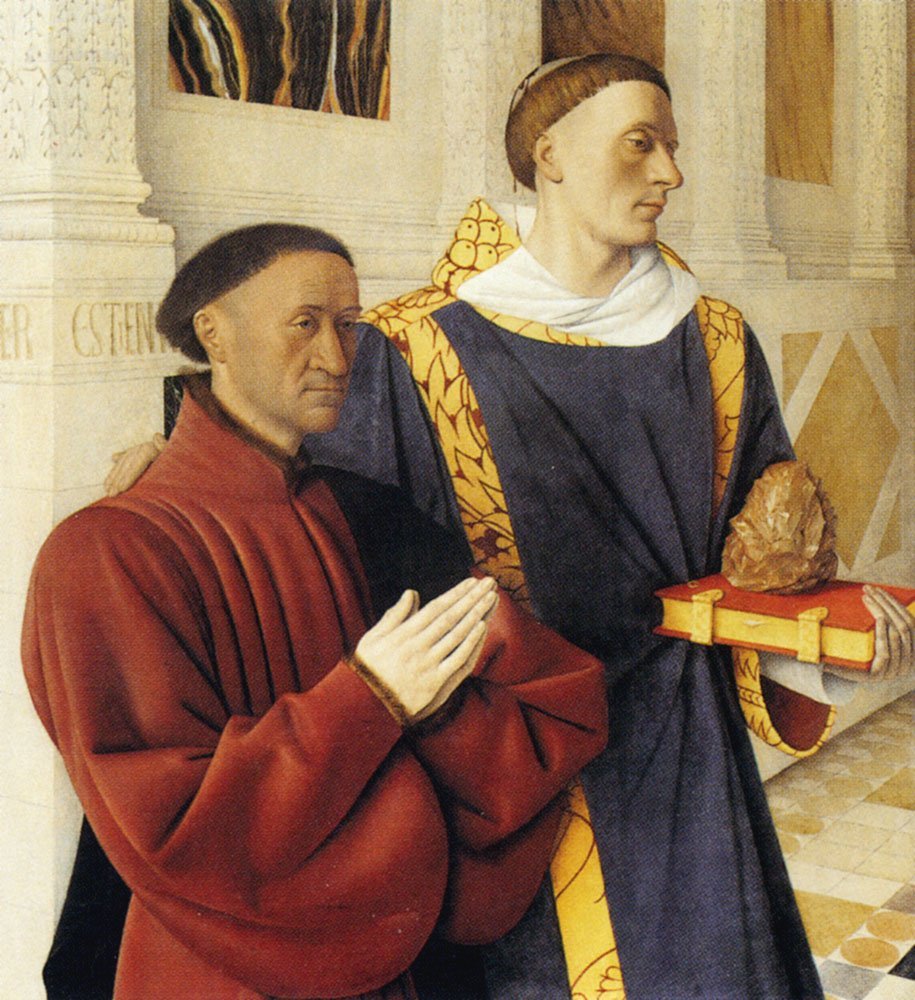
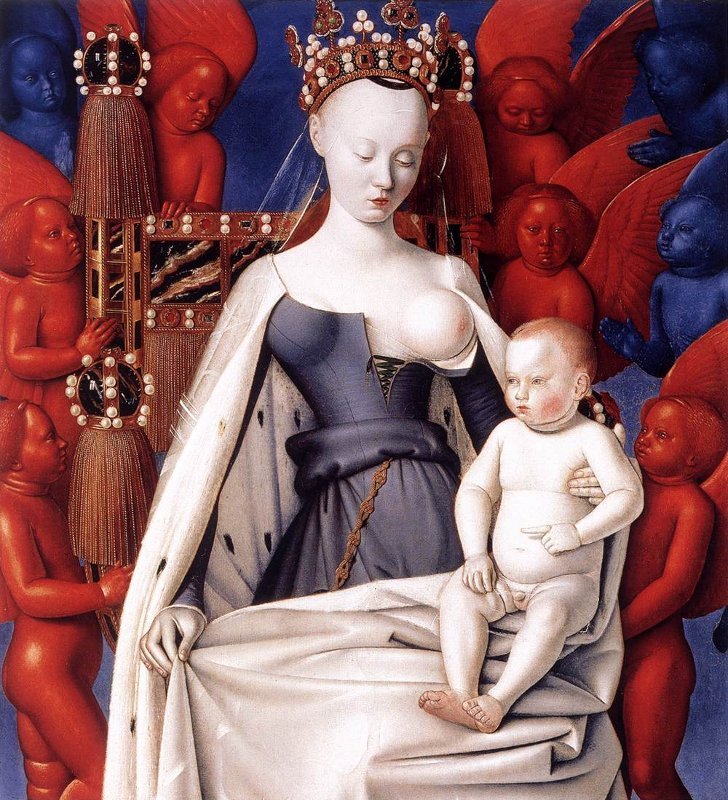
Portrait of Charles VII by Jean Fouquet (c.1445)

In 1445 he completed one of his first very large panel portraits entitled Portrait of King Charles VII.  It was the portrait of the French ruler, Charles VII.  The king is painted between drawn curtains. The artist has painted the king in three-quarters profile and the inscription on the frame “le trés victorieux roy de France” reminded everybody that this was the ruler who brought the Hundred Years’ War to a triumphant end.   Ironically it was one of the few battlefield victories achieved by the ruler.

In 1446, Fouquet accompanied a French delegation, as court painter on a mission to Rome, as records of the trip where chronicled by the Italian artist Antonio Filarete.  The following year, Fouquet completed the commission to produce a portrait of Pope Eugenius IV with his two nephews, which was hung in the sacristy of the Dominican convent of Basilica of Saint Mary Above Minerva in Rome.  It was probably this connection with the Dominican convent that led him to be introduced to the great Italian Renaissance painter and Dominican friar, Fra Angelico, who was at that time working on the frescoes in the chapel of Saint Peter,

When Fouquet returned to France in 1448, he opened a workshop in Tours and married.   He worked for the French court and carried out commissions for King Charles VII, the king’s treasurer Etienne Chevalier, and the king’s chancellor Guillaume Jouvenel des Ursins. A number of these commissions were miniatures, such as the Book of Hours of Étienne Chevalier.  In 1475, Jean Fouquet became the court painter to Louis XI.   Fouquet died in Tours in November 1481.

My Daily Art Display featured painting today is the Melun Diptych, so named as its original resting place was the cathedral at Melun, a town in the south-eastern suburbs of Paris.   This was a commission Fouquet received from Etienne Chevalier.  Estienne Chevalier came from Melun and worked for the government.  His initial posting was as French Ambassador to England in 1445.  Six years later he became Treasurer to Charles VII of France. Once Fouquet had completed the diptych, Chevalier presented it to his home town.  The diptych was made to be placed above the tomb of Chevalier’s wife, Catharine Bude, in the Collegiate Church of Notre-Dame, in Melun.  As I said in my introduction the diptych doesn’t exist anymore as a hinged pair and sadly, another thing we cannot see is the original framing.  According to a description of the paintings by Denis Godefroy, a seventeenth century historian, the original frames were covered in blue velvet. Around each picture were strands of gold and silver thread, in which the donor’s initials were woven in pearls. There were also gilded medallions on which stories of the saints were represented.

The Left wing of the diptych
Etienne Chevalier and St Stephen

Let us first look at the left hand panel of the diptych.  On the left wing of the diptych, Etienne Chevalier had himself painted next to his patron saint, Stephen (“Etienne” when translated into the English language is “Stephen).  Chevalier kneels in a red robe with his hands clasped in prayer.  The red colour of the robe indicates the status of Chevalier as it was the most expensive coloured dye and was reserved for high-ranking magistrates.   Next to him we have Saint Stephen wearing the dark robes of a deacon with its gold trim.  Stephen’s right arm is draped around the shoulders of Etienne Chevalier in a protective manner.   In the left hand of the saint there is a book, on which a jagged stone is lying.  This symbolises his martyrdom (St Stephen was stoned to death).  The background consists of Italian Renaissance style architecture with pilasters, in between which are inlaid marble panels.  The floor is made of neutral coloured tiles, which allows a glaring contrast with the highly coloured clothing of then two figures.  On the wall, receding in perspective, the name of Estienne Chevalier (IER ESTIEN ) is inscribed.   The two men look to their left at the Madonna and Child, who is portrayed on the right wing of the diptych and in some way if we look at the two panel paintings of the diptych together, it appears that St Stephen is introducing Etienne Chevalier to the Madonna and Child.  The plunging perspective Fouquet has used in this painting has in some way moved the two characters closer to us and they dominate the work.

The Right wing of the diptych
Madonna and Child

Now let us look at the right hand wing of the diptych, which is entitled Madonna and Child.  The first thing that strikes the observer is the strange and vibrant colouring used in the painting.  The unnatural colours have been attributed to represent the heraldic colours of the French king, being red, white, and blue.   It is generally agreed by art historians that the features of the Madonna are those of Agnès Sorel.  She was a favourite mistress of Charles VII and bore him three daughters.  She was known by the nickname, Dame de beauté.  In 1450, Charles was away on a campaign at Jumièges.  Agnès Sorel was at her home in Chinon, which the king had provided for her, but she wanted to be with Charles to give him some moral support.    Despite being pregnant with their fourth child and it being a cold mid-winter day, she journeyed from her residence to join Charles at the village of Le Mesnil-sous-Jumièges.  It was here that she suddenly became ill and died at the age of 28.   While the cause of death was originally thought to be dysentery, in 2005 French forensic scientist Philippe Charlier examined her remains and determined that the cause of death was mercury poisoning, but offered no opinion about whether she was murdered.   Agnès Sorel held great influence over the king and many historians believe that this made her many enemies, including the king’s son, the future king, Louis XI, and it could well be that she had been deliberately poisoned by her enemies.  However this theory does not receive unanimous agreement as historians point out that, at that time, mercury was sometimes used in cosmetic preparations or to treat worms and that might have brought about her death.

However there is another theory about the identification of the lady in the painting.  Jan Schafer in his 1994 book, Jean Fouquet an der Schwelle zur Renaissance, stated that he believed that the woman in the painting could have been Etienne Chevalier’s wife, Catherine Bude, over whose tomb the diptych was hung in Notre Dame, Melun.

This right-hand panel depicts the Virgin and Child seated on a jewelled throne with its marble panels and adorned with large gold tassels.  The Virgin and Child are surrounded by red and blue coloured cherubs and seraphims, which greatly contrast with the pale skin of the Virgin and child. The Madonna wears a blue dress, white mantle and a jewel-encrusted crown.  Once again we have the colour combination of red, white and blue.  The bodice of the dress is unlaced, giving us a view of her perfectly spherical left breast, which she has offered to the Child on her knee.  She has the bulging shaved forehead which was fashionable at that time. Her facial and skin tone, as well as the body of the Infant Jesus, are of a pale grey-white colour, as if painted in grisaille (painted entirely in monochrome or near-monochrome).  The colour Fouquet has used to depict her skin and the grey-blue colour he has used to depict her robe gives the Madonna a look of lethargy and sleepiness. The child ignores the proffered breast and instead looks at and points towards Chevalier and St Stephen.

The prominent Dutch historian Johan Huizinga wrote about this panel in his 1919 book entitled Herfsttij der Middeleeuwen which was translated five years later as The Waning of the Middle Ages.  He condemned the work as “blasphemous libertarianism”.  In his book he wrote about how he considered this painting a fine example of decadence in the late Middle Ages, when religious feelings came close to erotic ones. He wrote:

“…No instance of this dangerous association of religious with amatory sentiments could be more striking than the Madonna ascribed to Foucquet…”

“…The bizarre inscrutable expression of the Madonna’s face, the red and blue cherubim surrounding her, all contribute to give this painting an air of decadent impiety in spite of the stalwart figure of the donor…”

“..There is a flavour of blasphemous boldness about the whole, unsurpassed by any artist of the Renaissance…”

And so the two halves of the diptych were split up and never re-united.  Well actually they were, for in 1904, France borrowed the panels from Berlin for an exhibition of French primitives.

There are many unanswered questions with regards to these paintings and the background to their composition:

Was the Madonna based on Agnès Sorel or Catharine Bude?

Did Agnès Sorel die of dysentery during the birth of her stillborn fourth child or was she murdered on the orders of Charles VII’s son, the future King Louis XI?

Was there a third panel and in fact what we are seeing is two parts of a triptych?  The third panel was rumoured to be depicting Etienne Chevalier’s wife Catharine.

Besides Agnès Sorel being King Charles VII’s mistress was she also the mistress of Etienne Chevalier?

I am sure you will agree that we have before us today two beautiful wood panel paintings and the story behind them is fascinating.

What Our Lord Saw from the Cross by James Tissot

What Our Lord Saw from the Cross by James Tissot

My blog today is the first of a two part look at the life and art work of Jacques-Joseph Tissot, later to be known as James Tissot.  In this first part I will look at his life and a religious painting with a difference, which was one of a series he completed  between 1886 and 1894.   In my next blog I will introduce you to the “love of his life”, who featured in a number of his later works.

Jacques-Joseph Tissot was born in 1836, in Nantes, a French seaport on the north-west coast of France.   Tissot was the second of four sons born to Marcel Théodore Tissot, an affluent linen merchant and successful businessman, who owned a country house, Château de Buillon, close to the town of Besançon and Marie Tissot, née Durand, a clothes and hat designer who helped in her husband’s business.  Tissot was brought up in a very religious household with both his parents being devout Roman Catholics.   At the age of twelve he was sent away to a Jesuit boarding school in Belgium, in the town of Brugelette, which in those days was one of the leading seats of learning for children of the Roman Catholic faith and attracted many pupils from different countries.  In her 1985 biography, Tissot by Krystyna Matyjaszkiewicz, she points out that it was at this college that Tissot first came into contact with English children.  She wrote:

“…Pupils at Brugelette included Catholics from England, and it may have been through friendships at Brugelette that Tissot became interested in all things English and began to style himself James, the name he was using by 1854. When new laws enabled the Jesuits in 1850 to open a college at Vannes in Brittany Tissot returned to France and attended school there, subsequently moving to another in Dôle (near Besançon), a bastion of Catholicism….”

His early family life would later have a bearing on some of his paintings such as his beautifully crafted depictions of ships which he would have seen in the local harbour of Nantes and his devout religious upbringing would have given him an interest in religious paintings.

By the time he was seventeen years of age, Tissot had decided to become an artist, much to the annoyance of his father, who had hoped his son would follow in his footsteps and run the family business.  His father eventually relented and in 1855, aged 19, Tissot went to Paris, lodging with an artist friend of his mother, Jules-Élie Delaunay.  He then worked in the studios of the French academic painters, Jean-Hippolyte Flandrin and Louis Lamothe who had learnt their trade as pupils of Ingres.  During his stay in Paris, he would, like many aspiring artists, spend a great deal of time at the Louvre copying the  works of the Old Masters and it was around this time that he met other contemporary artists such Degas, who also had once studied under Lamothe, the American artist, James McNeill Whistler and Édouard Manet.   Four years after arriving in Paris, Tissot exhibited five of his works at the 1859 Paris Salon.

Within a relatively short time he became an admired painter and received a number of commissions for wealthy patrons.  There was also a change in Tissot’s painting style from his medieval-styled works to everyday life seen through his portraiture.  He would depict modern Parisian women as they went about the city and its suburbs and he would spend time perfecting the way he depicted their style of dress, and such an interest in this aspect probably harked back to the days spent with his family clothing business and admiring his mother’s talents as a designer.  Much later in his life, in 1885, there was a major exhibition of his work at the Galerie Sedelmeyer, Paris, where he showed 15 large paintings in a series called La Femme à Paris.  These paintings represented different types and classes of women, shown in their professional and social contexts.

Because I want to save the middle part of Tissot’s life and his love affair with Kathleen Newton, until my next blog, I am going to skip to the year 1885 which is the year in which the artist experienced a re-conversion to Catholicism. It is said that one day, during a church service, he had a vision of Jesus tending to people in a ruined building. It was, Tissot believed, his Road to Damascus.   It was this return to his Roman Catholic beliefs which led him to spend the rest of his life illustrating the Bible. It is not unusual for us to hear of people being struck by this “born again Christian” phenomena but in the case of James Tissot many of his friends found his sudden return to Roman Catholicism, at a time when there had been a French Catholic revival and a coinciding surge in purchasing religious paintings, just too much of a fortuitous coincidence !!  Nevertheless, from then on Tissot devoted himself to painting religious subjects. He totally immersed himself in all things religious and painted works connected with bible.  His biographer, Krystyna Matyjaszkiewiczn wrote of Tissot’s religious fervour:

“…Tissot set off for Palestine on 15 October 1886, his fiftieth birthday.  He returned to Paris in March 1887 with sketchbooks full of drawings and a burning compulsion to illustrate the life of Christ. The idea developed into publishing images of events, places, people, and incidental detail, with extracts from the Gospels and biblical commentaries. Tissot made further visits to Jerusalem in 1888 and 1889. By April 1894 he had completed 270 watercolours, which were displayed at the Champ de Mars, Paris, to awe and amazement…”

Tissot travelled to the Holy Land and this marked the beginning of a 10-year campaign to illustrate the New Testament.  He would return to Palestine and back to Jerusalem and the surrounding area in 1888 and 1889 to make further studies of the landscape and the people.   The culmination of the project resulted in his The Life of Christ collection which was a compilation of 350 watercolours that depicted detailed scenes from the New Testament, from before the birth of Jesus through to the Resurrection, in a chronological narrative.  Two hundred and seventy of them were exhibited at the Paris Salon of 1894.     It is reported that these works of art caused a sensation. Men were described as reverently doffing their hats whilst women wept and knelt before the pictures.  Some women even crawled like penitents through the show.   The exhibition of his biblical works moved to London in 1896 and New York at the end of 1898 before the entire collection was purchased by the Brooklyn Museum in 1900.   In 1897 a French version of the profusely illustrated Tissot Bible was published and a year later an English version was available.   This further enhanced the artistic reputation of Tissot and made him very wealthy.   In the last few years of his life, Tissot worked on paintings depicting scenes from the Old Testament, eighty of which were exhibited in Paris.  He had, by this time, retired to Château de Buillon, the residence he inherited on the death of his father.   Tissot was never to complete the series of Old Testament works as he died at his chateau in Doubs, France in 1902, aged 66.

My featured painting today is one of the biblical scenes from the New Testament completed by James Tissot during the period 1886-1894.   It is an opaque watercolour over graphite on gray-green woven paper entitled What Our Lord Saw from the Cross.  It is regarded as one of the most memorable of the series of biblical images by the French painter.  It is totally different from the normal crucifixion scene paintings when, in almost all cases, we look up at the figure of Christ hanging from the cross.  In Tissot’s painting, we are the eyes of Christ and it us who looks down from the cross at the people below.  By doing this Tissot has allowed us to imagine ourselves in Christ’s place and by doing so we are able to empathise with him and maybe we can imagine what was going through his mind as he looked down upon friends, who had come to lend their support, and his enemies who have participated in his death and had come to gloat at his predicament.

From our viewpoint we look downwards at the crowd.   We see Mary Magdalene, in the immediate foreground, with her long red tresses swirling down her back, kneeling below the feet of Christ, which we can just see at the bottom centre of the painting. Further back we see the Virgin Mary clutching her breast, while John the Evangelist looks up with hands clasped. Some Roman soldiers are looking on, including a centurion who is clad in red. He has a downcast and remorseful expression on his face and Tissot has no doubt placed him at the scene reminding us of the passage in Luke’s Gospel 23:47 which stated:

“…Now when the centurion saw what was done, he glorified God, saying, Certainly this was a righteous man…”

The men on horseback in the right mid ground of the painting are Jewish scribes. They have a look of satisfaction on their faces for Christ was their rival.  These were the very men who had put pressure on Pilate to have Christ crucified.   Their plan had succeeded and their rival had been removed.  Look towards the centre of the background and one can see that Tissot has depicted the entrance to a tomb, the very place in which the body of Christ will be laid to rest after he has been brought down from the cross.

This is truly a remarkable work of art and I would love to go to the Brooklyn Museum to see the complete series.

In my next blog I will tell you about Tissot’s beloved Kathleen Newton, an Irish divorcee, and look at some of his portraits of this woman, who was the love of his life.