Charles Beale by Mary Beale

Charles Beale by Mary Beale (c.1675)

For My Daily Art Display today, I am staying with an English artist but instead of a landscape painter and a man as was the case yesterday I am focusing on a lady artist, one of the most important portrait painters of 17th century England and who has been described as the first professional female English painter.  Her name is Mary Beale and the subject of today’s portrait painting is her husband Charles.

Mary Beale was born in 1633, in Barrow in the county of Suffolk.    Her father was the Reverend John Craddock, who was the local puritan rector.  He was an amateur painter and was acquainted with all the local artists, one of whom was Peter Lely, a portrait painter.  Although Mary Beale was never a pupil of Peter Lely there is no doubt that throughout her life she was influenced by his artistic style.  Her mother was Dorothy Brunton who sadly died when Mary was just ten years of age.

In 1652, at the age of eighteen, she married Charles Beale, a cloth merchant and amateur artist and she went to live with him in Covent Garden, London. The Beales had two sons who survived past childhood, Bartholomew and Charles.  Her husband, Charles became deputy clerk of the patents office in about 1660, by which time Mary had begun to study portraiture.   In 1664, the Beales moved away from London.  Charles had lost his job at the patents office and so they had a loss of income and they decided life would be cheaper in the country, so they moved to a farmhouse in Allbrook in Hampshire.  A second reason for the move was for their own safety as that year saw the onset of the Great Plague in London which was to kill a fifth of the population of London.

In 1670, Mary and her family, returned to London and she set up a studio in Pall Mall.  Here she painted many portraits of the aristocracy and local gentry.  Her husband, not only acted as her assistant, but looked after the business side of her artistic venture and her son Charles trained as an artist in his mother’s studio.  Her work was very popular and she received many commissions.   In her husband’s diary he recorded that in the 1670’s his wife received no fewer than 140 commissions for portraits.   Having returned to London she became reacquainted with Peter Lely who had been made the Court Artist to Charles II and many of Mary’s commissions were to paint copies of Lely’s works.

Mary Beale died in 1699, and was buried at St James’s, Piccadilly. Her husband died in 1705.  The Beales’ first child Bartholomew died when he was young.  Her second son also called Bartholomew studied portraiture but eventually gave up any thoughts of being a full time artist and took up medicine.  Her third son Charles jnr. became a painter specialising in miniatures.

The painting today, simply entitled Charles Beale, is a portrait of her husband.  She has portrayed him as a poet and clothed him accordingly in a style of unkempt abandon.  His disheveled state was that of the preserve of poetic and melancholic genius.  I love the informality of this painting with the sitter’s relaxed pose dressed in a brown gown underneath which we can see an open-necked chemise.  This portrait is in direct contrast to the portraiture norm when the sitter is expected to be shown in a strong courtly pose. This is a portrait that exudes casualness and familiarity which of course one expects of a husband’s portrait carried out by his loving wife.   This portrait has done away with the use of background drapery or Arcadian imagery which was so popular at the time and would no doubt have been included if this had been a commissioned work.  It is an engaging and intimate portrait.  The couple were very much in love and in his notebooks he always referred to his wife as his “Dearest and most Indefatigable Heart”.  There was great equality in their relationship and the fact that after losing his job he “worked” for his wife, which was acting against all contemporary notions of married life. Religious, social and medical teaching stressed the secondary role to be played by women, whose place was determined forever by Eve’s original Sin.   But Charles had no qualms about his position of apparent subservience.  Mary was a firm believer of equality between a husband and his wife and between man and woman outside of marriage.  She even put down her thoughts on the subject in 1660 when she wrote Essay on Friendship.  In Tabitha Barber’s book Mary Beale she quotes Mary’s thoughts on the subject of friendship and equality between husband and wife, writing:

“…This being the perfection of friendship that it supposes its professors equally, laying aside all distance, & so levelling the ground, that neither hath therein the advantage of other…”’

Regarding the relationship in marriage between husband and wife, Mary wrote:

“…In marriage, God had created Eve as ‘a wife and Friend but not a slave…”

Mary Beale painted numerous portraits of her husband Charles which is testament to the deep affection between them.

This painting presently hangs in a private collection.

Madame de Ventadour with Portraits of Louis XIV and his Heirs by The French School

Madame de Ventadour with Portraits of Louis XIV and his Heirs by The French School (c. 1715-1720)

For My Daily Art Display today I am returning to French art and a painting which is attributed to the French School around 1720.  The title of the work is Madame de Ventadour with Portraits of Louis XIV and his Heirs. It has all the grandeur and splendour one would expect in the pre-Revolution days when French life was controlled by the Monarchy.

I suppose the first thing I should talk about is who are all these people standing before us with their dignified regal poses?  In the painting we see four adults and a child in what is meant to look like an elegantly decorated room in the Palace of Versailles.  In the right background we can see the lavish gardens of the palace.  The people in the painting pose like actors playing to an audience and maybe we are that audience who marvels open-mouthed at such opulence.  Seated centre stage, as befits the most important person of the group, is King Louis XIV, the King of France.   Leaning on the back of his chair is his son, Louis, the Grand Dauphin and heir to the French throne.  On the right dressed sumptuously in a red velvet coat with gold brocade is the Dauphin’s eldest son and Louis XIV’s grandson, Louis, Duc de Bourgone who is second in line to the French throne.  The lady on the left is the lady of the title of the painting, Madame de Ventadour, who was the governess to the royal children and finally, the child in front of her, who is actually a boy despite the dress, and he is the great grandson of Louis XIV, Louis, the Duc d’Anjou, who would later become King Louis XV.  Two other personalities are present in the painting but only in the form of busts.  On the plinth in the left background we have the bust of King Henri IV, the deceased head of the Bourbon dynasty and on the plinth to the right we have the bust of King Louis XIII the deceased King of France and Louis XIV’s father.  Madame de Ventadour can be seen to the left of the painting but more about her later.

Louis XIV’s father Louis XIII had an arranged marriage with Anne of Austria when he was only fourteen years of age.  Anne suffered four miscarriages and the Royal couple waited twenty-eight years for their first child, Louis, to be born in 1638.  Five years after the birth of his son, Louis XIII died.  An amusing anecdote is related regarding the deathbed scene of the forty-one year old Louis XIII and his five year old son.  The dying man asked his son did he know who he was, the little boy replied:

“….Louis the Fourteenth, Father….”

To which his father quickly retorted:

“…You are not Louis the Fourteenth, yet….”

Louis came to the throne as Louis XIV on the death of his father at the age of four and ruled France for just over seventy-two years from 1643 to 1715 and as such, it is one of the longest recorded reigns of any European monarch.  He was known as the Sun King as he identified himself with the Sun God Apollo and it was probably in his honour that the picture of Apollo riding his chariot, which we see on the rear wall, was incorporated into the painting.

As the title of the painting states, this is a painting depicting Louis XIV’s heirs.  Actually we are looking at members from four generations.  We have the king seated, his son with the white wig, his grandson with the red coat and his great grandson the small child.   So why did this little boy, the king’s great grandson, become the next king on the death of his great grandfather?    The reason is simple but in some ways tragic.   Louis XIV lived a very long life, dying just four days before his seventy-seventh birthday in 1715.  His eldest son, the man standing behind his chair in the painting died of smallpox in 1711, aged 49.  The next in line for the throne would have been Louis XIV’s grandson, the Duc de Bourgogne, the man in the painting wearing the red coat, but he, his wife and one of their sons died of a measles epidemic in 1712.  This meant the little five year old boy, Louis duc d’Anjou, who we see in the painting with his governess Madame de Ventadour became Louis XV.

But why is this lady included in this royal portrait?  Like many of her family, Madame de Ventadour was the Gouvernante des enfants royaux, (Governess of the Children of France).  She became the royal governess in 1704.  It was amusing to read about her husband, Louis, Duke of Ventadour for though through marriage she became a duchess, she had a lot to put up with.  In L C Syms’ book of 1898 entitled Selected Letters of Madame de Sévigné  (Madame de Ventadour’s daughter) one letter described the Duke de Ventadour  as being

“horrific — very ugly, physically deformed, and sexually debauched”

However, she was credited as having saved the life of the soon to be Louis XV at a time when his elder brother, father and mother all succumbed to the deadly disease. The family was treated by the royal doctors, who bled them in the belief that it would help them to recover; instead, it merely weakened them and reduced their chances of survival.  She decided that she would not allow the same treatment to be applied to the two year old Duke of Anjou so Madame de Ventadour locked herself up with three nursery maids, and refused to allow the doctors near the boy.

The painting was commissioned to celebrate the role of the lady in ensuring the continuation of the Bourbon dynasty.  It is interesting to see how the seated king and the young child point to each other.  Maybe that symbolises the connection between great grandfather and his great grandson in as much as the crown passed between these two and circumvented the other two men in the painting.   If we want to look at symbolic connections in this painting, look how the bust of Louis XIII on the right hand pedestal, the seated Louis XIV and the little boy, Louis XV, the three consecutive French monarchs,  are connected by an imaginary diagonal line – just a coincidence ?

The painting can be seen by visiting the Wallace Collection in London.

Gathering on the Terrace at 47 Downshire Hill, Hampstead by Richard Carline

Gathering on the Terrace at 47 Downshire Hill, (1925) by Richard Carline

If you go back to My Daily Art Display for August 5th and the painting by Sir Stanley Spencer, you will find a mention of Richard Carline, as Spencer married his sister Hilda.   Richard Carline was born in Oxford into a family of artists.  It was an artistically talented family.  Richard Carline’s parents, George and Annie Carline were both artists who married in 1885 and had five children and the three youngest of these Sydney, Hilda and Richard all became respected painters.

Richard Carline’s works included landscapes and portraits, often of his contemporaries.  In 1913 Richard Carline enrolled at the Percyval Tudor-Hart’s Académie de Peinture et de Sculpture, in Paris.  Following a short period teaching, Carline served in World War I where he was appointed an Official War Artist.   Along with his brother he became well-known for his war pictures from the air.   In the 1920’s, the Carlines’ Hampstead home at Downshire Hill became a focus point for artists such as Henry Lamb, John Nash, Stanley Spencer and Mark Gertler who would have regular meetings there to discuss the arts.  It was during this time that Carline was clearly influenced by Stanley Spencer, transforming everyday scenes into something monumental.  Unlike Spencer, Carline achieved this without actually exaggerating figures or their gestures to the degree that Spencer did.  In 1924 he started a five year stint teaching at the Ruskin School of Drawing at Oxford.   His first solo exhibition came about in 1931 at the Goupil Gallery in London.  During the Second World War Carline supervised camouflage of factories and airfields. When the war was over, he was involved in helping to found the Hampstead Artists’ Council in 1944.   In 1946-47 he was appointed as the first Art Counsellor to UNESCO, and from 1955 to 1974 was chief examiner in art for the Cambridge Local Examinations Syndicate.   He also published a number of books including Pictures in the Post: the Story of the Picture Postcard, 1959;  Draw They Must, 1968; and Stanley Spencer at War, 1978.  The latter, I bought off eBay last week !!

Richard Carline died in 1980 aged 84.

The Carline family home, which George and Annie Carline bought in 1916, was 47 Downshire Hill in Hampstead, London and it was here that many artists would meet and discuss art, politics, religion and life in general.   One of the regular visitors, the Australian-born British painter, Henry Lamb,  described the artistic meetings as a veritable cercle pan-artistique.   Many of the group would embark on painting holidays together.

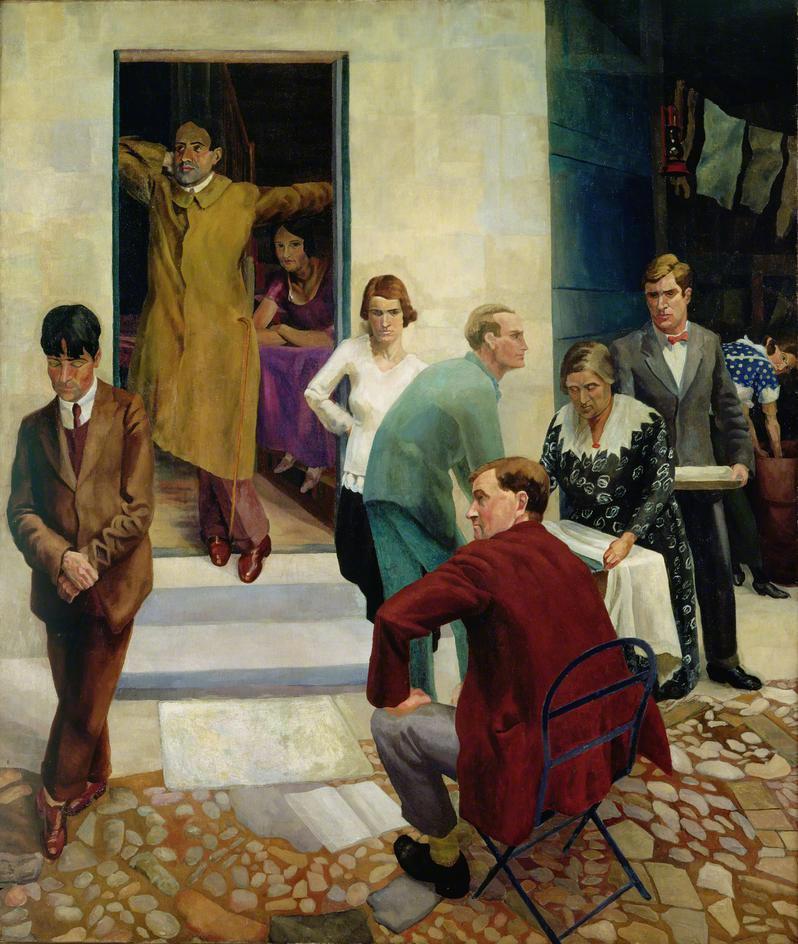
My Daily Art Display featured painting today by Richard Carline, entitled Gathering on the Terrace at 47 Downshire Hill, Hampstead,  shows one such meeting of the Downshire Hill Circle.  The painting was judged as one of Carline’s most impressive works.  Before us we have a group portrait. From left to right we have Stanley Spencer, James Wood, Kate Foster, Hilda Carline (later to become Mrs Stanley Spencer), Henry Lamb, Richard Hartley, Annie Carline and Sydney Carline.   Richard Carline was meticulous in his preparations for this work.  He painted an oil study of each of the group before slotting them into his group portrait.  His 1924 preparatory oil study of Stanley Spencer for this group portrait is also a stand-alone painting of his, entitled Study of Stanley Spencer.  Looking at the study one has to presume that he hadn’t  quite properly calculated the height of the preparatory study as he had to add Spencer’s shoes separately alongside the figure.

What enhances this group painting is the varied but individual characterization of each person.  This was not done by accident as Carline said his intention was to somehow convey the individuality of the people assembled at his parent’s house.  In his own words Carline described the group portrait:

“… [I] sought to convey the conflicting personalities gathered at our house – Stanley [Spencer] peering up and down as he expounded his views on this or that, James Wood hesitating in the doorway whether to come or go, Hilda absorbed in her own thoughts, Hartley sitting at ease, Lamb courteously attentive to my mother, with Sydney always helpful…”

This paintings, Gathering on the Terrace at 47 Downshire Hill, Hampstead , along with the Study of Stanley Spencer, are housed in the Ferens Art Gallery in Hull.  It is a gallery I have never visited but looking at their website it is one I will put down as a “must visit” location.

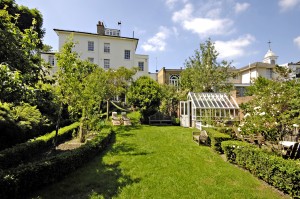
Finally, I always like to imagine what a place, depicted in a painting, looks like today.  I did this with my entry about Renoir’s boathouse in his painting Luncheon of the Boating Party which I featured in My Daily Art Display of August 2nd, so I wondered what the house at 47 Downshire Hill looks like today.  So below is a picture of it I found of it on the internet!

The present Downshire Hill house and garden

The Bellelli Family by Edgar Degas

The Bellelli Family by Edgar Degas

Today, My Daily Art Display looks at a painting by a French Impressionist painter who, to me, is synonymous with paintings and sculptures of young ballet dancers.  His name is Edgar Degas who was actually born Hilaire-Germain Edgar De Gas in 1834.  He was in the forefront of the Impressionism movement although he preferred to be labelled as a realist painter.  He worked on today’s featured painting between 1858 and 1867.  It is entitled Family Portrait or The Bellelli Portrait and is a masterpiece of Degas’ youth.  It is a deeply insightful family portrait, in which we observe four people, two adults and two children who are the family Bellelli.

Degas had a traditional École des Beaux-arts education in Paris and in 1856 travelled to Italy to continue his studies and the following year visited his grandfather, Hilaire Degas, in Naples.  He also spent time in Rome where he set about copying the work of the Renaissance Masters.  In 1858 he received an invitation from his aunt, Laura Bellelli, née De Gas, to visit her and her family in Florence and at the same time to take the opportunity to study the paintings in the city’s prestigious gallery, the Uffizi.  He jumped at the chance and so went to stay with the family.  The head of the household was Laura’s husband, Gennaro, who had been a political journalist as well as a fervent supporter and good friend of Camillo Benso, Count of Cavour, a leading figure in the movement towards Italian Unification.  When in 1854 the revolution against the Austrians failed, Gennaro was forced to flee from Italy to escape persecution by the Austrians over his participation in the failed uprising.  He first went and lived in exile in Paris but later returned to Florence.

Degas did not get on well with Gennaro and only remained at their rented house until the arrival of his cousins who had remained in Naples following the death of Degas’ grandfather, Hilaire.  Degas’ could sense the tension between Gennaro and his aunt Laura who once she confided in Degas about her relationship with her husband and her uncertain future saying:

“…my husband is “immensely disagreeable and dishonest… Living with Gennaro, whose detestable nature you know and who has no serious occupation, shall soon lead me to the grave….”

Part of the problem was that this exile in Florence separated her from her family back in Naples and to make matters worse, Laura was once again pregnant.  It is thought that the constant tension between her and her husband led to the death of the child in infancy and this tragic loss only added to the bitterness between husband and wife.  It was with this lack of domestic happiness in mind that Degas started this family portrait.

Before us we see the four members of the Bellelli family, Gennaro, his wife Laura, the sister of Degas’ father, and their daughters Giulia and Giovanna.  It is known that Degas made many sketches of the family before returning to Paris to work on the painting.

We see Laura dressed in mourning for the recent death of her father, and Degas’ grandfather, Hilaire, and in the background we can see a framed portrait of him.  Looking closely at how Degas has depicted his aunt.  We see a very dignified woman with a very stern countenance.  She stands upright as if posing for an official picture.  She coldly averts her gaze away from her husband. Her right hand rests protectively on the shoulder of her elder and favourite daughter, Giovanna.   Degas’ two young cousins are depicted with their mother, and are also dressed in mourning, in their black dresses and white pinafores. Giulia half sits on a small chair at the centre of the painting, arms akimbo, as she looks towards her father and in some ways forms a link between the two estranged adults.  Degas was very taken with his cousins describing them:

“….The elder one was in fact a little beauty. The younger one, on the other hand, was smart as can be and kind as an angel. I am painting them in mourning dress and small white aprons, which suit them very well…I would like to express a certain natural grace together with a nobility that I don’t know how to define….”

Note how Degas has positioned the husband and wife far apart in the painting, which was probably an acknowledgement of the tension between the couple and how the two had drifted apart.  There is no feeling of togetherness about the family.    The father sits in an armchair at his desk next to the fireplace, where he had been reading or writing a letter.   He has his back to us but his head is turned towards his daughter.  He appears unmoved and uncaring, showing little interest in what is going on around him.    His body is framed by a mantelpiece on which we see an ornate clock, some plates and a candlestick.  Over the mantelpiece there hangs a large mirror and in the mirror we see reflections of the room which in some way open up the space and fills it with more light.  We see reflections in the mirror of a curtained window, a chandelier and a framed painting.

It is interesting to look at how Degas has seemed to separate the husband from the rest of the family by a vertical separation formed by the leg of the table, the candlestick and the vertical side of the fireplace and mirror.   Just behind his chair, on the floor, we catch a glimpse of the family’s pet dog.  The drawing which we can see hanging on the wall behind Laura is a portrait of the recently deceased Hilaire Degas, which his grandson had drawn.  It is more than likely that Degas positioned this small picture where he did so as to give a sense of connection between the various generations of the Degas family.

Laura must have been appalled that Degas had to stay in a household, which exuded such unhappiness.   It is believed that Laura married Gennaro in desperation because her father had not been satisfied with any of her previous suitors and she was still unmarried at the “ripe old age” of 28.   She was extremely unhappy in her marriage and once shared her misgivings with Degas.   According to the American biographer and art historian, Theodore Reff, who wrote about a letter from Laura to her nephew, in his book , Degas: The Artist’s Mind .   In the letter she wrote:

 “…You must be very happy to be with your family again, instead of being in the presence of a sad face like mine and a disagreeable one like my husband’s…”

 It is thought that this family portrait was not to be a gift to the family but a work of art which he wanted to exhibit at the Paris Salon.  Whether he ever did that is uncertain but many believe he put it forward for exhibition at the Salon in 1867.  Degas kept hold of the painting until 1913 when he gave it to his art dealer, Paul Durand-Ruel, for him to sell.  In 1918 it was sold to the Musée du Luxembourg, Paris  and later the painting was moved to the newly opened Musée d’Orsay where it can now be found.

One should remember that this is not a photograph in which one can detect the mood of the sitters.  This is a painting by an artist who has the ability to paint the demeanour of his sitters in whatever way he chooses.  So this painting is how Degas views the family life of the Bellelli family.  How close it is to realism is known only by Degas and the Bellelli family.  So it is up to you  to decide whether Laura was a stern and disillusioned matriarch and whether Gennaro was the disinterested and curmudgeonly.