James Tissot and Kathleen Newton

Kathleen Newton in an Armchair by James Tissot (1878)

My blog today is the second part of the life of the French painter James Tissot.  In my last offering I looked at one of his beautiful and unusual religious paintings and I told you a little about the life of the artist but purposely left out his relationship with the special lady in his life, which I wanted to save for today.

In 1870 France was in turmoil.  The Franco-Prussian war had broken out, which was the conflict between France, under Napoleon III and the Kingdom of Prussia and was the final straw in the conflict between the two nations.  France was defeated and Paris was eventually occupied by the Prussian army.  Tissot was a member of the Garde Nationale which was tasked with defending the French capital and later became a member of the Paris Commune, which was a quasi-government that briefly ruled Paris and acted as protectors of the Parisians and their property from March to May in 1871.   However, Tissot, whether through business reasons or concerns he had for his personal safety, decided to leave his homeland and that year went to England where, through his art, he had built up a network of friends and business contacts.  One of these was Thomas Gibson Bowles, the proprietor of the popular magazine Vanity Fair.  Bowles not only provided Tissot with a place to stay in London but he also employed him as a caricaturist on the magazine.  Whilst in London Tissot also exhibited at the Royal Academy.  As was the case when he was in France, Tissot depicted in his paintings many of the chic ladies of London and he was a genius in the way he depicted them bedecked in the most expensive and sumptuous clothing which he carefully detailed.   These paintings were very popular and soon, through their sales, he managed to buy his own house in St John’s Wood, which, at that time, had become a popular and much sort after enclave for artists.  Tissot was not only admired as a great artist by the London Society but through the auspices of Thomas Bowles he was given entry into the social and artistic circles of London.

This particular time, 1874, was the starting point for the French Impressionists and his friend Degas tried to persuade Tissot to exhibit at their first exhibition but he declined the offer.  His decision to refuse to exhibit did not in any way cut him off from his Impressionist friends as he remained great friends with Berthe Morisot who visited him at his London home and also he remained very friendly with Edouard Manet.  The following year, 1875, the two travelled to Venice on a painting trip. It was around 1875 that he first met Kathleen Newton, a stunningly beautiful divorcee and it was Tissot’s relationship with her that afforded him, as an adult, his only period of a real family life.  She would dominate the subject matter of his paintings.
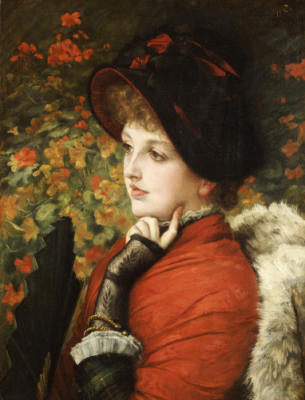
A Type of Beauty by James Tissot (1880)

Kathleen Irene Ashburnham Kelly was born in 1854 and brought up in Lahore and Agra.  She was the youngest of five children and came from an Irish Catholic family.   Her grandfather, Charles Kelly, left Ireland and practiced medicine in London. His son, and Mary’s father, Charles Frederick Kelly joined the East India Company and was stationed in Lahore where he worked as a clerk.  He married Flora Boyd, whose family came from the North of Ireland, and the couple had five children, Charles (Charley), Frederick WD (Freddie), George Lloyd (George), Mary Pauline (Polly) and Kathleen Irene (Kate).   In 1858, Charles Kelly, who had now added the family name “Ashburnham” to his own name, was transferred to Agra.   Kathleen’s father finally achieved the rank of chief adjutant and accountant officer in Agra and eventually retired around 1865, left India and returned with his wife and daughters to live in London.  When Kathleen was sixteen she travelled back to India to marry Isaac Newton, who was a surgeon attached to the Indian Civil Service. This was to be an arranged marriage orchestrated by her father and she had little or no input into the choosing of her future husband.

During the sea passage to India she was befriended by a Captain Palliser of the Bengal Rifles regiment who was returning to the sub-continent to rejoin his regiment.  (Other versions of her life state that Palliser, although a captain, was a naval officer).  Their friendship grew during the long sea passage and they became lovers and despite his pleas to her to cancel her wedding plans, she and Isaac were married in January 1870.  Being a devout Catholic, Kathleen decided to tell the local priest of her affair with Captain Palliser.  For him to forgive her of her sins the priest told her she should first tell her husband about this relationship.  She took the priests advice and told her husband who was horrified and as their marriage had not been consummated; her husband immediately instigated divorce proceedings on the grounds that his wife had not been a virgin on her marriage day.  Kathleen returned to England, the sea passage being paid for by the lovestruck Captain Palliser, who accompanied her, as a gesture of good will for her agreeing to be his mistress.  Their affair continued and she became pregnant but still refused to marry him.    When she arrived back in England she went to stay with her father, who was at the time courting a widow.  Kathleen’s daughter Muriel Mary Violet Newton was born there on 20 December 1871, which was also the same day as her Decree Nisi came through.   Later Kathleen and her daughter Violet went to live with her sister Polly and her husband at Hill Road, St John’s Wood.
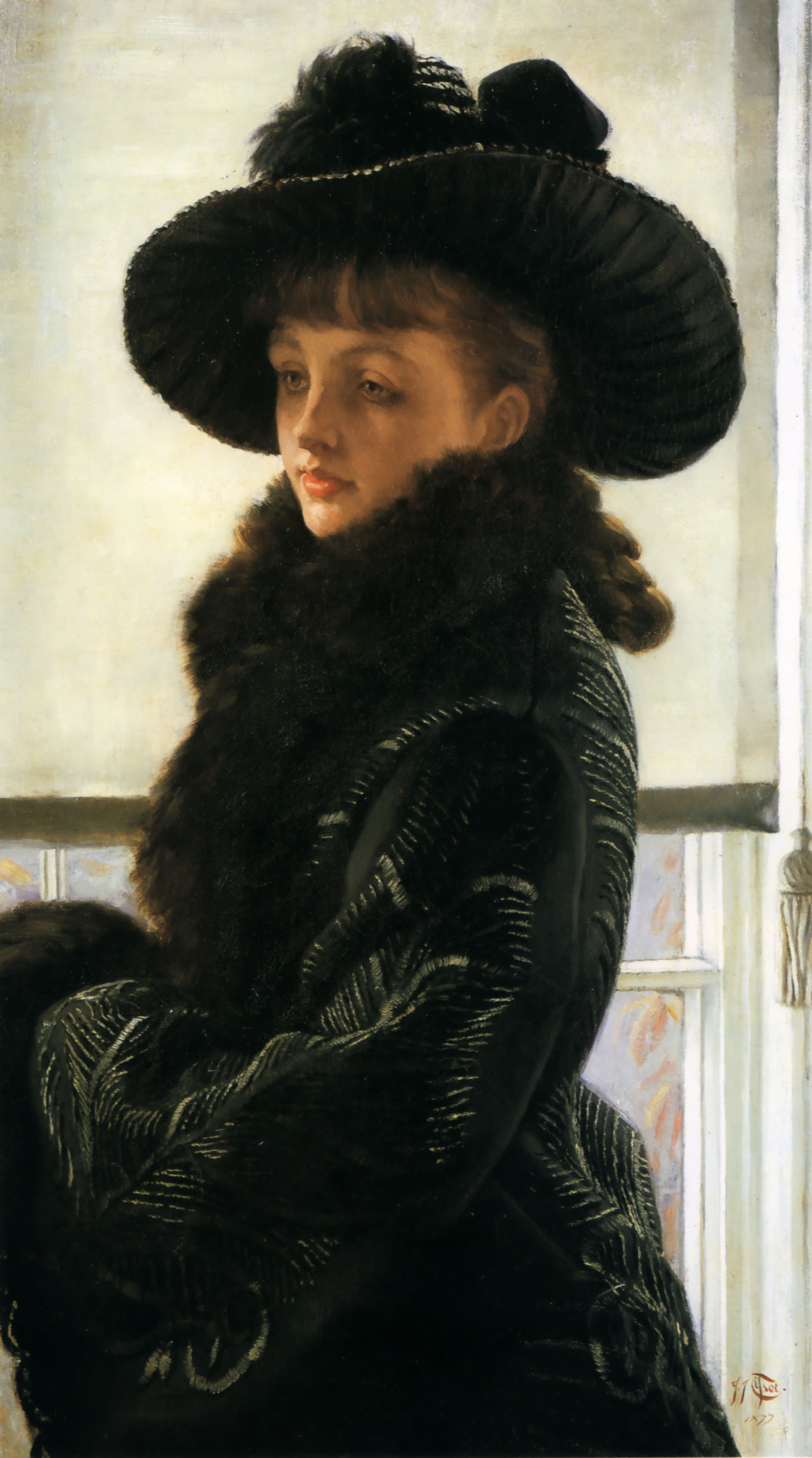
Mavourneen (Portrait of Kathleen Newton) by James Tissot (1877)

It was about four years later around 1875, that James Tissot, who was also living in St John’s Wood, London, met Kathleen Newton née Kelly.  The next step in their relationship came in March 1876 when Kathleen gave birth to a son, Cecil George Newton Ashburnham, who it is believed had been fathered by Tissot. Kathleen and James Tissot became lovers and she moved in with Tissot.  (It should be noted that census records cast some doubt whether they lived together and it is thought that Kathleen’s two children spent most or all of their time living with their aunt Polly and her family).   For Tissot, as was the case with Captain Pallister some five years earlier, he was smitten by this stunningly beautiful young woman.  His terms of endearment for her were mavoureen (Irish Gaelic for my love) and his native French phrase ravissante Irlandaise (lovely Irish).  Kathleen Newton became the love of Tissot’s life, his muse and adored lover.  Tissot described his time with Kathleen as one of “domestic bliss” and the happiest times of his life.  He completed many paintings featuring Kathleen of which I have featured some in my blog today.
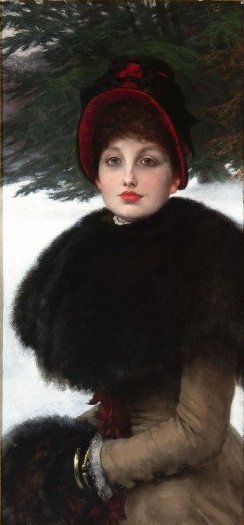
A Winter’s Walk by James Tissot (1878)

There was one great setback with his relationship with Kathleen for James Tissot.  Although it was not uncommon for successful and wealthy men to keep a mistress they did not, like Tissot, parade them around openly and advertise their liaison.   Tissot’s open and very public display of his affair with Kathleen shocked the London society which had once welcomed him with open arms and he had to choose between his social life and Kathleen.   For Tissot there was no question as to which course of action he would choose.  Kathleen was the love of his life and he chose her over life amongst London society.  He and Kathleen settled down to a life of domesticity and were happy to mix with their many artistic friends who continued to support them.  They never married and this may be due to their rigid Roman Catholic upbringing and beliefs.

Kathleen Newton in the Garden by James Tissot

This charming painting shows Kathleen sitting on a rug in the garden next to her daughter Violet.  The other small girl holding the parasol is her niece, Lillian Hervey. Sitting on the wall is her sister, Mary Hervey (Polly), who you can see ruffling the hair of Cecil George Newton who is thought to be the son of James Tissot.

————————————————————————————————————————————–

In the late 1870s Kathleen’s health started to deteriorate with the onset of tuberculosis.  Tissot remained devoted to her.  In 1882, Kathleen’s health declined rapidly with the onset of consumption.  The illness gave her great pain and Tissot was visibly distraught by the physical state of his wife and her sufferings.   Kathleen was aware that she was dying and she was saddened to witness how heartbroken her husband was, witnessing her long lingering death and so in November 1882, aged just twenty eight, she took an overdose of laudanum and died.  Sadly because she had committed suicide she was not able to be buried in consecrated ground.
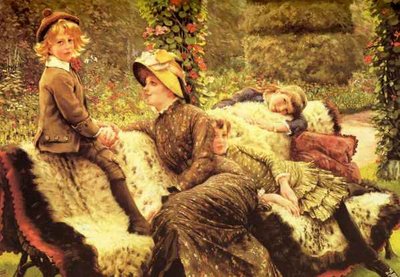
The Garden Bench by James Tissot (1882)

The painting above shows Kathleen Newton and her children, Cecil George and Violet and her niece, Lilian Hervey, the daughter of her sister Polly.  Although Tissot exhibited the painting, he would not sell it and kept it with him as a memorial until his death.

————————————————————————————————————————————–

One week after Kathleen’s death, Tissot left his London home at St John’s Wood, and never returned to it. The house was later bought by the artist Alma-Tadema.  Tissot was inconsolable and never really recovered from Kathleen’s death. Tissot never married and like many people who are devastated by the loss of a loved one he turned to Spiritualism, and on a number of occasions tried to contact his beloved Kathleen.

This somewhat sad story about a French artist and his fallen women is one of the great 19th century English love stories.   My interest in James Tissot was born out of a comment I received from Lucy Paquette who said she was publishing an eBook this autumn, entitled Hammock, a novel based on the life of James Tissot.  I hope, like me, you will be looking out for this publication.

Patricia O’Reilly has also written a novel about Kathleen Newton entitled A Type of Beauty: The Story of Kathleen Newton (1854-1882) which I am hoping to buy as novels based on lives of artists or one of their paintings always fascinate me.

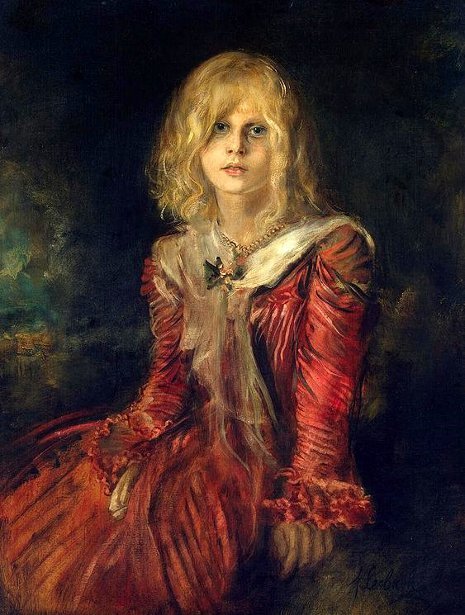
The Family Portraits of Franz von Lenbach

The Artist with his Wife Lola and his Daughters Marion and Gabriele (1903)
Städtische Galerie im Lenbachhaus

My recent blogs have in some ways been connected.  I will be in the middle of researching one artist when I come across another, who I feel I just cannot ignore and so my next featured artist has already been decided upon before I have completed my research on the current one.  A few blogs back I looked at the life of Frida Kahlo.  Whilst looking at literature concerning her and other female artists I came across Gabriele Münter and from her I focused on her one-time lover Wassily Kandinsky.  On looking at his life I found that one of his early art tutors was Franz von Stuck and he was the subject of my last blog.  I had decided to stop this train of thought when choosing a new artist but then during my research on von Stuck I stumbled across a contemporary of his, Franz von Lenbach and although I had decided to stop this system of choosing artists I found his portraiture awesome, especially his depiction of his own family.  I just could not pass up the chance of introducing this German painter to you and share with you some of his wonderful family portraiture.

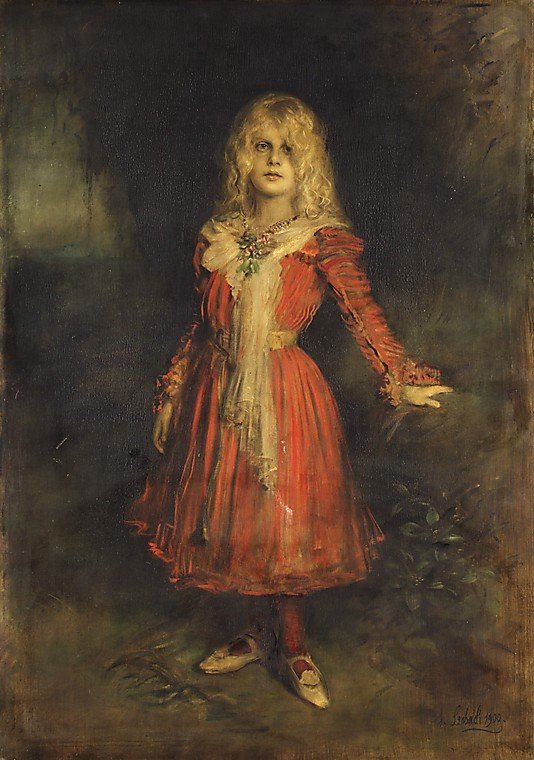
Marion Lenbach by Franz Lenbach

Franz Lenbach or to give him his full title, after ennoblement, Franz-Seraph Ritter von Lenbach was born in 1836 in the small town of Schrobenhausen which lies about forty miles north of Munich.  His father was a master builder and stonemason.  Initially Franz had planned to follow in his father’s footsteps and become a master builder himself and accordingly in his early teens, he enrolled at the Landshut Technical College to study the art of stone masonry and architecture.  At the age of fifteen he began to concentrate on sculpture and started to work in the studios of the German sculptor, Anselm Sickinger.  If it had not been for his elder brother, Karl August Lenbach, who was a painter, then maybe Franz would have carried on in his father’s profession.  However his brother introduced him to John Baptist Hofner, the German painter of animal and genre scenes and who had previously studied at the Akademie der Bildenden Künsten in Munich and it was he who introduced Franz Lenbach to drawing and painting.  Hofner and Franz Lenbach would often spend time going off together on painting trips and Hofner taught Lenbach the skills of en plein air painting.

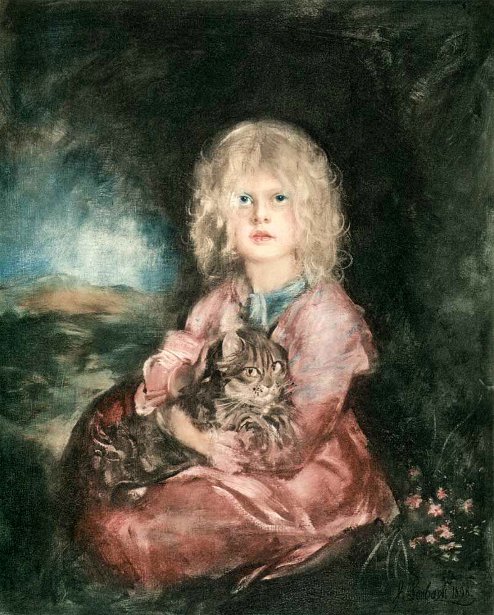
Marion With Cat by Franz Lenbach

For Franz Lenbach to gain admission to the Akademie der Bildenden Künsten he needed some formal groundwork training in art and so, in 1852,  at the age of sixteen, he enrolled at the Polytechnische Schule in Augsburg, following which he trained in the studio of Albert Gräfle, the Munich portraitist.  Finally Franz enrolled at the Munich Academy of Fine Arts in 1854.  Three years later he was studying under the great German historical painter Karl Theodore Piloty.  From the sale of one of Lenbach’s works, Peasants Trying to Take Shelter from a Thunderstorm in a Chapel and a scholarship, he managed to accumulate enough funds to go Rome with Piloty and Piloty’s brother Ferdinand, who was also an artist.  So impressed was Theodor Piloty with the artistic talents of Lenbach that in 1860, he put Lenbach’s name forward for the post of professorship of the Kunstschule in Weimar, which had just been opened.  Lenbach took the position and remained there for two years but by the end of this tenure he realised that life in academia as an art professor was not for him.

Gabriele Lenbach in Armour by Franz von Lenbach

It was around this time that Franz Lenbach met Adolf Friedrich, Graf von Schack,  who was a German poet, historian of literature and an avid art collector.  Schack had wanted to build up a formidable art collection for himself and although extremely wealthy he could not afford to buy paintings by the Old Italian Masters so he approached Lenbach and other aspiring young artists to set about copying some of his favourites.  Once Lenbach agreed to carry out this commission he was sent to Rome to start copying some of the famous works.  Here he met some other artists, such as Arnold Böcklin and Anselm Feuerbach who had also been commissioned as copyists by Schack.  So pleased was Schack with what Lenbach produced he sent him to Florence in 1865 to carry on the good work.

Marion Lenbach, the Artist’s Daughter by Franz von Lenbach (1900)

Whilst working in Florence Lenbach met Karl Eduard Baron von Liphart, a central figure of the German expatriate art colony in Florence, and it was through him that Lenbach picked up some lucrative portraiture commissions.  From Florence he travelled to Spain in 1867 with Ernst von Liphart the son of his benefactor.  The following year he and Liphart along with his patron, von Schack went to Tangiers. When he returned from North Africa he moved to Vienna and began to concentrate on his portraiture work.  Many famous people sat for Lenbach including Richard Wagner, Emperor Franz Joseph I, Ludwig I, King of Bavaria, Emperor Wilhelm I and he completed almost a hundred portraits of Otto Fürst Bismark.  It was during this period that Lenbach became recognised as the most famous contemporary German portrait painter.

Städtische Galerie im Lenbachhaus
Munich

In 1882 Franz Lenbach was ennobled, and became known as Franz von Lenbach.  Four years later in 1886 he procured himself an estate in Munich and with the assistance of his friend Gabriel von Seidl, the German architect, he designed and had built a Florentine villa which took almost four years to complete.  The city of Munich acquired the building in 1924, and today, the Lenbachhaus houses the city’s gallery.  In 1900 he won the Grand Prix for painting in Paris.   Lenbach died in Munich on May 6, 1904, aged 67.

My featured paintings today are not the ones Lenbach did of famous politicians and rulers of various countries but the intimate portraits of his family.    Lenbach had married twice and had three daughters, Marion, Erica and Gabriele.  His daughters and his second wife, Charlotte (Lolo) Freiin von Hornstein appear as models in many of his paintings and it some of these beautiful portraits that I have included in today’s blog.

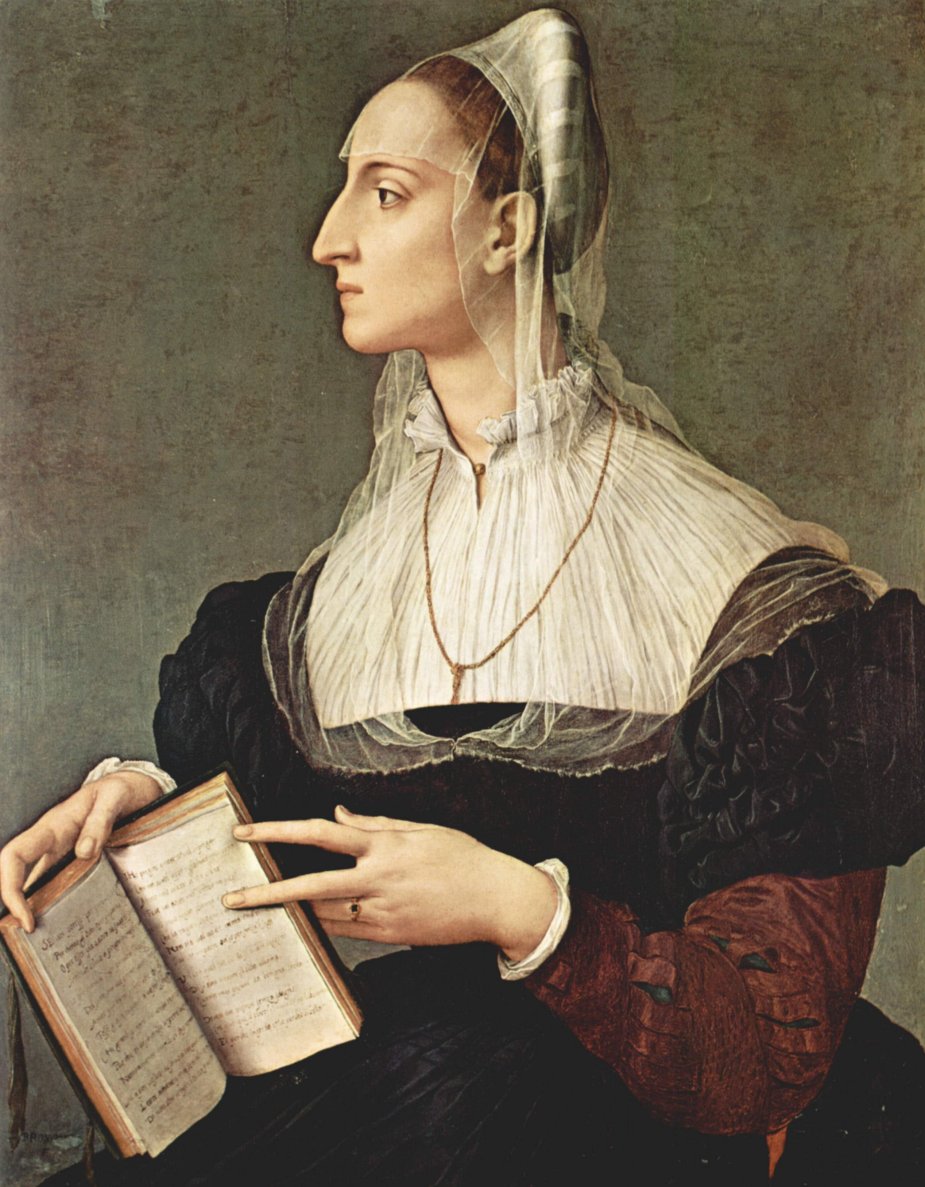
Portrait of Laura Battiferri, wife of the sculptor Bartolomeo Ammannati by Agnolo Bronzino

Portrait of Laura Battiferri by Agnolo Bronzino (c.1560)

My featured painting bears a strange resemblance to the painting I looked at in my last blog although they were painted about thirty years apart by two different Italian artists.  It is not unusual to see paintings featuring the same sitter or views of certain buildings or particular landscapes painted by different artists but it is somewhat unusual to look upon two portraits of two different women featuring a similar gesture towards a certain object which has been included in both of the works of art.  Sounds a little confusing?  Ok let me say that if you have just stumbled on to this page without looking at my previous blog (June 25th  Portrait of a Woman with a Volume of Petrarch by Andrea del Sarto) then go to that one first and read about that particular painting before you read more about today’s offering.

I am sure having now looked at the two paintings you can see the unusual similarity – the book and the pointing fingers.   My featured work of art today is a portrait completed by Agnolo Bronzino around 1560 and is entitled Ritratto di Laura Battiferri, moglie dello scultore Bartolomeo Ammannati  (Portrait of Laura Battiferri, wife of the sculptor Bartolomeo Ammannati) and is housed in the Palazzo Vecchio in Florence.  It is part of the Loeser Bequest of Palazzo Vecchio which comprises of over thirty works of art that the American collector Charles Alexander Loeser bequeathed to the Florence City Council on his death in 1928.  The idea behind his bequest was that he felt it would play a part in the enhancement and reconstruction of the ancient atmosphere of Palazzo Vecchio, which the Florentine Council was carrying out at that time.   One of the conditions Loeser made was that he laid down procedures for the layout of his bequest, which was to be displayed in several rooms in Palazzo Vecchio, and that they were to be kept united in perpetuity, in an arrangement that would give the area not the habitual appearance of a museum but as he put it, it would  make each room appear “simply beautiful for the repose and enjoyment of the visitor”.

Before we look at the painting in detail I suppose the first question one asks when we look at this work of art is, who was Laura Battiferri and why would the great Italain Mannerist painter, Bronzino,  depict her in the portrait pointing at a book?  To find the answer to those questions one needs to look at the life of both the artist and his sitter.

Bronzino, whose real name was Agnolo di Cosimo, but was was probably given the nickname Il Bronzino (the little bronze) because of his relatively dark skin.  He was born in 1503 in Monticelli, a suburb of Florence.  His first artistic training was under the tutorship of the Florentine painter, Raffellino del Garbo and this lasted several years before he became an apprentice at the studio of Jacopo Carrucci, better known as, Pontormo, named as such after the Tuscan town where he was born.  Pontormo is now recognised as one of the founder of Florentine Mannerism.  Despite Pontormo being nine years older than Bronzino they became great friends and artistic collaborators and in some ways Pontormo acted as a father-figure for the young Bronzino.

In 1522 the plague struck Florence and Pontormo and Bronzino left the Tuscan city and headed for the Certosa del Galluzzo which is prominently situated on a hillside just south of Florence.  Here Pontormo, with Bronzino as his apprentice, worked together on a commission to paint a series of frescoes.   This was a very important time for Bronzino as he began to gain a reputation for the beauty of his work.   Bronzino returned to Florence in 1532 and worked on his frescos, as well as a number of portraits.    Seven years later in 1539, Bronzino had a major breakthrough with his artistic career when he received the patronage of the Medicis and was commissioned to carry out the elaborate decorations for the wedding of Cosimo I de’ Medici to Eleonora di Toledo who was the daughter of the Viceroy of Naples.   From that moment in time he became the official court painter to the Medici court and over time would paint a large number of portraits of the Medici clan and members of the royal court.  His portraits of the royal couple, Cosimo and Eleonora, and other figures of the Duke’s court, revealed a delicate coldness, almost an aloofness.  This was to define Bronzino’s portraiture style.  It was a portraiture technique which showed no emotion whilst always remaining stylish. The works were well received by the sitters and Bronzino’s portraiture style went on to influence a century of European court portraiture.

It is now we have our first connection between Bronzino and the sitter in today’s painting, Laura Battiferri, because she was a close friend of Eleanora di Toledo, Cosimo’s di Medici’s wife and there is no doubt that the artist and sitter met at the Medici court.  Another thing the artist and sitter had in common was poetry.   Although we are well aware that Bronzino was an artist he was also, like Laura Battiferri, an accomplished poet. Besides the portraits of members of the Medici family and some of the favoured royal courtiers he would paint portraits of his fellow poets, one of which was Laura Battiferri.   Laura Battiferri  came from Urbino.  She was born illegitimately to a pre-Reformation churchman Giovanni Battiferri, and his concubine. Her wealthy father, a Vatican cleric, provided her with a humanist education. As a well regarded and well respected poet she mixed with the most distinguished poets and artists of her day and lived all her life in court circles. She was the wife of the renowned architect and sculptor Bartolomeo Ammannati, who was a close confidant and adviser to Cosimo di Medici.

And so to the painting.    I would ask you to look at today’s work in conjunction with Andrea del Sarto’s  Portrait of a Woman with a Volume of Petrarch which I featured in my last blog (June 24th).  Both are female portraits but Bronzino has unusually reverted to the type of female portraiture of the Quattrocento (the art of 15th century Italy).   In those days, in female portraiture, the sitter was seen in profile view.  These works were traditionally painted by male artists for male patrons.  Graham Smith commented on why female portraits in those days were painted in profile view in his 1996 book Bronzino’s Portrait of Laura Battiferri.  He wrote:

 “…the profile portrait allowed the suitor to explore his lover’s face ardently, while simultaneously attesting to the woman’s chastity and female virtue…”

As we look at the portrait of Laura are we immediately struck by her beauty?  I think not.  There is a remoteness about this lady as she looks straight ahead avoiding our eyes.  It is if she has turned away from us showing her disdain for us.   Or could it be that she is exhibiting a sense of modesty, and it is this which makes her avert her eyes?   Whatever the reason, it has in some way, added a majestic aura to her character.   There is a sense that she is untouchable and unattainable which of course would please her husband who is thought to have commissioned the work.  Laura was also recorded by historians as being a devout Catholic and a very pious person.  It is known that she was a great supporter of the Jesuitical Counter-Reformation also known as the Catholic Reformation which was the period of  Catholic revival beginning with the Council of Trent (1545-63)and which historians now look upon as a response to the Protestant Reformation. Therefore Bronzino’s portrayal of her is a very fitting one and it could well be that the artist wanted to indicate this piety in the way he depicted her.

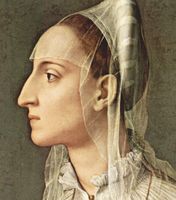
Laura Battiferri

Look at her closely.  Her neck and fingers have been elongated in a Mannerist style.  The upper part of her body is now completely out of proportion in relation to her small head and the way in which Bronzino has depicted her forehead in some ways draws attention to her long and slightly hooked nose.  She is wearing a transparent veil, which hangs down from the shell-shaped, calotte-style bonnet covering her tightly combed-back hair onto her goffered shawl and puffed sleeves.  Her one and only gesture, as she ignores us, is to point to a page in an open book which she is holding.  Her elongated thin fingers frame a certain passage of the prose.  It is a book of sonnets by the Italian poet Petrarch.  Compare this with Andrea del Sarto’s woman who is also pointing to a book of his sonnets.  So similar and yet so different.  The woman in del Sarto’s portrait connects with us.  We have eye contact with her.  We can almost know what she is thinking but with Laura Battiferri she is an enigma.  With no eye contact, her thoughts remain her own.

The passage in the book

In both portraits we see the women pointing to a passage in Petrarch’s book in which the central theme is the poet’s love for a woman he met when he was in his early twenties. Her name was Laura de Noves.   In this painting, Laura Battiferri points to a passage in the book where Petrarch talks about “his Laura” and maybe Battiferri identifies herself with Petrarch’s Laura and empathizes with the poet’s words as he describes the love of his life:

“….she is an unapproachable, unattainable beauty… as chaste as the adored mistress of a troubadour, as modest and devout as a ‘Stilnovismo Beatrice'”. “Laura’s personality is even more elusive than her external appearance. She remains the incarnation of chaste and noble beauty.”

Bronzino had already painted a number of portraits which featured the sitter pointing to pages in a book.  Around 1540 he completed his portrait entitled Portrait of Lucrezia Panciatichi in which the young lady points to a page in a book which rests on her knee.   Eight years earlier he painted a portrait entitled Lorenzo Lenzi, in which the young son of a prominent Florentine family holds an open book inscribed with sonnets by Petrarch and so when he completed his portrait of Laura Battiferri around 1560 showing the sitter pointing at pages in a book it was not a unique depiction and of course as we know Andrea del Sarto’s painting was completed about thirty years earlier.

I end with a question to any females reading this blog.  If you were to commission an artist to paint your portrait would you go for the Bronzino-profile style in which the artist would probably depict you as modest and unattainable or would you choose the del Sarto-style in which you look out at the us, the viewer and from your facial expression maybe we are able to read your thoughts?

Portrait of a Woman with a Volume of Petrarch by Andrea del Sarto

Portrait of a Woman with a Volume of Perarch
by Andrea del Sarto (c.1528)

My blog today centres around three women, an artist and a poet.  The artist in question, and the painter of today’s featured painting, is the Italian artist, Andrea del Sarto.

Andrea del Sarto was born in Florence in 1486 and was one of four children.  His real name was Andrea d’Agnolo di Francesco but the epithet “del Sarto” means “of the tailor” and that was the profession of his father, Agnolo.  At the age of eight, his parents took him out of his normal school where he had been learning to read and write and arranged for him to become an apprentice to a local goldsmith but he didn’t like the work although he did spend time at this early age drawing from his master’s models.  A local Florentine painter and woodcarver, Gian Barile, noticed his drawings and took him under his wing and gave him his first artistic lessons.  Andrea was now doing something he enjoyed and in a very short time had become quite a talented artist for someone his age.  At the age of twelve, Barile realising Andrea would, with the correct training, become a great artist had words with the great Florentine artist of the time Piero di Cosimo and persuaded him to take Andrea on as an apprentice.  Soon Piero di Cosimo realised that despite his age Andrea del Sarto was a greater draughtsman and painter than most of the other aspiring artists in Florence.

Andrea del Sarto remained with Piero di Cosimo for four years.  In 1505 he became great friends with another young Italian painter, Franciabigio, who was four years his senior and apprenticed to the Italian painter, Mariotto Albertinelli.  A year later in 1506, Andrea wanted to move on from his apprenticeship with Piero di Cosimo and because Franciabigio  apprenticeship had ended with Albertinelli, Andrea del Sarto persuaded him to embark on a shared venture with him and open up a joint workshop in Piazza del Grano.  It was here that they worked and lived and where they worked jointly on painting commissions.  One of their collaborations was for frescos for the Basilica della Santissima Annunziata di Firenze, (Basilica of the Most Holy Annunciation). The work they produced was highly regarded by the Church’s patrons, The Brotherhood of the Servites Order, who referred to Andrea del Sarto, as Andrea senza errori, or Andrea the perfect. From 1509 to 1514, he went on to complete many more frescos for the church.  One of the unfortunate aspects of these commissions was that due to the connivance of patrons, Andrea del Sarto and Franciabigio were from being working partners pitted against each other on some of the later commissions.  This eventually led to the breakup of the partnership of the two artists.

These works enhanced Andre del Sarto’s reputation and soon he became one of the leading Florentine painters.  Aged twenty-three, Andre del Sarto was regarded as the best fresco painter of central Italy, barely rivalled by Rafaello Sanzio di Urbino (Raphael), who was four years older.  It should also be remembered that Michelangelo’s Sistine Chapel frescoes were at this time, only in a preliminary stage.

During the time of the friendship between del Sarto and Franciabigio and before they split up, they would often go out socialising and it was on one of these occasions that Andre came across Lucrezia del Fede, who, at the time, was the wife of the hatter, Carlo Recanati.  It was love at first sight.    When her husband died at the end of 1512, Andrea married Lucrezia.  Andrea was besotted by this beautiful woman and would paint her portraits on many occasions and often portraits he did of other women had the hint of Lucrezia in them.  This liaison between man and wife was to have an effect on the course of his life.

In 1516 two of his paintings were sent to the court of the French king, Francois I.  He was very impressed with del Sarto’s work and in 1518 invited the artist to visit him in Paris.  In June that year, Andrea del Sarto, without his beloved wife, went to the French capital, along with his apprentice, Andrea Sguazzella.  He worked at the court and received sizeable remunerations for his time.  At last he was earning a good wage for his work and so everything was perfect.  Actually no, it was not,  as there was one major problem – his wife, whom he had abandoned in Florence.  She became more and more discontented and demanded her husband’s return.  Reluctantly Andrea approached the king and asked if he could return to Florence on a brief visit to see his wife.  King Francois reluctantly agreed on condition that Andreas’ visit home was only for a short period.  Maybe to ensure Andrea del Sarto’s return, he gave the artist some money in order to buy and bring back some Italian works of art.

Andrea took the money but instead of purchasing paintings and probably to placate his wife, used it to buy himself a house in Florence.  His love for his wife and Florence, his birthplace, had too much of a hold on him and he decided not to keep to his part of the bargain he had with the French king.  This act of betrayal meant that he could never return to France and in some ways tarnished his reputation.  For the next ten years he remained in Florence and continued with his art.  In October 1529 the city of Florence came under siege from a large Imperial and Spanish army which had surrounded the city.  The siege lasted for ten months before it was captured and Alessandro de’ Medici was proclaimed the new ruler of the captured city.

Andrea del Sarto had remained in the city during the siege but the following year he died at age 43 during a pandemic of Bubonic Plague which it is thought could have been brought to the city by the invading armies. He was buried in the church of the Servites.  The great biographer of Italian artists, Giorgio Vasari, claimed Andrea received no attention at all from his wife during his terminal illness but one should remember how contagious the Plague was and maybe she was simply scared in case she too contracted the often-fatal disease.   Vasari did not have a kind word for Lucrezia.  According to him, she was faithless, jealous, overbearing and vixenish with her husband’s apprentices. Lucrezia del Fede survived her husband by 40 years.

My featured oil on wood painting today by Andrea del Sarto is entitled Portrait of a Woman with a Volume of Petrarch and was completed by him around 1528 and is now housed in the Uffizi Gallery in Florence.   The woman in the painting is thought to be Maria del Berrettaio, who was born in 1513, and was Andrea del Sarto’s stepdaughter, the daughter from his wife, Lucrezia’s first marriage.  This early sixteenth century portrait is an interesting mix of the High Renaissance and the idealization of Mannerism.   Portraiture was very popular with the middle classes going back a hundred years from the time of this painting.  In those early days,  portraits of women would normally show the sitter in profile.  In those earlier portraits the sitter would look straight ahead with no eye contact with the viewer which in the majority of cases would be a person of the opposite sex.  The averting of the sitter’s eyes from us, the viewer,  enabled the female sitter to retain her modesty.  However by the end of the fifteenth century things began to change and artists would show women in three-quarter or even full face and by doing so would be able to capture the full beauty of the woman and highlight her facial qualities.   To retain a modicum of modesty however, the female sitter would often avert her eyes or look downwards.

Andrea del Sarto’s portrait is different.  What can we make of his sitter from this portrait?    The fact that the artist has chosen a very dark and plain background accentuates the facial expression of the young woman.  She is seated in a semi-circular chair.  Her clothes are somewhat plain and lack the opulence we see in other female portraits who wish to convey their wealth of that of their family.  Her blouse with its high neck has a chaste feeling to it.  Her blue over garment is heavy and full enough to hide the contours of her body.  The only fashionable aspect to her clothing is the popular slashed sleeves of her dress.  Her hair is long, simply fashioned and kept in place with a simple clasp.  The girl looks directly out at us.  She smiles weakly.   It is a demure and shy smile.   This is not an idealized portrait of a woman.  Andrea del Sarto has not shown any inclination to “beautify” his sitter.  She has an olive skin and not the fair skin of an idealized beauty of the time.  Her face is plump and does not have the delicate bone structure of contemporary beauties.  In those days beauty in a woman was fair skin, long neck, and bright oval shaped eyes.  Our sitter has none of these attributes.

At the beginning of this blog I said the painting today was all about an artist, a poet and three women.  I have given you the artist, Andrea del Sarto, talked about his wife Lucrezia and now we have identified his sitter, Maria del Berrettaio but where do the poet and the third woman come into the story?  The answer lies in the portrait itself and the title of the painting.  Our sitter has hold of a book which she has presumably been reading and she is pointing her Mannerist-styled fingers towards a point in the text.  The book she is holding is the Petrarchino and at the time was a popular work of the fourteenth century Italian scholar and poet Francesco Petrarca, who was known in English simply as Petrarch.  Petrarch is often referred to as the “Father of Humanism”.

The Petrarchino was part of a book of sonnets, entitled Il Canzoniere, whose central theme was Petrarch’s love for a woman he met when he was in his early twenties.  Her name was Laura de Noves, the wife of Count Hugues de Sade, an ancestor of the Marquis de Sade.   She was six years younger than Petrarch having been born in Avignon in 1310.  The story goes that Petrarch first saw her on Good Friday 1327 at Easter mass in the church of Sainte-Claire d’Avignon.  In current terminology we may look upon Pertrarch as a stalker as for the next three years whilst living in Avignon he haunted Laura in church and on her walks.   He eventually moved away from Avignon but returns ten years later and it was then that he began to write numerous sonnets in her praise.

The sitter in today’s featured painting points to a page of the book of sonnets which has been recognised as sonnets number 153 and 154.  So what is she coyly pointing to on this page ?  What are the words of the two sonnets?  All will be revealed in this English translation…………

ENGLISH

Sonnet 153

Go, warm sighs, to her frozen   heart,
shatter the ice that chokes her pity,
and if mortal prayers rise to heaven,
let death or mercy end my sorrow.

Go, sweet thoughts, and speak to her
of what her lovely gaze does not include:
so if her harshness or my stars still hurt me,
I shall be free of hope and free of error.

Through you it can be said, perhaps not fully,
how troubled and gloomy is my state,
as hers is both peaceful and serene.

Go safely now that Love goes with you:
and you may lead fortune smiling here,
if I can read the weather by my sun.

Sonnet 154

The stars, the sky, the   elements employed
all their art, and all their deepest care,

 to set in place this living light, where Nature
is mirrored, and a Sun without compare.

The work, so noble, graceful and rare
is such that mortal gaze cannot grasp it:
such is the measure of beauty in her eyes
that Love rains down in grace and sweetness.

The air struck by those sweet rays
is inflamed with virtue, and becomes
such as to conquer all our speech and thought.

There no unworthy desire can be felt,
but honour and virtue: now where
was ill will ever so quenched by noble beauty?

So there you have it – a story about a poet, an artist and three women.

Portrait of Maud Cook by Thomas Eakins

Portrait of Maud Cook by Thomas Eakins (1895)

As promised in my last blog, today I will complete the life story of the great American artist Thomas Eakins and look at another of his paintings, this time a portrait.  If you have just landed on this page maybe you would like to go back to my previous blog in which I started talking about Eakins’ early life and had a look at his famous painting entitled The Champion Single Sculls, a perfectly rendered quiet picture of a rower on the Schuylkill River which he completed in 1871.

After his four year stay in Europe, Eakins had returned to America and the city of Philadelphia where he remained to the end of his life.    He once again attended the Jefferson Medical College and resumed his anatomical studies and in 1878 he took up a teaching post as a volunteer at the Pennsylvania Academy of the Fine Arts.  The following year he was appointed Professor of Painting and Drawing and in 1882 he became director of the artistic establishment.  On January 19, 1884, he married Susan Hannah Macdowell, a student at the academy.   She was, well known in the artistic community.  She was 25 when Eakins met her at the Hazeltine Gallery in Philadelphia, where his painting, The Gross Clinic was being exhibited in 1875.  This was to be his most famous picture and at the time aroused controversy because of its detailed depiction of a surgical operation.     Unlike many, Susan MacDowell was impressed by the controversial painting and she decided to study with him at the Academy, which she attended for 6 years.   Her own artwork became more sober and her painting style became of a more realistic style similar to Eakins. She was an outstanding student and winner of the Mary Smith prize for the best painting by a matriculating woman artist.

Once she married Eakins she all but gave up her art as most of her time was spent in supporting her husband’s career, being the perfect hostess when they entertained and during the difficult times after Eakins left the Academy she never wavered in her support for him, unlike some of his family and so-called friends.  The couple did not have children but it was thought they lived a happy and contented life.  She and Eakins both shared a passion for photography, both as photographers and subjects, and employed it as a tool for their art. She also posed nude for many of his photos and took images of him. Both had separate studios in their home.

In the previous blog I talked about Eakins disenchantment with the École des Beaux-Arts and their treatment of nudity.  He had definite views on the subject and once wrote:

“…She [the female nude] is the most beautiful thing there is in the world except a naked man, but I never yet saw a study of one exhibited… It would be a godsend to see a fine man model painted in the studio with the bare walls, alongside of the smiling smirking goddesses of waxy complexion amidst the delicious arsenic green trees and gentle wax flowers & purling streams running melodious up & down the hills especially up. I hate affectation…”

Eakins was a fervent believer that the male and female nude were things of beauty and nude models should be available to his students for them to complete their life drawing studies.  He was attacked for his radical ideas, particularly his insistence on working from nude models.  Eakins’s work photographing and painting nudes made him something of a liability for the Pennsylvania Academy of the Fine Arts where he taught and it all came to a head in 1886 when he was forced to resign after allowing a class of both male and female students to draw from a completely nude male model.

The Concert Singer by Thomas Eakins

Thomas Eakins, who by the 1880s had only managed to sell nine pictures for a total of $2,000 now decided to concentrate on portraiture.   However, portraiture commissions were equally hard to come by and most of his portraiture works were of his friends and individuals who he admired and offered to paint them without payment.   My Daily Art Display painting today is an example of this.  My featured painting today is entitled Portrait of Maud Cook.  It is such a beautifully haunting portrait which Thomas Eakins completed in 1895 and is looked upon as one of his finest work of portraiture.  In 1892, Eakins had already completed portraits of Maud’s sister Weda Cook, the operatic contralto singer, one of which was entitled The Concert Singer.

Thomas Eakins’ paintings were known for being both scientifically and philosophically accurate.   For Eakins, portraiture held little interest as a means of fashionable idealization.  There was to be no glorification of how people looked.  There was to be no hint of making the person look more beautiful or younger than they actually were.   Unlike most other portrait painters of the time,  Eakins had little concern for flattering his sitters and instead demanded from himself the most precise objective images. The results were comprehensive and revealing portraits that seemed to carry with them the souls of their subjects.  Eakins refused to compromise and painted his subjects as they really were, and not as they wished to be seen.  However, it was precisely for this reason that his portraits were often rejected by the sitters or their families.

Eakins having studied anatomy and later taught it to his students applied this knowledge to the proportions of the human form in his work. He also had a certain gift for capturing the real embodiment of the person, which many artists strove for but often failed to achieve.

In this portrait of the twenty-five year old Maud Cook we see her wearing a pink dress the fabric of which flows from her shoulders and is pinned between her breasts.  Her hair is long and lies, tied with a ribbon, at the back of her neck.  Her face is tilted slightly towards the source of light which comes from the left of the painting.  Such light casts deep shadows across her face and reveals her facial structure.  There is a warmth in the light which illuminates the exposed skin of her neck and upper chest bringing to the painting a demure sensuality.  The expression on the young woman’s face is both captivating and haunting.  Is it a look of sadness or thoughtfulness?  In many of Eakins’ portraits of women he focused on their susceptibility and emotional sensitivity. Is this what he has achieved with this work?   Eakins gave the painting to Maud Cook and inscribed it on the back and carved frame:

“To his friend/Maude Cook/Thomas Eakins/1895”

Years later, Maud Cook described the portrait to the artist’s biographer:

“…As I was just a young girl my hair is done low in the neck and tied with a ribbon. Mr. Eakins never gave the painting a name but said to himself it was like ‘a big rosebud…'”

The painting was later bought by the newspaper publisher and art collector, Stephen Carlton Clark, who on his death bequeathed the painting to Yale University Art Gallery where it remains today.

The American artist Robert Henri, who had studied at the Pennsylvania Academy of the Fine Arts from 1886 to 1888 and knew Eakins, wrote an open letter about him to the Art Students League a year after the artist’s death.    In it he described the great man:

 “…Thomas Eakins was a man of great character. He was a man of iron will and his will to paint and to carry out his life as he thought it should go. This he did. It cost him heavily but in his works we have the precious result of his independence, his generous heart and his big mind. Eakins was a deep student of life, and with a great love he studied humanity frankly. He was not afraid of what his study revealed to him. In the matter of ways and means of expression, the science of technique, he studied most profoundly, as only a great master would have the will to study. His vision was not touched by fashion. He struggled to apprehend the constructive force in nature and to employ in his works the principles found. His quality was honesty. Integrity is the word which seems best to fit him. Personally I consider him the greatest portrait painter America has produced…”

It was only during the final years of his life that Eakins began to receive a little bit of the recognition he deserved. He died in 1916 in the Philadelphia home in which he was born. As is the case with many great artists, Eakins’ fame is almost entirely posthumous.  Eakins had struggled to make a living from his work which is somewhat ironic as his painting The Gross Clinic fetched US$ 68 million in 2006.  Today Thomas Eakins is regarded as one of the most important American artists of any period.

After his death in 1916, his wife returned to painting, adding considerably to her output right up to the 1930s.  Her artistic style changed becoming much warmer, looser, and brighter in tone.   She died in 1938.


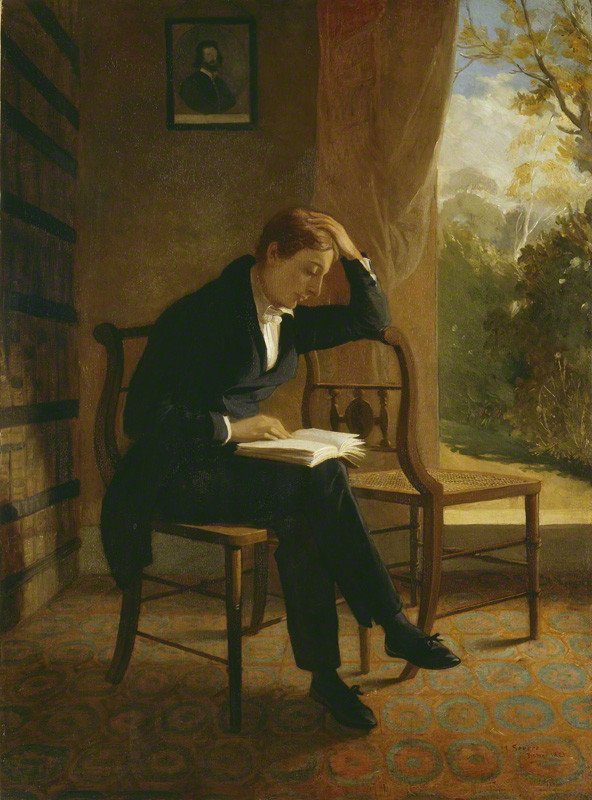
John Keats by Joseph Severn

John Keats by Joseph Severn (1821)

My Daily Art Display today centres around one of the greatest English poets, John Keats, and one of his most devoted friend, the English portrait artist Joseph Severn.

Joseph Severn was born in Hoxton near London in 1793.  He was one of seven children and the eldest son of a prosperous middle-class family.  His father was a music teacher and Severn besides being artistically talented was an accomplished pianist.   In 1807 his father arranged for him to be apprenticed to a London engraver, William Bond, a master of the stipple engraving technique.  When Severn was twenty-two years of age he enrolled at the Royal Academy Schools in London and four years later his first works were exhibited at the Royal Academy Exhibition.  That same year he was awarded the gold medal for his painting, Una and the Red Cross Knight in the Cave of Despair, the inspiration for this work being the epic poem by Sir Thomas Spenser entitled the Faerie Queen.  This prestigious award was even more special as the Royal Academy hadn’t awarded the medal for eight years.

It is thought that Severn first met the writer and poet John Keats around 1814 when he became part of the artistic circles of London.  He was not one of Keats’ closest friends but was one of Keats’ circle of literati and artists.  In 1817, John Keats and his brother George had to take time to nurse their brother Tom, who was suffering from tuberculosis.    In June 1818, Keats began a walking tour of Scotland, Ireland and the Lake District with his friend Charles Armitage Brown and his brother George and his sister-in-law Georgina before the latter pair set sail from Liverpool for a new life in America.  When Keats returned from his trip he continued to nurse his brother Tom and in doing so, exposed himself to the disease and it is thought by many that it was at this time that the disease took hold of John Keats.   His brother, Tom died in December 1818.

Tuberculosis took hold of Keats and he was counselled by his physicians to move to a warmer climate for the winter months.   Keats agreed to such a change of venue and a suitable travelling companion for him was sought.   Most of his close friends could not or would not go with him for various reasons and despite not being one of Keats’ “best friend” it was Severn who offered to accompany Keats to Italy for what was hoped to be an aid to the poet’s recovery.  Severn had always wanted to visit Italy and this proposed trip with Keats was his ideal opportunity. Severn was keen to study the great Italian Masters and be enthused by the beautiful landscapes of Italy. As he had just been awarded the gold medal by the Royal Academy he was eligible to apply for a travelling fellowship which gave him three years of artistic freedom funded by the Royal Academy. In order to receive this grant, Severn needed to paint an original in oil and have it shipped back to London. Once the painting was approved by a panel of judges, he would receive the precious fellowship and since Rome was the art capital of Europe, it made sense to Severn to travel there. His decision to leave England with Keats was not universally popular.  When he told his father of his plans, his father was horrified telling his son that he was risking his career and health by travelling with the ailing Keats and ordered him to remain in England. In Grant Scott’s book Letters and Memoirs, he recounts part of Severn’s late memoir in which he talks about this harrowing meeting with his father:

“…in his insane rage he struck me a blow which fell me to the ground…”

Severn was never to see his father again. However, Severn would not be deterred, packed his bags and embarked on what he believed was a voyage of convalescence, for his companion as Keats’s doctors had assured him that a stay in Rome would cure his condition.   It is extremely doubtful whether Keats believed the optimistic views of his doctors but it never crossed Severn’s mind that his companion would not fully recover once living in the favourable climate of the Italian capital.

In September 1820 Keats and Severn set sail for Naples on the vessel, Maria Crowther.  Although at the start of the voyage Keats’ illness seemed to be far from serious in the eyes of Severn, weeks into the voyage Keats became feverish and began to cough up blood and these physical signs of Keats’ illness affected Severn mentally.  In one of his letters he wrote of his time during the voyage with Keats:

“…He was often so distraught, with moreover so sad a look in his eyes, sometimes a starved, haunting expression that it bewildered me…”

The voyage itself had its problems.  The weather was constantly changing.  Stormy weather battered the ship one day and then the weather would completely change and the vessel would be becalmed lengthening the duration of the sea passage.  They finally arrived at the Italian port but then had to endure ten days in quarantine as news had travelled to Italy of a suspected outbreak of cholera in Britain.    Eventually the two men left Naples and travelled by carriage to Rome.  The pair eventually set up home in a villa on the Spanish Steps which is now the Keats-Shelly Memorial House Museum.  Keats’ health detonated and despite the ministrations of the medics he died on 23 February 1821 and was buried in the Protestant Cemetery in Rome and so, to carry out the last wishes of Keats, he was placed under an unnamed tombstone.  Joseph Severn and Keats’ close friend Charles Armitage Brown had the stone erected, which under a relief of a lyre with broken strings, was the epitaph:

“This Grave

contains all that was Mortal

of a

Young English Poet

Who

on his Death Bed, in the Bitterness of his Heart

at the Malicious Power of his Enemies

Desired

these Words to be

engraven on his Tomb Stone:

Here lies One

Whose Name was writ in Water. 24 February 1821″

My Daily Art Display featured painting today is simply entitled John Keats and was completed by Joseph Severn in 1821.  Severn had painted a number of portraits of Keats but this was one which he painted after the death of his friend and whilst he was still in Rome.  Severn wrote about this painting saying that it was painted to evoke a last graceful memory of his friend around the time when Keats first began to feel ill.  It had been on a morning visit to Keats’ house in Hampstead and Severn said that the position of the two chairs was exactly how he remembered the scene.  All the individual items such as the carpet, chairs, open window and even the engraving of Shakespeare hanging on the wall in the background were faithfully recorded in Severn’s work.  Look how Severn has depicted the room with all its atmospheric shadows.  It is a wonderful portrayal of the young poet reading his book and in the background we see a heavily gathered curtain pulled aside allowing us a glimpse of Keats’ Hampstead garden.  Severn said that his visit coincided with the time Keats had just written his famous Ode to the Nightingale and Severn later said that he was struck with the first real symptoms of the sadness Keats had so finely expressed in that poem.

This portrait of Keats is, beyond doubt, a Romantic portrait of one of the unsurpassed Romantic poets.

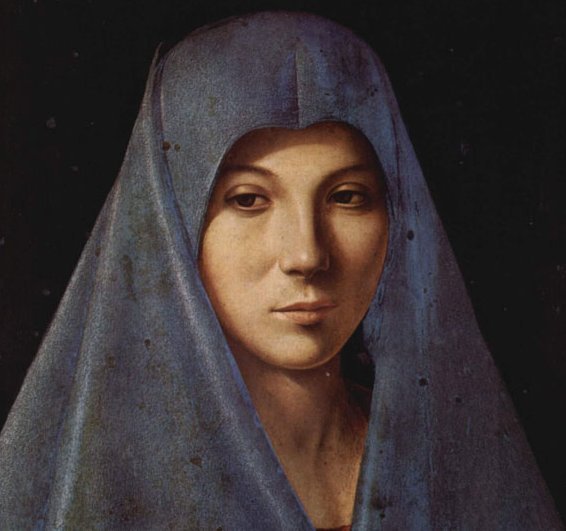
Virgin Annunciate by Antonello da Messina

Virgin Annunciate by Antonello da Messina (c.1476)

I think I have mentioned before how I choose an artist or a painting for future blogs.  It is usually following an art exhibition or a visit to a gallery or, as is the case today, the artist is mentioned in passing in a previous blog.   When I was putting together the biography of my last featured artist, Vittore Carpaccio, I mentioned that in his early days he was influenced by the Sicilian artist, Antonello da Messina.  I had never heard of this artist before and curiosity got the better of me and I began to research his life and look at some of his paintings.  His portraiture is some of the best I have ever come across so I thought I would share my “find” with you.

It is thought that Antonello di Giovanni degli Antonii, better known as, Antonello da Messina, was born in Messina, Sicily, around 1430 and is now considered as the most famous artist to have come from this island.  He was one of four children and his father was a local stonemason.  His early life is somewhat sketchy and often contradictory.  A little light can be shed on Antonello’s training from a letter, dated 1524,  in which Pietro Summonte, the Italian Renaissance humanist living in Naples, and who took great pains in collecting and preserving his correspondence on artistic matters with the Venetian nobleman, Marcantonio Michiel.  In it is mentioned that Antonello was the pupil of Niccolò Antonio Colantonio, an artist who had received instruction in the methods of Netherlandish painting whilst serving at the court of King René I of Naples.  This fact alone may go some way to explain the influence of Flemish paintings in Colantonio’s and later, Antonello’s work.  However not all art historian agree about the Flemish style, influence and technique of Colantonio’s works and that, in turn, Antonello was influenced by his Master, Colantonio.   The art historian J.Wright in his 1980 book, Antonello da Messina: The Origins of his Style and Technique, believes that the characteristic of Colantonio’s work is almost entirely French rather than Netherlandish.

So where did Antonello pick up this Netherlandish influence?  It appears debateable whether Antonello ever travelled to the Netherlands but it is known that René I’s time as ruler of Naples came to an abrupt end in late 1442 and the new ruler King Alphonse V of Aragon (King Alfonso I of Naples) came to power and his art collection contained works by the Netherlandish painters, Jan van Eyck and Rogier van der Weyden, which as Colantonio’s assistant, Antonello could well have been familiar with these works whilst working on royal commissions.   Around this time, Antonello completed many religious works, one of which was his painting entitled St Jerome in his Study, and many believe that this work was influenced by Jan van Eyck’s Portrait of St Jerome (1442).  His later Annunciation of Syracuse  in 1474 is thought to have been influenced by the extraordinary Lomellini Triptych by Jan van Eyck.

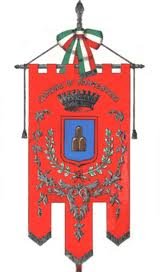
A gonfalone

In 1457 at the age of twenty-seven whilst in Messina, Antonello married Joan Cumminella and it could well be that his first son, Jacobello, had already been born.  In that same year, it is known that Antonello moved to Reggio Calabria,   on mainland Italy.  It was whilst here that he received a commission to produce a gonfalone for the confraternity of S Michele dei Gerbini in Reggio Calabria.  Gonfalones were a type of heraldic flag or banner, often pointed, swallow-tailed, or with several streamers, and suspended from a crossbar.   In that same year Antonello married.  His wife was Giovanna Cumminella.  Soon after this,  he and his family as well as his brother and sister-in-law moved north and settled in Amantea, a town on the west Calabrian coast.  However three years later in 1460, he returns to Sicily after his father sends a brigantine to transport them all back from Amantea to Messina.  The following year he set up a workshop in Messina and took on his younger brother, Giordano di Giovanni as an apprentice.

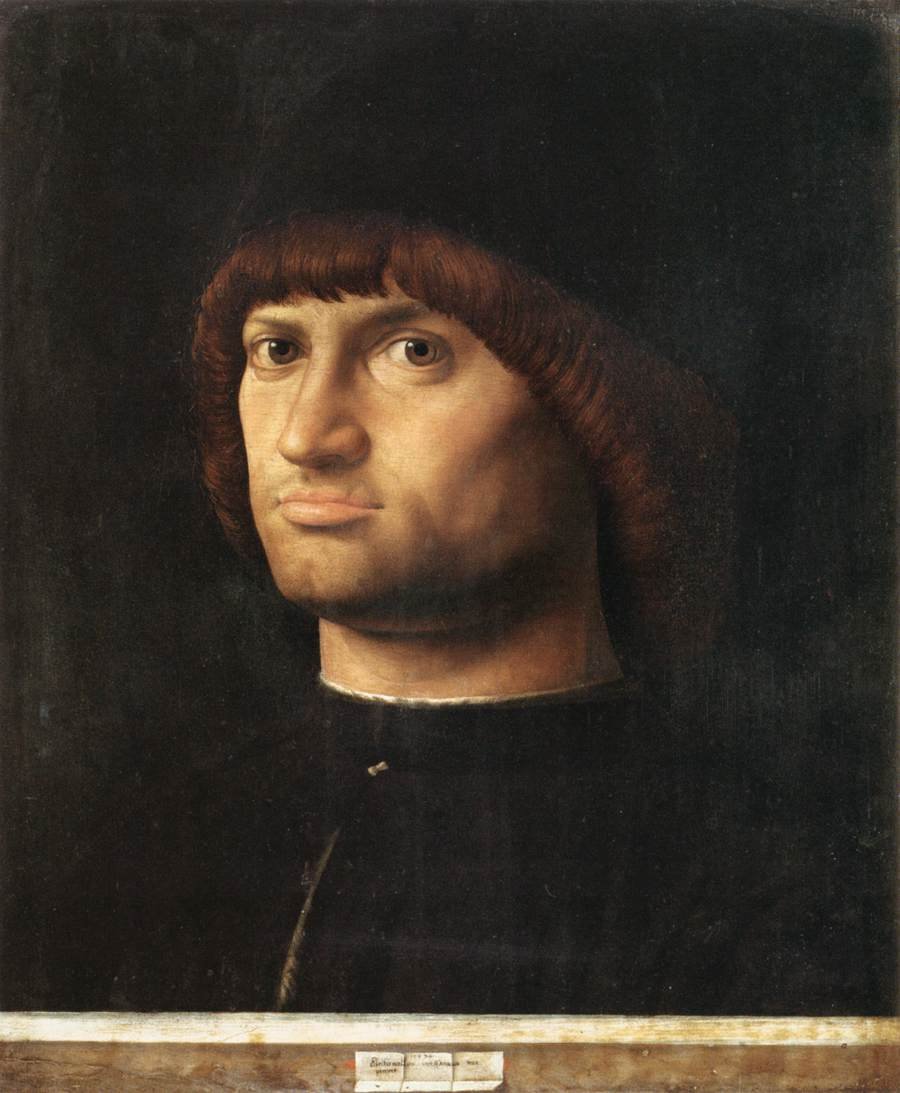
In the period from 1465 and 1475, Antonello completed many portraits.  The surviving portraits are all of men.  His portraiture at this time was different in style to the Italian portraiture for he had a great grasp on the structure of a face, not just the bone structure, but the overlying facial muscles and sinews.  With this knowledge he could depict how the movement and portrayal of facial muscles around the eyes and mouth could alter facial expressions.  His portraits were nearly all in three-quarter views and bust length showing head and shoulders but not the arms.  The sitters faced the light which generally fell from left to right illuminating the edge of the right cheek and modelling the nearside (left side) of the face with chiaroscuro, the term for the technique of using light and shade in pictorial representation.  His sitters, like in many Netherlandish portraiture, are dressed unostentatiously in contemporary dress and wear no emblems or jewellery which would detract us from the simplicity of the portrait.  This drabness of clothing, often dark red or black, does not attract our attention and allows us to look directly and steadily into the eyes of the sitter.

Portrait of a Man (known as The Condottiere )

However, it was Antonello’s stay in Venice, from 1475 to 1476, which marked the definitive turning point in his artistic career and in fifteenth-century Italian art history. The encounter between Antonello’s art and the Venetian figurative environment, represented primarily by Giovanni Bellini, created the conditions necessary for his absolute masterpieces, such as Portrait of a Man known as The Condottiere and the Trivulzio Portrait of a Man.   In Venice, Antonello and his works of art were highly acclaimed and he received many commissions.  It is known that Antonello was still in Venice in the March of 1476 completing the S Cassiano Altarpiece commissioned by the church of San Cassiano in Venice.  From Venice there is speculation that he travelled to Milan to carry out a commission for Gian Sforza, Duke of Milan, but whether he did visit Milan it is known that by the end of 1476 he was back in his Sicilian home in Messina.  In his workshop he now had his son, Jacobello d’Antonio and his nephews Antonio and Pietro de Silba as his assistants.

In February 1479 Antonello made his will, and died shortly afterwards at the young age of forty-nine.  He had pre-deceased both of his parents as he made provision for them in the document.   Antonello was an extraordinary painter, one of the greatest of his time.  In his last years his son collaborated with him with Antonello planning the work and Jacobello executing the painting.  On one, Jacobello paid a fitting tribute to his father and signed the painting:

“…the son of Antonello, a painter of no human kind…”

For my featured painting today I give you Virgin Annunciate which Antonello completed whilst in Venice around 1476 and is now housed in the Galleria Regionale della Sicilia in Palermo.  It is probably his most famous work.  The painting is a hauntingly beautiful image of an adolescent Mary at the time the angel Gabriel came to her to tell her that she would bear God’s son.  Look closely at her beauty as depicted in this bust length portrait by Antonello.  She sits before us dressed in a simple blue mantle.  She clasps her blue mantle closed and holds it modestly in front of her chest.  The background is plain and does not distract us from staring at the young woman.   She sits at a reading desk.  Before her, on the desk, is a book of devotions which she has been reading.  We have disturbed her.  She looks up at us.   The angel Gabriel as is the case in most Annunciation scenes, is not present.  It is simply implied.  Her right hand is raised in a blessing gesture to Gabriel but as he is not in the painting, it is as if she is greeting us, the viewer.  It is just her and us.

The face of young beauty

Would you say this is a religious painting?  That seems a silly question to ask as we know the story of the Annunciation is a religious story but although the subject is religious in nature, Antonello has deliberately selected a young, beautiful and humble Sicilian girl for the model of the Blessed Virgin. So was it in Antonello’s mind to simply paint a portrait of a devout young girl.  I suppose the answer lies in who commissioned the work and what they asked the artist to depict.  Whether it is a simple portrait or a religious painting, I challenge you to find another work depicting such an exquisite looking young.

Une loge aux Italiens (A Box at the Theatre des Italiens) by Eva Gonzalès

Une loge aux Italiens (A Box at the Theatre des Italiens) by Eva Gonzalès (1874)

I had intended this offering to be my previous blog but when I researched into today’s featured artist and her painting I saw there was a connection between this work of hers and a similar one completed by Renoir in that same year.  My Daily Art Display featured artist today is Eva Gonzalès and the work I want to look at is entitled Une loge aux Italiens (A Box at the Theatre des Italiens) which she completed in 1874.

Eva Gonzalès was born in Paris in 1849.  Her father was the novelist and playwright, Emmanuel Gonzalès, a Spaniard but naturalised French.  Her mother was a Belgian musician.  From her childhood she was immersed in the literary world as her parents house was often used as a meeting place for critics and writers.

Eva began her artistic career in 1865, at the age of sixteen, when she began to study art.  Initially she studied under Charles Joshua Chaplin, the French society portraitist, who ran art classes specifically for women in his atelier and who, the following year, would teach the American female artist Mary Cassatt.

Portrait of Eva Gonzalès by Manet

Just before her twentieth birthday in 1869 she became a pupil of Édouard Manet and also used to model for him and many of the other Impressionist artists.  It was whilst at his studio that she met Berthe Morisot who was also working with Manet and posing for some of his works.  There would seem to have been an intense  rivalry between the two females.  According to Anne Higonnet’s book Berthe Morisot, Morisot wrote to her sister about Gonzalès and Manet’s attitude towards her saying:

“… Manet preaches at me and offers me the inevitable Mlle Gonzalès as an example; she has bearing, perseverance, she knows how to carry something through, whereas I am not capable of anything.   In the meantime, he begins her portrait again for the twenty-fifth time; she poses every day, and every evening her head is washed out with black soap.  Now that’s encouraging when you ask people to model…”

Repose by Édouard Manet

One can easily detect Berthe Morisot’s jealousy of Eva Gonzalès in that passage.  The painting referred to by Berthe Morisot was entitled Portrait of Eva Gonzalès which Manet was working on and which he exhibited in the 1870 Salon.  It is now housed at the National Gallery, London.  At the same time that he was painting the portrait of Eva Gonzalès he was also painting a work entitled Repose which was a portrait of Morisot and which he also exhibited at the 1870 Salon, as almost a companion piece.  This portrait of Morisot can be seen in the Rhode Island School of Design, Museum of Art, Providence, Rhode Island.  As you can see by the passage above, Morisot was annoyed by Manet’s painting of Gonzalès.   What rankled Morisot the most was probably how Manet had portrayed the two young ladies.    So what could have annoyed Morisot about Manet’s depiction of her?  Look at the two paintings.  Both young women, both wear similar clothing, both have been portrayed as young and pretty but the one big difference is that Morisot is depicted half laying back on the sofa in what one could describe as a languid and idle pose whereas Eva is portrayed as a budding artist actively at work.   What also should be kept in mind is that Morisot did not look upon herself as merely a “pupil” of Manet.  For Morisot,  her relationship with Manet was almost as equals rather than master and pupil.  In her relationship with Manet, she was also much more forceful and self-confident than Gonzalès, who was more of a willing disciple of Manet and who would put up with Manet’s abrupt manner,  whilst continually absorbing his teaching.   Of course there was another significant difference between the two young women – age!   Eva was more than eight years younger than Morisot.

Unlike Morisot, but like her mentor Manet, Eva Gonzalès decided not to exhibit any of her work at the controversial Impressionist Exhibitions but she has always been grouped with them because of her painting style.   However, she did regularly have her work shown at the annual Salon exhibitions in the 1870’s.  Her works received mixed comments.  The critics who were supporters of the Impressionist artist liked her work.

Portrait of Jeanne Gonzalès in Profile by Eva Gonzalès

In 1869 Eva married Henri Charles Guérard, an etcher, lithographer  and printmaker, who was a close friend and sometime-model for Édouard Manet and who modelled for some of his wife’s paintings along with his sister-in-law Jeanne (La femme en rose, Jeanne Gonzelès).  In 1883, a month after her 34th birthday, she gave birth to a son, John.  Sadly, her life was cut short when she died following complications of childbirth.  It was believed to have been Puerperal Fever.    Her death came just six days after the death of her one-time mentor Édourad Manet.   Two years after her death a retrospective of Gonzalès’ work was held at the Salons de La Vie Moderne in Paris where over eighty of her paintings were put on display.

Five years later, in 1888, Henri-Charles Guérard  married Eva’s younger sister, Jeanne Gonzalès, also an artist.   My featured painting by Eva Gonzalès is entitled Une loge aux Italiens (A Box at the Theatre des Italiens) and you can obviously see the similarity between her painting and my previous offering entitled La Loge by Pierre-Auguste Renoir.  I decided to feature his first and then let you compare her painting with his.

As I discussed in my last blog, the auditorium of a  theatre and especially the theatre box were fashionable places for an exchange of society chit-chat and gave the theatregoers the opportunity to be seen at their best.  The subject of the theatre and theatre goers was a subject frequently chosen by the Impressionists, such as Cassatt and Degas but probably the most celebrated of this genre was Renoir’s La Loge (The Theatre Box) and it is interesting to compare it with this work by Eva Gonzalès which she completed in the same year, 1874.  This painting by Gonzalès was submitted to the Salon jurists for inclusion in the 1874 Salon but was refused.   Eva Gonzalès then made some changes to the painting and five years later submitted it to the 1879 Salon and this time it was accepted.  The critics loved the work.

There are some similarities to this painting of hers and that of her former tutor Édouard Manet in the way she, like him, chose to paint a modern-day subject and the way her painting, like some of his, shows a total contrast between the light colours of the clothing of the subject and the pale creamy skin of the female and the dark background.   In stark contrast to the dark velvet edge of the box , we see her white-gloved hand with its gold bracelet casually resting along it.   There is also an uncanny similarity between the bouquet of flowers that rests on the edge of the theatre box to the left of the woman in Gonzalès’ painting and the bouquet of flowers which Manet depicted in his painting, Olympia (see My Daily Art Display October 12th 2011).  The two people who were sitters for Eva’s painting were her husband, Henri Guérard and her sister Jeanne who as I said before was to become Henri’s second wife.

As was the case in Renoir’s painting we are left to our own devices as to what is going on within the theatre box. We need to make up our own minds as to what the relationship is between the man and the woman and to their social standing in society.  There is little symbolism to help us interpret the scene.  We just have to use our own imagination and sometimes that adds to the joy os looking at a work of art.

Mr and Mrs Edwin Edwards by Henri Fantin-Latour

Mr and Mrs Edwards by Henri Fantin-Latour (1875)

Who should be my next featured artist and what the next featured painting should be are the decisions I have to make each day.    Often I will make my choice when I flick through one of my art books or maybe I will be inspired by an artist or painting I have seen on one of my gallery visits but often or not the decision will come from research I have made into a previous painting.  My Daily Art Display featured artist and painting today comes from a little bit of all those.  In my last blog I looked at Manet’s Music at the Tuileries Gardens and listed a number of Manet’s friends the artist had added into his work.  One of these was the floral painter Henri Fantin-Latour.  Last week when I was wandering around the National Gallery in London I stood before one of his non-floral paintings entitled Mr and Mrs Edwin Edwards and my curiosity was immediately pricked.  Who were Mr and Mrs Edwards and why should this French artist paint the portraits of this English couple?   I knew then that sooner or later I had to feature this painting in one of my blogs and do some research into the background behind the work and the sitters.  So come with me on this journey of discovery and find out more about this couple.

Edwin Edwards was born in the small market town of Framlington in the heart of the Suffolk countryside in 1823.  He was the youngest of four sons of Charles Edwards and Mary Kersey.  He was educated at Dedham in Essex and went on to study law.  He became a legal practitioner in the admiralty and prerogative courts attaining the impressive position of King’s Proctor and Examiner of the Courts of Civil Law and the High Court of Admiralty.  When he was twenty-four he published a book entitled A treatise on the jurisdiction of the High Court of Admiralty of England.   In 1852 he married Elizabeth Ruth Escombe.  The couple had no children.  Despite having a busy and lucrative legal career Edwin Edwards had a great love for art and in 1861, aged thirty-eight years of age and with support from his wife, he decided to forego his legal career and become a full time artist.

Edwin Edwards had started painting using the medium of watercolours but later moved on to oil painting.  However his real love was etching and he had been influenced by the French artist and etcher Alphonse Legros.  He installed a press at his house in Sunbury, where his wife Ruth became skilled at printing. During the 1860s and 70s their home was a meeting place for French and British painters and etchers.  It was whilst he was in Paris  to arrange for the printing of his first plates that he was introduced to Henri Fantin-Latour by the English painter Matthew White Ridley.  Edwards and Fantin-Latour soon became great friends and the French artist would visit London and stay with the Edwards family in their Sudbury home.  Edwin Edwards and his wife bought many of Henri Fantin-Latour’s flower paintings, and found other buyers among their wealthy circle of friends thus securing the French artist a regular and steady income. Between 1864 and 1896 Fantin-Latour painted over 800 floral portraits, and almost all were purchased in England.

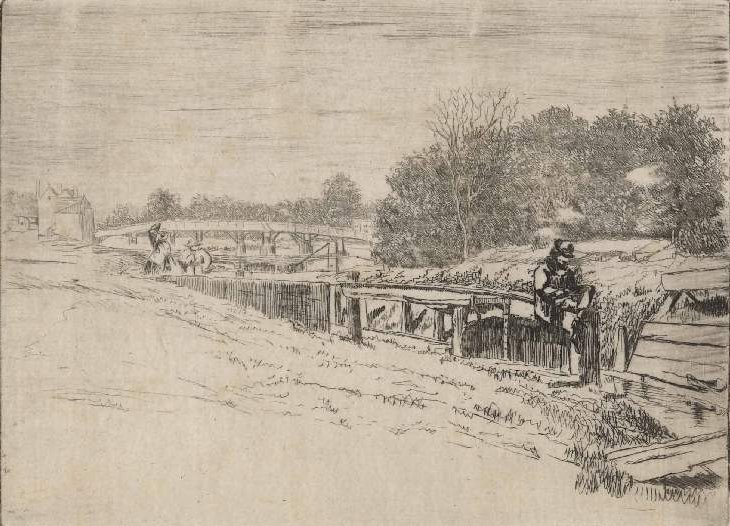
Molesey Lock by Edwin Edwards (1861)

In 1861 Edwards made an etching trip along the River Thames with James McNeil Whistler, Fantin-Latour and Whistler’s brother-in-law, Francis Seymour Hayden, an English surgeon, who later dedicated his life to etching and printmaking and it was during this trip that Edwin Edwards completed a portrait of Whistler sketching, seated, at Molesey lock.   In all, Edwards completed over three hundred and fifty etchings consisting of scenes of the Thames at Sunbury, English cathedral cities, the wild Cornish coast, and countryside scenes in Suffolk, many of which are now housed in the Fitzwilliam Museum, Cambridge.  He also published a three-volume work entitled ‘Old Inns of England,’ which were illustrated with a number of his etchings.

From 1861 until his death in 1879, aged 56, he was a prolific exhibitor of his work.  He exhibited fifty four works at the Royal Academy and over a hundred of his works at various other exhibitions.

My Daily Art Display featured painting is simply entitled Mr and Mrs Edwin Edwards by Henri Faintin-Latour.  The painting belongs to the Tate but is presently on loan to the National Gallery, London.  When Fantin-Latour first visited and stayed with Edwards and his wife in 1861 he began a portrait of Mrs Edwards but did not finish it until three years later when he again stayed with the couple.  It was not until the end of 1874 that Fantin-Latour embarked on the double portrait of Edwin Edwards and his wife and the couple visited his Paris studio for the formal sittings.  He wrote to Edwards and said that he intended to portray him, seated at a table in his studio, etching.  The background would have a number of canvases on the wall and that his wife would be portrayed standing behind him, overseeing his work, like a “guardian angel, the inspiring Muse”.   In reality the painting was much simpler than Fantin-Latour had originally envisaged.  The background as you see is plain and not adorned with other paintings.  Instead of being depicted etching,  Edwin Edwards is seen seated at an angle with his left arm resting on a folio of prints whilst studying an etching he holds in his right hand.  Mrs Edwards as was Fantin-Latour’s original idea stands behind her husband.  Does she look like a guardian angel?  It is hard to interpret her mood.  It seems one of aloofness and displeasure and seems somewhat unhappy with the situation.  I think she actually dominates the double portrait and would some up her appearance as “she who must be obeyed” !!!!!!!!!!!!!!

Henri Fantin-Latour exhibited the work in the Paris Salon of 1875 and it gained a second class medal.  This award was very beneficial to Fantin-Latour because from then on he was termed by the Paris Salon as hors concours, which meant that in future, any exhibits he put forward for inclusion at future Salon exhibitions did not have to first be passed by the Salon jury.

The Tribuna of the Uffizi by Johan Zoffany

The Tribuna of the Uffizi by Johann Zoffany (1772-77)

Johan Zoffany was born Johannes Josephus Zoffaly in Frankfurt-am-Main in 1733.  His father Anton Zoffaly was a court cabinet maker and architect to Alexander Ferdinand, Prince of Thurn and Taxis and it was at the Prince’s court that young Johan was brought up.  When the Prince took up residence in Regensburg, Zoffany served as an apprentice to the local painter, Martin Speer.  In 1750, at the age of 17 when he had completed his apprenticeship Johann travelled to Rome and studied with the portrait painter, Agostino Masucci.  In 1757, now back in Germany, Zoffany was commissioned by the Elector of Trier to paint frescoes and paintings for his new palace at Trier and his Ehrenbreitstein Palace in Koblenz.

In 1760 Zoffany travelled to London.  Here he was initially employed by Benjamin Wilson, the painter and printmaker and it was from his connection with Wilson that Zoffany came to the attention of one of Wilson’s patrons, the actor and theatre impresario, David Garrick, and he commissioned Zoffany to paint a number of theatrical works which featured the actor in famous theatrical roles.  Garrick also had Zoffany paint some conversation pieces of he and his wife set in the grounds of his Hampton estates.  The term Conversation Piece is an informal group portrait, often full length but usually small in scale in a domestic interior or garden setting and was a very popular art genre in 18th century England.   They would often portray a group of people apparently engaged in genteel conversation or some activity.  Usually the group would be members of a family, but sometimes friends would be included.  In some conversation pieces groups of friends or members of a society were depicted.  It was for these works that Zoffany made his name in England.

Zoffany’s fame spread among the London elite and commissions started to roll in for his portraiture and conversation pieces.  One such commission came from the Prime Minister, John Stuart, the 3rd Earl of Bute, who wanted Zoffany to paint portraits of his three sons and another portrait of his three daughters.  It was thanks to Bute that Zoffany was introduced to King George III and his wife Queen Charlotte in 1763.  Both were impressed by his work and commissioned Zoffany to paint portraits of their family.  The Royal Academy of Arts had been founded in December 1768 through a personal act of King George III.  Its task was to promote the arts of design in Britain through education and exhibition.  There were originally thirty four founder members, with Sir Joshua Reynolds its first President.  The rules stated that there would be forty Academicians.  In a Council of the Royal Academy in November 1769 it was reported to those present that “his Majesty had been pleased to appoint Mr Johan Zoffany to be one of the forty Academicians”.  Zoffany was now a Nominated Member of the Academy.

The Portraits of the Academicians of the Royal Academy by Johan Zoffany (1771-2)

George III also set him a task to paint a group portrait of the Royal Academy members which Zoffany duly completed in 1772 and was entitled The Portraits of the Academicians of the Royal Academy.  Zoffany himself is seen with brush and palette in his hand at the far left of the painting.  The king and his wife were delighted with the painting and Queen Charlotte commissioned Zoffany to paint an even larger and more elaborate conversation piece set in the Tribuna of the Uffizi, which would depict the art treasures held within the octagonal room.   Zoffany travelled to Italy to carry out the commission in 1772 and did not complete the ambitious work until 1777.

Zoffany returned to England with his masterpiece but was distressed to find that his genre of conversation pieces had gone out of vogue and his work was no longer required by his wealthy and fashionable clients.  He could have reverted to his other artistic forte, that of portraiture, but at the time he had many very successful rivals for that type of work, such as Thomas Gainsborough and Joshua Reynolds as well as the emerging “new kid on the bloc” George Romney.

By 1783 Zoffany had all but given up hope of receiving commissions for his work in England and decided to travel to India in his search for rich patrons.   For the next six years Zoffany bided his time in the sub-continent travelling between Calcutta and Lucknow completing commissions he received from the wealthy British colonials and the local Lucknow aristocracy.  Once again he had the opportunity to carry on with his beloved conversation pieces.  Such was the popularity of his work that he was inundated with commissions and by the time he returned to England in 1789 he had made his fortune.

Zoffany died in 1810, aged 77.  He was one of the greatest exponents of the English Conversation piece with its Rococo flamboyance and will also be remembered for the charm of his theatrical works depicting scenes from popular plays of the day.

My Daily Art Display featured painting today by Zoffany is looked upon as one of his greatest works.  It is his grand conversation piece entitled The Tribuna of the Uffizi, which he started in 1772 and completed in 1777.   Going to Italy at the behest of his Royal patrons, George III and his wife Queen Charlotte, to paint this work had not been his original plan as in 1772 he had hoped to secure a passage on Captain Cook’s vessel when he set sail on his second voyage to the South Seas but the offer of a sea voyage never materialised and so he took up the commission from Queen Charlotte to travel to Florence and record in a painting the collection of art and sculpture which the Grand Duke of Tuscany had put together in the Tribuna of the Uffizi Gallery in Florence.  Queen Charlotte had envisaged this work would be a pendant to Zoffany’s earlier work owned by the English rulers entitled Academicians of the Royal Academy which he completed in 1772 and was well received by the royal family.

The Tribuna was an octagonal room within the Uffizi Gallery, designed in the late 1580’s by Bernardo Buontalenti in which the art collection of Francesco de’ Medici would be housed.  In 1737 it came into the possession of Pietro Leopoldo, Grand Duke of Tuscany.  The commission was a great challenge to the talents of Zoffany as the Tribuna art collection was one of the greatest in all Europe.  Was it a true reproduction of what was there at the time?   Not quite, as Zoffany had to experiment and alter the perspective of the room in order to incorporate all the various pieces of sculpture and in some cases he had to reduce the size of individual pieces.  The collection of art in the Tribuna during the time Zoffany was painting it was also going through a slight reorganisation and this gave him the excuse to make his own decision as to what would be on display.   In doing so he omitted some paintings which were actually on display and added others which although housed in the Uffizi were never hung in the Tribuna.  One of these was Titian’s Venus of Urbino which we see in the central foreground.  There were also a number of paintings by Guido Reni which were housed in the Pitti Palace but were transported to the Uffizi just for Zoffany to copy!

There are twenty five paintings shown in this work.  How many can you identify?   All I will tell you is that amongst them there are six by Raphael, three by Guido Reni, two by Titian, two by Rubens and one each by Carracci, Corregio and Holbein.

Besides the works of art, sculptures and other artefacts, the painting is populated by no fewer than twenty two men all of whom were either connected with the Uffizi Gallery or were a miscellany of Grand Tourists.  So who were these Grand Tourists and what was the Grand Tour?  The Grand Tour was the traditional trip around Europe taken by mainly upper-class wealthy young European men, although primarily the term is associated with the British elite and nobility.   It reached the height of its popularity in the seventeenth and eighteenth century and it was a kind of rite of passage for this wealthy elite.   One amusing aspect of Zoffany’s inclusion of the men was that during the many years he worked on the painting he would add and remove people as he saw fit and would tell some of the travellers they had to sit for him as the George III had specifically asked for their portrait to be included.  Of course that was never the case.  The one thing Zoffany was adamant about was that he would not portray a woman within the group.  It is thought that this could be due to the fact that he incorporated some lewd visual jokes into the painting.   Look at the group of men to the right who are staring at and fascinated by the backside of the Venus de Medici.  This sculpture had been well-known for the lewd comments made about it by the Grand Tourists.  In Vicci Coltman’s book entitled Classical Sculpture and the Culture of Collecting in Britain since 1760 she quotes a comment made by Charles Townley, the English country gentleman and antiquary who had made a couple of Grand Tours whilst Zoffany was painting his masterpiece.  Townley had said that he had been told that:

“…the sight of the Venus in the Florence Gallery will give you some yammering after a Tuscan Whore…”

It was not just the heterosexual innuendos that made Zoffany’s painting risqué, but his addition of two well known homosexuals, Thomas Patch, in the right foreground in conversation with another homosexual, Sir Horace Mann.  Patch is pointing at the sculpture The Wrestlers and their addition in the painting was to prove a step too far.

Zoffany returned to England in 1779 and delivered the painting to his royal patrons.   Queen Charlotte was horrified to see the room cluttered by so many men and worse still to incorporate lewd innuendos of both a heterosexual and homosexual nature.  She was especially shocked that Zoffany had included portraits of the two infamous homosexuals into the scene.  George III reluctantly paid for the work but had it placed out of sight in a room in Kew Palace.  The artist Joseph Farrington was active in the social, cultural, and professional art world of his time and he kept a daily diary from 13 July 1793 until his death, missing only a few days. This diary often referred to the London art world. The diary eventually constituted 16 volumes and in one of the volumes Farrington recounts a conversation between George III and the artist William Beechey in which he quotes the king as saying of Zoffany’s Tribuna of the Uffizi:

“…[The King] expressed wonder at Zoffany having done so improper a thing as to introduce the portraits of Sir Horace Man[n], [Thomas] Patch, & others, who were considered as men addicted to improper practices – He sd. The Queen wd. Not suffer the picture to be placed in any of Her apartments…”

It is thought it was not so much that Zoffany took it upon himself to add the twenty two Grand Tourists into the painting but it was the character of some of them that shocked and offended George III and his Queen.  Zoffany never again received a royal commission and from that day on lost their patronage.

This is a beautiful work and one of unbelievable detail.  I stood before it yesterday when I visited the preview of the Johan Zoffany RA, Society Observed exhibition at the Royal Academy in London.  If you are in London you should make a point on visiting this exhibition which runs until June 10th.

Tomorrow I will give you the answer to the names of the paintings and the artists who painted them