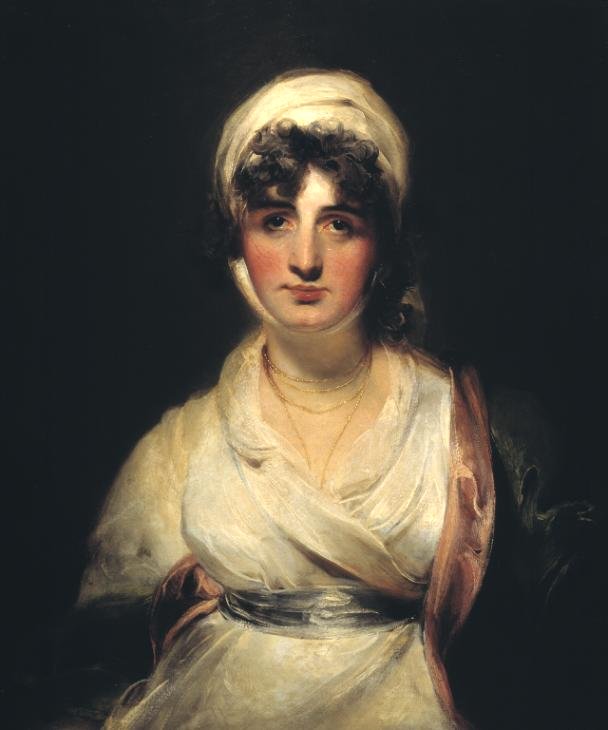
Christoffer Wilhelm Eckersberg. Part 3. Patrons and portraiture

In May 1816, Christoffer Eckersberg left Rome and headed home to Copenhagen.  During his homeward journey he stopped off at Dresden where he met up with the German Romantic painter, Casper David Friedrich.  Eckersberg finally arrived back in Copenhagen in August 1816.  His reputation as a leading painter of his time was all he could have wished for and soon commissions were rolling in.  Probably the most prestigious of these was a commission to paint four large works for the Throne Chamber of the magnificent baroque palace of Christiansborg which showed scenes from the history of the House of Oldenburg.  This commission earned him the nomenclature of “court painter”.
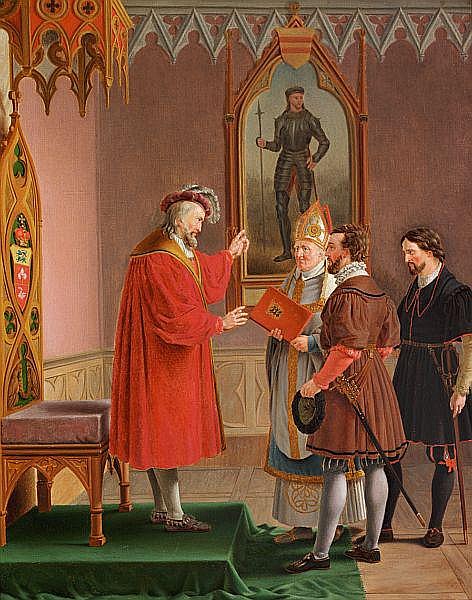
Duke Adolf declines the offer to be Danish king by Christoffer Eckersberg (1821) (43 x 39cms) Private collection
Duke Adolf declines the offer to be Danish king by Christoffer Eckersberg (1821)
(43 x 39cms)
Private collection

One of these works was Duke Adolf declining the offer to be King of Denmark which he completed in 1819.  The story behind this event is that in January 1448, King Christopher of Denmark, Sweden and Norway died suddenly and had no natural heirs. His death resulted in the break-up of the union of the three kingdoms, with Denmark and Sweden going their separate ways. Denmark had now to find a successor to the vacant Danish throne and so the Council of the Realm turned to to Duke Adolphus of Schleswig, as he was the most prominent feudal lord of Danish dominions. However Adolphus, who by that time was forty-seven years old and childless, declined the offer but instead supported the candidacy of his sister’s son, the Count Christian of Oldenburg.  Christian was elected King Christian I of Denmark and his coronation followed a year later in October 1449. In the painting we see Duke Adolphus declining the offer as he points to the portrait of his nephew, Christian, which is hanging on the wall in the background.

Mendel Levin Nathanson by Christoffer Eckersberg (1819) (32 x 28cms) Museum of National History at Fredericksborg Castle
Mendel Levin Nathanson by Christoffer Eckersberg (1819)
(32 x 28cms)
Museum of National History at Fredericksborg Castle

In October 1817 Eckersberg became a member of the Royal Academy of Fine Arts.  This allowed him to apply for any position as professor at the Model School of Charlottenborg, which was the home of the Royal Danish Academy of Fine Arts.  Whilst Eckersberg had been travelling around Europe he had been funded by a number of patrons and on his return home he decide to repay their generosity by completing portraits of them and their family.  One of Eckersberg’s most important and generous benefactors was Mendel Levin Nathanson.   He had arrived in Copenhagen aged twelve as a poor Jewish immigrant.  Nathanson rose to become a wealthy Danish merchant, editor, and economist who from an early age established himself in business.  At the age of twenty-six he became associated with the large Copenhagen banking firm of Meyer & Trier.  He was also a leading patron of the arts.   He was an author of books on economics as well as the country’s mercantile history but was probably best known for his advocacy of the Jewish cause. Nathanson was editor of the Berlingske Tidende one of the big three national newspapers from 1838 to 1858 and from 1865 to 1866.  Eckersberg completed the portrait of Nathanson in 1819.
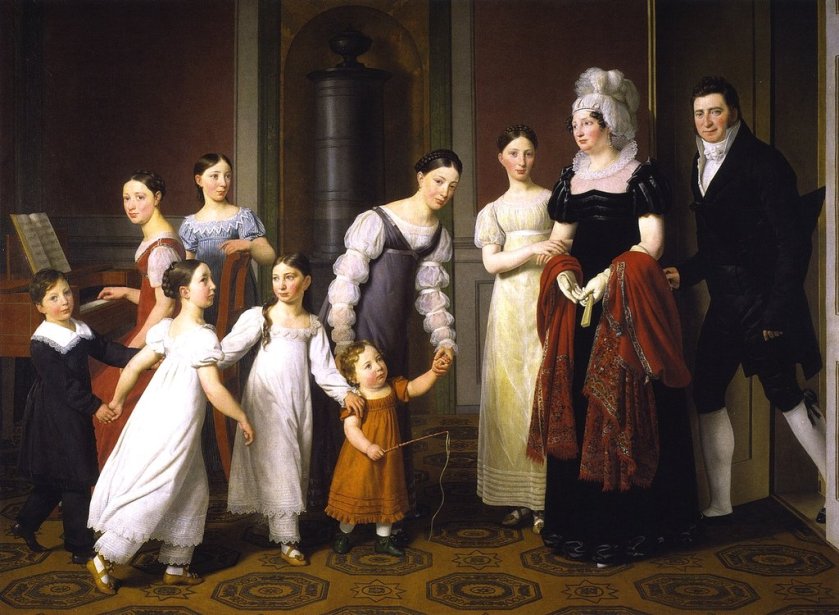
The Nathanson Family by Christoffer Eckersberg (1818) (126 x 173cms) Statens Museum for Kunst, Copenhagen
The Nathanson Family by Christoffer Eckersberg (1818)
(126 x 173cms)
Statens Museum for Kunst, Copenhagen

Another of Nathanson’s commissions for Eckersberg was to get the artist to complete a group family portrait, a task he completed in 1818.  The depiction was of Nathanson, his wife and their eight children.  It was simply entitled The Nathanson Family and the portrait was the most densely peopled and involved work ever attempted by Eckersberg.  Nathanson was quite specific about what he wanted the painting to reveal about himself and his family.  It was to be a depiction which would tell of his affluence and status in the country.

The Nathanson Family (Preliminary sketch) by Christoffer Eckersberg (1818)

Eckersberg’s original idea, as seen in a preliminary sketch, was to depict the whole family dancing, highlighting a close and harmonious family connection,  a family who enjoyed each other’s company but this idea failed to satisfy Nathanson.  For Nathanson the depiction must depict a family of stature and wealth.  It was paramount to depict his own prominent position in Danish society as a merchant and an integrated Jew.  He again spoke to Eckersberg to remind him how he wanted the family to be depicted.   The family members in the finished painting are shown, in a line, blatantly parading themselves before us in a stage-like manner.  On the left hand side the depiction focuses on the private life of the children, at play, dancing and one daughter is seen playing the piano.  The children’s activity is interrupted by the arrival home of Nathanson and his wife from an audience with the Queen having enjoyed the family tradition of some royal entertainment.  There is a sartorial elegance about the velvet-like clothing Nathanson and his wife are wearing and this of course brings home to the viewer of the painting the social and financial class of the couple.  The whole scene is a juxtaposition of two visual aspects of Nathanson’s life – the loving husband and father with his happy children and the successful businessman who has access to the Royal Court.  In the portrait Nathanson stares out at us inviting us into his house to witness all that belongs to him.  His wife stands next to him, somewhat aloof, as the children, who have  interrupted their playing to run and greet her.
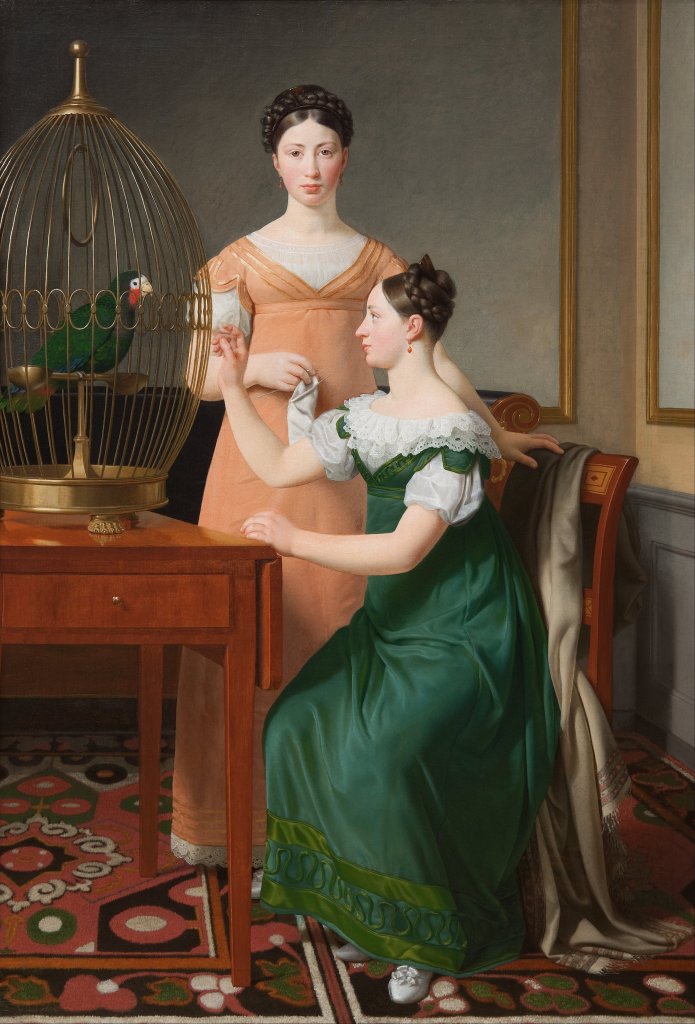
Bella and Hanna. Mendel Levin Nathanson's Elder Daughters by Christoffer Eckersberg (1820) (125 x 85cms) Statens Museum for Kunst in Copenhagen
Bella and Hanna. Mendel Levin Nathanson’s Elder Daughters by Christoffer Eckersberg (1820)
(125 x 85cms)
Statens Museum for Kunst in Copenhagen

In 1820 Eckersberg completed another portrait for Nathanson.  This time it is one depicting his two daughters, Bella and Hanna.   For many artists who have been asked to complete a portrait the decision as to how the sitter should be portrayed is a question which has to be carefully answered.  Should it be an en face depiction or a profile depiction?  In this work Eckersberg has solved the problem by having the daughter, who is standing, portrayed en face whilst the seated daughter is shown in profile.   Although it would not be that unusual to see the likeness of the two daughters in this case, could it be that Eckersberg has emphasized the similarities to such a degree that it almost looks as it is the portrait of a single person seen from two different angles.  On the table we see a parrot in a cage.  Is this just an additional ornamentation which lacks meaning?  Actually many believe it is symbolic and that it is all about the two young ladies who are at an age when marriage is on the horizon whilst other believe there is a definite similarity between the shape of the cage and the shape of the girls’ faces

Hans Christian Ørsted by Christoffer Eckersberg (1822) (53 x 43cms) Danish Museum of Science and Technology, Helsingør
Hans Christian Ørsted by Christoffer Eckersberg (1822)
(53 x 43cms)
Danish Museum of Science and Technology, Helsingør

Another of Eckersberg’s interesting portraits is Hans Christian Ørsted which he  completed in 1822.  It is a medium sized head and shoulder portrait which can now be found at the Danish Museum of Science and Technology in the eastern Danish town of Helsingør.  This is a good example of Eckersberg’s ability as a portraitist as to how he precisely and truthfully depicts his sitter.  It is a realistically accurate depiction of the man, as confirmed by his wife. The depiction of Ørsted facial expression is one of contemplation which concurs with the views that Ørsted was a great “thinker”.  Other than that expression on Ørsted’s face, it disregards the modus operandi of many portrait artists past and present who feel the need to incorporate into the portrait their perceived notion of the sitter’s psychological persona and by doing so they are happy to lose some of the physical accuracy of the person.   I know I am in the minority when I say, that for me, a portrait needs to be real and recognisable.   I am often told that as I am not an artist I do not understand portraiture !

Hans Christian Ørsted was an acclaimed international scientist born in 1777 who made the discovery that electric currents created magnetic fields which would later be known as Ørsted’s Law.  Eckersberg tells us more about the man, not by the way he “adjusts” the portrait but by using the tried and trusted method of including items in the portrait which relate to the man.  In his hand we see Ørsted holding a metal Chladni plate on which is sprinkled powder.  The powder has now formed a pattern on the surface of it, which is the result of a violin bow,  which can be seen on the table in the left foreground, being scraped against the edge of the plate.  The catalogue raisoneé of Eckersberg works does not indicate any payment for the portrait and it was probably a gift from Eckersberg to Ørsted as the two endured a long friendship after they had met in Paris years earlier.
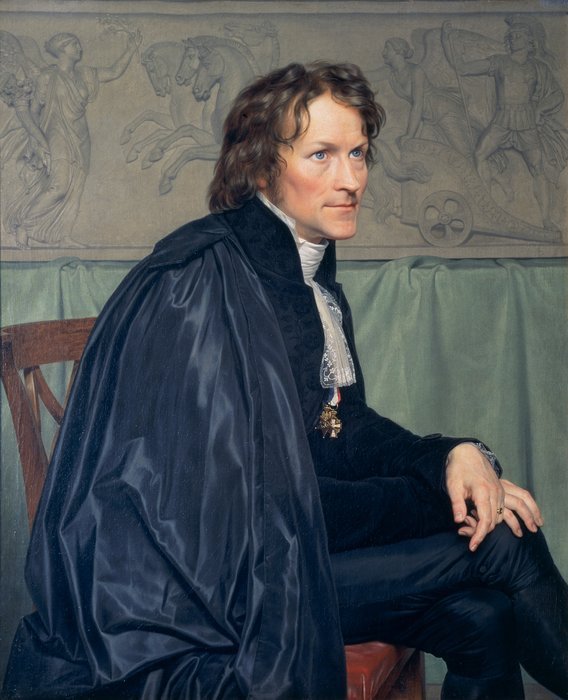
Portrait of Bertel Thorvaldsen wearing the habit and Insignia of the San Luca Academy by Christoffer Eckersberg (1814) (91 x 74cms) The Royal Danish Academy of Fine Arts
Portrait of Bertel Thorvaldsen wearing the habit and Insignia of the San Luca Academy by Christoffer Eckersberg (1814)
(91 x 74cms)
The Royal Danish Academy of Fine Arts

When Eckersberg stayed in Rome we know he stayed in a lodging house which also accommodated the great Danish sculptor Bertel Thorvaldsen and the two became good friends.  One of Eckersberg’s most famous and inspired portraits, which he completed in 1814, was of Thorvladsen.  It was entitled Portrait of Bertel Thorvaldsen wearing the habit and Insignia of the San Luca Academy.  At the time, Thorvaldsen was regarded as the most important sculptor in Rome and in 1804 he became a member of the Florence Academy of Art and a year later a member of the Danish Art Academy.  In this portrait, we see Thorvaldsen bedecked in the official robes of the Academia di San Luca in Rome, of which he had been a member since 1808. This prestigious academy was founded in 1577 and as such  is among the oldest academies in Europe with its roots being traced to the first statutes written in 1478 for the guild of painters named Compagnia di San Lucca. The robes we see Thorvaldsen wearing provide the portrait with the nuance of an artist who is continuing the work of a long Roman tradition.  There is no doubt that the message we can take from the way Eckersberg depicted his friend is the artist’s great admiration for the sculptor and all that he had achieved.  Eckersberg, like many admirers of Thorvaldsen, looked upon him as a visionary and the artist has tried to capture that aspect in the sculptor’s contemplative facial expression.  Such admiration for Thorvaldsen’s work can be seen by the way Eckersberg has included Thorvaldsen’s most famous piece of sculpture, the Alexander Frieze, which can be seen in the background.  Eckersberg was so happy with the finished portrait that he sent it to Denmark as a gift to the Copenhagen Academy.  This generous gesture probably had a more ulterior motive, that of proving of his artistic ability to the academicians.

The Double Portrait of Count Preben Bille-Braheand his second wife Johanne Caroline neé FalbeZ by Christoffer Eckersberg (1817) (61 x 50cms) Ny Carlsberg Glyptotek
The Double Portrait of Count Preben Bille-Braheand his second wife Johanne Caroline neé FalbeZ by Christoffer Eckersberg (1817)
(61 x 50cms)
Ny Carlsberg Glyptotek

Eckersberg’s many portraits were not just of male sitters.  Portraiture was a great way of making money and many commissions came to him when he returned to Copenhagen.  The next painting I am showcasing is The Double Portrait of Count Preben Bille-Braheand his second wife Johanne Caroline neé Falbe which he completed in 1817 and is now housed in the Ny Carlsberg Glyptotek in Copenhagen.  Eckersberg had been awarded the Academy’s Gold Medal in 1809 and with it came funds to cover the cost of European travel.  However the money did not become available to him until 1812 but he wanted to set off to Paris immediately and so had to turn to some wealthy sponsors to lend him the money he needed to start his journey.  One such benefactor was Count Preben Bille-Brahe, a wealthy Danish landowner.  On his return to Copenhagen Eckersberg repaid Count Preben Bille-Brahe’s generous support for his European journey by painting a double portrait of the count and his second wife, Double Portrait of Count Preben Billie-Brahe and his Second Wife, Johanne Caroline, neé Falbe.  Although their social status was to be part of the aristocracy, Eckersberg has managed a more commonplace depiction of the couple, which he used when he depicted the middle-class in his portraiture, enhancing the view that they were just real people.  Having said that, the male sitter with the ruddy cheeks looks resplendent in his brown tailcoat, the buff waistcoat with its lower fastening unbuttoned.

Jesus and the Little Children by Christoffer Eckersberg (c. 1810) Altarpiece for the Home Church at Funen
Jesus and the Little Children by Christoffer Eckersberg (c. 1810)
Altarpiece for the Home Church at Funen

Eckersberg had met Count Preben Bille-Brahe in 1810 during the first part of his European journey to Paris.  He stopped off at his benefactor’s estate on the island of Funen and received a commission from Count Preben Bille-Brahe to create an altarpiece for the Home Church which was part of the estate.  Eckersberg completed the painting for the altar whilst in Paris.  It was a biblical scene entitled Jesus and the Little Children.

Home Church Funen
The interior of Home Church Funen

In my fourth look at the life and work of Christoffer Wilhelm Eckersberg I will concentrate on some of his female portraiture and his large number of nude paintings.
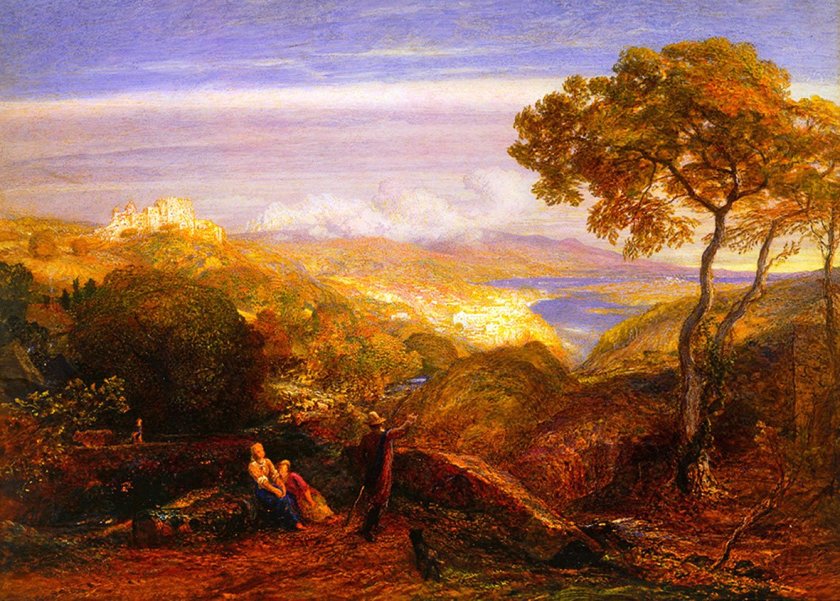
Samuel Palmer Part 1. The Early years, portraiture and the rural idyll

The Prospect by Samuel Palmer (1881)

My featured artist today is one of the great English landscape painters, draughtsmen and etcher of the nineteenth century.  He was a major player in the art of Romanticism.  His landscape works were special, conjured up by his inventive and far-sighted imagination.   There was a magical feel about his work.  Palmer was not just an ordinary every day painter; his works were poetical and he himself, through his art, seemed to have the ability of a mystical seer. Let me introduce you to Samuel Palmer.

At the time of Samuel Palmer’s birth there was a worrying tension brought on by conflict.  It was a troubling time.  It was a time of tumult in Europe.  Sixteen years earlier France had been affected by the storming of the Bastille and the fall of the rich and the nobility of the ancient regime.  Initially, there was probably a delighted sense of schadenfreude in the minds of many in England, including the “establishment” at the fall from grace of what they perceived was the cruel and greedy French aristocracy but soon that enthusiasm dwindled with the thought that such revolutionary behaviour may cross the English Channel.  In 1793, twelve years before Samuel was born France declared war on Britain, a war which would last more than two decades.  Although the battlefields were not in England Napoleon Bonaparte used another weapon against the British by blockading European ports and by so doing deprive Britain of lucrative trade.  The war however proved fortuitous to Samuel’s family who were hatters and hats were in great demand since the government, to add to their much needed war chest, had imposed a hair powder tax and this ended the era when elegantly puffed and powdered coiffures which were once de rigueur, now could not be afforded.  The fashion was now for the “topper”, the nickname given to top hats.

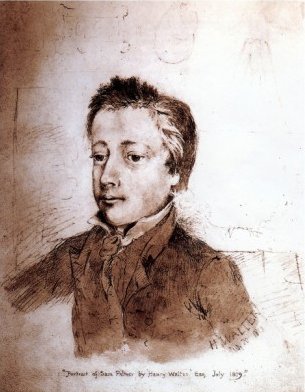
Portrait of Samuel Palmer by Henry Walter (1819)

Samuel’s father, also named Samuel, had set forth to study to become a surgeon but his squeamish nature put an end to that dream and he ended up in his father, Christopher Palmer’s, millinery business.  Samuel Snr. was somewhat of a dreamer and this along with his love of books led him to forego the safe and lucrative job as a hatter to set himself up as a bookseller.  This decision did not go down well with his family as the trade of a bookseller seemed a lowly trade not fit for a “gentleman”.  Samuel Snr. was, besides being a dreamer, a very determined person and cared little about status and the financial position of his family.

Samuel Palmer Snr. met and fell in love with Martha Giles and they married in October 1803.  Samuel Palmer, their first child, was born in Newington, London on winter Sunday morning, on January 27th 1805.  The couple lived in Surrey Square in Newington, which at the start of the nineteenth century, was a semi rural area populated with lush gardens, fields and orchards.  It was a haven for those who loved the countryside; a love young Samuel would have all his life.  It was a time when survival at birth was somewhat of a lottery with a third of babies not surviving to see their first birthday and amongst the poor and deprived the survival rate would drop even further.  However Samuel Palmer was lucky in as much as he was born into a prosperous middle-class family.

Early Morning by Samuel Palmer (1825) Pen and ink and wash, mixed with gum arabic, varnished,
Early Morning by Samuel Palmer (1825)
Pen and ink and wash, mixed with gum arabic, varnished,

Samuel was not a healthy child and his mother and grandmother would often take him to the Georgian seaside resort of Margate in the hope that sea air would improve his health.  This once fishing town was a favourite of Turner.  It was during his boyhood stays in Margate that he would listen to his grandmother’s tales of ghosts and restless spirits who wandered around the town.  Stories of such apparitions would remain with Samuel and would interest him all his life.  His mother’s continued concern about her son’s physical health led her to employ a live-in nurse, Mary Ward, who set about improving his health by improving his diet.   It was also this lady who was to have such an influence on the young boy.  Unlike most servants who were illiterate Mary was well read with the Bible and Jacob Tonson’s pocket illustrated book of Milton’s poems being her favourites.  She, like Samuel’s father, loved books and would often read Milton’s poems to Samuel.  When Mary died she bequeathed the book of poems to Samuel who would carry it round with him wherever he went.  Of Milton’s poems, Samuel wrote:

“…I am never in a “lull about Milton”…….nor can tell how many times I have read his poems… He never tires….I do believe his stanzas will be read in heaven…”

Samuel gained a brother in 1810 with the birth of William, who was to be the only other surviving child of Samuel Snr. and Martha.  Samuel Palmer did not have many boyhood friends as he was more than satisfied to immerse himself in his books, including works by Dickens, which featured the English capital.  It was a trait, which delighted his father.  Samuel would often go for walks on Dulwich Common with either his father or his nurse during which they would often read to him as they strolled the countryside.  His love for reading and the joy books brought him can be seen in one of his letters (The Letters of Samuel Palmer – Raymond Lister, 1974) in which he wrote:

“…There is nothing like books of all things sold incomparably the cheapest, of all pleasures the least palling, they take up little room, keep quiet when they are not wanted and, when taken up, bring us face to face with the choicest men who ever lived at their choicest moments…”

Samuel, maybe because of his poor health, tried to avoid the necessity of going into the heart of London with all its pollution from coal fires and the often dank fogs emanating from the Thames.  He was a lover of the countryside and being of poor health abhorred the polluted city life.

In May 1817, at the age of eleven, Samuel was sent to Merchant Taylors’ public school.  This was a prestigious institution founded back in 1561 but for Samuel it was a nightmare.  Samuel who had been cosseted by both his mother and nurse and had a quiet solitary home life, which suited his nature, suddenly was thrust into a maelstrom of lively and loud boys in which a pale-faced asthmatic boy fared badly.  Samuel disliked the public school system with all it entailed and in another of his letters he wrote:

“…the fag crawls to be kicked, and, in his turn, kicks the fag who crawls to him………it perfectly represents and so admirably prepares for the requirement of public life for what is statesmanship but successful crawling and kicking….”

His time at Merchant Taylors lasted only six months as his pleading to come back home was answered in the Autumn of 1817.

The death of Samuel’s mother in 1818 came as a harsh blow to her thirteen year old son.  He struggled to cope with the loss and shed many tears.  The loss of his mother came at the same time as he and his father considered what career he should follow.  Samuel favoured becoming an author.  He had already written some prose and poetry and although the latter never attained the quality required to have them published his stylistic prose gave him hope of a fulfilling career.  However it was not to be as his father believed, because of his son’s early talents as a draughtsman that the visual arts should be the career his son should follow.  The family’s decision that Samuel should follow a career in art was thought to have been down to a belief that it was what his mother would have liked her son to do.

Entrance of the Meuse: Orange-Merchant on the Bar, Going to Pieces; Brill Church bearing S. E. by S., Masensluys E. by S. by J W Turner (1819)

The family employed William Wate, a run-of-the-mill landscape artist, to tutor Samuel.  In 1819, when Samuel was just fourteen, he made his first visit to the Royal Academy Summer Exhibition.  He was amazed by the colour in Turner’s painting of the Entrance of the Meuse and fascinated by Turner’s Liber Studiorum, a series of his landscape and seascape compositions which were published as prints in etching and mezzotint, has been once described as perhaps comprising of ‘the pith of all that is best in his life and work’.

At this time Palmer was just a developing artist who was still learning the basic skills of art through Wate’s tuition.

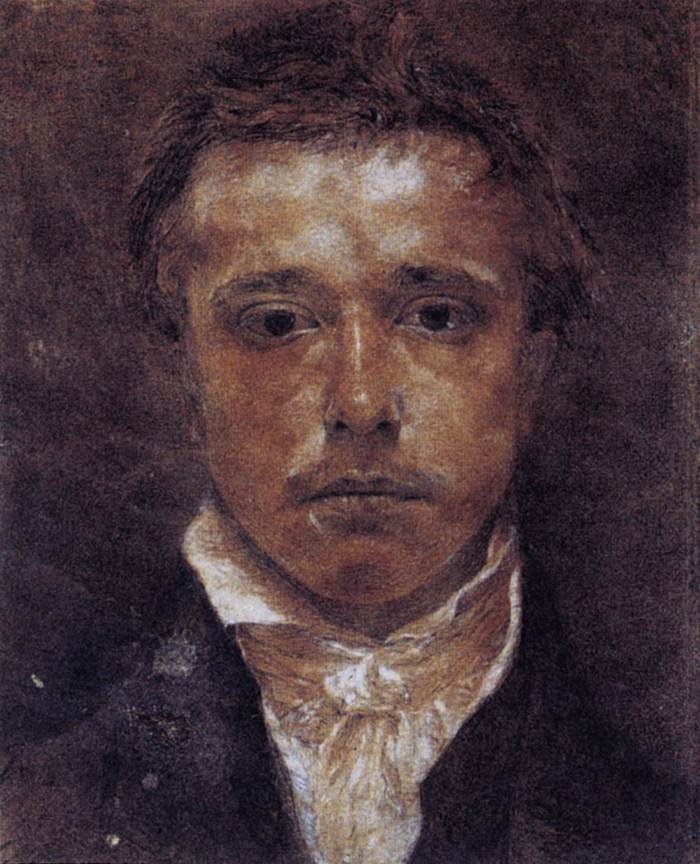
Samuel Palmer a Self-Portrait (1826)

I recently attended a portraiture workshop at which the guest artist and presenter talked about how the portrait he would produce would not necessarily be a photographic image of the sitter but how he envisaged the model.  With those words still in my head I gaze at Samuel Palmer’s self portrait which he completed around 1826 when he was twenty years of age.  Is this how he envisioned himself?  There is something quite disturbing about this self-portrait.  Palmer gazes directly towards us but it is a blank stare as if he is looking through us.  The question that immediately springs to mind is what is he thinking about.  What is going on in his mind as he looks into the mirror?   It is not an image one would associate with an aspiring artist who is looking forward to the future.  What is troubling him?  Look at his physical appearance.  He has not readied himself for the painting.  It is more of a “this is who I am, take it or leave it” stance.  He is unshaved.  His thick hair looks uncared for.  The collar of his shirt is crooked but he knows all this as he puts brush to canvas.  Maybe he wants us to disregard his physical appearance and concentrate on what could be on his mind.  We are looking at the face of a troubled dreamer.  We are looking at a man whose vivid imagination would influence his art and those who view some of his imaginative paintings will be transported into a magical world which in her book Mysterious Wilderness, The Life and Work of Samuel Palmer, the author Rachel Campbell-Johnston describes the artist and some of his works:

“…It is a place in which magical shines through the material, in which nature and heaven are intertwined, in which God in all his mildness blesses man’s harvests and the darkness of night can be innocent and day.  This is not the haunt of any workaday painter.  It is the home of the artist as mystic and seer and poet…”

The Shearers by Samuel Palmer (1834)

One of his best known works is The Shearers which he completed in 1835.  It is a painting which is rich in colour.  There is the juxtaposition of golden sparkling light and gloomy shadow.  I have already said the Palmer was looked upon as a seer and this painting was his vision of paradise.  Raymond Lister in his book, Catalogue Raisonné of the works of Samuel Palmer describes the work and a similar one entitled The Sleeping Shepherd which uses the same setting of the entrance to the barn we see in the above work:

“…A group of richly textured and abundantly coloured paintings of this period includes some of Palmer’s greatest and most attractive work. Such work reached its ultimate expression in The Shearers and The Sleeping Shepherd…”

Geoffrey Grigson, in his 1960 book Samuel Palmer’s Valley of Vision, wrote of the work:

“…Great richness of technique was used to realise The Shearers. In this Palmer combined oil and tempera so as to render every nuance of texture from the light on the distant hills and in the sky to the detailed depiction, almost Dutch in its realism, of the group of implements on the right. There is also an advance in the drawing of the figures, the shearers and their helpers; rarely if ever before this had Palmer portrayed figures so convincingly in movement…”

The setting of the painting is the great barn,  the doors of which are open and we look out at the scene before us.  The doors and the roof beam in some way form a frame for the painting.  A group of six people work in the shade of the trees outside the barn, three men and three women can be seen in the mid-ground.  The men are in the process of shearing the sheep whilst the women collect and bag the wool.  In the background we see an expanse of rolling hills which are lit up by the rays of the sun which light up the beautiful countryside.  Samuel Palmer never forgot his walks with his father over the hills and through the fields of Dulwich.   The idea for the painting must have been in his mind years earlier because he once wrote about his plans for depicting such a scene:

“…A group of different sex and age reaping, might be shewn in the foreground going down a walk in the field toward the above cottage island, and over the distant line that bounds this golden sea might peep up elysian hills, the little hills of David, or the hills of Dulwich or rather the visions of a better country which the Dulwich fields shew will to all true poets…”

Still life detail
Still life detail

In a way the painting is not just a rural landscape scene but part is also a still-life work in the way Palmer has painted the farming equipment inside the barn which we see on the right hand side along with a wide brimmed straw hat which the artist’s son, Alfred, said was one of his father’s most cherished possessions and an item which would appear in many of Samuel Palmer’s works.

In my next blog I will continue to look at the life of Samuel Palmer and explore the help he received from the landscape artist and portraitist John Linnell and  how he was so influenced by William Blake, the poet and painter who was an influential figure in the history of the poetry and visual arts of the Romantic Age.

Félix Vallotton. Part 1- The early years and portraiture

Self portrait by Félix Vallotton (1897)

The artist whose paintings I am looking at in this blog is the Swiss-born artist and printmaker Félix Edouard Vallotton.

Vallatton was born in Lausanne, on the shores of Lake Geneva, in December 1865, three days before the New Year. His parents  and grandparents hailed from the little town of Vallorbe in the Swiss canton of Vaud.   His family’s social status was given as conservative middle class.  Félix’s father, Adrien owned a chandlery and grocery shop and would later branch out as a chocolatier and own and run a chocolate factory.   Félix and his older brother Paul lived at the family’s home in Lausanne, situated in the centre of town in the small town hall square, the Place de la Pelouse.  Family memories of the young Félix Vallatton told of him being a very delicate and sensitive child and because of this and the presence of the smallpox epidemics, which had ravaged Europe, he was probably cosseted by his family.  Félix, as a young boy enjoyed to draw and paint and besides his normal scholastic subjects, he attended evening classes for drawing.

Self portrait by Félix Vallotton (1885)

In 1882, at the age of sixteen, having completed his school education, he persuaded his father to take him to Paris so that he could learn more about painting and drawing.  He had passed the entrance exam to the École des Beaux Arts but decided that he would prefer to attend the Académie Julian because of its teaching of real art and naturalism.  His father managed to have his son enrol at the prestigious academy, which at the time had the most respected art tutors.  Félix was to study under three great French figure painters, Jules Joseph Lefebvre, Guillaume Bougereau and Gustave Boulanger.  As a student he was known to be hard working but very reclusive.  His tutors looked upon him as a model student and had great hopes that he would win the Prix de Rome prize as the outstanding student of the year.  For young Vallotton life was not all fun and games and monotony had begun to set in, even at this early stage.  He wrote to his brother Paul;

“…So far I have not seen much apart from some museums.  The botanical gardens, which did not make much impression on me, one or two theatres, which I visited with father, the Pantheon, which is magnificent and which affords a marvellous view on a fine day.  Every day I follow the very same route and see the very same things…”

In an early letter to his brother there is a hint of lack of self-confidence when he tells his brother how things are developing academically.  He wrote:

“…The professor is pleased with me, but I am not pleased with myself and sometimes feel sad……My heart sinks when I think of what I am about to study and realise that I am nothing compared with the great artists who startled the world at the age of fifteen…”

Vallotton may not be confident in his own ability but one of his tutor’s assessment of him was quite different.  Lefebvre told Vallotton’s father that:

‘…Monsieur, I hold your son in high esteem, and have only had occasion to compliment him up to now.  I think that, if I had such a son, I would not be worried about his future at all and would unhesitatingly be prepared, with the bounds of possibility, To make sacrifices over and over again, in order to help him…”

Lefebvre ended the conversation with a prediction:

“…I am so interested now in those who are prepared to work – your son is one of those and I repeat he will bring you fame…”

People who suffer from lack of self confidence, often need somebody to be there to boost their morale and Vallotton had that in the person of Charles Maurin, a fellow student at the Académie Julian, albeit eight years his senior.  Vallotton and Maurin became friends and part of a letter from Maurin to the younger Vallotton highlights the elder artist’s moral support.  He wrote to Vallotton:

“…Whatever you lack it is certainly not artistic flair.  It is rather some quality of character (please allow me to mention this to you).  (I would like you to be as open with me).  From your last letter it emerges that you lack strong will and you are creating difficulties for yourself.   But that is not the case.  You do have willpower but it does not manifest itself…”

Life as an art student in the big city was a struggle for Vallotton.  He had constantly to turn to his father for money to pay for lodgings, to buy food and pay for models.  He tried to find some work to help his financial situation but it was never enough.  In 1888 Felix wrote to his parents bemoaning his lot in life and one can sense an air of depression

“…I practically never go out.  I work from seven in the morning until five in the afternoon.  This has not produced any great results so far, everything must work out soon…”

Portrait of Monsieur Ursenbach by Félix Vallotton (1885)

In 1885, at the age of nineteen, Vallotton’s luck changed.  It was due to his portrait of one of his neighbours, Monsieur Ursenbach, a mathematician and Mormon.  That year, he submitted the Portrait of Mr Ursenbach to the Salon jury and with his former tutor, Jules Lefebvre, one of the jurists, the work was accepted and subsequently displayed.   It is an interesting work.  The setting for the portrait is the sitter’s colourless and featureless room.  Ursenbach can be seen sitting in his armchair in a stiffly upright pose, looking uncomfortable with a stern expression on his face.  His hands rest steadily upon his knees as he stares off to the left of the painting.  It is this unusual demeanour of Ursenbach which probably caught the eye of visitors to the Salon exhibition.  Critics were divided on its merits but for Vallatton himself when he later listed all his paintings in chronological order, this was the first on the list.

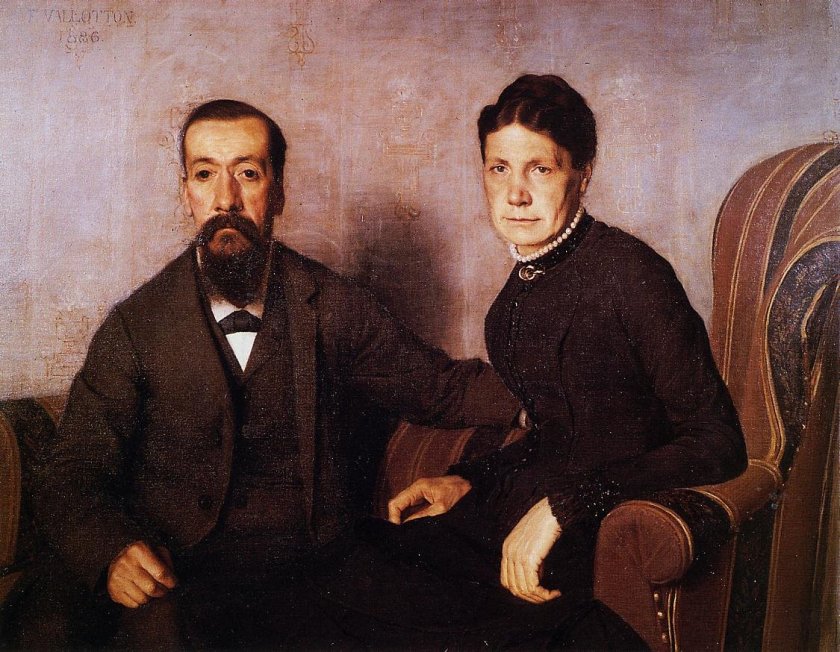
The Artist`s Parents by Félix Vallotton (1886)

Like many portrait artists before him, the young artist completed many portraits of his own family members.  His family portraits, such as the 1886 one of his parents, The Artist`s Parents,  featuring Alexis and Mathilde, were tender and showed the closeness he was to his parents.

Paul Vallotton by Félix Vallotton (1886)

In the same year that he completed the portrait of his parents he completed a portrait of his brother Paul.

Self portrait by Félix Vallotton (1891)

Over the years, he also painted many self portraits and one of my favourites is his 1891 painting, Mon portrait.  Portraiture was a way Vallotton began to earn money and he completed many commissions in Paris and back in his home town of Lausanne.  Many of his Paris commissions were attained through his Swiss ex-patriot friends who were living in the French capital.  One such friend and fellow student was the Swiss artist, Ernest Bieler and it was he who persuaded the artist and close acquaintance, Auguste de Molins, to write a letter of introduction on behalf of Vallotton to Renoir and Degas.  De Molins had known the Impressionists as he had exhibited works at the First Impressionist Exhibition.  In his letter to Degas, de Molins wrote:

“…My protégé is absolutely alone in Paris without any connections at all apart from his contacts at the studio, which is far from enough to satisfy his intellectual needs.  The studio is all very well, but there comes a time when close relations with a master are somewhat more important even far more important…”

Vallotton never used the letters of introduction.

Felix Jasinski in His Printmaking Studio - Felix Vallotton (1887)
Felix Jasinski in His Printmaking Studio – Felix Vallotton (1887)

In 1886 Vallotton met Felix Jasinski, an engraver and painted his portrait, entitled Felix Jasinski in His Printmaking Studio.  Jasinski went on to teach Vallotton all about the art of engraving and the two would work together on many projects.   Vallotton’s own catalogue of works began to list his engravings from 1887 and according to a letter to his parents in late 1889 he told them that he had begun to work on commissions for a publisher.  Money was to be made through his engraving work and by 1891 the amount of wood engravings completed by Vallatton was almost more that the number of paintings he had completed.

The Port of Pully by Félix Vallotton (1891)

His early works were not restricted to portraiture. Vallotton, being Swiss-born, loved to paint landscapes featuring the mountains and views of his homeland, especially around Lausanne and Lake Geneva.  Often they were for commissions given to him by Swiss people but often he would keep them for himself.  In 1891 he completed a painting, Port of Pully, one of the eastern suburbs of the city of Lausanne.  The painting depicts the lake front  located on the shores of Lake Geneva.

Outskirts of Lausanne by Félix Vallotton (1893)

Another beautiful landscape work by Vallotton was completed in 1893 and was entitled Outskirts of Lausanne.  In the painting we view Lake Geneva from a meadow.  The yellow and greens of the foreground are in contrast to the still blue water of the lake in the background.  There is an air of tranquillity about this depiction.  One can imagine sitting in the meadow, which is bathed in sunlight, and just relaxing and leaving the cares of the world behind.

The reason for me writing a couple of blogs about Félix Vallotton was that I was fascinated by the heading of a 2007 article in The Guardian newspaper by Julian Barnes which shouted out:

Better with their clothes on

The neglected, enigmatic Swiss artist Félix Vallotton was a fine painter of still lifes, landscapes and portraits. Shame about his dreadful nudes, writes Julian Barnes.

and so in my next blog I will continue with Vallotton’s life story and look at more of his paintings including some of his “dreadful nudes” !!!

Much of the material I have used for this blog came from an excellent book entitled Félix Vallotton by Nathalia Brodskia, an art historian attached to the hermitage Museum, St Petersburg.

Arnold Böcklin. Part 3 – The latter years. Portraiture and Symbolism

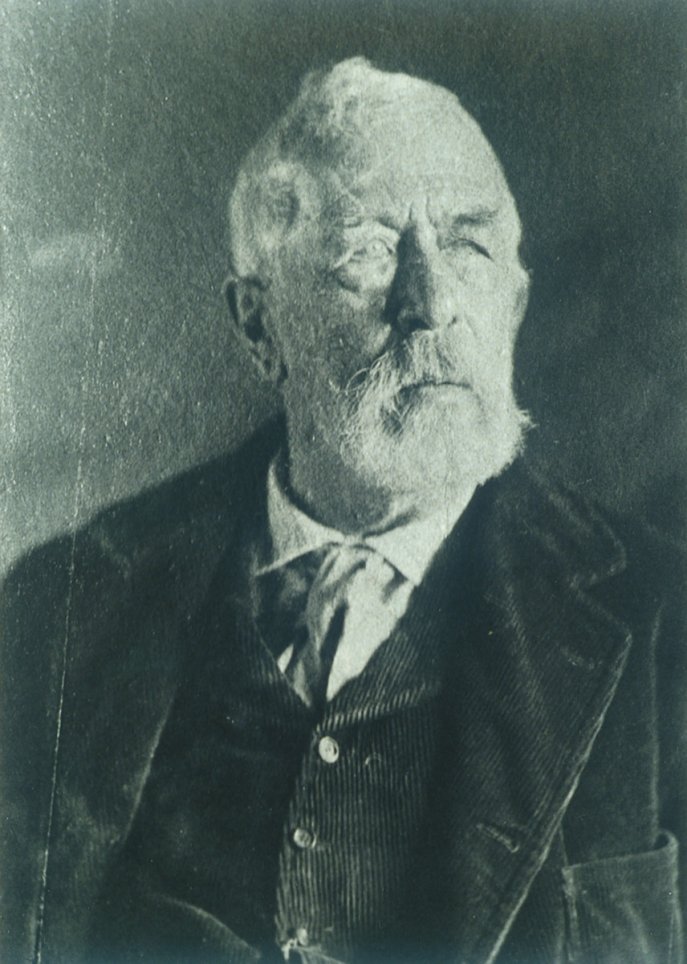
Photo of Arnold Böcklin (1900) aged 73

In my final part of the Arnold Böcklin story I want to look at his portraiture and some of his more evocative Symbolist works.  He completed many self portraits, two of which I have shown you at the start of the last couple of blogs.  His portraits also included ones of his second wife, Angela Rosa Lorenza Pasucci and their daughter Clara.

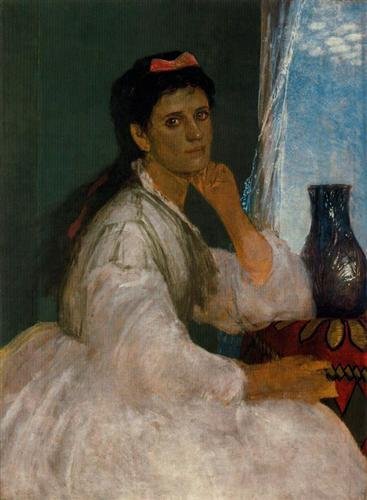
Portrait of Angela Böcklin as muse by Arnold Böcklin (1863)

In the first blog about Arnold Böcklin I mentioned his two wives.  He married Louise Schmidt in 1850 but she died a year later and then in June 1853, Böcklin married his second wife, a seventeen year old Italian girl, the daughter of a papal guard, Angela Rosa Lorenza Pasucci and she featured in a number of his works of art.  One such portrait was entitled Portrait of Angela Böcklin as a Muse which he completed in 1863.

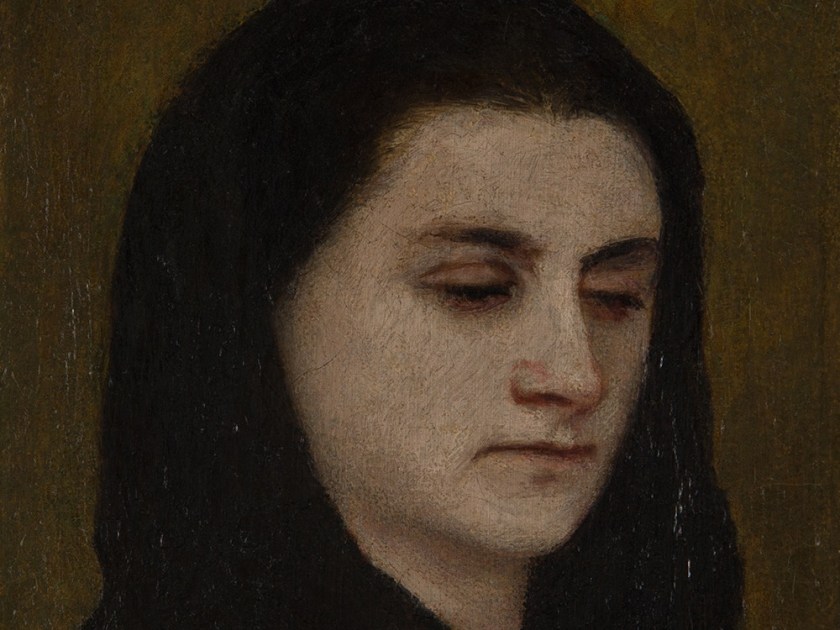
Mrs Böcklin with Black Veil by Arnold Böcklin (1863)

Böcklin completed another portrait of his wife that year entitled Mrs Böcklin with Black Veil.  This was a more sombre depiction of his wife.  It was painted when she was twenty-seven years of age.  It is only a small oil on canvas work within the stretcher frame just measuring 19 x 14 cms.  This was a painting he completed for himself.  There is a certain intimacy about the work.  The artists depicts his wife with a black veil on her head and this veil serves the purpose of being a frame for his wife’s face, the colour of which is in contrast to the simple olive green background.  Angela Böcklin seems to be very thoughtful, even slightly sad.  Maybe she is in mourning for we know she and Arnold had fourteen children but only eight of them survived him.   We take it for granted that we will die before our children but in the nineteenth century that was not always the case, in fact the opposite was often true, and although it was a common occurrence for children to die young we should never underestimate its tragic consequences.

Portrait of Clara Böcklin by Arnold Böcklin (1872)

In 1872 he completed one of a number of portraits of his daughter Clara.

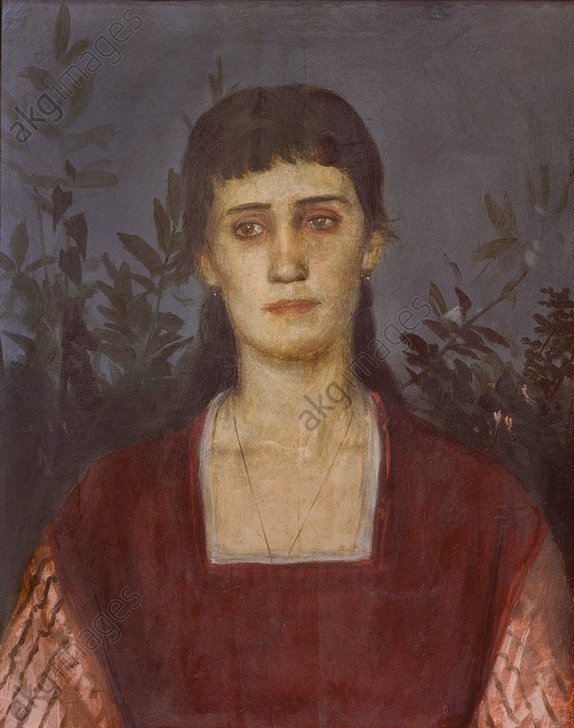
Portrait of Clara Böcklin by Arnold Böcklin (1876)

In 1876, when she was twenty-one years of age, Böcklin painted another portrait of her.   It was also in this year that Clara married the sculptor, Peter Bruckmann.

Böcklin became somewhat fixated by death and this is borne out with his evocative painting Die Toteninsel, which I talked about in the previous blog.  This preoccupation, which could have been because of the loss of his children, was clearly seen in yet another of his self portraits, which he completed in 1872, shortly after the death of his young daughter, and was entitled Self Portrait with Death as a Fiddler.  It was completed whilst Böcklin was in Munich having just travelled back from Italy. It was in Italy that Böcklin began to add symbols into his paintings in order to suggest ideas.  The interesting thing about Symbolism in art is that we can each come to our own conclusions about what we see in a painting and unless the artist has spoken about the painting then we have as much right to postulate about an artist’s reasoning behind their work as the next person.  So having looked at the work, what do you make of it?  Let me make a few suggestions about what I think may have been in Böcklin’s mind when he put brush to canvas.

Self portrait with Death as the Fiddler by Arnold Böcklin (1872)

We can see that Arnold has portrayed himself with painting brush in one hand whilst the thumb of his other hand is hooked through the hole in the palette securing a piece of cloth.  However what is more interesting is the inclusion of the skeleton playing the fiddle in the background.   The question I pose is – what was Böcklin thinking about when he decided to include the skeleton?    We know that most paintings, which include a skull or skeleton, are Vanitas paintings.  A vanitas painting contains an object or a collection of objects which symbolise the inevitability of death and the transience of life.  Such paintings urge the viewer to consider mortality and to repent !  So, Böcklin’s inclusion of a skeleton is a reminder to him that he cannot take life for granted and that there is a very fine line between life and death.

Look at the juxtaposition of the artist and the skeleton.   Look how the skeleton appears to be whispering something in Böcklin’s ear and the artist in the painting turns his head slightly and leans back to listen.   He is staring out of the painting, but not at us.  He is staring out but his full attention is on what the skeleton is saying.   Maybe the skeleton is telling the artist something about his future?  Look also at the fiddle that the skeleton is playing.  It has only one string left.  Why paint the fiddle with just one string?   Is this something to do with the length of time Böcklin has on this earth?  Is it that at birth the violin had all four strings but, as time progressed, string after string broke and so, at the time of death, there are no strings?

The painting can now be seen at the Alte Nationalgalerie in Berlin.

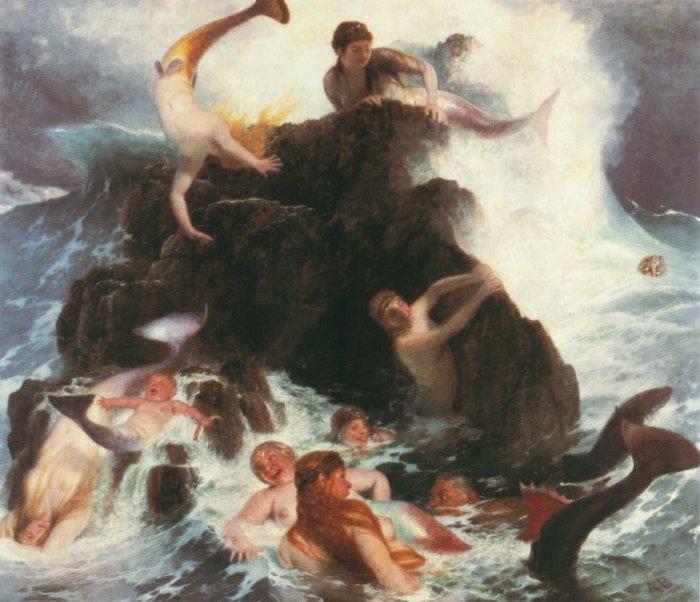
Naiads at Play by Arnold Böcklin (c.1862)

Other subjects that appeared in Böcklin’s paintings during his last period of creativity were the Naiads and Nereids or sea and water nymphs often referred to as female spirits of sea waters.  The next painting I am showcasing is entitled Naiads at Play which Böcklin completed around 1862 and now hangs in the Kunstmuseum Basel.  Böcklin’s biographer, Henri Mendelssohn described the painting, writing:

“…It fairly bubbles over with fun and merriment.  The scene represents a rock in the ocean, over which the waves dash in foam, tossing white spray high into the air.  Clinging fast to the wet rock face are the gleaming forms of naiads, their tails shining like jewels in the seething waters, as the waves dash, one on top of another, so do the creatures of the sea chase each other in their frolic, darting here and diving there, and tumbling heels over head from the rock into the ocean beneath, whose roar almost drowns their shrill laughter.  All is life and movement.  The sputtering triton and the luckless baby, holding in his convulsive clasp the prize he has captured, a little fish, rank among the inimitable creations of Böcklin’s art…”

Marie Joseph Robert Anatole, Comte de Montesquiou-Fézensac, a French Symbolist poet and art collector of the time, described Böcklin’s work, writing:

“…”This is the most astonishing of all Böcklin’s representations of the sea. The water gleams with hues as violent as those reflected by the Faraglioni, the red rocks which, seen from Capri, mirror their purple shadows in the blue waves. One of the naiads, with her back turned to us, seems to set the water on fire with the brilliancy of her orange-coloured hair, while all the naiads’ tails, wet and glistening, glow with the gorgeous hues of butterflies’ wings or the petals of brilliant flowers…”

Looking at the work one can understand the comments.  It is as if you were there, feeling the energy and almost feeling the spray on your face.  From this mythical subject, Böcklin has almost turned it into reality, such was his skill.

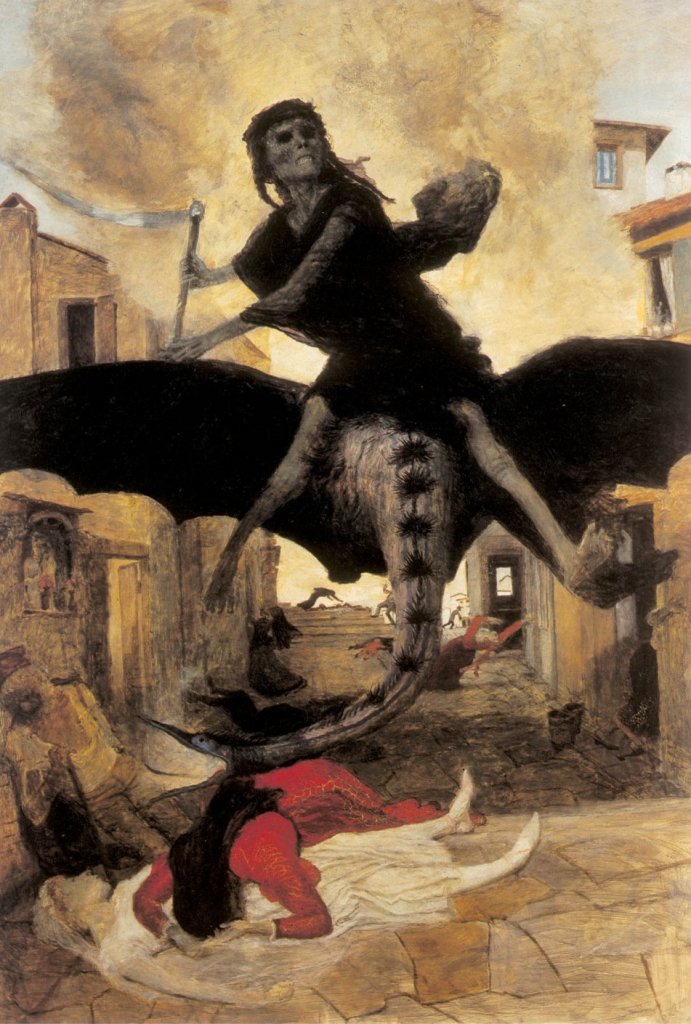
Plague by Arnold Böcklin (1898)

Another painting by the Swiss symbolist Böcklin which illustrates his fascination with nightmares, the plague and death was one he completed in 1898 entitled Plague.  It is a tempera on wood painting, which is now hanging in the Kunstmuseum Basel.   In the painting the setting is the street of a medieval town and we see the grim-faced Death, scythe in hand, riding a winged creature, which spews out miasma.  The colours Böcklin used in this painting are black and dull browns for the clothes of many of the inhabitants who desperately throw themselves out of the path of Death and shades of pale green which is often associated with death and putrefaction.  The one detail which is devoid of drab colours is that of the clothes worn by the woman in the foreground who lies across the body of the woman who has suffered at the hands of Death.  Her gold-embroidered red cloak signifies that she comes from a wealthy household and the painting reinforces the fact that Death takes both rich and poor.  The plague had ravished Europe throughout the 14th to 17th centuries.  It knew no boundaries of class or wealth.

Ruggiero and Angelica by Arnold Böcklin (c.1874)

Around 1874 Böcklin completed a painting entitled Roger and Angelica.  It can now be seen in the Nationalgalerie in Berlin. The scene, Roger rescuing of Angelica, is based on the 1532 epic romantic poem, Orlando Furioso by Ludivico Ariosto, which is all about the conflict between the Christians and the Saracens.  The painting depicts the main character, Ruggerio (Roger), a Saracen warrior, coming to the rescue of Angelica, the daughter of a king of Cathay.  She is chained to a rock on the shoreline and is about to be killed by the sea monster, the giant turquoise orc, which has wrapped itself around the helpless Angelica.  In the background we see Roger arriving astride his horse.  The battle with the orc is ended when Roger dazzles the sea monster with his shield allowing him the chance to place a magic ring on the finger of Angelica which protects her whilst he undoes the bonds which were tying her to the tree.

Grave of Arnold BöcklinArnold Böcklin moved around Europe, living in Munich, Florence and the small Swiss town of Hottingen which was close to Zurich but from 1892 onwards he settled down near Florence in the town of  San Domenico.  To mark his seventieth birthday a retrospective of his work was held in Basel, Berlin and Hamburg.  Böcklin died of tuberculosis, aged 73, in Fiesole, a small town northeast of Florence, in January 1902 and is buried in the Cimitero Evangelico degli Allori in southern Florence.

In my next blog I will be looking at the work of an artist who was known as the king of the cats as many of his paintings had an obligatory cat in the depiction.  However he was probably more remembered by his erotic paintings which featured pre pubescent girls in all manner of provocative poses.  In this day and age many of his works would struggle to be exhibited because of the age of his models.

Vasily Perov. Part 2 – portraiture and humour

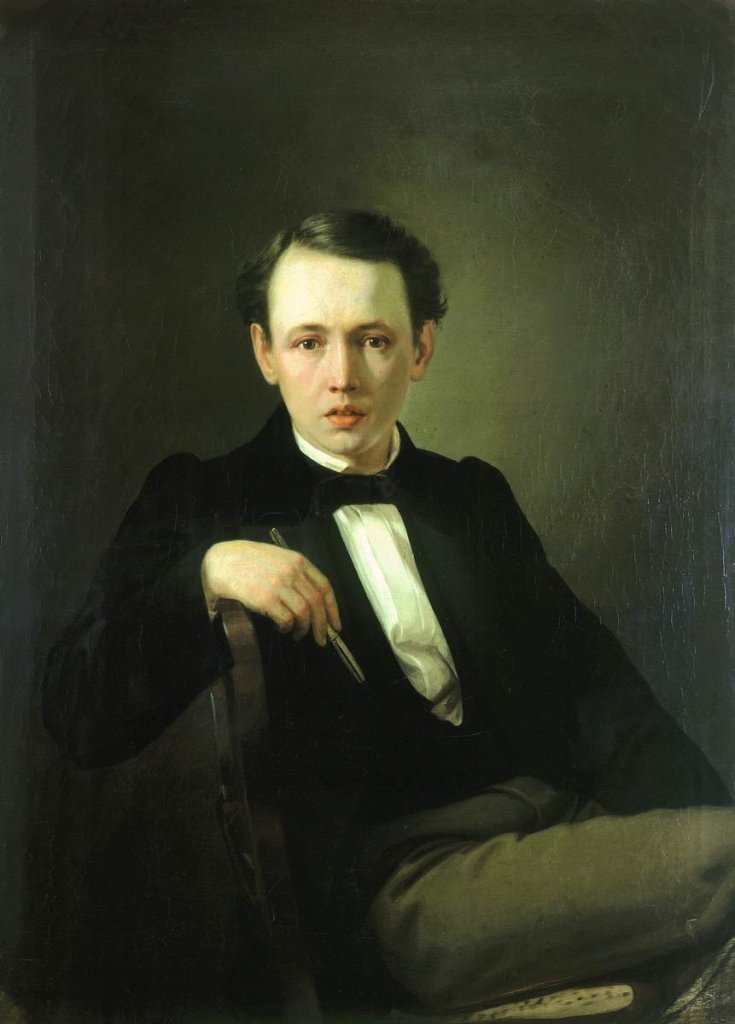
Self-Portrait (1851)

In my last blog I looked at Perov’s early life and his artwork which is often categorised as critical realism because of the way his paintings  focused on the peasants and how they had been let down by the Church, its clergy and the State.  For one of these works he was awarded the Gold Medal by the St Petersburg Imperial Academy of Arts and also a scholarship for him to travel to Europe and study European art.  He went to Paris where he spent a considerable amount of time but once again his art focused on poverty, this time, poverty in France.  Perov was now moving away from his anti-clerical depictions, and his barbed narrative works which poured scorn on the Church.  He now wanted to concentrate on the poor themselves and left the observer to decide on the reason for the poverty.

Savoyard by Vasily Perov (1863)

One of his most famous paintings, which he completed whilst in France, was one entitled Savoyard which he finished in 1863.  In Perov’s painting we see a young boy sat slumped on some stone steps.  The absence of any movement allows us to focus on the child without any distractions.  The child is asleep.  His feet stick out in front of him and this allows us to see the tattered hems of his trousers and because of the way is feet rest on the pavement we are given a view of the soles of his shoes, which are holed.  The painting itself is made up of dark sombre tones of smoky blue, green and grey.

Street Beggar by Gavarni

It is thought that Perov’s painting was influenced by the work of Paul Gavarni, a French engraver, who had his illustrations published in a collection of London sketches, featuring life in London at the time.  The sketches and accompanying illustrations were first published as a magazine series in 1848 and later they were collected in one volume, edited by essayist and journalist Albert Smith, which was first published in Paris, in 1862, a year before Perov’s arrival in the French capital.  It was entitled Londres et les Anglais.  One of the sketches was the Street Beggar and its thought that Perov had this in mind when he worked on the Savoyard.

Perov’s arrival in Paris in 1863 coincided with a great upheaval in French art.  The Hanging jury at that year’s Salon had been ruthless in their choice of paintings which could be admitted.  Those which were cast aside were ones deemed to have not been of the quality or type they wanted.  That year, the jury had been more ruthless than they had been in the past, rejecting two-thirds of paintings.  This resulted in vociferous protests from the artists who had had their works rejected.  It was so bad that Napoleon III stepped into the argument and placated the disgruntled artists by offering them a separate exhibition for their rejected works.  It became known as the Salon de Refusés (Exhibition of rejects) and that year this exhibition exhibited works by Pissarro, Fantin-Latour, Cezanne and included Manet’s Dejeuner sur l’herbe and Whistler’s Symphony in White,no. 1. 

The Arrival of the Governess at a Merchant's House by Vasily Perov (1866)
The Arrival of the Governess at a Merchant’s House by Vasily Perov (1866)

Perov returned home early from his European tour in 1865 and in 1866 produced a wonderful painting entitled The Arrival of the Governess at a Merchant’s House.  This was a move away from his focus on poverty and more to do with the fate of women.  In the painting we see a governess standing before the master of the house, a merchant who is to be her new employer.  This painting depicts the awkward encounter between the governess, who has probably graduated from a school for governesses, where they are taught to act like nobility, and the merchant who has no noble blood and is the face of the nouveau riche.   She presents herself well. She clutches a letter of introduction in her hands. She oozes an air of timidity and subservience, which is a trait that would be required if she was to become a member of the household.  However her demure stance with head bent down is befitting that of a lady.  She stands before, not only the master of the house, a bloated man, but behind him stands his family.  The children of the family are to be her pupils and by the looks of them she was going to be in for a difficult time.  The master of the house and his three children are dressed elegantly and the furnishings we see are fine and elegant and are part of merchant’s plan that they be elevated in status from mere merchants to something approaching nobility. Perov has changed the subject of his biting satire from the clergy of the Church to the oppressive merchant classes and the poor treatment they bestow on their employees.

Troika by Vasily Perov (1866)

The painting was purchased by thirty-four year old Pavel Tretyakov, a Russian businessman, patron of art, avid art collector, and philanthropist who gave his name to the Tretyakov Gallery in Moscow.   This work along with his Troika painting earned Perov the title of Academician.

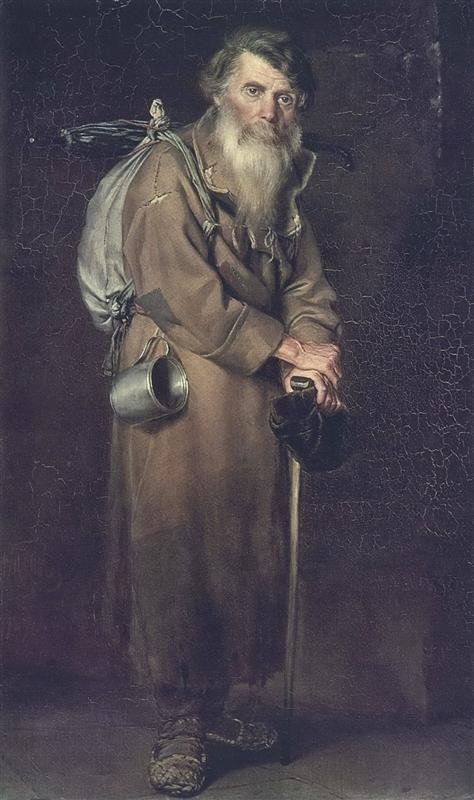
Wanderer by Vasily Perov (1870)

In the late 1860’s Perov began to concentrate on portraiture, initially of peasants and the title Wanderer was given to three of his works which featured peasants, all different and yet all emotive in their own way, one of which is shown above.  As Perov travelled around he came across a variety of fascinating characters and he was able present them on canvas and highlight their individualism and their way of life.

Portrait of the Author Feodor Dostoyevsky by Vasily Perov (1872)

In the early 1870’s Perov’s portraiture focused on cultural greats of Russia but it is interesting to note in these next two paintings they were totally devoid of any background accoutrements which would have added a sense of vanity in the sitter.  In 1872 he completed the Portrait of Dostoyevsky, a the Russian novelist, short story writer, essayist, journalist and philosopher. It was Dostoyevsky’s literary works which influenced Perov in the way they explored human psychology in the troubled political, social, and spiritual atmosphere in Russia during the 19th-century.

Portrait of the Playwright Alexander Ostrovsky by Vasily Perov (1871)

And in 1871 he finished his Portrait of Alexander Ostrovsky, a Russian playwright who was generally thought to have been the greatest writer of the Russian realistic period, which existed against the background social and political problems.  It started in the 1840’s under the rule of Nicholas I and lasted through to the end of the nineteenth century.   The painting is now housed in the Tretyakov Gallery, Moscow.

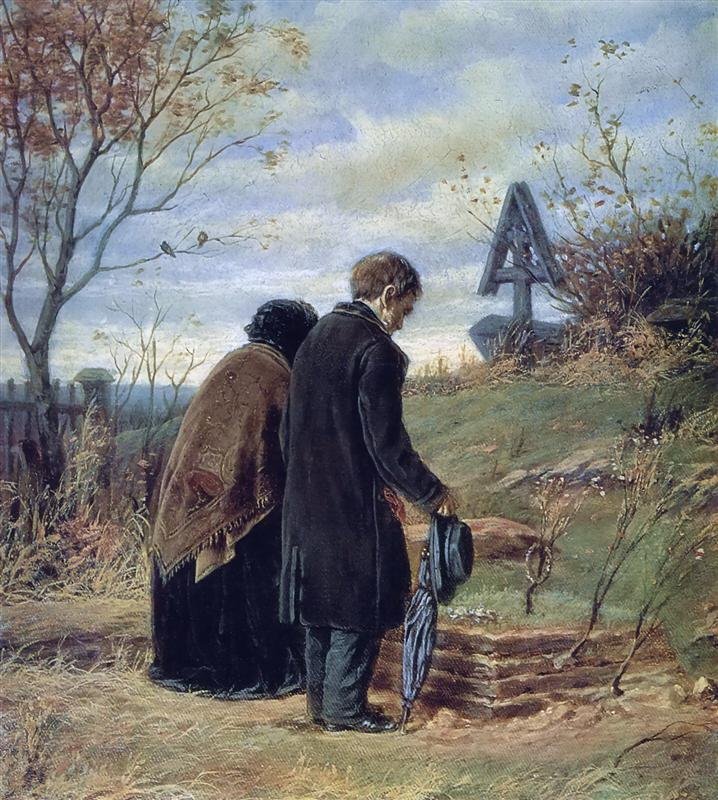
Old Parents Visiting the Grave of Their Son by Vasily Perov (1874)

In all his genre works he always managed to tug at your heart strings with his moving depictions.  Another of his heart-rending scenes was completed in 1874 and was entitled Old Parents Visiting the Grave of their Son.  It is said that nobody should suffer the agony of burying their children and in this work we feel the loss of the mother and father as they stand, heads bowed, at the side of the son’s grave.  This painting, like many of his other works, are to be found at the Tretyakov Gallery in Moscow.

Having received his academician’s degree in 1867, Perov went on in 1871 to gain the position of professor at Moscow School of Painting, Sculpture and Architecture.   It was through Perov’s teaching at Moscow School of Painting, Sculpture and Architecture that he managed to influence and nurture the young aspiring artists in his charge.  Many of the great Russian artists had been taught by him or were influenced by his style of painting

Amateur by Vasily Perov (1862)

As always I have the dilemma of which paintings to show you and which ones to leave out.  I just hope the blog will get you to search the internet for more of his works.   My final offering is one that features Perov’s sense of humour.  It is in complete contrast to his works which looked at poverty and the impoverished existence of the peasant classes.   It is a painting entitled Amateur which he completed in 1862.  It is both humorous and fascinating.   Before us we see a man slouched in a chair, chewing on the end of his maulstick, eyes narrowed as he looks at his work.  His wife stands beside him holding a baby.  She too is closely examining the canvas.    From the way the man is dressed along with the background details of the room we gather that this is an upper-middle class couple.  Another give away to the man’s social status is the way Perov has depicted him.  Well dressed, highly polished shoes and overweight.  Perov’s depiction of this man is similar to the master of the household, the merchant, whom he depicted in The Arrival of the Governess at a Merchant’s House- overweight, through all the food he had been able to buy and eat, whereas in most cases Perov portrayed the poor peasants as thin undernourished people.

Vasily Grigorevich Perov died of tuberculosis  in Kuzminki Village which is now part of Moscow and was laid to rest at Donskoe Cemetery.  He was fifty-eight years old.

Fred Elwell. Part 2. Portraiture

In my second look at the life and works of Fred Elwell I want to concentrate on his masterful portraiture.

In the last blog I left Fred Elwell studying in Paris with his friend Claude Rivas.  The year was 1892.   They had found themselves some rooms and had enrolled at the Académie Julian under the tutorship of William-Adolphe Bouguereau.  Bouguereau was far more than just a teacher of art at the Academy, he was a fierce defender of the academic method of teaching art.  He was also the chairman of the selection panel of the Paris Salon and thus had, with the other jurists, the power to accept or refuse submitted entries for the annual exhibitions and the jurists’ refusal to accept non-academic art angered many such as Paul Cézanne, Manet and Whistler.

Self Portrait by Fred Elwell (1933)

Life at Académie Julian was an exciting time for aspiring artists and many travelled great distances to be part of the Academy’s chosen few.  The artists were made to work hard and it also developed their competitive nature by offering a number of annual prizes.  Fred Elwell blossomed under this heavy workload and managed to win a number of these prizes during his stay.  Friendships were born at this Paris academy and Fred developed long term and special friendships with two other English artists, Richard Jack and the Lincoln-born, William Tom Warrener.  Warrener was nine years old than Elwell and had already established himself as a painter.   He was also a great social animal and spent much time in the bars of Montmartre and the Moulin Rouge nightclub which had come into being in October 1889, in the Jardin de Paris, at the foot of the Montmartre hill.  Warrener had become friends with Toulouse-Lautrec and, like Lautrec, had been commissioned to design a number of advertising posters for the Moulin Rouge.

Elwell would often visit Warrener at his apartment on rue Ravignon and would see the walls of his rooms covered with paintings he had done of the nightlife of the Moulin Rouge.  It was during one of those visits that Elwell was introduced to the actress, Léonie, who was one of Warrener’s models and Elwell managed to persuade her to also become his model (see Part 1 of my Fred Elwell blog where I have included Elwell’s painting of her, Léonie’s Toilet).

Elwell’s stay in Paris coincided with La Belle Époque.  This period from the late 1870’s to the start of World War I was one of optimism.  It was the golden age.  For France, this was a period of stability and peace squeezed between the Franco-Prussian War of 1870, quickly followed by the brutality of the Paris Commune and the Great War of 1914. It was a time of peace and prosperity.  It was time of joy and many took the opportunity to visit clubs and theatres and Elwell, who worked and studied hard during the day, managed to sample the night life in the evening and late into the night and it was during his stay in Paris that he developed the love of pipe-smoking, a habit which stayed with him for most of his life.  Another facet of Paris life which Elwell took to was what we now term as café culture which he continued to follow when he returned to England.  However, life in Paris had its downside for Elwell, as with most wannabe artists the burden of financial problems was ever present and Elwell’s financial predicament, despite the odd help from his father, was the same, so much so that he had to give his beloved portrait of Léonie to his landlord in lieu of rent.

Whilst he studied at the Académie Julian, Fred would often go back to Beverley to recharge his batteries and sample the delights of home comforts.  Elwell finally left Paris in 1895 deciding to live and work in London, although he still exhibited his works at the city’s Salon des Artistes Français (Paris Salon).  Elwell was determined to get some of his paintings excepted by the Royal Academy in London and believed he would be able to fund his London life through commissions.  Unfortunately for Elwell many artists had the same thought and the contest for painting commissions was ruthless.  Elwell realised that the streets of London were not paved with gold and soon he became very despondent with his lack of success.  It is thought his despondency led to a nervous breakdown.  His father rushed down to London to support his son and eventually convinced him to return home to Beverley

………..to be continued.

Florence by Fred Elwell (c.1902)

Fred Elwell was a master of many painting genres and the paintings I am featuring today deal with his skilful portraiture. The first portrait, Florence, is one Elwell completed around 1902.  It features his twelve year old niece Florence Elwell.  Florence had been brought up by Fred’s mother and father after she came to live with them at their Park Villa home, close to the racecourse in Beverley, following the death of her parents.  She looks a little moody and frustrated at having to sit for her uncle and pouts with annoyance.  There were more joyous things to do for a twelve-year old including mixing with the racing fraternity who would often congregate at her uncle’s home during Beverley horse-racing events.  It is believed that Fred Elwell completed the portrait in just one hour.

Portrait of a Small Boy by Fred Elwell (1917)

My next featured work is also of a youngster and is entitled Portrait of a Small Boy which Elwell completed in 1917.  Before us we see an immaculately dressed young boy in a white suit holding his hat in his right hand and his beloved yacht in the other.  His short white socks show signs of falling down towards his shiny black leather sandals.  The portrait must have been a challenging task for Elwell as boys of his age are reluctant to stand still and the crumpled look of his white suit is an indication of much movement.   It was so challenging that after he had completed the painting, Elwell swore that he would never paint the portrait of a child again.

Seated Nude in the Studio by Fred Elwell (1935)

As I mentioned in the first part of the Fred Elwell story, the first time he was allowed to paint live nudes was when he moved to Antwerp.  One of his best works of a female nude was completed in 1935 and was simply entitled Seated Nude in Studio and can be found at the East Riding of Yorkshire Council Museum.  The lady depicted in this work is seated on a stool and is depicted in graceful semi-profile.  Her blue dressing gown lies besides her. In the background there is some dark furniture which contrasts with the radiant flesh tints of the lady.  It is a quirky set-up as she sits before a painting on an easel as if she is the artist admiring her own work.

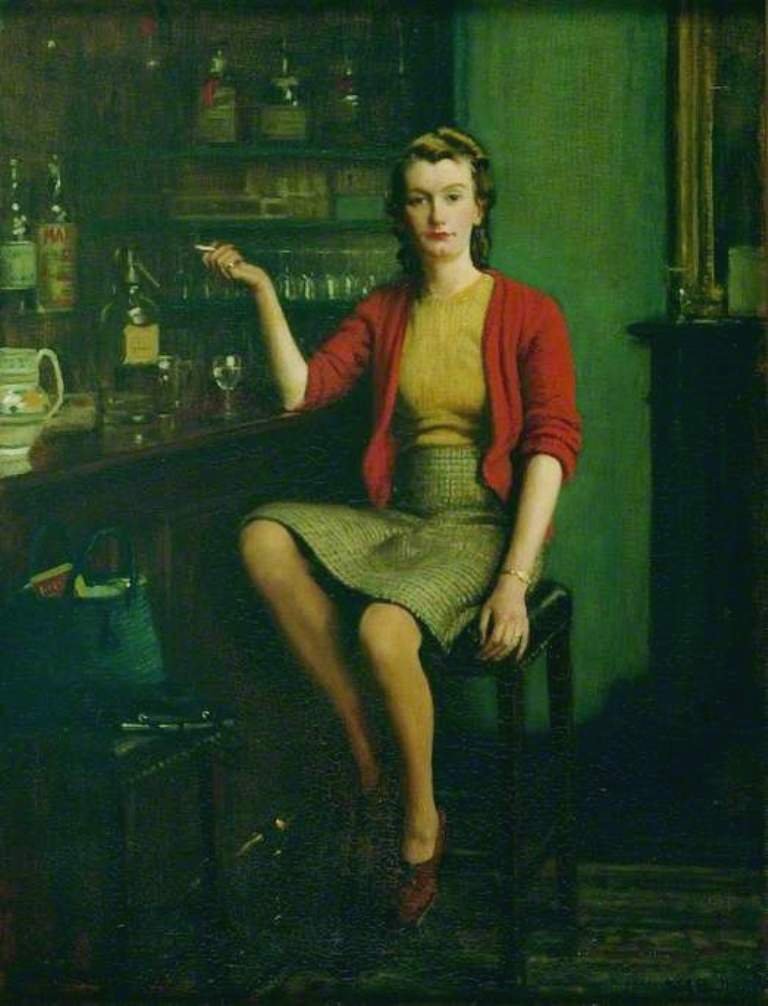
In a Bar by Fred Elwell (1943)

Another female portrait by Elwell which I really like is entitled In a Bar which he completed in 1943 and was exhibited at the Royal Academy that year.  In the work we see the model sitting at the bar, cigarette in hand with a glass of gin and tonic on the bar beside her.  There is an air of casual indifference about the way she poses, a somewhat challenging facial expression which challenges us to query her drinking and smoking habit.    This is twenty-eight year old Muriel Fox a favourite model of Fred Elwell and believed to be the lady who posed nude for him in the previous work.  Muriel was a cook at the Beverley Westwood Hospital and would often call into the Beverley Arms Hotel on her way home from work. This bar was later known as Elwell’s Bar.  She was a well-known regular at this hostelry and this was “her stool”.   There is great poise in her expression as she stares out at us.  As was the fashion in the 1940’s her cheeks were applied with  a liberal amount of rouge and her hairstyle , tightly waved, was the fashion of the day.   It was rumoured that she had recently given birth to her daughter and baby and basket had been placed out of sight behind the bar.

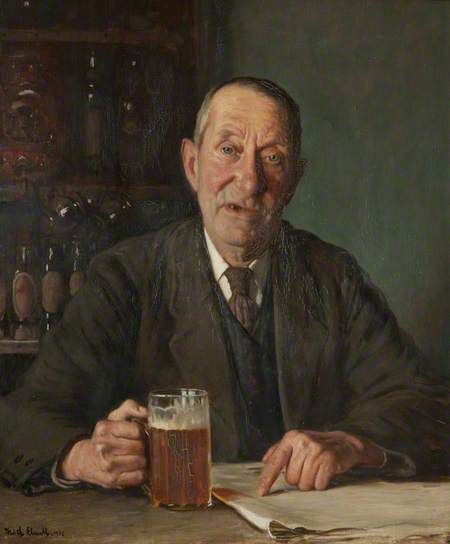
A Man with a Pint by Fred Elwell (1932)

My next offering is a male portrait and it is a real gem.  The work is entitled A Man with a Pint and was completed by Elwell in 1932 and exhibited at the Royal Academy a year later.  The painting depicts and elderly man tightly clasping his pint of beer whilst pointing at something in the newspaper which he had been reading.   He has a red face and a bulbous nose.  There is something very comical about the portrait.  The public loved this portrait and the art journal, The Artist, maintained that Elwell “belonged to the School whose purpose is Life”.  This portrait is a wonderful realist depiction.  Elwell has chosen his sitter, not for his handsome qualities but for his down-to-earth demeanour.  This is a depiction of man, like the many elderly men, who love to spend the time with their pint in a welcoming hostelry.

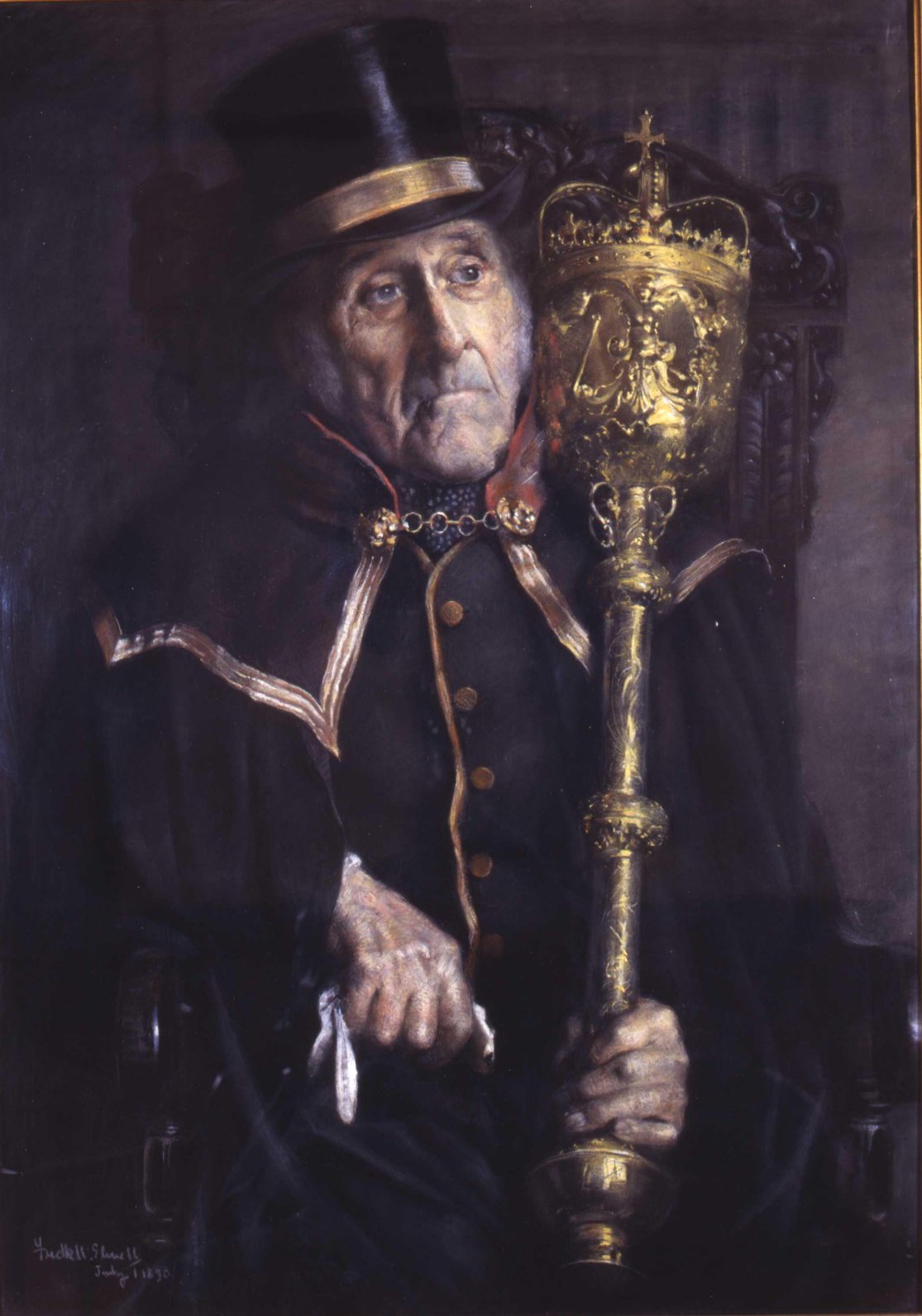
Portrait of George Monkman, Mace Bearer of Beverley by Fred Elwell (1890)

The next portrait is also of an elderly man but in this instance he is not an unknown character but a member of the local Beverley Council.  He is the official mace bearer that the town rolls out on official occasions.  His name is George Monkman and the title of the pastel painting is Portrait of George Monkman, Mace Bearer of Beverley.  This was painted by the twenty-year old Elwell in July 1890 during the time he was attending the Antwerp Academy and, like many of Elwell’s works, is housed in the East Riding of Yorkshire Council Museum.  Before us sits a grey-haired sad-faced man in top hat and dark gold rimmed livery.  He sits in a high-backed chair. Look how the light shines on both the man’s face and the gilt mace.  It is a great study of character and is a testament to Elwell’s ability in the way he has depicted the demeanour  of the man, who looks old and tired but still proud of his position as the mace bearer.  The frailty of the man, who was eighty-four years old at the time, is brought home by the way Elwell has got him to hold the large ornamental mace with his left hand grasping on to the weighty implement as he holds it against his body.  Elwell remembered the portrait well, stating that to keep the sitter happy he had to ply him with brandy.  Sadly a fortnight after the portrait was completed Monkman died.  Elwell completed an identical portrait in oils thirty years later in 1921.

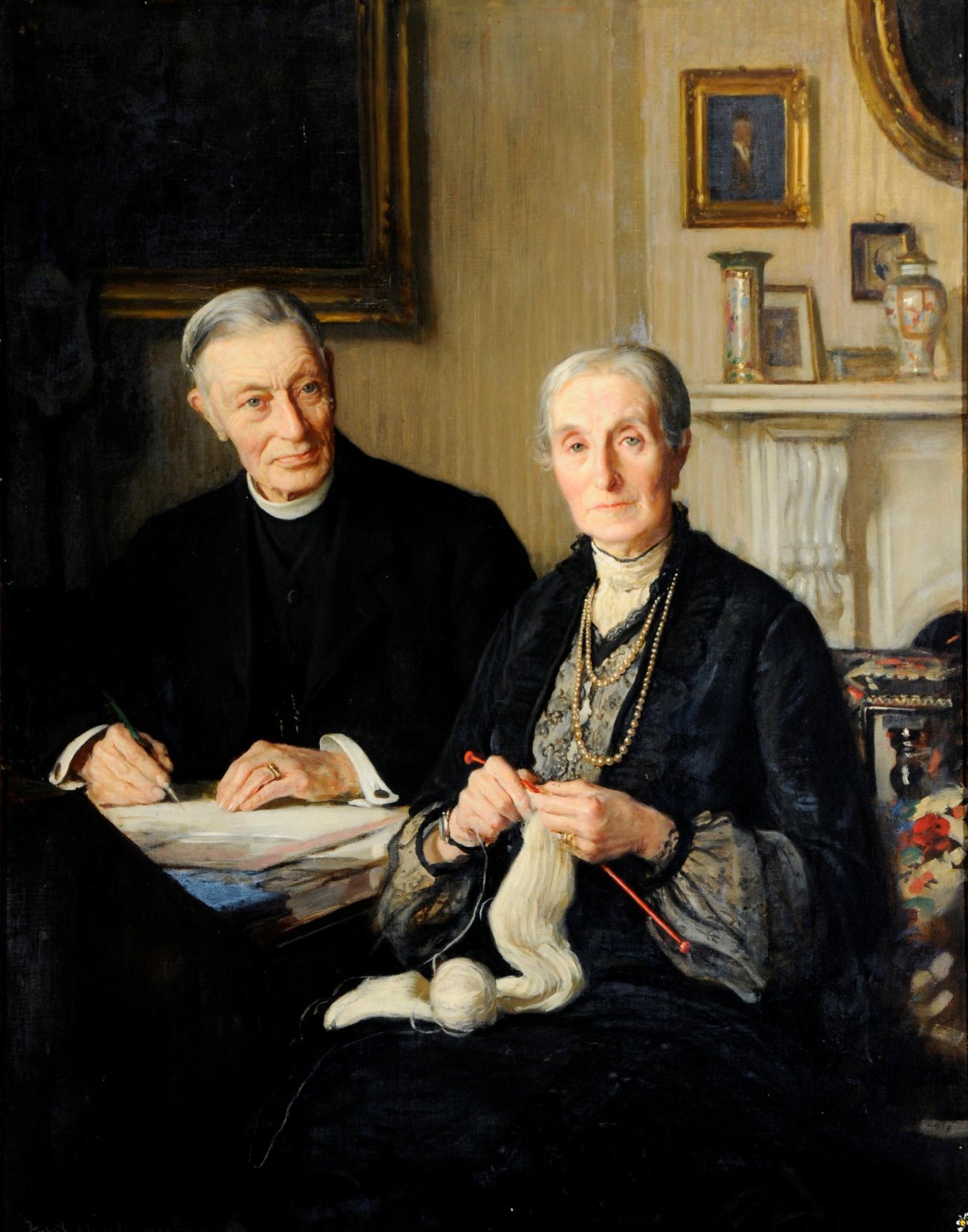
Canon Fisher and his Wife by Fred Elwell (1905)

 The final work of portraiture by Fred Elwell is entitled Canon Fisher and his Wife which he completed around 1905 and exhibited at the Royal Academy in 1929.  Before us we see an intimate dining room scene featuring the Reverend Robert Fisher and his wife Charlotte.  It is thought that painting had been commissioned to mark the retirement of the Canon paid for by his loyal parishioners and was one of Elwell’s first portraiture commissions.  The portrayal oozes warmth and there is an aura of affection and kind-heartedness surrounding the couple.   Robert Fisher sits at the table writing which probably alludes to the fact that he wrote a number of books on subjects such as plants, flowers and Yorkshire villages.  His wife sits by his side and works on her knitting.  The Canon retired from his position at St Mary’s Church in Beverley in 1905.

In my next blog I will be continue with Fred Elwell’s life story and look at more of his paintings.

Most of the information for this blog was gleaned from the excellent book I bought in Harrogate, Fred Elwell RA – A Life in Art by Wendy Loncaster & Malcolm Shields.  It is a beautiful book and well worth buying.

William Sidney Mount. Part 2 – The Portraitist, and some of his early historical works

Self portrait by William S Mount (1832)

In my last blog I looked at the early life of William Sidney Mount, hailed as the first American genre artist.  I looked at his love for music and how he depicted song and dance in his paintings.  Today I want to carry on with his life story and take a look at his early works and his portraiture.
 William had been working for his brother, Henry Smith Mount, at his sign writing business in Setauket and enjoyed it.  At first he found the work interesting and challenging but later found the painting of signs somewhat restrictive.  He gave up working for his brother and moved to New York to live with his uncle Micah Hawkins, who operated a tavern and grocery store in New York City.  His uncle was also a composer, playwright, and poet.  Micah combined music and storytelling into his theatrical productions which often delved into what was happening in politics and much of these ideas were to influence his nephew and his paintings.

  It was also around this time that William Mount visited his first art gallery, the American Academy in New York and in 1826 he enrolled at the newly opened National Academy of Design, an artistic establishment founded by a number of young painters such as Asher Durand, Thomas Cole, and Samuel Morse.  In those early years William Mount’s art was all about portraits and historical scenes.  William remained at the Academy for a year before returning home.
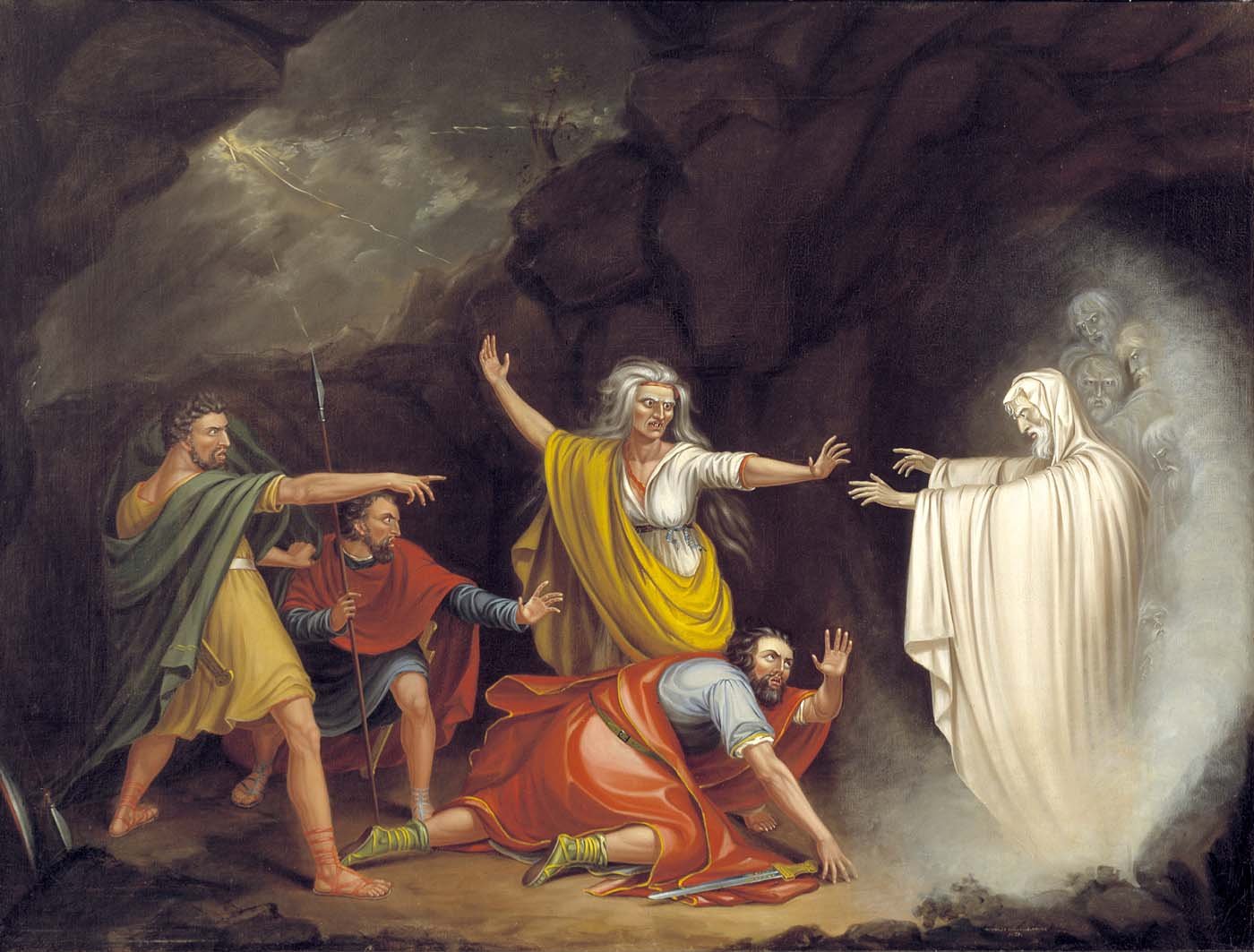
Saul and the Witch of Endor by William S. Mount (1828)

One of his early works was entitled Saul and the Witch of Endor, which he completed in 1828 and can now be found in the Smithsonian American Art Museum in Washington.   The painting depicts a passage from the Old Testament book of Samuel which tells of Saul and his battle with the Philistines.

 “… The Philistines assembled and came and set up camp at Shunem, while Saul gathered all Israel and set up camp at Gilboa. When Saul saw the Philistine army, he was afraid; terror filled his heart.  He inquired of the Lord, but the Lord did not answer him by dreams or Urim or prophets.  Saul then said to his attendants, “Find me a woman who is a medium, so I may go and inquire of her.

‘There is one in Endor,’ they said…”

 Saul seeks help from the oracle from Endor prior to him going into battle with the Philistines.  She summons the spirit of the prophet Samuel so that Saul could ask for his guidance.  In the painting we see Saul and his three companions cower in fear as the ghostly apparition approaches them.

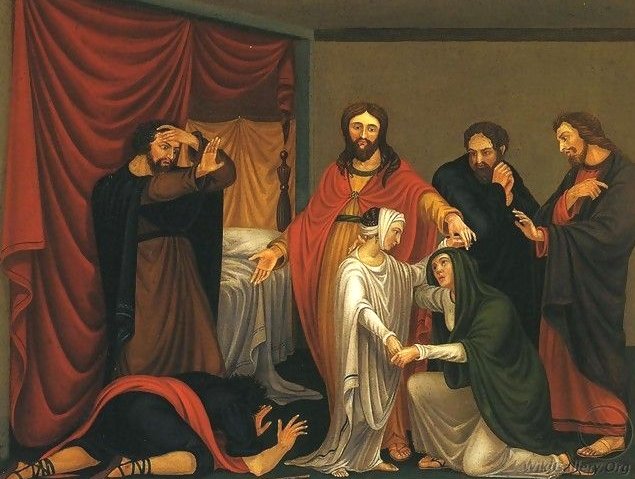
Christ Raising the Daughter of Jairus by William S Mount (1828)

In that same year he produced another biblical work based on Matthew’s Gospel (Matthew 9:23-26).  It was entitled Raising of Jairus’ Daughter.  The subject of this biblical work had been depicted many times before by great artists such as Veronese.  The bible relates the story:

“…When Jesus entered the synagogue leader’s house and saw the noisy crowd and people playing pipes, he said, “Go away. The girl is not dead but asleep.” But they laughed at him   After the crowd had been put outside, he went in and took the girl by the hand, and she got up.   News of this spread through all that region…”

William’s brother Henry was so impressed with the finished painting that he persuaded his brother to submit it at the annual National Academy exhibition.  It was well praised by the Academy professors.  William was now living at his brother’s place on Nassau Street, Lower Manhatten and had a studio in the attic.  He enjoyed painting historical and biblical works but the sales of which were not bringing in enough money so he reverted to portraiture which was always a guaranteed way of raising income.

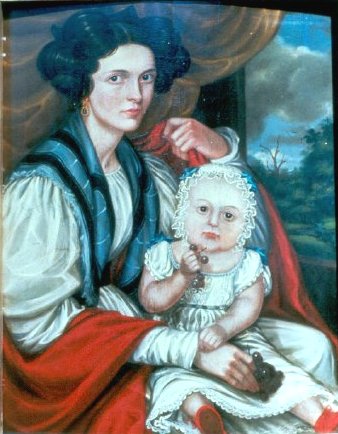
Ruth Hawkins Mount Seabury and Son Charles Edward by William S Mount (1828)

One of his early works of portraiture was a family portrait entitled Ruth Hawkins Mount Seabury and Son Charles Edward,  which he completed in 1828.  It depicts his nineteen year old sister Ruth Hawkins Mount and her infant son Charles Edward Seabury, the first of her seven children.

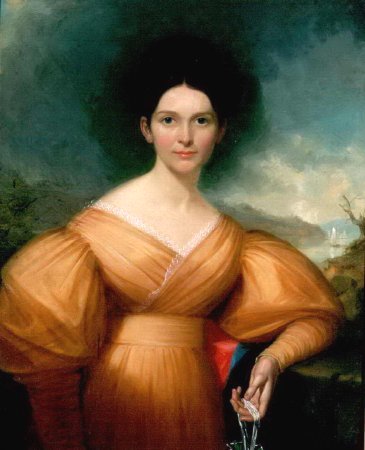
Ruth Mount Seabury by William S Mount (1831)

William Mount completed a portrait of his sister, Ruth in 1831.

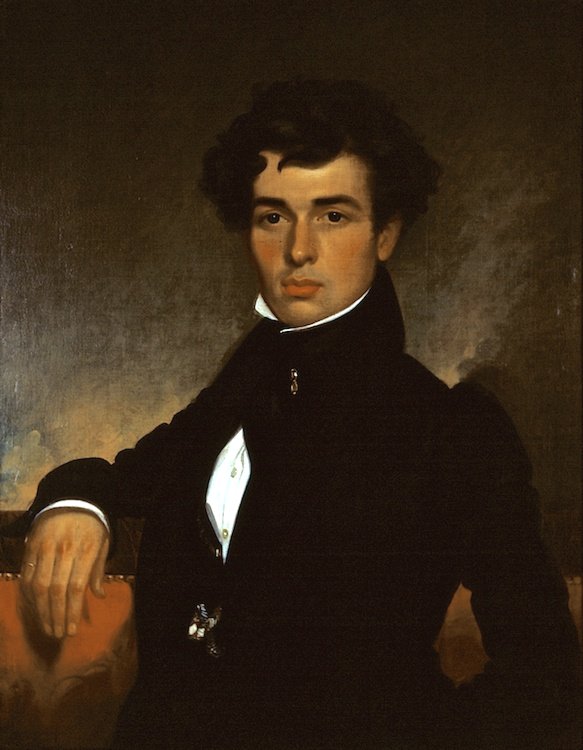
I suppose if you are looking for people to sit for you for a portrait, you turn firstly to your family and in 1828 he completed a portrait of his eldest brother, and his former employer, Henry Smith Mount.

Portrait of Henry Smith Mount by William S Mount (1831)

Three years later, in 1831, Henry Smith Mount was the subject of another of his younger brother’s portraits.  This portrait of his eldest brother (by five years) is a masterful portrait.  He has depicted his brother as a man of great self-confidence, a man who comes across as a thoughtful academic and yet, a man who by his facial expression, seems stern and somewhat menacing, as he stares out at us, lost in his own thoughts.

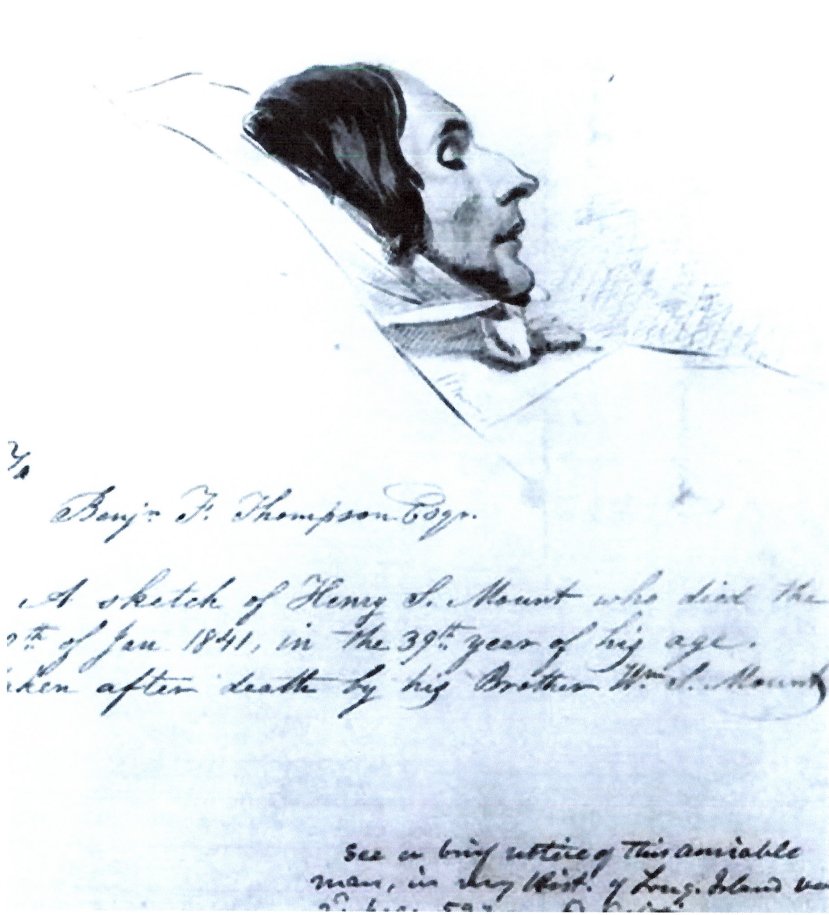
Henry Smith Mount on his deathbed by William S Mount (1841)

Thirteen years on he completed another depiction of his brother, Henry.  The circumstances surrounding this watercolour were much sadder as this was completed in January 1841 and the setting was Henry’s deathbed.  Henry was just thirty nine years of age.

Shepherd Alonzo Mount by William S Mount (1847)

In 1847 William Mount painted a portrait of his other brother, Shepherd Alonzo Mount.

Portrait of Jedediah Williamson by William S Mount (c. 1837)

The next example of William Mount’s portraiture is one he completed in 1837 and was entitled Portrait of Jedediah Williamson.  It is a depiction of a ten year old boy commissioned by his family.  It is a full frontal depiction of the young lad and Mount has carefully and with great skill portrayed the boy’s facial features.  It is a very peaceful depiction of the boy as he looks out into the distance.  The family would have been very pleased to have received the work from Mount and it is recorded that they paid him fifteen dollars for the painting.  However there is a sad twist to this portrayal as this is a “mourning painting” or as Mount referred to them, “a painting after death”.  The boy had died and this portrait was in honour of him and may have given the family a modicum of comfort during the sadness of their great loss.  These “mourning paintings” were very popular at the time and artists found they could achieve a steady income from paintings which, for relatives, served as a reminder of a loved one who had passed away. One should remember that between 1861 and 1865 over 350,000 Americans died during the American Civil War, the families of many just had an artist’s painting to remind them of their lost son or daughter.

Portrait of Reuben Merrill by William S Mount (1832)

Another interesting portrait by William Mount was one entitled Portrait of Reuben Merrill.  It was one of Mount’s early works which he completed in 1832.  The question, which is yet to be resolved, is who is Reuben?  Some believe he was a gardener whilst others say he was a simple field worker on the farm owned by William’s sister, Ruth and her husband, Charles Saltonstall Seabury.  The fact that he identity of the sitter used by Mount is somewhat of a mystery is not uncommon as a number of the sitters in Mount’s portraits are unknown.  There is warmth about how Mount has depicted this man.  His face is weather beaten from all the outside work but he has compassionate eyes, which leads us to believe that although he was just a poor and simple labourer, there was some sort of warm connection between him and the artist which probably testifies to the fact that he was a hard worker and appreciated by his employers.

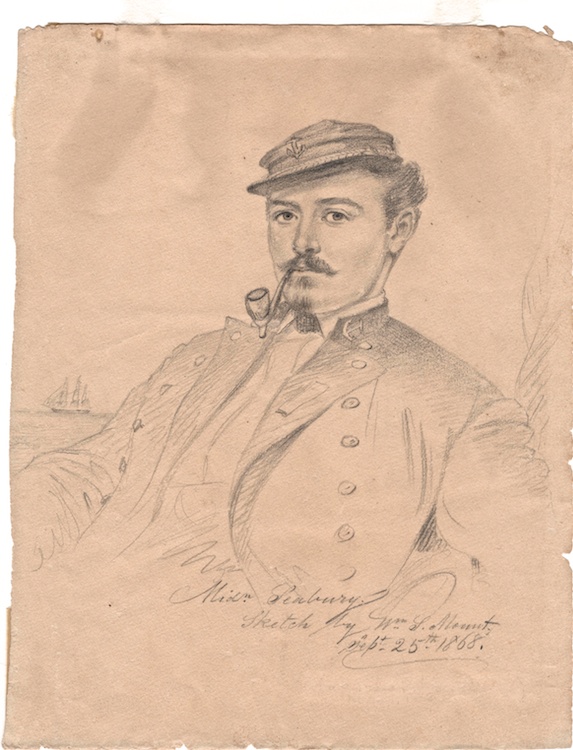
Portrait of Midshipman Seabury by William S Mount (1868)

My last example of Mount’s portraiture was also thought to have been his last artistic work.  It was completed in September 1868, less than two months before Mount’s death, and was a pencil sketch of his nineteen year old nephew Samuel Seabury.  Samuel was one of seven children.  His mother was Ruth Hawkins Mount Seabury, William Sidney Mount’s younger sister, and his father was Charles Saltonhall Seabury.   At the time of the portrait, Samuel Seabury was a midshipman in the navy, and the ship in the left hand background is a reminder of his profession.

In my next blog I will take my final look at William Sidney Mount and his work and I will feature some of his excellent non-musical genre work.

Marie Bashkirtseff. Part 1 The portraitist and feminist

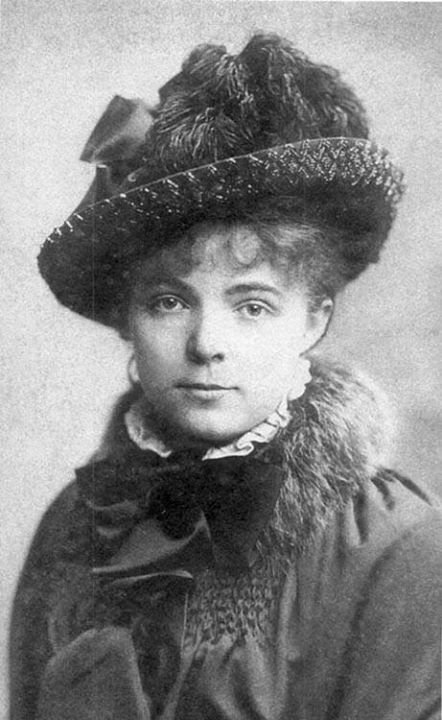
Photograph of twenty year old Marie Bashkirtseff (1878)

I had been researching the life of Jules Bastien-Lepage for a future blog when I came across the fascinating story of a Ukranian lady, a friend of his, who during her very short life excelled as a painter, a sculptor and a diarist.  It was her talent as a diarist and her personal diary which led to her notoriety.  I have split her lifestory, as short as it was, between two blogs, so come with me and explore the life of Maria Konstantinovna Bashkirtseva who became better known as Marie Bashkirtseff and her portraiture.

 Marie Bashkirtseff was born in November 1858 at Gavrontsi, a beautiful country estate close to the provincial town of Poltava in southern Ukraine.  Her father was Konstantin Bashkirtseff and her mother Mariia Babanina, who was a lady, fiercely proud of her Tartar heritage.   The family were wealthy and were looked upon as being of the petite noblesse social class, which was a termed used to describe the lesser nobility of France, especially rural landowners of noble ancestry.  A year later Marie’s brother Paul was born.  Marie was a studious and very intelligent child, speaking Russian and French fluently and even when young she exhibited a dynamic personality.  Her parents split up in 1859 and her mother took her and her brother back to her parents’ home in Tcherniakovka. 


The Umbrella by Marie Bashkirtseff  (1883)
The Umbrella by Marie Bashkirtseff (1883)

In May 1870, when Marie was eleven years old, her grandfather, Stepan Babanin, her brother Paul, and a motley collection of other family members, along with the family physician, Doctor Walitsky, left Tcherniakovka for good and embarked on a voyage of discovery around Russia and Europe.  The extensive journey lasted almost two years until the weary travellers settled down in a villa situated in the foothills of the Mediterranean Alps overlooking the coastal resort of Nice.  It was at this idyllic setting that fourteen year old Marie started to dabble with her artwork and also started to write her diary.  This diary which was eventually published in 1887, three years after her death, was to become a best seller.  In it she would write about her life on the Côte d’Azur with her extended family, her teenage infatuations, her dreams for the future and her loves.  She had a fixed idea of what her diary would be all about, writing:

 “…If I don’t live enough to be illustrious, this diary will be interesting for naturalists; the life of a woman is always curious, day by day, without affectation, as if nobody in the world should ever read it and at the same time with the intention of being read; I’m sure that you will find me pleasant… and I mean everything. Otherwise, what’s the point in writing? Apart from this, you will see that I say everything…”

Portrait of Mme X by Marie Bashkirtseff (c.1884)

 Marie Bashkirtseff received a well rounded education.  She was home-tutored with the family employing governesses and private tutors and she studied a number of languages including English, German, Italian, Greek and Latin.  She was well versed in history, mythology and literature and it was that knowledge that found its way onto the pages of her diary.   She also developed a great love of music and singing.   She was an accomplished pianist, played the harp and was a talented singer and she hoped that one day she would become a professional mezzo-soprano.   This plan for her future was to be dashed after a severe bout of laryngitis which irrevocably affected her vocal chords.  She was devastated at this turn of events, once musing in her diary about what could have been:

 “…My God!  What a beautiful voice I had!  It was powerful, dramatic, captivating; it gave chills in the back. And now I have nothing, not even a voice to speak with!…”

 With music being a thing of the past, Marie needed another outlet for her exuberance and it came in 1877,  when, aged nineteen,  she decided to embark on a career as an artist.  For this to happen she decided that Nice was not the place to be and insisted that the whole family should move to the European capital of art, Paris, for it was here she believed she would receive the best art tuition and be able to study the paintings of the Masters.  The family opposed the move, not because they didn’t want to move to the capital but because of Marie’s fragile health.  They believed that the warm climate of Nice was more suitable for Marie than the colder, damper climate of Paris.  It was not because of their wish to stay warm and enjoy the sunny climate of the south but it was because Marie had been diagnosed with irreversible tuberculosis and doctors had warned against such a move.  However the dominant and forceful character of Marie won the day and that year they left the south of France and moved north.

Portrait of a Woman by Marie Bashkirtseff (1882)

The Parisian establishment, which was in the forefront of art tuition, was the École des Beaux-Arts but this was not an option for Marie as, at that time, women were not allowed to enrol for study at that academy.  Marie then chose to enrol at the Académie Julian, which was the only academy at the time which accepted female students, albeit the men and women trained separately.  However the training for females was similar, even allowing women to participate in life drawing classes with nude models, which was frowned upon by other art establishments.  It was founded by Rodolphe Julian in 1868.  It was a private studio school for art students, which, as well as training aspiring male artists to pass the exams to enter the hallowed and prestigious École des Beaux-Arts,  it also offered independent training in arts to wannabe female painters.  Whilst there Marie received excellent artistic training under the tutelage of the likes of Rodolphe Julian, Tony Robert-Fleury, Gustave Boulanger, and Jules-Joseph Lefebvre.  She revelled in this world of art and even the glamour of her social life took a back seat as she commented in her diary:

 “…as for me, although feeling pleased of being in the ballroom, I’ve been thinking all the time in a pastel painted this morning with which I wasn’t satisfied…

 Marie was a perfectionist in all that she did and was highly competitive.  This latter characteristic manifested itself in her fierce competition with her fellow student, the Swiss-born painter, Louise Catherine Breslau.  They both exhibited works at the Paris Salons and Marie’s competitive nature soon turned to jealousy, jealous of the artistic ability of her fellow student.  She looked upon Breslau as a competitor in the race to be recognised by the art critics and the public.  Breslau was two years older than Bashkirtseff  but was to outlive her by more than forty years and so was able to consolidate her reputation within the art world.

Parisienne, Portrait of Irma by Marie Bashkirtseff (1882)

Marie Bashkirtseff, besides her dedication to painting, developed another love whilst living in Paris.  She was drawn to the feminist movement .  Hubertine Auclert had founded the feminist movement known as Le Droit des Femmes in 1876, the year before Marie had arrived in Paris.  It was a movement that supported women’s right to have the vote.  Marie, using the pseudonym, Pauline Orell, applied her innate ability as a writer to produce articles in support of feminism.  She had some of her writings published in La Citoyenne, a bi-monthly feminist newspaper first published Hubertine Auclert in Paris in 1881.  In the March 1881 edition an article by Baskirtseff appeared which linked her artistic career with that of the plight of women.  She cynically wrote:

 “…I will not surprise anyone by saying that women are excluded from the School of Fine Arts as they are almost everywhere.  Yet we admit them to the School of Medicine, why not at the École des Beaux-Arts.  Perhaps one fears scandals that would cause the element in this female comedies environment…” 

Jeune Femme Lisant la Question du Divorce d'Alexandre Dumas (Portrait of a Young Woman Reading) by Marie Bashkirtseff (1880)
Jeune Femme Lisant la Question du Divorce d’Alexandre Dumas (Portrait of a Young Woman Reading) by Marie Bashkirtseff (1880)

In 1880 , Marie Bashkirtseff submitted a beautiful work of portraiture to the Salon.  It was entitled Jeune femme lisant la Question du Divorce d’Alexandre Dumas (Portrait of a young woman reading).  It was not simply a portrait of a young woman,  it was a work of art with a message.  We see before us a portrait of a beautiful and stylish young woman who is totally engrossed in reading her book, The Divorce Question by Alexandre Dumas.  The sitter for this portrait is thought to be Marie’s cousin, Dina Babanine, who two years after Marie’s death would marry and become the Countess Toulouse-Lautrec.  There is a feminist statement behind this depiction.  There is the message that beautiful women have intelligence.  The title of the painting tells us the title of the book she is reading.  It was the 1880 work by the well-known author, Alexandre Dumas, who was discussing divorce and the French laws appertaining to the subject.  It was a controversial book and in some ways a ground-breaking one.  The serious and intellectual nature of the book was a statement that women do not, as believed by many, especially men, only read frothy romantic novels.   The artist was also making a statement regarding the important position of women in society.  In this case, it was about her aspirations for female independence.  The right to divorce and break free from an abusive relationship, the same right as men to be trained to become an artist, the women’s right to vote.  It was simply her belief regarding the right of women to be equal to men.

Portrait de la Comtesse Dina de Toulouse-Lautrec, by Marie Bashkirtseff (1883)

Dina Babanin featured in another of Bashkirtseff’s works.  It was a work in pastels, simply entitled Dina Babanine and was completed in 1883.   Dina was Marie’s cousin and also a close life-long friend.  Her early upbringing was in total contrast to that of Marie.  Dina and her brother had been brought up in a very disruptive household.  Her father had his marriage to their mother annulled making his children illegitimate.  This beautifully crafted portrait depicts the beauty of Marie’s cousin.  She wears a pale blue décolleté peignoir with a wide delicate white collar.  Her face, neck and chest have been depicted using delicately blended light tones which enhance the youthful beauty of the sitter.  Her full lips are pressed together but it is her eyes that catch our attention.  They are dark blue in colour.  She does not quite focus upon us.  There is a feeling that she has lost her power of concentration and there is a blankness about her stare.  Like all inquisitive and discerning observers we search for imperfections of her beauty but they are hard to find.  Maybe we comment upon the slight cleft of her chin.  Maybe we remark upon the flatness of her nose.  However we cannot but acknowledge her overall beauty.  Look at the composition.  It is all about the female.  There is no jewellery, no flowers attached to her simple but revealing dress with its plunging neckline.  The artist wanted nothing to divert our attention from her cousin’s beauty and in that she has unquestionably succeeded.

In my next blog I will conclude her life story, look at some of her most famous paintings and reveal more about her diary.

Alexandre Cabanel Part 4 – Portraiture

Alexandre Cabanel (1823-89)

 In my last look at the life and works of Alexandre Cabanel I want to concentrate on his genius as a portraitist.   In my last blog I had reached 1863, the year in which his most famous work, Naissance de Venus (Birth of Venus), was exhibited at that year’s Salon, which was subsequently purchased by Napoleon III and is now on display at the Musée d’Orsay.  The work received great revues despite the subject’s nudity which caused some adverse comments.   Cabanel, at the age of forty, was honoured that year, when he was bestowed with the status of Officer of the Legion of Honour and was elected a member of the Institut Impérial de France.  On January 1st 1864 he opened his own studio at the École des Beaux-Arts.  He was reputed to have been an excellent teacher, who was well loved by his students, many of whom went on to win the Prix de Rome.  Many of his students went on to regularly exhibit at the Salon.

 Cabanel’s reputation as a leading artist of the time was well established by 1860 and his mastery of portraiture was well known throughout Europe and he had become the favoured portraitist of the European aristocracy.  In the 1863 Salon besides his Birth of Venus painting he exhibited a portrait of Countess de Clermont Tonnerre who had married into one of the most famous old families in France.

Emperor Napoleon III by Alexandre Cabanel (c.1865)

Napoleon III and his wife, the Empress Eugénie, had, up to this time, commissioned several royal portraits from Franz Xavier Winterhalter, Edouard Dubuffe and Hippolyte Flandrin.  Their portraits of Napoleon III were acclaimed by critics and yet the royal couple were not completely satisfied and so, in 1864, decided to commission Cabanel to paint a new portrait of Napoleon.  For Cabanel, this was the ultimate commission.  The portrait was completed and exhibited in the 1865 Salon and won Cabanel a Medal of Honour.    What the critics liked so much about the work was its simplicity and sophistication.  This was not a normal portrait of a ruler in military uniform.  In this work, the Emperor is depicted wearing a simple black evening suit, under which we see his military sash.  The ceremonial robes can be seen draped on a chair at his side.  There was a sense of modesty about the Emperor although his depiction maintained an aristocratic tone.  It was if he was truly “one of the people” which may well have been part of what the ruler wanted his portrait to depict of him.  The 1886 edition of the Magazine of Art, which was an illustrated monthly British journal devoted to the visual arts, and which was published from May 1878 to July 1904 in London and New York included an article by Alice Meynell, who wrote that Cabanel’s royal portrait remit was to produce:

 “…a portrait which should be more expressive of the stability, suavity, and prosperity of the Empire, and he not only succeeded in this, but produced a work which was in many solid qualities the finest example of his talent…”

The painting is now housed at the Musée du Château de Compiègne.

  The work was acclaimed a masterpiece, not only in Europe, but also in America and, along with Cabanel’s portraits of high-society European women,  it was this work by him which almost certainly inspired wealthy Americans to choose Cabanel to paint their portraits and portraits of their family members.  Portraiture had always been a lucrative genre but the fact that Cabanel was a man of means indicates that, for him, portraiture was not just a means of earning money but was an art genre he loved and many of his portraits were exhibited at the various Salons

Catharine Lorillard Wolfe by Alexandre Cabanel (1876)

Catharine Lorillard Wolfe was an American philanthropist and art collector. She gave large amounts of money to institutions of which her most significant gifts were two bequests to the Metropolitan Museum of Art in New York . She also left her large collection of popular contemporary paintings to the museum, together with $200,000.

————————————————-

To have one’s portrait or a portrait of one’s partner painted by a well-known artist was a means of letting the world know that you had “arrived”.  You had made good and the “right” artist could depict you as a man or woman of class and wealth.  Around the 1880’s following the end of the American Civil War many people had amassed fortunes, much of which was spent on art – not just any art but the contemporary art of the European painters, especially works by the French artists.  In America, the period which spanned the final three decades of the nineteenth century was known as the Gilded Age.  The phrase Gilded Age derives from the many great fortunes created during this period and the way of life this wealth supported and the phrase was coined by Mark Twain’s 1873 novel, A Gilded Age, A tale of Today.

Mary Frick Garrett, by Alexandre Cabanel (1883)

Mary Sloan Frick married Robert Garrett, the oldest son of John W Garrett, who was president of the Baltimore and Ohio Railroad and Robert Garrett & Sons Bank.  Cabanel painted this portrait whilst his sitter was on holiday in Paris in 1883.

—————————————–

America’s industrial economy boomed.  It was a time of great wealth for the industrialists such as John D Rockefeller, with his oil, Andrew Carnegie, with his steel and Cornelius Vanderbilt, the railroad and steamboat tycoon.  For wealthy Americans like them, having a painting by a French artist hanging in one of the rooms of their large mansions signalled not just your wealth but alluded to your knowledge of European art and thus enhanced your air of intellectual prowess.  For these rich Americans what would be even better than just owning a painting by a well-known French artist, would be to have that artist paint your portrait or your wife’s portrait.  That would really impress your friends!

Olivia Peyton Murray Cutting by Alexandre Cabanel (1887)

 In 1877, Olivia Peyton Murray married William Bayard Cutting, a member of New York’s merchant aristocracy, an attorney, financier, real estate developer, sugar beet refiner and philanthropist.  Ten years later he commissioned Cabanel to paint a portrait of his wife which can now be found at the Museum of the City, New York.

———————————————-

Alexandre Cabanel’s reputation as an outstanding academic painter and portraitist was acknowledged on both sides of the Atlantic and his work was in great demand.

Mrs. Collis Potter Huntington by Alexandre Cabanel (1882)

Mrs Collis Huntington married Collis Potter Huntington, who was one of the Big Four of western railroading and who built the Central Pacific Railroad, which formed part of the first American transcontinental railroad.

—————————————————

A man of wealth would like to be portrayed by an artist in quite a sombre mood depicting his serious business-like nature whereas they would like their wives and daughters to be portrayed in the finest clothes, with the most expensive of jewellery but the women were not to be portrayed as being frivolous instead they must be seen as intelligent figures who played, like their husbands or fathers, a key role in society.

In a book which was published to coincide with Alexandre Cabanel’s retrospective 2010 exhibition at the Wallraf-Richartz Museum in Cologne, Michel Hilaire, the director of the Musée Fabre of Montpellier, where many of Cabanel’s work are housed, wrote of Cabanel’s life:

“…It was the end of a fulfilled life and artistic career characterised by hard work, but also full of success and esteem…”

Alexandre Cabanel died at his Paris home on the rue Alfred de Vigny close to the Parc Monceau Paris on January 23rd 1889, aged 65.

————————————————–

 For an excellent article on Alexandre Cabanel and his American portraits you should go and read an excellent article by Leanne Zalewski :

http://www.19thc-artworldwide.org/spring05/64-spring05/spring05article/300–alexandre-cabanels-portraits-of-the-american-aristocracy-of-the-early-gilded-age

Sarah Siddons

Sarah Siddons by J. Dickinson

The subject of my blog today is not an artist, although many would term her a theatrical artist, and in fact she was looked upon as one of the greatest English tragic actors of the eighteenth century. She was a Shakespearean actor of great renown and particularly famous for her interpretations of Lady Macbeth. She was a lady who was so popular that her portrait was painted a number of times by leading portraitists of the time. Let me introduce you to Sarae Kemble, later known as Sarah Siddons.

Sarae Kemble was born in the Welsh town of Brecon in July 1755. She was the eldest of twelve children of Roger Kemble and his wife Sarah Ward. Her father, who was a theatre manager, managed a troupe of travelling actors, the Warwickshire Company of Comedians. Sarah was fortunate to be the eldest child as her mother made sure that she received a good education and insisted on her attending school at the various towns the troupe of actors performed but this did not preclude her from making many appearances on the stage when she was still just a small child.

During her teenage years she fell in love with William Siddons, who was one of her father’s troupe of actors. However, like most parents, Sarah’s mother and father baulked at her liaison with Siddons as they had already received an offer of marriage from a local squire. Sarah would not agree to such a relationship and held out until she was eighteen and eventually in November of 1773 she married her beloved William Siddons in Trinity Church, Coventry. A year later, in 1774, she appeared as Belvidra in the English Restoration play, a tragedy, written by Thomas Otway, called Venice Preserv’d, which was first performed in 1680. Sarah Siddons’ performance was hailed a great success and the excellent revues of her depiction of her character came to the attention of the veteran actor of the time, David Garrick. She was invited to appear at the prestigious Theatre Royal, Drury Lane but whether it was nerves or whether she had still yet polished her acting ability, her performances were slated and, to her shame and horror, the theatre dispensed of her services.

It may have all been for the best as she spent the next six years travelling around the country with touring companies, honing her skill as an actor, all the time enhancing her reputation and finally she was invited back to the scene of her early disasters, Theatre Royal Drury Lane, where she was hailed as a theatrical genius for her portrayal of Isabella in David Garrick’s adaptation of Thomas Southerne’s play, Isabella or The Fatal Marriage.

Mrs. Siddons as the Tragic Muse by Sir Joshua Reynolds

It was around this time, in 1784 that she sat for Sir Joshua Reynolds who depicted her as the Tragic Muse, Melepoméne, in his famous portrait, Mrs Siddons as The Tragic Muse. The name Melpoméne comes from the Greek word melpo or melpomai, which means “to celebrate with dance and song. She is a Greek and Roman mythological character who was one of nine muses of the arts. She started off as the Muse of Song but later became the Muse of Tragedy. Reynolds was himself a great fan of the actor and was also a lover of all things classical and decided to combine his two loves in one single portrait. Reynolds was so overwhelmed by the actress that it was said that when she first visited him, he led her by the hand into his studio uttering:

“…Ascend upon your undisputed throne, and graciously bestow upon me some great idea of the Tragic Muse…”.

Further evidence of his devotion to the twenty-eight year old actor was that he signed his name on the gold embroidery at the hem of her dress. He explained this pictorial inclusion to the sitter saying:

“…I have resolved to go down to posterity on the hem of your garment…”

In the portrait we see Sarah Siddons seated in her throne chair with the allegories of Pity and Terror standing behind her and who merge into the brown background. Her body is towards us whilst her head and face are in profile. Her facial expression is one of concern. She looks troubled and in two minds as Pain and Terror influence her thought process. Despite this, she exudes an air of sophistication and dignity. Her dress is a mass of subtle colours, ochres and light and dark browns. Look at the beautiful and skilful way Reynolds has depicted the folds of the heavy fabric dress.

Sarah Siddons by Thomas Gainsborough

A year later, in 1785, another portrait of Sarah Siddons was completed. The artist was Thomas Gainsborough and the tile of the work was simply Sarah Siddons. It has been recorded that Gainsborough struggled with the portrait of Siddons especially when it came to her nose and her right hand which rests on the arm of the chair. It took him many attempts to get them right as has been revealed in the pentimenti. The word, pentimento (pentimenti is the plural), comes from the Italian word pentirsi, which means to repent or change your mind and pentimento is a change made by the artist during the process of painting. Such changes are concealed beneath  subsequent paint layers and often, if the final layer of paint has become transparent over a long period of time, an earlier layer of paint can be detected. Other ways of detecting such changes is with infra-red reflectograms and X-rays. Gainsborough himself commented about the difficulty he had with portraying her long nose when he uttered:

“…Confound the nose, there’s no end to it…”

Another well known artist, Sir Thomas Lawrence, painted a portrait of Sarah Siddons in 1804 when she was forty-nine years of age and nearing the end of her theatrical career.

Sir Thomas Lawrence knew Sarah Siddons and her family well. His portraits of her were probably more about Siddons the woman rather than Siddons the actor or one of Siddon’s many female characters she had played on stage. Thomas Lawrence and Siddons had first met in Bath in 1777 when she was twenty-two and on tour with a theatrical production. He was just eight years of age. Lawrence was a kind of child prodigy, an accomplished artist even at that age and had the ability to recite poetry, the two achievements which his father used to extract money from the passing public. At her first meeting with young Thomas Lawrence, Siddons never realised how he would affect her later  life and that of her family.

In 1787, just before his eighteenth birthday, Thomas Lawrence arrived in London. He met up again with Sarah Siddons, who was by now a cultural icon at the high-point of her theatrical career. Lawrence began consecutive relationships with two of her daughters, Maria and Sarah. Sadly they both died in their twenties. Sarah Siddons was by now separated from her husband William. Siddons herself was also in love with Thomas Lawrence, her daughters’ charming and alluring suitor, and he painted many portraits of her.

Mrs Siddons by Sir Thomas Lawrence (1804)

In his 1804 portrait entitled Mrs Siddons, we do not see her portrayed as an actor playing one of her many roles but at one of her many recitals when she would, with an actor’s panache, read from one of the plays which had made her so famous. In this portrait we see Sarah standing next to a table. On the table is a small lectern, on which are scripts of plays by Thomas Otway and Shakespeare.

Mrs Siddons as Mrs Haller in ‘The Stranger’ by Sir Tomas Lawrence

Lawrence had completed an earlier painting of Sarah Siddons in 1797 entitled Sarah Siddons (possibly as Mrs Haller) in ‘The Stranger’ , a play written by August Friedrich Ferdinand von Kotzebue the German dramatist and writer. The role she played was of the adulteress, Mrs Haller. In the portrait we see the sadness in Sarah Siddon’s expression which could well be the feelings expressed by the character in the play or it could be the unhappiness of her own life which would have been well known to Lawrence.  At last we may be seeing the real Sarah Siddons.

Sarah Siddons was a tall woman with strikingly beautiful features. Her most famous role was that of Lady Macbeth in the Shakespeare play, Macbeth. The way in which she played the part of Macbeth’s wife was legendry for the emotions she expressed when murder was on her mind. She was so good in the role, she made it her own. Audiences were spellbound by her performances.

Statue of Sarah Siddons,_Paddington_Green

Sarah Siddons gave up acting in 1812. She died in London in 1831 a month before her 76th birthday and was interred in Saint Mary’s Cemetery at Paddington Green. There is a statue of her on Paddington Green.