River Landscape with Apollo and the Cumaean Sibyl by Salvator Rosa

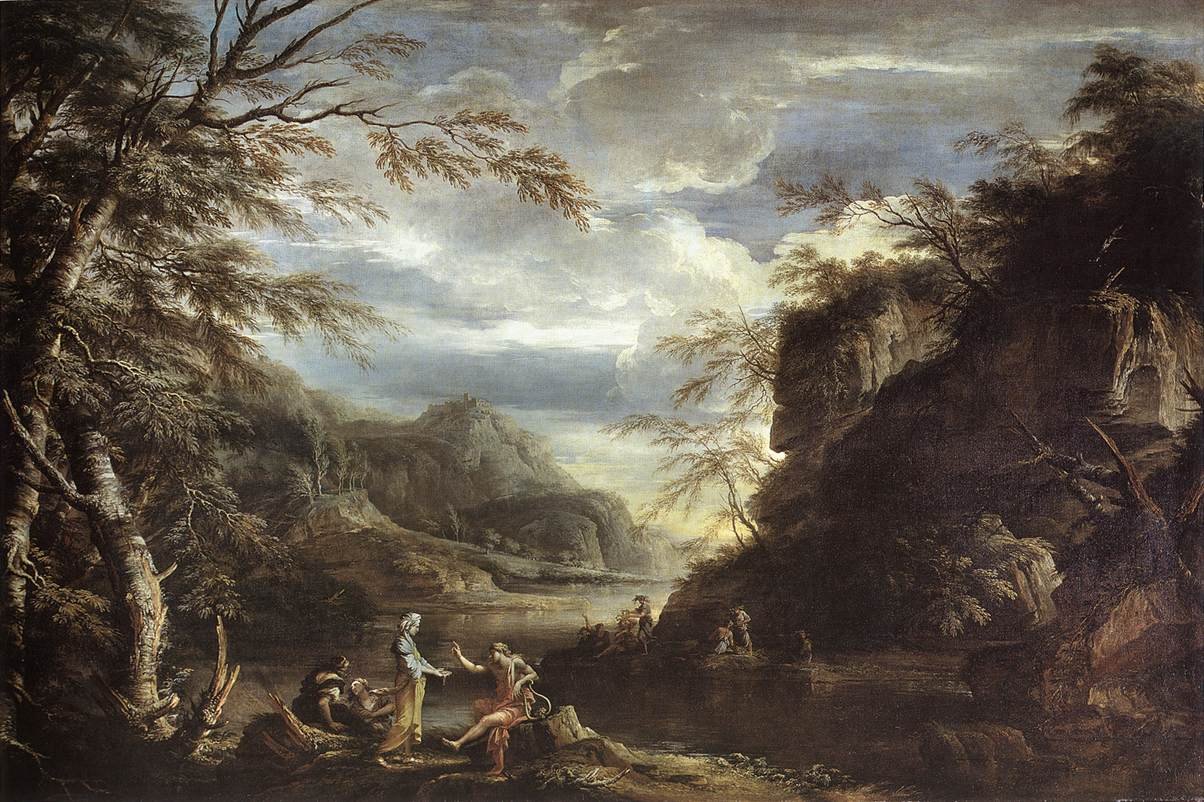
River Landscape with Apollo and the Cumaen Sibyl by Salvator Rosa (c.1655)

My featured artist today is the 17th century Italian Baroque painter Salvator Rosa.  He was born in 1615 in the small hill town of Arenella above the outskirts of Naples.  His father Vito Antonio was a land surveyor and had great ambitions for his son wanting him to become either a lawyer or take holy orders in the church and become a priest.  With this in mind he decided that his son should be afforded the best education and had him enter the convent of the Somaschi Fathers, a holy order of priests and brothers.  As we have seen in many biographies of artists, what the parents want for their children often differs from what the children themselves want and so it was the case for Salvator Rosa.  During his studies he had developed a love of art and with the support of his maternal uncle, Paolo Greco, he secretly began to learn to paint.  Rosa began his artistic training in Naples, under the tutelage of his future brother-in-law, Francesco Francanzano, who had trained under the influential Spanish painter, Jusepe de Ribera.  It is also believed that after this initial training, Rosa trained with the Naples painter, Aniello Falcone, who was also at one time apprenticed to Ribera.  Rosa greatly admired the works of Ribera and was influenced by them.

His father died when he was seventeen years old and, as he had been the breadwinner to Rosa’s large family, his mother struggled to feed her children let alone financially support her son Salvator with his artistic ambitions.  After his father’s death, Salvator Rosa continued to work as an apprentice with Falcone until 1634 when he relocated to Rome where he stayed for two years before returning home.

In 1638, aged 23 he went back to Rome where he was given accommodation by the Bishop of Viterbo, Francesco Brancaccio who treated him as his protégé and received commissions from the Catholic Church.  It was whilst in Rome that Rosa further developed his multi-talented skills, not just as an artist but as a musician, a writer and a comic actor.  He founded a company of actors in which he regularly participated.   He wrote and often acted in his own satirical plays, often political in nature and often lampooned the wealthy and powerful, and it was his devilish satire which gained him the reputation of a rebel, pitting himself against these influential people.  However his viperish-tongued satires made him some powerful enemies including Gian Lorenzo Bernini, the famous and powerful architect and who was at that time, the most powerful artist in Rome.  He, like Rosa, was also an amateur playwright and it was during the Carnival in 1639 that Rosa ridiculed Bernini’s plays and his stature as a playwright.  Eventually Rosa had made too many enemies in the Italian capital and decided it was just too dangerous to remain there.

From Rome he travelled to Florence where he was to remain for the next eight years.   One of his most influential Florentine patrons was Cardinal Giancarlo de’ Medici, himself a great lover and supporter of the Arts. Rosa worked for the Cardinal at his palace but was still allowed the freedom to paint his own landscapes and would go off and spend the summers in the Tuscan countryside around Monterufoli and Barbiano.    It was whilst living in Florence that Rosa did some work for Giovanni Carlo who was at the centre of the literary and theatrical life of Florence and Rosa soon became part of Carlo’s circle of friends.  Rosa used his own house as a meeting place for local writers, musicians and artists and it became known as the Accademia dei Percossi, or Academy of the Stricken.

He left Florence in 1646 being unhappy with the ever increasing restrictions put on him and his artistic and literary work by the Medici court  He went first back to Naples where he remained for three years before returning to Rome in 1649  where he believed his writings and paintings would win him even greater fame.  One of the problems Salvator Rosa had was his ever tempestuous relationship with his patrons and their demands.  He often refused to paint on commission or to agree a price beforehand.  He rejected interference from his patrons in his choice of subject.  In Francis Haskell’s book entitled, Patrons and Painters: Study in the Relations Between Italian Art and Society in the Age of the Baroque, he quotes from a letter Rosa wrote to one of his patrons, Antonio Ruffo, explaining his thoughts on his art and commissions:

“…I do not paint to enrich myself but purely for my own satisfaction.  I must allow myself to be carried away by the transports of enthusiasm and use my brushes only when I feel myself rapt…”

The 17th century Florentine art historian Filippo Baldinucci could not believe Rosa’s attitude to his patrons and wrote:

“…I can find few, in fact, I cannot find any, artists either before or after him or among his contemporaries, who can be said to have maintained the status of art as high as he did… No one could ever make him agree a fixed price before a picture was finished and he used to give a very interesting reason for this: he could not instruct his brush to produce paintings worth a particular sum but, when they were completed, he would appraise them on their merits and would then leave it to his friend’s judgement to take them or leave them….”

In his later years he spent much time on satirical portraiture, history paintings and works of art featuring tales from mythology.  In 1672 he contracted dropsy and died six months later.  Whilst on his deathbed he married Lucrezia, his mistress of thirty years, who had borne him two sons.   He died in March 1673 just a few months short of his fifty-eighth birthday.  After his father’s death forty years earlier Rosa had struggled financially but at the time of his death he had accumulated a moderate fortune.

Landscape painting had been regarded as a relatively lesser genre of painting in Italy at the time. But two French artists based in Rome, Claude Lorraine, who Rosa had befriended, and Nicholas Poussin, had done much to raise its status by setting scenes drawn from classical myth or biblical legend in grand Arcadian landscapes inspired by the nearby countryside. Rosa continued their tradition but with one subtle difference.  His landscape scenes depicted scenes of stormy desolation rather than calm pastoral beauty scenes of Claude and Poussin.  For My Daily Art Display today I am going to look at a painting by Salvator Rosa, which is a landscape but based on Roman mythology and Ovid’s book Metamorphoses.  It is the story of Apollo (often known as Phoebus) and the Cumaean Sibyl.   Cumae, which was the location of Italy’s earliest Greek colony, is on the Gulf of Gaeta near Naples and this location was probably known to Rosa.  The basis of the painting harks back to a conversation Aeneas had with the Cumaean Sibyl, who was a guide to the underworld of Hades, the entrance to which was the volcanic crater of Avernus.  Aeneas wanted to enter the underworld in order to visit his dead father Anchises.  Aeneas, with the help of his guide, the Cumaean Sibyl, found the aged ghost of his father.  It was at this time that the Sibyl recounted the story of her barter with the god Apollo, how she reneged on her promise and why she had become old and haggard:

“…“I am no goddess,” she replied, “nor is it well to honour any mortal head with tribute of the holy frankincense. And, that you may not err through ignorance, I tell you life eternal without end was offered to me, if I would but yield virginity to Phoebus for his love. And, while he hoped for this and in desire offered to bribe me for my virtue, first with gifts, he said, ‘Maiden of Cumae choose whatever you may wish, and you shall gain all that you wish.’ I pointed to a heap of dust collected there, and foolishly replied, `As many birthdays must be given to me as there are particles of sand.’  For I forgot to wish them days of changeless youth. He gave long life and offered youth besides, if I would grant his wish. This I refused, I live unwedded still. My happier time has fled away, now comes with tottering step infirm old age, which I shall long endure…”

The making of the bargain

Her mistake had been not only to ask Apollo for eternal life but also to ask for everlasting youth and beauty.  She aged over time.  Her body grew smaller with age and eventually was kept in an ampulla, a small nearly globular flask or bottle, with two handles.   Eventually only her voice was left.

The painting, entitled River Landscape with Apollo and the Cumaean Sibyl, depicting the meeting of the Cumaean Sibyl and Apollo, was painted by Salvator Rosa around 1655.  This is one of his finest works and highlights his ability as a landscape painter.  It is a desolate landscape scene.  Before us we have an isolated inlet of the sea, surrounded by towering cliffs of rough and rugged stone. On the right hand side of the painting we have a dark crag which towers against a stormy summer sunset.  From this jagged rock there are spindly trees sprouting from it at strange angles. In the foreground of the painting we see the god Apollo, seated on a tree stump with his lyre at his side, propositioning the beautiful Cumaean Sibyl, the turbaned woman who stands before him.    His hand is raised almost as if he is blessing the woman but it is his demonstrative act of granting her wish that she might live for as many years as there are grains of dust in the earth she holds out to him in her hand.   In return for the granting of her wish she would become his lover.   The Sibyl having been granted her wish, changes her mind, and refuses to surrender to Apollo’s advances.  Apollo cannot take back what he had given the young woman, but he was still able to punish the fickle girl, for, in devising her wish, she forgot to ask for eternal youth, and by refusing to grant her this he condemned her to grow older and older until at last she wasted away and only her voice was left.

The scene before us, depicted by Rosa, is purely imaginary, Rosa has included the cavern from which the Sibyl uttered her famous prophecies and which still exists in the dark, rocky area at the top right of the picture.  In the background we can see the inaccessible citadel perched high on a cliff.  The other characters we see in the scene are the nine muses, the goddesses of creative inspiration who were the handmaidens of Apollo. The painting is illuminated by the last rays of the setting sun light which light up the stormy sky in the distance. Look at how Rosa has managed to portray an aura of an ominous premonition.   The dramatic use of dark tones and chiaroscuro adds a feeling of foreboding about the scene.  The way he has depicted the wild landscape of bare rocks, splintered trees and a threatening stormy sky goes hand in hand with the story of retribution about to be dealt to the Cumaen Sibyl by Apollo for reneging on her promise to him.

Notwithstanding the darkness of the scene, it is still a beautiful landscape painting.  It is currently housed at the Wallace Collection, London.

The Monk by George Inness

The Monk by George Inness (1873)

For my artist today I had decided to cross the Atlantic and look at the work of an American painter.   I have always liked the beautiful landscape works of the Hudson River School artists and so I dipped into my book, which featured these painters and came up with George Inness.  I particularly liked his superb and beautiful painting entitled Our Old Mill, which I had considered for today’s offering.  It was only when I was researching his life and his works of art that I came across a hauntingly beautiful work of his entitled The Monk.  It had little to do with the landscapes along the Hudson River but it was just too good to ignore.  So today my featured artist is an American who was famous for his American landscapes, but you will just have to forgive me for abandoning those works.  However I am sure that My Daily Art Display featured painting today will impress you.

George Inness was born in Newburgh, New York in 1825.  He came from a very large family being the fifth of thirteen children of John William Inness, a farmer, and Clarissa Baldwin.   In 1829 when George was just five years old the family moved to Newark, New Jersey.  Inness began his artistic education at the age of fourteen when he received tuition from an itinerant artist, John Jesse Barker.  Later he would work as a map engraver in New York and during the summer of 1843,  he studied under the French painter, who had recently arrived from France, Régis-François Gignoux.  From this he developed a great interest in art and enrolled at the National Academy of Design, where Gignoux taught, and the following year he exhibited his first work at the Academy.  This was to be the beginning of a great partnership between the artist and the Academy.

In 1848 he opened his first studio in New York and he received his first commission.  The following year he married Delia Miller but sadly she passed away a few months later.   In 1850, at the age of twenty-five Inness marries Elizabeth Abigail Hart and the couple go on to have six children.  The patronage of Ogden Haggerty allowed him to take a trip to Italy where he was able to paint and study the work of the great Italian masters.  Once there, he fell in love with the beautiful Italian landscape.  In all, he spent fifteen months in Rome and took the opportunity to study the works of the great landscape artists such as Claude Lorrain and Nicolas Poussin.  Whilst in Rome he rented a studio, which was in the same building as the American painter and portrait artist William Page who had arrived in the Italian capital two years earlier.

In 1853 Inness moved to Paris and began studying the work and technique of the French Barbizon landscape painters and soon Inness became the leading American exponent of the Barbizon-style of painting. His main influence was the work of The French painter, Pierre Étienne Théodore Rousseau, which totally captivated him. The Barbizon-style of painting, which uses loose brushwork and places an emphasis on mood, became part of the artist’s tools to create the luminous and atmospheric landscapes that eventually established Inness’ trademark.  A year after the couple settled in Paris, their son George Junior was born.  He would later become a leading landscape painter.

During the 1850’s, Inness received a lucrative commission from the Delaware, Lackawanna and Western Railroads.  The train operator wanted him to record and portray the progress of DLWRR’s growth in early Industrial America. George Inness and his family settled in the small town of Medfield, a suburb of Boston, where they remained for five years.  It was during this time that Inness completed what art critics believed were some of his best paintings.   In 1864, he was on the move once again.  The family moved to the town of Eagleswood in New Jersey where he taught art.   He made many trips to Europe, especially France and Italy where he lived between 1870 and 1874 before he returned to America and settled in Montclair, New Jersey.

In 1894 he and his family made a trip to Europe, visiting Paris, Munich and Baden-Baden before arriving in Scotland where on August 3rd he and his son visited the famous beauty spot of Bridge of Allan.  In Adrienne Baxter Bell’s biography of Inness entitled, George Inness and the Visionary Landscape she recounts the time as described by Inness’ son:

“…My father threw up his hands into the air and exclaimed ‘My God oh, how beautiful!’ fell to the ground and died minutes later….”

George Inness died aged 69.  His funeral was held at the National Academy of Design in New York City and he was buried in West Orange, New Jersey.

George Inness painted today’s featured work, entitled The Monk, in 1873.  Without doubt this can only be described as a haunting work and one of his best paintings.  The setting of the painting is thought to be a secluded corner of the Villa Barberini, which is near the pope’s summer residence of Castel Gandolfo and lies a little distance south of Rome.  Just to the right of centre in the foreground we see the small figure of a cowled monk, holding a staff, as he walks within the walled garden.  He is diminutive in comparison to the tall stone wall behind him and further back, the cluster of tall slender pine trees that we see in the middle distance.   Inness often painted just the odd figure in his landscapes.  In most cases they would be solitary figures with a degree of anonymity.  Look how Inness has portrayed the pine trees with their unusual shaped branches.  They stand out so well against the brilliant yellow-ochre sky.  The bright yellow light also filters between the slim branches which rise vertically to support the tree canopies.

I like this panting.  I like the evocative nature of the depiction of the lone monk.  I suppose it is his white cowl which gives the painting a ghostly feel. The painting can be found in the Addison Gallery of American Art, at the Phillips Academy, Andover, Massachusetts.  The Phillips Academy is unique among secondary schools in the United States in as much as it is home to two museums, each of which is dedicated to educating and enriching its student community while also serving as a resource to the general public.

Bentheim Castle by Jacob van Ruisdael

Bentheim Castle by Jacob Van Ruisdael (1653)

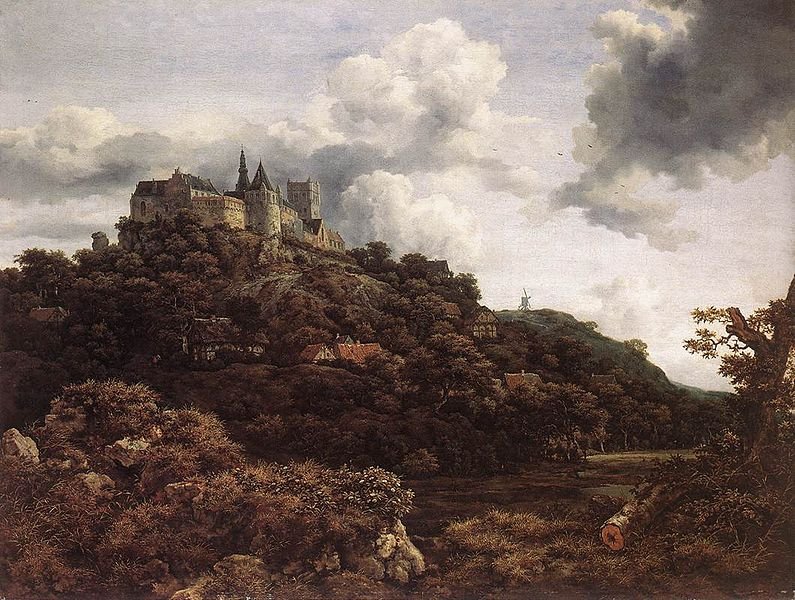
Today I am moving away from the horrors depicted in the Max Beckmann’s painting which I featured yesterday and move to a beautiful work by Jacob van Ruisdael, one of the greatest pure landscape painters in the Netherlands in the 17th century.  I have featured his works before in My Daily Art Display.  On January 9th 2011 I looked at his painting Dam Square and on February 18th I featured his hauntingly exquisite work entitled The Jewish Cemetery.  Both are worth looking at if you haven’t seen them before.     I never tire of his amazing paintings.  My Daily Art Display today features another of his works entitled Bentheim Castle which  van Ruisdael completed around 1653.

Jacob van Ruisdael was born in Haarlem in 1628 and was brought up in an artistic household.  His father, Isaak van Ruysdael and his uncle, Salomon van Ruysdael were both landscape painters.  Little is known about Jacob’s early artistic training but it is thought that his father probably taught him with guidance from his uncle.  At the age of twenty he was admitted as a member of the Guild of St Luke in Haarlem.  The Guild of Saint Luke was the most common name for a city guild for painters and other artists especially in the Low Countries.   They were named in honour of the Evangelist Luke, who was the patron saint of artists.

Unfortunately during his lifetime Jacob van Ruisdael’s artistic talent was not appreciated and by all accounts he led a poverty-stricken existence.  At the age of fifty three the Haarlem council was petitioned for his admission into the town’s almshouse.  He died in Amsterdam a year later in 1682 and his body was brought back to be buried in Haarlem

Jacob van Ruisdael travelled considerably during his lifetime but seldom went outside his own country.  However it is known that Ruisdael visited the small town of Bentheim, in Westphalia close to the Dutch-German border in the early 1650’s when he travelled to the region with his friend and fellow artist Nicolaes Berchem,  who, like Ruisdael, came from Haarlem.  Bentheim Castle received a first mention in historical records back in 1020 AD when the owner of the fortress who was named as Count Otto of Northeim, and who would later become the Duke of Bavaria, married.  He had, at this time, just married Richenza, the daughter of the Count of Werl, whose family was one of the most influential and wealth dynasties in Westphalia.  The castle changed hands during many battles over the centuries.  Nowadays the fate of Castle Bentheim is in the hands of the Hereditary Prince Carl Ferdinand of Bentheim and Steinfurt, who was born in 1977. Since 2007 he has been married to Hereditary Princess Elna-Margret of Bentheim and Steinfurt.

Jacob van Ruisdael’s favourite subjects were simple woodland scenes.  He was influenced by two great Netherlandish landscape painters of the time, Allaert van Everdingen and Meindert Hobbema.   Ruisdael forte was the depiction of trees in his works.  His rendering of the foliage was second to none. At the time of this painting which was completed in the 1650’s, Ruisdael portrayal of landscape scenes was bettered by nobody.  He stood out from his contemporaries when it came to the painting of woodlands, rivers, waterfalls, mountains, and even seascapes.

His landscape works became larger which allowed him more space for his portrayal of his giant oak and beech trees as well as the plethora of shrubs.  Look at today’s featured work simply entitled Bentheim Castle for an example of this.  No matter how the castle dominates the landscape, Ruisdael must have spent an enormous amount of time painting the surrounding trees and vegetation which can be seen like a skirt around the castle fortress.  Just take time and carefully study the detail of the vegetation in the foreground. Some of it has been brightened by a sudden shaft of sunlight whilst most of it in the middle ground remains in shade.  The colours the artist used in his paintings around this period became more vivid and space increases in both height and depth.  In this work by Ruisdael, look at the great variety of colours the artist has used to paint the flora.

What we see before us is the castle as seen from the south-west above which Ruisdael has given us a wonderful rendering of cloud formation.  It is an idealized landscape and not topographically accurate as the actual castle is situated on an unimpressive and somewhat low hill. However, Ruisdael, in order to add grandeur to his landscape work, has made the castle almost look like it is perched atop a small mountain.  Why would he do that?  Probably because placing the castle so high and so distant gave it a more commanding appearance but I believe his main reason was it offered him the opportunity to flood the middle and foreground with a small forest with all the colours that brings to the work.  In amongst the wooded slopes we see the red roof tops of the white houses and cottages.  This colour red manages to set off the verdant colour of the flora that surrounds them and which runs down to the foreground of the painting.  One can see that for Ruisdael the painting of trees and flora was his main joy.  Jacob van Ruisdael loved the view of this ancient fortress and over the years painted more than fifteen landscapes featuring Bentheim Castle, viewed from different viewpoints and seen in various surroundings.

I marvel at the detail in this painting and just wonder how long it took the twenty-five year old artist to complete it.  The painting is housed in Dublin at the National Gallery of Ireland.

Harvest at La Crau with Montmajour in the Background by Vincent van Gogh

Harvest at La Crau with Montmajour in the Background (1888)

For all of us in the northern hemisphere we are in the midst of winter.  The days are short, the skies are grey and the rain is plentiful.  It is truly a depressing time of the year and one knows only too well that there is nothing more likely to lift one’s spirits than the presence of blue skies, coupled with long hours of sunshine and feeling the warmth of the sun on one’s back.  So what has all this to do with My Daily Art Display’s featured painting and the famous artist who painted it?  Well, just maybe Vincent felt the same as he looked out the window of his Parisian apartment in February 1888.  Today my featured artist is Vincent Willem van Gogh and my featured painting is entitled Harvest at La Crau with Montmajour in the Background which he completed this work in 1888 and can now be found in the Rijksmuseum, Amsterdam.

Van Gogh had come to Paris from Antwerp in March 1886 to live with his brother Théo, who was the manager at the Goupil Gallery in the Boulevard Montmartre.  He studied for a time at the Atelier Cormon under the tutelage of Femand Cormon, the French painter and art teacher.  Whilst in Paris, Van Gogh met up with many of the Impressionists, such as Camille Pissarro, Emile Bernard and Claude Monet and became firm friends with Paul Gaugin who only arrived in the French capital in late 1887.  Van Gogh also witnessed the infancy of Neo-Impressionism and the works of the Neo-Impressionists Signac and Seurat.  Van Gogh quickly abandoned the dark colors he had used to create his earlier paintings and began to he embrace the brighter more vibrant colors and the techniques of the Impressionists.   Life in the French capital for van Gogh with his painting during the day and his socialising with his fellow artists at night soon began to affect his health and after almost two years he began to tire of the cliquish Parisian art scene.   Whether it was for this reason or for health reasons or even the simple desire to leave the drab and cold capital city we will probably never be sure but there was no doubt that he hankered for the warmer sunny climate and the vibrant colours of the southern countryside.,  Van Gogh decided to move south to Arles and take advantage of the special Provencal climate  with its many uninterrupted hours of sunlight and by doing so also absorb the beauty of the French countryside.  It was his fervent hope that he could persuade some of his newly found artist friends to join him there and together they could set up a school of art,  maybe even an artists’ colony and together he believed they could resurrect the purity of the arts.  This was to be van Gogh’s  Studio of the South.  He left Paris in February 1888, a month before his thirty-fifth birthday, and headed south for Provence.

It was during his sojourn in Provence that he painted today’s featured painting Harvest at La Crau with Montmajour in the Background.  Van Gogh loved this region of Provence with the rocky outcrop of Montmajour and the Montmajour abbey.  This was thought to be one of the happiest times of his troubled life.   For a short period he seemed very content with his way of life.  He made many pen and ink sketches of the Benedictine abbey at Montmajour and the spectacular views from it of the surrounding area.   Van Gogh spent much time producing sketches with his reed pen and rather less time painting.  The reasons for this were probably two-fold.  Painting and the acquiring of paints was quite costly and it was almost impossible to paint when the Mistral wind was at full strength.   In a letter which he wrote to his brother Théo in July 1888, he described the pleasure he derived from this area, despite the problem with mosquitos and the strong cold northerly Mistral wind which made his canvases shake on the easel andmade en plein air painting almost impossible.  He wrote:

“….But now I’ve been to Montmajour 50 times to see that view over the plain, if a view can make one forget such small displeasures, then it must have something…”

In this painting, the pride of place does not go to the abbey which can be seen in the background.   The painting is all about the yellow and green patchwork quilt fields of La Crau which lay between Montmajour and Arles.  The fields are interspersed with small farm buildings with their red-topped roofs, the colour of which not only acts as a contrast to but seems to enhance the colour of the surrounding fields.  In the middle ground we can see a blue cart which is often cited as a secondary title to the painting.  He painted the scene in June 1888 and he believed it to be his best work to date.  It was at a time when the summer heat was beginning to intensify and the life-restoring radiance of the Mediterranean sun was his constant companion.  He once described this light  in a letter to his brother:

“….a light that for want of a better word I shall call yellow, pale sulphur yellow, pale golden citron!  How lovely yellow is!  And how much better I shall see the North!….”

Preliminary sketch of Harvest at La Crau (Fogg Art Museum, Harvard University)

Van Gogh made two preliminary drawings of the work and the provenance of one shows that on the death of her brothers Vincent and Théo in 1890, it came into the possession of Willemina van Gogh, their younger sister.  It is now at the Fogg Art Museum, Harvard University, a bequest of Grenville L. Winthrop.  If one compares this preliminary sketch with the finished painting one can see that the space in the finished painting has been expanded and the viewpoint is much higher.  There is a much more gradual retreating of the plain as it runs off towards the towers of the Montmajour Abbey, which can be seen in the left background, and further back to the distant hills.

A later drawing of the scene (NGA Washington)

After he completed the painting he made two further drawings of the scene.  One of which is entitled Harvest – The Plain of La Crau, which he gave to his friend, John Peter Russell, an Australian artist and which can now be seen at the National Gallery of Art in Washington where it is part of the Mr and Mrs Paul Mellon collection.

I love this painting.  It is a truly inspiring painting.  Inspiring?  As I look out of my window at the falling rain and the dark grey rain-laden clouds, it inspires me to return to Provence and bask once again in the warm sunlight, take in the golden colours of the plains, interspersed occasionally with the blue and violet colours of the fields of lavender and of course be in awe of the azure colour of the nearby Mediterranean.

Oh, for the winter to end so that I can travel again!

Farm at Montfoucault by Camille Pissarro

Farm at Montfoucault by Camille Pissarro (1876)

At a time of chaos with Christmas Day just hours away and when family descend on us from every direction, it is very difficult to put aside time to develop a new blog for My Daily Art Display.  However today I am a writing a short entry featuring a painting by Camille Pissarro, which was on the majority of my Christmas cards which I sent out.  So, today’s blog is my Christmas card to you.  The painting is entitled Ferme à Montfoucault, effet de neige (Farm at Montfoucault, snow effect), which he completed in 1876 and can now be found in the Ashmoleon Museum.

It was Camille Pissarro’s good friend and fellow painter Ludovic Piette who had an estate at Montfoucault in the department of Mayenne in eastern Brittany.  Pissarro stayed there numerous times in the 1860’s and 1870’s.  It was during these periods that he completed many of his works of art depicting the region and its people.   Pissarro was in awe of the surrounding countryside and once commented to a friend that he always look forward with much anticipation to being in “the true countryside”.   This area was in complete contrast to Pontoise, where he had settled in 1872.  Pontoise was a modem town with a large population criss-crossed by roads and railway lines in complete contrast to the tranquillity of Montfoucault.  Montfoucault and the Mayenne department was criss-crossed, but not by numerous traffic-laden roads but by small country lanes and fields enclosed by hedgerows.  The whole of the Mayenne region at the time was somewhat remote and isolated.  It was Théodore Duret the French journalist and art critic who had recommended that Pissarro should journey to the area to find, as he termed it, “the path of rustic nature”.

The painting before you is of an enclosed barnyard of a farm which was close by to Ludovic Piette’s house.  In all, Pissarro completed no fewer than eighteen paintings which depicted the immediate surroundings of Piette’s house.   There is a coldness about this painting.  It is the kind of scene you appreciate as you sit at home and absorb the warmth of a wood fire.  The snow on the ground is melting slightly and turning to mud.   I like the way Pissarro has depicted the scene with a cold light which falls on the thatched roofs and bundles of straw.  Pissarro has managed to incorporate a number of animals into his painting as well as the figure of the farmer as he struggles through into the yard weighed down with bales of straw.

Despite his love for the area, this painting marked his last visit to the home of Ludovic Piette, who died in 1878.

So that is my Xmas card to you.  For my Christmas present to you I would (if I could) give you one of three books on artists, which I have enjoyed reading this year and which I thoroughly recommend you buy.

They are not strictly biographies but a kind of fictional biography which has allowed the author to mix facts with a touch of fiction and which I believe adds to the enjoyment.  The books are:

Luncheon of the Boating Party by Susan Vreeland and is a novel that brings to life Renoir’s masterpiece and how he came to paint the scene.  It also gives an insight into the Impressionists and the tensions between certain members of the group.

As Above, So Below by Rudy Rucker.  This is a fictional novel, based upon facts about the life and times of Pieter Bruegel the Elder.  It is a lively and interesting tale which will appeal to all of you who love the work of Bruegel.

The Passion of Artemisia by Susan Vreeland.   This is a fictional biography of Artemisia Gentileschi, one of the greatest female artists of all times and follows the struggles of the young woman who had to endure numerous setbacks and overcome much in a male-dominated society in order to reach the pinnacle of her career.

Finally let me wish you all,  a very Merry Christmas.

Spring Ice by Tom Thomson

Spring Ice by Tom Thomson (1916)

The exhibition I visited back in November at the Dulwich Picture Gallery was entitled The Group of Seven and Tom Thomson.   The reason for the Group not including Thomson himself was, although he was closely connected to and had greatly influenced the seven members of the Group, he died before they had formed this artistic association in 1920.

Tom Thomson, who was born into a large western Ontario farm family in Claremont, Ontario, was the son of John and Margaret Thomson.  It is interesting to note that unlike many early stories of artist’s lives, Thomson never showed an early interest in art.  In his youth, he was far more interested in music and literature.  At the age of twenty-two, he worked as an apprentice in an iron foundry owned by a friend of his father.  It is possible that Thomson took advantage of his father’s connection with the owner and failed to fulfil his part of the apprenticeship as within a year he had been sacked because of his lack of time management.  Thomson then decided that the excitement of military life was for him and applied to fight in the Second Boer war but was rejected on medical grounds.   Later he would be turned down again by the Canadian military when he tried to enlist and fight in the First World War.

In 1901, aged twenty-four, he was admitted into a business college at Chatham but stayed there for less than a year, at which time he went to Seattle where his brother George had a business school.  It was in this American city that he worked as a photoengraver and designed commercial brochures and spent a lot of his free time sketching and fishing.

Thomson returned to Canada in 1905 and two years later joined Grip Limited, a leading Toronto artistic design company.  It was whilst working there that he met some of the future members of the Group of Seven.   Apart from Lawren Harris, who came from a wealthy background and enjoyed an independent income, all the artists, who formed the Group of Seven, supported themselves at one time or another as commercial artists or graphic designers producing lettering and layout as well as illustrations for magazine and books.  Thomson and his newly found friends, who all loved to sketch and paint, would often go off together at the weekends on sketching trips.

One of Thomson’s favourite destinations on his painting trips was Algonquin Park, a forestry reserve north of Toronto, which stretches between Georgina Bay on the west and the Ottawa River to the east.  It is a vast stretch of pristine wilderness and an ideal location for landscape artists.   Thompson first journeyed there on a sketching expedition in 1912 returning home clutching numerous sketches of the areas he visited.   These sketching trips up north were a bit of a logistical nightmare as the artists had, as well as carrying food, shelter and cooking utensils, had also to carry their painting and sketching materials and this culminated in an almost impossible burden.  The weather conditions for en plein air painting or sketching was not conducive for the artists due to the cold and wet and this necessitated them having to try and paint or sketch with speed in changing light.

My Daily Art Display featured painting today is one of Tom Thomson’s early works which he completed in 1916 and which is entitled Spring Ice.   The 1915 study for this painting, in the form of a small oil on cardboard sketch, as well as the finished oil on canvas painting are normally housed at the National Gallery of Canada in Ottawa.  One should remember that many artists looked upon their preparatory sketches as works in their own right and not just as a preparation for the finished article.  Thomson made some subtle changes to his finished painting in comparison to his contemporary sketch.  Although the positioning of the land, trees and lake remain the same, the colours on the final canvas are noticeably different.  In the finished work Thomson has used much brighter pastel colours and by doing so has cleverly brought to us a hint of spring.   Also, whereas the sketch had a square shape, the oil on canvas work was wider and horizontal in shape.  This added width allows us to get a better view of the blue waters of the lake.   One can imagine the difficulty Thomson endured to capture the scene.  Probably squatting down on the thawing earth, balancing his sketch box on his knee so as to obtain a low-level view of the lake.  Can you imagine how cold it must have been and how cold his fingers must have been in the chilling air?  It was those same frosty conditions which bit unmercifully at his limbs that prevented the ice flows from melting as they moved slowly in the water.   We can see that there is a long time to go before the warmth of summer arrives to add warmth to the ground and tease the vegetation from the earth.  We are still in spring and the trees have yet to open up their buds to the elements.

Artists like those of the Group of Seven had to endure great hardships in the cause of producing a realistic representation of nature.  They had to paint quickly to capture the scene with its many moods as the light from the sun or moon changed.  The mood for this painting is one of serenity and tranquillity and one can understand why artists like Thomson put up with the harsh conditions so as to record the beauty of nature.

Thomson’s life ended suddenly and in mysterious circumstances.  It was the summer of 1917 and he had been out alone in a canoe on Canoe Lake in Algonquin Park when he disappeared.  His empty canoe was spotted later that day.  Thomson was an expert fisherman, canoeist and hiker, and when his body was found eight days later in the lake it seemed incongruous that he could have died accidentally.  To this day the circumstances of his death have remained shrouded in mystery. The official cause of death was given as “accidental drowning”.   The investigation claimed there was a fishing line wrapped around his legs and he had suffered a blow to his head before he died.  As with all deaths in unusual and suspicious circumstances, the conspiracy theorists have had a field day, putting forward numerous scenarios, which ultimately led to the artist’s death.  Murdered by a neighbour, killed in a drunken brawl over money he owed his assailant, and killed by the father of a girl whom he had got pregnant were just a few of the many suggested circumstances that led to the artist’s demise.  Maybe closer to the truth was the belief that it was a simple accident or that he had committed suicide during one of his many bouts of depression.  We will probably never know the truth but the one thing we do know with great certainty is that on that lake in July 1917, Canada lost one its great artists, aged just forty.

A Moonlight Effect by Paul Sandby

Landscape painting became the most inventive form of art in Britain during the late eighteenth and early nineteenth century.  Traditionally, paintings of the British landscape had been a way of showing off magnificent country houses, and were often commissioned by wealthy landowners to show off their estates and wealth.  However in the late eighteenth century the landscape became the subject of a more poetic vision. There was a growth in the urban middle-class and for them landscape art provided a romantic ideal of the landscape as the source of timeless values which could be enjoyed by anyone.  Landscape paintings were now being viewed as portraying idyllic places of rest and solace.  Landscape art in the 18th century did however have its detractors.  The Swiss-born artist Henry Fuseli, when once lecturing his art students, identified landscape art as a low branch of painting.  He described it:

“…the tame delineation of a given spot;   what is commonly called Views is  little more than topography; ….a kind of map-work”……”

My featured artist today would not have agreed with Fuseli’s description, as he was one of England’s great landscape artists.  His name is Paul Sandby.  Sandby was born in Nottingham in 1731.  His father Thomas was a framework knitter and he had a brother, also named Thomas, who was ten years older than him.  The boys had a comfortable upbringing and it is thought that they both received drawing tuition from Thomas Peat, a Nottingham-based land surveyor.  Both boys showed great aptitude and in 1747 Paul, then aged sixteen, left Nottingham to take up employment as a military draughtsman.  After the Battle of Culloden the English felt the need to map the Scottish landscape with detailed records of forts and castles and Paul Sandby was involved in the survey and from his office at Edinburgh Castle, where he worked as a mapmaker, he developed his landscape drawing technique.

After his work in Scotland he went on to paint much of Britain. In 1752, he, along with his brother, took up a post producing landscapes of the royal estates at Windsor.   Importantly in 1770, he travelled through Wales and was one of the first artists to paint landscapes of that country.  He popularised the area by not just exhibiting paintings but widely circulating printed images and developing an innovative print method, aquatint, a variant of etching, which echoes the washes of watercolour rather than relying on pure lines.   He returned to Wales in 1773 and toured the south of the country along with Sir Joseph Banks, the naturalist and botanist.  This sketching trip resulted in the 1775 publication of XII Views in South Wales.  A further twelve views were added the following year.

In 1757, Sandby  married Anne Stogden.   In 1768, the same year as his election as a Royal Academician, he was appointed chief drawing master to the Royal Military Academy at Woolwich, a position he held for over thirty years,.  His son Thomas Paul was eventually to succeed him in that post.

 Unfortunately for Sandby the public fell out of love with his fresh and uncomplicated natural style of paintings, which he embraced, and he was ultimately forced to petition the Royal Academy for financial support to supplement his modest pension. He died in 1809, his obituary describing him as the ‘father of modern landscape-painting in watercolours’.  He is buried in St George’s Burial Ground London.

Gainsborough praised Sandby as one of the first artists to paint what he termed “real views”, ones which were topographically accurate as opposed to idealised compositions.  There was a large gap between the topography and the ideal landscapes.  The topographer accurately recorded what he saw whereas the ideal landscape artist manipulatesd his landscape for aesthetic ends.  Paul Sandby endeavoured to bridge that gap.  He kept faith with his topographical skills but managed to bring expression and sensitivity to his work.  He did this by carefully choosing the viewpoint for the composition.  He also liked to incorporate realistic human figures in his works.  Throughout his career Sandby only ever used the medium of watercolour.

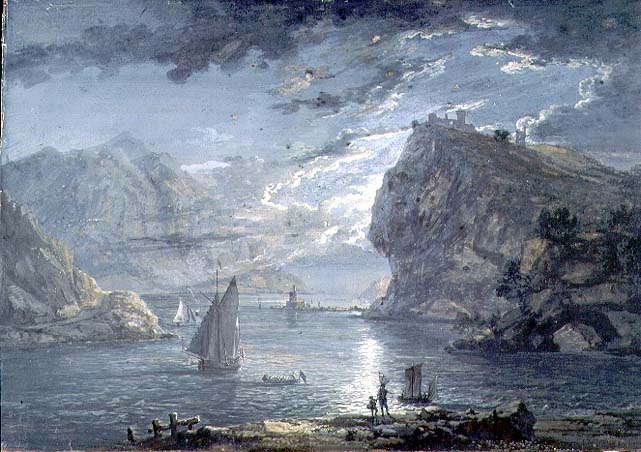
My Daily Art Display featured painting today is entitled A Moonlight Effect which Paul Sandby completed around 1790 and which can be found in the Nottingham City Museums and Galleries.  This is one of a number of paintings Sandby completed which depicted a place or a building as seen by moonlight.  In the 1770’s the early romantic painters, such as Joseph Wright of Derby and William Hodges, had taken a special interest in the portrayal of moonlight effects; and the image of the moon and of moonlight became one of the great romantic images.  For the romantic artist, who saw himself as alienated from society, the moon was often seen as an image of constancy and hope in a changing world, and it adequately depicted that longing and yearning or an unattainable perfection which lies at the heart of romanticism.

I love this painting with its silvery moonlight. 

Maybe you will have noticed that My Daily Art Display has not quite been a “daily” offering recently.  The reason for that is not because I am losing interest or having difficulty to find yet another painting, albeit it is getting harder.  The reason is that I have been trying to build up a reserve stockpile of blogs for when I am away on holiday in case I don’t have the time to research and compose a blog.  Today we are setting off to Hong Kong and Australia for a three-week break.  I am hoping I will still have access to the internet when I am away so that I can send out one of my “reserve” blogs, at least every other day.  I am hoping to take in a couple of art galleries when I am away and I am looking forward to seeing the depth of art on offer.


Maria Bicknell, Mrs John Constable by John Constable

Maria Bicknall by John Constable (1816)

In My Daily Art Display blog yesterday I looked at the early life of John Constable,  up to the point in his life when at twenty-three years of age he was still hell-bent to become an artist.     Today I am going to conclude the story of his life and look at another of his paintings.  

In 1799,  Constable had finally convinced his father to let him pursue art and he enrols in the Royal Academy School as a probationer.  Although he finds inspiration in paintings by Peter Paul Rubens, Thomas Gainsborough, Claude Lorrain and Annibale Carracci, he becomes very homesick and yearns for the beautiful countryside of his Sussex home.  He is also becoming very disheartened with the way the Royal Academy, at that time, disdainfully viewed landscape art.  Landscape art was his passion but unfortunately for him, it was not held in high regard by the Academy, who only valued history painting and portraiture.  Whilst he attended the Academy he met Turner but the two never forged a friendship.

In 1802 Constable exhibited his first painting at the Royal Academy.  His landscape works were unfortunately not the traditional heavenly landscapes which depicted biblical or mythological stories, which were in vogue at the time, and so were not popular with the buying public.  His depictions of the countryside were far more realistic than those of the very popular Gainsborough and Claude.  If anything, his style was more akin to that of the Dutch landscape painters, such as Jacob van Ruysdael.   Constable fervently believed that landscape art was to be a true study and reflection of nature and that idealized landscapes, which had been painted from the artist’s own imagination were, in some ways, dishonest.  He left the Royal Academy in 1802 and was offered the position of drawing master at Great Marlow Military College, but he turned down the offer, which horrified the then master of the Royal Academy, Benjamin West, who told Constable in no uncertain terms that his refusal would probably mean the end of his artistic career.  However Constable was not deterred and chose to stay on his chosen course – that of a landscape artist.  Constable returned to East Bergholt.

In 1800, when he was aged twenty-four and whilst he was at home in East Bergholt, he had become friendly with a young girl who was some twelve years younger than him.  Her name was Maria Bicknell.  Now almost ten years later in 1809, John is aged thirty-three and Maria is twenty-one years of age and their relationship changed.  Slowly but surely, this one-time childhood friendship developed into a much more serious relationship and the two fell deeply in love.  Seven years later, in 1816,  the couple decided to get engaged but this was strongly opposed by Maria’s parents and her grandfather, Dr. Rhudde who was the rector of East Bergholt.  Both Maria’s father, Charles Bicknell, who held the prominent position as solicitor to the Admiralty, and her grandfather did not want her to be married to a penniless artist and they also believed that Constable and his family were socially inferior to them and not fit in-laws.  To force home their disquiet about such a proposed liaison they told Maria that she would be disinherited if she married Constable.  Constable’s parents Golding and Ann Constable, while somewhat sympathetic to the desires of their son, could also see no future in the proposed marriage as they would not in the position to financially support the couple and even Maria herself pointed out to Constable that if he was to succeed as an artist he did not want the distraction of a wife and the financial implications of such a match.  For the next seven years the couple were often parted and sometimes forbidden even to write to one another, but throughout their long, frustrating courtship they remained loyal to each other

The situation changed in 1816 when both Golding and Ann Constable died and Constable inherits a fifth of the family business.   Now with some money behind him and the fact that their daughter Maria is twenty-eight years old, her parents reluctantly agree to let her marry Constable.  John and Maria marry in that October at St Martin-in-the Fields, London and the two of them tour the south coast of England on honeymoon. 

Constable struggled to sell his paintings and it was not until 1819 that Constable made his first big sale, which was for his painting entitled The White Horse.  This sale spurred him on and it led to what are known as his “six footers”, a series of six large scale paintings, which included The Hay Wain and Stratford Lock.  The Hay Wain was exhibited at the Royal Academy in 1821 and was seen by the great French Romantic artist Théodore Géricault who on his return to Paris spread the word about Constable and his painting.   Three years later, the painting is bought by the art dealer John Arrowsmith and it is exhibited at the Paris Salon of 1824 where it wins a gold medal.

Four years on and it is 1828 and that January Maria gives birth to their seventh child.  Sadly that same year she falls ill and after a prolonged illness dies that November of tuberculosis, at the young age of forty-one.  Constable is devastated by his loss and in a letter to his elder brother Golding he wrote:

“….hourly do I feel the loss of my departed Angel—God only knows how my children will be brought up…the face of the World is totally changed to me…”

In his book, Memoirs of the Life of John Constable, Charles Leslie wrote that after the death of his wife, Constable was always dressed in black and was “a prey to melancholy and anxious thoughts”.  Constable had to, from then on, look after his seven children singlehandedly.    

The financial situation of his having to bring up all his children should not have been too burdensome as shortly before her death, Maria’s father had died, leaving her £20,000.  However Constable, instead of safeguarding this new wealth, speculated disastrously with this money.  A large proportion of the money was invested in the engraving of his landscape works which he believed would easily pay for themselves but he was sadly mistaken and the money raised did not cover the expenditure.

At the age of  fifty-two he was elected to the Royal Academy and two years later in 1831 was appointed Visitor at the Royal Academy, a part time teaching post which proved to be very successful and extremely fulfilling.  He regularly lectured on landscape art and once again regaled how works should depict real scenes and not idealized fantasies.  It is interesting to note that although he was not always happy with the art education he received at the Royal Academy thirty years earlier, one of the constant themes of his lectures was the way he praised the establishment calling it the “cradle of British Art” and he stated that no great artist was ever self-taught.

Constable died in 1837 a couple of months short of his sixty-first birthday and was buried besides his beloved Maria in the graveyard of St John-at-Hampstead in London.  Later the couple would be joined in the family tomb by two of their sons, John Charles Constable and Charles Golding Constable

My Daily Art Display featured painting today is not one of his famous “six-footers” but a beautiful painting of his wife which he completed a few months before they married in 1816.  On completing the portrait Constable wrote to his wife:

“…I would not be without your portrait for the world the sight of it soon calms my spirit under all trouble…”

Constable is primarily known for his beautiful landscape paintings but he was also an accomplished portraitist and before us we see his depiction of the woman he deeply loved.  What greater love could an artist bestow on his wife than to paint her portrait?  The marriage only lasted twelve years but one should remember that he had known and loved the young girl for sixteen years before they had been allowed to become man and wife.

The painting hangs at the Tate Britain Gallery in London.

.

Dedham Vale and The Vale of Dedham by John Constable

My Daily Art Display today features two paintings by the same artist, with almost the same titles, but completed twenty six years apart.  The artist is one of the greatest landscape painters of England.  His name is John Constable.  Before we look at the two works of art let me give you a potted history of his life.

John Constable was born in East Bergholt, a small village on the River Stour in Suffolk in 1776, the fourth of six children.  His descendents were farmers and his father Golding Constable was an affluent corn merchant who owned considerable amounts of property in the area.  He owned water mills at Flatford and Dedham, two windmills in East Bergholt and even a small ship The Telegraph, which was moored at Mistley, North Essex, and which he used to transport his grain to London.  It was in East Bergholt that two years before John Constable was born his father built himself a large house and lived there with his wife Ann Constable (née Watts), whom he married in 1748.  The couple had six children, three sons, Golding, John and Abram and three daughters, Ann, Martha and Mary.

John Constable was fortunate with his upbringing, being afforded all the advantages of a wealthy family.  His education consisted of a short spell at a boarding school in Lavenham, which proved far too strict, then followed a period at the local day school in Dedham.  John had always enjoyed sketching and this love of this was helped by the local plumber, John Dunthorne, who would take the young boy out on sketching trips around the nearby area. 

As is the case in many life stories of artists, this desire of his son to become an artist did not go down well with his father who believed artists rarely made much money and instead had wanted John to study for a career in the church.  However this, because of his grades, proved to be a forlorn hope.  After that his father decided that John should come into his corn merchant business.  Although John was the second son, his elder brother Golding was mentally handicapped and could not take an active part in the family business and so John was the obvious choice as the future successor.  John did go into the family business but lasted just a year, at which time his younger brother, Abram, was of the age and had the will to become an active member of his father’s business.

The real turning point for John as far as art was concerned came when he was nineteen years old and he and his mother went to visit neighbours.   At this get-together John was introduced to Sir George Beaumont, an amateur artist and wealthy art collector.  Beaumont used to carry around with him, in a specially made wooden box, the latest paintings he had acquired and the day Constable met him he had with him his newly acquired Claude Lorrain painting Hagar and the Angel.  John Constable could not get over its beauty and was totally in awe of the way Claude had depicted the landscape.  The two art lovers spent much time that day discussing art and the works of Claude and the likes of the English landscape artists, John Cozens, and Thomas Girtin.  Sir George Beaumont was very impressed by young Constable’s enthusiasm and knowledge of art.  Constable knew then that he wanted to be a full time artist.  During a visit to Middlesex he met John Thomas Smith, the painter and engraver, later known as Antiquity Smith, because of the book he wrote, Antiquities of London and its Environs.   It was Smith who taught Constable the basic techniques of painting but warned him of the financial drawbacks of becoming a full-time artist.  In 1798 Constable met Joseph Farrington, who had once been a pupil of Richard Wilson.  Farrington goes on to teach Constable the techniques of this great Welsh landscape painter.

Fortunately in 1799, his father relented on his stance about his son studying art and as he now had his other son, Abram, to assist him,  he gave John some money and arranged for him to go London where he enrolled as a probationer at the Royal Academy School.  John was very homesick missing the beautiful countryside of his home and was disillusioned with the continuous copying of the old Masters.  To make things worse he realised that landscape art, which was what he loved, was not held in high regard by the Academy, who only held in high esteem history painting and portraiture.

I am going to conclude the story of Constable’s life at this juncture in his life, aged twenty-three still hell-bent to become an artist but unhappy with his start at the Royal Academy schools.  My next blog will conclude his life story, the tale of his love for a woman and the problems he had with her family but now I want to look at today’s two featured landscape paintings.

In 1802, at the age of twenty-six John Constable completed his first major work entitled Dedham Vale which is now in the Victoria and Albert Museum in London.  This, like most of Constable’s paintings, was a scene from the area around the Stour Valley.  I started off this blog by saying that Constable was one of the greatest landscape painters of England but maybe his accolade should be that he was the greatest landscape painter of the Stour Valley and Suffolk as he rarely travelled to other parts of Britain, let alone Europe,  unlike other landscape artists, who would travel extensively painting the beauty of the likes of the Lake District or Wales or the Roman Campagna. 

Dedham Vale by John Constable (1802)

Dedham Vale was painted by Constable in 1802 and now hangs in the Victoria and Albert Museum in London.  The scene we see before our eyes is one of complete tranquility.  Sadly for many, including Constable, it was also the start of a period of change in Britain and even in that area with the onset of  creeping industrialization,  such peace and serenity would soon be a thing of the past.  Even Constable’s beloved Stour valley would be home to the hubbub of a textile manufacturing area. 

We see before us, looking down from Gun Hill in the east, a flattish landscape of Dedham Vale pierced with a number of small waterways, some of which are natural, others man-made.  The lower reaches of the River Stour is in the middle ground of the painting and it can be seen wending its way eastwards towards the sea.   In the central background we see the gothic tower of Dedham Church and the village of Dedham and further back in the hazy distance we can just make out the town of Harwich.

The Vale of Dedham by John Constable (1828)

Twenty six years later in 1828 he returned to this scene for his last major painting of the Stour Valley entitled The Vale of Dedham, which is now housed in the National Gallery of Scotland in Edinburgh.  Maybe the fact that he returned to this scene so many years later is testament to his love for the area.  This later painting of the same view has some subtle differences.  The meandering river heading towards Dedham has got wider and now has a bridge across it.  In the foreground the old stump of the tree is sprouting some new saplings and by drawing our eye to it our attention focuses on the distant landscape.  However what was a more contentious addition to the scene was Constable’s inclusion of a gypsy mother nursing her child besides a fire.  Critics said that the addition did not add to the landscape and the inclusion was just the artist’s way of making the scene more picturesque.  However Charles Rhyne, Professor Emeritus, Art History at Reed College, Oregon,  wrote in his book Studies in the History of Art,  when discussing Constable’s landscapes, that according to an ordnance survey map,  a well was located in this area, and that this would have made it a natural camping site for gypsies.

Graham Reynolds, the art historian and author, also talked about the controversial inclusion of the gypsy in the painting.  In his book about Constable, he pointed out that gypsies were frequently to be seen in East Anglia and that the inclusion of this detail did not infringe Constable’s rule that only actual or probable figures should appear in his landscape paintings. By including the gypsy mother and child in this painting, he said that Constable enlivened the image, with the gypsy’s red cloak providing a contrast to the green of the vegetation.  It should be remembered that Suffolk had been affected by the agricultural depression and social unrest during the 1820s, and the inclusion of the gypsy in the painting may reflect the instability of rural life at this time and Constable’s sympathy with the cause of ordinary people.   Note how the gypsy is wearing a bright red shawl or coat.  Constable always believed that even the smallest touch of bright red in a painting highlighted and animated the green of the surroundings and he often used this technique in his other paintings.  Maybe that is another reason for the inclusion of the gypsy.

This second painting of Dedham Vale was well received by the Royal Academy when Constable exhibited it in 1828 under the title of Landscape.  Six years later he exhibited it again, this time at the British Institution under a different title.  This time he called it The Stour Valley.  People loved it and art critic of the The Morning Post (March 10th 1834) wrote:

“…..We must consider this picture as one of the best which we remember to have seen from Mr. Constable’s pencil. It is a work of great power both of colour and light and shade, and is executed with considerable freedom and dexterity of execution…” 

Which version did you prefer?

Winter Scene by Joos de Momper

Winter Scene by Joos de Momper (c.1630)

“…Why, sir, Claude for air and Gaspar for composition and sentiment; you may walk in Claude’s pictures and count the miles. But there are two painters whose merit the world does not yet know, who will not fail hereafter to be highly valued, Cuyp and Mompers…”

Richard Wilson

In an earlier blog about the Welsh landscape painter, Richard Wilson, I told you how he believed that although the landscape works of Claude Lorrain and Gaspar Dughet were lauded, he spoke about the, as yet, unknown talents of Aelbert Cuyp and Joos de Momper and so I thought it was time to take a look at the life of Joos de Momper the Younger and one of his greatest works.

Joos de Momper also known as Josse de Momper was born in 1564 in Antwerp.  He was just one of an outstanding artistic dynasty.  His great grandfather, Jan de Momper I,  was a painter in Bruges; his son, and our featured artist’s grandfather, Josse de Momper I, was also known as an artist and dealer who moved from Bruges to Antwerp, where his son, and Joos’ father,  Bartolomeus de Momper , inherited both occupations, as well as being an engraver. Bartholomeus’s sons Josse de Momper II and Jan de Momper II were both landscape painters, but Josse the younger, today’s featured painter, was the exceptional artist of the family.

He received his initial artistic training under the guidance of his father, Bartholomäus de Momper.   In 1581, when he was seventeen years of age, de Momper’s father, who was at that time Dean of the Antwerp painters’ guild, The Guild of St Luke, enrolled him as a vrijmeester (master) into that association.   It is believed that around this time Joos travelled to Italy.  Records show that an artist in Treviso, Lodewijk Toeput, was his teacher .  Another reason for believing that the young artist had visited Italy is that so many of his paintings featured mountain scenes and as he spent most of his life in Antwerp, to have such a knowledge of mountains, almost certainly meant that he had at one time crossed the Alps into Italy.   So did he go to Italy?   A further clue to whether de Mompers was ever in Italy came in 1985  when the frescoes in the church of San Vitale in Rome, previously attributed to Paul Bril, were attributed to Joos de Momper the Younger.

Records show that in 1590, the twenty-six year old artist was back in Antwerp as it was in this year and in this city that he married Elisabeth Gobyn.  The couple had ten children.  The painting dynasty was to continue with two of the  couples’ sons, Gaspard and Philips both becoming notable artists.  Gaspard de Momper and Philips de Momper I,  both became painters although little is known of their work, except that Philips executed the figures in some of his father’s paintings; he also spent some years in Rome, where he had travelled with Jan Breughel the Younger

 In 1594 De Momper collaborated with two other Flemish painters Adam van Noort and Tobias Vwerhaecht as well as the Flemish architect Cornelis Floris on the decorative programme to celebrate the entry of the Archduke Ernest into Antwerp.   Shortly after this de Momper was invited to become one of the Archduke’s court painters, a position he took up at the court of the Archduke and Archduchess Albert and Isabel Clara Eugenia, the sovereign rulers of the Spanish Netherlands. In 1611, de Momper was made Dean of the Guild of St Luke in Anterp.

Most of de Momper’s paintings, like the one we are going to look at today, featured landscapes and his work was very well received. His landscapes were sometimes topographically accurate whilst others would be idealised fantasy ones, but all sold well.    His work was highly regarded and he is considered to be the most important Flemish landscape artrist of his time.  The timeline of great Flemish painters puts him coming after Pieter Bruegel, whose works greatly influenced him, and before Peter Paul Rubens.  

My Daily Art Display today features a painting simply entitled Winter Landscape and was painted by Joos de Momper the Younger around 1630 and can now be seen in the North Carolina Museum of Art.  This is a winterscape with a number of figures,  which were believed to have been painted, not by de Momper, but by Pieter Bruegel’s son Jan.  I love this work as it is so “busy”.  Besides the beauty of the landscape in winter we have a dozen people depicted carrying on with their daily duties.  Pieter Brueghel the Elder’s influence is clearly evident in this winter landscape.    Joos de Momper was known for his use of Mannerist colors in many of his landscapes, but in the more realistic pictorial representations, such as today’s painting, he used more natural colors.   Momper’s has managed to deliver a scene with such aesthetic appeal. 

Woman by cart

In this village landscape before us, the houses and people, which in his mountain landscapes were mere accessories, are now in some way the main focus of our attention.   Look at the woman in red who stands by the cart.  Look how the artist has depicted her struggling and straining with an arched back to lift the barrel on to the cart.  Look how her face is reddened by the physical effort.  To the right of her we see a mother and two children in a line.  The mother is carrying a bundle of firewood on her head whilst her son tags behind with a token few sticks of kindling.  Following up at the rear is the young daughter, with her arms outstretched shrieking, as she is being left behind.

Man with baskets

It is a scene full of activity and I love to cast my eyes around the painting to discover what is happening.  At the barn we see a man repairing a cart whilst the white horse stands passively to the side.  In the left midground we see a man bent over surveying what looks like two large wicker baskets.  I am not sure what he is doing but whatever is going through his mind, he seems fascinated by them.  Besides the people in the painting, look at the way the artist has elegantly painted the trees which have shed their leaves and which stand tall and unbowed in this cold but still winter’s day.

In the background on the right we have the nearby town.  It is separated from our main scene by a river, the water of which seems partly frozen over.  Fishermen are at the river trying to catch something for their meal in the small parts that have yet to be frozen. 

Town and bridge

The way to the town is accessed by a small wooden bridge and we see a man with his dogs making his way over it and heading into town..

I hope you have enjoyed this painting and thanks to Richard Wilson, I have discovered a new Flemish artist and one day I will return to him and look at another of his works.

Finally my thanks go to Universal Pops’ Photostream on Flickr for the details of the painting.  His photographic site is quite amazing and well worth a visit.

http://www.flickr.com/photos/universalpops/