
Two Women Chatting by the Sea by Camille Pissarro

Two Women Chatting by the Sea by Camille Pissarro (1856)

Jacob Abraham Camille Pissarro was born to Abraham Gabriel Pissarro and Rachel Pissarro (née Manzano-Pomié ) in 1830 on the island of St Thomas in the Danish West Indies, now known as the US Virgin Islands.  His father, a Sephardic Jew, held French nationality, but was of Portuguese descent.  He originally came to the Caribbean to sort out the business affairs of his uncle who had recently died.  He ended up staying in St Thomas, took over the running of the dry store business and married his late uncle’s widow, Rachel.   This found no favour with the small local Jewish community, maybe because he had married his late uncle’s wife or maybe because his new wife and Camille’s mother,  was a native Creole, a Dominican of Spanish descent, and not of the Jewish faith.  Camille and his siblings because of this were excluded from the Jewish school on the island and had to attend the all-black primary school.

Pissarro’s father and mother went on to have four children.  Camille was the third son and he and his parents and siblings lived a comfortable existence in a large and spacious apartment over the family shop on Dronnigens Gade, the main street, of Charlotte Amalie, the capital of St Thomas.    At the age of twelve, so as to ensure he had a good education, Camille was sent to France to attend a boarding school in Passy, a small town in a district of Paris , on the right bank of the Seine.  It was whilst studying in Paris that the young Camille developed a love for art and would often visit the Louvre.  After five years studying in France,  Camille Pissarro returned home to Saint Thomas where his father was hoping he would enter the family business.  However the young Pissarro was unimpressed at having to act as a cargo clerk at the harbour and had other ideas for his future.  During his time at the harbour he would spend most of his time sketching.  It was whilst sketching one day that he met Fritz Melbye, a Danish marine painter who was also living on St Thomas.  He liked the enthusiasm Pissarro had for sketching and painting and he began to mentor him and eventually persuaded him that he should become a full time artist.  Pissarro was delighted and much to his father’s chagrin in 1852 gave up the family job and went off with Melbye to Venezuela where the two of them based themselves in Caracas and stayed for two years sketching and painting landscapes and village scenes.  Pissarro once reflected on his decision to leave his comfortable home and his position in the family business saying:

“…I abandoned all I had and bolted to Caracas to get clear of the bondage of bourgeois life…”

In 1854, he returned home to Saint Thomas and his parents realised that any attempt to persuade the son to settle down would be fruitless and so they gave him their blessing to seek his fortune as an artist and the following year he left Saint Thomas for the last time and went to live in Paris.  He went initially to stay with the French branch of his family who gave him financial support, in order to have him follow a more serious artistic training.

His first position was to act as an assistant to his friend Fritz Melbye’s brother and Danish artist, Anton.  In 1856 he attended private art classes at the École des Beaux-Arts and at the age of thirty-one registered as a copyist at the Louvre.  He was influenced in his early days in Paris by the likes of Courbet, Corot, Millet and Daubigny.  He also attended the prestigious Académie Suisse which was an art establishment in Paris.  The Swiss Academy did not offer courses, but provided the aspiring young artists with models made it possible for them to study nudes together, and in this way helped the usually poverty-stricken young painters who found the price of a model being too high for a sole artist.  It was also a great meeting place for the young artists to discuss their work and their personal ideas.   It was here that he met the future Impressionists Claude Monet, Armand Guillaumin and Paul Cézanne and through them was introduced to the likes of Renoir and Sisley.

Even though now living in Paris his early paintings were of the Caribbean and he was still influenced by Anton Melbye to such an extent his early exhibits at the Paris Salon bore the signature “Pupil of A. Melbye”  a moniker he used until 1866.  Studying at the Academies was not all together to Pissarro’s liking and he railed against having to work in the traditional and prescribed manner set down by these institutions and having to follow the official line when it came down to getting works exhibited in their official exhibitions.  He felt that their official standards were subduing his creativity and he decided to look elsewhere for help and inspiration which he eventually found when he was being tutored by Camille Corot.  It was their mutual love of rural scenes which endeared Corot to Pissarro and it was Corot that first introduced Pissarro to the technique of outdoor painting, en plein air.  Pissarro would spend much time around the countryside on the outskirts of Paris.  He would make many painting trips around Montmorency and Pontoise building up his landscape portfolio.

A few years after he had arrived in Paris his parents left their business in Saint Thomas leaving the running of it to their manager and moved to Paris.  They hired a maidservant by the name of Julie Vellay, the daughter of a Burgundian wine producer.   Camille struck up a relationship with Julie in 1860 and she was to become the love of his life and his constant companion.  In 1863, following a miscarriage the previous year, they had their first child, Lucien.  Just over a year later their daughter Jeanne was born.

The style of Pissarro’s works with their natural settings did not now find favour with the Salon juries and the pretence of grandeur the Salon jurists required in works if they were to be allowed into the Salon exhibitions.  A turning point came in 1863 when all the works by Pissarro and his like-minded contemporaries such as Monet, Cézanne and Guillaumin where rejected for the forthcoming exhibition by the Salon jury.  According to the author, Ross King, in his book, The Judgement of Paris, only 2217 out of 5000 paintings were accepted into the Paris Salon exhibition by the Salon jury.  The French ruler at the time Emperor Napoleon III voiced concern at the time for this wholesale refusal to allow so many works enter the official Salon exhibition and decreed that the rejected painters could have their works hung in an annex the regular Salon, the Salon des Refusés (Exhibition of Rejects).  He wanted the public to judge the works which had been rebuffed by the Salon jurists.   Artists who had their works hung in the 1863 Salon des Refusés exhibition included Pissarro, Manet, Whistler and Cézanne.

The Franco-Prussian War broke out in 1870 and Pissarro moved his family to Norwood on the outskirts of London and it was here he met the Paris art dealer, Paul Durand-Ruel, a man who would, from then on, organise the sale of Pissarro’s works.  It was also the art dealer that reacquainted Pissarro with Monet and the two French artists spent their time in London studying the work of the great landscape painters, Turner and Constable.  It was in 1871 whilst still in London that Pissarro married his lover Julie Vellay who was expecting their third child.   That year, after the war had ended, he and his family returned to their home in Louveciennes and much to his horror most of the works in his studio, which he had completed in the previous twenty years, had been destroyed by the invading Prussian soldiers.

I will leave Pissarro’s life story at this point and conclude it in my next blog but for today I want to end by looking at one of Pissarro’s early paintings.  My Daily Art Display featured oil on canvas painting is entitled Two Women Chatting by the Sea which he completed in 1856 around the time he left his homeland for the final time.  The painting had been owned by Mr and Mrs Paul Mellon, the late American philanthropist and his wife and was given to the National Gallery of Art in Washington in 1985.  Unfortunately,  according to their website it is not currently on view.  It is amazing the high percentage of paintings that all large museums have in their vaults, waiting their turn to go on display.  It is just a shame that there is not more wall space available for us to see these hidden gems.
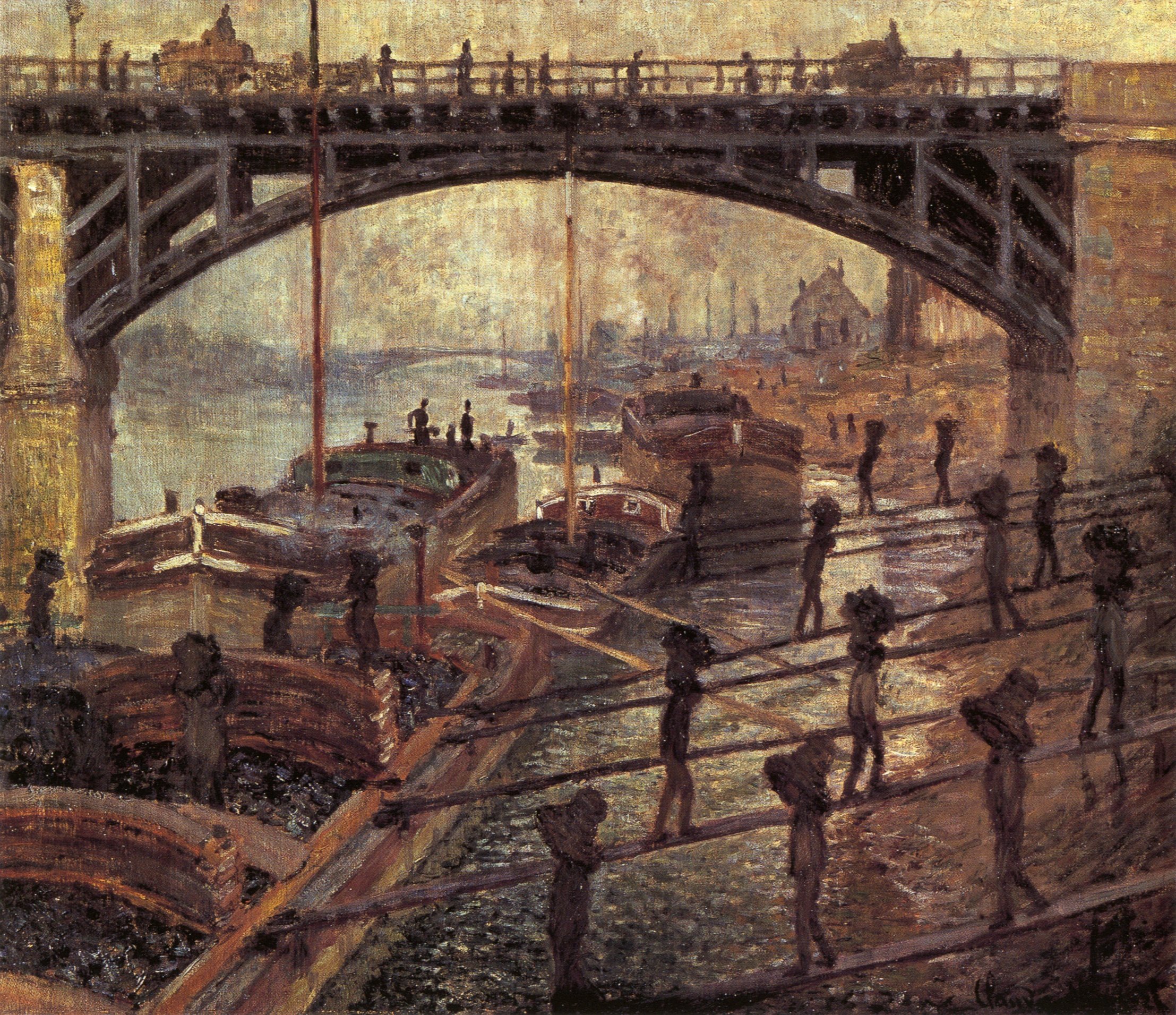
Les Charbonniers by Claude Monet

Les Charbonniers by Claude Monet (c.1875)

When I think of Impressionism and Impressionist paintings I think of light airy scenes.  I think of lily ponds and flowering arches at Givenchy.  I think of colourful young things boating on the mirror-like waters of the Seine.  I think of people sitting on the banks of the Seine staring out at blue cloudless skies.  I think of fashionable people promenading along the Grand Jatte in gorgeous sunlight.  I associate Impressionism and the paintings associated with that particular “–ism” as being light, colourful and full of smiling faces on the people as they relax from the rigours of their working lives.

That all changed when I came across the work of the Impressionist, Caillebotte and his Floor Scrapers (see August 3rd).  Today, I am featuring another darker and more sombre painting by one of the greatest Impressionist painters of all time, Claude Monet.  He painted today’s painting in 1875 when he was thirty five years old and living at Argenteuil.  It is entitled Les Charbonniers (The Coalmen) or sometimes referred to as Les déchargeurs de charbon (Men unloading coal).

Before us is a view of the docks at the Quai de Clichy, a little downriver from Paris.  Framed at the top of the painting in the background, we can just make out through the haze, the broad arch of the Pont de Clichy railway bridge, one which Monet would have crossed many times as he took the train from Argenteuil to Paris.   It is also a bridge which he featured in a number of his paintings.  Horses and carts can be seen crossing the nearer bridge, the Pont d’Asnières.  These carts will transport the coal from the quayside to nearby factories, the chimneys of which we can just make out in the distance as they pump out their smoky pollutants.   Also on the bridge we see a few pedestrians gazing down at the unloading operation.

It is a dark and atmospheric picture.  We do not have the brightness of a summer’s day.  It is a dull grey wintery day with a smoke-filled sky.  We see the men struggling with their heavy bags of coal perched on their shoulders as they struggle up the narrow wooden ramps between ship and quay over the murky waters of the Seine, balancing like tightrope walkers on a high wire.  The wooden walkways bend ominously under the strain of man and his load.  We can just imagine the ominous groaning and creaking of the wood as it takes the strain.  Hour upon hour these men will trudge mechanically back and forth until all the coal has been discharged from the boat.  This is a labour intensive operation.  Les charbonniers have an unenviable job with its physical strain on the body coupled with the inhalation of coal dust into their lungs.  In the holds of the vessel itself we see men filling baskets with coal ready for the charbonniers to take them ashore.  These men will probably not live to an old age.  Unfortunately for them, the invention of quayside cranes and cargo escalators had yet to be realised.  This discharge of the coal from the boat would be a long operation, as fully loaded, the coal barge could probably transport about 300 tons of coal, which could take anything up to two weeks to manually unload.

The sailing barge has probably brought its cargo of coal from the mines in Belgium and Northern France along the Canal de Saint-Quentin which connects the rivers Oise, Escaut and Somme.  The canal, a great feat of engineering, was opened by Napoleon Bonaparte in 1810.

The painting by Monet is simply a depiction of urban life and he might not have intended it as a political treatise with regards the conditions suffered by some working class people.  However the artist has given the painting a dark and solemn ambience which emphasizes the plight of some of the lowest paid workers.  This work was one of 29 works Monet presented in the fourth Impressionist exhibition.

The Floor-scrapers by Gustave Caillebotte

The Floor Scrapers by Gustave Caillebotte (1875)

Although I am sure people love to see the paintings of the so-called “Masters”, I believe it is good to look at the works of lesser known artists and by doing so, one can discover hidden gems.  After Renoir’s famous painting Luncheon of the Boating Party,which I featured yesterday,  I decided today that I would look for a painter, who until yesterday had been unknown to me.  However, I do understand that this may be due to my simple lack of artistic knowledge and in fact the artist is well known to you, if so, I apologise!

It is often the case that when I am researching a painting I come across another artist, whom I have never heard of, and that is the reason for my choice of artist today.  Amongst the guests at Renoir’s luncheon was his friend and lesser known Impressionist, Gustave Caillebotte and I decided to make him my artist of the day and I want to look at his unusual painting entitled Les raboteurs de parquet [The Floor Planers].

Caillebotte was born in Paris in 1848 and brought up in a very respectable and very wealthy upper-class family environment.  His father, Martial had inherited the family textile business.  Martial Caillebotte had been widowed twice before he met and married Gustave’s mother, Céleste.  When Gustave was eighteen his father moved the family home from Paris to the town of Yerres, a south-eastern suburb of Paris on the Yerres River,  an area which was familiar to the family as they had spent many summers there.

Gustave studied law when he was twenty years old and passed all his exams two years later. That year, he was drafted into army to fight in the Franco-Prussian War.  It was after the war and on leaving military service that Gustave wanted to concentrate on art and study painting.  He set up an artist’s studio in the family home and in 1873 he entered the École des Beaux-Arts in Paris.  The following year his father died and in 1878 his mother passed away, at which time the three brothers shared the family fortune.  It was also around this time that Gustave met and became friends with Edgar Degas and came into contact with the Impressionists, a group of artists who had rebelled against Academicism art and academic painters, whose works were exhibited in the Paris Salon.  This group of artists had their own Impressionist exhibitions, the first of which was held in 1874.

In 1876 the Impressionists held their second exhibition and Caillebotte exhibited eight of his paintings including today’s featured work, The Floor Scrapers, which he completed in 1875.  The style of this work belongs to the Realism genre but unfortunately for Gustave the art establishment only considered peasants and farmers from the countryside as acceptable subjects in works of art which highlighted the realism of working-class life.

The Floor-scrapers, sometimes known as The Floor-strippers  was painted in the artist’s family home.  It is a painting which depicts working class people hard at work and although that in itself was not an unusual subject for French paintings as it had been done many times before but the difference was that in previous French paintings, the depiction of the hardships of the working class was all about working class farmers or country peasants.  This painting depicts the urban working class and as such it was one of the first such representations.  Caillebotte presented his painting for the exhibition at the Paris Salon in 1875 but it was rejected.  The Jury of the Salon were shocked by its crude realism and some went so far as to describe it as being vulgar and offensive.  The artist was both disappointed and angered by their stance and decided that exhibiting his works at the Paris Salon was not going to be the future course for his paintings.  Instead, he decided to align himself with another group of French artists, who like him, were disillusioned by the narrow views of the academics and had formed themselves into their own artistic group – the Impressionists.

The work of art today is simply a painting depicting men hard at work.  Here we see three men stripping the varnish off the floor of the artist’s new apartment.  There is neither a moralising message nor is there a left wing political message.  Caillebotte is merely showing the men hard at work carrying out a strenuous task.  This is why the artist was looked upon as one of the most gifted French realist painters of his time.  Look how Caillebotte has depicted the musculature of the upper body of his three workers as they perform their back-breaking task on their hands and knees.  See how the artist has made the light of the late afternoon streams through the long balcony window and illuminate their backs.   It harks back to the heroes we saw centuries earlier when we looked at the paintings of the heroes of Antiquity. France, like Britain, had just gone through an Industrial Revolution and with urbanization came a new social class which was termed la classe ouvrière or working class and it was in complete contrast to the bourgeoisie.  The hard working men we see in Caillebotte’s painting may have been brought up in the countryside and therefore they were used to exhausting and strenuous work and had moved to the city to seek their fortunes.

At the time of this painting, France was in its Second Empire stage and Paris was undergoing massive change under the Haussmann’s Renovation of Paris which was the great modernisation plan for the city which had been commissioned by Napoleon III.  The project encompassed all aspects of urban planning, both in the centre of Paris and in the surrounding districts: streets and boulevards, regulations imposed on facades of buildings, public parks, sewers and water works, city facilities, and public monuments. The planning was influenced by many factors, not the least of which was the city’s history of street revolutions.  This was a time of great change and in a way Caillebotte wanted to change art and what had been previously unacceptable, he wanted to be accepted but he was a little ahead of his time as far as this painting was concerned.  There is a great contrast in colours used in the painting from the light blue walls to the dark browns of the floor and the men’s clothes.   I note that a bottle of wine and a glass has been added – a French prerequisite to help with a day’s work !