The Artist’s Studio, Rue de La Condamine by Frédéric Bazille

The Artist’s Studio, Rue de La Condamine by Frédéric Bazille

quem di diligunt, adolescens moritur

Whom the gods love, die young.”

The aphorism comes from the Roman playwright Plautus, who flourished around the end of the 3rd century and actually based his story on a Greek legend about a mother and her two sons.   The point of bringing up this saying is that it unhappily could refer to my featured artist of the day, who was so talented and yet was taken from us at such a young age by war.

Jean Frédéric Bazille was born in Montpellier in 1841.  His father was a senator and the head of an affluent and cultured middle-class Protestant family.    In Montpellier, Jean became acquainted with a friend of his father, a local art collector Alfred Bruyas.  Bruyas was a close friend of Gustave Courbet and he owned a large number of expensive paintings by Millet, Corot, Eugène Delacroix and many by his friend Courbet.  Young Frédéric Bazille was fascinated and inspired by the collection and this was the start of his love affair with art. He loved to paint and sketch but his father told him that if he wanted to continue with his art he had to agree to continue with his medical studies. He agreed to his father’s terms and in 1860 he started studying art.

 In 1862 he moved north to Paris to continue with his medical studies but spent most of his time sketching and painting.  Later that year he joined the studio of Charles Gleyre, the Swiss artist.  It was whilst there that he met and became friends with fellow aspiring artists, Monet, Renoir, Sisley and Whistler.   Gleyre’s studio closed the following year and Bazille decided to leave Paris and follow his friends whilst he waited on the results of his medical exams.

During his journeys around Normandy with Monet  in 1864 they stopped off at Honfleur, which was at that time a special meeting place for the en plein air painters.   It was here that he met up with Monet’s friends, the French marine and landscape painter, Eugene Boudin and the Dutch landscape and seascape painter, Johan Jongkind.  These two artists would later be instrumental in the development of Impressionism.    In the autumn of 1864 Bazille returned with Monet to Chaillyen-Bière, near Fontainebleau.  It was around this time that he finds out that he had  failed his medical exams but fortunately for him, his father did not press him to re-sit them and instead allowed his son to concentrate solely on his artistic career.  In 1865 he put forward two of his paintings to the Paris Salon, Young Girl at the Piano and Still-life with Fish.  Annoyingly for him only his still-life was accepted for the exhibition by the Salon jury.

Bazille and Camille (Study for Déjeuner sur l'Herbe) 1865

Monet, who had a competitive streak, knew about Édouard Manet’s work  Déjeuner sur l’herbe (See My Daily Art Display December 23rd) and knew of the masses of publicity it had received (not all good of course!) when it was exhibited at the 1863 Salon des Refusés.  In the spring of 1865, he decided that he too would embark on his own version of Déjeuner sur l’herbe.   This idea of figure painting in the open air was a new venture for Monet.  He began sketches for his new large-scale painting (4metres x 6 metres) which he planned to finish back in his Paris studio.  The reason for huge size for the proposed work was mainly down to Monet being inspired by Courbet’s recent large scale paintings.   The figures in Monet’s painting were life-sized.  It was almost a group of portraits set in a landscape.  Bazille and Monet’s girlfriend Camille posed for part of this work.  This preparatory oil painting of the two of them exists entitled Bazille and Camille (Study for “Déjeuner sur l’Herbe”) and can be seen at the National Gallery of Art in Washington.  However, only fragments of Monet’s completed grand scale painting survive.   Monet left it with a landlord to cover a debt, and it was ruined by moisture and neglect.  At the same time Bazille himself completed a painting The Pink Dress, which was part of the study for Monet’s open-air mammoth portrait/landscape. 

Bazille having come from a wealthy family never had any financial problems unlike his newly found artist friends and he would often help them out by sharing his studio with them and providing them with artistic materials when they couldn’t afford to buy them.   He actually bought some of Monet’s paintings, including a large work entitled Women in the Garden,  just because the artist needed money.  His friendship with the soon-to-be Impressionists was recorded in a series of paintings he did one of which was set in his Paris studio where they would all meet and it is this work which is My Daily Art Display’s featured painting of the day. 

At the outbreak of the Franco-Prussian war in August 1870, Bazille enlisted in the Zouave, which was the title given to certain light infantry regiments of the French army.  His friends had all tried to dissuade him from this patriotic gesture but to no avail.   In a battle close to the village of Beaune-la-Rolande, his commanding officer had been killed and he took control of his men leading an assault on the Prussian position.  He was hit twice by enemy fire and died on the battlefield.  His death on November 28th 1870 was just a few days before his twenty-ninth birthday.    His father was devastated by the news and a week later came north from Montpellier to the scene of the battle and took his son’s body back home for burial.

Today I am giving you The Artist’s Studio in the Rue de La Condamine, which Frederic Bazille completed in 1870, the same year he went off to fight and die for his country.  The painting currently hangs in the Musée d’Orsay.   One can imagine a group of friends nowadays doing the same as Bazille has done  – recording for posterity a gathering of companions in a photograph but of course in Bazille’s day,  it had to be a sketch or a painting.   The setting for the painting is Bazille’s studio at 9 rue de la Condamine, which he shared with Renoir from the beginning of 1868 until May 1870.   Some of Bazille’s works  are scattered around the room.  To the left, on the wall, we have his Fisherman with a Net and his painting entitled La Toilette can be seen hanging just above the white sofa.  The small still-life above the head of the piano player is a still life by Monet which Bazille had bought in order to support his friend.   We see three men standing at an easel discussing the painting on display.  The man with the hat standing in the middle is Édouard Manet and behind him we think is Monet.  The tall man to the right of the easel, palette in hand, is Bazille himself.  On the staircase is the journalist, writer and art critic, Emile Zola, who is in discussion with Renoir, who is seated below the staircase.  At the piano is Bazille’s musician friend Edmond Maitre.  The National Gallery at Washington houses a portrait of Maitre by Frédéric Bazille.

Frédéric Bazille was considered to be the most gifted of the soon-to-become Impressionists and, if he had lived, he might well have become one of the leaders of that group.  Camille Pissarro described him as one of the most gifted among us.

The Railway by Édouard Manet

The Railway by Édouard Manet (1872)

During Édouard Manet’s life he was great friends with the writer Charles Beaudelaire, the French poet, philosopher and art critic, and from around 1855 they became constant companions with the two of them frequently going off on sketching trips.   It was an important friendship for Manet, as during the times his work was being harshly criticised, Beaudelaire was very supportive of him.  Lois Hyslop the American author and Beaudelaire specialist wrote about this supportive role in her 1980 book Beaudelaire, Man of His Time, and she quoted his comments with regards Manet:

“…Manet has great talent, a talent which will stand the test of time. But he has a weak character. He seems to me crushed and stunned by shock…”

Beaudelaire believed in modernité in art and in his book, The Painter of Modern Life and Other Essays, he stressed the importance of it saying that it was very important that art must be held accountable to capture the modern experience.  He wrote:

“…By modernity I mean the transitory, the fugitive, the contingent which make up one half of art, the other being the eternal and the immutable…”

His advice to Manet was that his art should depict a contemporary realism and that Manet should become le peintre de la vie moderne .

Today I am returning to the French artist Édouard Manet and looking at another of his paintings.   It is a painting of modern life and modern Paris and would no doubt have pleased his friend, Beaudelaire.  The painting is simply entitled The Railway which he started in 1872 and completed the following year.  It now hangs in the National Gallery of Art in Washington. This was the only painting by Manet that was accepted by the Salon jury for their 1874 exhibition.  In some ways it is an unusual painting and we struggle to understand what it is all about and Manet never revealed his thoughts behind the work.  So let us take a look at the image and see if we can understand Manet’s thought process as he put brush to canvas.

Gare Saint Lazare and Pont de l'Europe (c.1868)

To start on this journey of exploration I suppose we need to say what we see.  Let us first let us take in the setting of the scene.  It is an urban landscape of Paris in the late 19th century.  Why did Manet choose this scene and what was its significance?  This was the area around the newly built Gare Saint Nazare which was completed in 1837 and this area, along with the Pont de l’Europe, which straddled the railway tracks was an area of unparalleled importance for representing the changing face of modern life in Paris brought about by the redevelopment scheme of Baron Haussmann.   It was an area which was depicted many times by the Impressionist artists like Monet, Caillebotte and Jean Beruad.  The view we see is from the garden of the rue de Rome apartment house of Manet’s artist friend Alphonse Hirsch.  The painting is almost dominated by the black metal railings which boldly run the full width of the painting, creating a foreground and a background to the work and at the same time and in some ways acts to force the two females out towards us.  The black railings form a hard, lattice-work and it is in contrast to the pure white steam behind it.  There is an abundance of contrast in this painting with its sharp edges and soft dissolves. The small girl, with her back to us, almost seems as if she is using the railings as stage curtains which she draws open to get a better view of the rail tracks and the feverish movement of the trains below.  In contrast, the older female just leans back against them and shows little interest in what is happening behind her.  She has seen it all before.  To the right, on the other side of the railings, low down we can see a signal box, above which we can just make out a white pillar which is part of the Pont de l’Europe, which was inaugurated in 1868.  The Saint-Lazare station, which is out of picture, is further to the right.

Across from the railway tracks and in the background on the upper left of the painting, just behind the woman’s head, we see the buildings on the rue de Saint-Pétersbourg and the probable reason for this inclusion is we are actually looking at the door and window  of 4 rue de Saint-Pétersbourg , which was formerly a fencing hall, but from 1872 to 1878, it was Manet’s studio.  Most of the central background behind the railings has been masked by a cloud of steam and smoke which has wafted upwards from a passing locomotive and now hangs in the air.

On our side of the railings and close up to us we have the life sized figures of a young women and a young girl.  We are connected to them by their nearness, but is there a connection between the two of them?  Are they mother and daughter, or sisters, or governess and charge?  I think at this early stage in our investigation we have hit a brick wall as there is nothing to tell us about this relationship.  However there is certain disconnect between the two.  They face in different directions, almost a Janus-like scenario.

The woman wears a long dark blue dress with large round white buttons and full lace cuffs.  Cradled in her lap we see a small dog, which is often termed due to its size, a lap dog.  She is holding an opened book which she has been reading and tucked partly under her right arm is a closed fan.  Her long hair which is auburn in colour hangs loosely down and rests on her shoulders.  The lack of styling to her hair gives me to believe that she may be just out of her teenage years and yet, the covering of her arms, unlike the young girl next to her,  would indicate a sense of decorum attributable to adulthood.  On top of her head she wears a tall bonnet crested with a floral design.  For jewellery she has gold-like earrings and a bracelet and wears a thin black ribbon around her neck.   She stares thoughtfully out at us.  It is an ambiguous unwavering  stare and in some ways a similar look to the one the lady gave us in Manet’s painting Olympia.  Is she trying to engage with us?

The model Manet used for this depiction is once again Victorine Louise Meurent, a painter and famous artist’s model.  We have seen her before in Manet’s controversial masterpieces, Le déjeuner sur l’herbe (The Luncheon on the Grass) which I featured in My Daily Art Display of August 2nd and Olympia (My Daily Art Display Oct 12th).  This was to be her last sitting for Manet  for it was around this time that she started taking painting lessons.  She wanted to concentrate on an academic style of painting which was anathema to Manet and their relationship fell apart.

Let us now look at the young girl.  The model used for this young girl was the daughter of Albert Hirsch, Manet’s friend.   She has her back to us and we see her peering between the railings at the activity below – the passing of a steam train.  It is somewhat strange that her right arm and shoulder are missing which is in direct contrast to her left arm which is stretched outwards as her hand grips the black metal railing.  Her attire reinforces her young age as we see she is not condemned by late 19th century convention to have long sleeves to her dress.  Her bluish/silver dress with the large bow is depicted in an unusual fashion.  It balloons outwards which either means a rush of upward air has caused it to billow or she has retained what is termed “puppy fat”.  Her hairstyle belies her age as it is swept up in an adult fashion and tied by a similar black ribbon worn by the woman.

So what did the critics make of Manet’s painting which was his largest en plein air work,  up until then, that he ever painted measuring 93cms x 114cms.  Alas once again a hostile reception from the critics greeted Manet’s work.  One said the painting should be renamed:

Two sufferers from incurable Manet-mania watch the cars go by, through the bars of a madhouse

Those who visited the exhibition were baffled by the work.  Critics said that the painting was incoherent and the painting quality was poor.  Unfortunately, few failed to recognise that this was a painting which symbolised modernity.  His friend Beaudelaire would have been proud of him but alas he died seven years before the painting was exhibited.

Sunday Afternoon on the Island of La Grande Jatte by Georges Seurat

A Sunday Afternoon on the Island of La Grande Jatte by Georges Seurat (1884-86)

Today I am starting My Daily Art Display blog by introducing you to some new “isms” which have a connection with what is to follow.  They are Post-Impressionism, Neo-Impressionism, Pointillism and Divisionism and they all are connected in some way to today’s featured artist George Seurat.

By now you will have read many of my blogs that cover the works of the Impressionists such as Monet, Renoir, Degas and Caillebotte and so by now you are familiar with the term Impressionism.  Post Impressionism was a style of painting that grew out of Impressionism or maybe we could say it was a style of painting which was a reaction against Impressionism. The three main artists who were central to this new group of painters and who were termed Post Impressionists were Gaugin, Van Gogh and Cézanne.   Gaugin retained the intense light and colour of the Impressionists but discarded the idea of painting from nature.  He was totally against naturalism, where artists depict nature just as it is, and in its place he wanted his works to have more inventive subject matter and he also liked to experiment with colour.   On the other hand Van Gogh continued to paint from nature but developed a highly personal use of colour and brushwork which openly expressed his own expressive response to a subject.  Cézanne kept faith with the Impressionist’s principle of painting from nature but his works came across with a greater energy and vitality.

Today I am going to look at Neo-Impressionism and Neo-Impressionist artists who were a distinct group of painters within the Impressionist movement and in some ways formed a transition period between the Impressionists and the Post Impressionists.  The two leading figures of this trend were Georges Seurat and Paul Signac and they wanted to have a more scientific approach on how light was depicted in their paintings.  Their works were characterised by the use of a technique known as Divisionism or Pointillism.  Divisionism, also sometimes known as Chromolumanarism, was a method of painting in which colour effects were achieved by applying small areas of dots of pure unmixed colours on the canvas so that  an observer standing at an appropriate distance from the painting (suggested distance for best effect was three times the diagonal measurement of the work) the dots would appear to react together giving a greater luminosity and brilliance than if the same colours had been mixed together before putting them on the canvas. What these artists wanted to achieve was that the observer of the painting combines the colours, which are in the form of dots, optically instead of the artist pre-mixing them on a palette before putting them on the canvas.

Pointillism comes from the term peinture au point, which was used by the French art critic Félix Fénéon, when he described today featured painting by Seurat.   It can be defined specifically as the use of dots of paint and does not necessarily focus on the separation of colors.  Divisionism refers mainly to the underlying theory, pointillism describes the actual painting technique associated with the likes of Seurat, Signac and to a lesser extent Pissarro. Pointillism is related to Divisionism which is a more technical variant of the method. Divisionism is concerned with color theory, whereas pointillism is more focused on the specific style of brushwork used to apply the paint.

Enough is enough !!!!  I don’t want to get too bogged down with “isms” and their meanings and I am sure that there are many people out there who can give a much more expansive explanation of the differences between Divisionism and Pointillism .   My Daily Art Display today features what many believe is Georges-Pierre  Seurat’s greatest work.  It is entitled A Sunday Afternoon on the Island of La Grand Jatte.  It was the one of the first painting to be executed entirely in the Pointillist technique and the first to include a great many people playing a major role.   It caused a sensation when it was exhibited at the eighth and final Impressionist Exhibition in 1886.  It is thought that it was possibly intended as a pendant to Seurat’s other work, Bathers at Asnière,  which I will look at in a later blog.

He started the work in 1884 and did not complete it until 1886.  He spent two years making over sixty preparatory pencil and ink drawings, conté crayon studies and oil sketches on panel for this work.  He would alter the grouping of people, the number of people within a group and where each group or individual were positioned until he was satisfied that he had achieved the perfect balance.  There was a smaller version of the painting which can be found in the Metropolitan Museum of Art in New York.  There is also a version of the scene without the people which was once in the private collection of Mrs John Hay Whitney.   This painting we see today is massive in size measuring 207cms high by 308cms wide (almost 7ft tall and 10ft wide) and since 1924 has been housed in the Art Institute of Chicago.  Seurat completed the final version of this painting in his small Paris studio.

The Models by Seurat (1886-88)

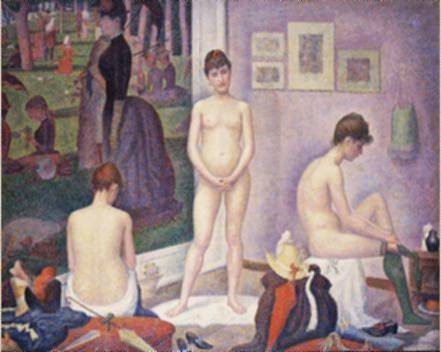
In 1888, Seurat also completed another painting which was entitled The Models  using his pointillism technique, and which depicts models in his studio.  Included in the painting is a section of La Grande Jatte and art historians believe that by doing this painting, he was showing the world that this technique of Pointillism worked just as well for indoor scenes as outdoor ones.

The Île de la Grande Jatte is a small island in the River Seine, downriver from La Défense.  It is about 2 kilometers long and just 200 metres wide at its widest point.  At one time it was reduced to being an industrial site but now has public gardens and houses.   Living on the island are approximately 4000 inhabitants.  However in the days of Seurat it was a pastoral retreat where Parisians could come at weekends from their claustrophobic city existence and soak up the quiet and peace of this little idyll.

Before us we see Seurat’s idealized version of the Grand Jatte omitting both the cafés and restaurants and the nearby ugly shipyard and factories.  In the painting we see members of different social classes out for a stroll along the Grand Jatte by the side of the Seine.  The figures, shown mainly in profile or frontal position, have a peculiar formal and artificial feel to them.  As we look at the painting head-on, there seems to be a definite elongation of some of the people although I believe if you stand at a certain angle to the painting this is minimised.  Seurat would sketch individual groups or single characters and then return to his studio to decide if and where each group should be placed on the canvas.  He sketched people of different classes in society to give the idea that all types of people enjoyed promenading along La Grande Jatte.   Look at the trio in the right foreground.  Here we have the a man wearing a top hat and holding a cane who is more than likely from the upper classes of Paris society.  The man with the muscular arms, lying back with a cap on his head, smoking the pipe is probably a working-class boatman and finally we have the young genteel lady of an indeterminate class.  An unusual trio and who, although physically close in the painting, would be unlikely to have a closeness in that present-day society.  The faces of the people in the painting show little personality.  There is something very impersonal about them.  We must presume that this was a deliberate ploy by Seurat who seemingly did not want the painting to be sullied by observers of the painting trying to interpret facial expressions.  I don’t believe the artist ever intended this to be in any way a moralistic statement about the French culture and classes at the time. However, some would disagree.   Art historians like to interpret every painting and seek symbolic depictions within a work so let us have a look at a few that have been thrown up for consideration with regards this work of art.

In the left middle ground we see a lady dressed in gold and orange fishing in the river.  I suppose there is nothing strange about that albeit she is hardly dressed as a woman who was to go out on a fishing expedition.  Well consider what the French word is to fish – it is pêcher and some have suggested that Seurat has made a play on the word as the French word to sin is pécher.  So is Seurat secretly identifying her as a prostitute.  Again look at the woman in the right foreground accompanying the gentleman.  Look what she is holding in her left hand – a monkey on a leash.  That is certainly an unusual pet to take for a walk.   So why did Seurat include a monkey.  One possible reason is that a female monkey in French is une singesse.  The symbolists would have us believe that a monkey is a symbol of licentiousness and that is why the French slang for prostitute is singesse.  So again I ask the question is Seurat trying to tell us by symbolism that this woman is a prostitute who is out for a stroll with her client?

It is interesting to note and it is not shown in my attached picture, that later Seurat painted the border using parallel red, orange and blue dashes and dots.  He varied the combination of colours in different parts of this border in order to accentuate the adjacent colours in the painting itself.  Maybe if you go to see the painting in Chicago you can let me know if Seurat’s idea with this border really works.

Finally, I came across a poem about this painting which I was going to add to the blog but it was too long so instead I have added the URL where you can find it.  It is:

http://www.lamaquinadeltiempo.com/algode/delmore2.htm

The Pond at Montfoucault by Camille Pissarro

The Pond at Montfoucault by Camille Pissarro

As promised yesterday my blog today carries on looking at the life of Camille Pissarro and one of his later paintings.

In 1872 Pissarro returned to Pontoise, where he once again set up home.   His friendship with Cézanne was re-established and Pissarro mentored his friend in the technique of painting “patiently from nature”.   Cézanne was to later to comment about his relationship with Pissarro and how his mentoring made him change his artistic style saying:

“…As for old Pissarro, he was a father to me, a man to consult and something like the good Lord…”

Pissarro was determined to create an alternative to the Salon.  He wanted a society of artists who would work together and become a type of cooperative.  It took almost four years to achieve his aim .   Artists petitioned for a new Salon des Refusés in 1867, and again in 1872.  Both requests were denied and so during the latter part of 1873, Pissarro along with Monet, Sisley and Renoir organized the Société Anonyme Coopérative des Artistes Peintres, Sculpteurs, Graveurs (“Cooperative and Anonymous Association of Painters, Sculptors, and Engravers”).  Its purpose was to exhibit their works of art independently.   They soon had fellow artists like Cezanne, Berthe Morisot and Degas interested in the scheme and all agreed to boycott participation in the Salon in 1874 and exhibit only at their exhibition.  The exhibition took place in January 1874 at the studio of Gaspard-Félix Tournachon , known as Nadar,  in the Boulevard des Capucines and this exhibition of their work was later to become known as the First Impressionist Exhibition.  Works in this exhibition included five paintings from Pissarro.  The names of the other artists who exhibited works in this exhibition reads like a Who’s Who” of famous artists.  Included in the exhibition were works by Monet, Renoir, Guillaumin, Béliard, Sisley, Cézanne, Degas and Morisot.  This First Impressionist Exhibition was not received favourably by the critics and Pissarro was disheartened by their criticism.  He wrote to the art critic Théodore Duret, who was sympathetic to the Impressionist cause, expressing his disappointment with the adverse criticism:

“…Our exhibition goes well. It is a success. The critics destroy us and accuse us of not having studied; I am returning to my work, it is better than reading the reviews…”

So why did the majority of art critics hate the works on show?    One should remember that the critics were brought up on the art of the Salon with its accepted works portraying religious, historical any mythological settings and so the paintings put forward by the Impressionists, including Pissarro, depicted commonplace street life and people busying themselves in their daily routine and was considered by the critics as both facile and some even went further by declaring them vulgar.  The critics considered a lot of the Impressionist works as being “unfinished” in comparison to the works seen at the Salon.  They commented that the way the brushstrokes of the Impressionists works were visible which, to their mind,  meant it had been done in haste and often completed in a solitary sitting.  In comparison they praised the Salon painters who to them were the “real” artists and who spent hour after hour carefully perfecting each part of their works.

The year of this First Impressionist Exhibition in 1874 proved a bad year for Pissarro.  His artworks were not selling and he had to endure a personal tragedy with his nine year old daughter Jeanne dying the week the exhibition opened.  However,  Pissarro stuck to his belief in the Impressionist movement and exhibited no fewer than twelve works in their second exhibition in 1876.  Three years on the Impressionist grouping was starting to fall apart with Renoir, Sisley and Cézanne having left.  There was also now a split amongst the remainder of the group with Degas on one side who wanted to bring in new artists and Caillebotte and Pissarro on the other who wanted to maintain the status quo.  Degas also laid down the rule for the Impressionist group that any artist putting forward work to the Salon could not enter work in that year’s Impressionist exhibition.  This was a major dilemma for some of the group who believed that to become a respected artist and command a good price for their works they had to exhibit at the Salon.

The possible break-up of the Impressionists that had worried Pissarro showed itself in the sixth and seventh exhibitions with few of the initial contributors putting forward works for inclusion.  Pissarro continued to support the Impressionist Exhibitions, refusing to enter works at the Salon and in fact contributed to all eight Impressionist Exhibitions.  Times were still difficult for Pissarro and the collapse of the French economy at the start of the 1880’s  made it even more difficult for him to sell his work.   In 1884 he moved from Pontoise to the small village of Eragny sur Epte which lies north east of Paris.  It was whilst living here that he met the artists Georges Seurat and Paul Signac and he became a convert to their new approach to art which was known as Neo-Impressionism.  I will go more into Neo-Impressionism movement and the related “–isms” of pointillism and divisionism, both of which are relevant to Neo-Impressionism, when I feature the works of George Seurat.

By the time of the eighth and last Impressionist Exhibition in 1886 there was an apparent lack of harmony among the remaining Impressionist artists, and the work of the Neo-Impressionists was shown separately from that of the others.   It was noticeable that both Monet and Renoir were absent from this last exhibition.   Seurat showed his now famous, and very large work entitled A Sunday on La Grande Jatte which he had just completed and  which dominated the room.  The room also contained Pissarro’s own Neo-Impressionist submissions which consisted of nine oil paintings,  as well as gouaches, pastels, and etchings.

Pissarro’s love affair with Neo-Impressionism was short lived and in 1889 he began to move away from the style, believing that it made it “impossible to be true to my sensations and consequently to render life and movement”.  Impressionism at this point in time had run its course.   Pissarro carried on painting city scenes although his erstwhile colleagues Renoir, Sisley and Monet had abandoned such subjects.  Pissarro completed a number of works featuring the streets of Paris and the Gare Saint Lazare.

In his latter years Pissarro suffered from a recurring eye infection that prevented him from his en plein air work and any outdoor scenes he wanted to paint he did so whilst sitting by windows of hotel rooms he stayed at, always making sure he had a top floor room with a good view.  He carried on doing this when he toured around the northern French towns of Rouen, Dieppe and Le Havre  and also when he made trips to London.  Pissarro died in Paris in 1903, aged 73.  He was buried along with the other greats of French art, music and literature in the Père Lachaise Cemetery.

Camille’s descendents followed his path in the art world.   His granddaughter, the daughter of his son Lucien,  Orovida Pissarro is a painter in her own right.  His great-grandson, Joachim Pissarro, is former Head Curator of Drawing and Painting at the Museum of Modern Art in New York and is now a professor in Hunter College’s Art Department.  His great-granddaughter, Lélia, is an artist who lives in London.

My daily Art Display featured work of art today by Camille Pissaro is a painting he completed in 1875 entitled The Pond at Montfoucault.   In 1859, a few years after arriving in Paris, Pissarro,  whilst attending the Académie Suisse,  met some aspiring artists who would become very famous, such as Monet and Cézanne.  He also became great friends with a lesser known painter, Ludovic Piette.  Piette often exhibited at the Paris Salon  in the 1860’s and also some of his paintings were shown at the Third Impressionist Exhibition of 1877.  Piette’s home was in the small village of Montfoucault, which lies on the border between Normandy and Brittany.   Pissarro went to stay with Piette on a number of occasions and when the Franco-Prussian war broke out Pissarro and his family left their home and took refuge with Piette before crossing the Channel to England.

It was later in 1874 when Pissarro had come to Montfoucault to try and relax and get over the stress and disappointment of the First Impressionist Exhibition that he started to paint some local country scenes.  He especially liked to depict female workers engaged in their daily duties and this is what we see in today’s painting.  Before us we see a female herding  some cattle by the pond which lay on Piette’s property.  Pissarro enjoyed his visits to Montfoucault and he wrote to Theodore Duret, the French journalist, author and art critic about his work but you can sense an uneasiness and doubt in his mind about his art.  He wrote:

“…I haven’t worked badly here.  I have been tackling figures and animals.  I have several genre pictures.  I am rather chary about going in for a branch of art in which first-rate artists have so distinguished themselves.  It is a very bold thing to do and I am afraid of making a complete failure of it…”

There is a beautiful tranquillity about this painting and one can see how an artist like Pissarro would have liked basing himself in this area.

Two Women Chatting by the Sea by Camille Pissarro

Two Women Chatting by the Sea by Camille Pissarro (1856)

Jacob Abraham Camille Pissarro was born to Abraham Gabriel Pissarro and Rachel Pissarro (née Manzano-Pomié ) in 1830 on the island of St Thomas in the Danish West Indies, now known as the US Virgin Islands.  His father, a Sephardic Jew, held French nationality, but was of Portuguese descent.  He originally came to the Caribbean to sort out the business affairs of his uncle who had recently died.  He ended up staying in St Thomas, took over the running of the dry store business and married his late uncle’s widow, Rachel.   This found no favour with the small local Jewish community, maybe because he had married his late uncle’s wife or maybe because his new wife and Camille’s mother,  was a native Creole, a Dominican of Spanish descent, and not of the Jewish faith.  Camille and his siblings because of this were excluded from the Jewish school on the island and had to attend the all-black primary school.

Pissarro’s father and mother went on to have four children.  Camille was the third son and he and his parents and siblings lived a comfortable existence in a large and spacious apartment over the family shop on Dronnigens Gade, the main street, of Charlotte Amalie, the capital of St Thomas.    At the age of twelve, so as to ensure he had a good education, Camille was sent to France to attend a boarding school in Passy, a small town in a district of Paris , on the right bank of the Seine.  It was whilst studying in Paris that the young Camille developed a love for art and would often visit the Louvre.  After five years studying in France,  Camille Pissarro returned home to Saint Thomas where his father was hoping he would enter the family business.  However the young Pissarro was unimpressed at having to act as a cargo clerk at the harbour and had other ideas for his future.  During his time at the harbour he would spend most of his time sketching.  It was whilst sketching one day that he met Fritz Melbye, a Danish marine painter who was also living on St Thomas.  He liked the enthusiasm Pissarro had for sketching and painting and he began to mentor him and eventually persuaded him that he should become a full time artist.  Pissarro was delighted and much to his father’s chagrin in 1852 gave up the family job and went off with Melbye to Venezuela where the two of them based themselves in Caracas and stayed for two years sketching and painting landscapes and village scenes.  Pissarro once reflected on his decision to leave his comfortable home and his position in the family business saying:

“…I abandoned all I had and bolted to Caracas to get clear of the bondage of bourgeois life…”

In 1854, he returned home to Saint Thomas and his parents realised that any attempt to persuade the son to settle down would be fruitless and so they gave him their blessing to seek his fortune as an artist and the following year he left Saint Thomas for the last time and went to live in Paris.  He went initially to stay with the French branch of his family who gave him financial support, in order to have him follow a more serious artistic training.

His first position was to act as an assistant to his friend Fritz Melbye’s brother and Danish artist, Anton.  In 1856 he attended private art classes at the École des Beaux-Arts and at the age of thirty-one registered as a copyist at the Louvre.  He was influenced in his early days in Paris by the likes of Courbet, Corot, Millet and Daubigny.  He also attended the prestigious Académie Suisse which was an art establishment in Paris.  The Swiss Academy did not offer courses, but provided the aspiring young artists with models made it possible for them to study nudes together, and in this way helped the usually poverty-stricken young painters who found the price of a model being too high for a sole artist.  It was also a great meeting place for the young artists to discuss their work and their personal ideas.   It was here that he met the future Impressionists Claude Monet, Armand Guillaumin and Paul Cézanne and through them was introduced to the likes of Renoir and Sisley.

Even though now living in Paris his early paintings were of the Caribbean and he was still influenced by Anton Melbye to such an extent his early exhibits at the Paris Salon bore the signature “Pupil of A. Melbye”  a moniker he used until 1866.  Studying at the Academies was not all together to Pissarro’s liking and he railed against having to work in the traditional and prescribed manner set down by these institutions and having to follow the official line when it came down to getting works exhibited in their official exhibitions.  He felt that their official standards were subduing his creativity and he decided to look elsewhere for help and inspiration which he eventually found when he was being tutored by Camille Corot.  It was their mutual love of rural scenes which endeared Corot to Pissarro and it was Corot that first introduced Pissarro to the technique of outdoor painting, en plein air.  Pissarro would spend much time around the countryside on the outskirts of Paris.  He would make many painting trips around Montmorency and Pontoise building up his landscape portfolio.

A few years after he had arrived in Paris his parents left their business in Saint Thomas leaving the running of it to their manager and moved to Paris.  They hired a maidservant by the name of Julie Vellay, the daughter of a Burgundian wine producer.   Camille struck up a relationship with Julie in 1860 and she was to become the love of his life and his constant companion.  In 1863, following a miscarriage the previous year, they had their first child, Lucien.  Just over a year later their daughter Jeanne was born.

The style of Pissarro’s works with their natural settings did not now find favour with the Salon juries and the pretence of grandeur the Salon jurists required in works if they were to be allowed into the Salon exhibitions.  A turning point came in 1863 when all the works by Pissarro and his like-minded contemporaries such as Monet, Cézanne and Guillaumin where rejected for the forthcoming exhibition by the Salon jury.  According to the author, Ross King, in his book, The Judgement of Paris, only 2217 out of 5000 paintings were accepted into the Paris Salon exhibition by the Salon jury.  The French ruler at the time Emperor Napoleon III voiced concern at the time for this wholesale refusal to allow so many works enter the official Salon exhibition and decreed that the rejected painters could have their works hung in an annex the regular Salon, the Salon des Refusés (Exhibition of Rejects).  He wanted the public to judge the works which had been rebuffed by the Salon jurists.   Artists who had their works hung in the 1863 Salon des Refusés exhibition included Pissarro, Manet, Whistler and Cézanne.

The Franco-Prussian War broke out in 1870 and Pissarro moved his family to Norwood on the outskirts of London and it was here he met the Paris art dealer, Paul Durand-Ruel, a man who would, from then on, organise the sale of Pissarro’s works.  It was also the art dealer that reacquainted Pissarro with Monet and the two French artists spent their time in London studying the work of the great landscape painters, Turner and Constable.  It was in 1871 whilst still in London that Pissarro married his lover Julie Vellay who was expecting their third child.   That year, after the war had ended, he and his family returned to their home in Louveciennes and much to his horror most of the works in his studio, which he had completed in the previous twenty years, had been destroyed by the invading Prussian soldiers.

I will leave Pissarro’s life story at this point and conclude it in my next blog but for today I want to end by looking at one of Pissarro’s early paintings.  My Daily Art Display featured oil on canvas painting is entitled Two Women Chatting by the Sea which he completed in 1856 around the time he left his homeland for the final time.  The painting had been owned by Mr and Mrs Paul Mellon, the late American philanthropist and his wife and was given to the National Gallery of Art in Washington in 1985.  Unfortunately,  according to their website it is not currently on view.  It is amazing the high percentage of paintings that all large museums have in their vaults, waiting their turn to go on display.  It is just a shame that there is not more wall space available for us to see these hidden gems.

The Dead Christ with Angels by Édouard Manet

The Dead Christ with Angels by Édouard Manet (1864)

Today, My Daily Art Display returns to the French painter of contemporary urban life and who was a leading figure in the shift from Realism to Impressionism and was looked upon as one of the founding fathers of Modernism.  So many –“isms” !   We have seen examples of these three -isms before but let me just do a recap of the meaning of these terms.

Realism was prevalent in the mid to late nineteenth century and this movement believed that painters should represent the world exactly as it was, even if it was at the expense of some artistic and social principles.  It was looked upon at the time as very controversial and often the works were viewed as being morally wrong and wicked because they challenged and broke the conventional standards of what was termed “good taste”.

Impressionism had its origins in France between 1860 and 1900 and soon spread to other western countries.   In a way it was, in some ways, a rejection of Academicism which promoted the Classical ideals of beauty and artistic perfection and which had a stringent hierarchy within the visual arts favouring the grand narrative and historical paintings.  The Impressionist painters and Impressionism wanted nothing to do with such Academic traditions but preferred to emphasise an accurate depiction of light in its changing qualities and looking how light changed with the time of day.  They would often paint outdoors (en plein air).   The Impressionist style of painting can be typified by its attention on the common impression produced by a scene or object and the way the artists tended to use unmixed primary colors and small brushstrokes in order to imitate real reflected light.

Finally Modernism, which was a very broad movement that also began around the latter years of the nineteenth century, and was a type of art that reflected modern times and did not keep looking back at times past.  The Modernist artists believed that the modern world they lived in was fundamentally different to what had gone before and that art needed renew itself and move on.  It was all about the artist’s vision of the future.

My featured artist today is Édouard Manet.  He was born in Paris in 1832 and was brought up in a wealthy, upper class household.  He was the eldest son of Auguste Manet, a judge and the Chief of Staff at the Ministry of Justice and Eugénie-Desirée Fournier, the daughter of a diplomat and goddaughter of Charles Bernadotte, the Swedish crown prince.  His father had hoped that young Édouard would follow him into the legal profession.  However even though he was well educated, Manet did not particularly shine academically but he did show a predisposition toward drawing and the arts.  In 1844, aged twelve years old, he enrolled at the College Rollin, a secondary school where he became friends with Antonin Proust, who would, in the future, become the French Minister of Fine Arts.   It was also around this time that Manet’s uncle, Charles Fournier, encouraged his enjoyment of the arts and the two of them along with Antonin Proust, would go on trips to the Louvre.

Manet had set his heart on going to sea and twice sat the entrance exam to a naval training school but in both cases failed.  He did however manage, with help from his father, to get a trip on the training ship Guadeloupe voyaging to Rio in 1848 and returning home in June the following year.   His father had by this time given up any hope of his son entering the legal profession and acquiesced to his son’s desire to become an artist.   For a six-year period, beginning in1850, Manet studies in the studios of Thomas Couture the Academic and History painter.  His relationship with his master was very strained and they would frequently clash.  It was around this time that he registers as a copyist at the Louvre and studies the works of the old masters, such as Velazquez and Goya.  Although impressed with their paintings, he believed that his works should reflect the ideas and ideals of the present time and not like theirs, keep harking back to the past.   Manet was a great friend and constant companion of Charles Beaudelaire, the great poet and art critic who was credited with coining the term modernité to designate the brief short-lived experience of life in an urban metropolis and he believed that art must be held accountable to capture the experience.  His advice to Manet about his art was that he should depict a contemporary realism, and had to become “le peintre de la vie moderne.

The year 1852 was the start of a change for Paris and Parisiennes as the great modernization of the city started on the direct orders of Napoleon III, under the supervision of Baron Georges- Eugène Haussmann.  The infrastructure often going back to medieval times had become inadequate, roads were too narrow and buildings were becoming unsafe.  In the great renovation programme, streets were widened and lengthened, houses pulled down to make way for new ones, shop fronts replaced.  All this work was labour-intensive and thousands of jobs were created people poured into the city from the outlying countryside to gain employment.  The whole of the social and cultural life of Paris changed with such a migration of labour.  Paris became one of the most beautiful and culturally progressive cities in the world and it was this modernity that Manet wanted to record in his works of art.

I will leave Manet’s biography at this point in his life and will conclude it in a later blog but for today I want to look at one of his earlier paintings entitled The Dead Christ with Angels, which he completed in 1864 and which can now be found at the Metropolitan Museum of Art in New York.  This was the first of a number of paintings by Manet that had religious subject matter. The biennial and later, annual Parisian Salons were considered the most expedient way for an artist to make himself known to the public, and Manet submitted paintings to Salon juries throughout his career.  He submitted today’s featured painting in 1864 exhibition.

The inscription indicates Manet’s source, but the passage he cited describes Mary Magdalene finding Christ’s tomb empty except for the two angels whereas his painting shows the two angels with Christ.  If that wasn’t bad enough Manet realised, albeit too late, when the painting was already on its way to the 1864 Salon Exhibition that he had made an even greater mistake with regards the accuracy of the biblical tale he had depicted.   Can you spot it?

In his painting he has painted the wound on the left side of Christ and not, as convention would have it, on his right side.   He immediately contacted his friend Baudelaire and told him of this error, and his friend advised him to correct the position of the wound in the painting before the exhibition opening.  He warned Manet that if he didn’t then his critics would have a field day, adding, “take care not to give the malicious something to laugh at.”   Manet’s submissions to the Salon of 1864 were again condemned by critics, for his painting of Christ and the Angels as they put it showed “a lack of decorum”.   The critics further denounced the work for its realistic touches, such as the cadaverous body of Christ and the seemingly human angels.  They argued that the painting totally lacked any sense of spirituality; the figure of the battered Christ was said to more closely resemble the body of a dead coal miner than the son of God.

Manet did not repaint the wound, and as Beaudelaire had foreseen, the critics derided his error. Only the writer, Émile Zola, gave the painting the respect it deserved.  Zola felt that Manet’s intention was to emphasize the reality of the corpse, even though he called attention to its holiness by including a halo.

Les Charbonniers by Claude Monet

Les Charbonniers by Claude Monet (c.1875)

When I think of Impressionism and Impressionist paintings I think of light airy scenes.  I think of lily ponds and flowering arches at Givenchy.  I think of colourful young things boating on the mirror-like waters of the Seine.  I think of people sitting on the banks of the Seine staring out at blue cloudless skies.  I think of fashionable people promenading along the Grand Jatte in gorgeous sunlight.  I associate Impressionism and the paintings associated with that particular “–ism” as being light, colourful and full of smiling faces on the people as they relax from the rigours of their working lives.

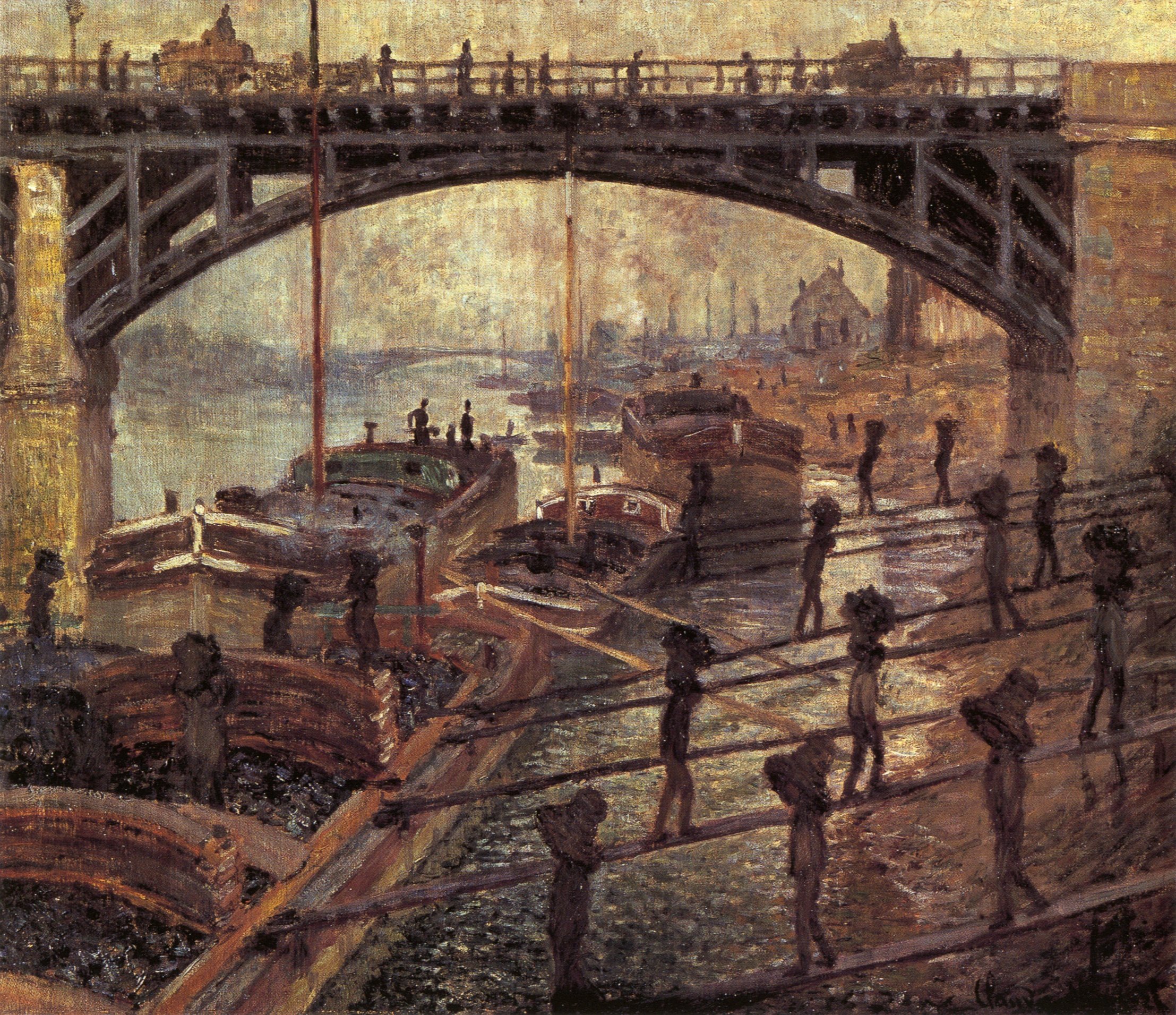
That all changed when I came across the work of the Impressionist, Caillebotte and his Floor Scrapers (see August 3rd).  Today, I am featuring another darker and more sombre painting by one of the greatest Impressionist painters of all time, Claude Monet.  He painted today’s painting in 1875 when he was thirty five years old and living at Argenteuil.  It is entitled Les Charbonniers (The Coalmen) or sometimes referred to as Les déchargeurs de charbon (Men unloading coal).

Before us is a view of the docks at the Quai de Clichy, a little downriver from Paris.  Framed at the top of the painting in the background, we can just make out through the haze, the broad arch of the Pont de Clichy railway bridge, one which Monet would have crossed many times as he took the train from Argenteuil to Paris.   It is also a bridge which he featured in a number of his paintings.  Horses and carts can be seen crossing the nearer bridge, the Pont d’Asnières.  These carts will transport the coal from the quayside to nearby factories, the chimneys of which we can just make out in the distance as they pump out their smoky pollutants.   Also on the bridge we see a few pedestrians gazing down at the unloading operation.

It is a dark and atmospheric picture.  We do not have the brightness of a summer’s day.  It is a dull grey wintery day with a smoke-filled sky.  We see the men struggling with their heavy bags of coal perched on their shoulders as they struggle up the narrow wooden ramps between ship and quay over the murky waters of the Seine, balancing like tightrope walkers on a high wire.  The wooden walkways bend ominously under the strain of man and his load.  We can just imagine the ominous groaning and creaking of the wood as it takes the strain.  Hour upon hour these men will trudge mechanically back and forth until all the coal has been discharged from the boat.  This is a labour intensive operation.  Les charbonniers have an unenviable job with its physical strain on the body coupled with the inhalation of coal dust into their lungs.  In the holds of the vessel itself we see men filling baskets with coal ready for the charbonniers to take them ashore.  These men will probably not live to an old age.  Unfortunately for them, the invention of quayside cranes and cargo escalators had yet to be realised.  This discharge of the coal from the boat would be a long operation, as fully loaded, the coal barge could probably transport about 300 tons of coal, which could take anything up to two weeks to manually unload.

The sailing barge has probably brought its cargo of coal from the mines in Belgium and Northern France along the Canal de Saint-Quentin which connects the rivers Oise, Escaut and Somme.  The canal, a great feat of engineering, was opened by Napoleon Bonaparte in 1810.

The painting by Monet is simply a depiction of urban life and he might not have intended it as a political treatise with regards the conditions suffered by some working class people.  However the artist has given the painting a dark and solemn ambience which emphasizes the plight of some of the lowest paid workers.  This work was one of 29 works Monet presented in the fourth Impressionist exhibition.

The Bellelli Family by Edgar Degas

The Bellelli Family by Edgar Degas

Today, My Daily Art Display looks at a painting by a French Impressionist painter who, to me, is synonymous with paintings and sculptures of young ballet dancers.  His name is Edgar Degas who was actually born Hilaire-Germain Edgar De Gas in 1834.  He was in the forefront of the Impressionism movement although he preferred to be labelled as a realist painter.  He worked on today’s featured painting between 1858 and 1867.  It is entitled Family Portrait or The Bellelli Portrait and is a masterpiece of Degas’ youth.  It is a deeply insightful family portrait, in which we observe four people, two adults and two children who are the family Bellelli.

Degas had a traditional École des Beaux-arts education in Paris and in 1856 travelled to Italy to continue his studies and the following year visited his grandfather, Hilaire Degas, in Naples.  He also spent time in Rome where he set about copying the work of the Renaissance Masters.  In 1858 he received an invitation from his aunt, Laura Bellelli, née De Gas, to visit her and her family in Florence and at the same time to take the opportunity to study the paintings in the city’s prestigious gallery, the Uffizi.  He jumped at the chance and so went to stay with the family.  The head of the household was Laura’s husband, Gennaro, who had been a political journalist as well as a fervent supporter and good friend of Camillo Benso, Count of Cavour, a leading figure in the movement towards Italian Unification.  When in 1854 the revolution against the Austrians failed, Gennaro was forced to flee from Italy to escape persecution by the Austrians over his participation in the failed uprising.  He first went and lived in exile in Paris but later returned to Florence.

Degas did not get on well with Gennaro and only remained at their rented house until the arrival of his cousins who had remained in Naples following the death of Degas’ grandfather, Hilaire.  Degas’ could sense the tension between Gennaro and his aunt Laura who once she confided in Degas about her relationship with her husband and her uncertain future saying:

“…my husband is “immensely disagreeable and dishonest… Living with Gennaro, whose detestable nature you know and who has no serious occupation, shall soon lead me to the grave….”

Part of the problem was that this exile in Florence separated her from her family back in Naples and to make matters worse, Laura was once again pregnant.  It is thought that the constant tension between her and her husband led to the death of the child in infancy and this tragic loss only added to the bitterness between husband and wife.  It was with this lack of domestic happiness in mind that Degas started this family portrait.

Before us we see the four members of the Bellelli family, Gennaro, his wife Laura, the sister of Degas’ father, and their daughters Giulia and Giovanna.  It is known that Degas made many sketches of the family before returning to Paris to work on the painting.

We see Laura dressed in mourning for the recent death of her father, and Degas’ grandfather, Hilaire, and in the background we can see a framed portrait of him.  Looking closely at how Degas has depicted his aunt.  We see a very dignified woman with a very stern countenance.  She stands upright as if posing for an official picture.  She coldly averts her gaze away from her husband. Her right hand rests protectively on the shoulder of her elder and favourite daughter, Giovanna.   Degas’ two young cousins are depicted with their mother, and are also dressed in mourning, in their black dresses and white pinafores. Giulia half sits on a small chair at the centre of the painting, arms akimbo, as she looks towards her father and in some ways forms a link between the two estranged adults.  Degas was very taken with his cousins describing them:

“….The elder one was in fact a little beauty. The younger one, on the other hand, was smart as can be and kind as an angel. I am painting them in mourning dress and small white aprons, which suit them very well…I would like to express a certain natural grace together with a nobility that I don’t know how to define….”

Note how Degas has positioned the husband and wife far apart in the painting, which was probably an acknowledgement of the tension between the couple and how the two had drifted apart.  There is no feeling of togetherness about the family.    The father sits in an armchair at his desk next to the fireplace, where he had been reading or writing a letter.   He has his back to us but his head is turned towards his daughter.  He appears unmoved and uncaring, showing little interest in what is going on around him.    His body is framed by a mantelpiece on which we see an ornate clock, some plates and a candlestick.  Over the mantelpiece there hangs a large mirror and in the mirror we see reflections of the room which in some way open up the space and fills it with more light.  We see reflections in the mirror of a curtained window, a chandelier and a framed painting.

It is interesting to look at how Degas has seemed to separate the husband from the rest of the family by a vertical separation formed by the leg of the table, the candlestick and the vertical side of the fireplace and mirror.   Just behind his chair, on the floor, we catch a glimpse of the family’s pet dog.  The drawing which we can see hanging on the wall behind Laura is a portrait of the recently deceased Hilaire Degas, which his grandson had drawn.  It is more than likely that Degas positioned this small picture where he did so as to give a sense of connection between the various generations of the Degas family.

Laura must have been appalled that Degas had to stay in a household, which exuded such unhappiness.   It is believed that Laura married Gennaro in desperation because her father had not been satisfied with any of her previous suitors and she was still unmarried at the “ripe old age” of 28.   She was extremely unhappy in her marriage and once shared her misgivings with Degas.   According to the American biographer and art historian, Theodore Reff, who wrote about a letter from Laura to her nephew, in his book , Degas: The Artist’s Mind .   In the letter she wrote:

 “…You must be very happy to be with your family again, instead of being in the presence of a sad face like mine and a disagreeable one like my husband’s…”

 It is thought that this family portrait was not to be a gift to the family but a work of art which he wanted to exhibit at the Paris Salon.  Whether he ever did that is uncertain but many believe he put it forward for exhibition at the Salon in 1867.  Degas kept hold of the painting until 1913 when he gave it to his art dealer, Paul Durand-Ruel, for him to sell.  In 1918 it was sold to the Musée du Luxembourg, Paris  and later the painting was moved to the newly opened Musée d’Orsay where it can now be found.

One should remember that this is not a photograph in which one can detect the mood of the sitters.  This is a painting by an artist who has the ability to paint the demeanour of his sitters in whatever way he chooses.  So this painting is how Degas views the family life of the Bellelli family.  How close it is to realism is known only by Degas and the Bellelli family.  So it is up to you  to decide whether Laura was a stern and disillusioned matriarch and whether Gennaro was the disinterested and curmudgeonly.

Luncheon of the Boating Party by Pierre-Auguste Renoir

Luncheon of the Boating Party by Auguste Renoir (1881)

My Daily Art Display today features one of the best known Impressionist paintings.  It is Luncheon of the Boating Party by Renoir which he painted in 1881.  Although I would rank Impressionism outside my top three favourite art genres, I was fascinated by this painting and the story behind it.

Maison Fournaise (c.1890)

I suppose firstly I should examine the setting for the painting, which is the balcony at the Maison Fournaise.  This building is situated on the ÎlIe de Chatou, an island situated across from the small town of Chatou, which is situated on the right bank of the Seine.   Boating on the Seine became a very popular form of recreation in the middle of the eighteenth century and whereas Argenteuil, a little way upstream from Chatou, where the Seine is wider and with its more prevalent winds, attracted sailors, the Îlle de Chatou was the ideal spot for rowers.  Alphonse Fournier, who was a river toll collector and a part-time boat carpenter, set up his boat building workshop along with his boat rental business in 1857.  Alphonse also used to organise boat regattas and water festivals.   At the same time, his wife, an accomplished cook, opened a restaurant next door.  This restaurant, combined with the boat rental facility and its many organised boating events, was a very popular family-run business.   Their daughter Louise-Alphonsine, who became a popular and well-known artist’s model, greeted the clients whilst their son Jules-Alphonse charmed the ladies and assisted them into the boats.  Artists visiting Maison Fournaise were never short of potential models for as Renoir wrote:

“…..I was constantly spending my time chez Fournaise-there I found as many beautiful girls as one could ever wish to paint!…..”

The Island of Chatou had other thing going for it.  Rail travel allowed Parisians easy access to this area in the countryside.  If you look carefully under the awning you can just make out, at the top left, the blue-gray outline of the Chatou railroad bridge, part of the government’s recently completed transportation projects that had made access to this riverside destination possible to everybody, not just to the members of the upper class.

La Maison Fournaise, today.

The setting also radiated   peace and tranquillity along with its ideal light conditions and proved a haven for artists with the likes of Claude Monet, Alfred Sisley, Berte Morisot, Edouart Manet and Camille Pissaro often visiting the location.   Auguste Renoir was also a regular caller and he once described his love of the establishment in a letter to friend:

“…You could find me anytime at Fournaise’s. There, I was fortunate enough to find as many splendid creatures as I could possibly desire to paint……….. I can’t leave Chatou, because my painting is not finished yet. It would be nice of you to come down here and have lunch with me. You won’t regret the trip, I assure you. There isn’t a lovelier place in all Paris surroundings….

The Fournaises’ two businesses flourished until 1906 when Madame Fournaise closed the restaurant and four years later Alphonse Fournaise wound down his boat rental enterprise.  Then, unfortunately, over the years,  the deserted premises started to fall into disrepair.  Madame Fournaise died in 1937.  By the 1970’s the buildings were at the point of complete dereliction.  However in 1977 the town of Chatou bought the building and five years later it listed it as a building of historic significance, joining the register of Les Monuments Historiques and restoration work began with the support from The Friends of Maison Fournaise and The Friends of French Art.   Currently the building is a museum, La Fournaise Museum, and in 1990 a restaurant reopened on the premises

So now we know the setting for the painting let me introduce you to some of the people featured in this wonderful painting.  As in a number of Renoir’s paintings, he liked to include portraits of his friends.

The Participants
  1.  Aline Charigot, seen holding a dog, was a seamstress and part time model for Renoir.  Aged twenty-seven at the time of the painting met Renoir in 1880 and they were married in 1890, despite a thirteen year age difference.  The couple had three children, Pierre, Jean (who became the well-known filmmaker) and Claude.  Despite being much younger than Renoir she died four years before him in 1915, aged 61 and was buried in the churchyard at Essoyes in the Champagne-Ardennes region of France which was her childhood home.  Renoir who died a few months before his seventy-ninth, in Cagnes, was laid to rest alongside his beloved wife.
  2. Jules-Alphonse Fournaise, wearing a straw boater and sportsman’s T shirt leans against the balustrade.  He was the son of the owner of Maison Fournaise and was in charge of the boat rentals.
  3. Louise-Alphonsine Fournaise, leaning against the balustrade is the daughter of the owner of the establishment and a war widow.
  4. Baron Raoul Barbier, sporting a brown bowler hat, has his back to us as he engages the proprietor’s daughter in conversation.  Formerly a cavalry officer and war hero later became mayor of colonial Saigon.  The two loves in his life were women and horse racing.
  5. Jules Laforgue, a Symbolist poet, journalist on the La Vie Moderne newspaper and private secretary to Charles Ephrussi (No.8)
  6. Ellen Andrée, seen drinking from her glass. Aged 24 at the time of the painting, she was a Parisian actress and mime at the Folies Bergère and sometime artist’s model for Renoir, Manet and Degas (See My Daily Art Display June 7th where the actress has modeled for the Degas painting).
  7. Angèle Leault, some time Parisian actress and singer and also a market flower seller.
  8. Charles Ephrussi, wearing a top hat and in conversation with his secretary.  Russian-born Ephrussi was a wealthy art collector and historian as well as being editor of the prestigious art magazine, Gazette des Beaux-Arts.  He was a great supporter of the Impressionist painters.
  9. Gustave Caillebotte, in the right foreground with a cigarette in his hand.  He was a good friend of Renoir and a well-known painter in his own right.  He was a collector of Impressionist paintings and also one of Renoir’s wealthy patrons.  Renoir’s prominent positioning of Caillebotte was not accidental but was a measure of his importance to Renoir.  He lived in a house overlooking the Seine, not far from Chatou.  Caillebotte  was trained as an engineer, built boats and was a great sportsman.  This maybe accounts for Renoir’s youthful portrayal of him (he was 33 at the time of the painting) in his boating attire, consisting of a sleeveless white T shirt and blue flannel pants.  On his head is a flat-topped straw hat around which a blue ribbon is tied.  This indicates that Caillebotte was a member of the privileged Cercle Nautique de la Voile boating club.  He was godfather to Renoir’s eldest son, Pierre.
  10. Adrien Maggiolo , Italian journalist on Le Triboulet newspaper.
  11.  Eugène-Pierre Lestringuez, official at the Ministry of the Interior and close friend of Renoir who often modeled for his paintings.
  12.  Paul Lhote, wearing a straw hat in conversation with Lestringuez and the actress Jeanne Samary.  He was a writer of short fiction and a journalist and close friend of Renoir.
  13.  Jeanne Samary, holding her black-gloved hands to her ears.  Actress at the Coméie-Francais in Paris.

With this group of people we can see that Renoir was illustrating the nature of Maison Fournaise which welcomed customers from a variety of social backgrounds from the wealthy aristocrats to the humble actors.   With the new rail system in place along with the shortened working week, everyone, no matter what their occupation, was able to escape the city and enjoy the pleasures of the Parisian suburbs at the weekends.  The forty year old artist in producing this large masterpiece depicted the modern life of Parisians as they relaxed.  Renoir’s painting captures the idyllic atmosphere as his friends wine and dine on the riverside terrace.  Renoir gathered most of the participants in the painting together early on so that he could organize the composition.  Later he worked on the individual figures as and when they were able to model for him.  It was a grueling time for the artist and Renoir felt the pressure on him to complete the work.  He had a love-hate relationship with the work commenting once:

“… I no longer know where I am with it, except that it is annoying me more and more….”

He made many changes to the work before he was completely satisfied. The final result was a veritable gem of Impressionism.