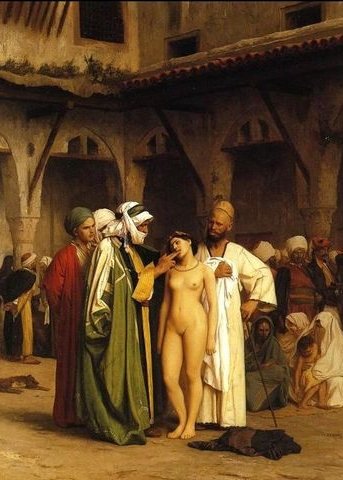
The Slave Market by Jean-Léon Gérôme

The Slave Market by Jean-Léon Gérôme (1866)

Today I am returning to the nineteenth century French academicism painter and sculptor Jean-Léon Gérôme, looking at his early life and featuring one of his works.  I had previously featured this artist in My Daily Art Display of February 10th 2011 when I talked about his painting entitled A Roman Slave Market.

Jean-Léon Gérôme was born in 1824, in Vesoul; a small town close to the city of Besançon and near to the French-Swiss border.  He was the eldest son of Pierre Gérôme, who was a goldsmith by trade, and his wife Claude Françoise Mélanie Vuillemot, a daughter of a merchant. He initially attended school locally in Vesoul where he was looked upon as a star pupil and attained a good deal of academic success culminating in being awarded first prize in chemistry, and an honourable mention in physics.  From the age of nine he took drawing lessons under the tutelage of Claude-Basile Cariage and when he was fourteen years of age he received formal art tuition and was viewed as a great up-and-coming talent and he received a prize from the school for one of his oil paintings.    At the age of sixteen, with his school days behind him, he set out for Paris with a letter of introduction to the French painter Paul Delaroche who at this time was at the height of his fame.   Delaroche’s artistic style was a blend of the academic Neo-classical school and the dramatic subject matter favoured by the Romantics.  This combination was to become known as the historical genre painting style. Gérôme was to be greatly influenced by the paintings and the tuition he received from Delaroche.

In 1845, after three years of studying under Delaroche and having just returned to Paris after a visit to his home in Vesoul, Gérôme discovered that Delaroche had closed his studio.   Delaroche had just suffered the loss of his wife, Louise, whom he deeply loved and whom he had depicted in many of his paintings.   Gérôme discovered him to be in the depths of depression following the death of his wife and was about to close his atelier and journey to Italy. Gérôme asked if he could accompany him.  Delaroche agreed and the two of them along with a couple of other of Delaroche’s students, one of which was the English painter Eyre Crowe, set off on their painting trip.

Gérôme stayed in Italy and visited Naples where he viewed the ruins of Pompeii and Herculaneum which were to become the foundation for his gladiatorial depictions.  His sojourn in Italy was cut short in 1844 when he contracted typhoid fever and he had to return home to Versoul where his mother nursed him back to health.  Later that year, fully recovered, he returned to Paris and entered the atelier of the Swiss painter and teacher Charles Gleyre.   Gleyre was to guide many young aspiring artists who would become famous household names, such as Monet, Renoir, Bazille and Whistler.  From the studio of Gleyre, Gérôme went on to attend the École des Beaux-Arts.

Meanwhile, Delaroche, who had remained in Rome, returned to Paris to work on an important commission.  Delaroche offered Gérôme a position as his assistant on the commission and so Gérôme left Gleyre’s studio to work with his former master.  He remained as Delaroche’s assistant for just on a year. Whilst working alongside Delaroche, he was encouraged to prepare paintings for the Salon exhibitions and within a short time, his talent as an artist was recognised and he was commissioned to paint a reproduction for the Queen. This was to be the start of many official and lucrative commissions. In 1846 Jean-Léon Gérôme began to work on one of his most famous paintings – Young Greeks Attending a Cock Fight.  Gérôme had just suffered the setback at the École des Beaux Arts of not achieving his main aim that of winning Prix de Rome prize, which would have given him a scholarship to travel to and study in Rome.  He was probably questioning his own ability and was somewhat hesitant to submit his painting to the Salon jurists, but on Delaroche’s insistence, he did and it was accepted into the 1847 Salon and hailed a great success.  One of those to take a liking to his work was the art critic and poet, Théophile Gautier, who would later support Gérôme throughout most of his career.  Gautier’s commendation of The Cock Fight made Gérôme famous and his artistic career was well and truly launched.

Gérôme travelled extensively visiting Turkey in 1855 to make studies for a large official commission, and two years later journeyed to Egypt in preparation for the Salon of 1857 in which his first Egyptian genre paintings were shown.   In the 1860’s he returned to Egypt and also visited Judea, Syria and the Holy Places.   Gérôme was fascinated with the Near East and many of his subsequent works highlighted the Near East culture and traditions and it was to mark the start of his career as an Orientalist or a peintre ethnographique.

The painting by Jean-Léon Gérôme which I am featuring today was completed by him in 1866 and is entitled The Slave Market.  It is without doubt one of Gérôme’s most provocative works.  The scene is set in a market place in a Near East country, more than likely, Egypt.  The idea for this painting and others featuring the slave market probably came to Gérôme during his Near East travels, when slavery was still practiced.  However the open air slave market as shown in this painting did not exist in the mid-nineteenth century and so this should be viewed as an idealised depiction.  The artist has put a great deal of effort into details of the costumes worn by the traders as well as the way in which he has carefully depicted, in detail, the architecture of the surrounding buildings.  In the centre of the painting we see a nude woman who is being offered up as a slave and is surrounded by a group of prospective buyers.  One of these men, dressed in a gold and green covered cloak, examines the “goods” on offer.  His left hand holds the back of the woman’s head whilst the fingers of his right hand are forced into her mouth so he could better examine her teeth.  Behind the woman stands the seller and from the smile on his face he seems assured that he is about to be paid handsomely for the woman.  There can be no doubt that prospective buyers of this painting were not totally absorbed by the way the artist depicted the clothes worn by the prospective buyers or with the architecture of the building in the background.  They were sold on the erotic nature of the painting.  Viewers were able to be vociferous in their condemnation of the slave trade whilst enjoying the sight of the female body.

The painting was acquired by Sterling and Francine Clark in 1930 and is part of the Sterling and Francine Clark Art Institute in Williamstown, Massachusetts collection but is currently (until September 23rd) on view at the Royal Academy, London.

View at Narni by Jean-Baptiste-Camille Corot

View at Narni by Corot (1826)

Today I want to focus on the early life of one of the greatest nineteenth century French landscape painters, Jean-Baptiste-Camille Corot.  He was one of the leaders of the Barbizon School and a master of plein air painting.   The Barbizon school, which existed between 1830 and 1870, acquired its name from the French village of Barbizon, which is situated close to the Fontainebleau Forest.  It was here that an informal group of French landscape painters gathered.  Other great luminaries from this group were Théodore Rousseau, Jean-François Millet, Charles-François Daubigny and Constant Troyon, to mention but a few.

Corot was born in Paris in 1796.  He was one of three children.  He had an older sister Annette Octavie and a younger sister Victoire Anne.   His father, Louis Jacques Corot, a Burgundian, was a cloth merchant and his mother, of Swiss origin, Marie Françoise Corot née Oberson, came from a wealthy wine merchant family of Versailles.  Camille’s parents were members of the so called bourgeois class, characterized by their sound financial status and their related culture, which their money allowed them to enjoy.    Following their marriage his father managed to purchase the hat shop, which his mother had worked in and he then gave up his career and helped her manage the business side of the shop whilst she carried on with her design work.   The family lived over the shop, which was situated on the fashionable corner of Rue du Bac and Quai Voltaire, at the end of the Pont Royal Bridge. From the windows of his room above the shop, Corot was able to see the Louvre and the Tuileries.  It could well be that the beautiful views Corot witnessed from his room had an influence on his art.  Their shop was very popular with the Parisians who always wanted to have the latest in fashion accessories.    It was a very successful business venture and on account of his parents’ affluence, Corot, unlike many of his contemporaries, never had to endure the hardships brought about by poverty.

His parent enrolled Camille in the small elementary school in the Rue Vaugirard in Paris and he remained there until he was ten years old.    The following year, 1806, his parents then sent him to the Lycée Pierre-Comeille College in Rouen.   During the time there, Corot lodged with the Sennegon family, who were friends of his father. The Sennegon family were great lovers of country walks and they would often take Camille Corot with them.  Over the five years he lived with the Sennegon family, Camille too built up a love for the countryside and nature and it was this love which would influence his work as a landscape painter and it was this very region that Corot depicted in his early paintings

Corot left Rouen and the Sennegon family home and, at the age of nineteen, he completed his formal education at a boarding school in Poissy, near Paris,.  Corot was not remembered as a clever student.  He never won any academic awards and did not show any interest or ability in art.   After leaving college his father arranged a number of apprenticeships for his son with a number of cloth merchants but Camille never settled and disliked the business practices inherent in that line of work.   Corot had discovered another love which soon consumed him and his time – Art.   In 1817, Corot started to spend all of his evenings painting, attending the art school, Académie Suisse in Paris.

Corot’s country home at Ville-d’Avray

In the same year, his father purchased a country home at Ville-d’Avray, eight miles west of the centre of Paris. Camille loved the house and the surrounding area with its woods and small lakes.  Again, as was the case when he lived in Rouen, Corot was able to appreciate the beauty of nature and the urge to record what he saw in his sketches and paintings.   Ville-d’Avray and the surrounding area were to be the focus of many of Corot’s en plein air paintings throughout his life time.   His bonding with nature, once again, only served to reinforce his desire to paint. The countryside around Ville-d’Avray provided Corot with an immense amount of subjects for his “en plein air” paintings all his life.  Étienne Moreau-Nélaton an artist and art collector and contemporary of Corot commented on Corot’s love of the Ville d’Avray when he said:

“…Providence created Ville-d’Avray for Corot, and Corot for Ville-d’Avray…”

In 1822, by the time Camille was twenty-six years of age, he had spent almost eight years working for various cloth merchants and had enough of this life.  In Vincent Pomarède & Gérard de Wallens, 1996 book Corot: Extraordinary Landscapes they quote Corot’s recollection of his conversation with his father:

“…I told my father that business and I were simply incompatible and that I was getting a divorce…”

The one thing that Camille did gain from working with textiles at the cloth merchants was it taught him about colours, patterns, textures and design and it could be that it was then that he began to explore painting as a possible career.   His father had equally  had enough of his son carping about working for fabric dealers and so asked him that if he wasn’t to follow him in his trade then what did he want to do.  Camille’s answer was unequivocal – he wanted to be an artist.

However, to do this, Camille needed some extra financial help.  Sadly, a year earlier, his younger sister, Victoire-Anne, had died and her annual family’s allowance of 1500 francs could now be made available to finance Camille’s artistic ambitions. This modest funding was to support Camille comfortably for the remainder of his life.   His parents were not happy with their son’s decision to become an artist, believing life as such led to just one thing – poverty.

With the financial assistance from his parents, Corot established an artist’s studio at No. 15 Quai Voltaire, a road which ran along the banks of the River Seine and was located close to his family home.  He, like many aspiring artists of the time, studied the works of the Masters in the Louvre and was initially tutored by the French painter, Achille-Etna Michallon.   After the passing of Michallon, in 1822, Corot moved on to the studio of the French historical landscape painter,  Jean-Victor Bertin.   It was under the auspices of this painter that Corot started combining the French neoclassical with the English and Dutch schools of realistic landscape art in his paintings.  Corot at the same time began sketching nature en plein air in the forest of Fontainebleau near Paris and in Rouen.

In 1825 Corot decided that to enhance his artistic ambitions he had to follow the well trodden route of artists and head for Italy.  Here he wanted to study the landscape of the Italian countryside around Rome, the Campagna.  He remained in the area for almost three years and in 1826 he took a painting trip to the Nar Valley and the hill top town of Narni which brings me to My Daily Art Display’s featured paintings by Corot entitled View at Narni, which is currently housed in the National Gallery of Canada in Ottawa and the preliminary oil sketch, The Bridge at Narni, which can now be seen in the Louvre.  This was initially painted by him as a study for that final work.   Painters in France at the time were encouraged to paint outdoors (en plein air) but the results were not looked upon as the finished works but merely as aides-mémoire for how the light and the atmosphere was at the time.  The artists would then take these sketches to their studios where he or she would complete the finished Classically-balanced composition.  The preliminary sketches were then just filed away and were never exhibited.  Now of course, these plein air sketches are very valuable and of great significance as they highlight the immediate and unmediated perception of the scene as seen through the eyes of the artist.  It is therefore interesting to look at the differences between the preliminary topographically true vision of a landscape and the finished work which may in some way have been somewhat idealized in order to boost the artist’s chance of selling the painting.

Today I am featuring both Corot’s preliminary sketch and the completed painting depicting the Bridge at Narni.  He came upon the town of Narni, on the River Nera in September 1826.  This Roman Bridge of Augustus was built in 27 BC, and was one of the two tallest road bridges ever built by the Romans. The Narni Roman Bridge was 160 m long and its remaining arch is 30 m high.  Corot was not the first artist to incorporate the bridge in one of his paintings as his erstwhile tutors, Achille-Etna Michallon and Edouard Bertin both completed works which depicted the structure.

The Bridge at Narni by Corot (1826)
Preliminary oil sketch

If we look at the preliminary oil sketch above we can tell it is a first attempt as the foreground is formless in detail.  Maybe this is due to the fact that as a plein air artist he was not concentrating on the details close to where he stood or sat at his easel.  His concentration would be solely focused on what he saw in the mid-ground and the background and he would have been absorbed by the aspects of light and shade at the very time he was putting brush to canvas.  This sketch of Corot’s was highly acclaimed by artists and critics alike for its naturalness and for its captivating breadth of vision.

When Corot returned to Paris the following year he set to work on his final oil painting of the bridge at Narnia.  He decided to put forward two paintings for exhibiting at the 1827 Paris Salon.  He wanted them to be two contrasting works.  One would depict a morning landscape whilst the other would depict an evening landscape.  For the morning landscape he submitted his final View at Narnia, the one shown at the start of this blog, whilst putting forward The Roman Campagna (La Carvara) as the evening landscape scene.  This latter painting is presently housed in the Kunsthaus, Zurich.  This final rendition of the painting, View at Narni, is much larger, at 68cm x 93cm than his preliminary oil sketch, Bridge at Narni, which only measures 34cms x 48cms.

When Corot set about “transferring” the details from his preliminary sketch on to the canvas for his final version he had to tread a fine line when it came to topographical integrity and idealised perfection.  This was the normal practice of landscape artists of Corot’s day.   It was expected of the landscape painter not to just depict a photo-like depiction of a scene, but bring to the painting what the likes of Claude had done before – a neoclassical ennoblement.

In Peter Galassi’s 1991 book, Corot in Italy, he talked about Corot’s desire to emulate the great landscape painters of earlier times and he knew he had to find a way to reconcile traditional painting objectives with those of plein air painting:

“…So deeply did Corot admire Claude and Poussin, so fully did he understand their work, that from the outset he viewed nature in their terms….In less than a year (since his arrival in Rome) he had realized his goal of closing the gap between the empirical freshness of outdoor painting and the organizing principles of classical landscape composition..”

The artist had to bring an academic approach to bear on his initial vision.  Look how Corot has changed the foreground from being a steep slope in his preliminary sketch, which was how it was, to terracing and as was often the case in academic landscape works he has added a path, in the left foreground, and on it we see some sheep and goats.   Corot has added shepherds tending their flock and near to the cliff edge, he has added a couple of umbrella pine trees synonymous with and symbolic of the Roman countryside.    This final version has now become a typical example of a Neoclassical landscape.

Corot must have liked the final version, for it remained with him and hung in his bedroom until he died.  The art historian of the time, Germain Bazan, commented on the difference between the two versions saying of the original plein air oil sketch:

“…a marvel of spontaneity in which there is already the germ of Impressionism, [while] the Salon picture, even though it is painted in beautiful thick paint and with great delicacy, is nonetheless a rather artificial Neoclassical composition…”

Kenneth Clark compared the two saying that of the two versions:

“… it [the preliminary sketch] is as free as the most vigorous Constable ; the finished picture in Ottawa is tamer than the tamest imitation of Claude…”

I will leave you to decide whether you prefer the original, topographically accurate sketch or the somewhat idealized final version.   Below is how the bridge appears today.

The Narni Bridge

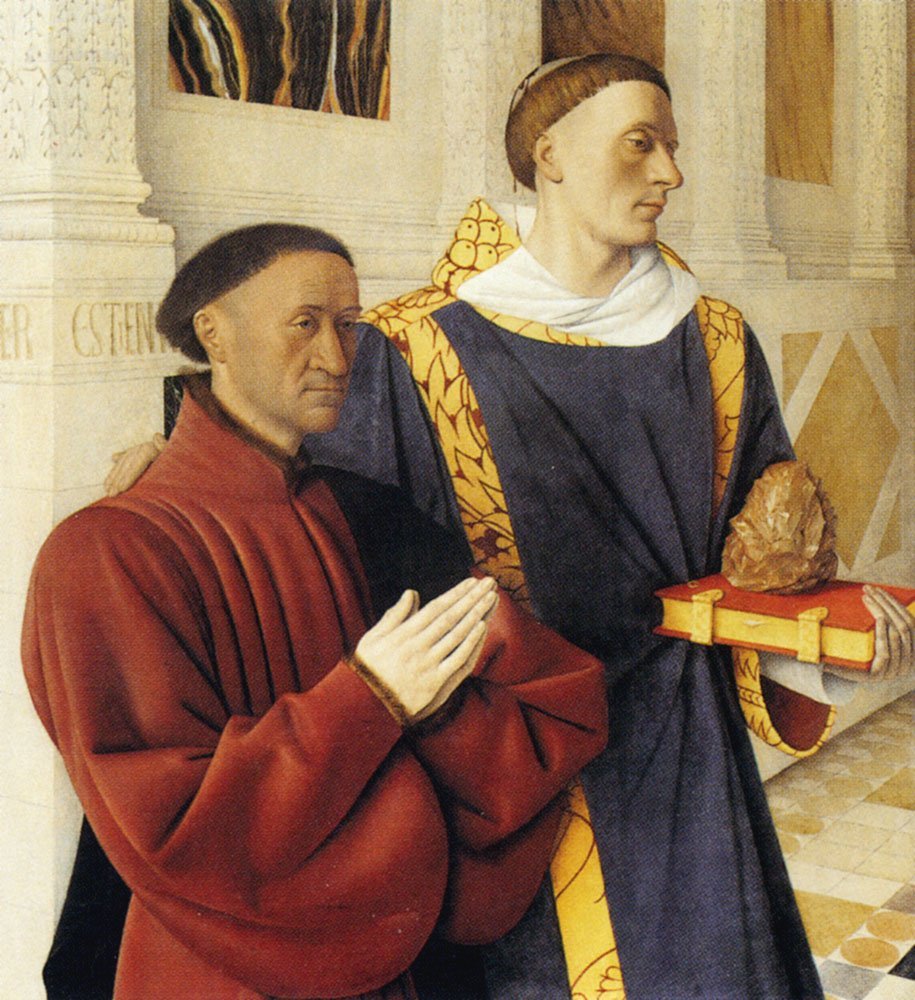
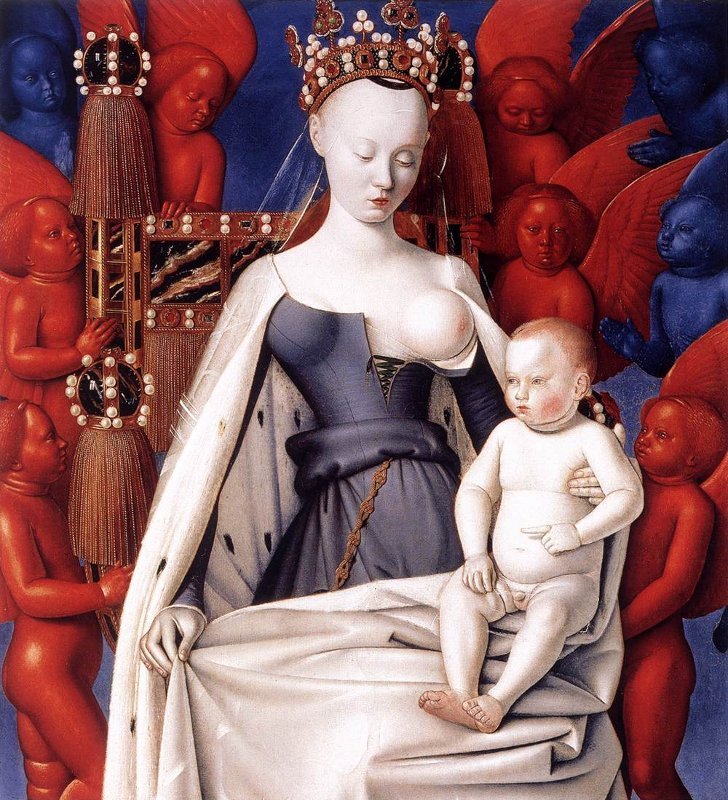
The Melun Diptych by Jean Fouquet

The Melun Diptych by Jean Fouquet (c.1450)

In my last blog I looked at an altarpiece by Michael Pacher and discussed terms such as diptych, triptych and polyptych, which all referred to panel paintings which were hinged together.  Although we looked at a triptych altarpiece this form of art was not only used in the depiction of religious personages.   There were many commissions for the diptych when it came to secular portraiture.  Often it would be the portrait of the husband on one panel with the portrait of his wife on the other.  The diptych was quite a common format in the Early Netherlandish paintings of the 15th and 16th centuries. In my blog today I want to look at a fifteenth century diptych, known as the Melun Diptych, which was the work of the great French painter and manuscript illustrator, Jean Fouquet.  Although the attached photograph above shows the two paintings as a diptych, the two panels are now separated.  Up until 1775, the diptych remained in the church of Notre Dame in Melun. However the church fell on hard times and needed money to help pay for the building’s restoration.  The elders of the church decided to raise funds for the building work by selling the diptych.  The right wing with the Madonna and Child was sold to the mayor of Antwerp and it has remained in the Belgian city ever since.  It is now housed in Koninklijk Museum voor Schone Kunsten, Antwerp (The Royal Museum of Fine Arts).    The left hand panel of Chevalier and St Stephen was purchased by Clemens Brentano, the German poet and novelist in 1896.  This panel is now housed in Staatliche Museen, Berlin.   Each of the wood panels measure 93cms x 85cms.

Jean Fouquet was born in Tours, a town in the Loire Valley, around 1420.  It is thought that Fouquet’s initial artistic training was at a studio in Paris, where he was educated in the ways of a manuscript illuminator and painting of miniatures.   It is also believed that he may have worked as an apprentice in the Bourges workshops of the Netherlandish painter, Jacob de Littemont, who was the court painter to Charles VII and later, Louis XI, a position that Fouquet himself would hold in 1475.    His first recorded painting dates back to 1440, and was entitled The Court Jester Gonella, who was the court jester of Nicholas III d’Este.  I featured that painting in My Daily Art Display of December 14th 2010.

Portrait of Charles VII by Jean Fouquet (c.1445)

In 1445 he completed one of his first very large panel portraits entitled Portrait of King Charles VII.  It was the portrait of the French ruler, Charles VII.  The king is painted between drawn curtains. The artist has painted the king in three-quarters profile and the inscription on the frame “le trés victorieux roy de France” reminded everybody that this was the ruler who brought the Hundred Years’ War to a triumphant end.   Ironically it was one of the few battlefield victories achieved by the ruler.

In 1446, Fouquet accompanied a French delegation, as court painter on a mission to Rome, as records of the trip where chronicled by the Italian artist Antonio Filarete.  The following year, Fouquet completed the commission to produce a portrait of Pope Eugenius IV with his two nephews, which was hung in the sacristy of the Dominican convent of Basilica of Saint Mary Above Minerva in Rome.  It was probably this connection with the Dominican convent that led him to be introduced to the great Italian Renaissance painter and Dominican friar, Fra Angelico, who was at that time working on the frescoes in the chapel of Saint Peter,

When Fouquet returned to France in 1448, he opened a workshop in Tours and married.   He worked for the French court and carried out commissions for King Charles VII, the king’s treasurer Etienne Chevalier, and the king’s chancellor Guillaume Jouvenel des Ursins. A number of these commissions were miniatures, such as the Book of Hours of Étienne Chevalier.  In 1475, Jean Fouquet became the court painter to Louis XI.   Fouquet died in Tours in November 1481.

My Daily Art Display featured painting today is the Melun Diptych, so named as its original resting place was the cathedral at Melun, a town in the south-eastern suburbs of Paris.   This was a commission Fouquet received from Etienne Chevalier.  Estienne Chevalier came from Melun and worked for the government.  His initial posting was as French Ambassador to England in 1445.  Six years later he became Treasurer to Charles VII of France. Once Fouquet had completed the diptych, Chevalier presented it to his home town.  The diptych was made to be placed above the tomb of Chevalier’s wife, Catharine Bude, in the Collegiate Church of Notre-Dame, in Melun.  As I said in my introduction the diptych doesn’t exist anymore as a hinged pair and sadly, another thing we cannot see is the original framing.  According to a description of the paintings by Denis Godefroy, a seventeenth century historian, the original frames were covered in blue velvet. Around each picture were strands of gold and silver thread, in which the donor’s initials were woven in pearls. There were also gilded medallions on which stories of the saints were represented.

The Left wing of the diptych
Etienne Chevalier and St Stephen

Let us first look at the left hand panel of the diptych.  On the left wing of the diptych, Etienne Chevalier had himself painted next to his patron saint, Stephen (“Etienne” when translated into the English language is “Stephen).  Chevalier kneels in a red robe with his hands clasped in prayer.  The red colour of the robe indicates the status of Chevalier as it was the most expensive coloured dye and was reserved for high-ranking magistrates.   Next to him we have Saint Stephen wearing the dark robes of a deacon with its gold trim.  Stephen’s right arm is draped around the shoulders of Etienne Chevalier in a protective manner.   In the left hand of the saint there is a book, on which a jagged stone is lying.  This symbolises his martyrdom (St Stephen was stoned to death).  The background consists of Italian Renaissance style architecture with pilasters, in between which are inlaid marble panels.  The floor is made of neutral coloured tiles, which allows a glaring contrast with the highly coloured clothing of then two figures.  On the wall, receding in perspective, the name of Estienne Chevalier (IER ESTIEN ) is inscribed.   The two men look to their left at the Madonna and Child, who is portrayed on the right wing of the diptych and in some way if we look at the two panel paintings of the diptych together, it appears that St Stephen is introducing Etienne Chevalier to the Madonna and Child.  The plunging perspective Fouquet has used in this painting has in some way moved the two characters closer to us and they dominate the work.

The Right wing of the diptych
Madonna and Child

Now let us look at the right hand wing of the diptych, which is entitled Madonna and Child.  The first thing that strikes the observer is the strange and vibrant colouring used in the painting.  The unnatural colours have been attributed to represent the heraldic colours of the French king, being red, white, and blue.   It is generally agreed by art historians that the features of the Madonna are those of Agnès Sorel.  She was a favourite mistress of Charles VII and bore him three daughters.  She was known by the nickname, Dame de beauté.  In 1450, Charles was away on a campaign at Jumièges.  Agnès Sorel was at her home in Chinon, which the king had provided for her, but she wanted to be with Charles to give him some moral support.    Despite being pregnant with their fourth child and it being a cold mid-winter day, she journeyed from her residence to join Charles at the village of Le Mesnil-sous-Jumièges.  It was here that she suddenly became ill and died at the age of 28.   While the cause of death was originally thought to be dysentery, in 2005 French forensic scientist Philippe Charlier examined her remains and determined that the cause of death was mercury poisoning, but offered no opinion about whether she was murdered.   Agnès Sorel held great influence over the king and many historians believe that this made her many enemies, including the king’s son, the future king, Louis XI, and it could well be that she had been deliberately poisoned by her enemies.  However this theory does not receive unanimous agreement as historians point out that, at that time, mercury was sometimes used in cosmetic preparations or to treat worms and that might have brought about her death.

However there is another theory about the identification of the lady in the painting.  Jan Schafer in his 1994 book, Jean Fouquet an der Schwelle zur Renaissance, stated that he believed that the woman in the painting could have been Etienne Chevalier’s wife, Catherine Bude, over whose tomb the diptych was hung in Notre Dame, Melun.

This right-hand panel depicts the Virgin and Child seated on a jewelled throne with its marble panels and adorned with large gold tassels.  The Virgin and Child are surrounded by red and blue coloured cherubs and seraphims, which greatly contrast with the pale skin of the Virgin and child. The Madonna wears a blue dress, white mantle and a jewel-encrusted crown.  Once again we have the colour combination of red, white and blue.  The bodice of the dress is unlaced, giving us a view of her perfectly spherical left breast, which she has offered to the Child on her knee.  She has the bulging shaved forehead which was fashionable at that time. Her facial and skin tone, as well as the body of the Infant Jesus, are of a pale grey-white colour, as if painted in grisaille (painted entirely in monochrome or near-monochrome).  The colour Fouquet has used to depict her skin and the grey-blue colour he has used to depict her robe gives the Madonna a look of lethargy and sleepiness. The child ignores the proffered breast and instead looks at and points towards Chevalier and St Stephen.

The prominent Dutch historian Johan Huizinga wrote about this panel in his 1919 book entitled Herfsttij der Middeleeuwen which was translated five years later as The Waning of the Middle Ages.  He condemned the work as “blasphemous libertarianism”.  In his book he wrote about how he considered this painting a fine example of decadence in the late Middle Ages, when religious feelings came close to erotic ones. He wrote:

“…No instance of this dangerous association of religious with amatory sentiments could be more striking than the Madonna ascribed to Foucquet…”

“…The bizarre inscrutable expression of the Madonna’s face, the red and blue cherubim surrounding her, all contribute to give this painting an air of decadent impiety in spite of the stalwart figure of the donor…”

“..There is a flavour of blasphemous boldness about the whole, unsurpassed by any artist of the Renaissance…”

And so the two halves of the diptych were split up and never re-united.  Well actually they were, for in 1904, France borrowed the panels from Berlin for an exhibition of French primitives.

There are many unanswered questions with regards to these paintings and the background to their composition:

Was the Madonna based on Agnès Sorel or Catharine Bude?

Did Agnès Sorel die of dysentery during the birth of her stillborn fourth child or was she murdered on the orders of Charles VII’s son, the future King Louis XI?

Was there a third panel and in fact what we are seeing is two parts of a triptych?  The third panel was rumoured to be depicting Etienne Chevalier’s wife Catharine.

Besides Agnès Sorel being King Charles VII’s mistress was she also the mistress of Etienne Chevalier?

I am sure you will agree that we have before us today two beautiful wood panel paintings and the story behind them is fascinating.

James Tissot and Kathleen Newton

Kathleen Newton in an Armchair by James Tissot (1878)

My blog today is the second part of the life of the French painter James Tissot.  In my last offering I looked at one of his beautiful and unusual religious paintings and I told you a little about the life of the artist but purposely left out his relationship with the special lady in his life, which I wanted to save for today.

In 1870 France was in turmoil.  The Franco-Prussian war had broken out, which was the conflict between France, under Napoleon III and the Kingdom of Prussia and was the final straw in the conflict between the two nations.  France was defeated and Paris was eventually occupied by the Prussian army.  Tissot was a member of the Garde Nationale which was tasked with defending the French capital and later became a member of the Paris Commune, which was a quasi-government that briefly ruled Paris and acted as protectors of the Parisians and their property from March to May in 1871.   However, Tissot, whether through business reasons or concerns he had for his personal safety, decided to leave his homeland and that year went to England where, through his art, he had built up a network of friends and business contacts.  One of these was Thomas Gibson Bowles, the proprietor of the popular magazine Vanity Fair.  Bowles not only provided Tissot with a place to stay in London but he also employed him as a caricaturist on the magazine.  Whilst in London Tissot also exhibited at the Royal Academy.  As was the case when he was in France, Tissot depicted in his paintings many of the chic ladies of London and he was a genius in the way he depicted them bedecked in the most expensive and sumptuous clothing which he carefully detailed.   These paintings were very popular and soon, through their sales, he managed to buy his own house in St John’s Wood, which, at that time, had become a popular and much sort after enclave for artists.  Tissot was not only admired as a great artist by the London Society but through the auspices of Thomas Bowles he was given entry into the social and artistic circles of London.

This particular time, 1874, was the starting point for the French Impressionists and his friend Degas tried to persuade Tissot to exhibit at their first exhibition but he declined the offer.  His decision to refuse to exhibit did not in any way cut him off from his Impressionist friends as he remained great friends with Berthe Morisot who visited him at his London home and also he remained very friendly with Edouard Manet.  The following year, 1875, the two travelled to Venice on a painting trip. It was around 1875 that he first met Kathleen Newton, a stunningly beautiful divorcee and it was Tissot’s relationship with her that afforded him, as an adult, his only period of a real family life.  She would dominate the subject matter of his paintings.

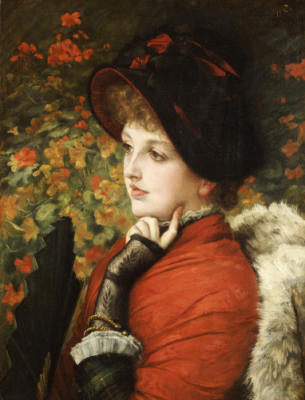
A Type of Beauty by James Tissot (1880)

Kathleen Irene Ashburnham Kelly was born in 1854 and brought up in Lahore and Agra.  She was the youngest of five children and came from an Irish Catholic family.   Her grandfather, Charles Kelly, left Ireland and practiced medicine in London. His son, and Mary’s father, Charles Frederick Kelly joined the East India Company and was stationed in Lahore where he worked as a clerk.  He married Flora Boyd, whose family came from the North of Ireland, and the couple had five children, Charles (Charley), Frederick WD (Freddie), George Lloyd (George), Mary Pauline (Polly) and Kathleen Irene (Kate).   In 1858, Charles Kelly, who had now added the family name “Ashburnham” to his own name, was transferred to Agra.   Kathleen’s father finally achieved the rank of chief adjutant and accountant officer in Agra and eventually retired around 1865, left India and returned with his wife and daughters to live in London.  When Kathleen was sixteen she travelled back to India to marry Isaac Newton, who was a surgeon attached to the Indian Civil Service. This was to be an arranged marriage orchestrated by her father and she had little or no input into the choosing of her future husband.

During the sea passage to India she was befriended by a Captain Palliser of the Bengal Rifles regiment who was returning to the sub-continent to rejoin his regiment.  (Other versions of her life state that Palliser, although a captain, was a naval officer).  Their friendship grew during the long sea passage and they became lovers and despite his pleas to her to cancel her wedding plans, she and Isaac were married in January 1870.  Being a devout Catholic, Kathleen decided to tell the local priest of her affair with Captain Palliser.  For him to forgive her of her sins the priest told her she should first tell her husband about this relationship.  She took the priests advice and told her husband who was horrified and as their marriage had not been consummated; her husband immediately instigated divorce proceedings on the grounds that his wife had not been a virgin on her marriage day.  Kathleen returned to England, the sea passage being paid for by the lovestruck Captain Palliser, who accompanied her, as a gesture of good will for her agreeing to be his mistress.  Their affair continued and she became pregnant but still refused to marry him.    When she arrived back in England she went to stay with her father, who was at the time courting a widow.  Kathleen’s daughter Muriel Mary Violet Newton was born there on 20 December 1871, which was also the same day as her Decree Nisi came through.   Later Kathleen and her daughter Violet went to live with her sister Polly and her husband at Hill Road, St John’s Wood.

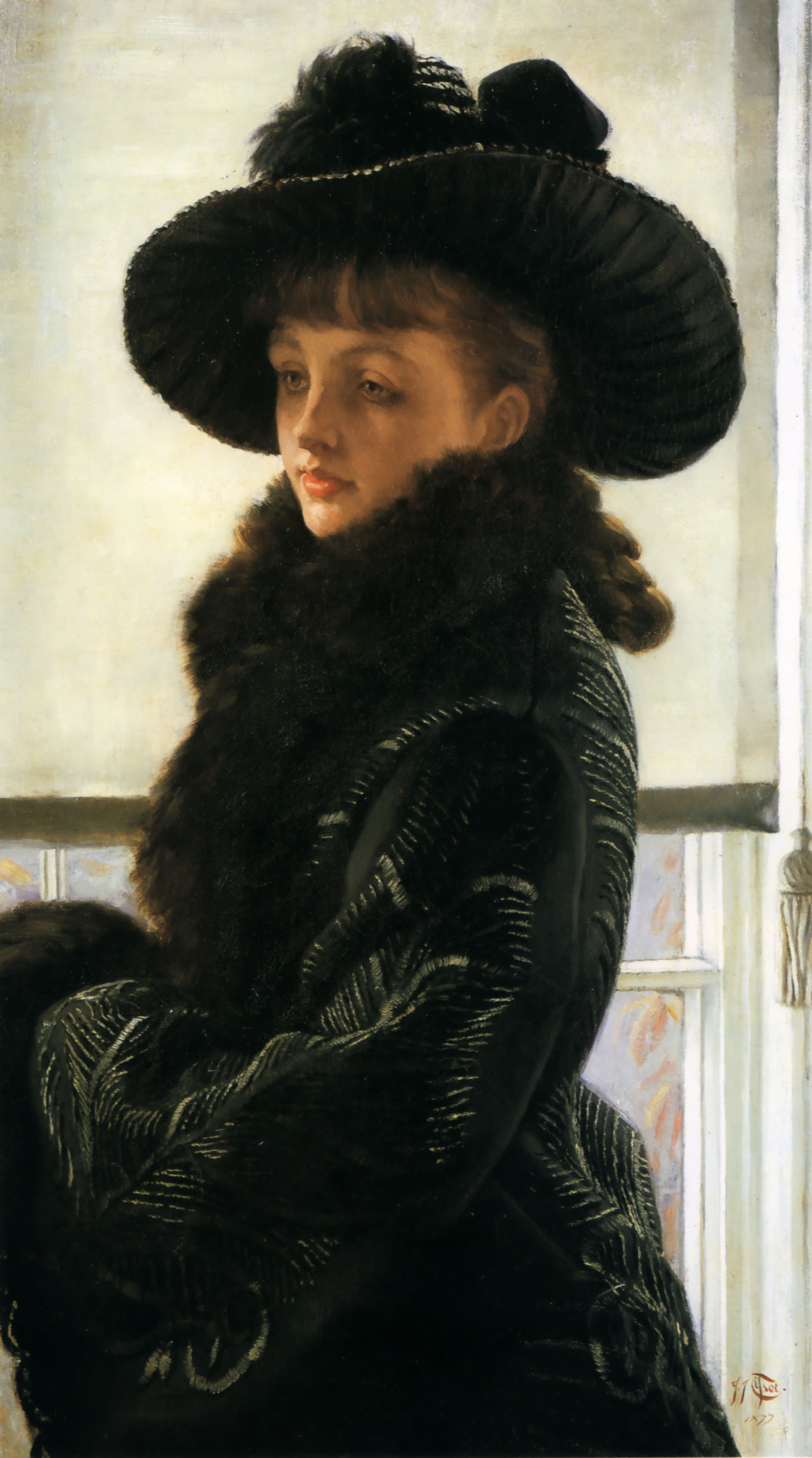
Mavourneen (Portrait of Kathleen Newton) by James Tissot (1877)

It was about four years later around 1875, that James Tissot, who was also living in St John’s Wood, London, met Kathleen Newton née Kelly.  The next step in their relationship came in March 1876 when Kathleen gave birth to a son, Cecil George Newton Ashburnham, who it is believed had been fathered by Tissot. Kathleen and James Tissot became lovers and she moved in with Tissot.  (It should be noted that census records cast some doubt whether they lived together and it is thought that Kathleen’s two children spent most or all of their time living with their aunt Polly and her family).   For Tissot, as was the case with Captain Pallister some five years earlier, he was smitten by this stunningly beautiful young woman.  His terms of endearment for her were mavoureen (Irish Gaelic for my love) and his native French phrase ravissante Irlandaise (lovely Irish).  Kathleen Newton became the love of Tissot’s life, his muse and adored lover.  Tissot described his time with Kathleen as one of “domestic bliss” and the happiest times of his life.  He completed many paintings featuring Kathleen of which I have featured some in my blog today.

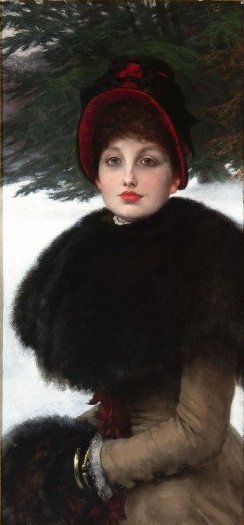
A Winter’s Walk by James Tissot (1878)

There was one great setback with his relationship with Kathleen for James Tissot.  Although it was not uncommon for successful and wealthy men to keep a mistress they did not, like Tissot, parade them around openly and advertise their liaison.   Tissot’s open and very public display of his affair with Kathleen shocked the London society which had once welcomed him with open arms and he had to choose between his social life and Kathleen.   For Tissot there was no question as to which course of action he would choose.  Kathleen was the love of his life and he chose her over life amongst London society.  He and Kathleen settled down to a life of domesticity and were happy to mix with their many artistic friends who continued to support them.  They never married and this may be due to their rigid Roman Catholic upbringing and beliefs.

Kathleen Newton in the Garden by James Tissot

This charming painting shows Kathleen sitting on a rug in the garden next to her daughter Violet.  The other small girl holding the parasol is her niece, Lillian Hervey. Sitting on the wall is her sister, Mary Hervey (Polly), who you can see ruffling the hair of Cecil George Newton who is thought to be the son of James Tissot.

————————————————————————————————————————————–

In the late 1870s Kathleen’s health started to deteriorate with the onset of tuberculosis.  Tissot remained devoted to her.  In 1882, Kathleen’s health declined rapidly with the onset of consumption.  The illness gave her great pain and Tissot was visibly distraught by the physical state of his wife and her sufferings.   Kathleen was aware that she was dying and she was saddened to witness how heartbroken her husband was, witnessing her long lingering death and so in November 1882, aged just twenty eight, she took an overdose of laudanum and died.  Sadly because she had committed suicide she was not able to be buried in consecrated ground.

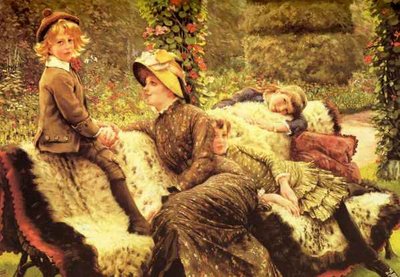
The Garden Bench by James Tissot (1882)

The painting above shows Kathleen Newton and her children, Cecil George and Violet and her niece, Lilian Hervey, the daughter of her sister Polly.  Although Tissot exhibited the painting, he would not sell it and kept it with him as a memorial until his death.

————————————————————————————————————————————–

One week after Kathleen’s death, Tissot left his London home at St John’s Wood, and never returned to it. The house was later bought by the artist Alma-Tadema.  Tissot was inconsolable and never really recovered from Kathleen’s death. Tissot never married and like many people who are devastated by the loss of a loved one he turned to Spiritualism, and on a number of occasions tried to contact his beloved Kathleen.

This somewhat sad story about a French artist and his fallen women is one of the great 19th century English love stories.   My interest in James Tissot was born out of a comment I received from Lucy Paquette who said she was publishing an eBook this autumn, entitled Hammock, a novel based on the life of James Tissot.  I hope, like me, you will be looking out for this publication.

Patricia O’Reilly has also written a novel about Kathleen Newton entitled A Type of Beauty: The Story of Kathleen Newton (1854-1882) which I am hoping to buy as novels based on lives of artists or one of their paintings always fascinate me.

What Our Lord Saw from the Cross by James Tissot

What Our Lord Saw from the Cross by James Tissot

My blog today is the first of a two part look at the life and art work of Jacques-Joseph Tissot, later to be known as James Tissot.  In this first part I will look at his life and a religious painting with a difference, which was one of a series he completed  between 1886 and 1894.   In my next blog I will introduce you to the “love of his life”, who featured in a number of his later works.

Jacques-Joseph Tissot was born in 1836, in Nantes, a French seaport on the north-west coast of France.   Tissot was the second of four sons born to Marcel Théodore Tissot, an affluent linen merchant and successful businessman, who owned a country house, Château de Buillon, close to the town of Besançon and Marie Tissot, née Durand, a clothes and hat designer who helped in her husband’s business.  Tissot was brought up in a very religious household with both his parents being devout Roman Catholics.   At the age of twelve he was sent away to a Jesuit boarding school in Belgium, in the town of Brugelette, which in those days was one of the leading seats of learning for children of the Roman Catholic faith and attracted many pupils from different countries.  In her 1985 biography, Tissot by Krystyna Matyjaszkiewicz, she points out that it was at this college that Tissot first came into contact with English children.  She wrote:

“…Pupils at Brugelette included Catholics from England, and it may have been through friendships at Brugelette that Tissot became interested in all things English and began to style himself James, the name he was using by 1854. When new laws enabled the Jesuits in 1850 to open a college at Vannes in Brittany Tissot returned to France and attended school there, subsequently moving to another in Dôle (near Besançon), a bastion of Catholicism….”

His early family life would later have a bearing on some of his paintings such as his beautifully crafted depictions of ships which he would have seen in the local harbour of Nantes and his devout religious upbringing would have given him an interest in religious paintings.

By the time he was seventeen years of age, Tissot had decided to become an artist, much to the annoyance of his father, who had hoped his son would follow in his footsteps and run the family business.  His father eventually relented and in 1855, aged 19, Tissot went to Paris, lodging with an artist friend of his mother, Jules-Élie Delaunay.  He then worked in the studios of the French academic painters, Jean-Hippolyte Flandrin and Louis Lamothe who had learnt their trade as pupils of Ingres.  During his stay in Paris, he would, like many aspiring artists, spend a great deal of time at the Louvre copying the  works of the Old Masters and it was around this time that he met other contemporary artists such Degas, who also had once studied under Lamothe, the American artist, James McNeill Whistler and Édouard Manet.   Four years after arriving in Paris, Tissot exhibited five of his works at the 1859 Paris Salon.

Within a relatively short time he became an admired painter and received a number of commissions for wealthy patrons.  There was also a change in Tissot’s painting style from his medieval-styled works to everyday life seen through his portraiture.  He would depict modern Parisian women as they went about the city and its suburbs and he would spend time perfecting the way he depicted their style of dress, and such an interest in this aspect probably harked back to the days spent with his family clothing business and admiring his mother’s talents as a designer.  Much later in his life, in 1885, there was a major exhibition of his work at the Galerie Sedelmeyer, Paris, where he showed 15 large paintings in a series called La Femme à Paris.  These paintings represented different types and classes of women, shown in their professional and social contexts.

Because I want to save the middle part of Tissot’s life and his love affair with Kathleen Newton, until my next blog, I am going to skip to the year 1885 which is the year in which the artist experienced a re-conversion to Catholicism. It is said that one day, during a church service, he had a vision of Jesus tending to people in a ruined building. It was, Tissot believed, his Road to Damascus.   It was this return to his Roman Catholic beliefs which led him to spend the rest of his life illustrating the Bible. It is not unusual for us to hear of people being struck by this “born again Christian” phenomena but in the case of James Tissot many of his friends found his sudden return to Roman Catholicism, at a time when there had been a French Catholic revival and a coinciding surge in purchasing religious paintings, just too much of a fortuitous coincidence !!  Nevertheless, from then on Tissot devoted himself to painting religious subjects. He totally immersed himself in all things religious and painted works connected with bible.  His biographer, Krystyna Matyjaszkiewiczn wrote of Tissot’s religious fervour:

“…Tissot set off for Palestine on 15 October 1886, his fiftieth birthday.  He returned to Paris in March 1887 with sketchbooks full of drawings and a burning compulsion to illustrate the life of Christ. The idea developed into publishing images of events, places, people, and incidental detail, with extracts from the Gospels and biblical commentaries. Tissot made further visits to Jerusalem in 1888 and 1889. By April 1894 he had completed 270 watercolours, which were displayed at the Champ de Mars, Paris, to awe and amazement…”

Tissot travelled to the Holy Land and this marked the beginning of a 10-year campaign to illustrate the New Testament.  He would return to Palestine and back to Jerusalem and the surrounding area in 1888 and 1889 to make further studies of the landscape and the people.   The culmination of the project resulted in his The Life of Christ collection which was a compilation of 350 watercolours that depicted detailed scenes from the New Testament, from before the birth of Jesus through to the Resurrection, in a chronological narrative.  Two hundred and seventy of them were exhibited at the Paris Salon of 1894.     It is reported that these works of art caused a sensation. Men were described as reverently doffing their hats whilst women wept and knelt before the pictures.  Some women even crawled like penitents through the show.   The exhibition of his biblical works moved to London in 1896 and New York at the end of 1898 before the entire collection was purchased by the Brooklyn Museum in 1900.   In 1897 a French version of the profusely illustrated Tissot Bible was published and a year later an English version was available.   This further enhanced the artistic reputation of Tissot and made him very wealthy.   In the last few years of his life, Tissot worked on paintings depicting scenes from the Old Testament, eighty of which were exhibited in Paris.  He had, by this time, retired to Château de Buillon, the residence he inherited on the death of his father.   Tissot was never to complete the series of Old Testament works as he died at his chateau in Doubs, France in 1902, aged 66.

My featured painting today is one of the biblical scenes from the New Testament completed by James Tissot during the period 1886-1894.   It is an opaque watercolour over graphite on gray-green woven paper entitled What Our Lord Saw from the Cross.  It is regarded as one of the most memorable of the series of biblical images by the French painter.  It is totally different from the normal crucifixion scene paintings when, in almost all cases, we look up at the figure of Christ hanging from the cross.  In Tissot’s painting, we are the eyes of Christ and it us who looks down from the cross at the people below.  By doing this Tissot has allowed us to imagine ourselves in Christ’s place and by doing so we are able to empathise with him and maybe we can imagine what was going through his mind as he looked down upon friends, who had come to lend their support, and his enemies who have participated in his death and had come to gloat at his predicament.

From our viewpoint we look downwards at the crowd.   We see Mary Magdalene, in the immediate foreground, with her long red tresses swirling down her back, kneeling below the feet of Christ, which we can just see at the bottom centre of the painting. Further back we see the Virgin Mary clutching her breast, while John the Evangelist looks up with hands clasped. Some Roman soldiers are looking on, including a centurion who is clad in red. He has a downcast and remorseful expression on his face and Tissot has no doubt placed him at the scene reminding us of the passage in Luke’s Gospel 23:47 which stated:

“…Now when the centurion saw what was done, he glorified God, saying, Certainly this was a righteous man…”

The men on horseback in the right mid ground of the painting are Jewish scribes. They have a look of satisfaction on their faces for Christ was their rival.  These were the very men who had put pressure on Pilate to have Christ crucified.   Their plan had succeeded and their rival had been removed.  Look towards the centre of the background and one can see that Tissot has depicted the entrance to a tomb, the very place in which the body of Christ will be laid to rest after he has been brought down from the cross.

This is truly a remarkable work of art and I would love to go to the Brooklyn Museum to see the complete series.

In my next blog I will tell you about Tissot’s beloved Kathleen Newton, an Irish divorcee, and look at some of his portraits of this woman, who was the love of his life.

The Stonebreakers by Gustave Courbet

The Stone Breakers by Gustave Courbet (1849)

For my third look at Realism art and Social Realism art I am going back to the land of its inception, France.   The emergence of this form of art came about in France around 1848, the year King Louis-Philippe lost the French crown and was replaced by Louis-Napoleon Bonaparte, who became President of the French Second Republic.  The monarchy had gone, even if it was just for a few years, as Louis-Napoleon had himself crowned Napoleon III.  With the change of ruler came the promise of greater democracy. The French people were excited with the change and were now baying for this pledged greater democracy under the new regime.  Realism in art also arrived with the Realist artists who democratised their art by depicting in their paintings subjects from everyday lives of the working class.   These painters rejected what had gone before them.  They neither wanted to paint idealized pictures, which had no bearing on reality but was what was being taught and expected from the students at the École des Beaux-Arts, the state-sponsored art academy and exhibited at the official Salons, nor did they want to carry on with the exotic themes of Romanticism.

For these Realist artists, they wanted their paintings to be a direct reflection on modern life.  The great French painter and leading proponent of Realism art, Gustave Courbet, described what art should be, saying:


“…painting is an essentially concrete art and can only consist in the representation of real and existing things..,”

Gustave Courbet is my featured artist today and I wanted to look at his painting The Stonebreakers.  Sadly it no longer exists as it was destroyed by Allied bombing on a transport convoy in February 1945, whilst it was being transported to the Königstein Castle, near Dresden, for safe keeping along with 154 other paintings.   When The Stonebreakers was exhibited in Paris at the Salon of 1850, it was attacked as un-artistic, crude, and socialistic, so let us look at why this view was taken by the critics.

Courbet wanted to depict the lifestyle of working class people in his paintings.  However, he wanted to depart from the idealized depiction of these poor farm workers and peasants who in the past had always been depicted smiling happily as they got on with the most arduous and often dangerous jobs, for little remuneration.   The problem of course with this artistic style was although it appealed to people who sympathised with the lot of the working class, the buyers of art were often the rich and upper classes, who through association were the very people who treated their workers badly.   His Realism art works were looked upon as being anti-authoritarian and politically threatening.  When he put forward two of his large paintings A Burial at Ornans and The Painter’s Studio for inclusion in the 1855 Salon, the Salon jurists rejected them. Courbet was so angered by the jurists’ decision that he withdrew his eleven accepted submissions and displayed the paintings privately in his Pavillon du Réalisme, not far from the official international exhibition.   In his exhibition catalogue, which described his works, he wrote an introduction which, in essence, was a Realist manifesto.  He stated:

“…his goal as an artist was to translate the customs, the ideas, the appearance of my epoch according to my own estimation…”

The realist paintings of Courbet found no favour with the Establishment.  Courbet’s critics firmly believed that he was bringing about an artistic and moral decline by painting what they deemed distasteful and inconsequential subjects on a grand scale. They accused him of nurturing a “cult of ugliness” against much beloved concepts of Beauty and the Ideal.   His critics even went as far as to state that this Realism was nothing less than the enemy of art.  However there were some high placed supporters of Courbet’s work.  The French socialist politician at the time, Pierre-Joseph Proudhon, an advocate of workers’ associations and co-operatives as well as individual worker / peasant possession over private ownership or the nationalization of land and workplaces, saw The Stonebreakers painting and commented:

“… The Stonebreakers was an irony directed against our industrialized civilization … which is incapable of freeing man from the heaviest, most difficult, most unpleasant tasks, the eternal lot of the poor...”
The Stonebreakers was painted by Gustave Courbet in 1849 and shows two peasants breaking rocks into gravel to be used as a base in the construction of roads. One appears to be in his sixties and the other much younger.  The painting could not be described as colourful.  Courbet has used monotonous colours and by doing so has reflected the languishing tone of the painting.  We are not distracted by a colourful landscape.  Our eyes are fixed upon the two men as they carry on with their backbreaking work.    In no way was Courbet’s depiction of the men idealized or romanticized.  What we see is the gritty uncompromising truth.  The job of a stonebreaker was considered the lot of the lowest in French society.   Their differing ages symbolizes the circle of poverty, which will haunt the lower classes throughout their lives.  Those born into poverty would remain so for the rest of their life.   It is a glimpse into the world of the rural unskilled labourer.   The workers are dressed in ragged clothes.  Their ragged clothes and the little meal laid out in the right midground of the work underline their impoverishment. Look how Courbet has depicted the boy as he struggles with the heavy basket of gravel.  It is almost beyond the boy’s strength while the old man exhaustedly bends his knee to work.   One is now too old and almost lacks the strength to wield the hammer whilst the other is almost too young and almost lacks the strength to carry his burden.  This is realist art at its finest.  Courbet has not resorted to ancient heroes for his portrayal of heroism he has taken two simple men whose lot in life was manual labour and who were carrying out their task as best they could.

Despite Realist art not being favoured by the bourgeoisie or the Academies, it found an audience in France who was showing an interest in the plight of the working poor especially following the labourers uprising against the bourgeois leaders of the newly established Second Republic in 1848.  Their demands were simple – a redistribution of property and better working conditions.  The labourers’ uprising lasted just three days and many lives were lost. They did not achieve their demands but suddenly the plight of the working class labourer was centre stage and Courbet’s painting which came a year after the failed uprising could not have arrived at a more fortuitous time.

Peasant Girl Lighting a Fire. Frost, by Camille Pissarro

Peasant Girl Lighting a Fire. Frost by Camille Pissarro (1888)

My Daily Art Display’s featured painting today is entitled Peasant Girl Lighting a Fire. Frost, which was painted by Camille Pissarro in 1888 and can now be found in the Musée d’Orsay in Paris.  At this time Pissarro was still a leading light of the Impressionist movement, a movement he had helped to form.   However it was two years prior to this work that Pissarro began to become interested in the experimental work of young artists, who had adopted the fragmented brushstroke technique which Georges Seurat and Paul Signac were trying out, known as pointillism , a technique Pissarro used in parts of this painting.  For a more in depth look at pointillism see My Daily Art Display October 21st 2011 for a painting by Georges Seurat and November 29th 2011 for a painting by Paul Signac. Pissarro had been introduced to Seurat and Signac in 1885 and in the following years he began to work in the pointillist style which had then been adopted by the Neo-Impressionists.  By the time Pissarro was in his sixties he found that this pointillism technique too restricting and in the last ten years of his life he returned to a purer Impressionist style.
Camille Pissarro was fifty-eight years of age when he completed today’s featured work of art.  Ten years earlier his style of painting was such that he would portray nature in his landscapes by a myriad of smaller comma-like brushstrokes built up on the surface of the canvas such as his 1877 work, The Red Roofs (see My Daily Art Display of November 30th 2010).  Pissarro was concerned that these works lacked clarity and so he decided to change the way he worked.  He spent time working in collaboration with Degas, who was, of all the Impressionists, a great believer and advocate of figure painting and the primacy of the human figure at the expense of landscape background.  It was maybe the views of Degas that led to Pissarro to complete some works in which the human being(s) took pride of place in the painting, as is the case with today’s featured work.

The painting depicts two peasant girls working in a field in a cold and frosty winter morning and we see one of them tending a fire.  Pissarro often painted peasant women at work.  Two fine examples of this are his 1881 work entitled Girl with a Stick and the 1893 painting entitled Woman with a Green Shawl.  His portrayal of peasants received some criticism for copying the ideas of Jean-François Millet but Pissarro firmly contested such a notion.  However in general art critics looked upon his works as true representations of peasant life.  Look at the beautiful way in which Pissarro has depicted the landscape.  At the time of this painting Pissarro was extremely interested in the pointillism technique of Seurat and Signac and he used this method to present us with a sumptuous backdrop to the two girls.  The painting has a light and airy feel to it and there is a subtle delicate nature to the work.  The work was painted in Eragny just north-west of Paris where Pissarro and his family lived for a time.

In the far distance we can see the low hills topped by irregular spaced bushy trees.  In the middle ground, we observe grazing cows in the meadow, a line of poplar trees at the foot of the hills and possibly a hidden stream running horizontally across the mid ground.   Notwithstanding the backdrop, the focus of the painting is on the two girls in the foreground, who almost appear to stand next to us.  The scene is lit up by the sun, somewhere out of sight, to the left, which throws off long blue shadows across the field.  It is a wintry sun and still low in the sky, hence the long shadow of the girl in the foreground, which disappears off the painting to the right.    Although it emits light, the sun gives off little warmth and so our two young workers are wrapped up well.  The temperature is even colder due to the wind chill factor.  Look how the girls skirt and the smoke from her small fire are blown horizontally by the wind which comes from the left of the painting.  One can imagine how cold it is with the driving wind on a wintry day. We almost shiver as we look at this work of art.

The girls are both well wrapped up against the morning’s wintry chill.  The girl on the right, who seems no more than a child, is warming her hands by the fire.  She wears a blue dress and a thick dark brown coat.  She has a dark woolen hat on her head which is pulled down to protect her ears from the icy wind.   The older girl, who is closest to us and because of her height, is the main focus of our attention.  She has taken a branch from the pile behind her, and is about to break it up and add it to the fire.  She wears a pink skirt with a blue apron.  She too has protected her head, wearing a white scarf tied beneath her chin.  Her final layer of protection is a pink and white shawl from which emerge long black sleeves of her dress.

The colour combinations Pissarro uses to achieve the colour we see is fascinating.  The girls pink dress is made up of a combination of yellow, blue and pink.  The green grass of the meadow is achieved by using a combination green, blue, yellow, pink and white.  The only orange Pissarro used was for the flames of the fire.

Pissarro fled the traumas of the Franco-Prussian War in 1871 and, like Monet, went to live in London.   It was whilst in London that he saw a number of paintings by Turner.  Pissarro later commented on Turner’s works and was amazed by the way Turner succeeded in conveying the snow’s whiteness, not just by the use of white alone but by combining a host of multi-coloured strokes, dabbed in, one against the other, which when looked at from a distance, created the desired effect.  It is in this painting that Pissarro has, without the actual presence of snow, managed to give us a crystalline frost of a cold winter’s morning encapsulated in an aura of diamond blue.

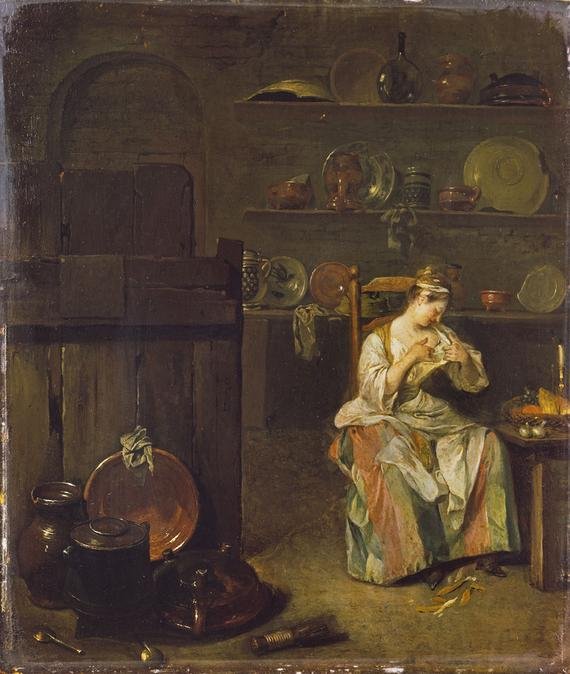
A Girl in a Kitchen (La chercheuse de puce) by Nicolas Lancret

A Girl in a Kitchen by Nicolas Lancret (c.1720-30)

Today I am featuring the French painter, draughtsman and art collector, Nicolas Lancret, who was born in Paris in 1690.  To begin with, Lancret trained as an engraver but soon afterwards became an apprentice to the history and religious painter Pierre Dulin.  Dulin was later to become a professor of art at  Académie royale de peinture et de sculpture in Paris.  Throughout his early artistic training Lancret was influenced by and greatly admired the works of the Jean-Antoine Watteau the late Baroque painter and one of the leading artists in the new Rococo style of artwork.  In 1708, at the age of eighteen, Lancret enrolled at the Académie royale de peinture and in 1711 he competed unsuccessfully for the Prix de Rome prize.  His stay at the Académie ended when he was expelled for quarrelling.    It was Lancret’s love of Watteau’s work that made him part from his tutor Dulin and serve under Claude Gillot, the French genre and decorative painter, who had Watteau as his assistant in 1703.  Once Lancret began to work in the studio of Gillot his artwork changed from the history painting he had learnt whilst with Dulin to the Rococo style with all its scenes of graceful figures at leisure in elegant garden settings similar to the works of Watteau whom Lancret met around 1712.

In 1719 he was the first painter to be accepted into the Académie Royale as a painter of fête galantes, a category that had been created by the Academy in 1717.  Fête galante, which means “courtship party”, is a French term used to describe a type of painting which first came very popular in the early eighteenth century France.  Watteau had submitted his reception piece, ‘The Embarkation for the Island of Cythera (See My Daily Art Display, February 22nd 2011)  to the Académie Royale in 1717 and the critics of the time described it as characterising une fête galante.  These fêtes galantes paintings were usually small in size and recorded the lives of stylishly dressed men and women engaged in amorous but well-mannered play in a garden or parkland surroundings.

Lancret’s art work became very popular and he received numerous commissions from wealthy patrons especially after the death of Watteau in 1721.  Frederick the Great owned more than twenty-six of his paintings but his main patron was the ruler of France, Louis XV,  who, from the 1725,  continued to buy Lancret’s work until the artist died almost twenty years later.  He was one of the most prolific and imaginative genre painters of the first half of the eighteenth century in France and he had the ability to insert lively genre images into an allegorical framework.  His portraiture work was different to many of the time as he liked to treat his portraits as genre scenes.  Lancret exhibited works regularly at the Paris Salon.

Lancret remained single for much of his life and did not marry until 1741 when he was fifty-one years of age.  He married the 18 year old grandchild of Edmé Boursault, the French dramatist and writer.  Although one may be dismayed by the age difference of the couple it is believed that Lancret decided to marry the young girl after finding her and her dying mother living in poverty in an attic room and on hearing that the daughter was soon to be compelled to enter a convent. The marriage was a short-lived as Lancret died of pneumonia in Paris in 1743, aged fifty three.

My Daily Art Display featured painting today is not a fête galante work but a genre piece which I saw recently at the Wallace Collection in London.  The painting is entitled A Girl in a Kitchen (La chercheuse de puce) which Lancret completed in the 1720’s.  It is very reminiscent of the Dutch genre paintings of the previous century.  We see before us a young woman seated in a kitchen.  The first question which comes to mind as we look at her is what is she doing?  The subtitle of the painting La chercheuse de puce, reveals all, as translated it means “the seeker out of fleas”.  Unbelievable as it may seem the girl is inspecting herself for fleas !!!   The reason for this activity was that during the eighteenth century, amongst the poorer classes, infestation in the household with fleas was quite common.  However the depiction of the girl touching her exposed breasts during her inspection was probably Lancret’s way of titillating the observer.  The girl sits before us with her corset unlaced, inspecting her body.  Kitchen scenes in poor and peasant households were popular with the Dutch art collectors but the addition of the bare-breasted girl with its erotic connotations adds a typical French flavour to the depiction.

In some ways this painting is a kind of plagiarism as it is thought that although Lancret painted the girl and the still-life on the table next to her, the interior was painted by a Dutch artist much earlier.    The erotic element of the painting is not the only “Frenchness” about the work of art.  She sits there in her French silk skirt, semi-laced corset and delicate pointed slippers and she has been added by Lancret to this Dutch seventeenth-century interior.  It is not known which Dutch artist had painted the interior.  There were many art collectors  in France who paid good money for these Dutch genre scenes.  However Lancret, the master of fêtes galantes paintings, wanted to add some colourful and picturesque feminine interest into those more dark and somber Dutch paintings and, as was the case in today’s work, he is known to have embellished works by the Dutch landscape and peasant scene painter, Herman Saftleven and the Dutch Golden Age and sill-life painter, Willem Kalf.

I will leave you to ponder over whether the original Dutch interior needed the little bit of colour and bare flesh that Nicolas Lancret has given us.

La Loge by Pierre-Auguste Renoir

La Loge by Renoir (1874)

Today’s featured work of art was not my original intended offering.  That sounds somewhat strange but actually there is logic to my decision.  I was researching a painting when I came across today’s work and there seemed, at least in my mind, a good reason to offer you today’s painting before I showcased my original work.

The French word La Loge in the context of a theatre means the theatre box and it has been the subject of a number of paintings.  Today I want to look at La Loge by Pierre-Auguste Renoir which he completed in 1874 and now hangs at The Courtauld Gallery in London.  Today this work of art by the Impressionist painter is looked upon as one of the most significant works of the Impressionist movement.  At the time of this painting it was estimated that over 200,000 theatre tickets were sold every week in Paris.  However, going to a Parisian theatre in the nineteenth century was not just about taking in the latest plays by the likes of Victor Hugo or Alexandre Dumas or the less formal vaudeville shows which were also very popular at the time, it was about being seen by other theatregoers.  Men would accompany and flaunt their wives or lovers.  Proud fathers would show off their daughters and “out-of-towners” would take the opportunity of dressing up and sample the Parisian lifestyle.   It was an almost indoor form of promenading, which was the leisurely walking in public places dressed in one’s finery and carried out as a social activity.  Attending  the theatre was a chance to showcase one’s most expensive clothes and accoutrements as well as parading one’s latest beau.  What could be more satisfying than to flaunt one’s wealth or one’s new lover?  It was a question of seeing and being seen and going to the theatre dominated the cultural life of the city.  As well as seeing actors on the theatre stage the theatregoers were actually quietly performing on their own  social stage.

Being seen

The way Renoir has depicted the scene in the theatre box sums up this attitude.  We see a lady and gentleman seated in their box.  Take a look at their demeanour.  Are they depicted as locked in concentration at what is happening on the stage below?  No they are not.  The lady stares out at us with her gloved hand holding her opera glasses and resting it on the lavish velvet frontage of the box whilst her other hand clasps a black fan and a white lace handkerchief in her lap.  Protocol of the day demanded that ladies must wear gloves on formal occasions.

Her face is now not hidden from view by her opera glasses.  She is revealing her face to all who may wish to gaze at her.   So how would you describe her?  Is there a delicate elegance about her or does she look rather brash.  She is without doubt beautiful and has little trepidation about letting people admire her from afar.  She wears a lavish dress, one she has probably saved for this very outing.  This is her tenue de premiere or opening-night attire.  Her costume would often be referred to as a robe à la polonaise or polonaise which was popular in the late eighteenth century and saw a was revival a hundred years later in the 1870’s.  It consisted of a fitted overdress which extended into long panels over an underskirt.  The magic of Renoir’s painting is that from a far one can see the three dimensional form of the dress with all its folds and yet up close it was just a series of brushstrokes.  It is almost magical the way the artist has painted this work.

The elegant dress oozes a sense of wealth but that is not the only thing which advertises the financial situation of the couple.   The style of the dress also oozes the ladies sensuality.  Note the position of the rose which immediately draws our eyes to the décolletage which emphasizes her cleavage. The low-cut neckline was a popular feature of evening gowns of that era.   Another rose placed in her hair once again draws our eyes to her simple but elegant coiffure.

Look at her neck and the pearl necklace she is wearing.  Also we can just make out a pair of diamond earrings dangling from her ears and if we look at the hand which holds her opera glasses we note a gold bracelet around her slender wrist.  The wealth is there for us to see but more importantly it is there for the other theatregoers to note.

This is a summation of the “seen and being seen” philosophy.  She is wanting to be seen in all her finery whilst he is concentrating on seeing.  Renoir used one of his regular models, Nini Lopez, as the model for the lady.

Seeing

The sitter for her male companion in the theatre box was Edmund Renoir, the brother of the artist.  He, like the lady, is dressed elegantly in his formal clothes.  Renoir has depicted him wearing a white shirt with a starched cravat, black trousers and gold cufflinks.  His attire, which is typical of that of the wealthy male theatregoer also exudes a sense of affluence but its plainness and subdued colour allows the more colourful female to be the centre of attention.

The aspect of this painting which we cannot be sure about and I will leave you to decide is whether we are seeing a husband and wife out for an evening at the theatre or are we looking a wealthy man accompanied by an elegantly dressed courtesan.  Can we deduce the truth from looking at the painting but beware of falling into the trap of being too judgemental !!!

Renoir exhibited this painting in the First Impressionist Exhibition which was held in the former studio of the photographer Nadar at 35 boulevard des Capucines in Paris on April 15, 1874.  This work, which gives us an insight into Parisian life in the late nineteenth century, is now hailed as a masterpiece of art and one of the most significant works of the Impressionist movement.  At the time it was exhibited it helped establish the reputation of Renoir.  The painting gives us an insight into life in the French capital during the late nineteenth century.

Eugène Manet on the Isle of Wight and Eugène Manet and His Daughter in the Garden by Berthe Morisot

Although I could write numerous blogs about Berthe Morisot and her works, this is not a Berthe Morisot site and therefore after today’s offering I will drag myself away from this talented artist and head for pastures new.  However today I want to focus on Berthe Morisot, her husband and her daughter and have a look at a couple of her paintings which portray the happy family.

As I wrote in my last blog, in 1868, Berthe Morisot had been introduced to Édouard Manet by Henri Fantin-Latour whilst she was working as a copyist at the Louvre.  Over time the Morisot and the Manet family became close friends and would exchange visits to each other’s houses and during this time Berthe became acquainted with Édouard Manet’s brothers, Gusatve and Eugène.

When her sister Edma married Adolphe Pontillon in 1869 she moved to Lorient and gave up painting.   For her, and despite having exhibited at four Salons, she considered her marriage was far more important than any thoughts she may have had of an artistic career. She was determined to channel all her energy into her marriage, playing the role of a supporting wife to her naval officer husband and being a loving and devoted mother to their children.  On the other hand, Berthe on her marriage to Eugène Manet in December 1874 was adamant that the change in her marital status would not affect her art.  She continued to paint as prolifically as before and kept signing her works in her maiden name.  In many ways she was fortunate that Eugène’s attitude to her work was one of support and often when Berthe set off on painting trips he would accompany her and dabble a little in art himself by making a few sketches.  Berthe was also fortunate not to have any money worries and this allowed her to pursue her artistic career without being anxious about where the next centime was coming from.

Eugène Manet on the Isle of Wight by Berthe Morisot (1875)

My Daily Art Display featured painting today, which is housed in the Musée Marmottan Monet in Paris, is entitled Eugène Manet on the Isle of Wight and is one which Berthe Morisot completed in 1875 when she and her husband spent the summer in Cowes on the Isle of Wight on their honeymoon.  This, at the time, was a favoured holiday destination for the English high society.  They visited the town of Rye several times before they moved on to London.  Whilst on the Isle of Wight Berthe spent most of her time painting.  Often she and Eugène would be seen leaving their lodgings carrying easels and paint boxes which they would position at some site of natural beauty and spend the day recording the beauty of the island.   Often Berthe would set up her easel in their hotel room and paint what they could see from their window.  Today’s work is an example of just that.  She managed to persuade Eugène, with some difficulty, to pose for her looking out of the window.   She wrote to Edma about the problems of getting her husband to pose, saying:

“…I began something in the sitting room with Eugène; poor Eugène is taking your place; but he is a much less accommodating model; he’s quickly had enough…”

The view from the window is of the port of Cowes but the painting is all about her husband Eugène Manet and the little cottage garden in front of the residence.  It is interesting to observe how Morisot has painted the window panes and the gauze curtains to convey transparency.  The flowers in the garden and the potted plants on the window sill add a dash of colour but in the main Morisot has used muted greys, blacks and blues in her work.  There is a grid-like structure to the painting with the vertical and horizontal lines of the window frame, window sill and garden fencing as well as Eugène’s boater.  Apparently Morisot found it quite difficult to paint this kind of picture and found the task both frustrating and in some ways depressing.  This again is an example of Morisot’s perfectionism and the problems inherent in that state of mind.  She wrote to Edma about the work saying:

“…The view from my window is very pretty to see, very ugly to paint; views from above are almost always incomprehensible; the upshot is that I am not doing very much, and the little I do looks frightful…”

Eugène Manet and His Daughter in the Garden by Berthe Morisot (1883)

In November 1878, almost four years after Eugène and Berthe married, Berthe gave birth to a daughter, Julie, who was to be their one and only child.  Berthe featured her daughter prominently in many of her future paintings as did her sisters and family members.  I particularly like the painting she did in 1883, entitled Eugène Manet and His Daughter in the Garden.  The setting is the garden on the Bougival estate where they were staying that summer.  Unlike some of her works which also featured her husband and daughter, this painting depicts a more private world of Eugène and Julie.  Eugène is dressed casually in an artist’s smock with a straw hat atop his head.  Julie, dressed in her light blue summer dress, sits by the pond watching her tiny red sailing boat drifting on the water.  There is no sign of their house in the painting but the natural setting enhances the loving father/daughter relationship.   Morisot had always intended the painting to be a private family work and no doubt for that very reason she never exhibited it during her lifetime.  It was not seen by the public until 1896, a year after her death.  The work was one of her daughter’s particular favourites,  as Julie commented on the scene with her father saying:

“..he gazes with a father’s eyes on the little blonde girl in a white dress who is intent on getting boats to move around the pond…”

I will now leave the life and paintings of Morisot for a little while but will undoubtedly return to showcase some of her other beautiful work at a later date.  If you are interested in Berthe Morisot and her life I suggest you read Berthe Morisot by Anne Higonnet, which gives a fascinating insight into Berthe Morisot’s life, her family and the people she mixes with.  It is a great read.