Camille Doncieux and Claude Monet (Part 2)

Claude Monet and Camille Doncieux

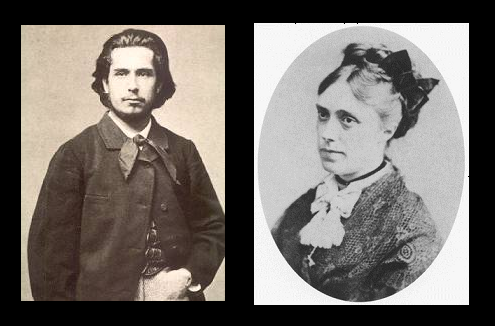
In my last blog I looked at the first meeting of Camille Doncieux and Monet.  It occurred in 1865 when Frédéric Bazille, a good friend of the twenty-five year old Monet, introduced him to Camille Doncieux who was still in her teens.  Camille, who was of humble origins, worked as an artist’s model.  Monet soon made her his number one model and shortly afterwards the two became lovers. The couple, because of the poor sales of Monet’s works of art, lived in depressing poverty.   Today I complete the story of Camille and Monet and look at a few more paintings the artist completed depicting Camille.

From the 1860’s till the end of that century, France was in love with all things Japanese.  This Japonisme as it was called had inspired both artists and the public.  Monet was not immune from this trend which swept his country.  Besides his art, he had two other hobbies.  He loved gardening and he loved to collect Japanese art, especially the Japanese woodblock prints.   In all he had built up a collection of over two hundred of these.  He had also accumulated a number of Japanese fans, kimonos and screens, some of which can still be seen at his house in Giverny.

 The most palpable and undeniable proof of Monet being influenced by the art and culture of Japan is his oil on canvas painting, Madame Monet en Costume Japonais (La Japonaise), which he completed in 1875 and which currently hangs in the Boston Museum of Fine Arts. This work was in complete contrast to his earlier works.   Large-scale figure paintings had usually been looked upon as a major challenge for an artist.  Camille is depicted dressed in an elaborate kimono, holding a Japanese fan in her hand.   It is interesting to note that Camille is wearing a blond wig so as to emphasize her Western identity. Her kimono is sumptuously embroidered and the background is adorned with numerous Japanese fans. These accoutrements could, at the time, be bought for a few centimes in many of the Parisian shops and even the larger department stores had exclusive sections for all things Japanese.

In the painting Camille’s pose is of a conventional style and it is believed that Monet did this so as to enhance the chance of selling the work.   Because of this, there is a somewhat loss of spontaneity about it.  The scene looks very contrived.   However the brilliance of the colours he used is breathtaking.   Monet exhibited this work at the Second Impressionist Exhibition in 1876, where it attracted much attention.  Maybe Monet was saddened and felt somewhat guilty by the compromise he had made with this work solely to make it more attractive to potential buyers.  He later described it as “trash” and “a concession to the popular taste of its time”.

On June 28th 1870, Camille and Claude were married in a civil ceremony performed at the town hall of the eighth arrondissement of Paris. The French painter Gustave Courbet was one of the witnesses. Although Camille’s parents were present at the ceremony, Monet’s family were horrified by their son’s choice of partner and would not accept Camille Doncieux as their daughter in law, nor would they acknowledge their grandchild, Jean-Armand-Claude who had been born in August 1867.   Monet’s parents even tried to bribe their son into leaving his wife with the threat of their allowance to him being stopped if he continued the liaison.  However Monet chose his wife over money and refused to abandon Camille and Jean.   As a result, his allowance was cut off and his financial situation worsened and the three of them suffered extreme financial hardship, sometimes unable to afford food and often unable to afford paint.   He carried this burden for many years, and struggled greatly with poverty and the stress caused by Camille’s poor health, and his inability to pay for her medical care.   After the wedding and just before the start of the Franco-Prussian War the family travelled to London and Zaandam before returning to France and setting up home in Argenteuil, a town to the west of Paris.

Camille Holding a Posy of Violets by Monet 1877

In 1876, Camille Monet fell ill with what is believed to have been the beginnings of cervical cancer.   In Monet’s 1877 painting Camille Holding a Posy of Violets, which he completed that year, one can see the toll the disease has had on her health. Her face looks pale and haggard.  She looks tired and older. It was around this time that Monet received a commission from a patron Ernest Hoschedé and for a short time his finances took a turn for the better.  However in 1877 all this changed when Hoschedé went bankrupt and his art collection was auctioned off. This was a blow to the Impressionists, whom Hoschedé had supported,  and especially Monet.   The bankrupted Hoschedé and his family moved to a house in Vétheuil with Monet, Camille and Jean. However Ernest Hoschedé spent most of his time in Paris before fleeing to Belgium to avoid his creditors.   There soon followed speculation that Monet may have been carrying on an affair with Alice Hoschedé.    Some art historians have translated the look on Camille’s face in this painting as one of disgust with her husband and his liaison with Alice Hoschedé.  This was the last painting Monet did of Camille whilst she was alive.

Camille on her Deathbed by Monet (1879)

On March 17th 1878, Camille gave birth to her second son, Michel.  The birth of Michel further weakened Camille.   Over the next twelve months Camille’s health deteriorated and on August 31 1879, a priest was called to the house to administer the last rites and to sanction her marriage to Monet, although they had been married in a civil ceremony nine years earlier.   Camille’s death on September 5th 1879 devastated Monet. She was just thirty-two years of age.   Monet painted a picture of his wife on her death bed and the work can be seen at the Musée d’Orsay.  Monet remembered the time well writing to a friend telling him of his urge to paint that last portrait of Camille:

“…I caught myself watching her tragic forehead, almost mechanically observing the sequence of changing colours that death was imposing on her rigid face. Blue, yellow, grey and so on… my reflexes compelled me to take unconscious action in spite of myself…”

Monet included lots of blue and gray in this painting, as well as yellow,orange and red and in some people’s opinion the use of these colours made the painting too light. Light, coming from the right hand side, shines on the face of his deceased wife.   We do not get a very clear view of Camille although we can just make out her face and that she is wearing a shroud.

After Camille Monet’s death in 1879, Monet and Alice along with the children from the two respective families continued living together at Poissy and later Giverny. Ernest Hoschedé died in 1891, and, in 1892, Alice and Claude Monet were married.   Little is known about Camille Doncieux Monet mainly because Monet’s alleged mistress and second wife, Alice Hoschedé, was so jealous of Camille that she demanded that all photographs, mementos and letters between Monet and Camille were destroyed.  She was determined that Camille’s very existence was denied.

Why did she hate Camille so much?    Maybe she realised that Camille Doncieux was the one and only true love of Claude Monet.

Claude and Camille by Stephanie Cowell

If you would like to read a fictional account of the relationship between Camille Doncieux and Claude Monet then I suggest you read:

Claude and Camille: A novel on Monet by Stephanie Cowell

Camille Doncieux and Claude Monet

My next two blogs deal not with a particular painting but with the subject of a series of paintings completed lovingly by one artist.  The subject is Camille-Léonie Doncieux, who was the beloved model, mistress and wife of Claude Monet.  In 1861, Monet had enlisted as a soldier in the Chasseurs d’Afrique regiment and spent two years in Algeria.  His military life came to an end in 1863 because he had fallen ill with fever.  He went back to Paris where he studied at the atelier of the Swiss artist Charles Gleyre and it was during this time that he met up with the artists Sisley, Bazille and Renoir, who would later join together with others and become known as the Impressionists..

Camille Doncieux was born in 1846 and met the impoverished but talented painter, Claude Monet, for the first time in 1865 when she was just eighteen years of age.  She came from an ordinary unprivileged background.  She fell in love with him, leaving her home to live with the talented 25-year-old painter who struggled to sell his work. People called her La Monette.  Everyone she met fell under her spell.   It was recorded that she was a ravishingly good-looking girl with dark hair, very graceful, full of charm and kindness.  Monet, her future husband, was struck by her beauty and described her eyes as being wonderful.    It was not long after they met that she began modeling for him and soon became his favourite model.  His professional interest in her soon became personal and the two soon became lovers.   The first time we come across Camille in a painting by Monet was in a study for his ill-fated work Déjeuner sur l’Herbe.

Study for Le Déjeuner sur l'Herbe (1865/6)

In 1863, Édouard Manet had exhibited his painting Déjeuner sur l’Herbe at the Salon des Refusés (see My Daily Art Display, December 23rd 2010).   The critics and public were shocked by the work and Manet’s depiction of a nude woman seated with a pair of clothed men in a landscape setting.    Monet, who was known for his competitive streak decided to paint his own version of Déjeuner sur l’Herbe in the spring of 1865. This audacious venture would culminate in putting it forward for an exhibition at the Salon of 1866.  Following outdoor studies he made in the Forest of Fontainebleau, he immediately headed back to his nearby studio at Chaillyen-Bière and started to make preparatory sketches for what would be his mammoth canvas measuring an unbelievable 4.5 metres x 6 metres.  In one of his preparatory sketches, which he did in oil entitled Bazille and Camille (study for Déjeuner sur l’Herbe) we see Camille Doncieux and Monet’s fellow artist friend Frédéric Bazille.   Ultimately the painting was not a success. Monet was unable to finish it in time for the 1866 Salon and eventually abandoned the work. He left it, rolled up, with his landlord as part payment for rent he owed but it became damp and all that now remains are fragments of the work and some preparatory studies. The experience did, however, contribute to Monet’s realisation that to portray the brief moment in time, he would have to work on a much smaller scale.

La Femme à la Robe Verte by Monet (1866)

The next time we see Camille is in a painting Monet exhibited in the 1866 Salon.  The work was entitled Camille or Woman in a Green Dress and now hangs in the Kunsthalle, in Bremen.  After his disastrous attempt to emulate Manet with his painting of Déjeuner sur l’Herbe this work of his gained him critical acclaim.  Rumour had it that in his rush to meet the Salon deadline he completed the work in four days but one must doubt that assertion.  It is not strictly a portrait of Camille.  It is all about the dress.  She was simply his model for the painting.  The first thing which strikes one as we look at the work is the colour of the promenade dress which had probably been borrowed for the occasion.  Monet loved colour and the green he has used is awesome.  It dominates the painting and even detracts from the woman herself.  This is not about Camille but on the dress she wears and how it hangs.  The painting reminds one of a photograph out of a fashion shoot for a fashion magazine when the clothes are the important thing and not the model.  Look how the background is undefined.  It is simply plain and dark.  Monet had decided that nothing should deflect our gaze from the woman and her dress.  I like how Camille is just raising her right hand towards her face as if the picture has captured her just about to do something, a fleeting gesture, and we are left guessing as to what.  Maybe she is adjusting the ribbon of her bonnet.  The painting was accepted by the Salon jury and hung in their 1866 exhibition.    It was an immediate hit with both the art critics of the time and the public and the Paris newspapers called Camille the Parisian Queen.

One amusing anecdote about this painting was the story that Monet’s signature on the painting had been mistaken by many viewers for that of Manet, who had entered the Salon to a chorus of acclaim for his supposed work.  Monet told this story to the newspaper Le Temps:

“….imagine the consternation when he discovered that the picture about which he was being congratulated was actually by me !   The saddest part of all was that on leaving the Salon he came across a group which included Bazille and me.  ‘How goes it?’ one of them asked.  ‘Awful,’ replied Manet, ‘I am disgusted.  I have been complimented on a painting which is not mine’…….”

Camille au Petit Chien by Monet (1866)

That same year Monet produced a hauntingly beautiful and intimate portrait of his lover entitled Camille with a Little Dog, which is in a private collection.  We see Camille sitting side-on to us in quite a formal pose.  This is one of the few paintings of her by Monet that looks closely at her.  Once again as was the case in the Woman in a Green Dress, the background is plain and dark and in no way serves as a reason for taking our eyes off Camille.  We are not to be distracted from her beauty.  This painting is all about Camille.  It is interesting how Monet has painted the figure of the dog simply by thick brush strokes.  At a distance it looks like a dog but if you stand close up to the painting you can see it is just a mass of brush strokes.  However Monet has not treated the painting of Camille’s face with the same quick thick strokes of his brush.  She has been painted with delicate precision.  Monet did not want to depict the love of his life with hastily swishes of a brush. He took pains in her appearance.  This was a labour of love.

Luncheon by Monet (1868)

In 1867 Monet’s lover Camille gave birth to their son Jean.  A year later, during the winter of 1868, Monet started on his painting entitled Luncheon, which can be seen at the Städelsches Kunstinstitut in Franfurt.   This family, which now included their son Jean, were staying in Étretat at the house of a patron, where Monet had taken refuge from his Parisian creditors and critics.  It is a large highly detailed oil on canvas painting measuring 230cms x 150cms.   It is simplistic in its subject.  Before us we have sitting at the dining table Camille and her blonde-haired son.  She looks lovingly at him whilst he seems to only have eyes for the food.  A visitor stands with her back to the window and the maidservant is seen leaving the room.  A place is set out ready for her husband to join her at the meal table.  Look how Monet has painted a number of items overlapping the surfaces they are resting on.  On the table we have the loaf of bread, the newspaper and the serviette  all hanging over the cloth which Monet has depicted as being somewhat creased.  In the background we have two books overlapping the edge of the table.  All this in some ways adds to the realism of the painting.  Sunlight pours through the large window to the left of the painting and bathes the well-stocked table in light and by doing so brings it to life.  Monet submitted the painting to the 1870 Salon jury but it was rejected.  Four years later he included the work in the First Impressionist Exhibition in 1874.

to be concluded tomorrow………………………………

Étretat by Various artists

There are many subjects depicted by artists in their paintings which are the same.  One only has to think of religious paintings and the likes of the pietà or the deposition or even the crucifixion itself to see how numerous artists choose the same subject for their works of art.  It is also reasonably common for one artist to paint many versions of the same subject.  Think of how many times Vincent van Gogh painted his Sunflowers.  The last blog I did featured a painting of Bentheim Castle by Jacob van Ruisdael and I told you that he had actually painted the subject no fewer than fifteen times.  Today I am going to focus on geological structure that many artists have used in their paintings and I will let you compare them and see what you think.  First let me show you the location as you would see it today.

Cliffs and The Pinnacle at Étretat

The place is Étretat which is situated in the Haute-Normandie region of Northern France.  The town itself is about twenty miles north-east of Le Havre but it is not the town which claims the fame and which has always fascinated artists but its cliffs.  The single beach of Étretat is separated from the town by a sea-wall promenade and lies between two well-known cliffs.  To the east of the town lies the Amont Cliff and to the west lies the Aval cliff with its huge arch, Porte d’Aval,  cut through the chalk structure.   Slightly offshore of the Porte d’Aval stands the solitary needle rock known as L’Aiguille.    During the late nineteenth century this area of Normandy was very popular with Parisian families and with this popularity it soon became a very fashionable place to visit.

In 1868, Claude Monet lived at Étretat with Camille Doncieux,  whom he was to marry two years later.  He revisited the town on a number of occasions in the 1880’s so as to work on a number of paintings depicting the cliffs and sea.   Étretat had already been painted by both Delacroix and Courbet and in fact Monet owned a Delacroix watercolour of the area.. When Monet visited Étretat in 1883 he had planned to create his own Normandy seascapes, saying:

“I reckon on doing a big canvas on the cliff of Étretat, although it’s terribly audacious of me to do that after Courbet who did it so well, but I’ll try to do it differently.”

Because of the increasing popularity of the area with holidaymakers, Monet sensed that there would be a good market for paintings depicting this area. The area had everything, magnificent cliff structures from the top of which one had spectacular views of the sea, which sometimes had a mirror-like calm sheen about it, whilst on other times it exhibited a terrible unforgiving  ferocity as it crashed on to the foot of the cliffs, biting away at the base of the massive chalk structures

During the 1880s, Monet rediscovered the Normandy coast and visited the area many times so as to draw by the sea. He was fascinated by its dramatic cliffs and rock arches and was constantly looking for somewhere with outstanding natural beauty and a place where he could observe the effects of natural light on the sea and on the chalk and limestone cliffs.  He would move from one position to another continually looking for the best natural lighting of the cliffs and the sea. His search for the perfect light on the sea and the perfect position from where it could be seen was of paramount importance.  He once said:

“…I know that to really paint the sea it has to be seen every day at any hour and from the same spot to know its life at this very spot ; that’s why I’m repeating the same subjects up to four and even six times…”

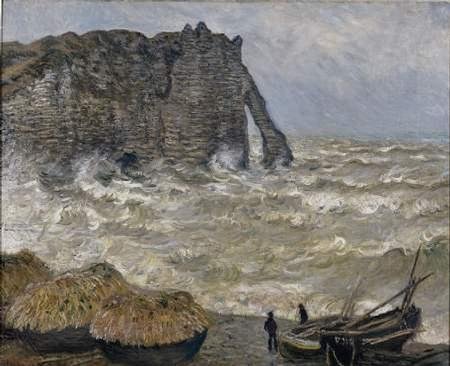
Stormy Sea at Étretat by Claude Monet (1883)

In 1883 Monet completed a work entitled Stormy Sea in Étretat, which is now housed in the Musée des Beaux-Arts in Lyon.  The painting is set on a winter day and we can see is being whipped up by gale force winds.  It is believed that Monet worked on this painting as he sat at the window of his hotel room.  What a wonderful depiction of the ferocity of the sea with the white curls of the surf atop the waves.  In the foreground we have the beach on which we see five boats.  Three of which are filled with what looks like thatch whilst the other two on the right seemed to have been abandoned and show signs that they have had to endure a battering in the waves.  Two men, stand by the boats, looking out on the rough seas.  To the left we have the cliffs and the Porte d’Aval,  above which we have the storm and rain clouds rushing towards the land.

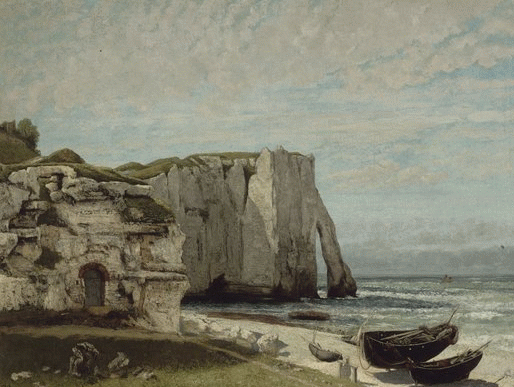
The Étretat Cliffs after the Storm by Gustave Courbet (1870)

The next painting I am featuring is one which depicts a similar view but is a work which depicts the time after a storm.  The title is La falaise d’Étretat après l’orage [The Etretat Cliffs after the Storm] and was completed by Gustave Courbet in 1870.  Courbet visited Étretat that summer and stayed in a house by the sea which was tucked against the Aval cliffs to the left of the bay.  He painted a number of versions of this scene but the one you see above is housed at the Musée d’Orsay in Paris.  Courbet like other artists was attracted to this area not only because of the breathtaking geological structures but because of the quality of natural light and the clarity of the air.  The composition of the sea, the land with its cliffs and rocks and the sky is well balanced.  Courbet had sent the painting for exhibition at the Paris Salon in 1870 where it was well received and Courbet’s reputation as a painter was enhanced.  Of the painting, the art critic and Courbet’s friend, Jules Antoine Castagnary, marvelled at the beauty of his friend’s work and described the elements of the work, speaking of:

 “…the free, joyous air which circulates in the canvas and envelops the details…”

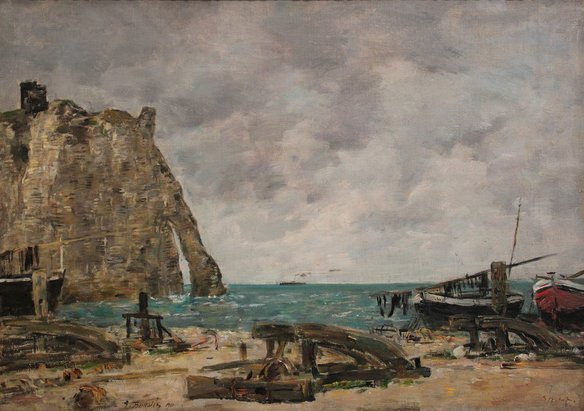
Beach at Etretat by Eugène-Louis Boudin (1890)

Another artist to depict this area in his painting was Eugène-Louis Boudin who in 1890 completed his work entitled Beach at Étretat.  Here we are looking at the scene from a vantage point similar to the previous works.  On the beach we once again see abandoned fishing boats which have been ravaged by the wind and sea.  Sails can be seen hanging from mast boom, shredded by the ferocity of a previous storm and probably act as a warning to the men as they contemplate a return to the fishing grounds.  In the distance we can just make out a steamship passing westward.

Étretat, Laundresses on the Beach, Low Tide by Eugène Bourdin (1892)

Two years later in 1892, Boudin, a noted marine painter, completed a very interesting depicting the beach at Étretat entitled Etretat, Laundresses on the Beach, Low Tide which is held in a private collectionThe setting is the same but the tide has retreated into the distance.  We are left with the brown and green of the rocks which have briefly lost their watery covering.  The breathtaking rock structure of the cliffs is not the focus of our attention in this work.  Before us we have a large group of women who have come down to the beach to do their washing.  It is a veritable hive of activity.

The Manneporte near Étretat by Monet (1886)

For my final painting I am returning to one painted by Monet in 1886 of the Manneporte, a spectacular rock structure just to the west of Étretat and the Aval cliffs.   It is entitled Manneporte (Étretat) and can now be found in the Metroploitan Museum of Art in New York.   This was one of nearly twenty views of the beach at Étretat and the spectacular rock formations such as the Porte d’Aval, Porte d’Amont and the Manneporte which rise upwards on along the coastline that Monet painted. In this painting Monet has captured the way the sunlight strikes the Manneporte, this beautiful natural wonder.  The reason for Monet painting so many pictures of the same scene was that he wanted to capture the changing light at different times of the day and during differing weather conditions

The writer Guy de Maupassant wrote his eyewitness account of Monet at Étretat.

“…The artist walked along the beach, followed by children carrying five or six canvases representing the same subject at different times of the day and with different effects. He took them up and put them aside by turns according to changes in the sky and shadows…”

One can so well imagine that scene.

Farm at Montfoucault by Camille Pissarro

Farm at Montfoucault by Camille Pissarro (1876)

At a time of chaos with Christmas Day just hours away and when family descend on us from every direction, it is very difficult to put aside time to develop a new blog for My Daily Art Display.  However today I am a writing a short entry featuring a painting by Camille Pissarro, which was on the majority of my Christmas cards which I sent out.  So, today’s blog is my Christmas card to you.  The painting is entitled Ferme à Montfoucault, effet de neige (Farm at Montfoucault, snow effect), which he completed in 1876 and can now be found in the Ashmoleon Museum.

It was Camille Pissarro’s good friend and fellow painter Ludovic Piette who had an estate at Montfoucault in the department of Mayenne in eastern Brittany.  Pissarro stayed there numerous times in the 1860’s and 1870’s.  It was during these periods that he completed many of his works of art depicting the region and its people.   Pissarro was in awe of the surrounding countryside and once commented to a friend that he always look forward with much anticipation to being in “the true countryside”.   This area was in complete contrast to Pontoise, where he had settled in 1872.  Pontoise was a modem town with a large population criss-crossed by roads and railway lines in complete contrast to the tranquillity of Montfoucault.  Montfoucault and the Mayenne department was criss-crossed, but not by numerous traffic-laden roads but by small country lanes and fields enclosed by hedgerows.  The whole of the Mayenne region at the time was somewhat remote and isolated.  It was Théodore Duret the French journalist and art critic who had recommended that Pissarro should journey to the area to find, as he termed it, “the path of rustic nature”.

The painting before you is of an enclosed barnyard of a farm which was close by to Ludovic Piette’s house.  In all, Pissarro completed no fewer than eighteen paintings which depicted the immediate surroundings of Piette’s house.   There is a coldness about this painting.  It is the kind of scene you appreciate as you sit at home and absorb the warmth of a wood fire.  The snow on the ground is melting slightly and turning to mud.   I like the way Pissarro has depicted the scene with a cold light which falls on the thatched roofs and bundles of straw.  Pissarro has managed to incorporate a number of animals into his painting as well as the figure of the farmer as he struggles through into the yard weighed down with bales of straw.

Despite his love for the area, this painting marked his last visit to the home of Ludovic Piette, who died in 1878.

So that is my Xmas card to you.  For my Christmas present to you I would (if I could) give you one of three books on artists, which I have enjoyed reading this year and which I thoroughly recommend you buy.

They are not strictly biographies but a kind of fictional biography which has allowed the author to mix facts with a touch of fiction and which I believe adds to the enjoyment.  The books are:

Luncheon of the Boating Party by Susan Vreeland and is a novel that brings to life Renoir’s masterpiece and how he came to paint the scene.  It also gives an insight into the Impressionists and the tensions between certain members of the group.

As Above, So Below by Rudy Rucker.  This is a fictional novel, based upon facts about the life and times of Pieter Bruegel the Elder.  It is a lively and interesting tale which will appeal to all of you who love the work of Bruegel.

The Passion of Artemisia by Susan Vreeland.   This is a fictional biography of Artemisia Gentileschi, one of the greatest female artists of all times and follows the struggles of the young woman who had to endure numerous setbacks and overcome much in a male-dominated society in order to reach the pinnacle of her career.

Finally let me wish you all,  a very Merry Christmas.

A Bar at the Folies Bergère by Édouard Manet

A Bar at the Folies Bergère byÉdouard Manet

Yesterday I looked at a painting by the Belgian artist Antoine Wiertz and bemoaned the fact that although I could discover facts about the artist himself, I could find little information about the featured work of art.  I have no such problem with today’s featured painting, A Bar of the Folies Bergère by Édouard Manet.  Much has been written about this enigmatic painting.  This will be the fourth occasion that I have featured one of Manet’s works and so I will not repeat his life story which you can find in my previous blogs (October 11th and 12th and November 9th).  Today in My Daily Art Display I want to simply concentrate on the painting itself.

As I have mentioned on a number of occasions previously, I believe that when you have a limited time in a town and you want to visit an art gallery it is sometimes better to go to a smaller one rather than rushing around a large establishment trying to see everything and failing miserably.  Today’s painting hangs in the Courtauld Gallery in London which in comparison to the National Gallery or the Tate Galleries is somewhat smaller but what its collection lacks in quantity really comes into its own when it comes to quality.   I first visited the Courtauld Gallery when I went to see Cezanne’s Card Players exhibition after which I decided to spend a few hours taking in the gallery’s permanent collection and it was then that I came across this fascinating and famous work by Manet.

The Folies Bergère, as most people know, is a famous Parisian night-club situated in the 9th Arrondissement of Paris, not far from the heart of the post-Haussmann cultural centre of Paris, south of Montmartre, and a little east of the boulevard des Italiens (known simply as The Boulevard).  The venue is located at 32 rue Richer, the same place that once housed a department store called ‘In the Pillars of Hercules’ .   After almost four years, the departmental store went out of business and so in 1867 it was decided that the store should be replaced a public auditorium.  The construction lasted for almost two years and it was the first music-hall to be opened in Paris.   It was based upon an imitation of the Alhambra in London, a music hall known and much-loved for broad comedy, opera, ballet and circus.  It opened in May 1869, a year before the start of the Franco-Prussian War, and is still in business today.  It was originally called the Folies Trévise because it was on the corner of the rue Richer and the rue Trévise but the name was changed in September 1872 because the Duc de Trévise would not allow his name to be brought into such potential notoriety. As the rue Bergère, a road named after a master dyer, was just a couple of blocks away, the decision was made to rename the establishment as the Folies Bergère.  A Folies-Bergère show typically included ballet, acrobatics, pantomime, operetta, animal acts, and many included spectacular special effects. However, the Folies-Bergère was perhaps more well-known for its sensual allures.  It became chic to be seen at the Folies Bergere, so aristocrats and royal families alike came from all over the European continent to claim their coveted seats at the Folies.  Manet’s picture features his friends, both artists and models and was the kind of trendy place in which he spent his evenings.  The painting we see before us was the last great work of art painted by Édouard Manet and was completed in 1882.  At the time Manet was suffering badly from a debilitating disease, brought on by untreated syphilis,  which he was to die from the following year.

So what are we looking at?  The woman in the painting is Suzon a waitress at the establishment, who posed for the picture in Manet’s studio.  When I first glanced at the painting I thought I was simply looking at a woman standing behind a marble-topped bar and behind her were a large throng of people who were enjoying a meal whilst watching the entertainment but in fact what we are looking at is the woman standing between us and a large mirrored wall, the bottom of its gold frame can be seen running the full width of the painting, and it reflects what is actually going on behind us as we stand at the bar.  The young woman, who rests her hands on the counter, wears a greyish blue skirt and a dark velvet jacket with a low-cut lacy collar and has a corsage of pink flowers at her breast.  She has blonde hair which is tied back and wears two small drop-earrings and a gold bangle on the wrist of her right hand. The woman before us is not looked upon as a just a simple bar tender but more than likely falls into the category of a demimondaine.  A demimondaine was a term used to describe a professional mistress who sold her company, affections and body in exchange for being maintained by a patron in a long term relationship.  Later the word became a euphemism for a courtesan or prostitute.  Some art historians have interpreted the main aspect of the painting, the woman, as not only the seller of the bottled products we see on the counter before her but possibly the seller of her own body.

Now cast your eyes to the right of the woman and we see the reflection of the woman, or do we?.  Should we simply believe that we are looking at a mirrored reflection of her?  If Manet has simply drawn her mirrored reflelection, how could it be, as if the mirror is parallel with the plane of the painting then the reflection of the woman should be directly behind her and thus out of our line of sight.    In the painting the waitress stands before us, upright and is looking directly out at us and yet the reflection of her as depicted in the painting has her bent over slightly turned sideways as she talks to a gentleman with a moustache and wearing a top hat.    Something is not right.  Many believe that in actuality Manet had not meant it to be a true mirrored reflection of the back of the woman but the image of the woman at another time in her life.  Maybe Manet wanted it to be a depiction of what she is thinking as she looks into our eyes.  Maybe she is dreaming of meeting her gentleman lover or remembering the intimate time when they last met.  In Jeffrey Meyers book Impressionist Quartet: The Intimate Genius of Manet and Morisot, Degas and Cassatt, he describes the intentional play on perspective and the apparent violation of the operations of mirrors:

 “Behind her, and extending for the entire length of the four-and-a-quarter-foot painting, is the gold frame of an enormous mirror. The French philosopher Maurice Merleau-Ponty has called a mirror ‘the instrument of a universal magic that changes things into spectacles, spectacles into things, me into others, and others into me.’ We, the viewers, stand opposite the barmaid on the other side of the counter and, looking at the reflection in the mirror, see exactly what she sees. Her own reflection, however, is not directly behind her, according to the strict rules of perspective, but at a right angle to where she’s standing. It seems to reveal her long hair, cheek, collar and back as she serves and chats to male customer. A critic has noted that Manet’s ‘preliminary study shows her placed off to the right, whereas in the finished canvas she is very much the centre of attention.’ Though Manet shifted her from the right to the center, he kept her reflection on the right. Seen in the mirror, she seems engaged with a customer; in full face, she’s self-protectively withdrawn and remote.”

Preliminary sketch

In an early preparatory sketch for this painting Manet placed the woman to the right of the picture and then her reflection in the mirror seems more realistic.

Suzon

The woman intrigues me.  I look at her and try and interpret her expression and by doing so, I  may be able to build up a picture of her existence.  How would you describe her expression?  Is it one of unhappiness, one of disappointment, maybe one of nervousness?  Her mind seems somewhere other than with us.  Her cheeks are flushed.  Is it simply due to the heat of the theatre or maybe it is a sign of extreme weariness.  In some ways she has a look of innocence but her reflected image talking to a customer or client belays that thought.  So in a way, maybe we are being asked to decide who the real woman is; the one who innocently looks out at us or the one who could well be negotiating the sale of herself?

Look at the bar which separates us from the woman.  On it we see a glass bowl containing oranges or mandarins, a small glass with two flowers in which we see a partial reflection of the woman’s corsage and an array of bottles of unopened champagne.  Critics have also pointed out that the mirror does not correctly reflect the bottles on the counter in type or quantity.  However more interestingly, note the bottles with the red triangle on the label. 

Bass Pale Ale

This was not a French product but Bass, a well known brand of English beer which was established in Burton on Trent by William Bass in 1777 and still can be bought today.  The inclusion of these bottles in the painting, which in present day terminology would be called product-placement, signifies the varied clientele. Members of the Jockey Club and English bookmakers used to congregate every evening at the Folie-Bergère bars and Bass beer was brought in especially for them.   Another interesting detail about the bottles on the counter is that the artist himself has signed his name “Manet 1852”on the label of the bottle containing the red liquid, on the far left.

The reflected background shows the interior of the theatre with its gilded balcony front and its large chandeliers hanging down from the high ceiling.  It is a glittering scene depicting a sensuous world of pleasure.  Round electric lights can be seen on the pillars which must have been in themselves a novelty as this type of lighting had only just come into being.  Look to the upper left corner of the painting and you can just make out a swing and a pair of small green-booted feet which belong to the trapeze artist who is poised aloft on a swing, performing for the theatregoers.

The installation of the painting at the Getty Centre exhibition (2007)

When this painting was lent out to the Getty Center in 2007 a mirror was installed to help dramatize the questions of vision and reflection raised by Manet’s painting.  The painting raises so many questions and as Manet is not with us to explain his work, one can only guess at the answers.  So I will leave you to ponder these points:

How would you describe the barmaid’s vacant expression, one of remorse, one close to tears ?

What had Manet in mind when he painted the off-set reflection of Suzon and why did he position her at the centre of the painting whereas in an early preparatory sketch she is to the right of the painting and the mirrored reflection of her seems more real?

The reflection shows a man talking to Suzon but why is he not shown on the side of the bar where we are standing?

We are standing on a balcony walkway in front of the bar and yet it is not shown in the mirrored reflection, why?

The marble bar top on which Suzon rests her hands stretches the full width of the painting and yet the reflected image of the of the bar top does not, why?

This is a truly intriguing painting and the next time you are in London you should make time to visit the Courtauld Gallery and stand in front of Suzon and see what you make of the painting.

Four Figures at a Table by le Nain Brothers

Four Figures at a Table by the le Nain Brothers (c.1643)

If I was an artist, which sadly I am not, I would always be sure to sign my name somewhere on my canvas after I had completed the work.  It would be a matter of pride.  It would be a matter of recognition even if it had not been the greatest work I had ever painted.  Today I am going to look at a painting which does not have an individual signature upon it.  It is not that it hasn’t been signed.  It is just that the signature is a kind of joint one, one signifying collaboration and it makes me wonder why that has been done.  Is it that the painting is a collaboration of three artists who each painted part of the work?  Was a decision made by the three painters that none of them should take more praise and recognition than the other two?  It is very strange.  My trio of painters are three brothers.  They are the Le Nain brothers. Louis who was born in 1593, Antoine  was born in 1599, although some art historians put his and Antoine’s birth date as “circa 1600”and the youngest, Mathieu, was born in 1607 and between them they created many amazing  genre and religious scenes as well as portraits.  Only 15 dated works survive, all executed between 1641 and 1648 and simply signed “Le Nain” but without a Christian name.

Their mother was Jeanne Prévost and their father was Isaac Le Nain who held the important position of Sergent Royal au Grenier à Sel in Laon.   The family were moderately prosperous and around 1615 had purchased a farm and some vineyards.  Historical records show that the le Nain brothers received their first artistic education from an “artiste étranger” which could mean that their tutor was from out of town or it could mean that he was a foreigner.  Unfortunately any of their early work, which had been kept in Laon like the fate of a lot art, would have been destroyed in the lead up to and during the French Revolution.

Sometime around 1629 the le Nain brothers moved to Saint Germain-des-Prés, a suburb of Paris and set up a studio, which because of its location, was outside the control and regulations of the Paris Guild.  Their business soon became very successful and they received many commissions, especially for their portraiture.  Surviving records show that in 1629, Antoine was admitted as master in the Corporation of Painters in Saint Germain and there is mention of a large commission he received from the Bureau de la Ville de Paris.  It is also recorded that Mathieu received many religious painting commissions and that in 1633, he was appointed painter to the city of Paris.  However the records mention little about the third brother, Louis.

All three brothers attended the initial meeting of the Académie Royale de Peinture et de Sculpture held in Paris on March 1st 1648 and were admitted to the Society as founder members.  Sadly, two months later, both Antoine and Louis were dead.  They died within two days of each other in May 1648, probably of some highly contagious disease.  They are buried at the Saint Sulpice church in Paris, recently made famous for the church at the centre of the Da Vinci Code film.

There is another unusual fact about the brothers, or to be more precise, the surviving brother Mathieu.  Within ten years of the death of his two siblings, Mathieu’s financial situation had vastly improved and his social standing in the community had also risen.  Mathieu’s social pretensions also increased and soon he was referring to himself as Lord of La Jumelle, which was the name of his parents’ small family farm back in Laon.  More was to follow as four years later Louis XIV awarded him the collar of the Order of St Michel, a form of knighthood.   This honour was only usually bestowed on those of noble birth and not an unprivileged painter like Mathieu le Nain.  So why did the king bestow this award on him?  There is no definite answer to this although he had spent a lot of time as a military engineer which may have contributed to his “award for services in the armies of the King”.  However what is more strange is that a year later the king took back the award but Mathieu refused to stop wearing the regalia and in 1666 he was imprisoned for the offence of sporting the symbols of office when he wasn’t entitled to.   Historians have put forward the view that Mathieu had friends in “high places” which resulted in his initial award but he also had an equal number of enemies in the same high places and they persuaded the king to strip Mathieu of his honour.

Mathieu le Nain died in 1667 and was laid to rest with his brothers at the church of Saint Sulpice, Paris.

It has been difficult, if not impossible, to attribute certain works of art to certain brothers and the closest they have come is the belief that the small paintings on copper had been done by Antoine and the larger more austere peasant scenes have been done by Louis.  However it is agreed that this is not a foolproof method of deciding which brother did which painting.  It is also strange to note that because Mathieu lived on almost thirty years after his siblings died in 1648, any paintings with the le Nain signature after that date, could be attributed to him.  However there has never been a painting signed “le Nain” later than 1647.

My Daily Art Display featured painting today is entitled Four Figures at a Table and was completed around 1643.  This small (44cms x 33cms) oil on canvas work is housed in the National Gallery in London.   The strong light emanates from the left of the scene and draws our attention to the darkness of the background in contrast to the pure white of the cloth and the cap worn by the mother.   There is a feeling of serenity and composure about the setting.  There is a sombre dignity to this painting of a peasant family at the meal table. Their clothes are of brownish-grey shades, which is in stark contrast to the white of the tablecloth.  I have featured many Dutch and Flemish paintings depicting peasants and in most cases there is a certain amount of squalor and drunken revelry associated with the scene.  Here it is quite different.  Here before us the le Nain brothers have given us a scene of tranquil dignity.  There is no sign of mockery with regards the characters depicted and there is no moralising symbolism.  This is simply a painting which exudes the quiet composure of the less well off.  Some art historians would have us believe that this is a portrayal of the Three Ages.  The old woman, hand on table, with her careworn face and look of resignation in contrast to the young woman, maybe her daughter, who is seated to the left, clay jug in hand,  with her fresh-looking face looking out at us questioningly and in the background the tiny girl staring out at us with wide-eyed fervour.

The under-painting

Strangely, when this painting was subjected to X-radiography in 1978 it was discovered that there was a bust-length portrait of a bearded man in a ruff wearing clothes which date back to the 1620’s, painted underneath the current work.  The X-radiograph exposed the man’s face and details of his costume with exceptional clearness. The underlying portrait, seen when the canvas was turned through 90 degrees, was thickly painted in colours containing a high proportion of lead white.  This colouration of the under-painting, in contrast to that of the final painting with its relatively thinly painted in colours containing little or no lead white, meant that it showed up strongly in the X-radiograph.   Why the original work was painted over by the brothers is not known and will never be known but where there once was a fashionable and wealthy citizen looking out at us, he has been replaced by four, less wealthy people sat at their meal table.

The subject of their painting, peasants, was an unusual subject for French painters at the time, most of whom were fixated with mythological allegories, and the “heroic deeds” of the king.  The paintings of peasant life by the three brothers have a realism unique in 17th-century French art.   However poverty and how to treat the poor was intensely debated especially by the Catholic movement in Paris.  It was much later, during the years preceding the French Revolution, that paintings of simple country life became popular.  So which of the le Nain brothers painted this work?  Or is this painting yet another collaboration by the three brothers?  We will probably never know the answer to that question but we do know that it was well received by the French Academy in 1648.

The Dining Room by Paul Signac

The Dining Room by Paul Signac (c.1887)

On October 21st,  I looked at a work by the Neo-Impressionist painter Georges Seurat, which had been completed by him using the technique known as Pointillism or Divisionism.   For a brief explanation of those terms, please go and look at that earlier blog.  Today I want to look at a work by his contemporary and friend Paul Signac.

Paul Victor Jules Signac was born in Paris in 1863 and came from a prosperous family of shopkeepers.  Originally he trained to become an architect but at the age of eighteen, after visiting a Claude Monet Exhibition, he decided to set off on an artistic career and learn the technique of en plein air painting.  His earliest known works were landscapes or still-lifes and one can see in them an Impressionist influence, especially the works of Monet and Alfred Sisley.  At the age of twenty he was tutored by the Prix de Rome winner Emile-Jean-Baptiste Bin.  In 1884 he became a founder member of the Société des Artistes Indépendants and their Salon des Indépendants.   The Salon des Indépendants was an annual exhibition which started in 1884 and was held in Paris by the Société des Artistes Indépendants.  It was set up in direct competition to the Paris Salon.   Many artists as well as the public became increasingly unhappy with the rigid and exclusive jurist-based selection policies of the official Salon.  Just over twenty years earlier, in 1863 the first Salon des Refusés had been held for innovative artists whose works had been rejected by the official Salon.  The Société des Artistes Indépendants which Signac co-founded had the motto “Sans jury ni récompense” which meant “no jury, no awards”.  One of the other co-founders of this society was Georges Seurat and it was he who introduced the principles of Divisionism and the theory of colours to his friend Signac.

Signac, up until then, had been following the Impressionist style of painting but he became fascinated with Seurat’s technique, known as Pointillism.    He then decided to experiment with this newly acquired technique of scientifically juxtaposing small dots of pure color on the canvas which combined and blended them in the viewer’s eye instead of the artist blending the colours on a palette before putting the combination on to the canvas.  Signac was fascinated with this technique and was tireless in his attempts to convert others to Seurat’s methods. In 1885 Signac met Camille Pissarro, whom he introduced to Seurat. Pissarro realised that this technique was the answer to his desire to have a rational style and so adopted it with great fervour.  Pissarro, against the wishes of the other Impressionists, invited Signac to participate in their eighth and last Impressionist Exhibition in 1886.

Signac loved to sail and a large number of his paintings featured the French coast and its harbours.  He would progressively sail further afield, visiting various ports in the Mediterranean as well as the Dutch coast to the north.  During the summers he would head south to the Côte d’Azur and St Tropez where he had bought himself a house in 1892.  He would always return from his voyages with numerous sketches of the places he had visited and then back in his studio, turn them into beautifully coloured canvases that are carefully worked out in small, mosaic-like squares of colour, and which were quite different from the tiny, variegated dots previously used by Seurat.

He became friends with Vincent van Gogh and the two would spend time in Van Gogh’s Parisian home and his summer hide-away in Arles. From the mid-1880s Signac exhibited regularly. Apart from the Salon des Indépendants, in which he figured every year, he showed at the last Impressionist Exhibition (1886) at the invitation of Pissarro.   It was not until he was almost forty years of age that he had his first one-man exhibition which was held at the Paris gallery owned by Siegfried Bing.  However like his Neo-Impressionist friends he received little public acclaim for the first 20 years of his career.  On Seurat’s death in 1891, Paul Signac became the leader of the Neo-Impressionists

Signac was a great inspiration to the young and up-and-coming painters such as Henri Matisse and André Derian.  It was his support that played a vital role in the evolution of Fauvism.   Fauvism was the short-lived and loose group of early twentieth-century Modern artists whose works emphasised the artistic qualities of strong colour more than the representational or realistic values of the Impressionist painters.  Signac became president of the annual Salon des Independants in 1908 and retained that position until his death.   As such, Signac encouraged and supported younger artists such as Matisse by allowing their works and the controversial works of the Fauves and the Cubists to be exhibited.

Signac died in Paris in 1935, aged seventy-two.

My Daily Art Display featured oil on white primed canvas painting today is not one of Signac’s landscape or seascape although it does highlight the unusual Divisionism technique.  It is entitled Dining Room and was completed in 1887 and exhibited at the Paris Salon des Indépendants in 1887 that year.  It now hangs in the Rijksmuseum Kröller-Müller, in Otterlo, Netherlands.  Before us we see three people, a man and a woman seated at a table and a maidservant.  Although the setting looks like it has all the accoutrements of a well-to-do bourgeois household, the dining room is actually that of Signac’s family, and before us we have Signac’s mother, grandfather and housekeeper.   The room is lit from behind with light emanating from a window on the rear wall.  This illuminates the subjects vividly and creates silhouettes and strong contrasts of light and shade.  It gives a strong structure to the composition.  See how Signac has highlighted areas of the painting by the use of barely tinted yellowish whites.  The seated characters are rather wooden-like.  They sit at the lunch table in stony silence.  There appears to be no communication between Signac’s grandfather and mother and the setting is devoid of anecdote.  There is a stiffness of what we see before us.  There is a frozen solemnity about the scene and this may have been Signac’s way of pictorially criticising the strict and ritualistic sombreness of middle-class meal times.

I am not sure I like the Divisionism technique used in Signac’s indoor scenes.  I think it works much better in his coastal landscape works.  There is no doubt about it that it was a clever technique but it is just not for me.

A Brawl in a Guardroom by Sébastien Bourdon

A Brawl in the Guardroom by Sébastian Bourdon (c.1643)

My featured artist for My Daily Art Display today is Sébastien Bourdon.  He was born in 1616 to Protestant parents living in Montpellier. His father was a glass painter.   Initially he was apprenticed to a painter in Paris from the age of seven to fourteen and then worked in Toulouse and Bordeaux until he travelled to Rome in 1634, where he gained a reputation as a bambocciante.  The Bamboccianti were genre painters active in Rome from about 1625 until the end of the seventeenth century. Most were Dutch and Flemish artists who brought existing traditions of depicting peasant subjects from sixteenth century Netherlands with them to Italy.   His genre scenes often depicted military bivouacs or itinerant figures at rest beside Italianate ruins, a fondness perhaps due to the fact that, after his apprenticeship, he enrolled as a soldier in the French Army at Toulouse.

After a brief sojourn in Venice he returned to France.  His return was brought about as he, being a Protestant, was forced to flee Italy in 1638 to escape denunciation by the Inquisition. He returned to Paris and continued to paint Italianate genre scenes. . He also became famous for his large Baroque religious and classical subjects painted with the definite influence of the great Venetian painters.   Around 1645 there was a noted difference in his painting style and it is believed that he had become influenced by the works of Nicholas Poussin.  The Académie Royale de peinture et de sculpture (Royal Academy of Painting and Sculpture), was founded in 1648.  The purpose of this academy was to professionalize the artists working for the French court and give them a stamp of approval that artists of the St. Luke’s guild did not have.    Bourdon was one of the founding members of the Académie Royale de Peinture et de Sculpture, and would later became its rector in 1654.  In these later years, due to his great success and recognition, he abandoned painting genre scenes altogether and his works were mostly comprised of commissions of a biblical or historical nature.

In 1652 Bourdon became the first court painter to Sweden’s Queen Christina, and during this period he painted numerous court figures in a style inspired by Anthony van Dyck.   His last works, made back in Paris, were landscape-oriented and influenced by Poussin’s art, to which Bourdon added tenderness, charm, and cool colour.

Bourdon died in Paris in 1671, aged 55.

My Daily Art Display featured work is entitled A Brawl in the Guardroom, and was completed by Bourdon around 1643 and can be seen at the Dulwich Picture Gallery in London.  Guardroom scenes, which the likes of the Dutch painter Pieter van Laer had mastered in the early seventeenth century, were very popular genre scenes in Europe at the time.  The guardroom scene is basically a genre painting depicting an interior with officers and soldiers who spend their off duty time making merry with camp followers.   These paintings often depicted mercenaries and prostitutes dividing booty, harassing captives, or indulging in morally despicable activities. The more dignified officers sometimes serve as mediators between the middle-class viewer and the unruly scene.

Two phases can be distinguished for the guardroom scene. The early phase lasted roughly until 1645 and was rather crude, displaying soldiers who were gambling, drinking, and frolicking with women of dubious repute. The second phase began after 1645 and was characterised by a certain refinement. Following the growing civility displayed by Dutch society as the seventeenth-century progressed, painters began to depict guardroom scenes which were occupied by middle-class people and devoid of booty and other signs of belligerent activities.  In the early phase, we find women in the role of barmaids, wearing aprons and holding jugs in their hands. The guardroom context, their unrestrained interaction with the men and the fact that they are sometimes dressed in undergarments and display a generous décolletage, are telling signs of their true nature.  In the second phase, the women who figure in the guardroom scenes tend to be restrained in dress and behaviour, whereas the men approach them gallantly and are otherwise mostly busy with activities related to the military.

In today’s work we can see that Bourdon has depicted the interior scene of a guardroom where we see soldiers at rest after a hard day.  The evening draws to a close and night fast approaches.   The moonlight illuminates the fort’s portcullis has remained in a raised position.  On the left of the painting we see a pair of young soldiers engaged in a brawl over a game of cards. The fight is almost spilling out of the left hand side of the painting.   It is apparent that the one who has lost the game believes he has been cheated and his fist is raised high poised to extract retribution.  Across the table from the combatants sits two older men, still dressed in their armour, watching the fracas, offer some reasoning, but to no avail and they appear not to want to intervene physically.  In the right of the painting we see another soldier kneeling by the open fire trying to warm himself.  In the middle of the foreground we see a young bare-footed boy, dressed almost in rags deliberately averting his eyes from the scuffle.   He looks directly out at us.  He, we believe, is a shepherd boy and if we look closely under the table we can just make out one of his sheep busily searching for crumbs of food.

This an interesting work of art and I received much of the information with regards the “guardroom” genre of painting  from the Dutch “dbnl” website.

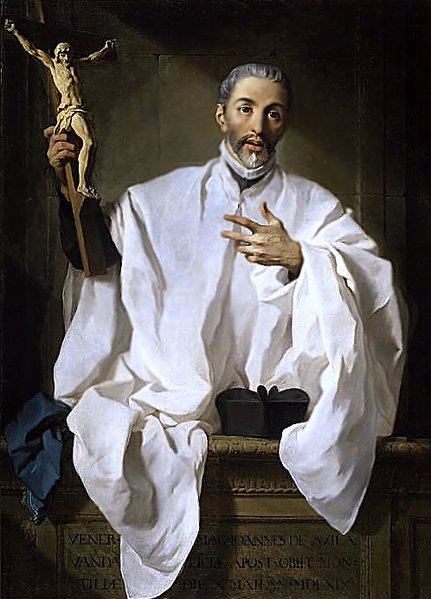
Portrait of St John of Avilla by Pierre Subleyras

Saint John of Avila by Pierre Subleyras (1746)

Pierre Subleyras was born in Saint-Gilles-du-Gard, a town close to Nimes in the south of France in 1699.  He was a pupil of his father and later of the French painter, Antoine Rivalz, in Toulouse. In 1726 he studied at the Royal Academy of Painting and Sculpture in Paris, where he was awarded the Premier Prix de Rome, which was a scholarship for arts students, principally of painting, sculpture, and architecture. It was created, initially for painters and sculptors, in 1663 in France during the reign of Louis XIV.   It was awarded annually and came with a bursary for promising artists having proved their talents by completing a very difficult elimination contest. The competition was open to the students of the Academy and starting in 1666, the award winner could win a stay of three to five years at the Palazzo Mancini in Rome paid for by the King of France.    

In 1728, Subleyras went to Rome where he received a painting commission from Frederick Christian, the Elector of Saxony, and this led to him being accepted into the Roman artists’ guild known as the Academia di San Luca.  He remained in Rome for the rest of his life and carried out many commissions for the Catholic Church.  He painted a variety of subjects, which included portraits of Pope Benedict XIV.  He also painted the portrait of the Italian priest and nobleman who was a great art collector and patron of Subleyras and who was eventually elevated to become Cardinal Valenti Gonzaga.  He painted many still-lifes, but his reputation was built around his religious paintings, which are much more serious in spirit than most French work in the Rococo period.

His most famous work is the Mass of St Basil, which he painted for St Peter’s.  The painting that served as the cartoon for this altarpiece was commissioned from Pierre Subleyras.   He was paid for the picture, which is now in S. Maria degli Angeli, Rome.  This huge picture was highly acclaimed when it was unveiled in 1748, but Subleyras died before he could follow up his success.  A modello of the work is currently housed at the Metropolitan Museum in New York.

However, My Daily Art Display featured painting for today is another of Subleyras’ works.  It is his portrait of St John of Avilla which he completed in 1746 and now hangs in the Birmingham Museum and Art Gallery.  Saint John of Avila (1500-69) is often known as the Apostle of Andalusia.  Shortly after his ordination to the priesthood, Saint John gave his family’s wealth to the poor and prepared to do missionary work in the New World. However, the Archbishop of Seville intervened, for in the wake of the release of the southern-most region of Spain from almost eight centuries from 711 to 1492 of Islamic rule, the archbishop wanted to restore and revitalize the Catholic Faith in Andalusia, and he convinced Saint John, who was a renowned preacher, to take on the task.  He remained in Andalusia for nine years and afterwards continued his missionary activities throughout Spain and is, to this day, one of the most beloved of Spanish saints.  He was beatified by Pope Leo XIII on November 12, 1893, and Saint John was canonized on May 31, 1970, by Pope Paul VI.  St John of Avila is one of the Catholic Church’s greatest heroes, even if relatively little is known about him outside Spain, where he is patron of the nation’s priests.

It is a mesmeric work with the light falling on the white vestments of St John as he stands in the pulpit holding up the cross with the crucified Christ. The long fingers of his left hand lay across his chest as he points towards the cross.   His greying hair adds to the dignity of the figure.  His dark eyes look out at us as he preaches his sermon. His black biretta lays before him on the edge of the raised pulpit.  This painting is a personification of his greatest gift – the power of oratory and it was this God-given gift that enabled him to win over the hearts of minds of the Andalusian people.

A Burial at Ornans by Gustave Courbet

A Burial at Ornans by Gustave Courbet (1850)

In an earlier blog (November 14th) I looked at the life of Courbet and his painting The Artist’s Studio.  If you have just arrived at today’s blog it would be worth going to the earlier one to read about Courbet’s life and his artistic principles I mentioned in that earlier blog that when he had tried to get his three large painting into the Paris Exposition Universelle of 1855 they were rejected because of their size.  My Daily Art Display featured painting today entitled A Burial at Ornans was one of the three.  This work was even bigger than the The Artist’s Studio, and measures 3.1metres by 6.6 metres and was completed by Courbet in 1850.  Both paintings are housed at the Musée d’Orsay.

Gustave Courbet was born in Ornans in 1819 and this huge painting depicts the funeral of his great uncle at the town in September 1848.   The depiction of the funeral and the laying to rest of the dead is unlike the usual way it would have been portrayed in Romantic or Academic art, where we would expect to see angels of the Lord carrying the soul of the deceased heavenwards.  Gustave Courbet was a realist painter.  In fact he was in the forefront of the Realism art movement, which was a grouping of artists  who believed that they should represent the world as it is even if that meant breaking with artistic and social conventions.  Realist artists painted everyday characters and situations all in a true-to-life manner.  These artists wanted to rid art of the theatrical drama, lofty subjects and the classical style and in its place they wanted to depict more everyday commonplace themes.  Courbet was once asked to incorporate angels in a painting he was doing of a church.  He rejected the request saying:

“….I have never seen angels. Show me an angel and I will paint one… “

The Innocent gaze

This realist art we see before us is exactly as Courbet would want.  It is a funeral scene, warts and all.  It is an unflattering yet dignified scene, but more importantly to Courbet, it is a realistic scene.  There is a stillness and serenity of what we see before us.  There is no attempt to glorify the setting with a grandiloquent and ostentatious depiction of descending angels with God seated on a throne in the clouds above.  In the foreground there is an open grave awaiting the coffin.  The funeral procession approaches from the left.  In the procession we see the pallbearers slowly following the priest and altar boys as they close in on the gaping hole in the ground and the gravedigger, who is on bended knee by the grave.  The figures in red are officials of the church, who assisted at religious functions.  If you look closely at the edge of the grave, you can just make out a skull which presumably was exhumed when the grave was dug out.  The mourners fill the middle ground of the painting.  Grief-stricken women, with handkerchiefs fending off their tears, circle the grave.  It is interesting to note that Courbet did not use models for this scene, which would have been the norm in historical narrative paintings.  Instead he used actual villagers who were at the ceremony, including his sister and mother, and this again highlights his desire for realism.  This is not an en plein air painting for the depiction of the people was done in his studio at Ornans.  Look how Courbet has depicted the young at this event. 

Girl peeking at grave

See how the young altar boy, who is standing behind the priest, stares up at one of the pallbearer.  Courbet has managed to perfectly capture the look of innocence in the boy’s face.  Cast your eyes to the right foreground of the painting and see if you can spot the face of a small girl who is peeking out at the grave.  We just see her face.  The rest of her is almost lost amongst a sea of black clothing.  Look at the way Courbet has kept the heads of the mourners and officials level with the tops of the cliffs and the land in the background.  Observe how only the crucifix reaches reaches above that level into the pale sky, as it is held aloft by an attendant.   Just a coincident or has a little piece symbolism crept into Courbet’s work?

In Sarah Faunce’s biography of Courbet she talked about the reception this painting received from the public and critics.  She wrote:

“….In Paris the Burial was judged as a work that had thrust itself into the grand tradition of history painting, like an upstart in dirty boots crashing a genteel party, and in terms of that tradition it was of course found wanting…”

The critics seemed to miss the histrionics and exaggerated gestures of grief they had been used to seeing depicted in great historical funeral paintings of the past.  They thought this painting was ugly and presumably missed the beauty of angels, puti and the presence of the figure of God sitting aloft awaiting a new entrant to his kingdom.   Another aspect of the painting which disturbed the critics was the fact that Courbet painted this huge work, similar in size to grand historical paintings of the past, centred, in their opinion,  on a subject of little consequence – a burial of a family member.  As far as the sophisticated Parisians were concerned paintings of  rural folk should be confined to small works of art and they were very critical of Courbet’s decision to afford these folk such a large space of canvas.  The fact that he did was looked upon as a radical act.  However Courbet said of the painting “it was the debut of my principles”.   For the critics, if an artist was going to paint such an enormous work, then they expected the subject to be an idealized grand narrative and not just an ordinary every day event.

I end today with two quotes from the artist on his artistic upbringing and his pursuit of Realism and what he tried to achieve.

“…I have studied, apart from any preconceived system and without biases, the art of the ancients and the moderns. I have no more wished to imitate the one than to copy the other; nor was it my intention, moreover, to attain the useless goal of art for art’s sake. No! I simply wanted to draw forth from a complete knowledge of tradition the reasoned and independent understanding of my own individuality…”

“…To know in order to be capable, that was my idea. To be able to translate the customs, idea, the appearances of my epoch according to my own appreciation of it [to be not only a painter but a man,] in a word to create living art, that is my goal…”

And finally his hope for how he would be remembered…………….

“…When I am dead, let it be said of me: ‘He belonged to no school, to no church, to no institution, to no academy, least of all to any regime except the regime of liberty…”