Cecilia (Leilie) Beaux. Part 1 – Ancestors and the early years

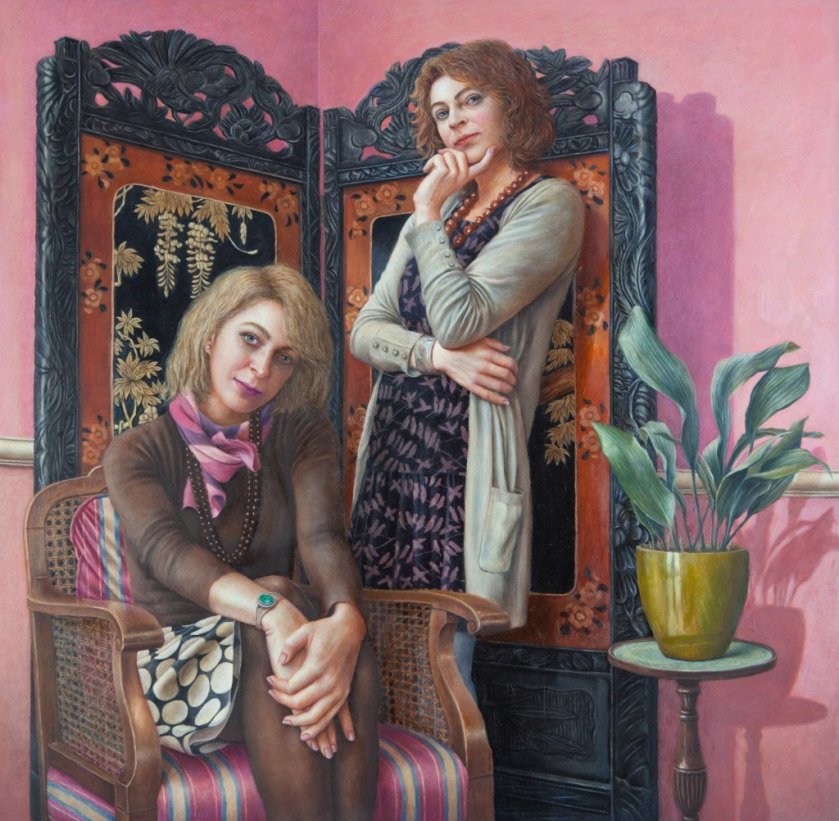
Portrait of Cecilia Beaux by John Lambert (1905)
My featured artist today is looked upon as one of the greatest portrait painters of her time. Of her, the American painter, William Merritt Chase said:
“…[she is] the greatest woman painter that had ever lived…. She is a painter as Velasquez and Rembrandt were, and like them, she infuses the subtle quality of life into her work…”

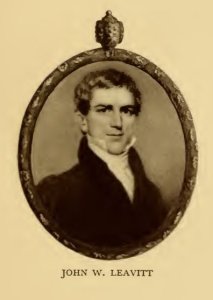
John Wheeler Leavitt

She is the nineteenth century American society portrait painter, Cecilia Beaux (née Leavitt). This initial blog looks on her life before she became a professional painter but maybe to understand her better, one must understand the trials and tribulations of her early life and one has also to go back to the turn of the eighteenth century and her maternal grandparents John Wheeler Leavitt and his wife Cecilia Kent Leavitt. John and Cecilia were both born in the last decade of the eighteenth century and were married in 1820. Their ancestral history could be traced

Cecilia Kent Leavitt

back to seventeenth-century New England and before that to England. John was a prosperous textile merchant who founded the New York based family firm John W. & Rufus Leavitt Company, and was one of the most prominent businessmen of his age. He and his wife had eight children and as the saying goes “money was no object” for this family. The children were all home-tutored in all the academic subjects and taught to play the piano at which the second youngest, Eliza became a brilliant musician.

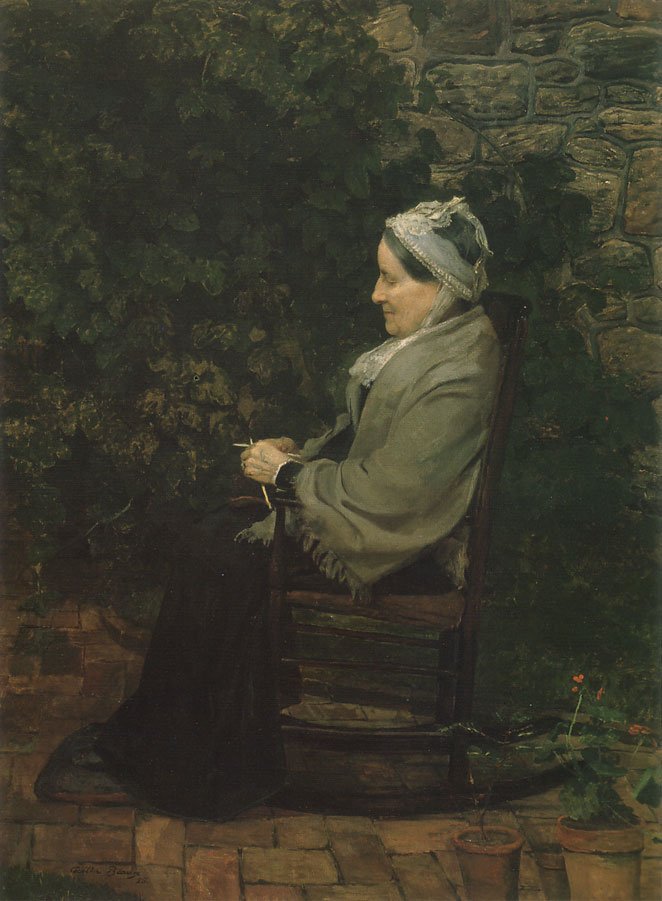
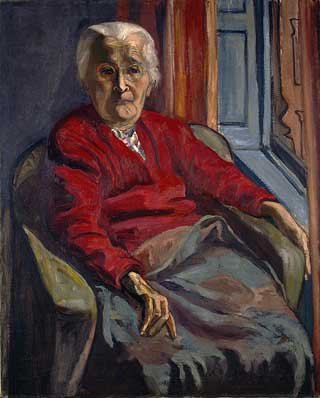
Mrs. John Wheeler Leavitt by Cecilia Beaux (1885) Cecilia Beaux’s maternal grandmother.

However, the good times ended abruptly in 1846 with problems in the cotton industry and debts that could not be serviced, and the company filed for bankruptcy. The Leavitt family owed their creditors so much money they had to sell their New York town house and their country estate on the Palisades in Hoboken and John and Cecilia Kent Leavitt were forced to move to a small house in a “rough” suburb.  Their two eldest daughters, Cecilia (the mother of Cecilia Beaux) and Eliza had to go out to work to help with the family finances. Cecilia worked as a music teacher and Eliza worked as a governess. It is noted in Cecilia Beaux’s autobiography Background with Figures, that the sons were of little help. As she put it, they were dreamers and not doers!  As is often the case when one is subjected to financial pressure, John Leavitt’s health took a turn for the worse and his wife had to take over the running of the house and manage the family finances.

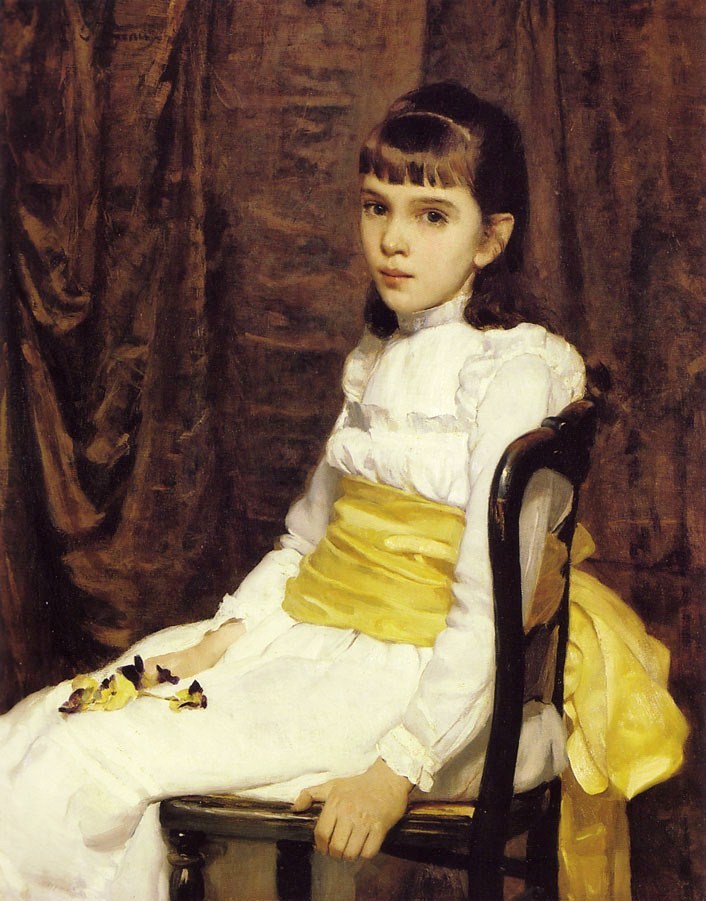
A Little Girl (Fanny Travis Cochran), by Cecilia Beaux (1887)

Cecilia and Eliza moved from the family home in New York to Philadelphia around 1848 where they had distant relatives. With the help of friends, they were soon socially accepted. Financial help for John Leavitt and his family materialised in the form of a foreigner, Jean Adolph Beaux. He came from the city of Nimes in France, in 1848 and was from a family of French Huguenots, long engaged in the silk manufacture business. In 1848, aged thirty-eight, he emigrated to Philadelphia to set up an American branch of his family’s business, J. P. Beaux & Co., Sewing Silks.

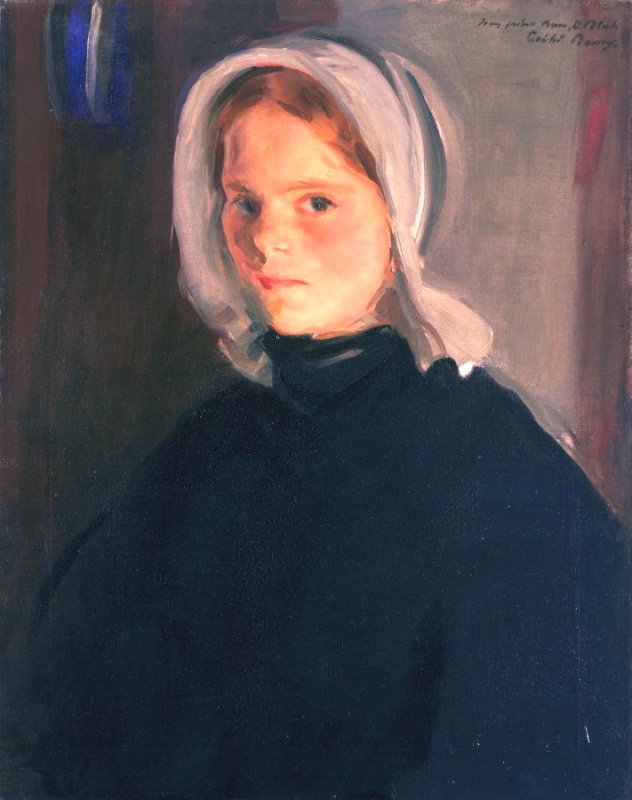
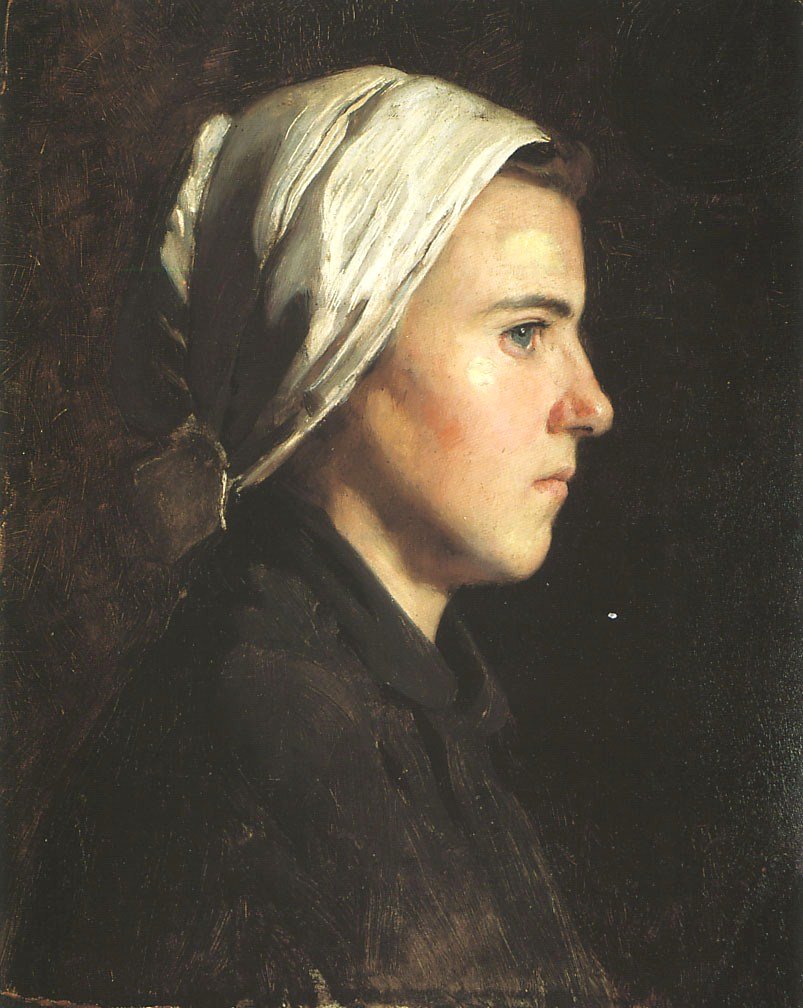
Head of a French Peasant Woman by Cecilia Beaux (1888)

Although there were many eligible women for the Frenchman to choose a companion, he had fallen desperately in love with Cecilia Leavitt, maybe partly because she had an excellent grasp of the French language, which certainly helped as John-Adolph’s grasp of the English language was poor. Cecilia also fell for the charming and handsome French gentleman and wrote home to her family in New York saying she had met a French gentleman with beautiful blue eyes. However, she made sure her relationship with Jean Adolphe progressed slowly and it was some time later that he headed to New York to meet her father and ask him for his daughter’s hand in marriage. Cecilia father was satisfied that Jean Adolph could provide for his eldest daughter and so agreed. John Adolph Beaux and Cecilia Leavitt were married in a society wedding at the Fifth Avenue Presbyterian Church in New York on April 3rd, 1850 and soon after a branch of the Beaux family silk business was set up in Pine Street, New York, which was managed by John Wheeler Leavitt and once again the Leavitt family finances were on an even keel.

Helen Bigelow Merriman by Cecilia Beaux (1908)
Painter and art collector, and one of the founders of the Worcester Art Museum, Massachusetts

It was not long before Cecilia and Jean-Adolph started a family. Their first child, a daughter, Alice Zepherine was born in February 1851 but sadly only lived for eleven months. The couple’s second child, Aimée Ernesta, nicknamed Etta, was born on October 26th, 1852, just ten months after the death of Alice. By 1854 Jean-Adolph, his wife Cecilia and their daughter Etta had moved to Philadelphia and on May 1st, the following year, a further addition to the family arrived – a daughter whom they named Eliza Cecilia, the names of her aunt and mother. This should have been a joyous time but in fact it was a traumatic and sad time with Jean-Adolph’s wife dying twelve days after giving birth due to puerperal fever, a bacterial infection following childbirth complications.

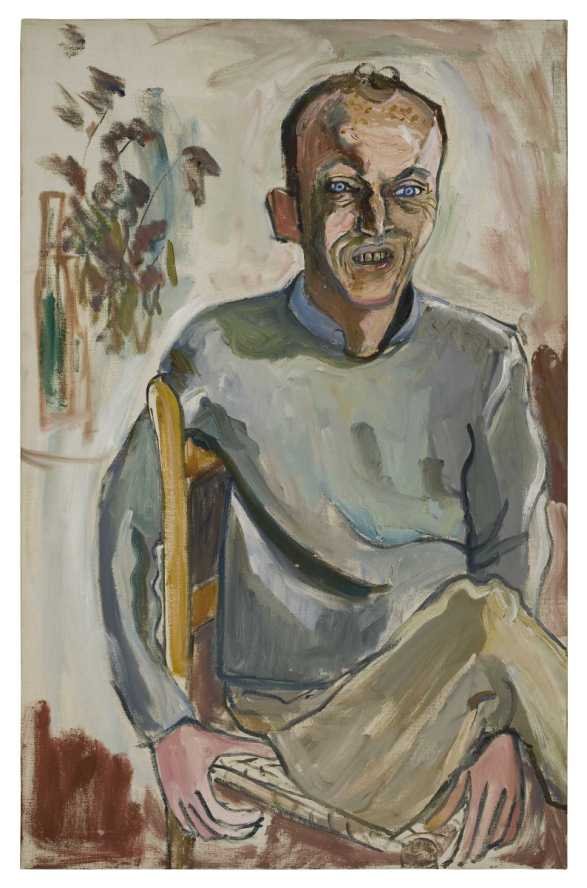
Clement B. Newbold by Cecilia Beaux (1912)

Jean-Adolph was devastated and inconsolable by his wife’s death, so much so, he could not endure the heartache and returned to the comfort of his family in Nimes, leaving his company to be run by his brother Edmund and left his two children to the care of his mother-in-law, Cecilia Kent Leavitt, who had also lost a dear one two years earlier, with the death of her husband, John Wheeler Leavitt. Can you imagine how this all affected the two children, Etta and Cecilia? Aimée Ernesta (Etta) Beaux had witnessed the birth of her sister, quickly followed by the death of her mother, and then the departure of her father back to France. Can you understand that the irrevocable change in the structure of her family must have been a frightening and confusing event? Jean-Adolph stayed away from his children for two years, not returning to Philadelphia until 1857, at which time Cecilia and Etta were two and five years of age and living with their maternal grandmother and her four remaining children, who hadn’t flown the nest, Eliza, Samuel, Charles, and Emily.  On his return to America, Jean-Adolph had much to repair in his relationship with his children and his mother-in-law as well as attempt to set himself in business, once again. He achieved little on both these fronts although he did work for his old family company, J.P. Beaux & Co., Sewing Silks. Although the company prospered his charm offensive with the Leavitt family failed. They never forgave this “foreigner” for abandoning his children and his mother-in-law whom he was living with never considered him a fit father to his children and slowly took charge of the future of her two grandchildren, despite having had to rear eight children of her own. Rightly or wrongly, Cecilia’s grandmother probably never held back on her adverse comments with regards her son-in-law and later in life,  Cecilia commented on this:

“…We didn’t love Papa very much, he was so foreign. We thought him peculiar…”

The relationship between Jean-Adolph and his third child Cecilia was a troubled one as he found his new-born daughter to be little more than a sad reminder and pale substitute for his cherished but sadly departed wife. One believes that when he looked upon her, he immediately thought about the death of her mother in childbirth. It had even reached the point that he could not bear to call her Cecilia (also his late wife’s name) as it brought up too many sad memories of deceased wife and so despite the family’s dislike of the idea, she was referred to as Leilie and not Cecilia. Although this may have comforted her father, in a way it stigmatised the child herself who as she grew older believed that in a way she had caused the death of her mother and was now unfit to bear her name.

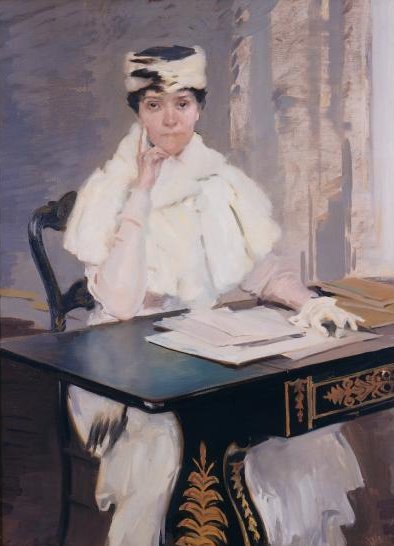
Mrs. Clement B. Newbold by Cecilia Beaux (1896)

Things went from bad to worse for Jean-Adolph. His business was failing and finally collapsed in 1860. His brother and partner in the firm, Edmund, went back to France but Jean-Adolph stayed with his children and in-laws albeit they had to move to a smaller house. Now having no business and the bringing up of his children having been “usurped” by his mother-in-law, Jean Adolph believed there was nothing left for him in Philadelphia and so he went back to France in 1861 and did not return to America for twelve years, which gives one an idea for the regard he had for his children.

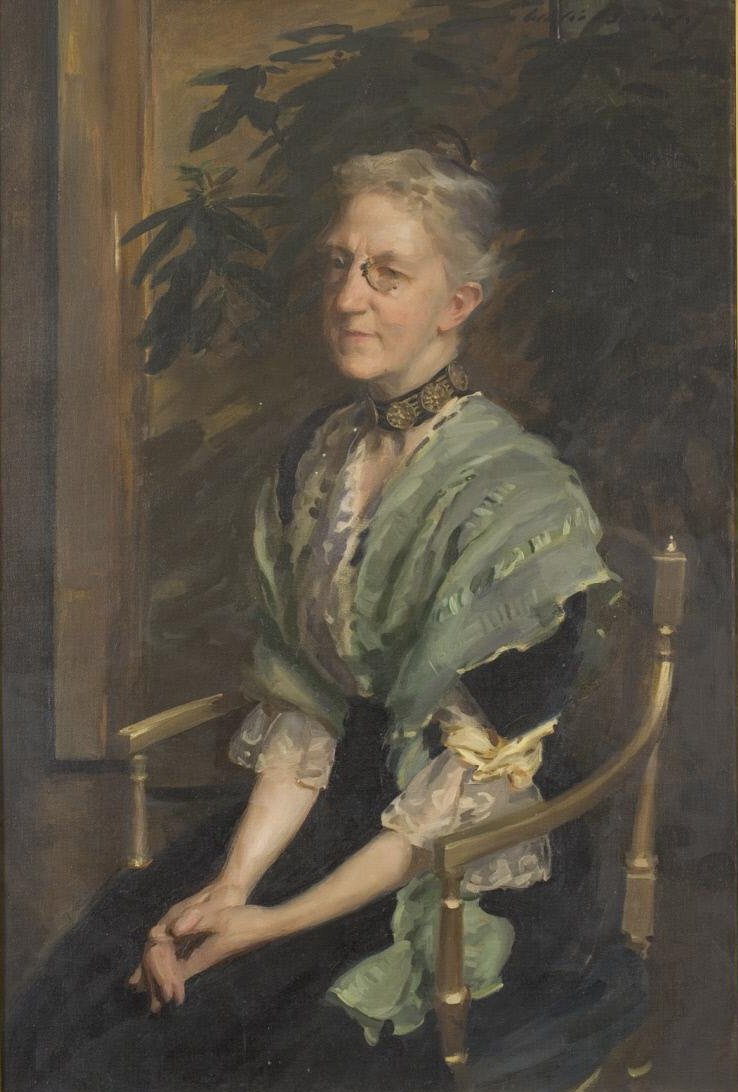
Portrait of Mrs. Samuel Hamilton Brooks by Cecilia Beaux (1911)
Founder of the Memphis Brooks Museum of Art

With the collapse of the J.P. Beaux Silk Company there was now little money coming into the Leavitt household. For Leilie it was a very sad time without a mother and father. Although she asked her grandmother and her family about her mother, their sadness meant that they were never forthcoming with information and so Leilie began to invent romantic images of her mother. Maybe her memory of her father was slightly tainted by the views of her grandmother and aunts.

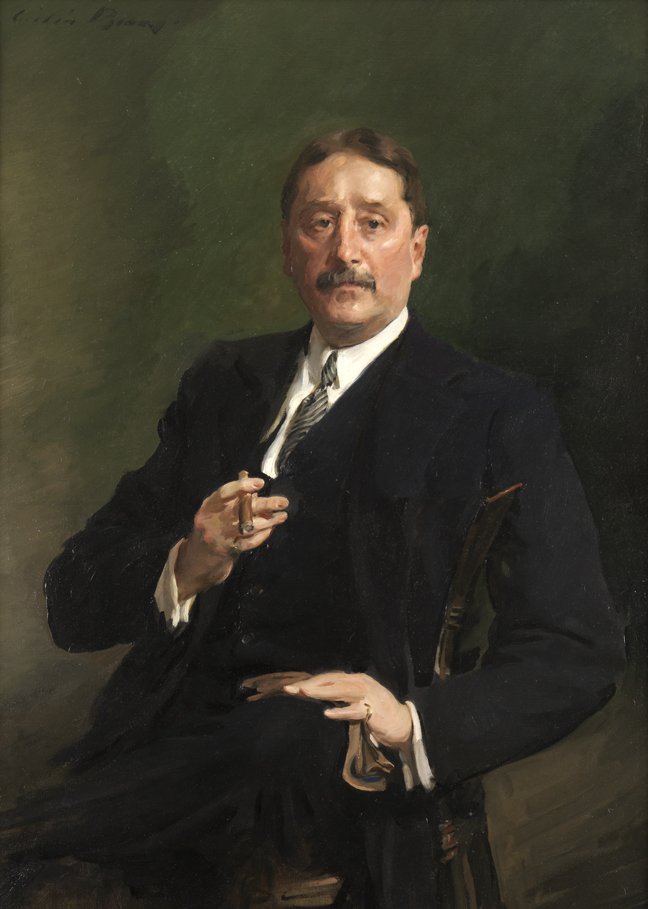
Portrait of Mr. Samuel Hamilton Brooks by Cecilia Beaux (1911)

It must be said that Leilie and her sister Etta who lived with the Leavitt family received vast amounts of love from their grandmother and their two aunts Eliza and Emily. Both girls were also very fond of their uncle Charles but often found their uncle Samuel annoying.

In 1860, Emily Leavitt, Leilie’s favourite aunt, married William Foster Biddle, an engineer by profession, and the two of them set up home. She was twenty-one and he was twenty-five. A year after their marriage, Biddle left his wife and began his military service with the rank of captain and rather than live alone, Emily returned to living with her mother, her siblings and the two Beaux girls. After completing his military service at the end of the Civil War, William Biddle was employed as a mining engineer and he and his wife Emily moved back to their own home.

Cecilia Kent Levitt ran the Leavitt household which now just comprised of her maiden daughter Eliza, and her two grandchildren, Etta and Leilia Beaux. Their aunt Emily looked after her two nieces’ education and their grandmother saw to their religious needs ensuring both girls, when they reached twelve years of age, were confirmed in the Presbyterian faith.

Half-Tide, Annisquam River by Cecilia Beaux (c.1905)
A rare example of Cecilia Beaux’s landscape work.

Cecilia Kent Leavitt, her daughter Emily and the two Beaux girls re-located on several occasions. Their frequent moves were due to Leavitt family’s deteriorating financial situation. However, through the good auspices of the son-in-law William Beadle, who rose to become vice president of Lehigh Coal & Navigation Company, their financial situation improved and this in turn lifted the family spirits of the four females. In 1873 Cecilia Kent Leavitt finally settled her family down in a house in Spruce Street, West Philadelphia. In her 1930 autobiography, Background with Figures, Leilie remembered that as a young fourteen-year-old how her Aunt Emily had shaped her life. She wrote:

“…My aunt had assisted in my education, and my uncle [Emily’s husband Walter Biddle] was to be, after my grandmother, the strongest and most beneficent influence in my life. I know that my Aunt Emily’s contribution to my bringing up had several channels. My lessons, with her, took place in the dining-room, rather a gloomy spot by day, on winter mornings, and we sat at either end of the green-felt-covered table. I am sure she labored over the sums and geography we bent over, but what remains consciously of these hours are the periods devoted to dictation. The use of the pen did not trouble me. Spelling was not one of my difficulties, and the appearance of new words, and of phrases far from anything I could have dreamed of, were a delight. Above all, and the real source of the living word enduring in this episode, was the choice…”

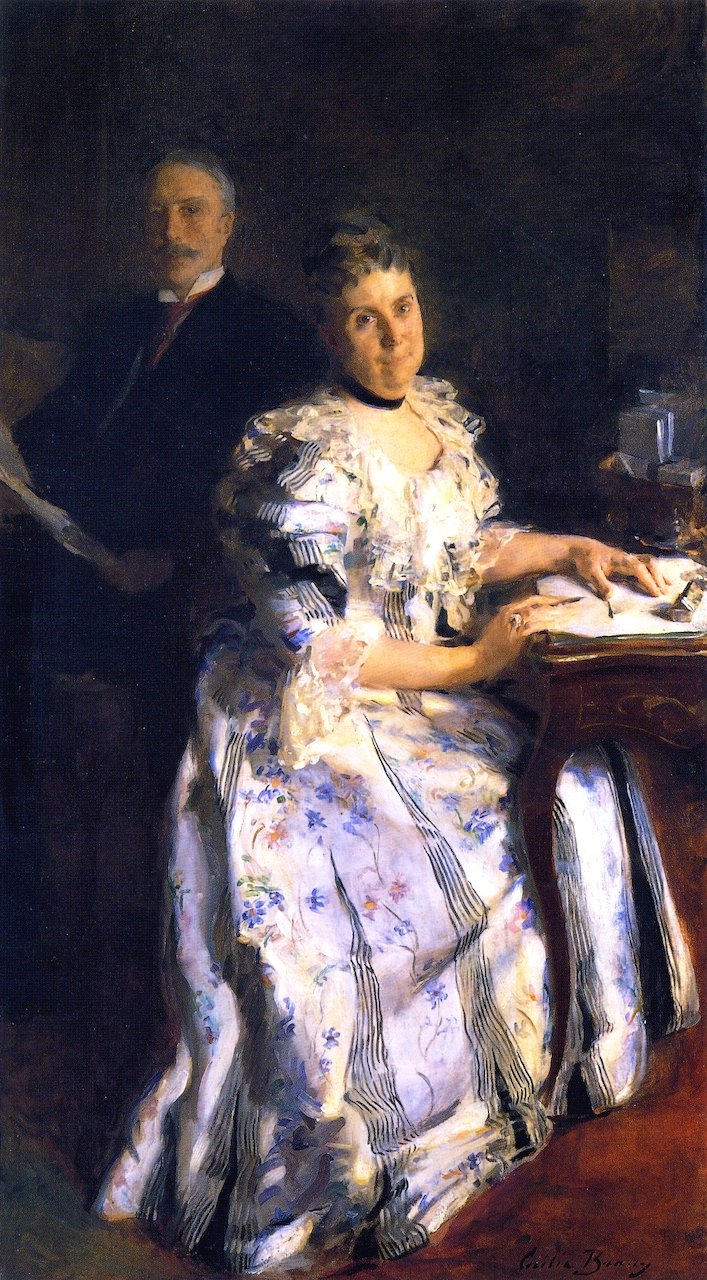
Mr. and Mrs. Anson Phelps Stokes by Cecilia Beaux (1898)
He was a wealthy American merchant, property developer, banker, and philanthropist.

Later in life Leilie told how the two greatest influences on her life were her grandmother and William Biddle. For Leilie, William was the main man in her teenage years and she relied on him for guidance and William Biddle recognised the energy and creativity of Leilie and he believed it was his job to channel this dynamism…………………………………..

……..to be continued

Mary Dawson Elwell

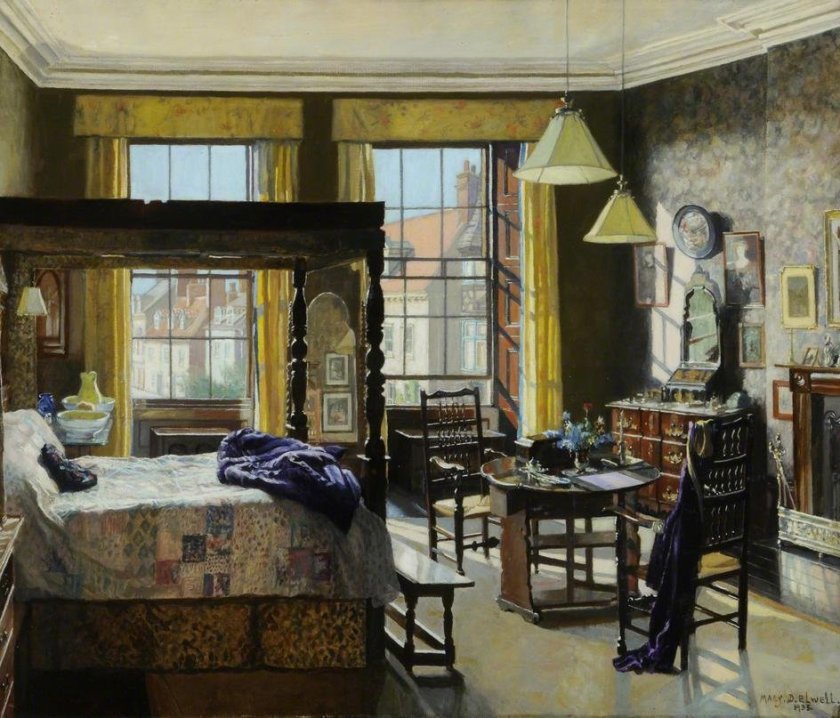
Bedroom, Bar House, Beverley, East Riding of Yorkshire by Mary Dawson Elwell (1935)

In a recent blog (My Daily Art Display, October 15th, 2017 – The Alma-Tadema Ladies. Part 2 – The Two Daughters, Anna and Laurense), I highlighted the artwork of Anna Alma-Tadema, the daughter of the great painter, Lawrence Alma-Tadema and marvelled at some of her interior paintings. In today’s blog I am going to look at another female painter who had mastered the art of depicting the interior of houses. She is the nineteenth century artist, Mary Dawson Holmes Ewell. I had featured her in a series of blogs about her husband, Frederick Elwell but for this blog I want to concentrate on her outstanding ability as an artist.

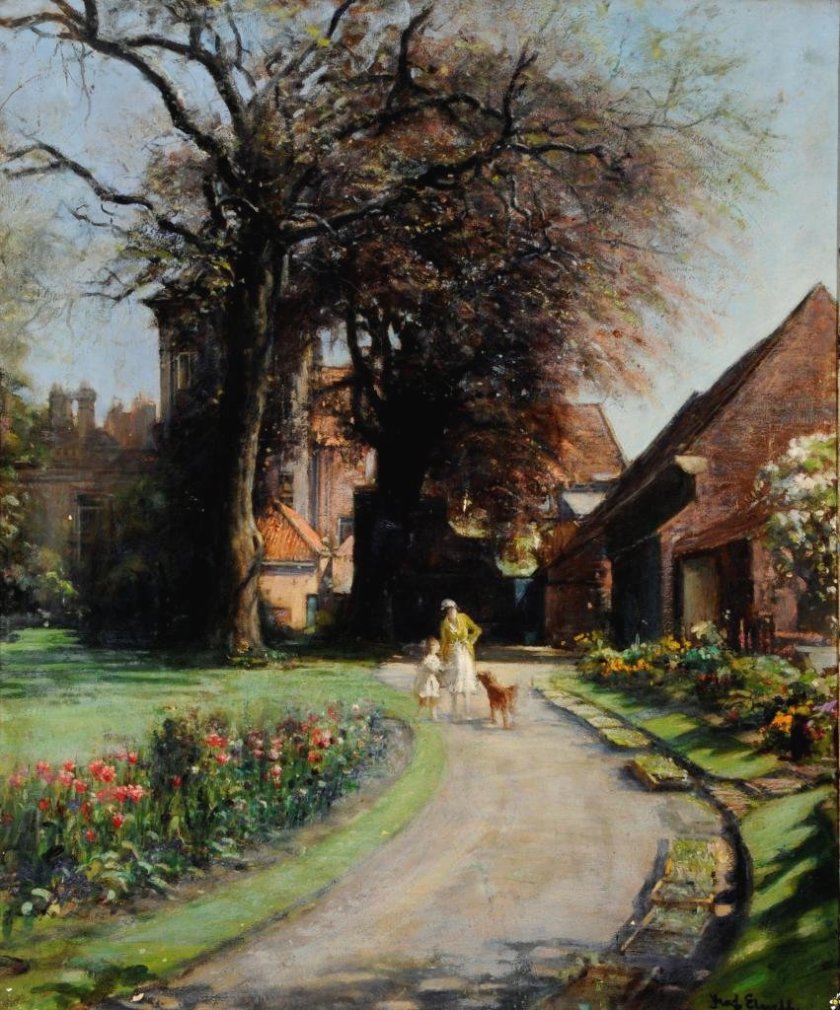
The Landing in Summer by Mary Elwell (1930)

Mary Dawson Bishop was born in Liverpool on August 13th, 1874. Her father, John Bishop, was a ship broker. Her mother, Mary Ellen Dawson, was the daughter of a Liverpool boot maker, Thomas Candlin and his wife Sarah who was a milliner and dress maker. Mary and her younger sister, Elsie, lived in the Fairfield district of Liverpool. Tragedy struck the family in 1879 when Mary’s thirty-six-year-old father died. Shortly after the death of her husband, Mary and her two daughters moved to Heaton Chapel, Manchester to live with her bachelor brother Henry who was fifteen years her senior. It was here that Mary and Elise went to kindergarten and primary school.

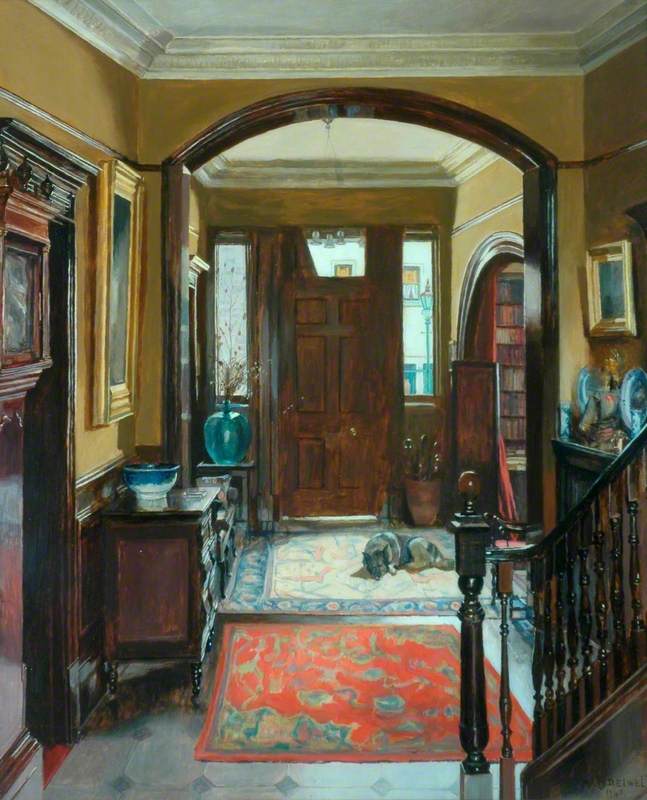
The Front Door by Mary Elwell (c.1940)

Having completed her primary schooling in 1885, eleven-year old Mary enrolled at Manchester’s prestigious Ellerslie College and it was here that she received her early artistic tuition, to ensure she had this “must-have” social skill for young Victorian ladies. The pupils attending this school were mainly from merchant families and it was probably due to Mary’s Uncle Henry and his business connections that allowed her to gain entrance to the college. Mary Bishop completed studies at Ellerslie around the early 1890’s. Not much is written about her life after leaving college but it is believed she carried on her art studies influenced by two of her uncles, Henry and Walter were not only successful business men but avid art collectors.

The next we hear of Mary Dawson Bishop was that she married George Alfred Holmes at the Church of All Saints, Heaton Norris, Stockport in June 1896. Mary was twenty-one years old and her husband George Alfred was forty-one. So why did Mary marry a man twice her age? This has been the topic of much speculation. George Alfred Holmes lived and had his office in Hull and was a prosperous oil broker and so there was the element that on her marriage to him, Mary would be financially secure. Hull, like her birthplace, was a seaport and maybe Mary looked on the prospect of living in Hull with her husband. Maybe she looked upon her husband as a father figure, having lost her own father at the age of five. But, of course, it could simply be that Mary fell in love with George Alfred Holmes.

Mary and Alfred Holmes set up their home in the small inland market town of Beverley which was just ten miles north of from Hull, a town where she would stay for the rest of her life.

It was in 1904 that Frederick Elwell was to enter the life of Mary Bishop Holmes. Following a somewhat unsuccessful period in London as far as his art sales were concerned, Fred Elwell had left London, a somewhat defeated man, and returned to Yorkshire. In the capital there were just too many artists chasing a small amount of commissions and this sudden realisation that the London streets were not paved with gold affected Elwell and there was a suggestion that he had suffered a nervous breakdown brought on by his financial situation. On hearing of his son’s state of health and financial predicament, his father travelled from Yorkshire and brought his son back to Beverley where his family and friends were and where he could expect a more profitable future.

Portrait of Frederick William Elwell by Mary Elwell (1913)

His year in London and his struggle to survive had taken a toll on him so the first thing the family had wanted him to do was to relax and enjoy the tranquillity of the Yorkshire countryside. Elwell also enjoyed the freedom offered by sailing and he would often take a small boat and cruise along Beverley Beck which joined the River Hull. Many like-minded painters would do the same as the clarity of light and the beautiful countryside including the East Riding flatlands surrounding the river was an idyllic setting for landscape artists. On occasion he would tie up the boat alongside a jetty and would welcome visitors to look at his artwork and, by so doing, would often receive commissions. Elwell’s love of landscape painting coincided with the English public’s change of attitude of what they wanted to see in a work of art. Depictions of city life were becoming less popular, displaced by depictions of the tranquillity of the countryside. This was a period when people wanted to “go back to nature”. They worked in cities but hankered for the fresh air of the countryside. They wanted to soak up country life by sailing along inland waterways or get themselves horse-drawn caravans and lose themselves in the peacefulness and serenity of the rural areas.

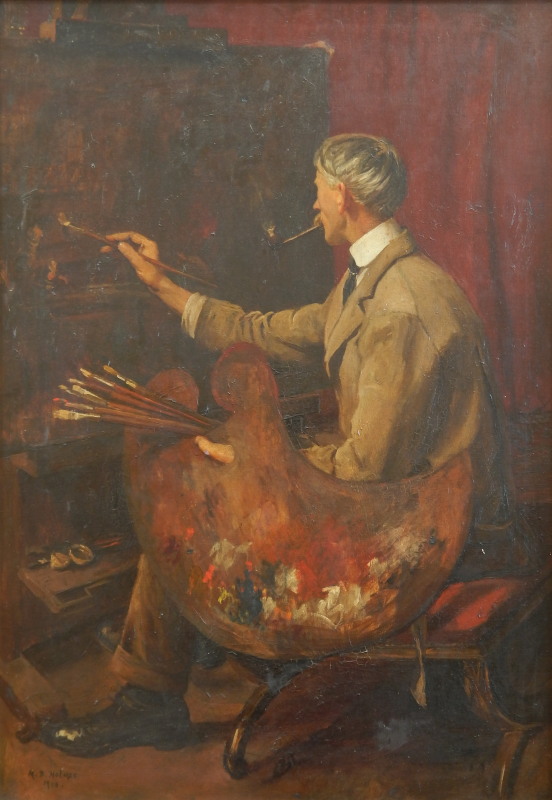
Self Portrait by Fred Elwell (1911)

For complete tranquillity Elwell made his home on a houseboat which he had borrowed from a friend. Not only did he travel up and down the river he would tie up alongside a local hostelry, the Brigham Arms, and his boat acted as his own selling gallery. He also had a “gypsy-type” horse-drawn caravan in which he would wend his way around the country lanes, sketching the beauty of the area. His artwork which depicted the tranquillity and the beauty of the Yorkshire countryside sold well and soon both his health and his finances had improved significantly.

Fred Elwell would also take on portrait commissions and often would visit the client rather than have them come to his studio. It was in 1904, that he received a visit from Alfred Holmes, a luminary of the Beverley community. Holmes asked Elwell to paint a portrait of his wife, Mary. Elwell agreed and went to the Holmes’ family home where he met Mary Holmes for the first time.

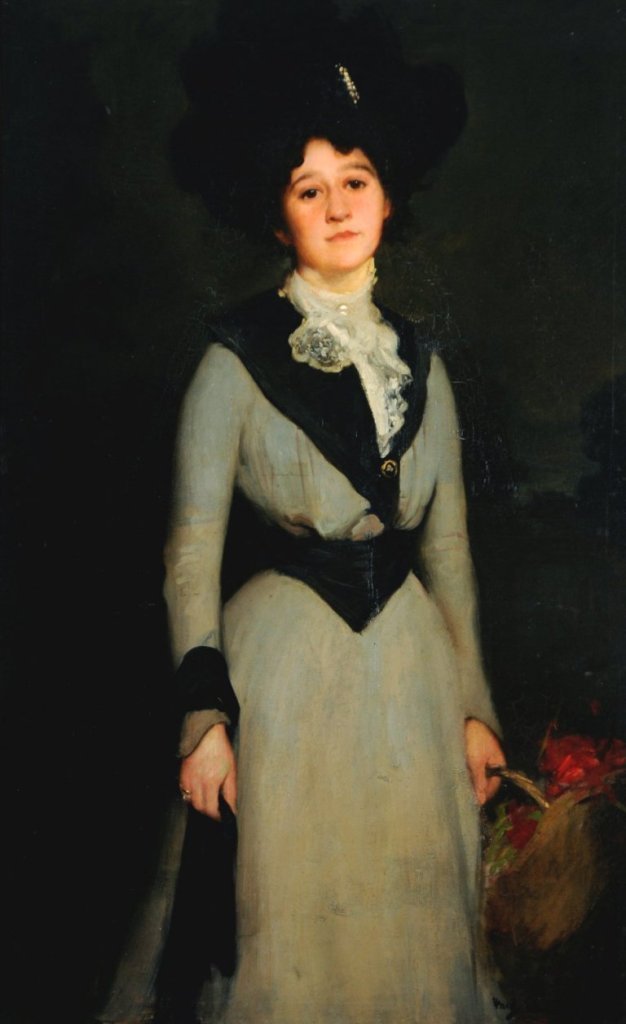
Mary Dawson Holmes by Frederick William Elwell (1904)

Elwell completed the Portrait of Mary Dawson Holmes that year and had it exhibited at the Royal Academy. It is a beautiful work of portraiture with Mary shown as a lady of gracious elegance. Her clothes remind one of the French fashion of the time. We see her adorned in a tight-fitting dress finished off with a fine white lace collar. She tilts her head to one side but holds an upright stance. Her eyes are dark and almond-shaped. Her expression teases us into imagining her thoughts. Does she look a willing participant as a model for this portrait? There is a hint of reticence in her facial expression. Was she unwilling to sit for Elwell or was it simply that she was shy and slightly embarrassed with all the attention.

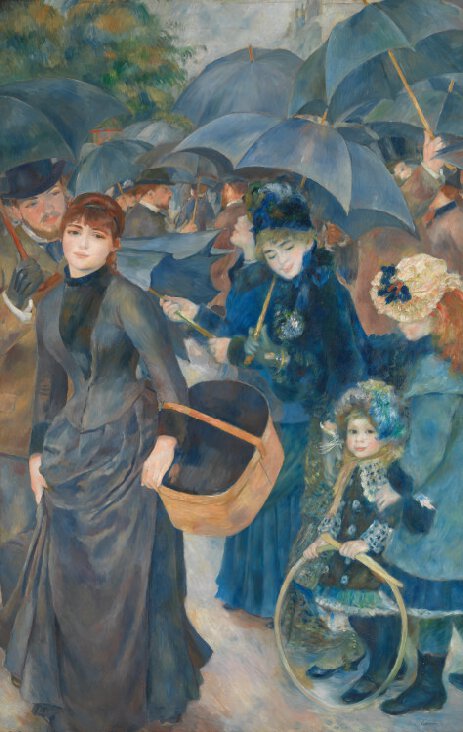
Les Parapluies by Renoir (c.1886)

The depiction of Mary has often been compared to Renoir’s 1886 work Les Parapluies, which Elwell would have seen, because of the similarity between the way Mary stands, tilts her head, and similarly carries a basket.

In the Trossachs by Mary Elwell (c.1900)

Alfred and Mary Holmes became good friends of Fred Elwell and they even had joint ownership of a sailing boat and the three of them took many trips on the Beverley Beck to the upper reaches of the River Hull, a tributary of the Humber. The three of them would often travel to Europe, visiting Venice and Switzerland where Fred Elwell and Mary Holmes would take the opportunity to sketch and paint the local landscapes.

The Wreath by Mary Elwell (1909)

Mary had her work exhibited at the Royal Academy from 1904 onwards and in 1908 she completed one of her most famous works, The Wreath, which was on display at the 1909 Royal Academy annual exhibition. It depicts a recently widowed woman grieving for the loss of a loved one. Queen Victoria had died in 1901 and this solemn period and the Victorian period prior to her death saw many artists concentrate on human loss and the grief felt when a loved one died. Queen Victoria suffered the loss of her beloved husband, Albert in 1861, and continually wore mourning clothes for ten years after he died. Many paintings compared the happiness of life before the death of a loved one with the inconsolable grief of those left behind. Violet Prest, a local girl, a costumier of Minster Moorgate West, in Beverley, modelled the woman in the painting. Ironically, six years after the painting was completed, her husband was killed in the Great War.

Chamonix, France by Mary Elwell (1938)

She was a much-admired artist and her popularity as an artist and that of Fred Elwell rose amongst the public and the art critics. Mary, and her future husband, Elwell, as far as their artistic ability was concerned, should never be looked upon as pupil and master as was the dictate of social expectation in the early twentieth century. They were truly equals.

A Quiet Hour by Mary Elwell (1942)

The health of Alfred Holmes began to deteriorate in 1910 and he sold his business and gave up his part ownership with Fred Elwell of their beloved sailing boat. That year May and Alfred moved from their large Westwood Road house in Beverley and bought Bar House which was also in Beverley, situated on North Bar Within. Alfred Holmes’ health had got so bad that by 1913 he realised he was dying and it is thought that due to his very close friendship with Fred Elwell he intimated that Elwell and Mary should get together when he died. George Alfred Holmes died on August 5th, 1913 aged just fifty-eight, leaving his widow comfortably provided for and allowing her to employ staff to help run the house.

North Bar Within, Beverley, East Riding of Yorkshire by Mary Elwell. (1916)

Holmes’ dying wish with regards his wife and Fred Elwell came to fruition on September 28th, 1914 when they married, and Elwell came to live with his new wife at her beloved Bar House. In 1916 Mary Elwell painted a scene entitled North Bar Within, Beverley which depicted a view from the front steps of Bar House. It is interesting work set during an overcast day and one of predominantly brown tones.

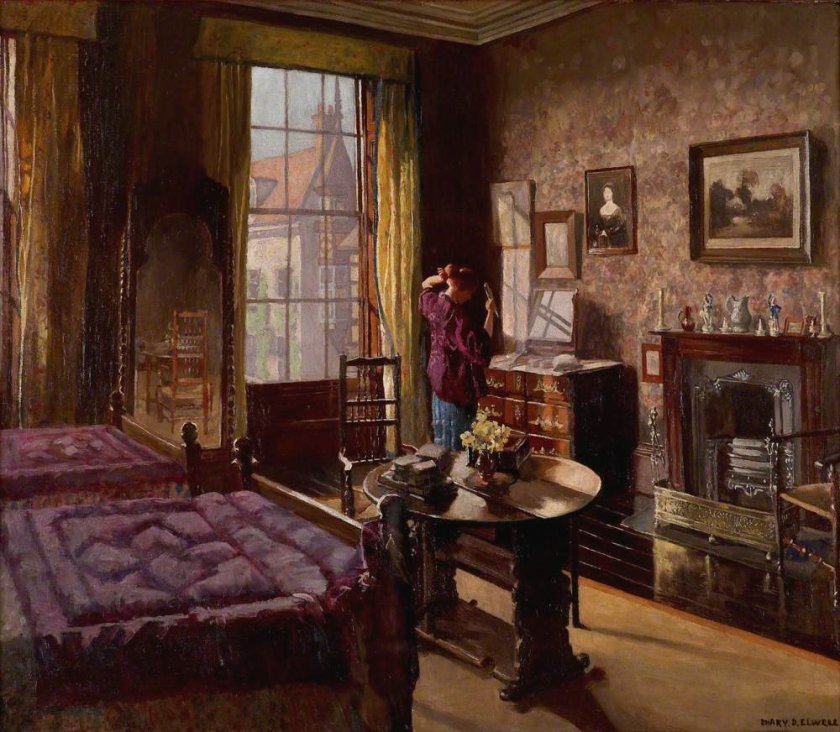
At the Mirror or Bedroom, Bar House by Mary Elwell

Mary painted many depictions of Bar House including a bedroom scene, which was entitled At the Mirror. There are two large double beds each covered with a purple quilt. In the central background there is a large window which frames the view of Wylies House. The using of a window as a framing device for a townscape was very popular at the time and was typical of the practice of the Camden Town Group of artists. It allowed viewers to catch a glimpse of the outside world, seen through the framing device of a window. The large full-length mirror, next to the window, reveals a reflection of the room. The light which shines through the windows of the room lights it up and the polished brass fender casts its reflection on the dark polished wooden floor. To the right of the window, we see a young woman standing before a mirror attending to her hair. She is oblivious of the outside world that we see through the window. The model used by Mary for this work was Annie Towse, the daughter of one of their employees.

Bar House Garden by Fred Elwell (1914)

Mary’s mother, Mary Ellen Bishop had died in 1901 and Mary Elwell’s uncles Henry and Walter died in 1917 and 1924. Neither had married and their wealth and properties were divided between Mary Elwell and her sister Elsie. Mary also received her late uncle’s art collection.

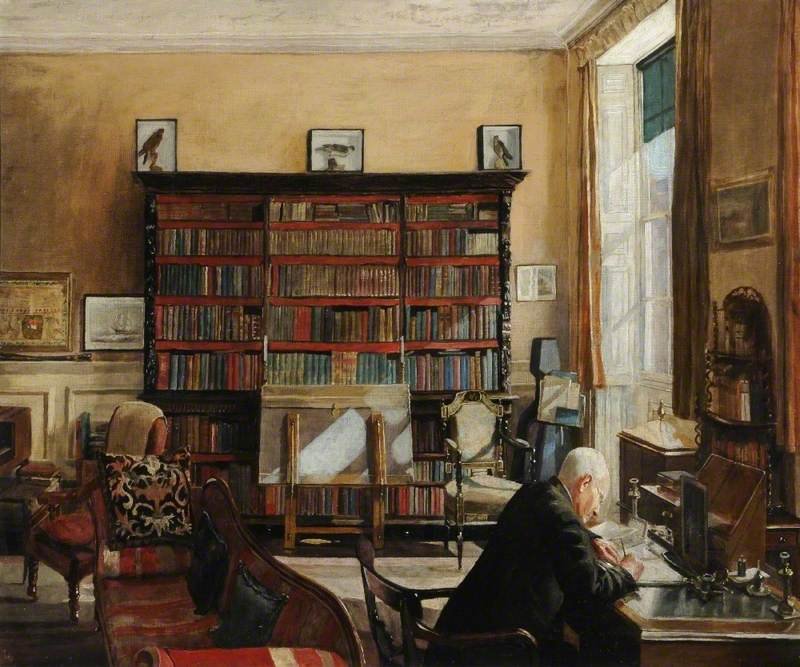
Interior Study by Mary Elwell (1937)

One of my favourite interior works by Mary Elwell is one she completed in the 1932 entitled At No.14 Newbegin, Beverley with an alternative title Interior Study. It is a depiction of a sitting room at No.14 Newbegin a house belonging to Reverend Wigfall the curate at Beverley Minster, who we see sitting at his writing desk. The room itself was light due to it having three large windows. The window we see in the painting allows a shaft of light into the room illuminating the large ornately carved bookcase on top of which are three glass cases, each of which contain stuffed birds. A cushion with its bold design and rich colours is placed for decorative effect on the arm of the sofa. The richness of colour of this painting is brought about by the liberal use of reds. The painting was exhibited at the Royal Academy in 1932.

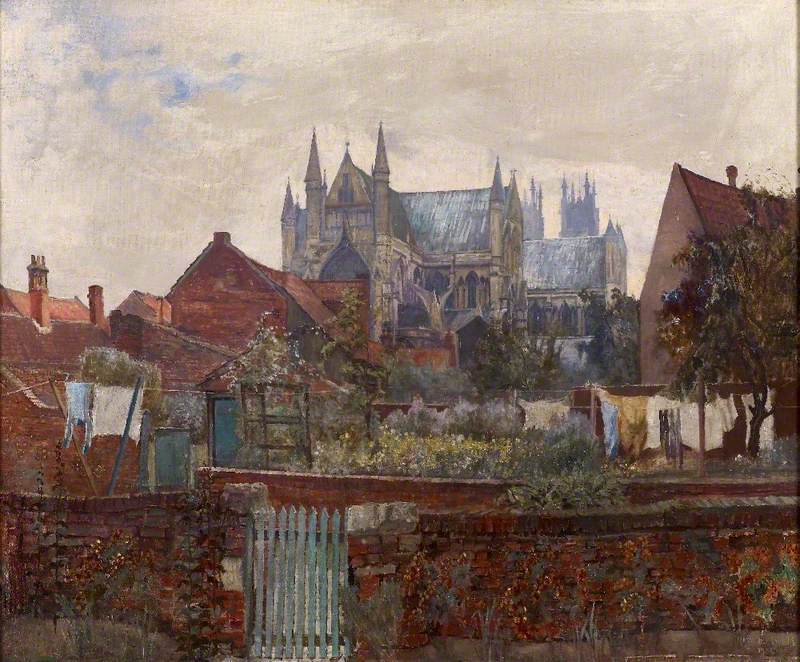
Beverley Minster from the Friary, by Mary Elwell (1934)

Beverley Minster from the Friary is a painting Mary Elwell completed in 1934. It is a comparative composition. The imposing edifice of Beverley Minster looms over the modest dwellings we see in the middle ground, which lie close to the railway track. The gable ends of the houses in the middle ground seem to reiterate the shape of the Minster’s transept. Elwell captures the spirit of the time with her depiction of the washing lines laden with clothes in the back yards of the houses. One of the houses on the right was occupied by Miss Woodmansey who ran a wash-house and who would, after washing the clothes, hang them out in her back yard, every day except Sunday. The painting was exhibited at the Royal Academy in 1934.

Matterhorn from Zermatt, Switzerland by Mary Elwell (1939)

In 1947 Mary suffered the first of a series of debilitating strokes which meant that she had to have round the clock nursing.  Her sister Elsie came to stay for longer periods.   Having made her final appearance at the Royal Academy in 1949, she withdrew from the world outside.  Mary Dawson Elwell died on the 28th August 1952, aged a fortnight before her seventy-eighth birthday.  She was buried in Saint Mary’s Cemetery in Beverley and according to her husband’s wish her gravestone was carved with an artist’s palette.. Her second husband, Fred Elwell died in January 1958 and was laid to rest in the same grave.

Fred Elwell gave a number of her paintings away to people who had cared for her, inscribing them:

“…in grateful remembrance of Mary D. Elwell…”

The Alma-Tadema Ladies. Part 2 – The Two Daughters, Anna and Laurense.

(Detail from full-length portrait) Miss Anna Alma-Tadema by Lawrence Alma-Tadema (1883)

In my last blog I looked at the lives of Lawrence Alma-Tadema’s two wives, Marie-Pauline Gressin-Dumoulin de Boisgirard and Laura Theresa Epps and how, in a way their two lives were intertwined.  In this second part of the blog I am looking at Alma-Tadema’s Ladies but in this blog I am looking at the lives of his two daughters, Laurense and Anna Alma-Tadema.

In the painting above, entitled Miss Anna Alma-Tadema, which her father completed in 1883 we see fifteen year old Anna, standing at the door of the library at Townshend House.  In her hand is a vase of carnations and she wears an Aesthetic dress probably made of Indian cotton, with a shell necklace.  Look how the artist has mastered the depiction of the different textures of the various surfaces whether it be clothes or inanimate objects.

Hall in Townshend House by Ellen Epps (1873)
Painting of Laurense and Anna painted by the sister of their step-mother

On September 24th, 1863, twenty-seven-year-old Laurens Alma-Tadema married a French lady, Marie-Pauline Gressin-Dumoulin de Boisgirard in Antwerp City Hall and the couple went on to have three children.  Their first-born, a son, died aged six months of smallpox.  The couple then went on to have two daughters, Laurense in August 1865 and Anna in 1867.  Both children were born in Brussels.

Laurense, Anna, their father, and his sister Atje moved to London in 1870, a year after Marie-Pauline’s death.  Lawrence Alma-Tadema re-married in 1871.  His second wife, who was sixteen years younger than him, was Laura Epps the English daughter of a homeopathic doctor.   Laurense and Anna were home-schooled by their father and step-mother.

Sir Lawrence Alma-Tadema – The Sculpture Gallery (1874)

In 1874 Lawrence Alma-Tadema painted one of his largest works, The Sculpture Gallery which measured 223 x 174cms.  In this work, which depicts an Ancient Roman temple setting, he has included depictions of his two wives and two children as well as himself.  We see his second wife Laura Theresa wearing a gold armlet in the centre of the work, and to the right of her are her two children Laurense and Anna.  Lawrence Alma-Tadema is seated on the left and to his right, sitting upright hold a purple feather fan is thought to be a portrayal of his late wife, Marie-Pauline Gressin-Dumoulin de Boisgirard who died five years earlier.

Sir Lawrence Alma-Tadema’s Study, Townshend House, London, (1884)

Anna developed her father’s and step-mother’s love of art and by the age of seventeen had become a talented artist.  She focused on painting the elaborate interiors of the family home, as well as portraits and flower paintings. Her gift as an artist can be seen in a set of watercolour and pen and ink depictions she completed in 1884 and 1885 of the family’s first London home, Townshend House close to Regents Park.  The detail is truly amazing and these works were almost certainly due to the influence of her father.   Her painting entitled Sir Lawrence Alma-Tadema’s Study in Townshend House, London was completed by Anna in 1884.  The interior of Townshend House was designed and furnished by her father.  He managed to create a set of ornate and diverse interiors in a variety of styles ranging from traditional Dutch to Egyptian, Ancient Greek, Pompeiian, Byzantine, and Japanese based on his journeys.  The setting in this work is the interior of a comfortable library.  The intricate detail amazes me.  At the back of the room we see a very comfortable couch made even more so with the addition of a fur covering. It is almost a day-bed to be used by a weary reader who has come to the library for some peace and quiet.  The room is bright due to its dual aspect stained-glass windows and in the evening the candle-lights of the bronze chandelier, which Alma-Tadema designed, will illuminate the room.  The room has many pieces of heavy Dutch oak furniture which probably reminded Anna’s father of his birthplace.   On the ceiling to the left there seems to be a Japanese lantern or it could be an upturned parasol.  The floor is covered by a tatami matting, which was used as a flooring material in traditional Japanese-style rooms.  Hanging from the fireplace is a large palm leaf fan and on top of the fireplace mantle is a vase full of peacock feathers.  Just take your time and look at everything that Anna has painstakingly depicted in this very busy room.

The Drawing Room, Townshend House by Anna Alma-Tadema (1885),

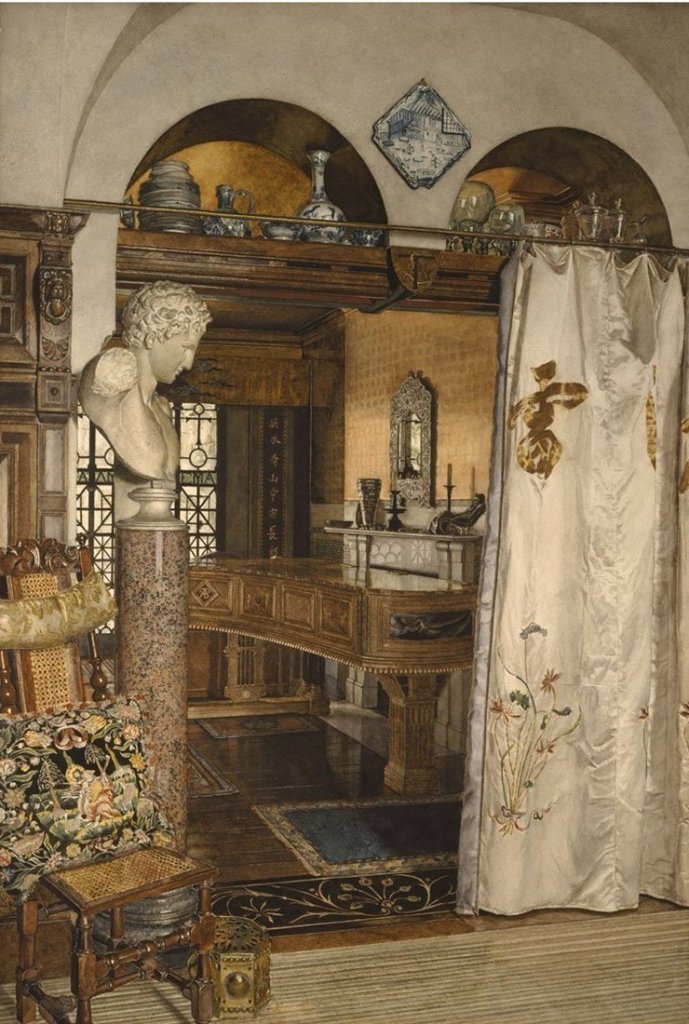
In a small (27 x 19cms) watercolour and ink painting The Drawing Room which Anna completed in 1885 we see another room in Townshend House.   We are standing in the Gold Room and looking through the archway into the Columned Drawing Room albeit the columns themselves are hidden.   In the work we see one of a suite of ornate drawing rooms in the family’s home.  In this work take a close look and see how she has mastered light and the texture of the objects.  Look at how she has depicted the full-length brocade curtain which seems to act as a room-divider.  Look at the way she has illustrated the shiny surface of the floor lit by a light source emanating from an unseen window to the right.  Anna exhibited at the Grosvenor Gallery in 1886 and exhibited at the World’s Columbian Exposition in Chicago, in 1893.

The Gold Room by Anna Alma-Tadema (1884)

Finally, we have her work entitled The Gold Room which she completed in 1884.   This watercolour depicts a view into the Gold Room which was named thus because its walls were overlaid with gold leaf.  The centre of the painting is dominated by the large ornate piano which has inlays of ivory and tortoiseshell.  On the right we see a sumptuous full-length curtain made of Chinese silk.  If you look carefully at the window in the background you will see that the leading of it forms the family name, “Alma-Tadema”.  We cannot but be amazed by the talent of this seventeen-year-old girl at how she has managed to create the rich and bright surfaces we see as well as the various textures of the objects.  The inclusion of an antique bust on a pedestal was probably testament to her father’s interest in Roman and Greek history.  The painting was shown at the 1885 Royal Academy exhibition and is housed at the Nelson-Atkins Museum of Art in Kansas City Missouri.

Eton College Chapel by Anna Alma-Tadema

Another 1885 painting highlighted Anna’s ability to replicate detail onto canvas.  It was her watercolour work entitled Eton College Chapel which she completed when she was just twenty years of age and was exhibited at the Royal Academy.  Of Anna and her great artistic skill her father’s biographer, Helen Zimmerman, wrote in her 1902 biography, Sir Lawrence Alma-Tadema R.A., that she was:

“…a delicate, dainty artist who has inherited much of her father’s power for reproducing detail…”

The Closing Door by Anna Alma-Tadema

In 1886, the family moved to a larger house, No. 17 Grove End Road, St. John’s Wood, London, which had previously been owned by the painter James Tissot.  Anna’s father carried out major refurbishments to the house and had extra studios added so that all four in the family could paint!   A room, thought to be on the upper floor in this house was the setting for Anna’s 1899 painting, The Closing Door.  It is a beautiful painting, full of mystery and atmosphere.  Once one has enjoyed the detail of the inanimate objects in the room our gaze goes to the central character of this work, the lady and soon our head is filled with questions.  So what story is unfolding before us?  Look at the woman – how is she feeling and why?  I suppose we recognise that something has badly upset her.  Look how she has roughly grasped the bead necklace and broken it.  If you look carefully you can see beads on the carpet.  Look at her facial expression –wretchedness, bewilderment, and fear are all recognisable.  So, what has brought her to this state of bleak despondency.  A lover’s tiff, a break-up of a relationship?  All possible.  Maybe if we look at some of the objects on the table we may get a clue.  A small vase of anemones symbolising the death of a loved one for in Greek mythology, the anemone sprang from Aphrodite’s tears as she mourned the death of Adonis.  In Victorian times, the anemone was looked upon as a symbol of dying love or departure of a loved one to the “point of no return”.  So, has her “loved one” died or abandoned her?  Next to the vase is a bottle of violet ink, the colour of which has associations with modesty and humility which probably tells us more about the lady herself.  The final mystery associated with this painting is the door.  Look closely at it and you will see fingers grasping it as if to close it.  Is this another sign of somebody “leaving”?  Or is this somebody about to enter which is causing the lady to be afraid?  So many questions and only the artist knows the answers.

Girl in a Bonnet with her Head on a Blue Pillow by Anna Alma-Tadema (1902),

In 1902 Anna Alma-Tadema painted Girl in a Bonnet with Her Head on Blue Pillow   It is a haunting painting with the girl seeming to stare at us as we observe the work but, on closer scrutiny, it is a blank stare.  She shows little interest at what is going on her around her.  Something is troubling her.  She feels helpless and alone.  Her hands are clasped tightly together in a pleading manner.  What solace does she crave? We, the observers, want to help her but how?  Is this simply about an unknown stranger or is this about the artist herself and her mood?

Following the death of her father in 1912, the value of his paintings fell drastically, and this loss of family revenue adversely affected the finances of his two daughters who lived their latter years in poverty.  Anna Alma-Tadema, who never married, died in 1943, aged seventy-six.

Photograph of Laurence Alma-Tadema from the US Library of Congress

Anna’s elder sister was born Laurense Alma-Tadema in August 1865 but she is always referred to as Laurence Alma-Tadema.  For this portion of the blog there will be few paintings as Laurence, unlike her sister, father and step-mother was not an artist.

Love’s Dream by Laurence Alma-Tadema

She was a novelist, playwright, short story writer, and poet. Her first novel, Love’s Martyr was published in 1886.  She wrote in various genres during the late nineteenth and the early twentieth centuries.

The Yellow Book periodical

She also submitted work to various periodicals such as The Yellow Book, a British quarterly literary periodical that was published in London from 1894 to 1897.  She also edited a periodical.  Many of her works were privately printed.

She left the family home and went to live in the Kent village of Wittersham in a cottage named The Fair Haven.  She became an active member of the local community, and involved herself with music and plays.  She even had a place built which could accommodate a hundred people and was to be used by the villagers to stage music concerts and plays and where the children of the village could be taught many local handicrafts.  She named it the Hall of Happy Hours.  In 1907 and 1908 she gave a series of readings in America on her literary work The Meaning of Happiness, which proved to be very well-liked by her American audiences.

World War I Propaganda Poster

She was an ardent activist and often spoke on the plight of the Polish people who were being displaced from their homes by the Austro-German troops in World War I.  She was a close friend and ardent admirer of Jan Paderewski, the Polish concert pianist and composer, politician, and spokesman for Polish independence.  Laurense was secretary of the Poland and the Polish Victims Relief Fund from 1915 to 1939 and her name appeared on many of their propaganda posters.  On her book tour in America, she spoke on the plight of the divided Poland and asked her audience to support the Polish people’s cause.

Laurense died in a nursing home in London on March 12th 1940, aged seventy-five.  Laurense like her sister Anna never married and one wonders whether either ever loved somebody and whether they missed “married bliss”.   Laurense’s poem If One Ever Marries Me would make one believe at least she was resigned to a solitary life.

 If no one ever marries me,—

And I don’t see why they should,

For nurse says I’m not pretty,

And I’m seldom very good—

 If no one ever marries me

I shan’t mind very much;

I shall buy a squirrel in a cage,

And a little rabbit-hutch:

 I shall have a cottage near a wood,

And a pony all my own,

And a little lamb quite clean and tame,

That I can take to town:

 And when I’m getting really old,—

At twenty-eight or nine—

I shall buy a little orphan-girl

And bring her up as mine.

————————–

I visited the exhibition At Home in Antiquity which features many paintings by Lawrence Alma-Tadema.   It is being held in London at the Leighton House Museum until October 29th.  It is a “must-see” exhibition of Lawrence Alma-Tadema’s works as well as works by his daughter and second wife.


Josefina Holmlund

Just in case you haven’t read my previous blog featuring the Welsh artist,  Sally Moore, let me explain why this blog, like the previous one, is much shorter in length than my usual ramblings.

When I decide on a subject for my blog I look for three criteria to be met.  Firstly, and on a personal note, I need to be interested in the person or their art.  Secondly, I need to be able to find enough information with regards the life of the artist and their family upbringing and lastly, I need to have enough copies of their works to be able to populate the blog.  Without all three criteria, I tend to reluctantly disregard the artist as the subject of my blogs.  Having said this blog and the last one featured two artists but  did not meet with all the criteria – the missing criterium is the limited information I have about their life, but because I liked their work so much I decided to feature them albeit in much shorter blogs.  Today I am looking at the life and work of the nineteenth century Swedish landscape painter, Josefina Holmlund.

Josefina Holmlund

Josefina Holmlund was born in Stockholm in 1827.  Her parents were Nils Holmlund and Johanna Helena Holmlund (née Torsslow) and she had one sister, Jeanette.  Josefina trained as a painter and studied under Teodor Billing, a former student of the Royal Academy of Fine Arts in Stockholm who was a realist landscape painter and who depicted many scenes from Skåne, Lapland and Värmland.  Her other tutor in those early days was Olof Hermelin, who was an ardent advocate for national Swedish values ​​and became a prominent portrayer of the domestic landscape mainly in Uppland and Södermanland

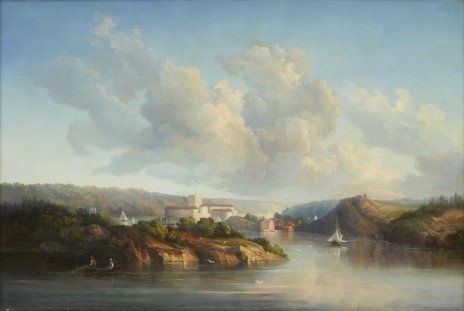
Vaxholm fortress by Josefina Holmlund

In the 1850’s, Josefina attended the Royal Academy of Fine Art in Stockholm where one of her professors was Edvard Bergh who started his career in law but later studied at the Royal Academy in Stockholm.  He founded the landscaping school at the Royal Academy and this school was characterised by the Swedish landscape painting of the time.  The fact that Josefina studied art at the Academy is unusual as the establishment did not officially allow entry for women before 1864.

In 1863, aged thirty-six, she travelled to Dusseldorf and went to live with her sister Jeanette.  Jeanette Holmlund who was also a painter had married the Norwegian landscape painter Nils Björnsson Möller.  Whilst living with them Josefina became influenced by her brother-in-law’s art.  She continued with her artistic studies and became strongly influenced by the “Dusseldorf School of painting”, which referred to a group of painters who either taught or studied at the Düsseldorf Academy of Art in the 1830s and 1840s, when the Academy was directed by the German Romantic painter Wilhelm von Schadow. The work of the Düsseldorf School is typified by finely meticulous yet imaginary landscapes.  Such landscapes often had religious or allegorical stories set in the landscapes. Members of the Düsseldorf School were great believers in plein air painting, and tended to use a palette with relatively subdued and even colours. that was a national romantic emphasis that depicted dramatic nature scenes, waterfalls and rapids with rocks.

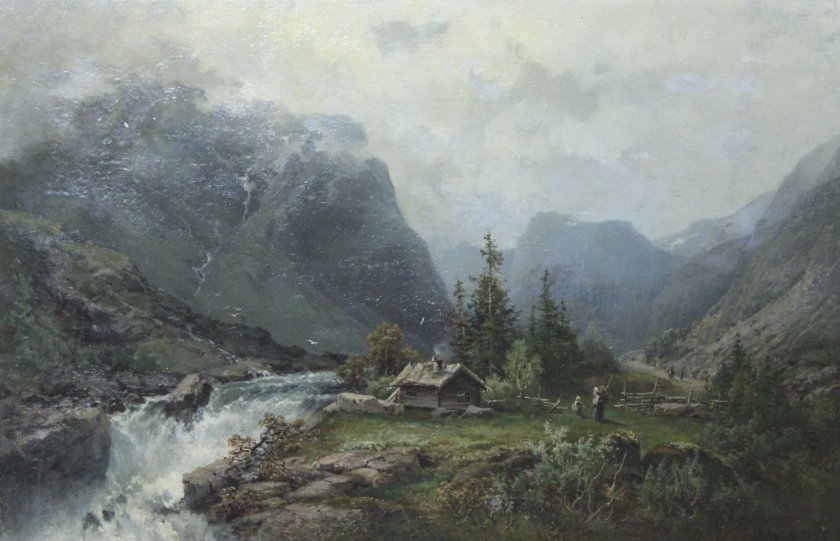
Mountain Landscape with Rapids by Josefina Holmlund

Josefina captured the starkness of life in the mountains and the ferocity of the rapids in her painting, Mountain Landscape with Rapids in which we see the fast flowing water of the rapids fall spectacularly over a waterfall at the side of which is a small, log-built cottage, with smoke billowing from the chimney.  By the side of it a lady, laden with wood she has collected heads home.

The Düsseldorf School emerged as part of the German Romantic movement.  Depictions by these artists had a national romantic emphasis that depicted dramatic nature scenes, waterfalls and rapids with rocks.  One can see in some of Josefina Holmlund’s paintings the influence of the Dusseldorf School.

She went on to make many trips to Holland, Norway and Scandinavia and the breath-taking countryside she discovered during her many journeys featured in her landscape works.

Josefina Holmlund never married and died in 1907, aged 78.

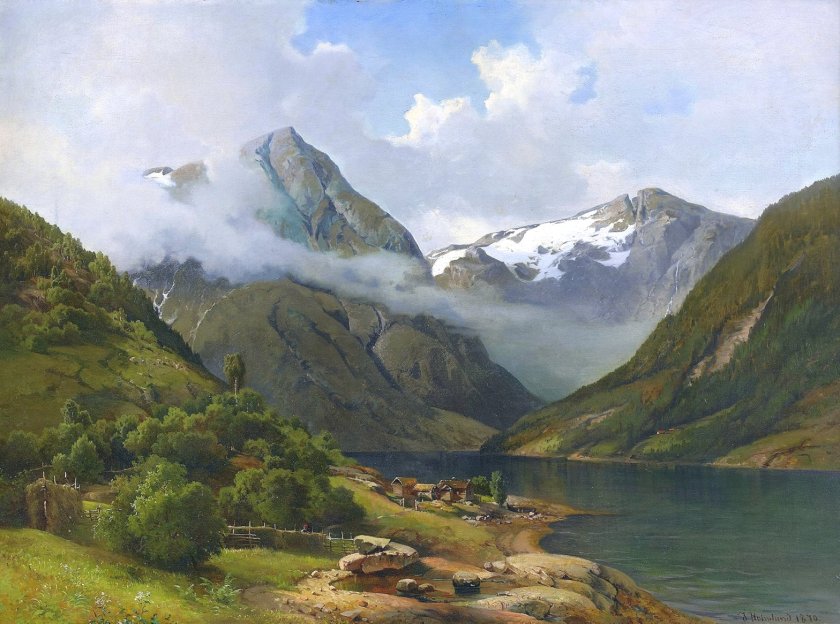
Fjord Landscape with Farm by Josefina Holmlund (1870)

Many of her landscape paintings featured the breath-taking “V” shaped fjords such as Fjord Landscape with Farm, the one she completed in 1870.  There is a beautiful tranquillity about this depiction.

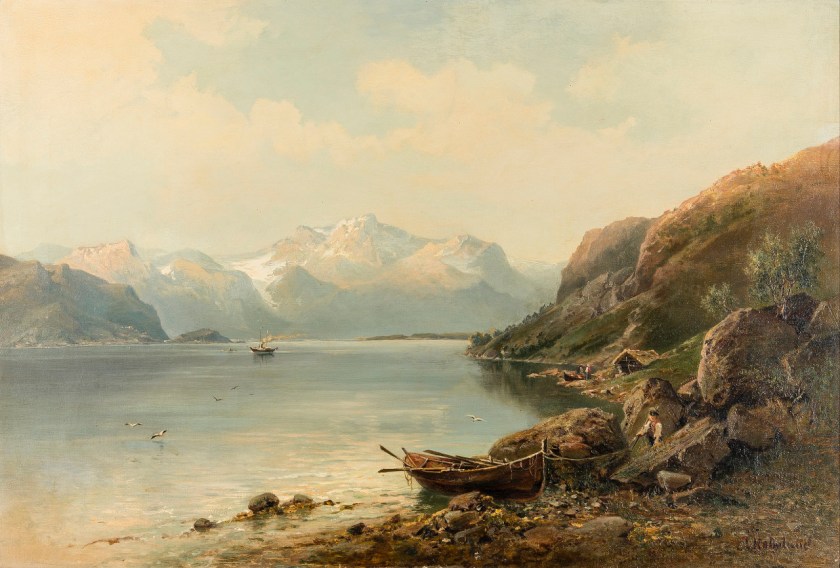
Fjord Landscape by Josefina Holmlund

Another painting of hers which I like is one featuring the tranquillity of the fjord which has lost its “V” shape as it is further from its source and closer to the sea.  In this work we see a steamer, puffing out smoke from its tall funnel as it chugs across the wide expanse of water.  In the right foreground we see a man making his way down to his row-boat.  On the bank of the fjord on the right mid-ground of the painting we can just make out a man and woman standing next to their boat and boathouse.

Kustbild med Båt (Coastel Scene with Boat) by Josefina Holmlund (1879)

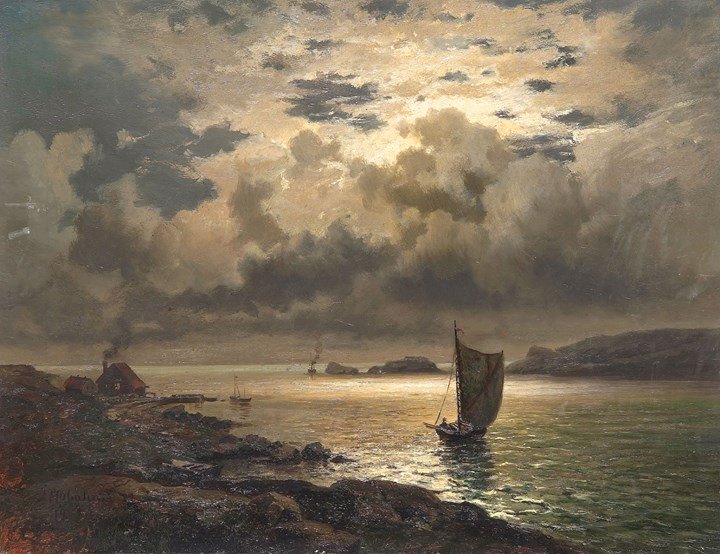
Josefina painted a beautiful and evocative sunset scene in 1879 entitled Kustbild med båt, (Coastal scene with boat).  Dark storm clouds almost obliterate the setting sun the rays of which force their way through to create a golden halo on the surface of the fjord.  Despite the prospect of an on-coming storm, a small sailing ship in the foreground sets out on its perilous journey.  In the left mid-ground we see a small cottage perched on the rocky bank of the fjord. Look at the myriad of colours, such as silver, greys and gold, she has used in depicting the water.

On the Bridge by Josefina Holmlund

Her ability to depict water with shimmering reflections is palpably shown in her painting entitled On the Bridge.

Sommarlandskap med Gärdesgård Intill en Väg by Josefina Holmlund (c.1855)

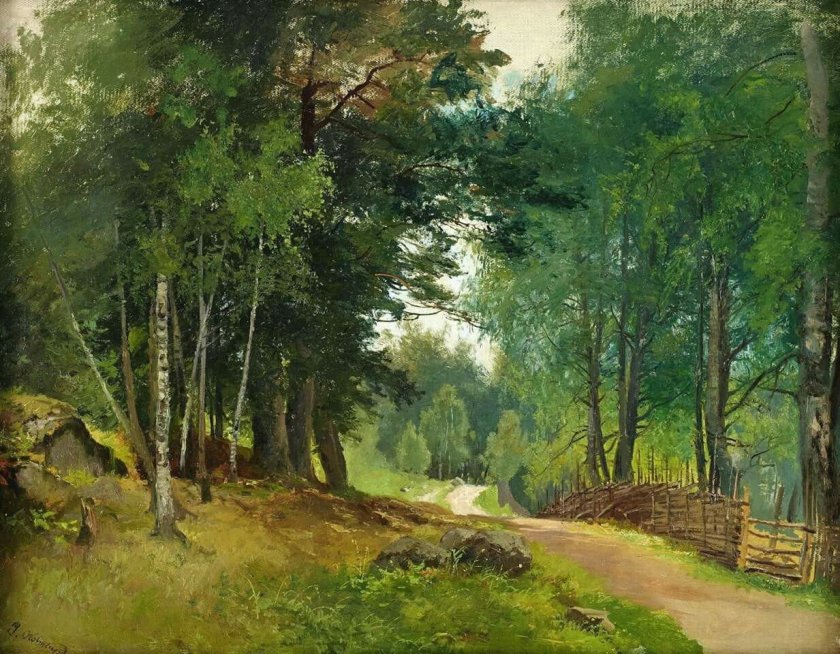
As well as her paintings of the fjords and lakes she completed many works featuring the countryside.  One of my favourites is Sommarlandskap med Gärdesgård Intill en Väg (Summer Landscape with Fence next to a Road) which she completed around 1855.

Cottage in the Woods by Josefina Holmlund (1879)

Often her countryside landscapes featured family life as in the case of her 1879 painting, Stuga vid skogsbryn (Cottage in the Woods) which is a depiction of idyllic life in the woods devoid of the noise and pollution of city life.  I think it is her portrayal of what life should be like.

Hide and Seek by Josefina Holmlund

Happiness attained from life in the woods is once again brought to the fore in her painting entitled Kurragomma (Hide and Seek), which combines the beauty and serenity of nature with the laughter and playfulness of three children as they amuse themselves with the game of hide and seek.

Village Street by Josefina Holmlund

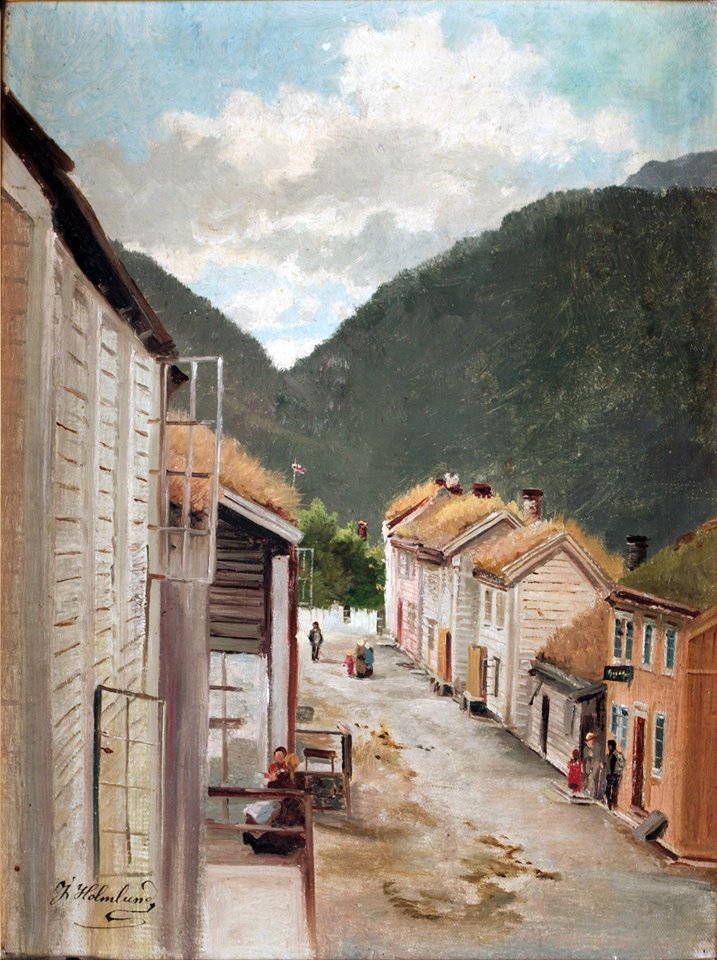
Another work of hers which I like for its simplicity is Village Street.

In my next blog I am going to look at the life and works of Charles Leickert, the nineteenth century painter of the Dutch landscape.

Sally Moore

Catnapping by Sally Moore

When I decide on a subject for my blog I look for three criteria to be met.  Firstly, and on a personal note, I need to be interested in the person or their art.  Secondly, I need to be able to find enough information with regards the life of the artist and their family upbringing and lastly, I need to have enough copies of their works to be able to populate the blog.  Without all three criteria, I tend to reluctantly disregard the artist as the subject of my blogs.  Having said all that, the next two blogs feature artists who did not meet with all the criteria – the missing criterium in both cases was the limited information I had about their lives, but because I liked their work so much I decided to feature them albeit in much shorter blogs.

All at Sea by Sally Moore

In this blog, I am looking at the work of a living surrealist artist and as I told you in an earlier blog about another living artist, Neil Simone (My Daily Art Display – May 24th 2017), who coincidently could also be classed as a surrealist, I try and avoid blogging about painters who are still alive, for fear of upsetting them!!!  My featured artist today is the Welsh-born surrealist painter Sally Moore.

Still Waters by Sally Moore

Although my favourite art tends to be landscapes, seascapes, and genre paintings I am fascinated by surrealist art and I am mesmerised by the thought process which goes into the depictions.  The Tate’s short description of the term surrealism encapsulates the very essence of the art form:

“…A twentieth-century literary, philosophical and artistic movement that explored the workings of the mind, championing the irrational, the poetic and the revolutionary…”

One of the most famous surrealist artists was the twentieth century Italian artist, Giorgio de Chirico and his take on surrealism was:

“…Although the dream is a very strange phenomenon and an inexplicable mystery, far more inexplicable is the mystery and aspect our minds confer on certain objects and aspects of life…”

Bittersweet Offerings by Sally Moore

Sometimes it is a mistake to compartmentalise art or the works of an artist and maybe Sally Moore would not want her art to be categorised as Surrealism and perhaps she would be unhappy that I am typecasting her as a Surrealist painter.  If so, I apologise in advance and just say that her exquisite depictions are quirky, amusing and cleverly thought out.

 Sally Moore was born in Barry, South Wales in 1962. She studied art at the Ruskin School of Art, in Oxford.  The Ruskin School of Art dates to 1871, when John Ruskin, the leading English art critic of the Victorian era, as well as an art patron, draughtsman, and watercolourist, first opened his School of Drawing. Sally subsequently won a scholarship to study at the British School in Rome.

Head with Bees by Sally Moore (1996)

Her paintings from the very start of her career were popular with both the critics and public alike and, early on, she won awards at the National Eisteddfod.  More awards soon followed including one for her painting Head with Bees at the 1996 Discerning Eye Exhibition in London.  The Discerning Eye Exhibition differs from many other exhibitions as six selectors (judges) make their choice of small works as their interpretation of the best of contemporary British art and each selected section is hung separately so that there may be a distinct identity with its combination of established and less established or even unknown artists.  The Discerning Eye has one limitation and that is the paintings must be small in size giving more artists a chance to exhibit and also allowing the works to be small enough to be bought, carried back under arm and hung in any home or office space. Each judge was asked to pick over half of his selection from less established names.  Her painting was selected as winner by artist and art critic, William Packer, one of the six judges/selectors.

This Charming Man by Sally Moore

In 2005, she won the Welsh Artist of the Year Award.

Her artworks are painstaking in style and much time is spent on the detail and this of course limits her output and thus the number of solo exhibitions she has held.  She says she often has a umber of works on the go at the same time.   I was fortunate to go to her exhibition the other week at the Martin Tinney Gallery in Cardiff, which contained sixteen of herpaintings.  Although small in quantity, the quality of the work was excellent and the subjects fascinating.

Fishy Business by Sally Moore

The one aspect of her work you will soon notice is that she includes herself in most of her paintings!

Home Histrionics by Sally Moore

Not all her paintings feature humour and in two of her works she looks at the state of people’s minds and behaviour when they are experiencing a personal trauma.  In two of her works, Beneath Suspicion and Home Histrionics, she looks at the behaviour of people, who we have all come across at some time, people who seem to revel in their catastrophes, to such an extent they almost seem to flourish on it. In a way Home Histrionics ridicules such characters.

Beneath Suspicion by Sally Moore

When asked whether she based the depictions on somebody she knew, she answered:

“…They are loosely based on a friend of mine who enjoys complex relationships with men and follows a specific pattern of destructive behaviour.  She gets herself in these ludicrous situations and seems to relish the drama it creates, when it’s all driven by fake emotion…”

Captive by Sally Moore

My favourite work by Sally Moore is the quirky painting entitled Captive.

Her work is probably best summed up by her fellow Welshman and Visual Artist, Keith Bayliss, who commented:

“…Sally’s paintings are intriguing, there is a drama being enacted, a story unfolding. Sometimes the stage set is a domestic one, or an everyday scene, a seemingly familiar and therefore reassuring picture. We are drawn in as eager observers, only to realise that we have become participants in the story.

Her work displays an interest in, and a deep knowledge of, three visual art traditions, the Narrative, the Surreal and the Symbolic, marrying all together through her use of highly personal imagery. Her paintings are painstakingly crafted, taking months to produce one glowingly detailed art work. The paintings are icons of magical realism, the known with the mysterious. In making art she is making sense of the world and we, in viewing the work become part of that process, part of the drama…”

But maybe I should leave the last word to the artist herself when she describes what she wants to achieve through her work:

“…Each painting is a mini psychological drama, often absurd, sometimes surreal and invariably humorous. I hope that my paintings may both unsettle and amuse the viewer…”

To find out more about Sally Moore and her art have a look at her website:

https://sallymoorepainter.co.uk

and in the “About” page there is a video which she made in 2013 in collaboration with film-maker Mark Latimer entitled The Domestic Surrealist which documents Sally’s thought processes which goes into each of her works of art.


Jennie Augusta Brownscombe

Jennie Augusta Brownscombe (1850 – 1936)

In my last blog I looked at the life of the nineteenth century American painter, Anna Elizabeth Klumpke.  Today I want to look at the life of one of her contemporaries, Jennie Augusta Brownscombe, who was born just six years earlier.

Jennie Augusta Brownscombe was born December 10th, 1850 in a small log cabin farmhouse, built by her father, near Irving Cliff in Honesdale, in rural north-eastern Pennsylvania.  It was a picturesque area, which the historian, writer and author of the short stories, Rip van Winkle and The Legend of Sleepy Hollow, Washington Irvine, described as:

“…Honesdale is situated between high hills on a plain through which two romantic mountain streams flow, uniting in the village and forming the Lackawaxen River. There are two wide basins where the streams unite, and the water was formed into the two most picturesque lakes. From the Eastern shore of one of these, Lake Dyberry, a solid ledge of serried and moss-grown slate rock rises almost sheer to the height of nearly 400 feet…”

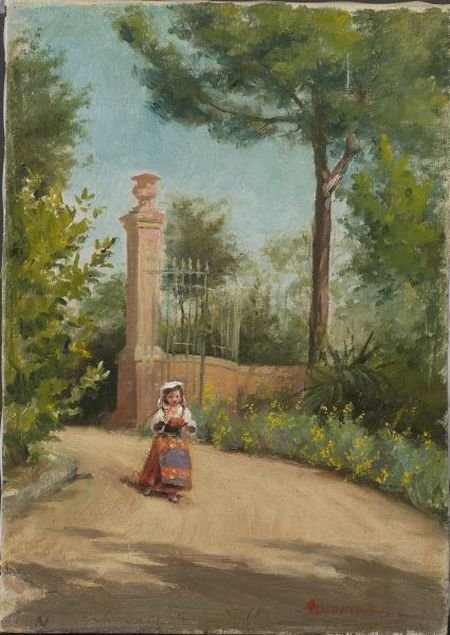
Peasant Girl Before a Gate by Jennie Augusta Brownscombe

Jennie was the only child of William Brownscombe, originally a farmer in the English county of Devon who had left England to seek his fortune in America in 1840 and his American wife Elvira Brownscombe (née Kennedy), who was said to be a direct descendent of an original Mayflower passenger.  Her mother who was a talented writer and amateur painter, nurtured her daughter’s interest in poetry and art.  Her early exploration of drawing is mentioned in the entry for Jennie Brownscombe in the 1897 book, American Women Fifteen Hundred Biographies:

“…She was studious and precocious, and about equally inclined to art and literature. She early showed a talent for drawing, and when only seven years old she began drawing, using the juices of flowers and leaves with which to colour her pictures. In school she illustrated every book that had a blank leaf or margin available…”

Jennie won awards for her art at the Wayne County Fair  when she was a high school student.

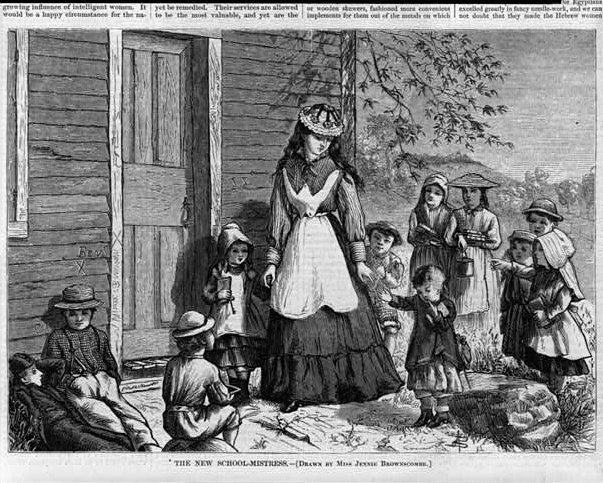
The New School-Mistress by Jennie Augusta Brownscombe (1873)

In 1868, when Jennie was eighteen years old, her father died.  To help herself and her mother financially, Jennie began selling illustrations to book and magazine publishers based on the landscape around her home and Irving Cliff.  One such illustration appeared in the illustrated journal, Harper’s Weekly, of September 20th 1873, entitled The New School-Mistress.   She also accepted a post as a school teacher at the high school in Honesdale.  Eventually she moved to New York to study art.  To get an idea of what this young aspiring artist was like we need to see the description of her given by art historian, Florence Woolsley Hazzard in her article on Brownscombe for the three-volume biographical dictionary, Notable American Women 1607-1950, in which she described the young artist:

“…she was slender, with a thin face in which large brown eyes and a dimpled chin were distinctive, and reserved in manner. She lived simply with one companion or servant…”

Jennie Brownscombe left home and went to New York where she studied under the Paris-born academic-style painter Victor Nehlig who had come to America in 1850 and opened up a studio in New York city, and was elected as an academician in the National Academy of Design.  In May 1871 Jennie graduated from the School of Design for Women of the Cooper Union for the Advancement of Science and Art more commonly known as the Cooper Union or Cooper Institute which was a privately funded college located in Cooper Square in the East Village neighbourhood of Manhattan, New York City.

Portrait of a Young Woman in Pink and Green by Jennie Brownscombe (1898)

For the next four years, until 1875, Jennie was enrolled at the National Academy of Design where she attended the Antique and Life Schools and studied painting under the tutelage of the American painters, Thomas LeClear and Lemuel Wilmarth, who was the director of the Academy.  The Academy also paid Jennie to teach some of the classes and this helped defray the cost of her tuition.  Whilst at the Academy Brownscombe won the first prize, the Charles Loring Elliott Medal, in the Antique School and the first prize, the Suydam Medal in the Life School, which was given annually by the Academy for achievements in life drawing and painting in the Life studies school.

Unfortunately, the Academy encountered financial problems at the end of the 1874/5 academic year and could no longer afford to employ Wilmarth and there was even talk that come the start of the next academic year in the autumn the Academy would not re-open.  With the uncertainty as to whether the Academy, due to financial pressures, would cancel all classes temporarily, forcing students to forgo drawing from life for a significant period of time, something had to be done.  Apart from this uncertain future, many of the students were also unhappy with the rigid artistic teaching at the Academy believing the favoured academic-style was too conservative especially in comparison with what was happening at the time with the art in Europe with the birth of Impressionism.  And so, in 1875, Lemuel Wilmarth and a group of artists, most of whom were students at the National Academy of Design, and many of whom were women, founded The Art Students League and Wilmarth was confirmed as its first president.

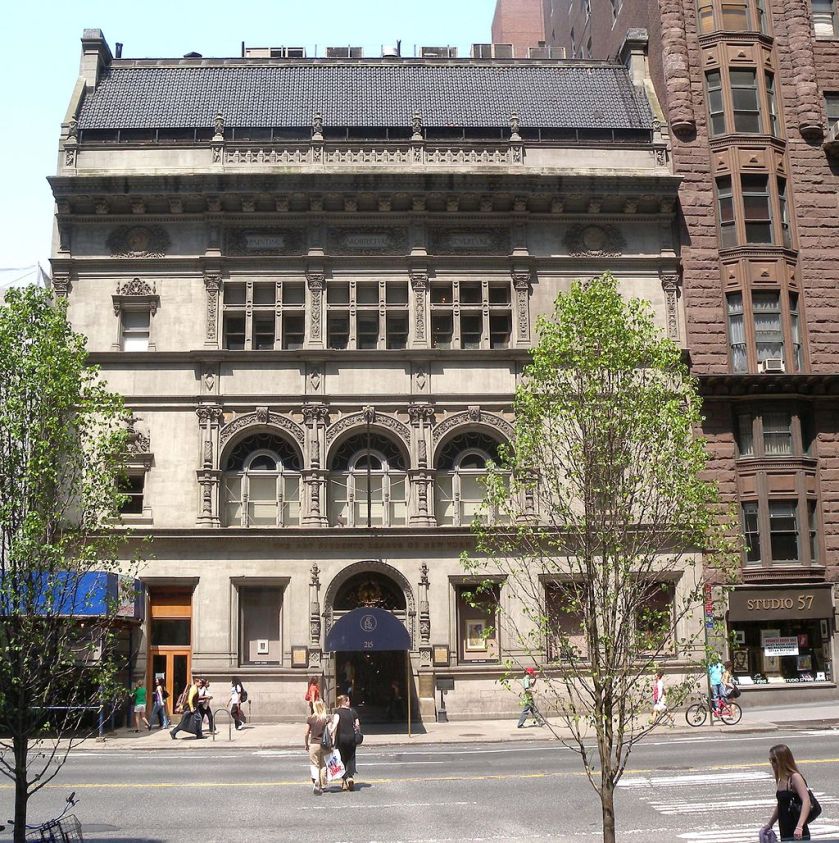
The present Art Students League of New York Building, West 57th Street, New York

Jennie Brownscombe was one of the founder members of the Art Students League.  Another founder member was the sculptor and illustrator James Edward Kelly whose comments about Jennie were published in 1925 in the Fiftieth Anniversary of the League publication.  He recalled the young artist:

“…Although I used to see Miss Jennie Brownscombe when she came to Harper’s Art Department, and as a student at the old Academy, I always visualize her sitting at her easel – working,  working, ceaseless and untiring.  The outcome was a series of paintings and etchings showing the halcyon days in the home life of America…”

The League opened its school with studio space on the top floor of a building at the corner of Fifth Avenue and 16th Street. Things were somewhat cramped and classes were conducted in just one small room.  It proved so popular that many more art students joined and by the end of the first semester the League had to rent the whole of floor to accommodate this new influx of artists.  Jennie returned to the National Academy of Design in 1879 and remained there as a student until mid-1881.

After completing her studies at the Academy, Jennie travelled to France and studied in Paris under the Polish-born American painter, Henry Mosler, who became well-known for his Breton peasant depictions.  Jennie returned to the United States but an eye injury curtailed her art until 1884 at which time she returned to painting in her studio in New York City.  Whilst living in New York she found time to make regular visits back to her mother who was still at the family home in Honesdale, Pennsylvania.  Her mother died in 1891.

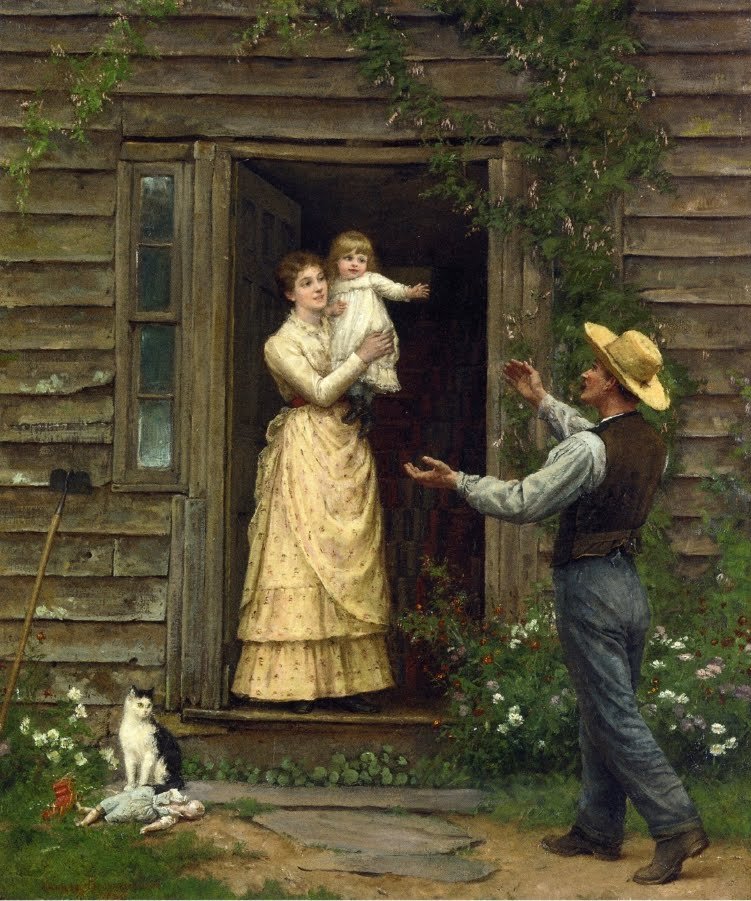
The Homecoming by Jennie Augusta Brownscombe (1885)

Jennie Brownscombe’s art was of various genres.  Many of her works focused on the observance of rural family life and it was the sentimentality of these works which appealed to buyers who liked to remember those trouble-free days.  A good example of this is her 1885 painting, The Homecoming, which depicts the return of a husband and the greeting he received from his wife and child on the doorstep of their log cabin.  Everything we see in the painting oozes with happiness and contentment –  what’s not to like about it?

Ready for the Oven by Jennie Augusta Brownscombe

In another depiction of contented homeliness,  Ready for the Oven, we see a lady in the kitchen.  She holds a pie, which she has just made and is about to put it into the oven to bake.  Again, this is a work depicting the joy that can be had by simply staying at home and looking after one’s family.  It is a depiction of a clean and well organised country kitchen and the rural idyll.  A lot of her genre works featuring rural life were about a clean and contented homely American lifestyle and is in stark contrast to the rural/ peasant kitchens we see depicted in some of the Dutch genre paintings where realism seemed to mean showing less than clean interiors and chaotic lives, often caused by the demon alcohol.  So, what did people want from their paintings – idyllic sentimentality or realistic hell on earth?

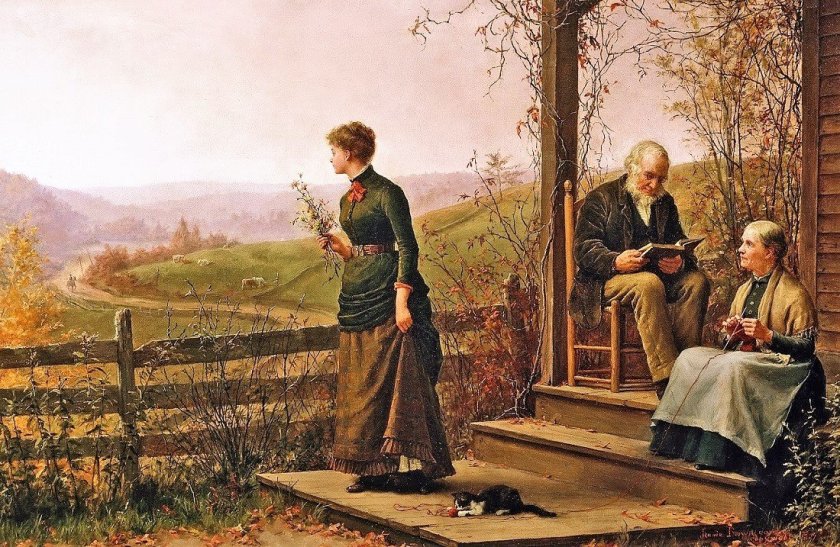
Love’s Young Dream by Jennie Augusta Brownscombe

One of the most popular example of Brownscombe’s idyllic but sentimental depictions is her idealized painting depicting rural family life which is entitled Loves Young Dream.  The painting has two distinct parts to it.  In the right foreground, and squeezed in, we have the porch of a wooden house and three people whilst on the left and in the background the space is open and clutter-free as we look towards the hills shrouded in mist but it is this openness which gives us the sense of vast sweeping and unspoilt countryside and set up of the painting highlights the isolation of the small house.

We see a young woman standing on the outside step of her modest wooden home.  Her expression is one of yearning, as she looks out at the winding country lane which leads to her family home.  In the distance, we can just make out a man on horseback approaching. Could this be who she is awaiting?  On the right of the painting we see an elderly couple sitting on the porch. One, probably her mother, looks up from her knitting and looks at the young woman and probably worries about her daughter’s expectations.  She is completely oblivious to the fact that the cat is playing with her ball of wool.  The other person on the porch is an elderly man who is completely engrossed in his book and has no time to observe his daughter, wife or the approaching rider.

The New Scholar by Jennie Augusta Brownscombe (1879)

In another example of her genre paintings we have The New Scholar which captures what school days were like in a rural community in the past.  In the work, we see a very young girl heading to her lessons. She is new to the school and is somewhat frightened at the reception she would receive from her fellow pupils. She walks towards the school room door, head down, but surreptitiously eyeing some of her fellow pupils whilst they line her approach and blatantly study her.   This is yet another beautifully portrayal of individuals.  This work is housed in the Thomas Gilcrease Institute of American History and Art in Tulsa, Oklahoma

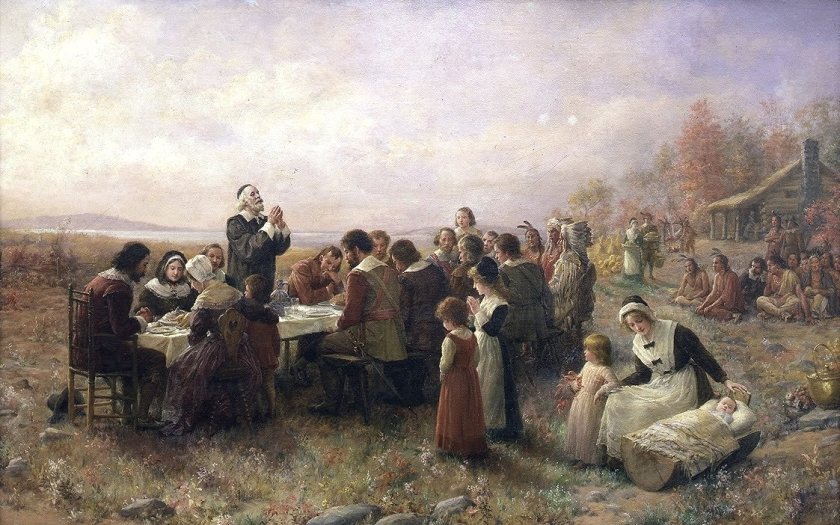
The First Thanksgiving held at Pilgrim Hall in Plymouth, Massachusetts by Jennie Brownscombe

In some works, she would produce depictions of special moments of American history such as the arrival of the first settlers in her painting The First Thanksgiving held at Pilgrim Hall in Plymouth, Massachusetts which commemorated the event which took place in early autumn of 1621, when the 53 surviving Pilgrims celebrated their successful harvest, which was an English custom.  Another reason for the depiction by Brownscombe could have been the colonial roots of her mother’s family.

In the painting, we see a group of Puritans in dark and dour-looking clothes gathered around a table being blessed by a pastor.  The idealisation of the depiction shows friendly native Americans looking on at the ceremony and are ready to participate in this communal meal. In the background, we see a solitary log cabin set amongst the yet to be developed New England countryside.  This is a quintessentially American depiction and paintings like this were very popular with American public.  Brownscombe sold the reproduction rights to more than a hundred of her genre and historical works which were then used by publishers to produce prints or incorporate them in calendars and greeting cards.

Washington Greeting Lafayette at Mount Vernon, 1784 by Jennie Brownscombe

Brownscombe was among a group of artists of the Colonial Revival Movement, which was a cultural movement which was both an architectural and decorating style. It was very popular in the late 19th and early 20th centuries and was motivated by a romantic adoration of the early American past. Paintings were created by artists depicting early American scenes.  Colonial heroes like George Washington and colonial history were popular subjects for artists, inspired by the 1876 centennial, which celebrated the 100th anniversary of the signing of the Declaration of Independence in Philadelphia.  Jennie Brownscombe’s painting Washington Greeting Lafayette at Mount Vernon is a classic example of Colonial Revival Movement painting.

Colonial Minuet by Jennie Augusta Brownscombe

Brownscombe developed a structured lifestyle geared up to her artistic life.  She would travel to Italy and spend the winters in Rome and it was during one such winter she met the American still-life and landscape artist George Henry Hall who had a studio in the Italian capital.  They became close friends and Hall who was twenty-five years her senior, became her mentor.  During the summer months, the two of them would return to Hall’s American residence, in Kaaterskill Clove Valley, in New York’s eastern Catskill Mountains, lying just west of the village of Palenville.   When Hall died in 1913 at the age of eighty-eight, he bequeathed the house and studio to Brownscombe.

Children Playing in the Orchard by Jennie Brownscombe (1934)

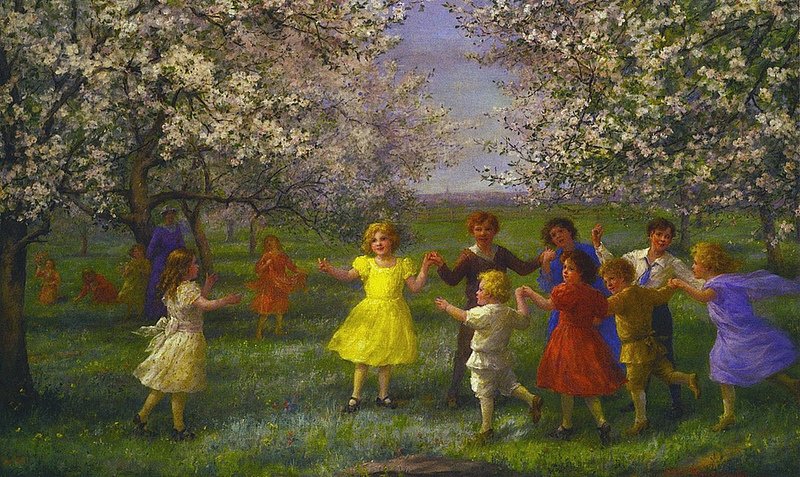
In 1932 Jennie Brownscombe suffered a stroke which temporarily stopped her painting but two years later in 1934, when she was eighty-four years old, she completed a work for the Lincoln School in her hometown of Honesdale entitled Children Playing in the Orchard.

Jennie Augusta Brownscombe, who never married, died on August 5th, 1936 four months before her eighty-sixth birthday and was buried next to her parents in the Glen Dyberry Cemetery in Honesdale next to her parents.

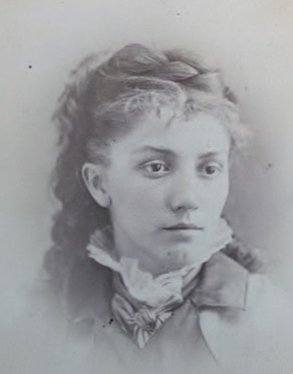
Jennie Augusta Brownscombe (c.1930)

I end this story with a quote from the blog The Jellybean Tree which perfectly sums up the life and work of Jennie Augusta Brownscombe and why her paintings appealed to so many:

“…Jennie Brownscombe was a pilgrim in her own way, making a name and life for herself in a time when most women were still housewives and mothers. She tapped into a talent and nostalgia that warmed the hearts of her viewers. Artists like Brownscombe place a mirror to our lives, forcing us to see the beauty in every day. Creative types can sometimes become bogged down with visions of the fantastic. A reminder of the subtle grace of life is always welcome…”

Gerda Gottlieb and Einar Wegener

Gerda and Einar
Gerda and Einar

The artist I am looking at today was unknown to me.  The more I read about her the more I realise I should have been aware of her especially after the recent publicity.  Howeve,r so that I am not cast alone as the “unknowledgeable one” I wonder how many of you have heard of Gerda Marie Fredrikke Gottlieb.  Well, have you?   I am not going to totally give away why you, like me, should have known her until a little later in the blog.  Today’s blog is not just about her but also about her first husband Einar Wegener.

Gerda Wegener (née Gottlieb)
Gerda Wegener (1886 – 1940)

Gerda Marie Fredrikke Gottlieb was born on March 15th 1886 in the small rural town of Hammelev in the eastern part of central Jutland. She was the daughter of Emil Gottlieb, a clergyman in the Catholic Church and Justine Gottlieb (née Osterberg). Although she had three other siblings they all died before adulthood.  Life as the daughter of a clergyman was a very conservative one.  Probably, because of her father’s profession, the family moved around the country.  Whilst still a child the family moved the short distance south from Hammelev to the coastal town of Grenaa and later to the central Jutland town of Hobro.

Gerda showed a love of art and an unusual artistic talent at a young age and began to receive some local artistic training. In 1903, when she was seventeen years of age, and had completed her schooling, she managed, after a lot of cajoling, to have her parents agree to allow her to carry on with her art studies and enrol at the newly opened women’s college at the Royal Danish Academy of Fine Arts in Copenhagen.  Gerda proved to be a very talented student and in 1904 some of her work was exhibited in the Kunsthal Charlottenborg which is the official gallery of the Royal Danish Academy of Art.  It was at this artistic academy that fate was going to change her life for it was here that she met and fell in love with a fellow Academy student Einar Wegener.

Einar Wegener
Einar Wegener

Einar Mogens Andreas Wegener was born a male (important to note!) on December 28th 1882 in the small Danish town, Vejle, which is situated in the southeast of the Jutland Peninsula and lies at the head of Vejle Fjord.  He was the youngest of four children. By all accounts Einar was a precocious child who, like Gerda, showed an early artistic talent. He trained as a painter at the Vejle Technical School, and on graduating in 1902 enrolled at the Royal Academy of Art in Copenhagen.

Capri, Italy by Einar Wegener (c.1920)

In his own works Einar Wegener often painted landscapes from the place where he came from, and later scenes from the countryside in France. Einar Wegener received Neuhausens prize in 1907 and exhibited at Kunstnernes Efteraarsudstilling (the Artists Fall Exhibition), Vejle Art Museum and in the Saloon and Salon d’Automme in Paris . These two aspiring young artists would often paint together although their interest in art differed.

Landscape by Einar Wegener (1908)

Einar liked to paint landscapes whereas Gerda preferred illustrative work, the type she would have seen in fashion magazines.  Her main influences derived from her love of French eighteenth century Rococo art depicting well dressed women in luxurious and colourful clothes painted by the great French artists of that time such as Jean-Antoine Watteau, Francois Boucher, and Jean-Honoré Fragonard.  Having a love of illustrative work she also admired the work of a contemporary of hers, the British Victorian illustrator Aubrey Beardsley

The Morning Dream, an illustration by Aubrey Beardsley

Beardsley, a major figure in Aestheticism and Art Nouveau, was influenced by the pre-Raphaelite painter and illustrator, Edward Burne-Jones and the woodcuts of the Ukiyo-e movement in Japanese art.  He had a distinctive style contrasting the subtle use of line with bold masses of black.  Many of his illustrations were classed as decadent and as an author he wrote an erotic novel, Under the Hill, and illustrated it with pornographic pictures.

Costumes Parisiens - illustration by Gerda Wegener (1914)
Costumes Parisiens – illustration by Gerda Wegener (1914)

Gerda Weneger had a refined and decadent character style, inspired by the English illustrator and her paintings split the views of the critic and public, some of who were excited with her work whilst it offended others, believing it to be simply pornographic. However in a lot of her erotic work Wegener often ensured that the ladies depicted had a disarming and somewhat enchanting twinkle in their eyes which countered the possible pornographic nature of the work. There is a distinct sense of fun and joie de vivre in Wegener’s work.

Lesbian illustration by Gerda Wegener

Gerda now lived in a bohemian area of Copenhagen populated by actors and dancers as well as artists her early works often depicted long-limbed heavily made-up, colourfully dressed exuberant females who were full of joie de vivre rather than art’s normal depictions of somewhat lifeless women.  In some way this could have been her challenge to the art establishment’s depiction of women, even challenging society’s concepts of women and challenge the standards of the time. Her book and magazine illustrations included ones which focused on high fashion and which were acceptable and loved by the public but she also produced illustrations featuring lesbianism and erotica which were often frowned upon my many parts of society.  There was a belief that Gerda herself was a lesbian.

Lili Elbe (1926)
Lili Elbe (1926)

Although I had never heard of Gerda and Einar Wegener they have become well-known not for their art but his sexuality which was brought to life in the 2016 biographical romantic film, The Danish Girl, which was based on the fictional book, of the same name, written in 2000 by David Ebershoff.    The book and the film also derived their information from a 1931 book about Einar.   The biography of Einar Wegener (Lili Elbe) was published in Denmark in 1931 under the title Fra mand til kvinde (From Man to Woman).  This was actually an autobiography edited by Niels Hoyer (real name Ernst Ludwig Hathom Jacobson) who had put together many manuscripts and letters after Lili’s death.  So when did the problematic sexuality of Einar first surface?  The Danish Girl film and book probably over simplified the beginnings of Einar’s doubt about his own sexuality but they refer to the day when he was asked to pose for his wife.  He described the occasion:

“…About this time Grete painted the portrait of the then popular actress in Copenhagen, Anna Larsen. One day Anna was unable to attend the appointed sitting. On the telephone she asked Grete, who was somewhat vexed: ‘Cannot Andreas pose as a model for the lower part of the picture? His legs and feet are as pretty as mine…”

Einar was very reluctant but Gerda finally persuaded him.   When Anna turned up unexpectedly at their studio she was very impressed with Einar’s portrayal of her and nicknamed him Lili.  On seeing (Einar, whose middle name was Andreas), she reportedly said:

 “…You know, Andreas, you were certainly a girl in a former existence, or else Nature has made a mistake with you this time…”

Two Cocottes with Hats (Gerda and Lili) by Gerda Wegener

Gerda was so pleased with Einar as a female model she persuaded him to model for her on a number of future occasions.  Wegener’s fashion industry paintings featured beautiful women dressed in chic attire, one of the most popular of which was a captivating lady with a stylish short bob, full lips, and haunting almond-shaped brown eyes. Who would have believed that this exquisite beauty was her husband, Einar, who posed as her fashion model while donning women’s clothing. It was through these experiences that her husband Einar came to realize his true gender identity and began living his life as a woman. Einar’s sexuality became even more complicated when he and Gerda would go to parties as two females and often Gerda would introduce Lili Elba as Einar’s sister.

Gerda and Einar married in 1905 whilst they were still students at the Academy.  She was nineteen and he was twenty-two.

Portrait of Ellen von Kohl by Gerda Wegener

In 1907, Gerda completed a portrait entitled Portrait of Ellen von Kohl but although as we look at it now you will be surprised to know it caused quite a controversy and sparked the Peasant Painter Feud which was a national debate covered in the pages of the Danish newspaper Politiken.  It was all about ‘distasteful’ paintings of excess, (the smouldering look of Ellen von Kohl was seen as being too lascivious!) for the favoured norm at the time was for realism favoured representations of ‘ordinary people in the countryside’. The debate became so heated that the portrait was rejected by both the Kunsthal Charlottenborg, which was the official gallery of the Royal Danish Academy of Art, and also the Den Frie gallery, which was founded by the Association of Danish Artists, in protest against the admission requirements for the Kunsthal Charlottenborg.

Lili Elbe by Gerda Wegener

Gerda completed her art course at the Academy in 1907 and once again fate was going to play a part in her future as in 1908, soon after leaving the Academy she entered and won a drawing competition organised by the leading Danish broadsheet newspaper Politiken. It was competition to draw ‘Copenhagen Woman’.  The newspaper was so pleased by her winning entry that they offered her a job as a regular contributor and soon she established herself as a capable cartoonist and illustrator.  This was just the start of her career as the recognition launched her into the fashion magazine industry and soon she became a leading illustrator of women’s high fashion in the Art Deco style of the time

Although the bohemian quarter of Copenhagen, where the couple lived, had a somewhat laissez-faire attitude towards life, the pair eventually moved to the more liberal Paris and soon Gerda and Einar began to live as two women.  In the French capital, Gerda was able to further her art career and, some would have us believe that she became a more active lesbian.

Lili and Gerda by Gerda Wegener

Besides posing as a woman for his wife’s paintings, Einar only dressed as Lili and was a tremendous hit on the bourgeois Parisian scene, with all its decadence, art, and sex. It soon became common knowledge that Lili and Einar were the same person but for Einar he had the satisfaction in knowing he would not be ridiculed.

Lili Elbe by Gerda Wegener

Sadly for Einar simply dressing as a woman was not enough and he was suffering mental torment as Lili slowly took over his life.  For him, Einar was slowly dying and Lili was taking control.  Einar viewed himself as an artist but, as his alter-ego Lili, he viewed things very differently.  He described Lili as:

 “…thoughtless, flighty, very superficially-minded woman”, prone to fits of weeping and barely able to speak in front of powerful men…”

Illustration by Gerda Wegener for the magazine La Baionette

Life in Paris was good for Gerda who found success as a portrait painter, fashion illustrator and caricaturist and received many commissions for illustrations from La Vie Parisienne, a French weekly magazine founded in Paris in 1863, Le Rire, the successful humour magazine, La Baïonnette, the magazine which started a few years after Gerda and Einar moved to Paris, as well as the elite Journal des Dames et des Modes, a favourite of artists, intellectuals, and high societyHer success guaranteed a degree of fame and soon she was the primary breadwinner of the couple.

Self portrait by Gerda Wegener

Andrea Rygg Karberg, art historian and curator at ARKEN Museum of Modern Art in Denmark has no doubt about the artistic ability of Gerda Wegener, saying:

“…Gerda was a pioneer who spent two decades as part of the Parisian art scene and revolutionised the way women are portrayed in art.  Throughout history, paintings of beautiful women were done by men.  Women were typically seen through the male gaze. But Gerda changed all that because she painted strong, beautiful women with admiration and identification – as conscious subjects rather than objects…”

Café by Gerda Wegener

With her new lesbian lifestyle in the avant-garde French capital, Gerda Wegener’s art became considerably more racy and scandalous. In addition to her fashion world portraiture that was featured in many fashion magazines, Wegener completed paintings featuring nude women often depicted in erotic, some would say lewd, poses. These paintings were termed “lesbian erotica,” and were published in art books, the most notorious being the Adventures of Casanova.  Some of these risqué paintings were exhibited publicly and the erotic nature and lesbian theme of the works often led to a public outcry.  Far from being taken aback by such vociferous criticism of her work by sections of the public, Gerda revelled in the notoriety.

Illustration by Gerda Wegener

The phrase “there is no such thing as bad publicity” may be correct as far as the sale of her work but for Gerda there was a price to pay.  Christian X, the King of Denmark, became aware of Gerda’s marriage to Einar Wegener when he, Lili Elba, had legally become a woman, and so the king declared their marriage invalid in October 1930. Maybe the time had come to an end for Gerda and Einar’s marriage anyway but in 1930 following the annulment, the couple parted ways amicably.

Femme a la Rose by Gerda Wegener

Gerda Wegener following the end of her marriage to Einar married an Italian military officer, Major Fernando Porta, and the couple went to live in Morocco. She continued to paint and would sign her paintings as ‘Gerda Wegener Porta’. The marriage was not a happy one and did not last long with couple divorcing in 1936.

Indian couple seated on a balcony by Gerda Wegener Porta

She returned to Denmark in 1938, but by then, her paintings and illustrations were no longer in demand and sadly Gerda just managed to eke out a meagre living by painting and selling postcards.  She managed to exhibit her work one last time in 1939.  She had no children and her latter years were spent alone in relative obscurity and with the loneliness came her reliance on alcohol.  Gerda Wegener died on July 28th 1940 in Frederiksburg, Denmark aged 54, a few months after the German army marched into Denmark.  She was buried alone at Solbjerg Park cemetery in Copenhagen.

Einar Wegener / Lili Elbe (1882 - 1931)
Einar Wegener / Lili Elbe
(1882 – 1931)

Einar Wegener continually struggled with his sexuality and believed that Lili Elba was his true self.  It was no longer enough to dress as a woman, he believed that the only way to be at peace with himself was to undergo revolutionary sex reassignment surgery and for that he had to travel to Germany.  In 1930 he attended Dr Ludwig Levy-Lenz clinic in Berlin where he was castrated and had his penis surgically removed.  The following year, 1931, he underwent further surgery, vaginoplasty, which was a procedure that results in the construction of the vagina.  Sadly for Einar these surgical procedures were carried out at a time before antibiotics and he died in Dresden of an infection on September 13th 1931, aged 48.

Alice Neel. Part 6. The latter years

 Alice Neel (1900-1984)
Alice Neel
(1900-1984)

Alice Neel had been receiving money for her involvement with the Works Project Administration (WPA).  The WPA was the largest and most ambitious American New Deal agency, employing millions of unemployed people, mostly unskilled men, to carry out public works projects.  The WPA employed musicians, artists, writers, actors and directors in large arts, drama, media, and literacy projects.  At its height in 1936, this federal project, the Federal Art Project employed over 5,300 artists. The Arts Service Division created illustrations and posters for the WPA writers, musicians, and theatres. However, with the onset of World War II, mass unemployment ended as millions of men joined the services and so President Roosevelt decided that there was no longer a need for such a national relief programme and the WPA was closed down at the end of 1942.  Alice was out of work and had then to turn to the state for public assistance which she kept drawing on for the next decade.

Photograph of Alice Neel sitting before her paintings which was used in the inviation to the exhibition

In March 1944 Alice held a solo exhibition at the New York Pinacotheca Gallery run by Rose Fried.  This was her first solo exhibition since 1938.  There were twenty-four of her works on display. The exhibition received mixed reviews.  An article in the prestigious art magazine, ArtNews, described her work:

“…Neel’s paintings at Pinacotheca have a kind of deliberate hideousness which make them hard to take even for persons who admire her creative independence … Nor does the intentional gaucherie of her figures lend them added expression. However, this is plainly serious, thoughtful work and in the one instance of The Walk, it comes off extremely well…”

As Bob Dylan once said The Times They are a-changin and this was the point in time that Alice Neel found herself.  After the 1944 Alice Neel’s retrospective exhibition at the Pinacotheca, gallery director Rose Fried never showed anything with a figure in it.  According to Neel, Rose had become a pure abstractionist and the works that Alice produced were no longer wanted.  The art world was changing; it had almost completely turned its back on Social Realism which had been the art form that had made Neel’s work so popular in the 1930’s.  So, Alice had to change but as another famous lady politician once said, “this lady is not for turning” and Alice likewise would not change her artistic style to suit others. In an interview with Eleanor Munro for her 1979 book Originals, American Women Artists, Neel is quoted as saying:

“…I never followed any school.  I never imitated any artist.  I never did any of that…”

Sam and Hartley By Alice Neel

For Alice Neel, she knew what she wanted to paint and nobody or nothing was going to alter her artistic desires even though New York was now awash with European émigré artists who were leaders in the world of Cubism, Dadaism and Surrealism such as Max Ernst, André Breton, Marcel Duchamp and Salvador Dali, all of who had fled across the Atlantic to avoid the rise of Nazism.  Alfred Barr had founded the MOMA and in October 1942, millionaire, Peggy Guggenheim, who was married to Max Ernst, had arrived in New York from war-torn Europe had opened a new gallery/museum.   It was called The Art of This Century Gallery.  The Art of This Century Gallery was situated at 30 West 57th Street in Manhattan and occupied two commercial spaces on the seventh floor of a building that was part of the midtown arts district which included the Museum of Modern Art, and three of the four galleries were dedicated to Cubist and Abstract art, Surrealism and Kinetic art, with only the fourth, the front room, being a commercial gallery.

During the 1950’s Alice Neel was kept under surveillance by the FBI.  In a memo from their Miami office based on a 1954 letter sent to them by an informant they concluded that Alice Neel was:

“…a muddled romantic, Bohemian type Communist idealist who will carry out loyally the Communist sympathiser type of assignment, including illegal work if ordered to do so…”

Their file on her and her activities remained open until the early 1960’s.

My Mother by Alice Neel (1952)

In March 1953, Alice’s mother comes to live with her in her Spanish Harlem apartment.  Sadly a year later Alice snr. aged 86, died from complications brought on by a broken hip.  For Alice, this was yet another traumatic moment in her life  She had always had to battle with depression and the death of her mother triggered the onset of the debilitating malaise for the next few years.  Physically she put on weight and sought the comfort of alcohol.

Alice often complained that she could not get any gallery space for her works of art.  She painted prolifically but still wanted to exhibit them.  The problem was that her genre of art had lost its appeal with the public.  She was going through a difficult period with mental health issues and was attending therapy sessions with a psychologist, Dr Anthony Sterrett.  He spent time with her trying to make her become more self-confident and self-assertive and it was he who persuaded Alice to contact Frank O’Hara to see if he would sit for her.  O’Hara was an American writer poet and art critic who was working as a reviewer for the prestigious art magazine, Artnews, and who, in 1960 was Assistant Curator of Painting and Sculpture Exhibitions for the Museum of Modern Art.  This position at the MOMA made him a prominent figure in New York City’s art world. He was looked upon as a leading figure in the New York School, which was an informal group of artists, writers and musicians who drew inspiration from jazz, surrealism, abstract expressionism, action painting and contemporary avant-garde art movements.

Frank O'Hara by Alice Neel (1960)
Frank O’Hara by Alice Neel (1960)

Alice completed two portraits of O’Hara in 1960 and they were looked upon as her breakthrough works.  In the painting, Frank O’Hara, Alice has beautifully and faithfully captured his distinguishing and unique profile.  The side view is hawk-like which is softened slightly by the bunch of lilac behind his head.

Frank O'Hara No.2 by Alice Neel (1960)
Frank O’Hara No.2 by Alice Neel (1960)

In stark contrast, the second portrait, Frank O’Hara No.2 is a more shocking depiction of the man.  Our eyes are immediately drawn to his bad teeth, which looked like tombstones, his sharp nose and somewhat wild eyes.  To be brutally honest, at first, he comes over as being ugly, even, dare I say, repulsive, but there is a vulnerability about Neel’s depiction of him.

Six years later, in the early morning hours of July 24, 1966, O’Hara was struck by a jeep on the Fire Island beach, after the beach taxi in which he had been riding with a group of friends broke down in the dark.  He died the following day.

Kate Millett by Alice Neel (1970)

In America, the 60’s was dominated by the Civil Rights movement and the Vietnam War with its protests which swept the country.  It was also a time when the second wave of the modern feminist movement emerged.  It was a time when there was the growing cry for equal opportunity for women and it soon became one which could not be ignored.   Enter Katherine Murray “Kate” Millett, best known as Kate Millett.  She was an American feminist writer, educator, artist, and activist. She attended Oxford University and was the first American woman to be awarded a postgraduate degree with first-class honours by St. Hilda’s.  She is probably best known for her ground-breaking 1970 book Sexual Politics, which was her doctoral dissertation at Columbia University.

Time magazine cover
Time magazine cover

This book became a bible for feminism and feminist protest was such a hot topic that in August 1970, Time magazine decided that Kate would be the face of the feminist movement and therefore should appear on the cover of their magazine.  Millet was unimpressed by the way she was heralded as the embodiment of the movement and refused to pose for a painting by Alice Neel which would be used for the cover.  She believed that no one person could presume to represent the objectives of the feminist movement.  Time magazine was not to be put off by her refusal and instead asked Neel to complete the portrait, using a photograph.  After the publication of the magazine Alice Neel and her art was always linked with the feminist movement but as Alice once quipped, she had been a feminist before there was feminism!

Andy Warhol by Alice Neel (1970)

The year 1970 was also the year that Alice Neel painted one of her most famous works, a depiction of Andy Warhol.  The painting can be found at the Whitney Museum of American Art, New York and rather than me trying to describe the painting I have reproduced the words of the museum’s audio-guide which was put together by Trevor Fairbrother, an independent curator and writer:

“…It’s an interesting year for both of these artists. Alice Neel was seventy years old when she painted it, and in a sense, was just hitting her stride as an important American realist. She’d had an incredible career since the thirties, but she hadn’t really had much recognition until the wave of feminist interest in the arts in the sixties. And suddenly she was a forebear for a whole new generation of feminist artists and writers.  The late sixties were much harder on Warhol. He’d been shot two years before Neel painted this portrait—an attempted assassination by a member of his artistic circle. In posing shirtless for Neel, he exposes the corset that he was required to wear for the rest of his life. He also bares his aging body, his chest sagging so that he almost appears to have breasts.  She shows him—I think it’s this kind of essence of loneliness and vulnerability, but at the same time I think she knows that he knows that everybody is looking at him. He was very much invested in famous artists. He wanted to be a kind of brand-name Pop artist, and he certainly is that now, long after his death. He, Warhol, in a sense is rising to her challenge to sit for her, to be painted and to take his clothes off. And so, in a sense, he’s doing a brave thing, but he’s also―he’s getting through it by shutting his eyes and being very focused internally.  I think part of the soulfulness of this picture is the fact that it might seem unfinished. I wouldn’t say it’s unfinished. I think she decided she had what she needed, and she stopped where she was ready to stop. The picture doesn’t need more…” 

Fame came to Alice Neel late in life and she believed she had the right to bask in the glory.  Her son Hartley recounted his mother’s feelings about this sudden fame:

“…She felt it was something she deserved.  She basked in it.  She really enjoyed it.  When we were young, she struggled, waiting around for some critic to review her work, up or down.  All of the sudden they were saying good things about her.  Her paintings were on the walls, and people were buying her work.  It was all different.  She wasn’t bitter.  She had a very upbeat attitude toward the whole thing…”

Self-portrait by Alice Neel (1980)

On October 14th 1980 at the Harald Reed Gallery on East 78th Street in New York a benefit dinner for the Third Street Music School Settlement was being held at which was the debut of an art exhibition entitled Selected 20th Century American Self Portraits, one of which was Alice Neel’s nude self-portrait which she had begun five years earlier.

She looks out at us completely oblivious or unconcerned about what we are thinking about why an eighty-year-old woman would want to depict herself naked.  Does she feel vulnerable?  There is no sign of that in her facial expression, in fact Neel’s steely gaze rivets us.  She exudes an air of self-confidence, despite her less than picture-perfect body.  We see her sitting regally in an upholstered chair with its hard vertical-striped arms which tend to accentuate her yielding and bounteous rolls of flesh.   It is a “warts and all” portrait.   She does not hide the visible signs of aging.  Instead she has decided to reveal herself with characteristic truthfulness and somewhat defencelessness. Yet there is also a sense of pride in this depiction.  In her right hand she holds a paintbrush whilst her left hand grasps a rag and, as we see no easel or canvas in the depiction, the two serve as artistic elements. The only personal accessory depicted is the presence of her eyeglasses which may have been added by her to remind us of her frailty and that she has passed her prime.

The painting was of course controversial and caused a stir but it also was testament that it was an audacious work by an artist who at the time was at the top of her form.  The other unusual aspect of this work was that beside a few pencil-sketched self-portraits, it was her first self-portrait painting.  The painting now resides at the National Portrait Gallery, Washington.

Loneliness by Alice Neel (1970)

In 1970 Alice completed a work entitled Loneliness, which she ironically referred to as a “self-portrait”.  It was about this time that her younger son Hartley had married Ginny and moved to Massachusetts.

Ginny in a Striped Shirt by Alice Neel (1969)

Throughout her life Alice continued with her portraits of her family.  Her future daughter-in-law, Hartley’s wife, Ginny featured in her 1969 work, Ginny in a Striped Shirt.  Ginny was a feminist who looked upon Alice as a role model and they became good friends even before she became involved with Hartley.

Pregnant Woman by Alice Neel (1971)

Her other daughter-in-law, Nancy, Richard’s wife and Alice’s assistant during the last two decades of her life, was depicted in Alice’s 1971 painting, Pregnant Woman.  In the work, we see an image of her husband looming in the background.

In 1980 Alice Neel’s physical health takes a turn for the worse and after a series of tests it is decided that she had to be fitted with a pacemaker to regulate her heart rate. Four years later in 1984, during a routine visit to the Massachusetts General Hospital to have her pacemaker checked, X-rays indicate that she has advanced colon cancer which has already spread to her liver. She immediately undergoes surgery and afterwards returns to Vermont to stay with Hartley, Ginny and their children while she recuperates.

From the Spring to the Summer of 1984 she returns to New York and Spring Lake. With the help of her son and his wife, Richard and Nancy, and despite her rapidly deteriorating health, she continues with her busy schedule including an appearance on the Johnny Carson Show

Among her many commitments, interviews for the ArtNews article continue, and, on June 19th, she makes a second appearance on ‘The Tonight Show’ during which she insists that Johnny Carson visit her in New York to sit for a portrait. In July, she had to receive chemotherapy which further weakened her.  Despite her weakened condition, she continues to paint.

Alice Neel died in her Upper West Side Manhattan apartment on October 13th 1984 surrounded by her family and was buried in a private burial ceremony at a cemetery near her studio in Vermont.  On February 7th 1985, a memorial service for her is held at the Whitney Museum of American Art.

My look at the life and works of Alice Neel has been a long journey stretching over six blogs and yet I know I have missed so much out about her life and because she was a prolific artist I know I have only scratched at the surface with regards her works of art.  I have been careful not to be judgemental with regards her lifestyle which probably added to her problems but she had a difficult and often sad life which often was beyond her endurance.  She however always wanted to do her own thing and I leave you with one of her quotes:

“…”I had a very hard life, and I paid the price for it, but I did as I wanted,” Miss Neel said then. ”I’m a high-powered person…”  

– – – – – – – – – – – – – – – – – – – – – – – – – – – – – –

I have used numerous internet sources to put together this and the other blogs on the life and art of Alice Neel and I am currently reading a fascinating book about the artist by Phoebe Hoban entitled Alice Neel: The Art of Not Sitting Pretty. It is a very interesting read and one I can highly recommend.

Alice Neel’s art is being shown at several exhibitions in America but there are also a series of exhibitions of her work travelling around Europe at the current time including one I am due to visit next month:

Gemeentemuseum, Den Haag, Holland

(November 5th, 2016 – February 12th 2017)

Natalia Goncharova and Rayonism

Natalia Goncharova       1881 - 1962
Natalia Goncharova
1881 – 1962

In my blog today I want to look at the life of the avant-garde Russian painter, stage designer and printmaker, Natal’ya (Sergeevna) Goncharova.   Natalia was born in Russia on her father’s estate in the Tula governate in June 1881.  She was the daughter of Sergey Mikhaylovich Goncharov, a renowned architect and mathematician, and her mother was Yekaterina Il’icha Belyayeva.  However, in her early infant days she grew up in her grandmother’s home at Ladyzhino, near Kaluga. When she was ten years old, the family moved to Moscow and she attended the Fourth Gymnasium for Girls in Moscow and in 1898, when she was seventeen years old she decided to study sculpture and enrolled at the Moscow School of Painting, Sculpture and Architecture as a sculpture student where her tutor was Paolo Troubetskoy.  It was at this establishment in 1900 that she met and became friends with fellow student, Mikhail Larionov.  He had enrolled at the Moscow School of Painting, Sculpture and Architecture at the same time as Goncharova, studying painting under Isaac Levitan and Valentin Serov.  Larionov was a student with very contentious and provocative views and was suspended from the academy on three occasions for his deep-seated opinions.   He and Goncharova became lifelong friends and he was to have a great influence on her.  It was Larionov who persuaded Goncharova to switch from studying sculpture to concentrate on studying painting.

Natalya Goncharova by Laborov

Goncharova’s early work concentrated on the medium of pastels and her first works were showcased at the Diaghilev’s Russian Art Exhibition, which was held in Paris in 1906 at the Salon d’Automne and a year later her first paintings were shown at the Moskovskoye Tovarishchestvo Khudozhnikov (Moscow Association of Artists) of which she was a member.  At this time, her friend Larionov’s painting style was that of Impressionism and Natalya, for a time, also became interested in the style which had become so popular in France.  In 1908 she took part in the Golden Fleece exhibition and it was during this show that she became more aware of a modern style of art with the works of Bonnard, Matisse, Gaugin and Toulouse-Lautrec.  The influence of these painters made Goncharova rethink her artistic style.

Gardening by Natalya Goncharova (1908)

In 1909 she completed a work of art, which highlighted her much-loved topic that of Russian peasants hard at work on the land.  The painting, which is currently housed at the Tate Liverpool, is entitled Gardening.  It is a painting, which is typical of her depictions of peasant life and was made around the time of her stay on a family estate in rural Russia.  Of this style of painting and her patriotism, she explained:

‘…If I extol the art of my country, then it is because I think that it … should occupy a more honourable place than it has done hitherto…”

In the painting we immediately sense her love for colour and her depiction of the peasants is a somewhat stylistic portrayal.  The display caption at the Tate describes the way she has portrayed the subjects shown in the paintings as:

 “…Her statuesque peasants, with their thickset bodies and massive limbs, are imbued with a heroic grandeur…”

 Her subsequent works were so colourful that they were likened to the work of the Fauves, which was an avant-garde movement that thrived in France during the first decade of the twentieth century, led by the likes of Matisse and Derain, these artists were the first to split from the Impressionism.

Pillars of Salt by Natalia Goncharova (1908)

  In 1910, Goncharova became one of the founder members of the Jack of Diamonds group, sometimes referred to as Knave of Diamonds.  This group of painters was deemed to be the first group of Russian avant-garde artists and it was Mikhail Larionov who came up with the group’s name.   This collection of painters came from both Moscow and nearby provinces and most of them, including Goncharova, had studied at the Moscow School of Painting, Sculpture and Architecture.  They were all influenced by the works of Cezanne, Van Gogh, Gauguin and Matisse.  Once again we see a group of artists coming together with the common idea that they would discard the links with traditional art, and discard the knowledge that they were taught at their alma mater. For them, it was all about change and new artistic ideas.  Goncharova exhibited a number of her works in the group’s first exhibition in December 1910.  Their art was not loved by everybody, in fact it horrified some.  The influential Russian artist, art critic, historian criticised the group of young artists for having gone too far in overthrowing accepted artistic ideals.  Many other critics and members of the public declared that many of the works of art shown at the exhibition were in bad taste, gauche and lacked artistic elegance and some were even criticised as being too violent.

Fishing by Natalia Goncharova (1909)

She exhibited another example of her Primitivist style art at the 1912 Jack of Diamond exhibition.  It had been completed a couple of years earlier and was entitled Fishing.  Again the style is similar to her painting Gardening and is part of the Carmen Thyssen-Bornemisza Collection and is housed in the Thyssen-Bornemisza in Madrid.

The Evangelists by Natalia Goncharova (1911)

 Another one of the paintings which Goncharova exhibited was entitled The Evangelists and this was among her first mature works devoted to a religious subject.   In her 1962 book, The Russian Experiment in Art 1863-1922, art historian, Camilla Gray, the daughter-in-law of Sergei Prokoviev, wrote:

“...The depiction is typical of Russian iconic paintings and so is a combination of old and new influences in Russian art. Perhaps one of the most impressive aspects of these four paintings is their effective use of color, line, and composition to create a strong rhythmic whole. Goncharova manipulates these elements with such understanding and perception that when one looks at the four authors of the Gospels there are no distractions and no weak points — only strength and security in a modern interpretation of tradition and native style. Both line and color become here “expressive entities in their own right” and convey the sense of calm spirituality and wisdom treasured by icon painters. However, what the Neo-primitivists of Goncharova’s time might have treasured most was an almost childish “directness and simplicity” characteristic of folk art which they tried to imitate in their works. Today, the four paintings of the Evangelists may be admired for many reasons, and regardless of the basis for the viewer’s appreciation, they definitely are an integral part of the Russian avant-garde movement…”

This religious work by Goncharova was heavily criticised for its primitive depiction and the critics believed no religious work should be associated with a group known as The Donkey’s Tail as it was bordering on blasphemy and so it was removed from the exhibition.

Peacock in Bright Sunlight (Egyptian style) by Natalia Goncharova (1911)

Natalia Gonchorova produced a series of paintings in 1911 that became known as the Peacocks.  They were highly colourful and were influenced by Larionov and his new style of work at the time which was termed Rayonism or Luchism (luch being the Russian word for “ray”) which was a type of abstract or semi-abstract painting.  The Rayonists sought an art that floated beyond abstraction, outside of time and space, and to break the barriers between the artist and the public. They derived the name from the use of dynamic rays of contrasting colour, representing lines of reflected light — crossing of reflected rays from various objects.  .The painting seen above is an example of this and is entitled Peacock in Bright Sunlight (Egyptian style) which can be found in the Tretyakov Museum in Moscow.  The museum’s description of the work states:

“…The works in question combine the laws of Ancient Egyptian art and traditions of Russian folk art. The figure of peacock is transformed into an expressive sign. The bird’s chiselled head and elegant neck are shown in profile, whereas the magnificent tail is spread in front, as prescribed by Ancient Egyptian art. Between them is a green oval providing a background for the neck, head and body. The peacock seems to be examining its own tail in surprise, the tail resembling a grand architectural structure. It resembles at the same time the Coliseum, an arched iconostasis, a rainbow and palette. Unlike the artists of Art Nouveau, who associated peacock feathers with elegant luxury, Goncharova interprets this motif as primordial power, expressed in colours. The image of peacock seems to embody the ancient symbol of immortality…”

All was not well within the Jack of Diamond group as a rigorous debate took place between, on one side, David Burliuk, who was a fervent supporter and strongly supportive of Western art, and on the other side, Natalia Goncharova and Larionov, who favoured Russian themes. The two parties could not agree a compromise and so the Russian artists split into two camps. In the one corner was David Burliuk with his supporters, such as Alexi von Jawlensky and Wassily Kandinsky, who favoured the art which was influenced by Western painters.  In the other corner was the more traditional camp, including Goncharova and Larionov, who believed that a modern Russian art should address the question of national artistic traditions and therefore they disassociated themselves from the Jack of Diamonds on the grounds that Burliuk was a “decadent Munich follower” while the others, known as Cézanne-ists, were conservative and eclectic..

Sunset Over the Adriatic by the ficticious Genoese painter  Joachim Raphale Baronali
Sunset Over the Adriatic by the ficticious Genoese painter Joachim Raphale Baronali

A year later in 1911 the more radical artists in the group, including Goncharova and Larionov, broke away and formed a new artist’s group which Larionov launched as Osliny khvost (the Donkey’s Tail), in order to promote avant-garde art inspired exclusively by Russian themes.  The name, The Donkey’s Tail, derived from a famous Parisian hoax in which the art critic, Roland Dorgelès and Fréderic Gérard, proprietor of the Montmartre café, Le Lapin Agile, had painted a lurid red and blue seascape by tying a paintbrush to a donkey’s tail. The work was exhibited as Sunset Over the Adriatic under the name of Joachim Raphale Baronali at the Salon des Indépendants of 1910 apparently without comment.

Frédé and his donkey artist Lolo

That year, Ilya Repin recounted the incident of the donkey’s tail in his review of Izdebsky’s International Exhibition and used the term as a critical epithet for the modernist work on show. Shortly afterwards, the Russian press satirized the Knave of Diamonds exhibition by publishing a cartoon of a donkey painting with its tail, with the cynical caption:

“…Off home already after looking round just one hall. Don’t be shy. Get your sixty kopeks worth and next year come again. Then we will change the name and under the sign of ‘the Donkey’s Tail’ we will show you the way we paint our pictures...”

In adopting this name for his group, Larionov beat the critics with their own stick.  Other artists to join the group were Marc Chagal and Kazimir Malevich.  The group, however, was only short-lived, disbanding at the end of 1912 having only managing to stage one exhibition in the March of 1912.  Goncharova submitted over fifty works of art to this exhibition.

The Cyclist by Natalia Goncharova

Goncharova continued with her Rayonist works of art but unlike her friend Larionov her paintings depicted distinguishable objects or people, whereas Larionov’s paintings became more pure abstract. One of her most famous works of that period was one entitled The Cyclist in which her depiction cleverly captures the energy of the man on his bike as he passes by.  The blurred background adds to the sense of speed and movement.

Goncharova and Larionov were fervent believers of Rayonism, so much so they issued a joint manifesto in 1913 of what Rayonism meant to them.  The manifesto entitled Rayonists and Futurists, The Manifesto, began with:

“…We, rayonists and futurists, do not wish to speak about new or old art, and even less about modern Western art. We leave the old art to die and leave the “new” art to do battle with it; and incidentally, apart from a battle and a very easy one, the “new” art cannot advance anything of its own. It is useful to put manure on barren ground, but this dirty work does not interest us. People shout about enemies closing in on them, but in fact, these enemies are, in any case, their closest friends. Their argument with old art long since departed is nothing but a resurrection of the dead, a boring, decadent love of paltriness and a stupid desire to march at the head of contemporary, philistine interests. We are not declaring any war, for where can we find an opponent our equal? The future is behind us. All the same we will crush in our advance all those who undermine us and all those who stand aside. We don’t need popularization—our art will, in any case, take its full place in life—that’s a matter of time……..”

The American art historian, Camilla Gray, in her book gave her definition of Rayonism as:

“…[as an art style which] encompasses all existing styles and forms of the art of the past, as they, like life, are simply points of departure for a Rayonist perception and construction of a picture…”

Larionov and Goncharova started to believe that light was the indispensable source of our sensory appreciation of the world and believed that for any object to be observed it had to be lit up and the Rayonist style was to incorporate rays of light that then allows us to view a particular scene. Their manifesto explained:

 “…In fact, we do not sense the object as such. We perceive a sum of rays proceeding from a source of light; these are reflected from the object and enter our field of vision…”

The Forest by Natalia Goncharova (c.1913)

In March 1913 Goncharova’s friend Larionov organised an exhibition entitled Mishen (Target) to introduce the Donkey’s Tail group of painters to the Moscow art critics and public.  One of the paintings Goncharova exhibited at the show was entitled La Forêt (The Forest) which is now part of the National Gallery of Scotland collection.  Although this is looked upon as an example of Goncharova’s Rayonist style with its coloured rays shooting out in different directions, it offers up the thought that Goncharova was more influenced by the Cubist style when she painted this work.  The shapes she has used in the depiction of trees in this work was replicated in a number of her works around this time.  It is a truly fascinating work.


The Forest by Natalia Goncharova (c.1913)

Goncharova went on to design ballet costumes and sets for ballets in Geneva and in 1914 she and Larionov moved to Paris to work alongside the great Russian ballet impresario, Sergei Diaghliev, during which time they designed a number of stage sets for Diaghilev’s Ballets Russes.  Goncharova still found time to carry on painting and exhibited works at the Salon d’Automne, Salon des Tuileries and the Salon des Indépendants.

Goncharova was quite a controversial character.  She was a woman that did not “toe the line” of convention.  It was said that she would sometimes appear topless in public, with symbols painted on her body. In a sense, their use of odd, possibly meaningless symbols united the masses with the past Symbolist aesthetic. In John Bowlt’s 1990 article in the Art Journal entitled Natalia Goncharova and Futurist Theatre, he commented on her bizarre behaviour writing:

“…in private relations and behavior, Goncharova enjoyed a license that only actresses and gypsies were permitted, and perhaps because of this dubious social reputation rather than as the result of any apparent innuendos in her paintings, she was said to traverse the ‘boundary of decency’ and to ‘hurt your eyes…”

According to Mary Charmot who wrote an article in 1955 for the Burlington Magazine entitled The Early Work of Goncharova and Larionov, Diaghliev was full of praise for this unconventional painter who had brought life to his ballets.  He talked of her, saying:

“…The most celebrated of these advanced painters is a woman. [. . .] This woman has all Saint Petersburg and all Moscow at her feet. And you will be interested to know that she has imitators not only of her paintings but of her person. She has started a fashion of nightdress-frocks in black and white, blue and orange. But that is nothing. She has painted flowers on her face. And soon the nobility and Bohemia will be driving out in sledges, with horses and houses drawn and painted on their cheeks, foreheads and necks…”

Project poster for the ballet by Manuel de Falla, El amor brujo by Natalia Goncharova (1935)

Goncharova and Larionov had lived together shortly after their first meeting in 1900 as fellow students at the Moscow School of Painting, Sculpture and Architecture and they stayed together as an unmarried couple for more than fifty years.  She and Larionov became French citizens in 1939 and in 1955 the two artists married.  The reason for marrying so late in their romantic relationship was believed to be so that their paintings would revert to the surviving partner.  In the latter years Larionov and Goncharova suffered financially.   Goncharova suffered badly with arthritis in her hands and it is said that to carry on painting she had to tie the paint brushes to her wrist.  Goncharova died in Paris, in October 1962 and Larionov died two years later.

So what happened to their works of art?  The story goes that when the couple had both died, most of their collections were inherited by another Russian émigré, Alexandra Tomilina, who had met Larionov in the 1930’s when she was his student, and later became his mistress.   After Goncharova died in 1962, Larionov married Tomilina in order that she would inherit all the paintings, which by this time was numbered in the thousands, and by doing so the two artists would continue to be remembered and therefore it would safeguard both artists’ legacies.  Sadly Tomilina had always viewed Goncharova as a love rival and so hated her, so much so that she gave away, destroyed or disposed of many of Goncharova’s works. Tomalina’s old age became one of a life of poverty and so, desperate to pay off her debts, contacted the Soviet authorities and offered them all the remaining artworks if they would financially support her for the rest of her life.  This they agreed to.  When Tomilina died in 1987, her ashes were buried in Goncharova and Larionov’s double grave

Picking Apples by Natalia Goncharova (1909)

After her death, Goncharova was almost forgotten as a painter in the West. Why?  Maybe it was because she painted in many styles — Cubism, Futurism, Neo-Primitivism, Rayism, and  also maybe because she worked in many forms, from oil painting to textile design. This lack of recognition was all to change in 2007 when her work, Picking Apples, which she completed in 1909, was sold at Christie’s Modern and Impressionist sale in London for £4.9 million ($9.8 million), a record for a female artist, only to be bested a year later when her painting, The Flowers, sold for £5.53 million ($10.8 million).

The Flowers by Natalia Goncharova (1912)

Goncharova’s life, like her art, was very colourful.  She was unconventional and actually fell foul of the law on a number of occasions.  She was tried for pornography after a show of nude paintings in 1910 and as I mentioned earlier, her religious paintings were forcibly removed from several exhibitions and for a time were banned by the Holy Synod.

Maria Luise Katharina Breslau

Self portrait by Louise Breslau (1891)

In my recent blogs looking at the life of Marie Bashkirtseff, I talked about the time she spent studying art at the Académie Julian in Paris and her rivalry with her fellow artist Louise Breslau.  Despite the wealthy lifestyle of Bashkirtseff she was still constantly jealous of Breslau, who she perceived as her rival at the academy.  She was also very jealous of Breslau’s friendship with contemporary artists such as Edgar Degas.  So today, I thought I should dedicate this blog to her rival, and look at the life and works of the German-born artist, Louise Breslau.

Two young girls sitting on a banquette by Louise Breslau (1896)

Maria Luise Katharina Breslau, who would later be known simply as Louise Catherine Breslau,  was born in Munich in December 1856 but spent much of her early life in Zurich. She was born into a prosperous middle-class family.   Louise had three younger sisters Marie-Henrietta, Emma and Bernadette.  Her father was an eminent obstetrician and gynaecologist and in 1858 he and his family moved to Zurich where he took up a position as head physician in obstetrics and gynaecology at the University Hospital of Zurich.

Louise suffered badly from asthma when she was young and was often confined to her bed and it was due to this enforced confinement, that to pass the time and counter loneliness, she immersed herself in reading and also developed a love of sketching.

La fille à l'orange by Louise Breslau (1897)
La fille à l’orange by Louise Breslau (1897)

In 1866, When Louise was nine years old, her father died of staph infection which he contracted during the execution of a postmortem examination. Louise, even though still very young, was tasked with helping her mother to bring up her three younger sisters.  When her health worsened, she spent some time in a convent near to Lake Constance where with its warmer climate it was hoped that her health would improve.   It was during her stay at the convent that she became more interested in art and she continued to sketch and paint during her teenage years.  Her love of art and her artistic ability became apparent to her mother who persuaded Louise to attend the drawing classes of the local Swiss portrait painter, Eduard Pfyffer.  She excelled under his tuition but after a while she believed that she had learnt all she could from Pfyffer and she wanted her art to be more than just a pleasing hobby.  All young ladies of a certain class, besides learning about domestic skills, were also encouraged to be able to play a musical instrument and be able to paint or sketch.   However, Louise wanted art not to be just a pleasant pastime, she wanted to become a professional artist and to achieve this she knew she had to leave Switzerland, move to the European capital of art, Paris, and enrol at a specialist art academy.   In 1876 she went to Paris but like many other female artists who wanted the best art training that Paris could offer, she was disappointed with the ruling of the prestigious Académie des Beaux-Arts that only male artists would be allowed to enter their hallowed establishment.  This sexist ruling did not change until 1897.  So, like Bashkirtseff, she enrolled at the Académie Julian who catered for aspiring female painters.

Children reading by Louise Breslau

Her fellow students at the Académie Julian included the Ukrainian artist, Marie Bashkirtseff, Madeleine Zillhardt, the French painter, Sophie Schäppi who, like Louise, had come to Paris from Switzerland and the Irish painter, Sarah Purser.  Louise excelled at the academy and was looked upon by her tutors as one of their best students and this fact did not lie well with Marie Bashkirtseff who was inordinately jealous of her fellow student. In 1879, Louise Breslau, Sophie Schäppi and the singer Maria Fuller moved into a large apartment in the Avenue des Thermes and that same year Breslau had her painting entitled Tout passé accepted at the Paris Salon.  This was a great achievement not only for Louise but also for the female atelier of Académie Julian.

Les amies by Louise Breslau (1881)

Two years later, in 1881, she received an honourable mention at that year’s Salon for her triple portrait entitled, Les amies (Portrait of Friends).  In it we see her friends Maria Feller on the left, Sophie Schäppi in the centre and Louise on the right, with a white dog sitting on top of the scarlet tablecloth.  It is a painting in which we see the three females in a reflective mood.  The painting is now housed in the Musée d’Art et d’Histoire, Geneva.  Louise Breslau was now acknowledged as an up-and-coming artist.  She opened her own studio and soon started to receive numerous commissions for her work from the wealthy of Paris society.

Le thé à cinq heures by Louise Breslau (1883)

In 1883 she was commissioned by the owner of the French newspaper Le Figaro to paint a portrait of his daughter.   She completed the commission and exhibited the painting entitled Isabelle de Rodays at the 1883 Salon.  She also exhibited another of her works, Five O’clock Tea at that year’s Salon and this can now be found at the Berne Kunstmuseum.

Chez soi by Louise Breslau (1885)

In 1885 Louis Breslau completed another great work entitled Chez Soi which is a portrayal of her mother and sister in an interior setting.  The dog sits at the feet of her mother and this genre piece exudes an air of silent contemplation.  The painting resides in the Musée d’Orsay in Paris.

Contre Jour (Louise Breslau and Madeleine Zillhardt) by Louise Breslau

The friendship between Breslau and Madeleine Zillhardt would last a lifetime and she would appear in many of her paintings.  After a brief affair in 1886 with the sculptor Jean Carriès, whom she met through Jules Breton, Louise Breslau chose to share her life with Madeleine Zillhardt and in 1902 the two women moved to a studio in Neuilly-sur-Seine where they set up home.

Jean Carries in his Atelier by Louise Breslau

She eventually became the third woman artist, and the first foreign woman artist to be bestowed France’s Legion of Honour award.  During World War I Breslau, although by this time a naturalised Swiss citizen, and Zillhardt, remained at their home at Neuilly. Breslau showed her patriotism towards her new country, France, by drawing numerous portraits of French soldiers and nurses on their way to the Front. Louise was sixty-two years of age when the war ended and she began to withdraw from public view and was contented to stay at home and sit in her garden, painting flowers but she still loved to entertain her friends.

Louise Catherine Breslau died in May 1927, aged 70 after suffering from a long and debilitating illness.   Most of her estate went to her good friend and long-time companion Madeleine Zillhardt.  As per her wishes Louise Breslau’s body was taken to the small Swiss town of Baden where she was buried next to her mother.

Unlike Bashkirtseff, who died at the age of 25, Breslau had many years to forge her artistic reputation.  Bashkirtseff sadly knew, when she was told that she was dying, that she would never have the time to be able to build up such an artistic reputation as Breslau but of course Bashkirtseff will always be remembered for her diaries.  The works of art of Louise Breslau were very popular when she was alive but sadly, after she died, she was almost forgotten.