John William Godward. Part 1 – Early life and works and the notorious Pettigrew sisters.

Beauty is in the eye of the beholder

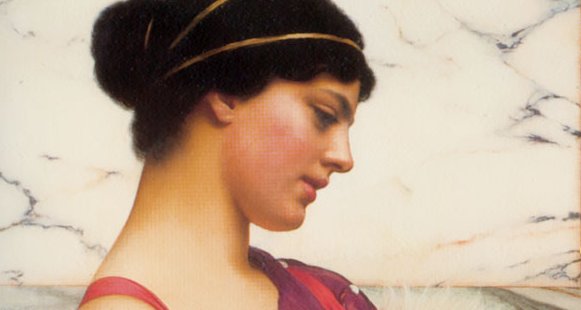
Observing things of beauty is one of the pleasures of life and in my blog today I am looking at the life of an artist who constantly depicted feminine beauty in his paintings.  My featured artist is the Victorian Neo-classicism painter John William Godward.    Victorian Neoclassicism was a British style of historical painting inspired by the art and architecture of Classical Greece and Rome.  During the 19th century, ever more Europeans made the “Grand Tour” to the Mediterranean lands. For them, the highlight of the journey was visiting the ancient ruins of Italy and Greece and learning about the exotic cultures of the past, and it was this fascination which led to the rise of Classicism in Britain.  Godward’s portrayals of female beauty was not merely “things of beauty” but of classical beauty which during his early days was very popular with the public.

William Godward (1801-1893),
John William Godward’s paternal grandfather

John William Godward was born on August 9th, 1861.  He was the eldest of five children of John Godward and Sarah Eborall.  John’s father and the artist’s grandfather, William Godward, had been involved in the life assurance business and his grandfather had become quite wealthy through some wise investments in the Great Northern Railways which had been formed in 1846.  John Godward Snr., the artist’s father, followed in his father’s footsteps and worked   as an investment clerk for The Law Life Assurance Society at Fleet Street in London’s financial district.  On the death of his father, John Godward Snr. inherited a sizeable amount of money and he and his wife Sarah, whom he married in June 1859, lived a comfortable life in their home in Bridge Road West which was then in the ashionable London district of Battersea.  They lived an “upright” and were devout followers of the High Church of England.
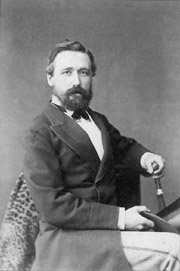
John Godward (1836-1904)
John William Godward’s father

Sarah Eborall, John Godward Snr’s twenty-six-year-old wife, gave birth to their first child on August 9th 1861 at their Battersea home. The baby was christened that October and given the names John and William after his father and paternal grandfather. Two years later in December 1863 their second child, Alfred was born.   In 1864 the family moved from Battersea to Peterborough Terrace, Fulham, later renamed Harwood Terrace.  Fulham at the time, and unlike today,  was a rural area with its farms and market gardens.  In February 1866 Sarah gave birth to her third child, a daughter, Mary Frederica, who was known affectionately as “Nin”.  With a growing family John Snr, Sarah and their three children moved to larger rented premises in Peterborough Villas, close to their previous home.

Two further children were born, Edmund Theodore, known as Ted, in November 1869 and their youngest, Charles Arthur, in June 1872.  The Godward family was now complete with five children and the size of the family probably dictated that they needed larger accommodation and somewhere around 1872 they all moved to Dorset Road Wimbledon

Little is known about John William Godward’s schooling but as his family were well-off middle-class parents he may have been enrolled at one of the many private schools in the Wimbledon area. It is thought that he developed a love of drawing during his schooldays.  He was brought up in a very strict household in which maternal and paternal love was in short supply.  Both his parents were very controlling and John William had few friends.  His father, a devout Christian and church-goer, was both strict and puritanical and expected his word to be law and as far as he was concerned all his sons would, on leaving school, follow in his footsteps into the business world and, in particular, into the world of insurance and banking.  Whereas John William’s three brothers, Alfred, Edmund, and Charles happily entered the world of insurance much to their father’s delight, John William Godward, his eldest son proved, in his mother and father’s eyes, to be a disappointing failure who although forced, at the age of eighteen, into working as an insurance clerk with his father, hated every minute of this alien world of finance.

Dora by John William Godward (1887)
Study of a model, possibly Hetty Pettigrew

John Godward probably realised that his son was not going to remain in the insurance profession and because of his son’s propensity for art, decided that rather than let him idle his time as a fine artist he would arrange for him to study architecture and design.  In the eyes of his parents, an architect had a more acceptable and honourable ring to it than that of an artist.  Between 1879 and 1881, his father arranged for his son to study under William Hoff Wontner, a distinguished architect and designer and friend of the family, in the evenings whilst retaining his day job as an insurance clerk. John William Godward worked alongside Wontner’s son William Clarke Wontner, who was also interested in fine art and exhibited some of his portraiture at the Royal Academy exhibitions.  William Clarke Wontner soon became a popular portrait painter who received many commissions from patrons for landscapes and murals to decorate interiors of their homes. One can imagine that the youthful John William Godward was inspired by his friend’s blossoming career in fine art and was more than ever determined to follow a similar path.  The two men would remain good friends for the years that followed.  The other bonus in working in Wontner’s architecture office was that Godward was able to develop his skills in prospective and drawing of architectural marble elements which would feature in his later paintings.  In 1881 William Hoff Wontner died but his son carried on training the twenty-year-old, Godward and it is almost certain that Wontner’s success as an artist further intensified Godward’s desire to paint for a living, a decision which would cause havoc with his relationship with his mother and father.

Portrait of Mary Perkinton Godward by John William Godward (1881)

One of the earliest works completed by John William Godward was a small watercolour portrait (4.5 x 3.25 inches) of his paternal grandmother, Mary Perkinton Godward.  She had died in 1866 when the artist was just five years old and so it is thought that he used a family photograph to complete the work.
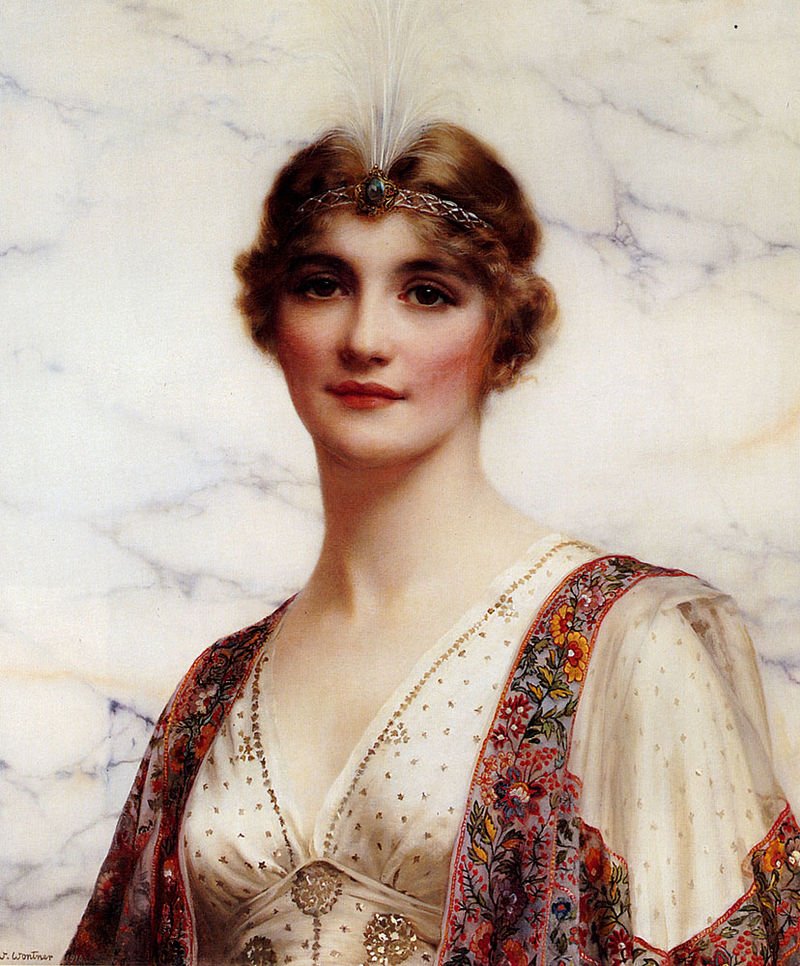
The Fair Persian by William Clarke Wonter (1916)

There is some doubt as to if, when and where John William Godward received formal artistic training.   Knowing his family’s vehement opposition to their son becoming a professional fine artist he is unlikely to have had his family’s backing to enrol at the likes of the Royal Academy of Art School and in fact there is no record of him attending any of their full-time courses.  However, we do know that in 1885, his friend and erstwhile mentor William Clarke Wontner taught at the prestigious St John’s Wood Art School, a feeder school to the RA School, and it may be that Godward also attended this establishment.  We also know that some of the visiting artists to this art school were Lawrence Alma-Tadema, Frederick Leighton, and Sir Edward John Poynter whose art certainly influenced Godward.
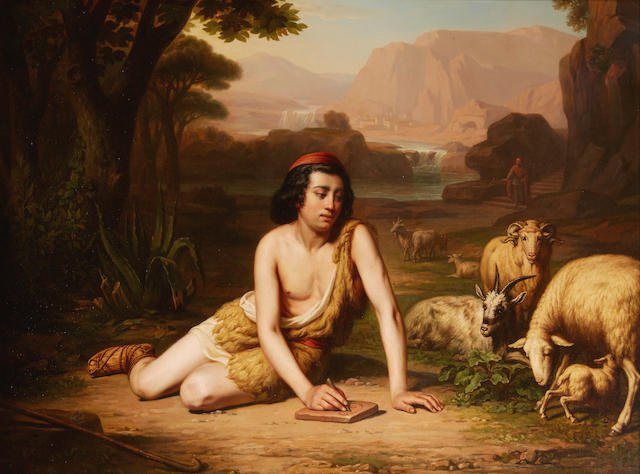
Giotto Drawing from Nature by John William Godward (c.1885)

Another reason to believe that Godward was receiving some formal training was a painting he completed around this time entitled Giotto Drawing on a Tablet which depicts the Italian artist, Giotto di Bondone, as a young shepherd drawing sheep.  The depiction is based on a passage from Giorgo Vasari’s1550 book, Le Vite de’ più eccellenti pittori, scultori, ed architettori (Lives of the Most Eminent Painters, Sculptors, and Architects), which recounts that Giotto was a shepherd boy, a merry and intelligent child who was loved by all who knew him. The great Florentine painter Cimabue, one of the two most highly renowned painters of Tuscany, discovered Giotto drawing pictures of his sheep on a rock. The depiction was so lifelike that Cimabue approached Giotto and asked if he could take him on as an apprentice.

Godward’s painting bore all the hallmarks of a “diploma piece” – a work of art which had to be submitted for critical assessment by tutors and it had to have the major genre elements taught in the art schools of the day.  It had a figure, a group of animals and a landscape, all of which were mandatory elements in order to demonstrate an artist’s technical expertise.  Having said all that, there are no definitive records of John William Godward attending any local art colleges.

Portrait of Mary Frederica ‘Nin’ Godward by John William Godward (1883)

Another early work by Godward was an 1883 portrait of his sister, entitled, Portrait of Mary Frederica “Nin” Godward.  The artist has depicted his sister shoulder-length in profile to the left. This was Godward’s first known oil painting.
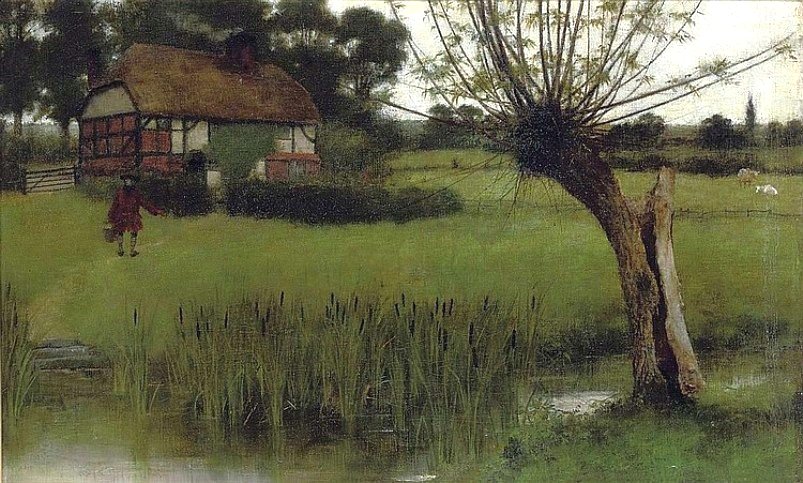
Country House in the 18th Century by John William Godward (1883)

Godward’s 1883 painting Country House in the 18th Century shows his early style, so dissimilar to the Neo-classical paintings we now associate with him.  It is so different in style that it may just have been a copy Godward made of another artist’s work

What every artist needs at one time or another is a good model.  Artists’ models often worked for more than one artist and the best were in high demand.  Enter the Sisters Pettigrew.  On the death of her husband William Pettigrew, a cork cutter, and because of the dire need to feed her thirteen children, his widow Harriet Davies took the advice of her artist son that three of his sisters, Lilly, Harriet and Rose, all with their masses of hair and exotic looks  would make ideal Pre-Raphaelite artist’s models, and so in 1884, she took them to London where they became an instant hit with many artists such as John Everett Millais, Fredrick Lord Leighton, William Holman Hunt, Edward Burne-Jones, James McNeill Whistler and John William Godward.  Rose Pettigrew wrote about the experience six decades later:

“…every great artist of the land” was clamouring for one of the “Beautiful Miss Pettigrew’s” to pose…”
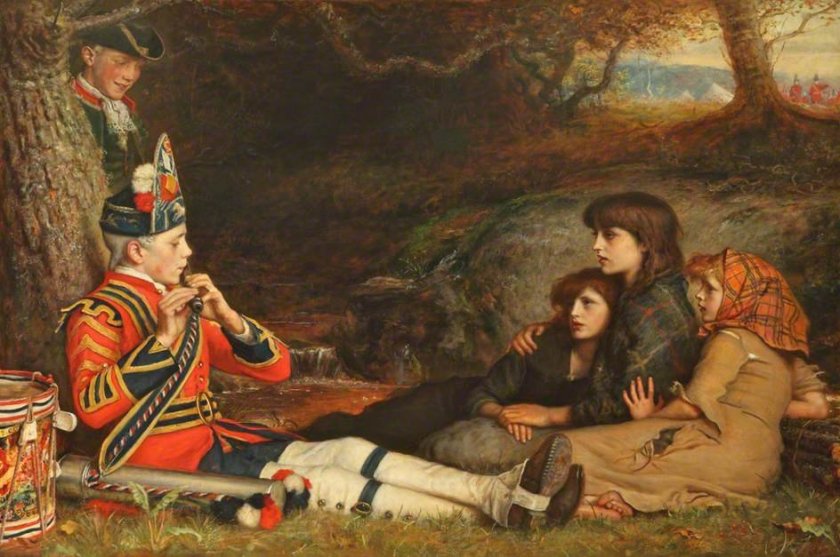
An Idyll of 1745 by John Evetett Millais (1884)

Their first time the girls appeared as artist’s models was when John Everett Millais used all three sisters in his 1884 painting, An Idyll of 1745, which depicts three young girls listening to the music played by a young British fifer.  Behind the fifer is a Loyal volunteer, seemingly enjoying the moment.  In the background is a British Army camp, likely where the fifer and volunteer came from.  From what the artist’s son said the three young girls were almost more trouble than they were worth, saying:

“…more trouble than any [models] he ever had to deal with. They were three little gypsies … and with the characteristic carelessness of their race, they just came when they liked, and only smiled benignly when lectured on their lack of punctuality…”
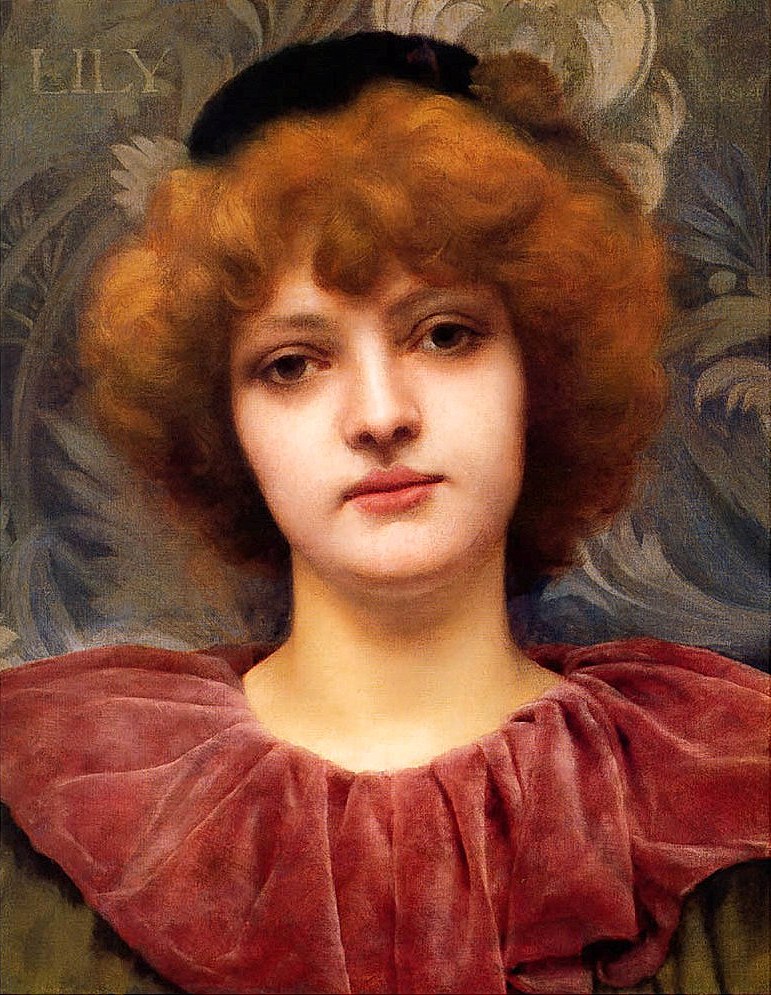
Portrait of Lily Pettigrew by John Wilson Godward (1887)

John William Godward completed a portrait of the beautiful seventeen-year old Lily Pettigrew in 1887.  She was the most beautiful of the three as her sister later wrote:

“…My sister Lily was lovely. She had [the] most beautiful curly red gold hair, violet eyes, a beautiful mouth, classic nose and beautifully shaped face, long neck, well set, and a most exquisite figure; in fact, she was perfection…”
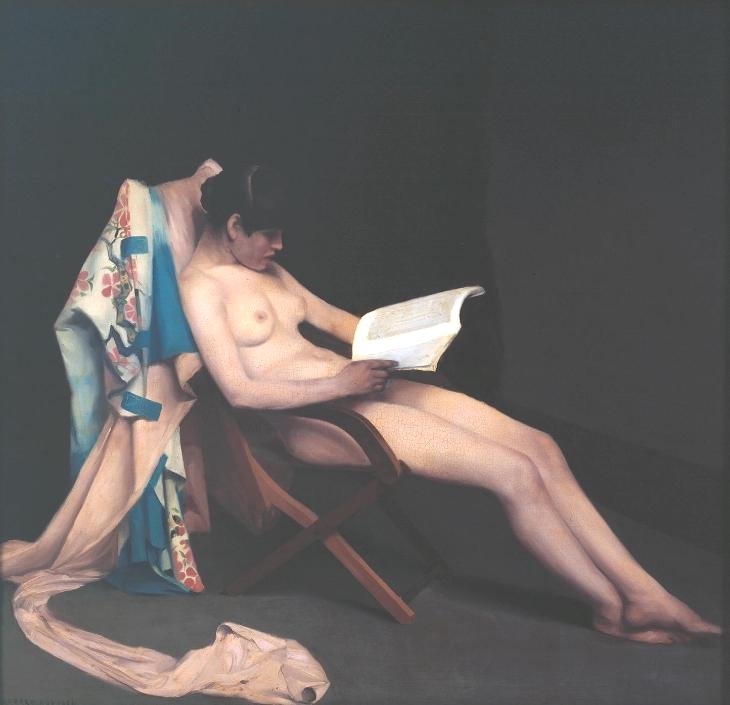
The Reading Girl by Théodore Rousseau (1887)

Nineteen year old Harriet (Hetty) Pettigrew featured in Théodore Roussel’s famous 1887 painting The Reading Girl.  Look what a fine model she is in the natural way she relaxes and seems so comfortable, naked in front of the artist.  Hetty had met Roussel in 1884 and from becoming his model, then, despite Roussel being married, became his mistress and gave birth to their daughter, Iris around 1900.   When Roussel’s wife died, instead of legalising his relationship with Hetty and their child, he married Ethel Melville, the widow of the Scottish watercolour painter, Arthur Melville. Once Roussel re-married in 1914, Hetty never sat for him again. Their close bond was over.
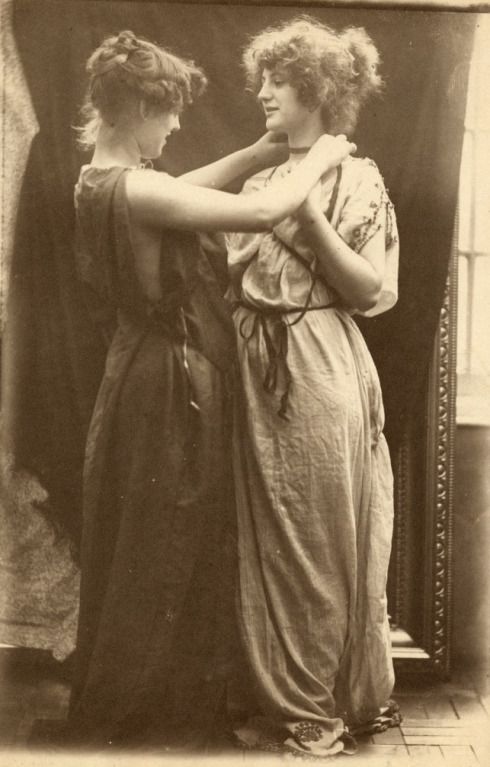
Lily and Hetty Pettigrew (Photographer: Edward Linley Sambourne)

The Pettigrew sisters are also thought to have introduced Godward to other artists who were members of the Royal Society of British Artists.  The Society had been founded in 1823 but had grown very little in its first fifty years of existence due to financial problems but then it came into its own around 1886 when its president was James McNeil Whistler.  Whistler wanted to inject some life into the Society by encouraging it to accept new young artists such as Godward, who for the next three years showed works at their exhibition.  Whistler’s tenure at the Royal Society of British Artists lasted only two years when he was asked to stand down.  Godward, however, was eventually elected as a member of the Society in 1890.

In 1887 Godward had his painting entitled The Yellow Turban accepted at the Royal Academy Summer Exhibition.  This of course was a great moment for the twenty-six-year-old artist and it was probably, begrudgingly, the first thing about their son’s desire to be a painter that pleased his parents’ middle-class values.  Whether their son was happy, mattered little to them.  His achievement or lack of it was everything in their eyes. Initially they hoped he would follow the family tradition and work in the insurance business.  They even “allowed” him to study art with Wontner in the evenings providing he stayed with the insurance company and there was even a hope he would, through his association with Wontner, enter the prestigious world of architecture.  Their dreams for their son were later lowered to believe he may become, as a last resort, a teacher of art – anything than have to suffer the ignominy of having their son become a penniless artist.

For Godward he was reaching a crossroad in his life.  He was twenty six years of age, still living at home with his parents who could not and would not share and support his ambition to become an artist.  He must have felt the overpowering parental pressure and for this reason suffered mentally.  He needed to break free but what price would he have to pay for this freedom?

……………..to be continued


Most of the information for this and my next blog about John William Godward came from a 1998 book by Vern Grosvenor Swanson entitled J.W.Godward: the Eclipse of Classicism.


Neil Simone. The Visual Surrealist

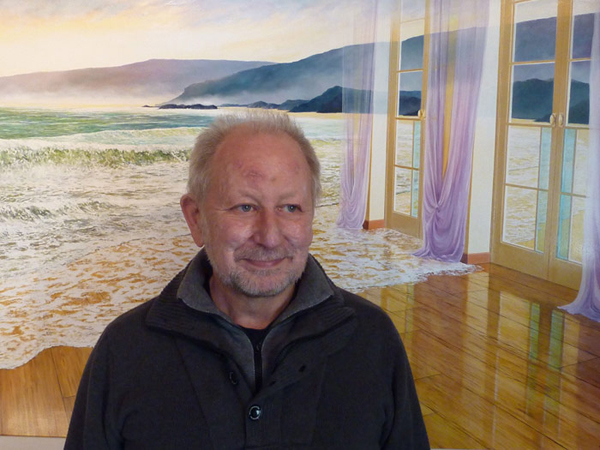
Neil Simone

My blog today is quite different to most of my others for two reasons.  My love of art is quite traditional, some would say boringly middle-ground. If you imagine visual art as a spectrum, at one end of which we have Abstract Expressionism and at the other end there is Hyperrealism, then my predilection would be much closer to the hyperrealism end of the spectrum.  I like to look at the beauty of a painting.  I like to be amazed by the skill of the artist and marvel at the time they must have spent in completing a work.  Mere splashes of colour do not impress me, whether it be stripes or dots.  However, as I have said before I was told that to appreciate visual art one needs to embrace all types !  So, the first reason for this blog being different is that it focuses on the art genre of Surrealism and the works of a Surrealist painter.

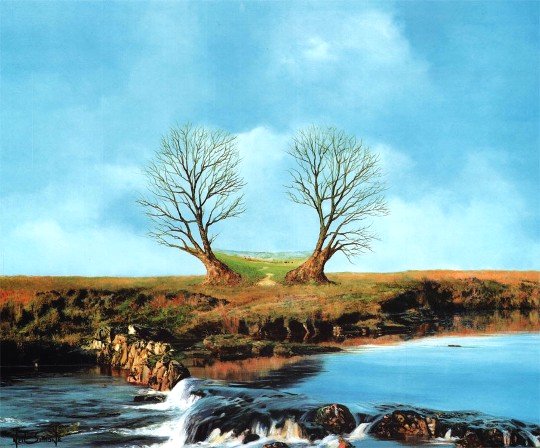
Surrealism is a 20th-century form of art in which an artist brings together unrelated images or events in a very strange and often dreamlike way.  It stresses the subconscious significance of imagery.  Through their works of art, the Surrealist artists wanted to revolutionise our experience.  They want us to cast-off our coherent and balanced visualisation of life and, in its place, value the power of the unconscious and dreams. The artists want us to look at their works and share their feeling of mysterious enchantment and discover the perplexing beauty in the bewildering depictions which totally disregarded convention.

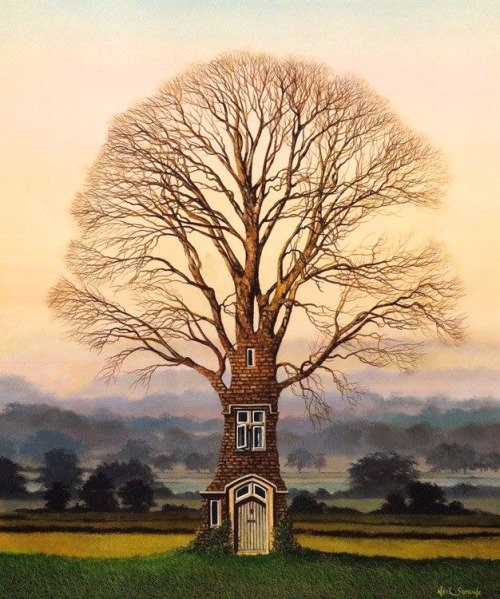
Alternative Path by Neil Simone

The second difference with my blog today, and this is more of a concern to me, is that my subject today is a living artist !  Why should that matter?  I suppose the answer is that I am delving into the life of somebody who has not given me permission to do so and secondly when one looks back and writes about somebody it is extremely important to have the correct facts.  You would be surprised at the number of times when I am researching a painter that I am finding differing facts, differing dates, differing names of family members and I never want to just guess at the correct information and so these inaccuracies drive me mad !!!  However, the deceased painter cannot complain at a mistaken fact quoted about them (albeit on some occasions I do get quizzed/censured regarding the authenticity/accuracy of what I have written by knowledgeable relatives or art historians).  With a living artist, they may take umbrage with my factual accuracy.

Having said all that let me introduce you to the English Surrealist painter Neil Simone.  The reason for this entry was that last week I was in the picturesque Yorkshire town of Harrogate and I visited Suttcliffes Contemporary Gallery, in the Montpellier Quarter of Harrogate and came across his works  and actually bought one of his prints, The Retreat,  as I was so fascinated by it. The one thing I like about some works of Surrealism, and I am a great fan of René Magritte, is that they are thought-provoking and quirky and I wonder how the artist ever came up with the ideas they put on canvas.

Nightfall by Neil Simone

Neil Simone was born in London in 1947. His parents rented rooms in a property in Burrows Road close to Kensall Green Underground station.  He was an only child and lived here for the first eleven years of his life.  In 1958, his parents bought their first property in Harrow, Middlesex.  This move to their own house finally gave their son his own room which as a teenager, was a godsend.

His progress in school was limited to success in graphic art and design in which he gained his “A” level and buoyed by that success he applied to enrol at the Harrow School of Art but was turned down due to not having achieved any academic qualifications in other subjects, in particular, the lack of “O” level English.  Like many setbacks in life one often find they were for the best and Neil Simone considered it was a narrow escape for him not to have gained admission to the art school as he believed that his erstwhile colleagues and friends who did attend the school were stymied as far as to their choice of a future artistic road map as their artistic path was dictated to them by the tutors, whereas Neil made all his own artistic life choices.

The Ocean Floor by Neil Simone

With no art college to attend, Simone had to both occupy his time, as well as finding a way of earning money.  Over the next few years he became a trainee lady’s hairdresser, helped a van driver deliver laundry, a petrol pump attendant and the nearest he got to the art world was a short spell as a layout artist for Moss Enterprises and a messenger for a commercial art studio, during which time he was attacked and robbed whilst carrying staff wages.  However the job which was to change his life the most was as a display artist at Sopers department store in Harrow for his immediate boss and team leader was Linda  who would in April 1968, become his wife.  The couple moved into a flat into a house owned by Peter Hale, the head of department at the Road Transport industry Training Board which made training films and artwork for use in lectures and promotions.  Peter had seen some of Simone’s work and offered him a job as creator of an exhibition to commemorate the opening of M.O.T.E.C. (multi-occupational training centre) which was held in Shrewsbury.  M.O.T.E.C. was the training centre for apprentices in the Road Transport Industry. The training unit was designed to provide realistic working conditions in which apprentices could have experience of all aspects of the trade.  The commission Peter gave Simone was so big that he needed help and so he took on his wife on a freelance basis to help him with the task.

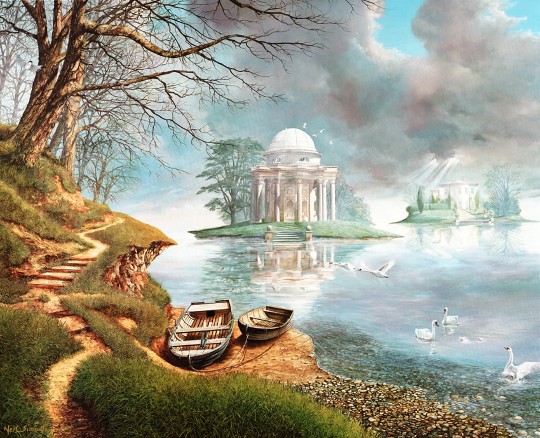
Island in the Sky by Neil Simone

The August Bank Holiday of 1969 proved a turning point in Neil and Linda Simone’s lives.  Their landlord and Neil’s employer invited the couple to visit his other home, The Priory, in the picturesque town of Harrogate in the heart of the Yorkshire countryside.  For Neil this was the first time out of London but he was immediately taken by the beauty of the area.  Peter and his wife Elizabeth persuaded Neil that Harrogate and the surrounding countryside would be a perfect base for him to carry on with his painting and they offered to rent Neil and Linda the basement of their house.  It must have been a big decision for Neil and Linda to have to make, whether they should give up their jobs and move two hundred miles away from their home and families in London and for Neil to take up painting professionally.  It was probably Linda’s belief in her husband that he could succeed and the fact that it was just the two of them that Neil decided to take the plunge and start a new life in Yorkshire with his wife.

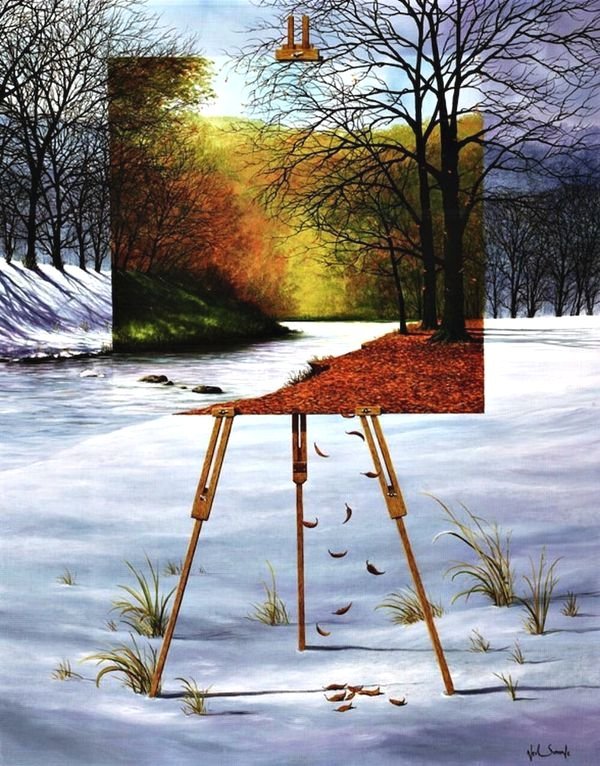
As Autumn Leaves by Neil Simone

Once the decision was made and the couple had moved to Harrogate Neil reckoned that to survive financially he needed to sell a minimum of two paintings per week.  He started to build up a collection of his work so that he could show his work at the 1970 Valley Gardens exhibition in Harrogate.  The exhibition went well and he sold twenty of his paintings.  However with every success comes failure and after the exhibition the sale of his paintings dried up and during the winter months of 1970 he was forced to go door to door with them to try to get a sale.

In the Spring of 1971 he exhibited at the Lounge Hall, Royal Baths, Harrogate and it was during this show that he met a fellow artist Judy Pyrah.  The two of them talked about the dream she had of opening her own gallery and suggested a joint venture when they had sufficient money.  Neil’s financial situation was improved by another person, Mr Rivlin, whom he also met at the exhibition.  Mr Rivlin liked Simone’s artwork and offered him employment at his company as the resident artist in charge of packaging designs and corporate identity material for his company, Endura Lamps of Horsforth.  In October 1971 Neil Simone started working for Mr Rivlin and in November Neil and Judy Pyrah opened their gallery, the Eye-Glass Gallery, in John Street, Harrogate.  The gallery remained open for just twelve months and this coincided with his work for Mr Rivlin being terminating in January 1973.

Exploring the Alternatives by Neil Simone

Neil and Linda’s stay in the basement of The Priory came to a sudden end in the autumn of 1974 when Harrogate was subjected to a series of storms and their basement flat was flooded and so the couple moved to another flat in Harrogate which also had room for a studio and a workshop for framing and was both light and airy.  During the next two years the sale of Simone’s paintings did well and he exhibited at galleries as far north as Edinburgh.  When Neil and Linda had taken the decision to permanently leave London and take a chance with life in Harrogate there was just the two of them and so if the venture failed then it would just hurt them as they had no children to support.  However seven years on, with their finances at a reasonable position, they believed they should start a family and in July 1976 their son, Lee, was born.

Within six months things turned for the worse for the family with galleries not wanting his paintings and with sales tumbling, they were in trouble. For Neil, it was a time of introspection, a time to figure out why things had gone wrong and more importantly work out what people wanted from art.  He needed time to reassess his art and, to give himself a chance to do this, Linda took their son and went back to live with her mother.  He realised the most important question he had to answer was what did he want from his art for he realised his mistake of suffocating his own imagination which once set ablaze his passion for art.  Neil thought long and hard and eventually hit on the idea that people may like to view works which would transport them into an alternative vision of reality.  He wanted observers of his work to question what were they actually looking at.  This was of course a form of surrealism, which he had dabbled with eight years earlier but had abandoned believing that he must paint what the public wanted and not what he wanted.

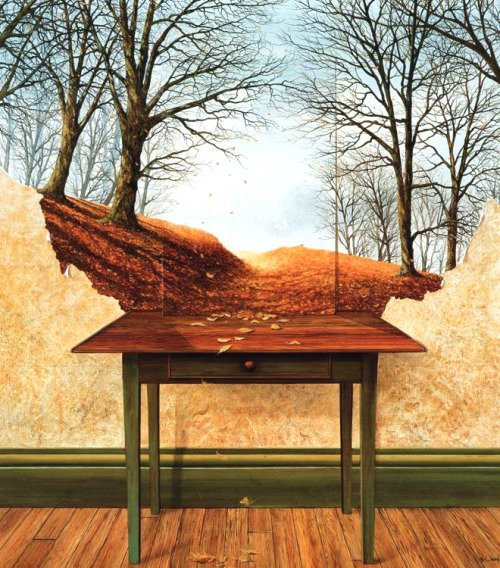
The Dropleaf Table by Neil Simone (2006)

His new style of artwork soon became an art with a sense of humour, as Neil put it “they would be paintings with an element of realism that invite conjecture”  It was quirky but would it sell?  He decided that he had nothing to lose and so in 1977, Neil Simone’s art became different.  It was a new direction.  In August 1979, the Harrogate Advertiser described it as

“…a fusion of fact and fantasy…”

It was the start of an exciting journey.  With the mental turmoil dissipated on having finally decided on the future of his art, he asked Linda to return to Harrogate.

The public and art critics both liked and were excited by this new style and his works of art were in great demand at exhibitions and sales rocketed.  His gamble on changing his artistic style had paid off and his paintings were in great demand.  Neil struggled to keep up a collection of his work due to all the sales.  His brain was awash with new ideas and his artwork was in great demand.  With all this came a healthy bank balance and in July 1978 Neil bought and moved into a house with Linda and two-year-old Lee in Grasmere Crescent, Harrogate.  This was the first home they had purchased and was an ideal place for an artist with a bright studio in the loft conversion.

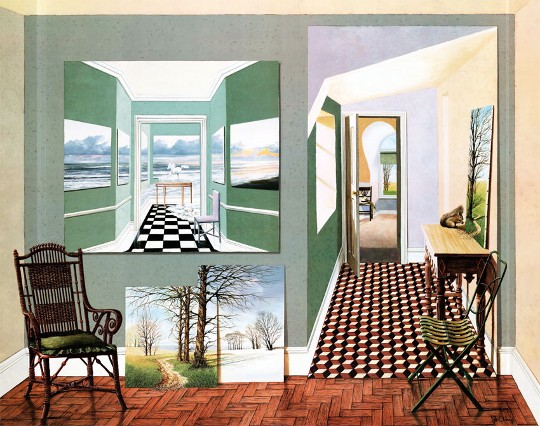
Realms of the Imagination by Neil Simone (1992)

Neil decided to launch his first set of limited editions prints but to do this he needed some financial backing which he got from family and friends and this proved a financial success and soon he could pay back his friends and from then on, he was able to fund any subsequent print editions, the second of which was launched in February 1980.  With all these print runs space at home became critical and it was soon obvious to Neil that the family needed a larger house.  In June 1980, they moved into a large house on Harlow Hill, one of the highest points around Harrogate, which he had bought when it was only partially constructed which allowed him to agree to some design alterations with the builder.

Another break came in March 1981 when a Dutch art dealer called at Simone’s studio. The dealer, Kees De Jong, had been told about the success Simone was having with his new style work and came to offer him a chance to exhibit some of it at the prestigious London Department store, Harrods.  Simone accepted the invite and in May his works were being showed in the windows of the prestigious department store.  More invites rolled in for Simone to exhibit works at various exhibitions and he now had to continually produce works.  Although this was time consuming and tiring Simone was very aware that the popularity of one’s artwork is ephemeral and that he had to make the most of his popularity.  The downside to this success was Neil had less time to spend with his wife and son.

The Sea Bed by Neil Simone (2000)

In 1983 Neil Simone met Barbara Dutton who had come to look at his paintings.  She was just about to open her own gallery at Pately Bridge, a village some four miles from Harrogate, and wanted some of Neil’s prints and originals but had a limited budget.  Neil and Barbara came to an agreement that she could take all his works on a sale or return basis.  The gallery opened in May and later that year there was an exhibition of Neil’s latest works.

In June 1984, Neil and Linda had an addition to the family with the birth of a daughter, Gemma.  Over the next ten years Neil was inundated with work to satisfy exhibitions he had committed to.  Life was hectic but profitable.  He had taken his son to Paris for his eighteenth birthday in 1994 and in 1996 his son had gone to university and his daughter was about to start secondary school.  Everything was going so well and yet around this time, Neil sensed all was not well.  He had a foreboding that things were going to change.  This sense he had of imminent change in his life was converted into two paintings he completed entitled The Ephemeral Nature of Beauty and the Persistence of Art and Our Thoughts Stray Constantly Without Boundary, both hinted at Neil’s concern that things in his life and marriage were about to change and not necessarily for the better.

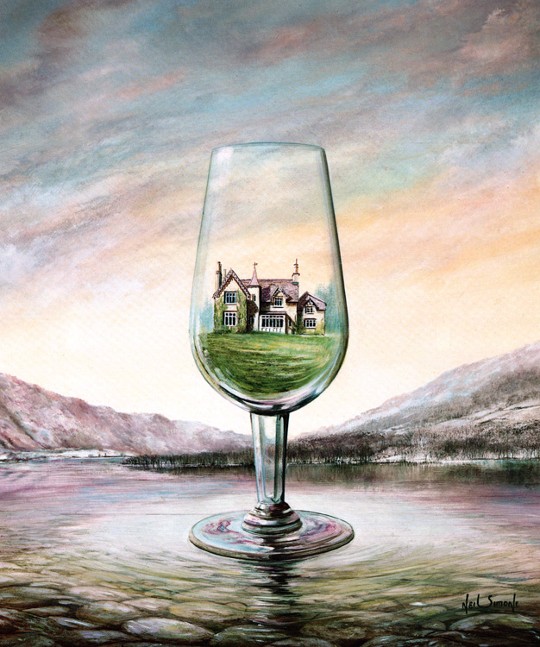
The House of Glass by Neil Simone (1991)

In 1997 Neil struggled with the effort to have to paint more pictures and became physically and mentally run down. He had to continually paint to satisfy clients and fulfil exhibition commitments but found it difficult to achieve sufficient work during a day at the studio so would leave home in the evening, returning to the studio to continue working through part of the night.  He began to worry about all the pressure to keep people happy but would not talk about it to his wife. He admitted that he became morose and withdrawn but he just hoped the problem would be short term. The strain on his marriage got so bad that in January 1998, in a hope that things may improve, he and Linda decided to separate and he left the family home and went to live in his rented studio.

The Retreat by Neil Simone (1999)

Some years earlier, Neil became very friendly with a lady called Heather who worked at an art materials shop where he bought most of his supplies.  Although she worked in Centagraph, an art supply shop, she had never painted and she was pleased to accept Neil’s offer of artistic tuition.  They became great friends and Heather proved to be the support Neil Simone needed to get him through life.  Living in his studio where he stored his artwork was proving to be untenable and so he decided he needed to buy somewhere larger.  The time also coincided with Heather and her young son Ben wanting to move out of rented premises and contemplate owning somewhere and so Neil and Heather, for financial reasons, decided to jointly buy somewhere and to fund his part of the purchase, Neil reluctantly sold some of his original paintings he had been keeping for himself.  In May 1999, the couple moved into a first-floor apartment in Langcliffe Avenue, Harrogate.  It was ideal for these two artists as it had a hexagonal sun room and a private roof terrace.

Rock Formation by Neil Simone (1999)

In late 2000, fifty-three-year-old, Neil Simone suffered a heart attack and was forced to rest and in January 2001 he underwent a triple bypass operation.  After a long period of rehabilitation under the watchful eye of Heather, Neil resumed painting.  Although they loved their apartment there was just not enough wall space to hang their work and so decided to search the property market for something larger and room for a gallery and workshop. Their search proved fruitful in September 2003 when they found the ideal home in the village of Whixley.  A month later Neil and Heather moved in to their new home and were able to hold exhibitions in their own gallery.  Heather and Neil are now married and still live in their Whixley home.

 Of his painting style which he termed visual surrealism, Neil wrote:

“…I paint the way that I do because I see the world as a dimension of shadows, shapes, contradictions and ever changing fragile boundaries…”

———————————————————————-

The majority of the information for this blog came from Neil’s own autobiography, Neil Simone.  The Memoirs of an Artist.  How long does it take? which is an excellent book with many reproductions of his work.

Neal and Heather’s gallery is at 2a High Street Pateley Bridge, North Yorkshire which I look forward to visiting in the summer.  The website is   http://www.simonegalleries.com/.

John Charles Dollman

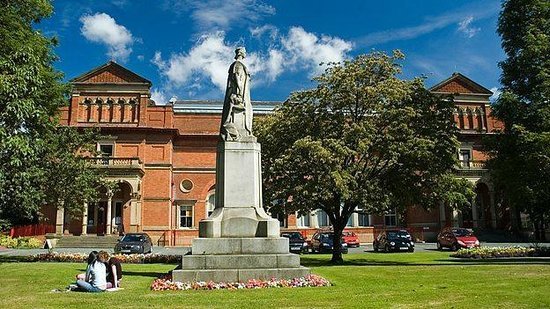
Salford Museum and Art Gallery

My blog today stems from a visit I made to an art gallery in one of our major cities, Manchester.   I have been to the two main galleries, the Manchester Art Gallery and the Whitworth Art Gallery, in the city before, but I had never been to the Salford Museum and Art Gallery.  The Salford Museum and Art Gallery was the UK’s ‘first free public library’, which opened in January 1850, followed in November by a museum and art gallery. The building was a mansion house known as Lark Hill, which had been built in the 1790s and has given its name to our famous Lark Hill Place; a Victorian street within the museum.

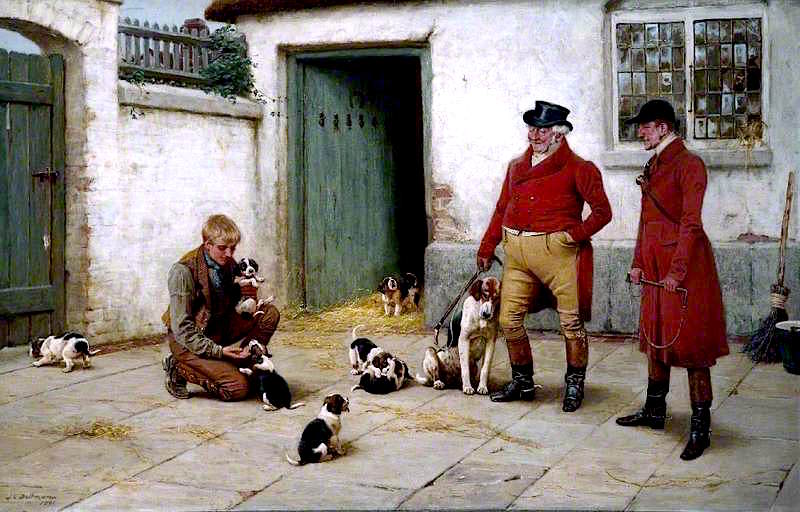
I had originally thought of featuring five or six of my favourite paintings from the gallery but the more I looked at one of the works of art, the more I wanted to know about other works the artist had produced.  The painting in question was Famine and the artist was the Victorian painter John Charles Dollman, who I had not heard of before. I was intrigued by both artist and the atmospheric painting and I needed to find out more.  Dollman, during his lifetime, was a celebrated artist but since his death just over eight decades ago he has almost been forgotten, so let me introduce you to a very talented Victorian artist.

During the Time of the Sermonses by John Charles Dollman (1896)

John Charles Dollman’s ancestors originated in France where their surname was spelled ‘Doleman’. Both Dollman’s grandfather and great-grandfather were prestigious hatters to the British royal family and it is believed that their work was well-liked by the courtiers.  Dollman’s father, also John, and his wife Mary lived on the south coast of England,  in the East Sussex coastal town of Hove where they had a bookstore and ran a stationery business.  John Charles Dollman, their first son,  was born on May 6th, 1851 one year after his sister, Selina, was born.  Ten years after John entered the world the family had expanded by a further four children, with the addition of Thomas Frederick, Herbert Purvis, Gertrude Eleanor, and the six-month old baby, Kate Maria.

The Rising Generation by John Charles Dollman (1891)

By the time John Dollman was a teenager his artistic talent had been recognised.  Some of his early work featured animals and at one local exhibition the art critic of the Brighton Guardian commented on Dollman’s work:

“…Mr Dollman’s forte seems to be for animal drawing. The strong-looking limbs, the well-rounded forms, and the symmetry of the horses show them to be types of a thoroughly serviceable animal…”

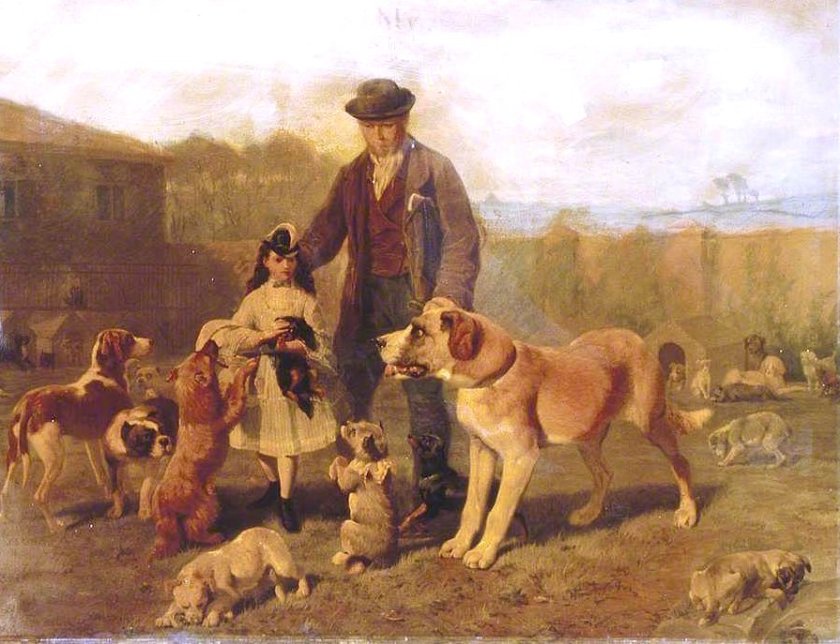
The Dogs Refuge by John Charles Dollman (1871)

Dollman studied art at both South Kensington and the Royal Academy Schools and soon gained a reputation as an animal painter and many at the time saw him as a natural successor to the renowned animal painter, Edwin Landseer. Many of Dollman’s works featured dogs and the plight of stray dogs.  An early painting by Dollman completed in 1871, entitled The Dogs Refuge, was a classic example of this genre and is housed in the Brighton Museum & Art Gallery.

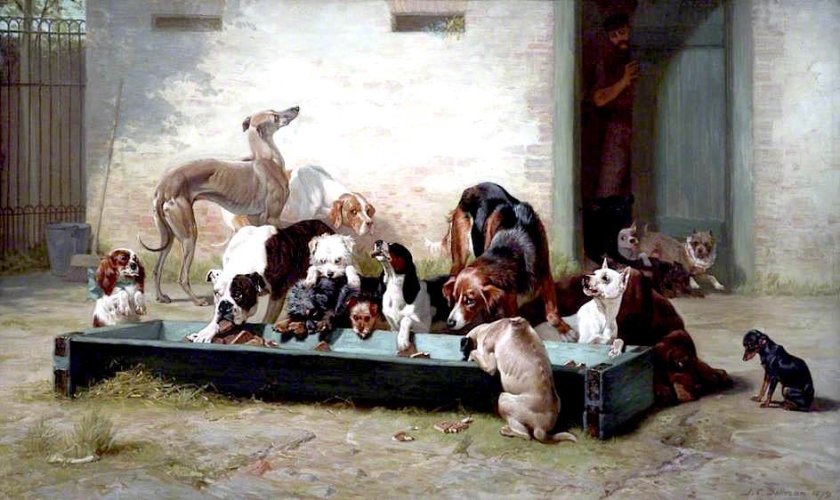
Table d’Hote at a Dogs’ Home by John Charles Dollman (1879)

Dogs had been companions to humans for tens of thousands of years but the acceptance of one as part of a family really only came about during Victorian times.  With this sentimentality over the dog came the concern for the fate of abandoned animals roaming the streets and it was this concern that led to the foundation of homes for these canine waifs.  In 1860, the Temporary Home for Lost and Starving Dogs opened its doors in Holloway. London which eventually moved south of the Thames and became the well-known Battersea Dogs Home.  Paintings featuring abandoned dogs pulled at the heart strings of the Victorians and were in much demand.   Another work featuring the plight of stray dogs is his painting Table d’Hote at a Dogs Home which was exhibited at the 1879 Royal Academy and is now housed at the Walker Art Gallery in Liverpool.

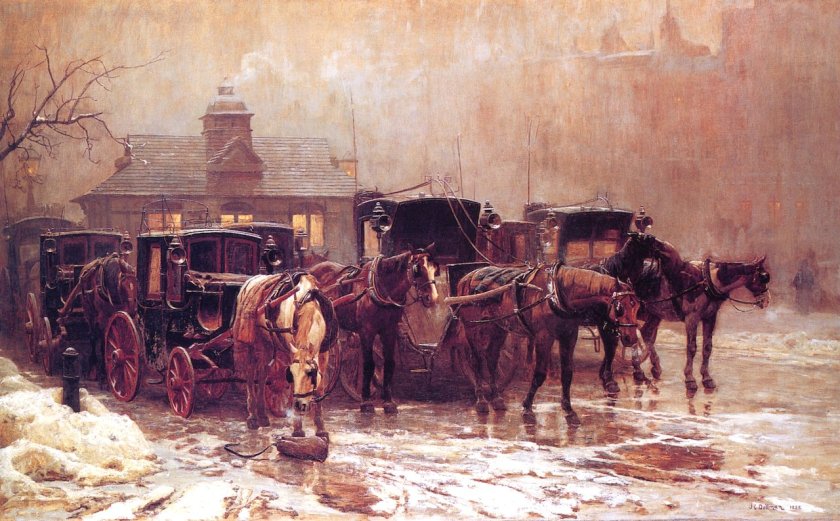
A London Cab Stand (Les Miserables) by John Charles Dollman (1888)

Probably his most famous works was one which also featured animals.  It was the atmospheric painting entitled A London Cab Stand which he completed in 1888 and is now housed at the London Museum.  It is a depiction of a group of forlorn-looking horses tethered to their cabs standing in pouring rain awaiting their next fare. The work is often known as Les Miserables for obvious reasons.  Dollman composed at least three variants of this picture.

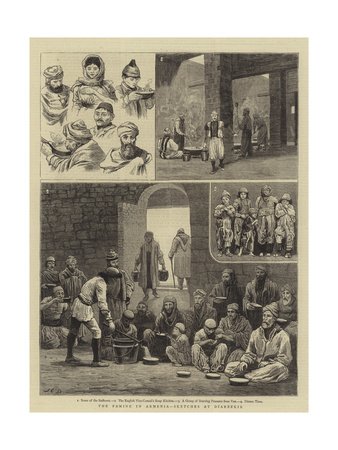
Famine in Armenia illustration by John Charles Dollman

Dollman was a regular exhibitor at the Royal Academy for over forty years from 1870 to 1912, and was elected a member of the Royal Watercolour Society.  To subsidise his income from selling his art he worked as an illustrator for magazines in the 1880’s such as the British weekly illustrated newspaper, The Graphic.  In some artistic quarters Dollman was referred to as a “black and white artist” which undoubtedly was based upon the amount of illustrations he did for newspapers and magazines.

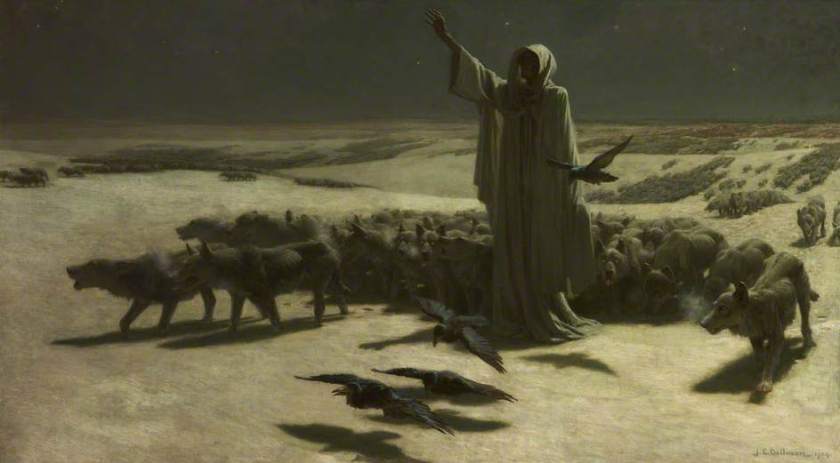
Famine by John Charles Dollman (1904)

As I said earlier this blog was brought about when I saw Dollman’s haunting oil painting entitled Famine, which he completed in 1904.  It depicts a tall emaciated figure going forward through a wasteland whilst being surrounded by hungry wolves and ravens.  It is a troubling work of art and one wonders what it is all about.  Some believe it is all about starvation with its visualisation of death in the form of the grey shrouded man who is being surrounded by ravenous wolves.  The artist, on the other hand, said he intended it to portray a famine of human spirit, or death of the soul after its neglect.  One amusing story behind this painting is that Dollman went to the zoo to sketch wolves for use in the painting but was disappointed to find that they all seemed well fed and all of them were too healthy-looking, which did not fit in with the idea of the work!

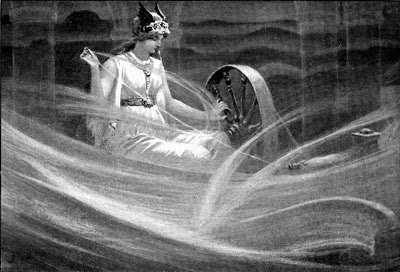
Frigga Spinning the Clouds by John Charles Dollman (c.1908)

Many of Dollman’s illustrations featured Viking mythology. His work conveys a powerful sense of drama. In 1908 Ethel Mary Wilmot-Buxton used eight of Dollman’s images in her book Told by the Northmen, and in the following year nine were reproduced in Hélène Adeline Guerber’s Myths of the Norsemen:  From the Eddas and Sagas.  One of these illustrations which Dollman completed around 1908 was Frigga Spinning the Clouds.  Frig, or the anglicised version of the name, Frigga, which translated means “beloved” was the wife of Odin, the chief of the gods and thus she was the highest ranking of Aesir goddesses.

There is a woman who weaves in the sky

See how She spins, see Her finger fly

She’s been before us from beginning to end

She is our mother, lover and friend

She is the weaver and we are the web

She is the needle and we are the thread.

From the poem Changing Woman by Adele Getty

Frigga was goddess of the clouds, and was usually depicted as wearing either snow-white or dark garments, which was dependent on her disposition.  She was queen of the gods, and she alone had the privilege of sitting beside her husband, Odin, on the throne, Hliðskjálf, which in Norse mythology was the high seat of the god Odin allowing him to see into all realms. From that lofty throne it was said she too could look over all the world and see what was happening, and, according to the belief of our ancestors, she possessed the knowledge of the future. Although she often appeared seated beside her husband, she preferred to remain in her own palace, called Fensalir, where she assiduously worked her jewelled spinning wheel producing golden thread and weaving long webs of bright-coloured clouds. Fensalir was also where Frigga invited husbands and wives who had led virtuous lives on earth, so that they might enjoy each other’s companionship even after death, and never be called upon to part again.

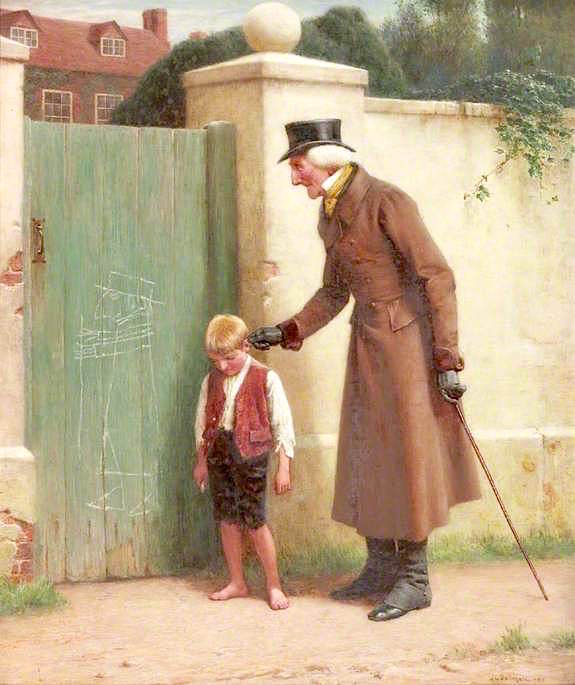
The Village Artist by John Charles Dollman (1899)

Paintings since the days of the cave drawings have been a means for us to learn about the past.  Paintings are often pictorial histories and without them the past would have been just our imagination gleaned from what we read but we lacked the graphic detail.  If we look at the seventeenth century Dutch and Flemish genre paintings we get an idea what life was like for the peasant classes in those days.  At the other end of the scale, in the eighteenth century paintings by the likes of Francois Boucher we get an idea of how the well-off lived in France.  Whereas the paintings looking at life of the rich could well be more stylised versions of the truth with elaborate furnishings added to the picture to enhance the status of the sitters, the peasant paintings were more realistic and it is this realism in a painting that appeals to me.  Add a story behind what we see before us as in narrative paintings then it is the icing on the cake.

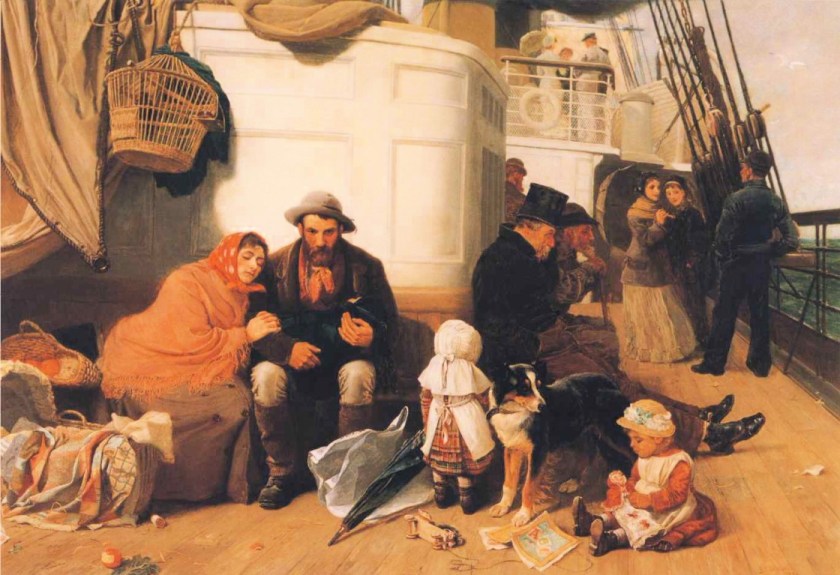
The Immigrants Ship by John Charles Dollman (1884)

Narrative art is art that tells a story.  It may be a single moment in a continuing story, often based on history, mythology or the Bible or as a sequence of events unfolding over time, such as the set of six paintings entitled Marriage a’la Mode by William Hogarth. Narrative paintings were especially popular in the Victorian era and John Dollman produced a classic entitled The Immigrant’s Ship in 1884.  In the painting, we see a young girl playing with a doll whilst her exhausted mother, who is almost drained of life, tries to get some rest as she leans her head on her husband’s shoulder.  He stares blankly at the wooden deck of the ship as if he wonders what they have all got themselves into and what was their future.  Unlike the wealthy man, who is sitting nearby with a top hat on his head, his family is living in very cramped quarters in the lower deck, a space which probably measured only a couple of square meters.  Beggars cannot be choosers, and this family was almost at beggar-level having received an assisted passage so that they could make a new life for themselves in Australia.  For people travelling on an assisted place this was no luxurious cruise.  Such passengers had to provide their own bedding and eating utensils and were fed biscuits, gruel, potatoes and occasionally preserved meat.

A Very Gallant Gentleman by John Charles Dollman (1913)

Dollman captured a very poignant moment in history with his 1913 painting entitled  A Very Gallant Gentleman which depicts Captain Laurence “Titus” Oates walking out to his death in the blizzard, on Captain Scott’s return journey from the South Pole, in March 1912. Oates had been suffering from severe frostbite which became so severe that he could hardly climb into his sleeping bag and the “killer”, gangrene, had set in. Oates realised his physical condition was now hampering his three other colleagues’ safe return and he pleaded with them to leave him behind, but they refused. The next day he awoke, and knew what he must do.  He left his colleagues knowing that this may help them and uttered his immortal line:

“…I’m just going outside; I may be away some time…”

Captain Scott recorded in his diary that day that Oates had gone out into the blizzard never to be seen again. The final three members of the expedition party struggled on for a few more days before they too died before ever reaching safety.

John Charles Dollman died in London on December 11th 1934 aged 83.  In his will he bequeathed a sum of ten thousand guineas to the Royal Academy to fund scholarships for promising young artists.  Dollman was a most amazing and yet forgotten artist.

Samuel Palmer. Part 2 The Shoreham Ancients, William Blake and later life

Samuel Palmer by George Richardson (1829)

Samuel Palmer was seventeen years old when he met the painter John Linnell and they would remain friends for life, a period stretching almost sixty years, albeit on occasions their relationship was somewhat strained during Palmer’s marriage to Linnell’s daughter. Linnell was born in London in 1792.  His background was very different to the middle-class prosperity of Palmer’s family.  His father, although a respectable carver and gilder, was not a wealthy man and whereas Palmer, who lived in the semi-rural outskirts of London, and was indulged and pampered by his parents, Linnell had to survive the murkiness of the depressing bleak streets of Bloomsbury.   Linnell was a landscape artist and portrait painter who found himself constantly in competition with the great John Constable.  At the time Linnell met Palmer the latter had rather lost his way artistically. Palmer wrote honestly about his worries regarding his art:

“…by the time I had practised for about five years I entirely lost all feeling for art … But it pleased God to send Mr. Linnell as a good angel from Heaven to pluck me from the pit of modern art…”

John Linnell inspired Palmer.  He offered artistic advice and instruction.   He took him to art galleries and introduced him to other artists, most notably William Blake who was to have a profound influence on Palmer.

The Rising of the Lark by Samuel Palmer (c.1839)

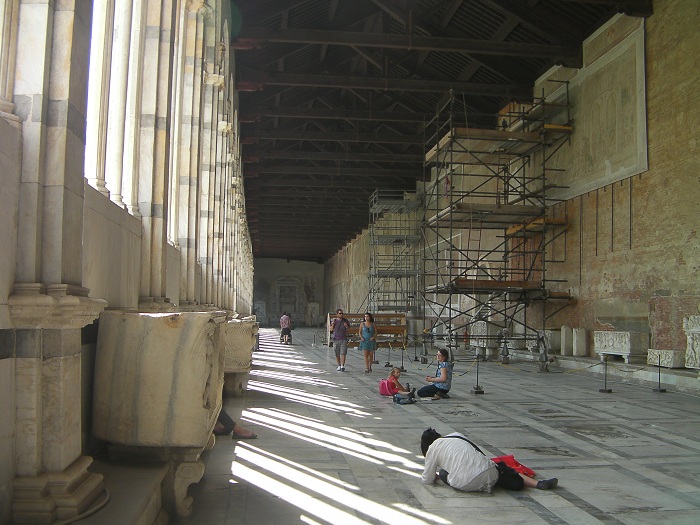
Linnell’s mentoring of Palmer was of great importance as it was Linnell who brought to the attention of Palmer  the artists of the late Gothic and early Renaissance periods, such as Albrecht Dürer, and the fourteenth century muralists, Francesco Traini, Buonamico Buffalmacco and Benozzo Gozzoli who were responsible for decorating the cemetery, Camposanto Monumentale in Pisa, Italy.

Interior hallway of Campo Santo showing restoration work of some of the murals

This magnificent building was said to have been built around a shipload of sacred soil from Golgotha, brought back to Pisa from the Fourth Crusade in the 12th century.  An inscription near the right gate tells us that the construction of the Camposanto started in year 1277 and finished in the late 15th century.

Another influence on Palmer around this time was the works of art of Henry Fuseli.  The National Gallery in London was not built until 1824 so Palmer would spend time at the Dulwich Gallery (opened in 1817) copying the works of the Masters and was fortunate to be allowed to view the private collection of the German merchant and insurance agent Carl Aders which included many works by artists of the Primitives movement.  However one of the greatest influences on Palmer was William Blake.  Blake was introduced to him by Linnell in 1824, who at the time, because of his art work, was viewed by many of the art establishment as an obscure and impoverished figure and thought to be just a harmless madman.  Palmer had always been a visionary and this was enhanced once he entered the world of William Blake

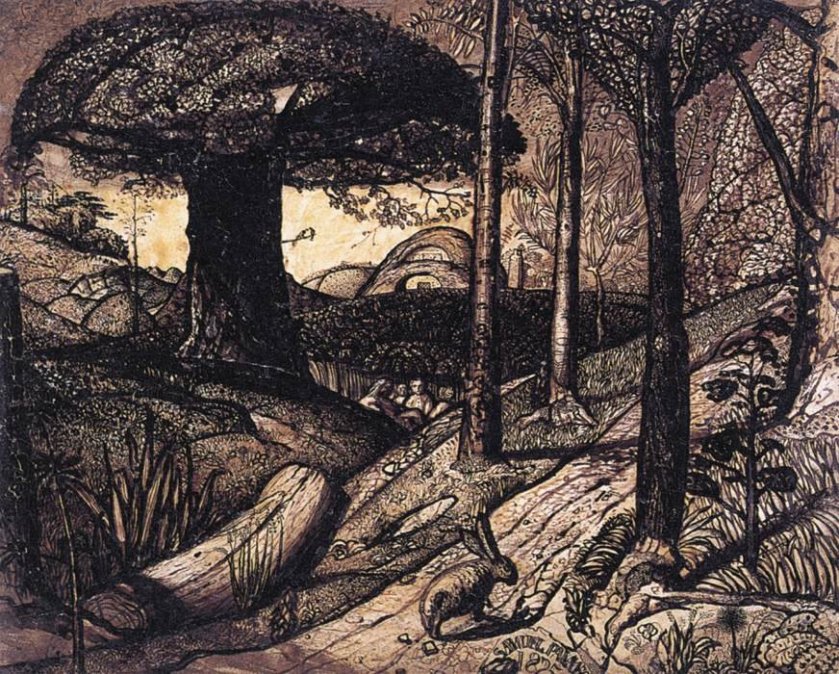
Early Morning by Samuel Palmer (1825)

In 1824, Palmer’s health once again deteriorated.  He suffered from asthma and bronchitis, and so he decided to follow his mother’s old remedy of leaving London and heading to the South Coast.  He visited the Kent village of Shoreham, and two years later he moved there permanently, buying himself a small run-down house, which he called Rat Abbey maybe because of his fellow dwellers in the old building!  A short time later, his father sold up his book selling business and left London and joined his son in Shoreham.  He rented half of a large house with the name Waterhouse which was situated on the banks of the River Darent.  Samuel Palmer’s nurse, Mary Ward, and his brother William joined Samuel snr. and also came to live there. The Water House proved to be of use to Samuel as it often housed visiting guests and fellow artists when there was no room at Rat Abbey.  Finally in 1828 Samuel Palmer left his small house and went to live with his father at Water House and stayed there for the rest of his time in Shoreham and it was during those heady days in Shoreham that Samuel first encountered John Linnell’s daughter Hannah whom he would later marry.  Palmer loved his new home and we can witness his contentment shown in his autobiographical letter published in The Portfolio art journal of that time.  He wrote:

“…Forced into the country by illness, I lived afterwards for about seven years at Shoreham, in Kent, with my father, who was inseparable from his books, unless when still better engaged in works of kindness. There, sometimes by ourselves, sometimes visited by friends of congenial taste, literature, and art and ancient music wiled away the hours, and a small independence made me heedless, for the time, of further gain; the beautiful was loved for itself …”

It was during his time in Shoreham that he founded, along with George Richmond and Edward Calvert, an artistic group of painters that were all inspired by William Blake.  The group were known as The Ancients or the Shoreham Ancients.  They were an artistic brotherhood who would meet both in Shoreham at Palmer’s home and at Blake’s apartment home in London.  This like-minded group of painters were followers of William Blake and were attracted to archaism in art, a style which has the deliberate intention to emulate a style of the past to suit contemporary vision.  With the exception of Palmer, most of the members of the “brotherhood” were former students of the Royal Academy, who had broken away from the confines of academic teaching and concentrated on their idealized vision of the past.

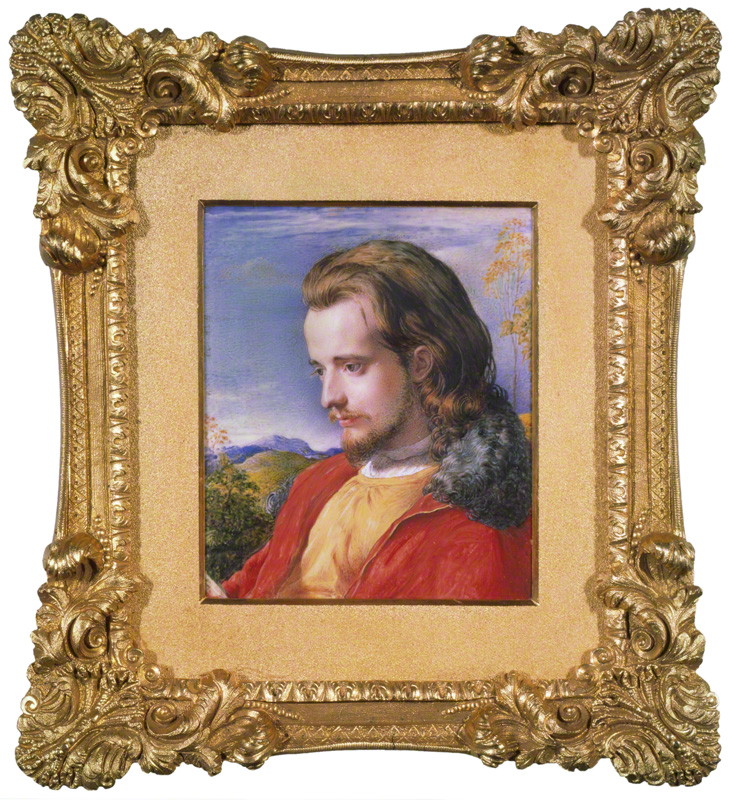
Samuel Palmer by George Richmond, watercolour and body colour on ivory, 1829
Samuel Palmer by George Richmond, watercolour and bodycolour on ivory, 1829

The Ancients were in existent around the same time as another art group was formed in Rome by some nineteenth century German painters.  They were known as the Nazarenes a derisory title which was used against them by detractors because of the biblical manner in the way they dressed and their Christ-like long hair and beards.  Samuel Palmer used to wear revivalist-type clothes and in a portrait in the National Portrait Gallery in London we see him with long hair and a full beard wearing a round-necked pleated smock under a coat.  It was during this time that critics believe that Samuel Palmer created his best works of art.  They were small landscapes which were almost composed of just a single colour using watercolour or ink. The depictions enforced Palmer’s religious belief which identifies God with the universe, or regards the universe as a manifestation of God and all the food derived from the fields were gifts from God.

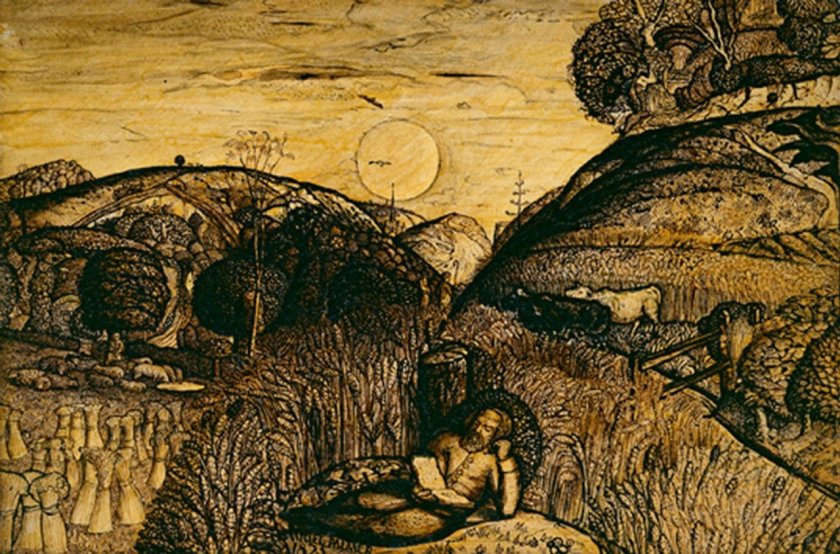
An example of a Samuel Palmer painting of this time and type is one he completed in 1825 entitled The Valley Thick with Corn which is part of the six so-called Oxford Sepias, a group which now belongs to the Ashmolean Museum in Oxford.   The six pictures were completed between 1825 and 1835 at a time when Palmer found inspiration in the landscape around his home village of Shoreham.  The area was inspirational for him and it allowed him to produce, what some believe to be, some of the greatest English pictures of the 19th century.

The Valley Thick with Corn by Samuel Palmer (1825).

The Valley Thick with Corn is a beautiful brown ink pen drawing which has been finished off with a layer of varnish.  This coating has aged over the years and has now given the work a rich yellow-brown finish.  The setting for the painting is undulating cornfields.  The darkness of the picture suggests it is late evening with the full moon rising over distant rounded hills and a tall thin church spire. A horse drawn cart can just be made out in the top left of the picture, as it trundles up a steep track.   In the foreground we see an elderly bearded man dressed in what looks like Elizabethan clothes lying on the ground surrounded by ears of corn.  He is stretched out and rests on his elbow.  On his lap lies an open book so he could be reading, albeit he looks as if he has fallen asleep.  Behind and to the right of him we see two cows slowly making their way through the cornfields.  To the left, in the mid ground, we see upright sheaves of corn which have been harvested and awaiting collection and behind them are sheep tended by the shepherd who sits under a tree and plays music to them on his pipes.

In a Shoreham Garden by Samuel Palmer (1830)

In 1829 Palmer completed his work entitled In a Shoreham Garden.  It is a wonderful work at a time which is looked upon as the height of Palmer’s achievements. The picture is a small watercolour heightened with gouache on stiff smooth cardboard often referred to as Bristol Board.  The work, measured just 28 x 22 cms and remained in Palmer’s own collection, no doubt in memory of Shoreham, the village he had loved so much.   It now resides in Oxford’s Ashmolean Museum.  It is full of light and colour with the dominating feature being an apple fruit tree in full blossom on the end of a path within a walled garden.  The tree is loaded with flowers.  In fact, besides the side of a wooden building in the right foreground the picture is an abundance of colourful flowers, bushes and trees which reach up to the sky.  In the background we see a lady wearing a long flowing red dress gazing out to something out of view to the right of the painting.  It is thought that the painting was a scene from the garden of his and his father’s Water Garden house.  It is now part of the V&A collection.

The Magic Apple Tree by Samuel Palmer (1830)

What is thought to be a companion piece to In a Shoreham Garden is one of his other 1830 works, The Magic Apple Tree.

Cornfield by Moonlight, with the Evening Star by Samuel Palmer (c.1830)

Around 1830, Palmer also completed a work entitled Cornfield by Moonlight, with the Evening Star.  It was a small painting measuring just 19 x 30cms.  The painting is now considered one of Palmer’s finest moonscape paintings.  We see a man carrying a staff, dressed in a long smock and wearing a wide brimmed hat walking through a cornfield with his dog.  In the foreground there are again sheaves of corn.  The sky is dark, lit up by a waxing sickle moon and an evening star, which could be, because of its brightness, the planet Venus.  The light emitting from the moon is probably much stronger than it would be for such a moon but it serves to illuminate the land.  There is no documentation to tell us the location of the scene but the rolling hills we see was characteristic of the Shoreham area.

In 1835, after ten years in the Kent village, Palmer left Shoreham and went to live back in London.   He had hoped to earn some money by selling some of the work he had accumulated whilst at Shoreham and he also hoped that he would be able to make some money by teaching art in the capital.

Samuel Palmer and Linnell’s eldest daughter, Hannah, married on 20th September, 1837 after an engagement which lasted several years.  Linnell had always been supportive of the match unlike his wife who was somewhat opposed to the liaison.  Samuel Palmer, funded by his new in-laws, and his new wife Hannah set off on their honeymoon to Italy in October 1837, a journey which would last two years and one that Palmer’s mother-in-law was vehemently opposed to..

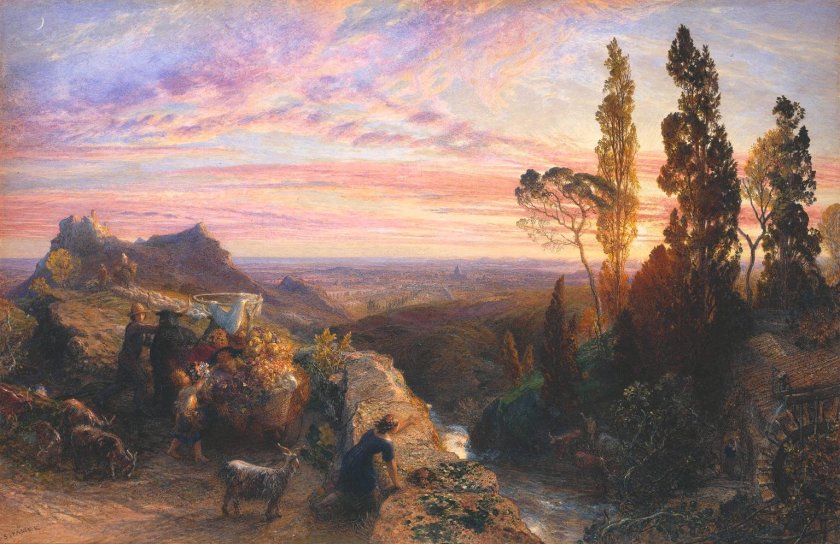
 Dream in the Apennines by Samuel Palmer (1864)
Dream in the Apennines by Samuel Palmer (1864)

A later painting by Samuel Palmer, one of his largest watercolours measuring 94 x 130cms, may have come from sketches he made during the honeymoon.  It was exhibited in 1864 and entitled Dream in the Apennine.  The depiction is a view of Rome as seen from the south-east.  It is now owned by the Tate in London.  When it was first exhibited it came with a note which read:

“…Suddenly, at a turn in the mountain road, we looked for the first time on that Plain; the dispenser of law, the refuge of philosophy, the cradle of faith. Ground which Virgil trod and Claude invested with supernatural beauty was sketched – but with a trembling pencil...”

In the foreground we see a young girl peering over the edge of a stone wall at the fast flowing river below.  She is throwing stones into the valley below.  There are goats standing behind her which may well be in her charge.  Behind and to the left of the girl we see a fully laden cart being pulled by a pair of mighty oxen which are being controlled by a young man.  A small child rushes towards the cart to add a few more bunches of flowers to the already filled large wicker baskets.  In the distance, on the plain we can see the Eternal city and the dome of St Peter’s Basilica.

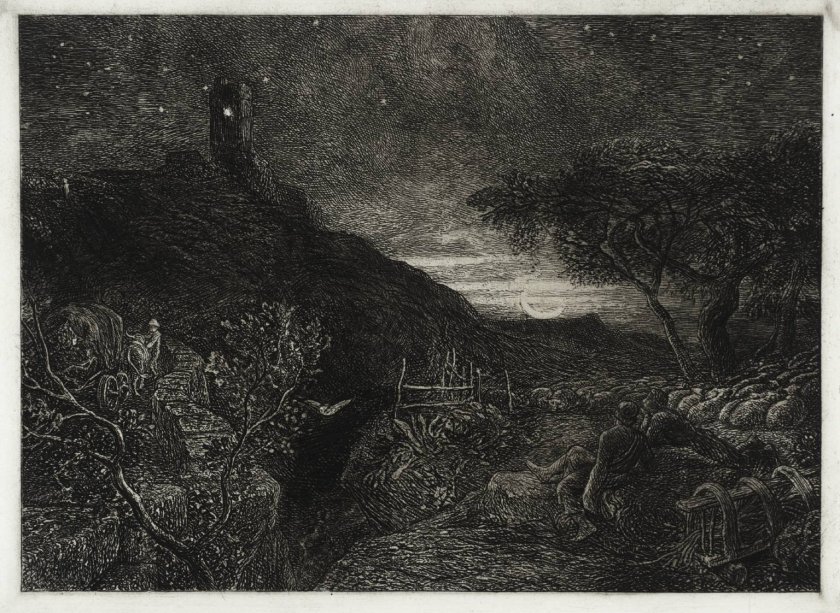
The Lonely Tower by Samuel Palmer (1879)

The last work of Samuel Palmer which I am looking at was an etching which he completed in 1879 entitled The Lonely Tower.  The scene before us was first exhibited as a watercolour at the Watercolour Society by Palmer in 1868.  Along with the watercolour there was a quotation from Il Penseroso (The Serious Man), a poem by Palmer’s favourite poet, John Milton.

“…Or let my lamp at midnight hour,

Be seen in some lonely tower,

Where I may oft outwatch the Bear,

With thrice great Hermes…”

Palmer and his family were living at Furze Hill House in Reigate and from his study he could look out towards Leith Hill and the folly, built in 1765 which is at its summit.  It could be this that he saw when he painted The Lonely Tower.    It is a depiction of a remote hilltop tower standing on the edge of a cliff with its single light shining out against a darkening sky.  It is now the remains of what once had a greater purpose.  We see a crescent moon against a horizon which is filled with clouds and stars which sparkle brightly.   Below and to the left of the light we see a man struggling to get his ox-cart up a steep track.  On the opposite side of the deep ravine we see two shepherds gazing up at the light and the night sky.  Flying over the ravine we see a barn owl. It is such an atmospheric and haunting picture. The Irish poet W B Yeats referred to the work in his poem Phases of the Moon:

“…He has found, after the manner of his kind,

Mere images; chosen this place to live in

Because, it may be, of the candle-light

From the far tower where Milton’s Platonist

Sat late, or Shelley’s visionary prince:

The lonely light that Samuel Palmer engraved,

An image of mysterious wisdom won by toil;

And now he seeks in book or manuscript

What he shall never find…”

This was by far the most evocative of Palmer’s late works.

Leith Hill Folly
Leith Hill Folly

Hannah and Samuel’s first son was born on January 27th 1842.  He was named Thomas More Walter George Palmer, Thomas More, after the famous fifteenth century statesman and philosopher who was councillor to Henry VIII, and George after Samuel’s good friend George Richmond.  He was a boy who grew to be a studious young man during which time he survived many boyhood scrapes whilst in Grammar school prior to going to Oxford University.  Sadly his father’s dream that his son would get to Oxford was dashed when the young man’s health deteriorated in 1859 and eighteen months later, after a long and painful illness, died on July 11th 1861.  He died at the tender age of nineteen.  Both Hannah and Samuel were devastated.  Samuel Palmer never got over his loss.  In his work The Lonely Tower the Great Bear star constellation depicted in the sky in the background is said to be as it was on the night his son died and as he looked skyward in grief. It was forever engraved on his mind.

The couple had another son Alfred Herbert Palmer who was born in 1860.  He went on to publish a biography of his father The Life and Letters of Samuel Palmer in 1892.

Samuel Palmer's grave in St Mary Magdalene Church Reigate
Samuel Palmer’s grave in St Mary Magdalene Church Reigate

Samuel Palmer died on May 24th 1881 aged seventy-six.  Palmer’s father-in-law and mentor John Linnell died six months later.  Palmer’s wife Hannah died twelve years later and the two are together in a cemetery in St Mary Magdalene churchyard in Reigate.  A strange twist to this story is the fact that in 1909, many of Palmer’s Shoreham works were destroyed by his surviving son Alfred, who burnt a great quantity of father’s sketchbooks, notebooks and original works. His reasoning behind the destruction was that he believed that nobody would not be able to make head nor tail of the material and that he wished to save it from a more “humiliating fate”.   Alfred Herbert Palmer died in 1931.

Samuel Palmer in Old Age by John Linnell

There is so much about Samuel Palmer I haven’t included in the two blogs but I hope that there is enough in them to tempt you to read more about the artist and I recommend an excellent book which will tell you all you about the great man.  It is written by Rachel Campbell-Johnston the chief art critic and poetry critic for the Times.  The book is entitled Mysterious Wisdom.  The Life and work of Samuel Palmer.

Samuel Palmer Part 1. The Early years, portraiture and the rural idyll

The Prospect by Samuel Palmer (1881)

My featured artist today is one of the great English landscape painters, draughtsmen and etcher of the nineteenth century.  He was a major player in the art of Romanticism.  His landscape works were special, conjured up by his inventive and far-sighted imagination.   There was a magical feel about his work.  Palmer was not just an ordinary every day painter; his works were poetical and he himself, through his art, seemed to have the ability of a mystical seer. Let me introduce you to Samuel Palmer.

At the time of Samuel Palmer’s birth there was a worrying tension brought on by conflict.  It was a troubling time.  It was a time of tumult in Europe.  Sixteen years earlier France had been affected by the storming of the Bastille and the fall of the rich and the nobility of the ancient regime.  Initially, there was probably a delighted sense of schadenfreude in the minds of many in England, including the “establishment” at the fall from grace of what they perceived was the cruel and greedy French aristocracy but soon that enthusiasm dwindled with the thought that such revolutionary behaviour may cross the English Channel.  In 1793, twelve years before Samuel was born France declared war on Britain, a war which would last more than two decades.  Although the battlefields were not in England Napoleon Bonaparte used another weapon against the British by blockading European ports and by so doing deprive Britain of lucrative trade.  The war however proved fortuitous to Samuel’s family who were hatters and hats were in great demand since the government, to add to their much needed war chest, had imposed a hair powder tax and this ended the era when elegantly puffed and powdered coiffures which were once de rigueur, now could not be afforded.  The fashion was now for the “topper”, the nickname given to top hats.

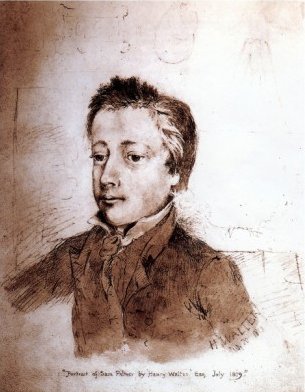
Portrait of Samuel Palmer by Henry Walter (1819)

Samuel’s father, also named Samuel, had set forth to study to become a surgeon but his squeamish nature put an end to that dream and he ended up in his father, Christopher Palmer’s, millinery business.  Samuel Snr. was somewhat of a dreamer and this along with his love of books led him to forego the safe and lucrative job as a hatter to set himself up as a bookseller.  This decision did not go down well with his family as the trade of a bookseller seemed a lowly trade not fit for a “gentleman”.  Samuel Snr. was, besides being a dreamer, a very determined person and cared little about status and the financial position of his family.

Samuel Palmer Snr. met and fell in love with Martha Giles and they married in October 1803.  Samuel Palmer, their first child, was born in Newington, London on winter Sunday morning, on January 27th 1805.  The couple lived in Surrey Square in Newington, which at the start of the nineteenth century, was a semi rural area populated with lush gardens, fields and orchards.  It was a haven for those who loved the countryside; a love young Samuel would have all his life.  It was a time when survival at birth was somewhat of a lottery with a third of babies not surviving to see their first birthday and amongst the poor and deprived the survival rate would drop even further.  However Samuel Palmer was lucky in as much as he was born into a prosperous middle-class family.

Early Morning by Samuel Palmer (1825) Pen and ink and wash, mixed with gum arabic, varnished,
Early Morning by Samuel Palmer (1825)
Pen and ink and wash, mixed with gum arabic, varnished,

Samuel was not a healthy child and his mother and grandmother would often take him to the Georgian seaside resort of Margate in the hope that sea air would improve his health.  This once fishing town was a favourite of Turner.  It was during his boyhood stays in Margate that he would listen to his grandmother’s tales of ghosts and restless spirits who wandered around the town.  Stories of such apparitions would remain with Samuel and would interest him all his life.  His mother’s continued concern about her son’s physical health led her to employ a live-in nurse, Mary Ward, who set about improving his health by improving his diet.   It was also this lady who was to have such an influence on the young boy.  Unlike most servants who were illiterate Mary was well read with the Bible and Jacob Tonson’s pocket illustrated book of Milton’s poems being her favourites.  She, like Samuel’s father, loved books and would often read Milton’s poems to Samuel.  When Mary died she bequeathed the book of poems to Samuel who would carry it round with him wherever he went.  Of Milton’s poems, Samuel wrote:

“…I am never in a “lull about Milton”…….nor can tell how many times I have read his poems… He never tires….I do believe his stanzas will be read in heaven…”

Samuel gained a brother in 1810 with the birth of William, who was to be the only other surviving child of Samuel Snr. and Martha.  Samuel Palmer did not have many boyhood friends as he was more than satisfied to immerse himself in his books, including works by Dickens, which featured the English capital.  It was a trait, which delighted his father.  Samuel would often go for walks on Dulwich Common with either his father or his nurse during which they would often read to him as they strolled the countryside.  His love for reading and the joy books brought him can be seen in one of his letters (The Letters of Samuel Palmer – Raymond Lister, 1974) in which he wrote:

“…There is nothing like books of all things sold incomparably the cheapest, of all pleasures the least palling, they take up little room, keep quiet when they are not wanted and, when taken up, bring us face to face with the choicest men who ever lived at their choicest moments…”

Samuel, maybe because of his poor health, tried to avoid the necessity of going into the heart of London with all its pollution from coal fires and the often dank fogs emanating from the Thames.  He was a lover of the countryside and being of poor health abhorred the polluted city life.

In May 1817, at the age of eleven, Samuel was sent to Merchant Taylors’ public school.  This was a prestigious institution founded back in 1561 but for Samuel it was a nightmare.  Samuel who had been cosseted by both his mother and nurse and had a quiet solitary home life, which suited his nature, suddenly was thrust into a maelstrom of lively and loud boys in which a pale-faced asthmatic boy fared badly.  Samuel disliked the public school system with all it entailed and in another of his letters he wrote:

“…the fag crawls to be kicked, and, in his turn, kicks the fag who crawls to him………it perfectly represents and so admirably prepares for the requirement of public life for what is statesmanship but successful crawling and kicking….”

His time at Merchant Taylors lasted only six months as his pleading to come back home was answered in the Autumn of 1817.

The death of Samuel’s mother in 1818 came as a harsh blow to her thirteen year old son.  He struggled to cope with the loss and shed many tears.  The loss of his mother came at the same time as he and his father considered what career he should follow.  Samuel favoured becoming an author.  He had already written some prose and poetry and although the latter never attained the quality required to have them published his stylistic prose gave him hope of a fulfilling career.  However it was not to be as his father believed, because of his son’s early talents as a draughtsman that the visual arts should be the career his son should follow.  The family’s decision that Samuel should follow a career in art was thought to have been down to a belief that it was what his mother would have liked her son to do.

Entrance of the Meuse: Orange-Merchant on the Bar, Going to Pieces; Brill Church bearing S. E. by S., Masensluys E. by S. by J W Turner (1819)

The family employed William Wate, a run-of-the-mill landscape artist, to tutor Samuel.  In 1819, when Samuel was just fourteen, he made his first visit to the Royal Academy Summer Exhibition.  He was amazed by the colour in Turner’s painting of the Entrance of the Meuse and fascinated by Turner’s Liber Studiorum, a series of his landscape and seascape compositions which were published as prints in etching and mezzotint, has been once described as perhaps comprising of ‘the pith of all that is best in his life and work’.

At this time Palmer was just a developing artist who was still learning the basic skills of art through Wate’s tuition.

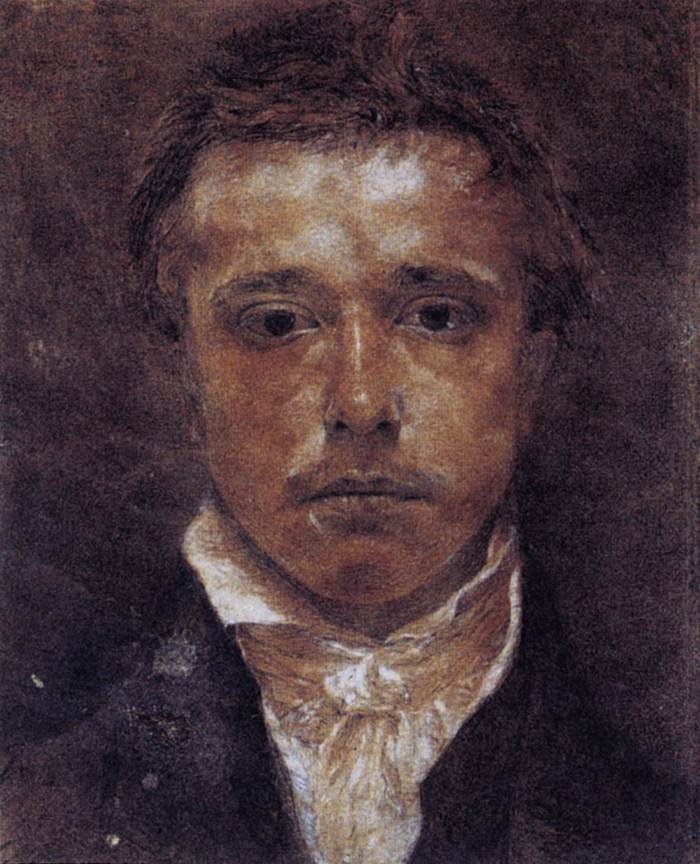
Samuel Palmer a Self-Portrait (1826)

I recently attended a portraiture workshop at which the guest artist and presenter talked about how the portrait he would produce would not necessarily be a photographic image of the sitter but how he envisaged the model.  With those words still in my head I gaze at Samuel Palmer’s self portrait which he completed around 1826 when he was twenty years of age.  Is this how he envisioned himself?  There is something quite disturbing about this self-portrait.  Palmer gazes directly towards us but it is a blank stare as if he is looking through us.  The question that immediately springs to mind is what is he thinking about.  What is going on in his mind as he looks into the mirror?   It is not an image one would associate with an aspiring artist who is looking forward to the future.  What is troubling him?  Look at his physical appearance.  He has not readied himself for the painting.  It is more of a “this is who I am, take it or leave it” stance.  He is unshaved.  His thick hair looks uncared for.  The collar of his shirt is crooked but he knows all this as he puts brush to canvas.  Maybe he wants us to disregard his physical appearance and concentrate on what could be on his mind.  We are looking at the face of a troubled dreamer.  We are looking at a man whose vivid imagination would influence his art and those who view some of his imaginative paintings will be transported into a magical world which in her book Mysterious Wilderness, The Life and Work of Samuel Palmer, the author Rachel Campbell-Johnston describes the artist and some of his works:

“…It is a place in which magical shines through the material, in which nature and heaven are intertwined, in which God in all his mildness blesses man’s harvests and the darkness of night can be innocent and day.  This is not the haunt of any workaday painter.  It is the home of the artist as mystic and seer and poet…”

The Shearers by Samuel Palmer (1834)

One of his best known works is The Shearers which he completed in 1835.  It is a painting which is rich in colour.  There is the juxtaposition of golden sparkling light and gloomy shadow.  I have already said the Palmer was looked upon as a seer and this painting was his vision of paradise.  Raymond Lister in his book, Catalogue Raisonné of the works of Samuel Palmer describes the work and a similar one entitled The Sleeping Shepherd which uses the same setting of the entrance to the barn we see in the above work:

“…A group of richly textured and abundantly coloured paintings of this period includes some of Palmer’s greatest and most attractive work. Such work reached its ultimate expression in The Shearers and The Sleeping Shepherd…”

Geoffrey Grigson, in his 1960 book Samuel Palmer’s Valley of Vision, wrote of the work:

“…Great richness of technique was used to realise The Shearers. In this Palmer combined oil and tempera so as to render every nuance of texture from the light on the distant hills and in the sky to the detailed depiction, almost Dutch in its realism, of the group of implements on the right. There is also an advance in the drawing of the figures, the shearers and their helpers; rarely if ever before this had Palmer portrayed figures so convincingly in movement…”

The setting of the painting is the great barn,  the doors of which are open and we look out at the scene before us.  The doors and the roof beam in some way form a frame for the painting.  A group of six people work in the shade of the trees outside the barn, three men and three women can be seen in the mid-ground.  The men are in the process of shearing the sheep whilst the women collect and bag the wool.  In the background we see an expanse of rolling hills which are lit up by the rays of the sun which light up the beautiful countryside.  Samuel Palmer never forgot his walks with his father over the hills and through the fields of Dulwich.   The idea for the painting must have been in his mind years earlier because he once wrote about his plans for depicting such a scene:

“…A group of different sex and age reaping, might be shewn in the foreground going down a walk in the field toward the above cottage island, and over the distant line that bounds this golden sea might peep up elysian hills, the little hills of David, or the hills of Dulwich or rather the visions of a better country which the Dulwich fields shew will to all true poets…”

Still life detail
Still life detail

In a way the painting is not just a rural landscape scene but part is also a still-life work in the way Palmer has painted the farming equipment inside the barn which we see on the right hand side along with a wide brimmed straw hat which the artist’s son, Alfred, said was one of his father’s most cherished possessions and an item which would appear in many of Samuel Palmer’s works.

In my next blog I will continue to look at the life of Samuel Palmer and explore the help he received from the landscape artist and portraitist John Linnell and  how he was so influenced by William Blake, the poet and painter who was an influential figure in the history of the poetry and visual arts of the Romantic Age.

Albert Joseph Moore. Part 3 – the conclusion.

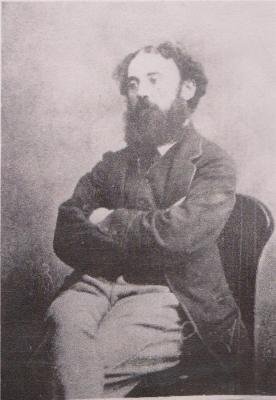
Albert Joseph Moore (c.1870)

The Aesthetic art movement thrived in Britain and America during the 1860s to the 1880s.   The movement started in a small way in the studios and houses of a radical group of artists and designers, including William Morris and Dante Gabriel Rossetti.  In works of art the leading British exponents of this aesthetic movement were J.M.Whistler, Frederic, Lord Leighton and Albert Joseph Moore.  This style of art was also known as Art for Art’s Sake.  The Oxford  Dictionary defines Aestheticism as:

“… the term applied to exaggerated expression of the doctrine that art is self-sufficient   and needs serve  no ulterior purpose, whether moral, political or religious…”

It was influenced by Japanese art and culture.  It was not universally loved and the art critic Walter Hamilton wrote a book in 1862, The Aesthetic Movement in England, in which he mounted a famous defence of the Aesthetic Movement and wrote about the key figures associated with the movement and provided descriptions of contemporary responses to it.

Albert Moore was one of the principal originators of the Aesthetic Art Movement, and was considered by Whistler as one of the most original artists of his generation.  His  decorative paintings, which were true to the Aesthetic movement, championed pure beauty in their depiction but  lacked messages whether overt or subtle, and this type of art became very popular with collectors.  His depiction of women, in what is termed a Hellenic style, draped in their diaphanous clothing, was one which will always be linked with Moore.  Following the success he had with his work entitled The Marble Seat, he followed it up with a series of purely decorative paintings.  In all of these, the allure of the works was Moore’s depiction of the female form and the harmonious use of colour.

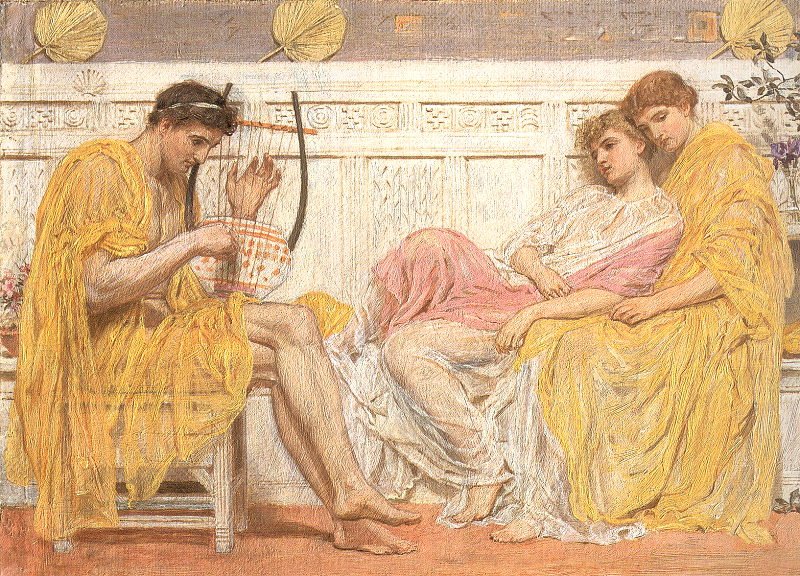
A Musician by Albert Moore (1865-6)

One of Albert Moore’s patrons, around this time, was James Leathart, a Newcastle lead manufacturer.  He had visited Moore at his studio in 1865 and whilst there saw an unfinished work by the artist entitled A Musician.  The work combines aspects of ancient Roman wall paintings, Greek sculpture and Japanese prints.  The figures in the painting are separated.  On the left side we have an active male musician playing the lyre and on the right we see his audience of two passive females.  This separation by gender was also present in his painting, The Marble Seat (see previous blog).

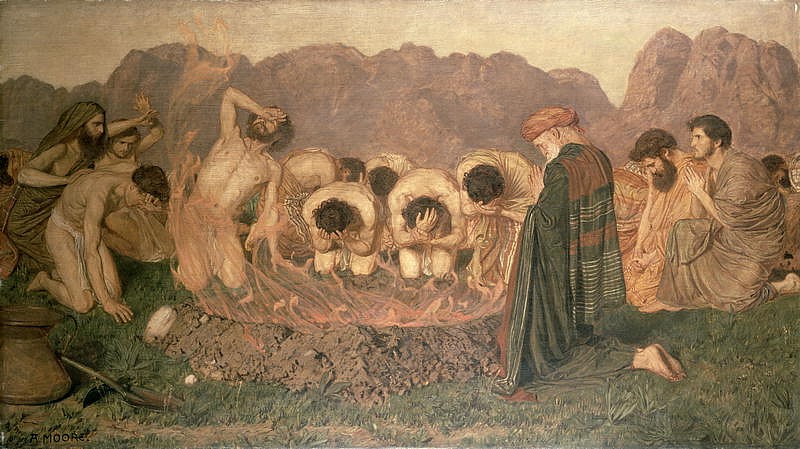
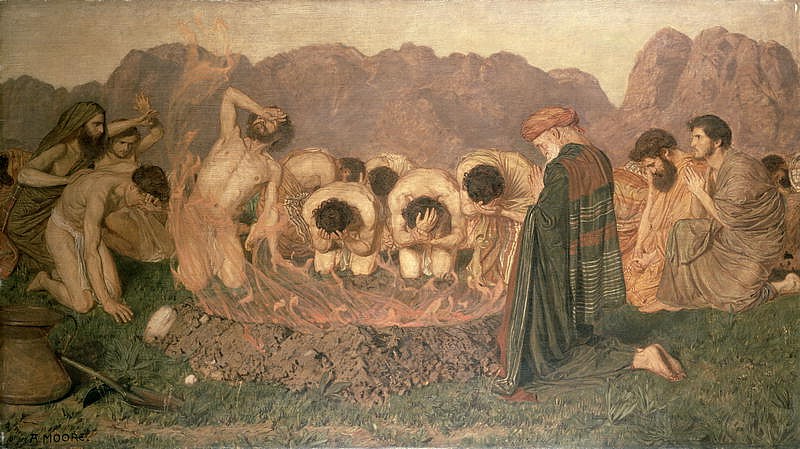
Leathart bought this work from Moore and It can now be seen at the Yale Centre for British Art, New Haven.  In 1867 he purchased from Moore his work Elijah’s Sacrifice.

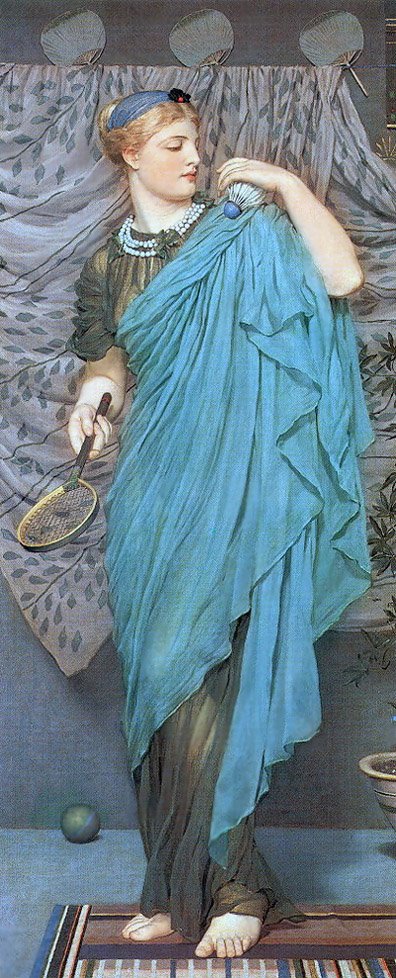
Battledore by Albert Moore (1870)

Leathart was so pleased with his acquisitions that he commissioned Moore to produce a pair of classically draped figures, each bearing a shuttlecock and racket.  The two commissioned paintings were to feature two ancient games played by both men and women.  It was the precursor to jeu de volant, which was itself the precursor to badminton.  The simple titles to his paintings were Battledore and Shuttlecock.

In a letter to Leathart in November 1868, Moore wrote:

“…now fairly at work on your two pictures and propose to go on with them continuously until they are finished…”

Leathart went to Moore’s studios to see what progress Moore had made and viewed the preparatory sketch.  However Moore had a change of heart with regards the colours and tones he would use and in February 1869 he again wrote to Leathart to tell him that he had:

“…hit upon combinations of colour darker in character than the little sketch you saw some time ago…”

Now, Moore had a dilemma.  He wanted to press ahead with the final paintings but had to be sure that Leathart agreed to his proposed changes to the colours and in his letter to Leathart, he gave his reasons for the change but to avoid problems with his patron hinted that Leathart had the final say.  Moore wrote:

“… I think it is best to learn your views on the subject.  That is to say, if you have any particular desire that the pictures should be kept light in character – as for instance, for the sake of their effect in your room – I shall of course be ready to recur to something like the original scheme: at the same time I have reason to believe that the latter combination would succeed – having tried them in small sketches and I may say I should not hesitate to carry them out, were I the only person concerned…”

Leathart agreed to the changes.

Principles of Harmony and Contrast of Colours by M.E.Chevreul
Principles of Harmony and Contrast of Colours
by M.E.Chevreul

Moore was fascinated by colour combinations and how some worked better than others.   Whilst studying at the School of Design in York he had studied this very issue and was inspired by Michel Eugène Chevreul who had published a book in 1855 entitled The Principles of Harmony and Contrast of Colour.  Chevreul based his ideas on the study of the coloured threads in the Gobelin tapestries.

Shuttlecock by Albert Joseph Moore (1870)

In his work, Shuttlecock , Moore brought together the colours of orange and blue which Chevreul had written were “harmonies of contrasts”.  Although chromatically opposites, orange and blue combined to produce grey.  Look at the colour combinations on the mat which the female stands upon.   When the two paintings were exhibited at the Royal Academy in 1871 Moore was praised for his depiction of the figures but those who detected Moore’s scientific approach to colour combinations were less happy.  Other critics were unhappy with the fact that there was no message within the painting, no historical or biblical connotation to the depiction

Sea-gulls by Albert Moore (1871)

Along with Battledore and Shuttlecock Moore had a third painting accepted for the 1871 Royal Academy Exhibition.  The title of this third work was Sea-gulls.  This painting eventually came to fruition but not without some controversy.  Moore’s friend James Whistler got to hear of, and later saw the preliminary sketches for this painting through their mutual friend and patron Frederic Leyland and Whistler was concerned that they were very similar to preliminary sketches he had made for his own painting.  After lots of discussions between the two artists and an intermediary, William Nesfield, an architect and amateur painter, and a  friend of both Whistler and Moore, it was amicably decided that Moore exhibiting his Sea-gulls painting would not have an adverse effect on Whistler’s works.  The painting was exhibited at the RA even though, according to Moore,  it was unfinished.  On receiving the work back from the exhibition, Moore completed the work and it was sold to his patron, Frederic Leyland.

A Summer Night by Albert Moore (1864-90)

There are so many beautiful paintings done by Albert Moore that it is difficult to select a only a few for the blog.  However, the next painting by Albert Moore which I am featuring took almost six years to complete and it is a veritable beauty.  Moore started this large work (132 x 229 cms) in 1884 but did not complete it until 1890.  It was entitled A Summer Night.

The backdrop for this work was not Moore’s usual wall but a fascinating and beautiful display of floral garlands, all intertwined together.  In the far background, across the sea, we see the twinkling of shore lights of an island which has been lit up by moonlight.  Pale clouds can be seen in the dark sky.  In the upper left foreground, we can see orange-coloured ranunculus blooms weaved into the upper part of the silver filigree which is part of the open trellis-work.  The painting received a rapturous reception from the public when it was exhibited at the 1890 Royal Academy exhibition, despite the RA’s Hanging team banishing the work, high up on a wall in the fifth room, close by a door.

The fact that Moore’s work was often looked down upon by the art institution for his constant scientific manipulation of colours and for producing paintings without any hidden meanings was not lost on the forward-thinking art critic of the time, Claude Phillips, who had, for a long time been a great supporter of Moore.   In an article in the Academy in May 1890, he wrote:

“…no artist of purely British origins has the same mastery over the keyboard of tints and tones as this master of decoration and that such a painter should persistently be excluded from the ranks of the Academicians while that august body contains so many crude, perfunctory and unspeakably tiresome practitioners, is a riddle the solution of which had, perhaps, better not be attempted…”

The art critic George Moore (no relation to Albert Moore) castigated the Royal Academy for not electing to the Academy, either Albert Moore or his friend James Whistler.  In 1893, he caustically wrote:

“… Many Academicians will freely acknowledge that his [Albert Moore] non-election is a very grave scandal;  they will tell you that they have done everything to get him elected and have given up the task in despair……………..the two greatest artists living in England, will never be elected Academicians; and artistic England is asked to acquiesce in this grave scandal…”

The Loves of the Winds and the Seasons by Albert Moore (1893)

The last painting I am showing you was the last painting Albert Moore completed.  It was entitled The Loves of the Winds and the Seasons, which he completed in 1893.  Moore’s financial situation at the start of the 1890’s was dire and to make things worse is health was starting to decline.    In August 1892 Moore had been taken seriously ill and despite a number of operations he was made to suffer from a painful and incurable illness.  Moore would not let his pain or his advancing death stop him from painting and this last painting which he started in 1890, was completed nine days before his death.  The painting depicts the courtship of the four male winds with the four female seasons.  The female figure on the left is Summer and she watches the courtship of the South Wind and Autumn.  In the right background of the painting we see the North and East Winds quarrelling over Winter whilst they are all stood in a patch of snow.

Albert Joseph Moore died at 3am in his London studio in Spenser Street, Westminster on September 25th 1893, three weeks after his fifty-second birthday.   The cause of death was given as a sarcoma of the thigh and a recurrent sarcoma of the abdomen.  He made his brother Henry sole heir to his estate which amounted to just £1,184.  He was buried in the family grave in Highgate Cemetery, which was already occupied by his mother and his brother, John Collingwood Moore.

———————————————————————————

Most of the information I have used in this and the next blog have come from  two books, biographies of Albert Joseoph Moore. They are:

Albert Moore, his life and works, by Alfred Lys Baldry (1894)

Albert Moore by Robin Asleson (published by Phaidon)

Albert Joseph Moore. Part 2 – his portrayal of women.

Albert Joseph Moore (c.1870)

At the end of my last blog I had reached the point in Albert Moore’s life with him travelling to Rome with his brother John Collingham Moore just after his twenty-first birthday.  Whilst travelling around the Roman Campagna he was able to observe the effects of colour which were presented to him under local conditions of light and atmosphere.  He travelled to Naples and Pompeii and throughout his stay he would copy classical statuary and Renaissance paintings.   His stay in Italy was cut short after five months when he received news about his mother’s death on the twenty-eighth of January 1863.  Albert returned to London in the Spring and set up home in a studio at 12 Newman Street in West London and immersed himself in the many commissions he received.

Elijah's Sacrifice by Albert Moore (1863)
Elijah’s Sacrifice by Albert Moore (1863)

It was also here that he held a one-man show featuring some of his works of art, including the newly completed Elijah’s Sacrifice (see previous blog).  One visitor to this show was Frederick George Stephens, an art critic, and one of the two ‘non-artistic’ members of the Pre-Raphaelite Brotherhood.  He gave his approval to Albert’s paintings and expressed the joy of discovering new young artists.  He wrote in the February 1864 issue of the London literary magazine, Athenaeum, in his regular review of the Arts, Fine-Art Gossip:

“…a critic’s pleasantest office is to call attention to works, from their nature, do not catch the eye of everyone…”

The small exhibition in his studio proved a great success.  It was unusual for an artist to show works in their own studio but Albert needed the money and needed to market himself and attract buyers but it was also a declaration of his own independence.  Albert Moore knew that he could not solely rely on the Royal Academy to show his work as he was only too well aware of the vagaries of the RA Selection Committee, who had a penchant of choosing works by its own Academicians rather than featuring young artists who were not RA members.   Albert had first-hand experience of this when, in 1864, the Selection Committee had rejected his work Elijah’s Sacrifice.

The Marble Seat by Albert Moore (1865)

Whether Albert altered the painting is not known but in 1865 it was accepted by the RA Selection Committee!   Along with that work he also had accepted into that year’s Academy exhibition his painting entitled The Marble Seat.   It was a turning point in Moore’s career as the critics loved his two works.  The Marble Seat tells no story and does not illustrate any incident in history.  It is merely a composition of four figures, one male and three females, all of whom are grouped around a flat stone seat.    The background comprises of flowers including red tulips, trees and through the trees we are able to see a flat hinterland which leads to a range of blue hills.  The nude male stands to the right of the picture and we see him pouring wine into a cup.  The three girls, all dressed in almost transparent white draperies, over which are thicker orange, green and scarlet wraps, sit or lean against the marble seat.  The seat is positioned on green lawn which seems to twinkle with small white daisies.

Leading magazines raved about the works of this up and coming young artist.  According to the critics Moore and some other young painters were breaking new ground in modern British painting by treating the human figure on a monumental scale unlike other older and well established artists who preferred to stick to small-scale homely themes.

However not to be deterred by the vagaries of the R.A., Albert Moore joined a group of artists, which included his brother Henry Moore, the Jewish pre-Raphaelite painter, Simeon Solomon, John Everett Millais and the historical painter, Edward Poynter.  Ironically, both Millais and Poynter would later become presidents of the Royal Academy.  This group chose the Dudley Gallery in London as the venue for exhibiting their paintings.

Dancing Girl Resting by Albert Moore (1864)

In 1864 Moore’s one-man show included his painting entitled Dancing Girl Resting.  It was noted that since returning from Rome, Albert Moore’s painting style and subject choice had changed.  The “new” Albert Moore can well be seen in this beautifully crafted 1864 painting.  Before us we see a tall girl, with a red scarf twisted around her head and shoulders, dressed in a full-length diaphanous shift standing on a leopard-skin rug which kept her feet away from the cold tiles.  She is leaning against a warm grey marble wall on which hangs a lyre and an ornamental woven mat.  The combination of the rug, the marble tiles and woven textiles adds an air of decadence.  The art critic, Frederick Stevens, in his Fine-Art Gossip column in the February 1864 edition of the Athenaeum described the girl’s somewhat erotic stance:

“…panting through parted lips, with heaving bust, her arms akimbo, and hands upon her hips…”

There is sensuousness and something erotic about this work.  Although she is not naked, we can see the contours of her naked body through the gossamer-like shift.  Look at the beautiful way Moore has executed the many folds of the shift which gives it a feeling of movement even though the dancer is at rest.  Although the title talks about the dancer resting, it is the small figure of the dark-skinned girl, who besides a strand of beads is naked.  She can be seen slumped limply on the floor besides the dancer who looks more at rest.

Sappho and Erinna in a Garden at Mytilene by Simeon Solomon (1864)

It is thought that Albert Moore was starting to be influenced by his friend Simeon Solomon whose paintings around this time showed a certain sensuousness such as in his 1864 painting, Sappho and Erinna in a Garden at Mytilene.  In that painting we see Sappho embracing her fellow poet Erinna in a garden at Mytilene on the island of Lesbos. According to legend, Sappho was born at Lesbos in about 612BC. After having been exiled to Sicily she returned to the island and was at the centre of a community of young women devoted to Aphrodite and the Muses.

The Shulamite by Albert Moore (c.1865)

Philip Henry Rathbone was a Liverpool insurance underwriter and Liberal Council member.  He came from a very wealthy family of merchants.  He was also an avid art collector and one time was a member of the Hanging Committee of the Liverpool Autumn Exhibition.  Amongst his friends was James McNeil Whistler.  Rathbone bought both The Marble Seat and my next featured work of Albert Moore, The Shulamite. A  Shulamite is a female name in Hebrew and means peaceful.  The name corresponds to Solomon as Julia does to Julius. It is the figurative name of the bride in Solomon’s Song and the bridegroom is represented by Solomon which also means peaceful.  The large oil painting, measuring 210 x 96cms is now housed in the Walker Art Gallery in Liverpool.  The painting appeared at the Royal Academy in 1866 but although it had been passed by the conservative Hanging Committee it, along with some other “audacious” paintings, were given an adverse hanging placement.  This and the other works, although placed in the prestigious North Room, were placed so high on the wall they were almost invisible to visitors.  Some would say a revengeful act by the Hanging Committee!  The May 22nd issue of the Times carried an article by the art correspondent, who reported on the exhibition and noted the poor positioning of Albert Moore’s work, writing:

“……..suffers more from its elevation, for its merits are of a more delicate and subtle kind……its exquisite draperies, clothing exquisite form [are] wholly out of sight…”

The Last Supper Wall painting by Albert Moore (1865-66)

In 1865, Albert Moore received a commission to carry out some wall paintings for the Church of St Alban in Rochdale.  The commission had come his way through good auspices of his friend, the architect William Eden Nesfield, whom he had travelled with to Northern France, five years earlier.  These wall painings were painted in oils directly on to the plaster surface of the walls.  The commission took most of 1865 and 1866 to complete and to complete the commission, Moore had to move a large quantity of his materials from London to Rochdale by train.  His biographer, Alfred Lys Baldry, tells the amusing anecdote of the start of this journey from Albert’s studio to Euston Station:

“…so heavily did he load the cab which was conveying him from his studio in Russell Place to Euston Station, that in mid-journey the bottom came out, and he and his brother Henry, who was going to see him off, had to run along inside for some distance, until the attention of the driver could be called to the mishap….”

The wall paintings in St Alban’s Church occupy the whole of the upper chancel and consist of several separate subjects, two being The Last Supper and The Feeding of the Five Thousand. 

In the final part of my look at the life and works of Albert Joseph Moore I will showcase more works of art dedicated to female beauty.

———————————————————————————–

Again, most of the information I have used in this and the previous blog have come from  two books, biographies of Albert Joseph Moore. They are:

Albert Moore, his life and works, by Alfred Lys Baldry (1894)

Albert Moore by Robin Asleson (published by Phaidon)

Albert Joseph Moore. Part 1 – his early life and his talented family

Albert Joseph Moore c. 1870

The nineteenth century Swiss painter, Paul Klee, once said of a woman’s beauty:

“…Beauty is as relative as light and dark. Thus, there exists no beautiful woman, none at all, because you are never certain that a still far more beautiful woman will not appear and completely shame the supposed beauty of the first…”

Maybe he, like today’s featured artist, was also always searching for the ultimate feminine beauty.  Let me introduce you to the Victorian painter Albert Joseph Moore.  In the first part of this blog I will look at Moore’s early life and his talented artistic family and in the next blog will look at his unique portrayal of beautiful women.

Unknown Man and his Dog by William Moore snr.

Albert Moore was born in York in September 1841.  He came from an extremely large family.     His father was originally employed by a firm in Birmingham to design japanned goods.  He gave up his commercial work to concentrate on portraiture which was very popular with London dealers.  The subjects of his portraiture featured people living in the northern counties.  His landscape works featured scenes from the northern districts and as such were very popular with the locals.  William Moore married Martha Jackson in 1812 and the couple had eight sons and a daughter.  Later, in 1828, after his first wife’s death, William re-married.  His second wife was Sarah Collingham, an amateur draughtswoman, who had a number of relatives involved in art.  Sarah gave William a further six sons

So, between William’ Moore’s two wives, he fathered fourteen children, thirteen sons and one daughter. Albert Moore was the youngest of William and Sarah’s six sons.  Many of Albert Moore’s brothers were artists.

A highland lake landscape, with figures by a cottage before, and fishermen in a boat, by Edwin Moore

Albert’s  oldest  step brother, was Edwin, who was a watercolourist and was interested in landscape work. He was twenty-nine years of age when Albert was born.   He was employed as an art teacher and taught drawing, perspective and painting at the Quaker School in York . He also supplemented his income by offering private drawing classes at his home.   In 1840 Edwin published a book, The Elementary Drawing Book which covered rules of perspective and was illustrated with sketches and geometrical diagrams.

As I Saw It by William Moore Jnr. (1891)

Edwin’s brother William Moore jnr., who was born in 1817, was also a landscape painter and  an art teacher.  He, like Edwin, was taught art by his father and later in life assisted his father and tutored the younger siblings in drawing and painting

Stephen Langton Massingbird and his sister Mary Langton Massingbird by John Collingham Moore

John Collingham Moore was the eldest son of William Moore by his second wife, Sarah, and was born at Gainsborough in March 1829. He initially received artistic training from his father and at the age of twenty-two studied in the schools of the Royal Academy. He was a regular exhibitor at the Royal Academy from 1853 to the year of his death in 1880.

Emily Massingberd by John Collingham Moore

His claim to fame as an artist was through his exquisite portraits of children and his watercolour paintings featuring landscape scenes of the Roman Campagna, the low-lying area surrounding Rome in the Lazio region of central Italy.  He also favoured scenes around the area of Florence.

Outward Bound by Henry Moore
Outward Bound
by Henry Moore

Henry Moore, born in 1831, was the third of the six sons of Sarah Collingham and William Moore  and he was a talented marine and landscape artist and etcher.

Storm Brewing by Henry Moore

Albert as a child was surrounded by artists and it was not surprising that from a very early age he took delight in drawing and painting.  It is said that before he was able to write he had achieved a highly regarded expertise in drawing.   He was surrounded by critics, his brothers, who were always willing to advise him how to improve his drawings.  Even at an early age Albert Moore was self critical of his art and was somewhat of a perfectionist.   He would never settle for second best and would often question his brothers’ views on art.  To many he seemed to be inquisitive always willing to state his point of view on matters concerning his art.  Many found this trait to be bordering on precociousness.

Albert went to Archbishop Holgate’s School in York and later St Peter’s School in the same city, which was under the direction of the Dean and Chapter of York Minster.  But apart from this standard education he received regular art lessons from his father.  In October 1851, when Albert was nine years old, his father died.  His art tutoring continued, now with the help of his elder brother, John Collingham Moore.  His mother, Albert, along with three of his brothers remained living in York until 1855, at which time they moved to London and took up residence in Phillimore Place, Kensington.   On arrival in London Albert was enrolled at the Kensington Grammar School where he remained for just over two years. It was whilst attending this school that he had two of his watercolour drawings, A Goldfinch and A Woodcock, exhibited at the annual exhibition of the Royal Academy.  Quite an achievement for one so young!   In May 1858, aged sixteen, he was accepted into the Royal Academy schools.

Study of an Ash Trunk by Albert Moore (1857)

Albert Moore developed a deep love of nature and would often go into the countryside to paint.  In 1857 he completed a wonderful painting, watercolour and gouache with gum Arabic, entitled Study of Ash Trunk,  which is housed at Oxford’s Ashmoleon Museum.
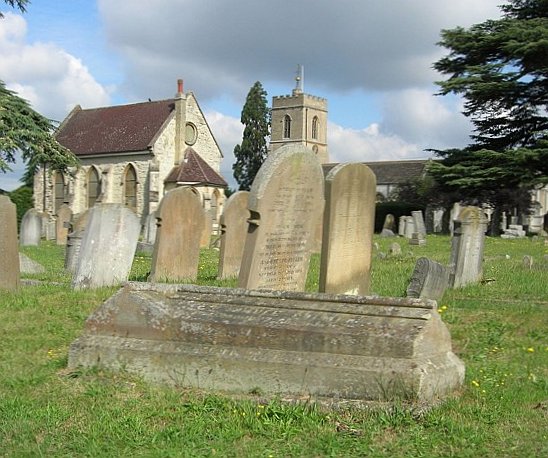
Waterfall in the Lake District by Albert Moore (c.1858)

He went on a painting exhibition to the Lake District in 1858 and from that journey he produced a landscape scene entitled Waterfall in the Lake District.

Albert completed his art course at the Royal Academy schools and started to look for a way of making money other than from the sale of his art work.  He was offered a job as chief designer at a well known firm of stain glass makers but refused the offer on the grounds that it would take him away from his beloved art.  He even turned down the chance in 1876 of becoming headmaster of the Birmingham School of Art as it would mean leaving London and again would take up too much of his time.

The Mother of Sisera looked out a Window by Albert Moore (1861)

In 1861 Moore completed a painting with a biblical connotation. It was entitled The Mother of Sisera Looked out at a Window .  This strange title of the painting comes from a passage from the Old Testament Book of Judges (5:28) and which was part of the Song of Deborah (Judges 5:2-31):

“…Out of the window she peered, the mother of Sisera wailed through the lattice: ‘Why is his chariot so long in coming? Why tarry the hoofbeats of his chariots?…”

Although we do not know the woman’s name, we know she is the mother of Sisera who was a Canaanite general and commander of the Canaanite army and was defeated by the forces of the Israelite tribes led by Barak and Deborah.  According to legend, Sisera, whose army had been routed, fled alone arriving at the settlement of the Kenites, He was invited by a Kenite woman, named Jael, into her tent. Sisera accepted the invitation.  He was given milk to drink and fell asleep.  When Sisera had fallen asleep, Jael took a hammer and drove a “nail,” or tent-pin, into his temple.  The story about Sisera’s mother appears to be based on the thoughts of Deborah who imagined how the mother of Sisera must have felt when her son had not arrived back home.

Elijah's Sacrifice by Albert Moore (1863)
Elijah’s Sacrifice by Albert Moore (1863)

At the end of 1862 he went to Rome with his brother John Collingham Moore where he stayed for five months, and it was whilst staying in the Italian capital that he completed another biblical painting which is entitled Elijah’s Sacrifice This work is housed in the Bury Art Gallery & Museum.  It was bought from Whitworth Wallis, a leading provincial curator in 1908 for £105.  The sum was raised from bequests and council grants.  The painting is based on the passage in the bible, 1 Kings 18 36:39:
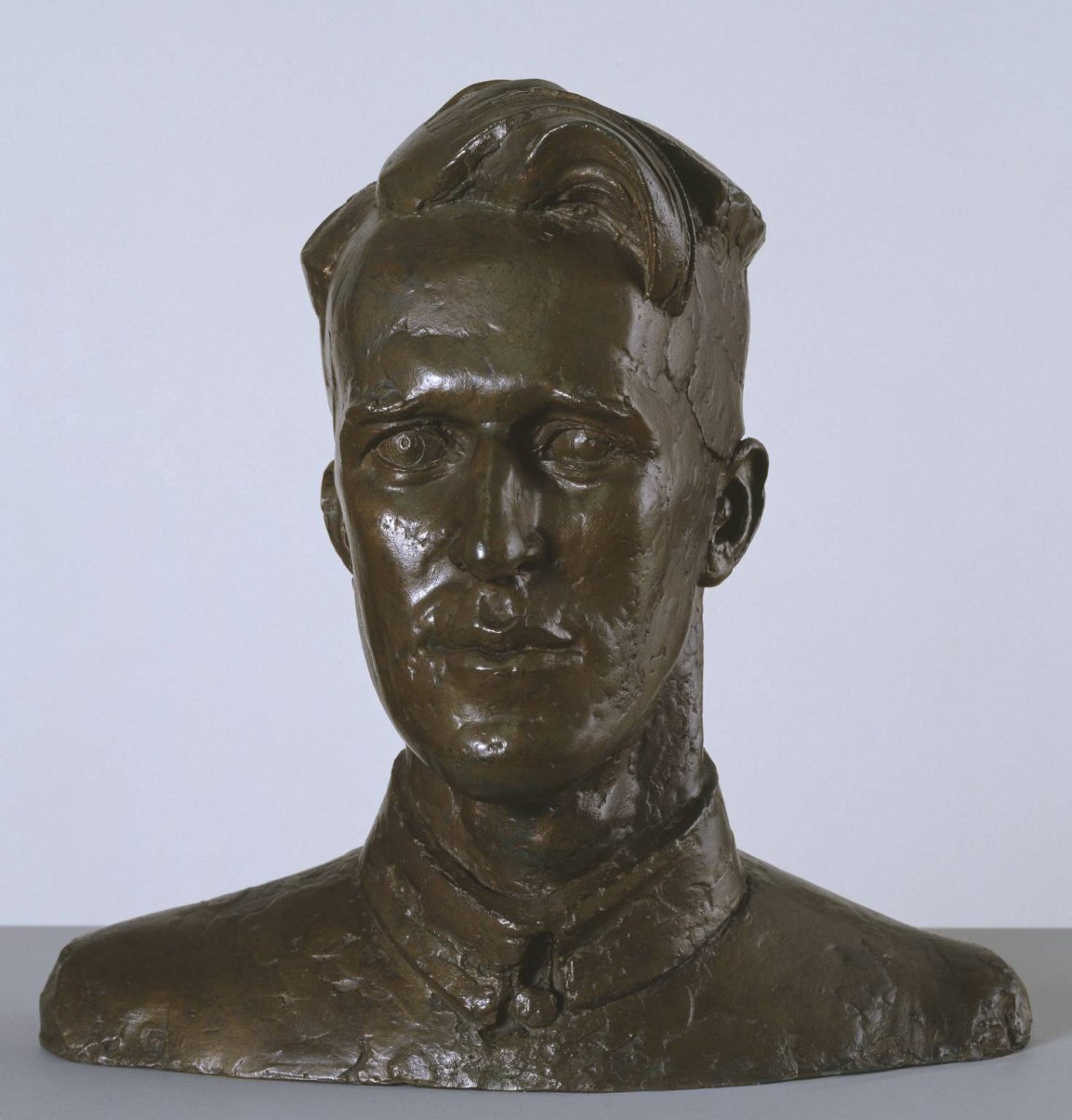
“…At the time of sacrifice, the prophet Elijah stepped forward and prayed: “Lord, the God of Abraham, Isaac and Israel, let it be known today that you are God in Israel and that I am your servant and have done all these things at your command.  Answer me, Lord, answer me, so these people will know that you, Lord, are God, and that you are turning their hearts back again....then the fire of the Lord fell and burned up the sacrifice, the wood, the stones and the soil, and also licked up the water in the trench.  When all the people saw this, they fell prostrate and cried, “The Lord—he is God! The Lord—he is God!…”

The passage described the miraculous fire, called forth by the prophet Elijah on Mount Carmel.  The prophets of Baal had earlier been challenged by Elijah for their god to conjure up fire to light the sacrificial pyre but nothing had happened.  We see Elijah with his red turban and patterned robe.  There is a symmetry about the figures who are placed at the rear of the fire pit.  There is a clear differentiation between the praying Elijah on his knees and those in the centre and to the left.  On the left of the group there is a naked priest of Baal shrinking back violently from the leaping flames which is in total contrast to the reverential posture of Elijah.  Note the counterbalance of the followers of Elijah, to his right, who quietly kneel, hands clasped in prayer, to the followers and prophets of their god, Baal, on the left,  who has let them down by not being able to bring fire to their sacrifice.  In between the two groups are bowed figures who cannot believe what they have just witnessed.

In his 1894 biography of Moore, Albert Moore, his life and works, Alfred Lys Baldry, a contemporary  and  a pupil of Moore, said that the landscape background of the work was based on a desolate spot between Rome and Tivoli that Moore had sketched.  This area was a favourite of landscape artists.  Although the background is somewhat desolate, look at how much detail Moore has put into the vegetation in the foreground.

In the second part of this blog about Albert Moore I will give more details about his life and I will look at his portrayal of women for which he is best known.

————————————————————————-

Most of the information I have used in this and the next blog have come from  two books, biographies of Albert Joseoph Moore. They are:

Albert Moore, his life and works, by Alfred Lys Baldry (1894)

Albert Moore by Robin Asleson (published by Phaidon)


Study for ‘Elijah’s Sacrifice’ by Albert Moore (c.1864)

There are two crayon and watercolour studies Albert Moore made for this painting which are now held at the Tate Museum in London.  The first is a full length sketch of the kneeling Elijah

Study for ‘Elijah’s Sacrifice’ by Albert Moore (c.1864)

and the second  comprises of two facial sketches of the prophet.

I started this blog talking about the beauty of women and in the next part of this blog I will look at Albert Moore’s portrayal of such beauty.

Eric Henri Kennington, Part 2 – the Second World War Artist

Eric Kennington (1926)

At the end of Part 1 of this blog about Eric Henri Kennington we had reached a point in his life when he had travelled to Arabia to prepare sketches which would later be used in his friend, T. E. Lawrence’s 1922 book entitled Seven Pillars of Wisdom.

In 1922, Eric Kennington first met Edith Cecil when he received a commission to paint a portrait of her husband, William Charles Frederick Hanbury-Tracy, 5th Baron Sudeley, whom she married in August 1905.  They had no children.  Kennington and Edith fell in love and in 1922 she and her husband divorced and in September 1922 she married Eric Kennington.  The couple went on to have a son, Christopher, in March 1925 and a daughter, Catherine in February 1927.  It is said that both Eric and Edith remained on friendly terms with Edith’s ex-husband.

The 1922 book Seven Pillars of Wisdom by T E Lawrence

Eric Henri Kennington, as well as having been a war artist during the Great War, was also a revered portrait painter.   During his time in Arabia sketching and working on paintings for T E Lawrence’s autobiographical book, Seven Pillars of Wisdom, he met Field Marshal Allenby.  Allenby, at that time, was the High Commissioner for Egypt and was based in Cairo.

Edmund Henry Hynman Allenby, 1st Viscount Allenby by Eric Kennington (1926)

In March 1921 Kennington met Allenby at the Semiramis Hotel in Cairo and produced a pastel portrait of Allenby.   It is remarkable to think that this pastel work was completed by Kennington in less than an hour.

Effigy of T.E. Lawrence - 'Lawrence of Arabia' in St. Martin's Church, Dorset by eric Kennington (1926)
Effigy of T.E. Lawrence – ‘Lawrence of Arabia’ in St. Martin’s Church, Dorset by eric Kennington (1926)

Kennington and T.E.Lawrence (Lawrence of Arabia) had an enduring friendship up until the day Lawrence was killed in a motorcycle accident in May 1935.  After his friend’s death, Kennington spent years completing a full-length reclining stone effigy of his friend dressed as an Arab sheikh.  This beautiful tomb effigy which was completed in 1939, and can now be found in the church of St Martin’s in Wareham in Dorset

Head of T. E. Lawrence by Eric Kennington (1926)

Kennington also completed a bronze sculpture of the head of T.E.Lawrence in 1926 and the intrepid British archaeologist, military officer, and diplomat was delighted with the work.  He said:

“…Magnificent; there is no other word for it. It represents not me but my top moments, those few seconds when I succeed in thinking myself right out of things…”

At the outbreak of the Second World War in 1939 the War Artists Advisory Committee was formed as part of the Ministry of Information.  The chairman of the new committee was Sir Kenneth Clark.  Clark who had been a fine art curator at Oxford’s Ashmolean Museum,  had, in 1933 at age 30, become the director of the National Gallery and as such was, and still is, the youngest person ever to hold the post.   One of the artists he chose was Eric Kennington, as by this time, he had built up a reputation as a leading portrait artist.    Kennington became a war artist for the second time in December 1939.   His contract with the War Artists Advisory Committee was to produce pastel or charcoal portraits and for each one he would be paid 25 guineas.  Kennington agreed but said he would need a minimum of three hours per sitter.

General Sir Edmund Ironside, General Officer Commanding-in-Chief, Home Forces, May-July, 1940. by Eric Kennington (1940)

One of his first sitters was the Chief of the Imperial Staff, General Sir Edmund Ironside.  He completed the portrait in January 1940

Portrait of Stoker A.Martin of HMS Exeter by Eric Kennington

In 1940 Kennington was sent to Plymouth to sketch portraits some of the seaman who had served in the great 1939 sea battle of the River Plate.  One such portrait, which he completed in the April of that year, was of Andrew Martin, a senior stoker aboard HMS Exeter during the River Plate battle.  Kennington wrote a small piece to accompany the portrait.  He wrote:

“…Man of Action: instantaneous: 100 per cent reliable: expert technician. Much humour under thorough camouflage. Very gentle, sensitive, and great physical strength…”

The painting found favour with the art critic, Herbert Granville-Fell who wrote:

“…Kennington’s harsh iron technique has a force admirably suited to conveying unflinching and dauntless resolution in the faces of his seamen and soldiers. I know of no other artist who can so convincingly depict the salt of the earth, and evoke palpably, in a portrait, the very essence and savour of courage…”

Kennington, as was the case during the First World War,  soon clashing with his “employer” the War Artists Advisory Committee principally because of his personal dislike of Colin Coote, a journalist, who was the War Office representative on the committee.  In May 1940 the Home Guard, the Local Defence Volunteers was formed and Kennington decided to leave his role as a war artist for the War Artists Advisory Committee and join the Home Guard.

In July 1940, shortly after Kennington left the War Artists Advisory Committee the Committee held an exhibition of official war art at the National Gallery.  The art critics and public were both pleased with what they saw and in particular the works of Eric Kennington which were said to have been the most popular.  In particular his works depicting the generals and the sailors received the most praise.

Eric Kennington in his Home Gurad uniform

Kennington rose in its ranks and in July 1940 he was put in charge of a section of six countrymen in the south Oxfordshire countryside, defending an observation post he had set up to the north of his home in Ipsden.   We are so use to thinking of the Home Guard as the people we see on the very popular TV comedy series, Dad’s Army or maybe we have a romantic view of the brave men who protected our homes.  Apparently Kennington did not view the Home Guard or his fellow Home Guardsmen in such an idealised and romantic manner.  Kennington was very vociferous in his criticism of the equipment they were given and was also critical with regards the senior officers, of whom he said were tied up in bureaucracy.   He wrote to his older brother William:

“…The men, if not suitably motivated, did not report for duty in the evenings, but sloped off after roll call to go poaching, fishing, or playing cards in the pub…”

Sergeant Bluett, Cornwall Home Guard by Eric Kennington

For all his criticism of some of his fellow volunteers he completed some wonderful portraits of them, such as Sergeant Bluett of the Cornwall Home Guard which he completed in 1943.

Corporal Robertson, City of Edinburgh Home Guard by Eric Kennington (1943)

….and Corporal Robertson of the City of Edinburgh Home Guard which he also completed in 1943.  Both these paintings are housed in the Imperial War Museum.

The War Artists Advisory Committee in August 1940 not wanting to have lost such a great artist approached Kennington and asked him to return to the fold as a war artist.  The War committee was delighted that Kennington agreed to return.  The secretary of the Committee, Edmund Montgomery O’Rourke Dickey, wrote to Kenneth Clark about how Kennington’s work instilled hope in those who saw his portraits.  He wrote:

“…The best of this artist’s [Kennington] portraits of sailors in the exhibition at the National Gallery have, in the eyes of the public, a nobility not shared by any other work that’s on display at the National Gallery. These portraits typify the fighting man who’s going to win the war for us…”

Pilot Officer M J Herrick, DFC, by Eric Kennington (1941)

Kennington agreed to return as a war artist and the Committee offered him a commission to draw portraits of RAF personnel at a time when the Battle of Britain was at its fiercest and these men were often referred to as “fighting aces”.

Flight Lieutenant Lloyd Watt Coleman, DFC, by Eric Kennington (1940)

The pastel portraits were sensitive depictions of the air force heroes and many were used as illustrations in Kennington’s 1942 book Drawing the RAF.  There is a simplicity about these portraits but the underlying thought that these were some of the men who would fight for and save our country, was unmistakeable.

Air Chief Marshall Sir Charles Frederick Algernon Portal DSO & Bar by Eric Kenningtonn(1941)
Air Chief Marshall Sir Charles Frederick Algernon Portal DSO & Barn by Eric Kennington (1941)

One must remember that the War Arts Committee would give Kennington a list of people who were to appear in his portraits.  This caused a rift between Kennington and the Committee as Kennington believed that all the Committee wanted was portraits of senior officers and Kennington wanted to highlight some of the fighting men from the lower ranks.  Once again Kennington threatened to walk away from his position as a war artist but he was such a great portraitist that he was talked out of his impending resignation by none other than the Chief of the Air Staff, Sir Charles Portal.

Wing Commander Geoffrey William Tuttle OBE DFC by Eric Kennington (September 1941)

As he carried on with his portraiture commissions they were often exhibited at the National Gallery.  Previously they had been lauded as great works of art but occasionally they received some adverse criticism, such as piece written by the art critic of the Sunday Times, Eric Newton, who wrote:

“…Eric Kennington goes on and on with his over-life-size portraits of supermen. They are strident things whose assertiveness almost hurts the eyes.’ But then he did concede: ‘They do look like men who are going to win the war. Some are positively frightening. Dropped as leaflets over enemy country, I can imagine them being as effective as a bomb…”

Cover of Eric Kennington's book Tanks and Tank Folk
Cover of Eric Kennington’s book Tanks and Tank Folk

In November 1941, Eric Kennington was invited to Ripon, Yorkshire by Sir Percy Cleghorn Stanley Hobart, the General Officer Commanding of the 11th Armoured Division to sketch portraits of some of his men.  Whilst there Kennington completed over twenty portraits of the men and also this small (29 x 38cms) oil on board portrait of his host.  Many of the portraits Kennington did whilst at the Ripon barracks appeared in his 1942 book Tanks and Tank Folk and many featured in his solo exhibition held at the Leicester Galleries, London in September 1943

Seeing It Through, by Eric Kennington, (1944)

My final offering is a painting by Kennington which was used as one of the war posters in the series Seeing it Through.  It was not of  a fighting man or woman, but commemorated everyday heroism of normal people going about job in difficult and dangerous times.  Kennington preferred not to use models for this type of work and in this work he used the woman herself as the model.  It is of a young twenty year old woman, Mrs M.J. Morgan, who was a conductor on one London buses.  She had become one of the first generation of female bus conductors employed by London Transport in November 1940. She’d only just started her job as a “clippie” when the bus she was assigned to was caught in the blitz.  She became an instant heroine when she shielded with her own body two young children, and then helped passengers who’d been injured when the bus was riddled with shrapnel from a bomb exploding nearby.

Kennington remembered her well describing her:

 “…like a Rubens Venus’ and she had a complexion that was ‘edible as a peach…”

Beneath the portrait of the bus conductor was a short verse by the novelist and humorist, Alan Patrick Herbert:

“…How proud upon your quaterdeck you stand

Conductor- Captain  of the mighty bus!

Like some Columbus you survey the Strand

A calm newcomer in a sea of fuss

You may be tired – how cheerfully you clip

Clip in the dark with one eye on the street –

Two decks – one pair of legs – a rolling ship

Much on your mind and fat men on your feet !

The sirens blow, and death is in the air

Still at her post the trusty Captain stands

And counts her change, and scampers up the stair

As brave a sailor as the King commands.

A.P.Herbert


Eric Henri Kennington died in April 1960 aged 72.  He is buried in the churchyard in Checkendon, Oxfordshire, where he was once the churchwarden and he is commemorated on a memorial in Brompton Cemetery, London..

Eric Henri Kennington. Part 1 – World War I and T.E.Lawrence

Photo of Eric Kennington by Howard Coster (1936)

In my last blog I looked at the life and some of the paintings of Thomas Benjamin Kennington, the Victorian painter.  Today, in the first of two instalments, I want to look at the life and art of his son Eric Henri Kennington, who was an early twentieth century sculptor and artist.

Eric was born in Fulham in March 1888.  He was the second of two sons. His father was the Victorian artist Thomas Kennington and his mother, Elise Nilla Lindahl Steveni, was of Swedish origin.  His mother died when Eric was just seven years of age.

Eric was born into a middle-class professional household and received the best education possible, attending St Paul’s School, London, one of the original nine British public schools and from there he enrolled at the Lambeth School of Art.  He started exhibiting his works of art at the Royal Academy in 1908 and by the start of the Great War in 1914 he had gained a reputation as a skilful painter.

Costermongers (La Cuisine ambulante) by Eric Kennington (1914)

One of his pre-War paintings was entitled Costermongers (La cuisine ambulante) which was exhibited at the International Society in April 1914, and the work itself was actually bought by the then very famous society portraitist William Nicholson.  It is now owned by the Centre Pompidou, Musée national d’art moderne, Paris.  It is the depiction of street life in London and is a fascinating capture of the individual characters.  The art critic of the Daily Mail wrote in the August 24th 1914 edition of the newspaper describing the scene as:

 “…‘huge staring groups of life-size people, represented in a brutal airless way, though with a great deal of technical cleverness…”

 and went on to acknowledge that they were protests against the “namby-pambiness’ of the usual group compositions..”

 With the sale of the painting Kennington was able to set himself up in a studio in Kensington High Street.

The Great War broke out in Europe in July 1914 and in the next month, Kennington took himself down to the recruiting office which was close to his studio, off Kensington High Street, and enlisted with the 13th Battalion, The London Regiment, Princess Louise’s Own Kensingtons.    He was sent to the Hertfordshire village of Abbot’s Langley where he did his three months of basic training before being sent to France in November 1914.  His days fighting on the front line were numbered as in mid-January 1915 he suffered a wound to his left foot which resulted in the amputation of his middle toe and he was extremely lucky not to have lost the whole of his left foot through infection.  He was discharged from the army as being unfit for duty.

The Kensingtons at Laventie by Eric Kennington (1915)

It was during his time convalescing throughout the latter part of 1915, firstly in London, then Liverpool, that he painted one of his most famous works of art.  It was a portrait of some infantrymen entitled The Kensingtons at Laventie, Winter 1914, which is now housed in the Imperial War Museum, London.  The painting is extremely large measuring 140 x 152cms.  The picture is a complex reverse painting on glass, where exterior layers of paint are applied first, giving the oils a particular clarity.

In the painting, Kennington depicts part of his platoon standing around in a deserted street in Laventie, a small French village in the Pas-de-Calais region, close to the Belgium border.  The village had been almost destroyed by shell fire.  It is set in the winter of 1914 with snow on the ground.  The soldiers in this painting were comrades from his unit, Platoon no. 7, C Company of the Kensingtons, and he has even included a portrait of himself in the scene.  He is in the top left-hand corner wearing the balaclava.  The men have arrived at the village after a long and tiring four days and four sleepless nights of duty in the trenches having had to endure continuous snowfall and temperatures at night which fell to twenty below freezing.  It is a loose grouping of men, all but one standing.  What is strange about their depiction is that no two men look in the same direction.  The men seem disorientated and are awaiting their corporal to find out their next orders.  Soon they were going to have to set off and endure a five-mile march to reserve billets, which were out of range of the German artillery.

 The painting was first exhibited at the Goupil Gallery in 1916 and caused a sensation.  The exhibition was in aid of the Star and Garter Building Fund charity.  Kennington’s accompanying notes detailed the individual soldiers and their experiences. The notes about  “Who is who” stated:

“…The portraits are of Private A. ‘Sweeney’ Todd (foreground) and (left to right) Private H Bristol in the red scarf, Private A. McCafferty carrying two rifles, the artist in balaclava, Private W Harvey, Private P A Guy, known as ‘Good Little Guy’, Lance-Corporal H Wilson in balaclava, Private M Slade resting both hands on his rifle and Corporal J Kealey…”  . 

Kennington did not complete the painting until December 1915 and sadly by this time, ninety per cent of the once 700-strong battalion, which he had arrived with in France twelve months earlier, had become causalities.  Many had died or had been severely wounded  during the battles of Neuve-Chapelle in March 1915, and particularly Aubers Ridge in May 1915..

The painting, when exhibited at the Goupil Gallery between April and June 1916, received glowing revues.  Kennington was described by The Times art critic: :

 “…the painter who knew how to properly portray the stoically enduring British Tommy’. For example,………: ‘He [Kennington] has painted the real war for us in all its squalor and glory…”

So impressed with the unemotional depiction of the hardships and endurance of the British soldiers whilst fighting on the Front, the War Propaganda Bureau, in June 1917, offered Kennington the chance to become an official war artist.   He was sent off to France in August 1917, where he spent about seven months.  In fact he was only supposed to be visiting the battlefields for one month  but after the first month had expired, he didn’t want to return to England and simply refused to come back home.  He would continually write to his employers stating that he needed to be on the battlefield so that he could “learn the war

Gassed and Wounded by Eric Kennington (1917)

One of his first paintings as an official War artist was entitled  Gassed and Wounded which he completed in 1918 and can now also be found in the Imperial War Museum.  The setting is the interior of a field hospital.  Eric Kennington made many sketches when he was at Casualty Clearing Station at Tincourt, a village in the Picardy region, some thirty miles east of Amiens.  This point in time when Kennington made these sketches was at the time the German air force was bombarding the English lines, prior to their last big offensive.  In the painting we see wounded soldiers, who have been gassed, lying on stretchers.  Look at the way Kennington has depicted the agony of the man in the foreground.  He lies on the stretcher.  His head is bound with bandages.  His eyes which have been damaged by the gas are covered.  His face is contorted and his mouth is open as he cries out in pain.

Eventually Kennington was persuaded to return to England in March 1918 Four months later a large selection of his pastel and charcoal drawings and watercolours were exhibited in an exhibition at the Leicester Galleries.  The art critics and public alike were astounded by the quality of his work

The art critic and poet, Laurence Binyon wrote in the New Statesman:

“…Mr Kennington has a genius for reality. He has not only the gift of exact and faithful record, but the power of giving expression to the latent vehemence, energy and passion that make up the controlled strength of a man. If a foreigner wished to see the British soldier, he could not do better than see him with Mr Kennington’s eyes…”

Kennington, had his differences with the Ministry of Information and parted company in September 1918.  He was not unemployed for long as in November 1918, he signed up with the Canadian War Memorial Scheme.  This scheme was established by the newspaper magnate Lord Beaverbrook in 1916.  His aim was to commission official war artists to paint the Canadian war effort. The official war art programme would eventually employ close to 120 artists, most of them British or Canadian, who created nearly 1,000 works of art. Eric Kennington went back to France in November 1918 as a temporary first lieutenant attached to the Canadian Army and he attached himself to the 16th Battalion Highlanders of Canada, part of the 3rd Infantry Brigade of the 1st Canadian Division.

The Conquerors by Eric Kennington (1918) (Originally known as "The Victims")
The Conquerors by Eric Kennington (1918)
(Originally known as “The Victims”)

Kennington remained in France between November 1918 and March 1919, during which time he made a series of over 40 studies of individual soldiers from the battalion who fought their last major battle of the war in October 1918.  The next painting I am showing you is one entitled The Conquerors and featured men from the battalion of soldiers Kennington was assigned to as a war artist.  This was not the original title of the work as when the painting was shown in an exhibition in Canada, it was entitled The Victims but there was an objection to that title from the battalion’s commanding officer, Lieutenant-Colonel Cy Peck, Kennington who wanted it to be changed and be renamed The Conquerors.   Cyrus Wesley Peck objected to the title “The Victims” as it was a somewhat defeatist title for the work of art and so it was changed to a more acceptable title, The Conquerors. The painting depicts kilted Canadians of the 16th Battalion, marching through a battlefield littered with debris and informal graves.  Look at the faces of the soldiers.  Some have normal skin tones whilst others look much paler and these may represent the deceased.  The painting is housed in the Canadian War Museum in Ottawa.

The Conquerors was exhibited in Ottawa during the summer of 1920 and it was later returned to London where, in October and November of that year, it appeared at Kennington’s solo exhibition at the Alpine Club gallery in London.  Whilst Kennington was present at the exhibition he met and was befriended by T.E.Lawrence the British archaeologist, military officer, and diplomat.  Lawrence bought two of Kennington’s sketches depicting soldiers.  The intrepid Lawrence was a great influence on Kennington’s art and he even persuaded Kennington to come out to the Middle East to draw personalities who appeared in his account of the war with the Ottoman Turks that he was writing at the time, and which was eventually published as The Seven Pillars of Wisdom.  The book was the autobiographical account of the experiences T.E. Lawrence  had, while serving as a liaison officer with rebel forces during the Arab Revolt against the Ottoman Turks which lasted two years from 1916 to 1918.  T E Lawrence soon became known as Lawrence of Arabia.

Muttar il Hamoud min Beni Hassan by Eric Kennington (1920)

One such portrait was completed by Kennington in 1920 entitled Muttar il Hamoud min Beni Hassan who was one of Lawrence’s s chosen bodyguards.  This pastel on brown paper was painted by Kennington whilst he was at a war camp in Western Arabia.  Lawrence had wanted Kennington to go out to Arabia and come back with some portraits which could be used as illustrations for his autobiography but strangely he would not let Kennington read the book before he set off on his Arabian journey.  On returning back to London Kennington gave Lawrence his sketches and paintings.  Lawrence was delighted saying:

“…I first saw one and then another of the men whom I had known and at once I learned to know them better. This may point indirectly to the power of the drawings and it points without contest to their literary completeness. There is quite admirable character here…”

Abd-el Rahman by Eric Kennington (1921)

Another portrait by Kennington used in Lawrence’s autobiography was Abd-el-Rahman, a pastel on green-toned paper, which he completed in 1921.   Abd-el-Rahman was mentioned in Chapter LXXI of the book as Lawrence recalls:

“…I enrolled Showakh and Salem, two Sherari camel-herds, and Abd el Rahman, a runaway slave from Riadh, now freedman of Mohammed el Dheilan, the Toweihi…”

On Kennington’s return home he exhibited the sketches and paintings from his Arabian trip at the Leicester Galleries in London and the portraits of Arabs became known as the ‘Kennington Arabs’.   The illustrations which Kennington worked on for Lawrence did not appear in the first edition of the book published in 1922 but four years later in 1926, in the next edition of the autobiography Kennington’s illustrations appeared along with those done by other well-known artists of the time such as Augustus John, Paul Nash and John Singer Sargent

Head of T.E. Lawrence by Eric Kennington (1926)

Kennington also produced a bust of Lawrence  in 1926.  It was modelled partly from life and partly from drawings he made in December 1926.  It was also chosen by Lawrence’s mother and brother for the Crypt of St Paul’s. Kennington made three further casts of this head in bronze or brass, one of which can be found in the music room at Lawrence’s cottage, Clouds Hill, Moreton, Dorset.  Clouds Hill is an isolated cottage near Wareham, Dorset which Lawrence initially rented in 1923 but then bought it in 1925.  Lawrence himself loved the bust saying that it was:

“…magnificent; there is no other word for it. It represents not me but my top moments, those few seconds when I succeed in thinking myself right out of things…”

Sir William Rothenstein, an English painter, printmaker, draughtsman and writer on art. who was best known for his work as a war artist in both world wars and as a portrait artist wrote about Kennington’s relationship with T E Lawrence.  He wrote:

“…‘Kennington was devoting himself to Lawrence’s glorification – for him Lawrence was the perfect man who could do no wrong…”

Battersea Park Memorial. by Eric Kennington
Battersea Park Memorial.
by Eric Kennington

In 1924, Eric Kennington designed the War Memorial which can be seen in Battersea Park to commemorate the 24th London Division.

In the second part of my story of Eric Kennington I will look at his life between the world wars and also the paintings he completed as a war artist during the Second World War.