Miss Murray by Sir Thomas Lawrence

Miss Murray by Sir Thomas Lawrence

My Daily Art Display looks at a work by one of the greatest English portrait painters.  His name was Thomas Lawrence, later to become Sir Thomas Lawrence.   He was born in Bristol in 1769.  His father, also called Thomas, was a supervisor of excise and his mother Lucy was the daughter of a clergyman.  His mother had an amazing number of children – sixteen in all, albeit only five survived infancy.  It was around the time that Thomas was born that his father decided to give up his government job and become an innkeeper.  The initial move into running an inn failed and when Thomas was four years of age his father moved the whole family to the Wiltshire market town of Devizes and tried again at being a successful landlord of an inn.  The inn named the Black Bear was on the main route between London and Bath and was ideally situated to catch the London gentry who were on route to Bath in order to take the healing waters.

The father’s business acumen was lacking and he soon ran into debt and it was left to young Thomas to help with the family finances by selling his pastel portraits.  When Thomas was ten, his father was declared bankrupt and the family moved to Bath.  There was now more pressure on the young boy to stabilise the family’s finances through the sale of his portraits.  He concentrated on oval portraits measuring 3ocms x 25cm and he was able to charge three guineas for each half length portrait.   In 1787 Thomas Lawrence moved to London and in a very short time established his reputation as a portrait painter in oils.   It was primarily the portraiture of Britain’s growing aristocracy which was in great demand and Lawrence was able to command high fees for his work and it was into this aristocratic world that Lawrence was accepted.      In 1790, he received his first royal commission when he was asked to paint a portrait of Queen Charlotte, the wife of King George III.  The following year, aged just twenty two, he became an associate of the Royal Academy and three years later a full member of that society.  In 1792, Sir Joshua Reynolds the great English portrait artist, friend and mentor to Thomas Lawrence, died and this opened royal doors for his protégé.  George III, who had been delighted with Lawrence’s portrait of his wife, Queen Charlotte, appointed Thomas Lawrence as the Principal Court painter. He retained that position under the monarchy of George IV.   Lawrence was knighted in 1815 and five years later became the President of the Royal Academy.

So business was good for Lawrence the sale of his portraits went well and he could command higher and higher fees for the commissions he received and so he was rich.   Well, in fact no, he wasn’t wealthy and on a number of occasions was nearly bankrupt and only staved off financial disaster with help from friends and patrons.  So where did all the money go?  Lawrence was bemused by his lack of money, commenting:

“…I have never been extravagant nor profligate in the use of money. Neither gaming, horses, curricles, expensive entertainments, nor secret sources of ruin from vulgar licentiousness have swept it from me…”

Many biographers have sought the reason for his financial mess and it is now generally accepted that Thomas Lawrence could not handle his finances, rarely kept accounts and he spent a lot of money building up a collection of Old Master drawings.  He was also very generous when it came to his family – probably too generous.

Apart from financial problems he was also very unlucky in love.  He had come in contact with the well-known London stage actress Sarah Siddons and he became entangled with her two daughters, Maria and Sally.  He fell in love first with Sally, then transferred his affections on to her sister Maria, then broke with Maria and turned back to Sally again. Both the sisters had fragile health; Maria died in 1798, on her deathbed extracting a promise from her sister never to marry Lawrence.  Sally kept her promise and refused to see Lawrence again, dying in 1803. But Lawrence continued on friendly terms with their mother and painted several portraits of her.   Lawrence never married.  Sir Thomas Lawrence died in 1830, aged 60 and was the most fashionable portrait painter in Europe

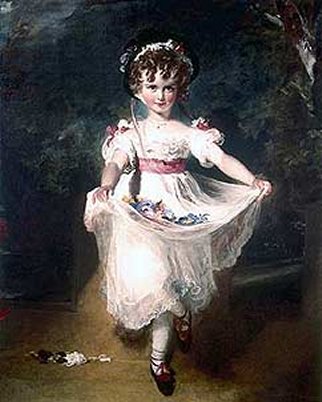
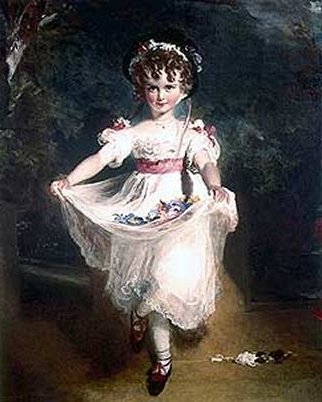
My Daily Art Display today is a delightful portrait which Sir Thomas Lawrence completed in 1826, entitled Miss Murray, which can be found at Kenwood House in London.  It is an unusual portrait considering the wealthy and famous people he had painted.  The painting was commissioned by Sir George Murray, the Scottish soldier and politician, who fought with General Wellington in the Peninsular Wars.  Louise Georgina Murray was his daughter and was also the goddaughter of the Duke of Wellington.  The young girl dances towards us beribboned and utterly bewitching.  She reminds me of the very young girls we see in present day American child beauty pageants, all dressed up adult-like, performing little dances for their doting audience.  She is just like Shirley Temple.   We seem to be looking up at her from below as if she is performing her dance on a stage and we are merely part of her audience.  Lawrence has undoubtedly captured the little girl’s beauty whilst she was still young.  Lawrence realised that his portrait had in some ways captured a certain moment in her life, a moment of child-like innocence and beauty which would undoubtedly change.  He commented on this very fact to her father, writing:

“…All I can do will be to snatch this fleeting beauty and expression so singular in the child before the change takes place that some few months may bring…”

How many times have we looked back on our children’s photographs when they were young and wondered how things change so much over time?  Lawrence and undoubtedly Sir George Murray knew that the sweet innocence of the child as she proudly shows off her dress and performs her dance would inevitably change.

So what of little Miss Murray, what became of her?    In 1843, aged twenty-one, she married Captain Henry George Boyce, a grandson of the 1st Duke of Marlborough who sadly died in Rome, five years after they were married.  Louisa Georgina Augusta Anne Murray remained a widow for forty three years, dying in 1891 in the Italian coastal town of Bordighera.
Mirror image ?

As I said at the start of this blog, the painting can be found in Kenwood House, London which I believe is near to Hampstead Heath.  I have never been there and thus have never stood in front of the painting but when I was researching the work I came across two “versions” of the painting, the one you see at the begining, with the girl looking slightly to her left and the sprig of flowers on the floor on the left side of the painting and the other picture of the painting (on the right) I came across in another art history book which had the girl turning slightly to her right and the flowers were on the floor to the right of the painting.  One book must have had a mirror-image of the real painting but which is correct?  Next time you visit the gallery please let me know !

Calais Pier by Joseph Mallord William Turner

Calais Pier by Turner (1803)

I am fast approaching my 300th edition of this blog and many of you may think it strange that in all that time I have never featured an artist much loved by many, Joseph Mallord William Turner.  In some ways, of course, it is an omission but I have to be honest and state that Turner is not one of my favourite artists.  Yes, I am aware that statement is artistic anathema and pictorially sacrilegious but everybody’s likes and dislikes are different.  I am a person who loves detail and clarity in a painting and the haziness” of a lot of Turner’s painting is just not for me.  I was at a local gallery the other day and when asked which was my favourite painting on display, I pointed to a mountain scene and the person who asked me to decide commented that it was too much like a photograph for his liking.  There lies my dilemma.  I don’t want a framed photograph on my wall but I do want clarity of detail.  I am happy with an idealised landscape.  I just want to study the intricate details of the artist’s work.

Less about my likes and dislikes and on to today’s offering which is one of Turner’s paintings, which is without the haziness that I dislike.  It is entitled Calais Pier and was completed by Turner in 1803 and is in the safe keeping of the National Gallery in London.  I touched briefly on Turner’s life a few days ago when I featured the artist Thomas Girtin, a friend and contemporary of Turner.  I know many books have been written about Turner’s life but let me briefly go through the life of today’s artist

Turner was born in 1775 in Covent Garden, London.  His father, William Gay Turner was a wig maker and when they became unfashionable he became a barber.  His mother was Mary Mallord Marshall.  His mother and father had married in 1773 and a year after Turner was born his mother gave birth to his sister, Mary Ann.  Sadly and with devastating consequences she died in 1786, at the age of eight.  Her death virtually destroyed her mother who became mentally unstable and eventually in 1799 she was committed to the Bethlem Royal Hospital Mental Hospital (Bedlam) where she died in 1804.

Because of his mother’s mental problems, and the problems arising from her condition, the young Turner left home for about a year and went to live in Brentford with his mother’s brother, Joseph William Mallord Marshal.  Whilst living with his uncle’s family he attended the John White’s School.  It was during the time when he was being brought up by his uncle’s family that Turner started to show an interest in art.    For holidays he would often be taken to Margate and it was around this time, 1786, that eleven year old Turner first signed and dated his drawings of the seaside town and the surrounding areas.    These early drawings of his were often proudly displayed by his father in his shop window.   After early schooling, Turner, aged fourteen, was accepted as a student at the Plaister Academy of the Royal Academy of Art schools in 1789 where he studied for exams which would afford him membership of the Royal Academy itself.  After just one year, when he was fifteen he was accepted into the Royal Academy, which at the time was headed by Sir Joshua Reynolds, the great English painter, and who was on the selection panel of the artistic establishment.  Turner went on to have his first painting, a watercolour entitled The Archbishop’s Palace, Lambeth,  accepted into the Academy’s Summer Exhibition in 1790 and six years later he had his first oil painting entitled Fisherman at Sea  shown at the exhibition.  Turner exhibited some of his work at almost every subsequent Royal Academy Summer Exhibitions for the rest of his life.

After leaving the Royal Academy Schools, Turner embarked on many European journeys, visiting Paris where he studied in the Louvre, visiting Switzerland and Italy where he spent some time in Venice.  He also often travelled around Britain with his friend and fellow artist, Thomas Girtin.  During one of his British journeys when he was twenty-two, he visited Otley, Yorkshire and met and became great friends with Walter Fawkes, a wealthy landowner and Member of Parliament, who was to become one of Turner’s patrons and who commissioned many works from the artist.

Although Turner never married, he did have two children by his mistress Sarah Danby whom he met in 1799.  Sarah, a widow nine years his senior, gave birth to two of his children, Evelina in 1801 and Georgiana in 1811.  Art historians would have us believe that Turner over time became very eccentric and only had a handful of close friends.  However, he was always close to his father and for thirty years his father lived with Turner.  His father died in 1829 and this devastated and depressed the artist.  Not only had his father been supportive of him he would often act as his studio assistant.

In 1833, on one of his journeys back to Margate, Turner met Sophie Caroline Booth who had been recently widowed and lived in the town.  They became lovers and in the 1840’s she bought herself a small cottage in Chelsea and Turner went to live with her.  He was to remain with her until his death at the house of his lover in December 1851.   He was buried in St Paul’s Cathedral and lies next to Sir Joshua Reynolds.

I chose the featured painting today, Calais Pier as I have been associated with the sea and ships almost all my life and I am only too aware of the ferocity of the seas around the British and Channel coasts and so in some way it was a return to my seafaring past when I was in ships and had to watch helplessly when my ship battled against the ferocity of a storm and the mountainous seas which the winds had whipped up.  This painting by Turner is based on his own experience of rough weather during his first ferry crossing to France in 1802 at which time he made many sketches of the crossing from Dover to Calais.  We need to remember that in those days there was no such thing as weather forecasts and so vessels would put to see and were at the mercy of the weather.

We have before us a sombre scene of vessels being wildly buffeted by the gale-force wind and giant waves.  In the centre of the work with the dark sails we see the Dover-Calais ferry crammed full of people.  The English flag flutters wildly at the top of the mast.  Next to it, with the white sail, is a French fishing boat which looks to be perilously close to the English ferry.  The sails and the deck of this vessel are spectacularly lit up by a shaft of sunlight which has managed to penetrate the black storm clouds.  Pulling away from the quay and heading into the rough seas, we see another small boat with its fishermen.  One of its crew can be seen remonstrating wildly towards the other fishing boat, maybe to alert them to the dangers of colliding with the ferry.  It seems a foolhardy act for the men to set sail in the little boat considering the ferocity of the storm or risk being crushed by the waves against the pier itself.  It is almost as if maybe the storm has taken everybody by surprise.  On the pier we see people trying to carry on as normal.  Women wearing local hats and wearing wooden clogs gather the morning catch of what looks like skate and set about gutting the fish.

This is wonderfully dramatic painting and whereas we are use to being able to see and hear the rough seas and the sound of violent storm on television, in the days of Turner it was just the magic of the artist who could bring such things to the attention of people.  Turner has magically given us an insight into the happenings during a storm at sea.  We can almost hear the people shouting to be heard.  We see the wild billowing of the ships’ sails and see and sense the sound of the crashing of the waves against the pier.  We almost feel that we are there on the Calais Pier.

Turner exhibited the painting at the Royal Academy in 1803 but like many of his works it was not well received.  Many thought it was an unfinished work especially the foreground.


Charles Beale by Mary Beale

Charles Beale by Mary Beale (c.1675)

For My Daily Art Display today, I am staying with an English artist but instead of a landscape painter and a man as was the case yesterday I am focusing on a lady artist, one of the most important portrait painters of 17th century England and who has been described as the first professional female English painter.  Her name is Mary Beale and the subject of today’s portrait painting is her husband Charles.

Mary Beale was born in 1633, in Barrow in the county of Suffolk.    Her father was the Reverend John Craddock, who was the local puritan rector.  He was an amateur painter and was acquainted with all the local artists, one of whom was Peter Lely, a portrait painter.  Although Mary Beale was never a pupil of Peter Lely there is no doubt that throughout her life she was influenced by his artistic style.  Her mother was Dorothy Brunton who sadly died when Mary was just ten years of age.

In 1652, at the age of eighteen, she married Charles Beale, a cloth merchant and amateur artist and she went to live with him in Covent Garden, London. The Beales had two sons who survived past childhood, Bartholomew and Charles.  Her husband, Charles became deputy clerk of the patents office in about 1660, by which time Mary had begun to study portraiture.   In 1664, the Beales moved away from London.  Charles had lost his job at the patents office and so they had a loss of income and they decided life would be cheaper in the country, so they moved to a farmhouse in Allbrook in Hampshire.  A second reason for the move was for their own safety as that year saw the onset of the Great Plague in London which was to kill a fifth of the population of London.

In 1670, Mary and her family, returned to London and she set up a studio in Pall Mall.  Here she painted many portraits of the aristocracy and local gentry.  Her husband, not only acted as her assistant, but looked after the business side of her artistic venture and her son Charles trained as an artist in his mother’s studio.  Her work was very popular and she received many commissions.   In her husband’s diary he recorded that in the 1670’s his wife received no fewer than 140 commissions for portraits.   Having returned to London she became reacquainted with Peter Lely who had been made the Court Artist to Charles II and many of Mary’s commissions were to paint copies of Lely’s works.

Mary Beale died in 1699, and was buried at St James’s, Piccadilly. Her husband died in 1705.  The Beales’ first child Bartholomew died when he was young.  Her second son also called Bartholomew studied portraiture but eventually gave up any thoughts of being a full time artist and took up medicine.  Her third son Charles jnr. became a painter specialising in miniatures.

The painting today, simply entitled Charles Beale, is a portrait of her husband.  She has portrayed him as a poet and clothed him accordingly in a style of unkempt abandon.  His disheveled state was that of the preserve of poetic and melancholic genius.  I love the informality of this painting with the sitter’s relaxed pose dressed in a brown gown underneath which we can see an open-necked chemise.  This portrait is in direct contrast to the portraiture norm when the sitter is expected to be shown in a strong courtly pose. This is a portrait that exudes casualness and familiarity which of course one expects of a husband’s portrait carried out by his loving wife.   This portrait has done away with the use of background drapery or Arcadian imagery which was so popular at the time and would no doubt have been included if this had been a commissioned work.  It is an engaging and intimate portrait.  The couple were very much in love and in his notebooks he always referred to his wife as his “Dearest and most Indefatigable Heart”.  There was great equality in their relationship and the fact that after losing his job he “worked” for his wife, which was acting against all contemporary notions of married life. Religious, social and medical teaching stressed the secondary role to be played by women, whose place was determined forever by Eve’s original Sin.   But Charles had no qualms about his position of apparent subservience.  Mary was a firm believer of equality between a husband and his wife and between man and woman outside of marriage.  She even put down her thoughts on the subject in 1660 when she wrote Essay on Friendship.  In Tabitha Barber’s book Mary Beale she quotes Mary’s thoughts on the subject of friendship and equality between husband and wife, writing:

“…This being the perfection of friendship that it supposes its professors equally, laying aside all distance, & so levelling the ground, that neither hath therein the advantage of other…”’

Regarding the relationship in marriage between husband and wife, Mary wrote:

“…In marriage, God had created Eve as ‘a wife and Friend but not a slave…”

Mary Beale painted numerous portraits of her husband Charles which is testament to the deep affection between them.

This painting presently hangs in a private collection.

Morpeth Bridge by Thomas Girtin

Morpeth Bridge by Thomas Girtin (1802)

I am returning today to an English Victorian artist whom I showcased back on June 25th.  The featured artist in My Daily Art Display today is one of the greatest watercolour painters of his time, Thomas Girtin, and the painting I am featuring today is a work he completed in 1802 entitled Morpeth Bridge.

Thomas Girtin was born in Southwark, London in 1775.  His father was a prosperous brush-maker but died when Thomas was still very young.  His mother remarried and her husband, a Mr Vaughn, was a pattern-draughtsman.   Girtin’s artistic training started when he was only eight years of age.  He took drawing lessons from Thomas Malton, a painter of topographical and architectural views.  Another of Malton’s pupils at the time was J M W Turner. It was around this time that he signed up to a seven year apprenticeship with Edward Daves, a watercolourist and mezzotint engraver.   In 1794 and 1795 Girtin and his friend Turner were put to work copying Dr Thomas Munro’s collection of J R Cozen’s drawings and colouring prints with watercolours and slowly but surely both young men learnt their trade.

When Girtin was nineteen years of age he exhibited his first work at the Royal Academy and soon his reputation as a watercolourist grew.  His style of watercolour painting was such that he has been recognised as being the originator of Romantic watercolour painting.  With fame came commissions and patronage and Girtin acquired two very wealthy patrons, Lady Sutherland and Sir George Beaumont, who played a crucial part in the creation of London’s National Gallery by making the first bequest of paintings to that institution.

In 1800, Girtin married Mary Ann Borrett, the sixteen year old daughter of a well-to-do City goldsmith, and set up home in St George’s Row, Hyde Park.  By 1801, his fame as an artist had spread and he was a prized houseguest at his patrons’ country houses.  His work was in such demand that he could charge 20 guineas for a painting.   In late 1801 to early 1802, he went to live in Paris. It was during his sojourn in Paris that he painted watercolours and made a series the pencil sketches which he engraved on his return to London. They were published as Twenty Views in Paris and its Environs after his death. In the spring and summer of 1802, Girtin produced what many believe was his greatest work, a 360 degree panorama of London, entitled the “Eidometropolis”.  It was 18 feet high and 108 feet in circumference.  It was hailed as his greatest masterpiece.

Sadly, his health was deteriorating and that November, Girtin died in his painting room; the cause was variously reported as asthma or “ossification of the heart.”  Girtin’s early death reportedly caused his friend Turner to remark, “Had Tom Girtin lived I should have starved”

Today’s painting, Morpeth Bridge was completed around 1802, the year of Girtin’s death.  He had travelled around Northumberland two years earlier and made a number of sketches of the countryside and towns.  In the painting, we see the bridge silhouetted against a starkly lit building.  Despite the gold and light brown hues of the buildings, there are dramatic contrasts of light and shade and the sky above is dark and threatening and there is an ominous, almost sinister, mood about the setting.  The great clouds which pass overhead dramatically darken some of the buildings and water.  There is just a hint of a break in the clouds where we catch a glimpse of blue sky which is reflected in the mirror-like surface of the still water and the arc of the bridge.   Girtin was able to convey drama and tension in his paintings by his clever depiction of light.

The painting hangs in the Laing Gallery in Newcastle upon Tyne.

Funeral at Bettws Church by David Cox

Funeral at Bettws Church by David Cox (1852)

We are now at the height of the summer holiday season and work at my Bed & Breakfast place is becoming more hectic and I am finding that I have less free time on my hands to devote to the blog.  I sometimes wonder whether my blog should have been entitled My Every Other Day Art Display!   Having said that I spent yesterday afternoon walking around Betwys y Coed, a small town in a very scenic area of North Wales, and it was during this walk that I came across a very old, 14th century church.  What was even more fascinating was its connection with an English mid-nineteenth century artist and a series of his painting.  The artist in question is David Cox and the oil painting, which he completed in 1852,  is entitled Funeral at Bettws Church.

David Cox was born in Birmingham in 1783.  His father was a simple blacksmith and the family lived in a poor area of the city and were, as we would euphemistically put it these days, “financially challenged”.  His first art tuition came from Joseph Barber, the English landscape painter, who as Birmingham’s first drawing master had set up an academy in the city to train aspiring artists.   Cox  eked out a small wage by working as a theatre scenery painter.  At the age of twenty-one, Cox went to live in London and continued his artistic training, this time under the tutelage of the English watercolourist, John Varley.  He made some visits to North Wales and started a job as a commercial artist; producing illustrations to accompany travel writer Thomas Roscoe’s two volumes of Wanderings and Excursions in Wales.

To survive financially, David Cox also took odd jobs in the art world’s Grub Street, as a scene painter, by selling views of London and the River Thames to booksellers at two guineas the dozen.  Grub Street was famous for its concentration of impoverished writers, artists and aspiring poets.   Its bohemian society was set amidst the impoverished neighborhood’s low-rent flophouses, brothels, and coffeehouses.   Cox also enhanced his income by teaching art, spending some time as a teacher at a boarding school for young ladies.  He even published a book on art.

He later moved south of the Thames and settled into life at Dulwich where he taught a number of art students.  Cox exhibited at the Royal Academy for the first time in 1805.  Four years after moving to London he married Mary Ragg who was the daughter of his landlady.  A year later in 1809, the couple had their first child, a son, David Jnr.  In 1814 to escape city life he and his family moved to rural Herefordshire and took up residence in the county town of Hereford where he taught at a girl’s school.  In the late 1820’s he travelled extensively through Western Europe and in 1827 the family moved back to London.  David Cox was now in his forties and had, by now, built up a reputation as a fine landscape painter and the sale of his works was increasing.

In 1841, Cox gave up teaching and moved back to his birthplace, Birmingham, this time to the small town of Harborne, a few miles south of the city.  It was throughout the 1840’ and 1850’s that David Cox would make annual pilgrimages to North Wales where he enjoyed the beautiful rugged scenery and revelled in the many opportunities the area gave him for his landscape subjects.  He fell in love with the Vale of Clwyd and the village of Betws-y-Coed in Conwy and his paintings of this area inspired the 19th Century Birmingham School of artists to follow in his footsteps.  Soon artists from around the country descended on this small Welsh village.   Many believe it was during this period that he completed some of his finest watercolours.  Suprisingly enough it was until the mid 1850’s that Cox started painting in oils.  David Cox died in Harborne in 1858, aged 75.

The sheer range of David Cox’s work is amazing and many considered him to be an equal to some of his more famous contemporaries such as Turner, Constable and Richard Bonnington.  Cox was noted for his skill in encapsulating in his paintings the unpredictable British weather, which was no more apparent than in North Wales.  He is probably best known for his many works associated with the small town of Betws y Coed which nestles at the edge of the Snowdonia National park and sits alongside the River Conwy.

With artists like Cox and their portrayal of the beautiful landscape around Betws y Coed, the village  began to draw in artists from many parts and it became both an artist’s colony and a favourite tourist spot.  Many of the artists flocked to Betws-y-Coed to learn more from David Cox, who made his home at the Royal Oak Hotel each summer.  He actually painted the original pub sign.   The surrounding area offered not only the remarkable scenery but it offered an insight into Welsh history as it was supposedly near the site of the massacre of the bards by King Edward I.

In the painting before us we see a group of mourners attending a funeral, standing outside the gates of St Michaels Church, Betwys y Coed.  The original church would have been built in the latter part of the Celtic Church era around the eighth and ninth century.  Nothing visible remains of that earliest ‘Bettws’ church which derives its name, Bettwys, meaning ‘Bede House’, as in rosary beads and thus meaning a “house of prayer”.   The whole church seems to have been rebuilt during the 14th–15th century This is still the oldest building in Betws y Coed today with parts surviving from the 14th or 15th century.  It was mostly rebuilt and enlarged, with the addition of a vestry and north transept in 1843.     However, even after enlargement, it still could not cope with the rising numbers of worshippers and it became redundant as a village church with the building of St Mary’s Church in 1873.   Although the church is now officially closed for regular public worship, a service is normally held on St Michael’s Day (29th September) and a candle-lit Carol Service at Christmas tide.  The Church houses an excellent quality 14th century stone effigy of Gruffydd ap Dafydd Goch – a close relative of the last Welsh Prince of Wales – Llewellyn ab Gruffydd.   A rustic oak pulpit has the date 1697 upon it, but some say that date is graffiti, and that the pulpit dates to an earlier period. The Church font is dated from the 13th century, although the pillar is from a later date.  In the churchyard there are many 18th century gravestones, some leaning against the church walls, and there are still even 17th century grave stones to be seen.

Many of the visitors to Betws-y-Coed in Victorian times were artists, and they were drawn to St Michael’s Church, which stands besides the river Conwy and was frequently the subject of paintings done by artists from the new artists’ colony,  which thrived in the second half of the nineteenth century.  Today’s featured oil painting by David Cox entitled Funeral at Bettws Church, which he painted in 1852, is a prime example. The painting is housed in the Bury Art Gallery.  In it we see the small church of St Michael in the background framed by two massive yew trees.  It is said to depict the funeral of the daughter of the landlord of the Royal Oak, where Cox used to stay.  The death of this young girl would have affected the whole village. The sunset setting of this painting makes it very atmospheric. Cox was not known for his symbolism but this is very symbolic, with the setting of the sun and little children gathering poppies – symbolic of death.

Welsh Funeral by David Cox

David Cox painted a number of similar paintings, one, a watercolour,  entitled The Welsh Funeral  (1848), which  is at Birmingham Art Gallery and there is the initial preparatory chalk sketch of the funeral painting at the Ashmolean Museum at Oxford.

The massive yew trees

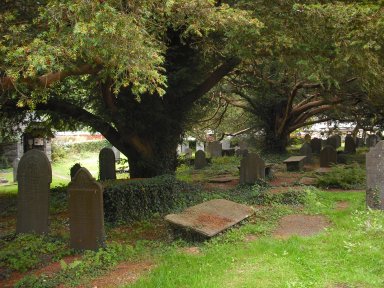
One noticeable change to the vista now is the fact that the yew trees have grown and spread even more and when you stand at the gated entrance to the church and graveyard, it is now almost impossible to see the church between the two enormous trees.

Present day church

So my walking trip yesterday did have artistic connotations but is also the reason for no blog.  My thanks go to Anne Hammond who introduced me to this beautiful little church and its connection with today’s featured artist and who led our small party of intrepid walkers on this voyage of discovery.

Gathering on the Terrace at 47 Downshire Hill, Hampstead by Richard Carline

Gathering on the Terrace at 47 Downshire Hill, (1925) by Richard Carline

If you go back to My Daily Art Display for August 5th and the painting by Sir Stanley Spencer, you will find a mention of Richard Carline, as Spencer married his sister Hilda.   Richard Carline was born in Oxford into a family of artists.  It was an artistically talented family.  Richard Carline’s parents, George and Annie Carline were both artists who married in 1885 and had five children and the three youngest of these Sydney, Hilda and Richard all became respected painters.

Richard Carline’s works included landscapes and portraits, often of his contemporaries.  In 1913 Richard Carline enrolled at the Percyval Tudor-Hart’s Académie de Peinture et de Sculpture, in Paris.  Following a short period teaching, Carline served in World War I where he was appointed an Official War Artist.   Along with his brother he became well-known for his war pictures from the air.   In the 1920’s, the Carlines’ Hampstead home at Downshire Hill became a focus point for artists such as Henry Lamb, John Nash, Stanley Spencer and Mark Gertler who would have regular meetings there to discuss the arts.  It was during this time that Carline was clearly influenced by Stanley Spencer, transforming everyday scenes into something monumental.  Unlike Spencer, Carline achieved this without actually exaggerating figures or their gestures to the degree that Spencer did.  In 1924 he started a five year stint teaching at the Ruskin School of Drawing at Oxford.   His first solo exhibition came about in 1931 at the Goupil Gallery in London.  During the Second World War Carline supervised camouflage of factories and airfields. When the war was over, he was involved in helping to found the Hampstead Artists’ Council in 1944.   In 1946-47 he was appointed as the first Art Counsellor to UNESCO, and from 1955 to 1974 was chief examiner in art for the Cambridge Local Examinations Syndicate.   He also published a number of books including Pictures in the Post: the Story of the Picture Postcard, 1959;  Draw They Must, 1968; and Stanley Spencer at War, 1978.  The latter, I bought off eBay last week !!

Richard Carline died in 1980 aged 84.

The Carline family home, which George and Annie Carline bought in 1916, was 47 Downshire Hill in Hampstead, London and it was here that many artists would meet and discuss art, politics, religion and life in general.   One of the regular visitors, the Australian-born British painter, Henry Lamb,  described the artistic meetings as a veritable cercle pan-artistique.   Many of the group would embark on painting holidays together.

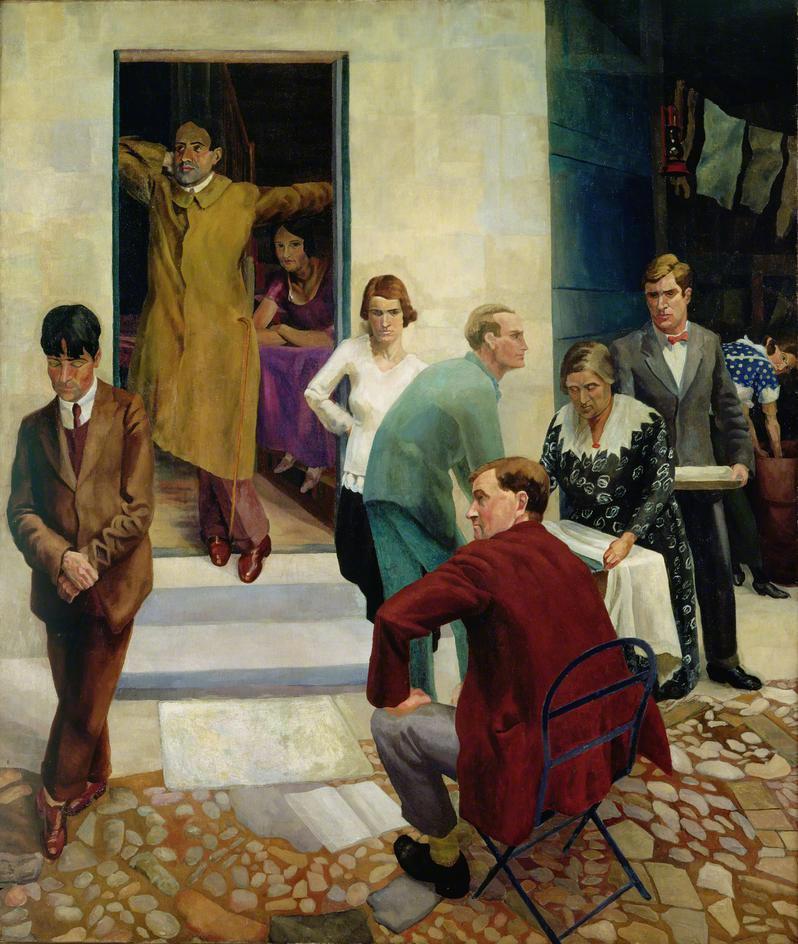
My Daily Art Display featured painting today by Richard Carline, entitled Gathering on the Terrace at 47 Downshire Hill, Hampstead,  shows one such meeting of the Downshire Hill Circle.  The painting was judged as one of Carline’s most impressive works.  Before us we have a group portrait. From left to right we have Stanley Spencer, James Wood, Kate Foster, Hilda Carline (later to become Mrs Stanley Spencer), Henry Lamb, Richard Hartley, Annie Carline and Sydney Carline.   Richard Carline was meticulous in his preparations for this work.  He painted an oil study of each of the group before slotting them into his group portrait.  His 1924 preparatory oil study of Stanley Spencer for this group portrait is also a stand-alone painting of his, entitled Study of Stanley Spencer.  Looking at the study one has to presume that he hadn’t  quite properly calculated the height of the preparatory study as he had to add Spencer’s shoes separately alongside the figure.

What enhances this group painting is the varied but individual characterization of each person.  This was not done by accident as Carline said his intention was to somehow convey the individuality of the people assembled at his parent’s house.  In his own words Carline described the group portrait:

“… [I] sought to convey the conflicting personalities gathered at our house – Stanley [Spencer] peering up and down as he expounded his views on this or that, James Wood hesitating in the doorway whether to come or go, Hilda absorbed in her own thoughts, Hartley sitting at ease, Lamb courteously attentive to my mother, with Sydney always helpful…”

This paintings, Gathering on the Terrace at 47 Downshire Hill, Hampstead , along with the Study of Stanley Spencer, are housed in the Ferens Art Gallery in Hull.  It is a gallery I have never visited but looking at their website it is one I will put down as a “must visit” location.

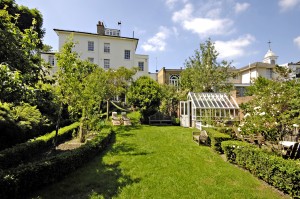
Finally, I always like to imagine what a place, depicted in a painting, looks like today.  I did this with my entry about Renoir’s boathouse in his painting Luncheon of the Boating Party which I featured in My Daily Art Display of August 2nd, so I wondered what the house at 47 Downshire Hill looks like today.  So below is a picture of it I found of it on the internet!

The present Downshire Hill house and garden

Mrs Baldwin in Eastern Dress by Sir Joshua Reynolds

Mrs Baldwin in Eastern Dress by Sir Joshua Reynolds (1782)

Today I am returning to portraiture and one of the greatest English portrait painters, Sir Joshua Reynolds.  His works were in a style which came from classical art and was often referred to as the Grand Manner which depended on idealization of the imperfect.  Reynolds himself preferred the term Grand Style which referred more to history painting and in his series of lectures, entitled Discourses of Art, he maintained that artists should perceive their subjects through generalisation and idealization rather than simply copying the sitter.  In the course of his lecture he expanded such thoughts, saying:

“…..How much the great style exacts from its professors to conceive and represent their subjects in a poetical manner, not confined to mere matter of fact, may be seen in the cartoons of Raffaelle.   In all the pictures in which the painter has represented the apostles, he has drawn them with great nobleness; he has given them as much dignity as the human figure is capable of receiving yet we are expressly told in Scripture they had no such respectable appearance; and of St. Paul in particular, we are told by himself, that his bodily presence was mean. Alexander is said to have been of a low stature: a painter ought not so to represent him. Agesilaus was low, lame, and of a mean appearance. None of these defects ought to appear in a piece of which he is the hero. In conformity to custom, I call this part of the art history painting; it ought to be called poetical, as in reality it is….”

Reynolds made a number of trips to Europe during which time he studied the foreign artistic techniques and by so doing was able to draw inspiration from them and it influenced how he shaped his own “English” paintings

My Daily Art Display featured painting;  Mrs Baldwin in Eastern Dress is a prime example of Sir Joshua Reynolds’s Grand Style of painting.   Jane Baldwin was born in Smyrna, Turkey in 1763.  She was the third daughter of Margaret Icard and William Maltass, a Yorkshire man from Ripon who, along with his brother Henry, spent the early part of the eighteenth century in Eastern Europe and was one of the earliest Europeans to settle in Turkey.    He became a wealthy merchant who traded with the East through the Levant Company.  From an early age Jane was deemed an extraordinary beauty.  At the age of sixteen, still virtually a child, she married the prosperous George Baldwin, an extremely wealthy English merchant stationed in Alexandria, Egypt.  George Baldwin later became that country’s British Consul-General and the British Minister Plenipotentiary to the Court of Tehran.

In the painting we see the delectable nineteen-year old English beauty attired in a luxuriously brocaded emerald and gold striped caftan, sprigged with cherry-coloured flowers and is aggrandized by an ermine mantle.  We see her dark chestnut hair braided into multiple long strands.  She is wearing a white and pink silk turban, atop of which are a small bouquet of tea roses.   In the late eighteenth century it was very fashionable for ladies to wear Eastern style headdresses and was in a way highlighting Britain’s trading relationship with the Ottoman Empire.

Around her neck she wears a diamond waterfall necklace along with a gold chain and pendant.  Her ears are adorned with gold teardrop earrings.   She is seated on a red velvet divan which is studded with brass tacks around its base.  Her pose is somewhat both alluring and seductive as she sits cross-legged before us.  Her eyes are fixed upon an ancient gold coin of Smyrna, the inclusion of which was probably to remind us of the links between England and its Turkish trading partner.  The sitter seems lost in thought, unaware that she is the focus of attention of the artist and of course us, the viewers.  So did the artist manage this expression on his sitters face by just simply having her stare at the coin for hours on end?  In fact no he didn’t.  Jane Baldwin sat in the pose we see but at the time the artist was painting her portrait she was actually holding and reading a book of poems by Pietro Metastasio, the famed Italian poet and librettist.  So why not have her reading the book in this portrait instead of having her transfixed by the sight of a coin?  The reason is probably that Reynolds had been asked to have something in the painting which reflected the world of commerce, the very thing which had led to her family’s wealth.  It also is reminding us that different cultures are brought together through trade and on economic grounds.  For the sitter to be holding and reading a book of poems written by an Italian might lead the viewers to believe that cultures are brought together through the arts….. perish the thought that we believed that (even if we know it to be true)  !!!!!!!

Jane Baldwin wore the costume we see in the painting many times when she visited England including a ball given by the king.   She earned the sobriquet the “pretty Greek”  not because she was of Hellenic descent (she had no Eastern-European blood) but because she, having been born and raised in the Greek region of Western Turkey, identified with that community as her own.  This is one of Reynolds’ finest portraits and I will leave you with a passage from Jane Baldwin’s obituary notice from the 1839 (July to December) issue of the Gentleman’s Magazine which talks about the painting and the sitter’s views of the artist:

“…..It was during the first winter after her arrival in London (1781), that Sir Joshua Reynolds painted the beautiful portrait of this lady which now enriches the Marquess of Lansdowne’s Gallery at Bowood. She is represented sitting on a sofa in the eastern fashion, contemplating a small object which she holds in her right hand.  She once told the writer that, when this portrait of her was made, she was lodging with her husband in the Temple; and that the trees which Sir Joshua has represented in the background were those in the Temple Gardens. At first she used to give the painter sittings in his study, but Reynolds could not satisfy himself with her resemblance; he made three attempts, which he successively defaced. Mrs. Baldwin could only remember, besides, that he took a prodigious quantity of snuff, and that his painting room smelled horribly. After a few hours she always grew restless and cross, which used to vex Reynolds, who did not know how to amuse her. He made his fourth and last sketch at the residence of the lady, and when she grew impatient suggested that she should take a book. She asked for Metastasio, and while reading it her portrait was made. Instead of a volume, Reynolds represented an ancient coin of Smyrna in Mrs. Baldwin’s band,—a circumstance, as she informed the writer, which was much quizzed and ridiculed at the time. Of this painting there exist several mezzotint engravings….”

“….. She travelled widely and lived in England for a considerable number of years, and was always admired for her intelligence and beauty. She was patronised by Mrs Hester Lynch Thrale, who remarked “I…hope to Obtain some favours from the new Ministry for my pretty Greca: could her Husband but gain the Embassy!  Oh I should not sleep for Pleasure. This pretty Greek as we call her, was born at Smyrna, & ran away with a Man whose Family had been some of Mr Thrale’s best Friends in the Borough; between Gratitude to him, and delight in her, for artlessness & Beauty; I have been led to interest myself no little towards protecting her, may my Fortune & Talents be ever devoted to Charity & Friendship! & may I have the Strength & Courage to despise them who would hinder its Current, by trying to make each other believe that its Source was only Desire!…”.

“…Mrs. Baldwin had many peculiarities, but they were of a less ambitious character: a singular iulirmity of temper, which estranged from her all but her immediate relatives, was perhaps her prevailing characteristic. She had survived her generation, and ended her days in a self-inflicted penurious seclusion,— the inconveniences of which were aggravated, of late years, by sickness and suffering….”

The Lake by L S Lowry

The Lake by L S Lowry (1937)

I don’t know about you, but for me, when I wake up and the sun is shining and the sky is a clear blue, I feel great.  Life is good.  I want to get out and do things.  I have an urge to go into the garden and make things look good.   On the other hand, when I get up and it is cold, pouring with rain and the sky is covered in black clouds I start to feel slightly depressed and extremely unmotivated.  I know that anything I do will not be done with any degree of enjoyment simply because I am not in the right frame of mind.  For that reason, and so as to clear my mind, I will often turn to a DVD and watch a film which helps me escape reality.   Although I am not an artist I would imagine that if you are experiencing life at its worse for whatever reason it may be transmitted subconsciously into your work of art.  It could be that your painting reflects your state of mind.  All this leads me to the second painting I am featuring by the artist L S Lowry.

This painting was the first one I came across when I walked into the Lowry Gallery at Salford Quays, just outside of Manchester.  I was so impressed by it that throughout my hour-long walk around the gallery I kept wanting to return to it and search for things that had escaped my attention during my initial viewing.  It was painted by Lowry in 1937 at a very distressing period of his life.  His father had died five years earlier and this had badly affected his elderly mother who just took to her bed and stayed there until she died in late 1938.  Lowry’s never really bonded with his father and their relationship does not appear to have been a loving one.  I get the feeling they exchanged pleasantries but there was never a warmth in their relationship.  Lowry probably turned to his mother, whom he dearly loved, for comfort but sadly he never received the love and affection that a child should receive from his mother.  She had always wanted daughters and was dissatisfied with her lot in life having been saddled with a son.  She rarely praised Lowry for his artistic achievements and maybe if she had shown just a modicum of pride for her son’s artistic success then maybe Lowry would have led a much happier life.

Despite all this, she demanded that Lowry and only Lowry attended to her needs when she spent her last seven and half years bedridden.  He would comb and brush her hair, bathe her and tend her bed sores.  I don’t believe she even appreciated what her son did for her and this period in his life must have affected him both mentally and physically. He was a man under great stress.

So to look at this painting knowing what life was like for Lowry at the time may give you some idea why there is a somewhat depressing feel to the work.  It is possible that his mental stress and depression percolated into the painting and in a way was the reason for its bleakness.  We are looking at a view of the Irwell Valley.  We see the smoke-polluted atmosphere of an industrial area.   It is a very moody painting.  It is a very depressing work of art.   It is an environmental nightmare set against an industrial background.  Look at the foreground with its fences and what look like blood-red coloured tombstones dotted around.  The telegraph poles remind us of crucifixes.  The water in the middle ground looks dirty and stagnant and we see an abandoned half-sunken boat to the left.  On the left shore we see men queuing for work at a time when jobs were few and far between.  On the far side of the lake we see Agecroft Colliery which had been opened in 1844 but had to close in 1932 with a great loss of jobs.  It was re-opened in the late 1940’s due to the country’s lack of coal supplies.  As our eyes scan the picture we are drawn to the red mill on the skyline.  Look how Lowry has intertwined churches and the town hall with the mill chimneys, which spew out black polluting smoke, and the winding tower of the colliery, which sits by its slag heap.  It is an interesting juxtaposition of industrial architecture and residential buildings.

It is a very dark and “dirty” picture and after looking at it for a while I feel I need to go and wash my hands to cleanse myself of the grime which emanates from the painting.  The more I look at the painting, the more I am sure that there was transference of the artist’s state of mind into what he offered us in his painting.

Head of a Man with Red Eyes by L S Lowry

Head of a Man with Red Eyes by L S Lowry (1938)

The other day I went over to Manchester and visited the Lowry Gallery at Salford Quays.  The Gallery was named after Laurence Stephen Lowry, best known simply as L.S.Lowry.  He was the Lancashire artist, who had a very distinctive type of art, often depicting people and places around his home town.  The small stick-like characters which were seen in the crowd scenes of his paintings were his trademark and were often described as matchstalk people.

The Matchstalk people of a Lowry painting

The term matchstalk men and matchstalk cats and dogs was further immortalised with the No. 1 hit song produced in late 1977 entitled Matchstalk men and Matchstalk cats and dogs.  The lyrics  of the song, telling the story of the artist Lowry, was performed by a duo, who went by the name of Brian and Michael.

The poignant lyrics summed up Lowry’s art:

He painted Salford’s smokey tops

On cardboard boxes from the shops

And parts of Ancoats where I used to play

I’m sure he once walked down our street

Cause he painted kids who had nowt on their feet

The clothes we wore had all seen better days.

Now they said his works of art were dull

No room, all round the walls are full

But Lowry didn’t care much anyway

They said he just paints cats and dogs

And matchstalk men in boots and clogs

And Lowry said that’s just the way they’ll stay

And he painted matchstalk men and matchstalk cats and dogs

He painted kids on the corner of the street with the sparking clogs

Now he takes his brush and he waits outside them factory gates

To paint his matchstalk men and matchstalk cats and dogs.

The Matchstalk people of a Lowry painting

Although I went to the Gallery expecting to see just a series of similar looking crowd scene paintings filled with strange looking, stick-like people, I was very pleased to see the exhibition showed far more than I was expecting.  Besides Lowry’s trade-mark paintings, there were a number of completely different works of art by Lowry, which I found amazing and two of which I will feature today and tomorrow.

The painting by Lowry which is My Daily Art Display painting of the day is entitled Head of a Man with Red Eyes, which he completed in 1938.  The 1930’s had been a period of his life which was very traumatic.  Lowry was an only child and was never to marry.  He lived with his mother and father, with his mother being, by far, the more dominant parent.  His mother had always wanted daughters and her son disappointed her and to make things worse her sister had given birth to three girls.  Lowry’s mother was very envious of her sister Mary and once commented that it was unfair that whilst Mary had three splendid daughters all she had was one clumsy boy.

In 1932 his father, aged 74, died of pneumonia.  Lowry’s relationship with his father had been somewhat cold and strained and although he called his father “Dad” there was a distinct lack of father-son rapport.   The death of his father did not bring out any palpable signs of overwhelming grief.  His main concern at the time was how the death of her husband would affect his mother.  The affect it had on his 73 year-old mother was terrible as she all but gave up on life and retired to bed where she remained for seven and a half years until her death.  Her demands on her son and his time were great and constant and for that lengthy period Lowry had to care for his mother, who would not agree to any outside help.

Not only did Lowry now have to be at his mother’s beck and call he discovered to his horror that his late father had run up a mass of debts.  The discovery of the alarming state of his father’s financial situation was only discovered when the creditors came knocking at the door.  It took Lowry a year to settle the outstanding debts.  Lowry’s health began to fail due to being over-tired with looking after his mother and at one point he had to go away for a few days on doctor’s orders.

Today’s painting probably was in some way a product of his physical and mental state.  He had suffered badly because of his all controlling mother who rarely showed him any love or affection and this painting was completed the year before she died.   It is the morning- mirror reflection of the face of a man staring out at us.   It looks like he has slept little during the night.  The healthy vigour is missing, drained completely away, leaving just strain and tension.  The physical discomfort we see in this face is the look of utter despair.  The gaze is both unsettling and intense.  Of this painting Lowry said:

 “…I was simply letting off steam.  I started a big self-portrait and then I thought ‘What’s the use of it.  I don’t want it and nobody will’.  I turned it into a grotesque head, I’m glad I did, I like it better than a self-portrait….”


Boy in a Yellow Jacket by L S Lowry (1935)

Lowry in the 1950’s commented again about his work and his equally disturbing 1935 painting Boy in a Yellow Jacket and came to the conclusion that it was painted during a harrowing period in his life.  He said of the period:

“…I think I reflected myself in those pictures.  That was the most difficult period of my life.  It was alright when he [his father] was alive, but after that it was very difficult because she was very exacting.  I was tied to my mother.  She was bedfast.  In 1932 to 1939 I was just letting off steam…”

The painting was bought by a Manchester man who only kept it for three weeks saying that he couldn’t live with such a disturbing picture.

Would you like to have it on your bedroom wall to see when you wake up?  Maybe a man should have it next to his bathroom mirror so that he can compare likenesses when he finally gets out of bed and thus be appreciative of his looks and be appreciative of what he has and realise that life could change for the worse !

Found Drowned by George Frederic Watts

Found Drowned by George Frederic Watts (c.1850)

For the second consecutive day I want to present a painting to you which has a connection with a poem.  My Daily Art Display painting today is entitled Found Drowned and was painted by the Victorian painter George Frederic Watts in 1850.  It is almost certain that the idea for the painting came from Watts having read The Bridge of Sighs, the poem written by Thomas Hood just before his death in 1845.

Watts was born in London in 1817 and his Christian names came from the fact that he was born on the composer, George Frederic Handel’s birthday.  He was brought up in an impoverished household, did not attend school, being taught at home by his father.  Despite these early setbacks in life, he achieved acceptance into the Royal Academy when he was eighteen years of age.  In 1843 he won first prize in an artistic competition to design a mural for the Houses of Parliament and although this never came to fruition, the monetary value of the prize enabled him to travel to Italy.  He remained in Italy until 1847 at which time he returned to London.

On his return to London he made the acquaintance of Henry Prinseps, an amateur artist and director of the East India Company, along with his circle of friends and in 1850, Prinseps, his wife Sara, along with some of her sisters and Watts obtained a twenty-one year lease on Little Holland House which belonged to Henry Fox, 4th Baron Holland, and a friend of Watts.  The house, not only became a place for them to all live and entertain their friends, but it gave Watts a studio for his painting.

In 1864 Watts painted portraits of the Terry sisters, Kate Terry and her famous actress sister Ellen Terry.  Watts was besotted by Ellen and despite the fact that she was still a little way short of seventeen years of age and he was thirty years her senior, they married.  The marriage was doomed to failure and a year after the marriage she eloped with her lover forcing Watts to sue for divorce.

In the early 1870’s when the lease ran out on the Little Holland House, Watts acquired another house in London and also one in Freshwater on the Isle of Wight.  In 1877 his divorce with Ellen Terry finally came through and nine years later at the age of 69 Watts re-married, this time his bride was Mary Fraser-Tytler,  a Scottish designer and social reformer, some thirty-three years his junior!   In 1891 he bought land in Guilford, Surrey and they named the establishment Limnerslease, which was a combination of the words “limner” meaning artist and “leasen” meaning glean and by it they had built the Watts Gallery which was a museum dedicated to his work.  It was the first and only remaining purpose-built gallery in Britain devoted to a single artist.  It eventually opened in April 1904, shortly before the death of Watts.

So that is the story of today’s artist and so now let us study his poignant painting and understand why he should depict such a heart-rending scene.  When Watts returned to London from Italy he was traumatized by the extremes of riches and poverty that he could see all about him.  It moved him and he realised that through his art he could bring home the inequalities of life.

The background of the painting is the London skyline and we are viewing it from under Waterloo Bridge and in the distance we can just make out Hungeford Suspension Bridge.  Waterloo Bridge had been a common place for suicides with people throwing themselves off the structure into the Thames.  In the foreground Watts has painted a “fallen woman”, a reasonably common subject in Victorian paintings.  She has drowned and been washed up on the shores of the Thames. Was it an accident or had life proved just too much for her to bear?  In those days, female suicides caused by adulterous relationships or financial hardship, which then led to prostitution, were not uncommon happenings.   Her body is lit up and is in stark comparison to the darkened background.  Her dress still floats in the murky polluted waters.  She is lying on her back with her arms stretched out in a cruciform adding religious symbolism to the picture.  In her left hand she is clutching hold of a chain, attached to which is a heart-shaped locket and this again makes us believe that unrequited love may have had some bearing on the situation.  In the night sky we see a very bright pin-point of light which could be a star of the planet Venus and Watts probably added this as a symbol of hope that maybe there will be a better after-life for the dead woman.  Look at the young woman’s face.  It appears calm.  Maybe at last she is at peace with herself.

It is interesting to note that the title of the painting Found Drowned was legal phraseology often used by coroners when there is no conclusive evidence of suicide, such as a note, and thus the coroner’s report avoids the stigma attached to suicides, which would automatically rule out a Christian Burial.

I end today’s blog with the Thomas Hood’s poem Bridge of Sighs which it is believed was the basis of Watts’ painting.  Read it through and then look at the painting and see if you agree that there is a connection between the two.

One more Unfortunate,
Weary of breath,
Rashly importunate,
Gone to her death!

Take her up tenderly,
Lift her with care;
Fashion’d so slenderly
Young, and so fair!

Look at her garments
Clinging like cerements;
Whilst the wave constantly
Drips from her clothing;
Take her up instantly,
Loving, not loathing.

Touch her not scornfully;
Think of her mournfully,
Gently and humanly;
Not of the stains of her,
All that remains of her
Now is pure womanly.

Make no deep scrutiny
Into her mutiny
Rash and undutiful:
Past all dishonour,
Death has left on her
Only the beautiful.

Still, for all slips of hers,
One of Eve’s family—
Wipe those poor lips of hers
Oozing so clammily.

Loop up her tresses
Escaped from the comb,
Her fair auburn tresses;
Whilst wonderment guesses
Where was her home?

Who was her father?
Who was her mother?
Had she a sister?
Had she a brother?
Or was there a dearer one
Still, and a nearer one
Yet, than all other?

Alas! for the rarity
Of Christian charity
Under the sun!
O, it was pitiful!

Near a whole city full,
Home she had none.

Sisterly, brotherly,
Fatherly, motherly
Feelings had changed:
Love, by harsh evidence,
Thrown from its eminence;
Even God’s providence
Seeming estranged.

Where the lamps quiver
So far in the river,
With many a light
From window and casement,
From garret to basement,
She stood, with amazement,
Houseless by night.

The bleak wind of March
Made her tremble and shiver;
But not the dark arch,
Or the black flowing river:
Mad from life’s history,
Glad to death’s mystery,
Swift to be hurl’d—
Anywhere, anywhere
Out of the world!

In she plunged boldly—
No matter how coldly
The rough river ran—
Over the brink of it,
Picture it—think of it,
Dissolute Man!
Lave in it, drink of it,
Then, if you can!

Take her up tenderly,
Lift her with care;
Fashion’d so slenderly,
Young, and so fair!

Ere her limbs frigidly
Stiffen too rigidly,
Decently, kindly,
Smooth and compose them;
And her eyes, close them,
Staring so blindly!

Dreadfully staring
Thro’ muddy impurity,
As when with the daring
Last look of despairing
Fix’d on futurity.

Perishing gloomily,
Spurr’d by contumely,
Cold inhumanity,
Burning insanity,
Into her rest.—
Cross her hands humbly
As if praying dumbly,
Over her breast!

Owning her weakness,
Her evil behaviour,
And leaving, with meekness,
Her sins to her Saviour!