The Pale Complexion of True Love by Eleanor Fortescue-Brickdale

The Pale Complexion of True Love
by Eleanor Fortescue-Brickdale (1898)

Today I want to look at the life of Pre-Raphaelite painter, Mary Eleanor Fortescue-Brickdale, who was born thirty-four years after the original seven English Pre-Raphaelites painters formed an artistic group, known as the Pre-Raphaelite Brotherhood, whose aim it was to reject classicism and return to the vibrant colours and complex details of earlier Italian and Flemish art. But while the Brothers were starting to go their own way artistically and the Brotherhood was heading for extinction, their ideas were not.

When I visited the Pre-Raphaelites: Victorian Avant-Garde at the Tate Britain a week ago I was struck by just the few paintings on display which had been painted by women.  There were a couple of watercolours by Dante Rossetti’s model and mistress, Elizabeth Siddall.  There were some early photographs taken by Julia Margaret Cameron and some embroidery by Jane Burden who later became Mrs Jane Morris, but little else from any other female Pre-Raphaelite painters.  So it was very pleasing to find that a local art gallery, not too far from me, The Lady Lever Gallery in Port Sunlight, Wirral had just put on a small exhibition of work by a feminine Pre-Raphaelite painter entitled A Pre- Raphaelite Journey which showcased the art of Mary Eleanor Fortescue-Brickdale.  In my next couple of blogs I want to look at the life of this gifted female artist and feature some of her paintings.

Mary Eleanor Fortescue-Brickdale was born in the prosperous London suburb of Upper Norwood, Surrey in 1872.   She was brought up in an affluent household which, besides the family, also housed four live-in servants and a governess.  Eleanor was the youngest of five children.  Her father Matthew was a Lincoln Inn’s barrister who had married Sarah Anna Lloyd, the daughter of a judge from Bristol.   At this juncture in Victorian England, parents expected their sons to prosper at school and go onto university, after which they would secure well paid, high status professions.  Daughters were not expected to achieve any great academic status but would harness all their efforts into securing a “good” marriage.  Mary Eleanor Fortescue-Brickdale’s two brothers achieved all that was expected of them.  Both Charles and John Fortescue-Brickdale graduated from Oxford University, following which Charles, like his father became a lawyer and John followed a career in medicine.  Of the three daughters, Anne had died at the age of six leaving Eleanor and Kate to fulfill their parents’ plans of finding themselves “good” husbands.  However, unlike their brothers, they were not to realize their parent’s wishes as neither married.

The Fortescue-Brickdale family had tentative ties to the world of art with Eleanor’s father being a fellow Oxford university student of John Ruskin and later Eleanor’s brother Charles, who was an amateur artist, would attend Ruskin’s lectures at Oxford.  Eleanor had originally shown an interest in painting and drawing but merely as a pastime.  As she grew older, she began to take art more seriously and consider it as a possible future profession.  In 1889, aged seventeen, Eleanor enrolled at the Crystal Palace School of Art, Science and Literature.  It was not considered a prestigious art school and did not have any famous painters on the staff but it was close to where Eleanor lived and so was deemed fit for purpose.  The school was open to both boys and girls but the science classes were only for young men whilst the art classes were solely for young women.  The only mingling of the sexes occurred in the music classes.

In 1894, tragedy was to strike the Fortescue-Brickdale family with Eleanor’s father being killed whilst climbing in the Swiss Alps.  Eleanor having gained a basic knowledge of art and artistic techniques whilst at the Crystal Palace School of Art, realised that to become a professional artist she needed to attend a much more professionally run art establishment and in the mid 1890’s she enrolled at the St John’s Wood Art School.  The aim of this school was to train students for the Royal Academy Schools and it was very successful at this, as between 1880 and 1895, 250 out of 394 students admitted to the Royal Academy had come from St John’s Wood Art School and furthermore, of the 86 prizes awarded to students by the Royal Academy, 62 had been ex-pupils of St John’s Wood Art School.   To achieve entry to the Royal Academy Schools as a probationer one had to submit certain prescribed pieces of work.  If the submitted works were considered acceptable, the candidate then had to endure a three month probationary period before being allowed on to a full-time course.   In January 1895, on her third attempt to become a probationer, Eleanor was admitted.  Despite the initial problems of being accepted as a probationer, her work during her probationary period was looked upon as being so good that she was allowed to embark on a full-time course after just three weeks.

Eleanor managed to cover the costs of her first year at the Academy by selling some of her work which she used to work on before and after attending the Academy School.  Although this was a financially good option for her,  it made her days very long.  Two years later in 1897 she was awarded a prize for her design work and the recognition she received for this led to a number of commissions, including one from her brother Charles’ legal practice, and one for illustrating a book entitled A Cotswold Village, which was written by her brother-in-law, J Arthur Gibbs.  Soon she became one of the most visible female artists of her time.  One must remember that Eleanor was a single woman, had not gone to a public school instead had been home educated, did not go to university and so lacked the opportunity in later life to cultivate connections with ex students.  The one thing that was going for her was the sector of society in which she grew up.  Their neighbourhood family friends included well-to-do bankers and lawyers, landed families who had houses in town, all of which needed decorating and acquiring paintings to hang on their walls.  These were people with disposal incomes.  They were also readers of upper-class publications such as Country Life and The Ladies Field and Eleanor managed to find work at these magazines using her well-loved artistic design skills.  She contributed illustrations to these magazines for over ten years and from people seeing and admiring her work she began to build up a sizeable patronage

In 1898 she had her first major work of art entitled The Pale Complexion of True Love accepted for the Royal Academy Exhibition of that year.  This is my featured painting of the day.  The title of the work is taken from Act 3 Scene IV of Shakespeare’s pastoral comedy, As You Like It, when the elderly shepherd, Corin speaks of the shepherd, Silvius’ unrequited love for the shepherdess, Phebe:

“…If you will see a pageant truly play’d,
Between the pale complexion of true love
And the red glow of scorn and proud disdain,
Go hence a little and I shall conduct you,
If you will mark it…”

The first thing that strikes you with this painting is the sumptuous red of the lady’s gown.  It is interesting how the artist has used such a bright spectrum of colours.  To many people, the Pre-Raphaelite painters use of bright colours is too garish and lacks subtlety.  To others it is this vibrancy of colour which enhances the work.   I will let you decide which camp you find yourself in.

In my next blog I will continue the life story of Eleanor Fotrtescue-Brickdale and look at another of her paintings.

A Suffolk Farm by Edward Seago

A Suffolk Farm by Edward Seago

Last Sunday,  I went down to London to visit two of my children and my one and only grandchild and on the following afternoon I had scheduled a visit to the Royal Academy Summer Exhibition.  I had some spare time on Monday morning and had intended to visit a couple of galleries or museums but my best laid plans were thwarted because of an item of shopping I was looking for which proved elusive and the atrocious weather which put a damper on any thoughts I had of a pleasant stroll between artistic collections.  I had seen an advert for an exhibition, Samuel Palmer, His Friends and His Followers at The Fine Art Society which is situated in New Bond Street so I eventually ended up there like a drowned rat as my umbrella proved totally inadequate to counter the torrential rain.   I will look at one of the paintings from that exhibition in a later blog.  I left there and still had an hour to kill before I was due to attend the Royal Academy and as I had no intention of any further long walks in the downpour I ended up at the Richard Green Gallery just a few doors down from The Fine Art Society.  The gallery was in the process of hanging an Edward Seago exhibition but allowed me to take a look at what was already in place.  What a wonderful collection of art.

Edward Brian Seago was born in Norwich in 1910, the second son of Brian, a local coal merchant and Mabel Seago.   As a child he suffered quite a lot with ill health caused by a heart complaint, paroxysmal tachycardia, with which he was first diagnosed when he was eight years of age.   This illness meant that on a number of occasions he was reluctantly confined to his bed. As a result of this enforced confinement, he spent a lot of time painting skies and the surrounding landscape from his bedroom window.  Seago later remembered those times with a surprising fondness and called his enforced leisure, “spells of sheer delight”.  It was during these periods of imposed convalescence that the young Edward Seago realised his great enthusiasm and aptitude for painting.

His continued illness precluded him from any formal artistic training and, for the most, he taught himself.  He did however receive some artistic advice from the local East Anglian painters who were both impressed with his work.  They were Sir Alfred Munnings, who lived in Dedham close to the Essex/Sussex border and the landscape painter, Bertram Priestman, who remained a friend for the rest of Seago’s life.  Another of Edward Seago’s friends was the poet John Masefield with whom Seago collaborated on a number of publications.  Masefield would provide the poems whilst Seago provided the illustrations.  Two of the most successful collaborations were The Country Scene which was published in 1937 and Tribute to Ballet which was published the following year.  It was also Masefield that instilled in Seago the love and appreciation of English country life.

Seago’s landscape works were influenced by the landscape paintings of the Dutch Masters as there was a certain similarity between the landscape of The Netherlands and that of the East Anglian countryside.  Seago also was a great admirer of the landscape works of the English painter, John Constable and by the painters of the Norwich School founded by John Chrome in 1803.  However notwithstanding all these outside influences, his biographer James Reid, wrote:

“…While Seago’s subject matter evolved within a fundamentally traditional genre, his methodology, style and technique contributed to an innovative interpretation of the rural, urban and marine scene…

During the 1930’s Seago led a very varied existence.  He loved the freedom associated with a bohemian lifestyle and would often travel and work with circus folk, gypsies and ballet dancers but at the same time he kept in contact with the more refined aristocratic circles which provided him with generous patronage.  One such patron and friend was the politician and industrialist, Henry Mond, 2nd Lord Melchett, who was also an art connoisseur and collector.  Seago and Henry Mond travelled together to Venice in 1933.   Seago was astounded by the beauty of Venice which he later captured in many of his oil paintings.  He also had the opportunity to view the art works of the great Italian masters which were on show in the city.

Another of Seago’s close friends was Princess Mary, the Countess of Harewood, who was King George VI’s sister, and it was through this acquaintance that he was later to meet the present Royal Family who collected many of his paintings.  George VI also commissioned a portrait, and that royal patronage made Seago and his art,  very fashionable.    The Queen Mother bought so many of his works of art that eventually the artist gave her two a year – on her birthday and at Christmas.   Later, in 1956, he accompanied Prince Philip, the Duke of Edinburgh on the Royal Yacht Britannia, on a world tour and during one part of the voyage the ship sailed around the Antarctic.  Prince Philip and Edward Seago used to paint alongside each other on the deck of the Royal Yacht Britannia and the two developed a very close friendship.  Edward Seago’s paintings depicting the Antarctic were quite beautiful and were loved by art critics and the public alike.

He became a war artist in Italy during the Second World War and spent two years with General Alexander.  After the Second World War Edward Seago concentrated his art work on the East Anglian countryside with its cloud-filled skies, cattle grazing in the expansive flat fields as well as paintings which focused on the waters and the mudflats of The Broads and some of the barges which plied their trade along these inland waterways.  His beautiful landscape paintings would often incorporate man-made structures such as windmills, churches and farmhouses.  Seago loved East Anglia and its countryside and once wrote:

“…Perhaps one has to be born and bred there for it to really get into one’s blood.   But it has a powerful hold on me, and whenever I go, I feel a longing to return there…”

In 1968 Seago bought Ca Conca, a villa apartment in the elegant yachting resort of Porto Cervo on the Costa Smeralda, Sardinia. The terrace of his property offered fine views of the harbour to the right.   His life was suddenly cut short whilst on a painting tour of Sardinia when he was diagnosed as having a brain tumour, from which he died in London in January 1974 just before his sixty-fourth birthday.  In terms of commissions, he was the most successful artist of his day.

The painting I have featured today by Edward Seago is entitled A Suffolk Farm and epitomises the beauty of his landscape paintings and his love for the Suffolk countryside.  I urge you to visit the Richard Green Gallery (147 New Bond Street, London W1 2TS) which in honour of Her Majesty the Queen’s Diamond Jubilee, is presenting an exhibition of 41 paintings by Edward Seago.  The exhibition opened on June 13th and ends on Saturday, July 7th.   The gallery is open Monday to Friday from 10am to 6pm and on Saturday from 10am to 1pm.  I can assure you that you will not be disappointed and if you have a few pounds to spare then you will be pleased to know that all the works are up for sale.

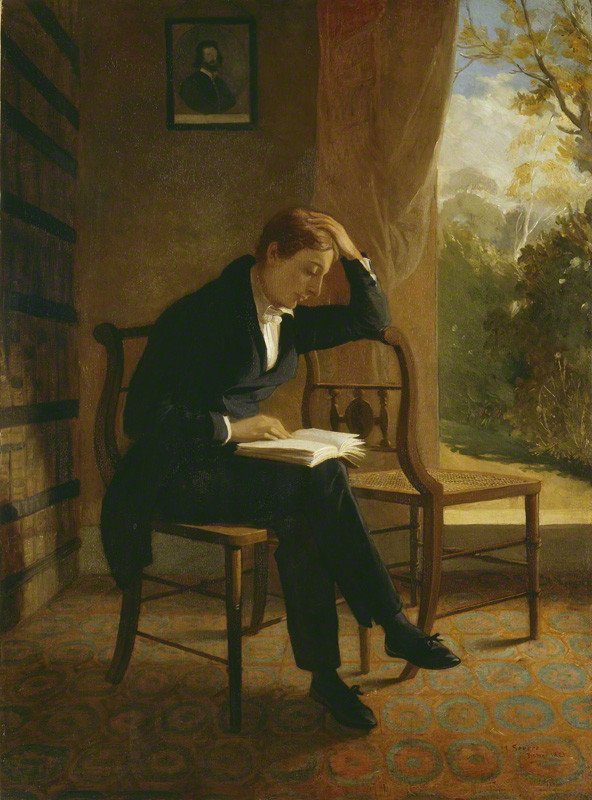
John Keats by Joseph Severn

John Keats by Joseph Severn (1821)

My Daily Art Display today centres around one of the greatest English poets, John Keats, and one of his most devoted friend, the English portrait artist Joseph Severn.

Joseph Severn was born in Hoxton near London in 1793.  He was one of seven children and the eldest son of a prosperous middle-class family.  His father was a music teacher and Severn besides being artistically talented was an accomplished pianist.   In 1807 his father arranged for him to be apprenticed to a London engraver, William Bond, a master of the stipple engraving technique.  When Severn was twenty-two years of age he enrolled at the Royal Academy Schools in London and four years later his first works were exhibited at the Royal Academy Exhibition.  That same year he was awarded the gold medal for his painting, Una and the Red Cross Knight in the Cave of Despair, the inspiration for this work being the epic poem by Sir Thomas Spenser entitled the Faerie Queen.  This prestigious award was even more special as the Royal Academy hadn’t awarded the medal for eight years.

It is thought that Severn first met the writer and poet John Keats around 1814 when he became part of the artistic circles of London.  He was not one of Keats’ closest friends but was one of Keats’ circle of literati and artists.  In 1817, John Keats and his brother George had to take time to nurse their brother Tom, who was suffering from tuberculosis.    In June 1818, Keats began a walking tour of Scotland, Ireland and the Lake District with his friend Charles Armitage Brown and his brother George and his sister-in-law Georgina before the latter pair set sail from Liverpool for a new life in America.  When Keats returned from his trip he continued to nurse his brother Tom and in doing so, exposed himself to the disease and it is thought by many that it was at this time that the disease took hold of John Keats.   His brother, Tom died in December 1818.

Tuberculosis took hold of Keats and he was counselled by his physicians to move to a warmer climate for the winter months.   Keats agreed to such a change of venue and a suitable travelling companion for him was sought.   Most of his close friends could not or would not go with him for various reasons and despite not being one of Keats’ “best friend” it was Severn who offered to accompany Keats to Italy for what was hoped to be an aid to the poet’s recovery.  Severn had always wanted to visit Italy and this proposed trip with Keats was his ideal opportunity. Severn was keen to study the great Italian Masters and be enthused by the beautiful landscapes of Italy. As he had just been awarded the gold medal by the Royal Academy he was eligible to apply for a travelling fellowship which gave him three years of artistic freedom funded by the Royal Academy. In order to receive this grant, Severn needed to paint an original in oil and have it shipped back to London. Once the painting was approved by a panel of judges, he would receive the precious fellowship and since Rome was the art capital of Europe, it made sense to Severn to travel there. His decision to leave England with Keats was not universally popular.  When he told his father of his plans, his father was horrified telling his son that he was risking his career and health by travelling with the ailing Keats and ordered him to remain in England. In Grant Scott’s book Letters and Memoirs, he recounts part of Severn’s late memoir in which he talks about this harrowing meeting with his father:

“…in his insane rage he struck me a blow which fell me to the ground…”

Severn was never to see his father again. However, Severn would not be deterred, packed his bags and embarked on what he believed was a voyage of convalescence, for his companion as Keats’s doctors had assured him that a stay in Rome would cure his condition.   It is extremely doubtful whether Keats believed the optimistic views of his doctors but it never crossed Severn’s mind that his companion would not fully recover once living in the favourable climate of the Italian capital.

In September 1820 Keats and Severn set sail for Naples on the vessel, Maria Crowther.  Although at the start of the voyage Keats’ illness seemed to be far from serious in the eyes of Severn, weeks into the voyage Keats became feverish and began to cough up blood and these physical signs of Keats’ illness affected Severn mentally.  In one of his letters he wrote of his time during the voyage with Keats:

“…He was often so distraught, with moreover so sad a look in his eyes, sometimes a starved, haunting expression that it bewildered me…”

The voyage itself had its problems.  The weather was constantly changing.  Stormy weather battered the ship one day and then the weather would completely change and the vessel would be becalmed lengthening the duration of the sea passage.  They finally arrived at the Italian port but then had to endure ten days in quarantine as news had travelled to Italy of a suspected outbreak of cholera in Britain.    Eventually the two men left Naples and travelled by carriage to Rome.  The pair eventually set up home in a villa on the Spanish Steps which is now the Keats-Shelly Memorial House Museum.  Keats’ health detonated and despite the ministrations of the medics he died on 23 February 1821 and was buried in the Protestant Cemetery in Rome and so, to carry out the last wishes of Keats, he was placed under an unnamed tombstone.  Joseph Severn and Keats’ close friend Charles Armitage Brown had the stone erected, which under a relief of a lyre with broken strings, was the epitaph:

“This Grave

contains all that was Mortal

of a

Young English Poet

Who

on his Death Bed, in the Bitterness of his Heart

at the Malicious Power of his Enemies

Desired

these Words to be

engraven on his Tomb Stone:

Here lies One

Whose Name was writ in Water. 24 February 1821″

My Daily Art Display featured painting today is simply entitled John Keats and was completed by Joseph Severn in 1821.  Severn had painted a number of portraits of Keats but this was one which he painted after the death of his friend and whilst he was still in Rome.  Severn wrote about this painting saying that it was painted to evoke a last graceful memory of his friend around the time when Keats first began to feel ill.  It had been on a morning visit to Keats’ house in Hampstead and Severn said that the position of the two chairs was exactly how he remembered the scene.  All the individual items such as the carpet, chairs, open window and even the engraving of Shakespeare hanging on the wall in the background were faithfully recorded in Severn’s work.  Look how Severn has depicted the room with all its atmospheric shadows.  It is a wonderful portrayal of the young poet reading his book and in the background we see a heavily gathered curtain pulled aside allowing us a glimpse of Keats’ Hampstead garden.  Severn said that his visit coincided with the time Keats had just written his famous Ode to the Nightingale and Severn later said that he was struck with the first real symptoms of the sadness Keats had so finely expressed in that poem.

This portrait of Keats is, beyond doubt, a Romantic portrait of one of the unsurpassed Romantic poets.

A Primitive City by Edward Calvert

A Primitive City by Edward Calvert (1822)

When I wander around various galleries, I am often lost in wonderment  when I stand in front of a massive painting.  I can remember when I was in Venice last year and visited the Accademia Galleries and stood before the giant work of Paolo Veronese entitled Feast in the House of Levi.     I was amazed at the magnitude of the work which measured  5.6 metres x 13metres and I could only wonder at how he managed to physically paint such a large scale picture.  How long must it have taken him?  Maybe he had some of his apprentices to help him but still it was an outstanding undertaking.  I find equally impressive miniature paintings and I am always filled with a sense of amazement at how these delicate paintings have been achieved.  My Daily Art Display featured painting today is one such miniature and I want you to feast your eyes on this lovely work of art entitled A Primitive City painted by the English artist Edward Calvert.

Edward Calvert was born in Appledore in the county of Devon in 1799.  His early schooling and art education was at Plymouth but coming from a seafaring area the young Calvert joined the Navy and spent five years serving his country.  A death of a close friend in naval action resulted in him leaving the force and coming ashore.  In 1824 he moved to London and it was here he, at the age of twenty-five, enrolled at the Royal Academy, where one of the professors was the artist, Henri Fuseli.  It was whilst in London that he met the ageing English painter, William Blake.  Blake and his paintings were one of his first great artistic influences and one that would remain with him for the rest of his life.  Blake’s art work inspired a number of aspiring artists and Calvert and some like-minded Romantic artists, who had fallen under the spell of Blake and his work formed an association known as The Brotherhood of the Ancients often simply known as The Ancients.  The leader of the group was Samuel Palmer but one of the most of the most important members of the group was today’s featured artist, Edward Calvert.  Others in the group were George Richmond and John Linnell.  This group of painters, who  all had a love of the spiritual art of the past, would often meet at the home of Blake, which they used to refer reverentially to as the House of the Interpreter.  They would also congregate at Palmer’s house in Shoreham, Kent to discuss Blake’s visionary ideology and to paint pastoral images with a mystical perspective.  They brought a new dimension to Romantic Art.  They brought a wondrous vision of a golden age set in quiet landscapes amidst a pastoral innocence and abundance.

Edward Calvert who was a man of private means left the Academy and concentrated on another love of his, wood-engraving.  He lived with his wife in Dalston in the London borough of Hackney for most of his life.  Calvert’s love of pastoral depictions disappeared gradually but his interest in ancient Greece increased. He visited Greece where he sketched prolifically.  Eventually, he gave up his printmaking and for the rest of his life his art was just for himself and for his own pleasure.  He would work in oil, watercolour and gouache and for his subjects he liked to focus on pagan mythology.  Latterly, Calvert became a recluse and died in 1883, aged 84.

My featured painting today is a tiny watercolour miniature, measuring just 7 cms x 10 cms (not quite 3 inches x 4 inches), entitled A Primitive City, which Edward Calvert painted in 1822.   The quality of this work of art is amazing with its clarity of line and jewel-like colouring and the amount of detail that is shown in such a small space.  It is an evening scene and in the background on the right, we see the waning moon as it hovers behind a distant walled city.  In the right mid-ground we see a peasant leading a donkey which staggers slowly heavily laden with two large baskets of grapes on its back.  Behind the donkey there is another cart, crossing a rickety wooden bridge, being pulled by a bullock, which is loaded with sacks of grain and driven by a woman.  The grapes and grain symbolise the Eucharistic wine and bread.  The pastoral theme is emphasized  by the shepherd and his flock which  we see depicted in the left mid-ground of the work.  If we carefully look at the city itself we see a woman drawing water from a well and above her we see another woman watching her from her viewpoint on the staircase between the two towers.

There is an innocence to the scene and this is accentuated by the beautiful, almost naked, young girl we see to the left of the picture who is about to take a swim in the nearby stream, which runs across  the foreground of the painting.  We can see Calvert’s love and interest in Classical art in the way he  has depicted the woman, as the stance of the scantily-clad young lady is almost certainly derived from the Venus Kallipygos, which is in the Naples National Archaeological Museum.  It could well be that the presence of the river was Calvert’s idea of symbolising the river of life and the nakedness of the young woman symbolic of innocence.  Above the girls head we see that the trees are full of fruit symbolising abundance.

This was Calvert’s vision of the perfect idyll, tranquillity and abundance.  It should be remembered that this work was completed before Calvert went to London and became part of The Ancients , which just goes to show that his ideas for artistic subjects were similar to those of artists he was yet to meet.

Disappointed Love by Francis Danby

Disappointed Love by Francis Danby (1821)

Francis Danby was an English painter, born in 1793, in a small village near Waterford, Ireland, where his father owned a farm.  When he was fourteen years of age his father died and he along with his mother and twin brother moved to Dublin.  Whilst living in Dublin, Francis Danby enrolled at the Royal Dublin Society’s Schools of Drawing where he received artistic training.  It was at this establishment that he met the renowned Irish landscape painter James Arthur O’Connor and it was through his mentorship that Danby developed a love of landscape painting. Danby also struck up a friendship with another fellow student, George Petrie, and they along with O’Connor left Dublin in 1813 and travelled to London.  By all accounts the trip had not been well planned financially and their funds soon ran out and they had to head back to Ireland, on foot, but on the way they stopped off in Bristol.  It was in this city that Danby managed to supplement his meagre worth by painting watercolours of the local scenes and selling them to the locals.  At the same time as selling some of his work, he kept back what he considered to be his best paintings and sent them to various London exhibitions.

The works of Francis Danby, which were shown at various London sites, received favourable reviews and were soon in great demand.  It was whilst still living in Bristol around 1818 that Danby joined an informal association of artists based around Bristol, which had been founded by the English genre painter, Edward Bird, known as the Bristol School or Bristol School of Artists.  In 1821, Danby had a painting of his first exhibited at the Royal Academy.  It was entitled Disappointed in Love and is My Daily Art Display’s featured work today.  In 1824 Danby left Bristol and moved to London.  It was around this time that Danby gave up his naturalistic and topographically accurate landscapes and moved towards poetic landscape painting.  Poetic landscapes gave one the geography and architecture of landscapes from a subjective point of view, using elements of myth, fantasy or the picturesque. Claude Lorrain is usually looked upon as the originator of this style and this style of painting culminated in the Romantic landscape of the 19th century.   A Poetic Landscape presents us with an imaginary place and for that reason the artists did not have to worry about topographical accuracy and it allowed them the opportunity to transform the characteristic features of, for example, Italian geography and architecture, and turn them into mythical or pastoral fantasy. This painting genre allowed artists to exaggerate the shape and height of mountains, delete or redesign buildings and objects, insert dramatically placed trees or human figures, and throw strongly contrasted lighting effects over it all. The public liked this style of landscape painting and did not care about the topographical veracity of what they saw.  People, at the time, preferred this style to the topographical landscape with its dryly objective recording of what was actually there.

Another artistic genre Danby began to draw on was the large biblical scenes such as his 1825 painting The Delivery of Israel,  which was exhibited at the Royal Academy and which led to him being elected an Associate Member of the Royal Academy.  In the next two decades Francis Danby produced many large biblical and apocalyptic paintings which were to rival his contemporary and renowned “high priest” of apocalyptic art, John Martin.

Francis Darby, already an Associate Member of the Royal Academy was put up for election in 1829 to become a Royal Academician.  When the votes were counted, he was devastated to find he had lost out by one vote to John Constable,  who was elected instead of him.  This year, 1829, was an annus horriblis for Danby as this was also the year that his marriage to his wife Hannah failed and he took himself a mistress.  Hannah went off with another artist Paul Falconer Poole who had spent some time in the Danby household.  London Society was scandalised by the goings-on at Danby’s household and in 1830 he went into self-imposed exile in Paris along with his mistress.  From 1831 to 1836 Danby worked out of Geneva reverting back to his topographical watercolour landscape art work.

The Deluge by Francis Danby

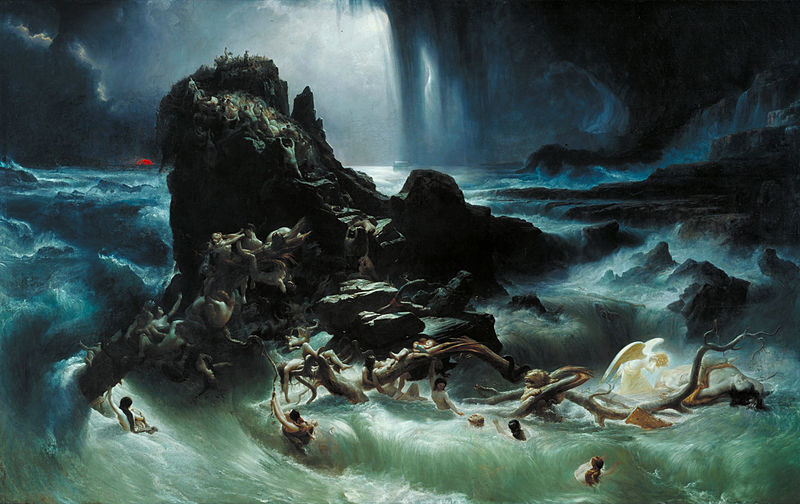
In 1837 he returned to Paris and a year later went back to living in London.  It was in that year he produced his famous work, The Deluge, which re-established his reputation amongst the art community.  This massive canvas, measuring 2.85m x 4.52m, depicted an area of harsh and violent weather and writhing, diminutive bodies trying to save themselves from the stormy waters.  The painting put Danby briefly back in the limelight.  However for Danby,  life as an artist was becoming too much for him and in 1847, aged 54, he left London and went to live in Exmouth, Devon.

Whilst living in Devon Danby still found time to paint concentrating on landscapes and seascapes but he also took up boatbuilding.  Francis Danby died in Exmouth, in 1861, aged 67.  To the end of his life Danby constantly had money problems and was embittered that he never gained the recognition he deserved from the Royal Academy and was never elected as a Royal Academician.  The final straw came two days before he died when he learnt that his ex-wife’s husband, Paul Falconer Poole had been elected a Royal Academician !

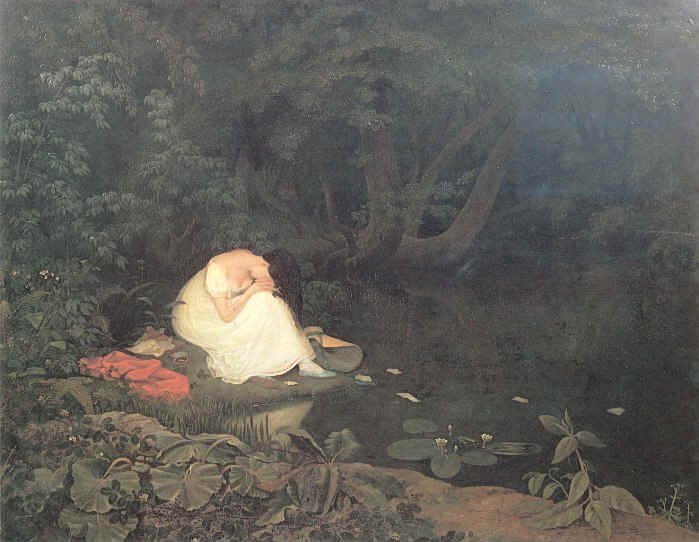
My Daily Art Display painting for today is by Francis Danby which he completed in 1821 and is entitled Disappointed Love.  The painting was the first painting Francis Danby exhibited at the Royal Academy, and it became one of his best-known works. Before us, we see a heartbroken young woman who has just been jilted.  Her hands cover her face as she sits weeping on the bank of a  lily pond surrounded by dark and murky woodland.  The occasional small white flowers, dotted around, struggle to lift the dark green and browns of the undergrowth.  This gloomy undergrowth mirrors the depressed mind of the young girl.   Her long dark tresses hang down over her white dress.   On the ground beside her we see her discarded bonnet, her scarlet shawl , a miniature portrait of her lover and other letters which she has not yet destroyed.    Her sad figure dressed in white is reflected in the water and in some way it seems that the water is drawing her to it so that she can end her life and her misery, in an Ophelia-like fashion.  Floating on the surface of the pond are pieces of a letter which she has torn up and discarded.  Eric Adams wrote a biography in 1973 on Francis Danby entitled Francis Danby: varieties of poetic landscape and he believes the setting for the painting was on the banks of the River Frome on the outskirts of Bristol and that the model for the painting was a model at the Bristol Artists newly founded Life Academy.  There was a lot of criticism of the painting, not so much for the poetical nature of the work but for its technical faults, in particular the lack of proportion of the plants in the foreground.

When the painting was put forward to the Royal Academy jurists to see if it should be allowed in to the 1821 Exhibition it was not wholly loved.  An account of the jurist’s comments on seeing Danby’s painting was reported some twelve years later as:

“…An unknown artist about ten years ago sent a very badly painted picture for the exhibition.  The committee laughed, but were struck by “something” in it and gave it admission.  The subject was this.  It was a queer-coloured landscape and a strange doldrum figure of a girl was seated on a bank, leaning over a dingy duck-weed pool.  Over the stagnant smeary green, lay scattered the fragments of a letter she had torn to pieces, and she seemed considering whether to plump herself in upon it.  Now in this case, the Academicians judged by the same feelings that influence the public.  There was more “touching” invention in that than in the nine-tenth of the best pictures exhibited there the last we do not know how many years.  The artist is now eminent…”

To my mind it is a beautiful painting, full of pathos, and one cannot but feel sympathy for the young girl.  It was for this reason that I was surprised to read an anecdote about this painting and the depiction of the girl.  Apparently the Prime Minister at the time, Lord Palmerston, was being shown the painting by its owner, the wealthy Yorkshire cloth manufacturer, John Sheepshanks and commented that although he was impressed by the deep gloom of the scene, it was a shame that the girl was so ugly.  Sheepshanks replied:

“..Yes, one feels that the sooner she drowns herself the better…”

How unkind !

This painting along with the rest of his outstanding art collection was presented to the Victoria & Albert Museum

Hope by George Frederic Watts

Hope by George Frederic Watts (1886)

George Frederic Watts was a Victorian painter and sculptor who was closely associated in his later years with the Symbolism Movement.  Symbolism came about in the 1880’s but by the end of the century it had almost died away having been overshadowed by the birth and rise of Modernism.  The Symbolist movement was a reaction against the literal representation of objects and subjects, where instead there was an attempt to create more suggestive, metaphorical and evocative works.  Symbolic artists based their ideas on literature, where poets such as Baudelaire believed that ideas and emotions could be portrayed through sound and rhythm and not just through the meaning of words. Symbolist painter styles varied greatly but common themes included the mystical and the visionary. Symbolists also explored themes of death, debauchery, perversion and eroticism. Symbolism moved away from the naturalism of the impressionists and demonstrated a preference for emotions over intellect.

George Frederic Watts was born on February 23rd 1817 in Marylebone, London and his Christian names were those of the great musician George Frederic Handel who was born on that date some 132 years earlier.  His mother and father struggled financially and this was not helped by the poor health of his mother who was to die when George was very young.   His father was a piano maker and took it upon himself to educate his son at home.  Much emphasis was placed on a conservative Christian upbringing and a love for classical literature.  Unfortunately, as is so often the case, his father’s compelling desire to force his Christian views on his son, eventually made George turn completely away from organised religions.

At the age of ten, George had some informal tuition from William Behnes, a local sculptor where he practiced drawing from the sculptures.  This training proved a godsend as by the age of sixteen he was able to support himself from the sale of his portraits.  In 1835, aged eighteen years of age, George Watts enrolled at the Royal Academy Schools.  Although Watts never enjoyed his time at the establishment and would often fail to attend he did exhibit some of his works at the 1837 Royal Academy Exhibition.  It was whilst studying art that he met and became great friends with Alexander Constantine Ionides, an art patron and collector.  Ionides commissioned many paintings from Watts and became one of his earliest patrons.

By 1840 Watts had moved away from portraiture and concentrated on historical paintings.  In 1843, he entered the first competition to design murals for the new Houses of Parliament.  Entries were to be of a narrative genre which endorsed patriotism and thus would be appropriate to the new legislative building.   His entry, Caractacus Led in Triumph through the Streets of Rome, gained him first prize in the competition and the prize money helped fund his artistic study trip to Italy where he remained for four years.  During his stay in Italy he learnt the secrets of fresco painting and completed many large scale paintings depicting scenes from Romantic literature.  However, he never gave up on his other artistic loves, portraiture and landscape painting.

Watts returned to London in 1847 and once again entered the Houses of Parliament competition.  This was the fourth one organised by the monarch and the government.  Watts won the competition with his entry Alfred Inciting the Saxons to Encounter the Danes at Sea.   Watts suffered from bouts of depression and he expressed his personal struggle with the illness in a series of four paintings which evoked a social realism theme.  One of these works entitled Found Drowned was my featured painting in My Daily Art Display of July 4th 2011.  In 1851 he went to live with his friend Henry Thoby Prinsep and his wife Sara at Little Holland House.  He lived with them for the next twenty-four years and it undoubtedly provided Watts with a secure environment for him to work and relax and provide a safe haven away from the rigours of the real world.  Little Holland House was a favourite meeting place of the young Pre-Raphaelite artists and literary people like Tennyson and it gave Watts then ideal opportunity to paint portraits of the aspiring literary and artistic luminaries of the day.

In 1878 Watts took part in the 1878 Exposition Universelle in Paris and submitted nine paintings and one sculpture.  He became an instantaneous celebrity on the European art scene.  During the 1880’s,  he produced many symbolic paintings which displayed close links to the work of his friend, the Pre-Raphaelite artist Dante Gabriel Rossetti, and the other Pre-Raphaelite artists such as Edward Burne-Jones.

In 1886 at the age of 69 Watts re-married, to Mary Fraser-Tytler, a Scottish designer and potter who was some thirty three years his junior.   In 1891 he bought a house in Compton, near Guilford, in Surrey and in 1904 had a gallery built nearby which became known as the Watts Gallery and which was dedicated to his work.  The Watts Gallery is still a very popular venue for art lovers. George Frederic Watts died that year aged 87, shortly after the gallery opening.

Hope is looked upon as certainly the most influential, and outstanding if not most unusual of all George Frederic Watts’ paintings. This portrayal of the poignant musician has struck a chord with audiences and critics ever since it was first displayed at the Grosvenor Gallery in 1886.  In 1887 at the Royal Jubilee exhibition held in Manchester the painting took pride of place in the middle of an entire wall dedicated to Watts’ work.  Numerous reproductions were made of this painting and many who saw it were deeply affected by what they saw and Watts received many letters from people who were greatly moved by the emotional impact it had on them. In the painting Watts has personified Hope as a young woman seated on a globe, hunched over, appearing to be almost asleep.  She wears a blindfold which symbolises her blindness and to the mental state she embodies. What was it about this work that such an effect on people?  It has to be Watts’ portrayal of this hunched, isolated, blindfolded and barefoot woman who appears to be on the edge of despair.  So why the title Hope?   Maybe in this case it is not hope meaning one’s optimistic thoughts but more of a feeling of almost despair; a hoping against hope.   As we take in the picture of the girl bent over listening to the music from her lyre we wonder why Watts has chosen the title.  The bluish grey background induces a melancholy mood. One critic commented that the painting did not evoke a feeling of hope and should have been entitled Despair.  Maybe that was the reason that in another version of his painting he has added a single star to the background to symbolise hope.  The girl, Hope, bends her ear to catch the music from the last remaining string of her almost shattered lyre. It is the faintest of hope as symbolised in her musical instrument which now with just one string left for her to make music and once that has broken, all hope of her producing a musical sound has disappeared.

Did the painting appeal to those who had almost lost hope themselves and in some way empathised with the vulnerability of the woman in the painting?  Watts had always sought, through his paintings, to communicate his message to as many people as possible. Some would criticise this aspect as being somewhat patronizing but Watts was a great master of narrative paintings and this was probably the reason why his conventional patriotic works he put forward for the Houses of Parliament were so successful.  Watts was surprised by the critical acclaim and popularity of his painting and attempted to follow up his success with Hope with two other works entitled, Faith and Charity, the other two “theological virtues” but they neither received the critical acclaim that his Hope painting achieved nor were they as popular with the public.

This version of the painting can be found in the Tate Gallery, London.

The Sharples Family

My Daily Art Display today is not about a single painting but about a talented artistic family of English portrait painters.  This was a veritable dynasty of artists of the highest quality.  The head of the family was James Sharples who was born in Lancashire around 1751.  Originally his family had intended that James should study for the Catholic priesthood and he was sent to France for his initial training.   The theological path that his parents had wanted him to follow was not for James and he returned to England.    Instead James followed his chosen profession, that of an artist. At the age of twenty-eight, whilst living in Cambridge, he had four of his pictures accepted for the 1779 Royal Academy Exhibition.  Two years later he moved to Bath where he set himself up as a portrait painter and art teacher.

He and his first wife had a son, George.  Little is known of him but it is thought he could have also been an artist as in the 1815 Royal Academy Exhibition there was a painting by a “G Sharples of London”.  With his second wife James fathered a second son, Felix who eventually came to live with James and his third wife Ellen Wallace.  Ellen Wallace, who was of French extraction, lived in Bath and came from a Quaker family.   She was born in 1769 and was eighteen years younger than James.  They had met whilst she was attending one of his art classes.   James and Ellen Sharples married in 1787 and went on to have two children of their own, James Jnr. born in 1788 and Rolinda born in 1793, both of whom became artists.

George Washington by James Sharples (1796)

Around 1794 James, his wife Ellen and the three children, James, Felix and Rolinda set off for America.  It is thought that James believed that in America it would be possible to make a good living by painting portraits of the leading American figures of the time.  The sea voyage did not go to plan as their ship, according to Ellen Sharples’ diaries, was captured by a French privateer and James and the family were taken to Brest where they were kept prisoners for seven months.  The following year they were eventually released and continued on with their voyage to America, and eventually arrived in New York.   Sharples started working in New York and Philadelphia, which was the then seat of government and a place full of eminent people, including local and national politicians.  It is known that in the execution of his work Sharples  made us of an instrument known as a physiognotrace.  This was a device which was designed to trace a person’s profile in the form of a silhouette.

Slowly but surely, Sharples built up commissions for his portraiture.  The whole family then embarked on a painting tour of New England picking up lucrative commissions which often entailed making reasonably priced copies of his original portraits of American political leaders, such as George Washington, Thomas Jefferson, James Madison and John Adams.   Around 1797 when the family was living in Philadelphia, Ellen Sharples  began to draw portraits professionally.   At this time, there was a  great demand for reasonably priced copies and Ellen’s career of copying her husband’s original portraits on commission flourished and she could command virtually the same price for her miniatures as her husband charged for his mini-portraits. It was not just the mother and father who had artistic talents as their three children under their parents’ tutelage soon became accomplished artists in their own right and were soon able to contribute work for the family business.  Portraiture in America at that time was highly competitive not only because of home-grown American artists but more so from European painters who, like Sharples, had travelled to America in search of their fortune.   This intense competition made it necessary for artists to travel and look for clients rather than wait at home for clients to come knocking upon their doors.   James Sharples often had to drag his family from place to place in search of commissions.

James and Ellen Sharples soon built up reputations as talented portraitists who concentrated on small scale pastel portraits and whose work was in great demand and slowly but surely they became financially secure.  James Sharples died of heart trouble in 1811, aged 60 and Ellen and her two children, James and Rolinda returned to England.  Felix Sharples, who was at this time twenty-five years old, chose to stay in America, working as a portrait artist, where he died in 1830 aged 44.

Charles and Catherine Darwin by Ellen Sharples (1816)

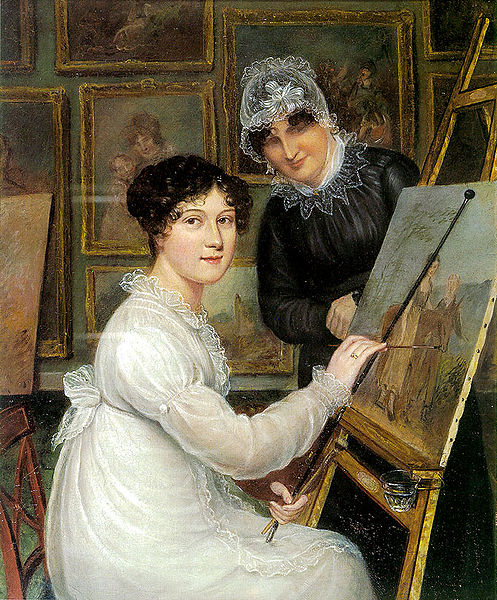
Ellen, along with James and Rolinda settled down in Clifton, just outside Bristol and the three of them set up a family business producing small-scale pastel portraits for clients. Rolinda Sharples began to work in oils and she moved away from being a miniaturist and ventured into the highly competitive world of full-scale portraiture and history paintings depicting groups of people.  Rolinda was elected an honorary member of the Society of British Artists in 1927 and was one of the first female artists to attempt multi-figure compositions, which formed part of the pictorial historical records of the time.

The Stoppage of The Bank by Rolinda Sharples (1831)

The painting above entitled The Stoppage of the Bank by Rolinda Sharples was completed in 1831.   The background to this painting relates to the happenings in 1825 when England had just recovered from the Napoleonic Wars and the country’s economy started to boom.   In the euphoria of this boom, even the most clear-headed of  bankers made risky loans ( a familiar story ??).  The bubble burst in April 1825 and the stock market crashed.   By the autumn a number of country banks had failed causing panic.   It was a financial catastrophe, which led to widespread ruin and misery for the unfortunate people who had all their capital invested in the failed banks.  This is the setting, which Rolinda Sharples illustrates in her painting.   The scene before us takes place in a fictional street, called Guinea Street but which had a great similarity to the real Corn Street in Bristol.   On the right of the painting is a bank whose closure is causing shock and consternation to the people waiting outside attempting to get their money.  Behind, we see the famous Dutch House which stood on the corner of Wine Street and High Street until destroyed in the Blitz. The church in the centre background is All Saints Church.  Rolinda Sharples used some artistic licence when she placed the church in that position, one presumes it was for artistic effect.

The Artist and her Mother by Rolinda Sharples (c.1820)

Both Rolinda and her brother James predeceased their mother.  Rolinda died of breast cancer in 1838, just forty-five years of age and James Jr. died of tuberculosis in 1839.  Ellen Sharples, the last of the Sharples family, died in 1849 aged 80.

Isabella by John Everett Millais

Lorenzo and Isabella by John Everett Millais (1849)

My favourite Pre-Raphaelite artist is, without doubt, John Everett Millais and I have featured a number of his paintings in previous blogs.  As you know, as I have mentioned it before, I like paintings with a story behind what is depicted by the artist and so merging my two favourite aspects of art I am delighted to present you with Millais’ painting entitled Isabella, also sometimes referred to as Lorenzo and Isabella or The Pot of Basil.  Some of you may know the story and poem behind this early work of art by the Pre-Raphaelite painter but for those who do not, let me lead you through the background of this work and to the medieval allegorical tale, Decameron, written around 1352 by Giovanni Boccaccio.   The word Decameron comes from the combination of two Greek words; déka meaning ‘ten’ and hēméra  meaning ‘days’ and thus decameron means ‘ten day event’.

The Decameron is set in Italy around the 1350’s at the time of the Black Death.  It tells of a group of ten people, seven young women and three young men who escape from the plague-ridden town of Florence and head into the hills of Fiesole and a deserted villa where they stay for a fortnight.  In order to while away the evenings, each one of the group had to tell a story on each night for ten days.  No story would be told on the one day set aside for the chores around the villa nor would a story be narrated on the holy days and thus in all ten stories would be told on the ten evenings making a total of 100 tales.  The stories are sometimes of a bawdy nature and range from the erotic to the tragic.   Each of the ten young people is made King or Queen of the company for one of the ten days in turn. This gives him or her, the right to choose a theme and a topic for the ten stories that day.

The painting I am featuring today is based on a story told by one of the young women, Filomena, on the fourth day and that days theme for all the stories was that they mus be tales of love that ends tragically.  She tells the story of Lisabetta and her three brothers who live a very rich life togetherthanks to the wealth they have inherited after the death of their father.  She has fallen in love with their manager Lorenzo and it was not long before they became lovers.  Her affair with Lorenzo was kept a secret from her brothers but, unbeknown to her, her eldest brother saw his sister sneak into Lorenzo’s bedchamber.  He was horrified as it was he and his brothers’ plan to marry her off to a wealthy nobleman and increase their own wealth.   He informed his brothers as to what he had witnessed and they hatched a plot to kill Lorenzo.  Days passed without incident until one day the brothers asked Lorenzo to accompany them on a trip, during which they murdered him and buried his body.  On returning home they told their sister that Lorenzo had been sent away on business.  A long time passes without any sign of Lorenzo and Lisabetta is heartbroken.  One night Lorenzo appears to her in a dream and shows her where he is buried. She goes there and disinters the body and brings away his head.  She takes the severed head wraps it in a fine napkin and buries it into a flower pot over which she plants basil, and other sweet herbs.  Each day she sheds tears over the pot which nourish the herbs.  Eventually the brothers get to hear about this pot of herbs, take it from her and discover the head of Lorenzo, which they re-bury.  Isabella is once again heartbroken, grows weak from sorrow and eventually dies of grief.

A narrative poem by John Keats, entitled, Isabella or the Pot of Basil, written in 1818, is adapted from this story in which the girl is  not now Lisabetta but Isabella.  When the painting was exhibited at the Royal Academy in 1849 the following stanzas from Keats’ poem was included in the catalogue:

Fair Isabel, poor simple Isabel!
Lorenzo, a young palmer in Love’s eye!
They could not in the self-same mansion dwell
Without some stir of heart, some malady;
They could not sit at meals but feel how well
It soothed each to be the other by.
These brethren having found by many signs
What love Lorenzo for their sister had,
And how she lov’d him too, each unconfines
His bitter thoughts to other, well nigh mad
That he, the servant of their trade designs
Should in their sister’s love be blithe and glad
When ’twas their plan to coax her by degrees
To some high noble and his olive trees.

To read the poem in full go to: http://www.bartleby.com/126/38.html

I stood before this painting a week ago when I visited the Walker Art Gallery in Liverpool and one could not help but be moved by this beautiful work of art.  The Pre-Raphaelite brotherhood members were fascinated by the poetry of Keats and Holman Hunt and Dante Rossetti intended to produce a series of etchings for book illustrations of Keats’s ‘Isabella’.   John Millais worked up his drawings into this large painting which he completed in 1849.  This was his first major painting and what is more remarkable is that he was only nineteen years of age.

The doomed lovers

The setting for the painting is a meal table around which sat a number of people including the three brothers, Isabella and Lorenzo.  The brothers have just found out about their sister’s affair with Lorenzo but have said nothing to her although they are already formulating a plan in their minds as to how to kill Lorenzo.  Isabella, wearing grey, sits at the right and is being handed a blood orange on a plate by her doomed lover, Lorenzo.   A cut blood orange is symbolic of the neck of someone who has just been decapitated and this alludes to the time in the future when Isabella will cut off the dead Lorenzo’s head after finding him buried. The sedate portrayal of mealtime is broken as we see Isabella’s eldest brother, hunched over, rocking forward on his chair as he furiously kicks out at a frightened dog while cracking a nut. His face is contorted in anger as he lashes out at the helpless animal.  Next to him sit his two brothers.  Their demeanour is much calmer and there is certain smugness about their expressions for they are aware of their brother’s plan to kill Lorenzo.  Observe the brother who holds up his glass of wine.  Observe how he is slyly and surreptitiously glancing at Lorenzo and Isabella.  He can see the look of desire in Lorenzo’s eyes as he studies his lover who has demurely avoided his penetrating gaze.

Millais has exaggerated the intensity of the painting by juxtaposing colours and tones.  Look at how Millais has contrasted the white towel draped over the arm of the servant, standing on the far right of the picture, with his black tunic.  The legs of this servant adorned in yellow stockings almost merges with the background colour of the floor and the marble base of the balustrade.

What I like about the work is how Millais has made each one of the diners different and each having very distinctive characteristics.  Common among Pre-Raphaelite works is Millais attention to detail.  Look at the plates on the table.  Each has an exquisite pattern.    Another distinctive Pre-Raphaelite feature is the inclusion of images and patterns within the image as a whole. Each of the majolica plates has a distorted picture glazed into its surface. Look too at the bench seat Isabella is sitting on.  See how Millais has gone to pains to depict the seat. The base of the bench on which Isabella sits contains an intricate carving depicting a kneeling figure, below which we see the letters PRB, which stand for Pre-Raphaelite Brotherhood.

Sketch of Dante Rossetti for the Lorenzo and Isabella painting (courtesy of George Landow)

The people sitting around the table were modelled by Millais’ friends.  The wife of his half-brother was the model for Isabella.   William Rossetti, Dante Rossetti’s brother, was Lorenzo, who sits next to Isabella; Dante Rossetti is the model for the man at the far end of the table on the right with a wine glass held to his mouth.    The older man on the right-hand side of the table dabbing his mouth with a serviette is none other than John William Millais, the artist’s father.   Walter Deverell, a fellow artist and student of Dante Rossetti and Frederic Stephens, an art critic, and one of the two ‘non-artistic’ members of the Pre-Raphaelite Brotherhood sat for the other two brothers who sit on the left hand side of the table.  Amusingly, the brother who kicks out at the dog is painted from memory of a John Harris, a person who had bullied John Millais when they were together at the Royal Academy Schools.

Millais has symbolised Lorenzo and Isabella’s love for each other by including a depiction of the white rose and passion flower entwined in the arch above their heads, and also by them sharing a blood orange.  We see the dog with its head on Isabella’s lap which is a sign of Lorenzo’s devotion for her and of course the fact that her brother aims a kick at the dog symbolises his feeling for Lorenzo.  In this painting we have no doubt that death will soon follow and of course we know it will be the death of Lorenzo.  Millais has included some symbols of death in the painting, for instance the brother holding up his glass of blood-red wine as he contemplates the end of Lorenzo.  Other symbols of death are the hawk, which perches on the back of an empty chair, pecking at a white feather which is a symbol of peace.  We see below the arm of the nearest brother a salt cellar lying on its side with the salt, which is considered a symbol of life, scattered on the tablecloth.  This spilt salt symbolises the spilt blood which will soon occur when the brothers kill Lorenzo.  Note how the salt is covered by the shadow of the brother’s forearm, thus implicating him in the heinous crime which is soon to happen.  Look at the right background and on the top of the balustrade we see a large pot containing basil and this may be the one in which Isabella will place Lorenzo’s severed head.   When you stand close up to the actual painting you can just make out designs on the majolica plates on the table.  On one there is the scene of David beheading Goliath whilst another shows Prometheus having his entrails pecked out by an eagle.  All of which is a reminder of the violence that is soon to follow.

The picture was sold to a tailor for £150 and a new suit.

Portrait of Sir Francis Ford’s Children Giving a Coin to a Beggar Boy by Sir William Beechey

Portrait of Sir Francis Ford’s Children Giving a Coin to a Beggar Boy by Sir William Beechey (c.1793)

The artist I am featuring in My Daily Art Display today is the English portrait painter, Sir William Beechey.  William Beechey was born in Burford Oxfordshire in 1753.  He was the eldest of five children of William Beechey and Hannah Read who both came from Dublin.  Young William Beechey was not brought up by his mother and father but by his uncle Samuel Beechey who was a lawyer and it was his intention to have William study law and made arrangements for him to be articled to a solicitor in nearby Stow-on-the-Wold and later in London.  Whilst in London training to become a lawyer William made friends with some students from the Royal Academy Schools.  In 1772, despite the displeasure of his uncle, William managed to gain a release from the solicitor’s articles and achieved admission to the Royal Academy schools.

Some historical records of his life state that at around this time William Beechey married Mary Ann Jones and the  couple went on to have three daughters and two sons, one of whom was his son, Henry William Beechey who became an explorer and artist.  William Beechey first put forward paintings for inclusion at the Royal Academy Exhibition in 1776 and continued to submit works to their annual exhibitions for the next seven years.  At this time, most of his work consisted of what was then termed as “small portraiture”.

In 1772 he left London and moved to Norfolk, living in Norwich and for a short time, Great Yarmouth.  This move out of the capital city would appear to have been a strange one for London was an ideal place to sell his work but the author, William Roberts explained the reason for going to Norwich in his 1907 biography of the artist, entitled Sir William Beechey R.A.

 “…he was invited to spend a month in that city, where he found himself in the immediate receipt of so many commissions in that town and neighbourhood that he was induced to take up his abode there altogether…”

He was still submitting and having his works of art accepted  by the Royal Academy for their exhibitions but they received little mention.  However in 1788 he submitted two framed works which incorporated fifteen smaller portraits.  The Royal Academy jury, who decided on which paintings would be allowed to be exhibited at the Exhibition, rejected his two submissions because the R.A. rules stipulated that all paintings must be framed separately.  An art dealer Benjamin Vandergucht took the two works and exhibited them in his own gallery.  The phrase “there is no such thing as bad publicity” kicked in as the press heard about the R.A. rejection of Beechey’s works and wrote the story of the R.A.’s rebuff.  Beechey had managed to obtain free and excellent publicity for his art work.

Beechey had returned to live in London.  A number of his contemporary portraitist had died, such as Gainsborough or ceased painting, such as Joshua Reynolds and so there was a great demand for his portraiture.  It was at about this time that Beechey moved away from miniature portraiture and started to concentrate on life-sized portraits.  His first wife, Mary died in 1793 and that same year he remarried.  His second wife was a miniature painter, Anne Phyllis Jessop, a lady some eleven years his junior.  The couple went on to have eighteen children!  The final breakthrough for Beechey in his artistic career was receiving royal patronage which came in 1793.  King George III and his wife loved Beechey’s portraiture style.  In a round-about way, Beechey had the Royal Academy to thank for this for they rejected another of his works, a portrait of a courtier.  The nobleman was so incensed when he heard that his portrait was not to appear at the R.A. Exhibition that he took the painting and showed it to the king and queen.  They thought it was a magnificent work of art and a generation of royal patronage began and Beechey was made the queen’s portrait painter.   One will never know fully how this influenced the Royal Academy but by a strange coincidence the R.A. elected Beechey as an Associate of the Royal Academy that same year.  This was also the year that the R.A. conferred the same honour to his portraitist rival John Hoppner.

An art critic of the Monthly Mirror journal wrote about William Beechey’s work and that of his rivals of the time, John Hopper and Thomas Lawrence:

“…Beechey has fewer eccentricities than his competitors—for he never distorts his figures for the sake of extravagant attitude—he is less fantastic in his design and less exuberant in manner, in short, he has more nature than [Hoppner and Lawrence]. … Beechey, who is more fixed and determinate, both in his colouring and outline, studies only to be chaste…”

Beechey’s work was often described as being delicate and lacking extravagance and it was these very qualities that appealed to his patrons and clients who disliked the ostentation and flamboyance of his two main rivals.  It was also these virtues of Beechey that appealed to King George.  King George was vociferous in his praise of Beechey, much to the chagrin of John Hoppner.  William Beechey was elected as an Academician of the Royal Academy in 1798 and in that same year, on King George’s specific instructions, he exhibited his great and mammoth masterpiece, measuring 14ft x 17 feet, entitled His Majesty Reviewing the Third Dragoon Guards and the Tenth Light Dragoons in which he depicted King George reviewing his household troops.    Sadly this beautiful work of art was destroyed during the 1992 fire in Windsor Castle.  The king was so delighted with the work that in May 1798 he conferred a knighthood on Beechey.  The knighthood was the first such honour to go to an artist since Joshua Reynolds was knighted back in 1769.  Sir William Beechey’s artistic rivals were astounded by this royal award!  Beechey remained a favourite of King George III.

Sir William Beechey continued to exhibit work at the annual Royal Academy exhibitions until his death in January1839, aged 85.

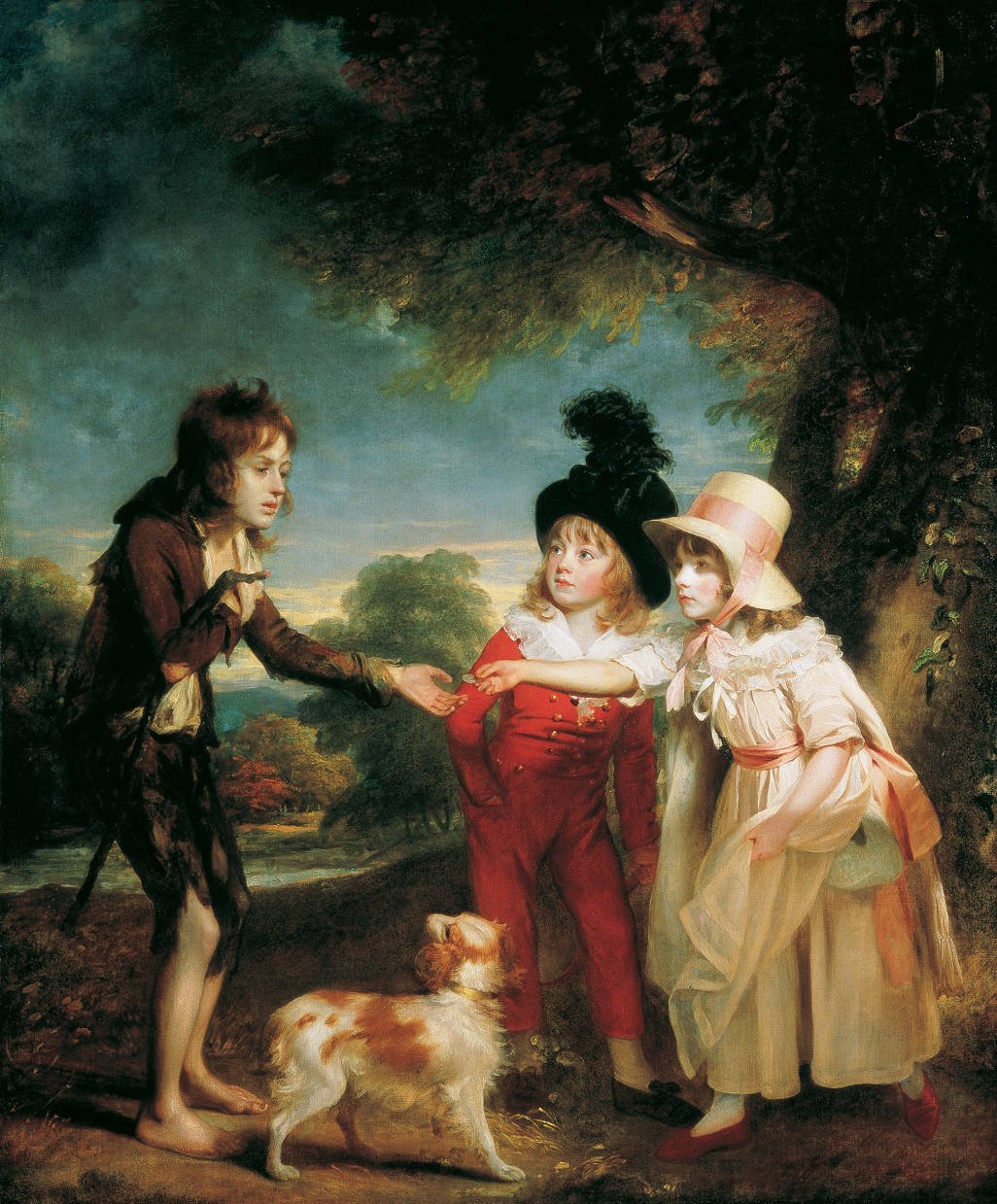
The featured painting fo My Daily Art Display today is by Sir William Beechey and is entitled Portrait of Sir Francis Ford’s Children Giving a Coin to a Beggar Boy, which he completed around 1793 and is housed at the Tate Britain in London.  The beggar in the painting is not depicted as a dirty and scruffy sad-looking urchin as we have seen in works such as The Beggar Boy by Murillo (My Daily Art Display, January 25th 2011) as this would have upset the sensibilities of the Victorian public.  There were many portraits of beggars during the late 18th century, most of which could almost be considered as being “prettified” versions of reality.  Such pictures would be more likely to home in on, not the pathetic state of the begging child, but of the kindness of the charity givers.  So is this just another one of these charitable depictions.  Well actually I am not so sure but then maybe I am just a cynic. Why?

We have to suppose that  when a patron approaches an artist to paint a picture, they know what sort of painting they want.  They know not only who or what is to be depicted but they will make the decision as to how something or someone is to be portrayed.  They will know whether there is to be a certain reasoning behind the depiction other than what is visible at a first glance to the casual observer.  By now you must be used to looking at the paintings I have featured and together we have delved into the interpretations and symbolism of the works.  So now let us look a little closer at what William Beechey has painted and try and work out if there was a reason for such a portrayal.

The first thing to consider is who had commissioned the painting.  The client was Sir Francis Ford.  Ford was the heir of a Barbados planter of the third generation.  His family originally came from Devon. In 1793, he was elected as Member of Parliament for Newcastle-under-Lyme and the day he was elected he was given a baronetcy. He was now a member of William Pitt’s administration but was in favour of procrastination as far as the abolition of the slave trade was concerned.   He disagreed with the government over the slave trade question and did not seek re-election as an MP.

Besides being a politician he was a plantation owner with estates in Barbados and the Dutch colony of Essequibo.  Being a plantation owner he needed labour to work his estates and thus was a great advocate of slavery.  However in England in 1793, at the time of this painting, there was the start of a movement against slavery and a steady outcry with regards the terrible conditions of the plantation slaves, although it would be another forty years before slavery was abolished in the British Empire.

In the painting we see portraits of Thomas Ford’s son and daughter giving a coin to a beggar boy.  Could it be that Sir Francis Ford wanted to remind the people of Victorian England that there were beggars in their own country, who were in desperate need of food and lived in unacceptable conditions, and that the English public should show more concern about the fate of their own “home-grown” poor rather than worry about the living and working conditions of the plantation slaves in some far-off distant lands.  Could Sir Francis Ford be stating in a roundabout way that “only those without guilt have the right to cast the first stone”!  Was Thomas Ford using the artistic talents of Beechey as that of a spin doctor?

Sir Thomas Ford died in Barbados in 1801.

An Idyll by Maurice William Greiffenhagen

An Idyll by Maurice Grieffenhagen (1891)

My featured artist today with the Germanic sounding surname was actually a British painter and Royal Academician.  Maurice William Greiffenhagen was born in London in 1862. His parents were both Germans from the Northern Baltic region.  At the age of 16, after passing the entrance examination, he enrolled at the Royal Academy Schools in 1878, where he won their Armitage Prize.   On graduating, Grieffenhagen secured a job as an illustrator, designing posters and worked on illustrations for books, magazines and newspapers.  One of the books he illustrated was Rider Haggard’s much loved novel, King Solomon’s Mines.   He contributed many illustrations to magazines and newspapers such as the Lady’s Pictorial and the Daily Chronicle.  In his art, Greiffenhagen specialised in portraits and allegorical figures in the Pre-Raphaelite style and in 1891, at the age of 29, he completed the painting entitled An Idyll, which was to establish his artistic reputation. This painting, which can be found at the Walker Art Gallery, Liverpool is the work, which I am featuring in My Daily Art Display today.  The public loved the painting and it was an instant success.  Meanwhile, his continuing friendship with the author Rider Haggard led to him, in 1899,  illustrating another of his adventure books, She: A History of Adventure. 

In 1884 he began to exhibit works at the Royal Academy and this prestigious art establishment made him an Associate Member in 1916 and a Royal Academician in 1922.

Railway poster by Grieffenhagen

In 1909 he became a member of the Royal Society of Portrait Painters.  Grieffenhagen was a prolific illustrator and his ability to design posters which he had done in his early days came very handy when the London Midland & Scottish Railway commissioned travel posters from Royal Academicians and Associate Royal Academicians.   Greiffenhagen’s design The Gateway of the North depicting a mounted knight before a portcullis archway was by far the most successful of the series.

In his later career, Greiffenhagen concentrated on portraiture.   Between 1901 and 1912 he exhibited at many of the important international exhibitions including those held in Munich, Pittsburg and Venice. Greiffenhagen received gold medals at Munich in 1897  and in Dresden in 1901, and an honourable mention at Pittsburgh exhibition in 1907. In 1906, despite his home being in London, he took up the position of professor of painting at the Glasgow School of Art, and took charge of the Life Department.  Despite the long commute between home and the university he remained there until 1926.   Whilst living in Scotland, Greiffenhagen continued to paint and 93 of his works are housed in the collection of the Hunterian Museum and Art Gallery, University of Glasgow.

Greiffenhagen died from a heart attack in 1931 at his home in St John’s Wood at the age of 69.

An Idyll is set on a slope of pastureland.  It is a colourful work with the vibrant and warm red of the poppies surrounding the feet of the young couple.  The red contrasts well with the greens and blues he has used for the background.  Before us we see a young man, dressed as a shepherd in his animal skin clothing, holding in his arms a compliant young woman who is attired in modern dress. His skin is brown and weather-beaten whereas, in contrast, her skin is pale, almost a virginal white.  It is an unusual embrace as although the young man captures the young woman with some force, she seems not to reciprocate to the encirclement of his arms and instead just lies somewhat leadenly in his embrace.  Is this a sign that she is not enamoured by the young man’s sudden move or is it a fact that she finds herself in a powerless position.   Would you look at her facial expression and say that she is ecstatic with the young man’s advances or maybe somewhat coy?  Or would you surmise from her lack of response that she is just surrendering to the inevitable?  Maybe I am misjudging the artist, for one must remember that this painting was completed during Victorian times and the public and critics would not have been impressed if Grieffenhagen had shown the woman as being equally passionate.  Maybe that would have been a step too far!  Maybe we just need to use our own imagination as to what is going on and what is going to happen next.

It is believed that the models for the painting were personal friends of Grieffenhagen.  However he had a problem with them, for at the time of the first sittings they were merely an engaged couple but before Grieffenhagen had completed the painting, the pair married and the artist had great difficulty in getting them to pose for him once they were man and wife.  In the end he had to use two other models.  The author DH Lawrence refers to this painting in his novel The White Peacock.   Lawrence, the great chronicler of unbridled passion in human relationships, had a great love for the visual arts.  In 1929 he admitted:

“…all my life I have gone back to painting, because it gave me a form of delight that words can never give…”

To D H Lawrence, An Idyll was the epitome of passion. Blanche Jennings, a suffragette post clerk in Liverpool with whom Lawrence corresponded, had sent him a reproduction of this popular painting. Lawrence was fascinated by the picture and confessed in a 1908 letter to Jennings:

“…the painting moved me almost as much as if I had fallen in love myself…”

Are you as moved as D H Lawrence with this painting?  I started researching this painting a few days ago on February 14th – Valentine’s Day.  A coincidence ?