Max Liebermann. Part 2.

Self portrait by Max Liebermann (1934)

Max Liebermann was Jewish, not a strict Orthodox Jew, but more of a secular Jew who regarded himself through assimilationist eyes. Maybe because of this he avoided painting religious subjects with the exception of a painting he completed in 1879 entitled The 12-Year-Old Jesus in the Temple With the Scholars.

Der zwölfjährige Jesus im Tempel (The Twelve-year-old Jesus in the Temple) by Max Liebermann (1879)

The painting depicts twelve-year-old Jesus in the temple, having been at the Festival of Passover in Jerusalem with his parents, but unbeknown to them, he had stayed behind in the city when they had set off to return home. The story continues as per the biblical tale (Luke 2:43-48):

“…After the festival was over, while his parents were returning home, the boy Jesus stayed behind in Jerusalem, but they were unaware of it. Thinking he was in their company, they travelled on for a day. Then they began looking for him among their relatives and friends. When they did not find him, they went back to Jerusalem to look for him. After three days they found him in the temple courts, sitting among the teachers, listening to them and asking them questions. Everyone who heard him was amazed at his understanding and his answers. When his parents saw him, they were astonished. His mother said to him, “Son, why have you treated us like this? Your father and I have been anxiously searching for you…”

The setting for this painting is derived from Max’s visit to the Jewish quarter of Amsterdam in 1876 when he made architectural sketches of the Portuguese Synagogue of Amsterdam. The curved staircase, which he later depicted as a spiral staircase in the painting, is a reference to the 16th-century Levantine Synagogue in Venice. The paned window on the upper edge of the painting also echoes the windows of the Portuguese Synagogue of Amsterdam.

Liebermann originally depicted Jesus, not as a holy figure, but as a dark-haired boy with Semitic features and mannerisms, arguing the doctrine with his elders. The painting was first exhibited at the First International Art Show in Munich in 1879, at a time when antisemitic activism and propaganda was just starting to break out in Germany. The artwork caused a major outcry with critics terming the depiction blasphemous. The art critic for the Augsburger Allgemeine Zeitung, Friedrich Pecht, asserted that Liebermann had painted “the ugliest, know-it-all Jewish boy imaginable,” and went on to state that the artist had shown the Jewish elders as “a rabble of the filthiest haggling Jews.” More criticism rained down from upon high with the Crown Prince of Bavaria declaring that he was scandalised, and the Bavarian State Parliament even spent time debating the painting and Pecht’s comments. One Catholic MPs criticised the fact that it had been admitted into a State establishment knowing that the country had inhabitants who were overwhelmingly devout Christians. One deputy pronounced that Liebermann, being a Jew, should have known better than to paint such a scene and that the painting was reviled as “a stench in the nostrils of decent people” It seemed that Lieberman’s mistake was simply that as Liebermann was a Jew, he had depicted an overtly Jewish Jesus.

Preliminary Sketch

And yet in the painting we cannot understand the violent criticism of the detractors regarding Liebermann’s Jesus who is depicted as a long-haired, slightly effeminate, blond boy. However, this was not the original depiction as this is because Liebermann, in response to unrelenting criticism, repainted the figure before it was included in a Paris exhibition in 1884. Art historians know this as a sketch of the untouched 1879 version has been preserved, in which it can be seen that Liebermann had originally depicted a barefoot boy with short, unkempt dark hair and a stereotypical Jewish profile. Liebermann changed the young Jesus’s appearance with the figure once described as an “urchin” now appears as a serious, intelligent, perhaps slightly deferential child. However, the changes, did not change the mood of the German critics and the work was not exhibited again in Germany until the Berlin Secession exhibition of 1907.

Sewing School by Max Liebermann (1876)

In 1875 Liebermann left Paris and spent three months in Zandvoort in Holland. It was in this Dutch town that Max acquired a brighter and more less planned style by copying paintings by one of his favourite artists, Frans Hals. Max developed a practice of setting aside time between the idea for a motif coming to him and the implementation of the larger finished painting. When he returned to Paris in the autumn of 1875 he moved into a more spacious studio and began to convert his Dutch sketches into full sized works. He returned to the Netherlands in the summer of 1876 where he remained for several months. During this stay he met the etcher William Unger, who brought him into contact with Jozef Israëls and the Hague School. One example of this change of painting style was Liebermann’s work entitled Sewing School which he completed in 1876. The sewing school depicted in this painting was in an orphanage in Amsterdam. Liebermann had started his career as a realist painter, but by the time of this work, he was already establishing himself as an Impressionist-style painter.

Schusterwerkstatt (Cobbler’s Workshop) by Max Liebermann (1881)

During his visit to the Netherlands in the summer of 1880, Liebermann travelled to the small village of Dongen in North Brabant, in the southern Netherlands. It was here that he made a number of studies that would be used when completing the work in his studio. One example of this was his depiction of a cobbler in his workshop. At the workshop, he created studies that he later used for his 1881 painting Schusterwerkstatt, (Cobbler’s Workshop).

Altmännerhaus (Old Men’s Home) in Amsterdam by Max Liebermann (1881)

Having completed the Cobbler’s Workshop painting he travelled to Amsterdam on his way to returning to Munich. It was whilst in Amsterdam that he came across the Catholic Altmännerhaus (Old Men’s Home). He happened to glance into the garden of the establishment and saw a large group of older gentlemen dressed in black sitting on benches in the dappled sunlight. According to Erich Hancke’s 1914 book, Max Liebermann. Sein Leben und seine Werke:

…He [Liebermann] had visited a friend at the Rembrandt Hotel, and when he looked out of the corridor window descending the stairs, his gaze fell down into a garden where many old men dressed in black were standing and sitting in a corridor bathed in sunlight […]. He later used a drastic analogy to characterize that moment: ‘It was as if someone were walking on a level path and suddenly stepped on a spiral spring that shot him up…”

Study for Old Men’s Home in Amsterdamby Max Liebermann (1881)

Liebermann immediately began to paint the scene and concentrated on the effect of light which was being filtered through a canopy of leaves and this dappled effect became known as “Liebermann’s sunspots” and would be seen in Liebermann’s later Impressionist depictions. He made two on-site portrait-format studies of the scene, one in oil and one in pastel, after which Liebermann painted the final picture in his Munich studio later that year. The painting was exhibited at the Paris Salon and received an honourable mention. Furthermore, Léon Maître, a well-known collector of Impressionism, acquired several of Liebermann’s paintings.

 Recreation Time in the Amsterdam Orphanage by Max Liebermann (1884)

Life in Paris was taking its toll on Liebermann. He needed to sell his artwork to prove to himself and his parents that he had not wasted his life. This continual pressure caused Lieberman to fall into periods of deep depression and his painting output declined, furthermore, the works he put into the Paris Salon were not getting the recognition he believed he had deserved. There was also still the anti-Prussian sentiment amongst the French and this did not help him sell his work. In all, he realised that the Netherlands or Germany were much more acceptable places to work and live. He left Paris and spent a couple of months in Venice before returning to Munich in 1878. It was here that he was able to enhance his status as an important progressive artist. Munich had everything Liebermann required – the artistic culture and patrons who supported him. He spent hours visiting the city’s museums and art galleries and creating everlasting and important friendships. He eventually left Munich and relocated to Berlin, his birthplace, in 1884, where he remained for the rest of his life.

Martha Marckwald by Anders Zorn (1896)

In that same year, 1884, that Max moved to Berlin he married Martha Marckwald, the fourth child of the German Jewish couple Ottilie and Heinrich Benjamin Marckwald, who ran a wool store in Berlin. When Martha’s father died in 1870, Max’s father Louis became the thirteen-year-old Martha’s guardian. The Marckwald and Liebermann families became even closer when Max’s elder brother Georg Liebermann married Martha’s elder sister Elsbeth. On September 14th 1884, thirty-seven-year-old Max Liebermann married twenty-six-year-old Martha. It was a marriage that would last more than fifty years until Max died in 1935. In August 1885 Max and Martha’s only child, Käthe, was born and in 1892.

Max’s mother died on August 12th 1892, aged 70 and his father died two years later on April 29th 1894, aged 75. Although the death of his parents was a sad time for Max, he was finally released from their unrelenting words of warning as to the perilous status of an artist. Max moved into his family’s Berlin home in Pariser Platz where he lived out the remainder of his life.

Liebermann Villa at Wannsee

In 1909, overwhelmed by the noisy life in the German city, the Liebermann family bought a plot of land in the Alsen summer villa colony on the northern shore of the Kleiner and western shore of the Großer Wannsee at Wannsee, some twenty kms south-west of Berlin, close to Potsdam. It was here that they built themselves a summer home, somewhere to retire to during the hot summer months when city life became very oppressive. The Villa was designed by the architect Paul Otto Baumgarten, the garden by Liebermann in collaboration with the then-director of the Hamburger Kunsthalle, Alfred Lichtwark.

Martha Liebermann in the garden at Wannsee

Their summer home was situated amidst the magnificent villas of this impressive Berlin colony, embedded in a park, and represented a unique cultural landscape of the time of the German Empire and the Weimar Republic.

The Villa at Wannsee by Max Liebermann (1930)

Flowering Shrubs by the Gardner’s Cottage by Max Liebermann (1928)

The Flower Terrace at Wannsee by Max Liebermann (1915)

During the following years, Liebermann had designed a beautiful garden at the Villa Wannsee. He was so proud of the finishing results that the garden became the subject of many of Liebermann’s painting.

The Artist in His Studio by Max Liebermann (1932)

During the latter decade of the nineteenth century Liebermann continued living and painting in Berlin and would spend his summers at Wannsee or the Netherlands. Liebermann, like many of his contemporary Berlin artists, were dissatisfied with how they were being treated by the Association of Berlin Artists and the restrictions on contemporary art imposed by Kaiser Wilhelm II, so sixty-five of them seceded as a demonstration against the standards set by the Association and the government endorsed art. This break-away became known as the Berlin Secession and its aim was to form a “free association for the organization of artistic exhibitions”. In 1898, Liebermann became the President of the Berlin Secession, which was simply a group of artists that was formed as an alternative to the conservative arts establishment.

Two Riders on the Beach by Max Liebermann (1901)

The Berlin Secession championed new forms of modern art and were not be tied down to and be dominated by the old-fashioned academic art favoured by the Berlin Academy. These break-away groups from the art establishments were not new occurrences as the same happened with the Munich Secession in 1892 and the Vienna Secession in 1897. The initial breakaway took place in Paris in 1890 when the Société Nationale des Beaux-Arts along with its exhibition arm, the Salon au Champs-de-Mars, was formed as a modern alternative to the official Société des Artistes Français and its exhibition arm, the Salon de Champs-Élysées. These break-away groups all wanted the same thing – the rejection of the official arts governing bodies due to their aversion of avant-garde art such as Impressionism, forms of Post-Impressionist painting and Naturalism, as well as their obstructive exhibition policies, which were inclined to support time-honoured painters and sculptors over their younger, more modernist contemporaries.

Marthe Liebermann with her grand-daughter Maria by Max Liebermann (1922)

In 1920, Liebermann became president of the Prussian Academy of Arts in Berlin, which was the highpoint of his career and signified how the Academy had changed over since the time of the Berlin Secession.

Portrait of President Paul von Hindenburg by Max Liebermann (1927)

Being a Jew, Liebermann had got used to the anti-Semitism in his homeland but by the early 30s with the rise and coming to power of the National Socialists it had noticeably worsened. In a way, it was a good thing that Liebermann died quietly in his sleep at the family home on February 8th 1935 aged 87 as he avoided bearing witness to the atrocities which followed. In 1938, his daughter Käthe her husband Kurt Riezler and their twenty-one-year-old daughter Maria were forced to flee the country and go to America.

The Graves of Max and Martha Liebermann at the Senerfelderplatz Jewish Cemetery, Berlin

They tried to persuade Max’s widow, Martha, to also emigrate but she refused to leave the land where her husband was buried. Martha Liebermann remained in Berlin, ultimately committing suicide in 1943 to escape her impending deportation to a concentration camp.


Most of the information for this blog came from the excellent website Liebermann Villa am Wannsee which goes into detail about his life and works.

I also consulted the informative website on all things art: The Art Story

Information regarding the painting, A Twelve-Year-Old Jewish Boy, came from the website: Art and Faith Matter/s
Maria Slavona

Maria Slavona was born Marie Dorette Caroline Schorer on March 14th 1865 in the north German town of Lübeck.  She was the daughter of the pharmacist Theodor Schorer and his wife Ottilie, (née Steger).  Her father owned the Löwenapotheke on the corner of Königstraße, and Johannisstraße in the town, which is now known as Dr.-Julius-Leber-Straße.  She was the youngest of five children and had two brothers and two sisters.  As a child, she was brought up in a happy household in the old patrician house in Johannisstraße. Her parents’ home was a great meeting place for writers, artists and intellectuals. For Maria life at home was a liberal and cultural experience and, at an early age, she soon developed an intense interest in drawing and painting. Her parents encouraged her love of all things artistic and they hopde that one day she would become a painter and her mother and father supported this future road for her. 

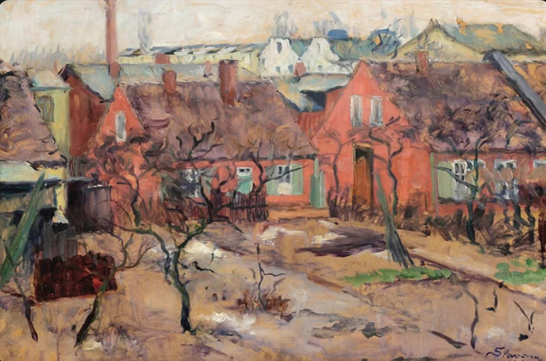
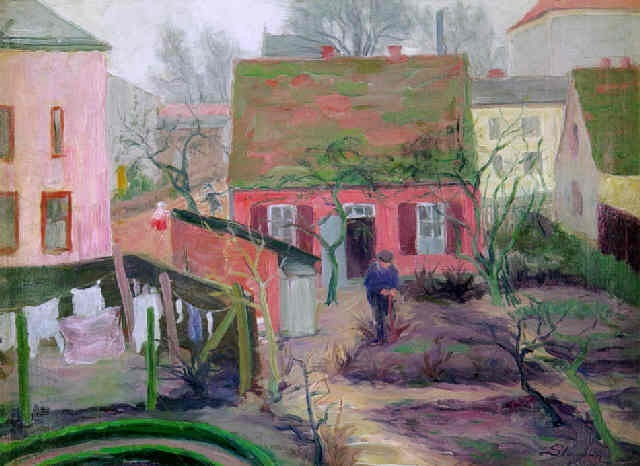
Red Gardener’s House with Gardener (Early Spring, Kahlhorst near Lübeck) by Maria Slavona

In 1882, when she was seventeen years of age, Maria went to Berlin to study art.  This was an unorthodox move as accordance with the social conventions of the time, it was unseemly for a young, unmarried woman to leave her parents’ home and pursue an education, in her case. studying painting.  Her move to Berlin caused a scandal in the Hanseatic city of Lübeck.  However, since women in Germany were denied access to art academies, Maria Slavona attended the Eichler private painting school in Berlin and the Deutsches Gewerbe-Museum zu Berlin, (Royal Museum of Decorative Arts) which at the time had a teaching institute.  In 1887, aged twenty-two, she moved to the painting school of the Verein der Berliner Künstlerinnen (Association of Women Artists and Friends of Art) in Berlin. It was an informal and free atmosphere, and the women here were allowed to conduct nude studies on living models.  A year later she enrolled at the painting school of the Münchner Künstlerinnenverein (Munich Association of Women Artists).

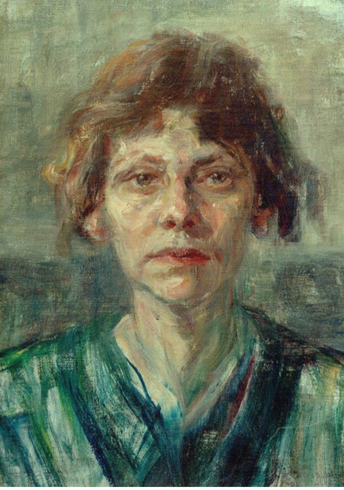
Self portrait by Maria Slavona (1887)

Her self-portrait, created in Berlin in 1887, shows the face of a 22-year-old, extremely pretty young woman, framed by tangled curls. With her head turned to the left, she fixes her gaze firmly on the viewer. Settling in this Bavarian city was fortuitous as the city of Munich had been, since 1850 onwards, deemed the most important centre for artistic creation and painting.  At this time, her most important patron and mentor was Ludwig Herterich, a German painter and art teacher, who in 1898 was a professor at the Academy of Fine Arts Munich, where he taught many young artists including Maria Slavona.   He introduced Maria to French Impressionism. A painting style that would be influential for her later paintings.

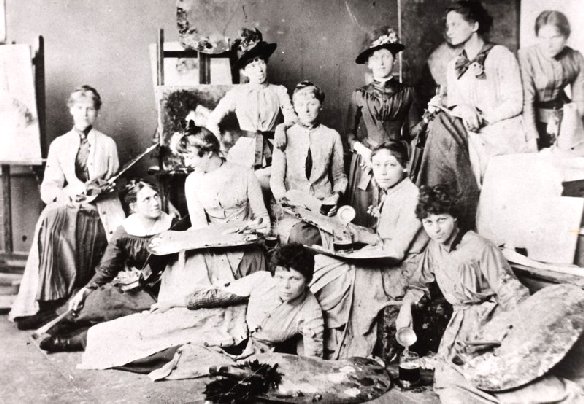
In the Munich Ladies’ Academy: Käthe Kollwitz seated between Maria Slavona (front right) and Rosa Pfäffinger (lying in front right)

Maria loved her time in Munich and made many friends including a fellow aspiring young painter, Käthe Kollwitz, who was also studying art in Munich. During a return home to Lübeck, she met some Scandinavian artists, one of whom was Vilhelm Petersen and, as they became closer friends, they both decided to take assumed names for their artworks. He chose Willy Gretor and she became Maria Slavona. Along with friends Maria and Vilhelm visited Paris in 1890.  She recalled her arrival in the French capital:

“…In 1890, I came to Paris. This is where a new world opened up to me. The first visits to the Louvre almost numbed and overwhelmed me. But I was disappointed by the schools I saw, I didn’t like them. I decided to work alone and seek advice and judgment only in the circle of a few young like-minded friends, almost all Danes and Norwegians…”

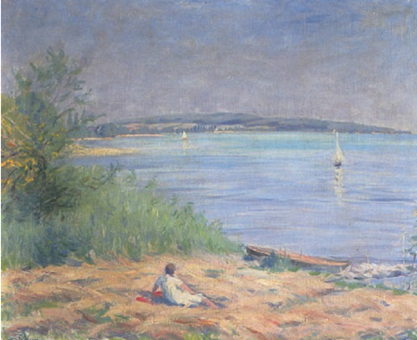
Sommermorgen am Starnberger See by Maria Slavona

That same year, Maria gave birth to an illegitimate daughter, Lilly, but her relationship with the father of the child, Petersen, was over.  She had at first looked upon him as a charismatic and educated man but he turned out to be a dubious art dealer, womanizer and bon vivant.  Worse still when their daughter Lilly was born Petersen had deserted Maria and she was left to bring up her daughter alone.

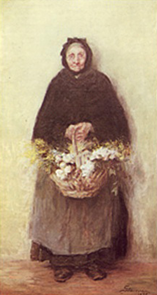
Alte Blumenfrau by Maria Slavona (1893)

In 1893, at her first exhibition at the Salon de Champ-de-Mars an annual event organized by the Société Nationale des Beaux-Arts.  Maria Slavona submitted her work, Alte Blumenfrau (Old Flower Woman). At this exhibition, ironically she identified herself under the male pseudonym “Carl-Maria Plavona”.  The painting depicts an old woman standing in frontal view, holding a large basket of white and yellow flowers in front of her body in her worn-out hands. Placed in front of a simple, ochre-coloured wall, the dark, poor clothing of the woman forms a strong contrast to the light background. The wrinkled face, framed by a headscarf, shows emotionless features. The tired eyes look firmly at the viewer.

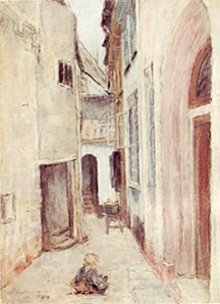
St Jurgen-Gang in Lubeck by Maria Slavona (1902)

Maria Slavona who, around 1898 had met the Swiss art connoisseur and collector Otto Ackermann. Their friendship grew over the next two years and in 1900 they married. Maria’s daughter Lilly took the name Ackerman and later she became an actress under the name Lilly Ackermann. Otto Ackermann was a valuable asset in the introduction of French art into Germany in the early 20th Century.  Otto and Maria set up home in Paris and it soon became a central meeting place for Parisian bohemianism. Visiting artists such as Münch, Liebermann, Leistikow, along with literary giants and art lovers would often frequent their home and be made most welcome.  Maria, who had spent sixteen years in the French capital, had led a happy and artistically productive life. During this period, she had completed many paintings depicting landscapes, portraits, still life and interiors.

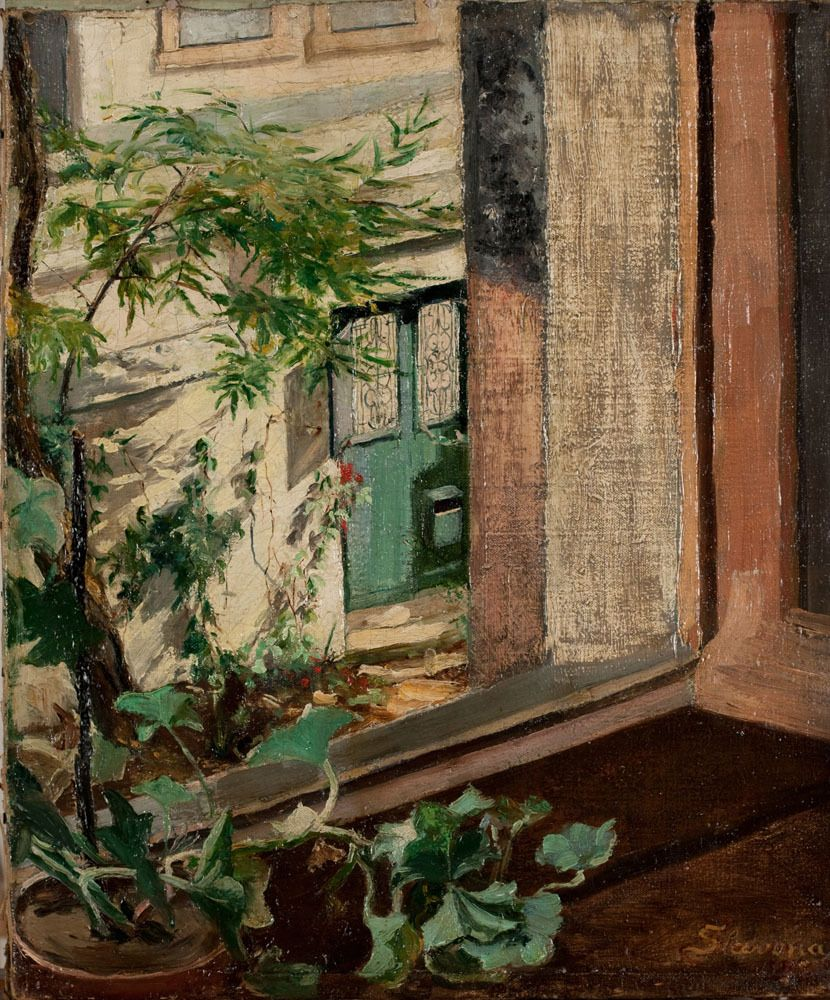
View from Studio Window by Maria Slavona (1899)

One of her favourite subjects was the view from the window of their home.  All of her work over those years established her reputation as a talented painter.

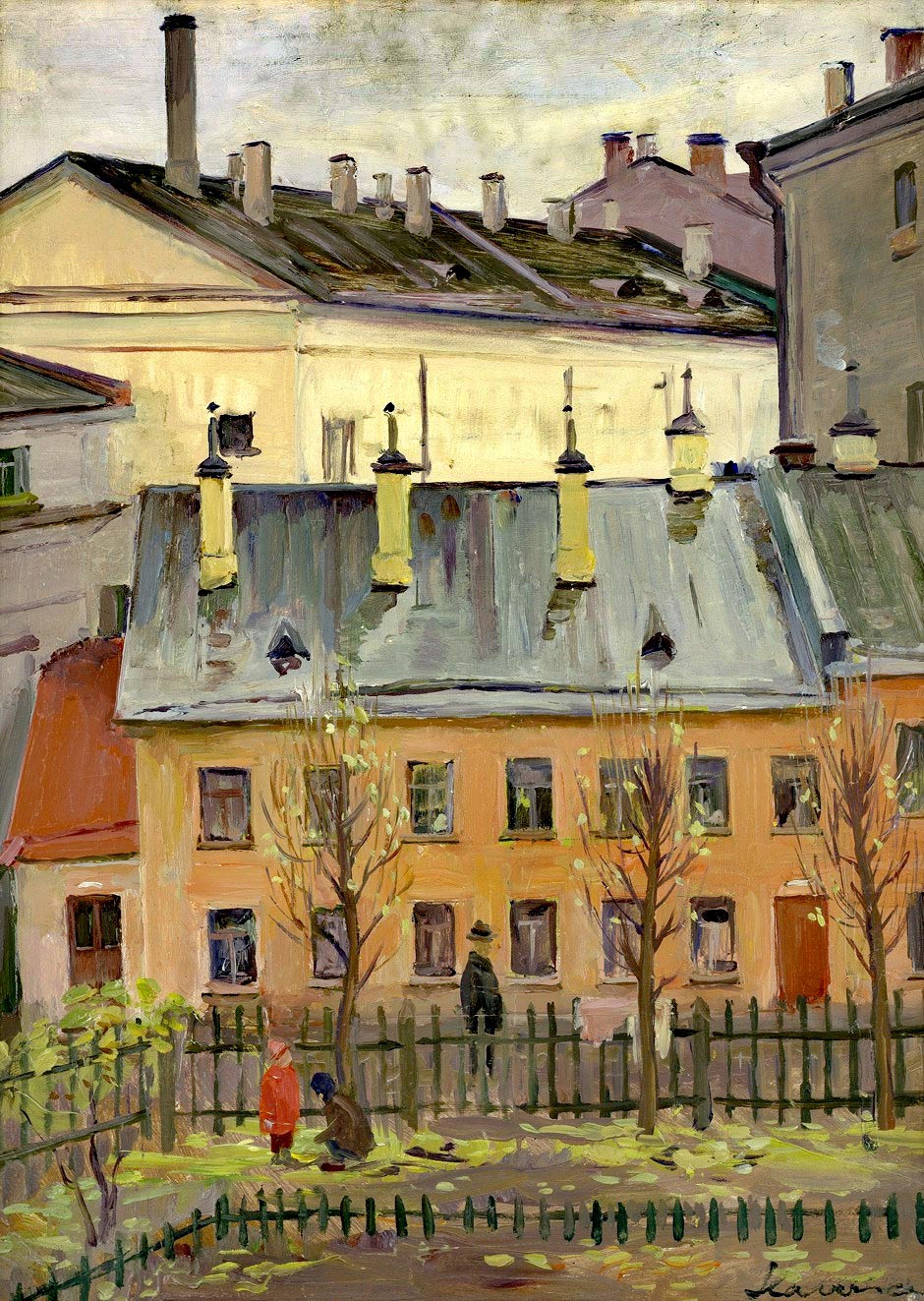
Houses on Montmartre, around 1900 by Maria Slavona

Häuser am Montmartre by Maria Slavona

In 1906 Maria and her family left Paris and returned to her old hometown of Lübeck.  During her stay in Lübeck she completed many paintings depicting the town and the surrounding areas.

 Villa entrance in Lübeck by Maria Slavona

Spring Thaw near Lubeck by Maria Slavona (1913)

Unfortunately, the bourgeois, art-hostile atmosphere that pervaded the old Hanseatic city had a negative effect on her husband’s art trade business and sadly this gave them no alternative but leave Lübeck in 1909, and move to Berlin.  It was in the German city of Berlin that she was once again artistically active and from 1913 she became a member of the Berlin Secession.  This was one of the last art Movements of 19th century German art.  It was a breakaway group of artists, who in 1898 ‘seceded’ from the city’s arts establishment, led by the eminent painter Max Liebermann.  It was a reaction to the Association of Berlin Artists, and the restrictions on contemporary art imposed by Kaiser Wilhelm II.  Sixty-five artists “seceded,” demonstrating against the standards of academic or government-endorsed art.  The group established an independent exhibition society, in order to champion new forms of modern art – rather than continue to churn out the old-fashioned academic art favoured by the art establishment.

Bouquet of field flowers by Maria Slavona (c.1900)

Following the end of the First World War Maria’s health began to deteriorate.  Added to that with a decrease in the sale of her paintings, the financial circumstances of the family took a substantial dip.  To try and rectify both her health and cut back on their financial outgoings the family moved to the countryside village of Munsing in Upper Bavaria.  From that time on, Maria mainly created floral still life works. 

Self portrait by Maria Slavona (1910)

Maria Slavona died in Berlin on May 10th 1931 aged 66.  Unfortunately, a large part of her work was lost during the Second World War, and also, for many years, her remaining works were branded by the Nazi government as Entartete Kunst (Degenerate Art) in 1933 and it was mainly ignored outside of her hometown Lübeck. Slavona is now known and famous as a representative of German Impressionism. Although she was unable to build on the artistic successes of her Paris years in Berlin, she was one of the best-known painters of her time, along with Dora Hitz and Käthe Kollwitz.

On the occasion of the 50th anniversary of her death in 1981, the Hanseatic City of Lübeck honoured its once famous and forgotten citizen with a large exhibition in the St. Anne Museum.

The Night by Max Beckmann

The Night by Max Beckmann (1918-19)

Today I am exploring the unusual world of Expressionism, to be more precise, German Expressionism, and will be looking at a painting entitled The Night by the German artist Max Beckmann, who was one of the most important German painters of the 20th century.  Beckmann has always been compartmentalised as an Expressionist painter but he himself, railed against that tag.

Expressionism materialized in different artistic circles across Europe but its zenith was the period between 1905 and 1920.  Expressionism as a general term refers to art in which the image of reality is more or less heavily distorted in formand colour in order to make it expressive of the artist’s inner feelings or ideas about it.  In expressionist art the colours used were often strong and highly intense and often non-naturalistic.  The brushwork is typically free and paint application tends to be generous and highly textured.  Expressionist art inclined to be poignant and sometimes had mystical qualities.  It would often look at themes of belonging and alienation.  In some ways Expressionism was the art of unrest and the search for truth.  The German Expressionists were loosely gathered in two groups.  One was called Die Brücke (The Bridge) and the other was Der Blaue Reiter (The Blue Rider).  There are numerous well known artists who could be looked upon as Expressionist artists.  The ones who come to mind are Egon Schiele, Edvard Munch, Wassiliy Kandinsky, Paul Klee and Beckmann just to mention a few.

Max Beckmann was born in Leipzig in 1884, the youngest of three children.  His family were of a middle-class background.  His father was a grain merchant but died when Max was just ten years of age.  He received a thorough education and spent several years at a boarding school.  At the age of fifteen and despite family objections, he decided on an artistic career and applied to the Königliche Akademie in Dresden but failed the entrance exam.  In 1900, aged sixteen years of age, his artistic studies finally began with his enrolment at the Weimar Saxon-Grand Ducal Art School for a three-year course and it was here that he learned to draw from antique statues and eventually progressed to human models.  It was also at the Academy that he met fellow art student, Minna Tube, whom he married three years later.  They went on to have a son, Peter.  After the course ended in 1903 he went to Paris where he studied at the private Académie Colarossi, which was an alternative art institution to the government-sanctioned École des Beaux-Arts that had, in the eyes of many promising young artists at the time, become far too conservative.  In 1906, he was in Florence financed by winning the German art prize, the Villa Romana Prize and it was in this Italian city he was able to study the works of the great Masters.  The following year, he moved to Berlin and three years later in 1907 he participated in the Berlin Secession, which was the predominant voice of modern German painting.  The term Secession, which came from the Latin secessio plebis (the revolt of the plebeians against the patricians) was the term applied to groups of artists who secede from academic bodies or associations in protest at the constraints.  The three main Secessions were those of Berlin, Munich and Vienna.   The Berlin Secession was founded by Berlin artists in 1898 as an alternative to the conservative state-run Association of Berlin Artists.

Beckmann’s paintings from this period are characterized by the legacy of Impressionism, with landscapes and beach scenes painted with stippled brushstrokes which evoked the play of light across shapes. He was held in such high regard by his colleagues that, in 1910, he was elected to the executive board of the Secession and was the youngest member ever to achieve such a distinction. However because he preferred painting to policy making, he resigned the following year in order to devote himself full-time to his art work. Conflict within the Berlin Secession eventually led to a further schism in 1910 and the new group called itself the Neue Secession (New Secession). In 1914 the rejection of works by some members of the Berlin Secession again led to further disagreements and several artists, including Beckmann left the Berlin Secession to found the Berlin Freie Secession (Berlin Free Secession), which existed until 1924.

At the outbreak of World War I in 1914, Beckmann volunteered as a medical orderly and served time on the Belgium front. Before the onset of war, he, like many other Germans, rationalized the necessity of war and believed in their countries aims.  He believed war could cleanse the individual and society. However, after experiencing day after day the widespread destruction and horrors of the war, he became disillusioned with the conflict and rejected the glory of military service.  In 1915 the dreadfulness of what he witnessed took its toll on him and he suffered a nervous breakdown and was moved to Belgium and later Frankfurt.

Following World War I, his work changed radically in reaction to the horrors he had witnessed. Initially he focused on biblical scenes, but during the 1920s he created more contemporary allegories and painted devastatingly realistic portraits and figure paintings associated with the Neue Sachlichkeit (New Objectivity) group, with whom he exhibited in 1925, but never formally joined.  He now rejected traditional perspective and proportion creating taut, airless pictorial structure of space and planes with an absence of bright colour and thick brushstrokes of Expressionism.   He saw the world as a tragedy of man’s inhumanity to man and saw life as a carnival of human folly.   In 1925 his marriage to Minna Tube, which had slowly been unravelling, came to an end and the couple were divorced.  That same year he married his second wife, Mathilde von Kaulbach and he was appointed professor at the Städelsches Kunstinstitut in Frankfurt.

In 1933 the Nazis came to power and Beckmann was declared a “degenerate artist”.  He was dismissed from his post at the Städelsches Kunstinstitut and a ban was placed on all his exhibitions.  All his works in German museums were confiscated.  The Nazi art policy at the time applied to everything that did not conform to Nazi goals.  It was their battle against what they termed überfremdung (foreign infiltration).  He moved from Frankfurt to Berlin where he believed due to its size and large population he could become more anonymous.  In 1937 he moved to Amsterdam where he lived in poverty in self-imposed exile failing in his desperate attempts to obtain a visa for the US.  He remained there until 1948 at which time he was finally granted a US visa.    From there he and his wife moved to the USA and he took up a post at the School of Fine Arts, Washington University in St Louis.  Later he moved to New York where he was given a professorship at the Art School of Brooklyn Museum.

Max Beckmann died of a heart attack whilst out walking in Manhattan, the day after Boxing Day in 1950.  He was aged 66.  His wife, Mathilde, died six years later.

My featured painting today entitled The Night was painted by Max Beckmann during 1918 and 1919.    It is housed at the Kunstammlung Nordrhein-Westfalen, Dusseldorf.   This is an early example of Beckmann’s grotesque and appalling visionary paintings with its misshapen figures. Before us we have an overcrowded room in a modern city.  Beckman himself said he wanted this work to be looked upon as a large modern history painting tinged with a sense of evil. Three men have invaded the room and are terrorising the occupants.  The man to the left has been hung by the neck by one of the intruders while a man with a bandaged head, wearing waistcoat and tie and smoking a pipe, twists his arm.   Two women can also be seen in the scene.  One, in the central foreground with her back to us, possibly the man’s wife, wears red stockings and is bound to a post after having been raped.   The second woman whose feet we can just make out at the top right of the painting, is held upside down by a man whose hat resembles the type worn by Lenin. To the right a blonde-haired child is about to be dragged off.  Under the table we see an old phonograph, the sound from which may have been used to blot out the cries from those being tortured.  Also partly under the table on the left we see a dog whose head is raised as he howls for help.  This is a scene of urban hell, an unfathomable and vile scene.

In his book Max Beckmann, Stephen Lackner commented on this work saying:

“… Beckmann sees no purpose in the suffering he shows; there is no glory for anybody, no compensation, … Beckmann blames human nature as such, and there seems to be no physical escape from this overwhelming self-accusation. Victims and aggressors alike are cornered. There is no exit…”

Maybe, one should remember that 1918 was  the time of the German November Revolution which resulted in the replacement of Germany’s imperial government with a republic and which unleashed tremendous savagery and terror across the country.  In 1919 there followed a general strike which was brutally put down by the authorities.  Maybe in some way Beckmann, in his painting, was alluding to such horrors perpetrated by mankind on mankind.  I find it very hard to fathom the state of the artist’s mind when he was painting this work.  Had he personally suffered so much mentally and lost all hope in humanity to depict such violence?