Fourteenth Street School of Artists

“…I hope my work is recognizable as being by a woman, though I certainly would never deliberately make it feminine in any way, in subject or treatment.  But if I speak in a voice which is my own, it’s bound to be the voice of a woman…”

-Isabel Bishop
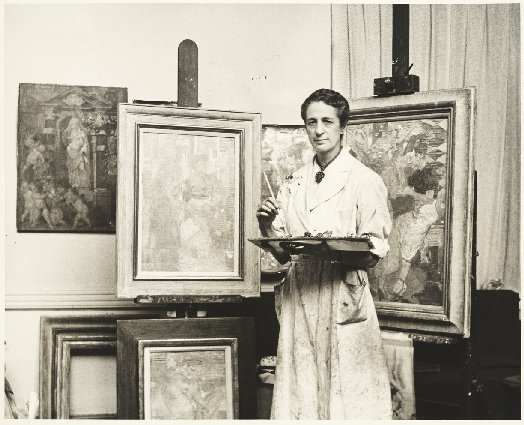
Isabel Bishop, 1959. Photo by Budd ( New York N.Y.). Archives of American Art, Smithsonian Institution.

The Ashcan School of painters was the artistic movement that depicted Urban Realism in America during the late 19th and early 20th century. A few decades later another group of American realist painters, who were also based in New York city, began to focus on everyday life in the city. For these artists, it was all about the bustling area which centred around 14th Street and Union Square in Lower Manhattan during the Depression era. They became known as the Fourteenth Street School of Artists. One of these artists was Isabel Bishop.
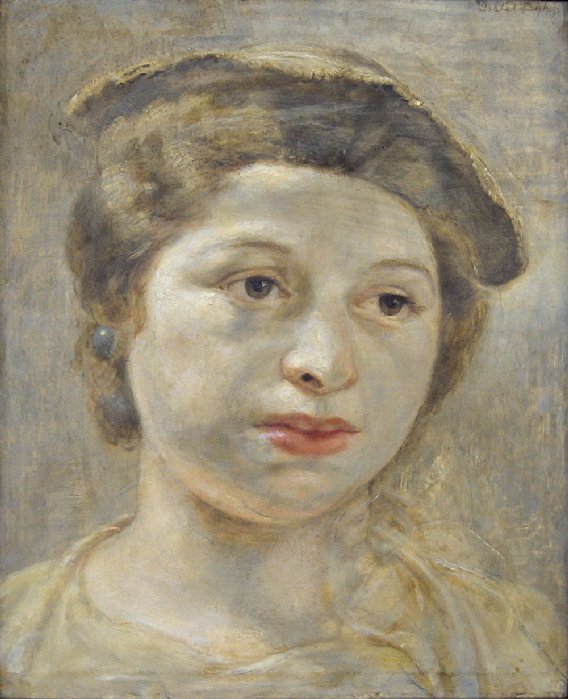
Female Head by Isabel Bishop

Isabel Bishop was the youngest of five children born on March 3rd 1902 in Cincinnati, Ohio, to John Renson Bishop and Anna Newbold Bishop. Her parents were descendants from East coast mercantile families but although they came from “old money” they were considered middle-class and often struggled financially. Isabel’s parents were both highly educated individuals. Her father was a Greek and Latin scholar and had a Ph.D in history. Her mother was a writer and an activist for women’s suffrage. The family frequently moved from town to town for financial reasons and to gain employment. Wherever they set up home, Isabel’s father, John, would find work at the local school where he often rose to become its principal and in some cases took ownership of the school.

Ice Cream Cones by Isabel Bishop

In 1887 the couple had their first children, twins, a boy and a girl, Mildred and Newbold and in 1890 another set of twins, once again a boy and a girl, was born, Remson and Anstice. This enlargement of the family caused financial hardship and her father had to continually look for better paying jobs. Isobel did not remember much about the two sets of twins as by the time she was born they were away at boarding school or college. According to Isabel her parents were very different in temperament. Her mother was a free spirit but very strong-willed and in her 1987 interview she recalls an incident that had repercussions on her father’s life:

“…It was hard on my father that she was strong. For one thing, in Detroit, Michigan, women were not supposed to be strong. She simply liked what she liked and that was it. One time she was asked to go down to the court and testify in some case. She went down, but she wouldn’t swear to be telling the truth. She was asked by the court why she wouldn’t and she said, “I don’t believe in God.” It was in the Detroit papers with the headline:


“SCHOOL PRINCIPAL’S WIFE DOESN’T BELIEVE IN GOD”


I really felt for my father. I mean, a school principal! His life was pretty impossible after that…”
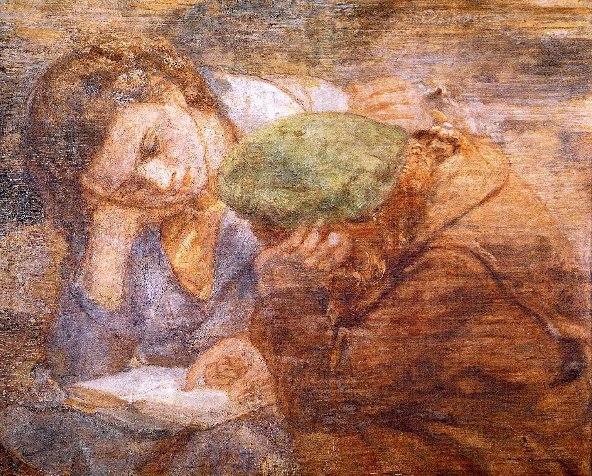
Two Girls with a Book by Isabel Bishop

Although born in Cincinatti Isobel and her parents moved to Detroit a year after she was born. In 1914, when she was twelve years of age, Isabel was enrolled in Saturday morning life drawing classes at the John Wicker Art School in Detroit. From there, at the age of sixteen, and once she had graduated from High School, she left Detroit and went to New York. It was here that she enrolled at the School of Applied Design for Women, where she studied illustration. In 1920, aged eighteen, Isabel, wanting to enhance her artistic knowledge and skills, attended the Art Students League where her first tutor was Max Weber, whom she disliked and who gave her a hard time. Later she was tutored by Kenneth Hayes Miller, another artist associated with the Fourteenth Street School who couldn’t be more different than Weber. Other tutors were Guy Pène du Bois, Robert Henri and Frank Vincent DuMond.
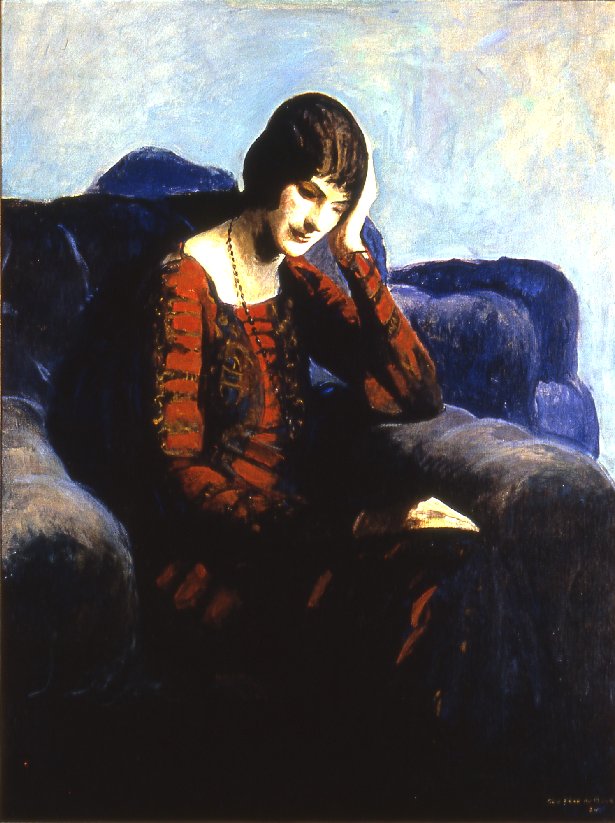
Portrait of Isabel Bishop by Guy Pene du Bois (1924)

According to Helen Yglesias’ 1989 biography Isabel Bishop, although Weber treated Isabel harshly and she felt intimidated by Robert Henri, in Kenneth Hayes Miller she found a mentor who, in her words, was “intellectually stimulating, not stultifying, a fascinating person who presented all sorts of new possibilities, new points of view.”

Isabel Bishop’s 9 West 14th Street Studio (no longer extant) highlighted in red, 14th Street, north side, west from Fifth Avenue. June 11, 1933.

Another friend she made at the Art Students League was Reginald Marsh, who made fleeting visits to the classes at the Art Students League whilst she was student there and this friendship led to her being witness to the working-class life of the city. In 1926, she went to live at 9 West Fourteenth Street, which was a short distance from where Marsh lived and it was in this vicinity that she kept her studio that overlooked Union Square at Broadway and East Fourteenth Street and remained there until 1982. From the windows of her studio she was able to witness the daily activities in Union Square. Fourteenth Street in the 20s and 30s was referred to as “The Poor Man’s Fifth Avenue.” It was a bustling center for bargain shopping and bawdy entertainment in the form of burlesque shows and movie theatres for everyday working-class New Yorkers. 
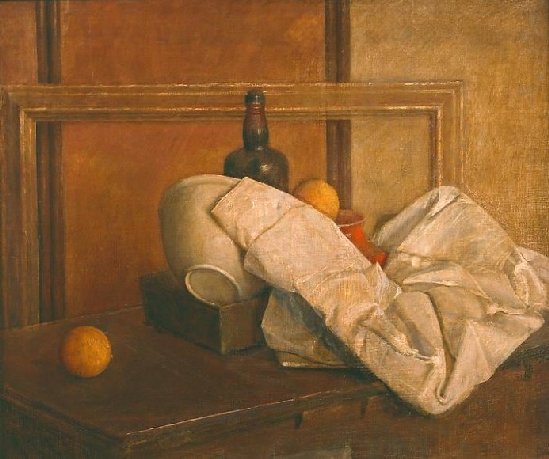
Still Life with Orange #1 by Isabel Bishop

Her friendship with fellow student, Reginald Marsh, encompassed many lunch or dinner dates when they discussed their day’s work. She affectionately recalled that they each paid for their own fifty cent meal and occasionally Marsh would take her to a Coney Island dance marathon or backstage at Minsky’s Burlesque. She recalled that it was great going with Reggie, and whilst there he would sketch the goings-on at the Burlesque show. She said that there were a number of occasions, the owner, Minsky bought Reggie’s work.

The Artist’s Table by Isabel Bishop

Isabel loved the area around Union Square and would regularly visit the Square itself, sketching for hours on end. She remembered those days saying:

“…I adored it. Drawing nourished my spirit; it was like eating. I got ideas there, for drawing is a way of finding out something, even though it might only be the discovery of a simple gesture…”

If she liked one of her sketches, she would turn it into an etching or make a painting from it. She soon became known for depicting urban life and was a leading member of the Fourteenth Street School of artists.

14th Street by Isabel Bishop

The Great Depression began in 1929 and nobody seemed to want to spend money buying the work of an unknown female artist, especially one who had not even had a solo show. Money was tight, people were losing their jobs and America had fallen into the grip of the worst depression in history and most Americans were worried about how they could survive the disaster that had befallen the nation. Isabel went from art gallery to art gallery hoping that they would accept her paintings but with little luck. It was a very depressing and frustrating time in Isabel’s life. A turning point came when Isabel met Alan Gruskin. Gruskin had hoped to become an artist, but while still a student realized that his talents were better suited to art administration than painting. On graduating from Harvard he worked at a New York gallery that specialized in the works of the Old Masters. He left there and returned home hoping to start a career as an author but that never came to fruition so he returned to Manhattan and, in 1932, opened the Midtown Galleries at 559 Fifth Avenue. He specialised in artwork by living American artists and in that year he staged a solo exhibition of Isabel’s paintings.
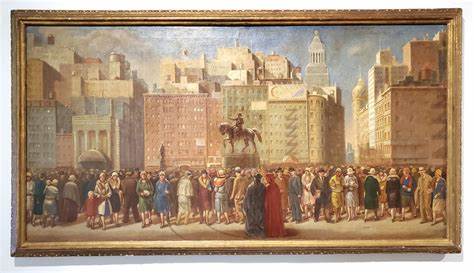
Dante and Virgil in Union Square by Isabel Bishop (1932)

Isabel Bishop’s paintings focused on the ordinary people of New York City, and in particular, those in her neighbourhood around Union Square and 14th Street. However, her 1932 painting entitled Dante and Virgil in Union Square was extraordinary with her inclusion of Dante, in the red cloak, and Virgil, with a laurel wreath on his head, which makes this work memorable. Isabel said she was motivated when she read the translation of Dante’s Inferno, the first part of Italian writer Dante Alighieri’s 14th-century narrative poem The Divine Comedy with its tales of life in the underworld. In her depiction, Isabel likened the hordes of poor souls that confronted Dante and Virgil in the various levels of hell with the hordes of human beings that daily passed through Union Square at rush hour. In the painting we see a crowd of people at Union Square, the equestrian statue of George Washington in the centre framed by the Union Square Savings Bank and other buildings in the background. It is a very busy scene a woman leading her child by the hand, pairs of women walking away from the crowd, and a number of working class men, portrayed in darker colours, facing into the Square seem completely unaware of the classical figures, who stand in the shadowed foreground of the sidewalk, as if embodying the evaluating gaze of another era.
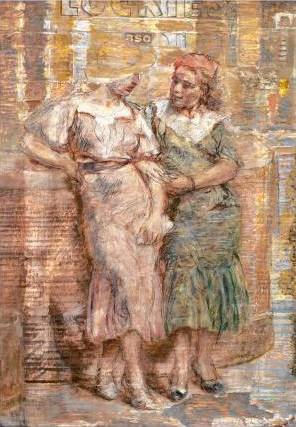
At the Noon Hour by Isabel Bishop (1936)

In Ellen Wiley Todd 1993 book, The “New Woman” Revised: Painting and Gender Politics on Fourteenth Street, she describes the New Woman of the 1920s and 1930s as:
“…being a moderate sort, who hoped to capitalize on new job possibilities and to make herself attractive with the mass-produced products of the clothing and cosmetics industry…”

Hearn’s Department Store-Fourteenth Street Shoppers by Isabel Bishop (1927)

The entrance to Hearn’s Department Store was right across the street from Isabel Bishop’s studio and she realised that it was the perfect place to find and observe this “New Woman.” Isabel Bishop’s Hearn’s Department Store—Fourteenth Street Shoppers was completed in 1927, the same year that she enrolled in Kenneth Hayes Miller’s mural painting class at the Art Students League. It depicts the city’s middle-class shoppers who are wearing the latest fashions and who visit the shops around Union Square in order to pick up the latest bargains.
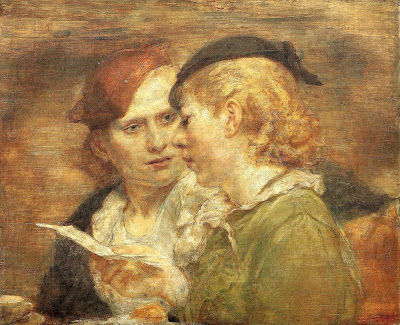
Two Girls by Isabel Bishop (1935)

In 1935 Isabel completed her painting entitled Two Girls. It was yet another of her works which depicted young working women. In this painting we see a close-up of two smartly dressed figures seemingly engaged discussing the contents of a letter. Isabel used two models for this depiction and for this work she used Rose Riggens, a server at a restaurant where Isabel often had breakfast, and Riggens’ friend Anna Abbott. The work exudes both warmth and tranquillity which counters the dire economic circumstances of the Great Depression in the 1930s. This painting which took her twelve months to complete was one of Isobel Bishop’s most well-known works and was originally shown at the Midtown Galleries in New York. It is now part of the city’s Metropolitan Museum of Art.
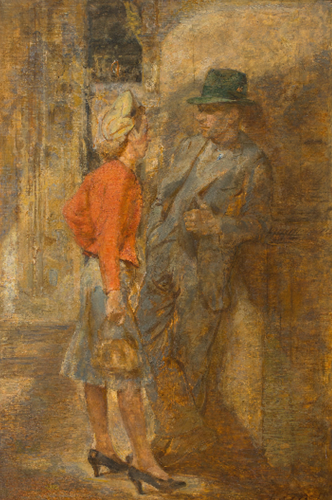
Encounter by Isabel Bishop (1940)

In her 1940 painting entitled Encounter we witness an exchange occurring between a man and a woman though the circumstance of this meeting remains unclear. From many of her paintings we can deduce that Isabel was an insightful observer of everyday activities of young women who visited offices and stores in her neighbourhood. Her works present working women as vivacious subjects for the American Art Scene, which centred on the daily lives of the city’s population. At a time of great unemployment Isabel found it easy to employ young unemployed clerical workers to pose for her. In this work, she depicts a young woman and her boyfriend, with whom she is having a rather stormy romance. The painting can be seen in the St Louis Art Museum.

Tidying Up by Isabel Bishop (1941)

In her 1941 painting Tidying Up, we see a woman, perhaps a secretary or salesperson, using a pocket mirror to check her teeth for lipstick smudges. Isabel liked to depict working-class women during their idle moments away from their jobs. She spent more than a decade depicting secretaries, salesclerks, and blue-collar workers who lived and often worked in and around Union Square. She favoured subjects of women who were simply going about their everyday lives, eating, talking, putting on makeup, and taking off their coats. It was these mundane actions along with facial expressions that Isabel Bishop believed divulged the character and temperament of the people she portrayed. This painting is part of the Indianapolis Museum of Art collection.
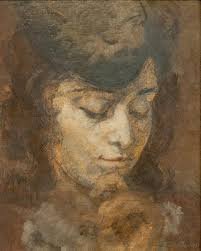
Girl Reading by Isabel Bishop (1935)

Bishop remained on Union Square, where she kept a studio until the end of her life. The area around Fourteenth Street and Union Square remained foremost as the subject matter for her paintings. She received many awards during her life and she was elected an associate member of the National Academy of Design in 1940 later in 1941 she was elevated to full Academician. She received a Benjamin Franklin Fellow at the Royal Society of Arts in London and was also elected a Member of the National Institute of Arts and Letters in 1944 and was the first woman to hold an executive position in the National Institute of Arts and Letters as vice-president. In 1979, she was awarded the Outstanding Achievement in the Arts Award presented to her by President Jimmy Carter.
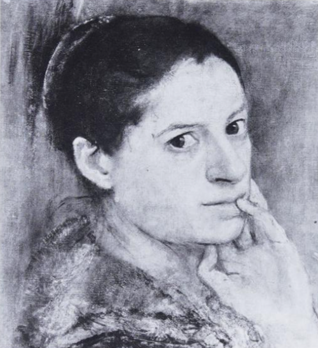
Self portrait by Isabel Bishop (1927)

Isabel Bishop died on February 19th 1988 two weeks before her eighty-sixth birthday.


Most of the information for this blog came from the following excellent websites:

The Art Story

incollect

Isabel Bishop

Hellenica World

Off the Grid

Oral history interview with Isabel Bishop,
1987 November 12-December 11

Annex Galleries

Reading and Art

William James Glackens

To look at the history of the Ashcan School one has to go back a step and look at a group of painters who became known as The Eight.  These eight artists, with Robert Henri, acknowledged as the leader of the group, were Arthur B. Davies, William Glackens, Ernest Lawson, George Luks, Maurice B. Prendergast, Everett Shinn, and John Sloan.

Ashcan School artists and friends at John French Sloan’s Philadelphia Studio, 1898

Luks, Sloan, Glackens, and Shinn worked as newspaper artist/reporters and illustrator-cartoonists and maybe because of this connection, the many paintings of these artists took on a journalistic quality.  All eight artists utilised the crowded life found on the New York streets as the subject of their paintings.  Their work depicted un-idealized views of life in a big city and focused on the bars and the clientele, dark grubby-coloured tenements, pool halls, and slums. This was the epitome of urban realism.  Realism in art was described by Gustave Courbet in an open letter he wrote on December 25th 1861, now referred to as his Realist Manifesto.  He wrote:

“…To know in order to do, that was my idea. To be in a position to translate the customs, the ideas, the appearance of my time, according to my own estimation; to be not only a painter but a man as well; in short, to create living art – this is my goal…”

 At the high point of their popularity these men were seen as confronting Academia which favoured the genteel tradition of “art for art’s sake, and which had dominated the American art establishment for many decades with works from likes of John Singer Sargent and Abbott Handerson Thayer.

However, on February 3rd, 1908, the MacBeth Galleries, New York, opened an exhibition featuring The Eight artists. It caught the attention of the American art world and although the show remained on view in New York for less than a fortnight, it was taken to several cities including Chicago, Detroit, and Philadelphia.  These exhibitions were lauded as watershed exhibitions of 20th-century vanguard art.   It was a triumph of “American” art.

The name “Ashcan School” was a derisive criticism of The Eight and their works of art, which appeared in an article in The Masses, an American magazine of socialist politics.  The author of the article alleged that there were too many “pictures of ashcans and girls hitching up their skirts on Horatio Street” in their paintings.  The group of artists were amused by the article and the group soon became known as the Ashcan School of painters. The Ashcan School of artists had also been known as “The Apostles of Ugliness”.

William Glackens by Robert Henri (1904)

A few blogs back I looked at the life of George Luks who was an American realist painter connected to the Ashcan School.  Today I am looking at the life and paintings of one of his contemporaries who was also one of the Ashcan School of painters.  He is William James Glackens. William Glackens was born in Philadelphia on March 3rd 1870.  He was the youngest of three children to Samuel Glackens, a cashier for the Pennsylvania Railroad and his wife Elizabeth Glackens.  William’s siblings were an older sister, Ada and an older brother Louis who would later become a cartoonist and illustrator and work on early animation films.

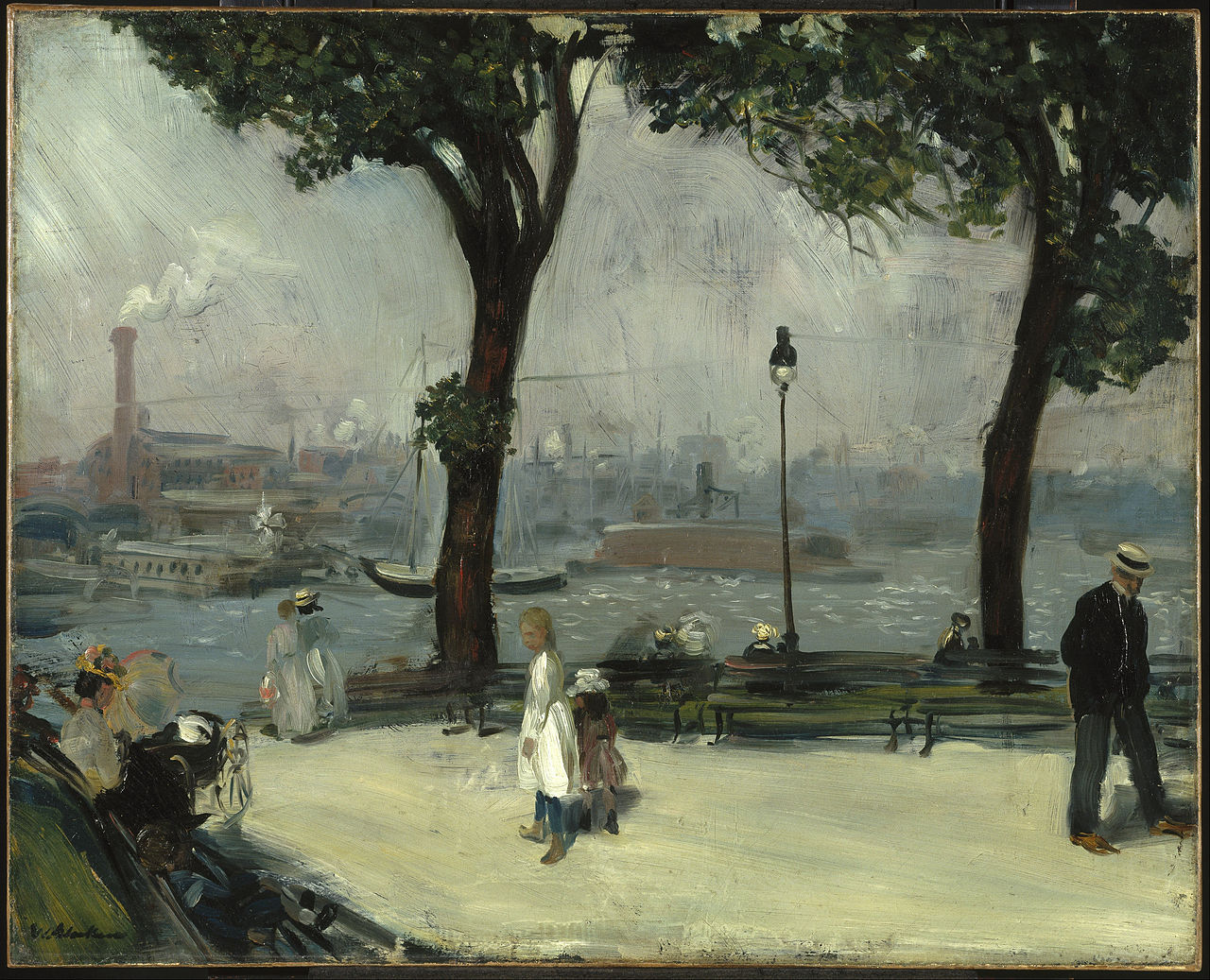
East River Park by William Glackens (1902)

William attended the Central High School where one of his fellow students John Sloan, who would later become a member of The Eight.  Glackens graduated from the Central High School in 1890. Throughout his school days Glackens loved to draw and paint and became a very accomplished artist and in November 1891, aged twenty-one, he and Sloan enrolled at the Pennsylvania Academy of Fine Art. Glackens also worked as an artist reporter for many newspapers, starting at the Philadelphia Record.  His task was to pictorially record news events and had to work to tight deadlines.

Christmas Shoppers by William Glackens (1912)

In October 1894, having completed his studies at the Academy of Fine Art, Glackens started a job as a staff artist/reporter for the Philadelphia Press and worked alongside fellow artists Sloan, Edward Davis, George Luks, and Everett Shinn.  Around this time Glackens was introduced to Robert Henri by Sloan.  Henri was an artist five years older than the pair.  He had returned to study at the Academy for a second stint after spending time in Paris studying at the Académie Julian, under William-Adolphe Bouguereau, where he developed a love for Impressionism and later, he was admitted into the École des Beaux Arts.  Besides befriending Glackens and Sloan two more aspiring artists, George Luks and Everitt Shinn joined the informal group which met at Henri’s apartment to discuss art, philosophy, culture and more, their meetings became known as the Charcoal Club because they would spend time using that medium to produce drawings from life.  This informal group explored art genres not available at the Academy, such as nude figure drawing. They also became interested in the social philosophical writings of Ralph Waldo Emerson, Walt Whitman, Émile Zola, and Henry David Thoreau.  Besides meeting to draw. paint and discuss philosophy, the group led a very sociable life during which alcohol played its part !

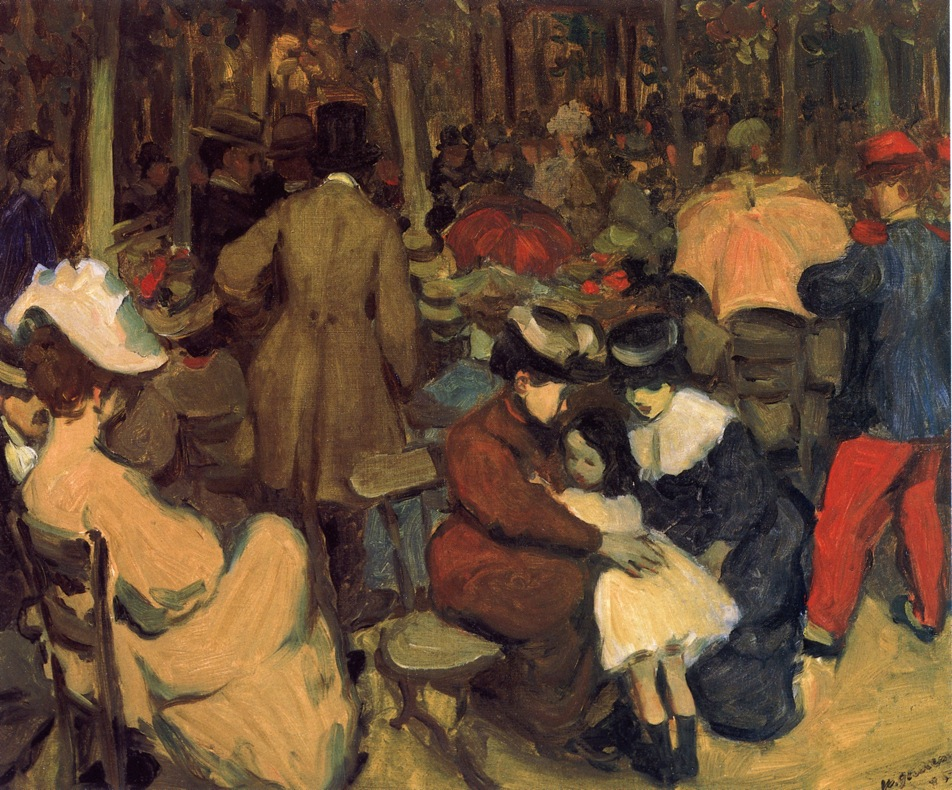
Figures in the Park, Paris by William Glackens (1895)

In 1895, Glackens, along with several other artists, including Robert Henri travelled to Europe so that they could learn more about  European art.  The first country they visited was Holland where Glackens scrutinised the work of the Dutch masters. From there he went on to the French capital where he and Henri rented a studio apartment for a year. For Glackens, staying in Paris, exposed him to the work of the great Impressionists and Post-Impressionists.  His greatest influence was the work of Manet.

Lena (the artist’s daughter) Painting by William Glackens (1918)

Glackens returned to America in 1896 and moved to New York and spent time at Henri’s many social gatherings.  Glackens took up employment at the New York Herald as a reporter and also worked as an illustrator for various magazines.  These two lines of work provided him with a good steady income and over the next decade he produced more than a thousand illustrations.  Although many were comedic in nature, in April 1898 the Spanish-American War broke out in Cuba and the McClure’s Magazine sent him there to collate the news and produce newsworthy illustrations.  It was a difficult assignment and his living conditions were poor.  On his return to New York, he was taken ill and it was discovered that he had contracted malaria which would return time and again during his life.

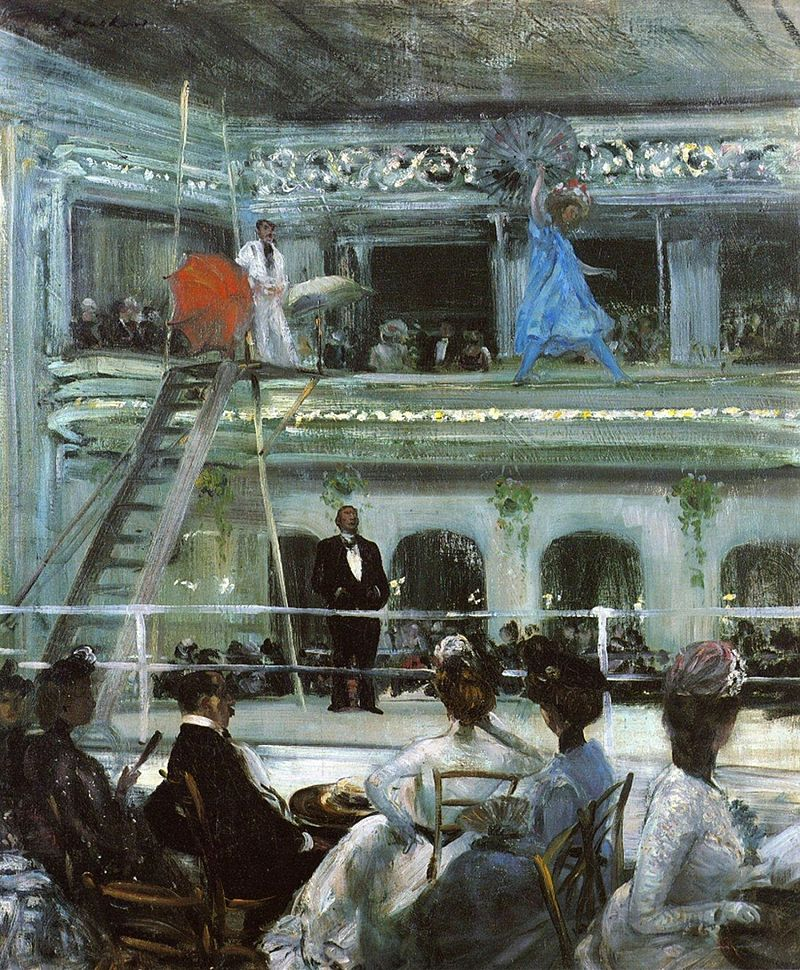
Hammerstein’s Roof Garden by William Glackens (1901)

In 1901 Glackens completed a painting entitled Hammerstein’s Roof Garden.  Hammerstein’s Roof Garden was the official name of the fashionable semi-outdoor vaudeville venue that theatre magnate, Oscar Hammerstein I, built atop the Victoria Theatre and the neighbouring Theatre Republic.  During summer months theatres were often closed due to the suffocating atmosphere inside the venues and so roof garden venues were very popular.  The viewer is placed as if they are part of the audience and in front of us, we see a a colourfully dressed female tightrope walker as she tentatively navigates the rope which is strung across the stage.  In the foreground we see the audience, some of which are unaccompanied females which was something that years ago would have been unheard of.  The painting is now part of the Whitney Museum of American Art collection in New York.
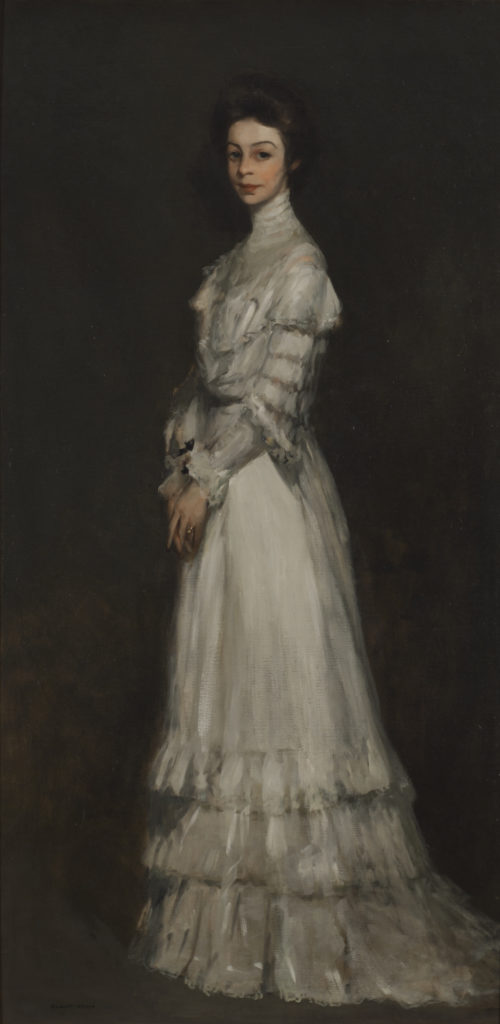
The Artist’s Wife, Edith Dimock Glackens, in her Wedding Dress by William Glackens (1904)

William Glackens’ single status ended in 1904 when he married Edith Dimock.  Edith, who was six years younger than William, came from a wealthy Hartford Connecticut family which made its fortune as silk merchants.  Despite her family’s strong objections but she turned away from business as a career and instead set about becoming a professional artist.  She left home and moved to New York City when, in her early twenties, she enrolled at the Art Students League where she studied with American Impressionist William Merritt Chase.

Sweat Shop Girls in the Country by Edith Dimock (c.1913) 

She soon made a name for herself as a talented watercolourist depicting women and children of working- and middle-class backgrounds. Through his wife’s wealth, Glackens could concentrate on his art, and often Edith and later their daughters, Ira and Lenna became his models. His 1901 portrait of his wife is of a classical formal style.  Set against a dark background, Edith is depicted wearing a black coat and hat with a long brown pleated skirt.  As with many of his portraits Glackens wanted his subjects to be seen just as they were, warts and all, and refused to idealize his sitters.   In this portrait Glackens has made no attempt to either make the depiction more modern or beautify the sitter.

Portrait of Edith Dimock Glackens by Robert Henri (c.1902)

His friend Robert Henri also painted a portrait of Edith around the same time which appears more idealized and certainly adds a touch of beauty to the depiction.

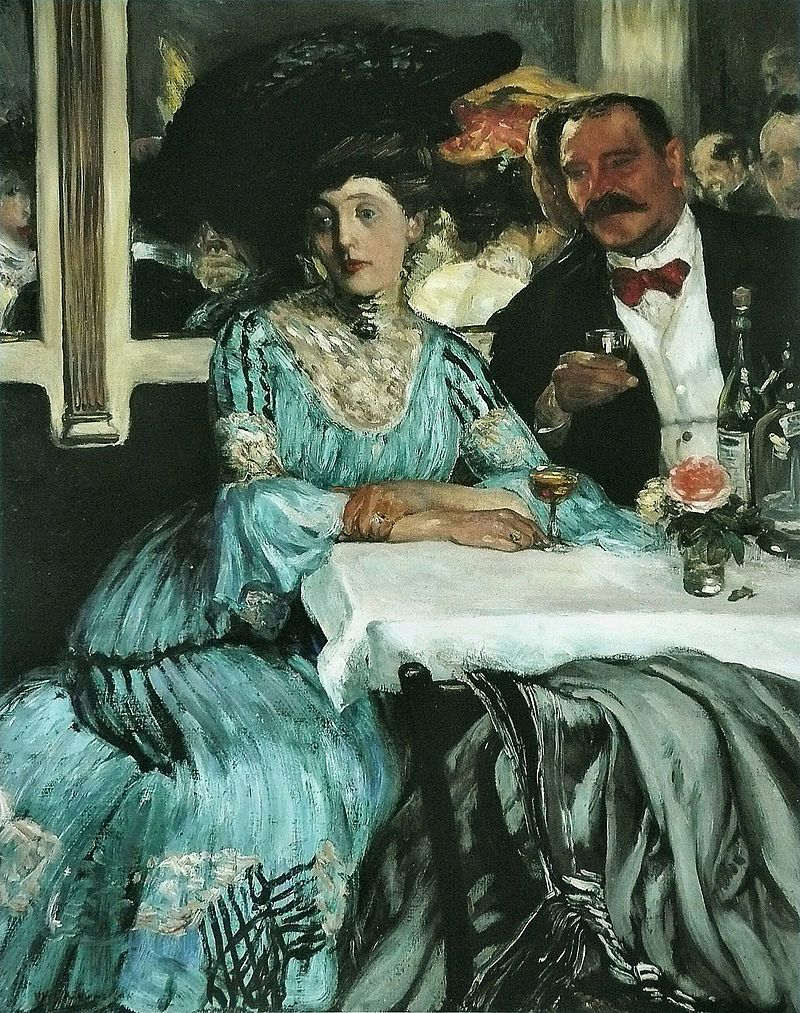
At Mouquin’s by William Glackens (1905)

Artists need to sell their work and to do this their work has to be shown at exhibitions.  However it was not always easy for many artists to have their work accepted by exhibition juries and in 1907, Glackens and many of his contemporaries decided to take the matter into their own hands and split from the National Academy of Design who they felt, for some reason, stopped accepting their work  The Eight, as they had come to be known, led by Robert Henri decided to host their own exhibition at the Macbeth Galleries in New York City and an opening date for the event was set for February 3rd 1908.

May Day in Central Park by William Glackens (1905)

Although part of the Ashcan School of Painters, Glackens preferred to use a lighter palette for his work, unlike the darker palette used by the others who liked to depict the darker and grittier side of life in the city.  For Glackens depictions of family life whilst shopping or relaxing in the park were his favourite subjects for his paintings.   Unlike his colleagues Glackens preferred to focus more on scenes of leisure and entertainment rather than concentrate on the misery of life in the slums of the Lower East Side.

The Green Car by William Glackens (1910)

The consequences of working as an artist/reporter for a number of Philadelphia and New York newspapers taught him to observe the smallest of details of a scene.  In New York Glackens had a studio on Washington Square Park and it was from here he captured a scene for his 1910 painting entitled The Green Car.  The painting depicts a green trolley car as it rounds the corner at the south side of the park and we see it is heading towards a lady who is standing by the snowy curb, waiting to alight.  She is dressed smartly in a long coat, hat, and muff, she signals to the conductor of the trolley car.  Our eyes move from the foreground and the green trolley car across the snow-covered grass, through the trees and finally alight on a row of three-storey brick tenement buildings.

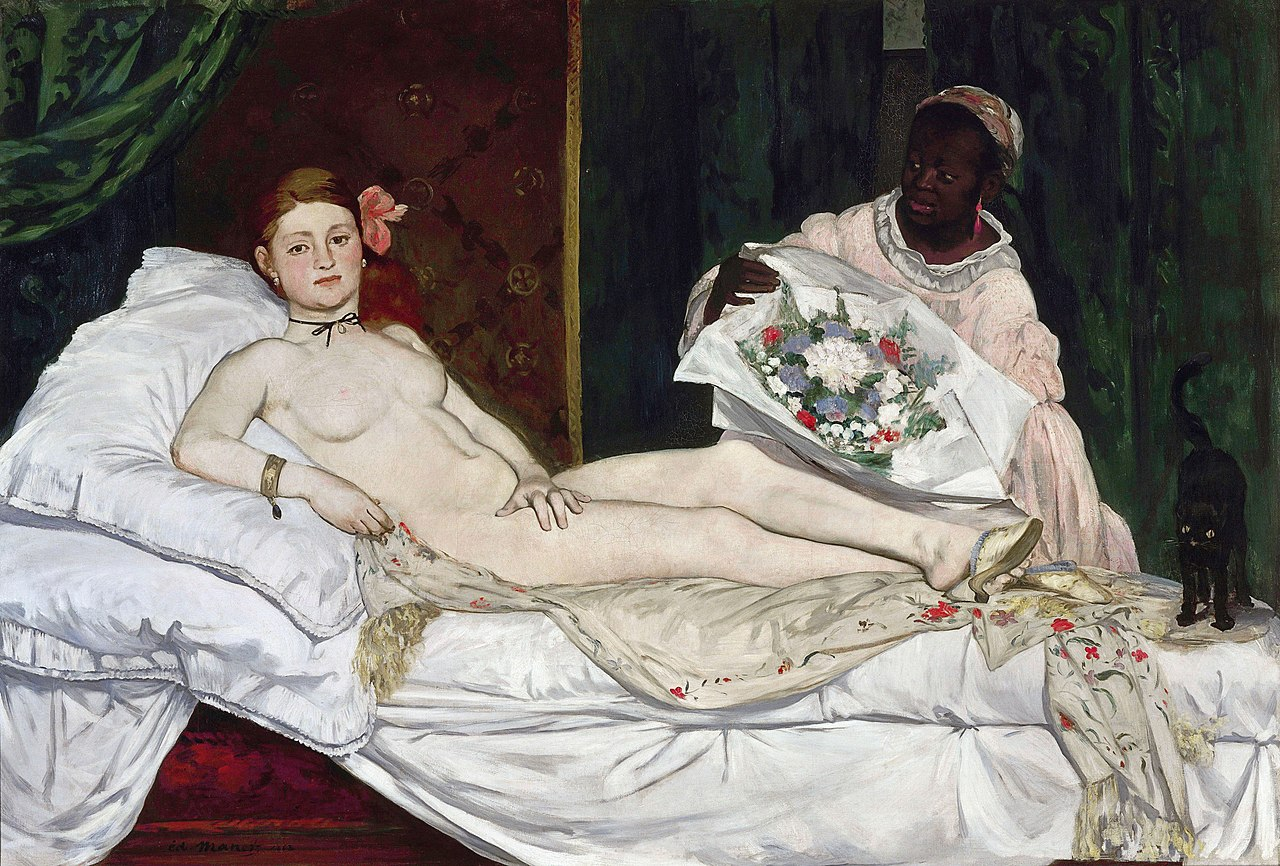
Olympia by Manet (1863)

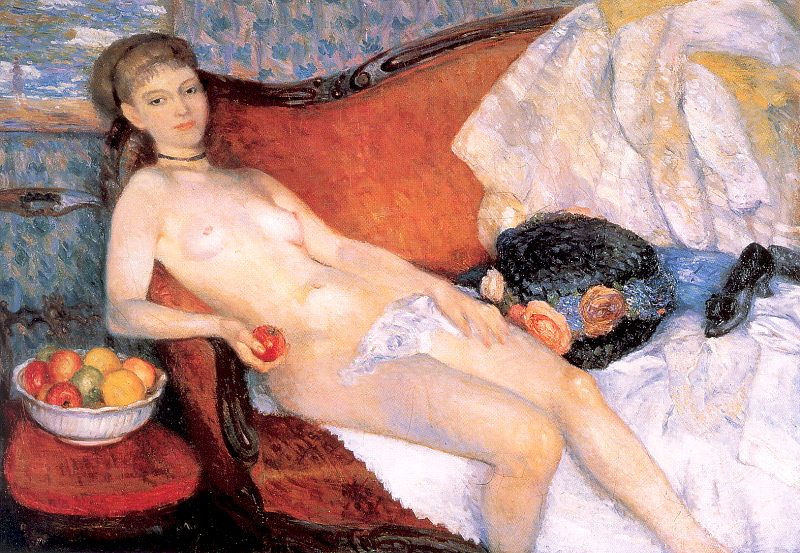
In 1910 Glackens produced what many believe is his homage to Édouard Manet’s Olympia with his painting entitled Nude with Apple

Nude with Apple by William Glackens (1910)

It depicts a reclining nude holding an apple which she has taken from the nearby bowl on her right.  To her left on the sofa there is a large hat and a pile of her discarded clothing including one blue shoe.  She wears a black choker around her neck which harks back to the same accoutrement warn by Manet’s reclining nude, Olympia.  Whereas Manet’s Olympia covered her pubic region with her hand, Glackens has modestly covered his model’s pubic region with a piece of discarded white lingerie.  Glackens’ depiction is another of his typical realist genre.  The model is ordinary.  She could not be termed beautiful.  The depiction alludes to her being simply one of Glackens’ models who has just arrived at his studio wearing a large flowery hat, a gown and blue shoes.  She then hurriedly undressed, abandoning her clothes on the sofa.  The scene seems to have been unscripted.    And yet…..are we to think of the apple in her hand as symbolising Eve?

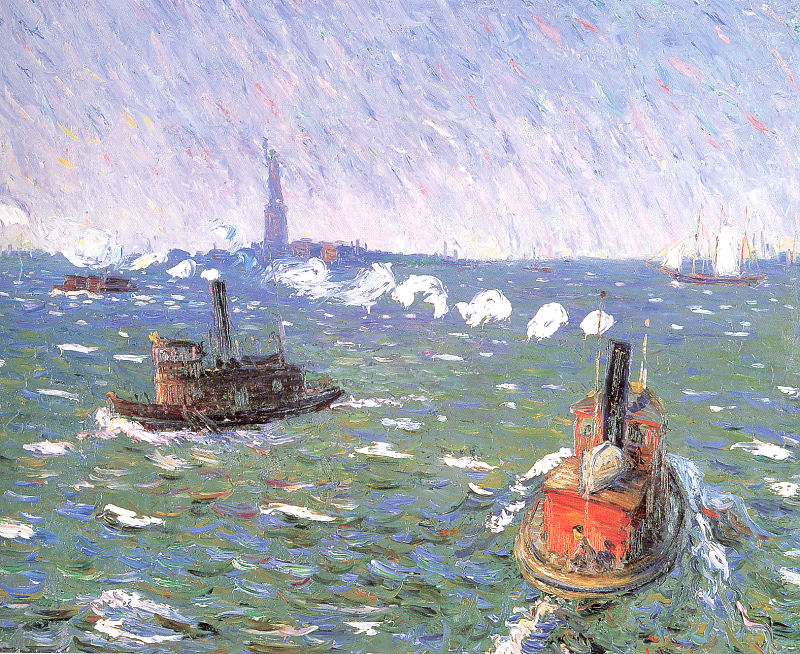
Breezy Day, Tugboats New York by William Glackens (1910)

Glackens extensive knowledge of European art and artistic trends in Europe led him to be commissioned by Albert Barnes, the American chemist, businessman, art collector, writer, and educator, in January 1912 to travel to Europe and buy paintings for him which would then become the foundation for the Barnes Collection in Philadelphia.  Barnes was also a High School classmate of Glackens and gave him twenty thousand dollars to be used for purchasing paintings and Glackens returned with thirty-three works of art.  That December Barnes himself travelled to Paris to buy more works of art.

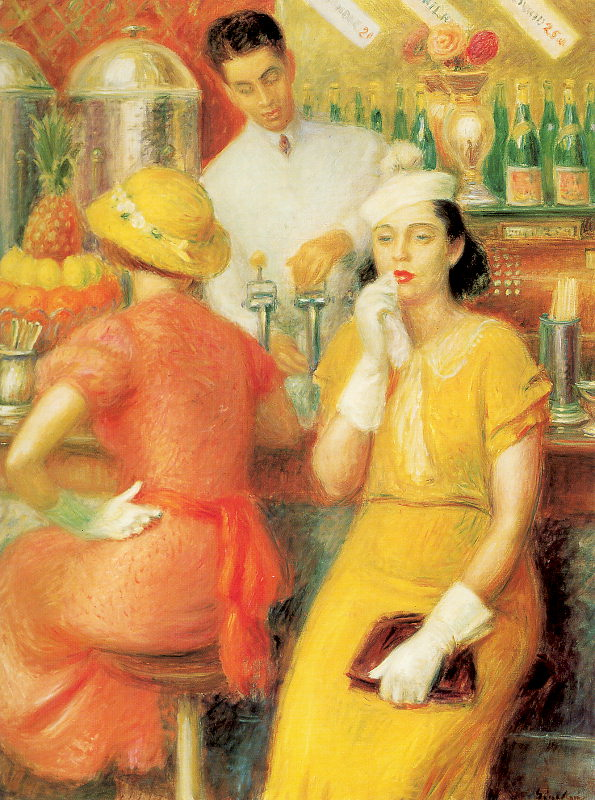
Soda Fountain by William Glackens (1935)

On Feb. 17th, 1913, the International Exhibition of Modern Art opened at the 69th Regiment Armory on Lexington Avenue in New York. The Armory Show, as it came to be known, had a profound effect on American art.  William Glackens helped to organize the American section of this ground-breaking exhibition but later reflected on how the American art was somewhat inferior to the European submissions. He voiced his opinion:

“…Everything worthwhile in our art is due to the influence of French art. We have not yet arrived at a national art […] I am afraid that the American section of this exhibition will seem very tame beside the foreign section. But there is a promise of renaissance in American art…”

William Glackens in his studio (c.1915)

Although he liked the modern and much more abstract European works Glackens maintained his love of painting scenes of everyday life and always remained a realist artist. During the inter-war years Glackens made a number of trips to Europe buying European works to enhance the Barnes collection. Glackens died of a cerebral haemorrhage on May 22nd 1938 while spending a weekend visiting fellow artist Charles Prendergast in Westport, Connecticut. He was 68.

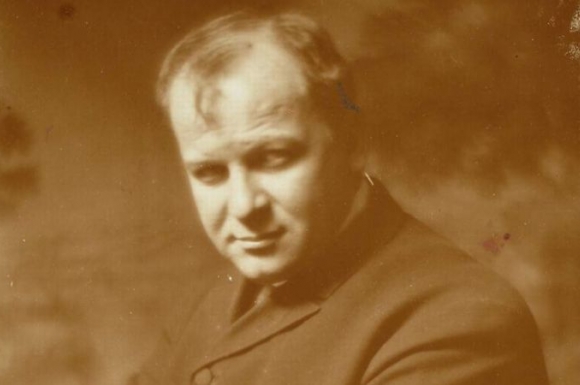
George Benjamin Luks

The artist I am looking at today is an American who was mainly known for his social-realist paintings and illustration.  Today’s painter supported several of his contemporaries in their philosophy of painting subjects which challenged the traditional approaches put forward at the time by the National Academy of Design and the established art circles in America.  This art renegade is George Benjamin Luks and he became a leading figure in the New York art world in the early part of the 20th century.

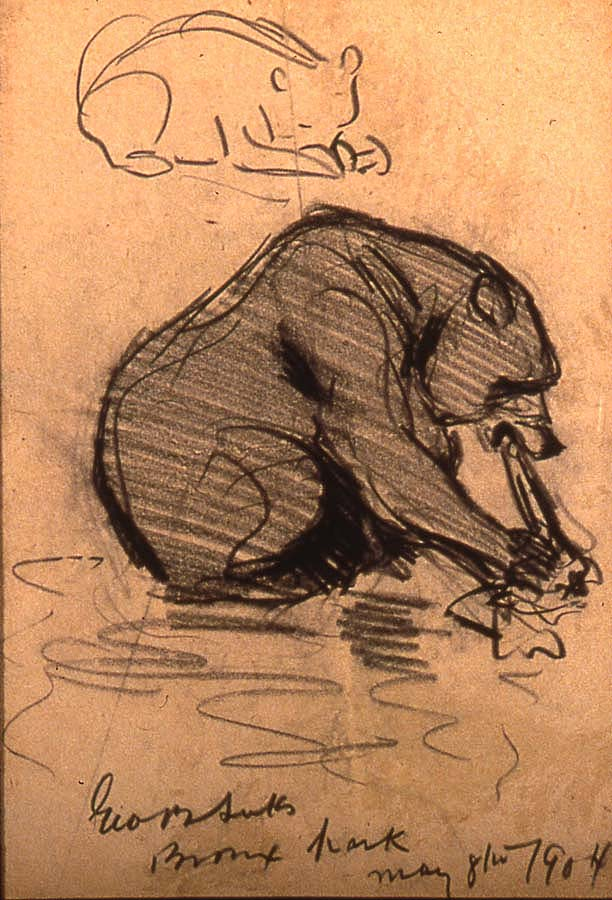
Bear by George Luks (1904)

George Luks was born on August 13th, 1867, in Williamsport, Pennsylvania.  He was the son of Emil and Bertha Luks who were both amateur painters and both encouraged their son’s inherent artistic talent by providing him with his earliest artistic tutoring.  When George was still a young child, the family moved some fifty miles south-east to Pottsville, a town in the heart of Pennsylvania’s coal region.  It was here that his father, a physician, tried to help the coal-miners and their families and was a supporter of a group known as the ‘Molly Maguires’, a secret organization of Irish-Americans that tried to improve conditions for the area’s miners.  As George grew up, he became aware of the poverty-stricken lives of the miners and their families.  This early exposure to the hard lives of the mining community had an effect on Luks and his works of art which often depicted impoverished families in naturalistic surroundings.

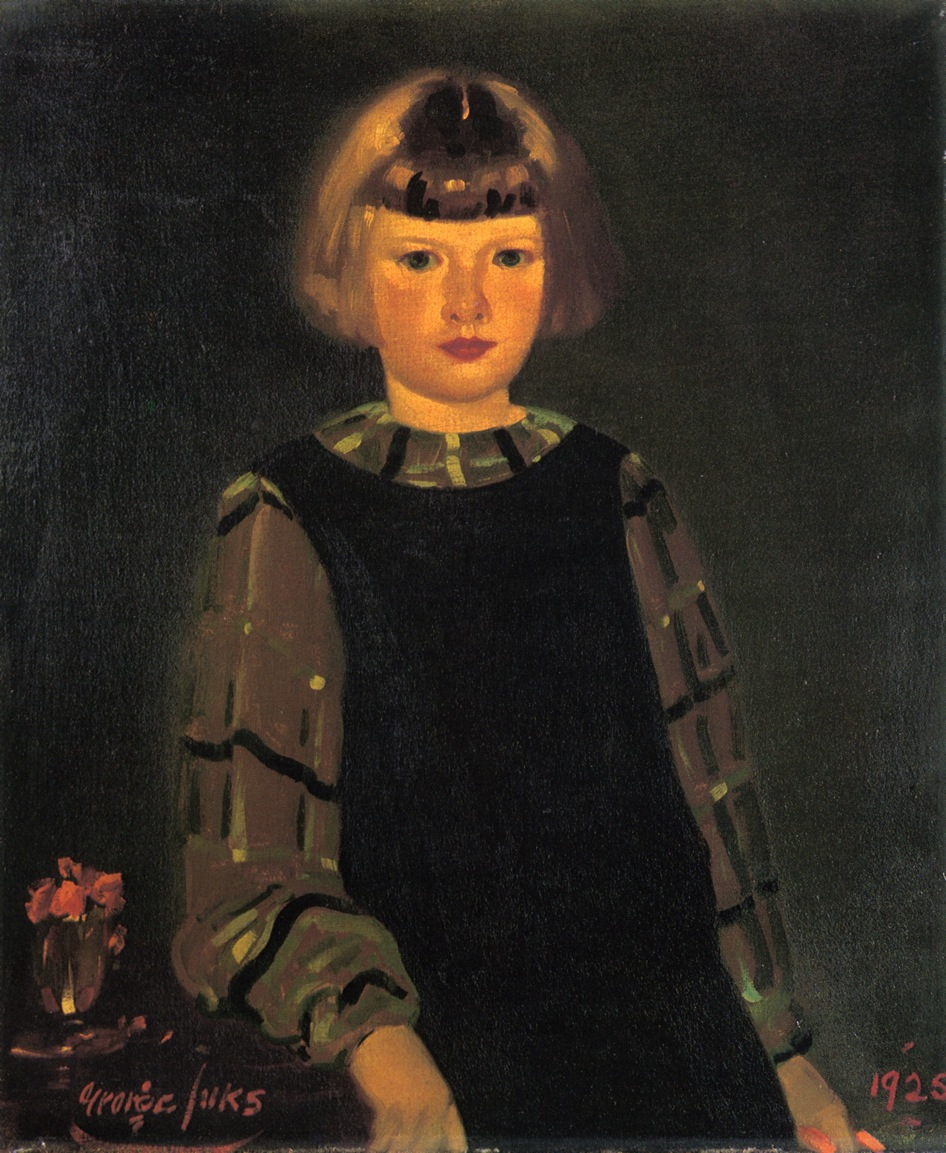
Portrait of Miss Ruth Breslin by George Luks (1925)

George Luks’ earliest job was in vaudeville.  He and his brother took part in the Pennsylvania and New Jersey vaudeville circuits while still in their teens.  However, even as a teenager, he was determined to become a professional artist and so his vaudeville career ended.  In 1884, at the age of seventeen, he enrolled in the Pennsylvania Academy of Fine Arts, where he was tutored by the painter, Thomas Anshutz, but his rebellious nature resisted the rigors of formal study, and he withdrew after a short stay.

London Bus Driver by George Luks (1889)

Luks then visited Europe and set about visiting Germany, England and France attending several of the city’s art schools.  One such school was the Kunstacademie in Dusseldorf, but his stay there as a pupil did not last long for the same reason that he departed the Pennsylvania Academy of Fine Arts – his dislike of the high standards and inflexibility of the rules of the establishment.  This mindset would stay with him all his life.  He then headed for Paris and London.  Throughout his European sojourn he was greatly influenced by European painters such as Velazquez, Manet, Rembrandt but in particular the Dutch painter, Frans Hals.

The Little Madonna by George Luks (1907)

On his return to America in 1890 he began to earn money as a newspaper illustrator and in 1894 he started at the Philadelphia Press and Philadelphia Evening Bulletin, where he produced “at-the-scene sketches” which later became illustrations to go alongside the news stories.   This was Luks’ forte as he was both a talented draftsman and had a meticulous eye for recording details of events.

Havana by George Luks (1896)

He and fellow illustrator at the Philadelphia Press newspaper, Everett Shin, moved into a one-room flat in the city.  Whilst working at the newspaper Luks became friends with the artists John Sloan and William Glackens.  These four painters and illustrators would have weekly get-togethers at the studio of Robert Henri, a renowned artist who was several years their senior, and who emboldened his younger friends to ponder over the necessity for a new style of painting.  Henri’s vision was that this new artistic style would express the essentials of their own time and experiences and would counter the limitations imposed by the present conservative art establishment.  Henri told his friends that they should be depicting scenes of ordinary life and discard the current trends of portraying life as a genteel existence.  Robert Henri and his four new friends with their new ideas regarding the direction of American art, collectively became known as the Philadelphia Five.

In 1896, the Philadelphia Press sent Luks to Cuba to cover the Spanish-American War as a newspaper correspondent/war artist.  On his return to America, he re-located to New York and joined the newspaper, New York World, under publisher Joseph Pulitzer.  Luks began at the newspaper employed to draw the comic strips, such as The Yellow Kid and Hogan’s Alley.  It was during this period that Luks began to devote more time to hone his painting skills, and six years later, in 1902, he abandoned newspaper work to concentrate all his energies to painting. 

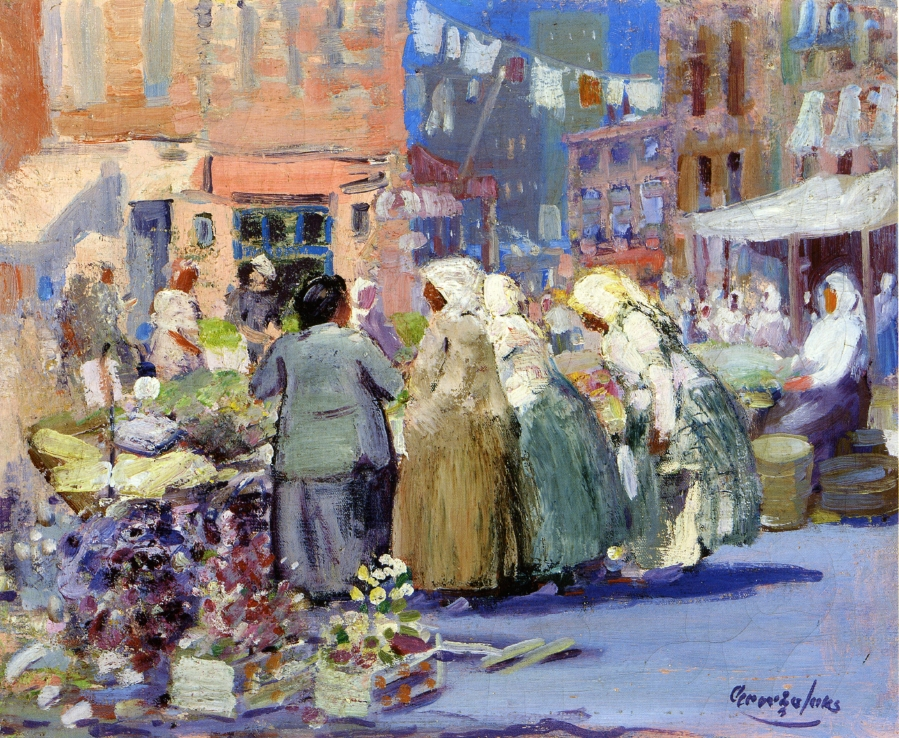
Street Scene (Hester Street) by George Luks (1905)

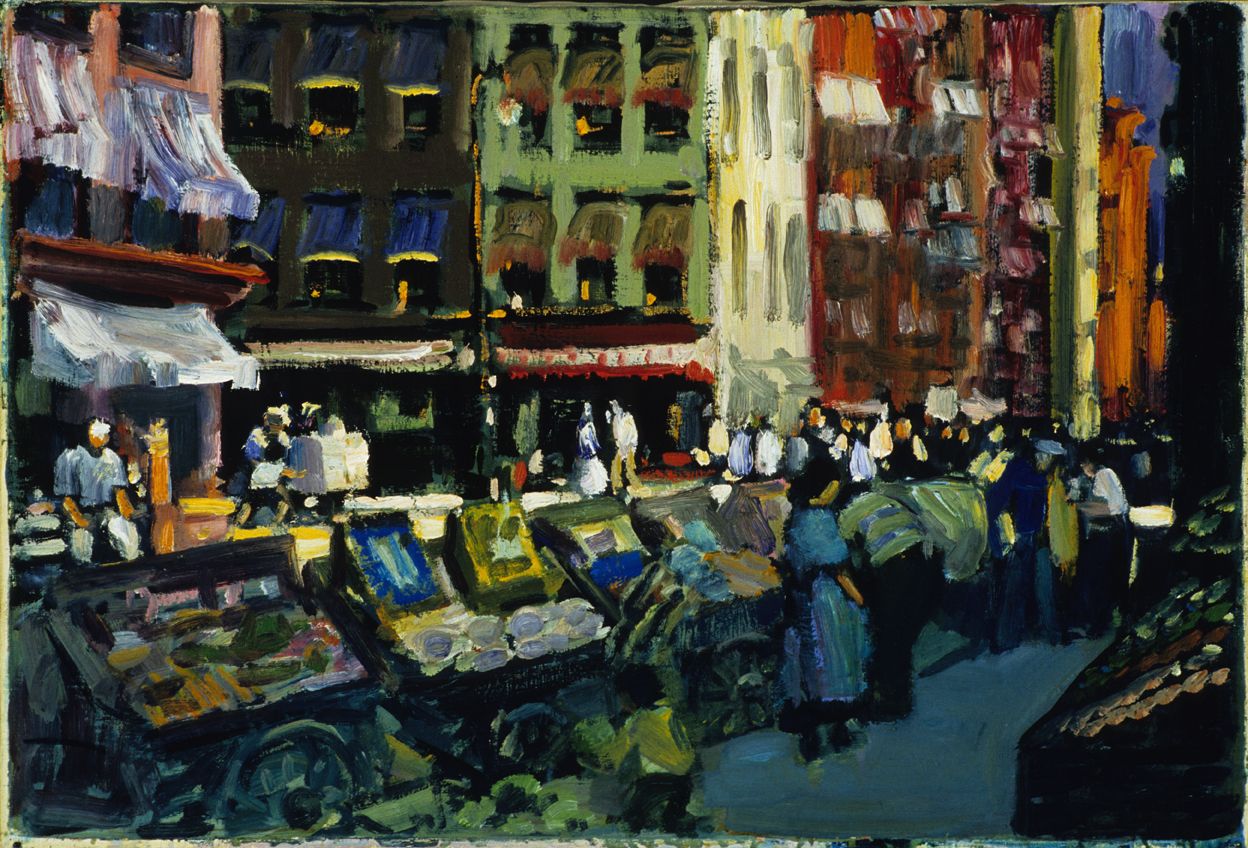
One of his most famous paintings was his 1905 work entitled Street Scene (Hester Street).  The setting is a push-cart market on Hester Street on the Lower East Side of Manhattan, an area of the city which was packed with recent Jewish immigrants.  From our viewpoint looking down the street we see a crowd of shoppers, both men and women and in the foreground we see children, milling around a toy pedlar, searching for bargains.  Many art historians have judged the depiction to be a compassionate pictorial essay of Jewish life.  We see the people in profile, and Luks has paid particular attention to skin colour and the physical features of the people in the crowd, while the subject matter relates to a series of caricatures of Jewish peddlers. It is a congested depiction and we only get small glimpse of the blue sky in the middle background. In the middle-ground we see the darkly oppressive inexpensive tenement blocks, in which were apartments that were so designed to house hundreds of these people, maximising the profits of the landlords.

Allen Street by George Luks (1905)

Another of George Luks’ 1905 Lower East Side paintings was entitled Allen Street. Between 1880 and 1920, more than twenty million immigrants came to America, making it the greatest period of mass migration in American history. At the time Luks painted these Lower East Side street scenes it was home to approximately half a million Jewish immigrants, who had fled economic hardship and political violence within the Russian Empire. At the time it was the most densely populated place on earth.  Sadly, with this sudden influx of Jews into the area came a rise in nativism, the protection of the interests of native-born or established inhabitants against those of immigrants, and anti-semitism.

Luks had produced antisemitic caricatures, above is an example, for several publications during the 1890s, and the emphasis on racist stereotypes about Jewish physiognomy  can be seen in the painting, Hester Street.

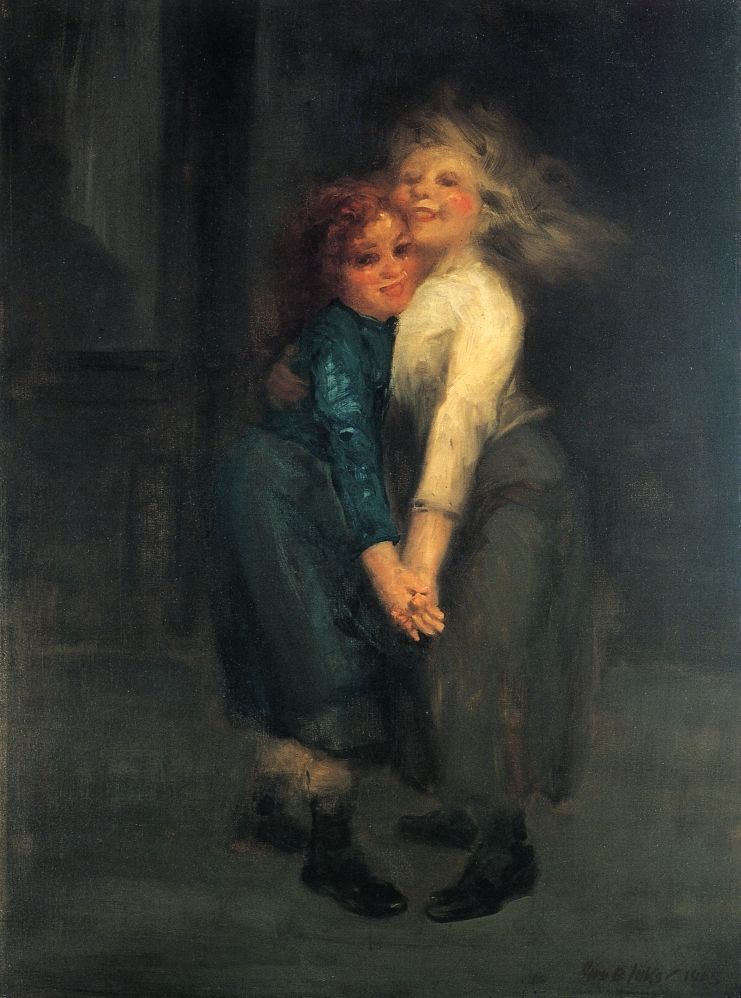
The Spielers by George Luks (1905)

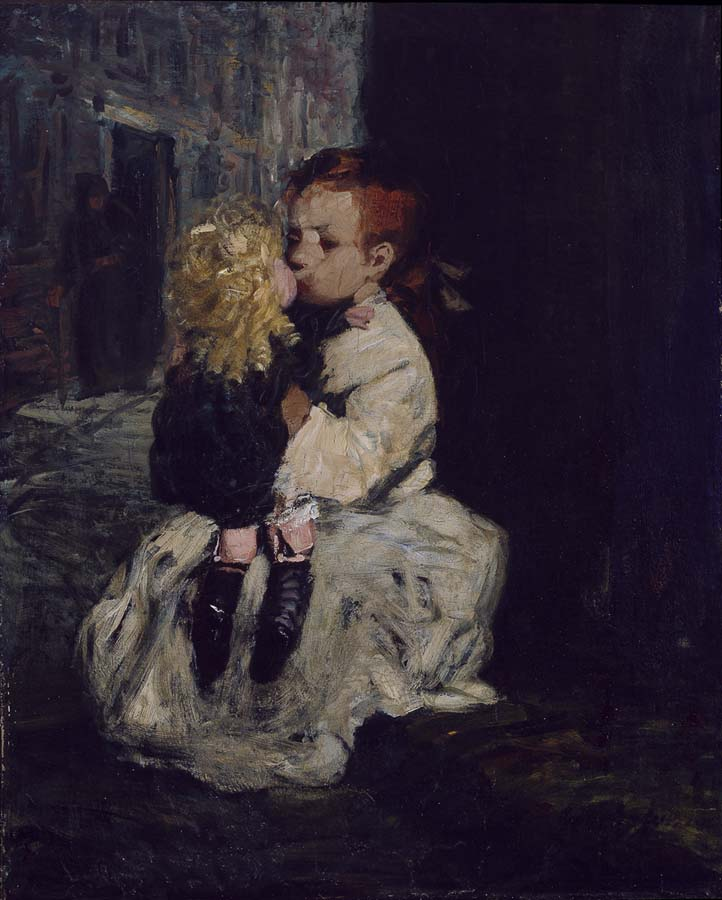
Despite the hardship of life whilst living in the overcrowded tenement block Luks also wanted to depict a modicum of joy displayed by some of the younger residents.  His 1905 painting entitled The Spielers (from the German word spielen – to play) was one of his favourites works and when, in 1907, he gave it to his dealer, William Macbeth to sell, he said he wanted $2000 for it.  His dealer was dismayed at such a high price. When it was displayed at Luks’ 1910 solo exhibition at the Macbeth Gallery in New York, critics called it an artistic masterpiece.  Luks sold it direct to a collector but it is not known whether he achieved his $2000.  In an article in the New York Times Magazine on February 6th, 1916, the art critic James Huneker praised the work in his article George Luks, Versatile Painter of Humanity wrote:

“…The east side is yet to boast its Dickens. And Dickens would have enjoyed the picture of the little tousled Irish girl with her red locks who dances with the pretty flaxen-haired German child, surely a baker’s daughter of Avenue B. Now you might suppose that this vivid art, this painting which has caught and retained the primal jolt and rhythm of the sketch, might be necessary rude and unscientific in technique. It is the reverse. This particular picture is full of delicious tonalities. The head of the blonde girl might be from an English eighteenth century masterpiece…”

This simple painting of two girls dancing together more than any other work by Luks, made his reputation.

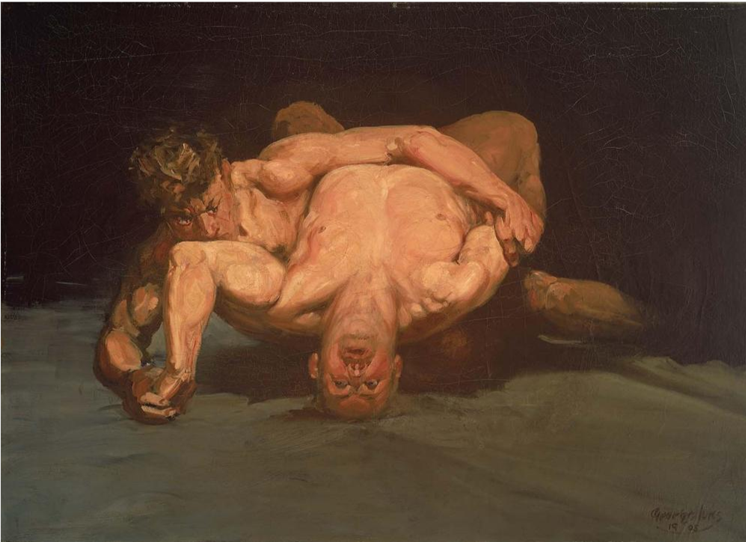
The Wrestlers by George Luks (1905)

Some art critics had voiced an opinion on Luks’ figurative work saying that he was not good at depicting human anatomy.  It is thought that Luks’ baulked at this sleight on his ability and in 1905 produced a complex painting of two nude wrestlers, so as to counteract their criticism. The painting is now housed in the Museum of Fine Art, Boston, which described the work:

“…The artist’s perspective was radical for the time. Luks’s composition effectively presses the viewer to the edge of the wrestling pit, thereby emphasizing the down-at-heels setting. The jarring vantage point also evokes the sweaty underbelly of modern urban life, a theme for which he and fellow members of the Ashcan School would become known.  Luks’s scene of entangled human flesh under duress is reminiscent of the sporting scenes that fellow Philadelphian Thomas Eakins painted, in particular Eakins’s 1899 Wrestlers (Los Angeles County Museum of Art). Whereas Eakins depicted a wrestling hold with the impassive eye of a painter rendering a studio model, Luks conveys the passion exuded by the heaving torsos. Eakins applied carefully blended strokes of pigment, building up solidly modelled forms after the manner of his studio training with the French academic painter Jean-Léon Gérôme. Luks, in contrast, enlivens his figures with energetic brushwork and thick impasto. Luks’s familiarity with the popular press, gained from his work for illustrated periodicals, may have inspired the sense of immediacy he suggested—brilliantly illuminated flesh is thrown into relief against the dark background as though caught in a reporter’s flashbulb.  The opponent at the left also recalls the terrifying visages of the early-nineteenth-century Spanish painter Francisco Goya’s so-called Black Paintings (Museo Nacional del Prado, Madrid), in which humans are transformed into ghouls. Luks portrays a distinctive type among the multitudes in New York City, in this case an aggressive athlete. Once again, his training as a newspaper illustrator likely honed his astute sensitivity to physiognomy, and here the thickly furrowed brow, devilish eyes, and flushed complexion suggest the bellicose personality befitting a pugnacious wrestler…”

Known originally as The Five, of which Luks became a member.  Then it became collectively known as The Eight, which was made up of the original five members with the addition of Arthur B. Davies, Ernest Lawson, and Maurice Prendergast.  Then The Eight eventually became known as the Ashcan School.  . The name “Ashcan” was originally coined by critics of the movement to deride the surplus of refuse bins in the artists’ pictures and the perceived dirtiness of the subjects at large. Robert Henri, the leader of the movement and its spiritual father was blunt of what he wanted to achieve. He said he wanted art to be akin to journalism… he wanted paint to be as real as mud, as the clods of horse-shit and snow, that froze on Broadway in the winter. Many of this group’s works were rejected when submitted to exhibitions of the powerful, conservative National Academy of Design and this motivated The Eight to form their own exhibiting group.  Their exhibition at the Macbeth Galleries in New York in January, 1908 was a significant event in the promotion of twentieth-century American art. 

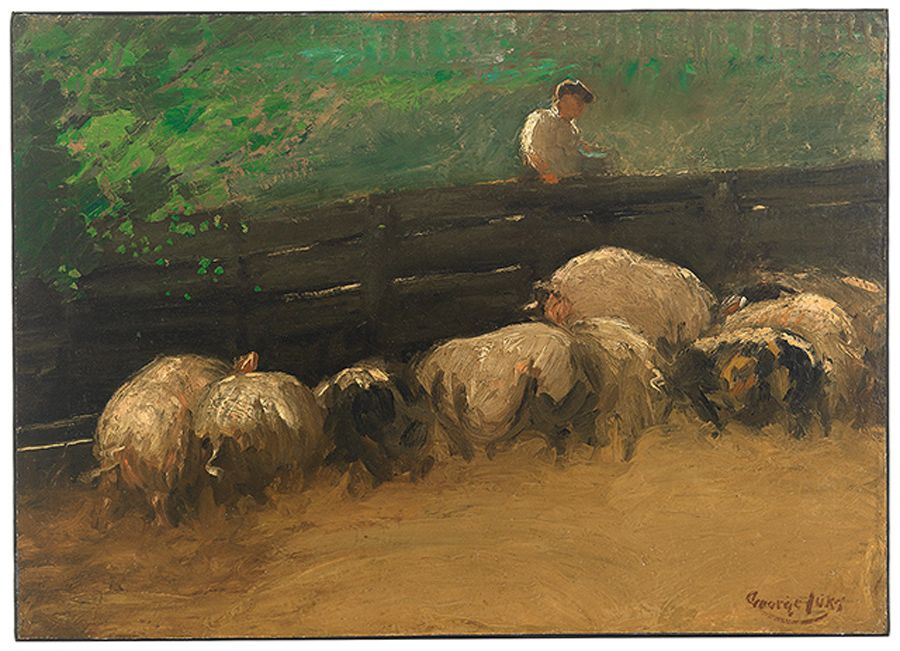
Feeding the Pigs by George Luks

Following the success of the New York exhibition John Sloan organized a traveling exhibition that brought their paintings to Chicago, Indianapolis, Toledo, Cincinnati, Pittsburgh, Bridgeport, and Newark.  These travelling exhibitions had people talking the new realism that the Ashcan School represented.  George Luk’s paintings Feeding the Pigs and Mammy Groody were seen as examples of this new ‘earthiness’ that many art lovers were not yet ready to accept.  The Ashcan movement threw down the gauntlet and confronted the academic art institutions, and as a result, during the 1910s the authority of the National Academy of Design as a cultural authority began to wane.  The Ashcan painters played a an essential role in developing the nation’s sense of what were to be considered suitable subjects for free artistic expression.

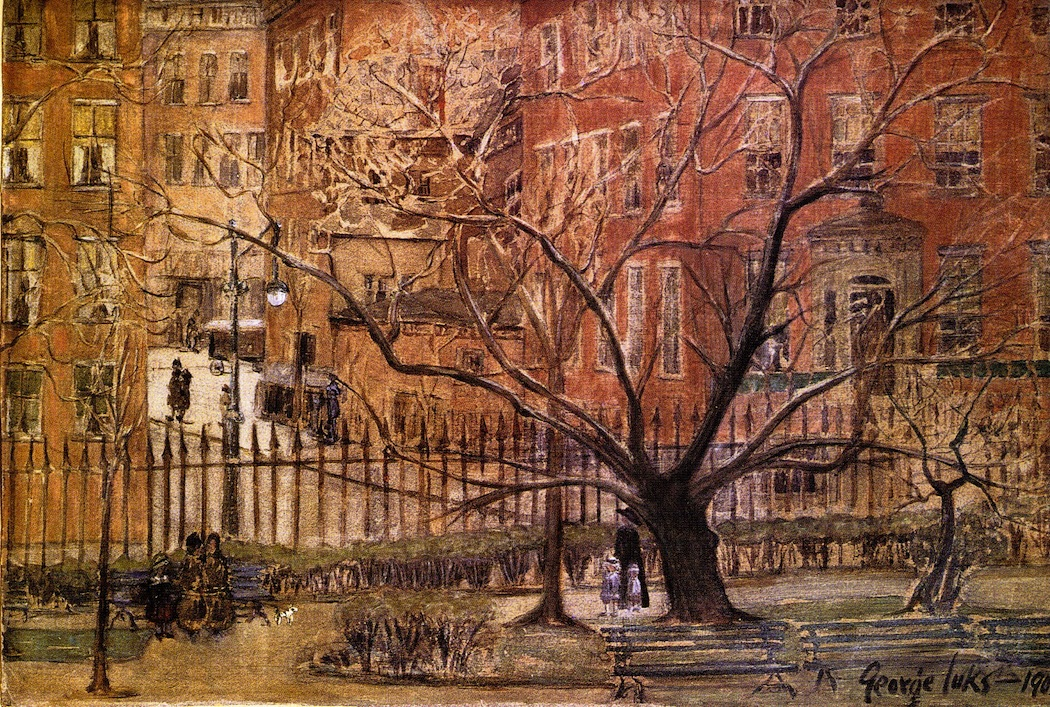
Gramercy Street by George Luks (1905)

As a member of The Eight, George Luks created works in vivid bravura manner that captured the spirited energy of the tenement districts of New York and their occupants. The American Art historian, Milton Brown wrote about George Luks’ works in his 1955 book, American Painting from the Armory Show to the Depression:

 “…In his art and in his character, he symbolized the spirit of American dynamism; as aggressive as a tycoon, as brash and boastful as a ‘drummer’. . . he was a swashbuckler in paint. This was not, of course, the cultured tradition of American life; it was rather the expression of a cruder side of America, an echo of the frontier…”

Hannaford.s Cove by George Luks (1922)

George Luks is best known for his depictions of New York City life, but he also painted many landscapes.

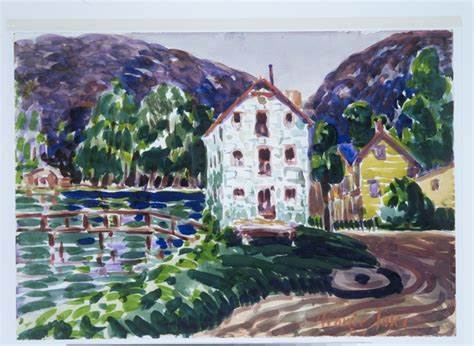
Old Gristmill, The Berkshires by George Luks (1925)

There are several landscapes of the Berkshire Mountains in Massachusetts that follow the Impressionist tradition.  One such work is his painting Old Gristmill, The Berkshires which he completed in 1925.   However, Luks was far happier living a city life.  

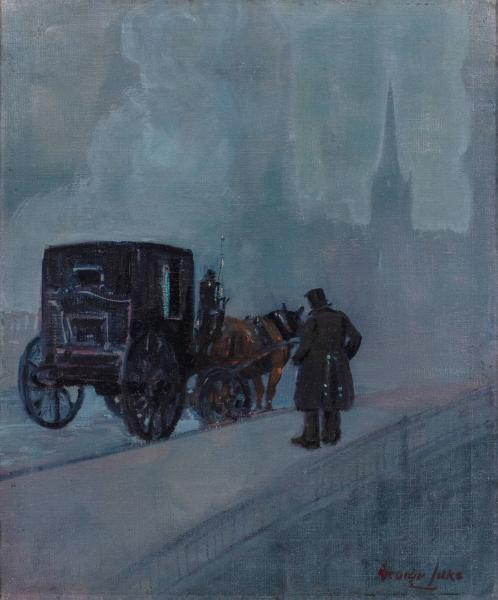
Foggy Night by George Luks (c.1925)

Luks’ painting Foggy Night which he completed around 1925 captures his urban vision during his many walks around the city. He was fascinated by what he saw.  In this depiction of an overcast night in New York, there is an eerie stillness about the scene.  We see a lone cab driver who has stopped his horse-drawn carriage on an otherwise empty bridge.  In the distance we can just make out shadowy buildings and the spire of a church. The city has been overwhelmed by the misty atmosphere and darkened by the nocturnal setting.

Spring Morning Houston and Division Streets by George Luks (1922)

George Luks was married twice but had no children. He was as famous for his paintings as he was with his mood.  He was said to be loud, boastful of his boxing prowess but a good-humoured man, and was a notoriously heavy drinker.  On October 29th, 1933, he was found dead in a Manhattan doorway at 6th Avenue and 52nd Street, a casualty of a bar-room brawl.  He was 66.  Luks was buried at Fernwood Cemetery in Royersford, Pennsylvania.  He was dressed in an 18th-century embroidered waistcoat, which was one of his most valued possessions. His death was reported in the New York Times and the reporter wrote:

“…His canvasses were invariably virile; his versatility was astonishing, and he painted as he lived, contemptuous of conventionalities, impatient with snobbishness and full of joy of life that so many of his paintings reflected…”

The War Series by George Bellows

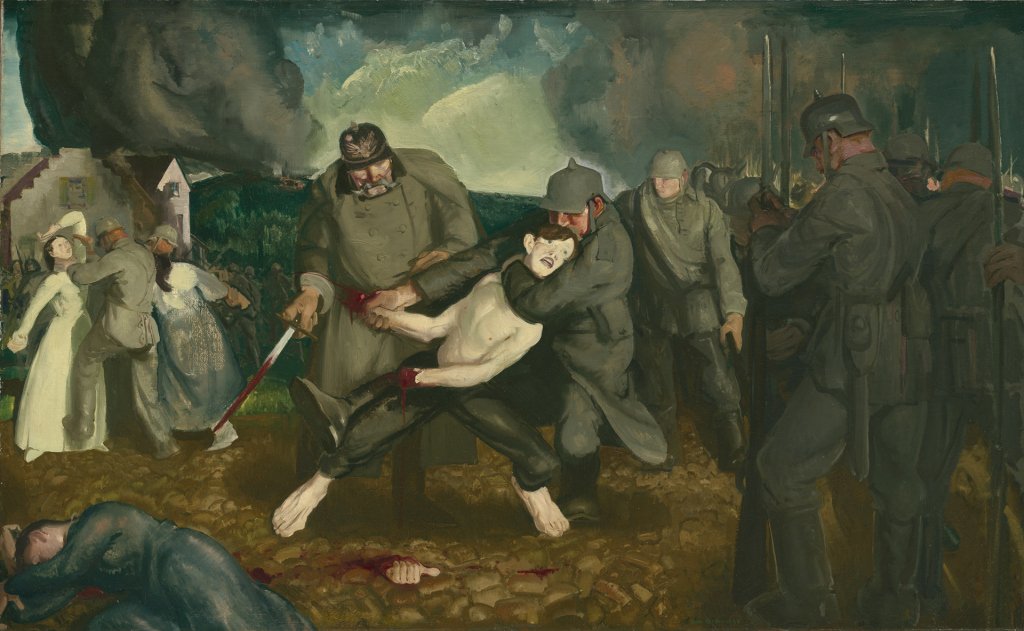
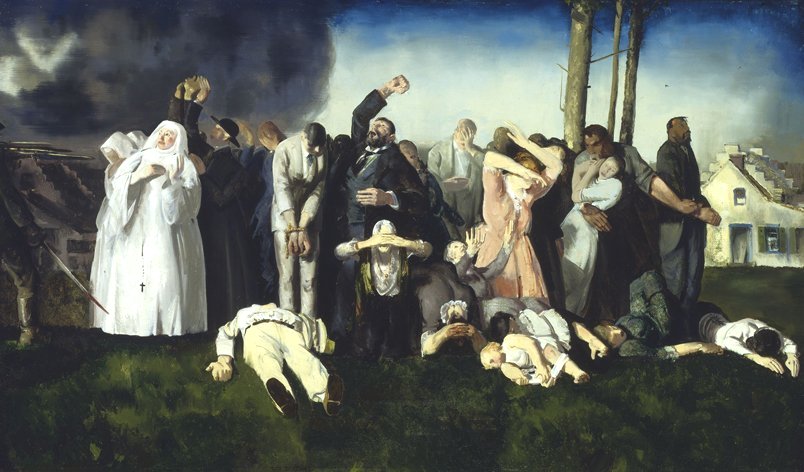
Massacre at Dinant by George Bellows (1918)

Another exhibition I recently attended whilst in London was one which showcased some of the works by the influential American realist painter, George Bellows.  To me, before I saw this collection of his work, the art of George Bellows was all about his wonderful boxing match scenes and the haunting look at the Pennsylvania Station excavation in New York so I was delightfully surprised by the amazing variety of his works, which were on view.  Today I want to look at a series of paintings and lithographs he completed in 1918, which highlighted German atrocities in the First World War.   Some of these works were on display at the Royal Academy exhibition.  The paintings, when they were first exhibited, shocked the people who saw them and the series caused some controversy, which I will talk about later.

The story behind his War Series paintings was of the German invasion of Belgium during the First World War and depicted some of the atrocities carried out by the invading German troops.  The Belgian town of Dinant, which lies on the Meuse River, was overrun by the German Third Army, led by Lieutenant General Baron Max Klemens von Hausen on August 23rd 1914.  Dinant fell to the German invaders but according to German reports some of the German soldiers, whilst repairing a bridge in the town, were fired upon by locals.  A swift and bloody retribution followed.  The German troops rounded up 612 local residents in the main town square.  This group consisted of men women and children.  In the double Pullitzer Prize Winner, Barbara Tuchman’s 1963 book The Guns of August, she wrote that among those executed that day was Felix Fivet, aged just three weeksold.  The town was then ransacked by the occupying army.

Unlike how it is nowadays, there were no television crews following the battle to send back live feeds of the war with all its brutality.  There were no newspaper pictures of the massacre of Dinant, so how did Bellows and the world hear about this horrific event?  A month after the atrocities in Dinant, the Belgian Government put out three reports on German war crimes committed during the invasion of their country.   The contents of these reports shocked all those who read them and in Britain both Parliament and the newspapers clamoured for an independent British commission to be set up to investigate the atrocities.  The British Prime Minister at the time, Herbert Asquith, bowed to public opinion and set up an inquiry.  In December 1914, James Bryce was asked to chair what was termed, the “German Outrages Inquiry Committee”, which would look into all material and take witness statements appertaining to the massacre of Belgium citizens and to the complicity of the German officers into the behaviour of their troops during the summary executions of civilians.  James Bryce, 1st Viscount Bryce, was a British academic, historian and Liberal politician and had been, from 1907 to 1913, the British Ambassador to the United States of America and was on friendly terms with the then Presidents, Theodore Roosevelt and Woodrow Wilson.

The report of the Committee was published on May 12th 1915 and the conclusion was that atrocities had been committed by the German army in order to strike terror into the civil population which would, in turn, dishearten the Belgian troops.  The Germans believed that it would quash resistance and extinguish the very spirit of self-defence. The Commission also stated that the German report of the townsfolk firing on German troops was simply used to justify the murder of large numbers of innocent civilians.   However, there was one problem with the compiling of the Commission’s report and this was the documenting of the 1200 eye witness accounts which had been correlated by a team of English lawyers.  A large number of these were excluded as the committee were mindful that their findings had to be reliable, credible and truthful.   For that to happen, the Committee stated that many of the depositions collected had to be omitted, although they were probably true, as they believed that it was much safer not to place reliance on them.   The committee ended their report by concluding:

“…Our function is ended when we have stated what the evidence establishes, but we may be permitted to express our belief that these disclosures will not have been made in vain if they touch and rouse the conscience of mankind, and we venture to hope that as soon as the present war is over, the nations of the world in council will consider what means can be provided and sanctions devised to prevent the recurrence of such horrors as our generation is now witnessing…”

The report was translated into many languages and circulated throughout the world.   Some later historians believed that the Bryce Commission report was a piece of propaganda and that the lurid accounts of German atrocities were designed to bolster the resolve of those already fighting in the war and to encourage those countries, including the powerful USA, to end their neutrality.

America had declared its neutrality in 1914 with Woodrow Wilson making his speech to the nation on August 18th 1914.  In the speech he said:

“…I venture therefore my fellow countrymen to speak a solemn word of warning to you against that deepest, most subtle, most essential breach of neutrality which may spring out of partisanship, out of passionately taking sides.   The United States must be neutral in fact as well as in name during these days that are to try men’s souls.  We must be impartial in thought as well as action, must put a curb on our sentiments as well as upon every transaction that might be construed as a preference of one party to the struggle before another…”

The United States of America finally gave up its stance of neutrality in April 1917.

So what has this report to do with the George Bellow paintings?  The answer is that Bellows based the depictions in his paintings on the Bryce Commission report.   In 1918 Bellows created a series of works, known as his War Series, depicting German war atrocities in order to stir outrage and embolden America in World War I.   The set consisted of five large paintings, which were his largest works ever completed.   Besides these oil paintings he also completed 20 lithographs and 42 drawings about the Great War.   At the time war paintings tended to focus on the heroic victors and glory in battles won and so Bellow’s War Series was a complete turnaround and many found them offensive.

Another artist, Francisco de Goya, a century earlier, had produced works highlighting the brutality of war.  In all he completed eighty-two etchings between 1810 and 1820 but,for political reasons, they were never exhibited until 1863, some thirty-five years after Goya’s death.  They depicted not only the atrocities of the French army which had invaded Spain but the inhuman treatment men inflicted on their fellow men.  Prints of these works by Goya would have been on display at galleries in New York and it is very likely that George Bellows would have seen them.

One Can't Look by Francisco de Goya (1863)
One Can’t Look by Francisco de Goya (1863)

In Bellow’s work, Massacre at Dinant, we see the foreground is littered with the dead bodies of women and children.  In the background we see the skies darken at the moment of death.  In the centre of the painting we see the clergy with their arms stretched aloft beseeching an end to the killings.  Their pleas fall on deaf ears and they are powerless to prevent the massacre.  It is a brutal depiction and horrifies all who stand before it. Although Bellows has not depicted any German soldiers in the painting, if one looks to the far left of the work one can see their bloody bayonets and rifles appearing on the scene.   This depiction of the “approaching” rifles could be taken directly from one of Goya’s lithographs entitled One Can’t Look (No se puede mirar), in which we see the bayoneted rifles just coming into the right hand side of the etching.

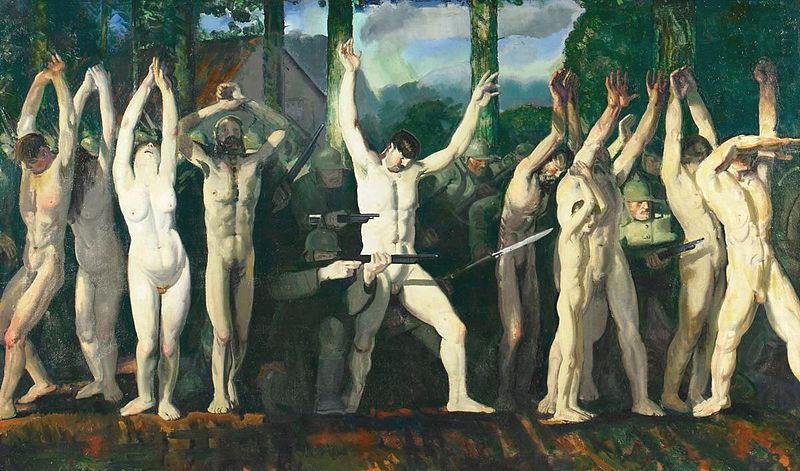
The Barricade by George Bellows (1918)

Another painting from his War Series was entitled The Barricade, in which we see a line of naked human beings, arms held aloft, acting as human shields for the uniformed German soldiers, with their guns raised, who stand and crouch behind them.   As a propaganda piece it worked well evoking both pity and rage in the mind of the viewer.  The message to the American public was clear – can we stand by and let this kind of thing happen or should we join the battle and end such atrocities.

Return of the Useless by George Bellows (1918)

In his painting Return of the Useless, Bellows depicted Germans soldiers unloading sick and disabled labour-camp prisoners from a rust-red boxcar.   These were Belgian citizens who were being returned home as they were no longer physically fit to work for the Germans.   Box-cars were familiar sights on the American railroads but this work depicted the box-car as a transport system for German prisoners.    Look how Bellows has cleverly used the same colour, red, for the rusty box-car as he used for the flushed face of the German soldier who is venting his anger on the fallen and cowering man and the bloodied skin of some of the prisoners.  Cast your eyes towards the interior of the box car.  Here we see an elderly man supporting a young female who is on the point of collapse.  Another woman sits on the floor her arms wrapped around a child.  A young woman is stepping out of the boxcar and her arms are raised in horror as she watches the German guard bring down the butt of his rifle on to the fallen man, who pathetically looks up and begs for mercy.

The Germans Arrive by George Bellows (1918)

The Germans Arrive, another painting in the series, was based on an actual account from the Bryce Commission and gruesomely illustrated  a German soldier restraining a young Belgian teenager whose hands had just been severed.   This and the other paintings in the series suffered much criticism accusing Bellows of taking liberties when capturing on canvas, the horrific scenes of war. One notable detractor was the American artist and author,  Joseph Pennell, who argued that because Bellows had never been at the battlefront and therefore had not witnessed at first hand the events he painted, he forfeited the right to paint them. Bellows responded sarcastically that he had not been aware that the great Leonardo da Vinci “had a ticket of admission to the Last Supper”.

The final painting in his War Series is entitled Murder of Edith Cavell.   Edith Cavell was head of the Training School for Nurses in occupied Brussels.

Murder of Edith Cavell by George Bellows (1918)

On August 5th 1915, she was arrested for assisting Belgian, British, and French soldiers to escape from the country. Two months later, she was shot by the German authorities. News of her execution spread round the world, and in October of that year, The New York Times published 41 stories and her case became a cause célèbre.   George Bellows included this incident in a series of 12 lithographs and one full scale painting for his War Series.    In 1959 the Princeton University Art Museum found and acquired Bellow’s finished, full-size drawing (53.5 x 68.5 cm.) for this print. It is interesting to note that Bellows did not complete the oil painting of the scene until after he had finished the full scale drawing and lithograph print.  The painting now belongs to the Springfield Art Museum in Springfield, Massachusetts.

The work depicts a dark and somewhat chaotic prison cell with its grates and bars covering the windows and door.   We see on the flight of stairs leading down to the room the angelic figure of Cavell, dressed in white with her hand to her breast, enacting the classic gesture of humility.  Behind her and to the left, on a landing, we can see some soldiers and a priest clutching his bible. At the foot of the stairs there are more soldiers, one of whom holds a sword.   On the floor in the foreground we see some wounded prisoners lying on the floor guarded by soldiers in the left foreground.

George Bellow’s War Series paintings and lithographs, which he completed in the summer of 1918 whilst he was residing at his home in Middletown, Rhode Island, were ambitious in nature in the beloved tradition of grand manner history works.  His intention was to stir up both the public’s outrage and sympathy.  However the credibility of the images depicted in these paintings went hand in hand with the credibility of the Bryce Commission Report and that was to be called into question after the war had ended.  Many of the reports of German atrocities were then looked upon as merely Allied propaganda, simply designed to bolster the resolve of those Allied nations which were participating in the war and to encourage those nations to commit to the war effort , which up until then, had preferred to remain neutral,   Later, many Americans believed that their country had been tricked and manipulated into joining the conflict and unfortunately for George Bellows he and his War Series were regarded as part of this deception.  In 1925, the American art critic and historian, Virgil Barker commented on the series saying:

“…[they were] ill-judged in their appeal to the passion of hatred as anything produced in America’s most hysterical war years…”

However I will close with a more favourable comment on the War Series.  The art critic G.D.Cotton saw the initial exhibition and wrote about the works in the American Art News in September 1918.  He commented:

“…[the works] are brutal, full of horror, but reeking with truth, which adds to their poignancy.   After one has recovered from the shock of the subject themselves one sees that the pictures are full of strange beauty, conceived in bigness of vision that is rare and inspiring.  The whole exhibition is one to stiffen the spines of the enlisted men who are here and make them realize what they face ‘Over There’…

I can sincerely recommend you go and see the George Bellows exhibition at the Royal Academy of Arts, London which runs until June 9th 2013.  See what you make of these War Series paintings and lithographs and at the same time, take in many of Bellow’s other beautiful works.

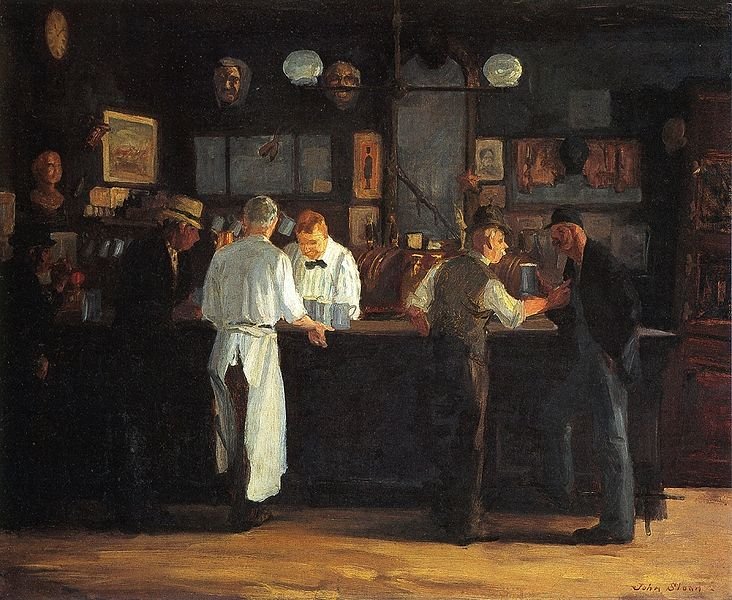
McSorley’s Bar by John Sloan

McSorley's Bar by John Sloan (1912)

I have looked at many paintings which have featured inns and taverns but they have been mainly been depictions of rural scenes with peasants in the Netherlands and Flanders and were painted by the Dutch and Flemish painters centuries ago.  Today, for a change, I am looking at a genre painting of a tavern scene but this is not really a tavern, more what we British would call a pub or Americans would term a bar or a saloon.  The title of the painting is McSorley’s Bar and was painted by the American artist John French Sloan.  Sloan was originally a member of a group of artists who had the strange collective name of The Eight and later he became a leading figure in the Ashcan School of realist artists.  I have featured works by these artists in earlier blogs and if you enter either Ashcan School or Robert Henri or George Bellows into the “Search” function at the right of this blog it will give you a little bit of history about these artist groups.

John French Sloan was born in New York in 1871.  His father James had had an interest in art, but as only as a hobby but he did encourage his children to draw and paint during their early years.  Sloan’s father struggled to find gainful employment moving from one job to another without ever making a fortune.  He married, Henrietta, a girl who had come from a much more financially prosperous family and who was a teacher.  James Sloan suffered a mental breakdown when John was seventeen years of age and consequently was unable to work and the burden of supporting the family fell on to the shoulders of the seventeen year old John.  For this reason, John Sloan had to leave school and find a job in order to bring in some money for the family.

Sloan was employed in a local bookstore as an assistant cashier.  The job was not very taxing and the young man had time to read the books that were on sale at the emporium and also spend time studying the artistic prints that it also held.  It was during this time that Sloan started to make pen and ink copies of some of the prints and the store owner liked them so much that he allowed Sloan to put them up for sale in the store.  Two years later in 1890 Sloan moved on to work in a stationery store where he used to design calendars and greeting cards.  Sloan had now found the joy of art and enrolled in an evening art class.  Buoyed by his artistic successes he left the stationers and set himself up as a commercial artist but his well-intentioned venture failed and he took a job as an illustrator at the local newspaper offices of The Philadelphia Enquirer, later he would work for the rival newspaper, The Philadelphia Press.    He continued his artistic tuition in the evenings by enrolling at the Pennsylvania Academy of Fine Arts.  It was here he met and became friends with fellow artists such as William Glackens and Robert Henri who became Sloan’s mentor, sending him reproductions of works by the French Impressionists and the leading European Renaissance painters, for him to copy.

When Sloan was twenty-seven he was introduced to a young woman with a somewhat chequered history, Anna Maria Wall, known affectionately as Dolly.  Sloan, who was very naive, very self-conscious and lacked the social graces which would gain him female companionship, met Anna at a brothel.  Although she worked in a department store during the day, she supplemented her meagre income by working in a brothel at night.  She needed the extra money to feed her other vice;  she was also an alcoholic but despite all this he fell in love with her and they started, what one can imagine, was a “challenging” relationship.

Their relationship did prove difficult as Anna not only suffered the effects of excessive and prolonged alcohol intake, she suffered from alcohol-related mental problems  and insecurity often believing Sloan was about to leave her.  In 1906 Sloan sought medical advice and was advised that he needed to constantly support Anna and show how much he needed her.  Between them they devised a plan by which Sloan would keep a dairy and in it he would write down each day how much he loved Anna and wanted to be with her and then leave the diary somewhere where she was bound to find it and surreptitiously read his journal entries and by doing so put her mind at rest.  He wrote daily entries for seven years until 1913.   Despite these problems, Sloan’s artistic work continued well and he was producing numerous oil paintings.  In 1904 he moved to New York and went to live in Greenwich Village and although relying on money he received from his freelance work for The Philadelphia Press newspaper, he supplemented that with money he earned for his book and magazine illustrations.   It was whilst living in New York, in 1912, that he painted today’s featured work McSorley’s Bar.  He exhibited it at the 1913 Armory Show, an exhibition of modern art which had been organised by the Association of American Painters and Sculptors.  This turned out to be a landmark exhibition which opened the eyes of the New Yorkers to this new modern art and the likes of cubism, who up till then had been accustomed to realistic art.   Sloan’s painting never sold and in fact remained unsold until 1932 when the Detroit Institute of Arts purchased it.  This was the first painting by Sloan to be part of a museum collection and was probably one of his best.

This painting was very typical of works by John Sloan in which he liked to depict the energy and life during the early years of the twentieth century of New York City and its inhabitants.  Sloan was a socialist and a member of the Socialist Party and had great empathy with the less well-off and their demanding and troubled existences.  His paintings would show the city’s people in different places and situations on the city streets and occasionally, like today’s painting, he would depict people in interior settings, such as cafés or bars as they discussed among themselves their everyday existence.

The painting today shows the interior of McSorley’s Bar with its clientele standing at the bar.  John Mc Sorley opened his Manhatten establishment on East Seventh Street in 1854 and during its existence in the nineteenth century, was an all-male bar.  From around 1912 it became a regular haunt of John Sloan and his Ashcan School artists.  The bar Sloan depicted was somewhat rough and inhospitable. It was always frequented by a great mix of people of various social classes and even today carpenters and mechanics rub shoulders with Wall Street brokers and local politicians.  John Sloan completed five paintings of the interior of the bar between 1912 and 1930 and these certainly increased the popularity of the establishment.   Today, McSorley’s bar draws visitors from around the world.    Its fame as New York’s oldest bar assures its survival and a 1970 court order guarantees that women are as welcome as men!   It’s a museum-like place. One can go there to drink a pint of ale and survey relics of a past era.

In 1943, Sloan’s  wife, Dolly, died of coronary heart disease. The next year, Sloan married Helen Farr, who is responsible for most of the preservation of his works. Part of this was the diary he wrote between 1907 and 1913 for his first wife, Dolly, to read and which were lovingly collated and published in 1965.  They gave a marvellous insight into Sloan’s life and his thoughts during those turbulent times.

On September 7, 1951 John Sloan died at the age of 80, of cancer in Hanover, New Hampshire.  John French Sloan was a leading figure in the Ashcan School of realist painters and was somebody who embraced the principles of socialism and allowed his artistic genius to be used to benefit those fervently upheld values.  His paintings sadly rarely sold during his lifetime and teaching at the Art Students’ League, of which he became its director in 1931, was his principal income.

To learn more about McSorley’s Bar why not go to their website:

http://www.mcsorleysnewyork.com/