The Pond at Montfoucault by Camille Pissarro

The Pond at Montfoucault by Camille Pissarro

As promised yesterday my blog today carries on looking at the life of Camille Pissarro and one of his later paintings.

In 1872 Pissarro returned to Pontoise, where he once again set up home.   His friendship with Cézanne was re-established and Pissarro mentored his friend in the technique of painting “patiently from nature”.   Cézanne was to later to comment about his relationship with Pissarro and how his mentoring made him change his artistic style saying:

“…As for old Pissarro, he was a father to me, a man to consult and something like the good Lord…”

Pissarro was determined to create an alternative to the Salon.  He wanted a society of artists who would work together and become a type of cooperative.  It took almost four years to achieve his aim .   Artists petitioned for a new Salon des Refusés in 1867, and again in 1872.  Both requests were denied and so during the latter part of 1873, Pissarro along with Monet, Sisley and Renoir organized the Société Anonyme Coopérative des Artistes Peintres, Sculpteurs, Graveurs (“Cooperative and Anonymous Association of Painters, Sculptors, and Engravers”).  Its purpose was to exhibit their works of art independently.   They soon had fellow artists like Cezanne, Berthe Morisot and Degas interested in the scheme and all agreed to boycott participation in the Salon in 1874 and exhibit only at their exhibition.  The exhibition took place in January 1874 at the studio of Gaspard-Félix Tournachon , known as Nadar,  in the Boulevard des Capucines and this exhibition of their work was later to become known as the First Impressionist Exhibition.  Works in this exhibition included five paintings from Pissarro.  The names of the other artists who exhibited works in this exhibition reads like a Who’s Who” of famous artists.  Included in the exhibition were works by Monet, Renoir, Guillaumin, Béliard, Sisley, Cézanne, Degas and Morisot.  This First Impressionist Exhibition was not received favourably by the critics and Pissarro was disheartened by their criticism.  He wrote to the art critic Théodore Duret, who was sympathetic to the Impressionist cause, expressing his disappointment with the adverse criticism:

“…Our exhibition goes well. It is a success. The critics destroy us and accuse us of not having studied; I am returning to my work, it is better than reading the reviews…”

So why did the majority of art critics hate the works on show?    One should remember that the critics were brought up on the art of the Salon with its accepted works portraying religious, historical any mythological settings and so the paintings put forward by the Impressionists, including Pissarro, depicted commonplace street life and people busying themselves in their daily routine and was considered by the critics as both facile and some even went further by declaring them vulgar.  The critics considered a lot of the Impressionist works as being “unfinished” in comparison to the works seen at the Salon.  They commented that the way the brushstrokes of the Impressionists works were visible which, to their mind,  meant it had been done in haste and often completed in a solitary sitting.  In comparison they praised the Salon painters who to them were the “real” artists and who spent hour after hour carefully perfecting each part of their works.

The year of this First Impressionist Exhibition in 1874 proved a bad year for Pissarro.  His artworks were not selling and he had to endure a personal tragedy with his nine year old daughter Jeanne dying the week the exhibition opened.  However,  Pissarro stuck to his belief in the Impressionist movement and exhibited no fewer than twelve works in their second exhibition in 1876.  Three years on the Impressionist grouping was starting to fall apart with Renoir, Sisley and Cézanne having left.  There was also now a split amongst the remainder of the group with Degas on one side who wanted to bring in new artists and Caillebotte and Pissarro on the other who wanted to maintain the status quo.  Degas also laid down the rule for the Impressionist group that any artist putting forward work to the Salon could not enter work in that year’s Impressionist exhibition.  This was a major dilemma for some of the group who believed that to become a respected artist and command a good price for their works they had to exhibit at the Salon.

The possible break-up of the Impressionists that had worried Pissarro showed itself in the sixth and seventh exhibitions with few of the initial contributors putting forward works for inclusion.  Pissarro continued to support the Impressionist Exhibitions, refusing to enter works at the Salon and in fact contributed to all eight Impressionist Exhibitions.  Times were still difficult for Pissarro and the collapse of the French economy at the start of the 1880’s  made it even more difficult for him to sell his work.   In 1884 he moved from Pontoise to the small village of Eragny sur Epte which lies north east of Paris.  It was whilst living here that he met the artists Georges Seurat and Paul Signac and he became a convert to their new approach to art which was known as Neo-Impressionism.  I will go more into Neo-Impressionism movement and the related “–isms” of pointillism and divisionism, both of which are relevant to Neo-Impressionism, when I feature the works of George Seurat.

By the time of the eighth and last Impressionist Exhibition in 1886 there was an apparent lack of harmony among the remaining Impressionist artists, and the work of the Neo-Impressionists was shown separately from that of the others.   It was noticeable that both Monet and Renoir were absent from this last exhibition.   Seurat showed his now famous, and very large work entitled A Sunday on La Grande Jatte which he had just completed and  which dominated the room.  The room also contained Pissarro’s own Neo-Impressionist submissions which consisted of nine oil paintings,  as well as gouaches, pastels, and etchings.

Pissarro’s love affair with Neo-Impressionism was short lived and in 1889 he began to move away from the style, believing that it made it “impossible to be true to my sensations and consequently to render life and movement”.  Impressionism at this point in time had run its course.   Pissarro carried on painting city scenes although his erstwhile colleagues Renoir, Sisley and Monet had abandoned such subjects.  Pissarro completed a number of works featuring the streets of Paris and the Gare Saint Lazare.

In his latter years Pissarro suffered from a recurring eye infection that prevented him from his en plein air work and any outdoor scenes he wanted to paint he did so whilst sitting by windows of hotel rooms he stayed at, always making sure he had a top floor room with a good view.  He carried on doing this when he toured around the northern French towns of Rouen, Dieppe and Le Havre  and also when he made trips to London.  Pissarro died in Paris in 1903, aged 73.  He was buried along with the other greats of French art, music and literature in the Père Lachaise Cemetery.

Camille’s descendents followed his path in the art world.   His granddaughter, the daughter of his son Lucien,  Orovida Pissarro is a painter in her own right.  His great-grandson, Joachim Pissarro, is former Head Curator of Drawing and Painting at the Museum of Modern Art in New York and is now a professor in Hunter College’s Art Department.  His great-granddaughter, Lélia, is an artist who lives in London.

My daily Art Display featured work of art today by Camille Pissaro is a painting he completed in 1875 entitled The Pond at Montfoucault.   In 1859, a few years after arriving in Paris, Pissarro,  whilst attending the Académie Suisse,  met some aspiring artists who would become very famous, such as Monet and Cézanne.  He also became great friends with a lesser known painter, Ludovic Piette.  Piette often exhibited at the Paris Salon  in the 1860’s and also some of his paintings were shown at the Third Impressionist Exhibition of 1877.  Piette’s home was in the small village of Montfoucault, which lies on the border between Normandy and Brittany.   Pissarro went to stay with Piette on a number of occasions and when the Franco-Prussian war broke out Pissarro and his family left their home and took refuge with Piette before crossing the Channel to England.

It was later in 1874 when Pissarro had come to Montfoucault to try and relax and get over the stress and disappointment of the First Impressionist Exhibition that he started to paint some local country scenes.  He especially liked to depict female workers engaged in their daily duties and this is what we see in today’s painting.  Before us we see a female herding  some cattle by the pond which lay on Piette’s property.  Pissarro enjoyed his visits to Montfoucault and he wrote to Theodore Duret, the French journalist, author and art critic about his work but you can sense an uneasiness and doubt in his mind about his art.  He wrote:

“…I haven’t worked badly here.  I have been tackling figures and animals.  I have several genre pictures.  I am rather chary about going in for a branch of art in which first-rate artists have so distinguished themselves.  It is a very bold thing to do and I am afraid of making a complete failure of it…”

There is a beautiful tranquillity about this painting and one can see how an artist like Pissarro would have liked basing himself in this area.

Two Women Chatting by the Sea by Camille Pissarro

Two Women Chatting by the Sea by Camille Pissarro (1856)

Jacob Abraham Camille Pissarro was born to Abraham Gabriel Pissarro and Rachel Pissarro (née Manzano-Pomié ) in 1830 on the island of St Thomas in the Danish West Indies, now known as the US Virgin Islands.  His father, a Sephardic Jew, held French nationality, but was of Portuguese descent.  He originally came to the Caribbean to sort out the business affairs of his uncle who had recently died.  He ended up staying in St Thomas, took over the running of the dry store business and married his late uncle’s widow, Rachel.   This found no favour with the small local Jewish community, maybe because he had married his late uncle’s wife or maybe because his new wife and Camille’s mother,  was a native Creole, a Dominican of Spanish descent, and not of the Jewish faith.  Camille and his siblings because of this were excluded from the Jewish school on the island and had to attend the all-black primary school.

Pissarro’s father and mother went on to have four children.  Camille was the third son and he and his parents and siblings lived a comfortable existence in a large and spacious apartment over the family shop on Dronnigens Gade, the main street, of Charlotte Amalie, the capital of St Thomas.    At the age of twelve, so as to ensure he had a good education, Camille was sent to France to attend a boarding school in Passy, a small town in a district of Paris , on the right bank of the Seine.  It was whilst studying in Paris that the young Camille developed a love for art and would often visit the Louvre.  After five years studying in France,  Camille Pissarro returned home to Saint Thomas where his father was hoping he would enter the family business.  However the young Pissarro was unimpressed at having to act as a cargo clerk at the harbour and had other ideas for his future.  During his time at the harbour he would spend most of his time sketching.  It was whilst sketching one day that he met Fritz Melbye, a Danish marine painter who was also living on St Thomas.  He liked the enthusiasm Pissarro had for sketching and painting and he began to mentor him and eventually persuaded him that he should become a full time artist.  Pissarro was delighted and much to his father’s chagrin in 1852 gave up the family job and went off with Melbye to Venezuela where the two of them based themselves in Caracas and stayed for two years sketching and painting landscapes and village scenes.  Pissarro once reflected on his decision to leave his comfortable home and his position in the family business saying:

“…I abandoned all I had and bolted to Caracas to get clear of the bondage of bourgeois life…”

In 1854, he returned home to Saint Thomas and his parents realised that any attempt to persuade the son to settle down would be fruitless and so they gave him their blessing to seek his fortune as an artist and the following year he left Saint Thomas for the last time and went to live in Paris.  He went initially to stay with the French branch of his family who gave him financial support, in order to have him follow a more serious artistic training.

His first position was to act as an assistant to his friend Fritz Melbye’s brother and Danish artist, Anton.  In 1856 he attended private art classes at the École des Beaux-Arts and at the age of thirty-one registered as a copyist at the Louvre.  He was influenced in his early days in Paris by the likes of Courbet, Corot, Millet and Daubigny.  He also attended the prestigious Académie Suisse which was an art establishment in Paris.  The Swiss Academy did not offer courses, but provided the aspiring young artists with models made it possible for them to study nudes together, and in this way helped the usually poverty-stricken young painters who found the price of a model being too high for a sole artist.  It was also a great meeting place for the young artists to discuss their work and their personal ideas.   It was here that he met the future Impressionists Claude Monet, Armand Guillaumin and Paul Cézanne and through them was introduced to the likes of Renoir and Sisley.

Even though now living in Paris his early paintings were of the Caribbean and he was still influenced by Anton Melbye to such an extent his early exhibits at the Paris Salon bore the signature “Pupil of A. Melbye”  a moniker he used until 1866.  Studying at the Academies was not all together to Pissarro’s liking and he railed against having to work in the traditional and prescribed manner set down by these institutions and having to follow the official line when it came down to getting works exhibited in their official exhibitions.  He felt that their official standards were subduing his creativity and he decided to look elsewhere for help and inspiration which he eventually found when he was being tutored by Camille Corot.  It was their mutual love of rural scenes which endeared Corot to Pissarro and it was Corot that first introduced Pissarro to the technique of outdoor painting, en plein air.  Pissarro would spend much time around the countryside on the outskirts of Paris.  He would make many painting trips around Montmorency and Pontoise building up his landscape portfolio.

A few years after he had arrived in Paris his parents left their business in Saint Thomas leaving the running of it to their manager and moved to Paris.  They hired a maidservant by the name of Julie Vellay, the daughter of a Burgundian wine producer.   Camille struck up a relationship with Julie in 1860 and she was to become the love of his life and his constant companion.  In 1863, following a miscarriage the previous year, they had their first child, Lucien.  Just over a year later their daughter Jeanne was born.

The style of Pissarro’s works with their natural settings did not now find favour with the Salon juries and the pretence of grandeur the Salon jurists required in works if they were to be allowed into the Salon exhibitions.  A turning point came in 1863 when all the works by Pissarro and his like-minded contemporaries such as Monet, Cézanne and Guillaumin where rejected for the forthcoming exhibition by the Salon jury.  According to the author, Ross King, in his book, The Judgement of Paris, only 2217 out of 5000 paintings were accepted into the Paris Salon exhibition by the Salon jury.  The French ruler at the time Emperor Napoleon III voiced concern at the time for this wholesale refusal to allow so many works enter the official Salon exhibition and decreed that the rejected painters could have their works hung in an annex the regular Salon, the Salon des Refusés (Exhibition of Rejects).  He wanted the public to judge the works which had been rebuffed by the Salon jurists.   Artists who had their works hung in the 1863 Salon des Refusés exhibition included Pissarro, Manet, Whistler and Cézanne.

The Franco-Prussian War broke out in 1870 and Pissarro moved his family to Norwood on the outskirts of London and it was here he met the Paris art dealer, Paul Durand-Ruel, a man who would, from then on, organise the sale of Pissarro’s works.  It was also the art dealer that reacquainted Pissarro with Monet and the two French artists spent their time in London studying the work of the great landscape painters, Turner and Constable.  It was in 1871 whilst still in London that Pissarro married his lover Julie Vellay who was expecting their third child.   That year, after the war had ended, he and his family returned to their home in Louveciennes and much to his horror most of the works in his studio, which he had completed in the previous twenty years, had been destroyed by the invading Prussian soldiers.

I will leave Pissarro’s life story at this point and conclude it in my next blog but for today I want to end by looking at one of Pissarro’s early paintings.  My Daily Art Display featured oil on canvas painting is entitled Two Women Chatting by the Sea which he completed in 1856 around the time he left his homeland for the final time.  The painting had been owned by Mr and Mrs Paul Mellon, the late American philanthropist and his wife and was given to the National Gallery of Art in Washington in 1985.  Unfortunately,  according to their website it is not currently on view.  It is amazing the high percentage of paintings that all large museums have in their vaults, waiting their turn to go on display.  It is just a shame that there is not more wall space available for us to see these hidden gems.

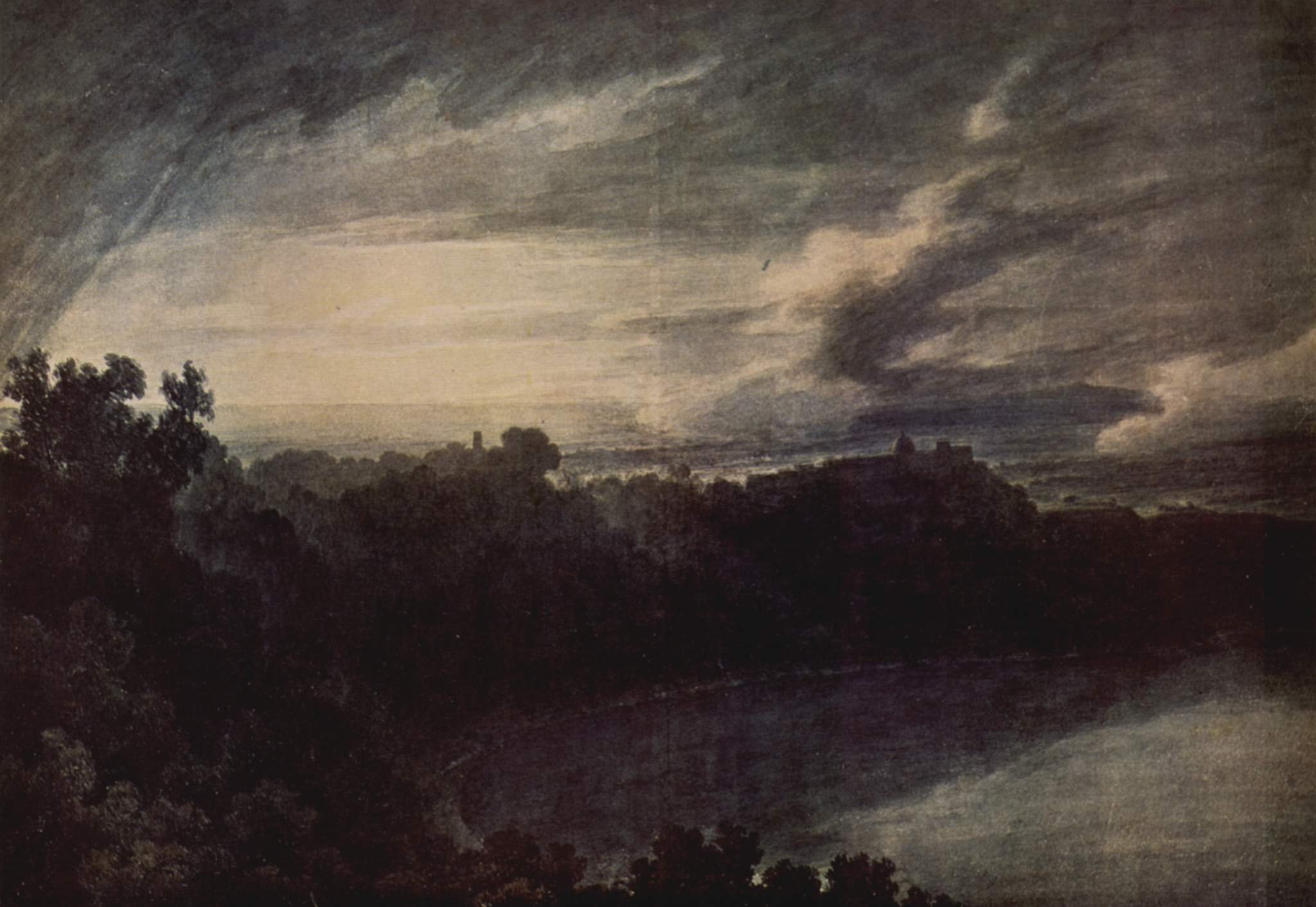
Lake of Albano and Castel Gandolfo by John Robert Cozens

Lake of Albano and Castel Gandolfo by John Robert Cozens (1777)

About the watercolours produced by today’s featured artist, the Swiss-born painter Henri Fuseli wrote:

“…they are creations of an enchanted eye drawn with an enchanted hand…”

The great English landscape artist, John Constable,  wrote of him saying he was:

“…the greatest genius that ever touched landscape…”

So who was this celebrated artist who was so revered by his fellow painters?  His name was John Robert Cozens.  He was born in London in 1752.  He received his initial artistic training from his father, Alexandra Cozens, the Russian-born watercolour landscape artist who was mostly employed in teaching and was drawing-master at Eton school from 1763 to 1768 and also  gave lessons to the Prince of Wales.  He allegedly was the natural son of Peter the Great.  He and his wife Juliet Cozens (née Pine) had one son, John and a daughter Juliet.

John Robert Cozens was, for the most, an en plein air painter and would often go off on sketching tours of Suffolk.  In 1772 he toured the Peak District area continually sketching the rugged landscape.  It was in that same year that he moved to live in Bath where his uncle Robert Pine, the English portrait and historical painter also lived.  In 1776 he exhibited his first oil painting at the Royal Academy and it was well received by the critics. He made his first trip to Europe in 1776, accompanied by Payne Knight.  Knight was a colourful character.  He was a classical scholar and connoisseur, who was best known for his theories of picturesque beauty.  He was later to become a Member of Parliament and he was also a member of the Dilettante Society or Dilettanti which was a society of noblemen and scholars which sponsored the study of ancient Greek and Roman art and the creation of new work in the classical style and it was through his auspices that Cozens made it to Italy. 

During the next eighteen months Cozens toured around the Italian countryside visiting Tivoli, Naples as well as the volcanic lakes of the Alban Hills, which lie twenty kilometers south of Rome.  During his time in this area he made sketches which he would eventually turn into some of the greatest watercolour landscapes ever seen.  His artwork incorporated the classicism of the greats such as Claude, Gaspar Dughet and Nicolas Poussin.  He remained in Rome until April 1779 at which time he returned to England and Bath where he remained for three years.  During this sojourn he set about converting the numerous sketches and drawings he had made on his Italian trip into watercolours, as by this time he had numerous wealthy patrons, who could not get enough of his work as they realised that not only were they things of beauty but also a solid investment for the future.  In May 1782 Cozens, along with a party of companion travelers made up of doctors, teachers, musicians along with a number of servants set off for another journey of discovery to Italy.

The following year Cozens returned to England and set up home in London where he set about producing more watercolours for his various patrons based on what he had seen and recorded during his recent visit.  Whilst living in the capital he took the opportunity to go on sketching trips around the local area and sketched and painted many scenes of the likes of Richmond Hill, and Greenwich and Windsor Parks as well as Thames river scenes.  He was so inundated with commissions from patrons that he never had time to put forward paintings to the Royal Academy exhibitions.

Sadly, like many gifted people, Cozens suffered from bouts of depression, probably caused by his unending and burdening search for artistic perfection.  His health was further affected by a bout of malaria which he had contracted during his Italian visit in 1782.   In 1794, aged just forty-two, his mental health had deteriorated and he had a mental breakdown and was placed under the care of a Doctor Thomas Monro, a physician at the Bethlehem Hospital, better known as Bedlam.   Unable to paint, Cozens and his family faced financial ruin and had to be rescued with the help of patrons and friends.  John Robert Cozens died four years later at the age of forty-five and was buried in London on New Year’s Day 1798.

Whilst Cozens was in the care of his physician Thomas Monro the doctor had access to some of Cozens’ sketches and he employed both Turner and Thomas Girtin to copy them.  The two young aspiring artists were greatly influenced by Cozens’ work.   Cozens was an expert when it came to the painting of trees and in 1789 he published a set of works entitled Delineations of the General Character of Forest Trees.  He submitted it to the Royal Academy but they rejected it saying that it was judged as being “not proper art”.

My Daily Art Display featured watercolour over pencil work today is entitled Lake of Albano and Castel Gandolfo which Cozens completed in 1777.   This little gem measures just 43cms x 62cms.   It depicts a large panorama of a menacing sky over the darkening hills surrounding Lake Albano, a small volcanic crater lake in the Alban hills of Lazio and the small hill-top town of Castel Gandolfo. There is a solemn grandeur about this work, a sense of vastness as well as an underlying tranquility.  I think there is also an air of mystery to the setting and maybe we are meant to look at it and use our imagination as to what it would be like to stand high above the lake at sunset.  

The work itself which was owned by Professor Ian Craft a fertility doctor, who bought it for £198,500 in 1991.  It went under the hammer at a Sotheby’s auction last year with a catalogue estimate of £500,000 – £700,000.   It finally went to David Thomson, the Third Baron of Fleet, and Canadian media magnet for £2.4 million.  That price represented not just a significant return on investment for the vendor but also a dramatic new high for a work by Cozens.  It easily surpassed the artist’s previous record of £240,000 for Cetara, Gulf of Salerno, Italy at Christie’s in November 2004.  It was also a record, not just for the artist, but for any 18th-century British watercolour.

A huge amount for David Thomson to spend on a work of art ?   Actually minutes earlier he had paid a record £109,250 for a rare drawing entitled Villa Borghese by Richard Wilson, the influential landscape artist I featured recently.  

Who said money cannot buy you happiness?

Olympia by Édouard Manet

Olympia by Édouard Manet (1863)

My Daily Art Display today continues with the life of Édouard Manet.  Yesterday we had reached 1864 the year when he exhibited his work entitled The Dead Christ with Angels at the Paris Salon and for which he was heavily criticised.  So did Manet, after the criticism and ridicule of his 1864 painting, submit a less contentious work the following season in 1865?  The answer is simply a resounding NO.  He entered two paintings into the 1865 Salon and in fact one of the paintings entitled Olympia, was one he had completed two years earlier and it was this one which caused an even greater furore with both the public and critics alike. The fact that Manet had completed the painting two years earlier but had not exhibited it makes one wonder whether Manet himself had doubts about the wisdom of launching such a contentious painting on the Parisian public.  His concern was well founded as it was considered the most shocking of all the works exhibited that year.  Olympia by Manet is My Daily Art Display featured painting today.

Before us we see an almost nude woman lying on a bed with a pink orchid tucked behind her left ear.    At the end of the bed, by the naked woman’s feet, we can just make out a small black cat.  In fact the inclusion of the small furry animal often had people naming the painting, Venus with a Cat.  The model for the painting was Victorine Meurent.  Victorine was also, besides being a famous model for painters,  an artist in her own right and one who exhibited a number of works at the prestigious Paris Salon.  Ironically in 1876, one of her paintings was included in the Salon’s juried exhibition (exhibitions at which the works of art are only displayed if selected by a jury) and the painting which Manet put forward for selection was rejected.

The subject of the oil on canvas painting caused a sensation.  So what shocked the critics?  Was it the nudity?  If that was the case, then why, as surely paintings of nudes were quite common at that time.   The problem was not the nudity but the fact that the critics believed the naked woman that Manet had depicted could be identified as a demi-mondaine.  These were ladies who had a reputation of enjoying an extravagant lifestyle of fine food and clothes, all of which had been achieved because of the steady income they made in cash and gifts from their various lovers.   In other words she was identified as a high-class prostitute and the Parisian public was very uncomfortable with the scale of prostitution in their city. 

Venus of Urbino by Titian

There can be no doubt that Manet’s inspiration for this painting came from Titian’s Venus of Urbino and Giorgione’s Sleeping (Dresden) Venus (see My Daily Art Display for Feb 15th).  Maybe Manet wanted to update and be more innovative with his “Olympia”.   Not all critics condemned his effort.  A few praised him for his “bold step into modernism”.  However there are differences in the way Manet has portrayed his woman in comparison with Titian’s Venus and it is these differences which led to the outcry.

Sleeping (Dresden) Venus by Giorgione

The contention that Manet’s woman was merely a high class prostitute was brought about by the way she wore an orchid in her hair, her pearl earrings, her bracelet, and her expensive oriental shawl on which her body rests,  all of which gave rise to the belief that her wealth was gained from the “service” she offered her lovers.  Her skin is bright white in colour and there is a severe shift from light to shadow in this painting.  Look how she stares towards us with her black eyes.  This is not a demure gaze.  It is a challenging, contemptuous and provoking look, in some ways daring us to find fault with her appearance.  Her hand is placed over her vulva and in a way she is saying that this is only to be had by the men she chooses.  It is in some way a signal that she will choose who she will bed.  Around her neck she wears a narrow black ribbon which when contrasted with the paleness of her neck adds sensuality to her pose.  Her upswept hair held in place by the orchid adds to the eroticism.  Her slipper is half on and half off her foot in a slovenly fashion. 

Her black servant, Laure, stands by her side.  She is attired in the typical fashion servants of a courtesan would dress.  She is holding a bouquet of flowers which the naked woman seems to ignore.  They are probably a gift from a lover who may have just arrived.   Maybe her eyes are not on us but on the door through which her lover is about to emerge.

As I said earlier we have the strange black cat sitting on the end of the bed.  In Titian’s Venus of Urbino he had included a dog which symbolized fidelity and added a kind of gentility to the scene.  Manet would have none of this sentimentality and added his black cat which because of its habits was taken as a symbol of laziness, lust and prostitution.  A coincidence?  Or did Manet know exactly what he was doing when he include the animal in his painting?

The painting when exhibited was one which the observer either loved or hated.  There were no half-measures.  The painting could not be ignored.  The critics labeled it immoral and vulgar and his friend Antonin Beaudelaire commented that the picture had created such anger that it was in danger of being destroyed by an over-zealous and offended observer.  In 1890 the French government acquired the painting with a public subscription, which had been organized by Claude Monet, and it now hangs in the Musée d’Orsay in Paris.

 I will let you decide whether what you see before you is Venus, an old-style Titian-like goddess or a nineteenth century Venus whose name was Olympia.   Maybe you prefer to simply believe Manet has depicted a high class prostitute awaiting her next client but whatever you decide I think you will agree that it is a fine work of art.

The Dead Christ with Angels by Édouard Manet

The Dead Christ with Angels by Édouard Manet (1864)

Today, My Daily Art Display returns to the French painter of contemporary urban life and who was a leading figure in the shift from Realism to Impressionism and was looked upon as one of the founding fathers of Modernism.  So many –“isms” !   We have seen examples of these three -isms before but let me just do a recap of the meaning of these terms.

Realism was prevalent in the mid to late nineteenth century and this movement believed that painters should represent the world exactly as it was, even if it was at the expense of some artistic and social principles.  It was looked upon at the time as very controversial and often the works were viewed as being morally wrong and wicked because they challenged and broke the conventional standards of what was termed “good taste”.

Impressionism had its origins in France between 1860 and 1900 and soon spread to other western countries.   In a way it was, in some ways, a rejection of Academicism which promoted the Classical ideals of beauty and artistic perfection and which had a stringent hierarchy within the visual arts favouring the grand narrative and historical paintings.  The Impressionist painters and Impressionism wanted nothing to do with such Academic traditions but preferred to emphasise an accurate depiction of light in its changing qualities and looking how light changed with the time of day.  They would often paint outdoors (en plein air).   The Impressionist style of painting can be typified by its attention on the common impression produced by a scene or object and the way the artists tended to use unmixed primary colors and small brushstrokes in order to imitate real reflected light.

Finally Modernism, which was a very broad movement that also began around the latter years of the nineteenth century, and was a type of art that reflected modern times and did not keep looking back at times past.  The Modernist artists believed that the modern world they lived in was fundamentally different to what had gone before and that art needed renew itself and move on.  It was all about the artist’s vision of the future.

My featured artist today is Édouard Manet.  He was born in Paris in 1832 and was brought up in a wealthy, upper class household.  He was the eldest son of Auguste Manet, a judge and the Chief of Staff at the Ministry of Justice and Eugénie-Desirée Fournier, the daughter of a diplomat and goddaughter of Charles Bernadotte, the Swedish crown prince.  His father had hoped that young Édouard would follow him into the legal profession.  However even though he was well educated, Manet did not particularly shine academically but he did show a predisposition toward drawing and the arts.  In 1844, aged twelve years old, he enrolled at the College Rollin, a secondary school where he became friends with Antonin Proust, who would, in the future, become the French Minister of Fine Arts.   It was also around this time that Manet’s uncle, Charles Fournier, encouraged his enjoyment of the arts and the two of them along with Antonin Proust, would go on trips to the Louvre.

Manet had set his heart on going to sea and twice sat the entrance exam to a naval training school but in both cases failed.  He did however manage, with help from his father, to get a trip on the training ship Guadeloupe voyaging to Rio in 1848 and returning home in June the following year.   His father had by this time given up any hope of his son entering the legal profession and acquiesced to his son’s desire to become an artist.   For a six-year period, beginning in1850, Manet studies in the studios of Thomas Couture the Academic and History painter.  His relationship with his master was very strained and they would frequently clash.  It was around this time that he registers as a copyist at the Louvre and studies the works of the old masters, such as Velazquez and Goya.  Although impressed with their paintings, he believed that his works should reflect the ideas and ideals of the present time and not like theirs, keep harking back to the past.   Manet was a great friend and constant companion of Charles Beaudelaire, the great poet and art critic who was credited with coining the term modernité to designate the brief short-lived experience of life in an urban metropolis and he believed that art must be held accountable to capture the experience.  His advice to Manet about his art was that he should depict a contemporary realism, and had to become “le peintre de la vie moderne.

The year 1852 was the start of a change for Paris and Parisiennes as the great modernization of the city started on the direct orders of Napoleon III, under the supervision of Baron Georges- Eugène Haussmann.  The infrastructure often going back to medieval times had become inadequate, roads were too narrow and buildings were becoming unsafe.  In the great renovation programme, streets were widened and lengthened, houses pulled down to make way for new ones, shop fronts replaced.  All this work was labour-intensive and thousands of jobs were created people poured into the city from the outlying countryside to gain employment.  The whole of the social and cultural life of Paris changed with such a migration of labour.  Paris became one of the most beautiful and culturally progressive cities in the world and it was this modernity that Manet wanted to record in his works of art.

I will leave Manet’s biography at this point in his life and will conclude it in a later blog but for today I want to look at one of his earlier paintings entitled The Dead Christ with Angels, which he completed in 1864 and which can now be found at the Metropolitan Museum of Art in New York.  This was the first of a number of paintings by Manet that had religious subject matter. The biennial and later, annual Parisian Salons were considered the most expedient way for an artist to make himself known to the public, and Manet submitted paintings to Salon juries throughout his career.  He submitted today’s featured painting in 1864 exhibition.

The inscription indicates Manet’s source, but the passage he cited describes Mary Magdalene finding Christ’s tomb empty except for the two angels whereas his painting shows the two angels with Christ.  If that wasn’t bad enough Manet realised, albeit too late, when the painting was already on its way to the 1864 Salon Exhibition that he had made an even greater mistake with regards the accuracy of the biblical tale he had depicted.   Can you spot it?

In his painting he has painted the wound on the left side of Christ and not, as convention would have it, on his right side.   He immediately contacted his friend Baudelaire and told him of this error, and his friend advised him to correct the position of the wound in the painting before the exhibition opening.  He warned Manet that if he didn’t then his critics would have a field day, adding, “take care not to give the malicious something to laugh at.”   Manet’s submissions to the Salon of 1864 were again condemned by critics, for his painting of Christ and the Angels as they put it showed “a lack of decorum”.   The critics further denounced the work for its realistic touches, such as the cadaverous body of Christ and the seemingly human angels.  They argued that the painting totally lacked any sense of spirituality; the figure of the battered Christ was said to more closely resemble the body of a dead coal miner than the son of God.

Manet did not repaint the wound, and as Beaudelaire had foreseen, the critics derided his error. Only the writer, Émile Zola, gave the painting the respect it deserved.  Zola felt that Manet’s intention was to emphasize the reality of the corpse, even though he called attention to its holiness by including a halo.

Holt Bridge on the River Dee by Richard Wilson

Holt Bridge on the River Dee by Richard Wilson (c.1762)

My Daily Art Display today features the 18th century Welsh landscape painter Richard Wilson.  He was born in 1714 in Penegoes, a small village in what is now the county of Powys.  His father was a rector at the local church and the family background could be considered as being well respected and of quite high social standing. It was through his father that his young son received a classical education.  The family was connected with some of the elite characters in the local society.  Wilson’s early artistic aspirations were encouraged by his mother’s nephew, Sir George Wynne, who had made his fortune out of lead mining and who supported Richard Wilson financially in London for many years from 1729.  Wilson was sent to London when he was sixteen years of age to take up a six year apprenticeship with a little known artist, Thomas Wright.  Wynne, besides arranging the apprenticeship, gave the young Wilson money to set up a studio in London and bankrolled the aspiring artist until he started selling some of his works.

In the 1740’s Wilson began to have success in selling his paintings and gained several wealthy patrons including the prominent Lyttleton Family who commissioned many family portraits.  This entry into “high society” led him to become a Society portrait painter and his many commissions brought him financial security, so much so he moved into a larger studio in the fashionable Convent Garden area of London.  In 1750 with financial help from a member of the Lyttleton family he set off on the Grand Tour.  This so-called Grand Tour, which was so popular in the 17th and 18th century, was the traditional trip of Europe undertaken by mainly upper-class young men from Europe, especially the British nobility and landed gentry.   Its aim was to be an educational rite of passage.

Wilson visited Venice in 1750 and stayed there for several months where he had the chance to study the works of the Old Masters such as Titian.  During hs soujorn in Venice, he met and became friends with the Venetian landscape artist and rococo painter, Francesco Zuccarelli.  It was Zuccarelli who persuaded Richard Wilson to move away from portraiture and concentrate more on landscape painting.  Wilson was also befriended by an English art collector, William Lock.   Lock and Wilson left Venice in 1751 and travelled through Italy eventually ending up in Rome where Wilson remained for six years.  His base was the Piazza di Spagna. This was a favourite meeting place for artists, both foreign and local and was also a popular haunt for the English Grand Tourists.  These tourists were extremely wealthy and were always looking to take home souvenirs from their great journey and as this was at a time before the invention of photography, what could be better than a painting of the Italian countryside and Richard Wilson was therefore in the ideal spot to sell his classical styled landscape works.  The artists, who most inspired Wilson, were the great French landscape painters Claude Lorrain and Gaspar (Dughet) Poussin.

Wilson returned to England in 1757 and, now quite wealthy, set himself up in a large studio in London.  He was the leading light, along with Sir Joshua Reynolds and Francis Hayman in establishing the Society of Artists in 1760 and later became one of the founding members of the Royal Academy of Art in 1768.  He staged many exhibitions of his work at the Academy and his reputation as a landscape artist grew and his works commanded very high prices.

Sadly, as in lots of cases of a rise to fame, there comes the inevitable fall and Richard Wilson and his reputation tumbled dramatically.  Sucked in by his increasing wealth and fame, Wilson became arrogant and rude.  He insulted a number of his wealthy patrons including George III and soon they deserted him.  His spectacular fall from grace made him turn to drink and soon he became an alcoholic, despite the help he received from the few friends who stayed loyal.  His career was over and he had no choice but to leave London and return to his family home in Wales, penniless.  Wilson spent the last years of his life at Colomendy Hall, the residence situated a few miles from Mold, which was owned by his aunt, Catherine Jones.  He died there in 1782 , a few months short of his 68th birthday, and was buried in the churchyard of St Mary’s  in Mold.

St Mary's Church, Mold

His grave, on the north side of the church, has the following Welsh inscription: (below is the English translation): 

From life’s first dawn his genius shed its rays,

And nature owned him in his earliest days

A willing suitor; skilled his lines to impart

With all the love and graces of his art;

His noble works are still admired and claim

The first reward of an enduring fame.

Richard Wilson's gravestone

My Daily Art Display featured painting today is Holt Bridge on the River Dee by Richard Wilson which he completed around 1762 and now hangs in the National Gallery in London.   This is an idealised landscape as it is not topographically accurate but notwithstanding that, it is a wonderful landscape painting.    Holt Bridge joins the village of Holt in Denbighshire to the village of Farndon in Cheshire. The tower of St Chad’s in Farndon is on the right and the outskirts of Holt on the extreme left.  It is strongly influenced by the works of Claude Lorrain as we know the artist was a great admirer of the French landscape artist.  However, for him there were two other landscape artists of note.  According to W.T.Whitley’s book Artists and their Friends in England 1700-1799, Wilson told a fellow artist William Beechey:

“…Why, sir, Claude for air and Gaspar for composition and sentiment; you may walk in Claude’s pictures and count the miles. But there are two painters whose merit the world does not yet know, who will not fail hereafter to be highly valued, Cuyp and Mompers…”

I have featured Albert Cuyp in a number of my blogs and you will know that he is one of my favourites painters and in the near future I will feature the beautiful work of Joos de Momper, the great Flemish landscape painter.

Road by the Edge of a Lake by Jan Both

Road by the Edge of a Lake by Jan Both (1637-41)

Today I am looking at a landscape painting by the Dutch painter and etcher Jan Dirksz Both.  The artist was born in Utrecht around 1618, the younger brother of Andries Both, who was one of a group of genre painters who worked in Rome in the 17th century and who brought to the Italians the sixteenth century Netherlandish art which depicted peasant subjects.  They were known as the bamboccianti.  The term came from the nickname Il Bamboccio, which translated means “ugly doll” or “ugly puppet”, and was a nickname given to the Dutch painter and leader of the group, Pieter van Laer, because of his physical deformity, as well as the puppet-like figures in his paintings.

It was whilst the two Both brothers were working in Rome that Jan Both met the French landscape artist Claude Lorrain and a fellow Dutch painter Herman van Swanevelt, and it was with these two painters that he collaborated on a series of landscape works.   It was from Claude that he acquired the skill of rendering effects of golden or silvery light and this technique was hugely influential after he returned to Holland in 1642.  Originally Jan Both produced the popular genre paintings and scenes from the everyday life of the streets of Rome but on his return to Utrecht he concentrated all his artistic efforts on Italianate landscape paintings, which were characterised by the golden glow of sunlight.  His brother Andries, on the other hand, preferred the genre painting in the manner of Pieter van Leer.   Like Jan and Andries Both, throughout the 17th century, a steady stream of Dutch painters made the long and demanding trek to Italy, which was, at that time, acknowledged as the home of art.  Aspiring artists from many European countries would descend on Rome in order to study the great masters of the Renaissance and the contemporary painters of the Baroque.  The Dutch who had come from a colder harsher climate with its gloomy and overcast skies were thrilled by the beauty of a sunny Italy.  They marveled at the light, and the myriad of colours offered by the Italian landscapes.   The Dutch artists depicted these wonderful Roman Campagna landscapes in their paintings along with the ruins of earlier civilizations which were dotted throughout the countryside.  This group of 17th century Netherlandish painters were known as the Dutch Italianates.

Jan returned to Utrecht around 1641.  He became the main pioneer of Italianate landscape painting in 17th-century Holland.   He introduced to Dutch landscape paintings a style based on the work of Claude Lorrain, which he had witnessed in Rome. Later this Italianate landscape style of his was developed by other artists such as Nicolaes Berchem and Aelbert Cuyp.  This Italianate style of landscape painting when transferred to the native Dutch landscapes was very popular and much in demand in Holland.  His landscape paintings became more refined over the years and he would often produce large works of idealised landscapes drenched in the golden light of the Mediterranean.

The painting of Jan Both, which I am featuring today, is entitled Road by the Edge of a Lake which he completed between 1637 and 1641 dating back to his Italian sojourn.  It currently hangs in the Dulwich Gallery, London.  The earth has a subtle red tinge to it which mirrors that found in Italy.  There is a tranquillity about this painting as we see the herdsman slowly weaving their way home towards the golden sunset.  The slanting light from the falling sun produces long shadows even from the smallest of molehills we see on the herdsmen’s trail.  This painting incorporates a typical golden sunset, which Jan Both probably learnt from Claude Lorrain when he was in Italy.  Look at the tones and colours of his sky.  Look how the artist has depicted the background, with its bright yellows and yet it also has a misty quality about it, which is what we would experience if we looked towards the setting sun on a clear day.  Move your eyes to the background on the right and the colour changes to a bluer tone and the mistiness gradually disappears.  The way the artist has depicted the background is a seamless continuity of the bright but misty yellowish haze to the clarity of blue sky.  I also like the way the artist has captured the way the sunlight falls on the leaves of the trees and even the individual blades of grass which borders on to the path to the left of the herdsman.

It is interesting to note that some art historians believe that Jan’s brother Andries may have had a hand in this painting.  They come to this conclusion when they studied the figures of the herdsme.  These reminded them of the figures seen in many of Pieter van Laer’s paintings and as I told you earlier, Andries Both was a dedicated follower on Il Bamboccio.

It is a magical painting and one can almost feel the warmth from the setting sun.  It is no wonder the Dutch liked to hang this type of painting on the walls of their houses as they sat inside by their fires and shivered with the cold of a Dutch winter’s day.

Man at the Window by Samuel van Hoogstraten

Man at the Window by Samuel van Hoogstraten (1653)

My Daily Art Display today enters the world of trompe l’oeil.  The term is French and literally means “trick of the eye”.  It is a kind of artistic illusionism which gives the appearance of three-dimensional realism.  This story of trompe l’oeil originated in ancient Greece.  Pliny the Elder records in his Natural Histories the famous confrontation between two Greek 5th Century BC painters, Zeuxis and Parrhasius who were involved in a painting contest. Each would try to make a picture that produced a more perfect illusion of the real world.   Zeuxis painted a likeness of grapes so natural that birds flew down to peck at them. Then his opponent, Parrhasius, brought in his picture covered in a cloth. Reaching out to lift the curtain, Zeuxis was stunned to discover he had lost the contest.  What had appeared to be a cloth was in reality his rival’s painting.

The early precursors of modern trompe l’oeil appeared during the Renaissance, with the discovery of mathematically correct perspective. But the fooling of the eye to the point of confusion with reality only emerged with the rise of still-life painting in the Netherlands in the l7th century.  Trompe l’oeil sets itself apart from ordinary decorative painting by its intent to mislead the observer, and it is this which sets it apart from ordinary still-life painting. The artist’s technical ability is meant to go undetected and, with use of perfect perspective, cleverly observed light and realistic colours, the ploy is to make the viewer believe that a flat surface is not actually flat, or that a space exists where there, in fact, is no space. A trompe l’oeil painting is one which shows apparently three dimensional objects and spaces in a way which the eye accepts as realism in the context of their surroundings.

The Staircase Group (Portrait of Raphaelle Peale and Titian Ramsay Peale), 1785

The new genre soon spread throughout Europe and America.   In American art, we have the Charles Willson Peale’s painting of 1795 entitled  The Staircase Group (Portrait of Raphaelle Peale and Titian Ramsay Peale), which is housed in the Philadelphia Museum of Art.   Peale executed this painting to prove that he was still one of the city’s preeminent artists. On a very large canvas, he made one of his rare full-length portraits, showing two of his sons on an enclosed spiral staircase. The high degree of detail and finish shows that the painting was undoubtedly intended to be a trompe l’oeil, an effect that Peale had never attempted before. To enhance the illusion, he set up the painting within a doorframe in his studio, with a real step in front. Rembrandt Peale, another son, recalled that his father’s friend George Washington, misled by Peale’s artifice, tipped his hat and greeted the two young men as he walked by!

Though highly regarded by collectors, from the beginning art theorists often rubbished trompe l’oeil as the lowest category of art.  These “wise” men regarded it as a mere technical tour-de-force that did not require invention or intellectual thought.  However in the l7th century, leading trompe l’oeil artists were not only receiving acclaim and acknowledgement from many quarters they were seen as also pushing the boundaries of the genre.  My Daily Art Display’s featured painter today,  Samuel van Hoogstraten was even  awarded a medal for his services to Art by the Emperor Ferdinand III, the Holy Roman Emperor, after being so impressed by one of his trompe l’oeil paintings.

My Daily Art Display featured painting today today is entitled Man at the Window which Hoogstraten completed in 1653 and now hangs in the Kunsthistoriches Museum in Vienna.   Look how the artist’s has splendidly portrayed the old man’s wrinkles and the graying of his beard.  The old man’s brow is furrowed and his head is slightly angled.  See how much detail the artist has given the window.   On the sill outside the window he has added a small vase which enhances and emphasizes the depth in the painting.  This window ledge is shaped by a stone wall surrounding the window.  Look at the amazing amount of detail Hoogstraten has put into his depiction of the texture and surface of the stonework.  You can almost believe that if you touched the surface of the painting it would feel like stone.  It is quite amazing.  Also on the windowsill, the artist has added a feather and a couple of leaves, one of which hangs over the side of the sill.  We see the man’s head protruding from one of the panes in the window and this gives the appearance that he is actually coming out towards our space.  Although it is a kind face there is something very haunting about it.  One can easily imagine that as an observer passes this painting and glances at it, they suddenly imagine that they are being watched by this elderly but real person. 

Today’s artist, besides his many trompe d’oeil works, completed many varied paintings and in a future blog I will look at the life of Samuel van Hoogstraten and another of his paintings.   He was not only a very talented painter but also a writer on art. He painted genre scenes in the style of de Hooch and Metsu, and completed many portraits, but maybe he will be best remembered as a specialist in perspective effect.

Still Life with Flowers and Fruit by Rachel Ruysch

Still Life with Flowers and Fruit by Rachael Ruysch (1703)

My Daily Art Display moves into unfamiliar territory on two counts.  My featured artist is a woman and up to now, I have showcased only a few paintings by women and secondly the work is a still-life painting, a genre which I have rarely selected for my daily blog.  I marvel at the intricacy of the painting and I have no doubt that the detailed work which goes into still-life paintings is equal if not greater than in other painting genres.

My featured artist today is the Dutch artist Rachel Ruysch.  Art historians who have studied the art of the Dutch Golden Age have placed her in the top three female artists of that period.  The other two being and Maria van Oosterwijk, another specialist in flower still-life paintings and Judith Leyster, the genre painter who painted a few portraits and who also produced a single still life work. Ruysch  is widely looked upon as the most talented female in the history of still-lifes of flowers and fruits and among the greatest exponents of either sex of this genre.  True praise indeed!!

 Rachel was born in The Hague in 1664.  She came from a wealthy family and was one of twelve children.  Her mother was the daughter of Pieter Post, a Dutch painter of landscapes and battle scenes, before becoming a talented classical-style architect.  Her father Frederick Ruysch, a talented amateur painter was also a renowned Dutch botanist and anatomist.  He accepted a professorship in Amsterdam and so when Rachel was just three years old the family all moved there.    Her father was an expert in anatomical preservation and the creation of dioramas,  three-dimensional full-size or miniature models, sometimes enclosed in a glass showcase, and which would house human parts which had first been preserved and embalmed in liquor balsamicum.   Rachel took an interest in her father’s work and would often help him to decorate the collection with flowers, fishes, seashells and the delicate body parts with lace.  With his trained scientific eye, Rachel’s father was able to observe and record nature with a high degree of accuracy, and it was a talent that he inspired in his daughter. This talent was to greatly influence her works of art in the future, for her still-life floral paintings would be characterized by realism.  Another reason for Rachel’s love of plants and flowers was that she and her family lived in a district of Amsterdam called Bloemgracht, which means “flower canal”. This area was of great natural beauty and was a favourite place of artists

In 1679, at the age of fifteen she had developed a love for art and was exceptionally talented even at that young age.  Recognising his daughter’s artistic aptitude, her father arranged an apprenticeship for her with William van Aelst, a renowned painter, who specialized in still-life works with flowers or game.  Van Aelst, who moved to Amsterdam in 1657, was famous for creating elaborate still-life paintings that featured spiralling compositions and avoided the convention of symmetrical arrangements of depicted bouquets.  Van Aelst taught her the necessary skill of composing a bouquet in a vase but in his less formal manner that produced a much more realistic and tangible effect. In their more realistic works, some flowers and leaves were allowed to droop over the sides of vases, while others were revealed from the back, and by so doing, produced a more rounded shape. Later in her artistic journey, Ruysch would build upon van Aelst’s compositional innovations and this would instil a vitality into her paintings.

Rachel remained a pupil of his until his death four years later in 1683.  Her earliest art works started to appear around 1680 and by the time she was eighteen years of age in 1682 she was producing a number of independently signed paintings and her successful artistic career had just begun.

 In 1693, aged twenty nine she married the lace dealer and portrait painter, Juriaen Pool.  The couple moved to The Hague where they both enrolled in the city’s Guild of St Luke, the professional artists’ organization which regulated the sales and handled the promotion of the artists’ works.  By all accounts their marriage was a happy one and the couple went on to have ten children.  Even though, as she claimed, she essentially raised her children on her own, her life of domesticity and all the chores that went with it coincided with her most creative artistic period. Her large family seemed in no way to get in the way of the quality of her work

In 1708, both Rachel and her husband were invited to Dusseldorf, where they became court painters to the Elector Palatine of Bavaria, Johann Wilhelm.   This proved to be a very successful period in their lives and they remained there and worked for him until his death in 1716, at which time they returned to Holland.  Flower painting emerged as part of the Baroque movement and was especially popular in the late 17th century.   The reason for its popular emergence was the increase in the number of more affluent merchants and middle classes, as well as the growing interest in plants that resulted from the developing science of botany.  It was also around this time in northern Europe, especially Holland, that there was a marked increase in the importation of many new and exotic plants. The Dutch had developed a wide variety of flowers and gardening became increasingly popular. Often, gardeners would commission artists to paint pictures of their best or rarest flowers.

In light of her situation, she was fairly productive throughout her lifetime. She finished her final painting in 1747, when she was 83. By the time she died, she had produced more than 250 pictures, an average of about five pictures a year, which was a considerable number of works for someone creating flower paintings in painstaking detail.

Rachel Ruysch had to overcome two problems which were common in the artistic world of northern Europe at the time.  Firstly she had to overcome the fact that she was a woman and artistic painting was considered a male province.  Secondly, during this period, art was divided into two categories – “greater” and “lesser”.  Into the “greater” category one found paintings of religious and historical themes and compartmentalised in the “lesser” category were portraits, landscapes and still-lifes.  It was this “lesser” category which was deemed fit for female artists.  Women artists who painted were considered to be just painting as a hobby and were completely incapable of artistic genius. However Rachel Ruysch triumphed and became a highly regarded artist who made her mark in the male world of the Dutch Old Masters, becoming one of the greatest flower painters in either gender.

Ruysch died in 1750 at age 86, and during her lifetime she gained widespread fame, and her artistic works were highly valued.   Despite the fact that flower paintings today is still  considered as a lesser form of artistic expression, Ruysch’s reputation as a great painter remains intact.   During the 20th century, there was great interest in her works and her paintings are still featured in major exhibitions in Europe.  She is thought to have produced over 250 paintings in her life but only about 100 are known to still exist, and most of these are in museums or private collections. When any of her paintings do come up for sale they make headlines. In France her 1710 painting Still Life of Fruit with a Birds Nest and Insects went for the equivalent of $508,000.

My Daily Art Display painting by Rachel Ruysch is entitled Still Life with Flowers and Fruit, which she painted in 1703.  This painting, which measures 85cms x 68cms, has an opulent arrangement of flowers and fruit but could never have existed in nature as the various flower specimens and fruit blossomed and bore fruit in different seasons.  This blossoming was simply a figment of the artist’s imagination.  There is a technical perfection about this painting which had come from Rachel’s extensive botanical training.  The painting now hangs in the Akademie der bildenden Künste, in Vienna

The Irish Girl and The English Boy by Ford Madox Brown

Manchester Art Gallery exhibition

The other day I went to Manchester to see the Ford Madox Brown exhibition at the Manchester Art Gallery.  The exhibition opened on September 24th and runs until January 29th 2012 and I strongly recommend you make the effort to visit the city and take in this superb show which displays 140 public and private works from this talented 19th century painter.  I have already  featured two of Ford Madox Brown’s paintings, The Last of England (June 15th) and Manfred on the Jungfrau (July 21st), the former I saw when I visited the Birmingham Art Gallery and the latter which I had hoped to view when I went to Manchester a few months ago had been withdrawn from the gallery for some restoration work prior to this new exhibition.   Both of these works are on show at the current Manchester Exhibition.

I will, in the coming months, review more of Ford Madox Brown’s works,  which I saw at the exhibition, but I need to space them out a little otherwise I will be accused of featuring one artist too often.

Like most people, I had seen many of Ford Madox Brown’s paintings before, in books or on the internet, but what I had not realized was that he had completed many portraits of which a number were on display at the exhibition.  However, there is nothing more true than the saying “you cannot please all the people all the time” for as I researched today’s blog and was still buoyed up with my admiration for Brown’s portraits,  I came across the Daily Telegraph’s art critic’s, Alastair Smart, view of the exhibition and his assessment of some of the paintings, especially his portraiture.  He wrote:

“…Despite the show’s claims to the contrary, Brown’s portraits and biblical dramas aren’t up to much either: his figures are just too awkward in facial gesture, one toothy contortion after another…”

How disappointing to read that when I was still so enthused with what I had seen.  I loved his small portraits.  I did get some consolation however when I re-read the opening line of his article which stated quite bluntly:

“….First, a confession: I utterly loathe the Pre-Raphaelites. Oh, what a mawkish, melodramatic and clichéd bunch…”

The journalist did however go on to qualify his bold statement by saying that he realized Ford Madox Brown was not a member of the Pre-Raphaelite Brotherhood but countered that by telling us that he did have a close association with the three founder members.  Guilty by association ?  Having said all that I will not be deflected from my proposed look at two of Brown’s small portraits, which I loved, even if the knowledgeable art critic disliked them. 

The Irish Girl by Ford Madox Brown (1860)

For My Daily Art Display today I am featuring two portraits, The Irish Girl and The English Boy as they were hung next to each other at the exhibition and in some ways they are connected.  It was the coming together of these “two old friends”, who were separated forty-seven years ago.  The man, who commissioned the paintings, was a Leeds stockbroker called Thomas Edward Plint, who was a patron of Ford Madox Brown, and an important Pre Raphaelite art collector.  In 1850, he had commissioned Brown to paint Work, and out of that commission came the painting, The Irish Girl, which also happens to be featured on all the exhibition publicity material.  To my mind this is a beautiful and haunting painting.  This small (almost 28cms square) oil on canvas work was completed by Brown in 1860 and is normally to be found exhibited at the Yale Centre of British Art.  The Yale Center for British Art, which is in New Haven, Connecticut, is a public art museum and research institute for the study of British art and culture. It was presented to Yale University by Paul Mellon who was in the Class of 1929 at Yale.  The Centre houses the largest collection of British art outside the United Kingdom.

In comparison to the portrait of the young English boy the young girl looks slightly nervous and somewhat troubled.  She has real beauty.  There is nothing idealized about this portrait.  Her haunting loveliness is plain to see and yet the difference between her and the English boy could not be starker.  Unlike the boy, she looks worldly–wise.  Her jet black hair, her dazzling brown eyes and her painted red lips are all part of her exquisiteness.   She has tilted her head a little to one side and her eyes focus on something off to the side.  When Ford Madox Brown was looking for Irish models for his painting Work he came across this young girl selling oranges and couldn’t pass up the opportunity to paint her portrait.   We see the fingers of her hand appearing from inside her red paisley shawl which is tightly wrapped around her and the colour of which complements the colour of her lips.  Between her fingers, she is gently holding a sprig of cornflowers. 

The English Boy by Ford Madox Brown (1860)

The portrait which hung next to the Irish Girl was entitled The English Boy and was the companion piece to the Irish Girl.  In this case the young child depicted was no stranger to Brown.  It was his five year old son, Oliver, and this too was painted in 1860.  It is slightly larger than the Irish Girl, measuring 39cms x 33cms.  This portrait is owned by the Manchester Art Gallery, which acquired it in 1932.  Although a companion piece to the Irish Girl they couldn’t be more different.  In this portrait,  the young child stares straight at us with a self-assured gaze.   It is a deadpan expression and we wonder what is going through his mind.   His cheeks are slightly flushed and this colouring in some way matches the red shawl and lips of the Irish Girl.   He wears a white smock over a red checked dress and on top of his head, sitting at a slightly jaunty angle, is a brown straw hat.  In his hands he clutches on tightly to the popular child’s toys of the time, a top and whip.  The way in which he holds the toys in some way reminds us of royal paintings where the subject holds a sceptre and orb.

Despite what our knowledgeable journalist would have us believe I don’t find these portraits in any way awkward in facial gesture.  I find them to be simply fascinating studies of two young children.