Peasant Girl Lighting a Fire. Frost, by Camille Pissarro

Peasant Girl Lighting a Fire. Frost by Camille Pissarro (1888)

My Daily Art Display’s featured painting today is entitled Peasant Girl Lighting a Fire. Frost, which was painted by Camille Pissarro in 1888 and can now be found in the Musée d’Orsay in Paris.  At this time Pissarro was still a leading light of the Impressionist movement, a movement he had helped to form.   However it was two years prior to this work that Pissarro began to become interested in the experimental work of young artists, who had adopted the fragmented brushstroke technique which Georges Seurat and Paul Signac were trying out, known as pointillism , a technique Pissarro used in parts of this painting.  For a more in depth look at pointillism see My Daily Art Display October 21st 2011 for a painting by Georges Seurat and November 29th 2011 for a painting by Paul Signac. Pissarro had been introduced to Seurat and Signac in 1885 and in the following years he began to work in the pointillist style which had then been adopted by the Neo-Impressionists.  By the time Pissarro was in his sixties he found that this pointillism technique too restricting and in the last ten years of his life he returned to a purer Impressionist style.
Camille Pissarro was fifty-eight years of age when he completed today’s featured work of art.  Ten years earlier his style of painting was such that he would portray nature in his landscapes by a myriad of smaller comma-like brushstrokes built up on the surface of the canvas such as his 1877 work, The Red Roofs (see My Daily Art Display of November 30th 2010).  Pissarro was concerned that these works lacked clarity and so he decided to change the way he worked.  He spent time working in collaboration with Degas, who was, of all the Impressionists, a great believer and advocate of figure painting and the primacy of the human figure at the expense of landscape background.  It was maybe the views of Degas that led to Pissarro to complete some works in which the human being(s) took pride of place in the painting, as is the case with today’s featured work.

The painting depicts two peasant girls working in a field in a cold and frosty winter morning and we see one of them tending a fire.  Pissarro often painted peasant women at work.  Two fine examples of this are his 1881 work entitled Girl with a Stick and the 1893 painting entitled Woman with a Green Shawl.  His portrayal of peasants received some criticism for copying the ideas of Jean-François Millet but Pissarro firmly contested such a notion.  However in general art critics looked upon his works as true representations of peasant life.  Look at the beautiful way in which Pissarro has depicted the landscape.  At the time of this painting Pissarro was extremely interested in the pointillism technique of Seurat and Signac and he used this method to present us with a sumptuous backdrop to the two girls.  The painting has a light and airy feel to it and there is a subtle delicate nature to the work.  The work was painted in Eragny just north-west of Paris where Pissarro and his family lived for a time.

In the far distance we can see the low hills topped by irregular spaced bushy trees.  In the middle ground, we observe grazing cows in the meadow, a line of poplar trees at the foot of the hills and possibly a hidden stream running horizontally across the mid ground.   Notwithstanding the backdrop, the focus of the painting is on the two girls in the foreground, who almost appear to stand next to us.  The scene is lit up by the sun, somewhere out of sight, to the left, which throws off long blue shadows across the field.  It is a wintry sun and still low in the sky, hence the long shadow of the girl in the foreground, which disappears off the painting to the right.    Although it emits light, the sun gives off little warmth and so our two young workers are wrapped up well.  The temperature is even colder due to the wind chill factor.  Look how the girls skirt and the smoke from her small fire are blown horizontally by the wind which comes from the left of the painting.  One can imagine how cold it is with the driving wind on a wintry day. We almost shiver as we look at this work of art.

The girls are both well wrapped up against the morning’s wintry chill.  The girl on the right, who seems no more than a child, is warming her hands by the fire.  She wears a blue dress and a thick dark brown coat.  She has a dark woolen hat on her head which is pulled down to protect her ears from the icy wind.   The older girl, who is closest to us and because of her height, is the main focus of our attention.  She has taken a branch from the pile behind her, and is about to break it up and add it to the fire.  She wears a pink skirt with a blue apron.  She too has protected her head, wearing a white scarf tied beneath her chin.  Her final layer of protection is a pink and white shawl from which emerge long black sleeves of her dress.

The colour combinations Pissarro uses to achieve the colour we see is fascinating.  The girls pink dress is made up of a combination of yellow, blue and pink.  The green grass of the meadow is achieved by using a combination green, blue, yellow, pink and white.  The only orange Pissarro used was for the flames of the fire.

Pissarro fled the traumas of the Franco-Prussian War in 1871 and, like Monet, went to live in London.   It was whilst in London that he saw a number of paintings by Turner.  Pissarro later commented on Turner’s works and was amazed by the way Turner succeeded in conveying the snow’s whiteness, not just by the use of white alone but by combining a host of multi-coloured strokes, dabbed in, one against the other, which when looked at from a distance, created the desired effect.  It is in this painting that Pissarro has, without the actual presence of snow, managed to give us a crystalline frost of a cold winter’s morning encapsulated in an aura of diamond blue.

Francesca da Rimini by Ary Scheffer

Francesca da Rimini by Ary Scheffer (1835)

What is your perception of Hell?  Do you think of it as a huge furnace full of burning souls, or simply a place of deprivation?  We do not know and I don’t believe we will ever know what it is like or whether it or its sister-place, Heaven, really exists and so with this lack of evidence we can then formulate in our own minds what it is all about without fear of contradiction.  One person who did just that was Durante degli Alighieri, better known simply as Dante Alighieri.  In the first part (Inferno) of his epic poem entitled Divine Comedy he tells of his journey he made through Hell with the Roman poet Virgil acting as his guide.  Many artists have painted pictures based on Dante’s Inferno with its concentric circles full of various types of sinners.  To get to the gates of Hell Dante and Virgil had to cross the river Acheron which could only be achieved by being transported by ferry, piloted by Charon.  My Daily Art Display (September 6th 2011) depicts the two men being ferried across the river made famous in the painting,  The Barque of Dante or Dante and Virgil in Hell by Eugène Delacroix.

According to Dante, Hell is situated within the Earth, it is made up of nine circles of torment.  The circles are concentric, and represent a gradual increase in evilness.  The outer circle, or the first circle is the resting place of those who were never baptised, the second circle was for people whose sin was one of Lust.  As Dante and Virgil moved inwards they came across circles which housed the souls who had committed the sins of Gluttony, Greed, Anger, Heresy, Violence, Fraud and Treachery.  It is interesting to note that for Dante, an Italian male, those who committed the sin of Lust were only in the second circle, as presumably in Dante’s mind, Lust was not that bad a sin!  The inner most part of this Hell ends at the centre of the earth, where Satan is held in bondage.   The sinners who populated each of the circles were punished in a fashion fitting their crimes, a system of contrapasso; derived from the Italian words contra and patior meaning  “suffer the opposite” a sort of poetic justice.

My featured painting today is about two lovers from Dante’s Divine Comedy who Dante and Virgil meet, trapped in the stormy darkness of the Second Circle of Hell (Lust)It is here that those overcome by lust during their time on earth have been sentenced to remain. Dante condemns them, and those like them, calling them “carnal malefactors” for letting their sexual appetites affect their reasoning. These hapless souls are blown to and fro by the terrible winds of a violent storm, without hope of rest and this symbolizes the power of lust to blow one about needlessly and aimlessly.  It is here that Francesca da Rimini tells Dante the story of how she and her lover Paolo ended up in this Second Circle of Hell.

Francesca da Rimini and Paolo Malatesta are depicted in the 1835 painting by Ary Scheffer, which is entitled Dante and Virgil Encountering the Shades of Francesca da Rimini and Paolo in the Underworld or simply Francesca da Rimini. .    The story goes back to the time when Francesca’s father, Guido I da Polenta was lord of Ravenna but had been at war with a rival  family,  the Malatesta family.  Peace between the two families finally came about and to cement their relationship Guido agreed that one of his daughters, Francesca, should marry Giovanni Malatesta, the son and heir of the Malatesta clan.  Although Giovanni was an able man and would on the death of his father become ruler, he was ugly and deformed.   The friends of Francesca’s father told him that if Francesca was to set eyes on Giovanni prior to the marriage, she would never go through with it. So the two fathers hatched plan and sent Giovanni’s younger brother Paolo to Ravenna with authorisation to marry Francesca in Giovanni’s name.   Paolo, unlike his elder brother was handsome and courteous and Francesca immediately fell in love with him. The marriage took place and the marriage contract signed and bride and bridegroom returned to Rimini, with Francesca still unaware of the deception.

In the morning following the wedding she became aware of the deception.  She was furious that she had been deceived and to make matters worse she realised that she had fallen in love with Paolo.  Giovanni left Rimini on business leaving Paolo and Francesca together and they both realised that they loved each other.   Their lovemaking was witnessed by Giovanni’s servant who sent word to his master, who then secretly returned home.  He went to Francesca’s room in which were the two lovers.  He banged on the door and shouted her name.  They recognised Giovanni’s voice.  Paolo pointed to a trapdoor in the floor that led to a room below. He told Francesca to go open the door as he planned his escape.   However as he jumped through the open trapdoor part of his jacket got caught on a piece of iron.  Francesca, unaware of his Paolo’s predicament, opened the door for Giovanni, believing she would be able to make excuses, now that Paolo was gone. When Giovanni entered the bedchamber he noticed Paolo caught by his jacket on the trap door.   He immediately ran towards the trapdoor and with his rapier drawn thrust it at Paolo intending to kill him. Seeing what Giovanni intended to do, Francesca quickly ran between the two brothers to try to prevent it. But Giovanni’s rapier was already thrusting downwards towards the hapless Paolo but before it struck him the blade passed through Francesca’s bosom. Giovanni was totally distraught by what he had done for he still loved Francesca.  He withdrew the blade of the sword from her body and immediately plunged it into his brother, killing him.  The next morning, amidst much weeping, the two lovers were buried in the same tomb.

In the painting we see Dante and Virgil standing to the right hand side watching as the two, almost-naked, lovers cling to each other.  Art critics at the time praised this exceptional work by Scheffer, and it was to become one of his most famous and most admired works.  Scheffer went on to produce several replicas of it.  The original painting can be found at the Wallace Collection, London.

Celebrating the Birth by Jan Steen

Celebrating the Birth by Jan Steen (1664)

I do my best to feature paintings by artists that people may not have come across before and I try not to feature the same artist too many times but sometimes I cannot help but revisit works by my favourite artists and today is no exception.  My Daily Art Display featured painting today is entitled Celebrating the Birth by Jan Steen which he completed in 1664.  I have showcased work by this artist three times before.  On February 16th 2011 we looked at a work entitled In Luxury, Look Out.  On April 27th 2011, I featured his painting The Effects of Intemperance and finally on August 26th 2011, I gave you The Life of Man so if you like today’s work why not go and have a look at some other of Jan Steen’s paintings.

Before us we have a simple scene of a couple celebrating the birth of their child, or do we?  In fact there is more to this painting than a simple celebration of the birth of a baby.  Look closely at the painting and see what is odd about the Steen’s depiction of the event and see if you can work out what is happening in the scene.  I will give you a hint.  Look at the man who stands behind the baby and the baby’s father.  Before I reveal the secret about the painting let me first tell you a little about the artist, Jan Steen.

Jan Havickszoon Steen was born in the Dutch town of Leiden in 1626.  He, like his artistic contemporary, Rembrandt, attended the local Latin School of Leiden. And a year later in 1646 he enrolled at the University of Leiden.  His professional artistic training started the following year and came from the German-born, Dutch Golden Age painter, Nicolaes Knupfer.  It is thought that he also could have studied with Adriaen van Ostade and it was this artist’s low-life genre work which was to influence Jan Steen’s early works.  At the age of twenty-two Steen along with his artist friend Gabriel Metsu and a number of local painters founded the painters’ Guild of St Luke of Leiden.

In 1648, Jan Steen moved to The Hague and worked as an assistant at the workshop of the celebrated landscape painter, Jan van Goyen.  Van Goyen was, like Jan Steen, born in Leiden.  He had moved from Leiden to The Hague in 1631 where he set up his workshop.  Steen was not only employed by van Goyen but was also taken in by van Goyen’s family and lived with him, his wife Annetie and their daughters.     Jan Steen became very friendly with Margriet, one of van Goyen’s daughters and they married in 1649 and the couple went on to have eight children.  Steen’s association with his father-in-law lasted until 1654.

In 1654 he and his family moved to Delft where he ran a brewery which his father had rented for him.  It was called De Roscam (The Curry Comb) but although Steen had a great artistic talent his business acumen was sadly lacking and the brewery failed.  In 1657 he went to live in Warmond,  a town close to Leiden and it was here that he met and became friends with the artist, Frans van Mieris.  Frans van Mieris was a painter of genre scenes which depicted the habits and actions of the wealthier classes.  It was this type of art by van Mieris and the works of Te Borch that weaned Steen off his low-life genre paintings and influenced him to paint more elegant genre scenes.  Jan Steen left Haarlem in 1660 and moved back to Haarlem where he stayed for the next ten years.  In 1669, near the end of this stay his wife died and the following year his father passed away.  After his father’s death in 1670 Jan returned once again to Leiden where he remained for the rest of his life.  He remarried that year and his second wife, Maria van Egmont,  gave Jan two children.

For the Dutch people, the year 1672 became known as the rampjaar(disaster year) as this was the year that saw the start of the Franco-Dutch War and the Third Anglo Dutch War, which culminated in the defeat of the Dutch States Army and large swathes of the Republic was conquered by the invading troops.   Because of these wars the art market collapsed and Steen needed another source of income so in 1673 he opened a tavern. His work in the tavern meant that his artistic output diminished in his later years.

Jan Steen died on New Year’s Day 1679 in Leiden

And so let us go back to the featured painting.  Have you worked out the “sub-plot” depicted in this painting yet?  Steen is best known for his humorous genre scenes, warm hearted and animated works in which he treats life as a vast comedy of manners and this work of his is no different.  We are looking at a lying-in room.  Whenever the lady of the house was about to give birth, one of the rooms was set aside for this purpose. The lying-in room was used for the actual delivery, and later to receive visitors.  The birth of a child was, as it is now, a cause for celebration.  It is greeted with both happiness and pride and in the 17th century in the case of the birth of a son, it became even more of a celebration for economic reasons as a son would often carry on his father’s business and would inherit the family possessions.

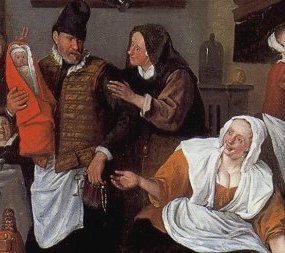
In this painting Steen has depicted a group of revellers celebrating the birth of a child.  One can imagine the elated atmosphere within the room with all its merriment and drinking.  The majority of people in the room are women as men, including the father, were considered inappropriate interlopers in this female sanctuary.  The mother is in the left background of the painting lying in her bed being fed some broth.  Another woman sits at the end of the bed drinking to excess.     The others present will probably be female relatives, maidservants and the midwife.  Normally one would expect, as in most works of art depicting such an event, that the mother of the newborn baby would be the main focus of attention.  However Steen has made the proud father the main focus of this painting.  However he is not the only man in the painting.  Look at the figure behind the baby.  We see another man as he is about to creep out of the room.  Actually it is a self-portrait of the artist himself.  It was not simply to break tradition to see the two men in the painting but Steen wanted to convey a little information about what has happened and to the nature of the husband and wife’s relationship.

Sign of the cuckold

Look more carefully and you will see something which was not visible until the painting was cleaned in 1983.  The man leaving the room has made a cheeky two-fingered gesture above the baby’s head.     This gesture can be seen by all those in the room except the proud father.   From the young man’s gesture, Steen has made us aware that the ‘father’ has been made a cuckold. The gesture illustrates the tradition of “cuckold’s horns, and that the horns, visible to all but the man himself, will grow on the head of a man whose wife has been unfaithful. The proud father stands right of centre having been presented with his child.  His pride on the birth of his child is plain to see.  He is totally unaware of the ridicule and stands before us, puffed up, beaming with pride as he shows off his child.  Nobody seems shocked by this audacious gesture which tells us that everyone in the room appears to know what the man does not: that the child is not his..  There are other sexually symbolic inclusions in Steen’s painting to suggest not just sexual impropriety but implying the husband was impotent, such as the bed warming pan, which lays prominently on the floor in the foreground.  The warming pan reminds us of the adage, the only warmth in the marriage bed is the warming pan.   In the right foreground we see broken egg shells scattered on the floor and again this is a reminder that the phrase, cracking eggs into a pan, was a contemporary euphemism for sexual intercourse.

The demand for money

Steen has been very unkind with his depiction of the father in this portrait.  We see him wearing an apron and carrying keys like a housekeeper would do, thus implying a lowering of his status in the household.   We also see the old midwife at his shoulder demanding money for her services and to the right of the man, sat on a stool, is a maid with her hand out, seemingly demanding payment for making the celebratory broth.  Steen’s final degrading of the man is his depiction of the limp and ineffectual sausage hanging by the fireplace which does not need me to explain the connotation of such an inclusion!!

There is a moralistic point to the painting.   It is a warning tale of what happens when an older man marries a much younger woman.   In a way Steen has no qualms about depicting the man as a cuckold.  Maybe the modern saying of there’s no fool like an old fool has its roots way back in time.

River Landscape with Apollo and the Cumaean Sibyl by Salvator Rosa

River Landscape with Apollo and the Cumaen Sibyl by Salvator Rosa (c.1655)

My featured artist today is the 17th century Italian Baroque painter Salvator Rosa.  He was born in 1615 in the small hill town of Arenella above the outskirts of Naples.  His father Vito Antonio was a land surveyor and had great ambitions for his son wanting him to become either a lawyer or take holy orders in the church and become a priest.  With this in mind he decided that his son should be afforded the best education and had him enter the convent of the Somaschi Fathers, a holy order of priests and brothers.  As we have seen in many biographies of artists, what the parents want for their children often differs from what the children themselves want and so it was the case for Salvator Rosa.  During his studies he had developed a love of art and with the support of his maternal uncle, Paolo Greco, he secretly began to learn to paint.  Rosa began his artistic training in Naples, under the tutelage of his future brother-in-law, Francesco Francanzano, who had trained under the influential Spanish painter, Jusepe de Ribera.  It is also believed that after this initial training, Rosa trained with the Naples painter, Aniello Falcone, who was also at one time apprenticed to Ribera.  Rosa greatly admired the works of Ribera and was influenced by them.

His father died when he was seventeen years old and, as he had been the breadwinner to Rosa’s large family, his mother struggled to feed her children let alone financially support her son Salvator with his artistic ambitions.  After his father’s death, Salvator Rosa continued to work as an apprentice with Falcone until 1634 when he relocated to Rome where he stayed for two years before returning home.

In 1638, aged 23 he went back to Rome where he was given accommodation by the Bishop of Viterbo, Francesco Brancaccio who treated him as his protégé and received commissions from the Catholic Church.  It was whilst in Rome that Rosa further developed his multi-talented skills, not just as an artist but as a musician, a writer and a comic actor.  He founded a company of actors in which he regularly participated.   He wrote and often acted in his own satirical plays, often political in nature and often lampooned the wealthy and powerful, and it was his devilish satire which gained him the reputation of a rebel, pitting himself against these influential people.  However his viperish-tongued satires made him some powerful enemies including Gian Lorenzo Bernini, the famous and powerful architect and who was at that time, the most powerful artist in Rome.  He, like Rosa, was also an amateur playwright and it was during the Carnival in 1639 that Rosa ridiculed Bernini’s plays and his stature as a playwright.  Eventually Rosa had made too many enemies in the Italian capital and decided it was just too dangerous to remain there.

From Rome he travelled to Florence where he was to remain for the next eight years.   One of his most influential Florentine patrons was Cardinal Giancarlo de’ Medici, himself a great lover and supporter of the Arts. Rosa worked for the Cardinal at his palace but was still allowed the freedom to paint his own landscapes and would go off and spend the summers in the Tuscan countryside around Monterufoli and Barbiano.    It was whilst living in Florence that Rosa did some work for Giovanni Carlo who was at the centre of the literary and theatrical life of Florence and Rosa soon became part of Carlo’s circle of friends.  Rosa used his own house as a meeting place for local writers, musicians and artists and it became known as the Accademia dei Percossi, or Academy of the Stricken.

He left Florence in 1646 being unhappy with the ever increasing restrictions put on him and his artistic and literary work by the Medici court  He went first back to Naples where he remained for three years before returning to Rome in 1649  where he believed his writings and paintings would win him even greater fame.  One of the problems Salvator Rosa had was his ever tempestuous relationship with his patrons and their demands.  He often refused to paint on commission or to agree a price beforehand.  He rejected interference from his patrons in his choice of subject.  In Francis Haskell’s book entitled, Patrons and Painters: Study in the Relations Between Italian Art and Society in the Age of the Baroque, he quotes from a letter Rosa wrote to one of his patrons, Antonio Ruffo, explaining his thoughts on his art and commissions:

“…I do not paint to enrich myself but purely for my own satisfaction.  I must allow myself to be carried away by the transports of enthusiasm and use my brushes only when I feel myself rapt…”

The 17th century Florentine art historian Filippo Baldinucci could not believe Rosa’s attitude to his patrons and wrote:

“…I can find few, in fact, I cannot find any, artists either before or after him or among his contemporaries, who can be said to have maintained the status of art as high as he did… No one could ever make him agree a fixed price before a picture was finished and he used to give a very interesting reason for this: he could not instruct his brush to produce paintings worth a particular sum but, when they were completed, he would appraise them on their merits and would then leave it to his friend’s judgement to take them or leave them….”

In his later years he spent much time on satirical portraiture, history paintings and works of art featuring tales from mythology.  In 1672 he contracted dropsy and died six months later.  Whilst on his deathbed he married Lucrezia, his mistress of thirty years, who had borne him two sons.   He died in March 1673 just a few months short of his fifty-eighth birthday.  After his father’s death forty years earlier Rosa had struggled financially but at the time of his death he had accumulated a moderate fortune.

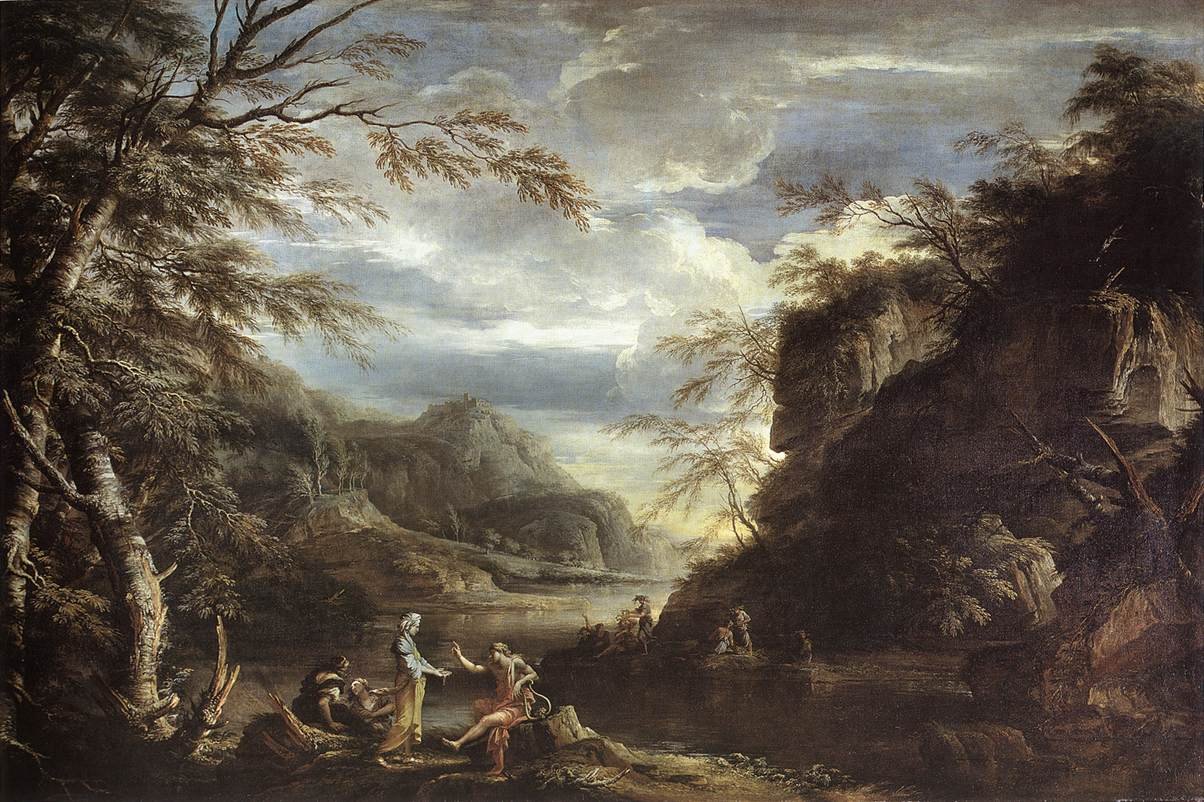
Landscape painting had been regarded as a relatively lesser genre of painting in Italy at the time. But two French artists based in Rome, Claude Lorraine, who Rosa had befriended, and Nicholas Poussin, had done much to raise its status by setting scenes drawn from classical myth or biblical legend in grand Arcadian landscapes inspired by the nearby countryside. Rosa continued their tradition but with one subtle difference.  His landscape scenes depicted scenes of stormy desolation rather than calm pastoral beauty scenes of Claude and Poussin.  For My Daily Art Display today I am going to look at a painting by Salvator Rosa, which is a landscape but based on Roman mythology and Ovid’s book Metamorphoses.  It is the story of Apollo (often known as Phoebus) and the Cumaean Sibyl.   Cumae, which was the location of Italy’s earliest Greek colony, is on the Gulf of Gaeta near Naples and this location was probably known to Rosa.  The basis of the painting harks back to a conversation Aeneas had with the Cumaean Sibyl, who was a guide to the underworld of Hades, the entrance to which was the volcanic crater of Avernus.  Aeneas wanted to enter the underworld in order to visit his dead father Anchises.  Aeneas, with the help of his guide, the Cumaean Sibyl, found the aged ghost of his father.  It was at this time that the Sibyl recounted the story of her barter with the god Apollo, how she reneged on her promise and why she had become old and haggard:

“…“I am no goddess,” she replied, “nor is it well to honour any mortal head with tribute of the holy frankincense. And, that you may not err through ignorance, I tell you life eternal without end was offered to me, if I would but yield virginity to Phoebus for his love. And, while he hoped for this and in desire offered to bribe me for my virtue, first with gifts, he said, ‘Maiden of Cumae choose whatever you may wish, and you shall gain all that you wish.’ I pointed to a heap of dust collected there, and foolishly replied, `As many birthdays must be given to me as there are particles of sand.’  For I forgot to wish them days of changeless youth. He gave long life and offered youth besides, if I would grant his wish. This I refused, I live unwedded still. My happier time has fled away, now comes with tottering step infirm old age, which I shall long endure…”

The making of the bargain

Her mistake had been not only to ask Apollo for eternal life but also to ask for everlasting youth and beauty.  She aged over time.  Her body grew smaller with age and eventually was kept in an ampulla, a small nearly globular flask or bottle, with two handles.   Eventually only her voice was left.

The painting, entitled River Landscape with Apollo and the Cumaean Sibyl, depicting the meeting of the Cumaean Sibyl and Apollo, was painted by Salvator Rosa around 1655.  This is one of his finest works and highlights his ability as a landscape painter.  It is a desolate landscape scene.  Before us we have an isolated inlet of the sea, surrounded by towering cliffs of rough and rugged stone. On the right hand side of the painting we have a dark crag which towers against a stormy summer sunset.  From this jagged rock there are spindly trees sprouting from it at strange angles. In the foreground of the painting we see the god Apollo, seated on a tree stump with his lyre at his side, propositioning the beautiful Cumaean Sibyl, the turbaned woman who stands before him.    His hand is raised almost as if he is blessing the woman but it is his demonstrative act of granting her wish that she might live for as many years as there are grains of dust in the earth she holds out to him in her hand.   In return for the granting of her wish she would become his lover.   The Sibyl having been granted her wish, changes her mind, and refuses to surrender to Apollo’s advances.  Apollo cannot take back what he had given the young woman, but he was still able to punish the fickle girl, for, in devising her wish, she forgot to ask for eternal youth, and by refusing to grant her this he condemned her to grow older and older until at last she wasted away and only her voice was left.

The scene before us, depicted by Rosa, is purely imaginary, Rosa has included the cavern from which the Sibyl uttered her famous prophecies and which still exists in the dark, rocky area at the top right of the picture.  In the background we can see the inaccessible citadel perched high on a cliff.  The other characters we see in the scene are the nine muses, the goddesses of creative inspiration who were the handmaidens of Apollo. The painting is illuminated by the last rays of the setting sun light which light up the stormy sky in the distance. Look at how Rosa has managed to portray an aura of an ominous premonition.   The dramatic use of dark tones and chiaroscuro adds a feeling of foreboding about the scene.  The way he has depicted the wild landscape of bare rocks, splintered trees and a threatening stormy sky goes hand in hand with the story of retribution about to be dealt to the Cumaen Sibyl by Apollo for reneging on her promise to him.

Notwithstanding the darkness of the scene, it is still a beautiful landscape painting.  It is currently housed at the Wallace Collection, London.

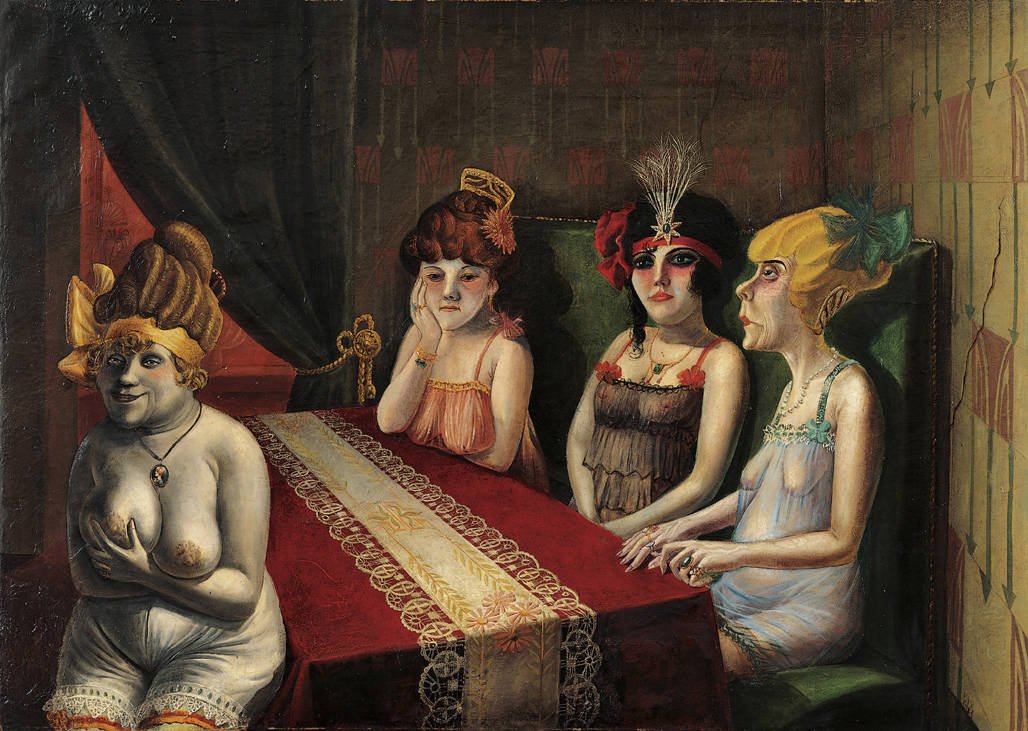
Salon I by Otto Dix

The Salon I by Otto Dix (1921)

Today I am looking at a painting by an artist whose work has frequently shocked the public.  His art often focused on the First World War and the aftermath of it on the people of Germany.  It was not his intention to shock people with what was depicted in his paintings.  It was simply his intention to tell the truth through his art and ensure that people would not ever forget the price citizens had to pay when their governments took them to war.  Of his controversial paintings, he said:

“I’m not that obsessed with making representations of ugliness. Everything I’ve seen is beautiful.”

“I did not paint war pictures in order to prevent war. I would never have been so arrogant. I painted them to exorcise the experience of war.”

“People were already beginning to forget, what horrible suffering the war had brought them. I did not want to cause fear and panic, but to let people know how dreadful war is and so to stimulate people’s powers of resistance.”

My featured artist today is the German painter and printmaker Otto Dix.  Dix was born in December 1891 in Untermhaus, Germany, which is now a part of the city of Gera.  He was the eldest son of Franz Dix, an iron foundry worker and Louise Dix, who was a seamstress and amateur artist.  His mother had also written poetry in her youth.  Otto had a cousin, Fritz Amann, who was a portrait and genre painter and so, from an early age, Otto Dix was exposed to the world of art.  At the age of fifteen Dix started a four year apprenticeship with the landscape painter Carl Senff and it was whilst at Senff’s workshop that Dix started painting his first landscapes.   At the end of his apprenticeship in 1910 he enrolled at the Dresden School of Arts and Crafts and supported himself financially by painting portraits and selling them to local people.  Whilst there he studied under Richard Guhr, the painter and sculptor and Dix attended his figurative and decorative painting classes.

World War I broke out in 1914 and Otto Dix enthusiastically enrolled in the German army.    His first assignment, as a non-commissioned officer, was to join up with a field artillery regiment in Dresden.  In the autumn of 1915 he was assigned as a non-commissioned officer of a machine-gun unit in the Western front and took part of the Battle of the Somme. He was seriously wounded on a number of occasions. In 1917, his unit was transferred to the Eastern front where he remained until the end of hostilities with Russia. He then returned with his regiment to the western front and took part in the German Spring offensive. He earned the Iron Cross (second class) for valour and reached the rank of vice-sergeant-major.  By the end of the conflict, he had been wounded on five separate occasions.  Dix was horrified and very much affected by the horrific sights he had witnessed during the four years of the war and these visions caused him to have many persisting nightmares well after the end of hostilities.

It was these nightmares and his traumatic experiences during the fighting that comes through clearly in many of his subsequent works, including a portfolio of fifty etchings called War, published in 1924.  At the end of the war, Dix returned to Gera, but in 1919 he moved to Dresden, where he studied at the Dresden Art Academy.   It was whilst studying art in that city that he met the Expressionist painter, Conrad Felixmüller, who was one of the youngest members of the New Objectivity movement.   Felixmüller was also a member of the Communist Party of Germany and his paintings often dealt with the social realities of Germany’s Weimar Republic. He became a mentor to Otto Dix and managed to bring together Dix and a number of like-minded Expressionist artists to form the city’s most radical art group, the Dresden Secessionist Group.  A year later Dix met George Grosz and it was around this time that Dix began to integrate collage aspects into his work.

The Trench by Otto Dix (1923)

In 1922 Dix moved from Dresden to Dusseldorf where he found a more lucrative market for his works of art.  A year later, in 1923 he completed a painting which shocked the public and establishment alike.  It had been commissioned by the city of Cologne and was entitled The Trench.  It depicted dismembered and decomposed bodies of soldiers after an overnight battle in a German trench.  For many, it was a gruesome and offensive depiction of death in the trenches.  He began the painting it in 1920 whilst he was living in Dresden but did not complete it until three years later.  Such was the uproar that the Wallraf-Richartz Museum in Cologne, which had commissioned the work, had to hide it behind a curtain.  The mayor of Cologne at the time and the future German Chancellor, Konrad Adenauer, cancelled the city’s purchase of the work and the Museum director, Hans Secker, was sacked.

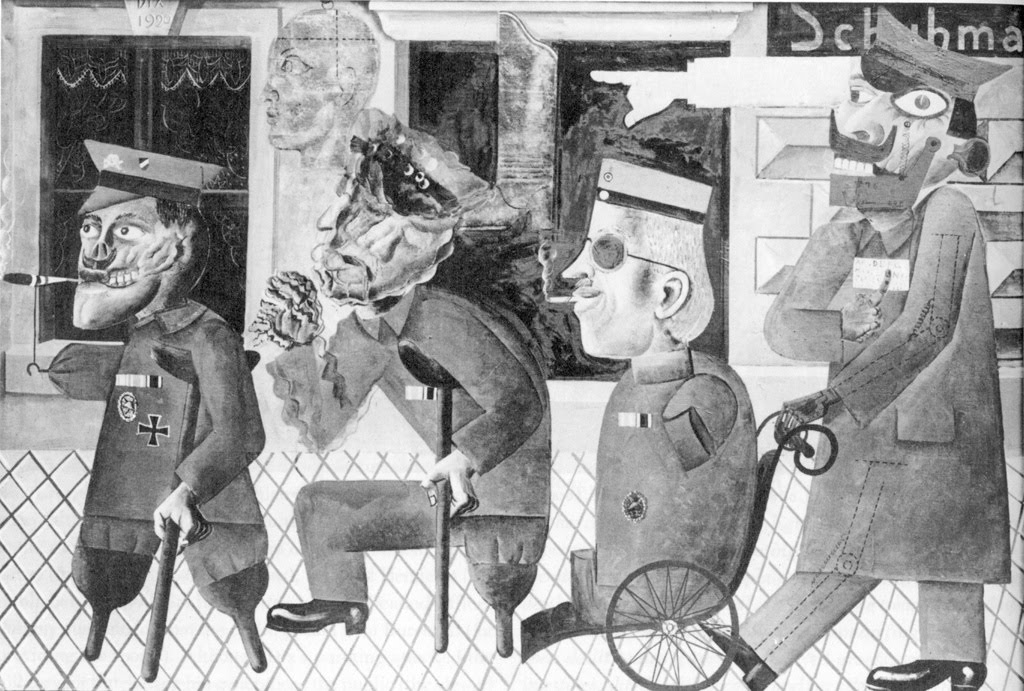
Otto Dix’s work, like that of his friend and contemporary George Grosz was extremely critical of the present-day German Weimar society.   His paintings would draw attention to the more miserable side of life and the hopelessness felt by the ordinary German people following on from their defeat in war.   The depictions seen in his paintings often graphically showed prostitution, violence, old age and death.  He also focused his attention on the German veterans of the war who would wander the streets of Berlin physically disfigured and mentally unable to cope with life.  These were the forgotten men who had served their purpose and who were now abandoned by society.   These paintings of his were somewhat sad and depressing and yet realistic.

The War Cripples by Otto Dix (1920)

When the Nazis came to power in Germany in the early 1930’s they regarded Dix as a degenerate artist and his depictions of the defeated German soldiers and his portrayal of the low-life of Berlin were considered unpatriotic and for this reason they had him sacked from his post as an art teacher at the Dresden Academy.  He later moved to live on the shores of Lake Constance.   In 1937, in Munich the Nazis held an art exhibition of what they called Entartete Kunst or Degenerate Art.  The purpose of the exhibition was to let the Germans know that some forms and pieces of art were not accepted by the “highest race”, and that this art was “degenerate”.  It was often termed Jewish or Bolshevistic art.  During the “Entartete Kunst” campaign over 20 thousand works by more than 200 artists of that time were confiscated. Dix’s 1923 painting The Trench and his 1920 work entitled, Kriegskrüppel (War Cripples) were shown at that exhibition.  They were later burned.  Dix was forced to join the Nazi-controlled Imperial chamber of Fine Arts in order to be able to work as an artist at all and had to promise to paint only landscapes. However, he still painted an occasional allegorical painting that criticized Nazi ideals. In 1939 he was arrested on a trumped-up charge of being involved in a plot against Hitler but was later released.  During World War II, Dix was conscripted into the Volkssturm. He was captured by French troops at the end of the war and released in February 1946. Dix eventually returned to Dresden. After the war most of his paintings were religious allegories or depictions of post-war suffering. Otto Dix died in Singen, Germany, in 1969, aged 77.

For My Daily Art Display featured painting today I have not chosen one of his gruesome but telling war paintings but a painting which looks at the fall-out from war for individuals, in this case females of the defeated nation.  The painting is entitled The Salon I and was completed in 1921, just three years after the end of World War I,  Dix had often examined the life of women in the aftermath of war, many of whom desperate for money to feed themselves and their family turned to prostitution.  In his painting we see four such women, garishly dressed, sat around a table which is covered with an expensive tablecloth, which evokes middle-class décor.  Except for one, they are all passed their prime.

These four scantily dressed prostitutes, decked out in bangles, necklaces and other cheap trinkets look bored.   They sit there in silent contemplation.  In the short term they wonder who their next client will be and how will they be treated.  In a longer term they wonder what will eventually happen to them and how was it possible that they have been reduced to this way of life.  The female to the left of the painting is overweight and was a character often seen in Dix’s works.  She gives us an inviting smile as she supports her breasts giving them an uplift which may make them more tempting to her next client.  The woman to the right of the painting is pitilessly depicted by Dix.  Her best years are far behind her and no amount of make-up can hide the wrinkles of old age.  Her diaphanous negligee does little to hide her sagging breasts.  Next to her wearing a red band and bow around her forehead is a young woman.  We ask ourselves why somebody with her looks and manner should end up in this brothel.  Her eyes and facial expression hide the truth from us.  We are left to decide for ourselves what necessitated her to sell her body.

All in all, it is a depressing work of art but before we condemn Otto Dix for choosing such a subject we need to remember why he did it.  At the very beginning of this blog I gave you his reasoning behind his often gruesome and shocking art.  He was horrified by what he experienced during his four years at war and he fervently hoped that it would never happen again and in his own way he needed to remind everybody about the horror of war or as is the case in today’s featured painting, he wanted to remind people about the terrible aftermath of war especially for the defeated.  Maybe we should consider again his reasoning for his art.  Dix wrote:

“People were already beginning to forget, what horrible suffering the war had brought them. I did not want to cause fear and panic, but to let people know how dreadful war is and so to stimulate people’s powers of resistance.”

Sadly nobody really paid attention to the horrors of the First World War as twenty years later we stumbled blindly into yet another major conflict.

The Fountain of Youth by Lucas Cranach the Elder

The Fountain of Youth by Lucas Cranach the Elder (1546)

Throughout time, mankind has always looked for ways to extend the longevity of life.  In modern times we have organ transplants, anti-aging creams and plastic surgery to either extend our life or if we accept the futility of that premise, then at least try and make oneself look younger.  We can now bathe in spas whose magical water quality are supposed to combat this disease or that disease and many who have bathed in these waters leave feeling cleansed and believe implicitly that the waters do heal them of their ailments and have rejuvenated them.  In past times there was always talk about the mythical Fountain of Youth in which the waters could reverse the ageing process.  Alexander the Great, who conquered most of the known world at the time, was thought to have been searching for a river that healed the ravages of age. Move forward to the 12th century and we hear of a puzzling letter sent to the Byzantine emperor Manuel I which started to circulate around Europe. It told of a magical kingdom in the East that was in danger of being overrun by infidels and barbarians. This letter was supposedly written by a king known as Prester John and talked about his kingdom which had rivers filled with gold and was the home of the Fountain of Youth.  Two centuries later, in 1513, it was recorded that the explorer, Ponce de León, was searching for the Fountain of Youth when he traveled to what is now Florida.   And so it goes on, this fascination with the mystical Fountain of Youth.

Artists have often recorded pictorially their take on this magical fountain and today I am going to take a look at one which was completed just over thirty years after Ponce de León’s voyage of discovery.  The painting, Der Jungbrunnen (The Fountain of Youth) is by the German artist Lucas Cranach the Elder which he completed in 1546.  It is about the human desire for immortality and eternal youth.  The old women in the painting crave to cast aside their worn outer shell, which is pale and wrinkled, and exchange their haggard looks by replacing their outer-self with a more acceptable younger version.

The examination

I like the mini-scene in the centre ground to the left of the pool where we see a man bent forward closely examining a naked woman.  What is that all about?  Is he an official or maybe a doctor who is examining how haggard the woman is to see if she fits the criteria for rejuvenation?  If this is the case, then for once to gain one’s admission to the pool old age and infirmity is requisite bargaining tool!

The Fountain

In many ways this simplistic depiction of the Fountain of Youth is quite amusing.  At the centre of the painting we observe a large square-shaped grey and white pool, at one end of which is the fountain.   The fountain gushes out water it has drawn from the spring below.  On the fountain there are statues of Venus and Cupid which, in some ways, is confirmation that this is more of a Fountain of Love and that maybe it is the power of love which is the rejuvenating factor.   The pool is populated by naked women.  Steps around the four sides of the pool lead down to the healing waters.  To the left of the painting we see elderly women, who have made the long and tiring journey, arriving in carts, on litters, in wheelbarrows or in one case piggy-backed on a man who can just about cope with her weight.  All want to bathe in the rejuvenating water.

Wheeled to the magical waters

The old women then alight from their transport, take off their clothes, examined and are helped into the square-shaped pool, the water of which is being topped up from the Fountain of Youth.   Once partly immersed in the magical waters the naked women begin to splash themselves with the water and frolic about, the cares of the world seemingly lifted from their shoulders.  Now that the women have regained their youthful looks they look at one another amazed by the change that has taken place.  They caress themselves or caress one another, hardly believing what they are seeing and feeling.  They comb their long flowing golden hair.  Their mood is one of triumph.  The power of the waters has worked.

In and out of the robing tent

If we now look to the right hand side of the pool we see that after having been immersed and had been revived by the recuperative powers of the waters, they step out of the pool, rejuvenated and once again young.  From the pool side, these gregarious young virgins are then directed towards a large tent in order to dress and after a short while they emerge as beautiful young ladies wearing the most exquisite clothes.  For them, the world has changed and they go off to dance or dine or find themselves a handsome young man whom they can take off to the seclusion of the bushes to……..

Although this undoubtedly is a humorous painting, I wonder whether Cranach intended to also moralize with his depiction.  On the left Cranach depicts the old women being brought to the waters by ordinary working-class types of people but note how, once rejuvenated and sumptuously dressed, the young women go off with the upper class nobility.  What happened to the poor men who almost carried their women to the pool?  Have they now been abandoned?  Another question the painting raises is why are there no men in the pool being rejuvenated?  Should we believe that in the 16th century it was only the women who sought rejuvenation?  Has nothing changed in the last five centuries?   Is the female current desire for rejuvenation by creams, potions and the surgeon’s knife any different to Cranach’s women immersing themselves in the Fountain of Youth?

One of the things I like about this painting is the number of mini-scenes taking place within the work.  Every time I look at the work, I notice something I had not seen before.  I saw this work of art when I visited the Gemäldegalerie in Berlin some time back, the same museum which houses the Netherländish Proverbs by Pieter Bruegel the Elder, another marvelous painting which is awash with mini scenes.

A Merry Company at Table by Hendrick Pot

A Merry Company at Table by Hendrick Pot (c.1630)

Two paintings today; one by the artist and one of the artist himself.  One of the pleasures I get from my blog is that besides discovering new artists and their paintings, I acquire an insight with regards the history and traditions of various countries , most of which I had little previous knowledge.  Maybe I should have concentrated more during my history lessons at school.   Recently I have featured Flemish artists and I looked briefly at Dutch and Flemish history during the time of Spanish occupation and rule.  Today, I am looking at a painting by the Dutch painter Hendrick Pot and exploring the world of the schutterij.  Don’t you know what the shutterij is or are?   Neither did I until I researched a painting by Pot but before I reveal the answer let me give you a brief biography of the artist himself.

Hendrick Gerritsz Pot was born in Haarlem around 1585.  His early artistic training was with Karl van Mander.  We probably know Karl van Mander not so much as an artist but for his writings.  He has often been termed the Dutch Vasari for his book entitled Schilderboek, published in 1604, which to this day, remains the main source for information on Northern European painters of the 1400s and 1500s and contains valuable original material about his Italian contemporaries.  He had arrived in Haarlem in 1583 and set up an informal academy with the Dutch engraver and painter, Hendrick Goltzius.  At this Academy, van Mander taught and developed the Haarlem Mannerist style.   Other artists who were trained by van Mander at his studio included Frans Hals.
In 1620 he was commissioned to do two paintings relating to William I of Orange, often referred to as William the Silent, who was one of the key leaders of the Dutch revolt against Spanish rule.  He was assassinated in 1584.  One of the paintings, entitled the Glorification of Willem I, was acquired by the city of Haarlem whilst the other entitled the Deathbed of Willem I was housed in the town hall of Delft.   In1630 Pot became Dean of the Haarlem Guild of St Luke.   He travelled to the court of Charles I in London in 1632 where he was employed as the court portraitist and during his one year sojourn at the court completed portraits of Charles I and his wife Queen Henrietta Maria.

In 1633 he returned he returned to Holland.  Many of Pot’s lucrative commissions were to paint group portraits of the local militias, known as schutterij.  So now you know – schutterij is the Dutch term for militia.  They were a voluntary city guard whose prime objective was to protect their town or city from attack and also to act in case of a fire breaking out within the town.   They were simply a defensive military support system for the local civic authority. The officers of the schutterij came from wealthy backgrounds and were appointed by the city magistrates. The captain of each group was normally a very wealthy inhabitant of the district, and the group’s ensign was a wealthy young bachelor and he could be recognised in the group portraits as the man wearing exceptionally fine clothes.   There was a special kudos to being a member of the schutterij as it often led to one being appointed to an important position within the town council.

At the time when the leaders of an individual schutterij stepped down or passed away and their replacements were sworn in, a local artist was commissioned to paint a new group portrait of the members. These group portraits were known as schuttersstukken and they often had the setting of a banquet which was held to welcome in the new leaders.     The artist commissioned to carry out the painting had a complex job on his hands.  This is not as it would be now when a photographer would get the group to stand as one and after a few minor adjustments shoot the film.  In the case of schuttersstukken the artist would paint each member separately so that each individual portrait within the group was as accurate as possible.  As a member of this militia, if one wanted to be included in the group portrait, one had to pay for the privilege and how much you paid the artist and your rank within the militia, would depend on where he positioned you within the group!  As I said before it was a very lucrative commission and there was a lot of competition for the right to carry out the group portrait.  Probably one of the most famous of the schuttersstukken was Rembrandt’s The Night Watch.   One thing that would help an aspiring artist to gain the painting commission was if he was a member of a schutterij.   Hendrick Pot was a lieutenant in a schutterij and that was the advantage he had over many of the other applicants.

The Banquet of the Officers of the St George Militia Company by Frans Hals

This leads me to my second painting of the day which is entitled The Banquet of the Officers of the St George Militia Company which Frans Hals painted around 1639 and included in the work is none other than Hendrick Pot with his militia sash who is seated at a table on the far right of the gathering, reading a book.

In 1648 Pot moved from Haarlem and went to live in Amsterdam.  In his later years he concentrated on small single figure portraiture.  He died in Amsterdam in 1657, aged 72.

My main featured painting is one Hendrick Pot completed around1630 and is entitled A Merry Company at a Table.   It is now housed in the Wallace Collection in London.   It is a genre piece.  The definition of a genre piece is a work of art  which affords a pictorial representation, painted  in any of the various media and one that represent scenes or events from everyday life, such as markets, domestic settings, interiors, parties, inn scenes, and street scenes. Some of the genre pieces are realistic, some imagined, whilst others are romanticized by the artist. This type of painting was particularly popular in seventeenth century Netherlands, but the term “genre” was not applied at the time;  instead, paintings were divided into more specific categories, such as ‘merry company’ scenes (conversatie), ‘little fire’ scenes (brandje) or ‘bordello scenes’ (bordeeltje).   My featured painting today falls into the latter category, a bordeeltje.  So why do we believe what we are looking at is a bordello?  Although the painting is not littered by scantily dressed females and lusting men the artist has given us some subtle hints as to what we are looking at.  On the floor there is a discarded rapier, lute and in the foreground, a dog.  These symbolise the disarming power of love and carnal desire.  Look to the left of the painting and in the doorway one sees an old woman carefully watching her girls as they enchant and flirt with the soldiers.  The men and women seated around the table make music together which is a common euphemism for making love and they play cards and smoke which were looked upon as the two great vices of the time.

Look to the extreme right of the painting.  Look at the cavalier with his back to the chimney breast, who stares out at us.  He gives us a knowing look as if to say “you know what is going on here, don’t you?”  The background solely consist of a drab muted coloured wall broken up only by the presence of a mirror.  Why do you think Pot added a mirror to this scene?  Could he be asking us to look into it, see our own reflection and examine our own behaviour, before we audaciously condemn the women and the men we see before us in the brothel?

I have always liked these Dutch and Flemish genre pieces.  There is often a moralistic tale being told.  The scene is often up for interpretation and we look carefully for any signs of symbolism.  I enjoy looking closely at the individuals and try to guess what is going on in their minds.  Fortunately there are so many of them in our art galleries and museums and I am never disappointed by what I see.

Enjoy !

Virgin Annunciate by Antonello da Messina

Virgin Annunciate by Antonello da Messina (c.1476)

I think I have mentioned before how I choose an artist or a painting for future blogs.  It is usually following an art exhibition or a visit to a gallery or, as is the case today, the artist is mentioned in passing in a previous blog.   When I was putting together the biography of my last featured artist, Vittore Carpaccio, I mentioned that in his early days he was influenced by the Sicilian artist, Antonello da Messina.  I had never heard of this artist before and curiosity got the better of me and I began to research his life and look at some of his paintings.  His portraiture is some of the best I have ever come across so I thought I would share my “find” with you.

It is thought that Antonello di Giovanni degli Antonii, better known as, Antonello da Messina, was born in Messina, Sicily, around 1430 and is now considered as the most famous artist to have come from this island.  He was one of four children and his father was a local stonemason.  His early life is somewhat sketchy and often contradictory.  A little light can be shed on Antonello’s training from a letter, dated 1524,  in which Pietro Summonte, the Italian Renaissance humanist living in Naples, and who took great pains in collecting and preserving his correspondence on artistic matters with the Venetian nobleman, Marcantonio Michiel.  In it is mentioned that Antonello was the pupil of Niccolò Antonio Colantonio, an artist who had received instruction in the methods of Netherlandish painting whilst serving at the court of King René I of Naples.  This fact alone may go some way to explain the influence of Flemish paintings in Colantonio’s and later, Antonello’s work.  However not all art historian agree about the Flemish style, influence and technique of Colantonio’s works and that, in turn, Antonello was influenced by his Master, Colantonio.   The art historian J.Wright in his 1980 book, Antonello da Messina: The Origins of his Style and Technique, believes that the characteristic of Colantonio’s work is almost entirely French rather than Netherlandish.

So where did Antonello pick up this Netherlandish influence?  It appears debateable whether Antonello ever travelled to the Netherlands but it is known that René I’s time as ruler of Naples came to an abrupt end in late 1442 and the new ruler King Alphonse V of Aragon (King Alfonso I of Naples) came to power and his art collection contained works by the Netherlandish painters, Jan van Eyck and Rogier van der Weyden, which as Colantonio’s assistant, Antonello could well have been familiar with these works whilst working on royal commissions.   Around this time, Antonello completed many religious works, one of which was his painting entitled St Jerome in his Study, and many believe that this work was influenced by Jan van Eyck’s Portrait of St Jerome (1442).  His later Annunciation of Syracuse  in 1474 is thought to have been influenced by the extraordinary Lomellini Triptych by Jan van Eyck.

A gonfalone

In 1457 at the age of twenty-seven whilst in Messina, Antonello married Joan Cumminella and it could well be that his first son, Jacobello, had already been born.  In that same year, it is known that Antonello moved to Reggio Calabria,   on mainland Italy.  It was whilst here that he received a commission to produce a gonfalone for the confraternity of S Michele dei Gerbini in Reggio Calabria.  Gonfalones were a type of heraldic flag or banner, often pointed, swallow-tailed, or with several streamers, and suspended from a crossbar.   In that same year Antonello married.  His wife was Giovanna Cumminella.  Soon after this,  he and his family as well as his brother and sister-in-law moved north and settled in Amantea, a town on the west Calabrian coast.  However three years later in 1460, he returns to Sicily after his father sends a brigantine to transport them all back from Amantea to Messina.  The following year he set up a workshop in Messina and took on his younger brother, Giordano di Giovanni as an apprentice.

In the period from 1465 and 1475, Antonello completed many portraits.  The surviving portraits are all of men.  His portraiture at this time was different in style to the Italian portraiture for he had a great grasp on the structure of a face, not just the bone structure, but the overlying facial muscles and sinews.  With this knowledge he could depict how the movement and portrayal of facial muscles around the eyes and mouth could alter facial expressions.  His portraits were nearly all in three-quarter views and bust length showing head and shoulders but not the arms.  The sitters faced the light which generally fell from left to right illuminating the edge of the right cheek and modelling the nearside (left side) of the face with chiaroscuro, the term for the technique of using light and shade in pictorial representation.  His sitters, like in many Netherlandish portraiture, are dressed unostentatiously in contemporary dress and wear no emblems or jewellery which would detract us from the simplicity of the portrait.  This drabness of clothing, often dark red or black, does not attract our attention and allows us to look directly and steadily into the eyes of the sitter.

Portrait of a Man (known as The Condottiere )

However, it was Antonello’s stay in Venice, from 1475 to 1476, which marked the definitive turning point in his artistic career and in fifteenth-century Italian art history. The encounter between Antonello’s art and the Venetian figurative environment, represented primarily by Giovanni Bellini, created the conditions necessary for his absolute masterpieces, such as Portrait of a Man known as The Condottiere and the Trivulzio Portrait of a Man.   In Venice, Antonello and his works of art were highly acclaimed and he received many commissions.  It is known that Antonello was still in Venice in the March of 1476 completing the S Cassiano Altarpiece commissioned by the church of San Cassiano in Venice.  From Venice there is speculation that he travelled to Milan to carry out a commission for Gian Sforza, Duke of Milan, but whether he did visit Milan it is known that by the end of 1476 he was back in his Sicilian home in Messina.  In his workshop he now had his son, Jacobello d’Antonio and his nephews Antonio and Pietro de Silba as his assistants.

In February 1479 Antonello made his will, and died shortly afterwards at the young age of forty-nine.  He had pre-deceased both of his parents as he made provision for them in the document.   Antonello was an extraordinary painter, one of the greatest of his time.  In his last years his son collaborated with him with Antonello planning the work and Jacobello executing the painting.  On one, Jacobello paid a fitting tribute to his father and signed the painting:

“…the son of Antonello, a painter of no human kind…”

For my featured painting today I give you Virgin Annunciate which Antonello completed whilst in Venice around 1476 and is now housed in the Galleria Regionale della Sicilia in Palermo.  It is probably his most famous work.  The painting is a hauntingly beautiful image of an adolescent Mary at the time the angel Gabriel came to her to tell her that she would bear God’s son.  Look closely at her beauty as depicted in this bust length portrait by Antonello.  She sits before us dressed in a simple blue mantle.  She clasps her blue mantle closed and holds it modestly in front of her chest.  The background is plain and does not distract us from staring at the young woman.   She sits at a reading desk.  Before her, on the desk, is a book of devotions which she has been reading.  We have disturbed her.  She looks up at us.   The angel Gabriel as is the case in most Annunciation scenes, is not present.  It is simply implied.  Her right hand is raised in a blessing gesture to Gabriel but as he is not in the painting, it is as if she is greeting us, the viewer.  It is just her and us.

The face of young beauty

Would you say this is a religious painting?  That seems a silly question to ask as we know the story of the Annunciation is a religious story but although the subject is religious in nature, Antonello has deliberately selected a young, beautiful and humble Sicilian girl for the model of the Blessed Virgin. So was it in Antonello’s mind to simply paint a portrait of a devout young girl.  I suppose the answer lies in who commissioned the work and what they asked the artist to depict.  Whether it is a simple portrait or a religious painting, I challenge you to find another work depicting such an exquisite looking young.

Two Venetian Ladies by Vittore Carpaccio

Two Venetian Ladies by Carpaccio (C.1510)

We know Vittore Carpaccio was born in Venice but his precise birth date is not known but it is thought to be around 1460.  His father Piero Scarpazza, who came from nearby Istria, was a leather merchant.  Vittore is believed to have trained in the studio of the Jacopo Bellini family, which at that time after his death, was run by his two sons, Gentile and Giovanni Bellini.  Carpaccio’s art was very much influenced by the works of Gentile and Giovanni Bellini as well as Antonello da Messina, the Sicilian Renaissance painter who introduced the Netherlandish Renaissance art of Flanders and Holland to Venice.  Later he would work as an assistant to the Paduan artist, who had a studio in Venice, Lazzaro Bastiani

Carpaccio’s greatest work of art was his large nine painting series entitled The Legend of Saint Ursula, which was originally meant for the Scuola di sant’Orsola but can now be found in the Gallerie dell’Academia in Venice.   This work completed in 1497 is absolutely breathtaking and is one that should be a “must see” if you visit Venice.  I featured one of the large paintings in My Daily Art Display, March 22nd 2011.  During the first decade of the sixteenth century, Carpaccio worked on a series of paintings for the Hall of the Great Council in the Doge’s Palace along with his former tutor Giovanni Bellini. Unfortunately, like many other major works, the series was entirely lost in the disastrous fire of 1577.  This was the third serious fire to devastate rooms in that building.

Between 1502 and 1507 Carpaccio worked on a cycle of canvases for the Scuola di S.Giorgio degli Schiavoni, with the story of St. George and the dragon and episodes from the life of St. Jerome.   Following this Carpaccio started in 1511 to work on a series of paintings based on the life of St. Stephen in the Scuola di S. Stefano.  It took him three years to complete the works.  Carpaccio received many commissions including ones from the Venetian government.

His popularity in the ten years prior to his death in 1525 waned mainly due to a young artist who had arrived in Venice in 1500 and like Carpaccio went to work for the Bellini brothers.  His name was Tiziano Vecellio, better known simply as Titian and it was this young man who was to amass numerous commissions from the Venetian government and rich Venetian patrons.  Carpaccio ended his career back in the provinces where his somewhat out-dated approach to art still attracted many buyers.   After his death he was almost completely forgotten as an artist but now art historians look upon him as a fifteenth century Venetian artist, only bettered by Giovanni Bellini.

My Daily Art Display’s featured work today is a tempera and oil on wood panel painting entitled Two Venetian Ladies and can be found at the Correr Museum in Venice.  It was completed by Carpaccio around 1510.  Before us are two unknown Venetian ladies.  Who they were has never been agreed on by art historians.  They sit there with what can only be described as vacant and bored expressions.  Early scholars including the English art critic, John Ruskin, believed that the two ladies were high class courtesans, a polite term for high class prostitutes, and they were waiting for their rich clients. John Ruskin, who thought this work at the time was one of the finest in the world, actually referred to the painting as Two Courtesans.   The story of the two ladies was further embellished by stating that the small page we see to the left of the painting has just arrived with a message from a lover for one of the ladies.  Another reason Ruskin and other believers in the “courtesan” argument gave for their theory was that in front of the page, on the floor, are a pair of wedge platform sandals which were often worn by prostitutes to make themselves look taller.  Those who did not accept the “courtesan” theory pointed out that most women of the time wore such sandals.

However, those who did not accept the “courtesan scenario” would have us believe that because of their exquisite clothing and expensive jewelry, they were members of the aristocratic Torella family.  Another reason for believing that they were not courtesans, mistresses of rich men, is Carpaccio’s inclusion in the painting of a white handkerchief held by one of the ladies, strings of pearls worn around their necks of both women, and the white doves perched on the balustrade, which were known as the birds of the Goddess of Love, Venus, and all of which symbolized chastity.

Hunting on the Lagoon by Carpaccio (c.1510)

In 1944 all the speculation about the Two Venetian Ladies painting changed when the upper half of the painting was discovered.   Professor Pamela Fortini Brown of Princeton University may have solved the question regarding the two ladies as she wrote that this painting is part of a larger one, in fact the lower right hand section of a very large work.     The upper right half of the original work is now housed in the Paul Getty Museum in Los Angeles, and is entitled Hunting in the Lagoon.  This upper part depicts several boats in a lagoon.  Because of the way only half of the dog’s head is shown in the painting, suddenly cut off behind its ears, it is thought there is a complete missing left hand side of the work in which the rest of the dog is depicted.

So now we must rethink what we are seeing in the original painting.   One now must believe that the husbands of the two ladies seated are in this party of hunters and that the ladies are waiting their return.  We can see each boat has a group of three rowers and an archer who all stand in these shallow-bottomed craft and hunt the glossy black cormorants which they will sell or train to catch and retrieve fish from the lake.   Rather than bring the bird down with an arrow which would damage the plumage, the archers use clay pellets which will stun the birds. If we now consider the two paintings together it would explain the meaning of the paintings title, as the two women are awaiting their husbands’ return after a hunting and fishing expedition in the Venetian lagoon. Look closely at the two paintings.

Juxtaposition of the two paintings

So do you agree the two paintings are part of one original work?  Observe the majolica vase of flowers on the balustrade in the upper left background of the Two Venetian Ladies painting.  Note how the stalk of the flower is cut off at the top edge of the work.  Now look at the bottom left foreground of the Hunting on the Lagoon painting and you can see the stem and head of a lily which when looking at just that painting makes no sense, but if the two paintings are juxtaposed, one on top of the other, one can then see that the head of the lily in one painting is a continuation of the stem protruding from the vase in the other painting.  Add to this visual evidence the fact that when the two panels were examined, the wood grain of the two panels was found to be identical and this confirmed that they were once a single panel. It is thought that the two parts were probably sawed apart some time before the nineteenth century.

A Girl in a Kitchen (La chercheuse de puce) by Nicolas Lancret

A Girl in a Kitchen by Nicolas Lancret (c.1720-30)

Today I am featuring the French painter, draughtsman and art collector, Nicolas Lancret, who was born in Paris in 1690.  To begin with, Lancret trained as an engraver but soon afterwards became an apprentice to the history and religious painter Pierre Dulin.  Dulin was later to become a professor of art at  Académie royale de peinture et de sculpture in Paris.  Throughout his early artistic training Lancret was influenced by and greatly admired the works of the Jean-Antoine Watteau the late Baroque painter and one of the leading artists in the new Rococo style of artwork.  In 1708, at the age of eighteen, Lancret enrolled at the Académie royale de peinture and in 1711 he competed unsuccessfully for the Prix de Rome prize.  His stay at the Académie ended when he was expelled for quarrelling.    It was Lancret’s love of Watteau’s work that made him part from his tutor Dulin and serve under Claude Gillot, the French genre and decorative painter, who had Watteau as his assistant in 1703.  Once Lancret began to work in the studio of Gillot his artwork changed from the history painting he had learnt whilst with Dulin to the Rococo style with all its scenes of graceful figures at leisure in elegant garden settings similar to the works of Watteau whom Lancret met around 1712.

In 1719 he was the first painter to be accepted into the Académie Royale as a painter of fête galantes, a category that had been created by the Academy in 1717.  Fête galante, which means “courtship party”, is a French term used to describe a type of painting which first came very popular in the early eighteenth century France.  Watteau had submitted his reception piece, ‘The Embarkation for the Island of Cythera (See My Daily Art Display, February 22nd 2011)  to the Académie Royale in 1717 and the critics of the time described it as characterising une fête galante.  These fêtes galantes paintings were usually small in size and recorded the lives of stylishly dressed men and women engaged in amorous but well-mannered play in a garden or parkland surroundings.

Lancret’s art work became very popular and he received numerous commissions from wealthy patrons especially after the death of Watteau in 1721.  Frederick the Great owned more than twenty-six of his paintings but his main patron was the ruler of France, Louis XV,  who, from the 1725,  continued to buy Lancret’s work until the artist died almost twenty years later.  He was one of the most prolific and imaginative genre painters of the first half of the eighteenth century in France and he had the ability to insert lively genre images into an allegorical framework.  His portraiture work was different to many of the time as he liked to treat his portraits as genre scenes.  Lancret exhibited works regularly at the Paris Salon.

Lancret remained single for much of his life and did not marry until 1741 when he was fifty-one years of age.  He married the 18 year old grandchild of Edmé Boursault, the French dramatist and writer.  Although one may be dismayed by the age difference of the couple it is believed that Lancret decided to marry the young girl after finding her and her dying mother living in poverty in an attic room and on hearing that the daughter was soon to be compelled to enter a convent. The marriage was a short-lived as Lancret died of pneumonia in Paris in 1743, aged fifty three.

My Daily Art Display featured painting today is not a fête galante work but a genre piece which I saw recently at the Wallace Collection in London.  The painting is entitled A Girl in a Kitchen (La chercheuse de puce) which Lancret completed in the 1720’s.  It is very reminiscent of the Dutch genre paintings of the previous century.  We see before us a young woman seated in a kitchen.  The first question which comes to mind as we look at her is what is she doing?  The subtitle of the painting La chercheuse de puce, reveals all, as translated it means “the seeker out of fleas”.  Unbelievable as it may seem the girl is inspecting herself for fleas !!!   The reason for this activity was that during the eighteenth century, amongst the poorer classes, infestation in the household with fleas was quite common.  However the depiction of the girl touching her exposed breasts during her inspection was probably Lancret’s way of titillating the observer.  The girl sits before us with her corset unlaced, inspecting her body.  Kitchen scenes in poor and peasant households were popular with the Dutch art collectors but the addition of the bare-breasted girl with its erotic connotations adds a typical French flavour to the depiction.

In some ways this painting is a kind of plagiarism as it is thought that although Lancret painted the girl and the still-life on the table next to her, the interior was painted by a Dutch artist much earlier.    The erotic element of the painting is not the only “Frenchness” about the work of art.  She sits there in her French silk skirt, semi-laced corset and delicate pointed slippers and she has been added by Lancret to this Dutch seventeenth-century interior.  It is not known which Dutch artist had painted the interior.  There were many art collectors  in France who paid good money for these Dutch genre scenes.  However Lancret, the master of fêtes galantes paintings, wanted to add some colourful and picturesque feminine interest into those more dark and somber Dutch paintings and, as was the case in today’s work, he is known to have embellished works by the Dutch landscape and peasant scene painter, Herman Saftleven and the Dutch Golden Age and sill-life painter, Willem Kalf.

I will leave you to ponder over whether the original Dutch interior needed the little bit of colour and bare flesh that Nicolas Lancret has given us.