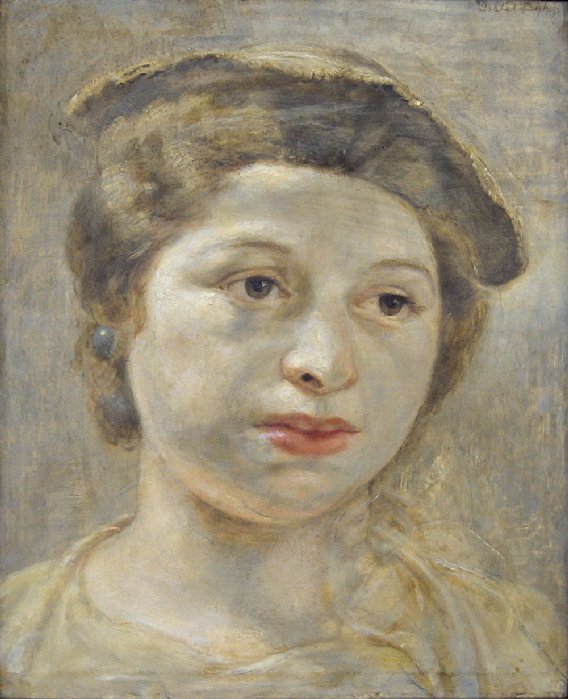
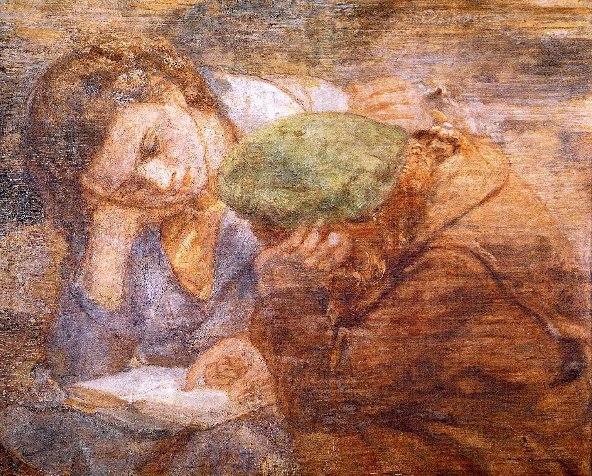
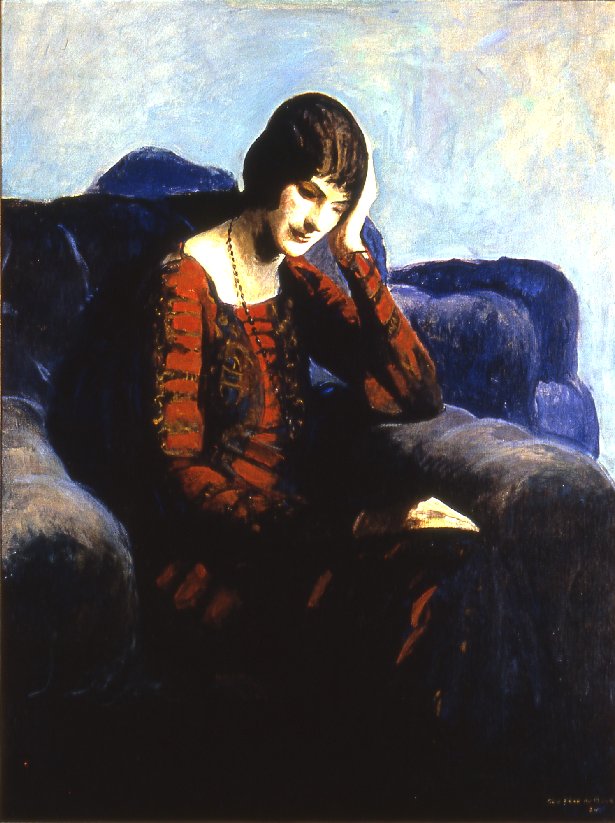
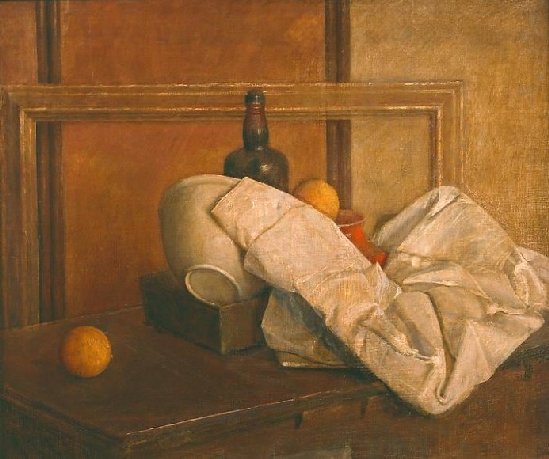
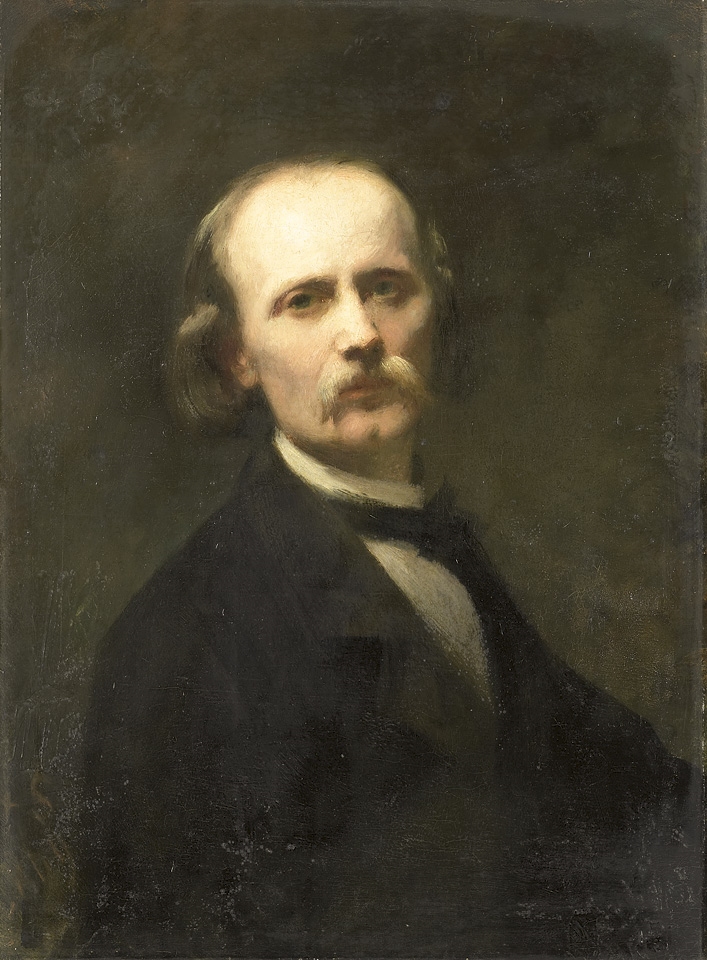
Gertrude Horsford Fiske

Gertrude Horsford Fiske

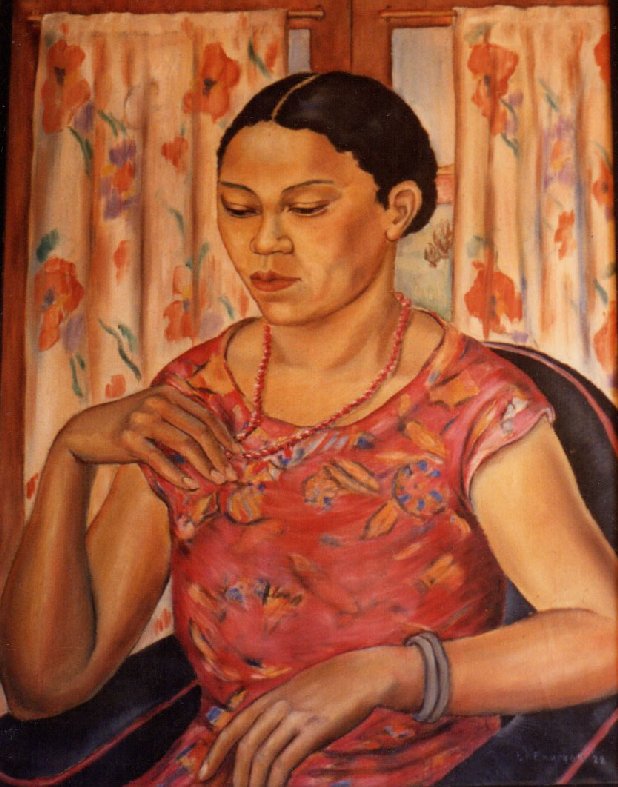
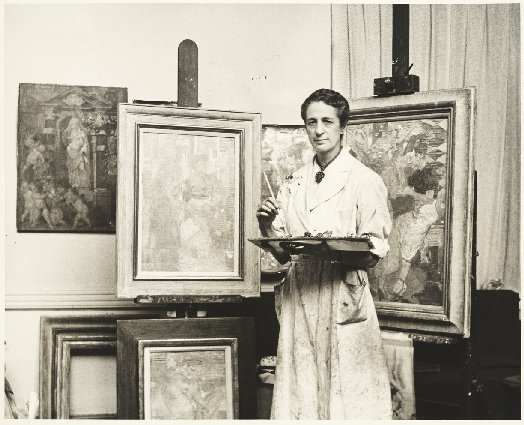
The artist I am looking at today is the nineteenth century American painter Gertrude Horsford Fiske who was famous for painting people, still life, and landscapes. Gertrude Fiske was born into an established New England family that can trace their family history way back to the Governor of Plymouth Colony, William Bradford an English Puritan Separatist originally from the West Riding of Yorkshire in Northern England who moved to Leiden in Holland in order to escape persecution from King James I of England, and then emigrated to the Plymouth Colony on the Mayflower in 1620. Gertrude, born in 1879, was one of six children born into a wealthy Boston family, her father being an eminent lawyer. She was educated in Boston’s best schools but during her teenage years she showed little interest in art as much of her free time was taken up with horse riding and golf. She proved herself to be an extremely skilled professional golfer.

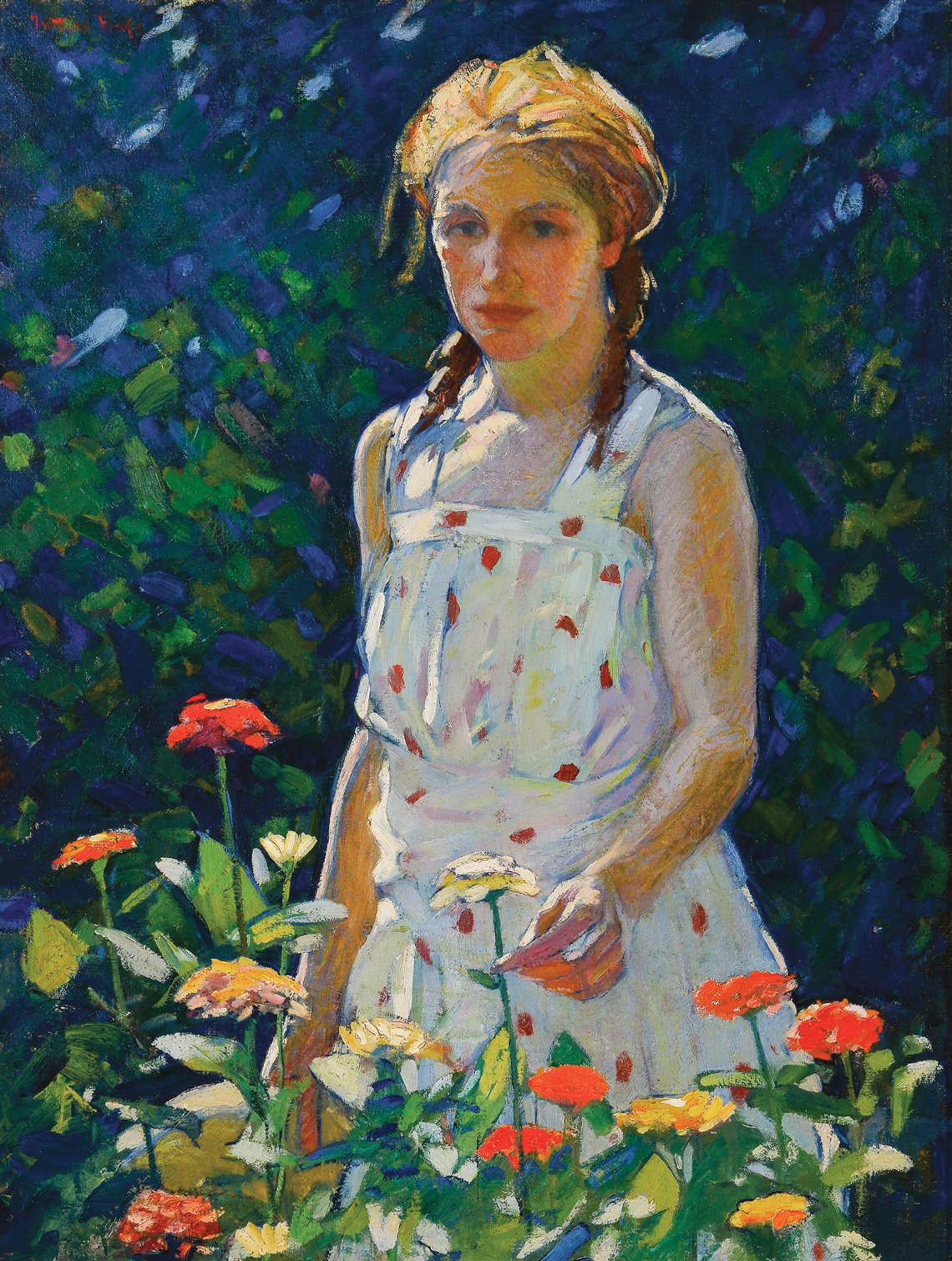
Woman in White by Gertrude Fiske

It was not until she was twenty-five years old that she took an interest in art and began to look at the possibility that her future could be as a professional artist. In 1904 she enrolled on a seven-year course at the School of the Museum of Fine Arts, Boston, (now the art school of Tufts University), where her tutors included Edmund C. Tarbell, an American Impressionist painter, Frank Weston Benson, known for his Realistic portraits, American Impressionist paintings, watercolours and etchings and Philip Leslie Hale, an American Impressionist artist, writer and teacher.

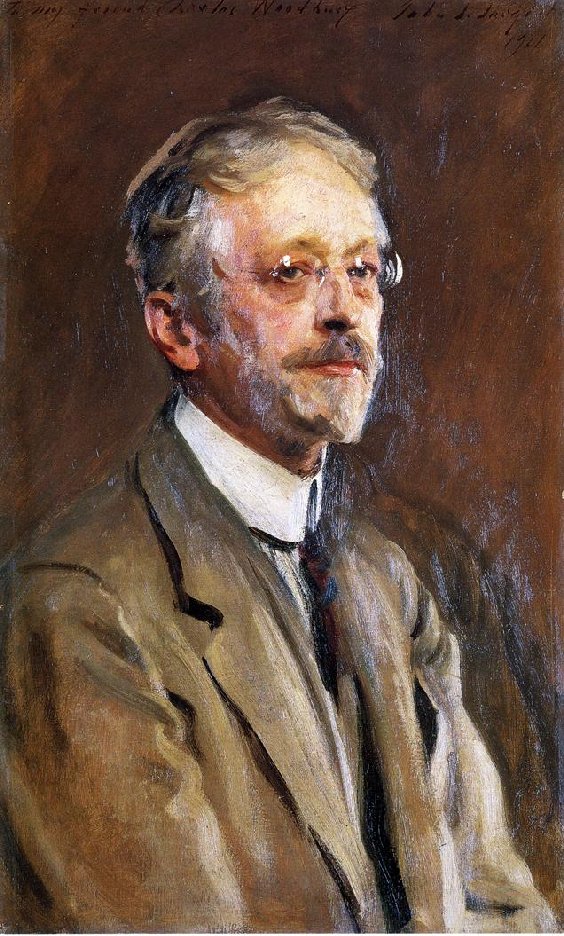
Charles Herbert Woodbury by John Singer Sargent (1921)


During the summers, she attended Charles Herbert Woodbury’s art classes in Ogunquit, Maine. Ogunquit was originally populated by The Abenaki indigenous people of the Northeastern Woodlands of Canada and the United States and in their language the name of the town means “beautiful place by the sea”. In the early years of the twentieth century, it had become a popular destination for artists who wanted to capture the landscape’s natural elegance.

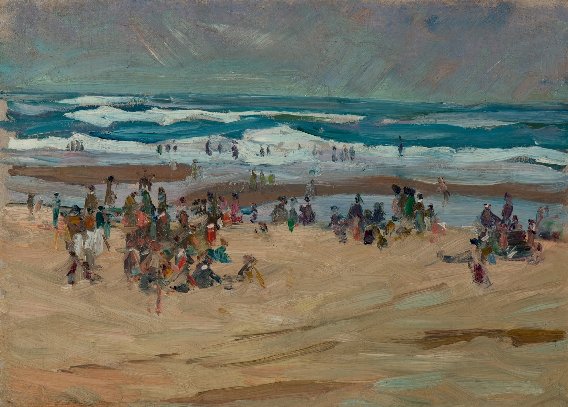
Ogunquit Beach by Gertrude Fiske (1914)

Ogunquit Beach by Gertrude Fiske

Soon, a community of artists formed the Ogunquit Summer School of Drawing and Painting which was founded by Charles Woodbury. Woodbury was a great influence on Gertrude Fiske’s informative years and he encouraged her and her fellow students to “paint in verbs, not in nouns.” By this, he meant that his students should enter into the life of the things they painted. He wanted to inspire them to fresh, “active” seeing and expressive creativity and told them that in seascapes they did not draw what they saw of the wave – you draw what it does. The phrase implied that painting is perceptual and that realism is evidence of the felt and the seen and not just of what’s visible.

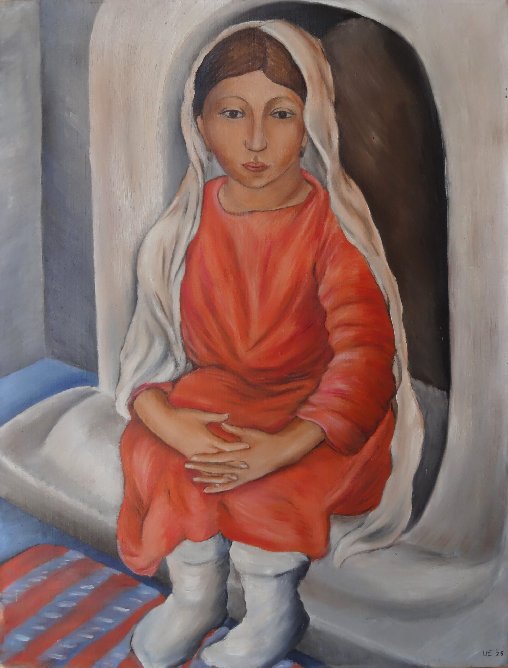
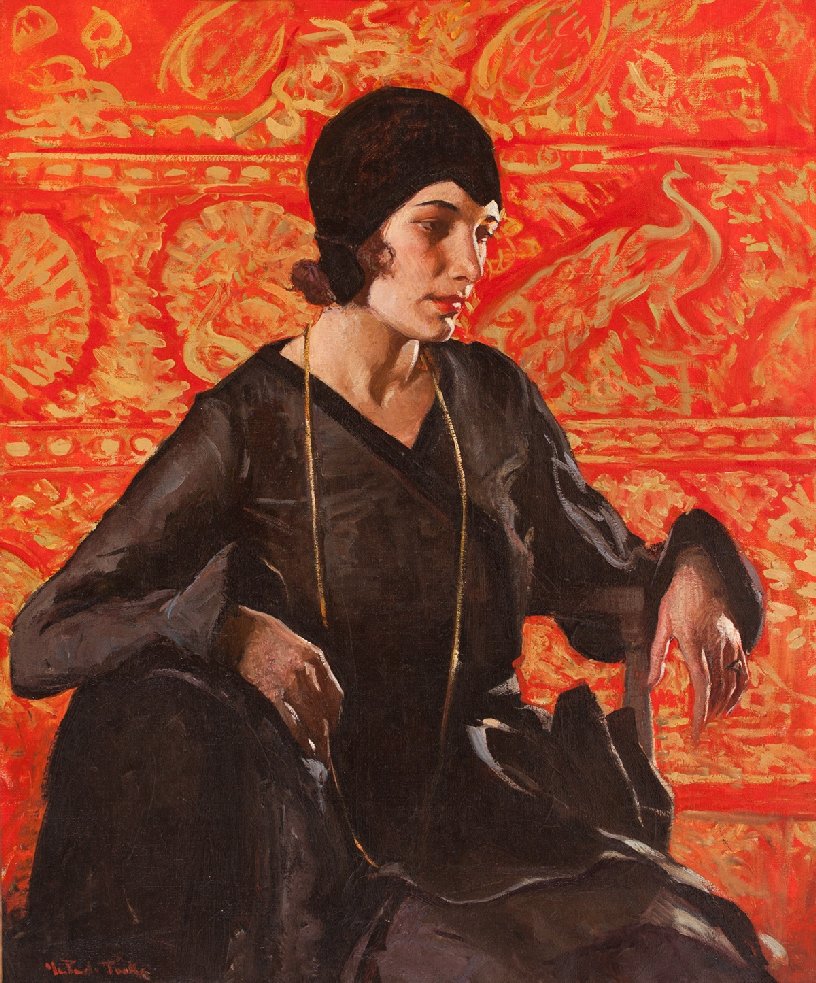
Bettina by Gertrude Fiske (1925)

Because of the family’s wealth, Fiske had the financial freedom to pursue her painting career and after she completed her time at the School of the Museum of Fine Arts, Boston in 1912, she spent time in France, continually sketching as she travelled. Her artistic style was a blend of the light-filled, classical, portrait style she had mastered under Edmund C. Tarbell with the freer, inventive, and colour-rich landscapes she had learnt during her summers spent at the Ogunquit school.

Nude in Interior by Gertrude Fiske (c.1922)

Gertrude Fiske painted a number of works featuring nudes. Her painting entitled Nude in Interior was completed around 1922. The subject of this work, the nude female, is shown posing for the artist, the image of whom we see in the background, reflected in a mirror. Gertrude often used this inclusion as a means to put over to the viewers the importance of the painter.

Bird of Paradise, Sleeping Nude by Gertrude Fiske (c.1916)

Another controversial nude work was her 1916 painting entitled Bird of Paradise, Sleeping Nude which received mixed reviews. It was praised for its honesty but more conservative critics said it was a scandalous depiction. Before us we see a foreshortened figure of a naked woman who appears supremely relaxed and unaware of us, the viewers. It is simply an honest depiction of a real woman.

Zinnias by Gertrude Fiske (c.1920)

Gertrude returned to America but tragedy struck her family with the deaths of a sister, brother and mother around the time that the First World War was raging in Europe. Fiske then had to care for her aging father. However, despite the tragic losses and her new role as a carer she continued to be a prolific and much-admired painter. She kept a studio in Boston as well as at her family’s longtime home, Stadhaugh, in the town of Weston, fifteen miles west of Boston. It was at Stadhaugh that she worked in her studio which was located on the top floor of a converted barn. It had a picturesque setting overlooking woods and this vista served as the backdrop for several of her works.

By the Pond by Gertrude Fiske (c.1916)

In 1914, she, along with prominent painters of the day, including Edmund Tarbell, William Paxton and Frank Benson, helped create the Guild of Boston Artists. Its mission was to promote both emerging and established artists who lived in the region. The Guild developed a reputation for excellence in quality and presentation. Later, in 1917, Gertrude was part of setting up the Boston Society of Etchers and in 1918 Fiske became a member of the National Association of Women Artists.

Strollers by Gertrude Fiske (c.1926)

After the end of the First World War, America staged a rapidly growing industrial way of life and along with waves of immigration in the last quarter of the nineteenth century, elements of a new national consciousness arose in the United States. It was considered to be part of the colonial revival, which found expression in architecture, decorative arts, paintings, and all types of material life which represented an effort to regain a sense of an earlier time in America. Boston was in the forefront of colonial revivalism, and it was the Boston School of Painting, led by Edmund C. Tarbell, that is closely identified with the movement. Gertrude Fiske, who had spent seven years there as a full-time student at the School of the Museum of Fine Arts, Boston, was trained in this artistic dream of the future.

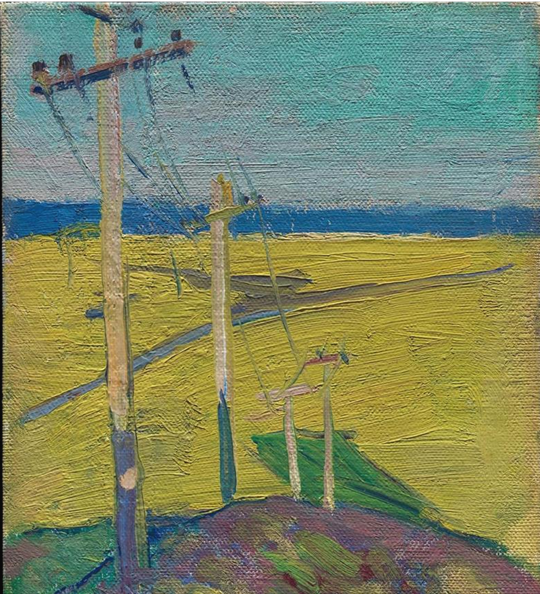
Wells, Maine by Gertrude Fiske


However Fiske was an independently minded and instead of blindly following social convention and the strong direction proposed by the Boston school with its more genteel mannerisms, she ploughed her own furrow and in her landscape depictions instead of removing signs of industry and technology from her work, she made a conscious decision to include them. A good example of this can be seen in her painting entitled Wells, Maine, in which she has retained depictions of a line of utility poles, with a secondary electrical line running across the painting. Her composition with utility poles set against the background of a seascape demonstrates the artist’s interest in juxtaposing signs of modernity with scenes more traditionally considered beautiful.

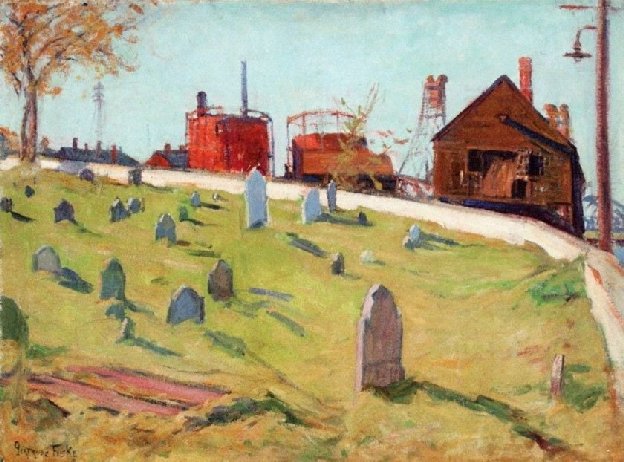
Portsmouth Burying Ground by Gertrude Fiske (c.1925)

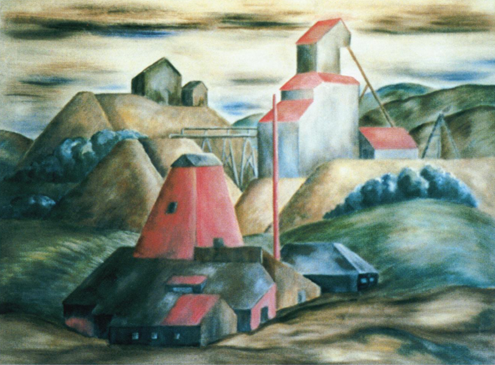
Another example of Fiske’s urban landscape work is one she completed around 1932 entitled Portsmouth Burying Ground which depicts Portsmouth, New Hampshire’s oldest cemetery, known as the Point of Graves, which is situated on the banks of the Piscataqua River in the south end of town. This small historic cemetery dating to the 17th century was the final resting place for many of Portsmouth’s prominent residents. It is the oldest known surviving cemetery in Portsmouth, and one of the oldest in the state, which has about 125 gravestones. Whereas many landscape painters would have spent time amidst the beauty of the countryside Gertrude has chosen this discordant, working waterfront to position her easel to take in the surrounding land. Fiske confounded viewers of this work when she depicted the bright red gasometers and the Sheafe warehouse as a backdrop to the ancient burial ground.

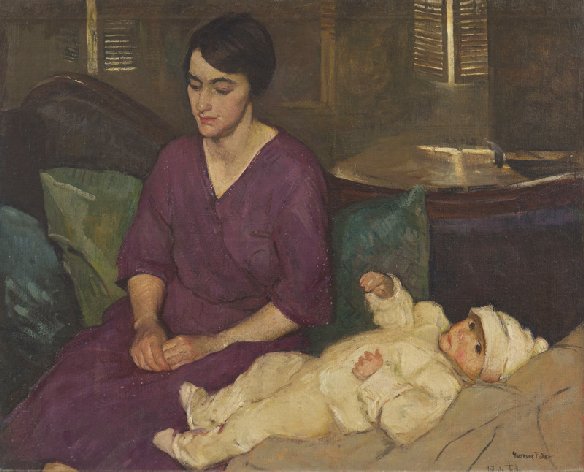
Portrait of William by Gertrude Fiske (1930)

One of her best-known figurative works was one Gertrude completed in 1930 entitled Portrait of William which she exhibited at both the Boston Art Club’s Annual Winter Exhibition of Contemporary American Painting and at the National Academy of Design’s 105th Annual Exhibition. It is part figurative and part an interior depiction which was a popular concept favoured by many of the early Boston School teachers and yet she put her own mark on the composition by her use of colours, such as the juxtaposition of the green of the fabric on the pillows with the dotted Swiss cotton of the woman’s purple dress. She also adopts an unusual placement of figures and objects in the work.

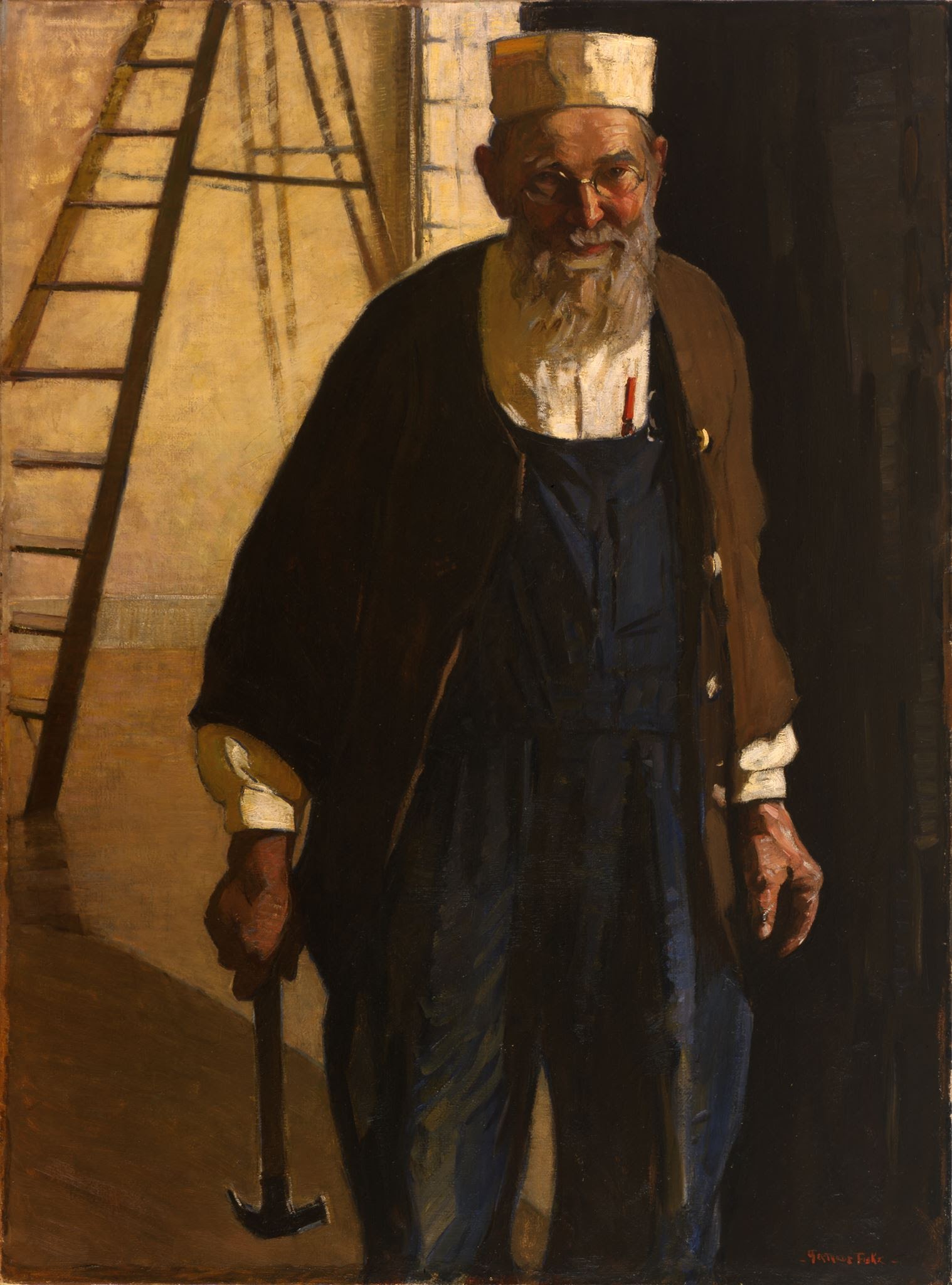
The Carpenter by Gertrude Fiske (1922)

Gertrude Fiske was appointed as the first woman ever to the Massachusetts State Art Commission in January 1930. She was also the the founder of the Concord Art Association. In an article in January 1930’s Boston Globe it was written that she had always had a strong artistic individuality of her own, and there is a note of personal distinction in all of her work—a virile note.

Fiske died in 1961 in Weston, Massachusetts aged 82.

Jean-Jacques Henner

In my previous blog regarding the Dutch painter Thérèse Schwartze I mentioned that one of her early art tutors was Jean-Jacques Henner, the French painter famed for his portraiture.  Today I am going to focus on his life and his many artworks.

Jean-Jacques Henner

Henner was born on March 5th 1829 at the Alsatian town of Bernwiller.  Henner came from a family of Alsatian farmers who had settled in Bernwiller in the Haut-Rhin. He was the youngest of six siblings of George Guillaume Polycarpe Henner and Madeleine Henner (née Wadel).  He had two older sisters, Maria Anne and Madeleine and three older brothers, Séraphin, Grégoire and Ignace. He grew up in this farming community, but despite their modest financial situation, his parents sent him to the College of Altkirch where he studied drawing. His teacher was Charles Goutzwiller who noticed his rapid progress and encouraged him to move to Strasbourg and study at the studio of Gabriel-Christophe Guérin. His artistic studies continued when he enroled at the Ecole des Beaux-Arts in Paris as a pupil of Michel-Martin Drolling,  a neoclassic French painter noted especially as a history painter and portraitist. In 1851 he was tutored by another French artist, François-Édouard Picot, famed for his mythological, religious and historical paintings.   

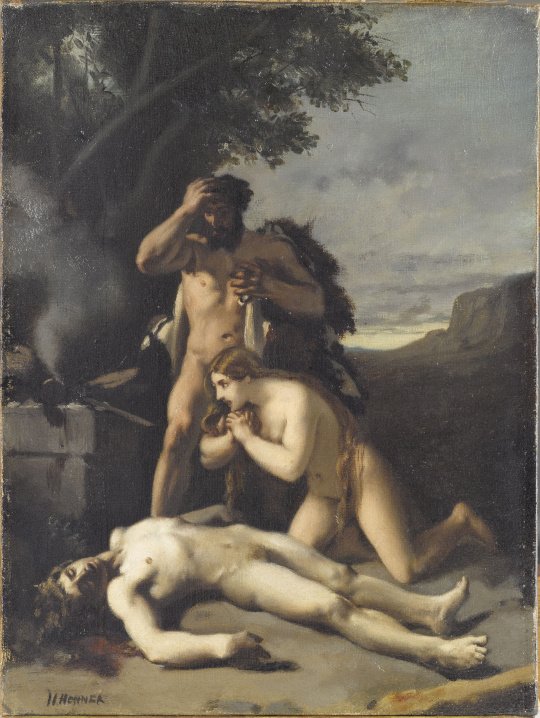
Adam and Eve find the Body of Abel by Jean-Jacques Henner (1858)

In 1848, he entered the École des Beaux Arts in Paris and in 1858 after two failed attempts he won the coveted Grand Prix de Rome award, which was a French scholarship for arts students.  His submission was his painting entitled Adam and Eve find the Body of Abel.  The prize for the winner was a bursary that allowed them to stay at the Villa Medici in Rome, for three to five years at the expense of the state. The painting can be seen at the Musée d’Orsay.

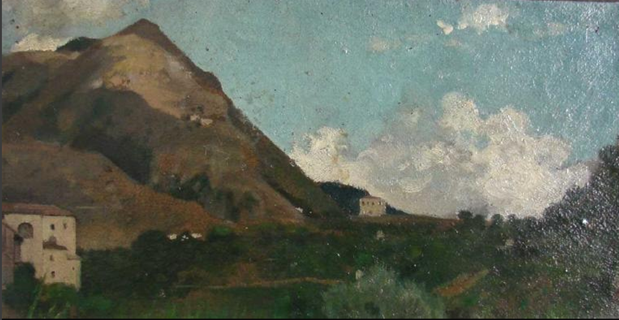
Mountains on the Outskirts of Rome by Jean-Jacques Henner (c.1861)

During his five-year stay in Rome, he was guided by Jean-Hippolyte Flandrin, a French Neoclassical painter.  Like many artists, Henner was captivated by Italy and spent many hours in museums reproducing the works of the painters that he respected. He also had plenty of time during his five-year stay to travel around the country, visiting Florence, Venice and Naples in which time he completed a number of small landscape paintings.  His works at that time showed his appreciation of past masters and it was Titian and Correggio who influenced him the most. In 1864 Henner returned to Paris and brought back copies of works by masters and a number of luminous landscapes.

Rome from the terrace of the Villa Medici by Jean-Jacques Henner (1860)

During those five years in Rome Henner painted this work at the Villa Medici where he stayed between 1859 and 1864. This is not simply a view of the Eternal City as observed from the villa. Once he had painted the garden, Henner then populated the terrace with groups of what he believed were “typical” characters, which he had often seen in real life and are simply identifiable by their clothes, monks, peasants, and elegant ladies. All are depicted in front of the classical panorama of the city, in which one can see the silhouette of Saint Peter’s Basilica in the background.

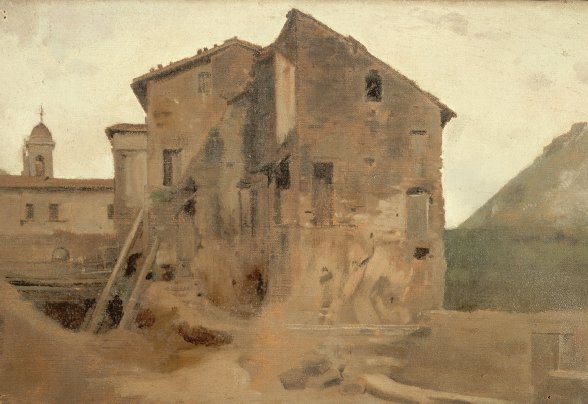
Masure dans la campagne de Rome (Dilapiated House in the Countryside of Rome) by Jean-Jacques Henner (c.1863)

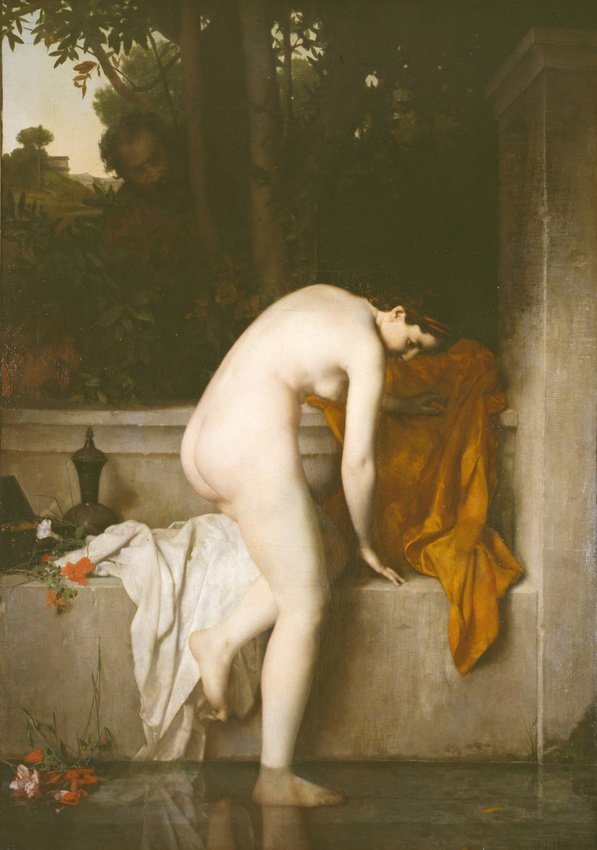
La Chaste Suzanne by Jean-Jacques Henner (1864)

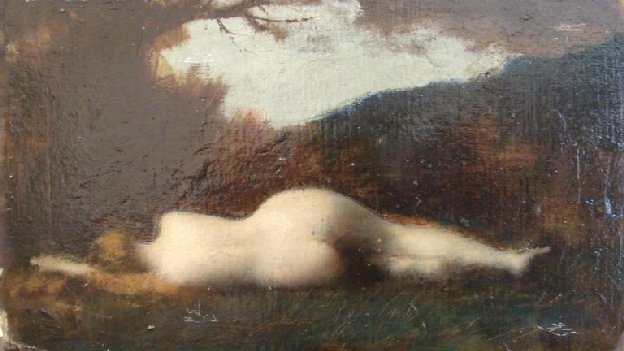
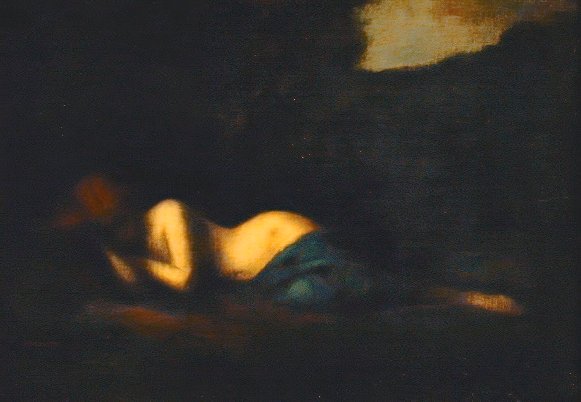
Henner had his painting Bather Asleep exhibited at the Salon in 1863 and at the following year’s Salon his painting La Chaste Suzanne was exhibited. The Biblical episode depicting Suzanne bathing was a popular one for painters and it was above all an opportunity for various artists to paint a beautiful nude. Jean-Jacques Henner sent back his version to the French Academy which he completed whilst in his last year of his residence at the Villa Medici in Rome. For Henner, this was a compulsory exercise, supposed to demonstrate the student’s progress and their skill in execution, and for the Academy to see if their prize winner was advancing artistically.

Sacred Love and Profane Love by Titian (1514)

Henner almost certainly took his inspiration from respected examples left by the great masters’ depiction of nudes which he had seen whilst in the Italian capital. It is thought that Henner was influenced Titian’s 1514 painting entitled Sacred Love and Profane Love which was at the Galleria Borghese in Rome. Henner’s work was not well-received and was harshly criticised for the heaviness and lack of graciousness in the model’s body. It was also criticised for the artificiality of the subject which although being put forward as a history/biblical painting offered little more than a depiction of a bather. However the propensity of ridding any narrative self-justification in painting the nude, and so giving it as a subject in itself, was becoming more common in the work of many contemporary artists, such as Courbet.

Séraphin Henner (brother) by Jean-Jacques Henner (c.1881)

Grégoir Henner (brother) by Jean-Jacques Henner (1889)

While a student in Paris Henner was particularly interested in portraiture, and during his frequent visits home to Alsace he would complete many portraits of his family as well as local dignitaries and scenes of Alsatian peasant life.

Eugénie and Jules Henner by Jean-Jacques Henner (c.1865)

Eugénie and Jules were two of the three children of his brother, Séraphin and his wife, Madeleine. Henner was very close to his nephew and niece and he paid for violin lessons for Jules and piano lessons for Eugenie when they were little. Henner had no children of his own, and on his death, he bequeathed them all that he possessed. Here, Eugénie and Jules are depicted together in their childhood.

Paul Henner by Jean-Jacques Henner (before 1867)

A rather sad portrait. Paul Henner was the third child of Séraphin and Madeleine Henner. He was born in 1860, but sadly died seven years later.

Byblis by Jean-Jacques Henner (c.1870)

In 1864 Henner returned to France and exhibited with great success at the Paris Salon between 1865 and 1903. During his early days back in France his works were of quasi-mythological subjects, such as his 1867 work entitled Byblis, which was exhibited at the 1867 Salon.

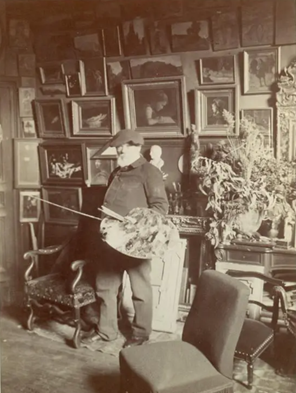
Jean-Jacques Henner in his Paris studio at 11 place Pigalle

Jean-Jacques Henner lived in rue La Bruyère and his studio was at 11 place Pigalle, where he lived from 1867.

L’Alsace. Elle Attend (Alsace, She Waits) by Jean-Jacques Henner (1871)

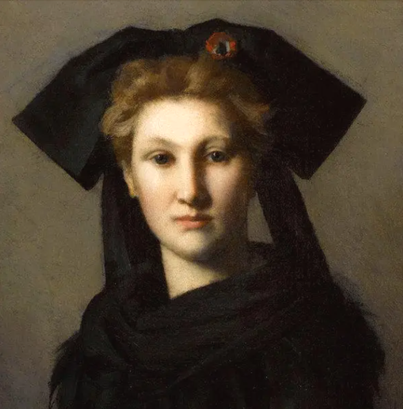
Jean-Jacques Henner’s birthplace was the region of Alsace and this north-east area of France borders Germany. With the defeat of France in the Franco-Prussian War in 1871, Alsace and northern Lorraine were annexed to the new German Empire. At the conclusion of the First World War, the defeat of Germany, and the Treaty of Versailles, Alsace once again came under French control. In 1940, during the Second World War Alsace–Lorraine was occupied by Germany during the Second World War. Although it was never formally annexed, Alsace–Lorraine was incorporated into the Greater German Reich. With the defeat of Germany in 1945 Alsace returned to French rule. Henner’s 1871 painting entitled L’Alsace. Elle Attend had political overtones. It depicts a young Alsatian woman in mourning and is a political comment on the German annexation of the province after the Franco-Prussian War. The patriotic image was very popular and achieved a wide circulation when it was engraved by Léopold Flameng.
L’Alsace. Elle Attend meaning Alsace, she awaits, was commissioned on the initiative of Eugénie Kestner, a member of the Thann industrial family from Alsace. On completion it was given Léon Gambetta, a French lawyer and republican politician, who was one of the fiercest opponents of the relinquishment of the Alsace-Lorraine region to the new German Empire following the war of 1870. Following the defeat of France by the Prussian armies a sense of fervent and heightened patriotism followed. Henner’s painting quickly became looked upon as a symbol of Alsace’s suffering, a pain shared by the painter who was very attached to the region of his birth. The painting depicts a young Alsatian woman in mourning, unassuming but gracious.

Donna sul divano nero (Woman on Black Divan) by Jean-Jacques Henner (1869)

At that time, Henner had assumed a naturalistic style which can be seen in his painting entitled Woman on a Black Divan, which was exhibited at the Salon of 1869 and now is housed at the Mulhouse, Musée des Beaux-Arts. A smaller version of this painting also included a rosette in the red, white and blue colours of France, pinned onto the traditional black Alsatian bow, gives the painting its patriotic significance without being pompous or anecdotal.

Magdalene in the Desert by Jean-Jacques Henner (1874)

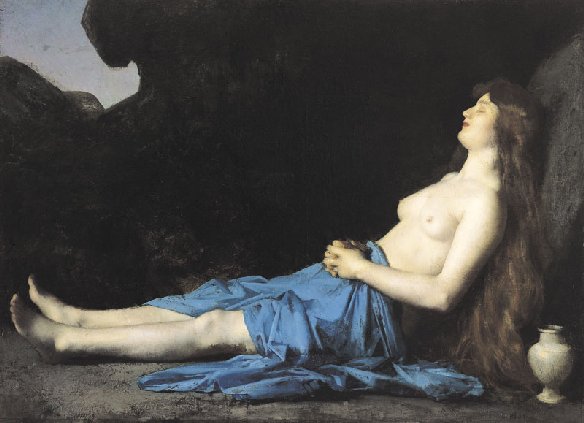
After 1870 Henner’s entire work became a deliberation on the theme of death in various appearances. There were the depictions of Mary Magdalene in what became known as the Magdalene Series, such as Magdalene in the Desert, which was exhibited at the 1874 Salon, and Magdalene Weeping, which he completed in 1885.

Die Magadalena by Jean-Jacques Henner (Exhibited at the 1878 Salon)

La Magdaleine by Jean-Jacques Henner

Henner complted many more Magdalene paintings.

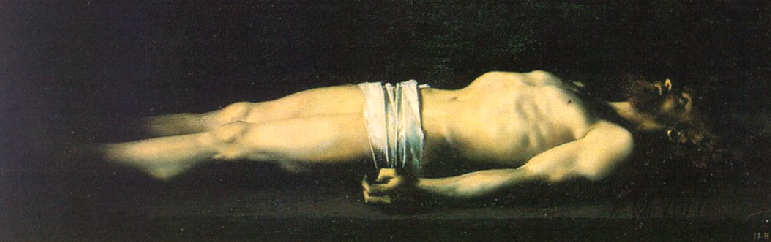
The Dead Christ by Jean-Jacques Henner (c.1884)

Jesus at the Tomb by Jean-Jacques Henner (c.1879)

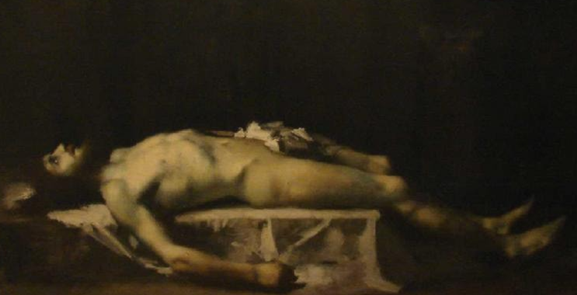
There was also a number of works in Henner’s Dead Christ series with paintings such as Jesus at the Tomb, which was exhibited at the 1879 Salon and is now part of the Musée d’Orsay collection and the painting entitled Dead Christ which was exhibited at the 1884 Salon and now hangs at the Musée Beaux-Arts in Lille.

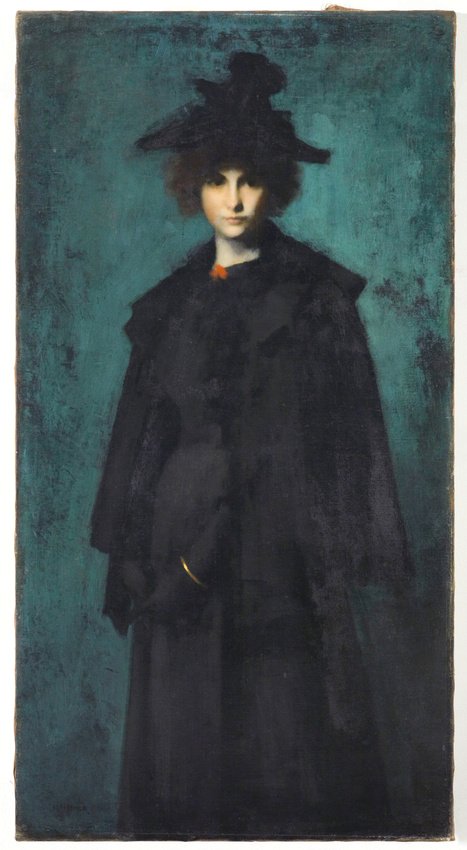
Portrait of Madame Laura Leroux by Jean-Jacques Henner

Jean-Jacques Henner will best be remembered for his portraiture which would provide him with financial stability. During his lifetime he completed many portraits of his family and famous people like his Portrait of Madame Laura Leroux. Laura Leroux-Revault was a French artist and painter. Her first teacher was her father, the painter Louis Hector Leroux and she later trained at the Académie Julian art school in Paris. She also trained under Jules Lefebvre and in Jean-Jacques Henner’s studio. The two artists were friends of her father.

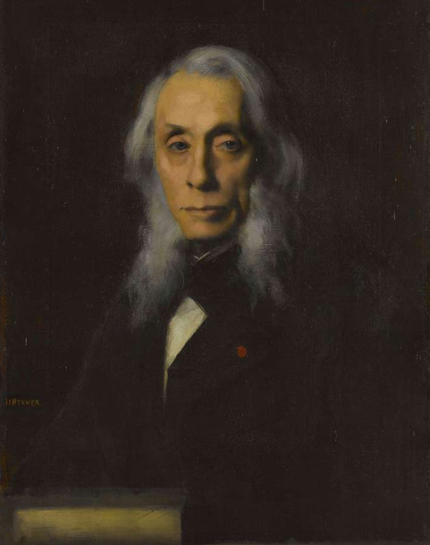
Portrait of Jean-Gaspard-Félix Laché Ravaisson-Mollien by Jean-Jacques Henner (1889)

Another famous person to be immortalised by Henner was Jean-Gaspard-Félix Laché Ravaisson-Mollien, a French philosopher, said to be France’s most influential philosopher in the second half of the nineteenth century.

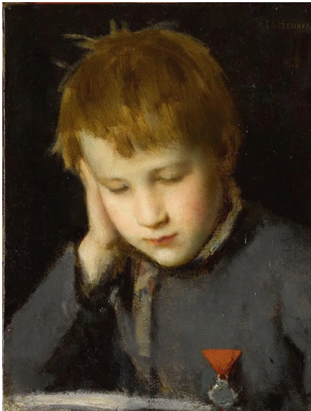
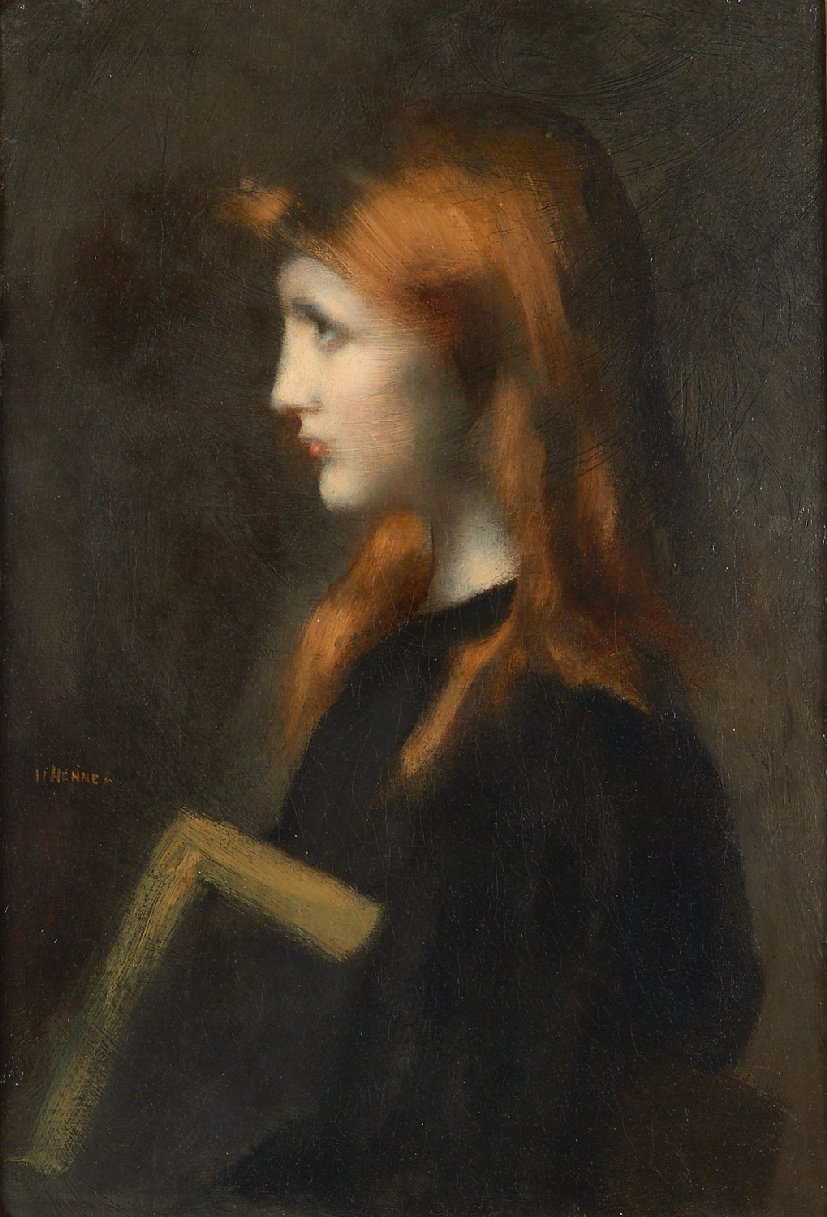
The Reader by Jean-Jacques Henner

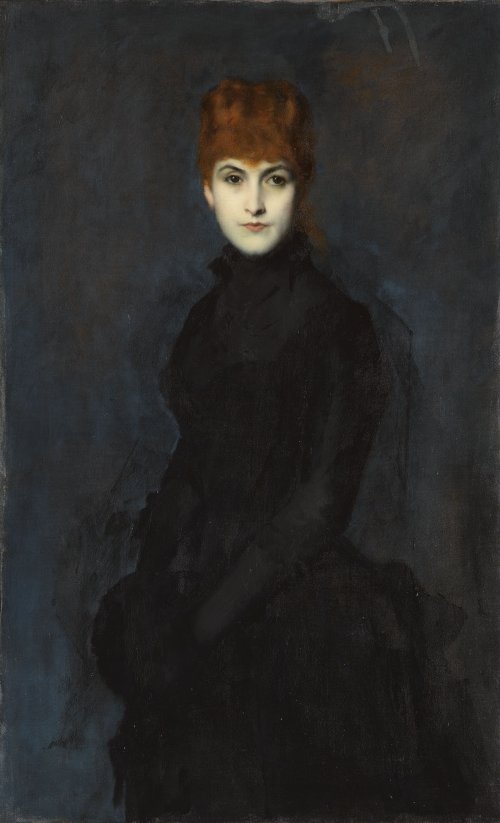
La comtesse Kessler by Jean-Jacques Henner (c.1886)

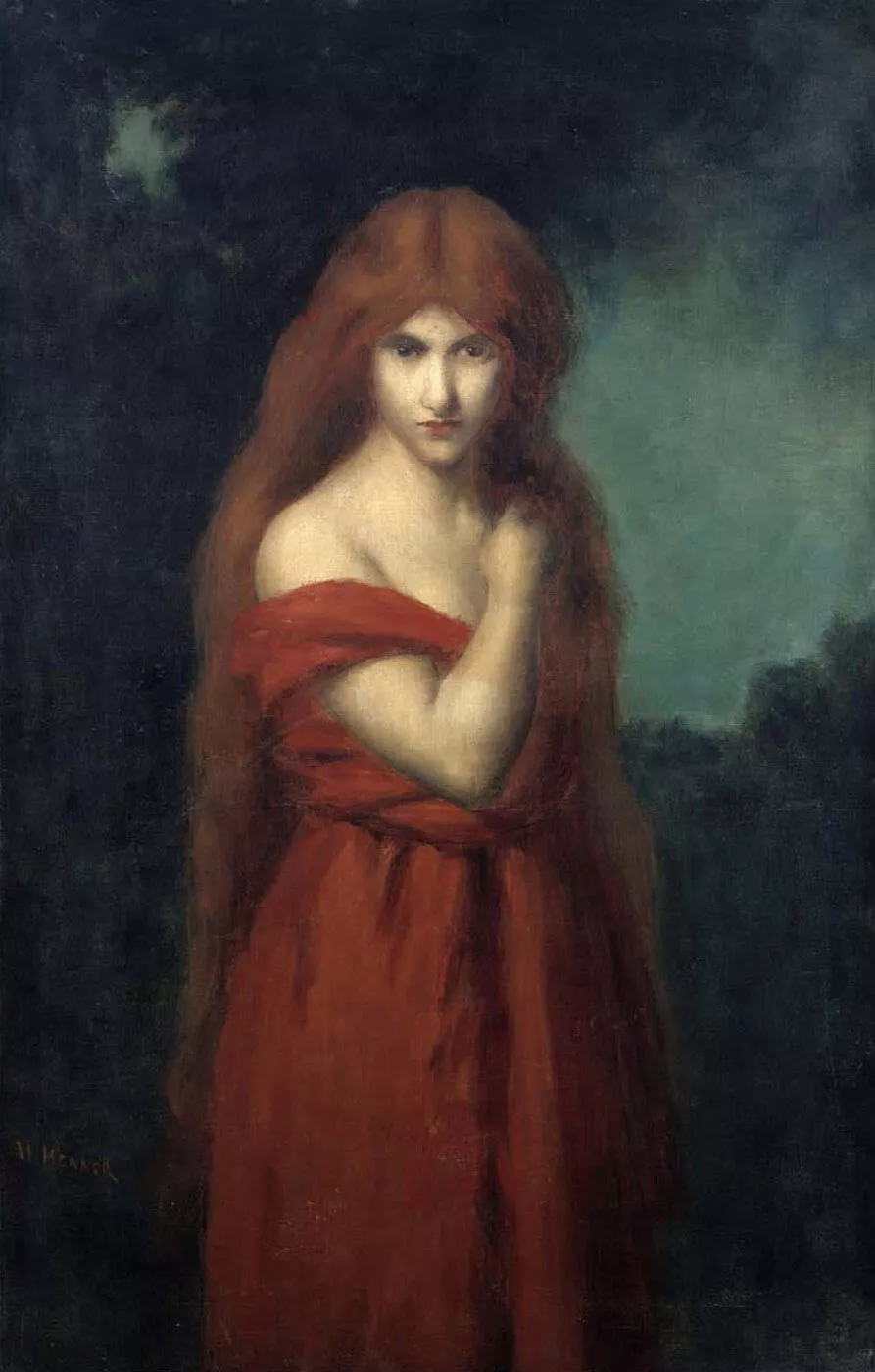
Henner’s love of portraying nudes in historical or mythological settings was not his only love. He had a passion for the colour red and of portraying women with red hair !

Woman in Red by Jean-Jacques Henner

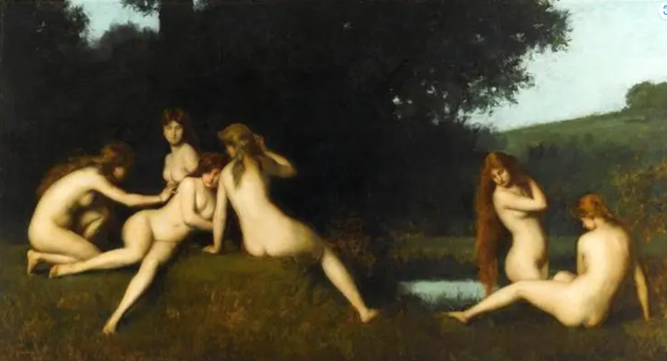
Les Naïades by Jean-Jacques Henner (1861). Painted for the Soyers’ dining room, 43 rue de Fauborg Saint-Honoré. Paris.

Alsatian Girl by Jean-Jacques Henner

L’Ecoliere by Jean-Jacques Henner

Over the years Henner tutored many aspiring painters. Between 1874 and 1889 he taught at what was termed “the studio of the ladies”, which he organized with Carolus-Duran, during the time when women were not allowed entry to the École des Beaux-Arts. Some of these students also served as his models such as Dorothy Tennant, Suzanne Valadon and Laura Leroux-Revault, daughter of his close friend Hector Leroux; Henner’s full-length portrait of Laura Leroux (shown earlier) is now at the Musée d’Orsay having been shown at the Paris Salon of 1898 and purchased by the French State.

Jean-Jacques Henner (Photograph by Nadar c.1900)

Jean-Jacques Henner died in Paris on July 23rd 1905 aged 76.

Thérèse Schwartze

Thérèse Schwartze – self portrait (1917)

Therese Schwartze was a Dutch 20th century painter.  Such was a hugely talented portrait artist that was one of only a few females who had been honoured by receiving an invitation to contribute her self-portrait to the hall of painters at the Uffizi Gallery in Florence.  This genius of portraiture completed around a thousand works during her forty-year career, which means that she completed more than twenty paintings a year. Because many of her portraits were created to be treasured by family members, most of her work has remained in private collections.  About one hundred and fifteen of her paintings are in public collections in the Netherlands, and twelve are part of foreign public collections, which leaves the locations of nearly four hundred paintings still unknown. She became a millionaire in the process. Schwartze also established an international reputation, with countless exhibitions and commissions throughout Europe and the United States. 

Self Portrait by Johan Georg Schwartze

Thérèse was born on December 20th 1852 in Amsterdam.  She was the daughter of Johan Georg Schwartze and Maria Elisabeth Therese Herrmann.  She was one of five children and had four sisters including Georgine, a sculptor, Clara Theresia, a painter and one brother, George Washington Schwartze, also a painter. 

Portrait of Thérèse aged 16 by her father, Johan Georg Schwartze (1869)

Her father was a well-respected portrait painter and it was he who provided Thérèse with her first artistic training.   In 1869 her father completed a portrait of his daughter, Thérèse.

Three girls of the orphanage in Amsterdam by Thérèse Schwartze (1885)

At that time, there was the perception that teaching girls and young ladies to paint was seen simply as a part of a cultured upbringing rather than a profession for earning money which was viewed as the role of the man. But for Johann Schwartze he couldn’t care less about such conventions. He trained his daughter in painting and drawing from a very young age and intended that Thérèse would become his worthy successor. She started her professional career at the age of sixteen, working in her father’s studio which she eventually took over when she was twenty-one after his death in 1874. Schwartze wrote to her father in a birthday letter, writing:

“…I will apply myself more to everything, so as, with God’s blessing, to be able to earn my living by painting…”

Because the art academies were not yet open to girls, her father sent her to Munich for expensive private lessons for a year under Gabriel Max and Franz von Lenbach who was regarded as the leading German portraitist of his era. In 1879 she moved to Paris and continued her artistic studies under Jean-Jacques Henner, the Alsace-born portrait artist.

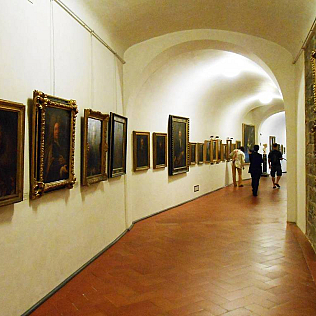
The Vasari Corridor at the Uffizi Gallery, Florence

Thérèse Schwartze’s portraits are truly remarkable and she was one of the few women painters, who had been honoured by an invitation to contribute her self-portrait to the Hall of Painters, the Vasari Corridor, at the Uffizi Gallery in Florence. The Uffizi collection is one of the most complete in all Europe, first started by Cardinal Leopoldo de’ Medici in the 17th century.  The passageway was designed and built in 1564 by Giorgio Vasari to allow Cosimo de’ Medici and other Florentine elite to walk safely through the city, from the seat of power in Palazzo Vecchio to their private residence, Palazzo Pitti.   The passageway used to contain over a thousand paintings, dating from the 17th and 18th centuries, including the largest and very important collection of self-portraits by some of the most famous masters of painting from the 16th to the 20th century, including Filippo Lippi, Rembrandt, Velazquez, Delacroix and Ensor.   While the Medici family bought the first paintings, after the collection started, the family started receiving the paintings as donations from the painters themselves. This has continued over the centuries and there were more paintings in the collection that did not have space to be exposed.  Things have now changed as from 1973 to 2016, some of the self-portraits which had been hung in the Vasari Corridor, were, however only visible during restricted and occasional visits because of the confined space, which, also lacked air conditioning and adequate lighting.  Most of the self portraits have been moved to other rooms at the Uffizi.

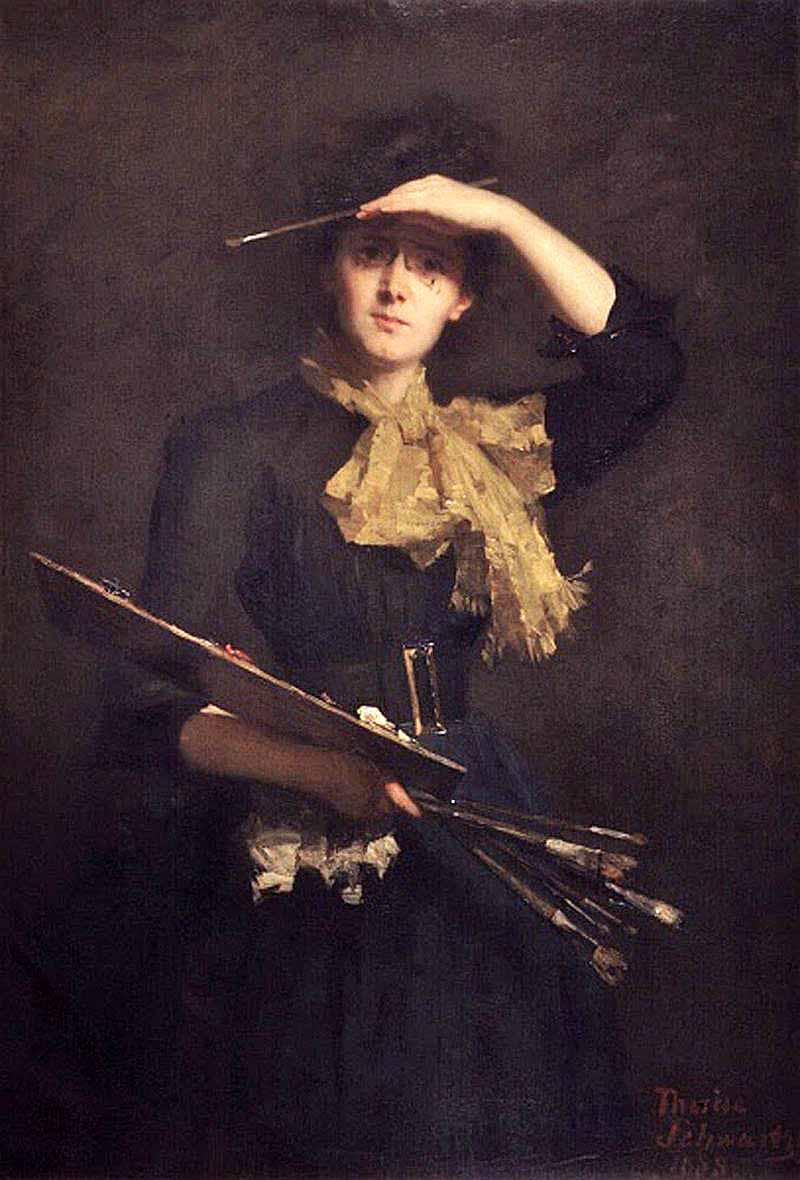
Self-portrait with Palette by Thérèse Scwartze (1888)

Only a handful of female portrait painters were active professionally in the 19th century, one of whom was Schwartze, who was nicknamed the ‘Queen of Dutch Painting’.  In the self portrait she contributed to the Uffizi entitled Self-portrait with Palette, she depicts herself staring out at us with a haunted look, paintbrush in one hand with the other looped through a paint-laden palette. The background of this canvas is bare, and our eyes are drawn to the painter’s tools: eyes, brush, pigments, and a rag at the ready. The painting was exhibited at the 1888 Paris Salon before being given to the Uffizi gallery in Florence.

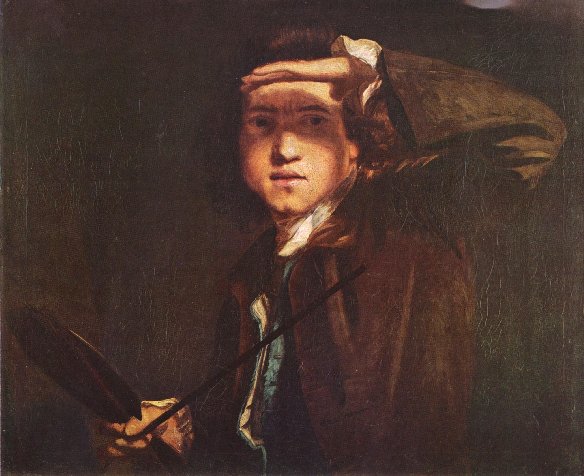
Sir Joshua Reynolds self portrait (c.1748)

Thérèse’s depiction of herself in her self-portrait could well have been inspired by Sir Joshua Reynold’s self-portrait which shows him similarly with his hand raised shielding his eyes from the bright light.

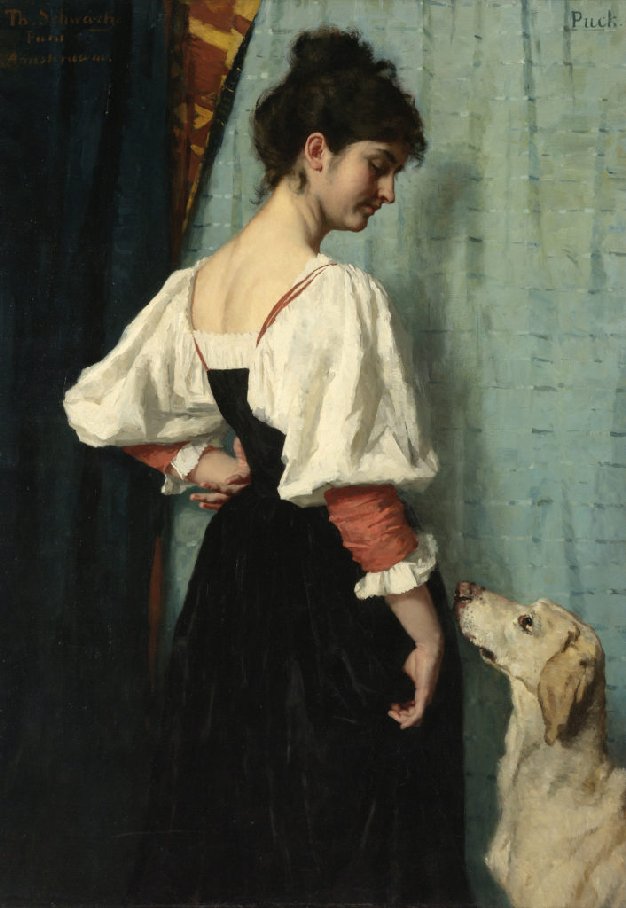
Young Italian Woman, with ‘Puck’ the Dog by Thérèse Schwartze, c. 1885)

Whilst living and studying in Paris, Thérèse completed her painting, Young Italian Woman, with ‘Puck’ the Dog.  The model she used for this painting was known as Fortunata.  She was one of the many professional Italian models working in Paris in the late 19th century. Schwartze started this painting in 1884 and exhibited it a year later in Amsterdam, having added the dog in the meanwhile.

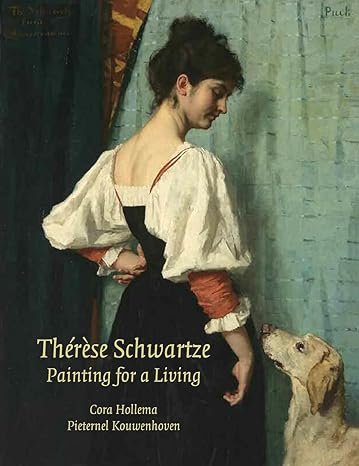
According the 2021 biography by Cora Hollema and Pieternel Kouwenhoven entitled Thérèse Schwartze: painting for a living. Thérèse’s career took off at a time when a new, wealthy Dutch class wanted to flaunt its status and what better way to achieve this than with a flattering portrait. Her biographer wrote:
“She was in demand because she produced a new elegant, un-Dutch, extravagant, flattering style of portraiture which was in demand by the upcoming ‘new money…….. The new entrepreneurs and industrialists in the second half of the 19th century…”

Portrait of Aleida Gijsberta van Ogtrop-Hanlo with her five children by Thérèse Schwartze (1906).

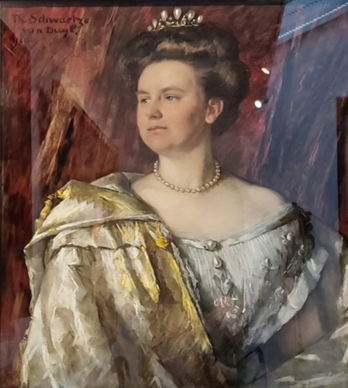
Schwartze was one of the leading society painters in the Netherlands around 1900. Her clientele came from the nobility and the bourgeois elite in Amsterdam and The Hague. Members of the royal family also sat for her.   A good example of her excellent portraiture is her 1906 group portrait of Aleida Gijsberta van Ogtrop-Hanlo with her five children.  In this work, Aleida van Ogtrop-Hanlo is surrounded by, from left to right: Adriënne (Zus), Pieter (Piet), Maria (Misel), Eugènie (Toetie) and Adèle (Kees). The youngest and sixth child, Joanna (Jennie) was not yet born.  Her husband was a wealthy stockbroker and founder of Amsterdam Royal Concertgebouw. The portrait of his wife and children has a dreamy quality, with rich clothing and poetic colours. It gives an excellent impression of the self-image of the Dutch upper classes at the beginning of the twentieth century.  Stylistically Thérèse Schwartze followed in the footsteps of the famous eighteenth-century English portrait painter, Thomas Gainsborough. 

 Portrait of the six Boissevain daughters by Thérèse Schwartze (1916)

An equally great group portrait by Thérèse Schwartze was her Boissevinfamily portrait but this a more decorous depiction.  It is entitled Portrait of the Six Boissevain Daughters and she completed it in 1916. According to Schwartze’s biography by art historian, Cora Hollema, this difference in style was not due to a development of the artist, but more to do with the wishes of her client. Mr. & Mrs. Boissevain, who were wealthy members of the Amsterdam upper class had ten children, six daughters and four sons. They were aware of the portrait of Aleida and her children by Thérèse but believed it to be far too modern.   So, when they commissioned Thérèse to paint the portrait in 1916 they asked her to produce a more time-honoured portrait of their daughters. Thérèse was now the breadwinner of the family and so sensibly adapted her style according to her client’s demands bearing in mind the adage: The client was king.
Thérèse Schwartze in her studio, Prinsengracht 1021, Amsterdam, 1903.

Thérèse’s great success as an artist became a point of reference for the young Dutch women painters who founded the Amsterdamse Joffers, a group of women artists who met weekly in Amsterdam at the end of the 19th and beginning of the 20th century. These “ladies of Amsterdam” met weekly, often at the Schwartze home, to update the glorious Dutch tradition of painting based on French Impressionist innovations.  They supported each other in their professional careers. Most of them were students of the Rijksakademie van beeldende kunsten and belonged to the movement of the Amsterdam Impressionists.

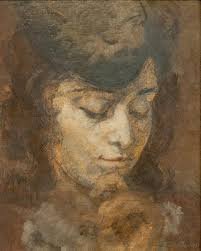
Woman wearing a hat (Portrait of Theresia Ansingh (Sorella)), by Thérèse Schwartze (after 1906).

Besides Schwartze’s commissioned portraits, which made her very wealthy, she still had time to complete portraits of her friends and relatives which were not commissioned and were often given as gifts.  A fine example in this regard is the portrait of Schwartze’s niece, Theresia Ansingh, who later became a member of the Amsterdam school of female painters known as The Joffers, many of them were inspired by Schwartze’s professional success. 

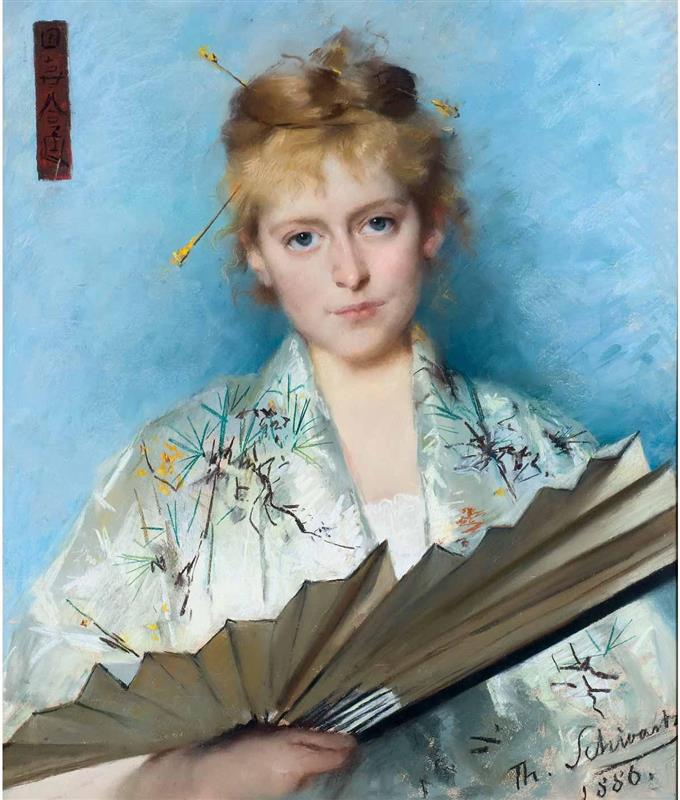
Maria Catharina Ursula (Mia) Cuypers by Thérèse Schwartze (1886)

One of my favourite portraits by Schwartze was her fascinating portrait of one of her friends, which is an amalgam of formal and informal portraiture and is entitled Portrait of Mia Cuypers.  She was a daughter of the architect Pierre Cuypers, who designed such famous buildings as the Rijksmuseum and Amsterdam’s Central Station. In 1883, she fell in love, to the dismay of her family and the astonishment of “high society,” with the Chinese-British merchant Frederick Taen-Err Toung from Berlin, who was in Amsterdam selling his Oriental merchandise at the International Colonial Exposition. Mia managed to overcome the social uproar and married Toung in 1886.  Being a close acquaintance of the Cuypers family, Thérèse was commissioned by the groom-to-be to make this wedding portrait, which is said to have only taken her one and a half days to complete.  There are Chinese characters in the upper left corner, which are not clear in my attached photo, which mean “rice field,” “longevity”/”delighted,” and “coming together.”

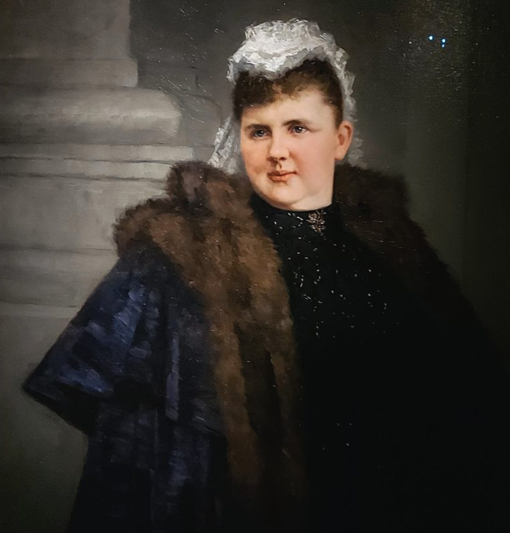
Portrait of Queen Emma by Thérèsa Schwartze (ca. 1881)

Soon after, she received a commission for a portrait of Queen Emma and the little princess Wilhelmina, who was born in 1880. In the single portrait of the young queen, she is dressed in dark colours against a neutral background, all is dark except her face. In this painting, one can already see the fine art of portraiture and the depicting of differing textures that Thérèse fully mastered. The fur stole, the lace cap on her head, as well as the brocade of the queen’s robe.

Portrait of Princess Juliana by Thérèsa Schwartze (1910)

Thérèse’s worked with the royal family of the Netherlands through a period of thirty-five years and in all they gave her six commissions that contributed greatly towards her fame and wealth. Most royal portraits were of Queen Wilhelmina.

Portrait of Queen Wilhelmina by Thérèse Schwartze (1910)

The royal court had a habit of paying a little more than the average client, which meant that 1910 was a particularly profitable year for Thérèse.  She painted so many members of the royal family that she was almost deemed a member of their household.

Portrait of Anton van Duyl by Thérèse Schwartze

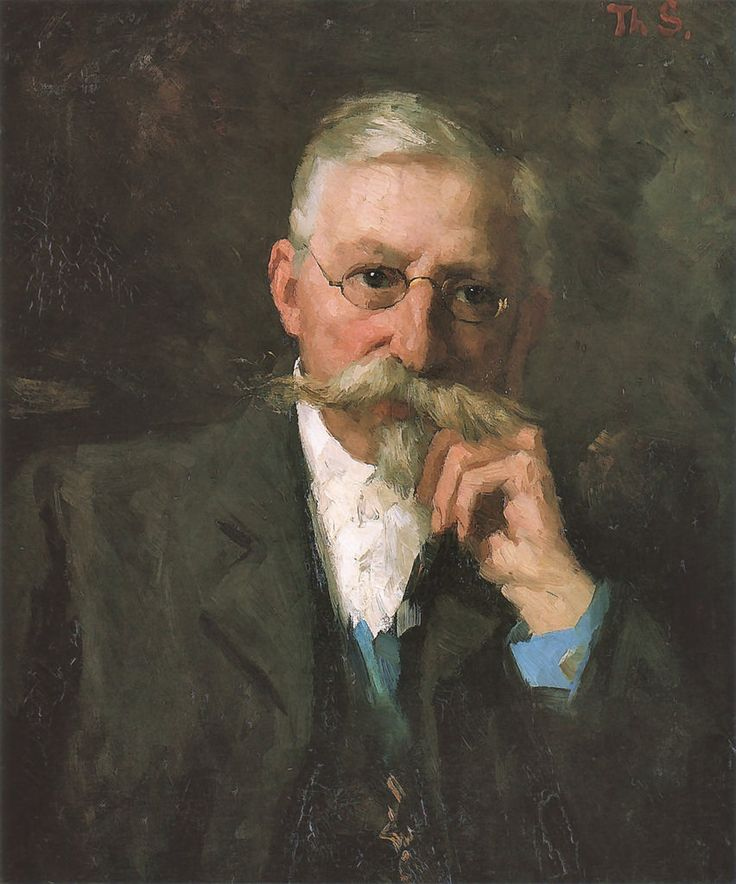
In 1906, Thérèse Schwartze married the editor-in-chief of the Algemeen Handelsblad, Anton van Duyl. Twelve years after they married, Thérèse’s husband died on July 22nd 1918.  It was double blow for Thérèse as she herself had been very ill at the time and five months later, on December 23rd 1918, three days after her sixty-seventh birthday, she died in Amsterdam.  

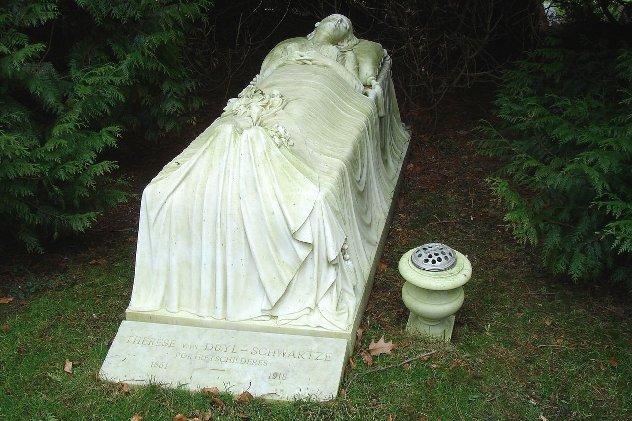
Grave of Thérèse Schwartze at the Nieuwe Ooster cemetery, Amsterdam.

She was buried at Zorgvlied cemetery in Amsterdam but was later reburied at the Nieuwe Ooster cemetery in Amsterdam, where her sister created a memorial to her, modelled after her death mask, which is now a rijksmonument.

Ellen Day Hale

Portrait of Ellen Day Hale by Margaret Lesley Bush-Brown (1944)

The artist I am looking at today is the American painter, Ellen Day Hale.  Ellen Day Hale was born on February 11th, 1855 in Worcester, Massachusetts.  She was born into an elite Boston Brahmin Hale-Beecher family. The Boston Brahmins, sometimes referred to as the Boston elite, are members of Boston’s historic upper class who were associated with a cultivated New England accent, going to Harvard University, Anglicanism, and traditional British-American customs and clothing. They were considered White Anglo-Saxon Protestants (WASPs).

Edward Everett Hale

Hale’s father was the author and orator Edward Everett Hale, an American historian, and Unitarian minister, who was best known for his writings such as “The Man Without a Country” which was published in Atlantic Monthly in support of the Union during the Civil War. Her father acted as a Unitarian chaplain in the U.S. Senate from 1904 until his death in 1909, and Ellen Hale often assisted her father in his church-related duties. Her mother was Emily Baldwin Perkins. Although the Hale family was looked upon as being part of the Brahmin elite, they were neither wealthy nor were they well respected among the Boston upper class.  Emily Hale was one of nine children.  Her elder brother died during childbirth and she then became the oldest of eight children with seven younger brothers.  She was brought up in an artistic household and her mother encouraged her interest in art, and her father’s sister was watercolourist Susan Hale, and it was thought that Susan gave Ellen her first artistic instruction. Her brother was Philip Leslie Hale who became a celebrated artist and art critic and who married Lilian Westcott Hale, an Impressionist painter.

Plains Indian Girl by Ellen Day Hale

During the 1870s, Ellen Hale decided that she needed to move forward with her art and look for a formal art education.  It was a good time to cement this artistic idea as Boston was in the middle of what was known as the Boston Renaissance and new cultural institutions were coming into being in the city.  A new and large Boston Public Library had been founded in 1848 and the first large free municipal library in the United States, the first public library to lend books, the first to have a branch library, and the first to have a children’s room.  The Boston Museum of Fine Arts (MFA) was founded in 1870 and in 1876, it moved to a highly ornamented brick Gothic Revival building in Copley Square. 

William Morris Hunt by Helen Mary Knowlton (1896)

Starting in 1874, Hale enrolled on a five-year course at William Morris Hunt’s school for painting, where she studied under Helen Mary Knowlton.  Helen Mary Knowlton had received art tuition from William Morris Hunt, and she told him that she knew of forty women who would love to study art and so in 1868, despite criticism from those who thought he was wasting his time, Hunt began classes for women.  It was not art that he was teaching, he was inspiring his female students and instilling in them a sense of self-worth.  When Hunt died in 1879, Knowlton carried on his work of supporting his female students and getting the group of women to rely upon each other for professional and personal support rather than their husbands or other men,

Morning News by Ellen Day Hale (1905)

Having finished her five years at the William Morris Hunt school she moved to Philadelphia and enrolled at a two-year course at Pennsylvania Academy of the Fine Arts (PAFA), where the director was Thomas Eakins.  Following this, in 1881, Ellen Day Hale went to Europe with Helen Knowlton and the pair went on to visit Belgium, Holland, Italy and England continually visiting museums of art and taking time to copy some of the paintings.  For a brief time whilst in London, Hale studied at the  Royal Academy, but she eventually parted company with Knowlton and travelled to Paris where she enrolled with Emmanual Frémiet at the Jardin des Plantes, worked in the atelier of Emile Carolus-Duran, and learned the French academic style at Académie Julian before returning to Boston in 1883.

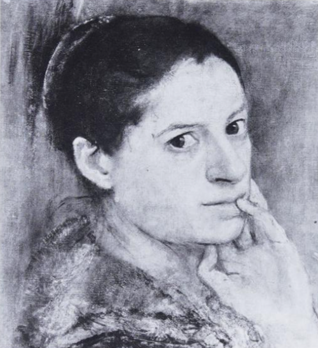
Self portrait by Ellen Day Hale (1885)

It was whilst back in Boston at her family’s home in Roxbury, Massachusetts, and at the family’s summer home in Matunuck, Rhode Island. that Hale began her self-portrait in 1884.  In this work we see Hale gazing out at us with great assurance.  Her right arm rests on the arm of a chair.  She is dressed completely in black wearing a dress with buttons and a fur collar, covered by a loose jacket.  From under the brim of her black hat we can see her fringe.  Hale appears to be making a fashion statement with her clothes and youthful hairstyle.  Her bold gaze and her fashionable outfit suggest her willingness to push traditional boundaries.  Hale exhibited her Self-Portrait in Boston, perhaps for the first time, in 1887.  The Museum of Fine Arts, Boston, which owns the work later commented:
“…Hale’s forthright presentation, her strong dark colours, and the direct manner in which she engages the viewer recall the work of one of the French painters she most admired, Edouard Manet. Manet had been known for his confrontational images, strongly painted without subtle nuances of light and shadow…”

June by Ellen Day Hale (1893)

Now although back living in Boston, Hale still loved to travel and made frequent journeys to Europe, North Africa, and the Middle East.  She also spent time exploring her own country especially the American West.  Despite her railing against traditional limitations exacted on females by society, the one she concurred with was that women should not travel alone and so she needed to find a like-minded companion for her exploratory journeys.  Hale soon lighted on the perfect companion in the guise of the painter Gabrielle de Veaux Clements.  Gabrielle had attended several prestigious art schools, studied under notable artists such as Tony Robert-Fleury and William-Adolphe Bouguereau, and exhibited at the Paris Salon in 1885. Clements specialized in landscapes, cityscapes, and harbour vistas capturing the bustling spirit of Paris, Baltimore, Cape Ann, and other cities and towns throughout France, Algiers, Palestine, and along the American East Coast.

Gabrielle de Veaux Clements.by Ellen Day Hale (1883)

Clements became the traveling partner of Ellen Day Hale whom she met in 1883. The two artists became life-long friends and beside their painting trips spent their summers in Folly Cove on Cape Ann, Massachusetts, which was a popular artist destination and an artist’s colony thrived. It was where the artists staying there were able to share models and learn each other’s techniques.   Such was their close friendship that in 1893, the two artists established a household together in the small Massachusetts town of Folly Cove, at a house they bought, “The Thickets”. During the winter months Clements and Hale spent their time traveling throughout Europe but sometimes just remained in America in Charleston, South Carolina, where they taught etching. Among their circle of friends and visitors were Cecilia Beaux and Margaret Bush-Brown.  Between 1904 and 1909, Hale resided in Washington, DC, serving as hostess in her father’s home while he was chaplain to the U. S. Senate.

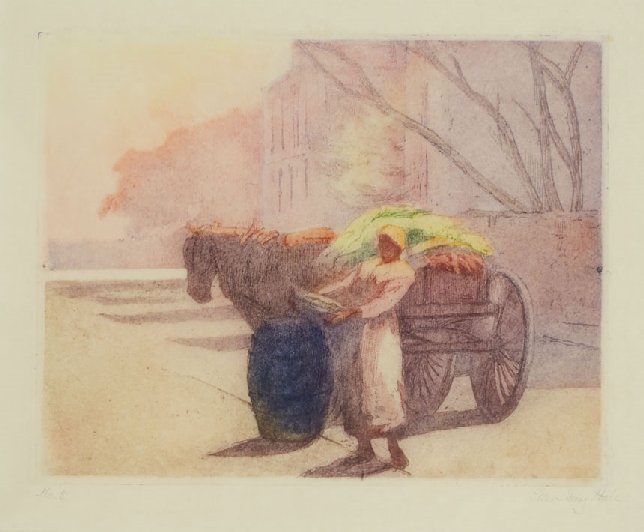
Early Vegetables by Ellen Day Hale (c.1918)

The relationship between Ellen Day Hale and Gabrielle de Veaux Clements was often referred to as a Boston Marriage.  A Boston marriage was, historically, the cohabitation of two wealthy women, independent of financial support from a man. The term is said to have been in use in New England in the late 19th and early 20th century. Some of these relationships were romantic in nature and might now be considered a lesbian relationship; others were not.  The nature of Ellen and Gabrielle’s type of relationship is simply unknown.

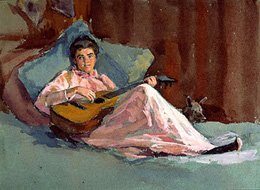
Musical Interlude by Ellen Day Hale

While in Charleston Ellen and Gabrielle immersed themselves in the flourishing arts renaissance which was taking place in the city.  They were both accomplished printmakers and they helped organize the Charleston Etchers Club, whose founding members included Elizabeth O’Neill Verner, Alice Ravenel Huger Smith, and Alfred Hutty. It was Verner’s daughter who later recalled the input of Verner and Hale had in Charleston and she recalled Clement’s words:

“…We want to leave Charleston some of our skills . . . Get together a group so you can buy a press and we will show you how to use it . . . We’ll teach you, so you can teach them…”

The Charleston Etchers’ Club was formed in 1923 and it offered instruction on printmaking, encouraged intellectual exchange, art criticism, and exhibition planning.

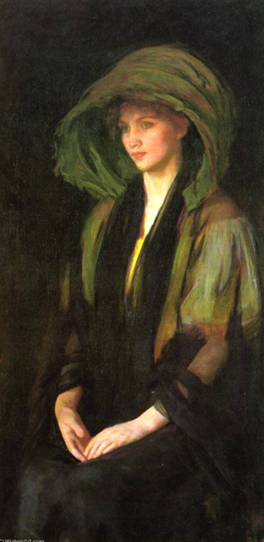
The Green Calash by Ellen Day Hale (1904)

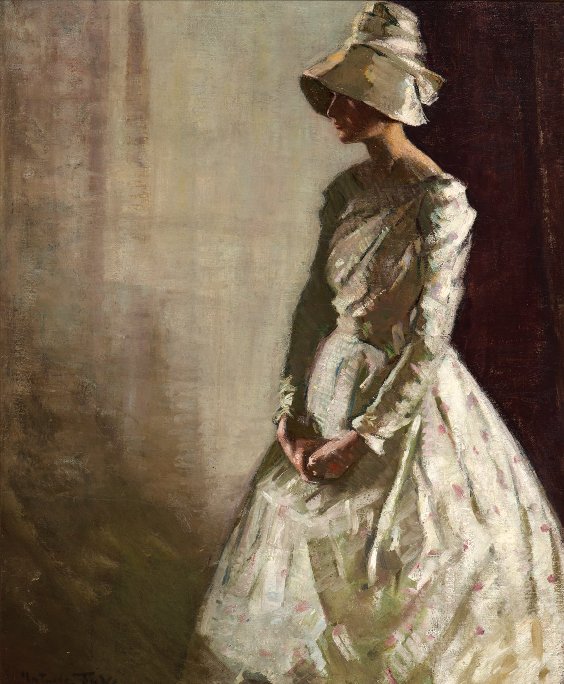
In 1904 Ellen Hale completed a painting entitled The Green Calash.  A calash is a large green bonnet or hood and resembles the folding top of an 18th-century carriage known as a calash.  It is a three-quarter-view portrait of a young woman who is sitting on a chair with her hands resting together in her lap.

The Green Calash by Ellen Day Hale (1925)

In 1925, twenty-one years later, Hale completed a soft ground colour etching and aquatint after her 1904 painting. The print is again a three-quarter-view portrait of a young woman seated with her hands resting together in her lap and is once again wearing a large green bonnet. The print of this etching was exhibited at the Smithsonian as part of a print exhibition in November 1936. Gabrielle DeVeaux Clements and Ellen Hale experimented extensively with colour printmaking throughout their careers.

The Original Colour Engraving by René Ligeron

Both had been influenced by the French artist René Ligeron’s 1924 treatise on colour intaglio, which Hale translated into English for the Smithsonian exhibition. Gabrielle Clements wrote to curator R.P. Tolman telling him that she and Hale had “been working on an interesting line of experiments in printing etchings in colour” and that they had “lately gained better control of the medium, and greater simplicity.”

This prestigious 1936 exhibition came near the end of Hale’s and Clements’s careers. By that time, they had been producing prints for more than sixty years. It was almost fifty years earlier that their work was showcased at the Women Etchers of America exhibition in 1887 at the Boston Museum of Fine Arts.

Hale died in Brookline, Massachusetts, on February 11, 1940, her 85th birthday.  Hale’s legacy is not only in her artwork and etchings but also her struggle to gain in the acceptance of female artists. A member of what is now referred to as the Boston School of Painting, Hale has also been recognized as one of America’s leading women impressionists.  She also wrote History of Art (1888). Her artist brother Philip Hale also exhibited at the Chicago World’s Fair. 

Ellen Day Hale

In his 1997 memoir, A Sculptor’s Fortunes, by Walker Kirtland Hancock an American sculptor and teacher talked about Hale and Clements, and their roles in establishing Folly Cove as a gathering spot for artists, a place he first visited in 1920:

“…Folly Cove…had begun to attract artists at least two generations before I arrived. The first to settle there were Ellen Day Hale and Gabrielle deV. Clements….Their houses were close to each other, overlooking the cove. Miss Clements’ was a large frame structure not far back from the road. Miss Hale’s, a stone building, was on higher ground. Miss Clements had been a mural painter, but because of her age she at that juncture limited her work to etching. She was kind and patient enough to give me lessons in that art. Miss Hale continued with her portrait painting. Both ladies were very much a part of the local community…They were responsible for [sculptor] Charles Grafly’s buying a house and building a large studio nearby, having recommended “the Folly” to him as a healthful place in which to live…

Walker Art Gallery revisited.

The Walker Art Gallery in Liverpool has one of the most significant and famous collection of artworks in the UK, which includes European Renaissance paintings, masterpieces by Rubens, Rembrandt, Turner and Stubbs, Pre-Raphaelite artworks by Rossetti and Millais, Impressionist works by Monet and Degas and contemporary works by Hockney, Wylie and the winners of the John Moores Painting Prize.   I have covered many of the Pre-Raphaelite works exibited here in previous blogs and following a visit I made to the gallery last week I have chosen a few more paintings which impressed me.

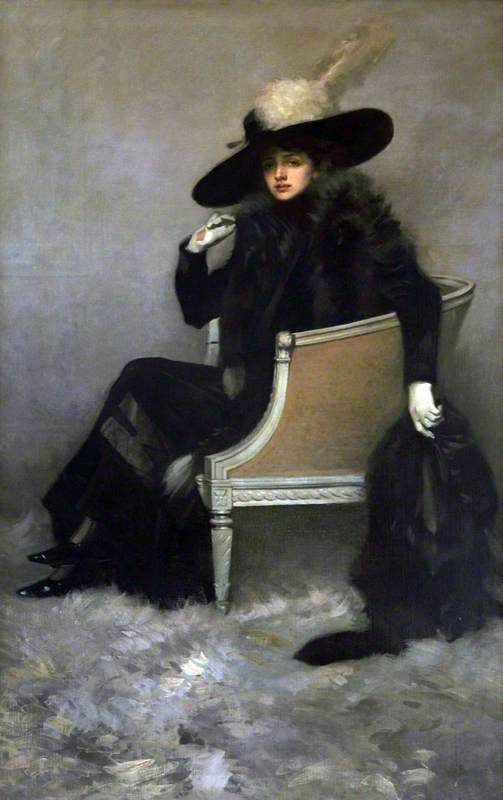
Lady in Black Furs by Pilade Bertieri (1912)

The first painting, I am showcasing is Lady in Black Furs, a work by the Italian painter Pilade Bertieri, which he completed around 1912.  Bertieri was born in Turin and exhibited in major cities in Italy, in New York and notably Manchester and Liverpool as well as Paris at the Salon from 1907 to 1931.  The painting depicts Bertieri’s wife Genevieve Wilson, the daughter of a wealthy New York socialite.  It was during a voyage in 1905 from Italy and America that they met and a year later they got married.  Bertieri said that he was first attracted to Genevieve when he saw seated on a deckchair.  For him, her graceful composure was just too much to resist and this depiction is a reconstruction of his first view of her but this time in a more fashionable chair.  The fact that she is wearing the very same furs, shoes and velvet and satin dress as she did aboard the ship in 1912 evokes memories for him of that first meeting.  At the time of the painting Genevieve was pregnant with their first child.

Fantine by Margaret Bernardine Hall (1886)

Margaret Bernadine Hall completed her painting entitled Fantine in 1886 and it depicts the character Fantine who was featured in Victor Hugo’s novel Les Misérables.  Fantine was dismissed from her job because of her illegitimate child and was forced into the life of a sex worker in order for her and her daughter to survive.  In the depiction we see Fantine protectively watching over her sleeping daughter.

Margaret Bernadine Hall was an English painter, born in 1863 in Wavertree, Liverpool.  Her father was Bernard Hall, a merchant, local politician and philanthropist, who was elected Mayor of Liverpool in 1879. Her mother was Margaret Calrow from Preston, who was Bernard Hall’s second wife. Margaret was their second child, and their oldest daughter.  In 1882 the family moved to London but at the end of that year nineteen-year-old Margaret went to live and study in Paris. Between 1888 and 1894 she travelled extensively to countries including Japan, China, Australia, North America, and North Africa, returning to live in the French capital in 1894. She moved back to England in 1907, where she died three years later.

River Scene with a Ferry Boat by Salomon van Riysdael (1650)

One of my favourite landscape painters is Salomon van Ruysdael and in his painting entitled River Scene with a Ferry Boat we see the kind of work he produced for the art-loving public. At this time, artists had mostly depicted religious subjects in their paintings and the Catholic Church used to be most artists’ best client, as they ordered altarpieces and other artworks to decorate churches and sacred places, but this came to an end with the Reformation as many Protestants refused to allow the presence of religious paintings or sculptures in churches.  This led to a great crisis for artists in Northwestern European countries as artists had only a few ways left to make money: painting portraits and illustrating books but there was also a revival of landscape paintings.  As well as the ever popular genre scenes, people began to buy landscape paintings to decorate their homes. Jacob Isaackszoon van Ruisdael, Salomon’s nephew, is generally considered the pre-eminent landscape painter of the Dutch Golden Age, a period of great wealth and cultural achievement when Dutch painting became highly popular. Jacob was best known for his atmospheric river scenes based upon the countryside around the city of Haarlem where he lived. He was also a merchant who dealt in the blue dye that was used in Haarlem’s famous cloth bleaching factories.

The Walker Art Gallery houses Salomon’s painting entitled River Scene with a Ferry Boat and we see a ferry crossing the river laden with people, livestock and even a small cart.  These ferries were an essential feature of the watery Dutch countryside, and a popular subject with landscape painters such as the Ruysdael family. This work is typical of much 17th-century Dutch landscape painting: naturalistic in its clear light and cloudy, rain-washed sky, but at the same time carefully organised to achieve a balanced composition. This work despite looking as though it was painted en plein air was not painted outdoors.  It is an idealised depiction and probably does not represent any particular place but is an amalgam of various details and features from a number of different places juxtaposed to form this vista.  Close to the riverbank we see a smaller boat with busy pulling in a fishing net. On the bank is a barn in which workers are salting fish and putting them into barrels. On top of the barn is a large dovecot. In a way the painting is a ‘foodscape’ as well as a landscape, highlighting what nature has to offer.  The Dutch patrons liked this kind of narrative painting.

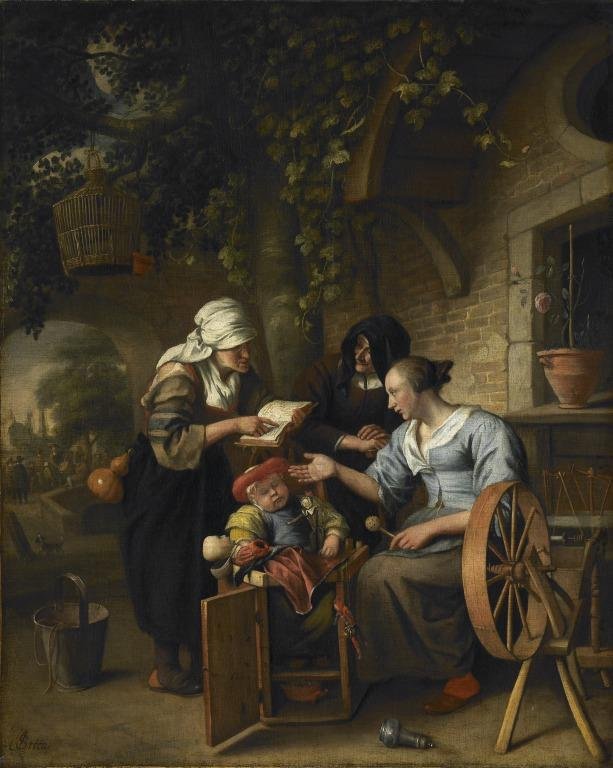
The Fortune Teller by Jan Steen (1663)

One of the greatest Dutch genre painters was Jan Steen. In Holland he ranks next to Rembrandt, Vermeer, and Hals in popularity.  He is best known for his humorous genre scenes, warm hearted and animated works in which he treats life as a vast comedy of manners.  Steen was born in Leiden and is said to have studied with Adriaen van Ostade in Haarlem and Jan van Goyen (who became his father-in-law) in The Hague. He worked in various towns – Leiden, The Hague, Delft, Warmond, and Haarlem and in 1672 he opened a tavern in Leiden.  In his painting The Fortune Teller we see a young woman sitting by her spinning wheel having her fortune told.  One interpretation of this depiction is that she is a sex worker, the old, black hooded lady is the brothel keeper and the soldiers in the background are her clients.  Fortune-telling was strongly associated with deceit, and therefore frowned upon in the seventeenth century.

The Epte in Giverny by Claude Monet (1864)

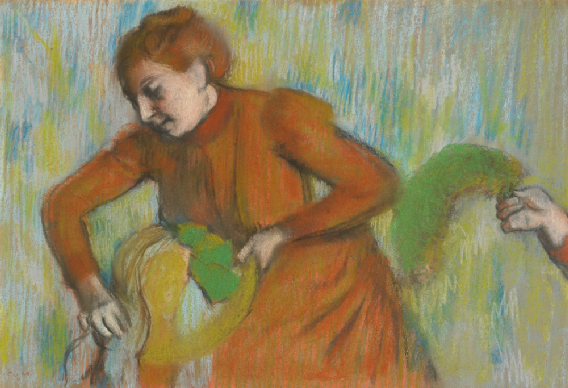
Modiste Decorating a Hat by Edgar Degas. (c.1895)

My next two offerings, The Epte in Giverny, by Monet and Modiste Decorating a Hat by Degas, are new arrivals at the gallery thanks to the beloved taxman. They have been acquired by National Museums Liverpool through the Government’s Acceptance in Lieu scheme which allows people, who have Inheritance tax bills to pay, to transfer important works of art and heritage objects into public ownership which are then allocated to museums, archives or libraries for people to enjoy.  Both the Monet and Degas artworks come from the collection of Mary Elliot-Blake and have been owned by the Montagu family by descent. Due to the family’s connection to Liverpool, the paintings were allocated to the Walker Art Gallery.

Monet completed the painting, The Epte in Giverny, in 1884, and it depicts the fast-flowing Epte river, which rises in Seine-Maritime in the Pays de Bray, near Forges-les-Eaux and empties into the Seine not far from Giverny where the artist painted his famous water lily series.

The second work is by Degas’ entitled Modiste Decorating a Hat and depicts a milliner adjusting a hat in a shop window.

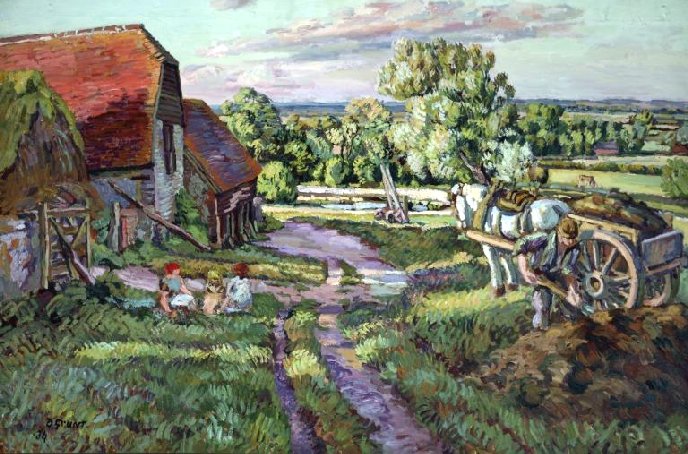
Farm in Sussex by Duncan Grant (1934)

The 1934 painting, entitled Farm in Sussex, is a depiction of Charleston Farm at Firle in Sussex is by the artist Duncan Grant. The picture was painted in his studio over a period of several years. The first thing that strikes you about the depiction is the unusually bright colours he has used and this is due to Duncan Grant’s great interest in Fauvism, which was popular between 1905 and 1910. The Fauves (the Beasts) used bright, clashing colours and fierce brushstrokes to express feelings and emotions.  In 1909, Grant met Henri Matisse, who was a leading light of this group.

He also saw more of the groups work in Roger Fry’s Post-Impressionist exhibition in London in November 1910, Fry had organised the exhibition Manet and the Post-Impressionists at the Grafton Galleries, London. This exhibition was the first to prominently feature Gauguin, Cézanne, Matisse, and Van Gogh in England and brought their art to the public.

Duncan Grant lived at Charleston Farm from 1916 with Vanessa Bell (neé Woolf), who was an artist and the sister of Virginia Woolf. They had met through the Bloomsbury Set, a London-based group of artists and writers who met regularly to discuss their work and ideas about modernism and art. Charleston Farm became a meeting place for the Bloomsbury Set outside of London.  The pair had moved to the countryside from London following the outbreak of World War I so that Grant could avoid conscription by working as a farm labourer. The couple each had their own studio at the farmhouse and decorated the entire building, including walls, fireplaces, door panels and furniture, with their paintings, fabrics and ceramics. They kept the house after the war and used it as a summer home. The painting highlights the bright colours that characterise Grant’s work. The painting was completed in 1934, the same year that Roger Fry died. Fry had been a close friend of both Duncan Grant and Vanessa Bell and was a regular visitor to Charleston. The painting reflects Grant’s affection for the Farm and the people he associated with it

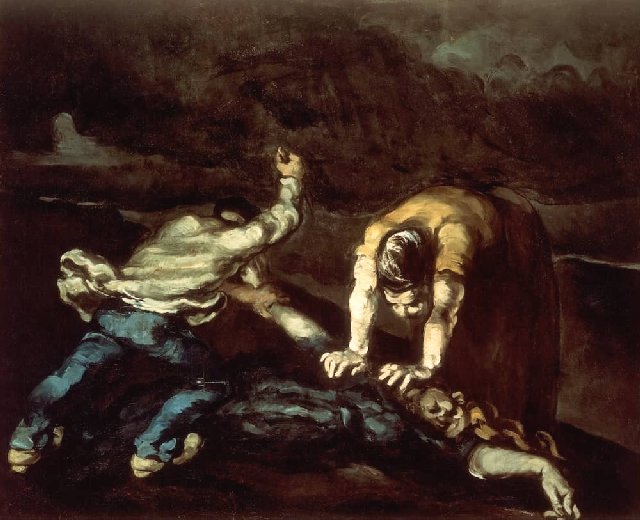
The Murder by Cezanne (c.1870)

The Murder is one of Cézanne’s early paintings which he completed around 1870.  It is a dark and highly melodramatic work which ably communicates the brutality of the act. In the depiction we see the murderer raising his hand and is about to give the final strike while his female conspirator forcefully holds down the rounded heavy-set body of the female victim whilst the fatal blow is struck.  Little can be made out of the figures; just the outline head and arms of the victim whose facial expression is contorted with pain.  The faces of her two assailants are blurred.  Cezanne was not interested with the identities of the murderers but the scene simply depicts the heinous act of anonymous violence.  The scene is made more frightening by the bleak surroundings and the dark sky overhead.  Close to the figures is a riverbank and we can deduce that the body of the dead woman will eventually be dumped into the dark waters.

Publicity Poster for Zola’s novel

The Murder was painted at a time when Cézanne was still influenced by the Old Masters such as Eugene Delacroix and Francisco Goya, and Diego Velazquez.  So after painting so many colourful landscapes why would he depict a brutal murder?  It is thought that Cezanne’s choice of depicting this brutal subject may have been inspired by Emile Zola’s novel Thérése Racquin which had been published in 1867, in which the heroine murders her husband. It was Zola’s third novel, though the first to earn wide fame. The novel’s adultery and murder were considered scandalous and famously described as “putrid” in a review in the newspaper Le Figaro. The painting’s subject could also be inspired by illustrations in the popular press.

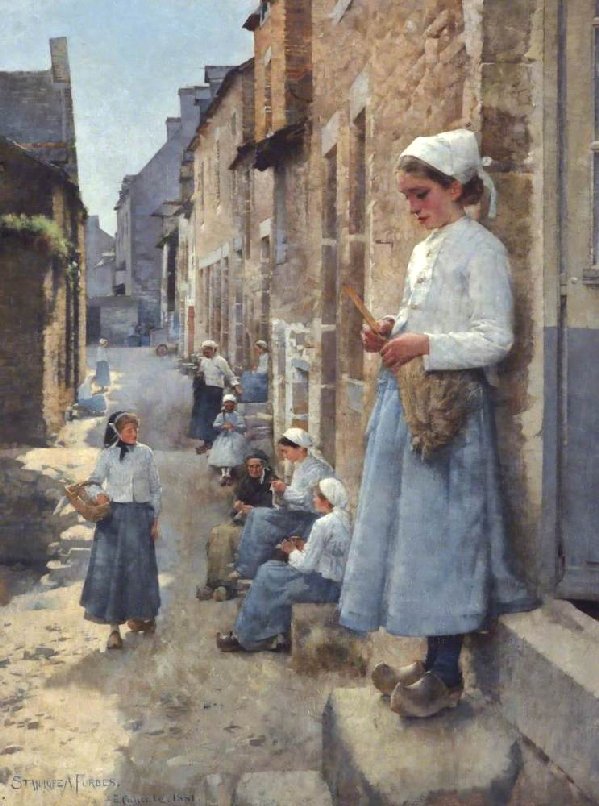
A Street in Britanny by Stanhope Forbes (1881)

My final painting is A Street in Brittany by Stanhope Alexander Forbes which he completed in 1881.  It is a depiction of figures in a narrow street: women in white headgear known as coiffes and blue petticoats.  They are grouped around their cottages, some are seated on their knitting blue jerseys for their fishermen husbands.

Stanhope Forbes was born in Dublin, the son of Juliette de Guise Forbes, a French woman, and William Forbes, an English railway manager, who was later transferred to London. He was educated at Dulwich College, and he studied art under John Sparkes at Lambeth College of Art, who later taught at South Kensington School of Art. Forbes then studied at the private atelier of Léon Bonnat in Clichy, Paris from 1880 to 1882.  It was in the French capital that Forbes met up with fellow artist, Henry Herbert La Thangue, who had also attended Dulwich College, Lambeth School of Art and the Royal Academy.

In 1881 Forbes and La Thangue went to Cancale, a village in Brittany, at the western end of the bay of Mont-Saint-Michel, fifteen kilometers east of Saint-Malo. It was here that Forbes began to paint en plein air and produced this painting. 

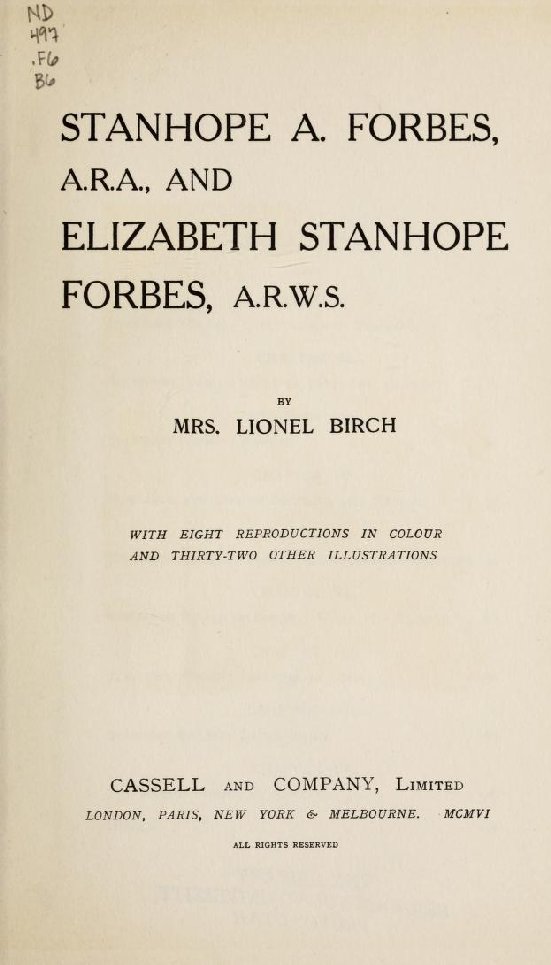
His biographer, Mrs. Lionel Birch in her 1906 book Stanhope A. Forbes, A. R. A., and Elizabeth Stanhope Forbes, A. R. W. S. recalled the setting of this work:

“..One of the first results of the visit to Cancale was a composition of figures in a narrow street: women in white coiffes and blue petticoats, grouped round their cottages and seated on their doorsteps engaged in their everlasting occupation of knitting blue jerseys for their fisher husbands…”

The biographer continues:

“…It was a very simple motif, but painted with great care and conscientiousness, and with a close and searching attention to those truths of lighting and that clear out-of-door aspect which the painter sought to betray. It was interesting, too, as the first attempt Stanhope Forbes had made in what might be termed figure composition, if, indeed, a picture in which there is so little of arrangement in the grouping of the figures can be termed a composition. But it was, at any rate, a great step from simple portraiture, and its success — for it brought the young painter a very signal one — had the most marked influence in determining his future. Exhibited at the Royal Academy of 1881, it attracted favourable attention, and when, later on, it was sent to Liverpool, the Committee of the Walker Art Gallery decided to purchase it for their permanent collection…”

Forbes left France and returned to London and exhibited the works he had made in Brittany at the 1883 Royal Academy and Royal Hibernian Academy shows.  In 1884 he moved to Newlyn in Cornwall, and soon became a leading figure in the growing colony of artists.

I hope this blog will tempt you to visit the Walker Art Gallery in Liverpool. You will not be disappointed.

Theodoor Rombouts

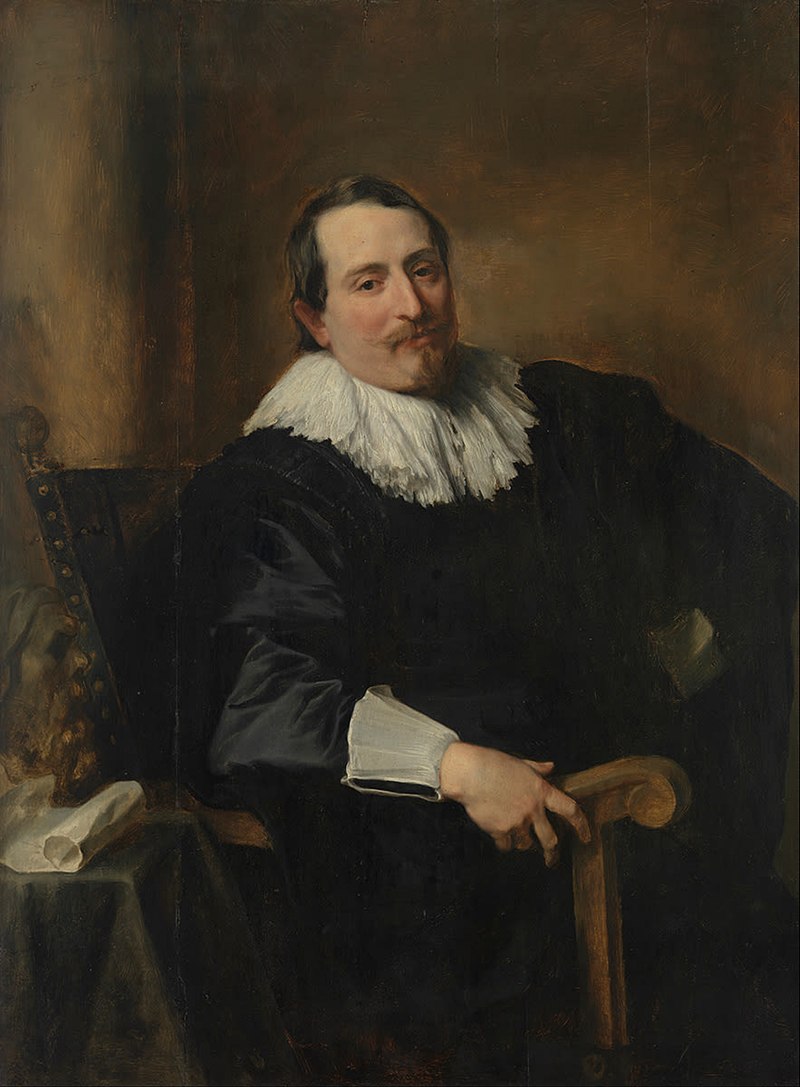
Portrait of Theodoor Rombouts by Anthony van Dyck

In my last two blogs regarding the Groeninge museum in Bruges, I looked at the works of the Flemish Primitive painters.  In this edition of the blog I want to showcase the life and works of an early seventeenth century Flemish painter known for his Caravaggesque genre scenes depicting lively dramatic gatherings.  Maybe because he lived in Antwerp at the same time as the great Rubens he and his artwork was overshadowed but I hope you will see that the man was an artistic genius.  Let me introduce you to Theodoor Rombouts.

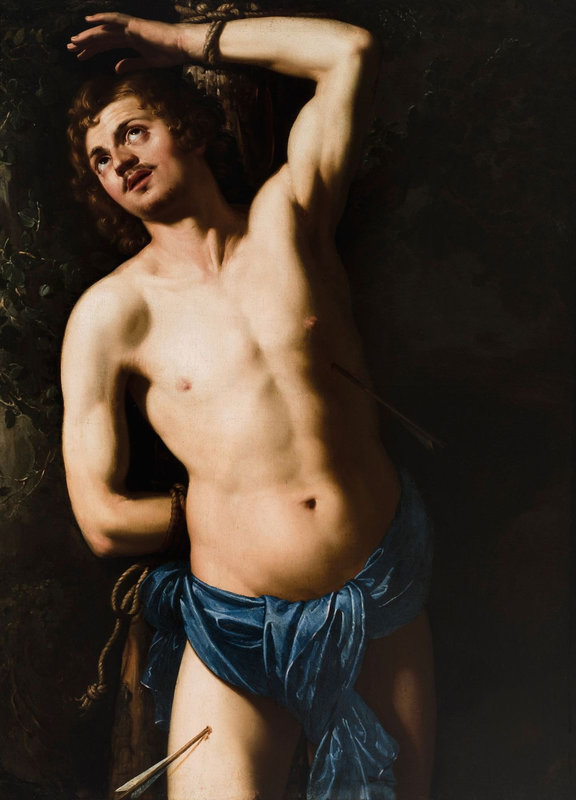
St Sebastian by Theodoor Rombouts (c.1626)

Rombouts was born in Antwerp on July 2nd 1597.  He was the son of Bartholomeus Rombouts, a wealthy tailor, and Barbara de Greve.  In 1608, at the age of eleven, Theodor studied art for a year as a pupil of Frans van Lanckvelt before being tutored by the Flemish artist, Abraham Janssens, the dean of the Antwerp Guild of St Luke and who had studied in Rome at the time of Caravaggio. He was one of the first Flemish followers of Caravaggio.

Young Soldier by Theodoor Rombouts (1624)

In 1616, aged nineteen, Theodore Rombouts also travelled to Rome where he remained until 1625.  He was recorded as living in the Roman parish of Sant’Andrea delle Fratte, along with two other Flemish painters, Francesco Tornelli  and Robert d’Orteil.  It is thought that while on a visit to Florence he met the Caravaggist Bartolomeo Manfredi and worked for Cosimo II de’ Medici. It was during his stay in the Italian capital that Rombouts was inspired by the revolutionary painter Michelangelo Merisi da Caravaggio and his most important follower Bartolomeo Manfredi and the two would influence Rombouts’ painting style.   In 1622 he also travelled to Pisa.

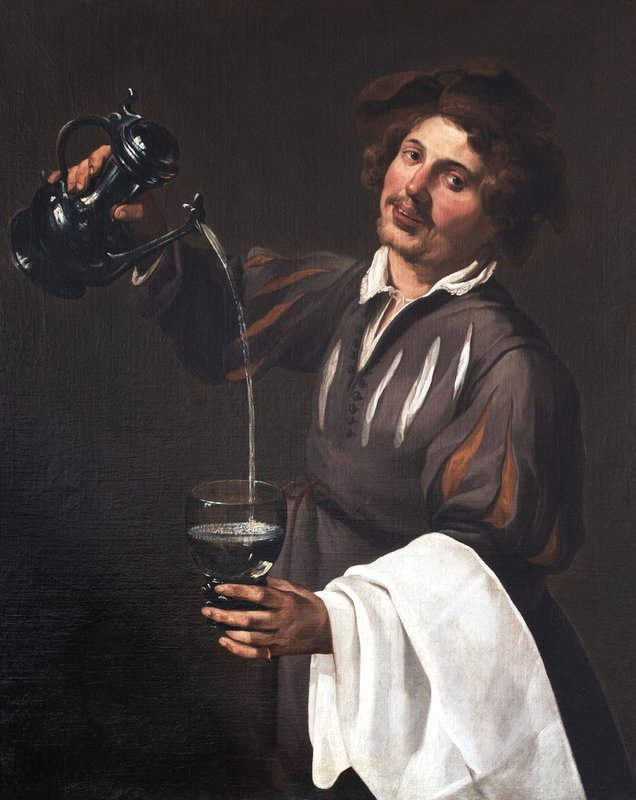
The Cup-bearer (Allegory of Temperance) by Theodoor Rombouts (c.1632)

In 1625, on his return to Flanders, Rombouts entered the Guild of St. Luke in Antwerp as an independent master. Now in Flanders, he concentrated on his genre painting which he could sell at the open market, in a style of strong contrasts of light, with figures of great articulacy, both evoking great energy and yet with natural movement.  The excellence of his work and its popularity resulted in him being looked upon as the leading Flemish Caravaggian of his time.

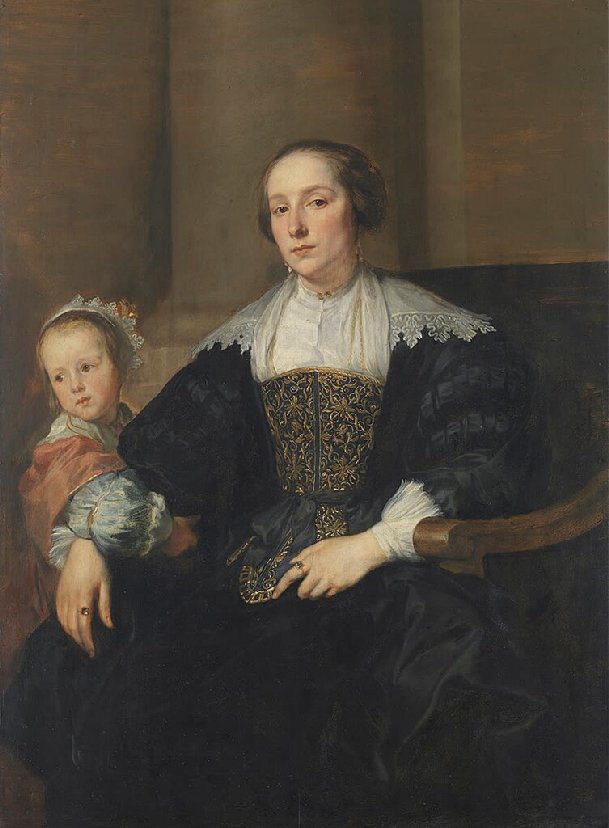
Portrait of Anna van Thielen, wife of the painter Theodor Rombouts with their daughter Anna Maria (c.1630)

In 1627 Rombouts married Anna van Thielen, who was from a noble family and the sister of Jan Philip van Thielen, who was the son of a minor nobleman by the name of Liebrecht van Thielen. Jan Philip became a well-known Flemish painter who specialized in flower and garland paintings.  He would eventually assume his father’s title of Lord of Couwenberch.  Jan Philip van Thielen became Rombout’s pupil in 1631 and became a talented still life painter.  There was a strange twist to Rombout’s marriage as Anna and her family were not from Antwerp but from the Mechelen area, and so he had to obtain, prior to the wedding ceremony, a dispensation from the Antwerp City Council to consummate the marriage outside Antwerp so that he would not forfeit his Antwerp citizenship rights.  In 1628 the couple had a daughter, Anna Maria.

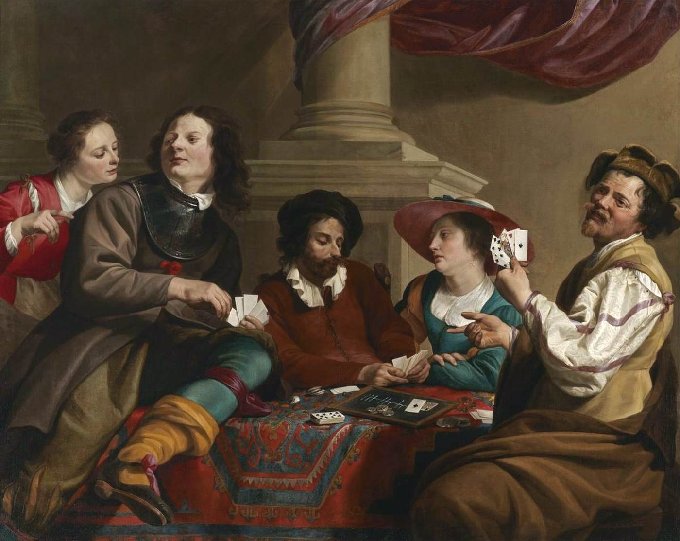
Card Players in an Interior by Theodoor Rombouts

Theodor Rombouts was the primary exponent of Flemish Caravaggism,that became a popular artistic phenomenon that reached its zenith in the 1620s. Besides his religious works, he is probably best known for his large-scale secular works which portrayed groups of cheerful folk partaking in musical merriment and card-playing characters who had often been affected by heavy drinking.  These people depicted wearing theatrical costumes were posed for best effect and set in chiaroscuro lighting typical of the Flemish Caravaggisti, also known as the Antwerp Tenebrosi.  Tenebrism, from Italian word tenebroso meaning dark, gloomy, and mysterious, also occasionally called dramatic illumination, is a style of painting using especially pronounced chiaroscuro, where there are violent contrasts of light and dark, and where darkness becomes a dominating feature of the image.

Tavern Scene with Lute Player by Bartolomeo Manfredi (c.1621)

Rombouts’ work entitled Card Players in an Interior, is a prime example of his Caravaggesque genre scenes. Recalling the jovial genre scenes of Bartolomeo Manfredi’s depiction of merriment in a tavern in his 1621 work, Tavern Scene with Lute Player, one can see a similar marked sense of monumentality to Rombouts’ five figures who are positioned around a carpeted table, engaged in a game of cards. The individuals are both realistic and expressive and the whole depiction has natural feel about it.

Rombouts introduces what is known in art terms as repoussoir to the depiction.  The word Repoussoir comes from the French verb répousser, which means “to push back” and it has been used for centuries by artists who want to focus attention and add interest to their art. They achieve this by placing certain types of objects or figures close to the painting’s edges, which guide the viewer’s eyes towards your central theme.  In this painting our eyes are being led towards the central bearded figure who stares down at his hand of cards, and it is thought to be a self-portrait of Rombouts. Rombouts also included a portrait of his wife, Anna, in the hatted figure seated beside him.

The Backgammon Players by Theodoor Rombouts (1634)

Rombout’s inclusion of self-portraits and portraits of family members in some of his paintings was not unusual as these additions were often seen in Dutch and Flemish genre painting.  In his 1634 painting entitled The Backgammon Players, which is part of the collection of the North Carolina Museum of Art, in Raleigh, Rombouts has included himself, the lavishly dressed soldier, his wife and his young daughter.

The Tooth Puller by Theodoor Rombouts (c.1625)

One of my favourite secular painting by Rombouts is his 1625 work entitled The Tooth Puller which can be seen at the Museo del Prado in Madrid. The depiction is of a tooth-puller who is treating a long-suffering patient surrounded by a large group of inquisitive onlookers who could well be the tooth-puller’s next patient.   They look on with a mixture of inquisitiveness and alarm, bordering on panic.  Like Caravaggio, Rombouts was interested in depicting ordinary folk enduring or enjoying everyday life.  The tooth-puller’s certificates lie on the table for his patients to see but his experience is substantiated by a collar of teeth worn around his neck.

The Lute Player by Theodoor Rombouts (c.1625)

One of Rombouts’ popular single figure painting is The Lute Player which is part of the John G. Johnson Collection at the Philadelphia Museum of Art.  It depicts a lute player tuning his instrument.  Lute players were often mocked for the undue amount of time they dedicated to tuning their instruments. Look how Rombouts has depicted the intensity of concentration on the face of the street musician which highlights the complexity of the task.  Some believe that this tuning of the instrument symbolises striving for harmony in love. The depiction of a stringed instruments could also symbolize temperance, especially when shown in the company of a tankard and a pipe, as depicted by Rombouts.

The Lute Player by Caravaggio (c.1596)

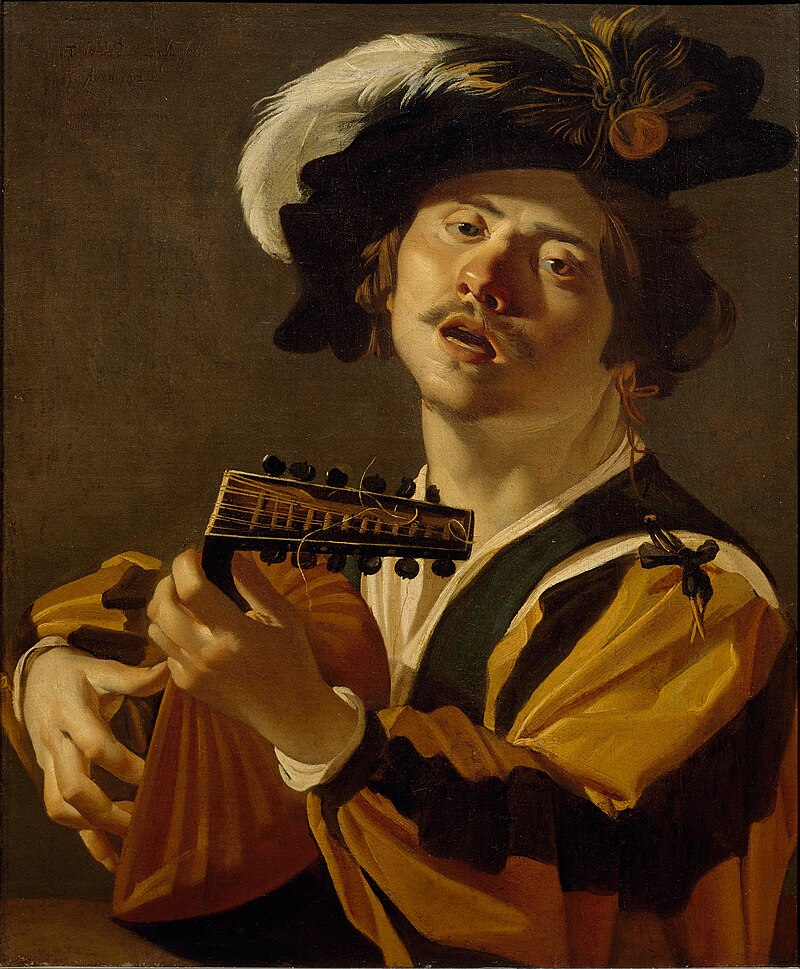
The subject of a lute player was very popular in the seventeenth century and was often depicted in a Caravaggio-style as can be seen in Dirck van Baburen’s 1622 painting entitled The Lute Player or Singing Man with Lute which is part of Centraal Museum in Utrecht collection. 

The Lute Player or Singing Man with Lute by Dirck van Baburen (1622)

Von Baburen, like Rombouts, had spent time in Rome and had seen many of Caravaggio’s works of art. 

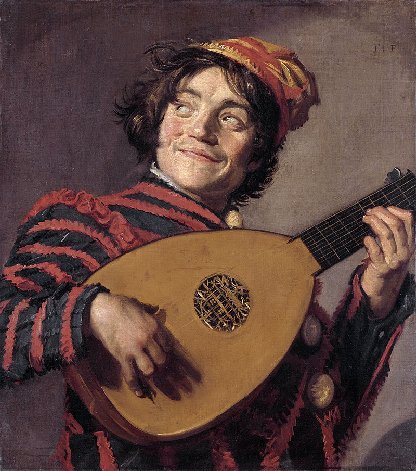
Lute Playing Jester by Frans Hals (1623/1624)

The half-figure image of a single musician became very popular in the Dutch Republic and other artists copied the style such as Frans Hals with his 1623 version of the Lute Playing Jester.

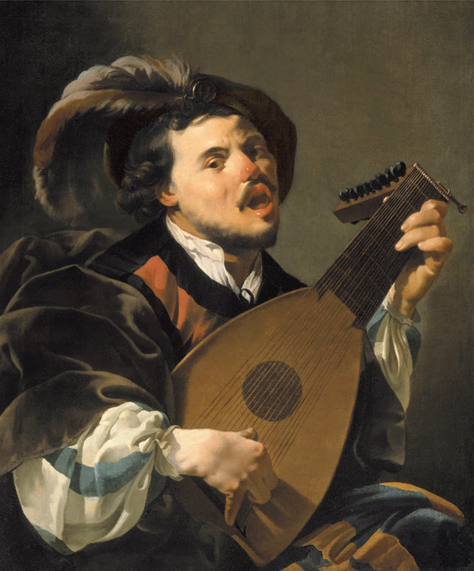
The Singing Lute Player by Hendrick Terbrugghen (1624)

and the Utrecht Caravaggesque painter Hendrick Terbrugghen with his 1624 painting entitled The Singing Lute Player.

Allegory of the Five Senses by Theodoor Rombauts (1632)

In 1632 Rombouts completed his multi-figured work entitled Allegory of the Five Senses which can be seen at the Museum voor Schone Kunsten in Ghent.  The art loving public in the 16th and 17th century were fascinated by symbolic works of art especially those where the artist has also displayed his or her virtuosity as a painter.  In the painting, Allegory of the Five Senses, we see five men depicted.  Each of them symbolizes one of the five senses. The elderly man on the left with glasses propping up a mirror represents Sight. Next to him is a man playing the chitarrone, a type of bass lute, and he symbolises Sound. The blind man in the centre of the painting represents the sense of Touch. Further to the right we see a jovial man with a glass of wine in his hand.  He portrays Taste.  At the far right we have an elegant young man smoking a pipe and holding a bag of garlic.  He represents Smell. The Ghent bishop, Antoon Triest, who also owned several paintings by Dutch masters, purchased this canvas from Rombouts.

The Denial of St. Peter by Theodoor Rombouts (c.1625)

Besides his genre paintings Theodoor Rombouts completed a number of large religious works during his lifetime.  Around 1625, after just returning from Rome, Rombouts completed his religious work entitled The Denial of St. Peter.  The narrative painting had a wide horizontal format (94 x 206cms) and the depiction was based on the biblical story about the testing of St Peter’s resolve in supporting Christ.  In the painting we see the servant girl questioning St Peter.  According to the bible Mark 14: 66-70:

“…While Peter was below in the courtyard, one of the servant-girls of the high priest came by. When she saw Peter warming himself, she stared at him and said, “You also were with Jesus, the man from Nazareth.” But he denied it, saying, “I do not know or understand what you are talking about.” And he went out into the forecourt. Then the cock crowed. And the servant-girl, on seeing him, began again to say to the bystanders, “This man is one of them.” But again, he denied it. Then after a little while the bystanders again said to Peter, “Certainly you are one of them; for you are a Galilean…”

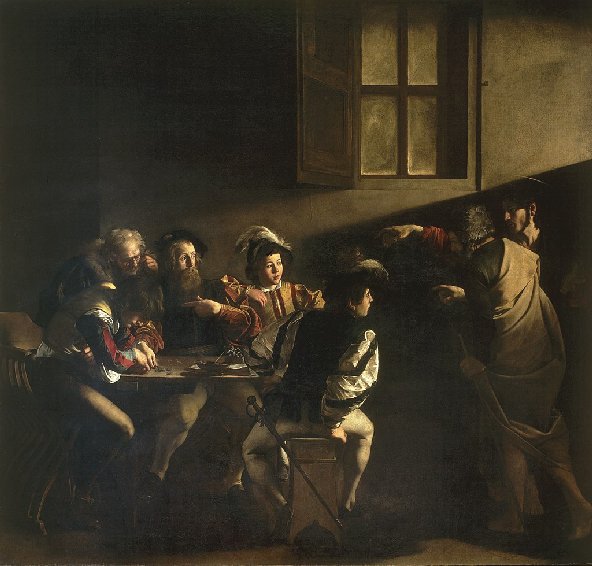
The Calling of St Matthew by Caravaggio (c.1600)

The influence of Caravaggio can be seen in this painting and the setting of the figures reminds one of Caravaggio’s  work The Calling of St Matthew which he completed around 1600 and is hanging in the Contarelli Chapel in San Luigi dei Francesi in Rome, and was probably seen by Rombouts.

Christ driving the Money-changers from the Temple by Theodoor Rombouts (c.1637)

Another of Rombouts’ religious works, Christ driving the Money-changers from the Temple, features the events in the Temple as related in Mark’s Gospel (Mark 11:15-17) in the New Testament:

“… On reaching Jerusalem, Jesus entered the temple courts and began driving out those who were buying and selling there. He overturned the tables of the money changers and the benches of those selling doves and would not allow anyone to carry merchandise through the temple courts. And as he taught them, he said, “Is it not written: ‘My house will be called a house of prayer for all nations’ But you have made it ‘a den of robbers…”

It depicts a furious Christ erupting in anger, his self-made whip in his hand, as he furiously attacks the merchants when he discovered that the holy site of the temple was being used as a market hall and money changer’s office.  Look at the wide range of emotions etched on the faces of the proponents.

Between 1628 and 1630 Rombouts was deacon of the Guild in Antwerp. In 1635, two years before his death, Rombouts collaborated with other artists on the programme of the decorations of the Joyous Entry of Cardinal-infante Ferdinand in Antwerp, which was led by Rubens. Theodoor Rombouts died in Antwerp on September 14th 1637, aged 40, shortly after the completion of this collaborative project.

Groeningen Museum Bruges. Part 2.

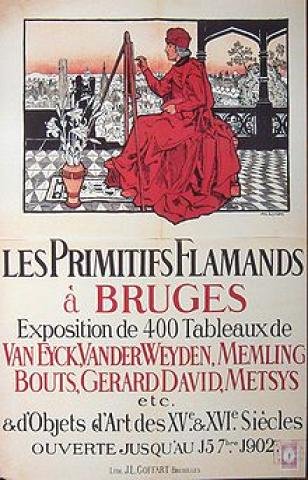
In 1902, a major exhibition of Flemish Primitive works entitled Les Primitifs flamands et l’art ancien was held in Bruges.  Almost four hundred paintings, including works by (or attributed to) Jan van Eyck, Rogier van der Weyden, Dieric Bouts, Hans Memling, Gerard David and Quentin Massijs, were on show. The exhibition drew in more than 35,000 visitors. It is believed that never before had so many Flemish paintings from the 15th and early 16th centuries been on display together.   If you manage to visit the Groeningen Museum in Bruges you will be able to see many works by the Flemish Primitives.

Portrait of a Theologian with his Secretary by Jacob van Oost the Elder (1686)

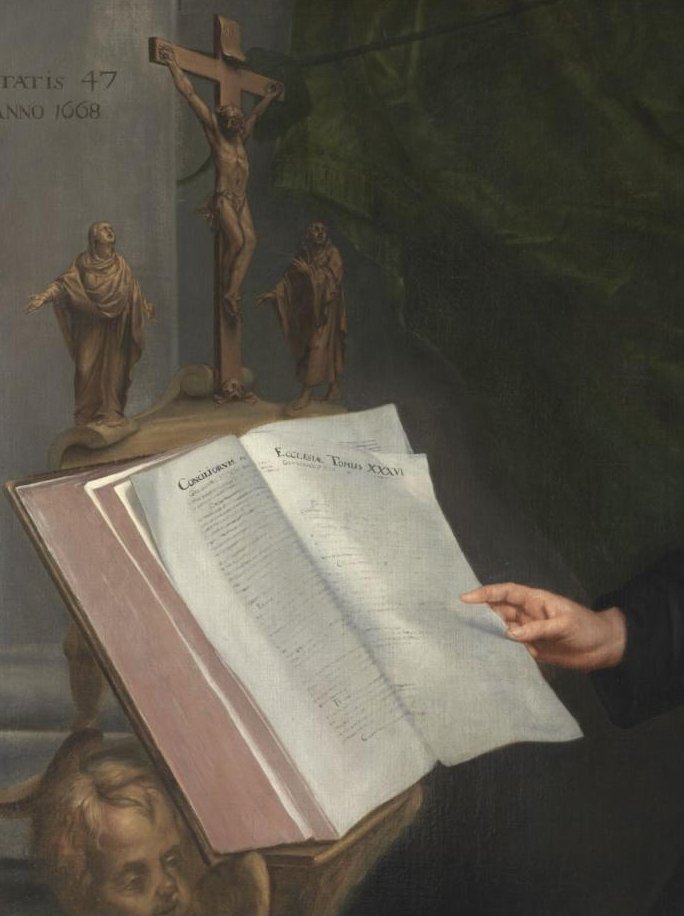
The first painting I am looking at in this blog is the dual portrait entitled Portrait of a Theologian and his Secretary by Jacob van Oost the Elder which he completed in 1668 and is part of the Groeninge Museum in Bruges.

Jacob van Oost the Elder was the leading artist of 17th-century Bruges. He painted many altarpieces in the churches of Bruges and he was also exceptionally gifted as a portrait painter as one can see in this work. Van Oost was born in Bruges, and trained there by his elder brother, Frans. He entered the Guild of Saint Luke in 1619, and became a Master two years later. He took a trip to Rome in the 1620s and on his return to Bruges in 1628, his work was influenced Caravaggio, albeit the depiction of his paintings were of a contemporary Netherlandish setting.

The work depicts a theologian, probably a Jesuit, reading the council’s decisions and comments on them to his secretary. His secular secretary takes notes. On the left of the painting we see a lectern, which is decorated with a sculpture of a Calvary group, and open on it is volume thirty-six of the collected Council Decrees. On the right of the painting we see a work table bedecked with a richly coloured tablecloth, at which the priest and the secretary are seated. On top of the table are study accoutrements, such as a globe and a book. Behind the two men is a bookcase with editions of the Bible and literature in the fields of theology and canon law.

Thomas Wentworth, Earl of Strafford, with Sir Philip Mainwaring by Anthony van Dyck

Once again, in this depiction we are reminded of the influence of Anthony van Dyck portraiture, such as his 1640 painting entitled Thomas Wentworth, Earl of Strafford, with Sir Philip Mainwaring, also the Caravaggesque treatment of the light, with its characteristically heavy contrasts between light and shade, in this case between the open book on the lectern and the black clothes of the English statesman and the lightness of his face in comparison to the dark background.

Portrait of a Bruges Family by Jakob van Oost the Elder (1645)

Portrait of a Bruges Family is another painting by the Bruges born painter Jakob van Oost.   He had been commissioned to paint a family portrait.  This work is regarded as a masterpiece of high Baroque painting. For the man who commissioned the work, it is a vanity painting in which he is asking the viewer to recognise his status, his wealth and his handsome family.  He stands before us his arm outstretched.  The focal point of this painting is the wealthy man who draws our attention to his assets. He points towards the estate he owns which stretches into the distance.  He is surrounded by his family and standing next to him is his wife.  We also see the children’s maid and the gardener and by catching a glimpse of the terrace he is standing on we know that his house will be palatial.  Van Oost has made his viewpoint low which adds to the imposing air of the central figure.  It is a painting which carefully exudes two facts for us to take in.  Firstly, the portrait is a glorification of family life based on love and fertility and secondly, it is a work of art which affirms the family’s social status.  In the seventeenth century the wealthy bourgeois yearned to be accepted into the realms of the aristocracy and one way of elevating themselves to that social status was to buy an estate that came with a title of nobility and we can clearly see the man in the portrait aspired to that elevated status.

What is fascinating about this painting, albeit you will probably not be able to see it clearly in the attached picture, is that the painting is signed and dated on the lower right on the parapet.  However, even more bizarre is that the painter has incorporated the age of the various figures in the work.  The man is 46 as we can see written on the heel of his shoe.  His wife is aged 26 and this figure appears on her fan and the boy who stands close to her is 3 as can be seen written on his hat.  The girl sitting on the steps sits on a cushion is 15 as shown on her basket and the young man is 17 as shown on his boot.  The baby who is being carried by the nursemaid has the figure 1 inscribed on his hand.   The ages of the various children suggest that there have been two separate marriages and the lady holding hands with the central figure is probably the mother of the two youngest children.  This work of art is considered to be one of van Oost’s greatest masterpieces.   It would be interesting to find out if anybody visits the museum and looks closely at the painting whether they can see the numbers inscribed in the painting

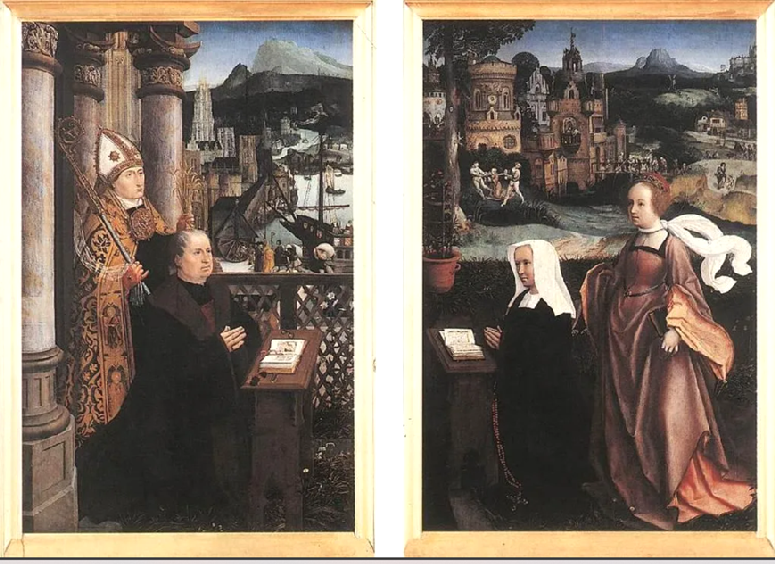
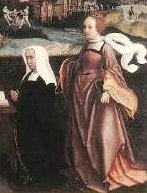
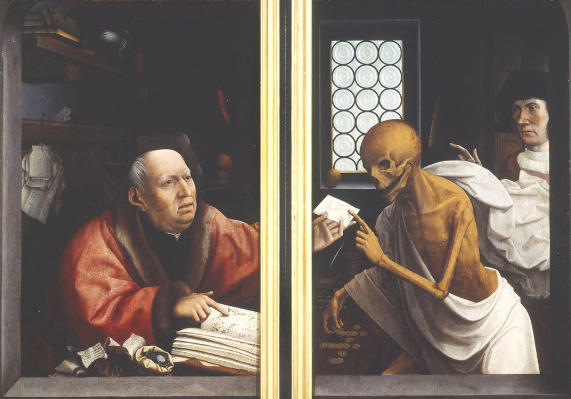
The next offering was once a triptych by the Belgian artist, Jan Provoost, and belonged to the former Dominican monastery in Bruges. Sometime before 1861 the front and back sides of the wing panels were separated by sawing them apart lengthwise.   The four panels are now displayed separately. The original central panel is missing. 

Jan Provoost was born in the Belgian town of Mons around 1463.  By 1491 he had married the widow of the miniaturist and painter, Simon Marmion and in 1494 he settled in Bruges.  He simultaneously headed up two workshops, one in Bruges, where he was made a burgher, the other in Antwerp, which was then the economic centre of the Low Countries. Provost was also a cartographer, engineer, and architect.

Inner wings of the original Triptych (c.1515)

The wealthy, but unknown, donors who commissioned the triptych are depicted on the original inner wing panels kneeling in prayer in a small, enclosed garden.  The background scenes include episodes in the lives of their patron saints, Nicholas of Myra and Godeliva who are also depicted in the panels.  Behind each of the saints are pictorial episodes from their lives.

The depiction in the background of the left hand panel we can just see men carrying sacks of food as they walk along the quayside next to a sailing vessel. When the people of Myra, a Lycian city in Ancient Greece in what is today the provinces of Antalya in Turkey, faced starvation, Bishop Nicholas had a shipload of grain that was destined for Alexandria distributed among the people. When the vessel completed its onward journey and arrived at Alexandria the cargo was found to have been miraculously replenished.

The right hand panel depicts the female donor along with her patron saint, Godeliva of Gistel and in the background we can see how the saint met her death. The story goes that she accepted an arranged marriage as was the custom, but her husband and family turned out to be abusive. Eventually he had her strangled by his servants. The large white scarf around the saint’s neck is to remind us of the manner of her death.

Outer (reverse)wings of the Triptych (c.1515)

Originally when the triptych was closed it showed the images Death and the Miser. These two rear sides form a continuous scene and depict a moneychanger who points to a line in an accounting register. Death lays down some tokens and points to the text held out to him by the moneychanger, presumably a promissory note. It is possibly that the man in the doorway with a raised finger could be the artist himself.

The Pandreitje in Bruges by Jan Antoon Garemijn (1778)

The world of art constantly changed.  Leaving the 15th- and 16th-century Northern Renaissance period, once known as the Flemish Primitives and moving on a quarter of a century, through the bombastic art of the Baroque period we arrive at the time when light-hearted charming, themed art of the Rococo period had gained in popularity.  In France, Antoine Watteau, Jean Honoré Fragonard and François Boucher held centre stage and defined the French Rococo period spanning from the reign of Louis XIV “The Sun King” to that of Napoleon Bonaparte.  They created soft-coloured dreamworld paintings set in idyllic surroundings exuding a light poetic atmosphere.  The Flemish Rococo artists never attained the aristocratic elegance of their French counterparts although they did manage to produce fresh bourgeois drawing-room style works. 

Portrait of Jan Antoon Garemijn by Charles-Nikolas Noel (1771)

The most talented of these Flemish artists was Jan Antoon Garemijn.  The Groeningemuseum houses his portrait and also a number of his beautiful works including one entitled The Pandreitje in Bruges which he completed in 1778. The Pandreitje was a square in Bruges used as a vegetable market. In the foreground we see women who have come to town from their rural homes bringing with them their vegetables which they hope to sell.  In the background, occupying the porticos of the prison building are the butchers selling their wares. 

On the left of the square we see a street entertainer singing songs and cracking jokes to keep the marketgoers entertained.  He is also depicted selling mannekensbladen, a kind of 18th century Flemish illustrated paper which is full of sensational stories.  Behind him is an advert for the paper he is trying to sell which bears the incomplete inscription:

DERLYCKL VAN- 1778

(Wonderful stories of 1778)

Garemijn always paid attention to detail in his paintings of market scenes, such as this one, which offered an idealised image of the common people without the symbolism and moralising undertone that earlier artists would insert into their genre works.  There was no hint of social criticism in this work.

Another painting housed in the Groeningemuseum is one I featured in one of my early blogs of 2011 and so I won’t repeat it but I will give you a link to the page. The painting and the story behind it, The Judgement of Cambyses and the Flaying of Sisamnes by Gerard David, was one of my most popular posts and it is well worth a visit.

Following these last two blogs featuring works housed in the Groeningemuseum I hope you will be able to visit one day in the future.

Groeningemuseum Bruges. Part 1.

Groeningemuseum, Bruges

If you ever manage to travel to Belgium and visit the city of Brugge (Bruges) then I entreat you to drop in at the Groeninge Museum which lies in the heart of the historic city.  It is at this establishment that you will be able to see works of art by Jan van Eyck, Hans Memling, Hugo van der Goes, Gerard David, Hieronymus Bosch, Ambrosius Benson, Lancelot Blondeel, father Pourbus and his sons and their contemporaries. These Masters came from the Low Countries and often worked in Bruges and completed assignments there in the late 15th and early 16th centuries. This museum is a home for many beautiful pieces of art produced by the Flemish Primitives. The painting of the 15th and early 16th centuries in the Southern Netherlands is an important highlight in the history of art. These painters are commonly referred to as Flemish primitives. The Flemish Primitive period flourished especially in the cities of Bruges, Ghent, Mechelen, Leuven, Tournai and Brussels, all of which are in present day Belgium.   The period began around the 1420s with painters such as Robert Campin and Jan van Eyck and lasted until the death of Gerard David in 1523, although many art historians believe it did not end until around 1566 or 1568 with the advent of the Dutch Revolt. Moreover, the Flemish primitives emphasise a previously unseen religious eloquence that accompanies a new tradition in painting. The painting commissions of the time not only came from the various courts and religious institutions, but also from the towns and cities and their citizens. It was a time when artists, for the first time, had attained a very important standing in the society. Several of their works are looked upon as highpoints in the history of European art.  In this blog I will introduce you to some of these fabulous paintings which can be found in this wonderful museum.

The Virgin and Child with Canon Joris van der Paele by Jan van Eyck (c.1436)

One of the great examples of early Netherlandish painting is the body of work by artists who were active in the Burgundian and Habsburg Netherlands during the 15th and 16th century Northern Renaissance period. The first work of art I am featuring is the large (122 x 158cms) oil on oak panel by Jan van Eyck entitled Virgin and Child with Canon Joris van der Paele which he completed around 1436. The painting depicts the the Virgin Mary enthroned at the centre of the semicircular space, which most likely represents a church interior, with the Christ Child on her lap. The Virgin’s throne is decorated with carved representations of Adam and Eve, Cain and Abel, prefigurations of the Crucifixion and Resurrection of Jesus, and scenes from the Old Testament. To the left in dark blue robes is Saint Donatian the patron saint of the church for which the panel was painted. The saint is dressed in brightly coloured vestments. This work is noted for the fine attire, including wonderful representations of furs, silks and brocades, and the detailed religious iconography. Kneeling down, as he piously reads from a book of hours, is Canon Joris van der Paele and standing behind him is St George, the canon’s patron saint.

Canon Joris van der Paele

Van der Paele had worked as a scriptor in the papal chancery in Rome.  From there he took up various posts in the Church before relocating to Bruges, his birthplace, in 1425.

Around the frame of the painting is a Latin inscription which once translated states:

“…Master Joris van der Paele, canon of this church, had the painting made by Johannes van Eyck, painter; and he founded two chantries, to be tended by the canons, 1434; the painting was, however, completed in 1436…”

The word “chantry” derives from Old French chanter and from the Latin cantare (to sing).   Its medieval derivative cantaria means “licence to sing mass”.  It is the prayer and liturgy in the Christian church for the benefit of the dead, as part of the search for atonement for sins committed during their lives.  In this case it indicates that Joris van der Paele donated a substantial amount of money to the authorities of St Donation’s Church in Bruges for them to dedicate an annual mass to his memory in perpetuity.  The painting would then have been hung alongside or above the church altar.

Death of the Virgin by Hugo van der Goes (c.1481)

The painting The Death of the Virgin is thought to have been the last work painted by Hugo van Goes before he died around 1482/1483.  It is thought that van der Goes was born in Ghent around 1442.  He enrolled in the city’s painter’s guild in 1467 and worked in the city for ten years during which time he received many lucrative commissions from the city, the Church and the Burgundian court.  In 1477 he left Ghent and went to live in Rouge-CloÎtre in the Forest of Soignes near Brussels.  Sadly, he suffered from many bouts of depression which culminated in a mental breakdown in 1481.  Following convalescence he returned to painting and completed this exquisite work of art which is believed to have been for Ter Duinen Abbey, a Cistercian monastery at Koksijde, in what is now Belgium.

Detail from Death of the Virgin by Hugo van der Goes

The depiction is the artist’s interpretation of the event with the vision of heaven above Mary’s deathbed.  The figures we see in the main picture are those filled with sorrow and the sense of despair at the death of the Virgin Mary.  Hugo van der Goes was looked upon as the most “modern” of the Flemish Primitive painters and this is borne out in this painting in which he has produced such realistic and expressive rendering of the figures and the movement and intensified feelings that pervade the composition.  The mystical, religious spirit along with the strong sense of emotion make this work one of the great masterpieces of 15th century painting.

Hans Memling was born in Germany, at Seligenstadt near Aschaffenburg, and it is thought that he received his first art education in Cologne.  He then travelled to the Netherlands but probably spent his early life in Mainz. By 1465 he had moved to Bruges and was the leading artist there for the rest of his life.  By 1480 he had bought himself a large stone house in the city and was taking on pupils.  Memling was listed among the wealthiest citizens on the city tax accounts. Sometime between 1470 and 1480 Memling married Anna de Valkenaere who bore him three children.

 Portrait of the family Moreel, 1482 by Hans Memling (Royal Museums of Fine Arts of Belgium, Brussels)

It is in the area of portraiture that Hans Memling appears to have been the most successful and had gained a vast number of aristocratic clientele who lived in Bruges. One of his lucrative commissions came from Willem Moreel, a prominent Bruges politician, merchant and banker and his wife Barbara van Vlaenderberch. He had painted their portraits in 1482. His figurative depictions are painted with an exactness, a precision and a concern for detail which bring them strongly to life.

The Triptych of Willem Moreel by Hans Memling (1484)

One such commissioned work of art was the Triptych of Willem Moreel. Moreel and his wife had commissioned Memling to paint a triptych altarpiece for the altar of the Saints Maurus and Giles in the Church of St. James in Bruges, a church in which Moreel and his wife wished eventually to be buried.

Central panel of the Moreel Triptych

The central panel of the triptych depicts the large figure of St. Christopher, who according to medieval legend, carried the Christ Child across a river on his shoulder. In the distance, up in the rocks in the left background we see the light from the hermit’s lamp guiding the saint. The two figures on either side of St Christopher do not belong in the legend but may have been added by Memling to balance the composition. To the left we see the former monk, St Maurus, holding his crook and open book and to the right is St Giles, a Benedictine hermit with an arrow in his arm and a deer at his side. It is interesting to note that the inclusion of the deer and the arrow which is in most depictions of the saint, as it harks back to the legend that Giles  finally withdrew deep into the forest near Nîmes, where, in the greatest solitude, he spent many years, his sole companion being his beloved deer, which in some stories sustained him on her milk.  His retreat was finally discovered by the king’s hunters, who had pursued the deer to its place of refuge. An arrow shot at the deer wounded the saint instead, who afterwards became a patron of the physically disabled.

The left hand panel of the Moreel Triptych

The left hand panel of the triptych continues with the magnificent landscape background. The depiction of the left hand panel has multiple figures. It depicts the Willem Moreel kneeling, hands clasped in prayer. His hair is short in a “bowl cut” and over his black jerkin, he wears a fur-lined tabard which is without a belt or fastenings, which was very fashionable in the 1480s. Behind him are his five male children, who are also shown kneeling. Of Moreel’s sons, two are known to have died in infancy leaving Willem the oldest, with his two remaining siblings, John and George. Moreel and his sons are being presented by Saint Wilhemus van Maleval, who stands among them, dressed in a fur-lined black coat over army clothing.   He places his hand on Willem’s shoulder as he directs and presents him to St.Christopher in the centre panel.

Right hand panel of the Moreel Triptych

On the right interior wing of the triptych is the depiction of Barbara Moreel with eleven of her thirteen daughters, who all kneel in prayer before an open book. Barbara wears an hennin, a headdress in the shape of a truncated cone, which was worn in the Late Middle Ages by European women of the nobility, a damask silk dress with a white collar, and a wide red belt with a golden buckle. The women are being presented by Saint Barbara, who was the patron saint of Moreel’s wife.  The saint is depicted standing before the tower where she was, according to legend, imprisoned and executed.

Sibylla Sambetha (Catherine Moreel ?) by Hans Memling (1480)

Barbara Moreel’s eldest daughter, Catherine, kneels directly behind her mother.  She also wears a black dress and it is known that later in her life she became a Dominican nun.  Besides completing portraits of Moreel and his wife, he had also painted a small oil on oak panel portrait entitled Sibyla Sambetha, in 1480.   The painting is now in the Hans Memling Museum at the Old St. John’s Hospital in Bruges. The girl in the light brown clothing, black V-neck and transparent veil has been identified as Maria from her name written in her headband, and is their second-born daughter, given her linear position in the painting.

Exterior panels of the Moreel Triptych when closed

The outer part of the two wings, seen when the triptych is closed has grisaille depictions of John the Baptist with his lamb and staff.  On the other wing we have Saint George in his full armour, slaying the dragon with a lance depicted on the right outer wing.  It is believed that these two panel paintings may have been completed much later around the time of the deaths of Willem and Barbara Moreel and dated as around 1504 by a number of art historians.  It was thought that Moreel’s sons, Jan (John) and Jaris (George), probably commissioned them as the final, successful, effort to have their parents interred within the chapel space.

One strange aspect to the Moreel Triptych is the fact that not all of the daughters depicted in the right hand panel were painted by Memling.   The art historian and former curator of the Groeningemuseum, Dirk De Vos, has identified at least six females who are later additions, layered over the original landscape. The explanation for these additions, which were probably added by members of Memling’s workshop, were that the daughters were born after the 1484 completion date of the triptych.   The left-hand panel depicting Moreel and his sons underwent a similar update.

………to be continued.

Marie Laurencin. Part 3.

Marie Laurencin – a photograph by Granger (1913)

Marie Laurencin left Spain and returned to Düsseldorf via Switzerland in 1919. She was very unhappy with her life.  She was depressed and felt unstable with her marriage failing.   Laurençin filed for a divorce from her husband telling friends that the reason for the marital split was because her husband had become an alcoholic. In 1921 Laurençin returned to Paris, knowing that her marriage was finished and she divorced von Wätjen.   However, despite the divorce, they remained on good terms, and Marie kept in touch with van Wätjen’s until his death in 1942.

The Spanish Dancers by Marie Laurencin (1921)

Now having returned to the French capital Marie realised that she had been greatly affected by her separation from Paris which she looked upon as the unrivalled centre of artistic creativity. After her return, she developed a new style of painting which is reflected in her 1921 work, The Spanish Dancers.   Gone are the muted colours and the geometric patterns she had inherited from Cubism and these are replaced by light tones and undulating compositions. Once again, we note the coming together of the feminine world and the animal world, which became her favourite theme.  In the work we see three young women spinning around a small bounding dog, in front of a large grey horse. Marie has portrayed herself kneeling in the foreground wearing a pink tutu, which happens to be the only warm tone in the painting. Her hands are entwined with those of the young woman on the right, who is wearing a light grey dress with a light blue headscarf.  The woman on the left, wearing a light blue dress, is executing a dance step whilst holding a hat in place on her head.  Her eyes lead almost seamlessly into the large almond-shaped eye of the horse. The animals would appear to be the dancers’ confidantes in this strange setting.

Femme aux tulipes by Marie Laurencin (1936)

Now back in Paris, Paul Rosenberg began to act as Marie Laurencin’s dealer which afforded her enhanced financial security and he also provided her with sound business advice.  Unfortunately, she did not always take Rosenberg’s advice and he was horrified to find that Marie often gave her work as a gift to those she liked. She also set higher prices for work which she found dull and often discounted some of her favourite works.  Curiously she often charged men double what she asked of women, and even charged brunettes more than blondes and furthermore she had a reputation for painting only children whom she liked.

Jeunesse by Marie Laurencin (c.1946)

In her private life, while Marie Laurençin had a succession of male lovers, she also had close female friendships and lesbian relationships. She became part of the female expatriate community in Paris that searched for both artistic and sexual liberation. Lesbianism, for many of these women, was a crucial element of their resistance to bourgeois social conventions.

Gertrude Stein at 27 rue de Fleurus with her portrait by Picasso on the wall, May 1930

Now, based in the French capital, Marie was alone.  The first American who befriended her and bought her paintings was Gertrude Stein, an American novelist, poet, playwright, and art collector who had been born in Pennsylvania.  She had moved to Paris in 1903 and made France her home for the remainder of her life. She hosted a Paris salon, where the leading figures of modernism in literature and art, such as Pablo Picasso, Ernest Hemingway, F. Scott Fitzgerald, Sinclair Lewis, Ezra Pound, Sherwood Anderson and Henri Matisse, would meet for conversation and inspiration.  Laurençin soon became part of the Stein salon on rue de Fleurus.  Marie remained in contact with Gertrude Stein and Alice B. Toklas until Stein’s death in 1946 and continued to see Toklas until her own death.

Portrait of Coco Chanel by Marie Laurencin (1923)

Laurencin held an exhibition of her work in 1921 at the Rosenberg Gallery in Paris. She had now built up her reputation as a talented portraitist, especially of celebrities, one of whom was Coco Chanel.  The commission to paint Chanel’s portrait came about in the autumn of 1923 when Marie Laurencin was working for Sergei Diaghilev’s Ballets Russes which was established in Paris, Monte-Carlo and London, and Marie was designing the costumes and sets for the ballet Les Biches [The Does]. At the same time, Coco Chanel was creating the costumes for the same company’s Le Train Bleu [The Blue Train] operetta .   At that time, Coco Chanel was both very rich and famous, and she commissioned Marie Laurencin to paint her portrait.  This was one of Laurencin’s early portrait commissions. Laurencin depicted Chanel face-on, seated in a relaxed, somewhat dreamy pose, with her head resting on her right arm. She appears relaxed and her eyes and mouth, neutral and expressionless, suggest that she is daydreaming or preoccupied by her thoughts. Marie Laurencin’s painting style was to incorporate animals in her works and here she depicts a white poodle sitting on the Coco Chanel’s knees. It is unclear where Chanel’s flesh ends and her dress begins; her pale outfit is accented with dark black and blue scarves, while the seat behind her is a textured pink and blue. On the right-hand side of the painting, we can see another dog leaping upwards towards a turtle dove which appears to be descending from the sky towards Coco Chanel, like the dove of the Holy Spirit, and thus Laurencin’s symbolising it as a sort of freedom. The colour palette is of a soft harmony of the colours – green, blue and pink, which is reinforced by the long black line of the scarf draped around the model’s neck.  The finished painting was so like Laurencin’s earlier works but did it capture the likeness of Coco Chanel.  The sitter did not think so and the artist did not deny it, but claimed that physical likeness was unimportant.  Chanel refused to pay for it and Laurencin was so annoyed by Chanel’s attitude that she refused to execute a second portrait and decided to keep the original herself.  Despite Chanel’s rejection of the painting, the success of Laurencin’s approach to portraiture was such that she continued to receive and execute portrait commissions in this style until the 1940s. The painting can now be found at the Musée de l’Orangerie in Paris.

In 1931, Laurencin was one of the founding members of La Société des femmes artistes modernes, and took part in their annual exhibitions until the outbreak of World War II. During the period from 1932 to 1935, she tutored at the Villa Malakoff, a private art school.  In 1937, which art historians believe was the height of her career, a retrospective of Laurencin’s work was held in conjunction with the Great Exhibition of Independent Art Masters at the Petit Palais, which sought to promote the superiority of the contemporary French artistic school, extended to foreign artists “living or having lived in France for many years”. The year 1937 saw a change in Laurencin’s appearance when she finally acquired glasses, which changed her life considerably as she had been extremely short-sighted since childhood and had had difficulty negotiating staircases since the 1920s.

During World War II, Laurencin remained in Paris painting and working on designs for the ballet, and in 1942 she published Le Carnet des Nuits – a collection of poetry with short memoir pieces in prose.  Although Laurencin will be remembered as an artist and the grace and the elegance of her artworks; she is also the author of a diary, Le Carnet des Nuits, an important witness of her time. It tells of her early years she spent in Bateau-Lavoir.  Her writing is of the same delicate style used for her artworks. 

Head of a Woman by Marie Laurencin (1909)

In later years, Laurencin became withdrawn and increasingly isolated and sadly suffered from periods of depression and other health complaints, albeit, she continued to paint throughout this troubling passage of time. Her main companion was her maid, Suzanne Moreau, who had lived with her since 1925. Whether there was more to the mistress/servant relationship is unclear but it is thought that they were romantically linked.    In 1954, Laurencin made Moreau the beneficiary of her estate. It is thought this came about due to Laurencin’s legal struggle, resolved the following year, with tenants living in the apartment that she owned.

The tomb of Marie Laurencin in Père Lachaise Cemetery, Paris.

Laurencin died of a heart attack on June 8th, 1956, aged 72.  She was buried wearing a white dress in Père-Lachaise cemetery in Paris, as per her wishes, with Apollinaire’s love letters and a rose in her hand.


The main source of information for the three blogs about Marie Laurencin came from the excellent The Art Story website.

Marie Laurencin Part 2.

Marie Laurencin, Paris (c.1912.)

Marie Laurençin’s paintings dating from around 1910 have a strong flavour of cubism. However, she once again stated that although the experiments of cubism fascinated her, she was adamant that she would never become a cubist painter because she was not capable of it.

Bateau-Lavoir c. 1910

Laurençin spent a lot of time at Picasso’s open studio at the Bateau-Lavoir, (Laundry Boat) building at 13 Rue Ravignan at Place Emile Goudeau in Montmartre in the 18th arrondissement of Paris.  The building was so nicknamed as it was said to resemble the public clothes-washing boats moored on the Seine in the early years of the twentieth century. The ramshakle building was said to strain and groan when it was windy—just like the those laundry boats on the Seine. Here, Laurençin exhibited her work along with a group of artists known as the Bateau-Lavoir, which was the residence and meeting place for a group of outstanding artists and men of literature.  It was here that she met Max Jacob, the French poet, painter, writer, and critic, and André Derain, the French artist, painter, sculptor and co-founder of Fauvism.  She was also introduced to Gertrude Stein, the American novelist, poet, playwright, and art collector to whom she made her first sale in 1908.

Les jeunes filles (Jeune Femmes, The Young Girls) by Marie Laurençin (1911)

In 1911 Laurençin completed her painting entitled The Young Girls.  Marie Laurencin showed The Young Women at the Salon des Indépendants in Paris in 1911, alongside works by other artists painting in a similar style. The exhibition, which gave rise to the term “cubism”, caused a scandal but was also the breakthrough for Cubist art.  This work depicts four pale-skinned dark-eyed women with dark hair, independent of each other and yet overlapping.  They are all wearing  grey robes and stand against an abstracted pastoral backdrop. The female on the left is a violinist, playing music for the figure beside her, who dances. At the centre of the depiction we see a woman seated facing the dancer, but she turns her head to look back at us.  On the right, another woman appears in motion, carrying a bowl of fruit under her right arm and reaching down with her left hand to stroke the nose of a doe. All the limbs of the women have a fluidity which mirrors the drape of their dresses.   Their bodies are outlined with heavy black lines.  Laurençin has experimented with this depiction and artistic style. 

Les Demoiselles d’Avignon by Picasso (1907)

The posture of the four women with their flat, mask-like faces seems to have been influenced by her friend, Picasso’s 1907 painting Les Demoiselles d’Avignon.  In a way the work can be considered as a suggestion that the four women represent a fertile sphere of feminine creativity.  The presence of the doe is symbolic of femininity and naturalness that was a common theme in Laurencin’s work.  Critics believe the painting alludes to the of lesbian self-fashioning and as a celebration of an independent female realm.  The painting can be viewed at the Moderna Museet in Stockholm.

Portrait de jeune femme by Marie Laurencin

In 1913, Marie Laurençin’s mother died and this sad event coincided with her ending her relationship with Apollinaire, but this ending could have something to do with his reputation as a philanderer.   However, she would remain close to Apollinaire until his death, aged 38, in 1918. Her split from Apollinaire freed Laurencin of his Cubist influence, but at the same time, isolating her. On June 24th 1914, in Paris, Marie married Baron Otto van Wätjen, a German Impressionist and Modern painter whom she had first met as fellow students at the Académie Humbert.  

Marie Laurencin, Cecilia de Madrazo and the Dog, Coco by Marie Laurençin (1915)

In the Tate Britain, London, one can see the 1915 work by Laurençin entitled Marie Laurencin and Cecilia de Madrazo and the Dog, Coco.  Cecilia was an art collector friend of Maria.  Laurençin told a fellow artist that the painting was completed in 1915 while she and her husband were exiled in Madrid.  The girl wearing the hat is Cecilia de Madrazo, a young Spaniard, and the other figure is Marie herself wearing a pink dress with her dog poking up between them.  She had bought the dog from an English sailor at Malaga. Marie Laurencin was staying in Madrid with the Madrazos at the time.  Marie has depicted herself with short hair which covers her ears and forehead.  Although her skin is grey it is sharply in contrast with pink cheeks and lips and black eyes which are focused downwards.  Cecilia is fascinated by the dog.  She stares down at it and pushes a finger towards its very long snout. Cecilia’s skin is almost white, with pink lips and cheeks.  She is wearing a grey dress and has a white hat, with a large blue bow, atop her dark hair. The backdrop, almost without detail, is grey and there is a pink curtain at the right edge of the painting; the colour scheme is very limited, with Laurencin utilising only grey, pink, blue and very small amounts of beige. This painting is representative of Laurencin’s work, which has been both appreciated and criticised for its deliberately feminine aesthetic.  Marie’s palette concentrated on  pastel colours. The two figures depicted add a sense of peace and charm and they own the conventional female virtues of loveliness, sophistication and meekness. Laurencin’s unapologetic embrace of visual pleasure and the way she developed an aesthetic that acclaimed female softness, elegance and sweetness was itself a radical position. Laurencin’s painting has depicted such qualities as part of a creative process in which a masculine form is utterly unnecessary, and in a way it is a presentation of a work in which both artist and subject are female.   

The Fan by Marie Laurencin (1919)

In 1919 Laurencin completed her painting entitled The Fan and this, like the previous work, is part of the Tate Britain, London collection.  The painting was purchased by Gustav Kahnweiler, an art dealer, as a gift for his wife, Elly.  He and his wife amassed a modest art collection focused on Cubist paintings, sculptures, and works on paper. After the couple moved to England in the 1930s to escape Nazi persecution, Gustav and Elly loaned and gifted works from their collection to the Tate.  It is believed that the woman in the oval frame is Laurencin herself but the identity of the other woman is unknown.  The fan, which was a symbol of vanity, was one of Laurencin’s favourite accessories. The painting depicts a pink shelf that holds two images of women, one in a rectangular frame and the other in a round frame, against a pink and grey background. The portrait to the left, in the larger, rectangular frame, shows a woman and a dog in greyscale, accentuated by a pale blue ribbon, hat and curtains.  Next to it is an oval frame at the centre of the painting depicting a woman reputed to be Marie Laurencin herself, though it is unclear if this is a portrait or indeed a mirror. The lower right corner of the painting is dominated by the folds of a fan, painted in grey and white, that is cut off at the canvas’s edge.  Laurencin has cleverly depicted the fan in a position that could be seen as being held by someone who is staring at the two frames on the shelf.  The two portraits in the frames on the shelf are positioned such that the figures appear to look out towards us but also towards the person holding the fan.  There is an air of mystery about the depiction and the identities of the figures.  Some believe that the woman in the rectangular frame is Nicole Groult, a dressmaker with whom Laurencin is likely to have had a romantic relationship.

Dona Tadea Arias de Enriquez by Goya (1793)

Once married to Otto van Wätjen, Laurencin automatically lost her French citizenship and so took up German citizenship. She and her husband moved to neutral Spain at the beginning of the First World War in order to avoid France’s anti-German sentiment.  Here, Laurencin became involved with the Dada movement, editing the art and literary magazine 391, a Dada-affiliated arts and literary magazine created by Francis Picabia.  She also spent time looking closely at the work of Francisco Goya, whose dignified, dark-eyed women captivated her.

Simultaneous Windows on the City by Robert Delaunay (1912)

During this period in Spain she became great friends with Sonia Delaunay and Robert Delaunay, who had similarly left France to avoid the War.   Robert was an artist of the School of Paris movement, who, with his wife Sonia Delaunay and others, co-founded the Orphism art movement, noted for its use of strong colours and geometric shapes.

……to be continued.