The ter Borch family

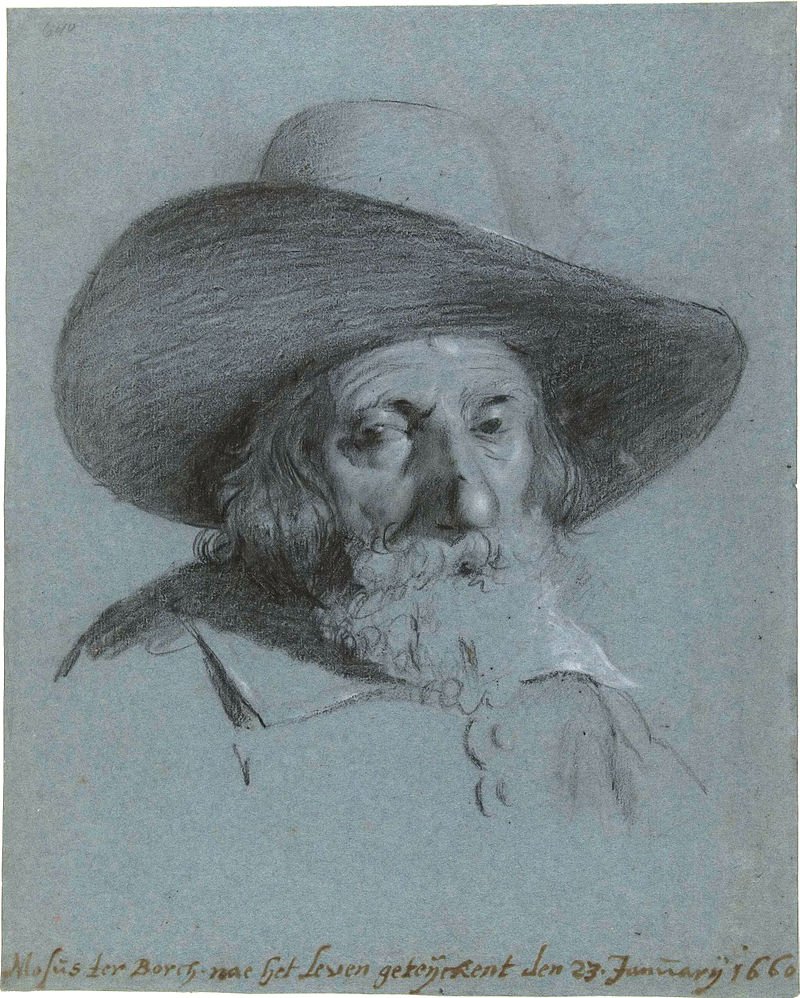
Gerard ter Borch the Elder by Moses ter Borch (1660)

Today I am looking at a dynasty of Dutch artists – the ter Borch family.  The head of the family was Gerard ter Borch the Elder who was born in Zwolle in 1583.  At the age of eighteen he travelled to Italy and stayed in Rome and Naples for the next eleven years drawing and painting local landscapes.  On his return to his home town of Zwolle he married Anna Bufkens and five years later, in 1617, she gave birth to their son Gerard.
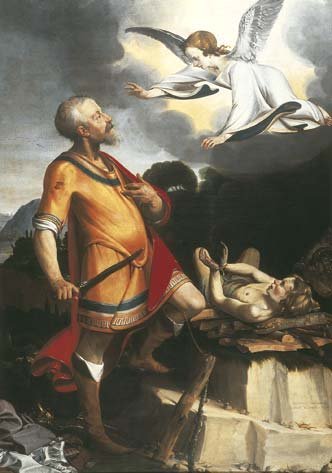
The Sacrifice of Abraham by Gerard ter Borch the Elder (1619)

During his final years in Italy and after his return to The Netherlands, many of the paintings by Gerard ter Borch the Elder featured scenes from the Bible, one of which was his 1619 painting entitled The Sacrifice of Abraham.

Head of a Girl by Gerard ter Borch the Elder (1628)

Gerard ter Borch the Elder was a talented draughtsman and this can be seen in his drawing, Head of a Girl, which he completed around 1628 and is thought to be a portrait of Sara, his daughter (by his second wife) who was four years old at the time.
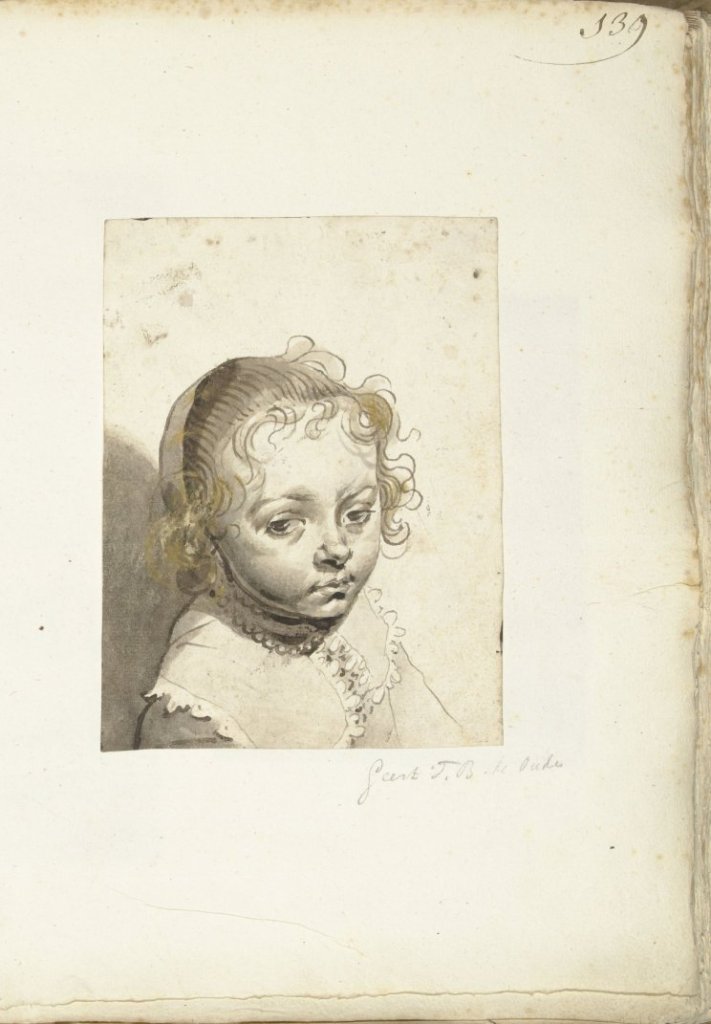
Head of a Little Girl Wearing a Necklace by Gerard ter Borch the Elder (c. 1630)

Ter Borch the Elder, like many artists of the time used family members as their models and again we can see an example of this in another of his pen and ink drawings entitled Head of a Little Girl Wearing a Necklace.

Little Girl at a Table Holding a Slice of Melon by Gerard ter Borch the Elder (1630’s)

A third example of Ter Borch’s draughtsmanship is his 1630’s work entitled Little Girl at a Table Holding a Slice of Melon.  This small (12 x 9cms) drawing is done using black chalk, brown ink washes and black ink.  The brown wash is used to shade one side of the girl’s face and to cover the background. This wash reinforces the effect of light falling on her face and her clothing. The girl stares off to the right of the painting at something which is fascinating her. Other items of food lie in front of her. She is dressed simply, wearing a wide white collar over her dress.  Her hair is tied behind her head with a bow, but some loose strands have escaped and lie across her forehead.

In the late 1630’s Gerard ter Borch the Elder almost gave up his painting although he did oversee the artistic education of his children.

Self Portrait of Gerard ter Borch the Younger (1688)

The eldest of the Ter Borch children was Gerard ter Borch the Younger, the only child from his father’s first marriage to Anna Bufkens, and I suppose if I was to talk about a Dutch artist by the name of ter Borch you would probably assume that I was referring to Gerard ter Borch the Younger as he was probably the most accomplished member of this talented and prosperous Dutch artistic family.  He was born in Zwolle in 1617. His mother died when he was just four years old and was looked after by his father.  Gerard Junior proved to be a talented painter even before his teenage years. In 1632, he went to Amsterdam to study painting and two years later, when he was seventeen years old, he went to Haarlem to study with the painter and engraver Pieter de Molijn and there, he entered the Guild of St Luke of Haarlem the following year.

The Suitor’s Visit by Gerard ter Borch the Younger (1658)

In 1635 ter Borch the Younger travelled to London where he worked alongside his uncle, Robert van Voerst, the royal engraver of Charles I.  Many of his travels took him to Italy, France and Spain, the latter visit being an invitation to the Spanish royal court to produce a portrait of King Philip IV which gives you an idea as to how highly he was thought of as an artist.  Ter Borch received a knighthood and a gold chain and medal from the king of Spain for his artistic efforts.
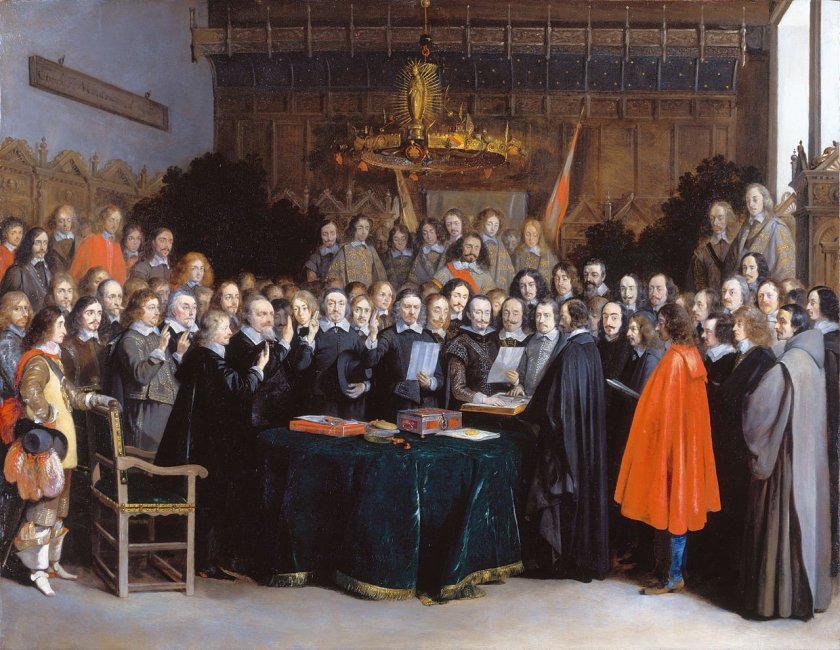
The Ratification of the Treaty of Münster, 15 May 1648by Gerard ter Borch the Younger (1648)

Around 1646 Gerard Ter Borch the Younger was living in Münster, Westphalia, and it is here he completed one of his most famous paintings, The Swearing of the Oath of Ratification of the Treaty of Münster which can be seen in the National Gallery in London. The Treaty of Munster, which was signed in May 1648, was a momentous time in the history of The Netherlands as it finally recognised the country’s independence. This treaty and the treaty signed in Osnabruck ended the Thirty Years’ War between 1618 and 1648 in the Holy Roman Empire, and the Eighty Years’ War between 1568 and 1648 between Spain and the Dutch Republic, with Spain formally recognizing the independence of the Dutch Republic.

The oil on copper painting is set in the Ratskammer (council chamber) of the Town Hall of Münster and depicts the portraits of seventy-seven men. In the foreground, standing behind the table, dressed in black, we see the six Dutch delegates.  To the right of the table stand the two Spanish.  Both sets of men are ratifying the treaty simultaneously.  A Franciscan monk stands behind the Spaniards on the extreme right.  What appeals to me about this work is that Ter Borch has taken the liberty of including himself in the work on the far left, gazing out at us!!!!

In his earliest works, Ter Borch depicted barrack-room scenes whereas most of his later genre scenes, focused on the more refined elements of Dutch society.
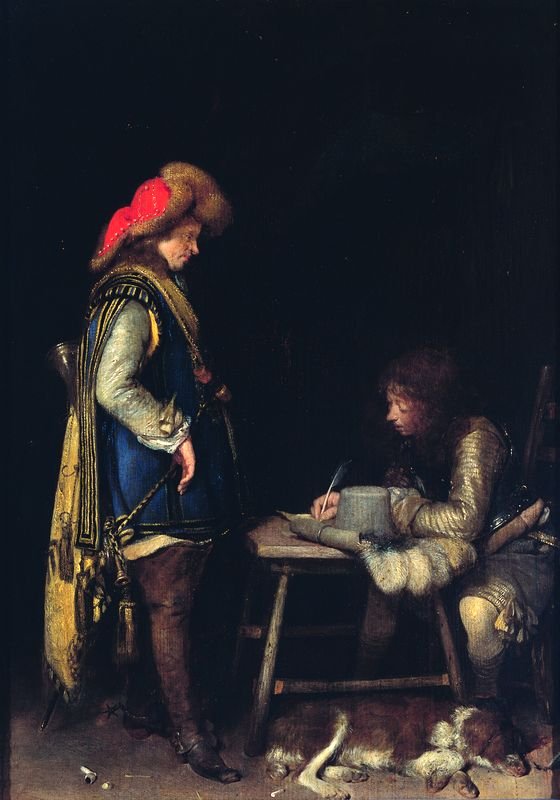
An Officer Dictating a Letter by Gerard ter Borch the Younger (1658)

Gerard ter Borch the Younger was also a leading proponent of genre scenes often featuring depictions of soldiers at rest in their barracks or the local taverns.  These works were generally small and upright in format and typically depict two or three elegantly clad, full-length figures engaged in an activity such as letter writing or music making.  The depiction of letter writing was extremely popular.  The reason for this probably stems from the belief that letter writing was predominately a form of relaxation among the middle and upper classes and these social classes had expanded during this period which saw the Dutch economy prosper.  An example of this is his 1658 work Officer Dictating a Letter.  They are executed with great sensitivity of touch and show an interest in the psychology of the sitters.
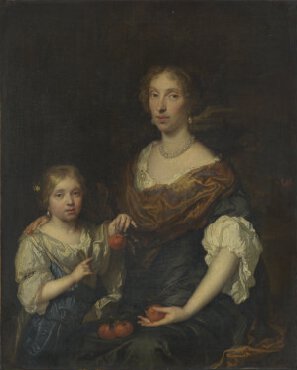
Portrait of a Lady and a Girl by Caspar Netscher (1679)

Ter Borch also painted many small-scale, full-length portraits. His most important student was Caspar Netscher (Dutch, 1639 – 1684), who learned many of his master’s techniques for rendering luxurious textures and who painted, in addition to his original compositions, many signed copies of Ter Borch’s works.

The Concert, Singer and Theorbo Player by Gerard ter Borch the Younger (1657)

Later in the 1650’s he often depicted more genteel scenes featuring wealthy members of Dutch society.  One such painting was entitled The Concert: Singer and Theorbo Player which he completed around 1657 and can now be found in The Louvre.  The setting is a cosy and relaxed bourgeois interior. Hanging in the background we see a large luxuriant tapestry.  The table in the left foreground is covered by a sumptuous oriental carpet with its colourful, geometric design that appealed to northern painters and which signified the wealth of the household. The two young women in the painting are giving a musical performance.  The lady standing on the left is playing a theorbo, a plucked string instrument of the lute family.  Seated at the table is her companion who is following the score, her hand is raised as she beats the time presumably as she prepares to break into song.  On the right of the painting, and looking towards us, is a young servant who has brought the ladies a glass of beer on a tray.
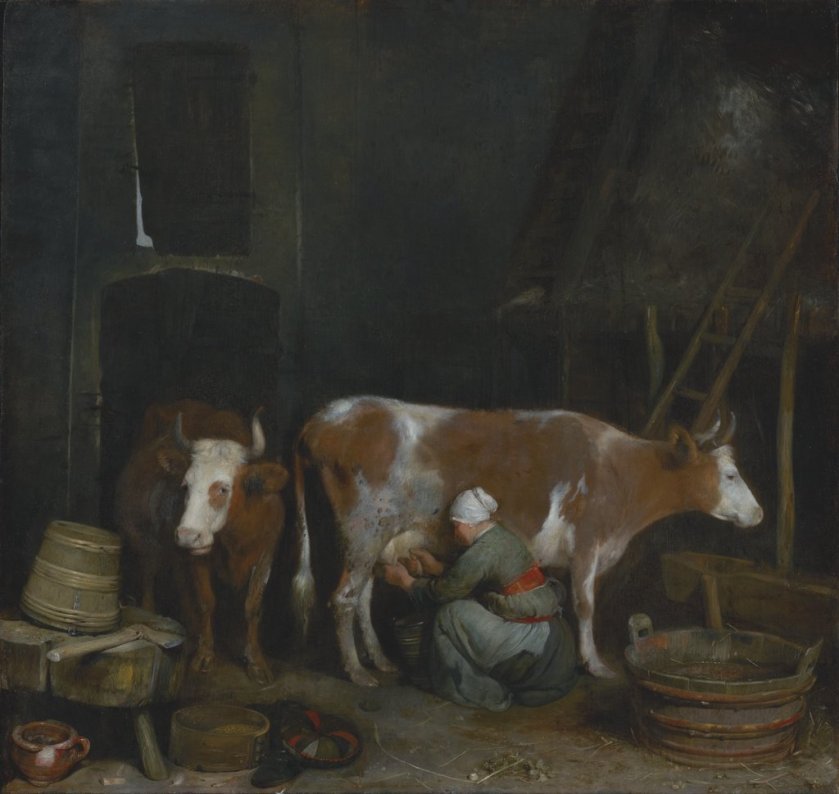
A Maid Milking a Cow in a Barn by Gerard ter Borch the Younger (c.1654)

Another genre work from around 1654 by Gerard ter Borch the Younger was A Maid Milking Cows in a Barn.   In the barn, we see a young woman squatting down in the process of milking a brown and white spotted cow. Another cow stands close by, waiting its turn. This work is a classic example of the ability of the artist to expertly depict different textures.  Look at how he has portrayed the various objects dotted around the foreground of this work such as the jaggedly sculpted stool and the wooden basin which is filled with water.  Look too at the chipped ceramic crock pot, and the shiny metal hinges of the buckets. The painting is housed in the Getty Centre, Museum East Pavilion in Los Angeles
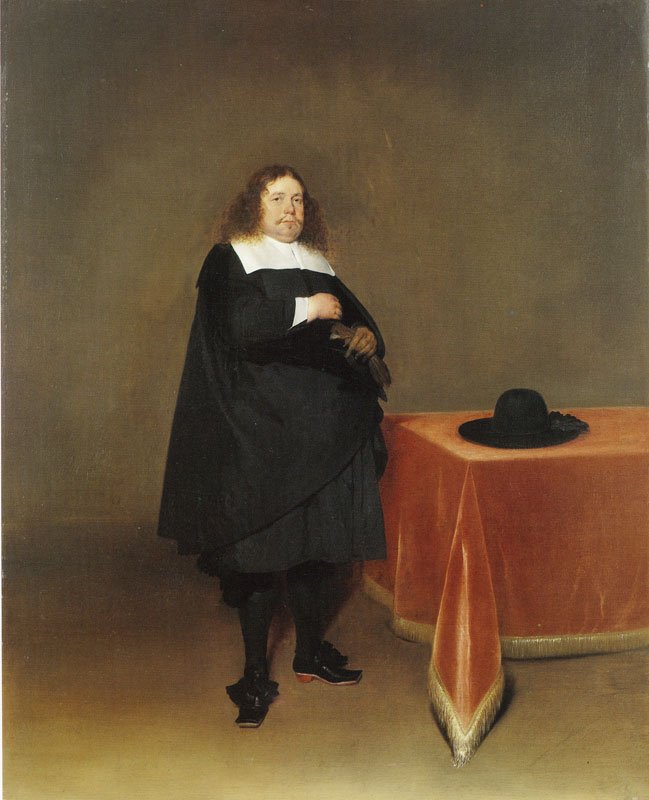
Jan van Duren by Gerard ter Borch (1667)

Gerard ter Borch the Younger also painted many small-scale, full-length portraits such as the pendant portraits he completed around 1667 of Jan van Duren, a member of the upper ruling class of the Dutch town of Deventer and his wife Margaretha van Haexbergen.  Van Duren is dressed in the opulent clothing one associated with an affluent regent and in the other work, his wife is equally well adorned.

Margaretha van Haexbergen by Gerard ter Borch the Younger (1667)

In both cases the background is bare which avoids anything that may have detracted from the subject/patron and in the same way, the settings are minimal with just a simple velvet covered table, atop of which is a hat, in one and a fringed velvet chair in the other.  The overall appearance of both portraits is one of simplicity, elegance, and dignity.

Gerbrand Pancras, Formerly Known as Hendrick Casimir II, Prince of Nassau-Dietz by Gerard ter Borch the Younger (1670)

Another of Gerard ter Borch’s portraits is one entitled Gerbrand Pancras, Formerly Known as Hendrick Casimir II, Prince of Nassau-Dietz which is housed mat the Manchester Art Gallery.  The three-quarter length, three-quarter right-side portrait is of a young man dressed in blue and silver clothes which are decorated with pink ribbon.  The man stands looking out at us, some would say condescendingly, with a silver-topped walking stick in his right hand whilst his left-hand rests on his hip. Lying to the side of him is a table, covered by a red cloth, on which is a black hat dressed with a white feather. The inscription states that he is 12 years old.

Anna Bufkens, the first wife of Gerard ter Borch the Elder and the mother of Gerard ter Borch the Younger died in 1621, aged 34.  Shortly after the death of his first wife, ter Borch the Elder re-married.  His second wife was twenty-two-year-old Geesken van Voerst.  The couple went on to have two daughters, Anna in 1622 and Sara in 1624.  It was around this time that Gerard Snr’s painting output declined although he would still afford his children artistic training.   He also assumed the position held by his aged father, Harmen, the Licencemaster of Zwolle, a position Gerard ter Borch the Elder would hold for about 40 years until his death.

The Milkmaid by Gesina ter Borch (1669)

Seven years later, in 1628, Gerard ter Borch the Elder’s second wife died aged just twenty-nine years of age.  Following shortly on from her death, forty-five-year-old Gerard married for a third time.  His third wife was twenty-one-year-old lady from Deventer, Wiesken Matthys.  There seems some doubt about how many children they had ranging from five to ten but I found that they had a daughter Gesina in 1631, a daughter Catharina in 1634, a son Harmen in 1638, a third daughter Jenneken in 1640 and a son Moses in 1645.  There was also talk about another son Mattijs but I cannot find a birth date for him.

Gesina ter Borch was born on November 15th, 1631 at the family home in Sassenstratt in the town of Zwolle, where she would live all her life.  She was the eldest child of Gerard ter Borch the Elder and his third wife, Wiesken Matthijs.  When her father died in 1662 and her brothers had left home, she lived in her parental home with her mother, sister Catharina and her late sister, Jenneken’s three children.  She never married.

Page from Gesina’s poetry album

Gesina became a great talent in the art of draughtsmanship and when she painted she favoured the medium of watercolours.  Her paintings which were mainly for her and her family’s pleasure and were usually small in size but vibrant in colour.  She had not received any formal artistic training except for the tuition afforded to her by her father who had also taught his sons, Gerard the Younger, Harmen and Moses.

Farmer’s wife and child in a landscape by Gesina ter Borch (1669)

Gesina over time collected her pen and ink and watercolour drawings as well as her poetry in three albums, Materi-Boeks, the first of which was begun in 1646 when she was just fifteen years of age.  Her art books were a combination of her art and her scrapbook.   She printed drawings of her family members, newspaper clippings, children’s and friends’ artwork, and many copies of her half-brother Gerard’s work and that of her brother Moses.

Moses ter Borch by Gerard ter Borch the Younger and Gesina ter Borch (1667)

The one painting she is probably best known for was her posthumous portrait of her youngest brother Moses ter Borch which is in the Rijksmuseum.  It was a collaborative work with her step brother Gerard ter Borch the Younger.  Moses, who was born in 1645 and died in 1667, aged twenty-two, during the storming of Fort Languard near Felixstowe in England. He had served in the Dutch navy which had been fighting against the English since 1664. It is a painting full of symbolism and meaning.  Time is alluded to by the inclusion of a pocket watch, death is symbolised by the skull, loyalty by the inclusion of a small lap dog looking lovingly at his master and eternity by the depiction of the ivy on the rocks. Moses ter Borch was buried in Harwich.

Moses ter Borch off the coast of Harwich by Gesina ter Borch (c.1667)

In the above collaborative portrait, one can tell that Gesina’s stepbrother Gerard probably was the greater of the two contributors to the work but a quite simplistic portrait of her brother and his death can be seen in her painting which was part of one of her albums.
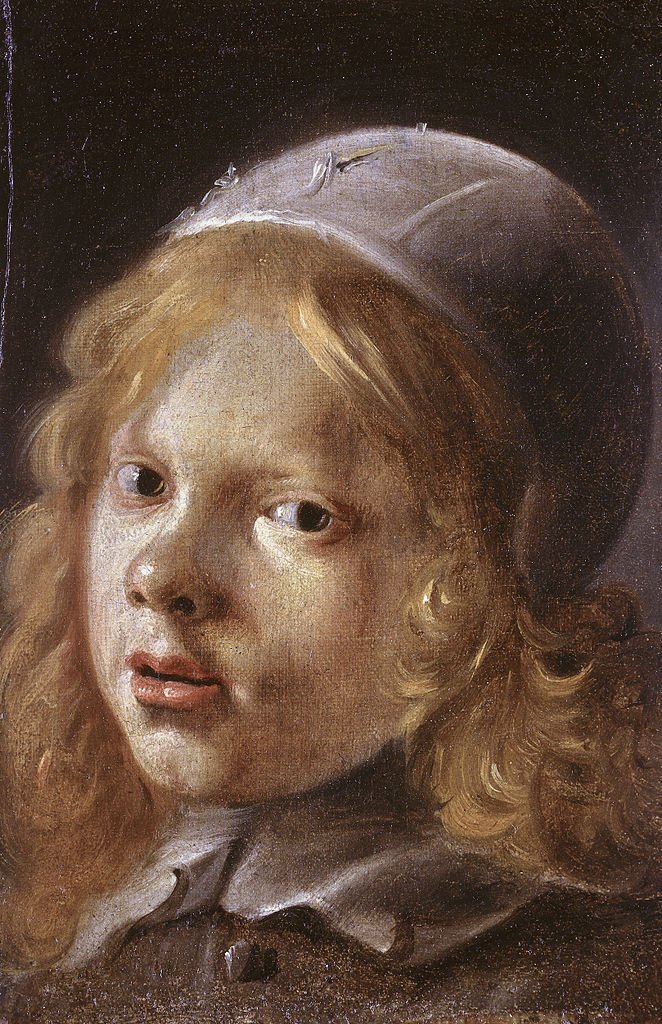
Self portrait by Moses ter Borch (c.1661)

Moses himself was also an artist and when he was about sixteen years of age completed a self-portrait.
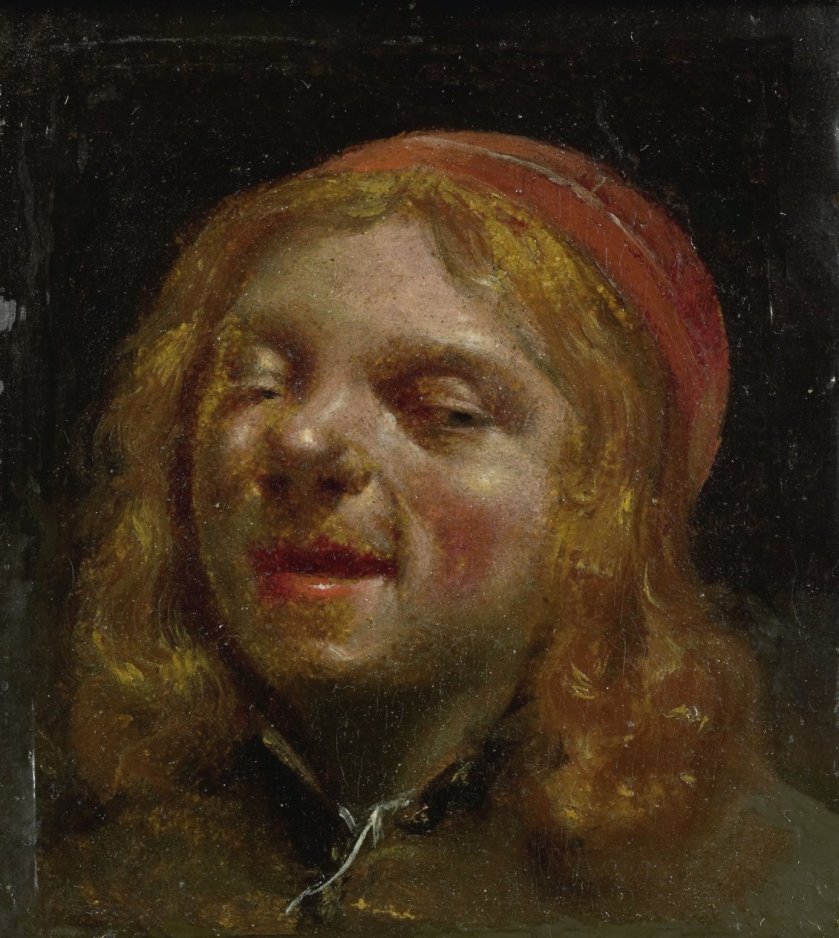
Self portrait, the so-called portrait of Jan Fabus by Moses ter Borch (1661)

He also completed many sketches, some were oil sketches like his very small (8 x 7cms) work with the strange title, Self Portrait, the so-called Portrait of Jan Fabus which he completed in 1661.
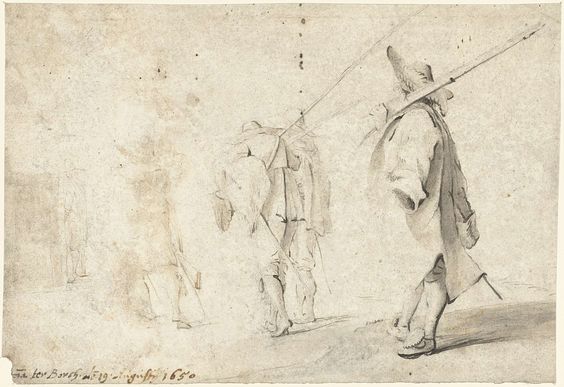
Sketch of soldiers by Harmen ter Borch (1650)

The final artist of the family was Harmen ter Borch.  He was the eldest son of Gerard ter Borch and his third wife, Wiesken Matthys and the sister of Gesina and Moses.  There are several his sketches in the Rijksmuseum including one depicting soldiers which he completed when he was just twelve years old.

Beestenconcert by Harmen ter Borch (1653)

Another, the Beestenconcert was completed in 1653 when he was fifteen years old.
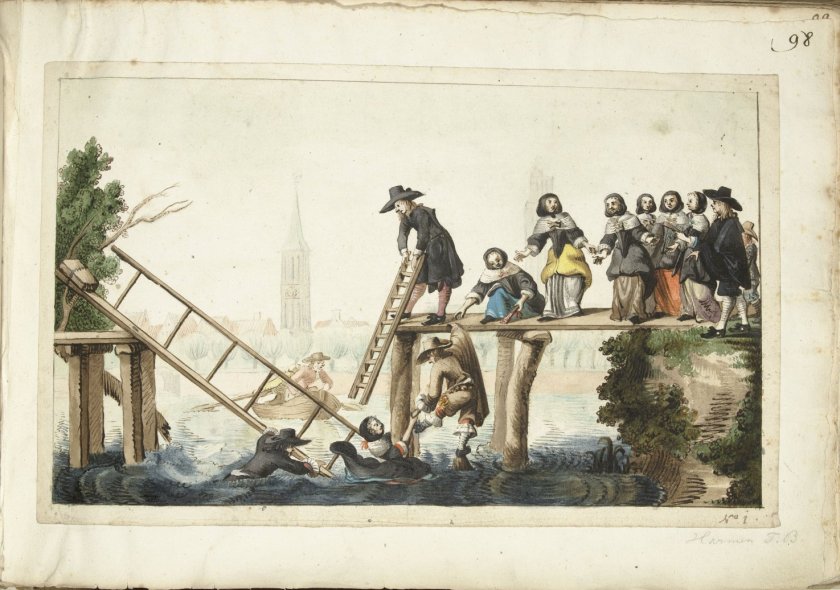
The Broken Bridge by Harmen ter Borch (1655)

But probably my favourite is his colour sketch entitled The Broken Bridge which he painted in 1655 when he was seventeen years old

With such a number of artists in one family, one wonders whether family life was a very competitive environment.  Gerard ter Borch the Younger was by far the greatest of the family artists but it is good to remember that he had some talented siblings.
John William Godward. Part 3 – Italy and the sad end to life.

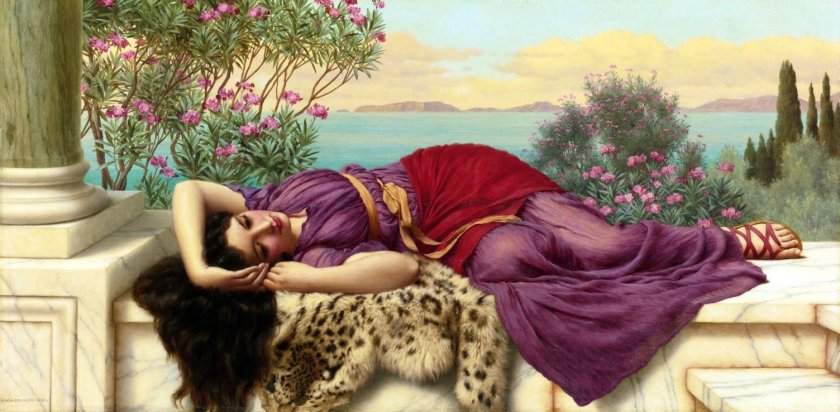
Dolce Far Niente by John William Godward (1906)

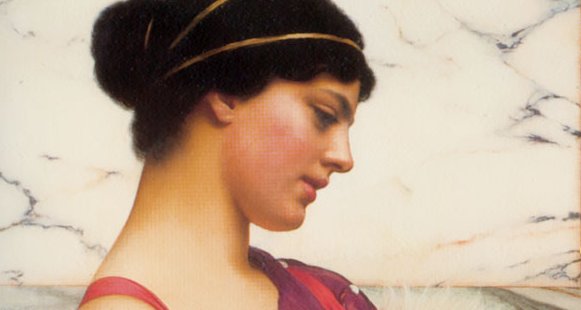
…………………John William Godward made his first visit to Italy in 1905, a year after his father died.  He travelled around visiting the islands of Ischia and Capri.  He also journeyed around the Gulf of Naples and visited Sorrento and the historical site of Pompeii, the latter being one of his favourite places, during which time he painted many oil studies.   Probably one of his best-known works of the time is a painting he completed in 1906 entitled Dolce far Niente (Beauty doing nothing).  Like most of his paintings there is no symbolic meaning or a connected narrative to it.  We are just left to study this ageless place, with its sumptuous luminous surfaces of veined marble.  We absorb the dark red coloured, classically-inspired fabrics which adorn the body of the beautiful woman, who reclines against the lush textures of a leopard skin. Her long dark hair cascades over the marble stonework.  She seems lost in thought and her eyes are languorously unfocused as if she is daydreaming.  She is the epitome of relaxation.  Look how the undulation of her breasts, waist, hips, and legs seems to be a mirror-image of the Phlegraean Islands in the Gulf of Naples which we see in the background.

Lycinna by John William Godward (1918)

After his short stay in Italy he returned home but returned for a much longer stay setting off for Rome around May or June of 1912 and he remained in the country for eleven years.  So why did he leave his native England?  Various theories abound.  It could be that he lost his desire to paint in England as his output around this time had fallen dramatically, and yet, London was where his art was selling.  Maybe he sought Roman inspiration.  It should also be remembered that the great Classicist painters like, Tadema-Alma, Edward Poynton, Bougureau and Jean-Léon Gerôme had all studied or worked in the Italian capital.  However, a more probable reason was his love for one of his models, an Italian girl, who had grown tired of living in England and decided to return home.  Once again, we need to understand Godward’s relationship with this girl.  It was not a case of mutual love.  Godward’s love for and devotion to the woman was, sadly for him, not reciprocated.  She put up with him and was happy to accept the fees for modelling but as far as she was concerned that was all it was.

Song Without Words by John William Godward (1919)

Godward had already disappointed his family by not following the footsteps of his father and brothers into the financial world.  He had chosen, in the minds of his parents, the dubious path and lowly status of a professional artist which was looked upon as a slight on the family values.  Now the family were informed by him that he was leaving the country and going to live in Italy with his Italian model.   Can you imagine how that was greeted by his mother and siblings, especially his brothers?  A family relation, Dr, Gilbert Milo-Turner recounts:

“…He left in a rush, running off with his Italian model to Italy.  His mother never forgave him for this breech of conduct. He shocked the family by living with his model…”

Milo-Turner continued that the family already felt betrayed by him for becoming an artist, “and now this!”

An Offering to Venus by John William Godward (1912)

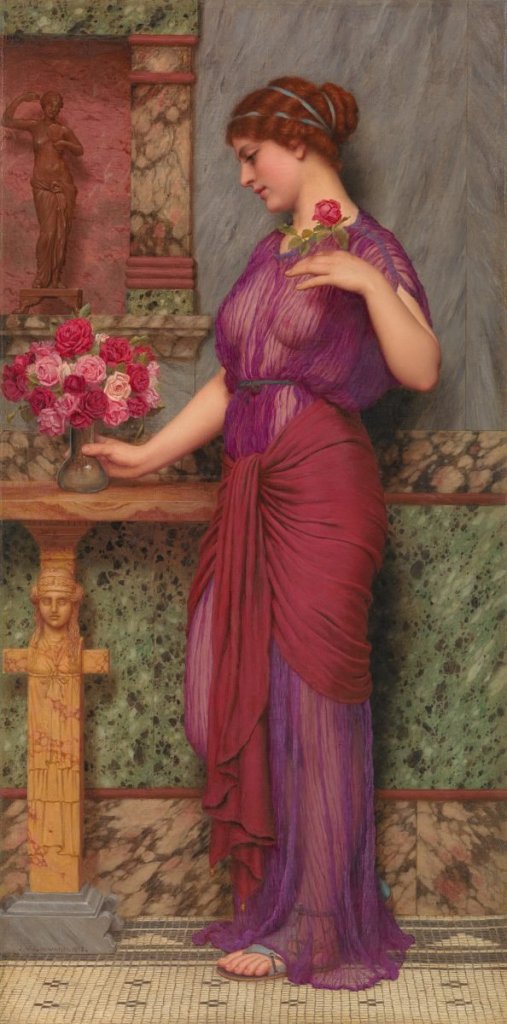
On arriving in Rome, Godward moved into a studio at the Villa Strohl-Fern hoping to find inspiration in the Italian capital. The Strohl-Fern had been converted into a group of artist’s studios and was close to the beautiful gardens of the Villa Borghese and the recently completed Museo Nazionale Arte Moderna.  One of the first works Godward completed whilst living in Rome was his 1912 oil painting, An Offering to Venus depicting a thoughtful priestess.   It is his homage to the Roman goddess of love.   Her voluptuous figure is barely hidden by the purple diaphanous coa vestis tunic and deep crimson stola.  Coa vestis is an ancient type of fabric named after its point of origin, the Greek island Kos and was made using the wild silk of Pachypasa otus, a Mediterranean moth.  The priestess is seen offering a vase of pink and red roses to a bronze statue of the Venus of Arles.  It is more than likely that the model Godward used for this work was the lady who travelled to Italy with him.

Girl In A Peach Dress by John William Godward

So, who was this woman who so beguiled the quietly-spoken introverted painter and turned him into a besotted suitor?  What was her name?  A clue to her identity comes from the Scottish painter and illustrator, Sir William Russell Flint who recalls meeting Godward in Rome:

“…I had an introduction from Lee Hankey to J. W. Godward in Rome … Godward was exceedingly kind and helpful. He knew all the ropes and didn’t mind showing us how to use them. He worked steadily at his Greek maidens in Liberty silks from a Roman model whose name in English meant “Sweetest Castaway.” This heavy-jowled beauty was a star among the models (I found them a sorry lot after Londoners), but she aimed at being taken for something better. One day at Godward’s for tea, Dolcissima, after taking a maddening time to complete her re-attirement, as last proceeded to make her dignified departure. My wife, with kind intention, called her notice to a long white thread sticking to her coat. It proved a mistake to do so because we were afterwards told that the thread had been placed there deliberately as the emblem of what Dolch thought a superior class — the dress-makers…”

Another entry in Flint’s diary hints at the tragedy which later befell Godward.  He wrote:

“…Good, kind Godward, what a difference he made to our Roman sojourn! Let these grateful words mask a tragedy…”

Absence Makes the Heart Grow Fonder by John William Godward (1912)

Godward’s completed his large canvas, measuring 131 x 80cms (51 x 32 inches), Absence Makes the Heart Grow Fonder in 1912 and this was looked upon as the start of his Roman Period. It is a beautiful painting which oozes with charm, beauty and innocent opulence which were familiar characteristics in Godward’s works.  The lady looks thoughtful and sad and by the title we are to presume that her lover has left her and maybe the ship in the background alludes to the couple’s parting.  She is dressed in a plum-coloured tunic.   Lying next to her on the marble seat is her fan.  In the foreground, Godward has included a floral still-life of irises. The flower symbolises faith, wisdom, and cherished friendship.

The Tryst by John William Godward (1912)

Another painting which incorporates a “Roman beauty” and a floral depiction was also painted in 1912 with the title The Tryst.  It is thought that, as it is the same size as Absence Makes the Heart Grow Fonder it could have been meant as a pendant piece with that work.  This painting depicts a young Roman woman dressed in a pale-yellow diaphanous tunic who is seated on a marble terrace waiting for her lover. She looks directly towards us, searching for a sign of her beloved.  The Mediterranean sun blazes down on her and she has raised her hand to shade her eyes from the dazzling brightness.   In the foreground, we see the still-life element of the painting in the form of poppies of various colours and varieties and a colourful oleander bush which acts as a great contrast to the clear blue sky.  There is probably little symbolism in their inclusion as Godward’s classical paintings centred on decorative beauty rather than tales of mythology and any narrative, which one gained from viewing the work, was probably in the observer’s mind rather than that of the artist.  Godward’s works were all about pleasure.  Beautifully adorned women in charming sunny settings overlooking the blue Mediterranean Sea, pristine marble surrounded by colourful flowers.  They all made for the perfect idyll

Still Life of Peach with Twig by John William Godward (c.1912)

Once in Italy Godward became more interested in still-life. Fresh fruit was easily accessible in market places and they appeared more and more in his paintings.  Around 1912 he completed the still life work entitled Still Life of Peach with Twig.

Seascape with Rock, Capri by John William Godward (c.1913)

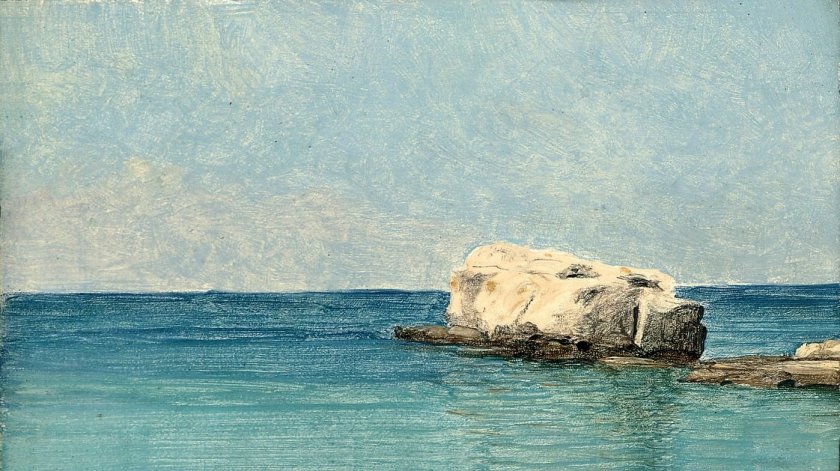
Although most of Godward’s works featured single figure depictions of women in classical settings, he did complete some pure landscapes and seascapes.  An example of this from around about 1913 was his seascape, Seascape with Rock, Capri.

Nude on the Beach by John William Godward (1922)

Godward painted many nudes during his lifetime and one of his last paintings was one entitled Nude on the Beach which he completed in 1922, the year of his death.

Godward returned to England around  the early part of 1921.  He was suffering physically with insomnia and chronic dyspepsia and mentally with bouts of severe depression.  His classicism genre of painting had fallen out of favour with the public, and it said that he believed there wasn’t enough room for him and Picasso, whose art genre had become so popular.  He was all alone having been introverted all his life.  Whatever was depressing him and how he was feeling was never talked about as he had no close friends to unburden himself.  He saw no reason with continuing with life and on Wednesday December 13th, 1922 he ended his own life by gassing himself.

The Fulham Gazette coldly reported the death:

FULHAM ARTIST DEAD BEFORE BLANK CANVAS: AMAZING GAS TRAGEDY: CHEQUE FOR WORK ON DOOR!

With his head lying in a packing case and his mouth touching the turned-on jets of a gas-ring, Mr. John William Godward, an artist in oils, aged 62, was found dead on Wednesday night in his studio at Fulham. The studio is at the rear of a house 410 Fulham Road, Fulham, where his brother and sister-in-law live.  The brother of deceased, Charles Arthur Godward, a fire insurance official, living at the same address, said that his brother had been a very reserved man and lived entirely alone. On the Wednesday morning Witness [C.A. Godward] had seen him in the Garden when he seemed all right. As far as he knew deceased had not financial worries or troubles of any kind. On the previous Sunday deceased had asked him to send a telegram to his mother stating that he would not be able to go and see her as he was not feeling well.

The death of Godward was greeted by his mother and siblings not so much with outright heartbreak but with a sense of indignation which was directed at the disgrace the eldest son’s suicide had brought upon the family, so much so that his elderly mother eradicated him from all the family records, destroying any photographs she had of him. even to the point where she cropped him out of photographs in order to remove the offending sections depicting her son, John William Godward.

Sadly, by the medium of his paintings, Godward created an imaginary world to take the place of the real world he lived in and which he disliked so much.  In a way, his art was a form of escapism.  His lonely and tedious world, full of anxiety, had been, through his art, replaced with an excessively joyous one, which came in the form of his idealised paintings of a tranquil bygone era endowed with perfect peaceful beauty.  Maybe on December 22nd, 1922 Godward finally entered his own idyll, finally free from depression, loneliness, and unhappiness.

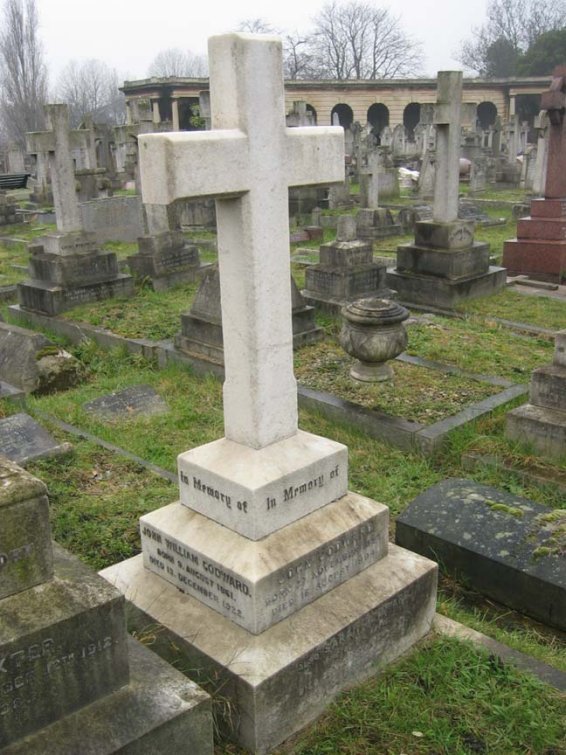
John William Godward’s grave at Old Brompton Cemetery

Godward was buried in London’s Old Brompton Cemetery which was just a hundred yards from his studio.  He had bought himself a burial plot there when his father died in 1904.  At the time of his death he was interred at this family plot along with his father and one of his sister’s, Nin’s, sons.  Godward’s mother, Sarah Eborall, lived until 1935.


Most of the information for this and my two previous blogs about John William Godward came from a 1998 book by Vern Grosvenor Swanson entitled J.W.Godward: the Eclipse of Classicism.

John William Godward. Part 1 – Early life and works and the notorious Pettigrew sisters.

Beauty is in the eye of the beholder

Observing things of beauty is one of the pleasures of life and in my blog today I am looking at the life of an artist who constantly depicted feminine beauty in his paintings.  My featured artist is the Victorian Neo-classicism painter John William Godward.    Victorian Neoclassicism was a British style of historical painting inspired by the art and architecture of Classical Greece and Rome.  During the 19th century, ever more Europeans made the “Grand Tour” to the Mediterranean lands. For them, the highlight of the journey was visiting the ancient ruins of Italy and Greece and learning about the exotic cultures of the past, and it was this fascination which led to the rise of Classicism in Britain.  Godward’s portrayals of female beauty was not merely “things of beauty” but of classical beauty which during his early days was very popular with the public.

William Godward (1801-1893),
John William Godward’s paternal grandfather

John William Godward was born on August 9th, 1861.  He was the eldest of five children of John Godward and Sarah Eborall.  John’s father and the artist’s grandfather, William Godward, had been involved in the life assurance business and his grandfather had become quite wealthy through some wise investments in the Great Northern Railways which had been formed in 1846.  John Godward Snr., the artist’s father, followed in his father’s footsteps and worked   as an investment clerk for The Law Life Assurance Society at Fleet Street in London’s financial district.  On the death of his father, John Godward Snr. inherited a sizeable amount of money and he and his wife Sarah, whom he married in June 1859, lived a comfortable life in their home in Bridge Road West which was then in the ashionable London district of Battersea.  They lived an “upright” and were devout followers of the High Church of England.

John Godward (1836-1904)
John William Godward’s father

Sarah Eborall, John Godward Snr’s twenty-six-year-old wife, gave birth to their first child on August 9th 1861 at their Battersea home. The baby was christened that October and given the names John and William after his father and paternal grandfather. Two years later in December 1863 their second child, Alfred was born.   In 1864 the family moved from Battersea to Peterborough Terrace, Fulham, later renamed Harwood Terrace.  Fulham at the time, and unlike today,  was a rural area with its farms and market gardens.  In February 1866 Sarah gave birth to her third child, a daughter, Mary Frederica, who was known affectionately as “Nin”.  With a growing family John Snr, Sarah and their three children moved to larger rented premises in Peterborough Villas, close to their previous home.

Two further children were born, Edmund Theodore, known as Ted, in November 1869 and their youngest, Charles Arthur, in June 1872.  The Godward family was now complete with five children and the size of the family probably dictated that they needed larger accommodation and somewhere around 1872 they all moved to Dorset Road Wimbledon

Little is known about John William Godward’s schooling but as his family were well-off middle-class parents he may have been enrolled at one of the many private schools in the Wimbledon area. It is thought that he developed a love of drawing during his schooldays.  He was brought up in a very strict household in which maternal and paternal love was in short supply.  Both his parents were very controlling and John William had few friends.  His father, a devout Christian and church-goer, was both strict and puritanical and expected his word to be law and as far as he was concerned all his sons would, on leaving school, follow in his footsteps into the business world and, in particular, into the world of insurance and banking.  Whereas John William’s three brothers, Alfred, Edmund, and Charles happily entered the world of insurance much to their father’s delight, John William Godward, his eldest son proved, in his mother and father’s eyes, to be a disappointing failure who although forced, at the age of eighteen, into working as an insurance clerk with his father, hated every minute of this alien world of finance.

Dora by John William Godward (1887)
Study of a model, possibly Hetty Pettigrew

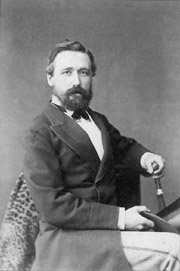
John Godward probably realised that his son was not going to remain in the insurance profession and because of his son’s propensity for art, decided that rather than let him idle his time as a fine artist he would arrange for him to study architecture and design.  In the eyes of his parents, an architect had a more acceptable and honourable ring to it than that of an artist.  Between 1879 and 1881, his father arranged for his son to study under William Hoff Wontner, a distinguished architect and designer and friend of the family, in the evenings whilst retaining his day job as an insurance clerk. John William Godward worked alongside Wontner’s son William Clarke Wontner, who was also interested in fine art and exhibited some of his portraiture at the Royal Academy exhibitions.  William Clarke Wontner soon became a popular portrait painter who received many commissions from patrons for landscapes and murals to decorate interiors of their homes. One can imagine that the youthful John William Godward was inspired by his friend’s blossoming career in fine art and was more than ever determined to follow a similar path.  The two men would remain good friends for the years that followed.  The other bonus in working in Wontner’s architecture office was that Godward was able to develop his skills in prospective and drawing of architectural marble elements which would feature in his later paintings.  In 1881 William Hoff Wontner died but his son carried on training the twenty-year-old, Godward and it is almost certain that Wontner’s success as an artist further intensified Godward’s desire to paint for a living, a decision which would cause havoc with his relationship with his mother and father.

Portrait of Mary Perkinton Godward by John William Godward (1881)

One of the earliest works completed by John William Godward was a small watercolour portrait (4.5 x 3.25 inches) of his paternal grandmother, Mary Perkinton Godward.  She had died in 1866 when the artist was just five years old and so it is thought that he used a family photograph to complete the work.

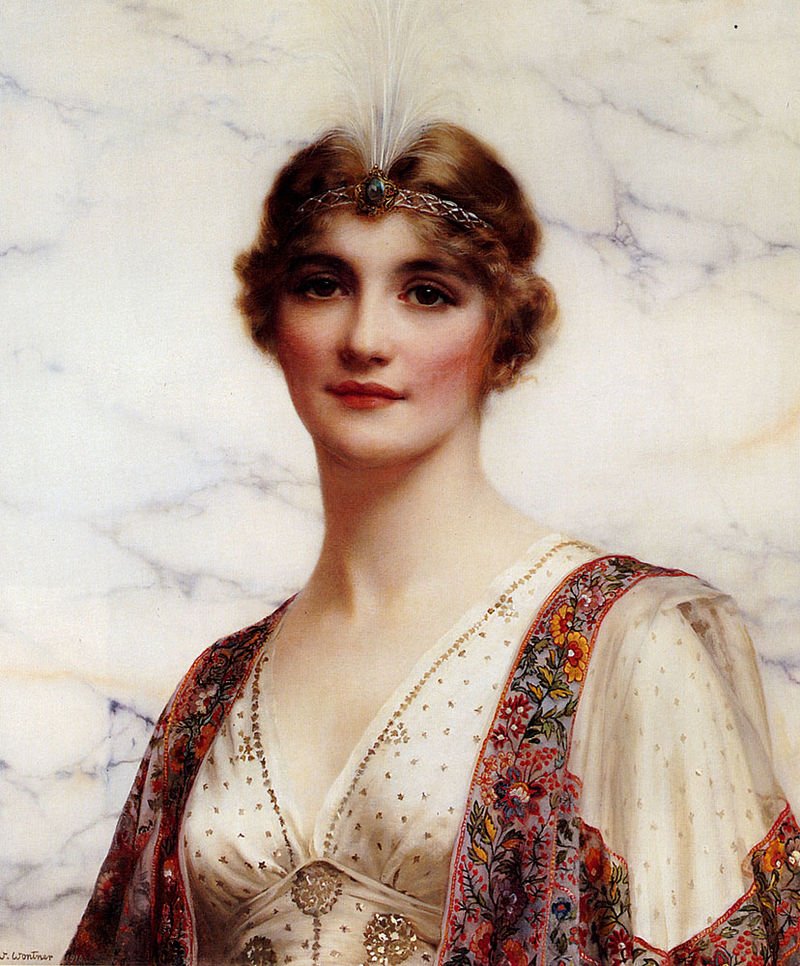
The Fair Persian by William Clarke Wonter (1916)

There is some doubt as to if, when and where John William Godward received formal artistic training.   Knowing his family’s vehement opposition to their son becoming a professional fine artist he is unlikely to have had his family’s backing to enrol at the likes of the Royal Academy of Art School and in fact there is no record of him attending any of their full-time courses.  However, we do know that in 1885, his friend and erstwhile mentor William Clarke Wontner taught at the prestigious St John’s Wood Art School, a feeder school to the RA School, and it may be that Godward also attended this establishment.  We also know that some of the visiting artists to this art school were Lawrence Alma-Tadema, Frederick Leighton, and Sir Edward John Poynter whose art certainly influenced Godward.

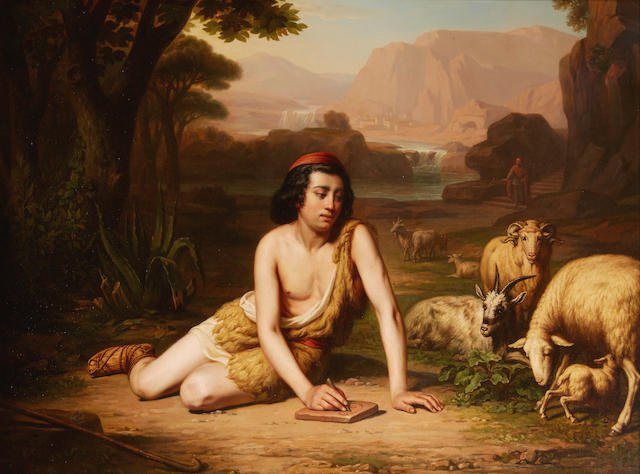
Giotto Drawing from Nature by John William Godward (c.1885)

Another reason to believe that Godward was receiving some formal training was a painting he completed around this time entitled Giotto Drawing on a Tablet which depicts the Italian artist, Giotto di Bondone, as a young shepherd drawing sheep.  The depiction is based on a passage from Giorgo Vasari’s1550 book, Le Vite de’ più eccellenti pittori, scultori, ed architettori (Lives of the Most Eminent Painters, Sculptors, and Architects), which recounts that Giotto was a shepherd boy, a merry and intelligent child who was loved by all who knew him. The great Florentine painter Cimabue, one of the two most highly renowned painters of Tuscany, discovered Giotto drawing pictures of his sheep on a rock. The depiction was so lifelike that Cimabue approached Giotto and asked if he could take him on as an apprentice.

Godward’s painting bore all the hallmarks of a “diploma piece” – a work of art which had to be submitted for critical assessment by tutors and it had to have the major genre elements taught in the art schools of the day.  It had a figure, a group of animals and a landscape, all of which were mandatory elements in order to demonstrate an artist’s technical expertise.  Having said all that, there are no definitive records of John William Godward attending any local art colleges.

Portrait of Mary Frederica ‘Nin’ Godward by John William Godward (1883)

Another early work by Godward was an 1883 portrait of his sister, entitled, Portrait of Mary Frederica “Nin” Godward.  The artist has depicted his sister shoulder-length in profile to the left. This was Godward’s first known oil painting.

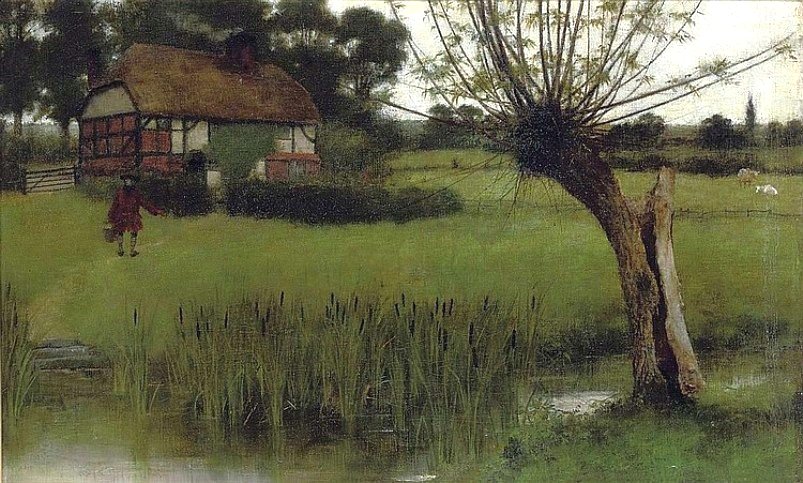
Country House in the 18th Century by John William Godward (1883)

Godward’s 1883 painting Country House in the 18th Century shows his early style, so dissimilar to the Neo-classical paintings we now associate with him.  It is so different in style that it may just have been a copy Godward made of another artist’s work

What every artist needs at one time or another is a good model.  Artists’ models often worked for more than one artist and the best were in high demand.  Enter the Sisters Pettigrew.  On the death of her husband William Pettigrew, a cork cutter, and because of the dire need to feed her thirteen children, his widow Harriet Davies took the advice of her artist son that three of his sisters, Lilly, Harriet and Rose, all with their masses of hair and exotic looks  would make ideal Pre-Raphaelite artist’s models, and so in 1884, she took them to London where they became an instant hit with many artists such as John Everett Millais, Fredrick Lord Leighton, William Holman Hunt, Edward Burne-Jones, James McNeill Whistler and John William Godward.  Rose Pettigrew wrote about the experience six decades later:

“…every great artist of the land” was clamouring for one of the “Beautiful Miss Pettigrew’s” to pose…”

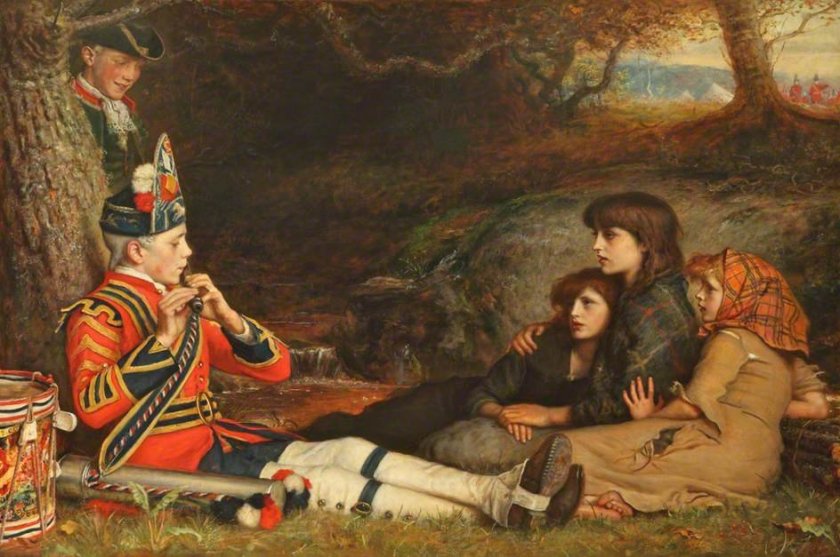
An Idyll of 1745 by John Evetett Millais (1884)

Their first time the girls appeared as artist’s models was when John Everett Millais used all three sisters in his 1884 painting, An Idyll of 1745, which depicts three young girls listening to the music played by a young British fifer.  Behind the fifer is a Loyal volunteer, seemingly enjoying the moment.  In the background is a British Army camp, likely where the fifer and volunteer came from.  From what the artist’s son said the three young girls were almost more trouble than they were worth, saying:

“…more trouble than any [models] he ever had to deal with. They were three little gypsies … and with the characteristic carelessness of their race, they just came when they liked, and only smiled benignly when lectured on their lack of punctuality…”

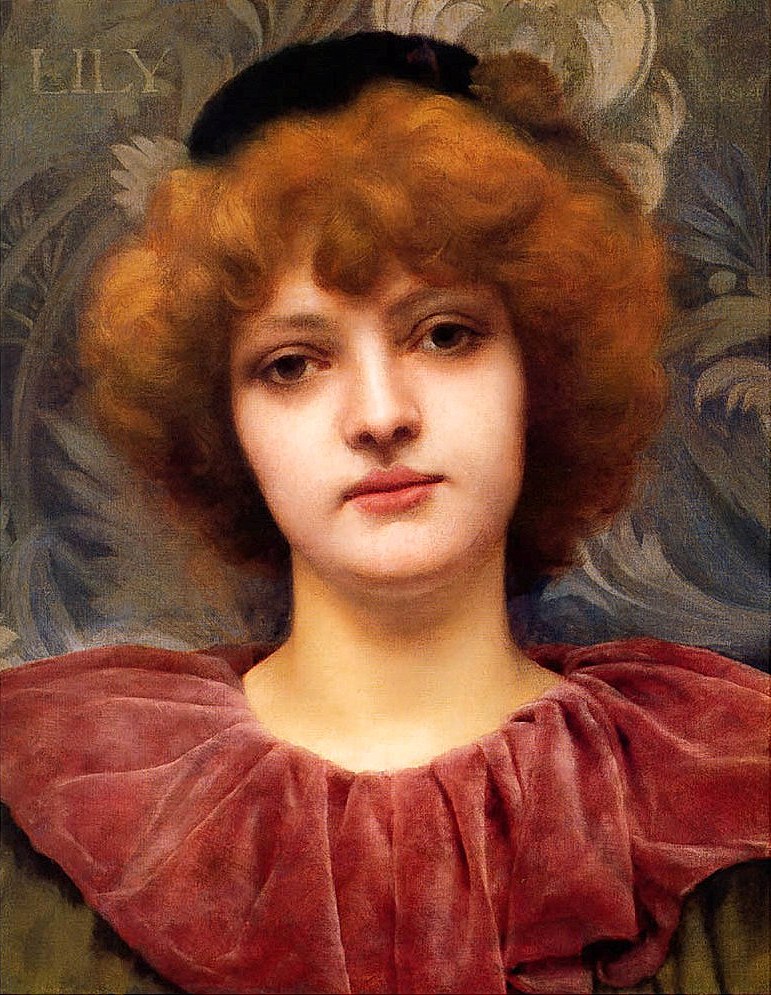
Portrait of Lily Pettigrew by John Wilson Godward (1887)

John William Godward completed a portrait of the beautiful seventeen-year old Lily Pettigrew in 1887.  She was the most beautiful of the three as her sister later wrote:

“…My sister Lily was lovely. She had [the] most beautiful curly red gold hair, violet eyes, a beautiful mouth, classic nose and beautifully shaped face, long neck, well set, and a most exquisite figure; in fact, she was perfection…”

The Reading Girl by Théodore Rousseau (1887)

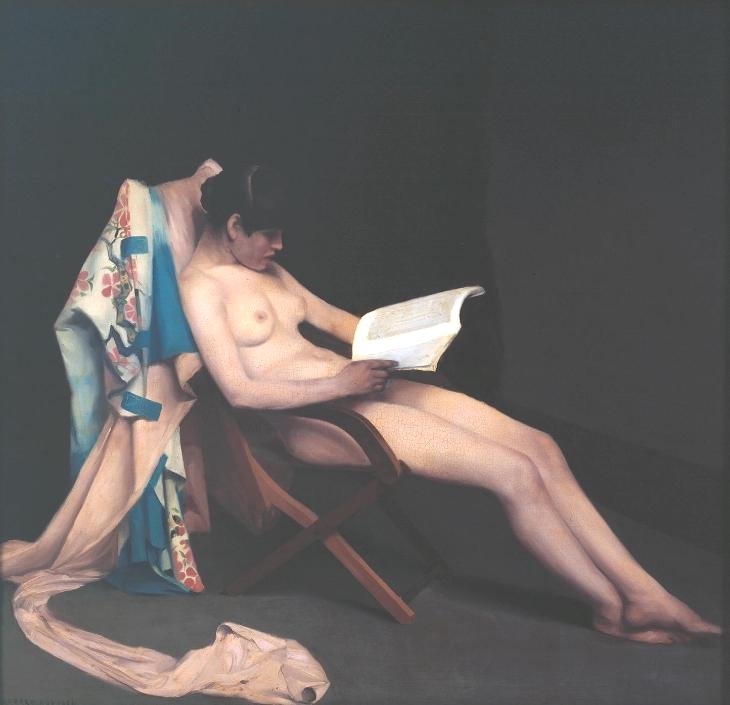
Nineteen year old Harriet (Hetty) Pettigrew featured in Théodore Roussel’s famous 1887 painting The Reading Girl.  Look what a fine model she is in the natural way she relaxes and seems so comfortable, naked in front of the artist.  Hetty had met Roussel in 1884 and from becoming his model, then, despite Roussel being married, became his mistress and gave birth to their daughter, Iris around 1900.   When Roussel’s wife died, instead of legalising his relationship with Hetty and their child, he married Ethel Melville, the widow of the Scottish watercolour painter, Arthur Melville. Once Roussel re-married in 1914, Hetty never sat for him again. Their close bond was over.

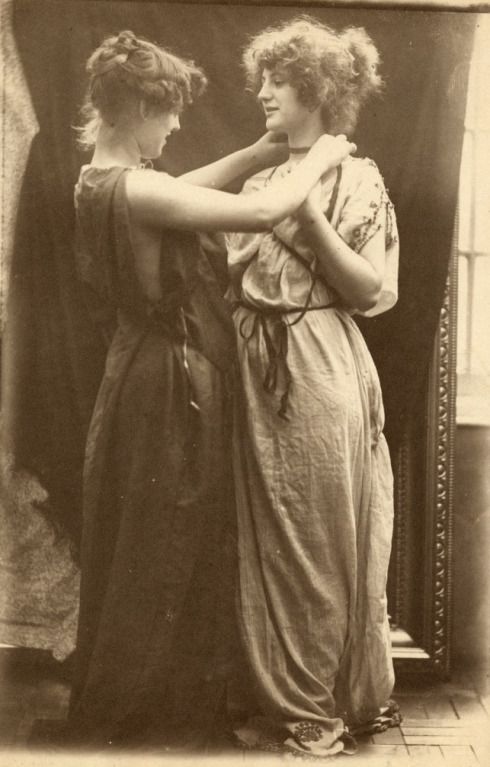
Lily and Hetty Pettigrew (Photographer: Edward Linley Sambourne)

The Pettigrew sisters are also thought to have introduced Godward to other artists who were members of the Royal Society of British Artists.  The Society had been founded in 1823 but had grown very little in its first fifty years of existence due to financial problems but then it came into its own around 1886 when its president was James McNeil Whistler.  Whistler wanted to inject some life into the Society by encouraging it to accept new young artists such as Godward, who for the next three years showed works at their exhibition.  Whistler’s tenure at the Royal Society of British Artists lasted only two years when he was asked to stand down.  Godward, however, was eventually elected as a member of the Society in 1890.

In 1887 Godward had his painting entitled The Yellow Turban accepted at the Royal Academy Summer Exhibition.  This of course was a great moment for the twenty-six-year-old artist and it was probably, begrudgingly, the first thing about their son’s desire to be a painter that pleased his parents’ middle-class values.  Whether their son was happy, mattered little to them.  His achievement or lack of it was everything in their eyes. Initially they hoped he would follow the family tradition and work in the insurance business.  They even “allowed” him to study art with Wontner in the evenings providing he stayed with the insurance company and there was even a hope he would, through his association with Wontner, enter the prestigious world of architecture.  Their dreams for their son were later lowered to believe he may become, as a last resort, a teacher of art – anything than have to suffer the ignominy of having their son become a penniless artist.

For Godward he was reaching a crossroad in his life.  He was twenty six years of age, still living at home with his parents who could not and would not share and support his ambition to become an artist.  He must have felt the overpowering parental pressure and for this reason suffered mentally.  He needed to break free but what price would he have to pay for this freedom?

……………..to be continued


Most of the information for this and my next blog about John William Godward came from a 1998 book by Vern Grosvenor Swanson entitled J.W.Godward: the Eclipse of Classicism.


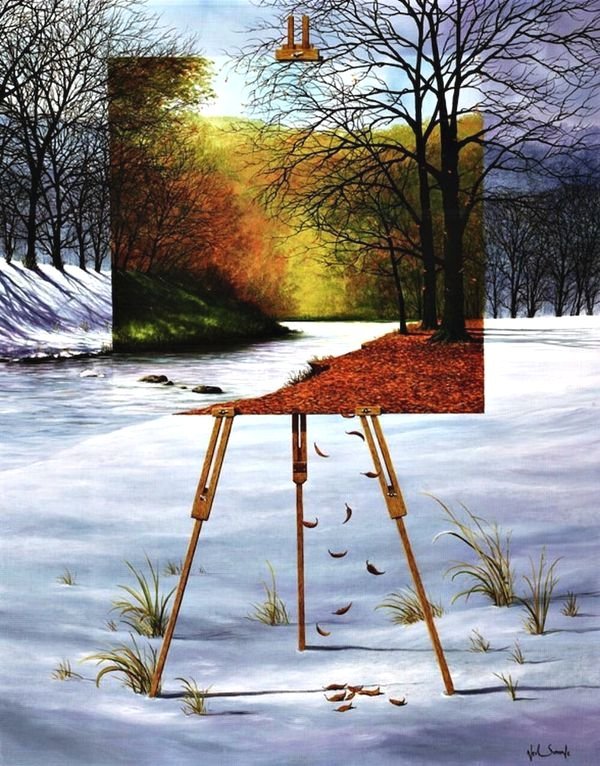
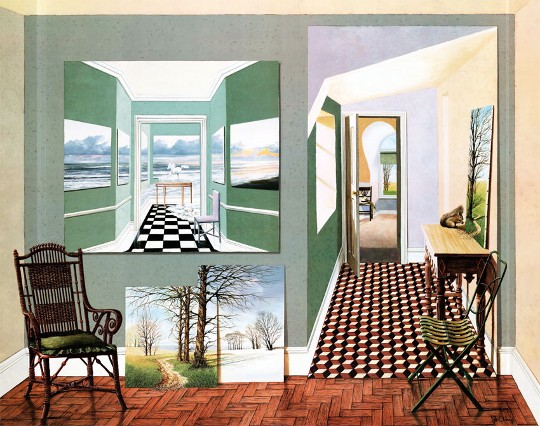
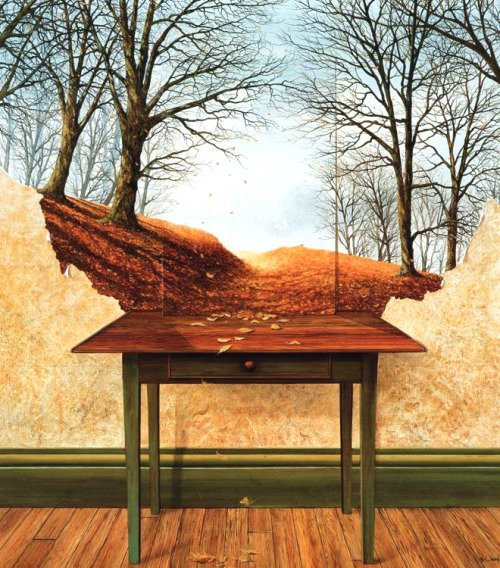
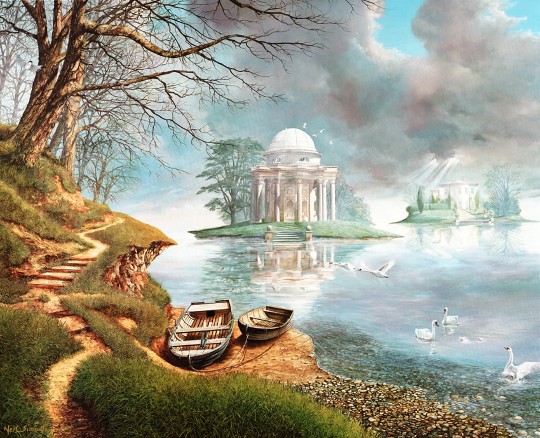
Neil Simone. The Visual Surrealist

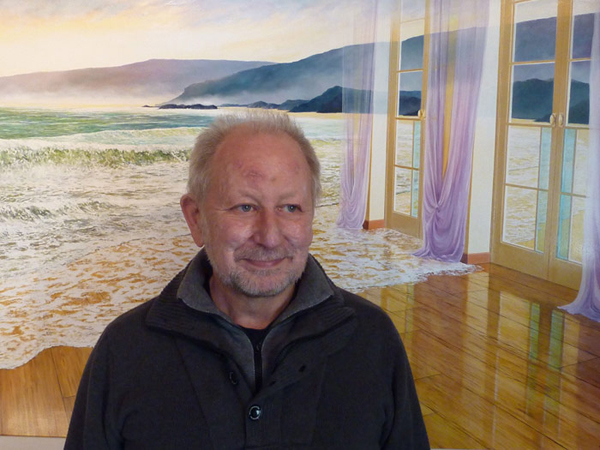
Neil Simone

My blog today is quite different to most of my others for two reasons.  My love of art is quite traditional, some would say boringly middle-ground. If you imagine visual art as a spectrum, at one end of which we have Abstract Expressionism and at the other end there is Hyperrealism, then my predilection would be much closer to the hyperrealism end of the spectrum.  I like to look at the beauty of a painting.  I like to be amazed by the skill of the artist and marvel at the time they must have spent in completing a work.  Mere splashes of colour do not impress me, whether it be stripes or dots.  However, as I have said before I was told that to appreciate visual art one needs to embrace all types !  So, the first reason for this blog being different is that it focuses on the art genre of Surrealism and the works of a Surrealist painter.

Surrealism is a 20th-century form of art in which an artist brings together unrelated images or events in a very strange and often dreamlike way.  It stresses the subconscious significance of imagery.  Through their works of art, the Surrealist artists wanted to revolutionise our experience.  They want us to cast-off our coherent and balanced visualisation of life and, in its place, value the power of the unconscious and dreams. The artists want us to look at their works and share their feeling of mysterious enchantment and discover the perplexing beauty in the bewildering depictions which totally disregarded convention.

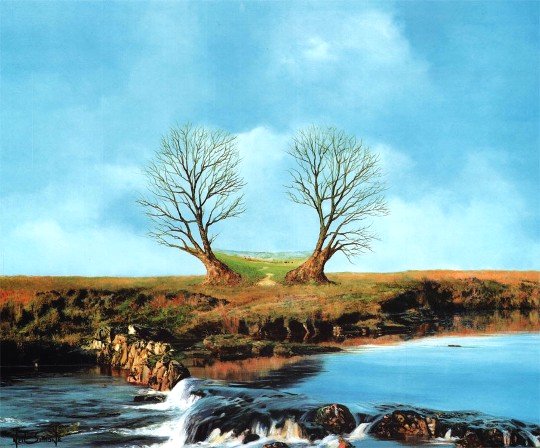
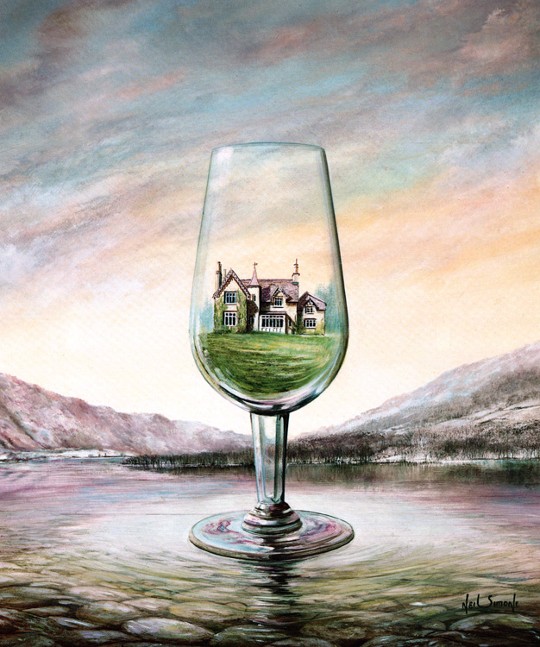
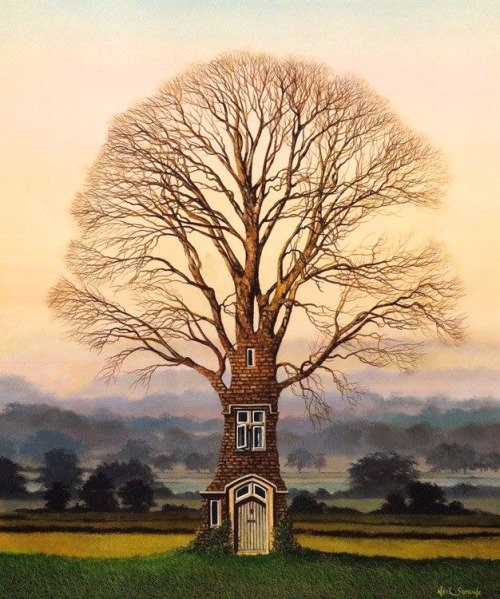
Alternative Path by Neil Simone

The second difference with my blog today, and this is more of a concern to me, is that my subject today is a living artist !  Why should that matter?  I suppose the answer is that I am delving into the life of somebody who has not given me permission to do so and secondly when one looks back and writes about somebody it is extremely important to have the correct facts.  You would be surprised at the number of times when I am researching a painter that I am finding differing facts, differing dates, differing names of family members and I never want to just guess at the correct information and so these inaccuracies drive me mad !!!  However, the deceased painter cannot complain at a mistaken fact quoted about them (albeit on some occasions I do get quizzed/censured regarding the authenticity/accuracy of what I have written by knowledgeable relatives or art historians).  With a living artist, they may take umbrage with my factual accuracy.

Having said all that let me introduce you to the English Surrealist painter Neil Simone.  The reason for this entry was that last week I was in the picturesque Yorkshire town of Harrogate and I visited Suttcliffes Contemporary Gallery, in the Montpellier Quarter of Harrogate and came across his works  and actually bought one of his prints, The Retreat,  as I was so fascinated by it. The one thing I like about some works of Surrealism, and I am a great fan of René Magritte, is that they are thought-provoking and quirky and I wonder how the artist ever came up with the ideas they put on canvas.

Nightfall by Neil Simone

Neil Simone was born in London in 1947. His parents rented rooms in a property in Burrows Road close to Kensall Green Underground station.  He was an only child and lived here for the first eleven years of his life.  In 1958, his parents bought their first property in Harrow, Middlesex.  This move to their own house finally gave their son his own room which as a teenager, was a godsend.

His progress in school was limited to success in graphic art and design in which he gained his “A” level and buoyed by that success he applied to enrol at the Harrow School of Art but was turned down due to not having achieved any academic qualifications in other subjects, in particular, the lack of “O” level English.  Like many setbacks in life one often find they were for the best and Neil Simone considered it was a narrow escape for him not to have gained admission to the art school as he believed that his erstwhile colleagues and friends who did attend the school were stymied as far as to their choice of a future artistic road map as their artistic path was dictated to them by the tutors, whereas Neil made all his own artistic life choices.

The Ocean Floor by Neil Simone

With no art college to attend, Simone had to both occupy his time, as well as finding a way of earning money.  Over the next few years he became a trainee lady’s hairdresser, helped a van driver deliver laundry, a petrol pump attendant and the nearest he got to the art world was a short spell as a layout artist for Moss Enterprises and a messenger for a commercial art studio, during which time he was attacked and robbed whilst carrying staff wages.  However the job which was to change his life the most was as a display artist at Sopers department store in Harrow for his immediate boss and team leader was Linda  who would in April 1968, become his wife.  The couple moved into a flat into a house owned by Peter Hale, the head of department at the Road Transport industry Training Board which made training films and artwork for use in lectures and promotions.  Peter had seen some of Simone’s work and offered him a job as creator of an exhibition to commemorate the opening of M.O.T.E.C. (multi-occupational training centre) which was held in Shrewsbury.  M.O.T.E.C. was the training centre for apprentices in the Road Transport Industry. The training unit was designed to provide realistic working conditions in which apprentices could have experience of all aspects of the trade.  The commission Peter gave Simone was so big that he needed help and so he took on his wife on a freelance basis to help him with the task.

Island in the Sky by Neil Simone

The August Bank Holiday of 1969 proved a turning point in Neil and Linda Simone’s lives.  Their landlord and Neil’s employer invited the couple to visit his other home, The Priory, in the picturesque town of Harrogate in the heart of the Yorkshire countryside.  For Neil this was the first time out of London but he was immediately taken by the beauty of the area.  Peter and his wife Elizabeth persuaded Neil that Harrogate and the surrounding countryside would be a perfect base for him to carry on with his painting and they offered to rent Neil and Linda the basement of their house.  It must have been a big decision for Neil and Linda to have to make, whether they should give up their jobs and move two hundred miles away from their home and families in London and for Neil to take up painting professionally.  It was probably Linda’s belief in her husband that he could succeed and the fact that it was just the two of them that Neil decided to take the plunge and start a new life in Yorkshire with his wife.

As Autumn Leaves by Neil Simone

Once the decision was made and the couple had moved to Harrogate Neil reckoned that to survive financially he needed to sell a minimum of two paintings per week.  He started to build up a collection of his work so that he could show his work at the 1970 Valley Gardens exhibition in Harrogate.  The exhibition went well and he sold twenty of his paintings.  However with every success comes failure and after the exhibition the sale of his paintings dried up and during the winter months of 1970 he was forced to go door to door with them to try to get a sale.

In the Spring of 1971 he exhibited at the Lounge Hall, Royal Baths, Harrogate and it was during this show that he met a fellow artist Judy Pyrah.  The two of them talked about the dream she had of opening her own gallery and suggested a joint venture when they had sufficient money.  Neil’s financial situation was improved by another person, Mr Rivlin, whom he also met at the exhibition.  Mr Rivlin liked Simone’s artwork and offered him employment at his company as the resident artist in charge of packaging designs and corporate identity material for his company, Endura Lamps of Horsforth.  In October 1971 Neil Simone started working for Mr Rivlin and in November Neil and Judy Pyrah opened their gallery, the Eye-Glass Gallery, in John Street, Harrogate.  The gallery remained open for just twelve months and this coincided with his work for Mr Rivlin being terminating in January 1973.

Exploring the Alternatives by Neil Simone

Neil and Linda’s stay in the basement of The Priory came to a sudden end in the autumn of 1974 when Harrogate was subjected to a series of storms and their basement flat was flooded and so the couple moved to another flat in Harrogate which also had room for a studio and a workshop for framing and was both light and airy.  During the next two years the sale of Simone’s paintings did well and he exhibited at galleries as far north as Edinburgh.  When Neil and Linda had taken the decision to permanently leave London and take a chance with life in Harrogate there was just the two of them and so if the venture failed then it would just hurt them as they had no children to support.  However seven years on, with their finances at a reasonable position, they believed they should start a family and in July 1976 their son, Lee, was born.

Within six months things turned for the worse for the family with galleries not wanting his paintings and with sales tumbling, they were in trouble. For Neil, it was a time of introspection, a time to figure out why things had gone wrong and more importantly work out what people wanted from art.  He needed time to reassess his art and, to give himself a chance to do this, Linda took their son and went back to live with her mother.  He realised the most important question he had to answer was what did he want from his art for he realised his mistake of suffocating his own imagination which once set ablaze his passion for art.  Neil thought long and hard and eventually hit on the idea that people may like to view works which would transport them into an alternative vision of reality.  He wanted observers of his work to question what were they actually looking at.  This was of course a form of surrealism, which he had dabbled with eight years earlier but had abandoned believing that he must paint what the public wanted and not what he wanted.

The Dropleaf Table by Neil Simone (2006)

His new style of artwork soon became an art with a sense of humour, as Neil put it “they would be paintings with an element of realism that invite conjecture”  It was quirky but would it sell?  He decided that he had nothing to lose and so in 1977, Neil Simone’s art became different.  It was a new direction.  In August 1979, the Harrogate Advertiser described it as

“…a fusion of fact and fantasy…”

It was the start of an exciting journey.  With the mental turmoil dissipated on having finally decided on the future of his art, he asked Linda to return to Harrogate.

The public and art critics both liked and were excited by this new style and his works of art were in great demand at exhibitions and sales rocketed.  His gamble on changing his artistic style had paid off and his paintings were in great demand.  Neil struggled to keep up a collection of his work due to all the sales.  His brain was awash with new ideas and his artwork was in great demand.  With all this came a healthy bank balance and in July 1978 Neil bought and moved into a house with Linda and two-year-old Lee in Grasmere Crescent, Harrogate.  This was the first home they had purchased and was an ideal place for an artist with a bright studio in the loft conversion.

Realms of the Imagination by Neil Simone (1992)

Neil decided to launch his first set of limited editions prints but to do this he needed some financial backing which he got from family and friends and this proved a financial success and soon he could pay back his friends and from then on, he was able to fund any subsequent print editions, the second of which was launched in February 1980.  With all these print runs space at home became critical and it was soon obvious to Neil that the family needed a larger house.  In June 1980, they moved into a large house on Harlow Hill, one of the highest points around Harrogate, which he had bought when it was only partially constructed which allowed him to agree to some design alterations with the builder.

Another break came in March 1981 when a Dutch art dealer called at Simone’s studio. The dealer, Kees De Jong, had been told about the success Simone was having with his new style work and came to offer him a chance to exhibit some of it at the prestigious London Department store, Harrods.  Simone accepted the invite and in May his works were being showed in the windows of the prestigious department store.  More invites rolled in for Simone to exhibit works at various exhibitions and he now had to continually produce works.  Although this was time consuming and tiring Simone was very aware that the popularity of one’s artwork is ephemeral and that he had to make the most of his popularity.  The downside to this success was Neil had less time to spend with his wife and son.

The Sea Bed by Neil Simone (2000)

In 1983 Neil Simone met Barbara Dutton who had come to look at his paintings.  She was just about to open her own gallery at Pately Bridge, a village some four miles from Harrogate, and wanted some of Neil’s prints and originals but had a limited budget.  Neil and Barbara came to an agreement that she could take all his works on a sale or return basis.  The gallery opened in May and later that year there was an exhibition of Neil’s latest works.

In June 1984, Neil and Linda had an addition to the family with the birth of a daughter, Gemma.  Over the next ten years Neil was inundated with work to satisfy exhibitions he had committed to.  Life was hectic but profitable.  He had taken his son to Paris for his eighteenth birthday in 1994 and in 1996 his son had gone to university and his daughter was about to start secondary school.  Everything was going so well and yet around this time, Neil sensed all was not well.  He had a foreboding that things were going to change.  This sense he had of imminent change in his life was converted into two paintings he completed entitled The Ephemeral Nature of Beauty and the Persistence of Art and Our Thoughts Stray Constantly Without Boundary, both hinted at Neil’s concern that things in his life and marriage were about to change and not necessarily for the better.

The House of Glass by Neil Simone (1991)

In 1997 Neil struggled with the effort to have to paint more pictures and became physically and mentally run down. He had to continually paint to satisfy clients and fulfil exhibition commitments but found it difficult to achieve sufficient work during a day at the studio so would leave home in the evening, returning to the studio to continue working through part of the night.  He began to worry about all the pressure to keep people happy but would not talk about it to his wife. He admitted that he became morose and withdrawn but he just hoped the problem would be short term. The strain on his marriage got so bad that in January 1998, in a hope that things may improve, he and Linda decided to separate and he left the family home and went to live in his rented studio.

The Retreat by Neil Simone (1999)

Some years earlier, Neil became very friendly with a lady called Heather who worked at an art materials shop where he bought most of his supplies.  Although she worked in Centagraph, an art supply shop, she had never painted and she was pleased to accept Neil’s offer of artistic tuition.  They became great friends and Heather proved to be the support Neil Simone needed to get him through life.  Living in his studio where he stored his artwork was proving to be untenable and so he decided he needed to buy somewhere larger.  The time also coincided with Heather and her young son Ben wanting to move out of rented premises and contemplate owning somewhere and so Neil and Heather, for financial reasons, decided to jointly buy somewhere and to fund his part of the purchase, Neil reluctantly sold some of his original paintings he had been keeping for himself.  In May 1999, the couple moved into a first-floor apartment in Langcliffe Avenue, Harrogate.  It was ideal for these two artists as it had a hexagonal sun room and a private roof terrace.

Rock Formation by Neil Simone (1999)

In late 2000, fifty-three-year-old, Neil Simone suffered a heart attack and was forced to rest and in January 2001 he underwent a triple bypass operation.  After a long period of rehabilitation under the watchful eye of Heather, Neil resumed painting.  Although they loved their apartment there was just not enough wall space to hang their work and so decided to search the property market for something larger and room for a gallery and workshop. Their search proved fruitful in September 2003 when they found the ideal home in the village of Whixley.  A month later Neil and Heather moved in to their new home and were able to hold exhibitions in their own gallery.  Heather and Neil are now married and still live in their Whixley home.

 Of his painting style which he termed visual surrealism, Neil wrote:

“…I paint the way that I do because I see the world as a dimension of shadows, shapes, contradictions and ever changing fragile boundaries…”

———————————————————————-

The majority of the information for this blog came from Neil’s own autobiography, Neil Simone.  The Memoirs of an Artist.  How long does it take? which is an excellent book with many reproductions of his work.

Neal and Heather’s gallery is at 2a High Street Pateley Bridge, North Yorkshire which I look forward to visiting in the summer.  The website is   http://www.simonegalleries.com/.

Jennie Augusta Brownscombe

Jennie Augusta Brownscombe (1850 – 1936)

In my last blog I looked at the life of the nineteenth century American painter, Anna Elizabeth Klumpke.  Today I want to look at the life of one of her contemporaries, Jennie Augusta Brownscombe, who was born just six years earlier.

Jennie Augusta Brownscombe was born December 10th, 1850 in a small log cabin farmhouse, built by her father, near Irving Cliff in Honesdale, in rural north-eastern Pennsylvania.  It was a picturesque area, which the historian, writer and author of the short stories, Rip van Winkle and The Legend of Sleepy Hollow, Washington Irvine, described as:

“…Honesdale is situated between high hills on a plain through which two romantic mountain streams flow, uniting in the village and forming the Lackawaxen River. There are two wide basins where the streams unite, and the water was formed into the two most picturesque lakes. From the Eastern shore of one of these, Lake Dyberry, a solid ledge of serried and moss-grown slate rock rises almost sheer to the height of nearly 400 feet…”

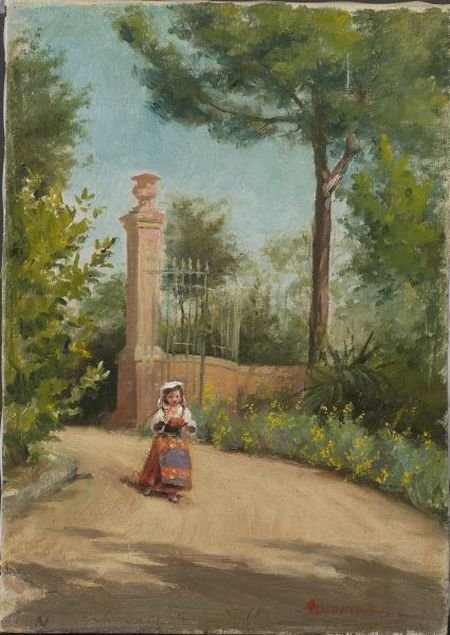
Peasant Girl Before a Gate by Jennie Augusta Brownscombe

Jennie was the only child of William Brownscombe, originally a farmer in the English county of Devon who had left England to seek his fortune in America in 1840 and his American wife Elvira Brownscombe (née Kennedy), who was said to be a direct descendent of an original Mayflower passenger.  Her mother who was a talented writer and amateur painter, nurtured her daughter’s interest in poetry and art.  Her early exploration of drawing is mentioned in the entry for Jennie Brownscombe in the 1897 book, American Women Fifteen Hundred Biographies:

“…She was studious and precocious, and about equally inclined to art and literature. She early showed a talent for drawing, and when only seven years old she began drawing, using the juices of flowers and leaves with which to colour her pictures. In school she illustrated every book that had a blank leaf or margin available…”

Jennie won awards for her art at the Wayne County Fair  when she was a high school student.

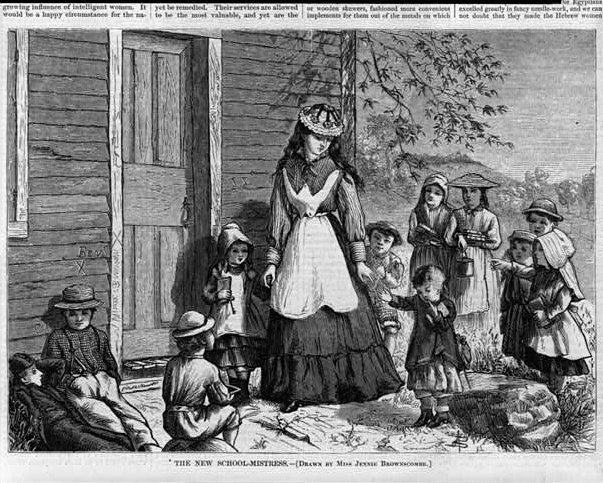
The New School-Mistress by Jennie Augusta Brownscombe (1873)

In 1868, when Jennie was eighteen years old, her father died.  To help herself and her mother financially, Jennie began selling illustrations to book and magazine publishers based on the landscape around her home and Irving Cliff.  One such illustration appeared in the illustrated journal, Harper’s Weekly, of September 20th 1873, entitled The New School-Mistress.   She also accepted a post as a school teacher at the high school in Honesdale.  Eventually she moved to New York to study art.  To get an idea of what this young aspiring artist was like we need to see the description of her given by art historian, Florence Woolsley Hazzard in her article on Brownscombe for the three-volume biographical dictionary, Notable American Women 1607-1950, in which she described the young artist:

“…she was slender, with a thin face in which large brown eyes and a dimpled chin were distinctive, and reserved in manner. She lived simply with one companion or servant…”

Jennie Brownscombe left home and went to New York where she studied under the Paris-born academic-style painter Victor Nehlig who had come to America in 1850 and opened up a studio in New York city, and was elected as an academician in the National Academy of Design.  In May 1871 Jennie graduated from the School of Design for Women of the Cooper Union for the Advancement of Science and Art more commonly known as the Cooper Union or Cooper Institute which was a privately funded college located in Cooper Square in the East Village neighbourhood of Manhattan, New York City.

Portrait of a Young Woman in Pink and Green by Jennie Brownscombe (1898)

For the next four years, until 1875, Jennie was enrolled at the National Academy of Design where she attended the Antique and Life Schools and studied painting under the tutelage of the American painters, Thomas LeClear and Lemuel Wilmarth, who was the director of the Academy.  The Academy also paid Jennie to teach some of the classes and this helped defray the cost of her tuition.  Whilst at the Academy Brownscombe won the first prize, the Charles Loring Elliott Medal, in the Antique School and the first prize, the Suydam Medal in the Life School, which was given annually by the Academy for achievements in life drawing and painting in the Life studies school.

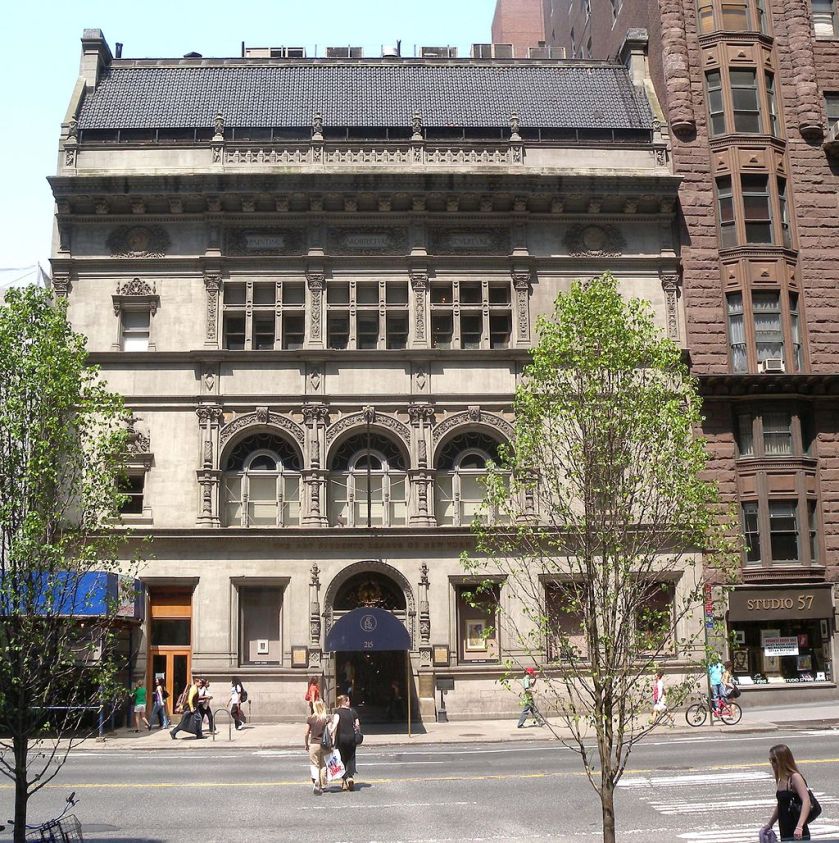
Unfortunately, the Academy encountered financial problems at the end of the 1874/5 academic year and could no longer afford to employ Wilmarth and there was even talk that come the start of the next academic year in the autumn the Academy would not re-open.  With the uncertainty as to whether the Academy, due to financial pressures, would cancel all classes temporarily, forcing students to forgo drawing from life for a significant period of time, something had to be done.  Apart from this uncertain future, many of the students were also unhappy with the rigid artistic teaching at the Academy believing the favoured academic-style was too conservative especially in comparison with what was happening at the time with the art in Europe with the birth of Impressionism.  And so, in 1875, Lemuel Wilmarth and a group of artists, most of whom were students at the National Academy of Design, and many of whom were women, founded The Art Students League and Wilmarth was confirmed as its first president.

The present Art Students League of New York Building, West 57th Street, New York

Jennie Brownscombe was one of the founder members of the Art Students League.  Another founder member was the sculptor and illustrator James Edward Kelly whose comments about Jennie were published in 1925 in the Fiftieth Anniversary of the League publication.  He recalled the young artist:

“…Although I used to see Miss Jennie Brownscombe when she came to Harper’s Art Department, and as a student at the old Academy, I always visualize her sitting at her easel – working,  working, ceaseless and untiring.  The outcome was a series of paintings and etchings showing the halcyon days in the home life of America…”

The League opened its school with studio space on the top floor of a building at the corner of Fifth Avenue and 16th Street. Things were somewhat cramped and classes were conducted in just one small room.  It proved so popular that many more art students joined and by the end of the first semester the League had to rent the whole of floor to accommodate this new influx of artists.  Jennie returned to the National Academy of Design in 1879 and remained there as a student until mid-1881.

After completing her studies at the Academy, Jennie travelled to France and studied in Paris under the Polish-born American painter, Henry Mosler, who became well-known for his Breton peasant depictions.  Jennie returned to the United States but an eye injury curtailed her art until 1884 at which time she returned to painting in her studio in New York City.  Whilst living in New York she found time to make regular visits back to her mother who was still at the family home in Honesdale, Pennsylvania.  Her mother died in 1891.

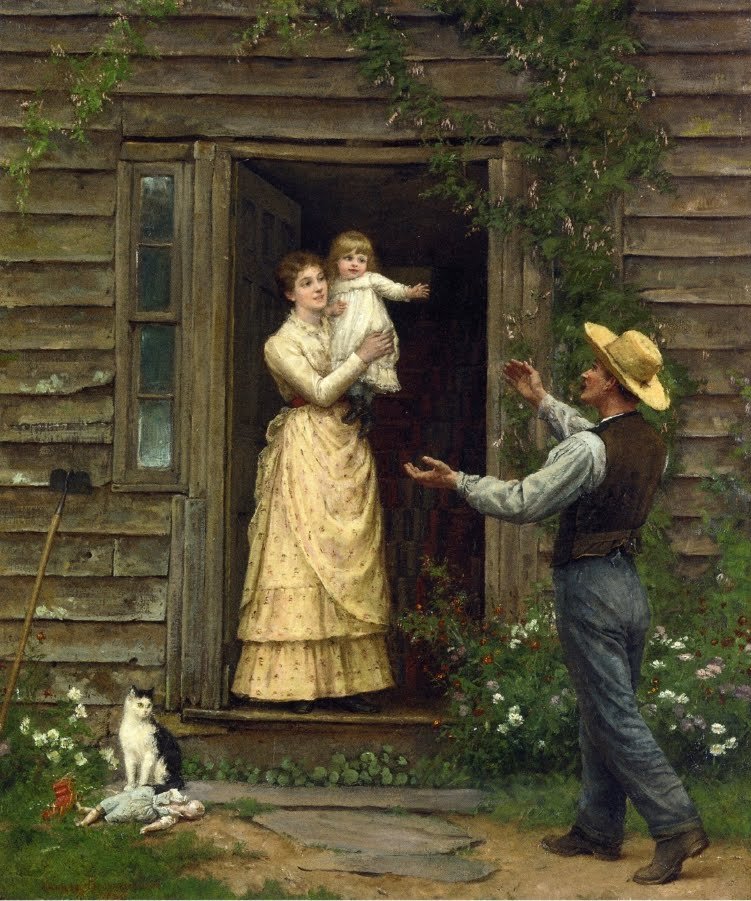
The Homecoming by Jennie Augusta Brownscombe (1885)

Jennie Brownscombe’s art was of various genres.  Many of her works focused on the observance of rural family life and it was the sentimentality of these works which appealed to buyers who liked to remember those trouble-free days.  A good example of this is her 1885 painting, The Homecoming, which depicts the return of a husband and the greeting he received from his wife and child on the doorstep of their log cabin.  Everything we see in the painting oozes with happiness and contentment –  what’s not to like about it?

Ready for the Oven by Jennie Augusta Brownscombe

In another depiction of contented homeliness,  Ready for the Oven, we see a lady in the kitchen.  She holds a pie, which she has just made and is about to put it into the oven to bake.  Again, this is a work depicting the joy that can be had by simply staying at home and looking after one’s family.  It is a depiction of a clean and well organised country kitchen and the rural idyll.  A lot of her genre works featuring rural life were about a clean and contented homely American lifestyle and is in stark contrast to the rural/ peasant kitchens we see depicted in some of the Dutch genre paintings where realism seemed to mean showing less than clean interiors and chaotic lives, often caused by the demon alcohol.  So, what did people want from their paintings – idyllic sentimentality or realistic hell on earth?

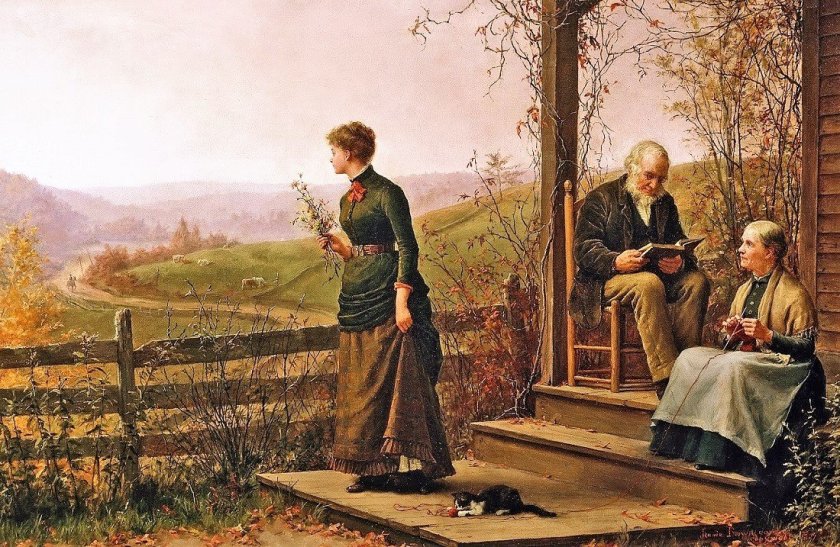
Love’s Young Dream by Jennie Augusta Brownscombe

One of the most popular example of Brownscombe’s idyllic but sentimental depictions is her idealized painting depicting rural family life which is entitled Loves Young Dream.  The painting has two distinct parts to it.  In the right foreground, and squeezed in, we have the porch of a wooden house and three people whilst on the left and in the background the space is open and clutter-free as we look towards the hills shrouded in mist but it is this openness which gives us the sense of vast sweeping and unspoilt countryside and set up of the painting highlights the isolation of the small house.

We see a young woman standing on the outside step of her modest wooden home.  Her expression is one of yearning, as she looks out at the winding country lane which leads to her family home.  In the distance, we can just make out a man on horseback approaching. Could this be who she is awaiting?  On the right of the painting we see an elderly couple sitting on the porch. One, probably her mother, looks up from her knitting and looks at the young woman and probably worries about her daughter’s expectations.  She is completely oblivious to the fact that the cat is playing with her ball of wool.  The other person on the porch is an elderly man who is completely engrossed in his book and has no time to observe his daughter, wife or the approaching rider.

The New Scholar by Jennie Augusta Brownscombe (1879)

In another example of her genre paintings we have The New Scholar which captures what school days were like in a rural community in the past.  In the work, we see a very young girl heading to her lessons. She is new to the school and is somewhat frightened at the reception she would receive from her fellow pupils. She walks towards the school room door, head down, but surreptitiously eyeing some of her fellow pupils whilst they line her approach and blatantly study her.   This is yet another beautifully portrayal of individuals.  This work is housed in the Thomas Gilcrease Institute of American History and Art in Tulsa, Oklahoma

The First Thanksgiving held at Pilgrim Hall in Plymouth, Massachusetts by Jennie Brownscombe

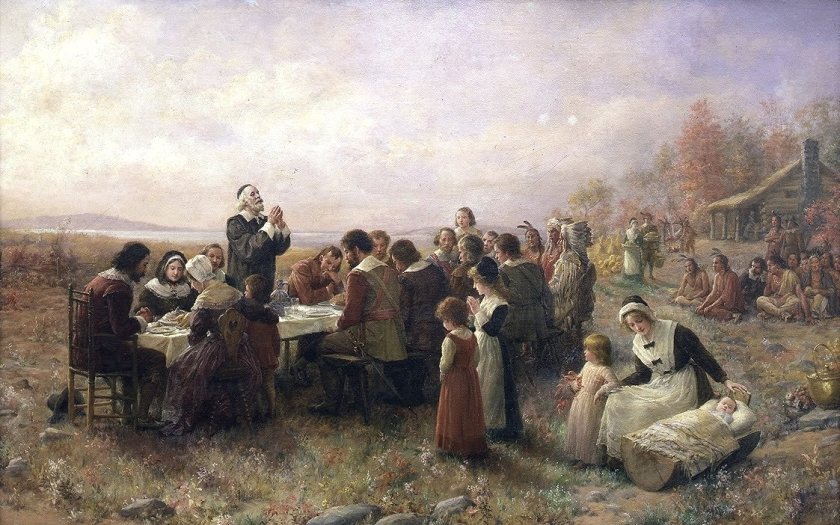
In some works, she would produce depictions of special moments of American history such as the arrival of the first settlers in her painting The First Thanksgiving held at Pilgrim Hall in Plymouth, Massachusetts which commemorated the event which took place in early autumn of 1621, when the 53 surviving Pilgrims celebrated their successful harvest, which was an English custom.  Another reason for the depiction by Brownscombe could have been the colonial roots of her mother’s family.

In the painting, we see a group of Puritans in dark and dour-looking clothes gathered around a table being blessed by a pastor.  The idealisation of the depiction shows friendly native Americans looking on at the ceremony and are ready to participate in this communal meal. In the background, we see a solitary log cabin set amongst the yet to be developed New England countryside.  This is a quintessentially American depiction and paintings like this were very popular with American public.  Brownscombe sold the reproduction rights to more than a hundred of her genre and historical works which were then used by publishers to produce prints or incorporate them in calendars and greeting cards.

Washington Greeting Lafayette at Mount Vernon, 1784 by Jennie Brownscombe

Brownscombe was among a group of artists of the Colonial Revival Movement, which was a cultural movement which was both an architectural and decorating style. It was very popular in the late 19th and early 20th centuries and was motivated by a romantic adoration of the early American past. Paintings were created by artists depicting early American scenes.  Colonial heroes like George Washington and colonial history were popular subjects for artists, inspired by the 1876 centennial, which celebrated the 100th anniversary of the signing of the Declaration of Independence in Philadelphia.  Jennie Brownscombe’s painting Washington Greeting Lafayette at Mount Vernon is a classic example of Colonial Revival Movement painting.

Colonial Minuet by Jennie Augusta Brownscombe

Brownscombe developed a structured lifestyle geared up to her artistic life.  She would travel to Italy and spend the winters in Rome and it was during one such winter she met the American still-life and landscape artist George Henry Hall who had a studio in the Italian capital.  They became close friends and Hall who was twenty-five years her senior, became her mentor.  During the summer months, the two of them would return to Hall’s American residence, in Kaaterskill Clove Valley, in New York’s eastern Catskill Mountains, lying just west of the village of Palenville.   When Hall died in 1913 at the age of eighty-eight, he bequeathed the house and studio to Brownscombe.

Children Playing in the Orchard by Jennie Brownscombe (1934)

In 1932 Jennie Brownscombe suffered a stroke which temporarily stopped her painting but two years later in 1934, when she was eighty-four years old, she completed a work for the Lincoln School in her hometown of Honesdale entitled Children Playing in the Orchard.

Jennie Augusta Brownscombe, who never married, died on August 5th, 1936 four months before her eighty-sixth birthday and was buried next to her parents in the Glen Dyberry Cemetery in Honesdale next to her parents.

Jennie Augusta Brownscombe (c.1930)

I end this story with a quote from the blog The Jellybean Tree which perfectly sums up the life and work of Jennie Augusta Brownscombe and why her paintings appealed to so many:

“…Jennie Brownscombe was a pilgrim in her own way, making a name and life for herself in a time when most women were still housewives and mothers. She tapped into a talent and nostalgia that warmed the hearts of her viewers. Artists like Brownscombe place a mirror to our lives, forcing us to see the beauty in every day. Creative types can sometimes become bogged down with visions of the fantastic. A reminder of the subtle grace of life is always welcome…”

John Charles Dollman

Salford Museum and Art Gallery

My blog today stems from a visit I made to an art gallery in one of our major cities, Manchester.   I have been to the two main galleries, the Manchester Art Gallery and the Whitworth Art Gallery, in the city before, but I had never been to the Salford Museum and Art Gallery.  The Salford Museum and Art Gallery was the UK’s ‘first free public library’, which opened in January 1850, followed in November by a museum and art gallery. The building was a mansion house known as Lark Hill, which had been built in the 1790s and has given its name to our famous Lark Hill Place; a Victorian street within the museum.

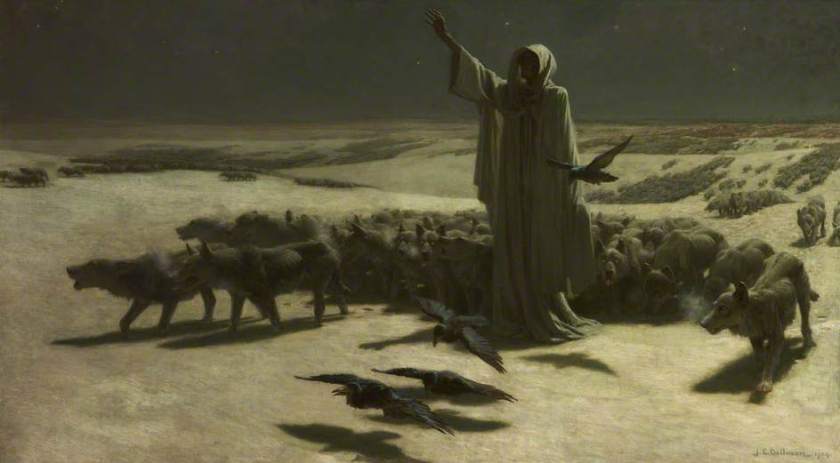
I had originally thought of featuring five or six of my favourite paintings from the gallery but the more I looked at one of the works of art, the more I wanted to know about other works the artist had produced.  The painting in question was Famine and the artist was the Victorian painter John Charles Dollman, who I had not heard of before. I was intrigued by both artist and the atmospheric painting and I needed to find out more.  Dollman, during his lifetime, was a celebrated artist but since his death just over eight decades ago he has almost been forgotten, so let me introduce you to a very talented Victorian artist.

During the Time of the Sermonses by John Charles Dollman (1896)

John Charles Dollman’s ancestors originated in France where their surname was spelled ‘Doleman’. Both Dollman’s grandfather and great-grandfather were prestigious hatters to the British royal family and it is believed that their work was well-liked by the courtiers.  Dollman’s father, also John, and his wife Mary lived on the south coast of England,  in the East Sussex coastal town of Hove where they had a bookstore and ran a stationery business.  John Charles Dollman, their first son,  was born on May 6th, 1851 one year after his sister, Selina, was born.  Ten years after John entered the world the family had expanded by a further four children, with the addition of Thomas Frederick, Herbert Purvis, Gertrude Eleanor, and the six-month old baby, Kate Maria.

The Rising Generation by John Charles Dollman (1891)

By the time John Dollman was a teenager his artistic talent had been recognised.  Some of his early work featured animals and at one local exhibition the art critic of the Brighton Guardian commented on Dollman’s work:

“…Mr Dollman’s forte seems to be for animal drawing. The strong-looking limbs, the well-rounded forms, and the symmetry of the horses show them to be types of a thoroughly serviceable animal…”

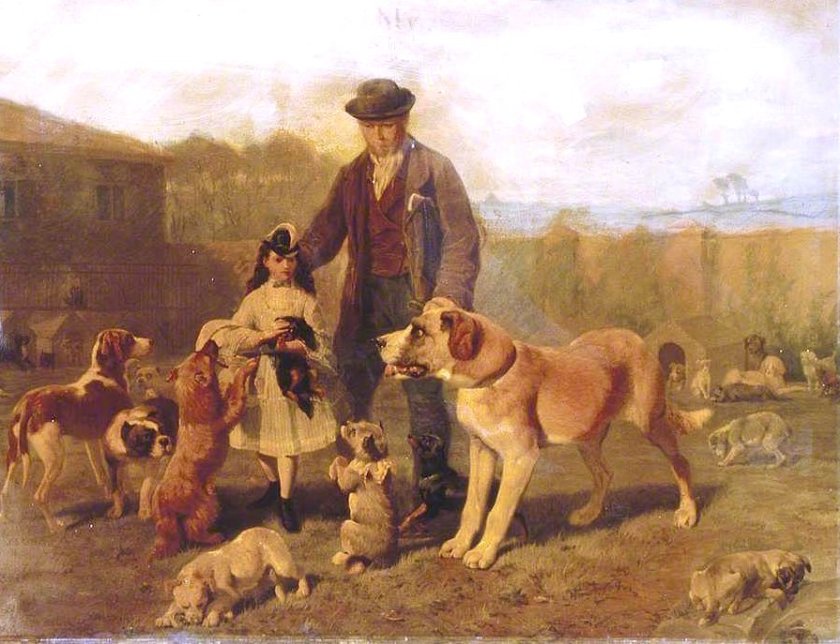
The Dogs Refuge by John Charles Dollman (1871)

Dollman studied art at both South Kensington and the Royal Academy Schools and soon gained a reputation as an animal painter and many at the time saw him as a natural successor to the renowned animal painter, Edwin Landseer. Many of Dollman’s works featured dogs and the plight of stray dogs.  An early painting by Dollman completed in 1871, entitled The Dogs Refuge, was a classic example of this genre and is housed in the Brighton Museum & Art Gallery.

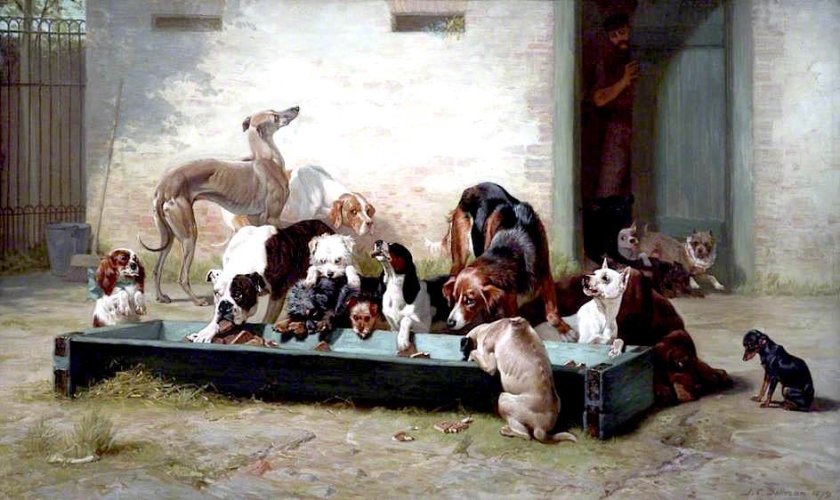
Table d’Hote at a Dogs’ Home by John Charles Dollman (1879)

Dogs had been companions to humans for tens of thousands of years but the acceptance of one as part of a family really only came about during Victorian times.  With this sentimentality over the dog came the concern for the fate of abandoned animals roaming the streets and it was this concern that led to the foundation of homes for these canine waifs.  In 1860, the Temporary Home for Lost and Starving Dogs opened its doors in Holloway. London which eventually moved south of the Thames and became the well-known Battersea Dogs Home.  Paintings featuring abandoned dogs pulled at the heart strings of the Victorians and were in much demand.   Another work featuring the plight of stray dogs is his painting Table d’Hote at a Dogs Home which was exhibited at the 1879 Royal Academy and is now housed at the Walker Art Gallery in Liverpool.

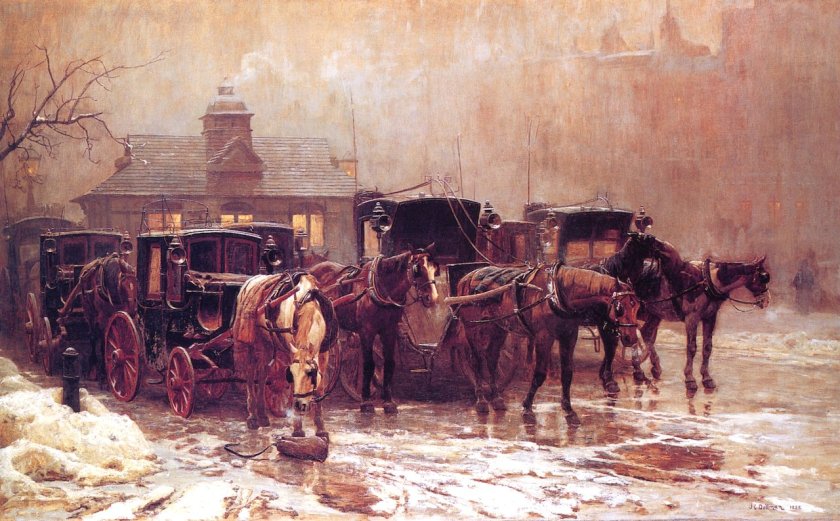
A London Cab Stand (Les Miserables) by John Charles Dollman (1888)

Probably his most famous works was one which also featured animals.  It was the atmospheric painting entitled A London Cab Stand which he completed in 1888 and is now housed at the London Museum.  It is a depiction of a group of forlorn-looking horses tethered to their cabs standing in pouring rain awaiting their next fare. The work is often known as Les Miserables for obvious reasons.  Dollman composed at least three variants of this picture.

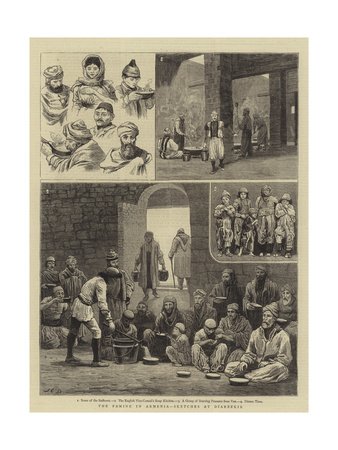
Famine in Armenia illustration by John Charles Dollman

Dollman was a regular exhibitor at the Royal Academy for over forty years from 1870 to 1912, and was elected a member of the Royal Watercolour Society.  To subsidise his income from selling his art he worked as an illustrator for magazines in the 1880’s such as the British weekly illustrated newspaper, The Graphic.  In some artistic quarters Dollman was referred to as a “black and white artist” which undoubtedly was based upon the amount of illustrations he did for newspapers and magazines.

Famine by John Charles Dollman (1904)

As I said earlier this blog was brought about when I saw Dollman’s haunting oil painting entitled Famine, which he completed in 1904.  It depicts a tall emaciated figure going forward through a wasteland whilst being surrounded by hungry wolves and ravens.  It is a troubling work of art and one wonders what it is all about.  Some believe it is all about starvation with its visualisation of death in the form of the grey shrouded man who is being surrounded by ravenous wolves.  The artist, on the other hand, said he intended it to portray a famine of human spirit, or death of the soul after its neglect.  One amusing story behind this painting is that Dollman went to the zoo to sketch wolves for use in the painting but was disappointed to find that they all seemed well fed and all of them were too healthy-looking, which did not fit in with the idea of the work!

Frigga Spinning the Clouds by John Charles Dollman (c.1908)

Many of Dollman’s illustrations featured Viking mythology. His work conveys a powerful sense of drama. In 1908 Ethel Mary Wilmot-Buxton used eight of Dollman’s images in her book Told by the Northmen, and in the following year nine were reproduced in Hélène Adeline Guerber’s Myths of the Norsemen:  From the Eddas and Sagas.  One of these illustrations which Dollman completed around 1908 was Frigga Spinning the Clouds.  Frig, or the anglicised version of the name, Frigga, which translated means “beloved” was the wife of Odin, the chief of the gods and thus she was the highest ranking of Aesir goddesses.

There is a woman who weaves in the sky

See how She spins, see Her finger fly

She’s been before us from beginning to end

She is our mother, lover and friend

She is the weaver and we are the web

She is the needle and we are the thread.

From the poem Changing Woman by Adele Getty

Frigga was goddess of the clouds, and was usually depicted as wearing either snow-white or dark garments, which was dependent on her disposition.  She was queen of the gods, and she alone had the privilege of sitting beside her husband, Odin, on the throne, Hliðskjálf, which in Norse mythology was the high seat of the god Odin allowing him to see into all realms. From that lofty throne it was said she too could look over all the world and see what was happening, and, according to the belief of our ancestors, she possessed the knowledge of the future. Although she often appeared seated beside her husband, she preferred to remain in her own palace, called Fensalir, where she assiduously worked her jewelled spinning wheel producing golden thread and weaving long webs of bright-coloured clouds. Fensalir was also where Frigga invited husbands and wives who had led virtuous lives on earth, so that they might enjoy each other’s companionship even after death, and never be called upon to part again.

The Village Artist by John Charles Dollman (1899)

Paintings since the days of the cave drawings have been a means for us to learn about the past.  Paintings are often pictorial histories and without them the past would have been just our imagination gleaned from what we read but we lacked the graphic detail.  If we look at the seventeenth century Dutch and Flemish genre paintings we get an idea what life was like for the peasant classes in those days.  At the other end of the scale, in the eighteenth century paintings by the likes of Francois Boucher we get an idea of how the well-off lived in France.  Whereas the paintings looking at life of the rich could well be more stylised versions of the truth with elaborate furnishings added to the picture to enhance the status of the sitters, the peasant paintings were more realistic and it is this realism in a painting that appeals to me.  Add a story behind what we see before us as in narrative paintings then it is the icing on the cake.

The Immigrants Ship by John Charles Dollman (1884)

Narrative art is art that tells a story.  It may be a single moment in a continuing story, often based on history, mythology or the Bible or as a sequence of events unfolding over time, such as the set of six paintings entitled Marriage a’la Mode by William Hogarth. Narrative paintings were especially popular in the Victorian era and John Dollman produced a classic entitled The Immigrant’s Ship in 1884.  In the painting, we see a young girl playing with a doll whilst her exhausted mother, who is almost drained of life, tries to get some rest as she leans her head on her husband’s shoulder.  He stares blankly at the wooden deck of the ship as if he wonders what they have all got themselves into and what was their future.  Unlike the wealthy man, who is sitting nearby with a top hat on his head, his family is living in very cramped quarters in the lower deck, a space which probably measured only a couple of square meters.  Beggars cannot be choosers, and this family was almost at beggar-level having received an assisted passage so that they could make a new life for themselves in Australia.  For people travelling on an assisted place this was no luxurious cruise.  Such passengers had to provide their own bedding and eating utensils and were fed biscuits, gruel, potatoes and occasionally preserved meat.

A Very Gallant Gentleman by John Charles Dollman (1913)

Dollman captured a very poignant moment in history with his 1913 painting entitled  A Very Gallant Gentleman which depicts Captain Laurence “Titus” Oates walking out to his death in the blizzard, on Captain Scott’s return journey from the South Pole, in March 1912. Oates had been suffering from severe frostbite which became so severe that he could hardly climb into his sleeping bag and the “killer”, gangrene, had set in. Oates realised his physical condition was now hampering his three other colleagues’ safe return and he pleaded with them to leave him behind, but they refused. The next day he awoke, and knew what he must do.  He left his colleagues knowing that this may help them and uttered his immortal line:

“…I’m just going outside; I may be away some time…”

Captain Scott recorded in his diary that day that Oates had gone out into the blizzard never to be seen again. The final three members of the expedition party struggled on for a few more days before they too died before ever reaching safety.

John Charles Dollman died in London on December 11th 1934 aged 83.  In his will he bequeathed a sum of ten thousand guineas to the Royal Academy to fund scholarships for promising young artists.  Dollman was a most amazing and yet forgotten artist.

Theodore Robinson. Part 3 – Monet, Giverny and Robinson’s muse, Marie.

At the Piano by Theodore Robinson (1887)

Whilst Robinson often depicted women at work, other paintings of his  portrayed women at rest, sometimes relaxing at the piano as was depicted in his 1887 painting At the Piano.  The painting was completed whilst he was staying at the home of John Armstrong “Archie” Chanler, a wealthy American writer and activist, and an acquaintance of Robinson who was related to the elite Astor, Livingston, and Stuyvesant families. Chanler was a great supporter of American artists who had come to Paris to follow their artistic dream and it is thought that on occasions had provided financial support to Robinson.

Look at the different textures depicted such as the glistening surface of the piano top and the glowing fabric of the woman’s dress.  We can almost hear the sound of the music as we see the fingers of the lady caress the ivory keys.

The painting was very popular and Robinson believed he knew why.  In his diary entry for September 10th, 1893 he wrote:

“…It is probably the sincerity with which it was done – I remember it seemed to me a sad failure at the time, and at Archie’s rue Dumont d’Urville just before leaving for the country…”

At the Piano by Whistler (1859)

Many believe the inspiration for this work was a painting Robinson may have come across when he was in Philadelphia in 1881 or New York in 1882 when At the Piano by James Abbott McNeil Whistler was being exhibited. Albeit that work, which is a study of Whistler’s half-sister and niece, is much darker in comparison to Robinsons painting which is aglow with delicate light.

Lady in Red by Theodore Robinson (1885)

The model for Robinson’s painting was thought to be Marie a love interest of his during his time in Paris and Giverny although they never married.  Robinson first met Marie at the start of his second visit to France in the Spring of 1884.  She was an artist’s model who lived in Paris.    He first portrayed Marie in a watercolour in 1885 entitled Lady in Red in which she is depicted in profile against a dappled background of leaves and fragile branches.

The Red Gown (also known as His Favorite Model) by Theodore Robinson (1885)

Although that was just a head and shoulder depiction we see she is wearing a red costume which was often seen in other Robinson portraits, such as his painting entitled The Red Gown, and the dress is thought to be one of Robinson’s studio props.

Val d’Arconville by Theodore Robinson (c.1888)

Another of Theodore Robinson’s works featuring Marie was his beautiful 1888 work entitled Val D’Arconville, which can be seen at the Chicago Institute for Art.  In this depiction, we see Marie sitting on a flower-filled hillside overlooking the Arconville Valley which is situated southeast of Paris.  In the painting, Robinson used densely layered, broken brushwork, which was a technique he picked up from Monet.  This clever artistic method has the observer of the work relinquish their focus on the woman and their eye is led down the slope, and across the valley.  This was not simply an impressionistic painting which captured momentary effects such as the grass moving in the breeze, it becomes more of a structural work with the inclusion of the houses in the middle ground.

The painting was originally owned by Arthur Astor Carey, a cousin of John Armstrong Chanler, who had taken up residency at Giverny during the summer 1887.  The identity of Marie as the sitter for the painting was confirmed by an entry in Robinson’s diary for June 11th1893 in which he stated:

“…Mrs B. told me of the inspiration she got from a picture of mine (Carey’s, with Marie on the hill-side)…”

Little is known of Marie but in Sona Johnston book In Monet’s Light she quotes from a letter of a fellow American tourist and lodger at Hôtel Baudy who wrote home:

“…By the way, dear, it looks very strange but Mr. Robinson has a model down here who has a little daughter . . . Everyone says that . . . the little girl is the daughter of Mr. Robinson [and] the child looks very like him.”

Robinson had fell heavily for his muse and in a letter to his sister-in-law, Mary, on May 20th, 1887, he wrote:

“…I am in love with a French Girl, it is an affair of some time – and I came close to writing of it to Father but did not.  It is quiet just now and nothing may come of it so you had better say nothing about it – She has the same name as you in French – Marie – but she is as dark as you are fair…”

Nobody ever knew the surname of Robinson’s love as he never wrote it down in any of his letters or in his diary.  Despite his deep love for the young women, nothing came of the relationship.  The couple never married and we will never know why.  Maybe it was because of his failing health or maybe it was because of his poor financial state.  We do know that the relationship was not as Robinson would have liked as he discussed his disappointment with the state of his love life on many occasions over the dinner table with Will Low and his wife.   His relationship with Marie lasted for six years until he finally left France but he continued to correspond with Marie up until his death.

Claude Monet Painting by the Edge of a Wood by John Singer Sargent (1885)

Giverny became a popular spot for artists around mid-1880’s.  It is known that John Singer Sargent visited the village around 1885 and met with Monet and it was the latter’s love of en plein air painting that appealed to Sargent.  It was in that year that Sargent produced his painting entitled Claude Monet Painting at the Edge of the Wood which depicts the great man at work watched over by his future second wife, Alice Hoschedé.

In 1880s and 1890s, American aspiring artists poured into Paris looking for places at its art schools and a chance to work in the ateliers of famous French painters. To them Paris was the Mecca of art and to study at one of the academies or ateliers was a “must have” experience and at the same time it was a sought-after freedom from the rigidity of artistic training at American academies.  For them to study at one of the famed Parisian academies and then to head for the countryside or the coast during the summer months was, for them, their idea of Shangri-La.

In the summer of 1887 a small group of young American artists made their home in Giverny.  How this came about was documented in a book written by the English Impressionist painter, Dawson Dawson-Watson entitled The Real Story of Giverny, based on a conversation he had had with the American artist, John Leslie Breck in 1888.  Breck recounted:

“…In the spring of ’87 [he and] Willard Metcalf, Theodore Robinson, Blair-Bruce, Theo Wendel, and a chap named Taylor whose Christian name I cannot recall, were talking over some place to go for the summer.  All of the usual places, Pont Aven, Etretat, Ecoigu, and Grèz, were rejected because their interest was in finding a new location to paint. After consulting the destination board at the Gare St. Lazare, they agreed that Pont del’Arche was appealing, so they decided to visit the town and see if it was as picturesque as its name.

The train to Pont del’Arche followed the Seine into Normandy and required a change at Vernon. As they approached Vernon, Metcalf pointed out a little village of white houses and a Norman church at the base of the hill on the opposite bank of the river and commented on its loveliness. At Vernon, they were told the village was Giverny. Once aboard the new train they were treated to a second view of Giverny when they crossed the Seine and were doubling back. The painters agreed unanimously that if Pont del’Arche was not to their liking they would return to Giverny the following morning, which was exactly what they did…”

After the initial discovery, other American artists soon followed and many began to extend their visits beyond the summer months.

Robinson’s photograph of the Monet-Hoschedé family gathering at Giverny (c.1892)

In April 1883, forty-two-year-old Claude Monet left his home in the western Paris suburb of Poissy and went to live in the small Normandy farming village of Giverny, a village he had passed thorough many times during his train journeys from Paris to Rouen.  The unpretentious village nestled at the bottom of a hill across the River Seine from the town of Vernon.  It was then made up of simple farms, modest houses, and a Norman church and at the time had a population of less than three hundred residents.  What appealed to Monet about Giverny and the surrounding area was its pastoral charm.  Monet, at this time, had been widowed for four years.  He arrived at Giverny and set up home along with his two children, Jean and Michel, and his former patrons Ernest and Alice Hoschedé.  Ernest Hoschedé, a departments store magnate and art collector had been declared bankrupt in 1877 when his business failed.  With nowhere to live, he and his wife and six children went to live with Claude and Camille Monet and their two children.

Charcoal sketch of Claude Monet by Theodore Robinson (1890)

At the time of Monet’s arrival at Giverny, his artistic career was starting to take off.  Giverny was to be a secluded and peaceful retreat and so he was less than pleased by the summer influx of artists to Giverny.  In his 1993 book Monet’s Giverny: An Impressionists Colony. William Gerdts recalls what Monet told a reporter about the influx of Americans:

“…When I first came to Giverny I was quite alone, the little village was unspoiled. Now, so many artists, students, flock here, I have often thought of moving away…”

However, the great man did not move away. Instead he progressively removed himself to his compound where his garden and lily pond provided all the subject matter he needed for his paintings.

Theodore Robinson’s photograph of Monet (c.1889)

Theodore Robinson agreed with Monet about the downside of the influx of visitors and was set against the idea put forward by John Leslie Breck to establish Giverny as an artists’ colony, and he was quoted as saying:

“…Breck conceived the idea of making an art colony of it [Giverny]. Theo Robinson strenuously objected saying they had found a lovely spot and should keep it to themselves…”

Breck had replied that because everyone had been so damn nice, he wanted them to reap some real financial benefit and not withstanding Robinson’s objection, Breck had persuaded Monsieur Baudy, the owner of Café Baudy they frequented, to build six rooms in the courtyard in back of the building and so Hôtel Baudy came into existence.  He even persuaded the landlord to build a studio for Willard Metcalf.

Theodore Robinson may have objected to making Giverny a hub for artists to visit in the summer for other than selfish reasons, it could well have been due to his own social reserve.  Robinson was not an unfriendly person but was quite happy with his own company.  Robinson, at thirty-one years of age, was older than his friends who had come to Giverny with him and this may have been a factor as to why he had been befriended by Monet.  Robinson, being close to Monet, was probably aware of Monet’s dislike of the village being overrun by visiting artists.  Robinson and Monet’s friendship was an interesting one.  It was not based on Monet being the master and Robinson the pupil.  It was a friendship based on a shared common love – painting, and both appreciated the talent of the other.  It was a friendship that would last even after Robinson returned to America with many letters passing from one to the other.

La Vachère (The Cowherd) by Theodore Robinson (1888)

Robinson returned briefly to New York at the end of 1887, but was back in Paris by early 1888 and had once again re-visited Giverny that summer. One of his paintings he completed during that summer is now considered to be one of his first Impressionist paintings.  It was La Vachére. It is interesting to note that this work highlights a dilemma for Robinson.  Is he an Impressionist painter or an Academic painter?  The painting would seem to be part Impressionism in the way the trees and foliage are depicted as patches of colour and part Academic in the way he depicts the woman.  She is simply a figurative study within an Impressionistic backdrop.  The painting was exhibited in the 1889 Paris Salon.

Autumn Sunlight by Theodore Robinson (1888)

A more impressionist style of painting can be seen in Theodore Robinson’s 1888 work entitled Autumn Sunlight.  In this painting, we see a young woman standing in the woods.  She is what is termed a faggot gatherer, a person who collects firewood, a bundle of which we see at her feet.   The background of speckled light hints at tonalism, which emphasizes atmosphere and shadow. However, the foreground with its myriad of leaves depicted by a montage of broken brushstrokes is pure Impressionism.

Winter Landscape by Theodore Robinson (1889)

Robinson returned to New York in December 1888.  He rented a studio in Manhattan.  His artistic output was less than it had been during his days in Giverny but produced works that he exhibited at the American Watercolor Society in the Spring of 1889.  Come the summer of 1889, Robinson was back in Giverny and it was during that year that he completed his beautiful work entitled Winter Landscape.  The work depicts ta view of the village of Giverny after it had succumbed to a freak snowstorm.  The red rooves of the houses were suddenly transformed to a patchwork of white and the entire village is swathed in a icy-looking purple-blue ambience.  Once again Robinson had returned to New York that winter and entered this painting at the Society of American Artists annual exhibition.  It won the Webb Prize, an award given for the best landscape in the exhibition, painted by an American artist under forty years of age.  He also received a monetary prize amounting the three hundred dollars.  Ironically this was one of the pure landscapes Robinson painted without a person or persons being part of the scene and the category for the prize stipulated that only “pure” landscape paintings would be accepted by the judges!

Capri and Mount Solaro by Theodore Robinson (1890)

Robinson was back in Giverny, once again a resident of Hôtel Baudy, for the summer of 1890 but the highlight of the year for him was his trip to Italy and the south of France.  During that winter journey Robinson visited Capri and from that stop-over produced the painting Capri and Mount Solero.  This landscape work was a depiction of the town and mountain as seen from a hillside which looks across from the town.  Again, in this work, we see the juxtaposition of his two styles.  We have the geometrical depiction of the village and the flat-roofed houses and yet we have the Impressionism style loose brushstrokes which are used to depict the foliage.

Capri by Theodore Robinson (1890)

For the first three months of 1891 Robinson was in Frascati, a town twenty kilometres south-east of Rome.  It was in March 1891 that Monet contacted Robinson, summoning home:

“…[Spring] is close … and I hope you are not going to delay taking possession again of your little house…….”

Robinson returned to Giverny in April 1891 after a brief stay in the French coastal town of Antibes.  Once again, having arrived back in Giverny, he took up residence at the Hôtel Baudy where he stayed until December, at which time he returns to New York.  The year 1891 was one of the most productive for Robinson and it was in that year that he once again began to dabble with photography.  He wrote to his family explaining why:

“…Painting directly from nature is difficult as things do not remain the same, the camera helps retain the picture in your mind…”

Two in a Boat Theodore Robinson (1891)

His use and dependency on photography varied but was mainly for use in his figurative work.  In some cases, it was found that he drew a grid of squares on the photograph and on the canvas or sheet of paper he was to draw on so that he could transfer a composition with great accuracy.  One painting he completed using this method to depict the two figures was Two in a Boat which he completed whilst in Giverny in the summer of 1891.  The depiction is of two women reading while lounging in a skiff floating on the Seine or Epte rivers. The method Robinson used to complete the work is given by the Phillips Collection in Washington which houses the painting:

“…The relationship between Two in a Boat and the photograph from which it derived offers a vivid example of Robinson’s painting process. He lightly scored the photograph and the canvas with graphite and sketched in the composition, using the grid as a measure. The grid and under-drawing are visible throughout, because Robinson’s pink primed canvas was left exposed in many areas, particularly in the lines defining the interior of the occupied boat and the figures. The painting differs slightly from the photograph: Robinson excluded a fourth boat to the starboard side of the skiff and the branch falling diagonally from the top left corner; furthermore, the photograph’s strong contrast has been replaced by an overall tone of violet and green…”

Robinson was pleased with the painting and exhibited it in the Society of American Artists’ 1895 annual exhibition and in his one-person exhibition at Macbeth’s later that year.

On May 13th, 1892, Robinson departed for what would prove to be his last summer in Giverny and the following month celebrated his fortieth birthday.  Celebrate was probably not the best way to describe this milestone in his life as he was suffering from a bout of severe depression and self-doubt.

La Debacle (also known as Marie at the Little Bridge) by Theodore Robinson (1892)

In 1892 Robinson completed one of his best known and best loved paintings.  It had the strange title of La Débâcle and later a subtitle of Marie at Little Bridge was added.  The sitter for this work was again his muse, Marie, Robinson’s great love and regular model.  In the painting, we see a fashionably dressed young woman seated on the stone foundation of the bridge over the River Epte, which runs close to Giverny.  Something or someone has disturbed her although we have no clue to what or who it is.  Clutched in her hand is the most recent novel written by Emile Zola entitled La Débâcle which had just come on sale that year.  The title of the book refers to the ignominious defeat of France in its battle with Prussia in 1870.  However, there may be another reason for the title of the painting as Robinson had proposed to Marie on a number of occasions and had been spurned and in a way that was Robinson’s own Débâcle.  It was also the year Robinson left Giverny and France for the last time but with him on his final journey back to America was this painting.

The Wedding March by Theodore Robinson (1892)

Also in 1892 Robinson produced what is probably his best-known work, The Wedding March.  The painting was based on the wedding of the American painter, Theodore Earl Butler to one of Monet’s stepdaughter, Susan Hoschedé.  In a letter to his friend he described the event:

“…There was a double ceremony – first at the Mairie – then at the church.  Nearly all the wedding party were in full dress……Most of the villagers and all the pensionnaires were there – guns were fired, two beggars held open the carriage doors and received alms…”

Although one may have thought that Robinson painted the work using a photograph of the processional march but in fact he painted it from memory. In the painting, we see the procession from the orange-sided Mairie, or City Hall, on its way to the old Norman church down the lane which has since been named the rue Claude Monet. In the depiction, we see Monet himself escorting the bride at foreground while Butler and Madame Hoschedé bring up the rear. The unidentified girl in the middle is thought to be the youngest Hoschedé daughter.

Gathering Plums by Theodore Robinson (1891)

Robinson arrived back in America on December 12th, 1892.  He had hoped to survive financially through the sale of his paintings but this was not to be and due to ever increasing financial difficulties Robinson was forced to teach a summer class for the Brooklyn Art School.  Robinson was a shy person who favoured his own company and so due to this and his lack of confidence, teaching was not a favourite occupation, but beggars cannot be choosers.

Père Trognon and His Daughter at the Bridge (1891)

For the next three years, Theodore Robinson continued to paint and teach at various colleges but his health was beginning to fail.   During the winter of 1895, asthma was increasingly consuming more of Robinson’s strength. In his final letter to Monet in February 6th, 1896 he wrote to the great man saying that he hoped to return to Giverny but it was not to be. He finally succumbed to the respiratory ailment that he had been suffering from all his life and he died on April 2nd, 1896 at the New York home of his cousin, Agnes Cheney. Robinson’s funeral was held on 4 April at the Society of American Artists in New York, and his body was then sent to Evansville, Wisconsin for burial.  His death came just six weeks before what would have been his forty-fourth birthday.

Theodore Robinson has long been considered the first American Impressionist.


Theodore Robinson. Part 2 – Naturalism, Realism and Giverny

Theodore Robinson

……………………Theodore Robinson returned with some of his fellow students to the Fontainebleu Forest in the summer of 1878 to carry on with their en plein air painting but probably the highlight for Robinson that September was his trip to Italy with his fellow École des Beaux-Arts student Kenyon Cox.  They visited Turin, Milan, Verona and Bologna on their way to Venice.  In his 1986 book, An American Art Student in Paris, The Letters of Kenyon Cox 1877-1882, H.Wayne Morgan quotes from a letter Cox sent to his family after he had returned to France on December 15th 1878 and from it we have an insight into the physical health of his erstwhile fellow traveller, Robinson.  Cox wrote:

“…Robinson has come back from Venice very much used up.  He caught some sort of fever there and was sick for some days in a little German hotel, waiting for money to leave with, confined to his bed, unable to eat anything…….and almost afraid he should get out alive.   He is very thin and feeble, but I hope if he takes care of himself and lives better he will come around…”

Suzette (Peasant Girl) by Theodore Robinson (1879)

Robinson left Europe and returned to New York in late 1879 and rented a studio on Broadway hoping to establish himself as a professional artist but his financial situation became dire and he had to close his studio and return to his family in Evansville where he would paint local scenes but also dabbled with illustrative work.  One such illustration, Suzette, appeared in the August 31st 1880 issue of the Harper’s Young People magazine  in conjunction with a children’s story Viola’s Sketch.   The original black chalk drawing with white heightening, on grayish blue paper, mounted on board can be found at the Chrysler Museum of Art in Norfolk, Va.   It depicts an outdoor scene with a young girl, turned to the right, in a humble frock intent on sewing.  Her hair is styled in a long braid and she stands in wooden shoes, looking downward wistfully at her work.  The simple depiction of this guileless peasant girl probably harks back at Robinson’s academic training in Paris and the rustic genre imagery we have seen in the works of Jean-François Millet

However, Robinson’s life was at a low point, both physically and mentally as indicated in letters he sent to his friends.  One such friend was Will Low a fellow student at Carolus-Duran’s atelier in Paris.  In his 1908 book, A Chronicle of Friendship, Low wrote that on hearing of his friend’s predicament he had to:

“…extricate Robinson from the surroundings where….he was fast relapsing into a vegetable state…”

And so, Low arranged for Robinson to take a teaching position in New York at Mrs Sylvanus Reed’s Boarding and Day School for Young Ladies, a latter day finishing school for young women.  In May 1881 Robinson was elected to the Society of American Artists and following the short spell of teaching he began to work for the muralist and stained-glass window maker John La Farge.  He and his friend Will Lowe worked on a La Farge commission from Cornelius Vanderbilt to decorate his New York 5th Avenue home and following this they worked on Vanderbilt’s Tarrytown residence on the Hudson River.  Robinson then went on to work for the decorative painting company run by Prentice Treadwell and he works on architectural decorations in Boston, Albany and on decorations for the Metropolitan Opera House in New York as well as commissions for the well-heeled nouveau-riche industrialists.

Daisy Field, Nantucket by Theodore Robinson (1882)

In May 1881 Robinson’s mother died and he returned briefly to Evansville to be with his family but returned to New York that August.   During these periods of employment Robinson still carried on with his own paintings and spent time in the summer travelling around New York State, Vermont and made painting trips to Nantucket with fellow artists in the summer of 1882 painting local island life.

Nantucket by Theodore Robinson (1882)

Theodore Robinson spent the summer of 1882 on Nantucket Island and produced several paintings based on local scenes, including the one above.  The depiction of the rider and his mount at rest under the tree is a depiction of tranquillity and serenity.  In the distance, on the horizon, we can just make out the sea which lends itself to the belief that the setting was somewhere on the New England coast, probably Nantucket Island.  The painting can now be found at the Columbus Museum in Columbus, Georgia.

Flower of Memory by Theodore Robinson (1881)

He completed a beautiful work in 1881 entitled Flower of Memory which is a romantic (if somewhat schmaltzy) depiction of a young lady in an Empire dress, standing alone in a garden.  This sort of depiction was very popular with folk in America at this time and could well have epitomised the figures he was painting as a decorative artist for the La Farge and Treadwell commissions.

A Poacher by Theodore Robinson (1884)

However, Robinson’s art was not dominated by cloying sentimentality in his depictions as he was very much a believer in the realism portrayed in works such as those by Winslow Homer on of his favourite painters.  This is borne out when we look at his 1984 work, The Poacher.

French Impressionism had permeated towards America and Impressionist paintings had started to become sought-after items.  The influential Parisian art dealer, Paul Durand-Ruel had organised a large exhibition of works of Manet, Monet, Pissaro  and Renoir in Boston in September 1883.  So just as Impressionism was arriving on the American shores in the Spring of 1884, Theodore Robinson, who had saved enough money to buy himself a sea passage, left the country to return to France where he would remain for the next eight years with just the occasional visits back to New York.  During his stay in France he would also make trips Belgium and Holland where he would take in the Flemish and Dutch art scene.

By the end of the 1870’s the leading exponent of the style of art known as Naturalism, which is the depiction of realistic objects in a natural setting, was Jules Bastien-Lepage.  When Robinson arrived in France in 1884 the popularity and standing of Lepage was escalating, and his works of art were in great demand, a fact that Robinson must have been well aware of and there is no doubt that Lepage’s works influenced Robinson.   Lepage’s popularity and the sale of his artwork increased even more in December 1884 when he tragically died of stomach cancer at the young age of forty-four and this adulation culminated in 1885 with a retrospective of his paintings at the Hotel de Chimay in Paris which proved to be a runaway success.

Le petit Colporteur endormi (The little sleeping pedlar) by Bastien-LePage

Often Lepage’s works depicted rural peasants and urban labourers  and these detailed portrayals lacked sentimentality and yet brought home to the observer an honest if somewhat blunt snapshot of the life of the less well-off. Such was their popularity they appeared regularly at the Salon  exhibitions.

In 1886 Robinson’s good friend Will Low along with his wife arrived in Paris and Robinson was there to greet them as they alighted from the train at Gare St. Lazaire.  Such was his friendship with Low that for the next twelve months he lived with them at their rented accommodation on Rue Vernier in the Paris suburb of Neuilly-sur-Seine.   Robinson’s work during his time in France was diverse.  There was the sentimentality of works like Flower of Memory which as I said earlier probably originated from his time of painting mural decorations for La Farge and Treadwell.  There was his landscape work which derived from his en plein air painting at the Fontainebleau Forest during his summer breaks from the Paris Academy and finally there was his interest in genre painting and the depiction of peasants and urban dwellers at work or at home which he became interested in during his trips to Flanders and the Netherlands.

A Cobbler of Old Paris by Theodore Robinson (1885)

His 1885 painting A Cobbler in Old Paris is a prime example of Robinson’s look at urban life.  The focal point for the work is the woman who leans in through the open window to talk to the cobbler.  One should almost look at this work as a part still life painting with the cobblers workbench littered with still life objects, the tools of his trade, as is the wall in the background filled with the racks of shoes.  This type of scene of tranquil everyday life was popular in Victorian times and Robinson completed many similar works.

Young Girl with Dog by Theodore Robinson (1886)

In his 1886 painting, Young Girl with Dog, Robinson has preserved Bastien-Lepage’s method of honestly and frankly portraying an un-idealized figure seen in a landscape.   There is also an American source of inspiration that would have been well-known to Robinson. This small vertical format containing the standing figure illuminated under a dappled light is evocative of a series of watercolours produced by Winslow Homer in the summer of 1878 when he was invited to stay at Houghton Farm in upstate New York, the home of his patron Lawson Valentine.

Weary by Winslow Homer (1878)

One such work by Homer was entitled Weary.  Robinson was not only an early admirer of Homer’s watercolours, but it is rumoured that he purchased one of the watercolours in 1894.  Robinson first visited Giverny, a small Norman village, which was situated on the banks of the River Seine halfway between Paris and Rouen in 1885 when he and a friend of Claude Monet, Monsieur De Conchy visited the French painter. Claude Monet had moved there in 1883 with his two young sons Jean and Michel.   Pierre Toulgouat who was a descendent of Monet, wrote of the time in his 1948 book, Skylights in Normandy:

“…in 1885, his [Monet’s] friend, De Conchy came to visit him, accompanied by the young American painter, Theodore Robinson – and Robinson, particularly, was to remain a faithful Givernois, until his death, painting there when he could and writing longingly of it when he had to be away…”

In June of 1886 Robinson was in Paris and managed to visit Monet’s work at the Fifth International Exhibition of the Impressionists at the Galerie Georges Petit and came away captivated by Monet’s works especially their colour and luminosity

Portrait of Madame Baudy by Theodore Robinson (1888)

In June 1887 Robinson moved out of Paris and went to live in Giverny. He moved into rooms at the newly-opened Hotel Baudy, which lay in the centre of the village and was run by Angélina Baudy.  Giverny and the surrounding area, for Theodore Robinson, was all about the simplicity of the landscape, the colours and the light and he would love to go off and explore and paint.  He loved everything about the area.  He loved the hills and fields, the old buildings, the people and the animals and would immerse himself in the area painting as much as he could in the ever changing conditions of light and weather.

Valley of the Seine, Giverny by Theodore Robinson (1887)

A fine example of this is his 1887 painting Valley of the Seine in which we see a minute figure in white which somehow secures a pattern of one horizontal and several diagonals that contain and depict several hillside swaths of yellow and grey, and a triangle of blue sky. For his portrayal of the countryside Robinson has used muted earthen colours, ones that he would use in many of his later paintings.

La Vachère (The Cowherd) by Theodore Robinson (1888)

During his stay around the Giverny area Robinson depicted many of the residents of the area.  Most of his paintings featured women at work, sometimes seen gathering wood and fruit sometimes tending the farm animals or doing the laundry.  An example of this is his large 1888 painting entitled La Vachère (The Cowherd) 219 x 152cms (86 x 60 ins) which is housed in the Baltimore Museum of Art.  Before us we see a young woman and a cow both surrounded by foliage that glistens in the reflected light.  Look how Robinson has cleverly left an opening between the trees in way of the girl’s head.  It enhances the young woman’s profile and frames her face as well as adding depth to the depiction.  The addition of the cow into the depiction is almost as if the animal is vying for supremacy in the painting but it is completely ignored by the girl.

In The Grove by Theodore Robinson (c.1888)

One strange thing about this painting is that shortly after he completed the work Robinson painted the same woman in the same setting but without the cow!  Maybe he thought the animal detracted from the beauty of the female. The picture, which is much smaller, is entitled In the Grove and is also part of the Baltimore Museum of Art’s collection.

In my final look at Theodore Robinson’s life in the next blog, I will look closer at his relationship with Claude Monet and showcase more of his later works.

Theodore Robinson. Part 1 – the early years of the American Impressionist

Theodore Robinson

When we think of Impressionism and Impressionist painters we immediately think of French artists and if I was to ask you to name a few French Impressionist painters, I guess you wouldn’t have a problem and the names of Monet, Sisley, Renoir, Bazille, Pissaro and Cézanne would easily roll off your tongue.  However, if I was to ask you to cite some famous American Impressionists I guess the names of Mary Cassatt and John Singer Sargent would come immediately to mind, some may even suggest William Merritt Chase or John Henry Twachtman but, especially if you were not an American, it would become a struggle to think of the names of any other American Impressionist.  In my blog today I am looking at the life and work of one of the first American Impressionists, Theodore Robinson, albeit he is not the best known.  Lovell Birge Harrison, the American genre and landscape painter, teacher, and writer and prominent practitioner and advocate of Tonalism wrote about Robinson in a 1916 article in Century Magazine, saying:

“…The one who always stands out most vividly in my own mind …[is] Theodore Robinson, who is now taking his place beside Inness, Wyant, and Winslow Homer as one of our American old masters…”

Self Portrait by Theodore Robinson (c.1887)

Robinson was one of the most skilful and gifted American artists of the nineteenth century. He said he always knew he would become an artist and once said of himself that perhaps he was born to make sketches.  His accomplishments as an artist take on an even greater meaning considering that he was a man who would have to battle all his life against poor physical health.

Harbour Scene by Theodore Robinson (1876)

Theodore Pierson Robinson was born on July 3rd 1852 in the small northern Vermont town of Irasburg which lies twenty-five miles south of the US-Canada border.  He was the third of six children of Elijah and Ellen Brown Robinson.  Sadly, his two sisters and one of his brothers died in childhood, leaving just Theodore and his two brothers Hamline and John.  In 1843, his father, who had worked on the family farm in Jamaica, trained to become a minster in the Methodist congregation but due to ill health had to give up the ministry and he became a shopkeeper opening is own clothing store.

Young Woman Reading by Theodore Robinson (1887)

In 1855, whilst still a very young child, Theodore and his family moved from Vermont and went to live in the small town of Barry, Illinois and two years later they moved again, this time to Evansville, southern Wisconsin, another small town that was first settled in the 1830s by New Englanders who were attracted to the area by its unspoiled wooded landscapes.  Another reason for the move to the countryside of Wisconsin was because of Theodore’s health.  As a young child, he had developed asthma which had weakened him and would trouble him for the rest of his life.  He enrolled at the local seminary where his artistic talent was first noted, winning  prizes for penmanship.   He would also often sketch portraits of friends and family as well as the parishioners who came to the local Methodist church.

In 1869, aged 17, after he had completed regular schooling, and because of his burgeoning artistic talent,  along with his mother’s dogged perseverance, he enrolled as a student at the Art Institute of Chicago.  Unfortunately, he did not stay there long as his asthma worsened, a chronic condition that he had suffered with since childhood, and so it was decided that he should move away from polluted air of city life and move to the cleaner drier mountain air of Denver, Colorado.  It must have done the trick for a few years later, he did return to Evansville where he carried on with his portraiture work which he would sell and with the money he earned he would put it aside for his art college fund.  In 1874 he moved to New York where he enrolled at the National Academy of Design.   This establishment was founded in 1825 by a group of artists including Samuel F. B. Morse, Asher B. Durand, Thomas Cole, Martin E. Thompson, all students of the American Academy of Fine Arts, who had grown increasingly impatient with the constraints of the Academy, and in 1825 they had left to found the National Academy of Design. The idea for its existence was said to be

“…to promote the fine arts in America through instruction and exhibition…”

On the Housatonic River Connecticut by Theodore Robinson (1877)

Whilst there, Robinson studied under Lemuel Everett Wilmarth and when not at the Academy would spend hours sketching in nearby Central Park.  We have seen with many of the European academies, the narrow and rigid academic training in art was not for everybody with some aspiring young artists wanting more freedom with regards what was being taught and how it was being taught.  As far as Robinson and several his fellow students were concerned there was a two-fold problem with the American Academy of Fine Art.   Firstly, the Academy was run by a group of older artists who were landscape painters and concentrated on teaching that artistic genre despite many of the students, including Robinson, wanting more emphasis on figurative painting.  Secondly, the students believed that their prospects to exhibit, and ultimately sell their work, was being limited by the Academy.  Another reason could have been that in 1874 the Academy temporarily suspended activities.  Rumours flew around that the establishment was in financial trouble and so its students felt they had nowhere to turn and wondered about their future.  In 1875, this dissatisfaction and confusion about the future lead Wilmarth, along with a group of his students, including Robinson, to form the Art Students League. This Art Students League met and held its classes in a small rented space over a shop at the corner of Fifth Avenue and 16th Street.  It was so small a space that a daily schedule of studio instruction had to be organised, with women studying in the afternoon and men at night. However, this alternative organisation allowed these painters a greater influence on their curriculum and would also allow them greater access to exhibition space.

Suzette (also known as Peasant Girl) by Theodore Robinson (1879)

Theodore Robinson fulfilled one of his artistic goals two years later in 1876 when he went to study art in Paris, a city looked upon at the time as the centre of the world of art.  Most American art students during the second half of the nineteenth century viewed their study in New York as a stopping-off point on their artistic journey before they headed to Europe.   The first art tutor Robinson studied with in Paris was the French painter, August Carolus-Duran, whose studio was in the Boulevard Montparnasse.  Carolus-Duran was renowned for his elegant portrayal of members of French high society and people travelled from far and wide to become one of his sitters.

Portrait of Mrs Astor by August Carolus-Duran (1890)

Carolus-Duran was probably well known to artists in America for his 1890 portrait of the American banker’s wife, Caroline Webster Schermerhorn Astor, the doyenne of American high society in the latter half of the 19th century, who maintained the stance of “old money” in the face of changing times and values when the nouveau riche were coming to the fore.   Also, studying under Carolus-Duran, at that time, were John Singer Sargent, the landscape and genre painter Carroll Beckwith and the muralist and author Will Hicock Low.   It was Low who recalled being with Theodore Robinson at that time in Carolus-Duran’s atelier, when he wrote in his 1908 book A Chronicle of Friendship, 1873-1900:
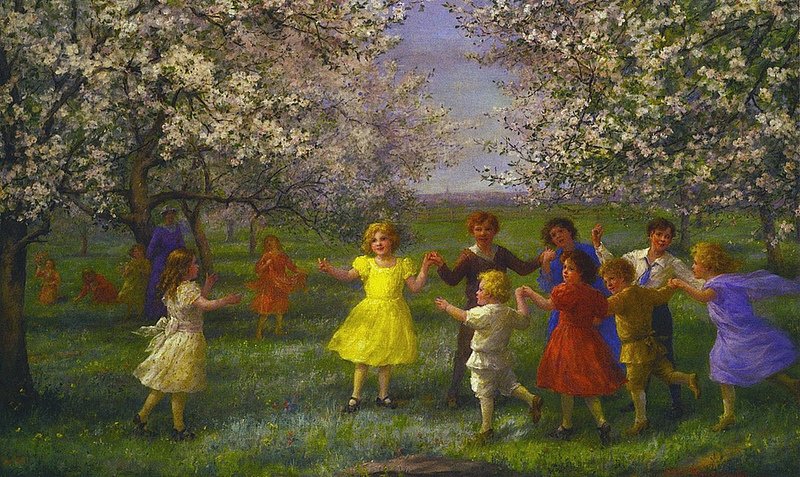
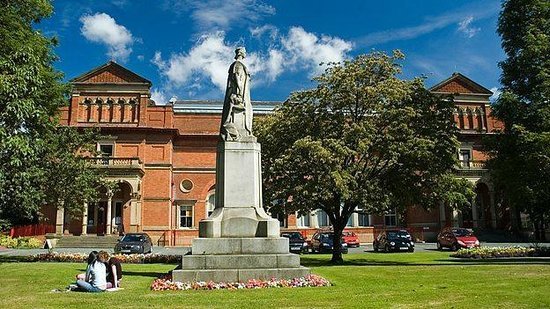
“…Among the new arrivals one year was Theodore Robinson, who, timidly, with due respect for my two years experience in Paris student life, sought my acquaintance… Frail, with a husky, asthmatic voice and a laugh that shook his meager sides and yet hardly made itself heard, yet blessed with as keen a sense of humor as anyone I have ever known, Robinson was received at once into our little circle. At first he seemed almost negative, so quietly he took his place among us, but once the shell of diffidence was pierced few of the men had thought as much or as independently…”

Arabs Arguing by Jean-Leon Gérome

Theodore Robinson was only with Carolus-Duran for a short time and rumour has it that they did not agree on some aspects of the artistic training,  Robinson moved on and became a student at the École des Beaux-Arts, and a pupil at the atelier of the French painter and sculptor, Jean-Léon Gérome, an artist, who had always been a great believer and follower of the painting style known as Academicism, a style of painting and sculpture produced under the influence of European academies of art. Gérome was noted for his portraiture and his history paintings which often featured Arabian scenes, which was known as Orientalism, and was an art genre of Academic art, popular in the nineteenth century which represented the Middle East.  The fact that Robinson was accepted into this atelier is testament to his artistic ability as it was the most admired studio and the one that most American students wanted to attend.
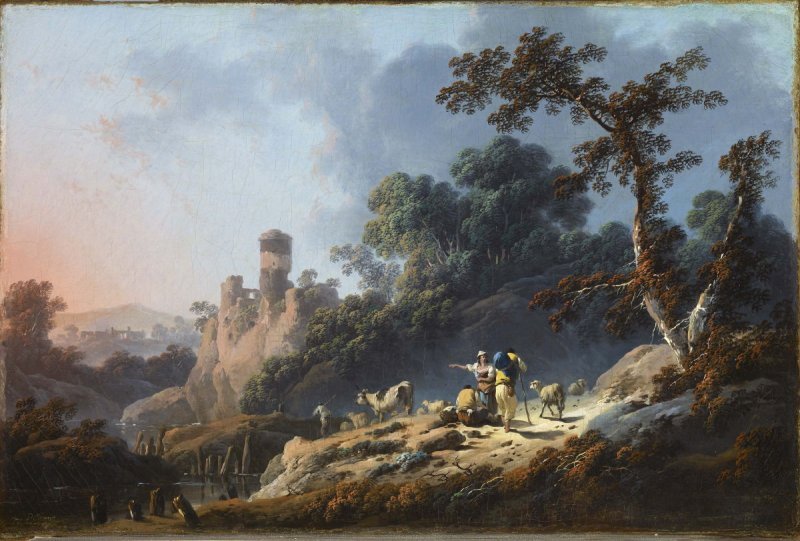
Spinning by Theodore Robinson

In 1877 Theodore Robinson achieved another of his artistic goals, one which every art student strived for; he had a painting, Une Jeune Fille, accepted at that year’s Salon. One can only imagine how delighted he was to get his painting hung at the Salon.  In a letter to his mother he wrote of his joy:

“…My picture is accepted and I tremble with joy…”

The Bridge at Grèz-sur-Loing by Corot (c.1860)

Robinson went on to exhibit his works at five more Salons during the 1880’s.  Following the time spent on his Salon entry and its inclusion at the 1877 Salon, Robinson decided to take a break from his studies and head out of the city and delve into the nearby countryside around Fontainebleau.  He and some of his fellow artists, Will Low, Birge Harrison and Walter Launt Palmer travelled to the village of Grèz which was on the banks of the River Loing on the southern edge of the Forest of Fontainebleau, some fifteen kilometres south of Barbizon.  At the time, this was an area that was awash with artist colonies such as those at Barbizon, Grèz-sur-Loing, Montigny-sur-Loing and Thomery but at this time, Grèz was the most popular with artists who wanted to spend the day painting en plein air and the evening spent talking about art.  This popular idyll was described in the book Theodore Robinson’s La Debacle, 1892: an American Artist in France by Betsy Kathryn Koeninger, in which she quotes the words of the Scottish painter John Lavery, a student at the Académie Julien who stayed in the village in the early 1880’s.   He described the ambience of the village and its surroundings:

“…a pleasant place surrounded by large fields of white and yellow water lilies and poplars and willows. There was also the much-painted bridge… a ruined castle and an ancient church… [and] Madame Chevillon’s Inn with its long garden down to the water’s edge where guests could sit in bathing dress to eat after a swim or a sail in a skiff…”

Farmhouse at Grèz by Theodore Robinson

Robinson’s friend and colleague from the Academy, Birge Harrison, who had travelled to Grèz with him and remembers him, wrote an article in the December 1916 edition of the Century Magazine, entitled With Stevenson in Grèz.  He wrote:

“…Robinson was far from handsome in the classic sense. An enormous head, with goggle-eyes and a whopper-jaw, was balanced on a frail body by means of a neck of extreme tenuity; and stooping shoulders, with a long, slouching gait, did not add anything of grace or of beauty to his general appearance.” It was not Robinson’s physical prowess that interested Harrison, but his strength of character. “[Out] of those goggle-eyes shone the courage of a Bayard, and in their depths brooded the soul of a poet and dreamer, while his whole person radiated a delightful and ineffable sense of humor…”

Another visitor to Grèz that summer was the writer Robert Louis Stevenson and he and Theodore Robinson immediately became good friends.

Once summer was over Robinson returned to Paris and his studies at Gérome’s studio and to copying the paintings of the Masters at the Louvre.  The climate in Paris during that winter was harsh and Robinson, a poverty-stricken artist, lived in poor conditions and suffered with colds and asthma attacks, all of which affected his work and he wrote to his mother:

“…When I’ve taken cold and cough all night my work is greatly interfered with not to mention the inconvenience it causes…”

On the Canal by Theodore Robinson

In 1878, Robinson decided to send one of his paintings to the Society of American Artists first exhibition.  The group had been founded the previous year by artists of attending the National Academy of Design which they believed did not satisfactorily meet their needs, and was far too conservative in its thinking.  This was the same reasoning behind the formation of the Art Students League which Robinson helped Wilmarth to organise in 1875.  The Society of American Artists was very valuable to those American artists who, having studied art in European cities, were returning home but discovered that there were inadequate prospects to exhibit their work. Robinson became a regular contributor to their annual exhibitions.

In my next blog I will be looking more at Theodore Robinson’s life and a very important and influential friendship he had with his French neighbour.

————————————————————————————–

Apart from the usual internet sources I found many details about Theodore Robinson’s life in an essay written  for the catalogue of the Theodore Robinson exhibition held at Owen Gallery, New York in March 2000 by the American writer and art curator, D. Scott Atkinson.

Jean-Baptiste Pillement

The Interrupted Sleep by Francois Boucher (1750)

Louis XIV, known as the Sun King died in 1715, at the age of seventy-seven after reigning for seventy-two years.  He had outlived all his legitimate children and two of his eldest grandchildren so his crown passed to his youngest grandchild, Louis Duke of Anjou, who became Louis XV at the age of five (the same age his grandfather was when he became Louis XIV) and his kingdom was ruled by his maternal great-uncle, Philippe II, Duke of Orléans as Regent of France, until Louis reached maturity in 1723.  The Duke of Orléans had a passion for beauty and cheerfulness and he tried to dismantle the godliness enforced by Louis XIV at his sumptuous home in Versailles. Following numerous wars under the previous monarch, France turned away from these imperial aspirations and instead, concentrated on more personal, and enjoyable pastimes. With this more relaxed political life and the letting-up of private morals, the change was mirrored by a new style in art, one that was intimate, decorative, and often erotic.  It was the era of Rococo.

Meeting in the Open Air by Jean-Antoine Watteau (c.1719)

Members of the new royal court began to decorate their sophisticated homes in a lighter, more delicate manner. This new style which came into being around the start of the 18th century has been known since the last century as “rococo,” from the French word, rocaille, for rock and shell garden ornamentation. The rococo style emphasized pastel colours, sinuous curves, and patterns based on flowers, vines, and shells. Artists moved away from depictions of lofty grandiloquence and instead focused on the pleasures of both colour and light, and also moved away from depictions of momentous religious and historical subjects and concentrated more on informal, friendly and relaxed mythological scenes as well as  joyous views of daily life, and elegant sophisticated portraiture.  When we think about rococo art we think of Jean-Antoine Watteau, François Boucher and Jean-Honoré Fragonard but today I am looking at the life and works of a lesser known rococo artist, Jean-Baptiste Pillement.

The Gardens of Benfica by Jean-Baptiste Pillement (1785)

Jean-Baptiste Pillement was born in Lyon, France on May 24th 1728.  He received his first artistic training as a teenager from the French painter, Daniel Sarrabat in Lyon.  The training he received gave him an excellent foundation in the Rococo style of genre painting which had become so popular through the works of Jean-Antoine Watteau and François Boucher.  In 1743, aged fifteen, Pillement moved from his home town to Paris where he was taken on as a design apprentice at the Manafacture des Gobelins, a tapestry factory, which is best known as a royal factory supplying the court of the French monarchs.   In 1745 he left Paris and travelled to Spain and remained there for five years. He spent those years moving from city to city earning money sometimes as a designer other times as a painter.

Landscape with Travelers and a Ruin by Jean-Baptiste Pillement
Landscape with Travelers and a Ruin
by Jean-Baptiste Pillement

One recurring theme depicted in his paintings was that of rugged landscapes, shepherds with their flocks of sheep and goats cross fast flowing streams by way of rickety bridges, on either side of the cascading water we see lush green vegetation all of which was bathed in the golden glow of sunlight.

In 1750, after five years in Spain, the twenty-two-year-old Pillement journeyed to Lisbon where he was to remain for four years.  In 1754 Pillement left the Iberian Peninsula and travelled to London.  The favoured artistic genre of the English at that time was landscape painting and this meant that Pillement’s Rococo-style of romanticised landscape art was in much demand.  One of the popular artists at that time whose work was to influence Pillement was Nicolaes Berchem, the highly regarded and prolific Dutch Golden Age painter who painted numerous works depicting pastoral landscapes in the seventeenth century.

Landscape with a waterfall and the Temple of the Sibyl at Tivoli by Nicolaes Berchem

Berchem was part of the second generation of “Dutch Italianate landscape” painters who had travelled to Italy to take in the romanticism of the country and who would later return home to the Netherlands with sketchbooks full of drawings of classical ruins and pastoral imagery. Like Pillement, a century later, Berchem’s works were based on the Arcadian landscapes of the French painter Claude Lorrain which would typically depict shepherds grazing their flocks among Classical ruins, bathed in a golden sunlit haze.

The Mouth of the River Tagus by Jean-Baptiste Pillement

During his sojourn in the English capital he became friends with the English actor, playwright, theatre manager and producer David Garrick and his wife, the dancer, Eva Maria Weigel.  Garrick had become quite wealthy through his acting and this allowed he and his wife to buy a palatial estate in Richmond-on-Thames which became known as Garrick’s Villa.  Eva Marie Weigel became an art collector and furnished the house with paintings, many of which were by Jean-Baptiste Pillement.

A Mountainous River Landscape by Jean-Baptiste Pillement

In 1763, Pillement was once again on the move, this time leaving London and travelling to Vienna.  His reputation as a successful painter gave him the opportunity to move in royal circles and was employed at the Imperial Court of Maria Theresa and Francis I.

Chinoiserie by Jean-Baptiste Pillement

In the eighteenth century, prints of designs was the foremost way of spreading information. They were often published monthly and were collected into folios or volumes, and people could order them by subscription. There was a massive demand throughout Europe, for these prints.   Pillement, whilst living in England, soon realised that the fashion there was the same as that in France, and, at the time, was the love of chinoiseries.  It was around 1764 that Pillement, according to his memoirs, had discovered a new method of printing on silk with fast colours.   Pillement’s illustrations were a blend of fanciful birds, flora & fauna, incorporating large human figures and chinoiserie.  The word, chinoiserie came from the French word Chinois, meaning “Chinese” and is a European version and simulation of Chinese and East Asian artistic traditions, especially in the field of decorative arts.  It first became popular during the 17th century and this trend was further commercialised in the 18th century with the boom in trade with China and East Asia.   The chinoiserie style is associated with the Rococo style with its cheerfulness, its concentration on materials, and often depicts times of great pleasure and leisure time.

One of Jean Baptiste Pillement's Ornamental Design for the book Nouvelle suite de cahiers chinois a l'usage des Dessinateurs et des peintres.
One of Jean Baptiste Pillement’s Ornamental Design for the book Nouvelle suite de cahiers chinois a l’usage des Dessinateurs et des peintres.

These beautiful and intricate designs were used by engravers and decorators not only on porcelain and pottery, but also on textiles, wallpaper and silver. Pillement published many albums, of these illustrations, the most famous being Œùvre de fleurs, ornements, cartouches, figures et sujets chinois which was published in 1776.

After Vienna, Pillement’s next stop, in 1765, was Poland and the city of Warsaw where he once again worked for the royal court of the Polish king, Stanislaw II, who commissioned him to decorate the Royal Castle in Warsaw and the nearby Ujazdowski Castle.

Inside Le petit Trianon

Pillement was forever on the move.  He worked in Saint Petersburg, the Piedmont, Milan, Rome and Venice as well as returning to his homeland where he was employed by Marie Antoinette to furnish the Petit Trianon, a small château located on the grounds of the Palace of Versailles which was built between 1762 and 1768 during the reign of Louis XV.   Its purpose was to house Louis XV’s long-term mistress, Madame de Pompadour, who sadly died four years before its completion.  However, all was not lost, as the Petit Trianon was subsequently occupied by her successor, Madame du Barry. When Louis XV died in 1774 he was succeeded by his son Louis-Auguste who became Louis XVI and when he came to the throne he gave the Petit Trianon to his wife Marie Antoinette whom he had married in 1770 when he was just fifteen years of age, the same age as his bride. In 1778 Pillement was nominated Court Painter to Queen Marie Antoinette, in which capacity he provided paintings for the Petit Trianon at Versailles.

A View of Lisbon by Jean-Baptiste Pillement

During the 1780’s Pillement was living once again on the Iberian Peninsula where he completed many of his most treasured works of art.  In Portugal, he became one of that country’s leading landscape and marine artists. He was also named Court Painter to Queen Maria I and King Pedro III, at last accepting the honour and pension that he had declined when he lived and worked in the country some thirty-five years earlier. It was during this second stay that he also gained a reputation as one of Portugal’s finest teachers of art.

Landscape with Washerwomen by Jean-Baptiste Pillement (1792)

He eventually returned to France in 1789 but instead of returning to Paris  he settled in a small town of Pézenas, in the Val d’Hérault in the Languedoc region.  In 1800, aged 72, he returned to his birthplace, Lyon, where he continued to paint.  On September 1st 1801 the First Consul, Napoleon Bonaparte signed a famous decree, Decree of 14 Fructidor, the so-called Chaptal Decree, named after the famous chemist Jean-Antoine Chaptal, who was the minister for the interior from 1800–04.  The decree offered the fifteen newly founded museums the art treasures which had been captured from “the enemies of the Republic”.  In the main, these were post-Revolution confiscations effected in France, but also included artwork which had been seized elsewhere in Europe by the Republican and, later, Napoleonic armies. In Lyon, in 1801, the founding of the Musée des Beaux-Arts Lyon. The institution also fulfilled local aspirations, such as recalling the city’s prestigious Roman past and furnishing models for the silk industry, which was in crisis at that time.  And at the beginning of 1803, the Louvre Museum began to send a total of 110 paintings to be housed in the Musée des Beaux-Arts Lyon.  Jean-Baptiste Pillement was employed at the museum to give art lessons which he continued doing for the rest of his life.

Fête Champêtre black chalk drawing by Jean-Baptiste Pillement
Fête Champêtre
black chalk drawing by Jean-Baptiste Pillement

Pillement achieved success not only as a landscape painter but was also one of the most influential decorators of the eighteenth century. His chinoiseries, arabesques and flower paintings providing elegant leitmotives for furniture makers, tapestry weavers, and particularly when he returned late in life to the south of France, he did much work for the silk industry of Lyon (Manufacture de Soie et des Indiennes), where he ended his distinguished career.

River Landscape by Jean-Baptiste Pellement

Jean-Baptiste Pillement died in Lyon in 1808, aged 80.  He will be remembered for his exquisite and delicate landscapes, but most of all for his engravings done after his drawings, and their influence in spreading the Rococo style and particularly the taste for chinoiserie throughout Europe.

In Maria Gordon-Smith’s 2006 book, Pillement, she commented:

“…the name Jean Pillement can evoke visions of Arcadian landscapes, luminous seascapes, and highly polished pastels and drawings. To the cognoscenti of decorative arts, Pillement is recalled as having been the most prolific and successful master of Rococo fantasy of his time. His designs were adopted by countless leading artistic manufactories, and their charm has never waned…”