Théophile “Théo” van Rysselberghe Part 2.

Van Rysselberghe went to Haarlem in September 1883 to study the light in the works of Frans Hals. He was fascinated by the way the artist had rendered the light and this facet of painting would remain with him for the rest of his life. It was also in the Netherlands that he first met the American painter William Merritt Chase.

Fantasia Araba, by Théo Van Rysselberghe (1884)

Having returned from the Netherlands he remained at home for a short while before setting off on his second painting trip to the Moroccan town of Tangier in November 1883 along with Franz Charlet who had accompanied him on his previous trip. He remained in Morocco for twelve months and managed to put together a large number of paintings and sketches. The highlight of which was his large painting (300 x 170cms) entitled Fantasia Araba, which he completed in 1884. It can be seen at the Royal Museums of Fine Arts of Belgium in Brussels.

Even though he was in North Africa Théo remained in close contact with Octave Maus discussing the running of Les XX. Les XX was a group of twenty Belgian painters, designers and sculptors, formed in 1883 by the Brussels lawyer, publisher, and entrepreneur Octave Maus.

Les XX poster for their sixth exhibition in 1889

For ten years, Les XX held an annual exhibition of their art; each year twenty other international artists were also invited to participate in their exhibition. Théo would suggest names of artists to Maus who he believed should be invited to their first exhibition in 1884. In the first year’s show the foreign invitees included Auguste Rodin, John Singer Sargent, Max Liebermann, Whistler and William Merritt Chase

Abraham Sicsu (Consul de Belgique a Tanger) by Théo Van Rysselberghe (1884)

His long stay in North Africa ended in October 1884 when he ran out of money and had to return home to Belgium. Once again he had many completed paintings to exhibit, including Fantasia Araba, at the second Les XX exhibition in 1885. Another of van Rysselberghe’s paintings exhibited was his portrait of Abraham Sicsu who had entered the service of the Belgian legation in Tangier in 1864 as an interpreter. Many famous painters and members of the Belgian royal family had visited him. He was appointed Belgian consul and officer of the Order of Leopold on 8 April 1889 and finally obtained Belgian naturalisation.

Madame Edmond Picard in Her Box at Theatre de la Monnaie by Theo Rysselberghe (1886)

In the 1886 Les XX exhibition van Rysselberghe saw the works of the Impressionist, Claude Monet and Auguste Renoir. He was so enthralled by what he saw that he decided to experiment with this artistic technique. An example of this is his 1886 painting entitled Madame Edmond Picard in Her Box at Theatre de la Monnaie.

Madame Oscar Ghysbrecht by Théo van Ryssdalberghe (1886)

… and his Portrait of Madame Oscar Ghysbrecht in which he used a palette of bright colours.

Les Dunes du Zwin, Knokke, by Théo van Rysselberghe (1887)

…and the impressionist style of van Rysselberghe carried on through many of his landscape and seascape painting including his 1887 work entitled Les Dunes du Zwin, Knokke, a municipality of of West Flanders in  Belgium.

A Sunday Afternoon on the Island of La Grande Jatte by Georges Seurat (1886)

Van Rysselberghe had cultivated close ties with the Parisian art scene, so much so that Octave Maus asked Rysselberghe to go to Paris and search out up-and-coming new talent who would be able to take part in future exhibitions of Les XX. Whilst in Paris van Rysselberghe became aware of Pointilism, a technique of painting in which small, distinct dots of colour are applied in patterns to form an image. It was a hallmark of Neo-Impressionist painters. Théo first saw it when he visited the eighth impressionism exhibition in 1886 and Georges Seurat’s painting, A Sunday Afternoon on the Island of La Grande Jatte. Théo and some other Belgian artists brought the pointillism art form back to Belgium but not every art critic was impressed by this new technique. Seurat was invited to exhibit at the 1887 salon of Les XX in Brussels but it received a very unfavourable reception with many art critics labelling it as “incomprehensible gibberish applied to the noble art of painting”.

Anna Boch by Théo van Rysselberghe (c. 1889)

Not to be deterred by the art critics’ vitriolic comments Théo decided to change his painting style abandoning realism and became proficient at pointillism. In the summer of 1887, he spent a few weeks in Batignolles, near Paris with Eugène Boch, a brother of Anna Boch, a Belgian painter, art collector, and the only female member of the artistic group, Les XX. His 1889 painting of Anna Boch is a good example of Théo’s pointillism style. It was while with Eugène Bloc that he met several painters from the Parisian art scene such as Sisley, Signac, Degas and especially Henri de Toulouse-Lautrec. He took the opportunity to invite several of them, including Signac, Forain, and Toulouse-Lautrec to the next exhibition of Les XX.

View of Meknès by Théo van Rysselberghe (1888)

In December 1887 Théo was invited, together with Edmond Picard, to accompany a Belgian economic delegation to Meknès, one of the four Imperial cities of Morocco, located in northern central Morocco and the sixth largest city by population in the kingdom.

Encampment near a Moroccan Village by Théo van Rysselberghe (1888)

Encampment near a Moroccan Village by Théo van Rysselberghe (1888)

His third stay in Morocco lasted three months during which time he completed many coloured pencil sketches, made copious notes and took many photos all of which he used to complete paintings. When he had finished these paintings, he stopped completely with this “Moroccan period” in his life. He now turned to portraiture, resulting in a series of remarkable neo-impressionist portraits.

Portrait of Alice Sèthe by Théo van Rysselberghe (1888)

The portrait of Alice Sèthe was an early one of van Rysselberghe’s divisionist (or pointillist) works which juxtaposes small touches of pure tones on the canvas. Alice stands before us in a beautiful blue and white dress. Behind her are the accoutrements of a luxurious setting. Van Rysselberghe’s mixing of colours no longer takes place on his palette but in the eye of the observer. Théo Van Rysselberghe remains one of the few artists who have put this technique in his portraits. This blue and gold portrait, completed in 1888, would become a turning point in his artistic life.

Portrait of Irma Sèthe by Théo van Rysselberghe (1894)

Gérard Sèthe was a wealthy textile merchant from Brussels who belonged to Van Rysselberghe’s circle of friends. Van Rysselberghe portrayed the Sèthe daughters, Irma, Maria and Alice on several occasions. The portrait of Irma Sèthe depicts her playing the violin. The Sèthe family were very musical with Maria playing the harmonium and Irma was apprenticed to the “King of Violin” Eugène Ysaÿe, a violinist and teacher at the Royal Conservatory of Brussels. The Portrait of Irma Sèthe epitomises Van Rysselberghe’s pointillism. The satin of Irma’s dress lights up in full pink, comprised of thousands of dots of unmixed colours. The changing light and colour effects create a strong plastic effect over the folds on Irma’s sleeves and skirt. In Irma’s portrait we see her completely engrossed in playing her violin. Our eyes are fixed on her and yet, maybe unnoticed at first, we see that she is not alone as sitting in the room next to her is another woman sitting in a chair with one hand laid on her blue dress. Why was this other woman included in the portrait? Is Irma aware of her presence? Only van Rysselberghe knows the answers. The portrait was exhibited in 1895 at the Paris Salon des Indépendants, in 1898 at the salon of La Libre Esthétique, and in 1899 at the thirteenth exhibition of the Vienna Secession.

Marie Monnom by Fernand Khnopff  (1887)

Fernand Khnopff completed this Portrait of Marie Monnom in 1887. Her father, a publisher of L’Art moderne in Brussels, had commissioned the work. We see her in Khnopff’s studio sitting in an armchair and seen from the side. It shares a number of elements with several portraits of women painted by Khnopff such as the golden circle on the wall on the upper left, the gloves that Marie is wearing, the framing which slices off the subject’s feet. She does not hold our gaze and her face, although bathed in light, is expressionless. Nothing of her personality shows through.

Sunset at Ambleteuse by Théo van Rysselberghe (1899)

Cap Griz Nez by Théo van Rysselberghe (1900)

On September 16th 1889, Théo van Rysselberghe, a close friend of Khnopff’s, married Marie Monnom and they went on their honeymoon to the south of England and then to Brittany where he made many sketches that he would later turn into finished paintings. In October 1890 their daughter Élisabeth was born.

Élisabeth by Théo van Rysselberghe, (1916)

Madame Theo van Rysselberghe and Her Daughter by Théo van Rysselberghe (1899)

Élisabeth in Straw Hat by Théo van Rysselberghe (1901)

Van Rysselberghe’s wife and daughter featured in many of his portraits.

Olive Trees near Nice by Théo van Rysselberghe (1905)

As the years passed van Rysselberghe used his pointillist technique less frequently and by 1910, he had completely put aside pointillism. His brushstrokes became longer and he used more often vivid colours and more intense contrasts, or softened hues. He had mastered the application of light and heat in his paintings.

Female Bathers Under the Pines at Cavaliere by Théo van Rysselberghe (1905) 

He completed his painting entitled Olive Trees near Nice in 1905 and the technique he used for this work is similar to one used by Vincent van Gogh with its longer brushstrokes in red and mauve becoming prominent in his 1905 painting, Bathing ladies under the Pine Trees at Cavalière.

The Vines in Saint Clair by Théo van Rysselberghe (1912)

Van Rysselberghe was travelling along the Mediterranean coast with his friend, the French Neo-Impressionist painter, Henri-Edmond Cross, looking for a suitable place to live. Cross lived in Saint-Clair and van Rysselberghe immediately fell in love with this coastal location. Théo’s brother Octave, who lived nearby, was an architect and, in 1911, he built a house for his brother. Théo now living on the Côte d’Azur slowly extricated himself from the Brussels art scene.

Bathers by Théo van Rysselberghe (1920)

The Model’s Siesta by Théo van Rysselberghe (1920)

Nude from behind Fixing her Hair by Théo van Rysselberghe (1920)

Now living on the Mediterranean coast many of Théo’s painting featured nearby landscape and coastal scenes. He continu

ed with his portraiture mainly focusing on his family. However in the first two decades of the twentieth century he produced many works featuring female nudity.

Théophile van Rysselberghe died on December 14th 1926 aged 64 and was buried in the cemetery of Lavandou, next to his friend and painter Henri-Edmond Cross.


Once again most of the information for this blog came from various Wikipedia and associated sites.

Théophile “Théo” van Rysselberghe Part 1.

The artist I am looking at today is Théophile “Théo” van Rysselberghe a Belgian neo-impressionist painter, who was a major protagonist in the European art scene at the turn of the twentieth century.

Self-portrait in a Green Waistcoat (1924)

Théo was born in Ghent on November 23rd 1862, the youngest child of Jean-Baptiste and Melanie van Rysselberghe and had five bothers and a sister. He was brought up in a French-speaking middle-class home. His first art training occurred when he attended the Royal Academy of Fine Arts in Ghent studying under the Belgian painter, Theo Canneel.

Oriental Beauty by Jean-François Portaels

In 1879 he enrolled at the Académie Royale des Beaux-Arts in Brussels under the directorship of Jean-François Portaels, a Belgian painter of genre scenes, biblical stories, landscapes, portraits and orientalist subjects. Portaels is regarded as the founder of the Belgian Orientalist school and his North African paintings had started an orientalist fashion in Belgium. This aspect of Portaels’ work had a great influence on the young Théo van Rysselberghe, so much so that he made three extended painting trips to Morocco between 1882 and 1888.

Self-portrait with Pipe by Théophile “Théo” van Rysselberghe (1880)

In 1880, when Theo was eighteen years of age he submitted and had accepted two portraits to the Salon of Ghent and that year completed a self-portrait entitled Self Portrait with Pipe. In 1881, he exhibited for the first time at the Salon in Brussels.

Portrait of a Young Spanish Woman by Théophile “Théo” van Rysselberghe

Spanish Woman by Théophile “Théo” van Rysselberghe (1880)

In 1881 Theo made his first trip to Spain and Morocco, along with his friend Frantz Charlet, a Belgian painter, etcher, and lithographer and the Asturian painter Darío de Regoyos. It was Theo’s intention to follow in the footsteps of his mentor, Jean-François Portaels.

Descent from the Cross by Pedro Campaña (1547)

Whilst in Madrid he visited the Museo del Prado and later the trio visited Seville where Théo met Constantin Meunier, who had been commissioned by the Belgian government to copy Pedro Campaña’s Descent from the Cross which was mounted on the back wal of the Sacristia Mayor of Seville Cathedral.

Dario de Regoyos playing the guitar by Théo Van Rysselberghe (1882)

During Théo’s stay in Spain he made time to complete a portrait of his fellow traveller, Darío de Regoyos, playing his guitar.

Arabian Street Cobbler by Théo Van Rysselberghe

Moroccan Market by Théo Van Rysselberghe (1883)

Théo arrived in Tangier at the end of October 1882 and suddenly he realised that he had entered a “new” world, so different from the Europe he had come from. He stayed in the town for four months continually sketching and painting street scenes, the kasbah and the souk.

The Oyster Eater by James Ensor (1883)

In April 1883 he exhibited these scenes of everyday Mediterranean life at the Salon L’Essor, in Brussels. L’Essor was an association of visual artists in Brussels, which was active from 1876 to 1891. Its original aim was to rebel against the conservative tendencies of the art institutions and art circles in Brussels. However in 1883 some of the artists of this group were dissatisfied with the ruling body of the group with regards its admission policy, lack of direction and their controversial decision to reject Belgian Expressionist painter James Ensor’s The Oyster Eater in the 1883 L’Essor Salon. However, it has to be remembered that the previous year the Antwerp Salon jurists had rejected the same painting. It is thought that the rejection was because of the sexual overtones suggested by a single young woman eating oysters, which at the time was considered to be an aphrodisiac.

Portraits of or work by the 11 original founders of Les XX. Upper register, left to right: Darío de Regoyos y Valdés, Guillaume van Strydonck, Théo van Rysselberghe, Fernand Khnopff and a portrait of Willy Finch by Magnus Enckell. Bottom, left to right: La donna morta by Willy Schlobach, Rodolphe Wytsman, Le viatique qui passa (1884) by Charles Goethals, a medal made by Paul Du Bois, and a painting by Frantz Charlet. Right, larger image: James Ensor.

Portrait of Octave Maus by Théo Van Rysselberghe

Portrait of Octave Maus by Théo Van Rysselberghe (1885)

Van Rysselberghe and James Ensor were two of the eleven artists who left L’Essor and became founding members of the breakaway group, Les XX. Les XX became a group of twenty Belgian painters, designers and sculptors, formed by the Brussels lawyer, publisher, and entrepreneur Octave Maus, who, with his wife, featured in a number of van Rysselberghe’s portraits between 1883 and 1890, Each year twenty other international artists were also invited to participate in the Les XX exhibitions. Among the most notable members were James Ensor, Willy Finch, Fernand Khnopff, Félicien Rops, and later Auguste Rodin and Paul Signac.

Emile Verhaeren by Théo Van Rysselberghe

Emile Verhaeren by Théo Van Rysselberghe ((1892)

Rysselberghe completed many portraits and it was around 1882 that he struck up a close friendship with the poet and art critic Emile Verhaeren who featured in many of Théo’s portrait works. The lower work was viewed as a masterpiece of Neo-Impressionist drawing and aroused the passions of true connoisseurs. The sketch sold for 150,000 euros in 2006, it was offered at the same auction house, Christie’s Paris, on 21 October 2023 with an astonishing estimate of 60-80,000 euros. After a fierce bidding war, it sold for €240,000. This works out at €302,000, with the buyer paying the substantial sales costs.

Portrait of Marguerite van Mons by Théo Van Rysselberghe (1886)

Another of Rysselberge’s portraits featured the daughters of his friend Emile van Mons, a lawyer and well-known art lover. The June 1886 Portrait of Marguerite van Mons features ten-year-old Marguerite shortly after the death of her mother. She stands facing us wearing a simple black dress in front of a pastel blue door on which are a number of gilded ornaments. Her right hand holds the doorknob as if she had just entered or was about to leave the room. There is an air of mystery and melancholia about the depiction as the pale-faced girl stares absently out at us

Portrait of Camille van Mons by Théo Van Rysselberghe (1886)

Months earlier van Rysselberghe had completed a portrait of Marguerite’s elder sister, Camille.

……. to be continued

.


Most of this information for this blog came from various Wikipedia sites.

Hannah Harrison Cohoon and the Shakers.

My short blog today is about n artist and a religion. It looks at the life and works of Hannah Cohoon, a person you may not have heard of before. Her art is both unusual and simplistic and is connected to a millenarian restorationist Christian sect known as The United Society of Believers in Christ’s Second Appearing, but more commonly referred to as the Shakers. The group grew out of a branch of Quakerism around  1747 in Northwest England and later, the visionary Ann Lee (Mother Ann) brought Shakerism to America in the 1780s.

Shaker workshop service showing worshippers on benches and marching in a spiral.

The Shakers were so-called because of their practices of shaking, dancing, whirling, and speaking, shouting, and singing in tongues.

Hancock Shaker Village

Round Stone Barn and Fields

Hannah Harrison Cohoon was an American painter born in Williamstown, Massachusetts on February 1st 1788 and later became a member of Hancock Shaker Village. Although there are only sketchy details of Hannah’s education it is thought that she would have been instructed in watercolour painting and probably would have learned needlework skills from her elders as it was a skill, like painting that was considered an essential ability that every young woman should possess Hannah, now married, and known as Hannah Cohoon was twenty-nine-years-old and the mother of two young children. Her son Harrison was born in 1812 and her daughter Mariah was born in 1814. It was on March 15th 1817 that the twenty-nine-year-old Hannah entered the Hancock Shaker Village community situated just outside  Hancock and Pittsfield, Massachusetts. In the main, the Hancock Shakers supported themselves through farming. The grew and cultivated flowers and plants and from them sold garden seeds. Over time they purchased more land and by the 1830s the Hancock Shakers owned about 3,000 acres (12 km2).

Tree of Light or Blazing Tree by Hannah Cohoon (1845)

The leading artists at the time who worked at Hancock were Joseph Wicker, Hannah Cohoon, and Polly Collins and all chose to depict images which were derived from nature, especially trees. For the Shakers, the Tree of Life was an immediately identifiable symbol, celebrated in sermons, gift songs, and in their early history as a representation of the unity of the Shaker Church.

Tree of Life by Hannah Cohoon (1854).   Ink and tempera on paper. Courtesy of Andrews Collection, Hancock Shaker Village.

When we look at Cohoon’s wonderful single-image paintings of trees we realise that her expertise in embroidery, the ornamental needlework of appliqué, and her knowledge of quilting techniques were all present in her mind when she painted. It was during a summer day in 1854, that Hannah Cohoon, who had been a member of the Shaker community in Hancock for thirty-seven years, had a vision of a singular and curious tree. She saw plainly the branches, leaves and fruit, and she sketched and painted them on a sheet of white paper. One of the Shaker elders saw what she had done and told her that the name of the tree was the Tree of Life. Cohoon described how the vision came to her to create the Tree of Life drawing:

…I received a draft of a beautiful Tree pencil’d on large sheet of plain white paper bearing ripe fruit. I saw it plainly, it looked very singular and curious to me. I have since learned that this Tree grows in the Spirit Land. Afterwards the Spirit showed me plainly the branches, leaves and fruit, painted or drawn upon paper. The leaves were check’d or cross’d and the same colours you see here. I entreated Mother Ann to tell me the name of this tree which she did on Oct. 1st 4th hour P.M. by moving the hand of a medium to write twice over Your Tree is the Tree of Life…”

A Bower of Mulberry Tree by Hannah Cohoon. (1854). Ink and tempera on paper. Courtesy of Andrews Collection, Hancock Shaker Village.

A Bower of Mulberry Trees by Hannah Cohoon (1854)

The main feature of Hannah’s painting entitled A Bower of Mulberry Trees is dominated by the curving branches of trees that form an arch over a long Shaker table which is set out for a feast. It came from her vision of Shaker elders feasting on cakes under mulberry trees which were held at biennial meetings,. The doves represent the bounties that the believer would experience in heaven, and the table depicts holy feasts which were held biennially.

A Little Basket Full of Beautiful Apples by Hannah Cohoon (1856) Art Work by Hannah Cohoon / Courtesy the Hancock Shaker Village Collection / American Folk Art Museum.

Hannah also completed A Little Basket Full of Beautiful Apples in 1856. In his article for the New Yorker journal, Adam Gopnik, a long-time staff writer for the paper, wrote:

...Shining Tree of Life is among the key drawings in American art, with a tonic sense of abundance—all the apples just alike, each with its rub-on of rouge, like blush applied by an adolescent girl—allied to obsessive order…”

Hannah Harrison Cohoon died in Hancock, Massachusetts, on January 7th, 1864, aged 75 and is buried in the family cemetery of the Church.


An image of Cohoon’s Tree of Life appeared in a December 1945 Antiques magazine article by Edward Deming Andrews. Andrews used the image for the covers of his books, Visions of Heavenly Sphere and Fruits of the Shaker Tree of Life in 1969 and 1975.
The Hancock Shaker Village became a museum in 1960, and sometime after that the Andrews sold Cohoon’s drawings and other gift drawings to the museum. Andrews also organized an exhibit at the Whitney Museum of American Art in 1935.
Her Tree of Life drawing was used in 1974 for a UNICEF Christmas postcard to raise funds for the organization. In 1980, the Whitney Museum of Art held another exhibition, “American Folk Painters of Three Centuries, which featured four of Cohoon’s drawings.

New Hope Artists. Part 3.

The third artist who was involved in the early days of the New Hope Artists Colony was Daniel Garber.  He has been looked upon as being one of the three most important painters of that group

Daniel Garber

Daniel Garber was born on April 11th, 1880, in North Manchester, Indiana. He was the son of Daniel Garber and Elizabeth Garber (née Blickenstaff). Daniel always had a love of art and the belief he could some day become a professional artist.  In 1897, when he was sixteen years old he enrolled at the Art Academy of Cincinnati.  In that same year he moved to Philadelphia and in 1899 he became a student at the Pennsylvania Academy of the Fine Arts on a six year course.  His instructors at the Academy included Thomas Anshutz, William Merritt Chase, and Cecilia Beaux.  During the summers of 1899 and 1900 he also registered to take summer school classes in Fort Washington, Pennsylvania, at the Darby School of Painting, where he studied under Hugh Breckenridge, an artist and educator who championed the artistic movements from impressionism to modernism and Thomas Anshutz, an artist known for his portraiture and genre scenes, and who, along with Breckenridge, was a co-founder of The Darby School. This summer art school flourished first in Darby, PA, and then in Fort Washington, PA, between 1898 and 1918.  Anshutz and Breckenridge brought a lot of new ideas about painting back to Philadelphia after their European stays, and introduced those ideas to a public that was initially not very responsive to Impressionism, 

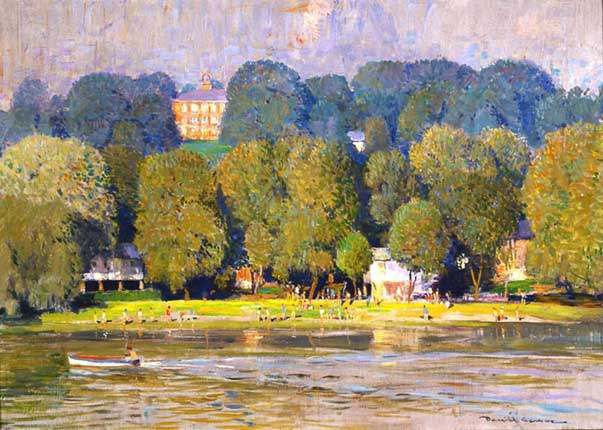
Lambertville Beach by Daniel Garber

During his time as a student at the Pennsylvania Academy, Daniel Garber met fellow artist Mary Ethel Franklin while she was posing as a model for the portrait class of Hugh Breckenridge. Peviously, she had been a student of Howard Pyle when he taught at the Drexel Institute. Following on from a two-year courtship, Garber and Mary were married on June 21st, 1901.

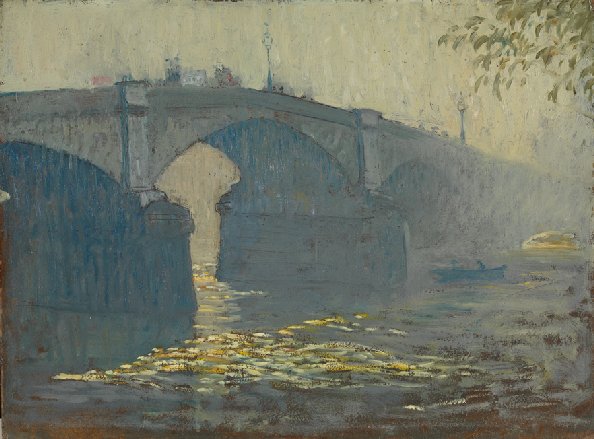
Battersea Bridge by Daniel Garber (1905)

Whilst still studying at the Academy, Daniel opened a studio in Philadelphia in 1901 and set to work as a portraitist and commercial artist. In May 1905, he won a Pennsylvania Academy award, The William Emlen Cresson Traveling Scholarship, which financed him to go to Italy, England and France for two years of independent studies. During his two-year sojourn in Europe he was continually creating paintings which depicted different rural villages and farm scenes and built up a collection of Impressionist landscapes some of which were exhibited at the Paris Salon. One such work was entitled Battersa Bridge.

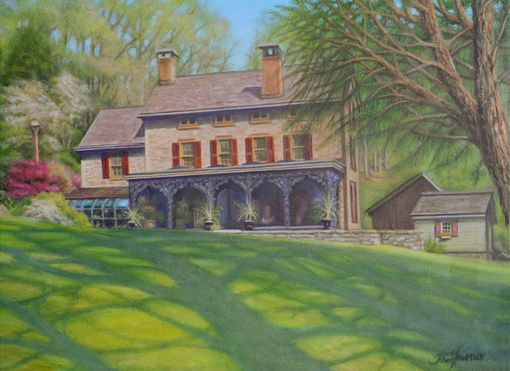
Painting of Daniel Garber’s home, Cuttalossa, by J.C.Turner

Upon his return to America in 1907, Garber began teaching life and antique drawing classes at the Philadelphia School of Design for Women. That summer, Garber, his wife and baby Tanis settled in Lumberville, Pennsylvania, a small town just north of New Hope. Their new summer home came to be known as Cuttalossa, named after the creek which occupied part of the land. The family spent part of their time in Lumberville and part in Philadelphia at their Green Street townhouse which he used as a base when he was teaching.

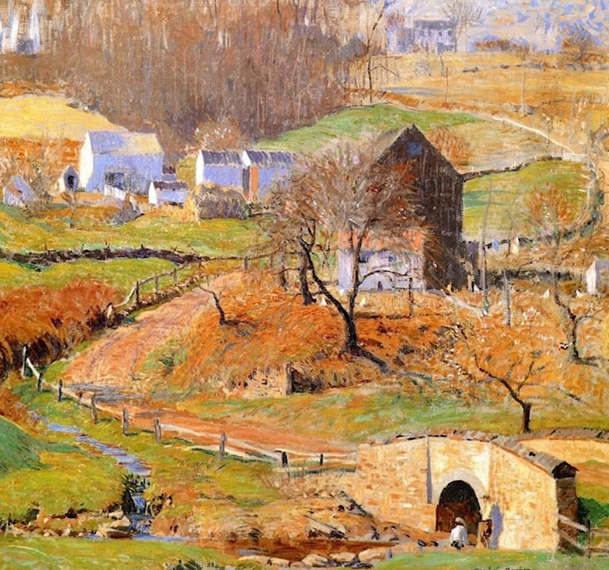
Rural Landscape by Daniel Garber

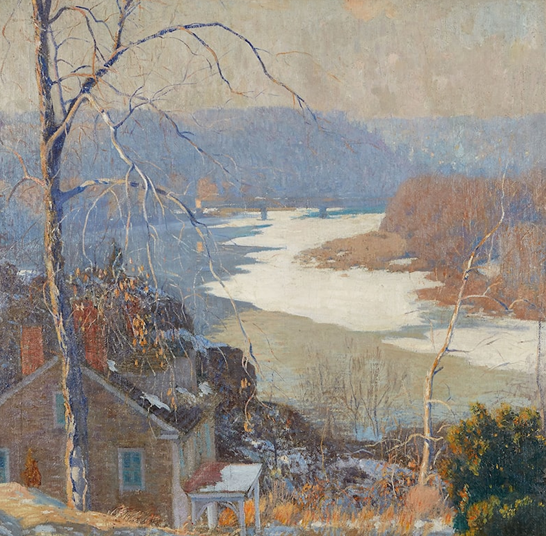
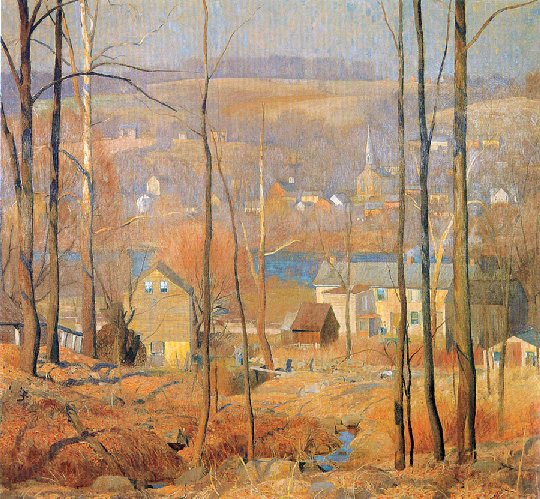
Up the River, Winter by Daniel Garber (1917)

Daniel submitted many of his Pennsylvania landscapes at various exhibitions and received numerous prestigious awards for these works.

Garber teaching at Chester Springs, c. 1935. Image courtesy of the Garber family.

In Autumn 1909, Garber was offered a position at the Pennsylvania Academy as an assistant to Thomas Anshutz. Garber accepted and became an notable instructor of art at the Academy where he taught for the next 41 years. As a lecturer in art, Garber aroused in his students an anxious silence as he passed among them, correcting the mistakes in their work. The brusque severity of his remarks often had his students, especially the women, in tears. He commented to one female student whilst critiquing her artwork:

“…Can you cook?……You sure can’t draw, so you’d better learn how to cook…”

Garber’s students, albeit often fearing his harsh critiques, respected his honest comments, realising the value of his observations and understanding the high expectations and dedicated concern underlying them.

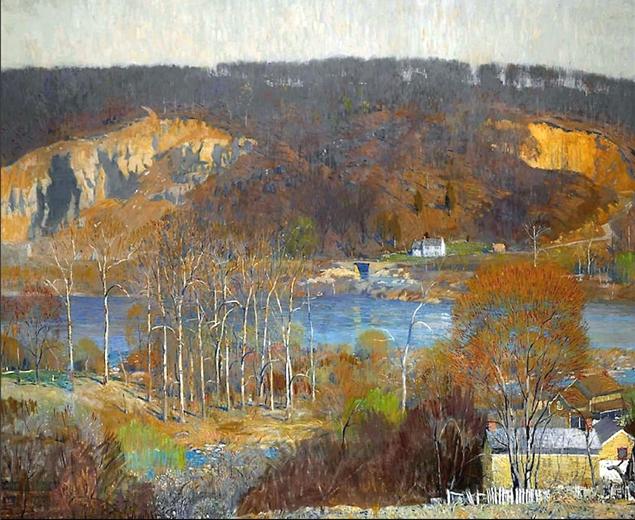
The Valley – Tohickon by Daniel Garber (1914)

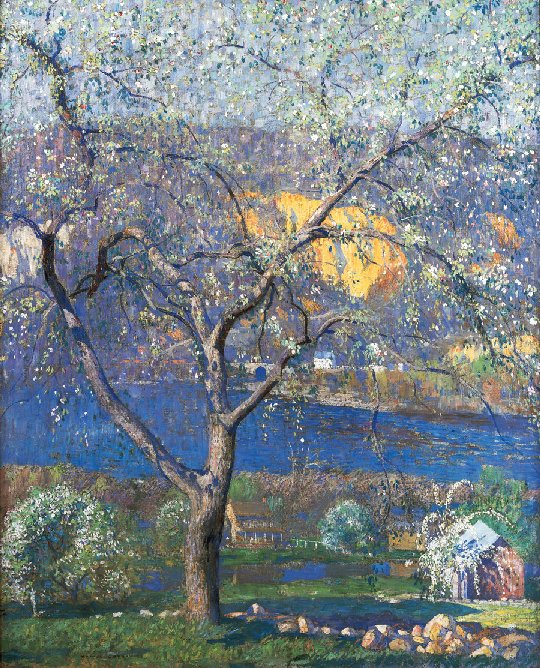
Daniel Garber painted consummate landscapes depicting the Pennsylvania and New Jersey countryside which surrounded New Hope. In contrast to fellow New Hope artist, Edward Redfield, Garber delicately painted using a thin paint application technique. His paintings exude both beautiful colour and light, which generate a sensation of endless depth. Garber like Redfield painted large exhibition size works with the intention of submitting them to exhibitions and winning prizes which they were both extremely successful doing so.

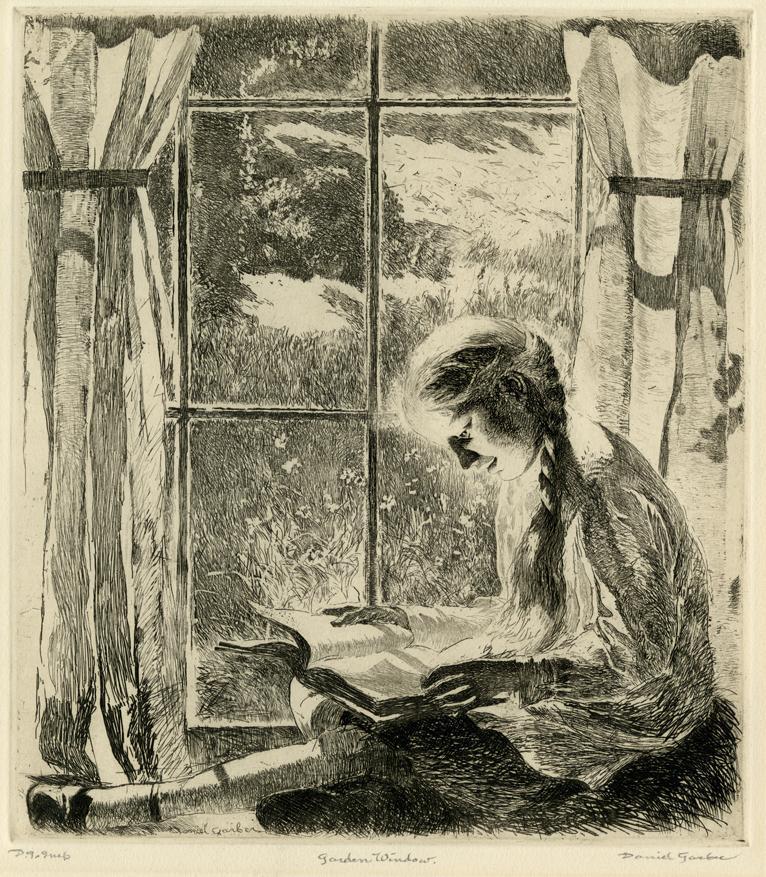
Garden Window, an etching and drypoint on paper by Daniel Garber (1946).

Although, he completed many small delicate paintings he was a fine draftsman, and completed many works on paper, mostly in charcoal but also a few works in pastel. Daniel Garber was also a talented etcher completing a series of about fifty different scenes, most of which run in editions of fifty or fewer etchings per plate.

Stockton Church etching by Daniel Garber (1941)

Daniel Garber loved to sketch. In fact the first jobs he held during his teenage years honed his skills as a draftsman. After working at the Franklin Engraving Company, Daniel Garber illustrated books and magazines, one of which was the collected works of Theodore Roosevelt. In 1917, he went back to his first love, drawing, this time as a printmaker. There was financial sense for Garber in making prints as by doing so he widened his exposure as an artist, exhibiting his work at print venues as well as the usual gallery outlets. He held many one-man exhibitions of his drawings, etchings, and prints and this meant an expansion to his market.

Tanis Garber by Daniel Garber (1914)

Daniel and Mary Garber’s first child Tanis had been born in Paris on December 16th 1906 and when she was seven years old her father completed her portrait. The portrait is part of the National Gallery, Washington’s collection.

Tanis by Daniel Garber (1915) From the Warner Collection of the Westervelt Warner Company, displayed in the Westervelt Warner Museum of American Art, Tuscaloosa, Alabama.

In this depiction (above) of his daughter Tanis he portrays her as if standing in a doorway of his studio at their home, Cuttalossa. In this work Garber began to explore the passage of light through air and objects. Although this might look like an Impressionist-style work, it is not about capturing fleeting light effects or impressions. In fact, Garber said that the painting was worked on over all of the summer months of 1915, with himt apparently returning to the work when his general light effects could be recreated. What Garber had in mind was his desire to simply achieve a Golden Age depiction of childhood; an eternal idealized image, rather than a momentary real one.

The Boys by Daniel Garber (1915) Depicting three of Garber’s students at the Pennsylvania Academy of the Fine Arts, this oil was created in his studio at Cuttalossa

Garber’s second child, John Franklin Garber was born in Pennsylvania on September 25th 1910, three years after his parents had returned to America from France. He grew up on the Garber property Cuttalossa, near Lumberville and he, like his sister Tanis and his mother, posed for many of Garber’s figurative paintings. He attended Penn Charter School and graduated with a degree in chemical engineering from Lehigh University in 1933. John Garber became a keen sponsor and advocate of his father’s work, assisting and corresponding with museums, private collectors, dealers and writers

Geddes Run by Daniel Garber (1930)

Daniel Garber’s works were exhibited nationwide and many earned awards, including a gold medal at the Panama-Pacific International Exposition in 1915 in San Francisco, California. He was elected a member of the National Academy of Design in 1913.

Buds and Blossoms by Daniel Garber (1916)

Daniel Garber died, aged 78, on July 5th, 1958, after falling from a ladder at his studio.

He continued to paint until nearly the end of his life and produced over 2,500 objects which were shown at over 750 exhibitions during the course of his lifetime. It had always been his desire to create and to share his art with the public. This interest in art and educating was also apparent by his forty-one years at the Pennsylvania Academy of Fine Arts, where he taught from 1909 until 1950, where he offered up his knowledge of art and was able to influence succeeding generations of artists. Garber’s paintings today are considered by collectors and art historians to be among the finest works produced from the New Hope art colony. His paintings can be seen in many major museums including the Smithsonian American Art Museum in Washington, DC, the Art Institute of Chicago and Philadelphia Museum of Art.

Was he the greatest of the New Hope painters ? I will let you decide.


Information for this blogs was obtained from a number of sources including:

Incollect

New Hope Colony Foundation of the Arts

Michener Art Museum

Jims at Lambertville

New Hope Artist Colony. Part 2.

The second artist I am looking at who was an early member of the New Hope Artists Colony was Edward Redfield

Edward Willis Redfield

Edward Willis Redfield was born on December 18th 1869 in Bridgeville, Delaware, before moving to Philadelphia as a young child. He was the youngest son of Bradley Redfield, who owned plant nurseries and sold fruit and flowers, and Frances Gale Phillips. He had two older brothers, Eugene and Elma, an older sister Ada and a younger sister May. Even at the age of seven he showed a love and talent for art and aged seven he exhibited a drawing of a cow in a competition for school children at the Centennial Exposition in 1876. From an early age, he studied at the Spring Garden Institute and the Franklin Institute and continued to show artistic talent. It was Redfield’s aim to be accepted into the Pennsylvania Academy, so in preparation for studying there, he received training from a commercial artist, Henry Rolfe. In 1887 Edward’s dream came true when he was accepted on a two-year course at the Pennsylvania Academy of the Fine Arts in Philadelphia. At the Academy his tutors were Thomas Anshutz, James Kelly and Thomas Hovenden. Anshutz, like Thomas Eakins, focused on an intense study of the nude as well as on human anatomy. While a student at the Academy Redfield met Robert Henri, who would later become an important American painter and educator and he and Henri became lifelong friends with  Henri often spedingt weekends at the Redfield home.

Village of Equihen, France by Edward Willis Redfield (1908)

Once he had completed his studies at the Academy in 1889, he approached his father for financial support for his proposde trip to study art in Paris. Redfield’s father agreed to send his son fifty dollars per month to finance a period of study in Europe and so Redfield left for Paris with the sculptor and former fellow student, Charles Grafly and they met up with Robert Henri in the French capital. Redfield and Henri attended classes at the Julian Academy, a school which provided art tuition to foreigners who had difficulty gaining entrance to the Ecole des Beaux-Arts. His instructors there were William Adolphe Bouguereau, one of the leading and best-known French academic painters and Tony Robert-Fleury. .Whilst residing in France Redfield became influenced by the work of the Impressionist painters Claude Monet, Camille Pissarro, and the Norwegian artist Fritz Thaulow.

Hotel Deligant in Bois-le-Roi-Brolles

It was while he was living in France that Redfield met Elise Devin Deligant, the daughter of the innkeeper of the Hotel Deligant in the village of Bois-le-Roi, a French commune located on the edge of the forest of Fontainebleau and along the Seine, 6km from Fontainebleau and 60km from Paris. The village inn became a meeting place for Redfield, Henri, Grafly, and they attracted other young artists who would come and the enlarged group would have long discussions about art and aesthetics. It was winter at the inn and Redfield became captivated by local snow scenes. Originally Redfield had set his heart on becoming a portrait artist but he abandoned this idea and decided to concentrate on landscape painting. He stated the reason for his decision:

“…With landscape, if I make it good enough, there are many who will appreciate it. Portrait painting must please the subject as a general thing – or no pay! It’s a hired man’s job…”

Canal en Hiver by Edward Willis Redfield

Many of those artists who used to meet at the inn submitted works to the Paris Salon of 1891. Redfield sent his painting entitled Canal en Hiver, one of his first winter snow scenes and it was accepted.

Redfield left France in 1892 to return to America where his one-man exhibition was being staged in Boston. The following year, 1893, Redfield returned to London where he married Elise Deligant. Sadly their first child died and this tragic event caused his wife to suffer from bouts of depression and mental illness, all her life. However, the couple went on to have five children, three sons, Laurent, Horace and George and two daughters, Louise and Frances.

1898 Historical Map of Center Bridge and Hendrick Island. Red arrow marks position of Redfield’s house.

On returning to America Redfield and his wife settled in Glenside, Pennsylvania but in 1898 they relocated to a home he had renovated in the Pennsylvania town of Center Bridge which was situated alongside the Delaware River towpath and several miles north of New Hope. They purchased a property that was situated between the Delaware River and the Delaware Canal in Center Bridge. The property included an island in the river, known then as Hendrick Island, where his father lived and farmed.

Center Bridge by Edward Willis Redfield (1926)

Redfield was one of the first painters to move to the area and is thought to have been a co-founder of the artist colony at New Hope along with William Langson Lathrop, who had taken up residence in New Hope that same year. Soon after settling in Center Bridge, Redfield began to produce a series of local snow scenes and soon his name became synonymous with the painter of the winter landscapes. Redfield completed his painting entitled Center Bridge in 1904 and it depicts a view of Redfield’s home town from a nearby hill. As expected the scene has changed nowadays since woods and new neighborhoods have grown over these hills. This painting is currently at The Art Institute of Chicago.

The Burning of Center Bridge” by Edward Willis Redfield

The large covered bridge across the river seen on the right of the picture no longer exists as it burned down in 1923 and was captured in Redfield’s painting entitled The Burning of Center Bridge.

New Hope by Edward Willis Redfield (1926)

Redfield’s works were, unlike many of his contemporary landscape painters, monumental in size, in contrast to the often-small sentimental works of the earlier nineteenth-century American landscape painters. He was a fast painter, as he had been taught in his early days, and often completed his 50 x 56 inch winter snow scenes, en plein air, in often harsh freezing conditions, in eight hours. Redfield stated:

“…What I wanted to do was to go outdoors and capture the look of a scene, whether it was a brook or a bridge, as it looked on a certain day…”

Redfield described his modus operandi for the plein air painting sessions saying that he would start by walking to his designated site often trudging through slush and snow with his gear weighing fifty pounds and his huge canvas balanced on his head. He said that he would start with almost no under-drawing and finish his painting in a single session using small brushes to cover the entire canvas with thick paint.

The Rock Garden, Monhegan Island, Maine by Edward Willis Redfield (1928)

Beginning in 1902 the Redfield family spent their summers at Booth Bay Harbor, Maine, due to the generosity of Dr. Samuel Woodward, who financed these annual vacations. In June 1903 the Redfields invited Robert Henri and his wife to spend part of their summer with them. During their stay Henri and Redfield sailed around the neighbouring islands constantly searching out suitable subject matter for their paintings. Henri was especially impressed by the beauty of Monhegan Island, an island in the Gulf of Maine. Redfield’s many paintings depicting New Hope landscapes were now supplemented with Maine seascapes. Other works would focus on the flora found on Monhegan Island, Maine. The Rock Garden, Monhegan Island, Maine by Edward Redfield is a study of peace and tranquillity during a warm summer’s afternoon painted in vibrant colours. In this painting Redfield builds up the paint with multiple layers of thick pigment, creating a rich impasto texture. The lively brushstrokes create a dynamic cross-hatching effect and a pattern of colour that brings the scene to life. In the foreground the vividly coloured and rigorously painted flower beds provide a dynamic contrast to the austere New England clapboard houses. A winding path runs diagonally through the scene, providing a sense of spatial recession to a distant shore. The painting sold for USD 750,000 at a 2015 Christies auction. Redfield was awarded the N. Howard Heinz Prize of $500 for The Rock Garden, Monhegan Island, Maine in 1928 at the Grand Central Art Galleries, New York. Redfield, like Henri, fell in love with the beauty of Monhegen Island so much so that he eventually purchased a house at Boothbay harbour and from then on spent nearly every summer vacation around the area.

Fleecydale Road by Edward Willis Redfield

Redfield completed his painting entitled Fleecydale Road in 1930. This road starts in the town of Lumberville on the Delaware River and ends in Carversville. Lumberville was once the home of another covered bridge across the river which was later replaced with a metal bridge that was restricted to pedestrian traffic. It connected walkers to a state park on the New Jersey side. This picture can be seen at the Michener Art Museum in Doylestown, PA.

Winter Reflections by Edward Willis Redfield (1935)

Another snow scene by Redfield was his 1935 painting, Winter Reflections. The painting depicts a view of the buildings in New Hope near the railroad station. The buildings backed on to the canal and you are still able to stand at this very spot on the towpath. New Hope’s railroad station is now just a tourist attraction which provides short rides on an old steam train. The painting is part of the collection of the Brandywine River Museum of Art in Chadds Ford, Pennsylvania.

The Mill in Winter by Edward Willis Redfield (1921)

Another winter scene painting by Redfield was his The Mill In Winter which he completed in 1921. In the Redfield archive papers it was referred to as the Centreville Mill. Centreville was a small crossroads between New Hope and Doylestown but has since disappeared as such as an officially named location. This painting is at the National Gallery of Art in Washington DC.

Spring in the Harbour by Edward Willis Redfield (c.1927)

As Redfield’s international reputation increased, many young artists were attracted to New Hope as according to James Alterman in his book, New Hope for American Art, Redfield was a great inspiration and an iconic role model, and his work is among the most widely recognized of the Pennsylvania Impressionists.

Sadly, in later years, Redfield became disappointed with his early work. In 1947, the year his wife died, he burned a large number of his early works which he considered to be sub-standard. In 1953, at the age of 84, he gave up painting altogether. Redfield talked about his decision saying:

“…I was outside one day. My insteps started hurting. It was very windy and I had a hard time keeping my easel up. So I quit. The main reason though, was that I wasn’t good as I had been, and I didn’t want to be putting my name on an “old man’s stuff,” just to keep going…”

Redfield died on October 19, 1965. Today his paintings are in many major museums, including the Metropolitan Museum of Art in New York City and the Smithsonian American Art Museum in Washington, DC.

…..to be concluded.


Information for this blog came from numerous sources including:

New Hope Colony Foundation of the Arts

Edward Redfield – Champion of Winter’s Timeless and Seductive Beauty

Hollis Taggart Galleries

New Hope Artist Colony. Part 1.

In my last blog about the American Impressionist, M Elizabeth Price, I mentioned the New Hope Artist Colony and this name has cropped up in other of my blogs so I thought I would give you a more in-depth look at this artist colony and how it all began and the three artists who were part of its foundation.

William Langson Lathrop, Edward Willis Redfield and Daniel Garber

Dr. George Morley Marshall

The New Hope Artist’s Colony can be traced back to 1896 when a Philadelphia surgeon and laryngologist Dr. George Morley Marshall acquired the hamlet of Phillips’ Mill in Solebury Township, Pennsylvania from the Betts Family. The grist mill, originally built in 1756 by Aaron Phillips, was ideally positioned to serve the many surrounding family farms.

Four generations of the Phillips family ground locally-farmed grain until 1889, when the property was sold and the mill fell into disuse. The property included a grist mill with water rights and glen, a dam, a pond, the Primrose Creek and a 40-foot waterfall which fed the mill race to run the two waterwheels. The buildings which surrounded the mill soon became residences for summer tenants, including the new school of Impressionist landscape painters, who used the outbuildings as studios to capture the natural beauty of Solebury and its environs.

William Langson Lathrop – self portrait

In 1897, Dr. Marshall contacted his boyhood friend, the well-known landscape artist William Langson Lathrop, inviting him to come to New Hope to paint the magnificent landscapes which bordered Phillips Mill.

Ely’s Bridge by William Langson Lathrop

William Langson Lathrop was an American Impressionist landscape painter. He was born in Painesville, Ohio, a small town on the shores of Lake Erie, on March 29th 1859. It was on this vast lake that William learnt to sail, a hobby he would enjoy for the rest of his life and ultimately, was to be the death of him.

A Pennsylvania Farm by William Langson Lathrop

Once he had completed his formal education, Lathrop began his art career in New York City. He was largely self-taught until he traveled to New York for a brief period of study with William Merritt Chase at the Art Students League. In the early 1880’s Lathrop secured a job as a graphic artist with Charles Parsons at Harper’s Magazine but he found that the small amount of money he earned was barely enough to live on. In the 1880s he travelled to England, France and Holland and it was during his stay in the English city of Oxford that Lathrop met, and in 1888, married his wife, Annie Sarah Burt. They had five children, three daughters, Nancy, Elizabeth and Ellen and two sons Joseph and Julian. Lathrop returned to America with little money, depressed at the way his artistic journey had stalled and he decided to give up art as a profession. After several years of struggle and failure, his friends back home persuaded him to return to his art and try the medium of watercolour. Lathrop finally found fame as a painter when, with one his works, he won the prestigious Evans Prize at the American Watercolor Society’s annual exhibition in 1896.  More importantly, he received a fulsome review in The New York Times, and, buoyed by this success, Lathrop embarked on the re-launch of his artistic career. In 1902 he was elected to the National Academy of Design.

Landscape by William Langson Lathrop (1915)

Having received Dr. Marshall’s invitation to visit the New Hope area, Lathrop, along with his wife Annie Sarah and their three children, Nancy, Joseph and Julian, travelled to New Hope where they rented the miller’s house which once belonged to Aaron Phillips on Marshall’s property. William Lathrop would later buy the property together with the surrounding four acres of farmland.

Twilight after the Storm by William Langson Lathrop

Lathrop’s wife Annie became a beloved figure in the New Hope Arts community and she would host afternoon teas on a Sunday on the lawn of their home besides the canal. These Sunday afternoon tea parties featured lively discussion of aesthetic, philosophical, and political issues, and visitors to these teas would love to sample a feast of homemade sandwiches, jams, beverages, and pastries. Lathrop’s wife, Annie, was a gifted cook and an affable host who took a genuine interest in the students’ well-being. Annie would attend their every need, housing, feeding, and encouraging them in a warmly maternal fashion. Martha Candler Cheney, a writer on the arts, wrote about these Sunday afternoon events:

“…Sunday afternoons, the Lathrops’ lawn was a collecting place at tea-time and someone remembered nostalgically only the other day how the fine, almost lost art of conversation flourished there…”

Spring Landscape by William Langson Lathrop (c.1915)

It was Lathrop’s reputation as an artist and a teacher that attracted other artists such as Edward Redfield. Daniel Garber and Charles Rosen to come to New Hope and form the group known as the Pennsylvania Impressionists. Lathrop was often called the “dean” of the New Hope art colony, and regularly welcomed students into his home at Phillips Mill. Unlike some of his colleagues, he preferred to work in the studio, rather than outdoors, which distinguished him from other artists in the group. Known primarily as a tonalist, Lathrop created rustic, simplified landscapes with a muted palette.

Montauk by William Langson Lathrop (1938)

William Langson Lathrop’s loved sailing and always had a boat.

Wiliam Langson Lathrop and his boat The Widget

William Langson Lathrop’s greatest love besides his art was sailing and in 1927 Lathrop hand-built a wooden boat in his backyard and named it The Widge which would become the love of his life. He completed and launched it into the Delaware River in 1930. It subsequently became his painting studio. Lathrop, being a competent sailor, would take the boat on trips along the eastern seaboard of America during the summer months. A companion on one of these trips was Albert Einstein, who was teaching at Princeton. 

On September 21, 1938, whilst Lathrop was sailing his boat around eastern Mountauk Point in Long Island he received word of an approaching hurricane. He was miles away from a safe harbour and so decided to ride out the storm in a secluded bay. The boat survived the hurricane-whipped seas but Lathrop’s body was recovered along the shoreline a month later. It is thought that he had suffered a heart attack and been washed overboard. After his death, a painting, entitled Montauk, dated September 21, 1938 was discovered in the boat’s cabin, proving that until his poignant final moments, Lathrop drew inspiration from the sea.

His good friend and fellow Bucks County artist, Henry B Snell wrote:

“…He had no fear of meeting death as he did — facing one of nature’s greatest manifestations. I know he died as he would have wanted to…”

William Langso Lathrop was buried in Solebury Friends Graveyard, Solebury, Bucks County, Pennsylvania.

………to be continued.


Important information for this and subsequent blogs regarding the New Hope Artists Colony came from an assorted websites, some of which were:

New Hope Colony Foundation of the Arts

Google Arts and Culture

Solebury

Diversions – A Meandering Journey through the World of Art

Mitchener Art Museum, Doylestown PA.

Mary Elizabeth Price

Mary Elizabeth Price

Mary Elizabeth Price, sometimes simply known as M. Elizabeth Price, was born on March 1st 1877 near the town of Martinsburg, West Virginia. Her parents, Reuben Moore Price and Caroline Cooper Paxson Price were Quakers, who lived in Shenandoah, Virginia. She was one of five children, having a sister, Alice Price, and three brothers, Frederick Newlin Price, Rueben Moore Price and Carroll Price. During her early days she lived in Virginnia but the family moved to the Shenandoah Valley and later to New Hope, Pennsylvania where she grew up.

Pennsylvania Museum and School of Industrial Art, Philadelphia. 

Art classrooms at the Pennsylvania Museum and School of Industrial Art, (c. 1891)

According to the Friends Intelligencer and Journal, Elizabeth graduated from her Literary Course at the Friends’ Central School in 1896, aged nineteen, and she enrolled at the Pennsylvania Museum and School of Industrial Art, a museum and teaching institution which later split into the Philadelphia Museum of Art and University of the Arts.

Pennsylvania Academy of the Fine Arts building

In 1904, having completed her course, she enrolled at the Pennsylvania Academy of the Fine Arts and studied under Hugh Breckenridge an artist and educator who advocated the artistic movements from impressionism to modernism. Another of her tutors was Daniel Garber, an American Impressionist landscape painter and member of the art colony at New Hope, Pennsylvania. Elizabeth also took private art lessons from William Langson Lathrop, an American Impressionist landscape painter and who founded the art colony in New Hope, Pennsylvania, where he was an influential founder of Pennsylvania Impressionism.

Picking Flowers by M Elizabeth Price (1916)

In 1917 Elizabeth moved to New York and took part in the “Baby Art School,” which was a pioneering programme funded by Mrs. Harry Payne Whitney (Gertrude Vanderbilt) and previously known as the Neighbourhood Art School of the Greenwich House. Children from nearby public schools were taught the fine arts of drawing, painting, sculpting, pottery, and wood carving. This idea was so successful that Carnegie Institute of Technology in Pittsburgh asked Elizabeth to stage an exhibition of the children’s work in the winter of 1919-1920, in conjunction with an art education campaign for teachers and supervisors in art.

Delphinium Pattern by M Elizabeth Price (1933)

When looking at Elizabeth Price’s work, her floral painting are the ones that are best remembered. She often painted on wooden panels coated with a mixture of gesso and red clay. Then, gold or silver leaf was applied over that, followed by the painted image in oils. One example of this is her 1933 painting entitled Delphinium Pattern.

Summer Bouquet by M Elizabeth Price (c.1933)

Another such work was Summer Bouquet which she completed around 1933.

Elizabeth Price joined a group of female artists known as the Philadelphia Ten. This group exhibited together between 1917 and 1945, at first annually in Philadelphia and later, with traveling exhibitions at major museums and galleries on the east coast and in the Midwest. All the members had studied art in the schools of Philadelphia, most having been graduate students at the Philadelphia School of Design for Women (now Moore College of Art and Design). The aim of the group was to move beyond the perception that they were merely hobbyists, as they were commonly viewed in the early 20th century, and be accepted as professional artists. Price regularly exhibited with the group from 1921 until their last exhibition in 1945.

Pumpkinseed Cottage on the bank of the Delaware Canal

Elizabeth, having been brought up on a farmstead in a rural area around Martinsburg, West Virginnia, had always hoped to one day leave the hustle and bustle of New York city life and return to the quieter countryside. Around 1927 she had finished her teaching contract in New York and decided it was time to make that move. She had fallen in love with Bucks County and the area around the town of New Hope and took up residence in an old stone house on the banks of the Delaware Canal. Her house was known as Pumpkinseed Cottage due to its bold yellow colour and diminutive size. She spent much of her time in her home with its studio. She also had a garden where she grew irises, mallows, peonies, lilies, delphiniums, poppies, hollyhocks, and gladioliflowers which often provided her the focus of her many floral paintings. She loved living here and said of it:

“…When I first saw the original cottage it was painted such a vivid yellow that I instinctively thought of a pumpkin; and it was so small that I named it Pumpkin Seed more in derision than anything else. But the quaintness of the name grew on us so that we’ve learned to love it…”

Christmas Card by M. Elizabeth Price. Inside Reads: Christmas Greetings! Card of her studio in the “Pumpkinseed” she and her brother, Fredric Newlin Price, occupied on the Canal Bank – near Rabbit Run Bridge, New Hope, Pennsylvania

She remained living here for the rest of her life with her brother, Fredric Newlin Price, who owned a house, farm, and property in the New Hope area. Whilst living here, she took the opportunity to give talks on art to the New Hope Women’s Club, where she often exhibited her works of art and at the same time encouraged and inspired local artists.

Cheerful Barge 269 by M Elizabeth Price

Although Elizabeth may be best remembered for her floral art works she painted many other genres. One such painting was entitled Cheerful Barge 269, which depicts a bright orange barge sliding by the canal waters on a sunny day. In the painting we see the blue water of the canal seemingly covered by fallen leaves from the trees along the canal banks but in fact what we see on the water is the reflection of the leaves which remain on the overhanging trees. In the foreground we can see sets of stones, alongside a wooden building, which create a path along the canal bank. Strangely, at the bottom right of the painting, we see a single tall red flower, and wonder what made the artist depict such a solitary item.

Bucks County Landscape by M Elizabeth Price

A Country Lane by M Elizabeth Price

Many of her paintings were inspired by what she saw during her walks in the surrounding countryside.

57th Street Window by M Elizabeth Price

Back when she was living and teaching in New York she produced her urban landscape work entitled 57th Street Window.

Bathing in Yardley, Pennsylvania by M Elizabeth Price

Pennsylvania Impressionism, which the artwork of Elizabeth Price emulated, was an American Impressionist movement of the first half of the 20th century. It was characterised by an interest in the quality of colour, light, and the time of day. It was centred in and around Bucks County, Pennsylvania, and particularly the town of New Hope. The movement is sometimes referred to as the “New Hope School” or the “Pennsylvania School” of landscape painting. It all began when landscape artist, William Langson Lathrop moved to New Hope in 1898 and founded a summer art school. The mill town, New Hope, was located along the Delaware River, about forty miles from Philadelphia and seventy miles from Manhattan. It was a landscape artist’s paradise with its spectacular rolling hills, the picturesque river, its tributaries, and the Delaware Canal. An example of this is her painting, Bathing in Yardley, which is a riverside town about 10 miles southeast of New Hope.

Frederick Price, M. Elizabeth Price, Rae Bredin and Alice Price Bredin aboard ship.

M. Elizabeth Price was an untiring promoter of the arts and shared her passion with her talented siblings. One brother, Frederic Newlin Price, owned the successful Ferargil Art Gallery in New York City; another brother, R. Moore Price, was an art dealer and an accomplished frame maker, while his wife, Elizabeth Freedley Price, was a painter; and her brother-in-law, Rae Sloan Bredin, was a member of the New Hope Group. M. Elizabeth Price distinguished herself for her development of women’s and children’s involvement in the arts.

Mary Elizabeth Price died in Trenton, New Jersey on February 19th, 1965 at Mercer Hospital. At the time of her death, she was a member of the Solebury Friends Meeting and, at the age of 87, had been the last living of the Price children. She was survived by her nieces and nephews. Elizabeth Price was buried in the Solebury Friends Meeting House cemetery, Bucks County, Pennsylvania.


Information for this blog was sourced from

Hellenica World

Art Now and Then

Invaluable

Michener Museum

Jacob Ochtervelt and his Voorhuis Paintings

For many of my blogs recently, I have concentrated on nineteenth century artists as this is one of my favourite artistic era but I have always been fascinated by the artists who flourished during the Dutch Golden Age, a period in Dutch history which lasted from 1588, when the Dutch Republic was established until 1672, when the Rampjaar occurred. The Rampjaar, or Disaster Year, was the year of the outbreak of the Franco-Dutch War, when France invaded and nearly overran the Dutch Republic. It was the time of its peripheral conflict, the Third Anglo-Dutch War, and at the same time, it faced the threat of an English naval blockade in support of the French.

Portrait of a Family by Jacob Ochtervelt (1663)

The seventeenth century was a torrid time for the people of the Netherlands who had had to endure war with the old Spanish monarchist with their Catholic cultural traditions. It meant that Dutch art had to reinvent itself almost entirely, a task in which it was very largely successful. The painting of religious subjects of earlier days declined and a large prosperous new market for all kinds of secular subjects evolved. It was an era that saw genre paintings dominated by the likes of Vermeer, Gabriel Metsu, Rembrandt, Frans Hals, Jacob van Ruisdael and Jan Steen to mention but a few.

A Singing Violinist set within a niche (thought to be a self-portrait) by Jacob Ochtervelt (c.1670)

Today, my featured artist was a contemporary of these great Dutch painters who was also active during this period but was less well known. He is Jacob Ochtervelt, a Dutch Golden Age painter who was born in Rotterdam in late January 1634. He was the son and third child of of Lucas Hendricksz, who was employed as a bridgeman of the Roode Brugge, and Trintje Jans. He studied painting and lived in Haarlem from 1646 to 1655 apprenticed to the landscape painter Nicolaes Berchem along with fellow apprentice Pieter de Hooch, who became famous for his genre works of quiet domestic scenes and known for his kamergezichten or “room-views” with ladies and gentlemen in conversation. Ochtervelt moved back to Rotterdam in 1655 where he was a pupil of Ludolf de Jongh, who also taught Pieter de Hooch.

The Music Lesson by Jacob Ochtervelt (1670)

Jacob Ochtervelt married Dirkje Meesters in the Reformed Church of Rotterdam on December 14th 1655. Due to the lack of baptismal records of the church, it is thought that the couple apparently had no children. On January 7th 1657 the following year, however, on January 7, 1666, Ochtervelt was appointed one of two guardians of the orphaned children of his brother Jan. It was thought that Jan may have been a sailor; and according to records, he had died on a return voyage from the East Indies.

Singing Violinist by Jacob Ochtervelt (c.1666)

Ochtervelt depicted scenes which centred on the pleasures of the aristocratic life and leisure—men and women were portrayed reading and writing letters, eating and drinking, making music, and playing games. However, he also depicted the “them and us” perspective with his paintings focusing on the interactions between the upper and lower classes, and the setting for these works was often the threshold of an elegant townhouse. These were known as Voorhuis painting. Voorhuis, which translated means entrance hall or foyer and these paintings were a popular Dutch painting genre of the 17th century, which depicted a view from inside a wealthy house with affluent residents standing in the entrance hall and their interaction with the callers to the house. The foyer is lit up from the light emanating through the open front door bathing the area in light and colour. Ochtervelt was a master of this genre and compassionately depicted the people from the differing social classes.

A Nurse and a Child in an Elegant Foye by Jacob Ochtervelt (1663)

An example of Ochtervelt’s Voorhuis paintings was his 1663 work entitled A Nurse and a Child in an Elegant Foyer, which is in the National Gallery of London collection. It is a depiction of a young boy presumed to be about three years old. He wears his hair in long curls and is dressed in a freshly ironed white dress. It was common for boys until the age of around seven before they started wearing breeches. The young boys hand is outstretched offering money to a family of beggars who have called at his home. The housemaid gently holds her charge’s hand while in the background we see the child’s parents looking on through the open doorway. They beam with pride at their son’s generosity, something they have instilled in him, a virtue taught in the home and of great importance to the Dutch. Outside we see a beggar boy as he sets his foot gingerly on the hall floor as he waits to receive a coin. His mother holds a nursing infant to her breast as she covertly observes her son receiving the money. Ochtervelt skilfully contrasts the two classes of people, the privileged world of the aristocratic family with the insecurities of the life of the poor. He has achieved that by differentiating the dark, ragged clothing of the beggars with the grand marble hallway and the radiant attire of those who live in the impressive townhouse.

Street Musicians at the Door by Jacob Ochtervelt (1665)

A similar depiction can be seen in Ochtervelt’s 1665 painting entitled Street Musicians at the Door which can be seen at the St Louis Art Museum. The setting is similar to the previous painting – the foyer of an upper-class Dutch home. In the mid-ground we see the lady of the house and to the right, the housemaid wearing her pinafore holding the hand of a very young, very excited child dressed in a blue gown as she opens the front door of the house. On the outside we see two dishevelled street musicians who are going from house to house trying to elicit money and who would play some music once they had been paid. There is a moral to this depiction. It is about the child’s mother teaching her child to give coins to the hard working musicians. There is an obvious contrast between the wealthy occupants of the house who are dressed in bright reds and blues, and the musicians, standing outside, begging for money, dressed in shades of murky brown. Through the open doorway we get a perspective view of city buildings culminating in a church.

Bettelmusikanten (Begging Musicians) by Jacob Ochtervelt (c.1665)

A very similar scenario can be seen in Ochtervelt’s painting entitled Bettelmusikanten, which translated means “Begging Musicians”. The setting is once again the entrance area or foyer of a wealthy home. To the left stands a young woman and through the open front door we look into the nighttime darkness and see two musicians who have been going from house to house begging for money as recompense for playing a tune. They are about to enter the voorhuis with its marble-tiled hallway. The woman is holding on to a toddler with both hands who in turn is unaware of the musicians at the door but is concentrating all his efforts on attracting the dog’s attention by waving the yellow ribbons of his dress. Another child on the right bedecked in red satin dress with an expensive lace collar looks mesmerised by the sight of the musicians in the doorway and is already proffering money to recompense the musicians for their tunes.

The Regents of the Leper House, by Jacob Ochtervelt (1674)

The last record of Ochtervelt living in Rotterdam was in 1672, the Ramplaar year. He and his wife were recorded on July 10th 1672 as being a witness at the baptism of the daughter of Jan Meesters and Marya de Jong in a Rotterdam church. There is clear evidence that Ochtervelt and his wife moved to Amsterdam where he was to spend the remainder of his life. It is generally thought that the reason for the move was that Ochtervelt believed that he would find more patrons and receive more lucrative commissions in Amsterdam. Soon he was proved right when in that year he received his largest commission: a group portrait of the Regents of the Amsterdam Leper House. The painting which is now on loan to the Rijksmuseum from the City of Amsterdam. The painting depicts the four regents of the Leprozenhuis, Anthonie de Haes, Gilles Hens, dr. Bonavendura van Dortmont and Isaac Hudde.

Lazarus and the Dog

It is thought that the original painting was slightly larger than this version judged by the way the depiction of the dog in the foreground is almost cut off. On the wall in the background is painted Apollo, and to the right above the door is the Poor Lazarus, just like the lepers “full of ulcers”, whose wounds are licked by a dog as told in the Bible (Luke 16: 19-21):

“…There was a rich man who was dressed in purple and fine linen and lived in luxury every day. At his gate was laid a beggar named Lazarus, covered with sores and longing to eat what fell from the rich man’s table. Even the dogs came and licked his sores…”

An Interior with a Lady giving Alms to Beggars by Jacob Ochtervelt

Documents from the Burial Register of the Nieuwezijds Chapel in Amsterdam show that Jacob Ochtervelt died in April 1682, aged 58 and his name was entered in the Burial Register of the Nieuwezijds Chapel in Amsterdam on May 1, 1682 which stated that at the time of his death he had been living at the Schapenmarkt near the Amsterdam Mint.
His wife Dirkje was not left a wealthy widow and following her husband’s death she moved back to Rotterdam and died in February 1710 and was buried at the Dutch Reformed Church of Rotterdam.


Information for this blog came mainly from the following websites:

The Ochtervelt Documents by Susan Donahue Kuretsky In the Oud Holland, Journal

Johnny van Haeften website

The Leiden Collection

George Edward Handel Lucas

My story today about an artist is a sad one. It is a tale of rags to riches and back to rags. My featured artist is George Edward Handel Lucas who because of artistic ability at a very young age was labelled by some as an artistic genius.

E G Handel Lucas self portrait painted on is 26th birthday (1887)

It all began at No.87 Church Street in Croydon on May 4th 1861 when George Edward Handel Lucas was born. He was the fifth child. His father, Edwin Newton Lucas, was a tailor and men’s outfitter by trade and had his shop on London Road. In 1875 the shop closed and his father ran his business from home. His father’s love of classical music, especially the works of George Frederick Handel led to his son’s middle name. This love of music led to his father’s second job, as for two evenings a week, he gave singing lessons at is house, in order to boost his income.

Autumn and Winter by EG Handel Lucas (1879)

Despite his business and his music tuition the large family found it difficult to make ends meet. In 1868, Handel Lucas was enrolled at Whitgift Middle School, which at that time provided education from the age of seven to fourteen for sons of the poor of the parish. Handel Lucas loved drawing and painting from an early age and at the age of fourteen he exhibited at the Royal Society of British Artists. He was the youngest person to have ever achieved that. Lucas left full-time schooling at the age of fourteen. He set himself up in a studio in a lean-to at his family’s Church Street home and could now finally concentrate on his art.

A Bird’s Nest and Flowers on a Mossy Bank by EG Handel Lucas (1879)

Handel Lucas’ favoured art genre was floral painting and still life. He would spend hours on his depiction of the minutiae of the flowers. Slowly his work became known and from the money he accumulated from their sale he would fund his artistic training. Lucas studied life drawing in the evenings at Heatherley School of Fine Art and for a short time studied at the St John’s Wood Art School.

Roses from the Vicerage (1877)

In 1877, eighteen-year-old Lucas completed his painting entitled Roses from the Vicarage and he submitted it to the Royal Academy annual exhibition where it was sold on the opening day. The price realised was £30 which is the equivalent of £4500 in today’s money. Three years later, in December 1880, a reviewer wrote, in relation to the work that Lucas had exhibited at the Royal Academy:

“…I am not surprised to find that the critics are praising the works of that young artist, Mr. E. G. H. Lucas. I was certain when his `Roses’ was in the Royal Academy three years ago… that time was only needed for him to come to the front…”

Smarting from a Hard Hit by EG Handel Lucas

Lucas’ artistic output was small due to the time it took him to complete a painting.  His attention to detail was such that his completed works rarely took less than six months to complete and in many cases, very much longer.  He exhibited his work regularly from 1879 to 1891 at the Royal Academy annual exhibitions and often his work was positioned “on the line”, a rare privilege for an “outsider”. His work received many complimentary reviews in the press with one art critic stating:

“…Mr Handel Lucas… possesses in a more marked degree than any still life painter I have met with, that genius which a great writer has informed us is an infinite capacity for taking pains..”

“While the Cat’s Away the Mice will Play” by EG Handel Lucas (1881)

Soon he and his artwork became well known.   Although his still life floral works took him so long to complete they sold well, he decided to concentrate on figurative painting.  Although this was an idea which would increase his output he also knew there was still a demand for his floral paintings and such commissions brought in the money and were far more popular in comparison to his figurative works.  It was all about supply and demand.

In 1895, Lucas married Clare Mary Stunell and they went on to have two daughters, Elsie Cecil Lucas born in 1899 and Marie Newton Lucas in 1900.  These new additions added pressure on the family finances and the time he spent looking after his wife and children resulted on his output being as little as only two or three major paintings a year, and this in turn meant that their family income fell.

The artwork of Lucas with all its great attention to detail was adored by English art lovers in the last decade of the 1800s but at the beginning of the twentieth century the genre began to fall out of favour with the British public’s interest switching to Impressionism. Sales of Lucas’ work dwindled.

The Pears Annual

One light at the end of the tunnel for Lucas at this time was that the Pears Soap Company wanted to buy some of his paintings which they sought to incorporate in their well-liked annuals. Eventually they bought three of his paintings.

The Cause of Many Troubles by EG Handel Lucas (1903)

His painting entitled The Cause of Many Troubles was bought by Pears in 1903 and was published in 1906. It depicts such things as playing cards, dice, a tombola, a picture of a racehorse and a flagon of beer. All items reminded us of gambling and the imbibing of alcohol and the perils of such pastimes. A further reminder of what these “hobbies” could lead to was the pistol affixed to the wall, which some mired in gambling debts, believed was the only way out. The Pears Soap Company paid Lucas £106 for the painting (around £15,000 in today’s money). It was an extraordinary amount.

Some of Life’s Pleasures by EG Handel Lucas (c.1908)

The second painting the Pears Soap Company bought from Lucas was one entitled Of Such is the Kingdom of Heaven and they paid him another substantial amount, £150 and yet it was never used in their publications. The third of Lucas’ works they bought was his painting, Some of Life’s Pleasures and it could well have been the antidote for his The Cause of Many Troubles painting for this was all about harmless and fulfilling pastimes such as painting, reading and playing a musical instrument. This painting appeared in the Pears Annual in 1909. The company bought it for £81 a considerably lesser amount that the previous two purchases had achieved. Lucas had no recourse but to accept this lower amount as he was desperate to clear his debts.

View from Pompeii over the Gulf of Naples to Capri. by EG Handel Lucas (1888)

Lucas became desperate with worry with regards his mounting debts and lack of sales. In 1908, it just became too much for him and he suffered a nervous breakdown. To reduce costs the family left Croydon and moved to Brighton. It was here that Lucas and two local photographers set up a new photographic project and started a company called The Handeltype Syndicate Company and Lucas filed a patent for their new photographic process. Sadly for Lucas, after twelve months, their company failed and the three men, together with friends and family who had financially backed them, lost all their money.

Foes in the Guise of Friends by EG Handel Lucas (1913)

Another of Lucas’ paintings which advocated temperance and warned of the perils of drinking was his 1913 painting entitled Foes in the Guise of Friends. The painting’s title says it all. It was this painting that had not been completed and was unsold and had been used as a bargaining tool by Lucas with his landlady who had been demanding money for the rent. He had no money, the landlady didnt want the painting and the family were evicted.

Haymaking by EG Handel Lucas

Finally, Lucas found work in the south London district of Streatham where he and his family went to live. His friend asked him to design Christmas cards for his Christmas card business. Lucas never lost his love of photography and a printing process called Handelchrome which he invented. It involved transferring a photograph onto glass and painting it from behind and he intended to use this technique as an aid for his portrait work. Sadly, this invention like many of Lucas’ ideas came to nought and he struggled to match his income and his expenditure.

Two Vases of Flowers by EG Handel Lucas

In the 1920s Lucas completed a number of paintings but he was unable to achieve prices for them that he had done thirty years earlier.

The Stolen Nest by EG Handel Lucas (1927)

He did however have one success when he was commissioned to provide a number of paintings which were then used as illustrations for the Brooke Bond Tea calendar, one of which was entitled The Stolen Nest which was published in the 1929 calendar. It is set on the banks of the River Wandle, a right-bank tributary of the River Thames in south London.

Portrait of Jesse Ward by EG Lucas (1927)

One of his best portraits was of the founder of The Croydon Advertiser, Jesse Ward.

In 1936, Lucas received the devastating news that his wife had been knocked down and injured in a road traffic accident. He suffered a fatal heart attack and died on April 4th 1936, aged 74.


I will end this blog about Edward George Handel Lucas with the words of an art critic in the 1890s when he described Lucas’ art as:

“…When the present and succeeding generations have passed away, this little gem of the painter’s art will survive to prove that one man in Croydon, at least, knew how to paint, and could unite patent toil with Heaven Born genius…”


The majority of information for this blog came from an article written by David Morgan for the Inside Croydon website in December 2023.

Utagawa Kuniyoshi and Nichiren. Part 2.

Nichiren’s journey continues……………………………

The Mantram “Namumyohorengekyo” Appears to Nichiren in the Waves near Sumida on the Way to Exile on Sado Island. One of the ten Utagawa Kuniyoshi’s Sketches of the Life of the Great Priest series.

Nichiren continued his journey into forced exile on Sado Island with a sea voyage from the mainland to the island. During the sea voyage across the Sea of Japan his boat is hit by a storm, said to have been conjured up by Susanoo-no-Mikoto, a kami associated with the sea and storms, which was likely to capsize the boat.

Nichiren casts a spell the first line of the Lotus Sutra, “Namu Myōhō Renge Kyō (Devotion to the Mystic Law of the Lotus Sutra as seen written on the waves.

Nichiren’s crew were terrified fearing death but Nichiren remained steadfast and cast a spell on the raging sea by reciting the first line of the Lotus Sutra, “Namu Myōhō Renge Kyō (Devotion to the Mystic Law of the Lotus Sutra) and these words appear on the waves. The words are a pledge, an expression of resolve, to embrace and demonstrate our Buddha nature. It is a promise to ourselves that one will never acquiesce in the face of problems and that one will overcome sorrow and pain. The sea immediately became calm. You will notice that depiction of the curling wave resembles Hokusai’s great 1831 print entitled The Great Wave off Kanagawa.

It was a similar wave depictions Utagawa Kuniyoshi used in his 1847 series entitled Tametomo s ten heroic deeds as seen above.

In the Snow at Tsukahara, Sado Island. One of the ten Utagawa Kuniyoshi’s Sketches of the Life of the Great Priest series.

The sixth print in the series is looked upon as the greatest example of Utagawa Kuniyoshi’s work and depicts the exiled monk, Nichiren, in his red robes, climbing, by himself, up a hill covered in snow. He had been earlier exiled by the regent Hojo Tokimune for his outspoken views on mainstream Buddhism and taken to Sado Island where he was abandoned in a cemetery with only a makeshift shelter to protect him from the elements in the midst of a harsh winter. An icy wind whips through his loose garments. He struggles to ascend, and his bare legs are ankle-deep in the snow. Utagawa uses a snowstorm to represent the cold reality the exile is facing. Behind him and to his right the houses in the village are visible.

Bunpô sansui gafu (Album of Landscapes by Bunpô) 1824.

It is believed that Utagawa Kuniyoshi’s landscape was influenced by the Japanese artist Kawamura Bunpō, and was based on a design from his book, Bunpō sansui gafu (A Book of Drawings of Landscapes by Bunpō). The Metropolitan Museum of Art in New York which has this print in its collection refers to it as a “masterpiece of ukiyo-e printmaking prints”. They describe it as a particular masterpiece of ukiyo-e printmaking as it creates a perfect resonance between pictorial and emotional presentation. The severe snowstorm symbolizes the hardships Nichiren underwent during his exile. The monk demonstrates his strength of spirit by persevering in his uphill struggle.

Claude Monet was an avid collector of Japanese prints and it is thought that some of his snowy winter landscapes were influenced by Japanese woodcut prints. When he died, Monet left behind 231 Japanese prints decorating his house at Giverny, one of which was Utagawa Kuniyoshi’sprint, In the Snow at Tsukahara, Sado Island.

The Rock Settling a Religious Dispute at Ōmuro Mountain on the Twenty-eighth Day of the Fifth Month of 1274. One of the ten Utagawa Kuniyoshi’s Sketches of the Life of the Great Priest series.

The setting for the seventh print of the series is in Komuroyama. We see Nichiren has managed to suspend in the air a large rock which has been hurled towards him by a member of the Yamabushi, a Japanese mountain ascetic hermit. This action by Nichiren was achieved by the sheer will of his spiritual power. A different versions of the story exists in which it is said that a member of a competing Buddhist school invited Nichiren to a contest to see who had the greater religious power to control the levitation of a rock. According to this legend, the man was able to lift the rock but Nichiren prevented him from lowering it. Upon losing the contest, the story goes, the man left his sect and became a Nichiren’s follower.

Nichiren Praying for the Repose of the Soul of the Cormorant Fisher at the Isawa River in Kai Province. One of the ten Utagawa Kuniyoshi’s Sketches of the Life of the Great Priest series.

In the eighth print of the series, we see Nichiren in his red robes, seated in prayer, sitting atop a cliff overlooking a river. Below is a small fishing craft used by fishermen who use trained cormorants to catch the fish. Two men sit in the boat, their hands also clasped in prayer. Nichiren had an affinity towards fishermen as his father was once one. However, at this time, a number of Buddhist sects showed prejudice towards fishermen as they killed (fish) for their own consumption. The story of Nichiren and the cormorant fisherman was the basis of the kabuki play Nichiren shônin minori no umi (Nichiren and the waters of Dharma), and Kuniyoshi had also featured it in a series of 10 landscape prints published around 1831.

The Priest Nichiren praying for the restless spirit of the Cormorant Fisherman at the Isawa river by Yamamoto (Yamamoto Shinji)

The woodcut print artist Tsukioka Yoshitoshi a few years later returned to the theme of Nichiren and the cormorant fishers with his own work, a triptych, entitled The Priest Nichiren praying for the restless spirit of the cormorant fisherman at the Isawa River. On the left panel is the ghost of the fisherman Kansaku, who had died as a result of fishing in a sacred area, and in 1274 appeared to Nichiren in a dream and begged him to save his lost soul. On waking, the priest found himself on the bank of the Isawa river in the Province of Kai, and there he prayed for Kansaku’s soul. Kansaku’s ghost is attended by several of the cormorants that he used to catch fish for him (tight metal collars were placed round the cormorants necks so that they could not swallow the fish before he had collected it).

Nichiren presiding over a crowded service in a temple hall, a dragon emerging in a dark cloud from the inert body of a woman lying prostrate before him. One of the ten Utagawa Kuniyoshi’s Sketches of the Life of the Great Priest series.

The ninth print of the series is a depiction of Nichiren’s 1277 encounter with a dragon. He was at Mount Minobu praying along with many of his supporters at a prayer assembly in the temple. Suddenly a beautiful woman appeared on the floor in front of him and interrupted his prayers.
Nichiren performs an exorcism on the woman in the temple, bringing forth a dragon which frightens the people gathered at the assembly. To calm the assembled people Nichiren holds aloft his Buddhist scriptures demanding that the woman should show her true self at which point she transforms into a shichimen daimyōjin (seven-faced dragon). Following her revealing her true identity, she vanishes.

The Saint’s Efforts Defeat the Mongolian Invasion in 1281. One of the ten Utagawa Kuniyoshi’s Sketches of the Life of the Great Priest series.

The final print in the series focuses on the war between the Mongol-led Yuan dynasty of China and Japan in 1281 when that summer the Mongols invaded Japan. This was the second time the two regimes had clashed. The first time the two nations fought was seven years earlier when the Mongol’s first invasion of Japan occurred in 1274. In the battle, a storm fortuitously aided the Japanese defence, as it helped to sink part of the Mongol fleet. Legend has it that Nichiren predicted the Mongol invasion in his book  Risshō Ankoku Ron.   It was the fierce storm which put an end to the Mongol invasion and Nichiren was given credit for conjuring up the storm. However, it should be remembered that Nichiren often predicted that Japan would be destroyed for ignoring him and his teachings about the Lotus Sutra. The woodblock print depicts the Japanese soldiers being driven back the Mongol invasion. Mongol ships continue the battle by launching fire stones from catapults towards the shore, but the ships appear to be sinking due to the storm and power of Nichiren’s prayers.

Utagawa Kuniyoshi received a commission in 1831 for this new print series in remembrance of the 550-year anniversary of the death of Nichiren, the founder of Nichiren Buddhism. The finished prints were later used for Nichiren Buddhist religious materials.

Statue of Nichiren Daishonin on the outskirts of Honnoji, in the Teramachi district of Kyoto.

Nichiren was born on 16th of the second month in 1222, which is 6 April in the Gregorian calendar and died outside of present-day Tokyo, on October 13th 1282. According to legend, he died in the presence of fellow disciples after having spent several days lecturing from his sickbed on the Lotus Sutra.

In 1856 Utagawa Kuniyoshi suffered from palsy, which caused him much difficulty in moving his limbs. It is said that his works from this point onward were noticeably weaker in the use of line and overall vitality. He died in his home in Genyadana in 1861 aged 63.