Portrait of Andrea Odoni by Lorenzo Lotto

Portrait of Andrea Odoni by Lorenzo Lotto (1527)

The featured artist in My Daily Art Display today is Lorenzo Lotto. He was born in Venice around 1480 and although little is known of his early life we but we know that he was greatly influenced by the works of Bellini. He was an artist of the High Renaissance period but there are signs in his work, such as unusual posing of his figures and some distortions in their body shape that he was a follower of the transitional stage leading to the Mannerism genre of art.

One knows that Lotto moved from Venice to Treviso around 1503. This move of his may have been due to the intense artistic competition in Venice with the likes of Giorgione and Titian and he may have believed he would fare better in the affluent town of Treviso. It was while here that he met the bishop, Bernardino de’ Rossi, who became his patron. After a few years spent here he moved to the Marche region of Italy and eventually ended up in Rome in 1508 where the pope, Julius II, commissioned some of his work. He carried on his nomadic lifestyle, travelling around Italy before finally returning to Venice in 1525. Here he took up residence at the Dominican monastery but his stay was cut short after a conflict with one of the brethren. By 1554 he was partially blind and he became a lay brother at a monastery at Loreto where he eventually died.

This nomadic and restless lifestyle of his mirrored his temperament which was said to be an existence of constant anxiety and change which made him a difficult person to get on with. His painting styles differed enormously. He was a keen observer of people. He is probably best known for his portraiture but in most of his portraits he conveyed a mood of psychological turmoil which was probably a mirror-image of his own mindset. His works of art often focused on religious works and he completed many altarpieces.

My Daily Art Display featured painting of the day is Lotto’s work entitled Portrait of Andrea Odoni which he completed in 1527 just two years after returning to Venice after his long self-exile from the city. .   The portrait has fittingly been described as one of the finest and most impressive of all of Lotto’s portraits and a calculated challenge to Titian’s supremacy in the field. So who was Andrea Odoni?    Odoni was an extremely successful Venetian merchant and collector of antiquities who lived in a grand house in Fondamenta del Gaffero in the district of Santa Croce.  The son of a wealthy recent Milanese immigrant to the city, Andrea Odoni was an important member of Venetian society.   He built upon the collection which he had inherited from his uncle, Francesco Zio, to become a renowned collector of paintings, sculpture, antique vases, coins, gems and natural history specimens. This portrait by Lotto was hung in Odoni’s bedroom alongside religious and profane paintings: a reclining nude by Savoldo, and paintings by Palma Vecchio and Titian.  His residence also contained an unusual combination of ancient and modern statues, with ‘mutilated and lacerated antique marble heads and other figures’.    The poet and satirist, Pietro Aretino, once wrote to Odoni in which he said that he believed Odoni had managed to re-create Rome in Venice.  However there was a subtle rebuke for the collector, as then Aretino went on to describe the splendours of the house in a tone that suggests it overstepped the boundaries of Venetian decorum.

In some ways it is an unusual portrait as it is in “landscape” orientation rather than the usual “portrait” orientation but this was to enable the artist to include some of Odoni’s collected antiquities.  As in a number of portraits the sitter likes to be depicted in a way that it will inform the viewers a little about himself or herself.  Where sitters want to highlight their wealth, the painting is adorned with the most sumptuous and expensive room decorations and the sitter is bedecked in the most magnificent fineries.  Odoni wanted people to look at his portrait and realise his passion for collecting antiquities.  However, it is amusing to read that with the exception of the bust of Hadrian, none of the antiques on show actually belonged to him and were probably plaster cast versions of the originals and were probably owned by Lotto.

Look at Odoni’s hand gestures.   His left hand clasps a small gold cross and presses it against his heart.  Is this simply a gesture signifying his heartfelt sincerity?  Is he merely indicating to us that he is an honest God-fearing man and that from his mouth will only come truthful utterings?  Maybe there is another reason behind the portrayal of him touching the cross to his heart.  It has been suggested that for Odoni, the true religion of Christianity, represented by the golden cross, will always take primacy over Nature and the pagan gods of antiquity, as indicated by the statuette of Diana and the busts of the other classical figures such as Hercules and Venus.

Look how his full beard and hair form a frame around his face.  Is it purely coincidental that the marble bust of the Emperor Hadrian we see in the foreground, peering from beneath the green table cloth, has a similar countenance?   Did Odoni ask the artist Lotto to position the bust in a prominent position in the painting so that we would make this comparison?  On the table we see a book, some medals and some coins.

In our sitters right hand he lovingly cradles the statuette of the Roman goddess Diana (the Greek goddess Artemis) of Ephesus with her body covered with breasts symbolising fertility.  She is the fertility goddess from classical mythology.  Is it meant as an offering to us?  What is the meaning of his gesture?

Odoni, sitting before us in his dark robe trimmed with fur in some way looks like a ringmaster at a circus with all the busts and statues surrounding him like his performers.   He appears as somebody very comfortable with his surroundings and maybe he is challenging us to “make what we will” of everything that we see before us.   In some ways this complex portrait has a sombre feel to it and by Odoni’s expression I am not convinced, despite his wealth, that we are looking at a particularly happy and contented man.

Charity by William-Adolphe Bouguereau

Charity by Williiam Adolphe Bouguereau (1865)

It used to be the “in thing” when one talked about what one was studying to reel off a list of “-ologys”.  It always sounded very impressive.  In the art world there is the tendency to group artists in “-isms” and not so long ago I even bought a book, entitled isms, Understanding art.  Would you believe there were 52 “isms” listed and a few more words that they gave up trying to add the ism suffix.    The featured artist in My Daily Art Display today is described as a dedicated follower of Academicism and Realism with a touch of Classicism.  He is the French painter William-Adolphe Bouguereau.

Bouguereau was born in the Charente-Maratime seaport of La Rochelle in 1825.  His family were wine and olive merchants and as he grew older it was expected that he would join the family firm.  But for his uncle Eugène, a local priest, we may never have had the pleasure of seeing the works of this talented French painter.  His uncle managed to interest the young William-Adolphe in biblical and historical stories and even organised for the boy to attend the local high school.  Whilst at the school Bouguereau began to develop his artistic talents which not only impressed his teachers but also his father.  The course of the boy’s life changed and he was enrolled at the École des Beaux Arts in Bordeaux and later with some financial assistance from his family along with money he made from some of his paintings he took himself off to Paris where he was accepted at the École des Beaux Arts

Bouguereau enjoyed painting and drawing figures and decided that to improve his technique he would attend anatomical dissections.  During this time he studied under Francois-Edouard Picot, the renowned French painter whose artistic forte was the depiction of mythological, religious and historical subjects.  Bouguereau had his first introduction into the genre we now term Academicism.  He went on to win the prestigious Prix de Rome with his painting Zenobia Found by Shepherds on the Banks of the Araxes and the travelling stipend that went with it in 1850 and he went off to Italy and the Villa Medici in Rome which housed the French Academy.  It was Napoleon Bonaparte who located the Academy in this building and both the building and the grounds were renovated so that future French artists who won the Prix de Rome could come here for a year, soak up the Italian atmosphere and have the opportunity to study and copy the art and sculptures of the Masters of the Italian Renaissance.  It was during this time that Bouguereau, as well as studying the art of the ancient, Greek, Etruscan and Roman times,  was able to immerse himself in classical literature.  This period of his life was forever going to have a profound effect on his life and be inspirational in his choice of subjects that he would depict in his future works of art.  Bouguereau throughout the rest of his artistic life was going to strictly adhere to the tenets of Academicism.  So what is Academicism?  It is a genre of art which promoted Classical ideals of beauty and artistic perfection and by doing so establishes a clear hierarchy within the visual arts.  Academicism preferred the grand narrative or history painting genre and advocated life drawings and classical sculpture.

Bouguereau with his portraiture, especially those of women, was very popular and successful as he had the ability to merge together a true likeness of the sitter with a certain amount of beautification without it being too obvious.  He was inundated with commissions from wealthy patrons for portraits of them or their family and most of these still remain in private hands.  His artistic standing increased over the years and he was made a Life Member of the Academy in 1876 and in 1885, was made Commander of the Legion of Honour and Grand Medal of Honour, the highest decoration in France.   His art was now bringing in great financial rewards and he had built up a formidable list of clients and art dealers who were willing to handle his work.  In 1875 he started teaching drawing  at the Académie Julian which had been established in 1868 as a private school for art students, both male and female (although taught separately) and its teachings prepared the students for the entrance exam for the prestigious École des Beaux Arts

In 1856 when he was 31 years of age he married Marie-Nelly Monchablon and the couple went on to have five children.  In 1877 his wife and infant son died and in 1896 at the age of seventy-one he remarried, this time to an American, a fellow artist and academic, Elizabeth Jane Gardner who was twelve years his junior and one of his former pupils.   In 1905, Bouguereau died of a heart attack at the age of 79.  He had a long and full life over the course of which he completed in excess of eight hundred paintings.

My Daily Art Display showcases Bouguereau’s painting entitled Charity which he first exhibited at the Paris Salon in 1865.  I saw this work in the Birmingham Municipal Art Gallery a few weeks ago.  Before us, at the centre of the painting, sitting on the steps of the Church of the Madeleine in Paris, we see a woman with three children huddled together.  This is a pyramidal composition which we are viewing from a low viewpoint.  The woman in the way she is dressed reminds me of the Virgin Mary and with the baby in her lap I can almost believe that I am looking at a secular Madonna.  She stares straight out at us.  The soft features of her face plead with us to, in some way, help her with her burden.  Look how the artist has portrayed the two young children.  They have been depicted in begging poses, which are meant to tug at our heart strings.  However they seem to be reasonably well dressed and we see no signs of the clothes being ragged.  I do note that they are all bare-footed and the shirt and the chemise worn by the young boy and girl have been pulled down slightly, revealing bare shoulders but this to my mind adds to the lack of realism.  This painting found no favour with Bouguereau’s contemporary realist painters.  They castigated him for depicting the woman and children in their spurious begging poses.  They said the depiction looked completely “stage managed” and lacked the brutal reality of beggars and their terrible impoverished lifestyle.  To them, Bouguereau had sold out his Realism ideals.  To them this depiction of poverty and begging was highly idealised.  Notwithstanding whether he had “sold-out” his Realism principles in thisn instance, I still think this is a superb painting and of course I can assure you it looks even more beautiful when you stand close up to it.

I will end the blog today with Bouguereau’s thoughts about art in general and how it had affected him and given him so much pleasure.  He commented:

 “Each day I go to my studio full of joy; in the evening when obliged to stop because of darkness I can scarcely wait for the next morning to come…if I cannot give myself to my dear painting I am miserable…”.

The White House at Chelsea by Thomas Girtin

The White House at Chelsea by Thomas Girtin (1800)

From Tudor-period portraiture by a Flemish artist yesterday, I am switching today to a landscape painting by an English Artist.  My Daily Art Display’s featured artist today is Thomas Girtin who was born in Southwark, London in 1775.  Girtin was to become recognised as one of the greatest watercolour landscape artists of his time and a rival to his contemporary, Turner.

Girtin’s father, Thomas, who was a prosperous brush maker, died when his son was only a child and Thomas was brought up by his mother and step-father.  Initially Thomas received his art tuition from the painter and engraver, Thomas Malton and this was followed by an apprenticeship with the watercolourist Edward Dayes.  His seven-year apprenticeship did not run smoothly as Thomas had a turbulent existence with his master, Dayes.  Girtin had become friendly with a fellow pupil of Thomas Malton and they were both employed to fill in the outlines of pencil sketches by the antiquarian James Moore with watercolours.  Sometimes they would be set the task of copying drawings by John Cozens.   This friend and pupil was to prove to be one of Girtin’s great rivals.  His name was Joseph Mallord William Turner.  For Girtin, these tasks were of great importance for unlike Turner he never attended the Royal Academy schools and these tasks honed his talent as a watercolourist.

Girtin first exhibited a painting at the Royal Academy in 1794 at the age of nineteen.  He produced many landscape sketches and his use of watercolours was to establish his reputation as a great artist.  He travelled widely throughout Britain on sketching expeditions visiting the Lake District, North Wales and the West Country.  By the end of the eighteenth century, he had managed to acquire the influential patronage of Elizabeth, Countess of Sutherland and the wealthy British art patron and amateur painter, Sir George Beaumont, a man who played a decisive part in the creation of the London National Gallery.  In 1800 Girtin, who had attained financial security through the sale of his paintings, married sixteen year old Mary Ann Borrett, the daughter of a London goldsmith and the couple set up house in the fashionable Hyde Park area.  Although free of money worries, his health was beginning to deteriorate,  Despite this he travelled to Paris and spent five months painting watercolours and making a series of sketches which he then turned into engravings on his return to London, some of which were published posthumously as Twenty Views in Paris and its Environs after his death the following year.  In 1802, Girtin exhibited Eidometropolis, a monumental panorama of London that dazzled his contemporaries.  It was 18ft high and 108 feet in circumference.  In November 1802, whilst in his painting studio he collapsed and died at the young age of twenty seven.  The reported cause of death was thought to be asthma or tuberculosis.

My Daily Art Display today is entitled The White House at Chelsea and was completed by Thomas Girtin in 1800.  The scene is set on the River Thames and we see the great waterway as it flows peacefully under a twilight summer sky.  It is believed that the actual view can be narrowed down to an upstream view of the Thames as seen from a location very close to where Chelsea Bridge now stands.   In the background on the left we have Joseph Freeman’s windmill.  If we look to the right of this we can see the sunlit white house, which gives its name to the painting.  The little house glistens.  Its brightness is uncanny and its glow is added to by its own reflection in the water.   The position of the white house is about where Battersea Park is now located.  Move further round to the right and you can see Battersea Bridge and on the other side of the river is the Chelsea Old Church, which was almost completely destroyed in the Second World War in 1941.

Look how Girtin has painted the tranquil surface of the river.   It is awash with colour under the grey and pink clouds of the summer sky.  We see two working boats on the water.  The one on the left has its sails down as it lays peacefully at anchor whilst the other wends its way slowly upstream, its wake breaking the smooth glass-like appearance of the water.

The painting is amazing, as before us we don’t have the sun lighting up a magnificent building or famous London landmark.  All we have is a small nondescript building suddenly illuminated by Girtin’s evening sun.  It is just an ordinary house on a nondescript stretch of the Thames.

To end with let me give you two famous quotes by Thomas Girtin’s friend Turner.   On hearing of Girtin’s death Turner remarked:

“Poor Tom……..If Tom Girtin had lived, I should have starved.”

Today’s watercolour by Girtin was much admired by Turner and this was borne out by the anecdote:

“………..A dealer went one day to Turner, and after looking round at all his drawings in the room, had the audacity to say, I have a drawing out there in my hackney coach, finer than any of yours. Turner bit his lip, looked first angry, then meditative. At length he broke silence: Then I tell you what it is. You have got Tom Girtin’s White House at Chelsea………”.

Praise indeed !

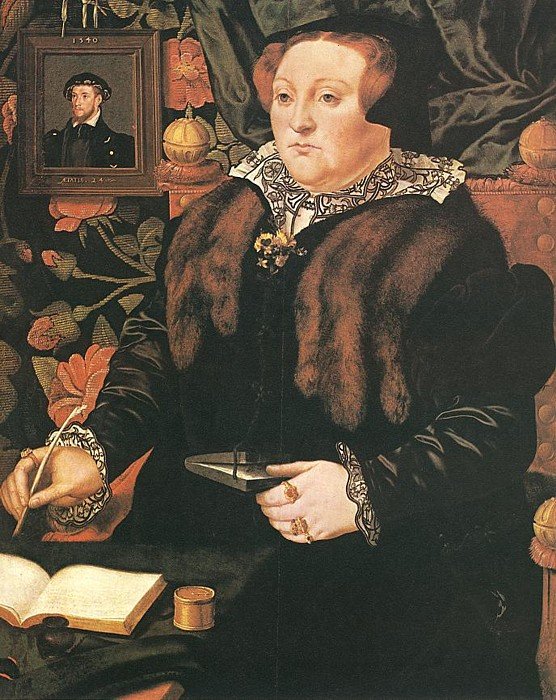
Mary Neville, Baroness Dacre by Hans Eworth

Mary Neville, Baroness Dacre by Hans Eworth (c.1555-1558)

My Daily Art Display today is a story of three people, the artist the woman who sat for her portrait and the man shown in a picture within the painting.  The featured artist today is the sixteenth century Flemish painter, Hans Eworth (Ewouts), who spent most of his artistic life in England.  The lady in the painting is Mary Fiennes, Baroness Dacre and the young man in a picture within the picture is her late husband, Thomas Fiennes, 9th Baron of Dacre.

Before I tell you the story of the painting let me linger awhile and talk about the artist himself.  Hans Eworth was born in or around Antwerp.  His date of birth is believed to be between 1520 and 1525.  Little is known about his early upbringing but the English art historian and one-time director of the National Portrait Gallery in London, Sir Lionel Cust, in his 1913 essays to the Walpole Society, draws a connection between Hans Eworth and a “Jan Euworts” who was known to have been a member of the Guild of St Luke in Antwerp in 1540.  In Karen Hearn’s short biography of Eworth published in 2000 and  according to Julius Friedrich’s in his book published in 1891, De Secte Der Loisten of Antwerpsche Libertijnen, 1525-1545, a Janne Ewouts and Claes Ewouts, painter and mercer (dealer in textile fabrics and fine cloths) were “expelled” from catholic Antwerp for heresy in the summer of 1544.  They lost their homes and property but were very lucky not to have lost their lives as the punishment in those days for heresy was ane extremely painful execution.

Eworth, like thousands of others fleeing Flanders because of its religious persecution, settled in London.   He continued painting and it is believed that one of his most important patrons was Queen Mary I (Mary Tudor) of whom he did many portraits of the monarch between 1554, the year after she was crowned queen and the year of her death 1558.  He was a prolific portrait painter but only about thirty of his paintings survive.  He was also known for his decorative painting and set designs for masques and pageants at the court of Queen Mary and her successor, Queen Elizabeth I.  He continued his artistic work until his death in London in 1574

The painting featured today is his portrait painting which he completed around 1558, entitled Mary Neville, Baroness Dacre.    She was the daughter of George Nevill, 5th Baron Beragvenny and his third wife Mary.  She married the English aristocrat Thomas Fiennes, and on his father’s death in 1528 became the next in line for his grandfather’s title who was the 8th Baron of Dacre.  He eventually became 9th Baron of Dacre in 1534 on the death of his grandfather and as well as the title,  inherited the family home of Hestmonceux Castle in Sussex.  The couple were married two years later in 1536 and went on to have three children, the eldest, Thomas who died of the plague at the age of 15, Gregory and Margaret.

That is not the end of thestory of their lives but let us now look at Eworth’s portrait of Mary and by doing so we will discover what happened to the family.  In front of us we have Mary sitting up straight in a richly upholstered chair with its red velvet back and arms.  This alone was symbolic of the sitter’s wealth.  She is dressed in a black gown which has a beaver collar and puffed sleeves.  Her dress is of satin and the collar and cuffs of her chemise are ornately embroidered.   It is Blackwork Embroidery, which was popular during the Tudor times.  It was often termed “Spanish work” because it was thought that Henry VIII’s first wife, Catherine of Aragon brought many such embroidered works with her from Spain.

In her right hand she holds a quill pen hovering over the pages of a notebook which lies upon a green-baize covered table.  In her left hand we see a partly opened notebook in which we can see some hand-written words.  On the table we see other implements used in those days for writing, the pot of ink and an ornate golden sand-shaker with a clock motif.   The Tudors dealt with a large black wet inky mistake soaking its way into a thick layer of paper by sprinkling clean sand onto the text to soak up the ink. The inky sand could then be flicked away from the paper, and any residual stain removed by gently scraping it off with a knife.

If you look at the flowers at her breast you will note they are a mix of forget-me-nots, rosemary, violas and pinks.  Forget-me-nots symbolise true love and memories and Rosemary which is often included in funeral wreaths symbolising remembrance and in wedding bouquets as a symbol for fidelity. It’s said that if you touch a lover with a sprig of rosemary, they’ll be faithful!    Violas often symbolise melancholy and pinks are symbolic of marriage.

So why the use of these symbols in the portrait by the artist?  Maybe the answer lies to the background to the left where we see, against a floral tapestry, a framed portrait of her late husband.  The inscription on the top part of the frame is “1540”, the date of the portrait and inscribed on the bottom “ÆTATIS. 2 4”,  which means “at the age of 24”.   So, what does it all mean?  Why did she want the picture of her young husband included in the portrait?  Why was he not with her?

The answer is simple but sad.  On 30 April 1541 Dacre along with a party of gentlemen including his brother-in-law went to poach on the neighbouring estate lands of Sir Nicholas Pelham of Laughton.    During the “adventure” the party were discovered by some of the servants of Sir Nicholas, one of whom was the gamekeeper, John Busbrig.   The meeting of adversaries went from verbal abuse to a fight during which Busbrig was fatally wounded and subsequently Dacre, although he did not strike the fatal blow and in fact was in another part of the estate at the time was held responsible for the death and along with several others was charged with murder.   Dacre originally entered a plea of not guilty but was later persuaded to change it to guilty and throw himself upon the King’s mercy in the hope of a reprieve.  However his strategy failed and he was hanged at Tyburn on 29 June 1541.

An account of the execution was reported in the Hall’s Chronicle, a periodical of the time, simply stating:-

“…….he was led on foot between the two sheriffs of London from the Tower through the city to Tyburn where he was strangled as common murderers are and his body buried in the church of St Sepulchre ….”.

Not only did her husband lose his life but the family lost their hereditary title and had their lands forfeited which left them destitute.  Despite numerous protestations from his widow it was not until ten years later in 1558 when Elizabeth I came to the throne that the hereditary title was restored to the family and Gregory, her second son was made 10th Baron Dacre.

Maybe the sumptuousness of her clothes and the splendour of the backdrop to this portrait suggest that almost ten years have passed since the execution of her husband and the forfeiture of the property and maybe life had become better for the widow.  In fact, in the same year her husband was executed, the widow managed to obtain an Act of Parliament in order to provide a dower for her from out of her late husband's estates.  A dower was a provision accorded by law to a wife for her support in the event that she should survive her husband (i.e., become a widow).  In her case the dower handed down to her by the Act of Parliament stated:

“.....the said Mary for the relief of her and her children &c is contented & pleased that it be enacted by His Highnes with the assent of this present parliament, & by authority of the same, that the said Mary Fynes shall possess & enjoy for the term of her natural life, from Michaelmas last past, the Manors of Burham & Codham co. Kent-of Fromquinton & Belchwell co. Dorset, of Nashall co. Essex, & all their rights & privileges &c. the said attainder....”

Courtesy of http://www.tudorplace.com.ar/


Mary Neville married twice more and had six children by her third husband.

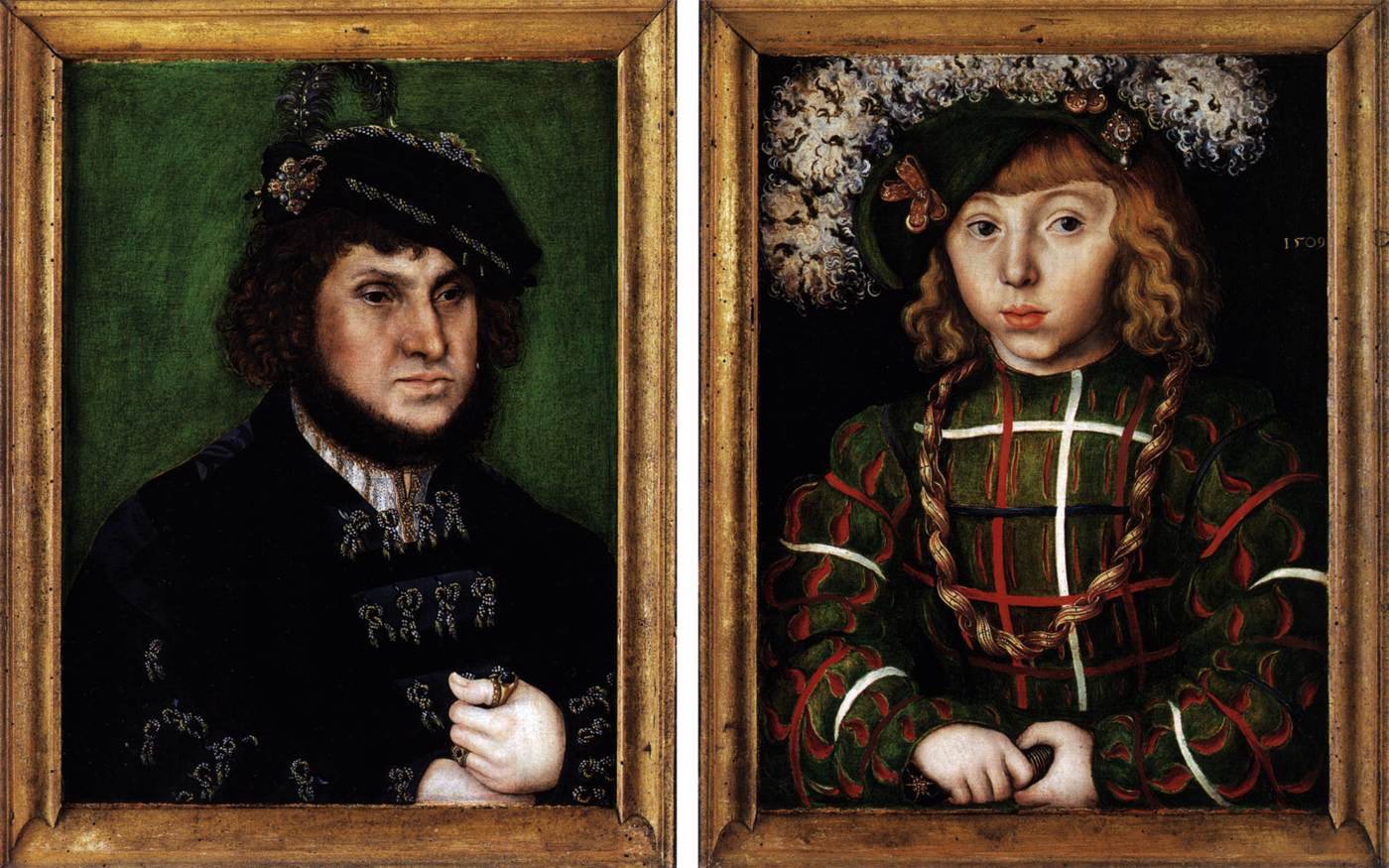
Portraits of Johann the Steadfast and Johann Friedrich the Magnanimous by Lucas Cranach the Elder

Portraits of Johann the Steadfast and Johann Friedrich the Magnanimous by Lucas Cranach the Elder (1509)

My Daily Art Display featured artist today is the German Renaissance painter and designer of woodcuts, Lucas Cranach the Elder.  He was born in Kronach a small German town in Upper Franconia, Bavaria in 1472.  His adopted surname was a derivation of the name of his birthplace, which was a quite usual practice at the time.  His father who had the unusual name of Hans Maler, the surname being the German word for “painter”.   In those days it was also not uncommon for a person’s surname to have no connection with ancestors but to do with the person’s profession.  Lucas Cranach’s father was indeed an artist, hence his surname.  Little is known of Cranach’s early life or fledgling artistic training except that one of his tutor commented that Cranach had displayed his artistic talents whilst a teenager.   It is recorded that Cranach arrived in Vienna in 1501 and stayed until 1504.  It was during this period that he completed many of his earliest works such as The Crucifixion (1503) and Portrait Doctor Johann Stephan Reuss’s (1503).  These and his other artistic works captured the attention of Duke Friedrich III, Elector of Saxony, known as Frederick the Wise who, in 1505, employed Cranach as a court painter at the palace of Wittenberg and although he took on private commissions, Cranach remained as court painter almost to the end of his life.

In 1508 Cranach married Barbara Brengbier and they were to have six children, four daughters and two sons.  The most famous of the children was Lucas the Younger who went on to become a well known artist in his own right.  At the court Cranach, along with other artists such as Dürer and Burgkmair painted many altarpieces for the castle church.  In 1509 Cranach temporarily left the court at Wittenberg and went to the Netherlands and painted the portrait of Emperor Maximilian I and his eight year old young grandson Charles who would later become Emperor Charles V.

It is interesting to note that up until this time Lucas Cranach the Elder always signed his works with his initials “L C” but in 1508 the Elector of Saxony, Frederick the Wise knighted him and awarded him the coat of arms of a winged serpent as an emblem which, from that time on, superseded or was added to his initials on his paintings.

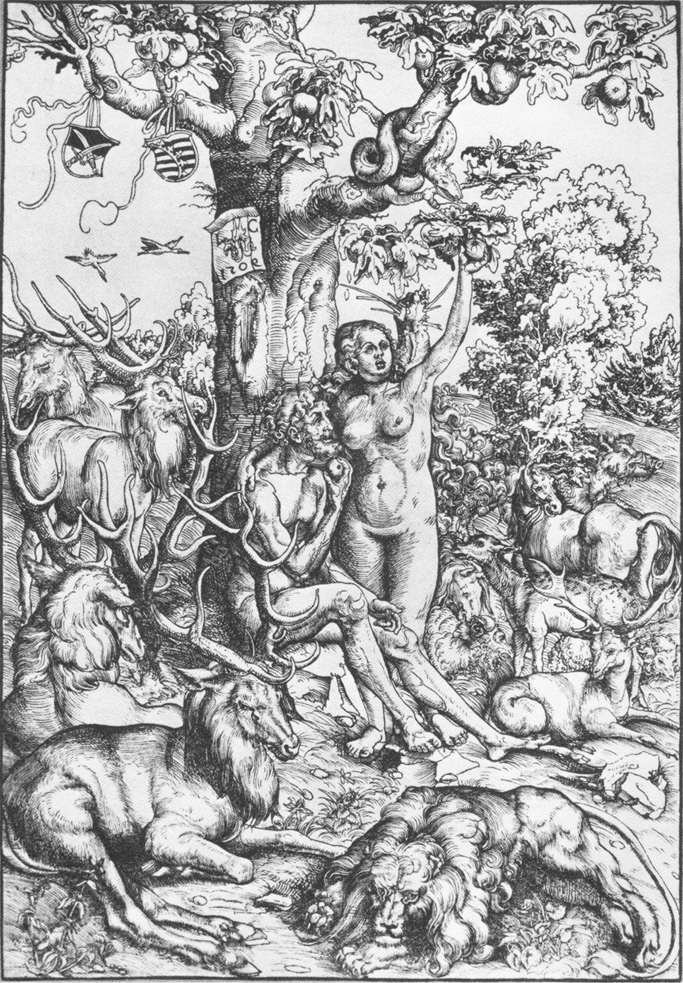
Adam and Eve - woodcarving by Cranach

An example of this can be seen in his woodcarving of Adam and Eve which he completed in 1509.

Signature with Serpent logo

Look at the note on the tree showing Cranach’s initials as well as the winged serpent.  The coats of arms hanging from the branch to the left of the trunk are those of the Elector of Saxony

Cranach was a friend of Martin Luther, and his art expresses much of the character and emotion of the German Reformation. Cranach, through many of his paintings and engravings, championed the Protestant cause. His portraits of Protestant leaders, including the many portraits of Luther and Duke Henry of Saxony are solemn and thoughtful and painstakingly drawn.   At this time Cranach had a large workshop and worked with great speed.  His output of paintings and woodcuts was immense.

He died in Weimar, in 1553 aged 81.   Cranach’s sons, Lucas and were both artists, but the only one to achieve distinction was Lucas Cranach the Younger, who was his father’s pupil and often his assistant. His oldest son Hans Cranach was also a promising artist but died prematurely.

Johann the Steadfast

My Daily Art Display featured painting today is a diptych, which is a picture or other work of art consisting of two equal-sized parts, facing one another like the pages of a book.  It is entitled Portraits of Johann the Steadfast and Johann Friedrich the Magnanimous which he painted in 1509.  They are usually small in size and hinged together.  This one was painted by Lucas Cranach the Elder in 1531.   It consists of two portraits.  On the left hand panel of the diptych we have a portrait of Johann the Steadfast who was the Elector of Saxony following the death of Frederick the Wise in 1525.  On the right hand side we have a portrait of Johann Friedrich the Magnanimous the eldest son of Johann the Steadfast and who became Elector of Saxony on the death of his father in 1533.  Cranach was the court painter during the time both of these men were in power.

Looking at the left hand portrait of Johann the Steadfast we see him against a dark green background wearing a black coat with some sort of grey patterning.  On his head he has a black hat highlighted with small pearl ornaments.

Johann Friedrich the Magnanimous

On the right hand panel we see the portrait of the six-year old, fair-haired boy, Johann Friedrich.  Note how Cranach has reversed the colours in comparison to the left hand panel.  Where we had a man in black with a green background, in this right hand panel, we have the young lad dressed in a green doublet with bands of red and white in what almost looks like a “tartan pattern” against a black background.  The “slashed doublet” which was very fashionable in the first half of the 16th century reveals the red of the shirt which he wears underneath it.  He too wears a hat, green in colour to match the doublet, on which are ornamental brooches and atop of which are multi-coloured ostrich plumes.  In his hands we see him clutching hold of the golden pommel of a sword with his still-chubby little fingers.

It is unusual to see two men in a diptych which would normally hold portraits of a man and his wife.  However there is some degree of poignancy about this coupling of father and son as the father lost his wife a couple of weeks after she gave birth to the young boy so we are looking at a widowed father and his motherless son.

Never Morning Wore to Evening but Some Heart Did Break by Walter Langley

Never Morning Wore to Evening but Some Heart Did Break by Walter Langley (1894)

My Daily Art Display today features an extremely moving picture which has the very long title Never Morning Wore to Evening but Some Heart Did Break.  The painting was completed by the English artist Walter Langley in 1894.  The painting today, as was the painting yesterday, is about loss.  The title of the painting emanates from Tennyson’s poem In Memoriam, one verse of which reads:

That loss is common would not make
My own less bitter, rather more:
Too common! Never morning wore
To evening, but some heart did break

Walter Langley was born in 1852 in Birmingham.   His father, William, was a tailor and Walter was one of eleven children brought up in an area close to the inner-city, poverty-stricken slums of one of England’s largest Victorian cities.  At the age of fifteen he was taken on as an apprentice lithographer and six years later he managed to gain a scholarship to South Kensington where he studied design for two years.  In 1876 Langley married Clara Perkins. The couple went off to Whitby on their honeymoon which was a favourite hangout of Victorian artists and this was Langley`s first encounter with a working fishing village.  In 1881 he returned to Birmingham and at the age of twenty-nine he was elected an Associate of the Royal Birmingham Society of Artists, which had been established in the early nineteenth century

His lithography work was starting to dry up and this coupled with the news that his wife was expecting twins forced him to make a choice between continuing to be a full-time lithographer or concentrate all his efforts into his painting.  Langley`s growing commercial success as an artist made the decision easier for him to make as he knew he needed the money to support his rapidly increasing family..

He had visited the Cornish fishing port of Newlyn before and was very impressed with the surrounding area and in July 1881 he returned.  This time he went there with a commission for 20 paintings from an important Birmingham patron, Edwin Chamberlain. As the year came to close he received a further remarkable commission from the Birmingham art dealer JW Thrupp, acting on behalf of the Alldays family, of 500 pounds for a year`s paintings in Newlyn.  The year of 1881 was a great year for the artist and his family with the commercial success of his paintings which far outshone anything he could have hoped to earn as a lithographer in Birmingham.   In 1882 he and his family moved permanently to the Cornish fishing port of Newlyn which was to become a haven for artists.  The Newlyn School was the term used to describe this new art colony that was based around the fishing port and in some ways mirrored the artist colony based on the outskirts of Paris, known as the Barbizon School.  Artists from both schools were associated with en plein air painting.   Although Langley was not the first artist to move and settle in Newlyn, he is largely credited with being the Pioneer of the Newlyn Art Colony and this “title” was engraved on his tombstone in Penzance.

Having been brought up close to the poverty of slum life he was a great supporter of left-wing politics and was a follower of the left wing radical Charles Bradlaugh, the great advocate of trade unionism.  Many of his paintings were of the social realist genre depicting working class folk and their struggle for survival.  Some of his paintings highlight the empathy he had for the hard-working fishermen and their families amongst whom he lived, no more so than today’s featured painting,  Never Morning Wore to Evening but Some Heart Did Break.   Before us we see an old woman comforting a younger one.  Her arm is wrapped around the young woman’s shoulder who holds her head in her hands and cries over a fisherman who never made it back home.   Look how the artist shows the moonlight dancing over the ripples of the sea.

This turmoil of human emotions is in direct contrast to the flat calm sea we can observe in the background of the painting.  It is the calm after the storm which has taken the life of the young woman’s beloved.  This is a very emotional painting and “speaks” more than any words could possibly do.  It succinctly illustrates the tragedies which can befall the family of working-class fishermen as they battle against all weathers simply to put food on the family table.

The Boer War by John Byam Liston Shaw

The Boer War by John Byam Liston Shaw (1900-01)

Once again, I am featuring an English artist.   My Daily Art Display’s featured artist was one of England’s most prolific painters of the late Victorian and Edwardian eras, John Byam Liston Shaw.  He was actually born in Madras, India in 1872, where his father was the registrar of the High Court.  He and his family lived in India until he was six years old at which time they came back to Londond and settled down in Kensington.  Byam Shaw showed early promise as an artist and when he was fifteen years old some of his paintings and drawings were shown to the Pre-Raphaelite painter, Sir John Everett Millais who was very impressed by the artistic standards achieved by the boy.  It was on Millais’ advice that Shaw entered the St John’s Wood Art School.  Also at the school at the time were the portraitist George Spencer Watson, the animal painter Roland Wheelwright and the landscape artist Rex Vicat Cole.  However probably the most important art student he met there was Evelyn Pyke-Nott, whom he was to marry in 1899.

In 1890, aged 18 years old, Byam Shaw attended the Royal Academy Schools at which in 1892 he won the prestigious Armitage Prize for his painting The Judgement of Solomon.   In 1893 he and fellow art student the portraitist and miniaturist, Gerald Metcalf who like Byam Shaw was born in India, moved into a studio together that at one time had been owned by Whistler.  Byam Shaw’s early works showed the influence on him of the Pre-Raphaelite Brotherhood.     He had been a great admirer of Dante Gabriel Rossetti and John Millais and one of his earliest works, and the first one he exhibited at the Royal Academy entitled Rose Mary, was based on a poem by Dante Gabriel Rossetti.  Looking at Byam Shaw’s works, it is easy to see the influence of the Pre-Raphaelites had on his work, not just in the subject matter but in his use of colour.

In 1899 Byam Shaw married Evelyn Pike Nott and they went on to have five children, four daughters and a son.  Besides his painting Byam Shaw spent a great deal of time on illustrations and drawings for books and in 1904 he was commissioned to produce thirty-four illustrations for the book, Historic Record of the Coronation of King Edward VII and Queen Alexandra.  It was around this time that Byam Shaw also became interested in theatrical costume design.  In 1904, aged thirty-two, he and his fellow artist friend, Rex Vicat Cole, became part-time teachers at the Women’s Department of King’s College at which ladies were allowed to attend lectures on various subjects but had to have chaperones in attendance !  The two friends resigned from their posts at King’s College and set up their own school of art in Kensington, which still exists as Byam Shaw’s School of Art and which is an integral part of the world-renowned Central Saint Martin’s College of Art and Design.  Shaw’s wife Evelyn also had a major role in the school.

During the First World War, Shaw produced many war cartoons for the newspapers of the day.  Shortly after the war in January 1919 he collapsed and died aged 46.

My featured painting today is John Byam Shaw’s work entitled The Boer War which he started in 1900 and completed in 1901.  When Shaw first exhibited this painting he added two lines to the title which came from A Bird Song, a poem by the English poet Christina Rossetti:

Last Summer greener things were greener

Brambles fewer, the blue sky bluer

This verse was a reflection of the mood of the young lady dressed in black.  She is heartbroken at hearing the news of the death of a loved one, killed in the Boer War.  She stands on the bank of the river and tries to remember happier days but she finds even that difficult.  In her eyes, the once beloved beauty of Mother Nature seems to have deserted her.  She struggles to come to terms with the death.  She is inconsolable.  However she is the archetypal English heroine who manages to bear her sorrows with a degree of stoicism as she deliberates on the death of a loved one who has given up his life for his country.

The model Byam Shaw used for this painting was his sister Margaret Glencair who at the time was in mourning  for her cousin who had been killed in the fighting in South Africa.   Byam Shaw drew on his knowledge of the banks of the River Thames near Dorchester to construct this beautiful picture.  Although Byam Shaw was influenced by the bright colours of the Pre-Raphaelites, the colours of the fauna in this painting are more subdued as if in the shadow of a dark cloud.  This muted colouring of the overgrown plants which kiss the water could well be part and parcel of the mood of the subject.  Look at the water in the right foreground and you can see a single feather of a swan.   It is more than likely that this symbolises loss as we are all aware that swans mate for life and if one dies, the other pines for it.  Could this then be drawing a parallel to the suffering of the woman who has lost her partner on the field of battle?  Another piece of symbolism in the painting is the way the artists has painted ravens in flight over the trees which is a sign of ill omen and thus amplifies the ominous atmosphere of the painting.

This is a truly beautiful painting, the subject of which is heartbreaking.

The Blind Girl by John Everett Millais

The Blind Girl by Millais (1854-56)

Another day, another painting, another offering from the Pre-Raphaelite Brotherhood.  My Daily Art Display for today is one of John Everett Millais’ finest works of art, entitled The Blind Girl which he painted in 1856.  In it we have a fusion of the elements of figure and landscape painting depicting, in the foreground, two girls sitting near a roadside against the backdrop of an expanse of wide, open fields with a distant view of a town.

Begging plea

The elder of the two girls, with her eyes closed, is blind.  She is homeless and forced to beg for sustenance by playing her concertina, which we see on her lap.  Her wretched plight is emphasized even more by the sheet of paper hanging around her neck with the words “PITY THE BLIND”.   Millais has chosen as his subject for this painting the social evil of the day – vagrancy among children and the disabled.  Millais hoped that his painting would elicit sympathy from its viewers for the plight of this blind girl and those like her.  There is a stillness and tranquility about the girl and this is borne out by the fact that we see a tortoiseshell butterfly resting on her shawl.

The younger girl, who is partly perched on the lap of the blind girl, and whom we believe maybe her sister, does not look out at us but is looking back at the double rainbow and the enchanting landscape below this phenomenon.  Some art historians have interpreted Millais’ depiction of the double rainbow as a Christian symbol of hope and one must remember that at the time Millais was still influenced by his former patron John Ruskin and it was Ruskin’s belief that there was a connection between the beauty of nature and the divine handiwork of God.   It is an enchanting scene we see before us and has luminosity brought on by the aftermath of what has probably been a heavy downpour of rain.  The rain has made the grass looks so green and its fresh appearance tempts us to sniff the air so as to take in the delights of the countryside.

Look at the way the two girls are depicted by Millais.  See how the younger girl snuggles within the shawl of the blind girl.  I wonder whether Millais meant us to look at their positioning and think of the Madonna and Child.  Whereas we would expect the sighted girl to look after the blind girl there appears to be a role reversal in this painting.  Maybe the blind girl is comforting her young companion who may have been frightened by the storm which has just passed.  Maybe the young girl is peeking around the blind girl’s shawl at a point in the distance where there had once been flashes of lightning and the rumble of thunder.  Take a moment to study the blind girl.  See how she seems to be trying to compensate her loss of sight through her other senses – the sense of touch.   See how, with one hand, she grips the hand of her young companion and with the other she fingers a blade of grass.  It is interesting to note how meticulous Millais has painted each individual blade of grass near to the hand of this blind girl.  She is also doing what so many of us do when the sun is shining – we close our eyes and face the sun and absorb the warmth of its rays.  The girl is taking pleasure in her surroundings, the warmth of the sunlight, the sounds of the birds and the smells emanating from the countryside all around her.

The background of this picture is a view of Winchelsea, a small village in East Sussex, located about two miles south-west of the coastal town of Rye.   The village stands on the site of a medieval town, founded in 1288, to replace an earlier town of the same name, sometimes known as Old Winchelsea, which was lost to the sea.   It is known that Millais, along with his fellow artists, Holman Hunt and Edward Lear visited the town in 1852.   It is recorded that Millais completed the middle ground of the painting whilst in Perth, Scotland where he had taken his new bride, Effie, the former Mrs Ruskin, in the summer of 1855.  The history of the painting chronicles that the last thing to be painted was the amber-coloured skirt, which the blind girl is wearing and which Effie cajoled an old woman into lending it to her.  Effie recorded the incident, writing:

“…She swore an oath and said what could Mrs Millais want with her old Coat, it was so dirty, but I was welcome.  I kept it two days and sent it back with a shilling and she was quite pleased…”

For his models for this painting, Millais used Matilda Proudfoot as the blind girl and Isabella Nichol as her younger sister. Originally Millais had used his wife Effie as the model for the blind girl but later he decided to use Matilda.

The Liverpool Academy awarded this painting its annual prize in 1857.    It was well received and is now looked upon as one of Millais’ finest works of art.  His Pre-Raphaelite colleague, Dante Rossetti declared it to be:

“…One of the most touching and perfect things I know….”

John Ruskin his former mentor and patron described The Blind Girl:

“…’The common is a fairly spacious bit of ragged pasture, and at the side of the public road passing over it the blind girl has sat down to rest awhile. She is a simple beggar, not a poetical or vicious one, a girl of eighteen or twenty, extremely plain-featured, but healthy, and just now resting, not because she is much tired but because the sun has but this moment come out after a shower and the smell of grass is pleasant….”

One interesting technical aspect of the painting is Millais’ depiction of the double rainbow.  When he showed the painting for the first time, somebody made him aware of his technical error as he had painted the two rainbows with their colours in the same order but he was advised that with double rainbows the inner rainbow of the two inverts the order of the colours.  Later Millais, in order to satisfy scientific accuracy, re-painted the inner rainbow.

The Stages of Life by Caspar David Friedrich

The Stages of Life by Caspar David Friedrich (1835)

I read the other day that life expectancy for men in the UK is somewhere between 75 and 80 years of age which is some ten years higher than it was in the 1970’s and of course what were once killer diseases are now more often or not, treatable.  So why worry about dying if you are still young?

Well of course, as far as longevity is concerned, the life expectancy back in the nineteenth century was much less, due to such diseases as cholera and typhus and  probably for a man living in Europe to reach the age of 45 in the nineteenth century was somewhat of an achievement.  All this leads me nicely on to my featured artist of the day, the German painter Casper David Friedrich, who was continually concerned with, and depressed by, the thought of his own mortality.  To be fair to him, he probably had good reason to be concerned and depressed by death for Friedrich had early acquaintances with death: his mother, Sophie Dorothea Bechly, died in 1781 when Caspar David was just seven.   At the age of thirteen, Caspar David was present when his brother, Johann Christoffer, fell through the ice of a frozen lake and drowned.    It was even reported that Johann Christoffer died while trying to rescue Caspar David, who was also in danger on the ice. His sister Elisabeth died in 1782, while another sister, Maria, died of typhus in 1791.

Friedrich’s contemporaries said that the melancholy in his art could be attributed to these tragic childhood events.  However I am not so sure that he was a manic depressive as there are many reports that stated he at times had a great sense of humour.   This was borne out by the famous German doctor, natural scientist and writer Gotthilf Heinrich von Schubert, who knew the artist and in his autobiography, wrote of Friedrich:

“…..He was indeed a strange mixture of temperament, his moods ranging from the gravest seriousness to the gayest humour … But anyone who knew only this side of Friedrich’s personality, namely his deep melancholic seriousness, only knew half the man. I have met few people who have such a gift for telling jokes and such a sense of fun as he did, providing that he was in the company of people he liked…..”

So these mood swings of Friedrich could have been more symptomatic of a bi-polar disorder.

The painting featured today in My Daily Art Display is an allegorical painting by this German Romantic landscape painter Caspar Friedrich David, one of the greatest of all the landscape painters.  He completed this work of art five years before his death in 1840 aged 66.  So despite his concerns about his own mortality, he lived much longer than the then life expectancy of a German man.

The work of art is entitled The Stages of Life.  Art historians do not believe that this would have been the title that Friedrich gave to his painting as the artist believed that titles of paintings should not be blatantly descriptive as he wanted his paintings to speak for themselves and he did not want viewers to be swayed by descriptive titles.  It is quite possible that this title was added much later, after Friedrich’s death, and when the public’s interest in his work returned in the latter years of the nineteenth century.

So what do we have before us in Friedrich’s allegorical painting about mortality and the transient nature of life?  The setting for the painting is dusk on the peninsular headland at Utkiek, overlooking the entrance to the northeastern German Hanseatic seaport of Griefswald,  which is bathed by the light from the gold and lavender evening sky.  Griefswald was the birthplace of Caspar David.  In the foreground we see an elderly man wearing a long brown coat and black hat standing with his back to us looking out to sea.  He walks with the aid of a stick towards a group of people.    In front of him is a younger man with a top hat.  He has turned towards the elderly man beckoning him on and pointing something out to him.  Seated on the ground at the feet of the young man is a woman and between the young couple and the sea we can see two children.  These in fact were family members of Caspar David.  The elderly man is the artist himself.  The young man with the top hat was Caspar David’s nephew Johann Heinrich and the young woman, his daughter Emma.

The Swedish Pennant held aloft

The two children holding the Swedish pennant are his son Gustav Adolf, who the artist named after the Swedish king, King  Gustav Adolf IV, and his daughter Agnes Adelheid.  The Swedish flag was probably added by the artist as he believed himself to be half-Swedish as from 1630 Griefswald was part of Swedish Pomerania and under Swedish control, before it was taken by Prussia in 1815 and formed part of the Prussian Province of Pomerania.  This of course throws up the question as to the date of the painting which is given as 1835, some twenty years after control of this area changed from being Swedish to coming under Prussian jurisdiction.  So does the Swedish pennant held by the children mean that the town was still under Swedish control and thus the painting is pre-1815 or is it just a sentimental addition by the artist to those glorious days under Swedish control?

Art historians believe that this group of people represents the various stages of life.  The artist representing old age, the gentleman with the top hat representing maturity, the young woman seated on the ground representing youth and finally the children representing childhood.  Out at sea, and corresponding to the number of people depicted, we can see five sailing ships of various sizes and designs and differing distances from the shoreline.  The five ships, and their distance from shore, in a way symbolises the transience of life in the way that they are at different distances from the harbour and the end of their voyages symbolising man’s journey through life and his ultimate destination, death.   The largest of these sailing ships which we look at, head-on, has a mast and crosstree which form the shape of a cross which some believe symbolizes Friedrich’s deep religious faith.  However, to me, I must doubt that symbolism as it just appears to me as a simple sailing ship design.  There are many interpretations of the what the ships and people represent but I like the one given by Charles Rosen and Henri Zerner in their book Caspar David Friedrich and the Language of Landscape in which they postulate that the two ships in the distance represent the mother and father sailing off into the distance to discover life and by so doing, gaining experience and wisdom through parenthood.   The largest ship close to shore, on the other hand,  represents the old man, a person who has built up experience over time and who has lived life to the full and who now is finally putting into the harbour to end life.

Whether we agree with or argue against the  interpretaion and symbolism of the painting I am sure we all agree that it is a wonderful work of art.

The Third of May 1808 by Goya

The Third of May 1808 by Goya (1814)

My Daily Art Display featured painting for today is the second of a set of two works by Goya entitled The Third of May 1808.  If you have just come to this website I suggest you read yesterday’s blog first as it is a prequel to this painting.

Yesterday we looked at Goya’s painting entitled The Second of May 1808 which was a depiction of an uprising of the people of Madrid against the Napoleonic forces including some of Napoleon’s fiercest fighter from the French Imperial Guard, the Egyptian Mamalukes.  The rebellion was put down after several hours of fierce fighting with loss of lives on both sides.  The French commander, Murat, was in no doubt as to the fate of the captured rebels unequivocally stating:

”…The population of Madrid, led astray, has given itself to revolt and murder. French blood has flowed. It demands vengeance. All those arrested in the uprising, arms in hand, will be shot…”

Today’s painting is a depiction by Goya of the promised French reprisals.  Hundreds of Spaniards were rounded up on the night of May 2nd and the next day and taken to various locations and executed by firing squads.  The painting is based on the executions which took place at one of these sites, the hill of Principe Pio on the outskirts of Madrid.

The scene is set at night.  The menacing sky is pitch-black and there is not a star in sight.  This alone adds menace to the painting.   Nearly a third of the canvas is black.   This blackened background darkens the painting but we can just make out the silhouette of the town and another group of people which may be inquisitive on-lookers or may even be the next batch of rebels destined for the firing squad.   The scene is only lit up by the light from the lantern which lies on the ground between the two sets of men. See how the rays of light from the lantern and the shadows form a dividing line on the ground between the killers and those to be killed.   The condemned are lit up by the lantern’s light. The lantern as a source of illumination in art was extensively used by Baroque artists, and later perfected by the Master of chiaroscuro, Caravaggio.

Before us, we see two groups of men, on the left hand side of the painting we see the rebels and, across a narrow gap, on the right hand side of the painting we see a line of French soldiers, with their shako headgear,  engulfed in shadow, rigidly poised with their guns with fixed bayonets  pointing at the condemned.  The soldiers, almost like robots, are solidly lined with immaculate military precision whereas the condemned are crumbling before their very eyes.   We are seeing the soldiers almost from behind and the faces of these executioners are hidden from view.  Goya has probably painted them like this to emphasise that these men are simply dehumanized perpetrators of brutality and tyranny.

The Condemned Man

Goya has carefully painted the condemned as individuals each showing different reactions to their fate.  One stares out defiantly at his executioners and another, a monk, we see with his hands clasped before him, praying for his soul.  The central figure within the bunch of rebels, with his white shirt and yellow trousers is lit up by the lantern and is the main focus of the painting.  His face is racked with terror and we see him kneeling amidst the bloodied corpses of his executed colleagues. His plain white shirt contrasts against his sun-burnt face, which gives the impression that he had been used to working outdoors in the fields as a simple labourer.   Look at his stance.

Stigmata

His arms are flung wide in what must be presumed as an act of defiance or maybe it is terror.  Note how Goya has depicted this.  His arms are spread as if he has been crucified and on close inspection of the palm of his right hand we see the marks of the stigmata, the bodily marks, in locations corresponding to the crucifixion wounds of Jesus Christ.  This was Goya’s way of portraying that this man and his comrades were martyrs, innocents battling against the persecution of a foreign power.  This condemned man was the very man we saw in yesterday’s painting, holding his dagger aloft about to thrust it into a Mamaluke soldier which he is dragging from his horse.

On the ground in front of the line of condemned men lie the blood-soaked bodies of those already executed.   Face down in a pool of his own blood is the rebel we witnessed in yesterday’s painting, who had just run his dagger into the shoulders of the white horse.   To the right of the white-shirted man we see a group of cowering rebels awaiting their fate.  They have been marched up the hill and have now come face to face with their fate.  They can hardly bear to look at the scene before them.

By the time of the painting’s conception, the public imagination had made the rioters symbols of heroism and patriotism. The two paintings by Goya were not glorious scenes of a great victorious battle but simple acts of anonymous heroism in the face of defeat.   Although I have highlighted the two paintings of the series it is thought that at one time the set may have comprised of four works – the two I have featured and one depicting the revolt at the royal palace, the other being a painting depicting the defence of the artillery barracks.  The fact that these latter two paintings have disappeared points to the possibility that they were destroyed by Spanish officials who were unhappy with the depiction of the popular uprising.

The painting received a mixed reception when first exhibited a good many years later, with critics pointing out its technical flaws with its perspective and the lack of realism.  Critics pointed out that the distance between executioners and victims was far too small and the fact that the power of the shot hitting its victim would probably propel the rebel backwards and not forwards as shown in the painting.  The other lack of realism lies in the fact that in reality the executions were carried out in the day time and not at night but I am sure Goya chose night as the time of day for his painting to make the painting more spectacular.   Other critics come to Goya’s defence pointing out that the painting was not supposed to be technically accurate but the way the artist had depicted the scene and his use of chiaroscuro added to overall effectiveness of the painting.