Miss Murray by Sir Thomas Lawrence

Miss Murray by Sir Thomas Lawrence

My Daily Art Display looks at a work by one of the greatest English portrait painters.  His name was Thomas Lawrence, later to become Sir Thomas Lawrence.   He was born in Bristol in 1769.  His father, also called Thomas, was a supervisor of excise and his mother Lucy was the daughter of a clergyman.  His mother had an amazing number of children – sixteen in all, albeit only five survived infancy.  It was around the time that Thomas was born that his father decided to give up his government job and become an innkeeper.  The initial move into running an inn failed and when Thomas was four years of age his father moved the whole family to the Wiltshire market town of Devizes and tried again at being a successful landlord of an inn.  The inn named the Black Bear was on the main route between London and Bath and was ideally situated to catch the London gentry who were on route to Bath in order to take the healing waters.

The father’s business acumen was lacking and he soon ran into debt and it was left to young Thomas to help with the family finances by selling his pastel portraits.  When Thomas was ten, his father was declared bankrupt and the family moved to Bath.  There was now more pressure on the young boy to stabilise the family’s finances through the sale of his portraits.  He concentrated on oval portraits measuring 3ocms x 25cm and he was able to charge three guineas for each half length portrait.   In 1787 Thomas Lawrence moved to London and in a very short time established his reputation as a portrait painter in oils.   It was primarily the portraiture of Britain’s growing aristocracy which was in great demand and Lawrence was able to command high fees for his work and it was into this aristocratic world that Lawrence was accepted.      In 1790, he received his first royal commission when he was asked to paint a portrait of Queen Charlotte, the wife of King George III.  The following year, aged just twenty two, he became an associate of the Royal Academy and three years later a full member of that society.  In 1792, Sir Joshua Reynolds the great English portrait artist, friend and mentor to Thomas Lawrence, died and this opened royal doors for his protégé.  George III, who had been delighted with Lawrence’s portrait of his wife, Queen Charlotte, appointed Thomas Lawrence as the Principal Court painter. He retained that position under the monarchy of George IV.   Lawrence was knighted in 1815 and five years later became the President of the Royal Academy.

So business was good for Lawrence the sale of his portraits went well and he could command higher and higher fees for the commissions he received and so he was rich.   Well, in fact no, he wasn’t wealthy and on a number of occasions was nearly bankrupt and only staved off financial disaster with help from friends and patrons.  So where did all the money go?  Lawrence was bemused by his lack of money, commenting:

“…I have never been extravagant nor profligate in the use of money. Neither gaming, horses, curricles, expensive entertainments, nor secret sources of ruin from vulgar licentiousness have swept it from me…”

Many biographers have sought the reason for his financial mess and it is now generally accepted that Thomas Lawrence could not handle his finances, rarely kept accounts and he spent a lot of money building up a collection of Old Master drawings.  He was also very generous when it came to his family – probably too generous.

Apart from financial problems he was also very unlucky in love.  He had come in contact with the well-known London stage actress Sarah Siddons and he became entangled with her two daughters, Maria and Sally.  He fell in love first with Sally, then transferred his affections on to her sister Maria, then broke with Maria and turned back to Sally again. Both the sisters had fragile health; Maria died in 1798, on her deathbed extracting a promise from her sister never to marry Lawrence.  Sally kept her promise and refused to see Lawrence again, dying in 1803. But Lawrence continued on friendly terms with their mother and painted several portraits of her.   Lawrence never married.  Sir Thomas Lawrence died in 1830, aged 60 and was the most fashionable portrait painter in Europe

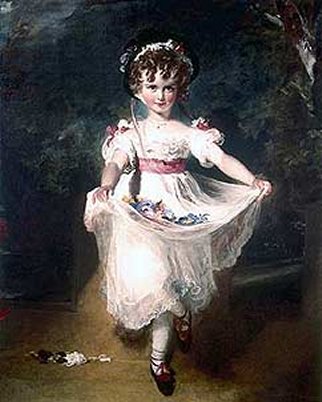
My Daily Art Display today is a delightful portrait which Sir Thomas Lawrence completed in 1826, entitled Miss Murray, which can be found at Kenwood House in London.  It is an unusual portrait considering the wealthy and famous people he had painted.  The painting was commissioned by Sir George Murray, the Scottish soldier and politician, who fought with General Wellington in the Peninsular Wars.  Louise Georgina Murray was his daughter and was also the goddaughter of the Duke of Wellington.  The young girl dances towards us beribboned and utterly bewitching.  She reminds me of the very young girls we see in present day American child beauty pageants, all dressed up adult-like, performing little dances for their doting audience.  She is just like Shirley Temple.   We seem to be looking up at her from below as if she is performing her dance on a stage and we are merely part of her audience.  Lawrence has undoubtedly captured the little girl’s beauty whilst she was still young.  Lawrence realised that his portrait had in some ways captured a certain moment in her life, a moment of child-like innocence and beauty which would undoubtedly change.  He commented on this very fact to her father, writing:

“…All I can do will be to snatch this fleeting beauty and expression so singular in the child before the change takes place that some few months may bring…”

How many times have we looked back on our children’s photographs when they were young and wondered how things change so much over time?  Lawrence and undoubtedly Sir George Murray knew that the sweet innocence of the child as she proudly shows off her dress and performs her dance would inevitably change.

So what of little Miss Murray, what became of her?    In 1843, aged twenty-one, she married Captain Henry George Boyce, a grandson of the 1st Duke of Marlborough who sadly died in Rome, five years after they were married.  Louisa Georgina Augusta Anne Murray remained a widow for forty three years, dying in 1891 in the Italian coastal town of Bordighera.

Mirror image ?

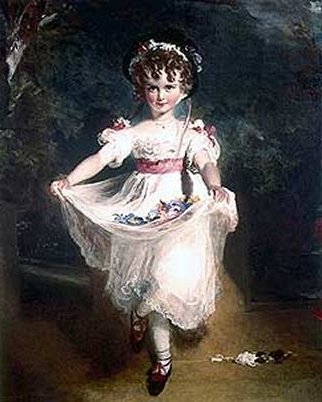
As I said at the start of this blog, the painting can be found in Kenwood House, London which I believe is near to Hampstead Heath.  I have never been there and thus have never stood in front of the painting but when I was researching the work I came across two “versions” of the painting, the one you see at the begining, with the girl looking slightly to her left and the sprig of flowers on the floor on the left side of the painting and the other picture of the painting (on the right) I came across in another art history book which had the girl turning slightly to her right and the flowers were on the floor to the right of the painting.  One book must have had a mirror-image of the real painting but which is correct?  Next time you visit the gallery please let me know !

Card Players in a Sunlit Room by Pieter de Hooch

Card Players in a Sunlit Room by Pieter de Hooch (1658)

Today My Daily Art Display returns to the Netherlands for its featured artist.  Today I am looking at a painting by the 17th century Dutch Golden Age artist Pieter de Hooch.   He was a contemporary of the great Jan Vermeer and there are some similarities between their works which we will look at later.

Pieter de Hooch was born in 1629 in Rotterdam, just three years before the birth of Vermeer.  He was the eldest of five children.  His father Hendricksz de Hooch was a bricklayer whilst his mother Annetge Pieters was a midwife.  Pieter studied art in Haarlem at the studio of Nicolaes Pieterszoon Berchem, the prolific Dutch Golden Age landscape painter.  His earliest employment was with Justus de la Grange a linen merchant and art collector where he acted as servant and general helper and it is thought that he paid for his board and lodgings by giving la Grange paintings some of his paintings, which was often the way aspiring artists managed to survive.  De Hooch went with la Grange on many of his business trips throughout Holland, including the town of Delft where he moved to temporarily in 1652, and on a more permanent basis in 1654 and 1655 during which time he joined the Guild of St Luke, the painters’ guild in Delft.

In 1654, whilst living in Delft, he married Jannetje van der Burch and the couple went on to have seven children.  In Delft he came under the influence of two of the town’s greatest painters, Carel Fabritius and Nicolaes Maes.  In the 1640’s, these two artists were originators  of the Delft School, a group of mid-17th century Dutch Golden Age painters named after its main base, the town of Delft.   It is best known for genre painting, such as images of domestic life, views of households, church interiors, courtyards, squares and the streets of the city.  The Delft School of painting in the 1650’s would number as its members the great Jan Vermeer and today’s featured artist.

Pieter de Hooch’s work at this time, both in style and subject matter, was in many ways similar to the paintings of Vermeer, who was still  living in Delft at that time.  De Hooch’s paintings, like Vermeer’s, were small works and though he sometimes painted open-air scenes and tavern genres he preferred painting two or three figures occupied with their normal daily duties and often shown in a sober interior interrupted only by the streaming in of radiant light from outside which, if by magic, transforms the scene.  At this time, the family unit was central to an increasing middle-class Dutch society, and de Hooch’s main characters in his works include friends, families and maids.  The world we see depicted in his paintings are glimpses of life seen unobtrusively through open doors and windows.  His works, which showed the simple life of the local inhabitants, were free of sentimentality and moralising.  Art historians believe that this period in Delft saw de Hoochcomplete his greatest works and that the artist was at this time at the height of his artistic powers.

In 1661, when Pieter de Hooch was thirty-two, he and his family moved on to Amsterdam.  De Hooch’s decision to leave Delft was undoubtedly brought on by the expectation of a larger market for his paintings in the flourishing and prosperous commercial centre of Amsterdam. It was here that he found a wealthier, more ambitious clientele, and the artwork they required was not of homely family scenes but paintings depicting extravagantly dressed people in contrived luxurious surroundings, such as country villas with palatial halls and their sumptuous marble interiors.  The patrons also wanted their paintings to be on a much large scale than he had tended to do in Delft.

In 1667 life took a turn for the worse for Pieter de Hooch.  His wife died leaving him, aged just 38, to bring up their large family.  Her death hit him hard and he struggled to cope with bringing up his young children.  Art critics believe that his struggle to survive affected his work.  His mental and physical health deteriorated and he died in 1684 in an Amsterdam mental asylum.  He was aged just 55.

The featured painting today is entitled Card Players in a Sunlit Room which he completed around 1658 whilst still living in Delft.  The finished work remained in Holland for almost one hundred and seventy years until it was bought by Lord Farnborough for King George IV of England in 1827.   It is now housed in the Royal Collection in London.  Before us we have two men and a woman sat at a table playing cards with another male onlooker standing besides the woman, pipe in hand, surveying the card game.  The mood of the painting is one of calmness.  There is an air of contemplation among the players.  This is not an animated scene, the participants are restrained.  The work is quite detailed in the way de Hooch has depicted the playing cards, the raised glass in the man’s hand and the broken pipe on the floor in the right foreground.  We fix our eyes on the fragments of the pipe on the floor and the five of spades playing card and cannot help but wonder why the artist has included them in the painting.  Was there some symbolism to its inclusion?  Should we look to interpret the existence of the abandoned pipe fragments and the single card on the floor or I wonder if the artist just wanted to get us to do what we are doing right now – trying to solve a mystery, when none exists!

One aspect of this painting which we have seen before in some of his other works is the setting of an inner room with an open door letting us see out into a much brighter exterior.  Observe the way de Hooch depicts the light flooding in from the sunlit courtyard in the middle ground of the painting, through the doorway into the interior, lighting up some parts of the room and some of the card players, whilst other parts are cast in shadow.    It is if de Hooch wants to showcase his skill in how he handles light as it falls over different surfaces.  Look how he has depicted the effect the sunlight has on the translucent curtains and the small panes of glass in the windows.  Again see how de Hooch has allowed the light streaming in through the door play on the card players, and by so doing, defining the form of their figures.

The paintings of Pieter de Hooch often exhibited a sophisticated and delicate treatment of light which was very similar to what we see in many of Jan Vermeer’s works, who as I said earlier, lived in Delft at the same time as de Hooch.  Art historians in the nineteenth century had originally assumed that Vermeer had been influenced by de Hooch’s work, but the opposite is now being seriously considered.

The Sorrows of Love by Louis-Léopold Boilly

The Sorrows of Love by Louis-Léopold Boilly (1790)

After three days of struggling with a small electronic notebook and the vagaries of foreign WiFi to publish my blogs I am back home to the comfort of my own PC and a fast WiFi.  In just over two months time we are off to Hong Kong and Australia for three weeks and I dare not think about how I am going to cope with trying to publish the blog but time will tell.

Today, My Daily Art Display is featuring a new painter to my blog.  He is the French portraitist and genre painter Louis-Léopold Boilly.  Boilly was born in La Bassée, a small town in the Nord department of Northern France, not far from Lille, in 1761.  He was brought up in a simple household, his father being a wood-carver.  He was a self-taught painter and started to turn out works when he was still only twelve years of age.  He showed some of his drawings and paintings to the local Augustinian friars and so impressed by them that in 1777, the bishop of Arras extended an invitation to Boilly to come and study in his bishopric.  The young Boilly painted prolifically producing more than three hundred small works of portraiture during that period.

In 1787 Boilly, now a much admired and renowned artist, moved to Paris but these were troubled times in the capital city with the start of the French Revolution.  His early works dwelt for the most part on amorous and moralizing subjects.   My Daily Art Display painting today entitled The Sorrows of Love, completed in 1790, is like many of his works of that period.    In the late 1790’s, after specializing in interior genre scenes, Boilly decided to switch to depictions of urban life and this gave us the chance, through his works, to witness life in Paris during that time.   Apart from the artistic merit of his compositions, he offers us a direct, candid view of Paris and the customs of its people.  His paintings were often awash with figures.  His paintings were often humorous and in a way displayed Boilly’s droll appreciation of Parisian urban life.

Throughout his career, Boilly was respected as a fine portraitist and received many commissions from the middle classes and the famous.   He had also made a name for himself as an artist who liked to paint somewhat titillating images, which were, at the time, very popular with patrons, who took their pleasures by enjoying the roguish side of life.  Boilly first encountered problems with his works in 1794, when one of his paintings, Lovers and the Escaped Bird,  was considered more than just erotic but that it was termed obscene by the Committee of Public Safety and that  the “crime” carried the penalty of a prison sentence as well as a very large fine.  He only escaped incarceration, when members of the Committee, on searching his studio, discovered more patriotic works, such as The Triumph of Marat, and that was enough to release the errant artist.  After this brush with officialdom, Boilly quickly toned-down his works.

In 1833 he was decorated as a chevalier of the nation’s highest order, the Legiond’Honneur.  Boilly died in Paris in 1845, aged 83 and his long life spanned the times when his country and his life was ruled by the royal monarchy of Louis XVI, the French Revolution, the Napoleonic Empire and the restoration of the Bourbon monarchy.

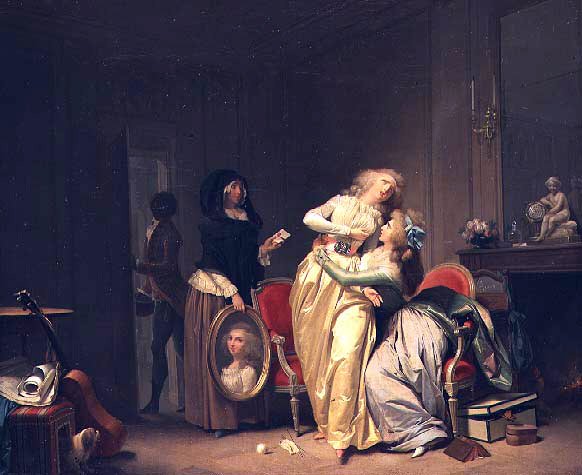
Today’s featured wok by Boilly is entitled The Sorrows of Love and in it we see a young lady being supported by her confidante.  She exhibits an exaggerated and shocked demeanour.  Her overstated affectation of grief reminds one of the demeanours of an actor hamming up a part in a play.  So what has brought on this distress expressed in the most dramatic way by the lady?  Look at the maid, wearing the black cowl.  In one hand she has an unopened letter which she offers the distraught woman.  It is not the content of the letter that is upsetting the lady as she recognises her own handwriting on the cover.  It is an unopened love letter being returned to her from her lover, who no longer reciprocates her love.  Not only is her love letter returned but in the maid’s right hand we can see that she is holding a head and shoulder portrait of the lady herself, which one presumes she gave to the man in her life, but tragically for her, this too is being returned as unwanted.   One must presume that the colour of the maid’s cowl is not just a coincidence and it is probably symbolic of the death of the love affair between her mistress and her lover.  The ending of the affair has occurred in a brutal fashion.  No letter of explanation, just a return of what is no longer wanted.

The Suitor’s Gift is in the same tradition of bourgeois genre scenes, which examine the many sides of love.  These works were greatly sought after by the public and collectors alike, and it seems probable, therefore, that the present work was completed to satisfy a taste for these subtle, yet highly charged scenes.  Before us we can witness Boilly’s skill at capturing the split-second of a seemingly every-day episode, whilst filling the scene with inner feeling, subtlety and mystery.

Self Portrait by Tommaso Minardi

Self Portrait by Tommaso Minardi (1807)

From a French Modernist painter I am moving to an Italian Romantic painter.  Today I am featuring Tommaso Minardi and looking at his painting entitled Self Portrait, which he painted in 1807.

Tommaso Minardi was born in Faenza in 1787, an Italian city some fifty kilometres south-east of Bologna.  As a teenager he studied art and design at a private school, as a pupil of Giuseppi Zauli.  Minardi was granted an annual stipend by Count Virgilio Cavina of Faenza and in addition, he received financial assistance in the form of a stipend, from the Congregazione di S Gregorio of Faenza.  Thanks to this five year stipend from his patron, Minardi, who was not yet sixteen years of age, moved to Rome to continue his artistic studies.  The terms of this five year grant were such that the young man had to send one completed work of art back to Faenza each year.   His paintings Socrates and Alcibiades and Supper at Emmaus were two of his works he sent back to his patron in Faenza.  At the age of twenty-three he entered a painting into an annual competition run by the Bologna Academy of Fine Arts and he won and his reward was financial stability for the next three years.

Whilst in Rome he studied art but was also employed by the painter and engraver Giuseppe Longhi, who was an exponent of Neoclassicism and for his employer he did reproduction drawings of Michelangelo’s Last Judgement in the Sistine Chapel.  

In his thirties Minardi began to teach art and in 1819 he was appointed director of the Academy of Fine Arts in Perugia.  Three years later he became professor of drawing at the Accademia di San Luca in Rome, a position he held for over thirty-five years.  Besides his own painting and teaching, Minardi began to take an interest in local politics and he spent much of his time working tirelessly for the protection and restoration of the capital city’s great heritage.  Tommaso Minari died in Rome in 1871, aged eighty-three.

My Daily Art Display’s featured painting today entitled Self Portrait depicts the artist himself, sitting on a matress which is on the floor.  He is wrapped in a coat in what looks like a very unassuming room.   The room we see him in is termed a mansard room but is known more commonly as an attic room with its sloping ceiling.  It is a typical student-type apartment at the top of a very large house.  On the back wall of the room we can just make out a painting and besides the bed is a bookcase crammed with books and papers.  More books and documents can be seen strewn on a desk to the right of the painting.  The room is lit up from two sources, light streaming in through windows on either side.  On a cabinet to the artist’s left is a human skull and on the floor in the left foreground there is skull of an animal.  What are we to make of this?  What was Minardi’s symbolic reasoning for including these two items?   Was the human skull to have the meaning related to Vanitas paintings, that human life passes quickly and we are but mere mortals, or is it just a  theatrical prop used by the artist to induce a feeling of melancholia into the work.  Are we meant to sympathise with this depiction of him, a poor, sad young art student in his small cramped abode, clutching a heavy coat around his body for warmth.  Is this a depiction of a poor young artist struggling for recognition, and desperate to attain financial security?  Remember Minardi was only twenty years old when he painted this work and had yet to become a successful artist.  So maybe this is how the artist viewed his current “lot in life” – life as a bohemian student in his dingy top floor attic room in the Eternal city.

I wonder whether this paining in any way inspired the French novelist and poet, Henri Murger, when he wrote a work published in 1851 entitled  Scènes de la vie de bohème and which was later used by the librettists Luigi Illica and Giuseppe Giacosa for Puccini’s 1896 opera La Bohème.  Was our struggling artist, Tommaso Minardi, in today’s painting the forerunner of the struggling painter Marcello, in La Bohème ?

I like the painting for its emotive qualities and I am heartened by the fact that Minardi did eventually make good and went on to live a prosperous life.

Interior at Nice by Henri Matisse

Interior at Nice by Henri Matisse (1920)

Yesterday I managed, with great difficulty to get away My Daily Art Display blog regarding Carl Philipp Fohr.  The difficulty was due to my present location, a hotel in Nice, where I am using their Wifi.   I was given the choice to let Internet provider, Orange, regulate the internet site so as to prevent me accessing “inappropriate material” or going for a “free –for-all”.   As an upstanding citizen, I chose the censored route but found myself barred from accessing my own site to publish a new blog.  I then had to re-think my strategy and agree to be open to all uncensored access in order to access my blog !!!!.  With my agreeing to a lack of censorship by Orange France I made it to my site but I am still wondering why my blog is grouped with the “XXX sites” – maybe the nude paintings has “done for me”!!!!

So by that introduction, you can gather I am not at home in North Wales enjoying this year’s summer with its torrential rain and gale force winds.  My wife Kathy had decided to desert me and go off to Tuscany with her friends who were all celebrating  60th birthdays and I was left all alone.    I had thought of remaining at home,  à la Cinderella and look after our Bed & Breakfast establishment but as I had a lull in bookings for three days, I decided to head off to one of my favourite destinations – Nice, in the south of France, for a few days of sun and good food.  Whilst I was here I thought I would look around some of the local art galleries.  I have been here numerous times but as you know, I am not a great Modern Art follower so I avoided their excellent Modern Art Gallery and instead I headed for the first time to the Henri Matisse Gallery at Cimiez, about five miles inland, and it was for that reason that I decided to make My Daily Art Display Today all about the great French Modernist painter, Henri Matisse.

Henri-Emile-Benoit Matisse was born in Le Cateau-Cambrésis, in France in 1869.  His early days were spent in Bohain-en-Vermandois , in Picardy, where his parents owned a florists.  At the age of eighteen he went to Paris to study law and after he had achieved his qualifications returned to his home town to work as a court administrator.  It was not until he was twenty years of age that he took up painting and that was when he was at home recovering from appendicitis and his mother gave him some artist’s materials so as to occupy his time whilst recuperating.  That small gift from his mother changed his life and much to the chagrin of his father, who wanted him to carry on in the legal profession, Matisse gave up law and went to Paris to study art at the Académie Julien where he studied under the great French painter William-Adolphe Bouguereau at the Académie Julian and later at the Académie des Beaux Arts under Gustave Moreau.  With his initial training he became competent in painting still-lifes and landscapes.   Matisse was influenced greatly by the French Masters, like Chardin, who was his favourite and the Rococo painters Poussin and Watteau as well as some of the new modern artists like Manet.

In 1896 and again in 1897, Matisse visited the painter John Peter Russell, an Australian Impressionist painter who had studied art in London and Paris, where one of his fellow students was Toulouse-Lautrec, and who had also become friends with both Monet and Vincent van Gogh.   Russell was an extremely wealthy man who, after his studies in Paris, moved to Brittany and settled at Belle-Île-en-Mer a small island off the coast where he established an artist’s colony.

Matisee fathered a daughter Margueritte with his lover and model, Caroline Joblau, in 1894.  Four years later he married, not to Caroline, but to Amelie Parayre who with Matisee brought up his daughter.  The couple went on to have two sons, Jean in 1899 and Pierre, born a year later.  Matisee and his bride honeymooned in London on the recommendation of the French Impressionist, Camille Pissaro and whilst there he combined his honeymoon with the chance to study the paintings of Turner.

In 1917, aged 48, Matisse came to Nice to recover from a bad bout of bronchitis.  He loved the town and said of it:

“….I decided never to leave Nice, and remained there nearly my entire existence…”

Of the town of Cimiez, where the Matisse Museum I visited is situated about five miles inland from the coast, Matisse said of it:

“…Most people come here for the light and the picturesque.  I am from Northern France;  what struck me were the great flashes of colour in January and the luminous daylight…”

Of the ambience of Nice and the pleasure it brought him, Matisse said:

“…When I realized I would see that light every morning I could not believe my happiness…”

Henri Matisse died in Nice in 1954, a month short of his eighty fifth birthday and was buried in the cemetery at Cimiez.   

The painting I have chosen was not at the Matisse Museum in Nice which I visited today but hangs in the Art Institute in Chicago and is entitled Interior at Nice, which he painted in 1920 and which I thought would be an appropriate choice as he, like me, loved the town.  Matisse used a very vertical canvas for this painting. He accentuated this with the window curtain coming from the very top of the canvas down to below the middle.  Matisse played with the perspective of the picture to give more excitement. We are looking down on the furniture in the foreground almost as if we were positioned high in the air.  The floor in this painting is almost a copy of the floor in his 1919 work “The Artist and his Model“, which hangs in the National Gallery of Canada in Ottawa.   Both are done in the same style and colour, but give a totally different feeling to each painting.  In today’s painting the warm floor serves as a  refuge against the dark cool of a winter’s evening outside.  In “The Artist and his Model“, the hue of the red floor is needed for added drama against all the other colours containing the same value and in some way heightened the feeling we got as we looked at the naked model posing for the artist.

So what was my impression of the Matisse Museum and the paintings and drawings which were being exhibited?  The obvious answer is that if you were a Matisse fan you would be pleased with what was on offer and how it was exhibited.  I went there with an open mind.  I went there determined to rid myself of any preconceived ideas as I had not been a lover of his work.  Over the years I have, when I see art that baffles me in its simplicity, educated myself to comment (just to myself) that “I don’t like it” and steer away from the crass comment “ a child of six could have done that”.  Maybe whether I liked what I saw can be answered by saying that as a hoarder of exhibition catalogues I left the museum without buying anything – please forgive me Henri !!!

Ideal Landscape near Rocca Canterana by Carl Philipp Fohr

Ideal Landscape near Rocca Canterana by Carl Philipp Fohr

My Daily Art Display today looks again at a German painter who was born at the end of the 18th century and is acknowledged as one of the most significant landscape painters of German Romanticism.  His name is Carl Philipp Fohr.

Fohr was born in Heidelberg in 1795.   His first art tuition was under the tutelage of Carl Rottmann, the genre and veduta painter, when he was aged thirteen.  It is said that when Fohr was fifteen years old the Darmstadt Court Councillor, Georg Wilhelm Issel, discovered him sketching at Stift Neuberg near Heidelberg and it was because of that and because Issel recognised the young man’s artistic potential, the following year Issel invited Fohr to come to Darmstadt and he provided him with both encouragement and financial support to continue with his artistic studies.   From 1813 Fohr received a number of commissions for paintings for the Grand Duchess Wilhelmina of Hesse, and it was for her that Fohr produced the Sketchbook of the Neckar Region, which consisted of a collection of watercolours of views and historical subjects of the region and a year later produced a similar sketchbook of the Baden area.  Such was the quality of his work that Fohr received an annual pension of 500 guilders from the Grand Princess. 

In 1815 Fohr became a student of landscape painting at the Kunstakademie in Munich, and it was here that his breakthrough into an independent and original drawing style came about.   He only remained at the Academy for a year as in 1816 he decided to embark on a walking adventure through Northern Italy which was to eventually take him to Rome.   It was whilst there that he came in contact with the group of artists, known as the Nazarene Brotherhood.  The brotherhood’s original members were six Vienna Academy students, four of whom, Friedrich Overbeck, Franz Pforr, Ludwig Vogel, and Johann Konrad Hottinger, moved to Rome in 1810, where they occupied the abandoned monastery of Sant’Isidoro.   Later they were joined by Peter von Cornelius, Wilhelm von Schadow, and others who at various times were associated with the movement.   The Nazarenes believed that all art should serve a moral or religious purpose; they admired painters of the late Middle Ages and early Renaissance and rejected most subsequent painting which were beloved by the European academies, believing that it abandoned religious ideals in favour of artistic virtuosity. They also thought that the mechanical routine of the academy system could be avoided by a return to the more intimate teaching situation of the medieval workshop.   For this reason, they worked and lived together in an almost monastic existence.    So where did the name, Nazarenes, come from?   Actually it was a derisory nickname they acquired because of their affectation of biblical style of hair and dress. The main aim of the Nazarenes was to revive the medieval art of fresco painting.   Fortune looked down favourably on the group as they received two important commissions to carry out the fresco decoration of the Casa Bartholdy in 1816 and a year later to carry out similar work in the Casino Massimo in Rome and their beautifully skilled work on the two projects brought their work to international attention.   However by the time the second project had been completed the Nazarene Brotherhood had all but disbanded.  The legacy of this group was that of honest expression of deeply felt ideals and it was to have an important influence on subsequent movements, particularly the English Pre-Raphaelites of the mid-19th century.

So where did Fohr go next for inspiration?   Sadly, Fohr’s life ended in tragic circumstances when in 1818, at the young age of twenty-three he drowned whilst swimming in the River Tiber.  Even sadder was the fact that his legacy to the world was only five oil paintings.

Today’s featured painting is The Ideal Landscape near Rocca Canterana and is one of Fohr’s best-known paintings, which he completed in 1818, the year of his death.   The painting shows a rocky pastoral landscape in the central mountains of Italy.  In the foreground, we can see a path which winds past craggy rocks and old, gnarled trees.   On this path we see a country girl dressed in some sort of festive costume.  In her arms she carries a young child, whilst hand in hand with another child, who is balancing a jug on her head.   If you look to the right middle-ground, under the trees, we can see a group of pilgrims who are heading towards a distant and illuminated valley.  The woman and children have just been passed by two shepherds who are heading for what Fohr has depicted as a peaceful, hilly region rimmed by steep mountains.

This painting is so like the old Arcadian landscape paintings of the past, which emerged in the Renaissance and which were inspirational to later artists who wanted to depict a “paradise on earth” theme to their works.  Fohr’ paradise on earth is emphasised by his inclusion of the pilgrims which alludes to the Christian Heaven.   The people in Fohr’s painting, who we see wandering around the landscape symbolise the journey we have to make on this earth before we die and  Fohr, in a way, is trying to remind us of the transience of all earthly things and the journey into the future, which some believe is the true goal and reason for human existence.

The picture in some ways is very simplistic but I hope you like it.

Niagara by Frederic Edwin Church

Niagara by Frederic Church (1857)

My Daily Art Display for today returns to a painting by an American artist and another member of the Hudson River School, which was a mid-19th century American art movement personified by a group of landscape painters whose artistic vision was influenced by the 18th century European Romanticism movement.   The paintings for which the group is named depict the Hudson River Valley and the area around the Catskill, Adirondack and the White Mountain ranges.  The artist is Frederic Edwin Church.

Frederic Church was born in Hartford Connecticut in 1826.  His father, Joseph, was a silversmith and watchmaker and through his success and that of his father who had owned a paper mill, the Church household lived a prosperous lifestyle.  Frederic studied art at school and through a family neighbour, Daniel Wadsworth, was fortunate enough to be introduced to Thomas Cole, the founder of the Hudson River School, who agreed to take Frederic on as his pupil.   Church thrived under Cole’s tutelage and within a year, he had some of his paintings shown in the National Academy of Design annual exhibition.  The following year, 1848, Church was elected as the youngest Associate of the National Academy of Design and was promoted to Academician the following year.  That year he sold his first major oil painting to the Hartford’s Wadsworth Atheneum, which had been founded by Wadsworth.

In 1848 he went to live in New York and began to teach art.  In his spare time in spring and autumn he would travel throughout New York and New England, particularly Vermont, all the time sketching the beautiful scenery whilst during the winter months he would return to New York City and his home and convert his numerous sketches into a number of landscape paintings, all of which sold well.   Church and a friend set forth on an adventurous trip through Central America and Ecuador. From this trip, Church’s first finished South American pictures, shown to great acclaim in 1855, transformed his career.   For the next decade he devoted a great part of his attention to those subjects, producing a celebrated series that became the basis of his ensuing international fame.   During a two year period, 1854 to 1856, he travelled extensively visiting Nova Scotia, and journeying throughout Maine, New Hampshire, and Vermont, and it was around this time that he visited the Niagara Falls.   The late 1850’s were the high point of Church’s career, artistic triumph followed artistic triumph.   In 1857 he made another trip to Ecuador and also took a voyage to Newfoundland and Labrador.  In 1860, Church bought some farmland at Hudson, New York, and married Isabel Carnes, whom he had met during the exhibition of his paintings.   He and his wife lead a settled and happy life and he spent most of his time tending to his farm but his happiness was shattered in 1865 when both his young children contracted diphtheria and died.  However, with the birth of Frederic junior in 1866, Church and his wife began a new family that was eventually to number four children.

At the end of 1867, Frederic Church and his family embarked on a long trip to Europe, North Africa, the Near East, and Greece that was to last eighteen months and was to lead to several important paintings. As Church got older he spent more and more time on his farm and farming.  From the 1870’s onwards Church suffered badly from rheumatoid arthritis and it badly affected his right arm which curtailed much of his art work although he did teach himself to paint with his left hand.  Frederic Church died in 1900, aged 74 and is buried in Spring Grove Cemetery in Hartford, Connecticut.

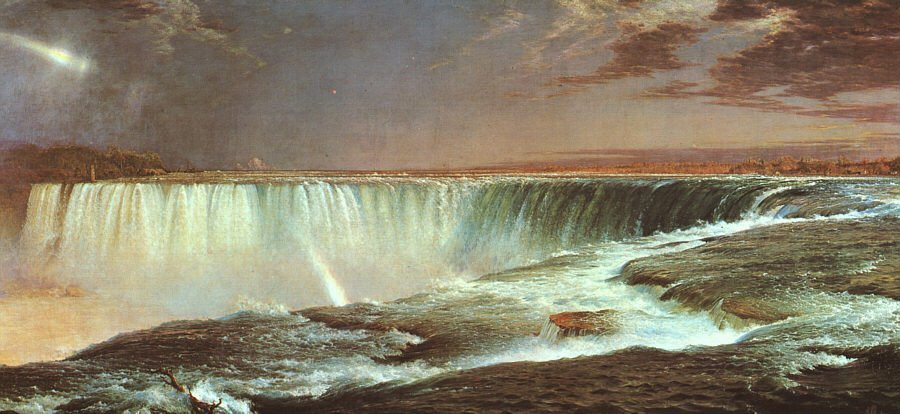
Today’s painting by Frederic Church entitled Niagara is one of four he painted of this waterfall.  This one was painted in 1857 and guaranteed for him, still a young man of thirty-one, the role of America’s most famous painter.   It is probably the most famous painting of it ever made.  During the 19th century, American artists flocked to the Falls to paint the various views of it.  The Falls were looked upon as the nation’s greatest natural wonder.   This picture was painted from the Canadian shore, a short distance above Table Rock, and includes the sweep of the Horseshoe Fall and the edge of Goat Island in a notable depiction of water and light. The time is towards evening.   We can see an amazing amount of detail in every stage of the water’s journey as it cascades downwards.  Look at how Church has incorporated an optical flourish of the rainbow against the falling waters.

The painting was introduced to the American public shortly after its completion, as a one-painting exhibition at the commercial gallery of Williams, Stevens, and Williams in New York City.   People flocked to see the work and were willing to pay 25 cents each to view the monumental canvas, which measured 109cms x 230cms and sometimes they would use opera glasses or other optical aids to augment the experience.   With their 25 cents admission fee the people would also receive a pamphlet that reprinted contemporary critics’ praise of Church’s picture and offered exhibition-goers the opportunity to purchase a print of the work.   Within a fortnight of the exhibition’s opening more than a hundred thousand people had paid to see it.  Art critics lavished praise on the work describing it as “the finest oil picture ever painted on this side of the Atlantic.”    After this success in New York the painting was taken to a number of American cities before it made two tours of Britain and was exhibited at the 1867 Exposition Universelle in Paris where it won a prize

The painting now hangs in the The Corcoran Gallery of Art in Washington DC

Les Charbonniers by Claude Monet

Les Charbonniers by Claude Monet (c.1875)

When I think of Impressionism and Impressionist paintings I think of light airy scenes.  I think of lily ponds and flowering arches at Givenchy.  I think of colourful young things boating on the mirror-like waters of the Seine.  I think of people sitting on the banks of the Seine staring out at blue cloudless skies.  I think of fashionable people promenading along the Grand Jatte in gorgeous sunlight.  I associate Impressionism and the paintings associated with that particular “–ism” as being light, colourful and full of smiling faces on the people as they relax from the rigours of their working lives.

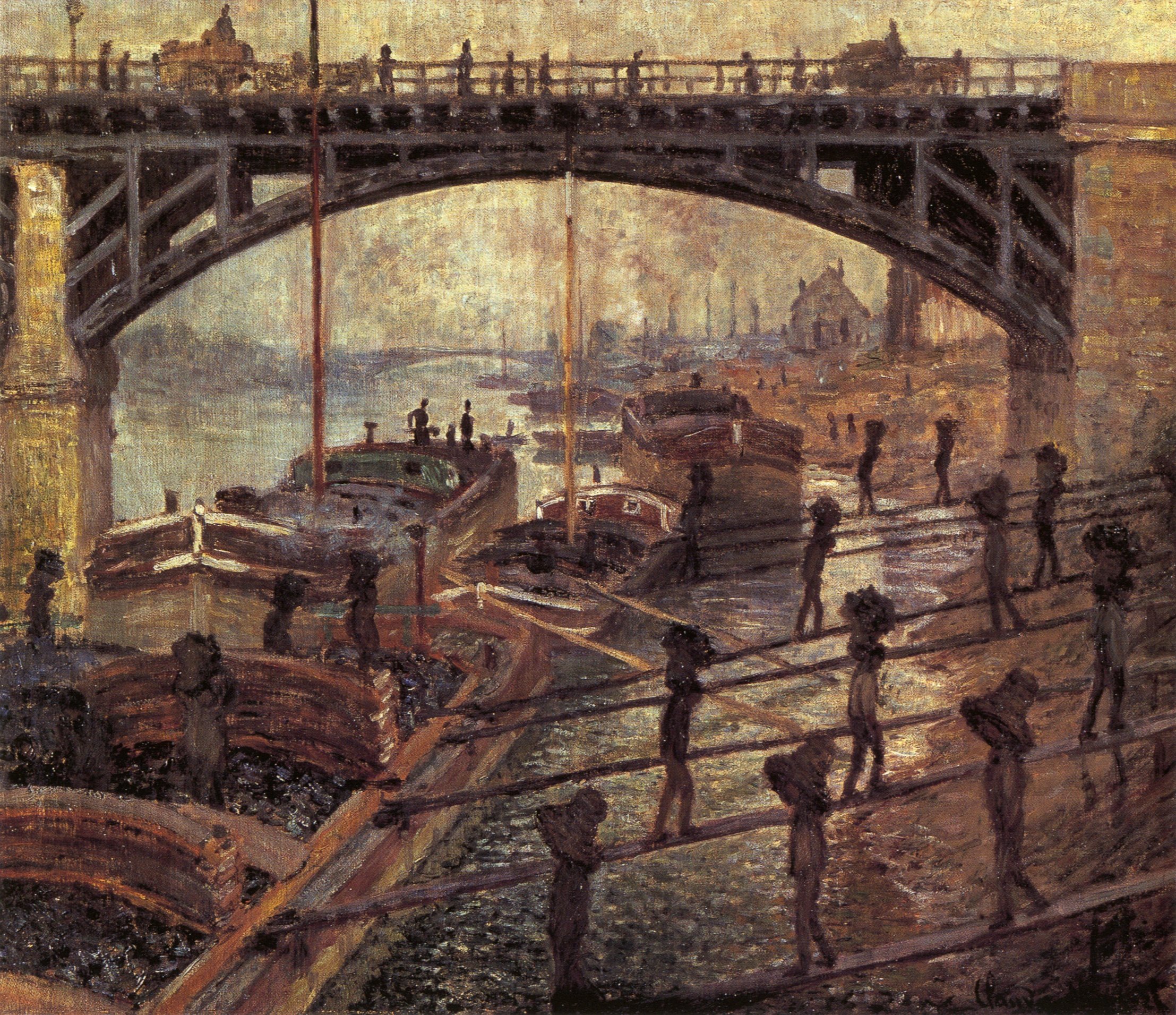
That all changed when I came across the work of the Impressionist, Caillebotte and his Floor Scrapers (see August 3rd).  Today, I am featuring another darker and more sombre painting by one of the greatest Impressionist painters of all time, Claude Monet.  He painted today’s painting in 1875 when he was thirty five years old and living at Argenteuil.  It is entitled Les Charbonniers (The Coalmen) or sometimes referred to as Les déchargeurs de charbon (Men unloading coal).

Before us is a view of the docks at the Quai de Clichy, a little downriver from Paris.  Framed at the top of the painting in the background, we can just make out through the haze, the broad arch of the Pont de Clichy railway bridge, one which Monet would have crossed many times as he took the train from Argenteuil to Paris.   It is also a bridge which he featured in a number of his paintings.  Horses and carts can be seen crossing the nearer bridge, the Pont d’Asnières.  These carts will transport the coal from the quayside to nearby factories, the chimneys of which we can just make out in the distance as they pump out their smoky pollutants.   Also on the bridge we see a few pedestrians gazing down at the unloading operation.

It is a dark and atmospheric picture.  We do not have the brightness of a summer’s day.  It is a dull grey wintery day with a smoke-filled sky.  We see the men struggling with their heavy bags of coal perched on their shoulders as they struggle up the narrow wooden ramps between ship and quay over the murky waters of the Seine, balancing like tightrope walkers on a high wire.  The wooden walkways bend ominously under the strain of man and his load.  We can just imagine the ominous groaning and creaking of the wood as it takes the strain.  Hour upon hour these men will trudge mechanically back and forth until all the coal has been discharged from the boat.  This is a labour intensive operation.  Les charbonniers have an unenviable job with its physical strain on the body coupled with the inhalation of coal dust into their lungs.  In the holds of the vessel itself we see men filling baskets with coal ready for the charbonniers to take them ashore.  These men will probably not live to an old age.  Unfortunately for them, the invention of quayside cranes and cargo escalators had yet to be realised.  This discharge of the coal from the boat would be a long operation, as fully loaded, the coal barge could probably transport about 300 tons of coal, which could take anything up to two weeks to manually unload.

The sailing barge has probably brought its cargo of coal from the mines in Belgium and Northern France along the Canal de Saint-Quentin which connects the rivers Oise, Escaut and Somme.  The canal, a great feat of engineering, was opened by Napoleon Bonaparte in 1810.

The painting by Monet is simply a depiction of urban life and he might not have intended it as a political treatise with regards the conditions suffered by some working class people.  However the artist has given the painting a dark and solemn ambience which emphasizes the plight of some of the lowest paid workers.  This work was one of 29 works Monet presented in the fourth Impressionist exhibition.

Calais Pier by Joseph Mallord William Turner

Calais Pier by Turner (1803)

I am fast approaching my 300th edition of this blog and many of you may think it strange that in all that time I have never featured an artist much loved by many, Joseph Mallord William Turner.  In some ways, of course, it is an omission but I have to be honest and state that Turner is not one of my favourite artists.  Yes, I am aware that statement is artistic anathema and pictorially sacrilegious but everybody’s likes and dislikes are different.  I am a person who loves detail and clarity in a painting and the haziness” of a lot of Turner’s painting is just not for me.  I was at a local gallery the other day and when asked which was my favourite painting on display, I pointed to a mountain scene and the person who asked me to decide commented that it was too much like a photograph for his liking.  There lies my dilemma.  I don’t want a framed photograph on my wall but I do want clarity of detail.  I am happy with an idealised landscape.  I just want to study the intricate details of the artist’s work.

Less about my likes and dislikes and on to today’s offering which is one of Turner’s paintings, which is without the haziness that I dislike.  It is entitled Calais Pier and was completed by Turner in 1803 and is in the safe keeping of the National Gallery in London.  I touched briefly on Turner’s life a few days ago when I featured the artist Thomas Girtin, a friend and contemporary of Turner.  I know many books have been written about Turner’s life but let me briefly go through the life of today’s artist

Turner was born in 1775 in Covent Garden, London.  His father, William Gay Turner was a wig maker and when they became unfashionable he became a barber.  His mother was Mary Mallord Marshall.  His mother and father had married in 1773 and a year after Turner was born his mother gave birth to his sister, Mary Ann.  Sadly and with devastating consequences she died in 1786, at the age of eight.  Her death virtually destroyed her mother who became mentally unstable and eventually in 1799 she was committed to the Bethlem Royal Hospital Mental Hospital (Bedlam) where she died in 1804.

Because of his mother’s mental problems, and the problems arising from her condition, the young Turner left home for about a year and went to live in Brentford with his mother’s brother, Joseph William Mallord Marshal.  Whilst living with his uncle’s family he attended the John White’s School.  It was during the time when he was being brought up by his uncle’s family that Turner started to show an interest in art.    For holidays he would often be taken to Margate and it was around this time, 1786, that eleven year old Turner first signed and dated his drawings of the seaside town and the surrounding areas.    These early drawings of his were often proudly displayed by his father in his shop window.   After early schooling, Turner, aged fourteen, was accepted as a student at the Plaister Academy of the Royal Academy of Art schools in 1789 where he studied for exams which would afford him membership of the Royal Academy itself.  After just one year, when he was fifteen he was accepted into the Royal Academy, which at the time was headed by Sir Joshua Reynolds, the great English painter, and who was on the selection panel of the artistic establishment.  Turner went on to have his first painting, a watercolour entitled The Archbishop’s Palace, Lambeth,  accepted into the Academy’s Summer Exhibition in 1790 and six years later he had his first oil painting entitled Fisherman at Sea  shown at the exhibition.  Turner exhibited some of his work at almost every subsequent Royal Academy Summer Exhibitions for the rest of his life.

After leaving the Royal Academy Schools, Turner embarked on many European journeys, visiting Paris where he studied in the Louvre, visiting Switzerland and Italy where he spent some time in Venice.  He also often travelled around Britain with his friend and fellow artist, Thomas Girtin.  During one of his British journeys when he was twenty-two, he visited Otley, Yorkshire and met and became great friends with Walter Fawkes, a wealthy landowner and Member of Parliament, who was to become one of Turner’s patrons and who commissioned many works from the artist.

Although Turner never married, he did have two children by his mistress Sarah Danby whom he met in 1799.  Sarah, a widow nine years his senior, gave birth to two of his children, Evelina in 1801 and Georgiana in 1811.  Art historians would have us believe that Turner over time became very eccentric and only had a handful of close friends.  However, he was always close to his father and for thirty years his father lived with Turner.  His father died in 1829 and this devastated and depressed the artist.  Not only had his father been supportive of him he would often act as his studio assistant.

In 1833, on one of his journeys back to Margate, Turner met Sophie Caroline Booth who had been recently widowed and lived in the town.  They became lovers and in the 1840’s she bought herself a small cottage in Chelsea and Turner went to live with her.  He was to remain with her until his death at the house of his lover in December 1851.   He was buried in St Paul’s Cathedral and lies next to Sir Joshua Reynolds.

I chose the featured painting today, Calais Pier as I have been associated with the sea and ships almost all my life and I am only too aware of the ferocity of the seas around the British and Channel coasts and so in some way it was a return to my seafaring past when I was in ships and had to watch helplessly when my ship battled against the ferocity of a storm and the mountainous seas which the winds had whipped up.  This painting by Turner is based on his own experience of rough weather during his first ferry crossing to France in 1802 at which time he made many sketches of the crossing from Dover to Calais.  We need to remember that in those days there was no such thing as weather forecasts and so vessels would put to see and were at the mercy of the weather.

We have before us a sombre scene of vessels being wildly buffeted by the gale-force wind and giant waves.  In the centre of the work with the dark sails we see the Dover-Calais ferry crammed full of people.  The English flag flutters wildly at the top of the mast.  Next to it, with the white sail, is a French fishing boat which looks to be perilously close to the English ferry.  The sails and the deck of this vessel are spectacularly lit up by a shaft of sunlight which has managed to penetrate the black storm clouds.  Pulling away from the quay and heading into the rough seas, we see another small boat with its fishermen.  One of its crew can be seen remonstrating wildly towards the other fishing boat, maybe to alert them to the dangers of colliding with the ferry.  It seems a foolhardy act for the men to set sail in the little boat considering the ferocity of the storm or risk being crushed by the waves against the pier itself.  It is almost as if maybe the storm has taken everybody by surprise.  On the pier we see people trying to carry on as normal.  Women wearing local hats and wearing wooden clogs gather the morning catch of what looks like skate and set about gutting the fish.

This is wonderfully dramatic painting and whereas we are use to being able to see and hear the rough seas and the sound of violent storm on television, in the days of Turner it was just the magic of the artist who could bring such things to the attention of people.  Turner has magically given us an insight into the happenings during a storm at sea.  We can almost hear the people shouting to be heard.  We see the wild billowing of the ships’ sails and see and sense the sound of the crashing of the waves against the pier.  We almost feel that we are there on the Calais Pier.

Turner exhibited the painting at the Royal Academy in 1803 but like many of his works it was not well received.  Many thought it was an unfinished work especially the foreground.


The Barque of Dante by Eugène Delacroix

The Barque of Dante by Delacroix (1822)

When I first saw today’s featured painting I was immediately reminded of Géricault’s Raft of Medusa, which was My Daily Art Display on June 10th.  There was something about the look of suffering and desperation on the faces of the men on Géricault’s sinking raft that I could see on the faces of Delacroix’s men in today’s painting.  My Daily Art Display today looks at the painting entitled Dante and Virgil in Hell by Eugène Delacroix.  The painting is also known as The Barque of Dante and was painted by the French artist in 1822.   

The painting is based on Canto VIII of the Inferno, the first part of the 14th century epic poem the Divine Comedy written by the Italian poet Dante Alighieri.  The poem is an allegory recording the journey of Dante through Hell along with his guide, the Roman poet Virgil.  According to the poem Hell is made up of nine concentric circles of suffering located within the Earth.  Each circle representing one sin and is the place where those who have committed that sin and who are unrepentant will end up and receive an appropriate punishment.  The sinners of each circle are punished in a fashion befitting their crimes.  Each sinner is made miserable for all of eternity by the key sin they have committed. The circles represent a gradual increase in wickedness, culminating at the centre of the earth, where Satan is held in bondage.

The painting by Delacroix is based on the fifth circle and is all about the sin of Wrath.  The first circle is nominated as Limbo and the people in there have simply never been baptised into the Church.  The ninth circle is Treachery which is looked upon as the most heinous of sins.  I was amused to note that those unfortunates that had committed the sin of Lust were only allocated  the second circle – maybe for a hot blooded Italian, like Dante Alighieri, lust was hardly a sin at all !!!

The Fifth Circle of Hell is the swamp-like water of the river Styx and in its murky waters, the angry people fight each other on the surface, and the morose and brooding people lie gurgling beneath the water. The character in the poem, Phlegyas, the guardian of the river, reluctantly transports Dante and Virgil across the River Styx in his skiff.  This lower part of Hell where the characters in the painting find themselves is the marshy swamp that lies outside the walls of the city of Dis, the City of the Dead, which houses the lower parts of Hell, and which we see burning in the left background of the painting.

Delacroix and Géricault comparison

At the beginning I said I saw a similarity between Géricault’s Raft of Medusa painting and this painting by Delacroix.  I actually managed to find a picture which also highlights the likeness in the facial expression of a man in each work.  The main picture, on the right, is of the man in the left foreground of today’s painting as he lies in the water and shown in the inset we have the face of the man who is in the centre of the Géricault’s raft looking sky-wards.  Go back to my earlier blog on Géricaults painting and see if you agree.  Some three years after Géricault completed his Raft of Medusa painting in 1819, Delacroix completed what was his first major work and one which he exhibited in the 1822 Salon, the art exhibition of the Académie des Beaux-Arts in Paris.  The oil on canvas painting which measures 189cms x 246cms now hangs in the Louvre.

Dante is given a steadying hand by Virgil as they falteringly stand up in the boat as it ploughs its way through the choppy water of the River Styx, which is heaving with the tormented souls who have been trapped in this fifth circle of hell for their sins of wrath.  The Neo-Classical style which was prevalent at the time can be seen in the way Delacroix has grouped his figures.  The main characters are set in the centre of the painting whilst the subsidiary figures are painted much lower down on a horizontal plane, each holding a classical pose which gives the artist a chance to concentrate on their musculature.  Look how the artist has depicted the gale-force weather condition the boat party have to endure.  See how Delacroix has depicted the blue garment of Phlegyas as he rows his boat.  Although wrapped around his body it flies wildly in the face of the strong wind which roars in from the left of the painting.  The guardian of the river is using every ounce of his strength as we see the muscles of his broad back ripple as he pulls on the oar.  He seems to be sure-footed as he has made this rough crossing many times.  Dante holds his right arm aloft to try and steady himself against the wind’s ferocity, whilst Virgil takes his other hand in an attempt to steady him against the onslaught.   The boat has slewed around and is a little off course as it tries to reach the fiery City of Death.

Look at the characters in the water.  A couple lay back exhausted whilst the others display the anger and hatred which has conspired to send them to this part of Hell.  Look at the piercing demonic eyes of the man that clings to the front of the boat and the staring rage of the man in the water in the right foreground as he seems to be attacking another with his teeth as his adversary grips him by the back of his neck.

The head and demonic face by Delacroix

Look carefully at the man clinging to the gunwale on the far side of the small boat.  See how the muscles and sinews in his arm are almost at breaking point as he tries to heave himself on board.  His reddened eyes are demonic.  It is a frightening depiction of a face and Delacroix admitted that it was his best depiction of a head in the painting.

I am interested to look at the contrast in expressions between our two main characters, Dante and Virgil.  Whereas Dante has a look of horror and fear on his face, Virgil’s facial expression is one of calm and tranquillity as if he is completely detached from what is going on around him. There is also a stark contrast of colours used by Delacroix.  Dante’s red cowl and the fiery inferno of Hell in the background is in sharp contrast to the blue of Phlegyas’ flowing blue robe.

There is such raw emotion in this painting.  We are looking at a world of insanity.  We see before us the rage of angry men who have yet to come to terms with their fate.  We almost wrap our arms around ourselves to protect us from the storm we view and this fifth circle – the circle of Wrath.  Delacroix had worked non-stop for very long hours for nearly three months to have this painting ready for the April opening of The Salon in 1822 and by the time he had completed this work he was totally exhausted.  The work was exhibited with the title:

“…Dante et Virgile conduits par Phlégias, traversent le lac qui entoure les murailles de la ville infernale de Dité…”

Which translated was:

“Dante and Virgil led by Phlegyas, across the lake surrounding the infernal city walls of Dis”

But later came to be known as its present title The Barque of Dante.  The painting received mainly favourable reviews and a few months later it was bought by the French State for 2000 Francs and it was housed in the Musée du Luxembourg but in 1874 transferred to its present location, The Louvre.